ANNEXES
Annex 1: PROCEDURAL INFORMATION
Annex 2: METHODOLOGY
Annex 3 – CASE STUDIES
Annex 4 – SYNOPSIS REPORT
Annex 5 – PUBLIC CONSULTATION REPORT
ANNEX - 5A - Responses of “private individuals” vs all other stakeholders
ANNEX - 5B - Duty holders vs. judges and prosecutors
Annex 6 – TARGETED CONSULTATION QUESTIONNAIRE
Annex 7 – PUBLIC CONSULTATION QUESTIONNAIRE
Annex 8 – TABLE ON CHANGES IN MS legislation to transpose the Directive
Annex 9 - Information Report of the European Economic and Social Committee (EESC) and its technical Annex
Annex 10 – TABLE OF SANCTIONS AND BASELINE
Annex 11 – TABLE OF CONVICTIONS AND SANCTIONS
Annex 1: PROCEDURAL INFORMATION
The Commission started the ex-post evaluation of the Directive in accordance with the Better Regulation requirements in summer 2019, based on the evaluation criteria effectiveness, efficiency, coherence, relevance and EU-added value.
Lead DGs and Interservice Steering Group
The evaluation of the environmental crime directive has been coordinated by the European Commission's Directorate-General (DG) Justice and Consumers supported by an Interservice Steering Group (ISG) involving representatives of DG ENV, DG HOME, DG OLAF, DG MOVE, DG MARE, DG CLIMA, DG ENER, DG SANTE, DG DEVCO, the Legal Service and the Secretariat-General. The group steered and monitored the evaluation's progress, the contracting of an external contractor, the progress made by the contractor, the drafting of the Staff Working Document (SWD) and ensured that it met the necessary standards for quality, impartiality and usefulness.
Roadmap
The roadmap was published on 8 March 2019 and feedback on this roadmap was received until 5 April 2019. The Commission received 6 statements: European Environmental Bureau (BE); NGO Shipbreaking Platform (BE); WWF European Policy Office (BE); Norwegian Environment Agency; BirdLife Europe (BE), WCS EU (BE), ZERO - Associação Sistema Terrestre Sustentável (PT).
External contractor
The Commission commissioned an external contractor – a consortium by ICF/Milieu – to support the evaluation (request for service JUST/2019/JACC/FW/CRIM/0050 (2019/04) under Framework contract n° JUST/2015/PR/01/0003 on Supply of Impact Assessment, Evaluation and Evaluation related services in the policy areas - Lot 1). The contract was concluded on 26 July 2019. The contractor delivered a study, which was finalised in April 2020.
The contractor had to collect, screen, assess and extract relevant information from existing material, studies, surveys and reports done by the Commission, stakeholders, academic and other research institutions, Member States and international or Union bodies in the field of environmental crime and offences. As data, where it exists, is often not complete (e.g. not covering or not covering in the same quality all Member States) or might only be available for certain geographical and/or environmental areas (such as wildlife or waste crime), the contractor was to analyse the available data and draw appropriate conclusions from them. Data gaps had to be clearly identified. Collection of new data, through surveys, meetings and interviews with stakeholders and other actors was required where useful and necessary to supplement existing incomplete data and/or to confirm conclusions drawn from available data.
Public consultation
On 10 October 2019, the Commission opened a 12-week public consultation, running until 2 January 2020. The consultation covered all evaluation criteria. To maximise the response rate, permanent representations of the Member States and a number of stakeholders and stakeholder organisations were also contacted directly and provided with the link to the questionnaire. In total, the Commission received 142 replies. A short summary of the results was published soon after closure of the public consultation on the European Commission’s public consultation website (
https://ec.europa.eu/info/law/better-regulation/initiatives/ares-2018-4981980/public-consultation_en
). A full assessment of the results can be found in the synopsis report (see Annex V).
The Interservice Steering Group was set up and met at the inception and interim stages of the evaluation work and provided guidance and comments on draft reports.
By 19 March, the Interservice Steering Group provided written comments to the draft Staff Working Document. A meeting could not be held due to the Corona-exceptional circumstances.
Workshop
A workshop with experts was held by the contractor to test the results of the evaluation as set out in the SWD. A meeting could not be held, due to the exceptional circumstances of the Corona crisis. Instead, participants were asked to provide written comments by 25 March 2020.
Information report by the European Economic and Social Committee (EESC)
In accordance with the Protocol on Cooperation between the European Commission and the European Economic and Social Committee (EESC), the Commission invited the EESC to contribute to the Commission’s evaluation of the Directive by preparing an information report. In its plenary assembly on 11 December 2019 the EESC adopted the information report and its related recommendations focus on the effectiveness, relevance and EU-added value of the Directive as well as on the way forward based on its findings.
The information report covers the criteria of effectiveness, relevance and the added value of involving civil society. The information report draws on: (1) reports compiled during fact-finding missions to a sample of five EU Member States (France, the Czech Republic, Hungary, Portugal and Finland); (2) a questionnaire targeted at civil society organisations in the same five Member States.
Joint Research Center (JRC)
The JRC was contacted several times to explore possibilities to support the evaluation with information/data, particularly with regard to the efficiency criterion and the development of environmental crime across the EU. Representatives of the Joint Research Center (Ispra) participated in the ISSG meeting on 13 September 2019 - by video, giving advice on methodology in the absence of sufficient, coherent and robust data.
Consultation of Regulatory Scrutiny Board (RSB or Board)
The RSB is an independent body within the Commission which scrutinises the quality of impact assessments, evaluations and fitness checks. The Board provides quality assurance to the political level of the Commission. The RSB selected the evaluation of the environmental crime directive for scrutiny. Before the evaluation started, an early upstream meeting was held with the Board on 26 February 2019, which was supported and prepared by a background paper sent to the Board upfront. The meeting served mainly to discuss issues relating to the limitations of data availability and the broad and complex scope of the evaluation of the Directive.
The draft SWD and accompanying documents were sent to the Board on 24 March 2020. The meeting with the Board took place on 22 April 2020 (to be updated after the meeting). On 24 April 2020, Board issued a positive opinion with recommendations to improve the document. The recommendations were incorporated into the SWD.
|
RSB opinion
|
Changes in SWD
|
Workplan
|
|
1
|
|
a)The report should better explain the background of the evaluation and why it is undertaken now, 10 years after the Directive’s implementation.
b)
The intervention logic should better account for how the Directive works to deliver better outcomes, and what sort of evidence would signal success. The report should clarify what should have been achieved at this point in time. The report should explain, in particular, the objective of achieving a level playing field, including why it is important and what a level playing field would look like in practice. Given that the Directive allows quite some leeway for Member States’ implementation, the report should explain what degree of harmonisation was to be expected and whether this has been achieved.
c)
The report should also present actions and formal procedures undertaken by the Commission to ensure Member States’ compliance, including with requirements on deterrent sanctions.
|
a)Under more information added under section 1 – “Introduction” subheading “political context”.
b)Information added under section 2.3 – “Intervention Logic” .
c)Information added under section 5.1. subheading “Description of the current situation” and under section 6.1.2. - “Deterrent Sanctioning System” – subheading “Interplay with other Sanctioning Systems” and “Commission action”.
|
|
|
2
|
|
a)The analysis should clarify the notion of safe havens and present any available evidence that they do or do not exist and have resulted in unfair competition.
b)
The report should present business views, if necessary drawing on other sources than the consultation and interviews undertaken.
b)The report should detail why the failure to meet minimum sanction levels has not resulted in safe havens. It should explain what role civil and administrative law played in this respect.
|
Information added under section 6.1.1.- “Level Playing Field” under subheading “safe havens.
|
|
|
3
|
|
a)The report should assess the Directive’s relevance comprehensively and objectively, taking into account the lack of evidence that it has had and any direct effect on the level of environmental crime.
b)
In particular, the analysis should expand on the added value of this Directive to sectoral legislation. Similarly, the report should elaborate on the extent to which environmental crime cases are currently dealt with under the Directive, or rather tend to fall under other criminal offences (as demonstrated in some of the case studies).
|
a)b)
Section 6.4.1 – “Continued relevance of the Directive”. It was made clearer that the Directive’s effectiveness and thus relevance depends on the practical implementation,
|
|
|
4
|
|
The report could better explain how and to what extent the Directive has contributed to reducing environmental crime. It should better explain its deterrent role and how it can strengthen investigation and enforcement by police and prosecutors. The Directive may
have an indirect impact, which the report so far neglects.
|
More explanations added to section 2.3. – “Intervention logic”. In particular, the limited influence of the Directive alone on the reduction of crime and the role of the Directive as an element in an overarching approach of the Commission to combat environmental crime is better explained.
New section 6.1.5 – “General Objective – reduction of environmental crime” added.
Information added under section 6.1.3. - Reduction of illegal trade, explaining indirect impacts of the Directive stemming from the creation of an EU-framework of environmental crime facilitating cross-border cooperation
|
|
|
5
|
|
The report should clearly present the gaps in the evidence base. It should better explain what steps it took to try to collect data and why they were only partially successful.
It should explain the consequences for understanding how the Directive affected environmental crime. The report could include conclusions on the lack of evidence and ,possibly, how to overcome it.
|
Information added under section 3 – “Methodology”. The starting point is a description of the lack of data-situation, and what it means for an informed policy making in the field of environmental crime.
The approach taken to overcome the information gap, was to rely on existing studies, report, and documents in the field.
|
|
|
6
|
|
The report should, as much as possible, present stakeholder views differentiated by groups, such as businesses, law enforcers and prosecutors, NGOs, citizens, etc. .As one of the objectives is to protect compliant companies from unfair competition from safe havens, it is important to include business views on this. Similarly, for national and EU law enforcers and prosecutors (including Europol/Eurojust), it is important to have their separate expert views on the effectiveness of the Directive. The report should take care to interpret correctly the results of some questions in the public consultation.
|
Information was added throughout the SWD, where reference was made to stakeholder views.
Overall, it can be said that were no significant differences in opinions between stakeholder groups.
|
|
|
7
|
|
Some conclusions are not presented in the same way across the report. All conclusions and recommendations must build directly on the analysis and findings. In areas where insufficient evidence is available, the report needs to draw cautious conclusions.
|
Findings have been harmonised throughout the text.
Recommendations/lessons learned under section 7 have been reviewed, and formulated more carefully.
|
|
Annex 2: METHODOLOGY
This section describes the evaluation framework and methodology that guided the design and implementation of the evaluation study. It presents the evaluation questions, the data collection methods and consultation strategy, as well as the analysis methods. It also provides an overview of the challenges and limitations of the study. The methodology was developed in line with the Better Regulation principles and guidelines.
The work on the study took place from July 2019 to March 2020 and consisted of four overlapping phases: inception (i.e. refining the methodology, workplans and designing consultation tools), evidence gathering (desk research and consultation activities), analysis and synthesis, and report drafting.
The Commission was assisted by a contractor who did a targeted consultation for key stakeholders, interviews with selected stakeholders, and helped with desk-research.
1.
Evaluation framework
The purpose of this evaluation study is to determine the extent to which the Environmental Crime Directive is fit for purpose, by examining its effectiveness, efficiency, relevance, coherence and EU added value.
Effectiveness considers the extent to which objectives of the ECD have been achieved. It assesses the extent to which progress has or has not been achieved, and the significant factors that have contributed towards or inhibited progress.
Efficiency considers the relationship between the resources used to implement the ECD and the changes generated by the Directive. It aims to provide an understanding of the extent to which the benefits of having and implementing the Environmental Crime Directive justify the costs.
Relevance assesses whether the original objectives of the ECD continue to correspond to current and future needs. It looks at whether or not the objectives of the legislation remain necessary and appropriate, and if the objectives and requirements set out in the Directive are still valid in protecting the environment by reducing environmental crime.
Coherence considers how the ECD interacts with other relevant areas of EU policy and whether there are significant contradictions or conflicts that stand in the way of their effective implementation or which prevent the achievement of their objectives.
EU added value assesses the value of the Directive in comparison with Member State action alone.
The interactions between the five criteria are illustrated in the figure below.
Figure: Interactions between the five criteria and the intervention logic

The Directive was evaluated using the 20 questions listed in the Evaluation Matrix. These are listed below.
|
Evaluation questions
Baseline
1. What was the approach to environmental criminal offences in Member States before the transposition of the Directive 2008/99/EC?
Effectiveness
2. To what extent has the Directive created a level playing field as regards the offences criminalised at national level across the EU?
3. To what extent has the Directive created a level playing field as regards sanctioning systems at national level across the EU?
4. Has the Directive produced a level playing field in relation to environmental enforcement in the Member States and thus avoided safe havens?
5. To what extent has the Directive resulted in a sufficiently deterrent criminal sanctioning system in the Member States in practice and a more effective tackling of environmental crime?
6. Has the Directive reduced illegal trade?
7. Has the Directive facilitated judicial cooperation?
8. To what extent can achievements be credited to the Directive? What other factors have influenced possible achievements observed? Which factors hamper or reduce the Directive’s effectiveness?
Efficiency
9. What are the costs and the benefits of the Directive – in the individual Member States and overall?
10. What have Member States done as a result of the Directive to prevent and tackle environmental crime?
11. Are the costs justified and proportionate?
12. Is there potential for the EU and Member States to simplify or reduce the administrative burden without undermining the intended objectives of the intervention?
Relevance
13. To what extent have the (original) general and specific objectives proven to be appropriate in view of the needs?
14. To what extent are the general and specific objectives of the Directive still appropriate?
Coherence
15. To what extent is the Directive coherent with other criminal legislation and policy such as financial crime, terrorism, organised crime, confiscation or freezing of proceeds of crime, Charter of Fundamental Rights, market abuse, counterfeiting and ship-source pollution?
16. To what extent is the Directive coherent with other environmental legislation and policy? To what extent is the Directive and its horizontal approach coherent with the otherwise sectoral approach in the area of environmental legislation?
17. To what extent is the Directive coherent with the international obligations of the EU and/or Member States?
EU Added value
18. What has been the added value of the Directive compared to what could be achieved by Member States at national and/or regional levels, and to what extent do the issues addressed by the Directive continue to require action at EU level?
19. To what extent is EU action (still) necessary to stimulate, complement, leverage and create synergies with national actions?
20. What would be the consequences of stopping targeted EU action on environmental crime?
|
These questions were developed into an evaluation framework, including sub-questions, judgment criteria and indicators, and outlining the information to be gathered for each question, together with the data collection and analysis methods to be used. All of this information was compiled in an evaluation matrix, which was established at the inception stage, following discussions with the Inter-service group on the scope and understanding of the evaluation questions, initial desk research and the development of the Public and Targeted consultation questionnaires.
|
Evaluation Framework
·Sub-questions: These reformulate the questions in an operational way.
·Judgment criteria: These clearly define the actual issues that need to be objectively assessed to effectively answer the evaluation question.
·Indicators: These specify the (quantitative and qualitative) data that need to be collected in order to assess the judgment criteria.
·Required information and analysis: This sets out the information to be gathered, both quantitative (e.g. data) and qualitative (e.g. legal provisions, programme results, experiences and perspectives), together with the analysis required to answer the question. It guides the content of the data collection and analysis tasks.
·Data collection tools and analysis methods: This sets out the exact method to be used to collect and analyse the data. It guides the identification of the type and scope of data collection and analysis tasks to be carried out, while the analysis methods define the means of synthesising, triangulating and interpreting data and information from various sources in order to develop sound, evidence-based conclusions.
|
2.
Data collection
2.1
Documentary review
The literature review is building on previous work on the implementation of the ECD and includes recent publications from the European institutions, relevant networks and organisations such as EnviCrimeNet
(Environmental Criminal Network), EUFJE
(European Union Forum of Judges for the Environment), ENPE
(European Network of Prosecutors for the Environment), Eurojust
(European Union Agency for Criminal Justice Cooperation), Europol
(European Union Agency for Law Enforcement Cooperation), ENEC
(European Network against Environmental Crime), Interpol (International Criminal Police Organisation), UNEP
(United Nations Environment Programme), environmental NGOs, as well as academic literature. To ensure that all evaluation questions were covered, the Commission has expanded the search strings to issues related to costs or coherence with other EU legislation. Search strings are focused separately on Europe and/or individual Member States. To collect, organise and share documentary information sources a reference database tool, Mendeley, was used. All references have been imported in Mendeley, tagged and annotated so that they can be searched and sorted more easily. The Commission created tags such as baseline, coherence, effectiveness, efficiency, EU added value, recommendations or relevance. The sources can also be filtered by authors, key words (such as academic article, country report, dataset, position paper, study) and publications (such as Crime, law and social change, Environmental Crime in Europe, Environmental Policy and Law, etc.). Some references are relevant to multiple criteria/questions and hence have multiple tags.
In addition, desk research has been completed at national level by a team of national legal experts, who are native speakers. On the basis of a common template to record the data to be collected for the application of each of the relevant indicators in the evaluation, the national experts have carried out:
·Research on relevant legislation in the Member States (taking into account the compliance assessment studies carried out by Milieu);
·Research case-law within the Member States;
·Search for relevant national-language websites and documents; and
·Completion of the template Member State reports to produce country fact sheets for each Member State.
2.2
Public and targeted consultation
Consultation activities had a two-fold objective – collecting the evidence to answer the evaluation questions and provide opportunities to all interested parties to provide input. The consultation strategy therefore consisted of a public and a targeted consultation, targeting different audiences and using different consultation tools. The target group included stakeholders responsible for the implementation of the Directive, stakeholders who are responsible for investigating and prosecuting environmental crimes, as well as all citizens, groups or organisations that have a stated interest in the issue.
The following stakeholder groups were consulted:
·EU and international organisations including Europol, Eurojust and Interpol;
·European Parliament – ENVI and LIBE Committees
– as well as relevant DGs of the Commission represented in the Steering Group;
·Ministries responsible for justice in all Member States, who are the main competent authority responsible for implementing the Directive;
·Ministries responsible for environment in all Member States, who are associated to the implementation of the Directive;
·Member State’s ministries responsible for finance in all Member States, who have information on the budget allocated in each Member State;
·Environmental regulators other than ministries (i.e. environmental agencies);
·Professional networks of practitioners involved in the investigation and prosecution of environmental crimes (i.e. IMPEL
- European Union Network for the Implementation and Enforcement of Environmental Law, EUFJE
, ENPE
, NEPA
- Network of the Heads of Environmental Protection Agencies, EnviCrimeNet);
·Environmental inspectors in all Member States;
·Prosecutors in all Member States;
·Judges in all Member States;
·Police officers in all Member States;
·Customs officers in all Member States;
·Criminal defence lawyers in all Member States;
·Environmental NGOs at EU and national level;
·Academics and experts working in the field of environmental criminal law;
·Organisations representing industry at EU and national level;
·Businesses;
·Members of the public.
To achieve the objectives of the consultation, to complement the information collected via desk-research and make sure all groups of stakeholders are given the opportunity to provide input, the Commission has followed the consultation strategy consisting of different consultation tools:
·A 12-week Public Consultation;
·A targeted consultation of a wide range of stakeholders including Member State authorities, practitioners, EU, international and national organisations and academic experts. This consultation included the following tools:
-A targeted consultation questionnaire, mainly aimed to collect stakeholders’ opinions on the performance of the Directive in a standardised way;
-A separate consultation of Member States’ authorities (hereafter, statistical data survey), by email, aimed at collecting statistical information on investigation and prosecution of environmental crime, as well as some factual information such as financial and human resources dedicated to environmental crime;
-Interviews to collect more in-depth information and opinion or fill in gaps in information collected. Interviews were organised with European networks of practitioners to collect information on their activities in relation to environmental crime, with EU and international organisations including Eurojust, Europol, and Interpol. Ad hoc follow-up interviews were also organised to fill in gaps in information collected. These interviews were based on specific needs to respond to the evaluation questions.
2.2.1
Public consultation
A 12-week public consultation (including each of the five mandatory evaluation criteria) ran from 10 October 2019 to 2 January 2020 and was available in all 23 official EU languages. The public consultation was accessible to every citizen and ensured that all interested parties had the opportunity to provide their input.
DG Justice prepared the public consultation questionnaire and took care of launching and managing the online consultation. The analysis of the questionnaire was carried out by the contractor. The questionnaire was divided into five sections, each focused on one evaluation criterion and included questions on the implementation of the Directive and its performance. Respondents also had the possibility to join a position paper or other documents to their response. A total of 142 responses were received.
Table 1
shows the respondents to the public consultation broken down by stakeholder group.
Table 1: Respondents to the public consultation by stakeholder group
|
Stakeholder groups
|
Number of responses
|
|
Private individual
|
79
|
|
Non-governmental organisation (NGO)
|
17
|
|
Business/industry association
|
8
|
|
Other public authority
|
7
|
|
Academic/research institution
|
6
|
|
Government authority in charge of environmental policy
|
6
|
|
Business/industry
|
4
|
|
Local/regional authority
|
4
|
|
Professional networks (judges, prosecutors, environmental inspectors, police etc.)
|
4
|
|
National judicial authority (judge/prosecutor)
|
3
|
|
National public enforcement authority (environmental supervisory authority/police)
|
2
|
|
National public enforcement authority (sector specific)
|
2
|
|
Total
|
142
|
A full report on the public consultation is available in Annex 5.
2.2.2
Targeted consultation
The targeted consultation addressed a narrower group of stakeholders than the public consultation and focused on those stakeholders with responsibility for the implementation of the Directive and the prosecution of environmental crimes. The targeted consultation was carried out in three stages:
·An online questionnaire disseminated to a wide range of stakeholders (targeted consultation questionnaire);
·A datasheet, disseminated to the national Ministries responsible for justice in all Member States (statistical data survey);
·Semi structured follow-up interviews.
2.2.2.1
Targeted consultation questionnaire
Using an online questionnaire allowed the contractor to reach a wide range of stakeholders in an efficient way and to collect standardised information and opinions. The questionnaire was disseminated to lawyers, EU/International organisations such as Eurojust, Europol and Interpol, EU and national NGOs, academic experts and business organisations. Although the target audience is very diverse, a single questionnaire was drafted for all stakeholders, which allowed respondents to skip the questions where they felt they could not provide input. This guaranteed that all stakeholder groups were provided with an equal opportunity to participate in the targeted consultation and ensured the comparability of the information collected.
To reach Member States’ justice authorities, the questionnaire was disseminated to the permanent representations of all Member States and in most cases to the Ministries of Justice, through the justice and home affairs mailing list of the Council. Environmental authorities were contacted through the Environmental Compliance and Governance Forum, managed by DG Environment. As practitioners are a very large and diverse group and identifying individuals for all Member States was not possible, practitioners were targeted through their networks – IMPEL, EUFJE, ENPE, ENCA, the EPA Network and EnviCrimeNet. Each network was contacted with the request to disseminate the questionnaire to their members, with a view to collecting at least one and maximum five answers by Member State for each type of practitioners. Criminal defence lawyers were targeted through EU and national associations.
The list of academics and EU NGOs was established largely from desk research. Academics belonging to the Avosetta Group
, as well as identified through the literature review were contacted. The main EU environmental NGOs working in the field of wildlife and waste crimes were contacted. National NGOs were reached through the intermediary of WWF (World Wildlife Fund)
and Birdlife
, which disseminated the questionnaire to their national members. Businesses were contacted through Business Europe
, and industry associations were mainly identified through desk research. The main associations working in sectors impacted by the ECD or important sectors for the questions on relevance (waste, oil and gas, shipping, hunting) and Business Europe, were contacted. Given the method chosen to target the different stakeholder groups – i.e. mainly through the intermediary of associations and networks – it is not possible to estimate the size of the sample of stakeholders contacted.
The targeted questionnaire was structured according to evaluation criteria and was based on the evaluation questions. It contained a combination of closed and open questions to allow some quantification of responses, while enabling the collection of more detailed and substantiated opinions, examples and evidence. As the questionnaire targeted diverse stakeholder groups, and the questions covered many different aspects of the implementation of the Directive, respondents were asked to respond only to the questions for which they had sufficient expertise or experience to provide an informed answer. Respondents were also encouraged to provide concrete examples and evidence to support their answers in the open questions. Respondents also had the possibility to upload documents to complement their answers.
The questionnaire was available online from 30 October 2019 to 10 January 2020. Fifty-one responses were received. The following table shows the respondents broken down by stakeholder groups.
Table 2: Respondents to the targeted consultation questionnaire by stakeholder group
|
Stakeholder groups
|
Number of Responses
|
Member State
|
|
A national ministry responsible for justice
|
3
|
RO, LT, PT
|
|
A national ministry responsible for environment
|
3
|
CY, FI, SI
|
|
A national environmental regulator
|
3
|
PT (2) SE (1)
|
|
A judge
|
9
|
CY (3) HU (3) BE (2) ES (1)
|
|
A criminal defence lawyer
|
2
|
FR (1) IE (1)
|
|
A prosecutor
|
11
|
CZ (1) EL (1) FI (1) HR (1) IE (1) IT (1) LV (1) NL (1) PL (1) PT (1) SK (1)
|
|
A police officer
|
7
|
HR (10 PL (1) PT (4) SE (1)
|
|
An environmental inspector
|
3
|
HR (2) LT (1)
|
|
An academic
|
3
|
BE (1), NL (1), SI (1)
|
|
An environmental NGO
|
4
|
2 EU / 2 national (ES/PT)
|
|
An organisation representing industry
|
2
|
1 EU / 1 national (FR)
|
|
A business
|
1
|
FR/DE
|
|
Total
|
51
|
|
2.2.2.2
Consultation of Member States authorities - statistical data survey
A datasheet was prepared for the Member State’s authorities to provide statistical data on the prosecution of environmental crimes in their country. The datasheet requested the following:
·Number of investigations into environmental crime in the Member State for the period 2008-2018;
·Number of criminal trials for breaches of environmental law in the Member State for the period 2008-2018;
·Number of convictions for environmental crime in the Member State for the period 2008-2018;
·The level of sanctions imposed as a result of prosecutions of environmental crime (i.e. total fines, highest fine, lowest fine and average fine) the Member State for the period 2008-2018;
·Sentences of imprisonment imposed as a result of prosecutions of environmental crime (i.e. total number of people sentenced, highest sentence, lowest sentence and average sentence) in the Member State for the period 2008-2018;
·Number of sanctions imposed on legal persons in relation to breaches of environmental law in the Member State for the period 2008-2018;
·Level of sanctions imposed on legal persons for breaches of environmental law (i.e. total fines, highest fine, lowest fine and average fine) in the Member State for the period 2008-2018;
·Financial and human resources available for investigation and prosecution of environmental crimes (i.e. total budget, number of FTE working in this area) in the Member State for the period 2008-2018.
The datasheet was disseminated to the permanent representations of all Member States and in most cases to the Ministries of Justice, through the justice and home affairs mailing list of the Council (together with the link to the targeted consultation questionnaire).
Eleven Member States filled in the datasheet, with at least some of the data requested, depending on the data collected at national level. Another Member State (Hungary) sent statistical data but did not follow the format of the datasheet.
Table 3: Member States that provided a filled in datasheet
|
Member States
|
|
Bulgaria
|
Germany
|
|
Croatia
|
Latvia
|
|
Czechia
|
Lithuania
|
|
Finland
|
Portugal
|
|
France
|
Sweden
|
|
Romania
|
|
2.2.2.3
Interviews
Practitioners networks (EUFJE, ENPE, EnviCrimeNet, and IMPEL) and EU/international organisations were contacted for interviews with the aim of collecting information on their activities in relation to environmental crime since 2008 (i.e. before and after the adoption of the Directive), as well as their expert opinion on the performance of the ECD since its adoption. EnviCrimeNet also sent a position paper – drafted together with Europol – providing their official position for the evaluation of the Directive.
Follow-up or additional interviews were also organised to fill in gaps in the information collected. These interviews were carried out based on needs, during the analysis and triangulation
of evidence collected to complement or substantiate some of the findings. In particular, follow up interviews related to costs and benefits of the Directive were organised with stakeholders who had provided cost data in the targeted consultation questionnaire.
In total, 64 stakeholders were contacted for interview. Twenty-one were interviewed and four sent a written answer.
Table 4: Interviews carried out by Member State
|
Member State
|
Interviewees contacted
|
Interviews completed
|
Written answers
|
Declined interviews
|
No response
|
|
Belgium
|
4
|
3: 1 judge,
1 academic,
1 police officer
|
|
|
1
|
|
France
|
3
|
2: 1 lawyer,
1 organisation representing industry
|
|
|
1
|
|
Germany
|
4
|
1: 1 Ministry for Environment
|
|
1
|
2
|
|
Ireland
|
2
|
1: 1 Environmental Protection Agency
|
|
1
|
1
|
|
Lithuania
|
1
|
0
|
|
|
1
|
|
Netherlands
|
1
|
|
|
|
1
|
|
Poland
|
1
|
1: prosecutor
|
|
|
|
|
Portugal
|
10
|
2: 1 police officer, 1 judge
|
1 national environment regulator
|
1
|
6
|
|
Slovakia
|
1
|
1: prosecutor
|
|
|
|
|
Spain
|
6
|
3: judge, NGO, prosecutor
|
1: Internal information sent
|
1
|
1
|
|
Sweden
|
4
|
1: prosecutor
|
|
|
3
|
|
UK
|
17
|
1: academic
|
1: 1 policy advisor prosecution office
|
3
|
12
|
|
EU LEVEL
|
9
|
5: Europol, EUFJE, ClientEarth, ENPE, EnviCrimeNet
|
Eurojust
|
1
|
3
|
|
TOTAL
|
64
|
21
|
3 written response + 1 internal information sent
|
8
|
32
|
The table below provides a more detailed overview of interviews conducted by stakeholder groups.
Table 5: Interviews carried out by stakeholder groups
|
Stakeholder group
|
Interviewed stakeholders
|
|
EU / International organisations
|
Senior Specialist (environmental crime and related areas), Europol
Written feedback from Eurojust
|
|
EU networks of practitioners
|
Vice-President of ENPE
|
|
EU networks of practitioners
|
President of EUFJE
|
|
EU networks of practitioners
|
Chair of EnviCrimeNet
|
|
Member State authority
|
Federal Ministry for the Environment, Nature Conservation and Nuclear Safety Division, Germany, Environmental Protection Agency, Ireland
|
|
Practitioner
|
Chief police officer of federal police unit in charge of environmental crime, Belgium
|
|
Practitioner
|
Judge, Belgium
|
|
Practitioner
|
Delegate Prosecutor for the Environment, Madrid, Spain
|
|
Practitioner
|
prosecutor, Poland
|
|
Practitioner
|
Chief Police Inspector, Portugal
|
|
Practitioner
|
Chief Public Prosecutor, Sweden
|
|
Practitioner
|
Prosecutor, Slovakia
|
|
Practitioner
|
Judge, Spain
|
|
Academic
|
Director of Environmental Law department, Ghent University
|
|
Academic
|
Professor of Criminology, Cardiff University
|
|
NGO
|
fisheries expert, ClientEarth
|
|
NGO
|
Head of Legal Unit, Spanish Society of Ornithology (SEO/BirdLife)
|
|
NGO
|
Chairman of the environmental law committee, IUCN
|
|
Company
|
Head of Environmental Law, Legal Affairs Department, Veolia Environnement, European Affairs, Waste specialist, Veolia
|
A series of stakeholders opted to provide written answers to the questionnaire instead of taking part in an interview. Written answers were received from a Senior Policy Advisor at the Crown Prosecution Service (CPS) (England, UK), and an official of the General Inspectorate for Agriculture, the Sea, the Environment and Spatial Planning (Portugal) (Spain). Additional official documents were sent to us by a Coordinator of the General Prosecutor's Office for the Environment (Spain). Eurojust also provided written feedback.
Finally, a panel of experts was organised to provide feedback to validate the findings of the study. However, due to the covid-9 crisis, it could not take place physically and the experts only provided written feedback.
Annex 3 – CASE STUDIES
Case Study 1
|
Glass eels trafficking in France
|
|
Wildlife organised crime
|
Background
Glass eels have been subject to extensive poaching in Asia in the past decades. In order to address the decrease in the glass eel population, the species has been placed under different protection regimes. Glass eels are listed in Annex II of the Convention on International Trade in Endangered Species of Wild Fauna and Flora (CITES) since 13 March 2009
, but also classified on the red list of the IUCN as critically endangered
, and are subject to a European safeguarding plan which includes a ban on the export of glass eels outside of the EU since 2010
. The price for glass eels on the black market is high as a result of this ban, this has led to poaching of the species in areas such as the Loire Region in France, in breach of the existing glass eels’ fishing quotas.
The case
Checks on glass eel fishing activities between 2014 and 2015 led by the Interregional Directorate for the North Sea Atlantic - West Channel (DIRM NAMO) and the French Biodiversity Agency (AFB) revealed significant differences between the quantity of glass eels captured and the quantity sold (which amounted to around 600 to 800 kilograms of glass eels illegally sold)
.
An inquiry was therefore opened and led by the DIRM NAMO, the AFB and the Departmental Directorate of Territories and the Sea (DDTM) of Loire-Atlantique and Vendée concerning glass eel trafficking networks operating between the Spanish Basque Country to Asia
.
Charges were brought against nine persons (sea fishermen, river fishermen and poachers) for the following infractions: trafficking protected species in organised groups (Articles L. 415-3 and L. 415-6 of the French Environmental Code), work concealment (Article L. 8224-1 of the French Work Code), money laundering (Article 324-1 of the French Criminal Code), money concealment (Article 321-1 of the French Criminal Code), breach of trust (Article 314-1 of the French Criminal Code) and misuse of company assets (Article L. 241-3 of the French Commercial Code).
By a decision of 7 February 2019, the Regional High Court of Nantes (Tribunal de Grande Instance de Nantes, “TGI”) sentenced the traffickers to prison sentences of up to two years’ imprisonment, to fines from EUR 5,000 to EUR 30,000.
Articles L. 415-3 to L. 415-8 of the environmental code were subject to a reform in 2016 which augmented the original sanction of one-year imprisonment to three years and from a fine of EUR 15,000 to EUR 150,000.
In the decision of the TGI of Nantes, the facts were subject to the pre-existing regime which established lower sanctions, but the TGI still applied the aggravating circumstance of organised crime. Under the previous regime, the sanction could go up to seven years’ imprisonment and EUR 150,000 for organised crime. The current monetary sanction has also been increased as it is now possible to sanction such an offence for up to EUR 750,000 (the imprisonment sanction did not change).
With the new applicable legal framework, the French judge would have more severe sanctioning tools today for the same offences.
Moreover, eight of the guilty parties were sentenced to pay damages to victims (professional organisations and associations) up to an amount of EUR 230,000 to compensate for moral and ecological damage
. The amount of the damage was calculated as follows by the Court: disorganisation of the fishing industry for glass eels (EUR 50,000) and for the traffic itself which was considered to be 600 kilos of glass eels sold at EUR 300 per kilo in Asia (EUR 180,000).
The Court also sentenced certain offenders to a five-year ban on carrying out a professional activity related to fishing glass eels. Property, assets and bank accounts up to an amount of EUR 700,000 were confiscated
(notably the following items: a boat, a motorbike, a car, a luxury watch and more than EUR 300,000). Compared to the main applicable sanction which only went up to EUR 30,000 (as ordered by the Court), these additional sanctions give the possibility to the Criminal judge to reinforce the financial and imprisonment sanctions.
The illegal fishing of glass eels also has a transborder dimension. In the case precited, the glass eels were fished in the West of France and then shipped to the Spanish Basque Country to then be again shipped to Asia. Other international traffic detected could go from France, Spain, Portugal and then to Asia.
Europol has put in place extensive operations to coordinate the fight against glass eels trafficking. For instance, under the LAKE and ABAIA operations initiated since 2015 within the framework of the EU Action Plan against wildlife trafficking, Europol supported Member States’ authorities to dismantle international criminal trafficking networks of glass eels in several EU Member States. Throughout the years, enforcement agencies from several Member States (France, Greece, Italy, Portugal, Spain and the UK) participated in this operation, alongside other EU agencies such as Eurojust INTERPOL and the EU Wildlife / CITES Enforcement Group. In 2018-2019, the LAKE operation resulted in several arrests in Czechia, Germany, France, Portugal, Spain and also Switzerland. For example, in Spain, the Spanish Civil arrested 16 individuals from four different organised crime groups. The seized species represented a value of EUR 600,000 and the Spanish authorities estimate that the four criminal organisations under investigation may have made more than EUR 6 million a year from their illegal activities.
The impact of Europol’s and Member States’ involvement in the fight against glass eels’ trafficking seems to be very positive as the European population has shown signs of recovery with the decreasing trend in the number of eels entering European waters reversing in the period 2011-2019.
There are still developments regarding the illegal fishing of glass eels. Various recent decisions from the Misdemeanor Tribunal of Dunkerke (Tribunal Correctionnel de Dunkerke) condemned a fisher to a EUR 400 fine, by the Misdemeanour Tribunal of Bobigny to 10 months conditional imprisonment sentence, or even two years imprisonment for the Misdemeanour Tribunal of Bordeaux.
Conclusion
The decision of the TGI of Nantes illustrates how the applicable law to glass eels’ trafficking has been applied in France. Under the previous regime, (before the increase in sanction levels of the Law n°2016-1087 of 8 August 2016 for the recovery of biodiversity, nature and landscapes) the principal sanctions of fines and imprisonment were not extremely high; however, the amounts and types of sanctions, coupled with compensation and confiscation, were very deterrent in this particular case. Finally, in practice, the actual sanctions may increase in the future considering that higher financial sanctions are now applicable. Finally, judicial cooperation has proved effective in the fight against glass eel trafficking (see the Europol investigation).
Case Study 2
|
Dieselgate in Germany
|
|
Liability of legal persons
|
Background
The Dieselgate scandal started in September 2015 when the US Environmental Protection Agency (EPA) revealed that the emissions’ tests on diesel cars had been manipulated by the Volkswagen Group. The EPA announced that the Volkswagen Group ‘was breaching its federal emissions legislation by fitting illegal software (defeat device) to cheat emissions tests’.
The NGO Transport and Environment, which uncovered the scandal in the EU, specified that ‘the device recognised that a vehicle was undergoing a laboratory test and lowered the emissions of nitrogen oxides (NOx) so that the vehicle achieved the strict US regulatory limit. On the road, the same vehicle produced up to 40 times more NOx emissions.’
In the US, the company has been sentenced to 4.3 billion dollars in criminal and civil fines and also agreed to pay 17.5 billion dollars to compensate dealers and owners of Volkswagen’s cars and for environmental clean-up.
The case
In Germany, Volkswagen was sanctioned for a breach of supervisory duties to pay EUR 1 billion. The fine imposed was of EUR 5 million based on Section 30 (for negligent conduct) of the Administrative Offences Act (hereafter OWiG) and the other EUR 995 million were imposed based on Section 17(4) of the OWiG which provides that “the fine should exceed the economic benefit derived by the offender from the infringement. If the legal maximum is not sufficient for this purpose, it may be exceeded”.
Daimler had to pay a fine of EUR 870 million, Audi EUR 800 million, and BMW 8.5 million. As companies are not liable under criminal law under German law, no criminal sentences were issued against them; however, in April 2018, the State Prosecution Office in Braunschweig pressed charged against the former CEO of Volkswagen and four more top managers of the company. The trial is pending.
As previously mentioned, German law does not allow the imposition of criminal sanctions on legal persons. For the purpose of punishing environmental crime committed by legal persons, quasi-criminal/administrative sanctions are foreseen which include the imposition of a fine or the confiscation of the financial benefits gained from the illegal activity.
The level of the quasi-criminal/administrative sanctions applicable to legal persons had already been questioned in the past. As a result, in 2013, the sanctions were increased from EUR 1 million up to EUR 10 million.
Nevertheless, even these levels were subject to criticism as they were considered too low for the types of offences at stake. The OWiG has been considered as an inefficient tool when it comes to complex cases of white-collar crime. When comparing the amounts that were imposed on the same company in the US, the administrative fine of EUR 1 billion does not seem to be effective or dissuasive for these types of crimes. Moreover, the fine itself was capped at a maximum of EUR 5 million pursuant to Section 30 of the OWiG. The rest of the calculation for the fine derived from a complementary way on sanctioning based on the economic benefit derived from the offence (Section 17(4) of the OWiG).
As a result, a draft bill has been presented on Corporate Sanctions Act in 2019 by the German Ministry of Justice and Consumer Protection, which would result in the establishment of a criminal liability for legal persons in certain cases in Germany. This draft bill notably contains the introduction of an obligation to prosecute, an increase of corporate fines and detailed sanctioning guidelines.
Class actions have been introduced in different Member States (Germany, France, the UK). Following the German class action, Volkswagen very recently offered a settlement of EUR 830 million.
Conclusion
Overall, even if the amount of the administrative fine imposed on Volkswagen in Germany seems at first quite substantial, when compared with what has been imposed in the same scandal in the US, it seems to be quite low. There is a clear consensus as to the lack of effectiveness and dissuasiveness of the administrative financial sanctions.
The Dieselgate case revives the debate on the need to introduce criminal liability of legal persons and with other recent white-collar cases, led the Government to propose a core reform of the German legal system to introduce criminal corporate liability.
This case illustrates the limits of a system of the lack of criminal liability for legal persons to handle white-collar crimes and the impact of the discretion left on Member States when transposing the ECD into their national law regarding legal persons.
The Dieselgate case also illustrates how a similar offence can be apprehended through environmental criminal or consumer law, as multiple ‘class actions’ were introduced against Volkswagen across the EU, which raises the question of coherence of the ECD with other legal instruments such as EU legislation on consumer’s legal actions.
Case Study 3
|
Waste offences in Ireland
|
|
Landfill nuisance odours and pollution offences
|
Background
The Irish Environmental Protection Agency initiated an investigation into the operation of a landfill at Kerdiffstown, Co. Kildare as a result of significant concerns about odours. The licensee operating the landfill, Neiphin Trading Limited went into liquidation in 2010 and was therefore not able to manage the landfill site anymore. The 30 hectare site, including the landfill, was controlled by Jenzsoph Limited, which granted Neiphin Trading Limited a licence to use the site for commercial purposes. Jenzsoph Limited was prosecuted by the Director of Public Prosecutions on foot of the investigation by the Environmental Protection Agency.
The case
On 27 October 2015, at Dublin Circuit Court, Jenzsoph Limited was convicted of:
■‘holding or disposing of waste in a manner that caused environmental pollution in the form of nuisance through odours between 1 February 2007 and 25 November 2008 at Kerdiffstow, County Kildare, contrary to section 32(1) and section 6(a) of the Waste Management Act 1996’; and
■‘holding or disposing of waste by accumulating a large mound of waste in the North West area of a waste facility at Kerdiffstown, between 22 October 2003 and 25 November 2008, in a manner that caused or was likely to cause environmental pollution in that it, to a significant extent, harmed the environment by: creating a risk to waters; creating a risk to the atmosphere; creating nuisance through odours; and adversely affecting the countryside, contrary to section 32(1) and section 6(a) of the Waste Management Act 1996’.
The company was sentenced to fines of EUR 10,000,000 for each charge (so EUR 20,000,000 overall).
Conclusion
The Irish case of landfill at Kerdiffstown is an example of strict sanctions imposed on a legal person for an environmental offence. In this case, the sanctions can be considered deterrent as they reached EUR 20,000,000. It also shows how the ECD has been used in the national caselaw, as there is a limited amount of cases available for analysis across the Member States.
Case Study 4
|
Illegal waste trade to Romania
|
|
Cross border and organised crime
|
Background
Significant illegal waste transfers from Italy (Campania) to Romania due to suspected mafia activities have been reported since 2010. Most waste would be dumped in the city of Glina, near Bucharest, where a waste disposal site was installed, and in the southern part of the country ending in legal and illegal landfills.
In 2011, the mafia was already suspected of laundering money through these activities in Romania using waste management shell companies (about a hundred waste treatment companies). The two managers of the Glina landfill were arrested in Romania at the request of the Italian authorities in 2014. A European arrest warrant was issued by the Italian authorities in order to bring the Romanian citizen in front of the Italian Courts.
The case
The managers of the Glina dump site along with other business partners were recently convicted by an Italian Court (Ninth Section of the Rome Tribunal) for being part of a network of money laundering through landfills.
By a decision of the 31 January 2019, the Italian Court decided to sentence Sergio Pileri (owner of 37.5% or Ecorec SA, which manages the Glina landfill) and Romano Tronci (a person involved in mafia), to five years’ imprisonment, along with Victor Dombrovschi (owner of 40% of the Glina landfill) and Raffaele Valente, sentenced for four years and six months and Nunzio Rizzi, sentenced to three years and six months’ imprisonment, on the grounds of attempted money laundering.
Judges established that the Romanian company Ecorec actually belonged to Massimo Ciancimino, who used the company to invest money derived from the mafia activities of his father, Vito Ciancimino. The subsequent investigation prevented the sale of Ecorec to a Luxembourg company operating in the field of alternative and renewable energy.
Conclusion
The case of the Glina landfills illustrates how an environmental offence in one Member State can be prosecuted under another legal basis in another Member State. Infractions that could fall under the scope of environmental crime are prosecuted under another legal basis such as money laundering in this case (here the environmental offence committed in Romania was treated under a money laundering offence in Italy). This can lead to misleading statistical data as cases might not be listed as environmental even if it was partly an environmental offence. Some respondents to the interviews confirmed that point and indicated that large scale cases often contain various types of crimes.
This case also illustrates the successful cross border cooperation between Italy and Romania in this instance as through a European arrest warrant a Romanian national and an Italian national residing in Romania were judged in Italy.
Finally, it should be noted that this case occurred in the context of the decision of the ECJ of 18 October 2018 (C-301/17) which found that Romania failed to comply with obligations related to Directive 1999/31/EC regarding 68 landfill sites. According to the press, 48 of these landfills are still operating today.
Case Study 5
|
Plant protection products - Netherlands
|
|
Effectiveness, dissuasiveness and proportionality of sanctions and scope of ECD
|
Background
Regulation (EC) n°1107/2009 of the European Parliament and of the Council of 21 October 2009 concerning the placing of plant protection products on the market and repealing Council Directives 79/117/EEC and 91/414/EEC provides for the rules applicable to authorisations of plant protection products in commercial form and their placing on the market within the EU.
The current case concerns the importation of plant protection products without a product authorisation pursuant to Regulation n°1107/2009 in 2014 from China and India into the EU. Six containers in total (five containing fungicides and one containing insecticide) were transported in several shipments through Rotterdam, Poland being the final destination.
The case
By a decision from the District Court of Rotterdam (Rechtbank Rotterdam) of the 29 October 2019 n°10/994514-17, the defendant, a British owner and managing director of the singular legal person who arranged the imports, was sentenced to a fine of EUR 40,000 and a suspended prison sentence of six months. The legal person could not be prosecuted as they were subject to bankruptcy.
The ECD in its Annex A refers to Council 79/117/EEC of 21 December 1978 prohibiting the placing on the market and use of plant protection products containing certain active substances which was effectively replaced and repealed by Regulation (EC) n°1107/2009. However, infringement of Regulation 1107/2009 as such is outside the scope of the ECD since it is not mentioned in Article 3. None of the behaviours mentioned in Article 3 of the ECD cover the use or import of illegal pesticides.
Regulation (EC) n°1107/2009 also refers in its recital 50 and Article 73 to general criminal liability in the Member States of the manufacturer and of the persons responsible for placing the plant protection product, that should remain possible:
‘The granting of authorisation and any other measures in conformity with this Regulation shall be without prejudice to general civil and criminal liability in the Member States of the producer and, where applicable, of the person responsible for placing the plant protection product on the market or using it.’ (Article 73 of Regulation (EC) n°1107/2009).
Article 72 of the same Regulation provides for penalties applicable for the infringements under the Regulation:
‘The Member States shall lay down the rules on penalties applicable to infringements of this Regulation and shall take the measures necessary to ensure that they are implemented. The penalties provided for shall be effective, proportionate and dissuasive.’
The violation of the Regulation (EC) n°1107/2009 is a criminal offence in the Netherlands. This is not, however, due to the ECD but to a three steps approach followed in national law. The Regulation (EC) n°1107/2009 lays down the material rules for the placing on the market of plant protection products. These rules are directly applicable in the Netherlands; however, the Dutch Act on Plant Protection Products and Biocides prohibits conduct in violation of the Regulation. Finally, it is the Dutch Economic Offences Act which makes the previously mentioned prohibition a criminal offence and formulates the maximum criminal sanctions.
In any case, pursuant to the wording of the Regulation, the penalty provided should, however, be effective, proportionate and dissuasive.
In the case at hand, the sanctions were deemed to be too low by the Prosecution office compared to the scale of the offence. The sanctions amounted to a fine of EUR 40,000 and a suspended prison sentence of six months, while the shipment was evaluated at a cost price of around EUR 92,000 per container. The materials in this case were confiscated but would have amounted to around EUR 2,000,000. This, however, remains a hypothetical estimation as the materials were seized.
The prosecutor in charge of the case therefore decided to appeal the decision from the District Court of Rotterdam alleging that the sanctions were not effective, dissuasive and proportionate.
Conclusion
This case illustrates how sanctions are being implemented in Member States and how they have been perceived as low by the Prosecutor working on the case compared to the scale and profits of the offence. Even though the Netherlands has in principle quite satisfactory sanctioning tools (like life imprisonment and fines for natural persons of up to EUR 87,000 per violation, which therefore can be multiplied if there are various violations and for legal persons of up to EUR 870,000), in practice, the national judges have a lot of discretion, which may result in a low level of sanction. The recourse brought in by the Prosecutor makes direct reference to the requirement of EU legislation to set effective, proportionate and dissuasive sanctions.
Moreover, this case shows an issue relating to the scope of the ECD, which in this particular case does not cover the activity of the use or import of illegal pesticides as even if Regulation Council 79/117/EEC (which was replaced and repealed by Regulation (EC) n°1107/2009) is cited in Annex A of the ECD, the behaviour at stake is not covered by Article 3 of the ECD. Therefore, even when instruments are enumerated in the Annex, their main breaches might not be subjected to the ECD if they do not fall within one of the behaviours mentioned in Article 3. The two-step approach of the ECD therefore limits its scope, which can be a hindrance at national level to criminalise certain environmental illegal activities.
Annex 4 – SYNOPSIS REPORT
1. INTRODUCTION
In line with the Better Regulation guidelines on stakeholder consultation, the synopsis report provides an overview of the consultation strategy, documents each consultation activity undertaken for the study, including the methodology followed to design the consultation tools and process the results, the response rate and profile of respondents. It also describes the results of the consultation activities and compares them highlighting similarities and differences across the different consultation tools and in relation to stakeholder groups.
This report presents the key issues raised in the consultation activities. The detailed overview of quantitative and qualitative results of the public consultation is presented in Annex 5.
2. CONSULTATION STRATEGY
Consultation activities had a two-fold objective – collecting the evidence to answer the evaluation questions and provide opportunities to all interested parties to provide input. The consultation strategy therefore consisted of a public and a targeted consultation, targeting different audiences and using different consultation tools. The target group included stakeholders responsible for the implementation of the Directive, stakeholders who are responsible for investigating and prosecuting environmental crimes, as well as all citizens, groups or organisations that have a stated interest in the issue. The following stakeholder groups were consulted:
|
Target groups
|
|
EU and international organisations including Europol, Europol and Interpol
|
|
Ministries responsible for justice in all Member States, who are the main competent authority responsible for implementing the Directive
|
|
Ministries responsible for the environment in all Member States, who are associated to the implementation of the Directive
|
|
Member State’s ministries responsible for finance in all Member States, who have information on the budget allocated in each Member State
|
|
Environmental regulators other than ministries (i.e. environmental agencies)
|
|
Professional networks of practitioners involved in the investigation and prosecution of environmental crimes (i.e. IMPEL, EUFJE, ENPE, NEPA, EnviCrimeNet)
|
|
Environmental inspectors in all Member States
|
|
Prosecutors in all Member States
|
|
Judges in all Member States
|
|
Police officers in all Member States
|
|
Customs officers in all Member States
|
|
Criminal defence lawyers in all Member States
|
|
Environmental NGOs at EU and national level
|
|
Academics and experts working in the field of environmental criminal law
|
|
Organisations representing industry at EU and national level
|
|
Businesses
|
|
Members of the public
|
3. CONSULTATION METHODS
To achieve the objectives of the consultation, complement the information collected via desk-research and make sure all groups of stakeholders were given the opportunity to provide input, we have followed different consultation methods:
■A 12-week online open public consultation (OPC) organised by DG JUST;
■A targeted consultation of a wide range of stakeholders including Member States’ authorities, practitioners, EU, international and national organisations and academic experts. This consultation included the following tools,
oa targeted consultation questionnaire mainly aiming to collect stakeholders’ opinions on the performance of the Directive in a standardised way,
ointerviews to collect more in-depth information and opinion or fill in gaps in information collected. Interviews were conducted with European networks of practitioners to collect information on their activities in relation to environmental crime, with EU and international organisations including Eurojust, Europol, and Interpol, and based on specific needs to respond to the evaluation questions with national authorities, practitioners and academics.
oa statistical data survey, which was a separate consultation of Member States’ authorities, by email, to collect statistical information on investigation and prosecution of environmental crime, as well as some factual information such as financial and human resources dedicated to environmental crime.
3.1. Open Public Consultation
Questionnaire and target group
A 12-week OPC ran from 10 October 2019 to 2 January 2020 and was available in all 23 official EU languages. The public consultation was accessible to every citizen and aimed to collect the views of a wide range of stakeholders and the general public. This consultation ensured that all interested parties had the opportunity to provide their input.
The OPC questionnaire was prepared by DG Justice that also took care of launching and managing the online consultation. The questionnaire was divided into five sections, each focused on one evaluation criterion and included questions on the implementation of the Directive and its performance. Respondents also had the possibility to join a position paper or other documents to their response.
Response rate and profile of respondents
A total of 142 responses from 26 Member States were received.
Table 1
shows the respondents to the public consultation broken down by stakeholder group. Two-thirds of these respondents declared being familiar with the Environmental Crime Directive (although that proportion falls to 50% among individuals).
Table 1 – Respondents to the OPC by stakeholder group
|
Stakeholder groups
|
Number of responses
|
|
Private individual
|
79
|
|
Non-governmental organisation (NGO)
|
17
|
|
Business/industry association
|
8
|
|
Other public authority
|
7
|
|
Academic/research institution
|
6
|
|
Government authority in charge of environmental policy
|
6
|
|
Business/industry
|
4
|
|
Local/regional authority
|
4
|
|
Professional networks (judges, prosecutors, environmental inspectors, police etc.)
|
4
|
|
National judicial authority (judge/prosecutor)
|
3
|
|
National public enforcement authority (environmental supervisory authority/police)
|
2
|
|
National public enforcement authority (sector specific)
|
2
|
|
Total
|
142
|
There were no campaigns identified in the results of the OPC.
Analysis and use of responses
The analysis of the results was carried out by the contractor, which drafted a summary report presenting the distribution of respondents by stakeholder group, the general results of the closed questions, as well as results by stakeholder groups where relevant, and summaries of responses to open-ended questions. This report is available in Annex III and has been published on the OPC webpage
. Full results were shared with the whole study team, for integration into the analysis of each evaluation criterion. Uploaded documents were included in the database of literature and documents.
3.2. Targeted consultation
The targeted consultation addressed a narrower group of stakeholders than the public consultation and focused on those stakeholders with responsibility for the implementation of the Directive and/or a higher degree of expertise on the prosecution of environmental crimes. The targeted consultation was carried out in three stages:
■An online questionnaire disseminated to a wide range of stakeholders;
■A datasheet, disseminated to the national Ministries responsible for justice in all Member States;
■Semi structured interviews and follow-up interviews.
3.2.1. Targeted consultation questionnaire
Questionnaire and target group
Using an online questionnaire allowed the project team to reach a wide range of stakeholders in an efficient way and to collected standardised information and opinions. Although the target audience was very diverse (national authorities, International/EU organisations, practitioners, academics, NGOs, industry associations and businesses), a single questionnaire was drafted for all stakeholder groups, with, however, specific questions only addressed to practitioners, authorities and businesses. Respondents were allowed to skip the questions for which they felt they could not provide input. Having a single questionnaire guaranteed the comparability of the information collected.
The questionnaire was disseminated to stakeholder groups through different means and intermediaries:
|
Target groups
|
Dissemination method
|
|
EU and international organisations including Europol, Europol and Interpol
|
Contacts provided by DG JUST / Found on organisation’s websites.
|
|
Ministries responsible for justice in all Member States
|
Contacted through the justice and home affairs mailing list of the Council.
|
|
Ministries responsible for the environment in all Member States, who are associated to the implementation of the Directive
|
Contacted through the Environmental Compliance and Governance Forum, managed by DG Environment.
|
|
Environmental regulators other than ministries (i.e. environmental agencies)
|
Contacted through the European Network of the Heads of Environment Protection Agencies (NEPA) and the European Nature Conservation Agencies Heads (ENCA).
|
|
Professional networks of practitioners (i.e. IMPEL, EUFJE, ENPE, NEPA, EnviCrimeNet)
|
Contacts found on organisation’s websites.
|
|
Environmental inspectors in all Member States
|
Contacted through European Union Network for the Implementation and Enforcement of Environmental Law (IMPEL)
|
|
Prosecutors in all Member States
|
Contacted through the European Network of Prosecutors for the Environment (ENPE)
|
|
Judges in all Member States
|
Contacted through the European Union Forum of Judges for the Environment (EUFJE)
|
|
Police officers in all Member States
|
Contacted through EnviCrimeNet
|
|
Customs officers in all Member States
|
Contacted through EnviCrimeNet
|
|
Criminal defence lawyers in all Member States
|
Contacted through the European Criminal Bar Associations and the European Environmental Law Forum.
|
|
Environmental NGOs at EU level
|
Contacts found on organisation’s websites.
|
|
Environmental NGOs at national level
|
Contacted through EU NGOs’ networks in Member States (WWF, Birdlife)
|
|
Academics and experts working in the field of environmental criminal law
|
Contacted through the Avosetta Group, the European Environmental Law Forum and based on desk research.
|
|
Organisations representing industry at EU level (mainly waste, oil and gas, shipping, hunting)
|
Contacts found on organisation’s websites and contacted through Business Europe
|
|
Businesses and national industry associations
|
Contacted through Business Europe and other EU level industry associations (e.g. European Federation representing the European waste management industry)
|
Given the method chosen to target the different stakeholder groups – i.e. mainly through the intermediary of associations and networks – it is not possible to estimate the size of the sample of stakeholders contacted.
The targeted questionnaire was structured according to evaluation criteria and was based on the evaluation questions. It contained a combination of closed and open questions to allow some quantification of responses, while enabling the collection of more detailed and substantiated opinions, examples and evidence. Respondents also had the possibility to upload documents to complement their answers.
The questionnaire was available online from 30 October 2019 to 10 January 2020.
Response rate and profile of respondents
51 responses were received from 20 Member States and three EU level organisations. The following table shows the respondents broken down by stakeholder groups and Member States.
|
Stakeholder groups
|
Number of Responses
|
Member State
|
|
A national ministry responsible for justice
|
3
|
RO, LT, PT
|
|
A national ministry responsible for environment
|
3
|
CY, FI, SI
|
|
A national environmental regulator
|
3
|
PT (2) SE (1)
|
|
A judge
|
9
|
CY (3) HU (3) BE (2) ES (1)
|
|
A criminal defence lawyer
|
2
|
FR (1) IE (1)
|
|
A prosecutor
|
11
|
CZ (1) EL (1) FI (1) HR (1) IE (1) IT (1) LV (1) NL (1) PL (1) PT (1) SK (1)
|
|
A police officer
|
7
|
HR (10 PL (1) PT (4) SE (1)
|
|
An environmental inspector
|
3
|
HR (2) LT (1)
|
|
An academic
|
3
|
BE (1), NL (1), SI (1)
|
|
An environmental NGO
|
4
|
2 EU / 2 national (ES/PT)
|
|
An organisation representing industry
|
2
|
1 EU / 1 national (FR)
|
|
A business
|
1
|
FR/DE
|
|
Total
|
51
|
|
Analysis and use of responses
Results from the targeted consultation questionnaire were downloaded in Excel format from EU Survey. General results from all the closed questions and results by stakeholder group were computed and provided in a readable format to the entire study team. Some of these results are presented in graphical form in the report. Responses to open-ended questions were analysed by team members, for their own criterion, taking into account their inter-relationship with the closed questions. Uploaded documents were included in the database of literature and documents. Results of this analysis were integrated into the analysis of the evaluation criteria, according to the evaluation framework.
It was generally difficult to see major differences across stakeholder groups, in particular as groups were too small to see clear trends. However, some constant trends were that Justice Ministries were more positive about the effectiveness of the Directive than the Environmental authorities. Practitioners were often quite divided – and could not be considered as a group. Judges and prosecutors were often slightly more negative about the performance of the Directive in achieving its objectives than the inspectors and police officers. NGOs tended to consider that the Directive had a minimal impact. For other criteria than effectiveness, clear trends across stakeholder groups could not be identified.
3.2.2.
Interviews
Interview questions and guidelines
Interviews with stakeholders were semi-structured, relying on a pre-established interview guide covering common themes and questions, adapted to the specifics of each interview (type of stakeholder, Member State context, etc.) by the interviewer. When an interview was a follow-up to a written contribution (e.g. response to the targeted consultation questionnaire), questions were drafted on a case by case basis by the interviewer.
Stakeholders interviewed
Practitioner networks (EUFJE, ENPE, EnviCrimeNet, and IMPEL) and EU/international organisations were contacted for interviews with the aim of collecting information on their activities in relation to environmental crime since 2008 (i.e. before and after the adoption of the Directive), as well as their expert opinion on the performance of the ECD since its adoption. Follow-up or additional interviews were also organised to fill in gaps in the information collected. In particular, follow up interviews relating to costs and benefits of the Directive were organised with stakeholders who had provided cost data in the targeted consultation questionnaire.
In total, 64 stakeholders were contacted for interview. Twenty-one were interviewed and three sent a written answer.
|
|
Number of stakeholders
|
|
Total number of stakeholders contacted
|
64
|
|
Total number of interviewed stakeholders
|
21
|
|
Written responses / information sent
|
3
|
|
Declined interviews
|
8
|
|
No response received
|
32
|
The table below provides a more detailed overview of interviews conducted by stakeholder groups.
|
Stakeholder group
|
Interviewed stakeholders
|
|
EU / International organisations
|
Senior Specialist in environmental crime and related areas, Europol
|
|
EU networks of practitioners
|
Vice-President of ENPE
|
|
EU networks of practitioners
|
President of EUFJE
|
|
EU networks of practitioners
|
Chair of EnviCrimeNet
|
|
Member State authority
|
Federal Ministry for the Environment, Nature Conservation and Nuclear Safety Division, Germany
|
|
Practitioner
|
Member of Federal police unit in charge of environmental crime, Belgium
|
|
Practitioner
|
Judge, Belgium
|
|
Practitioner
|
Prosecutor, Spain
|
|
Practitioner
|
Prosecutor, Poland
|
|
Practitioner
|
Police officer, Portugal
|
|
Practitioner
|
Judge, Portugal
|
|
Practitioner
|
Prosecutor, Sweden
|
|
Practitioner
|
Prosecutor, Slovakia
|
|
Practitioner
|
Judge, Spain
|
|
Academic
|
Director of Environmental Law department, Ghent University
|
|
Academic
|
Professor of Criminology, Cardiff University
|
|
NGO
|
Fisheries expert, ClientEarth
|
|
NGO
|
Head of Legal Unit, Spanish Society of Ornitology (SEO/BirdLife)
|
|
NGO
|
Lawyer and Chairman of the environmental law committee, IUCN France
|
|
Company
|
Legal Affairs Department, Veolia Environnement; European Affairs, Waste specialist, Veolia.
|
A series of stakeholders opted to provide written answers to the questionnaire instead of taking part in an interview. Written answers were received from a Senior Policy Advisor at the Crown Prosecution Service (CPS) (England, UK), and the General Inspectorate for Agriculture, the Sea, the Environment and Spatial Planning (Portugal). Additional official documents were sent to us by the General Prosecutor's Office for the Environment (Spain).
Analysis and use of responses
Transcripts were drafted for each interview. These were circulated to the whole project team and analysed by all criterion leads for their own criterion. Input from interviews was then integrated into the analysis of the evaluation criteria.
3.2.3.
Statistical data survey
Questionnaire and target group
The project team prepared a datasheet for the Member State’s authorities to provide statistical data on the prosecution of environmental crimes in their country. The datasheet requested the following information.
|
Member States datasheet
|
|
Number of investigations into environmental crime in the Member State for the period 2008-2018
|
|
Number of criminal trials for breaches of environmental law in the Member State for the period 2008-2018
|
|
Number of convictions for environmental crime in the Member State for the period 2008-2018
|
|
The level of sanctions imposed as a result of prosecutions of environmental crime (i.e. total fines, highest fine, lowest fine and average fine) the Member State for the period 2008-2018
|
|
Sentences of imprisonment imposed as a result of prosecutions of environmental crime (i.e. total number of people sentenced, highest sentence, lowest sentence and average sentence) in the Member State for the period 2008-2018
|
|
Number of sanctions imposed on legal persons in relation to breaches of environmental law in the Member State for the period 2008-2018
|
|
Level of sanctions imposed on legal persons for breaches of environmental law (i.e. total fines, highest fine, lowest fine and average fine) in the Member State for the period 2008-2018
|
|
Financial and human resources available for investigation and prosecution of environmental crimes (i.e. total budget, number of FTE working in this area) in the Member State for the period 2008-2018
|
The datasheet was disseminated to the permanent representations of all Member States and in most cases to the Ministries of Justice, through the justice and home affairs mailing list of the Council (together with the link to the targeted consultation questionnaire).
Responses
Ten Member States filled in the datasheet, with at least some of the data requested, depending on the data collected at national level. Another Member State (Hungary) sent statistical data, not following the format of the datasheet.
|
Member States that provided a filled in datasheet
|
|
Bulgaria
|
Germany
|
|
Croatia
|
Latvia
|
|
Czechia
|
Lithuania
|
|
Finland
|
Portugal
|
|
France
|
Sweden
|
Analysis and use of responses
The data received were included in the compilation of statistical data on the investigation and prosecution of environmental crime in all Member States. It was used to identify trends in the prosecution of environmental crime since the adoption of the Directive, together with data coming from other sources.
4. OVERVIEW OF CONSULTATION RESULTS
4.1. Effectiveness
Regarding the general objective of the Directive, it was difficult to identify a clear trend in the public and targeted consultations. Respondents to the targeted consultation questionnaire were divided on the overall contribution of the Directive to the protection of the environment. Slightly less than half of the respondents to the targeted consultation questionnaire considered that the Directive at least partly contributed to improving the protection of the environment by reducing environmental crime – while roughly the same number of respondents considered that no or a minimal contribution could be observed. In the OPC, a majority of respondents indicated that the protection of the environment had improved in the past ten years in the EU, although no clear link was made with the specific impacts of the Directive. When asked if the protection of the environment had improved in the past ten years in their Member States, respondents were, however, more critical, with only a slight majority who thought it had improved.
According to consultation results, the Directive partially achieved its specific objective to establish a level playing field as regards the offences criminalised and sanctioning systems in the EU. Respondents to the targeted consultation questionnaire considered that the Directive produced, at least to a moderate extent, a level playing field in relation to environmental offences and sanctions in the Member States and thus contributed to avoiding safe havens. Respondents also indicated that the Directive resulted, at least to a moderate extent, in more deterrent criminal sanctions. However, respondents were more divided regarding the dissuasiveness of sanctions for legal persons, especially for wildlife offences, and still considered that sanctions are generally too low to take account of the profit made from the committed crime.
Respondents to the OPC also indicated that the Directive contributed, at least to a small extent, to the prevention of safe havens for criminals in the EU and to a more deterrent sanction system for environmental crime (however, as mentioned before, respondents are more negative when asked the same question about their own Member State). They did, however, recognise that the sanctions at national level might not be sufficiently deterrent, and that the different levels of sanctions across Member States is an incentive for criminals to move their activities to countries where sanctions are lower. As in the targeted consultation, respondents indicated that there is currently no effective criminal liability system for legal persons in the EU.
Although interviewed stakeholders recognised that the sanctions in the law are generally sufficient, some pointed out the discrepancy across Member States in the available sanctions, which can impede the effective investigation of cross-border cases.
If consulted stakeholders indicated that the legal framework improved overall, at least in some Member States, with the ECD, they did not believe, however, that the Directive succeeded in establishing a sufficiently effective criminal sanctioning system for environmental offences in practice.
Respondents to the targeted consultation questionnaire considered that the Directive had a minimal impact on the numbers of investigations, prosecutions and convictions for environmental crime, as well as a minimal impact on the level of sanctions imposed in practice or the imposition of liability for environmental crime on legal persons. A similar tendency can be observed in the OPC, where respondents indicated that they generally saw an increase in the detection of environmental crime, but on the contrary saw fewer prosecutions and convictions for environmental crime. The data on convictions for environmental crimes in the Member States, which were gathered partially by consultation of Member States authorities and partially through desk research, also did not show significant changes in the number of convictions since the ECD came into force, which suggests that there was no significant change in the number of prosecutions either.
Interviews with practitioners underlined that the implementation of the Directive on the ground is still largely insufficient, in particular as too few cases of environmental crime are going to trial. Interviewees also stressed that judges do not use the full range of sanctions provided in the law and that, in general, low sanctions are applied for environmental crimes. A reason put forward in several interviews is that the judges’ reluctance to apply high criminal sanctions comes from the low awareness of the seriousness of environmental crime among practitioners.
Regarding the specialisation of practitioners, there was a division in the targeted consultation questionnaire between police officers, customs officers, and inspectors, who indicated that specialisation tended to happen, at least moderately, and judges and prosecutor, who considered that little or no specialisation had occurred. Several interviewees indicated that neither investigation or prosecution services had specialised – although this was not in all cases driven by the ECD – and underlined that specialisation significantly contributes to increased prosecutions and better sanctioning.
Respondents to the OPC considered that the Directive had contributed to the reduction of illegal trade. Respondents to the targeted consultation questionnaire confirmed that having a common regulatory framework is likely to contribute to reduced illegal trade.
Respondents to the targeted consultation questionnaire considered that the Directive resulted in a moderate increase in the cooperation between Member States in relation to cross-border environmental offences. Responses to the OPC also indicated that the Directive led to more cross-border cooperation between law enforcement and judicial authorities in the Member States, but considered, however, that cross-border cooperation is still insufficient and is one of the barriers to the establishment of a level playing field at EU level. Interviewees, however, were often more of the opinion that cross-border cooperation was driven by other instruments, such as the Directive on the European Investigation Order in criminal matters, or the EU Action Plan against Wildlife Trafficking. Several interviewees stressed the need to increase cooperation and information exchange across Member States.
Finally, there was a consensus in the OPC and the targeted consultation on the fact that public awareness of environmental crime has increased since the adoption of the Directive.
4.2 Efficiency
According to the targeted consultation questionnaire (N = 29), a majority of respondents felt the ECD had an impact on the workload of practitioners (judges, prosecutors, defence lawyers, police officers and customs officers, inspectors) specialised in environmental crime – this impact was due to the ECD to a “minor” and “moderate” extent for six (21%) and 13 (46%) respondents, respectively. Only one respondent, from Portugal, indicated that the entry into force of the ECD increased their workload to a major extent. Nine respondents (32%) indicated the entry of the ECD has had no impact at all.
When analysed to determine the opinion of just judges, prosecutors and criminal defence lawyers (19 respondents), the proportion of responses stating that the ECD had no impact on workloads increases from 32% to 47%. The remainder suggests the impact ECD had affected workloads to a minor (26%) or moderate (26%) extent.
A small number of interviewed environmental crime practitioners suggested that an increase in absolute numbers of environmental crime cases dealt with is the most important factor impacting practitioners’ workload; however, this viewpoint was not universal across the interviewed sample. Evidence from the targeted consultation questionnaire found a majority of respondents (76% for wildlife offences, 62% for waste offences) thought the ECD had had little or no impact on the number of trials of environmental crime. A majority of these respondents (66% for wildlife offences, 73% for waste offences) also felt workloads had “not increased at all” or only “increased to a minor extent”.
Evidence from the OPC found that 58% of respondents had the impression that the detection of environmental crime had increased, 67% felt that prosecutions had decreased and 75% that convictions had decreased during the same period.
A majority of respondents to the targeted consultation questionnaire indicate that the ECD did not impact the typical cost of investigation nor the typical cost of criminal trials of environmental crime in their country. However, a meaningful minority of respondents indicated that the ECD did have an impact on typical costs – from a minor to major extent – with the impact stronger on the typical cost of criminal trials than on the typical cost of environmental crime investigations.
Despite a majority indicating the ECD has, to some extent, increased workloads, this does not appear to have translated into an increase in staff involved in addressing environmental crime. According to the targeted consultation questionnaire, nearly 70% of respondents indicated that there had been no increase in the number of staff in their country involved in enforcing environmental crime following the ECD. Overall, 18% (ES, PL, PT, SK) mentioned there had been an increase, but these respondents also indicated that the contribution of the Directive was minimal. Only 3 respondents (14%, two police officers from Portugal, and one Irish criminal defence lawyer) indicated that the ECD had resulted in an increase in staff and that it was partly attributed to the ECD.
Targeted requests for information on budgets and staffing did not provide any comprehensive data. Anecdotal data was received through the interview programme, especially on the costs of training in Belgium, Portugal, Spain and Slovakia. Whilst the data received provides a very limited picture, it indicates that training costs per individual involved in environmental crime enforcement are not significant (ranging from 50 EUR to 428 EUR per year). And further, that only a proportion of those costs can be attributed to the ECD.
Interviewees suggested the ECD may have improved the conditions within which Member States tackle environmental crime, but they were unable to identify any concrete benefits following the transposition in their country. In many countries (e.g. BE, ES, PT, SE, SK), public authority representatives and practitioners interviewed indicated that the ECD strengthened the political willingness to prosecute environmental crimes. Where the number of prosecutions may have gone up (e.g. ES, PT, SK), there was no evidence to indicate whether this had stopped an ongoing environmental crime being carried out or if it had deterred another environmental crime from being carried out.
According to the targeted consultation questionnaire, there is no clear trend as to whether the ECD resulted in a decrease (or reduced growth) in illegal activity in wildlife offences, waste offences and other environmental crimes. Across the three environmental crime types, the majority of respondents stated that the ECD has not led to a decrease (or reduced growth) ‘at all’ (51%, 54% and 56% for wildlife offences, waste offences, and other environmental offences, respectively). Among those indicating that the ECD resulted in a decrease (or reduced growth) in illegal activity in wildlife crime, a majority argued that this has resulted in benefits that are more environmental and societal than economic.
Most (78%) of respondents to the targeted consultation questionnaire agreed or strongly agreed that the costs of applying criminal sanctions to environmental crimes in Member States are proportionate and justified given the expected benefits of increased environmental protection derived from the implementation of the ECD. Only 22% disagreed or strongly disagreed. Similarly, when asked whether the benefits of the ECD outweighed the costs, the majority (74%) of respondents to the OPC ‘strongly agreed’ (46%) or ‘agreed’ (27%). Only 13% disagreed or strongly disagreed.
A vast majority of respondents to the targeted consultation questionnaire (71%, N = 15) indicated that it is not possible to simplify or reduce the costs deriving from the ECD, without undermining its intended objectives. Asked about examples of opportunities to simplify or reduce costs, many respondents to the targeted consultation questionnaire have referred to the specialisation of judiciary actors on environmental crime.
4.3. Relevance
The majority of respondents to the targeted consultation questionnaire indicated that environmental crime still needs to be addressed in the EU, and that the objectives of the Directive (i.e. creating a level playing field regarding the offences criminalised and sanctioning systems at national level across the EU, ensuring a sufficiently deterrent criminal sanctioning system for environmental offences, protecting fair playing business, reducing illegal trade, and improving judicial cooperation) are still relevant objectives. In addition, respondents to the targeted consultation questionnaire and the OPC clearly stated that criminalisation for breaches of environmental law – and therefore the ECD – is a relevant instrument to address environmental crime because it results in a more effective enforcement regime.
Consulted stakeholders considered that the Directive could better take into account the new areas of environmental crimes. Respondents to the targeted consultation questionnaire indicated that some areas of environmental crimes – that are not covered by the Directive – have become somewhat more prominent since the adoption of the Directive, such as illegal logging, fisheries’ crime, or emissions’ trading fraud. Several interviewees confirmed this and indicated that the Directive needs to be updated, in particular to cover illegal timber trade and fisheries. The OPC asked respondents directly whether breaches of fisheries’ legislation should be criminalised. The majority of the respondents replied that they should be criminalised, at least for certain serious breaches.
Consulted stakeholders also indicated that new challenges could be better taken into account in the Directive. Respondents to the targeted consultation questionnaire indicated that the involvement of legal persons in environmental crime, the involvement of organised crime and the number of crimes with cross-border dimension have somewhat increased since the adoption of the Directive. The OPC asked whether the Directive was sufficient to address the challenges posed by the involvement of organised crime. The large majority of respondents considered that the Directive lacked provisions to address this issue. Only 12% of respondents considered that the provisions of the Directive are sufficient. The interview with Europol confirmed that the Directive would need to be updated in relation to the crimes covered (and include timber and fisheries’ crimes as part of wildlife offences) and to better tackle the involvement of organised crime.
Almost half of the respondents to the OPC also considered that intentional or negligent actions that caused serious environmental damage, even though these actions do not constitute breaches of environmental law should be criminalised. In addition, a quite large group of respondents (35%) indicated that all environmental offences, regardless of whether they actually caused serious damage, should be criminalised.
4.4. Coherence
Few questions related to coherence of the Directive with other EU and international law were asked in the targeted consultation questionnaire and in the OPC as this criterion was mostly based on desk research and comparison of legal frameworks.
Respondents were asked, in the targeted consultation questionnaire about the coexistence of administrative and criminal regimes for environmental crimes. Respondents to the targeted consultation questionnaire considered that administrative and criminal law can work effectively together. They mostly believed that administrative law is not sufficient to address environmental crimes and that the criminalisation of breaches of environmental law leads to a more effective system. Generally, respondents see the criminalisation of specific breaches of environmental law as complementary to non-criminal enforcement instruments, or at least they do not see any conflicts. Interviewees often confirmed that administrative and criminal sanctions are complementary in their Member State.
4.5. EU added value
Consulted stakeholders believed that an EU legal framework on the criminalisation of environmental offences is necessary and that at least some of the benefits could not have been achieved through legislation at national level. Respondents indicated that the criminalisation of breaches of environmental law and the liability of legal persons in relation to breaches of environmental law would have taken place in the Member States to a moderate extent if the Directive had not been adopted. However, the same respondents considered that the establishment of a level playing field in relation to environmental crime, the reduction of illegal trade, cross-border cooperation in investigation and prosecution of environmental crime, and the specialisation of environmental practitioners would only have occurred to a minor extent. In the OPC, 44% believed Member States could not have reached the same result by national criminal legislation if there was no EU action on environment crime, or only to a small extent (24%).
Respondents to the targeted consultation questionnaire and the OPC recognised the benefits of having an EU instrument in relation to environmental crime. In the OPC, nearly all respondents considered that EU action is important to have a framework for effective cross-border cooperation with regard to environmental crime. In the targeted consultation questionnaire, respondents stated that a common legal framework at EU level is beneficial for providing a level playing field for honest operators and prevent safe havens for breaches of environmental law, protecting fair playing businesses, reducing illegal trade, enabling cross-border cooperation in investigation and prosecution of environmental crime, and that in addition, it provides opportunities for the exchange of good practice and collaboration in areas such as training and guidance. The importance of having a common legal framework at EU level was confirmed in several interviews. Europol in particular underlined that a common legal framework is necessary for coordinated action across Member States.
Annex 5 – PUBLIC CONSULTATION REPORT
Summary report of the public consultation on the evaluation of Directive 2008/99/EC on the protection of the environment through criminal law (Environmental Crime Directive)
Summary report – detailed analysis
INTRODUCTION
The public consultation on the evaluation of Directive 2008/99/EC on the protection of the environment through criminal law (Environmental Crime Directive (ECD)) ran between 10 October 2019 and 2 January 2020.
The objective of this consultation was to obtain the views of citizens and relevant stakeholders on the effectiveness of the ECD from all Member States for the time the Directive has been applicable, from 2011 to 2018. These views feed into the evaluation of the Directive, which started in August 2019 and which will be finalised in March 2020. The public consultation questionnaire was tailored to two main categories of stakeholders: the general public, and stakeholders who are involved in the implementation of the Directive or who have detailed knowledge of the functioning of the different elements of the Directive and their impact on environmental crime.
The consultation was available on the European Commission’s website and respondents could reply in any of the 24 official EU-languages.
This document provides a question-by-question analysis of the responses received to the public consultation.
Number of respondents
In total, 142 individuals have responded to the Public Consultation. The majority of responses came from private individuals (79), followed by national or regional/local public authorities (24 in total), including government authorities in charge of environmental policy (6), local/regional authorities (4), national judicial authorities (3), national public enforcement authorities (environmental supervisory authority/police) (2), national public enforcement authority (sector specific) (2) and other public authorities (7). Other stakeholders included businesses (4) and business/industry associations (8), academic/research institutions (6), and professional networks (judges, prosecutors, environmental inspectors, police etc.) (4).
Types of respondents to the OPC
Figure 1.0Question: “I am giving my contribution as…” (N = 117)

Full responses:
|
I am giving my contribution as…
|
Total
|
|
Private individual
|
79
|
|
Non-governmental organisation (NGO)
|
17
|
|
Business/industry association
|
8
|
|
Business/industry
|
4
|
|
Government authority in charge of environmental policy
|
6
|
|
Other Public authority
|
7
|
|
Local/regional authority
|
4
|
|
National public enforcement authority (environmental supervisory authority/police)
|
2
|
|
National public enforcement authority (sector specific)
|
2
|
|
National judicial authority (judge/prosecutor)
|
3
|
|
Professional networks (judges, prosecutors, environmental inspectors, police etc.)
|
4
|
|
Academic/research institution
|
6
|
|
Grand Total
|
142
|
Nationality
In total, participants from 26 Member States contributed to this public consultation. Most answers were received from France, Germany, Romania, Belgium, Greece and Spain.
Figure 1.1Question: “Your country of residence…” (N = 141)

Familiarity
Two third of respondents declared being familiar with the Environmental Crime Directive against one third being unfamiliar with it.
Figure 1.2Question: “Are you familiar with the Environmental Crime Directive?” (N = 138)

Analysis of public consultation questions by evaluation criteria
Effectiveness
A majority of respondents suggest that the protection of the environment against environmental crime has improved in the EU and their Member State over the last ten years. In total, 45% of respondents consider that the protection of the environment from wildlife crime improved over the last ten years in their Member State against 57% at EU level. With regard to waste crime, a majority of respondents reported an improvement over the period (51% at national level and 52% in the EU overall). Similarly, the protection of the environment from pollution crimes has improved at national level according to 47% of respondents; as well as at EU level (50%) (Figure 2.1 and Figure 2.2).
Figure 1.3Question 1a. “In your view, did the protection of the environment improve over the last ten years in your Member State of residence?” (N =137)

Examples of the specific illegal activities where an improvement has been observed were highlighted. Among respondents who answered “Yes, to a large extent”, one referred to crimes against the Black sea and the last wild beaches in Bulgaria, crime against the Pirin mountains and the Kresna gorge. Other examples include illegal fishing in marine areas, metal theft. One stakeholder mentioned that while the state of the environment has improved in France in recent years, it is difficult to establish a link between criminal sanctions and improved environment protection and that other factors (e.g. raising awareness about environmental problems, voluntary commitments, improvements in technological performance and prevention policies) contribute to far greater extent to improvement of environment protection.
Figure 1.4Question 1b. “In your view, did the protection of the environment improve over the last ten years in the European Union overall” (N = 136):
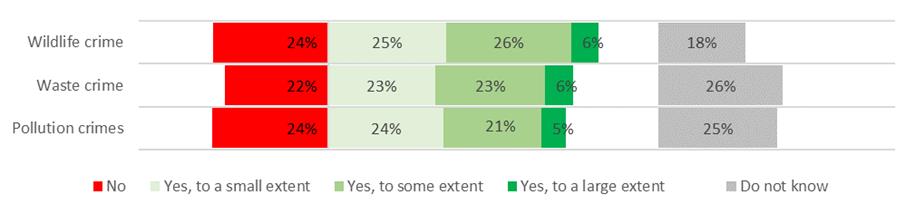
As illustrated in Figure 2.3, the most notable positive changes observed with regards environmental protection over the last ten years were increasing public awareness of the importance of the environment protection, followed by increasing detection of environmental crime. By contrast, respondents have generally observed less convictions with regard to environmental crime (75% of them think this has decreased), less severe sanctions imposed for environmental crime (65% of respondents argue this has gone done) and less resources to fight environmental crime (74%) over the last ten years. The number of respondents suggesting that environmental damage has increased is fairly similar to the number of respondents indicating that it has decreased over the last ten years.
Figure 1.5Question 2. What kind of changes did you observe in your Member State of residence with regard to the protection of the environment over the last 10 years?

Among the 17 duty-holders (businesses or business representatives) or respondents working for a duty-holder who answered the survey almost one in two businesses (47%) states that the criminalisation of environmental offences lead to their organisation taking measures to ensure compliance with environmental law requirements.
29% of business respondents highlight that environmental compliance measures were taken independently of the criminalisation of environmental offences while 18% indicate that the criminalisation of environmental offenses did not lead to take measures.
Figure 1.6Question 3. “Do you work for a duty-holder (for example; company/industry/organisation) obliged by environmental law? Are you a duty-holder with regard to environmental law yourself?” (N = 138)

Figure 1.7Question 3a. “Did you observe that the criminalisation of environmental offences lead to your company/industry/organisation taking measures to comply with environmental law requirements? If you are a duty holder yourself, did you take such measures?” (N = 17)

All businesses reporting that they have taken measures due to the criminalisation of environmental offences, have improved monitoring/controls/compliance measures (8) and adopted compliance training/awareness-raising measures for staff (8).
Figure 1.8Question 3b. “If the answer to the above question is yes, which additional measures have been taken in your company/industry/organisation (several answers are possible)” (N = 8)

As illustrated by Figure 2.7, when asked why the protection of the environment through criminal law as provided in the EU Directive might not be fully effective at the EU overall, a large proportion of respondents point to insufficient cross-border cooperation between Member State authorities and the fact that different criminal sanction levels across the EU makes criminals move their activities to EU Member States with low criminal sanctions or with low risk of detection.
At the national level, difficulties in finding the criminally liable perpetrator stand out as one of the main reasons why the protection of the environment through criminal law as provided in the EU Directive might not be fully effective. Insufficient coordination and cooperation is also reported as particularly notable reason.
At legislative level, respondents highlight the complexity of enforcement of environmental law (interplay between criminal, civil and administrative law), the lack of an effective system for criminal liability for legal persons and the lack of deterrent effect of criminal sanctions and the levels provided for in the national criminal code as the main sources of ineffectiveness of the protection of the environment through criminal law as provided in the EU Directive.
Figure 1.9Question 4. “If you think that the protection of the environment through criminal law as provided in the EU Directive, might not be fully effective in your Member State of residence or the EU overall, what are in your view the main reasons?”
a.At EU level

b.At national law enforcement/judicial level
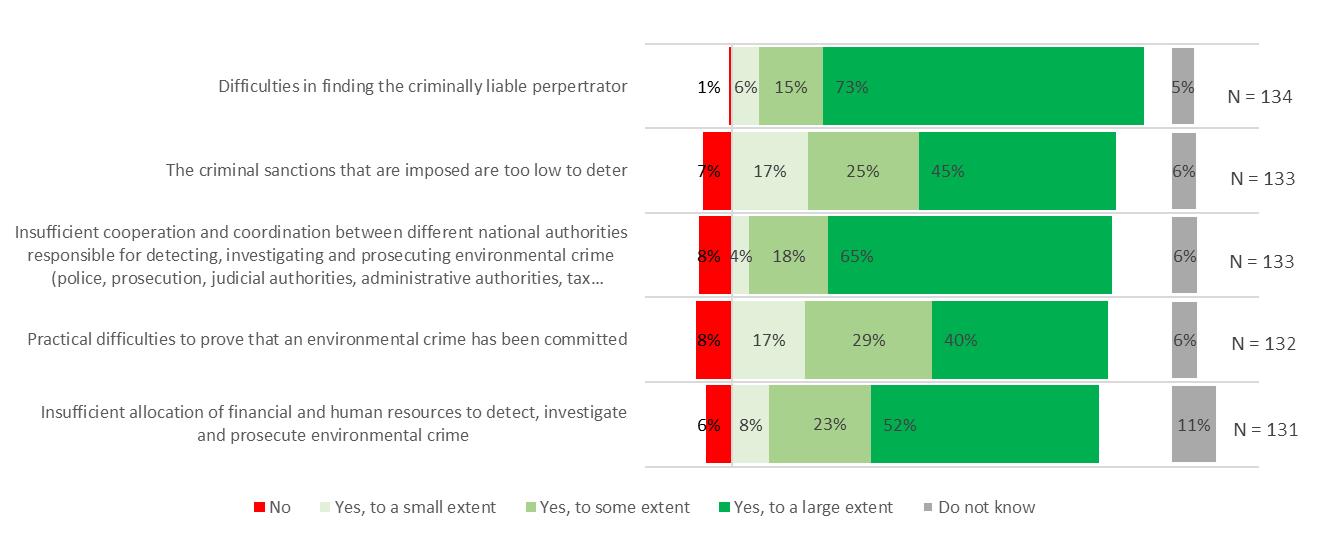
c.At legislative level

To improve the effectiveness of the ECD at EU level, respondents advocate including clearer and more precise definitions in the Directive (this opinion was supported by 62% of respondents) against issuing non-binding guidelines/best practices on vague terms in the Directive, considering legal traditions and case law (this was supported by only 40% of respondents). At Member State level, respondents make the case for transposing vague terms into their national law in a clear and precise manner taking account of their national legal traditions (supported by 52% of respondents) more than clarifying vague terms in case law by the judiciary (supported by 44%). (Figure 2.8)
Figure 1.10Question 5. If terms such as “substantial damage”, “dangerous activity or substances”, “negligible/non-negligible impact” in the legislation negatively affect the effectiveness of the Directive, how could legal clarity be improved? (Several answers are possible) (N = 134)

As illustrated by Figure 2.9, respondents strongly support the proposed rules on particular issues to improve the effectiveness of the Directive including the need for further EU action.
Figure 1.11Question 6: If you consider that the Directive might not be fully effective, please consider whether the following rules on particular issues could have been useful to improve the effectiveness of the Directive? (N = 134)

Efficiency
When asked to assess whether the benefits of increased environmental protection derived from the Directive outweigh the costs linked to its implementation, 73% of respondents answered agreed that they did (see Figure 2.10).
Figure 1.12Question 7: “To what extent would you agree or disagree with the following statement? “The benefits of increased environmental protection derived from the implementation of DIRECTIVE 2008/99/EC on the protection of the environment through criminal law largely outweigh the costs of applying criminal sanctions on environmental crimes in Member States.” (N = 132)

Relevance
According to the public consultation, 87% of respondents agree that criminalisation of environmental offences is an effective way to ensure compliance with environmental law and that criminalisation should complement administrative sanctions and preventive measures. Only 9% of respondents think that criminalisation of environmental offences is ineffective, and that administrative sanctions and preventive measures are effective and sufficient. (see Figure 2.11)
Figure 1.13Question 8. “In your view, is criminalisation of environmental offences an effective way to ensure compliance with environmental law?” (N = 137)
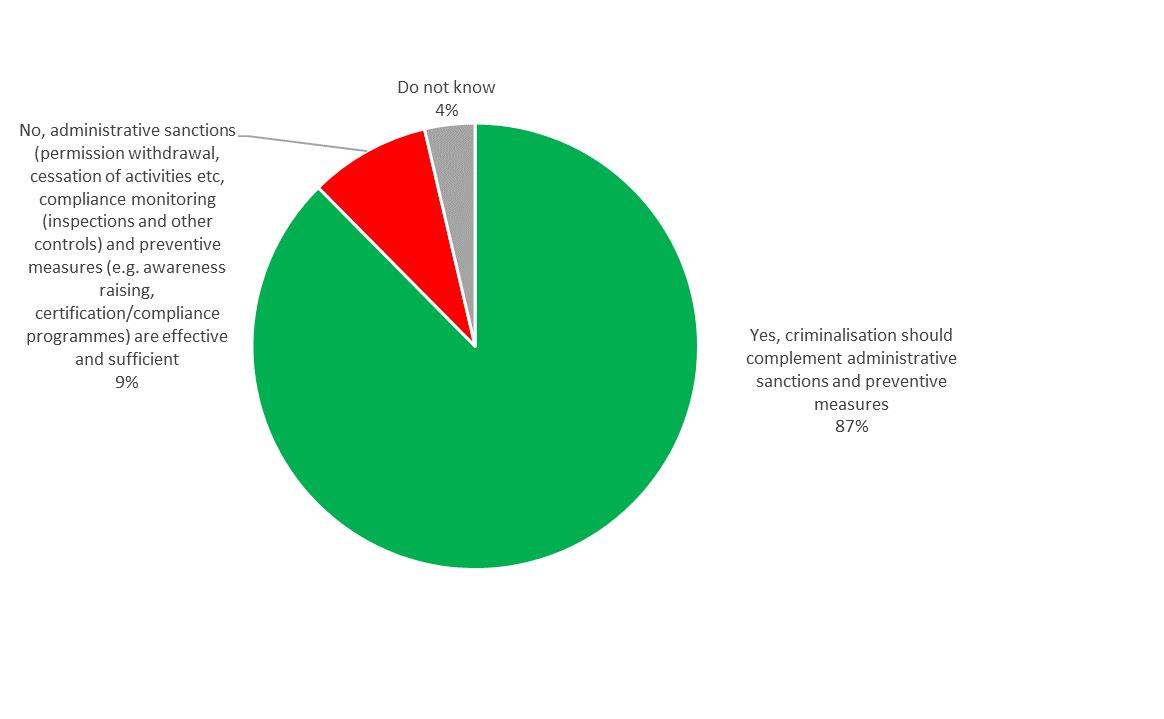
According to respondents, the sanctions and measures that motivate a duty holder (company/industry/organisation, natural person) to take measures to comply with environmental law the most include: the risk of criminal penalty and imprisonment, other sanctions (e.g. withdrawal or suspension of a licence/authorisation to operate an establishment, the shutdown of an establishment, judicial winding up, removing access to public aid, judicial supervision), effective controls (including environmental inspections, custom controls) and the risk of administrative fines. (Figure 2.12)
Figure 1.14Question 9. “In your view, to what extent do the following sanctions and measures motivate a duty holder (company/industry/organisation, natural person) to take measures to comply with environmental law? (N = 138)

The top five sanctions and measures that motivate a duty holder (company/industry/organisation, natural person) to take measures to comply with environmental law the most are similar for businesses and non-businesses.
Figure 1.15Question 9. “In your view, to what extent do the following sanctions and measures motivate a duty holder (company/industry/organisation, natural person) to take measures to comply with environmental law? (N = 138)
a.Non-businesses

b.Businesses

Only 12% of respondents believe that the Directive ensures that challenges of tackling the involvement of organised crime are met. 55% of respondents believe that the Directive lacks provisions to oblige Member States to treat environmental crime committed in the context of organised crime as an aggravating circumstance in court procedures.
Figure 1.16Question 10. “The EU Agenda on Security (2015) highlighted the link between environmental crime and organised crime. In your view, does the Directive ensure that challenges from the involvement of organised crime are met? (Several answers are possible.)” (N = 134)

Out of 138 responses received, 67 (49%) think that the Directive should criminalise intentional or negligent actions which did not violate environmental law but caused serious environmental damage, and 49 (36%) that it should criminalise environmental offences independent of whether they actually caused serious damage. Only 11 respondents (8%) consider that further conducts should not be criminalised.
Figure 1.17Question 11. “In your view, should further conducts be criminalised that are currently not criminalised by the Environmental Crime Directive (Art. 3)?” (N = 138)

Coherence
According to Figure 2.16, a majority (55%) respondents think that it would be both justified and coherent for breaches of fisheries legislation to be criminalised. A further 27% think this is the case, but only for certain serious breaches
Figure 1.18Question 12. “Currently, breaches against EU fishing legislation are not criminalised. Do you find it justified and coherent that breaches of fisheries legislation should be criminalised?” (N = 136)

EU-added value
According to respondents, the strongest influence of the Directive, both at EU and Member State level, comes from its contribution to increasing awareness of the importance of environmental protection. This position is more strongly felt when considering the Directive’s contribution to the EU as a whole (77%) compared to individual Member States (68%).
The next greatest contributions of the Directive, at both EU and Member State level, are its contribution to improving duty holders’ compliance with environmental law, and reducing illegal trade.
In general, respondents were more positive on the contribution of the Directive in the EU as a whole, as opposed to in their Member State. At the Member State level, for all the issues asked about, a meaningful proportion (between 21% and 41%) of respondents stated that the Directive had had no contribution. An area where the Directive has been the least successful at national level, according to respondents, relates to the its contribution to increasing resources allocated to Member States law enforcement and judicial authorities. (See Figure 2.17)
Figure 1.19“Question 13: “In your view, has the Directive contributed to: “
In the EU as a whole

In your Member State of residence

Nearly all (95%) respondents consider that EU action is important to have a framework for effective cross-border cooperation with regard to environmental crime (96%) and 75% agree to a large extent with that statement. Furthermore, 44% believe Member States could not have reached the same result by national criminal legislation if there was no EU action on environment crime, or only to a small extent (24%).
Figure 1.20Question 14. “To what extent do you agree with the following: i) EU action is important to have a framework for effective cross-border cooperation with regard to environmental crime. ii) If there was no EU action on environmental crime, Member States would have reached the same result by national criminal legislation.” (N = 136)

Other issues related to the ECD
To conclude, stakeholders were asked to mention any other issues with regard to the Directive to which they would like to draw the European Commission’s attention (Question 15). Issues mentioned across the different groups of stakeholders include:
ŸThe need to impose stronger criminal liability and serious financial penalties.
ŸThe need for further concrete action at EU level in the field of environmental protection in the Member States to combat organised crime.
ŸThe need to allocate adequate resources to the issue of environmental crime, and to provide training and information to law enforcement personnel, prosecutors and judges.
ŸThe need to address inconsistencies in the application of the Directive in the EU, including different sanctions Member States can impose.
ŸThe need to increase awareness about environmental legislation among citizens.
ANNEX - 5A - Responses of “private individuals” vs all other stakeholders
Annex 5a provides a comparative analysis of some of the public consultation questions between the private individuals and the other stakeholders.
|
Question n°
|
Private individuals
|
All other stakeholders
|
|
Familiarity
|

|

|
|
1a - In your view, did the protection of the environment improve over the last ten years in your Member State of residence?
|

|

|
|
1b - In your view, did the protection of the environment improve over the last ten years in the European Union overall?
|
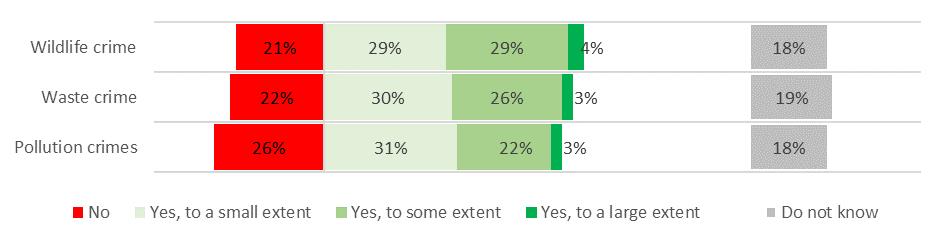
|

|
|
2 - What kind of changes did you observe in your Member State of residence with regard to the protection of the environment over the last 10 years?
|

|

|
|
5 - If terms such as “substantial damage”, “dangerous activity or substances”, “negligible/non-negligible impact” in the legislation negatively affect the effectiveness of the Directive, how could legal clarity be improved?
|
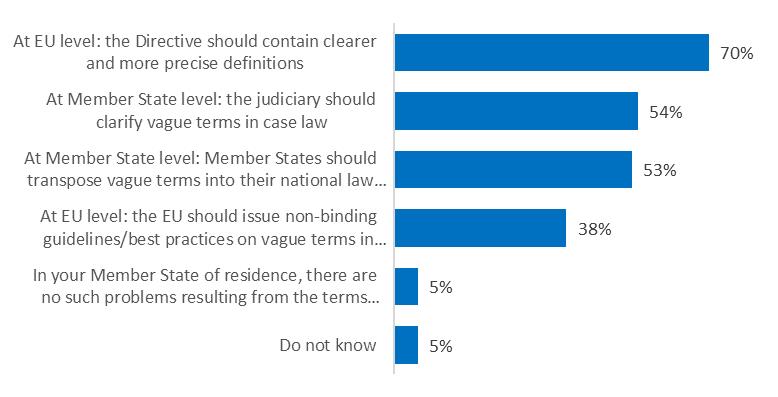
|

|
|
8 - In your view, is criminalisation of environmental offences an effective way to ensure compliance with environmental law?
|

|

|
ANNEX - 5B - Duty holders vs. judges and prosecutors
Annex 5B provides a comparative analysis of some of the public consultation questions between the duty holders and judges and prosecutors.
|
Question n°
|
Duty holders
|
Judges and prosecutors
|
|
1a - In your view, did the protection of the environment improve over the last ten years in your Member State of residence?
|

N = 11
|

N = 7
|
|
1b - In your view, did the protection of the environment improve over the last ten years in the European Union overall?
|

N = 10
|

N = 7
|
|
2 - What kind of changes did you observe in your Member State of residence with regard to the protection of the environment over the last 10 years?
|
Sample too low to compare.
|
|
|
4 - If you think that the protection of the environment through criminal law as provided in the EU Directive might not be fully effective in your Member State of residence or the EU overall, what are in your view the main reasons? Please assess below.
|
EU level (N = 9):

At national law enforcement/judicial level (N = [8, 12])

At legislative level (N = 8):

|
EU level (N = 7):

At national law enforcement/judicial level (N = 7):
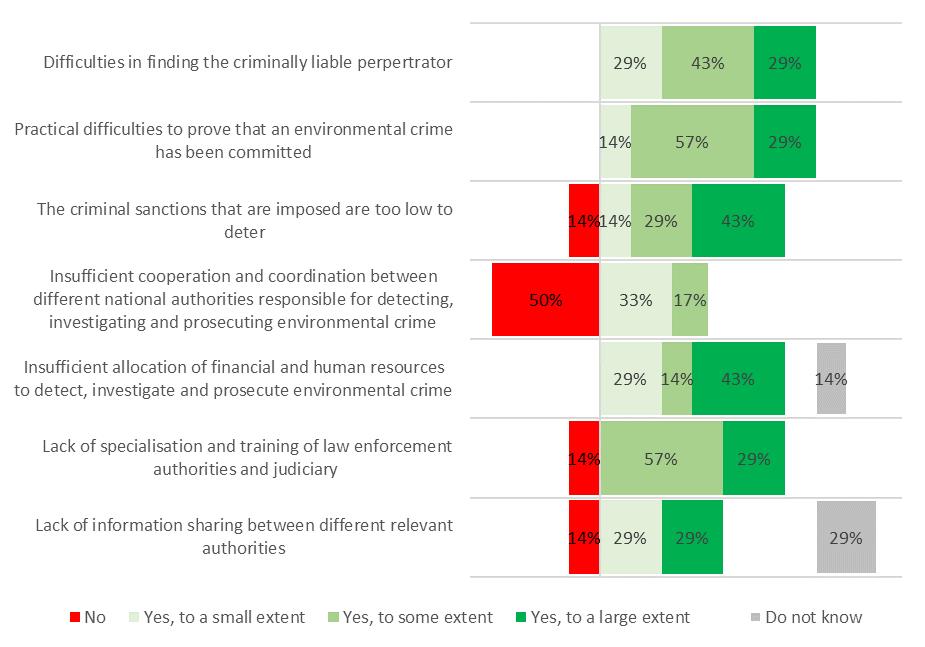
At legislative level (N = 7):

|
|
5 - If terms such as “substantial damage”, “dangerous activity or substances”, “negligible/non-negligible impact” in the legislation negatively affect the effectiveness of the Directive, how could legal clarity be improved?
|
Sample too low to compare
|
|
|
6 - If you consider that the Directive might not be fully effective, please consider whether the following rules on particular issues could have been useful to improve the effectiveness of the Directive?
|
N = [7, 9]

|
N = [4, 7]
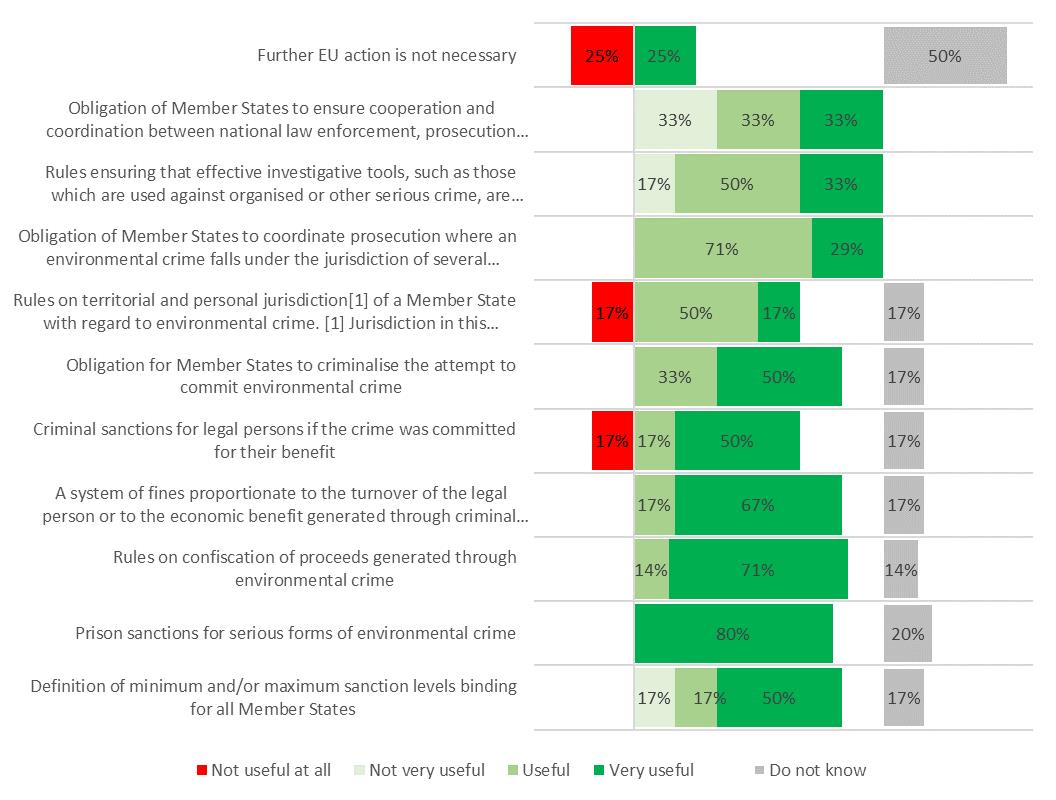
|
|
7 - To what extent would you agree or disagree with the following statement? “The benefits of increased environmental protection derived from the implementation of DIRECTIVE 2008/99/EC on the protection of the environment through criminal law largely outweigh the costs of applying criminal sanctions on environmental crimes in Member States”
|
N = 10

|
N = 7

|
|
8 - In your view, is criminalisation of environmental offences an effective way to ensure compliance with environmental law?
|
N = 10

|
N = 7

|
|
9 - “In your view, to what extent do the following sanctions and measures motivate a duty holder (company/industry/organisation, natural person) to take measures to comply with environmental law?
|
N = [10, 11]

|
N = 7

|
|
10 - The EU Agenda on Security (2015) highlighted the link between environmental crime and organised crime. In your view, does the Directive ensure that challenges from the involvement of organised crime are met? (Several answers are possible.)”
|
Sample too low to compare
|
|
|
11 - In your view, should more acts be criminalised by the Directive (Art. 3)?
|
N = 10

|
N = 7

|
|
13 - “In your view, has the Directive contributed to:
|
In the EU as a whole (N = [8,9])

In your Member State of residence (N = [6,9])

|
In the EU as a whole (N = [5,7])

In your Member State of residence (N = [3,7])

|
Annex 6 – TARGETED CONSULTATION QUESTIONNAIRE
Targeted consultation as part of the evaluation of Directive 2008/99 on the protection of the environment through criminal law
This consultation is part of the evaluation of
Directive 2008/99/EC
on the protection of the environment through criminal law (the ‘Environmental Crime Directive’). This evaluation is the first one since the adoption of the Directive in 2011. The study to support the Commission’s evaluation is being carried out by a team of consultants from Milieu and ICF.
With this evaluation, the European Commission (Directorate General for Justice) will assess the results achieved by the Environmental Crime Directive with regard to its objectives. The main objective of this Directive is to improve the protection of the environment by reducing environmental crime. Its specific objectives are to:
·Create a level playing field as regards the offences criminalised and sanctioning systems at national level across the EU
·Establish a sufficiently deterrent criminal sanctioning system for environmental offences
·Protect fair playing businesses
·Reduce illegal trade
·Improve judicial cooperation
Concretely, the Environmental Crime Directive requires Member States to criminalise unlawful conduct that causes or is likely or presumed to cause damage to the environment or wildlife or death or serious injury to persons (see Article 3 of the Directive). The conduct is defined as ‘unlawful’ when it infringes the EU environmental legislation listed in the Annexes A and B to the Directive, or national acts based on this EU legislation. It obliges Member States to criminalise inciting, aiding and abetting such offenses. The Directive also requires Member States to ensure that legal persons can be held liable for offences committed for their benefit – this responsibility can be of criminal or other nature – and to ensure effective, proportionate and dissuasive criminal penalties for environmental crimes, without providing for more detailed requirements on the types and levels of penalties.
The evaluation will assess the results achieved by the Environmental Crime Directive since the adoption of the Directive in 2011. The focus is mainly on waste crime (the illegal storage, disposal or recovery of waste and the illegal collection, transport (including shipment) of waste) and wildlife crime (i.e. the killing, destruction, possession or taking of wildlife; illegal wildlife trade; any conduct which causes the significant deterioration of a habitat within a protected site), although other areas of environmental crime will be considered – although less thoroughly – in the evaluation such as water, air, or soil pollution. The evaluation will specifically consider the:
·Effectiveness (the extent to which objectives have been achieved);
·Efficiency (consideration of the resources required to achieve the objectives in comparison to the benefits);
·Relevance (the extent to which the Directive continues to meet the needs of the EU and its citizens);
·Coherence (how the Directive interacts with other relevant areas of EU policy); and,
·EU Added Value (the value of the Directive in comparison to Member State action alone).
The different parts of the questionnaire address each of these evaluation criteria.
Responding to the survey
This targeted consultation aims to gather information and the views of stakeholders on how the Environmental Crime Directive has performed since 2011.
The European Commission has launched the
public consultation
linked to the evaluation of Directive 2008/99/EC on 10 October 2019. The results of both questionnaires will feed in the evaluation study and the final Staff Working document adopted by the Commission. The public consultation covers the same evaluation criteria, but is shorter and directed towards a wider audience. This questionnaire is sent to a smaller audience of experts.
The questionnaire is being sent to:
·Ministries responsible for justice in all Member States
·Ministries responsible for environment in all Member States
·Environmental regulators other than ministries (i.e. environmental agencies), selected based on membership of NEPA).
·Environmental inspectors in all Member States (selected based on membership of IMPEL)
·Prosecutors in all Member States (selected based on membership of ENPE)
·Judges in all Member States (selected based on membership of EUFJE)
·Police officers in all Member States (selected based on membership of EnviCrimeNet)
·Customs officers in all Member States
·Criminal defence lawyers in all Member States
·Environmental NGOs at EU and national level
·Organisations representing industry
·Businesses
As the consultation targets a diverse range of stakeholders, and the evaluation questions cover many different aspects of the Environmental Crime Directive, respondents are asked to respond to the questions for which they feel they have the expertise or experience to enable them to provide an informed answer. If you do not know or do not have an opinion, simply do not provide an answer. Only questions marked with a red asterisk are mandatory.
It is also important that answers are substantiated to the extent possible. The open text fields provide the possibility to explain answers, and also to provide concrete evidence to support the answers. Wherever possible, we ask you to identify and describe real-life examples, specific cases of environmental crimes or other situations that can concretely illustrate the response. You can provide links in all open questions and/or upload documents at the end of the questionnaire to support these examples.
You may interrupt your session at any time and continue answering at a later stage. If you do so, please remember to save the link to your answers as this is the only way to access them. Once you have submitted your answers online, you will be able to download a copy of the completed questionnaire.
We kindly ask you to fill in the questionnaire by 30 November. If you have any questions regarding the consultation, please contact:
ecocrimeevaluation@milieu.be
Personal data and privacy statement
No responses to the survey will be published. All personal data gathered for this survey is subject to the conditions laid down in the
privacy statement
. Please read this carefully before you reply to the following questions. Your consent can be withdrawn any time by contacting the data controller, as outlined in the privacy statement.
□ I consent to include my name and any contact details provided by me in this survey in a database for the purposes of the project.
*Are you replying as:
|
◯
|
A national ministry responsible for justice
|
|
◯
|
A national ministry responsible for environment
|
|
◯
|
A national environmental regulator
|
|
◯
|
A regional/local environmental regulator
|
|
◯
|
An environmental inspector
|
|
◯
|
A prosecutor
|
|
◯
|
A judge
|
|
◯
|
A police officer
|
|
◯
|
A customs officer
|
|
◯
|
A criminal defence lawyer
|
|
◯
|
An academic
|
|
◯
|
An environmental NGO
|
|
◯
|
An organisation representing industry
|
|
◯
|
A business
|
|
◯
|
Other
|
*If other, please specify:
*Do you have experience in or knowledge of these areas of environmental crime (please select all that apply)
|
□
|
Waste crime
|
|
□
|
Wildlife crime
|
|
□
|
Other environmental crime
|
|
□
|
None of the above
|
*At what level is your organisation primarily active?
|
◯
|
EU level
|
|
◯
|
National level
|
|
◯
|
Regional / local level
|
*If you are replying on behalf of an organisation, please state the name of the organisation, and the name and position of the respondent. If you are replying as an individual expert, please state your name.
*In which country(ies) do you have experience with prosecution of environmental crime? (Please mark all that apply)
|
□
|
Austria
|
|
□
|
Belgium
|
|
□
|
Bulgaria
|
|
□
|
Croatia
|
|
□
|
Cyprus
|
|
□
|
Czechia
|
|
□
|
Denmark
|
|
□
|
Estonia
|
|
□
|
Finland
|
|
□
|
France
|
|
□
|
Germany
|
|
□
|
Greece
|
|
□
|
Hungary
|
|
□
|
Ireland
|
|
□
|
Italy
|
|
□
|
Latvia
|
|
□
|
Lithuania
|
|
□
|
Luxembourg
|
|
□
|
Malta
|
|
□
|
Netherlands
|
|
□
|
Poland
|
|
□
|
Portugal
|
|
□
|
Romania
|
|
□
|
Slovak Republic
|
|
□
|
Slovenia
|
|
□
|
Spain
|
|
□
|
Sweden
|
|
□
|
United Kingdom
|
|
□
|
EU level
|
|
□
|
Other
|
*If other, please specify:
If you agree to be contacted for further clarifications or for a follow-up interview, please provide an email address
Assessing the effectiveness of the Ecocrime Directive means analysing the extent to which its objectives have been met and identifying any significant factors that may have contributed to or inhibited progress towards meeting those objectives.
Improving the protection of the environment through the reduction of environmental crime
1.In your opinion, has the Ecocrime Directive contributed to improving the protection of the environment by reducing environmental crime? And if so, to what extent can this be attributed to the Directive?
Yes, and it can be significantly attributed to the Directive
Yes, and it can be partly attributed to the Directive
Yes, but the contribution of the Directive was minimal
No contribution has been observed
Please explain your answers to Question 1 above, based on your experience and including examples (where possible).
Creating a level playing field as regards the offences criminalised and sanctioning systems at national level across the EU
2.Has the public attitude to breaches of environmental law changed since the adoption of the Directive?
|
|
To a major extent
|
To a moderate extent
|
To a minor extent
|
Not at all
|
|
More concerned about the serious impact on health
|
◯
|
◯
|
◯
|
◯
|
|
More concerned about the serious impact on the environment
|
◯
|
◯
|
◯
|
◯
|
|
More aware of potential links with organised crime
|
◯
|
◯
|
◯
|
◯
|
Please explain your answers to Question 2 above, based on your experience and including examples (where possible).
Creating a level playing field as regards the offences criminalised and sanctioning systems at national level across the EU
3.In your opinion, has the Directive produced a level playing field in relation to environmental offences and sanctions in the Member States and thus avoided safe havens?
|
|
To a major extent
|
To a moderate extent
|
To a minor extent
|
Not at all
|
|
Wildlife offences
|
◯
|
◯
|
◯
|
◯
|
|
Waste offences
|
◯
|
◯
|
◯
|
◯
|
|
Other environmental offences
|
◯
|
◯
|
◯
|
◯
|
Please explain your answers to Question 3 above, based on your experience and including examples (where possible).
4.In your opinion, has the Directive resulted in sufficiently effective, proportionate and dissuasive criminal sanctions?
|
|
To a major extent
|
To a moderate extent
|
To a minor extent
|
Not at all
|
|
Wildlife offences
|
◯
|
◯
|
◯
|
◯
|
|
Waste offences
|
◯
|
◯
|
◯
|
◯
|
|
Other environmental offences
|
◯
|
◯
|
◯
|
◯
|
Please explain your answers to Question 4 above, based on your experience and including examples (where possible).
5.In your opinion, has the Directive resulted in sufficiently effective, proportionate and dissuasive sanctions for legal persons?
|
|
To a major extent
|
To a moderate extent
|
To a minor extent
|
Not at all
|
|
Wildlife offences
|
◯
|
◯
|
◯
|
◯
|
|
Waste offences
|
◯
|
◯
|
◯
|
◯
|
|
Other environmental offences
|
◯
|
◯
|
◯
|
◯
|
Please explain your answers to Question 5 above, based on your experience and including examples (where possible).
6.In your opinion, have the following factors supported or inhibited the establishment of a level playing field as regards the offences criminalised and the sanctioning systems across the EU?
|
|
Strongly supported
|
Slightly supported
|
Neither supported nor inhibited
|
Slightly inhibited
|
Strongly inhibited
|
|
Inconsistent interpretation of ‘effective, proportionate and dissuasive sanctions’
|
◯
|
◯
|
◯
|
◯
|
◯
|
|
Sanctions imposed do not take account of profit made from commission of offence
|
◯
|
◯
|
◯
|
◯
|
◯
|
|
The absence of criminal sanctions for legal persons in all Member States
|
◯
|
◯
|
◯
|
◯
|
◯
|
|
Poor enforcement of EU environmental legislation at national level in some Member States
|
◯
|
◯
|
◯
|
◯
|
◯
|
|
Lack of prioritisation of enforcement of EU environmental legislation and/or environmental crime in some Member States
|
◯
|
◯
|
◯
|
◯
|
◯
|
|
Insufficient human and financial resources to enforce EU environmental legislation and address environmental crime in some Member States
|
◯
|
◯
|
◯
|
◯
|
◯
|
|
Insufficiently specialised human resources to enforce EU environmental legislation and address environmental crime in some Member States.
|
◯
|
◯
|
◯
|
◯
|
◯
|
|
Training and guidance at EU level
|
◯
|
◯
|
◯
|
◯
|
◯
|
|
Establishment of networks of EU practitioners
|
◯
|
◯
|
◯
|
◯
|
◯
|
|
Other
|
◯
|
◯
|
◯
|
◯
|
◯
|
If other, describe these factors below and explain how they inhibited the creation of a level playing field for environmental offences in the EU.
Please explain your answers to Question 6 above based on your experience and including examples (where possible).
7.(Only for practitioners – environmental inspectors, prosecutors, judges, police officers, customs officers. Criminal defence lawyers) In your opinion, have practitioners (judges, prosecutors, defence lawyers, police officers and customs officers, inspectors) specialised in environmental crime since the adoption of the Environmental Crime Directive?
|
|
To a major extent
|
To a moderate extent
|
To a minor extent
|
Not at all
|
|
Judges
|
◯
|
◯
|
◯
|
◯
|
|
Prosecutors
|
◯
|
◯
|
◯
|
◯
|
|
Defence lawyers
|
◯
|
◯
|
◯
|
◯
|
|
Police officers
|
◯
|
◯
|
◯
|
◯
|
|
Customs officers
|
◯
|
◯
|
◯
|
◯
|
|
Inspectors
|
◯
|
◯
|
◯
|
◯
|
(Only for practitioners – environmental inspectors, prosecutors, judges, police officers, customs officers. Criminal defence lawyers) Please explain your answers to Question 7 above, based on your experience and including examples (where possible).
8.(Only for practitioners – environmental inspectors, prosecutors, judges, police officers, customs officers. Criminal defence lawyers) In your opinion, in what areas of environmental crime have practitioners specialised?
|
|
To a major extent
|
To a moderate extent
|
To a minor extent
|
Not at all
|
|
Wildlife offences
|
◯
|
◯
|
◯
|
◯
|
|
Waste offences
|
◯
|
◯
|
◯
|
◯
|
|
Other environmental offences
|
◯
|
◯
|
◯
|
◯
|
(Only for practitioners – environmental inspectors, prosecutors, judges, police officers, customs officers. Criminal defence lawyers) Please explain your answers to Question 8 above, based on your experience and including examples (where possible).
9.(Only for practitioners – environmental inspectors, prosecutors, judges, police officers, customs officers. Criminal defence lawyers) Has the number of training events on environmental crime for practitioners (judges, prosecutors, defence lawyers, police officers, customs officers and inspectors) increased since the adoption of the Environmental Crime Directive?
|
|
Yes
|
No
|
|
Judges
|
◯
|
◯
|
|
Prosecutors
|
◯
|
◯
|
|
Defence lawyers
|
◯
|
◯
|
|
Police officers
|
◯
|
◯
|
|
Customs officers
|
◯
|
◯
|
|
Inspectors
|
◯
|
◯
|
10.(Only for practitioners – environmental inspectors, prosecutors, judges, police officers, customs officers. Criminal defence lawyers) In your opinion, in what areas of environmental crime have the number of training events increased?
|
|
Yes
|
No
|
|
Wildlife offences
|
◯
|
◯
|
|
Waste offences
|
◯
|
◯
|
|
Other environmental offences
|
◯
|
◯
|
Establishing an effective criminal sanctionning system for environmental offences
11.In your opinion, has the Directive resulted in an overall increase of investigation of environmental crimes in the Member States?
|
|
Yes, and it can be significantly attributed to the Directive
|
Yes, and it can be partly attributed to the Directive
|
Yes, but the contribution of the Directive was minimal
|
No contribution has been observed
|
|
Wildlife offences
|
◯
|
◯
|
◯
|
◯
|
|
Waste offences
|
◯
|
◯
|
◯
|
◯
|
|
Other environmental offences
|
◯
|
◯
|
◯
|
◯
|
12.In your opinion, has the Directive resulted in an overall increase of criminal trials of environmental crimes in the Member States?
|
|
Yes, and it can be significantly attributed to the Directive
|
Yes, and it can be partly attributed to the Directive
|
Yes, but the contribution of the Directive was minimal
|
No contribution has been observed
|
|
Wildlife offences
|
◯
|
◯
|
◯
|
◯
|
|
Waste offences
|
◯
|
◯
|
◯
|
◯
|
|
Other environmental offences
|
◯
|
◯
|
◯
|
◯
|
13.In your opinion, has the Directive overall resulted in an increase in the level of sanctions imposed for environmental crimes in the Member States?
|
|
Yes, and it can be significantly attributed to the Directive
|
Yes, and it can be partly attributed to the Directive
|
Yes, but the contribution of the Directive was minimal
|
No contribution has been observed
|
|
Wildlife offences
|
◯
|
◯
|
◯
|
◯
|
|
Waste offences
|
◯
|
◯
|
◯
|
◯
|
|
Other environmental offences
|
◯
|
◯
|
◯
|
◯
|
14.In your opinion, has the Directive overall resulted in the increased imposition of liability for environmental crime on legal persons?
|
|
Yes, and it can be significantly attributed to the Directive
|
Yes, and it can be partly attributed to the Directive
|
Yes, but the contribution of the Directive was minimal
|
No contribution has been observed
|
|
Wildlife offences
|
◯
|
◯
|
◯
|
◯
|
|
Waste offences
|
◯
|
◯
|
◯
|
◯
|
|
Other environmental offences
|
◯
|
◯
|
◯
|
◯
|
15.In your opinion, have the following factors contributed to observed trends in the investigation, criminal trials and sanctioning of environmental crime? (internal factors)
|
|
Yes, but it was attributable to the Directive
|
Yes, and it was independent of the Directive
|
No, it has not contributed
|
No, it did not happen
|
|
Increased human and financial resources dedicated to enforcement of EU environmental legislation and fighting environmental crime
|
◯
|
◯
|
◯
|
◯
|
|
Increased training of environmental practitioners
|
◯
|
◯
|
◯
|
◯
|
|
Increased specialisation of environmental practitioners
|
◯
|
◯
|
◯
|
◯
|
|
Increased prioritisation by national governments of enforcement of EU environmental legislation
|
◯
|
◯
|
◯
|
◯
|
|
Guidance by government (such as sentencing guidelines)
|
◯
|
◯
|
◯
|
◯
|
|
Changes in national legislation in relation to environmental crime
|
◯
|
◯
|
◯
|
◯
|
|
Other
|
◯
|
◯
|
◯
|
◯
|
If other in Questions 15, describe these factors below and explain how they have contributed to trends in the investigation, criminal trials and sanctioning of environmental crime.
16.In your opinion, have the following factors contributed to observed trends in the investigation, criminal trials and sanctioning of environmental crime? (external factors)
|
|
To a major extent
|
To a moderate extent
|
To a minor extent
|
Not at all
|
|
Increased involvement of organised crime in environmental crime
|
◯
|
◯
|
◯
|
◯
|
|
New areas of environmental crime
|
◯
|
◯
|
◯
|
◯
|
|
Increased public pressure
|
◯
|
◯
|
◯
|
◯
|
|
Other
|
◯
|
◯
|
|
|
If other in Questions 16, describe these factors below and explain how they have contributed to trends in the investigation, criminal trials and sanctioning of environmental crime.
Improving judicial cooperation
17.(Only for practitioners – environmental inspectors, prosecutors, judges, police officers, customs officers. Criminal defence lawyers) Has the Directive resulted in increased cooperation between law enforcement and environmental practitioners within Member States?
|
◯
|
To a major extent
|
|
◯
|
To a moderate extent
|
|
◯
|
To a minor extent
|
|
◯
|
Not at all
|
(Only for practitioners – environmental inspectors, prosecutors, judges, police officers, customs officers. Criminal defence lawyers) Please explain your answers to Question 17 above, based on your experience and including examples (where possible).
18.Has the Directive resulted in increased cooperation between Member States in relation to cross-border environmental offences?
|
◯
|
To a major extent
|
|
◯
|
To a moderate extent
|
|
◯
|
To a minor extent
|
|
◯
|
Not at all
|
Please explain your answers to Question 18 above, based on your experience and including examples (where possible). Please indicate which factors, in your opinion, supported or inhibited judicial cooperation.
Assessing the efficiency of the Environmental Crime Directive means assessing whether the costs involved in the implementation of the Directive are reasonable and in proportion to the changes or effects achieved. For that purpose, it is important to get an understanding of the type and magnitude of the costs and benefits of the Directive.
Costs of the Directive
19.(Only for practitioners – environmental inspectors, prosecutors, judges, police officers, customs officers. Criminal defence lawyers – businesses and organisation representing industry) To what extent has the entry into force of the Directive at national level increased your work as practitioner (judges, prosecutors, defence lawyers, police officers and customs officers, inspectors) specialised in environmental crime, or in your business (or businesses you represent)?
|
◯
|
To a major extent
|
|
◯
|
To a moderate extent
|
|
◯
|
To a minor extent
|
|
◯
|
Not at all
|
(Only for practitioners – environmental inspectors, prosecutors, judges, police officers, customs officers. Criminal defence lawyers – businesses and organisation representing industry) Please explain your answers to Question 19 above, based on your experience and including examples (where possible). Please indicate which factors, in your opinion, have influenced workloads
20.(Only for practitioners – environmental inspectors, prosecutors, judges, police officers, customs officers. Criminal defence lawyers – ministries responsible for justice, ministries responsible for environment, and environmental regulators) In your opinion, has the Directive had an effect on the typical cost (staff time and resources) of investigating an environmental crime in your country?
|
|
Major increase
|
Moderate increase
|
Minor increase
|
No change
|
Minor decrease
|
Moderate decrease
|
Major decrease
|
|
Wildlife offences
|
◯
|
◯
|
◯
|
◯
|
◯
|
◯
|
◯
|
|
Waste offences
|
◯
|
◯
|
◯
|
◯
|
◯
|
◯
|
◯
|
|
Other environmental offences
|
◯
|
◯
|
◯
|
◯
|
◯
|
◯
|
◯
|
Only for practitioners – environmental inspectors, prosecutors, judges, police officers, customs officers. Criminal defence lawyers – ministries responsible for justice, ministries responsible for environment, and environmental regulators) Please explain your answer to Question 20 above, by stating the reasons why typical investigation costs have or have not increased.
21.(Only for practitioners – environmental inspectors, prosecutors, judges, police officers, customs officers. Criminal defence lawyers – ministries responsible for justice, ministries responsible for environment, and environmental regulators) In your opinion, has the Directive had an effect on the typical cost (staff time and resources) of criminal trials of environmental crime in your country?
|
|
Major increase
|
Moderate increase
|
Minor increase
|
No change
|
Minor decrease
|
Moderate decrease
|
Major decrease
|
|
Wildlife offences
|
◯
|
◯
|
◯
|
◯
|
◯
|
◯
|
◯
|
|
Waste offences
|
◯
|
◯
|
◯
|
◯
|
◯
|
◯
|
◯
|
|
Other environmental offences
|
◯
|
◯
|
◯
|
◯
|
◯
|
◯
|
◯
|
(Only for practitioners – environmental inspectors, prosecutors, judges, police officers, customs officers. Criminal defence lawyers – ministries responsible for justice, ministries responsible for environment, and environmental regulators) Please explain your answers to Question 21 above, by stating the reasons why typical prosecuting costs have or have not increased.
22.(Only for practitioners – environmental inspectors, prosecutors, judges, police officers, customs officers. Criminal defence lawyers – ministries responsible for justice, ministries responsible for environment, and environmental regulators) Which capacities, structures and resources have been improved or stepped up in your organisation as a result of the Directive and what have been the associated costs? Please provide estimated costs for your organisation.
|
|
Cost (EUR) (please indicate if one-off or recurring)
|
|
Training
|
|
|
Specialisation of staff
|
|
|
New staff
|
|
|
Establishment of specialised units
|
|
|
Monitoring and reporting process
|
|
|
Cooperation structures and process
|
|
|
New equipment
|
|
|
Legal advice
|
|
|
Other
|
|
If other, please specify the action and its cost.
23.(Only for businesses and organisation representing industry) What capacities, structures and resources have been allocated by your business (or businesses you represent), as result of the Directive, to ensure crimes are not committed?
|
|
Compliance training / awareness raising
|
|
|
Additional legal advice
|
|
|
Improvement of monitoring/controls/compliance measures/work flows
|
|
|
Investments in equipment/assets/production sites/specialised staff etc.
|
|
|
External consultancy/advice
|
|
|
Other
|
(Only for businesses and organisation representing industry) Please provide details to support your response to Question 23. If you ticked 'other', please specify.
24.(Only for practitioners – environmental inspectors, prosecutors, judges, police officers, customs officers. Criminal defence lawyers – ministries responsible for justice, ministries responsible for environment, and environmental regulators) Could you provide an estimate of the resources you or your team/department/organisation allocate(s) on an annual basis to addressing environmental crime? Please indicate whether these costs relate to you/your team/department/organisation.
|
|
Time/year (days/year)
|
Resources/year (EUR/year)
|
|
Me as practitioner
|
|
|
|
My team
|
|
|
|
My department
|
|
|
|
My organisation
|
|
|
25.(Only for practitioners – environmental inspectors, prosecutors, judges, police officers, customs officers. Criminal defence lawyers – ministries responsible for justice, ministries responsible for environment, and environmental regulators) Could you provide an estimate of the number of staff in your country involved in addressing environmental crime?
|
|
Estimated number of staff involved in the investigation, prosecution, and litigation of environmental crime in your country (number of individuals)
|
|
Judges
|
|
|
Prosecutors
|
|
|
Defence lawyers
|
|
|
Police officers
|
|
|
Customs officers
|
|
|
Inspectors
|
|
|
Other (please specify)
|
|
26.(Only for practitioners – environmental inspectors, prosecutors, judges, police officers, customs officers. Criminal defence lawyers – ministries responsible for justice, ministries responsible for environment, and environmental regulators) In your opinion, has the Directive resulted in an increase in the number of staff in your country involved in enforcing environmental crime?
|
|
Yes, and it can be significantly attributed to the Directive
|
Yes, and it can be partly attributed to the Directive
|
Yes, but the contribution of the Directive was minimal
|
No increase has been observed
|
|
Overall
|
◯
|
◯
|
◯
|
◯
|
|
Wildlife offences
|
◯
|
◯
|
◯
|
◯
|
|
Waste offences
|
◯
|
◯
|
◯
|
◯
|
|
Other environmental offences
|
◯
|
◯
|
◯
|
◯
|
27.(Only for practitioners – environmental inspectors, prosecutors, judges, police officers, customs officers. Criminal defence lawyers – ministries responsible for justice, ministries responsible for environment, environmental regulators, businesses and organisations representing industry) Is there potential for the EU and Member States to simplify or reduce the costs deriving from the Directive, without undermining its intended objectives?
(Only for practitioners – environmental inspectors, prosecutors, judges, police officers, customs officers. Criminal defence lawyers – ministries responsible for justice, ministries responsible for environment, environmental regulators, businesses and organisations representing industry) Please explain your answer and provide examples of opportunities to simplify or reduce costs, relating to Question 27 above.
28.(Only for practitioners – environmental inspectors, prosecutors, judges, police officers, customs officers. Criminal defence lawyers – ministries responsible for justice, ministries responsible for environment, environmental regulators, businesses and organisations representing industry) Do you know of examples of best practices that can help to improve efficiency i.e. the costs relative to the benefits?
If you responded ‘yes’ to Question 28 above, please provide details of best practices including details of how and to what extent they can improve efficiency.
Benefits of the Directive
29.In your opinion, has the Directive resulted in a decrease (or reduced growth) in illegal activity in the following areas?
|
|
Yes, to a major extent
|
Yes, to a moderate extent
|
Yes, to a minor extent
|
Not at all
|
|
Wildlife
|
◯
|
◯
|
◯
|
◯
|
|
Waste
|
◯
|
◯
|
◯
|
◯
|
|
Other environmental areas
|
◯
|
◯
|
◯
|
◯
|
If you responded ‘yes’ to Question 29 above, please provide details of the types of illegal activity that have seen a reduction (or reduced rate of growth)
30.If you responded ‘yes’ to a decrease (or reduced growth) in illegal activity in relation to wildlife, what benefits do you think have occurred as a result of a decrease in illegal wildlife activity?
|
|
To a major extent
|
To a moderate extent
|
To a minor extent
|
Not at all
|
|
Environmental benefits
|
◯
|
◯
|
◯
|
◯
|
|
Economic benefits
|
◯
|
◯
|
◯
|
◯
|
|
Societal benefits
|
◯
|
◯
|
◯
|
◯
|
Please explain your answers to Question 30 above, including examples (where possible).
31.If you responded ‘yes’ to a decrease (or reduced growth) in illegal activity in relation to waste, what benefits do you think have occurred as a result of a decrease in illegal waste activity?
|
|
To a major extent
|
To a moderate extent
|
To a minor extent
|
Not at all
|
|
Environmental benefits
|
◯
|
◯
|
◯
|
◯
|
|
Economic benefits
|
◯
|
◯
|
◯
|
◯
|
|
Societal benefits
|
◯
|
◯
|
◯
|
◯
|
Please explain your answers to Question 31 above, including examples (where possible).
32.If you responded ‘yes’ to a decrease (or reduced growth) in illegal activity in other environmental areas, what benefits do you think have occurred as a result of a decrease in other types of illegal environmental offence activity?
|
|
To a major extent
|
To a moderate extent
|
To a minor extent
|
Not at all
|
|
Environmental benefits
|
◯
|
◯
|
◯
|
◯
|
|
Economic benefits
|
◯
|
◯
|
◯
|
◯
|
|
Societal benefits
|
◯
|
◯
|
◯
|
◯
|
Please explain your answers to Question 32 above, including examples (where possible).
Comparing the costs and benefits of the Directive
33.To what extent would you agree or disagree with the following statement? “The costs of applying criminal sanctions on environmental crimes in Member States are proportionate and justified given the expected benefits of increased environmental protection derived from the implementation of Directive 2008/99/EC on the protection of the environment through criminal law.”
|
◯
|
Strongly agree
|
|
◯
|
Agree
|
|
◯
|
Disagree
|
|
◯
|
Strongly disagree
|
Relevance concerns the extent to which the original objectives of the Environmental Crime Directive are consistent with the current needs. It relates to whether the objectives of the legislation are still necessary and appropriate and whether the objectives and requirements set out in the Directive are still valid.
Needs
34.Do we still need to address environmental criminality on the basis that it still has an adverse effect on the following areas?
|
|
To a major extent
|
To a moderate extent
|
To a minor extent
|
Not at all
|
|
Water
|
◯
|
◯
|
◯
|
◯
|
|
Air
|
◯
|
◯
|
◯
|
◯
|
|
Soil
|
◯
|
◯
|
◯
|
◯
|
|
Habitats
|
◯
|
◯
|
◯
|
◯
|
|
Flora and fauna
|
◯
|
◯
|
◯
|
◯
|
Please explain your answer to Question 34 based on your experience and including examples (where possible).
35.In addition to the areas covered by the Directive, are there new areas of environmental crime or areas that have become more significant since the adoption of the Directive?
|
|
To a major extent
|
To a moderate extent
|
To a minor extent
|
Not at all
|
|
Illegal logging
|
◯
|
◯
|
◯
|
◯
|
|
Fisheries crime
|
◯
|
◯
|
◯
|
◯
|
|
Emissions trading fraud
|
◯
|
◯
|
◯
|
◯
|
|
Other
|
◯
|
◯
|
◯
|
◯
|
Please explain your answer to Question 35 based on your experience and including examples (where possible) and, if you selected other, please specify the areas of environmental crime and indicate whether you think that they should be added to the Directive.
36.Has the nature of environmental crime changed since the adoption of the Directive?
|
|
To a major extent
|
To a moderate extent
|
To a minor extent
|
Not at all
|
|
Increase in the involvement of legal persons
|
◯
|
◯
|
◯
|
◯
|
|
Increase in the involvement of organised crime
|
◯
|
◯
|
◯
|
◯
|
|
Increase in the number of crimes with cross-border dimension
|
◯
|
◯
|
◯
|
◯
|
Please explain your answer to Question 36 based on your experience and including examples (where possible).
37.If you answered that there is an increase in the involvement of organised crime, in which areas of environmental crime have you noticed this increase?
38.Is the Directive, in its current form, sufficiently addressing the involvement of organised crime in environmental crime? If not, how should the Directive be improved in that regard?
39.Are there other conducts currently not criminalised by the Directive (Article 3) that should be covered by the Directive?
40.Are you aware of examples of specific cases of environmental damage that fell outside the scope of the Directive and could not be prosecuted from 2011 to 2018? If yes, please describe these examples below. You can provide links to documents and/or articles to support your description. If you wish to upload documents, you can do so at the end of the questionnaire.
Objectives
41.Based on the current needs in relation to environmental crime, are the following specific objectives of the Directive still relevant?
|
|
To a major extent
|
To a moderate extent
|
To a minor extent
|
Not at all
|
|
Create a level playing field as regards the offences criminalised and sanctioning systems at national level across the EU
|
◯
|
◯
|
◯
|
◯
|
|
Ensure a sufficiently deterrent criminal sanctioning system for environmental offences
|
◯
|
◯
|
◯
|
◯
|
|
Protect fair playing business
|
◯
|
◯
|
◯
|
◯
|
|
Reduction of illegal trade
|
◯
|
◯
|
◯
|
◯
|
|
Improve judicial cooperation
|
◯
|
◯
|
◯
|
◯
|
42.Based on current needs in relation to environmental crime, should the Directive adopt any new objectives?
Evaluating the coherence of the Environmental Crime Directive means assessing how well it works in conjunction with other relevant laws and EU policies. The breaches of environmental law criminalised by the Directive also be subject to administrative sanctioning regimes. It is important to understand how the criminal offences work with other sanctioning regimes.
43.Is administrative law sufficient to address breaches of environmental law/environmental crimes?
Please explain your answers to Question 43 above, based on your experience.
44.Does the criminalisation of specific breaches of environmental law complement or frustrate non-criminal enforcement instruments?
|
◯
|
Significantly complements
|
|
◯
|
Complements
|
|
◯
|
Neither complements nor frustrates
|
|
◯
|
Frustrates
|
|
◯
|
Significantly frustrates
|
Please explain your answers to Question 44 above, based on your experience.
45.Does the existence of criminal offences for breaches of environmental law result in a more effective enforcement regime?
Please explain your answers to Question 45 above, based on your experience and including examples (where possible).
46.Is administrative law and/or administrative sanctions sufficient to address environmental crimes committed by legal persons?
Please explain your answers to Question 46 above, based on your experience and including examples (where possible).
EU Added Value is defined as the additional value resulting from EU legislation compared to what would have been achieved by Member States acting in isolation. EU added value questions ask whether EU action was needed and is still needed. To support the assessment of EU Added Value, it is important to try to envision what might have happened with regard to environmental crime if the Environmental Crime Directive had not been adopted. The questions below aim to look at what might have happened, as well as better understand the overall benefits of having common EU legislation across all Member States.
47.In your opinion, would the following have taken place in your Member State if the Directive had not been adopted?
|
|
To a major extent
|
To a moderate extent
|
To a minor extent
|
Not at all
|
|
The criminalisation of breaches of environmental law
|
◯
|
◯
|
◯
|
◯
|
|
The liability of legal persons in relation to breaches of environmental law
|
◯
|
◯
|
◯
|
◯
|
|
A level playing field with other Member States in relation to environmental crime
|
◯
|
◯
|
◯
|
◯
|
|
Reduction of illegal trade
|
◯
|
◯
|
◯
|
◯
|
|
Cross-border cooperation in investigation and prosecution of environmental crime
|
◯
|
◯
|
◯
|
◯
|
|
Specialisation of environmental practitioners
|
◯
|
◯
|
◯
|
◯
|
Please explain your answer to Question 47 above, based on your experience and judgement.
48.Is it likely that the following would continue in your Member State if targeted EU action on environmental crime stopped?
|
|
To a major extent
|
To a moderate extent
|
To a minor extent
|
Not at all
|
|
The criminalisation of breaches of environmental law
|
◯
|
◯
|
◯
|
◯
|
|
The liability of legal persons in relation to breaches of environmental law
|
◯
|
◯
|
◯
|
◯
|
|
A level playing field with other Member States in relation to environmental crime
|
◯
|
◯
|
◯
|
◯
|
|
Reduction of illegal trade
|
◯
|
◯
|
◯
|
◯
|
|
Cross-border cooperation in investigation and prosecution of environmental crime
|
◯
|
◯
|
◯
|
◯
|
|
Specialisation of environmental practitioners
|
◯
|
◯
|
◯
|
◯
|
49.How important are the following benefits of having the same legislation in relation to environmental crime in all EU Member States?
|
|
Very important
|
Moderately important
|
Of minor importance
|
Not important
|
|
Providing a level playing field for honest operators and prevent safe havens for breaches of environmental law
|
◯
|
◯
|
◯
|
◯
|
|
Protecting fair playing businesses
|
◯
|
◯
|
◯
|
◯
|
|
Reduction of illegal trade
|
◯
|
◯
|
◯
|
◯
|
|
Cross-border cooperation in investigation and prosecution of environmental crime
|
◯
|
◯
|
◯
|
◯
|
|
Opportunities for exchanges of good practice and collaboration in areas such as training and guidance
|
◯
|
◯
|
◯
|
◯
|
|
Other
|
◯
|
◯
|
◯
|
◯
|
If other, please list below.
Please explain your answer to Question 49 above, based on your experience and judgement.
Additional input and file uploads
If you wish to provide any additional input on the implementation and performance of the Environmental Crime Directive, please provide it below.
If you wish to submit additional documentation in support of your responses, please upload your files here.
The maximum file size is 1 MB
Select file to upload.
Annex 7 – PUBLIC CONSULTATION QUESTIONNAIRE
Public consultation on the evaluation of Directive 2008/99/EC on the protection of the environment through criminal law (Environmental Crime Directive)
Introduction
According to the UN and Interpol, environmental crime is the fourth largest criminal activity in the world after drug smuggling, counterfeiting and human trafficking. It is worth between USD 91 billion and 259 billion and is rising by 5-7 per cent annually
. Serious forms of environmental crime often have a cross-border dimension and involve organised crime groups or corporate actors. The EU is directly affected by environmental crime as an origin (for example for waste trafficking) or destination market (for example for illegal logging) or as a transit point between two regions of the globe (for example between Africa and Asia for wildlife products).
In 2008, the EU adopted Directive 2008/99/EC on the protection of the environment through criminal law
(“the Directive”).
The Directive sets out obligations for Member States to
·criminalise unlawful conduct that causes or is likely or presumed to cause damage to the environment or wildlife or death or serious injury to persons. The conduct is defined as ‘unlawful’ when it infringes the EU environmental legislation listed in the Annexes A and B to the Directive, or national acts based on this EU legislation.
·It also obliges Member States to criminalise inciting and aiding and abetting such offenses;
·ensure that legal persons can be held liable for offences committed for their benefit;
·ensure effective, proportionate and dissuasive criminal penalties for environmental crimes.
In this context, the Commission is evaluating the Environmental Crime Directive with a view to establishing whether the Directive has achieved its objectives to contribute to better protection of the environment. The evaluation will assess results for the time the Directive has been applicable, 2011 to 2018, and from all Member States. The focus will be on waste and wildlife crimes, as these are the areas that Member States are most concerned by, and where most data and information exists in the public domain.
The evaluation will look at the criteria of effectiveness, relevance, efficiency, coherence/complementarity and EU-added value.
This public consultation is an opportunity for all to provide their views on the Directive. Where questions are addressed to certain stakeholders only, this is clearly indicated.
You may answer the open questions in this questionnaire in any official EU language, except Gaelic.
The results of this public consultation along with a synopsis report will be published on the public consultation website of the Commission, soon after its closure.
About you:
My background:
oPrivate individual
oBusiness/industry association (please specify sector)
oBusiness/industry (please specify sector)
oNational judicial authority (judge/prosecutor)
oNational public enforcement authority (environmental supervisory authority/police)
oNational public enforcement authority (sector specific)
oLocal/regional authority (please specify)
oGovernment authority in charge of environmental policy
oEnvironmental NGOs
oOther interest organisations (hunters, farmers etc)
oProfessional networks (judges/prosecutors, environmental inspectors, police etc.)
oOther public bodies and institutions (please specify)
oAcademia
oOther (please specify)
Please specify business sector (if applicable) or if other:
What is your country of residence? (In case of legal entities, please select the primary place of establishment of the entity you represent)
oAustria
oBelgium
oBulgaria
oCroatia
oCyprus
oCzech Republic
oDenmark
oEstonia
oFinland
oFrance
oGermany
oGreece
oHungary
oIreland
oItaly
oLatvia
oLithuania
oLuxembourg
oMalta
oPoland
oPortugal
oRomania
oSlovakia
oSlovenia
oSpain
oSweden
oThe Netherlands
oUnited Kingdom
oOther
If other, please specify:
Are you familiar with the Environmental Crime Directive?
Yes
No
Questionnaire
Questions on effectiveness: This section treats the progress of the Directive towards a better protection of the environment.
Question 1a. In your view, did the protection of the environment improve over the last ten years in your Member State of residence with regard to:
|
|
Yes, to a large extent
|
Yes, to some extent
|
Yes, to a small extent
|
No
|
Do not know
|
|
Wildlife crime (illegal hunting/logging/trafficking and killing of protected species/damage to habitats)
|
|
|
|
|
|
|
Waste crime (dumping, trafficking, illegal handling of waste)
|
|
|
|
|
|
|
Pollution crimes (air/water/soil)
|
|
|
|
|
|
|
Other (please specify)
|
|
|
|
|
|
Question 1b. In your view, did the protection of the environment improve over the last ten years in the European Union overall with regard to:
|
|
Yes, to a large extent
|
Yes, to some extent
|
Yes, to a small extent
|
No
|
Do not know
|
|
Wildlife crime (illegal hunting/logging/trafficking and killing of protected species/ damage to habitats
|
|
|
|
|
|
|
Waste crime (dumping, trafficking, illegal handling of waste)
|
|
|
|
|
|
|
pollution crimes (of air/water/soil)
|
|
|
|
|
|
|
Other (please specify)
|
|
|
|
|
|
Question 2. What kind of changes did you observe in your Member State of residence with regard to the protection of the environment over the last 10 years? (multiple answers possible).
oLess environmental damage (for example: less pollution [of water/air/soil], less illegal waste dumping/trafficking, less illegal hunting, less illegal logging)
oMore environmental damage (for example: more pollution, more waste crime, more wildlife crime)
oMore resources to fight environmental crime (courts, police, environmental authorities)
oMore investment/compliance measures taken by duty holders/companies/industries/organisations obliged by environmental law
oMore detection of environmental offences
oLess detection of environmental offences
oMore prosecution of environmental criminal offences
oLess prosecution of environmental criminal offences
oMore cross-border cooperation between law enforcement and judicial authorities
oMore criminal convictions with regard to environmental crime
oLess criminal convictions with regard to environmental crime
oHigher sanctions imposed with regard to environmental crime
oMore awareness of the public of the importance of environment protection.
oNo changes
oDo not know
If other, please specify:
Question 3. Are you a duty-holder with regard to environmental law, or do you work for a duty-holder (for example company/industry/organisation) obliged by environmental law?
oYes
oNo
If your answer is “no”, please skip to question 4.
Question 3a. Did you observe that the criminalisation of environmental offences led to duty-holders taking measures to comply with environmental law requirements?
oYes
oNo
oNo, environmental compliance measures were taken independently of the criminalisation of environmental offences.
oDo not know.
Question 3b. If the answer to the above question is yes, which additional measures have been taken in your company/industry/organisation (several answers are possible):
ocompliance training/awareness-raising measures
oadditional legal advice
oimprovement of monitoring/controls/compliance measures/
oinvestments in equipment/assets/production sites/specialised staff etc.
oexternal consultancy/advice
oother, please specify:
Question 4. If you think that the protection of the environment through criminal law as provided in the EU Directive might not be fully effective in your Member State of residence or the EU overall? What are in your view the main reasons? Please assess in the table below.
|
|
Yes, to a large extent
|
Yes, to some extent
|
Yes, to a small extent
|
No, not at all
|
Do not know
|
|
At EU level
|
|
|
|
|
|
|
Different criminal sanction levels across the EU result in criminals moving their criminal activities to EU Member States with low criminal sanctions.
|
|
|
|
|
|
|
Insufficient cross-border cooperation between EU Member State authorities.
|
|
|
|
|
|
|
Insufficient support at EU level (e.g. by bodies such as OLAF, Eurojust) for cross-border cooperation between Member States.
|
|
|
|
|
|
|
At national law enforcement/judicial level
|
|
|
|
|
|
|
Lack of specialisation and training of law enforcement authorities and judiciary.
|
|
|
|
|
|
|
Insufficient allocation of financial and human resources to detect, investigate and prosecute environmental crime.
|
|
|
|
|
|
|
Difficulties in practice to prove that an environmental crime has been committed.
|
|
|
|
|
|
|
The criminal sanctions that are imposed are too low to deter.
|
|
|
|
|
|
|
Insufficient cooperation and coordination between different national authorities responsible for detecting, investigating and prosecuting environmental crime (police, prosecution, judicial authorities, administrative authorities, tax authorities).
|
|
|
|
|
|
|
Lack of systematic data collection and information sharing between different relevant authorities.
|
|
|
|
|
|
|
Lack of specialisation and tailored training of law enforcement authorities and judiciary.
|
|
|
|
|
|
|
At legislative level
|
|
|
|
|
|
|
Criminal sanction levels in the national criminal code do not have enough of a deterrent effect.
|
|
|
|
|
|
|
Lack of criminal liability for legal persons.
|
|
|
|
|
|
|
Complexity of enforcement of environmental law (interplay between criminal, civil and administrative law).
|
|
|
|
|
|
Other, please specify:
Question 5. If you consider that terms in the legislation such as “substantial damage”, “dangerous activity or substances”, “negligible/non-negligible impact” are too vague, how could legal clarity be improved? (Several answers are possible)
oAt EU level: the Directive should contain clearer and more precise definitions.
oAt EU level: the EU should issue non-binding guidelines/best practices on vague terms in the Directive, considering legal traditions and case law.
oAt Member State level: Member States should transpose vague terms into their national law in a clear and precise manner taking account of their national legal traditions.
oAt Member State level: the judiciary should clarify vague terms in case law.
oIn your Member State of residence, there are no such problems resulting from the terms mentioned.
oDo not know.
oAny other comments, please specify:
Question 6: If you consider that the Directive might not be fully effective, please consider whether the following rules on particular issues could have been useful to improve the effectiveness of the Directive:
|
|
Very useful
|
Useful
|
Not very useful
|
Not useful at all
|
Do not know
|
|
Definition of minimum and/or maximum sanction levels binding for all Member States.
|
|
|
|
|
|
|
Prison sanctions for serious forms of environmental crime.
|
|
|
|
|
|
|
Rules on confiscation of proceeds generated through environmental crime.
|
|
|
|
|
|
|
A system of fines proportionate to the turnover of the legal person or to the economic benefit generated through criminal offences.
|
|
|
|
|
|
|
Criminal sanctions for legal persons if the crime was committed for their benefit.
|
|
|
|
|
|
|
Obligation for Member States to criminalise the attempt to commit environmental crime.
|
|
|
|
|
|
|
Rules on confiscation of proceeds generated through environmental crime.
|
|
|
|
|
|
|
Rules on territorial and personal jurisdiction
of a Member State with regard to environmental crime.
|
|
|
|
|
|
|
Obligation of Member States to coordinate prosecution where an environmental crime falls under the jurisdiction of several Member States (for example by having recourse to Eurojust).
|
|
|
|
|
|
|
Rules ensuring that effective investigative tools, such as those which are used against organised or other serious crime, are available for environmental crime.
|
|
|
|
|
|
|
Obligation to collect statistical data on environmental crime.
|
|
|
|
|
|
|
Obligation of Member States to ensure cooperation and coordination between national law enforcement, prosecution and judicial authorities including information exchange and exchange of statistical data.
|
|
|
|
|
|
|
Further EU action is not necessary
|
|
|
|
|
|
Other, please specify:
Question on efficiency: This section threats the analysis of the relationship between the costs and benefits generated by the Directive.
Question 7: To what extent would you agree or disagree with the following statement?
“The benefits of increased environmental protection derived from the Environmental Crime Directive on the protection of the environment through criminal law largely outweigh the costs of applying criminal sanctions on environmental crimes in Member States.”
oStrongly agree
oAgree
oNeither agree nor disagree
oDisagree
oStrongly disagree
oDo not know.
Questions on relevance: This section treats the relevance of the Directive and more specifically if it still corresponds to the needs to improve the protection of the environment.
Question 8. In your view, is criminalisation of environmental offences an effective way to ensure compliance with environmental law?
oNo, administrative sanctions (permission withdrawal, cessation of activities etc, compliance monitoring (inspections and other controls) and preventive measures (e.g. awareness raising, certification/compliance programmes) are effective and sufficient.
oCriminalisation should complement administrative sanctions and preventive measures.
oDo not know.
oOther, please specify:
Question 9. In your view, to what extent do the following sanctions and measures motivate a duty holder (company/industry/organisation, natural person) to take measures to comply with environmental law?
|
|
To a large extent
|
To some extent
|
To a small extent
|
Not at all
|
Do not know
|
|
Risk of criminal financial penalties
|
|
|
|
|
|
|
Risk of Administrative fines
|
|
|
|
|
|
|
Risk of imprisonment
|
|
|
|
|
|
|
Risk of reputational damage
|
|
|
|
|
|
|
Restauration costs/private settlement costs to make good environmental damage.
|
|
|
|
|
|
|
Other sanctions such as withdrawal or suspension of a licence/authorisation to operate, shutdown of an establishment used for environmental crime, judicial winding up, removing access to public aid, judicial supervision
|
|
|
|
|
|
|
Preventive measures (certification, compliance programmes, information campaigns)
|
|
|
|
|
|
|
Effective controls (including environmental inspections, custom controls)
|
|
|
|
|
|
|
Concern for the environment
|
|
|
|
|
|
Question 10. The EU Agenda on Security (2015) highlighted the link between environmental crime and organised crime. In your view, does the Environmental Crime Directive ensure that challenges from the involvement of organised crime are met? (several answers are possible):
oYes, the Directive’s provisions are sufficient to meet challenges stemming from involvement of organised crime.
oNo, the Directive lacks provisions
oNo, the Directive lacks provisions to oblige Member States to treat environmental crime committed in the context of organised crime as an aggravating circumstance in court procedures.
oNo, the Directive lacks provisions on minimum or maximum sanctions if environmental crime is omitted in the context of organised crime.
oNo, the Directive lacks provisions on investigative tools to be made available if environmental crime is committed in the context of organised crime.
oNo, the Directive lacks provisions to oblige Member States to criminalise environmental offences if committed in the framework of a criminal organisation independent of whether the offence has entailed serious damage or not.
oDo not know.
oOther, please specify:
Question 11. In your view, should more acts be criminalised by the Environmental Crime Directive (Art. 3)?
oIntentional or negligent actions which did not violate environmental law but caused serious environmental damage.
oEnvironmental offences independent of whether they actually caused serious
danger/damage.
oNone.
oDo not know.
Other, please specify:
Questions on coherence: Coherence treats the relationship between a legislative instrument and other European/national instruments in the same area.
Question 12. Currently, breaches of EU fisheries legislation are generally not criminalised. Do you find it justified and coherent that breaches of fisheries legislation should be criminalised?
oYes
oNo
oYes, for certain serious breaches
oDo not know
Questions on EU added-value: This section treats the question whether EU action is necessary to stimulate and complement national action
Question 13: In your view, has the Directive contributed to
|
|
To a large extent
|
To some extent
|
To a small extent
|
Not at all
|
Do not know
|
|
|
In your county
|
In the EU overall
|
In your country
|
In the EU overall
|
In your country
|
In the EU overall
|
In your country
|
In the EU overall
|
In your country
|
In the EU overall
|
|
More compliance of duty holders with environmental law
|
|
|
|
|
|
|
|
|
|
|
|
Prevention of “safe havens” for criminals in the EU
|
|
|
|
|
|
|
|
|
|
|
|
Reduction of illegal trade (of waste, wildlife, dangerous materials etc.)
|
|
|
|
|
|
|
|
|
|
|
|
Increased awareness of the importance of environmental protection
|
|
|
|
|
|
|
|
|
|
|
|
More cross-border cooperation
between Member State law enforcement and judicial authorities
|
|
|
|
|
|
|
|
|
|
|
|
More resources allocated to Member State law enforcement and judicial authorities
|
|
|
|
|
|
|
|
|
|
|
|
Better training and specialisation of Member State law enforcement and judicial authorities
|
|
|
|
|
|
|
|
More deterrent sanctions imposed by Member State courts with regard to environmental crime
|
|
|
|
|
|
|
|
More environmental crime prosecuted in Member States
|
|
|
|
|
|
|
Question 14:
To what extent do you agree with the following:
|
|
To a large extent
|
To some extent
|
To a small extent
|
Not at all
|
Do not know
|
|
If there was no EU action on environmental crime, Member States’ would have reached the same result by national criminal legislation
|
|
|
|
|
|
|
EU action is important to have a framework for effective cross-border cooperation with regard to environmental crime.
|
|
|
|
|
|
Question 15. Are there any other issues with regard to the Directive to which you would like to draw our attention?
Please feel free to upload a relevant document, such as additional evidence supporting your responses or a position paper. The maximum file size is 1MB.
Please note that the uploaded document will be published alongside your response to the questionnaire which is the essential input to this open public consultation. The document is an optional complement and serves as additional background reading to better understand your position.
Annex 8 – TABLE ON CHANGES IN MS legislation to transpose the Directive
|
MS
|
Main changes introduced
|
|
AT
|
·New offences for 3 (f), (g), (h) and (i)
·Amendment in 2015 introducing definition of serious negligence and harmonising the punitive frame (introduction of fines alternative to imprisonment)
|
|
BE
|
·2014 Change in the structure of legal act transposing the ECD in BR where criminal sanctions for environmental offences have been included into one single chapter.
·WR adopted the Decree on environmental offences in 2019
·2018 amendment, introducing joint criminal convictions of both natural persons and a legal person
·Some increase in fines applicable to natural persons and significant increase in penalties for legal persons for 3(a), (b) and (c). Increase for 3(g) offences for natural and legal persons (post transposition).
·Introduction of a new offence for Article 3(f) in the French version of the transposing law to cover possession of specimens of protected species (post transposition).
|
|
BG
|
·For natural persons increase in penalties in general although the maximum level remains low
·Additional offences for 3(b), (c) and (d), and new offences for 3(i)
·For legal persons for all offences (new penalties for (i) and substantial increase for the others ((a), (b), (c) and (h))
|
|
CY
|
·Change in structure as adopted a new specific act, although the criminal offences already existed in previous legislation
·Increase in penalties for 3(b), (c), (h) and (i) for both natural and legal persons
|
|
CZ
|
·Adoption of a new Criminal Code in 2009, influenced by the Directive
·Introduction of new offences for Articles 3(e) and (i) (post transposition).
·Introduction of criminal liability of legal persons
·Significant increase in 3(a), (b), (c) and (h) penalties
|
|
DE
|
·Stricter sanctions in particular 3(a), (b), (c), (h) for natural persons and in general for legal persons as part of an overall increase of administrative sanctions applicable to legal persons
·Introduction of new offences for Articles 3(f) and (g) to include criminalisation of certain offences with regard to all relevant protected species and to the inclusion of serious negligence (post transposition).
|
|
DK
|
·No specific transposing act adopted
·Introduction of new offences to cover the liability of legal persons in the area of use of unsealed radioactive sources in hospitals and laboratories (post transposition).
|
|
EE
|
·Introduction of negligence in 2015
·New offences introduced for 3(b) (post-transposition), (c), (d), (i) for natural and legal persons
·Increase in sanctions for Article 3(c) and (i) (post transposition).
|
|
EL
|
·Change in structure as, although most environmental crimes were already regulated in the 1986 Framework Law on Environment, the 2012 Act set a corpus of horizontal catch-all provisions, transposing in a literal fashion the Directive. It also amended the 1986 Law to harmonise the level of sanctions.
·General increase of sanctions
|
|
ES
|
·Introduction of criminal liability of legal persons
·Introduction of offences for 3(c), (d), (h) and (i)
·Introduction of amendments to include criminalisation of serious negligence of Article 3(e) to (h) and to cover explicitly the destruction and possession of specimens of flora and fauna (post transposition).
|
|
FI
|
·No specific transposing act adopted – reliance on existing legislation
|
|
FR
|
·Change in structure of the framework legislation by the inclusion of a new specific chapter on criminal sanctions in the environmental code
·Increase in sanctions for both natural and legal persons
·Introduction of amendments to criminalise offences under Article 3(e) ‘likely to cause’ substantial damage to the quality of air, soil or water or to animals and plants and to criminalise actions of aiding and abetting the intentional conduct of Article 3 for contraventions (post transposition).
|
|
HR
|
·Additional/improved offences for 3(a), (b), (d), (h) and (i)
·Introduction of amendments to include (simple) negligence for the offences of Article 3(c) (post transposition).
|
|
HU
|
·Change in the structure of the framework legislation as the new 2012 Criminal Code brought all environmental crimes into one specific chapter
·Some significant increases in sanctions for natural persons
·No changes in sanctions for legal persons
|
|
IE
|
·No specific transposing act adopted – reliance on existing legislation
|
|
IT
|
·Change in the structure of the framework legislation as before transposition, environmental crimes fell outside the criminal code, while the criminal code now includes environmental crimes and has a specific title on environmental serious crimes (felonies)
·Introduction of criminal liability of legal persons
·amendments made for Article 3(a), (d) and (e) relating to the risk of detrimental effects (post transposition).
·Introduction of new offences for 3(e), (f) and (h)
·Introduction of new offences for Article 3(a) relating to the risk of detrimental effects (post transposition).
·Increase in penalties for some offences
|
|
LT
|
·Increase for some offences, in particular significant increase of sanctions applicable to legal persons
|
|
LU
|
·Introduction of criminal liability of legal persons
|
|
LV
|
·Introduction of offences for Article 3 (b), (c), (d), (f), and (i) (post transposition).
·General increase in the level of sanctions for natural persons
·More severe quasi-criminal sanctions applicable to legal persons
|
|
MT
|
·Change in the structure of the framework legislation with the adoption of a new Crimes against the environmental act, although most of the offences were already criminalised in sectoral environmental legislation
·Introduction of new offences for 3(d) and (e)
·Increase in sanctions
|
|
NL
|
·No specific transposing act adopted – reliance on existing legislation
|
|
PL
|
·No significant changes
|
|
PT
|
·Some increase in penalties applicable to natural persons
·A 2015 law amended the Criminal Code and increased the imprisonment and fine sanctions set out for most of the criminal offences transposing the Directive
·Introduction of new offences to include for Article 3(a) ionizing radiation, for Article 3(d) dangerous mixtures and for Article 3(h) a change on the scope (post transposition).
|
|
RO
|
·Change in the structure of the framework legislation with the adoption of the Law no. 101/2011 on the prevention and sanctioning of certain acts regarding environmental degradation, although most of the offences were already criminalised in sectoral environmental legislation and the Criminal Code
·Introduction of new offences for 3(a) for serious negligence for water pollution (post transposition) and for 3(h) and (i)
·Some increases in penalties although the maximum levels remain low
|
|
SE
|
·No specific transposing act adopted – reliance on existing legislation
·Introduction of new offences under Article 3(b) for the disposal of waste and all handling of waste that may cause pollution (post transposition).
|
|
SI
|
·No significant changes
·Introduction of a small change for Article 3(b) transposition to include a new offence - after-care activities on waste disposal installations (post transposition).
|
|
SK
|
·The transposing Act only introduced the concept of indirect liability of legal persons, as the legislator considered that the national legislation was already in conformity with Directive 2008/99/EC on all other points.
·Introduction of direct criminal liability of legal persons in 2015
·Introduction of new offences for 3(a) and (i) only in 2015 and for 3(b) and (d) and for serious negligence (post transposition).
|
Annex 9 - Information Report of the European Economic and Social Committee (EESC) and its technical Annex

NAT/767
Evaluation on the Environmental Crime Directive
INFORMATION REPORT
Section for Agriculture, Rural Development and the Environment
Evaluation on the Environmental Crime Directive
(information report)
|
Administrators
|
Conrad GANSLANDT
Sveto TRAJKOVSKI
|
|
Document date
|
03/01/2020
|
Rapporteur: Arnaud SCHWARTZ
Co-rapporteur: Vladimír NOVOTNÝ
|
Referral
|
European Commission, 20/11/2018
|
|
Legal basis
|
Article 304 of the Treaty on the Functioning of the European Union
|
|
|
|
|
Plenary Assembly decision
|
19/02/2019
|
|
|
|
|
Section responsible
|
Agriculture, Rural Development and the Environment
|
|
Adopted in section
|
27/11/2019
|
Introduction
1.1The objectives of the Environmental Crime Directive (ECD) are to contribute to a more effective protection of the environment and full application of the existing Union environmental legislation through criminal law, to ensure a level playing field in the Member States by approximating the criminal offenses, and to ensure deterrent sanctions and overall effective sanctioning systems in all Member States
.
1.2The Environmental Crime Directive criminalises serious violations of more than 60 legal instruments in the environmental field which are listed in two annexes to the Directive (environmental areas covered are for example illegal waste trade, producing and handling of hazardous materials, pollution of water, air, ground water, agricultural area, wildlife)
.
1.3This information report assesses the results over the Environmental Crime Directive’s whole lifetime from 2011 to 2018 and with respect to five Member States. The information report covers the criteria of effectiveness, relevance and the added value of involving civil society.
1.4The information report draws on:
·reports compiled during fact-finding missions to a sample of five EU Member States (France, the Czech Republic, Hungary, Portugal and Finland);
·a questionnaire targeted at civil society organisations in the same five Member States.
1.5The views and experiences of civil society organisations are used to assess the effectiveness and relevance of the Directive, as well as the added value of involving civil society in the transposition and implementation of the ECD, with the aim of identifying possible room for improvement of the Directive. Secondary data collection draws on the EESC's past work on the subject, such as EESC opinions, reports of conferences, missions and public hearings.
Conclusions
The findings from the analysis from the fact-finding missions, questionnaire and other materials have led to the following conclusions and recommendations (for further details, see the technical appendix):
A.Relevance of the directive
1)An overwhelming majority of stakeholders consulted via the questionnaire stated that the Environmental Crime Directive (ECD) is still relevant, either to a large extent (57%), or to some extent (35%). This was generally confirmed by meetings with participants in the Member States visited.
2)Many of the survey respondents believe environmental protection in some Member States was already relatively strong before the introduction of the ECD, with the result that around one third (32%) of stakeholders consulted via the questionnaire do not think that the ECD resulted in more effective protection of the environment in their Member States.
3)Nevertheless, all categories of stakeholders consulted (employers, workers and other civil society organisations) think the ECD should be revised and could be improved, for example based on:
-the most recent EU treaties that allow the application of sanctions,
-new types of criminal conduct,
-a scale of minimum sanctions for natural and legal persons.
B.Effectiveness of the directive
1)64% of questionnaire respondents consider that the transposition of the Directive into national law has resulted in more effective protection of the environment in their Member State. On the other hand, interviews with participants show that the Directive's transposition has been rather unequal in the Member States visited by the EESC.
2)Although transposition of the ECD can be considered quite successful, the practical implementation appears to be lagging behind. This may result from administrative sanctions considered insufficiently effective to fight and prevent crimes, as the Directive does not provide for effective, proportionate and dissuasive sanctions.
3)The level of knowledge of the Directive seems to be very uneven from one Member State to another, but also between national and local organisations or big and small enterprises.
4)Training of judiciary actors has been pointed out as a real and urgent need, as has the strengthening or creation of specialised bodies for environmental crimes.
5)A call for more effective cross-border cooperation to prevent and fight against cross-border environmental crime was also made by the participants.
C.Inclusion of civil society and added value
1)50% of the questionnaire's respondents stated that they were not directly or indirectly consulted on the transposition of the Directive. As in the case of some other questions, the consultation of civil society on this matter was unequal across the Member States visited. For example, in Portugal there was no consultation, while in Finland civil society organisations are generally consulted on environmental issues.
2)The consulted civil society organisations highlighted that the relevant public authorities have not systematically involved them in the fight against environmental crime. Therefore, civil society organisations have made suggestions aimed at improving the cooperation between public authorities and civil society organisations.
EESC recommendations
Taking note of the data collected, the EESC considers that the prevailing suggestion is to improve the implementation of the existing Directive, starting with a comparative analysis of the implementation of the Directive in all Member States, even if there are also good reasons to update it.
The EESC points out that all categories of stakeholders (employers, workers and other civil society organisations) think the ECD should be revised and could be improved, for example based on:
-the most recent EU treaties that allow the application of sanctions,
-new types of criminal conduct, in particular environmental cyber-criminality,
-measures addressing criminal proceeds and environmental damage,
-creation of a general offence of endangering the environment,
-more cross-border cooperation,
-a permanent dialogue between public authorities and civil society organisations,
-the same level of responsibility applying to businesses in all countries in which they operate,
-a scale of minimum sanctions for natural and legal persons.
The EESC believes that it would be useful to have a police force specialised in environmental crime in every EU Member State. In order to be effective, these forces should conduct independent investigations. They could also assist the courts with environmental expertise, particularly in defining and monitoring remedial measures.
The EESC also believes it would be useful to have specialised prosecutors and judges. Specialisation of the courts is a cost-effective solution to allow magistrates to increase their competence and to be able to deal with files and understand stakeholders.
The EESC maintains that Member States should improve the conditions under which the victims of environmental damage may take collective legal action. Therefore, the EESC would have welcomed seeing environmental issues being taken into account by the European New Deal offered for Consumers.
The EESC calls upon the European Commission to propose a methodology for dealing with or prosecuting perpetrators of environmental crimes that have particularly adverse effects in terms of the cumulative consequences of the crime in more than one Member State (along the lines of the "Dieselgate" scandal). This proposal is made with the aim of punishing wrongdoings that could otherwise potentially go unpunished, or result in only small fines, if such cases were reviewed separately in individual Member States. This methodology could allow for joint prosecution simultaneously in several countries. It could also allow for a single prosecution procedure in several Member States involving similar or identical crimes where the effects in each country or in each case may be small, but viewed together could amount to a significant single case.
The EESC expects the Commission to take on board its recommendations for the next steps towards better implementation and/or revision of the ECD, as well as ad hoc conclusions and recommendations adopted in previous EESC opinions (see appendix).
Brussels, 27 November 2019
Maurizio REALE
The president of the Section for Agriculture, Rural Development and the Environment
_____________
Evaluation on the Environmental Crime Directive
Technical Appendix
1.Evaluation question
This information report assesses whether the EU Directive 2008/99/EC, or Environmental Crime Directive (ECD) on environmental crime is relevant and effective, and what is the added value of involving civil society. It also analyses civil society organisations' (CSOs) views across the EU concerning the implementation of the Directive.
2.Data collection
The members of the EESC study group collected the points of view of civil society organisations through a questionnaire and five fact-finding missions.
-The questionnaire asked civil society organisations how they perceive the practical implementation of the ECD. The questionnaire was created on the EU Survey online portal, using a combination of question formats (filter questions, closed, open-ended, grid and most- significant-change method). The consultation via the questionnaire was open during the period July - September 2019.
-The fact-finding missions included semi-structured interviews with local civil society organisations (and other stakeholders in some cases), generally following the structure of the questionnaire.
Secondary data collection drew on the EESC's past work on the subject, such as EESC opinions, reports of conferences, missions and public hearings.
3.Sampling
3.1Fact-finding missions
The selection of fact-finding mission countries was made by the study group and based on the criteria adopted by the EESC Bureau on 22 January 2019. The selection of Member States to be visited was also coordinated with the European Commission.
The countries were selected on the basis of:
•political spread e.g. high/low level of implementation, application success rates, most/least affected by the legislative proposal/programme, etc.;
•geographical spread e.g. by setting up five groups of Member States and choosing one from each group.
The sample of EU Member States chosen for this information report were: France (9 July 2019), Portugal (15 July 2019), Czech Republic (23 July 2019), Finland (24 July 2019) and Hungary (9 September 2019).
3.2Questionnaire
The aim of the questionnaire is to complement the findings of the fact-finding missions. Composed of 16 questions, it was sent to organisations from the Member States selected for the fact-finding missions (not only to the organisations participating in the mission meetings, but also to other relevant organisations).
3.3Respondent breakdown
During the five fact-finding missions, the EESC delegations consulted 40 civil society organisations and a number of representatives of public authorities. In addition, 28 civil society organisations and public authorities responded to the questionnaire, which included 10 representatives of environmental organisations (36%), 7 representatives of employers (25%), 4 representatives of workers (14%), and 7 respondents stating "other" (25%). 25% of the questionnaire respondents come from France, 21% from Portugal, 14% from the Czech Republic, 22% from Finland, and 14% from Hungary. One reply (less than 4%) was received from "other" Member States (Croatia).
Figure 1. Represented organisations

Figure 2. Represented Member States

4.Primary data: findings and analysis
4.1Relevance
According to the European Commission Better Regulation toolbox, the criteria of relevance "looks at the relationship between the needs and problems in society and the objectives of the intervention and hence touches on aspects of design. Relevance analysis also requires a consideration of how the objectives of an EU intervention (...) correspond to wider EU policy goals and priorities. ”
4.1.1Importance of the Environmental Crime Directive
The Environmental Crime Directive has not had the same impact in the five different Member States visited. Therefore, civil society organisations were asked how important the Directive has been for their Member State. Results (see graph below) show that a majority of respondents considered the Environmental Crime Directive as being very important (32%) or somewhat important (43%) for their Member State. On the other hand, 14% considered it not important and 11% did not know.

4.1.2Relevance of the Environmental Crime Directive
Adopted in 2008, the Environmental Crime Directive was drafted more than a decade ago, within a context that might not be the same any longer. It therefore appeared necessary to evaluate the current relevance of the Directive. According to the consultation (see graph below), the respondents believe that the Directive is still relevant to a large extent (57%), and 36% of them felt that it is still relevant to some extent. Only a small minority of respondents (7%) rated the Directive as no longer relevant.
Figure 4. To what extent is the Environmental Crime Directive still relevant?

During meetings in the Member States, the consulted participants underlined the positive impact of the Directive over the last ten years2. Public authorities dealing with environmental crime also stressed that the adoption of the Directive was a great support for their work, despite some deficiencies in terms of practical implementation3. In addition, French employers stressed that the Directive was still relevant, as it allows for a minimum harmonisation, independently of the national sanctions that individual Member State decide to implement. In Finland, all participants agreed that the Directive has been relevant and useful. In particular, representatives of both trade unions and environmental organisations highlighted that the Directive has helped raise awareness of environmental crime in Finland.
4.1.3Protection of the environment
According to the European Commission, "the Environmental Crime Directive has as an objective to contribute to a more effective protection of the environment and full application of the existing Union environmental legislation through criminal law (...)." 4 As a matter of fact, the Directive requires the Member States to provide for criminal sanctions for the most serious environmental offences. The information available (see graph below) shows that nearly half of the respondents (46%) feel that the Directive resulted in more effective protection of the environment in their Member State. Around one third (32%) of the respondents think the opposite, while nearly one quarter (21%) replied that they do not know if this is indeed the case.
2 Czech Republic, Finland, France - environmental organisations
3 Finland - public authorities
4 European Commission - Evaluation of the Environmental Crime Directive Roadmap
Figure 5. Has the Environmental Crime Directive resulted in more effective protection of the
environment in your Member State?

4.1.4Updating the objectives and revising parts of the Environmental Crime Directive
The objectives of the Environmental Crime Directive are multiple. Apart from aiming to protect better the environment through criminal law, the Directive also aims "to ensure a level playing field in the Member States by approximating the criminal offenses, and to ensure deterrent sanctions and overall effective sanctioning systems in all Member States.” In order to achieve this objective, the Directive ”establishes a common set of offenses that Member States must criminalize ”, ”approximates the scope of liable perpetrators”, ”requires that Member States extend criminal liability”, and ”approximates criminal sanctions by requiring all Member States to ensure effective, proportionate and dissuasive criminal penalties for environmental crimes.”
When asked whether the objectives of the Environmental Crime Directive need to be updated, participants consulted via the questionnaire were divided (see graph below): 32% of the respondents considered that there is a need to update the objectives, while 43% maintained that there is no need to revise the objectives and 21% of the respondents replied that they did not know.
Figure 6. Do the objectives of the Environmental Crime Directive need to be updated?

Consultations in the visited Member States revealed that most participants did not feel an urgent need to revise the Directive and considered the current context appropriate. For example, in France, employers agreed that the Directive did not need to be revised as it provides for extensive protection of the environment through criminal law, while representatives of public authorities suggested that the Directive could be updated based on the last EU treaties that allow the application of sanctions.
However, participants put forward some suggestions in case the Directive would be updated in the near future. In the Czech Republic, trade union representatives considered that the Directive (especially its annexes) should be simplified. In addition, they suggested that the Directive should take into account farmers, who are sometimes blamed for environmental crimes for which they are not responsible. Czech employers' representatives highlighted the need to ensure that if an individual employee causes environmental damage, the responsibility for such damage should be borne by this employee and not the company, if it is proven that the company had introduced the necessary measures to prevent the damage. Representatives of environmental organisations maintained that the priority should be to improve the practical implementation of the current Directive, rather than trying to update the legal text. In Finland, participants suggested that the issues of criminal proceeds and environmental damage should be addressed in the Directive, if the latter is revised. In addition, the courts should be able to adopt a decision imposing on the liable person to restore the environment to its original state, i.e. the state before the damage was caused. In Hungary, public authorities and environmental organisations suggested that more EU harmonised legislation would be welcome. The interlocutors also stated that key distinctions should be made between non-compliance and crime, both in the Directive and in national legislation.
In case of a decision to revise of the Directive, respondents to the questionnaire were asked to specify the focus of such revision. According to 32% of the respondents (see graph below), the focus of a possible revision should be on new types of criminal conduct. Respondents highlighted particularly environmental cyber-criminality. For 21% of the respondents, a possible revision of the Directive should focus on revising the sanctions. Employers in Czech Republic recommended that the range of environmental crimes should not be unreasonably expanded, and could perhaps be based on an analysis of the frequency of such behaviours on the one hand, and the benefits of the punishment on the other hand. They also suggested that the Directive should take into account the existence of other instruments, which are also of a preventative character. Finally, French respondents suggested to adopt a scale of minimum sanctions for natural and legal persons.
Figure 7. If the Environmental Crime Directive is revised, where should be the focus of the revision?Figure 7. If the Environmental Crime Directive is revised, where should be the focus of the revision?

The weak implementation of the Directive is a serious matter in several Member States. Respondents from Portugal highlighted that courts are not used to adjudicate stringent penalties for environmental crimes, or even to categorise an environmental offense as a crime. Similarly, Finnish environmental organisations pointed out that the implementation of the Directive has been deficient in Finland. Indeed, in Finland there are no police units specialised in environmental crimes, which in practice means that, if an environmental offence is reported to the police, the latter must contact the environmental authorities of the State or the municipality, even if the environmental problem may partly be caused by their negligent behaviour. The lack of a centralised environmental crime unit may also be considered an obstacle for investigating international environmental crime incidents.
4.2Effectiveness
According to the European Commission Better Regulation toolbox, the criteria of effectiveness "considers how successful EU action has been in achieving or progressing towards its objectives."
4.2.1 Transposition of the Environmental Crime Directive
Questionnaire results (see graph below) show that 64% of respondents considered that the transposition of the Directive into national law resulted in a more effective protection of the environment in their Member State, while 36% believe the contrary.

Nonetheless, the interviews with participants showed that the transposition of the Directive has been quite uneven in the represented countries.
On the one hand, all Czech interlocutors were generally satisfied with the transposition of the Directive, where some elements introduced by the Directive had been already part of the national legal system before the transposition. Czech representatives of environmental organisations and public authorities underlined that it is more important to focus on how to improve the implementation of the Directive at national level, rather than to discuss its transposition. Employers' representatives stressed the need to avoid an excess of transposition at national level, as this could result in imbalances among Member States. Portuguese authorities transposed the Directive via two laws in 2011 and 2015, meaning that the implementation of the Directive was delayed by almost five years. All Finnish participants generally agreed that the Directive was successfully transposed in Finland, and that the relevant changes to Finnish criminal legislation were completed in 2010. Public authorities stressed that transposition of the Directive was quite easy, with a good cooperation between the ministries, NGOs and other stakeholders. All other participants agreed that cooperation was good with public authorities in this context.
On the other hand, the French government decided not to transpose the Directive, as it considered that the French judiciary system was already fulfilling the requirements of the Directive. However, not all participants agreed with this statement. Indeed, some participants have pointed at a certain lack of criminal justice protection and sanctions, in particular in the area of air pollution. One of the participants, an environmental crime lawyer, considered that the simplification of the French environmental legislation was aimed at deregulation.
4.2.2
 Familiarity with the Environmental Crime Directive
The level of knowledge of the Directive was generally rated as sufficient by 57% of the consulted organisations (see graph above). However, answers from participants consulted during missions slightly depart from the questionnaire's main trend. For instance, Czech participants believed that the Directive was not very well known among national organisations. Social partners have not produced specific surveys or evidence analysing the level of awareness of the Directive among their members, though it was mentioned that national organisations are usually more familiar with the national rules derived from the Directive, and large companies have usually more knowledge on the Directive than small companies. In Portugal, participants highlighted that the Directive was not well known, and that there have not been many environmental crime cases recorded. French employers' organisations admitted that they have little knowledge of the Directive, as their activities are mostly focused on improving working and living conditions of workers. Nonetheless, they are still trying to tackle environmental crime and implement environmental criminal justice from the perspective of worker protection. In Finland, the level of knowledge of the Directive is relatively high among specialised trade unions, while environmental organisations are generally very familiar with the Directive. The same evidently applies to the Finnish public authorities, especially the Ministry of Environment, the Ministry of Justice, and the Public Prosecutor's Office, who are very much familiar with the national law resulting from the transposition of the Directive.
4.2.3Application of effective, proportionate and dissuasive criminal sanctions
Responses to whether the Directive enables Member States to apply effective, proportionate and dissuasive criminal sanctions have been various. Czech trade unions' and employers' representatives considered that administrative procedures in place have been effective. On the other hand, representatives of environmental organisations were less positive and expressed their concern about the extended feeling of impunity among perpetrators. Environmental organisations' representatives believed that it is necessary to better adapt sanctions to the severity of the crime. They considered administrative sanctions not to be sufficiently effective to fight and prevent committing crimes, and suggested to introduce more proportionality in prosecution and sentencing through gravity factors. Public authorities' representatives also recognised that the current sanction system is not sufficiently clear and that certain aspects could be improved. In particular, national law should define better what constitutes an environmental offence.
In France, the view of employers' representatives on the subject was different from the views of other participants. Representatives of employers stated that French legislation is effective, proportionate and dissuasive, but also believed that no matter how dissuasive legislation is, some perpetrators of environmental crimes will never be dissuaded. Employers' representatives also explained that industries are suffering a lot of social pressure regarding pollution, and are constantly exposed to criminal sanctions. They are therefore in favour of decriminalisation of penalties for minor offences. On the other hand, a French environmental lawyer felt that the Directive did not provide for effective, proportionate and dissuasive sanctions. The view of public authorities was in the middle ground between the previous two standpoints. They stated that in France the environmental criminal system is very effective in the field of water and sea pollution. France also has in place the "compensation for environmental damage principle" which contributes to more dissuasion. However, public authorities explained that French legislation should be updated with more proportionate sanctions and a system of evaluation of legislation.
All actors in Finland agreed that the Directive is a good legislative tool, whose provisions have been correctly transposed in Finnish law. However, their practical implementation is lagging significantly behind. Trade union representatives stressed that in most cases, courts impose only low penalties or fines, where perpetrators of criminal offences are only very rarely imprisoned. In addition, the risk of getting caught is very low. Moreover, the number of verdicts is generally very low, where only 25% of perpetrators receive a prison sentence, and even that applies to major criminal offences. Even if perpetrators receive a prison sentence, the length of imprisonment is only 2 to 3 months. The police are responsible for an initial investigation, followed by the work of a prosecutor, followed by a court ruling. However, the gap is huge: only 4% of all alleged crimes are prosecuted. It appears that environmental crime is not taken sufficiently seriously, given that the number of convictions is very low, and punishment is very lenient. There are around 70 cases a year that end up in court. Since the rate of prosecution is very low, the sanctions do not really function as deterrents, and are therefore not very effective. For example, someone that caused damage worth millions, received a punishment of only 7 month imprisonment.
In Hungary, representatives of environmental organisations mentioned that the legal framework is only in theory acceptable, since the practical implementation of the legislation is very unsatisfactory and needs to be much more effective. They also suggested that only higher conviction rates can change the general behaviour of the public.
4.2.4Environmental crime education and specialisation of judiciary actors
The specialisation and education of judiciary actors on environmental crime was a recurrent topic during fact-finding missions. For example, participants in Finland highlighted that there are no police units specialised in environmental crime in their Member State, and that there are only a handful of appropriately qualified prosecutors. Interlocutors in all meetings generally agreed that specialisation of police forces would be welcome in Finland. Indeed, environmental organisations pointed out that it would be useful to have a police force specialised in environmental crime in every EU Member State. Specialist prosecutors would be also very useful. Another solution would be to provide prosecutors with appropriate training. The police are generally not familiar with the Directive and do not have the required technical knowledge. This applies even more to local police units operating in smaller localities. For example, when a police report is received, it is almost impossible to follow up on it, because of lack of relevant information. Among the problematic issues is the lack of qualified human resources. Similarly, in Hungary, during consultation with representatives of environmental organisations and public authorities, it was mentioned that there was a need to raise the awareness among judges and public prosecutors of issues relating to environmental crimes and preventative measures.
Furthermore, Czech interlocutors considered it difficult to collect sufficient evidence for a criminal court case, because the police lacks resources to collect and analyse evidence. For this, there is a need for expert and specialised laboratories. In addition, environmental crime is not among the key priorities of the police. Environmental organisations recognised that the police are increasingly more committed to addressing the issue, but they lack resources and expert knowledge. When apprehended and if convicted, the perpetrator is generally punished with an administrative sanction, rather than with a criminal sanction. Environmental organisations highlighted the feeling of impunity among perpetrators of these offences.
4.2.5Specialised bodies for environmental crimes
Following the issue of education and specialisation of judiciary actors, many participants advocated for specialised bodies dedicated to environmental crime. For example, in the Czech Republic there is no specialised body in the police or in the judiciary system dealing with environment crime. Participants gave different opinions on the benefits/drawbacks of having a more specialised system. Environmental organisations supported the need to introduce specialised police units/teams and courts. Currently, environmental crime is only one of many tasks of the police and is not among their top priorities. Generally, they believe that this is not because of a lack of willingness, but simply because the police does not have the resources to deal with everything. Specialised tribunals would take this matter more seriously and with more knowledge, expertise and commitment than generalist judges. The creation of specialised bodies would contribute to raising awareness about environmental crime. This could also address the feeling of impunity among criminals. Other participants were not so convinced by the specific benefits of creating specialised bodies. Employers and trade unions representatives mentioned that this would be difficult because the Czech Republic does not have a culture/tradition of specialised courts (for example, trade union representatives highlighted that there are no special courts dealing with social/employment matters as this is the case in other Member States).
Moreover, Hungarian employers mentioned that there was a need for investigative units specialised in environmental crime, consisting of well-trained prosecutors, judges and police. Also, in addition to the creation of specialised investigative units and courts, the need for increasing financial resources and allocation of human resources was also highlighted.
4.2.6Cross-border environmental crime and cross-border cooperation
During country missions, many participants brought up the topic of cross-border environmental crime, highlighting the need for more cooperation between Member States' authorities. Some Member States are already working together, such as France, which collaborates intensively with Hungary, the Czech Republic, Portugal and Finland.
Czech public authorities' representatives mentioned that a potentially revised Directive should focus more on how to improve coordination and communication between Member States authorities. They felt that organised crime abuses the EU's freedom of movement. Indeed, large criminal networks normally operate in several countries. On the other hand, national public authorities face barriers to cooperation to fight these criminal groups. It was mentioned that these barriers are in many occasions linked to communication issues due to the different legal systems in individual countries. Employers' representatives supported this idea of improving the approach towards trans-border and crossborder environmental crime. Similarly, in Hungary, environmental organisations and public authorities stressed that in the field of cross-border cooperation there was a real need for cross-border information exchange.
In Portugal, employers' representatives suggested more cooperation between Member States. According to them, as no boundary exists for environmental crime, all Member States should detain the same procedures, and business should have the same responsibility in all countries they operate (as the business environment in EU countries can be very different). Environmental connection between countries should be taken into account as well (such as rivers going through several countries for example), and participants suggested to improve cross-border relations in this respect.
In Finland, international cases are within the competence of the Finnish Environmental Institute, but there are not many cases of cross-border environmental crime. In particular, Finland has good cooperation with Swedish authorities, while its cooperation with Russian authorities is not very effective. In the case of international or cross-border environmental crime, participants suggested to have a higher level of harmonisation within the EU, especially in cases of cross-border evaluations.
4.3. Inclusion of civil society and added value
According to the European Commission Better Regulation toolbox, EU-added value "looks for changes which it can reasonably be argued are due to the EU intervention, over and above what could reasonably have been expected from national actions by the Member Statek'
4.3.1 Consultation of civil society in transposition
 Consultation of civil society is an important topic assessed in this information report. As is evident in the graph below, half of the questionnaire's respondents stated that they were not directly or indirectly consulted regarding the transposition of the Directive (50%), while 21% declared that they were consulted. Less than one third (29%) replied that they do not know whether their organisations were consulted.
The results of the questionnaire match the opinions gathered during fact-finding missions. In Portugal and in Hungary, social partners declared that they were never involved in any public hearing regarding the transposition of the Directive. On the contrary, most participants in Finland agreed that transposition of the Directive was smooth, with a good cooperation between the ministries, non-governmental organisations (NGOs) and other stakeholders. Most participants agreed that civil society organisations are generally consulted by the government on these matters. In France, civil society organisations were not consulted only because the Directive was not transposed. However, there is a permanent dialogue between public authorities and civil society organisations, in particular thanks to the French Biodiversity Agency (AFB) which is in continuous contact with all stakeholders.
4.3.2 Involvement and improvement of civil society in the fight against environmental crime
 Similarly, civil society organisations were also consulted on whether they were involved in the fight against environmental crime. The results (see graph below) show that most of the respondents (54%) were indeed involved, while 36% were not. 11% of the respondents do not have an answer to this question.
Consulted civil society organisations highlighted that public authorities in charge of implementing the Directive did not systematically involve them in the fight against environmental crime. Therefore, participants put forwards some suggestions aimed at improving cooperation between public authorities and civil society organisations.
In the Czech Republic, most participants agreed that civil society organisations (CSOs) are generally consulted by the government. Nonetheless, participants suggested a few ideas for improving the involvement of civil society in the fight against environmental crime. A Czech employers' representative mentioned that a systematic and regular consultation process could be introduced, based on the current stakeholder involvement processes existing at EU level. Environmental organisations suggested that public authorities should reinforce collaboration with civil society organisations, and support them more in carrying out their mission of pursuing better protection the environment. Additionally, they should establish more collaboration with hunter associations (which are not always very committed to fighting certain environmental crimes). Finally, public authorities need to better promote the Directive and to ensure that all actors comply with it.
In Portugal, participants stressed that cooperation with civil society organisations is largely neglected, especially at municipal level. Municipal authorities mostly side with the government and do not meaningfully carry out public consultations. In addition, civil society organisations are still regarded as "a necessary evil" and they are not being invited to discuss proactively and participate in the public debate on important issues. Thus, giving voice to civil society is a particularly important subject in Portugal.
5.Secondary data: Literature review of EESC work
In NAT/748, on the LIFE Programme for the Environment and Climate Action (2018), the EESC stated that nature and the environment in the EU are undergoing a major crisis, and that the level of funding of the LIFE programme is insufficient in the context of the contemporary environmental crisis.
•The EESC emphasized that there needs to be much more consistency between all EU policies, as it already repeatedly criticised this inconsistency, which has a negative impact on nature and the environment.
•The EESC stated that in recent decades, the mainstreaming approach favoured by the Commission has proved to be unsuited to the funding of biodiversity protection.
In NAT/744, on the implementation of EU environmental legislation in the areas of air quality, water and waste (2018), the EESC underlines that in some cases, environmental investments, awareness raising of the public or strong enforcement chains are needed, and even if environmental inspectors already exist, Europe and its Member States also need specialized judges and prosecutors.
•The EESC also urges the EU to involve civil society in the ongoing monitoring and evaluating of the implementation of environmental legislation.
•The EESC states that the majority of citizens think that the EU and national governments are not doing enough to protect the environment and that the Council, Parliament and Commission should consequently work together more closely with the EESC's help to meet people's expectations.
•The EESC considers that the Commission should not only propose legislation, but also facilitate and support the application of law, and also make existing texts more consistent with each other and bring them more into line with scientific advances and international commitments intended to protect public health and restore the proper functioning of ecosystems.
In NAT/743, on the alignment of environmental reporting obligations (2018), the EESC welcomes the European Commission's proposal for aligning reporting obligations in environmental policy and expects it to result in increased transparency of reports and their drafting, the provision of an empirical basis for gauging the efficacy of environmental policies, simplified procedures and a lesser administrative burden for both the Commission and the Member States.
•The EESC calls on environmental organisations to be more active in fostering public awareness of the environmental situation in their countries or regions, and also urges the Commission to encourage and finance them in this.
In NAT/730, on EU actions to improve environmental compliance and governance (2018), the
EESC stated that the European Commission's action plan to improve compliance with environmental legislation and environmental governance is severely lacking in both ambition and resources, given the current level of environmental degradation.
•The EESC also emphasises that more efforts need to be made to prevent environmental damage from arising in the first place and that a prevention strategy should always be preferred over a cure.
•The EESC mentioned that consistent and strict enforcement of environmental law by Member States and the Commission are essential for this aim, as they serve as a strong deterrent to future damage.
•In this context of environmental compliance, the EESC stresses the essential role of civil society organisations in particular in their capacity as watchdogs for the rule of law, the common good and the protection of the public.
In NAT/716, on access to justice at national level related to measures implementing EU environmental law (2017), the EESC welcomes the Commission issued Interpretative Communication as it was providing a valuable overview of EU Court of Justice case law regarding Access to Justice at a national level in environmental cases.
•The EESC mentions that for the Communication to have real effect, it needs to be complemented by training and education at Member State level across the intended audiences, and in particular for the judiciary, administrative review bodies, and citizens.
•The EESC states that in a global context of harassment and persecution of environmental defenders, the EU should lead in facilitating Access to Justice.
In NAT/708, on the EU Environmental Implementation Review (2017) the EESC concludes that EU Environmental Implementation Review (EIR) reveals that poor, fragmented and uneven implementation of the EU environmental legislation is a serious problem in many EU Member States.
•The EESC states that political will, integration of environmental and other policies, and active involvement of civil society in the decision-making and review processes are the key prerequisites for the successful implementation of environmental legislation at Member-State level.
•The EESC points out that effective implementation of environmental protection measures hinges partly on civil society - employers, workers and other representatives of society - being granted an active role, by enabling the general public to monitor the proper implementation of environmental legislation through free access to environmental information, participation in the environmental policy-shaping process and access to justice.
In on an action plan against wildlife trafficking (2016) the EESC welcomes the Commission's proposal and its holistic approach.
•It recommends increasing dialogue and cooperation, launching awareness raising campaigns for business and consumers, training of judges to ensure that there is consistency and proportionality in sentencing, and in relation to criminal organisations, enforcing a system of common, effective, proportional and dissuasive controls and sanctions, and providing the resources for the policing efforts.
•It underlines the need for a labelling and traceability system to guarantee that trade in wildlife is lawful and sustainable.
•It regrets the absence in the Commission proposal of any reference to the threat represented by wildlife trafficking to public health and to native animal and plant species.
•The Committee proposes that the Commission should place much greater importance on the impact of e-commerce on wildlife trafficking and implement specific measures.
Inon Wildlife trafficking (2014), the EESC recognises the recent upsurge in wildlife trafficking as a new threat and supports the initiative by the Parliament and the Commission to draw up a holistic and coordinated strategy to tackle this crime more effectively.
•The EESC considers that the current legislative framework in the EU Member States is not yet capable of effectively tackling environmental crime, in part due to the laxity of existing penalties.
•The EESC would highlight the need to include wildlife trafficking among crimes that are relevant for the purposes of anti-money laundering and anti-corruption measures, and calls for the introduction of genuinely effective, proportionate and dissuasive sanctions such as maximum imprisonment of not less than four years.
•The EESC considers crucial to raise awareness among all the authorities involved in combating wildlife trafficking and to inform and alert civil society and consumers to the extremely serious environmental damage caused by trafficking.
6. List of organisations consulted
|
Organisation name
|
Country
|
Group
|
Consultation via
|
|
WWF Adria
|
Croatia
|
Group III
|
Questionnaire
|
|
Czech Chamber of Commerce
|
Czech
Republic
|
Group I
|
Fact-finding mission
|
|
ESTO Cheb Ltd
|
Czech
Republic
|
Group I
|
Questionnaire
|
|
DEZA, a.s.
|
Czech
Republic
|
Group I
|
Questionnaire
|
|
Confederation of Industry of the Czech Republic
|
Czech
Republic
|
Group I
|
Questionnaire
|
|
Association of Independent Trade Unions (ASO)
|
Czech
Republic
|
Group II
|
Fact-finding mission & questionnaire
|
|
BirdLife / Zelený kruh
|
Czech
Republic
|
Group III
|
Fact-finding mission
|
|
Friends of the Earth CZ / Zelený kruh
|
Czech
Republic
|
Group III
|
Fact-finding mission
|
|
Czech Environmental Inspectorate
|
Czech
Republic
|
Public authority
|
Fact-finding mission
|
|
Finnish SMEs
|
Finland
|
Group I
|
Fact-finding mission
|
|
Transport Workers' Union (AKT)
|
Finland
|
Group II
|
Fact-finding mission & questionnaire
|
|
Union of Professionals in Natural, Environmental and Forestry Sciences
|
Finland
|
Group II
|
Fact-finding mission
|
|
BirdLife Suomi
|
Finland
|
Group III
|
Fact-finding mission & questionnaire
|
|
Finnish Association for Nature Conservation
|
Finland
|
Group III
|
Fact-finding mission & questionnaire
|
|
Tapiola Association for Nature Conservation
|
Finland
|
Group III
|
Questionnaire
|
|
Ministry of the Environment
|
Finland
|
Public authority
|
Fact-finding mission & questionnaire
|
|
Prosecutor’s Office of Salpausselkä
|
Finland
|
Public authority
|
Fact-finding mission
|
|
Ministry of Justice, Department for Criminal Policy and Criminal Law
|
Finland
|
Public authority
|
Fact-finding mission
|
|
University of Eastern Finland
|
Finland
|
Other
|
Questionnaire
|
|
Association Générale des Producteurs de Blé (AGPB)
|
France
|
Group I
|
Questionnaire
|
|
Mouvement des Entreprises de France (MEDEF)
|
France
|
Group I
|
Fact-finding mission & questionnaire
|
|
Fédération nationale des syndicats d’exploitants agricoles (FNSEA)
|
France
|
Group I
|
Fact-finding mission
|
|
Confédération générale du travail (CGT)
|
France
|
Group I
|
Fact-finding mission
|
|
France Nature Environnement
|
France
|
Group III
|
Fact-finding mission & questionnaire
|
|
|
|
|
|
Greenpeace France
|
France
|
Group III
|
Questionnaire
|
|
|
Agence Française pour la Biodiversité (AFB)
|
France
|
Public authority
|
Fact-finding mission questionnaire
|
&
|
|
Office central de lutte contre les atteintes à l'environnement et à la santé publique
|
France
|
Public authority
|
Fact-finding mission
|
|
|
SCP Faro et Gozlan (lawyers' cabinet specialized in environmental law)
|
France
|
Other
|
Fact-finding mission questionnaire
|
&
|
|
Confederation of Hungarian Employers and Industrialists
|
Hungary
|
Group I
|
Fact-finding mission
|
|
|
Hungarian Chamber of Commerce and Industry
|
Hungary
|
Group I
|
Fact-finding mission
|
|
|
Association of Environmental Manufacturers and Services
|
Hungary
|
Group I
|
Fact-finding mission
|
|
|
Hungarian Chemical Industry Association
|
Hungary
|
Group I
|
Questionnaire
|
|
|
LIGA
|
Hungary
|
Group I
|
Fact-finding mission
|
|
|
Hungarian Trade Union Confederation
|
Hungary
|
Group II
|
Fact-finding mission
|
|
|
"Clean Air"
|
Hungary
|
Group III
|
Fact-finding mission
|
|
|
WWF Hungary
|
Hungary
|
Group III
|
Fact-finding mission
|
|
|
Life+
|
Hungary
|
Group III
|
Questionnaire
|
|
|
Ombudsman’s Office
|
Hungary
|
Public authority
|
Fact-finding mission
|
|
|
Office of the Prosecutor General of Hungary
|
Hungary
|
Public authority
|
Fact-finding mission
|
|
|
Office of the Commissioner for Fundamental Rights, Deputy Commissioner for the Protection of the Interests of Future Generations
|
Hungary
|
Public authority
|
Questionnaire
|
|
|
Municipality of Tolna County
|
Hungary
|
Public authority
|
Questionnaire
|
|
|
Lawyer’s office
|
Hungary
|
Other
|
Fact-finding mission
|
|
|
Portuguese Business Confederation (CIP)
|
Portugal
|
Group I
|
Fact-finding missions questionnaire
|
&
|
|
Business Council for Sustainable Development (BCSD)
|
Portugal
|
Group I
|
Fact-finding mission
|
|
|
General Union of Workers (UGT)
|
Portugal
|
Group II
|
Fact-finding mission questionnaire
|
&
|
|
General Confederation of Portuguese Workers (CGTP-IN)
|
Portugal
|
Group II
|
Fact-finding mission
|
|
|
Order of Engineers
|
Portugal
|
Group III
|
Fact-finding mission questionnaire
|
&
|
|
Sustainable Earth System Association (ZERO)
|
Portugal
|
Group III
|
Fact-finding mission questionnaire
|
&
|
|
Associação dos Amigos da Arrábida
|
Portugal
|
Group III
|
Fact-finding missions questionnaire
|
&
|
|
SOS Sado
|
Portugal
|
Group III
|
Fact-finding mission
|
|
|
Associação Portuguesa para a Defesa do Consumidor (DECO)
|
Portugal
|
Group III
|
Fact-finding mission
|
|
|
Conselho Nacional das Ordens Profissionais (CNOP)
|
Portugal
|
Group III
|
Fact-finding mission
|
|
Annex 10 – TABLE OF SANCTIONS AND BASELINE
Comparative overview of sanctions
Tables 1 and 2 provide a comparison of the criminal sanctions in the Member States for each of the offences of Article 3 for natural persons. The tables depict minimum and maximum imprisonment sentences and fines foreseen for negligence and intent (in case such a distinction is made in the transposing national legislation) per Member State and per criminal offence as stipulated in the Directive. Table 1 presents the information in relation to the conducts described in Article 3(a) to (e), while Table 2 provides the same information for Article 3(f) to (i). This analysis is complemented by Tables 3 and 4 which present a comparative overview of the maximum levels of fines and imprisonment for each Article 3 offence. Finally, Table 5 compares sanctions applicable to legal persons across the 28 Member States. The values presented in Tables 3 and 4 intend to reflect the highest penalties available for each type of penalty (imprisonment and fines). For that reason the values presented for each type of penalty in relation to each offence do not necessarily correspond to the one and same situation (e.g. the maximum imprisonment can be for death, while the maximum fine is for endangerment of the environment). The tables present the penalties for offences as close as possible to those described in the Directive and thus do not include special aggravating or mitigating circumstances such as recidivism, minor cases, large-scale damages, or occurrence in protected areas.
The tables do not indicate accessory criminal sanctions and administrative sanctions.
These tables have been updated with the current values as to November 2019.
The “Before transposition” sections are based on: HUGLO LEPAGE & Partners. (2007). Study on environmental crime in the 27 Member States. The study (and thus the information included in the tables below) only considers the following offences: unlawful discharge of hazardous substances into water (below under letter a); unlawful dumping of waste (below under letter b); illegal shipment of waste (below under letter c); unlawful significant deterioration of a protected habitat (below under letter h); unlawful trade in or use of Ozone Depleting Substances (below under letter i).
Table 1 Sanctions for conducts according to Articles 3(a) to (e) applicable to natural persons
|
|
Article 3(a)
|
Article 3(b)
|
Article 3(c)
|
Article 3(d)
|
Article 3(e)
|
|
AT
|
Intent
- up to 20 years
Negligence
- up to 5 years
- a fine (up to 720 daily units i.e. EUR 8 – EUR 3,600,000)
|
Intent
- up to 20 years
Negligence
- up to 5 years
- a fine (up to 720 daily units i.e. EUR 8– EUR 3,600,000)
|
Intent
- up to 1 year
- a fine (up to 720 daily units i.e. EUR 1,440 – EUR 1,800,000)
Negligence
- up to six months
- a fine (up to 360 daily units i.e. EUR 8 – EUR 3,600,000)
|
Intent
- up to 20 years
Negligence
- up to 5 years
- a fine (up to 720 daily units i.e. EUR 8 – EUR 3,600,000)
|
Intent
- up to 20 years
Negligence
- up to 5 years
- a fine (up to 720 daily units i.e. EUR 8 – EUR 3,600,000)
|
|
Before transposition
|
-1 day – 3 years for misdemeanour
-6 months – 5 years for misdemeanour under aggravating circumstances
|
-1 day – 2 years for misdemeanour
-up to 3 years for misdemeanour under
aggravating circumstances
|
-1 day – 2 years for misdemeanour
-up to 3 years for misdemeanour under
aggravating circumstances
|
|
|
|
BE
|
Partial regional competence
|
Partial regional competence
|
Partial regional competence
|
Partial regional competence
|
Federal competence
|
|
FED
|
Intent
- 10 days – 10 years
- a fine (EUR 8,000 – EUR 56,000,000)
Negligence
- 8 days – 1 year
- a fine (EUR 2,000 – EUR 40,000,000)
|
N/A
|
Intent and Negligence
- 8 days – 3 years
- a fine (EUR 320 – EUR 32,000,000)
|
N/A
|
Intent and Negligence
- 3 months – 2 years
- a fine (EUR 8,000 – EUR 8,000,000)
|
|
FL
|
Intent
- 1 month – 5 years;
- fine (EUR 800 – EUR 4,000,000)
Negligence
- 1 month – 3 years;
- fine (EUR 800 – EUR 2,800,000)
|
Intent
- 1 month – 5 years;
- fine (EUR 800 – EUR 4,000,000)
Negligence
- 1 month – 3 years;
- fine (EUR 800 – EUR 2,800,000)
|
Intent
- 1 month – 5 years;
- fine (EUR 800 – EUR 4,000,000)
Negligence
- 1 month – 3 years;
- fine (EUR 800 – EUR 2,800,000)
|
Intent and Negligence
- 1 month – 2 years;
- fine (EUR 800 – EUR 2,000,000)
|
N/A
|
|
WR
|
Intent and negligence
- 8 days – 3 years;
- fine (EUR 800 – EUR 8,000,000)
|
Intent and negligence
- 8 days – 3 years;
- fine (EUR 800 – EUR 8,000,000)
|
Intent and negligence
- 8 days – 3 years;
- fine (EUR 800 – EUR 8,000,000)
|
Intent and negligence
- 8 days – 3 years;
- fine (EUR 800 – EUR 8,000,000)
|
N/A
|
|
BR
|
Intent and Negligence
- 8 days – 2 years
- fine (EUR 400 – EUR 4,000,000)
|
Intent and Negligence
- 8 days – 2 years
- fine (EUR 400 – EUR 4,000,000)
|
Intent and Negligence
- 8 days – 2 years
- fine (EUR 400 – EUR 4,000,000)
|
Intent and Negligence
- 8 days – 2 years
- fine (EUR 400 – EUR 4,000,000)
|
N/A
|
|
Before transposition
FL
|
8 days – 6 months
|
1 month – 5 years
|
1 month – 5 years
|
|
|
|
WR
|
8 days – 6 months
|
-Illegal dumping: 8 days – 3 years
-Intentional offence: 1 month – 5 years
-Illegal dumping causing harm to human health: 6 months – 5 years
-Intentional illegal dumping causing harm to human health: 6 months – 5 years
|
-Shipment without prior notification and/or consent or without financial guarantee: 8 days – 3 years
-Intentional offence: 1 month – 5 years
-Shipment without prior and/or consent and/or
financial guarantee causing harm to human
health: 6 months – 5 years
-Intentional offence: minimum 5 years
|
|
|
|
BR
|
8 days – 6 months
|
1 – 6 months
|
-Shipment without a prior notification or consent: 3 – 12 months
-Intentional false notification: 1 – 6 months
|
|
|
|
BG
|
Intent
- 1 - 20 years
- a fine (EUR 2,500 – EUR 25,000)
Negligence
- up to 3 years
- a fine (EUR 1,000 – EUR 10,000)
|
Intent
- 1 - 20 years
- a fine (EUR 50 – EUR 25,000)
Negligence
- up to 3 years
- a fine (EUR 1,500 – EUR 7,500)
|
Intent
- up to 4 years
- a fine (EUR 1,000 – EUR 2,500)
Negligence
- up to 2 years
|
Intent
- up to 15 years
- a fine (EUR 1,000 – EUR 15,000)
Negligence
up to 2 years
|
Intent
- 1 - 15 years
- a fine (EUR 5,000 – EUR 10,000)
Negligence
up to 3 years
|
|
Before transposition
|
up to 5 years
|
up to 5 years (if danger for the people, the animals and the plants or unfit for using for cultural and household, health,
agricultural and other economic needs)
|
1 – 5 years
|
|
|
|
CY
|
Intent and Negligence
- up to 10 years
- a fine (up to EUR 500,000)
|
Intent and Negligence
- up to 10 years
- a fine (up to EUR 500,000)
|
Intent and Negligence
- up to 10 years
- a fine (up to EUR 500,000)
|
Intent and Negligence
- up to 10 years
- a fine (up to EUR 500,000)
|
Intent and Negligence
- up to 10 years
- a fine (up to EUR 500,000)
|
|
Before transposition
|
N/A
|
up to 3 years
|
up to 3 years
|
|
|
|
CZ
|
Intent
- up to 3 years
- a fine (EUR 80- EUR 1,460,000)
Negligence
up to 6 months
|
Intent and Negligence
- up to 2 years
- a fine (EUR 80- EUR 1,460,000)
|
Intent and Negligence
- up to 1 year
- a fine (EUR 80- EUR 1,460,000)
|
Intent:
- up to 3 years
- a fine (EUR 80- EUR 1,460,000)
Negligence: up to 6 months
|
Intent and Negligence
- 1 - 16 years
- a fine (EUR 80- EUR 1,460,000)
|
|
Before transposition
|
Intent
-prison, up to 3 years
-very aggravating circumstances: 2 – 8 years
Negligence
- up to 6 months
- very aggravating circumstances, 6 months – 5 years
|
-up to 2 years
-very aggravating circumstances: 6 months – 5 years
|
-up to 2 years
-very aggravating circumstances: 6 months – 5 years
|
|
|
|
DE
|
Intent
- up to 15 years
- a fine (EUR 5 – EUR 10,800,000)
Negligence
- up to 3 years
- a fine (EUR 5 – EUR 10,800,000)
|
Intent
- up to 15 years
- a fine (EUR 5 – EUR 10,800,000)
Negligence
- up to 3 years
- a fine (EUR 5 – EUR 10,800,000)
|
Intent
- up to 15 years
- a fine (EUR 5 – EUR 10,800,000)
Negligence
- up to 3 years
- a fine (EUR 5 – EUR 10,800,000)
|
Intent
- up to 15 years
- a fine (EUR 5 – EUR 10,800,000)
Negligence
- up to 3 years
- a fine (EUR 5 – EUR 10,800,000)
|
Intent
- up to 15 years
- a fine (EUR 5 – EUR 10,800,000)
Negligence
- up to 3 years
- a fine (EUR 5 – EUR 10,800,000)
|
|
Before transposition
|
-up to 5 years
-especially serious crime: up to 10 years
|
-up to 5 years
|
-up to 5 years
-very serious crime: up to 10 years
|
|
|
|
DK
|
Intent
- up to 6 years
- a fine
Negligence
a fine
|
Intent
- up to 6 years
- a fine
Negligence
a fine
|
Intent
- up to 6 years
- a fine
Negligence
a fine
|
Intent
- up to 6 years
- a fine
Negligence
a fine
|
No sanction available
|
|
Before transposition
|
-up to 2 years
-serious offence and damage to environment or imminent danger: up to 4 years
|
-up to 2 years
-serious offence and damage to environment or imminent danger: up to 4 years
|
-up to 2 years
-serious offence and damage to environment or imminent danger: up to 4 years
|
|
|
|
EE
|
Intent
- up to 5 years
- a fine
Negligence
- up to 5 years
- a fine
|
Intent
- up to 5 years
- a fine
Negligence
- up to 5 years
- a fine
|
Intent
- up to 2 year
- a fine
Negligence
- up to 1 years
- a fine
|
Intent
- up to 5 year
- a fine
Negligence
- up to 5 years
- a fine
|
Intent
-up to 5 years
- a fine
Negligence
- up to 5 years
- a fine
|
|
Before transposition
|
Intent
up to 2 years
Negligence
up to 1 year
|
Intent
up to 3 years
Negligence
up to 1 year
|
-up to 5 years
- aggravating circumstances: up to 10 years
|
|
|
|
EL
|
Intent
- up to 20 years
- a fine (EUR 3,000 – 500,000)
Negligence
- up to 5 years
- a fine (up to EUR 150,000)
|
Intent
- up to 20 years
- a fine (EUR 3,000 – 500,000)
Negligence
- up to 5 years
- a fine (up to EUR 150,000)
|
Intent
- up to 20 years
- a fine (EUR 3,000 – 500,000)
Negligence
- up to 5 years
- a fine (up to EUR 150,000)
|
Intent
- up to 20 years
- a fine (EUR 3,000 – 500,000)
Negligence
- up to 5 years
- a fine (up to EUR 150,000)
|
Intent
- up to 20 years
- a fine (EUR 3,000 – 500,000)
Negligence
- up to 5 years
- a fine (up to EUR 150,000)
|
|
Before transposition
|
Intent
3 months – 2 years
Negligence
up to 1 year
Danger of death or bodily injury: minimum 1 year and a fine
Death or bodily injury: up to 10 years
|
Intent
3 months – 2 years
Negligence
up to 1 year
Danger of death or bodily injury: minimum 1 year and a fine
Death or bodily injury: up to 10 years
|
Intent
3 months – 2 years
Negligence
up to 1 year
Danger of death or bodily injury: minimum 1 year and a fine
Death or bodily injury: up to 10 years
|
|
|
|
ES
|
Intent
6 – 12 years
Negligence
3 – 6 years
|
Intent
- 6 months – 5 years
- a fine of 8 to 24 months (EUR 480 – EUR 288,000)
Negligence
- 3 to 6 months
- a fine of 4 months to 10 months (from EUR 240 -EUR 120,000)
|
Intent
- 3 months to 1year
- fine of 6 to 18 months (EUR 360 – EUR 216,000)
Negligence
- 1 month – 3 months
- fine of 3 to 6 months (EUR 180 – EUR 72,000)
|
Intent
- 6 months – 5 years
- a fine of 8 to 24 months (EUR 480 – EUR 288,000)
Negligence
- 3 to 6 months
- a fine of 4 months to 10 months (from EUR 240 – EUR 120,000)
|
Intent
- 1 – 5 years
- a fine of 6 to 18 months (EUR 360 – EUR 216,000)
Negligence
- 3 to 6 months
- a fine of 3 to 6 months (EUR 180 – EUR 72,000)
|
|
Before transposition
|
-6 months – 4 years
- periodic payment
penalty of 8 – 24 months
- professional
disqualification from 1 to 3 years
|
- 6 months – 4 years
- periodic payment
penalty of 8 – 24 months
- professional
disqualification from 1 to 3 years
|
- 6 months – 4 years
- periodic payment
penalty of 8 – 24 months
- professional
disqualification from 1 to 3 years
|
|
|
|
FI
|
Intent
- up to 10 years
- a fine
Negligence
- up to 4 years
- a fine
Åland
Intent and negligence
- up to 4 years
- a fine
|
Intent
- up to 6 years
- a fine
Negligence
- up to 1 year
- a fine
Åland
Intent and Negligence
- up to 2 years
- a fine
|
Intent and Negligence
- up to 2 years
- a fine
Åland
Intent and Negligence Fine
|
Intent
- up to 10 years
- a fine
Negligence
- up to 4 years
- a fine
Åland
Intent and Negligence
- up to 2 years
- a fine
|
Intent
- up to 10 years
- a fine
Negligence
- up to 4 years
- a fine
Åland
Intent and negligence
- up to 4 years
- a fine
|
|
Before transposition
|
-up to 2 years
-aggravated impairment: up to 6 years
|
-up to 2 years
-aggravated impairment: up to 6 years
|
-up to 2 years
-aggravated impairment: up to 6 years
|
|
|
|
FR
|
Intent and Negligence
- up to 3 years
- a fine (up to EUR 150,000)
|
Intent and Negligence
- up to 3 years
- a fine (up to EUR 150,000)
|
Intent and Negligence
- 2 years
- a fine (EUR 75,000)
|
Intent and Negligence
- up to 3 years
- a fine (up to EUR 150,000)
|
Intent and Negligence
- up to 2 years
- a fine (up to EUR 75,000)
|
|
Before transposition
|
up to 2 years
|
up to 2 years
|
up to 2 years
|
|
|
|
HR
|
Intent
- 6 months to 15 years and/or a fine
Negligence
- up to 8 years and/or a fine
|
Intent
- 6 months to 15 years and/or a fine
Negligence
- up to 8 years and/or a fine
|
Intent
- Up to 15 years and/or a fine
Negligence
- up to 8 years and/or a fine
|
Intent
- 6 months to 15 years and/or a fine
Negligence
- up to 8 years and/or a fine
|
Intent
- 6 months to 15 years and/or a fine
Negligence
- up to 8 years and/or a fine
|
|
Before transposition
|
N/A
|
N/A
|
N/A
|
|
|
|
HU
|
Intent
- up to 20 years
- a fine (EUR 90 – EUR 809,000)
Negligence
- up to 5 years
- a fine (EUR 90 - EUR 809,000)
|
Intent
- up to 20 years
- a fine (EUR 90 - EUR 809,000)
Negligence
- up to 5 years
- a fine (EUR 90 - EUR 809,000)
|
Intent
- up to 5 years
- a fine (EUR 90 - EUR 809,000)
Negligence
- up to 2 years
- a fine (EUR 90 - EUR 809,000)
|
Intent
- up to 20 years
- a fine (EUR 90 - EUR 809,000)
Negligence
- up to 5 years
- a fine (EUR 90 - EUR 809,000)
|
Intent
- up to 20 years
- a fine (EUR 90 – EUR 809,000)
Negligence
- up to 5 years
- a fine (EUR 90 - EUR 809,000,106)
|
|
Before transposition
|
-up to 3 years
-up to 8 years (if damage is such that environment cannot be restored)
|
up to 8 years
|
up to 8 years
|
|
|
|
IE
|
Conviction on indictment
- up to 5 years
- a fine (up to EUR 15,000,000)
Summary conviction
- up to 12 months
- a fine (up to EUR 3,000)
|
Conviction on indictment
- up to 5 years
- a fine (up to EUR 15,000,000)
Summary conviction
- up to 12 months
- a fine (up to EUR 3,000)
|
Conviction on indictment
- up to 3 years
- a fine (up to EUR 500,000)
Summary conviction
- up to 3 months
- a fine (up to EUR 3,000)
|
Summary conviction
- up to 12 months
- a fine (up to EUR 3,000)
|
Conviction on indictment
- up to 3 years
- a fine (up to EUR 500,000)
Summary conviction
- up to 3 months
- a fine (up to EUR 5,000)
|
|
Before transposition
|
Conviction on indictment
up to 5 years
Summary conviction
up to 6 months
|
Conviction on indictment
up to 10 years
Summary conviction
up to 1 year
|
Conviction on indictment
Prison penalty up to 10 years
Summary conviction
Prison penalty up to 1 year
|
|
|
|
IT
|
Intent
- up to 10 years
- a fine (up to EUR 100,000)
Negligence
- up to 4 years
- up to EUR 66,667
|
Intent
- 3 months - 10years
- a fine (EUR 2,600 - EUR 100,000)
Negligence
- 3 months - 4 years
- a fine (EUR 2,600 - EUR 66,667)
|
Intent and Negligence
- up to 6 years
- a fine (EUR 1,550 - EUR 26,000)
|
Intent
- up to 10 years
- a fine (EUR 10,000 - EUR 120,000)
Negligence
- up to 4 years
- a fine (up to EUR 120,000)
|
Intent
- up to 10 years
- a fine (EUR 516.46 - EUR 100,000)
Negligence
- up to 4 years
- a fine (EUR 516.46 - EUR 66,667)
|
|
Before transposition
|
3 months – 3 years
|
up to 1 year (dangerous waste: if the offender does not repair the damages to the environment and does not remove the waste)
|
Transnational shipment of waste: up to 2 years
Organized activity of unlawful shipment of waste: 1 – 6 years
|
|
|
|
LT
|
Intent
- up to 10 years
- a fine (EUR 3,900 - EUR 156,000)
Negligence
- a fine (EUR 780 – EUR 29,250)
|
Intent
- up to 6 years
- a fine (EUR 3,900 - EUR 156,000)
Negligence
- a fine (EUR 780 – EUR 29,250)
|
Intent
- up to 3 years
-a fine (EUR 1,950 - EUR 78,000)
|
Intent
- up to 6 years
- a fine (EUR 3,900 - EUR 156,000)
Negligence
- a fine (EUR 780 – EUR 29,250)
|
Intent
- up to 10 years
- a fine (EUR 1,950 - EUR 156,000)
Negligence
- a fine (EUR 780 – EUR 29,250)
|
|
Before transposition
|
-up to 3 years
-up to 6 years in case of major harm to fauna and flora or other consequences
|
-up to 3 years
-up to 6 years in case of major harm to fauna and flora or other consequences
|
-up to 3 years
-up to 6 years in case of major harm to fauna and flora or other consequences
|
|
|
|
LU
|
Intent and Negligence
- 8 days - 5 years
- a fine (EUR 25 – EUR 750,000)
|
Intent and Negligence
- 8 days - 5 years
- a fine (EUR 25 – EUR 750,000)
|
Intent and Negligence
- 8 days - 6 months
- a fine (EUR 251 – EUR 100,000)
|
Intent and Negligence
- 8 days -1 year
- a fine (EUR 251 – EUR 500,000)
|
Intent and Negligence
- 8 days - 5 years
- a fine (EUR 251 – EUR 500,000)
|
|
Before transposition
|
8 days – 6 months
|
8 days – 6 months
|
8 days – 6 months
|
|
|
|
LV
|
Intent and Negligence
- up to 8 years
- a fine (10 up to 2000 times the minimum monthly wage – EUR 4,300 to EUR 860,000)
|
Intent and Negligence
- up to 5 years
- a fine (10 up to 2000 times the minimum monthly wage – EUR 4,300 to EUR 860,000)
|
Intent and Negligence
- up to 5 years
- a fine (10 up to 2000 times the minimum monthly wage – EUR 4,300 to EUR 860,000)
|
Intent and Negligence
- up to 2 years
- fine (3 up to 1000 times the minimum monthly wage - EUR 1,290 to EUR 430,000)
|
Intent and Negligence
- up to 8 years
- a fine (10 up to 2000 times the minimum monthly wage - EUR 4,300 to EUR 860,000)
|
|
Before transposition
|
up to 4 years
|
Repeated violations of provisions on elimination of hazardous waste:
up to 2 years
Repeated violation of provisions regarding
elimination of hazardous waste causing substantial harm to the environment; unauthorized burial of hazardous substances in waters:
up to 4 years
|
up to 6 years
|
|
|
|
MT
|
Intent
- up to life imprisonment
- a fine (EUR 12,000 - EUR 2,500,000)
Negligence
- up to 6 years - a fine (up to EUR 11,647)
|
Intent
- up to life imprisonment
- a fine (EUR 12,000 - EUR 2,500,000)
Negligence
- up to 6 years
- a fine (up to EUR 11,647)
|
Intent
- up to life imprisonment
- a fine (EUR 12,000 - EUR 2,500,000)
Negligence
- up to 6 years
- a fine (up to EUR 11,647)
|
Intent
- up to life imprisonment
- a fine (EUR 12,000 - EUR 2,500,000)
Negligence
- up to 6 years
- a fine (up to EUR 11,647)
|
Intent
- up to life imprisonment
- a fine (EUR 12,000 - EUR 2,500,000)
Negligence
- up to 6 years
- a fine (up to EUR 11,647)
|
|
Before transposition
|
up to 2 years (in case of re-offending)
|
up to 2 years (in case of re-offending)
|
up to 2 years (in case of re-offending)
|
|
|
|
NL
|
Intent
- up to life imprisonment
- a fine (up to EUR 87,000 )
Negligence
- up to 2 years
- a fine (up to EUR 21,750)
|
Intent
- up to 15 years
- a fine (up to EUR 87,000 )
Negligence
- up to 2 years
- fine (up to EUR 21,750)
|
Intent
- up to 15 years
- a fine (up to EUR 87,000)
Negligence
- up to 2 years
- fine (EUR 21,750)
|
Intent
- up to 15 years
- a fine (up to EUR 87,000)
Negligence
- up to 2 years
- fine (up to EUR 21,750)
|
Intent
- up to life imprisonment
- a fine (up to EUR 87,000)
Negligence
- up to 2 years
- fine (up to EUR 21,750)
|
|
Before transposition
|
Felony
up to 6 years
Misdemeanour
up to 1 year
|
Felony
up to 6 years
Misdemeanour
up to 1 year
|
Felony
up to 6 years
Misdemeanour
up to 1 year
|
|
|
|
PL
|
Intent
3 months - 5 years
Negligence
- up to 2 years
- a fine (EUR 25 - EUR 270 000)
|
Intent
3 months - 5 years
Negligence
- up to 2 years
- a fine (EUR 25 - EUR 270 000)
|
Intent
3 months - 5 years
Negligence
- up to 2 years
- a fine (EUR 25 - EUR 270 000)
|
Intent
6 months to 8 years Negligence
- up to 3 years
|
Intent
3 months - 5 years
Negligence
- up to 2 years
- a fine (EUR 25 - EUR 270 000)
|
|
Before transposition
|
3 days – 5 years
|
5 days – 5 years
|
3 months – 5 years
|
|
|
|
PT
|
Intent
- 1 - 128 months
- a fine (10 - 600 days, i.e. (EUR 50 – EUR 300,000)
Negligence
- 1 - 96 months
- a fine (10 - 360 days, i.e. EUR 50 – EUR 180,000)
|
Intent
- 1 - 128 months
- a fine (10 - 600 days, i.e. (EUR 50 – EUR 300,000)
Negligence
- 1 - 96 months
- a fine (10 - 360 days, i.e. EUR 50 – EUR 180,000)
|
Intent
- 1 month – 3 years
- a fine (10 - 600 days, i.e. (EUR 50 – EUR 300,000)
Negligence
- 1 month - 1 year
- a fine (10 - 360 days, i.e. EUR 50 – EUR 180,000)
|
Intent
- 1 - 128 months
- a fine (10 - 600 days, i.e. (EUR 50 – EUR 300,000)
Negligence
- 1 - 96 months
- a fine (10 - 360 days, i.e. EUR 50 – EUR 180,000)
|
Intent
- 1 - 128 months
- a fine (10 - 600 days, i.e. (EUR 50 – EUR 300,000)
Negligence
- 1 - 96 months
- a fine (10 - 360 days, i.e. EUR 50 – EUR 180,000)
|
|
Before transposition
|
-1 – 3 years or periodic penalty payment up to 600 days (if damage to nature or pollution)
-1 – 5 years (dol but not danger)
-1 – 8 years (dol and danger)
|
1 – 8 years
|
No criminal sanction
|
|
|
|
RO
|
Intent
- three months – 15 years imprisonment
- a fine (EUR 180 – EUR 31,500)
Negligence
- 6 months– 7 years
- a fine (EUR 240 – EUR 31,500)
|
Intent
- three months – 15 years imprisonment
- a fine (EUR 180 – EUR 31,500)
Negligence
- three months to 2.5 years
- a fine (EUR 240 – EUR 31,500)
|
Intent
2 years – 15 years
Negligence
- 1 year – 7.5 years
- a fine (EUR 240 – EUR 31,500)
|
Intent
- 3 months – 5 years
- a fine (EUR 180 – EUR 31,500)
Negligence
- 3 months – 2.5 years
- a fine (EUR 240 – EUR 31,500)
|
Intent
- 6 months – 20 years imprisonment
- a fine (EUR 240 – EUR 31,500)
Negligence
- 6 months– 7 years
- a fine (EUR 240 – EUR 31,500)
|
|
Before transposition
|
Intent
1 – 5 years
Negligence
1 – 3 years or by days/fine
Corporal injury to a person or significant material damage:
5 – 10 years
Death:
15 – 20 years
|
-1 – 7 years
-15 – 20 years if death or major damage to economy
|
-2 – 7 years
-15 – 20 years if death or major damage to economy
|
|
|
|
SE
|
Intent
up to 6 years or a fine (up to EUR 14,220)
Negligence
Up to 2 years or a fine (up to EUR 14,220)
|
Intent
up to 6 years or a fine (up to EUR 14,220)
Negligence
Up to 2 years or a fine (up to EUR 14,220)
|
Intent and Negligence
up to 2 years or a fine (up to EUR 14,220)
|
Intent and Negligence
up to 2 years or a fine (up to EUR 14,220)
|
Intent and Negligence
up to 2 years or a fine (up to EUR 14,220)
|
|
Before transposition
|
-up to 2 years
-up to 6 years if the offence leads to pollution and is serious
|
-up to 2 years
-up to 6 years if the offence leads to pollution and is serious
|
-up to 2 years
-up to 6 years if the offence leads to pollution and is serious
|
|
|
|
SI
|
Intent
30 days – 12 years and a fine
Negligence
30 days – 2 years or a fine
|
Intent
30 days – 12 years and a fine
Negligence
30 days – 2 years or a fine
|
Intent
30 days – 12 years and a fine
Negligence
30 days – 2 years or a fine
|
Intent
30 days – 12 years and a fine
Negligence
30 days – 2 years or a fine
|
Intent
30 days – 8 years and a fine
Negligence
6 months – 3 years
|
|
Before transposition
|
up to 1 year
|
-up to 1 year
-up to 2 years in case of pollution and destruction of the environment
|
up to 5 years
|
|
|
|
SK
|
Intent
up to 10 years or a fine (EUR 160 and EUR 331,930)
Negligence
up to 8 years
|
Intent and Negligence
up to 8 years or a fine (EUR 160 and EUR 331,930)
|
Intent and Negligence
up to 8 years or a fine (EUR 160 and EUR 331,930)
|
Intent
up to 10 years or a fine (EUR 160 and EUR 331,930)
Negligence
up to 8 years
|
Intent and Negligence
1 year - life imprisonment or a fine (EUR 160 and EUR 331,930)
|
|
Before transposition
|
-1 – 5 years
-3 – 8 years in case of large scale harm to the environment
|
-minor offence: up to 2 months
-more important offence: 6 months – 3 years
-important offence: 1 – 5 years
-large scale offence: 4 – 8 years
|
-minor offence: up to 2 months
-more important offence: 6 months – 3 years
-important offence: 1 – 5 years
-large scale offence: 4 – 8 years
|
|
|
|
UK
|
Conviction on indictment
- up to 5 years
- unlimited fine
Summary conviction
- 6 - 12 months
- fine (up to EUR 58,679, EUR 46,000 and EUR 34,507 in E&W, Scotland and NI respectively)
|
Conviction on indictment
- up to 5 years
- unlimited fine
Summary conviction
- 6 - 12 months
- fine (up to EUR 58,679 E&W and NI) and EUR 46,000 (Scotland))
|
Conviction on indictment
- up to 2 years
- unlimited fine
Summary conviction
- up to 3 months
- fine (up to EUR 5,867)
|
Conviction on indictment
- up to 2 years
- unlimited fine
Summary conviction
- up to 12 months (6 months in NI)
- fine (up to EUR 23,475)
|
Conviction on indictment
- up to 5 years
- unlimited fine
Summary conviction
- up to 12 months (E&W); 6 months (Scotland and NI)
- fine (up to EUR 58,679 (E&W); EUR 23,475 (Scotland and NI)
|
|
Before transposition
|
England and Wales:
Conviction on indictment
up to 2 years
Summary conviction
up to 3 months
Scotland:
Conviction on indictment
up to 5 years
Summary conviction
up to 6 months
Northern Ireland:
Conviction on indictment
up to 2 years
Summary conviction
up to 3 months
|
England, Scotland, Wales:
Conviction on indictment
up to 2 years
Summary conviction
up to 6 months
Northern Ireland:
Conviction on indictment
up to 2 years
Summary conviction
up to 6 months
|
Conviction on indictment
up to 2 years and/or
fine unlimited
Summary conviction
No criminal offence
|
|
|
Table 2 Sanctions for conducts according to Articles 3(f) to (i) applicable to natural persons
|
|
Article 3(f)
|
Article 3(g)
|
Article 3(h)
|
Article 3(i)
|
|
AT
|
Intent
- up to 2 years
Negligence
- up to 1 year
- a fine (up to 720 daily units)
|
Intent
- up to 5 years
- a fine (up to 360 daily units i.e. EUR 8 – EUR 1,800,000)
Negligence
- up to 1 year
- a fine (up to 180 daily units)
|
Intent
- up to 2 years
Negligence
- up to 1 year
- fine (up to 720 daily units)
|
Intent
- up to 1 year
- a fine (up to 720 daily units i.e. EUR 8 – EUR 1,800,000)
Negligence
- up to 6 months
- a fine (up to 360 daily units)
|
|
Before transposition
|
|
|
Prison from 1 day to 2 years for
misdemeanour
|
No criminal offence.
|
|
BE
|
Partial regional competence
|
Partial regional competence
|
Partial regional competence
|
Partial regional competence
|
|
|
|
|
|
|
|
FED
|
Intent and Negligence
Fine (EUR 4,000 – EUR 800,000)
|
Intent and Negligence
- 15 days – 3 months
- fine (EUR 200 – EUR 16,000)
|
Intent and Negligence
Fine (EUR 4,000 – EUR 800,000)
|
Intent and Negligence
- 8 days – 3 years
- fine (EUR 416 – EUR 32,000,000)
|
|
FL
|
Intent
- 1 month – 5 years;
- fine (EUR 800 – EUR 4,000,000)
Negligence
- 1 month – 3 years;
- fine (EUR 800 – EUR 2,800,000)
|
Intent
- 1 month – 5 years;
- fine (EUR 800 – EUR 4,000,000)
Negligence
- 1 month – 3 years;
- fine (EUR 800 – EUR 2,80,000)
|
Intent
- 1 month – 5 years;
- fine (EUR 800 – EUR 4,000,000)
Negligence
- 1 month – 3 years;
- fine (EUR 800 – EUR 2,800,000)
|
Intent and Negligence
- 1 month – 2 years;
- fine (EUR 800 – EUR 2,000,000)
|
|
WR
|
Intent and Negligence
- 8 days – 6 months
- fine (EUR 800 – EUR 800,000)
|
No criminal sanction
|
Intent and Negligence
- 8 days – 6 months
- a fine (EUR 800 – EUR 800,000)
|
Intent and negligence
- 8 days – 3 years
- fine (EUR 800 – EUR 8,000,000)
|
|
BR
|
Intent and Negligence
- 8 days – 2 years
- fine (EUR 400 – EUR 4,000,000)
|
Intent and Negligence
- 8 days – 2 years
- fine (EUR 400 – EUR 4,000,000)
|
Intent and Negligence
- 8 days – 2 years
- fine (EUR 400 – EUR 4,000,000)
|
Intent and Negligence
- 8 days – 2 years
- fine (EUR 400 – EUR 4,000,000)
|
|
Before transposition
|
|
|
|
|
|
FED
|
|
|
|
illegal uses, imports and illegal exports of goods containing ODS
8 days – 3 years
illegal exports of ODS
8 days – 1 year
|
|
FL
|
|
|
8 days – 3 years
|
illegal uses
8 days – 6 months
illegal trade in waste from ODS
1 month – 5 years
|
|
WR
|
|
|
1 month – 6 months
|
No penalties for breaches falling under regional competence
|
|
BR
|
|
|
fine EUR 0.25 – EUR 125
|
No penalties for breaches falling under regional competence
|
|
BG
|
Intent
- up to 5 years
- a fine (EUR 1,000 – EUR 10,000)
Negligence
Fine (EUR 500 – EUR 2,500)
|
Intent
- up to 5 years
- a fine (EUR 1,000 – EUR 10,000)
Negligence
Fine (EUR 500 – EUR 2,500)
|
Intent
- up to 3 years
- a fine (EUR 1,000 – EUR 5,000)
Negligence
Fine (EUR 500 – EUR 2,500)
|
Intent
- up to 4 years
- a fine (EUR 500 – EUR 2,500)
Negligence
up to 1 year
|
|
Before transposition
|
|
|
up to 2 years
|
No penalties identified
|
|
CY
|
Intent and Negligence
- up to 10 years
- a fine (up to EUR 500,000)
|
Intent and Negligence
- up to 10 years
- a fine (up to EUR 500,000)
|
Intent and Negligence
- up to 10 years
- a fine (up to EUR 500,000)
|
Intent and Negligence
- up to 10 years
- a fine (up to EUR 500,000)
|
|
Before transposition
|
|
|
up to 3 years
|
up to 1 year
|
|
CZ
|
Intent
- up to 3 years
- a fine (EUR 80- EUR 1,460,000)
Negligence
up to 1 year
|
Intent
- up to 3 years
- a fine (EUR 80- EUR 1,460,000)
Negligence
up to 1 year
|
Intent and Negligence
- up to 3 years
- fine (EUR 80- EUR 1,460,000)
|
Intent and Negligence
- up to 1 year
- a fine (EUR 80- EUR 1,460,000)
|
|
Before transposition
|
|
|
Intent
-up to 3 years
-2 – 8 years under very aggravating circumstances
Negligence
-up to 6 months
-6 months – 5 years under very aggravating circumstances
|
No specially provided criminal sanctions, but:
Criminal code
Article 124: violation on statutory
provisions on the circulation of goods in trade with foreign countries
Penalties:
-up to 2 years
-1 – 5 years under aggravating circumstances
Article 118: unlawful business activity
Penalties:
-up to 1 year
-6 months – 3 years under aggravating circumstances
|
|
DE
|
Intent
- up to 5 years
- a fine (EUR 5 – EUR 10,800,000)
Negligence
- up to 1 year
- a fine (EUR 5 – EUR 10,800,000)
|
Intent
- up to 5 years
- a fine (EUR 5 – EUR 10,800,000)
Negligence
- up to 2 years
- a fine (EUR 5 – EUR 10,800,000)
|
Intent
- up to 15 years
- a fine (EUR 5 – EUR 10,800,000)
Negligence
- up to 3 years
- a fine (EUR 5 – EUR 10,800,000)
|
Intent
- up to 5 years
- a fine (EUR 5 – EUR 10,800,000)
Negligence
- up to 2 years
- a fine (EUR 5 – EUR 10,800,000)
|
|
Before transposition
|
|
|
up to 5 years
|
No specific criminal offence
|
|
DK
|
Intent
-up to 6 year
- a fine
Negligence
a fine
|
Intent
- up to 6 year
- a fine
Negligence
a fine
|
Intent
- up to 6 year
- a fine
Negligence
a fine
|
Intent
- up to 6 years
- a fine
Negligence
a fine
|
|
Before transposition
|
|
|
up to 2 years
|
-fine
-up to 2 years if the offence results in an environmental damage or a profit
|
|
EE
|
Intent
- up to 5 years
- a fine
Negligence
- up to 1 year
- a fine
|
Intent
- up to 5 years
- a fine
Negligence
- up to 1 year
- a fine
|
Intent
- up to 5 years
- a fine
Negligence
- up to 3 year
- a fine
|
Intent
- up to 2 year
- a fine
|
|
Before transposition
|
|
|
up to 3 years
|
-fines for unlawful uses
-up to 10 years for illegal traffic and illegal imports or exports of goods
|
|
EL
|
Intent
- up to 20 years
- a fine (EUR 3,000 – 500,000)
Negligence
- up to 5 years
- a fine (up to EUR 150,000)
|
Intent
- up to 20 years
- a fine (EUR 3,000 – 500,000)
Negligence
- up to 5 years
- a fine (up to EUR 150,000)
|
Intent
- up to 20 years
- a fine (EUR 3,000 – 500,000)
Negligence
- up to 5 years
- a fine (up to EUR 150,000)
|
Intent
- up to 20 years
- a fine (EUR 3,000– 500,000)
Negligence
- up to 5 years
- a fine (up to EUR 150,000)
|
|
Before transposition
|
|
|
Intent
3 months – 2 years
Negligence
up to 1 year
Danger of death or bodily injury: minimum 1 year and a fine
Death or bodily injury: up to 10 years
|
No penalties identified
|
|
ES
|
Intent
- 6 months – 2 years
- a fine (8-24 months i.e. EUR 480 – EUR 288,000)
Negligence
- 3 months to 1 year
- a fine of 4-8 months (EUR 240 – EUR 96,000)
|
Intent
- 6 months – 2 years
- a fine (8-24 months i.e. EUR 480 – EUR 288,000)
Negligence
- 3 months to 1 year
- a fine of 4-8 months (EUR 240 – EUR 96,000)
|
Intent
- 6 months – 2 years
- a fine (8-24 months i.e. EUR 480 – EUR 288,000)
Negligence
- 3 months to 1 year
- a fine of 4-8 months (EUR 240 – EUR 96,000)
|
Intent
- 6 months – 3 years
- a fine (12-24 months i.e. EUR 720 – EUR 288,000)
|
|
Before transposition
|
|
|
6 months – 4 years
|
Criminal sanctions (prison or fine) only apply if the value of the goods is above EUR 18,000
|
|
FI
|
Intent and Negligence
- up to4 years
- a fine
Åland
Intent and Negligence
- up to 2 years
- a fine
|
Intent and Negligence
- up to 4 years
- a fine
Åland
Intent and Negligence
- up to 2 years
- a fine
|
Intent and Negligence
- up to 4 years
- a fine
Åland Intent and Negligence
- up to 2 years
- a fine
|
Intent and Negligence:
- up to 6 years
- a fine
Åland Intent and Negligence
- up to 2 years
- a fine
|
|
Before transposition
|
|
|
up to 2 years
|
-up to 2 years
-up to 6 years in case of aggravating impairment
|
|
FR
|
Intent and Negligence
- up to 6 years
- a fine (up to EUR 300,000)
|
Intent and Negligence
- up to 6 years
- a fine (up to EUR 300,000)
|
Intent and Negligence
- up to 6 years
- a fine (up to EUR 300,000)
|
Intent and Negligence
- up to 2 years
- a fine (EUR 75,000)
|
|
Before transposition
|
|
|
up to 6 months
|
up to 2 years
|
|
HR
|
Intent
- 6 months to 8 years and/or a fine
Negligence
- up to 3 years and/or a fine
|
Intent
- 6 months to 8 years and/or a fine
Negligence
- up to 3 years and/or a fine
|
Intent
- 6 months to 8 years and/or a fine
Negligence
- up to 3 years and/or a fine
|
Intent
- up to 3 years and/or a fine
Negligence
- up to 1 year and/or a fine
|
|
Before transposition
|
|
|
N/A
|
N/A
|
|
HU
|
Intent
- up to 5 years
- a fine (EUR 90 up to 809,000)
Negligence
- up to 2 years
- a fine (EUR 90 up to 809,000)
|
Intent
- up to 5 years
- a fine (EUR 90 up to 809,000)
Negligence
- up to 2 years
- a fine (EUR 90 up to 809,000)
|
Intent
- up to 5 years
- a fine (EUR 90 up to 809,000)
Negligence
- up to 2 years
- a fine (EUR 90 up to 809,000)
|
Intent
- up to 3 years
- a fine (EUR 90 up to 809,000)
Negligence
- up to 1 year
- a fine (EUR 90 up to 809,000)
|
|
Before transposition
|
|
|
-up to 3 years
-up to 8 years if damage to the environment is such that the environment cannot be restored
|
Illicit trade in ODS:
-up to 3 years for serious cases
-up to 8 years (if damage to the
environment is such that the environment cannot be restored)
Otherwise:
fines
|
|
IE
|
Conviction on indictment
- up to 3 years
- a fine (up to EUR 500,000)
Summary conviction
- up to 6 months
- a fine (up to EUR 5,000)
|
Conviction on indictment
- up to 2 years
- a fine (up to EUR 63,486.90)
Summary conviction
- up to 12 months
- a fine (up to EUR 1,904.61)
|
Conviction on indictment
- up to 3 years
- a fine (up to EUR 500,000)
Summary conviction
- up to 6 months
- a fine (up to EUR 5,000)
|
Conviction on indictment
- up to 3 years
- a fine (up to EUR 500,000)
Summary conviction
- up to 12 months
- a fine (up to EUR 5,000)
|
|
Before transposition
|
|
|
Wildlife Act 1976-2000, Section 74 (amended), Protection of flora
Penalties:
Conviction on indictment
up to 2 years
Summary conviction
up to 1 year
European Communities (natural habitats) Regulations 1997/1998, Section 39. Protection of protected animals and habitats
Penalties:
Conviction on indictment
up to 2 years
Summary conviction
up to 1 year
|
up to 1 year
|
|
IT
|
Intent and Negligence
- 1 – 6 months
- a fine (up to EUR 4,000)
|
Intent and Negligence
- 6 months – 2 years
- a fine (EUR 15,000 - EUR 200,000)
|
Intent and Negligence
- up to 18 months
- a fine (of min. EUR 3,000)
|
Intent and Negligence
- up to 2 years
- a fine (up to EUR 120,000)
|
|
Before transposition
|
|
|
No criminal sanction
|
up to 2 years and a fine
|
|
LT
|
Intent
- up to 4 years
- a fine (EUR 1,950 - EUR 156,000)
Negligence
- a fine (EUR 780 – EUR 29,250)
|
Intent
- up to 4 years
- a fine (EUR 1,950 - EUR 156,000)
Negligence
- a fine (EUR 780 – EUR 29,250)
|
Intent
- up to 5 years
- a fine (EUR 3,900 - EUR 156,000)
Negligence
- a fine (EUR 780 – EUR 29,250)
|
Intent
- up to 2 years
- a fine (EUR 1,950 – EUR 78,000)
|
|
Before transposition
|
|
|
-up to 2 years (illegal hunting and fishing)
- up to 3 years (anyone who kills, wounds, captures, obtains, keeps, or transports illegally wild animals, in particular protected species; or for damage and illegal exploitation and
picking of protected flora)
-up to 4 years (Anyone who kills, wounds, captures, obtains, keeps, transports illegally wild animals, in particular those which are listed in the Lithuanian red book or which belongs to protected species according to international conventions, and who causes serious damage to fauna)
|
2 years, or
fine, or
detention or restriction of liberty
|
|
LU
|
Intent and Negligence
- 8 days - 1 year
- a fine (EUR 251 – EUR 750,000)
|
Intent and Negligence
- 8 days - 1 year
- a fine (EUR 251 – EUR 750,000)
|
Intent and Negligence
- 8 days - 1 year
- a fine (EUR 251 – EUR 750,000)
|
Intent and Negligence
- 8 days - 3 years
- a fine (EUR 251 – EUR 500,000)
|
|
Before transposition
|
|
|
8 days – 6 months
|
A criminal fine
|
|
LV
|
Intent and Negligence
- up to 5 years
- a fine (10 up to 2000 times the minimum monthly wage - EUR 4,300 to EUR 860,000)
|
Intent and Negligence
- up to 2 years
- a fine (3 up to 1000 times the minimum monthly wage - EUR 1,290 to EUR 430,000)
|
Intent and Negligence
- up to 5 years
- a fine (10 up to 2000 times the minimum monthly wage - EUR 4,300 to EUR 860,000)
|
Intent and Negligence
- up to 4 years
- a fine (10 up to 2000 times the minimum monthly wage - EUR 4,300 to EUR 860,000)
|
|
Before transposition
|
|
|
-up to 5 years (natural sites under protection)
-up to 6 years (animals and plants under special protection of the State)
|
No specific penalty
|
|
MT
|
Intent
- up to life imprisonment and/or a fine (EUR 12,000 - EUR 2,500,000)
Negligence
up to 6 years or a fine (up to EUR 11,646.87)
|
Intent
-up to life imprisonment and/or a fine (EUR 12,000 - EUR 2,500,000)
Negligence
up to 6 years or a fine (up to EUR 11,646.87)
|
Intent
-up to life imprisonment and/or a fine (EUR 12,000 - EUR 2,500,000)
Negligence
up to 6 years or a fine (up to EUR 11,646.87)
|
Intent
-up to life imprisonment and/or a fine (EUR 12,000 - EUR 2,500,000)
Negligence
up to 6 years or a fine (up to EUR 11,646.87)
|
|
Before transposition
|
|
|
-up to 2 years in case of re-offending
|
-up to 2 years in case of re-offending
|
|
NL
|
Intent
- up to 6 years
- a fine (EUR 87,000)
Negligence
- up to 2 years
- fine (EUR 21, 750)
|
Intent
- up to 6 years
- fine (EUR 87,000)
Negligence
- up to 2 years
- fine (EUR 21, 750)
|
Intent
-up to 6 years
- a fine (EUR 87,000)
Negligence
- up to 2 years
- fine (EUR 21,750)
|
Intent
- up to 6 years
- a fine (EUR 87,000)
Negligence
- up to 2 years
- fine (EUR 21,750)
|
|
Before transposition
|
|
|
Felony
up to 6 years
Misdemeanour
up to 1 year
|
Felony
up to 2 years
|
|
PL
|
Intent
- up to 5 years
Negligence
- up to 2 years
- a fine (EUR 25 - EUR 270,000)
- restriction of freedom: 1-24 months
|
Intent
- 3 months to 5 years
Negligence
- up to 2 years
- a fine (EUR 25 - EUR 270,000)
- restriction of freedom: 1-24 months
|
Intent
- up to 2 years
- a fine (EUR 25 - EUR 270,000)
- restriction of freedom: 1-24 months
Negligence
- fine (EUR 25 - EUR 270,000)
- restriction of freedom: 1-24 months
|
Intent
- up to 2 years
- a fine (EUR 25 - EUR 270,000)
- restriction of freedom: 1-24 months
Negligence
A fine (EUR 25 - EUR 270,000)
- restriction of freedom: 1-24 months
|
|
Before transposition
|
|
|
Violation of the prohibitions and /or
restrictions in force in a protected area
and/or concerning protected species:
5 – 30 days
Destroying or damaging of plants and/or animals in a protected area:
3 months – 2 years
|
up to 2 years
|
|
PT
|
Intent
- 1 month – 5 years
- a fine (10 - 240 days, i.e. EUR 50 – EUR 120,000)
Negligence
- 1 month - 2 years
- a fine (10 - 360 days, i.e. EUR 50 – EUR 180,000)
|
Intent
- 1 month – 2 year
- a fine (10 - 360 days, i.e. EUR 50 – EUR 180,000)
Negligence
fine (10 - 240 days, i.e. EUR 50 – EUR 120,000)
|
Intent
- 1 month – 5 years
- a fine (10 - 240 days, i.e. EUR 50 – EUR 120,000)
Negligence
- 1 month - 2 years
- a fine (10 - 360 days, i.e. EUR 50 – EUR 180,000)
|
Intent
- 1 month – 1 year
- a fine (10 - 240 days, i.e. EUR 50 – EUR 120,000)
Negligence
- 1 – 6 months
- a fine (10 - 120 days, i.e. EUR 50 – EUR 60,000)
|
|
Before transposition
|
|
|
up to 3 years
|
no prison; fine up to EUR 3,740.98
|
|
RO
|
Intent
- 3 months – 5 years
- a fine (EUR 240 – EUR 31,500)
Negligence
- 1.5 months – 6 months
- a fine (EUR 240 – EUR 25,200)
|
Intent
- 3 months – 15 years
- a fine (EUR 240 – EUR 25,200)
Negligence
- 1.5 months – 6 months
- a fine (EUR 240 – EUR 25,200)
|
Intent
- 3 months – 15 years
-a fine (EUR 240 – EUR 25,200)
Negligence
Imprisonment of 1.5 months to six months
fine (EUR 240 – EUR 25,200)
|
Intent:
6 months – 3 years
Negligence:
3 months – 1.5 years
|
|
Before transposition
|
|
|
No criminal offence
|
No specific criminal sanction
|
|
SE
|
Intent
- up to 6 years
- a fine (up to EUR 14,220)
Negligence
- up to 2 years
- a fine (up to EUR 14,220)
|
Intent
- up to 4 years
- a fine (up to EUR 14,220)
Negligence
- up to 2 years
- a fine (up to EUR 14,220)
|
Intent and Negligence
fine (up to EUR 14,220)
|
Intent and Negligence
- up to 2 years
- a fine (up to EUR 14,220)
|
|
Before transposition
|
|
|
-up to 2 years
-up to 6 years if the offence leads to pollution and is serious
|
No specific criminal sanction identified
|
|
SI
|
Intent
- 30 days – 3 years
- a fine
Negligence
6 months – 3 years
|
Intent
- 30 days – 5 years
- a fine
Negligence
6 months – 3 years
|
Intent
- 30 days – 8 years
- a fine
Negligence
- up to 3 years
- a fine
|
Intent
- 30 days – 5 years
- a fine
Negligence
- up to 2 years
- a fine
|
|
Before transposition
|
|
|
up to 8 years only in case of irreparable damage or destruction of the environment
|
No criminal sanction identified
|
|
SK
|
Intent and Negligence
up to 2 years or a fine (EUR 160 and EUR 331,930)
|
Intent and Negligence
6 months - 3 years or a fine (EUR 160 and EUR 331,930)
|
Intent and Negligence
up to 5 years or a fine (EUR 160 and EUR 331,930)
|
Intent
1 - 5 years or a fine (EUR 160 and EUR 331,930)
Negligence
6 months - 3 years
|
|
Before transposition
|
|
|
-up to 2 years
-6 months – 3 years under
aggravating circumstances
-1 year – 5 years if offence committed to make profit or another aggravating circumstance.
-3 – 8 years if offence committed with the intention of or causes a large-scale damage.
|
No specific criminal sanction identified
|
|
UK
|
Conviction on indictment
Unlimited fine
Summary conviction
- up to 6 months
- a fine (up to EUR 5,867)
|
Conviction on indictment
- up to 5 years
- unlimited fine
Summary conviction
- up to 6 months
- fine (up to EUR 5,867)
|
Conviction on indictment
- up to 2 years
- unlimited fine
Summary conviction
- up to 12 months
- fine (up to EUR 23,475 )
|
Conviction on indictment
Unlimited fine
Summary conviction
Fine (up to EUR 5,867)
|
|
Before transposition
|
|
|
England, Wales, Scotland:
Summary conviction
up to 6 months
Northern Ireland:
criminal fines
|
Criminal fines
|
Table 3 Maximum levels of fines applicable to natural persons (Euros)
|
|
Article 3(a)
|
Article 3(b)
|
Article 3(c)
|
Article 3(d)
|
Article 3(e)
|
Article 3(f)
|
Article 3(g)
|
Article 3(h)
|
Article 3(i)
|
|
AT
|
3,600,000
|
3,600,000
|
3,600,000
|
3,800,000
|
3,600,000
|
3,600,000
|
1,800,000
|
3,600,000
|
3,600,000
|
|
BE
|
|
|
FED
|
56,000,000
|
N/A
|
32,000,000
|
N/A
|
16,000,000
|
800,000
|
16,000
|
800,000
|
32,000,000
|
|
FL
|
4,000,000
|
4,000,000
|
4,000,000
|
2,000,000
|
N/A
|
4,000,000
|
4,000,000
|
4,000,000
|
2,000,000
|
|
WR
|
8,000,000
|
8,000,000
|
8,000,000
|
8,000,000
|
N/A
|
8,000,000
|
Gap
|
8,000,000
|
8,000,000
|
|
BR
|
8,000,000
|
8,000,000
|
8,000,000
|
8,000,000
|
N/A
|
8,000,000
|
8,000,000
|
8,000,000
|
8,000,000
|
|
BG
|
25,000
|
25,000
|
2,500
|
15,000
|
10,000
|
10,000
|
10,000
|
5,000
|
2,500
|
|
CY
|
500,000
|
500,000
|
500,000
|
500,000
|
500,000
|
500,000
|
500,000
|
500,000
|
500,000
|
|
CZ
|
1,460,000
|
1,460,000
|
1,460,000
|
1,460,000
|
1,460,000
|
1,460,000
|
1,460,000
|
1,460,000
|
1,460,000
|
|
DE
|
10,800,000
|
10,800,000
|
10,800,000
|
10,800,000
|
10,800,000
|
10,800,000
|
10,800,000
|
10,800,000
|
10,800,000
|
|
DK
|
No minima or maxima fine levels are set by law.
|
|
EE
|
The level of the fine is linked to the offender’s income. Maximum fine is 500 daily incomes of the person.
|
|
EL
|
500,000
|
500,000
|
500,000
|
500,000
|
500,000
|
500,000
|
500,000
|
500,000
|
500,000
|
|
ES
|
No fine
|
288,000
|
216,000
|
288,000
|
216,000
|
288,000
|
288,000
|
288,000
|
288,000
|
|
FI
|
The level of the fine is linked to the offender’s income.
|
|
FR
|
150,000
|
150,000
|
75,000
|
150,000
|
75,000
|
300,000
|
300,000
|
300,000
|
75,000
|
|
HR
|
The level of the fine is linked to the offender’s income
|
|
HU
|
809,000
|
809,000
|
809,000
|
809,000
|
809,000
|
809,000
|
809,000
|
809,000
|
809,000
|
|
IE
|
15,000,000
|
15,000,000
|
500,000
|
3,000
|
500,000
|
500,000
|
63,486
|
500,000
|
500,000
|
|
IT
|
100,000
|
100,000
|
26,000
|
120,000
|
100,000
|
4,000
|
200,000
|
from 3,000
|
120,000
|
|
LT
|
156,000
|
156,000
|
78,000
|
156,000
|
156,000
|
156,000
|
156,000
|
156,000
|
78,000
|
|
LU
|
750,000
|
750,000
|
100,000
|
500,000
|
500,000
|
750,000
|
750,000
|
750,000
|
500,000
|
|
LV
|
860,000
|
860,000
|
860,000
|
430,000
|
860,000
|
860,000
|
430,000
|
860,000
|
860,000
|
|
MT
|
2,500,000
|
2,500,000
|
2,500,000
|
2,500,000
|
2,500,000
|
2,500,000
|
2,500,000
|
2,500,000
|
2,500,000
|
|
NL
|
87,000
|
87,000
|
87,000
|
878,000
|
87,000
|
87,000
|
87,000
|
87,000
|
87,000
|
|
PL
|
270,000
|
270,000
|
270,000
|
270,000
|
270,000
|
270,000
|
270,000
|
270,000
|
270,000
|
|
PT
|
300,000
|
300,000
|
300,000
|
300,000
|
300,000
|
180,000
|
180,000
|
180,000
|
120,000
|
|
RO
|
31,500
|
31,500
|
31,500 6
|
31,500
|
31,500
|
31,500 22
|
25,2006
|
25,2006
|
No fine.
|
|
SE
|
14,220
|
14,220
|
14,220
|
14,220
|
14,220
|
14,220
|
14,220
|
14,220
|
14,220
|
|
SI
|
The level of the fine is linked to the offender’s income.
|
|
SK
|
331,930
|
331,930
|
331,930
|
331,930
|
331,930
|
331,930
|
331,930
|
331,930
|
331,930
|
|
UK
|
No minima or maxima fine levels are set by law.
|
Table 4 Maximum levels of prison sanctions applicable to natural persons
|
|
Article 3(a)
|
Article 3(b)
|
Article 3(c)
|
Article 3(d)
|
Article 3(e)
|
Article 3(f)
|
Article 3(g)
|
Article 3(h)
|
Article 3(i)
|
|
AT
|
20 years
|
20 years
|
1 year
|
20 years
|
20 years
|
2 years
|
5 years
|
2 years
|
1 year
|
|
BE
|
|
|
FED
|
10 years
|
N/A
|
3 years
|
N/A
|
10 years
|
None
|
3 months
|
None
|
3 years
|
|
FL
|
5 years
|
5 years
|
5 years
|
2 years
|
N/A
|
5 years
|
5 years
|
5 years
|
2 years
|
|
WR
|
3 years
|
3 years
|
3 years
|
3 years
|
N/A
|
6 months
|
Gap
|
6 months
|
3 years
|
|
BR
|
2 years
|
2 years
|
2 years
|
2 years
|
N/A
|
2 years
|
2 years
|
2 years
|
2 years
|
|
BG
|
20 years
|
20 years
|
4 years
|
15 years
|
15 years
|
5 years
|
5 years
|
3 years
|
4 years
|
|
CY
|
10 years
|
10 years
|
10 years
|
10 years
|
10 years
|
10 years
|
10 years
|
10 years
|
10 years
|
|
CZ
|
3 years
|
2 years
|
1 year
|
3 years
|
16 years
|
3 years
|
3 years
|
3 years
|
1 year
|
|
DE
|
15 years
|
15 years
|
15 years
|
15 years
|
15 years
|
5 years
|
5 years
|
15 years
|
5 years
|
|
DK
|
6 years
|
6 years
|
6 years
|
6 years
|
Gap
|
6 year
|
6 years
|
6 year
|
6 years
|
|
EE
|
5 years
|
5 years
|
2 year
|
5 year
|
5 years
|
5 years
|
5 years
|
5 years
|
2 year
|
|
EL
|
20 years
|
20 years
|
20 years
|
20 years
|
20 years
|
20 years
|
20 years
|
20 years
|
20 years
|
|
ES
|
12 years
|
5 years
|
1 year
|
5 years
|
5 years
|
2 years
|
2 years
|
2 years
|
3 years
|
|
FI
|
10 years
|
6 years
|
2 years
|
10 years
|
10 years
|
4 years
|
4 years
|
4 years
|
6 years
|
|
FR
|
3 years
|
3 years
|
2 years
|
3 years
|
2 years
|
6 years
|
6 years
|
6 years
|
2 years
|
|
HR
|
15 years
|
15 years
|
15 years
|
15 years
|
15 years
|
8 years
|
8 years
|
8 years
|
3 years
|
|
HU
|
20 years
|
20 years
|
5 years
|
20 years
|
20 years
|
5 years
|
5 years
|
5 years
|
3 years
|
|
IE
|
5 years
|
5 years
|
3 years
|
1 year
|
3 years
|
3 years
|
2 years
|
3 years
|
3 years
|
|
IT
|
10 years
|
10 years
|
6 years
|
10 years
|
10 years
|
6 months
|
2 years
|
18 months
|
2 years
|
|
LT
|
10 years
|
6 years
|
3 years
|
6 years
|
10 years
|
4 years
|
4 years
|
5 years
|
2 years
|
|
LU
|
5 years
|
5 years
|
6 months
|
1 year
|
5 years
|
1 year
|
1 year
|
1 year
|
3 years
|
|
LV
|
10 years
|
5 years
|
5 years
|
2 years
|
8 years
|
5 years
|
2 years
|
5 years
|
4 years
|
|
MT
|
Life
|
Life
|
Life
|
Life
|
Life
|
Life
|
Life
|
Life
|
Life
|
|
NL
|
Life
|
15 years
|
15 years
|
15 years
|
Life
|
6 years
|
6 years
|
6 years
|
6 years
|
|
PL
|
5 years
|
5 years
|
5 years
|
8 years
|
5 years
|
5 years
|
5 years
|
2 years
|
2 years
|
|
PT
|
10,67 years
|
10,67 years
|
3 years
|
10,67 years
|
10,67 years
|
5 years
|
2 year
|
5 years
|
1 year
|
|
RO
|
15 years
|
15 years
|
15 years
|
5 years
|
20 years
|
5 years
|
15 years
|
15 years
|
3 years
|
|
SE
|
6 years
|
6 years
|
2 years
|
2 years
|
2 years
|
6 years
|
4 years
|
None
|
2 years
|
|
SI
|
12 years
|
12 years
|
12 years
|
12 years
|
8 years
|
3 years
|
5 years
|
8 years
|
5 years
|
|
SK
|
10 years
|
8 years
|
8 years
|
10 years
|
Life
|
2 years
|
3 years
|
5years
|
5 years
|
|
UK
|
5 years
|
5 years
|
2 years
|
2 years
|
5 years
|
6 months
|
5 years
|
2 years
|
None
|
Table 5 Sanctions applicable to legal persons
|
MS
|
3(a)
|
3(b)
|
3(c)
|
3(d)
|
3(e)
|
3(f)
|
3(g)
|
3(h)
|
3(i)
|
|
AT
|
The sanctions for legal persons correlate to the respective length of imprisonment set for natural persons, with a fine of minimum 40 daily units (corresponding to an imprisonment of up to 1 year) to a maximum of 180 daily units (corresponding to a lifelong imprisonment). One daily fine spans between EUR 50 and 10,000. If the corporation is non-profit oriented, serves humanitarian or church purposes the daily unit shall amount to at least EUR 2 and maximum EUR 500.
|
|
|
up to 720 daily units, i.e. EUR 7,200,000
|
up to 720 daily units, i.e. EUR 7,200,000
|
up to 720 daily units, i.e. EUR 7,200,000
|
up to 720 daily units, i.e. EUR 7,200,000
|
up to 720 daily units, i.e. EUR 7,200,000
|
up to 720 daily units, i.e. EUR 7,200,000
|
up to 360 daily units, i.e. EUR 3,600,000
|
up to 720 daily units, i.e. EUR 7,200,000
|
up to 720 daily units, i.e. EUR 7,200,000
|
|
Before trans-position
|
No criminal corporate liability.
In administrative penal law, pecuniary fine imposed on the (responsible) representative:
fine up to EUR 36,340
|
No criminal corporate liability.
In administrative penal law, pecuniary fine
imposed on the (responsible) representative:
fine up to EUR 36,340
|
No criminal corporate liability.
In administrative penal law, pecuniary fine
imposed on the (responsible) representative:
fine up to EUR 7,270
|
|
|
|
|
No criminal corporate liability.
In administrative penal law, pecuniary fine imposed on the (responsible) representative. Different fines depending on the Lander.
|
No criminal corporate liability.
In administrative penal law, pecuniary fine imposed on the (responsible) representative: fine up to EUR 29,070.
|
|
BE
Fed
|
The numbers sometimes summarise data: when the transposition of one same Art. 3 offence happened through several federal or regional offences sanctioned by fines with different minima and maxima, the table only mentions the lowest minimum and the highest maximum fine that applies to legal persons. This situation is coded by adding an * to the penalty levels. The fine levels have been multiplied with the current ‘opdeciemen’ (now x8).
|
|
|
EUR 4,000 – 112,000,000*
|
N/A
|
EUR 4,000 –64,000,000 *
|
N/A
|
EUR 12,500 –16,000,000
|
EUR 4,000 –800,000
|
EUR 2,000 –96,000*
|
EUR 4,000 –600,000
|
EUR 4,000 –64,000,000
|
|
FL
|
EUR 4,000 –8,000,000*
|
EUR 4,000 –8,000,000*
|
EUR 4,000 –8,000,000*
|
EUR 4,000 –4,000,000
|
N/A
|
EUR 4,000 –8,000,000*
|
EUR 4,000 –8,000,000*
|
EUR 4,000 –8,000,000*
|
EUR 4,000 –4,000,000
|
|
WR
|
EUR 4,000 –16,000,000
|
EUR 4,000 –16,000,000
|
Gap
4,000 –16,000,000
|
EUR 4,000 –16,000,000
|
N/A
|
EUR 4,000 –16,000,000
|
Gap
|
EUR 4,000 –16,000,000
|
Gap
EUR 4,000 –16,000,000
|
|
BR
|
EUR 4,000 –1,600,000*
|
EUR 4,000 –1,600,000*
|
EUR 4,000 –1,600,000*
|
EUR 4,000 –1,600,000*
|
N/A
|
EUR 4,000 –1,600,000
|
EUR 4,000 –1,600,000
|
EUR 4,000 –1,600,000
|
EUR 4,000 –1,600,000
|
|
Before trans-position
|
|
|
|
|
|
|
|
|
|
|
FED
|
|
|
|
|
|
|
|
|
-Illegal uses, imports, exports of goods containing ODS: EUR 160 – EUR 8,000,000
-Export of ODS: EUR 40 – EUR 240,000
|
|
FL
|
EUR 2.5 – EUR 5,000
|
EUR 12.5 – EUR 56,000
|
EUR 12.5 – 596,000
|
|
|
|
|
EUR 12.5 – 50,000
|
-Illegal uses of ODS: EUR 3 – 300
-trade in ODS waste: EUR 12.5 – 56,000
|
|
WR
|
EUR 26 – EUR 1,000,000
|
-Illegal dumping: EUR 2.5 – 50,000
- Intentional offence: EUR 12,5 – 140,000
- Illegal dumping causing harm to human health: EUR 75 – 50,000
- Intentional illegal dumping causing harm to human health: EUR 75 – 280,000
|
- EUR 2.50 – 50,000
-intent: EUR 2.50 – 125,000
-causing harm to human health: EUR 75 – 50,000
-causing harm to human health and intent: EUR 75 – 300,000
|
|
|
|
|
EUR 12.5 – 300
|
|
|
BR
|
EUR 2.5 – EUR 5,000
|
- Illegal dumping of a person’s own
waste: EUR 2.5 – EUR 250
-If dangerous: EUR 5 – EUR 500
-Illegal dumping of waste other than own waste: EUR 5 – EUR 2,500
-If dangerous: EUR 15 – EUR 7,500
|
-EUR 375 – 25,000
-if dangerous waste: EUR 25,000 – 130,000
|
|
|
|
|
EUR 0.25 – EUR 125
|
|
|
BG
|
Legal persons are not criminally liable for these offences
|
|
|
up to EUR 500,000
|
up to EUR 500,00043
|
up to EUR 500,00043
|
up to EUR 500,00043
|
up to EUR 500,00043
|
up to EUR 500,00043
|
up to EUR 500,00043
|
up to EUR 500,00043
|
up to EUR 500,00043
|
|
Before trans-position
|
EUR 75 – 2500
|
EUR 750 – 2,500
|
EUR 1,750 – 5,000
|
|
|
|
|
EUR 50 – 25,000
|
No sanction identified
|
|
CY
|
Same as for natural persons: up to EUR 500,000
|
|
Before trans-position
|
N/A
|
up to EUR 34,500
|
up to EUR 34,500
|
|
|
|
|
up to EUR 17,250
|
up to EUR 34,500
|
|
CZ
|
Fine is imposed in terms of daily rates, the total number of which shall be at least 20 and at most 730 full daily rates. A daily rate shall amount to at least EUR 40 and at most EUR 80,000 per day. Hence, fines can theoretically range from EUR 800 to 58,400,000. Daily rates are determined by the court on the basis of various preconditions.
|
|
Before trans-position
|
No corporate criminal liability
|
|
DE
|
Quasi-criminal (or: ‘administrative’) fines up to EUR 10,000,000 (intent) and up to EUR 5,000,000 (negligence)
|
|
Before trans-position
|
No corporate criminal liability; administrative fine up to EUR 500,000
|
|
DK
|
Fines applicable for natural persons are applicable for legal persons - Unlimited
|
|
Before trans-position
|
Unlimited
|
|
EE
|
EUR 3,200 to 16,000,000
|
|
Before trans-position
|
Up to EUR 16,000,000
|
Up to EUR 16,000,000
|
Up to EUR 16,000,000
|
|
|
|
|
Up to EUR 16,000,000
|
Up to EUR 3,250
|
|
EL
|
Same as for natural persons: EUR 3,000 to 500,000 (intent) – up to EUR 150,000 (negligence)
|
|
Before trans-position
|
EUR 146.73 – EUR 14,673.51
|
EUR 146.73 – EUR 14,673.51
|
EUR 146.73 – EUR 14,673.51
|
|
|
|
|
EUR 146.73 – EUR 14,673.51
|
No penalties identified
|
|
ES
|
The fine is expressed on number of days, with each day carrying with it a monetary fine. The monetary fine per day varies from EUR 30 to 5,000 for legal persons.
|
|
|
1 – 5 years (up to EUR 9,000,000)
|
3 months – 3 years (up to EUR 5,400,000) or 2 to 4 times the value of the damage caused
|
3 months – 3 years (up to EUR 5,400,000) or 2 to 4 times the value of the damage caused
|
3 months – 3 years (up to EUR 5,400,000) or 2 to 4 times the value of the damage caused
|
Only administrative fines up to EUR 30,000,000
|
Only administrative fines from EUR 500 to 2,000,000
|
Only administrative fines from EUR 500 to 2,000,000
|
Only administrative fines from EUR 500 to 2,000,000
|
1 to 3 years (up to EUR 5,475,000) or 2 to 4 times the value of the total damage
|
|
Before trans-position
|
No criminal penalties
|
|
FI
|
EUR 850 to 850,000
|
|
Before trans-position
|
EUR 850 to 850,000
|
|
FR
|
up to EUR 750,000
|
up to EUR 750,000
|
up to EUR 375,000
|
up to EUR 750,000
|
up to EUR 375,000
|
up to EUR 1,500,000
|
up to EUR 1,500,000
|
up to EUR 1,500,000
|
up to EUR 375,000
|
|
Before trans-position
|
Up to EUR 375,000
|
Up to EUR 375,000
|
Up to EUR 375,000
|
|
|
|
|
Up to EUR 150,000
|
Up to EUR 375,000
|
|
HR
|
EUR 1,966 to 1,966,100
|
EUR 1,966 to 1,966,100
|
EUR 1,966 to 1,966,100
|
EUR 1,966 to 1,966,100
|
EUR 1,966 to 1,966,100
|
EUR 1,966 to 1,572,800
|
EUR 1,966 to 1,572,800
|
EUR 1,966 to 1,572,800
|
EUR 655 to 1,310,374
|
|
Before trans-position
|
N/A
|
|
HU
|
The maximum level of fine is three times the financial benefit gained or aimed to be gained, but at least 500,000 HUF (EUR 1,500). If the benefit gained or intended to be gained through the criminal act is not financial advantage, the court imposes the fine considering the financial situation of the legal entity, but at least HUF 500,000 (EUR 1,500).
|
|
Before trans-position
|
The maximum level of fine is three times the financial benefit gained or aimed to be gained, but at least 500,000 HUF (EUR 1,737)
|
|
IE
|
Fines applicable for natural persons are applicable for legal persons.
|
|
|
Up to EUR 3,000 (summary) – up to EUR 15,000,000 (indictment)
|
Up to EUR 3,000 (summary) – up to EUR 15,000,000 (indictment)
|
Up to EUR 3,000 (summary) – up to EUR 500,000 (indictment)
|
Up to EUR 3,000 (summary)
|
Up to EUR 5,000 (summary) – up to EUR 500,000 (indictment)
|
Up to EUR 5,000 (summary) – up to EUR 500,000 (indictment)
|
Up to EUR 1,904 (summary) – up to EUR 63,487 (indictment)
|
Up to EUR 5,000 (summary) – up to EUR 500,000 (indictment)
|
Up to EUR 5,000 (summary) – up to EUR 500,000 (indictment)
|
|
Before trans-position
|
Up to EUR 1,500 (summary) – up to EUR 37,000 (indictment)
|
Up to EUR 2,260 (summary) – up to EUR 15,000,000 (indictment)
|
Up to EUR 2,260 (summary) – up to EUR 15,000,000 (indictment)
|
|
|
|
|
Up to EUR 2,260 (summary) – up to EUR 75,000 (indictment)
|
Up to EUR 3,000
|
|
IT
|
One quota is between EUR 258 and EUR 1,549
|
|
|
150 – 600 quotas (up to EUR 929,400)
|
up to 600 quotas (up to EUR 929,400)
|
150 – 500 quotas (up to EUR 774 ,500)
|
No sanction available
|
400 – 800 quotas (up to EUR 1,239 ,200)
|
up to 250 quotas (up to EUR 387,250)
|
up to 250 quotas
(up to EUR 387,250)
|
150 - 250 quotas
(up to EUR 387,250)
|
150 - 250 quotas
(up to EUR 387,250)
|
|
Before trans-position
|
No corporate criminal liability (for environmental crimes)
|
|
LT
|
Up to EUR 3,900,000
|
|
Before trans-position
|
Up to EUR 362,025
|
|
LU
|
up to EUR 1,500,000
|
up to EUR 1,500,000
|
up to EUR 200,000
|
Up to EUR 1,000,000
|
Up to EUR 1,000,000
|
up to EUR 1,500,000
|
up to EUR 1,500,000
|
up to EUR 1,500,000
|
up to EUR 1,000,000
|
|
Before trans-position
|
No corporate criminal liability
|
|
LV
|
Fine from 20 to 75,000 times the minimum monthly wage - EUR 8,600 to EUR 32,250,000
|
Fine from 20 to 75,000 times the minimum monthly wage - EUR 8,600 to EUR 32,250,000
|
Fine from 20 to 75,000 times the minimum monthly wage - EUR 8,600 to EUR 32,250,000
|
Fine from 10 to 50,000 times the minimum monthly wage - EUR 4,300 to EUR 21,500,000
|
Fine from 20 to 75,000 times the minimum monthly wage - EUR 8,600 to EUR 32,250,000
|
Fine from 20 to 75,000 times the minimum monthly wage - EUR 8,600 to EUR 32,250,000
|
Fine from 10 to 50,000 times the minimum monthly wage - EUR 4,300 to EUR 21,500,000
|
Fine from 20 to 75,000 times the minimum monthly wage - EUR 8,600 to EUR 32,250,000
|
Fine from 20 to 75,000 times the minimum monthly wage - EUR 8,600 to EUR 32,250,000
|
|
Before trans-position
|
For less serious crimes: a monetary levy. For the serious and especially serious crimes: liquidation, limitation of rights, confiscation of property or monetary levy may be applied.
|
|
MT
|
A fine of not less than EUR 20,000 and not more than EUR 2,000,000
|
|
Before trans-position
|
EUR 1150 – 2300
|
EUR 1150 – 2300
|
EUR 1,155 – 115,500
|
|
|
|
|
EUR 462 - 2315
|
EUR 1165 – 2315
|
|
NL
|
Pursuant to the Act on Economic Offences, fine up to EUR 870,000. Pursuant to the Penal Code, legal persons can be subject to higher fines, i.e. one category higher than for natural persons. If the offence is punishable by a fine in the sixth category and that category does not permit an appropriate penalty, a fine may be imposed up to a maximum of 10 % of the annual turnover of the legal person in the business year preceding the judgment or decision. Currently, these levels of the six categories vary from EUR 435 (Category 1) to EUR 870.000 (Category 6).
|
|
Before trans-position
|
Felony: fine up to EUR 450,000
Misdemeanour: fine up to EUR 45,000
|
|
PL
|
Fine between EUR 250 and 1,250,000, but not higher than 3% of the yearly income of the entity
|
|
Before trans-position
|
EUR 146.73 - EUR up 14,673.51
|
Financial penalty to a maximum amount of
10% of incomes applicable for violation of the
provisions on collection of waste management
where it may cause a serious damage.
|
No corporate criminal liability
|
|
|
|
|
Financial penalty to a maximum amount of
10% of incomes
|
Up to EUR 150 / 1kg of substance
|
|
PT
|
The daily fine unit is set by the court, between EUR 100 and 10,000.
|
|
|
10 -1280 days
(up to EUR 12,800,000)
|
10 -1280 days
(up to EUR 12,800,000)
|
10 – 600 days
(up to EUR 6,000,000)
|
10 -1280 days
(up to EUR 12,800,000)
|
10 -1280 days
(up to EUR 12,800,000)
|
10 – 600 days
(up to EUR 6,000,000)
|
10 – 360 days
(up to EUR 3,600,000)
|
10 – 600 days
(up to EUR 6,000,000)
|
10 – 240 days
(up to EUR 2,400,000)
|
|
Before trans-position
|
No corporate criminal liability
|
|
RO
|
EUR 2,520 – EUR 441,000
|
EUR 2,520 – EUR 441,000
|
EUR 2,520 – EUR 441,000
|
EUR 2,520 – EUR252,000
|
EUR 2,520 – EUR441,000
|
EUR 2,520 – EUR252,000
|
EUR 2,520 – EUR 441,000
|
EUR 2,520 – EUR 441,000
|
EUR 2,520 – EUR 252,000
|
|
Before trans-position
|
EUR 296 – 222,649
|
EUR 296 – 222,649
|
EUR 296 – 222,649
|
|
|
|
|
EUR 145 – 2,220
|
No specific sanction
|
|
SE
|
A fine of EUR 474 (SEK 5000) to 247,400,000 (SEK 500,000,000)
|
|
Before trans-position
|
Administrative sanctions (environmental sanction charges)
|
Administrative sanctions (environmental sanction charges)
|
Administrative sanctions (environmental sanction charges)
|
|
|
|
|
Administrative sanctions (environmental sanction charges)
|
No specific criminal penalty identified
|
|
SI
|
For the offences for which the prescribed punishment for a natural person is under three years of imprisonment, the maximum fine is EUR 500,000. For the offences for which the prescribed punishment for a natural person is over three years, only the minimum fine of EUR 50,000 is prescribed for the legal person, which means that the maximum amount may reach EUR 1,000,000.
|
|
Before trans-position
|
EUR 0,004 – EUR 40,000
|
No fine
|
No fine
|
|
|
|
|
EUR 0, 064 – EUR 40,000
|
No criminal liability identified
|
|
SK
|
Confiscation of a sum of money between EUR 800 to 1,660,000
|
|
Before trans-position
|
Up to +/- EUR 2,168,818
|
Up to +/- EUR 2,168,818
|
Up to +/- EUR 2,168,818
|
|
|
|
|
Up to +/- EUR 2,168,818
|
No specific sanction identified
|
|
UK
|
Same as for natural persons
|
|
|
Unlimited on indictment
|
|
Before trans-position
|
Summary conviction
Up to EUR 30,000 (England, Wales, Northern Ireland); up to EUR 60,000 (Scotland)
Indictment:
unlimited
|
Summary conviction
Up to 30,000
Indictment:
unlimited
|
Summary conviction
EUR 1,500 – 7,500; 600 – 3,000 for Northern Ireland
Indictment:
Ulimited
|
|
|
|
|
Up to EUR 7,500
|
Summary conviction
Up to EUR 7,500
Indictment:
Ulimited
|
Annex 11 – TABLE OF CONVICTIONS AND SANCTIONS
NUMBER OF CONVICTIONS FOR ENVIRONMENTAL CRIME
|
|
2008
|
2009
|
2010
|
2011
|
2012
|
2013
|
2014
|
2015
|
2016
|
2017
|
2018
|
|
Austria
|
|
|
|
|
|
|
|
|
|
|
|
|
Total convictions
|
|
|
|
|
|
9
|
8
|
12
|
7
|
7
|
|
|
Waste crimes
|
|
|
|
|
|
3
|
6
|
8
|
3
|
3
|
|
|
Wildlife crimes
|
|
|
|
|
|
0
|
1
|
0
|
3
|
1
|
|
|
Other environmental crimes
|
|
|
|
|
|
6
|
1
|
4
|
1
|
3
|
|
|
Bulgaria
|
|
Total convictions
|
0
|
3
|
2
|
8
|
24
|
11
|
23
|
11
|
6
|
4
|
5
|
|
Waste crimes
|
0
|
0
|
0
|
1
|
19
|
10
|
12
|
7
|
1
|
1
|
2
|
|
Wildlife crimes
|
0
|
2
|
1
|
4
|
3
|
1
|
10
|
3
|
5
|
3
|
3
|
|
Other environmental crimes
|
0
|
1
|
1
|
3
|
2
|
0
|
1
|
1
|
0
|
0
|
0
|
|
Croatia
|
|
Total convictions
|
|
|
344
|
278
|
263
|
174
|
143
|
106
|
91
|
102
|
63
|
|
Waste crimes
|
|
|
3
|
5
|
1
|
1
|
6
|
10
|
3
|
0
|
3
|
|
Wildlife crimes
|
|
|
223
|
168
|
157
|
109
|
71
|
43
|
41
|
49
|
20
|
|
Other environmental crimes
|
|
|
118
|
105
|
105
|
64
|
66
|
53
|
47
|
53
|
40
|
|
Czechia
|
|
Total convictions
|
103
|
93
|
36
|
65
|
38
|
61
|
68
|
69
|
59
|
48
|
56
|
|
Waste crimes
|
3
|
2
|
0
|
0
|
2
|
1
|
1
|
1
|
0
|
0
|
1
|
|
Wildlife crimes
|
3
|
3
|
2
|
4
|
1
|
11
|
16
|
12
|
3
|
5
|
8
|
|
Other environmental crimes
|
97
|
88
|
34
|
61
|
35
|
49
|
51
|
56
|
56
|
43
|
47
|
|
Finland
|
|
Total convictions
|
|
|
|
|
|
62
|
88
|
68
|
67
|
61
|
105
|
|
Waste crimes
|
|
|
|
|
|
27
|
40
|
32
|
23
|
28
|
46
|
|
Wildlife crimes
|
|
|
|
|
|
3
|
6
|
13
|
12
|
2
|
4
|
|
Other environmental crimes
|
|
|
|
|
|
32
|
42
|
23
|
32
|
31
|
55
|
|
France
|
|
Total convictions
|
|
|
|
|
488
|
557
|
459
|
487
|
521
|
534
|
545
|
|
Waste crimes
|
|
|
|
|
227
|
240
|
190
|
204
|
209
|
200
|
200
|
|
Wildlife crimes
|
|
|
|
|
261
|
317
|
269
|
283
|
312
|
334
|
344
|
|
Other environmental crimes
|
|
|
|
|
0
|
0
|
0
|
0
|
0
|
0
|
1
|
|
Germany
|
|
Total convictions
|
1620
|
1435
|
1411
|
1277
|
1181
|
1174
|
1185
|
1177
|
1145
|
1224
|
1364
|
|
Waste crimes
|
1140
|
1014
|
986
|
870
|
797
|
864
|
882
|
892
|
819
|
886
|
1027
|
|
Wildlife crimes
|
45
|
45
|
48
|
38
|
47
|
34
|
31
|
34
|
28
|
40
|
49
|
|
Other environmental crimes
|
435
|
376
|
377
|
369
|
337
|
276
|
272
|
251
|
298
|
298
|
288
|
|
Hungary
|
|
Total convictions
|
|
|
|
|
123
|
197
|
195
|
161
|
129
|
164
|
|
|
Waste crimes
|
|
|
|
|
|
|
|
133
|
100
|
124
|
|
|
Wildlife crimes
|
|
|
|
|
|
|
|
|
|
|
|
|
Other environmental crimes
|
|
|
|
|
123
|
197
|
195
|
28
|
29
|
40
|
|
|
Ireland
|
|
Total convictions
|
12
|
19
|
13
|
14
|
10
|
11
|
9
|
11
|
7
|
23
|
21
|
|
Waste crimes
|
10
|
19
|
13
|
13
|
9
|
11
|
9
|
11
|
7
|
23
|
20
|
|
Other environmental crimes
|
2
|
0
|
0
|
1
|
1
|
0
|
0
|
0
|
0
|
0
|
1
|
|
Latvia
|
|
Total convictions
|
85
|
88
|
62
|
62
|
62
|
59
|
73
|
62
|
55
|
67
|
62
|
|
Waste crimes
|
0
|
0
|
0
|
1
|
0
|
0
|
0
|
0
|
0
|
0
|
5
|
|
Wildlife crimes
|
85
|
88
|
62
|
61
|
62
|
59
|
73
|
62
|
55
|
67
|
57
|
|
Lithuania
|
|
Total number of criminal trials
|
8
|
18
|
24
|
26
|
20
|
19
|
17
|
8
|
8
|
12
|
7
|
|
Waste crimes
|
0
|
0
|
0
|
0
|
0
|
0
|
0
|
0
|
0
|
1
|
0
|
|
Wildlife crimes
|
6
|
9
|
7
|
8
|
9
|
11
|
10
|
6
|
6
|
3
|
5
|
|
Other environmental crimes
|
2
|
9
|
17
|
18
|
11
|
8
|
7
|
2
|
2
|
8
|
2
|
|
Luxembourg
|
|
Total convictions
|
|
|
|
|
|
15
|
25
|
20
|
27
|
30
|
20
|
|
Poland
|
|
Total convictions
|
|
|
72
|
59
|
30
|
46
|
28
|
49
|
53
|
34
|
|
|
Waste crimes
|
|
|
46
|
40
|
23
|
32
|
19
|
29
|
36
|
25
|
|
|
Wildlife crimes
|
|
|
8
|
5
|
1
|
2
|
3
|
4
|
2
|
1
|
|
|
Other environmental crimes
|
|
|
18
|
14
|
6
|
12
|
6
|
16
|
15
|
8
|
|
|
Portugal
|
|
Total convictions
|
86
|
60
|
75
|
77
|
113
|
126
|
135
|
120
|
137
|
139
|
189
|
|
Waste crimes
|
3
|
3
|
3
|
3
|
0
|
0
|
5
|
0
|
0
|
0
|
3
|
|
Wildlife crimes
|
0
|
0
|
0
|
0
|
4
|
10
|
11
|
16
|
13
|
8
|
13
|
|
Other environmental crimes
|
82
|
57
|
71
|
74
|
108
|
116
|
119
|
104
|
124
|
130
|
173
|
|
Romania
|
|
Total convictions
|
|
|
|
|
0
|
3
|
1
|
1
|
4
|
2
|
2
|
|
Total convictions
|
|
|
|
|
|
|
|
|
518
|
641
|
528
|
|
Slovenia
|
|
Total convictions
|
|
|
|
|
|
|
29
|
31
|
32
|
39
|
27
|
|
Spain
|
|
Total convictions
|
527
|
617
|
691
|
676
|
799
|
882
|
929
|
929
|
975
|
|
|
|
Wildlife crimes
|
84
|
80
|
96
|
80
|
119
|
145
|
171
|
220
|
263
|
|
|
|
Other environmental crimes
|
443
|
537
|
595
|
596
|
680
|
737
|
758
|
709
|
712
|
|
|
|
Sweden
|
|
Total convictions
|
|
|
|
|
|
|
293
|
272
|
241
|
210
|
266
|
|
Waste crimes
|
|
|
|
|
|
|
|
|
|
|
|
|
Wildlife crimes
|
|
|
|
|
|
|
27
|
17
|
16
|
9
|
7
|
|
Other environmental crimes
|
|
|
|
|
|
|
266
|
255
|
225
|
201
|
259
|
LEVEL OF SANCTIONS IMPOSED AS A RESULT OF PROSECUTIONS OF ENVIRONMENTAL CRIME (AVERAGE FINE IN EUR)
|
|
2008
|
2009
|
2010
|
2011
|
2012
|
2013
|
2014
|
2015
|
2016
|
2017
|
2018
|
|
Finland
|
|
Average fine
|
|
|
|
|
|
N/A
|
N/A
|
N/A
|
N/A
|
N/A
|
N/A
|
|
Average fine – waste
|
|
|
|
|
|
727
|
620
|
658
|
867
|
660
|
893
|
|
Average fine - wildlife
|
|
|
|
|
|
240
|
267
|
1533
|
664
|
524
|
422
|
|
Average fine – other
|
|
|
|
|
|
676
|
2895
|
1095
|
2032
|
2322
|
801
|
|
France
|
|
Average fine
|
|
|
|
|
1,405
|
1,546
|
1,709
|
3,129
|
5,911
|
2,047
|
1,916
|
|
Average fine – waste
|
|
|
|
|
1,775
|
1,579
|
2,292
|
4,921
|
5,492
|
2,588
|
1,403
|
|
Average fine - wildlife
|
|
|
|
|
1,033
|
1,519
|
1,244
|
1,525
|
6,246
|
1,695
|
2,231
|
|
Ireland
|
|
Average fine
|
3,437.5
|
22,883.3
|
8,523.1
|
2,214.3
|
11,615
|
6,227.3
|
2,677,7
|
1,825,645
|
3,585.7
|
5,413
|
4,571.4
|
|
Average fine – waste
|
3,325
|
22,883.3
|
8,523.1
|
2,115.4
|
12,822.2
|
6,227.3
|
2,677,7
|
1,825,645
|
3,585.7
|
5,413
|
4,500
|
|
Average fine – other
|
4,000
|
0
|
0
|
3,500
|
750
|
0
|
0
|
0
|
0
|
0
|
6,000
|
|
Latvia
|
|
Average fine
|
637,45
|
1304,30
|
896,41
|
|
1138,30
|
853,72
|
1173,33
|
1506,86
|
2053,33
|
2200
|
|
|
Average fine – waste
|
-
|
-
|
-
|
16647,60
|
-
|
-
|
-
|
-
|
-
|
-
|
6880,00
|
|
Average fine - wildlife
|
637,45
|
1304,30
|
896,41
|
2525,60
|
1138,30
|
853,72
|
1173,33
|
1506,86
|
2053,33
|
2200
|
2066,67
|
LEVEL OF SANCTIONS IMPOSED AS A RESULT OF PROSECUTIONS OF ENVIRONMENTAL CRIME (TOTAL FINES IN EUR)
|
|
2008
|
2009
|
2010
|
2011
|
2012
|
2013
|
2014
|
2015
|
2016
|
2017
|
2018
|
|
Bulgaria
|
|
Total fines
|
N/A
|
0
|
1,842
|
7,874
|
8,948
|
2,045
|
3,323
|
8,181
|
4,602
|
2,556
|
5,624
|
|
Total fines – waste
|
N/A
|
0
|
256
|
0
|
6,647
|
1,023
|
0
|
6,135
|
3,068
|
0
|
2,556
|
|
Total fines - wildlife
|
N/A
|
N/A
|
1,534
|
5,113
|
2,301
|
1,023
|
2,556
|
2,045
|
1,534
|
2,556
|
3,068
|
|
Total fine – other
|
N/A
|
N/A
|
51
|
1,227
|
0
|
0
|
767
|
0
|
0
|
0
|
0
|
LEVEL OF SANCTIONS IMPOSED AS A RESULT OF PROSECUTIONS OF ENVIRONMENTAL CRIME (TOTAL NUMBER OF FINES)
|
|
2008
|
2009
|
2010
|
2011
|
2012
|
2013
|
2014
|
2015
|
2016
|
2017
|
2018
|
|
Germany
|
|
Total fines
|
1541
|
1371
|
1336
|
1221
|
1122
|
1131
|
1141
|
1144
|
1109
|
1186
|
1331
|
|
Total fines – waste
|
1106
|
975
|
944
|
843
|
778
|
843
|
856
|
881
|
796
|
864
|
1008
|
|
Total fines - wildlife
|
40
|
42
|
43
|
35
|
38
|
32
|
27
|
30
|
24
|
40
|
47
|
|
Total fine – other
|
395
|
354
|
349
|
343
|
306
|
256
|
258
|
233
|
289
|
282
|
276
|
STATISTICS ON SENTENCES OF IMPRISONMENT IMPOSED AS A RESULT OF PROSECUTIONS OF ENVIRONMENTAL CRIME
|
|
2008
|
2009
|
2010
|
2011
|
2012
|
2013
|
2014
|
2015
|
2016
|
2017
|
2018
|
|
Bulgaria
|
|
Total number of people sentenced
|
N/A
|
4
|
1
|
3
|
15
|
8
|
8
|
4
|
2
|
1
|
4
|
|
Total number of people sentenced – waste crimes
|
N/A
|
0
|
0
|
0
|
10
|
8
|
6
|
4
|
1
|
1
|
3
|
|
Total number of people sentenced – wildlife crimes
|
N/A
|
3
|
0
|
1
|
0
|
0
|
2
|
0
|
1
|
0
|
1
|
|
Total number of people sentenced – other
|
N/A
|
1
|
1
|
2
|
5
|
0
|
0
|
0
|
0
|
0
|
0
|
|
Croatia
|
|
Total number of people sentenced
|
|
|
201
|
165
|
236
|
140
|
132
|
91
|
76
|
90
|
55
|
|
Czechia
|
|
Total number of people sentenced
|
50
|
60
|
22
|
43
|
30
|
54
|
53
|
53
|
53
|
36
|
46
|
|
Total number of people sentenced – waste crimes
|
3
|
1
|
0
|
0
|
2
|
1
|
0
|
1
|
0
|
0
|
1
|
|
Total number of people sentenced – wildlife crimes
|
1
|
1
|
1
|
3
|
1
|
10
|
11
|
6
|
3
|
3
|
7
|
|
Total number of people sentenced – other
|
46
|
58
|
21
|
40
|
27
|
43
|
42
|
46
|
50
|
33
|
38
|
|
Finland
|
|
Total number of people sentenced
|
|
|
|
|
|
13
|
7
|
5
|
5
|
15
|
22
|
|
Total number of people sentenced – waste crimes
|
|
|
|
|
|
11
|
6
|
2
|
1
|
11
|
9
|
|
Total number of people sentenced – wildlife crimes
|
|
|
|
|
|
0
|
0
|
2
|
0
|
0
|
0
|
|
Total number of people sentenced – other
|
|
|
|
|
|
2
|
1
|
1
|
4
|
4
|
13
|
|
France
|
|
Total number of people sentenced
|
|
|
|
|
119
|
116
|
81
|
112
|
139
|
149
|
155
|
|
Total number of people sentenced – waste crimes
|
|
|
|
|
65
|
67
|
52
|
70
|
61
|
77
|
65
|
|
Total number of people sentenced – wildlife crimes
|
|
|
|
|
54
|
49
|
29
|
42
|
78
|
72
|
90
|
|
Total number of people sentenced – other
|
|
|
|
|
0
|
0
|
0
|
0
|
0
|
0
|
0
|
|
Germany
|
|
Total number of people sentenced
|
64
|
49
|
51
|
47
|
53
|
35
|
40
|
26
|
28
|
30
|
23
|
|
Total number of people sentenced – waste crimes
|
0
|
0
|
0
|
0
|
0
|
0
|
0
|
0
|
0
|
0
|
0
|
|
Total number of people sentenced – wildlife crimes
|
5
|
3
|
5
|
3
|
9
|
2
|
4
|
4
|
0
|
0
|
2
|
|
Total number of people sentenced – other
|
59
|
46
|
46
|
44
|
44
|
33
|
36
|
22
|
28
|
30
|
21
|
|
Latvia
|
|
Total number of people sentenced
|
42
|
40
|
27
|
21
|
16
|
15
|
14
|
23
|
15
|
20
|
24
|
|
Total number of people sentenced – waste crimes
|
|
|
|
|
|
|
|
|
|
|
3
|
|
Total number of people sentenced – wildlife crimes
|
42
|
40
|
27
|
21
|
16
|
15
|
14
|
23
|
15
|
20
|
21
|
|
Total number of people sentenced – other
|
0
|
0
|
0
|
0
|
0
|
0
|
0
|
0
|
0
|
0
|
0
|
|
Portugal
|
|
Total number of people sentenced
|
|
6
|
6
|
7
|
8
|
10
|
20
|
5
|
12
|
15
|
21
|
|
Sweden
|
|
Total number of people sentenced
|
|
|
|
|
|
|
3
|
2
|
1
|
0
|
6
|
|
Total number of people sentenced – wildlife crimes
|
|
|
|
|
|
|
2
|
1
|
1
|
0
|
6
|
|
Total number of people sentenced – other
|
|
|
|
|
|
|
1
|
1
|
0
|
0
|
0
|
AVERAGE SENTENCES OF IMPRISONMENT IMPOSED AS A RESULT OF PROSECUTIONS OF ENVIRONMENTAL CRIME (MONTHS)
|
|
2008
|
2009
|
2010
|
2011
|
2012
|
2013
|
2014
|
2015
|
2016
|
2017
|
2018
|
|
Finland
|
|
Average sentence
|
|
|
|
|
|
3
|
1,7
|
6,8
|
5,2
|
6,2
|
4,7
|
|
Average sentence – waste
|
|
|
|
|
|
2,5
|
1,8
|
6,5
|
2
|
5,6
|
3,9
|
|
Average sentence - wildlife
|
|
|
|
|
|
|
|
9
|
|
|
|
|
Average sentence – other
|
|
|
|
|
|
5,5
|
1
|
3
|
6
|
8
|
5,3
|
|
France
|
|
Average sentence
|
|
|
|
|
4.4
|
4.7
|
4.9
|
5.3
|
5.3
|
5.3
|
5.6
|
|
Average sentence – waste
|
|
|
|
|
5.3
|
5.4
|
5.8
|
6.4
|
7.0
|
5.4
|
5.8
|
|
Average sentence - wildlife
|
|
|
|
|
3.3
|
3.8
|
3.4
|
3.5
|
3.9
|
5.3
|
5.4
|
|
Latvia
|
|
Average sentence
|
14
|
14.6
|
11
|
7.8
|
8.6
|
10.6
|
8.6
|
8
|
21.5
|
14
|
16.6
|
|
Average sentence - wildlife
|
14
|
14.6
|
11
|
7.8
|
8.6
|
10.6
|
8.6
|
8
|
21.5
|
14
|
16.6
|
NUMBER OF SANCTIONS IMPOSED ON LEGAL PERSONS IN RELATION TO BREACHES OF ENVIRONMENTAL LAW
|
|
2008
|
2009
|
2010
|
2011
|
2012
|
2013
|
2014
|
2015
|
2016
|
2017
|
2018
|
|
Czechia
|
|
Total number of legal persons sanctions
|
|
|
|
|
|
|
1
|
1
|
|
|
1
|
|
Waste
|
|
|
|
|
|
|
1
|
|
|
|
|
|
Wildlife
|
|
|
|
|
|
|
|
|
|
|
|
|
Other breaches of environmental law
|
|
|
|
|
|
|
|
1
|
|
|
1
|
|
Finland
|
|
Total number of legal persons sanctions
|
|
|
|
|
|
1
|
4
|
1
|
4
|
3
|
5
|
|
Waste
|
|
|
|
|
|
1
|
3
|
0
|
0
|
1
|
1
|
|
Wildlife
|
|
|
|
|
|
0
|
0
|
0
|
0
|
0
|
0
|
|
Other breaches of environmental law
|
|
|
|
|
|
0
|
1
|
1
|
4
|
2
|
4
|
|
France
|
|
Total number of legal persons sanctions
|
|
|
|
|
62
|
72
|
58
|
46
|
58
|
61
|
75
|
|
Waste
|
|
|
|
|
59
|
55
|
51
|
36
|
47
|
55
|
59
|
|
Wildlife
|
|
|
|
|
4
|
17
|
7
|
10
|
11
|
6
|
16
|
|
Other breaches of environmental law
|
|
|
|
|
0
|
0
|
0
|
0
|
0
|
0
|
0
|
|
Ireland
|
|
Total number of legal persons sanctions
|
12
|
16
|
12
|
13
|
10
|
10
|
9
|
11
|
7
|
21
|
21
|
|
Waste
|
10
|
16
|
12
|
12
|
9
|
10
|
9
|
11
|
7
|
21
|
20
|
|
Other breaches of environmental law
|
2
|
0
|
0
|
1
|
1
|
0
|
0
|
0
|
0
|
0
|
1
|
|
Portugal
|
|
Total number of legal persons sanctions
|
|
|
|
|
|
|
|
|
4
|
3
|
|
|
Sweden
|
|
Total number of legal persons sanctions
|
|
|
|
|
|
|
206
|
215
|
194
|
200
|
195
|
|
Waste
|
|
|
|
|
|
|
|
|
|
|
|
|
Wildlife
|
|
|
|
|
|
|
3
|
7
|
7
|
1
|
0
|
|
Other breaches of environmental law
|
|
|
|
|
|
|
203
|
208
|
187
|
199
|
195
|
Level of sanctions imposed on legal persons for breaches of environmental law (€)
|
|
2008
|
2009
|
2010
|
2011
|
2012
|
2013
|
2014
|
2015
|
2016
|
2017
|
2018
|
|
Finland
|
|
Average fine
|
|
|
|
|
|
4,000
|
10,625
|
6,000
|
21,250
|
15,167
|
116,000
|
|
Average fine – waste crimes
|
|
|
|
|
|
4,000
|
4,167
|
|
|
7,500
|
14,000
|
|
Average fine – wildlife crimes
|
|
|
|
|
|
|
|
|
|
|
|
|
Average fine – other
|
|
|
|
|
|
|
30,000
|
6,000
|
21,250
|
1,9000
|
141,500
|
|
France
|
|
Average fine
|
|
|
|
|
5,477
|
22,795
|
13,248
|
8,477
|
16,152
|
19,025
|
6,885
|
|
Average fine – waste crimes
|
|
|
|
|
5,464
|
14,027
|
11,256
|
9,341
|
18,075
|
20,070
|
6,818
|
|
Average fine – wildlife crimes
|
|
|
|
|
5,750
|
57,867
|
23,973
|
5 255
|
4,458
|
7,883
|
7,366
|
|
Average fine – other
|
|
|
|
|
|
|
|
|
|
|
|
|
Ireland
|
|
Average fine
|
3,437.5
|
26,993.3
|
9,950
|
2,346.2
|
11,615
|
6,550
|
2,677,7
|
1,825,645
|
3,585.7
|
5,869
|
4,571.4
|
|
Average fine – waste crimes
|
3,325
|
26,993.3
|
9,950
|
2,250
|
12,822.2
|
6,550
|
2,677,7
|
1,825,645
|
3,585.7
|
5,869
|
4,500
|
|
Average fine – other
|
4,000
|
0
|
0
|
3,500
|
750
|
0
|
0
|
0
|
0
|
0
|
6,000
|
Level of sanctions imposed on legal persons for breaches of environmental law
|
|
2014
|
2015
|
2016
|
2017
|
2018
|
|
Sweden
|
|
Total fines
|
709,305
|
625,444
|
834,862
|
532,755
|
884,552
|
|
Total fines – waste crimes
|
|
|
|
|
|
|
Total fines – wildlife crimes
|
19,680
|
6,559
|
7,965
|
5,154
|
0
|
|
Total fines – other
|
689,708
|
618,957
|
826,994
|
527,589
|
884,592
|


