 EUROPEAN COMMISSION
Brussels, 4.4.2019
SWD(2019) 119 final
COMMISSION STAFF WORKING DOCUMENT
The EU Environmental Implementation Review 2019
Country Report - CZECH REPUBLIC
Accompanying the document
Communication from the Commission to the European Parliament, the Council, the European Economic and Social Committee and the Committee of the Regions
Environmental Implementation Review 2019:
A Europe that protects its citizens and enhances their quality of life
{COM(2019) 149 final} - {SWD(2019) 111 final} - {SWD(2019) 112 final} - {SWD(2019) 113 final} - {SWD(2019) 114 final} - {SWD(2019) 115 final} - {SWD(2019) 116 final} - {SWD(2019) 117 final} - {SWD(2019) 118 final} - {SWD(2019) 120 final} - {SWD(2019) 121 final} - {SWD(2019) 122 final} - {SWD(2019) 123 final} - {SWD(2019) 124 final} - {SWD(2019) 125 final} - {SWD(2019) 126 final} - {SWD(2019) 127 final} - {SWD(2019) 128 final} - {SWD(2019) 129 final} - {SWD(2019) 130 final} - {SWD(2019) 131 final} - {SWD(2019) 132 final} - {SWD(2019) 133 final} - {SWD(2019) 134 final} - {SWD(2019) 135 final} - {SWD(2019) 136 final} - {SWD(2019) 137 final} - {SWD(2019) 138 final} - {SWD(2019) 139 final}
This report has been written by the staff of the Directorate-General for Environment, European Commission. Comments are welcome, please send them to
ENV-EIR@ec.europa.eu
More information on the European Union is available at
http://europa.eu
.
Photographs: p. 11 — ©gettyimages/DaLiu; p. 19 — © iStock/zm_photo; p. 22 — ©gettyimages/Nikada; p. 22 — ©iStock/Beautiful_textures; p. 32 — © iStock/bruev
For reproduction or use of these photos, permission must be sought directly from the copyright holder.
©European Union, 2019
Reproduction is authorised provided the source is acknowledged.
Table of Contents
EXECUTIVE SUMMARY
PART I: THEMATIC AREAS
1.TURNING THE EU INTO A CIRCULAR, RESOURCE-EFFICIENT, GREEN AND COMPETITIVE LOW-CARBON ECONOMY
Measures towards a circular economy
Waste management
Climate change
2.PROTECTING, CONSERVING AND ENHANCING NATURAL CAPITAL
Nature and biodiversity
Maintaining and restoring ecosystems and their services
Estimating natural capital
Invasive alien species
Soil protection
3.ENSURING CITIZENS' HEALTH AND QUALITY OF LIFE
Air quality
Industrial emissions
Noise
Water quality and management
Chemicals
Making cities more sustainable
PART II: ENABLING FRAMEWORK: IMPLEMENTATION TOOLS
4.GREEN TAXATION, GREEN PUBLIC PROCUREMENT, ENVIRONMENTAL FUNDING AND INVESTMENTS
Green taxation and environmentally harmful subsidies
Green public procurement
Environmental funding and investments
5.STRENGTHENING ENVIRONMENTAL GOVERNANCE
Information, public participation and access to justice
Compliance assurance
Effectiveness of environmental administrations
International agreements
Sustainable development and the implementation of the UN SDGs
Executive summary
Czech Republic and the Environmental Implementation Review (EIR)
In the 2017 EIR, the main challenges identified for Czech Republic for the implementation of EU environmental policy and law were:
·to create an effective and legally compliant Environmental Impact Assessment (EIA) process, including other environmental assessments, which would build upon societal acceptance and use best practices;
·to put in place the infrastructure and conditions (including reliable statistics in the waste sector) to move towards a recycling economy; and
·to improve air quality in critical regions of the country, especially in urban areas, while promoting the right set of measures.
In July 2017, Czech Republic organised an EIR National Dialogue in July 2017 focusing on the main findings of the 2017 EIR. This also included a high-level panel with stakeholders, including journalists. Czech Republic also used this opportunity to present its work in the field of international cooperation (CITES). Sectoral dialogues were also held in the context of the EIR framework, namely the Nature Dialogue in September 2018 and the Clean Air Dialogue in November 2018.
In 2017, the Commission launched the TAIEX-EIR Peer-to-Peer (EIR P2P), as a new practical tool facilitating peer-to-peer learning between environmental authorities. Czech Republic hosted a workshop on reducing emissions in road transport and a workshop focused on plastics in circular economy. The Czech experts also participated in workshops organised in other Member States.
Progress on meeting challenges since the 2017 EIR
Despite making progress in decoupling the economy from environmental pressures, as underlined by the OECD the Czech Republic is facing new challenges. It is only making slow progress in moving towards the circular economy despite having more opportunities to do so than other similar Member States.
The transposition of EU legislation is in principle on track. However, there is a tendency to limit this purely to obligations, rather than embracing the wider objectives of EU legislation. Although previous EIA conformity issues have been addressed, new amendments to Czech national legislation have partly weakened public participation rights in general with knock on effects on access to justice. Despite some efforts to streamline the decision-making processes, they remain lengthy and complex which weakens the transparency of the administration. The further changes to the permitting procedures that have been announced that could weaken public participation should be avoided.
The 2019 EIR report confirms that although progress was made, especially in improving the environmental infrastructure, Czech Republic still has a mixed performance in implementing environmental policies effectively.
Czech Republic is on track to meeting the EU’s 2020 recycling target — in line with the methodology chosen to comply — however much more effort is still needed to comply with the recycling targets set for the post-2020 period as the main waste treatment option remains landfilling.
Air quality remains a significant problem. Although the national scheme for exchanging boilers in individual households, supported by EU funds, is being implemented in certain regions, domestic solid fuels combustion remains the largest source of air pollution. Particulate matter, nitrogen dioxide, ozone and benzo(a)pyrene cause the main concern and health risks for the Czech citizens.
The most significant pressure on rivers is from anthropogenic pressure and diffuse pollution from agriculture is the most significant pressure on groundwater bodies. The expected progress resulting from planned measures is low and even though there has been some progress, not all significant pressures are addressed, including notably hydromorphological pressures.
The main pressures on nature and the Natura 2000 network remain the changes in agricultural land management (both the abandonment of land and intensification of farming), forestry and intense fishpond farming.
Examples of good practice:
·The national scheme, supported by EU funds, for replacing around 80 000 old and poor quality household boilers, out of 300 000 households using solid fuels;
·The national network of environmental education centres, which is a unique network of more than 100 non-governmental centres, set up over past 20 years in all regions of the country.
Part I: Thematic areas
1.Turning the EU into a circular, resource-efficient, green and competitive low-carbon economy
Measures towards a circular economy
The Circular Economy Action Plan emphasises the need to move towards a life-cycle-driven ‘circular’ economy, reusing resources as much as possible and bringing residual waste close to zero. This can be facilitated by developing and providing access to innovative financial instruments and funding for eco-innovation.
Following the adoption of the Circular Economy Action Plan in 2015 and the setting up of a related stakeholder platform in 2017, the European Commission adopted a new package of deliverables in January 2018. This included additional initiatives such as: (i) an EU strategy for plastics; (ii) a Communication on how to address the interplay between chemical, product and waste legislation; (iii) a report on critical raw materials; and (iv) a framework to monitor progress towards a circular economy.
The circular (secondary) use of material in Czech Republic was 7.6 % in 2016 (below the EU-28 average at 11.7% — however, this has been steadily increasing since 2010).
In the 2017 Special Eurobarometer 468 on attitudes of EU citizens towards the environment, 84 % of Czech people said they were concerned about the effects of plastic products on the environment (EU-28 average is 87 %). Some 85 % said they were worried about the impact of chemicals (EU-28 average 90 %).
Czech Republic is performing below the EU average on resource productivity (how efficiently the economy uses material resources to produce wealth), with 1.131 EUR/kg in 2017 (EU average is 2.04 EUR/kg). Figure 1 shows a modest increase since 2009.
The country has no specifically dedicated national circular economy strategy or roadmap yet. Preparations for establishing a national strategy called "Circular Czech Republic 2040" are still at an early stage, adoption is expected in 2020.
Nevertheless, some of the circular economy measures are addressed in the existing strategies. For example, transitioning to a circular economy is one of the main objective in the country’s new waste management plan for the 2015-2024 period.
|
Figure 1: Resource productivity 2010-2017
|
Another document is the Secondary raw material policy, which deals with an effective and sustainable using of secondary raw materials as a substitution of a primary sources.
Czech Republic has some circular economy initiatives in place. The main challenges that the country faces on eco-innovation and the circular economy are related to the research and innovation system. The education and public research systems have taken some steps to address this challenge.
Eco-innovation and circular economy developments in Czech Republic are primarily focused on buildings and infrastructure, sustainable transport, and several environmental topics, such as (i) water efficiency and wastewater treatment, (ii) waste management (e.g. municipal and food waste) and resource efficiency (e.g. reuse and recycling of construction and demolition waste, and (iii) reduced resource consumption). In recent years, there appears to have been rapid growth in innovation in bio- and nanotechnologies.
The number of EU Ecolabel products and EMAS-licensed organisations (in a country can give a rough measurement of the transition to a circular economy. These two indicators show to what extent this transition is engaging the private sector and other national stakeholders. These two indicators also show the commitment of public authorities to policies that support the circular economy. As of September 2018, Czech Republic had 94 products and 11 licences registered in the EU Ecolabel scheme, out of 71707 products and 2167 licences in the EU, showing a rather low take-up of these licences. Moreover, as of May 2018, 24 organisations from Czech Republic were registered in EMAS.
SMEs and resource efficiency
Czech Republic scores above the EU-28 average in environmental issues for small businesses, as shown in Figure 2. Percentage of SMEs with a turnover share of more than 50% generated by green products or services is above the EU average. However, the public support system cannot be easily accessed and it supports a smaller number of companies than in the EU-28 average.
The latest Eurobarometer on ‘SMEs, resource efficiency and green markets’ asked companies about both recent resource-efficiency actions they had taken and additional resource efficiency actions they planned to take in the next 2 years. The Eurobarometer then compared these responses with responses given to the same questions in 2015. The proportion of companies that undertook resource efficiency is generally around the EU-28 average. However, 33 % (+7 %) of companies claimed to have taken measures to design products that are easier to maintain and repair — this is one of the highest values in the EU-28. Ecological design is also a field with much more ambition than the across the EU (34 % vs an EU average of18 %).
|
Figure 2: Environmental performance of SMEs
|
|
|
Some 37 % of Czech companies state that grants and subsidies are useful. However, only 18 % deem technical consultancy or financial consultancy to be useful. The highest value (30 %) in the EU-28 is assigned to technology demonstration. Some 26 % of Czech companies deem support to enable them to cooperate with other companies to be useful, among the highest in the EU.
There is still substantial interest in the Czech business community in investing in resource efficiency. External cooperation is rather frequent and companies support the idea of getting assistance to cooperate better with partners. Companies draw on a wide range of partners, primarily in the private sector for consultancy and finance. This mature support system is undergoing a shift from being driven by public policy to inherent motivation. The high interest in technology demonstration and the high motivation in ecological design open up avenues for the next generation of support for the transition to a circular economy.
However, as also highlighted in the latest OECD Environmental Performance Review (EPR), the strong industrial base and reliance on coal place the country among the most energy- and carbon-intensive in the OECD. Progressing towards a low-carbon economy will require strengthening political commitment and implementing more cost-effective environmental policies. For example, despite two Czech regions becoming the pilot regions of the EU’s Platform for Coal Regions in Transition, coal remains in the country’s energy mix.
Eco-innovation
Czech Republic ranked 13th on the European Innovation Scoreboard 2018, falling by 2.9 % since 2010. The country ranks 18th out of the 28 EU Member States for its eco-innovation performance according to the 2017 Eco-innovation scoreboard, with an overall score of 97, which is 3 % below the overall EU average (see Figure 3).
|
Figure 3: 2017 Eco-innovation index (EU=100)
|
|
|
There are still several barriers at the policy level, in the area of the human resources, in targeted funding for eco-innovation and circular economy.
Over the past 2 years, there have been some changes in the policy area and in funding of R&D, with some new programmes to finance innovation and development, and more initiatives to support different stakeholders in eco-innovation and in their transition to the circular economy.
|
Figure 4: Czech Republic’s Eco-Innovation Performance
|
|
|
The main areas of progress are: (i) energy efficiency, (ii) renewable energy, (iii) waste management (industrial, municipal), (iv) sustainable transport, (v) material and resource efficiency (reuse, recycling), (vi) new innovative technologies, and (vii) bio and nanotechnologies.
There are several funding programmes that support innovation activities through agencies and ministries. Some newer ones include: (i) the DELTA programme, which has been operating since 2013, and aims to support collaboration in applied research and experimental development projects through joint projects involving companies and research organisations supported by the Technology Agency of the Czech Republic (TACR); (ii) the THETA programme, approved in 2016, which supports applied research, experimental development, and innovation; and (iii) the ZETA programme, also approved in 2016, which focuses on supporting cooperation between the academia and companies. The Ministry of Environment also launched in 2017 two calls from the NPE to support pilot “eco-innovation” projects with an allocation of CZK 100 million each.
2019 priority action
·The Czech Republic is encouraged to complete, adopt and implement a national Strategy on Circular Economy.
Waste management
Turning waste into a resource is supported by:
(i) fully implementing EU waste legislation, which includes the waste hierarchy, the need to ensure separate collection of waste, the landfill diversion targets, etc.;
(ii) reducing waste generation and waste generation per capita in absolute terms; and
(iii) limiting energy recovery to non-recyclable materials and phasing out landfilling of recyclable or recoverable waste.
This section focuses on management of municipal waste for which EU law sets mandatory recycling targets.
|
Figure 5: Municipal waste by treatment in Czech Republic 2010-2017
|
|
|
Municipal waste generation in Czech Republic remains much lower compared to the EU average (344 kg/y/inhabitant compared to around 487 kg/y/inhabitant on average).
Figure 5 depicts the municipal waste by treatment in Czech Republic in terms of kg per capita, which shows almost a 9 % increase of the recycling rates compared to 2014.
Recycling of municipal waste accounts for 34 %, still below the EU average (46 %) as shown in Figure 4. While Czech Republic is already on track to meet the 2020 recycling target using the methodology chosen to comply, much more effort will have to put into complying with the recycling targets set for the post-2020 period.
|
Figure 6: Recycling rate of municipal waste 2010-2017
|
|
|
Landfilling remains the main treatment option for municipal waste. It accounts for 48.5 % of waste being treated, a small decrease from 2014, and it is above the EU average of 24 %.
Currently, the Czech Republic is struggling to comply with EU targets on diversion of biodegradable waste from landfills. However, a set of policy measures introduced in the past few years is expected to contribute to bridging this implementation gap. This includes a revision of the Waste Act mandating separate collection of biodegradable waste in all municipalities adopted in 2015 and a ban announced on the landfilling of recyclable, recoverable and mixed municipal waste from 2024 onwards.In addition, an obligatory separate collection of waste vegetable oils and fat will be introduced across the country.
However, there are still large discrepancies between the data from Ministry of Environment e.g. in the national waste management plan and for reporting pursuant to EU waste directives and the waste statistics from the Czech Statistical Office (validated by Eurostat). These two information systems are based on different EU legal acts but there is scope for reconciliation as formally agreed by the Ministry of Environment and the Czech Statistical Office in August 2016. Some progress has been made following the ongoing work on aligning waste statistics resulting from this agreement. Nevertheless, the pace of reform is very slow and raises concerns in view of the need to step up implementation efforts and plan for compliance with more ambitious post-2020 targets on municipal waste recycling and diversion of landfilling.
The national waste management plan 2015-2024 And the regional waste management plans sets out measures aiming at an increase of recycling rates. However, there are concerns over planned capacity for residual waste treatment, namely waste to energy. The issue is directly linked with the problem of data described above.
The Czech Republic has a well-functioning extended producer responsibility (EPR) scheme for packaging and the country is exceeding the relevant packaging targets (75 % packaging recycling in 2016, third place in EU).
2019 priority actions
·Increase the existing landfill tax to divert waste from landfill. Channel those revenues towards measures to improve waste management in line with the waste hierarchy.
·Avoid building excessive infrastructure for the treatment of residual waste, e.g. mechanical-biological treatment (MBT) facilities or incinerators.
·Shift reusable and recyclable waste away from incineration by introducing incineration taxes.
·Improve and extend the separate collection of waste, including that for bio-waste. Establish minimum service standards for separate collection (e.g. frequency of collections, types of containers etc.) in municipalities to ensure high collection rates of recyclable waste. Use the economic instruments provided, such as pay-as-you-throw.
·Finish the alignment the two official waste datasets to ensure consistency of the data reported to the European Commission
·Improve the functioning of Extended Producer Responsibility Systems, in line with the general minimum requirements on EPR set out in Article 8a of Directive 2018/851/EU.
Climate change
The EU has committed to undertaking ambitious climate action internationally as well as in the EU, having ratified the Paris Climate Agreement on 5 October 2016. The EU targets are to reduce greenhouse gas (GHG) emissions by 20 % by 2020 and by at least 40 % by 2030, compared to 1990. As a long-term target, the EU aims to reduce its emissions by 80-95 % by 2050, as part of the efforts required by developed countries as a group. Adapting to the adverse effects of climate change is vital to alleviate its already visible effects and improve preparedness for and resilience to future impacts.
The EU emissions trading system (EU ETS) covers all large greenhouse gas emitters in the industry, power and aviation sectors in the EU. The EU ETS applies in all Member States and has a very high compliance rate. Each year, installations cover around 99 % of their emissions with the required number of allowances.
Czech Republic’s emissions were below its annual emission allocations in each of the years between 2013 and 2017. For 2020, Czech Republic's national target under the EU Effort Sharing Decision is to avoid increasing emissions by more than 9 % compared to 2005. For 2030, Czech Republic's national target under the Effort Sharing Regulation will be to reduce emissions by 14 % compared to 2005. The Czech Republic is expected to over-achieve its 2020 Effort sharing target for GHG emissions with a reduction of 9%. Its own 2017 projections show a small gap to reach its 2030 target. Further efforts are therefore encouraged.
Existing documents that form the basis for the draft national energy and climate plan in Czech Republic include the State Energy Policy of 2015, the Climate Protection Policy of 2017, and the Strategy on Adaptation to Climate Change. Other relevant documents include the Development Plan for the Transmission System of Czech Republic 2017-2026, the National Energy Efficiency and the Renewable Energy Action Plan.
|
Figure 7: Change in total greenhouse gas emissions 1990-2017 (1990=100%).
|
|
|
The Czech Climate Protection Policy can be regarded as Low Emission development strategy as it lays down the targets and also provides information how these targets will be achieved. Several national sectoral strategies have been elaborated to ensure the continuous reduction of greenhouse gas emissions.
Transport represents almost a quarter of Europe's greenhouse gas emissions and is the main cause of air pollution in cities. Transport emissions in Czech Republic increased by 12 % from 2013 to 2016.
Under the F-gas Regulation Member States must implement training and certification programmes and rules for penalties and notify these measures to the Commission by 2017. Czech Republic has notified both measures.
The accounting of GHG emissions and removals from forests and agriculture is governed by the Kyoto Protocol. A preliminary accounting exercise for the period 2013-2016 depicts net credits of, on average, -1.2 Mt CO2-eq, which corresponds to 1.0% of the EU-28 accounted sink of -115.7 Mt CO2-eq.
The EU Strategy on adaptation to climate change, adopted in 2013, aims to make Europe more climate-resilient, by promoting action by Member States, better-informed decision making, and promoting adaptation in key vulnerable sectors. By adopting a coherent approach and providing for improved coordination, it seeks to enhance the preparedness and capacity of all governance levels to respond to the impacts of climate change.
|
Figure 8: Targets and emissions for Czech Republic under the Effort Sharing Decision and Effort Sharing Regulation.
|
|
|
|
Figure 9: Greenhouse gas emissions by sector (Mt. CO2-eq.). Historical data 1990-2016. Projections 2017-2030.
|
|
|
Czech Republic adopted its Strategy on Adaptation to Climate Change (NAS) in 2015. The National Action Plan on Adaptation to Climate Change was developed on the basis of this Strategy and adopted in 2017. The following priority sectors were included in the strategy: forest management, agriculture, water regime in the landscape and water management, urban landscape, biodiversity and ecosystem services, health and hygiene, tourism and recreation, transportation, industry and energy sector, emergency events and protection of the population and the environment. The monitoring system has been developed in 2017 and the reporting system is being developed. The default status of indicators, for monitoring the NAS, is defined and the whole monitoring system is operational.
The total revenues from the auctioning of emission allowances under the EU ETS over the years 2013-2017 were EUR 566 million. 88% of the auctioning revenues has been spent on climate and energy purposes.
2019 priority action
In this report, no priority actions have been included on climate action, as the Commission will first need to assess the draft national energy and climate plans which the Member States needed to send by end of 2018. These plans should increase the consistency between energy and climate policies and could therefore become a good example of how to link sectorspecific policies on other interlinked themes such as agriculture-nature-water and transportairhealth.
2.Protecting, conserving and enhancing natural capital
Nature and biodiversity
The EU biodiversity strategy aims to halt the loss of biodiversity in the EU by 2020. It requires full implementation of the Birds and Habitats Directives to achieve favourable conservation status of protected species and habitats. It also requires that the agricultural and forest sectors help to maintain and improve biodiversity.
Biodiversity strategy
Czech Republic’s new Biodiversity strategy adopted in 2016 is a concept document defining biodiversity priorities for the 2016-2025 period.
Setting up a coherent network of Natura 2000 sites
On the basis of the latest update, the EU’s terrestrial Natura 2000 network under the Birds and Habitats Directives is now considered to be virtually complete.
In 2018, 14.1 % of Czech Republic’s territory is covered by Natura 2000 (EU average 18.2 %). There are 1 153 sites, including 1 112 Sites of Community importance (SCIs) under the Habitats Directive and 41 Special protection areas (SPAs) under the Birds Directive. The SCIs cover 10.1 % (EU average 13.9 %) of the country’s territory and the SPAs 8.9 % (EU average 12.4 %).
Designating Natura 2000 sites and setting conservation objectives and measures
The designation of the SPAs is considered sufficient for all identified bird species. However, the assessment of the SCIs conducted in 2016 shows insufficiencies for a number of habitats and species.
New sites were officially proposed by Czech Republic in February and June 2016, with spatial data submitted in September 2016. The European Commission is addressing the issue of sufficiency of the SCIs in Czech Republic in an ongoing infringement procedure. The legislative process to designate the remaining SCIs is currently ongoing.
The main threat to habitat types of Community interest is the abandonment of their traditional use. Nature has reverted abandoned pastures and meadows back into forests with a different species composition.
In parallel, productive agricultural land and a substantial percentage of forests are managed in an intensive, profit-oriented manner. The average size of Czech agricultural holdings is the highest in the EU and practising large-scale agriculture is another major cause of natural habitat decline.
The country has about 20 000 fishponds, some of them in Natura 2000 sites, which may provide a substitute for wetlands drained in the past. Most of these ponds are intensively managed by large-scale companies to raise carp at extremely high densities. The impact of intensive aquaculture on aquatic ecosystems is hard to quantify due to lack of studies.

With a long history of industrialisation, the Czech Republic already has one of the most fragmented landscapes among the EU countries. Continuing development such as urban sprawl or the construction of roads and small hydro-electric power plants is leading to the further fragmentation of natural areas. This reduces the area and quality of habitats and divides species populations into smaller and more vulnerable fragments. Infrastructure development, such as the planned construction of a dam on the Elbe river at Děčín, could lead to the destruction of a habitat type protected by the Habitats Directive that only occurs there in the Czech Republic.
Forest areas account for around 34 % of Czech Republic’s total area, which is below the EU average (42 %). Forested areas are steadily growing, 15 % of Czech forests are in protected areas and almost 60 % of the forested areas belong to the State. In general, the management of the forest is done by owner/forest manager, under the Forest management plans approved by the forest authority. The approval of these plans requires the opinion of nature conservation authorities. However, the focus of these plans is forest production. Therefore, plans should be a subject to appropriate assessments in case they also cover Natura 2000 (forest) sites.
The Natura 2000 network provides extra layer in addition to the national system for protecting nature. It has a rather complex governance structure with three levels of competent authorities, with Natura 2000 sites being managed according to the categories of nationally protected areas. Endless discussion is the norm on general nature protection issues, such as river navigation or forest management in the national parks and Natura 2000. One example is the Sumava National Park, where a non-intervention approach is being tested to see if this is an appropriate response to the bark beetle outbreaks.
Progress in maintaining or restoring favourable conservation status of species and habitats
Considering that Member States report every 6 years on the progress made under the Birds and Habitats Directives,, no new information is available on the state of natural habitats and species. Nor is there information on progress made in terms of improving the conservation status of species and habitats in Czech Republic, as compared to the 2017 EIR Report.
2019 priority actions
·Complete the Natura 2000 designation process and establish binding conservation objectives and measures for all sites. Provide adequate resources for their implementation.
·Strengthen the integration of biodiversity issues into other policies (in particular agriculture, forestry, fish farming, and infrastructure and urban development).
·Consider streamlining all relevant nature related assessments and to improve the stakeholder’s position in the administrative processes as regards site and species
Maintaining and restoring ecosystems and their services
The EU biodiversity strategy aims to maintain and restore ecosystems and their services by including green infrastructure in spatial planning and restoring at least 15 % of degraded ecosystems by 2020. The EU green infrastructure strategy promotes the incorporation of green infrastructure into related plans and programmes.
The EU has provided guidance on the further deployment of green and blue infrastructure in Czech Republic and a country page on the Biodiversity Information System for Europe (BISE)
. This information will also contribute to the final evaluation of the EU Biodiversity Strategy to 2020.
In Czech Republic, there is no specific legislation on Green Infrastructure. However, several policies and laws mention landscape protection and the restoration of ecosystems. The Territorial System of Ecological Stability of the Landscape (TSES) addresses the issue of ecosystem connectivity. By setting up the TSES, Czech Republic (and Slovakia when the former Czechoslovakia existed) was a pioneer as regards having a legal tool for building an ecological network/GI in Europe as well as globally. The TSES is seen as a tool to mainstream GI into spatial planning from which the binding nature of TSES only arises. Existing linear structures in the landscape like river and brook valleys, alleys, wetlands and existing protected areas have been included into the TSES network, which has played positive role in maintenance of these elements in the landscape. Unfortunately, insufficient control, supervision and coordination of the system as a whole have resulted in its low level of enforcement.
Czech Republic’s national biodiversity strategy sets out priorities and national measures that span across sectors. However, in practice it is not always used at policy level or in implementing measures across sectors.
The mainstreaming of GI varies highly depending on the policy area. In the agricultural sector, the uptake of ecological measures depends on the willingness of farmers Up to 80 % of agricultural land is leased, which means it is usually managed by farmers not related to land with short-term contracts, who are predominantly not interested in sustainability and are profit-oriented. However, various subsidies suitable for the landscape and the environment are provided. Part of the agricultural land, whether arable or permanent grassland, is treated with special environmental management. Intensive method of certain sectors of agricultural and in some cases of forest management are the other major reasons of decrease in quality of ecosystems, which also exacerbates and deepens the negative impacts of climate change.
Czech Republic has also conducted a lot of work to identify migration areas and corridors connecting these areas and they have linked this to spatial planning processes. There are a number of programmes that support the revitalisation of watercourses, water retention in the landscape and the recovery of landscape structures that strengthen the water regime. A document of revitalisation and re-naturalisation of waterways is expected for 2020. However, the development of navigation policy puts pressure on water bodies (e.g. Prelouc and Decin). The expected progress resulting from planed measures related to the objectives of the Water Framework Directive is low and even though there has ben some progress, not all significant pressures are addressed, most notably not hydromorphological pressures. Furthermore, GI is being considered in the transport sector as the Transgreen project (2017-2019) will provide guidelines for integrated transport measures and a complete inventory of underpasses and overpasses for highways, main roads and railways in selected pilot areas.
Estimating natural capital
The EU biodiversity strategy calls on Member States to map and assess the state of ecosystems and their services in their national territories by 2014, assess the economic value of such services and integrate these values into accounting and reporting systems at EU and national level by 2020.
Czech Republic has not provided any new information on its work regarding the mapping and assessment of ecosystems and their services on its MAES (mapping and assessment of ecosystems’) webpage on the BISE platform since 2015.
It has developed habitat mapping for each biotope on a scale of 1:10.000, which is a good basis for mapping ecosystems and it aims to monitor conservation status. Whereas data on biodiversity are available, good understanding and a strategic review of the data is required.
|
Figure 10: Implementation of MAES (September 2018)
|
|
|
Business and biodiversity platforms, networks and communities of practice are key tools for promoting and facilitating natural capital assessments among business and financial service providers, for instance via the Natural Capital Coalition’s protocol. The assessments contribute to the EU biodiversity strategy by helping private businesses better understand and value both their impact and dependence on nature. Biodiversity platforms have been established at EU level and in a number of the Member States.
Czech Republic is involved in the ‘Central and Eastern Europe, CEEWeb Cooperation with Business’, which aims to strengthen business and NGO partnerships by analysing their complexity, spreading good practice case studies and providing practical tips for implementation. The initiative also serves as a match-making platform between companies and NGOs willing to take action to protect biodiversity.
2019 priority action
·Czech Republic is encouraged to provide information about its progress on MAES.
Invasive alien species
Under the EU biodiversity strategy, the following are to be achieved by 2020:
(i) invasive alien species identified;
(ii) priority species controlled or eradicated; and
(iii) pathways managed to prevent new invasive species from disrupting European biodiversity.
This is supported by the Invasive Alien Species (IAS) Regulation, which entered into force on 1 January 2015.
Czech Republic actively contributed to the development of the EU list by proposing 4 plant species for the first and the second update of the this list.
The report on the baseline distribution (Figure 12), for which Czech Republic reviewed its country and grid-level data, shows that from the 37 species on the first EU list, 12 have already been observed in Czech Republic.
The invasive alien species that have been currently causing the most significant environmental damage in Czech Republic are, eg. crayfish species Pacifastacus leniusculus and Orconectes limosus, or Heracleum mantegazzianum.
|
Figure 11: Number of IAS of EU concern, based on available georeferenced information for Czech Republic
|
|
|
Between the entry into force of the EU list and May 2018, Czech Republic has submitted one early detection notification for marbled crayfish (Procambarus fallax f. virginalis), as required under Article 16(2) of the IAS Regulation.
The adoption of the national act containing the relevant national provisions on processes, system of permits, penalties etc. of the IAS Regulation is pending.
2019 priority actions
·Czech Republic is urged to swiftly adopt national legislation to comply with obligations of the IAS Regulation and notify the Commission in this regard.
·Czech Republic is urged to notify the measures it is taking against marbled crayfish.
Soil protection
The EU soil thematic strategy underlines the need to ensure a sustainable use of soils. This entails preventing further soil degradation and preserving its functions, as well as restoring degraded soils. The 2011 Roadmap to a Resource Efficient Europe states that by 2020, EU policies must take into account their direct and indirect impact on land use.
Soil is a finite and extremely fragile resource and it is increasingly degrading in the EU.
The annual land take rate (growth of artificial areas) as provided by CORINE Land Cover was 0.43 % in Czech Republic over the 2006-2012 period, close to the EU average (0.41 %). It represented 2 159 hectares per year (in the previous period, 2000-2006, it was 1944 hectares per year) and was mainly driven by housing, services and recreation as well as industrial and commercial sites.
The percentage of artificial land in Czech Republic (Figure 13) can show the relative pressure on nature and biodiversity, as well as the environmental pressure on people living in urbanised areas. A similar measure is population density.
The Czech Republic is slightly above the EU average for artificial land coverage (4.6 % vs 4.1 %). The population density is 136.8/km2, which is above the EU average of 118/km2 .
In 2015 Czech Republic adopted an amendment to the Soil Conservation Act which can strengthen the protection of agricultural soil.
|
Figure 12: Proportion of artificial land cover, 2015
|
|
|
Contamination can severely reduce soil quality and threaten human health or the environment. A recent report of the European Commission estimated that potentially polluting activities have taken or are still taking place on approximately 2.8 million sites in the EU. At EU level, 650 000 of these sites have been registered in national or regional inventories. 65 500 contaminated sites already have been remediated. Czech Republic has registered 9 300 sites where potentially polluting activities have taken or are taking place, and already has remediated or applied aftercare measures on 257 sites. Some of the remediation projects were supported by EU funds.
Soil erosion by water is a natural process, but this can be aggravated by human activities such as inappropriate agricultural practices, deforestation, forest fires or construction works. According to the RUSLE2015 model, Czech Republic has an average soil loss rate by water of 1.65 tonnes per hectare per year (t ha−a yr−y), compared to the EU mean of 2.46 t ha−a yr−y. These figures are the output of an EU level model based on rainfall, support practices, land cover, soil and slope characteristics, and therefore cannot be considered as locally measured values. The actual rate of soil loss can vary strongly within a Member State depending on local conditions.
Soil organic matter plays an important role in the carbon cycle and in climate change. Soils are the second largest carbon sink in the world after oceans.
3.Ensuring citizens' health and quality of life
Air quality
EU clean air policy and legislation require the significant improvement of air quality in the EU, moving the EU closer to the quality recommended by the World Health Organisation. Air pollution and its impacts on human health, ecosystems and biodiversity should be further reduced with the long-term aim of not exceeding critical loads and levels. This requires strengthening efforts to reach full compliance with EU air quality legislation and defining strategic targets and actions beyond 2020.
The EU has developed a comprehensive body of air quality legislation, which establishes health-based standards and objectives for a number of air pollutants.
The emission reductions between 1990 and 2014 mentioned in the previous 2017 EIR continued between 2014 and 2016. Emissions of nitrogen oxides (NOx) fell by 8.01 %, emissions of volatile organic compounds (NMVOCs) fell by 1.77 %, emissions of fine particulate matter PM2.5 fell by 3.58 % and emissions of sulphur oxides (SOx) fell by 16.34 %. Meanwhile emissions of ammonia (NH3) have increased by 0.73 % (see also Figure 13 on the total PM2.5 and NOx emissions per sector).
|
Figure 13: PM2.5 and NOx emissions by sector in Czech Republic
|
|
|
Despite the reduction in emissions since 1990 (see the 2017 EIR report), the country needs to make additional efforts to meet its emission reduction commitments (compared 2005 emission levels) set by the new National Emissions Ceilings Directive for the 2020-2029 period and for each year beyond 2030.
At the same time, air quality in Czech Republic is still a cause for concern. For 2015, the European Environment Agency estimated that about 10 100 premature deaths were attributable to fine particulate matter concentrations, 460 to ozone concentrations and 490 to nitrogen dioxide concentrations.
For 2017, exceedances related to the annual limit value for nitrogen dioxide (NO2) in 2 (out of 10) air quality zones (Prague, Brno). Exceedances have also been registered related to particulate matter (PM10) in 9 (out of 10) air quality zones (including Ostrava and several locations in Moravia region), and related to fine particulate matter (PM2.5) in 1 (out of 10) air quality zones (Ostrava). Furthermore, target values for annual mean concentrations of ozone have been also exceeded.
See also Figure 14 on the number of air quality zones where NO2, PM2.5, and PM10 were reported as having been exceeded.
|
Figure 14: Air quality zones exceeding EU air quality standards in 2017
|
|
|
According to the European Court of Auditors (ECA), EU action to protect human health from air pollution has not delivered its expected impact.
There is a risk that air pollution is being underestimated in some instances because it may not always be monitored in the right places. Member States are now required to report both real-time and validated air quality data to the Commission.
The persistent breaches of air quality requirements (for PM10 and NO2), which have severe negative effects on health and the environment, are being followed up by the European Commission through infringement procedures covering all the Member States concerned, including Czech Republic. As regards the EU air quality standards being exceeded for PM10, the measures being put in place or planned by Czech Republic seem to be able to tackle the identified gaps appropriately, if correctly implemented. For this reason, the Commission will continue to closely monitor the implementation of these measures as well as their effectiveness in redressing the situation as soon as possible. The aim is that appropriate measures are put in place to bring all zones into compliance.
2019 priority actions
·Take, in the context of the National Air Pollution Control Programme (NAPCP), actions towards reducing the main emission sources - and meet all air quality standards.
·Accelerate the reduction in nitrogen oxide (NOx) emissions and nitrogen dioxide (NO2) concentrations; this will require, for example, further reducing transport emissions, particularly in urban areas (and may require proportionate and targeted urban vehicle access restrictions) and/or fiscal incentives.
·Accelerate the reduction in particulate matter (PM2.5 and PM10) emissions and concentrations; this will require, for example, further reducing emissions from energy production and heat generation that uses solid fuels, or promoting efficient and clean district heating.
·Build on the “Coal regions in transition” initiative to reduce the use of coal for domestic heating in order to limit air pollutants emissions.
Industrial emissions
The main objectives of EU policy on industrial emissions are to:
(i) protect air, water and soil;
(ii) prevent and manage waste;
(iii) improve energy and resource efficiency; and
(iv) clean up contaminated sites.
To achieve this, the EU takes an integrated approach to the prevention and control of routine and accidental industrial emissions. The cornerstone of the policy is the Industrial Emissions Directive (IED).
The below overview of industrial activities regulated by the IED is based on the ‘industrial emissions policy country profiles’ project.
In Czech Republic around 1 560 industrial installations must have a permit according to the IED.
In 2015 the industrial sectors in Czech Republic with the most IED installations were the intensive rearing of poultry or pigs (27 %), waste management (19 %) chemicals (15 %), metal production (8 %) and energy (6 %).
|
Figure 15: Number of IED industrial installations by sector, Czech Republic (2015)
|
|
|
The sectors identified as contributing the most emissions to air in Czech Republic are:
·the ‘energy-power’ sector for sulphur oxides (SOx), nitrogen oxides (NOx), cadmium (Cd), arsenic (As), chromium (Cr), lead (Pb), mercury (Hg) nickel (Ni) zinc (Zn) and polychlorinated dibenzodioxins and polychlorinated dibenzofurans (PCDD/F);
·the iron and steel production sector for cadmium (Cd), lead (Pb) zinc (Zn) and polychlorinated dibenzodioxins and polychlorinated dibenzofurans (PCCD/F);
·non-ferrous metals production for arsenic (As); and
·‘other activities’ (mostly the intensive rearing of poultry or pigs and surface treatment) for non-methane volatile organic compounds (NMVOCs) and ammonia (NH3).
The breakdown is shown in the following graph.
|
Figure 16: Emissions to air from IED sectors and all other national total air emissions, Czech Republic (2015)
|
|
|
Regarding water emissions, energy-power, iron and steel production, chemicals and ‘other activities’ were identified as having significant environmental burdens for emissions to water. For hazardous waste generation, both waste management and metal production were identified as the most polluting sectors, while for non-hazardous waste generation the most polluting sectors identified were waste management, energy-power and metal production.
Best Available Techniques (BAT) reference documents and BAT conclusions are developed through the exchange of information between Member States, industrial associations, NGOs and the Commission. This ensures a good collaboration with stakeholders and a better implementation of IED.
Thanks to the national competent authorities’ efforts to apply the legally binding BAT conclusions and associated BAT emission levels in environmental permits, pollution has decreased considerably and continuously.
For example, by applying the recently adopted BAT emission levels for large combustion plants, emissions of sulphur dioxide will be cut on average by between 25 % and 81 %, nitrogen oxide by between 8 % and 56 %, dust by between 31 % and 78 % and mercury by between 19 % and 71 % at EU level. The extent of the reduction depends on the situation in individual plants.
The issues resulting from the late implementation of the BAT conclusion that prohibits the use of the mercury cell technique by chlor alkali plants by 11 December 2017 were efficiently solved.
The challenges identified were air pollution from the Ostrava/Karviná/Frýdek-Místek agglomeration on the borders with Slovakia and Poland and air pollution from power generation plants.
2019 priority actions
·Review permits to ensure that they comply with the newly adopted BAT conclusions.
·Strengthen control and enforcement to ensure compliance with the BAT conclusions.
·Address air pollution from power plants and steel production plants where relevant.
Noise
The Environmental Noise Directive provides for a common approach to avoiding, preventing and reducing the harmful effects of exposure to environmental noise.
Excessive noise from aircraft, railways and roads is one of the main causes of environmental health-related issues in the EU
.
Based on a limited set of data, environmental noise causes at least 600 premature deaths per year in Czech Republic and is responsible for around 2 100 hospital admissions. Noise also disturbs the sleep of roughly 410 000 people in the country. There are significant delays in implementing the Environmental Noise Directive. Based on the latest full set of information that could be analysed, (i.e. 2012 for noise maps and 2013 for action plans), the obligations from the Directive have only been met for noise mapping. The action plans for the agglomerations, the airport, the major roads and major railways are still lacking.
These instruments, adopted after a public consultation had been carried out, should include the measures to keep noise low or reduce it.
2019 priority action
·Complete action plans for noise management and use them in planning.
Water quality and management
EU legislation and policy requires that the impact of pressures on transitional, coastal and fresh waters (including surface and ground waters) be significantly reduced. Achieving, maintaining or enhancing a good status of water bodies as defined by the Water Framework Directive will ensure that EU citizens benefit from good quality and safe drinking and bathing water. It will further ensure that the nutrient cycle (nitrogen and phosphorus) is managed in a more sustainable and resource-efficient way.
The existing EU water legislation
puts in place a protective framework to ensure high standards for all water bodies in the EU and addresses specific pollution sources (for example, from agriculture, urban areas and industrial activities). It also requires that the projected impacts of climate change are integrated into the corresponding planning instruments e.g. flood risk management plans and river basin management plans, including programme of measures which include the actions that Member States plan to take in order to achieve the environmental objectives.
Water Framework Directive
The Czech Republic has adopted and reported the second generation of River Basin Management Plans under the Water Framework Directive and the European Commission has assessed the status and the development since the adoption of the first River Basin Management Plans, including suggested actions in the EIR report 2017.
The most significant pressures on rivers in terms of proportion of affected surface of water bodies is from anthropogenic pressure (70% of surface water bodies), Urban waste water (38%), diffuse pollution from agriculture (22%) and diffuse Atmospheric deposition (22%).
For groundwater bodies the most significant pressure is diffuse pollution from agriculture (61% of groundwater bodies), unknown anthropogenic pressure (49%), atmospheric deposition, including diffuse pollution from transport (30%), contaminated sites or abandoned industrial sites (24%) and abstraction/flow diversion from public water supply (9%).
Chemical pollution was the most significant impacts on surface water (48% of surface water bodies) and ground water (73% of groundwater bodies) followed by nutrient pollution (41 % of surface water bodies and 53% of ground water bodies).

The water framework directive requires Member States to establish monitoring programmes for the assessment of the status of surface water and of groundwater in order to provide a coherent and comprehensive overview of water status within each River Basin District. Overall there has been an increase of monitoring regarding the ecological status in surface water bodies sites in rivers from the first to second River Basin Management Plans and a decrease of sites in lakes. All monitoring sites are used for the monitoring of ecological status of rivers and lakes but only 59% (rivers) and 56% (lakes), are used for the monitoring of chemical status. For most (~70%) rivers and lakes, the assessment of chemical status was undertaken between 2010 and 2012. The assessment of the chemical status is to a significant degree based on expert judgment where non-monitored water bodies generally were considered to be without pressures and were classified in good status (this was the case for 41% of all surface water bodies). However, it is not clear whether all significant pressures have been identified for all water bodies, as a significant proportion of river water bodies monitored and failing to achieve good chemical status are subject to unknown anthropogenic pressures.
The monitoring situation regarding the quantitative status of groundwater has improved, the monitoring sites increased significantly and there is a slight improvement of the status.
The ecological status/potential is still less than good in the main part of the country and 19.2% of surface water bodies is in good or high status as illustrated in figure 17. This shows that Czech Republic has a long way to go to achieve the good status/potential objectives set down in the Water Framework Directive.
|
Figure 17: Ecological status or potential of surface water bodies in Czech Republic
|
|
|
The level of ambition and expected progress resulting from the Programme of Measures for the second cycle is low with small reductions expected in many of the gaps to achievement of objectives at the end of the second cycle. There has been some progress in the gaps to be filled for the achievement of objectives which have been quantified for some but not all significant pressures, most notably not for hydromorphological pressures.
There has not been secured a clear financial commitment for the implementation of the Programme of Measures in any of the River Basin Districts.
The Czech Republic did not report about the application of Art 4(7) in the second RBMP as the impact of new modifications on water status is according to the Czech republic being assessed and deterioration of water bodies is not expected for any of them. Detailed justifications for each project that may or may not fall under Art 4(7) is not provided in the RBMP, background documents indicate that no project requiring the application of Art 4(7) has been identified so far by the Czech authorities. However, a number of navigation projects are planned (e.g. Decin and Prelouc locks, Danube-Odra-Elbe canal, etc) together with an extension of the nuclear plant at Temelin, and exemptions under Art 4(7) will thus likely need to be applied to these developments.
Nitrates Directive
Levels in groundwater are slowly decreasing. In 11, 6 % of monitoring points, these levels, as well as eutrophication, remain an issue. More attention needs to be paid to the application of action programmes in those areas where water quality in the context of the Nitrates Directive is not improving sufficiently.
Bathing Water Directive
Figure 18 shows that in 2017, out of the 154 Czech bathing waters, 81.8 % were of excellent quality, 9.7 % of good quality and 1.3 % of sufficient quality (compared to 82.5 %, 8.4 % and 1.3 % respectively in 2016). Only one bathing water site was of poor quality. Detailed information on Czech bathing waters is available on a national portal and on an interactive map viewer designed and hosted by the European Environment Agency.
|
Figure 18: Bathing water quality 2014–2017
|
|
|
Urban Waste Water Treatment Directive
Overall, in Czech Republic, according to the latest data reported, all (100 %) waste water is collected, but only 90.5 % and 62.7 % undergo secondary treatment and more stringent treatment respectively. Therefore, the Commission is following up on these areas of non-compliance by way of infringement proceedings. The estimated investment needed to ensure the remaining agglomerations are treated adequately is EUR 26 million in the last report on UWWTD. According to this report, the projects listed would not be sufficient to ensure full compliance with the Directive as there are many more agglomerations in breach than there are projects listed. The last projects should be completed by 2018, 8 years after the final deadline in the Czech Accession Treaty. The country should implement the necessary measures to ensure that the agglomerations in breach will reach compliance without delay.
Floods Directive
The Floods Directive established a framework for the assessment and management of flood risks, aiming at the reduction of the adverse consequences associated with significant floods.
Czech Republic has adopted and reported its first Flood Risk Management Plans under the Directive and the European Commission conducted an assessment.
The Commission’s assessment found that good efforts were made with positive results in setting objectives and devising measures focusing on prevention, protection and preparedness. The assessment also showed that, as was the case for other Member States, Czech Republic’s Flood Risk Management Plans do not yet include concrete enough measures that are linked to the objectives set and an as complete as possible estimation of the cost of measures. In addition, there is scope for clarifying the method for the prioritisation of measures, including the assessment of costs and benefits.
2019 priority actions
·Take steps in order to ensure better monitoring in accordance with the water framework directive, in particular a sufficient number of water bodies and appropriate coverage of all relevant quality elements. Operational monitoring of lakes should be improved and better linked with the pressures and impacts analysis. Hydromorphological quality elements should be monitored in both water categories.
·The Czech Republic should give increased attention to the application of action programmes in those areas where quality of the waters in the context of the nitrate directive is insufficiently improving, taking into account agricultural developments and the recommendations of the Court of Auditors report.
·Take steps to clarify the method for selecting measures, including the use of cost/benefit analysis in relation to the Flood Risk Management Plans.
Chemicals
The EU seeks to ensure that by 2020 chemicals are produced and used in ways that minimise any significant adverse effects on human health and the environment. An EU strategy for a non-toxic environment that is conducive to innovation and to developing sustainable substitutes, including non-chemical options, is being prepared.
The EU’s chemicals legislation provides baseline protection for human health and the environment. It also ensures stability and predictability for businesses operating within the internal market.
In 2016, the European Chemicals Agency (ECHA) published a report on REACH and the CLP Regulation that showed that enforcement activities are still evolving. Member States cooperate closely within the REACH Forum for Exchange of Information on Enforcement . This cooperation has shown that there is scope to increase the effectiveness of enforcement activities, particularly for registration obligations and safety data sheets where the level of non-compliance is still relatively high.
While progress has been made, there is room to further improve and harmonise enforcement activities across the EU, including controls on imported goods. Enforcement remains weak in some Member States, particularly for controls on imports and supply chain obligations. The enforcement architecture is complex in most EU countries and enforcement projects reveal differences in compliance between Member States.
A 2015 Commission study already emphasised the importance of harmonised market surveillance and enforcement when implementing REACH at Member State level, deeming it to be a critical success factor in the operation of a harmonised single market.
In March 2018, the Commission published an evaluation of REACH. The evaluation concludes that REACH delivers on its objectives, but that progress made is slower than anticipated. In addition, the registration dossiers often are incomplete. The evaluation underlines the need to enhance enforcement by all actors, including registrants, downstream users and in particular for importers, to ensure a level playing field, meet the objectives of REACH and ensure consistency with the actions envisaged to improve environmental compliance and governance. Consistent reporting of Member State enforcement activities was considered important in that respect.
The Czech Ministry of the Environment is responsible for applying the REACH Regulation. Several national institutions enforce the Regulation such as the Czech Environmental Inspection, the Czech Customs Administration and regional public health authorities. The enforcement authorities inspect all legal and natural persons that have obligations to meet under REACH.
Making cities more sustainable
EU policy on the urban environment encourages cities to put policies in place for sustainable urban planning and design. These should include innovative approaches to urban public transport and mobility, sustainable buildings, energy efficiency and urban biodiversity conservation.
The population living in urban areas in Europe is projected to rise to just over 80% by 2050. Urban areas pose particular challenges for the environment and human health, but they also provide opportunities for using resources more efficiently. The EU encourages municipalities to become greener through initiatives such as the Green Capital Award
, the Green Leaf Award
and the Green City Tool
.
Czech cities are also involved in initiatives such as Eurocities and the EU Covenant of Mayors. By June 2018, 16 Czech municipalities had signed up to the EU Covenant of Mayors.
Financing greener cities
In the 2014-2020 programming period, attention is given under the Partnership Agreement to Czech Republic regarding the territorial aspect of interventions, particularly urban development and access to public services. At least 5 % of the European Regional Development Fund (ERDF) will be invested in sustainable urban development.
Participation in EU urban initiatives and networks
Czech municipalities are generally less involved in EU initiatives while several initiatives are widely promoted at national level. The national ‘Strategy of support Agenda 21 2020’ was adopted in 2012, with its action plan being adopted in 2016. Currently, 174 Czech cities are in the UN MA21 database (of which 82 cities fulfil requirements for categories A-D).
Within the UDN initiatives, the ERDF is supporting urban innovative actions (UIA) as a way of testing new and unproven solutions to address urban challenges. The UIAs have a total ERDF budget of EUR 372 million for 2014-2020. So far, no city in Czech Republic has become involved in this initiative. Also, no Czech city has ever been awarded the European Green Capital Award.
Six Czech municipalities are involved in the URBACT initiative to support sustainable urban development.
The Ministry of the Environment runs a yearly programme for Village of the Year — ‘Green Ribbon’, rewarding villages or rural towns for good practice in green area, water and urban nature management.
These urban initiatives and networks should be welcomed and encouraged, as they contribute to a better urban environment. In 2017, 16 % of Czech population living in cities felt that their residential area was affected by pollution, grime or other environmental problems, down from 17.8 % in 2016.
Nature and cities
More than 31 % of Czech Republic’s Natura 2000 network is in functional urban areas, above the EU average of 15 % (see Figure 19).
Urban sprawl
The urban sprawl quantified in the EEA study by WUP (weighted urban proliferation) at NUTS-2 level was, out of all the NUT regions, highest in Prague (8.56 UPU/m2 in 2006, up from 8.16 UPU/m2 in 2009), reaching a high value level. The WUP for Czech Republic between 2006 and 2009 was growing (2.05 to 2.11), reaching a higher level than the European average (EU 28+EEA-4) of 1.64 UPU/m2 in 2009.
|
Figure 19: Proportion of Natura 2000 network in Functional Urban Areas (FUA)
|
|
|
Traffic congestion and urban mobility
The number of passenger cars per inhabitants has been growing steadily between 2005 (228 cars per 1000 inhabitants) and 2016 (502 cars per 1000 inhabitants) and is now very close to EU average (505 cars per 1000 inhabitants).
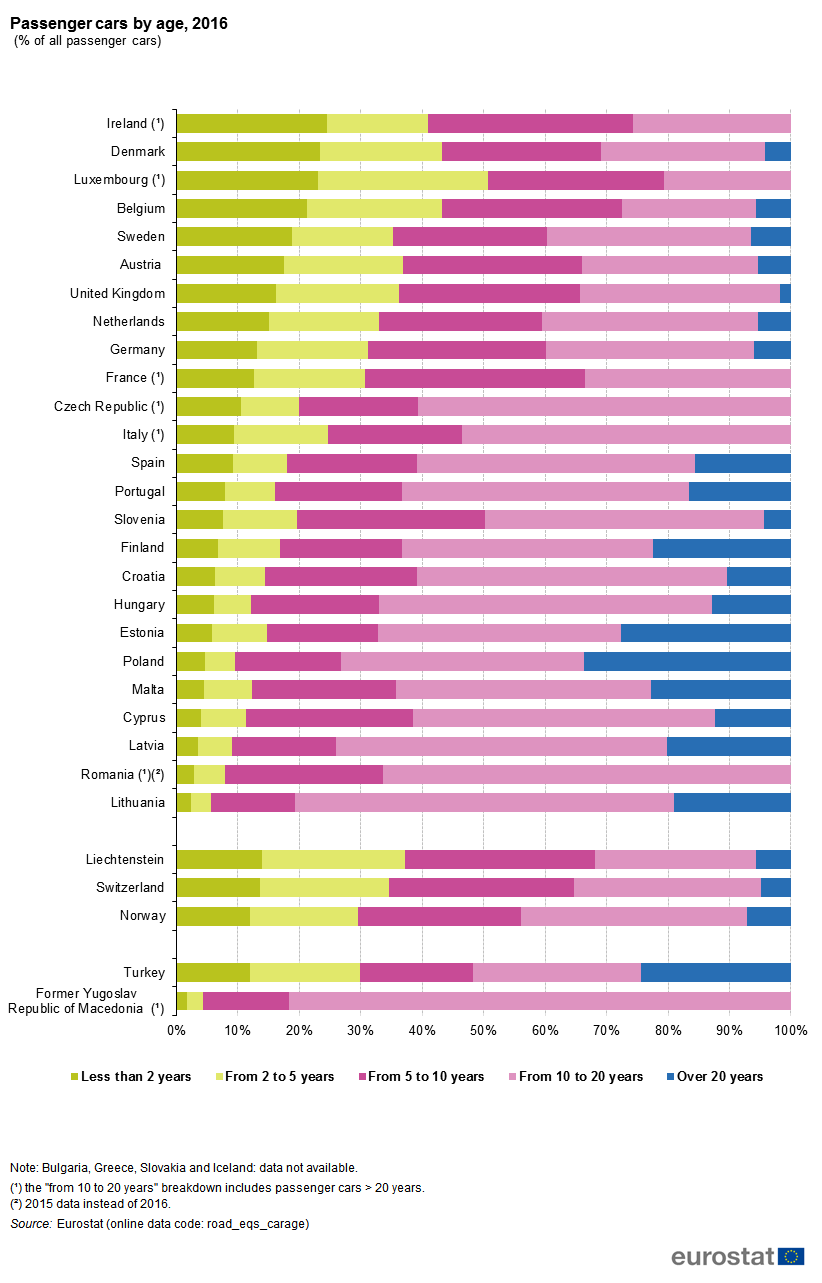
The age of the Czech vehicle feet is higher than EU average with 60% of all passenger cars being older than 10 years (10-20 years). Around 36% of all passenger cars registered in the Czech Republic in 2016 were powered by diesel engines, which is also very close to the EU average (42%). The average number of hours spent in traffic congestion annually did not change between 2014 (23.28) and 2016 (23.23).
Traffic intensity and congestion differs across the region and the type of infrastructure. According to the latest census (2016), the highest traffic intensity can be found in and around Prague and Brno with more than 6 000 cars/24 hours in some sections of the network.
Prague, Brno and Ostrava are the Czech cities listed among the most congested cities in Europe, although they do not have the highest levels of traffic congestion (below 30). However, the congestion level is growing in Prague. Although the extension of the Prague metro was supported by EU funds in the programming period 2007-2013, further public infrastructure projects are pending like the improved connection to Prague’s Václav Havel Airport or metro line D while no clear consenzus exist on the completion of some projects, like Prague Ring Road.
Two dialogues between the European Commission and Czech authorities were held in 2018 in order to address the air quality and Natura 2000 challenges and to promote broader policy approach in relation to several sectors, including the transport.
Part II: Enabling framework: implementation tools
4.Green taxation, green public procurement, environmental funding and investments
Green taxation and environmentally harmful subsidies
Financial incentives, taxation and other economic instruments are effective and efficient ways to meet environmental policy objectives. The circular economy action plan encourages their use. Environmentally harmful subsidies are monitored in the context of the European Semester and the energy union governance process.
Czech Republic’s revenue from environment related taxes remains among the lowest in the EU. Environmental taxes accounted for 2.07 % of GDP in 2017 against an EU average of 2.4 % as shown in Figure 20, while energy taxes accounted for 1.93 % of GDP against an EU average of 1.84 %. In the same year, environmental tax revenues were 5.86 % of total revenues from taxes and social-security contributions (in line with the EU-28 average of 5.97 %).
Czech Republic’s tax structure results in a high proportion of revenues from labour tax in total tax revenues, with 50.1 % in 2016, while the implicit tax burden on labour was 39.8 %. Consumption taxes remained relatively high (34.2 %, compared to the EU-28 average of 28.5 %), showing that there is still considerable potential for shifting taxes from labour to consumption, particularly to environmental taxes.
Since 2015, Czech Republic has made some progress in reforming the tax system, shown notably by the increasing amount of total tax revenues as a proportion of GDP. However, the Commission has repeatedly observed in the European Semester that environmental taxes continue to remain low compared to the rest of the EU. One of the most positive environmental taxes is the air pollution fee, which has existed since 1967 and last amended in 2012. The charges have increased by about 37 % on average, with further yearly increases laid down in the legislation.
|
Figure 20: Environmental tax revenues as % of GDP (2017)
|
|
|
Meanwhile, fossil fuel subsidies fell over the past decade, mainly due to the phasing out of the excise tax refund for diesel used in agriculture by the end of 2013. However, the government reversed its decision by reintroducing this measure in September 2014, allowing for retroactive refunds for fuels consumed from July 2014 onwards. Other tax exemptions for natural gas, solid fuels and oil used for heating are still in place. In 2016 fossil fuels subsidies amounted to EUR 156 million.
Some progress has also been made on reducing the ‘diesel differential’ (difference in the price of diesel versus petrol) since 2005. However, in 2016 there was still a 17 % gap between petrol and diesel tax rates. Excise tax rates levied on petrol and diesel in 2016 remained similar to those in 2015 (EUR 0.47 per litre for petrol and EUR 0.40 for diesel).
The favourable tax treatment for company cars is still cause for concern in Czech Republic, as well as in many other EU countries. Favourable tax treatment in principle affects behaviour in three ways: (i) it increases the total number of cars; (ii) it increases the use of bigger cars which emit more emissions: and (iii) it encourages driving because of the free fuel. Harmful environmental effects stemming from company car subsidies are a direct consequence of the three types of behaviour mentioned above (more cars, more expensive cars, and more mileage), which increase fuel consumption approximately by 4-8 % and hence also CO2 emissions by the same amount.
CO2-based motor vehicle taxes are non-existent in the country, but a surcharge is levied in addition to the administrative registration fee for vehicles that do not comply with EU emission standards. Incentives to encourage people to buy cars with lower CO2 emissions were rare in 2016. There were only some that were linked to annual circulation taxes, road tolls, and congestion or low emission zone charges, but none related to the acquisition or the use of public infrastructure.
The use of alternative fuels in new passenger cars sold in Czech Republic has been increasing very dynamically over the recent years. The number of new passenger cars using alternative fuels tripled in 2015 compared to 2011. However, in 2016 (for the first time since 2013) the market share of passenger cars using alternative fuels dropped (from 1.49 % in 2015 to 1.23 % in 2016). Furthermore, the market share of compressed natural gas in transport significantly increased between 2014 and 2016, as did the number of electric charging points.
Green public procurement
The EU green public procurement policies encourage Member States to take further steps to apply green procurement criteria to at least 50 % of public tenders. The European Commission is helping to increase the use of public procurement as a strategic tool to support environmental protection.
The purchasing power of public procurement amounts to around EUR 1.8 trillion in the EU (approximately 14% of GDP). A substantial proportion of this money goes to sectors with a high environmental impact such as construction or transport. Therefore, green public procurement (GPP) can help to significantly lower the negative impact of public spending on the environment and can help support sustainable innovative businesses. The Commission has proposed EU GPP criteria.
On 24 June 2017, the Czech Government approved, through its Resolution No 531, the rules for implementing a responsible approach in public procurement and for purchasing by the State and local governments.
According to the resolution, the Environment Ministry developed a methodology for an environmentally responsible approach in public procurement and purchasing by the State and local governments. In cooperation with the Minister of Labour and Social Affairs, the Environment Ministry set up a working group for the implementation of a responsible approach in the public procurement and purchasing, bringing together the representatives of the central and local governments.
The methodology contains 10 sheets for specific products or services (IT, imaging equipment, printing paper, tissue paper, administrative buildings operation, lighting, furniture, cleaning products, and services and catering) and provides recommended environmental criteria, based on EU GPP criteria.
A European Parliament study shows that the Czech Republic has partially implemented the GPP national action plan.
Environmental funding and investments
European Structural and Investment Fund (ESIF) rules oblige Member States to promote environment and climate in their funding strategies and programmes for economic, social and territorial cohesion, rural development and maritime policy.
Achieving sustainability involves mobilising public and private financing sources
. Use of the European Structural and Investment Funds (ESIFs)
is essential if countries are to achieve their environmental goals and integrate these into other policy areas. Other instruments such as Horizon 2020, the LIFE programme and the European Fund for Strategic Investments (EFSI)
may also support the implementation and spread of good practices.
Moreover, 85 % of Czechs support greater EU investment in environmental protection (in line with the EU-28 average). Czech society also appears to support circular economy initiatives and environmental protection actions.
European Structural and Investment Funds 2014-2020
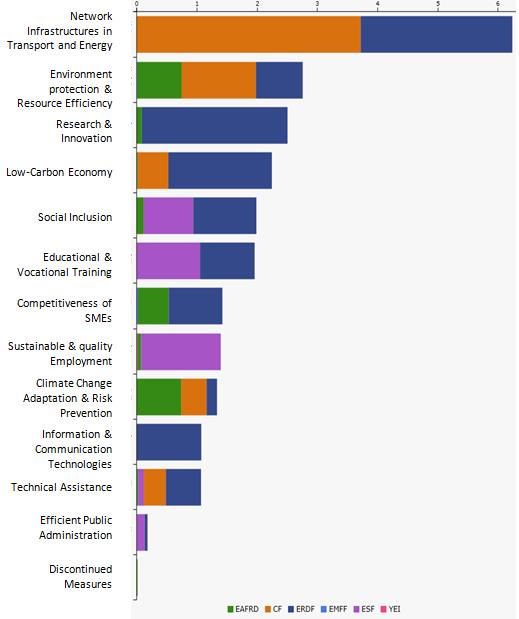
Through 11 programmes, Czech Republic has been allocated EUR 23.9 billion from ESIF funds for 2014-2020. This means that with its national contribution of EUR 7.88 billion, Czech Republic has a total budget of EUR 32.08 billion to invest in various areas; for example, creating jobs and growth, research and innovation, protecting the environment, supporting sustainable transport, promoting employment and labour mobility, and strengthening social inclusion.
The main programme for implementing environmental policies is ‘Operational Programme Environment’. Planned investments for each environmental sector target water, waste, air, flood protection and nature. It is too early to draw conclusions about the use and results of ESIF for 2014-2020. Nevertheless, according to the 2017 Annual Implementation Report for the programme mentioned above, the calls for proposals launched by the end of 2017 by the Managing Authority equalled 100 % of the programme’s allocation. The most effective investment activity falls under the priority axis ‘Air quality improvements in human settlements’ with a total of 23 898 exchanged stationary sources of air pollution by individual households by the end of 2017.
|
Figure 21: ESIF 2014-2020 – EU allocation by theme, the Czech Republic (EUR billion)
|
|
|
Cohesion policy
Environmental spending from the ERDF and Cohesion Fund amounts to an estimated 10.3 % for the 2014-2020 period (based on specific environmental related categories of expenditure), which in 2007-2013 corresponded to 18.1 %.
Current data suggests that the EU funds for the 2007-2013 period were fully spent (100 %, 2016 year). In terms of overall direct environmental investments, there was a slight decrease of 6 % between 2008 and 2016 in the Czech operational programmes, from 4.1 billion to 3.8 billion. As regards the fields where there were interventions, the biggest shift was recorded in drinking water investments (-57 %), IPPC (-51 %) and land rehabilitation (-47 %) while the investments in air quality increased (+86 %).
The interventions in 2014-2020 should lead to additional waste recycling capacities of 700 000 t/year or an additional 150 000 people and 84 339 people being served by improved water supply and wastewater treatment respectively.
The challenge for Czech Republic in the 2014-2020 programming period is making good use of EU funds for targeted investments and to strengthen the environmental integration as well as to use the potential of the green economy for competitiveness and job creation.
Rural Development
Funding for the Czech national rural development programme (RDP), which disburses the country’s allocation from the European Agriculture and Rural Development Fund (EAFRD), amounts to EUR 2.305 million.
The budget for agri-environmental-climate measures represents 29.43 % of the total EAFRD budget, while measures in areas facing natural constraints, represent 25.5 % of the whole budget.
Furthermore, to create a positive impact on the environment, there has also been a focus on providing aid towards the building of drip irrigation structures in orchards, hop fields, vineyards and nurseries. Significantly, Czech authorities have also requested aid in an amendment to their RDP to replace specific tree species, planted historically due to their resilience to high levels of emissions (particularly sulphur), with native tree species. In addition to a state aid scheme to balance and mitigate the damages caused by specially protected animal species on agricultural land and in agricultural holdings.
If Czech Republic was ambitious in implementing first pillar greening, it would clearly help to improve the country’s environmental situation in areas not covered by rural development programmes, including intensive areas. The country could review, if appropriate, its implementation of first pillar greening during the 2014-2020 period.
The Connecting Europe Facility (CEF)
The CEF is a key EU funding instrument developed specifically to direct investment towards European transport, energy and digital infrastructure to address identified missing links and bottlenecks and promote sustainability.
By the end of 2017, the Czech Republic had signed agreements for EUR 1.1 billion for projects under the CEF.
Horizon 2020
The Czech Republic has benefited from Horizon 2020 funding since the programme started in 2014. As of January 2019, 337 participants have been granted a maximum amount of EUR 70 million for projects from the Societal Challenges work programmes dealing with environmental issues .
In addition to the abovementioned work programmes, climate and biodiversity expenditure is present across the entire Horizon 2020. In The Czech Republic, projects accepted for funding in all Horizon 2020 working programmes until December 2018 included EUR 60 million destined to climate action (24.3 % of the total Horizon 2020 contribution to the country) and EUR 8 million for biodiversity-related actions (3.3 % of the Horizon 2020 contribution to the country).
An example of a project involving Czech partners is the SIMRA project, which focuses on community-led social innovation initiatives in Europe and across the Mediterranean region with an impact on agriculture, forestry and rural development in particular.
LIFE programme
Since its launch in 1992, the LIFE programme has co-financed a total of 19 projects in Czech Republic. Of these, four have focused on environmental innovation, eight on nature conservation and biodiversity, one on information and communication, and one on capacity-building (see below). Five were operating grants for NGOs. These projects cost a total of EUR 32 million, of which the EU has contributed EUR18 million.
During 2014-2017 the EU allocated EUR 9 million to Czech projects. One of these is the LIFE project , which supports the active conservation of thermophilous habitats and species of Community interest in the České středohoří hills, to which an EU contributed by more than EUR 1.5 million
. The LIFE project ‘Butterflies CZ-SK — Integrated protection of rare butterfly species of non-forest habitats in Czech Republic and Slovakia’, which was coordinated by the Agency for Nature Conservation and Landscape Protection of Czech Republic, was selected as one of the best EU LIFE Natura projects 2016-2017
.
European Investment Bank
Over the 2013-2018 period, EIB loans in Czech Republic amounted to approximately EUR 4.2 billion.. In 2018 alone, the EIB Group (the European Investment Bank and the European Investment Fund) loaned Czech businesses and public institutions EUR 707.9 million, as shown in Figure 22. Of this, EUR 53.9 million (8 %) went to environmental projects.
|
Figure 22: EIB loans to the Czech Republic in 2018
|
|
|
European Fund for Strategic Investments
The European Fund for Strategic Investments (EFSI) aims to help overcome the current investment gap in the EU. As of January 2019, it has mobilised EUR 706 million in Czech Republic, and the secondary investment triggered by this is expected to be EUR 4 billion .Within the total, seven projects have been approved so far under the Infrastructure and Innovation Window (including six multi-country projects), amounting to EUR 99 million in EIB financing under the EFSI.
National environmental financing
Czech Republic spent EUR 1 313.2 million on environmental protection in 2016, a decrease of 28 % from 2015. 37 % of these payments were allocated to waste management activities (the annual average percentage of environmental spending allocated to waste management in the EU is 49.7 %). EUR 360.5 million was allocated to wastewater management (27 % of total) and EUR 17.5 million to pollution abatement (1.3 % of total). Some 26.7 % of environmental expenditure was allocated to protecting biodiversity and the landscape (EUR 350.7 million). Between 2012 and 2016, the general government funding for environmental protection was EUR 8.5 billion.
2019 priority action
·Improve the capacity to use EU funds.
5.Strengthening environmental governance
Information, public participation and access to justice
Citizens can more effectively protect the environment if they can rely on the three ‘pillars’ of the Aarhus Convention:
(i) access to information;
(ii) public participation in decision making; and
(iii) access to justice in environmental matters.
It is of crucial importance to public authorities, the public and business that environmental information is shared efficiently and effectively. Public participation allows authorities to make decisions that take public concerns into account. Access to justice is a set of guarantees that allows citizens and NGOs to use national courts to protect the environment. It includes the right to bring legal challenges (‘legal standing’).
Environmental information
Czech Republic has a partially centralized system for dissemination of environmental data. CENIA, the Czech Environmental Information Agency is the organisation set up by the Ministry of the Environment and its mission is the collection, evaluation, interpretation and distribution of environmental information. A separate portal, the Information System of Statistic and Reporting (ISSaR, serves as a gateway to environmental information which publishes data on the state of components of the environment and pressures of the economy on the environment in interactive and illustrative manner. There are some limits in accessing industrial emissions related data. It should be pointed out that the system set-up is user-friendly and it is easy to find environmental data and information. There are limitations in accessing monitoring data as these are only accessible for air and water.
Czech Republic’s performance in implementing the INSPIRE Directive could be improved. Its performance has been reviewed based on the country’s 2016 implementation report and its most recent monitoring data from 2017. There was good progress and good levels of implementation for coordination, dataset identification and documentation of data. More effort is needed to make the data accessible through services, improve the conditions for data reuse and prioritise environmental datasets in implementing the Directive, especially those identified as high-value spatial datasets used for implementing environmental legislation.
|
Figure 23: Access to spatial data through view and download services in Czech Republic (2017)
|
|
|
Public participation
In Czech Republic, separate sectoral legislation is used to implement the Aarhus Convention and related European legislation. Neither overarching legislation addressing also other policy fields, nor a single information portal appears to exist. The information gap is filled by the NGO sector (Green Circle or Frankbold). There is also limited information on how public participation is applied in practice. As regards the development consent procedures on projects and participation in environmental matters, significant legislation, aside from the EIA Act, includes the Construction Act and the Administrative Code, and the Act to speed up the construction of transport, water and energy infrastructure.
The Eurobarometer figures from 2017 show that in Czech Republic, there is a relatively strong agreement (79 % of respondents) that individuals can play a role in protecting the environment. This is a slight improvement compared with 2014 but remains lower than the EU average.
Nevertheless, public participation rights, including those in environmental matters, have been criticised by stakeholders as having been weakened since the 2017 EIR report. This is mainly due to the amendment to the Construction Act, which has entered into force in January 2018. There are also further plans to restrict the rights of public, e.g. by introducing the fees for submitting appeals in order to discourage from complaining against the permits.
As regards the attitude of Czech citizens towards the environment and nature in particular, the recent study shows that they “like the idea of protecting it” (for going outdoor/tourism activities) but to the extent the state is taking care of the costs incurred.
Access to justice
Czech Republic does not provide online information on access to justice in environmental matters.
In general, Czech legislation provides for a restrictive rights-based approach to legal standing, which makes it difficult for environmental NGOs to bring cases. Despite this, some Czech courts – including the Supreme Administrative Court - give a wider standing to environmental NGOs in accordance with the Aarhus Convention and in line with the case-law of the Court of Justice of the European Union.
The NGOs do not have access to justice in the scope requested by the Directive on environmental liability. The deficient transposition is addressed by the Commission in the infringement case against Czech Republic.
2019 priority actions
·Improve access to spatial data and services by creating stronger links between the central INSPIRE website and regional portals; identify and document all spatial datasets required for implementing environmental law; and, at a minimum make the data and documentation accessible ‘as is’ to other public authorities and the public through the digital services provided for in the INSPIRE Directive.
·Improve the legal framework and/or the practical application (e.g. by setting up a single webpage) to enable the public to participate in the implementation of EU legislation that affects the environment in line with the Aarhus Convention. And consider revisiting the public’s position in the development consent procedure.
·Ensure that the public receives practical information on their access to justice rights.
Compliance assurance
Environmental compliance assurance covers all the work undertaken by public authorities to ensure that industries, farmers and others fulfil their obligations to protect water, air and nature, and manage waste. It includes support measures provided by the authorities, such as:
(i) compliance promotion;
(ii) inspections and other checks that they carry out, i.e. compliance monitoring; and
(iii) the steps that they take to stop breaches, impose sanctions and require damage to be remedied, i.e. enforcement.
Citizen science and complaints enable authorities to focus their efforts better. Environmental liability ensures that the polluter pays to remedy any damage.
Compliance promotion and monitoring
The quality of online information to farmers on how to comply with obligations on nitrates and nature this information is an indicator of how actively authorities promote compliance in subject-areas with serious implementation gaps. The Ministry of Agriculture of Czech Republic runs a ‘Farmer’s Portal’ with detailed information about obligations related to the fertiliser use and manure storage in nitrate vulnerable zones under the Nitrates Directive. However, there is a lack of specific information on what farmers should do to comply with obligations on nature.
Major industrial installations can be a serious pollution risk. Public authorities must have plans in place to inspect these installations and to make individual inspection reports available to the public. The website of the Czech Environmental Inspectorate or CEI (‘Česká inspekce životního prostředí’) provides information about planned inspections throughout the year.
Citizen science and complaint handling
Engaging the general public through citizen science can increase knowledge about the environment and help the authorities in their work. The availability of clear online information about how to make a complaint shows how responsive authorities are to complaints from the public. The CEI website ‘Submitting suggestions and complaints’ provides clear instructions on how to submit a complaint about environmental nuisances or environmental damage.
In 2016 and 2017, the Czech public became particularly engaged in air pollution problems and several air quality plans were questioned by public. As a result, the Supreme Administrative Court ruled is some of the cases that an air quality plan (forPrague, Ostrava and the Northwest) was insufficient’. Issues addressed by the Supreme Administrative Court had been taken into consideration and relevant provisions were incorporated into the last amendment of the Air Act, 201/2012 Col., effective since 1st of September 2018. Public participation in this process is considered as essential.
Enforcement
When monitoring identifies problems, a range of responses may be appropriate. The CEI’s annual reports contain information about inspections carried out during the year, including the list and description of the most significant instances of non-compliance in relation to national law. However, there is no information about follow-ups, recommendations or repeated non-compliance. Statistics on environmental crimes are very limited and there is no information on responses to cross-compliance breaches on nitrates and nature.
Tackling waste, wildlife crimes and other environmental offences is especially challenging. It requires close cooperation between inspectors, customs authorities, police and prosecutors. The CEI’s annual reports highlight the importance attached to this matter in Czech Republic.
Environmental liability
The Environmental Liability Directive (ELD) establishes a framework based on the ‘polluter pays’ principle to prevent and remedy environmental damage. The 2017 EIR focused on better information on environmental damage, financial security and guidance. The Commission is still collecting evidence on progress made.
2019 priority actions
·Better inform the public about compliance promotion, monitoring and enforcement. At a minimum this should involve providing online information to farmers about how to comply with obligations on nature. Similarly, it should involve publishing more information on the outcomes of enforcement action and on the follow-up to detected cross-compliance breaches on nitrates and nature.
·Improve financial security for liabilities and ELD-guidance and publish information on environmental damage.
Effectiveness of environmental administrations
Those involved in implementing environmental legislation at EU, national, regional and local levels need to have the knowledge, tools and capacity to ensure that the legislation and the governance of the enforcement process bring about the intended benefits.
Administrative capacity and quality
Central, regional and local administrations must have the ability to carry out their own tasks and work effectively with each other, within a system of multi-level governance.
In general, the Czech administration is able to implement EU environmental legislation provided it matches with the national interests. The Czech experts are often involved in twinning projects with other Member States. Cooperation between administration and experts from universities or the Czech Academy of Science and NGOs is developed.
The critical competences, like in water sector are divided among several ministries. The Ministry of the Environment is responsible for the protection of water ecosystems (including floods), Ministry of Agriculture for water management (including irrigation; the issue of droughts is a joint competence) while the Ministry of the Transport is in charge of planning and implementation of infrastructural projects in inland navigation. This means than on one hand, there is a scope for balance of different interests, on the other hand, there is a need to establish a constructive dialog about infrastructure projects as otherwise the decision making process remains prone to the politically desired outcomes rather than scientific evidence.
Czech Republic has an average number of active infringements concerning mainly non-conformity and poor application of EU environmental law. These cases concern all main sectors, i.e. impact assessment waste, water and air. Infringements in the area of impact assessments relate to the legacy of late transposition of EU law.
As assessed in the 2017 EIR report, the Czech Republic’s environmental legislation was found not to conform with the Environmental Impact Assessment (EIA) Directive.
An amendment to the national EIA law, in force since April 2015, has addressed a number of deficiencies, although not all. Therefore, Czech Republic adopted methodological guidance to supplement the legal changes. The application of the guidance is being monitored as whether it satisfies the grievances. As pointed already above, there were however several steps taken since and other foreseen to be taken which might negate this development.
Coordination and integration
As mentioned in the 2017 EIR, the transposition of the revised Environmental Impact Assessment (EIA) Directive into national law provides an opportunity for countries to streamline the regulatory framework on environmental assessments. Despite a delay, Czech Republic has now fully transposed the revised Directive.
The Commission encourages the streamlining of environmental assessments to reduce duplication and avoid overlaps in environmental assessments for projects. Moreover, streamlining helps to reduce unnecessary administrative burden. It also accelerates decision-making, without compromising the quality of the environmental assessment procedure.
The Czech development consent system for projects has multiple stages; the EIA, the zoning decision and the building permit. The infrastructure projects (mainly transport sector) have long preparation period and projects with old/pre-accession EIAs are still in a pipeline for EU co-financing in programming period 2014-2020.
Streamlining or simplifying the whole framework is contingent upon the Building Act. The last amendment to the Construction Act enables EIA and zoning decision procedures to be integrated. The EIA and Natura 2000 assessments had already been integrated into the EIA process before the revision of the EIA Directive. Other assessments like those carried out under the Water FD or Industrial Emissions Directive are not. As regards the crucial provisions of the Water Framework Directive (Art 4 and in particular Art 4.7), which could have an implication on the option analysis of the project undergoing also EIA assessment, Czech Republic had a transposition and application gap (until 2010 and 2018 respectively). To this end, the Guidance for water authorities was adopted in 2018.
Apart from the examples on inefficient system of interim reliefs applied in Czech Republic, there seems to be another practice over the use of the trial permit in the absence of the final development permit that may render the provisions of EIA Directive ineffective. It is necessary to evaluate each case individually, since the trial permits play a crucial role in the authorization process. On one hand, it can be an effective tool for a developer or affected administrative bodies for control or detecting potential project weakness and their subsequent removal, on the other hand it can be an instrument to circumvent the obligations laid down by the EIA Directive.
Adaptability, reform dynamics and innovation (eGovernment)
Although Czech public authorities are increasingly adopting and using electronic services that enable them to interact with the public online, the country performed below the EU average in 2018. For Digital Public Services, the country has a score of 0.50/1 based on Europe's Digital Progress Report 2018, lower than the EU28 average (0.575/1). However, the situation has considerably improved since the year 2016, mainly in terms of open data. In the DESI Report 2018, the Czech Republic had a score of 50 out of 100 on digital public services, lower than the EU average of 58.
The government plans to launch an interactive citizens’ portal, acting as a national gateway for personalised e-government services. To improve accessibility, classification of the available public sector digital services (some 700) is ongoing, with a view to cataloguing them. This should raise awareness of e-government services from the currently low levels, which is one of the barriers to their broader usage.
The drawdown of available EU funds for the development of eGovernment services has been low so far. The actions put in place by the country to improve availability, quality and promotion of eGovernment services could contribute to improvements in this dimension.
Enabling financing and effective use of funds
A slower start of the 2014-2020 ESI Funds programming period and certain implementation problems resulted in a low use of EU funds, notably in areas such as energy efficiency. In addition, sometimes environmental projects suffer delays and funding is finally allocated to other domains.
2019 priority action
·Consider the possibilities for further streamlining environmental assessment procedures, while ensuring that the public can properly participate.
International agreements
The EU Treaties require the EU environmental policy to promote measures at international level to deal with regional or worldwide environmental problems.
The EU is committed to strengthening environmental law and its implementation globally. It therefore continues to support the Global Pact for the Environment process, which was launched by the United Nations General Assembly in May 2018. The EIR is one of the tools to ensure that the Member States set a good example by respecting European Union environmental policies and laws and international agreements.
Forests: EU Timber Regulation (EUTR)/ Forest Law Enforcement, Governance and Trade (FLEGT) Regulation
The Czech Republic reported that around 300 000 operators placed domestic timber onto the EU market and 2 500 operators imported timber. Between March 2015 and February 2017, Czech authorities conducted 119 checks on operators dealing with domestic timber products and 68 checks on operators placing imported timber on the market. These numbers are relatively in line with previously planned checks. Based on these checks, diverse enforcement actions, including penalties, were imposed on operators placing both domestic (84 actions) and imported timber (48 actions) on the market.
Moreover, over the two-year period, Czech Republic carried out 213 checks on traders, which can be considered quite a high number compared to other countries.
On cooperation (Art. 12 EUTR), Czech Republic reports to have collaborated mainly with national customs/tax agencies and the national police, or other enforcement agencies.
Genetic resources: Nagoya Protocol on Access to Genetic Resources and the Fair and Equitable Sharing of Benefits Arising (ABS)
Under the EU ABS Regulation, which transposes the required compliance measures under the Nagoya Protocol into the EU legal system, Czech Republic has appointed competent authorities for genetic resources. As regards the rules for penalising infringements of the Regulation, this is to be further checked.
International wildlife trade: the Convention on International Trade in Endangered Species of Wild Fauna and Flora (CITES)
In line with the obligations laid down in the Basic Regulation, which transposes the major obligations of the Convention on International Trade in Endangered Species of Wild Fauna and Flora (CITES) into EU law, Czech Republic has established relevant national authorities and is processing (requests for) import, (re-) export and intra-EU trade documents on a regular basis.
Reports on seizures of illegal wildlife shipments (in particular those reported every 6 months to TRAFFIC under its contract with the Commission, and those exchanged through the
EU-TWIX
platform, show the extent of the customs authorities’ activity.
To ensure that the EU Wildlife action plan (2016) is fully implemented and to improve the rate for detecting illegal activities, Czech Republic’s competent national and local authorities have established regular checks on traders, breeders and keepers, in addition to checks at border-crossing points. Czech Republic was also involved in the Pannon Eagle Life Project, which focuses on protecting the Eastern Imperial Eagle. Furthermore, to boost international cooperation in the fight against wildlife crime, Czech authorities bilaterally cooperate with enforcement authorities from Vietnam, as this country is an important destination for illegal wildlife commodities exported from Europe.
2019 priority action
·Increase efforts to be party to relevant multilateral environmental agreements, by signing and ratifying the remaining ones.
Sustainable development and the implementation of the UN SDGs
Sustainable development links environmental, social and economic policies in a coherent framework and therefore helps to implement environmental legislation and policies.
Czech Republic has implemented the principles of the SDGs in a strategic framework document ‘Czech Republic 2030’ . ‘Czech Republic 2030’ is the strategic framework setting long-term development priorities for the country, which will help to improve the quality of life for current and future generations. The framework, approved by the government in April 2017, replaced the 2010 strategic framework for sustainable development of Czech Republic. In October 2018, the implementation plan for the framework was adopted . As regards the measures and recommendations for each of 97 specific national targets which should have been part of other national strategies and policies, each ministry is responsible for allocating funds within its own budged.
The sustainable development agenda is coordinated at the national level by the Government Council on Sustainable Development, chaired by the Vice Prime Minister and Minister of Environment. Coordination between the sub-national levels is fostered by the Building Act of 2006, a law that aims to implement several previous NSDS objectives and integrated tools (ITI, IPRÚ, CLLD) under the auspices of the Ministry of Regional Development. In 2014, the Committee for Sustainable Municipalities was established as a part of renewed Government Council of Sustainable Development which gathers the representatives of relevant ministries, municipal associations, academia and NGOs. The Government Council for sustainable development cooperates with the Association of Regions and the Union of Towns and Municipalities and other stakeholders in the Council ‘Working Group for LA 21’. This working group involves various stakeholders and is very active in developing bottom-up strategies based on local situations and activities.
According to the Implementation Plan of the strategic framework ‘Czech Republic 2030’, the first monitoring report for the period 2017-2019 will be presented to the government in 2020. However, in 2017, Czech Republic submitted a voluntary national review ‘National Report on the Implementation of the 2030 Agenda for Sustainable Development’ to the UN.