Table of contents
GLOSSARY
LIST OF FIGURES
LIST OF TABLES
LIST OF BOXES
1.Introduction: Political and legal context
1.1. How does the delegated act on climate change mitigation and adaptation fit with the political priorities of the Commission and the EU?
1.2. Legal and policy context of the delegated act – the Taxonomy Regulation
1.3. The uses of the EU Taxonomy and interactions with other initiatives
1.4. Scope and structure of the report
2.Problem definition
3.Why should the EU act?
4.Objectives: What is to be achieved?
4.1.General and specific objectives
4.2.Operational objective
5.Key methodological choices
5.1.Prioritisation, selection and classification of economic activities
5.2.Approaches to set technical screening criteria
5.3.Level of ambition for technical screening criteria
6.Assessing the proposed approaches and technical screening criteria against the requirements of the Taxonomy regulation
6.1.Substantial contribution to climate change mitigation
6.1.1 Policy Coherence
6.1.2. Environmental integrity
6.1.3. Level playing field
6.1.4. Usability of the criteria
6.1.5. Consistency with the requirements in Article 19(2)-(4) of the Taxonomy Regulation
6.2. Substantial contribution to climate change adaptation
6.2.1. Policy Coherence
6.2.2. Environmental integrity
6.2.3. Fair treatment of sectors, avoid distortion, and set right incentives
6.2.4. Usability of the criteria.
6.3. Do no significant harm
6.3.1. Assessment of the DNSH to climate change mitigation criteria against the requirements of the Taxonomy Regulation
6.3.2. Assessment of the DNSH criteria against the requirements of the Taxonomy Regulation for climate change adaptation
6.3.3. Assessment of the DNSH criteria against the requirements of the Taxonomy Regulation for objectives 3 to 6
7. How the Taxonomy will be used, monitored and evaluated
7.1 Monitoring and review of the technical screening criteria
7.2 Uses of the EU Taxonomy, indicative impacts and broader monitoring and evaluation provisions
ANNEX 1: PROCEDURAL INFORMATION
1.1. Lead DG, Decide Planning/CWP references
1.2. Organisation and timing
1.3. Consultation of the RSB
1.4. Evidence, sources and quality
ANNEX 2: STAKEHOLDER CONSULTATION
2.1. Technical Expert Group on Sustainable Finance (TEG) and Member States Expert Group (MSEG)
2.2. TEG’S first call for feedback
2.3. TEG workshops with additional experts
2.4. First stakeholder dialogue on sustainable finance
2.5. TEG’s second call for feedback
2.6. Second stakeholder dialogue on sustainable finance
2.7. Feedback by Member States on TEG report
2.8. Feedback on inception impact assessment
2.9. Consultation on the Renewed Sustainable Finance Strategy
2.10. Feedback on the draft delegated act: November-December 2020
ANNEX 3: WHO IS AFFECTED AND HOW?
3.1 Practical implications of the initiative
3.2 Summary of costs and benefits
ANNEX 4: KEY METHODOLOGICAL CHOICES
4.1Classification of economic activities - NACE
4.2 Methodology for selecting economic sectors and activities for climate change mitigation
4.2.1. Prioritisation of sectors and activities for assessment
4.2.2. Inclusion logic of activities in the EU Taxonomy
4.3 Methodology for selecting economic sectors and activities for climate change adaptation.
4.3.1. First category of included activities: Activities for which DNSH criteria for environmental objectives 3-6 were developed under the mitigation Taxonomy.
4.3.2. Second category of included activities: (i) Activities not assessed by the TEG but for which DNSH criteria for activities already assessed can apply or (ii) Activities that have no or a very low impact on other environmental objectives.
4.3.3. Third category of included activities: Enabling activities identified by the TEG.
4.4 Approaches to set technical screening criteria
4.5 Level of ambition for the technical screening criteria
ANNEX 5: CLIMATE CHANGE MITIGATION
5.1. Sector-specific assessment of the approaches and criteria for substantial contribution to climate change mitigation
5.1.1. Forestry
5.1.2. Agriculture
5.1.3. Manufacturing
5.1.4. Energy sector
5.1.5. Water, sewage, waste and remediation (WSWR)
5.1.6. Transportation
5.1.7. Information and communications (ICT)
5.1.8. Construction and real estate activities
5.2. Inclusion of additional sectors and activities for climate change mitigation
ANNEX 6: CLIMATE CHANGE ADAPTATION
6.1. Assessment of the proposed criteria
6.2.Overview of the relevance of the proposed sectors and activities for climate change adaptation.
6.2.1.
First category of included activities: Activities for which DNSH criteria for environmental objectives 3-6 were developed under the mitigation Taxonomy.
6.2.2.
Second category of included activities: (i) Activities not assessed by the TEG but for which DNSH criteria for activities already assessed can apply or (ii) Activities that they have no or a very low impact on other environmental objectives.
6.2.3.
Third category of included activities: Enabling activities identified by the TEG.
ANNEX 7: DO NO SIGNIFICANT HARM
7.1. Analysis on DNSH to climate change mitigation
7.2. Analysis on DNSH to climate change adaptation
7.3. Analysis on DNSH to sustainable use and protection of water and marine resources (in short: “DNSH to water”)
7.4. Analysis on DNSH to the transition to a circular economy (in short: “DNSH to circular economy”)
7.5. Analysis on DNSH to pollution prevention and control (in short: “pollution DNSH”)
7.6. Analysis on DNSH to protection and restoration of biodiversity and ecosystems (in short: “DNSH to biodiversity”)
ANNEX 8: EXPECTED USES OF THE EU TAXONOMY
8.1. Overview of the potential uses of the EU Taxonomy
8.2. Illustrations of potential coverage and alignment with the EU Taxonomy
8.3 More detailed overview on literature and case studies referenced in this annex
ANNEX 9: LIST OF PROPOSED ECONOMIC ACTIVITIES IN THE DRAFT DELEGATED ACT AND APPROACHES TO SET TECHNICAL SCREENING CRITERIA
9.1 List of activities for climate change mitigation
9.2 List of activities for climate change adaptation
9.3 Major deviations from the final recommendations of the Technical Expert Group on Sustainable Finance (TEG) in the draft delegated act as published in November 2020
ANNEX 10: RELEVANT EU LEGISLATION AND POLICY INITIATIVES
10.1 Interaction between the EU Taxonomy and other legislation in the field of sustainable finance
10.2 EU legislation relevant for setting technical screening criteria for the delegated act
ANNEX 11: RELEVANT EXCERPTS TAXONOMY REGULATION
11.1 Requirements relevant for the delegated act for climate change mitigation and adaptation
LIST OF REFERENCES
GLOSSARY
|
Term or acronym
|
Meaning or definition
|
|
AFOLU
|
Agriculture, Forestry and Other Land Use
|
|
AIFM
|
Alternative Investment Fund Manager
|
|
API
|
Application Programming Interface
|
|
AuM
|
Assets under management
|
|
BAT
|
Best Available Technique
|
|
BERD
|
Business expenditure on R&D
|
|
BREEAM
|
Building Research Establishment Environmental Assessment Method
|
|
BREF
|
BAT Reference Documents
|
|
C3S
|
Copernicus Climate Change Services
|
|
CAP
|
Common Agriculture Policy
|
|
CCS
|
Carbon Capture and Sequestration
|
|
CDS
|
Climate Data Store
|
|
CEPA
|
(European standard statistical) Classification of Environmental Protection Activities
|
|
COM
|
European Commission
|
|
CreMA
|
Classification of Resource Management
|
|
CSRD
|
Corporate Sustainability Reporting Directive
|
|
EU CTB
|
EU Climate Transition Benchmark
|
|
DA
|
Delegated Act
|
|
DNSH
|
Do No Significant Harm
|
|
EcAMPA
|
Economic Assessment of GHG mitigation policy options for EU agriculture
|
|
EGD
|
European Green Deal
|
|
EPBD
|
Energy Performance of Buildings Directive
|
|
EPC
|
Energy Performance Certificate
|
|
ESG
|
Environmental, social and governance
|
|
ETS
|
Emissions Trading System
|
|
EU 27 or EU 28
|
27 or 28 Member States of the European Union
|
|
FSC
|
Forest Stewardship Council
|
|
GBS
|
Green Bond Standard
|
|
GHG
|
Greenhouse Gas
|
|
HDV
|
High-Duty vehicles
|
|
HVD
|
High Value Datasets
|
|
ICT
|
Information and Communication Technology
|
|
IBIP
|
Insurance-based Investment Product
|
|
IFRS
|
International Financial Reporting Standards
|
|
IORP
|
Institution for Occupation Retirement Provision
|
|
ISSG
|
Inter-Service Steering Group
|
|
JRC
|
Joint Research Centre
|
|
KBA
|
Key Biodiversity Area
|
|
KPIs
|
Key Performance Indicators
|
|
LCE
|
Life Cycle Engineering
|
|
LULUCF
|
Land Use, Land-use Change and Forestry
|
|
MFF
|
Multiannual financial framework
|
|
MSEG
|
Member States Expert Group
|
|
NACE
|
Nomenclature des Activités Économiques dans la Communauté Européenne
|
|
NFRD
|
Non-financial Reporting Directive
|
|
NGO
|
Non-government Organization
|
|
NZEB
|
Nearly Zero-Energy Buildings
|
|
EU PAB
|
EU Paris Aligned Benchmark
|
|
PEFC
|
Program for the Endorsement of Forest Certification Schemes
|
|
PEPP
|
Pan-European Personal Pension Product
|
|
PESETA
|
Projection of Economic Impacts of Climate Change in Sectors of the European Union based on bottom-up Analysis
|
|
R&D
|
Research and Development
|
|
R&I
|
Research and Innovation
|
|
RCA
|
Recycled Concrete Aggregates
|
|
RED II
|
Renewable Energy Directive II
|
|
RSB
|
Regulatory Scrutiny Board
|
|
RTS
|
Regulatory Technical Standards
|
|
SC
|
Substantial Contribution
|
|
SFM
|
Sustainable Forest Management
|
|
SMEs
|
Small and medium-sized enterprises
|
|
TEG
|
Technical Expert Group on Sustainable Finance
|
|
TFEU
|
Treaty on the Functioning of the European Union
|
|
TR
|
Taxonomy Regulation
|
|
TRL
|
Technology Readiness Level
|
|
UCITS
|
Undertakings for Collective Investments in Transferable Securities
|
|
WSWR
|
Water, Sewerage, Waste and Remediation
|
LIST OF FIGURES
Figure 1: The four basic conditions for economic activities in the Taxonomy Regulation
Figure 2: Timeline of files related to the Taxonomy Regulation
Figure 3: Uses of the EU Taxonomy
Figure 4: Framework for assessment
Figure 5: Typology for substantial contribution to climate change mitigation.
Figure 6: Representation by type of stakeholder
Figure 7: Visualisation of EU Taxonomy assessment process in a non-financial company operating in multiple economic activities.
Figure 8: GHG emission in the EU27 in 2018.
Figure 9: Typology for substantial contribution to climate change mitigation.
Figure 10: EU greenhouse gas emissions by sector 1990-2017.
Figure 11: International Hydropower Association data on GHG emissions and power density.
Figure 12: Gross inland consumption of biomass and waste. Source: COM(2018) 773
Figure 13: Shares in power generation.
Figure 14: Partial reproduction.
Figure 15: Categorisation of companies in relation to Ecolabel pockets.
Figure 16: Results of the fund-level assessment.
Figure 17: Estimated split between types of potentially aligned activities based on Nordea report
Figure 18: Estimated split of potentially aligned activities per macro-sector based on Nordea report
Figure 19: Estimated share of potentially aligned activities in different sectors based on Nordea report
Figure 20: Sectoral shares of insurer’s eligible holdings, EIOPA, 2020
Figure 21: Issuers by potentially aligned revenue share (MSCI, 2020)
Figure 22: Number of relevant companies per sector within MSCI ACWI IMI Index (MSCI, 2020)
Figure 23: Sector representation of MSCI ACWI and potentially Taxonomy-eligible companies
Figure 24: Potentially Taxonomy eligible companies in MSCI ACWI
Figure 25: Comparison of Taxonomy-relevant and Taxonomy-aligned revenue shares
Figure 26: Possible Covid-19 recovery packages, Hepburn et al., 2020
Figure 27: Interaction between Taxonomy Regulation, NFRD, and SFDR
Figure 28: NFRD overview
LIST OF TABLES
Table 1: Overview of annexes
Table 2: Proposed approaches by macro sector
Table 3: Relevant pieces of Union legislation that set rationale of intervention
Table 4: Measuring success of the EU Taxonomy for climate change mitigation and adaptation as established by the delegated act
Table 5: High-level comparison of studies on Taxonomy alignment and eligibility
Table 6: Possible broader monitoring provisions for the EU Taxonomy
Table 7: Overview of benefits
Table 8: Overview of costs
Table 9: Analysis for inclusion of adapted activities beyond TEG recommendation
Table 10: Presentation of the generic types of approaches
Table 11: Relevance of the different approaches depending on the type of substantial contribution of the activity
Table 12: Deduction of the assessment grid: conditions under which an approach can be selected for a given economic activity
Table 13: Assessment of proposed approaches to set criteria for forestry
Table 14: Assessment grid for agriculture activities
Table 15: Assessment grid for manufacturing activities
Table 16: Assessment grid for electricity and/or heat generation activities not including those relating to biomass, biogas and bioliquids
Table 17: Assessment grid for water, sewerage, waste and remediation activities
Table 18: Assessment grid for transportation activities
Table 19: Assessment grid for information and communication activities
Table 20: Assessment grid for Construction activities
Table 21: Climate risks
Table 22: Sensitivity Matrix for information and communication
Table 23: Sensitivity Matrix for financial and insurance activities
Table 24: Potential uses (mandated and voluntary) of the EU Taxonomy
Table 25: Initiatives under the European Green Deal that reference the EU Taxonomy
Table 26: Studies of the European Commission on EU Taxonomy
Table 27: Clustering of Revenue Segments
Table 28: JRC study climate policies mapped to NACE activities covered in EU Taxonomy
Table 29: Potential financial coverage of the EU Taxonomy on climate change mitigation in equity and debt markets by NACE sectors*
Table 30: Potential financial coverage of the EU Taxonomy on climate change mitigation in equity and debt markets by CPRS sectors
Table 31: EU-Taxonomy eligible activities in equity and debt markets by CPRS
Table 32: Potential of EU Taxonomy to close investment gap by sector and EUCO scenario
Table 33: Activities for climate change mitigation
Table 34: Activities for climate change adaptation
Table 35: Deviations between final recommendations of the TEG and Commission services
LIST OF BOXES
Box 1: Disclaimer
Box 2: What does it mean to be "included" in the EU Taxonomy?
Box 3: The iterative introduction of the EU Taxonomy and its dynamic nature
Box: 4 Types of approaches to set criteria for substantial contribution to climate change mitigation..18
Box 5: Types of approaches to set criteria for substantial contribution to climate change adaptation
Box 6: Types of approaches to set criteria for do no significant harm
19
Box 7: Example of different DNSH to adaptation criteria based on the nature of activity.
Box 8: Compliance costs vs. administrative costs under the EU Taxonomy
Box 9: EU Taxonomy alignment: from economic activities to investment portfolio
Box 10: Definition of economic sectors and activities
Box 11: Types of approaches to set criteria for substantial contribution to climate change adaptation
Box 12: Types of approaches to set DNSH criteria
Box 13: Deviations from the TEG recommendation for technical screening criteria for substantial contribution to climate change adaptation
Box 14: Peseta IV
1.Introduction: Political and legal context
1.1. How does the delegated act on climate change mitigation and adaptation fit with the political priorities of the Commission and the EU?
This impact assessment underpins the first delegated act under the Taxonomy Regulation that sets out economic activities and related technical screening criteria for the first two (out of six) environmental objectives. This delegated act provides the technical details to establish the EU Taxonomy for climate change mitigation and climate change adaptation. The Taxonomy Regulation establishes the framework for developing a list of environmentally sustainable economic activities (or “EU Taxonomy”) and was underpinned by a separate impact assessment.
The EU Taxonomy is an important piece of the puzzle to enable and scale up sustainable investment and thus to implement the European Green Deal. The Taxonomy aims to channel capital towards activities that substantially contribute to reaching the objectives of the European Green Deal, such as climate neutrality, zero pollution, preservation of biodiversity, a circular economy and a high degree of energy efficiency. This framework coherent with the European Green Deal will help limit the risk of greenwashing and avoid market fragmentation. Taxonomy
In light of the ongoing post-crisis fiscal stimulus and the EU27’s estimated financing needs after the crisis, the European Green Deal will help provide for the European recovery strategy and the EU Taxonomy can be a valuable tool to help channel finance towards the green recovery.
1.2. Legal and policy context of the delegated act – the Taxonomy Regulation
(I)it contributes substantially to one or more of the six environmental objectives set out in the Taxonomy Regulation
;
(II)it does not significantly harm any of the other environmental objectives;
(III)it is carried out in compliance with minimum (social) safeguards set out in the Taxonomy Regulation; and
(IV)it complies with the “technical screening criteria” that are established by the European Commission through delegated acts. The technical screening criteria specify the conditions under which an economic activity meets criteria (i) and (ii).

Figure 1: The four basic conditions for economic activities in the Taxonomy Regulation
The Taxonomy Regulation acknowledges different means for an activity to make a substantial contribution for each objective. Across all objectives, it is recognised that activities may not only qualify due to their own performance, but also by enabling another activity or activities to substantially contribute. For climate change mitigation, the Regulation additionally stipulates in Article 10 (2) that “transitional activities”, for which no feasible low-carbon alternative exists, can qualify under certain conditions.
The first delegated act that establishes the activities and technical screening criteria for the climate objectives (and which is accompanied by this report) is adopted by the Commission in April 2021. A second delegated act will set out the activities and technical screening criteria for the remaining four environmental objectives under the Taxonomy Regulation, to be developed over 2021. A third delegated act due by mid- 2021 will establish the key performance indicators that companies need to disclose under the Taxonomy Regulation. This timeline is illustrated in Figure 2.
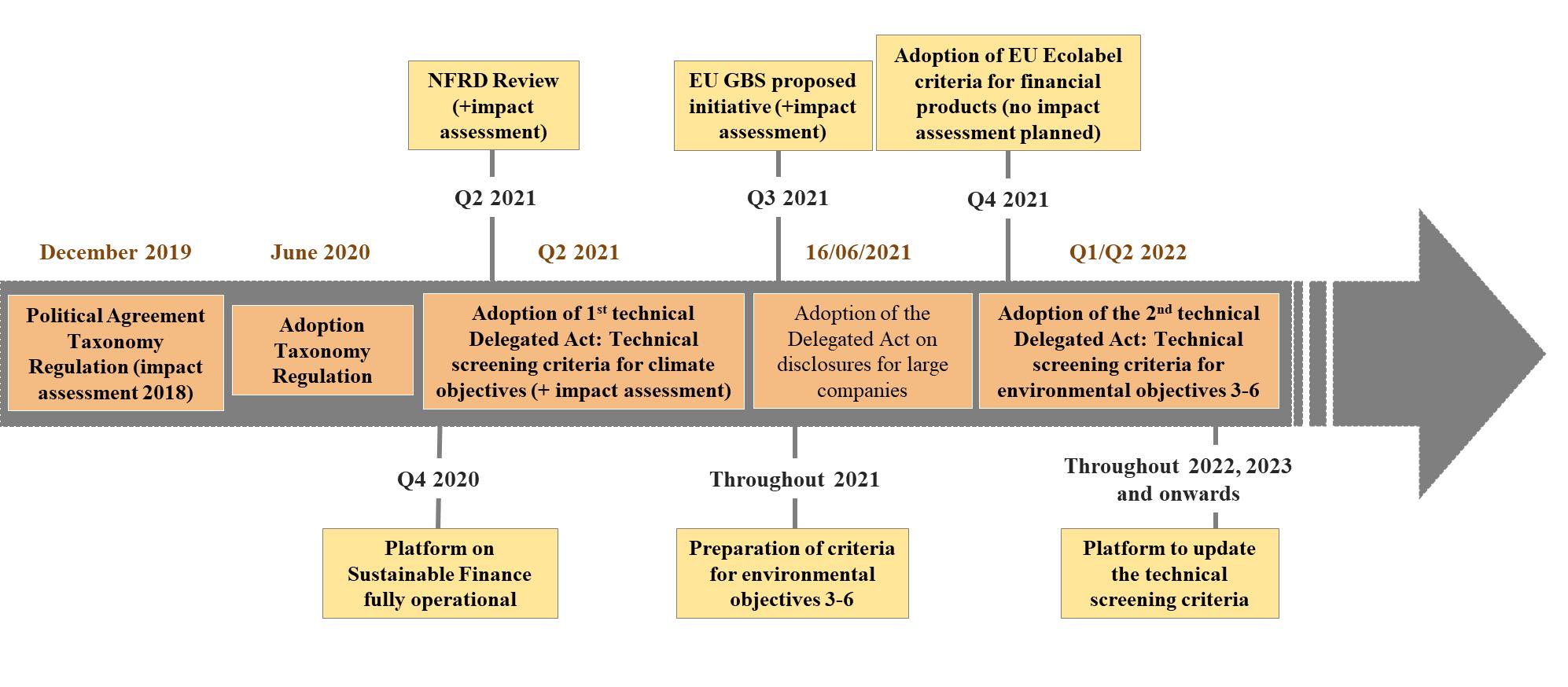 Figure 2: Timeline of files related to the Taxonomy Regulation
In order to assist with the development of the first delegated act, the Commission tasked the Technical Expert Group on Sustainable Finance (TEG) with providing advice on the development of the technical screening criteria on the objectives of climate change mitigation and adaptation. Their final recommendations are
publicly available
. The final recommendations serve as a basis and main technical input for the Commission’s analysis in this impact assessment.
In order to assist the Commission in the preparation of subsequent delegated acts and to update the EU Taxonomy, the Taxonomy Regulation creates a
Platform on sustainable finance
(“Platform”) that is composed of a balanced representation of public and private, financial and non-financial stakeholders. This Platform started its work in October 2020 and does not only assist the Commission with developing the EU Taxonomy for the remaining environmental objectives (and advise on potentially extending it to other objectives), but also advises the Commission on the need to update the technical screening criteria and the list of activities for all objectives.
The iterative introduction of the EU Taxonomy and its dynamic natureThe Taxonomy Regulation puts forward an iterative approach to develop the EU Taxonomy, starting with the two climate objectives and followed by the Taxonomy for the other four environmental objectives. In this “second round” of delegated acts developed over 2021, the Commission could further amend the first delegated act in order to include additional activities for climate change mitigation and adaptation. This step-by-step introduction of the Taxonomy and prioritisation of some sectors over others stems from the urgent need to realise the EU green policy agenda. While this overall legislative architecture prioritises those sectors and activities with the highest potential for positive environmental impact, it also allows to include other activities in the Taxonomy, once screening criteria for how they can demonstrably make a substantial contribution to an environmental objective can be worked out and agreed upon in a methodologically sound way. The iterative approach mitigates the risk for activities for which this process has not yet been able to conclude in time for the first round of delegated acts which contains priority sectors and activities backed by broad scientific evidence and consensus. It ensures an objective and rigorous path for their potential inclusion, while safeguarding the integrity of the Taxonomy. The incremental roll-out of the Taxonomy also allows market actors to familiarise themselves with the Taxonomy criteria in stages and facilitates learning how to use the Taxonomy before disclosure obligations become mandatory and other initiatives, which build on the Taxonomy, begin to apply. More information on the monitoring and evaluation of the Taxonomy including its incremental roll-out are given in section 7. In addition, the EU Taxonomy is dynamic in its nature. This has been a political choice in the Regulation itself to allow the Taxonomy to evolve with technological and market developments. The Regulation requires the Commission to regularly review the technical screening criteria and, where appropriate, to amend the delegated acts. Notably the Commission has to review the technical screening criteria for transitional activities at least every 3 years and for other activities at least every 5 years. Such updating frequency should strike the right balance between the costs of updating relevant systems and creating potential uncertainty for investors on the one hand, and reflecting technical progress and policy changes in a timely manner on the other. Any changes will be carefully considered as regards their expected impacts such as the risk of stranded assets. A more detailed discussion on stranded assets is provided in Annex 3.Box 3: The iterative introduction of the EU Taxonomy and its dynamic natureThe iterative introduction of the EU Taxonomy and its dynamic natureThe Taxonomy Regulation puts forward an iterative approach to develop the EU Taxonomy, starting with the two climate objectives and followed by the Taxonomy for the other four environmental objectives. In this “second round” of delegated acts developed over 2021, the Commission could further amend the first delegated act in order to include additional activities for climate change mitigation and adaptation. This step-by-step introduction of the Taxonomy and prioritisation of some sectors over others stems from the urgent need to realise the EU green policy agenda. While this overall legislative architecture prioritises those sectors and activities with the highest potential for positive environmental impact, it also allows to include other activities in the Taxonomy, once screening criteria for how they can demonstrably make a substantial contribution to an environmental objective can be worked out and agreed upon in a methodologically sound way. The iterative approach mitigates the risk for activities for which this process has not yet been able to conclude in time for the first round of delegated acts which contains priority sectors and activities backed by broad scientific evidence and consensus. It ensures an objective and rigorous path for their potential inclusion, while safeguarding the integrity of the Taxonomy. The incremental roll-out of the Taxonomy also allows market actors to familiarise themselves with the Taxonomy criteria in stages and facilitates learning how to use the Taxonomy before disclosure obligations become mandatory and other initiatives, which build on the Taxonomy, begin to apply. More information on the monitoring and evaluation of the Taxonomy including its incremental roll-out are given in section 7. In addition, the EU Taxonomy is dynamic in its nature. This has been a political choice in the Regulation itself to allow the Taxonomy to evolve with technological and market developments. The Regulation requires the Commission to regularly review the technical screening criteria and, where appropriate, to amend the delegated acts. Notably the Commission has to review the technical screening criteria for transitional activities at least every 3 years and for other activities at least every 5 years. Such updating frequency should strike the right balance between the costs of updating relevant systems and creating potential uncertainty for investors on the one hand, and reflecting technical progress and policy changes in a timely manner on the other. Any changes will be carefully considered as regards their expected impacts such as the risk of stranded assets. A more detailed discussion on stranded assets is provided in Annex 3.Box 3: The iterative introduction of the EU Taxonomy and its dynamic nature1.3. The uses of the EU Taxonomy and interactions with other initiatives
The EU Taxonomy is a classification system, establishing a list of environmentally sustainable economic activities. The delegated act that is considered in this impact assessment only represents the first two environmental objectives of this list. The Taxonomy as a whole aims to incentivise the mitigation of GHG emissions and adaptation to climate change compared also in sectors that are not yet recognised as “green” by the market. The Taxonomy is, however, not a mandatory or prescriptive list to invest in.
The different uses of the EU Taxonomy can broadly be grouped in four categories (Figure 3):

Figure 3: Uses of the EU Taxonomy
First, the Taxonomy Regulation sets out several mandatory uses. First, the Regulation sets out disclosure requirements for large companies in the scope of the Corporate Sustainability Reporting Directive (CSRD) that will amend the Non-Financial Reporting Directive (NFRD) and financial market participants under the Sustainable Finance Disclosure Regulation (SFDR)
. The EU Taxonomy thus forms an integral part of sustainability-related reporting over the investment chain. Annex 11 provides more detail on these initiatives and their interaction with the EU Taxonomy and also lists existing EU legislation relevant for this delegated act.
The Taxonomy Regulation also mandates the use of the Taxonomy criteria when Member States and the Union set out EU or (public) national labels and standards for financial products and corporate bonds that are made available to investors as “environmentally sustainable”. The possible EU Green Bond Standard and the expected EU Ecolabel for retail financial products are examples of where this requirement applies on EU level. Market-based labels for green funds and green bonds are not required to use the EU Taxonomy. The Taxonomy technical screening criteria therefore draw from existing market-based initiatives as much as possible to allow for coherence when Member States and the EU apply it in this context.
Second, the Taxonomy is set to serve as a basis for various future and ongoing initiatives in sustainable finance. The EU Taxonomy will facilitate the development of Union-wide standards for environmentally sustainable financial products and the establishment of labels that recognise compliance with these standards. Notably, the potential EU Green Bond Standard (EU GBS) and the future EU Ecolabel for financial products are set to use the EU Taxonomy to define a pool of eligible green assets in which a certain percentage of investment will be mandatory to obtain the label. The Taxonomy is also a reference point for climate transition and Paris-aligned benchmarks. Furthermore, the Taxonomy Regulation complements the disclosure obligations on financial market participants that will increase transparency towards investors about sustainable financial products and the entities that issue them. In order to allow for this transparency on financial product level, information is needed from companies. In this context, not only the disclosure obligation for companies under the Taxonomy Regulation, but also the revision of the NFRD through the proposal for a CSRD will be important.
Third, the Taxonomy may be used in public instrument and further EU initiatives. Application of the EU Taxonomy on a European level is foreseen in the proposed Regulation establishing the InvestEU Programme, where the EU Taxonomy will be used in an appropriate way to track the achievements of the InvestEU Fund to the climate objectives by establishing guidance for investment projects. Projects will need to do a sustainability proofing for their projects to be supported by InvestEU and can use the Taxonomy criteria in an appropriate way to do so.
Finally, the Taxonomy may be used in a voluntary way by the market. Investors may use it to reorient their investment decisions towards Taxonomy-aligned activities and projects; companies might use it to increase their share of Taxonomy-aligned activities to become eligible for these investments. The degree of uptake of the Taxonomy by the market cannot be estimated at this stage.
1.4. Scope and structure of the report
This report underpins the first delegated act under the Taxonomy Regulation. Notably, this report assesses the activities and technical screening criteria that are proposed for the delegated act for climate change mitigation and climate change adaptation. It notably assesses the technical screening criteria that have been published in the draft delegated act for stakeholder feedback in November 2020. The changes that have been made to the criteria as part of the stakeholder feedback gathered in this process are not part of the assessment. The feedback received and resulting changes are summarised in Annex 2.10 of this report.
The Taxonomy Regulation itself was accompanied by an impact assessment that outlined the underlying challenges and the relevant problem drivers that resulted in the need to develop a granular, EU-wide Taxonomy. The establishment of the screening criteria is a necessary step to achieve the objectives of the Taxonomy Regulation and to help address the wider problems analysed in the impact assessment that accompanied it. Hence the assessment of these problems and the analysis of the impacts of the broader EU Taxonomy will not be duplicated here.
While the Taxonomy Regulation sets out the overarching framework to develop the EU Taxonomy, the Commission establishes – by means of delegated acts – the list of activities and associated technical screening criteria within the boundaries of the Regulation. In order to propose criteria that comply with the Regulation’s requirements in a coherent, transparent and accountable manner, this report sets out a framework to translate the Regulation’s requirements and provisions to a more granular level and assess the proposed technical screening criteria.
First, the requirements for technical screening criteria (Article 19 of the Taxonomy Regulation) have been grouped around four main categories of requirements (section 4) that present the background (and objective) against which the content of the delegated act is assessed. The assessment structure, including the different steps and choices that are made to operationalise the Regulation’s requirements to set technical screening criteria at the level of economic activities are presented in section 5. This assessment structure is applied to the criteria for climate change mitigation, climate change adaptation and do no significant harm (summary in Chapter 6) to ensure that the content of the delegated act complies to the best degree possible with the Regulation’s requirements. Finally, section 7 outlines how the success of the EU Taxonomy can be monitored in the future, again taking into account the limitations of data availability. Due to the nature of this content, the report deviates from the usual template for impact assessments. For usability purposes, the below table presents an overview of the annexes that substantiate the sections in this report.
|
Section 1: Introduction, legal and policy context, uses of the Taxonomy
|
Annex 10 (Linkages between sustainable finance files, relevant EU legislation)
|
|
Section 2 and 3: Problem definition, intervention logic
|
/
|
|
Section 4: Objectives
|
Annex 11: Relevant excerpts of the Taxonomy Regulation (Overview and mapping of the objectives)
Annex 4: Methodology to use the Regulation’s requirements to assess approaches in assessment grids.
|
|
Section 5: Methodology, selection of sectors and activities, introduction of approaches, level of ambition
|
Annex 4 (4.1: Classification of activities, 4.2: Selection methodology for climate change mitigation, 4.3: Selection methodology for climate change adaptation, 4.4: approaches to set technical screening criteria, 4.5: level of ambition)
|
|
Section 6.1: Climate change mitigation
|
Annex 5, (sector-specific assessment, additional evidence for added activities) Annex 9 (overview of activities and approaches)
|
|
Section 6.2: Climate change adaptation
|
Annex 6 (detailed assessment), Annex 9 (overview of activities and approaches)
|
|
Section 6.3: Do no significant harm (DNSH)
|
Annex 7 (objective-specific assessment), Annex 9 (overview of activities and approaches)
|
|
Section 7: Monitoring and evaluation, coverage, uses, potential impacts, estimated costs.
|
Annex 3 (expected impacts, estimated costs and benefits for users of the EU Taxonomy, practical implications), Annex 8 (expected uses, summary and detailed information on studies about the coverage of the EU Taxonomy)
|
Table 1: Overview of annexes
2.Problem definition
This initiative is a precondition for the establishment of the EU Taxonomy as a classification system for environmentally sustainable economic activities. Without the list of economic activities and associated technical screening criteria that determine under what conditions an activity makes a substantial contribution to climate change mitigation or adaptation and does not significantly harm any of the other five environmental objectives, the problems that led to the development of an EU Taxonomy would not be addressed.
These underlying problems were analysed in the impact assessment underpinning the Taxonomy Regulation and two other sustainable finance proposals. With regards to the EU Taxonomy, the impact assessment established that investors face high search costs in order to identify sustainable economic activities. Together with other factors, this results in limited transparency on sustainability in the financial sector and affects investment behaviour with the ultimate consequence of limiting capital flows into sustainable investments including across borders; necessary in supporting the transition to a climate-neutral and climate-resilient economy. A lack of clarity on what can be considered an environmentally sustainable economic activity for investment purposes was found to be one of the biggest drivers of this problem, and ultimately one of the main obstacles to scaling up green investment, particularly in countries where different definitions of sustainability are used. This was evidenced through relevant literature as well as stakeholder responses to the related public consultation.
In this regard, the conclusion from the original impact assessment that market failures prevent the establishment of a commonly accepted Taxonomy for environmentally sustainable economic activities still holds. The impact assessment presented an overview of existing sustainability classification systems as of May 2018, but concluded that none of these was ready to be used by European investors in a comprehensive way to address the problem. In the two years since then, no commonly accepted classification system has been developed by market operators or public bodies. The EU co-legislators have during that period agreed on the Taxonomy Regulation. However, this Regulation still needs to be fully implemented to become operational. Hence, without the delegated act, the lack of clarity, uncertainty and fragmentation on environmentally sustainable economic activities would continue, against the backdrop of an accelerating climate and ecological crisis and the rising need for investments in environmentally sustainable economic activities. In a context characterized by pervasive and increasing climate change, only those businesses which implement methodologies to control the risks, can ensure corporate value in the long run. At the same time, it is likely that investors would continue to seek more sustainable financial products, driven by greater awareness and higher preferences to invest sustainably particularly among the younger generations. Due to the absence of clear information on what can be considered environmentally sustainable for investment purposes or on the exposure of operations to climate risks, this capital could be allocated in a sub-optimal manner with regards to its environmental impacts.
To be successful, this initiative has to solve a problem stemming from the agreement to set-up the EU Taxonomy: it has to set technical screening criteria for climate change mitigation and adaptation aligned with the Taxonomy Regulation, especially within the requirements of Article 19. Notably, technical screening criteria need to be environmentally ambitious and science-based, consistent with EU legislation, easy to use and should not lead to market distortion and inconstant incentives when used by companies and investors.
3.Why should the EU act?
Subsidiarity and the need for action at EU level were established in the impact assessment accompanying the legislative proposals on sustainable finance put forward by the Commission in May 2018. The present initiative is required under Articles 10(3) and 11(3) of the Taxonomy Regulation in order to establish the EU Taxonomy for the environmental objectives regarding climate change mitigation and climate change adaptation. Under this framework, the Commission has been empowered to adopt delegated acts pursuant to Article 23 of the Taxonomy Regulation.
The legal basis of the Taxonomy Regulation is Article 114 of the Treaty of the Functioning of the European Union (TFEU). Article 114 TFEU confers the European Parliament and the Council the competence to adopt measures for the approximation of provisions laid down by law, regulation or administrative action in Member States, which have as their object the establishment and functioning of the internal market. The EU derives the right to establish the EU Taxonomy from Article 114 TFEU, as it aims to create harmonised definitions of what can be considered a sustainable economic activity.
4.Objectives: What is to be achieved?
Similar to the problem definition and legal basis/subsidiarity, the objectives for this initiative stem from the impact assessment accompanying the legislative proposals on sustainable finance.
4.1.General and specific objectives
The general and specific objectives of this initiative are the same as those already established in the 2018 impact assessment, as the delegated act links to the objectives of the Taxonomy Regulation. Specifically, the development of a uniform and granular EU Taxonomy together with other sustainable finance policies aims to address two out of three general objectives presented there – reorienting capital flows towards sustainable investments (general objective 3) and fostering transparency in financial and economic activity on sustainability (general objective 2) – by reducing investor search costs in identifying sustainable economic activities. To do so, it needs to meet the relevant specific objective (specific objective 3) of providing clarity at EU level on what sustainable economic activities are.
4.2.Operational objective
The operational objective of this initiative is to ensure that the technical screening criteria in the delegated act are calibrated in a way that is likely to provide clarity at EU level on what are sustainable economic activities. This objective is more specific to this delegated act, although it arises from the Taxonomy Regulation, which has set out requirements in Article 19 that aim to make the technical screening criteria that are established in the delegated act robust, credible, and usable. For practical reasons, the requirements for the technical screening criteria in Article 19 are grouped around four broader categories of requirements based on their common elements and the potential trade-offs between them. An overview of the requirements and their mapping around the four groups of requirements is outlined in Annex 11. It is important to note that the requirements for technical screening criteria in the Regulation refer to both criteria for substantial contribution and criteria for do no significant harm. The requirements reflect some of the main concerns from stakeholders that were raised in the process of developing and negotiating the Taxonomy Regulation and ensure that these concerns will be addressed in the adoption of the delegated act.
This requirement ensures the overall environmental integrity of the EU Taxonomy. For this purpose, the technical screening criteria have to be based on available scientific evidence if it is robust enough and apply the precautionary principle otherwise. They have to take into account life-cycle considerations in addition to the environmental impact of the activity itself, wherever possible. The inclusion of life-cycle considerations in the Taxonomy Regulation for the development of technical screening criteria ensures that positive environmental impacts (especially important in determining enabling activities as set out in Article 16 (b)) and harmful impacts for both upstream and downstream impacts for products and services provided by the economic activity (“production, use and end of life”) must be considered, including existing life-cycle assessments. When setting the technical screening criteria, short and long-term impacts of an activity must have been considered.
5.Key methodological choices
The broader framework of the EU Taxonomy has been set by the European Parliament and the Council in the Taxonomy Regulation, determining the key aspects of the EU Taxonomy including the requirements and scope for the delegated acts. The framework determines the setup of the Taxonomy, such as its gradual development through delegated acts. It sets out the definition of the environmental objectives, the definition of “substantial contribution” and “do no significant harm” as well as the requirements for the technical screening criteria.
The provisions adopted in the Taxonomy Regulation cannot be reopened at the level of a delegated act and leave the Commission with limited discretion. The empowerment under the Taxonomy Regulation obliges the Commission to adopt technical screening criteria in line with the specific requirements of the Taxonomy Regulation. In terms of expected impacts, the decisions being taken at the level of this delegated act are expected to play a smaller role compared to those taken at the level of the Taxonomy Regulation.
However, implementing the broader framework of the Taxonomy Regulation required several important choices to set technical screening criteria in line with the operational objective of this initiative. These choices follow a certain sequence that is illustrated below and determines the logic of the assessment in this report:
1)First, developing the Taxonomy in a gradual way required a prioritisation of certain sectors and activities along with a choice of an appropriate classification system for economic activities.
2)In order to systematically establish on which grounds economic activities could make a substantial contribution and could be included (or not), the rather high-level definitions of substantial contribution from the Taxonomy Regulation needed to be interpreted further.
3)Third, there was a need for a methodology to translate the provisions of the Regulation into technical screening criteria on economic activity level for different types of economic activities. For this purpose, different approaches for setting technical screening criteria are assessed in this report and the most suitable approaches are selected, based on how likely the technical screening criteria resulting from them will be to meet the different requirements in the Taxonomy Regulation.
4)Once an approach was chosen, the right level of ambition for the technical screening criteria had to be determined to calibrate the thresholds and practices that would need to be met in order for an activity to be considered EU Taxonomy-aligned, resulting in the formulation of the draft criteria.
5)Finally, the resulting technical screening criteria were checked against the requirements of the Regulation again to make sure that the proposed content is aligned with the requirements of the Regulation.
6)Following completion of this impact assessment, the draft technical screening criteria were published for stakeholder feedback. Feedback was carefully considered by the Commission before final publication.

Figure 4: Framework for assessment
The work of the Technical Expert Group on Sustainable Finance (TEG) has been instrumental in the preparation of the technical screening criteria as well in the choices discussed in this section. The Commission services established clear parameters for the TEG’s work and followed it closely. The TEG’s work was supported by several rounds of extensive feedback from stakeholders and targeted scientific and technical inputs involved industry representatives, academia, environmental experts, civil society, Member States and other stakeholders. The outreach activities of the TEG are described as part of the synopsis report (Annex 2).
In certain areas this proportionate impact assessment evaluates the technical inputs with a view to inform policy decisions concerning the delegated act up to the publication of the draft delegated act in November 2020. Given the close involvement in the TEG deliberations and their extensive outreach to stakeholders, this work is not duplicated at this stage and the focus lies in particular on areas where deviations from the TEG were recommended (including where activities were added) or where the recommendations by the TEG could be substantiated with more scientific evidence. Together, the assessment of these choices aims to ensure the proposed delegated act is aligned with the requirements of the Taxonomy Regulation and that it strikes the right balance between these requirements, where trade-offs exist.
5.1.Prioritisation, selection and classification of economic activities
The EU Taxonomy is based on EU’s NACE classification system of industries as recommended by the TEG. This choice is aligned with the requirement that technical screening criteria are built upon EU statistical classification systems, where appropriate, and are easy to use. Despite some limitations, NACE ensures that the technical screening criteria can be set in a comparable framework and thus provides a high degree of usability and comparability when the Taxonomy is applied by companies across Europe, but also internationally. A more thorough assessment is available in Annex 4.1.
Given the urgency of this initiative in the light of an ongoing climate crisis, the work on economic sectors and activities with the highest expected potential to contribute had to be prioritised. This sets the basis for further gradual development of the Taxonomy (as set out in Box 3 above). The assessment of economic sectors (and activities within these sectors) for climate change mitigation focused on sectors with the greatest potential to make a substantial contribution to climate change mitigation based on their share of overall emissions and their potential to reduce emissions (their own emissions or those of other activities). For climate change adaptation, all sectors and activities are expected to be able to make a substantial contribution. Nevertheless, it was not feasible to conduct the DNSH assessment for all sectors of the economy for this delegated act. Hence, the starting point for the assessment was the same set of activities as for mitigation.
Within the selected sectors, activities with the highest potential to make a substantial contribution to one or more environmental objectives were prioritised for inclusion. In this process, the assessment carefully considers different ways in which an activity can make a substantial contribution – with the main categories being its own performance and enabling the performance of others, which is recognised in the Taxonomy Regulation for all environmental objectives. In case of climate change mitigation, a guiding principle for identifying low carbon activities was the potential to substitute high impact activities. While many activities across the economy have low carbon impact, not all of them can replace high impact activities and not all of them are therefore included. Another way for low-carbon, or more generally low-impact activities, to make a substantial contribution is to enhance the status of (or “heal”) the environment. This typology of substantial contribution is illustrated in Figure 5 below. As explained above, such prioritisation was not considered applicable for climate change adaptation. Explicit exclusions made at the level of the Taxonomy Regulation (electricity production from solid fossil fuels) and other, rather practical considerations (e.g. technological readiness levels, but also data availability and ongoing work within the Commission) were also reflected in the choice of which activities should be included at this stage.
The prioritisation of sectors and activities also means that not all sectors and activities in the economy that could have the potential to make a substantial contribution, are included in the EU Taxonomy at this point. Some high emitting manufacturing and transport activities, as well as those activities that are not among the most high-emitting sectors but might be relevant as enabling activities, could not be included in the first round. As further explained in Annex 4.1, this results from the methodologic choice, but also from practical constraints such as limited time, ongoing scientific work and inconclusive evidence on certain issues. As explained in section 7, the impact of the delay in inclusion is expected to be limited. Climate-oriented investors are still likely to invest in activities perceived as green for which criteria have not been developed yet. The addition of further activities, as well as activities that could qualify for substantial contribution to other environmental objectives, will be carefully considered based on technical advice of platform on sustainable finance.
Annexes 4.2 and 4.3 provide more detail about the logic of selecting different sectors and activities as well as on the inclusion logic, the former for climate change mitigation and the latter for climate change adaptation.

Figure 5: Typology for substantial contribution to climate change mitigation.
5.2.Approaches to set technical screening criteria
EU climate and environmental objectives do not translate automatically into technical screening criteria for individual economic activities. In the absence of commonly recognised transition pathways and metrics for various sectors, there are different ways in which criteria could be set – for instance, they could require that selected activities meet a specific quantitative threshold or require that a specific process is followed. The European Commission’s Joint Research Centre (JRC) identified a set of feasible approaches to set criteria for climate change mitigation derived from the technical work with the TEG. These approaches are used to determine what types of metrics and criteria would be the most appropriate for a given economic activity considering aspects such as existing policy targets and legislation, data availability, current levels of scientific knowledge and technology feasibility. Usability aspects and risks to create market distortion were also considered, with the Taxonomy Regulation requirements used as a guiding framework. It is important to note that different types of approaches still leave some flexibility to determine the level of ambition needed to define the substantial contribution criteria, which is discussed further below.
Approaches identified by the JRC for setting substantial contribution criteria to climate change mitigation are the following:
1.Impact-based: Criteria set according to this approach require an activity to demonstrate a certain level of impact regarding the environmental objective considered. The impact is defined as the result of certain pressures (e.g. GHG emissions, water abstraction, etc.) that the activity exerts on the state of the environment (e.g. local water availability of the activity area, atmospheric GHG concentration, etc.). Hence, the impact will depend on the environmental performance of the activity (i.e. the pressures it exerts) but also on the context in which the activity takes place. Activities qualify if they operate above or below a given threshold. For climate change mitigation, where the state of the environment (atmospheric GHG concentration) is not location-specific but global, the context refers to the alternative activities potentially substitutable: an impact-based approach would lead to criteria not on the levels of emissions the activity is responsible for but the effect the activity has on greenhouse concentrations in the atmosphere (e.g. life cycle GHG emission savings resulting from carrying out the activity compared to the likely alternative scenario).
2.Performance in relation to the environmental target: criteria set according to this approach require an activity to demonstrate a certain level of performance. Performance is usually defined in terms of a pressure that the activity exerts on the environment (e.g. GHG emissions, water abstraction, etc.), although it could refer both to a positive or a negative pressure (i.e. a pressure leading to a worsening or to an improvement of the state of the environment). The performance is measured with a specific performance metric (direct or proxy) relating to the environmental objective considered. Activities qualify if they achieve a certain level of performance (such as meeting a threshold for CO2e/km), derived from environmental considerations (e.g. with reference to scientific literature or EU policy that is based on scientific evidence). In contrast to the first approach, this performance-based approach is independent of the context in which the activity takes place and only relies on the intrinsic performance of the activity.
3.Best-in-class performance: Like for the previous approach, criteria set according to this approach require an activity to demonstrate a certain level of environmental performance of the activity, defined as a pressure on the environment (which may be negative or positive), and measured under a relevant metric. Activities qualify if they operate above a threshold that is based on the performance currently achieved by the best performers (e.g. the level of performance achieved by the top 10% best activity operators in the EU).
4.Relative improvement: In this approach, the criteria require a minimum evolution of a given metric over time. This can be the performance improvement of an underlying activity or asset (e.g. improving the energy performance of a building for a renovation activity), the improvement of the state of the environment (e.g. reducing the amount of water pollutants by X% for a cleaning activity), etc. Activities qualify if they can demonstrate an improvement by at least a defined relative threshold, for instance an energy efficiency improvement of at least 20% compared to a previous point in time.
5.Practice-based: Criteria set according to this approach require an activity to demonstrate implementation of or compliance with a set of defined practices or a list of qualitative requirements that are likely to reduce substantially the pressure on the environment or to improve substantially the state of the environment. These criteria describe how the activity must be performed. Activities qualify if they follow those practices.
6.Process-based: Criteria set according to this approach define a number of qualitative process-based steps to determine how to reduce the pressure or enhance the state of the environment in the case of the specific activity. This approach allows to cather for activities for which both a quantitative threshold or a defined list of qualitative requirements do not work well because the actual thresholds or qualitative criteria need to be defined on ad-hoc basis and the criteria determine how to define them. Activities qualify if they follow the process steps detailed in the criteria and implement or achieve the requirements stemming for them.
7.Nature of the activity: Criteria set according to this approach define the exact scope and description of the activity. Activities qualify if they fall within such scope/description. Such activities are then Taxonomy-aligned without being subject to quantitative or qualitative requirements. As valid for all approaches – activities qualify only provided they also meet the respective DNSH criteria and minimum safeguards.
Box: 4 Types of approaches to set criteria for substantial contribution to climate change mitigation
Box 5: Types of approaches to set criteria for substantial contribution to climate change adaptation
1)Practice-based criteria: Develop a set of precise practices that the activity has to implement to be deemed aligned (what practices to implement), tailored to the individual economic activity category.
2)Process-based criteria: Define a number of process-based steps that the activity has to follow to be deemed aligned, tailored to the individual economic activity category. Note: criteria can be set for the whole economy or over just one or several sectors containing several activities.
While these approaches were derived primarily from the work for defining substantial contribution to climate change mitigation, it was concluded that these could also serve as a starting point for other environmental objectives. Hence, the impact assessment analysed these approaches also for their relevance to substantial contribution to climate change adaptation and retained two approaches for more thorough assessment, reflecting the highly context- and location-specific nature of adaptation needs and solutions and a lack of established quantitative metrics.
The do no significant harm (DNSH) criteria are developed following a similar logic. The approaches identified as most appropriate for substantial contribution to climate change mitigation and adaptation were also followed for DNSH criteria to these objectives – the only tangible difference between the two being a different ambition level. To develop DNSH criteria for the other four environmental objectives, four approaches were retained for more thorough assessment, given the vast differences between the four environmental objectives.
Annex 4.4 provides more detail on the approaches considered in this impact assessment, first explaining them and then showing how the applicability of the different approaches can be tested through the lens of the four requirements, to assess which approaches are more suitable for a given sector or group of economic activities.
1)Minimum performance: On the basis of quantified environmental impact data, set a threshold to ensure minimum performance of a given economic activity against a given objective to ensure this activity does not cause significant harm (quantitative criteria).
2)Process-based criteria tailored to the individual economic activity category: Define a number of process-based steps that the activity has to follow to be deemed not causing significant harm (how the activity selects what to do) tailored to the individual economic activity category (qualitative criteria).
3)Process-based criteria common to many economic activities for one environmental objective: As above, with the difference being that criteria are not tailored to the individual economic activity category, but apply to many economic activities (qualitative criteria).
4)Practice-based criteria: Develop a set of practices that the activity has to implement to be deemed aligned (what practices to implement) tailored to the individual economic activity category (qualitative criteria).
5.3.Level of ambition for technical screening criteria
After choosing an appropriate approach to setting the technical screening criteria (resulting for instance in a quantitative metric), a consistent level of ambition had to be calibrated to set the technical screening criteria. The Taxonomy Regulation sets an overall ambition level based on applicable EU climate and environmental objectives. While alignment with these objectives was used as a guiding principle, this overall ambition level had to be translated into specific thresholds for different activities in the absence of commonly recognised transition pathways for all sectors. Particular attention was paid to what is actually feasible for market players, based on available solutions and current market practices.
When setting the ambition level, this report considers all available scientific reference points that can be applied to the selected activities. These include climate scenarios, sectoral pathways, and requirements stemming from existing sectoral legislation. When sectoral legislation defines mandatory standards for a whole sector, the Taxonomy uses them as a baseline to set a (higher) level of ambition, such as for buildings. Where EU legislation already defines best practices and directly contains sustainability criteria, the EU Taxonomy draws from these critiera to set coherent incentives. Nevertheless, these reference points were often not available or could not be directly linked to economic activities or operators, as described in further detail in Annex 4.5. In such cases, the preferred option proposed here is to follow the ambition level recommended by the TEG, which was carefully calibrated based on vast stakeholder outreach. The technical screening criteria will be updated regularly in order for the EU Taxonomy to evolve with the legislative framework.
The ambition level proposed for substantial contribution in the EU Taxonomy is generally higher than existing EU legislation. Existing EU legislation typically specifies only minimum requirements that all (large) economic operators in a given sector have to meet. Since it was a political choice that the EU Taxonomy aims to “channel capital flows towards sustainable investments” and is thus set to “help achieving the SDGs in the EU”, it has to identify what top environmental performance means in order to achieve this aim and incentivise performance improvements. Considering that in the EU economy as a whole, practices are still far from being climate neutral and climate resilient, the criteria for substantial contribution by definition have to be set much higher than “business as usual”. Setting ambition level at the same level as existing EU law would lead to defining whole sectors as environmentally sustainable, which would not fulfil the main objectives of the EU Taxonomy.
By contrast, DNSH criteria aim to prevent significant harm to the environment and have a similar objective as existing sectoral legislation. Hence, for DNSH criteria, compliance with EU law or mandatory practices is largely considered a suitable starting point for defining technical screening criteria. This motivates the difference in the ambition level between SC and DNSH criteria. The difference in this ambition is explained in more detail in section 6. The technical screening criteria also take good note of established practices among the best environmental performance in different sectors.
A more detailed discussion of the ambition level in the EU Taxonomy is available in Annex 4.5.
6.Assessing the proposed approaches and technical screening criteria against the requirements of the Taxonomy regulation
This section summarises the results of the selection of appropriate approaches for setting technical screening criteria and of the assessment of the resulting technical screening criteria against the Regulation’s requirements. The assessment follows the methodology introduced in Chapter 5 (detailed in Annex 4) and draws from sector-specific assessments that apply this methodology. Stakeholder feedback received in the various rounds of outreach outlined in Annex 2 is duly considered. This chapter also outlines the rationale for the major deviations from the TEG. The conclusions presented in this section are substantiated by detailed analysis for climate change mitigation in Annex 5, for climate change adaptation in Annex 6 and for do no significant harm in Annex 7.
Across the objectives and criteria, the main technical input for this analysis is the final report of the TEG. The deviations from the TEG, the supporting rationale and underpinning evidence is therefore presented in the respective annexes and a summary table can be found in Annex 9.3. Changes compared to the TEG report are proposed in order to (i) achieve a better balance between the requirements from the Regulation where trade-offs exist between them and thus to improve the overall calibration of the delegated act; (ii) include additional activities where sufficient and mature methodological underpinning was available; (iii) improve the overall clarity of the criteria; and (iv) outline areas where stakeholder feedback was particularly divided. Additional analysis and evidence has been presented to underpin these suggestions. The analysis is complemented by in-house expertise on the different sectors and policy areas across different Commission services.
While this impact assessment concludes that the delegated act can largely follow the TEG advice, some deviations are suggested to align the calibration of the technical screening criteria better with the requirements of the Taxonomy Regulation. The deviations aim to improve the balance of the requirements and some eventual deviations might also reflect political decisions as described below. All substantive deviations are displayed in a simplified manner in Annex 9.3 and explained in more detail in the sector annexes (5, 6 and 7). There are different types of deviations recommended in this impact assessment. Some deviations simply add more clarity and precision to the specific criteria. The inclusion of some additional activities are a proportionately bigger deviation, most notably in the case of climate change adaptation. Only very few deviations actually change the thresholds and metrics, considering that these were developed based on technical inputs, most common practices and in line with the approaches introduced in Chapter 5 and Annex 4.2.
Different trade-offs between the Regulation’s requirements were considered carefully and are reflected in choosing the best suitable approaches to set technical screening criteria. For example, while policy coherence is desirable, ambition levels in some areas of existing EU legislation do not correspond to the level of ambition required to make a substantial contribution and do not support the overall objective of the EU Taxonomy. At the same time, the ambition level needs to be considered in the light of the usability of the criteria, as latest scientific evidence might not be operational enough to be used in the assessment and relevant disclosures against the EU Taxonomy. Based on these types of reflections, the resulting approaches that determine the nature of the technical screening criteria are specific to substantial contribution to climate change mitigation, substantial contribution to climate change adaptation and do no significant harm.
Setting a coherent level of ambition within the chosen approach results in concrete technical screening criteria. The criteria are attached in Annex 10 and were checked again against their compliance with the Regulation’s requirements. While a detailed analysis for the choice of approaches was carried out for substantial contribution, the resulting approaches and criteria are checked directly against the Regulation’s requirements for climate change adaptation and DNSH. With the deviations from the TEG’s recommendations proposed, the resulting content for the delegated act is considered aligned with the Regulation’s requirements.
Sector-specific political choices
Besides the methodological choices explained in previous sections, there are certain economic sectors where the choice of economic activities and technical screening criteria have been informed by separate political choices in preparing the draft delegated act that has been published in November 2020. Apart from the sectors discussed below, several other political choices were taken resulting from the feedback received on the draft delegated act in November/December 2020 (Annex 2.10). These include the removal of the agricultural sector in light of the ongoing negotiations between the co-legislators on the Common Agricultural Policy reforms. These choices are not assessed in this report.
While this impact assessment proposes preferred options for the inclusion of economic activities and technical screening criteria for the delegated act, on these three issues, it only identifies several feasible options but does not conclude any preferred option at this stage. The need for a political decision is supported as these issues have received extensive (and much divided) stakeholder feedback.
In the case of forestry, the choice involves whether to include all, none or some of the forest activities proposed by the TEG for inclusion in the EU Taxonomy based on their capacity to make a substantial contribution to climate change mitigation, or whether to await progress in evolving EU policy work under the Biodiversity and future Forest Strategies to inform the appropriate technical screening criteria.
In the evolving policy context around the Biodiversity and Forestry Strategies, a decision is required on whether and which forestry activities to include in the delegated act on the climate objectives.
-One option is to include those forestry activities identified for their potential to contribute significantly to climate change mitigation based on the TEG recommendations, and to set accompanying technical screening criteria.
-The alternative is to delay these choices as the evolving policy context may lead to changes regarding what are considered sustainable forestry practices (and thus the appropriate technical screening criteria), and given that they could either conceivably qualify under the Taxonomy Regulation for the other environmental objectives or be included as updated activities in a revised climate Taxonomy.
In the case of bioenergy, the choice involves the appropriate design of the technical screening criteria, and to what extent these are based on the sustainability criteria for bioenergy contained in the revised Renewable Energy Directive (RED II) as well as to what extent new policy developments (notably the Biodiversity Strategy) are taken into account. Bioenergy is the only energy source that is already subject to mandatory environmental sustainability criteria at EU level in order to be accounted towards the renewable energy target of the Member States and to be eligible for state subsidies, as set out in the revised Renewable Energy Directive (RED II). The Directive and sustainability criteria are the outcome of extensive discussions among the European Parliament and the Council, and are set to be applied as of June 2021. The TEG recommendations put forward tighter emission savings thresholds compared to those defined in RED II and established a stricter definition of feedstock eligible for the manufacture of solid biomass, biogas and liquid biofuels.
Against this background and considering some of the trade-offs between the requirements in section 4.2, there are three main options for bioenergy for the delegated act, notably in terms of the scope of eligible bio-feedstocks:
·Follow the TEG advice and restrict the scope of eligible feedstocks to advanced biofuels in Annex IX, part A of RED II. This would increase environmental ambition but at the possible expense of consistency with EU law and the need to ensure a level playing-field and usability for economic operators.
·Restrict the scope further by excluding some of the feedstocks in Annex IX, part A of RED II. This would further prioritise environmental ambition, but at the further possible cost in terms of the other requirements.
·Broaden the eligible scope to the full Annex IX (Parts A and B). This would increase overall consistency with EU law, better level the playing-field and improve usability, but at the possible expense of a higher level of environmental ambition.
A detailed discussion can be found in Annex 5.1.4.
The European Commission continues to evaluate these options at the time of submission of the Impact Assessment.
In the case of nuclear energy, the choice involves carrying out further technical work on do no significant harm aspects before considering its (possible) place in the Taxonomy Regulation. While nuclear energy contributes to climate change mitigation and the achievement of the climate targets through its low GHG emissions, it is not included as an activity in the delegated act. Its potential contribution to climate change mitigation has been recognised by the Taxonomy Regulation, as well as by the TEG, which considered nuclear energy from a climate mitigation perspective. However, both the Taxonomy Regulation and the TEG underline the importance of the ‘do no significant harm’ requirement applicable to all economic activities under the EU Taxonomy, including nuclear energy. The TEG did not put forward a conclusive recommendation on this issue and recommended “that more extensive technical work is undertaken on the (DNSH) aspects of nuclear energy in future and by a group with in-depth technical expertise on nuclear life-cycle technologies and the existing and potential environmental impacts across all objectives”. Such analysis is to be carried out with the objective of deciding whether this activity, depending on the outcome of the assessment, should be included in the EU Taxonomy by a complementary delegated act on climate change mitigation and climate change adaptation.
In 2020, the European Commission launched in-depth work to assess whether or not to include nuclear energy in the EU Taxonomy of environmentally sustainable activities. As a first step, the Joint Research Centre, the in-house science and knowledge service of the Commission, drafted a
technical report on the ‘do no significant harm’ aspects of nuclear energy
. This publication is a Science for Policy report by the JRC, which aims to provide evidence-based scientific support to the European policy-making process. The scientific output expressed does not imply a policy position of the European Commission. This report will be reviewed by two sets of experts: the
Group of Experts on radiation protection and waste management under Article 31 of the Euratom Treaty
and the
Scientific Committee on Health, Environmental and Emerging Risks
on environmental impacts. They are expected to issue their reports within three months. These three reports will inform the Commission’s decision.
6.1.Substantial contribution to climate change mitigation
This section summarises the sector-specific assessment of the approaches and technical screening criteria for climate change mitigation that is presented in detail in Annex 5. It outlines the coverage of the sectors, the outcomes of the assessments of the different approaches to set technical screening criteria against the Taxonomy Regulation’s requirements and the main deviations for substantial contribution criteria from the TEG’s recommendations. It provides a view to how each policy requirement is met – and which direct relevance it has for the technical screening criteria for substantial contribution.
The assessment carried out for the different categories of activities per sector resulted in proposing specific approaches for each sector under substantial contribution to climate change mitigation, as illustrated below. A summary of the proposed approaches for each category of activity in the sectors can be found in the table below (Annex 9.3). The types of criteria proposed vary not only according to the sectors specificities, but also according to the nature of the activities proposed in each of the sectors. As such, no “one-size-fits-all” solution is proposed. Given the trade-offs between the different policy objectives involved that are explained further below, the recommended approaches to set criteria and the calibration of the actual criteria are considered to strike a good balance between the requirements based on the assessment which is detailed below, supported by additional analysis in Annex 5.
|
Macro sector
|
Proposed approaches
|
|
Forestry
|
Combination of practice-based criteria, process-based criteria and performance improvement
|
|
Agriculture
|
Combination of practice-based criteria, process-based criteria and performance improvement
|
|
Manufacturing
|
Nature of the activity criteria
Best-in class performance
|
|
Energy
|
Impact-based
Performance in relation to the environmental target
Best-in-class performance
Performance improvement
|
|
Water, Sewage, Waste, and Remediation
|
Different approaches depending on activity (as diverse activities are included):
Combination of nature of the activity and practice-based criteria
Nature of the activity criteria
Performance in relation to the environmental target
Performance improvement
Practice-based criteria
Process-based criteria
|
|
Transport and Storage
|
Combination of nature of the activity criteria and performance in relation to the environmental target
Nature of the activity criteria
Performance in relation to the environmental target
Best-in-class performance
Performance improvement
Practice-based criteria
|
|
Information and communications
|
Nature of the activity criteria
Practice-based criteria
|
|
Construction and real estate activities (mitigation)/ Buildings
|
Nature of the activity criteria
Best-in-class performance
Performance in relation to the environmental target
Performance improvement criteria
Practice-based criteria
Process-based criteria
|
Table 2: Proposed approaches by macro sector
Setting a coherent level of ambition, consistent with the overall objective of the EU Taxonomy to channel capital into the SDGs within the different approaches, resulted in determining the technical screening criteria that were then checked for their alignment with the four categories of requirements in the Taxonomy Regulation. It looks at the way that the ambition level was set for all criteria.
6.1.1 Policy Coherence
EU legislation has been taken into account in several ways resulting into the choice of different approaches to set criteria across sectors. First, it can serve as the source of a recognised and prevalent metric. This is the case for the use of the metrics established and reported by all installations under the EU ETS. Second, the data collected for setting the ETS benchmarks for 2021-2030, which are set up to allocate free allowances to sectors that are exposed to carbon leakage, can be repurposed to establish for the technical screening criteria the level of emission performance of e.g. the 10% best installations on EU markets. This existence resulted in selecting best-in-class performance approaches for the manufacturing sector for transitional activities (Annex 5.1.3), for example, while ensuring that the other three requirements do not imply trade-offs. Third, the sector legislation can also provide directly the criteria and threshold for substantial contribution, like in the case of passenger cars and heavy duty vehicles for which both specific measuring protocols and emission standards have been set which define low carbon vehicles (Annex 5.1.6). Likewise, the EU law sets parameters for specific sustainability performance for construction of new buildings, as the nearly zero-energy buildings (NZEB) that can be used for this purpose. While for the renovation of existing buildings, the energy performance certificates (EPC) are useful tools to measure the energy performance and can be used also to measure the substantial contribution (Annex 5.1.8).
In addition, based on scientific evidence and market practices as well as underpinned by in-house expertise, the new metrics and thresholds have been developed where a better balance could be achieved in order to set approaches for the technical screening criteria that meet the Taxonomy Regulation’s requirements to a higher degree. This is for example the case for defining sustainable transport infrastructure (Annex 5.1.6) or combining elements for anaerobic digestion of sewage sludge (Annex 5.1.5).
6.1.2. Environmental integrity
A central issue in setting the technical screening criteria for substantial contribution to climate change mitigation is linked to the lack of a set of sector pathways, which is linked to the uncertainties around technological developments and political choices. In the absence of those, in line with the intentions of the Taxonomy Regulation, substantial contribution to mitigation should target limiting temperature increases to 1.5°C.translated into the technical screening criteria in a range of ways, according to the sector specificities.
In the context of the long-term EU objective, a choice has been made to systemically include activities, which are consistent with a decarbonised economy in 2050 in their own right, like zero emission transport (cf. Annex 5.1.6) and renewable energy generation (cf. Annex 5.1.4). An approach that qualifies the nature of such activities has been taken for these activities. The substantial contribution criteria for such sectors reflect the need to expand investment in sectors where technical solution on the market are already at near-zero carbon levels.
In high-emission sectors where near-zero GHG solutions are not yet viable, the EU Taxonomy should reflect the need to rapidly decarbonise these sectors. A zero carbon target for a manufacturing sector where there are currently no technologies on the market capable of reaching that performance would be ambitious and Paris-aligned, but would not be usable. Therefore, the EU Taxonomy in such contexts should aim to recognise for activities that are best-in-class, provided that they are not locking in activities that are incompatible with a decarbonised economy. This is notably the case for heavy industries. For example, iron and steel productions are emissions intensive both through high energy use and also due to the process of emissions. In addition, this should also be complemented by recognising in the EU Taxonomy to investment in research activities aiming to bring new technologies to the market that support activities to meet and go beyond the respective sector criteria in the EU Taxonomy.
Another type of transitional activity is linked to sectors where near-zero carbon activities exist, but are not yet practicable at scale. For example, this rationale underpins the importance of addressing building renovation with thresholds linked to the relative improvement of the energy performance, not equal to the required performance level of a new building. As in the previous paragraph, an exclusion of such improvements would mean excluding in practice a major part of the actions needed for decarbonisation. Therefore, the calibration of the ambition level on the basis of market presence is also a key element of consideration. Such transitional activities would need to be reassessed as part of the regular review (Section 7).
The analysis also includes criteria reflecting the specific role of certain activities that enable other activities to decarbonise. Such activities are for example manufacture of low-carbon technologies (e.g. production of solar panels, high efficiency windows) and IT solutions that are exclusively aimed at GHG emission reductions. While the emissions performance of such manufacturing might not be the top class within the sector, these are considered to substantially contribute to GHG emission reductions through the benefit their products provide.
Also, in the specific context of activities that do not need to reduce emissions but actually can have negative emissions, the ambition level considered for substantial contribution should be that in addition to reducing emissions, they significantly increase carbon sequestration, such as for forestry.
The technical screening criteria have been set taking into account the latest scientific evidence on both the objectives and of the potential to mitigate emissions in a specific sector. For example in manufacturing hydrogen, for which the current EU ETS benchmark defines a value of 8.85 tCO2/t H2, such level was deemed not sufficiently ambitious to ensure substantial contribution to climate change mitigation, since much lower performance levels and the consideration of life-cycle GHG emissions is possible.
6.1.3. Level playing field
6.1.4. Usability of the criteria
6.1.5. Consistency with the requirements in Article 19(2)-(4) of the Taxonomy Regulation
The balance between the categories of requirements for technical screening criteria has been further analysed. Annex 5 shows in more detail the considerations for setting the criteria for each macro-sector. With these elements, the criteria would be consistent with the Taxonomy Regulation and fulfil the parameters of substantial contribution to climate change mitigation, as set out in Article 10 of the Taxonomy Regulation, and the requirements for technical screening criteria, as set out in Article 19.
6.2. Substantial contribution to climate change adaptation
This section summarises the more specific analysis in Annex 6, notably how the operationalisation of the requirements in the Taxonomy Regulation as outlined in Annex 4, is applied when setting criteria for substantial contribution to climate change adaptation.
As a starting point, any activity that is considered to make a substantial contribution to climate change adaptation must prevent or reduce physical climate risks that are material (i.e. may lead to damage) to an asset, operation, activity or infrastructure in a given location and context, aligned with the definitions in the Taxonomy Regulation (Article 11) based on climate risk assessments. Prevention and reduction of risks may lead to different adaptation solutions depending on the context, location of the activity, size, institutional and financial capacity of the entity to deal with climate risk and evolution of the risk over time (for instance increased sea-level rise or repetitive drought). Depending on these factors, an economic operator (company) can either implement adaptation solutions within the economic activity itself (adapted activity) or procure the adaptation solution from another operator (a so-called enabling activity) in order to account for the respective risks (e.g. early warning systems) or to reduce them (insurance product or climate resilient crops) and thus to make a substantial contribution.
This is set through the new Article 7 of the Taxonomy Regulation where:
An economic activity shall be considered to contribute substantially to climate change adaptation where:
•Adaptation of an activity (=adapted activities): that economic activity includes adaptation solutions that substantially reduce the (risk of) adverse impact of the current and expected future climate on that economic activity itself;
•Enabling adaptation activity: that economic activity provides adaptation solutions that contribute substantially to preventing or reducing the (risk of) adverse impact of the current and expected future climate on other people, nature or assets.
For substantial contribution to climate change adaptation, technical screening criteria are set that are uniform and mostly qualitative and process-based for most adapted activities as well as specific, tailor-made criteria for a limited number of enabling activities. The primary qualitative nature of the criteria results from the lack of measured baselines or accepted metrics for defining quantitative screening criteria for adaptation at this point in time, and relative lack of quantitative adaptation targets defined at the national, sectoral, or subnational level. Setting uniform and qualitative criteria for adapted activities, consistent across all sectors of the economy, was also supported by the feedback on adaptation received from stakeholders in the 2019 call for feedback by the TEG. The analysis below supported by Annex 6 illustrates why these criteria are proposed, how they differ from the approach that the TEG proposed and how they fulfil the requirements of the Taxonomy Regulation including how potential trade-offs between them are handled and addressed. It is important to note that the approach to climate change adaptation differs conceptually from the approach to climate change mitigation. This is reflected in the different structure of the annexes that support this part of the assessment. Notably, a sector-specific assessment is not carried out.
6.2.1. Policy Coherence
|
|
|
|
|
|
|
|
|
|
EU Civil Protection Mechanism
|
|
|
|
|
Table 3: Relevant pieces of Union legislation that set rationale of intervention
Furthermore, investment based on the proposed screening criteria should not undermine sectoral, regional or national adaptation efforts. All Member States now have national adaptation strategies, adaptation plans and many local adaptation plans exist. A number of sectoral adaptation strategies or standards exist or are under development. The investments that are directed into activities that qualify under the proposed criteria should be consistent with the objectives of the adaptation policy in the location it is carried out. An activity that undermines this effort would not meet the substantial contribution criteria and consequently not qualify under the EU Taxonomy.
The construction of a floodplain in an area where local bans exist and where it clearly risks adverse impacts on other activities would not qualify. A measure that puts additional strains on water use in an already water stressed area where local adaptation plans clearly highlight water scarcity as a constraint would not qualify.
6.2.2. Environmental integrity
Second, priority is given to green (nature-based) solutions instead of grey-engineered solutions where they exist, because of the numerous co-benefits they bring. Various examples can illustrate these co-benefits.
An example for such a co-benefit would be to include green roofs and water retention systems using green elements, flood protection through wetland restoration, creating thermal comfort in buildings by planting trees around buildings instead of technical air-conditioning systems.
Third, the proposed criteria ensure that adaptation solutions are based on the latest available scientific evidence. Notably, the company is required to carry out climate risk and vulnerability assessments based on robust climate data to identify most important material physical climate risk. Risk and vulnerability assessments are the primary tools to define the type and level of risk that an asset or entity face, to help identify priorities and plan the most appropriate measures in response. Ensuring high quality of these assessments in the criteria for substantial contribution to climate change adaptation is therefore crucial and the increased use of these assessments would entail to bring co-benefits for an effective policymaking on risk prevention and management. Risk and vulnerability assessments need to be comprehensive, multi-sector and consider changing risks dynamics. These can still remain challenging as the case study of a large Asset Owner illustrates. However, this consideration of initial difficulties in usability seemed to be acceptable given the need and opportunity for all companies to learn. It is considered that the experience is on the rise and the EU Taxonomy will even help to build learning opportunities further. The private sector, think tanks and academia are currently developing ready-to-use climate risk assessment tools, which are partially free of charge. It is expected that the development of such tools will grow in the future, also because of initiatives like the TCFD. Please also refer to Section 6.2.4 for information on climate risk assessments.
Scenario analysis - best practice approach for climate risk assessment for single sectors: The analysis starts with the identification of climate risks and the financial impacts they might have on companies. In the next step, sector-specific climate scenario(s) are defined. Usually, companies choose different climate scenarios, like a 1.5° scenario and a 2° scenario. Within these scenarios, it needs to be defined how the identified climate risks are evolving. Lastly, companies calculate the financial impact according to the financial impact mechanisms identified in the first step for different climate scenarios. For example, an agricultural company might face the risk of heat stress. The financial impact could cause higher costs through higher water consumption or revenue loss through crop failures (this would be the financial impact mechanism). In a 1.5° scenario, the heat stress is potentially lower as in a 2° scenario. Therefore, a result of the assessment would be lower negative financial impacts in the 1.5° scenario.
6.2.3. Fair treatment of sectors, avoid distortion, and set right incentives
6.2.4. Usability of the criteria.
While the criteria are generally set in a way that they are usable across the sectors, a concern around usability is that good understanding and acknowledgement of increased climate change risks and their evolution over time is still poorly understood by many companies. Adaptation and the notion of physical climate risks may be still poorly understood in many sectors of the economy beyond the insurance industry, despite featuring highly in the last annual Global Risks Reports by the World Economic Forum, in numerous scientific articles, and even in mainstream media reports on climate impacts. A number of companies still either underestimate or completely overlook climate risks to their economic activity. In the EU, 65% of direct economic losses from climate disasters are not covered by insurance (EIOPA, 2019).
This happens despite the gradual development of the policy, permeating into number of policy areas (energy, infrastructure, transport or buildings), and already pronounced impacts of weather events on assets, business operations or water resources and ongoing standardisation. On the positive side, top-down knowledge on climate change impacts, vulnerabilities and risks has improved sizably over recent years with Copernicus Climate Change Services and granular risk assessment are becoming available at very high resolution. Please also refer to Section 6.3.2 for recent development on economic climate risk assessments.
Many companies have their own risk analysis teams, and include a risk register, and/or have corporate teams that look at due diligence and safeguards, or environment. They report to the operational teams, investors, financial department, management/board of directors are the primary decision makers. Most companies, however, do not have the expertise to do these assessments, and thus may use climate or management or technical consultancies to undertake these assessments (Annex 6.3.2). The service providers for those assessments do exist. These have recently been assessed in the ClimINVEST project, focusing on services for businesses.
6.3. Do no significant harm
This section contains the summary of the assessment of the approaches used to set do no significant harm criteria as well as the assessment of the actual technical screening criteria for activities that make a substantial contribution to climate change mitigation and adaptation. This includes both the approaches for setting criteria for do no significant harm to the other four environmental objectives set out in the Taxonomy Regulation, as well for the climate objectives.
As a result of the different nature of the do no significant harm criteria to climate change mitigation and adaptation, these criteria are assessed by objective, while the do no significant harm criteria to the remaining four objectives are assessed together in this section. More detail is provided for the assessment in Annex 7.
The section first outlines the do no significant harm approach, how it is in line with the broader EU environmental policy ambitions and how it is reflected in the EU Taxonomy. The section then assesses the proposed approaches to set technical screening criteria against the requirements of the Taxonomy Regulation. For each of the environmental objectives, this section presents areas where this report recommends to adjust the technical input received from the TEG in order to better meet the Taxonomy Regulation’s requirements and support them with additional analysis in the relevant annex. It also takes into account stakeholder feedback received in the various rounds of outreach as presented in Annex 2 into account.
The Taxonomy Regulation puts forward a “do no significant harm” (DNSH) principle alongside the need for economic activities to make a substantial contribution to at least one of the environmental objectives. This is to avoid that an economic activity that makes a substantial contribution to one objective causes significant harm to any of the remaining five environmental objectives. As such, this principle helps safeguard internal coherence of the EU Taxonomy. This “DNSH logic”, recently embraced by the Commission at a more general level as the “do no harm oath” under the European Green Deal, intends to ensure that progress against one objective is not made at the expense of others and recognises the reinforcing relationships between different environmental objectives. In that sense, DNSH criteria play an essential role in ensuring the environmental integrity of the EU Taxonomy.
The DNSH assessment requires some preliminary horizontal considerations ahead of the actual assessment that specify the operationalisation of the four broader requirements set out in Annex 4:
·While the DNSH to adaptation criteria are the same principle-based criteria for all activities, and apply to all activities, DNSH criteria to the other five environmental objectives have been put forward only in those cases where a given economic activity presents a risk of significant harm to a given objective.
·The DNSH technical screening criteria contain quantitative thresholds where possible. Where this is not possible, the criteria are qualitative, describing an action or set of actions to be undertaken in order to avoid significant harm.
·EU legal requirements were considered as minimum requirements and were in general not repeated in the DNSH evaluation.
·However, when environmental impact was considered significant, the relevant requirements stemming from EU legislation (for example best available techniques, or BAT, conclusions and BAT reference documents, or BREFs
) were included in the DNSH criteria unless more specific requirements were deemed necessary to avoid significant harm. This is also to ensure the applicability and environmental integrity of the EU Taxonomy globally. While some DNSH risks may be effectively mitigated by EU legislation, this is not the case globally, hence “repeating” EU requirements in the form of DNSH criteria in the EU Taxonomy ensures global applicability and a global level playing field.
6.3.1. Assessment of the DNSH to climate change mitigation criteria against the requirements of the Taxonomy Regulation
The DNSH criteria are assessed for their compliance with the parameters for defining significant harm to climate change mitigation as set out in Article 17(a) of the Taxonomy Regulation, and the requirements for technical screening criteria as set out in Article 19. The DNSH to mitigation is considered on the basis of whether the activity leads to significant GHG emissions at activity level, taking into account also the life-cycle aspects.
The criteria for DNSH to mitigation were developed by the TEG for the economic activities that would be included in the adaptation part of the EU Taxonomy. For ensuring the objective, it should be noted that even though the sustainable contribution to adaptation can be defined through specific measures that are taken, the DNSH to mitigation should apply to the whole activity, not to the specific measure.
The potential of leading to high GHG emissions and thus significantly harming the climate change mitigation objective has been considered for each economic activity. For activities which present such potential, the DNSH to mitigation criteria are developed. For activities which present low risk of high GHG emissions, no criteria should be proposed.
For DNSH to mitigation to ensure environmental integrity, it is important to ensure that the criteria reduce the risk of maladaptation (i.e. adaptation that induces net harm), even when direct benefits of adaptation are significant. These include, for example, energy-intensive solutions (e.g. cooling systems that reduce heat stress but greatly increase greenhouse gas emissions), or measures that improve the resilience of carbon intensive assets and that, as a consequence, prolong artificially their lifetime. This is notably the case of high-GHG emission activities, where a market average performance in a sector could be considered as a possible delimiter for what activities are leading to significant emissions (e.g. energy production, transport).
In developing the criteria, both the environmental impact of the activity itself and the environmental impact of the products and services provided by that activity throughout their life cycle have been taken into account to the extent feasible.
6.3.2. Assessment of the DNSH criteria against the requirements of the Taxonomy Regulation for climate change adaptation
The criteria for DNSH to adaptation is based on the TEG’s technical input with some deviations to respect the proportionality principle:
-The TEG has mimicked the DNSH to adaptation after the substantial contribution to adaptation. In the Commission’s assessment, this could limit the scope of desirable investments for mitigation substantially, namely the priority given to green solutions, consistency checks with other plans or monitoring requirements, and the requirement to implement adaptation solutions at the start of operations for new activities, or within five years. It means the criteria proposed for this delegated act would be more proportionate with a lower ambition for DNSH than for substantial contribution.
-The TEG has treated the activities aiming at upgrading existing assets (plant upgraded with more electricity efficient machinery) on the same footing as greenfield activities (construction of a new plant using electricity efficient machinery). This could imply that activities that could be more cost efficient at reaching an environmental target (upgrading of a plant) are treated the same way as more costly activities reaching the same goal (construction of a new plant). This may reduce the attractiveness of good investments into cutting emissions of existing operations according to the EU Taxonomy.
-Similarly to the substantial contribution to adaptation, the ‘subjective’ elements in the DNSH to adaptation criteria were perceived to risk creating adverse incentives (reduction of material risks on ‘best efforts’ basis) and are removed compared to the TEG report. They are replaced by a more objective reference methodology (IPCC compliant).
So far, economic operators have mostly relied on community-based adaptation, i.e. adaptation measures were ensured through public intervention (e.g. flood fencing, anti-fire protection). This new DNSH approach also reflects the idea that adaptation is everyone’s responsibility and that all levels of governance should climate-proof their decisions and operations, down to the private individual or economic operator. For this to happen, activities and investment decisions need to be taken based on a clear ex-ante allocation of financial risk resulting from climate change, which helps remove climate-risk awareness issues at all levels, potential split incentives, moral hazard or charity hazard barriers to adaptation; and facilitates easily accessible, decision-useful, customized, and if possible costed climate risk information.
The DNSH to adaptation is based on whether the activity is climate-proof, i.e. any existing and future impacts that are material to the activity are identified and solutions are found to minimize or avoid possible losses or impacts on business continuity. Just as for substantial contribution, it is proposed to include in the delegated act a process-based criterion for DNSH to adaptation that is the same across most economic activities. This process-based criterion is proposed for all activities following the approach that climate change will affect the whole economy.
For new activities, the following is required:
The physical climate risks that are material to the activity have been identified from those listed in the table below by performing a robust climate risk and vulnerability assessment. The assessment is proportionate to the scale of the activity and its expected lifespan, such that:
a)for investments into activities with an expected lifespan of less than 10 years, the assessment is performed, at least by using downscaling of climate projections;
b)for all other activities, the assessment is performed using high resolution, state-of-the-art climate projections across a range of future scenarios consistent with the expected lifetime of the activity, including, at least, 10 to 30 years climate projections scenarios for major investments.
The economic operator has developed a plan to implement adaptation solutions to reduce material physical climate risks to the activity. These adaptation solutions do not adversely affect the adaptation efforts or the level of resilience to physical climate risks of other people, of nature, of assets and of other economic activities and are consistent with local, sectoral, regional or national adaptation efforts.
For activities upgrading or altering existing assets or processes, the following is required:
The physical climate risks that are material to the activity have been identified from those listed in the table below by performing a robust climate risk and vulnerability assessment. The assessment is proportionate to the scale of the activity and its expected lifespan, such that:
a)for investments into activities with an expected lifespan of less than 10 years, the assessment is performed, at least by using downscaling of climate projections;
b)for all other activities, the assessment is performed using high resolution, state-of-the-art climate projections across a range of future scenarios consistent with the expected lifetime of the activity, including, at least, 10 to 30 years climate projections scenarios for major investments.
Physical climate risks assessments and progress on implementing the plan developed to implement adaptation solutions to reduce material physical risks are disclosed in the non-financial statements in accordance with Directive 2013/34/EU of the European Parliament and of the Council.
The economic operator has developed a plan to implement adaptation solutions to reduce material physical climate risks to the activity. The adaptation solutions identified need to be implemented within 5 years from the start of the activity. These adaptation solutions do not adversely affect the adaptation efforts or the level of resilience to physical climate risks of other people, of nature, of assets and of other economic activities and are consistent with local, sectoral, regional or national adaptation efforts.
|
Such an approach was deemed more proportionate as a number of adaptation options can only be considered at the design phase of an asset or activity for example:
·If a location is being considered for the construction of a solar farm and a climate risk assessment shows that this location will face recurrent frequent floods in 10 years due to more intense and frequent precipitation levels swelling up a river running nearby, hence increasing the likelihood of physical damages to the asset, a different location should be chosen or adaptation measures planned from the onset.
·However, if the activity is to replace existing solar panels in an existing farm with more performant ones, then of course the location of the asset cannot not be changed (this adaptation action is no longer available), but a different set of adaptation measures should be put in place within 5 years.
|
Box 7: Example of different DNSH to adaptation criteria based on the nature of activity.
While both the criteria for substantial contribution to adaptation and for do not significant harm to adaptation are rooted in climate risks assessments, at the heart of any adaptation action, the ambition is higher under substantial contribution. The criteria for substantial contribution to adaptation require that the economic activity has already implemented physical and non-physical adaptation solutions that reduce the most important physical climate risks that are material to that activity.
On the other hand, the DNSH criteria for adaptation only require a climate risk assessment and a plan to implement adaptations solutions (with a requirement for implementation within 5 years in the case of activities upgrading or altering existing assets or processes). In the case of a new activity, it is expected that the conduct of a risk assessment and design of a plan to implement adaptation solutions should create internal incentives strong enough for economic operators not to create stranded assets and implement solution without the need for the criteria to mandate it.
Moreover, the criteria for substantial contribution include a number of additional requirements compared to the DNSH criteria: (a) preference is given to green solutions; (b) monitoring and remedial action, (c) physical adaptation solutions comply with DNSH technical screening criteria for those activities if established. These requirements are not part of the criteria for DNSH to adaptation, which are instead based on current legislative approaches (RescEU, Climate Law) and practices (climate proofing for 2014-2020 major projects under the cohesion policy) on climate change adaptation.
In light of the above, the DNSH criteria are assessed for their compliance with the parameters for defining significant harm to climate change adaptation as set out in Article 17(b) of the Taxonomy Regulation, and the requirements for technical screening criteria as set out in Article 19.
Policy Coherence
The criteria that are proposed for the DNSH to adaptation are grounded in risk assessment approaches. In general, the “risk-based” approach that is proposed as an underlying rationale for the criteria follows closely the rationale of intervention by Union and Member States as set by the Paris Agreement (Article 7 of the Paris Agreement) and relevant pieces of EU legislation (see Table 4). In line with the provisions of the Paris Agreement, EU Taxonomy criteria are set to incentivise actions by various sectors to enhance their adaptive capacity, strengthen resilience and reduce vulnerability to climate change, as well as maximise the co-benefits with other environmental policies and legislation.
To ensure environmental integrity of the DNSH for adaptation criteria, it is important to ensure that business decision regarding specific economic activities are made in light of the possible future changes to the climate and environment in which they are taking place, and that adaptation strategies are put in place. This will prevent placing further stress on the environment and potential financial losses due to material losses to the activity. As such, economic activities relying on extensive water usage are discouraged without proper planning of adaptation solutions, in areas projected to become arid or drought, even when direct benefits of mitigation are significant. These include, for example, water-intensive solutions (e.g. hydropower or energy crops).
The DNSH criteria to climate change adaptation are applied across the board to all included sectors and activities in a way that should not lead to any market distortion, inconsistent incentives or induce stranded assets. The criteria are designed in a way that reduces information asymmetries and prevents economic losses due to climate change. The criteria reflects the fact that activities that are contributing substantially to climate mitigation cannot do so without a reasonable level of climate risk assessment and preparedness to be considered sustainable under the EU Taxonomy. With the use of the EU Taxonomy being voluntary, these criteria only constitute an additional tool for companies to consider when making investments, which ultimately depends on the decisions of companies and investors. The criteria rather improve transparency and long-term signalling to the markets, thereby supporting an orderly adjustment to pervasive climate impacts. Nevertheless, the DNSH to adaptation criteria that the TEG proposed were perceived rather strict by the market. Therefore, the level of ambition between DNSH to adaptation criteria and substantial contribution to adaptation criteria were adjusted to support the integrity of the EU Taxonomy better (that DNSH should only prevent significant harm).
Since the criteria for DNSH is mimicking to some extend the criteria for substantial contribution for climate change adaptation and revolves around the performance of climate risk assessments, remarks on the usability of the criteria made in Section 6.2 remain valid. An increasing number of companies have their own risk analysis teams, include a risk register, and/or have corporate teams that look at due diligence and safeguards, or environment. Of particular importance for usability is the growing pool of available tools through online climate service platforms using open data or databases with loss data to identify potential hotspots. Increasing literature related to adaptation modelling and approaches and further work by the Commission and the Platform on Sustainable Finance are also elements that will help companies understand and acknowledge increased climate change risks and their evolution over time, and take appropriate adaptation action.
6.3.3. Assessment of the DNSH criteria against the requirements of the Taxonomy Regulation for objectives 3 to 6
The proposed approaches to set the DNSH criteria for the delegated act have been assessed against the broad definition of significant harm to objectives 3 to 6 as set out in Article 17(c)-(f) of the Taxonomy Regulation, and for their compliance with the requirements for technical screening criteria as set out in Article 19. In particular, it has been assessed which approaches would meet the requirements set out in the Taxonomy Regulation to the best degree possible, taking into account stakeholders’ feedback. This section summarises this assessment, which is contained in its detailed form, including examples of proposed approaches and criteria, in Annex 7 for each of the four environmental objectives 3 to 6.
For DNSH to water and marine and biodiversity and ecosystems, it is proposed to include in the delegated act process-based criteria for DNSH that are the same across most economic activities covered in the delegated act. These process-based criteria are proposed for all activities that can pose a risk to the water and biodiversity objectives, which is the large majority of activities.
In deviation from this generic criterion, specific criteria have been identified for selected activities that pose specific risks to the water and biodiversity objectives, as detailed in Annex 7.3. Some of them are also justified in light of recent policy initiatives, such as the 2030 Biodiversity Strategy.
For DNSH to circular economy and pollution prevention and control, the criteria proposed differ across macro-sectors and activities, given that the potential sources of harm to these two objectives differ considerably depending on the activity at hand.
For those activities where relevant requirements, metrics or thresholds are available, DNSH criteria to circular economy mirror such requirements. Examples include references to requirements from the end-of-life vehicles Directive
for many of the transport activities; a requirement for buildings and construction activities to ensure 70% of construction and demolition waste is prepared for reuse or sent for recycling or other material recovery, in line with the national level target for construction and demolition of waste and with the Waste Framework Directive.
7. How the Taxonomy will be used, monitored and evaluated
The initial impact assessment that accompanied the Taxonomy Regulation proposal foresees to monitor success against the objective of “providing clarity at EU level on what are sustainable economic activities”. In line with the Commission’s Better Regulation agenda and the Inter-institutional Agreement on Better Law-Making, the Commission will monitor indicators relevant for the calibration and use of this delegated act as part of monitoring and evaluation activities for the broader Taxonomy Regulation. While this text focuses on climate change mitigation and adaptation, the monitoring approach and indicators presented in this section would also be relevant for future and updated delegated acts under the EU Taxonomy.
The text of the Taxonomy Regulation envisions a report on its application by 2 years after entry into force, and subsequently every three years thereafter. The report will notably assess:
·The progress on the implementation of the Taxonomy Regulation with regard to the development of technical screening criteria for environmentally sustainable economic activities;
·Access by investors to reliable, timely and verifiable Taxonomy-related information, taking into account related administrative burden; and,
·The effectiveness of the EU Taxonomy in channelling private investments into sustainable activities.
7.1 Monitoring and review of the technical screening criteria
Monitoring for the delegated act will be done in close cooperation with the Platform on Sustainable Finance, which was introduced in Section 1.2. Monitoring falls explicitly under its tasks as established by Article 20 of the Taxonomy Regulation. The main tasks related to the Platform’s monitoring function are the following:
I)Advise the Commission on the technical screening criteria referred to in Article 19 of the Taxonomy Regulation, and the possible need to update those criteria;
II)Analyse the impact of the technical screening criteria in terms of potential costs and benefits of their application;
III)Advise the Commission on the usability of the technical screening criteria, taking into account the need to avoid undue administrative burdens;
IV)Assist the Commission in analysing requests from stakeholders to develop or revise technical screening criteria for a given economic activity;
V)Monitor and report regularly to the Commission on EU and Member State level trends regarding capital flows towards sustainable investment; and
VI)Advise the Commission on the possible need to amend the Taxonomy Regulation.
Further, the Platform will monitor the usability of the technical screening criteria and the data availability and quality, and advise on the possible measures to improve it, building on a range of stakeholder engagement activities. To define the mandate of the Platform, the Commission prepared relevant scoping papers that among others specify how the Platform would deliver on its monitoring role. The monitoring activities done by the Platform on Sustainable Finance will hence be a key input for the monitoring and future reviews of this policy.
Given the dynamic nature of the EU Taxonomy, regular monitoring and evaluation is also needed to update technical screening criteria in line with market developments. The updates are foreseen to be carried out approximately every three years for transitional activities and every five years for other activities, balancing the need to reflect the contribution of the latest market-ready technologies and the cost of adapting relevant systems to the changes in the criteria (see also Section 1.3). In this regard, the Platform on Sustainable Finance will feed into this work, which will reflect available evidence and stakeholder input. To this end, the Platform will set up a process under which stakeholders will be able to flag which economic activities should be added to the EU Taxonomy. The Platform will carefully assess stakeholders’ requests in view of recommending technical screening criteria for that activity to the Commission.
|
Type of indicator
|
Measurement of success
|
Indicator
|
Expected data source, frequency
|
Collected by
|
Target/direction
|
|
Calibration of the DA
|
DA achieves coherence and consistency across EU legislation and objectives (requirement one)
|
Relevant EU rules and their changes are reflected timely in the DA.
|
EU legislation including delegated legislation, to be monitored continuously
|
COM
|
Mapping is conducted; all relevant laws from the mapping are submitted for consideration to SF platform
|
|
Calibration of the DA
|
DA ensures environmental ambition and integrity (requirement two)
|
The calibration fits with the sectoral policies and pathways under the European Green Deal.
The calibration is adapted according to latest scientific findings
|
COM communications, to be monitored continuously
|
COM
|
Mapping is conducted; any changes in environmental ambition based on published documents are considered in the following update
|
|
Calibration of the DA
|
DA promotes a level playing field (requirement three)
|
Relevant technology developments are considered.
SF Platform will consider whether it is appropriate to develop further indicator(s) for level playing field (in particular for transition activities).
|
Dedicated feedback mechanism of Platform on sustainable finance, collected continuously and considered before a planned update
|
Platform on Sustainable Finance
|
Feedback mechanism set up within 6 months from publication of the DA; all suggestions provided are noted by the Platform on sustainable finance.
|
|
Calibration of the DA
|
DA is usable (requirement four)
|
N/A (this aspect will be monitored indirectly with regards to the expected result)
|
-
|
-
|
-
|
|
Result indicator
|
Information considered relevant by investors
|
Surveyed investors consider the contents of the DA relevant and credible
|
Survey (annual or bi-annual)
|
Platform on Sustainable Finance via COM website
|
TBD (e.g. majority of respondents, and increasing over time)
|
|
Result indicator
|
Information sufficiently clear for businesses
|
Surveyed companies consider the contents of the DA sufficiently clear
|
Survey (annual or bi-annual)
|
Platform on sustainable finance via COM website
|
TBD (e.g. half of respondents or more, increasing over time).
|
Table 4: Measuring success of the EU Taxonomy for climate change mitigation and adaptation as established by the delegated act
Companies from different sectors expressed concerns whether or not they will meet the criteria set out in this DA. Commission services have reflected on the inclusion of sectoral indicators in the table above, but concluded that indicators based on sectoral or activity alignment share would ultimately measure the approximate readiness of different sectors for climate neutrality, treating the EU Taxonomy as a roadmap, rather than considering whether the EU Taxonomy has been well calibrated with regards to the level-playing field. Such information may nevertheless be collected as a contextual indicator. Ongoing close cooperation with the Platform as well as Member States Expert Group on Sustainable Finance and other stakeholders is expected to help detect potential further unintended consequences, shall they arise.
7.2 Uses of the EU Taxonomy, indicative impacts and broader monitoring and evaluation provisions
Although outside the scope of the assessment of the delegated act, this section summarises some indicative impacts that may arise from the broader Taxonomy Regulation and various potential uses of the EU Taxonomy which are illustrated in more detail in Annex 8. These uses are not prescribed by the delegated act. Rather, some specific uses and applications of the EU Taxonomy are required by the Taxonomy Regulation and other upcoming EU initiatives, for some undertakings and financial products. Potential impacts of these requirements to use the EU Taxonomy have either been looked at in the impact assessment accompanying the Commission proposal for the Taxonomy Regulation, or are set to be examined in separate impact assessments accompanying the other initiatives. In addition, various voluntary uses are expected.
The EU Taxonomy is not a mandatory list to invest in. Actors in the market remain free to decide whether to align their activities, issuances, financial products, and investments to the EU Taxonomy, and the degree to which to do so. Some undertakings or financial intermediaries can choose to strive for high alignment of their activities and financial products, while others may report low levels of alignment. Some sectors covered by the EU Taxonomy may see more market pressure towards upward-alignment, some less. There may also be regional variation in levels of uptake per sector across Member States, depending on local conditions, environmental priorities among companies and investors and the like. We have yet to see to what degree investors and businesses will choose to use the EU Taxonomy in their business and investment decisions. The results from the consultation on the Renewed Sustainable Finance Strategy indicate that a high degree of use can be expected at least among economic operators that consider themselves sustainable. Among these companies, two thirds indicated a high or very high likelihood of using the EU Taxonomy in business decisions. Among investors, approximately three fourths said that they are likely or very likely to use the EU Taxonomy in their investment decisions. See Annex 2 for more detail.
The delegated act establishes a classification system and sets out criteria for assessing companies’ environmental performance. Financial market participants are expected to use this tool in their investment decisions at their discretion. Use of this tool can help stimulate both supply and demand in the market for green finance. The precise degree to which the EU Taxonomy will be used in investment and business decisions and what impacts will arise for economic activities across sectors and environmental outcomes cannot be credibly determined at this stage. This section offers a brief illustration of potential coverage and impacts of the EU Taxonomy, including an indicative estimation of an approximate magnitude of administrative costs under the NFRD scope. It concludes with potential indicators that could be monitored to assess the uptake and impacts of the EU Taxonomy.
Illustrations of potential coverage
There is so far a limited number of studies available that assess potential EU Taxonomy coverage of the current investment landscape by looking at a sample of companies or green financial products/portfolios.
A brief overview of such studies that were made available to the Commission services is in the table below, with more detailed descriptions in Annex 8. An important distinction between these studies is the level of assessment with regards to the EU Taxonomy – some studies assess potential EU Taxonomy alignment (i.e. what share of activities would likely meet the technical screening criteria), while other limit the assessment to Taxonomy eligibility (i.e. mapping what companies operate in some of the NACE activities from the TEG report).
Results diverge, but generally suggest relatively low levels of alignment at present across the chosen samples. Considering the Nordea and adelphi studies as the most comparable in their scope to EU capital markets, it is realistic to expect that the percentage of Taxonomy-aligned activities would likely be in lower single digit numbers (probably below 5%) for companies in the EU. Notably, the study by adelphi, which looked at potential Taxonomy alignment in the revenues of 75 European companies listed on three main European indices (EURO STOXX 50, DAX 30 and CAC 40), found levels of alignment between 1% and 2% of total revenue across the indices. Meanwhile, a study by Nordea, which looked at Nordic equity markets, found ~6.5% of potentially Taxonomy-aligned revenues in their sample, using a more limited estimation of DNSH criteria. It is worth noting that the potential alignment seems to be influenced more than expected by the application of DNSH criteria. While approximately 3-5% of revenues were Taxonomy-relevant and compliant with substantial contribution criteria, less than half of this was estimated to comply with DNSH-criteria. There is however a notable degree of uncertainty around these results, as availability of data for assessing the EU Taxonomy alignment is still limited at this stage.
Only few sector-specific conclusions can be drawn from these studies. The study by Nordea (2020) highlights that, for some sectors, almost a third of companies could be potentially Taxonomy-aligned – this concerns notably energy and real estate/construction sectors. For some others, a decent share of 10% or slightly higher can be expected based on the results (e.g. forestry, materials, foods & beverages and capital goods). For other sectors, alignment would likely be lower. Results from other studies are not directly comparable with this, although they generally point at a large role that manufacturing/industrial companies and construction/real estate are likely to play in Taxonomy-focused investment portfolios. Overall, while current levels of alignment are low and important data limitations need to be kept in mind, the results of these studies indicate that the sectoral differences may allow investors to construct a wide range of diversified Taxonomy-focused portfolios.
|
Study / author
|
Ecolabel study (Climate & company et al., 2020)
|
Nordea study (March 2020, not publically available)
[need to check text pre-publication]
|
EIOPA (July 2020)
|
MSCI (2019, not publically available)
|
Goldman Sachs (June 2020, not publically available)
|
adelphi
(2020)
|
|
Focus
|
Equities held by a sample of “green” UCITS equity funds in the EU
|
Nordic equities (sample of 257 companies)
|
Insurance sector (assets, equities, corporate bonds)
|
Global equities and green bonds
|
Global equities (~2900 companies)
|
Main EU equity indices (75 companies)
|
|
Level of assessment
|
NACE codes + SC criteria (climate change mitigation only)
|
NACE codes + SC criteria + limited DNSH assessment
|
NACE codes only, both mitigation and adaptation
|
Equity: NACE codes + DNSH/minimum social criteria, all levels for green bonds
|
NACE codes only
|
NACE + SC + DNSH criteria (climate change mitigation and adaptation)
|
|
Main results
|
~11% of total net assets invested in companies with least 50% from “green” economic activities based on SC criteria
|
~6.5% of potentially Taxonomy-aligned revenues;
~30% of companies had some eligible revenues
|
Equity: ~13% eligible
Corporate bonds: ~6% eligible; Total assets: ~5% eligible
|
Equity: ~ 9%
likely eligible activities and meet DNSH; Green bonds: ~17% likely aligned
|
41%, potentially eligible (>5% eligible revenue);
~26% by market cap)
|
Between 1% and 2% of total revenue across the indices estimated to be fully Taxonomy-aligned
|
|
Findings per macro sector
|
Sectoral shares not available. Manufacture of low carbon technologies is the most prominent “green” activity in the fund holdings.
|
Potentially aligned share: Energy, Real estate and construction ~30%; forestry ~14%; materials, foods & beverages and capital goods ~10%, other sectors < 3%
|
Sectoral shares not available.
|
Industrials, IT, real estate and materials could have each >300 companies with some potentially aligned revenues
|
Sectoral shares not available (eligibility-only); manufacture of low carbon technologies is the most prominent activity
|
Energy, waste management, electricity and construction most likely to have more Taxonomy activities
|
Table 5: High-level comparison of studies on Taxonomy alignment and eligibility
Meanwhile, a number of company-specific accounts of Taxonomy-readiness show that some individual undertakings may already be aligned to a large degree. These findings do not allow to have a definitive conclusion about current or likely future levels of alignment and do not allow to construct scenarios for potential uptake and aggregate impact.
Potential impacts, costs and benefits
The primary users of the criteria listed in this delegated act will be companies that carry out relevant economic activities in the sectors described in Annex 9. Their disclosures under Article 8 of the Taxonomy Regulation, to be specified further in the future delegated act required by this Article, will in turn help financial intermediaries design financial products supporting investments into these companies and activities. This will also facilitate their own disclosures regarding the Taxonomy alignment of their products under Article 5, 6 and 7 of the Taxonomy Regulation. Finally, this information on EU Taxonomy-alignment throughout the investment chain will benefit end-investors in the shape of accurate and consistent data on green investment opportunities.
Box 8: Compliance costs vs. administrative costs under the EU Taxonomy
Compliance costs vs. administrative costs under the EU Taxonomy
Administrative costs: Administrative costs refer to all costs resulting from the obligation to disclose against the Taxonomy, such as for the companies under NFRD scope. This refers to any data collection (such as for water consumption etc.) including external outsourcing where applicable); system upgrading, such as for accounting systems; and disclosing information in a report/on a website.
Substantive compliance costs: Substantive compliance costs refer to all costs that an operator occurs in order to comply with the thresholds under the Taxonomy. For example to change current practices to meet the substantial contribution threshold of a certain activity. Substantive compliance costs do not occur under the Regulation as the EU Taxonomy is voluntary under the current Regulation.
Companies and financial market participants would bear administrative costs related to collecting and disclosing Taxonomy-relevant information.
For companies currently covered by the NFRD
, we provide an illustrative estimation of an approximate magnitude of aggregate Taxonomy-related administrative costs in the range of 280 – 875 million EUR for one-off costs and recurring costs in the range 140 – 350 million EUR per year. This estimate nevertheless comes with a certain degree of uncertainty and could be influenced by a number of factors. Costs are also likely to vary by company.
Due to the expected gradual changes in asset allocation, an effect of including an activity at a later stage, where this activity is seen as “green” by investors, would be marginal. Moreover, a company that is currently (mostly) not Taxonomy-aligned could manage investors’ expectations by using the criteria as a framework to communicate their future ambitions.
In terms of benefits, the cost of organising information should however be outweighed by the prospect of better access to green capital, including in the post-Covid-19 green recovery context and amid changing investor sentiment. For financial intermediaries and investors, better information along the investment chain can be expected to have significant net benefits: less information assymetry and more transparency about available green investment opportunities, easier access to data which is more comparable, and a lower risk of greenwashing and fraud.
Indirect costs and benefits will depend on how the information is put to use by market participants. Expected costs and benefits are thus contingent on several of the factors outlined above (choices by market actors, sectoral and regional variations etc). Some of these can also only be more directly assessed as part of future initiatives that involve use of the EU Taxonomy.
Potential costs and benefits of the EU Taxonomy, including relevant administrative burdens, are discussed further in Annex 3. Given the proportionate nature of this impact assessment and its focus on the technical calibration of the EU Taxonomy rather than setting up disclosure-related provisions, this assessment is mostly qualitative.
Monitoring of uptake and impacts
The table below introduces possible broader monitoring provisions for the EU Taxonomy, which capture how investors use the EU Taxonomy. Impact can only be assessed ex-post with data of sufficient quality stretching across several years. This table thus only attempts to articulate how success could be measured. Moreover, as the monitoring of capital flows towards sustainable investment is one of the tasks of the Platform on Sustainable Finance, the table presents an indication of what success could look like without pre-empting further elaboration by the Platform, in particular with respect to any target values. It is important to note that where further policy initiatives mandate new uses of the EU Taxonomy, these initiatives will set up their own monitoring provisions that may also capture this element. As regards administrative costs, future reviews of the Taxonomy Regulation and work on the upcoming delegated acts will, as appropriate, look to update and verify some of the estimates referred to in this assessment, based on more empirical data, where available.
|
Type of indicator
|
Measurement of success
|
Indicator
|
Expected data source, frequency
|
Collected by
|
Target/direction
|
|
Uptake indicator
|
EU Taxonomy reflected in investors’ decisions
|
Surveyed investors reflect EU Taxonomy in their decisions
|
Survey (annual or bi-annual)
|
Platform on Sustainable Finance via COM website
|
Rising over time (potential level target can only be established when data are available)
|
|
Uptake indicator
|
Growing EU Taxonomy alignment of investment portfolios
|
Share of Taxonomy-aligned activities in portfolios of funds (among those that report it) and its percentage increase
|
Data reported by investors and companies under TR + public data
|
Platform on Sustainable Finance
|
Rising over time (potential level target can only be established when data are available)
|
|
Uptake indicator
|
Growing share of Taxonomy-aligned activities in the economy
|
Share of Taxonomy-aligned activities as percentage of a companies’ total activities
|
Data reported by investors and companies under TR + public data
|
Platform on Sustainable Finance
|
Rising over time (potential level target can only be established when data are available)
|
Table 6: Possible broader monitoring provisions for the EU Taxonomy
ANNEX 1: PROCEDURAL INFORMATION
1.1. Lead DG, Decide Planning/CWP references
This impact assessment report was prepared by the Directorate-General for Financial Stability, Financial Services and Capital Markets Union (DG FISMA).
The DEcide Planning reference for the initiative ‘Commission delegated regulation on a climate change mitigation and adaptation Taxonomy’ is PLAN/2020/6950.
1.2. Organisation and timing
In the preparation of the impact assessment report, DG FISMA worked closely with the Directorate Generals for Climate Action (CLIMA), Environment (ENV), Energy (ENER), and the Joint Research Centre (JRC).
Three Inter-Service Steering Group (ISSG) meetings, consisting of representatives from various Directorates General of the Commission, were organised in 2020 and were held over WebEx. They were chaired by DG FISMA.
The first meeting took place on 24 March 2020 and was attended by the Directorate Generals for Agriculture (AGRI), Budget (BUDG), CLIMA, Communications Networks, Content and Technology (CONNECT), International Cooperation and Development (INTPA), Economic and Financial Affairs (ECFIN), Civil Protection and Humanitarian Aid Operations (ECHO), ENER, ENV, Internal Market, Industry, Entrepreneurship and SMEs (GROW), Justice and Consumers (JUST), Mobility and Transport (MOVE), Research and Innovation (RTD), Legal Services (SJ), Secretariat-General (SG) and the JRC.
The second meeting took place on 30 April 2020. Representatives from DG AGRI, BUDG, CLIMA, CONNECT, DEVCO, ECFIN, ECHO, ENER, ENV, GROW, JUST, MOVE, NEAR, RTD, SJ, SG and the JRC were present.
The third meeting was held on 11 June 2020. Representatives from DG AGRI, BUDG, CLIMA, CONNECT, DEVCO, ECFIN, ECHO, ENER, ENV, GROW, JUST, MOVE, NEAR, RTD, SJ, SG and the JRC participated in the meeting. This was the last meeting of the ISSG before the submission to the Regulatory Scrutiny Board (RSB).
DG FISMA updated the Impact Assessment by taking into account the comments made by other DGs. In particular, the following changes were made:
-Make the proportionate nature of the impact assessment more explicit, introduce a section on operational objectives of the delegated act, reinforce the section on indicative impacts and uses, and underline the dynamic nature of the Taxonomy in response to comments by SG.
-Adjusted wording in various sector-specific parts of the impact assessment report to address comments from DG MOVE and AGRI.
-Introduced a reference to the international context of the EU Taxonomy in response to comments by DG DEVCO.
1.3. Consultation of the RSB
An upstream meeting with the RSB took place on 18 March 2020 (16:15 – 17:45). The impact assessment report was submitted to the RSB on 23 June 2020. The Board provided a detailed quality checklist concerning the draft impact assessment report on 17 July 2020 and written answers were sent to the Board concerning their main questions on 20 July. A hearing with the Board took place on 22 July during which the Board’s key concerns as described below were discussed further. While the Board recognised that useful clarifications had been provided, the Board issued a negative opinion on the first draft of the impact assessment report on 24 July 2020.
The Board’s main concerns related to the following three points:
1.The report would not sufficiently justify the selection of activities to cover in this delegated act, especially for climate change adaptation.
2.The report would not sufficiently present the proposed screening criteria. It would not sufficiently outline the trade-offs and discuss the political choices, including when the criteria deviate from the advice from the Technical Expert Group (TEG).
3.The report would not address the administrative burdens companies will face, if choosing to apply the EU Taxonomy.
In response to the opinion of the Board and to address the Board’s concerns, the following improvements have been made:
·The logic for prioritising and including economic activities was made clearer for both climate change mitigation and climate change adaptation. The overall approach is explained in Chapter 5 and is detailed in Annex 4.1, Annex 4.2 and Annex 4.3. In each sector for mitigation and for adaptation, the report clarifies the results of this logic – which activities are included and which ones are not included. The adaptation part in particular has been enhanced and made more transparent including regarding the limitations of the selection of activities.
·The draft technical screening criteria were attached to the resubmitted impact assessment in order to make the assessment more tangible and understandable. Their assessment against the Taxonomy Regulation’s requirements has been strengthened. For the most sensitive criteria subject to a political decision, several possible options were presented and discussed (Chapter 6 and detailed annexes per sector). However, no preferred option was selected.
·The analytical basis for the assessment of the approaches has been substantiated (Chapter 5, detailed in Annex 4). Notably, the assessment grids for the different approaches for substantial contribution are based on a more in depth logic, based on a paper by the JRC. The Board’s specific questions were addressed in the different sectors. The process to derive technical screening criteria based on the level of ambition has been explained more clearly in Section 5 and has been applied to climate change mitigation (Section 6.1 and Annex 5) climate change adaptation (Section 6.2 and Annex 6) and do not significant harm (Section 6.3 and Annex 7).
·The explanations of the deviations from the TEG’s recommendations were made clearer and discussion was added with regards to how they align to the Taxonomy Regulation’s requirements.
·Estimations of the coverage of the EU Taxonomy within the economy are presented in more detail in the impact assessment report. This is based on a comparison of relevant studies.
·An illustration of the expected magnitude of administrative costs for the users of the EU Taxonomy is added as usual Annex 3 (that was originally left out). In addition, the sector annexes explain where criteria draw from current market practices already, pointing out that no new costs are imposed on best performers in the market.
·In general, more pedagogical explanations and examples are included with regards to applying the criteria and the potential different uses of the EU Taxonomy.
·Other, smaller changes were made in order to address the more detailed comments of the Board.
The second version of the impact assessment was submitted on 9 September and the Board issued its second opinion on 2 October 2020.
The Board issued a positive opinion with reservations. It requested however, that:
·It should be made clearer in the report why certain sectors were not included and what potential risks might arise for those sectors that are not yet included in the EU Taxonomy;
·How such risks could be mitigated and how the evaluation and monitoring framework could be made stronger in order to account for these risks;
·The report should include the technical screening criteria for substantial contribution to climate adaptation and for enabling activities and make clear the difference between substantial contribution and do no significant harm.
In order to address the Board’s points, the draft impact assessment report was strengthened to explain the inclusion and prioritisation logic for the different sectors and activities in Section 5. The objectives against this requirement were assessed and refined in Section 4. The potential impacts of these exclusions were addressed more thoroughly in Sections 5 and 7. In addition, further clarifications were provided regarding the monitoring and evaluation framework. In particular, a mechanism was proposed that would allow the Platform on Sustainable Finance to accommodate stakeholder feedback on unintended impacts of the EU Taxonomy. With regard to the last reservation, a clarification was provided that this report assesses the technical screening criteria that have been published in the draft delegated act for stakeholder feedback in November 2020. For practical reasons, draft criteria that were originally attached to this impact assessment were replaced by a reference to the draft delegated act published in November 2020 on the Commission website.
1.4. Evidence, sources and quality
This impact assessment report is based primarily on the work of the Technical Expert Group on Sustainable Finance (TEG) that was established in July 2018 to assist the Commission with, among other things, the development of technical screening criteria for the EU Taxonomy. As described in its reports, the TEG’s work was based on available scientific literature, international practice or evidence obtained by the TEG – either through existing market-based Taxonomy frameworks or via evidence provided by additional experts – and through multiple iterations of extensive stakeholder consultation. Both the process of working with additional experts and stakeholder consultations by the TEG are described in more detail inAnnex 2.
In addition, the report has been informed by feedback from stakeholders through a large number of bilateral meetings between Commission services and stakeholders, the feedback on the inception impact assessment and the exchange of views by Member States on the reports of the TEG in the context of the Member State Expert Group on Sustainable Finance.
Finally, the impact assessment report has drawn on extensive in-house expertise from the JRC and other DGs.
ANNEX 2: STAKEHOLDER CONSULTATION
Stakeholder consultation activities that informed the development of a granular EU-wide Taxonomy were covered in the impact assessment accompanying sustainable finance proposals. Stakeholder views were also collected at every stage of the development of the delegated Act. Notably, during the preparatory stage when the input provide by the Technical Expert Group leveraged on a number of stakeholder consultation and outreach activities. This is why no additional stakeholder consultation was conducted during the impact assessment as such. Stakeholders, however, could still provide feedback on the inception impact assessment. The Member States Expert Group established under the Taxonomy Regulation gives additional possibility for Member States to provide feedback. The draft delegated act itself is subject to a four week feedback period.
Overview of consultation activities outlined in this annex:
·Technical expert group on sustainable finance (TEG) and Member States Expert Group (MSEG)
·TEG’s first call for feedback
·TEG workshops with additional experts
·First stakeholder dialogue on sustainable finance
·TEG’s second call for feedback
·Second stakeholder dialogue on sustainable finance
·Feedback by Member States on the final TEG report
·Stakeholder feedback on inception impact assessment
2.1. Technical Expert Group on Sustainable Finance (TEG) and Member States Expert Group (MSEG)
The European Commission set up a Technical Expert Group on Sustainable Finance (TEG) to assist it in developing the EU Taxonomy, in line with the Commission's legislative proposals of May 2018. The TEG commenced its work in July 2018. Its 35 members from civil society, academia, business and the finance sector, as well as additional members and observers from EU and international public bodies worked both through formal plenaries and subgroup meetings for each work stream. To allow it to conclude its technical work and retain the expertise before the future Platform on Sustainable Finance is set up, the mandate of the TEG has been extended until 30 September 2020. The Taxonomy subgroup actively coordinated its work with subgroups working on corporate disclosures, EU Green Bond Standard and EU Climate benchmarks through monthly plenary meetings to ensure greater policy alignment.
The Commission also established the Member States Expert Group on Sustainable Finance (MSEG) to actively involve Member States in the development of the EU Taxonomy. Each member state had one or two representatives in the group. During MSEG meetings, which were held each two or three months, the Commission updated Member States on the EU Taxonomy and other important policy developments in sustainable finance. The meetings also provided a crucial feedback loop between the TEG and Member States, as the rapporteurs of the Taxonomy subgroup and other TEG subgroups frequently joined these meetings to present the latest state of play and took questions and comments from Member States. Through the MSEG, Member States were also encouraged to comment on the final TEG report on Taxonomy. This is described in further detail below in part 2.7.
2.2. TEG’S first call for feedback
From December 2018 to February 2019, the Technical Expert Group held a first consultation for stakeholder feedback on its proposed EU Taxonomy. The consultation targeted a first set of climate change mitigation activities and the usability of the EU Taxonomy.
A total of 257 respondents provided their feedback on climate change mitigation. Among these, 30% were industry associations, 21% businesses, 15% investors, 10% public authorities or international organisation, 8% non-governmental organisations, 3% consultancies or law firms and 13% from other groups or unspecified. Almost all of the respondents (95%) were based in Europe.
The questionnaire included seven questions for each proposed climate change mitigation activity from five sectors ‘Agriculture, forestry and fishing’, ‘Manufacturing’, ‘Energy’, Transportation and storage’, ‘Construction and Real Estate’. The questions focused on the proposed mitigation principles, metrics and thresholds, areas of ‘do no significant harm’, potential negative consequences from activity screening criteria and the use of the Taxonomy outside of the EU. Across the five sectors, stakeholders commented that the principles of the EU Taxonomy should focus on climate neutrality rather than on the reduction of emissions, include clear activity boundaries and value chain considerations and emphasize technology neutrality. They further asked for a clearer explanation on the distinction between economic activities, assets and projects.
On thresholds, many stakeholders underlined the importance of alignment with existing sector policies in the EU (e.g. RED II for bioenergy and agriculture) and requested a better articulation of the environmental yardsticks used to determine the thresholds. In the energy sector, respondents typically noted that the proposed DNSH considerations for Hydro, Ocean Energy, and solar PVs were either ambiguous or insufficient and needed to be reviewed. In order to make the EU Taxonomy globally applicable, some respondents argued that it should be put in alignment with other existing policies and international initiatives. One argued that this would be necessary to ensure an effective international cooperation and fair competition, reducing the potential of carbon leakage through a level playing field.
On the questions concerning the usability of the EU Taxonomy, 205 respondents provided their input to the questionnaire, consisting of 34% industry associations, 32% businesses, 7% public authorities, 5% private individuals, 5% non-governmental organisations and academic institutions, 2% trade unions and 15% from other groups or unspecified. Similar to the geographic representation for the climate change mitigation questions, 94% of respondents were based in Europe, the majority of which came from Belgium (22%), France (16%), Germany (12%) and Spain (7%). The remaining 6% consisted of contributions made from Asia (Japan, Hong Kong) and Multinational Offices (EU, US, Asia).
In this part of the questionnaire, stakeholders answered six usability questions, the feedback on which can be divided into four areas. First, respondents gave their views on the design of the EU Taxonomy, which should, in their opinion, account for transitioning and enabling activities, incorporate science-based criteria that are aligned with existing market-practices, and be globally applicable. Second, some stakeholders noted positive and negative economic implications that could arise from the use of the EU Taxonomy, such as long-term savings effects for investor due to lower search costs or sudden capital shifts resulting from investors rapidly withdrawing from non-Taxonomy-aligned activities. Third, stakeholders expressed concerns on the limited quality and availability of data for investors to fulfil their disclosure obligations. Lastly, respondents highlighted several implementation challenges of the EU Taxonomy, such as aligning it with existing environmental classification systems (e.g. CEPA or CreMA) and investors’ IT systems, or managing the short-term costs related to the set-up of monitoring and reporting processes and training of staff.
2.3. TEG workshops with additional experts
On 26 and 27 March 2019, the TEG held workshops on the EU Taxonomy with the additional experts that were selected following the registration of interest that was held between December 2019 and January 2019. Experts were asked to participate in eight workshop sessions to provide technical input to the following activities:
·The development of new criteria for further economic activities that have the potential to make a substantial contribution to climate change mitigation objectives. These are called the 2nd round climate change mitigation activities.
·The development of new criteria for activities expected to make a substantial contribution to climate change adaptation objectives of the EU. These are called climate change adaptation activities.
·The development of new criteria to assess ‘do no significant harm’ across all environmental objectives (climate mitigation, climate adaptation, sustainable use and protection of water and marine resources, transition to a circular economy, waste prevention and recycling, pollution prevention control, and protection of healthy ecosystems).
For the workshops on climate change mitigation, a total of 107 stakeholders were invited, 29% of which came from the Manufacturing sector, 23% from Transport, 21% from Electricity, gas, steam and heating supply, 12% from ICT, 8% from Agriculture and 7% from Water, sewerage, waste and remediation. Additionally, 42 experts were invited to provide feedback on climate change adaptation issues and 30 on DNSH criteria for all environmental objectives.
2.4. First stakeholder dialogue on sustainable finance
On 24 June 2019, the Commission organized a first stakeholder dialogue on sustainable finance to exchange views on the three preliminary TEG reports on the EU Taxonomy, the EU Green Bonds Standard and the interim report on climate benchmarks and benchmarks’ ESG disclosures, which were published on 18 June 2019.
During the Q&A session on the EU Taxonomy report, a number of industry stakeholders expressed concerns on the exclusion of nuclear and waste-to-energy activities from the EU Taxonomy, as well as questions on how to ensure that the EU Taxonomy works for SMEs and supports the transition from brown to green. Furthermore, participants requested more information on the usability of the EU Taxonomy including, what share of the market would qualify, whether it would raise transactions costs and how companies could be incentivised to disclose data on the EU Taxonomy.
In addition to the reports of the TEG, the Commission hosted a separate session to present the
new guidelines for companies on how to report climate-related information
that had been built on the TEG’s proposals from January 2019. Lastly, the event featured a session on the role of sustainable finance in the context of the EU transition towards a resilient and climate-neutral economy by 2050, after which the audience was invited to present their ideas on the future of sustainable finance.
2.5. TEG’s second call for feedback
From 3 July to 16 September 2019, the TEG invited stakeholders to provide feedback on its July 2019 report on the EU Taxonomy in four areas: climate change mitigation, climate change adaptation, usability of the Taxonomy and future developments of the Taxonomy. Within these areas, stakeholders were able to give their feedback on the boundaries of economic activities, metrics and thresholds for substantial contribution criteria, do no significant harm criteria (DNSH), as well as on the international applicability of these criteria. The questions typically gave respondents the opportunity to show agreement with the proposed Taxonomy report or request an alternative. In case of the latter, participants were invited to elaborate their opinion in an open response. The feedback was considered alongside other evidence by the TEG in drafting the final TEG report on the EU Taxonomy, which was published on 9 March 2020. TEG indicated changes made based on stakeholder feedback in the respective sectoral chapters of the report.
A total of 830 respondents answered (parts of) the questionnaire, consisting of 48% private individuals, 24% business (general) stakeholders, 10% business (finance) representatives, 9% civil society organisations, 6% public authorities or international organisations and 1% research and academia or other stakeholders (figure 6). Among the 203 business (general) respondents, most operated in the electricity, gas, steam and air conditioning supply (102) and manufacturing (85) sectors. In terms of geographic representation, 88% of respondents came from the EU, most notably from Germany (25%), Belgium (14%), France (13%), Italy (8%) and Poland (5%). The UK was also among the top five respondents, representing 6% of the total sample.

Figure 6: Representation by type of stakeholder
On climate change mitigation, stakeholders provided their feedback on the seven sectors covered by the EU Taxonomy. The sectors that received most responses were electricity, gas, steam and air conditioning supply (2,511 closed and 1,727 open responses) and agriculture and forestry (1,042 closed and 788 open responses), followed by transport and manufacturing. Stakeholders most commonly suggested changes in economic activities and criteria in electricity, gas, steam and air conditioning supply and agriculture and forestry, while for water, waste and sewerage remediation and ICT, more than half of the respondents agreed with the TEG’s proposals. Across all sectors, the economic activities that received most comments were existing forest management, production of electricity from gas combustion and manufacturing of low carbon technologies.
The sector Agriculture and Forestry received almost equal attention from stakeholders representing civil society organisations, public authorities or international organisations and business (general) representatives (around 280 closed and 200 open responses each). Business (general) stakeholders were mainly active in “agriculture and forestry”, “electricity, gas, steam and air conditioning supply” and “manufacturing”. Public authorities and international organisations were more likely to agree with the TEG’s recommendations compared to other stakeholder groups. On questions related to “existing forestry management”, “afforestation” and “reforestation”, some participants asked for greater alignment of the EU Taxonomy with EU’s net zero emissions 2050 ambition, while others asked for greater alignment with existing legislation such as the Common Agriculture Policy. A few respondents further noted the narrow scope of the EU Taxonomy in its definition of sustainable forest management and in its focus on CO2 issues. Generally, respondents criticised the proposed thresholds, often considering them as too ambitious or not aligned with current policies or methodologies.
Questions on the Manufacturing sector were mostly answered by business (general) representatives (more than 50% of responses), notably those active in “manufacturing” and “electricity, gas, steam and air conditioning supply”, followed by an even split between public authorities or international organisations, civil society organisations and business (finance) stakeholders. “Manufacturing of low carbon technologies” and “Manufacture of hydrogen” were the two economic activities that received most comments. For these activities, many stakeholders requested a better integration of a value chain approach. When determining the substantial contribution to climate change mitigation, some business (general) respondents thought that total GHG emissions should be considered and be based on a Life Cycle Assessment approach. Furthermore, most of the stakeholders saw the thresholds as being too strict and proposed an alternative. For the objectives where DNSH criteria had been identified, the majority of stakeholders thought that the criteria should better consider economic feasibility and legal requirements, and incorporate the SDGs. Most respondents also commented that the benchmarks and thresholds of the EU Taxonomy could not be used on manufacturing sites and processes outside of the EU.
Electricity, gas, steam and air conditioning supply included the largest number of economic activities and received the highest number of responses among the sectors in the survey, mostly from business (general) stakeholders (57% of total responses) that are active in this respective sector. Responses were also collected from public authorities or international organisations, civil society organisations and business (finance) stakeholders, the latter being the most likely to agree with the TEG’s proposals than to request alternatives. Several points were made consistently across the 23 activities covered in the questionnaire, including that the EU Taxonomy was not sufficiently aligned with existing legislation, that it was missing technology neutrality across activities and that it did not include social infrastructure considerations. Many respondents criticised the proposed thresholds, often considering them as too ambitious. Furthermore, the life-cycle assessment criteria (ISO 14044) for LCE assessments were often regarded as not being specific enough. Finally, several respondents commented that they would like to see nuclear energy, natural gas and waste-to-energy activities included in the EU Taxonomy.
Feedback on Water, Waste and Sewerage remediation was provided mostly by business (general) stakeholders active in “electricity, gas, steam and air conditioning” sector (only 16% of respondents came from the “water, waste and sewerage remediation” sector), public authorities or international organisations and to a lesser extent from business (finance) stakeholders, civil society organisations, research and academia, and private individuals. For most of the economic activities in this sector, stakeholders had a tendency to support TEG recommendations rather than suggest changes. Among these actors, public authorities or international organisations demonstrated the highest rate of agreement with the TEG proposal. Comments often related to the limited scope of the EU Taxonomy regarding the exclusion of certain activities in anaerobic digestion of bio-waste and the eligibility of only some specific pipelines for the transport of CO2. Similar to the responses received in the “manufacturing” sector, stakeholders expressed concerns that the EU Taxonomy could not be applied outside of the EU as third countries may not be compliant with EU legislation.
The Transport sector followed the general trend that the majority of responses were received from business (general) stakeholders (more than 55%) active in “electricity, gas, steam and air conditioning” and to a lesser extent in “manufacturing” and “transport”. Public authorities or international organisations and business (finance) representatives also responded to the questions and proved more likely to agree with the TEG recommendations than to request alternatives. Business (general) and civil society stakeholders were more likely to propose changes. Echoing the feedback received in “electricity, gas, steam and air conditioning supply”, some stakeholders argued that the proposed EU Taxonomy lacked technology neutrality, that its scope should be broadened to cover life-cycle and Well-to-Wheel approaches, while others criticised the inclusion of biofuels and noted the difficulties of applying such an approach; still other stakeholders – in particular civil society organisations – asked for a stricter approach, such as only including vehicles and vessels with zero-emissions at tailpipe, or excluding any fossil-based fuel, and to consider wider impacts beyond CO2 emissions. Many respondents also noted that without EU legislation being enforced in third countries, the EU Taxonomy could not be applied outside of EU borders.
With 44 respondents, the Information and Communication Technologies (ICT) questions on data processing, hosting and related activities and on data-driven solutions for GHG emissions reductions received the lowest traction among stakeholders. Especially business (general) stakeholders active in “electricity, gas, steam and air conditioning” and in the “ICT” sectors provided their feedback. Business (finance) representatives and private individuals had a tendency to agree with the proposed criteria, while business (general) and civil society were more likely to propose changes. The feedback received related mostly to extending the boundaries of the activity (to include edge computing and data centre power distribution equipment), modifications for DNSH criteria and clarity around standards and codes of conduct used by the sector.
The last sector covered in the climate change mitigation questionnaire was Buildings. It mainly attracted responses from business (finance) and business (general) stakeholders (76% of total responses), among which 33% operated in “electricity, gas, steam and air conditioning supply”, 22% in “manufacturing” and only 17% in “construction” or “real estate activities”. Business (general), business (finance) and civil society stakeholders were more likely to propose changes, while researchers, public authorities and individuals were mostly supportive. In their comments, stakeholders requested that on top of energy efficiency considerations, the EU Taxonomy should pay additional focus on GHG emissions in its boundaries and metrics. Moreover, several responses underlined that ex-ante predictions on buildings’ final energy demand are never accurate enough, suggesting to lay the focus on ex-post analyses and monitoring instead. Lastly, many stakeholders commented on the alignment of the proposed criteria with market standards in the building sector (e.g., BREEAM and LEED) and debated the use and harmonisation of the tools proposed by the EU legislation – Energy Performance Certificates (EPCs) and Nearly Zero-Energy Buildings (NZEB) - stressing the differences across EU Member States and the limited use outside of the EU.
The second part of the questionnaire on climate change adaptation received less attention from respondents (with a total of 145 responses) than questions on climate change mitigation. The number of responses was almost even among business (finance) representatives, business (general) stakeholders, public authorities and private individuals, with the last two groups of stakeholders being the most likely to request alternatives than to agree with the TEG’s proposals. The section included five questions ranging from the applicability of qualitative criteria on climate change adaptation to areas of potential harm that should be considered in the DNSH criteria. In their comments, most stakeholders noted that the qualitative criteria of the EU Taxonomy should be applied equally across all sectors. To further improve their usability, stakeholders also recommended to develop illustrative templates for all sectors and to take regional/local specificities and limited access to and availability of data into consideration. Lastly, respondents listed several activities related to climate change adaptation, for which DNSH criteria should be developed, i.e. soil and farmland, consumption, biodiversity, education index, human health and energy poverty.
A total of 577 stakeholders shared their opinions on the future developments of the EU Taxonomy. Stakeholders expressed diverging views on what economic activities should be included in the next Taxonomy and what should be excluded from considerations, although there were typically more stakeholders requesting inclusion than stakeholders requesting exclusion. A large number of responses, notably from private individuals, requested inclusion of nuclear energy, while some respondents argued against. Several stakeholders were of the opinion that all forms of low-carbon electricity generators should be considered for the EU Taxonomy on an equal basis, including carbon capture utilisation and storage (CCUS), waste energy, forestry activities, as well as maritime and aviation. At the same time, some respondents, typically private individuals, listed natural gas, incineration of waste and livestock production among the activities whose inclusion should be reconsidered. This section also asked stakeholders for what economic activities an illustrative template for substantial contribution to climate change adaptation should be developed next. Stakeholders requested that all sectors receive illustrative templates for substantial contribution to climate change adaptation, with most commonly mentioned activities including nuclear energy, carbon capture and forestry management.
On usability of the EU Taxonomy, 223 stakeholders responded, mainly from the business (general) and business (finance) categories (a combined 74% of total respondents). Overall, stakeholders mentioned that they would use the EU Taxonomy in the long-term, but highlighted some usability issues – complexity of the EU Taxonomy, issues with data availability and short time to implement relevant disclosures. Some stakeholders requested further EU guidance on the use of NACE codes. A few stakeholders also requested more flexibility of the EU Taxonomy to ensure its applicability outside of the EU. Moreover, respondents generally shared the view that the EU Taxonomy could be made more useful for the disclosure of financial products (most notably in portfolio management). In some cases, stakeholders mentioned that the EU Taxonomy could narrow their investment portfolio, suggesting a voluntary use of the EU Taxonomy as a potential solution. Similarly, stakeholders across most asset classes outlined room for improvement on the use of the EU Taxonomy in public equity, corporate bonds and green bonds to go beyond “green issues” and support investment decisions for those aiming to reduce emissions in a transitory manner towards low-carbon solutions.
2.6. Second stakeholder dialogue on sustainable finance
On 12 March 2020, the European Commission organised a second stakeholder dialogue to accompany the final TEG report on the EU Taxonomy (including technical annex) and the user guidance report on the EU Green Bond Standard that were published on 9 March 2020. The meeting also provided an opportunity for stakeholders to discuss and express ideas on the upcoming Renewed Sustainable Finance Strategy, which was announced in the European Commission’s Communication on the European Green Deal.
The second stakeholder dialogue on sustainable finance was held in a virtual form due to the Covid-19 pandemic. Stakeholders were given the opportunity to ask TEG members and the Commission questions with regard to the TEG’s final reports and the Commission’s next steps. A document containing these questions and further frequently asked questions has been published on the Commission’s website to provide detailed and written answers to these questions.
2.7. Feedback by Member States on TEG report
The Member States Expert Group, which has a formal legal base as an expert group under the Taxonomy Regulation, was given the opportunity to provide feedback on the final recommendations of the technical expert group in a four weeks period. Comments were received in written and were exchanged on 8 May 2020. Member States comments covered both usability aspects of the EU Taxonomy and its future implementation, as well as technical aspects in the different sectors.
Overall, the Commission received detailed feedback from 15 Member States (MS) on the final reports of the TEG. In general, MS welcomed the TEG reports including the updated technical screening criteria and pointed at opportunities for supporting the EU’s climate and energy objectives through the EU Taxonomy, as well as opportunities for specific sectors and activities. Most MS provided elaborate and sector-specific comments.
With regard to the scope of the feedback, MS commented on both the final report and the accompanying technical annex published by the TEG. Therefore, feedback also related to usability and design questions. Some MS referred in their comments to the Taxonomy Regulation and expressed the wish for the Commission to clarify certain disclosure requirements. While the Commission takes due note of these comments, it should be clarified, that the delegated act on climate change mitigation and adaptation will only establish the technical screening criteria for the objectives of climate change mitigation and climate change adaptation. Some comments provided by MS do therefore not fall in the scope of the Commission’s empowerment for the delegated act.
The summary of MS’ feedback is split into three parts: (1) design and usability questions related to the EU Taxonomy; (2) cross-cutting issues on the criteria and activities; and (3) sector-specific feedback on the technical annex. While the first section does not fall under the scope of the delegated act, the Commission would like to use the opportunity of the virtual meeting with MS to clarify outstanding questions. The feedback on the technical annex and cross-cutting issues will be considered by the Commission for the preparation of the delegated act.
I.Usability and Design questions
1.Further guidance on disclosure obligations
Almost all MS expressed a wish for additional usability guidance and tools from the Commission with regard to the disclosure obligations under the Taxonomy Regulation, in particular in relation to the KPIs that need to be disclosed by companies falling under the scope of the NFRD and by financial market participants. Member States wondered if the Commission would specify the guidance provided by the TEG, such as the narrative around disclosures. In particular, MS mentioned that it should be clearly identified for which activities turnover and/or capital and operational expenditures could be counted as green and that it should be clearly explained what the differences are between climate change mitigation and adaptation in this respect. MS also asked for more concrete examples for all types of asset classes and financial instruments, such as for private equity, funds of funds, hedge funds, infrastructure funds. Several MS asked for a clearer differentiation between transitioning and enabling activities and improvement measures. Many MS mentioned the need to establish coherence with regard to reporting requirements under the NFRD and the Taxonomy Regulation, as well as the requirements under the SFDR and to address the fact that there will be no corporate reporting available yet while financial market participants are expected to make their first disclosures against the EU Taxonomy.
2.Verification requirements
Some MS saw the need to introduce an obligation for verification to ensure credibility and a level playing field and to clarify which bodies could carry out this duty. However, other MS expressed the clear preference to leave verification to the market and not to reopen discussions on the supervisory division between MS and the EU.
3.Applicability of the EU Taxonomy
MS raised questions with regard to the applicability of the EU Taxonomy outside the EU and indicated that applicability would be hindered by missing data from companies. Some MS expressed concerns that the due diligence approach proposed by the TEG to comply with minimum safeguards and the ‘do no significant harm’ (DNSH) criteria would be difficult to apply. MS also asked for clarifications regarding the applicability of the minimum safeguards included in the Taxonomy Regulation and asked for example if the OECD guidelines also refer to non-multilateral companies. In addition, MS suggested making the DNSH criteria more user friendly, efficient and pragmatic.
II.Cross-cutting remarks
1.Inconsistencies and factual errors
Some MS pointed out concrete inconsistencies in the technical annex of the TEG report, such as incoherent language and some factual errors. MS also pointed at some missing references to legislation, leaving margin for subjectivity. Some MS advised to refer to specific parts of EU legislation rather than a general reference.
2.Inclusion of further sectors and activities
Several MS indicated that additional activities should be included, in particular other high-emitting activities in manufacturing, aviation and maritime shipping, as well as research and innovation activities. Almost all MS provided feedback on the inclusion of nuclear energy; further details are provided in Section V.
3.Clarify criteria for enabling activities
Two MS expressed the need to clarify the criteria for enabling activities, both for climate change mitigation and climate change adaptation.
III.Sector-specific remarks
1.Forestry
On forestry, MS generally recalled that the TFEU makes no reference to a common forestry policy and that therefore the delegated act should not prejudge any shift in competences between MS and the EU. MS noted that any measure on forestry should strictly respect the principle of subsidiarity and that MS competence in this field should be respected.
Many MS pointed out that large parts of forests are privately owned and that while forests are uneven distributed across the EU, the EU Taxonomy would have a large impact on private forest owners. The EU Taxonomy should therefore aim at minimising the burden for forest owners, especially with regard to new reporting schemes included in the criteria for forestry activities proposed by the TEG.
With regard to the definitions and criteria for forestry activities, it was noted that the Forest Europe definition of Sustainable Forest Management does not include a specific requirement to identify and apply forest management practices, while the TEG criteria do. MS also raised concerns about the first criterion under the climate change mitigation objective (increase existing carbon stocks) and saw a trade-off between the objectives of climate change mitigation and adaptation, as certain countries are replacing tree species with climate-resilient tree species that have a lower carbon storage capacity. In general, some MS noted that forestry should be linked to other sectors, such as manufacturing, buildings and waste management.
MS furthermore noted that alignment with existing legislation is important, in particular the alignment with the recast of Directive (EU) 2018/2001 on renewable energy (RED II) and Regulation (EU) 2018/841 on the inclusion of greenhouse gas emissions and removals from land use, land use change and forestry (LULUCF). In addition to those two legislative acts, MS referred to the EU Forest Strategy as a basis for the drafting of the delegated act. On forestry definitions, some MS noted that “close-to-nature” forestry was a new concept and should not be introduced in the delegated act.
2.Agriculture
MS commented on the activities of growing perennial- and non-perennial crops and livestock production. On growing perennial and non-perennial crops, main concerns were related to the use of the criteria and their alignment with existing EU legislation, as well as the applicability to the different types of soil and land across Europe. MS suggested alternative criteria, such as introducing maintaining soil organic carbon (SOC). MS also emphasized several times that the criteria should be compatible and consistent with the (future) Common Agriculture Policy (CAP) including the DNSH criteria. With regard to proposed criteria to regularly review carbon sinks and surveys of soil, it was noted that the period of 3 years was too short to make a significant difference and that it should be extended to 5 years. One MS noted that regarding the 20-years commitment in the agricultural sector (notably on carbon storage), it should be specified that these commitments are only valid if they are legally transferred to the future tenant or owner of the plots, or farm manager, in the event of a change.
3.Manufacturing
For manufacturing activities, MS commented mostly on manufacturing of low-carbon technologies and noted that the scope should be clarified in line with the Taxonomy Regulation. Furthermore, several MS expressed the need to differentiate between vehicle segments for this activity. Concerning the DNSH criteria for the environmental objective pollution prevention and control, MS criticized that waste incineration was not in line with the Taxonomy Regulation and that references to BAT (BREF) should be replaced by references to Industrial Emissions Directive. On the manufacturing of steel, some MS noted that steel should not be judged only on the basis of a reference to the EU ETS benchmark, but should be assessed in a more holistic way (supply chain) and that different criteria should be used. Furthermore, some MS argued that secondary aluminium and steel should not be eligible unconditionally, but should carry a metric on the intensity of direct emissions and potentially indirect emissions.
4.Electricity
For electricity, several MS commented on the TEG’s proposal to deviate from RED II, while the ones commenting explicitly criticised the deviation. This concerned the activities manufacture of biomass, biogas or biofuels, production of electricity from bioenergy, co-generation of heat/cool and power from bioenergy and the production of heat/cool from bioenergy. Few MS expressed disagreement with the threshold of 100gCO2e/KWh for electricity production (from all sources), while others explicitly agreed with this threshold. Finally, some MS argued for the inclusion of waste-to-energy.
5.Water, sewerage, waste and remediation
On the activity transport of CO2, one MS asked for clarification of the sentence in the TEG report “Assets or activities that enable carbon capture and use (CCU) will deem all the connected elements of an existing transport network ineligible” and how it would be put into practice. Some MS observed a need for a holistic analysis of this sector, and thus, also for the assessment of DNSH criteria for circular economy, noting that some activities did not have DNSH criteria.
6.Transport and storage
Concerning transport, some MS mentioned that the technical screening criteria for transport and storage should be consistent with current EU legislation on transport, in particular the recently updated Clean Vehicles Directive 2019/1611. Several MS also stated that not only electric and hydrogen propulsion technologies with zero emissions should be included as eligible activities under transport, but also other types of alternative fuels under Directive 2014/94/EU, as these could also contribute to achieving low carbon mobility. Several MS also mentioned it could be hard to meet RED II targets if those alternative fuels were not included. Finally, MS noted that the activity infrastructure for low-carbon transport should be broadened to other forms of transport, such as cycling and walking. Finally, one MS suggested that the threshold (for tail-pipe emissions) for interurban scheduled road transport was not suitable and should be replaced by a Well-to-Wheel approach.
7.Buildings
Several MS mentioned that embodied carbon in buildings should be part of the criteria for buildings, a practice already existing in a number of MS. Some MS noted that national circumstances vary across the EU and that therefore a focus on “carbon footprint” would be more accurate and effective. With regard to alignment of the criteria with existing EU legislation, it was noted that the reference to existing standards such as ISO14001 should be ensured.
Some MS feared that the "20% over national regulation" threshold may introduce distortions between national construction markets and argued that the methodology to calculate the indicators should be common to all MS for meaningful comparability. On thermal renovation, one MS suggested that the “30% improvement threshold” could be put in relation with the Energy performance certificate framework for better reporting.
Some MS raised concerns regarding the assessment and analysis required under the EU Taxonomy as proposed by the TEG, such as assessing relative improvements of buildings. While some MS acknowledged that certificates and audits were established, other MS feared that insufficient clarification of auditing and analysis could lead to confusion. One MS noted that the criterion for eligible renovation expenditures was not appropriate since it enabled renovations without energy efficiency elements.
IV.Adaptation
In general, fewer MS commented on the proposals by the TEG on climate change adaptation than on climate change mitigation. Some MS noted that additional work would be required regarding the climate change adaptation criteria as the assessment of relevant economic sectors such as health care or ecosystem services is missing in the TEG’s work. MS also expressed doubts about the selection of activities for climate change adaptation, as they considered that activities that have the most relevant potential contribution to climate change mitigation are not necessarily the most relevant for adaptation.
V.Nuclear energy
All MS provided their position on the inclusion or non-inclusion of nuclear energy as an environmentally sustainable activity in the EU Taxonomy. Almost all MS provided extensive feedback on the underlying reasoning why nuclear energy would (or would not) qualify and suggested possible evidence to support their position, including evidence related to substantial contribution and to DNSH. Some MS noted that social and economic impacts of nuclear energy should also be considered when assessing nuclear energy.
MS also commented on the way forward with regard to the assessment of nuclear energy. Some MS emphasized that they consider it unnecessary and even counterproductive to undertake a further assessment of nuclear energy and expressed concerns about negative impacts on the EU Taxonomy’s credibility towards public and private investors. Other MS considered it necessary to do a further assessment of nuclear energy and suggested concrete expert groups to undertake this assessment. MS also commented on the timing, as well as the frame, in which nuclear should – or should not – be addressed in the EU Taxonomy.
2.8. Feedback on inception impact assessment
The inception impact assessment
was published
on 23 March 2020, with the opportunity to provide feedback extended until 27 April 2020. There were 409 respondents in total. Most comments, approximately one third of the total, came from EU citizens. This stakeholder group was followed by business associations (22% of respondents), companies (17%), NGOs (15%) and environmental organisations (6%). Among companies and business associations, non-financial sectors were more commonly represented, in particular stakeholders from agriculture and forestry sector, energy, and manufacturing. In terms of geographic split, the responses came from 22 Member States, with the largest share of responses from France (35%), Belgium (20%), Germany (8%), and Finland, Poland, and Austria (4% each). Several responses came also from countries outside EU, notably from the UK and Norway (each with seven responses).
Many stakeholders stated explicit support for the development of the EU Taxonomy and EU’s ambition to become climate neutral by 2050. Several have stated agreement with the overall approach taken by the TEG. While only a few made statements that could be read as overall disagreement with the approach taken, a number of stakeholders pointed out at some aspects in which TEG’s work does not fully reflect one or more of the requirements set out in the EU Taxonomy. Most of these contributions were focused on climate change mitigation. For the needs of this impact assessment, comments related to Article 19 requirements were analysed though the lens of the four specific objectives of this delegated act.
Relatively many citizens, companies and business associations made comments related to fair assessment of activities, arguing that TEG’s application of certain methodologies was at times not consistent across activities within one sector (notably for energy sector). Some stakeholders also made comments on considerations for technology readiness level, where most of the comments argued for applying it consistently, and approximately even balance between comments suggesting the inclusion or exclusion of technologies with lower readiness level.
Many comments referred to alignment with existing legislation and suggested that the Commission should pay more attention to this aspect, notably for agriculture, forestry and manufacturing. These comments were more frequent among companies and business associations.
Some stakeholders, typically financial and non-financial companies, mentioned potential issues with usability and complexity of the EU Taxonomy. Most of these concerns were nevertheless broader than the calibration of the delegated act, notably in relation to the EU Taxonomy’s implementation. Some stated that several definitions and references used were not in line with legal clarity and could result in usability issues.
NGOs encouraged the Commission to focus more on environmental ambition and integrity, while this aspect was not very prominent among other stakeholders. Nevertheless, as mentioned above, a number of stakeholders referred to some of the elements of this objective (e.g. life-cycle assessment) in relation to their consistent application.
Alongside these comments, many stakeholders from companies and business associations suggested that activities related to their business operations are included in the EU Taxonomy or that the relevant thresholds are set lighter. In contrast, NGOs and environmental organisations argued for exclusion of several activities (such as livestock and bioenergy) and tightening of the criteria for some others. The most debated activity was nuclear energy, followed by waste incineration and gas. Many NGOs were arguing for exclusion of livestock production and bioenergy. A full half of the respondents made comments related to nuclear energy, which was not fully assessed by the TEG. Out of these respondents, three fourths were in favour of including nuclear energy and the remainder was against, with both camps showing signs of campaigning. The pro-nuclear responses called for a nuclear expert group to be set up soon, while the anti-nuclear stakeholders were mostly against establishing such expert group.
A minority of companies have expressed concerns about possible negative economic impacts, notably in relation to risk of reduced access to finance if considered non-compliant. Several stakeholders made comments related to the current Covid-19 crisis: these were relatively evenly split between those saying that this highlights a greater need for the EU Taxonomy, and those stating their concerns about implementation costs related to Taxonomy disclosures or to voluntary measures needed in order to meet the criteria. Some stakeholders stressed the need for regulatory stability for long-term investments, also in relation to the frequency of updating the EU Taxonomy. On the other hand, some supported the need to update the EU Taxonomy sufficiently often to ensure relevant technologies are included.
With regards to Taxonomy-relevant disclosures, some stakeholders from the financial sector expressed concerns about availability of data for their first year disclosures and possible discrepancies between disclosures required by financial market participants and non-financial companies under NFRD. Several non-financial stakeholders also expressed concerns about potential costs of verification.
2.9. Consultation on the Renewed Sustainable Finance Strategy
In addition, stakeholders also had an opportunity to provide feedback on the possible use of the EU Taxonomy in the
consultation on the Renewed Sustainable Finance Strategy
, which took place between 8 April and 15 July 2020.
Stakeholders who currently market financial products that promote environmental characteristics or have environmental objectives were asked how likely is it that they would use the EU Taxonomy in their investment decisions. First, it is important to note that 109 organisations noted that they market such financial products. Among companies marketing their products as environmentally sustainable, responses indicated a very strong interest to use the EU Taxonomy in investment decisions – 76% of companies that responded to this question said that they are likely or very likely to use the EU Taxonomy, with the most positive answer being the most commonly selected.
The consultation also asked companies how likely it is that they would use the EU Taxonomy for their business decisions (such as adapting the scope and focus of their activities in order to be aligned with the EU Taxonomy). This question was focused on those who carry out economic activities that could substantially contribute to the environmental objectives defined in the Taxonomy Regulation based on their own understanding and assessment. Among those who responded to this question, 50% indicated that they carry out such activities; among companies who responded, this share stood at 75%. Among companies who responded the following question, there was a strong interest in using the EU Taxonomy in business decisions, with 39% indicating a very high likelihood of such use and a total of 67% indicating a high or very high likelihood of using the EU Taxonomy in business decisions.
2.10. Feedback on the draft delegated act: November-December 2020
The draft delegated act was published on 20 November 2020 for a 4-week feedback period. Stakeholders were able to provide comments until 18 December 2020. The draft delegated act has attracted a great number of comments. Overall, the Commission has received 46 591 responses in total. There was a large campaigning activity detected, which was for the most part connected to one campaign by NGOs and citizens supporting their propositions (“stopfakegreen.eu” campaign). Specifically, 44 774 contributions received were clearly associated with this campaign. For this and further identified campaign, please refer to a short overview below. Feedback is further summarised per sector.
With regard to stakeholder types, EU citizens were the most represented category. Including the major campaign, 97.8% of responses came from citizens, around 0.8% from companies, 0.6% from business associations and 0.3% from NGOs. Outside this main campaign, 43% of responses came from citizens, while companies and business associations submitted 20.0% and 16.2% of contributions, respectively, and NGOs submitted 8.3% of the responses. Other stakeholder groups such as public authorities, academia or trade unions, amounted to 12.5% of responses outside the main campaign. Among company respondents, 54% were large, 28% were small and micro enterprises and 18% were medium-sized (between 10 and 249 employees).
The main campaign has also largely impacted the geographic distribution of responses. With the campaign, responses were largely concentrated in France (38.5%) and Germany (34.4%), with Spain taking the third place (7.8%) and 1.7% of responses from outside the EU. Outside the main campaign, the responses were distributed more evenly, with 18.6% from France, 17.8% from Sweden, 13.5% from Belgium, 8.5% from Italy and 6.8% from Germany. Other EU countries accounted for more than one fourth of responses and further 7.4% came from outside the EU.
Stakeholders provided comments across a full range of sectors, albeit with large differences. Most comments related to the criteria for the energy sector (42% of respondents outside campaigns commented), followed by agriculture and transport. Many comments were also related to criteria for forestry, manufacturing, buildings and for hydrogen. The comments received were varied, with a large polarisation between those proposing more or less ambitious criteria. Many also focused on usability of the criteria and technical clarifications. This summary hence cannot cover comments received in their full entirety and detail and only focuses on the main issues raised and on the aspects that showed greater polarisation of stakeholder views.
Main campaigns identified
Several campaigns were detected in the provided feedback, with one clearly standing out with its size. This table below provides a brief overview of the main identified campaigns, which were carefully considered in the balance of stakeholders requests under specific sectors. Several other responses could be potentially counted as campaigns, but these had up to 30 responses and were more disparate, hence they are not detailed in this table.
|
Campaign (working title)
|
Approximate size
|
Main stakeholder types
|
Campaign focus and key messages
|
|
Stopfakegreen.eu campaign
|
44 774 contributions
|
Citizens and NGOs
|
Support for high environmental ambition of criteria and further strengthening of some criteria (notably bioenergy) or removal of some activities (e.g. shipping, livestock production)
|
|
Livestock and industrial farming
|
Around 450 contributions
|
Citizens and NGOs
|
Excluding livestock activity and industrial farming
|
|
Hydropower campaign
|
Around 100 contributions
|
Citizens and NGOs
|
Concern about environmental impacts, notably in relation to small hydropower plants
|
|
Forestry campaign
|
around 100 contributions
|
Citizens (forest owners), companies, associations and some other stakeholders
|
Include forestry activities as sustainable, against additionality, concerns about usability/potential burdens and subsidiarity
|
|
Bioenergy campaign
|
Around 40 contributions
|
Mainly companies
|
Set less strict criteria for bioenergy and remove transitional label
|
|
Open interdisciplinary scientists letter
|
Around 40 contributions
|
Academia and citizens
|
Declining pathway for transitional technologies
|
Agriculture
Agriculture was the sector that attracted the second highest number of comments, with over 550 responses. Comments typically related to alignment with the Common Agricultural Policy (CAP), notably with regard to DNSH criteria for agriculture, and recognition of various agricultural practices. Many stakeholders also expressed concerns about usability of these criteria and potential burdens related among others to farm sustainability plans and verification. NGOs and citizens, mostly through the main campaigns described above, requested that livestock production would be completely dropped from the EU Taxonomy and that the text would exclude, or limit scope in which extensive agricultural production is included in the delegated act. Stakeholders also asked for some clarifications on classification of agro-forestry.
The Commission recognises that agriculture plays a central role in climate change mitigation, while also delivering benefits for adaptation, reversing biodiversity loss, and fostering other sustainable development goals. In this context, the Commission has come to the conclusion that it is appropriate to delay the inclusion of the agricultural sector to the next delegated act, in order to take into account the results of the ongoing inter-institutional negotiations on the Common Agricultural Policy (CAP). This will allow achieving a greater coherence across the different instruments to achieve the environmental and climate ambitions of the Green Deal. It was hence concluded that withdrawing the agricultural sector from the first round of delegated act related to the climate change objectives is needed to preserve the robustness, integrity and ambition of the EU Taxonomy objectives, not to prejudge an ongoing legislative process, and to examine ways to further exploit possible synergies between the new CAP and the EU Taxonomy. With respect to the importance of this sector, there is an intention to include this sector in the future. The next possible opportunity would be the adoption of the delegated act setting out criteria for the four environmental objectives which might include a revision for certain criteria set out in the climate delegated act.
Forestry
Forestry attracted a large number of comments out of which almost half came through a recognised campaign (see table above). Many stakeholders called for greater consistency with RED II and existing Forest Management Framework. Stakeholders also usually commented on the reference to “close to nature forestry” and the concepts of additionality and permanence. Many considered the preparation of a climate benefit analysis too burdensome, especially for small forest owners or public administrations, and asked to reduce the complexity of the proposed criteria. At the same time, there was feedback requesting additional elements and safeguards. There were also opposing views on DNSH criteria for biodiversity and for pollution, with some saying these should be strengthened and others proposing more lenient criteria.
With regards to improved/sustainable forest management, many stakeholders opposed the new definition of the activity and suggested that existing sustainable forest management should be automatically considered Taxonomy-aligned.
Based on the feedback provided, the Commission proposed changes that reduce complexity and burdens, extend the timeframe for demonstrating climate benefits, improve consistency with RED II and between adaptation and mitigation criteria, and clarify key concepts. The activity “improved forest management” is clarified to mean forest management, while ensuring that adequate environmental ambition is upheld in the criteria. Steps taken to simplify the criteria and reduce burdens include notably reduced frequency of audits and possibility for compliance with the criteria can be assessed at the level of a group of operators. In order to minimise administrative burden for small forest owners, forest holdings below 25 ha are not required to perform a climate benefit analysis. Further changes have been implemented to simplify the criteria and provide greater legal clarity.
Manufacturing
Manufacturing was an area where stakeholders provided many comments, which mostly focused on manufacture of iron and steel, aluminium, plastics, chemicals and other low carbon technologies.
Regarding iron and steel, comments notably focused on the use of the EU ETS benchmarks in the criteria and on possible alternative metrics. Stakeholders also commented on the criterion about the use of scrap steel. In the case of aluminium production, comments focused on the strictness of the criteria, disadvantaging Member States with a higher-carbon energy mix and the manufacture of secondary aluminium. Many comments on manufacture of plastics were linked to chemical recycling or to the exclusion of food and feed crops from the suitable feedstock for chemicals and plastics. Comments on manufacture of other low carbon technologies focused mainly on the scope, definitions and level of ambition. Further cross-cutting comments on manufacturing focused notably on use of the EU ETS benchmarks, application of thresholds and classification of activities as ‘transitional’.
Based on the feedback provided, a different share of minimum scrap used was included in the criteria for the manufacture of steel, depending on the type of steel manufactured in electric arc furnaces. Moreover, the criteria for substantial contribution to climate change mitigation for manufacture of aluminium was reverted to a formulation aligned with the TEG’s recommendations. The criteria for substantial contribution to climate change mitigation for the manufacture of ammonia was also reviewed, in order to ensure consistency with the activity ‘manufacture of hydrogen’.
After careful considerations, the EU ETS-based criteria were retained, as the Commission did not see a feasible alternative that could have been assessed in depths in the timeframe given and would guarantee environmental ambition, consistency among different manufacturing activities and scientific integrity. Nevertheless, possible changes will be carefully considered in the future reviews of the delegated act, as acknowledged in the recitals of the delegated act.
In light of the feedback received, the activity “manufacture of batteries” was included, as a separate activity (instead of being considered a ‘key component’ for the manufacture of low carbon technologies for transport), and the scope of some activities was widened (such as manufacture of equipment for the production and use of hydrogen or manufacture of low carbon technologies for transport). Additionally, a less stringent threshold for the manufacture of hydrogen was introduced, based on the public feedback received. Criteria for DNSH to pollution were also strengthened, to increase scrutiny in areas were some stakeholders expressed particular concerns.
Finally, in order to improve clarity and solidity of the criterion, the exclusion of food and feed crops as feedstock for the manufacture of plastics and organic chemicals was substituted by clear reference to the sustainability and greenhouse gas emissions saving criteria in the current legislative framework.
Energy
The energy sector attracted the largest number of responses (over 900). Stakeholders notably commented on bioenergy, hydropower, geothermal plants, hydrogen and gas. Some comments also concerned nuclear energy, but these were less frequent than in the feedback on the inception impact assessment. Many stakeholders suggested that natural gas should be recognised for its role as transition fuel in decarbonisation and that criteria for transitional activities should take into account different starting points and be attainable. Stakeholders also often commented on consistency with EU acquis (e.g. RED II, EED, CVD).
Regarding the 100gCO2e/kWh threshold, environmental organisations and civil society generally proposed to maintain this level of ambition, while many MS, industry and business associations proposed to make the threshold less ambitious. Regarding bioenergy, many stakeholders (such as businesses, associations and MS) requested the transitional label to be removed but views were especially split on alignment with RED II, notably in relation to the degree of ambition of the criteria. On hydropower, some suggested to simplify DNSH to water criteria by referring to applicable EU legislation and commented on equal treatment of hydropower to other renewable, while other stakeholders proposed to exclude smaller hydropower plants. There were polarized views whether to include or exclude hydrogen that integrates fossil fuels in the production process.
Based on the feedback provided, Commission services have notably revised criteria for hydropower, geothermal plants and hydrogen.
With regards to technology neutrality, the Commission decided to drop the ‘transitional’ label for activities that perform below 100gCO2e/kWh GHG emission threshold on a life cycle basis, including all bioenergy activities. Regarding hydropower, the criteria have been refined to ensure fair treatment with other activities while safeguarding possible risks. DNSH to water criteria have been revised to bring it into more explicit alignment with the Water Framework Directive.
Across energy activities, stakeholders suggested further clarifications and in most of these cases, Commission services have revised criteria accordingly.
Water and waste
Around 75 stakeholders commented on water and waste criteria. Respondents generally supported the inclusion of water and waste activities in the first delegated act as well as the suggested split of activities between renewal and new infrastructure. Nevertheless, they were generally critical on raised environmental ambition compared to the TEG’s proposal. With regards to criteria for drinking water, some stakeholders considered these as too ambitious and some proposed alternative metrics. Similar comments were made for waste water.
Most comments on waste-related activities were technical drafting suggestions. Several comments also focused on waste incineration, with views split between including this activity and keeping it outside of the EU Taxonomy. Some targeted adjustments were made in waste activities in response to comments, including factual corrections and better alignment with EU acquis in the area of waste. Regarding the anaerobic digestion of waste (activity 5.7), the final text refers to the Waste Framework Directive definition for bio-waste. Food and feed crops are no longer excluded, but remain limited to 10% of input material. The different approach here compared to manufacture of biogas in the energy chapter (4.13) is justified as in activity 5.7 the criteria do not require a minimum GHG savings threshold as per RED II, unlike in activity 4.13. This activity is about promoting an environmentally beneficial treatment option of bio-waste. Regarding activity 5.9 on the material recovery from non-hazardous waste, a recital was added to clarify that the uniform target does not fully address the climate mitigation potential of individual material streams and that it may therefore be necessary to further assess and review those technical screening criteria in the future.
Based on the feedback provided, the level of ambition was adapted to make it more accessible for more projects in relation to both drinking water supply and waste water treatment. For the drinking water supply activities, the value of the threshold of net average energy consumption of the water supply system did not change, but the distribution network has been excluded from its calculation, to focus on abstraction and treatment of drinking water, which was a demand by several stakeholders. A link with the recent recast Drinking Water Directive was included to open the possibility in the future to use another measurement index to assess leakage, as demanded by several MS and other stakeholders.
For the wastewater activities, the most notable change for new infrastructure and extension of waste water collection and treatment is that the delegated act does not maintain the zero-energy-use threshold in view of serious concerns on feasibility. The revised criteria include softened, but still ambitious thresholds on net energy consumption in kWh per population equivalent, as demanded by several stakeholders and MS, which are differentiated according to waste water treatment plant capacity.
Transport
Transport was among the sectors that attracted the most comments (almost 400), notably those from the transport industry. Stakeholders commented notably on the ambition of the criteria, scope of activities and their categorisation as enabling or transitional (such as in case of rail transport). There were diverging views on whether the criteria should be tightened or relaxed and stakeholder views also differed on whether maritime transport should be included. Stakeholders also commented on specific metrics and use of LCA as well as exclusion of vehicles, vessels, infrastructure “dedicated” to transport of fossil fuels.
Specific concerns were expressed on purchase, leasing and refinancing which led to specifying in the delegated act that both assets and operations are included and thus maintenance of vehicles can be considered Taxonomy-aligned when complying with technical screening criteria.
Based on the feedback provided, the ‘transitional’ classification from electrified rail and zero tailpipe emission transport was removed, while keeping it for those aspects of transport that are not low carbon. The revised delegated act also caters for a broader inclusion of waterways infrastructure in the adaptation Taxonomy, and improves the criteria for DNSH to biodiversity for maritime transport activities, which were criticised during public feedback. The criteria for interurban coaches were adjusted to reflect its role in modal shift. On all road transport, the Commission has simplified the DNSH requirement on pollution, regarding tyres regarding rolling noise and rolling resistance requirements. Further, a full range of suggestions for more clarity in the criteria across the sector was taken on board.
With regard to substantial contribution to climate change adaptation, some stakeholders suggested to add further activities, such as aviation. Commission services nevertheless concluded that relevant criteria could not be sufficiently developed in the timeline for this delegated act and hence noted the suggestion for future work on the EU Taxonomy.
Buildings
Criteria on buildings have attracted a large number of comments. Most comments concentrated on the activity “Acquisition and ownership of buildings”, specifically on the use of EPC labels. Comments typically considered the proposed requirement of EPC class A for existing buildings too strict and difficult to apply across Member States with different practices and standards. Mainly financial institutions, banking associations, companies, business associations, NGOs, MS, and citizens expressed this view. Some stakeholders shared specific suggestions on how to address this issue (e.g. keep the top 15%, include also EPC class B).
For the other activities, the feedback concerning the level of ambition was rather mixed, some stakeholders arguing it is too ambitious, some arguing it is not ambitious enough, and finally, some others indicating that the proposed level of ambition strikes the right balance. In addition, the Commission received many suggestions for adjusting some of the proposed criteria, and suggestions for including additional activities. Regarding renovation of existing buildings, stakeholder views were split on the proposed 30% threshold. Construction of new buildings and individual renovation measures attracted relatively fewer comments.
Based on the feedback provided, Commission services have notably changed the requirement related to the use of EPC labels and reverted to the proposed approach by the TEG for the acquisition and ownership of buildings – notably to allow the top 15% of national or regional building stock to be eligible. DNSH criteria on water were simplified, and made less strict (water flow increased for showers, and residential building units excluded from these requirements) to reflect stakeholder concerns and reduce potential burdens.
The scope of energy efficiency equipment in buildings and instruments and devices for measuring, regulation and controlling energy performance of buildings has been increased to include notably maintenance and repair and energy efficient light sources.
Information and communication
Relatively infrequent stakeholder comments on ICT activities mostly related to a need for clarification of the criteria, to allow more flexibility for data centres, and broaden the scope of “Data-driven solutions”.
Based on the feedback provided, Commission services have notably made the criteria clearer and addressed technical concerns such as on the order and complementarity of the criteria, definition of “data centres”, and references to specific documentation. The comment to broaden the scope for the enabling activity of “Data-driven solutions” has also been taken into account.
Research, development and innovation
Relatively infrequent stakeholder comments on RD&I mostly requested to broaden the scope of the activity by including the enabling and transitional activities as target activities. Some stakeholders also suggested including lower technical readiness levels as eligible. Stakeholders also suggested to remove or clarify third-party verification of life cycle emissions calculation for RD&I activities.
Based on the feedback provided, Commission services have notably included RD&I linked to enabling and transitional activities in the delegated act, provided that it meets the relevant criteria. The Commission added specific safeguards for RD&I linked to transitional activities to take into account the fact that their thresholds are not low-carbon yet. The reference to NACE codes was also adjusted in order not to excessively limit the scope of RD&I aligned with the EU Taxonomy. At the same time, the delegated act retains focus on RD&I at higher technical readiness levels as it was concluded that lower TRL levels would require further reflection and sufficient safeguards to ensure that the research actually delivers on the required substantial GHG benefits.
Climate change adaptation
Around 65 respondents commented on climate change adaptation criteria. The most common comments were, on the one hand, on the usability and lack of clarity of the criteria notably for SMEs and individuals (e.g. in relation to buildings), and, on the other hand, on the limited scope of inclusion of activities enabling adaptation. Stakeholders also often commented on the coherence of the criteria, the lack of difference in level of ambition between DNSH and screening criteria to adaptation. Some stakeholders called for inclusion of more enabling activities and for expansion of the scope of research, development and innovation beyond nature-based solutions. Some also enquired about the relationship between annexes I and II and what counts as Taxonomy-compliant, asking for more guidance and clearer definitions.
On the point on usability and clarity, Commission services have improved the wording and simplified the requirements of the criteria in several aspects. For the do no significant harm to adaptation criteria, the steps that need to be followed were made clear to strengthen the usability and applicability of the criteria. Further clarifications were provided to show that the list of climate-related hazards was not exhaustive.
Financial and insurance activities
There were relatively few comments on insurance and reinsurance, most of which came from the insurance sector. Stakeholders notably expressed concerns on demanding the nature of the proposed criteria and their usability (in particular as regards the reference to price signals and data sharing as well as some DNSH criteria).
Based on the feedback provided, Commission services have added clearer references to existing sectoral legislation for the definition of eligible business lines and clarified the text of the criteria to provide more flexibility.
ANNEX 3: WHO IS AFFECTED AND HOW?
The perspective of this impact assessment has been the compliance of the technical screening criteria and do no significant harm criteria with the requirements of the Taxonomy Regulation. By itself, the delegated act will only increase information available for companies and investors, without any direct impacts. As established in Section 7, the impacts will depend on the level of uptake of the EU Taxonomy in business and investment decisions. The calibration of the technical screening criteria can influence the levels of uptake only to some degree, for example as regards the overall credibility and usability of the EU Taxonomy. As such, robust technical screening criteria would bring more decision-useful information to the market. This would allow stakeholders to reflect this information in their business and investment decisions alongside other factors such as expected risk and return. Arguably, these external factors will continue to play a decisive role for how economic and environmental impacts play out.
This annex presents an illustration of the potential impacts of the EU Taxonomy. A full assessment of the actual financial, economic, social and environmental impacts of the EU Taxonomy for climate change mitigation and adaptation falls outside the scope of this report. This is because these impacts will depend heavily on the future choices of investors, designers of financial products and companies to consider the EU Taxonomy in their decisions. These choices, rather than the set-up of the EU Taxonomy and specifically the information contained in the technical screening criteria as such, will ultimately determine how much capital will be redirected into Taxonomy-aligned activities. These financial flows will largely also determine the environmental impact of the EU Taxonomy, both in terms of financing activities contributing to reducing or preventing GHG emissions and actions increasing climate resilience. This annex is also complemented by Annex 8, which illustrates potential uses of the EU Taxonomy.
3.1 Practical implications of the initiative
Broader practical implications of the information contained in the EU Taxonomy will ultimately depend on its use. However, the information will substantiate two disclosure obligations included in the Taxonomy Regulation in order to improve transparency. First, companies under the scope of the Non-financial Reporting Directive (NFRD) will have to disclose the Taxonomy-aligned percentage of their turnover and expenditures. This disclosure obligation will be further specified through a delegated act, notably for financial undertakings
. For non-financial entities, this will imply mapping their operations against relevant NACE activities, collecting relevant sustainability information and linking them with data on revenues, CAPEX/OPEX at an appropriate NACE level. The process is likely to involve multiple steps which are outlined for illustrative purposes on the visualisation below.

Figure 7: Visualisation of EU Taxonomy assessment process in a non-financial company operating in multiple economic activities.
Source: based on input by a listed non-financial company, which preferred not to disclose its name
Second, financial market participants
will have to disclose the degree of alignment of their financial products with the EU Taxonomy. This disclosure obligation will be further specified through a Regulatory Technical Standard proposed by the European Supervisory Authorities that will be subject to a consultation
. These disclosure obligations aim to ensure that information related to the EU Taxonomy is accessible, coherent and consistent along the investment chain among companies subject to the NFRD, financial market participants under the SFDR. Box 13 explains how the EU Taxonomy alignment at activity level, translates into alignment at company level and into alignment at portfolio or fund level. Ultimately, such information is expected to be more available also for retail investors, such as through the EU Ecolabel, websites of financial intermediaries and financial advice. It is expected that the introduction of the EU Taxonomy and relevant disclosures will help investors make more informed choices. This is likely to trigger behavioural changes among institutional investors that will help channel more money from investors into sustainable economic activities. For instance, the new information provided by companies will allow investors to assess the degree to which their portfolio captures companies likely to benefit from the opportunities related to climate change or companies that are progressing well with their transition. As such, companies with higher Taxonomy alignment are likely associated with lower expected transition risks (for climate change mitigation) and greater resilience towards physical risks of climate change (for climate change adaptation).
A recent paper looked at these issues involving the application of the EU Taxonomy by investors. Compiled from 37 case studies mostly by asset managers, and based on the TEG recommendations for the technical screening criteria, the study was optimistic that the EU Taxonomy can be operationalised by financial market participants. Several challenges noted in this impact assessment were however confirmed by the studies, for example related to the availability of granular information on Taxonomy alignment from economic operators, and the need to reconcile data from several sources for this purpose. The paper proposes a series of practical steps that financial market participants should consider taking in order to facilitate their task to determine the Taxonomy alignment of their portfolios. This covers recommendations for how to go about checking and reconciling NACE codes with portfolio exposures, as well as determining compliance with the environmental performance requirements of the technical screening criteria and social safeguards. Regarding the levels of alignment at present, the paper confirms the low percentages quoted in the other studies referred to in this impact assessment.

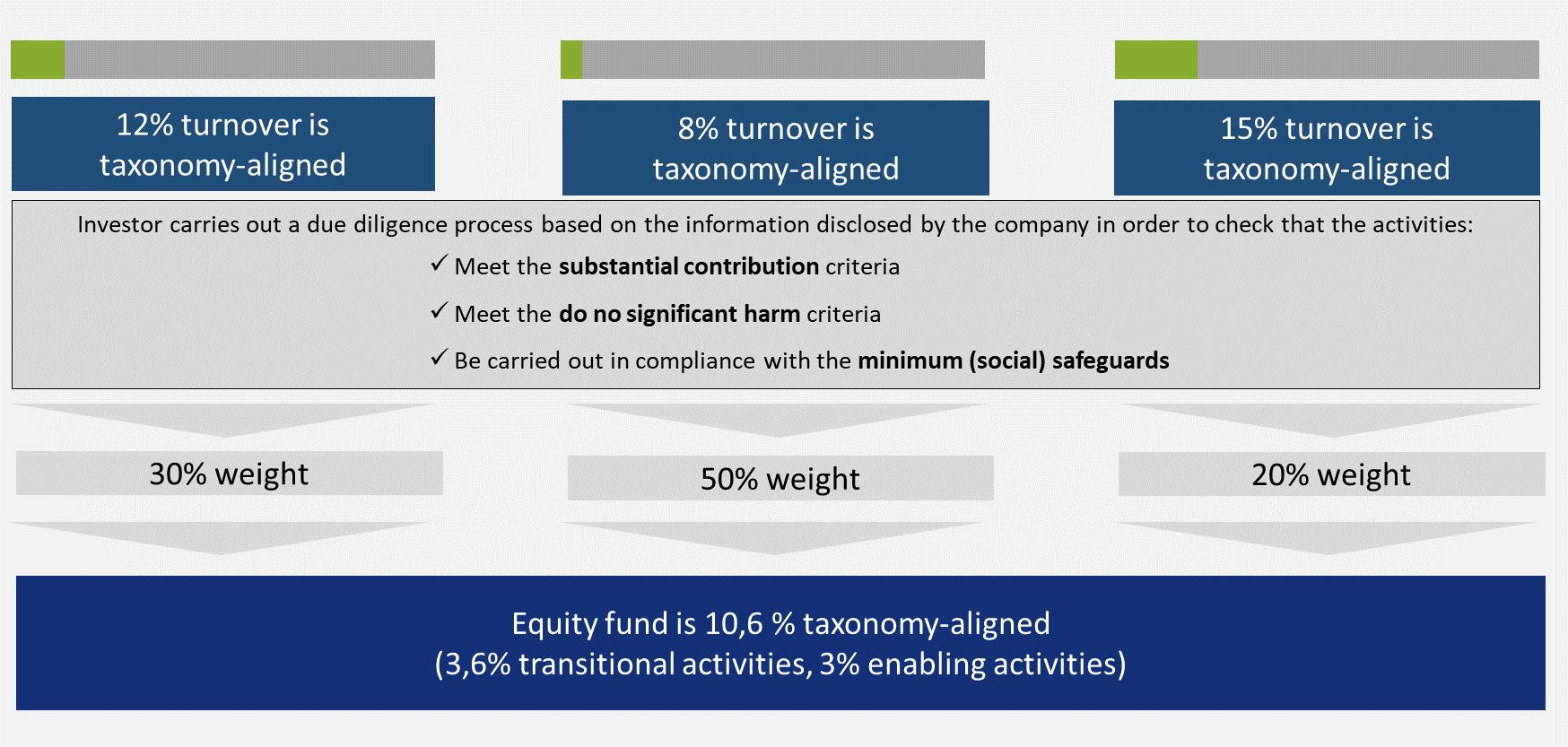
3.2 Summary of costs and benefits
This part of the annex elaborates on potential broader costs and benefits of the EU Taxonomy. These aspects are not the focus of this report and only complement it by providing illustrative complementary information. It is not possible to comprehensively assess impacts at this stage, as they are dependent on specific uses (as explained at the start of this annex). This section thus presents only an illustrative overview of costs and benefits related to disclosure by entities under the scope of NFRD. Similarly, impact assessment accompanying initiatives that introduce use cases related to the EU Taxonomy will assess the use of the EU Taxonomy where relevant and to the degree that there is optionality to applying it given the adopted primary legislation.
The following tables present a qualitative overview of expected benefits and costs related to the use of the EU Taxonomy, attempting to distinguish which benefits and costs can be expected to directly arise from obligations under the Taxonomy Regulation (direct) and those expected to arise as a result of the uses of the EU Taxonomy including possible second-order effects of these obligations and uses (indirect). This is followed by a further elaboration on possible impacts related to SMEs and potential cross-cutting impacts.
|
I. Overview of Benefits
|
|
Description
|
Amount
|
Comments
|
|
Direct benefits
|
|
Lower search costs for sustainable economic activities
|
The EU Taxonomy will be a common tool for classifying economic activates as environmentally sustainable. This is expected to reduce investor search costs for prospective companies likely to benefit from the transition to a carbon-neutral economy (indirect) and reduce expenses that institutional investors would spend on developing and updating their own classifications.
|
Stakeholders expected to benefit: financial intermediaries and institutional investors.
|
|
Clear transition path
|
The EU Taxonomy translates long-term climate transition objectives into more tangible activity-level criteria, providing a clear path that companies can use as a reference for their transition.
|
Stakeholders expected to benefit: companies.
|
|
Monitoring progress and capital flows
|
The EU Taxonomy will make it easier to monitor capital flows towards green investments and in this sense keep track of the progress towards long-term climate and environmental objectives. It will also make environmental information more available for relevant authorities.
|
Stakeholders expected to benefit: public authorities, researchers and broader public.
|
|
Indirect benefits
|
|
Enabling integration of climate factor into financial products and portfolios
|
The activity-level approach followed by the EU Taxonomy can also help investors to develop new financial products (e.g. using Taxonomy exposure as a factor to add a climate transition/climate resilience tilt to their portfolios). It could thus enable them to reduce their exposure to transition and, to a certain degree, physical risks of climate change.
|
Stakeholders expected to benefit: financial intermediaries and institutional investors, ultimately also households using financial products.
|
|
Supporting investor and stakeholder engagement
|
The criteria and relevant disclosures are likely to help investors find common language with investee companies.
|
Stakeholders expected to benefit: financial intermediaries and institutional investors, companies, civil society.
|
|
Attracting capital and customers to sustainable economic activities
|
Possibility to attract new capital and investors with sustainability preferences by credibly signalling alignment. Alignment with the EU Taxonomy can also boost company’s reputation with their customers.
|
Stakeholders expected to benefit: companies.
|
|
Reflecting sustainability in business strategy
|
Better identification of firms’ green assets (and transition risks) can be used as a metric in a long-term business strategy.
|
Stakeholders expected to benefit: companies.
|
|
Greatly enhancing comparability financial products on environmental characteristics
|
It will be easier for retail investors to compare financial products on environmental characteristics based on Taxonomy-relevant product disclosures (and later through the use of the EU Ecolabel). Increased transparency will reduce search costs and can limit the risk of greenwashing to which investors are exposed.
|
Stakeholders expected to benefit: retail investors.
|
|
Enhancing confidence in financial products
|
By reducing potential for greenwashing, this initiative could help to increase confidence in sustainable financial products over time and thus attract more end investors.
|
Stakeholders expected to benefit: investors, financial intermediaries.
|
|
Holding companies accountable and reducing externalities
|
Information on the EU Taxonomy alignment (which implicitly includes compliance with DNSH and minimum social requirements) could help civil society to hold companies accountable in relation to their environmental impacts. This information as part of corporate disclosures could also help to reduce externalities over time.
|
Stakeholders expected to benefit: civil society and public.
|
|
Basis for further policy action (public incentives, etc.)
|
Public authorities could leverage the EU Taxonomy as a basis for further policy action, e.g. to design and implement initiatives to scale up green investment at a lower cost.
|
Stakeholders expected to benefit: public authorities (and ultimately companies with environmentally sustainable activities).
|
Table 7: Overview of benefits
|
|
II. Overview of costs
|
|
|
Citizens/Consumers
|
Financial intermediaries
|
Businesses
|
Administrations
|
|
|
One-off
|
Recurrent
|
One-off
|
Recurrent
|
One-off
|
Recurrent
|
One-off
|
Recurrent
|
|
Taxonomy disclosures
|
Direct costs
|
None
|
None
|
One-off costs related to Taxonomy disclosure: i) developing or adapting adequate tools and processes; ii) familiarisation with the obligations and training staff; iii) expected higher costs when collecting information for the first time (higher costs can be expected where information from investee companies would not be available). Some of these tasks could be handled through external service providers.
|
Taxonomy-related disclosures by financial intermediaries captured by NFRD (on entity level) or Disclosure Regulation (on financial product level): i) updating the collected information; ii) publishing the information
|
Assessment and disclosures on Taxonomy alignment with approximate magnitude of costs in the range of 280 – 875 million EUR. Expected cost categories: i) familiarisation with the legislation and training;
ii) updating internal processes and systems; iii) setting up data collection (for those who do not capture such data for other purposes); iv) matching financial and non-financial information at an appropriate NACE activity level. Some of these tasks could be handled through external service providers.
|
Assessment and disclosures on Taxonomy alignment with approximate magnitude of costs in the range of 140 – 350 million EUR per year Cost categories: i) updating the information; ii) publishing the information
|
Regulators and supervisors in the EU who have already developed their own taxonomies could face costs to adapt their system (direct/indirect depending on use relation to Article 4 of the Taxonomy Regulation).
|
Monitoring and enforcement of compliance with Taxonomy Regulation
|
|
|
Indirect costs
|
|
Disclosure-related costs faced by intermediaries could be passed on into the cost of investment products with sustainability objectives.
|
|
At risk of competitive disadvantage, potential pressure to provide information from institutional investors using wholesale products.
|
|
At risk of competitive disadvantage, potential pressure to provide information by those not subject to NFRD from investors or businesses across value chains.
|
Regulators and supervisors in the EU who have already developed their own taxonomies could face costs to adapt their system (direct/indirect depending on use relation to Article 4 of the Taxonomy Regulation).
|
|
Table 8: Overview of costs
Approximate magnitude of costs under CSRD/NFRD scope
As described above, large companies under the scope of CSRD (former NFRD) are expected to bear administrative costs related to the EU Taxonomy. These would be notably the incremental costs of collecting relevant environmental data, matching them with financial data at activity level and disclosing on the resulting alignment. These costs have to be distinguished from substantive compliance costs which refer to costs incurred to meet the thresholds of a particular activity in the EU Taxonomy. As the EU Taxonomy is a voluntary tool, no substantive compliance costs are mandated under the Taxonomy Regulation.
The administrative costs related to the EU Taxonomy are very hard to estimate at this stage, as previously explained in Section 7. This report nevertheless attempts to support the assessment of the criteria for the delegated act with an illustrative estimation of an order of magnitude of these costs. This delegated act could influence these costs only to a limited extent. Notably the direct impact of the criteria on administrative costs results from the usability of the technical screening criteria (which was assessed under requirement IV in this report).
This estimation draws from a survey that was run by the Centre for European Policy Studies (CEPS) in spring 2020 as part of its study supporting the NFRD review (CEPS, 2021). As part of its survey, CEPS asked several questions to companies in relation to costs of Taxonomy-related disclosures. Only 13 non-financial companies provided some estimates of administrative costs in the survey, with only two of them providing estimates for all three cost categories listed
. The Commission has substantiated this information further through targeted outreach with companies and data providers.
Here there is an attempt to illustrate the expected magnitude of costs per company for large companies under the scope of the current NFRD, including companies brought under the NFRD due to national transposition of the Directive
. The input provided in this limited exercise suggested one-off costs approximately in the range of 40 000 – 125 000 EUR per company
, and recurring costs in the range of 20 000 – 50 000 EUR per year, albeit with a certain degree of uncertainty around these estimates.
In any case, costs would differ greatly between companies depending on a number of factors, notably:
·Complexity of the company: The number of economic activities that the company carries out overall and the number of their activities that are (already) covered by the EU Taxonomy; the number of different geographic areas in which the company operates and finally the number and structure of its facilities/sites.
·The degree to which the company is already collecting data on environmental impacts
and the degree to which it has systems for collecting such data in place.
·The degree to which the company’s existing accounting system and legal structure is aligned with NACE or other industry classification systems that can be mapped to NACE
as well as checking for compliance with both substantial contribution and DNSH-criteria.
·The company’s decision to internalise or externalise certain tasks and the extent to which companies will seek verification of these data.
Given the small sample and uncertainty about costs, it is difficult to extrapolate this to arrive at an estimate of total costs. Assuming that the above cost ranges can be applied to each of the approximately 11 700 companies currently subject to the NFRD, and taking account of how Member States have transposed the Directive
, this would translate into an approximate magnitude of aggregate Taxonomy-related disclosure costs in the range of 280 – 875 million EUR for one-off costs and recurring costs in the range 140 – 350 million EUR per year. Meanwhile, the CSRD proposal as adopted by the Commission on 21 April 2021 proposes an extended scope of 49 000 companies that are subject to the reporting requirements. Extending the expected magnitude of costs accordingly, while keeping the same assumptions, would amount to approximately EUR 1 200 – 3 700 million one-off costs and EUR 600 – 1 500 million recurring costs per year. Again, there is a large level of uncertainty around this estimate. In this estimation, it is assumed that 40% of the companies under the CSRD/NFRD would likely not face additional costs, as they would not have any Taxonomy-eligible revenues
.
An important limitation of the CEPS survey is that it did not ask about costs of investments – e.g. additional equipment for measuring emissions – as desk research, and preliminary testing of the questionnaire with stakeholders suggesting that these costs would be negligible in the current NFRD context. Nevertheless, the Commission acknowledge that these could be more significant in the case of the EU Taxonomy for companies that have not yet measured GHG emissions or other environmental data in a granular way
. This is complemented by a targeted outreach with several companies and data providers. One company that has already completed its self-assessment against the EU Taxonomy criteria pointed at an approximately similar or slightly lower range for one-off costs. The most relevant cost items were setting up data collection (around 35% of one-off costs), updating internal processes (around 25%) and costs related to familiarisation/training of staff and matching financial and non-financial information at an appropriate NACE activity level (each around 15% of one-off costs). Recurring costs consisted mostly of annual data collection and update of the information (around 80%) as well as internal controls related to the publication of this information. An interview with a mid-sized company active in more than 10 countries and over five economic activities confirmed these cost categories and highlighted that costs may indeed be higher for companies that are more complex, as outlined above. It also showed that even some relatively complex entities might not modify their reporting systems and rather compile relevant information from across the company through a survey or other methods.
In case of financial companies, responses from the CEPS survey were even fewer and much more heterogeneous, thus not allowing to draw any meaningful conclusion. This could result from the differences between the relevant portfolios and assets to which the EU Taxonomy would be applied, but also, importantly, from the lack of clarity at this stage about relevant indicators and methodologies to follow in the disclosures, which will be specified only through the delegated act on Article 8 of the Taxonomy Regulation. In the above approximation of costs under NFRD/CSRD scope, financial companies are implicitly included, assuming for simplicity a similar magnitude of costs per company. While this assumption may not fully hold in all cases, the overall effect on the estimated magnitude of costs should not be very large as financial companies form only a small subset of companies disclosing information under the NFRD scope
.
To give at least a qualitative sense of the types of costs that financial companies will face, based on the interaction with a limited number of financial and data providers, the following cost categories would be expected:
I)Recurring costs related to purchasing external data from a provider (or expanding existing data subscriptions to cover the EU Taxonomy);
II)Recurring costs related to mapping available data against loan books and portfolio holdings and potential engagement with investee companies; and,
III)Potential one-off costs related to upgrading IT systems and processes.
The costs need to be considered in the context of the anticipated benefits outlined in the table above, which will be spread across a range of actors. As regards non-financial companies, the introduction of the EU Taxonomy could lead to better access to capital and the diversification and expansion of the investor base (as “green” companies could attract both investors with higher sustainability preferences and more institutional investors). The Commission nevertheless acknowledge that costs may be higher than benefits for some actors, at least in the short term, as the potential improvement in access to capital could be influenced by a number of factors. Positive benefits are likely to materialise in particular for those with Taxonomy-aligned activities that were not recognised as “green” in the past (for instance steel and cement producers with outstanding environmental performance). At the same time, companies which were previously considered sustainable by investors and will disclose a lower than expected share of Taxonomy-aligned activities could become less attractive for investors. Some stakeholders also expressed concerns that this may be the case for companies operating in activities that are not included in the EU Taxonomy at this stage (e.g. in their feedback on the inception impact assessment). Nevertheless, if such impact were to materialise, this is expected to be marginal for any given entity, as the expected Taxonomy alignment across the markets is rather low at this stage, and as the resulting reallocation of capital would likely be gradual and driven also by broader policies related to climate and environment.
Together with possible public incentives, this better access to finance for sustainable projects should encourage steps towards reducing carbon footprints, improving climate resilience, and preventing and reducing large long-term consequences of climate change. There are potentially far-reaching positive effects that could arise from the EU Taxonomy in conjunction with other EU Green Deal policies that could together help to significantly reduce negative externalities (e.g. preventing flooding, droughts, etc.). Such benefits cannot yet be quantified, as they must be seen in light of the long-term costs of inaction and resulting heightened physical and transition risks of climate change. Thus, the Commission expects that overall and in the mid- to long-term, benefits (in particular environmental) will significantly outweigh the costs.
The second TEG call for feedback as well as the consultation of the Renewed Sustainable Finance Strategy (see Annex 2.9) both indicated an intention to use the EU Taxonomy among a number of respondents. The intention to use the EU Taxonomy and the need to provide more transparency to end-investors from financial market participants will in turn lead to greater demand for non-financial information from companies. In this context, the NFRD review, which is also undergoing an impact assessment, is central in order to ensure it meets users’ needs. More standardised and credible disclosure of relevant non-financial information along the investment chain could be expected to help investors to obtain the necessary information. Such disclosures will also complement other non-financial information from companies, making it easier for civil society to hold companies accountable, as well as for public authorities to monitor the situation and design future policies, but it could also spur new areas of research and innovation.
Potential impacts for SMEs
SMEs are outside of the scope of the NFRD. At this stage, no direct impact of the broader EU Taxonomy on SMEs is thus envisioned. However, the growing demand among market participants for better, more comprehensive and more reliable non-financial information, potentially including how SMEs’ activities align with the EU Taxonomy, may affect them as well. Therefore, it is understood that there are certain indirect impacts for SMEs which can result from the EU Taxonomy.
As part of investment portfolios and supply chains of large companies, SMEs may be pressurised to disclose Taxonomy alignment to investors or NFRD companies. This is already the case for some non-financial information and could be further intensified. As the SME panel on NFRD showed, 43% of surveyed SMEs that are part of the supply chain of a large company, received requests to disclose ESG data from companies, to which they supply goods or services. Similarly, 76% of the medium sized SMEs that are part of a large company supply chain also received requests from their customers, compared to 36% and 33% for small and micro sized SMEs respectively. Therefore, although SMEs may not fall under the scope of the NFRD, pressure from market participants may nonetheless require them to disclose Taxonomy-aligned activities. These issues and their extent will be monitored in light of potential changes for companies under the Taxonomy Regulation which may result from the review of the NFRD.
In addition, some stakeholders have expressed concerns that their access to finance could worsen unless they disclose according to the EU Taxonomy. For example, stakeholders noted that banks could choose to limit lending to non-Taxonomy-compliant entities or that asset managers could remove them from their investment funds. However, it seems that these concerns are not shared across the board of SMEs. While some companies may choose to disclose EU Taxonomy alignment voluntarily, it is also not likely that a high share of SMEs would do so. Thus it is not very likely that the non-disclosing SMEs would face substantial negative impact. Rather, against the backdrop of growing costs of climate-related events, it could become more feasible for them to increase their resilience to climate-related risks as the EU Taxonomy is expected to help the market develop greater experience with implementation of such climate change adaptation solutions (as explained in Annex 6). Greater use of adaptation solutions and practices by larger companies could foster economies of scale and learning effects, which could in turn make it easier and less costly for SMEs to become more climate-resilient as well.
At the same time, the EU Taxonomy could encourage businesses including SMEs to improve their resilience to climate change adaptation by raising awareness about recommended practices. While climate change will impact SMEs in a similar manner as large corporations, there are indications that SMEs may be less prepared to manage the risks that arise from climate change as they may have less resources and expertise to deal with and recover from the crisis than larger companies. The risk perception of SMEs has changed accordingly. As a survey of the Zurich Insurance Group (2016) showed that 78% of the 2,600 SMEs surveyed expected risks associated with climate change to have a significant effect on their business. Among these, one third of the stakeholders regarded material damage the most critical risk to business due to climate change, followed by the threat of business interruptions. In this context, the EU Taxonomy may play an important, indirect role at several levels as a tool to spur investments in greater resilience.
Cross cutting impacts on stakeholders
Throughout the development of the EU Taxonomy, stakeholders have also expressed concerns on further impacts that could materialise in the case of a widespread use of the EU Taxonomy.
Some stakeholders view a risk of generating financial disruptions: green bubbles, disorderly correction of current market distortions, or stranded assets. By increasing transparency, the EU Taxonomy indeed intends to attract investors to finance sustainable economic activities. This can make some investments more attractive than others and influence cost of financing for companies to some degree. In case of a very high uptake of the EU Taxonomy in investment decisions and a lack of green investment opportunities, such increased demand might generate a green asset bubble with potential adverse consequences on financial stability. However, it is unlikely that investors would use this information in isolation from financial information. In fact, the design of the EU Taxonomy which stretches across a number of sectors rather than a handful of “green sectors” would encourage investors to consider Taxonomy-relevant information in the context of other information relevant for a given sector. Thus if the share price of a highly Taxonomy-aligned company was to greatly diverge in value from its non-Taxonomy peer company (as a “green premium”), any crowding in of investors would, all things being equal, lower the returns on offer, and the premium would likely be kept at a reasonably level as investors with lower sustainability preferences would take their money elsewhere. It is also important to consider that the EU Taxonomy will operate as a part of the broader framework of EU climate strategy, which aims to generate more opportunities related to a low-carbon economy and therefore generate more sustainable activities that fulfil demand.
In relation to activities which are not considered sustainable, the risk of creating stranded assets (e.g. assets which might be subject to a price depreciation resulting from the implementation of climate policies, prior to the end of their economic life, and to the attached investment) does not result from the EU Taxonomy by itself, but rather from the implementation of climate policies (especially in the case of a disorderly transition) and the lack of long-term perspectives from the investors. In this regard, by setting out greater transparency and being designed as a dynamic tool reflecting market developments, the EU Taxonomy would rather help the market to integrate this information in asset prices over a longer-term. The EU Taxonomy could also help avoid some stranded assets by making EU climate and environmental objectives more tangible for different sectors and thus discouraging some new investments that may end up being stranded (e.g. from technological or market developments, or from a lack of resilience to climate change physical impacts). From the investor perspective, the EU Taxonomy could signal activities which are less exposed to transition risks and therefore it can help preserving long-term financial stability by helping to diversify exposures of financial institutions before more stringent sectoral climate policies are implemented. Similar consideration also applies in case certain operations are no longer considered Taxonomy-aligned following an update of the EU Taxonomy. As in the example discussed in the paragraph above, investors would likely weight this information against other relevant information (e.g. financing metrics), hence financing would not be likely to dry out suddenly and cause stranded assets.
ANNEX 4: KEY METHODOLOGICAL CHOICES
4.1Classification of economic activities - NACE
The EU’s NACE classification system of industries (Nomenclature des Activités Économiques dans la Communauté Européenne) is used to classify economic activities within the EU Taxonomy. The reason for taking NACE as the basis for the EU Taxonomy is that the European classification system promotes comparability and usability. NACE is subject to legislation at the European Union level, which imposes the use of the classification uniformly within all Member States. This guarantees comparability not only across EU Member States, but also across international statistical frameworks – NACE is based on classifications from the UN Statistical Commission (UNSTAT), Eurostat as well as national statistical bureaus. All of these systems are strongly related to each other. The Taxonomy Regulation requires that technical screening criteria be built upon Union statistical classification systems where appropriate (Article 19 (d)) and be easy to use. NACE ensures that the technical screening criteria can be set in a comparable framework and thus ensures a high degree of usability and comparability when the Taxonomy is applied by companies across Europe, but also internationally.
The use of NACE codes for economic activities has several limitations. First, some important activities are not captured by the NACE classification system. For example, urban and regional planning for low carbon development, including avoided journeys, the support for lower carbon personal choices, such as vegetarian diets, or investments to sustainably managed natural capital, such as forests and wetlands lack a specific NACE code. It is therefore likely that additional NACE codes will need to be added at a later stage to enable coverage of all relevant activities in the EU Taxonomy or that certain economic activities need to be included in the EU Taxonomy at this stage without reference to a specific NACE code. Second, the attribution of revenue stemming from an economic activity that is classified in one of the NACE codes may not always be clear to users.
In order to account for these limitations, activities that fall under several NACE codes but are important for climate change mitigation and adaptation, have been attributed to a dedicated code or a cross-cutting sector (and related economic activities). The latter was the case for both climate change mitigation and adaptation. In addition, to enhance usability for companies and investors, consistency between the EU Taxonomy and NACE must be ensured. Therefore, the work on the EU Taxonomy will be taken into account in the review process of NACE. However, as NACE is used for a wide range of purposes, needs to fit a broad frame put in place for the international economic classifications (e.g., be compatible with ISIC) and serves as reference for many other statistical classifications, alignment with the EU Taxonomy constitutes only one of many considerations. Hence, it might not be possible to ensure a seamless alignment between the two. Moreover, it should be noted that consistency between NACE and the EU Taxonomy will only make it easier for users to determine which criteria apply to a given activity. In each case, it needs to be examined whether a producer, its specific business segment or project belonging to a given NACE code comply with the technical screening criteria of the EU Taxonomy for that activity.
4.2 Methodology for selecting economic sectors and activities for climate change mitigation
This annex complements section 5.1 concerning the classification and selection methodology of economic sectors and activities for the EU Taxonomy.
When considering the selection of economic sectors and activities for the EU Taxonomy, one has to differentiate between prioritisation of certain economic sectors and activities for further assessment on one hand, and the eventual inclusion of these activities in the EU Taxonomy on the other. While the Taxonomy aims to assess the whole economy eventually, this does not mean that all economic activities can make a substantial contribution and will thus be included. This section looks first at why the assessment of certain sectors and activities was prioritised over others and continues by explaining the logic of including certain activities in the Taxonomy based on their potential to make a substantial contribution to climate change mitigation.
4.2.1. Prioritisation of sectors and activities for assessment
The assessment of economic sectors (and activities within these sectors) for climate change mitigation focused on sectors with the greatest potential to make a substantial contribution to climate change mitigation based on their share of overall emissions and their potential to reduce emissions. This impact assessment has evaluated the prioritisation used by the TEG and endorses it. This prioritisation is based on the GHG emissions of the (each) sectors/activities and their mitigation potential, as well as their potential to enable other sectors on the basis of Scope 1 emissions data. The analysis is based on Scope 1 emissions data, as Scope 2 and 3 data by NACE code is not available. Additionally, the methodology recognises energy efficiency improvements, consistent with the requirements of the Taxonomy Regulation. This is also necessary, because failure to address the carbon performance of buildings, which alone contribute 36% of CO2 emissions in the EU28, would risk causing harm to climate objectives.
This prioritization logic matches the EU’s objective to decarbonise the economy. European decarbonisation in the medium-term is defined through the climate and energy targets until 2030, while the 2050 climate-neutrality ambition sets out the long-term vision. The EU has set binding targets for the EU comprised of the GHG emissions reduction target of 40% below 1990 levels by 2030, minimum 32% share of renewable energy in the Union's gross final consumption of energy by 2030; and the target of 32,5% improvement in energy efficiency to be achieved by 2030. The Commission is currently preparing to propose new emissions targets for 2030.
The input received from the TEG covers 8 sectors that account for over 93% of GHG emissions in the European economy. Prioritization of these sectors for further assessment reflects the objective to decarbonise the EU economy by 2050 as it ensures that the main levers for reducing emissions are considered. However, some high-emitting activities within these sectors have not been assessed yet. The percentage of GHG emissions generated by the subset of economic activities that have ultimately been included in the Taxonomy thus represents a smaller fraction of the overall 93%. With respect to the economic significance of included activities, Chapter 7 and Annex 8 contain some early estimations of potentially Taxonomy eligible and aligned shares of activities based on studies available to the Commission.
The TEG used Eurostat GHG emissions inventory data from 2016, which are consistent with the more recently published data from 2018. More recent emissions data is now available. There has been no disruptive change in sectoral GHG emissions in terms of proportions in the recent years, therefore GHG inventory of the EU remains an appropriate basis for determining which sectors of our economy are responsible for the bulk of GHG emissions. The current impact assessment relies on the most recent data available – as illustrated below.

Figure 8: GHG emission in the EU27 in 2018.
Source: European Commission based on European Environment Agency EU's 2020 GHG inventory submission under the UNFCCC, May 2020 - https://www.eea.europa.eu/themes/climate/eu-greenhouse-gas-inventory/eu-greenhouse-gas-inventory
On the basis of these data, the Technical Expert Group on Sustainable Finance started narrowing down the universe of economic activities (as classified by NACE codes). Of the 21 broad sectors covered by NACE codes, the TEG has selected 8 (including the sector “buildings”, which was added as it was not assigned to a separate NACE code), with four levels of sub-codes. At the fourth level, of the 615 classes of economic activities the TEG has selected 70 activities for inclusion. The selection takes into account that not all sectors or economic activities have high emissions, or the potential to mitigate their own emissions or the emissions of other activities. The latter category is associated with ‘enabling activities’, which as the name suggests, enable other selected sectors to make a substantial contribution to climate change mitigation. In that spirit, complete sectors become relevant for assessment under the technical screening criteria, such as J - Information and Communication - and M - Professional, Scientific Technical activities - due to their potential to be enabling activities.
4.2.2. Inclusion logic of activities in the EU Taxonomy
The eventual inclusion of assessed activities in the Taxonomy is based on the potential of an activity to make a substantial contribution to one or more environmental objectives. As explained in chapter 1.2 (Box 2) “inclusion” means that the respective economic activity has to meet certain technical screening criteria (performance thresholds) in order to be considered environmentally sustainable.
The Taxonomy Regulation acknowledges different means for an activity to make a substantial contribution for each objective. Across all objectives, it is recognised that activities may not only qualify due to their own performance, but also by enabling other activities to substantially contribute. For climate change mitigation, the Regulation additionally stipulates in Article 10 (2) that “transitional activities”, for which no low-carbon alternative exists, can qualify under certain conditions. Transitional activities, such as cement manufacturing, are high impact activities as they are associated with high levels of GHG emissions. However, their environmental pressures can be reduced substantially, for instance by switching to alternative fuels, reducing the clinker to cement ratio, improving energy efficiency etc.
Low carbon activities on the other hand, which are not specified by the Regulation, make a substantial contribution because they have the potential to substitute high impact activities. While many activities across the economy have a low carbon impact, such as education, not all of them can replace high impact activities and are therefore included. An example is electricity generation from wind, capable of making a substantial contribution by replacing electricity generation with much higher levels of GHG emissions. The same applies for electric cars that are able to substitute thermic vehicles. Another way for low-carbon activities to make a substantial contribution is to enhance the good status (or “heal”) the environment. These are economic activities that make a net positive contribution to the environment. In the case of climate change mitigation, this category includes activities that remove carbon from the atmosphere, for instance afforestation or direct air capture.
The typology of substantial contribution described is illustrated in Figure 9 below.
Figure 9: Typology for substantial contribution to climate change mitigation.
When looking at explicit exclusions, the only – ex-ante – exclusion of economic activities stems from the Taxonomy Regulation and refers to electricity production from solid fossil fuels. The other activities that have been assessed, but not included, do simply not have the potential to make a substantial contribution as described above.
While this explains the overall inclusion and exclusion logic of activities, other activities could not be included at this stage due to practical constraints. First, a specific technology that would allow an activity to make a substantial contribution might not yet be mature enough to be included. Some solutions are very innovative, but are not yet commercially available on the market. Second, data availability for the activity’s potential to make a substantial contribution might still be missing. In this case, no scientific base could be provided to include the activity and a prudent approach was chosen to delay inclusion. Third, for some activities, data existed but no widely shared understanding of their benefits was available. In this context, work has been ongoing for several activities within the European Commission, but was not mature enough to be used in this round. Finally, the TEG had phased a very ambitious task in a limited amount of time. It has to be acknowledged that not all activities in assessed sectors have been assessed yet (for example aviation or maritime shipping in the transport sector or oil refineries in the energy sector –again, not preempting the decision to assign technical screening criteria to these activities or not). The Platform on sustainable finance will continue to work on this task to include any relevant sectors and activities as timely as possible.
In general, the Taxonomy aims to provide incentives for investors to invest in green projects and activities by giving them additional clarity; it does not aim to create disadvantages or change incentives for activities that are not included. Moreover, the potential disadvantages in terms of potential financial investments due to the delay of inclusion (probably one year) for certain sectors is expected to be marginal. The ultimate goal of the Taxonomy is, however, to assess the whole spectrum of economic activities.
4.3 Methodology for selecting economic sectors and activities for climate change adaptation.
For climate change adaptation, the logic of the assessment and inclusion of activities is different from the one for climate change mitigation where sectors were assessed by their potential to make a substantial contribution to mitigation based on their GHG emission profiles. Indeed, all sectors and activities through the economy are expected to be able to make a substantial contribution to climate change adaptation. This “whole-economy” approach is essential as climate change will affect all sectors of the economy. All sectors need to adapt to climate impacts in order to become resilient. Boosting climate resilience in all sectors helps avoid economic losses and provides co-benefits across other objectives. For instance, urban reforestation can provide co-benefits such as natural flood control, air pollutant and particulate matter removal, and regulate thermal stress in populated areas.
Nevertheless, it was not possible to include the whole economy for climate change adaptation in this first delegated act within the given timeframe. In order to preserve the integrity of the EU Taxonomy, relevant ‘do no significant harm’ criteria had to be considered and developed for every included activity. Three categories of activities were therefore included in this first delegated act based on a selection methodology described below. The approach taken implies that some key economic sectors for adaptation to climate change might not yet be included in the recommended list of activities that make a substantial contribution to climate change adaptation and will be added at a later stage through the work of the Platform. As the Taxonomy is set to be a dynamic tool that will develop and change over time, this gradual inclusion of activities and sectors is also a part of the essential characteristics of the Taxonomy.
4.3.1. First category of included activities: Activities for which DNSH criteria for environmental objectives 3-6 were developed under the mitigation Taxonomy.
The starting point for the adaptation Taxonomy in this first delegated act was the same list of activities that the TEG proposed for climate change mitigation, with some limited deviations to include further sectors and activities with high relevance for climate change adaptation (annex 6.1). The Commission services acknowledge that this approach implies that some key economic sectors for adaptation to climate change might not yet be included in the recommended list of activities that make a substantial contribution to climate change adaptation and therefore need to be assessed by the Platform on Sustainable Finance.
Nevertheless, by taking the activities proposed by the TEG as a starting point, it is possible to include these activities without compromising the environmental integrity of the Taxonomy as DNSH criteria for environmental objectives 3-6 were already developed under the mitigation Taxonomy. Only DNSH criteria to climate change mitigation had to be established for these activities.
These activities across 8 sectors are also of high relevance for adaptation as they should also be made resilient to climate impacts along with the whole economy. The rationale for their relevance to adaptation is developed in this annex under section 6.2.1.
4.3.2. Second category of included activities: (i) Activities not assessed by the TEG but for which DNSH criteria for activities already assessed can apply or (ii) Activities that have no or a very low impact on other environmental objectives.
For climate change adaptation, it is proposed to include a limited number of ‘adapted activities’ in the delegated act in addition to those that were proposed and analysed by the TEG. The selection of these additional activities for inclusion has been made rigorously, based on in-house expertise of the sectors within the Commission and according to the following methodology:
1.First step: screening of all remaining activities in NACE in order to identify activities that were partially covered or not covered by the work of the TEG.
2.Second step: identifying these activities screened in step one that (i) can follow the do no significant harm criteria for activities already assessed by the TEG (due to their similarity, e.g. additional manufacturing categories or buildings for warehouses), or (ii) have no or a very low impact on other environmental objectives and as such do not need DNSH criteria. This is typically the case for education or health systems that are important enablers for a successful collective resilience. This work was done by the JRC and the result is shown in the table below.
3.Third step: expert judgment within the Commission and the precautionary principle were used to eliminate the some activities from the list resulting from step 2. If, for any activity, there was a slight risk of harm to other sustainability objectives or further analysis was needed to assess potential impact, it would not be included.
For example:
oAlthough “Gambling and Betting” has no obvious environmental impact, it has been left out due to significant social impact it can cause.
o“Public Administration and Defence” has been left out, as defence can be one of the largest greenhouse gases emitters in many countries.
o“Publishing” has been left out as further analysis is need to assess harm potential to circular economy
4.Fourth step: assessing the potential for these activities to be considered as enabling activities in the future (i.e. providing solutions for adaptation).
The result of this analysis is summarised in table 9. The criteria that are set for these activities are the same as for all other activities that need to be adapted. The assessment of the criteria against the Taxonomy Regulation’s requirements is therefore part of section 6.3.2 in the main text.
The rationale for their relevance to adaptation is developed in annex 6.2.2.
4.3.3. Third category of included activities: Enabling activities identified by the TEG.
For enabling activities to climate change adaptation, the approach taken by the Technical Expert Group has been reviewed. Based on studies and in-house desk reviews it is suggested to establish more tailor-made criteria for enabling activities (in particular insurance) instead of a universal set of criteria. Two sectors that contain enabling activities are (i) Insurance and reinsurance, and (ii) Research, development and innovation allowing other activities to become adapted.
The rationale for their relevance to adaptation is developed in annex 6.2.3.

Table 9: Analysis for inclusion of adapted activities beyond TEG recommendation
4.4 Approaches to set technical screening criteria
As explained in section 5.2, EU climate and environmental objectives do not translate automatically into technical screening criteria for individual economic activities. This impact assessment used the approaches identified by the JRC as a tool to determine what types of metrics and criteria would be the most appropriate for a given economic activity. The applicable approaches were selected by using the Taxonomy Regulation requirements as a guiding framework. This was reflected in the use of an assessment grid described further below (Table 10) throughout Annex 5 with the results of this assessment summarised in Section 6.
For the climate change mitigation objective, there are different ways in which criteria to substantial contribution can be set. The criteria are developed in line with the net-zero emissions by 2050 objective and a 50–55% reduction by 2030, consistent with the commitments under the European Green Deal. While this can be used as a guiding principle, this does not translate automatically into criteria for individual economic activities. A starting point is therefore to recognise that the criteria in the Taxonomy can be set in different ways. The approaches outlined for climate change mitigation have been identified based on the types of criteria that have been analysed during the work of the TEG.
The list of approaches is not exhaustive, but comprises the approaches that have been identified by the JRC as most feasible ways to set criteria for climate change mitigation so far. The concept of each approach, presented below, describes how the substantial contribution criteria for climate change mitigation can be formulated for each of them. Further tables explain how the approaches were applied in the assessment grids and provide some illustrative examples.
|
Type of approach
|
Quantitative / qualitative
|
Concept
|
The technical screening criteria define…
|
Example
|
|
(1) Impact-based
|
Quantitative
|
Assess the environmental impact of the activity, i.e. the consequences on the environment of carrying out the economic activity. Activities qualify if they operate above a defined threshold or can demonstrate a positive impact on the environment.
|
… minimum expectations for the impact (effect) on the environment of carrying out the economic activity
(e.g. absolute GHG emissions savings considering the emissions from the activity and the avoided emissions from the activity it replaces, if any)
|
The TEG suggests that the manufacture of low carbon technologies and their key components that result in substantial GHG emission reductions in other sectors of the economy is eligible if they demonstrate substantial higher net GHG emission reductions compared to the best performing alternative technology/ product/ solution available on the market on the basis of a recognised/standardised cradle-to-cradle carbon footprint assessment (e.g. ISO 14067, 14040, EPD or PEF) validated by a third party.
|
|
(2) Performance in relation to the environmental target
|
Quantitative
|
Assess the performance of the activity under the relevant metric(s). Activities qualify if they achieve a certain level of performance derived from environmental considerations.
|
… minimum threshold (derived from the likely impact on the environment of carrying out the economic activity) for the environmental performance of the activity
(e.g. a level of GHG emissions per unit of activity that is considered aligned with a climate neutral economy)
|
The TEG suggests that light commercial vehicles with tailpipe emission intensity of max 50 g CO2/km (WLTP) are eligible.
|
|
(3) Best-in-class performance
|
Quantitative
|
Assess the performance of the activity under the relevant metric(s). Activities qualify if they operate above a fixed threshold based on the performance currently achieved by best performers (e.g. the top X% of the market).
|
... minimum threshold (derived from the top market players performance) for the environmental performance of the activity
(e.g. a level of GHG emissions per unit of activity that only the best 10% markets players achieve)
|
The TEG suggests that the manufacturing of nitric acid is eligible if the GHG emissions (calculated according to the methodology used for EU-ETS benchmarks) associated to the production processes are lower than the values of the related EU-ETS benchmarks. As of February 2020, ETS benchmark: 0.302 tCO2e/t of nitric acid
|
|
(4) Relative improvement
|
Quantitative
|
Assess the evolution over time of the performance of the activity under the relevant metric(s). Activities qualify if their performance improved by at least a defined relative threshold.
|
… minimum improvement threshold for the environmental performance of the activity
(e.g. a level of reduction of GHG emissions per unit of activity that is considered aligned with a climate neutral economy pathway)
|
The TEG suggests that the building renovation is eligible if it leads to reduction of Primary Energy Demand of at least 30% in comparison to the energy performance of the building before the renovation.
|
|
(5) Practice-based criteria
|
Qualitative
|
Develop a set of precise practices reducing the pressure or enhancing the status of the environment. Activities qualify if they implement/follow those practices or meet relevant qualitative criteria on how the activity is performed.
|
… a set of practices (derived from widely accepted best practices on the market) for the economic activity
(e.g. compliance with a set of qualitative criteria, with a code of conduct, certification by an EU scheme etc.)
|
The data centre implements the European Code of Conduct for Data Centre Energy Efficiency.
This implies implementation of the practices - including relevant optional ones where reasonable - described in the most recent “Best Practice Guidelines for the European Code of Conduct for Data Centre Energy Efficiency“ (JRC) or in CEN/CENELEC documents CLC TR50600-99-1 and CLC TR50600-99-2.
|
|
(6) Process-based
|
Qualitative
|
Define a number of process-based steps to determine how to reduce the pressure or enhance the status of the environment. Activities qualify if they follow those steps.
|
… a set of process-based steps
(e.g. a set of actions or points of focus that need to be addressed)
|
DNSH criteria proposed by the TEG for the Water objective for the Afforestation activity: Identify and manage risks related to water quality and/or water consumption at the appropriate level.
|
|
(7) Nature of the activity criteria
|
Qualitative
|
Define criteria on the exact scope and description of the activity. Activities qualify if they fall within this scope/description.
|
… the description of the activity automatically eligible (derived from proven substantial contribution of that activity)
(e.g. an activity that would always respect the absolute performance threshold and hence doesn’t need verification every time, s.a. EV or wind energy)
|
TEG suggests that zero tailpipe emission vehicles (incl. hydrogen, fuel cell, electric) are automatically eligible.
Manufacture of secondary aluminum is eligible. No additional mitigation criteria need to be met.
|
Table 10: Presentation of the generic types of approaches
Depending on the activity assessed, the different approaches presented in Table 10 are not equally suitable (e.g. as there is no well-established metric for a given activity’s environmental footprint). This explains the need for a methodology to select the most appropriate one. The table below (Table 11) presents a primary analysis of the intrinsic relevance of each approach with regards to the four categories of requirements defined in Section 4. We acknowledge the fact that there are trade-offs between some of the requirements: for instance, the ‘usability’ category pushes for criteria as simple and easily verifiable as possible while the ‘environmental integrity’ category requests scientific evaluation of life-cycle footprints that requires more effort to create and assess. As such, the most promising approach will be the one meeting the requirements to the best degree possible potentially for the different requirement categories, while ensuring at least minimum alignment with each.
|
|
Policy coherence
|
Environmental integrity
|
Level playing field
|
Usability of the criteria
|
|
(1) Impact-based
|
Depends on the policies for the environmental objective applicable to the activity.
|
Highest alignment: relevant indicator to be compared with the scientific requirement
|
Low alignment: Context-dependent: the same solution can have different impacts depending on external parametres outside the control of the economic activity and that may change over time (e.g. CO2 savings from wind-energy depend on the energy source it would be displacing).
|
Depends on availability of data for the activity and requires contextual data to assess the impact (which is not required in the performance-based approaches). Can be difficult in particular for an investor with a large portfolio of activities carried out in various contexts.
|
|
(2) Performance in relation to the environmental target
|
Depends on the policies for the environmental objective applicable to the activity.
|
High alignment : proxy for impact metrics
|
Highest alignment : totally independent of nature of the solution
|
Depends on availability of data (activity-dependent)
|
|
(3) Best-in-class performance
|
Depends on the policies for the environmental objective applicable to the activity. More aligned with policies that recognise the top X% market players.
|
High alignment : proxy for impact metrics
|
Highest alignment : totally independent of the nature of the solution
|
Depends on availability of data (activity-dependent)
|
|
(4) Relative improvement
|
Depends on the policies for the environmental objective applicable to the activity.
|
Depends on the activity
|
Low alignment : a poor solution with good improvement can be eligible while a good solution can be deemed not good enough
|
Depends on availability of data (requires before & after improvement data)
|
|
(5) Practice-based criteria
|
Depends on the policies for the environmental objective of the activity. Note: more aligned with mean-oriented rather than result-oriented policies (e.g. promoting certain farming practices)
|
Low alignment : harder to connect to ensure scientific evidence and lifecycle considerations are addressed
|
Medium alignment / depends on the activity: Risk of favouring one solution (= one set of practices) over another if this set of criteria is not a widely accepted best solution available
|
Medium alignment / depends on the activity: there may be a margin of interpretation left to user
|
|
(6) Process-based
|
Depends on the policies for the environmental objective applicable to the activity (some policies push for some specified solutions, e.g. renewables)
|
Depends how the activity has been chosen, but that can be under strong scientific consideration
|
Depends on the activity: e.g. nature-based of wind energy and electric cars criteria come from extension of the absolute-performance criteria, which respect the level-playing field requirement
|
Low alignment / depends on the activity: potentially large margin of interpretation left to user
|
|
(7) Nature of the activity criteria
|
Depends on the policies for the environmental objective applicable to the activity
|
Low alignment : harder to connect to scientific evidence and life cycle consideration
|
Depends on the activity
|
High alignment: the only assessment required is wheather the activity carried out fits the description.
|
As displayed in Table 11, in most cases, the suitability of the approach for a certain activity depends on the specificities of the activity considered. A further step in the analysis is hence required to determine which conditions on the activity assessed may influence the selection of the approach (see Table 12). We provide below a summary of the key findings for each approach.
The impact-based approach is a result-oriented approach and is the most scientifically robust as there can be a strong matching between the environmental needs and the criteria requirement without proxy. However, as it depends on the context in which the activity takes place it has a lower alignment regarding the ‘level playing field’. Its ‘usability’ and ‘coherence with EU policy’ depend on the activity itself (existence of such policies, measurability and availability of relevant data at activity level etc.) and can’t be assessed a priori.
The performance in relation with environmental target approach is also result-oriented but under a number of implicit assumptions (e.g. on the fact that the activity is replacing an activity with worse performance). It has a strong solution-neutrality component, compatible with the level playing field requirement. Depending on the quality of the quantitative performance metric selected, there may be a strong scientific linkage between the metric and the environmental impact. Thus the alignment with the ‘environmental integrity’ requirement is strong where the information used to set the threshold is also science-based. The usability of the approach and its coherence with EU policy depend on the activity itself and cannot be assessed a priori. For this criteria to be usable, one has to ensure that the level of ambition set for the threshold (from policy or scientific source) is actually reachable by the market players. Note: this approach does not recognize even very substantial performance improvement, as long as the target threshold is not reached.
The best-in-class performance approach has similar alignment with the ‘environmental integrity’, the ‘level playing field’ and the ‘usability of the criteria’ requirements than the performance in relation with environmental target approach, as they both rely on a result-oriented performance metric. Regarding policy coherence, it depends on whether policy related to the activity assessed recognises the performance of the best market players. However, as the threshold derives from technologies and practices available on the market rather than being directly linked to policy or scientifically established performance minimum requirement, ‘environmental integrity’ needs careful checking. This approach also requires frequently updated performance data for the whole EU market. This approach is likely to be more appropriate for high impact activities (selecting the best performers among high emitters may be, perhaps temporarily, good enough) than for low impact activities (if impacts below a given threshold are considered acceptable by the environmental imperative, a best-in-class approach might be too stringent).
The relative improvement approach does not reward the best absolute performers, but the ones having the best improvement. It encourages the whole market to take action and not just the most advanced players, leveraging a potentially bigger impact. The compliance with the four requirement categories depends on the activity assessed. This approach can be especially relevant for activities enabling a minimum improvement of underlying activities or assets, or net positive impact activities directly improving the state of the environment.
The practice-based approach that defines a set of practices to implement is not a result-oriented approach, but a means-oriented one. As such, the linkage between those means and the actual impact has to be established in a way that ensure compliance of the ‘environmental integrity’ requirement. Furthermore, as only one type of solution may be eligible (the set of practices chosen), it has to prove to be the best available one in order to respect the ‘level playing field’ requirement to make sure no ineligible other solutions performing at least as well exist. To be usable, the criteria have to be designed in a way that do not leave a large margin of interpretation for the activity user or the verifier. We note that in the case of activities improving the state of the environment, it is often difficult to clearly identify the results of the activity in isolation from anything else and thus a means-oriented approach like this one can prove more suitable.
The process-based approach, as a qualitative means-oriented approach, can leave a high margin of interpretation when applying the criteria and is harder to connect with scientific impact evidence. It can, however, be easier to write (e.g. when no other approach proves feasible) as it explicitly outlines the qualitative steps the activity has to follow without pre-empting the way in which the activity has to complete them). We note that in the case of activities improving the state of the environment, it is often difficult to clearly identify the results of the activity in isolation from anything else and thus a means-oriented approach like this one can prove more suitable
The nature of the activity approach automatically rewards the activities that correspond to the description. This is the most usable criteria as it is unambiguously and immediately assessable. It can be used as an extension of another approach if one type of solution is always eligible regardless of the way the activity is conducted. However, there must be sound scientific evidence of the fact that the activity would always comply to avoid level playing field issues vis-à-vis other activities that need to prove compliance with e.g. a performance based criteria. For activities improving the state of the environment, this approach can be particularly suitable.
Based on this primary analysis, we can identify that some approaches can prove less suitable for certain categories of activities, based on the type of substantial contribution these activities can do. By default, any approach is potentially suitable and would require further analysis taking into account activity specificities, but some approaches already can show less suitable or not suitable for a given type of activity. Table 12 summarizes these findings.
|
|
Negative emissions activities
|
Low carbon activities
|
Transitional activities
|
Enabling activities
|
|
(1) Impact-based
|
If the activity has a net positive impact, quantitative approaches may be less usable (data measurement needed) and even too stringent (threshold to reach while activity unconditionally positive). However, this stringency depends on the level of negative emissions expected to call it a substantial contribution.
|
Potentially suitable
|
Potentially suitable
|
Potentially suitable
|
|
(2) Performance in relation to the environmental target
|
|
Potentially suitable
|
Potentially suitable
|
Potentially suitable
|
|
(3) Best-in-class performance
|
|
Maybe too stringent as it could reject performers that are not the best but that are good enough, considering that the whole category presents a low-carbon alternative to other means of production
|
Potentially suitable
|
Potentially suitable
|
|
(4) Relative improvement
|
|
Maybe too stringent as it could reject performers that don't improve but that are already good enough
Level playing field issues
|
Rather not suitable for level playing field issues
|
Potentially suitable (improvement requirement on the underlying activity respects the level playing field requirement) e.g. Renovation of building
|
|
(5) Practice-based criteria
|
Potentially suitable
|
Potentially suitable
|
Potentially suitable
|
Potentially suitable
|
|
(6) Process-based
|
Potentially suitable
|
Potentially suitable
|
Potentially suitable
|
Potentially suitable
|
|
(7) Nature of the activity criteria
|
Potentially suitable
|
Potentially suitable
|
Not suitable
|
Potentially suitable
|
Table 11: Relevance of the different approaches depending on the type of substantial contribution of the activity
In this section, a way forward is proposed to select the most promising approach to develop the TSC for a given activity. We will illustrate this methodology with an example: electricity generation from geothermal energy.
For a given economic activity to assess, the legislator has to select the most suitable approach. A systematic screening of the potential approaches for that activity can be used based on the alignment of each approach with the Taxonomy Regulation requirements with regards to the specificity of the activity. Table 12 below shows a list of conditions that can be assessed. As these requirement can sometimes prove conflicting, we don’t expect an approach to perform to the highest extend to each requirement categories and some trade-offs may be necessary. The selected approach should be the one that deemed to have the best overall compliance.
For a given economic activity or group of similar activities, a systematic screening methodology will:
1)Check the level of compliance of each approach with the four categories of requirement. For that purpose, one can evaluate to what extent the conditions in the guidance Table 12 are met;
2)Compare the different approaches based on this analysis to narrow down the number of promising approaches;
3)Select the approach which offers the best overall alignment.
|
|
(A)Policy coherence
|
(B)Environmental integrity
|
(C)Level playing field
|
(D)Usability of the criteria
|
|
(1) Impact-based
|
oEU policy requires the consideration of broad environmental impact
|
oConsidering the actual impact of the economic activity in its context (if relevant, considering what it replaces) is mandatory to ensure a robust assessment
oThere is a way to measure impact that is consistent with state-of-the-art methods and takes into consideration the relevant life-cycle phases
|
oImpact-based criteria can be set for the activity in a way that avoids giving advantage to some in the market due to external conditions
|
oData on the activity impact is measurable and available in the market. Such measurement is affordable and widely adopted.
|
|
(2) Performance in relation to the environmental target
|
oRelevant metrics that can be used to quantify environmental performance and relevant performance targets for the activity or sector are set out in EU legislation and policies (if not, relevant internationally agreed or market-based metrics exist and do not contradict EU policy)
|
oThe level of environmental performance of the activity can be assessed robustly taking into account, when relevant, life-cycle considerations
oThe level of performance of the activity is coherent with the environmental target
|
oThe environmental target and the level of performance required are formulated to ensure technology neutrality
|
oData on the activity performance is measurable and available in the market. Such measurement is affordable and widely adopted.
|
|
(3) Best-in-class performance
|
oBest-in class approaches that are relevant and applicable exist in EU legislation or policies
|
oThe level of environmental performance of the activity can be assessed robustly taking into account, when relevant, life-cycle considerations
|
oPerformance is comparable across the economic activity in a meaningful way (e.g. the output is largely homogenous)
oThe level of environmental performance can be formulated in a way that ensures technology neutrality
|
oData on the activity performance is measurable and available in the market. Such measurement is affordable and widely adopted.
|
|
(4) Relative improvement
|
oMethodologies based on performance improvement exist in relevant legislation or EU policies
|
oPerformance improvement targets that are broadly coherent with the needed transition and feasible can be identified
|
oThe performance improvement can be reflected in the criteria in a way that does not reward nor penalise activities in the sector with different initial environmental performance
|
oThere is a relevant commonly accepted metric in the market that can be used to set a performance improvement threshold.
oPerformance improvement thresholds can be clearly defined and are easy to understand to users
|
|
(5) Practice-based criteria
|
oEU approaches or policies recognise certain practices as best practices within the economic activity
|
oAvailable scientific evidence demonstrates the technical robustness and environmental integrity of practices identified
|
oNo other (ineligible) set of recognised practices leads to similar or better impact or performance
oSufficient flexibility to carry out the practices as long as they do not undermine integrity
|
oThe relevant practices are sufficiently established in the sector. The description of the practices can be set in a way that is clear and unambiguous
|
|
(6) Process-based
|
oThe approach adopted in EU policies can be turned into a series of process steps that lead to actions
|
oThe requirements set through the process steps ensure that activities qualify only if the actions they lead to implement ensure reaching a level of impact or performance that is considered to provide a substantial contribution to the environmental objective
|
oA process-based criteria can be set for the activity in a way that avoids giving advantage to some in the market due to external conditions
|
oProcess criteria are sufficiently precise to be unambiguous and provide clear ways forward to implement action
|
|
(7) Nature of the activity criteria
|
oEU policies do not identify only certain results or practices within the activity as environmentally sustainable
|
oThere is evidence that the nature of the activity can unambiguously lead to a level of impact or performance that is considered to provide a substantial contribution to the environmental objective
oThe boundaries of the nature of the activity can be set in a way that only includes embodiments of the economic activity that provide such certainty
|
oAll activities having similar level of certainty regarding leading to a level of impact or performance that is considered environmentally sustainable are also included
|
o The definition of the activity can be stated in a clear and unambiguous way
|
Table 12: Deduction of the assessment grid: conditions under which an approach can be selected for a given economic activity
For climate change adaptation, technical screening criteria are mostly qualitative and process-based. Their primary qualitative nature results from the lack of measured baselines or accepted metrics for defining quantitative screening criteria for adaptation at this point in time, and lack of adaptation targets defined at the national, sectoral, or subnational level. Even with the availability of methodologies, targets or baselines, quantitative screening criteria could exclude small-scale activities that may deliver significant climate-resilience benefits in specific contexts. The interaction of climate exposure, resources and socioeconomic characteristics related to a specific economic activity determines the nature and scale of adaptation that would be appropriate.
The highly context- and location-specific nature of adaptation needs and solutions explains why the criteria to determine substantial contribution are process-based and practice-based. Sectoral climate sensitivity matrixes in Annex 6.1 identify the main hazards in sectors and underline potential vulnerabilities that justify the inclusion of the sectors by Taxonomy. Process-based criteria allow to determine whether an activity contributes to adaptation and to the broader system’s climate resilience. The actual assessment of climate risks (“climate risk assessments”) that are material to the activity lies at the core of the adaptation approach.
Box 11: Types of approaches to set criteria for substantial contribution to climate change adaptation
Practice-based criteria: Develop a set of precise practices that the activity has to implement to be deemed aligned (what practices to implement), tailored to the individual economic activity category.
Process-based criteria: Define a number of process-based steps that the activity has to follow to be deemed aligned, tailored to the individual economic activity category. Note: criteria can be set for the whole economy or over just one or several sectors containing several activities.
Following this logic, when considering the different approaches introduced in the previous section, the criteria that are set for adaptation can be practice-based and process based.
As for adaptation, one set of criteria is proposed for substantial contribution for adapted activities. Therefore, no analysis per sector is carried out such as for climate change mitigation. Instead, for adaptation it was possible to check the compliance for all criteria against the requirements of the Taxonomy Regulation directly (Section 6.2 and Annex 6.2).
In addition to requiring that an activity makes a substantial contribution to one environmental objective, the Taxonomy Regulation requires that the activity does no significant harm (DNSH) to any of the other environmental objectives under the Taxonomy Regulation, in order for the activity to be Taxonomy-aligned. While Article 3 of the Taxonomy Regulation contains the general conditions for an activity to qualify (including that it has to meet the DNSH criteria), Article 17 of the Taxonomy Regulation sets out concrete requirements for the meaning of DNSH to a given objective. In the delegated act, an approach needs to be taken on what this means in a given objective-activity combination. DNSH criteria reflect a sector-specific assessment of the respective impacts that a given activity can have on the different environmental objective. When setting criteria for DNSH, this impact assessment differentiated between (i) the environmental objectives that are at risk of being significantly harmed by an activity; and, (ii) those that are not at such risk. For each activity, the risk of harm to each of the objectives separately has been assessed. If an activity does not risk causing significant harm to an environmental objective, no DNSH criteria were specified for that combination of activity and objective (“minor harm” is addressed by applicable legislation). Conversely, if an activity risks causing significant harm to an environmental objective, DNSH criteria were specified.
It could be argued that for many activities the risk of significant harm to one or several of the objectives is effectively mitigated by EU legislation. However, legislation of non-EU countries does not necessarily effectively mitigate this risk, so that activities not subject to EU law (e.g. because they take place outside the EU) entail such a risk. In view of the global applicability of the Taxonomy Regulation, for such cases, DNSH criteria mirroring EU legal requirements have therefore been proposed.
There are also cases (for a given activity and given objective) where existing EU legislation itself does not effectively mitigate the risk of significant harm as defined in the Taxonomy Regulation, for example because EU legislation is not developed for a given sector with such focus (e.g. some of the DNSH criteria to circular economy). For these cases, (approximately 10% of the criteria), additional criteria for DNSH were developed as further explained in Chapter 6 and accompanying Annex 7.
DNSH criteria have the form of either qualitative (including process-based) or quantitative performance criteria: For DNSH to climate change adaptation, the criteria are process-based. This is also the case for most activities for DNSH to the sustainable use and protection of water and marine resources (where criteria require identifying and addressing risks to this objective, including through management plans); as well as for DNSH to the protection and restoration of biodiversity and ecosystems (where criteria require that an environmental impact assessment has been conducted, where relevant, and mitigation measures have been implemented). For DNSH to the transition to a circular economy, criteria are often qualitative, e.g. requiring recyclability of components. For DNSH to the objectives climate change mitigation and pollution prevention and control, the criteria are primarily quantitative (e.g. references to emission limit values / ranges from best available technique conclusions adopted under the EU’s Industrial Emissions Directive in the case of DNSH to pollution). These differences reflect the different nature of the environmental objectives (e.g. location-specific impacts), as well as the availability of quantitative data that needed to be accounted for, e.g. minimum performance thresholds.
The do no significant harm criteria can generally be set in different ways as outlined above. As they are set across all six environmental objectives and for each sector, where necessary, as explained above, a detailed analysis for each sector and each objective was not carried out. Rather, the relevant approaches chosen for each objective are assessed per objective. In addition, the principles for setting do no significant harm criteria are outlined and assessed to make sure that all proposed approaches meet the Taxonomy Regulation’s requirements to the best degree possible.
4.5 Level of ambition for the technical screening criteria
For the climate change mitigation Taxonomy, the main points of reference to set the level of ambition for technical screening criteria on economic activities are the Paris Agreement and the EU climate neutrality target by 2050. For climate change mitigation, the Taxonomy Regulation therefore aims to include activities that support the transition to a climate-neutral economy consistent with a pathway to limit the temperature increase to 1,5°C above preindustrial levels. In Article 10, the Regulation sets out means in respect to these reference points. However, other public policies or sectoral pathways consistent with these references could also be used as point of reference, if relevant.
While alignment with the EU’s and international environmental objectives as outlined above can be used as a guiding principle, the application to individual economic activities is complex. First, different climate scenarios have not been sufficiently translated into concrete pathways per sector in an unanimously accepted way. Not all technical screening criteria can thus directly be deducted from pathways to climate neutrality. Second, ambition levels of sectorial legislation in the EU varies greatly. Third, if environmental legislation exists, it does usually not set ambition levels directly on economic activity level or tailored to economic operators, but it rather exists in the form of Directives that contain obligations for Member States who then implement EU legislation and set out obligations on economic operators. Therefore, determining the exact ambition level for technical screening criteria is very specific to the considered sectors. However, the grounds on which EU legislation is taken into account to implement this ambition is done in a coherent way across the Taxonomy.
Generally, compliance with EU law or mandatory practices is a minimum requirement for all technical screening criteria. However, the aim of the Taxonomy is the “channelling of capital flows towards sustainable investments” in order to achieve the Sustainable Development Goals (SDG). Ultimately, it is about improvement in environmental outcomes, either through impact amelioration for existing activities or through new green activities that substitute non-green activities. The Taxonomy and its criteria should provide incentives for such improvements. The substantial contribution criteria therefore usually go beyond EU legislation as exemplified below. Setting general EU law compliance as a threshold for substantial contribution would lead to defining whole sectors as environmentally sustainable without incentivising improvement beyond what the EU legislation already does.
For example, for the construction of new buildings, the EU legislation (the Energy Performance of Buildings Directive) already requires that as of 1 January 2021 all buildings are nearly zero-energy buildings. For the EU Taxonomy it is proposed that the new buildings have a performance at least 20% better than the one of nearly zero-energy buildings. Where the EU legislation contains clear sustainability criteria, the Taxonomy draws directly from these critiera to set coherent incentives. This is the case for some (very few) sectors, for example the Clean Vehicles Directive. As mentioned before, setting an existing ambition level from EU law cannot be understood literally as technical screening criteria reproducing content of EU law. It rather means this ambition can be translated into criteria that apply to economic activities.
When translating the ambition level of the EU Taxonomy to economic activies, it is an important consideration that the technical screening criteria have to be reachable by current market practices. The criteria should therefore take into accound what is actually feasible for the market players, based on the performance available solutions on the market. Practices available on the market have to be proven to be applicable by best performers in the sector (for substantial contribution); it is not required that the majority uses them already. For DNSH, this consideration does not only apply to the level of ambition of a quantiative threshold, but also to qualitative criteria that require certain practices, such as verification requirements, assessment practices or management plans.
To define the level of ambition, there is an important difference between activities that can already be performed in a low-carbon way today (if continue to be performed as today until 2050, they would be consistent to reach climate neutrality) and the ones that cannot, but that need to be incentivised to change in particular. When an activity can already be performed in a “low-carbon way”, the criteria are set according to these practices. When it is currently not feasible to carry out an activity with low-emissions, the criteria are set to incentivise the best market practices, provided that they are still aligned with the transition to a climate-neutral economy consistent with a pathway to limit the temperature increase to 1,5°C, do not hamper the development of low-carbon alternatives and avoid lock-in of carbon intensive assets.
Accordingly, one can then set the threshold based on scientific or policy targets and check that the ambition level is reachable with the current level of technololy. Or (in particular for transitional activites) set the level of ambition based on the performance of the market and ensure that the level of ambition proposed is not in contradiction with EU policy and scientific conclusions.
ANNEX 5: CLIMATE CHANGE MITIGATION
5.1. Sector-specific assessment of the approaches and criteria for substantial contribution to climate change mitigation
The analysis in this section assesses the technical screening criteria that have been published in the draft delegated act for stakeholder feedback in November 2020. The changes that have been made to the criteria as part of the subsequent stakeholder feedback are not part of the assessment. The feedback received and resulting changes are summarised in Annex 2.10 of this report.
5.1.1. Forestry
This section assesses the criteria recommended in the draft delegated act as published in November 2020 for the forestry sector with regard to substantial contribution to climate change mitigation. It provides the context and scope of this sector and takes stakeholder feedback into account. It also outlines where major deviations from the TEG final recommendations are proposed. Applying the Taxonomy Regulation’s requirements, the section eventually assesses the suitability of the different types of approaches to substantial contribution to set criteria for the forestry sector and checks the resulting criteria against the Regulation.
Context
Why is forestry covered: Forests cover around 30% of the global landmass (in Europe this figure is higher at ~40-45%) and absorb roughly 2 billion tons of carbon dioxide each year. The EU forests already account for more than 20% of the global forest carbon sink, and yet an increase in carbon sequestration from forests is essential to the achievement of a net-zero target by 2050 in Europe and globally, especially in times that forests are experiencing many challenges due to climate change.
Which activities would be covered: On the basis of the importance of this sector in carbon sequestration potential, it is considered necessary to cover a range of types of activities that take place to create, improve and enhance the forests to contribute to various objectives, including climate. To this end, the TEG proposed five activities in the forestry sector, namely afforestation, rehabilitation and restoration, reforestation, existing forest management, and conservation forests, with the proposed criteria applying up to the forest gate (i.e. not considering downstream uses of wood). The Draft Delegated Act proposes criteria covering these activities. This is done without prejudging the evolving forest policy framework, notably the ongoing processes stemming from the Biodiversity Strategy and the Forest Strategy, and with the expectation that the future requirements can be integrated into the Taxonomy criteria at the later stages. Agroforestry is not explicitly addressed at this stage. However, the respective elements from the forestry criteria could be applied to the related parts of the economic activities. In addition, the importance of wetlands as carbon sinks is recognised and the inclusion of an according economic activity is proposed for the draft delegated act.
Assessment of the proposed criteria
The Taxonomy Regulation’s requirements are assessed for each of the specific approaches to set technical screening criteria that have been described in chapter 5.2. Aiming to strike the best balance between the different requirements, this assessment results in a combination of performance in relation to the environmental target criteria, performance improvement criteria, practice-based criteria and nature of the activity criteria that is consequently proposed for technical screening criteria for economic activities in the forestry sector. The table below presents the summary of this assessment.
|
|
oPolicy coherence
|
oEnvironmental integrity
|
oLevel playing field
|
oUsability of the criteria
|
Overall conclusion on applicability of approach
|
|
(1) Impact-based
|
No EU policy directly requires GHG emission savings in forestry.
|
There is no method for uniformly measuring the GHG saving impacts, but methods exist for calculating expected savings in forestry.
|
Strong risk of creating a distortion on the market due to the location-specific nature of the GHG savings potential of forestry activities.
|
Direct measurements of forestry impacts at stand level over a meaningful timeframe and taking into account other environmental factors would be difficult to implement, and do not exist on the market.
|
Not applicable, as the approach lacks in all aspects of the requirements.
|
|
(2) Performance in relation to the environmental target
|
There is no existing EU policy that could be used for defining substantial contribution to climate change mitigation in forestry; the RED II criteria can, however, be used as a component of the criteria.
No universal metrics exist to quantify environmental performance of forests. Internationally recognised methods for calculating GHG baselines and savings can be used.
|
.It is not possible to set a universal performance level due to the context specific nature of forestry. Rather, it is possible to set a performance level through the established key practices and local baseline.
|
Due to the context specific nature of forestry, setting a universal performance level would run a strong risk of creating a distortion on the market due to the location-specific nature of the GHG savings potential of forestry activities.
|
Direct measurements of forestry impacts at stand level over a meaningful timeframe and taking into account other environmental factors would be difficult to implement, and do not exist on the market.
|
Not applicable, notably for a lack of a justifiable target, but also for usability considerations.
|
|
(3) Best-in-class performance
|
No universal performance mapping exists to provide quantitative classes of environmental performance of forestry activities. Internationally recognised methods for calculating GHG baselines and savings could be used.
|
There is no method for uniformly measuring the GHG saving impacts, but methods exist for calculating expected savings in forestry.
|
Due to the context specific nature of forestry, comparing the performance level of forests in different locations would run a strong risk of creating a distortion on the market due to the location-specific nature of the GHG savings potential of forestry activities.
|
Direct measurements of forestry impacts at stand level over a meaningful timeframe and taking into account other environmental factors would be difficult to implement, and do not exist on the market.
|
Not applicable, notably for the lack of baseline data and the potential for market distortion.
|
|
(4) Performance improvement
|
No universal metrics exist to quantify environmental performance of forests, but internationally recognised methods for calculating GHG baselines and savings can be used.
|
The methods mentioned can be used to calculate the savings potential and the changes in this savings potential.
|
The performance improvement criteria can reflect the individual savings potential and thus ensure maximising that potential for each economic operator.
|
The methods to calculate performance improvements are known and tools exist.
|
Partially applicable, notably in ensuring a solid climate benefit analysis and improvement over an established own baseline.
|
|
(5) Practice-based
|
The range of practices that can deliver in different contexts is established in scientific literature and policy processes. The EU Biodiversity Strategy and Forest Strategy will further develop the elements for defining sustainable forest management.
|
Scientific evidence is available regarding the best practices in a range of contexts, but such assessment can be done only by experts for individual activities, as no single set of practices would be appropriate or sufficient in all contexts.
|
A universally applicable set of practices would imply an assumption regarding the location, therefore could incentivise sub-optimal solutions or penalise activities in different contexts.
|
The relevant practices are well established in the sector and the advisory services to identify the most relevant are also available. For usability and assurances, verification would also be mandated.
|
Partially applicable, if specific universally applicable practices would be identified i.e. in the context of the EU Forest Strategy. At the same time, this would need to be complemented by context-specific practices.
|
|
(6) Process-based
|
The processes of establishing management plans are standard in forestry.
|
A process-based approach leaves the discretion on the appropriate location specific ambition to the experts, but should lead to the criteria for each activity reflecting the GHG savings potential. Such expertise and services are well established.
|
Process-criteria would ensure a level playing field in a sense that all operators are equally required to follow the context specific requirements, but at the same time, these requirements can differ across locations.
|
The practices of management planning and GHG calculations are well established. For usability and assurances, verification is also mandated.
|
Applicable, as it allows tailoring context-specific measures to maximise GHG savings potential, e.g. in the forest management plan or equivalent.
|
|
(7) Nature of the activity
|
EU policies do not define specific forestry activities unequivocally as sustainable.
|
Forests are by nature carbon sinks and thus important for decarbonisation. At the same time, this potential can only be fulfilled if managed with a long term perspective.
|
Forestry activities can result in both positive and negative outcomes, and therefore the nature of the activity is not sufficient to establish substantial contribution.
|
The definition of forestry activities can be set clearly on the basis of existing definitions.
|
Not applicable, notably to avoid negative impact activities included in the Taxonomy.
|
|
Approaches chosen: Performance improvement, Practice-based, Process-based
|
Table 13: Assessment of proposed approaches to set criteria for forestry
Resulting from this assessment, a combination of criteria that are process, practice and performance based are proposed for the forestry sector. The below analysis assesses in more detail how the parameters for the criteria that result from these approaches are set with a similar ambition level across forestry activities that reflect – and meet the Taxonomy Regulation’s requirements.
In light of the specific role of forestry in decarbonising the EU economy, but also in light of the importance of forests to a broader range of EU environmental objectives, a comprehensive approach to forestry is embedded in the proposed criteria for substantial contribution to climate change mitigation. This reflects the strong interconnectedness of the various services that the forests provide and the balance of environmental outcomes that result from these services. This approach also reflects feedback from stakeholders that forestry activities should take a holistic approach in the Taxonomy. The proposed criteria ensure applicability in a range of situations and avoid prescribing specific practices that might not be suitable in all locations and circumstances.
The criteria reflect in particular the Regulation’s requirement to set the criteria in a fair and usable way, so that users can set their baseline reflecting the specific situation in which they operate, while a high level of ambition is maintained. The proposed criteria build on existing legislation and definitions in parts, as also requested in the stakeholder feedback. At the same time, these are not sufficient for defining substantial contribution to mitigation, and an acceptable level of ambition, delivering on the Taxonomy objectives, needs to be ensured through combining a range of elements and the need to ensure transparency.
Proposing elements in the criteria that foster transparency had to be weighed up against the administrative burden it would pose on the reporting entities and users of the Taxonomy. The proposed criteria in the November draft delegated act are, therefore, predominantly based on the main elements of already existing forest management and sustainability processes. The benefits of additional data availability were a key element in the stakeholder feedback. In forestry, the specific measures and potential is context specific and thus the ambition level is hard to ascertain without in-depth knowledge. Building on existing processes, a verification requirement is therefore required for the forest management plan to allow greater certainty about the alignment of the practices, which would be too hard to verify otherwise.
Based on the main elements of already existing forest management and sustainability processes, the criteria clearly define forests for the purposes of the Taxonomy through existing definitions and additional elements regarding the suitability of the location and activity, and cover the main elements that are important for ensuring good long-term GHG performance in forestry. It is essential that the Taxonomy does not facilitate deforestation or conversion of high carbon stock lands, but would only cover activities which take place on suitable areas. The Taxonomy criteria ensure a sufficiently high ambition level further by promoting additionality of measures, going beyond the business as usual baseline. There are three key parameters that could be used for assessing the substantial contribution to climate change mitigation, and the following evidence is further considered regarding these:
-Forest management/afforestation plan: in light of the context specificity of forestry, the best measures and potential for carbon savings vary. To allow identifying these measures, a verified and regularly updated plan detailing the situation and the measures taken or foreseen is proposed. Such plans are a common aspect of forest management, and are at places also already mandated under national legislation. To ensure that the plans are sufficient, the sustainability of the measures needs to be specifically verified.
-Climate benefit analysis: In light of the complexity and interconnectedness of forest ecosystems, the evolution of GHG savings and carbon stock requires context specific calculation. To avoid measures that benefit in the short term but are detrimental in the longer term, both the baseline calculations and the benefit analysis need to be based on conservative assumptions and regularly verified. The calculations of GHG savings and carbon stock should follow the international guidelines which define methods to calculate both above and below ground carbon pools, both of which are essential to maximising the long term sequestration of CO2. While this can increase administrative effort to some extent, such tools are available and they reflects an essential element of a comprehensive approach to carbon stock considerations in forests. This analysis needs to demonstrate climate benefit over the baseline. At the same time, the emissions and removals that occur due to natural disturbances should not be considered as disqualifying.
-Permanence: Given the importance of long-term action to achieve GHG savings, the criteria should also ensure that the permanence of the climate benefit is ensured in the above plans.
In light of the lack of a fully agreed and verifiable reference point for sustainable forest management, and the ongoing processes following the EU Biodiversity Strategy and the forthcoming new EU Forest Strategy, it is difficult to define a fixed set of practices for all identified forestry activities at this point in time. While these discussions are ongoing, the criteria build on the basis described above ensuring a verified forest management plan, or equivalent, together with other safeguards listed above to ensure a high level of climate contribution. While covering the same main parameters, this represents a notable difference to the TEG analysis, which was built around the use of Sustainable Forest Management practices.
This difference meets the requirements of the Taxonomy Regulation better. From policy coherence perspective, the Commission proposal offers better alignment to the current situation in the EU, while also improving usability with clear requirements.
In addition to forestry and agriculture activities, the importance of wetlands is recognised in the context of strengthening land carbon sinks. Wetland restauration is therefore considered to have potential to significantly contribute to climate change mitigation provided that the parameters listed above are addressed. Apart from spelling out criteria for the restoration of forests, the work by the TEG did not recognise the role of nature-based solutions for climate change mitigation and adaptation, mainly due to technical capacity constraints. To make up for this shortcoming and to ensure coherence with recent policy initiatives, notably the European Green Deal and the EU Biodiversity Strategy for 2030, it is proposed to consider to include the activity “restoration of wetlands” in the delegated act. This also follows directly from the Taxonomy Regulation, where co-legislators included in Article 10.1.f strengthening land carbon sinks among the means to substantially contribute to climate mitigation. The European Green Deal recognises the intrinsic links between biodiversity and climate action. The 2030 Biodiversity Strategy, in following the assessment by IPBES, refers to nature as a “vital ally in the fight against climate change”, and highlights in particular the role of nature-based solutions such as protection and restoration of wetlands for both emissions reductions and climate adaptation.
Example for the application of the proposed criteria:
Requiring a forest management plans to be in place would in many cases already mean compliance with national legal requirement. Standard practices exist on the market. While the criteria require verification, this part of the criteria could be satisfied by the standard approval process through national authorities.
A forest owner would face a reporting requirement to disclosure against the Taxonomy if, as an economic operator, they are subject to the Non-Financial Reporting Directive. A forest owner might also want to report on a voluntary basis to attract investors.
5.1.2. Agriculture
This section assesses the criteria recommended in the draft delegated act as published in November 2020 for the agriculture sector with regard to substantial contribution to climate change mitigation. It provides the context and scope of this sector and takes stakeholder feedback into account. It also outlines where major deviations from the TEG final recommendations are proposed.
The agricultural sector has been removed from the final draft delegated act. The analysis for the criteria that have been put forward in November 2020 does not aim to prejudge further analysis and work that will be carried out on these criteria in the future.
Context
Why is agriculture covered (in the draft proposed in November 2020): The agricultural sector plays a central role in climate change mitigation. At present, the food supply chain is responsible for 19-29% of global greenhouse gas (GHG) emissions, the majority of which occurs at the farm level (80-90%). In the EU, 10% of GHG emissions are attributed to agriculture (see Figure 8 in Annex 4.2.1), that include notably non-CO2 GHG emissions, particularly from manure management and enteric fermentation in case of livestock and from agricultural soils. In addition to potential GHG reduction, agriculture sector can also act as a sink for GHG emissions.
Which activities are covered: Three broad economic activities are proposed to be covered: growing of non-perennials, growing of perennials, and animal production. Plant propagation, support activities and hunting are not covered at this stage, and represent a lower GHG savings potential. Agroforestry is not explicitly addressed at this stage. However, the respective elements from agriculture and forestry criteria could be applied to the related parts of the economic activities. The proposed criteria target three types of behaviour: increased sequestration, reduced emissions, and avoidance of converting high-carbon lands.
Assessment of the proposed criteria
The Taxonomy Regulation’s requirements are assessed for each of the specific approaches to set technical screening criteria. Aiming to strike the best balance between the different requirements, this assessment results in a combination of performance improvement criteria, practice- and process-based criteria that is consequently proposed for the technical screening criteria for economic activities in the agriculture sector. The table below presents the summary of this assessment.
|
|
oPolicy coherence
|
oEnvironmental integrity
|
oLevel playing field
|
oUsability of the criteria
|
Overall conclusion on applicability of approach
|
|
(1) Impact-based
|
oNo EU policy directly requires GHG emission savings in agriculture.
|
oThere is no method for uniformly measuring the GHG saving impacts, but methods exist for calculating expected savings in agriculture.
|
oStrong risk of creating a distortion on the market due to the location-specific nature of the GHG savings potential of agriculture activities.
|
oDirect measurements of agriculture impacts at farm or field level over a meaningful timeframe and taking into account other environmental factors would be difficult to implement, and do not exist on the market.
|
oNot applicable, as it lacks in all aspects of the requirements.
|
|
(2) Performance in relation to the environmental target
|
oNo existing EU policy target that could be used for defining substantial contribution to climate mitigation.
oNo universal metrics exist. Internationally recognised methods for calculating GHG baselines and savings can be used.
|
oNot possible to set a universal performance level due to the context specific nature of agriculture. Possible to set performance level through the established key practices and local baseline
oScientific literature establishes clearly the range of practices that can be appropriate in a range of contexts.
|
oDue to the context specific nature of agriculture, setting a universal performance level would run a strong risk of creating a distortion on the market due to the location-specific nature of the GHG savings potential activities.
|
Direct measurements of agriculture impacts at farm or field level over a meaningful timeframe and taking into account other environmental factors would be difficult to implement, and do not exist on the market.
|
oNot applicable, notably for a lack of a justifiable target, but also for practical considerations.
|
|
(3) Best-in-class performance
|
o Agriculture is context specific, comparative performance cannot be assessed. No universal metrics exist. Internationally recognised methods for calculating GHG baselines and savings can be used.
|
oThe methods mentioned can calculate the savings potential and changes in this savings potential.
|
oDue to the context specific nature of agriculture, comparing the performance level of activities in different locations would run a strong risk of creating a distortion on the market due to the location-specific nature of the GHG savings potential.
|
oDirect measurements of agriculture impacts at farm or field level over a meaningful timeframe and taking into account other environmental factors would be difficult to implement, and do not exist on the market.
|
oNot applicable, notably for the lack of baseline data and the potential for market distortion.
|
|
(4) Performance improvement
|
oThere are internationally recognised methods for calculating GHG savings potential, savings and baselines.
|
o The methods mentioned can identify the savings potential.
|
oThe performance improvement criteria can reflect the individual savings potential and thus ensure maximising that potential for each economic operator.
|
oThe calculation methods to reach performance improvements are known and tools exist.
|
oPartially applicable, notably in showing GHG improvements over own baseline and for showing increase in carbon sinks.
|
|
(5) Practice-based criteria
|
oThe range of practices that can deliver GHG savings in agriculture in a range of contexts is established in scientific literature and policy processes, for example under the Common Agriculture Policy.
|
oScientific evidence is available regarding the best practices in a range of contexts.
|
oFlexibility to ensure best measures in the local context is ensured.
|
oThe practices of management planning and GHG calculations are well established. For usability and assurances, verification is also mandated.
|
oApplicable, notably in the case of the list of essential management practices that complement other types of criteria.
|
|
(6) Process-based
|
o The processes of establishing management plans are standard in agriculture.
|
oA process-based approach leaves the discretion on the appropriate location specific ambition to the experts, but should lead to the criteria for each activity reflecting the GHG savings potential. Such expertise and services are well established.
|
o Process-criteria would ensure level playing field in a sense that all are equally required to follow the context specific requirements, but at the same time these requirements can differ across locations.
|
o The practices of management planning and GHG calculations are well established. For usability and assurances, verification is also mandated.
|
oApplicable, as it allows tailoring context-specific measures to maximise GHG savings potential, e.g. in the farm sustainability plan or equivalent.
|
|
(7) Nature of the activity criteria
|
EU policies do not define specific agriculture activities unequivocally as sustainable.
|
oAgricultural lands are by nature carbon sinks and thus important for decarbonisation when managed with a long-term perspective. Livestock farming is a major emitting sector and requires improvements in GHG performance. At the same time, this potential can only be fulfilled if managed with a long term perspective.
|
o Agriculture activities can result in both positive and negative outcomes, and therefore the nature of the activity is not sufficient to establish substantial contribution.
|
oThe definition of agriculture activities can be set clearly on the basis of existing definitions.
|
oNot applicable, notably to avoid negative impact activities included in the Taxonomy.
|
|
Approaches chosen: Performance improvement, Practice-based, Process-based
|
Table 14: Assessment grid for agriculture activities
Resulting from this assessment, performance in relation to performance improvement criteria, practice-based criteria and process-based criteria are proposed for the agriculture sector. The below analysis assesses in more detail how the parameters for the criteria that result from these approaches reflect – and meet the Taxonomy Regulation’s requirements. In light of the specific role of food production in decarbonising the EU economy, but also of agriculture to a broader range of EU environmental objectives, the agriculture criteria need to embed a comprehensive approach in the criteria for substantial contribution to climate change mitigation. This reflects the strong interconnectedness of the specific practices and the balance of environmental outcomes. Therefore, the criteria should ensure applicability in a range of situation and avoid the potential of prescribing specific practices that might not be suitable in all circumstances. The relevance of specific practices to an activity should subsequently be assessed taking into account the local context.
The criteria reflect in particular the Regulation’s requirement to set the criteria in a fair and usable way, in that users are given a choice to comply with the criteria in different ways (quantitative and qualitative) and set their context specific baseline, while a high level of ambition is maintained. This partly addresses the concern raised by a number of stakeholders over the difficulty in demonstrating compliance with the criteria proposed by the TEG. While the proposed criteria maintain the core elements of the TEG recommendation, these are restructured and simplified for usability. The proposed criteria build on existing legislation and definitions as far as possible, as also requested in the stakeholder feedback; notably a number of essential management practices are aligned with existing regulation, but go beyond them in ambition. The detail of the criteria had to be balanced against the additional administrative effort for reporting entities and users of the Taxonomy. The proposed criteria build on the practices already standard in the implementation of the EU Common Agriculture Policy, and thus would not constitute a noticeable increase in administrative effort for the best market practice. Like in forestry, the specific measures and potential are context specific and thus the ambition level is hard to ascertain without in-depth knowledge, and therefore a verification requirement that builds on existing processes is warranted.
Similar to forestry, agriculture is location and context specific, and it is essential to ensure flexibility of criteria, while maintaining a high level of ambition. It is essential that the Taxonomy does not facilitate deforestation or conversion of high carbon stock lands, but would only cover activities which take place on suitable areas. Building on the existing practices and requirements under EU regulations, there are two key dimensions that should be used for assessing the substantial contribution to climate change mitigation, and the following evidence is further considered regarding these:
1)Farm Sustainability Plan. To ensure maximum feasible ambition and balanced treatment in light of the variability of farming situations, a regularly verified farm sustainability plan should map the specific conditions and establish baselines and identify key management practices that achieve best results in that context. This should as a minimum cover the essential elements linked to farm management and keeping a regular record of interventions. This reflects the existing practice and work under the CAP, and adds further clarity and safeguards in addition to TEG recommendations.
2)High climate ambition. Reflecting the range of situations, existing practice and the current penetration of greenhouse gas emission calculation practice, the criteria should allow for alternative avenues for demonstrating substantial contribution, one based on essential management practices, and the other on quantified GHG savings. Regarding essential management practices, these incentivise the best practices in key aspects of land management that bring best results in a specific context, building on the TEG recommendations and making the requirements more precise. Regarding GHG targets, these should aim at both reduction of emissions and increase in carbon sinks, thereby setting the incentive to address both of the key aspects. Like for forestry, the calculation of baseline and emission performance should be based on conservative assumptions and be done in line with internationally recognised methods, notably the relevant IPCC guidelines. Force majeure should be recognised in these approaches. With these elements the criteria can ensure high ambition that is in line with the best market practice. The alternative pathways of either proving GHG savings over a 20% threshold or following a set of essential practices supports recognition of efforts in different contexts.
The questions raised by stakeholders regarding the inclusion of livestock in the Taxonomy have also been considered. It is recognised that the Long Term Strategy and the Farm to Fork Strategy include a clear direction of travel regarding diets, which could be seen as an argument for reconsidering the inclusion of livestock production in the Taxonomy. At the same time, the specific role of the Taxonomy in supporting improvements within activities balances towards the incentivising improvements in one of the major emitters in the form of livestock, which is why this sector is included in the Taxonomy. Commission is cognisant of the need to consider plant-based alternatives in the further development of the Taxonomy.
5.1.3. Manufacturing
This section assesses the criteria recommended in the draft delegated act as published in November 2020 for the manufacturing sector with regard to substantial contribution to climate change mitigation. It provides the context and scope of this sector and takes stakeholder feedback into account. It also outlines where major deviations from the TEG final recommendations are proposed.
Why macro-sector covered: The manufacturing sector is the third largest source for GHG emissions in the EU, being responsible for about 17% of the EU GHG emissions in 2017. At the same time, it is also a key sector in enabling GHG emission reductions in other sectors by producing the products and technologies needed to become low-carbon and is as such, a fundamental part of the low-carbon economy. The manufacturing section of the Taxonomy Regulation therefore includes both the manufacturing of low-carbon technologies as well as those manufacturing activities associated with the highest levels of GHG emissions (energy intensive and hard-to-abate manufacturing sectors). It aims to give support to those economic activities that are low in carbon emissions and first movers who are engaging in a transformational shift.
Scope/which activities covered: on the one hand, the manufacturing sectors that account for the largest shares of industrial GHG emissions are included to stimulate large GHG emissions reductions. This includes the manufacturing of aluminum (NACE 24.42); the manufacturing of iron and steel (NACE 24.1, 24.2, 24.3); the manufacturing of cement (NACE 23.51); and the manufacturing of chemicals (NACE 20.13, 20.14, 20.15, 20.16). The manufacturing of chemicals include several different types of products (e.g. carbon black, disodium carbonate, chlorine, organic basic chemicals, anhydrous ammonia, nitric acid, plastic in primary form) that are presented separately in the Taxonomy because of their different production processes and thus the need for separate technical screening criteria. On the other hand, the manufacturing of low-carbon technologies is also included in the manufacturing section of the Taxonomy as enabling activities: manufacture of (i) renewable energy technologies, (ii) equipment for production of hydrogen (iii) low carbon technologies for transport, (iv) energy efficient equipment for buildings, (v) other low carbon technologies.
The manufacturing activities that are not covered yet (for instance manufacture of glass, manufacture of pulp and paper, manufacture of food and beverage) are also able to reduce their environmental pressure on climate change, but have not been prioritized since their sectorial GHG emissions are lower than the ones from the industrial sectors currently covered. In the future development of the climate change mitigation Taxonomy, more sectors can be included, aiming at having a complete list of manufacturing activities.
Assessment of the proposed criteria
The Taxonomy Regulation’s requirements are assessed for each of the specific approaches to set technical screening criteria. Aiming to strike the best balance between the different requirements, this assessment results in a combination of best-in-class performance criteria and nature of the activity criteria that is consequently proposed for technical screening criteria for economic activities in the manufacturing sector. The table below presents the summary of this assessment.
|
|
oPolicy coherence
|
oEnvironmental integrity
|
oLevel playing field
|
oUsability of the criteria
|
Overall conclusion on applicability of approach
|
|
(1) Impact-based
|
oNo consideration of broad environmental impact in EU policy for the transitional activities covered.
|
oIt is extremely complex to consider the actual impact of the transitional activities covered in their context (considering also what they could replace).
Life-cycle considerations in the manufacturing sector are much more complex given the articulated supply chain.
|
It is not possible to assess this requirement since, as mentioned in the previous columns, there are no clear environmental targets available for this sector.
|
oLife-cycle data on the activity impact are complex to assess and scarcely available. In fact, it requires considerable effort to carry out such assessment.
|
oHardly applicable for enabling and transitional activities covered in the manufacturing sector because of the complex methodology to apply and the lack of reference points for specific economic activities.
|
|
(2) Performance in relation to the environmental target
|
oThere are metrics in EU policy that allow assessing the environmental performance of the manufacturing sector, mainly looking at direct GHG emissions.
oNo environmental targets defined for individual economic activities in manufacturing in EU policy.
|
oIt is possible to assess the environmental performance of the activities, mainly based on direct GHG emissions. Life-cycle considerations, in the manufacturing sector, are much more complex given the articulated supply chain.
oHowever, there are no clear specific environmental targets available for the manufacturing sector. The carbon-intensive manufacturing activities prioritised are the ones with the highest GHG emissions and currently they cannot be carried out as ‘low carbon’.
|
oIt is not possible to assess this requirement since, as mentioned in the previous columns, there are no clear environmental targets available for this sector.
|
oThere are methodologies and data that allow measuring the environmental performance, however mainly related to direct GHG emissions. Life-cycle assessment is much more complex and, in fact, it is not widely adopted and requires considerable effort to be carried out.
|
oHardly applicable for enabling and transitional activities covered in the manufacturing sector because of the complex methodology to apply and the lack of reference points for specific economic activities.
|
|
(3) Best-in-class performance
|
oThere are best-in-class approaches defined for the manufacturing sector in EU policy.
|
oIt is possible to assess the environmental performance of the activities, mainly based on direct GHG emissions. Life-cycle considerations, in the manufacturing sector, are much more complex given the articulated supply chain.
|
oGiven the availability of suitable environmental indicators to assess performance of activities in the sector, it is feasible to compare different economic activities, not prescribing in the criteria specific technologies to achieve the best-in-class environmental performance.
|
There are methodologies and data that allow measuring the environmental performance, however mainly related to direct GHG emissions. Life-cycle assessment is much more complex and, in fact, it is not widely adopted and requires considerable effort to be carried out.
|
oFully applicable for transitional activities covered, thanks to the availability of information to base usable criteria.
|
|
(4) Performance improvement
|
oA binding target to cut emissions in the EU by at least 40% below 1990 levels by 2030 is set in European legislation. The GHG emissions reduction target has implications for sectors within and outside the EU emissions trading system sectors, where sectoral trajectories exist.
oHowever, EU policy does not define sectoral or activity-level GHG performance improvement targets (apart from very few cases such as the manufacture of transport vehicles).
|
oIt is possible to identify performance improvement targets in scientific literature, however they are formulated at sectoral level, as a mean of what the sector achieves in terms of improvement.
|
oIf the performance improvement approach is used in the transitional activities prioritised in the manufacturing sector, it would lead to rewarding economic activities with an initial low environmental performance (i.e. easily achieving a better performance), while the ones with higher environmental performance would be penalised (i.e. they would struggle more to achieve a better performance).
|
oThere are relevant commonly accepted metrics that can be used to set a performance improvement threshold. However, performance improvement thresholds could be identified at sectoral level (average) but not at single economic activity level.
|
oHardly applicable to transitional and enabling activities covered, mainly because of the issues with ensuring a level-playing field in the sector.
|
|
(5) Practice-based criteria
|
oThere are few EU policies (e.g. EMAS regulation) establishing a number of best practices in the manufacturing sector (e.g. for the food and beverage manufacturing sector), however they are not explicitly linked to climate change mitigation and they are not available for the transitional economic activities prioritised.
|
oScientific evidence is available regarding the best practices in a range of economic activities, however, their robustness and environmental integrity depend on many factors.
|
oIn principle, there could be a set of other (ineligible) practices that can lead to similar or better impact or performance.
oDepending where and how the practices are applied, the environmental performance of the economic activity could be more or less improved, therefore not ensuring a level-playing field.
|
oPractices can be described in detail in the criteria, leaving little room for interpretation.
|
oDifficult to apply for transitional and enabling activities covered, because of the issues with ensuring environmental integrity and a level playing field in the sector.
|
|
(6) Process-based
|
oThere are few EU policies (e.g. EMAS regulation) establishing a number of best processes in the manufacturing sector (e.g. for the food and beverage manufacturing sector), however they are not explicitly linked to climate change mitigation and they are not available for the transitional economic activities prioritised.
|
oScientific evidence is available regarding the best practices in a range of economic activities, however, their robustness and environmental integrity depend on many factors.
|
oIn principle, process-based criteria, even if set accurately, could give advantage to some in the market due to context-specific conditions
|
oProcess criteria can be sufficiently precise and unambiguous leaving little room for interpretation.
|
oDifficult to apply for transitional and enabling activities covered, because of the issues with ensuring environmental integrity and a level playing field in the sector.
|
|
(7) Nature of the activity criteria
|
oEU policies identify the generation of electricity from renewables, low-carbon transport and nearly zero-energy buildings as broadly environmental sustainable activities.
|
oThere is evidence that the nature of the prioritised enabling activities can contribute substantially to climate change mitigation, allowing for instance the manufacture of renewable energy technologies.
oIt is possible to set the boundaries of the nature of the enabling activity in a way that only includes embodiments of the economic activity that can substantially contribute to climate change mitigation.
|
oAll the prioritised enabling activities can substantially contribute to climate change mitigation, ensuring a level-playing field.
|
oThe definition of the enabling activities prioritised can be stated in a clear and unambiguous way.
|
oFully applicable for enabling activities covered, because of their (natural) ability to substantially contribute to climate change mitigation.
|
|
Approaches chosen: Best-in class, Nature of the activity criteria
|
Table 15: Assessment grid for manufacturing activities
Resulting from this assessment, the approaches best-in-class performance and nature of the activity are selected as the most suitable for all the manufacturing activities covered. In fact, they result the most suitable to meet the policy requirement defined in Article 19 of the Taxonomy Regulation.
The other approaches instead result less adequate, because of the limitations in the availability of reference points (from EU legislation or scientific literature) to base the criteria, issues in ensuring a level playing field or environmental integrity due to the heterogeneity of the manufacturing activities covered and context-specific considerations.
The analysis below assesses in more detail how the approaches chosen were applied to formulate the technical screening criteria for the manufacturing activities covered – and meet the Taxonomy Regulation’s requirements.
Currently, there is no low-carbon option commercially available for the most carbon intensive manufacturing sectors covered in the scope. These activities are thus considered transitional, as they fulfil the criteria defined in Article 10(2) of the Taxonomy Regulation. In order to do so, for each of the manufacturing sectors included in the scope, the first step was to identify the best performing industries and, consequently, set the technical screening criteria at a level that would be achievable only by the best performers of each sector. Different options to assess the substantial contribution to climate change mitigation of these manufacturing activities (e.g. absolute yearly GHG emissions, achieved % reduction of GHG emissions) were assessed and GHG emissions per unit of output production (e.g. tCO2e/t output) was selected as, in general, the most appropriate indicator to be used in the screening criteria. Such an indicator captures the substantial contribution to climate change mitigation in the sector, spurred by any change in the production output of the economic activity. Such assessment of GHG emissions would be most meaningful if carried out over the life-cycle of the product manufactured and not only accounting the direct GHG emissions of the manufacturing process. However, because of the scarce availability of public data and the limited practice of the industry to collect relevant information from suppliers, setting criteria on the upstream GHG emissions was not considered viable. Thus, for the formulation of the technical screening criteria, the wealth of information and data provided by the EU emission trading system (ETS) is proposed, that for almost all manufacturing sectors covered in the scope (excluding the manufacture of chlorine and plastics) define the industrial installations with the least impact on climate change mitigation (i.e. the best 10% installations in the EU). Hence, the screening criteria build on EU legislation and include, in the majority of cases, the requirement to meet the threshold (tCO2e/t output) defined in Commission Decision 2011/278/EU (i.e. EU ETS benchmark) resulting in an easy use for the economic activities. However, the use of the EU ETS benchmarks implies a limitation for those economic activities where thresholds are defined at single production step (e.g. manufacturing of steel): in these activities different production routes from the ones defined in Commission Decision 2011/278/EU cannot be recognised, even if they could potentially have a better environmental performance.
For activities relying on heavy use of electricity in the production processes, in order to complement the technical screening criteria, requirements on the carbon intensity of the electricity used (life-cycle greenhouse gas emissions lower than 100 g CO2e/kWh) were added directly for the manufacture of chlorine or indirectly, in the case of the manufacture of aluminium. In the case of manufacturing of hydrogen, for which the current EU ETS benchmark defines a value of 8.85 tCO2/t H2, such level was deemed not sufficiently ambitious to ensure substantial contribution to climate change mitigation, since much better performance levels (i.e. higher environmental ambition), and the consideration of life-cycle GHG emissions are possible. For the activity of manufacturing of plastics and chlorine, since they are not covered by the EU ETS, the definition of the screening criteria relies on experts’ judgment, life-cycle analysis and literature review of best performing industries within these sectors. Finally, for activities that could rely on fossil fuel or bio-based feedstock (i.e. manufacture of organic chemicals and plastic in primary form), the screening criteria require to calculate the life-cycle carbon footprint of the product manufactured from bio-based feedstock and compare it with the corresponding product manufactured from fossil fuel feedstock. Such comparison needs, moreover, to be verified by a third party in order to ensure that the calculation is carried out implementing a solid methodology and results are not manipulated in order to meet the screening criteria.
As just explained in the paragraphs above, the technical screening criteria reflect the environmental performance achieved by the best performers (for transitional activities). The fact that the technical criteria rely heavily on the EU ETS benchmarks, ensures that the EU Taxonomy recognises the best 10% of the activities. Instead, for the criteria not based on the EU ETS benchmarks, an equivalent level of ambition (i.e. best 10%) is achieved thanks to experts’ judgment, life-cycle analysis and literature review of best performing industries.
The scope of activities for the manufacturing sector includes also five enabling activities, for which the assessment has identified, relying on literature review and reference to other legal texts, a combination of qualitative (e.g. manufacture of façade and roofing elements with a solar shading or solar control function, including those that support the growing of vegetation) and quantitative (e.g. manufacture of windows with U-value lower or equal to 0.7 W/m2K, manufacture of M1 and N1 category vehicles with tailpipe emissions lower than 50 gCO2e/km) criteria that would be of simple use and ensure that the manufactured products can make a substantial contribution to climate change mitigation in other sectors of the economy. The activity 'manufacturing of other low carbon technologies', in the screening criteria defining substantial contribution to climate change mitigation, requires third party verification for the results of the life-cycle carbon footprint calculation. Such requirement was introduced to ensure that the calculation is carried out implementing a solid methodology and results are not manipulated in order to meet the screening criteria.
|
Example from the manufacture of cement for the application of technical screening criteria
An economic operator manufacturing cement clinker can easily assess the alignment (or not) with the Taxonomy dividing the GHG emissions from the manufacturing operations (tCO2e) by the product output (t cement clinker). The assessment can be carried out based on annual data and both, GHG emissions and annual product output, are information easily available to economic operators in this sector. The value calculated can then be compared to the technical screening criterion for substantial contribution to climate change mitigation for this sector (0.766 tCO2e per tonne of clinker) and the economic operator can easily check if the activity is Taxonomy-aligned.
|
In the preparation of the Delegated Act, Commission services relied on the recommendations from the TEG, when drafting the technical screening criteria for the manufacturing activities. In this sector, there is no major deviation from TEG’s recommendation, but Commission services only ensured that the technical screening criteria are formulated accurately, and with the correct terminology and references, for a legal text.
The definition of the technical screening criteria relied at different stages on the input from relevant stakeholders. Such contributions were taken into account and allowed to refine and improve the screening criteria. For instance, the most common comments received highlighted the potential for iron, steel and aluminium products to be easily recycled and, therefore, contribute to climate change mitigation. Such input from stakeholders led to the integration of the screening criteria with specific provisions that recognise the contribution to climate change mitigation of manufacture of new metal from scrap iron, steel and aluminium. Another comment received from stakeholders was about the risks of undermining the contribution to climate change mitigation in the manufacturing of plastic in primary form from chemical recycling. Such comments triggered a more detailed formulation of the required life-cycle GHG emissions assessment of the manufactured plastics that excluded the GHG emission benefits from any fuel produced.
Stakeholder feedback
The majority of responses from the public consultation were in relation to the list of low carbon technologies with most submissions requesting additional technologies to be included. These were reviewed and appropriate amendments were made to the list in light of these comments.
Stakeholders also expressed concerns about the stringency of the thresholds for the manufacture of hydrogen given the need for green hydrogen to contribute to a 2050 net-zero future. As a result of this feedback, the thresholds were amended.
There were multiple requests for a life-cycle analysis of steel to be taken into account in thresholds proposed to acknowledge that steel is a material that can fully be recycled and will continue to play a role in a low carbon economy. We acknowledge the role that steel may play in the supply chain efficiencies, but for practical reasons have limited the scope of thresholds proposed to the production of primary steel and steel recycling only. In this respect - the manufacturing of e.g. aluminum - cement is dealt with in a similar way.
It was noted that many of the submissions were not of a purely of technical nature but were rather presented as a position and the assessment ensured that the thresholds applied promote low-carbon production. Stakeholders voiced considerable concern about the manufacture of plastics, particularly single use plastic production.
Finally, many of the submissions recommended that a circular economic perspective be introduced. In response, emphasis in the criteria has been placed on recycling.
5.1.4. Energy sector
This section assesses the criteria recommended in the draft delegated act as published in November 2020 for the energy sector with regard to substantial contribution to climate change mitigation. It provides the context and scope of this sector and takes stakeholder feedback into account. It also outlines where major deviations from the TEG final recommendations are proposed.
Activities related to fossil-based gaseous and liquid fuels have been removed from the final draft delegated act. The analysis for the criteria that have been put forward in November 2020 does not aim to prejudge further analysis and work that will be carried out on these criteria in the future.
Context
Why macro-sector covered: The energy sector as a whole is accountable for 75% of GHG emissions in the EU27. These emissions are partially associated with the downstream consumption of energy, such as transport, manufacturing industries, industrial processes, which are addressed as separate sectors in the structure of EU Taxonomy (see Figure 8 in Annex 4.2.1). The energy industry (particularly, heat/cool and electricity generation) accounts for over a quarter of the EU’s greenhouse gas emissions (see Annex 5.1). The energy sector has been at the forefront of GHG emissions reduction: since 1990 GHG emissions have declined in all sectors of the economy except for transport, while the energy sector has seen the most significant declines in GHG emissions. (The impact of COVID-19 is clearly visible in declines in energy demand in Q1 2020 in comparison to Q1 2019 with correlation of declines high-emitting electricity- and heat generation.) Emission reductions in this sector continue to be vital for decarbonisation and the transition to a net-zero emissions economy.

Figure 10: EU greenhouse gas emissions by sector 1990-2017.
Source: European Commission (2018) In-depth analysis in support of the Commission Communication COM(2018) 773, Figure 3.
https://ec.europa.eu/clima/sites/clima/files/docs/pages/com_2018_733_analysis_in_s
Scope/which activities covered:
Given the importance of the energy sector for climate change mitigation, it is necessary to cover a wide range of activities pertaining to the energy supply chain from generation, through networks and storage and some activities around the meter. Use-cases of power and heat, as economic activities, however are outside the control of the energy market participants, therefore the scope of energy sector activities is better kept in alignment with the logic of EU energy policy making. The activities under the energy sector cover electricity generation, combined heat and power generation and heat/cool production – distinguishing by the source of energy per each activity. They also address electricity transmission and distribution, district heating, gas transmission and distribution, storage activities, heat pumps and the manufacture of biomass, biogas and biofuels. The list of activities proposed largely builds on the recommendations of the TEG, although the scope of activities requires more precision, for example in the case of solar heat, electricity generation and heat production using gaseous fuels etc..Stakeholder feedback provided to the Commission was the basis for finessing the scope of some of these activities. As referred to in Chapter 5.1, the Taxonomy is a dynamic tool, hence is not exhaustive concerning the list of activities. Even if the assessment of the energy sector aimed at the widest possible coverage of activities, there remain activities, which are not included in the Taxonomy. The Taxonomy Regulation explicitly rules out electricity generation from solid fossil fuels, therefore that is not part of the assessment. For instance, hybrid electricity (or heat) generation solutions which combine different energy sources on a single site, have not been identified as individual activities given their rather innovative nature but the scope of activities included in the assessment should suffice for assessing the elements of these solutions.
Assessment of the proposed criteria
The Taxonomy Regulation’s requirements are assessed for each of the specific approaches to set technical screening criteria. Aiming to strike the best balance between the different requirements, this assessment results performance in relation to the environmental target criteria that are consequently proposed for technical screening criteria for economic activities in the energy sector. The table below presents the summary of this assessment.
Selection of approaches for activities relating to electricity and/or heat generation in the energy sector, except those fuelled by biomass, biogas and biofuels.
|
|
oPolicy coherence
|
oEnvironmental integrity
|
oLevel playing field
|
oUsability of the criteria
|
Overall conclusion on applicability of approach
|
|
(1) Impact-based
|
o(With the exception of greenhouse gas emission savings from the use of biofuels, bioliquids and biomass, European legislation does not set GHG savings requirements for sources of heat or electricity.)
o RES target: minimum 32% share of renewable energy in the Union's gross final consumption of energy by 2030.
oIn order to promote the use of renewable energy in the heating and cooling sector, each Member State shall endeavour to increase the share of renewable energy in that sector by an indicative 1,3 percentage points as an annual average calculated for the periods 2021 to 2025 and 2026 to 2030, starting from the share of renewable energy in the heating and cooling sector in 2020, expressed in terms of national share of final energy consumption.
oThe Energy Efficiency Directive (Directive 2012/27/EU) sets out a definition of high-efficiency cogeneration that has to meet specified level of primary energy savings according to methodology laid out in the Directive.
oEuropean competition policy applies context-specific evaluations, where individual power or thermal plants are compared for their performance with counterfactuals.
|
oConsidering the actual impact of the economic activity in its context, if relevant, considering the counterfactual, hence the substitution effect, is mandatory to ensure a robust assessment.
oQuantitative values can be derived based on assumptions integrating scientific and empirical evidence and project-specific modelling, but those will vary depending on the source of energy and the assumptions on counterfactuals, so even within an individual economic activity.
oIn case of combined heat and power generation the primary energy saving requirement doesn’t translate easily to GHG emission reduction, hence is therefore used in the part of Taxonomy focussing on energy-/resource efficiency.
|
oHigh risk of inconsistent results within a single economic activity, as the impact (GHG savings) would depend on the local electricity or heat generation mix (counterfactual and substitution effect) and the assumptions in the calculation.
oArriving at a single impact-based quantitative value applicable to all economic activities under electricity and heat generation is extremely challenging, putting technology-neutrality in jeopardy.
|
oData on the activity impact is measurable, but highly project- and location-specific and requires complicated calculations. These are likely to create administrative burden for financial and non-financial undertakings as well.
|
oThe impact-based approach for electricity and/or heat generation activities (with the exception of bioenergy) could be a suitable approach to cater for policy coherence, but given its complexity, high project- and context-specificity within a certain economic activity has been found to be suboptimal as an approach to establish technical screening criteria for electricity or heat generation.
oIn case of combined heat and power generation the impact based approach would suit the evaluation focussing more on efficiency, rather than GHG emission reduction.
|
|
(2) Performance in relation to the environmental target
|
oRES target: minimum 32% share of renewable energy in the Union's gross final consumption of energy by 2030.
oIn order to promote the use of renewable energy in the heating and cooling sector, each Member State shall endeavour to increase the share of renewable energy in that sector by an indicative 1,3 percentage points as an annual average calculated for the periods 2021 to 2025 and 2026 to 2030, starting from the share of renewable energy in the heating and cooling sector in 2020, expressed in terms of national share of final energy consumption.
oEU policy does not define climate performance targets for electricity and/or heat generation technologies that can be easily converted into technical screening criteria.
oA performance-based metric that is consistent with EU legislation is possible to develop. The RES target in electricity and heating and cooling should be attainable by the performance level set for the relevant activities.
|
oThe level of environmental performance of the activity can be assessed robustly taking into account, when relevant, life-cycle considerations.
oQuantitative life-cycle emissions data are available for electricity and/or heat generation activities (often expressed in gCO2e/kWh). Well-established, recognized LCA methodologies are used by the market. A limited number of alternatives methodologies can ensure a level of standardization across calculation methods and comparability of results.
oThe level of performance of the activity is to be coherent with the environmental target.
|
oA single quantitative value for the level of performance can be set in a way to ensure technology neutrality across electricity and heat generation economic activities and technologies.
|
oData on the activity performance are attainable, assessments are carried out as market practice, methodologies are widely available for the calculation.
oUsing the performance-based approach results in a simple, useable threshold.
|
oThe performance-based approach to setting technical screening criteria can integrate policy objectives and hard-wire them across the board, setting a clear direction of travel for all activities in the electricity and/or heat generation group of activities. It can define a single, technology-neutral threshold. The approach can utilise widely used calculation methodologies with a metric known to the energy sector. Although the calculation of the metric needs to rely on simplified assumptions, the simplicity of the approach is also its strength, particularly when compared to the other approaches.
|
|
(3) Best-in-class performance
|
oBest-in class approaches are not defined in EU legislation to the whole group of activities under electricity and/or heat generation.
oIn case of combined heat and power generation, EU legislation establishes a definition of high-efficiency cogeneration associated with primary energy savings.
|
o Well-established, recognized LCA methodologies are used by the market.
oPrimary energy savings for cogeneration are used by market participants, the calculation methodology is specified in Directive 2012/27/EU. Primary energy savings are better used for expressing resource efficiency rather than GHG emission savings.
|
oBest-in-class performance cannot be defined for the group of activities under electricity and/or heat generation as activities differ substantially.
|
oLife cycle emissions data are available for electricity and/or heat generation activities in general. Low visibility on the evolution of the threshold.
|
oBest-in-class approach is not well suited for setting a technology-neutral threshold across the electricity or heat generation activities.
oIt would be a suitable approach when setting up criteria under the circular economy objective with regards to combined heat and power generation.
|
|
(4) Performance improvement
|
oA binding target to cut emissions in the EU by at least 40% below 1990 levels by 2030 is set in European legislation. The GHG emissions reduction target has implications for sectors within and outside the EU emissions trading system sectors, where sectoral trajectories exist.
oEU policy does not define sectoral or activity-level GHG emissions reduction targets.
|
oIt is possible to identify performance improvement targets in scientific literature, however they are formulated at sectoral level, as a mean of what the sector achieve in terms of improvement.
oA single performance improvement requirement might would be challenging to identify applicable to all activities concerned.
|
oThe performance improvement-based technical screening criteria would not create a level playing field for all generation technologies, it would likely put otherwise high-performing activities in a less advantageous position.
|
oLife cycle emissions data are available for electricity and/or heat generation activities in general. Setting a performance improvement-based screening criteria will require repeated assessments.
|
oPerformance improvement is a possible approach to setting technical screening criteria and it could cater for policy alignment. It would be challenging to identify a single performance target to all activities, putting level playing field at risk. Performance improvement requires repeated assessments, which would have to take place at times following the evaluation vis-à-vis the Taxonomy.
|
|
(5) Practice-based criteria
|
oEU approaches or policies recognise certain practices as best practices within the economic activity.
|
oAvailable scientific evidence demonstrates the technical robustness and environmental integrity of practices identified.
|
oNo other (ineligible) set of recognised practices leads to similar or better impact or performance.
oSufficient flexibility to carry out the practices as long as they do not undermine integrity.
|
oThe relevant practices are sufficiently established in the sector. The description of the practices can be set in a way that is clear and unambiguous.
|
|
|
(6) Process-based
|
oThe approach adopted in EU policies can be turned into a series of process steps that lead to actions.
|
oThe requirements set through the process steps ensure that activities qualify only if the actions they lead to implement ensure reaching a level of impact or performance that is considered to provide a substantial contribution to the environmental objective.
|
oA process-based criteria can be set for the activity in a way that avoids giving advantage to some in the market due to external conditions.
|
oProcess criteria are sufficiently precise to be unambiguous and provide clear ways forward to implement action.
|
|
|
(7) Nature of the activity criteria
|
oEU policies identify the generation of electricity and heat from renewables, low-carbon transport and nearly zero-energy buildings as broadly environmental sustainable activities.
|
oThere is evidence that the nature of the activity can unambiguously lead to a level of impact or performance that is considered to provide a substantial contribution to the environmental objective.
oThe boundaries of the nature of the activity can be set in a way that only includes embodiments of the economic activity that provide such certainty.
|
oAll activities having similar level of certainty regarding leading to a level of impact or performance that is considered environmentally sustainable are also included.
|
o The definition of the activity can be stated in a clear and unambiguous way.
|
|
|
Approaches chosen: Impact-based, Performance in relation to the environmental target, Best-in class performance, Performance improvement
|
Table 16: Assessment grid for electricity and/or heat generation activities not including those relating to biomass, biogas and bioliquids
Source: https://www.hydropower.org/news/study-shows-hydropower%E2%80%99s-carbon-footprint
Figure 11: International Hydropower Association data on GHG emissions and power density.
Resulting from this assessment, an approach based on performance has been found to be the most suitable to setting the criteria for electricity and/or heat generation activities. The below analysis assesses in more detail how the parameters for the criteria that result from these approaches reflect – and meet the Taxonomy Regulation’s requirements. The overwhelming majority of GHG emissions from the covered activities (and in fact the energy sector) is associated with electricity and heat generation. The generation technologies, however are very different in terms of their environmental impact beyond climate change mitigation, which in a Taxonomy framework makes the distinction between different technologies necessary (DNSH). Contribution to climate change mitigation is quantifiable through GHG emissions data, although there is a wealth of metrics used across industries. One of these metrics is expressed in term of grams of CO2 emitted per kWh of electricity generated (gCO2e/kWh). The metric of gCO2e/kWh is a well-established, often quoted unit of measurement in life-cycle emission analysis with respect to electricity and heat generation technologies (see for example IPCC 2018), therefore has been found as a suitable quantitative and technology-neutral threshold to be applied for contribution to GHG emission reduction with clear compliance with all three quantitative, technology-neutral and life-cycle-based requirement of the Taxonomy Regulation. The use of such a metric introduces a level of simplicity, which – weighing its advantages and disadvantages – appears desirable given the purpose of Taxonomy, which requires disclosures concerning financial products and aggregate figures for undertakings under the Non-Financial Reporting Directive. The TEG has recommended the use of 100gCO2e/kWh threshold for electricity and heat generation (including combined heat and power generation – see below) activities with a requirement to carry out life cycle assessments (LCA). In order to provide clarity and fragmented solutions to quantify life-cycle emissions, the criteria also has to integrate optional methodologies to users to make sure the assessment is robust and comparable and can be carried out with limited administrative burden. Beyond the
 well-established approach of the ISO 14067 standard, the alternative use of the carbon emission-related methodology defined in Commission Recommendation 2013/179/EU
is proposed. (In case of hydropower, the optional methodologies are extended to the G-res tool, designed by the hydropower industry (IHA) together with UNESCO and the support of the World Bank and to the IEA Hydro Framework, a guidance document.) Given the evidence on the performance of the various electricity and heat generation technologies, notably that several technologies perform below the 100gCO2e/kWh threshold on a life-cycle basis, these technologies are derogated from performing an LCA and are considered significantly contributing to climate change mitigation. The administrative burden associated with the Taxonomy compliance of Solar PV, solar thermal, CSP, wind, ocean technologies, which have widely evidenced low GHG emissions would this way not be increased beyond the legal obligations the activities would have to comply with, irrespective of the Taxonomy. Similarly, hydropower plants with a power density above 5W/m2 would be exempted from carrying out a LCA. According to the International Hydropower Association’s GHG emission data, hydropower plants above 5W/m2 do not emit more than 100gCO2e/kWh. In cases of electricity and heat generation activities, where the life-cycle emissions data are not widely evidenced to be lower than the threshold, the LCA analysis needs to be carried out in accordance with any of the methodologies identified to underpin performance vis-a-vis the threshold.
well-established approach of the ISO 14067 standard, the alternative use of the carbon emission-related methodology defined in Commission Recommendation 2013/179/EU
is proposed. (In case of hydropower, the optional methodologies are extended to the G-res tool, designed by the hydropower industry (IHA) together with UNESCO and the support of the World Bank and to the IEA Hydro Framework, a guidance document.) Given the evidence on the performance of the various electricity and heat generation technologies, notably that several technologies perform below the 100gCO2e/kWh threshold on a life-cycle basis, these technologies are derogated from performing an LCA and are considered significantly contributing to climate change mitigation. The administrative burden associated with the Taxonomy compliance of Solar PV, solar thermal, CSP, wind, ocean technologies, which have widely evidenced low GHG emissions would this way not be increased beyond the legal obligations the activities would have to comply with, irrespective of the Taxonomy. Similarly, hydropower plants with a power density above 5W/m2 would be exempted from carrying out a LCA. According to the International Hydropower Association’s GHG emission data, hydropower plants above 5W/m2 do not emit more than 100gCO2e/kWh. In cases of electricity and heat generation activities, where the life-cycle emissions data are not widely evidenced to be lower than the threshold, the LCA analysis needs to be carried out in accordance with any of the methodologies identified to underpin performance vis-a-vis the threshold.
The use of a single emission performance criterion allows for abatement technologies to be applied to reduce the emissions of a certain activity. In line with the necessary decarbonisation of the technologies, in case of electricity or heat generation from gaseous and liquid fuels the criteria serve to incentivise the use of abatement – leaving the abatement solution flexible, but where applicable, compliant with the Taxonomy. Carbon capture is one of the examples of abatement, where the criteria are linked with the carbon transport and storage criteria in the Water, sewerage, waste sector. Carbon capture is predominantly integrated on electricity/heat and manufacturing sites, therefore the relevant activities and associated criteria include the solution.
The TEG recommended the Taxonomy to integrate a declining threshold across electricity and heat generation activities “in line with the trajectory to a net-zero economy”. It is considered that the climate change mitigation threshold has been set in alignment with the net-zero 2050 ambition, so given the compatibility of activities with a decarbonised economy by 2050, tightening of criteria would deliver limited benefits. Should the emission performance of activities be necessary to revise, the Commission is entitled to review the delegated act, providing an opportunity to make adjustments to the technical screening criteria.
The extension of the single 100gCO2e/kWh threshold to combined heat and power generation runs a number of trade-offs, including the lack of consideration of the efficiency of the technology and existing European legislative requirements concerning high-efficiency cogeneration, and the positive substitution effect delivered by CHP in comparison to high-emitting technologies. Setting the same threshold for cogeneration as for electricity-only or heat-only generation does not fully reflect the different functions of CHP, as those plants are configured differently to meet primarily a heat or electricity demand. It nevertheless brings cogeneration closer to the climate change mitigation ambition. Given the shortcoming of applying the electricity threshold to co-generation, it is proposed to consider complementing the criteria by an aspect better aligned with the Energy Efficiency Directive 2012/27/EU, emphasizing the benefits of combined heat and power for primary energy savings under the circular economy objective.
Evaluating the substantial contribution of eeconomic activities using bioenergy and bio-based products
Disclaimer: The economic activities that are covered in this section are subject to a political decision by the Commission before the adoption of the delegated act, as discussed in section 5.4.2. The technical screening criteria discussed in this section reflect the technical background to the topic and the work of the Commission services, but do not represent an agreed position. The technical screening criteria for activities using bioenergy and bio-based products are therefore not included in Annex 10.
The contribution of bioenergy-related activities to climate change mitigation are best evaluated in the European energy policy framework for the purposes of the EU Taxonomy. New developments need to be taken into account as well, most notably the European Commission’s commitments in the Biodiversity Strategy.
Bioenergy plays an important role in the achievement of the EU 2020 and 2030 energy and climate targets and the long-term goal of decarbonisation by 2050. Today, bioenergy is the main renewable energy source in the EU, accounting for over 10% of EU final energy consumption and about 60% of renewable energy consumption in 2017. Bioenergy contributes to all final use forms of energy, i.e. heat, transport and electricity. It is storable, dispatchable and Europe is world leader in bioenergy technologies/patents. Biomass is mainly produced in European rural areas and is seen as an important contribution to growth and jobs, particularly in rural areas. Bioenergy is the largest renewable energy source in terms of direct and indirect employment, providing 703200 jobs and a turnover of EUR 66.6 billion.
Three quarters of all bioenergy is used for bioheat production, mainly for households and industry. Bioelectricity and biofuels for transport represent around 13% and 12% of bioenergy final consumption, respectively. Bioelectricity is produced largely (60%) through efficient Combined Heat and Power (CHP) technologies. Comparatively, only 23% of fossil-based electricity is CHP-based. Solid biomass is the main type of bioenergy carrier used in the EU (accounting for 70% of the total gross consumption of bioenergy), followed by biogas (12%), liquid biofuel (11%), and energy from municipal waste (7%). Differently from the general perception, wood pellets are a minor biomass fuel as they account for only 6% of the total solid biomass use.
All scenarios analysed in the 2050 decarbonisation strategy rely on a substantial use of biomass for energy. By 2050, biomass (and waste) could supply 14-19% of final energy demand in 2050, depending on the scenario (gross inland consumption of biomass ranges from 190 Mtoe to just over 250 Mtoe in full decarbonisation scenario - so-called 1.5TECH scenario). In 2018, the energy sector consumed 140 Mtoe of biomass.
As shown in the figure below, the demand for biomass is similar for all scenarios analysed until 2030, but diverges afterwards with more demand in the full decarbonisation scenario than in the scenarios achieving 80% GHG reduction until a peak in 2045. Post-2045, biomass demand is decreasing in full decarbonisation scenario, partly due to the deployment of other energy carriers (including the introduction of e-fuels).

Figure 12: Gross inland consumption of biomass and waste. Source: COM(2018) 773
The European legislative framework for bioenergy is mainly composed by the LULUCF Regulation 2018/841 and the Directive (EU) 2018/2001, the so-called recast Renewable Energy Directive (RED II). The reported information under LULUCF actually provides the most complete estimate of biomass emissions, as it directly and immediately attributes all the carbon stock change in forests (including for example to soils) as emissions in the year of harvest – balanced by the sequestration in the forest system. It is therefore the most robust point to estimate biomass emissions related to bioenergy.
The EU policy framework is complemented by the recast Renewable Energy Directive (RED II) which sets out binding requirements to avoid unsustainable forest harvesting and negative impacts of forest carbon stocks. More specifically, under these new sustainability criteria, EU bioenergy operators need to demonstrate that the forest biomass used in their bioenergy installations (equal or above 20 MW) is sourced from:
1.LULUCF criteria
-Evidence a) – countries or regional economic organizations (e.g. the EU) that: are a Party to the Paris Agreement, and account any changes in carbon stock associated with biomass harvest towards its national GHG reduction target, or have national laws ensuring that the reported LULUCF-sector emissions do not exceed removals; or, in case evidence a) is not available,
-Evidence b) – forest sourcing areas subject to management systems ensuring that forest carbon stocks are maintained or increased over the long term.
2.Sustainable harvesting criteria
-Evidence a) – countries that have national or sub-national legislation and enforcement mechanisms ensuring: legal logging, forest regeneration, protection of sensitive areas, minimization of harvesting impacts on soil quality and biodiversity; and long-term productivity of the forests; or, in case evidence a) is not available,
-Evidence b) – forest sourcing areas subject to management systems that meet all the above-mentioned requirements.
Furthermore, the revised Directive includes land criteria to avoid conversion of biodiversity and carbon-rich land for the production of agricultural biomass and to address/minimize soil quality and soil carbon impacts associated to the extraction of agricultural waste and residues. The Directive requires minimum lifecycle GHG emission savings for biomass heat and power plants (70% fewer emissions that fossil fuels, increasing to 80% by 2025). The Directive includes also minimum energy efficiency standards for biomass-based electricity only installations, promoting further use of efficient Combined Heat and Power technology. Finally, the Directive establishes minimum EU-wide sustainability criteria for solid biomass and biogas used for energy. However, Member States can introduce more stringent sustainability criteria and/or apply them to installations with a lower capacity than 20 MW.
The TEG report recommendations concerning several activities depart from the established European legislative framework for bioenergy that rests on sustainability criteria established in RED II. The TEG recommendations depart from the applicable sectoral legislative framework in terms of ambition and deviate substantially in terms of sourcing criteria for biomass and biofuels. The TEG recommended that, for the manufacture of solid biomass, biogas and liquid biofuels, eligible feedstock should be restricted compared to RED II and notably exclude used cooking oils and specific animal fats. For electricity generation and cogeneration and production of heat/cooling from biomass, biogas and biofuels, the TEG recommended stricter emissions savings thresholds than in RED II. In addition, the feedstock used recommended exclusive sourcing from the narrower list eligible under the manufacture of solid biomass, biogas and liquid biofuels. The same would apply for the manufacturing of bio-based plastics and organic basic chemicals.
Although compliance with RED II ensures alignment with the requirement of policy consistency in the European context (requirement I), conditions additional to those in RED II are under consideration in order to reach a higher level of environmental ambition (requirement II) described in section 4. This is specifically the case regarding the higher emission savings threshold that could be set for electricity generation and co-generation and production of heat/cooling from biomass – all based on the RED II methodology, and an exclusion of crop/food-based biofuels for transport. An additional deviation from the RED II provisions would be a stricter set of conditions in case of biomass sourcing, which would take recent EU strategies, such as the Biodiversity Strategy and the Circular Economy Action Plan into much stronger consideration. Beyond increasing the ambition, stricter conditions could look to introduce further compliance criteria for the sustainable management of land used to source bio-feedstock, or could extend to further restricting eligible feedstock, i.e. beyond the recommendations of the TEG. At the same time, the options should be not create undue problems notably (i) for usability (requirement IV) among operators familiar with the parameters of RED II, and (ii) a risk of market dislocation (requirement III) if swaths of business considered sustainable under RED II would lose that label under the Taxonomy. In particular, the proposal to limit the eligibility of biomass to feedstock listed in RED II Annex IX Part A, would require a substantially different certification scheme which would lead to an increase of administrative burden and costs for the individual forest owners. The concerns above reflect the view of a large section of stakeholders active in bio-energy production and use. They are of the view that RED II criteria already guarantee sufficient environmental safeguards and ambition.
Against this background and considering some of the trade-offs between the requirements in Section 4.2, there are three main options for bioenergy for the delegated act, notably in terms of the scope of eligible bio-feedstock.
·Follow the TEG recommendation and restrict the scope of eligible feedstock to advanced biofuels in Annex IX, part A of RED II. This would prioritise the requirement of environmental ambition, but at the possible expense of the requirements of consistency with EU law and level playing-field and usability for economic operators.
·Restrict the scope further by excluding some of the feedstock in Annex IX, part A of RED II. This would further prioritise environmental ambition, but at further possible cost in terms of the other requirements.
·Broaden the eligible scope to the full Annex IX (Parts A and B). This would prioritise the requirements of overall consistency with EU law, level playing-field and usability, but at the possible expense of a higher level of environmental ambition.
Electricity transmission and distribution infrastructure is critical for the EU decarbonisation goals. These networks serve as the backbones of the electricity system ensuring that the increasingly renewable energy-generated electricity reaches consumers. A recent study from several German universities concludes that both CO2 emissions and variable costs of electricity generation would increase if interconnector expansion in the EU is delayed. This would be most significant in scenario 2050, where lower connectivity leads roughly to a doubling of both CO2 emissions and variable costs of electricity generation. Notably, in Southern and Central Europe, less interconnection leads to higher use of natural gas power plants since less renewable electricity from Northern Europe can be integrated into the European grid. Developments in the European power market structure in the last two decades allowed the integration of an increasing share of variable renewable generation. Connecting markets through appropriate infrastructure and cross border trading rules allowed significant increases liquidity and security of supply significantly. The Trans-European Network policy framework in energy is a key enabler towards the Union’s decarbonisation objectives for 2030 and 2050 as outlined in the Green Deal, while contributing to sector and market integration. The contribution of networks to climate change mitigation can be seen through the electricity mix they supply. The European Commission modelling underpinning the 2050 long-term strategic vision for a climate-neutral economy, has shown that by 2050 the electricity mix will be composed of over 80% renewables, while nuclear energy will represent over 10% and fossil fuels will see a decline to 2% to 6% share of Europe’s total electricity generated. Consequently, in the European energy policy framework committed to and already delivering on decarbonisation as evidenced by JRC (2019), electricity transmission and distribution networks are significantly contributing to climate change mitigation, also ensuring consistency with the TEN-E policy.

Figure 13: Shares in power generation.
Source: European Commission (2018) In-depth analysis in support of the Commission Communication COM(2018) 773, Figure 3.
With the increasing share of intermitted renewable energy in electricity generation, the role of flexibility becomes more prominent. This is acknowledged by the TEG recommendations that established a list of activities that would always be considered environmentally sustainable. Energy storage (through various vectors) is a key enabling technology for addressing flexibility requirements. Currently, electricity and thermal storage solutions are developing fast, but their deployment needs to be scaled up to meet the demands of the decarbonized and increasingly electrified economy. The TEG report recognizes the importance of storage and considered the construction and operation of storage environmentally sustainable (with the exception of hydrogen storage, where the operation of the facility is conditional to the hydrogen meeting the Manufacture of hydrogen criteria). Electricity storage is to be extended to pure pumped hydropower storage, which provides storage functions and is not connected to the natural stream network. Mixed hydropower pumped storage connected to a free-flowing water source shall comply with the criteria for electricity generation from hydropower. This complementary element improves the scope of the activity and ensures environmental integrity.
The scope of the energy sector also extends to the gas transmission and distribution network, which with the decarbonisation of gas as laid out in the European Green Deal and underlined in the energy sector integration strategy, will continue to play an important role. The TEG recommendations capture those activities that target primarily the repurposing of networks for the supply of hydrogen and low-carbon gases, as well as the repair of pipelines for the reduction of methane leakage if the pipelines are hydrogen- or low-carbon gases-ready. Complementing the TEG criteria by those activities that concern the construction and operation of new, dedicated hydrogen transmission and distribution is proposed to complement the spectrum of relevant activities. These will be essential for the establishment of a well-functioning hydrogen market in the long run as underlined in the Commission’s Hydrogen Strategy. Further complementing the criteria is proposed with regards to/for the repair or pipelines with repair of other (non-pipeline) network elements, as well as adding leak detection to the criteria to better reflect the Commission’s work on the methane strategy.
Existing legislation has been the predominant basis for defining criteria for district heating and cooling. The Energy Efficiency Directive defines efficient district heat/cool systems and has been used by the TEG in the recommendations. It is proposed to complement the criteria through the rehabilitation of those district heating and cooling systems, which do not yet meet the efficiency criteria but provide assurance that the threshold for efficiency will be met within a limited timeframe. A best available technology approach has been used to identify a quantitative criteria for heat pumps. Heat pumps with a Global Warming Potential of less than or equal to 675 represent the direction of travel for the market. Reinforcing that level through the Taxonomy criteria would serve as an incentive for the market-uptake of the technology. Since the stock of heat pumps is extremely low, it appears appropriate to incentivize the uptake of already existing technologies instead of pushing the market into scarcely available solutions. The cumulative criteria must also take into account the energy efficiency requirements stipulated in the implementing regulations under the Ecodesign Framework Directive
, as proposed by the TEG.
Stakeholder feedback
Stakeholders highlighted the need for technology neutrality and noted different levels of ambition across different activities: this includes some respondents referred to some technologies being exempted from LCE analysis requirements, while other respondents suggested increasing the exemption list from LCE assessments. The need to align the Taxonomy with current legislation (particularly the Renewable Energy Directive) for DNSH and bioenergy was outlined by some respondents. Some respondents noted that the EU Taxonomy should be structured in a way that minimizes additional burdens. Respondents commented on the proposed thresholds, some considering them as too ambitious and some as not ambitious enough. Several stakeholders would have liked to see the inclusion or a stronger acknowledgement of nuclear energy, waste-to-energy and unabated natural gas.
|
Example for the application of technical screening criteria in the energy sector:
An energy sector undertaking falling under the scope Article 1(2(c)) of Regulation 2020/852 is required to disclose how and to what extent the undertaking’s activities are associated with economic activities that qualify as environmentally sustainable. An energy sector undertaking not directly falling under Article 1(2(c)) would have the possibility to explain how and to what extent its activities relate to those qualified as environmentally sustainable. To do so, these undertakings would assess their activity(ies) against the criteria defined in the delegated act. As an example, in case a non-financial undertaking is responsible for constructing or operating a geothermal power plant, it would carry out a life-cycle analysis using any of the alternative methodologies defined in the delegated act to determine whether the life-cycle GHG emissions of the plant fall below the established quantitative threshold of 100gCO2e/kWh. The delegated act will leave technical details of the calculation beyond the alternative methodologies in the discretion of the undertaking. As a result of the calculation, the undertaking will be able to determine whether the significant contribution technical screening criteria associated with the specific economic activity are met (i.e. emissions are below the threshold). In case the non-financial undertaking does not fall under the disclosure obligation of the Taxonomy Regulation, the assessment is voluntary for the concerned undertaking. Carrying out the assessment could, however, attract those financial market participants that are looking for greening their financial portfolio and could provide reliable information to investors.
|
5.1.5. Water, sewage, waste and remediation (WSWR)
This section assesses the criteria recommended in the draft delegated act as published in November 2020 for the WSWR sector with regard to substantial contribution to climate change mitigation. It provides the context and scope of this sector and takes stakeholder feedback into account. It also outlines where major deviations from the TEG final recommendations are proposed.
Context
Why macro-sector covered: Water, Sewerage, Waste and Remediation (WSWR) contributes to a comparatively small share of the EU’s total greenhouse gas emissions —water 0.2% and sewerage, waste and remediation 4.4% in 2016 — but advanced solid waste management has great potential to trigger greenhouse gas emissions reductions in other sectors of the economy through waste prevention, separate waste collection, reuse and recycling.
Scope/which activities covered: the following activities are considered necessary to cover WSWR: they are classified under NACE sectors E36.0.0 (Water collection, treatment and supply); E37.0.0 (Centralized wastewater treatment; Anaerobic digestion of sewage sludge); E38.1.1 (Separate collection of non-hazardous waste in source segregated fractions); E38.2.1 (Anaerobic digestion of bio-waste; Composting of bio-waste); E38.3.2 (Material recovery from non-hazardous waste); E39.0.0 (Landfill gas capture and utilization; Transport of CO2; Permanent storage of CO2). While two additional activities, Direct air capture of CO2 and Capture of Anthropogenic CO2 emissions have been part of the TEG recommendations as part of the WSWR sector, the maturity and nature of the two activities leads to a proposal integrating the activities under other relevant activities. Direct air capture (DAC) cannot yet be considered as a commercially available technology at large scale, hence is best addressed under the scope of the ‘Research, development and innovation’ activity. Once the technology matures, the Taxonomy will have an opportunity to extend the list (and criteria) of activities that bring well-evidenced contribution to climate change mitigation (c.f. 5.1 on the dynamic nature of Taxonomy). The ‘capture of anthropogenic CO2 emissions’ is barely a self-standing activity, rather a solution most often integrated into industrial (e.g. steel and cement manufacturing) and electricity generation. To better reflect the deployment of ‘carbon capture’, it is proposed to integrate it under the most relevant activities under the manufacturing and energy sectors. The utilisation of CO2 (CCU) is an activity of high complexity. In the Circular Economy Action Plan the Commission undertakes to explore the development of a regulatory framework for the certification of carbon removals, including through CCU, based on robust and transparent carbon accounting to monitor and verify the authenticity of carbon removals. The Commission is already starting a study which will help preparing this framework and design a pilot phase. Under the RED II, the Commission is also working on a delegated act that will help establish the carbon intensity of CCU fuels by the end of 2021. Given this parallel policy work in the European Commission that would improve the methodological framing of evaluating CCU, the activity requires further assessment and at present, is there is a proposition to exclude it from the delegated act. Rather, it would be included in the further work of the Platform on Sustainable Finance.
As regards the water and waste sectors, these will be addressed again much more comprehensively with the view of developing criteria for the other four environmental objectives. In line with Annex 5.1, the focus here was on activities that have the potential to make a substantial contribution to the climate objectives. For example, material recovery from non-hazardous waste is included based on the recognition in EU strategies and literature of the climate mitigation potential of better waste valorisation and ultimately of moving to a circular economy. On the other hand, the scope of the WSWR subsector excludes activities falling under E38.1.2. collection of hazardous waste, E38.2. treatment and disposal of hazardous waste and E38.3.1. dismantling of wrecks as they have been considered as being less relevant for climate change mitigation.
It is finally worth noting that the issue of waste incineration has received a lot of, granted mixed, stakeholder feedback. Some stakeholders in particular represent the incineration industry, with Member States asking for the inclusion of waste incineration with energy recovery, while others (NGOs in particular) highlighted that the TEG was right in not proposing it as part of their recommendations. The TEG was given a mandate at the time to work on the basis of Commission’s proposal for the Taxonomy Regulation, which, under the circular economy article, required to “avoid” incineration and considered a significant increase in incineration to constitute significant harm to the circular economy.
The Taxonomy Regulation stipulates that minimising incineration is one of the means to make a substantial contribution to the circular economy (Article 13). The Taxonomy Regulation also considers that an activity that leads to a significant increase in the incineration of waste does ‘significant harm’ to the circular economy (Article 17.1.d). Hence, such an activity cannot qualify as ‘environmentally sustainable’ under the Taxonomy Regulation. The only exception is incineration of non-recyclable hazardous waste, introduced as part of the political agreement between co-legislators. The politically agreed exception does not cover incineration of non-recyclable non-hazardous waste.
As background, it should be noted that the Commission recognises the role of waste-to-energy, particularly for treating waste fractions containing hazardous substances that make their recycling problematic. At the same time, in line with the Circular Economy Action Plan, the aim is to redirect efforts towards options higher up the waste hierarchy (i.e. waste prevention, product reuse and recycling), where there are important investment gaps. Such efforts (eco-design, recyclability, less hazardous substances) will also decrease the amount of feedstock for incineration.
In view of all of the above, the inclusion of incineration in this delegated act is not proposed.
Assessment of the proposed criteria
The Taxonomy Regulation’s requirements are assessed for each of the specific approaches to set technical screening criteria. Aiming to strike the best balance between the different requirements, this assessment results in different approaches depending on the activity, with nature of the activity in combination with practice-based criteria dominating for waste activities, while for water activities performance improvement criteria dominate. The table below presents the summary of this assessment.
|
|
oPolicy coherence
|
oEnvironmental integrity
|
oLevel playing field
|
oUsability of the criteria
|
Overall conclusion on applicability of approach
|
|
(1) Impact-based
|
oNo consideration of broad environmental impact on climate in EU policy for the activities covered.
|
oHighly complex to consider the actual (absolute) impact of the economic activity in its context.
|
It is not possible to assess this requirement since, as mentioned in the previous columns, there are no clear GHG targets available for the activities covered here.
|
It is not possible to assess this requirement since, as mentioned in the previous columns, there are no clear GHG targets available for the activities covered here and hence no clear data requirements that could be assessed regarding their usability.
|
oNot applicable.
|
|
(2) Performance in relation to the environmental target
|
oNo environmental targets defined for individual economic activities in the area of waste and water that are directly applicable in this context of defining criteria to demonstrate substantial contribution to climate mitigation (this is because EU legislation in the area of water and waste does not pursue GHG mitigation amongst its primary objectives).
|
oWhile no directly applicable environmental target from EU legislation, for water collection, treatment and supply a performance target could be identified that indicates a high-performing water supply system in terms of energy consumption.
|
oFor water supply systems, two alternative environmental targets could be identified (energy consumption and leakage index). These can be met through several measures depending on the context, e.g. to use more efficient sources (such as surface sources instead of groundwater sources), more efficient pumping systems, frequency variators, digitalization and automation). This provides flexibility and ensures a level-playing field for systems operating in different contexts.
|
oQuantitative thresholds can be identified. Data on energy consumption of water supply systems and data to calculate leakage are part of operational data collected on a standard basis. There are furthermore tools available in the market, e.g. as provided by the European Benchmarking Cooperation.
|
oApplicable to one of the activities (water collection, treatment and supply).
|
|
(3) Best-in-class performance
|
oThere are no best-in class approaches defined in EU legislation or policies for the activities dealt with here.
|
oThe level of environmental performance of the activity can be assessed for some of the activities on the basis of quantitative metrics, as described in the previous row.
|
oMany of the activities dealt with here are context specific (e.g. energy consumption of a water supply system depends on the sources available) so that performance across companies cannot be compared in a meaningful way (lack of level-playing field).
|
oQuantitative data for some of the activities is available.
|
oNot applicable given the difficulties of comparing performance across companies due to context specificity.
|
|
(4) Performance improvement
|
oAs explained above, EU legislation in the area of water and waste does not pursue GHG mitigation amongst its primary objectives, therefore no directly relevant target.
|
oSimilar to above under (2), ambitious performance improvement target could be identified, e.g. on the basis of European benchmarking projects and scientific literature.
|
oMeasuring against own performance (as provided for by criteria for water supply that require 20% improvement in energy consumption of the system compared to own performance) does not provide for a level playing field as difficult to meet for systems that are already very efficient. However, this is for renovation of water supply systems. Already efficient systems can aim for the criteria formulating an absolute performance target.
|
oThe data needed to demonstrate compliance with the proposed criteria that require performance improvement are considered easily available to economic operators. As explained under approach (2) above, tools exist supporting operators in data collection.
|
oApplicable to the water supply activities
|
|
(5) Practice-based criteria
|
oEU / national legislation sets out for example rules on the handling of digestate from anaerobic digestion processes as well as requirements on fertilising material (of relevance for anaerobic digestation and composting).
|
oAvailable scientific evidence demonstrates the technical robustness and environmental integrity of practices identified. As an example: in order to ensure the climate mitigation benefit of anaerobic digestion, it is essential to avoid methane leakage.
|
oThe criteria do not involve detailed practices, but simply require that digestate/compost is put to good use as a fertiliser or soil improver and that methane leakage is avoided through a monitoring plan (leaving flexibility).
|
oSimilar to before: methane monitoring needs to take place according to a self-established monitoring plan, allowing an operator to select the most appropriate parameters in a given context. Digestate needs to meet certain quality requirements, as set in EU or national legislation, so this reflects market practice as no additional requirements are imposed that would hamper usability.
|
oApplicable to elements of the criteria for anaerobic digestation and composting activities and landfill gas capture.
|
|
(6) Process-based
|
oEU legislation for CCS sets out the process of identifying suitable geological storage sites.
|
oThe purpose of the procedural steps contained in Directive 2009/31/EC is to set extensive requirements for the selecting of sites for CO2 storage. A site can only be selected if a prior analysis shows that, under the proposed conditions of use, there is no significant risk of leakage or damage to human health or the environment.
|
oThe requirements ensure no advantage is given to some in the market.
|
oDirective 2009/31/EC spells out clear requirements which have been implemented by EU member states, hence giving legal certainty to the sector.
|
oApplicable to transport and permanent storage of CO2 (which have some performance targets on top).
|
|
(7) Nature of the activity criteria
|
EU policies and strategy papers define certain waste management activities as contributing to both circular economy and climate mitigation agenda.
|
oThis is the case for all of the waste activities as well as waste water treatment, complemented by some practices / performance requirements, respectively. For example, separate waste collection is as an enabling activity a precondition for material recovery from (non-hazardous) waste, which in turn delivers climate benefits through the substitution of virgin material.
oThe criteria clearly define the activity boundaries.
|
oThe most relevant activities from a climate mitigation angle have been included here.
|
o The activities are defined in a clear and unambiguous way.
|
oApplicable in part to waste activities and waste water treatment. All of these are complemented by some practices / performance requirements, with the exception of collection and transport of non-hazardous waste in source segregated fractions.
|
|
Approaches chosen: Performance in relation to the environmental target, Performance improvement, Practice-based, Process-based, Nature of the activity criteria
|
Table 17: Assessment grid for water, sewerage, waste and remediation activities
Resulting from this assessment were a number of different approaches depending on the activity proposed, the predominantly nature of the activity in combination with practice-based criteria dominating for waste activities, and the performance improvement criteria for water activities. The below analysis assesses in more detail how the parameters for the criteria that result from these approaches reflect – and meet - the Taxonomy Regulation’s requirements.
Carbon capture and storage (CCS) was included in the analysis due to the key role it plays in the Commission’s Long-Term Strategic Vision for the decarbonisation of Europe. To determine a screening criteria, the analysis of CCS was divided into its three main stages: capture, transport and storage. Carbon capture, often used as an abatement technology in heavy industry and electricity generation, is proposed to be included in the most relevant activities. Carbon transport and storage are evaluated as self-standing activities.
Due to the heterogeneity of activities covered under the WSWR, there is no clear value in attempting to establish a set of criteria that could fit all activities. For waste, the included activities are predominantly considered eligible per se (nature of the activity approach) with some additional practice-based requirements. Regarding waste collection, criteria are proposed that recognise as eligible all separately collected and transported non-hazardous waste that is segregated at source (including co-mingling) and sent to preparation for reuse or recycling. For anaerobic digestion activities (of sewage sludge and bio-waste, respectively), practice-based criteria are proposed, including requirements:
-that the resulting biogas is either used directly for the generation of electricity and/or heat, or upgraded to bio-methane for injection in the natural gas grid, or used as vehicle fuel or as feedstock in chemical industry;
-that methane leakage is monitored and addressed;
-on the handling of resulting digestants to be used as fertiliser and/or soil improver, which needs to meet the requirements for fertilising materials as set out in the recently adopted Fertiliser Regulation
or national rules on fertilisers/soil improvers for agricultural use.
In response to stakeholder feedback, it is proposed to extend the scope of the anaerobic digestion activities to recognise chemicals as an output from the digestion process.
Similarly, the treatment of separately collected bio-waste through composting (aerobic digestion) in dedicated facilities - with the resulting production and utilization of compost - is eligible.
Regarding material recovery from non-hazardous waste, the criteria require that the activity converts at least 50%, in terms of weight, of the processed separately collected non-hazardous waste into secondary raw materials that are suitable for the substitution of virgin materials in production processes. The figure of 50% was proposed by the TEG and considered adequate as an average across different waste streams (noting that while it is ambitious for some waste streams, it is easier to achieve for others) that would ensure, through the replacement of virgin materials, a substantial contribution to climate mitigation.
For landfill gas capture, it is proposed to limit eligibility to newly installed (or extended and/or retrofitted) landfill capture systems on landfills that are permanently closed and not taking further biodegradable waste, in order not to prolong in this way the lifetime of landfills, which would go against the EU’s waste hierarchy as well as the wording in Article 13 of the Taxonomy Regulation (“avoid landfilling”) and corresponding DNSH Article 17.1.d.
For activities falling under water collection, treatment and supply criteria aim to promote more efficient, i.e. less GHG intensive water supply/sewerage systems. For water supply, alternative criteria are proposed that are set following the performance against environmental target and performance improvement approach, respectively. The proposed criteria recognise that reduced GHG emissions can result either directly from reduced energy consumption in treating and supplying water, or from reducing water leakage, hence indirectly saving energy use needed for treatment and supply. It should be noted that while there is an extensive body of EU law in the area of water, criteria are not directly taken from legislation in the area. This is not surprising given that the focus here is on setting criteria for substantial contribution for climate mitigation, whereas EU law in the area of water has other primary objectives (such as ensuring good status of water bodies, ensuring safe drinking water, promoting – centralised – waste water treatment to improve water quality in receiving water bodies etc.). The majority of this legislation poses obligations on Member States and not directly on economic operators, while the criteria proposed are in line with the overall spirit of this body of law. For example, proposing for inclusion in the Taxonomy the centralised waste water treatment is in line with the objectives of the Urban Waste Water Treatment Directive to promote centralised collection and treatment.
The proposed threshold values are considered ambitious, in line with the sectoral expert input received from the TEG, hence ensuring environmental integrity. To ensure both usability and a fair treatment standard among operators, the water supply sector was split into two activities. In both cases, two “compliance routes” are proposed, reflecting the different realities among operators in this sector:
1. For constructing (new) or operating (existing) water collection, treatment and supply plants, through demonstrating that the average energy consumption of the water supply system complies with a threshold of 0.5 kwh per cubic meter billed/unbilled authorized water supply or that the water supply system has an Infrastructure Leakage Index (ILI) equal to or lower than 1.5 (performance against environmental target); or
2. For renovation activities of water supply system through demonstrating substantial energy efficiency improvements, by either directly decreasing the average energy consumption of the system, or reducing leakage and hence indirectly generating energy savings (performance improvement approach).
For centralised waste water treatment, an assessment of the GHG emissions from the centralized waste water system, including collection (sewer network) and treatment, needs to be performed and the results disclosed to investors and clients on demand. The environmental integrity of this approach is based on evidence that centralised waste water treatment systems generally lead to substantial emission reductions compared to decentralised alternatives (onsite sanitation systems). While a recommendation is made to established IPCC methods for calculating emissions from waste water treatment systems, it is left to the choice of the economic operator to select a method.
These elements are the basis for setting the criteria in the delegated act.
|
Example for the application of technical screening criteria in the WSWR sector
Operators in the WSWR sectors face different ways of applying the technical screening criteria, given their different nature.
As an example, the operator of a water supply system would calculate its average energy consumption, for example in line with the principles and guidelines of ISO 50015:2014 (Energy management systems — Measurement and verification of energy performance of organizations — General principles and guidance). Whilst some organisations already actively pursue energy efficiency through asset management, including operational improvements, particularly those water suppliers that are regulated, others will require support with for example the help of consultants possibly leading to additional costs. The European Benchmarking Cooperation provides tools and training to assist water utilities in measuring their performance (and thus eventually benchmarking performance with peers). In order to establish performance for the alternative requirement of leakage from the distribution system, the operator would be required to calculate the Infrastructure Leakage Index (ILI), based on asset and operational parameters; some operators already have the data on their assets and their performance to calculate leakage, per ILI or with another method, however many water supply system operators do not have data, systems or expertise currently in place to calculate leakage, according to the calculation formula included in the technical screening criteria. When renovating a water supply system, the operator would use similar methods in order to establish whether the minimum efficiency improvements are met.
For several of the waste activities, nature-of the-activity applies that is easy to comply with as the economic operator simply has to demonstrate to be undertaking the activity as described in the Taxonomy (e.g. collection and transport of non-hazardous waste in source segregated fractions), with some having (rather light) practices prescribed on top (such as digestate/compost is used as a fertiliser or soil improver). Regarding material recovery from non-hazardous waste, the requirement that the activity converts at least 50%, in terms of weight, of the processed separately collected material into secondary raw materials is simply demonstrated by commonly collected operational data on secondary raw material produced (and sold onwards) versus how many tonnes of material the facility takes in and treatment losses. EU legislation has been recently adopted regarding the recycling calculation methods, hence harmonising the data collection and production across the EU.
|
5.1.6. Transportation
This section assesses the criteria recommended in the draft delegated act as published in November 2020 for the transport sector with regard to substantial contribution to climate change mitigation. It provides the context and scope of this sector and takes stakeholder feedback into account. It also outlines where major deviations from the TEG final recommendations are proposed.
Context
Why macro-sector covered: Transport operations consume one-third of all energy in the EU, accounting for more than one quarter of the EU’s total GHG emissions, the bulk of it coming from oil. Road, rail, aviation, and waterborne transport will all have to contribute to reductions in emissions in order to achieve the goal of climate neutrality by 2050, a 90% reduction needed compared to 1990 levels. Growing transport demand and a sluggish share of low-carbon solutions have outweighed the mitigating effects on GHG emissions achieved by vehicle efficiency improvements. Road transport is the dominant emissions source accounting for more than two-thirds of transport-related GHG emissions. In accordance with the Green Deal Communication, the Commission aims to shift a substantial proportion of road freight to rail and inland waterways.
Which activities covered: Reflecting the main sources of emissions within the transport sector and alternatives, it would be necessary to cover land, water and air transport, as also recognised by the TEG. In light of the ongoing processes on shipping and aviation, at this stage the following economic activities could be covered: passenger and freight rail transport, public urban and interurban passenger transport, passenger cars and light vehicles, active mobility, road freight transport, inland and coastal water passenger and freight transport, and construction and upgrades of infrastructure for low carbon transport infrastructure. A number of these activities were welcomed in the stakeholder feedback. Most of these activities were also recommended by the TEG but for better usability the Commission has separated sectors, notably infrastructure and active mobility. While the TEG they did not propose criteria for coastal and sea transport, in light of long lead time and the overall modal shift required, the Commission has considered it important to cover these sectors. Similarly, the Commission has included criteria for no-regret airport infrastructure. The Taxonomy does not include at this stage aviation and maritime shipping, which both require in depth analysis and consultation.
Assessment of the proposed criteria
The Taxonomy Regulation’s requirements are assessed for each of the specific approaches to set technical screening criteria. Aiming to strike the best balance between the different requirements, this assessment results in a combination of performance in relation to the environmental target criteria, best-in-class and performance improvement performance criteria, practice-based criteria and nature of the activity criteria that is consequently proposed for technical screening criteria for economic activities in the transport sector. The table below presents the summary of this assessment.
|
|
oPolicy coherence
|
oEnvironmental integrity
|
oLevel playing field
|
oUsability of the criteria
|
Overall conclusion on applicability of approach
|
|
(1) Impact-based
|
oNo EU policy directly uses impact-based metrics on transport.
|
oThere is no method for uniformly assessing climate impacts of transport activities, and such approach could lead to incentivising suboptimal solutions.
|
In light of the differences in the current state of technology development across transport modes and geographic locations, an impact-based approach could distort the market.
|
There are no common methods for assessing impact and thus data are not available on the market.
|
oNot applicable, as it is weak across the Taxonomy requirements.
|
|
(2) Performance in relation to the environmental target
|
o For passengers cars and heavy duty vehicles, EU legislation defines low carbon performance. For other transport sectors, such clear definitions have not been established yet.
oFor a range of transport sectors, metrics from legislation that can be used to quantify environmental performance in the criteria exist in EU legislation and policy (or relevant international metrics not contradicting EU policy), with specific rules and protocols for measuring.
|
The levels set in EU legislation determine low emission performance. For other sectors where no measuring protocol exists, zero emission transport could be considered as a no-regret performance, in light of the overall aim to decarbonise transport.
|
In light of the differences in the current state of technology development and uptake across transport modes, a single approach would not incentivise improvements across modes in the longer term, but existing low carbon thresholds can be used within relevant sectors.
|
Data are available for some transport sectors, while they can be lacking for others.
|
oPartially applicable, notably for passenger cars and heavy duty vehicles.
|
|
(3) Best-in-class performance
|
oSome EU legislation uses comparative performance to determine low carbon performance (Heavy duty vehicles).
|
oFor HDVs, the legislation defines a Low carbon HDV through relative performance in its own class. For other sectors where such metrics don’t exist and which would be in competition with road transport, these thresholds can be used for comparative performance. The evidence for defining the ambition of such performance levels within sectors is not conclusive for a range of transport modes. At the same time, for hard to decarbonise sectors this could be an option.
|
oSuch criteria would allow comparison within a transport mode, but depending on the metrics and calculation methods may or may not allow comparison across competing transport modes.
|
oFor some transport sectors, the approach could be constructed on the basis of proxy data and metrics from other transport modes, but as such comparable protocols do not currently exist, it could be challenging for market uptake in the short term.
|
oPartially applicable, notably for HDV and for sectors in direct competition with them.
|
|
(4) Performance improvement
|
oThe EU legislation does not define the environmental performance of transport through improvement metrics.
|
oIn hard to decarbonise sectors, improvement criteria could be a possibility in light of lack of alternatives. At the same time, limited scientific evidence on the extent of potential improvements can make it difficult to identify the appropriate ambition level.
|
oWithin a sector, such criteria would ensure level playing field, while they complicate comparison and equal treatment between sectors.
|
oNo universally agreed metrics exist, but existing methods and assumptions could be consolidated with reasonable effort.
|
oPartially applicable, notably for energy efficiency improvements in hard to decarbonise water transport.
|
|
(5) Practice-based criteria
|
oThe EU legislation does not define the environmental performance of transport through specific practices.
|
oAs the emissions of transport modes can be quantified and compared, a practice based approach is not appropriate. At the same time, certain sector-specific practices could be listed as key.
|
oWithin a sector, setting specific practices as criteria would ensure a level playing field, but it would make comparisons between sectors difficult.
|
oSpecific practices would be easy to identify.
|
oPartially applicable, notably in case of low carbon infrastructure such as installation of electric vehicle charging points.
|
|
(6) Process-based
|
o The EU legislation does not define the environmental performance of transport through specific processes.
|
oProcess-based approaches would be an indirect and thus less efficient way of targeting lower emissions.
|
oIt would be difficult to ensure a level playing field across sectors, given different technologies.
|
oSpecific processes would be easy to identify, but would probably require verification.
|
oNot applicable, notably as other options are more effective.
|
|
(7) Nature of the activity criteria
|
oZero emission transport is a direct EU objective, and is part of some legislation. At EU level, transport legislation uses criteria linked to tailpipe emissions.
|
oZero emission transport is by nature part of a decarbonised economy and thus a substantial contribution to climate mitigation.
|
oZero emission transport criteria ensure a level playing field.
|
oThe zero tailpipe emission criterion is easy to establish and clearly defined.
|
oApplicable, notably for all zero tailpipe vehicles.
|
|
Approaches chosen: Performance in relation to the environmental target, Best-in-class performance, Performance improvement, Practice-based, Nature of the activity criteria
|
Table 18: Assessment grid for transportation activities
Resulting from this assessment, performance in relation to the environmental target criteria, best-in-class performance and performance improvement criteria, practice-based criteria and nature of the activity criteria are proposed for the transportation sector. The below analysis assesses in more detail how the parameters for the criteria that result from these approaches reflect – and meet the Taxonomy Regulation’s requirements.
In considering the criteria for transport, there is a need to focus on the main emission sources from the transport sector in order to make a substantial contribution to climate mitigation. In this, reducing GHG emissions from road transport is key, primarily in relation to climate mitigation activities regarding the operations of vehicles and the associated enabling infrastructure. A well-developed EU legislative framework that includes mandatory emissions testing already exists for road vehicles. The system is most mature for cars and vans with recent progress for trucks, with buses and coaches to follow. Inland navigation, rail, public transport, active mobility and infrastructure for low-carbon transport are also included on account of the vital role they play in achieving systemic change towards more sustainable mobility. The several principal options for climate mitigation, as identified in the Long Term Strategy, including, increasing the number of low-and-zero emission vehicles; improving vehicle efficiency and infrastructure; increasing substitution of fossil fuels with sustainable alternative and net-zero carbon fuels; and improving efficiency of the overall transport/mobility system.
The criteria reflect both the usability and need to ensure the fair treatment of transport sectors while ensuring high ambition. As such, the lack of agreed metrics and usable performance data for a range of transport sectors complicates both setting criteria in comparison to other transport sectors and performance within the sector. Where indicative data exists- water transport for - the comparison could be made to the road transport equivalent when a clear definition of the performance of zero emission and low-carbon vehicles exists. At the same time, this needs to be weighed against the potential of including vessels that could be high-emitting in their own class in the Taxonomy, based on different measuring methods, as well as against the potential of a bias in favour of larger vessels. The precautionary principle and usability would indicate that before a clear basis for such comparative reporting on these modes is established, only zero tailpipe transport could be unequivocally be considered to make a substantial contribution to climate mitigation. Environmental impact and equal treatment of sectors would require inclusion of sectors in direct competition and more efficient for example in terms of emissions per tonne kilometre; which is why the Delegated Act proposes also criteria for other water transport activities that are in competition notably with road transport.
Reflecting the existing legislation and prevalent practice, the key aspects for substantial contribution to climate change mitigation in the transport sector are the emissions of the vehicles and vessels purchased or operated, and the infrastructure needed for clean mobility. On specific parameters, the following further evidence has been considered:
1)Emission measuring and calculation.
a.The prevalent method of assessing transport emissions in the EU is on the basis of tailpipe/direct emissions, as for example in the cars and vans, and heavy duty vehicles legislation. Assessing life-cycle emissions is an ambition, and is for example foreseen for consideration in upcoming revision of the regulations setting CO2 emission performance standards for cars, vans and trucks. Such an approach is not currently feasible for several transport modes, given the basis of the existing legal framework and available data. This is also reflected in the TEG analysis and recommendation that both water transport and aviation should be developed at a later stage. Divergent to the TEG recommendation, evidence regarding the benefits of addressing the climate contribution of vehicles running on biofuels under the Transportation sector is inconclusive, particularly regarding the potential of EU policy objectives to offer perverse incentives in the reduction of tailpipe emissions of vehicles, and the potential of using such vehicles with conventional fuels. On account of both policy coherence and ambition, the Commission does not propose to include vehicles running on biofuels in the Taxonomy. Taxonomy
b.There is currently no EU agreed methodology for calculating emissions per passenger kilometre across different passenger transport modes (rail, public transport, coach, inland navigation). Therefore, for usability and data availability reasons, given that at this stage it is unclear how such criteria could be reliably and comparably monitored, the Commission does not propose to include such metrics in the criteria, differently of what was recommended by the TEG. It is something that could be considered in the future revisions of the Taxonomy, taking into account relevant EU legislation.
2)Threshold ambition: in transport sector, it is important to ensure support for modal shift, taking into account the competition between transport modes. This needs to be balanced with the need to incentivise ambition within the mode. A holistic view with a number of solutions interacting in the transportation sector was welcomed in the stakeholder feedback.
a.For road transport for example the criteria can be set on the basis of the definition of zero emission or low emission heavy duty vehicles in REGULATION (EU) 2019/1242. Such clear definitions do not exist for rail and water transport. In rail transport, electrification is already well underway, and should be complemented by bi-mode locomotives that are necessary in certain situations to facilitate modal shift, as well as other zero tailpipe emission trains, that can offer alternatives (e.g. hydrogen) to diesel where electrification of the infrastructure is not viable. The purchase and upgrade/retrofit of rail wagons and coaches (and that of trains and locomotives) enables rail services that support modal shift, such as passenger night trains and freight transport. While electrification and bi-mode vessels are key to decarbonising water transport - and shifting traffic to water transport is a key element of decarbonising transport - the performance of the wide range of possible vessels is not currently clearly classifiable. Possible avenues to develop emission thresholds based on the Energy Efficiency Operational Indicator, the global Energy Efficiency Design Index (EEDI) data or the STREAM study.In the meanwhile, even if currently available for only limited situations, it is clear that zero tailpipe vehicles and vessels are making a substantial contribution to climate change mitigation. In light of the long lifecycle and the practice of upgrading existing vehicles and vessels, the criteria should also include retrofitting. The criteria for the water-transport sectors are proposed on this basis.
b.Infrastructure for low carbon transport. A large range of infrastructure can be considered relevant for low carbon transport, and it is essential to clearly delimit the types of infrastructure elements that are dedicated to low carbon mobility, for example the specific elements identified in the Alternative Fuels Infrastructure Directive (Directive 2014/94). While the TEG recommended its inclusion, the evidence regarding the climate mitigation contribution of roads and motorways is inconclusive and as such, the Delegated Act does not propose associated criteria. At the same time, the infrastructure that is dedicated to operate low carbon transport is essential for decarbonisation, along with those dedicated to active mobility and facilitating modal shift to low carbon transport while improving connectivity. The Delegated Act also includes criteria for decarbonising key airport infrastructure.
c.In addition, for overall consistency of the Taxonomy it is necessary to exclude infrastructure and vehicles and vessels that are dedicated to the transport of fossil fuels, as also suggested by the TEG. This clause should be considered in light of the role of blended renewable fuels in light of their relevance for the decarbonisation of specific sectors.
Example for the application of technical screening criteria in the transport sector:
A rail company purchasing, retrofitting, upgrading or operating trains can easily verify alignment with the criteria of having zero direct (tailpipe) emissions propulsion system, and ensuring that the trains are not dedicated to transport of fossil fuels.
5.1.7. Information and communications (ICT)
This section assesses the criteria recommended in the draft delegated act as published in November 2020 for the ICT sector with regard to substantial contribution to climate change mitigation. It provides the context and scope of this sector and takes stakeholder feedback into account. It also outlines where major deviations from the TEG final recommendations are proposed.
Context
Why macro-sector covered: The ICT sector is a significant and growing economic sector, representing 3.9% of the EU value added, 2.5% of total employment, 15.7% of total BERD, and 18.6% and 20.6% of the R&D personnel and researchers in the EU, respectively. Current estimates put ICTs at accounting for 8-10% of European electricity consumption and up to 4% of its carbon emissions. Demand for telecommunication services is projected for robust growth across business segments. On the basis of a continuously increasing use of ICT across businesses, organizations and daily life with an increasing trend of the sector’s share in GHG emissions—as well as its potential role in mitigating climate change—it is considered necessary to cover the ICT macro-sector.
Scope and activities covered: The DA covers two economic activities, namely 1) Data processing, hosting and related activities and 2) Data-driven solutions for GHG emissions reductions, both of which are classified under the NACE sector J – Information and Communication, which does not include electronics manufacturing. Both transition and enabling activities are targeted: the mitigation potential associated with high-emitting ICT sectors, i.e. data centres, telecommunication networks, and software and the enabling potential of digitalization solutions, i.e. data-driven solutions for GHG emissions reductions, and context-specific solutions for resource efficiency.
Assessment of the proposed criteria
The Taxonomy Regulation’s requirements are assessed for each of the specific approaches to set technical screening criteria. Aiming to strike the best balance between the different requirements, this assessment results in a combination of practice-based criteria and nature of the activity criteria that is consequently proposed for technical screening criteria for economic activities in the ICT sector. The table below presents the summary of this assessment.
|
|
oPolicy coherence
|
oEnvironmental integrity
|
oLevel playing field
|
oUsability of the criteria
|
Overall conclusion on applicability of approach
|
|
(1) Impact-based
|
Since no legislation is in place to determine the required level of absolute performance for ICT solutions, the impact based approach cannot apply.
|
oThe relevant ICT solutions are not considered for their positive environmental impact as such but for their possibility to transition towards better energy efficiency and for enabling GHG savings in other areas.
|
Heterogeneity of potential ICT solutions does not favour determination of common impact thresholds, regardless of external factors.
|
oNo consensus or data on impact thresholds for potential ICT solutions.
|
oNot applicable
|
|
(2) Performance in relation to the environmental target
|
No legislation is in place to determine the required level of absolute performance for ICT solutions. The main avenue for assessing the GHG performance of ICT solutions is the energy consumption; however reflecting the high heterogeneity of types and uses of ICT, it is not clear how a comparative target could be set.
|
oThe absolute level of environmental performance of the ICT activities considered is not the main rationale for their inclusion.
|
oHeterogeneity of potential eligible ICT technologies makes common environmental target or level of performance difficult to operationalise.
|
oData on performance are measurable but not in terms of a common target.
|
oNot applicable
|
|
(3) Best-in-class performance
|
No, given the high heterogeneity of the applications and uses, relevant comparative metrics are not currently available.
|
oHeterogeneity makes best-in-class metrics unworkable.
|
oPerformance is too heterogeneous across the economic activity to be operationalised in a meaningful way in terms of best-in-class metrics.
|
oData on the activity performance are measurable but not in terms of best-in-class metrics.
|
oNot applicable
|
|
(4) Performance improvement
|
While the energy consumption is measurable and could theoretically be used for measuring improvements over time, the nature of ICT solutions, which entails variable energy consumption reflecting e.g. processing load and required redundancies at this stage does not render itself to using such measures meaningfully.
|
oDifficult to set coherent performance improvement and transition targets.
|
oDifficult to set common performance improvement targets given heterogeneity of potential ICT activities.
|
oCommonly accepted metrics for performance improvement are not available, given the heterogeneity of the potential activities.
|
oNot applicable
|
|
(5) Practice-based criteria
|
The EU has taken the approach of a practice based scheme for certifying the energy efficiency measures taken by data centres, on the basis of established best practices.
|
The practice- based schemes are regularly reviewed and seek to identify the best available technologies and approaches.
|
The approach is flexible, allowing demonstration of the best practices in a specific context.
|
The best-practice approach is developed with the market actors and is well established, therefore easy to use at activity level.
|
oApplicable
|
|
(6) Process-based
|
oThe approach adopted in EU policies is more practice-based than process-based.
|
oSubstantial contribution is better operationalised via accepted practice, rather than process-based criteria.
|
oRequired flexibility already accepted in existing practice-based schemes.
|
oExisting practice-based approach is accepted in the market.
|
oNot applicable
|
|
(7) Nature of the activity criteria
|
The ICT solutions that are exclusively aimed at the provision of data and analytics for decision making either by the public and private sector are considered to enable GHG emission reductions.
|
The ICT solutions can improve efficiency or provide knowledge that allows alternative solutions to high carbon activities, therefore these can be a key element in achieving EU objectives.
|
oAll potential activities having similar level of certainty regarding leading to a level of impact or performance that is considered environmentally sustainable are potentially included.
|
The definition to identify such enabling activities is flexible for users yet requires clear proof of being a mitigation action.
|
oApplicable
|
|
Approaches chosen: Practice-based, Nature of the activity criteria
|
Table 19: Assessment grid for information and communication activities
Resulting from this assessment, practice-based criteria and nature of the activity criteria are proposed for the ICT sector. The below analysis assesses in more detail how the parameters for the criteria that result from these approaches reflect – and meet the Taxonomy Regulation’s requirements.
In considering the criteria for ICT, it is proposed – following TEG recommendations – to focus both on the sector’s transition and on enabling possibilities in order to make a substantial contribution to climate mitigation: the mitigation potential associated with high-emitting ICT sectors, i.e. data centres, telecommunication networks, and software, as well as the enabling potential of digitalization solutions, i.e. data-driven solutions for GHG emissions reductions, and context-specific solutions for resource efficiency. Given the high complexity of data centres and the industry trade-offs between energy efficiency and reliability and security, a comprehensive approach to substantial contribution to mitigation is considered: the implementation of all the relevant and expected practices of the advanced standard of energy efficiency in the sector, the Best Practice Guidelines of the European Code of Conduct for Data Centre Energy Efficiency. A well-established EU scheme certifying that a data centre has adopted energy efficiency best practices, in operation since 2008, the practices are regularly audited to take into account technological advances. Data driven solutions for data collection, transmission and modelling of GHG emissions reductions-related information plays an important potential enabling role. These ICT solutions are exclusively aimed at the provision of data and analytics for decision making (by the public and private sector) enabling GHG emission reductions; given the nature of the activity no threshold is necessary.
Stakeholder feedback
The feedback from stakeholders highlighted the need to amend screening criteria related to Data Centers: edge computing and data center power distribution equipment were added to the scope; clarification that both required and where relevant, optional practices of the voluntary European Code of Conduct for Data Centre Energy Efficiency should be implemented; Standards CEN/CENELEC documents CLC TR50600-99-1 and CLC TR50600-99-2 – which build on the European Code of Conduct for Data Centre Energy Efficiency – added as alternative standards for compliance, updates to DNSH criteria were also added.
The practices proposed for inclusion for the delegated act are oriented at feasible market practices in order to support the full potential of ICT solutions for climate change mitigation.
5.1.8. Construction and real estate activities
This section assesses the criteria recommended in the draft delegated act as published in November 2020 for the construction and real estate sector with regard to substantial contribution to climate change mitigation. It provides the context and scope of this sector and takes stakeholder feedback into account. It also outlines where major deviations from the TEG final recommendations are proposed.
Context
Why macro-sector covered: Buildings are effectively the largest energy-consuming sector in the EU, responsible for 40% of energy consumption and 36% of carbon emissions. About three-quarters of the existing EU building stock has poor energy performance and was constructed before any legislation on building performance was in place. It is estimated that about 80% of today’s buildings will be in use by 2050. With only 1% of buildings per year undergoing energy renovations (with Member States’ rates varying from 0.4% to 1.2%), and even a much smaller share being deep energy renovation (resulting in more than 60% energy savings), it would take over 100 years to deliver on the EU climate neutrality objectives by 2050. Thus, in order to decarbonize the built environment by 2050, in line with the EU energy and climate objectives, the renovation rates must be substantially increased. Furthermore, considering the very long lifetime of a building, it is important that new buildings comply with strict standards, ensuring that operational carbon emissions and reduced to a minimum. In the long run, also embodied carbon emissions of new buildings must be significantly reduced in order to minimize their climate impact over their whole life cycle.
Scope/which activities covered: It is considered necessary to cover all four activities proposed by the TEG: construction on new buildings; building renovation; individual renovation measures and professional services; acquisition and ownership of buildings. These activities basically cover the construction, as well as the acquisition and ownership of, as well as the renovation measures (taken together as a comprehensive renovation, or as individual renovation measures). Energy services related to buildings are also covered. It proposes consistent mitigation criteria that enable assessing the eligibility of investments in construction and real estate based on their potential impact on building energy performance and thus on related carbon emissions.
As the category ‘individual renovation measures and professional services’, proposed by the TEG, covered a very wide range of measures and services, these were better structured and split into the following categories: installation, maintenance and repair of energy efficiency equipment; installation, maintenance and repair of charging stations for electric vehicles in buildings (and parking spaces attached to buildings); installation, maintenance and repair of instruments and devices for measuring, regulation and controlling energy performance of buildings; installation, maintenance and repair of renewable energy technologies, and professional services related to energy performance of buildings (this last category being moved under ‘professional, scientific and technical activities).
Assessment of the proposed criteria
The Taxonomy Regulation’s requirements are assessed for each of the specific approaches to set technical screening criteria. Aiming to strike the best balance between the different requirements, this assessment results in a combination of all approaches that is consequently proposed for technical screening criteria for economic activities in the construction (excluding practice-based criteria) and real estate activities sector (excluding best-in-class performance criteria). The table below presents the summary of this assessment.
|
|
o(A) Policy coherence
|
o(B) Environmental integrity
|
o(C) Level playing field
|
o(D) Usability of the criteria
|
Overall conclusion on applicability of approach
|
|
(1) Impact-based
|
oNo EU policy directly requires GHG emission savings in buildings.
|
oThere is no method for uniformly measuring the GHG saving impacts, but methods exist for calculating expected savings in buildings.
|
Strong risk of creating a distortion on the market due to the location-specific nature of the GHG savings potential of buildings. The GHG emission savings largely depend on the carbon intensity of the energy used, including the carbon intensity of the national grids.
|
oDirect measurements of GHG emission savings in buildings over a meaningful timeframe and taking into account other environmental factors would be difficult to implement, and do not exist across all Member States.
|
oNot applicable.
|
|
(2) Performance in relation to the environmental target
|
oRelevant metrics are defines in EPBD. NZEB are defined in the EPBD and represent buildings that have a very high energy performance, and for which the nearly zero (or very low amount of) energy required should be covered to a very significant extent by energy from renewable sources, including energy from renewable sources produced on-site or nearby.
oNo relevant metrics that properly cover GHG emissions over the lifetime of buildings are defined in EU legislation.
|
oNZEB buildings consume nearly zero (or very little amount of) energy, and as such emit nearly zero (or very little) GHG emission during their use phase. While they do not cover the whole life cycle of buildings, they seem to be the best available metrics that can be currently used.
|
oNZEB requirements are defined in national legislation transposing the requirements of the EPBD. They exist in all Member States, and the national definitions take into account specific national specificities, including climate areas.
|
oNZEB are defined in all Member States and as such are easily available and easy to use.
|
oApplicable, used for construction of new buildings, as well as for acquisition and ownership of buildings constructed after 31 December 2020.
oThe technical screening criteria require the energy performance of these buildings to be at least 20% better than the energy performance corresponding to NZEB.
oFor new buildings NZEB would be aligned with the long-term objective of decarbonising the buildings stock. However, since this will be the minimum required by EU law for new buildings, and since the TEG recommended to aim for even higher ambition, the threshold proposed by the TEG is considered as appropriate.
oThe criteria for acquisition and ownership of buildings constructed after 31 December 2020 are aligned with the criteria proposed for construction of new buildings.
|
|
(3) Best-in-class performance
|
oThe energy performance of buildings is measures via Energy performance certificates. All Member States have defined various classes of Energy Performance Certificates, and the top class can be considered as best-in class performance.
|
While they do not cover the whole life cycle of buildings, but only the energy in the consumption phase, Energy Performance certificates seem to be the best available metrics that can be currently used for measuring the impact of buildings on climate.
|
oThe national methodologies for defining the different classes of Energy Performance Certificates must be in line with the EPBD requirements, ensuring a sufficient level of consistency. At the same time, they take into account specific factors at national (and even regional) level.
|
oEnergy Performance Certificates are mandatory in certain situations (e.g. acquisition of building), and therefore are widely available, and easy to use.
|
oApplicable, used for acquisition and ownership of buildings constructed before 31 December 2020.
|
|
(4) Performance improvement
|
oAs the energy consumption is measured and indicated in Energy Performance certificates, it is easy to measure the improvement in energy performance (as a percentage of the energy consumption) by comparing the Energy Performance of the building before and after a renovation.
|
oThe relative improvement of energy performance of a building is broadly coherent with the needed transition. The threshold was chosen based on current market best practices, and taking into account the feedback received from various stakeholders.
|
oThe relative improvement of the energy performance of a building can easily apply across Member States and across various categories of buildings. As it is a relative improvement, it does not reward nor penalise activities in the sector with different initial environmental performance, although the threshold is likely to be easier met when the initial level of energy performance is rather low.
|
oEnergy Performance certificates are a relevant commonly accepted metric in the market, available in all Member States.
oThe proposed performance improvement threshold can be clearly defined and are easy to understand to users – it has been already used in various initiatives considered as best practices in the field.
|
oApplicable, used for renovation of buildings.
|
|
(5) Practice-based criteria
|
oThere are various market practices, quite diverse and the best practices identified depend very much on the context. There is no single best practice approach that would provide criteria that could be used across Member States.
|
oThe best practices are usually identified based on the results achieved, but there is no scientific evidence to demonstrate the technical robustness and environmental integrity of the practices identified.
|
oThere are various practices that could be considered as best practices, often specific to the national and local conditions.
|
oThe relevant practices are insufficiently established in the sector.
|
oNot applicable
|
|
(6) Process-based
|
oThere is no specific process definition/ defined in the EU legislation or in the EU policies that could be used to reduce the GHG emissions generated by buildings. There is a wide variety of measures and processes that can contribute to this objective.
|
oBuildings’ GHG emissions depend on a large variety of elements. There are no clear pre-defined process steps to ensure reduction of the GHG emissions generated by buildings.
|
oIt is very difficult to set up specific process-based criteria for the activities considered.
|
oProcess criteria are not very good and precise for capturing the buildings GHG emissions savings potential.
|
oNot applicable
|
|
(7) Nature of the activity criteria
|
oFor some specific renovation measures or specific equipment for buildings, the EU policies and legislation clearly define certain conditions that would make these measures/equipment environmentally sustainable.
|
oThere is evidence that the nature of the activity can unambiguously lead to a level of impact or performance that is considered to provide a substantial contribution to the environmental objective – e.g. for equipment that has the top class energy labels, or having measurement equipment, or movement/presence/light sensors.
o
|
oAll activities having similar level of certainty regarding their effect on reducing energy consumption, and therefore the associated GHG emissions, are considered and included.
|
oThe definition of the proposed measures and equipment can be stated in a clear and unambiguous way – e.g. by reference to energy labels, or by clearly defining the type of measure/equipment.
|
oApplicable, used for individual renovation measures, and energy services related to buildings.
|
|
Approaches chosen: Performance in relation to the environmental target, Best-in-class performance, Performance improvement, Nature of the activity criteria
|
Table 20: Assessment grid for Construction activities
Resulting from this assessment, all approaches to set criteria are proposed for the construction sector (except for practice-based criteria) and the real estate sector (expect for best-in-class performance criteria). The below analysis assesses in more detail how the parameters for the criteria that result from these approaches reflect – and meet the Taxonomy Regulation’s requirements.
In considering the criteria for construction and real estate activities, the analysis, following to a very large extent the TEG recommendations, focused both on the sector’s transition and enabling possibilities in order to make a substantial contribution to climate mitigation. The buildings sector has certain specificities, making this exercise more challenging, as the carbon emissions are to a very large extent linked to the use of the buildings, and therefore it is less obvious to find corresponding economic activities based on NACE codes to cover all relevant aspects.
Several options were considered for each activity for the metrics and thresholds proposed as technical screening criteria. Some of these had to be discarded, due to insufficient data to allow proposing meaningful thresholds, or due to difficulties linked to their application and verification. The assessment took into account current market practices, and the level of ambition needed to reach the EU energy and climate targets, and the long-term objective of decarbonising the buildings stock by 2050. The assessment benefitted from a very detailed analysis done by the TEG, and recommendations going beyond the proposed current criteria, showing how these would fit in a longer term trajectory, and how the proposed criteria could be strengthened over time.
For the construction of new buildings, several metrics were considered, covering energy consumption during the use phase of buildings, energy consumption over the life-time of the buildings and carbon metrics. It was however concluded that currently the data available on embodied carbon and carbon emissions are too limited to allow proposing meaningful thresholds for all categories of new buildings. Such metrics and thresholds could be introduced later, once data availability improves. At this stage, the proposed metrics are linked to energy consumption in the use phase of the building, in line with the existing EU legislation on buildings, in particular with the Energy Performance of Buildings Directive (EPBD). In line with EPBD, all new buildings will need to be NZEB as of 1 January 2021. This was the starting point for defining a threshold. NZEB is and will continue to define the top category of buildings for many years to come, as national NZEB definitions are updated and strengthened over time, to reflect cost-optimal solutions for obtaining buildings with a very high energy performance, needing nearly zero (or very low amount of) energy, covered to a very significant extent by energy from renewable sources, including energy from renewable sources produced on-site or nearby. The TEG, as well as a number of stakeholders insisted that the threshold should be more ambitious than the minimum legal requirement applicable to new buildings. The assessment follows this line and a threshold is proposed, expressed as the total primary energy demand, calculated based on the national methodologies applied for EPC, being at least 20% lower than the total primary energy demand resulting from the relevant national NZEB requirements (noting however that the proposed 20% have an arbitrary element, and there is no clear proof showing that this extra 20% would significantly improve the probability of reaching a decarbonised buildings stock by 2050). While the NZEB methodology was considered the best reference, there are significant differences among national NZEB definitions, some Member States imposing stricter thresholds than others, and the technical screening criteria proposed are likely to be easier met for some Member States, and more difficult for others. The assessment also explored the possibility of defining absolute thresholds, based on climate zones, however this was not possible under the current time framework. While this could be considered for the future, this option had to be discarded for now.
The technical screening criteria proposed for buildings renovation are based also on primary energy use. Two possibilities have been retained: if a renovation is compliant with the requirements set in the applicable building regulations for ‘major renovation’ transposing the (EPBD), it was considered that such renovation will lead to significant energy savings (usually above 30-40%). In this case it is therefore not required to precisely estimate the energy savings achieved. The energy performance of the building or the renovated part upgraded must meet cost-optimal minimum energy performance requirements in accordance with the EPBD. When the renovation performed does not qualify as major renovation, a threshold is proposed, which is related to the relative improvement of the energy performance of the building, requiring a reduction of the primary energy demand of at least 30% in comparison to the energy performance of the building before the renovation. The threshold proposed was based on market practice (showing that such a threshold is achievable, while often challenging) and on the minimum that could be considered acceptable to ensure a sufficient improvement of the energy performance, taking into account that rather low frequency of energy renovations (improbably to have another such renovation in the following 10-15 years). A relative improvement of 50% was also considered, and while some stakeholders argued that an even higher level should be proposed (e.g. 60% or even 80%), a large number of stakeholders considered 50% as too high, and possible to be achieved in a very small number of cases).
For the activities covered under the individual measures and professional services (installation, maintenance and repair of energy efficiency equipment; installation, maintenance and repair of charging stations for electric vehicles in buildings (and parking spaces attached to buildings); installation, maintenance and repair of instruments and devices for measuring, regulation and controlling energy performance of buildings; installation, maintenance and repair of renewable energy technologies; professional services related to energy performance of buildings), a high alignment is proposed with the list of activities covered under the manufacturing of energy efficiency equipment for buildings. While manufacturing of such equipment is covered under the manufacturing sector, its installation is covered under the contraction and real estate sector, together with professional services likely to trigger significant improvement of energy performance of a building. Moreover, such individual measures are considered even if the thresholds for the building renovation are not met. While an individual measures might not change to a very significant extent the overall energy performance of the building, it can lead to substantial energy savings and emissions reduction when deployed at wider scale, and as such has a significant climate change mitigation potential. Only measures and professional services with a demonstrated capacity to have a significant impact on the energy performance of the buildings are included. The decision to include individual measures was supported by the need to encourage the increase of renovation rates, and the poor state of most existing buildings. The inclusion of professional services is supported by examples showing that energy savings of up to 30% or more can be obtained with adjustments in the management of energy consumption, with any, or with very limited capital investment.
Finally, the thresholds proposed for acquisition and ownership of buildings consider two different scenarios: buildings to be constructed as of 1 January 2021 – for which an alignment with the criteria proposed for construction of new building makes most sense, and existing buildings (buildings constructed before 31 December 2020). For the existing building it was considered that an alignment with the criteria proposed for buildings renovation would not be justified: in fact, while a major renovation or a renovation leading to more than 30% energy savings certainly contribute to the necessary transition of the building towards low energy and low carbon levels, it might not be sufficient to ensure that after the renovation the building can be considered as low energy and low carbon building. The TEG proposed to consider in this case the buildings that qualify in the top 15% of the building stock. Such a threshold would be aligned to the current market practices (e.g. with the CBI methodology used for issuing green bonds). However, such principle is difficult to apply, as there is no available data to allow an easy inclusion of any existing building within (or outside) the top 15%. Moreover, similarly to other activities covered under this sector, it is justified to set up stricter thresholds than the ones currently used by the market. The TEG already suggested that EPC could be used to demonstrate compliance with the proposed principle. In fact, EPCs are widely used and are the most well-known tool to certify the energy performance of an existing building. In many instances, e.g. when a building/dwelling is sold or rented, the current EU legislation requires an EPC to disclose the energy performance of the respective building/dwelling. Therefore, it makes sense to use the EPCs as basis for setting a threshold for the existing buildings. Just like the NZEB, the EPCs are based on national methodologies, and differ from one Member State to another. An analysis of the EPC classes under across the EU Member States shows that using the EPC class A would always fit within the top 15% of the most performant buildings. Trying to use both EPC class A and EPC class B would lead to going beyond the top 15% in some cases. Therefore it is proposed to use the EPC class A as threshold for the buildings constructed before 31 December 2020. This threshold would be easier achieved in Member States having set less strict requirements for the A class of EPCs, and more difficult to achieve in Member States with stricter national requirements. However, at this stage it has not identified a better option. Overall, setting the threshold to EPC class A would lead, at least in the short run, to having a smaller than 15% of the existing buildings qualifying. However, this situation can change in the future, as it is possible to renovate a significant part of the existing buildings to a level corresponding to EPC class A, and it is expected that setting a more ambitious threshold will encourage renovation of existing buildings to transform them into low energy and low carbon buildings.
These elements are the basis for setting the criteria in the delegated act.
Stakeholder feedback
Stakeholders’ feedback highlighted the need to foster energy-efficient operations of buildings through performance monitoring and reporting, all the while considering practicality and privacy requirements. Another issue highlighted was the need to ensure minimum safeguards across the building life cycle through DNSH criteria by adopting EU and international standards while considering the practical implications of demonstrating Taxonomy eligibility across different building type and activities. Stakeholders also noted the current inability of significant parts of the market to operate with carbon metrics, and the need to progress towards the adoption of such metrics in conjunction with energy metrics.
5.2. Inclusion of additional sectors and activities for climate change mitigation
Despite a high coverage of the most emitting sectors and activities in the economy (methodology in Annex 5.1), not all sectors and activities that have the potential to make a substantial contribution to climate change mitigation and adaptation have been analysed at this stage (cf. Analysis Annex 5.3 and Annex 6.3).
However, in addition to the activities that had been analysed by the TEG, some further activities have been identified for inclusion in the delegated act in an effort to align the proposed activities with the Taxonomy Regulation in particular with the requirement that all relevant economic activities within a specific sector should be covered and that those activities should be treated equally if they contribute equally to an environmental objective (cf. Article 19 (j)). It had to be ensured that criteria for substantial contribution and do no significant harm could be provided at an appropriately mature level, in consultation with relevant industries and based on the Commission services’ in-house sectorial expertise. The additional activities are displayed in Annex 9 and additional analysis is provided for these activities in the respective parts of the analysis for climate change mitigation activities below and climate change adaptation activities in Annex 6.3.
For climate change mitigation, it is notably proposed to include maritime shipping in the first delegated act due to the key role it plays in the decarbonisation of the EU transport system as reflected in the 2019 EU Green Deal Communication and 2020 Recovery package. In addition, specific criteria for all maritime segments are being developed based on the findings of a dedicated study on Taxonomy for the maritime shipping sector with the aim of including them in the future revision of the delegated act. Second, it is recognised that Research, Development and Innovation (RD&I) activities should be considered as an enabling activity under the Taxonomy, as they allow companies to shape the future of substantially contributing and other enabling activities to meet their respective climate change mitigation thresholds. Furthermore, the innovation principle as part of the European Council Conclusions in May 2016, requires the European Commission in its legislative acts to promote RD&I as one of the key building blocks for growth. This is why, instead of leaving RD&I activities for the future work of the Platform on Sustainable Finance as recommended by the TEG, the Commission services propose the horizontal inclusion of RD&I as an enabling activity in the first delegated act of the EU Taxonomy. With this proposed inclusion, some main stakeholder concerns with regard to important activities making a substantial contribution to climate change mitigation could be addressed. Finally, to address the lack of recognition of nature-based solutions in the forest sector for climate change mitigation and adaptation in the TEG report, the inclusion of the sector restoration of wetlands in the first delegated act is proposed. For all activities, Annex 5.3 contains further analysis. The inclusion of wetlands is notably in line with the European Green Deal and the EU Biodiversity Strategy for 2030, and follows the request of co-legislators expressed in Article 10.1(f) of the Taxonomy Regulation to strengthen[ing] land carbon sinks as a means to substantially contribute to climate change mitigation.
As introduced in Section 5.3 in the main body of this report, some additional activities have been identified for inclusion in the first delegated act under the Taxonomy Regulation, namely maritime shipping, research and innovation, as well as restoration of wetlands.
Maritime shipping. Due to time constraints, maritime shipping was not specifically addressed in the TEG report. However, the maritime sector will play an important role to decarbonise the entire EU transport system as reflected in the 2019 EU Green Deal Communication and 2020 Recovery Package. In 2018, ship traffic to or from ports of the European Economic Area accounted for more than 138 million tonnes of CO2 emissions. This represents around 11% of all EU transport CO2 emissions and 3-4% of total EU CO2 emissions. CO2 emissions from international shipping in the EU are currently around 32% above 1990 levels. In addition, significant emissions of sulphur oxides (SOx), nitrogen oxides (NOx), and particulate matter significantly contribute to air pollution in coastal areas and port cities. According to the 3rd IMO GHG study, CO2 shipping emissions may still increase between 50% and 250% by 2050, thus undermining the objectives of the Paris Agreement. Furthermore, definition of ‘green’ shipping activities is also key to activate funding for sustainable maritime infrastructure projects, since the latter are identified in the TEG report as necessary to service green ships. Therefore, the inclusion of this sector in the first delegated act under the Taxonomy Regulation is proposed. To the coastal freight segment the horizontal thresholds, which should be applied to all substitutable modes until 2025 to incentivise modal shift to less polluting modes should be used, because this segment competes with rail and road transport. In addition, to ensure access of the maritime sector to the funds necessary for its green transformation for other maritime segments (deep sea transport and passenger transport), eligibility criteria bound to existing international standards could be used. Retrofitting of ships with technologies enhancing energy efficiency (e.g. assisting wind propulsion, hull design, direct emission sensors, installation of auxiliary clean propulsion systems) and ships with hybrid/dual fuel propulsion could be included as transitional technologies. More specific and technology neutral criteria/monitoring arrangements for all maritime segments will be defined based on the findings of a dedicated study on Taxonomy for the maritime shipping. These will be included in the first revision of the Taxonomy Regulation delegated act. To ensure consistency with the specific technical screening criteria developed for the other modes, the study has been launched in full conformity with the TEG methodology.
Research, Development and Innovation. The TEG identified research and development as a priority work area for the future Platform on Sustainable Finance. However, given that research, development and innovation (RD&I) are critical priorities to achieving EU Green Deal objectives by 2050, the Commission services have considered the immediate need to address the role and nature of RD&I. RD&I on technologies and other solutions dedicated to climate change is shaping the future of substantially contributing activities both directly as well as through enabling activities that would contribute to Taxonomy-eligible activities to meet those respective technical screening criteria. RD&I is an intrinsic part of the economic principle that market participants strive to differentiate themselves through innovation, by offering improved products and service properties and capturing, as a result, a higher market share and/or improved profit. Economic evidence shows that the majority of industry investment reported in RD&I is skewed towards higher technology readiness levels (TRLs). This can be attributed partly to exponentially higher expenditure at increasingly higher TRLs, as technology is exposed to the use environment and scale, International Financial accounting standards (IFRS) practice and finally to signal the market that the entity is a technology play for investors and consumers. Most notably in deep tech areas, the passage from one TRL to a higher one may take 18 month on average, and the financing needs to bring innovation to the market (e.g. from TRL 6-9, with site-scale demonstration investments as of TRL 7) can be substantial over time.
By including RD&I activities done in-house by actors performing substantially contributing activities but not recognising RD&I as enabling activity, the delegated act would leave aside standalone entities and in particular starts-ups, small and medium enterprises (SMEs) and mid-caps, which as enablers perform critical research, development and innovation work as a service or with a business model built on patenting and selling/licencing solutions. Lastly, the innovation principle, as part of the European Council Conclusions in May 2016, requires the Commission in its legislative acts to promote RD&I as one of the key building blocks for growth. Within this light, addressing the role and nature of RD&I in the Taxonomy is an additional policy measure to improve the innovation ecosystem by triggering greater private investment in RD&I, which as stated by the Eurogroup in November 2019 is urgently needed as Europe is lagging behind other major economies.
Restoration of wetlands. Apart from outlining criteria for the restoration of forests, the work by the TEG did not recognise the role of nature-based solutions for climate change mitigation and adaptation, mainly due to technical capacity constraints. To make up for this shortcoming and to ensure coherence with recent policy initiatives, notably the European Green Deal and the EU Biodiversity Strategy for 2030, it is proposed to add a new activity “restoration of wetlands”. This also follows directly from the Taxonomy Regulation, where co-legislators included in Article 10.1.f strengthening land carbon sinks among the means to substantially contribute to climate mitigation. The European Green Deal recognises the intrinsic links between biodiversity and climate action. The 2030 Biodiversity Strategy, in following the assessment by IPBES, refers to nature as a “vital ally in the fight against climate change”, and highlights in particular the role of nature-based solutions such as protection and restoration of wetlands for both emissions reductions and climate adaptation.
ANNEX 6: CLIMATE CHANGE ADAPTATION
The analysis in this section assesses the technical screening criteria that have been published in the draft delegated act for stakeholder feedback in November 2020. The changes that have been made to the criteria as part of the subsequent stakeholder feedback are not part of the assessment. The feedback received and resulting changes are summarised in Annex 2.10 of this report.
This annex provides an assessment of the key features of the delegated act as regards substantial contribution to climate change adaptation. Firstly, it includes an assessment of the proposed criteria. Following this, it explains the rationale behind the selection of included sectors and activities for climate change adaptation, including an analysis supporting the inclusion of additional economic activities compared to the activities that were analysed by the Technical Expert Group on Sustainable Finance (TEG). It also provides an overview of the relevance of the proposed sectors and activities for climate change adaptation (including tables with a mapping of key physical risks against the recommended economic activities).
Limited stakeholder feedback was received on adaptation. The Taxonomy is therefore largely based on technical expertise from the TEG and the Commission services.
6.1. Assessment of the proposed criteria
The design of the technical screening criteria for climate change adaptation is based mainly on the use of climate risk assessments and minimisation or avoidance of material risks within the lifespan of the activity. Guidelines have been developed for this climate risk assessment as part of the climate proofing rules for the next financial framework. An
ISO standard
is under development, international guidelines are available and the trend is towards the development of sector-specific guidelines as is the case of EU’s financial sector’s prudential framework.
The climate-related hazard classification comprises four major hazard groups, with hazards related to water, temperature, wind, and mass-movements. All groups include acute (extreme) and chronic (slow-onset) hazards, as adaptation must account for both rapid as well as gradual changes in the weather and climate to take the appropriate adaptation measures and avoid maladaptation. This analysis focusses on the most important or significant hazards and is designed to guide the user to consider the most salient physical risks when mapping the sensitivities of a given sector.
Main climate risks to be considered are:
|
|
Temperature-related
|
Wind-related
|
Water-related
|
Solid mass-related
|
|
Chronic
|
Changing temperature (air, freshwater, marine water)
|
Changing wind patterns
|
Changing precipitation patterns and types (rain, hail, snow/ice)
|
Coastal erosion
|
|
|
Heat stress
|
|
Precipitation and/or hydrological variability
|
Soil degradation
|
|
|
Temperature variability
|
|
Ocean acidification
|
Soil erosion
|
|
|
Permafrost thawing
|
|
Saline intrusion
|
Solifluction
|
|
|
|
|
Sea level rise
|
|
|
|
|
|
Water stress
|
|
|
Acute
|
Heat wave
|
Cyclone, hurricane, typhoon
|
Drought
|
Avalanche
|
|
|
Cold wave/frost
|
Storm (including blizzards, dust and sandstorms)
|
Heavy precipitation (rain, hail, snow/ice)
|
Landslide
|
|
|
Wildfire
|
Tornado
|
Flood (coastal, fluvial, pluvial, ground water)
|
Subsidence
|
|
|
|
|
Glacial lake outburst
|
|
Table 21: Climate risks
It is proposed to establish a set of criteria for an adapted activity that could be used by any economic activity. This will facilitate further inclusion of new sectors provided “do no significant harm” criteria are made available; will allow to follow a risk management process with the aim of setting the sustainable contribution to adaptation of an activity, hence identify expenditures that enhance climate resilience [of the same economic activity (adaptation of) of another economic activity (adaptation by)], as well as for “do no significant harm”. The criteria are set to ensure a coherent approach with regards to ambition throughout the Taxonomy, meet the requirements of the Taxonomy Regulation, avoid any “subjective elements of the criteria” and facilitate the uptake of climate risk assessments.
|
Generic Technical Screening Criteria for Substantial Contribution to Adaptation to Climate Change
The physical climate risks that are material to the activity have been identified from those listed in Appendix A to this Annex by performing a robust climate risk and vulnerability assessment. The assessment should be proportionate to the scale of the activity and its expected lifespan, such that:
(a)for investments into adaptation solutions activities with an expected lifespan of less than 10 years, the assessment must be performed, at least by using downscaling of climate projections;
(b)for all other activities, the assessment must be performed using high resolution, state-of-the-art climate projections across a range of future scenarios consistent with the expected lifetime of the activity, including, at least, 10 to 30 years climate projections scenarios for major investments.
The climate projections and assessment of impacts should be based on best practice and available guidance and take into account the open source models, the best available science for vulnerability and risk analysis and related methodologies in line with the most recent Intergovernmental Panel on Climate Change reports and scientific peer-reviewed publications.
The adaptation solutions implemented:
(a)do not adversely affect the adaptation efforts or the level of resilience to physical climate risks of other people, of nature, of assets and of other economic activities;
(b)favour nature-based solutions
or rely on blue or green infrastructure
to the extent possible;
(c)are consistent with local, sectoral, regional or national adaptation efforts;
(d)are monitored and measured against pre-defined indicators and remedial action is considered where those indicators are not met;
(e)where the solution implemented is physical and consists in an activity for which technical screening criteria have been specified in this Annex, the solution complies with the do no significant harm technical screening criteria for that activity.
|
The proposed criteria are different from the TEG’s proposal in four ways:
Adapted and enabling activities
In the TEG’s approach, the solutions that support adapted activities and economic activities enabling adaptation are linked and may overlap. The TEG thus refrained from settling the list of adapted and enabling adaptation activities and left it to the discretion of the user. Adapting an economic activity captures the solutions required by actors to increase their own resilience, whilst enabling activities capture the research, development, marketing, and installation of solutions that will help other entities to adapt.
Ambition on addressing material risks
Box 13: Deviations from the TEG recommendation for technical screening criteria for substantial contribution to climate change adaptation
6.2.Overview of the relevance of the proposed sectors and activities for climate change adaptation.
As the whole economy will be affected by climate impacts, every sector should also be made resilient to climate impacts. While the initial selection of sectors under this first delegated act is limited, the included economic activities are nevertheless of particular importance for climate change adaptation. The rationale for areas that are vulnerable to climate impacts (and hence covered by Taxonomy) is illustrated below.
6.2.1.First category of included activities: Activities for which DNSH criteria for environmental objectives 3-6 were developed under the mitigation Taxonomy.
Agriculture
Climate change is already affecting agriculture production both in direct and indirect ways: through temperature and precipitation changes, increasing variability, and extremes. It is also affecting the long-term perspective of agriculture through slow on-setting events such as soil salinization, land degradation and desertification, and sea-level rise. This has a direct impact on production and yields, income and livelihoods, as well as the processing industry altogether accounting for high economic impacts.
The results of crop modelling studies tend to show a strong distributional pattern in Europe, with productivity gains in the North and losses in the South. Changes in crop phenology have been observed, such as the advancement of flowering and harvest dates in cereals. These changes are expected to continue in many regions, leading to reductions in grain yield. Throughout Europe, the increased frequency of extreme events is expected to increase the risk of crop losses and impose risks on livestock production. Irrigation demand is projected to increase, in particular in Southern Europe where there is already considerable competition between different water users. Projected increases in extreme climatic events are expected to increase crop yield variability and to lead to yield reductions in the future throughout Europe.
Forestry
The vulnerability of forests and ecosystems to climate change has been highlighted in a number of studies and reports from the European Environmental Agency and the Joint Research Centre. Climate change is affecting forests and forest ecosystems in direct and indirect ways:
·Extreme heat and drought are prompting trees to operate closer to their physiological boundaries weakening them and increasing their susceptibility to pests, diseases or death.
·Extreme heat and drought are also increasing forest fire risks, their frequency, intensity and severity, the area at risk and the probability of extreme wildfire events characterised by rapid fire spread, intense burning over a few days, with multiple fires simultaneously burning sizable portions of a whole territory.
·Climate change impacts on ecosystems and habitat characteristics is resulting in shifts in vegetation as well as in animal and pest populations into new and expanded habitats. Those propagate rapidly in weakened forests and regions already under stress from climate change and accelerate forest dieback.
With increasing warming, climate zones are projected to further shift poleward in the middle and high latitudes. In high-latitude regions, warming is projected to increase disturbance in boreal forests, including drought, wildfire, and pest outbreaks. In tropical regions, under medium and high GHG emissions scenarios, warming is projected to result in the emergence of unprecedented climatic conditions by the mid to late 21st century.
Changing weather conditions associated with global warming could increase fire danger in most of Europe.
|
PESETA IV – Wildfire danger and vulnerability in a changing climate – Facts and figures
·In Europe, the number of days with high-to-extreme wildfire danger is expected to increase with the changing climate.
·Five Mediterranean countries Portugal, Spain, Italy, Greece and France, on average account for around 85% of the total burnt area in Europe per year.
·In these five countries, the average damage between 1999 and 2016 was more than 400 thousand ha, and higher than 700 thousand ha one year in five.
·In 2017, the worst year for the last two decades, the total annual burnt area of Portugal, Spain, and Italy alone exceeded 0.8 million ha.
·In Europe, the mapped burnt areas of fires over 30 ha in 2017 was almost 1 million hectares (993600 ha) compared with a 2008–2016 average of around 213 000 ha.
·Only 3.6% of the wildfires recorded by the Fire Database of EFFIS burn an area greater than 30 hectares. However, they contribute to more than 79% of the total burnt area.
·Only less than 0.1% of the wildfires spread for over 1000 ha: this very small percentage alone is responsible for 30% of the damaged area in Europe.
|
Box 14: Peseta IV
The areas with increased high-to-extreme fire danger are notably expanded (see Figure) at 1.5°C. This expansion is further increased at 2°C and even more at 3°C.
Afforestation, reforestation and forest restoration for adaptation
Changes in forest cover, for example from afforestation, reforestation and deforestation, directly affect regional surface temperature through exchanges of water and energy. Where forest cover increases in tropical regions cooling results from enhanced evapotranspiration. Increased evapotranspiration can result in cooler days during the growing season and can reduce the amplitude of heat related events. In regions with seasonal snow cover, such as boreal and some temperate regions, increased tree and shrub cover also has a wintertime warming influence due to reduced surface albedo. Solutions that help adapt to and mitigate climate change while contributing to combating desertification are site and regionally specific and include inter alia: water harvesting and micro-irrigation, restoring degraded lands using drought resilient ecologically appropriate plants, agroforestry, and other agro-ecological and ecosystem-based adaptation practices. Depending on water availability and soil conditions, afforestation, tree planting and ecosystem restoration programs, which aim for the creation of windbreaks in the form of ‘green walls’ and ‘green dams’ using native and other climate resilient tree species with low water needs, can reduce sand storms, avert wind erosion, and contribute to carbon sinks, while improving micro-climates, soil nutrients and water retention.


Figure 14: Partial reproduction.
Source: IPCC (2019) op. cit.
Wetlands
Wetlands are ‘areas of marsh, fen, peatland or water, whether natural or artificial, permanent or temporary, with water that is static or flowing, fresh, brackish or salt, including areas of marine water the depth of which at low tide does not exceed six metres’. Common wetland types include peatland, salt marsh, tidal freshwater marsh, mangroves, wet floodplain forests, meadow potholes and seagrass meadows. Wetland ecosystems hold an important part of Europe’s biodiversity and they deliver essential ecosystem services. Notably, they regulate water flows in the landscape, filter out nutrients, improve water quality and – from a climate policy perspective – they contribute significantly to both mitigation and adaptation. Peatlands hold a disproportionate amount of the earth’s soil carbon, and coastal wetlands such as mangroves, salt marshes and sea grass beds are vital for the sequestration of “blue carbon”. Together, they store more carbon than all of the world’s forests combined.
Ongoing climate change puts another layer of stress on European wetlands. Ecosystems on up to half of Europe’s land area, including wetlands, may experience major climate-change shifts during this century, including many of today’s protected areas,. Specifically for wetlands, climate change scenarios predict additional stresses because of changes in hydrology, temperature increases, and a rise in sea level. The responses of wetlands in Europe will vary according to wetland type and geographical location:
·Especially along the Atlantic coast, sea level rise will probably be the decisive factor leading to coastal wetland loss or change.
·In the boreal part of Europe, climate change will probably lead increase evapotranspiration and decrease organic matter accumulation in soil, thus suppressing the role of vast boreal wetlands as carbon sinks.
·In Central and Western Europe, floods risks may trigger support for flood defence measures which may threaten the hydrology of existing wetlands.
·Southern Europe will probably suffer most from water shortage, which may strengthen the competition for water resources between agriculture, industry and settlements on the one hand and nature conservancy, including wetland conservation, on the other.
The CLIMSAVE study, which modelled climate change related flood impacts and wetland changes in Europe, found that impacts increase substantially under high-end scenarios, unless there are corresponding adaptation efforts. The case of Southern Europe also illustrates how the direct effects of climate change on wetlands will likely be exacerbated indirectly by human land use change in response to global warming such as growing water extraction for agriculture, overall growing competition for water resources, or the expected growth in dams and other water storage infrastructure in the context of adaptation or mitigation (hydropower) policies. Yet, these activities often add pressure on wetland ecosystems, which under certain conditions could provide themselves water storage capacity and hence function as a nature-based water storage solution.
Wetland adaptation, conservation and restoration are therefore key allies in Europe’s fight against climate change and biodiversity loss, and they can be very cost-efficient, too. For instance, it can be two to five times cheaper to restore coastal wetlands than to construct submerged breakwaters to deal with wave heights of up to half a meter. Constructed wetlands to retain storm water are usually less expensive to build than ‘grey’ options for the same function.
Protecting coastal wetlands could save the insurance industry around EUR 50 billion annually through reducing flood damage losses. Similar to other ‘nature-based solutions’, wetland restoration projects must be carefully assessed and selected, meticulously planned and implemented, and matched to specific regional and local circumstances if they are to deliver their full potential and benefits.
Water, sewerage, waster and remediation (WSWR)
Water providing utilities may face the challenges of water scarcity or health crises due to climate induced changes in drinking water quality. Increased average temperature, increased drought and extreme precipitation events all have impacts on the health aspects of drinking water.
Transport
Transport assets tend to be at risk to both incremental climate change and extreme events (e.g. heat waves, heavy downpours, high winds and extreme sea levels and waves); and particularly at risk from extreme events whose occurrence is considered relatively unlikely in comparison to typical weather variability,.
Inland waterway transport: both floods and droughts result in limitations to navigation services by imposing restrictions on the amounts of loads transported, increasing the number of vessels to compensate reduced load factors and a shift to less energy-efficient modes. This undermines its capacity to contribute to transport decarbonisation goals, while other modes do not necessarily dispose of the capacity to take over. The interruption in the logistics chains can cause considerable economic losses. In 2018, the low water levels of the Rhine in Germany resulted in a decrease of the country’s industrial production by EUR 5 billion.
Additionally, logistics operations have changed significantly over the last decades; the trend towards just-in-time logistics and the resulting reduction of buffers in the supply chain have resulted in ever lower tolerance levels for climate change-induced interruptions.
Rail and road transport: increases in the frequency/duration of heat waves pose substantial challenges to railway, road operations and services, due to, for example, the buckling of rail tracks, the implementation of speed restrictions (reduced train speeds once certain heat threshold is reached) or road pavement damages (e.g. pavement softening, rutting, flushing, bleeding). Projected increases in the number of very hot could lead to increases in road infrastructure failures. Drier and hotter summers may cause pavement to deteriorate and/or subsidence, which can affect performance and resilience. There can be direct damages or wash-out of infrastructure such as roads, bridges or railway tracks during, and immediately after, a heavy precipitation event that may require emergency response as well as measures to support the structural integrity and maintenance of roads, bridges, drainage systems, and tunnels.
Coastal transport infrastructure (i.e. coastal roads, railways, seaports and airports) will be disproportionally impacted by climate variability. Coastal inundation can render transportation systems unusable for the duration of the event and damage terminals, intermodal facilities, freight villages, storage areas and cargo and, thus, disrupt supply chains for longer periods of time.
Construction and real estate activities
Buildings: Climate change has exposed buildings to chronic stresses (e.g. rising summer temperatures) and acute shocks (e.g. heat waves, wildfires), creating new vulnerabilities in the built environment. Traditional building retrofit solutions are based on historical data and characteristics of climate that no longer represent today’s reality. Rising average temperatures and longer, more frequent stretches of heat waves raise risks of occupants overheating in older, poorly constructed buildings. More than thermal discomfort, overheating can have serious health implications, especially for vulnerable populations: Nearly half of urban hospitals and nearly a third of urban schools are located in urban heat island effect areas. The proportion of the general European population unable to keep their dwelling comfortably cool during summer (20%) is now higher than the proportion unable to keep their home warm during winter (10%). The discrepancies in the percentages of people living in uncomfortably warm dwellings are greatest in the case of Bulgaria, Greece, Spain and Italy which is now increasing throughout the European Union. Retrofit solutions must anticipate future climate conditions that include rising temperatures. They should include envelope upgrades to reduce drafts and passive and active cooling measures.
Energy
Energy utilities and assets are already challenged by increasing temperature, changing water availability, climate-related extreme events or costal and marine hazards.
6.2.2.Second category of included activities: (i) Activities not assessed by the TEG but for which DNSH criteria for activities already assessed can apply or (ii) Activities that they have no or a very low impact on other environmental objectives.
The following sectors and their activities have been included in this delegated act on the basis of the analysis explained in annex 6.1.2. As every sector of the economy needs to be adapted and these can without risk of harming other environmental objectives or by using DNSH criteria developed for similar activities, they are included as an early result before further expansion of the Taxonomy adaptation by the Platform for Sustainable Finance. In particular, these sectors are important enablers of adaptation by providing essential services and solutions towards collective resilience.
Real estate activities
These activities include acting as lessors, agents and/or brokers in one or more of the following: selling or buying real estate, renting real estate, providing other real estate services such as appraising real estate or acting as real estate escrow agents. Activities in this section may be carried out on own or leased property and may be done on a fee or contract basis. Also included is the building of structures, combined with maintaining ownership or leasing of such structures and real estate property managers. It is critical that property owners, developers and investors prepare for the effects of climate change,. Real estate assets are already experiencing the impact of extreme heat and floods across Europe and the real estate industry will continue to be impacted by climate change in the near-term. There is an urgent need for resilience-building across assets to ensure business continuity and reduce financial losses. Asset owners and managers can leverage asset-level risk exposure data, alongside awareness of regional adaptation efforts, to improve the resilience of their assets and engage communities around shared resilience priorities. For physical assets like buildings, the DNSH criteria for buildings would apply.
Architectural and engineering activities; technical testing and analysis
These activities includes the provision of architectural services, engineering services, drafting services, building inspection services and surveying and mapping services. It also includes the performance of physical, chemical, and other analytical testing services. The role of architectural and engineering activities is critical to adaptation in matching climate risks and adaptive capacity with proper technical and non-technical solutions. Increasing uptake of green solutions will depend on the understanding and preparedness of the sector to supply those solutions. It is important that the sector starts with implementing mostly awareness raising, builds expertise among its professionals. This activity does not pose any significant risk to other environmental objectives.
Motion picture, video and television programme production, sound recording and music publishing activities
These activities include production of theatrical and non-theatrical motion pictures whether on film, video tape or disc for direct projection in theatres or for broadcasting on television; supporting activities such as film editing, cutting, dubbing etc.; distribution of motion pictures and other film productions to other industries; as well as motion picture or other film productions projection. Buying and selling of motion picture or other film productions distribution rights is also included. This division also includes the sound recording activities, i.e. production of original sound master recordings, releasing, promoting and distributing them, publishing of music as well as sound recording service activities in a studio or elsewhere. This activity does not pose any significant risk to other environmental objectives.
Programming and broadcasting activities
These activities include creating content or acquiring the right to distribute content and subsequently broadcasting that content, such as radio, television and data programs of entertainment, news, talk, and the like. Also included is data broadcasting, typically integrated with radio or TV broadcasting. The broadcasting can be performed using different technologies, over-the-air, via satellite, via a cable network or via Internet. This also includes the production of programs that are typically narrowcast in nature (limited format, such as news, sports, education, and youth-oriented programming) on a subscription or fee basis, to a third party, for subsequent broadcasting to the public. This activity is important for the solutions for climate adaptation (awareness raising material) and hence holds a promise as an enabling activity in the future as is demonstrated by weather forecasters for Climate network. This activity does not pose any significant risk to other environmental objectives.
Computer programming, consultancy and related activities
These activities includes the following activities of providing expertise in the field of information technologies: writing, modifying, testing and supporting software; planning and designing computer systems that integrate computer hardware, software and communication technologies; on-site management and operation of clients’ computer systems and/or data processing facilities; and other professional and technical computer-related activities. These activities are very important for the overall functioning of the economy and businesses. In case, these activities are not climate-proof, it could lead to serious spill-over and disruptions downstream effects downstream. When physical infrastructure is concerned, DNSH for buildings will apply.
Climate Sensitivity Matrix for Information and Communication
|
Economic Activity
|
Temperature-related
|
Wind-related
|
Water-related
|
Solid Mass-related
|
|
Sector: Information and Communication
|
Acute
|
Chronic
|
Acute
|
Chronic
|
Acute
|
Chronic
|
Acute
|
Chronic
|
|
NACE CODE
|
Parent
|
This sector includes…
|
Heat Wave
|
Cold Wave / Frost
|
Wildfire
|
Changing Temperature (Air, Freshwater, Marine Water)
|
Heat Stress
|
Temperature Variability
|
Permafrost Thawing
|
Cyclones, Hurricanes, Typhoons
|
Storms (Blizzards, Dust Storms, Sand Storms)
|
Tornadoes
|
Changing Wind Patterns
|
Drought
|
Heavy Precipitation (Rain, Hail, Snow / Ice)
|
Flood (Coastal, Fluvial, Pluvial, Groundwater)
|
Glacial Lake Outburst
|
Changing Precipitation Patterns and Types (Rain, Hail, Snow / Ice)
|
Precipitation, Hydrological Variability
|
Ocean Acidification
|
Saline Intrusion
|
Sea Level Rise
|
Water Stress
|
Avalanche
|
Landslide
|
Subsidence
|
Coastal Erosion
|
Soil Degradation
|
Soil Erosion
|
Solifluction
|
|
58.1
|
58
|
Publishing of books, periodicals and other publishing activities
|
|
|
|
|
|
|
|
|
|
|
|
|
|
|
|
|
|
|
|
|
|
|
|
|
|
|
|
|
|
58.11
|
58.1
|
Book publishing
|
|
|
|
|
|
|
|
|
|
|
|
|
|
|
|
|
|
|
|
|
|
|
|
|
|
|
|
|
|
58.12
|
58.1
|
Publishing of directories and mailing lists
|
|
|
|
|
|
|
|
|
|
|
|
|
|
|
|
|
|
|
|
|
|
|
|
|
|
|
|
|
|
58.13
|
58.1
|
Publishing of newspapers
|
|
|
|
|
|
|
|
|
|
|
|
|
|
|
|
|
|
|
|
|
|
|
|
|
|
|
|
|
|
58.14
|
58.1
|
Publishing of journals and periodicals
|
|
|
|
|
|
|
|
|
|
|
|
|
|
|
|
|
|
|
|
|
|
|
|
|
|
|
|
|
|
58.19
|
58.1
|
Other publishing activities
|
|
|
|
|
|
|
|
|
|
|
|
|
|
|
|
|
|
|
|
|
|
|
|
|
|
|
|
|
|
58.2
|
58
|
Software publishing
|
|
|
|
|
|
|
|
|
|
|
|
|
|
|
|
|
|
|
|
|
|
|
|
|
|
|
|
|
|
58.21
|
58.2
|
Publishing of computer games
|
|
|
|
|
|
|
|
|
|
|
|
|
|
|
|
|
|
|
|
|
|
|
|
|
|
|
|
|
|
58.29
|
58.2
|
Other software publishing
|
|
|
|
|
|
|
|
|
|
|
|
|
|
|
|
|
|
|
|
|
|
|
|
|
|
|
|
|
|
59
|
J
|
Motion picture, video and television programme production, sound recording and music publishing activities
|
|
|
|
|
|
|
|
|
|
|
|
|
|
|
|
|
|
|
|
|
|
|
|
|
|
|
|
|
|
59.1
|
59
|
Motion picture, video and television programme activities
|
|
|
|
|
|
|
|
|
|
|
|
|
|
|
|
|
|
|
|
|
|
|
|
|
|
|
|
|
|
59.11
|
59.1
|
Motion picture, video and television programme production activities
|
|
|
|
|
|
|
|
|
|
|
|
|
|
|
|
|
|
|
|
|
|
|
|
|
|
|
|
|
|
59.12
|
59.1
|
Motion picture, video and television programme post-production activities
|
|
|
|
|
|
|
|
|
|
|
|
|
|
|
|
|
|
|
|
|
|
|
|
|
|
|
|
|
|
59.13
|
59.1
|
Motion picture, video and television programme distribution activities
|
|
|
|
|
|
|
|
|
|
|
|
|
|
|
|
|
|
|
|
|
|
|
|
|
|
|
|
|
|
59.14
|
59.1
|
Motion picture projection activities
|
|
|
|
|
|
|
|
|
|
|
|
|
|
|
|
|
|
|
|
|
|
|
|
|
|
|
|
|
|
59.2
|
59
|
Sound recording and music publishing activities
|
|
|
|
|
|
|
|
|
|
|
|
|
|
|
|
|
|
|
|
|
|
|
|
|
|
|
|
|
|
59.2
|
59.2
|
Sound recording and music publishing activities
|
|
|
|
|
|
|
|
|
|
|
|
|
|
|
|
|
|
|
|
|
|
|
|
|
|
|
|
|
|
60
|
J
|
Programming and broadcasting activities
|
|
|
|
|
|
|
|
|
|
|
|
|
|
|
|
|
|
|
|
|
|
|
|
|
|
|
|
|
|
60.1
|
60
|
Radio broadcasting
|
|
|
|
|
|
|
|
|
|
|
|
|
|
|
|
|
|
|
|
|
|
|
|
|
|
|
|
|
|
60.1
|
60.1
|
Radio broadcasting
|
|
|
|
|
|
|
|
|
|
|
|
|
|
|
|
|
|
|
|
|
|
|
|
|
|
|
|
|
|
60.2
|
60
|
Television programming and broadcasting activities
|
|
|
|
|
|
|
|
|
|
|
|
|
|
|
|
|
|
|
|
|
|
|
|
|
|
|
|
|
|
60.2
|
60.2
|
Television programming and broadcasting activities
|
|
|
|
|
|
|
|
|
|
|
|
|
|
|
|
|
|
|
|
|
|
|
|
|
|
|
|
|
|
61
|
J
|
Telecommunications
|
|
|
|
|
|
|
|
|
|
|
|
|
|
|
|
|
|
|
|
|
|
|
|
|
|
|
|
|
|
61.1
|
61
|
Wired telecommunications activities
|
|
|
|
|
|
|
|
|
|
|
|
|
|
|
|
|
|
|
|
|
|
|
|
|
|
|
|
|
|
61.1
|
61.1
|
Wired telecommunications activities
|
|
|
|
|
|
|
|
|
|
|
|
|
|
|
|
|
|
|
|
|
|
|
|
|
|
|
|
|
|
61.2
|
61
|
Wireless telecommunications activities
|
|
|
|
|
|
|
|
|
|
|
|
|
|
|
|
|
|
|
|
|
|
|
|
|
|
|
|
|
|
61.2
|
61.2
|
Wireless telecommunications activities
|
|
|
|
|
|
|
|
|
|
|
|
|
|
|
|
|
|
|
|
|
|
|
|
|
|
|
|
|
|
61.3
|
61.3
|
Satellite telecommunications activities
|
|
|
|
|
|
|
|
|
|
|
|
|
|
|
|
|
|
|
|
|
|
|
|
|
|
|
|
|
|
61.9
|
61.9
|
Other telecommunications activities
|
|
|
|
|
|
|
|
|
|
|
|
|
|
|
|
|
|
|
|
|
|
|
|
|
|
|
|
|
|
62
|
62
|
Computer programming, consultancy and related activities
|
|
|
|
|
|
|
|
|
|
|
|
|
|
|
|
|
|
|
|
|
|
|
|
|
|
|
|
|
Table 22: Sensitivity Matrix for information and communication
Legal and accounting activities
These activities includes legal representation of one party’s interest against another party, whether or not before courts or other judicial bodies by, or under supervision of, persons who are members of the bar, such as advice and representation in civil cases, advice and representation in criminal actions, advice and representation in connection with labour disputes. It also includes preparation of legal documents such as articles of incorporation, partnership agreements or similar documents in connection with company formation, patents and copyrights, preparation of deeds, wills, trusts, etc. as well as other activities of notaries public, civil law notaries, bailiffs, arbitrators, examiners and referees. It includes accounting and bookkeeping services such as auditing of accounting records, preparing financial statements and bookkeeping. The role of legal services and accounting activities will be increasingly critical in the provision of services like (1) assessing climate risks and adaptive capacity, (2) valuing adaptation costs and benefits, (3) climate disclosure (4) legal redress in cases of liability or to put in question construction decisions that go against local or regional plans for adaptation. It is important that the sector starts with implementing mostly awareness raising and expertise among its professionals to be able to provide those enabling solutions in the future. This activity does not pose any significant risk to other environmental objectives.
Scientific research and development
These activities includes the activities of three types of research and development: 1) basic research: experimental or theoretical work undertaken primarily to acquire new knowledge of the underlying foundations of phenomena and observable facts, without particular application or use in view; 2) applied research: original investigation undertaken in order to acquire new knowledge, directed primarily towards a specific practical aim or objective and 3) experimental development: systematic work, drawing on existing knowledge gained from research and/or practical experience, directed to producing new materials, products and devices, to installing new processes, systems and services, and to improving substantially those already produced or installed. Preparing the research activity for worsening climate conditions is critical to spur transparency, inter-disciplinary approaches, and innovation in design of adaptation programmes, impact on the ground, addressing incentive structures and promoting more effective brokering knowledge management and learning. For providing better solutions to the society, the sector needs to provide tools for better modelling, data analytics and adaptive capacity that has to be tested. This activity does not pose any significant risk to other environmental objectives.
Education
These activities includes education at any level or for any profession. The instructions may be oral or written and may be provided by radio, television, Internet or via correspondence. It includes education by the different institutions in the regular school system at its different levels as well as adult education, literacy programmes etc. Also included are military schools and academies, prison schools etc. at their respective levels. The section includes public as well as private education. There are two main entry points for including education: (i) awareness about climate risks and climate change curricula are critical to preparing the society to deal with worsening climate conditions (lack of it leads to fake news, denialism and cognitive dissonance) and (ii) need to climate-proof schools as every 12th school in the EU is situated in a floodplain (in this case building DNSH applies).
Residential care
These activities include the provision of residential care combined with either nursing, supervisory or other types of care as required by the residents. Facilities are a significant part of the production process and the care provided is a mix of health and social services with the health services being largely some level of nursing services. COVID-19 and heatwaves in the past have unveiled how critical it is to consider this area to allow for vulnerable parts of the population to be properly protected. This requires a better understanding of the personnel of the risks for the occupants of their buildings and also to adapt the buildings to weather extremes (e.g. heatwaves) that can become fatal for their residents. For physical assets like buildings, the DNSH criteria for buildings would apply.
Libraries, archives, museums and other cultural and entertainment activities
These activities include the operation of facilities and provision of services to meet the cultural and entertainment interests of their customers. This includes the production and promotion of, and participation in, live performances, events or exhibits intended for public viewing; the provision of artistic, creative or technical skills for the production of artistic products and live performances. This activity is important for the solutions for climate adaptation (awareness raising, campaigns) and hence also holds a promise as an enabling activity in the future. This activity does not pose any significant risk to other environmental objectives. For physical assets like buildings, the DNSH criteria for buildings would apply.
6.2.3.Third category of included activities: Enabling activities identified by the TEG.
Research, development and innovation also constitutes an enabling activity, allowing other activities to become adapted.
The Technical Expert Group on Sustainable Finance identified research and development as a priority work area for the future “Platform on sustainable finance”. However, given that research, development and innovation (RD&I) are critical to achieving EU Green Deal objectives by 2050, it was considered important to include this activity as soon as possible. RD&I on technologies and other solutions dedicated to climate change will help finding solutions that can enable other activities in the Taxonomy to meet the criteria for substantial contribution. RD&I is an intrinsic part of the economic principle that market participants strive to differentiate themselves including through innovation, by offering improved products and service properties and capturing, as a result, a higher market share and/or improved profit. Economic evidence shows that the majority of industry investment reported in RD&I is skewed towards higher technology readiness levels (TRLs). This can be attributed partly to exponentially higher expenditure at increasingly higher TRLs, as technology is exposed to the use environment and scale, International Financial accounting standards (IFRS) practice and finally to signal the market that the entity is a technology play for investors and consumers. Most notably in deep tech areas, the passage from one TRL to a higher one may take 18 month on average, and the financing needs to bring innovation to the market (e.g. from TRL 6-9, with site-scale demonstration investments as of TRL 7) can be substantial over time. By including RD&I activities done in-house by actors performing substantially contributing activities but not recognising RD&I as enabling activity, the delegated act would leave aside standalone entities and in particular starts-ups, small and medium enterprises (SMEs) and mid-caps, which as enablers perform critical research, development and innovation work as a service or with a business model built on patenting and selling/licencing solutions. Lastly, the innovation principle, as part of the European Council Conclusions in May 2016, requires the Commission in its legislative acts to promote RD&I as one of the key building blocks for growth. Within this light, addressing the role and nature of RD&I in the Taxonomy is an additional policy measure to improve the innovation ecosystem by triggering greater private investment in RD&I, which as stated by the Eurogroup in November 2019 is urgently needed as Europe is lagging behind other major economies.
Insurance and reinsurance
Insurance companies serve as one source of managing risks for individuals and companies. An important aspect of the functioning of such private insurance is that it transfers in exchange for a premium payment financial risk from entities that are exposed to it to insurance companies which are able to diversify it, e.g. within a collective, geographically or over time. Likewise, insurers can transfer parts of those risks to reinsurers who can benefit from diversification at their level. Insurance works particularly well when the risks and the corresponding insurance premiums of many customers are pooled to compensate for potentially devastating losses of few customers. This is in particular useful for risks that are less frequent but could cause significant damage. Insurance against climate-related risks (e.g. floods) offers important protection to individuals and companies. However, as these risks might affect many customers simultaneously they require from the insurers additional measures in their risk mitigation, in particular additional reinsurance for further diversification as explained above.
Insurance and reinsurance companies have been offering products with coverage against climate-related risks. But both the offer of these products and the uptake by customers, are not keeping pace with the increasing exposure and/or vulnerability. Thus, available evidence points out at a significant insurance gap. According to a report by the European Environmental Agency, during the period of 1980-2017, 65% of direct economic losses from climate disasters were not covered by insurance in EU and EFTA countries, with wide discrepancies between Member States, hazards and types of policyholders.
As regards demand, a rise can be expected as awareness about physical risks of climate change increases. Moreover, the Taxonomy Regulation itself may incentivise further demand for insurance products focused on physical risk of climate change, as it encourages investee companies to assess, report and therefore take into account existing or expected adverse impact of climate change. As regards supply, it has to be noted that a significant share of losses from natural catastrophes is and will presumably remain not “insurable” by purely private solutions. EIOPA has further warned that that phenomenon is likely to become an increasing concern, unless active steps are taken to improve insurability by investments in adaptation.
Given their role as providers of coverage against climate-related risks, many insurance and reinsurance companies have built up expertise on climate adaptation and are vocal advocates on the matter. This expertise is also influencing the pricing of insurance premiums and design of insurance products. Insurance product design and the pricing can therefore set monetary or non-monetary incentives for adaptation by insurers’ (prospective) customers. Reinsurers can contribute to increased insurance coverage for climate-related risks or enable new types of insurance products for such risks by taking on (parts of) insurers’ risks but also sharing expertise and data to enable insurers to develop new products. While other EU policies will be targeted at addressing the climate protection gap, insurers’ potential to enable climate change adaptation and reinsurers’ role in expanding the supply of insurance solutions justify the addition of insurance and reinsurance to the list of economic activities substantially contributing to climate change adaptation. This would also create more attention for the importance of this activity and could support any policies that aim to improve the supply of (re-)insurance coverage for climate-related risk.
Financial and Insurance activities
|
Economic Activity
|
Temperature-related
|
Wind-related
|
|
Water-related
|
Solid Mass-related
|
|
Sector: Financial and Insurance Activities
|
Acute
|
Chronic
|
Acute
|
Chronic
|
|
Acute
|
Chronic
|
Acute
|
Chronic
|
|
NACE CODE
|
Parent
|
This sector includes…
|
Heat Wave
|
Cold Wave / Frost
|
Wildfire
|
Changing Temperature (Air, Freshwater, Marine Water)
|
Heat Stress
|
Temperature Variability
|
Permafrost Thawing
|
Cyclones, Hurricanes, Typhoons
|
Storms (Blizzards, Dust Storms, Sand Storms)
|
Tornadoes
|
Changing Wind Patterns
|
|
Drought
|
Heavy Precipitation (Rain, Hail, Snow / Ice)
|
Flood (Coastal, Fluvial, Pluvial, Groundwater)
|
Glacial Lake Outburst
|
Changing Precipitation Patterns and Types (Rain, Hail, Snow / Ice)
|
Precipitation, Hydrological Variability
|
Ocean Acidification
|
Saline Intrusion
|
Sea Level Rise
|
Water Stress
|
Avalanche
|
Landslide
|
Subsidence
|
Coastal Erosion
|
Soil Degradation
|
Soil Erosion
|
Solifluction
|
|
65
|
K
|
Insurance, reinsurance and pension funding, except compulsory social security
|
|
|
|
|
|
|
|
|
|
|
|
|
|
|
|
|
|
|
|
|
|
|
|
|
|
|
|
|
|
|
65.1
|
65
|
Insurance
|
|
|
|
|
|
|
|
|
|
|
|
|
|
|
|
|
|
|
|
|
|
|
|
|
|
|
|
|
|
|
65.11
|
65.1
|
Life insurance
|
|
|
|
|
|
|
|
|
|
|
|
|
|
|
|
|
|
|
|
|
|
|
|
|
|
|
|
|
|
|
65.12
|
65.1
|
Non-life insurance
|
|
|
|
|
|
|
|
|
|
|
|
|
|
|
|
|
|
|
|
|
|
|
|
|
|
|
|
|
|
|
65.2
|
65.2
|
Reinsurance
|
|
|
|
|
|
|
|
|
|
|
|
|
|
|
|
|
|
|
|
|
|
|
|
|
|
|
|
|
|
Table 23: Sensitivity Matrix for financial and insurance activities
ANNEX 7: DO NO SIGNIFICANT HARM
This section assesses the Do no significant harm criteria recommended for this delegated act. It provides the context and scope of the do no significant harm criteria to each of the six environmental objectives. Stakeholder feedback is taken in to account in this assessment. This annex also outlines where major deviations from the TEG final recommendations are proposed.
The analysis in this section assesses the technical screening criteria that have been published in the draft delegated act for stakeholder feedback in November 2020. The changes that have been made to the criteria as part of the subsequent stakeholder feedback are not part of the assessment. The feedback received and resulting changes are summarised in Annex 2.10 of this report.
7.1. Analysis on DNSH to climate change mitigation
This section assesses the Do No Significant Harm to mitigation criteria. Stakeholder feedback is taken in to account in this assessment. This annex also outlines where major deviations from the TEG final recommendations are proposed.
A range of criteria that differ across macro-sectors and activities is proposed for DNSH to mitigation. This reflects the Article 17.1.a of the Taxonomy Regulation, which defines significant harm to climate change mitigation, where that activity leads to significant greenhouse gas emissions. This follows the approaches selected for different sectors or groups of activities under substantial contribution to climate change mitigation where relevant.
The recommended criteria by the TEG have been an important consideration in developing the proposed DNSH criteria to climate mitigation. In many instances, the criteria proposed follow the TEG recommendations as regards the potential harm to be addressed, yet with some reformulation to bring criteria in line with Art. 19 requirements, especially the need to ensure usability. In particular, the criteria proposed, while building on TEG recommendations, are more concrete and hence more easily verifiable. In other cases, it was deemed that the potential harm addressed by the criteria proposed by the TEG was in fact not “significant” and hence did not warrant criteria. .
The main elements considered for defining DNSH to mitigation by macro sector:
oForestry: services consider that if an activity does not have a management systems to ensure that carbon stocks and sinks levels in the forest are maintained, or strengthened over the long term, then it could be considered as significantly harming climate mitigation by possibly leading to higher emissions and reduced sequestration. This is linked to the requirements set out in Article 29(7)b of the recast Renewable Energy Directive (EU/2018/2001). This was also recommended by the TEG.
oAgriculture: The main potential for high GHG impact in agriculture come from land use change, burning of arable stubble and loss of soil carbon by management practices. Therefore such practices should be considered to constitute significant harm to climate mitigation. It is considered necessary to ensure that a set of easy to verify practices are implemented, that include maintenance of permanent grassland, avoiding burning arable stubble, not converting wetlands, peatlands or forests, minimum land management under tillage and avoiding bare soils. This was also recommended by the TEG.
oManufacturing: in light of the high emissions within the manufacturing sector, a scenario analysis based approach as recommended by TEG is considered, which would require further methodological work. It is also considered to use industry average emissions, but compared to TEG proposal of using global average, consider that using available data collected through the EU ETS benchmarking for Phase 4 to establish current EU average market performance as the threshold for significant emissions in the sector context is more usable.
oEnergy: The main GHG emissions in the energy related activities come from direct emissions from energy generation. At the same time, many activities in this macro sector are not in a position to significantly emit GHG by technology, and thus require no specific criteria. For other activities, in light of the systemic importance of decarbonising the energy sector, it is considered that an approach similar to manufacturing is warranted, setting the threshold for significantly harming climate mitigation at the current average emissions. The TEG recommendation are supported to use the IEA regional average as the reference (262g). At the same time, services do not consider it appropriate to consider any increase that are below this threshold in emissions due to implementation of adaptation solutions as significantly harming mitigation.
oWSWR: in line with the TEG’s assessment, it is considered that water and wastewater management and composting biowaste are not in a position to do substantial harm to mitigation and thus do not require criteria. Where the activity produces methane (anaerobic digestion, landfill gas), the main potential harm comes from leaks of this GHG, and this needs to be mitigated by having a methane leakage monitoring plan in place. For activities capturing (except direct air capture), transporting and storing CO2, the main harm can come from leaks of this GHG, which needs to be mitigated by a low leakage factor.
oTransport: the high GHG emissions in transport sector could come either from direct tailpipe emissions or from facilitating access to fossil fuels. It is considered that transport of fossil fuels does significant harm to mitigation. Also, in light of direct tailpipe emissions, the services consider that a threshold at the average performance should be set.
oICT: services agree with the TEG that ICT activities covered in the Taxonomy are not in a position to substantially harm climate mitigation, and thus do not require criteria.
oBuildings: like for transport, it is considered that buildings dedicated to operations with fossil fuel substantially harm mitigation. Also, it is considered that construction and operation of buildings need to respect certain minimum energy efficiency criteria.
These sector elements should ensure that the economic activities making a substantial contribution to adaptation do not do significant harm to climate mitigation objective.
7.2. Analysis on DNSH to climate change adaptation
This section assesses the do no significant harm to adaptation criteria. Stakeholder feedback is taken in to account in this assessment. This annex also outlines where major deviations from the TEG final recommendations are proposed.
It is proposed to include in the delegated act a process-based criterion for DNSH to adaptation that is the same across most economic activities covered in the delegated act. This process-based criterion is proposed for all activities following the approach that climate change will impact all activities. The purpose is to make sure that the activity is climate-proof, i.e. any existing and future impacts that are material (i.e. incur losses or impact business continuity) to the activity are identified and solutions are found to minimise or avoid possible losses or impact on business continuity. To respect proportionality, a distinction is made between “new activity” and “activities upgrading or altering existing assets or processes”:
|
Technical Screening Criteria for Do No Significant Harm to Climate Change Adaptation
New Activity
The physical climate risks that are material to the activity have been identified from those listed in the table below by performing a robust climate risk assessment:
(a) using high resolution, state-of-the-art climate projections across a range of future scenarios consistent with the expected lifetime of the activity, including at least 10 to 30 years climate projections scenarios for major investments;
(b) using downscaling of climate projections for investments into adaptation solutions of lifespan of less than 10 years.
The economic operator has developed a plan to implement adaptation solutions to reduce material physical climate risks to the activity. These adaptation solutions do not adversely affect the adaptation efforts or the level of resilience to physical climate risks of other people, of nature, of assets and of other economic activities and are consistent with local, sectoral, regional or national adaptation efforts.
Activity upgrading or altering existing assets or processes
The physical climate risks that are material to the activity have been identified from those listed in the table below by performing a robust climate risk assessment:
(a) using high resolution, state-of-the-art climate projections across a range of future scenarios consistent with the expected lifetime of the activity, including at least 10 to 30 years climate projections scenarios for major investments;
(b) using downscaling of climate projections for investments into adaptation solutions of lifespan of less than 10 years.
Physical climate risks assessments and progress on implementing the plan developed to implement adaptation solutions to reduce material physical risks are disclosed [in the non-financial statements in accordance with Directive 2013/34/EU of the European Parliament and of the Council513].
The economic operator has developed a plan to implement adaptation solutions to reduce material physical climate risks to the activity. The adaptation solutions identified need to be implemented within 5 years from the start of the activity. These adaptation solutions do not adversely affect the adaptation efforts or the level of resilience to physical climate risks of other people, of nature, of assets and of other economic activities and are consistent with local, sectoral, regional or national adaptation efforts
|
For new activities, the following is required:
-Climate risk assessment based on either advanced techniques (high resolution, state-of-the-art climate projections from 10 to 30 years) or downscaling of climate projections for investments into adaptation solutions of lifespan of less than 10 years.
-A plan to implement adaptation solutions to reduce material physical climate risks.
For activities upgrading or altering existing assets or processes, the following is required:
-Climate risk assessment based on either advanced techniques (high resolution, state-of-the-art climate projections from 10 to 30 years) or downscaling of climate projections for investments into adaptation solutions of lifespan of less than 10 years.
-Disclosure on physical climate risks (or climate risk assessment) and progress on implementing the plan developed to implement adaptation solutions
-Plan to implement adaptation solutions to reduce material physical climate risks within 5 years from the start of the investments.
Deviation from TEG recommendation:
-TEG did not differentiate between new activities (greenfield) and activities upgrading or altering existing assets or processes, it is considered that such a differentiation is necessary for DNSH with higher requirements for new activities.
-TEG has mimicked the DNSH after the substantial contribution to climate change adaptation, the requirement set is more proportionate, by not mandating the implementation of adaptation solutions from the start of operations.
-Similar as for the substantive contribution, the “subjective” elements have been removed.
While both the criteria for substantial contribution to adaptation and for do not significant harm to adaptation are rooted in climate risks assessments, at the heart of any adaptation action, the ambition is higher under substantial contribution. The criteria for substantial contribution to adaptation require that the economic activity has already implemented physical and non-physical adaptation solutions that reduce the most important physical climate risks that are material to that activity.
On the other hand, the DNSH criteria for adaptation only require a climate risk assessment and a plan to implement adaptations solutions (with a requirement for implementation within 5 years in the case of activities upgrading or altering existing assets or processes). In the case of a new activity, it is expected that the conduct of a risk assessment and design of a plan to implement adaptation solutions should create strong enough internal incentives for economic operators not to create stranded assets and implement solution without the need for the criteria to mandate it. In the case of an activity upgrading or altering existing assets or processes, the economic operator does not have the whole range of possible adaptations solutions from the onset (such as choosing a different location, or building in a certain way). Indeed, the asset might already be built and vulnerable to climate risks, in this case, it is required that adaptation solutions are implemented within 5 years.
Moreover, the criteria for substantial contribution includes a number of additional requirements compared to the DNSH criteria: (a) preference is given to green solutions; (b) monitoring and remedial action, (c) physical adaptation solutions comply with DNSH technical screening criteria for those activities if established. These requirements are not part of the criteria for DNSH to adaptation, which are instead based on current legislative approaches (RescEU, Climate Law) and practices (climate proofing for 2014-2020 major projects under the cohesion policy) on climate change adaptation. This adjustment reflects the fact that the DNSH to adaptation criteria that the TEG proposed were perceived rather strict by the market. Therefore, the level of ambition between DNSH to adaptation criteria and substantial contribution to adaptation criteria were adjusted to support the integrity of the Taxonomy better (that DNSH should only prevent significant harm).
Do No Significant harm will also re-inforce important co-benefits between mitigation, adaptation and some environmental objectives areas, hence improving the value of those investments for companies:
Wetlands: Degraded wetlands are a significant source of GHGs. Warmer climates will lower the carbon sink strength of wetlands and increases drought and wildfire risks, which turn wetlands into carbon sources. Wetland conservation, adaptation and restoration can minimise these risks and, at the same time, improve landscape-level climate resilience by buffering coastal storm surges, reducing wave damage and floods, and stabilising shorelines, water supplies and local microclimates.
Buildings: energy efficiency investments such as building insulation alone may not be sufficient or could be even counter-productive if they focus on making winter heating more efficient and do not pay attention to prepare for summer heatwaves, especially in Northern Europe where such heatwaves were not common in the past. It can lead to makeshift solutions such as added air-conditioning, which is more energy consuming than planning the whole building system to accommodate heatwaves through a combination of intelligent shading, ventilation, natural cooling through green roofs and walls, and efficient well integrated air-conditioning using renewable energy.
Renewable energy: Three hailstorm events in Germany in July and August 2013 caused around EUR 4.2 billion of combined damages to buildings, crops, vehicles, solar panels, greenhouses and other infrastructure.” “Hail occurs in large parts of Europe and a single hail event may lead to billions of losses. The hail events have increased over the past 37 years in most areas in Europe and are expected to increase even more. “Overall, solar panels are vulnerable to hail and the vulnerability is mostly dependent on the hailstone size. There are several options to decrease this vulnerability, such as taking the characteristics of solar panels into account when installing them. Improvements can be made in (the enforcement of) standards, regulations, and insurance of solar panels. The development of specific measures, such as a cover for the solar panels, may also help to decrease this vulnerability.
7.3. Analysis on DNSH to sustainable use and protection of water and marine resources (in short: “DNSH to water”)
This section assesses the Do no significant harm to water criteria. Stakeholder feedback is taken in to account in this assessment. This section also outlines where major deviations from the TEG final recommendations are proposed.
Presentation of the proposed criteria
It is proposed to include in the delegated act a process-based criterion for DNSH to water that is the same across most economic activities covered in the delegated act. This process-based criterion is proposed for all activities that can pose risk to the water objective. The purpose of the proposed DNSH criterion is to avoid significant harm to the physical, biological and hydro-morphological features of water bodies, including harm from pollution, in line with the areas of potential significant harm listed in Art.17.1.c of the Taxonomy Regulation.
Concretely, the proposed criterion requires that:
An assessment of the water footprint of the activity has been performed and environmental degradation risks related to preserving water quality and avoiding water stress are identified and addressed, in accordance with a water use and protection management plan, developed in consultation with relevant stakeholders
.
In deviation from this generic criterion, specific criteria have been identified for selected activities that pose specific risks to the water and marine objective. These include:
·Electricity generation from hydropower: under evaluation
·Construction of new buildings and building renovations: given the fact that the choice of water-using appliances has a potentially long-lasting impact on the building’s water consumption, DNSH criteria include requirements to install water-saving / low-flow devices (such as for taps and showers).
·Infrastructure for low-carbon water transport: given the specific and potentially severe risks to aquatic ecosystems from inland navigation infrastructure (involving, for example, canalisation, dredging, construction of locks), more specific measures are required which include case-by-case assessments and appropriate mitigation and/or compensation measures as identified in such assessments. Proposed criteria also reflect latest initiatives in particular the objective in the 2030 Biodiversity Strategy to restore at least 25,000 km of rivers into free-flowing rivers by 2030while maintaining the necessary navigability on the TEN-T network.
The recommended criteria by the TEG have been an important consideration in proposing the above explained approach. This includes the TEG recommended process-based criteria, which has been taken over in essence but clarifying proposed to change as above to bring better in line with the EU policy framework and hence better reflecting current market practice. For buildings activities, the TEG recommended DNSH to water criteria that referred explicitly to the EU Water Label. Since this is a private label, endorsement of such a label in a delegated act is not considered appropriate and references to direct threshold values derived from existing labels and reflecting better performing water appliances om the market are proposed instead.
Assessment of the criteria
The recommended criteria by the TEG have been an important consideration in proposing the above explained approach. This includes the TEG recommended process-based criteria. The TEG report recommended as part of these a general statement on the need to fulfil the requirements of EU water legislation. It is proposed to drop this requirement, as it is considered a horizontal requirement for Taxonomy compliance.
7.4. Analysis on DNSH to the transition to a circular economy (in short: “DNSH to circular economy”)
This section assesses the Do no significant harm to circular economy criteria. Stakeholder feedback is taken in to account in this assessment. This section also outlines where major deviations from the TEG final recommendations are proposed.
Presentation of the proposed criteria
It is proposed to include in the delegated act criteria for DNSH to circular economy that differ across macro-sectors and activities, given the potential source of harm to the circular economy differs considerably depending on the activity at hand. Also, according to Article 17.1.d of the Taxonomy Regulation, an economic activity can harm the circular economy in a number of cases. These are
·where there are significant inefficiencies in the use of materials and natural resources;
·where the activity leads to a significant increase in the generation, incineration or disposal of waste (with the exception of incineration of non-recyclable hazardous waste);
·where the long term disposal of waste may cause significant and long-term harm to the environment.
The recommended criteria by the TEG have been an important consideration in developing the proposed DNSH criteria to circular economy. In many instances, the criteria proposed for the delegated act follow the TEG recommendations as regards the potential harm to be addressed, yet with some reformulation to bring criteria in line with Art. 19 requirements, especially the need to ensure usability. In particular, the proposed criteria in the delegated act, while building on TEG recommendations, are more concrete and hence more easily verifiable. This corresponds also to many stakeholder concerns regarding the do no significant harm criteria in due diligence processes. In other cases, it was deemed that the potential harm addressed by the criteria proposed by the TEG was in fact not “significant” and hence did not warrant criteria. Some deviations are explained below in more detail:
·Buildings and infrastructure construction (for transport) activities: for the requirement that 80% of non-hazardous construction and demolition waste generated on the construction site must be prepared for re-use or sent for recycling or other material recovery, including backfilling operations, the threshold was changed to 70% in line with the national level target for construction and demolition waste of the Waste Framework Directive.
·For buildings activities (new built and renovation), a DNSH criterion was added that requires that the building works use techniques that support circularity and their driving principles (reuse and recycle, disassembly and reassembly, life cycle extension and adaptability, resilience) to reduce the important material footprint of construction activities, which is in line with the ambitions set out in the new Circular Economy Action Plan, where construction and buildings are among the priority sectors addressed. Such requirement is also well aligned with the requirements in Art. 19 to take into account lifecycle considerations.
·For several Manufacturing activities, DNSH to circular economy have been simplified as compared to the TEG report to focus on those elements that give rise to significant harm, or were entirely dropped where TEG recommendations did not go much beyond requirements “minimise and manage waste” (e.g. manufacturing of iron and steel, hydrogen, “chemicals activities”, cement, aluminium).
·For several activities relating to the Manufacturing of low carbon technologies/ energy-efficient equipment: Criterion proposed by TEG (“Embodied carbon emissions should represent less than 50% of the total carbon emissions saved by the use of the energy efficient equipment. Carbon emissions and savings at the end-of-life stage are not included in the assessment for this criteria (too uncertain)”) not considered suitable from a usability point of view.
·For sea and coastal freight water transport activities the DA proposes additionally specific requirements to manage waste both in the use phase and the end-of-life of the vessel, in full compliance with Ship Recycling Regulation EU 2013/1257, Waste Framework Directive (2018/028) and the revised PRF Directive (EU) 2019/883.
Assessment of the criteria
Criteria for DNSH to circular economy refer to requirements set out in EU law where possible. For example, for many of the transport activities, criteria are proposed that reflect requirements from the end-of-life vehicles Directive
. For activities related to buildings and construction (incl. of infrastructure), it is proposed to bring in line the requirement recommended by TEG that 80% of non-hazardous construction and demolition waste generated on the construction site must be prepared for re-use or sent for recycling or other material recovery, including backfilling operations, with the national level target for construction and demolition waste of the Waste Framework Directive. Hence, it would make sense to lower the threshold to 70% in line with that Directive. For activities subject to EU law, it is easy to demonstrate compliance with these requirements, hence enhancing usability. For activities not subject to EU law (e.g. because they are undertaken on the territory of a third country), compliance with such requirements is necessary to avoid significant harm to the circular economy, as local legislation may not be sufficient.
7.5. Analysis on DNSH to pollution prevention and control (in short: “pollution DNSH”)
This section assesses the Do No Significant Harm to pollution criteria. Stakeholder feedback is taken in to account in this assessment. This section also outlines where major deviations from the TEG final recommendations are proposed.
Presentation of the proposed criteria
The criteria for DNSH to pollution prevention and control that are proposed for inclusion in the delegated act differ across macro-sectors and activities, given that the potential sources and types of pollution differ considerably depending on the activity at hand. The Taxonomy Regulation in Art. 17.1.e stipulates that an economic activity shall be considered to significantly harm pollution prevention and control where that activity leads to a significant increase in the emissions of pollutants into air, water or land, as compared with the situation before the activity started.
The recommended criteria by the TEG have been an important consideration in developing the proposed pollution DNSH criteria. In many instances, the criteria proposed in the delegated act follow the TEG recommendations as regards the potential harm to be addressed, with some reformulation to bring criteria in line with Art. 19 requirements, though often changes have been more editorial. Some more significant deviations are explained in more detail below:
·For most manufacturing activities, changes compared to the TEG recommendations are minimal and mostly aim to simplify and improve the legal drafting of criteria. Regarding the manufacturing of cement, the TEG proposed an exclusion of refuse derived fuels for cement production, pointing at high pollutant emissions and at the potential for undermining waste minimisation efforts in other sectors. This exclusion was dropped, as the reference to the BREF for the production of Cement Lime and Magnesium Oxide was considered sufficient to ensure reduction of pollutant emissions within applicable ranges, independent of whether the plant burns refuse derived fuels or not. This also reflects comments from stakeholders from the cement sector.
·For activities relating to sea and coastal freight water transport activities, the DA proposes additional requirements related to sulphur oxides (SOx) and nitrogen oxides (NOx) emissions, to be established in full compliance with Sulphur Directive EU 2016/802, IMO annex VI of the International Convention for the Prevention of Pollution from Ships (MARPOL) and NOx Technical Code 2008 (in the case of Tier II and Tier III limits).
Assessment of the criteria
7.6. Analysis on DNSH to protection and restoration of biodiversity and ecosystems (in short: “DNSH to biodiversity”)
This section assesses the Do no significant harm to biodiversity economy criteria. Stakeholder feedback is taken in to account in this assessment. This section also outlines where major deviations from the TEG final recommendations are proposed.
Presentation of the proposed criteria
A process-based criterion for DNSH to biodiversity is proposed for the delegated act that is the same across most economic activities covered in the delegated act. This process-based criterion is proposed for all activities that can pose risk to the biodiversity objective. The Taxonomy Regulation in Art. 17.1.f defines that an economic activity shall be considered to significantly harm the protection and restoration of biodiversity and ecosystems, where that activity is:
(i)
significantly detrimental to the good condition and resilience of ecosystems; or
(ii)
detrimental to the conservation status of habitats and species, including those of Union interest.
Concretely, the proposed criterion refers to an Environmental Impact Assessment (and where relevant Strategic Environmental Assessment), to be completed in line with applicable EU legislation, or, for activities outside of the EU, relevant international standards for EIAs, and requires that any mitigation or compensation measures that have been identified as part of the EIA be implemented. For sites/operations located in or near to biodiversity-sensitive areas, the delegated act proposes similar, but enhanced process requirements, which are in line with EU legislation (Birds and Habitats Directive) and international standards for outside of EU.
The proposed criterion is:
Environmental Impact Assessment (EIA) has been completed, for activities within the EU, in accordance with the EU Directives on Environmental Impact Assessment (2014/52/EU) or, where relevant, Strategic Environmental Assessment (2001/42/EC). For activities outside the EU, an EIA has been completed in accordance with other equivalent national provisions or international standards
.
Where an EIA has been carried out, the required mitigation and compensation measures for protecting the environment are implemented.
For sites/operations located in or near biodiversity-sensitive areas (including the Natura 2000 network of protected areas, UNESCO World Heritage sites and Key Biodiversity Areas, as well as other protected areas), an appropriate assessment
, where applicable, has been conducted and based on its conclusions the necessary mitigation measures
are implemented.
It should be noted that conducting an environmental impact assessment or similar is not only relevant for addressing impacts to biodiversity and ecosystems but likewise to the other environmental objectives. The inclusion is proposed as part of the biodiversity objective as it is considered the most relevant choice, but the way the criterion is formulated ensures that any conclusions from the impact assessment, such as identified mitigation and compensation measures, are implemented, independent of whether they are geared at biodiversity protection or other outcomes (hence the wording “mitigation and compensation measures for protecting the environment are implemented”).
In deviation from this generic criterion, specific criteria have been identified for selected activities that pose specific risks to the biodiversity objective. These include:
·Forests activities have specific criteria, which are largely identical across forest activities. Given forests are rarely managed with only climate objectives but rather have wider environmental (as well as economic and recreational functions), it is important to have targeted and strong DNSH criteria to avoid negative trade-offs for biodiversity given the focus on climate aspects of the “substantial contribution” criteria. While this is inherent to the design of the Taxonomy, it turned out challenging for activities for which a multi-objective approach would be more suitable, which includes forestry. The delegated act therefore proposes inter alia criteria to ensure no conversion of land and habitats of high biodiversity value and measures to sustain or improve conservation status.
·The situation is similar for agriculture activities. Also for these, the delegated act proposes specific criteria, to protect land of high biodiversity value and ensure consistency with EU legislation (GAECs).
·For land transport infrastructure, the delegated act proposes tailored requirements to address the specific risks posed by this activity. This includes requirements to implement mitigation measures to avoid wildlife collisions, as well as requirements to maintain vegetation along transport infrastructure to avoid invasive species spread.
·For water transport, a requirement is proposed to avoid the release of ballast water containing aquatic organisms.
·For buildings activities, DNSH criteria are proposed to ensure new construction does not take place in biodiversity sensitive sites; and to ensure timber used in construction is from sustainable sources.
·For sea and coastal freight water transport activities, DNSH criteria are proposed to prevent releases of ballast water containing aquatic organisms in line with the International Convention for the Control and Management of Ships' Ballast Water and Sediments (BWM).
The recommended criteria by the TEG have been an important consideration in proposing the above explained approach. This includes the TEG recommended process-based criteria. Some of the relatively few deviations explained:
·The proposed generic DNSH to biodiversity criterion remains close to the one recommended by TEG apart from editorial changes.
·Concerning the sustainable timber sourcing requirement for the buildings activities, it is proposed in the delegated act to drop the reference to FSC and PEFC, which are private certification schemes and therefore it is not appropriate to endorse those in a delegated act.
·For constructions of new buildings, the TEG’s approach of excluding construction in protected areas, incl. Natura2000 sites, was considered too strict and not in line with EU Nature legislation, which does not prevent developments but makes them subject to assessment (and appropriate mitigation measures as identified as part of the assessment). The text was changed accordingly.
Assessment of the criteria
It is also important to mention in this context that for many activities, the DNSH criteria to biodiversity are to be seen in conjunction with the DNSH criteria to water. For example, for hydropower and inland water infrastructure, safeguards suggested as DNSH to water criteria also address potential harm to the biodiversity objective (given the two objectives both cover aquatic ecosystems).
ANNEX 8: EXPECTED USES OF THE EU TAXONOMY
8.1. Overview of the potential uses of the EU Taxonomy
The table below summarises the potential uses of the EU Taxonomy which flow from the EU framework, as set out in section 1.3. These use cases, which fall outside the scope of the main report, refer to both voluntary choices by private actors to use the Taxonomy in the design of their financial products, portfolios or indices as well as to legal requirements mandating its use e.g. for disclosure requirements for large companies and financial market participants. Ultimately, the degree of success of the EU Taxonomy will depend mainly on voluntary choices by actors in the investment chain to align their activities or investment decisions according to the Taxonomy; these nevertheless can, and are set to be, influenced by mandated uses and the credibility of this framework.
|
Mandatory
|
|
Voluntary
|
|
Under the Taxonomy Regulation
|
Under other (forthcoming) financial services initiatives
|
Under other proposed EU initiatives
|
|
Choices to align activities, issuances, financial products, and investments to Taxonomy by companies, financial market participants and investors.
|
|
Disclosure requirements for companies under the NFRD on Taxonomy alignment (Art 8)
|
EU climate transition and Paris-aligned benchmarks
|
InvestEU Programme
|
|
|
|
Disclosure requirements for financial market participants on Taxonomy-alignment (Art 5-7)
|
Ecolabel for financial products
|
Various initiatives under the European Green Deal as listed separately below
|
|
|
|
Setting requirements for standards and labels for financial products at EU or Member States level (Art 4)
|
Potential EU Green Bond Standard
|
|
|
|
Table 24: Potential uses (mandated and voluntary) of the EU Taxonomy
The following table presents initiatives that include a reference to the EU Taxonomy. As the details on the references show, these are set in a way that allows for a reasonable degree of flexibility around the potential use of EU Taxonomy in order to reflect other aspects that these initiatives have to consider. This also means that precise implications of these uses cannot be assessed comprehensively at this stage.
|
Initiative
|
Status
|
Reference/context
|
|
InvestEU
|
COM proposal
6.6.18
|
Taxonomy to be used in an appropriate way for climate tracking and sustainability proofing.
|
|
Climate law
|
COM proposal
4.3.20
|
Taxonomy to be used among inputs for COM assessment of Union and MS progress towards climate goals.
|
|
Green deal investment plan
|
COM communication 14.1.20
|
Explore how Taxonomy can be used in the context of the European Green Deal by the public sector, beyond InvestEU.
|
|
A new industrial strategy
|
COM communication 10.3.20
|
Taxonomy among initiatives to incentivise investment towards competitive sustainability throughout the financial system.
|
|
Circular economy action plan
|
COM communication 11.3.20
|
Taxonomy among initiatives to steer finance towards circular economy.
|
|
Biodiversity strategy for 2030
|
COM communication 20.5.20
|
Taxonomy to help guide investment towards a green recovery and the deployment of nature-based solutions.
|
|
Europe’s moment: Repair and Prepare for the Next Generation
|
COM communication 27.5.20
|
Taxonomy to guide investment in Europe’s recovery, supported by the Renewed Sustainable Finance Strategy later in 2020.
|
|
Critical Raw Materials Resilience: Charting a Path towards greater Security and Sustainability
|
COM communication
3.9.2020
|
Action 2 refers to the development of sustainable financing criteria for the mining, extractive and processing sectors in Delegated Acts on Taxonomy by end 2021.
|
Table 25: Initiatives under the European Green Deal that reference the EU Taxonomy
8.2. Illustrations of potential coverage and alignment with the EU Taxonomy
As Taxonomy-related disclosures are not yet in place, the precise coverage of Taxonomy-aligned activities in today’s financial markets cannot be determined at this stage with sufficient reliability. Nevertheless, this sub-section aims to illustrate potential coverage and alignment with the EU Taxonomy based on the (limited) existing studies that try to approximate it. It is crucial to note that there are different types of studies - e.g. top-down estimations starting from EU climate objectives and mapping onto the existing landscape of EU securities markets, based on a range of assumptions; bottom-up studies on samples of existing funds, equity or bond markets; or individual companies which self-assessed the degree to which their activities align with the Taxonomy. Each type can only give a partial account of the potential degree of coverage and alignment of the Taxonomy which would be needed in order to attempt impact assessments. Further detail on these studies is available in annex 8.4. We complement this by an illustration of the link between economic activities, companies and financial products in box 9.
As a key part of EU efforts to mobilise sustainable finance, the Taxonomy is an integral part of the growth strategy outlined in the European Green Deal. Investments in sustainable infrastructure and technologies are put forth as the best medium to generate growth and long-term employment in the face of risks posed by climate change. Several studies confirm the potential twin benefits in terms of economic growth and environmental sustainability on offer in the sectors covered by the Taxonomy. This is also supported by the conclusions of a study based on interviews among 231 policymakers and economists in 53 countries on post-Covid-19 recovery measures. The interviewees tend to believe that sustainable investments can often deliver the highest environmental benefits and economic multipliers. Notably, this was highlighted for investments in clean energy infrastructure and connectivity, energy efficiency for buildings, natural capital investment for ecosystem resilience and regeneration, as well as clean R&D spending. There is also some evidence that jobs in of the clean energy and energy efficiency sectors deliver social co-benefits in the shape of higher wages than for workers on average. Several of these high-impact sectors feature activities targeted by the Taxonomy, illustrating its potential value in helping drive the twin goals of post-Covid19 economic recovery and environmental sustainability, together with social inclusion.
A recent study by JRC attempted to approximate the Taxonomy coverage in existing equity and bond markets and mapped this with the required investments in order to reach the EU’s environmental objectives. In assessing Taxonomy coverage, the study did not consider the technical screening criteria for substantial contribution or DNSH and is therefore to be understood as an upper bound for the range and value of securities that have some Taxonomy-exposure and could, in theory, be eligible to qualify under the Taxonomy. Subject to these caveats, and noting that the results vary across sectors, the study finds that the financial value of securities issued by entities engaged in activities covered by the Taxonomy could make the increase in investments which is required to achieve the climate objectives broadly reachable. Even for more stringent scenarios (i.e. higher climate objectives), the study concludes that the required increase in investments in Taxonomy-eligible sectors appears manageable, with energy efficiency in buildings clearly exhibiting the biggest investment gap.
In the context of the intended use of EU Taxonomy as a basis of an Ecolabel for financial products, a recent study commissioned by Commission is also relevant for assessing the degree to which EU Taxonomy-aligned activities are covered in existing fund portfolios. The purpose of the study was to inform the calibration of an Ecolabel criterion linked to EU Taxonomy share in a fund’s portfolio. The potential presence of Taxonomy compliant activities is assessed based on a 101-strong sample of today’s landscape for ‘green’ UCITS equity funds. The Ecolabel would be awarded to funds whose underlying assets, in terms of the share of AuM invested in companies performing environmentally sustainable activities as defined under the EU Taxonomy, reach certain thresholds. The study finds only limited Taxonomy-alignment based on substantial contribution to climate change mitigation in the 1,831 companies which the sample of UCITS equity funds invest in today. This finding is subject to a number of limitations, notably due to the lack of consistent data and reporting on companies’ Taxonomy –alignment today. This is something that the Taxonomy Regulation aims to addresses for companies under the scope of NFRD. The study hence found that a large share of investee companies’ economic activities cannot be definitively categorised as Taxonomy-aligned or not due to an absence of data to assess their substantial contribution to climate change mitigation or ambiguous or mapping between NACE and other classification systems. As a result, the study indicated that only three of the assessed funds would likely meet this criterion (or five when proxies are used for some of the data where feasible).
Several other analyses have looked at levels of Taxonomy-alignment among a sample of European companies today. The choice of the sample is inevitably decisive. Still, it can serve to illustrate the corporate landscape which the Taxonomy will start to apply to in 2022. Analysis by Nordea from March 2020 finds that 30% of a 257-strong sample of Nordic cross-sectoral companies have some potentially Taxonomy-aligned revenues. Across the sample, 6.5% of revenues was potentially aligned. Renewable energy, real estate and construction companies have the highest share of potentially Taxonomy-aligned revenues according to the study.
Another recent screening
of 75 European companies listed on three main European indices (EURO STOXX 50, DAX 30 and CAC 40) found that approximately 22% of their total revenue concerns activities listed in the Taxonomy, as proposed by the TEG. When checking for the share of this revenue that complied with both substantial contribution and DNSH-criteria, the study estimated the potential percentage of fully Taxonomy-compliant revenue to fall to between 1.2% and 2.1% of total revenue across the indices (or between 4.6% and 10.6% of Taxonomy-relevant revenue).
When it comes to the potentially aligned share of activities in different sectors, an initial indication is available from Nordea’s study. This study made an estimation of alignment with substantial contribution criteria for climate change mitigation based on public information and checking with companies in some cases and limited qualitative assessment of DNSH. Based on its methodology, potentially aligned share largely differed by sector. It reached as high as 32% for energy or ~29% for real estate and construction. For forestry, it was around 14% closely followed by three sectors with approximately 10% alignment - materials, foods and beverages, and capital goods. Other sectors in the sample were below 3%, often as they had none or very few activities listed in the TEG report. The adelphi study suggested that the proportion of Taxonomy-aligned revenue could be relatively higher (c.12%) in the utilities sector, in contrast to the share in the automotive sector (less than 1%) due to the small size of the market for electric vehicles. For other studies to date, approximate shares per sector are not available, typically as the given study had a different focus or stopped with an assessment of eligibility, which does not allow for the derivation of insights on (potential) alignment.
Studies made available to the European Commission are summarized in the table below, including their main limitations. When considering their results, it is important to keep in mind the different levels of Taxonomy-relevant assessment that they checked – some studies only assessed eligibility (coverage of the activities that the company carries out) while others looked at the actual potential compliance of the company’s activities with the (assumed) thresholds. Only very few studies included an assessment against DNSH criteria and to our knowledge, none considered minimum social standards in the assessment. Hence, the actual Taxonomy alignment could be lower than the results suggest. At the same time, there are factors that could bring the resulting alignment higher than expected based on the studies – for instance due to conservative assumptions for companies about which important input data was missing or some of the insurers’ assets not considered. Further detail can be found in Annex 8.3.
|
|
Ecolabel study (Climate & company et al.)
|
Nordea
|
EIOPA
|
MSCI
|
Goldman Sachs
|
adelphi
(2020)
|
|
Scope
|
Sample of “green” UCITS equity funds domiciled in the EU (101 funds with 1831 investee companies)
|
Nordic capital markets (sample of 257 companies)
|
Insurance and re-insurance sector
|
Global financial market indices
|
Global companies from MSCI ACWI index (~2900 companies)
|
75 companies on three main EU equity indices
|
|
Assets in focus
|
Underlying equities
|
Equities
|
Total assets, equities, corporate bonds
|
Equities, green bonds
|
Equities
|
Equities
|
|
Level of Taxonomy-relevant assessment
|
Checking NACE codes and SC criteria of the underlying companies (climate change mitigation only)
|
NACE codes + estimation of SC (public information, checking with companies in some cases) + limited qualitative assessment of DNSH
|
Checking main NACE codes only (eligibility)
|
Equity: NACE codes + DNSH and minimum social criteria based on proxies, all levels for green bonds
|
Checking NACE codes only (eligibility)
|
NACE + SC + DNSH criteria (climate change mitigation and adaptation)
|
|
Main results
|
~11% of total net assets invested in companies with least 50% from “green” economic activities based on SC criteria; 3% - 6% of the sample of green equity funds would reach the specified thresholds in the current draft Ecolabel Criterion 1.
|
~6.5% of potentially Taxonomy-aligned revenues;
~30% of companies had some eligible revenues
~60% of companies in the sample were in scope of the EU Taxonomy
|
Equity: ~13% eligible
corporate bonds: ~6% eligible; Total assets: ~5% eligible (NACE code only)
|
Equity: ~ 9%
of MSCI ACWI IMI constituents likely involved in eligible activities and meet DNSH; Green bonds: ~17% of Bloomberg Barclays MSCI Green Bond Index (by market value)
|
41%, of global companies in MSCI ACWI index
(26% of market cap), have revenue exposure (>5%) that is potentially Taxonomy-eligible.
|
Between 1% and 2% of total revenue across the indices estimated to be fully Taxonomy-aligned (or between 20% and 27% of Taxonomy-relevant revenue).
|
|
Findings per macro sector
|
Most of the “green” share comes from manufacturing (67% of holdings in the top 3 funds, but it also was 52% of overall assets), notably from “Manufacture of low-carbon technologies”
|
Potentially aligned share: energy ~32%; real estate and construction: ~29%; forestry ~14%; materials, foods & beverages and capital goods ~10%, other sectors in the sample below 3%
|
Approximate shares per sector not available (assessment only focused on eligibility)
|
There could be over 300 companies with some potentially aligned revenues in each of the following sectors: industrials (~800), IT, real estate, materials in MSCI ACWI IMI index.
|
N/A (assessment focused only on eligibility); manufacture of low carbon technologies is the most prominent activity
|
Energy, waste management, electricity and construction most likely to have more Taxonomy activities
|
|
Other important findings and caveats
|
Many holdings could not be clearly categorised in the draft Ecolabel pockets due to significant data issues and ambiguous mapping between classification systems
|
Substantial contribution assessed based on Nordea’s estimation using available information; limited verification of the results with companies
|
Only primary NACE code was used to categorise investee companies, holdings through asset managers not assessed
|
NACE activity mapping + proxy for DNSH and minimum social criteria compliance
|
Companies with Taxonomy-eligible share >5% tend to be smaller on average
|
While revenue shares signal a low level of potential alignment today, the study found that 94.7% of the companies analysed invest in climate change mitigation, but the data for checking for Taxonomy-compliance based on capital expenditure (CapEx) and/or operational expenditure (OpEx) was not available
|
|
Source/link
|
Climate & Company, et. al. 2020 (
link
)
|
Not publically available; main report from March 2020 and supplementary March 2020 report focused on real estate and construction sector (equity report provided on a commercial basis)
|
EIOPA 2020 (
link
)
|
Not publically available, part of a presentation
|
Not publically available (equity report provided on a commercial basis), June 2020
|
adelphi, 2020 (
link
)
|
Table 26: Studies of the European Commission on EU Taxonomy
Some companies have also published self-assessments, sometimes with the help of external auditors, of their degree of Taxonomy-alignment. At one extreme, in the case of one company with activities in 5 of the 7 macro-sectors covered by the Taxonomy, its report concluded that 69% of its 2018 revenues and 99% of its capital expenditure are derived from Taxonomy-aligned activities. Another company focused on energy efficiency and sustainability solutions disclosed as part of its 2019 results that 35% of its revenues were from Taxonomy-aligned business. Apart from providing first indications of EU Taxonomy alignment on company level, this also certifies that some companies choose to voluntarily calculate and disclose their EU Taxonomy alignment before they are obliged to do so.
There are further studies that are expected in the upcoming months or that authors make available only on a commercial basis. These are not covered in this overview. It is important to view these studies in the appropriate context, notably as relevant stakeholders state that companies with a high share of Taxonomy-aligned activities would typically constitute a subset of their green portfolios or indices today.
8.3 More detailed overview on literature and case studies referenced in this annex
Ecolabel study
A recently published study commissioned by the European Commission, ‘Testing draft EU Ecolabel Criteria on Existing UCITS Equity Funds’, tested potential EU Taxonomy-related thresholds for equity funds to inform the design of an EU Ecolabel for financial products. The study worked with a sample of 101 ‘green’ UCITS equity funds domiciled in the EU 27 Member States.
The EU Ecolabel for retail financial products is not yet finalised. In January 2020, the JRC published a second technical report setting out draft eligibility criteria for funds to obtain an EU Ecolabel
. The JRC report sets out six draft criteria that need to be met in order to obtain an Ecolabel. Among these, draft Criterion 1 captures the link with the EU Taxonomy for equity funds as follows:
·At least 60% of the total portfolio asset value under management (AuM) are invested in companies whose economic activities comply with the following thresholds i. and ii:
i. At least 20% of the total portfolio shall be invested in companies deriving a revenue of at least 50% from “green” economic activities (“green pocket”);
ii. between 0-40% of the total portfolio asset value under management shall be invested in companies deriving a revenue of at least 20 - 49% “green” economic activities (“transition pocket”);
·The remaining proportion of the total portfolio shall consist of companies that are not complying with points i. or ii., or other assets or cash (“diversification pocket”).
When following this logic, the study found that 62 out of the 101 ‘green’ funds in its sample were already excluded from Ecolabel eligibility before even applying the EU Taxonomy as they derived more than 40% from non-green activities.
Nevertheless, the study attempted to assess the results against the framework of the EU Taxonomy. It clustered the share of green revenue of the 1831 unique companies the funds were invested in, into the following five categories:
·activity is not covered by Taxonomy,
·activity is per se and unconditionally Taxonomy compliant,
·activity is evaluated against a GHG intensity,
·activity is evaluated against another numeric threshold, and
·activity is evaluated against qualitative criteria.
The findings at company level showed that 52.7% of the activities in the primary and secondary segments of the companies were not covered under substantial contribution to climate change mitigation in the final TEG report on EU Taxonomy, followed by 21.3% of activities covered by EU Taxonomy (either as green without a need to meet any threshold, or with quantitative or qualitative criteria) and 13.7% being left in ambiguous mapping due to data restrictions.
|
Revenue-weighted share of activities
|
Entire Sample (#101)
|
Labelled Funds (#51)
|
Unlabelled Funds (#50)
|
|
Category
|
Primary (1)
|
Segments 2-10 (2)
|
Total (3)
|
(1)
|
(2)
|
(3)
|
(1)
|
(2)
|
(3)
|
|
0: Ambiguous Mapping
|
2.3
|
11.3
|
13.7
|
1.8
|
10.9
|
12.7
|
2.8
|
11.8
|
14.6
|
|
1: No Taxonomy exposure
|
50.1
|
2.6
|
52.7
|
57.4
|
2.5
|
59.9
|
42.7
|
2.6
|
45.4
|
|
2: Per se Green
|
6.8
|
0.6
|
7.4
|
3.7
|
0.4
|
4.1
|
9.9
|
0.8
|
10.7
|
|
3: GHG intensities
|
1.7
|
0.2
|
1.9
|
1.6
|
0.2
|
1.8
|
1.7
|
0.2
|
2.0
|
|
4: Numeric
|
2.9
|
0.0
|
2.9
|
3.7
|
0.0
|
3.8
|
2.0
|
0.0
|
2.0
|
|
5: Qualitative
|
13.1
|
2.0
|
15.0
|
12.5
|
1.9
|
14.4
|
13.7
|
2.0
|
15.7
|
|
Energy Production*
|
3.9
|
1.5
|
5.4
|
1.9
|
0.7
|
2.6
|
5.9
|
2.3
|
8.2
|
|
Data restrictions
|
No firm data obtained
|
0.1
|
|
0.1
|
|
0.1
|
|
|
Cash / Currencies
|
1.0
|
|
0.7
|
|
1.3
|
|
|
|
|
100
|
|
|
100
|
|
|
100
|
|
* Energy production is listed separately since several activities fall under NACE code 35.11 (i.e. “ambiguous mapping”). Nonetheless, an evaluation of energy production activities with the proposed methodology described in section 4.3 is possible.
|
Table 27: Clustering of Revenue Segments
Source: Climate & Company
The contractor then grouped companies into the green, transition and diversification pockets and examined the share of Total Net Assets (TNAs) that the sample of funds held with these companies. Due to significant data limitations, some of the companies could not be clearly categorised in a single pocket. The figure below captures this.

Figure 15: Categorisation of companies in relation to Ecolabel pockets.
Source: Climate & Company
On fund level, the study concluded that only three of the assessed funds would likely meet this Taxonomy-related criterion based on their holdings associated with substantial contribution to climate change mitigation. This could be largely driven by significant data limitations in the absence of Taxonomy-relevant disclosures. The figure below captures the main result of the study in the light of a high share of fund total net assets that could not be categorised at this stage (“rest”). In addition to the main assessment, the contractor also carried out additional scenario analysis, which used proxies for estimating some of the data points needed for assessing substantial contribution. This scenario analysis confirmed in principle the order of magnitude, concluding that five funds from the sample would likely meet this criterion.

Figure 16: Results of the fund-level assessment.
Source: Climate & Company
Nordea study
Nordea also made its own assessment of potential EU Taxonomy-alignment in Nordic equity markets based on the interim TEG report. The assessment was done on a sample of 257 listed Nordic companies (Sweden, Finland, Denmark, and Norway) and focused on checking both Taxonomy eligibility (associating companies with relevant NACE codes) as well as testing substantial contribution to climate change mitigation. Unlike most other studies, DNSH criteria were checked, although mostly on a qualitative basis due to data unavailability and nature of the criteria. The assessment was largely based on public information (e.g. annual and sustainability reports, companies’ websites, product listings, technical specification of products) with limited verification with the companies.
Overall, this study estimated that around 60% of companies in the sample are in scope of the EU Taxonomy, around 30% of companies in our Nordic sample have some potentially Taxonomy-aligned revenues and 6.5% of revenues of the companies in the sample are potentially Taxonomy-aligned. More than half of the alignment came from enabling activities, with the rest split almost evenly between low-carbon and transitional categories. Potential Taxonomy-aligned revenues were spread across all relevant sectors, even though two of them – manufacturing and buildings – were the most prominent (about 70% of the exposure). The report also revealed interesting insights on potential alignment of operations in different sectors with the EU Taxonomy. The average share of green revenues among green companies per sector was as high as 32% for energy and 29% for real estate and construction sectors in this sample. In forestry, around 14% of revenues were estimated to be potentially aligned and three further sectors had estimated alignment around 10%. Other sectors had alignment lower than 3%, but this is mostly due to the fact that these sectors are not included in the Taxonomy for climate change mitigation at this stage. Please note that the sectoral categories used by Nordea may not fully match the macro-sectors considered in this impact assessment (e.g. activities categorised as capital goods in thus study likely correspond to different macro sectors in the TEG report).

Figure 17: Estimated split between types of potentially aligned activities based on Nordea report
Source: Nordea, 2020

Figure 18: Estimated split of potentially aligned activities per macro-sector based on Nordea report
Source: Nordea, 2020
Figure 19: Estimated share of potentially aligned activities in different sectors based on Nordea report
Source: Nordea, 2020
EIOPA paper
EIOPA published an article as part of its July 2020 financial stability report that investigates how large shares of insurers’ assets may be eligible under the EU Taxonomy. To examine this, EIOPA uses its Solvency II item-by-item investment data reported by insurance and reinsurance companies. The assessment is limited to looking at the share of current insurer’s holding to the NACE codes included in the EU Taxonomy using the main NACE code for each investee company.
Overall, ~5% of the total asset value held by insurers may be eligible. For equities and corporate bonds, ~13% and ~6% respectively of the asset value held by insurers for each financial instrument may be eligible. The higher share for equity investments is mainly explained by the equity holdings in non-life insurance companies (around 7% of total equity investments), which could be eligible with respect to climate change adaptation.
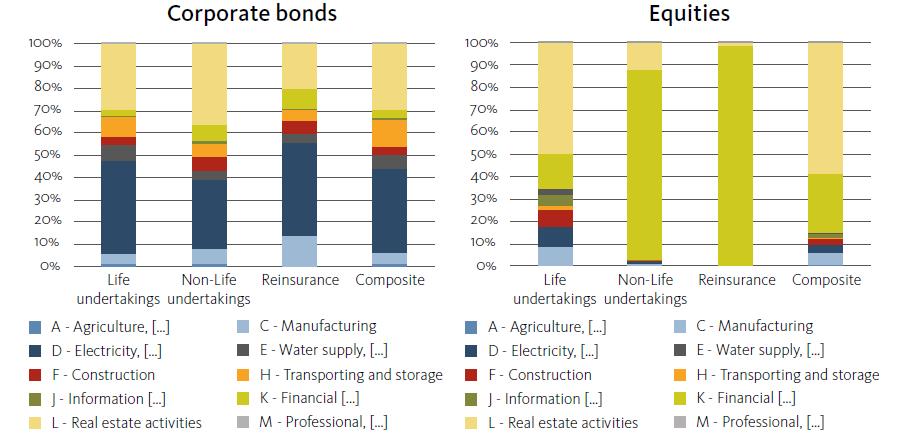
Figure 20: Sectoral shares of insurer’s eligible holdings, EIOPA, 2020
When it comes to different sectors, real estate and electricity are the most prominent eligible activities in insurer’s corporate bond holdings, while finance (non-life insurance) and real estate play the biggest role in their equity portfolios. Nevertheless, the publication does not make any conclusions on approximate share of eligible activities per sector based on insurer’s holdings. The split per sector is displayed in the figure above.
MSCI assessment
MSCI’s assessment combined an assessment of Taxonomy eligibility with an approximation for meeting DNSH criteria and minimum social standards. The study nevertheless did not test whether substantial contribution criteria are met, hence the results are hard to compare with the other studies at our disposal. MSCI used revenue estimation from MSCI Sustainable Impact Metrics and used their data on controversial events and business involvement data from MSCI ESG Controversies and MSCI Business Involvement Screening Research as a proxy for meeting DNSH criteria.
Using this approach, MSCI estimated that 27% of the constituents of the MSCI ACWI Investable Market Index (with approximately 9000 companies) had some degree of involvement in activities listed in the TEG report while avoiding major controversies. Of this group, 15% generated at least 5% of their revenue from activities likely to address one or more of the six environmental objectives of the EU Taxonomy and were not involved in controversial practices that could indicate breach of the Taxonomy’s minimum social safeguards and DNSH criteria. The chart below shows the results across of 2,425 issuers with potentially EU Taxonomy eligible revenues. As figure 34 shows, the number of companies per sector with such activities is relatively high for at least five sectors – ranging from industrials to information technology and real estate. While the final conclusion would depend on company size, this is likely to allow construction of well-diversified portfolios focused on EU Taxonomy alignment.
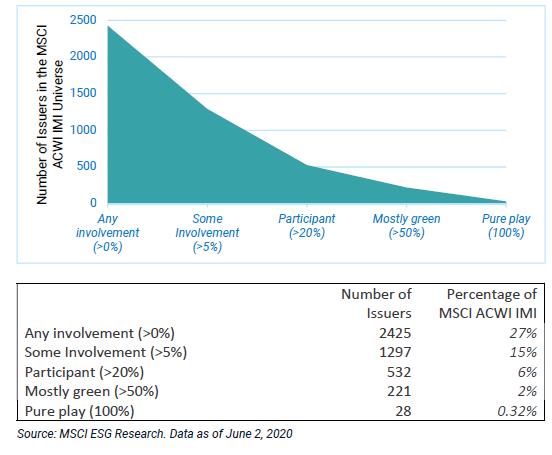
Figure 21: Issuers by potentially aligned revenue share (MSCI, 2020)

Figure 22: Number of relevant companies per sector within MSCI ACWI IMI Index (MSCI, 2020)
Goldman Sachs study
A June 2020 study by Goldman Sachs screened large and mid-cap global companies in the MSCI ACWI index and found that around 1200, or 41%, have at least some revenue (more than 5%) that is potentially eligible under the Taxonomy. 957 companies were found to have more than 50% potentially eligible revenue, while 602 companies were found to have 100% potentially eligible revenue. High rates of potential eligibility are notably seen in Japan and the rest of Asia, due to the broad potential application of the Taxonomy to industrial companies, and notably the manufacture of low carbon technologies (see exhibit-tables from the study below). The study highlights however that actual rates of Taxonomy-alignment will be far lower, once compliance with the technical screening criteria and social safeguards are checked. Due to the limited investable universe, the analysis points to potential challenges for asset managers to accommodate Taxonomy-alignment into their existing broader ESG-portfolios but expects this to become easier as the Taxonomy develops in the coming years to include more sectors and cover the other environmental objectives. In the short run, the study suggests that the Taxonomy may give rise to dedicated Taxonomy-aligned financial products alongside more diversified ESG funds.
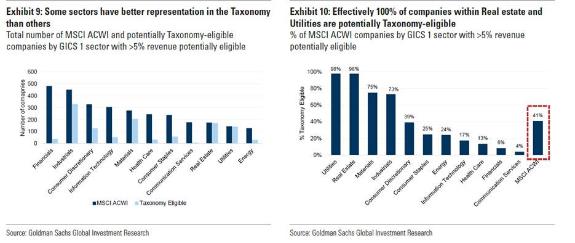
Figure 23: Sector representation of MSCI ACWI and potentially Taxonomy-eligible companies

Figure 24: Potentially Taxonomy eligible companies in MSCI ACWI
adelphi study
The adelphi study confirms the findings concerning a low level of overall potential Taxonomy alignment at present. Based on a screening of 75 European companies listed on three main European indices (EURO STOXX 50, DAX 30 and CAC 40), the study finds that approximately 20 - 27% of their total revenue concerns activities listed in the Taxonomy, as proposed by the TEG.
The study stands out by also looking at compliance with DNSH-criteria. While almost 20 - 27% of Taxonomy-eligible revenues across the indices were identified and 3-5% of total revenues meet substantial contribution criteria (approximately one fifth of the eligible revenues), less than half of this was found to comply with DNSH-criteria. Overall, the study estimates between 1% and 2% of total revenue across the indices to be fully Taxonomy-aligned.
The study found that the range of Taxonomy-activities performed by the 75 analysed companies ranged from 0 to 13, with an average of 2 and a median of one activity per company. Companies in the energy, waste management, electricity and construction sectors were found more likely to conduct a higher number of Taxonomy-activities. Overall, based on the study, 77% of analysed companies have an alignment level equal to or lower than 1%, while 13% of analysed companies have an alignment level equal to or above 5%.
Figure 25: Comparison of Taxonomy-relevant and Taxonomy-aligned revenue shares
Source: based on data provided by adelphi
Paper on climate change and recovery packages
In their paper ‘Will Covid-19 fiscal recovery packages accelerate or retard progress on climate change?’, Hepburn et al. (2020) interviewed 231 officials in finance ministries and central banks, as well as other economists from 53 countries on their perspectives on possible Covid-19 recovery policies along four metrics: speed of implementation, long-run economic multiplier, climate impact potential and overall desirability.

Figure 26: Possible Covid-19 recovery packages, Hepburn et al., 2020
Their results showed that in most cases, experts believed that positive climate impact policies could also deliver high long-run economic multipliers. As shown in the upper right quadrant of this figure, these policies included clean energy infrastructure (T), clean energy R&D spending (Y), connectivity infrastructure (S), general R&D spending (X) and education investment (L). Moreover, climate positive policies were rated among the ten most desired policies, even in cases where the policies were associated with longer implementation times. Due to the co-benefits and high desirability of positive climate policies, the authors concluded that Covid-19 recovery packages are likely to be examined based on their impact on climate change and contribution to reach the Paris Agreement.
The authors provided three recommendations for policy-makers that design Covid-19 recovery policies. First, they argued that due to their positive impact on climate change and the economy, policy makers should take policies in clean physical infrastructure, building efficiency for renovations and retrofits, education and training to address immediate unemployment from the crisis, natural capital investment for ecosystem resilience and regeneration, as well as clean R&D spending into consideration. Second, they suggested that policy-makers should identify co-benefits of climate positive policies in the design process to maximize their impact on the climate and the economy. Third, policies must be well designed to deliver economic, social and climate outcomes, rapidly implemented, evidence-based and designed in collaboration with the international community. Fourth, they recommended that policy-makers should evaluate policies within national affordability constraints and carefully managed.
Table 26 maps the positive climate policies that are recognized by the study to deliver higher multiplier effects with the NACE sectors covered by the Taxonomy. It shows that the majority of these policies are in line with the EU Taxonomy coverage, highlighting the importance of using the Taxonomy to identify green and economically strong economic activities in the context of recovery from the Covid-19 crisis.
|
Study policy areas
|
NACE activities covered in EU Taxonomy
|
|
L – Education and training
|
Not included
|
|
S – Connectivity infrastructure
|
H – Transporting and storage
|
|
T – Clean energy infrastructure
|
|
|
Renewable energy assets
|
D – Electricity, Gas, Steam and Air Conditioning Supply
|
|
Storage (including hydrogen)
|
D – Electricity, Gas, Steam and Air Conditioning Supply
|
|
Grid modernisation
|
D – Electricity, Gas, Steam and Air Conditioning Supply
|
|
CCS technology
|
E – Water Supply; sewerage, waste management and remediation activities
|
|
Building efficiency
|
F – Construction
|
|
X – General R&D spending
|
Not included
|
|
Y – Clean energy R&D spending
|
Not included
|
Table 28: JRC study climate policies mapped to NACE activities covered in EU Taxonomy
JRC study
In its study ‘The EU Sustainability Taxonomy: a Financial Impact Assessment’ (2019), the Joint Research Centre of the European Commission made an attempt to estimate the financial impact of the EU Taxonomy on equity and bond markets.
As part of their analysis, the JRC developed a top-down approximation of the current financial coverage of the EU Taxonomy on climate change mitigation in equity and debt markets in Europe. As the JRC only considered whether the securities were issued for economic activities included in the NACE code list, but not whether the activities passed activity-specific thresholds and DNSH criteria, the financial coverage should be interpreted as an upper bound for the financial value of securities that may be associated with some Taxonomy-eligible activities. The table below summarizes their findings for equity and bonds issued in 2018 by firms belonging to NACE (sub-) sectors that are considered in the EU Taxonomy on climate change mitigation.
|
Sector (NACE)
|
Outstanding shares Taxonomy aligned (EUR bn)
|
% of total outstanding shares
|
Outstanding bonds Taxonomy aligned (EUR bn)
|
% of total outstanding bonds
|
|
Agriculture
|
negligible
|
negligible
|
negligible
|
Negligible
|
|
Mining and quarrying
|
7.6 (total 380)
|
2%
|
1.3 (total 12.7)
|
10%
|
|
Manufacturing
|
840 (total 2,672)
|
31%
|
75.6 (total 250)
|
30%
|
|
Electricity, gas, steam and air conditioning supply
|
234.5 (total 292)
|
80%
|
129 (total 152)
|
85%
|
|
Water supply, sewerage, waste management and remediation activities
|
26.6 (total 26.6)
|
100%
|
17.6 (total 20)
|
100%
|
|
Construction
|
73.6 (total 152)
|
48.6%
|
8 (total 25)
|
28%
|
|
Transportation and storage
|
24 (total 267)
|
9%
|
25 (total 167)
|
15%
|
|
Real estate activities
|
0
|
0%
|
0
|
0%
|
|
Professional, scientific and technical advice
|
65 (total 1,512)
|
4%
|
3 (total 334)
|
1%
|
Table 29: Potential financial coverage of the EU Taxonomy on climate change mitigation in equity and debt markets by NACE sectors*
*Disclaimer: The estimations shown are only indicative as the JRC did not perform a screening criteria and ‘do no significant harm’ assessment for the included securities, which is necessary to determine Taxonomy-alignment.
To regroup activities more directly to climate mitigation domains, the JRC performed a similar exercise by mapping NACE codes to the climate-policy relevant sectors (CPRS) (Battiston ea. 2017), i.e. fossil-fuel, electricity, energy-intensive, transportation and buildings. The result of their analysis is summarized in the table below
|
. Sector
|
Outstanding shares Taxonomy considered (EUR bn)
|
% of total outstanding shares
|
Outstanding bonds Taxonomy considered (EUR bn)
|
% of total outstanding bonds
|
|
Fossil fuel
|
83 (total 645)
|
13%
|
2 (total 60)
|
4%
|
|
Utility
|
261 (total 283)
|
92%
|
147 (total 154)
|
95%
|
|
Energy intensive
|
151 (total 1,374)
|
11%
|
19 (total 97.6)
|
19.5%
|
|
Buildings
|
215.6 (239.6)
|
90%
|
79 (total 87)
|
91%
|
|
Transportation
|
338 (total 737)
|
46%
|
58 (total 225)
|
26%
|
|
Scientific R&D
|
50
|
100%
|
601.5
|
100%
|
Table 30: Potential financial coverage of the EU Taxonomy on climate change mitigation in equity and debt markets by CPRS sectors
Moreover, the JRC estimated the approximate financial value of potentially EU Taxonomy-eligible activities in equity and debt markets in 2018 by using available EU-ETS benchmarks as a proxy of EU Taxonomy thresholds. Where ETS benchmarks were not available, the research centre referred to the technical screening criteria of the TEG report of June 2019. Similar to their analysis on EU Taxonomy coverage, they did not consider activity-specific thresholds or DNSH compliance, which is why the estimates should be considered as reflecting the upper bound for actual financial values that are likely to be associated with some Taxonomy-eligible activities. The results are summarized in the table below.
|
Sector (CPRS)
|
Shares in EU Taxonomy-eligible activities (EUR bn)
|
Bonds in EU Taxonomy-eligible activities (EUR bn)
|
|
Buildings
|
45.35
|
16.74
|
|
Energy intensive
|
7.37
|
0.95
|
|
Transportation
|
2.85
|
10.59
|
|
Utility
|
56.17
|
27.82
|
Table 31: EU-Taxonomy eligible activities in equity and debt markets by CPRS
Based on the above findings, the JRC mapped out estimations of the potential impact of the EU Taxonomy on financial markets to fill the investment gaps needed to reach the EU’s climate targets of 2030.
For this analysis, the JRC used the investment gaps identified by the Impact Assessments EC 2016 SWD (2016) 405
and EC 2016 SWD (2016) 418
as a basis. These impact assessments analysed the investment gaps to reach 2030 climate targets across CRPS sectors and across a set of EUCO scenarios (EUCO27, EUCO30, EUCO+33, EUCO+35, EUCO+40) that display the different margins and pathways to reach the EU 2030 targets. As these scenarios were based on 2016 analyses, the JRC subtracted the investments that were achieved between 2016 and 2020 (Ref2016) to get the investment gaps for the next ten years.
The table below summarises the investment gaps to reach the different EUCO scenarios between 2020 and 2030 (Investment gap vs Ref2016), as well as the ratio of the investment gap to the total value of outstanding bonds and loans issued by firms in the sector (see table ‘Financial coverage of Taxonomy by CPRS sectors). Lastly, the table shows how the gap could be funded by bonds and shares in Taxonomy-eligible activities.
|
Sector
|
Scenario
|
|
|
|
EUCO27
|
EUCO30
|
EUCO+33
|
EUCO+35
|
EUCO+40
|
|
Utility
|
Investment gap vs Ref2016 (EURbn)
|
14
|
11
|
7
|
1
|
-5
|
|
|
Gap/total bonds and loans (%)
|
3.5
|
2.8
|
1.8
|
0.3
|
-1.3
|
|
|
Gap funded by bonds (EURbn)
|
6.0
|
4.7
|
3.0
|
0.4
|
-2.1
|
|
|
Gap funded by loans (EURbn)
|
8.0
|
6.3
|
4.0
|
0.6
|
-2.9
|
|
Energy intensive
|
Investment gap vs Ref2016 (EURbn)
|
2
|
4
|
9
|
14
|
36
|
|
|
Gap/total bonds and loans (%)
|
0.27
|
0.54
|
1.2
|
1.9
|
4.9
|
|
|
Gap funded by bonds (EURbn)
|
0.29
|
0.59
|
1.32
|
2.06
|
5.3
|
|
|
Gap funded by loans (EURbn)
|
1.7
|
3.4
|
7.7
|
11.9
|
31
|
|
Transport
|
Investment gap vs Ref2016 (EURbn)
|
26
|
31
|
24
|
28
|
35
|
|
|
Gap/total bonds and loans (%)
|
4.4
|
5.3
|
4.1
|
4.8
|
6.0
|
|
|
Gap funded by bonds (EURbn)
|
10
|
12
|
9
|
11
|
13
|
|
|
Gap funded by loans (EURbn)
|
16
|
19
|
15
|
17
|
22
|
|
Buildings
|
Investment gap vs Ref2016 (EURbn)
|
48
|
132
|
255
|
344
|
562
|
|
|
Gap/total bonds and loans (%)
|
2
|
7
|
13
|
17
|
28
|
|
|
Gap funded by bonds (EURbn)
|
2.2
|
6.1
|
12
|
16
|
26
|
|
|
Gap funded by loans (EURbn)
|
46
|
126
|
243
|
328
|
536
|
|
Total investment gap (EURbn)
|
90
|
178
|
295
|
387
|
628
|
Table 32: Potential of EU Taxonomy to close investment gap by sector and EUCO scenario
The results demonstrate that the estimated impact of the EU Taxonomy on financial markets varies across sectors and scenarios. In the least stringent scenarios (EUCO27 and EUCO30), the increased financial investments towards relevant sectors appear to be reachable when comparing it to the 2018 EUR amounts of outstanding bonds and loans in Taxonomy-eligible activities. On the other hand, in the most stringent scenario (EUCO+40), the JRC findings show that the investment gap can be filled through a modest increase in leverage (4.9% in energy-intensive sectors and 6% in transport sector) and a reasonable increase of institutional investors exposure to firms in the relevant sectors.
Moreover, when solely focusing on the required amount of bonds to fill the gap, the JRC highlights that the increased financing needs in all scenarios are close to the 2018 amounts of outstanding bonds in Taxonomy-aligned activities in the energy-intensive, buildings and transportation sectors.
ANNEX 9: LIST OF PROPOSED ECONOMIC ACTIVITIES IN THE DRAFT DELEGATED ACT AND APPROACHES TO SET TECHNICAL SCREENING CRITERIA
The list below illustrates the activities that have been published in the draft delegated act for stakeholder feedback in November and December 2020. The changes that have been made to the activities and criteria as part of the subsequent stakeholder feedback are not part of the below list. The feedback received and resulting changes are summarised in Annex 2.10 of this report.
9.1 List of activities for climate change mitigation
|
NACE Macro-sector
|
NACE Activity
|
Approaches to set technical screening criteria
|
|
Forestry
|
Afforestation
|
Combination of practice-based criteria and performance improvement.
|
|
|
Rehabilitation, restoration
|
|
|
|
Reforestation
|
|
|
|
Improved forest management
|
|
|
|
Conservation forestry
|
|
|
|
Wetlands
|
|
|
Agriculture*
|
Growing of perennial crops
|
Combination of practice-based criteria and performance improvement.
*[NB: This sector has been removed in the final delegated act, but will be part of the next, complementary climate delegated act]
|
|
|
Growing of non-perennial crops
|
|
|
|
Livestock production
|
|
|
Manufacturing
|
Manufacture of renewable energy technologies
|
Nature of the activity criteria.
|
|
|
Manufacture of low-carbon technologies for transport
|
|
|
|
Manufacture of energy-efficiency equipment for buildings
|
|
|
|
Manufacture of equipment for the production of hydrogen
|
|
|
|
Manufacture of other low carbon technologies
|
|
|
|
Manufacture of cement
|
Best-in class performance.
|
|
|
Manufacture of aluminium
|
|
|
|
Manufacture of iron and steel
|
|
|
|
Manufacture of hydrogen
|
|
|
|
Manufacture of carbon black
|
|
|
|
Manufacture of disodium carbonate
|
|
|
|
Manufacture of chlorine
|
|
|
|
Manufacture of organic basic chemicals
|
|
|
|
Manufacture of anhydrous ammonia
|
|
|
|
Manufacture of nitric acid
|
|
|
|
Manufacture of plastics in primary form
|
Combination of practice-based criteria and performance improvement.
|
|
ENERGY
|
Electricity generation using solar photovoltaic technology
|
Nature of the activity criteria.
|
|
|
Electricity generation using concentrated solar power (CSP) technology
|
|
|
|
Electricity generation from wind power
|
|
|
|
Electricity generation from ocean energy technologies
|
|
|
|
Electricity generation from hydropower
|
Performance in relation to the environmental target.
*[NB that electricity generation from natural gas has been removed in the final delegated act]
|
|
|
Electricity generation from geothermal energy
|
|
|
|
*Electricity generation from gaseous and liquid fuels (not exclusive to natural gas, oil or other refined products)
|
|
|
|
Electricity generation from bioenergy (Biomass, Biogas and Biofuels)
|
|
|
|
Transmission and distribution of electricity
|
|
|
|
Storage of electricity
|
Nature of the activity criteria.
|
|
|
Storage of thermal energy
|
|
|
|
Storage of hydrogen
|
|
|
|
Manufacture of biomass, biogas or biofuels
|
Performance in relation to the environmental target.
|
|
|
Transmission and distribution networks for renewable and low-carbon gases
|
Nature of the activity criteria.
|
|
|
District heating/cooling distribution
|
|
|
|
Installation of electric heat pumps
|
Performance in relation to the environmental target.
|
|
|
Cogeneration of heat/cool and power from solar energy
|
Performance improvement.
*[NB that cogeneration from natural gas has been removed in the final delegated act]
|
|
|
Cogeneration of heat/cool and power from geothermal energy
|
|
|
|
*Cogeneration of heat/cool and power from gaseous and liquid fuels (not exclusive to natural gas, oil or other refined products)
|
|
|
|
Cogeneration of heat/cool and power from bioenergy (biomass, biogas, biofuels)
|
Performance in relation to the environmental target.
|
|
|
Production of heat/cool from solar thermal heating
|
Nature of the activity criteria.
|
|
|
Production of heat/cool from geothermal energy
|
Performance in relation to the environmental target.
[*NB that the production of head/cool from natural gas has been removed in the final delegated act]
|
|
|
*Production of heat/cool from gaseous and liquid fuels (not exclusive to natural gas, oil or other refined products)
|
|
|
|
Production of heat/cool from bioenergy (biomass, biogas, biofuels)
|
|
|
|
Production of heat/cool using waste heat
|
Nature of the activity criteria.
|
|
Water, Sewage, waste, and remediation
|
Construction, extension and operation of water collection, treatment and supply systems
|
Performance in relation to the environmental target.
|
|
|
Construction, extension and operation of waste water collection and treatment
|
|
|
|
Renewal of water collection, treatment and supply systems
|
Performance improvement.
|
|
|
Renewal of waste water collection and treatment
|
|
|
|
Anaerobic digestion of sewage sludge
|
Combination of nature of the activity and practice based criteria.
|
|
|
Collection and transport of non-hazardous waste in source segregated fractions
|
Nature of the activity criteria.
|
|
|
Anaerobic digestion of bio-waste
|
Combination of nature of the activity and practice based criteria.
|
|
|
Composting of bio-waste
|
|
|
|
Material recovery from non-hazardous waste
|
Combination of nature of the activity and performance in relation to the environmental target.
|
|
|
Landfill gas capture and utilization
|
Combination of nature of the activity and practice based criteria.
|
|
|
Transport of CO2
|
Performance in relation to the environmental target.
|
|
|
Underground permanent geological storage of CO2
|
Practice based criteria.
|
|
Transport and Storage
|
Passenger interurban rail transport
|
Combination of nature of the activity criteria and performance in relation to the environmental target.
|
|
|
Freight rail transport
|
|
|
|
Public transport
|
|
|
|
Operation of personal mobility devices
|
Combination of nature of the activity criteria and performance in relation to the environmental target.
|
|
|
Sea and coastal freight water transport
|
Performance in relation to the environmental target.
|
|
|
Sea and coastal passenger water transport
|
|
|
|
Transport by motorbikes, passenger cars and light commercial vehicles
|
|
|
|
Freight transport services by road
|
|
|
|
Interurban scheduled road transport
|
|
|
|
Inland passenger water transport
|
|
|
|
Inland freight water transport
|
|
|
|
Infrastructure for low carbon transport
|
Nature of the activity criteria.
|
|
|
Retrofitting of sea and coastal freight and passenger water transport
|
Performance improvement.
|
|
Information and communications
|
Data processing, hosting and related activities
|
Practice-based criteria.
Nature of the activity criteria.
|
|
|
Data-driven solutions for GHG emissions reductions
|
|
|
Construction and real estate activities (mitigation)/ Buildings (adaptation)
|
Construction of new buildings
|
Performance in relation to the environmental target.
|
|
|
Renovation of existing buildings
|
Performance improvement criteria.
|
|
|
Installation, maintenance and repair of energy efficiency equipment
|
Best-in-class performance.
Nature of the activity criteria.
|
|
|
Installation, maintenance and repair of charging stations for electric vehicles in buildings (and parking spaces attached to buildings)
|
|
|
|
Installation, maintenance and repair of instruments and devices for measuring, regulation and controlling energy performance of buildings
|
|
|
|
Installation, maintenance and repair of renewable energy technologies
|
|
|
|
Acquisition and ownership of buildings
|
Performance in relation to the environmental target.
Best-in-class performance.
|
|
Professional, scientific and technical activities
|
Research, development and innovation (dedicated to Taxonomy-eligible activities)
|
Depending on the taxonomy-eligible activity that the research targets.
|
|
|
Professional services related to energy performance of buildings
|
Nature of the activity criteria.
|
Table 33: Activities for climate change mitigation
9.2 List of activities for climate change adaptation
|
NACE Macro-sector
|
NACE Activity
|
Types of approaches per sector
|
|
Forestry
|
Afforestation
|
A set of process- and practice based
criteria for adapted activities.
*[NB that agriculture and activities related to natural gas have been removed in the final delegated act]
|
|
|
Rehabilitation and restoration of forests
|
|
|
|
Reforestation
|
|
|
|
Improved forest management
|
|
|
|
Conservation forestry
|
|
|
|
Restoration of wetlands
|
|
|
Agriculture*
|
Growing of perennial crops
|
|
|
|
Growing of non-perennial crops
|
|
|
|
Livestock production
|
|
|
Manufacturing
|
Manufacture of renewable energy technologies
|
|
|
|
Manufacture of equipment for production of hydrogen
|
|
|
|
Manufacture of low carbon technologies for transport
|
|
|
|
Manufacture of energy efficiency equipment for buildings
|
|
|
|
Manufacture of other low carbon technologies
|
|
|
|
Manufacture of cement
|
|
|
|
Manufacture of aluminium
|
|
|
|
Manufacture of iron and steel
|
|
|
|
Manufacture of hydrogen
|
|
|
|
Manufacture of carbon black
|
|
|
|
Manufacture of disodium carbonate
|
|
|
|
Manufacture of chlorine
|
|
|
|
Manufacture of organic basic chemicals
|
|
|
|
Manufacture of anhydrous ammonia
|
|
|
|
Manufacture of nitric acid
|
|
|
|
Manufacture of plastics in primary form
|
|
|
Energy
|
Electricity generation using solar photovoltaic technology
|
|
|
|
Electricity generation using concentrated solar power (CSP) technology
|
|
|
|
Electricity generation from wind power
|
|
|
|
Electricity generation from ocean energy technologies
|
|
|
|
Electricity generation from hydropower
|
|
|
|
Electricity generation from geothermal energy
|
|
|
|
Electricity generation from gaseous and liquid fuels (not exclusive to natural gas, oil or other refined products)
|
|
|
|
Electricity generation from bioenergy (Biomass, Biogas and Biofuels)
|
|
|
|
Transmission and distribution of electricity
|
|
|
|
Storage of electricity
|
|
|
|
Storage of thermal energy
|
|
|
|
Storage of hydrogen
|
|
|
|
Manufacture of biogas and biofuels for use in transport
|
|
|
|
Transmission and distribution networks for renewable and low-carbon gases
|
|
|
|
District heating/ cooling distribution
|
|
|
|
Installation of electric heat pumps
|
|
|
|
Cogeneration of heat/cool and power from solarenergy
|
|
|
|
Cogeneration of heat/cool and power from geothermal energy
|
|
|
|
Cogeneration of heat/cool and power from gaseous and liquid fuels (not exclusive to natural gas, oil or other refined products)
|
|
|
|
Cogeneration of heat/cool and power from bioenergy (biomass, biogas, biofuels)
|
|
|
|
Production of heat/cool from solar thermal heating and cooling
|
|
|
|
Production of heat/cool from geothermal energy
|
|
|
|
Production of heat/cool from gaseous and liquid fuels (not exclusive to natural gas, oil or other refined products)
|
|
|
|
Production of heat/cool from bioenergy (biomass, biogas, biofuels)
|
|
|
|
Production of Heat/cool using waste heat
|
|
|
Water, Sewage, waste, and remediation
|
Construction, extension and operation of water collection, treatment and supply systems
|
|
|
|
Renewal of water collection, treatment and supply systems
|
|
|
|
Construction, extension and operation of waste water collection and treatment
|
|
|
|
Renewal of waste water collection and treatment
|
|
|
|
Anaerobic digestion of sewage sludge
|
|
|
|
Collection and transport of non-hazardous waste in source segregated fractions
|
|
|
|
Anaerobic digestion of bio-waste
|
|
|
|
Composting of bio-waste
|
|
|
|
Material recovery from non-hazardous waste
|
|
|
|
Landfill gas capture and utilization
|
|
|
|
Transport of CO2
|
|
|
|
Underground permanent storage of CO2
|
|
|
Transport and Storage
|
Passenger interurban rail transport
|
|
|
|
Freight rail transport
|
|
|
|
Urban and suburban and road public transport
|
|
|
|
Operation of personal mobility devices
|
|
|
|
Transport by motorbikes, passenger cars and light commercial vehicles
|
|
|
|
Freight transport services by road
|
|
|
|
Road passenger transport
|
|
|
|
Inland passenger water transport
|
|
|
|
Inland freight water transport
|
|
|
|
Retrofitting of inland water passenger and freight transport
|
|
|
|
Sea and coastal freight water transport
|
|
|
|
Sea and coastal passenger water transport
|
|
|
|
Retrofitting of sea and coastal freight and passenger water transport
|
|
|
|
Infrastructure for personal mobility
|
|
|
|
Infrastructure for rail transport
|
|
|
|
Infrastructure enabling low-carbon road transport
|
|
|
|
Infrastructure for water transport
|
|
|
|
Low carbon airport infrastructure
|
|
|
Information and communications
|
Data processing, hosting and related activities
|
|
|
|
Computer programming, consultancy and related activities
|
|
|
Construction and real estate activities (mitigation)/ Buildings (adaptation)
|
Construction of new buildings
|
|
|
|
Renovation of existing buildings
|
|
|
|
Installation, maintenance and repair of energy efficiency equipment
|
|
|
|
Installation, maintenance and repair of charging stations for electric vehicles in buildings (and parking spaces attached to buildings)
|
|
|
|
Installation, maintenance and repair of instruments and devices for measuring, regulation and controlling energy performance of buildings
|
|
|
|
Installation, maintenance and repair of renewable energy technologies
|
|
|
|
Acquisition and ownership of buildings
|
|
|
Financial and insurance activities (adaptation)*
|
Non-life insurance: underwriting of climate-related perils
|
*Tailored criteria for Financial and insurance
|
|
|
Reinsurance
|
|
|
Professional, scientific and technical activities (adaptation)
|
Engineering activities and related technical consultancy dedicated to adaptation to climate change
|
|
|
|
Legal and accounting activities
|
|
|
|
Architectural and engineering activities; technical testing and analysis
|
|
|
|
Scientific research and development*
|
|
|
Education
|
Education
|
|
|
Human health and social activities
|
Residential care activities
|
|
|
Arts, Entertainment and Recreation
|
Creative, arts and entertainment activities
|
|
|
|
Libraries, archives, museums and other cultural activities
|
|
|
|
Motion picture, video and television programme production, sound recording and music publishing activities*
|
|
|
|
Programming and broadcasting activities
|
|
Table 34: Activities for climate change adaptation
*Activities marked with an asterisk are proposed to be included as both adapted and enabling activities
* Activities marked as bold are proposed to be included as additional (compared to the TEG proposal) adapted activities
9.3 Major deviations from the final recommendations of the Technical Expert Group on Sustainable Finance (TEG) in the draft delegated act as published in November 2020
The list below illustrates the deviations from the TEG in the draft criteria that have been published for stakeholder feedback in November and December 2020. The changes that have been made to the activities and criteria as part of the subsequent stakeholder feedback are not part of the below list. The feedback received and resulting changes are summarised in Annex 2.10 of this report.
|
SECTOR
|
CHANGE
|
SOURCE EXPLAINING RATIONALE FOR CHANGE
|
|
Forestry
|
·Additional activities added: wetlands.
·More clarity: clear process-related requirements, compared to the TEG recommended sustainable forest management practices.
·More precision: detailed requirements to demonstrate GHG mitigation of forestry activities through a climate benefit analysis.
|
Annex 5, Section 5.2.1.
|
|
Agriculture
|
·Qualitative approach: Need to have verified Farm Sustainability Plans.
·More clarity: on essential management practices.
|
annex 5, Section 5.2.2.
|
|
Manufacturing
|
·More precision: the manufacture of low carbon technologies is split up into (i) renewable energy technologies, (ii) equipment for production of hydrogen, (iii) low carbon technologies for transport, (iv) energy efficient equipment for buildings, (v) other low carbon technologies.
|
Annex 5, Section 5.2.3.
|
|
Energy
|
·More precision: on scope of activities included (e.g. solar thermal); on criteria for cogeneration.
·More clarity: three options for LCA including Commission Recommendation 2013/179/EU (see below); inclusion of carbon capture under electricity-, heat- and co-generation rather than carbon capture as a self-standing activity. More explicit qualification of the European electricity transmission and distribution network.
·Additional activity: production of heat/cool from solar thermal heating/cooling (originally CSP).
·Extra method: carbon emission-related methodology defined in Commission Recommendation 2013/179/EU is added as a method of LCA along with TEG proposals.
·Less strict requirements: declines in thresholds, if necessary, to be part of the delegated act review, rather than part of the criteria.
·Extended scope of activities: construction and operation of new transmission and distribution network dedicated to hydrogen are included. For reducing fugitive emissions, repair of other (non-pipeline) network elements as well as leak detection are included. In DHC systems, the transition of the system is to be included in the activity description with applicable criteria.
|
Annex 5, Section 5.2.4.
|
|
Water, Sewage, Waste, and Remediation
|
·Rearrangement and rationalization of activities: The activity identified as capture of anthropogenic CO2 emissions is integrated under relevant activities in the manufacturing and energy sectors. Direct Air Capture is proposed to be integrated under research, development and innovation.
·More precision: all means of CO2 transport is to be included.
|
ANNEX 5, SECTION 5.2.5.
|
|
Transportation
|
·Reduced scope of activities: vehicles running on biofuels and construction of roads and motorways are not included.
·Metric changed: the TEG proposed metric of emissions per passenger kilometre across different passenger transport modes is not applicable across different modes of transport as there is no agreed methodology. As such, for rail and water transport, the threshold is zero-tailpipe emissions, including if similar levels of performance is achieved through retrofitting.
·additional activity: Maritime shipping could be included.
|
Annex 5, Section 5.2.6.
|
|
Construction and Real Estate Activities
|
·More precision: TEG recommendation of top 15% of building stock for acquiring and ownership of buildings is difficult to apply as it is not easily measured, as such, EPC class A is proposed as threshold, which always fit within top 15%.
|
Annex 5, Section 5.2.8.
|
|
Research, innovation and development
|
·Enabling activity added: R&I on technologies and other solutions dedicated to climate change is shaping the future of substantially contributing as well as enabling activities and could be considered an enabling activity that would contribute to other Taxonomy-eligible activities to meet those respective thresholds.
|
annex 5.3.
|
|
criteria For adapted activities across all sectors
|
·Changes to criteria for adapted activities:
·Difference between adapted and enabling activities
·Focus on material risks
|
Section 6.2, annex 6.2.
|
|
additional activities for climate change adaptation
|
·adapted activities:
as marked in bold in annex 9.2
·enabling activities: insurance, reinsurance, R&I
|
section 5.3, annex 6.3
|
Table 35: Deviations between final recommendations of the TEG and Commission services
ANNEX 10: RELEVANT EU LEGISLATION AND POLICY INITIATIVES
This annex describes the most relevant existing EU legislation that interact with the Taxonomy Regulation.
For this section, please also refer to the impact assessment accompanying the proposal for a Corporate Sustainability Reporting Directive (review of the NFRD).
10.1 Interaction between the EU Taxonomy and other legislation in the field of sustainable finance
The NFRD and Sustainable Finance Disclosure Regulation, together with the Taxonomy Regulation, are the central elements of the sustainability reporting regime that underpins the EU’s Sustainable Finance Strategy.
Financial market participants under the SFDR and investee companies under the NFRD are both required to disclose the extent to which their products or activities respectively are sustainable as defined by the Taxonomy. The Taxonomy therefore provides a common reference point that supports alignment between the SFDR and the NFRD. In response to the open consultation supporting NFRD impact assessment, a significant majority of respondents (69%) said that the legal provisions related to reporting on environmental matters should be structured according to the six objectives of the Taxonomy Regulation. The proportion of financial sector respondents who held this view was even higher (81%). And interaction of these legislations is described in the visualisation below.

Figure 27: Interaction between Taxonomy Regulation, NFRD, and SFDR
The Non-Financial Reporting Directive (NFRD, Directive 2014/95/EU), which amended the Accounting Directive (Directive 2013/34/EU), imposed new reporting requirements on certain large companies. The NFRD requires companies to disclose information about five business concepts: business model, policies (including due diligence processes implemented), the outcome of those policies, risks and risk management, and key performance indicators (KPIs) relevant to the business for four non-financial ‘matters’: environment, social and employee matters, human rights, and anti-corruption and anti-bribery. Similarly to SFDR, it follows a double materiality perspective, whereby companies have to report information not only on how non-financial issues affect the company (“outside-in” perspective), but also regarding the impact of the company itself on society and the environment (“inside-out” perspective).
The visualisation below summarises the main elements of NFRD including its current scope. Important aspects of the Directive may change as a result of an ongoing NFRD review which is supported by a separate impact assessment. On 21 April 2021, the Commission adopted a proposal for a Corporate Sustainability Reporting Directive (CSRD), which would amend the existing reporting requirements of the NFRD. The proposal extends the scope to all large companies and all companies listed on regulated markets (except listed micro-enterprises); requires the audit (assurance) of reported information; introduces more detailed reporting requirements, and a requirement to report according to mandatory EU sustainability reporting standards and requires companies to digitally ‘tag’ the reported information, so it is machine readable and feeds into the European single access point envisaged in the capital markets union action plan. The new proposal is not yet reflected in this impact assessment.

Figure 28: NFRD overview
In 2019, the Commission published additional guidelines, specifically on reporting climate-related information. The guidelines also suggest reporting EU Taxonomy-relevant information.
The NFRD applies to large public interest entities with more than 500 employees. In practice this means that it applies to large EU companies with securities listed in EU regulated markets, large banks (whether listed or not) and large insurance companies (whether listed or not) – all provided they have more than 500 employees. The NFRD exempts the subsidiaries of parent companies from the reporting obligation, if the parent company itself reports the necessary information on a consolidated basis. The NFRD impact assessment estimated that approximately 11,700 companies are subject to the reporting requirements of the NFRD, which is taken into account in our illustrative estimation of the magnitude of administrative costs in Annex 3.
The Sustainable Finance Disclosure Regulation (SFDR) governs how financial market participants (including assets managers and financial advisers) should disclose sustainability information towards end investors and asset owners. The SFDR lays down rules for sustainability-related disclosures toward end-investors, for both outside-in sustainability risks and inside-out adverse sustainability impacts. It does so in relation to:
·the integration of sustainability risks by financial market participants and financial advisers in all investment processes,
·financial products that pursue the objective of sustainable investment or have environmental or social characteristics, and
·adverse impacts on sustainability matters at entity and financial products levels, i.e. whether financial market participants and financial advisers consider negative externalities on environment and social justice of the investment decisions/advice and, if so, how this is reflected at the product level
.
In terms of legal technique, the SFDR is a directly applicable regulation which introduces additional disclosure requirements to the existing elements of relevant sectoral legislations (AIFMD, UCITS, Solvency II, IORP II, national pension rules, IDD and MiFID II), via a stand-alone text (lex specialis) providing full harmonization, cross-sectoral consistency and regulatory neutrality as well as convergence by ESMA, EIOPA and EBA. Instead of amending all these existing directives in identical way, the SFDR comes on “top” of existing rules in order to impose sustainability disclosure obligations. This way consistency and regulatory neutrality across all relevant institutional investors' sectors is ensured.
The ESAs prepared seven Regulatory Technical Standards (RTSs) on the content, presentation and methodologies of information, including legally binding definitions. The Regulation applies as of March 2021. The Taxonomy Regulation included three further RTS mandates in the SFDR.
10.2 EU legislation relevant for setting technical screening criteria for the delegated act
Directive 2001/42/EC of the European Parliament and of the Council of 27 June 2001 on the assessment of the effects of certain plans and programmes on the environment, Official Journal of the European Communities, L 197, 21 July 2001, available at:
https://eur-lex.europa.eu/legal-content/EN/TXT/PDF/?uri=CELEX:32001L0042&from=FR
Directive 2014/52/EU of the European Parliament and of the Council of 16 April 2014 amending Directive 2011/92/EU on the assessment of the effects of certain public and private projects on the environment, Official Journal of the European Union, L 124, 25 April 2014, available at:
https://eur-lex.europa.eu/legal-content/EN/TXT/PDF/?uri=CELEX:32014L0052&from=EN
Directive (EU) 2018/2001 of the European Parliament and of the Council of 11 December 2018 on the promotion of the use of energy from renewable sources, Official Journal of the European Union, L 328, 21 December 2018, available at:
https://eur-lex.europa.eu/legal-content/EN/TXT/PDF/?uri=CELEX:32018L2001&from=FR
Directive (EU) 2018/2002 of the European Parliament and of the Council of 11 December 2018 amending Directive 2012/27/EU on energy efficiency, Official Journal of the European Union, L 328, 21 December 2018, available at:
https://eur-lex.europa.eu/legal-content/EN/TXT/PDF/?uri=CELEX:32018L2002&from=EN
Directive (EU) 2019/883 of the European Parliament and of the Council of 17 April 2019 on port reception facilities for the delivery of waste from ships, amending Directive 2010/65/EU and repealing Directive 2000/59/EC, Official Journal of the European Union, L 151, 7 June 2019, available at:
https://eur-lex.europa.eu/eli/dir/2019/883/oj
Council Regulation (EEC) No 3037/90 of 9 October 1990 on the statistical classification of economic activities in the European Community, Official Journal of the European Communities, No L 293, 24 October 1990, available at:
https://eur-lex.europa.eu/legal-content/EN/TXT/PDF/?uri=CELEX:31990R3037&from=EN
Commission Regulation (EEC) No 761/93 of 24 March 1993, Official Journal of the European Communities, No L 83, 3 April 1993, available at:
https://op.europa.eu/en/publication-detail/-/publication/b309aac5-1d79-4758-89a7-fb5bf286a3b4/language-en
Corrigendum to Commission Regulation (EEC) No 761/93 of 24 March 1993 amending Council Regulation (EEC) No 3037/90 on the statistical classification of economic activities in the European Community, Official Journal of the European Communities, No L 159, 11 July 1995, available at:
https://eur-lex.europa.eu/legal-content/EN/TXT/PDF/?uri=CELEX:31993R0761R(01)&from=en
Regulation (EU) No 345/2013 of the European Parliament and of the Council of 17 April 2013 on European venture capital funds, Official Journal of the European Union, L115, 25 April 2013, available at:
https://eur-lex.europa.eu/legal-content/EN/TXT/PDF/?uri=CELEX:32013R0345&from=EN
Regulation (EU) No 346/2013 of the European Parliament and of the Council of 17 April 2013 on European social entrepreneurship funds, Official Journal of the European Union, L 115, 25 April 2013 available at:
https://eur-lex.europa.eu/legal-content/EN/TXT/PDF/?uri=CELEX:32013R0346&from=EN
Regulation (EU) No 1257/2013 of the European Parliament and of the Council of 20 November 2013 on ship recycling and amending Regulation (EC) No 1013/2006 and Directive 2009/16/EC, Official Journal of the European Union, L 330, 10 December 2013, available at:
https://eur-lex.europa.eu/LexUriServ/LexUriServ.do?uri=OJ:L:2013:330:0001:0020:EN:PDF
ANNEX 11: RELEVANT EXCERPTS TAXONOMY REGULATION
11.1 Requirements relevant for the delegated act for climate change mitigation and adaptation
The Taxonomy Regulation sets out a number of requirements for the delegated act. The list of activities and technical screening criteria included in the delegated act have to comply with:
·Article 10: definition of substantial contribution to climate change mitigation;
·Article 11: definition of substantial contribution to climate change adaptation;
·Article 17: definition of significant harm to environmental objectives; and
·Article 19: overarching requirements for technical screening criteria.
Articles 10, 11 and 17 set out the parameters for determining when an activity provides a substantial contribution to climate change mitigation or adaptation and when it significantly harms a given environmental objective.
Article 19 set outs out a number of horizontal requirements for the technical screening criteria that apply to the criteria set by the Commission through delegated acts. These requirements have been mapped into four broader categories that are described in section four. The mapping is illustrated below.
Overview of Article 19 (1) Requirements for technical screening criteria in the Taxonomy Regulation
1. The technical screening criteria established pursuant to Articles 10(3), 11(3), 12(2), 13(2), 14(2) and 15(2) shall:
(a)
identify the most relevant potential contributions to the given environmental objective while respecting the principle of technological neutrality, considering both the short- and long-term impact of a given economic activity;
(b)
specify the minimum requirements that need to be met to avoid significant harm to any of the relevant environmental objectives, considering both the short- and long-term impact of a given economic activity;
(c)
be quantitative and contain thresholds to the extent possible, and otherwise be qualitative;
(d)
where appropriate, build upon Union labelling and certification schemes, Union methodologies for assessing environmental footprint, and Union statistical classification systems, and take into account any relevant existing Union legislation;
(e)
where feasible, use sustainability indicators as referred to in Article 4(6) of Regulation (EU) 2019/2088;
(f)
be based on conclusive scientific evidence and the precautionary principle enshrined in Article 191 TFEU;
(g)
take into account the life cycle, including evidence from existing life cycle assessments, by considering both the environmental impact of the economic activity itself and the environmental impact of the products and services provided by that economic activity, in particular by considering the production, use and end of life of those products and services;
(h)
take into account the nature and the scale of the economic activity, including:
(i) whether it is an enabling activity as referred to in Article 16; or
(ii) whether it is a transitional activity as referred to in Article 10(2);
(i)
take into account the potential market impact of the transition to a more sustainable economy, including the risk of certain assets becoming stranded as a result of such transition, as well as the risk of creating inconsistent incentives for investing sustainably;
(j)
cover all relevant economic activities within a specific sector and ensure that those activities are treated equally if they contribute equally towards the environmental objectives set out in Article 9 of this Regulation, to avoid distorting competition in the market; and
(k)
be easy to use and be set in a manner that facilitates the verification of their compliance.
2. The technical screening criteria referred to in paragraph 1 shall also include criteria for activities related to the clean energy transition consistent with a pathway to limit the temperature increase to 1,5 ⁰C above pre-industrial levels, in particular energy efficiency and renewable energy, to the extent that those activities substantially contribute to any of the environmental objectives.
3. The technical screening criteria referred to in paragraph 1 shall ensure that power generation activities that use solid fossil fuels do not qualify as environmentally sustainable economic activities.
4. The technical screening criteria referred to in paragraph 1 shall also include criteria for activities related to the switch to clean or climate-neutral mobility, including through modal shift, efficiency measures and alternative fuels, to the extent that those are substantially contributing to any of the environmental objectives.
(d)Take into account Union legislation, build on labelling and certification schemes, Union methodologies and certification schemes
(e)Take into account Union legislation, build on labelling and certification schemes, Union methodologies and certification schemes
(f)Take into account Union legislation, build on labelling and certification schemes, Union methodologies and certification schemes
(g)Take into account Union legislation, build on labelling and certification schemes, Union methodologies and certification schemes
(e) sustainability indicators
(e) sustainability indicators
(e) sustainability indicators
(e) sustainability indicators
(g) life-cycle of activities
(g) life-cycle of activities
(g) life-cycle of activities
(g) life-cycle of activities
Subpoint
Subpoint
Subpoint
Subpoint
(f)scientific evidence and precautionary principle
(g)scientific evidence and precautionary principle
(h)scientific evidence and precautionary principle
(i)scientific evidence and precautionary principle
(k) easy to use
(k) easy to use
(k) easy to use
(k) easy to use
(c)be quantitative as far as possible, be qualitative otherwise
(d)be quantitative as far as possible, be qualitative otherwise
(e)be quantitative as far as possible, be qualitative otherwise
(f)be quantitative as far as possible, be qualitative otherwise
Mapping of article 19 (1) of the Taxonomy Regulation: Requirements for technical screening criteria
Mapping of article 19 (1) of the Taxonomy Regulation: Requirements for technical screening criteria
Mapping of article 19 (1) of the Taxonomy Regulation: Requirements for technical screening criteria
Mapping of article 19 (1) of the Taxonomy Regulation: Requirements for technical screening criteria
Policy Coherence
Policy Coherence
Policy Coherence
Policy Coherence
Level playing field
Level playing field
Level playing field
Level playing field
(j)cover all relevant activities within a specific sector
(k)cover all relevant activities within a specific sector
(l)cover all relevant activities within a specific sector
(m)cover all relevant activities within a specific sector
(I)potential market impact and no competition distortion
(II)potential market impact and no competition distortion
(III)potential market impact and no competition distortion
(IV)potential market impact and no competition distortion
(h) nature and scale of the economic activity
(h) nature and scale of the economic activity
(h) nature and scale of the economic activity
(h) nature and scale of the economic activity
(b)short and long term impact
(c)short and long term impact
(d)short and long term impact
(e)short and long term impact
(a)technological neutrality
(b)technological neutrality
(c)technological neutrality
(d)technological neutrality
(a)short and long term impact
(b)short and long term impact
(c)short and long term impact
(d)short and long term impact
LIST OF REFERENCES
Adelphi (2020), “European Sustainable Finance Survey”, available at:
https://www.sustainablefinancesurvey.de/#Downloads
Alessi et al. (2019), “The EU Sustainability Taxonomy: a Financial Impact Assessment”, European Commission -Joint Research Centre, available at:
https://ec.europa.eu/jrc/en/publication/eu-sustainability-Taxonomy-financial-impact-assessment
Anderson, J. et al (2020), “The fiscal response to the economic fallout from the coronavirus”, Bruegel Datasets, 4 June 2020, available at:
https://www.bruegel.org/publications/datasets/covid-national-dataset/
Balkovicˇ, J., et al. (2015), “D7.2. Report on modelling results (including maps) and adaptation options (Update). IMPACT2C. Quantifying projected impacts under 2°C warming.”, IIASA, October 2015, available at:
https://impact2c.hzg.de/imperia/md/content/csc/projekte/impact2c_d7.2.pdf
CE Delft (2020), “STREAM Freight transport”, Home, Product, STREAM Freight transport, available at:
https://www.cedelft.eu/en/stream-freight-transport
CEPS (2021), “Study on the Non-Financial Reporting Directive”, available at: https://ec.europa.eu/info/publications/201110-non-financial-reporting-directive_en
Ciscar, M. et al. (2014), “Climate Impacts in Europe. The JRC PESETA II Project”, JRC European Commission, available at:
https://ec.europa.eu/jrc/en/publication/eur-scientific-and-technical-research-reports/climate-impacts-europe-jrc-peseta-ii-project
Čížková, H., Květ, J., Comín, F.A., Laiho, R.; Pokorny, J.; Pithart, D. (2013), “Actual state of European wetlands and their possible future in the context of global climate change”, Aquatic Sciences, Vol. 75, 16 September 2011, available at:
https://doi.org/10.1007/s00027-011-0233-4
DW (2018), “Hydropower supply dries up with climate change”, Top stories, environment, renewable energy, 1 March 2018, available at:
https://www.dw.com/en/hydropower-supply-dries-up-with-climate-change/a-42472070
EBRD, GCECA (2018), “Advancing TCFD Guidance on physical climate risks and opportunities”, 20 August 2018, London, available at:
https://s3.eu-west-2.amazonaws.com/ebrd-gceca/EBRD-GCECA_draft_final_report_full_2.pdf
EM-DAT (2020), “EM-DAT. The International Disaster Database. Home”, available at:
www.emdat.be
European Commission (2018), “Proposal for a Regulation of the European Parliament and of the Council establishing the InvestEU Programme”, COM (2018) 439 final - 2018/0229 (COD), 6 June 2018, Brussels, available at:
https://eur-lex.europa.eu/legal-content/EN/TXT/?uri=COM%3A2018%3A439%3AFIN
European Commission (2020), “EU Biodiversity Strategy for 2030. Bringing nature back into our lives”, Communication from the Commission to the European Parliament, the Council, the European Economic and Social Committee and the Committee of the Regions, COM (2020) 380 final, 20 May 2020, Brussels, available at:
https://ec.europa.eu/info/sites/info/files/communication-annex-eu-biodiversity-strategy-2030_en.pdf
European Commission (2020), “Europe's moment: Repair and Prepare for the Next Generation”, Communication from the Commission to the European Parliament, the Council, the European Economic and Social Committee and the Committee of the Regions, COM(2020) 456 final, 27 May 2020, Brussels, available at:
https://ec.europa.eu/info/sites/info/files/communication-europe-moment-repair-prepare-next-generation.pdf
European Commission (2020), “Factsheet: The business case for biodiversity”, Press corner, available at:
https://ec.europa.eu/commission/presscorner/detail/en/FS_20_907
European Council (2019a), “European Council conclusions, 12 December 2019”, Home, Press, Pres releases, 12 December 2019, available at:
https://www.consilium.europa.eu/en/press/press-releases/2019/12/12/european-council-conclusions-12-december-2019/
European Council (2019b), “Remarks by Mario Centeno following the Eurogroup meeting of 7 November 2019”, Home, Press, Press releases, 7 November 2019, available at: https://www.consilium.europa.eu/en/press/press-releases/2019/11/07/remarks-by-mario-centeno-following-the-eurogroup-meeting-of-7-november-2019/
European Council (2020), “Report on the comprehensive economic policy response to the COVID-19 pandemic”, Press, Press release, 9 April 2020, available at:
https://www.consilium.europa.eu/fr/press/press-releases/2020/04/09/report-on-the-comprehensive-economic-policy-response-to-the-covid-19-pandemic/
Eurostat (2008), “NACE Rev. 2. Statistical classification of economic activities in the European Community”, Eurostat Methodologies and Working Papers, 2008, Luxembourg, Office for Official Publications of the European Communities, available at :
https://ec.europa.eu/eurostat/documents/3859598/5902521/KS-RA-07-015-EN.PDF
Eurostat (2020a), “Greenhouse gas emissions by source sector”, 9 June 2020, available at:
http://appsso.eurostat.ec.europa.eu/nui/show.do?lang=en&dataset=env_air_gge
Eurostat (2020b), “Intramural R&D expenditure (GERD) by sectors of performance and type of R&D activity”, 18 March 2020, available at:
https://appsso.eurostat.ec.europa.eu/nui/show.do?dataset=rd_e_gerdact&lang=en
EU High Level Expert Group on Sustainable Finance (2018), “Financing a Sustainable European Economy. Final Report 2018 by the High-Level Expert Group on Sustainable Finance. Secretariat provided by the European Commission”, 31 January 2018, available at:
https://ec.europa.eu/info/sites/info/files/180131-sustainable-finance-final-report_en.pdf
Goldstein, A.; Turner, W.R.; Gladstone, J.; Hole, D.G. (2019), “The private sector’s climate change risk and adaptation blind spots. Nature Climate Change”, 9, 18-25, available at:
https://www.nature.com/articles/s41558-018-0340-5
Koks, E.E.; Rozenberg, J.; Zorn, C. (2019), “A global multi-hazard risk analysis of road and railway infrastructure assets”, Nature Communications, Vol. 10(1), December 2019, available at:
https://www.researchgate.net/publication/334005888_A_global_multi-hazard_risk_analysis_of_road_and_railway_infrastructure_assets
Kreibich, H. et al. (2015), “A review of damage-reducing measures to manage fluvial flood risks in a changing climate”, Mitigation and Adaptation Strategies for Global Change, 20, available at:
https://link.springer.com/article/10.1007/s11027-014-9629-5
Nelson, G. C., et al. (2014), “Climate change effects on agriculture: Economic responses to biophysical shocks”, Proceedings of the National Academy of Sciences, 111(9), available at:
https://www.researchgate.net/publication/259350665_Climate_Change_Effects_on_Agriculture_Economic_Responses_to_Biophysical_Shocks
TCFD (2017), “Final Report: Recommendations of the Task Force on Climate-related Financial Disclosures”, 15 June 2017, Basel, available at:
https://www.fsb-tcfd.org/wp-content/uploads/2017/06/FINAL-2017-TCFD-Report-11052018.pdf
TCFD (2020), “About the Task Force”, available at:
https://www.fsb-tcfd.org/about/#
Tenle, T.; Appeldoorn, M.; Bosma, P.; Sprenger, L. ; Koks, E. ; de Moel, H. (2019), “The vulnerability of solar panels to hail”, Institute for Environmental Studies, Vrije Universiteit Amsterdam, available at:
https://research.vu.nl/en/publications/the-vulnerability-of-solar-panels-to-hail
UNDRR (2020), “Sendai Framework for Disaster Reduction”, available at:
https://sendaimonitor.undrr.org/
UNEPFI (2018), “Navigating a new climate – Assessing credit risk and opportunity in a changing climate: Outputs of a working group of 16 banks piloting the TCFD Recommendations – Part 2: Physical risks and opportunities”, UN Environmental Finance Initiative, available at:
https://www.unepfi.org/wordpress/wp-content/uploads/2018/07/NAVIGATING-A-NEW-CLIMATE.pdf
WWF et al. (2020), “Joint NGO Statement – Ten Priorities for the European Commission’s Climate Taxonomy Delegated Acts”, available at:
https://d2ouvy59p0dg6k.cloudfront.net/downloads/joint_ngo_statement___ten_priorities_for_the_Taxonomy_delegated_acts.pdf
Directive 2001/42/EC of the European Parliament and of the Council of 27 June 2001 on the assessment of the effects of certain plans and programmes on the environment, Official Journal of the European Communities, L 197, 21 July 2001, available at:
https://eur-lex.europa.eu/legal-content/EN/TXT/PDF/?uri=CELEX:32001L0042&from=FR
Directive 2014/52/EU of the European Parliament and of the Council of 16 April 2014 amending Directive 2011/92/EU on the assessment of the effects of certain public and private projects on the environment, Official Journal of the European Union, L 124, 25 April 2014, available at:
https://eur-lex.europa.eu/legal-content/EN/TXT/PDF/?uri=CELEX:32014L0052&from=EN
Directive (EU) 2018/2001 of the European Parliament and of the Council of 11 December 2018 on the promotion of the use of energy from renewable sources, Official Journal of the European Union, L 328, 21 December 2018, available at:
https://eur-lex.europa.eu/legal-content/EN/TXT/PDF/?uri=CELEX:32018L2001&from=FR
Directive (EU) 2018/2002 of the European Parliament and of the Council of 11 December 2018 amending Directive 2012/27/EU on energy efficiency, Official Journal of the European Union, L 328, 21 December 2018, available at:
https://eur-lex.europa.eu/legal-content/EN/TXT/PDF/?uri=CELEX:32018L2002&from=EN
Directive (EU) 2019/883 of the European Parliament and of the Council of 17 April 2019 on port reception facilities for the delivery of waste from ships, amending Directive 2010/65/EU and repealing Directive 2000/59/EC, Official Journal of the European Union, L 151, 7 June 2019, available at: https://eur-lex.europa.eu/eli/dir/2019/883/oj
Council Regulation (EEC) No 3037/90 of 9 October 1990 on the statistical classification of economic activities in the European Community, Official Journal of the European Communities, No L 293, 24 October 1990, available at:
https://eur-lex.europa.eu/legal-content/EN/TXT/PDF/?uri=CELEX:31990R3037&from=EN
Commission Regulation (EEC) No 761/93 of 24 March 1993, Official Journal of the European Communities, No L 83, 3 April 1993, available at:
https://op.europa.eu/en/publication-detail/-/publication/b309aac5-1d79-4758-89a7-fb5bf286a3b4/language-en
Corrigendum to Commission Regulation (EEC) No 761/93 of 24 March 1993 amending Council Regulation (EEC) No 3037/90 on the statistical classification of economic activities in the European Community, Official Journal of the European Communities, No L 159, 11 July 1995, available at:
https://eur-lex.europa.eu/legal-content/EN/TXT/PDF/?uri=CELEX:31993R0761R(01)&from=en
Regulation (EU) No 345/2013 of the European Parliament and of the Council of 17 April 2013 on European venture capital funds, Official Journal of the European Union, L115, 25 April 2013, available at:
https://eur-lex.europa.eu/legal-content/EN/TXT/PDF/?uri=CELEX:32013R0345&from=EN
Regulation (EU) No 346/2013 of the European Parliament and of the Council of 17 April 2013 on European social entrepreneurship funds, Official Journal of the European Union, L 115, 25 April 2013 available at:
https://eur-lex.europa.eu/legal-content/EN/TXT/PDF/?uri=CELEX:32013R0346&from=EN
Regulation (EU) No 1257/2013 of the European Parliament and of the Council of 20 November 2013 on ship recycling and amending Regulation (EC) No 1013/2006 and Directive 2009/16/EC, Official Journal of the European Union, L 330, 10 December 2013, available at:
https://eur-lex.europa.eu/LexUriServ/LexUriServ.do?uri=OJ:L:2013:330:0001:0020:EN:PDF

