 EUROPEAN COMMISSION
Brussels, 23.11.2021
SWD(2021) 334 final
COMMISSION STAFF WORKING DOCUMENT
Screening of FDI into the Union and its Member States
Accompanying the document
REPORT FROM THE COMMISSION TO THE EUROPEAN PARLIAMENT AND THE COUNCIL
First Annual Report on the screening of foreign direct investments into the Union
{COM(2021) 714 final}
Contents
1.
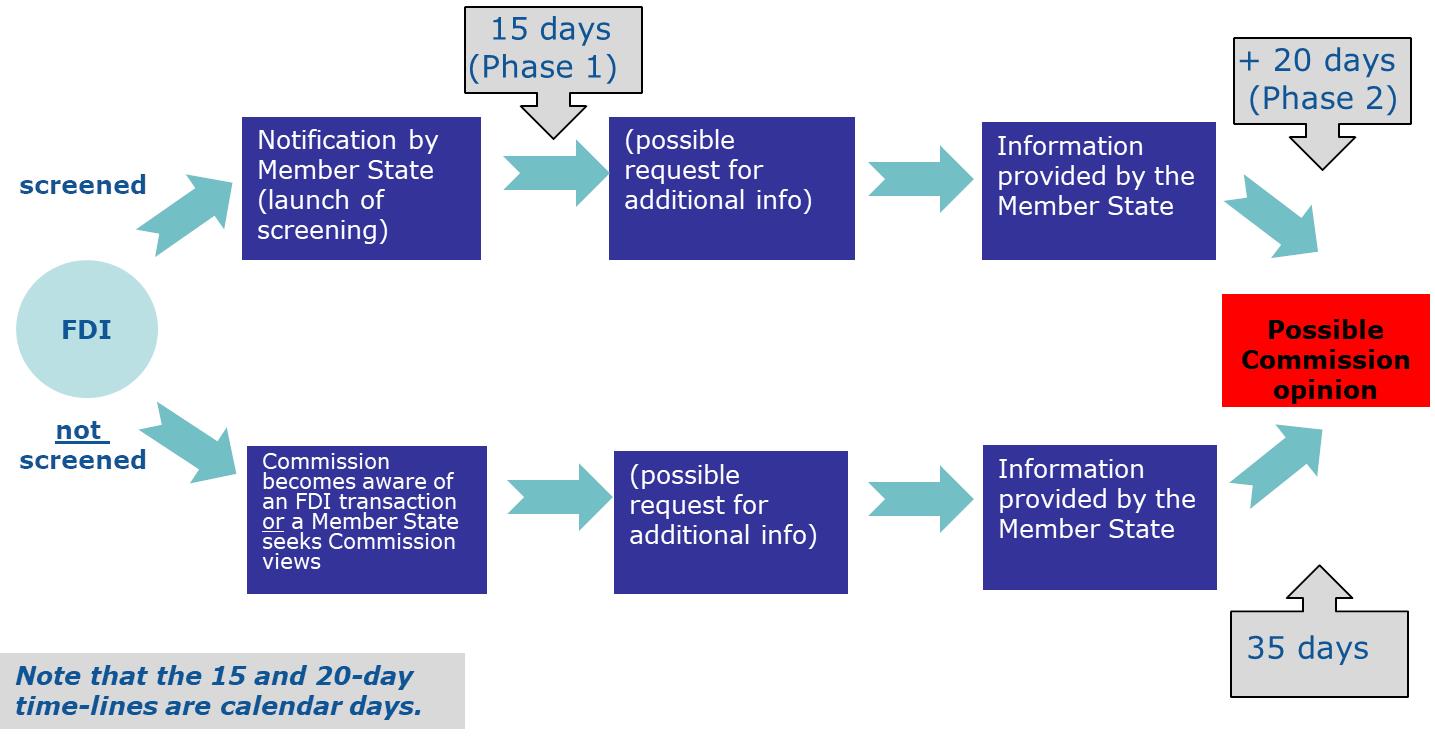
Flowchart illustrating the handling of cases among the Member States and the Commission under the cooperation mechanism set up by the EU FDI Screening Regulation
2.
Foreign Direct Investments into the EU – 2019 / 2020 overview
3.
Methodology and sources
4.
EU Member States – legislative developments
Introduction
Austria
Belgium
Bulgaria
Croatia
Republic of Cyprus
Czechia
Denmark
Estonia
Finland
France
Germany
Greece
Hungary
Ireland
Italy
Latvia
Lithuania
Luxemburg
Malta
Netherlands
Poland
Portugal
Romania
Slovakia
Slovenia
Spain
Sweden
1.Flowchart illustrating the handling of cases among the Member States and the Commission under the cooperation mechanism set up by the EU FDI Screening Regulation
2.Foreign Direct Investments into the EU – 2019/2020 overview
As could be expected, 2020 proved a particularly challenging year for multinational enterprises and investors, operating in a deeply uncertain environment.
The uncertainty was largely fueled by the exponential growth of COVID-19 cases and its fall-out on economic activity across the globe, as well as actions shielding domestic industries in key critical sectors from foreign speculative takeovers. The growing tensions between the United States (US) and China, and the increased pace in the reshaping of international supply chains added further pressure to an already challenging environment for multinational enterprises and investors.
The particular characteristics of 2020, and their related impact on foreign direct investment, including for the European Union, are best understood when placed within a broader time-frame. Consequently, this Section covers the time-period of January 2019 through first quarter of 2021. This allows for proper context and for the 2020 numbers to be contrasted against both the pre-COVID-19 pandemic environment and developments, as well as the indication, albeit not uniformly for all sectors and investors, of some rebound in economic activity globally for the first quarter of 2021, including FDI transactions.
This Section looks closely at FDI inflows into the EU and individual member states, the origins of foreign investors in the EU, and the impact of COVID-19 on foreign direct investment into particular sectors.
Official FDI flows, covering equity transactions, reinvestment of earnings, and intercompany debt transactions, measure financial links between the reporting country and its first counterpart. The need to look deeper into the origin of investors underpins the use of firm level data on mergers and acquisitions (M&A) deals and greenfield projects.
The word “uneven” captures developments well. The negative impact on FDI activity has been uneven dependent on the foreign investor, the host EU Member States, and the sectors at issue. Likewise, the rebound, however fragile and subject to the further handling of the pandemic, is proving to be uneven across EU Member States and economic sectors.
|
Main findings
In 2020, global FDI flows fell to €885bn, 35% less than in 2019. In the EU, 2020 is characterised by a decrease of inward FDI by 71% to €98bn in 2020, down from €335bn in 2019.
In 2020, 33.6% fewer foreign M&A deals were announced as compared to 2019. Deal-making recovered slowly by end-2020 and in the first quarter of 2021 (+4.5% on a year-on-year comparison), but remained 30% below the 2019 level. In 2020 Europe has lost €31bn in foreign greenfield investments and 115,000 expected jobs when compared with 2019.
In 2020, the largest share of foreign investments in Europe originated in the United States (US) and Canada, with nearly 35% of M&A transactions and 44% of greenfield projects, followed by the United Kingdom (UK) with 30.5% and 21% respectively. EFTA comes next with about 12% of the foreign M&A transactions and 8% of greenfield projects. China, with 2.5% of the M&A transactions (down from 4% in 2019) and 7.5% of greenfield projects, was the fourth foreign investor in the EU after US, UK and Switzerland.
The drop in the number of M&A transactions in 2020 involved all EU Member States, even if France and Sweden were particularly affected. Germany, with a more contained drop in the number of M&A transactions, suffered from sinking Chinese and US investments, while in Spain and the Netherlands deals from EFTA countries and from Korea and Japan lost ground in 2020 as compared to 2019.
Economic sectors in Europe were not equally impacted by COVID-19. The hardest-hit sector was accommodation with a drop of more than 70% in the number of foreign deals. With a quarter of all foreign M&A transactions, manufacturing suffered a 40% drop in 2020 deal numbers as compared to 2019, and still shows a cloudy outlook in the first quarter of 2021 with a year-on-year performance rounding -1.3%. Over 56% of acquisitions done in manufacturing in 2020 involved medium or large companies, about 15 percentage points more than the EU average for all sectors. A non-negligible 8% of the deals involved acquisitions of enterprises with less than 10 employees in this sector.
Information and communication technologies (ICT) is the sector least affected by the pandemic, with a modest drop of 12% in 2020 as compared to 2019. In 2020 ICT totaled 35% of all M&A deals, surpassing manufacturing for the first time ever. ICT also drives the recovery in 2021, with a year-on-year increase in M&A transactions rounding 53% in the first quarter of 2021, which brings the number of deals in this sector to its pre-COVID level.
|
The numbers in detail
In 2020, global FDI flows fell drastically to €885bn, meaning 35% less than in 2019 and 55% less as compared to the peak year of 2016 (Fig.1). The COVID-19 pandemic accelerated the steady decline of global FDI and contributed to global FDI flows plummeting to their lowest levels in 25 years, recorded in 2020, with FDI values 30% below the lowest point recorded after the global financial crisis.
In the EU, the COVID-19 pandemic produced even harsher effects when compared to the world average, with inward FDI falling by 71% to €98bn in 2020, down from €335bn in 2019. This is an 80% reduction with respect to the European peak year of 2018. In 2020 inward FDI accounted for a mere 0.7% of EU27 GDP, sharply down from 3.6% in 2018.
Figure 1: World and EU FDI inflow (left panel) and FDI inflow in EU with breakdown by instrument (right panel)
Source:
OECD
data, extracted on 20 May 20 2021. The details by instrument does not include inflows into Bulgaria, Croatia, Cyprus, Malta, and Romania whose value is grouped under Rest. FDI values exclude investments from resident special purpose entities.
A different picture, all depending on the EU Member State
This decline in European FDI inflows in 2020 is driven by significant disinvestments in the Netherlands, where FDI fell to -€98bn from +€38bn in 2019. Large reduction of investments, especially from US, are also observed in Ireland, where FDI inflows were €29bn in 2020, down from €72bn the year before. German and French FDI inflows fell to €31bn and €16bn respectively, recording a -36% and -48% decrease compared to 2019. Italian FDI inflows dried out almost entirely reaching -€338ml in 2020, down from €16bn in 2019. In conclusion, 2020 has been an annus horribilis almost everywhere in the EU, with the notable exceptions of Luxemburg, Belgium and Sweden and to a lesser extent in Spain and Hungary, which saw increased flows despite a decline in the number of deals and projects.
Three months into 2021, the EU landscape has started to improve in all developed countries. Investors seem to be gearing up for a recovery of FDI inflows to Europe, as the last quarter of 2020 recorded €11bn, up from the -€17bn of the third quarter. Both corporate and private equity investors are increasingly considering new investments, in order to capitalise on a potential market upswing as economies reopen.
However, while there appears to be some light at the end of the tunnel, the post COVID-19 recovery represents a marathon, not a sprint. Baseline projections suggest that the EU recovery will depend on how successfully vaccination programmes will manage the pandemic, and how quickly governments will ease or lift restrictions. The EU economy is forecast to grow by 4.2% in 2021, returning EU GDP to its pre-crisis level by the end of 2021. Yet FDI remains on shaky grounds. The enduring challenges of the pandemic (including the surge of new variants, with some more resistant to available vaccines), the fear of an increase in trade frictions, the rise in technology competition, and the continuous reshaping and regionalisation of supply chains, are all factors likely to influence the volume and direction of future FDI flows worldwide.
Mergers & acquisitions deals and greenfield investment projects in Europe - general trends
While official FDI figures at macro-level describe investment links between the reporting country and the first partner country, the link between the foreign investment and the ultimate origin of the investor can only be established by looking at individual transactions, namely mergers & acquisitions (M&As) and greenfield projects.
In 2020, 33.6% fewer foreign M&A deals were announced when compared to 2019 (Fig.2, upper panel). The drop in M&A transactions in the second quarter of 2020 (-45.7% on year-on-year comparison
) corresponds to the first lock-down period in many EU Member States and is particularly severe. Foreign M&A transactions stagnated to a smaller reduction of around 25% in the following two quarters, reflecting the uncertainty facing investors and the significant confinement measures worldwide. Deal-making recovered slowly in the first quarter of 2021 (+4.5% on a year-on-year comparison), although remaining 30.7% below the level of 2019.
The drop in the number of M&A transactions involved all EU Member States. France and Sweden (Fig.4, left panel), were particularly affected, especially for the foreign M&A deals involving US and EFTA investors. Germany, with a more contained drop in the number of M&A transactions, suffered from decreasing Chinese and US investments, while in Spain and the Netherlands deals from EFTA countries and from Korea and Japan lost ground in 2020 as compared to 2019 (Tab.3). In the first quarter of 2021 the number of deals are on the rise in all Member States, except Italy, Spain, Luxemburg and Portugal.
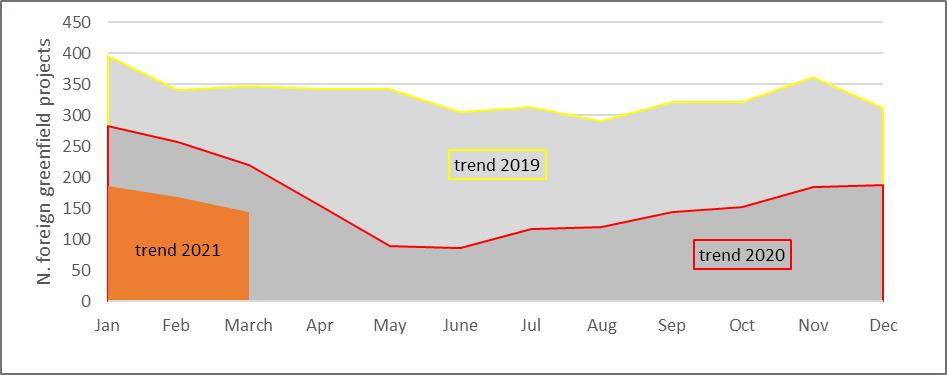
Figure 2: General trends of foreign M&A deals and greenfield projects into the EU from January 2019 to March 2021 (three months rolling average).
Source: JRC calculations on Bureau van Dijk data extracted on the 6 May 2021.
The negative effect of COVID-19 on greenfield projects has been even more pronounced than on M&A transactions (Fig. 2, bottom panel). This partly reflects the long-term nature of a greenfield investment which requires, in its initial phase, visits to the future production sites
and meetings with local authorities
, all extremely difficult in pandemic times with lock-downs and travel restrictions.
In 2020, foreign investors cut the number of greenfield investments in Europe by over 50% as compared to 2019. Projects dried out in the second and third quarters of 2020 with a year-on-year variation of -72% and -55%, respectively. The last quarter of 2020 showed a temporary rebound, with +30% in the number of projects as compared to the first quarter, despite the lock-down in many EU countries. In value-terms, the rebound in the last quarter of 2020 is even more significant, with €12.6bn of capital expenditures announced or completed between October and December 2020, up from €6.3bn in the third quarter of 2020. Irrespective of this uptick, in the last quarter of 2020 the number of greenfield projects was 40% less than the number observed in the last quarter of 2019, whereas the value of the projects was only 10% lower.
Altogether, the losses in terms of foregone investments and job creation, due to cancelled or postponed greenfield projects, were considerable. In 2020 Europe has lost €31bn in foreign greenfield investments and 115,000 expected jobs when compared with 2019 (Fig.3). The first quarter of 2021 shows a mixed picture. The number of greenfield projects is estimated to be 34% lower than in 2019, but the capital invested amounts to €16.6bn, up from €14.8bn in the first quarter of 2020.
Figure 3: Foreign greenfield projects, capital invested and expected job creation, 2019-Q1, 2021-Q1
Source: JRC calculations on Bureau van Dijk data extracted on the 6 May 2021.
A closer look at the host countries for foreign investments shows that foreign projects in the COVID-19 year fell in all EU countries.
Denmark, Romania and Germany suffered the most from the COVID-19 outbreak (Fig. 4, right panel). In particular, US greenfield projects declined considerably, from -38% in Germany to -84% and -87% in Romania and Denmark respectively. Swiss greenfield projects in Germany dropped by 90% in 2020 as compared with 2019.
In the first quarter of 2021, in Denmark, Hungary and Greece a recovery of greenfield investments by more than 40% on a year-on-year basis is observed, while in Spain and Portugal the improvement observed is between 3% and 16%. All remaining Member States with a sizable number of greenfields remain in negative territory.
Figure 4: Number of foreign M&A deals and greenfield projects by target EU country: share over the total in 2020 and percentage change with respect to 2019
Source: JRC calculations on Bureau van Dijk data extracted on the 6 May 2021.
Origins of foreign investors in the European Union
In 2020, the largest share of foreign investments in Europe originated in the US and Canada, with nearly 35% of M&A transactions and 44% of greenfield projects, followed by the UK with 30.5% and 21% respectively. EFTA comes next with about 12% of the foreign M&A transactions and 8% of greenfield projects. China, with 2.5% of the M&A transactions (down from 4% in 2019) and 7.5% of greenfield projects was the fourth foreign investor in the EU after US, UK and Switzerland (Tab.1).
While heavily affected by the pandemic, US outward investments to Europe are slowly recovering, with 37% more M&A transactions in the first quarter of 2021 as compared to the first quarter of 2020, topping the pre-COVID level of 2019-Q1. The positive outlook is also shared with offshore financial centres, which represent about 7% of all M&A transactions in 2020 and 4% of greenfield projects. Offshores were only moderately affected by the pandemic and display a year-on-year upturn of M&A transactions reaching 47% in the first quarter of 2021.
Table 1. Foreign M&A transactions and greenfield projects in 2020 by nationality of the investor’s ultimate owner. Percentage change in 2020 as compared to 2019, and share over total, are displayed
|
|
Percentage change 2020 over 2019
|
Share over total
(in %), 2020
|
|
|
M&A
|
Greenfield
|
M&A
|
Greenfield
|
|
USA and CAN
|
-35
|
-47
|
34.9
|
44.2
|
|
UK
|
-21
|
-46
|
30.5
|
20.9
|
|
EFTA
|
-25
|
-68
|
12.1
|
8.2
|
|
Offshores
|
-34
|
-25
|
6.9
|
4.2
|
|
Developed Asia
|
-47
|
-59
|
5.6
|
6.3
|
|
China
|
-63
|
-50
|
2.5
|
7.5
|
|
Central & S. America
|
-37
|
-67
|
1.7
|
1.0
|
|
India
|
-44
|
-47
|
1.4
|
1.4
|
|
AUS and NZ
|
-50
|
-50
|
1.2
|
0.7
|
|
Gulf Coop Countries
|
0
|
-35
|
1.2
|
0.8
|
|
Turkey and other ME
|
-50
|
-57
|
0.9
|
2.3
|
|
Other Asia
|
-73
|
-55
|
0.4
|
0.5
|
|
Russian Federation
|
-83
|
-41
|
0.1
|
0.5
|
|
Rest of the World
|
-54
|
-44
|
0.6
|
1.0
|
Source: JRC calculations on Bureau van Dijk data extracted on 6 May 2021.
While accounting for a relatively small share of deals, Chinese companies increased their presence in the EU considerably in the past years. During the three years prior to the pandemic, Chinese M&A in EU grew by 26.1% as compared to the previous four years, despite the deceleration of Chinese GDP growth. Other strategic economic partners like the US, Switzerland or Japan reported significantly more modest increases of 20.8%, 13.2% and 15.6% respectively.
Chinese outward investment deals into Europe have sharply slowed down starting from November 2019, i.e. two months prior to the lock-down in Wuhan (China) at end-January 2020. Irrespective of the early re-opening of the Chinese economy, in mid-2020, Chinese M&A activity in the EU declined by 62.5% as compared to 2019 (Tab.1), and M&A transactions in the first quarter of 2021 are failing to take off (as contrasted against greenfield investments which display positive year-on-year growth). Together with COVID-19, continuing political tensions between the US and China, and the reshoring of global value chains, largely exposed to China to avoid geopolitical and tariff fallout, also slowed down such Chinese foreign investments. However, the appetite of Chinese investors for high tech sectors is likely to increase and could shape future FDI flows from and to China. Since 2013, about 80% of the greenfield projects and 74% of the M&A transactions have been in sectors linked to “Made In China 2025”, and the new Chinese multi-annual plan presented in March aims at boosting an innovation-led growth model.
EU economic sectors unevenly impacted by COVID-19
Economic sectors in Europe were not equally impacted by COVID-19. Some sectors saw unprecedented surges in deal-making (such as medical supplies, pharma manufacturing, e-commerce), while others such as tourism, leisure, aviation and marine transportation have been adversely affected.
The hardest-hit sector was accommodation with a drop of more than 70% in the number of foreign deals. Real estate and transportation sectors followed, with -52% and -63% drops on a year-on-year comparison, respectively. Retail, representing 6.4% of all foreign deals in 2020 (down from 8.4% of 2019) was also impacted heavily in 2020 (Tab. 2 and Fig.5, upper panel).
With a quarter of all foreign M&A transactions, manufacturing suffered a 40% drop in 2020 deal numbers as compared to 2019, and still shows a cloudy outlook in the first quarter of 2021 with a year-on-year performance rounding -1.3%. Over 56% of the transactions done in manufacturing in 2020 involved medium or large companies, about 15 percentage points more than the average for all sectors (Tab.2). However, a non-negligible 8% of the deals involved acquisitions of enterprises with less than 10 employees in this sector.
The sky is no clearer for greenfield projects in manufacturing. Third by number of foreign projects (after wholesale and ICT), manufacturing is nevertheless the top sector in terms of investments with €11bn of foreign projects in 2020, down from €22.5bn in 2019. Foreign investors have been more cautious, also in the amount invested per project. The average value of investments decreased from €27.5ml in 2019 to €20ml in 2020.
For the period observed (2019-Q1 to 2021-Q1), US, China and Japan have been the main non-European investors in manufacturing. About 26% of all US deals in EU, involved companies in the manufacturing sector. This percentage increased to 61% for China and 42% for Japan. The UK and Switzerland have been the main European players, with 22% and 34% of their investment deals targeting manufacturing.
If the COVID-19 crisis revealed the widespread fragility of global supply chains, the recovery certainly goes through technology and innovation. Information and communication technologies (ICT) is the sector least affected by the pandemic, with a modest drop of 12% for M&A deals in 2020 as compared to 2019. In 2020 ICT totaled 32% of all M&A deals, surpassing manufacturing for the first time ever. Two third of the M&A deals in ICT involved small or very small EU companies. Only 8% of the foreign deals involved large EU companies.
ICT also drives the recovery of foreign investments in 2021, with a year-on-year jump in M&A transactions of 53% in the first quarter of 2021, which brings the number of deals in this sector to its pre-COVID level. The picture for greenfield investments is slightly different. While buoyant before the pandemic, greenfield investments in ICT more than halved in 2020 and are failing to take off, also in the first quarter of 2021 (Fig. 5, bottom panel). In 2020, ICT and R&D related activities represented over 25% of all foreign greenfield investments in EU, and 22% of the capital invested (about €9bn), with an average size of investment unaltered across the timeframe observed. In terms of expected job creation, ICT and R&D related projects represented 31% of the entire job creation produced by foreign greenfield investments, eight percentage points more than manufacturing. Among the projects announced, those related to green transportation, and data use, storage and transmission stand out.
The US is, by far, the main foreign investor in ICT. In the past two years, as much as 45% of US foreign M&A transactions in the EU targeted ICT and R&D activities. The UK follows with 34%. Japan and Switzerland come next with 26% and 27% respectively, while China lags behind with a mere 7%.
Figure 5: Foreign M&A deals and greenfield projects by target EU sector, 2019-Q1 – 2021-Q1
Source: JRC calculations on Bureau van Dijk data extracted on 6 May 2021. Prof. and Scientif. stands for Section M of the NACE Rev. 2 Classification “Professional, scientific and technical activities”, this section broadly contains R&D activities.
Table 2. Size of acquired companies in EU (blue panel) and share of foreign M&A deals (green panel). Detail by Nace-rev2 sectors.
|
Sectors
|
Share over total by sector, 2020
|
Share over total
|
|
|
Micro
|
Small
|
Medium
|
Large
|
2019
|
2020
|
|
ICT
|
20.30%
|
46.50%
|
25.60%
|
7.60%
|
24.5%
|
32.3%
|
|
Manuf.
|
7.50%
|
36.30%
|
41.80%
|
14.40%
|
27.4%
|
24.6%
|
|
Prof. Scientif
|
22.00%
|
45.10%
|
24.40%
|
8.50%
|
7.6%
|
7.8%
|
|
Retail
|
19.70%
|
49.30%
|
18.30%
|
12.70%
|
8.4%
|
6.4%
|
|
Finance
|
30.30%
|
28.80%
|
9.10%
|
31.80%
|
7.4%
|
7.7%
|
|
Health
|
13.33%
|
20.00%
|
33.33%
|
33.33%
|
2.1%
|
3.0%
|
|
Transport
|
30.80%
|
30.80%
|
23.10%
|
15.40%
|
3.8%
|
2.1%
|
|
Construction
|
9.10%
|
36.40%
|
36.40%
|
18.20%
|
1.9%
|
1.7%
|
|
OtherService
|
27.30%
|
36.40%
|
36.40%
|
0.00%
|
0.3%
|
0.1%
|
|
Real.Estate
|
50.00%
|
30.00%
|
10.00%
|
10.00%
|
3.0%
|
2.1%
|
|
All remaining sectors
|
20.80%
|
34.00%
|
30.20%
|
15.10%
|
13.6%
|
12.1%
|
|
Average all sectors
|
19.10%
|
40.00%
|
27.20%
|
13.70%
|
|
Source: JRC calculations on Bureau van Dijk Orbis-Global data extracted on 6 May 2021. The first four data columns (blue) are based on detailed balance sheet data, available only for 66% of the M&A observed. Each row in blue sums to 100. The last 2 columns (green) are based in the entire M&A sample an each column sums to 100. Micro: enterprises with less than 10 persons employed; Small: enterprises with 10-49 persons employed; Medium: enterprises with 50-249 persons employed; Large: enterprises with 250 or more persons employed.
Table 3. Foreign M&A deals by origin of the investor and location of the investment in EU. Share over yearly total by top receivers.
|
 Source: JRC calculations on Bureau van Dijk data extracted on 6 May 2021Box: Public shareholding in foreign investors
This Box presents evidence of public shareholding in EU foreign M&A transactions and greenfield investments for the period 2019-2020. Public shareholding refers here to any case where a state-controlled body or company belonging to a selection of countries (Switzerland, China, Japan, South Korea, Russia, UK, US) holds stakes in a foreign investor in the EU. The ownership structure of the foreign investor is investigated at any level of holding, both direct and indirect, and both control and minority shares are considered for these purposes.
In 2020 public shareholding is more pronounced in M&A transactions than in greenfield investments. 15% of the foreign M&A transactions (unchanged as compared to 2019) and 11% of the greenfield- investments (10% in 2019) have cases of public shareholding.
The presence of public shareholding is mainly by way of minority shares, with an average public share of 4% for M&A deals and for greenfield investments, so looking only at actual control would leave out a significant number of cases (Fig.B1). The results for each deal type are very similar, showing that public influence in greenfield investments and M&A transactions is comparable.
Figure B.1. Foreign M&A deals and greenfield projects with public participation: share by amount of participation and country.
Source: JRC calculations on Bureau van Dijk data extracted on 6 May 2021.
The foreign countries under analysis hold public shareholding in rather different amounts. The largest proportion of public shareholding cases (45%) comes from the US, but with average stakes below 1%. This is the case of both federal and local funds, controlled by public bodies, that hold small stakes in both US, and foreign, companies investing in the EU. South Korea follows (present in 22% of the cases), again with very small average stakes. The remaining countries hold shares on average below 2%, the exceptions being Switzerland, with an average public stake of 7%, China with about 25%, and, Russia with a very significant average presence of 68%.
Public shareholding is more frequent (43% of cases) in foreign investors investing in the Manufacturing sector, although the amount of public stakes is rather limited in this group (on average 3%). The second-largest group of foreign investors with public shareholding are in the ICT industry (15% of cases), with an average stake of 3%. Public shareholding in the Financial sectors is found in 9% of cases, with a mean public stake of 9%. Public shareholding in investors acting in other sectors is less frequent, with the highest public average shares recorded in Transportation, Professional Activities, and Electricity (12%, 12% and 9% respectively).
Roughly half of the analysed M&A deals and greenfield investments entail the public owners holding stakes in an investor registered in the same country (e.g. Russia being shareholder of a Russian investor in EU). This percentage is significantly lower (around 3%) for China and Japan as their presence is mostly detected in investors registered outside Japan or China. At the other end of the spectrum, in almost all cases UK public bodies or companies appear as stakeholders in UK investors investing in EU, however, with minority shares. For the US and Switzerland, this is the case for two-thirds of the investments by Swiss and US investors.
|
3.Methodology and sources
For purposes of Section 2 of this Staff Working Document, raw data on Mergers and Acquisitions (M&As) and greenfield projects is from Bureau van Dijk datasets Orbis-Global, Zephyr and Orbis-CrossBorder. Data has been retrieved in May 2021 and then further elaborated by the Joint Reseach Center (JRC).
The term “foreign investor” is used whenever the investor is ultimately controlled by a non-EU subject (either a company or an individual). When the ultimate owner cannot be established, the location of the investor applies. This definition is not identical to the definition of foreign investor used in the FDI screening regulation.
“EU” indicates EU27, i.e. excluding the UK.
Only the observed number of M&A deals are reported, rather than deal values, as those values are only available for less than half of the deals. The reluctance of companies in reporting the financial details of the transactions motivates this lack of data. National account data at the start of the section, although based on the first counterpart location principle, should help in devising the importance and variations of M&A deals (see Fig. 1 on equity flows in Section 2).
For greenfield projects, the expected investment and the job creation is always available and reported in the text. All types of greenfield projects are accounted for in this document, including the construction of new sites, the relocation of a foreign presence, and the expansion of existing sites.
The reader should consider these figures (particularly those referring to the latest months in the sample) as preliminary and incomplete projections. Raw data are regularly updated, but a delay usually exists between the publication of a deal in the news and its recording in the dataset. Note also that the data provider updates old deals when new information becomes available, so data extractions for the same time window, but done at different points in time, could lead to different figures.
Section 2 considers deals and projects completed and assumed completed, but reports them with their announced date. For the latest transactions, Section 2 includes also the announcements, while rumours and postponed deals/projects are excluded. A special treatment is accorded to multi-deals, i.e. deals where there are multiple targets and/or multiple investors. Section 2 considers the multi-deal as a sum of multiple transactions. This means that if a foreign investor acquires two companies, this is recorded as two transactions. Conversely, if a foreign investor acquires a company with multiple subsidiaries (in different countries), the transaction remains unique and is attributed to the main company’s country. Transactions with multiple targets and multiple investors (a negligible amount) are disregarded, as it is very difficult to devise a general rule to attribute the deal. This classification rule is also applied to greenfield investments in case of multi-purpose projects in which several sites are built and/or the projects with multiple investors is announced.
For the analysis of public shareholding, for each investor, the ownership information available at the time of the deal/project is used. Where not available for 2020, the ownership information used is that of 2019, the latest information available.
Finally, data on the size of EU target companies acquired by a foreign investor is based on raw data from Bureau van Dijk Orbis-Global. This database contains detailed balance sheet data for about 40 million companies world-wide. Where not available for 2020, the information on balance sheet used is that of 2019. Note that very small firms (and to some extent small companies) are poorly covered in this database (see
OECD, 2020
for additional insights).
4.EU Member States – legislative developments
Introduction
This part of the Staff Working Document reflects the information provided by the EU Member States pursuant to their annual reporting obligation set out in Article 5 of the EU FDI Screening Regulation.
The section for each Member State reflects:
-whether the relevant Member State has, as of 1 July 2021, a national investment screening mechanism in place;
-legislative developments in the field of investment screening during the reporting period (Q1 2019 – Q1 2021);
-any ongoing initiatives that may be expected to result in the introduction of a national screening mechanism or amendments to an existing mechanism.
Austria
NATIONAL SCREENING MECHANISM IN PLACE: Yes
LEGISLATIVE DEVELOPMENTS DURING THE REPORTING PERIOD (Q1 2019 – Q2 2021):
The Austrian Investment Control Act (ICA) entered into force on 25 July 2020. Prior to this Act, Section 25a of the Foreign Trade Act 2011 applied.
Compared to Section 25a of the Foreign Trade Act 2011, the Investment Control Act entails substantial improvements:
·More precise definition of included sectors;
·Enhanced possibilities of screening indirect acquisitions;
·Lower threshold (10%) triggering the authorisation obligation in particularly sensitive areas (e.g. water, 5G networks, pharmaceutical sector, energy, medical products, protective equipment);
·Exemptions from the authorisation obligation for certain microenterprises, including start-up enterprises, with fewer than ten employees and an annual turnover or an annual balance sheet total of less than €2 ml;
·The cooperation mechanism between the European Commission and EU Member States.
The authorisation obligation under the ICA applies when The Austrian undertaking targeted by the acquisition is active in an area of particular relevance for security or public order. A non-exhaustive list of these areas is set out in the annex to the Investment Control Act.
·An authorisation is required in the following cases:
·Acquisition of the whole undertaking;
·Acquisition of a specific share of voting rights (ten per cent or twenty-five per cent);
·Acquisition of a controlling interest; or
·Acquisition of material assets, whereby a determining influence on part of an undertaking is acquired.
ANY ONGOING INITIATIVES THAT MAY RESULT IN THE INTRODUCTION OF A NATIONAL SCREENING MECHANISM OR AMENDMENTS TO AN EXISTING MECHANISM?
Austria has no ongoing initiatives which can be expected to lead to updates to its existing screening mechanism and related legislation.
Belgium
NATIONAL SCREENING MECHANISM IN PLACE: No
LEGISLATIVE DEVELOPMENTS DURING THE REPORTING PERIOD (Q1 2019 – Q2 2021):
Shortly after the adoption of the Regulation, the Belgian federal government took the initiative to gather all relevant stakeholders, including civil society, to set out the guiding principles that should apply to a Belgian national screening mechanism.
This broad consultation subsequently has led to a preliminary draft law that was adopted by the federal Council of Ministers in July 2020 under the condition of further examination. By September 2020, an advisory opinion of the Legislation Section of the Council of State was issued, pointing out remarks regarding, among others, the allocation of competences within the Belgian federal structure.
As soon as the new government took office in October 2020, further initiatives were taken to reach a broad consensus on the allocation of competences and the necessary legal instruments to implement and apply a screening mechanism.
ANY ONGOING INITIATIVES THAT MAY RESULT IN THE INTRODUCTION OF A NATIONAL SCREENING MECHANISM OR AMENDMENTS TO AN EXISTING MECHANISM?
At the time of reporting, further discussions are being held to establish an efficient and effective screening mechanism as soon as possible. It remains the objective to finalise the preparatory drafting of the legal instruments swiftly, which will have to be followed by parliamentary procedures to adopt and implement the Belgian national screening mechanism.
Bulgaria
NATIONAL SCREENING MECHANISM IN PLACE: No
LEGISLATIVE DEVELOPMENTS DURING THE REPORTING PERIOD (Q1 2019 – Q1 2021):
In 2020, the Minister of Economy sent to the national authorities, which are responsible for sensitive areas, an information request regarding the current legislation and the sector-specific measures.
Based on the analysis of the national legal framework, the competent Bulgarian authorities have concluded that the Bulgarian legislation provides sufficient tools for the monitoring of investment at sectoral and national level. Against this backdrop, no legislative changes have been initiated at this stage.
ANY ONGOING INITIATIVES THAT MAY RESULT IN THE INTRODUCTION OF A NATIONAL SCREENING MECHANISM OR AMENDMENTS TO AN EXISTING MECHANISM?
Bulgaria has no ongoing initiatives which can be expected to lead to the adoption of a national screening mechanism and related legislation.
Croatia
NATIONAL SCREENING MECHANISM IN PLACE: No
LEGISLATIVE DEVELOPMENTS DURING THE REPORTING PERIOD (Q1 2019 – Q1 2021):
See below.
ANY ONGOING INITIATIVES THAT MAY RESULT IN THE INTRODUCTION OF A NATIONAL SCREENING MECHANISM OR AMENDMENTS TO AN EXISTING MECHANISM?
Croatia has no ongoing initiatives which can be expected to lead to the adoption of a national screening mechanism and related legislation.
Republic of Cyprus
NATIONAL SCREENING MECHANISM IN PLACE: No.
Cyprus is in the process of evaluating the opportunity to establish a screening mechanism with other stakeholders, also taking into account any difficulties encountered up to now.
Depending on a pending political decision on appointing a permanent contact point for Regulation (EU) 2019/452 some changes in the relevant legislation may be required.
LEGISLATIVE DEVELOPMENTS DURING THE REPORTING PERIOD (Q1 2019 – Q2 2021):
See below.
ANY ONGOING INITIATIVES THAT MAY RESULT IN THE INTRODUCTION OF A NATIONAL SCREENING MECHANISM OR AMENDMENTS TO AN EXISTING MECHANISM?
Cyprus has no ongoing initiatives which can reasonably be expected to lead to the adoption of a national screening mechanism and related legislation.
Czechia
NATIONAL SCREENING MECHANISM IN PLACE: Yes
LEGISLATIVE DEVELOPMENTS DURING THE REPORTING PERIOD (Q1 2019 – Q2 2021):
The draft bill establishing the national screening mechanism and implementing the FDI Screening Regulation was submitted to the Chamber of Deputies in April 2020 and was passed in January 2021. The Act No. 24/2021 on screening of foreign investments entered into effect on 1 May 2021.
The Act focuses on foreign investors whose ultimate beneficial owner originates from non-EU countries, and who acquire at least 10% of voting rights in or/and substantial control over a targeted Czech company active in a sector important for the security, public, or internal order of the Czech Republic. If the target company does business in the field of production of military material, selected dual-use goods, or belongs to critical or critical information infrastructure (defined by special laws), the investor will have to request mandatory authorisation from the Ministry of Industry and Trade (MOIT) before completion of the investment. The screening period is 90 days. If a national security risk is identified, the Czech government will have a further 45 days to decide whether it will approve, conditionally approve, or, prohibit the transaction.
Other national security relevant investments could be subject to ex officio screening up to 5 years after completion of the investment as well, however, the mandatory permission will not be required before the investment is concluded.
To strengthen the transparency of the investment environment, the law introduces a regime of voluntary consultations whether their investment could be relevant for national security, public or internal order. By consulting MOIT, foreign investors will gain legal certainty through learning whether their transaction could be subject to a screening procedure. Such a consultation will be concluded within a shortened period of 45 days. The consultation is mandatory only for investments into the most significant media houses and leading media outlets (e.g. holders of nationwide broadcasting licenses).
The Act also sets up the necessary internal and external procedures to process comments and requests for information by other Member States and/or the Commission.
ANY ONGOING INITIATIVES THAT MAY RESULT IN THE INTRODUCTION OF A NATIONAL SCREENING MECHANISM OR AMENDMENTS TO AN EXISTING MECHANISM?
The Czech Republic has no ongoing initiatives which can be expected to lead to updates to its existing screening mechanism and related legislation.
Denmark
NATIONAL SCREENING MECHANISM IN PLACE: Yes
LEGISLATIVE DEVELOPMENTS DURING THE REPORTING PERIOD (Q1 2019 – Q2 2021):
On 10 March 2021, the Danish Government introduced a proposal for new FDI screening legislation in Denmark (the Investment Screening Act).
The purpose of the Investment Screening Act is to prevent that foreign direct investments constitute a threat to national security or public order in Denmark, through screening and possible interventions against such investments, etc.
The Investment Screening Act is designed as a combination of a compulsory scheme for authorisation of foreign direct investments, etc. within particularly sensitive sectors and activities (defence, dual-use, IT security, critical infrastructure, and critical technology), and an optional scheme for notification of foreign direct investments within other sectors.
Following the approval of the Investment Screening Act by the Danish Parliament, the Act will enter into force on 1st July 2021. However, the legislation does not apply to foreign direct investments that have been implemented before 1 September 2021.
ANY ONGOING INITIATIVES THAT MAY RESULT IN THE INTRODUCTION OF A NATIONAL SCREENING MECHANISM OR AMENDMENTS TO AN EXISTING MECHANISM?
See above.
Estonia
NATIONAL SCREENING MECHANISM IN PLACE: No
LEGISLATIVE DEVELOPMENTS DURING THE REPORTING PERIOD (Q1 2019 – Q2 2021):
See below.
ANY ONGOING INITIATIVES THAT MAY RESULT IN THE INTRODUCTION OF A NATIONAL SCREENING MECHANISM OR AMENDMENTS TO AN EXISTING MECHANISM?
Estonia does not currently have a national screening mechanism and related legislation in place.
A legislative intent regarding the need to prepare a draft act for a foreign investment screening mechanism was sent to public consultation and approved in July 2020.
An independent legal impact assessment of the planned draft Act was subsequently ordered by the Government Office and was prepared by the Centre for Applied Social Sciences of the University of Tartu. The impact assessment was finalised in April 2021.
The draft law is planned to be submitted to the Government of the Republic in January 2022, and its adoption in the Parliament could take place in the second quarter of 2022.
The expected time of entry into force of the act would be the beginning of 2023.
Finland
NATIONAL SCREENING MECHANISM IN PLACE: Yes
LEGISLATIVE DEVELOPMENTS DURING THE REPORTING PERIOD (Q1 2019 – Q2 2021):
A law amending the Act on the Screening of Foreign Corporate Acquisitions entered into force on 11 October 2020. The amendments aligned the existing mechanism with Regulation (EU) 2019/452. Specifically, the amendment provided anti-circumvention clauses and rules on the disclosure of confidential information. In addition, the amendment provides the possibility of imposing conditions in the confirmation decision (mitigating measures) and provides a clarification of certain definitions, such as key national interest.
Furthermore, the scope of mandatory prior application was extended to acquisitions in the security sector when the undertaking concerned produces or supplies critical products or services related to the statutory duties of Finnish Authorities essential to the security of society. In the previous legislation, these acquisitions were mainly subject to a voluntary announcement, and it was also possible after the final conclusion of the transaction.
In addition, in January 2020, further legislation on screening of foreign acquisitions of certain land and properties of importance to defense entered into force. This mechanism falls under the responsibility of the Ministry of Defence.
ANY ONGOING INITIATIVES THAT MAY RESULT IN THE INTRODUCTION OF A NATIONAL SCREENING MECHANISM OR AMENDMENTS TO AN EXISTING MECHANISM?
At the time of reporting, Finland had no ongoing initiatives which can be expected to lead to updates to its existing screening mechanism and related legislation.
France
NATIONAL SCREENING MECHANISM IN PLACE: Yes
LEGISLATIVE DEVELOPMENTS DURING THE REPORTING PERIOD (Q1 2019 – Q2 2021):
Several amendments were made to the applicable framework for FDI screening in France since January 1 2019:
·Entry into force of the “PACTE” (Loi portant Plan d’Action pour la Croissance et la Transformation des Entreprises» law - May 2019): the updated provisions led to (i) increased powers with the Minister for the Economy for injunction and sanctions; (ii) strengthened powers for the State to investigate FDI cases ; (iii) increased transparency of the procedure with the introduction of parliamentary control and the obligation for the Government to publish data on FDI screening; (iv) increased foreseeability towards stakeholders evidenced by the revision of the assessment time-limits and the clarification of the scope of prior authorisation and opinion.
·Entry into force of the infra-legislative decree implementing the « PACTE » law – April 2020: through this reform (i) the scope of sensitive sectors was extended to new fields of activity; (ii) definitions of foreign investor and takeover were broadened.
Emergency measures taken in response to the COVID 19 crisis - April and July 2020: (i) inclusion of R&D activities in the field of biotechnologies to the list of sensitive sectors / critical technologies; (ii) lowering of the threshold triggering the screening to 10% of voting rights for takeovers by extra EU-investors in listed companies (valid until 31 December 2021).
ANY ONGOING INITIATIVES THAT MAY RESULT IN THE INTRODUCTION OF A NATIONAL SCREENING MECHANISM OR AMENDMENTS TO AN EXISTING MECHANISM?
No
Germany
NATIONAL SCREENING MECHANISM IN PLACE: Yes
LEGISLATIVE DEVELOPMENTS DURING THE REPORTING PERIOD (Q1 2019 – Q2 2021):
On 20 May 2020, the German government adopted a revision of the Foreign Trade and Payments Ordinance, which changes procedural and substantive aspects of Germany’s investment screening procedure to safeguard essential security interests (so-called 15. AWV-Novelle). The changes extend the application of a 10 % trigger threshold for acquisitions by non-EU-foreigners and an associated notification requirement to health-related sectors. Furthermore, it adjusts some procedural rules to close identified shortcomings in the operation of the mechanism. The changes entered into force 3 June 2020.
On 18 June 2020, the German Bundestag adopted a revision of the Foreign Trade and Payments Act which aligns Germany’s investment screening procedure with the FDI Screening Regulation (452/2019) (so-called 1 AWG-Novelle). The Federal Ministry for Economic Affairs and Energy serves as Germany’s contact point pursuant to Art. 11 of the FDI Screening Regulation. Due to the new law, it is now possible to take into account a threat to the security or public order of other EU Member States within the German FDI screening process. In accordance with Art. 4 of the FDI Screening Regulation the amendment changed the benchmark for the investment screening from “immediate danger to security or public order” to “likely to affect security or public order”, so that now more prognostic aspects of the acquisition can be integrated into the screening. Further amendments include a prohibition to close the deal ahead of the government’s decision if the notification is mandatory. It is now also prohibited to disclose information which potentially impairs Germany’s public order or security during an ongoing screening procedure. The changes entered into force on 17 July 2020.
On 29 October 2020, a further amendment to the Foreign Trade and Payments Ordinance entered into force (so-called 16. AWV-Novelle). The amendment adjusted the FDI screening related rules of the ordinance to the changes brought by the reform of the Foreign Trade and Payments Act.
On 1 May 2021, another amendment to the Foreign Trade and Payments Ordinance came into effect (so-called 17. AWV-Novelle). The most important change is the extension of the notification requirement to several specifically defined emerging technologies (including artificial intelligence, robotics, semiconductors, optoelectronics, quantum and nuclear technologies) and introduction of a 20% trigger threshold for acquisitions by non-EU-foreigners in the defined sectors. The amendment allows – in specific circumstances – the screening of investments which enable effective participation in the management or control of a company by other means than the acquisition of voting rights. The amendment further adjusts some procedural rules to close identified shortcomings in the operation of the mechanism.
ANY ONGOING INITIATIVES THAT MAY RESULT IN THE INTRODUCTION OF A NATIONAL SCREENING MECHANISM OR AMENDMENTS TO AN EXISTING MECHANISM?
Germany is currently working on a further amendment to the Foreign Trade and Payments Ordinance (so-called 18. AWV-Novelle) which addresses a limited number of identified legislative shortcomings.
Greece
NATIONAL SCREENING MECHANISM IN PLACE: No
LEGISLATIVE DEVELOPMENTS DURING THE REPORTING PERIOD (Q1 2019 – Q2 2021):
The legislation regarding the organisation of the Hellenic Ministry of Foreign Affairs (the national competent Authority for FDI Screening), which entered into force on 28 February 2021, includes a specific clause designating the new department which will be responsible for FDI screening, on the basis of the relevant EU legislation.
As provided by the said legislation, the new department will be responsible for the operation of the contact point as regards the implementation of the FDI Screening Regulation, as well as for the operation of the national screening mechanism currently under preparation.
Greece is planning to establish a national FDI screening mechanism on the grounds of security or public order. This information has previously been shared with the European Commission and Greece has actively participated in the exchange of good practices concerning Member States’ screening mechanisms as organised by the European Commission.
ANY ONGOING INITIATIVES THAT MAY RESULT IN THE INTRODUCTION OF A NATIONAL SCREENING MECHANISM OR AMENDMENTS TO AN EXISTING MECHANISM?
The legislation regarding the FDI screening mechanism is currently being drafted.
Hungary
NATIONAL SCREENING MECHANISM IN PLACE: Yes
LEGISLATIVE DEVELOPMENTS DURING THE REPORTING PERIOD (Q1 2019 – Q2 2021):
Act LVII of 2018 on Controlling Foreign Investments Violating Hungary’s Security Interests entered into force on 1 January 2019. It was the basic legislation for implementing the FDI Screening Regulation with respect to compliance with its Article 6 and 8.
In response to the COVID 19 pandemic, a new Government Decree 532/2020. (XI. 28.) entered into force on 28 November 2020. This Decree modified the Act LVII of 2018 so that, during a state of emergency, citizens of the EU, the EEA and the Swiss Confederation, or legal persons established in the aforementioned countries shall also be considered as foreign investors. Furthermore, the scope of screened activities was also widened. The Government Decree will be in force until the end of the state of emergency declared by the Government due to the COVID-19 pandemic.
ANY ONGOING INITIATIVES THAT MAY RESULT IN THE INTRODUCTION OF A NATIONAL SCREENING MECHANISM OR AMENDMENTS TO AN EXISTING MECHANISM?
At the time of reporting, Hungary had no ongoing initiatives which can be expected to lead to updates to its existing screening mechanism and related legislation.
Ireland
NATIONAL SCREENING MECHANISM IN PLACE: No
LEGISLATIVE DEVELOPMENTS DURING THE REPORTING PERIOD (Q1 2019 – Q2 2021):
Ireland does not currently screen foreign investment. The introduction of an Investment Screening mechanism in Ireland will require primary legislation.
To inform and support the Government’s decision-making process in this policy area, a Regulatory Impact Assessment (RIA) was conducted in 2020, exploring the various options available, and setting out the pros and cons of alternate policy interventions. In parallel, a public consultation exercise on Ireland’s implementation of the FDI Screening Regulation and on the options for the development of a domestic screening regime was undertaken. In all of the submissions received, there was a general appreciation of the need to address the current vulnerability in this regard.
Based on this work, a draft General Scheme of the Bill was submitted to Government for consideration. The General Scheme outlined the objectives of the proposed Investment Screening Bill and provided an initial indication of the types of measures that would need to be included in the final legislation. In July 2020, the Government confirmed their decision to introduce a screening mechanism and approved the drafting of the necessary legislation. The Investment Screening Bill 2021 will give full effect to the EU Regulation Investment Screening, as well as facilitating the introduction of an investment screening mechanism in Ireland.
The Department of Enterprise, Trade and Employment is working with the Office of the Attorney General to progress the drafting of legislation.
It is expected that a Bill providing for an Investment Screening mechanism in Ireland will be published in the latter part of 2021.
Ultimately, the approach taken will balance Ireland’s longstanding FDI Strategy whilst also acknowledging the challenge posed by potentially hostile investments.
ANY ONGOING INITIATIVES THAT MAY RESULT IN THE INTRODUCTION OF A NATIONAL SCREENING MECHANISM OR AMENDMENTS TO AN EXISTING MECHANISM?
See above.
Italy
NATIONAL SCREENING MECHANISM IN PLACE: Yes
LEGISLATIVE DEVELOPMENTS DURING THE REPORTING PERIOD (Q1 2019 – Q2 2021):
The Italian FDI screening framework (commonly known as ‘Golden Power’ legislation or ‘special powers’) is established by Law Decree no. 21 of 15 March 2012 (‘DL 21/2012’), converted with amendments by Law no. 56 of 11 May 2012, and Law Decree no. 105 of 21 September 2019 (‘DL 105/2019’), converted with amendments by Law no. 133 of 18 November 2019, which aimed to adapt national legislation to the provisions of the FDI Screening Regulation. The main legislative developments during the reporting period are the following:
·Law Decree No. 22 of 25 March 2019, converted with amendments by Law No. 41 of 20 May 2019, introduced in DL 21/2012, Article 1-bis, which regulates the exercise of special powers in relation to operators signing contracts for the supply of ICT tools with non-EU providers – related to broadband electronic telecommunications networks with 5G technology.
·Law Decree No. 23 of 8 April 2020 (‘DL 23/2020’), responding to the COVID-19 emergency and following EU Commission guidelines of 25 March 2020, introduced Articles 15, 16 and 17, amending DL 21/2012 and DL 105/2019, to temporarily expand the scope of special powers until 31 December 2020. This urgent measure required a further implementing decree specifying the sectors and assets falling within the areas mentioned to extend the scope. The main amendments:
oIncluded critical infrastructures, critical technologies, supply of critical inputs, access to sensitive information and the freedom and pluralism of the media, as referred to in Article 4 of the Regulation, in the scope;
oLowered the thresholds of acquisitions by any non-EU entity to at least 10% of the corporate capital or voting rights in the target as long as the investment value exceeds €1ml and included acquisitions by EU entities only if they result in majority control in all areas outlined above (hence beyond defence and national security sectors);
oIntroduced the possibility to exercise the special powers ex officio in case of failed notification of a transaction by the parties.
·The Decrees of the President of Council of Ministers (DPCM) no. 179 of 18 December 2020 and no. 180 of 23 December 2020 clarified the scope by defining and listing all strategic assets in (i) the energy, transport, and communications sectors, and (ii) in all other critical areas of Article 4 of the Regulation, such as artificial intelligence, robotics, semiconductors, etc.
·Article 10-ter of Law no. 176 of 18 December 2020, extended the application of the temporary regime introduced by DL 23/2020 until 30 June 2021; and Article 4 of Law Decree no. 56 of 30 April 2021, further extended the application until 31 December 2021.
ANY ONGOING INITIATIVES THAT MAY RESULT IN THE INTRODUCTION OF A NATIONAL SCREENING MECHANISM OR AMENDMENTS TO AN EXISTING MECHANISM?
Italy is currently reviewing the sectors/list of technologies screened under its legislation so as to be fully compliant with Article 4 of the FDI Screening Regulation.
Latvia
NATIONAL SCREENING MECHANISM IN PLACE: Yes
LEGISLATIVE DEVELOPMENTS DURING THE REPORTING PERIOD (Q1 2019 – Q1 2021):
On 11 October 2020 amendments to the Regulations of Cabinet of Ministers of Republic of Latvia No. 606 of 3 October 2017 “Regulations Regarding the Institution Determined in the National Security Law, the Scope of Information to be Submitted, the Procedures for Submission Thereof, and the Evaluation of the Submitted Information, and also the Taking and Notification of the Decision Determined in the National Security Law” entered into force.
In particular, the amount of information to be provided has been supplemented by the regulatory framework in case the investor is a foreign investor. Furthermore, the new regulatory framework has established procedures for transmitting information (including comments and an opinion) received from other Member States and the European Commission to the national security authorities for assessment.
The main legislative developments during the reporting period are the following:
·National Security Law, Chapter VI - Restrictions on Commercial Companies of Significance to National Security (Amended on 23 November 2020 and 20 May 2021)
·Regulation No. 606 adopted on 3 October 2017 regarding the Information to be Submitted to the Authority Determined in the National Security Law and the Handling of Information on Foreign Direct Investments (6 October 2020) (Amended on 04 February 2021)
ANY ONGOING INITIATIVES THAT MAY RESULT IN THE INTRODUCTION OF A NATIONAL SCREENING MECHANISM OR AMENDMENTS TO AN EXISTING MECHANISM?
Latvia has no ongoing initiatives which can be expected to lead to updates to its existing screening mechanism and related legislation.
Lithuania
NATIONAL SCREENING MECHANISM IN PLACE: Yes
LEGISLATIVE DEVELOPMENTS DURING THE REPORTING PERIOD (Q1 2019 – Q2 2021):
The Lithuanian national investment screening mechanism is governed by the Law on the Protection of Objects of Importance to Ensuring National Security of the Republic of Lithuania.
The Law foresees safeguards to prevent national security threats associated with investments in enterprises, facilities and protection zones important to national security and in economic sectors important to national security.
Several amendments to the Law have been adopted during the reporting period. Most amendments were minor and/or related to the updates of the list of enterprises important to national security or economic activities within sectors important to national security. However, more significant amendments to the Law were introduced on 30 June 2020 (amendment No. XIII-3257) and included:
·Review of the criteria for assessing the compliance of investors with national security interests;
·Clarification of the criteria for transactions which have to undergo mandatory screening;
·Simplification of screening procedure by removing redundant requirements;
·Review of specific time frames for the investment screening procedure;
·Strengthening the role and functions of the Governmental Commission, which is responsible for national investment screening.
·Specific provisions related to the implementation of the FDI Screening Regulation
a)Additional criteria for the assessment of an investor’s compliance with national security interests have been added in order to have the possibility of taking into account the comments of Member States and the opinions of the European Commission.
b)Possibility to temporarily suspend the national screening procedure has been foreseen in order to take into account comments from Member States and the European Commission
c)Additional competences have been given to the Commission for Coordination of Protection of Objects of Importance to Ensuring National Security to be involved in the process of reviewing FDI in other Member states, reviewing comments received, as well as cooperation with other Member States and the Commission.
The national screening procedure in Lithuania is implemented by the Commission for Coordination of Protection of Objects of Importance to Ensuring National Security. The Commission is composed of representatives from Lithuanian government’s ministries, state security and special investigations services, and the Bank of Lithuania. The Commission follows the Rules of Procedure which were amended on 28 October 2020 (amendment No. 1213). The amendments are to ensure compliance with the newest edition of the Law On The Protection Of Objects Of Importance To Ensuring National Security (valid from 1 August 2020). The new Rules of Procedure also specify additional requirements for information to be submitted by an investor for the screening procedure.
In addition, Government of Lithuania has appointed the Ministry of Foreign Affairs of the Republic of Lithuania as a contact point for the implementation of the FDI Screening Regulation on 30 September 2020.
ANY ONGOING INITIATIVES THAT MAY RESULT IN THE INTRODUCTION OF A NATIONAL SCREENING MECHANISM OR AMENDMENTS TO AN EXISTING MECHANISM?
At the time of reporting, Lithuania had no ongoing initiatives which could be expected to lead to updates to its existing screening mechanism and related legislation.
Luxemburg
NATIONAL SCREENING MECHANISM IN PLACE: Luxemburg has no national screening mechanism and related legislation in place.
LEGISLATIVE DEVELOPMENTS DURING THE REPORTING PERIOD (Q1 2019 – Q2 2021):
A government bill is underway.
ANY ONGOING INITIATIVES THAT MAY RESULT IN THE INTRODUCTION OF A NATIONAL SCREENING MECHANISM OR AMENDMENTS TO AN EXISTING MECHANISM?
The Government Council has approved on July 16 2021, a government initiative to introduce a national screening mechanism and to set up the rules for the intra-European cooperation mechanism. The government bill will now follow the normal legislative procedure.
Malta
NATIONAL SCREENING MECHANISM IN PLACE: Yes.
The screening of foreign direct investments originating from third countries (i.e. non-EU) started in April 2020 with the establishment of the National FDI Screening Office. Initially the basis for screening was the FDI Screening Regulation.
The Office has since promoted and piloted a legislation in order to transpose the FDI Screening Regulation into the laws of Malta. This was effectively achieved on 18 December 2020, with the enactment of Chapter 620 of the Laws of Malta. The FDI Screening Office of Malta is tasked with implementing the provisions of Chapter 620.
The Law regulates e.g. the establishment of a Board to direct the National FDI Screening Office. The Law describes in detail the functions and duties of the Office, and the notification and the screening process.
The Law also describes the Office’s executive powers, mainly the imposition of conditions, unwinding and prohibiting of investments; and administrative penalties in case of breaches or offences by any person(s) involved in the foreign direct investment. In such cases, an appeal application process (also included in the Law) shall be filed within 20 days from receipt of the decision taken by the Office in relation to the foreign direct investment or an administrative penalty imposed.
LEGISLATIVE DEVELOPMENTS DURING THE REPORTING PERIOD (Q1 2019 – Q1 2021):
See above.
ANY ONGOING INITIATIVES THAT MAY RESULT IN THE INTRODUCTION OF A NATIONAL SCREENING MECHANISM OR AMENDMENTS TO AN EXISTING MECHANISM?
Malta has no ongoing initiatives which can be expected to lead to updates to its existing screening mechanism and related legislation.
Netherlands
NATIONAL SCREENING MECHANISM IN PLACE: Yes
LEGISLATIVE DEVELOPMENTS DURING THE REPORTING PERIOD (Q1 2019 – Q2 2021):
The Netherlands has implemented the Uitvoeringswet Screeningsverordening Buitenlandse Investeringen (Implementation Act Regulation 2019/452) in December 2020.
This Act assigns to the Dutch FDI Screening Authority (the Bureau for Investment Screening, which is part of the Ministry of Economic Affairs & Climate Policy) powers to retrieve information from several internal sources in order to be able to answer any questions asked by the European Commission or Member States.
Currently, the national screening legislation of the Netherlands is contained in the following sector-specific laws:
• Telecommunications Act;
• Electricity Production, Transport and Supply Act
• Gas Transportation and Supply Act
ANY ONGOING INITIATIVES THAT MAY RESULT IN THE INTRODUCTION OF A NATIONAL SCREENING MECHANISM OR AMENDMENTS TO AN EXISTING MECHANISM?
A bill for the assessment of the impact of investments in vital sectors on national security interests has been submitted to parliament on the 30 June 2021.
The bill includes a screening mechanism for investments in companies with a role in national security or public order, or companies with sensitive technologies.
Any major developments with regard to this bill will be communicated to the European Commission.
Poland
NATIONAL SCREENING MECHANISM IN PLACE: Yes
LEGISLATIVE DEVELOPMENTS DURING THE REPORTING PERIOD (Q1 2019 – Q1 2021):
The most important amendments regarding the Polish FDI screening mechanism have been introduced by the Act of 19 June 2020 on Subsidies on Interest on Bank Loans Granted to Entrepreneurs affected by COVID-19 and on the Simplified Procedure for the Approval of Arrangements in Connection with COVID-19, which introduced among others, changes to Act of 24 July 2015 on the Control of Certain Investments (Journal of Laws 2020, item 2145).
In order to strengthen the protection of domestic companies against takeovers by non-EU entities, a comprehensive framework was introduced on a temporary basis (a period of 24 months) for the control of activities that may threaten safety, order and public health in connection with the deteriorating economic situation caused by the COVID-19 epidemic, affecting, inter alia, the increased risk of reduced financial liquidity of enterprises.
A procedure consisting of two phases was introduced. The first phase is to separate cases into those not requiring further control actions (non-controversial cases), and those requiring such actions.
An anti-circumvention clause has also been introduced, which allows checking entities from outside the EU, which, in order to avoid controls, are being introduced as EU entities. Proceedings conducted on this basis may be initiated only ex officio. In all other cases, proceedings will be conducted upon notification or ex officio.
The Act indicates the sectors in which Polish entities are protected. These are strategic sectors (e.g. energy, communications), sectors that have a significant impact on Poland's GDP, as well as sectors particularly important in the fight against the epidemic and ensuring the protection of the life and health of citizens (medical equipment, pharmaceutical sector). In times of epidemics, the food sector has also gained importance. Thus, the protection applies to:
1)public companies within the meaning of the Act of 29 July 2005 on Public Offerings and Conditions for Introducing Financial Instruments into an Organised Trading System, and on Public Companies,
2)entities which hold assets that form part of critical infrastructure,
3)companies from the IT sector that develop or modify software used in the power industry, water supply and sewage treatment, telecommunications (communications), mass transport and logistics, non-cash payments, data processing and services for hospitals and laboratories, medical devices, or sales of prescription drugs,
4)companies that operate in the electricity, natural gas, oil, and other fuel sectors (e.g., production, storage, transportation, and trading),
5)companies that produce rhenium,
6)companies that produce chemicals, fertilizers and chemical products,
7)companies that manufacture or trade explosives, weapons, ammunition or other products and technologies for the army and police or extract and process metal ores for this purpose,
8)companies from the telecommunications sector,
9)companies handling at inland ports,
10)entities producing medical equipment or manufacturing medicines and other pharmaceutical products,
11)entrepreneurs from the food sector dealing with processing of meat, milk, cereals, fruits and vegetables.
The President of the Office of Competition and Consumer Protection became the control authority.
ANY ONGOING INITIATIVES THAT MAY RESULT IN THE INTRODUCTION OF A NATIONAL SCREENING MECHANISM OR AMENDMENTS TO AN EXISTING MECHANISM?
Poland has no ongoing initiatives which can be expected to lead to updates to its existing screening mechanism and related legislation.
Portugal
NATIONAL SCREENING MECHANISM IN PLACE: Yes
LEGISLATIVE DEVELOPMENTS DURING THE REPORTING PERIOD (Q1 2019 – Q2 2021):
The Portuguese investment screening framework is governed by the Decree-Law nº. 138/2014, of 15 September, published in the DR nº 177, series I, from 15.09.2014
ANY ONGOING INITIATIVES THAT MAY RESULT IN THE INTRODUCTION OF A NATIONAL SCREENING MECHANISM OR AMENDMENTS TO AN EXISTING MECHANISM?
Efforts are currently ongoing to update the existing screening legislation:
·An inter-ministerial Working Group at technical level was established in 2020.
·A set of possible changes to the existing law is being discussed.
There is initial agreement on adjustments proposed, including on:
·the alignment of deadlines between national and EU mechanisms,
·the establishment of the contact point
·the introduction of the possibility of imposing mitigation measures
A number of important issues remain to be decided. It is therefore not yet possible to conclude the review and begin the legislative process.
Romania
NATIONAL SCREENING MECHANISM IN PLACE: Yes
LEGISLATIVE DEVELOPMENTS DURING THE REPORTING PERIOD (Q1 2019 – Q1 2021):
The Romanian authorities have prepared a legislative proposal aimed at modifying their national screening mechanism.
Discussions are still ongoing between the relevant national authorities and the law is expected to entry into force by the end of 2021.
ANY ONGOING INITIATIVES THAT MAY RESULT IN THE INTRODUCTION OF A NATIONAL SCREENING MECHANISM OR AMENDMENTS TO AN EXISTING MECHANISM?
The amendments to the national screening legislation are expected to enter into force by the end of 2021.
Slovakia
NATIONAL SCREENING MECHANISM IN PLACE: Yes
LEGISLATIVE DEVELOPMENTS DURING THE REPORTING PERIOD (Q1 2019 – Q1 2021):
The Slovak Republic does not have a comprehensive legal framework for screening foreign investments to protect the security and public order of the Slovak Republic.
However, a partial scheme covering the elements of critical infrastructure under the competence of the Ministry of Economy of the Slovak Republic has been incorporated into Act 45/2011 Coll. on critical infrastructure.
The legislation entered into force on 1 March 2021 and covers all direct and indirect transfers and transitions of the elements of critical infrastructure (energy and industry) under the competence of the Ministry of Economy (not only FDI). The legislation also sets out the rules and procedures for the assessment of such transfers and transitions. Transfers and transitions cover changes to and transfer of ownership of an entity, including as a result of liquidation, bankruptcy proceedings and restructuring and other legal proceedings.
ANY ONGOING INITIATIVES THAT MAY RESULT IN THE INTRODUCTION OF A NATIONAL SCREENING MECHANISM OR AMENDMENTS TO AN EXISTING MECHANISM?
The Slovak Republic recognises the need to adopt additional legislation for the screening of foreign investment.
The Ministry of Economy of the Slovak Republic continues with intensive preparatory work on the draft Act on Screening of Foreign Investment which would be of general application, covering additional sectors beyond critical infrastructure. The official legislative process has started It is expected that the proposed screening mechanism will enter into effect by 1 January 2022.
Slovenia
NATIONAL SCREENING MECHANISM IN PLACE: Yes
LEGISLATIVE DEVELOPMENTS DURING THE REPORTING PERIOD (Q1 2019 – Q1 2021):
Slovenia did not have a national screening mechanism prior to the crisis brought about by the COVID-19 pandemic.
The risk of acquisitions of strategic companies by third countries was increasing significantly due to the decline in value of European companies. Given these circumstances, Slovenia was even more exposed to hostile takeovers of strategic companies and infrastructure, crucial for the systemic functioning of the state and the welfare of its citizens.
With the entry into force on 31 May 2020 of the Intervention Measures to Mitigate and Eliminate the Consequences of the COVID-19 Epidemic Act (Official Gazette of the Republic of Slovenia, No. 80/20, hereinafter referred to as ZIUOOPE), the Foreign Direct Investment Review Mechanism became fully operational as the first screening mechanism in Slovenia.
The screening of FDI entails the following obligations for foreign investors: if the transaction represents a foreign direct investment under Article 70 of the ZIUOOPE, i.e. if a foreign direct investor acquires at least 10% of the share capital or voting rights in a Slovenian company through a transaction; and; if the activity of the target company relates to one of the risk factors, i.e. critical infrastructure, critical technology, supply of critical resources, access to sensitive information, freedom and pluralism of the media and projects or programmes of Union interest, the FDI must be notified to the Slovenian Ministry of Economic Development and Technology (“MGRT”):
·within 15 days from the conclusion of the merger agreement or from the publication of the takeover bid (any contract by which a foreign investor acquires at least 10% of the share capital or voting rights in a Slovenian company),
·within 15 days from the establishment of the company in the Republic of Slovenia (in case of a “greenfield” investment),
·within 15 days from the conclusion of the sales contract, in the case of the purchase of real estate crucial for the use of critical infrastructure (or land in its vicinity).
During the preliminary procedure, the Notification Commission (comprised of three members of MGRT and two members of SPIRIT Slovenia (Public Agency for Entrepreneurship, Internationalisation, Foreign Investments and Technology) examines the FDI notifications and issues opinions on the introduction of the review procedure.
If any potential risks are identified in the preliminary procedure, the Minister may appoint an interdepartmental commission consisting of 3 to 10 members (ministries, agencies, chambers, universities, institutes, etc.) for each review procedure. Based on the opinion of the interdepartmental commission, the Minister then decides whether the FDI under review is either authorised; authorised with conditions; prohibited; or cancelled.
The FDI screening mechanism entered into force on 31 May 2020 and will remain in force until 30 June 2023.
ANY ONGOING INITIATIVES THAT MAY RESULT IN THE INTRODUCTION OF A NATIONAL SCREENING MECHANISM OR AMENDMENTS TO AN EXISTING MECHANISM?
The screening mechanism will be permanently included in the Investment Promotion Act (Official Gazette of the Republic of Slovenia, No. 13/18, hereinafter referred to as: ZSInv) within the framework of the regular/shortened legislative procedure.
Slovenia will take into account the experience in using the existing mechanism (in force until June 2023), and concerns and suggestions of investors and their representatives, and will then permanently include the mechanism in ZSInv.
Spain
NATIONAL SCREENING MECHANISM IN PLACE: Yes
LEGISLATIVE DEVELOPMENTS DURING THE REPORTING PERIOD (Q1 2019 – Q2 2021):
The Spanish investment screening framework is governed by the following:
·Royal Decree 137/1993, which approves the regulation on weapons.
·Royal Decree 664/99, on foreign investment.
·Law 19/2003, on the legal system on transfers of capitals and foreign economic transactions and specific measures for the prevention of money laundering.
·Law 7/2010, General Law on audiovisual communication.
·Law 3/2013, creating the National Commission on Markets and Competition (Additional Provision nine).
·Law 9/2014 on Telecommunications.
Since January 1, 2019 the main amendments to the FDI screening framework have been the following:
·Royal Decree 8/2020 of 17 March introduced an amendment to Law 19/2003 of 4 July on the legal regime of capital movements and economic transactions abroad, which introduced article 7 bis. Article 7 bis suspends the liberalisation regime, based on national security, public order and/or public health reasons, for those direct foreign investments that require authorisation when they meet any of the assumptions set out in Article 7 bis.
·Article 7 bis was subsequently amended by Royal Decree 11/2020 of 31 March 2020 and Royal Decree 34/2020 of 17 November 2020 (later amended by Royal Decree 12/2021 of 24 June 2021).
·Royal Decree 11/2020 introduced a simplified procedure for the notification and authorisation of foreign investments below a €5ml threshold.
·Royal Decree 34/2020 established a transitory regime (until 30 June 2021) for foreign investments, by EU or EFTA country investors, in listed or non-listed companies if the investment exceeds €500ml. Royal Decree 12/2021 has extended this transitory regime until 31 December 2021.
ANY ONGOING INITIATIVES THAT MAY RESULT IN THE INTRODUCTION OF A NATIONAL SCREENING MECHANISM OR AMENDMENTS TO AN EXISTING MECHANISM?
Spain does not have ongoing initiatives which can be expected to lead to updates to its existing screening mechanism and related legislation.
Sweden
NATIONAL SCREENING MECHANISM IN PLACE: No
LEGISLATIVE DEVELOPMENTS DURING THE REPORTING PERIOD (Q1 2019 – Q2 2021):
No
ANY ONGOING INITIATIVES THAT MAY RESULT IN THE INTRODUCTION OF A NATIONAL SCREENING MECHANISM OR AMENDMENTS TO AN EXISTING MECHANISM?
Preparatory work is currently ongoing to introduce Swedish FDI Screening legislation.
In August 2019 the Swedish Government initiated a government inquiry to propose a framework for screening of foreign direct investments in Sweden.
The government inquiry’s conclusions will be presented in a report in November 2021. The Swedish Government thereafter intends to introduce a government bill to the Swedish Parliament regarding new legislation regarding screening of foreign direct investments into Sweden.