 EUROPEAN COMMISSION
Brussels, 26.2.2019
SWD(2019) 79 final
COMMISSION STAFF WORKING DOCUMENT
First Flood Risk Management Plans: Member State: Poland
Accompanying the document
REPORT FROM THE COMMISSION TO THE EUROPEAN PARLIAMENT AND THE COUNCIL
on the implementation of the Water Framework Directive (2000/60/EC) and the Floods Directive (2007/60/EC)
Second River Basin Management Plans
First Flood Risk Management Plans
{COM(2019) 95 final} - {SWD(2019) 30 final} - {SWD(2019) 31 final} - {SWD(2019) 32 final} - {SWD(2019) 33 final} - {SWD(2019) 34 final} - {SWD(2019) 35 final} - {SWD(2019) 36 final} - {SWD(2019) 37 final} - {SWD(2019) 38 final} - {SWD(2019) 39 final} - {SWD(2019) 40 final} - {SWD(2019) 41 final} - {SWD(2019) 42 final} - {SWD(2019) 43 final} - {SWD(2019) 44 final} - {SWD(2019) 45 final} - {SWD(2019) 46 final} - {SWD(2019) 47 final} - {SWD(2019) 48 final} - {SWD(2019) 49 final} - {SWD(2019) 50 final} - {SWD(2019) 51 final} - {SWD(2019) 52 final} - {SWD(2019) 53 final} - {SWD(2019) 54 final} - {SWD(2019) 55 final} - {SWD(2019) 56 final} - {SWD(2019) 57 final} - {SWD(2019) 58 final} - {SWD(2019) 59 final} - {SWD(2019) 60 final} - {SWD(2019) 61 final} - {SWD(2019) 62 final} - {SWD(2019) 63 final} - {SWD(2019) 64 final} - {SWD(2019) 65 final} - {SWD(2019) 66 final} - {SWD(2019) 67 final} - {SWD(2019) 68 final} - {SWD(2019) 69 final} - {SWD(2019) 70 final} - {SWD(2019) 71 final} - {SWD(2019) 72 final} - {SWD(2019) 73 final} - {SWD(2019) 74 final} - {SWD(2019) 75 final} - {SWD(2019) 76 final} - {SWD(2019) 77 final} - {SWD(2019) 78 final} - {SWD(2019) 80 final} - {SWD(2019) 81 final} - {SWD(2019) 82 final} - {SWD(2019) 83 final} - {SWD(2019) 84 final}
Table of contents
Acronyms
Introduction
Overview
Overview of the assessment
Good Practices
Areas for further development
Recommendations
1.
Scope of the assessment and sources of information for the assessment
1.1
Reporting of the FRMPs
1.2
Assessment of the FRMPs
2.
Integration of previously reported information
2.1
Conclusions drawn from the preliminary flood risk assessment (PFRA)
2.2
Presentation of Flood Hazard and Risk Maps (FHRMs) in the FRMPs
2.3
Changes to the APSFRs or other Flood Risk Areas
2.4
Areas for further development in the earlier assessment of the flood hazard and risk maps
2.5
Good practices and areas for further development in the FRMPs regarding integration of previously reported information
3. Setting of Objectives
3.1
Focus of objectives
3.2
Specific and measurable objectives
3.3
Objectives to reduce adverse consequences from floods
3.4
Objectives to address the reduction of the likelihood of flooding
3.5
Process for setting the objectives
3.6
Good practices and areas for further development regarding setting objectives
4. Planned measures for the achievement of objectives
4.1
Cost of measures
4.2
Funding of measures
4.3
Measurable and specific (including location) measures
4.4
Measures and objectives
4.5
Geographic coverage/scale of measures
4.6
Prioritisation of measures
4.7
Authorities responsible for implementation of measures
4.8
Progress of implementation of measures
4.9
Measures taken under other Community Acts
4.10
Specific groups of measures
4.11
Recovery from and resilience to flooding
4.12
Monitoring progress in implementing the FRMP
4.13
Coordination with the Water Framework Directive
4.14
Good practices and areas for further development with regard to measures
5. Consideration of climate change
5.1
Specific measures to address expected effects of climate change
5.2
Good practices and areas for further development concerning climate change
6. Cost-benefit analysis
6.1
Good practices and areas for further development
7.
Governance including administrative arrangements, public information and consultation
7.1
Competent authorities
7.2
Public information and consultation
7.3
Active involvement of Stakeholders
7.4
Effects of consultation
7.5
Strategic Environmental Assessment
7.6
Good practices and areas for further development regarding Governance
Annex A: Supplementary tables and charts on measures
Background & method
Types of measures used in reporting
List of Annex A tables & figures
Measures overview
Measure details: cost
Measure details: name & location
Measure details: objectives
Measure details: authorities
Measure details: progress
Measure details: other
Annex B: Definitions of measure types
Catalogue of Natural Water Retention Measures (NWRM)
Acronyms
|
APSFR
|
Areas of Potential Significant Flood Risk
|
|
CBA
|
Cost-Benefit Analysis
|
|
EEA
|
European Environment Agency
|
|
FD
|
Floods Directive
|
|
FHRM
|
Flood Hazard and Risk Map
|
|
FRMP
|
Flood Risk Management Plan
|
|
NGO
|
Non-Governmental Organisation
|
|
NWRM
|
Natural Water Retention Measures
|
|
PFRA
|
Preliminary Flood Risk Assessments
|
|
PoM
|
Programme of Measures
|
|
RBD
|
River Basin District
|
|
RBMP
|
River Basin Management Plan
|
|
SEA
|
Strategic Environmental Assessment
|
|
UoM
|
Unit of Management
|
|
WFD
|
Water Framework Directive
|
|
WISE
|
Water Information System for Europe
|
Introduction
The Floods Directive (FD) (2007/60/EC) requires each Member State (MS) to assess its territory for significant risk from flooding, to map the flood extent, identify the potential adverse consequences of future floods for human health, the environment, cultural heritage and economic activity in these areas, and to take adequate and coordinated measures to reduce this flood risk. By the end of 2011, Member States were to prepare Preliminary Flood Risk Assessments (PFRAs) to identify the river basins and coastal areas at risk of flooding (Areas of Potential Significant Flood Risk – APSFRs). By the end of 2013, Flood Hazard & Risk Maps (FHRMs) were to be drawn up for such areas. On this basis, Member States were to prepare Flood Risk Management Plans (FRMPs) by the end of 2015.
This report assesses the FRMPs for Poland. Its structure follows a common assessment template used for all Member States. The report draws on two main sources:
·Member State reporting to the European Commission on the FRMPs as per Articles 7 and 15 of the FD: this reporting provides an overview of the plans and details on their measures
·The review covered the three FRMPs prepared in Poland, for the three Units of Management (UoMs) where APSFRs have been identified: Vistula (Wisła in Polish, PL2000), Oder (Odra, PL6000) and Pregolya (Pregoła, PL7000).
Overview
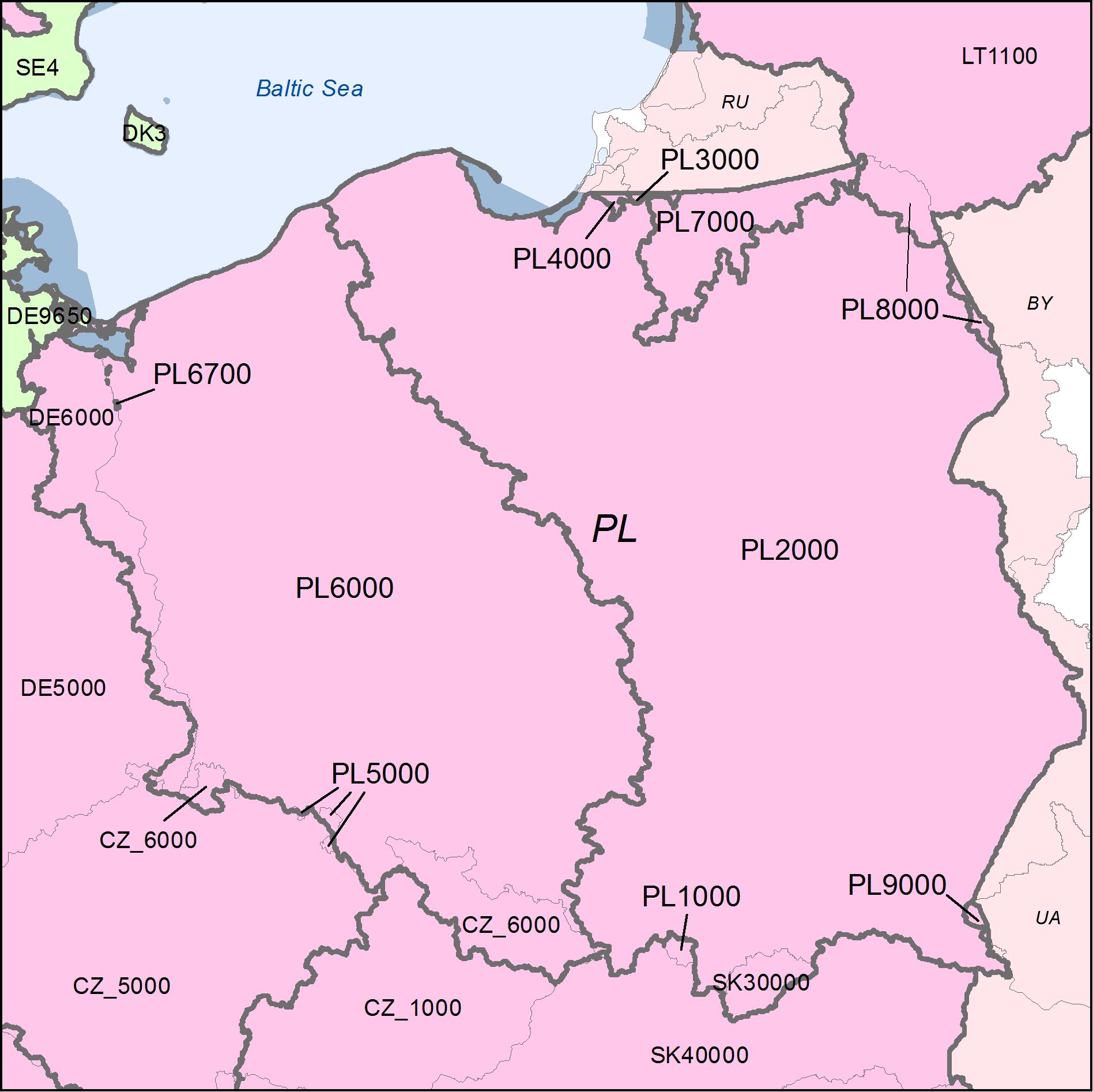
Figure 1
Map of Units of Management/River Basin Districts
|
|
|
|
International River Basin Districts (within European Union)
|
|
|
|
|
International River Basin Districts (outside European Union)
|
|
|
|
|
National River Basin Districts (within European Union)
|
|
|
|
|
Countries (outside European Union)
|
|
|
|
|
Coastal Waters
|
Source: WISE, Eurostat (country borders) as presented in the 2012 RBMP assessment reports
Poland has designated 10 Units of Management (UoMs) under the Floods Directive (FD), which are equivalent to the River Basin Districts (RBDs) designated under the Water Framework Directive (WFD). Areas of potentially significant flood risk (APSFRs) have been identified in only three UoMs, and Poland has developed three FRMPs for these UoMs: Vistula (Wisła, PL2000), Oder (Odra, PL6000) and Pregolya (Pregoła, PL7000). According to the information in FRMPs, these three UoMs cover 99.5 % of the country. All FRMPs follow the same approach, often with the same wording across the FRMPs.
The FRMPs were adopted via a decree of Council of Ministers on 18 October 2016. The FRMP for the Vistula was published on 15 November 2016, while the other two FRMPs were published on 7 November 2016 (Pregolya) and 1 December 2016 (Oder).
The table below gives an overview of all UoMs in Poland, including the UoM code, the name, and the number of APSFRs reported. It also shows if documents were reported for each UoM to European Environment Agency’s (EEA) WISE
– the FRMP as a PDF and the reporting sheet as an XML.
Table 1Overview of UoMs in Poland
|
UoM
|
Names
|
Number of APSFRs
|
XML Reported
|
PDF Reported
|
|
PL1000
|
DANUBE
|
-
|
No
|
No
|
|
PL2000
|
VISTULA
|
166
|
Yes
|
Yes
|
|
PL3000
|
SWIEZA
|
-
|
No
|
No
|
|
PL4000
|
JARFT
|
-
|
No
|
No
|
|
PL5000
|
ELBE
|
-
|
No
|
No
|
|
PL6000
|
ODER
|
101
|
Yes
|
Yes
|
|
PL6700
|
UCKER
|
-
|
No
|
No
|
|
PL7000
|
PREGOLYA
|
1
|
Yes
|
Yes
|
|
PL8000
|
NEMUNAS
|
-
|
No
|
No
|
|
PL9000
|
DNIESTER
|
-
|
No
|
No
|
|
Total
|
10
|
268
|
3
|
3
|
The FRMPs can be downloaded from the following web pages:
·The FRMP for the Vistula:
http://www.dziennikustaw.gov.pl/du/2016/1841/1
·The FRMP for the Oder:
http://www.dziennikustaw.gov.pl/DU/2016/1938
·The FRMP for the Pregolya: http://www.dziennikustaw.gov.pl/du/2016/1813/1
Overview of the assessment
The table below gives an overview of the evidence found during the assessment of the FRMPs. The following categorisation was used for the column concerning evidence:
·Evidence to the contrary: An explicit statement was found stating that the criterion was not met;
·No evidence: No information found to indicate that the criterion was met;
·Some evidence: Reference to the criterion is brief and vague, without a clear indication of the approach used for the criterion. Depending on the comment in the adjacent column, “some evidence” could also be construed as “weak evidence”.
·Strong evidence: Clear information provided, describing an approach followed in the FRMP to address the criterion.
Table 2Overview of the evidence found during the assessment of the FRMPs
|
Criterion
|
Evidence
|
Comments
|
|
FRM objectives have been established
|
Strong evidence
|
All three of Poland’s FRMPs set three main groups of objectives (with more detailed objectives for each): 1. Halting any increase in the risk of flooding, 2. Reducing existing flood risk, 3. Improvement to the management system for floods (including awareness). The Vistula and Odra UoMs set out further objectives for areas at risk from seawater floods.
|
|
FRM objectives relate to...
|
|
...the reduction of potential adverse consequences
|
Strong evidence
|
The FRMPs state that the overall goal of Poland’s objectives and measures is to reduce the potential negative effects of flooding on human health, the environment, cultural heritage and economic activity
|
|
...to the reduction of the likelihood of flooding
|
Some evidence
|
The objectives call for reducing flood risk, which is understood to nominally at least include the likelihood of flooding. The objectives moreover aim, among others, to increase the retention capacity of catchments and address development in flood risk areas, initiatives that reduce the likelihood of flooding.
|
|
...to non-structural initiatives
|
Strong evidence
|
The third main objective group refers specifically to non-structural initiatives, calling for improvement to the management system for floods (including awareness)
|
|
FRM objectives consider relevant potential adverse consequences to...
|
|
...human health
|
Some evidence
|
The FRMPs state that the overall goal of the objectives and measures is to reduce the potential negative effects of flooding on human health, the environment, cultural heritage and economic activity (Sections 3 and 4 of each FRMP).
|
|
...economic activity
|
Some evidence
|
|
|
...environment
|
Some evidence
|
|
|
...cultural heritage
|
Some evidence
|
|
|
Measures have been...
|
|
...identified
|
Strong evidence
|
Poland has reported 2 429 individual measures and no aggregated measures. The number of measures per UoM ranges from 47 (for the Pregolya UoM, PL7000) to 2 033 (for the Vistula UoM, PL2000). The measures cover all four measure aspects – prevention, protection, preparedness and recovery and review – though 87 % of all measures are for protection.
The measures are linked to the objectives.
|
|
...prioritised
|
Strong evidence
|
In its reporting to WISE, Poland has indicated for each measure one of three levels of priority: critical, very high, high. About 80 % of measures are indicated as very high priority.
The FRMPs instead list each measure as having high, moderate or low priority.
|
|
Relevant aspects of Article 7 have been taken into account such as...
|
|
...costs & benefits
|
Strong evidence
|
The three FRMPs and Poland’s reporting sheets refer to cost benefit as a criterion for the establishment of priorities for the selection of measures. It appears that CBA was used to compare alternative “scenarios” of measures.
|
|
...flood extent
|
Strong evidence
|
The FRMPs state that the extent and conveyance of flood, as well as areas with potential flood water retention, were included in the FRMPs via a detailed analysis of the spatial distribution of flood hazard and risk and potential losses based on flood hazard maps and flood risk maps, using data on historical floods.
|
|
...flood conveyance
|
Strong evidence
|
As noted above, the flood conveyance was indicated in the FRMPs, addressed via the spatial analysis of floods.
|
|
...water retention
|
Strong evidence
|
Increasing retention capacity is included among the specific objectives, and natural water retention measures are planned in all three FRMPs in Poland. Examples of measures include the development of a list of potential locations for increasing natural retention in areas outside cities and within urban areas and measures to increase forest water retention. Poland’s reporting sheets, as mentioned above, indicate that an analysis of potential flood water retention was carried out for the FRMPs.
|
|
...environmental objectives of the WFD
|
Strong evidence
|
The analysis of planning scenarios included the environmental acceptability of methods in the context of environmental requirements, inter alia Article 4.7 of the Water Framework Directive.
|
|
...spatial planning/land use
|
Strong evidence
|
Poland’s three FRMPs introduce a broad range of spatial planning and land use measures. Examples include: the elaboration of legal acts that introduce principles to govern development in flood risk areas; and analysis of the possibility of removal, change of use and modernization of facilities located in specific flood zones, along with the analysis of purchase options for land and buildings located in specific flood zones.
|
|
...nature conservation
|
Strong evidence
|
Measures considering nature conservation are planned in the three UoMs, in particular for the re-naturalisation of river valleys and their wetlands.
|
|
...navigation/port infrastructure
|
Some evidence
|
All three FRMPs assessed make a brief reference that they shall take into consideration navigation and port infrastructure, but specific details are not provided.
|
|
...likely impact of climate change
|
Strong evidence
|
Climate change was considered in all three FRMPs, which provide information on potential climate impacts and on adaptation measures, including under Poland’s Climate Adaptation Strategy.
|
|
Coordination with other countries ensured in the RBD/UoM
|
Some evidence
|
The FRMPs indicate that coordination was carried out in particular via international river basin commissions. Bilateral water agreements are also mentioned, but details of bilateral coordination are not provided.
|
|
Coordination ensured with WFD
|
Strong evidence
|
Joint consultation of RBMPs and FRMPs was carried out, along with coordination between authorities responsible for developing FRMPs and RBMPs, coordination with the environmental objectives in Art. 4 of the WFD.
|
|
Active involvement of interested parties
|
Strong evidence
|
Stakeholders were actively involved via planning teams, planning groups at steering committees across different levels of governance, including catchment level, water regions and UoMs.
|
Good Practices
The assessment identified the following good practices in the Polish FRMPs assessed.
Table 3
Good practices in the Polish FRMPs
|
Topic area
|
Good practices identified
|
|
Setting objectives
|
The process for setting objectives included discussions with stakeholders.
The FRMPs identify indicators to monitor the achievement of the three objectives.
|
|
Planning/implementing of measures and their prioritization for the achievement of objectives.
|
Estimated costs are provided for all measures in the three UoMs and information is provided on potential sources of funding.
All three FRMPs include measures for spatial planning, for natural water retention and for nature protection.
The FRMPs describe an articulated system for monitoring the implementation of measures.
|
|
Consideration of climate change in the FRMPs assessed.
|
The three FRMPs refer to Poland’s Climate Adaptation Strategy and to measures developed under it (though details on these measures are not provided).
The three FRMPs provide information from studies and models to indicate the potential impacts of climate change on flooding.
|
|
Use of cost-benefit analysis (CBA) in the FRMPs assessed.
|
A detailed system of cost benefit analysis was used to assess the efficiency of individual planning scenarios.
|
|
Public participation.
|
A broad consultation process was carried out, and several various mechanisms were used to inform the public and interested parties about the consultation, including print and internet advertising and a film trailer shown in cinemas. The consultation process was initiated from the first stage of FRMP development.
A dedicated website was created where all the relevant information was stored, including the results of the consultation.
A broad range of mechanisms was used for the active involvement of stakeholders, including planning groups and steering committees at different levels and a national stakeholder conference.
The effects of consultations are summarised in the FRMPs.
|
Areas for further development
The assessment identified the following areas for further development in the Polish FRMPs assessed.
Table 4
Areas for further development in the Polish FRMPs
|
Topic area
|
Areas identified for further development
|
|
Integration of previously reported information in the FRMPs.
|
Flood hazard and risk mapping was still on going during the first cycle to cover the outstanding areas at risk.
|
|
Planning/implementation of measures and their prioritization for the achievement of objectives.
|
The process for the prioritisation of measures is not clearly presented in the FRMP.
|
|
Consideration of climate change in the FRMPs assessed.
|
It is not clear to what extent the analysis of climate change was integrated into the objectives and measures of the FRMPs.
|
|
Use of CBA in the FRMPs assessed.
|
It is not explained whether the scenarios covered by CBA included all measures.
The FRMPs do not consider transboundary effects of measures.
|
|
International issues in flood risk management.
|
The FRMPs provide little information on coordination, in particular at the bilateral level.
|
Recommendations
Based on the reported information and the FRMPs, the following recommendations are made to enhance flood risk management (not listed in any particular order):
·Conclusions from the finalised flood hazard and risk mapping of the first cycle should inform the second cycle PFRA, FHRM and FRMP steps.
·CBA should consider possible transboundary effects of measures.
·The process for prioritisation of measures should be clearly explained in the FRMP.
·Climate change should be further integrated into the objectives and measures of the FRMPs.
·The FRMPs should provide more information on international coordination.
·
1. Scope of the assessment and sources of information for the assessment
1.1Reporting of the FRMPs
Poland has prepared FRMPs at the level of its UoMs. Poland has reported three FRMPs for the three UoMs where APSFRs were designated: Vistula (PL2000), Oder (PL6000) and Pregolya (PL7000). There is one FRMP covering each entire UoM. These three UoMs cover about 99.5 % of the country’s territory.
Water management in Poland is also carried out at catchment level and water region level. The Vistula and Odra UoMs are each divided into four water regions, managed by Regional Water Management Boards. For the Vistula UoM, these regions are the Little Vistula, Upper Vistula, Central Vistula and Lower Vistula; for the Odra UoM, the regions are the Upper Oder, Central Oder, Warta Region and Lower Oder and West Borders Region.
Poland did not make use of Article 13.3 of the Floods Directive, which allows Member States to make use of previous flood risk management plans (provided their content is equivalent to the requirements set out in the Directive).
1.2Assessment of the FRMPs
In Poland, river basin districts (RBDs)/UoMs are managed at a national level. These ten UoMs are:
Table 5
UoMs in Poland
|
UoM
|
Names
|
|
PL1000
|
DANUBE
|
|
PL2000
|
VISTULA
|
|
PL3000
|
SWIEZA
|
|
PL4000
|
JARFT
|
|
PL5000
|
ELBE
|
|
PL6000
|
ODER
|
|
PL6700
|
UCKER
|
|
PL7000
|
PREGOLYA
|
|
PL8000
|
NEMUNAS
|
|
PL9000
|
DNIESTER
|
|
Total
|
10
|
Note: the UoMs for which the FRMPs have been developed are marked in bold
All FRMPs follow the same approach, using the same methods developed at national level (and in some places with similar wording) across the three FRMPs.
2. Integration of previously reported information
2.1Conclusions drawn from the preliminary flood risk assessment (PFRA)
All three FRMPs provide the conclusions of the PFRA, including a map of the UoM with the areas of potential significant flood risk (APSFRs). The APSFRs are described in the text and shown on the map.
Links to online maps of the APSFRs have been provided in all the FRMPs: specifically, a link to the national floods web portal (
www.powodz.gov.pl
) that provides flood hazard and risk maps (FHRMs).
Conveyance routes are mentioned the FRMPs among the information to be reported to the European Commission. No further details are found in the FRMPs. In Poland’s reporting sheets, it is stated that the extent and conveyance of flood as well as areas with potential flood water retention were included in the FRMP via a detailed analysis of the spatial distribution of flood hazard and risk and potential losses based on flood hazard maps and flood risk maps, using data on historical floods.
The prior assessment of Poland’s APSFR found that fluvial and seawater flooding was significant .
2.1.1Coordination with neighbouring Member States on shared RBDs/UoMs
Section 8 of the FRMPs describes international coordination, noting that this is led in Poland by the National Water Management Board. The working groups of international river basin commissions are listed together with an overview of their activities for both the FD and the WFD. The Oder FRMP notes, for example, that Working Group G2 for the international Oder RBD/UoM works on floods and had an input to the draft FRMP. The Vistula and Pregolya FRMPs also describe cooperation on transboundary river basins.
2.1.2Information how the PFRA was used in the development of the FHR maps
The FRMPs note that the flood hazard and flood risk maps were prepared for areas identified in the PFRA; however, they do not provide further information regarding links between the FHRMs and the PFRA .
2.2Presentation of Flood Hazard and Risk Maps (FHRMs) in the FRMPs
All three FRMPs provide summary FHRMs as well as links to online flood hazard and flood risk maps (on the web portal cited above,
www.powodz.gov.pl
)
The flood risk and hazard maps are presented in the appendices to the FRMPs for the whole UOM, divided into smaller regions for the Vistula and Oder UoMs to make them easier to read. This web portal contains some maps for Poland as a whole, information related to maps and flood risk and hazard areas. The portal also contains a link to a separate platform with detailed maps,
http://mapy.isok.gov.pl
. Flood risk and hazard maps cover fluvial floods. The FHRMs for the Oder and Vistula UoMs also cover seawater floods. The FRMPs refer to pluvial floods, but these are not indicated on the summary FHRMs.
2.2.1Maps for shared flood risk areas
Maps in the FRMPs for the Vistula UoM and the Oder UoM indicate APSFRs on Poland’s borders. The FRMPs do not, however, clearly state if any APSFRs are shared with other Member States, nor whether any joint FHRMs were prepared. The FRMPs indicate that international co-operation is based on international conventions and bilateral agreements, .
2.2.2Conclusions drawn from the flood hazard and flood risk maps
The three FRMPs state that the analysis of FHRMs was used to plan measures. The FHRMs were also available in the public participation process for the FRMPs (via the portal,
http://mapy.isok.gov.pl/imap/
).
2.3Changes to the APSFRs or other Flood Risk Areas
The FRMP assessment looked for information on changes in the identification of APSFRs or since December 2011, or in the FHRMs since December 2013, indicated in the FRMP. The three FRMPs do not indicate that Poland’s APSFRs have been updated since 2013, however, the last time documents were submitted to the European Commission on the topic was in 2016.
The FRMPs refer to changes in the identification of flood hazards and risks: a verification of the FHRMs was carried out in 2014 and the FRMPs were based on maps that were updated in 2014 following this verification. The FRMPs explain that the flood hazard maps published in December 2013 were prepared based on a terrain model validated for the years 2011-2013. In 2014, the flood hazard maps were reviewed in connection to comments made by administrative authorities and other stakeholders, concerning inter alia, the fact that the maps did not include infrastructure and property investments completed later than the acquisition of the digital terrain model. In the period from 22 December 2014 to 22 June 2015, further comments of administrative authorities were received regarding needs to include flood risk and the methodology used in the development of maps (including for maps for seawater flooding in terms of wavelengths). To meet these expectations, a further scenario (called zero) was prepared for the FRMPs, containing updated ranges of flood risk areas in relation to the areas indicated in the FHRMs (these were forwarded to Poland’s administrative authorities in April 2015).
2.4Areas for further development in the earlier assessment of the flood hazard and risk maps
The 2015 FHRM assessment identified the following area for further development for Poland:
·Maps for about 70 % of potentially significant flood risk areas in Poland still have to be produced. Maps seem to cover areas around major rivers.
·No APSFRs were reported in PL1000, PL3000, PL4000 and PL6700. Poland has subsequently indicated this was because there were no data on historical flooding, so they were not considered to be at risk of future flooding. It was not clear if possible climate change and future socio-economic scenarios were considered.
None of these areas for further development have been explicitly addressed in the time period between the publication of the FHRMs and the assessment of the FRMPs.
2.5Good practices and areas for further development in the FRMPs regarding integration of previously reported information
The following area for further development was identified:
·Flood hazard and risk mapping appeared to be on going during the first cycle to cover the remaining areas at risk. Conclusions from the finalised mapping should inform the second cycle PFRA, FHRM and FRMP steps.
3. Setting of Objectives
3.1Focus of objectives
For all three UoMs, Poland’s reporting sheets and the FRMPs themselves list three main groups of objectives, along with more detailed objectives for each group:
1.Halting any increase in the risk of flooding: a) maintaining and increasing the existing retention capacity of the catchment in the water region, b) eliminating or avoiding development growth in areas of significant flood hazard, c) defining the conditions for possible development of areas protected by embankments, d) avoiding the growth of and defining the conditions for development in areas with low (Q 0.2 %) probability of flood occurrence;
2.Reducing existing flood risk: a) limiting existing flood hazard, b) limiting existing development, c) limiting the sensitivity of facilities and communities to flood risk;
3.Improving the management system for floods (including public awareness): a) improvement of forecasting and warning system (meteorology/hydrology), b) improvement of the effectiveness of response of the public, companies and public institutions to the flood, c) improvement of the effectiveness of reconstruction and return to the state before a flood, d) implementation and improvement of the effectiveness of post-flood analyses, e) building legal and financial instruments that encourage behaviours that increase flood safety, f) building educational programs that improve awareness and knowledge about flood risk and hazard.
The reporting sheets and FRMPs for the Vistula and Odra UoMs set out further objectives for areas at risk from seawater floods: a) Determining the conditions for the possible development of areas protected from risk of flood from the sea; b) Sustaining natural forms of protection of the shore; c) Sustaining existing technical forms of protection of the shore; d) Analysis of existing forms of shore/coast protection in the context of dynamic changes in the area of the coastal belt along the entire length of the Polish coast.
In the reporting sheets, the objectives are linked to measure types recommended for the implementation to help achieve the main three groups of objectives.
These objectives apply to the three Polish FRMPs. Consequently, in the FRMPs assessed:
·The objectives aim to reduce the adverse consequences of floods
·The objectives aim to reduce the likelihood of flooding
·The objectives refer to measures that will be implemented
·The objectives refer to non-structural measures
3.2Specific and measurable objectives
In supporting documents to Polish FRMPs, information is provided on locations where the objectives will be achieved (e.g. which APSFR and sometimes which UoM), in what way and by when they will be achieved. It is not specified, however, if this information is provided for every APSFR. Specific objectives have measures assigned to them (see section 4 below).
While the objectives themselves do not contain targets, the FRMPs provide common indicators to monitor the achievement of the three objectives. For example, Objectives 1 and 2 are to be monitored using several indicators. These include the reductions, as a result of measures, in:
·average value of annual flood losses;
·number of inhabitants in areas of particular flood risk;
·number of culturally valuable sites in areas of special flood risk
3.3Objectives to reduce adverse consequences from floods
The FRMPs state that the overall goal of Poland’s objectives and measures is to reduce the potential negative effects of flooding on human health, the environment, cultural heritage and economic activity.
3.4Objectives to address the reduction of the likelihood of flooding
The objectives call for reducing flood risk, which is understood, by definition (but not explicitly), to include the likelihood of flooding. The objectives moreover aim, among others, to increase the retention capacity of catchments and address development in flood risk areas, initiatives that both reduce the likelihood of flooding.
3.5Process for setting the objectives
The FRMPs indicate that the objectives were considered on the basis of the FHRMs as well as existing plans and programmes (such as the Master Plan for projects in the Vistula and Oder basins, which includes flood protection projects) as well as Operational Programmes under EU Cohesion Policy. In addition, objectives were discussed with stakeholders.
3.6Good practices and areas for further development regarding setting objectives
The following good practices were identified:
·The process for setting objectives included discussions with stakeholders.
·The FRMPs identify indicators to monitor the achievement of the three objectives.
4. Planned measures for the achievement of objectives
Poland has reported 2 429 individual measures and no aggregated measures. As Poland has reported some measures under more than one aspect and type, the total number of measures reported, including measures which have been allocated to more than one type, is 2 484 (this implies double counting).
The number of measures per UoM ranges from 47 (for the Pregolya UoM, PL7000) to 2 033 (for the Vistula UoM, PL2000): the Vistula UoM thus accounts for 82 % of all measures reported.
The measures cover all four measure aspects: in total, 158 measures are for prevention (6 % of the total number of measures), 2 171 for protection (87 % of the total), 88 for preparedness (4 %), and 67 for recovery and review (3 %). Thus, the great majority of all measures reported, 87 %, are for protection.
The shares vary among the three UoMs, however. Prevention measures make up 30 % of the total in the Pregolya UoM, while in the Oder and Vistula UoMs, the shares are significantly less (5 % and 6 %, respectively). The highest number of the protection measures is planned in the Vistula UoM (91 %), while in the Oder UoM this is 74 % and in the Pregolya, 30 %. Preparedness measures in the Vistula UoM constitute 1 % of the total, and recovery and review measures, 2 %. In the Oder UoM, 10 % of measures are for preparedness and 10 % for recovery and review. The share of the preparedness measures in the Pregolya UoM is 26 %, and recovery and review, 15 %.
See Annex A for further details.
4.1Cost of measures
Table 6
Estimated overall budget for the measures in the assessed FRMPs
|
UoM code
|
Estimated overall budget of planned measure/s (2015-2021) in PLN
|
|
PL2000
|
5 398.64 m
|
|
PL6000
|
6 245.15 m
|
|
PL7000
|
1.75 m
|
Source: Reporting sheet and FRMPs
Poland has reported the costs of its measures (see the table above). The total costs are about PLN 11 650 m (approximately EUR 2 800 m ). The costs of single measures vary significantly: 79 % of measures will cost between PLN 50 000 (about EUR 11 700) and PLN 500 000 (EUR 117 000) each; while 56 measures (2 %) are estimated to cost over PLN 100 m (EUR 24 m ) each.
4.2Funding of measures
The FRMPs summarise measures and their funding sources and in many cases are identified for specific projects. Funding sources include: the National and Regional Water Management Boards, relevant ministries, local authorities and water and sewerage companies. EU and international funds are also mentioned; however, these are not linked to specific projects. Property owners are also specified as entities funding measures. The FRMPs also indicate that funds may be borrowed from development banks: they mention the World Bank, the Council of Europe Development Bank and the European Investment Bank; further information on the role of these banks is not provided, however.
Table 7
Funding of measures
|
|
PL2000
|
PL6000
|
PL7000
|
|
Distribution of costs among those groups affected by flooding
|
|
|
|
|
Use of public budget (national level)
|
✔
|
✔
|
✔
|
|
Use of public budget (regional level)
|
✔
|
✔
|
✔
|
|
Use of public budget (local level)
|
✔
|
✔
|
✔
|
|
Private investment
|
✔
|
✔
|
✔
|
|
EU funds (generic)
|
✔
|
✔
|
✔
|
|
EU Structural funds
|
✔
|
✔
|
✔
|
|
EU Solidarity Fund
|
|
|
|
|
EU Cohesion funds
|
✔
|
✔
|
✔
|
|
EU CAP funds
|
|
|
|
|
International funds
|
|
|
|
|
Other (development banks) *
|
✔
|
✔
|
✔
|
Source: FRMPs
Note: * The FRMPs indicate that measures can also be funded using funds borrowed from 1) The World Bank; 2) the Council of Europe Development Bank; and 3) European Investment Bank.
4.3Measurable and specific (including location) measures
The FRMPs assessed include a clear and explicit description of the measures with regard to:
·What they are trying to achieve,
·Where they are to be achieved,
·How they are to be achieved, and
·By when they are expected to be achieved.
The location of measures is specified: for the Vistula and Oder FRMPs, measures are reported at the levels of the UoM, APSFR or other specific risk area or at the level of local authorities. Timescales and planning cycles for implementation are given. The information of what the project covers, costs, who is responsible including the locations and extent (length). The FRMPs summarise as well general types of measures applied in the UoM (e.g. technical, non-technical). Indicators measuring the progress of the implementation of measures are also provided. While much of the information is for structural measures, supporting documents summarise non-technical measures, indicating their location and completion times. Information available for measures in the Pregolya UoM is, however, more limited.
Table 8
Location of measures
|
|
PL2000
|
PL6000
|
PL7000
|
|
International
|
|
|
|
|
National
|
|
|
|
|
RBD/UoM
|
✔
|
✔
|
✔
|
|
Sub-basin
|
|
|
|
|
APSFR or other specific risk area
|
✔
|
✔
|
✔
|
|
Municipal level
|
✔
|
✔
|
|
|
Water body level
|
|
|
|
|
More detailed than water body
|
|
|
|
Source: FRMPs
4.4Measures and objectives
The FRMPs link measures to objectives and specific objectives. As noted in section 3, however, the objectives do not include specific targets that would allow an indication when measures implemented lead to the achievement of specific objectives. Nonetheless, details on the measures are found in background reports available on the national flood web site (
http://www.powodz.gov.pl/pl/biblio_view?id=2
), such as graphical information showing the location of many specific projects and measures. There is also some explanation by how much many individual projects will contribute to objectives: for example, the expected increase in water retention on agricultural land.
4.5Geographic coverage/scale of measures
In Poland’s reporting sheets, codes are provided for the location of all measures. Poland did not report information for the geographical coverage of its measures.
4.6Prioritisation of measures
The FRMPs give the priority of groups of measures on a three-level scale, as: high, moderate and low priority. The FRMPs indicate the methodology for prioritisation: this is linked to the achievement of objectives, and in particular on identifying and addressing sources of excessive flood risk in given areas and reducing the risk of flooding. High priority measures should be carried out first to reduce the risk of flooding as quickly as possible; moderate priority measures could be introduced at the same time as high priorities depending on timeframes and available funding; low priority measures are those difficult to implement or less effective. The measures were grouped into variants, which were then further analysed including, inter alia, multicriteria and cost/benefit analysis.
Poland’s reporting sheets indicate that the measures were then given priorities on the following basis: very high - strategic measures located in problem areas (hot spots) and instruments supporting the implementation of measures; high - buffer measures in problem areas; critical - buffer and strategic measures outside of the problem areas / not impacting to problem areas. Across all of Poland’s measures:
·The great majority of measures, 1 942 (78 % of the total), are reported as very high priority: 157 prevention, 1 631 protection, 87 preparedness and 67 recovery and review measures
·440 measures, 18 % of the total, are listed as high priority (439 protection measures and one preparedness measure).
·A total of 102 measures are reported as critical priority (one prevention and 101 protection measures, 4 % of all measures reported)
Poland provided information about the timetable of all measures in the reporting sheets. However, this was an open question and the reported time periods varied greatly, thus it was not possible to aggregate the information. However, it appears that about 60 % of measures will be completed after the end of the first FRMP in 2021.
4.7Authorities responsible for implementation of measures
Poland has reported information on the authorities responsible for the implementation of measures, indicating six levels of authorities. The breakdown varies by UoM.
In the Vistula UoM, where the great majority of measures (2 033 out of 2 484) are planned):
·provincial authorities are responsible for the majority of measures: 1 440 (71 %)
·regional authorities, 255 measures (13 %).
·district authorities, 153 measures (8 %)
·catchment authorities are responsible for 85 measures (4 %)
·municipal authorities, 54 measures (3 %)
·national authorities, 46 measures (2 %)
For the Oder UoM:
·catchment authorities are responsible for 319 of the 404 measures identified (79 %)
·national authorities, 40 measures (10 %)
·provincial authorities, 22 measures (5 %)
·regional authorities, 10 measures (2 %)
·municipal authorities are responsible for eight measures (2 %)
·district authorities, five measures (1 %)
For the Pregolya UoM:
·national authorities are responsible for 38 of the 47 measures (81 %)
·catchment authorities are responsible for five measures (11 %)
·regional authorities, two measures (4 %).
·municipal and district authorities, one measure each (2 %)
4.8Progress of implementation of measures
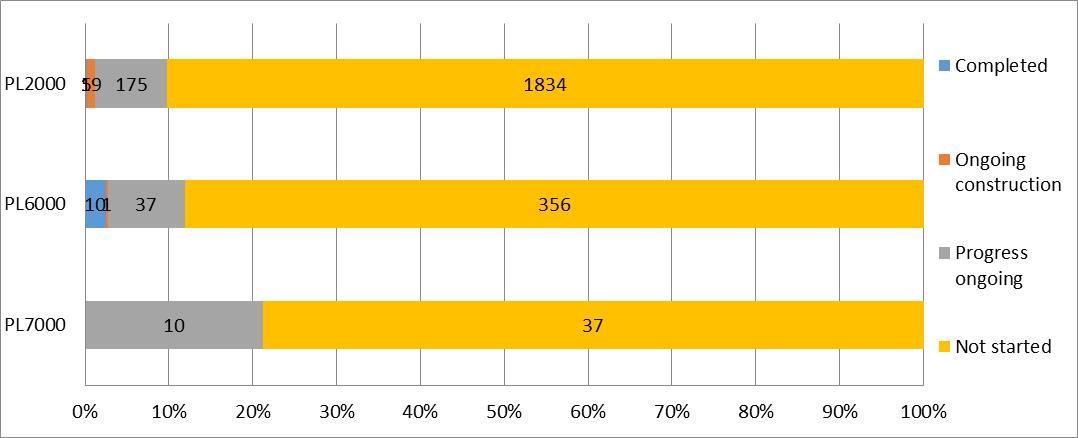
Poland has reported that the great majority of measures, 2 227 out of 2 484 (90 %) have not yet started. In total, 15 measures (less than 1 %) are reported to be completed: these are all protection measures. Not many more, 20 measures (less than 1 %) are in on-going construction and these are also protection measures. Finally, 222 measures (9 % of the total) are reported to have progress on-going: nearly all of these are protection measures (210 measures, 95 % of the 222 progress ongoing measures), though prevention, preparedness and recovery and review measures are also in the category of progress ongoing.
Both completed and on-going construction measures are found in the Vistula and Oder UoMs. No measures were reported in these categories in Pregolya UoM.
4.9Measures taken under other Community Acts
Member States have been asked to report on other Community Acts under which each measure has been implemented. Poland reported the Water Framework Directive (2000/60/EC) under ‘other Community acts’ for a total of 106 measures in the Vistula and Oder UoMs (4 % of the total 2 429 measures). No reference was found, however, to measures taken under the Seveso Directive or the IPPC Directive, though all FRMPs include measures related to dangerous substances (e.g. an early warning system for dangerous substances in air and water – a measure in both the Oder and Vistula FRMPs).
4.10Specific groups of measures
With regard to spatial planning/land use measures, Poland’s three FRMPs introduce a broad range of measures. Across the three UoMs, there are 14 measures under measure type M21 on avoidance, including the following:
·Elaboration of legal acts that introduce principles to govern development in flood risk areas;
·Development of technical requirements under which it will be possible to locate and build houses and facilities in areas at risk of damage to the embankments;
·Development of guidelines for the location and technical aspects of development in flood risk areas.
Under measure type M22 on removal or relocation, the FRMPs include measures such as:
·Analysis of the possibility of removal, change of use and modernisation of facilities located in the specific flood zones, along with the analysis of purchase options for land and buildings located in the specific flood zones;
·Analysis of conditions for relocation of buildings from areas of particular flood threat;
·Plans for resettlement and purchase of properties located in specific areas;
·Development of a buy-out and resettlement program in areas particularly exposed to flooding;
·Analysis of land management behind flood embankments and in inter-embankment areas to prevent an increase of flood hazards.
The Vistula and Oder FRMPs highlight the need to address flooding via better use of floodplains, minimise investment in and near flood risk areas, and increase retention areas along riverbanks via the ‘protection of wetlands, peat bogs, forests, ponds or oxbow lakes’. The FRMPs also state that existing developments make it difficult to effectively use flood plains in the event of a flood. To address this, the FRMPs plan the purchase and resettlement of existing developments.
Although the FRMPs include a large number of spatial planning and land use measures, they do not provide information how the framework for spatial planning has changed since 2000.
Natural water retention measures (NWRMs) have been planned in all three FRMPs. Under measure type M31 (natural flood management), the FRMPs set out measures including the following:
·Development of guidelines on non-technical methods of flood risk management covering principles for identifying priority areas for re-naturalization in river valleys, with particular reference to wetlands;
·Development of guidelines on non-technical methods of flood risk management including principles of protection and increasing retention in forest areas;
·Development of a list of potential locations for increasing natural retention in areas outside cities and in urban areas;
·Development of guidelines on non-technical methods of flood risk management, including principles of protection and increasing retention, in agricultural areas.
There are a number of measures related to M32 (Flow regulation) referring to creation of polders, for example on the banks of the Vistula River: it is envisaged that these will reduce maximum flows during floods.
All three FRMPs include measures that specifically consider nature conservation. Examples of such measures include the following:
·Development of guidelines on non-technical methods of flood risk management covering the principles of identifying priority areas for re-naturalization in river valleys, with particular reference to wetlands.
All three FRMPs assessed make a brief reference that they shall take into consideration navigation and port infrastructure, but specific details are not provided.
Dredging measures are planned in the Vistula and Oder UoMs. Some examples for the Vistula UoM include the following:
·Dredging of the mouth of the Bug river;
·Dredging of the Łagowica riverbed for safe passage of flood waters
Examples for the Oder UoM include:
·Dredging and restoration of the Czarny Potok in Mirsk, Czerniawa, Wolimierz, Pobiedna;
·Dredging and partial reconstruction of the Kwisa River in the city of Nowogrodziec - Lubań
4.11Recovery from and resilience to flooding
The role of insurance policies is not discussed in the three FRPMs. The FRMPs mention that measures should ensure rational management of flood risk to include implementation of insurance instruments, in particular in areas where the degree of flood hazard does not justify the implementation of technical or non-technical methods of flood protection. However, no further details are given.
Flood risk insurance is available in all the UoMs but no information is given as to the type of insurance available or to be developed for potential flooding areas.
4.12Monitoring progress in implementing the FRMP
The FRMPs provide information on the process for monitoring of progress. It is stated that the president of the National Water Management Board (NWMB) is responsible for coordination of the monitoring of progress. A large number of entities are responsible for the implementation of measures. Data on the implementation of measures for which national level bodies are responsible is transferred directly to the NWMB. On the other hand, information about measures carried out by other responsible entities – such as. at regional and local levels – is collected by the directors of the Regional Water Management Boards (RWMB) and then forwarded to the NWMB.
The information to be collected includes the implementation status of measures, any delays, and the effectiveness of planned and completed measures for the achievement of objectives. The FRMPs set out indicators and information on frequency of monitoring for specific measures and who is responsible; however, these indicators are not explained in detail. Examples of the indicators include: number of analyses carried out as part of instruments for rational management of flood risk areas; number of trained citizens; number of operational flood prevention plans prepared in the reporting period (including population and inventory evacuation plans). In addition, the General Directorate for Environmental Protection, which performs tasks in the field of nature monitoring, will monitor selected habitats and species dependent on water and wetlands environments: the results of this monitoring should be included in the next planning cycle as information on the impacts of flood protection investments (both positive and negative) on the status of protected species and natural habitats.
In terms of a baseline for monitoring, the FRMPs refer to a “variant 0” which assumes the discontinuation of measures aimed at any improvement of the current situation, so called status quo. This is referred to as the baseline option, to which the effects enhancing the effectiveness of flood control measures, provided for in the subsequent analysed options, are referred to.
It is stated in Section 5 of the FRMPs that “monitoring of the environmental effects of the implementation of FRMP serves to track changes in the environment occurring both during and after the implementation of individual measures, so that in the next planning period it is possible to effectively use data specific to the FRMP”. It is recommended that reports on progress in the implementation of measures should be submitted by the bodies responsible for their implementation annually, while the indicators that require hydraulic modelling should be determined at least twice in the planning period.
4.13Coordination with the Water Framework Directive
The table below shows how the development of the FRMP has been coordinated with the development of the second River Basin Management Plan of the WFD.
Table 9
Coordination of the development of the FRMPs with the development of the second River Basin Management Plans of the WFD
|
|
All FRMPs
|
|
Integration of FRMPs and RBMPs in a single document
|
|
|
Joint consultation of draft FRMPs and RBMPs
|
✔
|
|
Coordination between authorities responsible for developing FRMPs and RBMPs
|
✔
|
|
Coordination with the environmental objectives in Art. 4 of the WFD
|
✔
|
|
The objectives of the Floods Directive were considered in the preparation of the RBMPs a
|
✔
|
|
Planning of win-win and no-regret measures in the FRMPs
|
|
|
The RBMP PoMs includes win-win measures in terms of achieving the objectives of the WFD and Floods Directive, drought management and NWRMs a
|
✔
|
|
Permitting or consenting of flood risk activities (e.g. dredging, flood defence maintenance or construction) requires prior consideration of WFD objectives and RBMPs
|
|
|
Natural water retention and green infrastructure measures have been included
|
✔
|
|
Consistent and compliant application of WFD Art. 4(7) and designation of heavily modified water bodies with measures taken under the FD e.g. flood defence infrastructure
|
✔
|
|
The design of new and existing structural measures, such as flood defences, storage dams and tidal barriers, have been adapted to take into account WFD Environmental Objectives a
|
✔
|
|
The use of sustainable drainage systems, such as the construction of wetland and porous pavements, have been considered to reduce urban flooding and also to contribute to the achievement of WFD Environmental Objectives
|
|
Note: a Based on reporting for the WFD.
The FRMPs summarise the coordination with the WFD. The environmental analysis of projects and measures to be carried out under the FRMPs was reflected in the process of planning and coordinating of the development of updated RBMPs. Consultations of RBMP and FRMP were coordinated. The initial environmental assessment of planning scenarios considered Art. 4(7) of the Water Framework Directive and Art. 6 of the Habitats Directive (92/43/EEC), as well as national nature protection requirements.
The FRMPs state that biological and hydromorphological elements under the WFD were considered in the analysis of the impacts of the FRMPs on WFD objectives. The FRMPs also indicate that fish passages for flood structures have been determined. Hydromorphological elements considered include: quantity and dynamics of water flow, connections with groundwater bodies, river continuity, morphological conditions: river depths, width variation, structure and composition of river beds, coastal zone structure.
4.14Good practices and areas for further development with regard to measures
The following good practices were identified:
·Estimated costs are provided for all measures in the three UoMs and information is provided on potential sources of funding.
·All three FRMPs include measures for spatial planning, for natural retention and for nature protection.
·The FRMPs describe an articulated system for monitoring the implementation of measures.
The following area for further development was identified:
The process for prioritisation of measures should be clearly presented in the FRMP.
5. Consideration of climate change
Climate Change was considered in all three FRMPs and all three FRMPs make reference to the national Climate Change Adaption Strategy, the Strategic adaptation plan for sectors and areas sensitive to climate change by 2020 with a view to 2030 (SPA 2020), published in 2013. The FRMPs also cite an FP6 project, ENSEMBLES, on strategically important information on the climate and its changes and their impact on society; and to the work of the International Panel on Climate Change.
As part of the preparation of the FRMPs, a pilot study was carried out to project the impact of changes of predicted precipitation on the outflow from the Nysa Kłodzka catchment (in the Oder UoM) to the water gauge in Kłodzko, using the results of regional simulations from global models. The projections were carried out for the periods 2011-2030 and 2050-2070.
A shift in the occurrence of extreme events is mentioned in all three FRMPs. The results of analysis show that flood risks due to the occurrence of extreme events (such as very high levels of precipitation) will be smaller, while flood risks caused by rainfall of lower intensity may increase. At the same time, the scenarios analysed indicate an increased likelihood of flash floods caused by strong rainfall that could cause the flooding of areas where the spatial management is not properly implemented. Forecasts indicate that the period of snow deposition will gradually decrease, and in the middle of the 21st century it may be on average 28 days shorter than today. This can have a positive effect in terms of a lower probability of floods related to snowmelt.
5.1Specific measures to address expected effects of climate change
One measure in the Oder FRMP directly addresses climate change: a measure to increase water retention in forests includes the analysis of water retention in connection with the adaptation of forests and forestry to climate change. No measures were found in the Vistula or Pregolya UoMs.
Poland’s reporting sheets state that measures to promote adaptation in natural areas are proposed in the SPA 2020 plan, and these will, among other results, reduce the negative effects of drought and flooding. When implementing the measures, particular attention will be given to areas at risk of floods (river valleys, mountain and foothill areas) as well as areas with increased water needs and those characterized by water shortages. No further details are given in the FRMPs.
With regard to potentially increased pollution risk in flood prone zones due to climate change, it is mentioned in the FRMPs that measures are proposed in SPA 2020, however further details are not provided in the FRMPs.
5.2Good practices and areas for further development concerning climate change
The following good practices were identified:
·The three FRMPs refer to Poland’s Strategic adaptation plan and to measures developed under it (though details on these measures are not provided).
·The three FRMPs provide information from studies and models to indicate the potential impacts of climate change on flooding.
The following area for further development was identified:
·It is not clear to what extent the analysis of climate change was integrated into the objectives and measures of the FRMPs.
6. Cost-benefit analysis
The three FRMPs and Poland’s reporting sheets refer to cost benefit results as a criterion for the establishment of priorities for the selection of measures.
The reporting sheets for Vistula and Oder state that CBA was carried out in all three UoMs to assess the effectiveness of planning scenarios. The scenarios sum the costs and benefits of measures recommended for individual water regions (i.e. at sub-UoM level) as well as for the UoMs themselves. According to the FRMPs, five scenarios were considered for each water region and UoM: zero (no new measures), maintenance, non-technical measures, technical measures and a mixed scenario. The specific measures included in the different scenarios are not indicated, however.
Reporting sheets for Pregolya UoM reports only that in the first planning period, no technical measures were proposed in the Pregolya UoM, and in the information sheets under the CBA section it is stated that there was no need to consider cross-border impact under the procedure of strategic environmental assessment of FRMPs.
Estimates were made of social costs and benefits based on the difference between the projected average annual flood losses in the zero scenario and the lower average annual flood losses in other scenarios.
The CBA was based on an analysis of investment and operational costs, together with an analysis of social costs and benefits. The analysis period was 50 years, 2015 to 2064. The following social benefits were included: flood losses avoided as a result of investments, avoided intangible losses approximated as 40 % of material losses, induced economic benefits. The reduction of flood losses was calculated as the difference between the losses without investment and with investment (after completion). Based on the hydrological model, the surface of floods was simulated for various flow values with a defined probability of occurrence: 10 %, 1 % and 0.2 %. The values of flood losses were based on national scale. These values were indexed for inflation (based on values appropriate for a given category of land use in previous years). The method calculated average annual flood losses (AAD). On the basis of the CBA, the following economic performance indicators were calculated for each scenario: economic net present value (ENPV), economic rate of return (ERR) and benefit-to-cost ratio (B/C).
Multi-benefits were not considered. Moreover, the analysis did not cover transboundary aspects: Poland indicated in the reporting sheets that no transnational measures are planned in Vistula, Oder or Pregolya UoMs; moreover, the analysis of the social costs and benefits for the basins of the Vistula, Oder and Pregolya was developed without evaluation of transboundary effects.
6.1Good practices and areas for further development
The following good practice was identified:
·A detailed system of cost benefit analysis was used to assess the efficiency of planning scenarios.
The following areas for further development were identified:
·It is not explained whether the scenarios included all measures.
·The FRMPs should consider transboundary effects of measures.
7. Governance including administrative arrangements, public information and consultation
7.1Competent authorities
In 2016, Poland updated information on Competent Authorities reported to WISE.
7.2Public information and consultation
The table below shows how the public and interested parties were informed in the three UoMs assessed concerning the draft FRMPs. Information how the consultation was actually carried out and which stakeholders participated is presented in the rest of the section:
Table 10
Methods used to inform the public and interested parties of the FRMPs
|
|
All FRMPs
|
|
Media (papers, TV, radio)
|
✔
|
|
Internet
|
✔
|
|
Digital social networking
|
|
|
Printed material
|
✔
|
|
Direct mailing
|
✔
|
|
Invitations to stakeholders
|
✔
|
|
Local Authorities
|
✔
|
|
Meetings
|
✔
|
|
Other *
|
✔
|
Source: FRMPs
Notes: * In Poland, “Other” information mechanisms comprised promotion film and short videos, dedicated website, conferences, newsletters, advertisements in internet and printed press
The FRMP consultation process was carried out from 22 December 2014 to 22 June 2015.
Parallel to the consultation process, an information and promotion campaign was conducted, addressed to entities directly and indirectly affected by FRMPs, including bodies responsible for flood protection as well as the general public. As part of the campaign, the website dedicated to flood protection and to the plans under development was updated on an ongoing basis (
www.powodz.gov.pl
). The website address was included in promotional materials such as printed press and internet advertising. A promotional film and trailer (shown in commercial cinemas) described the consultation process. A booklet and newsletters on the plans were produced. Direct mailings and invitations were sent to stakeholders. Local authorities were included in consultation process as decision-taking partners, attending Steering Committees and River Basin/Catchment Planning Groups.
The table below shows how the actual consultation was carried out:
Table 11
Methods used for the actual consultation
|
|
PL2000
|
PL6000
|
PL7000
|
|
Via Internet
|
✔
|
✔
|
✔
|
|
Digital social networking
|
|
|
|
|
Direct invitation
|
✔
|
✔
|
|
|
Exhibitions
|
|
|
|
|
Workshops, seminars or conferences
|
✔
|
✔
|
✔
|
|
Telephone surveys
|
|
|
|
|
Direct involvement in drafting FRMP
|
✔
|
✔
|
✔
|
|
Postal written comments
|
✔
|
✔
|
✔
|
|
Other *
|
|
|
✔
|
Source: FRMPs
Note: * In Poland, one other mechanisms for consultation was an internet survey.
The reporting sheets and the FRMPs state that an extensive consultation process was carried out. The consultation process was initiated in the early stages of FRMP development through the preparation of stakeholder databases, on the basis of which planning teams were created, including at water region and UoM levels. Also, steering committees at water region and river basin level were created. Related to the consultation, an internet survey on citizens’ knowledge of flood risk was carried out: the survey focused on inhabitants of areas with 1 % flood probabilities; in total 1 300 inhabitants took part (Pregoyla FRMP).
During the six-month FRMP consultation, multiple events were held (see also below) and written comments could be submitted by mail, email and other electronic forms. After this period, further FRMP consultations were held, this time along with the SEA.
The table below shows how the documents for the consultation were provided:
Table 12
Methods used to provide the documents for the consultation
|
|
All FRMPs
|
|
Downloadable
|
✔
|
|
Direct mailing (e-mail)
|
✔
|
|
Direct mailing (post)
|
✔
|
|
Paper copies distributed at exhibitions
|
✔
|
|
Paper copies available in municipal buildings (town hall, library etc.)
|
✔
|
|
Paper copies at the main office of the competent authority
|
|
Source: FRMPs
The draft FRMPs were made available for consultation by a wide range of mechanisms, including for download on the dedicated website (
www.powodz.gov.pl
), at conferences, via direct mailing and at municipal buildings.
7.3Active involvement of Stakeholders
The table below shows the groups of stakeholders that have been actively involved in the development of the FRMP:
Table 13
Groups of stakeholders
|
|
All FRMPs
|
|
Civil Protection Authorities such as Government Departments responsible for emergency planning and coordination of response actions
|
✔
|
|
Flood Warning / Defence Authorities
|
✔
|
|
Drainage Authorities
|
✔
|
|
Emergency services
|
✔
|
|
Water supply and sanitation
|
✔
|
|
Agriculture / farmers
|
✔
|
|
Energy / hydropower
|
|
|
Navigation / ports
|
✔
|
|
Fisheries / aquaculture
|
|
|
Private business (Industry, Commerce, Services)
|
|
|
NGOs including nature protection, social issues (e.g. children, housing)
|
|
|
Consumer Groups
|
|
|
Local / Regional authorities
|
✔
|
|
Academia / Research Institutions
|
|
|
Others *
|
✔
|
Source: FRMPs
Note: * In Poland, other stakeholders include Culture and National Heritage, Forestry and other institutions suggested by the National Water Management Board.
The table below shows the mechanisms used to ensure the active involvement of stakeholders:
Table 14
Mechanisms used to ensure the active involvement of stakeholders
|
|
All FRMPs
|
|
Regular exhibitions
|
|
|
Establishment of advisory groups
|
✔
|
|
Involvement in drafting
|
✔
|
|
Workshops and technical meetings
|
✔
|
|
Formation of alliances
|
|
|
Other *
|
✔
|
Source: FRMPs
Note: * In Poland, other mechanisms for the active involvement of stakeholders were: Water Forum & conferences, expert meetings
The FRMPs state that stakeholders participated in planning teams at the catchment level, planning groups and steering committees at the level of water regions, as well as a planning group and a steering committee at the level of the UoMs. The stakeholders identified (see the previous page) were actively involved, particularly in these committees. The planning teams took an active part in the process of preparing flood risk management plans. Also, focus groups were organised as well as a Water Forum (a two-day conference to exchange information among stakeholder groups) and expert meetings at RBD and water region levels.
7.4Effects of consultation
The table below shows the effects of consultation:
Table 15Effects of consultation
|
|
PL2000
|
PL6000
|
PL7000
|
|
Changes to selection of measures
|
✔
|
|
|
|
Adjustment to specific measures
|
✔
|
|
|
|
Addition of new information
|
✔
|
✔
|
|
|
Changes to the methodology used
|
|
|
|
|
Commitment to further research
|
|
|
|
|
Commitment to action in the next FRMP
|
|
|
|
|
Comments and results of the consultation "were considered in the formulation of the plan"
|
✔
|
✔
|
✔
|
|
Other *
|
✔
|
✔
|
✔
|
Source: FRMPs
Note: * In Poland, “Other” areas where consultation affected the plans were: verification of solutions/measures, increasing priority of measures, new measures proposed
The three FRMPs state that during the whole process of public consultations, stakeholders and members of the public submitted a total of 966 comments. Many comments focused on technical measures proposed in their immediate vicinity. Many respondents indicated that activities related to increasing water retention were important. Some respondents mentioned a lack of adequate knowledge, including on their own part, and proposed expanding educational activities (e.g. information on flood prevention in schools).
The FRMPs state that expert discussions allowed the verification of certain solutions and measures proposed, though no details are given as to which measures.
For the Oder FRMP, a total of 269 comments were submitted. An example of changes made to the plan include: clarification was added to the scope of certain investments, limiting them to hotspots in Warta region. There were some changes to specific projects and one was dropped.
In the course of public consultations for the Vistula FRMP, compromise measures were found for polders to satisfy local communities; 20 measures proposed in one water region were modified, and 18 new measures were added. In the Lower Vistula water region, information on 56 proposed measures were improved (e.g. with further information on their titles, costs and implementation times) and five new measures were added to the list of strategic (i.e. priority) investments to reduce flood risk.
After analysis of the comments submitted as part of the public consultation in the Pregolya FRMP, changes made included the priority of a measure: the re-naturalisation of river beds and banks was changed from "not applicable" to low.
Poland has published an overview analysis of comments submitted, as well as information on how they were addressed in the final FRMPs, on the national floods portal:
www.powodz.gov.pl
.
7.5Strategic Environmental Assessment
All three FRMPs underwent an SEA procedure.
The SEA procedure received opinions from the General Director of Environmental Protection, the Chief Sanitary Inspector and directors of Maritime Offices, as well as public comments. During the consultation on the SEA, further comments were submitted on the FRMPs: 40 comments for the Vistula UoM, 15 for the Oder UoM and four for the Pregolya UoM.
7.6Good practices and areas for further development regarding Governance
The following good practices were identified:
·A broad consultation process was carried out, and several various mechanisms were used to inform the public and interested parties about the consultation, including print and internet advertising and a film trailer shown in cinemas. The consultation process was initiated from the first stage of FRMP development.
·A dedicated website was created where all the relevant information was stored, including the results of the consultation.
·A broad range of mechanisms was used for the active involvement of stakeholders, including planning groups and steering committees at different levels and a national stakeholder conference.
·The effects of consultations are summarised in the FRMPs.
Annex A: Supplementary tables and charts on measures
This Annex gives an overview of the data on measures provided by Poland in the reporting sheets. These tables and charts were used for the preparation of section 4 on measures.
Background & method
This document was produced as part of the assessment of the Flood Risk Management Plans (FRMPs). The tables and charts below are a summary of the data reported on measures by the Member States and were used by the Member State assessor to complete the questions on the Flood measures. The data are extracted from the XMLs (reporting sheets) reported by Member States for each FRMP, and are split into the following sections:
·Measures overview – Tabulates the number of measures for each UoM;
·Measure details: cost – Cost & Cost explanation;
·Measures details: name & location – Location & geographic coverage;
·Measure details: authorities – Name of responsible authority & level of responsibility;
·Measure details: objectives – Objectives, Category of priority & Timetable;
·Measure details: progress – Progress of implementation & Progress description;
·Measure details: other – Other Community Acts.
On the basis of the reporting guidance (which in turn is based on the Floods Directive), not all fields are mandatory, and, as such, not all Member States reported information for all fields.
Some of the fields in the XMLs could be filled in using standardised answers – for example, progress is measured via the categories set out in the Reporting Guidance. This means that producing comprehensive tables and charts required little effort. For many fields, however, a free data format was used. For some Member States, this resulted in thousands of different answers, or answers given in the national language.
In such situations, tables and charts were developed using the following steps:
·A first filter is applied to identify how many different answers were given. If a high number of different answers are given, Member State assessors were asked to refer to the raw data when conducting the assessment, and this Annex does not reflect these observations.
·If a manageable number of answers are given, obvious categories are identified, and raw data sorted.
·Measures missing information may be assigned categories based on other fields (for example, if the level of Responsibility Authority is missing, the information may be obvious from the field “name of Responsible Authority”).
·Measures where obvious categories cannot be defined based on other available information (as in the example above on the name of the Responsible Authority), are categorised as “no information”.
Types of measures used in reporting
The following table
is used in the reporting on the types of measures. Each type of measures is coded as an M-number. Measures are grouped in an ‘aspect’.
|
NO ACTION
M11: No Action
|
PREPAREDNESS
M41: Flood Forecasting & Warning
M42: Emergency response planning
M43: Public Awareness
M44: Other preparedness
|
|
PREVENTION
M21: Avoidance
M22: Removal or relocation
M23: Reduction
M24: Other prevention
|
RECOVERY & REVIEW
M51: Clean-up, restoration & personal recovery
M52: Environmental recovery
M53: Other recovery
|
|
PROTECTION
M31: Natural flood management
M32: Flow regulation
M33: Coastal and floodplain works
M34: Surface Water Management
M35: other protection
|
OTHER MEASURES
M61: Other measures
|
List of Annex A tables & figures
Figure A1: Number of total measures (individual and aggregated) by measure aspect
Figure A2: Share of total measures (aggregated and individual) by measure aspect
Figure A3: Visualisation of Table A3: Cost by measure aspect (PLN)
Figure A4: Visualisation of Table A4: Cost by UoM (PLN)
Figure A5: Visualisation of TableA 5: Category of priority by measure aspect
Figure A6: Visualisation of Table A6: Category of priority by UoM
Figure A7: Visualisation of Table a7: Level of responsibility by measure aspect
Figure A8: Visualisation of Table A8: Level of responsibility by UoM
Figure A9: Visualisation of Table A9: Progress of implementation by measure aspect
Figure A10: Visualisation of Table A10: Progress of implementation by UoM
Table A1 - Total number of measures
Table A2 - Number of individual measures per measure type and UoM
Table A3: Cost by measure aspect (PLN)
Table A4: Cost by UoM (PLN)
Table A5: Category of priority by measure aspect
Table A6: Category of priority by UoM
Table A7 - Level of responsibility by measure aspect
Table A8: Level of responsibility by UoM
Table A9: Progress of implementation by measure aspect
Table A10: Progress of implementation by UoM
Measures overview
Table A1 - Total number of measures
|
Number of individual measures
|
2 429
|
|
Number of individual measures including measures which have been allocated to more than one measure type
|
2 484
|
|
Number of aggregated measures
|
0
|
|
Number of aggregated measures including measures which have been allocated to more than one measure type
|
0
|
|
Total number of measures
|
2 429
|
|
Total number of measures including measures which have been allocated to more than one measure type
|
2 484
|
|
Range of number of measures between UoMs including measures which have been allocated to more than one measure type (Min-Max)
|
47
2 033
|
|
Average number of measures across UoMs including measures which have been allocated to more than one measure type
|
828
|
Table A2 - Number of individual measures per measure type and UoM
|
|
Prevention
|
Total
|
Protection
|
Total
|
Preparedness
|
Total
|
Recovery & review
|
Total
|
Other
|
Grand Total
|
|
|
M21
|
M22
|
M23
|
M24
|
|
M31
|
M32
|
M33
|
M34
|
M35
|
|
M41
|
M43
|
M44
|
|
M51
|
M53
|
|
|
|
|
PL2000
|
9
|
11
|
102
|
1
|
123
|
43
|
151
|
1609
|
46
|
8
|
1 857
|
28
|
5
|
1
|
34
|
1
|
18
|
19
|
|
2 033
|
|
PL6000
|
3
|
6
|
11
|
1
|
21
|
27
|
31
|
230
|
2
|
10
|
300
|
26
|
15
|
1
|
42
|
2
|
39
|
41
|
|
404
|
|
PL7000
|
2
|
4
|
7
|
1
|
14
|
8
|
|
2
|
|
4
|
14
|
7
|
4
|
1
|
12
|
1
|
6
|
7
|
|
47
|
|
Grand Total
|
14
|
21
|
120
|
3
|
158
|
78
|
182
|
1841
|
48
|
22
|
2 171
|
61
|
24
|
3
|
88
|
4
|
63
|
67
|
0
|
2 484
|
|
Average per UoM
|
5
|
7
|
40
|
1
|
53
|
26
|
61
|
614
|
16
|
7
|
724
|
20
|
8
|
1
|
29
|
1
|
21
|
22
|
0
|
828
|
Notes: The total includes measures assigned to more than one measure type. All measures are individual as Poland did not report any aggregated measures.
The information in Table A2 is visualised in Figures A1 and A2 below:
Figure A1: Number of total measures (individual and aggregated) by measure aspect
Notes: The total includes measures assigned to more than one measure type. All measures are individual as Poland did not report any aggregated measures. Note also that one UoM reported considerably more measures than others, making some measures less visible.
Figure A2: Share of total measures (aggregated and individual) by measure aspect
Notes: The total includes measures assigned to more than one measure type. All measures are individual as Poland did not report any aggregated measures. Note also that one UoM reported considerably more measures than others, making some measures less visible.
Measure details: cost
Member States were requested to report information on: 1) Cost (optional field); 2) Cost explanation (optional field).
Poland provided information about the cost and cost explanation for the majority of the measures in the reporting sheets. The information provided for cost explanation was greatly diverse and it was not possible to aggregate the data. The provided cost estimates varied with the highest being PLN 3 bn and the lowest being PLN 14 760. The remaining figures were categorised and summarised in the following tables.
Table A3: Cost by measure aspect (PLN)
|
|
0-100k
|
100-500k
|
500k-1M
|
1-5M
|
5-10M
|
10-50M
|
50-100M
|
over 100M
|
No information
|
Grand Total
|
|
Prevention
|
2
|
11
|
86
|
13
|
4
|
7
|
1
|
2
|
32
|
158
|
|
Protection
|
73
|
196
|
274
|
841
|
273
|
369
|
52
|
52
|
41
|
2171
|
|
Preparedness
|
|
9
|
17
|
17
|
6
|
5
|
|
1
|
33
|
88
|
|
Recovery & review
|
|
6
|
24
|
13
|
1
|
|
|
1
|
22
|
67
|
|
Grand Total
|
75
|
222
|
401
|
884
|
284
|
381
|
53
|
56
|
128
|
2484
|
Notes: The total includes measures assigned to more than one measure type.
Table A4: Cost by UoM (PLN)
|
|
0-100k
|
100-500k
|
500k-1M
|
1-5M
|
5-10M
|
10-50M
|
50-100M
|
over 100M
|
No information
|
Grand Total
|
|
PL2000
|
74
|
199
|
345
|
792
|
251
|
273
|
29
|
19
|
51
|
2 033
|
|
PL6000
|
1
|
16
|
54
|
92
|
33
|
108
|
24
|
37
|
39
|
404
|
|
PL7000
|
|
7
|
2
|
|
|
|
|
|
38
|
47
|
|
Grand Total
|
75
|
222
|
401
|
884
|
284
|
381
|
53
|
56
|
128
|
2 484
|
|
Average per UoM
|
25
|
74
|
134
|
295
|
95
|
127
|
18
|
19
|
43
|
828
|
Notes: The total includes measures assigned to more than one measure type.
The following figures present a visualisation of the cost data.
Figure A3: Visualisation of Table A3: Cost by measure aspect (PLN)
Notes: The total includes measures assigned to more than one measure type.
Figure A4: Visualisation of Table A4: Cost by UoM (PLN)
Notes: The total includes measures assigned to more than one measure type.
Measure details: name & location
Member States were requested to report information on the following:
·Location of implementation of measures (mandatory field);
·Geographic coverage of the impact of measures (optional field).
Location of measures
Poland provided information about the location of all measures in the reporting sheets, however, this was an open question, and as such, the level of detail and responses varied greatly. It was thus not practical to aggregate the information
Geographic coverage
Poland did not provide information about the geographic coverage of the effects of any of the measures in the reporting sheets.
Measure details: objectives
Member States were requested to report information on:
·Objectives linked to measures (optional field, complementary to the summary provided in the textual part of the XML);
·Category of priority (Conditional, reporting on either ‘category of priority’ or ‘timetable’ is required);
·Timetable (Conditional, reporting on either ‘category of priority’ or ‘timetable’ is required).
Objectives
Poland provided information about the objectives of all measures in the reporting sheets. However, this was an open question and the responses varied greatly, thus it was not possible to aggregate the information.
Category of priority
Poland provided information for the priority of the measures under the following categories:
·Critical;
·Very high;
·High.
No measures were categorised as ‘moderate’ or ‘low’ priority. It appears from Poland’s reporting sheets, that “critical” is intended as a lower priority than “very high” or “high” (please see section 4.6 for further information).
Table A5: Category of priority by measure aspect
|
|
Critical
|
Very high
|
High
|
Grand Total
|
|
Prevention
|
1
|
157
|
|
158
|
|
Protection
|
101
|
1 631
|
439
|
2 171
|
|
Preparedness
|
|
87
|
1
|
88
|
|
Recovery & review
|
|
67
|
|
67
|
|
Grand Total
|
102
|
1 942
|
440
|
2 484
|
Notes: The total includes measures assigned to more than one measure type.
Figure A5: Visualisation of TableA 5: Category of priority by measure aspect
Notes: The total includes measures assigned to more than one measure type.
Table A6: Category of priority by UoM
|
|
Critical
|
Very high
|
High
|
Grand Total
|
|
PL2000
|
89
|
1 668
|
276
|
2 033
|
|
PL6000
|
13
|
227
|
164
|
404
|
|
PL7000
|
|
47
|
|
47
|
|
Grand Total
|
102
|
1 942
|
440
|
2 484
|
|
Average per UoM
|
34
|
34
|
34
|
828
|
Notes: The total includes measures assigned to more than one measure type.
Figure A6: Visualisation of Table A6: Category of priority by UoM
Notes: The total includes measures assigned to more than one measure type.
Timetable
Poland provided information about the timetable of all measures in the reporting sheets. However, this was an open question and the reported time periods varied greatly, thus it was not possible to aggregate the information in a meaningful way.
Measure details: authorities
Member States were requested to report information on:
·Name of the responsible authority (optional if ‘level of responsibility’ is reported);
·Level of responsibility (optional if ‘name of the responsible authority’ is reported).
Poland provided information about the name of the responsible authority for all measures in the reporting sheets. However, this was an open question and the reported names varied greatly, thus it was not possible to aggregate the information in a meaningful way.
The information about the level of responsibility of the responsible authorities provided in the reporting sheets was summarised in the following tables.
Table A7 - Level of responsibility by measure aspect
|
|
Catchment
|
Communal
|
District
|
National
|
Provincial
|
Regional
|
Grand Total
|
|
Prevention
|
92
|
6
|
|
35
|
3
|
22
|
158
|
|
Protection
|
272
|
51
|
140
|
34
|
1 445
|
229
|
2 171
|
|
Preparedness
|
17
|
4
|
19
|
34
|
8
|
6
|
88
|
|
Recovery & review
|
28
|
2
|
|
21
|
6
|
10
|
67
|
|
Grand Total
|
409
|
63
|
159
|
124
|
1 462
|
267
|
2 484
|
Figure A7: Visualisation of Table a7: Level of responsibility by measure aspect
Notes: The total includes measures assigned to more than one measure type.
Table A8: Level of responsibility by UoM
|
|
Catchment
|
Municipal
|
District
|
National
|
Provincial
|
Regional
|
Grand Total
|
|
PL2000
|
85
|
54
|
153
|
46
|
1 440
|
255
|
2 033
|
|
PL6000
|
319
|
8
|
5
|
40
|
22
|
10
|
404
|
|
PL7000
|
5
|
1
|
1
|
38
|
|
2
|
47
|
|
Grand Total
|
409
|
63
|
159
|
124
|
1 462
|
267
|
2 484
|
|
Average per UoM
|
136
|
21
|
53
|
41
|
487
|
89
|
828
|
Notes: The total includes measures assigned to more than one measure type.
Figure A8: Visualisation of Table A8: Level of responsibility by UoM
Notes: The total includes measures assigned to more than one measure type.
Measure details: progress
Member States were requested to report information on:
·Progress of implementation of measures (mandatory field) – this is a closed question whose responses are analysed below;
·Progress description of the implementation of measures (optional field) – this is an open text question for which not all Member States reported and whose answers are not analysed here.
Poland reported information about the progress of implementation of the measures. The Progress of implementation was reported as
:
·COM (completed);
·OGC (ongoing construction);
·POG (progress ongoing);
·NS (not started).
A full definition of these terms can be found at the end of this section.
Table A9: Progress of implementation by measure aspect
|
|
Completed
|
Ongoing construction
|
Progress ongoing
|
Not started
|
Grand Total
|
|
Prevention
|
|
|
3
|
155
|
158
|
|
Protection
|
15
|
20
|
210
|
1 926
|
2 171
|
|
Preparedness
|
|
|
6
|
82
|
88
|
|
Recovery & review
|
|
|
3
|
64
|
67
|
|
Grand Total
|
15
|
20
|
222
|
2 227
|
2 484
|
Notes: The total includes measures assigned to more than one measure type.
Figure A9: Visualisation of Table A9: Progress of implementation by measure aspect
Notes: The total includes measures assigned to more than one measure type.
Table A10: Progress of implementation by UoM
|
|
Completed
|
Ongoing construction
|
Progress ongoing
|
Not started
|
Grand Total
|
|
PL2000
|
5
|
19
|
175
|
1 834
|
2 033
|
|
PL6000
|
10
|
1
|
37
|
356
|
404
|
|
PL7000
|
|
|
10
|
37
|
47
|
|
Grand Total
|
15
|
20
|
222
|
2 227
|
2 484
|
|
Average per UoM
|
5
|
7
|
74
|
742
|
828
|
Notes: The total includes measures assigned to more than one measure type.
Figure A10: Visualisation of Table A10: Progress of implementation by UoM
Notes: The total includes measures assigned to more than one measure type.
The categories describing the progress of measures are defined in the EU Reporting Guidance Document on the Floods Directive:
|
For measures involving construction or building works (e.g. a waste water treatment plant, a fish pass, a river restoration project, etc.):
·Not started (NS) means the technical and/or administrative procedures necessary for starting the construction or building works have not started.
·Progress on-going (POG) means that administrative procedures necessary for starting the construction or building works have started but are not finalised. The simple inclusion in the RBMPs is not considered planning in this context.
·On-going construction (OGC) means the construction or building works have started but are not finalized.
·Completed (COM) means the works have been finalised and the facilities are operational (maybe only in testing period in case e.g. a waste water treatment plant).
For measures involving advisory services (e.g. training for farmers):
·Not started (NS) means the advisory services are not yet operational and have not provided any advisory session yet.
·Progress on-going (POG) means the advisory services are operational and are being used. This is expected to be the situation for all multi- annual long/mid-term advisory services that are expected to be operational during the whole or most of RBMP cycle.
·On-going construction (OGC): Not applicable
·Completed (COM) means an advisory service that has been implemented and has been finalised, i.e. is no longer operational. This is expected only for advisory services that are relatively short term or one-off, and which duration is time limited in relation to the whole RBMP cycle.
For measures involving research, investigation or studies:
·Not started (NS) means the research, investigation or study has not started, i.e. contract has not been signed or there has not been any progress.
·Progress on-going (POG) means the research, investigation or study has been contracted or started and is being developed at the moment.
·On-going construction (OGC): Not applicable
·Completed (COM) means the research, investigation or study has been finalised and has been delivered, i.e. the results or deliverables are available (report, model, etc.).
For measures involving administrative acts (e.g. licenses, permits, regulations, instructions, etc.):
·Not started (NS) means the administrative file has not been opened and there has not been any administrative action as regards the measure.
·Progress on-going (POG) means an administrative file has been opened and at least a first administrative action has been taken (e.g. requirement to an operator to provide information to renew the licensing, request of a permit by an operator, internal consultation of draft regulations, etc.). If the measure involves more than one file, the opening of one would mean already “ongoing”.
·On-going construction (OGC): Not applicable
·Completed (COM) means the administrative act has been concluded (e.g. the license or permit has been issued; the regulation has been adopted, etc.). If the measure involves more than one administrative act, “completed” is achieved only when all of them have been concluded.
|
Measure details: other
Member States were requested to report information on:
·Other Community Act associated to the measures reported (optional field);
·Any other information reported (optional field).
In the reporting sheets, Poland reported Directive 2000/60/EC under the section ‘Other Community Acts’ for 106 of the measures. It also reported information for the section ‘any other information’ for the majority of the measures. However, the responses varied greatly, and it was not possible to aggregate the data.
Annex B: Definitions of measure types
Table B1
Types of flood risk management measures
|
|
No Action
|
|
M11
|
No Action, No measure is proposed to reduce the flood risk in the APSFR or other defined area,
|
|
|
Prevention
|
|
M21
|
Prevention, Avoidance, Measure to prevent the location of new or additional receptors in flood prone areas, such as land use planning policies or regulation
|
|
M22
|
Prevention, Removal or relocation, Measure to remove receptors from flood prone areas, or to relocate receptors to areas of lower probability of flooding and/or of lower hazard
|
|
M23
|
Prevention, Reduction, Measure to adapt receptors to reduce the adverse consequences in the event of a flood actions on buildings, public networks, etc...
|
|
M24
|
Prevention, Other prevention, Other measure to enhance flood risk prevention (may include, flood risk modelling and assessment, flood vulnerability assessment, maintenance programmes or policies etc...)
|
|
|
Protection
|
|
M31
|
Protection Natural flood management / runoff and catchment management, Measures to reduce the flow into natural or artificial drainage systems, such as overland flow interceptors and / or storage, enhancement of infiltration, etc and including in-channel , floodplain works and the reforestation of banks, that restore natural systems to help slow flow and store water.
|
|
M32
|
Protection, Water flow regulation, Measures involving physical interventions to regulate flows, such as the construction, modification or removal of water retaining structures (e.g., dams or other on-line storage areas or development of existing flow regulation rules), and which have a significant impact on the hydrological regime.
|
|
M33
|
Protection, Channel, Coastal and Floodplain Works, Measures involving physical interventions in freshwater channels, mountain streams, estuaries, coastal waters and flood-prone areas of land, such as the construction, modification or removal of structures or the alteration of channels, sediment dynamics management, dykes, etc.
|
|
M34
|
Protection, Surface Water Management, Measures involving physical interventions to reduce surface water flooding, typically, but not exclusively, in an urban environment, such as enhancing artificial drainage capacities or though sustainable drainage systems (SuDS).
|
|
M35
|
Protection, Other Protection, Other measure to enhance protection against flooding, which may include flood defence asset maintenance programmes or policies
|
|
|
Preparedness
|
|
M41
|
Preparedness, Flood Forecasting and Warning, Measure to establish or enhance a flood forecasting or warning system
|
|
M42
|
Preparedness, Emergency Event Response Planning / Contingency planning, Measure to establish or enhance flood event institutional emergency response planning
|
|
M43
|
Preparedness, Public Awareness and Preparedness, Measure to establish or enhance the public awareness or preparedness for flood events
|
|
M44
|
Preparedness, Other preparedness, Other measure to establish or enhance preparedness for flood events to reduce adverse consequences
|
|
|
Recovery & Review
|
|
M51
|
Recovery and Review (Planning for the recovery and review phase is in principle part of preparedness), Individual and societal recovery, Clean-up and restoration activities (buildings, infrastructure, etc), Health and mental health supporting actions, incl. managing stress Disaster financial assistance (grants, tax), incl. disaster legal assistance, disaster unemployment assistance, Temporary or permanent relocation , Other
|
|
M52
|
Recovery and Review, Environmental recovery, Clean-up and restoration activities (with several sub-topics as mould protection, well-water safety and securing hazardous materials containers)
|
|
M53
|
Recovery and Review, Other, Other recovery and review Lessons learnt from flood events Insurance policies
|
|
|
Other
|
|
M61
|
Other
|
Catalogue of Natural Water Retention Measures (NWRM)
NWRM cover a wide range of actions and land use types. Many different measures can act as NWRM, by encouraging the retention of water within a catchment and, through that, enhancing the natural functioning of the catchment. The catalogue developed in the NWRM project represents a comprehensive but non prescriptive wide range of measures; other measures, or similar measures called by a different name, could also be classified as NWRM.
To ease access to measures, the catalogue of measures hereunder is sorted by the primary land use in which it was implemented: Agriculture; Forest; Hydromorphology; Urban. Most of the measures however can be applied to more than one land use type.
Table B2
List of NWRMs
|
Agriculture
|
Forest
|
Hydro Morphology
|
Urban
|
|
A01 Meadows and pastures
|
F01 Forest riparian buffers
|
N01 Basins and ponds
|
U01 Green Roofs
|
|
A02 Buffer strips and hedges
|
F02 Maintenance of forest cover in headwater areas
|
N02 Wetland restoration and management
|
U02 Rainwater Harvesting
|
|
A03 Crop rotation
|
F03 Afforestation of reservoir catchments
|
N03 Floodplain restoration and management
|
U03 Permeable surfaces
|
|
A04 Strip cropping along contours
|
F04 Targeted planting for 'catching' precipitation
|
N04 Re-meandering
|
U04 Swales
|
|
A05 Intercropping
|
F05 Land use conversion
|
N05 Stream bed re-naturalization
|
U05 Channels and rills
|
|
A06 No till agriculture
|
F06 Continuous cover forestry
|
N06 Restoration and reconnection of seasonal streams
|
U06 Filter Strips
|
|
A07 Low till agriculture
|
F07 'Water sensitive' driving
|
N07 Reconnection of oxbow lakes and similar features
|
U07 Soakaways
|
|
A08 Green cover
|
F08 Appropriate design of roads and stream crossings
|
N08 Riverbed material renaturalisation
|
U08 Infiltration Trenches
|
|
A09 Early sowing
|
F09 Sediment capture ponds
|
N09 Removal of dams and other longitudinal barriers
|
U09 Rain Gardens
|
|
A10 Traditional terracing
|
F10 Coarse woody debris
|
N10 Natural bank stabilisation
|
U10 Detention Basins
|
|
A11 Controlled traffic farming
|
F11 Urban forest parks
|
N11 Elimination of riverbank protection
|
U11 Retention Ponds
|
|
A12 Reduced stocking density
|
F12 Trees in Urban areas
|
N12 Lake restoration
|
U12 Infiltration basins
|
|
A13 Mulching
|
F13 Peak flow control structures
|
N13 Restoration of natural infiltration to groundwater
|
|
|
|
F14 Overland flow areas in peatland forests
|
N14 Re-naturalisation of polder areas
|
|
Source: