 EUROPEAN COMMISSION
Brussels, 26.2.2019
SWD(2019) 45 final
COMMISSION STAFF WORKING DOCUMENT
Second River Basin Management Plans - Member State: Hungary
Accompanying the document
REPORT FROM THE COMMISSION TO THE EUROPEAN PARLIAMENT AND THE COUNCIL
on the implementation of the Water Framework Directive (2000/60/EC) and the Floods Directive (2207/60/EC)
Second River Basin Management Plans
First Flood Risk Management Plans
{COM(2019) 95 final} - {SWD(2019) 30 final} - {SWD(2019) 31 final} - {SWD(2019) 32 final} - {SWD(2019) 33 final} - {SWD(2019) 34 final} - {SWD(2019) 35 final} - {SWD(2019) 36 final} - {SWD(2019) 37 final} - {SWD(2019) 38 final} - {SWD(2019) 39 final} - {SWD(2019) 40 final} - {SWD(2019) 41 final} - {SWD(2019) 42 final} - {SWD(2019) 43 final} - {SWD(2019) 44 final} - {SWD(2019) 46 final} - {SWD(2019) 47 final} - {SWD(2019) 48 final} - {SWD(2019) 49 final} - {SWD(2019) 50 final} - {SWD(2019) 51 final} - {SWD(2019) 52 final} - {SWD(2019) 53 final} - {SWD(2019) 54 final} - {SWD(2019) 55 final} - {SWD(2019) 56 final} - {SWD(2019) 57 final} - {SWD(2019) 58 final} - {SWD(2019) 59 final} - {SWD(2019) 60 final} - {SWD(2019) 61 final} - {SWD(2019) 62 final} - {SWD(2019) 63 final} - {SWD(2019) 64 final} - {SWD(2019) 65 final} - {SWD(2019) 66 final} - {SWD(2019) 67 final} - {SWD(2019) 68 final} - {SWD(2019) 69 final} - {SWD(2019) 70 final} - {SWD(2019) 71 final} - {SWD(2019) 72 final} - {SWD(2019) 73 final} - {SWD(2019) 74 final} - {SWD(2019) 75 final} - {SWD(2019) 76 final} - {SWD(2019) 77 final} - {SWD(2019) 78 final} - {SWD(2019) 79 final} - {SWD(2019) 80 final} - {SWD(2019) 81 final} - {SWD(2019) 82 final} - {SWD(2019) 83 final} - {SWD(2019) 84 final}
Table of contents
Acronyms and definitions
Foreword
General Information
Status of second river basin management plan reporting
Key strengths, improvements and weaknesses of the second River Basin Management Plan(s)
Recommendations
Topic 1
Governance and public participation
1.1
Assessment of implementation and compliance with WFD requirements in the second cycle
1.2
Progress with Commission recommendations
Topic 2
Characterisation of the River Basin District
2.1
Assessment of implementation and compliance with WFD requirements in the second cycle
2.2
Main changes in implementation and compliance since the first cycle
2.3
Progress with Commission recommendations
Topic 3
Monitoring, assessment and classification of ecological status in surface water bodies
3.1 Assessment of implementation and compliance with WFD requirements in the second RBMP
3.2
Main changes in implementation and compliance since the first RBMP
3.3
Progress with Commission recommendations
Topic 4
Monitoring, assessment and classification of chemical status in surface water bodies
4.1
Assessment of implementation and compliance with WFD requirements in the second cycle
4.2
Main changes in implementation and compliance since the first cycle
4.3
Progress with Commission recommendations
Topic 5
Monitoring, assessment and classification of quantitative status of groundwater bodies
5.1
Assessment of implementation and compliance with WFD requirements in the second cycle
5.2
Main changes in implementation and compliance since the first cycle
5.3
Progress with Commission recommendations
Topic 6
Monitoring, assessment and classification of chemical status of groundwater bodies
6.1
Assessment of implementation and compliance with WFD requirements in the second cycle
6.2
Main changes in implementation and compliance since the first cycle
6.3
Progress with Commission recommendations
Topic 7
Designation of Heavily Modified and Artificial Water Bodies and definition of Good Ecological Potential
7.1
Assessment of implementation and compliance with WFD requirements in the second cycle for designation
7.2
Main changes in implementation and compliance since the first cycle
7.3
Progress with Commission recommendations
Topic 8
Environmental objectives and exemptions
8.1
Assessment of implementation and compliance with WFD requirements in the second cycle
8.2
Main changes in implementation and compliance since the first cycle
8.3
Progress with Commission recommendations
Topic 9
Programme of measures
9.1
Assessment of implementation and compliance with WFD requirements in the second cycle
9.2
Main changes in implementation and compliance since the first cycle
9.3
Progress with Commission recommendations
Topic 10
Measures related to abstractions and water scarcity
10.2
Main changes in implementation and compliance since the first cycle
10.3
Progress with Commission recommendations
Topic 11
Measures related to pollution from agriculture
11.1
Assessment of implementation and compliance with WFD requirements in the second cycle
11.2
Main changes in implementation and compliance since the first cycle
11.3
Progress with Commission recommendations
Topic 12
Measures related to pollution from sectors other than agriculture
12.1
Assessment of implementation and compliance with WFD requirements in the second cycle
12.2
Main changes in implementation and compliance since the first cycle
12.3
Progress with Commission recommendations
Topic 13
Measures related to hydromorphology
13.1
Assessment of implementation and compliance with WFD requirements in the second cycle
13.2
Main changes in implementation and compliance since the first cycle
13.3
Progress with Commission recommendations
Topic 14
Economic analysis and water pricing policies
14.1
Assessment of implementation and compliance with WFD requirements in the second cycle
14.2
Progress with Commission recommendations
Topic 15
Considerations specific to Protected Areas (identification, monitoring, objectives and measures)
15.1
Assessment of implementation and compliance with WFD requirements in the second cycle
15.2
Main changes in implementation and compliance since the first cycle
15.3
Progress with Commission recommendations
Topic 16
Adaptation to drought and climate change
16.1
Assessment of implementation and compliance with WFD requirements in the second cycle
16.2
Main changes in implementation and compliance since the first cycle
16.3
Progress with Commission recommendations
Acronyms and definitions
|
EQS Directive
|
Environmental Quality Standards Directive
|
|
FD
|
Floods Directive
|
|
Km
|
Kilometre
|
|
km2
|
Kilometre squared
|
|
KTM
|
Key Type of Measure
|
|
PoM
|
Programme of Measures
|
|
RBD
|
River Basin District
|
|
RBMP
|
River Basin Management Plan
|
|
WFD
|
Water Framework Directive
|
|
WISE
|
Water Information System for Europe
|
|
Annex 0
|
Member States reported the structured information on the second RBMPs to WISE (
Water Information System for Europe
). Due to the late availability of the reporting guidance, Member States could include in the reporting an Annex 0, consisting of a short explanatory note identifying what information they were unable to report and the reasons why. This Annex was produced using a template included in the reporting guidance. If Member States reported all the required information, this explanatory note was not necessary.
|
|
|
|
|
|
|
|
|
|
|
|
|
Foreword
The Water Framework Directive (WFD) (2000/60/EC) requires in its Article 18 that each Member State (MS) reports its River Basin Management Plan(s) (RBMPs) to the European Commission. The second RBMPs were due to be adopted by the Member States in December 2015 and reported to the European Commission by March 2016.
This Member State Assessment report was drafted on the basis of information that was reported by Member States through the Water Information System for Europe (WISE) electronic reporting.
The Member State Reports reflect the situation as reported by each Member State to the European Commission in 2016 or 2017 and with reference to River Basin Management Plans (RBMP) prepared earlier. The situation in the Member States may have changed since then.
General Information
Map A
Map of RBD
Source: WISE, Eurostat (country borders)
|
|
|
|
International RBDs (within European Union)
|
|
|
|
|
International RBDs (outside European Union)
|
|
|
|
|
National RBDs (within European Union)
|
|
|
|
|
Countries (outside European Union)
|
|
|
|
|
Coastal Waters
|
Information on the area of the national RBD including countries sharing borders is provided in Table A.
Table A
Overview of Hungary‘s RBD
|
RBD
|
Name
|
Size (km2)
|
Countries sharing borders
|
|
HU1000
|
Hungarian part of the Danube RBD
|
93 011
|
Slovak Republic, Austria, Slovenia, Romania, Croatia, Serbia, Ukraine
|
Source: RBMP reported to WISE
Hungary has an 11.5 % share in the international Danube RBD (Table B).
Table B
Transboundary river basins by category and % share in Hungary
|
Name international
river basin
|
Countries sharing borders
|
Co-ordination category
|
|
|
|
1
|
|
|
|
km²
|
%
|
|
Danube
|
Slovak Republic, Austria, Slovenia, Romania, Croatia, Serbia, Ukraine
|
93 011
|
11.5
|
Source: WISE electronic reporting
Category 1: International agreement, permanent co-operation body and international RBMP in place.
Category 2: International agreement and permanent co-operation body in place.
Category 3: International agreement in place.
Category 4: No co-operation formalised.
Status of second river basin management plan reporting
The RBMP for Hungary (Danube RBD) was published on 7 April 2016. Documents are available from the European Environment Agency EIONET Central Data Repository https://cdr.eionet.europa.eu/
Key strengths, improvements and weaknesses of the second River Basin Management Plan(s)
The main strengths and shortcomings of the second RBMP of Hungary are as follows:
·Governance and public consultation
A broad range of stakeholders was actively involved in the preparation of the RBMP, including via Water Management Advisory Committees.
Hungary did not adopt and publish the RBMP in accordance with the timetable in the Water Framework Directive.
·Characterisation of the RBD
Since the first RBMP all surface water types have been made biologically relevant and reference conditions have been established for all lake and river types for all biological, hydromorphological and physicochemical quality elements.
For surface waters, the significance of pressures was defined in terms of a threshold and was linked to the risk of failure of objectives.
Unknown anthropogenic pressures were the most significant pressures on lakes in the second RBMP, affecting 30 % of water bodies: this may indicate some inadequacies in the methodologies used to assess pressures and impacts in Hungary.
Hungary reported gaps for most significant pressures reported at the surface water and groundwater body level.
Inventories have been established in all four sub-units, but 29 Priority Substances are not included in any of these inventories. Tier 1 of the methodology was applied for several of the substances, even when they are relevant at sub-unit level, which is not in accordance with the CIS Guidance Document nº 28. The data quality was assessed as very uncertain to medium.
·Monitoring, assessment and classification of ecological status
The monitoring programmes have improved since the first RBMP and there are now more operational monitoring sites.
54 % of surface water bodies were directly monitored for four River Basin Specific Pollutants, in water only. Sampling was undertaken at least at the recommended minimum frequency at all monitoring sites.
Assessment methods are fully developed and classification is done for all the biological quality elements in most river water bodies and for all except fish in lakes.
Assessment methods are developed for all the relevant physicochemical quality elements, and standard values were reported. The nutrient standards seem too high to be supporting good status for nutrient sensitive biological quality elements, although they are reported to be linked to the biology. Hungary participates in ongoing work at EU level to validate nutrient standards.
All biological quality elements have been intercalibrated, except fish in rivers and lakes. Most of the lakes types are not linked to any intercalibration type.
All the biological and general physicochemical quality elements are classified based on monitoring, except fish in lakes, even though this quality element is monitored. The proportion of river water bodies which are classified based on monitoring for most of the biological and general physicochemical quality elements increased since the first RBMP.
Hydromorphological quality elements are mainly classified using expert judgement, indicating weaknesses in the current methodology.
All rivers are classified using most of the hydromorphological and physicochemical quality elements and 87 % are classified with one or more biological quality elements. Classification of river continuity is lacking for the majority of the river water bodies. For lakes, as many as 37 % are classified without biology quality elements, 19 % without hydromorphology and 40 % without physicochemical quality elements. A high percentage of water bodies (45 % of rivers and 60 % of lakes) were not classified for River Basin Specific Pollutants.
Environmental Quality Standards were set for the four River Basin Specific Pollutants which have been monitored, which were all metals and therefore did not include any organic substances. The Environmental Quality Standards were set according to Technical Guidance n° 27. The analytical methods follow best available technology for three of the substances and are in line with Article 4(1) of the Commission Directive 2009/90/EC for zinc.
Ecological status/potential has been classified for almost 90 % of all water bodies, compared to 60 % in the first RBMP. However, it is still unknown for a large proportion of lakes. The ecological status/potential is still less than good for more than 90 % of all water bodies, with no improvement since the first RBMP. Achievement of good status/potential is foreseen after 2027 for a large proportion of water bodies.
·Monitoring, assessment and classification of chemical status in surface water bodies
Between the two RBMPs there was a large increase in the proportion of surface water bodies with good chemical status, from 3 to 46 %, and a significant decrease in the proportion with unknown status, from 94 to 46 %. The proportion with poor status increased slightly, from 3 to 8 %.
The significant reduction in the proportion of water bodies in unknown status results from the increase in the number of monitoring sites, in the number of monitored water bodies (about 50 % of waterbodies are monitored in the second RBMP) and in the number of Priority Substances monitored. The number of years of monitoring data available for the assessment also increased between the two RBMPs.
A significant proportion of water bodies are classified with high or medium confidence, but slightly less than one third of the classified water bodies are still associated with a low confidence.
38 of the 41 Priority Substances were used in the assessment of chemical status. These substances were all monitored in water and included all substances identified as discharged (however, the three substances that were not monitored did not appear in any of the inventories, so it is unclear whether these are discharged). No appropriate analytical methods were available for tributyltin, chloroalkanes C10-13 and brominated diphenylethers. The monitoring frequencies met the recommended minimum frequency for surveillance monitoring at some sites, and for operational monitoring at other sites.
Hungary did not monitor mercury, hexachlorobenzene or hexachlorobutadiene in biota for status assessment.
Hungary did not perform monitoring for long-term trend assessment.
·Monitoring, assessment and classification of quantitative status of groundwater bodies
The quantitative status of groundwater bodies deteriorated, with 10 more groundwater bodies failing good status. The total groundwater body area failing good status increased from 23.3 % to 25.5 %.
·Monitoring, assessment and classification of chemical status of groundwater bodies
Six groundwater bodies are no longer subject to surveillance monitoring and grouping was not reported to be applied.
The total groundwater body area failing good chemical status increased from 16.6 % to 17.2 % since the first cycle.
·Designation of Heavily Modified and Artificial Water Bodies and definition of Good Ecological Potential
The RBMP describes how the significant adverse effects of restoration measures on the use and the wider environment have been defined and an annex to the RBMP contains an explanation of the designation per water body.
A background document to the RBMP gives details of the methodology of designation of heavily modified water bodies, which contains specific criteria / thresholds for assessing the significant adverse effects on specific uses and the wider environment and gives general guidance on the need to investigate different alternative options and their implications. However, according to information subsequently provided by Hungary, only the hydropeaking of the Dubrava Hydropower Plant was assessed in a more detailed way in terms of alternative options, because for all the other modifications no other real solutions could be found. Furthermore, no direct information was found in the RBMP on whether results from monitoring were used to improve the data and reduce uncertainty in the designation process.
Good ecological potential was reported in WISE as not defined in terms of biology. Furthermore, a comparison between good ecological potential and good ecological status has not been finished yet. According to information in the RBMP, actual values for biological quality elements in artificial and heavily modified water bodies (rivers and lakes) are estimated with the same methodology as for natural water bodies.
·Environmental objectives and exemptions
Environmental objectives for ecological and chemical status of surface water bodies have been reported. A significant number of surface water bodies is expected to achieve good status only after 2027.
Drivers, pressures and pollutants leading to exemptions are reported.
Article 4(6) has been applied because of accidental pollution, but since the pollution was rapidly remediated the exemption was not applied beyond 2015.
·Programme of Measures
A financial commitment for the implementation of measures has been secured, which was not in place for the first RBMP.
Indicators of the gaps to be filled by KTMs, and indicators of the scale and progress with implementation of measures until 2027, have been developed. Little progress is expected for most measures.
Coordination with the Floods Directive: a joint consultation was carried out, and the plans have been co-ordinated. Financial commitment has been secured for the implementation of the Programme of Measures in the floods management sector. Integration has not been achieved and Article 9(4) has not been applied to impoundments for flood protection.
·Measures related to abstractions and water scarcity
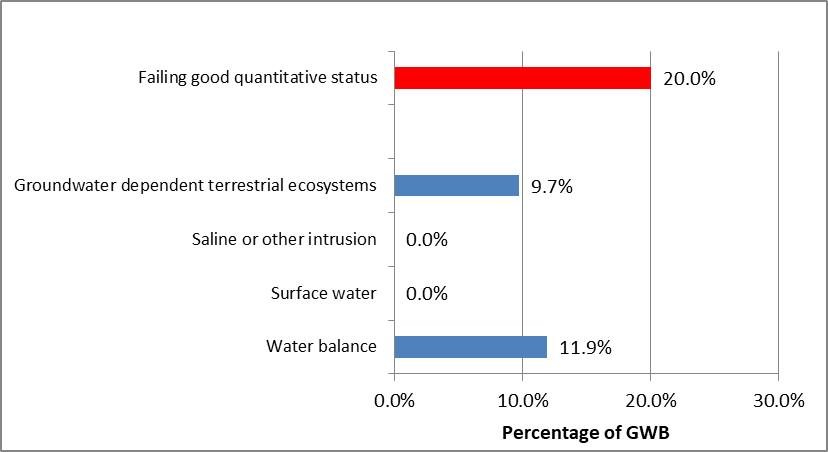
Water abstraction pressures have been reported as relevant for Hungary. The calculated Water Exploitation Index + presents low values. Yet, 20 % of groundwater bodies fail achieving good quantitative status.
Consumption calculations for the main uses for water have been based on measurements and monitoring. However, significant non-authorised abstractions are apparent.
With respect to measures, improved regulation for water rights registration and control, measures to control illegal water abstractions and a water rights review (every five years) have been implemented. However, no water resource allocation and management plans have been developed systematically.
·Measures related to pollution from agriculture
There is a clear link between agricultural pressures and agricultural measures. A gap assessment for nitrogen and phosphorus was performed and was reported in WISE.
Drinking water protection measures (e.g. establishment of safeguard zones, buffer zones etc.) are applied as a basic and a supplementary measure.
Financing of measures is secured.
The level of ambition is unclear as there are uncertainties about the level at which voluntary measures will be taken on by farmers.
·Measures related to pollution from sectors other than agriculture
Information reported to WISE shows that KTMs have been reported for significant pressures from most of the individual Priority Substances that are reported to be causing non-compliance.
Information appears to be lacking on how effective the measures will be at reaching the objectives.
·Measures related to hydromorphology
In the second RBMP, there is more comprehensive information about the funding of the planned measures, including for measures related to hydromorphology. In addition, the gap to be closed for hydromorphological pressures is better specified for 2015 and 2021.
Ecological flows have been derived and implemented for all relevant water bodies.
Natural Water Retention Measures were reported as operational to tackle significant hydromorphological pressures, abstractions and diffuse pollution from urban run-off. Several specific measures are included in the context of these measures, and the RBMP states that Natural Water Retention Measures have high priority in Hungary.
·Economic analysis and water pricing policies
The use of Article 9(4) of the WFD was reported for drinking water, irrigation, self-abstraction, wastewater and water storage.
Hungary has not reported any explanation on how ‘adequate incentives’ are provided.
From 2017 onwards, there will be some water pricing in agriculture, even if not leading to full cost recovery.
·Adaptation to drought and climate change
KTM24 (climate change adaptation measures) has not been made operational to address several of the significant pressures related to climate change.
There is no clear distinction in Hungary between droughts and water scarcity.
No drought management plan has been adopted in Hungary yet.
Recommendations
·Hungary should continue to further improve international cooperation, including coordinated assessments of the technical aspects of the Water Framework Directive such as ensuring a harmonised approach for status assessment and a coordinated Programme of Measures, in order to ensure the timely achievement of the WFD objectives.
·Hungary needs to continue its work in order to quantify the significant pressures on surface water bodies.
·Work is still needed to address shortcomings in the methods for quantifying hydromorphological pressures.
·Hungary should complete the development of assessment methods for biological quality elements by developing a method for fish in lakes, and, more generally, methods for artificial or heavily modified lake water bodies.
·Hungary should also ensure that methods developed for relevant supporting quality elements are WFD compliant, in particular concerning their links to good status for the biology quality elements. The classification of hydromorphology should have less reliance on expert judgement.
·It should be ensured that the method used to select River Basin Specific Pollutants identifies all relevant pollutants. Furthermore, the number of water bodies classified in relation to River Basin Specific Pollutants should be increased.
·Hungary should continue improving the confidence in the assessment of status for all water categories, and further reduce the proportion in unknown status. In particular, monitoring should be performed in a way that provides sufficient spatial coverage to classify all water bodies (in combination, if necessary, with robust grouping /extrapolation methods). All Priority Substances should be considered in the assessment of status, in the relevant matrix. If a different matrix is used, the corresponding explanations should be provided in the RBMP, as required by the WFD.
·Trend monitoring should be performed in sediment and/or biota, to ensure that all the relevant substances specified in Directive 2008/105/EC are monitored in a way that provides sufficient temporal resolution and spatial coverage.
·Hungary should continue strengthening monitoring for chemical status of groundwater to reduce uncertainties and support the Programme of Measures.
·Uncertainty in the designation of heavily modified and artificial water bodies needs to be further tackled by WFD compliant monitoring, improved data on hydromorphological pressures and an improved understanding of the effects on the biological quality elements. The designation of HMWBs should comply with all the requirements of Article 4(3), including criteria to define substantial changes in character due to the physical modification, the assessment of significant adverse effects on their use or the wider environment and the lack of significantly better environmental options for different uses. This is needed to ensure transparency of the designation process. Ecological potential also needs to be defined in terms of biological quality elements.
·Hungary should continue to further reduce uncertainties with regard to the achievement of the WFD objectives. The significant number of Article 4(4) exemptions and the reported timeframe for the achievement of the objectives is an issue of concern. Justifications need to be reviewed and updated, in order to ensure that all possible measures are implemented for a timely achievement of the WFD objectives.
·Hungary should ensure that the Programme of Measures is designed and implemented to close the gaps, in order to achieve good status for water bodies. In particular, Hungary should try to increase its level of ambition as regards identifying and taking effective measures against chemical pollutants in surface and groundwaters.
·Hungary should ensure that abstractions are addressed through effective permits, metering and controls.
·Hungary should ensure that a clear distinction is made between water scarcity and drought in water policy and that a Drought Management Plan is adopted, particularly in light of the fact that abstraction is identified as the most significant pressure for groundwater bodies in the country.
·Hungary needs to consider the implementation of a set of basic measures (minimum requirements to be complied with) across the entire area of agricultural land in the third RBMP, rather than only in the Nitrate Vulnerable Zones. Hungary should also consider how supplementary measures (designed to be implemented in addition to basic measures) can contribute more effectively to achieving the WFD objectives. Sources of funding (e.g. CAP Pillar 1, RDP) need to be identified, as appropriate, to facilitate implementation of these measures.
·Hungary needs to further explain whether exclusion of water pricing in agriculture is justified. Hungary should elaborate on this issue in the third RBMP, prioritise clearly the measures foreseen in terms of cost-effectiveness and define whether measures are voluntary or obligatory.
·The review and development of the strategy for the delivery of WFD objectives, in cooperation with the farming community and Hungarian CAP delivery authorities, needs to be continued. Hungary should ensure that the third RBMP is technically feasible and all relevant policies and instruments (e.g. Rural Development Plans, CAP Pillar 1, Nitrates Directive, etc.) contribute significantly to the RBMP.
·Cost recovery for water use activities having a significant impact on water bodies should be applied. Otherwise, the use of any exemptions using Article 9(4) should be properly justified. Hungary should continue to present transparently how financial, environmental and resource costs have been calculated and how the adequate contribution of the different users is ensured. Hungary also needs to continue to transparently present the water-pricing policy and provide an overview of estimated investments and investment needs.
·Hungary should further work on the implementation of thorough monitoring programmes for relevant Protected Areas and set additional objectives and measures.
Topic 1Governance and public participation
1.1Assessment of implementation and compliance with WFD requirements in the second cycle
1.1.1Administrative arrangements – RBDs
The entire territory of Hungary is located in the international Danube RBD. Hungary has designated one RBD, the Hungarian Danube RBD, for its part of this international RBD.
1.1.2Administrative arrangements – competent authorities
Hungary has reported the following competent authorities for its RBMP:
•The Ministry of Interior: monitoring of groundwater and surface water, economic analysis, preparation of the RBMP and Programme of Measures, implementation of measures, co-ordination of implementation and reporting to the European Commission. The Ministry has a support role for public participation.
•The General Directorate of Water Management: assessment of the status of groundwater and surface water, pressure and impact analysis, preparation of the RBMP and Programme of Measures, public participation, and implementation of measures; the General Directorate has supporting roles for the monitoring of groundwater and surface water, economic analysis, co-ordination of implementation and reporting to the European Commission.
•12 sub-national water directorates are also reported: they have main roles for the monitoring and assessment of status of groundwater and surface water, pressure and impact analysis, preparation of the RBMP, public participation and implementation of measures; and a secondary role for the preparation of the Programme of Measures.
•11 Government Offices are listed at county level: they are responsible for the enforcement of regulations; in addition, seven of them are responsible for monitoring of groundwater and surface water.
•12 Disaster Management Directorates at county level are listed: these are responsible for the assessment of status of groundwater and surface water, enforcement of regulations, pressure and impact analysis and implementation of measures. In addition, the national Directorate General for Disaster Management has main roles for the enforcement of regulations and implementation of measures, plus a supporting role for the coordination of implementation.
•The Geological and Geophysical Institute of Hungary has a main role for the monitoring of groundwater, and a supporting role for the assessment of its status.
•The National Inspectorate for Environment and Nature is responsible for the enforcement of regulations.
•The Prime Minister's Office has main roles for the monitoring of groundwater and surface water and supporting roles for the implementation of measures and the co-ordination of measures.
1.1.3RBMP – Structure and Strategic Environmental Assessment
Hungary has four sub-basin plans for the Duna River (Danube), Tisza River, Drava River and Lake Balaton, and for 42 sub-regional planning units. In addition, Hungary has an overarching National Water Strategy. Hungary does not have thematic sub-plans for its RBMP.
A Strategic Environmental Assessment was carried out for Hungary's RBMP.
1.1.4Public participation and active involvement of stakeholders
The public and interested parties were informed via internet, invitations to stakeholders, local authorities, media (papers, TV and radio), meetings and written consultation. The RBMP was available for download for the requisite six months. There was international co-ordination of public participation.
The following stakeholder groups were actively involved in the development of the RBMP: agriculture/farmers, consumer groups, energy/hydropower, fisheries/aquaculture, industry, local/regional authorities, navigation/ports, NGOs/nature protection and water supply and sanitation. Active involvement comprised involvement in drafting and in Water Management Advisory Committees.
Public consultation had the following impacts: addition of new information, adjustment to specific measures, changes to the selection of measures, changes to the methodology used, commitment to action in the next RBMP and commitment to further research.
1.1.5Integration with the Floods Directive and the Marine Strategy Framework Directive
Hungary carried out joint consultation of its RBMP and Floods Directive Flood Risk Management Plan. Moreover, a sub-section of the RBMP addresses links with the Flood Risk Management Plan, and an annex analyses the relationship of flood risk measures with the WFD. Further information on integration with respect to measures is provided in Chapter 9 of this report.
Hungary indicated that it did not take into consideration the Marine Strategy Framework Directive in its RBMP, although it has been addressed in connection with the implementation of the Urban Waste Water Treatment Directive.
1.1.6 International coordination and co-operation
Hungary's RBD is part of the Danube international RBD, where there is an international agreement, permanent co-operation body and an international RBMP in place (designated as category 1 cooperation), and explicit links have been made with national RBMPs within the international RBMP (for further information see the reports on international coordination on the Water Framework Directive).
1.2Progress with Commission recommendations
There were no Commission recommendations based on the first RBMP and Programme of Measures.
Topic 2Characterisation of the River Basin District
2.1Assessment of implementation and compliance with WFD requirements in the second cycle
2.1.1Delineation of water bodies and designation of heavily modified and artificial water bodies
There were differences in the number of delineated surface water bodies reported in the two cycles (
Table 2.1
). According to the data reported in WISE, there was a 46 % reduction in the number of lake water bodies and an 11% increase in the number of river water bodies. The reported information shows that the development of the water network records and maps over recent years, as well as the experience of the first cycle, resulted in a revision of the boundaries of surface water bodies.
Table 2.4
summarises the information provided by Hungary on how water bodies have evolved between the two cycles.
Table 2.1
Number and area/length of delineated surface water bodies in Hungary for the second and first cycles
|
Year
|
RBD
|
Lakes
|
Rivers
|
|
|
|
Number of water bodies
|
Total area (km2) of water bodies
|
Number of water bodies
|
Total length of water body (km)
|
|
2016
|
HU1000
|
115 (189)
|
1,017 (1,180)
|
963 (839)
|
18,897 (19,126)
|
|
2010
|
HU1000
|
213
|
1,267
|
869
|
18,802
|
Source: WISE electronic reporting. Hungary subsequently communicated that the correct numbers are the ones indicated in parentheses.
Table 2.2
Size distribution of surface water bodies in Hungary in the second and first cycles
|
Year
|
RBD
|
Lake area (km2)
|
River length (km)
|
|
|
|
Minimum
|
Maximum
|
Average
|
Minimum
|
Maximum
|
Average
|
|
2016
|
HU1000
|
0.41 (0.041)
|
594.33
|
8.85 (6.24)
|
1.36
|
186.29
|
21.26
|
|
2010
|
HU1000
|
0.27
|
594.28
|
5.95
|
0.95
|
281.14
|
21.64
|
Source: WISE electronic reporting. Hungary subsequently communicated that the correct numbers are the ones indicated in parentheses.
Between the first and the second RBMP, the analysis of pressures and measures changed, there was a re-design and changes in monitoring programmes, and the status of surface water bodies has improved
.
There was a significant increase in the number of heavily modified lake water bodies (from 15 to 50) and of heavily modified river water bodies (from 350 to 468) between the two cycles, according to the reporting in WISE (
Figure 2.1
). This was accompanied by a slight decrease in the numbers of natural lake and river water bodies, and an increase in the number of artificial lakes between the two cycles.
Figure 2.1
Proportion of surface water bodies in Hungary designated as artificial, heavily modified and natural for the second and first cycles. Note that the numbers in parenthesis are the numbers of water bodies in each water category
Source: WISE electronic reporting
Table 2.
2 shows the differences in size distribution of surface water bodies in Hungary between the first and second cycles. The minimum size of rivers increased whilst the maximum length decreased. The minimum size criteria reported were a 10 km2 catchment area for rivers and a 50 km2 surface area for lakes. It was reported that the minimum criteria can be reduced by 10 % in the case of rivers and also in the case of important lakes such as drinking water reservoirs. The minimum size reported for lakes in 2016 was 0.41 km2 surface area.
There was no change in the number of groundwater bodies between the two cycles (
Table 2.
3). However, the delineation was changed by updating the boundaries using the latest monitoring results: 18 karstic, six porous thermal and four other types of groundwater bodies were re-delineated in total.
Table 2.4
shows that 176 groundwater bodies changed since the first cycle, due to coordinate system changes and/or correct implementation of the national borders.
Table 2.3
Number and area of delineated groundwater bodies in Hungary for the second and first cycles
|
Year
|
RBD
|
Number
|
Area (km2)
|
|
|
|
|
Minimum
|
Maximum
|
Average
|
|
2016
|
HU1000
|
185
|
16.75
|
13,653.64
|
1,511.57
|
|
2010
|
HU1000
|
185
|
16.74
|
13,602.19
|
1,510.99
|
Source: WISE electronic reporting
Table 2.4
Type of change in delineation of groundwater and surface water bodies in Hungary between the first and second cycles
|
Type of water body change for second cycle
|
Groundwater
|
Rivers
|
Lakes
|
|
Change
|
176
|
191
|
3
|
|
Aggregation
|
|
16
|
2
|
|
Splitting
|
|
127
|
|
|
Aggregation and splitting
|
|
8
|
|
|
Extended area
|
|
35
|
|
|
Reduced area
|
|
51
|
3
|
|
Creation
|
|
49
|
20
|
|
Deletion
|
|
21
|
103
|
|
Change in code
|
|
12
|
|
|
No change
|
9
|
474
|
87
|
|
|
|
127
|
|
|
Total water bodies before deletion
|
185
|
984
|
218
|
|
Delineated for second cycle (after deletion from first cycle)
|
185
|
963
|
115
|
Source: WISE electronic reporting
2.1.2Identification of transboundary water bodies
Hungary reported three transboundary lakes (2.6 % of total lake water bodies), 134 transboundary rivers (14 % of total river water bodies) and 95 groundwater bodies (51 % of total groundwater bodies).
2.1.3Typology of surface water bodies
Table 2.5
shows the number of surface water body types at RBD level in Hungary for the first and second cycles. There was a decrease in the number of types for lakes and rivers between the two cycles.
Table 2.5
Number of surface water body types at RBD level in Hungary for the first and second RBMPs
|
RBD
|
Rivers
|
Lakes
|
|
|
1st
|
2nd
|
1st
|
2nd
|
|
HU1000
|
25
|
15
|
16
|
8
|
Source: WISE electronic reporting.
For the first RBMP it was reported that the typology of all surface water bodies had been tested against biological data, but that the process was not completed in the first cycle due to lack of data. The second RBMP reported that all the lake and river water types were biologically relevant. The typology of river and lake water bodies has been revised and some types were grouped together to reduce the overall number of types. The RBMP states that the typologies were significantly simplified as a result of biological validation. For example, there were 25 river types in the first cycle and this was reduced to 15 types of river water bodies which were isolated based on 10 biologically isolating types and five hydromorphology types.
One national lake type covering artificial, heavily modified and natural water bodies has an equivalent intercalibration type. The other seven types do not have an equivalent intercalibration type: these types equate to 46 % of lake water bodies in Hungary
. There are seven equivalent river intercalibration types reported covering the 15 national river types. One river type had an equivalent lake intercalibration type: these water bodies are reservoirs which were originally rivers, and have been intercalibrated against a lake type. One national river type was reported to have two equivalent intercalibration types
. Three national river types were reported to have no equivalent intercalibration type: these types represent 5 % of river water bodies in Hungary
. The RBMP states that Hungary participated in three EU ecological intercalibration processes (Phase I 2004-2008, Phase II. 2008-2012 and Phase III 2013-2016).
2.1.4Establishment of reference conditions for surface water bodies
Table 2.6
shows the percentage of surface water body types in Hungary with reference conditions established for the first and second cycles. Reference conditions have been established for all lake and river types for all biological, hydromorphological and physicochemical quality elements.
Table 2.6
Percentage of surface water body types in Hungary with reference conditions established for all, some and none of the biological, hydromorphological and physicochemical quality elements. Numbers in parenthesis are the number of types in each category
|
Water category
|
Water types
|
Biological quality elements
|
Hydromorphological quality elements
|
Physicochemical quality elements
|
|
Rivers (15)
|
All
|
100 %
|
100 %
|
100 %
|
|
|
Some
|
|
|
|
|
|
None
|
|
|
|
|
Lakes (8)
|
All
|
100 %
|
100 %
|
100 %
|
|
|
Some
|
|
|
|
|
|
None
|
|
|
|
Source: WISE electronic reporting
The national reference values and reference conditions were compared and coordinated. The RBMP reported that available national type-specific reference conditions were taken into account in the intercalibration process for physico-chemical and hydromorphological quality elements.
2.1.5Characteristics of groundwater bodies
Further characterisation work has been undertaken since the first cycle, with Hungary reporting the main geological formation of the aquifer types and whether or not groundwater bodies were layered. 59 % of groundwater bodies were reported to be linked to surface water bodies and 62 % to terrestrial ecosystems.
2.1.6Significant pressures and impacts on water bodies
There has been a significant change in the delineation of surface water bodies and in the definition of pressure types between the two cycles, which makes a comparison of pressures between cycles difficult. For example, diffuse pressures were reported to be significant for 24 % of surface water bodies in the first cycle and for 61 % in the second cycle (
Figure 2.2
).
For surface water bodies, the most significant pressures in the second cycle are physical alteration of channel/bed/riparian area/shore due to agriculture (41 % of surface water bodies) and agriculture diffuse pollution (36 % of surface water bodies) (
Figure 2.3
). For lake water bodies, unknown anthropogenic pressures were the most significant pressures in the second cycle, affecting 30 % of water bodies.
Up to eighteen different pressure types were reported to be significant for groundwater bodies in the second cycle. The most significant in terms of the proportion of affected water bodies was abstraction or flow diversion for public water supply (78 % of groundwater bodies), followed by diffuse - discharges not connected to sewerage network (61 %) and abstraction or flow diversion - other (45 %) (
Figure 2.3
). Nine different pressure types were reported in the first cycle, with the most significant being diffuse - non-sewered population (19 %), abstraction for public water supply (15 %) and abstraction for other purposes (17 %). Though the same top three pressures were identified for both cycles and there was no change in the number of groundwater bodies, the numeric differences between the two cycles are likely to be unreliable and probably reflect changes/improvements in the risk assessments between the two cycles
.
Figure 2.2
Comparison of pressures on surface water bodies in Hungary in the first and second cycles. Pressures presented at the aggregated level. Note that there were 1078 identified surface water bodies for the second cycle and 1082 for the first cycle
Source: WISE electronic reporting.
Figure 2.3
The 10 most significant pressures on surface water bodies and groundwater bodies in Hungary for the second cycle
Source: WISE electronic reporting
2.1.7Definition and assessment of significant pressures on surface and groundwater
There is no information in the second RBMP about whether any major changes in the criteria for the identification of pressures had been applied since the first RBMP. Expert judgment was reported to be used to assess the significance of water abstraction and water flow pressures on surface waters
, numerical tools for diffuse source pressures and a combination of both for point source pressures. The significance of these pressures was defined in terms of threshold and was linked to the risk of failure of objectives.
A combination of both numerical tools and expert judgement was used to assess the significance of all pressure types on groundwater bodies. However, significance was not defined in terms of thresholds and was not linked to the risk of failure of objectives for groundwater bodies
.
2.1.8Significant impacts on water bodies
Altered habitats due to morphological changes were the most significant impacts on lakes (43 % of lake water bodies) and rivers (88 % of river water bodies) in Hungary in the second cycle (
Figure 2.4
). Altered habitats were also the most significant impacts on lakes (39 %) and rivers (94 %) in the first cycle. Nutrients affected 45 % of river water bodies in the first cycle and 43 % of river water bodies in the second cycle.
Chemical pollution was the most significant (17 %) of the four impacts reported for groundwater bodies in the second cycle.
Figure 2.4
Significant impacts on surface water and groundwater bodies in Hungary for the second cycle. Percentages of numbers of water bodies.
|
Source: WISE electronic reporting
|
|
2.1.9Quantification and apportionment of pressures
Gaps to achieving good status in groundwater were reported for fifteen pressures. There are also three pressures (point - mine waters, point - other and diffuse - other) reported as significant at the water body level for which gaps have not been reported, indicating that measures may not be implemented for these pressures (see Chapter 9 of this report for further information)
. For surface waters, gaps were reported for 34 different pressure types. Gaps were not reported for two pressure types (diffuse atmospheric deposition and diffuse-other) which had been reported as significant at the water body level.
Gaps to be filled for chemical substances causing failure of good status were reported for one groundwater pollutant (atrazine). In terms of surface water, gaps were reported for 12 Priority Substances (all causing failure of good chemical status) and four River Basin Specific Pollutants (all causing failure of good ecological status/potential).
2.1.10Groundwater bodies at risk of not meeting good status
Around 9 % of groundwater bodies were reported to be at risk of failing to be in good chemical status. Four pollutants and electrical conductivity were reported to be causing the risk, with nitrate affecting the most groundwater bodies (11).
11 % of groundwater bodies were at risk of failing to achieve good quantitative status. The cause of the risk in all of the water bodies concerned was exceedance of available groundwater resource by longterm annual average rate of abstraction that may result in a decrease of groundwater levels.
2.1.11Inventories of emissions, discharges and losses of chemical substances
Article 5 of the Environmental Quality Standards Directive (EQS Directive)
requires Member States to establish an inventory of emissions, discharges and losses of all Priority Substances and the eight other pollutants listed in Part A of Annex I of the EQS Directive for each RBD, or part thereof, lying within their territory. This inventory should allow Member States to further target measures to tackle pollution from Priority Substances. It should also inform the review of the monitoring networks, and allow the assessment of progress made in reducing (or suppressing) emissions, discharges and losses for Priority Substances (or Priority Hazardous Substances).
Inventories have been established in all four sub-units in the Hungarian RBD. 29 Priority Substances are not included in any inventory. There were inventories for all four sub-units for lead, mercury, nickel and cadmium.
The two-step approach from the Common Implementation Strategy Guidance Document n°28
has been followed for all substances in the inventories. Tier 1 or Tier 2 of the methodology was implemented for most of the substances (for others, the methodology applied was not reported). Tier 1 only was used for some substances relevant at subunit level, while the Guidance Document recommends implementing at least Tier 1 + 2 for the substances relevant at RBD level. The data quality was assessed as very uncertain to medium.
2.2Main changes in implementation and compliance since the first cycle
There were significant differences in the number of delineated surface water bodies between the two cycles. There was a reduction in the number of lake water bodies and an increase in the number of river water bodies. There was a significant increase in the number of heavily modified lake and river water bodies between the two cycles. This was accompanied by a decrease in the numbers of natural lake and river water bodies, and an increase in number of artificial lake water bodies between the two cycles.
There was a decrease in the number of types for lakes and rivers between the two cycles. The RBMP reported that the typologies were significantly simplified as a result of biological validation and that all types were biologically relevant.
There has been a significant change between the cycles in the delineation of surface water bodies and in the definition of pressure types, which makes comparison of pressures between cycles difficult. For example, diffuse pressures were reported to be significant for 30 % of river water bodies in the first cycle and 40 % in the second cycle.
2.3Progress with Commission recommendations
The Commission recommendations based on the first RBMP and Programme of Measures requested action on the following:
•Recommendation: Carry out a more detailed, quantitative pressures and impacts analysis using source apportionment in the second RBMPs. Applying this more detailed analysis, measures could be assigned to water bodies specifically more focused on agriculture, water abstraction and protected areas.
Assessment: Gaps to the achievement of objectives have been defined and reported in the second RBMP for most significant pressures, including the identification of the responsible sectors/activities. This indicates progress on this aspect.
A combination of both numerical tools and expert judgement has been used to assess point source pressures, and numerical tools for diffuse source pressures on surface waters. Hungary subsequently clarified that modelling of water abstractions impacts on surface water bodies has been undertaken.
Overall, therefore, the pressures and impacts analysis aspect of this recommendation has been fulfilled.
•Recommendation: Hungary should also further analyse hydromorphological pressures and impacts in the second RBMPs and reconsider the necessary supplementary measures which should be implemented to reach targets.
Assessment: Hydromorphological pressures were considered in the first RBMP. According to information provided for the bilateral meeting that followed the assessment of the first RBMP, an extended database for hydromorphological pressures was under development for the second RBMP. Hungary reported many types of hydromorphological pressures in the second RBMP and also identified gaps to be filled for these pressures.
Overall, therefore, the analysis of pressures and impacts aspect of this recommendation has been fulfilled.
•Recommendation: The testing of typology of surface water bodies against biological data has not been completed in the first RBMP cycle because of the lack of sufficient data. This should be remedied.
Assessment: For the first RBMP, it was reported that the typology of all surface water bodies had been tested against biological data but the process was not completed due to lack of data. The second RBMP reported that all the lake and river water types were biologically relevant. The typology of river and lake water bodies has been revised and some types were grouped together to reduce the overall number of types. The RBMP reported that the typologies were significantly simplified as a result of biological validation.
Therefore this recommendation has been fulfilled.
Topic 3Monitoring, assessment and classification of ecological status in surface water bodies
3.1 Assessment of implementation and compliance with WFD requirements in the second RBMP
3.3.1Monitoring of ecological status/potential
Monitoring programmes
Article 8.1 of the WFD requires Member States to establish monitoring programmes for the assessment of the status of surface water and of groundwater, in order to provide a coherent and comprehensive overview of water status within each RBD.
Hungary has eleven surface water monitoring programmes. These are divided into separate programmes for rivers and lakes and for different pressure types, e.g. “under nutrient and organic pressure”.
Monitoring sites and monitored water bodies used for surveillance and operational monitoring
Table 3.1
compares the number of monitoring sites used for surveillance and operational purposes between the first and second RBMPs, and
Table 3.2
gives the number of sites used for different purposes for the second RBMP.
Table 3.1Number of sites used for surveillance and operational monitoring in Hungary for the second and first RBMPs. Note that for reasons of comparability with data reported in 2010, the 2016 data does not take into account whether sites are used for ecological and/or chemical monitoring.
|
|
Rivers
|
Lakes
|
|
|
Surv.
|
Op.
|
Surv.
|
Op.
|
|
2nd RBMP
|
|
|
|
|
|
HU_1000
|
118
|
1,078
|
27
|
102
|
|
Total number of monitoring sites
|
1 123
|
119
|
|
1st RBMP
|
|
|
|
|
|
HU_1000
|
122
|
474
|
26
|
41
|
|
Total number of monitoring sites
|
596
|
67
|
Surv. = Surveillance monitoring, Op. = Operational Monitoring
Sources: Member States electronic reporting to WISE.
Table 3.2Number of monitoring sites in relevant water categories used for different purposes in Hungary
|
Monitoring Purpose
|
Lakes
|
Rivers
|
|
Operational monitoring
|
102
|
1078
|
|
Surveillance monitoring
|
27
|
118
|
|
Total sites irrespective of purpose
|
119
|
1123
|
Source: WISE electronic reporting
There was a doubling of monitoring sites for both rivers and lakes for operational monitoring from the first to the second RBMP. For surveillance monitoring, there were only very minor changes in the number of monitoring sites. The current operational monitoring programme has more than 1000 sites for rivers and more than 100 sites for lakes. However, it is not clear whether this monitoring is actually happening, as the RBMP states that there is no separate budget line in the national budget for the costs of operating the monitoring system. Significant improvement has been made in terms of instrument development, but further institutional development is needed to overcome the backlog.
Figure 3.1
shows that operational monitoring now covers a very high proportion of water bodies, both for lakes (68 %) and rivers (79 %). Part of the increase for lakes is due to a 50 % decrease in the number of lake water bodies since the first RBMP, but the increase is still very significant. For surveillance monitoring, the increase for lakes, from 10 % to 19 %, probably represents no real change in the amount of monitoring but is a product of the 50 % decrease in the total number of lake water bodies. For rivers, there is little change in the proportion of water bodies included in the surveillance monitoring programme (12 % in the first RBMP and 10 % in the second) representing no substantive change in the amount of surveillance monitoring in the second RBMP.
Figure 3.1Percentage of water bodies included in surveillance and operational monitoring in Hungary for the first RBMP (2010) and second RBMP (2016). Note that no differentiation is made between water bodies included in ecological and/or chemical monitoring.
Source: WISE electronic reporting
Monitoring sites and monitored water bodies used for ecological status/potential
Annex V.1.3.1 of the WFD states that “Surveillance monitoring shall be carried out of sufficient surface water bodies to provide an assessment of the overall surface water status within each catchment or subcatchment within the river basin district”.
Figure 3.2
shows that, for lakes, proportionally more water bodies in good status/potential are included in surveillance monitoring than the other status/potential classes: this may indicate that less-than-good status/potential water bodies are underrepresented in surveillance monitoring to provide an assessment of the overall surface water status. In addition, neither of the two lake water bodies in high status is included in surveillance monitoring which is significant in the context of the WFD non-deterioration objective and the assessment of long-term changes in natural conditions and long-term changes resulting from widespread anthropogenic activity.
For rivers there is a more equitable proportional distribution of different status/potential water bodies included in surveillance monitoring, though the largest proportion is again for good status/potential water bodies. As is the case for lakes, none of the four high status river water bodies is included in surveillance monitoring.
Figure 3.2Proportion of water bodies in each ecological status/potential class that is included in surveillance monitoring in Hungary
Source: WISE electronic reporting
Quality elements monitored (excluding River Basin Specific Pollutants)
Table 3.3
illustrates the quality elements used for the monitoring of lakes and rivers for the second RBMP: no differentiation is made between purposes of monitoring.
Table 3.3Quality elements monitored for the second RBMP in Hungary (excluding River Basin Specific Pollutants). Note that quality elements may be used for surveillance and/or operational monitoring
|
Biological quality elements
|
|
Hydromorphological quality elements
|
|
|
Phytoplankton
|
Macrophytes
|
Phytobenthos
|
Benthic invertebrates
|
Fish
|
Angiosperms
|
Macroalgae
|
Other aquatic flora
|
Other species
|
|
Hydrological or tidal regime
|
Continuity conditions
|
Morphological conditions
|
|
Lakes
|
Yes
|
Yes
|
Yes
|
Yes
|
Yes
|
|
|
No
|
|
|
Yes
|
|
Yes
|
|
Rivers
|
Yes
|
Yes
|
Yes
|
Yes
|
Yes
|
|
|
No
|
|
|
Yes
|
Yes
|
Yes
|
|
General physicochemical quality elements
|
|
|
Transparency conditions
|
Thermal conditions
|
Oxygenation conditions
|
Salinity conditions
|
Acidification status
|
Nitrogen conditions
|
Phosphorus Conditions
|
Silicate
|
Other determinand for nutrient conditions
|
|
Lakes
|
Yes
|
Yes
|
Yes
|
Yes
|
Yes
|
Yes
|
Yes
|
No
|
No
|
|
Rivers
|
Yes
|
Yes
|
Yes
|
Yes
|
Yes
|
Yes
|
Yes
|
No
|
No
|
Source: WISE electronic reporting
River Basin Specific Pollutants and matrices monitored
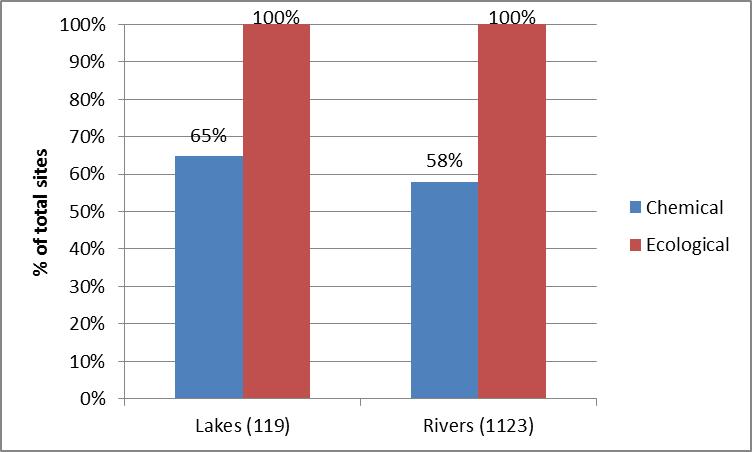
River Basin Specific Pollutants are monitored in a fairly high number of monitoring sites, corresponding to 52 % of all surface water bodies and to 65 % of all lake monitoring sites and 59 % of all river monitoring sites (combining data in
Tables 3.4
and
3.2
).
Hungary reported that eight chemical substances that are not Priority Substances were being monitored in lakes and rivers, and only in water, not in sediment or biota. These include the four metals for which Environmental Quality Standards have been set. The other four chemical substances may be considered to be isomers or components of Priority Substances and Certain Other Pollutants as defined in Directive 2013/39/EU.
·CAS_1806-26-4 – Octylphenol: (an isomer of Priority Substance CAS_140-66-9 - Octylphenol (4-(1,1',3,3'-tetramethylbutyl)-phenol));
·CAS_789-02-6 - DDT, o,p': (a component of total DDT a Certain Other Pollutant);
·EEA_33-02-3 – Benzol: (a component of Priority Substance CAS_71-43-2 – Benzene);
·EEA_33-56-7 - Total PAHs (Benzo(a)pyrene, Benzo(b)fluoranthene, Benzo(k)fluoranthene, Benzo(g,h,i)perylene, Indeno(1,2,3-cd)pyrene): (Polyaromatic hydrocarbons for which specific substances are given as Priority Substances in Directive 2013/39/EU).
Annex V of the WFD provides guidance on the frequency of monitoring of the different quality elements: once every three months is recommended for “other pollutants”, which are taken here to equate to River Basin Specific Pollutants. Surveillance monitoring should be carried out for each monitoring site for a period of one year during the six years covered by a RBMP. For River Basin Specific Pollutants this would mean four times for the surveillance year, and for operational monitoring four times a year for each year of the cycle.
All four River Basin Specific Pollutants (metals) included in surveillance monitoring were monitored at least at the minimum WFD recommended frequency at all sites where they are monitored. Similarly the same four River Basin Specific Pollutants included in operational monitoring were monitored at least at the minimum WFD recommended frequency at all sites where they are monitored.
Table 3.4Number of sites used to monitor River Basin Specific Pollutants reported in the second RBMP and non-priority specific pollutants and/or other national pollutants reported in the first RBMP in Hungary. Note that the data from both cycles may not be fully comparable as different definitions were used and not all Member State reported information at the site level, meaning that there were no equivalent data for the first RBMP.
|
RBMP
|
|
Lakes
|
Rivers
|
|
2nd
|
Sites used to monitor River Basin Specific Pollutants
|
77
|
650
|
|
1st
|
Sites used to monitor non-priority specific pollutants and/or other national pollutants
|
NR
|
NR
|
Source: Hungary did not report to WISE the number of sites used to monitor River Basin Specific Pollutants at the generic level. The values for the second RBMP were obtained from the reported monitored chemical substances that are not Priority Substances.
NR = Not reported
Use of monitoring results for classification
In rivers, the classification of biological quality elements was solely based on monitoring results, though for fish many more water bodies were directly monitored (547) than were classified using monitoring results (446). Expert judgment was solely used to classify river continuity and morphological conditions in rivers. The classification of hydrological regime in rivers was based mainly on monitoring, but expert judgement was used for some water bodies. The classification of physicochemical quality elements in rivers was again solely based on monitoring results.
The classification of the quality elements for lakes followed a similar pattern to that for rivers. The classification of the biological and physicochemical quality elements was only based on the results of monitoring, whereas morphological conditions were classified by expert judgment only and hydrological regime by a combination of expert judgment and monitoring. Even though fish were monitored in lakes, none were subsequently classified using this element, perhaps indicating that the assessment method is not considered to be fit for classification of ecological status/potential. In addition, more lake water bodies were directly monitored for benthic invertebrates than were subsequently classified using this element, again perhaps indicating some weaknesses in the assessment method for this element. Grouping was reported not to be used for the classification of any element for lakes and rivers, and this was also the situation for the first RBMP.
Transboundary surface water body monitoring
Hungary reported 968 monitoring sites that were related to international monitoring networks, including 57 sites in transboundary river and lake water bodies.
3.3.2Ecological Status/potential of surface water
The ecological status/potential of surface water bodies in Hungary for the second RBMP is illustrated in
Map 3.1
. This is based on the most recent assessment of status.
Map 3.1Ecological status or potential of surface water bodies in Hungary based on the most recently assessed status/potential of the surface water bodies
Note: Standard colours based on WFD Annex V, Article 1.4.2(i).
|
|
High
|
|
|
Good
|
|
|
Moderate
|
|
|
Poor
|
|
|
Bad
|
|
|
Unknown
|
|
|
RBDs
|
Source: WISE, Eurostat (country borders)
A detailed breakdown of ecological status/potential in each RBD and water category can be viewed in https://www.eea.europa.eu/publications/state-of-water.
Only a small proportion (less than10 %) of Hungarian rivers and lakes are in good ecological status/potential, and only two lake and four river water bodies are in high status. Water bodies in moderate status constitute the largest proportion of all the water bodies, but more than one third of the water bodies were reported in poor or bad ecological status/potential. Many of the heavily modified and artificial water bodies are not classified, indicating a lack of an appropriate assessment method for these groups of water bodies.
The proportion of water bodies with unknown ecological status/potential is now reported to constitute 13 % of all water bodies, which is a major improvement since the first RBMP, when the proportion of unknowns was 40 %. However, there is a big difference between the proportion of unknown lakes (up to 47 %) and rivers, of which only 9 % are unknown.
Figure 3.3
shows the confidence in the classification of ecological status/potential. Most of the water bodies are classified with medium confidence, but there are also some that are classified with high (19 % of rivers and 10 % of lakes) or low confidence (25 % of rivers and 36 % of lakes). This indicates that the classification of rivers is done with better confidence than for lakes, pointing to possible weaknesses in the lakes assessment system. However, in the first RBMP, no water bodies were classified with high confidence, so the situation in the second RBMP represents an improvement.
Figure 3.3Confidence in the classification of ecological status or potential of surface water bodies in Hungary based on the most recently assessed status/potential
Source: WISE electronic reporting
Figure 3.4
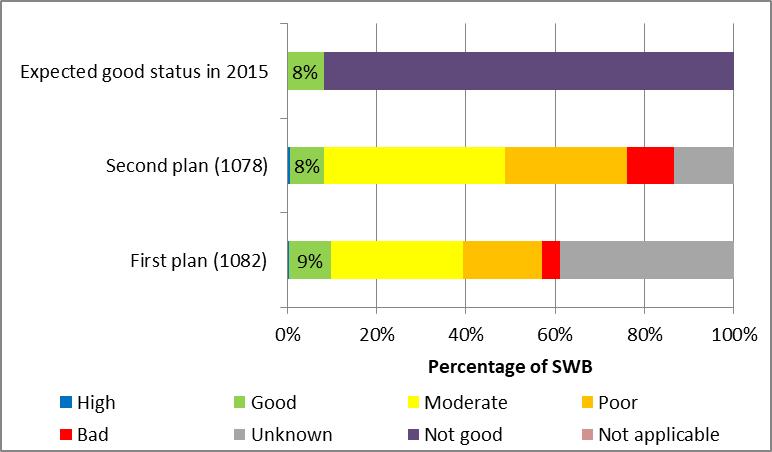
compares the ecological status of surface water bodies in Hungary for the first RBMP with that for the second RBMP (based on the most recent assessment of status/potential) and that expected by 2015. The results mainly show the reduction in the proportion of unknowns since the first RBMP, and that the proportion in good status/potential is still less than 10 % of all the water bodies.
The proportion expected to be in good or better status in 2015 is also less than 10 % of all water bodies.
Figure 3.4Ecological status or potential of surface water bodies in Hungary for the second RBMP, for the first RBMP and expected in 2015. The number in parenthesis is the number of surface water bodies for each cycle. Note that the period of assessment of status for the second RBMP was 2006 to 2013. The year of assessment of status for the first RBMP is not known.
Source: WISE electronic reporting
Member States were asked to report the expected date for the achievement of good ecological status/potential. The information for Hungary is shown in
Figure 3.5
. The time for achieving the objectives was reported to be beyond 2027 for 50 % of all the river and lake water bodies, while only a small minority (less than 10 %) is expected to achieve the objectives during the 2016-2021 period.
Figure 3.5Expected date of achievement of good ecological status/potential of surface water bodies in Hungary. The number in the parenthesis is the number of water bodies in each category.
Source: WISE electorinic reporting
Classification of ecological status in terms of each classified quality element
Figure 3.6
shows that the proportion of water bodies in good or high ecological status is much higher for the single biological quality elements than for total ecological status (compare with
Map 3.1
and
Figure 3.4
). For rivers, most of the biological quality elements are classified in 50-60 % of the total number of classified water bodies, while for lakes, the proportion is 40-50 % for most of the biological quality elements. For lakes, fish has not been classified at all (but is monitored), indicating that the ecological assessment method for fish in lakes has not yet been completed.
Figure 3.6Ecological status/potential of the biological quality elements used in the classification of lakes and rivers in Hungary. Note that water bodies with unknown status/potential, and those that are monitored but not classified or not applicable, are not presented.
Source: WISE electronic reporting
Figure 3.7
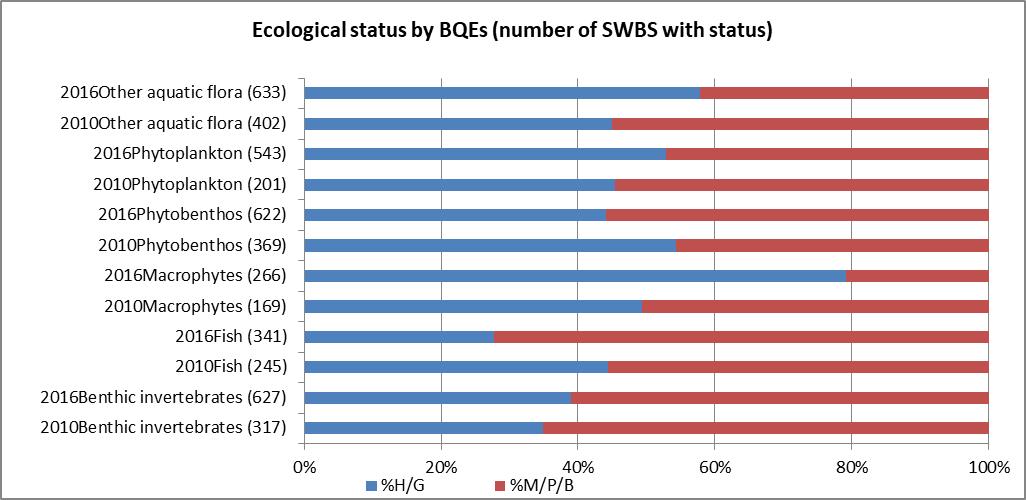
compares the classification of biological quality elements in terms of ecological status/potential for the first and second RBMPs. This comparison should be treated with some caution as there are differences between the numbers of surface water bodies classified for individual elements from the first to the second RBMP.
Figure 3.7Comparison of ecological status/potential in Hungary according to classified biological quality elements in rivers and lakes from the first to the second RBMP
Source: WISE electronic reporting
Figure 3.8
and
Figure 3.9
illustrate the basis of the classification of ecological status/potential of rivers and lakes in Hungary for the second RBMP. The figures show that all the four groups of quality elements are used to classify the majority (52 %) of the river water bodies, while 28 % are classified using three groups of quality elements. For lakes, the proportion of water bodies classified with all four groups of quality elements is only 28 %, while as many as 39 % are classified with only one group of quality elements, indicating that the basis for classification is weaker for lakes than for rivers.
The weaker basis for classification of lakes compared to rivers is confirmed in
Figure 3.9
showing that no rivers are classified without using the hydromorphological quality elements and only a few (13 %) are classified with no biological quality elements. However, it is worth noting that classification of river continuity is lacking for the majority of the river water bodies. For lakes, as many as 37 % are classified without biology, 19 % without hydromorphology and 40 % without physicochemical quality elements. For River Basin Specific Pollutants the proportion classified without them is high for both water categories (45 % of rivers and 60 % of lakes).
Figure 3.8The classification of ecological status or potential of rivers and lakes in Hungary using 1, 2, 3 or 4 types of quality element. Note: The 4 types are: biological; hydromorphological, general physicochemical and River Basin Specific Pollutants.
Source: WISE electronic reporting
Figure 3.9The percentage of river and lake water bodies in Hungary where no biological quality element or no hydromorphological (HYMO) or no general physicochemical (PHYSCHEM) or no river basin specific pollutant (RBSP) has been used in the classification of ecological status or potential
Source: WISE electronic reporting
The basis for the classification of individual quality elements is illustrated in
Figure 3.10
. All the classified biological and physicochemical quality elements in both water categories are based on monitoring, while the hydromorphological quality elements are classified based mostly on expert judgement. The latter may indicate weaknesses in the hydromorphological assessment methods. Grouping is not used for classification of any quality element.
Figure 3.10Basis of the classification of ecological status/potential in Hungary. The percentages are in terms of all waterbodies in each category.
Source: WISE electronic reporting
Assessment methods and classification of biological quality elements
Reference conditions have been defined for all the biological quality elements in both rivers and lakes in all types of surface waters (no gaps were reported). New pressure-specific indices have been developed since the first RBMP. However, there is no method for fish in lakes, as that is not used for classification, as explained above (
Figure 3.6
and
Figure 3.10
).
Intercalibration of biological assessment methods and national classification systems
Only one of the lake types is linked to a common intercalibration type. It is unclear how the class boundaries have been set for those national types which were not intercalibrated. Intercalibration has not been achieved for fish in lakes, nor for fish in rivers, according to the Intercalibration Official Decisions from 2013 and 2018. The other biological quality elements have been successfully intercalibrated.
Assessment methods for hydromorphological quality elements
Hydromorphological assessment methods have been developed for both water categories, according to the RBMP background document 6-4, “Hydromorphological status assessment system for surface water bodies”. However, the classification is mainly based on expert judgement (
Figure 3.10
), raising some doubt about the quality of these assessment methods.
Assessment methods for general physicochemical quality elements
The Hungarian methods have been completed, and the standards are all reported to be linked to the good/moderate boundaries for the sensitive biological quality elements. For the nutrients, however, the actual values reported for total phosphorus and orthophosphate are much higher than the nutrient saturation level for phytoplankton and phytobenthos (ca. 0.1 mg/l), and are also higher than reported in most other Member States. The basis for linking these standard values to the nutrient sensitive biological quality elements is unclear. This is a serious issue that may prevent the achievement of objectives.
Selection of River Basin Specific Pollutants and use of Environmental Quality Standards
The River Basin Specific Pollutants have been selected based on measured concentrations from monitoring, but it is not clear how Hungary decided which pollutants to analyse in the monitoring. Hungary subsequently stated that four river basin specific pollutants have been identified in the context of the regulations of the International Commission on the Protection of Danube River: Arsenic, Chromium, Copper and Zinc. Environmental Quality Standards have been set for them. The Environmental Quality Standards have been set according to the Common Implementation Strategy Technical Guidance no. 27. The analytical methods follow best available technology for three of the substances and the analytical method prescribed in Article 4(1) of the Directive 2009/90/EC for zinc.
Hungary reported that eight chemical substances that are not Priority Substances were being monitored. These include the four metals for which Environmental Quality Standards have been set. The other four chemical substances may be considered to be isomers of Priority Substances and certain other pollutants as defined in Directive 2013/39/EU.
No Environmental Quality Standards have been set for any organic pollutant because no organic pollutants have been selected as River Basin Specific Pollutants.
The RBMP indicates that Hungary has followed an internationally recommended and accepted methodology in the second Plan, thereby considerably improving the evaluation system since the first Plan. The results are not comparable between the two RBMPs due to changes in the Environmental Quality Standards. In the second RBMP, only one lake was reported to exceed the limit values for arsenic and copper, while between eleven and thirty river water bodies exceeded the limit values for the four metals; arsenic, chromium, copper and zinc. However, the majority of lakes and almost half of the river water bodies have not been classified for River Basin Specific Pollutants, so there is a risk that more of them could be exceeding the limit values.
Overall classification of ecological status (one-out, all-out principle)
The one-out-all-out principle is reported as having been used.
3.1Main changes in implementation and compliance since the first RBMP
There was a 2-fold increase in the number of river monitoring sites and a similar increase in lake monitoring sites between the two RBMPs. Significantly more sites were used for operational than for surveillance monitoring in both cycles. There were increased numbers of surveillance and operational monitoring sites in lakes and rivers between the two RBMPs.
The significant changes in the numbers of lake and river waterbodies make comparisons of monitored water bodies between the two RBMPs difficult. In both the first and second RBMPs more lake and river water bodies were included in operational monitoring than in surveillance monitoring. In terms of operational monitoring there were significant increases in the number and proportion of lake and river water bodies covered: e.g. 390 (45 %) of river water bodies in the first RBMP and 759 river water bodies (79 %) in the second RBMP.
It is not clear whether this monitoring is actually happening, as the RBMP states that there is no separate budget line in the national budget for the costs of operating/running the monitoring system. Significant improvement has been made in terms of instrument development, but further institutional development is needed to overcome the backlog.
For surveillance monitoring, there were only very minor changes in the number of monitoring sites between the two RBMPs.
The second RBMP shows a significantly higher number of water bodies with ecological classifications compared to the first RBMP. The proportion of water bodies with unknown ecological status/potential is now reported to constitute 13 % of all water bodies, which is a major improvement since the first RBMP, when the proportion of unknowns was 40 %. However, there is a big difference between the proportion of unknown lakes (up to 47 % unknowns) and unknown rivers (9 % unknowns). The reason why so many lakes cannot be classified is unclear.
Significant changes (in both directions) are obvious in the classifications using benthic invertebrates, phytoplankton, other aquatic flora, fish, oxygenation conditions and salinity conditions. This indicates that changes or developments have been made to the assessment methods.
The confidence in classification has improved from medium to high for 19 % of the rivers and 10 % of the lakes.
The assessment methods are much more developed than in the first RBMP, including pressure-specific indices for several biological quality elements. Most of the biological assessment methods have now been intercalibrated, except fish in rivers and fish in lakes. Work is planned to develop fish assessment methods for the 3rd RBMP.
There are also methods developed for all relevant supporting quality elements, but there are some concerns about their links to good status for biology. The nutrient standards are above the saturation level for nutrient sensitive biological quality elements, which may prevent the achievement of objectives.
For River Basin Specific Pollutants, the RBMP indicates that Hungary followed an internationally recommended and accepted methodology, thereby considerably improving the evaluation system since the first RBMP. The results are not comparable between the two RBMPs due to changes in the limit values.
3.2Progress with Commission recommendations
The Commission recommendations based on the first RBMP and Programme of Measures requested action on the following:
•Recommendation: Ensure implementation of WFD compliant monitoring and of the Programme of Measures by allocating adequate human and financial resources, exploring the possibility of using European Union funds (e.g. Rural Development Programme funds, Structural and Investment Funds and LIFE Integrated Projects).
Assessment: A much more ambitious monitoring programme has been planned, with a large increase in the number of monitoring sites for both rivers and lakes, including more biological and supporting quality elements. However, there is no budget line to ensure implementation of the programme in the national budget, thus raising concerns as to whether this monitoring is done in practice. Hungary has subsequently confirmed to the Commission that operational monitoring is in place. Significant improvements are achieved in terms of instrument development, but further institutional development is needed to overcome the backlog.
The recommendation has been fulfilled.
•Recommendation: As the methods were not completed for all biological quality elements, the reference values and class boundaries were not completed for all types. Methodologies for all biological quality elements should be established with reference values and class boundaries completed for all types.
Assessment: This recommendation has been addressed for both rivers and lakes, except on intercalibration of fish, which is still a gap (although assessment methods for fish have been developed). Hungary now has a full set of biological assessment methods with reference conditions and class boundaries for all the required biological quality elements. These methods, however, do not allow for classification of all the artificial or heavily modified lake water bodies. The surveillance monitoring programme includes all these quality elements, but fish in lakes are not classified (which is also not intercalibrated).
The recommendation has been partially fulfilled.
•Recommendation: Due to significant lack of data, only 13 % of surface water bodies were classified for River Basin Specific Pollutants. The identification of River Basin Specific Pollutants needs to be more transparent, with clear information on how pollutants were selected, how and where they were monitored, where there are exceedances and how such exceedances have been taken into account in the assessment of ecological status. It is important that there is an ambitious approach to combatting chemical pollution and that adequate measures are put in place.
Assessment: The RBMP provided information on how River Basin Specific Pollutants were selected and monitored. 52 % of surface water bodies were classified according to River Basin Specific Pollutants in the second RBMP. Four different River Basin Specific Pollutants were monitored only in water. 54 % of surface water bodies were directly monitored for River Basin Specific Pollutants. All were monitored at least at the minimum WFD recommended frequency at all monitoring sites. Compared to other Member States the number of selected River Basin Specific Pollutants is low possibly indicating a low level of ambition in identifying chemical pollution.
Progress has therefore been made on this aspect of this recommendation and therefore it has been partially fulfilled.
•Recommendation: Ensure in the second RBMPs that measures adopted in the Programme of Measures are based on a reliable status assessment of water bodies and are linked to the relevant pressures.
•Assessment: The proportion of water bodies with unknown ecological status/potential is now reported to be 13 % of all water bodies, which is a major improvement since the first RBMP, when the proportion of unknowns was 40 %. However, there is a big difference between the proportion of unknown lakes (up to 47 % unknowns) and unknown rivers (9 % unknowns). The confidence in classification has improved from medium to high for 19 % of the rivers and 10 % of the lakes. The assessment methods are much more developed than in the first RBMP, including pressure-specific indices for several biological quality elements. Most of the biological assessment methods have now been intercalibrated, except fish in rivers and fish in lakes. There are also methods developed for all relevant supporting quality elements, but there are some concerns about their links to good status for the biology. The nutrient standards are above the saturation level for nutrient sensitive biological quality elements, which may prevent the achievement of objectives. For River Basin Specific Pollutants, the RBMP indicates that Hungary followed an internationally recommended and accepted methodology, thereby considerably improving the evaluation system since the first RBMP. The results are not comparable between the first and second RBMPs due to changes in the limit values. The classification of hydromorphological quality elements is largely based on expert judgement.
This recommendation has been partially fulfilled.
•Recommendation: Strengthen monitoring to reduce unknowns and uncertainties by implementing robust monitoring programmes to support the application of methods for the status assessment of water bodies and definition of reference conditions. An adequate WFD compliant assessment and monitoring framework is a necessary pre-requisite to design an effective Programme of Measures and ultimately to achieve the WFD objectives.
Assessment: There has been substantial progress with this recommendation, due to more monitoring in terms of more sites and more quality elements, facilitating the development and intercalibration of more assessment methods including reference conditions. This has resulted in fewer unknowns (especially for rivers) and better confidence in status assessment for some rivers. However, there are some concerns related to the continuation of the monitoring due to insufficient financing.
•Recommendation: Status assessments of surface water bodies are not sufficiently reliable, therefore an extremely high percentage of surface water bodies are indicated as being of unknown status in Hungary. Where there are currently high uncertainties in the characterisation of the RBDs, identification of pressures, and in the assessment of status, these need to be addressed in the current cycle, to ensure that adequate measures can be put in place before the next cycle. For example, status assessments of surface water bodies should be made reliable and monitoring should be intensified in order to reduce the high number of water bodies in unknown status.
Assessment: The proportion of surface water bodies with unknown ecological status/potential decreased significantly from 40 % (out of 1082 water bodies) to 13 % (out of 1078 water bodies) between the two RBMPs. There was also an improvement in the confidence of the classification: 45 % of surface water bodies were classified with medium/high confidence for the first plan and 64 % for the second. This part of the recommendation has been fulfilled.
Topic 4Monitoring, assessment and classification of chemical status in surface water bodies
4.1Assessment of implementation and compliance with WFD requirements in the second cycle
4.1.1Monitoring of chemical status in surface waters
Monitoring sites and monitored water bodies used for monitoring of chemical status
Member States have to implement surveillance and operational monitoring programmes, in accordance with the requirements of the WFD and of the EQS Directive, for the assessment of ecological status/potential and chemical status.
Surveillance monitoring programmes should allow Member States to supplement and validate the impact assessment procedure, to efficiently and effectively review the design of their monitoring programmes, and to assess the long-term changes in natural conditions and those resulting from widespread anthropogenic activity. For operational purposes, monitoring is required to establish the status of waterbodies identified as being at risk of failing to meet their environmental objectives, and to assess any changes in the status of such waterbodies resulting from the Programme of Measures.
Section 3.1.1 of this report summarises the characteristics of the surveillance and operational monitoring programmes in Hungary for the second RBMP.
Figure 4.1
summarises the proportion of sites used for the monitoring of chemical status in lakes and rivers for the second RBD. No distinction is made between sites used for surveillance and/or operational purposes. More detailed information can be found on the website of the European Environment Agency. As shown in
Figure 4.1
, over half of sites monitored are used for monitoring of chemical status (65 % of lake monitoring sites and 58 % of river monitoring sites). In comparison, all sites are used for monitoring of ecological status.
Figure 4.1Proportion of sites used for monitoring of chemical status and, for comparison, ecological status, in Hungary. The number in parenthesis next to the category is the total number of monitoring sites irrespective of their purpose
Source: WISE electronic reporting
Figure 4.2
summarises the proportion of water bodies monitored for chemical status in lakes and rivers for the second RBMP. In this figure, no distinction is made between sites used for surveillance and/or operational purposes. Also given is the proportion of water bodies monitored for any purpose and, for comparison, those for ecological status. Over 50 % of water bodies are monitored for chemical status (58 % of lake and 53 % of river water bodies).
All water bodies failing to achieve good chemical status were reported to be monitored in Hungary as part of the operational monitoring programme.
Figure 4.2Proportion of total water bodies in each category which are monitored, monitored for chemical status and monitored for ecological status, in Hungary. The number in parenthesis next to the category is the total number of water bodies in that category
Source: WISE electronic reporting
Long-term trend monitoring and monitoring of Priority Substances in water, sediment and biota for status assessment
Monitoring for status assessment
Requirements
Article 8.1 of the WFD requires Member States to establish monitoring programmes in order to provide inter alia a coherent and comprehensive overview of water status within each RBD. The amount of monitoring undertaken in terms of priority substances, frequency and numbers of sites should be sufficient to obtain a reliable and robust assessment of status. According to the EQS Directive (version in force in 2009), mercury, hexachlorobenzene and hexachlorobutadiene have to be monitored in biota for status assessment, unless Member States derived a standard for another matrix, which is at least as protective as the biota standard.
Spatial Coverage
In Hungary around half of the lake and river water bodies are not monitored for any Priority Substances but all the other lake and river water bodies are monitored for more than 10 Priority Substances.
According to the reporting in WISE, 37 Priority Substances are monitored in water. However, Hungary subsequently clarified that only tributyltin, chloroalkanes C10-C13 and brominated diphenylethers are not monitored.
No information on the monitoring of Priority Substances in sediment and/or biota was reported. Hungary subsequently clarified that no Priority Substance was monitored in biota between 2008 and 2013, because they lacked the appropriate analytical methods. Research started in 2015 to address this gap.
Frequencies
The WFD indicates that, for the surveillance and operational monitoring of Priority Substances in water, the frequency of monitoring should be at least monthly for one year during the six-year cycle and at least monthly every year, respectively. Monitoring in biota for status assessment should take place at least once every year according to the EQS Directive. In all cases greater intervals can be applied by Member States if justified on the basis of technical knowledge and expert judgement.
Monitoring frequencies in water were reported for 34 Priority Substances at site level and each substance is monitored 12 times per year, once per cycle in some sites (presumably for surveillance monitoring) and every year in the other sites (presumably for operational monitoring).
Monitoring for long-term trend assessment
Requirements
Article 3.3 of the EQS Directive (version in force in 2009) requires Member States to monitor 14 priority substances that tend to accumulate in sediment and/or biota, for the purpose of long-term trend assessment. Monitoring should take place at least once every three years, unless technical knowledge and expert judgment justify another interval.
Spatial coverage
No information was provided on the analysis of long-term trends as measured in sediment and/or biota.
The RBMP does not explicitly mention that transboundary surface water monitoring programmes are in place with European Union Member States and non-European Union countries for the monitoring of Priority Substances. However, Hungary operates an operational monitoring sub-programme of rivers at risk from Priority Substances (HUSWPO_1RWPS) as well as a surveillance monitoring programme for rivers and lakes. Hungary also participates in the Transnational Monitoring Network of the International Commission for the Protection of the Danube River and operates some transboundary monitoring sites. 57 surface water monitoring sites are reported to belong to international networks and all these sites are reported as chemical monitoring sites for Priority Substances.
Monitoring of Priority Substances that are discharged in each RBD
Annex V of the WFD states, in Section 1.3.1 (Design of surveillance monitoring), that “Surveillance monitoring shall be carried out for each monitoring site for a period of one year during the period covered by a river basin management plan for [inter alia]: priority list pollutants which are discharged into the river basin or sub-basin.” Section 1.3.2 (Design of operational monitoring) of the same Annex states that “In order to assess the magnitude of the pressure to which bodies of surface water are subject Member States shall monitor for those quality elements which are indicative of the pressures to which the body or bodies are subject. In order to assess the impact of these pressures, Member States shall monitor as relevant [inter alia]: all priority substances discharged, and other pollutants discharged in significant quantities.”
Member States are therefore required to monitor all Priority Substances which are discharged into the river basin or sub-basin.
Hungary reported that 12 Priority Substances were listed in at least one of the inventories and were discharged. All these substances were reported to be monitored.
However, twenty nine substances were not included in any of the inventories in Hungary. In particular, tributyltin, chloroalkanes C10-13 and brominated diphenylethers did not appear in any of the inventories (so it is unclear whether these substances are discharged) and they were not monitored.
Performances of analytical methods used
For 30 Priority Substances, the analytical methods used were reported to meet the minimum performance criteria laid down in Article 4(1) of the Directive 2009/90/EC for the strictest standard applied. For the remaining eight substances, the analytical methods complied with the requirements laid down in Article 4(2) of the Directive 2009/90/EC for the strictest standard applied. For three Priority Substances (tributyltin, chloroalkanes C10-C13 and brominated diphenylethers), Hungary subsequently clarified that no analytical methods were available in the assessment period relevant for the second RBMP.
The method of dealing with measurements of Priority Substances lower than the limit of quantification is as specified in Article 5 of Directive 2009/90/EC.
4.1.2Chemical Status of surface water bodies
Member States are required to report the year on which the assessment of chemical status is based. This may be the year that the surface water body was monitored. In case of grouping this may be the year in which monitoring took place in the surface water bodies within a group that are used to extrapolate results to non-monitored surface water bodies within the same group. Overall the chemical assessments were carried over the period from 2008 to 2012.
The chemical status of surface water bodies in Hungary for the second RBMP is illustrated in
Map 4.1
. This is based on the most recent assessment of status. Overall between the two cycles there was a large increase in the proportion of surface water bodies with good chemical status, from 3 to 46 %, and a significant decrease in the proportion with unknown status from 94 to 47 %. However, the proportion failing to achieve good status increased from 3 to 8 %.
Map 4.1Chemical status of surface water bodies in Hungary based on the most recently assessed status of the surface water bodies
Note: Standard colours based on WFD Annex V, Article 1.4.3.
Source: WISE, Eurostat (country borders)
The chemical status of lakes and rivers for the first and second RBMPs is given in
Table 4.1
.
More information on the chemical status in each RBD and water category can be found on the website of the European Environment Agency.
Table 4.1Chemical status of surface water bodies in Hungary for the second and first RBMPs. Note: the number in parenthesis next to the water category is the number of water bodies in that category. Note: Chemical status assessment is based on the standards laid down in the EQS Directive (version in force on 13 January 2009). Some Member States did not implement the Directive in the first RBMP, as the transposition deadline was in July 2010, after the adoption of the first RBMP.
|
Category
|
Good
|
Failing to achieve good
|
Unknown
|
|
|
Number
|
%
|
Number
|
%
|
Number
|
%
|
|
Second RBMP
|
|
|
|
|
|
|
|
Lakes (115)
|
43
|
37 %
|
3
|
3 %
|
69
|
60 %
|
|
Rivers (963)
|
450
|
47 %
|
81
|
8 %
|
432
|
45 %
|
|
Total (1078)
|
493
|
46 %
|
84
|
8 %
|
501
|
46 %
|
|
First RBMP
|
|
|
|
|
|
|
|
Lakes (213)
|
7
|
3 %
|
|
|
206
|
97 %
|
|
Rivers (869)
|
28
|
3 %
|
28
|
3 %
|
813
|
94 %
|
|
Total (1082)
|
35
|
3 %
|
28
|
3 %
|
1019
|
94 %
|
Figure 4.3 shows the confidence in the classification of chemical status for the second RBMP. Overall 11 % of surface water bodies were classified for chemical status with high confidence, 59 % with medium confidence and 30 % with low confidence. Confidence in the classification of chemical status for the first RBMP was not reported.
The one-out-all-out principle is applied. Surface water bodies not monitored for chemical status were reported as unknown status.
Figure 4.3 Confidence in the classification of chemical status of surface water bodies in Hungary based on the most recently assessed status/potential
Source: WISE electronic reporting
Figure 4.4 compares the chemical status of surface water bodies in Hungary for the first RBMP with that for the second RBMP (based on the most recent assessment of status) and that expected by 2015. It shows that 46 % of water bodies achieved good status and this was in line with the expectations expressed in the first RBMP.
The assessment of chemical status for the second RBMP was expected to be based on the standards laid down in the EQS Directive (version in force on 13 January 2009). Some Member States did not implement the Directive in the first RBMP as the transposition deadline was in July 2010, after the adoption of the first RBMP.
Directive 2013/39/EU amended the EQS Directive. In particular, it set more stringent Environmental Quality Standards for seven substances. Member States were required to indicate if the new standards caused the status of the surface water body to appear to deteriorate. This was the case for 7 % of surface water bodies in Hungary in terms of fluoranthene and 3 % for lead, nickel and total benzo(b)fluor-anthene + benzo(k)fluor-anthene. This situation was also reported for 2 % of surface water bodies for total benzo(g,h,i)-perylene + indeno(1,2,3-cd)-pyrene.
Figure 4.4Chemical status of surface water bodies in Hungary for the second RBMP, for the first RBMP and expected in 2015. The number in parenthesis is the number of surface water bodies for each cycle. Note that the period of assessment of status for the second RBMP was 2007 to 2013. The year of assessment of status for first RBMP is not known.
Source: WISE electronic reporting
Good chemical status should be reached by 2021 in relation to the revised environmental quality standards, unless Member States apply exemptions under Article 4(4) of the WFD or less stringent objectives under Article 4(5).
Member States were asked to report the expected date for the achievement of good chemical status. The information for Hungary is shown in Figure 4.5. Good chemical status of surface water bodies is expected to be achieved by the end of the third planning cycle. The basis for this prediction is unclear because a large proportion of surface water bodies are yet to be monitored for Priority Substances and are classified in unknown status.
Figure 4.5Expected date of achievement of good chemical status of surface water bodies in Hungary. The number in parenthesis is the number of water bodies in each category
Source: WISE electronic reporting
Priority substances causing failure of good chemical status
Member States were expected to report exceedances based on the revised, more stringent, Environmental Quality Standards from Directive 2013/39/EU.
The Priority Substances reported to be causing failure to achieve good chemical status in surface water bodies are shown in Figure 4.6. This figure shows the “top-ten” in terms of the proportion of water bodies failing due to the exceedance of the Environmental Quality Standard for a substance.
Overall for surface water bodies, the largest proportion of exceedances was for the Annual Average Environmental Quality Standard for fluoranthene. Exceedances of Maximum Allowable Concentration Environmental Quality Standard were largest for total benzo(b)fluor-anthene + benzo(k)fluor-anthene. In terms of exceedance of both types of standard, the largest proportion was for fluoranthene and lead.
Figure 4.6The top-ten Priority Substances causing failure to achieve good chemical status in surface water bodies in Hungary
Source: WISE electronic reporting
Ubiquitous, persistent, bioaccumulative and toxic Priority Substances
According to Article 8(a) of the EQS Directive, eight Priority Substances and groups of Priority Substances are behaving like ubiquitous, persistent, bioaccumulative and toxic substances. These substances are generally expected to cause widespread exceedances, and their emissions can be challenging to tackle (e.g. due to long-range atmospheric transport and deposition). In order to show the progress made in tackling other Priority Substances, Member States have the possibility to present the information related to chemical status separately for these substances.
Of the three lake water bodies failing to achieve good chemical status, it appears that all are affected by at least one ubiquitous, persistent, bioaccumulative and toxic Priority Substance failing the associated Environmental Quality Standard: three water bodies due to mercury and one due to total benzo(b)fluor-anthene. Of the 81 river water bodies failing to achieve good chemical status, 53 are affected by at least one ubiquitous, persistent, bioaccumulative and toxic Priority Substance failing the associated Environmental Quality Standard, 21 due to mercury, 32 due to total benzo(b)fluor-anthene and 16 due to total benzo(g,h,i)-perylene. However, for these water bodies failing to achieve good status, the failures were not due to ubiquitous, persistent, bioaccumulative and toxic Priority Substances alone; therefore their influence in Hungary is limited. It should be noted, however, that no monitoring of biota has been undertaken and the influence of these substances in biota has been significant in other Member States.
This is illustrated in the 2018 State of Water report of the European Environment Agency.
Priority Substances used in the assessment of chemical status compared to those monitored
Hungary clarified that reporting to WISE had some inaccuracies and clarified that all Priority Substances are monitored and used in the assessment of status, except Tributyltin-cation, chloroalkanes C10-13 and brominated diphenylethers (congener numbers 28, 47, 99, 100, 153 and 154) which were neither monitored nor used in the assessment of status.
Application of alternative Environmental Quality Standards for water, biota and sediment
According to the EQS Directive, Member States may opt to apply Environmental Quality Standards for another matrix than the one specified in the Directive for a given substance. If they do so, they have to ensure that the Environmental Quality Standard they set in the other matrix (or matrices) offers at least the same level of protection as the standard established in the Directive.
Hungary reported that all of the Environmental Quality Standards from the Directive have been applied to assess chemical status with the exception of tributlytin cation, chloroalkanes C10-13 and brominated diphenylethers which were not used in status assessment. Hungary subsequently informed that these substances were not monitored due to the lack of an analytical method.
Use of mixing zones
Article 4 of the EQS Directive provides Member States with the option of designating mixing zones adjacent to points of discharge in surface waters. Concentrations of priority substances may exceed the relevant Environmental Quality Standard within such mixing zones if they do not affect the compliance of the rest of the surface water body with that standard. Member States that designate mixing zones are required to include within their RBMPs a description of the approaches and methodologies applied to define such zones and a description of the measures taken to reduce the extent of the mixing zones in the future.
Mixing zones have not been designated under Article 4 of the EQS Directive for the Hungarian RBD.
Background Concentrations and Bioavailability
The EQS Directive stipulates that Member States have the possibility, when assessing the monitoring results against the Environmental Quality Standards, to take into account:
(a) natural background concentrations for metals and their compounds, if they prevent compliance with the Environmental Quality Standards, and
(b) hardness, pH or other water quality parameters that affect the bioavailability of metals.
Natural background concentrations for metals and their compounds are taken into consideration in the Hungarian RBD where such concentrations prevent compliance with the relevant Environmental Quality Standards. Water quality parameters affecting the bioavailability of metals have also been taken into consideration when assessing monitoring results against relevant Environmental Quality Standards.
4.2Main changes in implementation and compliance since the first cycle
The scale of monitoring for Priority Substances has increased in the second RBMP in terms of the number of monitoring sites (for lakes, an increase of 39 sites and 28 water bodies, and for rivers, an increase of 630 sites and 391 water bodies), the number of Priority Substances monitored and the number of years of available data upon which to base chemical status assessments (the first RBMP assessments were based on one years’ data while the second RBMP assessments draw on data collected from 2008 to 2012).
Significant progress is also reported to have been made in the development and operation of the monitoring network and the monitoring equipment deployed, although the need for further development and progress is identified. For the second RBMP, monitoring of sediment and biota has not been implemented.
In terms of classification, there has been a significant decrease in the number of water bodies classified in unknown status (from >95 % to 39-51 % depending on the combination of water category and type of physical modification – natural, Heavily Modified or Artificial Water Body). This reflects the number of water bodies that were not monitored for chemical status (which are classified in unknown status).
Information on Priority Substances causing failure of good chemical status for the first RBMP was not systematically reported, making comparison with the second RBMP difficult. Furthermore, in the first cycle monitoring for Priority Substances was limited. Overall, there are four Priority Substances that were failing Environmental Quality Standards in the first RBMP but are no longer failing the standards in the second RBMP, resulting in the improvement of the water body from failing to achieve good status to good chemical status. In each case, a single river water body showed this improvement as a result of each of the following Priority Substances: endosulfan, octylphenol (4-(1,1',3,3'-tetramethylbutyl)-phenol), hexachlorocyclohexane and cadmium.
For the second cycle, the identification of significant pressures causing failure of good chemical status has improved, especially with respect to river water bodies. Many of the significant pressures reported were from diffuse sources. For lake water bodies, “unknown anthropogenic pressure” was reported most frequently. No investigative monitoring was reported in WISE. However, two large investigative monitoring campaigns were implemented and described in the second RBMP.
4.3Progress with Commission recommendations
The Commission recommendations based on the first RBMP and Programme of Measures requested action on the following:
•Recommendation: Status assessments of surface water bodies are not sufficiently reliable, therefore an extremely high percentage of surface water bodies are indicated as being of unknown status in Hungary. Where there are currently high uncertainties in the characterisation of the RBDs, identification of pressures, and in the assessment of status, these need to be addressed in the current cycle, to ensure that adequate measures can be put in place before the next cycle. For example, status assessments of surface water bodies should be made reliable and monitoring should be intensified in order to reduce the high number of water bodies in unknown status. Uncertainty in HMWB designation should be tackled. Improvements in data will be needed for a better designation process and to reduce the uncertainty.
•Assessment: There has been a significant decrease in the number of surface water bodies classified in unknown chemical status (from >95 % in the first RBMP to 46 % in the second RBMP). This derives from the very significant increase in the number of sites and water bodies monitored (non-monitored water bodies are classified in unknown status). There has also been an increase in the number of Priority Substances monitored, and in the number of monitoring years per cycle, leading to an improved reliability of status assessment. Where water bodies are monitored, 11 % of surface water bodies in Hungary were classified for chemical status with high confidence, 59 % with medium confidence and 30 % with low confidence. Monitoring frequencies were consistent with the minimum recommended frequencies for surveillance (but not operational) monitoring.
However, three Priority Substances were neither monitored nor used in status assessment because of a lack of analytical method, and no monitoring in biota was reported for status assessment. No trend assessment was performed.
Significant progress has been made, this recommendation is partially fulfilled.
•Recommendation: Mercury, hexachlorobenzene and hexachlorobutadiene should be monitored in biota for comparison with the biota standards in the EQS Directive, unless water environmental quality standards providing an equivalent level of protection are derived. Trend monitoring in sediment or biota for several substances as specified in EQS Directive Article 3(3) will also need to be reflected in the next RBMP.
Assessment: Hungary has not monitored the three required substances in biota for status assessment, and no stricter standard was set for water. No monitoring was reported for long-term trend assessment.
Therefore, no progress has been made in addressing this recommendation.
•Recommendation: Strengthen monitoring to reduce unknowns and uncertainties by implementing robust monitoring programmes to support the application of methods for the status assessment of water bodies and definition of reference conditions. An adequate WFD compliant assessment and monitoring framework is a necessary pre-requisite to design effective Programme of Measures and ultimately to achieve the WFD objectives.
Assessment: As mentioned above, between the two RBMPs, there has been a significant increase in the number of sites and water bodies monitored, leading to a major reduction in the proportion of water bodies in unknown status (from more than 95 % to 46 %, corresponding to non-monitored water bodies). The number of years of monitoring data available increased, as well as the number of Priority Substances monitored.
Hungary reported monitoring of all Priority Substances included in their inventories (which includes all substances identified as discharged). Three substances are not monitored; they are not included in the inventories either. Monitoring is undertaken at the recommended minimum frequency for surveillance (but not operational) monitoring. No explanation could be found for the reduced monitoring frequencies in operational monitoring sites. No monitoring was undertaken in sediment or biota.
Where monitoring is undertaken, 30 % of surface water bodies are classified with low confidence and the remainder with medium or high confidence.
Significant progress has therefore been made but further improvements are necessary to fully address this recommendation.
Topic 5Monitoring, assessment and classification of quantitative status of groundwater bodies
5.1Assessment of implementation and compliance with WFD requirements in the second cycle
5.1.1Monitoring of quantitative status in groundwater
The total number of groundwater bodies in Hungary is 185 (
Table 2.3
). Five groundwater bodies are not subject to monitoring for quantitative status (
Table 5.1
)
. This means that 3 % of groundwater bodies are not monitored. There was no indication in the RBMP that any grouping of groundwater bodies for monitoring was applied but for the status assessment 66 groups of groundwater bodies had been formed
. 28 groundwater bodies were re-delineated but the total number of 185 groundwater bodies remained unchanged since the first RBMP. The number of monitored groundwater bodies increased from 179 in the first RBMP to 180 in the second. The number of monitoring sites for quantitative status is listed in Table 5.3 and shows a slight increase from 1802 in the first RBMP to 1847 in the second.
139 of 185 groundwater bodies are identified as Drinking Water Protected Areas.
Table 5.1
Number of water bodies in Hungary directly monitored and purpose of monitoring
|
RBD
|
Total ground-water bodies directly monitored
|
Monitoring Purpose
|
|
|
|
OPE - Operational monitoring
|
QUA - Quantitative status
|
SUR – Surveillance monitoring
|
|
HU1000
|
182
|
42
|
180
|
179
|
Source: WISE electronic reporting
Table 5.2
Proportion of groundwater bodies in Hungary monitored for quantitative status
|
RBD
|
No of groundwater bodies with quantitative monitoring
|
Total No. groundwater bodies
|
% of total groundwater bodies monitored for quantitative status
|
|
HU1000
|
180
|
185
|
97 %
|
Source: WISE electronic reporting
Table 5.3
Number of groundwater monitoring sites in Hungary and their purpose
|
RBD
|
Total groundwater monitoring sites
|
Monitoring Purpose
|
|
|
|
OPE - Operational monitoring
|
QUA - Quantitative status
|
SUR - Surveillance monitoring
|
|
HU1000
|
3500
|
424
|
1847
|
2004
|
Source: WISE electronic reporting
5.1.2Assessment and classification of quantitative status for groundwater
Map 5.1 shows the most recently assessed quantitative status of groundwater bodies. It shows that 148 of 185 groundwater bodies (80 %) were in good quantitative status and 37 (20 %) were failing good status (
Figure 5.1
). In terms of area, this means that about 26 % are failing good quantitative status.
Figure 5.2
shows the confidence in status classification, mostly medium confidence. All groundwater bodies had and still have a clear status, in the first and in the second RBMPs.
Map 5.1
Map of the most recently assessed quantitative status of groundwater bodies
Note: Standard colours based on WFD Annex V, Article 2.2.4.
Source: WISE, Eurostat (country borders)
Figure 5.1
Quantitative status of groundwater bodies in Hungary for the second RBMP, for the first RBMP and expected in 2015. The number in parenthesis is the number of groundwater bodies for each cycle. Note that the period of assessment of status for the second RBMP was 2008 to 2014. The year of assessment of status for the first RBMP is not known
.
Source: WISE electronic reporting
Figure 5.2
Confidence in the classification of quantitative status of groundwater bodies in Hungary based on the most recent assessment of status
Source: WISE electronic reporting
The total number of groundwater bodies failing good quantitative status increased significantly, from 27 groundwater bodies in the first RBMP to 37 in the second (by more than 9 % in terms of area).
Water balance was assessed by a comparison of annual average groundwater abstraction with the ‘available groundwater resource’ for a subset of groundwater bodies.
The reasons for the failure of good quantitative status of groundwater bodies are shown in
Figure 5.3
. 22 groundwater bodies are failing good status due to failing the water balance test, which means that the long-term annual average rate of groundwater abstraction is exceeding the available groundwater resource, and 18 groundwater bodies are failing due to damage to groundwater dependent terrestrial ecosystems. The expected date of achievement of good quantitative status in Hungary is shown in
Figure 5.4
.
Figure 5.3
Reasons for the failure of good quantitative status of groundwater in Hungary based on the most recent assessment
Source: WISE electronic reporting
Notes:
‘Water balance’ = long-term annual average rate of abstraction exceeds the available groundwater resource which may result in a decrease of groundwater levels.
‘surface water’ = Failure to achieve environmental objectives (Article 4 WFD) for associated surface water bodies resulting from anthropogenic water level alteration or change in flow conditions; significant diminution of the status of surface waters resulting from anthropogenic water level alteration or change in flow conditions.
‘Groundwater dependent terrestrial ecosystems’ = Significant damage to groundwater dependent terrestrial ecosystems resulting from an anthropogenic water level alteration.
‘Saline or other intrusion’ = Regional saline or other intrusions resulting from anthropogenically induced sustained changes in flow direction.
Figure 5.4
Expected date of achievement of good quantitative status and good chemical status of groundwater bodies in Hungary. 185 groundwater bodies were delineated for second RBMP
Source: WISE electronic reporting
The criterion of ‘available groundwater resource’ has been fully applied in accordance with Article 2(27) of the WFD. All environmental objectives have been considered in status assessment.
In total, 20 groundwater bodies (11 %) are at risk of failing good quantitative status due to harm to actual or potential legitimate uses or functions of groundwater (Figure 6.1).
5.1.3Consideration of groundwater associated surface waters and/or groundwater dependent ecosystems
Groundwater associated surface waters have been reported and there is no related failure of good status of a groundwater body and no risk related to them. Groundwater associated surface waters have been considered in status assessment.
Groundwater bodies are linked with groundwater dependent terrestrial ecosystems. 18 groundwater bodies are failing good status due to damage to such ecosystems, but no related risk was reported. Groundwater dependent terrestrial ecosystems have been considered and the needs of terrestrial ecosystems have been taken into account in status assessment.
5.2Main changes in implementation and compliance since the first cycle
In total, 28 groundwater bodies were re-delineated since the first RBMP and the total number of 185 groundwater bodies remained unchanged since the first RBMP.
The monitoring situation has slightly improved. The number of monitoring sites increased slightly as did the number of monitored groundwater bodies (one more groundwater body monitored).
The status changes show drawbacks. The number of groundwater bodies failing good status increased by 37 %, from 27 to 37, associated with an increase of 9 % in the groundwater body area failing good status. The reasons given in the RBMP and background documents for this significant increase were significant changes of the pressure situation and the consideration of additional pressures in the status assessment.
There is a comprehensive overall summary in the second RBMP, including a description of the changes in the status of groundwater bodies. Furthermore, the summary of each chapter in the RBMP gives details about the changes since the first RBMP was issued. The assessment method of the groundwater bodies changed, by considering 3D hydraulic models instead of conceptual models as was done in the first RBMP. Also the methodology for assessing damage to groundwater dependent terrestrial ecosystems was significantly improved. The recalculation of status caused that compared to seven groundwater bodies in the first RMBP, in the second RBMP 18 (shallow) groundwater bodies are failing good status due to damage of such ecosystems. There is no evidence that the increased number of groundwater bodies with poor status is a consequence of actual deterioration.
5.3Progress with Commission recommendations
The Commission recommendations based on the first RBMP and Programme of Measures requested action on the following:
·Recommendation “Strengthen monitoring to reduce unknowns and uncertainties by implementing robust monitoring programmes to support the application of methods for the status assessment of water bodies and definition of reference conditions. An adequate WFD-compliant assessment and monitoring framework is a necessary pre-requisite to design effective PoMs and ultimately to achieve the WFD objectives.”
Assessment: this recommendation has been assessed in more detail in other chapters. Regarding quantitative monitoring, it is broadly used and monitoring sites have increased, thus in this sense the recommendation is considered as fulfilled.
Topic 6Monitoring, assessment and classification of chemical status of groundwater bodies
6.1Assessment of implementation and compliance with WFD requirements in the second cycle
6.1.1Monitoring of chemical status in groundwater
The total number of groundwater bodies in Hungary is 185 (
Table 2.3
). In total, six groundwater bodies are not subject to surveillance monitoring
(
Table 5.1
) and all groundwater bodies at risk (9 % of the total) (Figure 6.1) are subject to operational monitoring (17 groundwater bodies are at risk and 42 are subject to operational monitoring). There was no indication in the RBMP that any grouping of groundwater bodies for monitoring was applied but for the status assessment 66 groups of groundwater bodies had been formed
.
Hungary had 28 groundwater bodies re-delineated but the total number of 185 groundwater bodies remained unchanged since the first RBMP.
Figure 6.1
Percentage of groundwater bodies in Hungary at risk of failing good chemical status and good quantitative status for the second RBMP
Source: WISE electronic reporting
The number of groundwater bodies with surveillance monitoring decreased from 182 groundwater bodies in the first cycle to 179 in the second RBMP. The number of surveillance monitoring sites is listed in
Table 5.3
and shows a slight decrease from 2014 in the first cycle to 2004 sites in the second RBMP. The number of groundwater bodies with operational monitoring increased from 40 in the first RBMP to 42 in the second RBMP; 17 groundwater bodies are at risk and 42 are subject to operational monitoring. The number of operational monitoring sites has slightly decreased since the first RBMP, from 427 to 424.
All substances at risk of causing deterioration in chemical status are subject to surveillance and operational monitoring. Substances listed in Annex II of the Groundwater Directive,
as well as substances for which long term trend assessments should be enabled, have been included in monitoring. All WFD core parameters (nitrate, ammonium, electrical conductivity, oxygen and pH) are monitored.
6.1.2Assessment and classification of chemical status in groundwater
Map 6.1
and Figure 6.2 display the chemical status of groundwater bodies for the most recently assessed status. They show that 147 of 185 groundwater bodies (79 %) were in good chemical status, and the remaining 38 groundwater bodies (21 %) were failing good status. In terms of area, this means that about 17 % were failing good chemical status. Figure 6.3 shows the confidence in status classification. All groundwater bodies had a clear status in the first RBMP and this remains the case in the second RBMP.
The total number of groundwater bodies failing good status remains unchanged since the first RBMP, but individual groundwater bodies failing good status changed. In terms of groundwater body area, the percentage of groundwater bodies in poor status increased from 16.6 % in the first RBMP to 17.2 % in the second RBMP. The expected date of achievement of good chemical status in Hungary is shown in
Figure 5.4
.
The reasons for the failure of good chemical status of groundwater bodies are shown in Figure 6.4. For 16 groundwater bodies, the general assessment of the chemical status for the groundwater body as a whole was failed. This assessment considers the significant environmental risk from pollutants across a groundwater body and a significant impairment of the ability to support human uses. 20 groundwater bodies are failing the drinking water test, which means that the requirements of drinking water protected areas have not been met. 13 groundwater bodies are failing the groundwater associated surface water test, which means that there is a diminution of the status of groundwater associated surface waters. Figure 6.5 shows the main pollutants causing failure of status and Figure 6.6 those causing a sustained upward trend.
Map 6.1
Map of chemical status of groundwater bodies based on the most recently assessed status of the groundwater water bodies.
Note: Standard colours based on WFD Annex V, Article 2.4.5.
Source: WISE, Eurostat (country borders)
Figure 6.2
Chemical status of groundwater bodies in Hungary for the second RBMP, for the first RBMP and expected in 2015. The number in parenthesis is the number of groundwater bodies for each cycle. Note that the period of assessment of status for the second RBMP was 2008 to 2012. The year of the assessment of status for first RBMP was 2004 to 2007.
Source: WISE electronic reporting
Figure 6.3
Confidence in the classification of chemical status of groundwater bodies in Hungary based on the most recent assessment of status
Source: WISE electronic reporting
Figure 6.4
Reasons for failing good chemical status in Hungary for the most recent assessment of status
Source: WISE electronic reporting
Notes:
‘surface water’ = Failure to achieve environmental objectives (Article 4 WFD) in associated surface water bodies or significant diminution of the ecological or chemical status of such surface water bodies.
‘Groundwater dependent terrestrial ecosystems’ = Significant damage to terrestrial ecosystems which depend directly on the groundwater body.
‘Saline or other intrusion’ = Regional saline or other intrusions resulting from anthropogenically induced sustained changes in flow direction.
‘Drinking Water Protected Area’ = Deterioration in quality of waters for human consumption.
‘General water quality assessment’ = Significant impairment of human uses; significant environmental risk from pollutants across the groundwater body.
Figure 6.5
Top groundwater pollutants causing failure of good chemical status in Hungary
Source: WISE electronic reporting
Figure 6.6
Top pollutants with upward trends in groundwater bodies in Hungary
Source: WISE electronic reporting
The calculation of the extent of exceedance of a groundwater quality standard or a groundwater threshold value is based on the number of monitoring sites in the groundwater body.
Groundwater threshold values have been established for all pollutants or indicators of pollution causing a risk of failure of good chemical status and all Groundwater Directive Annex II substances. Natural background levels have been considered in the groundwater threshold value establishment.
Trend and trend reversal assessment methodologies are available and assessments have been performed.
6.1.3Consideration of groundwater associated surface waters and/ or groundwater dependent ecosystems
109 groundwater bodies with associated surface waters have been reported, and there is no risk related to them. Groundwater associated surface waters have been considered in status assessment.
115 groundwater bodies are linked with groundwater dependent terrestrial ecosystems, there is no related risk reported associated to them. Groundwater dependent terrestrial ecosystems have been considered in status assessment and 18 groundwater bodies are failing good chemical status due to damage to such ecosystems.
Groundwater associated aquatic ecosystems and groundwater dependent terrestrial ecosystems have been both considered in the establishment of groundwater threshold values.
6.2Main changes in implementation and compliance since the first cycle
28 groundwater bodies were re-delineated but the total number of 185 groundwater bodies remained unchanged since the first RBMP.
The monitoring situation deteriorated slightly. Three groundwater bodies were not subject to surveillance monitoring in the first RBMP, increasing to six in the second RBMP. The number of groundwater bodies under operational monitoring increased from 40 to 42 and the total number of operational monitoring sites slightly decreased, but operational monitoring still covers more groundwater bodies than those at risk of failing good status.
The status situation did not improve. The number of groundwater bodies failing good status remained the same as in the first RBMP and the total groundwater body area concerned increased slightly from 16.6 % to 17.2 %.
There is a comprehensive overall summary in the second RBMP describing the changes in the status of groundwater bodies. The second RBMP also states that the operational monitoring programme will be changed from 2016 onwards based on the results of the status assessment carried out during its preparation.
6.3Progress with Commission recommendations
The Commission recommendations based on the first RBMP and Programme of Measures requested action on the following:
·Recommendation: Strengthen monitoring to reduce unknowns and uncertainties by implementing robust monitoring programmes to support the application of methods for the status assessment of water bodies and definition of reference conditions. An adequate WFD compliant assessment and monitoring framework is a necessary pre-requisite to design effective Programme of Measures and ultimately to achieve the WFD objectives.
Assessment: There are still six groundwater bodies without surveillance monitoring.
The recommendation has been partially fulfilled.
·Recommendation: Groundwater trend assessments should be carried out more extensively in the second RBMP cycle. Trend reversals should be performed.
Assessment: A trend methodology is available and trend assessment has been performed. There is also progress with trend reversal assessment which was reported in the second RBMP. The recommendation has been fulfilled.
Topic 7Designation of Heavily Modified and Artificial Water Bodies and definition of Good Ecological Potential
7.1Assessment of implementation and compliance with WFD requirements in the second cycle for designation
7.1.1Designation of Heavily Modified and Artificial Water Bodies
The WFD requires a review of designation every six years. The number of designated heavily modified water bodies has increased significantly since the first RBMP for rivers, from 350 (40 % of river water bodies) to 468 Heavily Modified Water Bodies (49 % of river water bodies) (
Figure 7.1
). Also the number of designated lake heavily modified water bodies significantly increased, from 15 (7 % of lake waterbodies) to 50 heavily modified water bodies (43 % of lake water bodies).
Figure 7.1
Proportion of total water bodies in each category in Hungary that has been designated as heavily modified or artificial
Source: WISE electronic reporting
There were no major changes for river Artificial Water Bodies but there was a significant decrease in the number of lake Artificial Water Bodies, from 129 (60 % of lake water bodies) to 32 (17 % of lake water bodies). The reason for this is that the embanked fish ponds were removed from the delineated water bodies because they are not integral parts of the water network. They are water users as they withdraw water and emit polluted water from/to water bodies.
There are 77 reservoirs, which were originally rivers and were therefore designated as river Heavily Modified Water Bodies. There is also one lake Heavily Modified Water Body which is also a reservoir but originally included chained rivers and lakes.
The most common reasons for designation of river Heavily Modified Water Bodies in the second RBMP were the use of storage for fisheries/aquaculture/fish farms, agriculture (land drainage and irrigation) and uses which are unknown. The main water uses for which lake water bodies were designated as Heavily Modified Water Bodies are tourism, recreation and flood protection.
The main physical alterations of river Heavily Modified Water Bodies were weirs/dams/reservoirs and channelisation / straightening / bed stabilisation / bank reinforcement. The main alterations of lake Heavily Modified Water Bodies were other alterations not specified in the reporting in WISE.
The RBMP describes how the significant adverse effects of restoration measures on the use and the wider environment (Article 4(3)(a)) have been defined and an annex to the second RBMP contains an explanation of the designation per water body. A background document to the RBMP gives details of the methodology of designation of Heavily Modified Water Bodies, which contains specific criteria / thresholds for assessing the significant adverse effects on specific uses and the wider environment. The background document to the RBMP also gives general guidance on the need to investigate different alternative options and their implications, involving stakeholder-based preparatory work on the consideration of alternatives. However, Hungary has informed the Commission that only the hydropeaking of the Dubrava Hydropower Plant was assessed in a more detailed way because for all the other modifications no other real solutions could be found.
7.1.2Definition of good ecological potential for Heavily Modified and Artificial Water Bodies
Good ecological potential was reported as defined at water body level, following the Prague approach (based on the identification of mitigation measures). A method for defining good ecological potential that addresses rivers and lakes was reported at national level.
Good ecological potential was reported in WISE as not defined in terms of biology and a comparison between good ecological potential and good ecological status has not been finished yet.
According to information in the RBMP, actual values for biological quality elements at Artificial and Heavily Modified Water Bodies are estimated with the same methodology as for natural water bodies, namely phytoplankton, phytobenthos, macrozoobenthos, macrophytes and fish for rivers, and phytoplankton and phytobenthos for lakes.
For rivers, methods for assessing fish, phytobenthos and benthic invertebrates were reported as sensitive to altered habitats due to both hydrological and morphological changes. One method for macrophytes is sensitive to morphological changes only and one method for phytoplankton is sensitive only to hydrological changes. For lakes, there was one method for assessing macrophytes which is sensitive to altered habitats due to both hydrological and morphological changes. One method for phytoplankton is sensitive only to hydrological changes (same method as for rivers).
Mitigation measures for defining good ecological potential have been reported for the RBD of Hungary. In the Programme of Measures, measures by water are described, at a water body level, as being implemented in order to achieve good ecological potential.
7.2Main changes in implementation and compliance since the first cycle
As described above, there have been modifications in the extent of designation of water bodies as heavily modified or artificial since the first RBMP.
The designation of Artificial Water Bodies has changed slightly compared to the first RBMP. In the case of standing waters, fishponds with bordering dikes have been removed from the water bodies, so that the number of standing waters that do not have previous history could be reduced to 32 (mining habitats and five water side reservoirs). In the case of watercourses, at least 50 % of them are artificially excavated, so 145 watercourses are designated as artificial (e.g. inland waterway, double-purpose or irrigation channel, artificial channel).
The designation of heavily modified water bodies has also been updated in relation to the first RBMP, mainly because in the meantime a number of European standards have been published which were used in the revision of the methodology for Heavily Modified Water Body designation. These European standards concern the evaluation of hydromorphological characteristics of river waters, the determination of the extent of hydromorphological changes in the river, and surveys of the hydromorphological characteristics of lakes.
In the first RBMP, the following water uses were linked to the designation of Heavily Modified Water Bodies: navigation including port facilities, recreation, storage for drinking water supply, storage for power generation, storage for irrigation, water regulation, flood protection and land drainage. These seem to differ from those reported for the second RBMP, where the most common reasons for designation of river Heavily Modified Water Bodies were the use of storage for fisheries/aquaculture/fish farms, agriculture (land drainage and irrigation) and uses which are unknown. The main water uses for which lake water bodies are designated as Heavily Modified Water Bodies in the second RBMP were tourism, recreation and flood protection.
The approach used for good ecological potential definition was reported in the second RBMP to be the Prague approach, whereas in the first RBMP a combination of a reference based approach and the Prague approach was applied (based on setting of mitigation measures and expert judgement on biology). The second RBMP mentions that the methodology for defining good ecological potential has been updated since the first RBMP, according to the requirements of new European standards which Hungary adopted in relation to hydromorphological assessments (see above).
7.3Progress with Commission recommendations
The Commission recommendations based on the first RBMP and first Programme of Measures requested action on the following:
·Recommendation: Uncertainty in heavily modified water body designation should be tackled. Improvements in data will be needed for a better designation process and to reduce the uncertainty.
·Recommendation: The designation of HMWBs should comply with all the requirements of Article 4(3). The assessment of significant adverse effects on their use or the environment and the lack of significantly better environmental options should be specifically mentioned in the RBMPs. This is needed to ensure transparency of the designation process.
·Recommendation: Develop an appropriate methodology for the designation of Heavily Modified Water Bodies.
Assessment: The designation of Heavily Modified Water Bodies has been updated, mainly because, since the first RBMP, a number of European standards have been published which were used in the revision of the methodology. These European standards concern the evaluation of hydromorphological characteristics of river waters, the determination of the extent of hydromorphological changes in the river, and surveys of the hydromorphological characteristics of lakes. However, no direct information was found in the RBMP that results from monitoring were used to improve the data in the designation process and thus reduce the uncertainty related to lack of monitoring of heavily modified and artificial water bodies. After the assessment of the first cycle, it was also concluded that uncertainty in the designation process of Heavily Modified Water Bodies related to the regulation of small and medium water courses, as protection against flood and excess water can be solved by other means than dykes or modifications of the cross-section. Based on the information available, it cannot be concluded whether there is progress in this regard in the process of revising designations.
The uses and physical alterations of Heavily Modified Water Bodies were reported and the RBMP describes how the significant adverse effects of restoration measures on the use and the wider environment (Article 4(3)(a)) have been defined on the basis of specific criteria / thresholds. An annex to the second RBMP contains an explanation of the designation per water body. The background document to the RBMP also gives general guidance on the need to investigate different alternative options and their implications. However, Hungary has informed the Commission that only the hydropeaking of the Dubrava Hydropower Plant was assessed in a more detailed way because for all the other modifications no other real solutions could be found.
Therefore, on the basis of information found, the recommendations have been partially fulfilled.
Topic 8Environmental objectives and exemptions
8.1Assessment of implementation and compliance with WFD requirements in the second cycle
8.1.1Environmental objectives
The environmental objectives are defined in Article 4 of the WFD. The aim is long-term sustainable water management based on a high level of protection of the aquatic environment. Article 4(1) defines the WFD general objective to be achieved in all surface and groundwater bodies, i.e. good status by 2015. Within that general objective, specific environmental objectives are defined for Heavily Modified Water Bodies (good ecological potential and good chemical status by 2015), for groundwaters (good chemical and quantitative status by 2015) and for Protected Areas (achievement of the objectives of the associated Directive by 2015 unless otherwise specified).
Environmental objectives for ecological and chemical status in surface waters and chemical and quantitative status in groundwaters have been reported. For surface water chemical status, all surface water bodies in lower than good chemical status (including unknown) are expected to achieve the objective by 2027. A significant number of surface water bodies is expected to achieve good ecological status only after 2027. For groundwater quantitative and chemical status, a small proportion of groundwater bodies are expected to achieve good status after 2027.
Member States are also required to specify additional environmental objectives and standards in Protected Areas where these are required to ensure that the requirements of the associated Directive are met. An assessment of such additional objectives for Hungary is provided in Chapter 15 of this report.
Assessments of the current status of surface and groundwater bodies in Hungary are provided elsewhere in this report: for ecological status/potential of surface waters (Chapter 3); chemical status of surface waters (Chapter 4); quantitative status of groundwater bodies (Chapter 5); chemical status of groundwater bodies (Chapter 6); status of surface and groundwater bodies associated with Protected Areas (Chapter 15).
For the second RBMP, Member States were required to report the date when they expect each surface and groundwater body to meet its environmental objective. This information is summarised for Hungary elsewhere in this report, in the same chapters mentioned above.
8.1.2Exemptions
Where environmental objectives are not yet achieved, exemptions can be applied in case the respective conditions are met and the required justifications are included in the RBMP. Figure 8.1 summarises the percentage of water bodies expected to be at least in good status in 2015 and the use of at least one exemption in Hungary for the four main sets of environmental objectives.
Figure 8.1Water bodies in Hungary expected to be in at least good status in 2015 and use of exemptions. 1 = Surface water body ecological status/potential; 2 = Surface water body chemical status; 3 = Groundwater body quantitative status; 4 = Groundwater body chemical status
Source: WISE electronic reporting
Article 4 of the WFD allows under certain conditions for different exemptions to the objectives: extension of deadlines beyond 2015, less stringent objectives, a temporary deterioration, or deterioration / non-achievement of good status / potential due to new modifications, provided a set of conditions are fulfilled. The exemptions under WFD Article 4 include the provisions in Article 4(4) - extension of deadline, 4(5) - lower objectives, 4(6) - temporary deterioration, and 4(7) - new modifications / new sustainable human development activities. Article 4(4) exemptions may be justified by: disproportionate cost, technical feasibility or natural conditions, and Article 4(5) by disproportionate cost or technical feasibility.
Figure 8.2
summarises the percentage of water bodies subject to each type of exemption (and reason) in relation to the four types of environmental objective in Hungary.
Figure 8.2Type of exemptions applied to surface water and groundwater bodies for the second RBMP in Hungary. Note: Ecological status and groundwater quantitative status exemptions were reported at the water body level. Chemical exemptions for groundwater were reported at the level of each pollutant causing failure of good chemical status, and for surface waters for each Priority Substance that is causing failure of good chemical status
Source: WISE electronic reporting
Application of Article 4(4)
The number of exemptions under Article 4(4) has increased for surface water since the first RBMP. For groundwater, the figures remain more or less stable. In the first RBMP, the justification for surface water and groundwater in relation to Article 4(4) referred to technical feasibility, disproportionate costs and natural conditions. For disproportionate costs, affordability, cost-benefit analysis, distribution of costs and social and sectoral impacts were taken into consideration by Hungary.
The background document “Guidance document for exemption justification” provides further details about the six exemption categories that Hungary applied: technical (M1, M2), disproportionate costs (G1, G2) and natural conditions (T1, T2):
•M1: Temporal exemption, since currently the condition of the water body is not known reliably and therefore further preparatory work (monitoring, assessment, testing) is necessary to determine the measures.
•M2: Temporal exemption, since the achievement of good status needs coordinated actions with the neighbouring countries.
•G1: The action on a water body is not worth to be carried out taking into account the estimated direct and indirect positive and negative impacts and benefits and related disproportionate costs (Article 4(5)).
•G2: The implementation of measures till 2015 would cause disproportionately high burden on the economy, society, certain actors, or the national economy (Article 4(4)).
•T1: Time extension, since ecological restoration is taking longer.
•T2: Time extension, since the restoration of groundwater is a slow process.
The main pressures to surface water responsible for exemptions stem from a broad range of activities, including urbanisation, industry, forestry, agriculture, mining, aquaculture, atmospheric deposition and activities causing changes in hydromorphology (those responsible for Priority Substances failing to achieve good chemical status are listed in
Table 8.1
). The main drivers behind these pressures were urban development, transport, tourism and recreation, industry, forestry, flood protection, fisheries and aquaculture, energy and agriculture. For groundwater, the main pressures responsible for exemptions are abstraction, point and diffuse pollution pressures from agriculture, industry, tourism and urban development (those responsible for Priority Substances failing to achieve good chemical status are listed in
Table 8.2
).
The main impacts on groundwater leading to Article 4(4) exemptions were diminution of quality of associated surface waters for chemical / quantitative reasons, lowered water table, damage to groundwater-dependent terrestrial ecosystems for chemical / quantitative reasons and chemical pollution. For surface water, the main impacts were saline pollution/intrusion, organic, chemical and nutrient pollution, altered habitats and acidification.
Table 8.1Pressures responsible for Priority Substances in Hungary failing to achieve good chemical status and for which exemptions have been applied
|
Significant pressure on surface water bodies
|
Failing Priority Substances
|
Article 4(4) - Technical feasibility exemptions
|
Article 4(5) - Disproportionate cost exemptions
|
|
|
Number
|
Number
|
Number
|
|
1.1 - Point - Urban waste water
|
7
|
17
|
44
|
|
1.3 - Point - IED plants
|
4
|
0
|
5
|
|
1.4 - Point - Non IED plants
|
5
|
0
|
5
|
|
1.7 - Point - Mine waters
|
1
|
0
|
1
|
|
1.9 - Point - Other
|
3
|
5
|
20
|
|
2.1 - Diffuse - Urban run-off
|
9
|
41
|
134
|
|
2.10 - Diffuse - Other
|
6
|
6
|
35
|
|
2.2 - Diffuse - Agricultural
|
3
|
2
|
5
|
|
2.5 - Diffuse - Contaminated sites or abandoned industrial sites
|
2
|
8
|
41
|
|
2.7 - Diffuse - Atmospheric deposition
|
9
|
20
|
68
|
|
8 - Anthropogenic pressure - Unknown
|
1
|
0
|
2
|
Source: WISE electronic reporting
Table 8.2Pressure responsible for pollutants in Hungary failing to achieve good chemical status in groundwater and for which exemptions have been applied
|
Significant pressure on groundwater
|
Number of failing pollutants
|
Number of exemptions
|
|
|
|
Article4(4) - Natural conditions
|
|
2.1 - Diffuse - Urban run-off
|
2
|
4
|
|
2.10 - Diffuse - Other
|
1
|
2
|
|
2.2 - Diffuse - Agricultural
|
4
|
44
|
Source: WISE electronic reporting
Application of Article 4(5)
Article 4(5) is again applied to groundwater, justified by disproportionate costs. The impact leading to exemptions under Article 4(5) to groundwater is lowered water tables.
Application of Article 4(6)
Article 4(6) has been applied because of accidental pollution, but since the pollution was rapidly remediated the exemption was not applied beyond 2015.
Application of Article 4(7)
No exemptions according to Article 4(7) have been applied.
A national guidance on the application of Article 4(7) was published and included in Annex 7-2 of the second RBMP. This guidance streamlined the analysis for the application of Article 4(7) with the processes under the Environmental Impact Assessment and Strategic Environmental Assessment.
Application of Article 6(3) of the Groundwater Directive
No exemptions according to Article 6(3) of the Groundwater Directive have been applied.
8.2Main changes in implementation and compliance since the first cycle
Article 4(6) for surface waters was newly applied compared to the first RBMP, but for a short period (15 months) and not beyond 2015. Article 4(7) was again not applied. The number of exemptions under Article 4(4) has increased in surface waters. For groundwater bodies, the figures remain more or less stable.
The second RBMP makes clear that the approach to justification criteria on exemptions was similar to the approach and criteria used in the first RBMP.
8.3Progress with Commission recommendations
The Commission recommendations based on the first RBMP and Programme of Measures reports requested action on the following:
•Recommendation: A large number of exemptions have been applied in this first cycle of RBMPs. While the WFD does provide for exemptions, there are specific criteria that must be fulfilled for their use to be justified. The application of exemptions needs to be more transparent and the reasons for the exemptions should be clearly justified in the plans. The high number of exemptions applied in the first RBMPs is a cause of concern. Hungary should take all necessary measures to bring down the number of exemptions for the next cycle, including the needed improvements in the characterisation process, monitoring networks and status assessment methods, as well as reducing significantly the degree of uncertainties.
Assessment: The recommendation has been partially fulfilled.
The application of exemptions is again provided at the water body level, but the number of exemptions, especially for river water bodies, is still significant. More detailed information on the justification of the exemptions is provided in the national guidance document and the RBMP.
•Recommendation: It is unclear whether there are new physical modifications planned in RBMPs. If this is the case, the use of exemptions under Article 4(7) should be based on a thorough assessment of all the steps as requested by the WFD, in particular an assessment of whether the project is of overriding public interest and whether the benefits to society outweigh the environmental degradation, and the absence of alternatives that would be a better environmental option. Furthermore, these projects may only be carried out when all possible measures are taken to mitigate the adverse impact on the status of the water. All conditions for the application of Article 4(7) in individual projects must be included and justified in the RBMPs as early in the project planning as possible.
Assessment: Application of Article 4(7) has not been reported in the second RBMP. Hungary did publish a national guidance on the application of Article 4(7) and has streamlined the Article 4(7) test with the EIA and SEA environmental assessment processes.
This recommendation has been partially fulfilled. Due to the lack of information about individual uses of Article 4(7) it is not possible to conclude on whether the national guidance is leading to a correct implementation of these exemptions.
•Recommendation: Ensure that the RBMPs clearly identify the gap to good status, and that the Programme of Measures is designed and implemented to close that gap. Hungary should indicate in the second RBMP when WFD objectives will be achieved. Exemptions should be adequately justified at water body level.
Assessment: The application of exemptions is again provided at the water body level in this second RBMP and the time when the WFD objectives are expected to be met is reported. A significant number of surface water bodies is expected to achieve good status only after 2027, raising the question regarding the level of ambition of the Programme of Measures. More detailed information on the justification of the exemptions is provided in the national guidance document and the RBMP.
Therefore this recommendation has been partially fulfilled.
Topic 9Programme of measures
The aim of this chapter is to provide an overview of the Programmes of Measures reported by the Members States; more specific information on measures relating to specific pressures (for example arising from agriculture) is provided in subsequent chapters.
The Key Types of Measure (KTM) referred to in this section are groups of measures identified by Member States in the Programmes of Measures, which target the same pressure or purpose. The individual measures included in the Programmes of Measure (being part of the RBMPs) are grouped into Key Types of Measure for the purpose of reporting. The same individual measure can be part of more than one Key Type of Measure because it may be multi-purpose, but also because the Key Types of Measure are not completely independent silos. Key Types of Measure have been introduced to simplify the reporting of measures and to reduce the very large number of Supplementary Measures reported by some Member States (WFD Reporting Guidance 2016).
A Key Type of Measure may be one national measure but it would typically comprise more than one national measure. The 25 predefined Key Types of Measure are listed in the WFD Reporting Guidance 2016.
The Key Types of Measure should be fully implemented and made operational within the RBMP planning period to address specific pressures or chemical substances and achieve the environmental objectives.
9.1Assessment of implementation and compliance with WFD requirements in the second cycle
9.1.1General issues
An indication as to whether or not measures have been fully implemented and made operational is whether they have been reported as being planned to tackle significant pressures (at the Key Types of Measure level). Significant pressures are reported at the water body level. It would therefore be expected that there would be measures planned in the RBMP to tackle all significant pressures. Generally the reported significant pressures are well covered with operational KTMs in Hungary, to reduce the pressure for both surface water and groundwater, with some exceptions. KTMs were not reported for groundwater bodies for: ‘point - mining waters; point – other’, and ‘diffuse – other’. For surface water bodies, KTMs were not reported for ‘diffuse - atmospheric deposition’ and ‘diffuse – other’. Conversely, KTMs have been reported to tackle pressures not reported at the water body level; these relate to specific substances causing a failure of objectives including atrazine in groundwater bodies and fluoranthene, arsenic and its compounds, chromium and its compounds, copper and its compounds, and zinc and its compounds in surface water bodies. All four Hungarian River Basin Specific Pollutants were reported as causing a failure of objectives in surface water bodies and KTMs have been reported to address them. Nitrate, ammonium and sulphate were also reported as causing failure of objectives in groundwater bodies, and KTMs have been reported to address these. 12 Priority Substances were reported to be causing failures of objectives in surface waters and the same KTM (KTM15 - Measures for the phasing-out of emissions, discharges and losses of Priority Hazardous Substances or for the reduction of emissions, discharges and losses of Priority Substances) was identified to address all of them. 71 national basic measures and 87 national supplementary measures have been mapped against the pre-defined KTMs and 13 new KTMs developed by Hungary. Of these, 14 % of basic measures and 26 % of supplementary measures were mapped to KTM6 – “Improving hydromorphological conditions of water bodies other than longitudinal continuity”. An inventory of national measures was reported. More pressures were reported to be mapped against national measures than those to be tackling significant pressures, indicating that there may be a number of measures that are yet to be made operational.
Information on indicators of the gap to good status and the progress expected to be achieved in the implementation of the measures was reported for 2015 and 2021, but not for 2027. Little progress is expected for many of the indicators of the gap to good status between 2015 and 2021, with some exceptions. For example, the load of biological oxygen demand emitted from wastewater treatment plants to groundwater bodies is expected to decrease by approximately 50 % as a result of the construction and upgrade of wastewater treatment plants; however, less of an impact on the load of nitrogen and phosphorus is expected. Similarly, the number of groundwater bodies affected by storm water overflows is expected to decrease to 0 by 2021, as are the numbers of water bodies affected by point sources from contaminated sites or by abandoned industrial sites. The indicators reported for the progress of implementation of the measures indicate that there will be a significant number of measures still to be implemented in the 2021 Programme of Measures.
Cost-effectiveness analysis is an appraisal technique that provides a ranking of alternative measures on the basis of their cost and effectiveness, where the most cost-effective has the highest ranking. A cost-effectiveness analysis was carried out for the first Programme of Measures but it was not clear whether it had been applied at a water body level or not. For the second Programme of Measures it was reported that a combination of both quantitative and qualitative analysis has been carried out in Hungary for supporting the selection of measures. Hungary applied the Driving Forces-Pressure-State-Impact-Response (DPSIR) methodology and considered that measures related to driving forces are the most effective, followed by those measures that target pressure reduction, measures improving the status of water bodies and finally measures to reduce the impacts.
A critical factor in the success of the implementation of the Programme of Measures is the availability of funding to support the investments required. It was reported that € 3 353 million was invested in Article 11(3)(a) measures (measures required to implement Community legislation for the protection of water) in the first cycle, and that € 1 395 million was invested in measures required by Article 11(3)(b-l), Article 11(4) and Article 11(5) (other measures). The capital investment required in Article 11(3)(a) measures for the second cycle was reported to be € 2 119 million with annual operation and maintenance costs of € 24.9 million . The capital investment required for measures required by Article 11(3)(b-l), Article 11(4) and Article 11(5) was reported to be € 1 885 million, with annual operation and maintenance costs of € 79 million . Depreciation has not been included in any of the calculations. European Union funding was reported to be € 3 675 million for the first cycle and € 2 962 million for the second cycle. It has been reported that clear financial commitments have been secured for the Programme of Measures in Hungary. This includes all sectors: agriculture, industry, urban, hydropower, energy, aquaculture, recreation and flood protection. Transport has been reported to be not relevant in Hungary. The total cost of the second Programme of Measures is over HUF 1264.7 billion (€ 4 billion ) over the whole cycle, of which HUF 1241 billion (€3.97 billion) is covered by European Union funding for 2014-2020 and an additional HUF 17.8 billion (€57 million) is expected to be covered. The necessary measures of a comprehensive nature to ensure the conditions for implementation of the measures need about HUF 5.9 billion (€19 million) from the domestic budget.
Hungary is a landlocked country but it has nevertheless taken into consideration the requirements of the Marine Strategy Framework Directive.
The RBMP and Floods Directive Flood Risk Management Plan have not been integrated into a single plan in Hungary, but joint consultation was carried out on the RBMP and Flood Risk Management Plans, and the objectives and requirements of the Floods Directive have been considered in the second RBMP and Programme of Measures (see Chapter 1 for further information). Hungary indicated that specific win-win measures in terms of achieving the objectives of the WFD and Floods Directive, drought management and the use of Natural Water Retention Measures have been included in the Programme of Measures. The design of new and existing structural measures, such as flood defences, storage dams and tidal barriers, have been adapted to take into account WFD environmental objectives and a clear financial commitment has been secured for the implementation of the Programme of Measures in the flood protection sector in Hungary. Article 9(4) has not been applied to impoundments for flood protection in the Hungarian Danube RBD.
9.1.2Measures related to other significant pressures
Other significant pressures in Hungary were reported as ‘anthropogenic other’ or ‘unknown’. Information was reported for surface water bodies only. The gap indicators for each other significant pressure and KTM indicators are given for 2015 and 2021, but values are the same, meaning the WFD objectives will not be achieved.
9.1.3Mapping of national measures to Key Types of Measure
It was expected that Member States would be able to report their Programmes of Measures by associating their national measures with predefined Key Types of Measure. Key Types of Measure are expected to deliver the bulk of the improvements through reduction in pressures required to achieve WFD environmental objectives. A Key Type of Measure may be one national measure but it would typically comprise more than one national measure. Member States are required to report on the national measures associated with the Key Types of Measure, and whether the national measures are basic (Article 11(3)(a) or Article 11(3)(b-l)) or supplementary (Article 11(4)).
Table 9.1
summarises the number of national measures that have been mapped to the relevant Key Types of Measure in Hungary.
Table 9.2
then summarises the types of basic measures associated with the national measures mapped against the Key Type of Measure.
Table 9.1Mapping of the types of national measures to Key Types of Measure in Hungary
|
Key Type of Measure
|
National basic measures
|
National supplementary measures
|
Number of RBDs where reported
|
|
KTM1 - Construction or upgrades of wastewater treatment plants
|
3
|
2
|
1
|
|
KTM10 - Water pricing policy measures for the implementation of the recovery of cost of water services from industry
|
3
|
|
1
|
|
KTM11 - Water pricing policy measures for the implementation of the recovery of cost of water services from agriculture
|
3
|
2
|
1
|
|
KTM12 - Advisory services for agriculture
|
|
2
|
1
|
|
KTM13 - Drinking water protection measures (e.g. establishment of safeguard zones, buffer zones etc)
|
2
|
2
|
1
|
|
KTM14 - Research, improvement of knowledge base reducing uncertainty
|
|
2
|
1
|
|
KTM15 - Measures for the phasing-out of emissions, discharges and losses of Priority Hazardous Substances or for the reduction of emissions, discharges and losses of Priority Substances
|
5
|
1
|
1
|
|
KTM16 - Upgrades or improvements of industrial wastewater treatment plants (including farms).
|
2
|
1
|
1
|
|
KTM17 - Measures to reduce sediment from soil erosion and surface run-off
|
2
|
7
|
1
|
|
KTM18 - Measures to prevent or control the adverse impacts of invasive alien species and introduced diseases
|
|
3
|
1
|
|
KTM19 - Measures to prevent or control the adverse impacts of recreation including angling
|
2
|
1
|
1
|
|
KTM2 - Reduce nutrient pollution from agriculture
|
2
|
4
|
1
|
|
KTM20 - Measures to prevent or control the adverse impacts of fishing and other exploitation/removal of animal and plants
|
|
2
|
1
|
|
KTM21 - Measures to prevent or control the input of pollution from urban areas, transport and built infrastructure
|
7
|
3
|
1
|
|
KTM22 - Measures to prevent or control the input of pollution from forestry
|
|
1
|
1
|
|
KTM23 - Natural water retention measures
|
4
|
|
1
|
|
KTM3 - Reduce pesticides pollution from agriculture.
|
1
|
1
|
1
|
|
KTM4 - Remediation of contaminated sites (historical pollution including sediments, groundwater, soil)
|
2
|
2
|
1
|
|
KTM5 - Improving longitudinal continuity (e.g. establishing fish passes, demolishing old dams)
|
|
7
|
1
|
|
KTM6 - Improving hydromorphological conditions of water bodies other than longitudinal continuity
|
23
|
10
|
1
|
|
KTM7 - Improvements in flow regime and/or establishment of ecological flows
|
4
|
7
|
1
|
|
KTM8 - Water efficiency, technical measures for irrigation, industry, energy and households
|
4
|
|
1
|
|
KTM9 - Water pricing policy measures for the implementation of the recovery of cost of water services from households
|
2
|
2
|
1
|
|
KTM99 - Other key type measure reported under PoM - Measures to control the cooling water discharges into surface waters
|
|
2
|
1
|
|
KTM99 - Other key type measure reported under PoM - Measures to control, reconstruct or eliminate of improperly constructed wells
|
|
1
|
1
|
|
KTM99 - Other key type measure reported under PoM - Measures to improve and control of artificial recharge or augmentation of groundwater bodies
|
2
|
|
1
|
|
KTM99 - Other key type measure reported under PoM - Measures to prevent or control the adverse impacts of fish farms
|
1
|
1
|
1
|
|
KTM99 - Other key type measure reported under PoM - Measures to prevent pollutions from industrial accident
|
2
|
|
1
|
|
KTM99 - Other key type measure reported under PoM - Measures to reduce impact and control indirect water abstractions from groundwater bodies
|
1
|
1
|
1
|
|
KTM99 - Other key type measure reported under PoM - Measures to reduce pollutions from agricultural sites (including livestock farms)
|
2
|
|
1
|
|
KTM99 - Other key type measure reported under PoM - Measures to retain sediment and nutrient before discharged to surface waters
|
2
|
|
1
|
|
KTM99 - Other key type measure reported under PoM - Review and update of legislation for the protection of water on non-priority substances
|
|
1
|
1
|
|
KTM99 - Other key type measure reported under PoM - Supplementary and specific measures to protect damaged water dependent habitats due to quality changes
|
1
|
1
|
1
|
|
KTM99 - Other key type measure reported under PoM - Supplementary and specific measures related to protection of bathing waters
|
2
|
1
|
1
|
|
KTM99 - Other key type measure reported under PoM - Supplementary and specific measures to protect damaged water dependent habitats due to hydrological changes
|
1
|
1
|
1
|
|
KTM99 - Other key type measure reported under PoM - Treatment for thermal waters discharged to surface waters
|
2
|
|
1
|
|
Total number of Mapped Measures
|
87
|
71
|
1
|
Source: Member States reporting to WISE
Table 9.2Type of basic measure mapped to Key Type of Measures in Hungary
|
Key Type of Measure
|
Basic Measure Type
|
|
|
|
|
|
|
|
|
|
|
|
|
|
|
|
Accidental pollution
|
Controls water abstraction
|
Cost recovery water services
|
Efficient water use
|
Habitats or Birds
|
Hydromorphology
|
IPPC IED
|
Nitrates
|
Other
|
Point source discharges
|
Pollutants diffuse
|
Pollutants direct groundwater
|
Protection water abstraction
|
Recharge augmentation groundwaters
|
Surface Priority Substances
|
Urban Waste Water
|
|
KTM1 - Construction or upgrades of wastewater treatment plants
|
|
|
|
|
|
|
|
|
|
3
|
|
|
|
|
|
2
|
|
KTM10 - Water pricing policy measures for the implementation of the recovery of cost of water services from industry
|
|
|
3
|
|
|
|
|
|
|
|
|
|
|
|
|
|
|
KTM11 - Water pricing policy measures for the implementation of the recovery of cost of water services from agriculture
|
|
|
3
|
|
|
|
|
|
|
|
|
|
|
|
|
|
|
KTM13 - Drinking water protection measures (e.g. establishment of safeguard zones, buffer zones etc)
|
|
|
|
|
|
|
|
|
1
|
|
|
|
1
|
|
|
|
|
KTM15 - Measures for the phasing-out of emissions, discharges and losses of Priority Hazardous Substances or for the reduction of emissions, discharges and losses of Priority Substances
|
|
|
|
|
|
|
2
|
|
|
2
|
|
1
|
|
|
2
|
|
|
KTM16 - Upgrades or improvements of industrial wastewater treatment plants (including farms).
|
|
|
|
|
|
|
1
|
|
|
1
|
|
|
|
|
|
|
|
KTM17 - Measures to reduce sediment from soil erosion and surface run-off
|
|
|
|
|
|
|
|
|
|
|
2
|
|
|
|
1
|
|
|
KTM19 - Measures to prevent or control the adverse impacts of recreation including angling
|
|
|
|
|
|
|
|
|
|
2
|
2
|
|
|
|
|
|
|
KTM2 - Reduce nutrient pollution from agriculture
|
|
|
|
|
|
|
|
1
|
1
|
|
|
|
|
|
|
|
|
KTM21 - Measures to prevent or control the input of pollution from urban areas, transport and built infrastructure
|
|
|
|
|
|
|
|
|
|
3
|
4
|
|
|
|
2
|
1
|
|
KTM23 - Natural water retention measures
|
|
|
|
|
|
|
|
|
|
|
4
|
|
|
|
4
|
|
|
KTM3 - Reduce pesticides pollution from agriculture.
|
|
|
|
|
|
|
|
|
1
|
|
|
|
|
|
|
|
|
KTM4 - Remediation of contaminated sites (historical pollution including sediments, groundwater, soil)
|
2
|
|
|
|
|
|
|
|
|
2
|
1
|
|
|
|
2
|
|
|
KTM6 - Improving hydromorphological conditions of water bodies other than longitudinal continuity
|
|
|
|
|
|
23
|
|
|
|
|
|
|
|
|
|
|
|
KTM7 - Improvements in flow regime and/or establishment of ecological flows
|
|
2
|
|
2
|
|
|
|
|
|
|
|
|
|
|
|
|
|
KTM8 - Water efficiency, technical measures for irrigation, industry, energy and households
|
|
|
|
4
|
|
|
|
|
|
|
|
|
|
|
|
|
|
KTM9 - Water pricing policy measures for the implementation of the recovery of cost of water services from households
|
|
|
2
|
|
|
|
|
|
|
|
|
|
|
|
|
|
|
KTM99 - Other key type measure reported under PoM
|
2
|
1
|
|
|
2
|
|
|
1
|
2
|
7
|
2
|
1
|
|
1
|
2
|
|
Source: Member States reporting to WISE
Key
|
‘Accidental pollution’ = Article 11(3)(l): Any measures required to prevent significant losses of pollutants from technical installations and to prevent and/or reduce the impact of accidental pollution incidents.
|
|
‘Controls water abstraction’ = Article 11(3)(e): Controls over the abstraction of fresh surface water and groundwater and impoundment of fresh surface waters including a register or registers of water abstractions and a requirement for prior authorisation of abstraction and impoundment.
|
|
‘Cost recovery water services’ = Article 11(3)(b): Measures for the recovery of cost of water services (Article 9).
|
|
‘Efficient water use’ = Article 11(3)(c): Measures to promote efficient and sustainable water use.
|
|
‘Habitats or Birds’ = Habitats Directive (92/43/EEC) or Birds Directive (2009/147/EC)
|
|
‘Hydromorphology’ = Article 11(3)(i): Measures to control any other significant adverse impact on the status of water, and in particular hydromorphological impacts.
|
|
‘IPPC IED’ = Integrated Pollution Prevention Control Directive (96/61/EC) and the Industrial Emissions Directive (2010/75/EU) .
|
|
‘Nitrates’ = Nitrates Directive (91/676/EEC).
|
|
‘Other’ = Other Directives mentioned in Part A of Annex VI of the WFD.
|
|
‘Point source discharges’ = Article 11(3)(g): Requirement for prior regulation of point source discharges liable to cause pollution.
|
|
‘Pollutants diffuse’ = Article 11(3)(h): Measures to prevent or control the input of pollutants from diffuse sources liable to cause pollution.
|
|
‘Pollutants direct groundwater’ = Article 11(3)(j): Prohibition of direct discharge of pollutants into groundwater.
|
|
‘Protection water abstraction’ = Article 11(3)(d): Measures for the protection of water abstracted for drinking water (Article 7) including those to reduce the level of purification required for the production of drinking water.
|
|
‘Recharge augmentation groundwaters’ = Article 11(3)(f): Controls, including a requirement for prior authorisation of artificial recharge or augmentation of groundwater bodies.
|
|
‘Surface Priority Substances’ = Article 11(3)(k): Measures to eliminate pollution of surface waters by Priority Substances and to reduce pollution from other substances that would otherwise prevent the achievement of the objectives laid down in Article 4.
|
|
‘Urban Waste Water’ = Urban Waste Water Treatment Directive (91/271/EEC).
|
9.1.4Pressures for which gaps to be filled to achieve WFD objectives have been reported and the Key Types of Measure planned to achieve objectives
Member States are required to report the gaps that need to be filled to achieve WFD environmental objectives in terms of all significant pressures on surface waters and groundwater, in terms of Priority Substances causing failure of good chemical status and in terms of River Basin Specific Pollutants causing failure of good ecological status/potential. Member States were asked to report predefined indicators for the gaps to be filled or other indicators where relevant. Values for the gap indicators were required for 2015 and 2021 and were optional for 2027.
The information reported in WISE on the gaps to fulfil to achieve good ecological status include detailed data on the significant pressures on surface and groundwaters that may cause failure on the environmental objectives. For chemical status, the Member States reported the specific chemical substances causing failure.
This information is reported at the sub-unit level. Sub-units are smaller geographic areas within particular RBDs identified by Member States. Not all Member States have defined and reported sub-units.
Member States were required to report which KTMs are to be made operational to reduce the gaps to levels compatible with the achievement of WFD environmental objectives. A number of indicators were predefined for each KTM. Values of the indicators for the second and subsequent planning cycles were also to be reported to give an indication of the expected progress and achievements: the values for 2027 could be optionally reported. This means that the value of the indicator will be reduced with time as measures are implemented. A value of zero is comparable with 100 % good ecological status or potential or good chemical status.
This information was reported at sub-unit level, or at RBDs level if sub-units have not been reported by the Member State.
9.2Main changes in implementation and compliance since the first cycle
In general, the amount and quality of readily available information has improved between the two cycles. Often, there is no equivalent information for the first cycle and it is difficult, therefore, to make direct comparisons between the two cycles. However, the financing of measures was not secured in the first cycle while there is a clear financial commitment for the implementation of the Programme of Measures in the second cycle. In the second cycle, there was no information provided on progress towards meeting objectives until 2027, whereas this information was available in the first cycle. In the first cycle measures were only partly based on the status assessment and partly on expert judgement; no information was provided through WISE on how this was assessed in the second cycle. In the report to WISE, Hungary reports that “All planned measures have started”. The obstacles to implementation were reported to be delays, extreme events, governance and finance.
Hungary provided a summary in the second RBMP on the progress of implementation of measures listed in the first RBMP. This sub-chapter discusses i) progress in basic measures, ii) progress in supplementary measures; iii) extensive problems hindering the achievement of the goals of the RBMP; iv) water management problems explored since the first RBMP. According to this sub-chapter, significant progress has been achieved in the implementation of basic measures since the first RBMP (National Wastewater Programme, Implementation of the Nitrates Directive, Programme on Drinking Water Protection Zones, National Environmental Remediation Programme). However, most of these programmes will continue during the implementation phase of the second RBMP.
In the first RBMP, three programmes were defined for supplementary measures: i) development of environmental infrastructural systems (such as: sewerage and wastewater treatment facilities for settlements under 2000 population equivalent, re-cultivation of polluted sites, protection of drinking water resources); ii) improvement of hydromorphological status of surface water bodies and lake water bodies ; iii) measures to control agricultural pressures within protection zones of the water bodies (erosion sensitive areas, excess water sensitive areas, riparian buffer zones, etc.). There were nine so-called comprehensive measure groups in the first RBMP: legislative tasks, development of administrative tools and administrative law enforcement, strengthening administrative work, development of monitoring networks and tools, development of IT systems, measures to recover the cost of water services, use of financial incentives (grants), research and development, ability development and awareness formation. It was reported that significant improvement has been achieved, but most of these programmes will be continued in the next cycle. Surface water status in the examined period did not improve or improved only slightly. The number of bodies in unknown ecological and chemical status has dropped significantly, but still exceeds 50 %. The status of groundwater bodies is much more favourable than is the case for surface waters, but one third of the groundwater bodies are still in poor condition: of the 185 groundwater bodies, 98 are in good status, 64 are in poor status and 23 are in good status but are indicated to be at risk.
New regulations were required to implement the Programme of Measures in the first cycle. This is in progress.
9.3Progress with Commission recommendations
The Commission recommendations based on the first RBMP and first Programme of Measures requested action on the following:
•Recommendation: Carry out a more detailed, quantitative pressures and impacts analysis using source apportionment in the second RBMPs. Applying this more detailed analysis, measures could be assigned to water bodies specifically more focused on agriculture, water abstraction and protected areas.
Assessment: Quantitative and qualitative assessments have been carried out in Hungary to support decisions for the selection of measures in the second cycle. Source apportionment has been carried out.
This recommendation has been fulfilled. However, a significant number of water bodies are not expected to achieve good status by 2027.
Recommendation: Ensure that the RBMPs clearly identify the gap to good status, and that the Programme of Measures is designed and implemented to close that gap. Hungary should indicate in the second RBMP when WFD objectives will be achieved. Exemptions should be adequately justified at water body level.
Assessment: Information on indicators of gaps and KTMs were reported for 2015 and 2021, although not for 2027. With some exceptions, not much progress is expected between 2015 and 2021for most of the indicators in tackling pressures to achieve WFD objectives.
This recommendation has been partially fulfilled (the gap has been defined, but the measures have been designed to close the gap only in part).
Topic 10Measures related to abstractions and water scarcity
10.1Assessment of implementation and compliance with WFD requirements in the second cycle
10.1.1Water exploitation and trends
Water abstraction pressures are relevant for Hungary, though the existing and reported data do not draw a clear picture. The Water Exploitation Index+ (2013) is 0.48 %, with the worst month being August (1.31 %); whilst 20 % of groundwater bodies fail in achieving good quantitative status. Water scarcity issues are considered as not relevant at the international level; however, they are a significant water management issue at national level within the international Danube basin. No specific water resource allocation and management plans have been set up.
10.1.2Main uses for water consumption
The major use for water consumption is urban (from groundwater, accounting for overall 62 %), followed by agriculture consuming 6 % from groundwater and 15 % of the country’s overall consumption from surface water resources. Energy uses cause 8 % of water consumption. The calculation methods for the water consumption are based on direct measurement/monitoring, which is a positive note.
There is a significant number of water abstractions not included in the Water Registry. According to the Hungarian Association of Water Well Drills, about 4000-5000 wells are set up every year, but according to the Water Registry, only 400-500 wells are registered. Experts have estimated the unauthorised water abstraction at nearly 100 million cubic metres per year, which is 12 % of the registered water abstractions.
The hydrological load caused by water abstractions and water transfers is considered in the second RBMP to be a significant burden if the level of abstraction exceeds the usable resources. However, a water abstraction is significant to a surface water body if the water abstraction exceeds 90 % of the usable runoff in August, a criteria which might not be sufficiently checked against the biological status of water bodies.
Measures related to abstractions and water scarcity
The second RBMP deals extensively with water abstractions, especially in quantitative aspects in different chapters, but only partial information can be found on how water abstractions are controlled.
Regarding the water utility services, a major step forward was the publication of the Act on Water Utilities
(effective since 31 December 2011), since the principle of pricing is governed according to the cost-recovery principles of the WFD. A set water fee is payable for state water abstraction, which ensures increased control of abstractions.
The assessment of the impact of water use is greatly distorted by unauthorised water use, mainly affecting groundwater. The first phase of the planned measure 7a.3 “Additional regulation of water use” is the identification of illegal water abstractions, followed by a decision on their liquidation (technical proposal and timetable) or legalisation (permitting procedure and technical conditions). The measure also includes the introduction of clear sanctions on illegal water use in the regulations and enforcement of the legislation.
Measures for the efficient and sustainable use of water (Article 11(3)(c)) have been implemented in the previous cycle but new measures and/or significant changes are also planned for the 2016-2021 period. Enforcement of ecological aspects in sustainable water use, include registering, reviewing, modifying and authorising surface abstractions and transfers, registration, revision, modification and authorisation of groundwater abstractions, additional regulation of water use (e.g. unauthorised use elimination or legalisation), exploration of alternative groundwater resources, utilisation of thermal waters, regulation, stimulation and modernisation of the utilisation of thermal waters used. KTM 8 - "Water efficiency, technical measures for irrigation, industry, energy and households", include measures such as use of water-saving solutions for crop production (crop culture, irrigation technology, energy efficiency), reducing technology and network losses, use of water-saving fittings and water-saving solutions for industrial water supply.
Measures for the prior authorisation of artificial recharge or augmentation of groundwater bodies (Article 11(3)(f)) have been implemented in the previous cycle, and new measures or significant changes are planned for the next period.
Complementary measures are planned to be implemented in the Hungarian Danube RBD associated with KTM 7 - "Improvements in flow regime and/or establishment of ecological flows" and KTM 8 - "Water efficiency, technical measures for irrigation, industry, energy and households", in both surface and groundwater bodies. KTM 14 - "Research, improvement of knowledge base reducing uncertainty" is planned to address gaps of urban water abstraction pressures in a limited number of surface water bodies. KTM 23 - "Natural water retention measures" is planned, often to address excess waters, for ground and surface water bodies addressing pressures from agriculture, industries and other uses, addressing a larger number of water bodies (>50). Water reuse is also foreseen.
Regarding basic measures (Article 11(3)(e)), there is a concession, authorisation and/or permitting regime to control water impoundment and a register of impoundments. Small abstractions are exempted from these controls. As 20 % of groundwater bodies fail achieving good status due to quantitative reasons, action may be insufficient.
10.2Main changes in implementation and compliance since the first cycle
Several measures on the control of water abstractions are included in the second RBMP and the Governmental Decree 115/2014 on metering devices
introduced a major change, but implementation might be a challenge, e.g. given the relevance of non-authorised abstractions. However, measure 7a.3 “Additional regulation of water use”, a new measure in the second cycle, aims at addressing this issue.
10.3Progress with Commission recommendations
The Commission recommendations based on the first RBMP and Programme of Measures requested action on the following:
•Recommendation: Carry out a more detailed, quantitative pressures and impacts analysis using source apportionment in the second RBMPs. Applying this more detailed analysis, measures could be assigned to water bodies specifically more focused on agriculture, water abstraction and protected areas.
Assessment: Measures for the efficient and sustainable use of water (Article 11(3)(c)) have been implemented in the previous cycle but new measures and/or significant changes are also planned for the 2016-2021 period.
The aspect of this recommendation that concerns measures for water abstraction has been partially fulfilled.
•Recommendation: Ensure that abstraction is addressed through effective permits, metering and controls.
Assessment: There had been some revision of the permitting procedures during the implementation of measures of the first RBMP, but it was concluded in the second RBMP that further revision is needed. The process of reviewing permits to support good status is in place and will be implemented with the measures as listed in the second RBMP (measure 7a.3 Additional regulation of water use (e.g. unauthorised use, elimination, legalisation). The implementation of metering by the Governmental Decree 115/2014 is uncertain; the metering devices are linked to the tariff scheme for agricultural water supply, and the cost of the metering devices should be included in the tariff paid by the user; no information has been provided yet on the timeline and the real implementation; it should be further noticed that non-authorised abstractions will require additional attention.
Therefore this recommendation has been partially fulfilled.
Topic 11Measures related to pollution from agriculture
11.1Assessment of implementation and compliance with WFD requirements in the second cycle
Agricultural pressures have been identified as significant in the second cycle. These pressures were also identified in the first cycle, when nitrogen, phosphorous and pesticide pollution from point and diffuse sources were identified as significant pressures. Certain hydromorphological modifications - especially at sub-unit level (Danube, Tisza and Dráva Rivers and Lake Balaton sub-basins) - are directly connected to farming activities, as many of the dams, weirs and drainage systems are used for agricultural purposes. As in the first cycle, from a quantitative point of view, water over-abstraction and agricultural use related to water transfers were considered as significant pressures. Furthermore excess water has also been reported as a pressure in the second cycle.
No gap assessment was reported in WISE for nitrogen and phosphorus from agriculture. Furthermore, Hungary reported the ’’Number of water bodies affected”, ’’Area (km2) of agricultural land at risk of soil erosion” and “Number of water bodies affected by significant nutrient/pesticide load from inland waters” for each of the basins. The implemented and planned measures match the identified pressures. There is a clear indication of the areas to be covered by measures to tackle diffuse pollution. The total area is not foreseen to be increased between 2015 and 2021. The implementation of basic measures (the minimum requirement to be complied with) under Article 11(3)(h) for the control of diffuse pollution from agriculture at source is mandatory in Nitrate Vulnerable Zones and voluntary under the Agro-environmental Programme. The implementation of basic measures Article 11(3)(h) covers microbiological, nitrate, organic, pesticide, phosphorus and sediment pollution.
Hungary applied the following measures: KTM 2 - "Reduce nutrient pollution from agriculture" (basic and supplementary), KTM 3 - "Reduce pesticides pollution from agriculture" (basic and supplementary), KTM 12 - "Advisory services for agriculture" (supplementary), KTM 17 - "Measures to reduce sediment from soil erosion and surface run-off" (basic and supplementary) and KTM 23 - "Natural water retention measures" (basic). KTM 13 -"Drinking water protection measures (e.g. establishment of safeguard zones, buffer zones etc.)" is applied as basic and supplementary measures.
Hungary already has a clear regulation on protecting drinking water resources with safeguard zones. The RBMP sets measures to further improve some of these regulations. Also, additional control measures on all agricultural land (not just in safeguard zones but in the wider catchment) to prevent pollution by nitrogen, phosphorus or pesticides are foreseen, namely:
·Measure 2.1 Effective restriction on nutrition application (mandatory measure)
·Measure 3.1 Regulation of application of pesticides according to the EU Sustainable Use of Pesticides Directive (in the case of arable land, plantations and pastures)
·Measure 3.2 Limitation of application of pesticides in the framework of the national agro-environmental programme (mandatory)
·Measure 12.1 deals with "Consultancy on Sustainable Nutrition Management and Pesticide Use including arable, grape, orchard and pasture areas in water protection".
·Measure 13.2 deals with "Protection of drinking water bases, designation of safe zones, regulation and modification of activities (Implementation of the diagnostic and safety program)".
In the RBMP, there is a clear categorisation attached to the measures regarding which ones are mandatory or voluntary. For example, it is mentioned that nutrient control is mandatory in Nitrate Vulnerable Zones but voluntary under the agro-environmental programme outside these zones. .
Farmers/Farmers' Unions have been consulted under the public consultation process in the RBD.
Financing of agricultural measures is secured in Hungary.
11.2Main changes in implementation and compliance since the first cycle
Agricultural pressures have been identified as significant also in the second cycle, as had already been the case in the first cycle, when nitrogen, phosphorous and pesticide pollution from point and diffuse sources were identified as significant pressures. Abstractions or flow diversions are again reported as pressures from agriculture. Certain hydromorphological modifications - especially at the sub-unit level - are directly connected to farming activities as many of the dams, weirs and drainage systems are used for agricultural purposes. Also excess water was reported as a pressure.
11.3Progress with Commission recommendations
The Commission recommendations based on the first RBMP and Programme of Measures requested action on the following:
•Recommendation: Consider whether exclusion of water pricing in agriculture is justified. Hungary should elaborate on this issue in the second RBMPs. Prioritize clearly the measures foreseen in terms of cost-effectiveness and define whether measures are voluntary or obligatory.
Assessment: This recommendation has not been implemented for this topic as no measure to tackle over-abstraction from agriculture has been reported
.
•Recommendation: Agriculture is indicated as exerting a significant pressure on the water resources in Hungary. This should be translated into a clear strategy that defines the basic/mandatory measures that all farmers should adhere to and the additional supplementary measures that can be financed. This should be developed with the farmers' community to ensure technical feasibility and acceptance. There needs to be a very clear baseline so that any farmer knows the rules this can be adequately advised and enforced and so that the authorities in charge of the Common Agricultural Policy funds can adequately set up Rural Development programmes and cross compliance water requirements.
•Assessment: A gap assessment as a basis for defining the baseline was performed and reported. Hungary reported "Number of water bodies affected", "Area (km2) of agricultural land at risk of soil erosion” and "Number of water bodies affected by significant nutrient/pesticide load from inland waters" for each of the sub-basins. Measures to reduce pressures from diffuse nutrient sources are described in the second RBMP and linked to the identified pressures. Basic measures under Article 11(3)(h) are defined. However, most measures that result in a change in the agricultural land usage and / or cultivation method affecting land use will only be implemented on a voluntary basis. Landowners' willingness to join cannot be predicted in advance, but can only be assessed and evaluated when following-up the measure implementation. So, it remains unclear what will be achieved through measures to implement the Nitrates Directive, through basic measures under Article 11(3) of the WFD, basic measures included in pillar 1 (GAEC, greening) of the Common Agricultural Policy and supplementary measures under pillar 2 of the Common Agricultural Policy
.
•Recommendation: Ensure in the second RBMP that controls are put in place including mandatory requirements for farmers where necessary at farm level to tackle diffuse pollution from nutrients and pesticides, in order to meet WFD objectives.
Assessment: It is not fully clear how this recommendation has been implemented, as several measures on farm level are listed in the RBMP but only for those which are funded under the Rural Development program it is clear that they are controlled by the competent authority for implementing the Rural Development programme.
•Recommendation: Ensure that the Rural Development Programme adequately contributes to the achievement of WFD objectives.
Assessment: The RBMP lists measures that are financed by the Rural Development Programme. There has been a large development in WFD supporting measures from the previous programming period (2007-2013) to the current programming period (2014-2020). This recommendation has been implemented
Topic 12Measures related to pollution from sectors other than agriculture
12.1Assessment of implementation and compliance with WFD requirements in the second cycle
In the context of this topic, pollution is considered in terms of nutrients, organic matter, sediment, saline discharges and chemicals (Priority Substances, River Basin Specific Pollutants, groundwater pollutants and other physico-chemical parameters) arising from all sectors and sources apart from agriculture. Key Types of Measure (KTM) are groups of measures identified by Member States in their Programmes of Measures which target the same pressure or purpose. A KTM could be one national measure but would typically comprise more than one national measure. The same individual measure can also be part of more than one KTM because it may be multipurpose, but also because the KTMs are not completely independent of one another.
KTMs relevant to non-agricultural sources of pressures causing failure of WFD objectives have been reported for the Hungarian Danube RBD. These KTMs include:
·KTM1 - "Construction or upgrades of wastewater treatment plants",
·KTM4 - "Remediation of contaminated sites (historical pollution including sediments, groundwater, soil)",
·KTM14 - "Research, improvement of knowledge base reducing uncertainty".
·KTM 15 - "Measures for the phasing-out of emissions, discharges and losses of Priority Hazardous Substances or for the reduction of emissions, discharges and losses of Priority Substances".
·KTM 16 - "Upgrades or improvements of industrial wastewater treatment plants (including farms)".
·KTM17 - "Measures to reduce sediment from soil erosion and surface run-off"
·KTM21 - "Measures to prevent or control the input of pollution from urban areas, transport and built infrastructure".
·KTM22 -" Measures to prevent or control the input of pollution from forestry".
·KTM23 - "Natural water retention measures".
The WFD specifies that the Programmes of Measures shall include, as a minimum, “basic measures” and, where necessary to achieve objectives, “supplementary measures” when basic measures are not enough to address specific significant pressures (see Chapter 9). Information on basic and supplementary measures used to tackle pollution from non-agricultural sources has been provided. Information on types of basic measures to tackle pollution from non-agricultural sources is also provided for nine measure types.
Hungary provided more targeted information on basic measures required under Article 11(3)(c to k). Use of an authorisation and/or a permitting regime to control waste water point source discharges (Article 11(3)(g)) was reported for surface and groundwater. A register of wastewater discharges (Article 11(3)(g)) is available for surface and groundwater. Small wastewater discharges are exempted from controls and some direct discharges to groundwater are authorised in accordance with Article 11(3)(j).
Hungary reported that there are measures in place to eliminate / reduce pollution from Priority Substances and other substances.
12.2Main changes in implementation and compliance since the first cycle
In the first RBMP, the description of chemical measures did not refer to specific chemicals, the relevant measures were related to industrial and illegal wastewater discharges, thermal waters and cooling water.
Information reported to WISE shows that KTMs have been reported for significant pressures from most of the individual Priority Substances that are reported to be causing non-compliance.
A measure is planned in the second RBMP to review and revise the water resources licensing regulation in connection with the emission limit values of some pollutants into surface waters. Six measures are listed in the Programme of Measures under KTM 15 “Elimination of Priority Hazardous Substances emissions and emission reduction of Priority Substances” to set the emission limit values so that the Environmental Quality Standards for Priority Substances and River Basin Specific Pollutants are met in the water bodies.
A review and update of legislation for the protection of waters from Priority Substances was reported under KTM 15.
It is stated in the second RBMP that the less than good status of groundwater bodies is caused almost entirely by diffuse nitrate pollution. There are several groups of measures addressing nitrate pollution from point and non-point sources. Some of the measures are mandatory and considered as basic measures in connection with European Union legislation aimed at reducing emissions.
12.3Progress with Commission recommendations
There was one Commission recommendation in the first RBMP and Programmes of Measures relevant to this topic, as follows:
·Recommendation: "Due to significant lack of data, only 13 % of surface water bodies were classified for river basin specific pollutants. The identification of river basin specific pollutants needs to be more transparent, with clear information on how pollutants were selected, how and where they were monitored, where there are exceedances and how such exceedances have been taken into account in the assessment of ecological status. It is important that there is an ambitious approach to combatting chemical pollution and that adequate measures are put in place"
Assessment: Hungary has identified KTM15 and other KTMs as relevant to tackling chemical pollution, and specific measures have been identified for some individual pollutants. It is foreseen to review and possibly revise the emission limit values for a number of substances.
Hungary has not provided information on the expected effectiveness of the proposed measures, and it is not clear whether all relevant substances are covered, therefore this recommendation can be considered partially fulfilled.
Topic 13Measures related to hydromorphology
13.1Assessment of implementation and compliance with WFD requirements in the second cycle
Significant hydromorphological pressures were reported for both rivers and lakes and are assigned to specific sectors. Hydrological alterations are mainly related to aquaculture, agriculture and, to some extent, hydropower. Dams, barriers and locks are mainly related to irrigation, flood protection and recreation, but in the highest number of affected water bodies their use is not specified according to the uses listed in WISE (other use). Physical alterations are mainly related to agriculture, flood protection and to some extent navigation, but in a high number of affected water bodies, physical alterations are related to other uses not listed in WISE.
Operational KTMs to address the significant hydromorphological pressures were reported: KTM 5 - "Improving longitudinal continuity (e.g. establishing fish passes, demolishing old dams)", KTM 6 - "Improving hydromorphological conditions of water bodies other than longitudinal continuity", KTM 7 - "Improvements in flow regime and/or establishment of ecological flows", KTM 8 - "Water efficiency, technical measures for irrigation, industry, energy and households", KTM 14 - "Research, improvement of knowledge base reducing uncertainty" and KTM 23 - "Natural water retention measures". Overall management objectives and quantitative objectives in terms of restoring river continuity have been set.
The types of specific hydromorphological measures planned are diverse, including fish ladders and bypass channels, habitat restoration, sediment management, removal of structures, reconnection of meanders, lowering of river banks, restoration of modified bank and bed structure, channel narrowing, setting of ecological flows, inundation of flood plains, operational modifications for hydro-peaking, and dredging minimisation and/or modification.
In terms of basic measures, there is an authorisation and/or permitting regime in place to control physical modifications, which covers changes to the riparian area of water bodies according to Article 11(3)(i) of the WFD. There is also a register of physical modifications of water bodies.
Win-win measures in terms of achieving the objectives of the WFD and Floods Directive, drought management and use of Natural Water Retention Measures were included in the Programme of Measures. In addition, the design of new and existing structural measures, such as flood defences, storage dams and tidal barriers, was reported to have been adapted to take into account WFD objectives.
KTM 23 - "Natural water retention measures" was reported as operational to tackle significant hydromorphological pressures, abstractions and diffuse pollution from urban run-off. KTM 23 includes several measures on creating water conservation opportunities (e.g. via green roofs, cisterns, water reservoirs, lakes), rainwater management, field level water retention to increase infiltration and reduce drainage, and water retention by storage. The RBMP also mentions that Natural Water Retention Measures should be considered prior to any other measures to decrease demand on drainage and that this type of measure has high priority in Hungary.
Ecological flows have been derived and implemented for all relevant water bodies, but at the same time, there is no reference to using the principles of the Common Implementation Strategy guidance on ecological flows. Basic measures under Article 11(3), which impose controls on uses impacting the flow regime, are included and it is mentioned if and how these measures can support ecological flows implementation. KTM 7 - "Improvements in flow regime and/or establishment of ecological flows" includes a measure on the change of water distribution to ensure minimum ecological flows. The hydrological load caused by water abstraction and water transfer is considered in the second RBMP to be a significant burden, if the degree of abstraction exceeds the usable resources (where usable resource = recoverable resource – ecological flow) and hence minimum ecological flow is not maintained. However, water abstraction is considered to be important in a surface water body if the water abstraction exceeds 90 % of the usable runoff in August, a criterion which may not be sufficiently checked against with the biological status of water bodies.
Concerning the level of ambition for tackling significant hydromorphological pressures, indicators on the gap to be filled were reported for 2015 and 2021 but not for 2027. From the information available, it can be concluded that there will be different levels of progress in terms of closing the gap for different hydromorphological pressures by 2021.
Mainly for significant physical alterations, the forecast is that the gap will be, to a large extent, closed between 2015 and 2021, although a certain share of water bodies affected by these pressures (from 0 to 20 %) are not expected to achieve good status or potential by 2027. For significant pressures related to dams/barriers/locks and hydrological alterations, only partial progress is expected in terms of closing the gap between 2015 and 2021, with a reduction of around 15 % of the number of affected water bodies.
13.2Main changes in implementation and compliance since the first cycle
In the first RBMP, complementary measures were planned in three areas by 2015. One of these areas concerned measures to improve the hydromorphological state of watercourses and standing waters. In the assessment of the first RBMP, it was concluded that no detailed information was found about the expected effects of hydromorphological measures. No special financial resources were available to implement hydromorphological measures and the exact improvements due to these projects could not be judged precisely.
In the second RBMP, there is more comprehensive information about the funding of the planned measures, including for measures related to hydromorphology. In addition, the gap to be closed for hydromorphological pressures is better specified for 2015 and 2021.
13.3Progress with Commission recommendations
The Commission recommendations based on the first RBMP and Programme of Measures requested action on the following:
•Recommendation: Hungary should also further analyse hydromorphological pressures and impacts in the second RBMPs and reconsider the necessary supplementary measures which should be implemented to reach targets.
Assessment: Operational KTMs to address significant hydromorphological pressures were reported, but information on the number of supplementary measures is not provided in the WISE reporting. In the second RBMP there is more comprehensive information about the funding of the planned measures, including for measures related to hydromorphology.
Based on the information found, the measures aspect of this recommendation is to a large extent fulfilled.
•Recommendation: Natural water retention measures should be used more extensively.
•Recommendation: Consider and prioritise the use of green infrastructure and/or natural water retention measures that provide a range of environmental (improvements in water quality, flood protection, habitat conservation etc.), social and economic benefits which can be in many cases more cost-effective than grey infrastructure.
Assessment: KTM 23 - "Natural water retention measures" was reported as operational to tackle significant hydromorphological pressures, abstractions and diffuse pollution from urban run-off. Several specific measures are included in the context of this measure, and the RBMP states that Natural Water Retention Measures have high priority in Hungary. Furthermore, links are discussed in the RBMP between Natural Water Retention Measures, flood protection objectives and nature conservation considerations.
These recommendations are therefore considered as fulfilled.
Topic 14Economic analysis and water pricing policies
14.1Assessment of implementation and compliance with WFD requirements in the second cycle
Information reported to WISE suggests a rather wide definition of water services: drinking water abstraction/treatment/distribution, impoundment/storage of water, irrigation water abstraction/treatment/distribution, self-abstraction and sewage collection/wastewater treatment. Self-abstraction has been added since the first RBMP, and it is stated in the second RBMP that more water services are included in the cost recovery calculations.
The legal definition of water services in Hungary is set out in Act LVII of 1995 on water management, harmonizing/adopting the relevant requirements of the WFD in 2004 and so did not change since the first cycle.
The use of Article 9(4) was reported for drinking water, irrigation, self-abstraction, wastewater and water storage. For the reasons to apply Article 9 (4) of the WFD, affordability studies were carried out.
Cost recovery rates were reported in the RBMP for impoundment/storage of water (110 %), irrigation water abstraction/treatment/distribution, self-abstraction (in 2013 it was 115 %, but between 2014 and 2016 it was 0 %). The cost recovery rate in water utilities was 86.3 %.
Cost recovery rates were not broken down by water use (although several water uses are indicated that benefit from the services), except for agriculture, energy - non-hydropower, fisheries/aquaculture and tourism/recreation, which benefit from the service "self-abstraction" and also contribute to cost recovery. In case of self-abstractions, the paid WRF (water resource fee) was presented in a more detailed breakdown by sector. In case of the paid WLF (water load fee), the industry and the water utility were also separated.
It was not explained whether users’ contributions to cost recovery were adequate or not, and the contribution of water users to the cost recovery was assessed on the basis of an affordability study, applying Article 9(4) of the WFD for the drinking water and wastewater services. For agricultural water services (e.g irrigation), an affordability study was carried out, aimed at preparing regulatory proposals to fulfil the ex ante conditionality linked to EU funds - both for the water resource fee and for the water service charge/tariff.
Regarding water pricing in agriculture, it will be introduced from 2017 onwards, even if not leading to full cost recovery
The economic analysis was reported as having been updated.
14.2Progress with Commission recommendations
The Commission recommendations based on the first RBMP and Programme of Measures requested action on the following:
•Recommendation: Develop fully the economic analysis of water use, including the calculation of Environmental and Resource Costs covering those generated by diffuse and point sources, and ensure that the water tariff and the water fees lead to adequate recovery of the costs of water services.
Assessment: In the second RBMP the calculation method for environmental and resource costs was updated and a calculation was made for many relevant water services, but not all. Hungary, in addition to the "WRF, water resource fee/tax" also considered the water pollution charge and the wastewater fines as the regulatory tool for the internalisation of all environmental costs and of part of the resource costs.
The users’ contributions to cost recovery were calculated for relevant water services, but whether or not these rates were adequate was not fully explained. Thus the recommendation has been partially fulfilled.
•Recommendation: Consider whether exclusion of water pricing in agriculture is justified. Hungary should elaborate on this issue in the second RBMPs. Prioritize clearly the measures foreseen in terms of cost-effectiveness and define whether measures are voluntary or obligatory.
Assessment: From 2017 onwards, there will be a gradual water price increase for agricultural water users (regulated by the modified Governmental Decree 115/2014), even if not leading immediately to full cost recovery (a maximum of partial cost recovery is planned in 2021, with the national budget covering/subsidising the rest). The basis of this pricing policy is an affordability analysis which was carried out both for the application of agricultural water service charges and for the water resource fee payable by agriculture.
•Recommendation: The cost-recovery should address a broad range of water services, including impoundments, abstraction, storage, treatment and distribution of surface waters, and collection, treatment and discharge of waste water, also when they are "self-services", for instance self-abstraction for agriculture. The cost recovery should be transparently presented for all relevant user sectors, and environment and resource costs should be included in the costs recovered. Information should also be provided on the incentive function of water pricing for all water services, with the aim of ensuring an efficient use of water. Information on how the Polluter Pays Principle has been taken into account should be provided in the RBMPs.
Assessment: According to WISE, a rather wide definition of water services was indicated: drinking water abstraction/treatment/distribution, impoundment/storage of water, irrigation water abstraction/treatment/distribution, self-abstraction and sewage collection/wastewater treatment. Self-abstraction has been added since the first RBMP, and it was stated in the second RBMP that more water services were included in cost recovery calculations, such as utility water supply, municipal sewerage disposal service, agricultural water supply, own water intakes, impoundment and storage.
However, overall the legal definition of water services in Hungary has not changed since the first cycle. The use of Article 9(4) was reported for drinking water, irrigation, self-abstraction, wastewater and water storage. Results of affordability studies for several water services were provided in Annex 5-2 of the second RBMP.
Hungary informed the Commission that the data reported in WISE on cost recovery rates is incorrect. According to the corrected information, cost recovery rates were 110 % for impoundment/storage of water, while for irrigation water abstraction / treatment / distribution, self-abstraction it was 115 % in 2013, but % between 2014 and 2016.
In the RBMP, there were textual descriptions of cost recovery rates for different services (structured differently than in the WISE reporting), explaining a "water resource fee/tax" and other legal provisions. Here, it was also stated that the cost recovery rate for the impoundment of water for energy production ranged between 132 % and 110 % in 2012 and 2013, respectively. Hence, there were inconsistencies between the electronically reported information and the information in the RBMP.
Hungary seemed to regard the "WRF, water resource fee/tax" and the water pollution charge and wastewater fines as the regulatory tool for the internalisation of all environmental costs and a part of the resource costs. Methodologies are described in the annexes to the RBMP, and the contribution of each type of water user to cost recovery was confirmed by means of affordability analyses.
The affordability analyses of disproportionate costs and of the Programme of Measures between 2016-2021 on macroeconomic level is also used to show that the main actors, in particular the population and agriculture, have a limited affordability to pay.
From 2017 onwards there will be gradual water price increases for agricultural water users (regulated by the modified Governmental Decree 115/2014), but this will not lead immediately to full cost recovery. The basis of this pricing policy is an affordability analysis which was carried out both for the application of agricultural water service charges and for the water resource fee payable by agriculture.
Hungary regarded the water load fee (WLF) and the wastewater fines as the regulatory tools for applying the Polluter Pays Principle. A study was carried out which examined the possibilities for introducing taxes which can be levied on agricultural diffuse polluters. One of the conclusions was that so-called "input taxes" (pesticide tax, fertilizer tax) were not advisable. It was justified that "in order to reduce the diffuse load, greater emphasis should be placed on limiting and preventing transport processes (erosion, excess water runoff, water retention)" .
Overall, progress on this recommendation has been made, but some gaps still remain.
Topic 15Considerations specific to Protected Areas (identification, monitoring, objectives and measures)
15.1Assessment of implementation and compliance with WFD requirements in the second cycle
Hungary has reported types of Protected Areas for all relevant Directives in the second RBMP (
Table 15.1
).
Table 15.1
Number of Protected Areas of all types in each RBD, for surface and groundwater
|
Protected Area type
|
Number of Protected Areas in
|
|
|
Rivers
|
Lakes
|
Groundwater
|
|
Abstraction of water intended for human consumption under Article 7
|
1908 (569)
|
1908 (23)
|
1933
|
|
Recreational waters, including areas designated as bathing waters under Directive 76/160/EEC
|
41
|
197
|
|
|
Protection of species where the maintenance or improvement of the status of water is an important factor in their protection, including relevant Natura 2000 sites designated under Directive 79/409/EEC (Birds)
|
55
|
28
|
55
|
|
Protection of habitats or species where the maintenance or improvement of the status
of water is an important factor in their protection, including relevant Natura 2000 sites designated under Directive 92/43/EEC (Habitats)
|
369
|
54
|
374
|
|
Nutrient-sensitive areas, including areas designated as vulnerable zones under Directive 91/676/EEC (Nitrates Directive)
and areas designated as sensitive areas under Directive 91/271/EEC (Urban Wastewater Treatment Directive)
|
4
|
4
|
1
|
|
Areas designated for the protection of economically significant aquatic species
|
7
|
|
|
|
Other
|
129
|
26
|
133
|
Source: Member States reporting to WISE
The status assessments (both for surface and groundwater) are generally made with high or medium confidence, except for the chemical status for surface water, where unknown status is assigned to a significant number of water bodies. An overview of the status of water bodies associated with Protected Areas was reported (
Figure 15.1
).
Figure 15.1
Status of water bodies associated with the Protected Areas reported for Hungary. Note: based on status/potential aggregated for all water bodies associated with all Protected Areas
Source: WISE electronic reporting
Hungary used a differentiated approach for setting specific water objectives in relation to Protected Areas under the Birds and Habitats Directives. Objectives have been set where needed; in 25 % of Protected Areas it was reported that WFD objectives are sufficient to meet the requirements of these Directives, so additional specific water objectives have not been set. Where additional objectives have been set, these are deemed to have been met in some cases and not in others. It is not clear how additional specific objectives could be reported as having been met without a dedicated monitoring programme. Hungary subsequently clarified that there are dedicated monitoring programmes for protected areas. These are reported under the spatial data folder in Reportnet but not in the River Basin District XML files.
For surface water Drinking Water Protected Areas, objectives have only been set for a small part of the designated areas.
No data were reported on the specific monitoring programmes for Protected Areas in Hungary in surface or groundwater bodies (
Table 15.1
)
.
Table 15.1
Number of monitoring sites associated with Protected Areas in Hungary
|
Protected Area type
|
Number of monitoring sites associated with Protected Areas in
|
|
|
Lakes
|
Rivers
|
Groundwater
|
|
Protection of habitats or species where the maintenance or improvement of the status of water is an important factor in their protection, including relevant Natura 2000 sites designated under Directive 92/43/EEC (Habitats)
|
NR
|
NR
|
NR
|
|
Abstraction of water intended for human consumption under Article 7
|
9
|
12
|
1195
|
|
Nutrient-sensitive areas, including areas designated as vulnerable zones under Directive 91/676/EEC and areas
designated as sensitive areas under Directive 91/271/EEC
|
33
|
338
|
1710
|
Source: WISE electronic reporting
NR = not reported
Exemptions have only been applied to Protected Areas designated under the Birds and Habitats Directives. Exemptions have been applied to 82 % of the Protected Areas relevant to these Directives; in 83 % of the Protected Areas to which exemptions are applied the reason for them is disproportionate costs, with the rest due to natural conditions.
15.2Main changes in implementation and compliance since the first cycle
The main change from the first cycle was an increase in the number of Protected Areas related to the Habitats and Birds Directives due to the reporting of groundwater dependent Protected Areas. According to the updated information, a significant increase in protected areas of water intended for human consumption under Article 7 was also observed in the second Plan.
15.3Progress with Commission recommendations
The Commission recommendations based on the first RBMP and Programme of Measures requested action on the following:
·Recommendation: Carry out a more detailed, quantitative pressures and impacts analysis using source apportionment in the second RBMPs. Applying this more detailed analysis, measures could be assigned to water bodies specifically more focused on agriculture, water abstraction and protected areas.
Assessment: With regards to measures in relation to Protected Areas, additional basic measures were only reported for Protected Areas designated under Article 7 of the WFD. No additional measures were reported, even though some additional objectives were set to protect water-dependent interest features in Protected Areas designated under the Birds and Habitats Directives.
For measures in relation to Protected Areas, this recommendation has not been implemented.
Topic 16Adaptation to drought and climate change
16.1Assessment of implementation and compliance with WFD requirements in the second cycle
Climate change was considered and it is stated that the CIS guidance on how to adapt to climate change
was used. Climate change was considered for flood management, for monitoring change at reference sites and for the preferential selection of robust adaptation measures. However, KTM24 (climate change adaptation measures) has not been made operational to address any of the significant pressures
. No sub-plans were reported nor a link to a national strategy
.
According to the 2012 “Topic Report on Water Scarcity and Drought in the RBMP”
, there was no clear distinction in Hungary between droughts and water scarcity. Even though there is no legal obligation to prepare Drought Management Plans, many Member States have prepared them in order to cope with droughts. No Drought Management Plan has been developed in Hungary. Hungary subsequently clarified that a Drought Management Plan was developed but not yet adopted by the government. According to Hungary, this shows that there is a clear distinction in the country between droughts and water scarcity.
16.2Main changes in implementation and compliance since the first cycle
No climate proofing of measures was reported in the first RBMP, but this was reported in the second RBMP.
16.3Progress with Commission recommendations
There were no Commission recommendations on this topic based on the first RBMP and Programme of Measures.