

This document is an excerpt from the EUR-Lex website
Document 02013R0321-20150701
Commission Regulation (EU) No 321/2013 of 13 March 2013 concerning the technical specification for interoperability relating to the subsystem rolling stock — freight wagons of the rail system in the European Union and repealing Decision 2006/861/EC (Text with EEA relevance)
Consolidated text: Regolament tal-Kummissjoni (UE) Nru 321/2013 tat- 13 ta’ Marzu 2013 dwar l-ispeċifikazzjoni teknika għall-interoperabbiltà relatata mas-subsistema ta’ vetturi ferrovjarji — vaguni tal-merkanzija tas-sistema ferrovjarja fl-Unjoni Ewropea u li jirrevoka d-Deċiżjoni tal-Kummissjoni 2006/861/KE (Test b’relevanza għaż-ŻEE)
Regolament tal-Kummissjoni (UE) Nru 321/2013 tat- 13 ta’ Marzu 2013 dwar l-ispeċifikazzjoni teknika għall-interoperabbiltà relatata mas-subsistema ta’ vetturi ferrovjarji — vaguni tal-merkanzija tas-sistema ferrovjarja fl-Unjoni Ewropea u li jirrevoka d-Deċiżjoni tal-Kummissjoni 2006/861/KE (Test b’relevanza għaż-ŻEE)

2013R0321 — MT — 01.07.2015 — 002.001
Dan id-dokument ġie magħmul bil-ħsieb li jintuża bħala għodda ta’ dokumentazzjoni u l-istituzzjonijiet ma jassumu l-ebda responsabbiltà għall-kontenut tiegħu
|
REGOLAMENT TAL-KUMMISSJONI (UE) Nru 321/2013 tat-13 ta’ Marzu 2013 dwar l-ispeċifikazzjoni teknika għall-interoperabbiltà relatata mas-subsistema ta’ “vetturi ferrovjarji — vaguni tal-merkanzija” tas-sistema ferrovjarja fl-Unjoni Ewropea u li jirrevoka d-Deċiżjoni tal-Kummissjoni 2006/861/KE (ĠU L 104 12.4.2013, p. 1) |
Emendat bi:
|
|
|
Il-Ġurnal Uffiċjali |
||
|
No |
page |
date |
||
|
REGOLAMENT TAL-KUMMISSJONI (UE) Nru 1236/2013 tat-2 ta’ Diċembru 2013 |
L 322 |
23 |
3.12.2013 |
|
|
REGOLAMENT TAL-KUMMISSJONI (UE) 2015/924 tat-8 ta' Ġunju 2015 |
L 150 |
10 |
17.6.2015 |
|
REGOLAMENT TAL-KUMMISSJONI (UE) Nru 321/2013
tat-13 ta’ Marzu 2013
dwar l-ispeċifikazzjoni teknika għall-interoperabbiltà relatata mas-subsistema ta’ “vetturi ferrovjarji — vaguni tal-merkanzija” tas-sistema ferrovjarja fl-Unjoni Ewropea u li jirrevoka d-Deċiżjoni tal-Kummissjoni 2006/861/KE
(Test b’relevanza għaż-ŻEE)
IL-KUMMISSJONI EWROPEA,
Wara li kkunsidrat it-Trattat dwar il-Funzjonament tal-Unjoni Ewropea,
Wara li kkunsidrat id-Direttiva 2008/57/KE tal-Parlament Ewropew u tal-Kunsill tas-17 ta’ Ġunju 2008 dwar l-interoperabbiltà tas-sistema ferrovjarja fil-Komunità ( 1 ), u b’mod partikolari l-Artikolu 6(1), it-tieni subparagrafu tagħha,
Billi,|
(1) |
L-Artikolu 12 tar-Regolament (KE) Nru 881/2004 tal-Parlament Ewropew u tal-Kunsill tad-29 ta’ April 2004 li jistabbilixxi Aġenzija Ewropea tal-Ferroviji [Aġenzija Ferrovjarja Ewropea] ( 2 ) jeħtieġ li l-Aġenzija Ferrovjarja Ewropea (minn hawn ‘il quddiem, “l-Aġenzija”) tiżgura li l-ispeċifikazzjonijiet tekniċi għall-interoperabbiltà (minn hawn ‘il quddiem, “TSIs”) jiġu addattati għall-progress tekniku, ix-xejriet tas-suq u għall-ħtiġijiet soċjali u li tipproponi lill-Kummissjoni l-emendi għat-TSIs li tikkunsidra meħtieġa. |
|
(2) |
Bid-Deċiżjoni C(2010) 2576 tad-29 ta’ April 2010, il-Kummissjoni tat mandat lill-Aġenzija biex tiżviluppa u tirrevedi l-ispeċifikazzjonijiet tekniċi għall-interoperabbiltà bil-għan li testendi l-ambitu tagħhom għas-sistema ferrovjarja kollha tal-Unjoni Ewropea. Skont it-termini ta’ dak il-mandat, l-Aġenzija kienet mitluba testendi l-ambitu tal-Ispeċifikazzjoni Teknika għall-Interoperabbiltà relatata mas-subsistema ta’ “vetturi ferrovjarji — vaguni tal-merkanzija” għas-sistema ferrovjarja kollha tal-Unjoni Ewropea. |
|
(3) |
Fl-1 ta’ Frar 2012, l-Aġenzija Ferrovjarja Ewropea ssottomettiet rakkomandazzjoni dwar l-Ispeċifikazzjoni Teknika għall-Interoperabbiltà (“TSI”) riveduta fir-rigward tas-subsistema ta’ “vetturi ferrovjarji — vaguni tal-merkanzija”. |
|
(4) |
It-TSI dwar il-“vetturi ferrovjarji — vaguni tal-merkanzija” ma għandhiex timponi l-użu ta’ teknoloġiji jew soluzzjonijiet tekniċi speċifiċi għajr fejn dan ikun strettament meħtieġ għall-interoperabbiltà tas-sistema ferrovjarja tal-Unjoni Ewropea. |
|
(5) |
It-TSI dwar il-vetturi ferrovjarji li se tiġi stabbilita minn dan ir-Regolament ma tkoprix ir-rekwiżiti essenzjali kollha stipulati fl-Anness III tad-Direttiva 2008/57/KE. Skont l-Artikolu 5(6) tad-Direttiva 2008/57/KE, aspetti tekniċi li mhumiex koperti għandhom ikunu identifikati bħala punti miftuħa. |
|
(6) |
Skont l-Artikolu 17(3) tad-Direttiva 2008/57/KE, l-Istati Membri għandhom jinnotifikaw lill-Kummissjoni u lill-Istati Membri l-oħra dwar ir-regoli tekniċi, il-proċeduri għall-valutazzjoni tal-konformità u għall-verifika li għandhom jintużaw għal każijiet speċifiċi, u dwar l-entitajiet responsabbli mit-twettiq ta’ dawn il-proċeduri |
|
(7) |
It-TSI dwar il-“vetturi ferrovjarji – vaguni tal-merkanzija” għandha tirreferi għad-Deċiżjoni tal-Kummissjoni 2010/713/UE tad-9 ta’ Novembru 2010 dwar moduli għall-proċeduri għall-valutazzjoni tal-konformità, adattezza għall-użu, u verifika tal-KE li għandhom jintużaw fl-ispeċifikazzjonijiet tekniċi għal interoperabbiltà adottati skont id-Direttiva 2008/57/KE tal-Parlament Ewropew u tal-Kunsill ( 3 ). |
|
(8) |
Skont l-Artikolu 11(5) tad-Direttiva 2008/57/KE, it-TSI dwar il-“vetturi ferrovjarji — vaguni tal-merkanzija” għandha tippermetti, għal perjodu limitat, li l-kostitwenti tal-interoperabbiltà jkunu inkorporati f’subsistemi mingħajr ċertifikazzjoni, bil-kundizzjoni li jiġu ssodisfati ċerti kundizzjonijiet. |
|
(9) |
Għalhekk, id-Deċiżjoni tal-Kummissjoni 2006/861/KE tat-28 ta’ Lulju 2006 dwar l-ispeċifikazzjoni teknika tal-interoperabbiltà marbuta mas-subsistema “vetturi ferrovjarji – vaguni tal-merkanzija” tas-sistema konvenzjonali tal-ferrovija trans-Ewropea ( 4 ) għandha tiġi rrevokata; |
|
(10) |
Il-miżuri pprovduti f’dan ir-Regolament huma skont l-opinjoni tal-Kumitat stabbilit skont l-Artikolu 29(1) tad-Direttiva 2008/57/KE, |
ADOTTAT DAN IR-REGOLAMENT:
Artikolu 1
L-ispeċifikazzjoni teknika għall-interoperabbiltà (TSI) relatata mas-subsistema ta’ “vetturi ferrovjarji – vaguni tal-merkanzija” tas-sistema ferrovjarja tal-Unjoni Ewropea, kif stipulata fl-Anness, hija b’dan adottata.
Artikolu 2
1. It-TSI se tkun applikabbli għas-subsistema ta’ “vetturi ferrovjarji – vaguni tal-merkanzija” kif deskritt fil-punt 2.7 tal-Anness II tad-Direttiva 2008/57/KE.
2. It-TSI se tkun applikabbli għall-vaguni tal-merkanzija li joperaw b’veloċità massima ta’ 160 km/h jew inqas u b’tagħbija massima fuq il-fusien ta’ 25 t jew inqas.
3. It-TSI se tkun applikabbli għal vaguni tal-merkanzija maħsuba biex joperaw fuq binarji ta’ wieħed jew aktar minn dawn il-qisien: 1 435 mm, 1 524 mm, 1 600 mm, u 1 668 mm. It-TSI mhux se tkun applikabbli għal vaguni tal-merkanzija li prinċipalment joperaw fuq binarji ta’ 1 520 mm u li okkażjonalment jistgħu joperaw fuq binarji ta’ 1 524 mm.
Artikolu 3
It-TSI se tkun applikabbli għall-vetturi ferrovjarji ġodda kollha, b’vaguni tal-merkanzija, tas-sistema ferrovjarja tal-Unjoni Ewropea, fejn titqies it-Taqsima 7 tal-Anness.
It-TSI stipulata fl-Anness se tkun applikabbli wkoll għall-vetturi ferrovjarji b’vaguni tal-merkanzija:
(a) meta dawn jiġu mġedda jew aġġornati skont l-Artikolu 20 tad-Direttiva 2008/57/KE; jew
(b) fir-rigward ta’ dispożizzjonijiet speċifiċi, bħat-traċċabbiltà tal-fusien fil-punt 4.2.3.6.4 u l-pjan ta’ manutenzjoni fil-punt 4.5.3;
(c) f'dak li għandu x'jaqsam mal-marka “GE” kif murija fil-punt 5 tal-Appendiċi C tal-Anness, il-vaguni fil-flotta eżistenti li ġew awtorizzati skont id-Deċiżjoni tal-Kummissjoni 2006/861/KE kif emendata bid-Deċiżjoni 2009/107/KE jew bid-Deċiżjoni 2006/861/KE kif emendata bid-Deċiżjonijiet 2009/107/KE u 2012/464/UE, u li jissodisfaw il-kundizzjonijiet stabbiliti fil-punt 7.6.4 tad-Deċiżjoni 2009/107/KE, jistgħu jirċievu din il-marka “GE” mingħajr l-ebda valutazzjoni addizzjonali minn parti terza jew awtorizzazzjoni ġdida għat-tqegħid fis-servizz. L-użu ta' din il-marka f'vaguni attivi tibqa' taħt ir-responsabbiltà tal-impriżi ferrovjarji.
L-ambitu tekniku dettaljat ta’ dan ir-Regolament huwa stipulat fil-Kapitolu 2 tal-Anness.
Artikolu 4
1. Fir-rigward tal-“punti mhux konklużi” stipulati fl-Anness A tat-TSI, il-kundizzjonijiet li għandhom ikunu ssodisfati għall-verifika tal-interoperabbiltà skont l-Artikolu 17(2) tad-Direttiva 2008/57/KE għandhom ikunu dawk ir-regoli tekniċi applikabbli li jintużaw fl-Istat Membru li jawtorizza t-tqegħid fis-servizz tas-subsistema koperta b’din id-Deċiżjoni.
2. Fi żmien sitt xhur mid-dħul fis-seħħ ta’ dan ir-Regolament, kull Stat Membru għandu jibgħat din l-informazzjoni lill-Istati Membri l-oħra u lill-Kummissjoni, sakemm ma tkunx diġà intbagħtitilhom skont id-Deċiżjoni tal-Kummissjoni 2006/861/KE:
(a) il-lista ta’ regoli tekniċi applikabbli msemmija fil-paragrafu 1;
(b) il-proċeduri għall-valutazzjoni tal-konformità u għall-verifika li għandhom jitwettqu biex jiġu applikati dawk ir-regoli;
(c) l-entitajiet maħtura biex iwettqu dawk il-proċeduri għall-valutazzjoni tal-konformità u għall-verifika.
Artikolu 5
1. Fir-rigward tal-każijiet speċifiċi stipulati fl-Anness 7 tat-TSI, il-kundizzjonijiet li għandhom ikunu ssodisfati għall-verifika tal-interoperabbiltà skont l-Artikolu 17(2) tad-Direttiva 2008/57/KE għandhom ikunu dawk ir-regoli tekniċi applikabbli li jintużaw fl-Istat Membru li jawtorizza t-tqegħid fis-servizz tas-subsistemi koperti b’dan ir-Regolament.
2. Fi żmien sitt xhur mid-dħul fis-seħħ ta’ dan ir-Regolament, kull Stat Membru għandu jinnotifika lill-Istati Membri l-oħra u lill-Kummissjoni:
(a) ir-regoli tekniċi applikabbli msemmija fil-paragrafu 1;
(b) il-proċeduri għall-valutazzjoni tal-konformità u għall-verifika li għandhom jitwettqu għall-applikazzjoni tar-regoli tekniċi msemmija fil-paragrafu 1;
(c) l-entitajiet maħtura biex iwettqu l-proċeduri għall-valutazzjoni tal-konformità u għall-verifika tal-każijiet speċifiċi msemmija fil-paragrafu 1.
Artikolu 6
1. Mingħajr preġudizzju għall-ftehimiet li diġà ġew innotifikati skont id-Deċiżjoni tal-Kummissjoni 2006/861/KE u li ma għandhomx jiġu nnotifikati għal darba oħra, l-Istati Membri għandhom jinnotifikaw lill-Kummissjoni, fi żmien sitt xhur mid-dħul fis-seħħ ta’ dan ir-Regolament, kwalunkwe ftehim nazzjonali, bilaterali, multilaterali jew internazzjonali li skontu jiġu operati vaguni tal-merkanzija, li jaqgħu fl-ambitu ta’ dan ir-Regolament.
2. L-Istati Membri għandhom minnufih jinnotifikaw lill-Kummissjoni kwalunkwe ftehim jew modifika għall-ftehimiet eżistenti li jsiru fil-futur.
Artikolu 7
Skont l-Artikolu 9(3) tad-Direttiva 2008/57/KE, fi żmien sena mid-dħul fis-seħħ ta’ dan ir-Regolament, kull Stat Membru għandu jikkomunika lill-Kummissjoni lista ta’ proġetti li jkunu qed jiġu implimentati fit-territorju tiegħu u li jkunu fi stadju ta’ żvilupp avvanzat.
Artikolu 8
1. Ċertifikat KE ta’ verifika għal subsistema li fiha kostitwenti tal-interoperabbiltà li m’għandhomx Dikjarazzjoni KE tal-konformità jew tal-idoneità għall-użu jista’ jinħareġ waqt perjodu ta’ tranżizzjoni ta’ għaxar snin mid-data tad-dħul fis-seħħ ta’ dan ir-Regolament, bil-kundizzjoni li jiġu ssodisfati d-dispożizzjonijiet stipulati fit-Taqsima 6.3 tal-Anness.
2. Il-produzzjoni jew l-aġġornament/tiġdid tas-subsistema bl-użu ta’ kostitwenti tal-interoperabbiltà mhux iċċertifikati għandha titlesta fil-perjodu ta’ tranżizzjoni stipulat fil-paragrafu 1, inkluż it-tqegħid fis-servizz.
3. Waqt il-perjodu ta’ tranżizzjoni stipulat fil-paragrafu 1:
(a) ir-raġunijiet għan-non-ċertifikazzjoni tal-kostitwenti tal-interoperabbiltà għandhom jiġu identifikati kif xieraq fil-proċedura ta’ verifika msemmija fil-paragrafu 1;
(b) l-awtoritajiet nazzjonali tas-sikurezza għandhom jirrappurtaw dwar l-użu ta’ kostitwenti tal-interoperabbiltà mhux iċċertifikati fil-kuntest tal-proċeduri ta’ awtorizzazzjoni fir-rapport annwali tagħhom imsemmi fl-Artikolu 18 tad-Direttiva 2004/49/KE tal-Parlament Ewropew u tal-Kunsill ( 5 ).
4. Wara perjodu ta’ tranżizzjoni ta’ sena wara d-dħul fis-seħħ ta’ dan ir-Regolament, il-konstitwenti tal-interoperabbiltà prodotta ġdida ta’ “sinjali minn wara”, għandhom ikunu koperti permezz tad-Dikjarazzjoni tal-konformità tal-KE.
Artikolu 8a
1. Minkejja d-dispożizzjonijiet tat-Taqsima 6.3 tal-Anness, ċertifikat KE ta' verifika jista' jinħareġ għal subsistema li fiha komponenti li jikkorrispondu mal-kostitwent tal-interoperabbiltà “element ta' frizzjoni għal brejkijiet ma' wiċċ ir-rota” li ma għandux dikjarazzjoni ta' konformità tal-KE waqt perjodu ta' tranżizzjoni ta' għaxar snin wara d-data ta' applikazzjoni ta' dan ir-Regolament, jekk jiġu sodisfati l-kundizzjonijiet li ġejjin:
(a) il-komponent kien manifatturat qabel id-data ta' applikazzjoni ta' dan ir-Regolament; kif ukoll
(b) il-komponent tal-interoperabbiltà ntuża f'subsistema li kienet ġiet approvata u mqiegħda fis-servizz f'mill-inqas Stat Membru wieħed qabel id-data ta' applikazzjoni ta' dan ir-Regolament.
2. Il-produzzjoni, l-aġġornament jew it-tiġdid ta' kwalunkwe subsistema bl-użu ta' kostitwenti tal-interoperabbiltà mhux ċertifikati għandha titlesta, inkluż l-għoti ta' awtorizzazzjoni għat-tqegħid fis-servizz tas-subsistema, qabel jiskadi l-perjodu ta' tranżizzjoni stabbilit fil-paragrafu 1.
3. Waqt il-perjodu ta' tranżizzjoni stabbilit fil-paragrafu 1:
(a) ir-raġunijiet għan-non-ċertifikazzjoni ta' kwalunkwe kostitwent tal-interoperabbiltà għandu jiġi identifikat kif xieraq fil-proċedura ta' verifika msemmija fil-paragrafu 1; kif ukoll
(b) l-awtoritajiet nazzjonali tas-sikurezza għandhom jirrappurtaw fir-rapport annwali tagħhom, kif imsemmi fl-Artikolu 18 tad-Direttiva 2004/49/KE, dwar l-użu ta' kostitwenti tal-interoperabbiltà mhux ċertifikati “element ta' frizzjoni għal brejkijiet ma' wiċċ ir-rota” fil-kuntest tal-proċeduri ta' awtorizzazzjoni.
Artikolu 8b
1. Sakemm jiskadi l-perjodu ta' approvazzjoni attwali tagħhom, il-kostitwenti tal-interoperabbiltà “element ta' frizzjoni għal brejkijiet ma' wiċċ ir-rota” elenkati fl-Appendiċi G tal-Anness ma hemmx għalfejn ikunu koperti minn dikjarazzjoni ta' konformità tal-KE. Matul dan il-perjodu, “elementi ta' frizzjoni għal brejkijiet ma' wiċċ ir-rota” elenkati fl-Appendiċi G tal-Anness għandhom jitqiesu konformi ma' dan ir-Regolament.
2. Wara li jiskadi l-perjodu ta' approvazzjoni attwali tagħhom, il-kostitwenti tal-interoperabbiltà “element ta' frizzjoni għal brejkijiet ma' wiċċ ir-rota” elenkati fl-Appendiċi G tal-Anness għandhom ikunu koperti minn dikjarazzjoni ta' konformità tal-KE.
Artikolu 8c
1. Minkejja d-dispożizzjonijiet tat-Taqsima 6.3 tal-Anness, ċertifikat KE ta' verifika jista' jinħareġ għal subsistema li fiha komponenti li jikkorrispondu mal-kostitwent tal-interoperabbiltà “element ta' frizzjoni għal brejkijiet ma' wiċċ ir-rota” li ma għandux dikjarazzjoni ta' konformità tal-KE waqt perjodu ta' tranżizzjoni ta' għaxar snin wara l-iskadenza tal-perjodu ta' approvazzjoni tal-kostitwent tal-ineroperabbiltà, jekk jiġu ssodisfati l-kundizzjonijiet li ġejjin:
(a) il-komponent kien manifatturat qabel l-iskadenza tal-perjodu ta' approvazzjoni tal-komponent tal-interoperabbiltà; kif ukoll
(b) il-komponent tal-interoperabbiltà ntuża f'subsistema li kienet ġiet approvata u mqiegħda fis-servizz f'mill-inqas Stat Membru wieħed qabel id-data ta' applikazzjoni ta' dan ir-Regolament.
2. Il-produzzjoni, l-aġġornament jew it-tiġdid ta' kwalunkwe subsistema bl-użu ta' kostitwenti tal-interoperabbiltà mhux ċertifikati għandha titlesta, inkluż l-għoti ta' awtorizzazzjoni għat-tqegħid fis-servizz tas-subsistema, qabel ma jiskadi l-perjodu ta' tranżizzjoni stabbilit fil-paragrafu 1.
3. Waqt il-perjodu ta' tranżizzjoni stabbilit fil-paragrafu 1:
(a) ir-raġunijiet għan-non-ċertifikazzjoni ta' kwalunkwe kostitwent tal-interoperabbiltà għandu jiġi identifikat kif xieraq fil-proċedura ta' verifika msemmija fil-paragrafu 1; kif ukoll
(b) l-awtoritajiet nazzjonali tas-sikurezza għandhom jirrappurtaw fir-rapport annwali tagħhom, kif imsemmi fl-Artikolu 18 tad-Direttiva 2004/49/KE, dwar l-użu ta' kostitwenti tal-interoperabbiltà mhux ċertifikati “element ta' frizzjoni għal brejkijiet ma' wiċċ ir-rota” fil-kuntest tal-proċeduri ta' awtorizzazzjoni.
Artikolu 9
Id-dikjarazzjoni ta’ verifika u/jew konformità mat-tip ta’ vettura ġdida kif stabbilita skont id-Deċiżjoni 2006/861/KE għandha titqies valida sat-tmiem ta’ perjodu ta’ tranżizzjoni ta’ tliet snin mid-dħul fis-seħħ ta’ dan ir-Regolament.
Artikolu 9a
Iċ-ċertifikat ta' eżami tat-tip KE jew tad-disinn KE għall-kostitwent tal-interoperabbiltà “element ta' frizzjoni għal brejkijiet ma' wiċċ ir-rota” għandhom ikunu validi għal 10 snin. Matul dak il-perjodu, kostitwenti ġodda tal-istess tip jistgħu jitqiegħdu fis-suq abbażi ta' dikjarazzjoni ta' konformità tal-KE li tirreferi għal dan iċ-ċertifikat ta' eżami tat-tip KE jew tad-disinn KE.
Artikolu 10
1. L-Aġenzija għandha tippubblika, fuq is-sit tal-Internet tagħha, il-lista ta' blokok tal-brejks komposti approvati b'mod sħiħ imsemmija fl-Appendiċi G tal-Anness, għall-perjodu li fih dawn il-blokok tal-brejkijiet ma jkunux koperti bid-dikjarazzjonijiet KE.
2. L-Aġenzija għandha żżomm il-listi msemmija fil-paragrafu 1 aġġornati u tinforma lill-Kummissjoni dwar kwalunkwe tibdil li jsirilhom. Il-Kummissjoni għandha tinforma lill-Istati Membri dwar kwalunkwe tibdil li jsir lil-listi permezz tal-Kumitat stabbilit skont l-Artikolu 29 tad-Direttiva 2008/57/KE.
Artikolu 10a
1. Sabiex inkomplu nlaħħqu mal-progress teknoloġiku, jistgħu jkunu meħtieġa soluzzjonijiet innovattivi li ma jikkonformawx mal-ispeċifikazzjonijiet stabbiliti fl-Anness u/jew li għalihom ma jistgħux jiġu applikati l-metodi ta' valutazzjoni stabbiliti fl-Anness. F'dak il-każ, għandhom jiġu żviluppati speċifikazzjonijiet ġodda u/jew metodi ġodda ta' valutazzjoni marbutin ma' dawk is-soluzzjonijiet innovattivi.
2. Is-soluzzjonijiet innovattivi jistgħu jkunu relatati mas-subsistema “vetturi ferrovjarji — vaguni tal-merkanzija”, mal-partijiet tagħha u mal-kostitwenti tal-interoperabbiltà tagħha.
3. Jekk tiġi proposta soluzzjoni innovattiva, il-manifattur jew ir-rappreżentant awtorizzat tiegħu, stabbilit fl-Unjoni, għandu jiddikjara kif it-tali soluzzjoni tvarja mid-dispożizzjoni rilevanti ta' din it-TSI jew kif din tikkumplimentaha, u għandu jibgħat id-differenzi lill-Kummissjoni għall-analiżi.
4. Il-Kummissjoni għandha toħroġ opinjoni dwar is-soluzzjoni innovattiva proposta. Jekk din l-opinjoni tkun pożittiva, l-ispeċifikazzjonijiet operattivi u tal-interfaċċja x-xierqa u l-metodu ta' valutazzjoni, li jridu jiddaħħlu fit-TSI sabiex din is-soluzzjoni innovattiva tkun tista' tintuża, għandhom jiġu żviluppati u mbagħad integrati fit-TSI matul il-proċess ta' reviżjoni skont l-Artikolu 6 tad-Direttiva 2008/57/KE. Jekk l-opinjoni tkun negattiva, is-soluzzjoni innovattiva proposta ma tistax tiġi applikata.
5. Sa ma tiġi analizzata mill-ġdid it-TSI, l-opinjoni pożittiva mogħtija mill-Kummissjoni għandha titqies bħala mezz ta' konformità aċċettabbli mar-rekwiżiti essenzjali tad-Direttiva 2008/57/KE, u għalhekk tista' tintuża għall-valutazzjoni tas-subsistema.
Artikolu 11
Id-Deċiżjoni 2006/861/KE hija revokata b’effett mill-1 ta’ Jannar 2014.
Madankollu, din tibqa’ applikabbli għall-manutenzjoni ta’proġetti awtorizzati skont dik id-Deċiżjoni u, sakemm l-applikant ma jitlobx biex japplika dan ir-Regolament, għall-proġetti ta’ subsistemi ġodda, imġedda jew aġġornati li jkunu fi stadju ta’ żvilupp avvanzat jew li jkunu s-suġġett ta’ kuntratt li jkun qed jitwettaq fid-data tal-pubblikazzjoni ta’ dan ir-Regolament.
Artikolu 12
Dan ir-Regolament għandu jidħol fis-seħħ l-għada tal-jum tal-pubblikazzjoni tiegħu f’Il-Ġurnal Uffiċjali tal-Unjoni Ewropea.
Dan ir-Regolament għandu jibda japplika mill-1 ta’ Jannar 2014. Madankollu, qabel l-1 ta’ Jannar 2014, l-awtorizzazzjoni għat-tqegħid fis-servizz tista’ tingħata fl-applikazzjoni tat-TSI kif stipulat fl-Anness ta’ dan ir-Regolament, għajr fit-Taqsima 7.1.2 tiegħu.
Dan ir-Regolament għandu jorbot fl-intier tiegħu u japplika direttament fl-Istati Membri kollha.
ANNEX
Technical specification for interoperability for the “rolling stock — wagons” subsystem
|
TABLE OF CONTENTS |
|
|
1. |
Introduction |
|
1.1. |
Technical scope |
|
1.2. |
Geographical scope |
|
1.3. |
Content of this TSI |
|
2. |
Scope and definition of subsystem |
|
3. |
Essential requirements |
|
4. |
Characterisation of the subsystem |
|
4.1. |
Introduction |
|
4.2. |
Functional and technical specifications of the subsystem |
|
4.2.1. |
General |
|
4.2.2. |
Structures and mechanical part |
|
4.2.2.1. |
Mechanical interface |
|
4.2.2.1.1. |
End coupling |
|
4.2.2.1.2. |
Inner coupling |
|
4.2.2.2. |
Strength of unit |
|
4.2.2.3. |
Integrity of the unit |
|
4.2.3. |
Gauging and track interaction |
|
4.2.3.1. |
Gauging |
|
4.2.3.2. |
Compatibility with load carrying capacity of lines |
|
4.2.3.3. |
Compatibility with train detection systems |
|
4.2.3.4. |
Axle bearing condition monitoring |
|
4.2.3.5. |
Running safety |
|
4.2.3.5.1. |
Safety against derailment running on twisted track |
|
4.2.3.5.2. |
Running dynamic behaviour |
|
4.2.3.6. |
Running gear |
|
4.2.3.6.1. |
Structural design of bogie frame |
|
4.2.3.6.2. |
Characteristics of wheelsets |
|
4.2.3.6.3. |
Characteristics of wheels |
|
4.2.3.6.4. |
Characteristics of axles |
|
4.2.3.6.5. |
Axle boxes/bearings |
|
4.2.3.6.6. |
Variable gauge wheelsets |
|
4.2.3.6.7. |
Running gear for manual change of wheelsets |
|
4.2.4. |
Brake |
|
4.2.4.1. |
General |
|
4.2.4.2. |
Safety requirements |
|
4.2.4.3. |
Functional and technical requirements |
|
4.2.4.3.1. |
General functional requirements |
|
4.2.4.3.2. |
Brake performance |
|
4.2.4.3.2.1. |
Service brake |
|
4.2.4.3.2.2. |
Parking brake |
|
4.2.4.3.3. |
Thermal capacity |
|
4.2.4.3.4. |
Wheel slide protection (WSP) |
|
4.2.4.3.5. |
Friction elements for wheel tread brakes |
|
4.2.5. |
Environmental conditions |
|
4.2.6. |
System protection |
|
4.2.6.1. |
Fire safety |
|
4.2.6.1.1. |
General |
|
4.2.6.1.2. |
Functional and technical specification |
|
4.2.6.1.2.1. |
Barriers |
|
4.2.6.1.2.2. |
Materials |
|
4.2.6.1.2.3. |
Cables |
|
4.2.6.1.2.4. |
Flammable liquids |
|
4.2.6.2. |
Protection against electrical hazards |
|
4.2.6.2.1. |
Protective measures against indirect contact (protective bonding) |
|
4.2.6.2.2 |
Protective measures against direct contact |
|
4.2.6.3. |
Attachment devices for rear-end signal |
|
4.3. |
Functional and technical specification of the interfaces |
|
4.3.1. |
Interface with the subsystem “infrastructure” |
|
4.3.2. |
Interface with the subsystem “operation and traffic management” |
|
4.3.3. |
Interface with the subsystem “control, command and signalling” |
|
4.4. |
Operating rules |
|
4.5. |
Maintenance rules |
|
4.5.1. |
General documentation |
|
4.5.2. |
Maintenance design justification file |
|
4.5.3. |
Maintenance description file |
|
4.6. |
Professional competencies |
|
4.7. |
Health and safety conditions |
|
4.8. |
Parametri li għandhom jiġu rreġistrati fil-fajl tekniku u r-reġistru Ewropew ta’ tipi ta’ vetturi awtorizzati |
|
5. |
Interoperability constituents |
|
5.1. |
General |
|
5.2. |
Innovative solutions |
|
5.3. |
Interoperability constituent specifications |
|
5.3.1. |
Running gear |
|
5.3.2. |
Wheelset |
|
5.3.3. |
Wheel |
|
5.3.4. |
Axle |
|
5.3.4a. |
Friction element for wheel tread brakes |
|
5.3.5. |
Rear-end signal |
|
6. |
Conformity assessment and EC verification |
|
6.1. |
Interoperability constituent |
|
6.1.1. |
Modules |
|
6.1.2. |
Conformity assessment procedures |
|
6.1.2.1. |
Running gear |
|
6.1.2.2. |
Wheelset |
|
6.1.2.3. |
Wheel |
|
6.1.2.4. |
Axle |
|
6.1.2.5. |
Friction elements for wheel tread brakes |
|
6.1.3. |
Innovative solutions |
|
6.2. |
Subsystem |
|
6.2.1. |
Modules |
|
6.2.2. |
EC verification procedures |
|
6.2.2.1. |
Strength of unit |
|
6.2.2.2. |
Safety against derailment running on twisted track |
|
6.2.2.3. |
Running dynamic behaviour |
|
6.2.2.4. |
Axle box/bearings |
|
6.2.2.5. |
Running gear for manual change of wheelsets |
|
6.2.2.6. |
Thermal capacity |
|
6.2.2.7. |
Environmental conditions |
|
6.2.2.8. |
Fire safety |
|
6.2.2.8.1. |
Barriers |
|
6.2.2.8.2. |
Materials |
|
6.2.2.8.3 |
Cables |
|
6.2.2.8.4 |
Flammable liquids |
|
6.2.3. |
Innovative solutions |
|
6.3. |
Subsistema li fiha komponenti li jikkorrispondu għal kostitwenti tal-interoperabilità li ma jkollhomx dikjarazzjoni tal-KE |
|
6.4. |
Project phases where assessment is required |
|
6.5. |
Constituents holding an EC declaration of conformity |
|
7. |
Implementation |
|
7.1. |
Authorisation for placing in service |
|
7.1.1. |
Authorisation for placing into service of a new vehicle in conformity with previous WAG TSIs |
|
7.1.2. |
Mutual recognition of the first authorisation of placing in service |
|
7.2. |
Substitution, renewal and upgrading |
|
7.3. |
Specific cases |
|
7.3.1. |
Introduction |
|
7.3.2. |
List of specific cases |
|
7.3.2.1. |
General specific cases |
|
7.3.2.2. |
Axle bearing condition monitoring (point 4.2.3.4) |
|
7.3.2.3. |
Safety against derailment running on twisted track (point 4.2.3.5.1) |
|
7.3.2.4. |
Running dynamic behaviour (point 4.2.3.5.2) |
|
7.3.2.5. |
Characteristics of wheelsets (point 4.2.3.6.2) |
|
7.3.2.6. |
Characteristics of wheels (point 4.2.3.6.3) |
|
7.3.2.7. |
Attachment devices for rear-end signals (point 4.2.6.3) |
|
7.4. |
Specific environmental conditions |
|
7.5. |
Freight wagons operating under national, bilateral, multilateral or international agreements |
|
Appendices |
|
1. INTRODUCTION
A Technical Specification for Interoperability (TSI) is a specification that covers a subsystem (or part of it) as described in Article 2(i) of Directive 2008/57/EC in order:
— to ensure the interoperability of the rail system, and
— to meet the essential requirements.
1.1. Technical scope
See Article 2 of this Regulation.
1.2. Geographical scope
L-ambitu ġeografiku ta’ din it-TSI huwa n-netwerk tas-sistema ferrovjarja kollha, magħmula minn:
— is-sistema ferrovjarja konvenzjonali trans-Ewropea (TEN) kif deskritt fl-Anness I taqsima 1.1 “Netwerk” tad-Direttiva 2008/57/KE,
— is-sistema ferrovjarja b’veloċità qawwija trans-Ewropea (TEN) kif deskritt fl-Anness I taqsima 2.1 “Netwerk” tad-Direttiva 2008/57/KE,
— partijiet oħra tan-netwerk tas-sistema ferrovjarja kollha, wara l-estensjoni tal-ambitu kif deskritt fl-Anness I Taqsima 4 tad-Direttiva 2008/57/KE,
u bl-esklużjoni tal-każijiet imsemmija fl-Artikolu 1(3) tad-Direttiva 2008/57/KE.
1.3. Content of this TSI
In accordance with Article 5(3) of Directive 2008/57/EC, this TSI:
(a) indicates its intended scope (Chapter 2);
(b) lays down essential requirements for the part of the rolling stock subsystem concerned and for its interfaces vis-à-vis other subsystems (Chapter 3);
(c) establishes the functional and technical specifications to be met by the subsystem and its interfaces vis-à-vis other subsystems (Chapter 4).
(d) determines the interoperability constituents and interfaces which must be covered by European specifications, including European standards, which are necessary to achieve interoperability within the rail system (Chapter 5);
(e) states, in each case under consideration, which procedures are to be used in order to assess the conformity or the suitability for use of the interoperability constituents and the “EC” verification of the subsystems (Chapter 6);
(f) indicates the strategy for implementing the TSIs (Chapter 7);
(g) indicates, for the staff concerned, the professional qualifications and health and safety conditions at work that are required for the operation and maintenance of the above subsystem, as well as for the implementation of this TSI (Chapter 4).
2. SCOPE AND DEFINITION OF SUBSYSTEM
This TSI is applicable to “freight wagons including vehicles designed to carry lorries” as referred to in Annex I Section 1.2 to Directive 2008/57/EC taking into account the limitations as set out in Article 2. In the following this part of the subsystem rolling stock is called “freight wagon” and belongs to the subsystem “rolling stock” as set out in Annex II to Directive 2008/57/EC.
The other vehicles listed in point 1.2 of Annex I to Directive 2008/57/EC are excluded from the scope of this TSI; this is especially the case for mobile railway infrastructure construction and maintenance equipment and vehicles designed to carry
— motor vehicles with their passengers on board, or
— motor vehicles without passengers on board but intended to be integrated in passenger trains (car carriers).
In the present TSI the following definitions are used:
(a) A “unit” is the generic term used to name the rolling stock. It is subject to the application of this TSI, and therefore subject to the EC verification procedure.
A unit can consist of:
— a “wagon” that can be operated separately, featuring an individual frame mounted on its own set of wheels, or
— a rake of permanently connected “elements”, those elements cannot be operated separately, or
— “separate rail bogies connected to compatible road vehicle(s)” the combination of which forms a rake of a rail compatible system.
(b) A “train” is an operational formation consisting of several units.
(c) The “design operating state” covers all conditions under which the unit is intended to operate and its technical boundaries. This design operating state may go beyond the specifications of this TSI in order that units may be used together in a train on the network under the safety management system of a railway undertaking.
3. ESSENTIAL REQUIREMENTS
Article 4(1) of Directive 2008/57/EC states, that the rail system its subsystems and their interoperability constituents shall meet the relevant essential requirements. The essential requirements are set out in general terms in Annex III to Directive 2008/57/EC. Table 1 indicates the basic parameters specified in this TSI and their correspondence to the essential requirements as explained in Annex III to Directive 2008/57/EC.
Table 1
Basic parameters and their correspondence to the essential requirements
|
Point |
Basic parameter |
Essential requirements |
||||
|
Safety |
Reliability and availability |
Health |
Environment protection |
Technical compatibility |
||
|
4.2.2.1.1 |
End coupling |
1.1.1, 1.1.3, 1.1.5, 2.4.1 |
|
|
|
|
|
4.2.2.1.2 |
Inner coupling |
1.1.1, 1.1.3, 2.4.1 |
|
|
|
|
|
4.2.2.2 |
Strength of unit |
1.1.1, 1.1.3, 2.4.1 |
|
|
|
|
|
4.2.2.3 |
Integrity of the unit |
1.1.1 |
|
|
|
|
|
4.2.3.1 |
Gauging |
1.1.1 |
|
|
|
2.4.3 |
|
4.2.3.2 |
Compatibility with load carrying capacity of lines |
1.1.1 |
|
|
|
2.4.3 |
|
4.2.3.3 |
Compatibility with train detection systems |
1.1.1 |
|
|
|
2.4.3 |
|
4.2.3.4 |
Axle bearing condition monitoring |
1.1.1 |
1.2 |
|
|
2.4.3 |
|
4.2.3.5.1 |
Safety against derailment running on twisted track |
1.1.1, 1.1.2, 2.4.1 |
|
|
|
2.4.3 |
|
4.2.3.5.2 |
Running dynamic behaviour |
1.1.1 1.1.2 |
|
|
|
2.4.3 |
|
4.2.3.6.1 |
Structural design of bogie frame |
1.1.1, 1.1.2, 1.1.3 |
|
|
|
|
|
4.2.3.6.2 |
Characteristics of wheelsets |
1.1.1, 1.1.2, 1.1.3 |
|
|
|
2.4.3 |
|
4.2.3.6.3 |
Characteristics of wheels |
1.1.1, 1.1.2, 1.1.3 |
|
|
|
2.4.3 |
|
4.2.3.6.4 |
Characteristics of axles |
1.1.1, 1.1.2, 1.1.3 |
|
|
|
|
|
4.2.3.6.5 |
Axle box/bearings |
1.1.1, 1.1.2, 1.1.3 |
|
|
|
|
|
4.2.3.6.6 |
Variable gauge wheelsets |
1.1.1, 1.1.2, 1.1.3 |
|
|
|
|
|
4.2.3.6.7 |
Running gear for manual change of wheelsets |
1.1.1, 1.1.2, 1.1.3 |
|
|
|
|
|
4.2.4.2 |
Brake — Safety requirements |
1.1.1, 1.1.3 |
1.2 2.4.2 |
|
|
|
|
4.2.4.3.1 |
Brake — General functional requirements |
1.1.1 2.4.1 |
2.4.2 |
|
|
|
|
4.2.4.3.2.1 |
Brake performance — In-service brake |
1.1.1, 1.1.2 2.4.1 |
2.4.2 |
|
|
1.5 |
|
4.2.4.3.2.2 |
Brake performance — Parking brake |
2.4.1 |
|
|
|
2.4.3 |
|
4.2.4.3.3 |
Brake — Thermal capacity |
1.1.1, 1.1.3 2.4.1 |
|
|
|
2.4.3 |
|
4.2.4.3.4 |
Brake — Wheel slide protection (WSP) |
2.4.1 |
2.4.2 |
|
|
|
|
4.2.4.3.5 |
Friction elements for wheel tread brakes |
1.1.1, 1.1.2, 1.1.3, 2.4.1 |
|
|
|
2.4.3 |
|
4.2.5 |
Environmental conditions |
1.1.1 1.1.2 |
|
|
|
2.4.3 |
|
4.2.6.1 |
Fire safety |
1.1.1 1.1.4 |
|
|
|
|
|
4.2.6.1.2.1 |
Fire safety Barriers |
1.1.4 |
|
1.3.2 |
1.4.2 |
|
|
4.2.6.1.2.2 |
Fire safety Materials |
1.1.4 |
|
1.3.2 |
1.4.2 |
|
|
4.2.6.1.2.3 |
Fire safety Cables |
1.1.4 1.1.5 |
|
1.3.2 |
1.4.2 |
|
|
4.2.6.1.2.4 |
Fire safety — Flammable liquids |
1.1.4 |
|
1.3.2 |
1.4.2 |
|
|
4.2.6.2 |
Protection against electric hazard |
1.1.5 2.4.1 |
|
|
|
|
|
4.2.6.3 |
Attachment device for rear-end signal |
1.1.1 |
|
|
|
|
The essential requirements 1.3.1, 1.4.1, 1.4.3, 1.4.4 and 1.4.5 of Annex III to Directive 2008/57/EC fall under the scope of other Union legislation.
4. CHARACTERISATION OF THE SUBSYSTEM
4.1. Introduction
The rail system, to which Directive 2008/57/EC applies and of which freight wagons form a part, is an integrated system whose consistency shall be verified. This consistency shall be checked in particular with regard to the specifications of the rolling stock subsystem and the compatibility with the network (Section 4.2), its interfaces in relation to the other subsystems of the rail system in which it is integrated (Sections 4.2 and 4.3), as well as the initial operating and maintenance rules (Sections 4.4 and 4.5) as requested by Article 18(3) of Directive 2008/57/EC.
The technical file, as set out in Article 18(3) and Annex VI to Directive 2008/57/EC (Section 4.8), shall contain in particular design related values concerning the compatibility with the network.
4.2. Functional and technical specifications of the subsystem
4.2.1. General
In light of the essential requirements in Chapter 3, the functional and technical specifications of the subsystem “rolling stock — freight wagons” are grouped and sorted out in the following points of this Chapter:
— Structures and mechanical parts
— Gauging and vehicle track interaction
— Brake
— Environmental conditions
— System protection.
Except where this is strictly necessary for the interoperability of the rail system and to meet the relevant essential requirements, the functional and technical specifications of the freight wagon and its interfaces do not impose the use of any particular technical solutions.
▼M2 —————
When the functional and technical specifications that are necessary in order to achieve interoperability and to meet the essential requirements, have not been developed concerning a particular technical aspect, this aspect is identified as an open point in the relevant point. As required in Article 5(6) of Directive 2008/57/EC all open points are listed in Appendix A.
In Appendix C a set of conditions is specified. The conformity with this set of conditions is optional. If this option is selected, the conformity shall be assessed by a notified body within the EC verification procedure.
In accordance with Article 5(5) of Directive 2008/57/EC, provision may be made for specific cases for each TSI. Such provisions are indicated in Chapter 7.
As far as possible the assessment procedure for the requirements in Section 4.2 is defined in Chapter 6. In these cases the text of Section 4.2 makes a reference to the corresponding points and sub points clauses of Chapter 6. If for a particular basic parameter the separation of requirements and assessment procedures is not feasible, no reference is given.
4.2.2. Structures and mechanical parts
4.2.2.1.
4.2.2.1.1.
The end coupling is the mechanical interface between units forming a train.
The coupling system shall be designed in a way that no human presence between the units to be coupled/uncoupled shall be required whilst either one unit is moving.
End couplings shall be resilient and capable of withstanding the forces in accordance with the defined design operating state of the unit.
4.2.2.1.2.
The inner coupling is the mechanical interface between elements forming a unit.
The inner coupling shall be resilient and capable of withstanding the forces in accordance with the defined design operating state of the unit. The joint between two elements sharing the same running gear, is covered by point 4.2.2.2.
The longitudinal strength of the inner coupling(s) shall be equal to or higher than the one of the end coupling(s) of the unit.
4.2.2.2.
The structure of a unit body, any equipment attachments and lifting and jacking points shall be designed such that no cracks, no significant permanent deformation or ruptures occur under the load cases defined in Chapter 5 of EN 12663-2:2010. Joining techniques shall be deemed to be covered by the demonstration of conformity in accordance to point 6.2.2.1.
The demonstration of conformity is described in point 6.2.2.1.
The jacking positions shall be marked on the unit. The marking shall comply with point 4.5.13 of EN 15877-1:2012.
4.2.2.3.
The unit shall be designed so that all movable parts intended to close an aperture (access doors, tarpaulin, lids, hatches, etc.) are prevented against an unintentional movement of these parts.
Locking devices shall indicate their status (open/closed) and shall be visible outside the unit.
4.2.3. Gauging and track interaction
4.2.3.1.
This point concerns the rules for calculation intended for sizing the rolling stock to run on one or several networks without interference risk.
The compliance of a unit with the intended reference profile including the reference profile for the lower part shall be established by one of the methods set out in EN 15273-2:2009.
The kinematic method, as described in EN 15273-2:2009 shall be used to establish conformity, if any, between the reference profile established for the unit and the respective target reference profiles G1, GA, GB and GC including those used for the lower part GIC1 and GIC2.
4.2.3.2.
The vertical loading characteristics of the unit shall be determined in order to check compatibility with the load carrying capacity of lines.
The permissible payload a unit may carry, for axle loads up to and including 25 t, shall be determined by application of clauses 6.1 and 6.2 of EN 15528:2008.
4.2.3.3.
If the unit is intended to be compatible with one or more of the following train detection systems, this compatibility shall be established according to the provisions of the Commission Decision 2012/88/EU ( 6 ):
(a) train detection systems based on track circuits;
(b) train detection systems based on axle counters;
(c) train detection systems based on loop equipment.
4.2.3.4.
It shall be possible to monitor the axle bearing condition either by:
— line side detection equipment, or
— on-board equipment.
If the unit is intended to be capable of being monitored by line side equipment on the 1 435 mm track gauge network the unit shall be compliant with clauses 5.1 and 5.2 of EN 15437-1:2009 in order to ensure sufficient visibility.
For units intended to be operated on the networks with track gauges of 1 524 mm, 1 600 mm, 1 668 mm, the corresponding values in Table 2 referring to the parameters of the standard EN 15437-1:2009 shall be applied.
Table 2
Target and prohibitive zone for units intended to be operated on particular networks
|
|
YTA [mm] |
WTA [mm] |
LTA [mm] |
YPZ [mm] |
WPZ [mm] |
LPZ [mm] |
|
1 524 mm (both areas are relevant) |
1 080 ± 35 |
≥ 50 |
≥ 200 |
1 080 ± 5 |
≥ 140 |
≥ 500 |
|
894 ± 2 |
≥ 14 |
≥ 200 |
894 ± 2 |
≥ 28 |
≥ 500 |
|
|
1 600 mm |
1 110 ± 2 |
≥ 70 |
≥ 180 |
1 110 ± 2 |
≥ 125 |
≥ 500 |
|
1 668 mm |
1 176 ± 10 |
≥ 55 |
≥ 100 |
1 176 ± 10 |
≥ 110 |
≥ 500 |
The specifications of the design and the conformity assessment of on-board equipment is an open point in this TSI.
4.2.3.5.
The dynamic behaviour of a vehicle has a strong influence on safety against derailment, running safety and track loading.
4.2.3.5.1.
The unit shall be designed to ensure safe running on twisted track, taking into account specifically the transition phase between canted and level track and cross level deviations.
The demonstration of conformity is described in point 6.2.2.2.
4.2.3.5.2.
The unit shall be designed to provide safe movement up to the maximum design speed.
The running dynamic behaviour of a unit shall be proven either by:
— following the procedures set out in Chapter 5 of EN 14363:2005, or
— performing simulations using a validated model.
The demonstration of conformity is described in point 6.2.2.3.
“Imġiba dinamika fil-moviment” titħalla tiġi vvalutata fil-livell ta’ kostitwent tal-interoperabbiltà skont il-punt 6.1.2.1. F’dan il-każ test speċifiku jew simulazzjoni fuq il-livell tas-subsistema mhix meħtieġa.
4.2.3.6.
The running gear guarantees to carry and guide the unit safely as well as to transmit braking forces where so required.
4.2.3.6.1.
The integrity of the structure of a bogie frame, all attached equipment and body to bogie connection shall be demonstrated based on methods as set out in point 6.2 of EN 13749:2011.
L-integrità tal-istruttura tal-qafas tal-bogie titħalla tiġi vvalutata fil-livell ta’ kostitwent tal-interoperabbiltà skont il-punt 6.1.2.1. F’dan il-każ test speċifiku jew simulazzjoni fil-livell tas-subsistema mhix meħtieġa.
4.2.3.6.2.
The wheelset assembly shall be able to transmit forces and torque between the fitted parts in accordance with the area of use.
The geometric dimensions of the wheelsets, as defined in Figure 1, shall be compliant with limit values specified in Table 3. These limit values shall be taken as design values and shall be stated as in-service limit values in the maintenance file described in Section 4.5.
The demonstration of conformity is described in point 6.1.2.2.
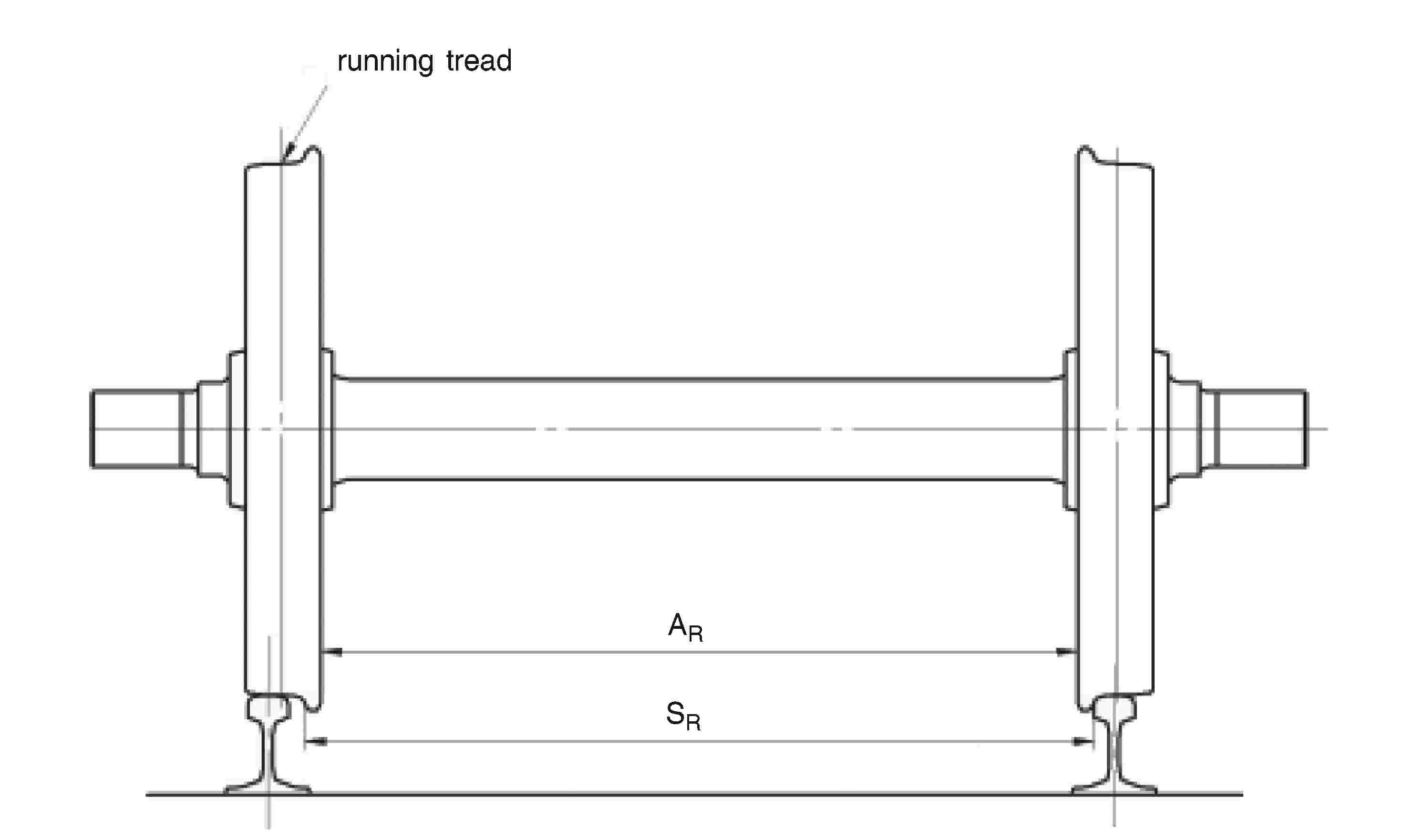
Table 3
Limits of use of the geometric dimensions of wheelsets
|
Designation |
Wheel diam. D [mm] |
Minimum value [mm] |
Maximum value [mm] |
|
|
1 435 mm |
Front-to-front dimension (SR)
|
330 ≤ D ≤ 760 |
1 415 |
1 426 |
|
760 < D ≤ 840 |
1 412 |
1 426 |
||
|
D > 840 |
1 410 |
1 426 |
||
|
Back to back distance (AR) |
330 ≤ D ≤ 760 |
1 359 |
1 363 |
|
|
760 < D ≤ 840 |
1 358 |
1 363 |
||
|
D > 840 |
1 357 |
1 363 |
||
|
1 524 mm |
Front-to-front dimension (SR)
|
400 ≤ D < 840 |
1 492 |
1 514 |
|
D ≥ 840 |
1 487 |
1 514 |
||
|
Back to back distance (AR) |
400 ≤ D < 840 |
1 444 |
1 448 |
|
|
D ≥ 840 |
1 442 |
1 448 |
||
|
1 600 mm |
Front-to-front dimension (SR)
|
690 ≤ D ≤ 1 016 |
1 573 |
1 592 |
|
|
|
|
||
|
Back to back distance (AR) |
690 ≤ D ≤ 1 016 |
1 521 |
1 526 |
|
|
|
|
|
||
|
1 668 mm |
Front-to-front dimension (SR)
|
330 ≤ D < 840 |
1 648 (1) |
1 659 |
|
840 ≤ D ≤ 1 250 |
1 643 (1) |
1 659 |
||
|
Back to back distance (AR) |
330 ≤ D < 840 |
1 592 |
1 596 |
|
|
840 ≤ D ≤ 1 250 |
1 590 |
1 596 |
||
|
(1) Two-axle wagons with axle load up to 22,5 t the value shall be taken as 1 651 mm. |
||||



4.2.3.6.3.
The geometrical dimensions of the wheels as defined in Figure 2 shall be compliant with limit values specified in Table 4.
Table 4
Limits of use of the geometric dimensions of wheels
|
Designation |
Wheel diam. D [mm] |
Minimum value [mm] |
Maximum value [mm] |
|
|
1 435 mm |
Width of the rim (BR) (with maximum BURR of 5 mm) |
D ≥ 330 |
133 |
140 |
|
Thickness of the flange (Sd) |
330 ≤ D ≤ 760 |
27,5 |
33 |
|
|
760 < D ≤ 840 |
25 |
33 |
||
|
D > 840 |
22 |
33 |
||
|
Height of the flange (Sh) |
330 ≤ D ≤ 630 |
31,5 |
36 |
|
|
630 < D ≤ 760 |
29,5 |
36 |
||
|
D > 760 |
27,5 |
36 |
||
|
Face of the flange (qR) |
D ≥ 330 |
6,5 |
— |
|
|
1 524 mm |
Width of the rim (BR) (with maximum BURR of 5 mm) |
D ≥ 400 |
134 |
140 |
|
Thickness of the flange (Sd) |
400 ≤ D < 760 |
27,5 |
33 |
|
|
760 ≤ D < 840 |
25 |
33 |
||
|
D ≥ 840 |
22 |
33 |
||
|
Height of the flange (Sh) |
400 ≤ D < 630 |
31,5 |
36 |
|
|
630 ≤ D < 760 |
29,5 |
36 |
||
|
D ≥ 760 |
27,5 |
36 |
||
|
Face of the flange (qR) |
D ≥ 400 |
6,5 |
— |
|
|
1 600 mm |
Width of the rim (BR) (with maximum BURR of 5 mm) |
690 ≤ D ≤ 1 016 |
137 |
139 |
|
Thickness of the flange (Sd) |
690 ≤ D ≤ 1 016 |
26 |
33 |
|
|
Height of the flange (Sh) |
690 ≤ D ≤ 1 016 |
28 |
38 |
|
|
Face of the flange (qR) |
690 ≤ D ≤ 1 016 |
6,5 |
— |
|
|
1 668 mm |
Width of the rim (BR) (with maximum BURR of 5 mm) |
D ≥ 330 |
133 |
140 |
|
Thickness of the flange (Sd) |
330 ≤ D ≤ 840 |
27,5 |
33 |
|
|
D > 840 |
22 (PT); 25 (ES) |
33 |
||
|
Height of the flange (Sh) |
330 ≤ D ≤ 630 |
31,5 |
36 |
|
|
630 ≤ D ≤ 760 |
29,5 |
36 |
||
|
D > 760 |
27,5 |
36 |
||
|
Face of the flange (qR) |
D ≥ 330 |
6,5 |
— |
|
These limit values shall be taken as design values and shall be stated as in-service limit values in the maintenance file described in Section 4.5.

The mechanical characteristics of the wheels shall ensure the transmission of forces and torque as well as the resistance against thermal load where so required in accordance with the area of use.
The demonstration of conformity is described in point 6.1.2.3.
4.2.3.6.4.
The characteristics of the axle shall ensure the transmission of forces and torque in accordance with the area of use.
The demonstration of conformity is described in point 6.1.2.4.
The traceability of axles shall take into accounts the findings of the ERA Task force on Freight Maintenance (see “Final report on the activities of the Task Force Freight Wagon Maintenance” published on the ERA website http://www.era.europa.eu).
4.2.3.6.5.
The axle box and the rolling bearing shall be designed with consideration of mechanical resistance and fatigue characteristics. Temperature limits reached in service relevant for the hot box detection shall be defined.
The demonstration of conformity is described in point 6.2.2.4.
4.2.3.6.6.
This requirement is applicable to units equipped with variable gauge wheelsets with changeover between two track gauges.
The changeover mechanism of the wheelset shall ensure the safe locking:
— of the wheels, and
— of the corresponding brake equipment,
in the correct intended axial position considering the dynamic effects in accordance with the design operating state of the unit.
The conformity assessment of the requirements specified in this point is an open point.
4.2.3.6.7.
The requirement is applicable to units prepared to run on different track gauges, by means of a physical change of wheelset.
The unit shall be equipped with a locking mechanism in order to ensure the correct position of its brake equipment in the different configurations considering the dynamic effects in accordance with the design operating state of the unit.
The demonstration of conformity is described in point 6.2.2.5.
4.2.4. Brake
4.2.4.1.
The purpose of the train brake system is to ensure that:
— the train’s speed can be reduced,
— the train’s speed can be maintained on a slope,
— the train can be stopped within the maximum allowable braking distance, and that
— the train can be immobilised.
Primary factors that influence the braking performance and the braking process are:
— the braking power,
— the train mass,
— the speed,
— the allowable braking distance,
— the available adhesion, and
— the track gradient.
The brake performance of a train is derived from the individual brake performance of each unit in the train.
4.2.4.2.
The braking system contributes to the safety level of the railway system. Therefore the design of the braking system of a unit has to undergo a risk assessment in accordance with Commission Regulation (EC) No 352/2009 ( 7 ) considering the hazard of complete loss of the brake capability of the unit. The severity level shall be deemed as catastrophic when:
— it affects the unit alone (combination of failures), or
— it affects the brake capability of more than the unit (single fault).
The fulfilment of the conditions of C.9 and C.14 of Appendix C is presumed to be in conformity with this requirement.
4.2.4.3.
4.2.4.3.1.
The brake equipment of the unit shall provide the functions of braking such as the application and the release of the brake, upon a transmitted signal. The brake shall be:
— continuous (the brake application or release signal is transmitted from a central command to the whole train by a control line),
— automatic (an inadvertent disruption of the control line shall lead to brake activation on all units of the train bringing each part to stand still),
— disengageable, which enables its release and isolation.
4.2.4.3.2.
4.2.4.3.2.1. Service brake
The brake performance of a train or a unit is its ability to decelerate. It is the result of the braking power available to decelerate the train or unit within defined limits and all factors involved in the conversion and dissipation of energy including train resistance.
The brake performance of a unit shall be calculated in accordance with one of the following documents:
— EN 14531-6:2009, or
— fuljett UIC 544-1:2013.
Il-kalkolu għandu jiġi vvalidat b’testijiet. Il-kalkolu tal-prestazzjoni tal-brejk skont l-UIC 544-1 għandu jkun vvalidat skont kif jisttabilixxi l-UIC 544-1:2013.
4.2.4.3.2.2. Parking brake
A Parking Brake is a brake used to prevent parked rolling stock moving under the specified conditions taking into account the place, wind, gradient and rolling stock loading state, until intentionally released.
If the unit is equipped with a parking brake, the following requirements shall be met:
— the immobilisation shall remain until intentionally released,
— where it is not possible to identify the state of the parking brake directly, an indicator showing the state shall be provided on both sides on the outside of the vehicle,
— Il-prestazzjoni minima tal-brejk tal-ipparkjar, mingħajr riħ, għandha tiġi determinata mill-kalkoli kif definit fil-Klawżola 6 tal-EN 14531-6:2009,
— the minimum performance of the parking brake shall be marked on the unit. The marking shall comply with clause 4.5.25 of EN 15877-1:2012. The parking brake of a unit shall be designed considering a wheel/rail (steel/steel) adhesion factor not higher than 0,12.
4.2.4.3.3.
The brake equipment shall be able to withstand one emergency brake application without any loss of brake performance due to thermal or mechanical effects.
It-tagħbija termali li l-unità kapaċi tiflaħ bla telf negattiv fil-prestazzjoni tal-brejk minħabba effetti termali jew mekkaniċi, għandha tiġi definita u espressa f’termini ta’ veloċità, tagħbija tal-fus, gradjazzjoni u distanza tal-brejk.
The demonstration of conformity is described in point 6.2.2.6.
A slope of 21 ‰ at 70 km/h during 40 km may be considered as the reference case for the thermal capacity which results in a braking power of 45 kW per wheel during 34 minutes for a nominal wheel diameter of 920 mm and an axle load of 22,5 t.
4.2.4.3.4.
Wheel slide protection (WSP) is a system designed to use the maximum available adhesion by decreasing, holding or increasing the brake force to prevent wheel sets from locking and uncontrolled sliding. Thereby the stopping distance shall be optimised.
If an electronic WSP-control is used negative effects caused by malfunctions of WSP shall be reduced by suitable system design processes and technical configuration.
The WSP shall not alter the functional characteristics of the brakes. The vehicle’s air equipment shall be dimensioned such that the air consumption of the WSP does not impair the performance of the pneumatic brake. The design process of the WSP shall take into account that the WSP has no detrimental effect on the constituent parts of the vehicle (brake gear, wheel tread, axle boxes, etc.).
It-tipi ta’ unitajiet li ġejjin għandhom jiġu mmuntati b’WSP:
— tipi ta’ unitajiet mgħammra b’kull tip ta’ blokok tal-brejkijiet għajr il-blokok tal-brejkijiet kompożiti, li għalihom l-utilizzazzjoni medja massima tal-adeżjoni hija ta’ aktar minn 0,12,
— tipi ta’ unitajiet mgħammra b’diski tal-brejkijiet biss u/jew bi blokok ta’ brejkijiet kompożiti, li għalihom l-utlizzazzjoni medja massima hija ta’ aktar minn 0,11.
4.2.4.3.5.
The friction element for wheel tread brakes (i.e. brake block) generates brake forces by friction when engaged with the wheel tread.
If wheel tread brakes are used the characteristics of the friction element shall contribute reliably to achieving the intended brake performance.
The demonstration of conformity is described in point 6.1.2.5 of this TSI.
4.2.5. Environmental conditions
The design of the unit, as well as its constituents shall take into account the environmental conditions to which this rolling stock will be subjected to.
The environmental parameters are described in the clauses below. For each environmental parameter, a nominal range is defined, which is the most commonly encountered in Europe, and is the basis for the interoperable unit.
For certain environmental parameters ranges other than the nominal one are defined. In that case, a range shall be selected for the design of the unit.
For the functions identified in the clauses below, design and/or testing provisions taken to ensure that the rolling stock is meeting the TSI requirements in this range shall be described in the technical file.
Depending on the ranges selected and on provisions taken (described in the technical file), appropriate operating rules could be necessary when the unit designed for the nominal range is operated on a particular line where the nominal range is exceeded at certain periods of the year.
The ranges, if different from the nominal one, to be selected to avoid any restrictive operating rule(s) linked to environmental conditions, are specified by the Member States and are listed in Section 7.4.
The unit and its constituents shall be designed under consideration of one or several of the following external air temperature ranges:
— T1: – 25 °C to + 40 °C (nominal),
— T2: – 40 °C to + 35 °C, and
— T3: – 25 °C to + 45 °C.
The unit shall meet the requirements of this TSI without degradation for snow, ice and hail conditions as defined in clause 4.7 of EN 50125-1:1999, which correspond to the nominal range.
Where more severe “snow, ice and hail” conditions than considered in the standard are selected, the unit and its constituents shall then be designed to meet TSI requirements considering the combined effect with low temperature according to the temperature range chosen.
In relation with the temperature range T2 and with the severe conditions for snow, ice and hail, the provisions taken to meet TSI requirements in these severe conditions shall be identified and verified, in particular design and/or testing provisions considering the following functions:
— Coupling function restricted to the resiliency of couplings.
— Brake function, including brake equipment.
The demonstration of conformity is described in point 6.2.2.7.
4.2.6. System protection
4.2.6.1.
4.2.6.1.1.
All significant potential fire sources (high risk components) on the unit shall be identified. The fire safety aspects of the unit design shall be aimed at:
— preventing a fire from occurring,
— limiting the effects if a fire occurs.
The goods carried on the unit are not part of the unit and do not have to be taken into account in the conformity assessment.
4.2.6.1.2.
4.2.6.1.2.1. Barriers
In order to limit the effects of fire, fire barriers with integrity of at least 15 minutes shall be installed between the identified potential fire sources (high risk components) and the carried load.
The demonstration of conformity is described in point 6.2.2.8.1.
4.2.6.1.2.2. Materials
All permanent materials used on the unit shall have limited ignitability and flame spread properties, unless:
— the material is separated from all potential fire risks on the unit by a fire barrier and the safe application is supported by a risk assessment, or
— the component has a mass < 400 g, and is located within a horizontal distance of ≥ 40 mm and a vertical distance of ≥ 400 mm to other non-tested components.
The demonstration of conformity is described in point 6.2.2.8.2.
4.2.6.1.2.3. Cables
The selection and installation of electrical cables shall take into account their fire behaviour properties.
The demonstration of conformity is described in point 6.2.2.8.3.
4.2.6.1.2.4. Flammable liquids
The unit shall be provided with measures preventing a fire from occurring and spreading due to leakage of flammable liquids or gases.
The demonstration of conformity is described in point 6.2.2.8.4.
4.2.6.2.
4.2.6.2.1.
The impedance between vehicle body and the running rail shall be low enough to prevent hazardous voltages between them.
Units shall be bonded in accordance with the provisions as described in clause 6.4 of EN 50153:2002.
4.2.6.2.2.
The electrical installations and equipment of a unit shall be designed so as to protect persons from electric shock.
The unit shall be designed so that direct contact is prevented following the provisions set out in clause 5 of EN 50153:2002.
4.2.6.3.
Fil-każ tal-unitajiet kollha mfassla biex jirċievu sinjal minn wara, żewġ biċċiet ta’ tagħmir fuq wara tal-unità għandhom jipprovdu l-istallazzjoni ta’ żewġ fanali jew żewġ platti riflettivi kif jistipula l-Appendiċi E fl-istess għoli ‘l fuq mir-rejl u mhux ogħla minn 2 000 mm. Id-dimensjonijiet u l-ispazju liberu ta’ dan it-tagħmir mehmuż għandhom ikunu kif deskritt fil-kapitolu 1 tad-dokument tekniku tal-ERA, ERA/TD/2012-04/INT verżjoni 1.2 tat-18.1.2013 ippubblikat fil-websajt tal-ERA (http://www.era.europa.eu).
4.3. Functional and technical specification of the interfaces
4.3.1. Interface with the subsystem “infrastructure”
Table 5
Interface with infrastructure subsystem
|
Reference in this TSI |
Reference Commission Decision 2011/275/EU (1) |
|
4.2.3.1 Gauging |
4.2.4.1 Minimum structure gauge 4.2.4.2 Distance between track centres 4.2.4.5 Minimum radius of vertical curve |
|
4.2.3.2 Compatibility with load carrying capacity of lines |
4.2.7.1 Track resistance to vertical loads 4.2.7.3 Lateral track resistance 4.2.8.1 Resistance of bridges to traffic loads 4.2.8.2 Equivalent vertical loading for earthworks and earth pressure effects 4.2.8.4 Resistance of existing bridges and earthworks to traffic loads |
|
4.2.3.5.2 Running dynamic behaviour |
4.2.9 Track geometrical quality |
|
4.2.3.6.2 Characteristics of wheelsets 4.2.3.6.3 Characteristics of wheels |
4.2.5.1 Nominal track gauge 4.2.5.6 Rail head profile for plain line 4.2.6.2 In service geometry of switches and crossings |
|
(1) OJ L 126, 14.5.2011, p. 53. |
|
4.3.2. Interface with the subsystem “operation and traffic management”
Table 6
Interface with operation and traffic management subsystem
|
Reference in this TSI |
Reference Commission Decision 2011/314/EU (1) |
|
4.2.2.2 Strength of unit — Lifting and jacking |
4.2.3.6.3 Contingency arrangements |
|
4.2.3.1 Gauging |
4.2.2.5 Train composition |
|
4.2.3.2 Compatibility with load carrying capacity of lines |
4.2.2.5 Train composition |
|
4.2.4 Brake |
4.2.2.6 Train braking |
|
4.2.6.3 Attachment devices for rear-end signal. Appendix E Rear-end signal |
4.2.2.1.3.2 Rear-end |
|
(1) OJ L 144, 31.5.2011, p. 1. |
|
4.3.3. Interface with the subsystem “control, command and signalling”
Table 7
Interface with control, command and signalling subsystem
|
Referenza f’din it-TSI |
Referenza Deċiżjoni tal-Kummissjoni 2012/88/UE Anness A, Tabella A2, indiċi 77 |
|
4.2.3.3 a) Il-karatteristiċi tal-mezzi fuq il-binarji kompatibbli mas-sistema tad-detezzjoni tat-trejnijiet ibbażata fuq ċirkwiti tal-linji |
— distanzi tal-fusien (3.1.2.1, 3.1.2.4, 3.1.2.5 u 3.1.2.6), — tagħbija fuq il-fusijiet tal-vettura (3.1.7.1), — impedanza bejn ir-roti (3.1.9), — użu ta’ blokok tal-brejkijiet komposti (3.1.6). |
|
4.2.3.3 b) Il-karatteristiċi tal-mezzi fuq il-binarji kompatibbli mas-sistema tad-detezzjoni tat-trejnijiet ibbażata fuq kawnters tal-fusien |
— distanzi tal-fusien (3.1.2.1, 3.1.2.2, 3.1.2.5 u 3.1.2.6), — ġeometrija tar-roti (3.1.3.1 - 3.1.3.4), — spazji bejn ir-roti liberu mill-kompenenti induttivi/tal-metall (3.1.3.5) — materjal tar-roti (3.1.3.6). |
|
4.2.3.3 c) Il-karatteristiċi tal-mezzi fuq il-binarji kompatibbli mas-sistema tad-detezzjoni tat-trejnijiet ibbażata fuq tagħmir anellat (loop) |
— massa tal-metall tal-vettura (3.1.7.2). |
4.4. Operating rules
Operating rules are developed within the procedures described in the railway undertaking safety management system. These rules take into account the documentation related to operation which forms a part of the technical file as required in Article 18(3) of and as set out in Annex VI to Directive 2008/57/EC.
The documentation related to operation describes the characteristics of the unit in relation to the design operating state to be considered in order to define the operating rules in normal and in various reasonably foreseeable degraded modes.
The documentation related to operation is composed of:
— deskrizzjoni tal-operat fil-modalità normali, inklużi l-karatteristiċi u l-limiti operattivi tal-unità (eż. il-gejġ tal-vettura, il-veloċità massima tad-disinn, it-tagħbijiet tal-fusien, il-prestazzjoni tal-brejkijiet, il-kompatibbiltà mas-sistemi tad-ditezzjoni tat-trejns, il-kundizzjonijiet ambjentali permessi),
— a description of operation in degraded mode (when equipment or functions described in this TSI suffer safety failures) as far as can reasonably predicted, together with the related acceptable limits and operating conditions of the unit that could be experienced.
The applicant shall provide the initial version of the documentation related to operating rules. This documentation might be modified later in accordance with the corresponding Union legislation, taking into account the existing operating and maintenance conditions of the unit. The notified body shall verify only that the documentation on operation is provided.
4.5. Maintenance rules
Maintenance is a set of activities intended to keep a functional unit in, or to restore it to a state in which it can perform its required function.
The following documents being part of the technical file as required in Article 18(3) of and as set out in Annex VI to Directive 2008/57/EC are necessary to undertake maintenance activities on the units:
— general documentation (point 4.5.1),
— the maintenance design justification file (point 4.5.2), and
— the maintenance description file (point 4.5.3).
The applicant shall provide the three documents described in 4.5.1, 4.5.2 and 4.5.3. This documentation might be modified later in accordance with the corresponding EU legislation, taking into account the existing operating and maintenance conditions of the unit. The notified body shall verify only that the documentation on maintenance is provided.
4.5.1. General documentation
The general documentation comprises of:
— Drawings and description of the unit and its components.
— Any legal requirement concerning the maintenance of the unit.
— Drawing of systems (electrical, pneumatic, hydraulic and control-circuit diagrams).
— Additional on-board systems (description of the systems including description of functionality, specification of interfaces and data processing and protocols).
— Configuration files for each vehicle (parts list and bill of material) to enable (in particular but not only) traceability during maintenance activities.
4.5.2. Maintenance design justification file
The maintenance design justification file explains how maintenance activities are defined and designed in order to ensure that the rolling stock characteristics will be kept within permissible limits of use during its lifetime. The file shall give input data in order to determine the criteria for inspection and the periodicity of maintenance activities. The maintenance design justification file consists of:
— Precedents, principles and methods used to design the maintenance of the unit.
— Limits of the normal use of the unit (e.g. km/month, climatic limits, foreseen types of loads, etc.).
— Relevant data used to design the maintenance and origin of these data (return of experience).
— Tests, investigations and calculations carried out to design the maintenance.
4.5.3. Maintenance description file
The maintenance description file describes how maintenance activities can be conducted. Maintenance activities include, among others, inspections, monitoring, tests, measurements, replacements, adjustments and repairs.
Maintenance activities are split into:
— preventive maintenance (scheduled and controlled), and
— corrective maintenance.
The maintenance description file includes the following:
— Component hierarchy and functional description which sets up the boundaries of the rolling stock by listing all the items belonging to the product structure of that rolling stock and using an appropriate number of discrete levels. The lowest item of the hierarchy shall be a replaceable component.
— Parts list which shall contain the technical and functional descriptions of the spare parts (replaceable units). The list shall include all parts specified for changing based on condition, which may require a replacement following electrical or mechanical malfunction or which will foreseeable require a replacement after an accidental damage. Interoperability constituents shall be indicated and referenced to their corresponding declaration of conformity.
— Limit values for components which are not to be exceeded in service. It is permitted to specify operational restrictions in degraded mode (limit value reached).
— List of reference to the European legal obligations to which components or subsystems are subject.
— Maintenance plan ( 8 ) i.e. the structured set of tasks to perform the maintenance including the activities, procedures and means. The description of this set of tasks includes:
—
(a) Disassembly/assembly instructions drawings necessary for correct assembly/disassembly of replaceable parts.
(b) Maintenance criteria.
(c) Checks and tests in particular of safety relevant parts; these include visual inspection and non-destructive tests (where appropriate, e.g. to detect deficiencies that may impair safety).
(d) Tools and materials required to undertake the task.
(e) Consumables required to undertake the task.
(f) Personal protective safety provision and equipment.
— Necessary tests and procedures to be undertaken after each maintenance operation before re-entry into service of rolling stock.
4.6. Professional competencies
The professional competencies of staff required for the operation and maintenance of units are not covered by this TSI.
4.7. Health and safety conditions
Id-dispożizzjonijiet għas-saħħa u s-sikurezza tal-istaff talbu li l-operat u l-manutenzjoni tal-unitajiet huma koperti mir-rekwiżiti essenzjali 1.1.5, 1.3.1, 1.3.2, 2.5.1 u 2.6.1 stipulati fl-Anness III tad-Direttiva 2008/57/KE.
In particular, the following points of Section 4.2 specify provisions for health and safety of staff:
point 4.2.2.1.1: End coupling,
point 4.2.6.1: Fire safety,
point 4.2.6.2: Protection against electrical hazards.
If the unit is fitted with a manual coupling system, a free space for shunters during coupling and uncoupling shall be provided.
All protruding parts deemed a hazard to operational staff shall be clearly indicated and/or fitted with protective devices.
The unit shall be equipped with footsteps and handrails except in those cases it is not intended to be operated with staff on-board, e.g. for shunting.
4.8. Parametri li għandhom jiġu rreġistrati fil-fajl tekniku u r-reġistru Ewropew ta’ tipi ta’ vetturi awtorizzati
The technical file shall contain at least the following parameters:
— Type, position and resiliency of the end coupling
— Load due to dynamic traction forces and compressive forces
— Gauge reference profiles to which the unit complies
— Conformity, if any, to target gauge reference profile(s) G1, GA, GB and GC
— Compliance, if any, to gauge lower reference profile(s) GIC1 and GIC2
— Mass per axle (tare and fully laden)
— Position of the axles along the unit and number of axles
— Length of the unit
— Maximum design speed
— Track gauges(s) the unit can be operated on
— Compatibility with train detection systems (track circuits/axle counters/loop equipment)
— Compatibility with hot axle box detection systems
— In-service temperature range of the axle bearings
— Nature of the signal which controls the brake (example: pneumatic main brake pipe, electric brake type XXX, etc.)
— Characteristics of the control line and of its coupling with other units (main brake pipe diameter, section of the electric cable etc.)
— Individual nominal performance of the brake unit, depending on the brake mode, if any (response time, brake force, level of adhesion required, etc.)
— Braking distance or brake weight depending on the brake mode, if any.
— Tagħbija termali komponenti tal-brejk espressa f’termini ta’ veloċità, piż fuq il-fus, u distanza tal-brejk
— Temperature range and severity level of snow/ice/hail conditions
— Brake weight and maximum gradient of the parking brake (if applicable)
— Ability/inability to be hump shunted
— Presence of footsteps and/or handrails.
Id-dejta dwar il-mezzi fuq il-binarji li għandhom ikunu rreġistrati fir- “Reġistru Ewropew ta’ tipi ta’ vetturi awtorizzati (ERATV)” hija stabbilita fid-Deċiżjoni ta’ Implimentazzjoni tal-Kummissjoni 2011/665/UE tal-4 ta’ Ottubru 2011 dwar ir-reġistru Ewropew tat-tipi ta’ vetturi ferrovjarji awtorizzati ( 9 ).
5. INTEROPERABILITY CONSTITUENTS
5.1. General
Interoperability constituents (ICs), as defined in Article 2(f) of Directive 2008/57/EC, are listed in Section 5.3 together with:
— their area of use covering parameters of the subsystem, and
— the reference to corresponding requirements defined in Section 4.2.
When a requirement is identified in Section 5.3 as being assessed at IC level, an assessment for the same requirement at subsystem level is not required.
5.2. Innovative solutions
As stated in Article 10a, innovative solutions may require new specifications and/or new assessment methods. Such specifications and assessment methods shall be developed using the process described in point 6.1.3 whenever an innovative solution is envisaged for an interoperability constituent.
5.3. Interoperability constituent specifications
5.3.1. Running gear
The running gear shall be designed for an application range, the area of use, as defined by the following parameters:
— Maximum speed
— Maximum cant deficiency
— Minimum tare of the unit
— Maximum axle load
— Range of distances between bogie pivots or range of wheelbase of “two-axle units”
— Maximum height of centre of gravity of empty unit
— Coefficient of height of centre of gravity of loaded unit
— Minimum torsional stiffness coefficient of car body
— Maximum mass distribution coefficient for empty units with:
—

— Where:
—
|
Izz |
= |
moment of inertia of the car body relative to the vertical axis through the centre of gravity of the car body |
|
m |
= |
mass of the car body |
|
2a* |
= |
wheelbase |
— Minimum nominal wheel diameter
— Rail inclination.
The parameters speed and axle load may be considered in combination in order to define the appropriate area of use (e.g. maximum speed and tare weight).
The running gear shall comply with the requirements expressed in points 4.2.3.5.2 and 4.2.3.6.1. These requirements shall be assessed at IC level.
5.3.2. Wheelset
The wheelset shall be assessed and designed for the area of use as defined by
— nominal wheel tread diameter, and
— maximum vertical static force.
A wheelset shall comply with the requirements on geometrical and mechanical parameters defined in point 4.2.3.6.2. These requirements shall be assessed at IC level.
5.3.3. Wheel
A wheel shall be designed and assessed for an area of use defined by:
— nominal tread diameter,
— maximum vertical static force,
— maximum speed and service life, and
— maximum braking energy.
A wheel shall comply with the requirements on geometrical, mechanical and thermo mechanical parameters defined in point 4.2.3.6.3. These requirements shall be assessed at IC level.
5.3.4. Axle
An axle shall be designed and assessed for an area of use defined by:
— maximum vertical static force.
An axle shall comply with the requirements on mechanical parameters defined in point 4.2.3.6.4. These requirements shall be assessed at IC level.
5.3.4a. Friction element for wheel tread brakes
The friction element for wheel tread brakes shall be designed and assessed for an area of use defined by:
— dynamic friction coefficients and their tolerance bands,
— minimum static friction coefficient,
— maximum permitted brake forces applied on the element,
— suitability for train detection by systems based on track circuits,
— suitability for severe environmental conditions.
A friction element for wheel tread brakes shall comply with the requirements defined in point 4.2.4.3.5. These requirements shall be assessed at IC level.
5.3.5. Rear-end signal
The rear-end signal, as described in Appendix E, is an independent IC. There are no requirements in Section 4.2 dealing with the rear-end signal. Its assessment by the notified body is not part of the EC verification of the subsystem.
6. CONFORMITY ASSESSMENT AND EC VERIFICATION
6.1. Interoperability constituent
6.1.1. Modules
The conformity assessment of an interoperability constituent shall be performed in accordance with the module(s) described in Table 8.
Table 8
Modules for conformity assessment of interoperability constituents
|
Module CA1 |
Internal production control plus product verification by individual examination |
|
Module CA2 |
Internal production control plus product verification at random intervals |
|
Module CB |
EC-Type examination |
|
Module CD |
Conformity to type based on quality management system of the production process |
|
Module CF |
Conformity to type based on product verification |
|
Module CH |
Conformity based on full quality management system |
|
Module CH1 |
Conformity based on full quality management system plus design examination |
|
Module CV |
Type validation by in-service experience (suitability for use) |
These modules are specified in detail in Decision 2010/713/EU.
6.1.2. Conformity assessment procedures
The manufacturer or his authorised representative established within the Union shall choose one of the modules or module combinations indicated in Table 9 in accordance with the required constituent.
Table 9
Modules to be applied for interoperability constituents
|
Point |
Constituent |
Modules |
|||||
|
CA1 or CA2 |
CB + CD |
CB + CF |
CH |
CH1 |
CV |
||
|
4.2.3.6.1 |
Running gear |
|
X |
X |
|
X |
|
|
Running gear — established |
X |
|
|
X |
|
|
|
|
4.2.3.6.2 |
Wheelset |
X (1) |
X |
X |
X (1) |
X |
|
|
4.2.3.6.3 |
Wheel |
X (1) |
X |
X |
X (1) |
X |
|
|
4.2.3.6.4 |
Axle |
X (1) |
X |
X |
X (1) |
X |
|
|
4.2.4.3.5 |
Friction element for wheel tread brakes |
X (1) |
X |
X |
X (1) |
X |
X (2) |
|
5.3.5 |
Rear-end signal |
X |
|
|
X |
|
|
|
(1) Modules CA1, CA2 or CH may be used only in the case of products placed on the market, and therefore developed, before the entry into force of this TSI, provided that the manufacturer demonstrates to the NoBo that design review and type examination were performed for previous applications under comparable conditions, and are in conformity with the requirements of this TSI; this demonstration shall be documented, and is considered as providing the same level of proof as module CB or design examination according to module CH1. (2) Module CV shall be used in case the manufacturer of friction element for wheel tread brakes has no sufficient return of experience (according to its own judgment) for the proposed design |
|||||||
Within the application of the chosen module or module combination the interoperability constituent shall be assessed against the requirements mentioned in Section 4.2. If necessary, additional requirements concerning the assessment of particular interoperability constituents are given in the following clauses.
6.1.2.1.
Id-dimostrazzjoni tal-konformità għat-tagħmir tad-dawran hija stabbilita fil-kapitolu 2 tad-dokument tekniku tal-ERA, ERA/TD/2013/01/INT verżjoni 1.0 tal-11.2.2013 ippubblikat fil-websajt tal-ERA (http://www.era.europa.eu).
Units equipped with an established running gear as listed below are presumed to be in conformity with the relevant requirement provided that the running gears are operated within their established area of use:
(a) Single axle running gear:
— Double link suspension.
— Niesky 2.
— Suspension S 2000.
(b) Two-axle bogie running gear:
— Y25 family.
— Two-axle steering axle bogie.
(c) Three-axle bogies:
— Three-axle bogie family with link suspension.
The assessment of the bogie frame strength shall be based on clause 6.2 of EN 13749:2011.
6.1.2.2.
The demonstration of conformity for the mechanical behaviour of the wheelset assembly shall be carried out according to clause 3.2.1 of EN 13260:2009+A1:2010, which defines limit values for the axial assembly force and the associated verification test.
A verification procedure shall exist to ensure at the assembly phase that no defects may detrimentally affect safety due to any change in the mechanical characteristics of the fitted parts of the axle.
6.1.2.3.
(a) Forged and rolled wheels: The mechanical characteristics shall be proven following the procedure as specified in clause 7 of EN 13979-1:2003+A1:2009+A2:2011.
If the wheel is intended to be used with brake blocks acting on the wheel running surface, the wheel shall be thermo mechanically proven by taking into account the maximum braking energy foreseen. A type test, as described in clause 6.2 of EN 13979-1:2003+A1:2009+A2:2011 shall be performed in order to check that the lateral displacement of the rim during braking and the residual stress are within the specified tolerance limits.
The decision criteria of residual stresses for forged and rolled wheels are set out in EN 13979-1:2003+A1:2009+A2:2011.
(b) Other types of wheels: Other types of wheels are permitted for units in national use. In that case the decision criteria and the fatigue stress criteria shall be specified in national rules. Those national rules shall be notified by Member States in accordance with Article 17(3) of Directive 2008/57/EC.
Għandha tkun teżisti proċedura ta’ verifika li tiżgura li fil-fażi tal-produzzjoni l-ebda diffetti ma jaffettwaw ħażin is-sikurezza minħabba kwalunkwe bidla fil-karatteristiċi mekkaniċi tar-roti. Is-saħħa tensili tal-materjal tar-rota, l-ebbusija tar-rimm, is-saħħa kontra l-frammentazzjoni (fil-każ tar-roti bil-brejk bil-ħajta), ir-reżistenza għall-impatti, il-karatteristiċi tal-materjal u l-indafa tal-materjal għandhom jiġu vverifikati. Il-proċedura tal-verifika għandha tispeċifika l-kampjonarju tal-baċċ użat għal kull karatteristika li għandha tiġi vverifikata.
6.1.2.4.
Flimkien mar-rekwiżit għall-assemblaġġ t’hawn fuq, id-dimostrazzjoni tal-konformità tal-karatteristiċi tar-reżistenza u l-għejja mekkanika tal-fus għandha tissejjes fuq il-Klawżoli 4, 5 u 6 tal-EN13103:2009 + A2:2012.
Il-kriterji tad-deċiżjoni għall-istress permissibbli hija speċifikata fil-Klawżola 7 tal-EN 13103:2009 + A2:2012. Proċedura ta’ verifika għandha tkun teżisti biex tiżgura li fil-fażi tal-produzzjoni l-ebda difetti ma jafu jolqtu ħażin is-sikurezza minħabba kwalunkwe bidla fil-karatteristiċi mekkaniċi tal-fusien. Is-saħħa tensili tal-materjal fil-fus, ir-reżistenza għall-impatti, l-integrità tal-wiċċ, il-karatteristiċi tal-materjal u l-indafa tal-materjal għandhom jiġu verifikati. Il-proċedura tal-verifika għandha tispeċifika il-kampjonarju tal-baċċ użat għal kull karatteristika li għandha tiġi vverifikata.
6.1.2.5.
The demonstration of conformity of friction elements for wheel tread brakes shall be carried out by determining the following friction element properties in accordance with the European Railway Agency (ERA) technical document ERA/TD/2013-02/INT version 2.0 of XX.XX.2014 published on the ERA website (http://www.era.europa.eu):
— dynamic friction performance (chapter 4);
— static friction coefficient (chapter 5);
— mechanical characteristics including properties in respect to shear strength test and flexural strength test (chapter 6).
Demonstration of the following suitabilities shall be carried out in accordance with chapters 7 and/or 8 of the ERA technical document ERA/TD/2013-02/INT version 2.0 of XX.XX.2014 published on the ERA website (http://www.era.europa.eu), if the friction element is intended to be suitable for:
— train detection by systems based on track circuits; and/or
— severe environmental conditions.
If a manufacturer does not have sufficient return of experience (according with its own judgement) for the proposed design, the type validation by in-service experience procedure (module CV) shall be part of the assessment procedure for suitability for use. Before commencing in-service tests, a suitable module (CB or CH1) shall be used to certify the design of the interoperability constituent.
The in-service tests shall be organised on request from the manufacturer, who must obtain agreement from a railway undertaking that will contribute to such an assessment.
The suitability for train detection by systems based on track circuits for friction elements intended to be used in subsystems beyond the scope set out in chapter 7 of the ERA technical document ERA/TD/2013-02/INT version 2.0 of XX.XX.2014 published on the ERA website (http://www.era.europa.eu) may be demonstrated using the procedure for innovative solutions described in point 6.1.3.
The suitability for severe environmental conditions by a dynamometer test for friction elements intended to be used in subsystems beyond the scope set out in clause 8.2.1 of the ERA technical document ERA/TD/2013-02/INT version 2.0 of XX.XX.2014 published on the ERA website (http://www.era.europa.eu) may be demonstrated using the procedure for innovative solutions described in point 6.1.3.
6.1.3. Innovative solutions
If an innovative solution referred to in Article 10a is proposed for an interoperability constituent, the manufacturer or his authorised representative established within the Union shall apply the procedure set out in Article 10a.
6.2. Subsystem
6.2.1. Modules
The EC verification of the subsystem “Rolling stock — freight wagons” shall be performed in accordance with the module(s) described in Table 10.
Table 10
Modules for EC verification of subsystems
|
SB |
EC-Type Examination |
|
SD |
EC verification based on quality management system of the production process |
|
SF |
EC verification based on product verification |
|
SH1 |
EC verification based on full quality management system plus design examination |
These modules are specified in detail in Decision 2010/713/EU.
6.2.2. EC verification procedures
The applicant shall choose one of the following combinations of modules or module for the EC verification of the subsystem:
— (SB+SD), or
— (SB+SF), or
— (SH1).
Within the application of the chosen module or module combination the subsystem shall be assessed against the requirements mentioned in Section 4.2. If necessary, additional requirements concerning the assessment of particular constituents are given in the following clauses.
6.2.2.1.
The demonstration of conformity shall be in accordance with Chapters 6 and 7 of EN 12663-2:2010.
Regarding joints, a recognised verification procedure shall exist to ensure at the production phase that no defect may decrease the intended mechanical characteristics of the structure.
6.2.2.2.
The demonstration of conformity shall be carried out either in accordance with:
— the procedure defined in Section 4.1 of EN 14363:2005, or
— the method given in Section 4.2 of EN 15839:2012 by using the pre-calculation for standardised solutions.
6.2.2.3.
The demonstration of conformity shall be carried out in accordance with Chapter 5 of EN 14363:2005.
As an alternative to perform on-track tests on two different rail inclinations, as set out in clause 5.4.4.4 in EN 14363:2005, it is permitted to perform tests on only one rail inclination if it is demonstrated that the tests cover the range of contact conditions as defined in Appendix B, Section 1.1.
As an alternative to performing on-track tests on two different rail inclinations, as set out in clause 5.4.4.4 in EN 14363:2005, tests may be carried out on only one rail inclination, if it is demonstrated that the tests cover the range of contact conditions as set out in section 1.1 of ERA technical document ERA/TD/2013/01/INT version 1.0 of 11.2.2013 published on the ERA website (http://www.era.europa.eu).
Meta jkun meħtieġ test fuq il-linja meħud b’metodu ta’ kejl normali, l-unità għandha tiġi vvalutata kontra l-valuri tal-limitu stipulati fit-taqsimiet 1.2 u 1.3 tad-dokument tekniku tal-ERA ERA/TD/2013/01/INT verżjoni 1.0 tal-11.2.2013 ippubblikat fuq il-websajt tal-ERA (http://www.era.europa.eu).
The required test conditions for on-track tests, as set out in EN 14363:2005, are not always fully achievable concerning
— track geometric quality, and
— combinations of speed, curvature, cant deficiency.
In cases this is not fully achievable the demonstration of conformity is an open point.
Alternatively, under the conditions stated in Section 9.3 of EN 15827:2011, a simulation may replace the above mentioned on-track tests.
6.2.2.4.
The demonstration of conformity for mechanical resistance and fatigue characteristics of the rolling bearing shall be in accordance with clause 6 of EN 12082:2007+A1:2010.
6.2.2.5.
Is-soluzzjonijiet tekniċi deskritti fil-figuri li ġejjin tal-fuljett tal-UIC 430-1:2012 huma meqjusa bħala konformi mar-rekwiżiti fil-punt 4.2.3.6.7:
— għall-unitajiet tal-fusien: Il-Figuri 9 u10 tal-Anness B.4, u l-Figura18 tal-Anness H tal-fuljett tal-UIC 430-1:2012,
— għall-unitajiet bogie: Il-Figure 18 tal-Anness H tal-fuljett tal-UIC 430-1:2012.
The technical solution described in Appendix 7 of UIC leaflet 430-3:1995 is deemed to be compliant with the requirements in point 4.2.3.6.7.
6.2.2.6.
Calculations, simulations or tests shall demonstrate that the temperature of the brake block, brake pad or brake disc does not exceed their thermal capacity. The following shall be taken into account:
(a) concerning the emergency brake application: the critical combination of speed and payload considering straight and level track, minimum wind and dry rails;
(b) concerning the continuous brake application:
— the range up to the maximum braking power,
— the range up to the maximum speed, and
— the corresponding brake application time.
6.2.2.7.
Steel materials are deemed to comply with all the ranges indicated in point 4.2.5 if the material properties are determined down to – 20 °C.
6.2.2.8.
6.2.2.8.1.
Barriers shall be tested in accordance with EN 1363-1:1999. Steel sheets of at least 2 mm thickness and aluminium sheets of at least 5 mm thickness are deemed to comply with the integrity requirements without testing.
6.2.2.8.2.
Testing of the materials ignitability and flame spread properties shall be performed in accordance with ISO 5658-2:2006/Am1:2011 for which the limit value shall be CFE ≥ 18 kW/m2.
For the following materials and components the fire safety requirements are deemed to comply with the required ignitability and flame spread properties:
— metals and alloys with inorganic coatings (such as, but not limited to: galvanised coating, anodic coating, chromate film, phosphate conversion coating),
— metals and alloys with an organic coating with a nominal thickness less than 0,3 mm (such as, but not limited to paints, plastic coating, asphaltic coating),
— metals and alloys with a combined inorganic and organic coating of which the nominal thickness of the organic layer is less than 0,3 mm,
— glass, stoneware, ceramic and natural stone products,
— materials that meet the requirements of category C-s3, d2 or higher in accordance with EN 13501-1:2007+A1:2009.
6.2.2.8.3
The electrical cables shall be selected and installed in accordance with EN 50355:2003 and EN 50343:2003.
6.2.2.8.4
The measures taken shall be in accordance with TS 45545-7:2009.
6.2.3. Innovative solutions
If an innovative solution referred to in Article 10a is proposed for the “rolling stock — freight wagons” subsystem, the applicant shall apply the procedure set out in Article 10a.
6.3. ►M1 Subsistema li fiha komponenti li jikkorrispondu għal kostitwenti tal-interoperabilità li ma jkollhomx dikjarazzjoni tal-KE ◄
Entità Notifikata hija permess toħroġ ċertifikat tal-KE għall-verifika ta’ subsistema, anki jekk xi wieħed jew aktar mill-komponenti li jikkorresondu mal-kostitwenti tal-interoperabbiltà inkorportati fi ħdan is-subsistema mhumiex koperti mid-dikjarazzjoni rilevanti tal-konformità tal-KE skont dan it-TSI (ICs mhux ċertifikati), jekk il-kostitwent ikun ġie manifatturat qabel id-dħul fis-seħħ ta’ dan it-TSI u t-tip tal-kostitwemnt kien:
— użat f’subsistema diġà approvata, u
— imqiegħed fis-servizz f’talanqas Stat Membru wieħed qabel id-dħul fis-seħħ ta’ dan it-TSI.
The EC verification of the subsystem shall be carried out by the notified body against the requirements of Chapter 4 by using the corresponding requirements concerning assessment in Chapter 6 together with Chapter 7 except for specific cases. For this EC verification the modules of the subsystem, set out in point 6.2.2, apply.
EC declarations of conformity or suitability for use shall not be drawn up for the components assessed in this manner.
6.4. Project phases where assessment is required
The assessment shall cover the following two phases as identified by “X” in the Table F.1 of Appendix F in this TSI. In particular, where a type test is identified the conditions and requirements of Section 4.2 shall be considered.
(a) Design and development phase:
— Design review and/or design examination
— Type test: test to verify the design, if and as defined in the Section 4.2.
(b) Production phase:
— Routine test to verify the conformity of production. The entity in charge of the assessment of the routine tests is determined according to the assessment module chosen.
Appendix F is structured according to Section 4.2. Where relevant, a reference to the points of Sections 6.1 and 6.2 is given.
6.5. Constituents holding an EC declaration of conformity
Where a constituent has been identified as an IC and held an EC declaration of conformity before the entry into force of this TSI, its treatment under this TSI is set out as follows:
(a) In the case this constituent is not recognised as an IC in this TSI, neither the certificate nor the declaration are valid for the EC verification procedure related to this TSI.
(b) iċ-ċertifikati tal-konformità tal-KE, iċ-ċertifikati tal-eżamijiet tat-tip KE u ċ-ċertifikati tal-eżamijiet tad-disinn KE tal-ICs li ġejjin għandhom jibqgħu validi skont dan it-TSI sal-iskadenza tagħhom:
— Sett tar-roti;
— Rota;
— Fus.
7. IMPLEMENTATION
7.1. Authorisation for placing in service
This TSI is applicable to the subsystem “rolling stock — freight wagons” within the scope set out in its Sections 1.1, 1.2 and Chapter 2 which are placed in service after the date of application of this TSI.
7.1.1. Authorisation for placing in service of a new vehicle in conformity with the previous WAG TSIs ( 10 )
See Article 9.
7.1.2. Mutual recognition of the first authorisation of placing in service
In accordance with Article 23(1) of Directive 2008/57/EC the following list lays out the conditions under which a unit, once authorised for placing in service in one Member State, shall not be subject to any additional authorisation for placing in service. These conditions shall be seen as complementary to the requirements in Section 4.2. These following conditions must be fulfilled in their entirety:
(a) The running dynamic behaviour of the unit must have been assessed to the full range of track geometric qualities and all combinations of speed, curvature, cant deficiency set out in EN 14363:2005 (point 4.2.3.5.2). Alternatively the unit must be equipped with running gear, either certified or established, in accordance with point 6.1.2.1.
(b) The axle bearing condition must be possible to be monitored by line side detection equipment of the network the unit is intended to be operated on considering the conditions of clauses 4.2.3.4.
(c) The unit must not be equipped with variable gauge wheelsets (point 4.2.3.6.6).
(d) The unit must be equipped with forged and rolled wheels assessed according to point 6.1.2.3(a).
(e) The compliance/non-compliance with the requirements regarding the axle bearing condition monitoring by line side equipment as set out in point 7.3.2.2(a) must be recorded in the technical file.
(f) Units intended to operate on the 1 668 mm track gauge network must comply with the requirements regarding the axle bearing condition monitoring by line side equipment as set out in point 7.3.2.2(b).
(g) The reference profile established for the unit as per point 4.2.3.1 must be allocated to one of the target reference profile(s) G1, GA, GB and GC including those used for the lower part GIC1 and GIC2.
(h) The unit must be compatible with the train detection systems based on track circuits, on axle counters and on loop equipment as specified in clauses 4.2.3.3(a), 4.2.3.3(b) and 4.2.3.3(c).
(i) The unit must be equipped with the manual coupling system in accordance with the prescriptions set out in Appendix C, Section 1, including the fulfilment of Section 8 or with any semi-automatic or automatic standardised coupling system.
(j) The brake system must be in accordance with the conditions of Appendix C, Sections 9, 14 and 15 when applying the reference case set out in point 4.2.4.2. ►M2 ————— ◄
(k) The unit must be marked with all applicable markings in accordance with EN 15877-1:2012, in particular with the marking on:
(i) the allocated interoperable gauge;
(ii) the vehicle tare weight;
(iii) the vehicle load table;
(iv) the length over buffers;
(v) the maintenance dates;
(vi) the lifting and re-railing signs;
(vii) the distance between the two end axles of the unit;
(viii) the distance between bogie centres;
(ix) the brake weight; and
(x) the track gauge(s) the unit is compatible with and was assessed for.
7.2. Substitution, renewal and upgrading
This Section deals with:
— substitutions of constituents as referred to in Article 2(p) of Directive 2008/57/EC, and
— the renewal or upgrading of freight wagons, including the substitution of elements within a unit, in accordance with the conditions laid down in Article 20 of Directive 2008/57/EC.
Concerning the substitution of constituents the following categories have to be considered.
— Certified ICs: Components which correspond to an IC in Chapter 5 and which are holding a certificate of conformity.
— Other components: Any component, which is not corresponding to an IC in Chapter 5.
— Non-certified ICs: Components which correspond to an IC in Chapter 5 but are not holding a certificate of conformity and which are produced before the expiry of the transitional period referred to in Section 6.3.
Table 11 shows the possible permutations.
Table 11
Substitution permutation table
|
|
… substituted by … |
||
|
… certified ICs |
… other components |
… non-certified ICs |
|
|
Certified ICs … |
check |
not possible |
check |
|
Other components … |
not possible |
check |
not possible |
|
Non-certified ICs … |
check |
not possible |
check |
The word “check” in Table 11 means that the entity in charge of maintenance (ECM) may under its responsibility substitute a component by another one utilising the same function and performance in accordance with the relevant TSI requirements considering these components are:
— suitable, i.e. conform to the relevant TSI(s),
— used within its area of use,
— enabling interoperability,
— meeting the essential requirements, and
— in line with restrictions eventually stated in the technical file.
When the extent of the work leads to a different function or performance or in case of a substitution of an element within the unit, the contracting entity or the manufacturer is required to send the Member State concerned a file describing the project as set out in Article 20 of Directive 2008/57/EC. The Member State decides whether a new authorisation for placing in service is needed.
7.3. Specific cases
7.3.1. Introduction
The specific cases, as listed in point 7.3.2, are classified as:
|
— |
“P” cases : “permanent” cases. |
|
— |
“T” cases : “temporary” cases, where it is recommended that the target system is reached by 2020 (an objective set in Decision No 661/2010/EU of the European Parliament and of the Council of 7 July 2010 on Union guidelines for the development of the trans-European transport network ( 11 )). |
7.3.2. List of specific cases
7.3.2.1.
Units running between a Member State and a third country with a network with 1 520 mm track gauge: Specific case Finland, Poland and Sweden.
(“P”) The application of national technical rules instead of the requirements in this TSI is allowed for third countries rolling stock.
7.3.2.2.
(a)
(“T”) Units intended to operate on the Swedish railway network shall be compliant with the target and prohibitive zones as set out in Table 12.
The two zones underneath the axle box/journal set out in Table 12 referring to the parameters of the standard EN 15437-1:2009 shall be free to facilitate vertical monitoring by trackside axle box detection system:
Table 12
Target and prohibitive zone for units intended to be operated in Sweden
|
|
YTA [mm] |
WTA [mm] |
LTA [mm] |
YPZ [mm] |
WPZ [mm] |
LPZ [mm] |
|
System 1 |
862 |
≥ 40 |
whole |
862 |
≥ 60 |
≥ 500 |
|
System 2 |
905 ± 20 |
≥ 40 |
whole |
905 |
≥ 100 |
≥ 500 |
Units mutually recognised in accordance with point 7.1.2 and units equipped with on-board axle bearing condition monitoring equipment are exempted from this specific case.
(b)
(“P”) Units intended to operate on the Portuguese railway network shall be compliant with the target and prohibitive zones as set out in Table 13.
Table 13
Target and prohibitive zone for units intended to be operated in Portugal
|
|
YTA [mm] |
WTA [mm] |
LTA [mm] |
YPZ [mm] |
WPZ [mm] |
LPZ [mm] |
|
Portugal |
1 000 |
≥ 65 |
≥ 100 |
1 000 |
≥ 115 |
≥ 500 |
7.3.2.3.
(“P”) The limitations to the use of Method 3 set out in EN 14363:2005 point 4.1.3.4.1 are not applicable for units that are intended for national use on the UK mainline network only.
7.3.2.4.
(“P”) The limitations to the use of Method 3 set out in EN 14363:2005 clause 4.1.3.4.1 are not applicable for units that are intended for national use on the UK mainline network only.
7.3.2.5.
(“P”) For units intended to operate solely on the railway network of Great Britain the characteristics of the wheelsets may be in accordance with the national technical rules notified for this purpose.
7.3.2.6.
(“P”) For units intended to operate solely on the railway network of Great Britain the characteristics of the wheels may be in accordance with the national technical rules notified for this purpose.
7.3.2.7.
(“P”) The attachment devices for rear-end signals are not mandatory for units intended to be operated only in traffic not crossing a border between EU Member States on networks with 1 600 mm track gauge.
7.4. Specific environmental conditions
Specific conditions Finland and Sweden
For unrestricted access of rolling stock to the Finnish and Swedish network under winter conditions, it shall be demonstrated that the rolling stock meets the following requirements:
— Temperature zone T2 as specified in point 4.2.5 shall be selected.
— Snow, ice and hail severe conditions as specified in point 4.2.5 shall be selected.
Specific conditions Portugal and Spain
For unrestricted access of rolling stock to the Portuguese and Spanish network under summer conditions, temperature zone T3 as specified in point 4.2.5 shall be selected.
7.5. Freight wagons operating under national, bilateral, multilateral or international agreements
See Article 6.
Appendix A
Open points
Certain technical aspects, corresponding to the essential requirements, which are not explicitly covered by the specifications, are open points. These are stipulated in Sections 4.2 and 6.2 and listed in Table A.1.
Table A.1
List of open points
|
Element of the Rolling Stock sub-system |
Point |
Technical aspect not covered by this TSI |
Link to other subsystems to cover the open point |
|
Axle bearing condition monitoring |
4.2.3.4 |
Option on board equipment |
Equipment not mandatory. |
|
Test conditions for on-track tests as set out in the EN 14363 are not always fully achievable |
6.2.2.3 (4.2.3.5.2) |
track geometric quality and combinations of speed, curvature, cant deficiency (point 5.4.2 of EN 14363). |
|
|
Variable gauge wheelsets |
4.2.3.6.6 |
Assessment concerning the following requirement: The changeover mechanism of the variable gauge wheelset shall ensure the safe locking in the correct intended axial position of the wheel and any brake equipment attached. |
|
|
▼M2 ————— |
|||
Appendiċi B
mhux użat.
Appendix C
Additional optional conditions
The compliance with the following set of conditions C.1 to C.18 is optional. If the applicant selects this option, a notified body has to assess the compliance within the EC verification procedure.
1. Manual coupling system
The manual coupling system shall comply with the following requirements:
— The screw coupling system excluding the draw hook shall comply with the requirements related to freight wagons of EN 15566:2009+A1:2010 except clause 4.4,
— The draw hook shall comply with the requirements related to freight wagons of EN 15566:2009+A1:2010 except clause 4.4 and except the dimension “a” in Annex A Figure A.1 which shall be treated as informative.
— The draw hook shall be located at a height between 920 and 1 045 mm above rail level in all loading and wear conditions.
— The centreline of the draw hook shall be located within a range of 0 to 20 mm below the buffing centre.
— L-ispazju liberu għall-ganċ li jgħaqqad iż-żewġ vaguni għandu jkun skont il-kapitolu 2 tad-dokument tekniku tal-ERA, ERA/TD/2012-04/INT verżjoni 1.2 tat-18.1.2013 ippubblikat fil-websajt tal-Aġenzija (http://www.era.europa.eu).
— The buffer shall comply with the requirements related to freight wagons of EN 15551:2009+A1:2010.
— The buffing centre line shall be located at a height between 940 and 1 065 mm above rail level in all loading and wear conditions.
— There shall be no fixed parts within 40 mm of a vertical plane placed at the end of the fully compressed buffers.
— L-ispazju għall-operat tax-xaft tat-tħarrik għandu jkun skont il-kapitolu 3 tad-dokument tekniku tal-ERA, ERA/TD/2012-04/INT verżjoni 1.2 tat-18 ta’ Jannar 2013 ippubblikat fil-websajt tal-Aġenzija (http://www.era.europa.eu).
— Where a combined automatic and screw coupler is fitted, it is permissible for the auto coupler head to infringe the space specified above for shunting staff on the left hand side when it is stowed and the screw coupler is in use. In this case the marking in Figure 75 of EN 15877-1:2012 is mandatory.
Interaction of buffers and draw gear
— The characteristics of the buffers and draw gear shall be designed in order to enable the safe transit of curves in the track with a radius of 150 m. Two units with bogies coupled on straight track with touching buffers shall generate compressive forces not higher than 250 kN on a 150 m radius curve. There is no requirement specified for two axle units.
— The distance between the front edge of a draw-hook opening and the front side of the fully extended buffers shall be 355 mm + 45/– 20 mm in the new condition as shown in Figure C.1:
—
Figure C.1
Configuration of buffers and draw gear

Units designed for 1 435 mm and 1 520 mm or 1 435 mm and 1 524 mm, or 1 435 mm and 1 668 mm gauge network(s), equipped with manual coupling and “UIC” pneumatic brake system, shall be compatible with both,
— the interface requirements for “End Coupling” mentioned in this Section, and
— specific buffer layouts related to broad gauge networks.
In order to provide this full compatibility, it is permitted to have a different value of the distance between buffer centrelines, 1 790 mm (Finland) and 1 850 mm (Portugal and Spain) taking into account clause 6.2.3.1 of EN 15551:2009+A1:2010.
2. UIC footsteps and handrails
L-unità għandha tiġi mgħammra b’għatab u manki tal-idejn skont il-kapitolu 4 tad-dokument tekniku tal-ERA, ERA/TD/2012-04/INT verżjoni 1.2 tat-18.1.2013 ippubblikat fil-websajt tal-ERA (http://www.era.europa.eu).
3. Ability to be hump shunted
In addition to the requirements of point 4.2.2.2 the unit shall be assessed in accordance with clause 8 of EN 12663-2:2010 and classified in Category F I in accordance with clause 5.1 of EN 12663-2:2010 with the following exception: for units designed to carry motor vehicles or combined transport units without long stroke shock absorbers the Category F-II may be used. The requirements concerning the buffing tests in clause 8.2.5.1 of EN 12663-2:2010 apply.
4. Free space under lifting points
The unit shall comply with Figure C.2 on the free space under the re-railing places for rerailing:
Figure C.2
Free spaces under rerailing places

5. Marking of units
Markings of EN 15877-1:2012 are required where applicable. The following are always applicable:
— 4.5.2 Gauge marking
— 4.5.3 Vehicle Tare Weight
— 4.5.4 Vehicle load table
— 4.5.5 Sign for length over buffers
— 4.5.12 Table of Maintenance dates
— 4.5.14 Lifting and re-railing signs
— 4.5.23 Distances between end axles and bogie centres
— 4.5.29 Brake weight.
Units compliant with all requirements set out in Section 4.2, fulfilling all conditions set out in point 7.1.2 and all conditions set out in Appendix C may receive the marking “GE”.
Units compliant with all requirements set out in Section 4.2, fulfilling all conditions in point 7.1.2 and the conditions set out in Appendix C but not those set out in Appendix C, Sections 3 and/or 6 and/or 7.b, may receive the marking “CW”.
If the additional marking is used, it shall be inscribed on the unit as outlined in Figure C.3.
Figure C.3
The additional markings“GE” and “CW”

The letters shall be of the same font type as the TEN marking. The size of the letters shall be at least 100 mm high. The outer measures of the frame shall be at least 275 mm wide and 140 mm high, the frame shall be 7 mm thick.
The marking shall be located on the right hand side of the area containing the European Vehicle Number and the TEN marking.
6. G1 gauge
The reference contour with which the unit complies with shall be G1 and GIC1 determined as defined in point 4.2.3.1.
7. Compatibility with train detection systems
(a) The unit shall be compatible with the train detection systems based on track circuits, on axle counters and on loop equipment as specified in clauses 4.2.3.3(a), 4.2.3.3(b) and 4.2.3.3(c).
(b) The distance between two adjacent axles of the unit shall not exceed 17 500 mm.
8. Tests concerning longitudinal compressive forces
The verification of safe running under longitudinal compressive forces shall be in accordance with EN 15839:2012.
9. UIC brake
The brake system shall be compatible with vehicles equipped with UIC approved brake systems. The brake system of a unit is compatible with the UIC brake system if it fulfils the following requirements:
(a) The unit shall be equipped with a pneumatic brake pipe with an inner diameter of 32 mm.
(b) Brake modes have different brake application and release times and specific brake weight percentage.
(c) Every unit shall be fitted with a brake system having at least brake modes G and P. The brake modes G and P shall be assessed in accordance with UIC 540:2006.
(d) The minimum braking performance for brake-modes G and P shall be in accordance with Table C.3.
(e) If a unit is equipped with a brake system having in addition further brake modes the assessment procedure as described in point 4.2.4.3.2.1 shall be carried out for these additional brake modes. The brake application time of the P brake mode in accordance with UIC 540:2006 are also valid for further brake modes.
(f) The energy storage has to be designed in such way that after a brake application with the maximum brake cylinder pressure and the maximum unit specific brake cylinder stroke at any load state the pressure in the auxiliary reservoir must be at least 0,3 bar more than the brake cylinder pressure without the addition of any further energy. Details for standardised air reservoirs are set out in EN 286-3:1994 (steel) and EN 286-4:1994 (aluminium).
(g) The pneumatic energy of the brake system shall not be used for other applications different than those related to braking purposes.
(h) The distributor and distributor isolating device shall be in accordance with EN 15355:2008+A1:2010. At least one distributor shall be installed per 31 m unit length.
(i) The pneumatic half coupling:
(i) The interface of the brake pipe shall be in accordance with EN 15807:2011.
(ii) The opening of the automatic air brake coupling head shall face the left when looking at the end of the vehicle.
(iii) The opening of the main reservoir coupling head shall face the right when looking at the end of the unit.
(iv) The end cocks shall be in accordance with EN 14601:2005+A1:2010.
(j) The brake mode switching device shall be in accordance with UIC 541-1:2010 Appendix E.
(k) Brake block holders shall be in accordance with UIC leaflet 542:2010.
(l) If the brake system requires a “friction element for wheel tread brakes” interoperability constituent, the interoperability constituent shall, in addition to the requirements of point 6.1.2.5, comply with UIC leaflet 541-4:2010. The manufacturer of the friction element for wheel tread brakes, or his authorised representative established within the Union, shall in that case obtain the UIC approval.
(m) Slack adjusters shall be in accordance with ERA technical document ERA/TD/2012-05/INT version 1.0 of 4.6.2012 published on the ERA website (http://www.era.europa.eu).
(n) If the unit is equipped with a wheel slide protection system (WSP) it shall be in accordance with EN 15595:2009+A1:2011.
Table C.3
Minimum braking performance for brake modes G and P
|
Mod ta’ bbrejkjar |
Tagħmir kmand |
tip ta’ unità |
Status tat-tagħbija |
Rekwiżit għal veloċità mexxejja ta’ 100 km/h |
Rekwiżit għal veloċità mexxejja ta’ 120 km/h |
||
|
Distanza massima tal-ibbrejkjar |
Distanza minima tal-ibbrejkjar |
Distanza massima tal-ibbrejkjar |
Distanza minima tal-ibbrejkjar |
||||
|
Mod tal-ibbrejkjar “P” |
Bidla (10) |
“S1” (3) |
Vojt |
Smax = 700 m λmin = 65 % amin = 0,60 m/s2 |
Smin = 390 m, λmax = 125 %, (130 %) (1), amax = 1,15 m/s2 |
Smax = 700 m λmin = 100 % amin = 0,88 m/s2 |
Smin = 580 m, λmax = 125 %, (130 %) (1), amax = 1,08 m/s2 |
|
Intermedju |
Smax = 810 m λmin = 55 % amin = 0,51 m/s2 |
Smin = 390 m, λmax = 125 %, amax = 1,15 m/s2 |
|
||||
|
Mgħobbi |
Smax = 700 m λmin = 65 % amin = 0,60 m/s2 |
Smin = Max [(S = 480 m, λmax = 100 %, amax = 0,91 m/s2), (S miksub b’forza ritardatorja medja ta’ 16,5 kN kull fus)] (6) |
|
||||
|
Relay ta’ tagħbija varjabbli (11) |
“SS”, “S2” |
Vojt |
Smax = 480 m λmin = 100 % (2) amin = 0,91 m/s2 (2) |
Smin = 390 m, λmax = 125 %, (130 %), (1) amax = 1,15 m/s2 |
Smax = 700 m λmin = 100 % amin = 0,88 m/s2 |
Smin = 580 m, λmax = 125 %, (130 %), (1) amax = 1,08 m/s2 |
|
|
“S2” (4) |
Mgħobbi |
Smax = 700 m λmin = 65 % amin = 0,60 m/s2 |
Smin = Max [(S = 480 m, λmax = 100 %, amax = 0,91 m/s2), (S miksub b’forza ritardatorja medja ta’ 16,5 kN kull fus)] (7) |
|
|||
|
“SS” (5) |
Mgħobbi (18t kull fus għall-blokok tal-brejkijiet) |
|
Smax (9) = Max [S = 700 m, λmax = 100 %, amax = 0,88 m/s2), (S miksub b’forza ritardatorja medja ta’ 16kN kull fus)] (8) |
||||
|
Mod tal-ibbrejkjar “G” |
|
There shall be no separate assessment of the braking performance of units in position G. A unit’s braked weight in position G is the result of the braked weight in position P (see UIC 544-1:2013) |
|
||||
|
(1) Biss għal tagħbija tal-ibbrejkjar b’żewġ stadji (kmand ta’ bidla) u P10 (blokok tal-ħadid fondut b’10 % fosfru)- jew blokok tal-brejkijiet LL
(2)
(3) Unità “S1” hija unità b’tagħmir vojt/mgħobbi. It-tagħbija massima għal kull fus hija ta’ 22,5 t. (4) Unità“S2” hija unità b’relay ta’ tagħbija varjabbli. It-tagħbija massima għal kull fus hija ta’ 22,5 t. (5) Unità“SS” għandha tkun mgħammra b’relay ta’ tagħbija varjabbli. It-tagħbija massima għal kull fus hija ta’ 22,5 t.
(6) Il-forza massima medja tar-ritardazzjoni permessa (għal veloċità mexxejja ta’ 100 km/h) hija
(7) Il-forza massima medja tar-ritardazzjoni permessa (għal veloċità mexxejja ta’ 100 km/h) hija
(8) Il-forza massima medja tar-ritardazzjoni permessa (għal veloċità mexxejja ta’ 120 km/h) hija (9) λ m’għandhiex tisboq 125 %, b’qies ta’ ibbrejkjar biss fuq roti (blokok tal-brejkijiet), il-forza massima medja tar-ritardazzjoni permessa ta’ 16 kN/fus (għal veloċità mexxejja ta’ 120 km/h). (10) Bidla skont l-EN 15624:2008 + A1:2010. (11) Relay varjabbli tat-tagħbija skont EN 15611:2008 + A1:2010 f’kumbinazzjoni ma’ tagħmir sensibbli għal tagħbija varjabbli skont EN 15625:2008 + A1:2010. |
|||||||
 , b’Te = 2 sek. Kalkolu tad-distanza skont EN 14531-1:2005 taqsima 5.11
 . Dan il-valur joħroġ mill-input tal-enerġija tal-ibbrejkjar massima permessa fuq rota ta’ brejk bil-ganċ b’dijametru fil-medda ta’ [920 mm; 1 000 mm] waqt l-ibbrejkjar (il-piż tal-brejk għandu jkun limitat sa 18 tunnellata/fus).
 . Dan il-valur joħroġ mill-input tal-enerġija tal-ibbrejkjar massima permessa fuq rota ta’ brejk bil-ganċ b’dijametru fil-medda ta’ [920 mm; 1 000 mm] waqt l-ibbrejkjar (il-piż tal-brejk għandu jkun limitat sa 18 tunnellata/fus). Normalment unità, b’V max = 100 km/h u li tkun immuntata b’relay varjabbli hija mfassla li tikseb λ = 100 % sa 14,5 t/fus.
 . Dan il-valur joħroġ mill-input tal-enerġija tal-ibbrejkjar massima permessa fuq rota ta’ brejk bil-ganċ b’dijametru fil-medda ta’ [920 mm; 1 000 mm] waqt l-ibbrejkjar (il-piż tal-brejk għandu jkun limitat sa 18 tunnellata/fus). Il-massa/fus hija limitata għal 20 t/fus u l-λ korrispondenti huwa ta’ 90 %. Jekk ikun jeħtieġ li λ > 100 % b’massa/fus > 18 t allura jkun neċessarju li tqis xi tip ieħor ta’ brejk.
10. Location of parking brake handles
If a unit is equipped with a parking brake the location of its operating handle or operating wheel shall be:
— on both sides of the unit if it is operated from the ground, or
— on a platform, that can be accessed from both sides of the unit.
The operation from the ground shall be done by wheel.
11. Temperature ranges for air reservoirs, hoses and grease
The following requirements are deemed to comply with the range T1 indicated in point 4.2.5:
— Air reservoirs shall be designed for the temperature range of – 40 °C to + 100 °C.
— Brake cylinders and brake couplings shall be designed for the temperature range of – 40 °C to + 70 °C.
— Hoses for air brakes and air supply shall be specified for the temperatures range – 40 °C to + 70 °C.
— The grease for the lubrication of roller bearing shall be specified for ambient temperatures down to – 20 °C.
12. Welding
Welding shall be carried out in accordance with EN 15085-1-5:2007.
13. Track gauge
The unit shall be compatible with the 1 435 mm track gauge.
14. Specific brake thermal capacity
The brake system shall resist a thermal load equivalent to the suggested reference case in point 4.2.4.3.3.
With regard to the use of wheel tread brake systems, this condition is deemed to be met if the “friction element for wheel tread brakes” interoperability constituent is, in addition to the requirements of point 6.1.2.5, compliant with UIC leaflet 541-4:2010, and if the wheel:
— is assessed in accordance with point 6.1.2.3; and
— fulfils the conditions of Section 15 of Appendix C.
15. Specific product properties concerning the wheel
The wheels shall be in accordance with EN 13262:2004+A1:2008+A2:2011 and EN 13979-1:2003+A1:2009+A2:2011. The thermal mechanical type test required in point 6.1.2.3 shall be carried out in accordance with Table C.4 when the complete brake system is acting directly on the wheel tread.
Table C.4
Conditions for the thermal mechanical type test
|
Wheel diameter range [mm] |
1 000 -920 |
920-840 |
840-760 |
760-680 |
|
Standard power value |
50 kW |
50 kW |
42,5 kW |
38 kW |
|
Application time |
45 min |
45 min |
45 min |
45 min |
|
Running speed |
60 km/h |
60 km/h |
60 km/h |
60 km/h |
16. Tow hooks
Units shall be provided with tow hooks, each one being fixed to the side of the unit underframe in accordance with clause 1.4 of UIC 535-2:2006.
17. Protective devices on protruding parts
To ensure the safety of staff, protruding (e.g. angular or pointed) parts of the unit located up to 2 m above rail level or above passageways, working surfaces or tow hooks which are liable to cause accidents, shall be fitted with protective devices as described in clause 1.3 of UIC 535-2:2006.
18. Label holders and attachment devices for rear-end signal
All units shall be equipped with a label holder in accordance with clause 1 of UIC 575:1995 and at both ends with attachment devices as set out in point 4.2.6.3.
Appendix D
Standards or normative documents referred to in this TSI
|
TSI |
Standard |
||
|
Characteristics to be assessed |
References to mandatory Standard |
Clauses |
|
|
Structure and mechanical part |
4.2.2 |
|
|
|
Strength of unit |
4.2.2.2 4.2.2.2 |
EN 12663-2:2010 |
5 |
|
EN 15877-1:2012 |
4.5.13 |
||
|
6.2.2.1 |
EN 12663-2:2010 |
6, 7 |
|
|
Vehicle track interaction and gauging |
4.2.3 |
|
|
|
Gauging |
4.2.3.1 |
EN 15273-2:2009 |
all |
|
Compatibility with load carrying capacity of lines |
4.2.3.2 |
EN 15528:2008 |
6.1, 6.2 |
|
Axle bearing condition monitoring |
4.2.3.4 |
EN 15437-1:2009 |
5.1, 5.2 |
|
Safety against derailment running on twisted track |
4.2.3.5.1 |
— |
— |
|
6.2.2.2 |
EN 14363:2005 |
4.1 |
|
|
EN 15839:2012 |
4.2 |
||
|
Running dynamic behaviour |
4.2.3.5.2 |
EN 14363:2005 |
5 |
|
6.2.2.3 6.1.2.2.1 |
EN 14363:2005 |
5 |
|
|
EN 15687:2010 |
5.3.2.2 |
||
|
EN 15827:2011 |
9.3 |
||
|
6.1.2.1 |
►M1 Id-dokument tekniku tal-ERA, ERA/TD/2013/01/INT verżjoni 1.0 ta’ 11.2.2013 ippubblikat fil-websajt tal-Aġenzija (http://www.era.europa.eu) ◄ |
all |
|
|
Running gear |
4.2.3.6 |
— |
— |
|
6.1.2.1 |
EN 13749:2011 |
6.2 |
|
|
►M1 Id-dokument tekniku tal-ERA, ERA/TD/2013/01/INT verżjoni 1.0 ta’ 11.2.2013 ippubblikat fil-websajt tal-Aġenzija (http://www.era.europa.eu) ◄ |
all |
||
|
Structural design of bogie frame |
4.2.3.6.1 |
EN 13749:2011 |
6.2 |
|
6.1.2.1 |
EN 13749:2011 |
6.2 |
|
|
Characteristics of wheelsets |
4.2.3.6.2 |
— |
— |
|
6.1.2.2 |
EN 13260:2009+A1:2010 |
3.2.1 |
|
|
Characteristics of wheels |
4.2.3.6.3 |
— |
— |
|
6.1.2.3 |
EN 13979-1:2003+A1:2009 +A2:2011 |
7, 6.2 |
|
|
Characteristics of axles |
4.2.3.6.4 |
— |
— |
|
6.1.2.4 |
►M1 EN13103:2009 + A2:2012 ◄ |
4, 5, 6, 7 |
|
|
Axle boxes/bearings |
4.2.3.6.5 |
— |
— |
|
6.2.2.4 |
EN 12082:2007+A1:2010 |
6 |
|
|
Running gear for manual change of wheelsets |
4.2.3.6.7 |
— |
— |
|
6.2.2.5 |
►M1 Fuljett tal-UIC 430-1:2012 ◄ |
Ann. B, H |
|
|
UIC 430-3:1995 |
Ann. 7 |
||
|
Brake |
4.2.4 |
|
|
|
In-service brake |
4.2.4.3.2.1 |
EN 14531-6:2009 |
all |
|
►M1 UIC 544-1:2013 ◄ |
all |
||
|
Parking brake |
4.2.4.3.2.2 |
EN 14531-6:2009 |
6 |
|
EN 15877-1:2012 |
4.5.25 |
||
|
Friction elements for wheel tread brakes |
4.2.4.3.5 |
— |
— |
|
6.1.2.5 |
ERA technical document ERA/TD/2013-02/INT version 2.0 of XX.XX.2014 |
All |
|
|
Environmental conditions |
4.2.5 |
|
|
|
Environmental conditions |
4.2.5 |
EN 50125-1:1999 |
4.7 |
|
6.2.2.7 |
— |
— |
|
|
System protection |
4.2.6 |
|
|
|
Fire safety — barriers |
4.2.6.1.2.1 |
— |
— |
|
6.2.2.8.1 |
EN 1363-1:1999 |
all |
|
|
Fire safety — materials |
4.2.6.1.2.2 |
— |
— |
|
6.2.2.8.2 |
ISO 5658-2:2006/Am1:2011 |
all |
|
|
EN 13501-1:2007+A1:2009 |
all |
||
|
Fire safety — cables |
6.2.2.8.3 |
EN 50355:2003 |
all |
|
EN 50343:2003 |
all |
||
|
Fire safety |
6.2.2.8.4 |
TS 45545-7:2009 |
all |
|
Protection against el. hazard — indirect contact |
4.2.6.2.2.1 |
EN 50153:2002 |
6.4 |
|
Protection against el. hazard — direct contact |
4.2.6.2.2.2 |
EN 50153:2002 |
5 |
|
Attachment devices for rear-end signals |
4.2.6.3 |
►M1 Id-dokument tekniku tal-ERA, ERA/TD/2012-04/INT verżjoni 1.2 tat-18.1.2013 ippubblikat fil-websajt tal-Aġenzija (http://www.era.europa.eu) ◄ |
Chapter 1 |
|
Additional optional conditions for units |
App. C |
Standard/UIC leaflet |
|
|
Manual coupling system |
C.1 |
EN 15566:2009+A1:2010 |
all |
|
EN 15551:2009+A1:2010 |
6.2, 6.2.3.1 |
||
|
►M1 Id-dokument tekniku tal-ERA, ERA/TD/2012-04/INT verżjoni 1.2 tat-18.1.2013 ippubblikat fil-websajt tal-Aġenzija (http://www.era.europa.eu) ◄ |
Chapters 2 and 3 |
||
|
EN 15877-1:2012 |
Figure 75 |
||
|
UIC footsteps and handrails |
C.2 |
►M1 Id-dokument tekniku tal-ERA, ERA/TD/2012-04/INT verżjoni 1.2 tat-18.1.2013 ippubblikat fil-websajt tal-Aġenzija (http://www.era.europa.eu) ◄ |
Chapter 4 |
|
Ability to be hump shunted |
C.3 |
EN 12663-2:2010 |
5, 8 |
|
Marking of units (RIV) |
C.5 |
EN 15877-1:2012 |
all |
|
Tests concerning long. compressive forces |
C.8 |
EN 15839:2012 |
all |
|
UIC brake |
C.9 |
EN 15355:2008+A1:2010 |
all |
|
EN 15611:2008+A1:2010 |
all |
||
|
UIC 540:2006 |
all |
||
|
EN 14531-1:2005 |
5.11 |
||
|
EN 15624:2008+A1:2010 |
all |
||
|
EN 15625:2008+A1:2010 |
all |
||
|
EN 286-3:1994 |
all |
||
|
EN 286-4:1994 |
all |
||
|
EN 15807:2011 |
all |
||
|
EN 14601:2005+A1:2010 |
all |
||
|
UIC 541-1:2010 |
Ann. E |
||
|
UIC leaflet 542:2010 |
all |
||
|
UIC 541-4:2010 |
all |
||
|
ERA technical document ERA/TD/2012-05/INT version 1.0 of 4. 6.2012 |
all |
||
|
EN 15595:2009+A1:2011 |
all |
||
|
Welding |
C.12 |
EN 15085-1-5:2007 |
all |
|
Specific product properties concerning the wheel |
C.15 |
EN 13262:2004 +A1:2008+A2:2011 |
all |
|
EN 13979-1:2003 +A1:2009+A2:2011 |
all |
||
|
Tow hooks |
C.16 |
UIC 535-2:2006 |
1.4 |
|
Protective devices on protruding parts |
C.17 |
UIC 535-2:2006 |
1.3 |
|
Lable holders and attachment devices for rear-end signal |
C.18 |
UIC 575:1995 |
1 |
Appendix E
Rear-end signal
1. Lamps
The colour of tail lamps shall be in accordance with clause 5.5.3 of EN 15153-1:2013.
The lamp shall display a luminous area of at least 170 mm diameter. The reflector system shall be designed to display a lighting strength of at least 15 candela of red light along the axis of the lighting surface for an angle of opening of 15° horizontally and 5° vertically. The intensity must be at least 7,5 candela of red light.
The lamp shall be suitable to be attached to units complying with the attachment devices and the clearance set out in point 4.2.6.3. The lamp shall be equipped with:
— a switch (on/off),
— a warning light which indicates the battery status.
2. Reflective plates
The reflective plates shall be suitable to be attached to units complying with the attachment devices and the clearance set out in point 4.2.6.3. The reflective section of the plates shall be at least 150 by at least 200 mm as illustrated in Figure E.1. The side triangles shall be white, the top and the bottom triangles shall be red. The plate shall be retro-reflective in accordance with EN 12899-1:2007 Class Ref. 2.
Figure E.1
Reflective plate
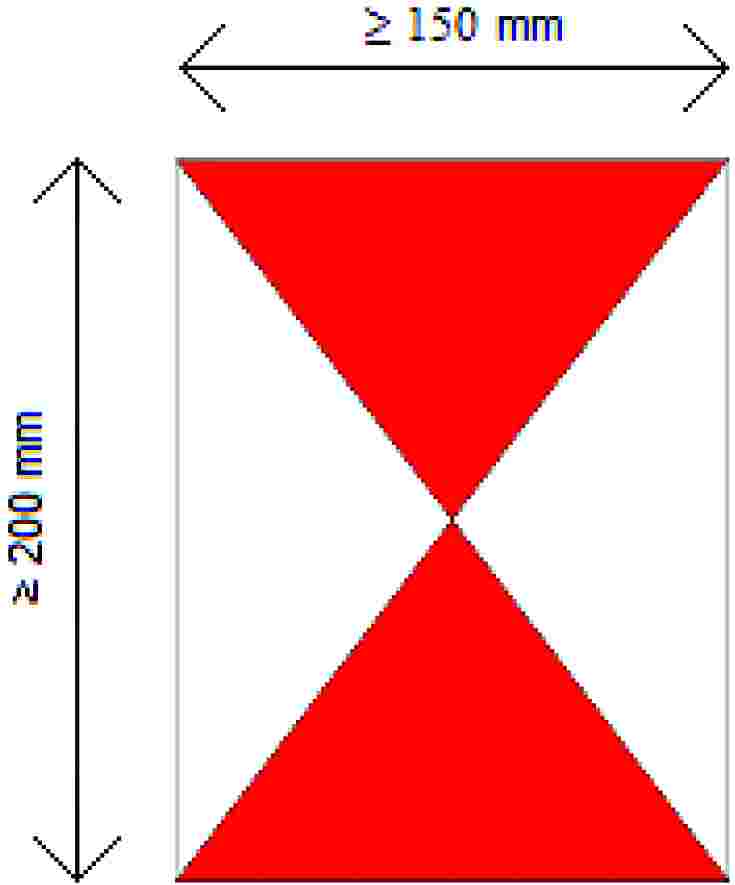
Appendix F
Assessment assigned to the production phases
Table F.1
Assessment assigned to the production phases
|
Characteristics to be assessed, as specified in Section 4.2 |
Design and development phase |
Production phase |
Particular assessment procedure |
||
|
Design review |
Type test |
Routine test |
|||
|
Element of the Rolling Stock sub-system |
Point |
|
|
|
Point |
|
Structure and mechanical part |
4.2.2 |
|
|||
|
End coupling |
4.2.2.1.1 |
X |
n.a. |
n.a. |
— |
|
Inner coupling |
4.2.2.1.2 |
X |
n.a. |
n.a. |
— |
|
Strength of unit |
4.2.2.2 |
X |
X |
n.a. |
6.2.2.1 |
|
Integrity of the unit |
4.2.2.3 |
X |
n.a. |
n.a. |
— |
|
Vehicle track interaction and gauging |
4.2.3 |
|
|||
|
Gauging |
4.2.3.1 |
X |
n.a. |
n.a. |
— |
|
Compatibility with load carrying capacity of lines |
4.2.3.2 |
X |
X |
n.a |
— |
|
Compatibility with train detection systems |
4.2.3.3 |
X |
X |
n.a |
— |
|
Axle bearing condition monitoring |
4.2.3.4 |
X |
X |
n.a. |
— |
|
Safety against derailment running on twisted track |
4.2.3.5.1 |
X |
X |
n.a. |
6.2.2.2 |
|
Running dynamic behaviour |
4.2.3.5.2 |
X |
X |
n.a. |
6.1.2.1/6.2.2.3 |
|
Structural design of bogie frame |
4.2.3.6.1 |
X |
X. |
n.a. |
6.1.2.1 |
|
Characteristics of wheelsets |
4.2.3.6.2 |
X |
X |
X |
6.1.2.2 |
|
Characteristics of wheels |
4.2.3.6.3 |
X |
X |
X |
6.1.2.3 |
|
Characteristics of axles |
4.2.3.6.4 |
X |
X |
X |
6.1.2.4 |
|
Axle boxes/bearings |
4.2.3.6.5 |
X |
X |
X |
6.2.2.4 |
|
Variable gauge wheelsets |
4.2.3.6.6 |
open |
open |
open |
open |
|
Running gear for manual change of wheelsets |
4.2.3.6.7 |
X |
X |
n.a. |
6.2.2.5 |
|
Brake |
4.2.4 |
|
|||
|
Safety requirements |
4.2.4.2 |
X |
n.a |
n.a |
— |
|
Functional and technical requirements |
4.2.4.3 |
X |
X |
n.a |
— |
|
In-service brake |
4.2.4.3.2.1 |
X |
X |
n.a. |
— |
|
Parking brake |
4.2.4.3.2.2 |
X |
n.a |
n.a |
— |
|
Thermal capacity |
4.2.4.3.3 |
X |
X |
n.a |
6.2.2.6 |
|
Wheel slide protection (WSP) |
4.2.4.3.4 |
X |
X |
n.a |
— |
|
Friction elements for wheel tread brakes |
4.2.4.3.5 |
X |
X |
X |
6.1.2.5 |
|
Environmental conditions |
4.2.5 |
|
|||
|
Environmental conditions |
4.2.5 |
X |
n.a. /X (1) |
n.a. |
6.2.2.7 |
|
System protection |
4.2.6 |
|
|||
|
Fire safety |
4.2.6.1 |
X |
X |
n.a |
6.2.2.8 |
|
Protection against electric hazard |
4.2.6.2 |
X |
X |
n.a |
— |
|
Attachment devices for rear-end signal |
4.2.6.3 |
X |
X |
n.a |
— |
|
(1) Type test if and as defined by the applicant. |
|||||
Appendix G
List of fully approved composite brake blocks for international transport
This Appendix is published on the ERA website (http://www.era.europa.eu).
( 1 ) ĠU L 191, 18.7.2008, p. 1.
( 2 ) ĠU L 164, 30.4.2004, p. 1.
( 3 ) ĠU L 319, 4.12.2010, p. 1.
( 4 ) ĠU L 344, 8.12.2006, p. 1.
( 5 ) ĠU L 164, 30.4.2004, p. 44.
( 6 ) OJ L 51, 23.2.2012, p. 1.
( 7 ) OJ L 108, 29.4.2009, p. 4.
( 8 ) The maintenance plan shall take into accounts the findings of the ERA Task force on Freight Maintenance (see “Final report on the activities of the Task Force Freight Wagon Maintenance” published on the ERA website http://www.era.europa.eu).
( 9 ) ĠU L 264, 8.10.2011, p. 32.
( 10 ) Commission Decision 2006/861/EC (OJ L 344, 8.12.2006, p.1) and Commission Decision 2006/861/EC amended by Commission Decision 2009/107/EC (OJ L 45, 14.2.2009, p.1).
( 11 ) OJ L 204, 5.8.2010, p. 1.