 EUROPEAN COMMISSION
Brussels, 3.2.2017
SWD(2017) 43 final
COMMISSION STAFF WORKING DOCUMENT
The EU Environmental Implementation Review
Country Report - FINLAND
Accompanying the document
Communication from the Commission to the European Parliament, the Council, the European Economic and Social Committee and the Committee of the Regions
The EU Environmental Implementation Review: Common Challenges and how to combine efforts to deliver better results
{COM(2017) 63 final}
{SWD(2017) 33 - 42 final}
{SWD(2017) 44 - 60 final}
This report has been written by the staff of the Directorate-General for Environment, European Commission. Any comments are welcome to the following e-mail address:
ENV-EIR@ec.europa.eu
More information on the European Union is available on the internet (
http://europa.eu
).
Photographs: p.9 – ©LIFE04 ENV/FIN/000299, p.12 – ©anzeletti/iStock, p.18 – ©Oleksiy Mark/iStock, p.23 – ©Arpad Benedek/iStock
For reproduction or use of these photos, permission must be sought directly from the copyright holder.
©European Union, 2017
Reproduction is authorised provided the source is acknowledged.
Table of Contents
Executive summary
Part I: Thematic Areas
1.Turning the EU into a circular, resource-efficient, green and competitive low-carbon economy
Developing a circular economy and improving resource efficiency
Waste management
2.Protecting, conserving and enhancing natural capital
Nature and Biodiversity
Estimating natural capital
Green Infrastructure
Soil protection
Marine protection
3.Ensuring citizens' health and quality of life
Air quality
Noise
Water quality and management
Enhancing the sustainability of cities
International agreements
Part II: Enabling Framework: Implementation Tools
4.Market based instruments and investment
Green taxation and environmentally harmful subsidies
Green Public Procurement
Investments: the contribution of EU funds
5.Effective governance and knowledge
Effective governance within central, regional and local government
Compliance assurance
Public participation and access to justice
Access to information, knowledge and evidence
Executive summary
About the Environmental Implementation Review
In May 2016, the Commission launched the Environmental Implementation Review (EIR), a two-year cycle of analysis, dialogue and collaboration to improve the implementation of existing EU environmental policy and legislation
. As a first step, the Commission drafted 28 reports describing the main challenges and opportunities on environmental implementation for each Member State. These reports are meant to stimulate a positive debate both on shared environmental challenges for the EU, as well as on the most effective ways to address the key implementation gaps. The reports rely on the detailed sectoral implementation reports collected or issued by the Commission under specific environmental legislation as well as the 2015 State of the Environment Report and other reports by the European Environment Agency. These reports will not replace the specific instruments to ensure compliance with the EU legal obligations.
The reports will broadly follow the outline of the 7th Environmental Action Programme
and refer to the 2030 Agenda for Sustainable development and related Sustainable Development Goals (SDGs)
to the extent to which they reflect the existing obligations and policy objectives of EU environmental law
.
The main challenges have been selected by taking into account factors such as the importance or the gravity of the environmental implementation issue in the light of the impact on the quality of life of the citizens, the distance to target, and financial implications.
The reports accompany the Communication "The EU Environmental Implementation Review 2016: Common challenges and how to combine efforts to deliver better results", which identifies challenges that are common to several Member States, provides preliminary conclusions on possible root causes of implementation gaps and proposes joint actions to deliver better results. It also groups in its Annex the actions proposed in each country report to improve implementation at national level.
General profile
Finland is rich in surface waters with many lakes, ponds and rivers, making their protection from impacts of agriculture key. Forests cover about 78% of Finland's land area. Since Finland has based its industrial economy on abundant forest resources, sustainable management of these resources is crucial for its economic development. The responsibility for environmental issues in Finland lies both with the state and the regions, including municipalities; hence, effective co-ordination is needed within a system of multi-level governance.
Main Challenges
The two main challenges with regard to implementation of EU environmental policy and law in Finland are:
Improve air quality (NO2) around Helsinki.
Reduce diffuse pollution from agriculture causing deteriorated water quality.
Main Opportunities
Finland has opportunities to perform better in areas where there is already a good knowledge base and good practices. This applies in particular to:
Activities on the circular economy which could increase Finland's resource productivity.
A reduction in high levels of incineration by favouring recycling of municipal waste.
Points of Excellence
Where Finland is a leader on environmental implementation, innovative approaches could be shared more widely with other countries. Good examples are:
The recently started large scale LIFE Integrated Project "FRESHABIT" is an important demonstration project on how to engage different sectors in the implementation of the Water Framework Directive and the Nature Directives; the results of this study could be widely applied in future.
Finland is especially advanced in the process for the designation of protected Natura 2000 sites as Special Areas of Conservation (SACs), which sets the basis for a successful management of such sites.
Part I: Thematic Areas
1.Turning the EU into a circular, resource-efficient, green and competitive low-carbon economy
Developing a circular economy and improving resource efficiency
The 2015 Circular Economy Package emphasizes the need to move towards a lifecycle-driven ‘circular’ economy, with a cascading use of resources and residual waste that is close to zero. This can be facilitated by the development of, and access to, innovative financial instruments and funding for eco-innovation.
SDG 8 invites countries to promote sustained, inclusive and sustainable economic growth, full and productive employment and decent work for all. SDG 9 highlights the need to build resilient infrastructure, promote inclusive and sustainable industrialization and foster innovation. SDG 12 encourages countries to achieve the sustainable management and efficient use of natural resources by 2030.
Measures towards a circular economy
Transforming our economies from linear to circular offers an opportunity to reinvent them and make them more sustainable and competitive. This will stimulate investments and bring both short and long-term benefits for the economy, environment and citizens alike
.
In the longer term, the themes of cleantech, bioeconomy and digitalisation can help improve Finland's resource productivity
and progress towards a more circular economy and better resource efficiency, which will stimulate investments and have short-term and long-term benefits for the economy, environment and employment.
Finland had a resource productivity (how efficiently the economy uses material resources to produce wealth) of 1.12 EUR/kg below EU average, which is 2) in 2015. As shown in Figure 1, Finland's resource productivity has not significantly increased since 2003.
|
Figure 1: Resource productivity 2003-15
|
|

|
The bioeconomy and clean solutions have been established as key high-level policy priorities in the Strategic Programme of the Finnish Government from 2016 onwards, and related national and regional initiatives are manifold. Both start-ups and established companies generate technologies, products and services in several sectors relevant to eco-innovations and the circular economy.
One of the most important high-level steps towards a circular economy in the country has been the inclusion of circular economy as a key policy priority in the abovementioned Strategic Programme. The Finnish Government has allocated EUR 300 million extra funding to strategic development and investments on bioeconomy, circular economy and cleantech for the years 2016-2018. In addition to public funding, this choice signals broad political support for making the economy and industry more circular in the longer term.
The Finnish Ministry of Employment and the Economy also published the Strategy to Promote Cleantech Business in Finland in 2014, which continues to guide policymaking and business initiatives. Additional strategies and programmes relevant to eco-innovations and the circular economy include the Finnish Bioeconomy Strategy (2014), the Finnish Material Efficiency Programme (2014), the national Roadmap for Circular Economy (2016) and the new Circular Economy focus area (2016) in Sitra, the Finnish Innovation Fund.
Besides Finland's own activities and initiatives, as a key priority, a strong platform for green growth has emerged between the Nordic countries through the Nordic Council and the Nordic Council of Ministers – Green Growth the Nordic Way.
Cleantech remains one of Finland’s fastest growing business sectors. It employs around 50,000 people, and 40,000 new jobs are expected by 2020. The government also aims to raise the turnover of Finnish cleantech companies to EUR 50 billion by 2020. Importantly, Finnish cleantech start-ups received around EUR 50 million or 20% of all foreign and domestic equity investments in Finnish start-ups in 2015.
Environmental taxation is one of the more important parts of the related policy landscape. In 2014, Finland’s revenue from environmental taxation, 2.9% of gross domestic product, was above the EU average of 2.5%. The share of environmental taxes in tax revenues has also gradually increased, while the composition has changed: taxes on carbon dioxide from heating, power plants and machinery as well as the waste tax have all been gradually increased.
Finland has set up a Smart Procurement programme for 2013–2016 with the focus on creating smart demand, which will provide the prerequisites for new market creation and growth.
Ministries together with Motiva Ltd (state-owned expert company in energy and material efficiency) have launched several initiatives to boost resource efficiency and circular economy.
For example, Motiva Ltd provides material efficiency auditing services for companies. The Government funds the auditing programme and companies may receive economic incentives for audits.
At national level, Motiva Ltd coordinates the Finnish Industrial Symbiosis System (FISS) network, which aims at collecting information on resources, matchmaking actors and driving forward resource synergies. FISS for example runs a database to identify possible synergies between industries regarding resource use, and collects information on the impact of industrial collaboration on environment and economy.
There are also two platforms (Fisu and Hinku), which both aim at creating solutions that have economic and social benefits as well as environmental advantages. Both networks bring around 40 municipalities, businesses, citizens and experts together to create and carry out solutions to improve resource-efficiency and reduce greenhouse gas emissions.
SMEs and resource efficiency
In the Flash 426 Eurobarometer "SMEs, resource efficiency and green markets" it is shown that 61% of Finland's SMEs have invested up to 5% of their annual turnover in their resource efficiency actions (EU28 average 50%), 36% of them are currently offering green products and services (EU28 average 26%), 63% took measures to save energy (EU28 average 59%), 64% to minimise waste (EU28 average 60%), 36% to save water (EU28 average 44%), and 71% to save materials (EU28 average 54%). From a circular economy perspective, 35% took measures to recycle by reusing material or waste within the company (EU28 average 40%), 30% to design products that are easier to maintain, repair or reuse (EU28 average 22%) and 25% were able to sell their scrap material to another company (EU28 average 25%).
According to the Flash 426 Eurobarometer, the resource efficiency actions undertaken allowed the reduction of production costs in a 54% of the Finland's SMEs (EU28 average 45%).
The number of SMEs in the non-financial business economy is in line with the EU average. Nearly all businesses are SMEs, providing two out of three jobs and 60% of total value added. SME productivity, measured as value added per head, is well above the EU average.
The Flash 426 Eurobarometer "SMEs, resource efficiency and green markets" shows that 50% of the SMEs in Finland have one or more full time employee working in a green job at least some of the time (EU28 average 35%). Finland has an average number of 1.7 full time green employees per SME, the same as the EU28 average)
.
Eco-innovation
Finland continues to demonstrate high performance in terms of eco-innovation. As in 2013, Finland is again ranked second in the EU28 Eco-innovation Index in 2015, with an overall score that exceeds the EU average by 40% as shown in Figure 2.
In 2014, Finland was fourth in the ranking. National experts agree with the depiction in the index of particularly high eco-innovation performance. Similarly, as in the overall score, Finland’s track record in terms of different Eco-IS components has been largely consistent since 2011, with particular strengths and weaknesses.
The 2014 Research and Innovation Country Report for Finland by the European Commission provides insights into the general barriers and drivers to eco-innovation in the country. As mentioned, one of the key challenges relates to the economic environment. The recession and the problems in the ICT sector have led among other things to a steep decline in both public and private research and development investments. Government R&D funding decreased by 13% in real terms between 2010 and 2014, and gross domestic expenditures for R&D declined sharply. Another high-level challenge for the Finnish innovation system is its low level of internationalisation, as well as a relatively fragmented university system.
|
Figure 2: Eco-Innovation Index 2015 (EU=100)
|
|

|
Despite the problems, Finland still outperforms its peers when it comes to highly skilled human resources, public and business investments in R&D and patent applications. The main high-level driver of eco-innovation stems from the fact that Finland still ranks among the world’s best in R&D intensity, and performs well in terms of scientific and technological excellence: the Information Technology and Innovation Foundation (ITIF) ranked Finland first in how its policies contribute to global innovation system.
More specifically to eco-innovation, Finland has several hot-spot clusters in technological areas such as materials, energy, and agriculture. Finland also ranked second in the 2014 Cleantech Innovation ranking by WWF, which compared countries based on their conditions for establishing clean technology start-ups and facilitating the development of environmental technologies. According to a report from the Finnish Environmental Institute, while there is substantial and increasing demand for eco-innovations, it is often difficult for Finnish companies to access international markets. In particular, start-ups and SMEs face problems in commercialising their new products and services internationally. Networks are missing or limited, and financing might not always readily available. As for the customers, the long-term benefits from eco-friendly products may be difficult to recognise, meaning that customers are not committed to pay an additional margin for environmentally friendly products. In general, the payback period for eco-innovations is long, and returns on investment uncertain.
The Finnish Innovation Fund (Sitra) 2015 report
‘The opportunities of a circular economy for Finland’ discusses the economic potential of the circular economy for the country, also mapping out tangible business opportunities. Sitra estimates that circular economy represents an opportunity worth around EUR 1.5-2.5 billion for Finland. Some companies will benefit indirectly from efficient use of material flows while others will be able to sell products and services based on new business models that take advantage of the circular economy. The key sector-specific opportunities discussed in the Sitra report concern paper industry side streams; the opportunities in the food industry to reduce loss of value; business potential of private consumption; and opportunities in construction and manufacture of machinery.
The forestry-wood value chain in Finland has two key areas of interest for the circular economy: recovery of paper fibre for reuse accounts for a major share of total material flow, and most wood waste in Finland ends up as an energy source. From the circular economy perspective, the best opportunities lie in improving the circulation of paper fibres and the use of side streams.
The food value chain, from agriculture to retail and restaurant services, also includes two factors crucial to circular economy: how well the original raw material is used, and the way in which nutrients are reintroduced into the nutrient cycle. Potential high-level actions include the minimisation of food waste generated by households and hospitality services, as well as capturing the maximal value of inedible food waste instead of incinerating it. Finland’s food chain is indeed ideally placed to foster the circular economy at the local level.
Sitra also discusses three dimensions of household consumption that are of interest from the perspective of the circular economy: the opportunities stemming from the sharing economy, second-hand markets and the recycling of household waste. As for the latter, a major part of material flows in Finland and elsewhere is due to private consumption, and post-consumer waste is generally sent to landfills unsorted. According to the Minister of the Environment, recycling in Finland could be increased, especially in packaging waste and biowaste. Additional EU measures would also help to speed up progress at the national level.
In addition to Sitra’s detailed report, the circular economy was also selected as one of the key projects of Prime Minister Juha Sipilä’s 2015 government programme, with a planned public investment of EUR 40 million. Related initiatives, also supported by Sitra, include trial projects that aim to facilitate the building of concrete business models as well as the sharing of best practices in the country. The functioning and feasibility tests of different business models are currently underway in the textile industry, nutrient cycling, cities, and technology and export companies.
Together with new actions from the EU, the funding environment and the government’s preparedness to support circular economy in Finland indeed seem promising.
As implied earlier, resource efficiency in general is another challenge for Finland, especially due to the high number of resource-intensive industries in the economy. Several measures to improve resource efficiency have been outlined at the national level, for instance in the working group proposal for a National material efficiency program, prepared in collaboration with the Ministry of Employment and Economy and the Ministry of the Environment
Finland has four EMAS registered organisations, which can be compared with EU total registrations of 4,034. It has not seen any changes since October 2015. However, the coverage of these registrations is broad, as they include UPM Kymmene Corporation with its 19 sites in Europe, China and Uruguay. Organizations operating outside Europe can be registered to EMAS in Finland since 2012.
Concerning the EU Ecolabel, Finland has 14 licenses, compared to the 1,875 total number of licenses in the EU.
Waste management
Turning waste into a resource requires:
Full implementation of Union waste legislation, which includes the waste hierarchy; the need to ensure separate collection of waste; the landfill diversion targets etc.
Reducing per capita waste generation and waste generation in absolute terms.
Limiting energy recovery to non-recyclable materials and phasing out landfilling of recyclable or recoverable waste.
SDG 12 invites countries to substantially reduce waste generation through prevention, reduction, recycling and reuse, by 2030.
The EU's approach to waste management is based on the "waste hierarchy" which sets out an order of priority when shaping waste policy and managing waste at the operational level: prevention, preparing for reuse, recycling, recovery and, as the least preferred option, disposal (which includes landfilling and incineration without energy recovery). The progress towards reaching recycling targets and the adoption of adequate WMP/WPP
should be the key items to measure the performance of Member States. This section focuses on management of municipal waste for which EU law sets mandatory recycling targets.
The amount of municipal waste
generated in Finland remains above the EU average (475 kg/y/inhabitant in 2014) but it has decreased from 493 kg/y/inhabitant in 2013 to 482 kg/y/inhabitant in 2014
.
Figure 3 depicts the municipal waste by treatment in Finland in terms of kg per capita, which shows an increase of incineration and a decrease in landfilling.
|
Figure 3: Municipal waste by treatment in Finland 2007-14
|
|

|
Landfilling is relatively low (17%) and below the EU average (28%). Finland has complied with both the 2006 and the 2009 landfill diversion targets. Finland also already fulfilled the 35% requirement for the year 2016 in 2014.
Recycling of municipal waste accounts for 33% (composting accounts for 15%), below the EU average (44%) as shown in Figure 4.
|
Figure 4: Recycling rate of municipal waste 2007-14
|
|

|
The recycling rate decreased after 2011 and remained stable between 2013 and 2014, below the targets set out in the EU Waste Framework Directive for the recycling of municipal waste of 50% by 2020
(see Figure 4). Like in the previous couple of years, incineration remains the main waste management method and its share continued to increase (42% in 2013, 50% in 2014).
 While the possibility of imposing a tax on waste incineration has been studied several times in Finland, the last time in 2014, the studies have not resulted in such a tax. However, issues such as taking into account the need to treat equally incineration and co-incineration of waste, the relationship to the EU Emissions Trading System (ETS) and the impacts on exports of municipal waste for incineration to neighbouring EU countries have not been covered.
The national waste management plan, including the Waste Prevention Programme, sets a 30% recycling target, 6% composting at source, 14% composting an anaerobic digestion, 30% energy recovery and 20% landfilling by 2016. The National Waste Management Plan 2008-2016 is currently being reviewed. A new landfill ban on placing organic waste at landfills came into force in 2016.
According to a recent study, full implementation of the existing legislation could create more than 4,800 jobs in Finland and increase the annual turnover of the waste sector by over EUR 514 million. Moving towards the targets of the Roadmap on resource efficiency which outlines how we can transform Europe's economy into a sustainable one by 2050 could create over 6,500 additional jobs and increase the annual turnover of the waste sector by over EUR 690 million
.
Suggested action
Introduce new policies, including economic instruments or producer responsibility schemes, to promote prevention, make reuse and recycling more economically attractive.
Shift reusable and recyclable waste away from incineration, e.g. by introducing an incineration tax.
2.Protecting, conserving and enhancing natural capital
Nature and Biodiversity
The EU Biodiversity Strategy aims to halt the loss of biodiversity in the EU by 2020, restore ecosystems and their services in so far as feasible, and step up efforts to avert global biodiversity loss. The EU Birds and Habitats Directives aim at achieving favourable conservation status of protected species and habitats.
SDG 14 requires countries to conserve and sustainably use the oceans, seas and marine resources, while SDG 15 requires countries to protect, restore and promote the sustainable use of terrestrial ecosystems, sustainably manage forests, combat desertification, and halt and reverse land degradation and halt biodiversity loss.
The 1992 EU Habitats Directive and the 1979 Birds Directive are the cornerstone of the European legislation aimed at the conservation of the EU's wildlife. Natura 2000, the largest coordinated network of protected areas in the world, is the key instrument to achieve and implement the Directives' objectives to ensure the long-term protection, conservation and survival of Europe's most valuable and threatened species and habitats and the ecosystems they underpin.
The adequate designation of protected sites as Special Ares of Conservation (SAC) under the Habitats Directive and as Special Protection Areas (SPA) under the Birds Directive is a key milestone towards meeting the objectives of the Directives. The results of Habitats Directive Article 17 and Birds Directive Article 12 reports and the progress towards adequate Sites of Community Importance (SCI)-SPA and SAC designation
both in land and at sea, should be the key items to measure the performance of Member States.
As of early 2016, 12.7% of the Finnish national territory is covered by Natura 2000 (EU average 18.1%), with Birds Directive SPAs covering 7.9% (EU average 12.3%) and Habitats Directive SCIs covering 12.5% (EU average 13.8%). There are altogether 1,865 Natura 2000 sites in Finland.
Based on an assessment of the sufficiency of the SCI network
for Annex II species and Annex I habitats occurring in Finland, the Natura 2000 network in Finland is considered complete in the Alpine region and almost complete in the Boreal and Marine Baltic region. However, there are insufficiencies in designation for the marine components of the SCIs network, as shown in Figure 5.
|
Figure 5: Sufficiency assessment of SCI networks in Finland based on the situation until December 2013 (%)
|
|

|
The process for the designation of the sites as special areas of conservation (SAC) is almost complete.
Finland has developed a new planning and monitoring system for its protected areas which includes a specific periodic assessment of the status of the habitats and species of the Natura 2000 sites. Management plans are linked to this system. Most of Natura 2000 sites are managed by one state owned organisation, Metsähallitus, which develops the use of state-owned land and waters.
The number of nature-related complaints and infringements is not very high in Finland. Most complaints and infringement cases relate to the derogations under Article 9 (Birds Directive) and 16 (Habitats Directive). Management of the wolf population is the main topic in complaints.
The Finnish report under Article 17 Habitats Directive
shows that 34% of habitat assessments indicate favourable status
(for comparison, 16% at EU27-level) and 39% are considered to be Unfavourable –Inadequate (EU27: 47%) and 26% are Unfavourable – Bad (EU27 is 30%) as depicted in Figure 6
. Agricultural activities are most frequently reported pressures of high importance for habitat types. Concerning species assessments (other than birds) 46% are at favourable status (EU27: 23%), 35% at unfavourable-inadequate (EU27: 42% and 11% unfavourable-bad status (EU27: 18%).
|
Figure 6: Conservation status of habitats and species in Finland in 2007/2013 (%)
|
|

|
The results from the Article 12 report under Birds Directive
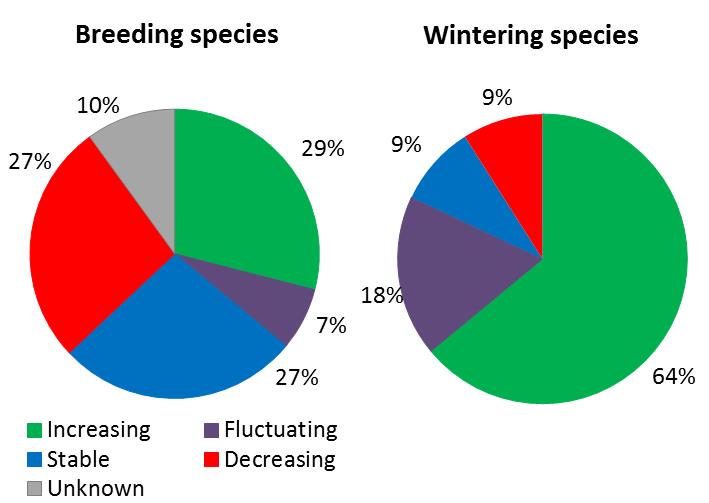
show that short-term trends of breeding birds are improving for 29% of the species and stable and decreasing for 27% of species, as depicted in Figure 7. The same categories for long-term trends are 38%, 16% and 34%. Since the 1950s, Europe’s farmland bird populations have decreased by one half. This has also happened in Finland.
|
Figure 7: Short-term population trend of breeding and wintering bird species in Finland in 2012 (%)
|
|
|
There is a good knowledge of species present on Finnish territory. Of the 45,000 species living in Finland, it has been possible to evaluate the threat status for over 21,000 species. The conclusion is that one in ten of all evaluated species in Finland is endangered.
The latest Red List of Birds (2015)
indicates that out of 245 bird species, 36% are Threatened, 9% are Nearly Threatened and 55% are Least Concern. Targeted conservation actions are bringing results, as shown by increasing populations of Golden Eagle, White-tailed Sea Eagle, White-backed Woodpecker and Peregrine Falcon. On the other hand, concerns have been raised recently on the decline of common forest birds in managed forests in Southern Finland. Red list assessment of mammals (2015) shows that Arctic fox is critically endangered and the Saimaa ringed seal, Wolverine, Wolf and Natterer's Bat are Endangered. However, the Mountain hare and Otter are no longer Threatened. For birds the most important threats are changes in breeding areas, along migration routes and in wintering areas. For mammals the main threats are hunting (including illegal killing), climate change and random factors linked to small populations.
Finland is implementing a large scale LIFE Integrated Project "FRESHABIT" (20 million Euro) aiming to develop new methodology and indicators for assessing the conservation status of freshwater habitats, to improve the ecological status, management and sustainable use of freshwater Natura 2000 sites, by tackling the problems the sites face at water catchment level. This is an important demonstration project on how to engage different sectors in the implementation of the Water Framework Directive and the Nature Directives.
 Some 78% of Finland's surface is forest land. However, only about 9% of the forest area is strictly protected from any forestry measures and most of the protected areas are in northern Finland. The country has currently an ambitious bioeconomy target which foresees also increasing use of timber.
Suggested action
Complete the Natura 2000 designation process for marine sites and ensure that the necessary conservation measures for the sites maintain/restore species and habitats of community interest to a favourable conservation status across their natural range.
Estimating natural capital
The EU Biodiversity Strategy to 2020 calls on the Member States to map and asses the state of ecosystems and their services in their national territory by 2014, assess the economic value of such services, and promote the integration of these values into accounting and reporting systems at EU and national level by 2020.
In Finland some work has been carried out on indicators consistent with the framework developed by the MAES (Mapping and Assessment of Ecosystems and their Services) initiative. The focus is mainly on biophysical accounts. The 2015 Study on The Economics of Ecosystem Services for Finland (TEEB Finland) provided an overview of the most relevant ecosystem services
and the main drivers and future trends affecting their provision; suggestions for developing indicators on the value of ecosystem services; a spatial case study (including a view on Green infrastructure); policy and governance issues and other guiding tools; a scoping assessment on natural capital accounting; and a review on the relationship of ecosystem services and green economy.
Suggested action
Continue support for the mapping and assessment of ecosystems and their services, and valuation work and develop natural capital accounting systems.
Green Infrastructure
The EU strategy on green infrastructure
promotes the incorporation of green infrastructure into related plans and programmes to help overcome fragmentation of habitats and preserve or restore ecological connectivity, enhance ecosystem resilience and thereby ensure the continued provision of ecosystem services.
Green Infrastructure provides ecological, economic and social benefits through natural solutions. It helps to understand the value of the benefits that nature provides to human society and to mobilise investments to sustain and enhance them.
Under the Forest Biodiversity Programme for Southern Finland (METSO), Metsähallitus has restored forests and mires in protected areas - nearly 17,400 hectares between 2008 and 2015 and more than 26,000 hectares before 2008. The restored area covers approximately 0.1% of Finland’s surface area.
Metsähallitus has a special legal obligation to protect biological diversity on state lands. Besides wood supply, ecological values in commercially managed forests are secured with environmental management standards. Valuable habitats are excluded from commercial forestry and are linked by ecological corridors and stepping stones. The ecological network includes various buffer zones such as environmentally valuable forests and biodiversity enhancement areas. Recreational and landscape sites also support the green infrastructure.
The Finnish Environment Institute ran a project called 'Green infra'
, exploring the dependence of ecosystem services and biodiversity on the green infrastructure. Green infra had objectives to assess how national policies, including legislation, can be developed to protect and enhance green infrastructure and also to develop a new GIS-based tool to guide decision making on land use and green infrastructure. The GIS-based tool aims to identify the key areas for Green Infrastructure by comprehensively assessing the prerequisites for provision of a multitude of ecosystem services.
TEEB Finland is building on the TEEB Nordic scoping assessment and it will be implemented in close co-operation with a number of on-going national projects, e.g. developing national ecosystem service indicators (FESSI) and Green Infrastructure.
Soil protection
The EU Soil Thematic Strategy highlights the need to ensure a sustainable use of soils. This requires the prevention of further soil degradation and the preservation of its functions, as well as the restoration of degraded soils. The 2011 Road Map for Resource-Efficient Europe, part of Europe 2020 Strategy provides that by 2020, EU policies take into account their direct and indirect impact on land use in the EU and globally, and the rate of land take is on track with an aim to achieve no net land take by 2050.
SDG 15 requires countries to combat desertification, restore degraded land and soil, including land affected by desertification, drought and floods, and strive to achieve a land-degradation-neutral world by 2030.
Soil is an important resource for life and the economy. It provides key ecosystem services including the provision of food, fibre and biomass for renewable energy, carbon sequestration, water purification and flood regulation, the provision of raw and building material. Soil is a finite and extremely fragile resource. Land taken by urban development and infrastructure is highly unlikely to be reverted to its natural state; it consumes mostly agricultural land and increases fragmentation of habitats. Soil protection is not subject to a comprehensive and coherent set of rules in the EU. Existing EU policies in areas such as agriculture, water, waste, chemicals, and prevention of industrial pollution however contribute to the protection of soils but the continuous degradation of soil suggests that it is insufficiently protected.
Artificial land cover is used for settlements, production systems and infrastructure. It may itself be split between built-up areas (buildings) and non-built-up areas (such as linear transport networks and associated areas).
The annual land take rate (growth of artificial areas) as provided by CORINE Land Cover was 0.41% in Finland over the period 2006-12, equal to the EU average (0.41%). It represented 1851 hectares per year
and was mainly driven by housing, services and recreation.
The annual land take rate (growth of artificial areas) was 1.96% over the period 2000-06, below the EU average (2.90%). It represented 1,544 hectares per year and was mainly driven by housing, services and recreation .The percentage of built up land in 2009 was 0.59%, well below the EU average (3.23%)
.
In Finland, the soil water erosion rate in 2010 was 0.06 tonnes per ha per year, well below EU28 average (2.46 tonnes)
.
There are still not EU-wide datasets enabling the provision of benchmark indicators for soil organic matter decline, contaminated sites, pressures on soil biology and diffuse pollution.
An updated inventory and assessment of soil protection policy instruments in Finland and other EU Member States is being performed by the EU Expert Group on Soil Protection.
Figure 8 shows the different land cover types in Finland in 2012.
|
Figure 8: Land Cover types in Finland 2012
|
|

|
Marine protection
The EU Coastal and Marine Policy and legislation require that by 2020 the impact of pressures on marine waters is reduced to achieve or maintain good environmental status and coastal zones are managed sustainably.
SDG 14 requires countries to conserve and sustainably use the oceans, seas and marine resources for sustainable development.
The Marine Strategy Framework Directive (MSFD)
aims to achieve Good Environmental Status (GES) of the EU's marine waters by 2020 by providing an ecosystem approach to the management of human activities with impact on the marine environment. The Directive requires Member States to develop and implement a marine strategy for their marine waters, and cooperate with Member States sharing the same marine region or subregion.
As part of their marine strategies, Member States had to make an initial assessment of their marine waters, determine GES
and establish environmental targets by July 2012. They also had to establish monitoring programmes for the on-going assessment of their marine waters by July 2014. The next element of their marine strategy is to establish a Programme of Measures (2016).
Finnish marine protected areas covered 8,153.3 square kilometers of its marine water in the Baltic Sea
.
In its implementation of the Marine Strategy Framework Directive, Finland addresses GES for all descriptors. It has generally used existing EU requirements and standards and places a strong emphasis on standards and assessments developed in the region though the Regional Sea Convention for the Baltic Sea, HELCOM. However, the GES definition is generally qualitative and therefore not yet defined in a way which is measurable
.
It is therefore too early to say whether Finnish marine waters are in good status as there were weaknesses in identifying what GES is in the first place.
Finland established a monitoring programme of its marine waters in 2014. The monitoring programme is well-developed and adequate in many areas
.
Suggested action
Continue work to improve the definitions of GES in particular for biodiversity descriptors, including through regional cooperation by using the work of the relevant Regional Sea Convention.
Identify and address knowledge gaps.
Continue to integrate existing monitoring programmes required under other EU legislation and to implement joint monitoring programmes developed at (sub)regional level, for instance by HELCOM.
Continue to enhance comparability and consistency of monitoring methods within the country's marine region.
Ensure that the monitoring programme is fully appropriate to monitor progress towards GES.
3.Ensuring citizens' health and quality of life
Air quality
The EU Clean Air Policy and legislation require that air quality in the Union is significantly improved, moving closer to the WHO recommended levels. Air pollution and its impacts on ecosystems and biodiversity should be further reduced with the long-term aim of not exceeding critical loads and levels. This requires strengthening efforts to reach full compliance with Union air quality legislation and defining strategic targets and actions beyond 2020.
|
Figure 9: Attainment situation for PM10, NO2 and O3 in 2014 in Finland
|
|

|
The EU has developed a comprehensive suite of air quality legislation
, which establishes health-based standards and objectives for a number of air pollutants. As part of this, Member States are also required to ensure that up-to-date information on ambient concentrations of different air pollutants is routinely made available to the public. In addition, the National Emission Ceilings Directive provides for emission reductions at national level that should be achieved for main pollutants.
The emission of several air pollutants has decreased significantly in Finland
. Reductions between 1990 and 2014 for sulphur oxides (83%), nitrogen oxides (-52%), as well as volatile organic compounds (-70%) ensure air emissions for these pollutants are within the currently applicable national emission ceilings
. Conversely, for ammonia only modest emission reductions have been recorded (-2%), and emissions for this pollutant are still 15% above current ceilings.
At the same time, air quality in Finland continues to give cause for concern. For the year 2013, the European Environment Agency
estimated that about 1 730 premature deaths were attributable to fine particulate matter concentrations
, and 80 to ozone concentrations
. Although concentrations above EU air quality standards such as shown in Figure 9
are rare, significant health risks still exist.
For 2014, exceedances above the EU air quality standards have been registered related to annual mean concentration of nitrogen dioxide (NO2)
in one air quality zone (Helsinki
, which was covered by a time extension and will only need to show compliance from 2015 onwards). Furthermore, target values for annual mean concentrations have been exceeded for arsenic and for benzo(a)pyrene in at least one air quality zone
. Exceedances on target values for cadmium and nickel may also occur in some years.
It is estimated that the health-related external costs from air pollution in Finland are above EUR 2 billion/year (income adjusted, 2010), which include not only the intrinsic value of living a full health life but also direct costs to the economy. These direct economic costs relate to 542 thousand workdays lost each year due to sickness related to air pollution, with associated costs for employers of EUR 74 million/year (income adjusted, 2010), for healthcare of above EUR 8 million/year (income adjusted, 2010), and for agriculture (crop losses) of EUR 29 million/year (2010)
.
Suggested action
Maintain downward emissions trends of air pollutants in order to achieve full compliance with currently applicable national emission ceilings and air quality limit values - and reduce adverse air pollution impacts on health, environment and economy.
Reduce ammonia (NH3) emissions to comply with currently applicable national emission ceilings, for example by introducing or expanding the use of low-emission agricultural techniques.
Reduce nitrogen oxide (NOx) emissions to comply with currently applicable national emission ceilings
and/or to reduce nitrogen dioxide (NO2) (and ozone concentrations), inter alia, by reducing transport related emissions - in particular in urban areas, especially Helsinki.
Noise
The Environmental Noise Directive provides for a common approach for the avoidance, prevention and reduction of harmful effects due to exposure to environmental noise.
Excessive noise is one of the main causes of health issues
. To alleviate this, the EU acquis sets out several requirements, including assessing the exposure to environmental noise through noise mapping, ensuring that information on environmental noise and its effects is made available to the public, and adopting action plans with a view to preventing and reducing environmental noise where necessary and to preserving the acoustic environment quality where it is good.
Finnish authorities have fulfilled all their obligations with regards to the Environmental Noise Directive
for the current reporting period.
Water quality and management
The EU water policy and legislation require that the impact of pressures on transitional, coastal and fresh waters (including surface and ground waters) is significantly reduced to achieve, maintain or enhance good status of water bodies, as defined by the Water Framework Directive; that citizens throughout the Union benefit from high standards for safe drinking and bathing water; and that the nutrient cycle (nitrogen and phosphorus) is managed in a more sustainable and resource-efficient way.
SDG 6 encourages countries to ensure availability and sustainable management of water and sanitation for all.
The main overall objective of EU water policy and legislation is to ensure access to good quality water in sufficient quantity for all Europeans. The EU water acquis
seeks to ensure good status of all water bodies across Europe by addressing pollution sources (from e.g. agriculture, urban areas and industrial activities), physical and hydrological modifications to water bodies) and the management of risks of flooding.
River Basin Management Plans (RBMPs) are a requirement of the Water Framework Directive and a means of achieving the protection, improvement and sustainable use of the water environment across Europe. This includes surface freshwaters such as lakes and rivers, groundwater, estuaries and coastal waters up to one nautical mile.
Finland has provided information to the Commission from its second generation of RBMPs. However, as the Commission has not yet been able to validate this information for all Member States, it is not reported here.
In its first generation of RBMPs Finland reported the status of 1,602 rivers, 4,275 lakes, 276 coastal and 3,804 groundwater bodies. The areal coverage of the water bodies is 85% of all Finnish lakes, about 90% of rivers and 100% of coastal waters. 30% of natural surface water bodies achieve a good or high ecological status ecological status
(while the status of 53% is unknown) and 35% of heavily modified or artificial water bodies
achieve a good or high ecological potential. 63% of surface water bodies (37% unknown), 90% of heavily modified and artificial water bodies and 92% of groundwater bodies achieve good chemical status
. 98% of groundwater bodies are in good quantitative status
.
The main pressure on Finnish waters is diffuse pollution
that affects 20% of surface water bodies. Point sources of pollution and water flow regulation or morphological alteration affect smaller proportion of water bodies – 5% and 3% respectively. There are significant regional differences, e.g. in the Kokemäenjoki river basin district in the South West of the country 48% of water bodies are affected by diffuse sources of pollution, 18% by point sources and 8% by hydromorphological changes.
There are deficiencies in the Finnish River Basin Management Plans related to the unknown status of large portions of water bodies. Programmes of Measures are expected to result in improved ecological status of natural surface water bodies by 6% and ecological potential of artificial or heavily modified water bodies by 9%, and almost no improvement in the chemical status of water bodies. A high number of exemptions have been applied.
Finland has recently revised its action programme implementing the Nitrates Directive. The action programme is applying to the whole national territory. Data concerning the 2008-2011 period showed that nitrate concentrations in groundwater and surface waters did not raise particular concern. However Finland is one of the countries bordering the Baltic Sea, which is heavily affected by nutrients pollution. HELCOM estimation of normalized inputs of nitrogen shows, for instance, that Finland increased its nitrogen inputs to the Bothnian Bay
. There are also some concerns on the fertilization in forest ecosystems, which might contribute to nutrient leaching in the Baltic Sea.
As regards drinking water, Finland reaches very high compliance rates of 99-100% for microbiological, chemical and indicator parameters laid down in the Drinking Water Directive
.
As shown in Figure 10, there has been a modest improvement since 2014 in bathing water quality, reaching almost EU average. In 2015, in Finland out of 301 bathing waters, 83.1% were of excellent quality, 9.3% of good quality, and 2.0% of sufficient quality. 2 bathing waters were of poor quality or non-compliant while it was not possible to assess the remaining 15 bathing waters
.
|
Figure 10: Bathing water quality 2012 – 2015
|
|

|
Finland demonstrates excellent compliance rates with the Urban Waste Water Treatment Directive. The estimated investment needs for urban waste water treatment (reported by Finland under Article 17 of the Urban Waste Water Treatment Directive) are of EUR 47 million
.
Suggested action
Improve the monitoring system and methods for assessment of status to resolve uncertainties about the status of many water bodies.
Review the implementation of the Nitrates Directive provisions (e.g. measures concerning both organic and mineral fertilizers, closed periods, application techniques, buffer strips and fertilization on sloping grounds provisions, appropriate fertilization standards, appropriate safeguards for storage on field) , especially in order to reduce nutrient losses to the Baltic Sea.
Take effective basic and supplementary measures to address diffuse pollution from agriculture, mainly phosphates (e.g. measures to prevent soil runoff and sedimentation, proper disposal of manure, integrated pest management).
Review and improve measures (e.g. removal of redundant flow barriers and the installation of fish passes) to reduce hydromorphological pressure in river basins.
Enhancing the sustainability of cities
The EU Policy on the urban environment encourages cities to implement policies for sustainable urban planning and design, including innovative approaches for urban public transport and mobility, sustainable buildings, energy efficiency and urban biodiversity conservation.
SDG11 aims at making cities and human settlements inclusive, safe, resilient and sustainable.
Europe is a Union of cities and towns; around 75% of the EU population are living in urban areas
. The urban environment poses particular challenges for the environment and human health, whilst also providing opportunities and efficiency gains in the use of resources.
The Member States, European institutions, cities and stakeholders have prepared a new Urban Agenda for the EU (incorporating the Smart Cities initiative) to tackle these issues in a comprehensive way, including their connections with social and economic challenges. At the heart of this Urban Agenda will be the development of twelve partnerships on the identified urban challenges, including air quality and housing
.
The European Commission will launch a new EU benchmark system in 2017
.
The EU stimulates green cities through awards and funding, such as the EU Green Capital Award aimed at cities with more than 100,000 inhabitants and the EU Green Leaf initiative aimed at cities and towns, with between 20,000 and 100,000 inhabitants.
Of all the applicant cities for the 2017 Green Capital Award
, Lahti has the most cycle paths with 3.8m/inhabitant. Lahti has also pioneered a peer review tool for developing their own environmental work activities and sustainable development goals; the town has also assisted a number of European cities in their mutual environment and sustainable development peer reviews
.
 Tampere has included environmental and sustainable development criteria in their public procurement. Furthermore, Tampere has an environmental target for organic and fair-trade products; to date 155 Tampere kitchens have joined the "Stairs Create" and other programmes committed to use organic products on a regular basis
.
Tampere has included environmental and sustainable development criteria in their public procurement. Furthermore, Tampere has an environmental target for organic and fair-trade products; to date 155 Tampere kitchens have joined the "Stairs Create" and other programmes committed to use organic products on a regular basis
.
The EcoSairila project aims to create a new growth centre for green industry in Mikkeli. The EcoSairila coordination project 2015‐16 is funded by the ERDF. The project will provide a unique environment to develop and pilot new techniques and concepts for the circular economy and eco‐efficient treatment solutions. The planned land use in the project will allow for more than 100 hectares of new industrial area alongside the waste treatment centre
. Nearby, the Green Energy Showroom is a network of green energy organisations operating in Lappeenranta, with the aim to provide an opportunity for local enterprises to develop and market innovative high‐tech solutions in the fields of energy, environmental technology and sustainable development
.
In June 2016 the Finnish Innovation Fund Sitra, the metropolitan region cities, and Ministries founded the Helsinki Metropolitan Smart & Clean Foundation. Its purpose is to turn the Helsinki Metropolitan Area into an internationally important reference area for ecological and smart solutions. The main fields of action include traffic and movement, construction, energy, waste and water, as well as consumer cleantech.
International agreements
The EU Treaties require that the Union policy on the environment promotes measures at the international level to deal with regional or worldwide environmental problems.
Most environmental problems have a transboundary nature and often a global scope and they can only be addressed effectively through international co-operation. International environmental agreements concluded by the Union are binding upon the institutions of the Union and on its Member States. This requires the EU and the Member States to sign, ratify and effectively implement all relevant multilateral environmental agreements (MEAs) in a timely manner. This will also be an important contribution towards the achievement of the SDGs, which Member States committed to in 2015 and include many commitments contained already in legally binding agreements.
The fact that some Member States did not sign and/or ratify a number of MEAs compromises environmental implementation, including within the Union, as well as the Union’s credibility in related negotiations and international meetings where supporting the participation of third countries to such agreements is an established EU policy objective. In agreements where voting takes place it has a direct impact on the number of votes to be cast by the EU.
Finland has signed and ratified almost all MEAs.
Part II: Enabling Framework: Implementation Tools
4.Market based instruments and investment
Green taxation and environmentally harmful subsidies
The Circular Economy Action Plan encourages the use of financial incentives and economic instruments, such as taxation to ensure that product prices better reflect environmental costs. The phasing out of environmentally harmful subsidies is monitored in the context of the European Semester and in national reform programmes submitted by Member States.
Taxing pollution and resource use can generate increased revenue and bring important social and environmental benefits.
In 2014, expressed as a percentage of GDP, Finland’s revenue from environmental taxation (2.88%) was above the EU28 average of 2.46%. As shown in Figure 11, in the same year environmental tax revenues accounted for 6.57% of total revenues from taxes and social-security contributions (EU28 average: 6.35%).
A 2016 study
shows significant potential for shifting taxes from labour to environmental taxes in Finland, when compared to rates in other similar countries. Under a good practice scenario, these taxes could generate an additional EUR 1.08 billion in 2018, rising to EUR 2.23 billion in 2030 (both in real 2015 terms). This is equivalent to an increase by 0.51% and 0.93% of GDP in 2018 and 2030, respectively.
According to this study, the largest additional source of revenue would come from a waste abstraction tax which could generate EUR 0.64 billion of revenue generated in 2030 (real 2015 terms), equivalent to 0.27% of GDP. The next largest contribution to revenue could come from taxes on transport fuels. This would account for EUR 0.62 billion in 2030 (real 2015 terms), equivalent to 0.26% of GDP.
Regarding environmentally harmful subsidies (EHS), the petrol/diesel tax differential in Finland has diminished over time and is compensated by a fixed tax imposed on diesel vehicles. Another key EHS relates to energy taxes on electricity, resulting in electricity prices twice as high for private consumers as for business users (0.15 EUR/kWh versus 0.07 EUR/kWh).
|
Figure 11: Environmental tax revenues as a share of total revenues from taxes and social contributions (excluding imputed social contributions) in 2014
|
|

|
Green Public Procurement
The EU green public procurement policies encourage Member States to take further steps to reach the target of applying green procurement criteria to at least 50% of public tenders.
Green Public Procurement (GPP) is a process whereby public authorities seek to procure goods, services and works with a reduced environmental impact throughout their life-cycle when compared to goods, services and works with the same primary function that would otherwise be procured.
The purchasing power of public procurement equals to approximately 14% of GDP
. A substantial part of this money is spent on sectors with high environmental impact such as construction or transport, so GPP can help to significantly lower the impact of public spending and foster sustainable innovative businesses. The Commission has proposed EU GPP criteria
.
A national strategy on Green Public Procurement is included in the Government Decision on the Promotion of Sustainable Environmental and Energy solutions (cleantech solutions) in Public Procurement of 2013
. In all government procurements, the goal is a comprehensive solution, which promotes energy and environmental goals and utilises cleantech solutions in the most economically advantageous way.
More detailed targets exist for different product areas: food and catering, vehicles and transports, construction, energy, services, energy related products
.
GPP criteria are developed at the national level and there is guidance
and criteria for 16 procurement areas including food and catering, vehicles and transport, construction, energy services, energy related products, and textiles (workwear). GPP criteria are furthermore under development for furniture, cleaning services, professional kitchen appliances, and printing services
.
According to a 2010 study, between 20% and 30% of Finnish local authorities included GPP requirements in between 50% and 100% of their contracts
.
According to a 2011 survey, Finnish authorities included at least one of the EU core green criteria in 41% of the GPP-relevant contracts, and 15% of the contracts included all the relevant EU core green criteria
.
Investments: the contribution of EU funds
European Structural and Investment Funds Regulations provide that Member States promote environment and climate objectives in their funding strategies and programmes for economic, social and territorial cohesion, rural development and maritime policy, and reinforce the capacity of implementing bodies to deliver cost-effective and sustainable investments in these areas.
Making good use of the European Structural and Investment Funds (ESIF)
is a powerful tool to achieve the environmental goals and integrate these into other policy areas. Other instruments such as the Horizon 2020, the LIFE programme and the EFSI
may also support implementation and spread of best practice.
|
Figure 12: EU Structural & Investment Funds 2014-2020: Budget Finland by theme, EUR billion
|
|

|
The total ESIF funding for Finland for the 2014-2020 period is represented in the figure above, of which the total ERDF funding is EUR 789.1 million. ERDF investments in R&I are 100% targeted to smart specialisation of the regions. The selected smart specialisation areas include among others: cleantech, bioeconomy, energy efficiency and material efficiency.
It is too early to draw conclusions as regards the use and results of ESIF for the period 2014-2020, as the relevant programmes are still in an early stage of their implementation.
5.Effective governance and knowledge
SDG 16 aims at providing access to justice and building effective, accountable and inclusive institutions at all levels. SDG 17 aims at better implementation, improving policy coordination and policy coherence, stimulating science, technology and innovation, establishing partnerships and developing measurements of progress.
Effective governance of EU environmental legislation and policies requires having an appropriate institutional framework, policy coherence and coordination, applying legal and non-legal instruments, engaging with non-governmental stakeholders, and having adequate levels of knowledge and skills
. Successful implementation depends, to a large extent, on central, regional and local government fulfilling key legislative and administrative tasks, notably adoption of sound implementing legislation, co-ordinated action to meet environmental objectives and correct decision-making on matters such as industrial permits. Beyond fulfilment of these tasks, government must intervene to ensure day-to-day compliance by economic operators, utilities and individuals ("compliance assurance"). Civil society also has a role to play, including through legal action. To underpin the roles of all actors, it is crucial to collect and share knowledge and evidence on the state of the environment and on environmental pressures, drivers and impacts.
Equally, effective governance of EU environmental legislation and policies benefits from a dialogue within Member States and between Member States and the Commission on whether the current EU environmental legislation is fit for purpose. Legislation can only be properly implemented when it takes into account experiences at Member State level with putting EU commitments into effect. The Make it Work initiative, a Member State driven project, established in 2014, organizes a discussion on how the clarity, coherence and structure of EU environmental legislation can be improved, without lowering existing protection standards.
Effective governance within central, regional and local government
Those involved in implementing environment legislation at Union, national, regional and local levels need to be equipped with the knowledge, tools and capacity to improve the delivery of benefits from that legislation, and the governance of the enforcement process.
Capacity to implement rules
It is crucial that federal, regional and local administrations have the necessary capacities and skills and training to carry out their own tasks and co-operate and co-ordinate effectively with each other, within a system of multi-level governance.
In Finland, the Ministry for the Environment is mainly responsible for formulating environmental policy. The Acts are complemented by Decrees adopted by the Government or the Ministry. The Ministry for Agriculture and Forestry is responsible for the use of natural resources, such as hunting, fishing and water use. The current Government has joined these tasks under one Minister.
The Regional State Administrative Agencies (AVI) authorise environmental activities based on permits. The Centres for Economic Development, Transport and the Environment (ELY Centres) are responsible for the regional implementation and development tasks of the central government, including environmental monitoring and supervision. Municipalities serve both as permitting and supervising authorities on local environmental issues.
Currently, based on the Strategic Programme of the Finnish Government, there is a major reform ongoing, the purpose of which is to harmonise the state regional administration with county government administration and to rationalise the organisation of public-sector administration at state, regional and municipal levels.
The Åland Province is autonomous and has its own competence in environmental matters, including legislation and implementation.
The National Environmental Policy Programme 2005, prepared by the Ministry of the Environment in 1995, was Finland’s first comprehensive environmental planning effort. Since then, several sectoral programmes for instance on energy and climate, and Finland’s Strategy for the Arctic Region, have been adopted.
The Ministry of the Environment's administrative branch includes the Finnish Environment Institute (SYKE) and the Housing Finance and Development Centre of Finland (ARA). SYKE serves as a research institute and a centre for environmental expertise. SYKE's research focuses on changes in the environment, and seeks ways to control these changes. SYKE acts also as competent authority for several fields (e.g. EMAS, CITES, Basel). Furthermore, it has duties under the Ministry of Agriculture and Forestry mainly concerning water management.
The Ministry also guides and funds Parks & Wildlife Finland within Metsähallitus, the state enterprise administering state-owned land and water areas.

The 2013 European Quality of Government Index puts Finland in second place out of the 28 Member States with Åland in first place amongst all European Regions
.
Compliance with EU legislation is generally ensured in Finland. Infringements and complaints are often related to different aspects of nature protection which sometimes attract attention from society. Finnish authorities cooperate well with the Commission in order to solve issues taken up by the Commission. Finland's record for timely transposing legislation is good although the Åland Province occasionally transposes later than the Finnish mainland.
Coordination and integration
Impact assessments are important tools to ensure environmental integration in all government policies
. The Commission issued a guidance document in 2016 regarding the setting up of coordinated and/or joint procedures that are simultaneously subject to assessments under the EIA Directive, Habitats Directive, Water Framework Directive, and the Industrial Emissions Directive
.
Compliance assurance
EU law generally and specific provisions on inspections, other checks, penalties and environmental liability help lay the basis for the systems Member States need to have in place to secure compliance with EU environmental rules.
Public authorities help ensure accountability of duty-holders by monitoring and promoting compliance and by taking credible follow-up action (i.e. enforcement) when breaches occur or liabilities arise. Compliance monitoring can be done both on the initiative of authorities themselves and in response to citizen complaints. It can involve using various kinds of checks, including inspections for permitted activities, surveillance for possible illegal activities, investigations for crimes and audits for systemic weaknesses. Similarly, there is a range of means to promote compliance, including awareness-raising campaigns and use of guidance documents and online information tools. Follow-up to breaches and liabilities can include administrative action (e.g. withdrawal of a permit), use of criminal law
and action under liability law (e.g. required remediation after damage from an accident using liability rules) and contractual law (e.g. measures to require compliance with nature conservation contracts). Taken together, all of these interventions represent "compliance assurance" as shown in Figure 13.
|
Figure 13: Environmental compliance assurance

|
Best practice has moved towards a risk-based approach at strategic and operational levels in which the best mix of compliance monitoring, promotion and enforcement is directed at the most serious problems. Best practice also recognises the need for coordination and cooperation between different authorities to ensure consistency, avoid duplication of work and reduce administrative burden. Active participation in established pan-European networks of inspectors, police, prosecutors and judges, such as IMPEL
, EUFJE
, ENPE
and EnviCrimeNet
, is a valuable tool for sharing experience and good practices.
Currently, there exist a number of sectoral obligations on inspections and the EU Directive on Environmental Liability (ELD)
provides a means of ensuring that the "polluter-pays principle" is applied when there are accidents and incidents that harm the environment. There is also publically available information giving insights into existing strengths and weaknesses in each Member State.
For each Member State, the following were therefore reviewed: use of risk-based compliance assurance; coordination and co-operation between authorities and participation in pan-European networks; and key aspects of implementation of the ELD based on the Commission's recently published implementation report and REFIT evaluation
.
Finland has adopted a range of measures to underpin compliance assurance, for example:
a comprehensive set of compliance promotion measures, including technical assistance, regular dialogue with the regulated community, dissemination of guides on best practices and co-financing with business associations of environmental management studies
;
the Ministry of the Environment has published a guide for compliance monitoring in the field of environment protection legislation
and guidance for compliance monitoring
;
a compliance monitoring data system (VAHTI) has been established which is assessable by all inspectorates and includes, inter alia, permitting documentation of industrial facilities and relevant inspection reports
. Basic tools for digitalized environmental permitting will be put into operation in turn of the year 2016-2017;
there is a high degree of specialisation along the compliance assurance chain, including police officers and prosecutors specialised in combating environmental crime and a specialised administrative court in Vaasa
. Advanced training programs for environmental inspectors and police officers are in place
.
Up-to-date information is lacking in relation to the following:
data-collection arrangements to track the use and effectiveness of different compliance assurance interventions
;
the extent to which risk-based methods are used to direct compliance assurance at the strategic level and in relation to critical activities outside of industrial installations, in particular in specific problem-areas highlighted elsewhere in this Country Report, i.e. the threats to protected habitat types and species, air pollution and nutrient losses to the Baltic;
how the Finnish authorities ensure a targeted and proportionate response to different types of non-compliant behaviour
.
Finland is active within IMPEL and hosted an IMPEL IRI in 2013.
For the period between 2007 and 2013, Finland reported two cases of environmental damage dealt with under the Environmental Liability Directive (ELD). The country also suffered a major accident (i.e. severe negative impact with high costs of restoration) after the reporting period involving leaks of toxic metal-contaminated tailings (Talvivaara). Finland has developed a national guidance document on environmental liability. It did not set up a mandatory financial security system for liabilities under the Directive. A general environmental damage fund
, which has been in existence for nearly two decades, may provide financial support in case of higher losses, but the fund is not directly applicable to environmental damage under the ELD (just applicable to bodily injury, property damage and pure economic loss caused by environmental damage).
Suggested action
Improve transparency on the organisation and functioning of compliance assurance and on how significant risks are addressed, as outlined above.
Encourage greater participation of competent authorities in the activities of ENPE, EUFJE and EnviCrimeNet.
Step up efforts in the implementation of the Environmental Liability Directive (ELD) with proactive initiatives, in particular by setting up a national register of ELD incidents (this may be linked to the compliance monitoring data system of the state supervision authority, if feasible). It should moreover take further steps to ensure an effective system of financial security for environmental liabilities.
Public participation and access to justice
The Aarhus Convention, related EU legislation on public participation and environmental impact assessment, and the case-law of the Court of Justice require that citizens and their associations should be able to participate in decision-making on projects and plans and should enjoy effective environmental access to justice.
Citizens can more effectively protect the environment if they can rely on the three "pillars" of the Convention on Access to Information, Public Participation in Decision-making and Access to Justice in Environmental Matters ("the Aarhus Convention"). Public participation in the administrative decision making process is an important element to ensure that the authority takes its decision on the best possible basis. The Commission intends to examine compliance with mandatory public participation requirements more systematically at a later stage.
Access to justice in environmental matters is a set of guarantees that allows citizens and their associations to challenge acts or omissions of the public administration before a court. It is a tool for decentralised implementation of EU environmental law.
For each Member State, two crucial elements for effective access to justice have been systematically reviewed: the legal standing for the public, including NGOs and the extent to which prohibitive costs represent a barrier.
Finnish law has established an effective access to justice framework in environmental matters. This legislative framework consists of several legislative acts in the field of the environment including provisions on public participation in decision-making, on the right to institute proceedings, and on the right to appeal. These provisions encompass the legal standing of environmental NGOs as well.
Access to information, knowledge and evidence
The Aarhus Convention and related EU legislation on access to information and the sharing of spatial data require that the public has access to clear information on the environment, including on how Union environmental law is being implemented.
It is of crucial importance to public authorities, the public and business that environmental information is shared in an efficient and effective way. This covers reporting by businesses and public authorities and active dissemination to the public, increasingly through electronic means.
The Aarhus Convention
, the Access to Environmental Information Directive
and the INSPIRE Directive
together create a legal foundation for the sharing of environmental information between public authorities and with the public. They also represent the green part of the ongoing EU e-Government Action Plan
. The first two instruments create obligations to provide information to the public, both on request and actively. The INSPIRE Directive is a pioneering instrument for electronic data-sharing of spatial information between public authorities who can vary in their data-sharing policies, e.g. on whether access to data is for free. The INSPIRE Directive sets up an European geoportal which indicates the level of shared spatial data in each Member State – i.e. data related to specific locations, such as air quality monitoring data. Amongst other benefits its objective is to facilitate the public authorities' reporting obligations.
For each Member State, the accessibility of environmental data (based on what the INSPIRE Directive envisages) as well as data-sharing policies ('open data') have been systematically reviewed.
Finland's performance on the implementation of the INSPIRE Directive as enabling framework to actively disseminate environmental information to the public leaves room for improvement, as in most Member States. Finland has indicated in the 3-yearly INSPIRE implementation report
that the necessary data-sharing policies allowing access and use of spatial data by national administrations, other Member States' administrations and EU institutions without procedural obstacles are available and implemented. Driven by the Open Programme for making public databases available to all interested parties, spatial data is largely being published as open data.
Assessments of monitoring reports
issued by Finland and the spatial information that Finland has published on the INSPIRE geoportal
indicate that not all spatial information needed for the evaluation and implementation of EU environmental law has been made available or is accessible. The larger part of this missing spatial information consists of the environmental data required to be made available under the existing reporting and monitoring regulations of EU environmental law.
Suggested action
Identify and document all spatial data sets required for the implementation of environmental law, and make the data and documentation (metadata) at least accessible 'as is' to other public authorities and the public through the digital services foreseen in the INSPIRE Directive.

