 EUROPEAN COMMISSION
Brussels,7.3.2018
SWD(2018) 219 final
COMMISSION STAFF WORKING DOCUMENT
Country Report Poland 2018
Accompanying the document
COMMUNICATION FROM THE COMMISSION TO THE EUROPEAN PARLIAMENT, THE COUNCIL, THE EUROPEAN CENTRAL BANK AND THE EUROGROUP
2018 European Semester: Assessment of progress on structural reforms, prevention and correction of macroeconomic imbalances, and results of in-depth reviews under Regulation (EU) No 1176/2011
{COM(2018) 120 final}
Contents
Executive summary
1.Economic situation and outlook
2.Progress with country-specific recommendations
3.Reform priorities
3.1.Public finances and taxation
3.2.Financial sector
3.3.Labour market, education and social policies
3.4. Investment
3.5.Sectoral policies
Overview tableAnnex A:
Macroeconomic Imbalance Procedure scoreboardAnnex B:
Standard tablesAnnex C:
References
LIST OF Tables
Table 1.1:Key economic, financial and social indicators - Poland
Table 2.1:Assessment of 2017 country-specific recommendations
Table 3.2.1:Banking sector financial stability indicators, 2015-2017
Table 3.3.1:Differences between activity rates in Poland and EU – by age class and educational attainment, Q3 2017, percentage points
Table B.1:The Macroeconomic Imbalance Procedure scoreboard for Poland (AMR 2018)
Table C.1:Financial market indicators
Table C.2:Headline Social Scoreboard indicators
Table C.3:Labour market and education indicators
Table C.4:Social inclusion and health indicators
Table C.5:Product market performance and policy indicators
Table C.6:Green growth
LIST OF Graphs
Graph 1.1:
Contributions to real GDP growth, 2008-2019
Graph 1.2:
Estimated potential growth and its components, 2007-2019
Graph 1.3:
Employment, wages and unemployment rate, 2013-2017
Graph 1.4:
Share of companies indicating shortage of labour among factors limiting activity in selected sectors, 2000-2017
Graph 1.5:
Gini coefficient of disposable income, 2005-2016
Graph 1.6:
Average quality rank of manufacturing exports to the EU, 2016 and 2011
Graph 1.7:
Headline and structural fiscal balances, 2011-2019
Graph 2.1:
Overall multiannual implementation of 2011-2017 CSRs to date
Graph 3.1.1:
Tax revenue as % of GDP, 4 quarter moving average
Graph 3.1.2:
Medium-term public debt scenarios
Graph 3.2.1:
Credit growth, 2012-2017 (annual % change)
Graph 3.3.1:
Pre-school participation by 3-5 year olds, 2013-2017
Graph 3.4.1:
Investment outlays per person employed by firm size, 2015
Graph 3.5.1:
Total international scientific co-publications as % of total scientific publications, 2007 and 2016
Graph 3.5.2:
Network of high-speed roads until 2023
Graph 3.5.3:
Gross electricity generation by fuel - TWh, 2015
LIST OF Boxes
Box 2.1: Tangible results delivered through EU support to structural change in Poland
Box 3.1.1: Policy highlights: measures to improve tax compliance
Box 3.3.1: Monitoring performance in light of the European Pillar of Social Rights
Box 3.4.1: Investment challenges and reforms in Poland
Executive summary
Poland’s social, fiscal and economic situation offers a good opportunity to address medium-term challenges. Economic growth is strong, the financial sector is stable and there are no short-term risks to fiscal sustainability. Poland could safeguard medium-term growth prospects by addressing the challenges connected to shrinking working-age population and ageing. Boosting private investment and innovation would help sustain the successful convergence towards average EU income levels, which has been observed in recent years. While some policies, such as lowering the retirement age, have not been conducive to growth, other measures have been undertaken to improve the country’s economic and social prospects and to improve tax collection ().
The economy has been growing robustly. Domestic demand, especially private consumption, has been the dominant driver of growth over the last few years. This was particularly evident in 2016 and 2017. However, investment remained sluggish until mid-2017. Strong private consumption has been supported by a buoyant labour market, increased fiscal transfers and record-high levels of consumer confidence.
The short-term economic outlook remains favourable. After increasing by 4.6 % in 2017, real GDP is forecast to grow by 4.2 % in 2018 and 3.6 % in 2019, among the highest rates in the EU. An increasing utilisation of EU funds should result in higher investment, in particular public investment. Private consumption, driven by rapidly rising wages, is projected to remain robust, albeit slowing from the exceptionally high rate in 2017. Solid domestic demand is forecast to enable higher imports, but favourable developments in foreign demand and the improving competitiveness of the Polish economy should support a steady rise in exports. Inflation is set to increase, driven mainly by strong wage growth.
Several structural factors weigh on the economy's long-term growth potential. As the sources of strong past growth gradually diminish, Poland faces the challenge to become more innovative and to better position itself in the global value chains. An expected decline in the working age population underlines the need for increasing labour market participation. The country’s ability to do so will also depend on its success in building up the skills of its population. A more skilled workforce can stimulate innovation and associated productivity gains, which are key drivers of economic growth. This is also recognised in the government’s responsible development strategy. Future private investment will largely depend on macroeconomic outlook and on the stability and quality of law and institutions, including the policy and regulatory environment. The rule of law, including the independence of the judiciary and legal certainty, are also of key importance.
Overall, Poland has made limited progress (
) in addressing the 2017 country-specific recommendations (CSRs). Limited progress was made in addressing the recommendations on public finance. First steps were taken to reform the budgetary framework, while the extensive use of reduced VAT rates has not been addressed. Limited progress has been made on taking measures to get more people into the labour market. No effective measures were taken to increase the effective retirement age and to reform special pension arrangements. There was limited progress on removing obstacles to investment, including in the transport sector.
Poland is making good progress in reaching the national targets under the Europe 2020 strategy in the following areas: greenhouse gas emissions, poverty, energy efficiency, tertiary education, reducing early school leaving and the employment rate. Progress is limited in R&D investment and in renewable energy.
Poland performs relatively well on the indicators of the Social Scoreboard supporting the European Pillar of Social Rights. A significant gender employment gap is, inter alia, related to limited access to childcare for children under three and shortcomings in the provision of long-term care. High unmet needs in the healthcare system also emerge as an important challenge.
The main findings of this report and the related policy challenges are as follows:
·There is no short-term risk to fiscal sustainability. The headline deficit, unlike the structural one, is estimated to have strongly declined in 2017 and is projected to broadly stabilise in 2018-2019. This improvement is to a large extent driven by strong economic growth. In the short term, no major risks to fiscal sustainability are foreseen. Longer term risks stem primarily from high expected age-related expenditure.
·Measures taken to increase tax revenue are bearing fruit. In 2017, tax revenues increased significantly. This was due to the improved macroeconomic conditions and to a number of measures implemented in recent years. New measures are also in the pipeline. Two important challenges emerge in this respect: ensuring permanency of stronger revenues and preventing an increase in the cost of tax compliance. In 2017, Poland did not tackle the extensive use of reduced VAT rates. This results in large foregone tax revenues and overly complicates the tax system.
·Overall, the fiscal framework is strong. Fiscal rules are effective and stable. The authorities plan to address deficiencies in budgetary planning and procedures. Poland is, however, the only EU Member State that has not yet set up an independent fiscal council.
·The effectiveness and efficiency of increased social spending and future pension adequacy raise concerns. Higher social benefits are expected to further reduce poverty and inequality that have continued to decline for several years. However, some elements of the benefit system appear to be creating disincentives to work, in particular for the low-skilled. Unless effective counteracting measures are taken, the significantly lowered statutory retirement age will depress pensions with consequences for inequality and poverty among older people. A comprehensive assessment of the efficiency of the social benefit system is currently not available. Safeguarding the resources to support important social policy areas, such as health and long-term care, is likely to be challenging.
·Work to improve the management of public expenditure has started. Since many recent measures structurally increase public expenditure, its effective management is of crucial importance for both short-term and long-term fiscal sustainability. Poland has initiated work to reform the budgetary process with a view to increase the effectiveness and efficiency of spending.
·The banking sector has remained liquid and well capitalised. Banks’ profitability has been reduced by low interest rates, the tax on financial sector assets and higher contributions to bank guarantee and relief funds. Risks related to loans in foreign currency are gradually diminishing. While a wide range of related legislative proposals were tabled, none have as yet been adopted.
·The role of strong, independent financial supervision is increasingly important. This is especially relevant given the recently strengthened links between the financial sector and the public sector, in particular as the state now controls the two largest banks and the largest insurer.
·Labour market situation is the best in recent history; yet, getting more people to work would ease labour shortages. Employment rates have continued to rise (above 70 % for those aged 20-64 in 2017), to the point that labour shortages are affecting business activity. Barriers to labour market participation include disincentives to work originating from the benefit system and limited access to long-term care and childcare. Arrangements for a better work-life balance, including part-time work, are not widely provided. These barriers are particularly relevant for groups with lower activity rates: women, low-skilled people, and older and disabled people. Permanent employment has been rising fast, but the share of temporary contracts remains high. High incidence of self-employment and other atypical work combined with weaker welfare coverage of these workers creates risks. Labour mobility is hampered by sector-specific arrangements (such as the special social security system for farmers), shortcomings in the housing market and transport infrastructure. After a steady rise in immigration to Poland in recent years, non-EU workers (especially from Ukraine) now play an important role in the Polish labour market.
·A continued upskilling of the labour force is crucial to improve employability and to foster innovation. The currently low number of adults in education and training and its impact on skills and competences is an obstacle to employment. However, the Polish education system has two strong features: a high percentage of tertiary graduates and good basic skills at completion of lower secondary school. Developing independent, creative and critical thinking and learning is a key challenge for all levels of the education and training system.
·An improved access to healthcare is key to better health outcomes. This is particularly challenging given the low level of public funding and the low number of doctors and nurses. In 2017, some efforts were made to distribute healthcare resources more efficiently.
·The business environment overall is favourable, while investment remains restrained by barriers related to the quality of regulation and investor-uncertainty. Private investment has been low for many years, while public investment has benefitted from the wide-spread use of EU funds. The regulatory framework and other barriers to the expansion of firms are affecting investment activity and productivity. Work continues on some legislative proposals to improve the conditions for business activity. High uncertainty, resulting, e.g., from abrupt regulatory changes, appears to hinder investment. Inadequate financing may also be a constraint for some companies. Effective and efficient public administration, including procedures for public procurement, spatial planning, and building permits is key for the country’s investment climate and regional development. State-owned and state-controlled companies continue to gain importance.
·Poland adopted reforms of the justice system which led the Commission to conclude that there is a clear risk of a serious breach of the rule of law. An efficient and independent judicial system is beneficial for the business environment. Since late 2015, the Polish authorities have adopted several laws affecting the structure of the justice system. The reforms should be carried out in a way which protects the independence of the judiciary. In this regard, the Commission has concluded that a clear risk of a serious breach of the rule of law exists in Poland within the meaning of Article 7(1) of the Treaty on European Union. The Commission also set out the ways in which this risk could be addressed.
·Poland’s efforts to increase the economy’s innovative capacity have not yet translated into a significant rise in innovative outputs. Developing the science base is a critical challenge for improving scientific excellence and translating it into innovative market results. A number of steps towards increasing private sector innovation have been taken, including tax incentives for R&D expenditures. Their effects, however, risk being delayed by limited collaboration between business and research institutions, among other factors.
·Poland continues to develop its infrastructure. The road network continues to improve, with the support of EU funds. Modernisation of the railway network is also progressing, although slowed by a lack of long-term planning and shortcomings in investment project management. Fixed broadband coverage is low and only partially offset by mobile broadband take-up.
·Poland faces challenges in moving towards cleaner energy sources. The electricity sector relies heavily on coal-fired generation. The transition to cleaner sources risks being delayed by legislative changes that in some areas impose de facto prohibitive conditions for renewable energy installations. Limiting greenhouse gas emissions from energy, transport and industry remains a key concern from a climate perspective. High air pollution remains a major health-related concern.
1.
Economic situation and outlook
GDP growth
Poland is experiencing strong economic growth. Domestic demand has been the dominant growth driver for the last 3-4 years. In 2016 and 2017, private consumption contributed the most to growth, given the weak performance of investment during that period. Private consumption was supported by favourable labour market conditions, increased fiscal transfers and record-high consumer confidence. Estimated at 4.6 % in 2017, real GDP growth was among the highest in the EU.
|
Graph 1.1:Contributions to real GDP growth, 2008-2019
|
|

|
|
Source: Eurostat, European Commission
|
Weak investment continued in the first three quarters of 2017. Public investment started to recover in Q2 2017 thanks to an increasing utilisation of EU structural funds. Private investment trends differed between sectors, reflecting a range of economy-wide and sector-specific factors. Sectors with a significant share of state-owned or state-controlled enterprises such as energy, mining and other public utilities recorded a particularly weak investment performance.
Growth is projected to remain strong in 2018 and 2019. An increasing utilisation of EU funds is expected to provide a strong stimulus to public and, to a lesser extent, private investment. Private consumption growth is projected to moderate from exceptionally high readings in 2017, while still remaining robust. It will be supported by strong wage increases. Strong domestic demand is forecast to translate into higher imports, but favourable developments in foreign markets should support a continued expansion of exports. As a result, real GDP growth is projected to reach 4.2 % in 2018 and 3.6 % in 2019.
Potential growth
Potential growth has moderated in recent years, mainly due to a slower increase in productivity and lower investments. Capital accumulation contributed the most to potential growth, especially in 2007-2011, but since then this contribution declined (Graph 1.2). The slowdown in total factor productivity (TFP) growth was more pronounced. Its contribution to potential growth dropped. It fell from above 3 percentage points up to around 2003 to around 2 percentage points during 2005-2010 and to around 1 percentage point in more recent years. However, some rebound is expected in the coming years. Significantly rising employment rates were supporting potential growth during the last decade.
|
Graph 1.2:Estimated potential growth and its components, 2007-2019
|
|

|
|
Source: European Commission
|
In the future, the labour market is expected to be a drag on potential growth. Poland’s population has been falling since 2013, while the working age (15-74) population has been slowly shrinking already since 2008 and is projected to continue declining in the decades to come. The most recent Eurostat's projection sees working age population (aged 15-74) falling by around 18 % between 2015 and 2050 (see also European Commission, 2017a). Migration flows are likely to be an increasingly important factor for future working age population trends. Fertility rates, currently very low despite a small improvement in 2017, are expected to play only a limited role. Given the current record low unemployment rate, further gains in labour force participation and investment in skills become key for the potential growth outlook (Section 3.3).
Capital accumulation is expected to remain muted in the near future, while the longer term outlook will depend on a combination of factors. In the long run, investment can play a stronger role of supporting potential growth in Poland. The capital-output ratio in Poland has hovered around two for the last few years, whereas it was closer to three (although declining) in the Czech Republic and Germany. Future investment developments will be determined in particular by perceptions of macroeconomic prospects and stability and the quality of institutions, including the rule of law and policy and regulatory environment.
Labour market
The strong growth has resulted in a buoyant labour market performance. Employment continued to grow in the first three quarters of 2017 (Graph 1.3). The employment rate of those aged 20-64 went above 71 % in Q2-Q3 2017. Wage growth increased visibly. This translated into a further, though limited, increase in activity rates. The unemployment rate has continued to hit new record lows (4.7 % in Q3 2017). These numbers may underestimate the actual growth in employment as they cover migrant workers only to a limited degree. Available data suggest that inward migration of labour, predominantly from Ukraine, continued to rise in 2017.
Labour shortages became a challenge and wage growth is expected to accelerate. In 2017, a shortage of adequately skilled labour has become one of the top barriers to growth, as reported by various business surveys (Graph 1.4). Labour shortages are the result of a strong demand for labour at the current stage of the economic cycle combined with a limited supply of labour. Given that activity rates among highly skilled people are already high, migrants have become an increasingly important source of new hiring for firms (NBP, 2017c). Another related development is the pressure on wages that is projected to further intensify in the coming quarters.
|
Graph 1.3:Employment, wages and unemployment rate, 2013-2017
|
|

|
|
Source: Eurostat
|
Structural labour market challenges include low participation of certain groups and lack of labour market flexibility in some areas. Older, less skilled people and women in particular are less economically active than their peers in most other EU Member States (see Section 3.3). The employment rate of the disabled is particularly low (
). This has multiple reasons, including low skills, the lack of a culture of adult learning, barriers to geographic mobility, certain disincentives built into the social benefit system, and the low statutory retirement age for women. The overall flexibility of the labour market is hampered by factors such as:
-limited take-up of part-time employment,
-weaknesses in the public employment services,
-rules on transferring from the farmers’ special pension system to the general social security system, and
-the large differences between atypical and temporary and permanent work contracts as regards the costs associated with employment protection.
|
Graph 1.4:Share of companies indicating shortage of labour among factors limiting activity in selected sectors, 2000-2017
|
|

|
|
Source: Central Statistical Office
|
Inequality
Strong growth of incomes of less affluent households lowered inequality. Income inequality in Poland has been falling for several years (Graph 1.5). Based on the most commonly-used indicators, it fell below the EU average by around 2012 and has stayed slightly below it since then (
). This improvement can be explained by a combination of rising employment and wages, and certain changes in the tax and benefit system. The most recent benefit changes (not yet fully reflected in available data) are expected to have further lowered income inequality.
The role of social benefits in reducing inequalities is expected to increase while various factors affect the equality of opportunities. The tax and benefit system as a whole used to play a relatively limited role in reducing inequality (European Commission 2017b). Within the tax-benefit system, it is mainly the pension system which has the most significant impact on reducing income inequality and the risk of poverty. However, recent changes in social benefits appear to have increased the impact of these benefits on the redistribution of income. Difficulties pertain to accessing healthcare as well as early childcare and pre-school education. This can increase the inequality of opportunities (see Section 3.3). While the education system as a whole appears to have reduced inequalities, recent changes to the school structure may limit this role in the future. This is because the separation into vocational and general education tracks will now happen after less years of school (
).
|
Graph 1.5:Gini coefficient of disposable income, 2005-2016
|
|

|
|
Source: Central Statistical Office and Eurostat
|
External position
External competitiveness remains strong. Poland has been consistently increasing its share in total world exports, by around one third over the decade up to 2016. The strong performance of services trade has been reflected in a gradually increasing surplus in trade in services. Telecommunications, computer, and information services, transport and other business services saw their global export shares rising quite strongly during the last decade. The cost competitiveness of exports has been supported by contained unit labour costs growth and a stable EUR/PLN exchange rate.
The composition of export of goods is changing gradually, with average quality remaining below the EU average. The composition of exports reflects competitive advantages of the Polish economy. Production costs below the EU average are associated with the average quality of Polish manufacturing exports to other EU countries remaining below the EU average (Graph 1.6) (
). For some sectors, such as computer, electronic and optical products or furniture, the average quality has been improving in recent years. In other sectors, the quality has been stagnating or declining compared to the EU average. In the future, the export performance of the economy will be determined by the extent to which the expected faster growth of labour and other production costs lead to a gradual shift in export composition towards high-tech, high-quality products.
The current account remained close to balance in 2017. The current account position has been broadly stable since mid-2015, gradually moving towards a balanced position. This results from consistent deficits in the primary income balance (around 4 % of GDP), a high and growing surplus in the trade of services (around 3.5 % of GDP as of late 2017) and a minimal surplus in the trade of goods (below 0.5 % of GDP).
Poland's negative net international investment position (NIIP) widened slightly. The NIIP was 63 % of GDP at the end of Q3 2017. This slight widening followed rapid improvement in the position in late 2016, and these swings mainly reflect changes in official reserves. The accumulated stock of net foreign direct investments (nearly 37 % of GDP in Q3 2017) accounts for the major part of the NIIP. Given the relative stability of direct investments, this limits the risks associated with a negative NIIP.
|
Graph 1.6:Average quality rank of manufacturing exports to the EU, 2016 and 2011
|
|

|
|
Source: European Commission calculations based on Comext and Orbis databases.
|
Price developments
Consumer price inflation gradually increased in the second half of 2017, and this trend is expected to continue. Swings in energy and food prices had the strongest impact on inflation (measured by the harmonised index of consumer prices – HICP) during 2017. After an initial surge at the end of 2016 and in early 2017, HICP inflation first decreased and then went above 1.5 % later in the year. The index targeted by the central bank followed a very similar path, increasing to 2.5 % in November, before falling in December. Core inflation (excluding energy and unprocessed food) stayed in a narrow band between 1 % and 1.5 % since March 2017. Stronger wage growth is projected to translate into higher price increases especially in the services sector. Overall HICP inflation is expected to reach 2.5 % in the middle of 2018 and stay just below 3 % in late 2019. Price pressures from higher wage growth are expected to be counterbalanced by low foreign inflation and broadly stable energy prices.
2017 was a good year for asset prices. The main index of the Warsaw Stock Exchange was rising throughout 2017, increasing by 23 % since end-2016. Shares performed well across the sectors, including in the energy and financial sectors. This followed the general trend in European markets, and was broadly in line with developments in other Central European markets. House prices were on the rise, although the pace remained modest – around 5 % annually in the secondary market in the largest cities.
Monetary policy
The National Bank of Poland has kept interest rates unchanged since March 2015 despite a gradual rebound in inflation and stronger wage growth. The central bank sees the strong impact of external factors (especially global energy and food prices) driving inflationary trends. The statements issued by Poland’s Monetary Policy Council stressed the relatively low core inflation, despite stronger wage growth. The Council expected inflation to remain close to the target over the projection horizon. As a result, in early 2017 real interest rates turned negative. This has likely contributed to some changes in the structure of bank deposits (see Section 3.2) and might have been a factor supporting housing demand.
Financial sector
The banking sector remains strong and resilient with adequate profitability. Strong capital buffers, comfortable liquidity and sound asset quality limit the risks to financial stability. After falling between 2014 and 2015, banks’ profitability appears to have stabilised, although the situation differs among banks. The inter-linkages between the financial sector and the state have grown for two reasons. First, state ownership in the sector increased in 2017 with the two largest banks now directly or indirectly controlled by the state. Moreover, the design of the tax on financial sector assets gives an incentive to banks to hold a substantial amount of government bonds (around 40 % of the outstanding amount of Polish sovereign bonds). The problems of the small segment of credit unions are being dealt with. The risks related to uncertain outcome of policy discussions on reducing the remaining stock of foreign currency-denominated mortgage loans appear to have receded somewhat in 2017.
Public finances
The headline deficit contracted in 2017, primarily due to stronger revenues. A combination of strong growth in wages, private consumption and imports, better collection of VAT and lower-than-projected investment expenditure facilitated a continued decline in the general government deficit. In 2017, it is estimated to have significantly decreased from 2.5 % of GDP in 2016. Based on the Commission’s autumn 2017 forecast, the deficit should remain broadly stable in 2018 and 2019.
Projections suggest an expansionary fiscal stance in 2018. While the headline deficit should remain broadly stable, the fiscal situation looks differently when considering the structural fiscal balance, i.e. the balance adjusted for the economic cycle and excluding one-off and temporary measures. Following a period of fast decline until 2015, the estimated structural deficit remained broadly stable. The Commission autumn 2017 forecast predicts a gradual increase in the structural deficit in 2018 and 2019 (Graph 1.7). Hence, despite a favourable economic situation, the structural deficit remains far from the medium-term objective of 1 % of GDP (
). In 2016 and 2017 public spending increased also due to the lowering of the statutory retirement age and the introduction of a child benefit. This puts more pressure on the structural deficit, as other expenditure items were not adjusted. By consequence, the room for countercyclical fiscal policy will be more limited when economic conditions worsen. Public expenditure for these two items is rather inelastic and cannot be easily adjusted over the economic cycle.
The general government debt decreased from its 2016 peak and is projected to broadly stabilise. A combination of faster nominal economic growth, a lower headline deficit and appreciation of the zloty contributed to the decline in the general government debt-to-GDP ratio in 2017 (from 54.1 % at the end of 2016). The public debt is expected to broadly stabilise until the end of 2019.
|
Graph 1.7:Headline and structural fiscal balances, 2011-2019
|
|

|
|
Source: European Commission
|
|
|
|
Table 1.1:Key economic, financial and social indicators - Poland
|
|

|
|
Source: Eurostat and ECB as of 30 Jan 2018, where available; European Commission for forecast figures (Winter forecast 2018 for real GDP and HICP, Autumn forecast 2017 otherwise)
|
|
|
2.
Progress with country-specific recommendations
Progress with implementing the recommendations addressed to Poland in 2017 has to be seen as part of a process which started with the introduction of the European Semester in 2011. Looking at the multi-annual assessment of the implementation of the CSRs since these were first adopted, Poland implemented 44 % of all the CSRs with at least 'some progress', while in 56 % of CSRs Poland recorded 'limited' or 'no progress' (see Graph 2.1). Some CSRs in the fields of public finance and product markets have been fully implemented or saw 'substantial progress' with introduction of the expenditure rule and liberalisation of access to the professional services. Some measures tackling the labour market segmentation and participation helped to achieve 'some progress' for labour market related CSRs. The introduction of tax incentives and improving access to finance for R&D activities was also assessed as achieving 'some progress' in relevant CSRs. Only limited progress was observed in life-long learning, enforcing contracts, and removing obstacles to infrastructure investment. There was no progress in reforming special pension regimes for farmers and miners, in establishing an independent fiscal council and limiting the use of reduced VAT rates. As the statutory pension age increase was reversed in 2017, there is also no progress in this area.
Poland corrected its excessive deficit and increased tax compliance, but only limited or no progress was observed in other public finance areas. Poland had corrected its excessive fiscal deficit and the corresponding excessive deficit procedure was closed in 2015. No progress was made to limit the extensive use of reduced VAT rates, but a number of effective measures to increase tax compliance, in particular regarding VAT, were implemented. At the same time, work to reform budgetary planning and processes was initiated. Efforts were made to tackle the long-term sustainability of public finances, with a 2012 reform gradually increasing the statutory retirement age to 67 years. However, the reversal of the statutory retirement age increase implemented in October 2017 (back to 65 years for men and 60 for women) was not accompanied by substantial measures to increase the effective retirement age. Only limited action was taken to reform special pension arrangements, and the measures did not cover miners and farmers.
|
Graph 2.1:Overall multiannual implementation of 2011-2017 CSRs to date
|
|

|
|
|
Poland has been tackling labour market segmentation but at the same time took actions with a mixed impact on labour market participation. Poland has been continuing actions to tackle labour market segmentation by limiting the possibility to abuse temporary employment, increasing social security contributions on some non-standard labour contracts and introducing minimum hourly wage for some of these contracts. In addition, new labour codes are being prepared. Poland has also increased the availability of childcare so that more women can work. However, increasing the school starting age and removing the obligation for five-year-olds to attend pre-school have the opposite effect. Some steps were taken to address the recommendations on vocational education and training. The lifelong learning strategy was adopted in September 2013, but coordination of adult learning policy is not efficient and there has been no increase in participation. The decrease of the statutory retirement age is likely to reduce the number of people working or actively looking for a job.
|
|
|
Table 2.1:Assessment of 2017 country-specific recommendations
|
|

|
Poland has been continuously improving its transport and energy infrastructure. While the pace of road transport investment is satisfactory, the rail sector is still lagging behind due to problems with timely preparation and implementation of rail projects. Infrastructure investment hinges to a large extent on EU funding and is thus prone to cyclical peaks and downturns. This adversely affects the stability of the construction sector. Progress was observed in developing domestic energy transmission and distribution networks. This included opening of the liquefied natural gas terminal and some new power generation capacity. Investment in gas and electricity interconnectors has been delayed, while recent legislative changes hindered the development of renewables.
Overall, Poland has made limited progress (
) in addressing the 2017 CSRs. Limited progress was made in addressing recommendations on public finance. First steps were undertaken to reform the budgetary framework, while the extensive use of reduced VAT rates was not addressed. There has been limited progress with the recommendation to increase labour force participation. In addition, no measures were taken to increase the effective retirement age and to reform special pension arrangements. There was also limited progress on removing obstacles to investment, including the transport sector.
The European Structural and Investment (ESI) Funds are pivotal in addressing key challenges to inclusive growth and convergence in Poland. Notably, these include improving investment and business conditions, promoting R&D in the private sector and strengthening links between research and industry, and reducing obstacles to railway investments by fostering planning and administrative capacities. The ESI Funds also support women's participation in the labour market, particularly through developing childcare facilities, strengthening links between vocational training and adult learning and the labour market.
Member States can request from the Commission technical support to prepare, design, and implement growth-enhancing structural reforms. The Structural Reform Support Service (SRSS) provides, in cooperation with the relevant Commission services, tailor-made technical support, which does not require co-financing and is provided at a Member State's request. The support addresses priorities identified in the context of the EU economic governance process (i.e., implementation of country-specific recommendations), but the scope of the SRSS support is wider as it can also cover reforms linked to other Commission priorities, or reforms undertaken at the initiative of Member States.
Poland has requested technical support from the SRSS to help implement reforms in various areas such as: public administration, growth and the business environment, public financial management, taxation, and the financial sector. In particular, the SRSS provides support to strengthen the administrative capacity of the National Revenue Administration, improve public financial management, and enhance research, development and innovation.
|
Box 2.1: Tangible results delivered through EU support to structural change in Poland
Poland is the largest beneficiary of the European Structural and Investment Funds (ESI Funds) support and can receive up to EUR 86 billion until 2020. This represents around 3 % of GDP annually over the period 2014-2018 and 56% of public investment (
I
). By 31 December 2017, an estimated EUR 48 billion (55 % of the total) was allocated to projects on the ground. This has paved the way for over 750 enterprises to cooperate with research institutions; over 1 700 firms are being supported to introduce new products to their markets; the capacity of childcare infrastructure is raised to accommodate an additional 146 000 children. Out of the EU financing, EUR 3.4 billion is to be delivered via financial instruments, which is a three-fold increase compared to the 2007-2013 period.
ESI Funds help address structural policy challenges and implement country-specific recommendations. Actions financed cover, among others, promoting R&D in the private sector; strengthening links between R&D, innovation and industry; improving investment conditions and the easing of registering business; reducing obstacles to railway investments by fostering project planning and building administrative capacities; supporting women's participation in the labour market, particularly through developing childcare facilities; strengthening links between vocational training and the labour market and adult learning development. The Catching-up Regions Initiative aims at enhancing technology transfers between academia and business, helping speeding up and easing administrative processes related to business registration, spatial planning and business inspections; and aims at improving the employability of graduates of secondary schools.
Various reforms were undertaken already as precondition for ESI Funds support (
II
). Smart Specialisation Strategies for research and innovation were developed to focus efforts on product specialisation with strong market potential. This has also helped improve cooperation between enterprises and public research institutions. The national and regional transport plans have allowed the timely preparation of projects, implemented not only with support from ESI Funds, but also from the Connecting Europe Facility, European Investment Bank (EIB) loans and national funding. Reform of public procurement, including e-procurement is increasing the efficiency of public spending. The mapping of health infrastructure intends to enhance coordination and targeting of investments improving access to healthcare by shifting the system away from hospital based care towards ambulatory care. However, in certain instances this has entailed additional amount of time and resources.
Poland is advancing the take up of the European Fund for Strategic Investments (EFSI). As of December 2017, overall financing volume of operations approved under the EFSI amounted to EUR 2.5 billion, which is expected to trigger total private and public investment of EUR 8.9 billion. More specifically, 35 projects under the Infrastructure and Innovation Window have been approved so far, amounting to EUR 2.4 billion in EIB financing under the EFSI. This is expected to trigger nearly EUR 6.5 billion in investments (
III
). Under the SME Window, 9 agreements with financial intermediaries have been approved so far. European Investment Fund financing enabled by the EFSI amounts to EUR 56 million, which is expected to mobilise more than EUR 1.1 billion in total investment. Some 26 000 smaller companies or start-ups will benefit from this support.
Funding under Horizon 2020, the Connecting Europe Facility and other directly managed EU funds is additional to the ESI Funds. By the end of 2017, Poland has signed agreements for EUR 4.1 billion for projects under the Connecting Europe Facility.
https://cohesiondata.ec.europa.eu/countries/PL
|
3.
Reform priorities
3.1.
Public finances and taxation
Tax system
In Poland, the share of direct taxes, in particular on labour, in total tax revenue is lower than in the EU. In 2016, the overall tax-to- GDP ratio at 34.4 % was lower than the EU average of 40.0 %. This compares to, respectively, 33.3 % and 39.7 % in 2015. The difference in the tax-to-GDP ratio was mainly driven by lower revenue from taxes on labour in Poland, one of the lowest in the EU. At the same time, revenue from taxes on consumption remained close to the EU average (
).
Tax compliance is improving. Stronger tax collection is driven to a large extent by VAT revenue. According to an EU wide study, the gap between the VAT amount expected to be collected and actually collected in Poland was 24.5 % in 2015, significantly above the EU average of 12.8 % (CASE/IAS, 2017). However, these estimates do not yet reflect the effects of recent reforms. The VAT gap is the only tax gap for which there are comparative estimates for all EU countries. The increase in tax revenues in 2016 and notably in 2017 seems to indicate that the gap is being significantly reduced (see Graph 3.1.1). National estimates also confirm this trend. For example, one source estimated that in 2017 around one fourth of the 2016 VAT gap was closed (PwC, 2017). A strong increase in revenue from corporate and personal income taxes is also visible.
Robust macroeconomic conditions and a number of reforms helped to increase tax revenue. The current buoyant macroeconomic environment, including strong consumption and rising inflation and wages (see Section 1), boosts tax revenues. However, part of the recently observed increase in tax revenue can be attributed to efforts strengthening the legal framework with a view to curbing tax evasion and avoidance (for details see Box 3.1.1). They followed the substantial reforms implemented in 2016 which covered mainly VAT, excise duties and corporate income tax (CIT) (European Commission, 2017a).
|
Graph 3.1.1:Tax revenue as % of GDP, 4 quarter moving average
|
|

|
|
Source: European Commission
|
Poland continues its drive to tackle tax fraud. Following the 2017 implementation of a large number of changes to VAT and excise legislations, further reforms are planned for 2018. They include the implementation of: a voluntary split payment for VAT (
), a law to prevent the use of the financial sector for tax fraud (
), a register of public receivables, on-line cash register, and the tobacco package focusing on the tobacco product trade.
|
Box 3.1.1: Policy highlights: measures to improve tax compliance
In 2013-2016, Poland received country-specific recommendations to increase tax compliance. It has been addressing this challenge through a number of legislative changes, in particular related to VAT. Their implementation started in 2014 and significantly intensified in 2016-2017. Initially, anti-fraud measures included reverse charge and joint responsibility of vendor and client for the payment of VAT in some sectors. In 2016, the country modified a number of laws under the ‘fuel package’ with a view to curbing organised VAT fraud activity in the fuel sector. Also in 2016, a general anti-avoidance rule for taxation entered into force. In 2017, an amendment to the VAT law further extended the application of the reverse charge mechanism and joint liability as well as limited the use of quarterly VAT returns. Additionally, some 100 000 companies were obliged to regularly submit to the tax authorities a standard audit file containing transaction details. Also, the law on tracking the transport of certain goods became applicable. On top of that, the tax and customs administrations merged and underwent a restructuring process. They were also equipped with new IT tools facilitating detection of fraud.
|
Also, the scope of application of the Standard Audit File was extended further to micro-companies (some 1.5 million taxpayers) and an amendment of the framework tax law is being prepared.
The National Revenue Administration became operational in 2017. To improve effectiveness and create synergies, the customs and tax administrations were merged into one body. The new institution has more powers. The way tax audits are performed has changed considerably. For instance, in many cases the appeal against the findings of an audit needs to be lodged with the authority that issued it. This may limit the chances of a positive outcome for businesses. There is broad consensus that tax authorities need adequate organisation, tools and powers to combat fraud (European Commission, 2016a; IMF, 2015). It is important, however, to ensure a proper balance so that effective enforcement does not adversely affect honest businesses, in particular small ones.
An efficient tax administration remains crucial for systemic improvement in tax compliance. The amount of resources invested in information technology (IT) can be taken as a proxy for how modernised a tax administration is and tends also to go hand in hand with good performance. The recurrent budget allocated to IT expenditures in Poland was among the lowest in OECD countries, at 1 % of the administration’s total budget in 2015 (OECD, 2017a). Although, the National Revenue Administration became operational in early 2017, some processes are still being developed and remain fragmented, for example databases. To date, IT applications have been developed to process information collected from Standard Audit Files and there are plans to set up an IT centre in 2018. Some effects are already visible, with more focus on desk audits, automated analysis of available tax-related data and prompt feedback to taxpayers on issues identified. This is in line with the OECD findings on how tax administrations can use technology to become more effective (OECD, 2016a). In addition, the Supreme Audit Office has positively assessed the previous legal and organisational reforms in its recent audit of tax administration performance in terms of respecting taxpayer’s rights and protecting state revenue (NIK, 2017a).
Changes to the tax system yielded higher revenues but increased uncertainty. In 2016, a record number of almost 32 000 pages of legal acts entered into force in Poland (Grant Thornton, 2017a). Over 40 % of them had an impact on business activity, including nearly 1 800 pages of tax-related laws. The practical application and legal interpretation of several recent measures have posed many challenges. For instance, the Standard Audit File became compulsory for large companies only a few months after the relevant law was adopted. It required some quick modifications of companies’ bookkeeping systems. Another example is the construction sector which raised concerns that the interpretation of new regulations could potentially expose honest taxpayers to the risk of wrong interpretation and non-compliance.
Tax compliance remains burdensome in Poland but simplification efforts are ongoing. The 260 hours spent in 2016 by a model company in Poland to meet its tax obligations (11 hours fewer than in 2015) was the third longest time in the EU (World Bank, 2017). The efficiency of post-filing processes such as obtaining tax refunds or being audited remained moderate (World Bank and PwC, 2017) but simplification efforts are underway. Rates of e-filings have substantially increased. The authorities consulted the private sector on some issues. In 2017, the Ministry of Finance initiated a set of tax consultations with businesses to increase certainty and simplify procedures. For example, a consultation was run on improving the Standard Audit File and creating a list of practices for VAT which, when followed, would provide certainty for honest taxpayers.
Poland continues to apply reduced VAT rates to an extensive number of goods and services. This leads to high foregone revenue and complicates the VAT system. The VAT policy gap, capturing the effects of applying reduced rates and exemptions, was the highest in the EU (CASE/IAS, 2017). More than half of the gap comes from applying reduced rates (
). The wide application of reduced rates significantly increases the cost of compliance. For instance, Grant Thornton (2017b) reported that in 2015 and 2016, taxpayers made respectively 1 825 and 1 193 requests to tax offices for individual interpretations of the applicable VAT rates for food products alone (5 % vs 8 %). Poland is currently analysing its system of reduced VAT rates and acknowledges the need to improve it, particularly to ensure clearer definitions of goods and services for the application of reduced rates (
). It is not yet known whether and to what extent this analysis will result in actual changes and structural improvements.
Poland does not use environmental taxes to stimulate a more efficient use of energy and reduce greenhouse emissions. The implicit tax rate on energy, at below 60% of the EU average, remains relatively low (European Commission, 2017c). Rates on transport fuels are below the EU average and a number of tax exemptions are available e.g. for agriculture and energy-intensive industries. Also, vehicles taxation in Poland is not linked to CO2 emissions. In 2017, the work on amending legislation on car taxation (excise duty on cars) – which included linking it to CO2 emissions – was suspended; however, excise duties on electric vehicles were abolished in 2018.
Fiscal framework
The fiscal framework remained unchanged in 2017 with numerical fiscal rules as its strongest element. The fiscal framework comprises numerical fiscal rules, a medium-term budgetary framework, independent fiscal institutions and budgetary procedures. Numerical fiscal rules cover debt (including a ceiling enshrined in the Constitution) and an expenditure rule encompassing almost the whole general government sector as well as individual spending limits for local governments. The stabilising expenditure rule – used for the first time for the 2015 budget – determines a maximum amount of public expenditure in a given year. Unlike a simple debt rule, it is countercyclical in nature because of its design and permanent character – it prevents policymakers from over-spending also in good times. However, the amendments to the rule in late 2015 that allowed for higher expenditure limits in the 2016 budget raised concerns about its credibility. Since then, the rule has not been modified and in the 2017 convergence programme the authorities underlined their commitment to it.
Poland is the only EU Member State without a fiscal council (
). Such councils are watchdogs for monitoring fiscal policy. Their remit significantly differs across countries, but usually includes assessing macroeconomic and budgetary forecasts, assessing compliance with fiscal rules and analysis of long-term sustainability of public finances. Fiscal councils are important because they help inform the public about the key challenges of fiscal policy and public finances. Poland has no plans to set up a fully-fledged fiscal council. Some of the functions mentioned above are currently performed by several bodies in Poland, but this fragmented set-up weakens their impact.
Budget planning and procedures do not support efficient use of available funds. As highlighted by the Commission (European Commission, 2017a), the current setup creates a situation ‘in which an effective and efficient management and reallocation of funds pose challenge’. This was also underlined by the IMF (2017a) which pointed to various factors that hamper efficient management of public funds. They include the complexity of the current budget structure; a lack of robust and binding medium-term planning; substantial spending decided outside the budget; and a lack of a structured assessment of the effectiveness of expenditure. Although the government adopts a medium-term budgetary framework every year (in the form of a Multiannual State Financial Plan), the public finance targets set in it do not constitute targets for the budgets laws for the years it covers. In the current situation, it is difficult to identify inefficient spending and reallocate funds to areas where expenditure would add most value; also as spending reviews are not part of the budget process. The need for tools to do this is even more acute as the share of inelastic expenditure has recently increased (Section 1). As also underlined by the Ministry of Finance (MF, 2015), such a situation may lead to a suboptimal allocation of funds.
Poland is committed to improving budget planning and procedures. In 2016, the government announced a reform of the budget process and work continued in 2017. The reform is intended to address the major issues in public finance management. It includes the introduction of more binding medium-term planning, a formal inclusion of spending reviews in the budget process and a simplification of the budget structure. It also includes several operational changes, for instance a new calendar for preparing the budget and a change of forecasting models. Work is ongoing to strengthen macroeconomic forecasting, modernise the Chart of Accounts, and strengthen the medium term budgetary framework. The reform has the potential to make the spending significantly more effective and efficient, but the change from the current budget decision-making process to the new process will require time and a strong commitment. No implementation date for the entire comprehensive reform has yet been set.
Long-term sustainability
No major risks to fiscal sustainability have been identified. The Commission's 2017 analysis of debt sustainability (European Commission, 2018a) indicates low short-term fiscal sustainability risks for Poland. In the medium term, the S1 fiscal sustainability indicator points to a medium risk given that the debt-to-GDP ratio is expected to rise somewhat in the different scenarios (see Graph 3.1.2). The long-term fiscal sustainability indicator S2 points to a similar conclusion. It indicates that an upfront adjustment effort of 3.1 pps of GDP would be needed to ensure that the debt-to-GDP ratio is not on an ever-increasing path. The medium risk over the long term is driven by the initial budgetary position (i.e. still sizeable fiscal deficit projected at 1.9 % of GDP for 2019) and the outlook for age-related expenditure (1.2 pps of GDP).
|
Graph 3.1.2:Medium-term public debt scenarios
|
|

|
|
Source: European Commission
|
The lowering of the statutory retirement age in 2017 will be a drag on public finances. In late 2017, Poland lowered the statutory retirement age to 60 years for women and 65 years for men, reversing an ongoing gradual increase to 67 years for all. Mainly as a result of this factor, public pension expenditure is expected to increase by around 1.0 pp. of GDP in the years 2030-2040 and to a lower extend in the following decades. The lowering of the statutory retirement age, without any accompanying measures to increase the effective retirement age, will also affect the pension replacement rate which is expected to decrease strongly in the decades to come (see Section 3.3). With a significant share of pensioners projected not to accumulate sufficient contributions, the budget will need to top up their pensions to a certain minimum level. As a consequence, public expenditure on minimum pensions is expected to increase. As an example, in the scenario simulated by EC-EPC (2018), it raises from 0.1 % of GDP in 2016 to 2.4 % of GDP in 2070.
The change of rules on social security contributions, that could increase the short-term revenue and increase pension expenditure in the long-term, was put on hold. The Parliament, in a relatively short procedure, decided that from 2019, the cap on social security contributions would be abolished. The pension and disability allowance contributions would be paid based on the actual salary, instead of being capped at 30 average monthly wages. In the short term, the reform was expected to generate additional social contributions revenue of some 0.3 % of GDP annually. This assumed that there would be no significant shift to other forms of employment among the highest-paid individuals (e.g. self-employment). Given the defined-contribution pension system, in the long term, this change would create obligations to pay higher pensions. The reform was put on hold as the President decided not to sign the law and sent it to the Constitutional Tribunal for review (
).
Special pension arrangements remained broadly unchanged in 2017. The lowering of pension-related emoluments for officials of certain former special services was the only major change to the special pension schemes that entered into force in 2017. However, its impact on the budget, estimated at some 0.02 % of GDP per year, is negligible. At the same time, the costly special pension schemes, particularly for farmers (KRUS) and miners, enjoyed privileges compared to the general system (ZUS). Actual contributions to the farmers’ pension scheme cover less than 10 % of its total bill. In turn, the public subsidy to the farmers’ pension scheme, although in nominal terms lower than in 2016, was nearly 1 % of GDP in 2017. The preferential contribution rates of the farmers’ pension scheme and the low financial incentives for switching to the general system combined with a special tax system for farmers hamper labour mobility (see Section 3.3). In 2017, the average miner’s pension was almost twice the average pension paid by the general system (ZUS, 2017), while the average age of newly retired miners was less than 49 in 2016.
3.2.
Financial sector
The banking sector remains liquid and well capitalised. Banks are well capitalised with an average capital adequacy ratio of 17.5 % and Tier 1 capital ratio of 16.1 % in Q2 2017, about two percentage points higher than in 2015. Liquidity indicators, such as the loan to deposit ratio (94.7 % in Q2 2017), point to a comfortable buffer as a result of private sector deposit growth averaging 9 % over 2015-2016. Polish banks are predominantly funded through domestic deposits, which represented close to 60 % of the balance sheet total, and liabilities towards foreign financial entities, mostly parent banks, were equivalent to around 12 % of total funding. The quality of assets in the sector has remained sound on the back of strong macroeconomic data, with the non-performing loans ratio at 4.9 % in Q2 2017 (Table 3.2.1). But the performance of individual banks varies and some may need to increase their capital.
|
|
|
Table 3.2.1:Banking sector financial stability indicators, 2015-2017
|
|

|
|
Source: ECB
|
|
|
Low interest rates, the bank levy as well as contributions to the Bank Guarantee Fund weigh on banks’ profitability. Profitability indicators declined in 2015 and have remained broadly stable since then. On top of record low interest rates, profits have been reduced by two factors. First, the bank levy introduced in February 2016 was equivalent, in nominal terms, to some 19% of total 2015 profits. Second, in 2016 banks needed to contribute approximately EUR 1 billion into the Bank Guarantee Fund (BGF), which had to be regularly replenished following the bankruptcies of SK Bank and credit unions. In 2017 the BGF and resolution fund contributions were governed by the newly implemented bank recovery and resolution directive and amounted to some EUR 0.5 billion. The profitability outlook for the sector is uncertain given the policy discussions on various measures to address foreign-currency loans and additional provisions for disputes on loans in a foreign currency.
The stock of mortgage loans denominated in a foreign currency has declined and is not a systemic risk per se, though it does pose challenges for some banks. Neither the central bank nor the financial supervisory authority consider the stock of foreign currency mortgages to be generating systemic risks. In the banking system, the stock of foreign-currency mortgage loans has been decreasing on average by some 6 % a year for the last five years to the level equivalent to 7.2 % of GDP and 35 % of the total mortgage loan stock in October 2017. However, some banks still have a sizeable foreign-currency mortgage loan book. This has two implications. First, these banks are exposed to valuation and compensation losses, if their loan book were to be converted into domestic currency based on historical exchange rates (either through legislation or court judgements). Second, a sizeable foreign-currency position forces lenders to rely for risk management either on funding from a foreign parent bank, from foreign currency bonds or the derivatives market.
No major legislation on loans denominated in a foreign currency was adopted, despite multiple draft proposals. The authorities’ approach has both legislative and regulatory elements. The legislative proposals tabled so far aimed on the one hand to offer some compensation for excessive, unfairly charged, foreign-currency spreads and on the other hand tried to strongly incentivise banks to convert foreign-currency mortgages into PLN. This operation would use a fund financed by mandatory bank contributions, proportionate to their foreign-currency mortgage exposure (in the version proposed by the President’s Office in August 2017). The main regulatory element takes the form of the nine recommendations released by the Financial Stability Committee in January 2017. The key incentive is in the form of risk weights of 150 % for foreign-currency mortgage loans (compared with the normal weight of 100 %).
Sovereign-bank interconnections became stronger. The financial crisis drew attention to sovereign-bank linkages, which in some instances have increased exposure to market and liquidity risks, ultimately becoming a major liability for some countries. In Poland, the sovereign-bank nexus became more relevant in the last two years. The introduction of the bank levy, which exempts Polish sovereign bonds from the tax, increased banks’ holdings of these bonds in the first half of 2016. In 2017, Polish banks held about 40 % of the outstanding amount of Polish sovereign bonds, equivalent to some 14 % of banks’ balance sheet. In addition, with the acquisition of the controlling stake in Pekao SA now the first and the second largest banks in Poland are controlled by the state, bringing the share of directly and indirectly state-controlled banks up to around 36 % of the sector’s total assets in mid-2017. This acquisition also presents the financial supervision with the challenge given the ownership links between the leading insurance company and the second largest bank.
Financial and macro-prudential supervision are playing an increasingly important role. Over the crisis years, Poland’s financial supervision proved to be prudent and forward-looking. Currently, discussions are ongoing on some form of merger between financial supervision and the central bank. The reasons given for this are potential synergies between the micro-prudential supervision of banks and macro-supervision of the banking sector. The increasing role of the state in the financial sector together with a higher share of government bonds held by banks underline the paramount importance of strong and independent supervision and a robust macro-prudential framework.
Credit growth was supported by low interest rates and strong economic growth, though the dominance of variable-interest-rate mortgage loans might become a challenge in the future. The growth in loans to the private sector has been broadly in line with nominal GDP growth. Loans to the corporate sector grew by around 7-8 % in the second half of 2017, driven by investment loans (Graph 3.2.1). The stock of loans to households increased by some 5-6 % annually, driven by a strong increase in consumer lending on the back of improved households’ creditworthiness and record-high consumer confidence. The stock of housing loans grew only by around 3 %, a result of robust growth of Polish zloty denominated mortgages and falling foreign-currency loans. Banks have tightened rules on housing loans, primarily due to regulatory factors, including new rules on acquiring agricultural real estate and more stringent risk parameters following supervisory recommendations. Mortgage lending products are predominantly based on variable interest rates (adjusted on a quarterly or half-yearly basis). The limited use of fixed-interest-rate contracts reflects relatively little traction in the covered bond market. And the dominance of flexible-rate contracts may become a challenge in future, given the current record low interest rates.
|
Graph 3.2.1:Credit growth, 2012-2017 (annual % change)
|
|

|
|
Source: ECB
|
Poland’s capital market is one of the largest and most developed in central Europe, though growth has slowed in recent years. Following an exceptionally good 2017, the Warsaw Stock Exchange (WSE) market capitalisation increased to some EUR 170 billion or 36 % of GDP in December 2017. The Polish capital market has all the features of a developed market, including secure trading and post-trade services as well as an advanced infrastructure. From September 2018, the market will be upgraded to the status of ‘developed market’ from the ‘advanced emerging’ category by the FTSE Russel indices. Over the past 20 years, the WSE has become a hub for foreign institutional investors targeting equity investments in the region as well as the preferred capital market for initial public offerings of foreign companies from neighbouring countries. But the Polish market still faces challenges including the relatively small size of both the market itself and the listed companies, the low free float resulting in low turnover, the uncertainty about the future of the sizeable stock held by open pension funds, and the underdeveloped individual savings and pension plans.
3.3.
Labour market, education and social policies
Labour market
Employment grew stronger in 2017 while unemployment hit record lows. Employment growth was particularly strong in manufacturing and certain service sectors. This benefitted all population groups, with employment rates increasing for both men and women in almost all age groups (except women aged 30-34), people with different educational backgrounds and persons with disabilities. In the first half of 2017, the employment rate of those aged 20-64 exceeded 70 % for the first time since data has been available. In parallel, the unemployment rate continued to decline, hitting record lows in subsequent quarters. Falls in unemployment were observed for both female and male populations, and in both rural and urban areas. Youth unemployment (i.e. people aged 15-24) also declined steadily: at 14.7 % it was well below the EU average of 16.6 % in Q3 2017. Finally, the share of long-term job seekers among all unemployed people also decreased.
The supply of skilled labour has become a significant challenge. Companies are reporting shortages of skilled workers in various sectors (see Section 1). The unemployment rate is at the record lows and the demographic outlook is negative (see European Commission, 2017a). This emphasises the challenge of increasing labour force participation and investment in skills.
The number of people in work or actively looking continued to grow, but low participation by specific groups remains a challenge. The activity rate was improving, but at 69.7 % in Q2 2017 (for ages 15-64) it was still below the EU average of 73.3 %. The activity rate is close to the EU average in the 25-49 age group, while remaining visibly lower among people aged 55-64 and the youngest generation (15-24). Also, women with below-tertiary education are participating to a significantly lesser extent than the EU average (Table 3.3.1). Economic activity by the disabled increased in 2017, yet still remaining low at 29.9 % in Q3 2017 (
).
|
|
|
Table 3.3.1:Differences between activity rates in Poland and EU – by age class and educational attainment, Q3 2017, percentage points
|
|

|
|
Source: Eurostat
|
|
|
Limited access to childcare, an underdeveloped long-term care system and disincentives built into the social benefits system can discourage especially women from participating in the labour market. Insufficient access to early childcare and pre-school facilities is particularly detrimental to women’s participation in the labour market. Formal enrolment in child care for children under 3 stood at 7.9 % in 2016, compared to the EU average of 32.9 %. Since 2011 Poland has been taking action to develop early child education and care facilities and the requirements for service provision were liberalised in January 2018. The effects of this measure are yet to be seen. Another important factor is the design of financial support for people who provide long-term care to family members, which prohibits the take-up of paid employment. For low-income households with young children, the incentives to take up low-paid work appear weak because of the eligibility conditions of some social benefits (Bargu and Morgandi, 2018). The child benefit appears to have played a discouraging role (Magda, 2017). The design features of the special pension regime for farmers continue to discourage workers from moving from agriculture into other sectors, while deficiencies in the housing market and transport infrastructure limit geographical mobility (European Commission, 2017a).
Economic activity by older people is hindered by low skills, the recently lowered retirement age, health-related issues and low take-up of part-time work. The over 50s have a significantly worse self-declared health status than in other EU countries (Myck and Oczkowska, 2017). Mental health appears to be particularly problematic, with a more mixed picture for physical health, depending on the indicator used. Participation in
|
Box 3.3.1: Monitoring performance in light of the European Pillar of Social Rights
The European Pillar of Social Rights, proclaimed on 17 November 2017 by the European Parliament, the Council and the European Commission, sets out 20 principles and rights to benefit citizens in the EU. In light of the legacy of the crisis and changes in our societies driven by population ageing, digitalisation and new ways of working, the Pillar serves as a compass for a renewed process of convergence towards better working and living conditions.
 Poland performs relatively well on the indicators of the Social Scoreboard (
IV
) supporting the European Pillar of Social Rights. The situation is favourable in terms of access to the labour market. Indicators related to poverty and income inequality have been improving over the past years. At the same time, the country faces challenges on issues such as providing formal childcare for young children and the development of digital skills. This also reflects a rapidly evolving labour market situation. Access to quality healthcare and long-term care are issues of concern.
Poland performs relatively well on the indicators of the Social Scoreboard (
IV
) supporting the European Pillar of Social Rights. The situation is favourable in terms of access to the labour market. Indicators related to poverty and income inequality have been improving over the past years. At the same time, the country faces challenges on issues such as providing formal childcare for young children and the development of digital skills. This also reflects a rapidly evolving labour market situation. Access to quality healthcare and long-term care are issues of concern.
The gender employment gap remains relatively high. Although female employment and activity rates have been increasing, they are still well behind those of men. A number of institutional factors leading to inadequate work-life balance provisions, including a very low childcare coverage for children aged less than three, play a key role in this respect. Poland took steps to address this challenge, but it is too early to assess its effects.
Gross disposable household income has been increasing very fast, and unemployment is at record lows. The strong household income gains in recent years have been related to rising employment and wages in the low inflation environment. The education system overall performs well, as witnessed by the low number of early school leavers (5.2 % in 2016, below half of the EU average) and high tertiary attainment. Early school leaving has stayed low for a long time, inter alia owing to effective enforcement of educational obligation up till the age of 18 and to the well-established reintegration programme organised by the Voluntary Youth Corps for young people who dropped out of school.
|
education and training and the incidence of informal learning among people aged 55-64 is among the lowest in the EU (
). The statutory retirement age used to be a major factor affecting labour force participation. The growth in activity in recent years was related to the removal of early retirement schemes and a gradual increase in the statutory retirement age. In this context, the significant lowering of the retirement age (particularly for women) is a source of concern. Poland is one of the only two EU Member States where legislation does not foresee equalisation of retirement age for men and women. Part-time work is not as popular among older people in Poland (only 13 % of all employed people aged 55-74 worked part-time in the first half of 2017) as in the EU as a whole (over 25 %).
Migrant workers are helping to ease labour shortages in Poland. Immigration continued to increase fast in 2017, according to the available data (
). While more permanent forms of employment among foreigners appear to be increasing rapidly (120 % annual increase in the number of work permits in the first half of 2017), most non-EU nationals (especially from Ukraine) in Poland still work through a simplified procedure that enables work for 6 months within a given 12-month period. Such temporary labour migration may not fully utilise migrants’ skills and may be sensitive to developments affecting the relative attractiveness of work in their home countries, Poland and other EU Member States (NBP, 2017c). Developing a migration strategy to enable the recognition of qualifications and a better matching of job offers with migrants’ skills could help maximise gains from migration.
Public employment services and other institutions face increasing challenges getting people with low skills and competencies into work. While the number of unemployed was falling fast, the average time of job search decreased more modestly (10.4 months in Q3 2017, down from 11.1 a year earlier). In their efforts to find a job, the unemployed in Poland rely on public employment services more often than the EU average, while direct applications to employers are less common. Private employment services are barely used. People who currently remain unemployed or are not economically active are likely to have low skills and competencies. To improve the situation, the government is considering changes to its active labour market policies. In addition, coverage of unemployment benefits for the short-term unemployed remain among the lowest in the EU (
). This may be linked to the persistent segmentation of the labour market, as the self-employed face administrative difficulties in accessing unemployment benefits and not all civil law contracts are covered by the social security contributions allowing for unemployment benefits.
Permanent contracts dominate among newly created jobs, but the share of temporary contracts remains high. Temporary employment accounted for 26.1 % of employees in Q3 2017, down by 1.3 percentage points from a year earlier, but still among the highest in the EU. This is accompanied by one of the lowest transition rates from temporary to permanent contracts in the EU. The underlying reasons and implications of ensuing labour market segmentation into different categories of workers and types of contracts were discussed e.g. in European Commission (2016a, 2017a). Some legislative changes relevant for labour market duality might be included in new draft labour codes that are to be presented in early 2018 by the Codification Commission.
Social dialogue and collective bargaining
The Social Dialogue Council has worked intensively on several policy areas, although not all important legislative proposals are submitted to it. Since its creation in 2015, the Council has played a key role in the dialogue between employers, workers and the Polish government. However, it has not discussed several major legislative proposals, such as removing the cap on social security contributions (see Sections 3.1 and 3.4).
Collective bargaining between social partners is decentralised. Poland has one of the lowest collective bargaining coverages across Member States (Visser, 2016a, 2016b). There is almost no coordination in wage bargaining, as it predominantly takes place at the company level. Collective bargaining coverage is particularly low among young workers, based on self-reported data (European Commission, 2017d). A new collective labour code, now under preparation, might change the situation.
Education and skills
Educational performance has been strong in recent years. Poland’s rate of early school leaving is low: in 2016 it was 5.2 %, less than half the EU average of 10.7 %. Poland had improved its PISA results in recent years. Despite some decline in overall performance between 2012 and 2015, Poland still scored better than both the EU and OECD averages in all areas (European Commission, 2016b).
The education system still faces various challenges in light of the changing demand for skills and intensifying global competition for talent. Major issues include making schools better at developing independent, creative and critical thinking, teaching problem-solving skills and teamwork, helping pupils learn to learn independently and developing a positive attitude to life-long-learning, including through the use of information technology tools (see IBE, 2015). In addition, there is scope for improving the role of schools in equalising socioeconomic opportunities.
Coverage of early childhood education and care partly recovered in the school year 2017/18 after a decline in 2016/17. Participation in early childhood education and care was increasing fast until the 2015/16 school year. The coverage then reached 93.1 % of children between age 4 and the compulsory education starting age, still below the EU average of 94.8 % in 2014/15. In turn, participation declined in 2016/17 (for policies triggering this decline see European Commission, 2017a). Provisional data suggest a rebound in 2017/18, particularly for three-year-olds who have a guaranteed right to a place in preschool as of September 2017 (Graph 3.3.1). In addition, funding was recently increased for the opening of new childcare places for children under three, for whom coverage is still very low. Enrolment in early child education and care is geographically uneven: it is much lower in rural areas, particularly eastern and north-eastern Poland (GUS, 2017a).
Ongoing change of the school system is utilising considerable resources and attracting the attention of stakeholders. The phasing out of lower secondary schools started in September 2017, affecting schools, teachers and local governments, which are responsible for the school network. The operation has numerous logistical challenges and substantial costs (European Commission, 2017e). This risks significantly reducing the resources that could be devoted to addressing challenges in the Polish educational system, like the ones mentioned above.
|
Graph 3.3.1:Pre-school participation by 3-5 year olds, 2013-2017
|
|

|
|
Source: Central Statistical Office; PL Ministry of Education.
|
Tertiary education attainment is high, but challenges remain with learning outcomes. The share of tertiary graduates struggling with basic quantitative reasoning and understanding simple written communication was well above the OECD average in the Survey of Adult Skills (PIAAC) (OECD, 2016b). To address the quality of teaching, social relevance and scientific outcomes, Poland intends to reform its higher education system. In 2017, the draft law (Constitution for Science) was officially presented, following a broad public consultation. If implemented, the changes are expected to cover e.g. governance, the organisation of doctoral studies, and the funding of higher education. Some steps have already been taken to address shortcomings in the system.
Improving basic skills and increasing the employers’ involvement remain the key challenges facing initial vocational education. The weakness of vocational schools in helping students develop basic skills has repeatedly been identified in PISA and PIAAC surveys (e.g. IFiS, 2013). The forthcoming re-organisation of vocational schools creates an opportunity to strengthen cooperation with employers and the role of apprenticeships. It is, however, as yet unclear whether effective action will be taken in this area.
Formal and especially non-formal adult learning in Poland remains underdeveloped. The PIAAC results show that key information-processing skills of adult population were below the average across participating countries, particularly among people aged 35-54 and those with low educational attainment (OECD, 2016b). The share of adult population (16-74 years) with at least basic digital skills is relatively low in Poland (46 % in 2017) as compared to the EU average (57 % in 2017), even if there has been marked improvement in the recent years (from 40 % in 2015). These underscore the challenge of upgrading skills for adults in the context of population ageing and changing demand for skills. This is the particular focus of the EU’s Upskilling Pathways Recommendation (Council, 2016). In 2016, only 3.7 % of those aged 25-64 reported participation in education or training in the month before the survey, one third of the EU average of 10.8 % (
). The gap is wider still among the least qualified. Both demand and supply-side issues are likely at play. Adults are frequently not interested in developing their competencies or acquiring new skills or qualifications. At the same time, companies may be relatively less willing to provide training to certain categories of workers. The implementation of the Integrated Qualifications System has had a limited impact so far. The Polish authorities plan to develop a new skills strategy.
Poverty and social inclusion
Poverty continued to decline fast. While Poland performs around EU average for the indicators related to adequacy of minimum income benefits, its level is below the national poverty threshold (
). The share of people at risk of poverty or social exclusion fell to 21.9 % in 2016 down from 27.8 % in 2009, and most recent labour market trends and changes in the social benefits system suggest further improvement in 2016-2017 (see Section 1) (
). This is also confirmed by 2016 household budget survey data (GUS, 2017b). In parallel, the number of at risk people has fallen by almost 3.3 million since 2008, by far the biggest fall in the EU. The pace of improvement, nevertheless, differs between groups.
Expenditure on social benefits increased significantly, but there are questions about their effectiveness and efficiency. Recent policy developments show a clear focus on selected areas, namely family/children income support. The introduction of a child benefit in early 2016 was not accompanied by any significant adjustments to the whole social benefit system. As a result, the relative generosity of the system has changed, with families with more children now benefitting the most. However, an overall assessment of the social benefit system is lacking and there appears to be little public debate about the distribution of public resources to different policy areas, such as healthcare, long-term care, support for the disabled, family support, etc.
Welfare coverage for self-employed and atypical workers is emerging as a potential issue. Most welfare benefits in Poland are based on the insurance principle. Self-employed and those employed on certain non-standard contracts are not obliged by law to be covered by health insurance, even if they can voluntarily opt in. Because of the high incidence of self-employment and other forms of atypical work, Poland is one of the countries with the highest share of employed at risk of not being entitled to sickness benefits. Pension contributions are also lower or not obligatory for certain atypical work arrangements. This will lead to very low future pensions for many people.
Pensions currently provide adequate protection against poverty but the recent change in the pension system is expected to reduce benefit levels. In 2015, the at-risk-of-poverty rate among Polish pensioners was below the EU average and only slightly higher than among employed people. The pension replacement rate, i.e. the ratio between pensions in retirement relative to earnings when working, was supposed to decline fast even with the statutory retirement age at 67. Its recent lowering is expected to worsen the situation significantly, unless working careers are lengthened well beyond the new statutory age. Women are expected to be particularly affected given that, for those retiring from 2040 onwards, their statutory retirement age will be reduced by seven years (
). Depending on the indexation of minimum pensions, a significant proportion of future female pensioners could be at risk of poverty. So far, the only government initiative attempting to increase the effective retirement age consisted of informing potential pensioners about the link between the level of benefit and the length of professional career.
Healthcare
Life expectancy in Poland has continued to increase, with the gap with the EU average narrowing in the last decade. In 2015, life expectancy in Poland stood at 77.5 years, above the levels in most neighbouring countries, but about 3 years below the EU average. An eight-year gap in life expectancy between Polish men and women (73.5 and 81.6 years, respectively) is above the EU average of 5.5 years. Differences by the socioeconomic status also remain higher than in most other EU Member States.
Access to and the effectiveness of the healthcare system is affected by low health spending and a low number of health workers in some specialisations. In 2015, total health expenditure was 6.3 % of GDP, well below the EU average of 9.9 % of GDP (
). The government intends to increase public health expenditure from around 4.5 % of GDP at present to 6 % of GDP by 2025. Poland has amongst the lowest number of practising doctors and nurses relative to population size. The shortages in particular affect certain specialisations. This has implications for access to healthcare. Self-reported unmet needs for medical care rank among the highest in the EU, and waiting times for certain health care interventions are particularly long. The effectiveness of the healthcare system varies. For example, hospital acute care for cardiac patients appears to be very effective, while outcomes for cancer care are less favourable. Mortality rates for conditions that are amenable to medical treatment remain above the EU average.
Inefficiencies remain in the distribution of healthcare resources. The number of hospital beds is high but not optimally distributed geographically. In contrast outpatient and primary healthcare are generally underdeveloped. While preliminary diagnoses are meant to be conducted at primary care level, the system of financial incentives means that doctors often push the cost of investigation onto specialist providers. Few resources are devoted to preventive medicine, through public health initiatives and health promotion. All the above, together with a relatively high share of out-of-pocket health spending by patients also leads to unequal access to health services depending on patients’ income and place of residence.
Certain measures are being taken that could improve efficiency. Preparing maps of healthcare needs can improve efficiency of healthcare investments as these enable assessment on the basis of criteria including identified needs, demographics, available infrastructure, medical staff, etc. The introduction of new pharmaceuticals and medical technologies, an area potentially resulting in sharp cost increases, is being managed by a specialised agency. Potential savings by aggregating the procurement of medicinal products largely remain untapped.
Recently-adopted laws are changing how the hospitals and primary healthcare operate. The introduction of the hospital network could improve services for patients, through better coordination of services (including after hospital discharge), easier access to specialists and reduced waiting times for medical treatment. In addition, the new solutions for primary healthcare should improve coordination of healthcare, including preventive medicine. The new primary healthcare set-up will be piloted until 2019, with a view to fully implementing it after that. The combined effects of these two new laws are yet to be assessed.
Long-term care faces multiple challenges. Most long-term care is provided by informal carers, often family members who have almost no institutional support. Such a system has negative implications for social inclusion and labour market participation. In the longer term, it is unsustainable, given population ageing. Furthermore, better coordination of long-term care and healthcare could help curb costs.
3.4.
Investment
Corporate investments, particularly in intangible assets, have been low for many years. In 2009-2016, the average investment of the corporate sector amounted to 10.3 % of GDP, compared to the EU-28 average of 11.9 % and to significantly higher values in regional peer countries (e.g. 16.7 % in the Czech Republic). There is a particularly large gap in investments in intellectual property products (this category includes for example software or patent rights) that averaged 1.3 % of GDP in Poland, compared to the EU-28 average of 3.7 % of GDP. Private investment declined in 2016 and remained weak in early 2017 but is expected to gradually recover (see Box 3.4.1 and Section 1).
Public investment is higher than the EU average, largely because of the utilisation of the European Structural and Investment Funds (ESIF). In addition to public investment at national level, a particularly large share of investment (2.3 % of GDP during 2009-2016, compared to the EU-28 average of 1.3 % of GDP) is by local governments. A significant share of public and also private investment is supported by the ESIF. This has several implications. First, Poland is exposed to swings in the utilisation of EU funds. Second, a long-term challenge of ensuring adequate public resources to maintain an appropriate investment level could emerge, should the ESIF allocation decrease after 2020. Third, the large amount of ESIF funding also underscores the importance of effective administration, strategic planning of infrastructure investment and public procurement (See Box 2.1) (
).
The relatively small size of companies limits overall investment, especially in R&D. There is a strong link between firm size and investment intensity: larger firms invest more per person employed (Graph 3.4.1). Given the particularly high share of small companies in Poland, this may be one of the factors lowering total investment in the country. In 2014-2015, 34 % of all those employed in Poland worked in firms with at least 10 employees, well below the EU average of 44 %. In turn, microenterprises account for a high share of Poland’s corporate sector. The small employment share of the largest companies has an even stronger impact on aggregate R&D investment given that this is even more concentrated on the biggest companies.
|
Graph 3.4.1:Investment outlays per person employed by firm size, 2015
|
|

|
|
Source: European Commission calculations based on Central Statistical Office
|
The quality of the regulatory framework remains a weak element of the overall favourable business environment. A large domestic market, strong and stable economic growth, human capital, and quality of infrastructure have remained the strong elements of the business environment, compared to other countries. This is confirmed by various international rankings, such as the Global Competitiveness Index (WEF, 2017). However, the quality of institutions weighs on Poland’s rank. For instance, the most problematic factors for doing business as identified by WEF (2017) include tax and labour regulations, policy instability and inefficient government bureaucracy.
High uncertainty appears to still hinder investment. The perception of relatively high uncertainty, especially surrounding the legal and tax environment, remained an important factor limiting investment in 2017 (NBP, 2017a). This may be related to measures taken to improve tax compliance (see Section 3.1) but can also reflect other abrupt regulatory changes. In 2017, several measures impacting the conditions for businesses were adopted in a fast legislative procedure. Examples include a significant increase in social security contributions on high-wage earners, changes in the conditions for the renewable energy sector or new limitations on setting up pharmacies. The practice of avoiding and limiting the scope of public and social consultations on key draft laws continued in 2017 (Obywatelskie Forum Legislacji – Fundacja Batorego, 2017).
Poland adopted reforms of the justice system which led the Commission to conclude that there is a clear risk of a serious breach of the rule of law. An efficient and independent judicial system is crucial for the business environment. Since late 2015, the Polish authorities have adopted several laws affecting the structure of the justice system. The reforms should be carried out in a way which protects the independence of the judiciary. In this regard, the Commission has concluded that a clear risk of a serious breach of the rule of law exists in Poland within the meaning of Article 7(1) of the Treaty on European Union. The Commission also set out the ways in which this risk could be addressed. Respect for the rule of law is not only a prerequisite for the protection of all the fundamental values listed in Article 2 TEU. It is also a prerequisite for upholding all rights and obligations deriving from the Treaties and for establishing mutual trust of citizens, businesses and national authorities in the legal systems of all other Member States. The Commission underlines that the proper functioning of the rule of law is also essential in particular for the seamless operation of the Internal Market and an investment friendly environment, because economic operators must know that they will be treated equally under the law. Respect for the rule of law is also essential for mutual trust in the area of justice and home affairs, in particular for effective judicial cooperation in civil and criminal matters which is based on mutual recognition. This cannot be assured without an independent judiciary in each Member State.
Several policy measures to improve the business climate are at the advanced stage of the legislative process. Poland slipped three places in the 2018 Doing Business ranking (World Bank, 2017) because other countries progressed with implementation of reforms. This points to the importance of a sustained effort to improve the business environment. A legislative package of five laws known as the ‘Constitution for business’ was approved by the lower house of the parliament in January 2018. Its general objective is to simplify the legal business environment and to set more favourable conditions for starting and carrying out economic activity. It will also clarify rules for foreign companies setting up or providing cross-border services in Poland. The package was extensively consulted and business representatives were generally supportive. New laws, if effectively implemented, may improve the relations between business and public administration. Another law discussed by the government proposes to introduce a new mechanism of support for companies investing throughout Poland by offering income tax breaks. This new system is meant to replace the tax exemptions in special economic zones.
Poland has reformed its R&D tax incentives with new regulations in 2016-2018. The changes aim to make R&D tax breaks more attractive and encourage their wider use. Based on international experience with similar solutions, these reforms can be expected to lead to more private investment in R&D (CPB et al., 2014) (
).
Barriers to expansion of firms affect investment activity and productivity. Given the link between firm size and investment intensity, barriers to firm growth constitute also investment barriers. For example, burdensome administrative procedures for social security can prevent certain one-person companies from hiring as this is associated with the need to report monthly with multiple forms and annexes. Other factors hindering the growth of firms include issues surrounding inheritance in family firms, lack of trust, credit market imperfections, administrative burdens for workplace security, business inspections or sector-specific regulations (see also EBRD, 2017). Also, shortages of skilled labour (see Section 3.3) can be expected to limit the room for firm growth, while additionally directly impeding investment, especially in sectors where capital and labour are complementary. Barriers to firm growth have further implications for productivity, competitiveness and innovativeness of the whole economy, as discussed by EBRD (2017).
Access to credit is not a crucial investment barrier overall, but adequate financing may be a constraint for some companies. Own resources remain the dominant source of funding for corporate investments (NBP, 2017a). The same applies to investment in housing by households (NBP, 2017b). At the same time, underdevelopment of certain capital market instruments may be limiting investment, especially in some market segments (
). In 2017, the Warsaw Stock Exchange noted the lowest number of new listings since 2009 and the highest ever number of withdrawals. Meanwhile, the Polish Development Fund is expected to gain importance increasing the role of public entities on the capital market.
Effective and efficient public procurement is important for public investment. In 2017, public procurement processes were adapting to the changes introduced in July 2016 and preparing for a wider roll-out of electronic public procurement. A broader use of non-price-related tender criteria is already visible in data. It remains to be seen to what extent the various players will cooperate in aggregating their tenders (e.g. in the health sector or local governments through integrated territorial investment). Managing complex infrastructure or information technology projects remains challenging even at the central government level.
Deficiencies in the spatial planning framework and in the issuing of building permits affect the investment climate and regional development. The non-binding role of documents setting spatial development guidelines at the local level (
), the limited coverage of spatial development plans (
) and the dominant role of ad hoc administrative decisions for building permits create distorted spatial development patterns (NIK, 2017b). This makes investing in certain localities less attractive, leads to building in risk areas (e.g. flooding), and creates urban sprawl that puts pressure on existing infrastructure. The draft Building Code has the potential to address some of these deficiencies by aiming at policies encouraging a more sustainable use of land. However, its final shape and the effects of its eventual implementation remain to be seen.
State-owned and state-controlled companies (SOEs) continue to gain importance. SOEs are key players in crucial sectors of the Polish economy (European Commission, 2017a). The government sees SOEs as drivers and leaders of its innovation policy agenda and significantly increased in 2017 the state ownership in the banking and energy sectors (
). So far the SOEs’ performance remained overall strong and broadly similar to private companies. However, international evidence suggests that a dominant role of SOEs can pose fiscal, financial and macro-stability risks (Böwer, 2017). Given their size, the current patterns of investment by SOEs translate into overall investment trends (European Commission, 2017f). High turnover in top management at several major SOEs may have played a role affecting investment decisions.
The new SOE governance framework is being gradually implemented. The new governance law of 2017 formally kept the oversight of the SOE supervision centralised, while transferring the responsibilities from the Ministry of the Treasury to the Chancellery of the Prime Minister. However, the supervision was delegated to line ministries, some of which (e.g. the Ministry of Energy) set their own supervisory guidelines. In October 2017, the Chancellery issued supervisory guidelines as a reference governance framework for line ministries. The Chancellery is preparing a revision of the January 2017 governance law, which increases the Chancellery's supervisory rights. The objective of the SOEs’ management is defined as ‘sustainable growth in shares values, considering an economic policy of the state’ (Republic of Poland, 2016). It remains to be seen how this will be operationalised and to what extent considering it will help make economic investment decisions.
|
Box 3.4.1: Investment challenges and reforms in Poland
Macroeconomic perspective
Investment activity was volatile in recent years. After falling in 2012-2013, investment activity rebounded strongly in 2014-2015. However, 2016 saw a strong decline in investment and investment weakness continued into 2017, with some revival only in the second half of the year. By Q3 2017 the ratio of total investment to GDP fell to 17.3 %, the lowest since 1995. Factors explaining these swings include fluctuations in the utilisation of the EU structural funds, changing perceptions of uncertainty and risks, including on economic policy directions, and on overall macroeconomic conditions. A recovery in investment is expected to strengthen in 2018. Public investment is estimated to have rebounded strongly already in 2017, whereas private investment is projected to increase more gradually.
Assessment of barriers to investment and ongoing reforms

A number of investment barriers persist affecting Poland's investment climate. These include in particular:
1. An unstable regulatory environment. Several implemented and still discussed changes in taxation (see Sections 3.1 and 3.3) increase uncertainty, especially if implemented through a fast-track legislative process with no public consultation. Lack of a long-term strategy for the energy sector and 2016-2017 regulatory changes are examples of sector-specific regulatory barriers (see Section 3.4). Such specific barriers exist also in other areas, as evidenced by recent legislation constraining the opening of new pharmacies and by discussions on taxes targeting the retail sector.
2. The increased role of the state. In some key sectors the government's control on investment decision by some key companies may discourage private investments if public involvement is perceived as distorting competition (see Section 3.5,Wise-Europa, 2016).
3. Limited co-operation between academic and business sectors. This along with the subpar quality of scientific research in some areas hampers the development of corporate R&D investment (Sections 3.3, 3.4).
4. Lack of capacity of public administration. This in particular applies to the capacity to carry out public procurement in a way that ensures good value for money for the public sector but also gives the contractors sufficient stability and predictability to adequately adjust capacity (see Section 3.3). This also applies to the knowledge of the applicable laws and willingness to share the knowledge with potential investors (see e.g. by Fundacja Republikańska, 2017). It also refers to spatial planning and the issuing of building permits.
|
3.5.
Sectoral policies
R&D and Innovation
Despite efforts to enhance the economy's capacity to innovate, scientific and innovation inputs and outputs have been weak in recent years. Between 2007 and 2016, the expenditure on R&D increased by 0.41 % of GDP to 0.97 % of GDP. However, this still matched only about half of the EU average (2.03 % of GDP). The increase has been supported by public R&D spending, of which 60 % is ensured by the European Structural and Investment Funds (European Commission, 2017g). Business R&D expenditure, although almost tripling in recent years (from 0.22 % of GDP in 2011 to 0.63 % in 2016), was still far below the EU average of 1.3 % of GDP. Poland scores low for most indicators of the European Innovation Scoreboard, including SME in-house innovations (lowest in the EU), science-business linkages and number of PhD graduates (European Commission, 2017h). Employment in high-tech manufacturing and knowledge intensive sectors is also low (Applica et al, 2016). Recently, major steps have been taken to encourage more innovation in the private sector, including programmes for innovative start-ups and tax incentives for R&D (Section 3.3). The effects of these measures cannot yet be fully evaluated, but they are likely to support business expenditure on R&D in the coming years.
Developing the science base is critical for enhancing scientific excellence and translating it into innovations and technological progress. Despite past efforts to reform the research system (European Commission 2016a & 2017a), it still ranks third to last in the 2017 European Innovation Scoreboard (European Commission, 2017h), poorly performing for scientific outputs() and international scientific co-publications (Graph 3.5.1). In particular, the Polish research system lacks openness and does not create favourable conditions for knowledge flows (). A major reform to address these shortcomings, the ‘Constitution for Science’ (see also Section 3.2), has been prepared in consultation with stakeholders. The reform takes into account key recommendations of the international Peer Review, conducted by the Horizon 2020 Policy Support Facility at the request of the Polish authorities (Winckler et al, 2017). The reform provides for measures to overcome the fragmentation of higher education (consolidation) and to encourage broadening the teaching offer (e.g. ‘Excellence Initiative’ project). It also focuses on reinforcing the management and autonomy of universities combined with their greater societal involvement, simplification of the university funding system and reporting obligations. Moreover, the reform envisages setting up doctoral schools and reorienting university evaluation processes from a bureaucratic exercise to a system of promoting teaching quality, scientific excellence and impact.
|
Graph 3.5.1:Total international scientific co-publications as % of total scientific publications, 2007 and 2016
|
|

|
|
Source: European Commission
|
The private sector’s long-term engagement in R&D is subdued by weak collaborative links with research institutions. Despite several support schemes offered by the Ministry of Science and Higher Education, the National Centre for Research and Development, and the Foundation for Polish Science, the quantifiable outcomes of collaborative R&D are modest, with a low number of co-patents and public-private scientific co-publications. Many Polish companies only embark on formal R&D projects if public co-funding and grants are available (Winckler et al, 2017). In 2015, only 10 % of innovative companies in Poland cooperated with universities. In addition, only a few higher education institutions and research institutes were funded by the private sector (Klincewicz et al, 2018). A competitive call for industrial doctorates launched in May 2017 is expected to increase researchers’ mobility. The draft ‘Constitution for Science’ law could better enable universities to deliver demand-side services to enterprises. In addition, the planned ‘Łukasiewicz Research Network’ aims at integrating selected research institutes and creating synergies to ensure an efficient management of major projects under the Strategy for Responsible Development.
Infrastructure and network industries
The road network in Poland continues to improve. In 2017, more than 370 km of new national roads were added to the network. The newly amended national road construction programme provides a financial framework to continue the development of high-speed roads until 2023, with EU funds covering around 40 % of their total costs. However, the programme and its financial allocation were often subject to sudden changes, jeopardising the means invested to prepare certain projects. In principle, the programme priorities were selected to match the growing traffic demand and the requirements for European connectivity, but the mobility needs of northern regions remain only partly addressed. In particular, insufficient connectivity may affect the growth potential of the Pomerania region (Graph 3.5.2).
Road safety remains poor, particularly for pedestrians and cyclists. With fatalities dropping by a cumulative 23 %, Poland made substantial progress in 2010-2016. However, in 2016 the number of road fatalities increased to 79 deaths per 1 million inhabitants, and Poland was still among the EU Member States with the highest rate of road fatalities. The 2016 EU average was 50 per 1 million. In cities, pedestrians and cyclists are disproportionately affected, as they account for more than 50 % of the fatal victims of road accidents. The main factors behind the poor safety record include lack of appropriate regulatory solutions, such as an absolute priority of pedestrians over vehicles at pedestrian crossings, ineffective law enforcement against dangerous driving habits and inadequate safety infrastructure.
|
Graph 3.5.2:Network of high-speed roads until 2023
|
|
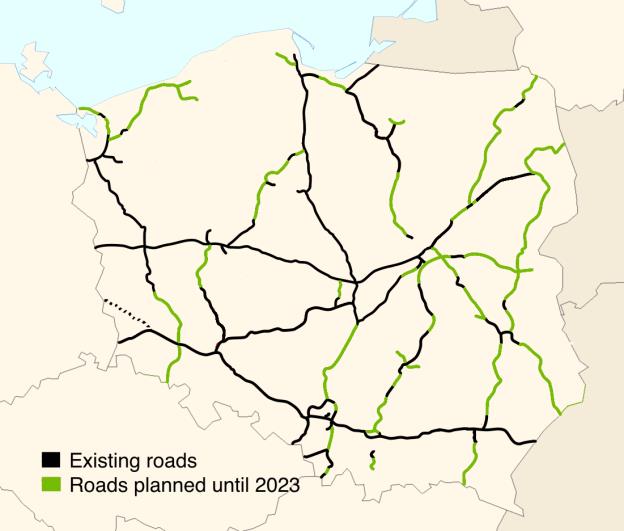
|
|
Source: European Commission
|
Modernisation of the railway network is accelerating, although most of the challenges in the sector persist. In 2017, EU funds financed over 50 % of the overall investments implemented under the national railway programme. The implementation of Rail Baltica progressed with the first section to the north of Białystok. Despite a faster contracting of railway projects, there is still risk that all railway investments planned until 2023 will not be completed on time. This is mainly due to a limited capacity in the construction sector and institutional weaknesses of the infrastructure managing authority. In comparison to the road sector, complex administrative and financial procedures are still affecting the effectiveness of the railway managing body. The railway network high vulnerability to traffic disruptions and a limited coordination of works are affecting the already low speed of average commercial freight rail. The risk of missing the programme objectives is further aggravated by a lack of appropriate measures to address the challenges of increased investments, as well as too few reserve projects with secured funding under the national railway programme. The High Level Group on Railway Investments is working to resolve the main bottlenecks to investments in the railway with EU funds.
Strategic long-term planning of transport investments is missing. There is still no strategic regulatory framework for the long-term (beyond 2023) development of the transport networks for all modes, including clear identification and attribution of their roles and safeguarding of appropriate financing solutions. Poland's transport development strategy, which is currently under review, may eventually accommodate these needs.
Poland is still challenged by a low fixed broadband coverage and take-up. The number of households with a broadband connection remains low; with only 78 % of households connected in 2017, Poland was significantly below the EU average of 85 %. The negative effects of low fixed broadband coverage are only partially offset by high mobile broadband take-up. Local authorities charge telecom operators high fees for using installation space on roads, hampering the effective roll-out of broadband infrastructure and raising its maintenance cost.
Energy
Despite ongoing changes, the electricity sector is challenged by the need to expand capacity, modernise and to reduce greenhouse gas emissions. Without additional investment, the projected growth in electricity demand may lead to electricity shortages after 2020 (PSE, 2016). The large part of ageing generation capacity does not meet the pollutant emissions standards and would not work flexibly with plants producing energy from intermittent renewables. Currently, around 80 % of power generation relies on coal (Graph 3.5.3) and will thus be exposed to the changing price of emission allowances under the EU emissions trading system (EU ETS). An update of the strategic outlook for the Polish energy mix is missing, but the most recent government declarations indicate that coal is to keep its dominating share. To support the transition of mining regions towards clean energy, the Commission initiated a pilot programme for Silesia region under the Coal and Carbon-Intensive Regions in Transition initiative.
In the short term, expansion of electricity supply capacity is planned mainly in the form of coal-fired generation. Over 3 GW of new coal-fired and over 1 GW of new gas-fired capacity is being built. More mainly gas-fired generation projects are also being analysed. Some efficient coal combustion and pollution control technologies are to be applied and coal gasification feasibility is considered. The development of co-generation is suffering from regulatory uncertainty over the regulation of its support system. The Polish nuclear power programme has been delayed. Poland is making little use of electricity interconnectors and only scarce progress on their development has been observed (see European Commission, 2017a). Constrained by insufficient capacity and facing difficulties to finance the necessary investment, Poland is planning to use the capacity mechanism, which is to be operational as of 2018.
|
Graph 3.5.3:Gross electricity generation by fuel - TWh, 2015
|
|

|
|
Source: European Commission
|
Despite renewables becoming more competitive, their deployment was hampered by recent legislative changes. The 2016 regulation set de facto prohibitive requirements for new on-shore wind installations. The 2017 change of certain provisions related to the green certificates affected existing renewable energy installations that were receiving this support. In conjunction, the renewables operators also suffered from unilateral termination of long-term contracts by state-controlled entities. It is also not clear how much additional renewable capacity Poland plans to develop. On a positive note, Poland introduced an auction-based scheme to support new producers of electricity from renewable sources. These elements create a mixed investment climate for renewables. Hence, the achievements of the 2020 national renewables target will be challenging (
).
The electricity market has become increasingly competitive, but coal-based generation and lack of interconnections have an impact on prices. While domestic coal is still relatively cheap, the operation of inefficient old power plants is costly. Lack of and limited use of interconnections likely makes prices higher (
). While market competition has been improving in recent years, state-controlled enterprises dominate the market. In 2017 state ownership was further expanded. Retail prices for electricity are regulated for households, and currently there is no roadmap for deregulation in this sector. The restructuring of coal mines might affect electricity bills.
Gas supply security is gradually improving. Poland has been developing its gas interconnectivity. The liquefied natural gas terminal in Świnoujście and a significant reverse-flow interconnection with Germany are operational. While connections with other EU Member States are not yet developed (
), the situation is to improve, with the construction of additional interconnectors, notably between Poland and Denmark (BalticPipe), as well as with Lithuania (GIPL).
While competition in the gas wholesale market is becoming restricted, the gas retail market is being liberalised. In 2016, the number of firms holding licences and actively participating in the wholesale trade of gas was increasing. However, this positive trend may be reversed. As a result of legislative changes in 2016 and 2017, companies importing gas on the wholesale market are obliged to ensure mandatory gas stocks in Poland or abroad. If abroad, they must be able to permanently secure the interconnector capacity in addition to capacity reserved for supplying their customers. Currently, the only existing storage capacities in Poland are those of the state-owned company with the leading role in the market. In the first three quarters of 2017, the wholesale gas prices were similar to the prices of neighbouring central European countries but higher than in Germany. In October 2017, gas prices were liberalised for all customer groups except for households, which is scheduled for 2024.
Climate and environmental issues
Poland is one of the most energy-intensive economies in the EU, contributing to substantial greenhouse gas emissions. Although the primary energy intensity declined in Poland much faster than the EU average from 2005 to 2015 (3.4 % and 2 %, respectively), the economy is still among the most energy-intensive in the EU. In addition, against the background of a strong economic growth, final energy consumption has been increasing. However, greenhouse gas emissions per capita are just above the EU average. Poland faces the challenge of mitigating the energy demand and exploiting the potential for energy efficiency in all sectors.
Poland is on track to meet its greenhouse gas emissions target, but transport emissions are on the rise. Poland aims to limit the increase of its greenhouse gas emissions in sectors outside the EU ETS to 14 % by 2020 from the 2005 levels. Poland’s non-ETS emissions increased by 7.1 % between 2005 and 2016, staying below the interim target. The biggest contributor to total greenhouse gas emissions is the energy sector, due to its dependence on coal. Transport emissions, however, remain a growing source of concern as emissions and energy consumption from this sector have increased in recent years. According to national projections, Poland will reach its 2020 greenhouse gas emissions target with a wide margin, limiting the increase to 5.6 % against the target ceiling of +14 %.
The measured concentration of air pollutants continues to exceed EU standards and classifies Polish cities as top-polluted in Europe. The most severe situation has been reported for benzo[a]pyrene (in some cases more than 10 times the target value) and particle pollution. Air pollution is reported to have strong health implications, causing a large number of premature deaths (EEA, 2017). In September 2017, Poland adopted a long-awaited regulation setting standards for coal and wood biomass boilers below 500kW, i.e. those used in individual houses. The regulation entered into force in October 2017. The key measure introducing standards for solid fuels used for individual heating is still in consultations.
Annex A
Overview table
|
Commitments
|
Summary assessment(
)
|
|
2017 Country-specific recommendations (CSRs)
|
|
CSR 1: Pursue a substantial fiscal effort in 2018, in line with the requirements of the preventive arm of the Stability and Growth Pact, taking into account the need to strengthen the ongoing recovery and to ensure the sustainability of Poland’s public finances. Take steps to improve the efficiency of public spending and limit the use of reduced VAT rates.
Pursue a substantial fiscal effort in 2018, in line with the requirements of the preventive arm of the Stability and Growth Pact, taking into account the need to strengthen the ongoing recovery and to ensure the sustainability of Poland’s public finances.
Take steps to improve the efficiency of public spending
and limit the use of reduced VAT rates.
|
Poland has made limited progress in addressing CSR1.
This overall assessment of CSR 1 does not include an assessment of compliance with the Stability and Growth Pact.
The compliance assessment with the Stability and Growth Pact will be carried out in spring when final data for 2017 is available.
Limited progress has been made in improving the efficiency of public spending. In 2017, work continued on a reform of the budget process that was announced in 2016. Measures are planned to support macroeconomic forecasting, help modernise the Chart of Accounts to facilitate a move towards accrual accounting, and to strengthen the medium-term budgetary framework. The work also continued on amendments to the public finance law that would in particular incorporate spending reviews in the budgetary process and strengthen the role of internal audit in the public sector. No implementation date for the reform of the budget planning and budgetary procedures has been set.
No progress was made on limiting the extensive use of reduced VAT rates.
|
|
CSR 2: Take steps to increase labour market participation, in particular for women, the low-qualified and older people, including by fostering adequate skills and removing obstacles to more permanent types of employment. Ensure the sustainability and adequacy of the pension system by taking measures to increase the effective retirement age and by starting to reform the preferential pension arrangements.
Take steps to increase labour market participation, in particular for women, the low-qualified and older people, including by fostering adequate skills and removing obstacles to more permanent types of employment.
Ensure the sustainability and adequacy of the pension system by taking measures to increase the effective retirement age and by starting to reform the preferential pension arrangements.
|
Poland has made limited progress in addressing CSR2.
Limited progress has been made as regards measures to increase labour market participation. Some policy measures can be expected to increase activity. In particular the creation of nurseries should become easier and the public funding for them was increased. The number of places in kindergartens was also increased. Some barriers to permanent employment may potentially be removed by new labour codes, but the drafts have not yet been published. No government decision has been made on the higher education reform. Simultaneously, the lowered statutory retirement age acts towards limiting labour market participation. Labour market participation of the respective groups increased during the last 3-4 quarters thanks to a strong cyclical position of the economy.
No progress has been achieved in ensuring the sustainability and adequacy of the pension system. The sustainability and adequacy of the pension system was weakened by lowering of the statutory retirement age which came into force on 1 October 2017. No measures have been implemented to increase the effective retirement age. Also no measures have been taken to start reforming the preferential pension arrangements.
|
|
CSR 3: Take measures to remove barriers to investment, particularly in the transport sector.
Take measures to remove barriers to investment, particularly in the transport sector.
|
Poland has made limited progress in addressing CSR3.
There was no progress in ensuring legal certainty and trust in the quality and predictability of policies, including regulatory changes, and institutions. Limited progress has been made as regards the construction-related procedures: the government is working on legislative proposals that, if effectively implemented, could simplify environmental procedures and issuing construction permits. Some progress has been made in removing obstacles to investment in the transport sector. The contracting and implementation of rail and road projects was accelerated and some new legislative and non-legislative measures were implemented or are in the legislative process.
|
|
Europe 2020 (national targets and progress)
|
|
Employment rate target: 71 %
|
Employment rate among people aged 20-64 has increased strongly since 2013 reaching 69.3 % in 2016. Data for the first three quarters of 2017 show a continuation of a positive trend.
|
|
R&D target set in the 2013 NRP: R&D intensity target is 1.7 % for 2020
|
0.97% of GDP (2016).
Limited progress towards the target. Public R&D intensity has been growing on average by 6.2% annually over the period 2007-2016, Poland will reach its national target for 2020 if further substantial increase of R&D intensity is achieved with the minimum average annual growth of 15.2% over the period 2016-2020.
|
|
Greenhouse gas emissions target:
- National greenhouse gas emissions target:
+14 % in 2020 compared to 2005 (in non-ETS sectors)
|
According to estimates, greenhouse gas emissions in sectors not covered by the EU ETS increased by 7.1 % between 2005 and 2016, i.e. below the 2016 ceiling of +9.7 %. According to the latest national projections, based on existing measures, non-ETS emissions will increase by 5.6 % between 2005 and 2020. The target is consequently expected to be met with a substantial margin of 8.4 percentage points.
|
|
2020 Renewable energy target: 15%
Share of renewable energy in all modes of transport: 10%
|
According to preliminary ESTAT 2016 data, a share of renewable energy in final energy consumption decreased to 11.3 % in 2016.
Poland is lagging behind in reaching the target of 10 % for renewable energy share in transport. In 2016 the share equalled 3.9 %, displaying a sharp decline from 2015.
|
|
Energy efficiency: reduction of energy consumption
Poland has set an indicative national energy efficiency target of reaching a 2020 level of 96.4 Mtoe primary consumption and 71.6 Mtoe final energy consumption.
|
The preliminary ESTAT 2016 data show the levels of primary (94.3 Mtoe) and final energy consumption (66.7 Mtoe) below the 2020 indicative national targets. Following a period of decline both energy consumption indicators increased slightly in 2015 - 2016, compared to 2014. Poland will need to continue efforts to keep energy consumption levels in check until 2020.
|
|
Early school leaving target: 4.5 %
|
Poland is one of the best EU performers on early school leavers with the rate of 5.2 % in 2016 being less than half the EU average of 10.8 %.
|
|
Tertiary education target: 45 %
|
Poland is among the EU countries with a high tertiary education attainment. The share of the population aged 30-34 who have successfully completed tertiary studies have been increasing for the last several years. The rate was 44.6 % in 2016 and it is likely that the national target of 45 % was already reached in 2017.
|
|
Risk of poverty or social exclusion target: Target on the reduction of population at risk of poverty or social exclusion in number of persons: 1 500 000
|
Poland has achieved the target since 2012. By 2016 the number of people at risk of poverty or social exclusion declined by 3.3 million.
|
Annex B
Macroeconomic Imbalance Procedure scoreboard
|
|
|
Table B.1:The Macroeconomic Imbalance Procedure scoreboard for Poland (AMR 2018)
|
|

|
|
Source: European Commission 2017, Statistical Annex to the Alert Mechanism Report 2018, SWD(2017) 661.
|
|
|
Annex C
Standard tables
|
|
|
Table C.1:Financial market indicators
|
|

|
|
Source: European Commission (long-term interest rates); World Bank (gross external debt); Eurostat (private debt); ECB (all other indicators).
|
|
|
|
|
|
Table C.2:Headline Social Scoreboard indicators
|
|

|
|
(5) Average of first three quarters of 2017 for the employment rate and gender employment gap.
Source: Eurostat.
|
|
|
|
|
|
Table C.3:Labour market and education indicators
|
|

|
|
Source: Eurostat, OECD.
|
|
|
|
|
|
Table C.4:Social inclusion and health indicators
|
|

|
|
Source: Eurostat, OECD.
|
|
|
|
|
|
Table C.5:Product market performance and policy indicators
|
|

|
|
Source: European Commission; World Bank — Doing Business (for enforcing contracts and time to start a business); OECD (for the product market regulation indicators); SAFE (for outcome of SMEs' applications for bank loans).
|
|
|
|
|
|
Table C.6:Green growth
|
|

|
|
Source: European Commission and European Environment Agency (Share of GHG emissions covered by ETS); European Commission (Environmental taxes over labour taxes and GDP); Eurostat (all other indicators).
|
|
|
References
Applica sprl, Cambridge Econometrics, Vienna Institute for International Economic Studies (2016), Economic Challenges of Lagging Regions, annex 2, Task 2- Country report Poland,
http://ec.europa.eu/regional_policy/sources/docgener/studies/pdf/challenges_lagging/econ_challenges_lagging_annex7_en.pdf
.
Bargu A. and M. Morgandi (2018), Can Mothers Afford to Work in Poland? Labor Supply Incentives of Social Benefits and Childcare Costs, forthcoming in: Policy Research Working Papers, The World Bank. Washington D.C.
Białek-Jaworska A., M. Ziembiński, D. Zięba (2016), Innowacyjność polskich przedsiębiorstw. Działalność badawczo-rozwojowa i współpraca z biznesem, Polska Rada Biznesu and DELab, Warszawa.
Breznitz D. and D. Ornston (2017), EU financing and innovation in Poland, EBRD Working Paper No. 198, European Bank for Reconstruction and Development.
Böwer U. (2017), State-Owned Enterprises in Emerging Europe: The Good, the Bad, and the Ugly, IMF Working Paper no 17/221, International Monetary Fund, Washington, DC.
CASE/IAS (2107), Study and Reports on the VAT Gap in the EU 28 Member States: 2017 Final Report. TAXUD 2015/CC/131, available at:
https://ec.europa.eu/taxation_customs/sites/taxation/files/ study_and_reports_on_the_vat_gap_2017.pdf
.
CPB et al (2014), A study on R&D tax incentives. Final report, European Commission Taxation Papers n. 54, Luxembourg.
Council (2016), Council Recommendation of 19 December 2016 on Upskilling Pathways: New Opportunities for Adults (2016/C 484/01).
EBRD (2017), Sustaining Growth. Transition Report 2017-2018, European Bank for Reconstruction and Development, tr-ebrd.com.
EEA (2017), Air quality in Europe — 2017 report, European Environment Agency, EEA Report No 13/2017, available at https://www.eea.europa.eu/publications/air-quality-in-europe-2017.
EC – EPC (2018), 2018 Ageing Report: Economic and Budgetary Projections for the EU Member States (2016-2070), (forthcoming), European Commission – Economic Policy Committee (Ageing Working Group).
European Commission (2016a), Country Report Poland 2016, SWD (2016) 91 final.
European Commission (2016b), PISA 2015: EU Performance and initial conclusions regarding education policies in Europe, https://ec.europa.eu/education/sites/education/files/pisa-2015-eu-policy-note_en.pdf.
European Commission (2016c), Science, Research and Innovation performance of the EU, available at
https://publications.europa.eu/en/publication-detail/-/publication/744d5735-e1d4-11e5-8a50-01aa75ed71a1
.
European Commission (2017a), Country Report Poland 2017, SWD (2017) 86 final.
European Commission (2017b) – Labour Market and Wage Developments in Europe, Annual Review 2017, Publications Office of the European Union.
European Commission (2017c), Taxation Trends in the European Union, Data for the EU Member States, Iceland and Norway, 2017 Edition, Luxembourg.
European Commission (2017d), Employment and Social Developments in Europe, Annual Review 2017, Publications Office of the European Union.
European Commission (2017e), The Education and Training Monitor 2017, available at https://ec.europa.eu/ education /sites/education/files/monitor2017_en.pdf.
European Commission (2017f), European Economic Forecast Autumn 2017, Institutional Papers 063.
European Commission (2017g), My Region, My Europe, Our Future, Seventh report on economic, social and territorial cohesion, SWD(2017) 330 final, Brussels.
European Commission (2017h), European Innovation Scoreboard 2017.
European Commission (2017i), Energy Union Factsheet Poland, 0020SWD(2017) 407 final, Brussels.
European Commission (2018a), Debt Sustainability Monitor 2017, Institutional Paper no. 071.
European Commission (2018b), Science, Research and Innovation performance of the EU, forthcoming.
EIU et al. (2015), Risk and Return. Foreign Direct Investment and the Rule of Law, Economist Intelligence Unit, Hogan Lovells, Bingham Centre for the Rule of Law and the Investment Treaty Forum, available at
https://www.biicl.org/newsitem/6112
.
Fundacja Republikańska (2017), Główne ryzyka i bariery działalności gospodarczej w Polsce: Perspektywa mikroprzedsiębiorców i małych przedsiębiorstw, Warszawa.
Grant Thornton (2017a), Barometr stabilności otoczenia prawnego w Polsce, Warszawa.
Grant Thornton (2017b), Niestrawny VAT od żywności. Szacunek wpływu ujednolicenia stawek podatkowych dla produktów spożywczych, Warszawa.
GUS (2017a), Oświata i wychowanie w roku szkolnym 2016/2017, Główny Urząd Statystyczny, Warszawa.
GUS (2017b), Budżety gospodarstw domowych w 2016 r., Główny Urząd Statystyczny, Warszawa.
IBE (2015), Dynamika przemian w edukacji i diagnoza problemów, Instytut Badań Edukacyjnych, Warszawa.
IFiS (2013), Program Międzynarodowej Oceny Umiejętności Uczniów OECD PISA. Wyniki Badania 2012 w Polsce, Instytut Filozofii i Socjologii PAN.
IMF (2015), Republic of Poland: Technical Assistance Report-Tax Administration-Modernization Challenges and Strategic Priorities, Country Report No. 15/112, International Monetary Fund, Washington, DC.
IMF (2017a), Republic of Poland: Developing a Medium-Term Budget Framework, Technical Assistance Report, International Monetary Fund, Washington, DC.
IMF (2017b), Regional Economic Outlook: Europe Hitting Its Stride, International Monetary Fund, Washington, DC.
Invest Europe (2017), Central and Eastern Europe Private Equity Statistics 2016, available at https://www.investeurope.eu/media/671537/invest-europe_cee_privateequitystatistics2016_24082017.pdf.
Jonkers, K. and C.S. Wagner (2017), Open countries have strong science, Nature Vol 550, pp. 32–33.
Klincewicz, K., Marczewska, M., Szkuta K. (2018), RIO country report 2017; forthcoming.
Magda, I. (2017), Family 500+ and women’s labour market participation, Presentation at the Institute for Structural Research seminar, 24 October.
Market Observatory (2017), Quarterly Report on Energy on European Electricity Markets, Market Observatory for Energy DG Energy Volume 10 (issue 1; first quarter of 2017), European Commission, Brussels.
MF (2015), Analiza elastyczności wydatków budżetowych w Polsce, Podsumowanie wyników współpracy z OECD, Ministerstwo Finansów, Warszawa.
Myck M. and M. Oczkowska (eds.) (2017), Pokolenie 50+ w Polsce na tle Europy: aktywność, zdrowie i jakość życia. Wyniki na podstawie badania SHARE, Centrum Analiz Ekonomicznych CenEA.
Moody's (2018), Sovereigns – Central & Eastern Europe: 2018 outlook stable as solid growth offsets structural and institutional challenges, Outlook, 17 January.
NBP (2017a), Szybki Monitoring NBP. Analiza Sytuacji Sektora Przedsiębiorstw, nr 04/17, Narodowy Bank Polski, Warszawa.
NBP (2017b), Informacja o cenach mieszkań i sytuacji na rynku nieruchomości mieszkaniowych i komercyjnych w Polsce - II kwartał 2017, Narodowy Bank Polski, Warszawa.
NBP (2017c), Kwartalny raport o rynku pracy w I kw. 2017 r., nr 02/17, Narodowy Bank Polski, Warszawa.
NIK (2017a), Informacja o wynikach kontroli: Poszanowanie przez Urzędy Skarbowe interesów podatników oraz zabezpieczenie interesów Skarbu Państwa przy wykonywaniu egzekucji administracyjnej, KBF.430.003.2017, nr ewid. 14/2017/P/16/011/KBF, Najwyższa Izba Kontroli, Warszawa, available at
https://www.nik.gov.pl/plik/id,13888,vp,16325.pdf
.
NIK (2017b), System gospodarowania przestrzenią gminy jako dobrem publicznym, Nr ewid. 193/2016/KIN, Najwyższa Izba Kontroli, Warszawa.
Obywatelskie Forum Legislacji – Fundacja Batorego (2017), X Komunikat Obywatelskiego Forum Legislacji o jakości procesu legislacyjnego na podstawie obserwacji w okresie od 16 listopada 2016 do 15 listopada 2017 roku, available at
http://www.batory.org.pl/programy_operacyjne/przeciw_korupcji/przejrzystosc_w_procesie_stanowienia_prawa_1/obserwacje_rzadowego_procesu_tworzenia_prawa
.
OECD (2016a), Technologies for Better Tax Administration: A Practical Guide for Revenue Bodies, OECD Publishing, Paris.
OECD (2016b), Skills Matter: Further Results from the Survey of Adult Skills, OECD Publishing, Paris.
OECD (2017a), Tax Administration 2017: Comparative Information on OECD and Other Advanced and Emerging Economies, OECD Publishing, Paris.
OECD/European Observatory (2017), Poland: Country Health Profile 2017, State of Health in the EU, OECD Publishing, Paris/European Observatory on Health Systems and Policies, Brussels.
PSE (2016), Prognoza pokrycia zapotrzebowania szczytowego na moc w latach 2016 – 2035, Polskie Sieci Elektroenergetyczne, Konstancin-Jeziorna.
PwC (2017), Wyłudzenia VAT - luka podatkowa w 2016 r. i prognoza na 2017, Warszawa.
Republic of Poland (2016), Ustawa z dnia 16 grudnia 2016 r. o zasadach zarządzania mieniem państwowym, available at http://dziennikustaw.gov.pl/du/2016/2259/1.
Vandenbussche H., (2014), Quality in Exports, Economic Papers 528, European Commission, Directorate-General for Economic and Financial Affairs, Brussels.
Visser (2016a), ICTWSS Data base. version 5.1, Amsterdam: Amsterdam Institute for Advanced Labour Studies (AIAS), University of Amsterdam.
Visser J. (2016b), What happened to collective bargaining during the great recession?, IZA Journal of Labour Policy 2016 5:9.
WEF (2017), Global Competitiveness Index 2017-2018, World Economic Forum.
Winckler, G. et al. (2017), Horizon 2020 Policy Support Facility Peer Review of Poland's Higher Education and Science system, European Commission, Brussels.
Wise-Europa (2016), Wiatr w żagle. Obywatelska strategia dla polskiego rynku kapitałowego, Warszawa.
Woessmann, L. (2016), The Importance of School Systems: Evidence from International Differences in Student Achievement, Journal of Economic Perspectives, 30(3): 3-32.
World Bank (2017), Doing Business 2018: Reforming to Create Jobs, World Bank, Washington, DC.
World Bank and PwC (2017), Paying Taxes 2018, available at: https://www.pwc.com/gx/en/services/tax/ publications/paying-taxes-2018.html.
ZUS (2017), Informacja o świadczeniach pieniężnych z funduszu ubezpieczeń społecznych oraz o niektórych świadczeniach z zabezpieczenia społecznego, III kwartał/okres I-IX 2017, Zakład Ubezpieczeń Społecznych Warszawa.
-
(I)
()Public investment is defined as gross fixed capital formation + investment grants + national expenditure on agriculture and fisheries.
-
(II)
()Before programmes are adopted, Member States are required to comply with a number of so-called ex-ante conditionalities, which aim at improving conditions for the majority of public investments areas.
-
(III)
()Figures relating to the Infrastructure and Innovation Window exclude multicountry projects.
-
(IV)
() The Social Scoreboard includes 14 headline indicators, of which 12 are currently used to compare Member States performance. The indicators "participants in active labour market policies per 100 persons wanting to work" and "compensation of employees per hour worked (in EUR)" are not used due to technical concerns by Member States. Possible alternatives will be discussed in the relevant Committees. Abbreviation: GDHI – gross disposable household income.

