TABLE OF CONTENTS
1.Introduction
2.Background to the intervention
3.Implementation and state of Play
4.Method
5.Analysis and answers to the evaluation questions
A.
Relevance
B.
Effectiveness
C.
Efficiency
D.
Coherence
E.
EU Added-Value
6.Conclusions
Annex 1: Procedural information
Annex 2: Consultations – SYNOPSIS REPORT
Annex 3: Methods and analytical models
Annex 4: SUMMARY OF TRENDS IN ARTICLE 19.2
Annex 5: list of eu regulations and international instruments
Annex 6: literature cited
GLOSSARY
|
Term or acronym
|
Meaning or definition
|
|
AC
|
EU Advisory Council
|
|
CECAF
|
Fishery Committee for the Eastern Central Atlantic
|
|
CFP
|
Common Fisheries Policy
|
|
DCF
|
EU Data Collection Framework
|
|
DSAR
|
Deep-Sea Access Regulation (EU) 2016/2336
|
|
EEZ
|
Exclusive Economic Zone
|
|
EFCA
|
European Fisheries Control Agency
|
|
EMFF
|
European Maritime and Fisheries Fund
|
|
EQM
|
Evaluation Question Matrix
|
|
EUMOFA
|
European Market Observatory for Fisheries and Aquaculture Products
|
|
FAO
|
Food and Agriculture Organisation of the United Nations
|
|
FDI
|
Fisheries Dependent Information
|
|
FTE
|
Full-Time Equivalent
|
|
GEBCO
|
General Bathymetric Chart of the Oceans
|
|
GES
|
Good Environmental Status
|
|
GT
|
Gross Tonnage
|
|
HD
|
Habitats Directive 92/43/EEC
|
|
ICCAT
|
International Commission for the Conservation of Atlantic Tunas
|
|
ICES
|
International Council for the Exploration of the Sea
|
|
IOTC
|
Indian Ocean Tuna Commission
|
|
JDP
|
Joint Deployment Plan
|
|
kW
|
Kilowatt
|
|
MS
|
EU Member State
|
|
MSFD
|
Marine Strategy Framework Directive 2008/56/EC
|
|
MSY
|
Maximum Sustainable Yield
|
|
NAFO
|
Northwest Atlantic Fisheries Organization
|
|
NEAFC
|
North-East Atlantic Fisheries Commission
|
|
NGO
|
Non-Governmental Organisation
|
|
PC
|
Public Consultation
|
|
RA
|
Regulatory Area
|
|
RFMO
|
Regional Fisheries Management Organisation
|
|
SCIP
|
Specific Control and Inspection Programme
|
|
STECF
|
Scientific, Technical and Economic Committee for Fisheries
|
|
TAC
|
Total Allowable Catch
|
|
UNGA
|
United Nations General Assembly
|
|
VME
|
Vulnerable Marine Ecosystem
|
|
WCPFC
|
Western and Central Pacific Fisheries Commission
|
|
WGDEC
|
ICES working group on deep-water ecology
|
|
WGDEEP
|
ICES working group on biology and assessment of deep-sea fisheries resources
|
1.Introduction
Fishing for deep-sea species occur on deep-water slopes, ridges and seamounts with gears that can scrape the bottom of the seabed. This leads to important impacts on the deep-sea fauna, which is made of slow-growing and long-lived species, such as coral reefs and garden, sponges, anemones and sea pens, which compose the so-called “vulnerable marine ecosystems” (VMEs).
In 2013, the EU introduced the reformed Common Fisheries Policy, which brought an increased focus on the ecosystem approach to managing fisheries. This led to a revision of Regulation (EC) No 2347/2002 that regulated the access to deep-sea fishing until then. In 2016, the EU adopted Regulation (EU) 2016/2336, called the “Deep-sea Access Regulation” (DSAR), governing access to deep-sea fishing and setting conditions for protecting VMEs in international and EU waters. The Deep-sea Access Regulation aims to establish a sustainable exploitation of deep-sea stocks while reducing the environmental impact of these fisheries and preventing significant adverse impacts on VMEs, and to improve the information base for scientific assessment, through data collection.
Article 19 of the DSAR foresees that by January 2021, the Commission shall evaluate the impacts of the measures laid down in the Regulation and determine to what extent its objectives have been achieved, as well as a series of 11 specific subjects.
In compliance with the Better Regulation guidelines, this evaluation is based on the following five criteria:
·Relevance: To what extent was there a need to adopt the measures under the DSAR? /To what extend does this need continue to exist? /To what extent are measures under the DSAR appropriate to address needs, do they continue to be appropriate to respond to needs?
·Effectiveness: To what extent is the DSAR effective to protect deep-sea vulnerable ecosystems? /To what extent is the DSAR effective in contributing to preserve deep-sea fish stocks? /To what extent is the DSAR effective at improving scientific knowledge on the deep-sea environment?
·Efficiency: What are the average DSAR implementation costs? /Is there scope for simplification of DSAR design and operation?
·Coherence: To what extent is the DSAR coherent with EU international commitments under UN Resolutions 61/105 and 64/72? /To what extent is the DSAR coherent with the North-East Atlantic Fisheries Commission (NEAFC) Recommendation 19.2014? /To what extent is the DSAR coherent with the other non-CFP EU instruments on protection of the marine environment (MSFD, Habitats Directive)? /To what extent is the DSAR coherent with the CFP Regulation and CFP-instruments in relation to fishing opportunities, technical measures, Control and Data collection? /To what extent is the DSAR coherent with other EU measures for VMEs protection?
·EU added value: What is the additional value resulting from the EU measures under the Deep-sea Access Regulation? /What would be the effects of discontinuing the DSAR all other things being equal?
The European Commission launched the evaluation on 17 September 2019 with the publication of a roadmap, open for feedback. A public consultation was also open on the European Commission consultation website between May and August 2020, whose results are available online (summary report and all contributions).
To support the evaluation exercise, an external consultant was hired to perform a study. This study was carried out over a period of nine months starting on 10 February 2020. It included data collection and desk research on available reports and statistical data, in-depth targeted consultations of stakeholders, including Member States’ authorities, fishermen associations, research institutions and NGOs. The research covered the DSAR implementation period from 2017 to 2020.
In this Staff Working Document (SWD), the Commission presents and reflects on the main outcomes and findings for this evaluation, which provides evidence and data on the functioning of the Deep-sea Access Regulation. It should be noted that the evaluation takes place while important features of the Regulation, i.e. the VMEs closures and the delimitation of the fishing footprint, are yet to be implemented. This SWD therefore outlines conclusions, which are proportionate to the scope of the evaluation.
The SWD has the following structure. Firstly, it describes the background of the DSAR and summarises its state of play. The SWD then provides an overview of the methodology used for the evaluation. The main results of the evaluation are presented in the following section according to the five Better Regulation criteria/questions. The last section of the SWD offers the evaluation’s conclusions.
2.Background to the intervention
In 2016, the EU adopted the Deep-sea Access Regulation (EU) 2016/2336 to replace Council Regulation (EC) 2347/2002. The DSAR defines specific conditions, which apply to deep-sea fishing activities taking place in EU waters and in the international waters of the North-East Atlantic. It pursues three main objectives:
I)improving scientific knowledge on deep-sea stocks and habitats,
II)preventing significant adverse impacts on Vulnerable Marine Ecosystems (VMEs) and ensuring the long-term conservation of stocks of deep-sea species,
III)ensuring consistency of EU measures with UN Resolutions 61/105 and 64/72.
The overarching objective of the DSAR is to bring an effective contribution to the objectives of the Common Fisheries Policy (CFP) defined in Article 2 of Regulation (EU) 1380/2013 of the European Parliament and of the Council for what concerns deep-sea fisheries, namely that the CFP shall:
·ensure that fishing and aquaculture activities are environmentally sustainable in the long-term (Article 2.1),
·apply the precautionary approach to fisheries management (Article 2.2),
·implement the ecosystem-based approach to fisheries management so as to ensure the negative impacts on the marine ecosystem are minimised (Article 2.3).
To contribute to these objectives, the DSAR comprises measures including:
·a fishing authorisation scheme for vessels targeting deep-sea species (‘targeting fishing authorisation’) and vessels catching deep-sea species when targeting other species (‘by-catch fishing authorisation’),
·measures for regulating the fishing capacity of fishing vessels engaged in deep-sea fisheries,
·a set of spatial measures designed to prevent the expansion of deep-sea fishing areas, to protect deep-sea vulnerable marine ecosystems (VMEs) from significant adverse impacts caused by fishing gears and to prohibit bottom trawling at depths below 800m,
·a VME encounter protocol prompting fishing vessels to report each encounter with a VME and to immediately cease fishing in the area concerned (the “move-on” rule),
·specific stringent control and monitoring provisions, and
·an observer coverage of at least 20% in the case of fishing vessels authorised to target deep-sea species with bottom trawls or bottom set gillnets and at least 10% for all other vessels authorised to catch deep-sea species as target or by-catch.
The DSAR operates in conjunction with other EU instruments implementing conservation and management measures for deep-sea fish stocks and their habitats such as limits on fishing opportunities or technical measures defining how, when and where fishing vessels may exploit the fishing opportunities allocated to them.
Figure 1 summarises the DSAR’s intervention logic: the Regulation was built to address the impacts of deep-sea fishing, limit bycatches and account for the high vulnerability of deep-sea flora and fauna. By contributing to the CFP objectives, the DSAR was expected to prevent significant adverse impacts on the deep-sea ecosystem by regulating the use of fishing gears and allow the sustainable exploitation of deep-sea stocks.
Figure 1: Logic of the intervention

Source: European Commission ‘
Study supporting the Evaluation of the Deep-sea Access Regulation’
, (2020)
3.Implementation and state of Play
3.1.Implementation of the DSAR
At the time of completion of this evaluation, the implementation of the Deep-sea Access Regulation is not complete. Indeed, the closure of VME areas below 400 meters to bottom gears and the determination of the existing deep-sea fishing areas, i.e. “the footprint”, remain pending for adoption, following the release of ICES advice on 5 January 2021.
Upon the Regulation’s entry into force in 2017, measures with immediate effects were:
·the ban on bottom fishing below 800 meters;
·the establishment of fishing authorisations for target and bycatch fisheries;
·the management of capacity aiming to prevent an increase in capacity above the highest level achieved by Member States in 2009-2011;
·the obligatory reports of VMEs encounters;
·stricter control provisions;
·20% observer coverage for bottom trawls and gillnets fisheries (targeting deep-sea fish) and 10% for other vessels.
Following the above considerations, the scope of the evaluation has been defined as follows:
1.EU intervention: the evaluation concentrates on the DSAR and includes considerations of other EU instruments relating to the management of deep-sea fisheries and their impacts on habitats in the scope of the DSAR as defined by its Article 2. For certain provisions of the DSAR, the geographical scope of the evaluation also includes international waters of the North-East Atlantic that correspond to the Regulatory Area of the North-East Atlantic Fisheries Commission (NEAFC);
2.Temporal scope: the evaluation is focused on the period between 2017, the year of entry into force of the DSAR, and 2020 (depending on availability of data);
3.EU Member States: the evaluation includes all Member States having an interest in fisheries in the geographical area of the DSAR as flag State or as coastal State. 15 Member States are potentially concerned by the DSAR: Belgium, Denmark, Germany, Estonia, Finland, France, Ireland, Latvia, Lithuania, Netherlands, Poland, Portugal, Spain, Sweden and the United Kingdom.
3.2.State of play of the DSAR
EU fisheries of deep-sea species
Since 2008, EU reported catches of deep-sea species listed in Annex I of the DSAR follow a decreasing trend of -43%, from 35 000 tonnes per year on average over 2009-2011 to approximately 21 000 tonnes per year since 2015.
Figure 2: Evolution of EU reported catches of deep-sea species referred to in Annex I of the DSAR in the North-East Atlantic and in CECAF areas 34.1.1, 34.1.2 and 34.2 (except Greenland waters).
Dotted line: trend - Source: Eurostat data
Figure 3 shows reported catches of the 12 main deep-sea species by decreasing order of importance. The first seven species in the list represent 90% of total reported catches of deep-sea species. The 12 species in the table equal 97% of the total reported catches of deep-sea species.
Figure 3: EU reported catches (tonnes) of the twelve main deep-sea species referred to in Annex I of the DSAR in the North-East Atlantic and in CECAF areas 34.1.1, 34.1.2 and 34.2
|
Common name
|
Scientific name
|
2016
|
2017
|
2018
|
Average
|
% total
|
|
Black scabbardfish
|
A. carbo
|
7 167
|
6 638
|
6 018
|
6 608
|
32%
|
|
Greater silver smelt
|
A. silus
|
2 896
|
4 091
|
4 016
|
3 667
|
18%
|
|
Blue ling
|
M. dypterygia
|
1 981
|
2 610
|
3 094
|
2 562
|
12%
|
|
Greenland halibut
|
R. hippoglossoides
|
1 998
|
1 559
|
2 230
|
1 929
|
9%
|
|
Bluemouth (Bluemouth redfish)
|
H. dactilopterus
|
1 637
|
1 821
|
1 657
|
1 705
|
8%
|
|
Roundnose grenadier
|
C. rupestris
|
1 435
|
1 624
|
1 399
|
1 486
|
7%
|
|
Red (blackspot) seabream
|
P. bogaraveo
|
853
|
772
|
693
|
773
|
4%
|
|
Baird's smoothhead
|
A. Bairdii
|
400
|
482
|
400
|
427
|
2%
|
|
Silver scabbardfish (Cutlass fish)
|
L. caudatus
|
492
|
349
|
138
|
326
|
2%
|
|
Common mora
|
M. moro
|
306
|
269
|
237
|
271
|
1%
|
|
Alfonsino
|
B. splendens
|
229
|
222
|
227
|
226
|
1%
|
|
Wreckfish
|
P. americanus
|
201
|
272
|
185
|
219
|
1%
|
|
Other deep-sea species
|
|
797
|
662
|
604
|
688
|
3%
|
|
Total
|
|
20 391
|
21 370
|
20 897
|
20 886
|
100%
|
Source: based on Eurostat data
97% of total deep-sea catches were fished by six EU Member States: Portugal, France, Spain, the Netherlands, the United Kingdom and Germany. The contribution of deep-sea species in total weight of national landings is the highest for Portugal (close to 4%), and below 1% for all other five Member States.
Figure 4: % weight of deep-sea catches in total national landings in 2017 for the main Member States reporting deep-sea catches

Source: STECF (2019a)
At EU level, total landings of deep-sea species in 2017 (31 370 tonnes) represented 0.4% of the total EU landing of fisheries products (5.2 million tonnes) (STECF, 2019a).
NEAFC fisheries and EU share
According to catch statistics published by NEAFC, EU catches of deep-sea species referred to in Annex I of the DSAR in the NEAFC Regulatory Area were 3 026 tonnes per year on average between 2016-2018, representing 14.5% of the total EU catches of deep-sea species reported in Figure 3. The EU is by far the main fishing entity exploiting deep-sea species in the NEAFC Regulatory Area with 90% of total catches, the second placed fishing entity is Faroes with 8% of deep-sea catches in the NEAFC Regulatory Area.
Figure 5: Total reported catches (tonnes) of the deep-sea species referred to in Annex I of the DSAR in the Regulatory Area of the North-East Atlantic Fisheries Commission by fishing entity
|
Fishing entity
|
2016
|
2017
|
2018
|
Average
|
|
EU
|
2 788
|
3 315
|
2 974
|
3 026
|
|
Faroes
|
460
|
323
|
30
|
271
|
|
Iceland
|
37
|
0
|
0
|
12
|
|
Norway
|
20
|
18
|
54
|
31
|
|
Russia
|
14
|
2
|
5
|
7
|
|
Total
|
3 319
|
3 658
|
3 063
|
3 347
|
Source: NEAFC Fisheries Statistics (
https://www.neafc.org/catch
)
The main deep-sea species targeted by EU vessels in the NEAFC Regulatory Area is roundnose grenadier (C. rupestris) with an average of 1 370 tonnes per year between 2016 and 2018 (44% of EU catches in the NEAFC-RA), preceding Greenland halibut (R. hippoglossoides) with 715 tonnes (23%) and black scabbardfish (A. carbo) with 245 tonnes (8%).
The evolution of catches of deep-sea species over time (Figure 2) show stable landings since 2015, and no particular signal as from 2017, the year of entry into force of the DSAR.
However, significant decreases in the number of fleets targeting deep-sea species were observed up to 2010, with operators reporting the decreasing amount of fishing opportunities being the main driver for the decreasing fishing fleet. For instance, the Total Allowable Catches (TAC) for black scabbardfish and grenadiers in North Western waters was reduced by 40% between 2013 and 2019.
NGOs consumers’ campaigns against deep-sea fisheries might have also resulted in a decrease in market demand for deep-sea fish, which reduced the economic incentive to catch them.
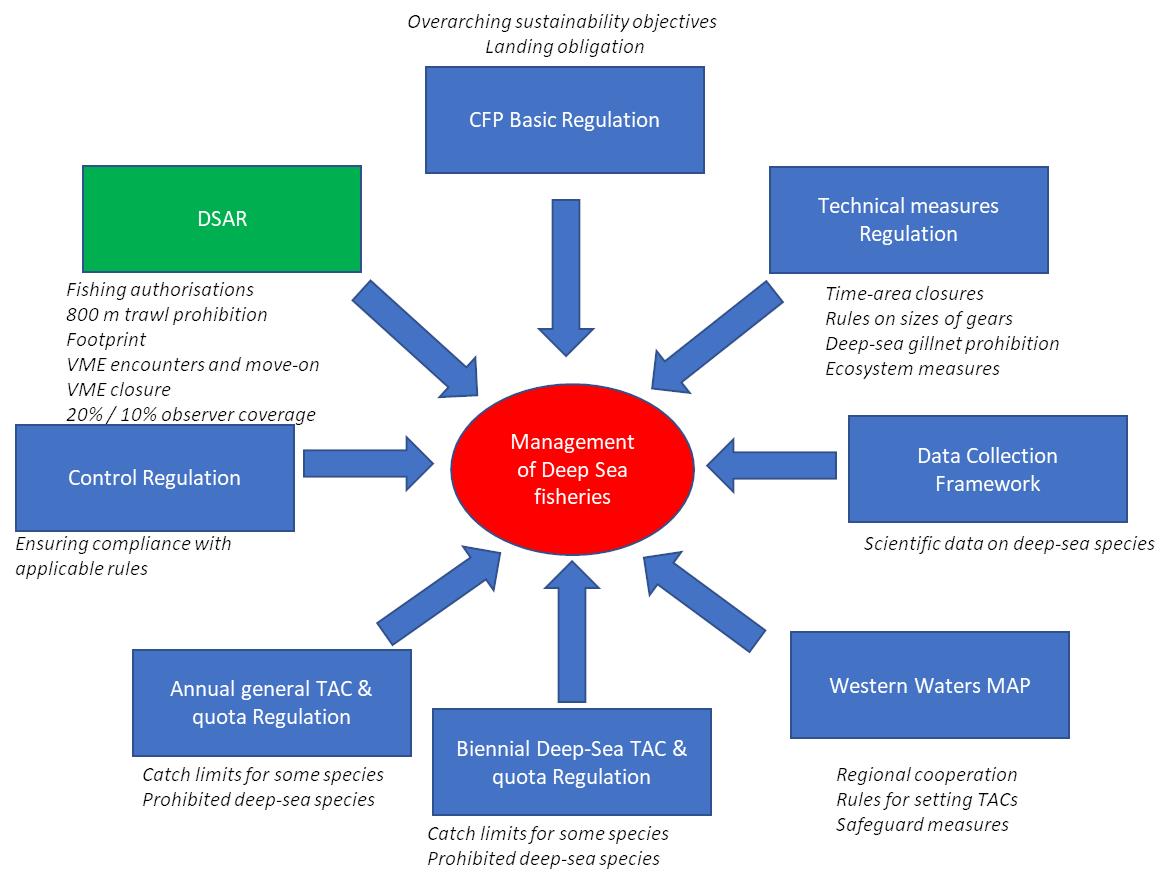
The DSAR is one of EU’s legal instruments to regulate deep-sea fisheries in EU waters, ensuring the implementation of the Common Fisheries Policy (CFP). Other EU CFP instruments having an impact on the conservation and management of deep-sea fisheries (deep-sea stocks and their habitats) over the period starting in 2017 considered by this evaluation include:
·The biennial deep-sea TAC and quota Regulation fixing fishing opportunities for certain deep-sea stocks;
·The annual general TAC and quota Regulation fixing fishing opportunities for certain stocks, including some deep-sea stocks;
·The Technical Measures Regulation setting rules on how, where and when fishing vessels may exploit fishing opportunities, including fishing opportunities granted for the exploitation of deep-sea stocks;
·The Western Water Multiannual Plan which covers management and conservation of some stocks of deep-sea species as from 2019;
·The landing obligation introduced through the CFP Regulation applicable to most deep-sea fisheries as from 2019;
·The Control Regulation defining rules to ensure uniform control of EU fisheries, including deep-sea fisheries;
·The Data Collection Framework Regulation establishing rules on the collection, management and use of technical and scientific data in the fisheries sector
The next figure shows the different CFP instruments listed above and summarises the nature of the main measures which have an impact on the conservation and management of deep-sea fisheries.
Figure 6
4.Method
1.Process
The evaluation is carried out in line with the principles commonly applied for the evaluation of EU initiatives, as laid down in the Better Regulation guidelines.
The evaluation has been supported by a study undertaken by an external consultant and coordinated by the Directorate-General for Maritime Affairs and Fisheries (DG MARE) and the Executive Agency for Small and Medium-sized Enterprises (EASME), with the support of an Inter-Service Steering Group of Commission services.
The evaluation has followed three main phases: (1) the inception phase, in which the structure of the evaluation was defined, based on a conceptual framework; (2) the data collection phase, in which the data was collected, through desk research and consultations, and structured based on the evaluation strategy; (3) the feedback phase, in which the intermediary and final evaluation results were analysed and transposed into conclusions.
2.Data collection and consultations
Data collection
During the inception phase, data and information stemming from Members States’ reporting obligations were collected, such as available Member States annual reports on the implementation of the DSAR, deep-sea species quota uptake, notifications of VME encounters and requests submitted to the International Council for the Exploration of the Sea (ICES).
In view of the numerous interlinkages between the DSAR and other EU and international instruments, all relevant legal texts were collected and analysed. The list of instruments consulted and referenced for the evaluation is shown in Annex 5. Relevant published technical and scientific information (e.g. reports, scientific papers) were gathered and analysed. The list of references reviewed and cited in the evaluation is shown in Annex 6.
Consultations
A consultation strategy was established with the following key elements: consultation scope and objectives, identification of stakeholders, envisaged consultation activities, their timing and language regime. A
roadmap
indicating the main milestones of the consultations was published in September 2019, with no comment received.
There were two types of consultations implemented in support of the evaluation: targeted consultations and a public consultation.
Targeted consultations
The methodology included the implementation of a targeted consultation strategy to reach EU stakeholders that have a high interest and/or a high stake in deep-sea fisheries. This facilitated the collection of information in support of the study, and enabled the gathering of opinions and perceptions on the DSAR and on its implementation. Three groups of stakeholders were identified during the inception phase of the study:
·stakeholders impacted by the provisions of the DSAR (e.g. operators of the fishing industry);
·stakeholders in charge of the implementation of the DSAR (e.g. relevant Commission services and EU agencies, MS authorities, research institutes, representatives of the Advisory Councils); and
·stakeholders of the civil society having a stated interest in the conservation of deep-sea ecosystem (e.g. environmental NGOs).
Initially, the methodology considered direct contacts with the different stakeholders through face-to-face interviews or telephone calls. However, with the Covid-19 outbreak and associated sanitary measures that culminated during the period initially earmarked to implement the consultations (April-May 2020), the strategy had to be adapted to reach stakeholders using written questionnaires, and with follow-up telephone calls or videoconferences, as appropriate. The targeted consultation period was also extended to June 2020 to factor in the impacts of the lockdown on stakeholders’ ability to provide feedback.
Three different types of questionnaires were prepared during the inception phase to ensure adaptation of the questions to the target audience, as follows:
·one questionnaire for Member State authorities, with one version for Member States issuing fishing authorisations to catch deep-sea species and an abridged version for Member States not issuing fishing authorisations;
·one questionnaire for fishermen associations;
·one questionnaire for Advisory Councils and NGOs.
Stakeholders were contacted from early April 2020. The full list of stakeholders contacted is presented in Annex 2. Concerning the four Advisory Committees (AC) consulted, two responded (North Western Waters and South Western Waters) but not in the form of a formal AC position paper. The two ACs’ contributions consisted mainly of feedback on what the ACs had already prepared at the time of negotiation of the DSAR, the dissemination of questionnaires to all their members and communication to the evaluation team of individual responses.
In total, 73 entities were contacted and 58 responded (79%).
Overall, the feedback displays the following strengths:
·All 15 Member States authorities having fishing vessels operating in the North-East Atlantic responded;
·Fishermen associations who responded represent different types of fishing interests in terms of types of fisheries exploited, categories of fishing vessels (large-scale, small-scale) and nationalities;
·There was a good level of engagement by NGOs having a stated interest in the management of deep-sea fisheries.
Public consultation
The public consultation on the DSAR was published on the European Commission consultation website between 13 May 2020 and 5 August 2020. The public consultation was open to all citizens and the wider stakeholder community. It was promoted on DG MARE’s website and advertised via stakeholders’ mailing, newsletters and social media posts by DG MARE, EASME and DG ENV.
The survey questionnaire was divided into two sections:
·General Questions – to assess the relevance and effectiveness of the DSAR, aimed at respondents with limited or no knowledge of the Regulation
·Specialised Questions – to assess the relevance, effectiveness and coherence of the DSAR, aimed at respondents with a more in-depth knowledge of the Regulation.
In total, 156 respondents participated, of whom 112 (72%) also responded to the specialised questions.
An overview and conclusions of the consultations activities is shown in Annex 2 “Consultations - Synopsis Report”.
3.Robustness of the findings and limitations
The Commission’s assessment of the data and information collected through desk research and consultations is that these are broadly adequate to inform the evaluation. The main factor potentially impacting the robustness of findings is the relatively short time period (i.e. 3.5 years) between the entry into force of the DSAR and its evaluation. Due to the time lag for releasing certain data into the public domain, such as data on catches or on fishing fleet performances, the evaluation could use public data generally referring to 2017 or 2018. As a result, trends measured are limited to the short term. In addition, this evaluation was conducted before the adoption of the Commission’s implementing act for two DSAR flagship measures (i.e. definition of the existing fishing areas and definition of areas where VMEs are known or likely to occur). As a result, the evaluation could consider these two measures only on their principles and objectives, but could not evaluate their effectiveness in detail, nor could the evaluation identify potential unexpected effects stemming from their implementation.
5.Analysis and answers to the evaluation questions
The evaluation assessed the performance of the DSAR against the following five criteria: relevance, effectiveness, efficiency, coherence and EU added-value. The evaluation developed 13 specific evaluation questions, which are grouped according to their topic. The overall analysis is based on evidence from both the study supporting the evaluation and the Commission’s own sources. This chapter presents the analysis and provides the answers to the general evaluation questions.
A.Relevance
The previous Deep-Sea Access Regulation (EC) 2347/2002 concentrated on measures to manage fishing pressure on certain deep-sea fish stocks through capacity management and effort restrictions, but it did not include measures to protect deep-sea habitats from significant adverse impacts from fishing gear, in particular Vulnerable Marine Ecosystems (VMEs). At the same time, the previous Deep-Sea Access Regulation was considered by the Commission to be broadly ineffective as a means to protect deep-sea fish stocks from unsustainable exploitation and to ensure provision of relevant data to support scientific advice.
As from 2004, the United Nations General Assembly (UNGA) adopted three resolutions, which address the management of bottom deep-sea fisheries, including their impacts on VMEs. UNGA Resolutions set out principles and standards that apply primarily in areas beyond national jurisdictions covered or not by a relevant multilateral arrangements like Regional Fisheries Management Organisations (RFMOs). UNGA Resolutions are operationalised by FAO International Guidelines for the Management of Deep-Sea Fisheries in the High Seas adopted in 2008 pursuant to paragraph 89 of UNGA Resolution 61/105, and published in 2009. EU measures for the management of deep-sea fisheries, including their impacts on deep-sea ecosystems, were not fully consistent with UNGA Resolutions at that time.
The need for enhanced protection of deep-sea fish stocks and of their habitats was further underpinned by the adoption of the Common Fisheries Policy implemented as from 2013 through Regulation (EU) 1380/2013, which established as a main objective an ecosystem-based approach to fisheries management. The ecosystem-based approach is conceived to ensure that negative impacts of fishing activities on the marine ecosystems are minimised. An EU intervention was thus needed to better address the four fundamental problems of deep-sea fishing identified by the Commission’s impact assessment:
·The high vulnerability of deep-sea stocks to fishing;
·Fishing with bottom trawls destroys or risks destroying irreplaceable benthic habitats (VMEs) which represent main sources of biodiversity in the deep sea. The extent of destruction that already occurred is unknown;
·Fishing with bottom trawls for deep-sea species produces medium to high levels of undesired catch of deep-sea species;
·Determining the sustainable level of fishing pressure via scientific advice is particularly difficult.
Member State authorities and NGOs consulted through the targeted consultations confirmed that in 2016 there was a need for a new instrument to protect deep-sea ecosystems and to bring EU legislation in line with international commitments. Most fishermen associations also supported the need for a revised regime in view of the specificities of deep-sea fisheries, but some fishermen associations (Spain, Netherlands, Germany) expressed a different view stating that existing measures were sufficient on the ground that fishing for deep-sea species did not necessarily mean fishing in VMEs.
Contributions to the public consultation on the DSAR confirmed the need to protect deep-sea VMEs (92% of respondents) and deep-sea fish stocks (89% of respondents).
To what extent does this need continue to exist?
Deep-sea species and ecosystems are particularly vulnerable to depletion and significant adverse impacts from bottom gears, especially given the longevity and slow recovery potential of many deep-sea species and habitats. While other EU fisheries (e.g. TAC and quota Regulations, Technical Measures Regulation) and environmental legislation (e.g. Habitats Directive, Marine Strategy Framework Directive) also play an important role, these alone are not sufficiently tailored to the particular needs of vulnerable deep-sea species and habitat. Specific provisions are needed in particular for regulating fishing capacity exploiting deep-sea stocks, freezing the fishing footprint, protecting the different species of the seabed ecosystem forming VME habitats (e.g. cold-water corals, deep-sea sponges, sea pen fields), implementing more stringent control and reporting rules and strengthening the enhanced provision of scientific information on deep-sea stocks and habitats.
A widespread majority among the Member State authorities and NGOs consulted through the targeted consultations confirmed that the need for a specific deep-sea access regime continues to exist to ensure implementation of measures tailored to the vulnerability of the deep-sea environment. Fishermen associations also supported the continued existence of a specific framework for access to deep-sea fisheries but were more focused on fishing fleets interacting the most with the deep-sea environment.
Contributions to the public consultation corroborated these findings with 90% of respondents indicating that there is still a need to prevent significant impacts on vulnerable marine ecosystems and to ensure the long-term conservation of deep-sea stocks, and 85% confirming the need to improve scientific knowledge on deep-sea species and habitats.
To what extent are measures under the DSAR appropriate to address needs, do they continue to be appropriate to respond to needs?
The DSAR implements the following four main types of interrelated measures:
·Management of fishing capacity including:
üFishing authorisation regimes based on quantities of deep-sea species caught in absolute value or in proportion of total catches.
üCapacity ceilings to ensure that total fishing capacity expressed in kW and GT does not exceed 2009-2011 reference levels.
·Protection of deep-sea stocks and deep-sea habitats through spatial restrictions including:
üLimitation of exploitation to defined existing deep-sea fishing areas (i.e. the fishing footprint) based on areas exploited in 2009-2011 calendar years, with a specific science-based procedure for authorising fishing outside existing deep-sea fishing areas.
üClosure of areas below 400m where VMEs are known or likely to occur to bottom gear.
üVME encounter protocol, including move-on rule.
ü800m bottom trawl prohibition to ensure full protection of ecosystems and deep-sea fish stocks beyond this depth.
·More stringent monitoring and control rules.
·Enhanced scientific data collection on deep-sea species and on species belonging to the seabed ecosystem.
Management of fishing capacity
The key instrument for managing fishing capacity engaged in deep-sea fisheries is the DSAR fishing authorisation regime as per Article 5. Fishing authorisation regimes are commonly used in EU legislation, where access to certain stocks or areas needs to be managed and controlled, for example under EU multiannual management plans or for fishing in the waters of third countries. The DSAR fishing authorisation regime provides the legal basis for identifying fishing vessels authorised to catch deep-sea species as target species (the targeting fishing authorisation) or as by-catches (the by-catch fishing authorisation) under defined conditions. The two types of authorisations allow application of different treatments with the possibility to focus conservation and management measures on the part of the fleet presumed to have the greatest impact on deep-sea stocks and habitats. However, the non-exclusive nature of the targeting and by-catch regimes could raise concerns as some Member States issue both types of fishing authorisations to the same vessel.
Fishing authorisation regimes are often used to cap the fishing capacity of fishing vessels authorised to access the fisheries beyond certain reference levels. The DSAR includes such mechanisms through its Article 6 by limiting the fishing capacity (expressed in kW and GT) of vessels eligible to targeting fishing authorisations to 2009-2011 levels, whichever year provides the higher figure.
The DSAR fishing authorisation regime and the associated limitation mechanisms are relevant to control and manage the fishing fleet exploiting deep-sea species. None of the stakeholders consulted challenged the principle of regulating access to deep-sea fisheries through fishing authorisations. However, fishermen associations and NGOs indicated that the implementation modalities of the DSAR fishing authorisation regime, based on a list of designated deep-sea species, may not be fully relevant to achieve DSAR objectives. Fishermen associations and NGOs further challenged the relevance of the by-catch fishing authorisation regime as a mechanism to contribute to the protection of the deep-sea environment on the ground that fishing vessels issued with such fishing authorisation are subject to few DSAR measures and are exempt from limitations of their fishing operations within the footprint. The provision on capacity limitations appears to be less relevant now with the reduction of the number of fishing vessels exploiting deep-sea stocks. This is interpreted by the respondents as a result of increased limitations on fishing opportunities (TAC and quotas), spatial restrictions (800m bottom trawl prohibition) and, as reported by fishermen associations, the decreased economic incentives to catch deep-sea species as a result of NGOs’ campaigns against consumption of deep-sea fish. The forthcoming implementation of the DSAR footprint delimitation and closure of VME areas will probably impose additional spatial restrictions likely to further limit the fishing capacity deployed in deep-sea fisheries.
Protection of deep-sea stocks and deep-sea habitats through spatial restrictions
Three measures recommended by the United Nations General Assembly to protect deep-sea VMEs from significant adverse impacts caused by fishing gears are reflected in the DSAR:
-the limitation of operations of fishing vessels targeting deep-sea fish to existing deep-sea fishing areas (Article 7 of the DSAR), i.e. the fishing footprint, with specific procedures for the authorisation to fish outside (Article 8.5) i.e. exploratory fisheries,
-the closure of areas below 400m where VMEs are known, or likely, to occur to fishing vessels using bottom gear (Article 9.6),
-the VME encounter protocol including a move-on rule (Article 9.2).
The three measures have already been implemented in the NEAFC Regulatory Area. The implementation of these measures through the DSAR is relevant to protect deep-sea VMEs in EU waters while ensuring alignment of EU legislation with recommendations of the United Nations General Assembly. While none of the stakeholders consulted through targeted consultations challenged the relevance of these three measures to contribute to DSAR stated objectives, they mentioned that the forthcoming implementation modalities will have an effect on the extent to which the measures respond to needs. In addition, NGOs suggested that the application of VMEs protection to depths below 400m is not appropriate to protect VMEs present above that depth.
The 800m bottom trawl prohibition has two main expected effects:
I)protection of deep-sea habitats against interactions with bottom trawls irrespective of the characteristics of the habitats (i.e. VMEs or not) and
II)protection from fishing pressure of deep-sea species living mostly below that depth like grenadier and orange roughy, and commercial deep-sea species for which depths below 800m form a major part of their natural habitat (i.e. black scabbardfish).
This measure also protects non-commercial species often caught as by-catches by bottom trawlers below 800m like deep-sea sharks or chimaera. The 800m bottom trawl prohibition is appropriate to address the needs for enhanced protection of deep-sea stocks and their habitats below that depth.
Feedback from targeted consultations on the relevance of the 800m bottom trawl prohibition reveals two radically different perceptions of the relevance of the measure. For NGOs, the measure is the most appropriate way of preventing significant adverse impacts on VMEs within the framework of deep-sea fishing and ensuring the long-term conservation of deep-sea fish stocks. This view is shared by 88% of contributors in the public consultation. For fishermen associations, the 800m bottom trawl prohibition is irrelevant as fishing below 800m depth does not entail destruction of VMEs if the gear is towed over muddy bottoms. According to them, the measure has been adopted without reasonable scientific justification. Fishermen associations with fishing interests in South-Western Waters (mainly from Spain and Portugal) further report that such prohibition may be counterproductive as waters deeper than 800m are relatively close to the shore, forcing vessels to move closer to the coast to deploy their gears with increased risks of interactions for small-scale vessels. Member State authorities did not comment on the relevance of the measure but indicated that it was a reasonable compromise to reconcile the opposing positions of civil society and fishing operators.
More stringent monitoring and control rules
Article 10 of the DSAR details specific control provisions of the EU control system applying in the context of stocks subject to the multiannual plans referred to in Article 9 of the CFP Regulation and for which compliance with existing rules is assessed as essential to reach conservation objectives. In view of the vulnerability of deep-sea stocks and VMEs, it was relevant to implement the more stringent control rules applied in the context of multiannual plans through the DSAR.
The main control rule created by the DSAR (Article 13) is an obligation to report catches on a haul-by-haul basis when engaging in a deep-sea métier or when fishing below 400m, as opposed to on a daily basis under the general rule. This more stringent reporting obligation is essential to improve monitoring of fishing activities on deep-sea stocks or in waters deeper than 400m as fishing vessels may exploit different stocks or areas during the same day. The haul-by-haul reporting obligation generates specific monitoring information on deep-sea fishing operations that would otherwise be amalgamated with information on fishing vessel activities on other non-deep-sea stocks during the same day.
None of the stakeholders consulted challenged the relevance of applying the more stringent control rules in the context of EU multiannual plans to deep-sea fisheries. The haul-by-haul reporting requirement is already imposed on fishing vessels operating in the NEAFC Regulatory Area and it was considered logical to apply the same requirement in EU waters. Contributions to the public consultation also indicated a large majority of respondents (>80%) supporting more stringent control rules on vessels exploiting deep-sea species.
Enhanced scientific data collection on deep-sea species and on species belonging to the seabed ecosystem
Article 15 of the DSAR foresees that scientific data on deep-sea species, including those discarded, and species belonging to the seabed ecosystem are collected by Member States under the mechanisms implemented through the EU Data Collection Framework (DCF). This provision is appropriate to ensure that scientifically-based sampling strategies with data collected are of sufficient quality to be considered for deep-sea fish stock assessment purposes and for improved knowledge on areas where VMEs are known, or likely, to occur.
The DSAR also introduced a specific observer scheme for fishing vessels authorised to catch deep-sea species, with quantitative coverage objectives for Member States. The purpose of the DSAR observer scheme was to ensure the collection of data on catches, by-catches of deep-sea species, encounters with VMEs and other relevant information for the effective implementation of the DSAR. The spirit of the DSAR observer scheme was to ensure sufficient scientific monitoring of the activities of the fleet authorised to catch deep-sea species. Therefore the definition of a uniform observer coverage, at levels higher than those generally implemented under the DCF, was appropriate to meet the needs for improved scientific knowledge on deep-sea species and habitats. Contributors to the public consultation widely supported the principle of a specific observer coverage (74% of respondents).
Stakeholders consulted, and a large majority of contributors to the public consultation, (>80%) confirmed that enhanced data collection of deep-sea species and their habitats is needed to better inform decision-making. Some fishermen associations (Spain, Portugal) highlighted that it is not suitable for small-scale vessels to host an observer, and the DSAR provides waivers for such cases.
Conclusion on the relevance of the DSAR
In conclusion, the DSAR measures are relevant and appropriate to address the needs identified to i) improve scientific knowledge on deep-sea species and their habitats and ii) prevent significant impacts on VMEs within the framework of deep-sea fishing and ensuring long-term conservation of deep-sea fish stocks. Stakeholders consulted in the framework of the targeted consultations did not identify other types of measures that could have been relevant to contribute to the DSAR objectives given other CFP conservation and management measures (e.g. Fishing Opportunities Regulations, Technical Measures) in place. Most measures remain relevant as needs identified ex-ante remain the same.
By contrast, the capacity management measure of the DSAR Article 6 is probably less relevant now than at the time of the adoption of the DSAR. This assessment is based on the decreasing levels of fishing activities on deep-sea stocks as a result of increased limitations on fishing opportunities (TAC and quotas), strengthened by the landing obligation and spatial measures (800m bottom trawl prohibition), combined with the decreased economic incentive to catch deep-sea species as a result of NGO campaigns targeting market outlets that offer deep-sea species to consumers (as reported by fishermen associations). The relevance of the by-catch fishing authorisation regime remains important as it results in the identification of fishing vessels authorised to catch deep-sea species and in the application of the observer coverage.
B.Effectiveness
The DSAR includes four main measures to protect the deep-sea ecosystems, including VMEs:
1.Limitation of deep-sea fishing to defined fishing areas (i.e. the fishing footprint) based on areas exploited in 2009-2011, with a specific authorisation procedure for fishing outside this footprint;
2.Closure for bottom gears of areas where VMEs are present or likely to occur below 400m;
3.Protocol to signal encounters with VMEs and a move-on rule;
4.Prohibition for bottom trawl to fish below 800 meters to ensure full protection of ecosystems and deep-sea fish stocks beyond this depth.
The first two measures have not yet been implemented (Article 7.2 for the determination of existing fishing areas and Article 9.6 for the closure of VME areas below 400m to bottom gear). The two other measures (VME encounter protocol and 800m bottom trawl prohibition) were immediately applicable as of 2017.
The main reason for the delayed adoption of the implementing act for the first two measures is a scientific advisory process that took longer than the single year established by the DSAR. The delayed implementation of the two measures can be explained:
I)by delayed submission of relevant data by some Member States and
II)by the relative complexity of the advice to be provided by ICES, which includes new and specific methodologies for the VMEs likelihood, analysis of impact on fishing activities and options for closure of areas based on a trade-off analysis.
In the meantime, VMEs areas are not closed to bottom fishing and the footprint is not defined. However, the DSAR includes a safeguard clause, which limits the issuance of targeting fishing authorisations to areas previously exploited by fishing vessels. The safeguard clause has a different temporal coverage (the last three years as opposed to the 2009-2011 period), and does not establish how past fishing areas should be defined. A review of Member States’ annual reports to the Commission suggests that Member States identify authorised fishing areas on a statistical rectangle basis, which may be appropriate, or on an ICES division (e.g. 6a) basis, which is probably too large, or on a mix of both spatial references. The effectiveness of the safeguard clause may be undermined by the fact that Coastal States may not be fully aware of the licensing conditions imposed by each flag state for access to certain areas, possibly hindering monitoring of compliance.
The VME encounter protocol, including the move-on rule, was applicable as from 2017 but only to bottom trawls and longlines (Annex IV of the DSAR). However, no VME encounter has been reported to date. This possibly reflects a combination of a general decline in bottom fishing activity in EU waters and an enhanced awareness and capability of vessels to avoid coral and sponge areas. It is also known that bottom trawls are designed to catch fish which makes them poor sampling tools for most sessile benthic organisms while the catchability of VME indicator species is unknown (Auster et al., 2011). Additionally, the sampling effectiveness is likely to be species-specific and for some species the trawl may only retain a very small proportion of the VME species actually impacted (Parker et al., 2009).
It cannot be excluded however that the lack of reports also reflects failure to report actual encounters. This may not be intentional as fishermen associations reported that the identification of VME indicator species by masters of fishing vessels is beyond their technical capacity (determination of the dead or live status of coral and/or sponge taxa brought on-board in the net). Scientific observers considered by Article 16 of the DSAR may support through their expertise, but i) their primary task is to collect data without interfering with vessel operations, and ii) they cover 10% or 20% of fishing activities, depending on the nature of the fishing authorisation held.
NGOs consulted indicated that the VME encounter protocol should be considered only as a backup/safeguard measure to ensure the protection of undiscovered VMEs that could not be included in stronger spatial protection measures like the footprint or closures of VMEs areas. As a result, the VME encounter protocol seems a useful safeguard measure but it cannot be considered as an effective conservation measure on its own given the poor sampling effectiveness of VME indicator species by commercial fishing gears and the lack of adequate resources on-board to analyse catches of VME indicator species and qualify them as an encounter with a VME.
The prohibition to fish below 800 meters with bottom trawl was applicable immediately at the entry into force of the Regulation. The measure is effective to protect any type of ecosystem below 800m irrespective of their attributes in relation to determination of VME status. Obviously, the measure does not address the protection of VMEs above that depth or protection from significant adverse impacts on VMEs caused by other types of bottom contacting fishing gear (e.g. longlines) below 800m. While it is not within the DSAR’s remit to address the effective protection of VMEs located above 400m depth, it is to note that scientific evidence compiled for this evaluation suggests that VMEs are present in EU waters in the 200 – 400m depth band.
As a result of the delayed implementation of two of its key measures (i.e. the definition of the fishing footprint and the closure of areas below 400m for VMEs protection), the DSAR has not been effective to date in protecting deep-sea vulnerable marine ecosystems from significant adverse impacts caused by bottom fishing gear between 400-800m depths. This view was shared by more than 70% of respondents to the public consultation with some feedback highlighting that no VME area has been closed so far despite DSAR commitments. Whilst the delayed implementation of two DSAR key measures for protection of VMEs may be explained by the complexity of the underlying scientific advisory process and associated data requirements, NGOs reported that there is a discrepancy between the Union’s pledges for protection of the deep-sea ecosystems and actual advancement in terms of achievements.
To what extent is the DSAR effective in contributing to preserve deep-sea fish stocks?
The main measures for conservation and management of deep-sea fish stocks are implemented through other EU CFP-related regulations, in particular the TAC and quota Regulations (fixing levels of fishing opportunities) and the Technical Measures Regulation (defining how, when and where fishing vessels may exploit available fishing opportunities). The DSAR does not include conservation and management measures, which aim to regulate the level of fishing mortality of deep-sea fish stocks.
However, two DSAR measures could be expected to contribute to preservation of deep-sea stocks: the capacity management measures (Article 6) and the 800m bottom trawl prohibition (Article 8.4).
Capacity management
The capacity management measures enacted through Article 6 of the DSAR seek to ensure that the aggregate fishing capacity of fishing vessels issued with a targeting fishing authorisation does not exceed 2009-2011 levels, whichever year provides the highest figure. Although limits to fishing capacity are frequently enforced to contribute to the management of fisheries in EU waters and in waters under the management mandate of RFMOs, the design of the DSAR measures raises doubts regarding the potential effectiveness of the measure:
·The criteria defined by the DSAR to establish capacity levels applicable to vessels having been issued a targeting fishing authorisation leave room for interpretation by Member States. For instance, capacity ceilings are unspecific on gear used. For some Member States, the national capacity ceiling can include capacity of different fishing fleet segments such as large-scale bottom trawlers or pelagic trawlers and small-scale vessels using hooks. As a result, it is likely that capacity limits established by Member States are not defined on a uniform basis, with the consequence that limits might not correspond to the assumed ambition of the DSAR to cap deep-sea fishing capacity levels in EU waters at the levels of fishing capacity deployed in the same waters in 2009-2011.
·The capacity limits defined at Member State levels include all types of vessels. They do not make a distinction regarding the ability of the vessels to catch deep-sea species and the extent of significant adverse impacts on VMEs that the vessels could generate.
It is to note that information on the fishing capacity of vessels with a targeting fishing authorisation is not available, nor is the capacity ceiling that the current fishing capacity should not exceed. The evolution of catches of deep-sea species since 2009-2011 follows a decreasing trend (-43% since the reference period), suggesting a corresponding decrease in fishing effort. However, the decreasing trend in catches, and possibly effort, does not provide information on the evolution of the fishing capacity deployed on deep-sea stocks. It may be the result of the deployment of the same amount of fishing capacity, but for fewer days in the year compared to the reference period. However, in practice, contributions from consulted Member States and fishermen associations confirmed that the number of vessels exploiting deep-sea species decreased significantly as a result of decreasing fishing and market opportunities.
Other considerations suggest that capacity management regimes may not be fully effective instruments to support fisheries management:
·The European Commission recently raised concerns that capacity management as a whole is undermined due to the lack of compliance by Member States that do not generate reliable capacity indicators for registration and certification purposes.
·Effort management does not equal capacity management. Both can be categorised as input management (as opposed to output management such as quotas), but the two are different in nature. Effort management assumes the existence of capacity, and then limits the use of the available capacity through specific measures, such as technical measures.
Overall, it is likely that the effectiveness of the capacity management measures enacted through Article 6 of the DSAR has a somewhat limited contribution to the preservation of deep-sea fish stocks.
The prohibition for bottom trawl below 800 meters
The 800 meters bottom trawl prohibition had the immediate effect of preventing bottom trawlers from accessing fishing areas where some commercial deep-sea species are abundant. According to ICES scientific reports and as confirmed by fishermen associations, the 800m bottom trawl ban effectively protects deep-sea species with habitats below that depth, such as orange roughy and grenadiers, and decreases the availability of deep-sea species with the majority of biomass below 800m, such as black scabbardfish. ICES has indeed stated that “fishing effort on black scabbardfish has been decreasing probably associated with the ban of trawling in deeper area”, “before the ban on trawling deeper than 800m, some spatial overlap between orange roughy and fisheries remained […]. Following the application [of the ban], this bycatch might be minor because the fraction of orange roughy biomass occurring shallower than 800m is minor or inexistent” and that “as a consequence of the ban of fishing deeper than 800m, the core depth range of the roundnose grenadier is no longer accessible to trawlers”.
Figure 7 shows the evolution of catches of these species and a clear decrease starting from 2016.
Figure 7: Evolution of catches of grenadiers (left) and black scabbardfish (right) in ICES subarea 6
Source : catch data published in ICES (2020a)
Note: 2016 is the last year before prohibition of bottom trawling below 800m
A comparison of the results of catch sampling by scientific observers on-board French deep-sea trawlers in 2013 and in 2018 indicates that the 800m trawl prohibition has been effective in reducing discards with a drop from 22.1% to 4.8% (see figure 8 below). The measure also led to a decreased abundance of deep-sea sharks in discards, both in quantity and in the number of species caught, as noted by ICES “the ban in 2016 of trawling deeper than 800m in EU waters might have resulted in reduction of deep-water sharks bycatch to low levels in trawl fisheries”.
Figure 8: Evolution of proportion of total weigh of discards / total weight of catches by French trawlers targeting deep-sea species in the West of Scotland and in the West of Ireland

Source: IFREMER – programme OBSMER. Data for métier OTB/OTT_DWS in the West of Scotland and in the West of Ireland
The positive effect of the 800m bottom trawl prohibition of 2017 is to be distinguished from the landing obligation, which entered into force for most deep-sea species in 2019 only. Despite the landing obligation applying to greater silver smelt caught in small pelagic fisheries since 1 January 2015, all other deep-sea species are under the landing obligation since 1 January 2019. The only known exemption running until 2021 concerns black scabbardfish caught by longlines in South-Western Waters.
Nevertheless, the 800m bottom trawl prohibition does not yet have a visible effect on the status of all exploited stocks. According to published ICES advice, the exploitation status of deep-sea stocks reviewed has been stable over the past periods (2015-2017 or 2016-2018). There are no stocks exploited sustainably that transitioned to being exploited unsustainably or vice-versa. It will probably take another couple of years to detect any impacts of the measure on deep-sea fish stocks providing it is possible to disaggregate the effects of fishing pressure from the effects of natural variations (i.e. recruitment) on biomass variations. However, information on catches shows that catches of the main deep-sea species remain consistently well below the TACs allocated (figure 9 below) which may suggest that the current fishing pressure is low or very low on certain stocks.
Figure 9: Ratio reported catches / available TACs (%) for the main stocks of deep-sea species over the 2017-2019 period
|
Species
|
Stock
(TAC code)
|
2017
|
2018
|
2019
|
TAC 2019*
(tonnes)
|
|
Black scabbardfish
(A. carbo)
|
BSF/56712
|
64%
|
66%
|
49%
|
2 470
|
|
|
BSF/8910
|
63%
|
57%
|
67%
|
2 832
|
|
|
BSF/C3412
|
75%
|
77%
|
67%
|
2 189
|
|
Alfonsinos
(Beryx spp.)
|
ALF/3X14
|
94%
|
96%
|
102%
|
252
|
|
Roudnose grenadier
(C. rupestris)
|
RNG/03
|
0%
|
0%
|
0%
|
50
|
|
|
RNG/5B67
|
10%
|
14%
|
9%
|
2 558
|
|
|
RNG/8X14
|
47%
|
39%
|
28%
|
2 281
|
|
Red seabream
(P. bogaraveo)
|
SBR/678
|
85%
|
92%
|
88%
|
117
|
|
|
SBR/9
|
65%
|
64%
|
35%
|
149
|
|
|
SBR/10
|
94%
|
83%
|
65%
|
576
|
|
Deep-sea sharks
|
DWS/56789
|
16%
|
15%
|
4%
|
7
|
|
|
DWS/10
|
0%
|
3%
|
2%
|
7
|
|
|
DWS/F3412C
|
5%
|
1%
|
0%
|
7
|
|
Greater silver smelt
(A. silus)
|
ARU/3A4-C
|
30%
|
18%
|
7%
|
1 234
|
|
|
ARU/567
|
92%
|
75%
|
95%
|
4 661
|
|
Blue ling
(M. dypterygia)
|
BLI/5B67
|
15%
|
19%
|
19%
|
11 378
|
|
|
BLI/24
|
32%
|
20%
|
35%
|
53
|
|
Greenland halibut
(R. hippogloides)
|
GHL/2A-C46
|
27%
|
18%
|
18%
|
1 250
|
|
|
GHL/1/2/INT
|
66%
|
94%
|
121%
|
900
|
Source: DG MARE
Note: TAC 2019 is as published in the relevant Regulations. It does not take into account possible exchanges with third countries for shared stocks.
Whilst capacity management measures introduced by the DSAR are unlikely to effectively contribute to the preservation of deep-sea fish stocks, the 800m bottom trawl ban has been effective in reducing the availability of some key commercial deep-sea species to the reach of bottom trawlers, leading to an effective decrease of the quantities of deep-sea species discarded, in particular deep-sea sharks.
The DSAR does not include other main conservation and management measures for exploited deep-sea stocks. Results achieved in conserving deep-sea stocks depend largely on the effectiveness of other EU conservation and management measures, including the TAC and quota Regulations and the Technical Measures Regulation. In some cases, results on conservation of deep-sea stocks extending beyond EU waters are also dependent on measures implemented by third countries in their waters. Examples include stocks of greater silver smelt, blue ling or Greenland halibut in North Western Waters shared with Northern third countries (e.g. Norway and Faroes) or stocks of black scabbardfish and red seabream in South Western Waters shared with Morocco.
To what extent is the DSAR effective at improving scientific knowledge on the deep-sea environment?
The DSAR included two main measures to improve scientific knowledge on deep-sea fish stocks and deep-sea habitats: a scientific data collection scheme placed under the umbrella of the broader EU Data Collection Framework (Article 15) and a specific observer coverage (Article 16).
Scientific data collection scheme
The DSAR measure ensuring data collection under the overarching framework of the Data Collection Framework (DCF) supported the collection of scientific information on exploited species according to scientific methodologies sufficiently robust and representative for stock assessment purpose. The inclusion of deep-sea species in the list of species subject to collection of biological data by Member States under the DCF ensures the operationalisation of the DSAR measure. As a result of increased scientific data and according to ICES feedback, two deep-sea stocks (black scabbardfish and greater silver smelt) are likely to move from the ICES category 3 that comprises stocks for which MSY reference points are not available, to ICES category 1 that includes stocks subject to full analytical assessment with MSY reference points available. Availability of data was further underpinned by the DSAR obligation to report catches on a haul-by-haul basis when engaged in a deep-sea métiers or when fishing below 400m (Article 13). Without this DSAR requirement, catch data would have been reported on a fishing day basis, amalgamating hauls targeting deep-sea species and hauls targeting other species. Feedback from scientists through the targeted consultations confirmed the positive contribution of the haul-by-haul reporting to scientific knowledge.
However, scientific information for most deep-sea species stocks remain insufficient for stock assessment purposes. According to feedback from scientists, and confirmed by fishermen associations, the relatively low catch levels of most deep-sea species prevents any further improvement as the amount of available data will remain insufficient for stock assessment purposes, even if sampling rates are increased. In fact, the DSAR measures resulted in lower catches of some species thus decreasing the amount of data available for stock assessment purposes. ICES noted the example of the stock of grenadiers in subareas 6 and 7 and divisions 5.b and 12.b for which catches decreased significantly as a result of the 800m trawl ban enforced by the DSAR. The stock was downgraded from data-rich category 1 to data-poor category 5 when it was last assessed in 2018.
In addition, the DCF exempts Member States from collecting biological data on fish stocks when Member States catches are less than 200 tonnes per year. This is the case for most deep-sea species caught as by-catches or deep-sea species targeted by small fleets, like for deep-sea crabs, which are targeted by German vessels in quantities below that threshold and thus exempted from data collection obligations.
Observer coverage
The observer coverage mandated through Article 16 was designed to ensure sufficient coverage of fishing vessels activities by on-board scientific observers to sample landings and discards of deep-sea species as well as species belonging to the seabed ecosystem, in particular VME indicator species. Although the measure was fully relevant to increase amount of data available, its design probably hindered its potential effectiveness.
The DSAR sets quantitative targets for observer coverage: 20% for vessels using bottom trawls and bottom set gillnets with a targeting fishing authorisation and 10% for all other vessels with a targeting or bycatch fishing authorisation. But the DSAR does not define the reference for calculating the percentage (e.g. % number of vessels, % number of trips, % number of fishing operations).
According to information collected during the targeted consultations, Member States applied the DSAR observer coverage differently, resulting in some Member States applying a higher observer coverage to vessels when their fishing operations target deep-sea species (e.g. 20% or 10% of the number of vessels having a fishing authorisation, or 20% or 10% of the number of trips of the fleet concerned), and the commonly reported national DCF observer coverage (≈ 1% of fishing trips) in other cases. ICES was also unable to provide the advice foreseen by January 2018 mostly because of the difficulty to collect relevant quantitative information on Member States’ implementation of the observer coverage. The diverging implementation of the observer coverage among Member States makes the establishment of quantitative targets, their assessment and comparison, very complex in practice. Nevertheless, all fishing operators boarded scientific observers as evidenced by the absence of sanctions foreseen in Article 14b of the DSAR in case of refusal to board an observer. Thus, potential shortcomings cannot be attributed to a lack of cooperation from fishing operators.
The DSAR observer scheme is defined as a scientific observer scheme, as opposed to a control observer scheme in the sense of the Control Regulation (EU) 1224/2009. Member States implemented it as such via observations on vessels authorised to catch deep-sea fish under the overarching rules foreseen by the Data Collection Framework. The DSAR observer scheme as applied by Member States did therefore not monitor compliance with DSAR rules, such as the control of the 800 meters limit and the adherence to the VME encounter protocol by fishing masters, although Article 16.1 of the Regulation states that the observer coverage is expected to also provide “relevant information for the effective implementation of this Regulation”.
In terms of data collected, scientific observations on-board vessels have been reported by scientists as effective to collect data on total catches and discards of deep-sea species useful to support stock assessment. Concerning the collection of scientific data on species belonging to the seabed ecosystem, in particular VME indicator species, the DSAR observer scheme has been ineffective as evidenced by the absence of records collected on EU commercial vessels included in the ICES VME database, which provides ICES with an essential resource for some core work, including advice in relation to the implementation of the DSAR. In fact, all VMEs records shared by EU Member States with ICES are coming from scientific surveys. The reason for the lack of effectiveness of the DSAR observer scheme to collect scientific information on VMEs may be attributable to an absence of VMEs indicator species in vessels’ catches while observers where on-board, but may also be attributable to inadequate implementation of the scheme by Member States with scientific observers not being trained for the identification of VME indicator species at the required taxonomic levels.
Article 16.3 of the DSAR introduced an obligation for the Commission to seek scientific advice on whether the observer coverage is sufficient to achieve the collection of data on catches and by-catches of deep-sea species and encounters with VMEs and other relevant information for the effective implementation of the Regulation. Although the Commission made a request to ICES, ICES declined and indicated that it was firstly necessary to assess Member States’ compliance with DSAR observer coverage before considering reviewing its functioning. In view of the diverging implementations of Article 16.1 of the DSAR, an assessment of compliance with the DSAR rules is difficult.
Conclusion on the effectiveness of the DSAR
The DSAR has contributed to the preservation of deep-sea fish stocks through the prohibition to fish below 800 meters with bottom trawls. The prohibition decreased accessibility of some key commercial deep-sea species to bottom trawlers, such as grenadiers, orange roughy and black scabbardfish. This contributed to a decrease in catches of other deep-sea species caught as by-catches, in particular deep-sea sharks.
The DSAR, in conjunction with the EU DCF, has effectively improved scientific knowledge on the main commercial deep-sea stocks. Biological data collected by Member States, including data on catches and discards collected by scientific observers on-board fishing vessels, have been adequate to upgrade the quality of the assessment of the status of at least two deep-sea species (three stocks of greater silver smelt and black scabbardfish). However, the relatively small catches of most other deep-sea species prevent any further improvement of their stock status, even if the sampling rate is increased. Data available for stock assessments depend on the amount of catches, and measures to reduce fishing pressure, such as the 800m bottom trawl ban, can limit the quality of stock assessments as evidenced in the case of grenadiers. Contributions to the public consultation acknowledged that scientific knowledge has improved overall, notably as a result of deep-sea research projects co-funded by the EU.
The DSAR observer coverage probably has had limited influence on improving the scientific knowledge on VMEs. Observations on commercial vessels authorised to catch deep-sea species did not result in new information being recorded in the ICES VME database. The reason for the lack of contribution of the DSAR observer scheme to knowledge of VMEs may be attributable to an absence of VME indicator species in vessels’ catches, but may also be attributable to an uneven implementation of the coverage by Member States and a lack of training among observers deployed to identify VMEs indicator species.
C.Efficiency
No Member State authority could provide detailed quantitative information on the implementation costs of the DSAR. The fishing authorisation regime is the main driver for administrative cost for Member States. Other costs related to the DSAR are a relatively small part of the monitoring, control and surveillance of fishing vessels under Member States competence or of the collection of scientific data under the EU Data Collection Framework. In view of the relatively low share of deep-sea species catches in total national catches (Figure 11), the fraction is likely to be small, and probably too small to support an analytical identification of costs.
Based on the number of fishing authorisations issued under the scope of the DSAR by the Member States (Figure 10), the implementation costs of the DSAR are likely to be the highest for the three Member States (Portugal, Spain and France) issuing the largest number of targeting and by-catch fishing authorisations. By contrast, implementation costs are comparatively lower for Member States issuing limited numbers of fishing authorisations (Germany, Estonia, Lithuania, Netherlands, Poland and the UK). There are no DSAR implementation costs for Member States not issuing deep-sea fishing authorisations (Belgium, Denmark, Finland, Ireland, Latvia and Sweden).
Figure 10: Number of targeting and by-catch deep-sea fishing authorisations issued by Member States between 2017 and 2020
|
|
2017
|
2018
|
2019
|
2020****
|
|
MS
|
Target
|
By-catch
|
Total
|
Target
|
By-catch
|
Total
|
Target
|
By-catch
|
Total
|
Target
|
By-catch
|
Total
|
|
BE
|
0
|
0
|
0
|
0
|
0
|
0
|
0
|
0
|
0
|
0
|
0
|
0
|
|
DE
|
2
|
11
|
13
|
3
|
12
|
14
|
2
|
10
|
|
1
|
8
|
9
|
|
DK
|
0
|
0
|
0
|
0
|
0
|
0
|
0
|
0
|
0
|
0
|
0
|
0
|
|
EE**
|
0
|
3
|
3
|
0
|
3
|
0
|
0
|
0
|
0
|
0
|
0
|
0
|
|
ES
|
69
|
5
|
+599*
|
184
|
275
|
459
|
198
|
201
|
399
|
196
|
192
|
388
|
|
FI
|
0
|
0
|
0
|
0
|
0
|
0
|
0
|
0
|
0
|
0
|
0
|
0
|
|
FR
|
|
|
42*
|
17
|
71
|
88
|
19
|
89
|
108
|
16
|
79
|
95
|
|
IE
|
|
|
12*
|
|
|
|
0
|
0
|
0
|
0
|
0
|
0
|
|
LT**
|
0
|
2
|
2
|
0
|
5
|
0
|
0
|
3
|
3
|
0
|
0
|
0
|
|
LV
|
0
|
0
|
0
|
0
|
1
|
1
|
0
|
0
|
0
|
0
|
0
|
0
|
|
NL
|
|
|
8
|
7
|
8
|
8
|
6
|
6
|
6
|
6
|
6
|
6
|
|
PL**
|
1
|
1
|
2
|
1
|
1
|
2
|
1
|
1
|
2
|
1
|
1
|
2
|
|
PT***
|
624
|
2
|
626
|
324
|
150
|
434
|
429
|
125
|
|
|
|
|
|
SE
|
0
|
0
|
0
|
0
|
0
|
0
|
0
|
0
|
0
|
0
|
0
|
0
|
|
UK
|
6
|
51
|
57
|
6
|
45
|
51
|
|
|
|
|
|
|
|
Total
|
702
|
75
|
763
|
542
|
571
|
1 057
|
|
|
|
|
|
|
Source: Member States report to the Commission (Article 15 of the DSAR) for 2017 and 2018; consultant’s survey for 2019 and 2020
Note:
* fishing authorisations issued according to criteria set out by the previous deep-sea Regulation 2347/2002.
** Information reviewed, slightly different from information submitted to the Commission
*** For Portugal, numbers of targeting fishing authorisations reported for 2019 include 127 for mainland, 280 for Azores and 22 for Madeira. Number of by-catches authorisations provided only for mainland
**** Data collected until April 2020
Anecdotal qualitative information on likely recurring and one-off administrative costs is presented below:
Recurring administrative costs
·Two Member States (Germany and Portugal) raised the issue that the management of fishing authorisations entails significant administrative costs but did not provide an estimate of these costs. Other Member States issuing large numbers of fishing authorisations (Spain and France) did not specify this administrative task as entailing significant administrative costs. Note that the DSAR fishing authorisation regime is one of the fishing authorisation regimes implemented through CFP-related regulations. There are several comparable fishing authorisation regimes for access to EU fisheries subject to multiannual plans and for access to waters under third countries’ jurisdictions and international waters under RFMOs’ management mandate.
·No Member State reported specific administrative costs for monitoring, control and surveillance of fishing vessels whose activities fall under the scope of the DSAR. According to feedback received, control of the national fishing vessels authorised to catch deep-sea species is part of the national control strategies with no possibility to separate actions and associated administrative costs stemming from DSAR provisions.
·Two Member States (Germany and Netherlands) highlighted that the annual reports to the Commission pursuant to Article 15.5 of the DSAR entail administrative costs that could be reduced given that part of the information requested by the Commission is already reported or accessible under the provisions of the Control Regulation (EU) 1224/2009 (e.g. catches of deep-sea species against quotas, fishing authorisations issued).
One-off implementation costs
·One Member State (France) reported relatively high deployment of resources to define depth contours considered by the DSAR and to introduce them in the VMS software to monitor compliance.
·One Member State (Netherlands) mentioned that the identification of capacity limits considered under Article 6 of the DSAR has been time-consuming.
·One Member State (Netherlands) noted that communication with owners of fishing vessels falling under the scope of the DSAR to explain what the DSAR would require for them mobilised some administrative resources.
The implementation cost of the DSAR observer programme was not reported to entail significant administrative costs by and from Member States. The main reasons being:
I)the implementation of the DSAR observer programme is part of the implementation of the broader DCF observer scheme, with a likely share of the DSAR observer scheme commensurate with the relative importance of deep-sea fisheries compared to all national fisheries (i.e. often less than 1% for most Member States, except 4% for Portugal, see figure 11 below)
Figure 11: % weight of deep-sea catches in total national landings in 2017 for the main Member States reporting deep-sea catches.
Source: STECF (2019a) for weight of total landings
II)costs of implementation of data collection schemes by Member States, including DCF observer schemes, are 80% covered by the EU through the European Maritime and Fisheries Fund (EMFF), with new EMFAF post 2020 carrying over EU support for data collection. However, Member States reported that the DCF budget to support scientific observer programmes is limited with some difficulties encountered to ensure adequate sampling rates of all national fishing fleet segments included in the scope of the DCF. In this respect, Member States raised concerns that if the DSAR observer coverage was to be increased, this would mean fewer resources being deployed on other fishing fleet segments, if the DCF budget is not increased accordingly.
Fishermen associations were not concerned about the administrative costs of implementing the DSAR. Feedback received, in particular from fishermen associations representing small-scale vessels (Spain and Portugal) and pelagic vessels (Germany and Netherlands), was more on the relevance of these administrative costs considering their assumed low or insignificant impacts on deep-sea ecosystems (no bottom gear, deep-sea species taken as bycatches).
Is there scope for simplification of the DSAR design and operation?
Analysis and feedback from consultations supported the identification of scope for possible simplification of the DSAR in relation to:
I)the criteria for issuing fishing authorisation
II)the by-catch fishing authorisation regime
III)the geographical scope of application of the DSAR
IV)Member States’ annual reports to the Commission.
The criteria for issuing fishing authorisation
The DSAR fishing authorisation regime is based on a list of designated deep-sea species and it had the likely unexpected effect of bringing under the scope of the DSAR types of fishing vessels not using bottom gears and hence unlikely to generate significant adverse impacts on VMEs. For instance, pelagic trawls are catching greater silver smelt (A. silus), and small-scale fleets are exploiting deep-sea species when they are available in shallow waters (i.e. red seabream, P. bogaraveo) or close to the coast, with in this case also unmonitored recreational fisheries contributing to fishing mortality. According to feedback from many Member States’ authorities, fishermen associations and NGOs, the fishing authorisation regime could be simplified so as to concentrate the implementation of the DSAR on vessels likely to generate significant adverse impacts on VMEs in deep-waters, which suggests the importance to consider the type of fishing gear used and depths exploited in any simplified fishing authorisation regime. However, this would leave fleet segments out of the scope of the DSAR (footprint, observer coverage, control provisions) and reduce the overview over the EU fleet exploiting deep-sea species.
The by-catch fishing authorisation regime
There are few specific measures imposed by the DSAR on fishing vessels, which have been issued a by-catch fishing authorisation.
Figure 12: DSAR main measures in relation to the types of fishing authorisations held by the vessels
|
DSAR main rules
|
Targeting fishing authorisation (art. 5.2)
|
By-catch fishing authorisation (art. 5.3)
|
|
Capacity ceiling (Art. 6)
|
Included
|
Not included
|
|
Existing fishing areas (Art. 7)
|
Included
|
Not included
|
|
800m depth bottom trawl prohibition (Art. 8.4)
|
Included
|
Included
|
|
VME encounter protocol (Art. 9.2)
|
Irrespective
|
Irrespective
|
|
VMEs closure to bottom gears (Art. 9.6)
|
Irrespective
|
Irrespective
|
|
Control provisions (Art. 10-13)
|
Irrespective
|
Irrespective
|
|
Data collection and reporting (Art. 15)
|
Irrespective
|
Irrespective
|
|
Observer coverage (Art. 16)
|
20% bottom trawl and gillnet
10% other gear
|
10% any gear
|
Source: own analysis of the DSAR / Note: “irrespective” means that DSAR do not refer to the types of fishing authorisations issued for the scope of application of the measure.
As detailed in the table above, the two main DSAR measures applying to fishing vessels issued with a by-catch fishing authorisation is the 10% observer coverage, with no further specifications on the reference for calculation of this percentage and the operational conditions to which it applies (i.e. any time or only when the vessel catches deep-sea species), and the 800 meters bottom trawl prohibition. Other DSAR measures apply only to vessels issued with a targeting fishing authorisation (existing fishing areas, capacity ceiling), or apply to any vessel either targeting or catching deep-sea species as by-catches (800m bottom trawl prohibition, VMEs area closure, VME encounter protocol, more stringent control rules, data collection and reporting).
The by-catch fishing authorisation also results in the official identification of the fleet authorised to catch deep-sea species in small quantities outside the limits of the footprint.
According to many fishermen associations consulted (Spain, Portugal, Netherlands, Germany), the by-catch fishing authorisation could be removed. However, some fishermen associations (France) reported that the issuance of by-catch fishing authorisations provides a vehicle to inform relevant fishermen of the DSAR rules. For Member States, the by-catch fishing authorisation contributes to narrowing down the number of vessels that should be subject to closer monitoring in view of the potential involvement in deep-water fisheries.
Concentration of DSAR measures on EU waters
The DSAR introduces references to the NEAFC Regulatory Area through Article 16.5 applying mutatis mutandis the observer coverage defined for EU waters to NEAFC waters for EU vessels. According to Member States concerned, Article 16.5 led to the perception of a need to issue the two types of fishing authorisations to their fishing vessels exploiting NEAFC international waters, namely those foreseen under Article 5 of the DSAR to manage deep-sea fishing activities in EU waters, in addition to the NEAFC deep-sea fishing authorisation foreseen by Article 20.3 of the DSAR. Issuance of DSAR fishing authorisations foreseen under Article 5 further creates uncertainty on the extent to which other DSAR provisions apply to their vessels while fishing in the NEAFC Regulatory Area (e.g. capacity management, rules for data collection and reporting, and 800m bottom trawl ban). Member State authorities and fishermen associations suggested that any such references to fishing activities in the NEAFC Regulatory Area should be clarified to streamline and simplify the scope of the DSAR application.
The inclusion of international waters of CECAF areas 34.1.1, 34.1.2 and 34.2 in the scope of application might not be necessary as a dedicated EU instrument designed for protection of VMEs, i.e. Regulation (EC) 734/2008 on the protection of vulnerable marine ecosystems in the high seas, already applies in these international waters.
Member States annual reports to the Commission
One Member State (Netherlands) pointed out that some of the information required by the Commission is already made available by Member States, as a result of the Control Regulation. This includes, in particular, data on deep-sea species quota uptake already submitted to the Commission on a regular basis through the Aggregated Catch Data Reporting (ACDR) database. However, information required from Member States by the Commission in the annual reports corresponds to the information requirements decided by the co-legislators through Article 15.6 of the DSAR.
Conclusion on the efficiency of the DSAR
Considering the balance between the resources used for the DSAR and the results generated, the DSAR and its fishing authorisation regime appear to be efficient. The implementation and management of the fishing authorisation regime are the main cost drivers for some Member States (notably for Portugal, Spain and France issuing most fishing authorisations). Other DSAR-related administrative costs are borne within Member States’ programmes for monitoring, control and surveillance of fishing vessels, as well as in the collection of scientific data under the EU Data Collection Framework. Given the relatively small share of deep-sea species in the total national landings, these costs represent small amounts in relative terms and there is no reliable method for their identification and analysis. Based on the contributions from the targeted and public consultations, the DSAR fishing authorisation regime could be simplified by concentrating on fishing vessels likely to generate significant adverse impacts on VMEs below 400m depth (i.e. vessels using bottom gears). However, this would leave certain fishing fleet segments out of the scope of the DSAR and, thus, reduce the overview and control over the EU fleet catching deep-sea species. The rules applicable to deep-sea fishing operations in the NEAFC Regulatory Area could also be made clearer for Member States, and avoid duplicating with Regulation (EC) 734/2008 the rules applying in the international waters of CECAF areas 34.1.1, 34.1.2 and 34.2. Some Member States’ authorities also suggested the simplification of information to be reported to the Commission, noting however that the information requested is in line with the legal reporting obligations of the Regulation.
D.Coherence
The United Nations General Assembly (UNGA) has adopted three resolutions since 2004 in which the management of bottom deep-sea fisheries and impacts on VMEs are addressed. The three resolutions are Resolution 59/25 (17 November 2004), Resolution 61/105 (8 December 2006) and Resolution 64/72 (4 December 2009). UNGA Resolutions set out principles and standards that apply primarily in areas beyond national jurisdictions, covered (or not) by relevant multilateral arrangements, such as Regional Fisheries Management Organisations (RFMOs). UNGA Resolutions are operationalised by the “FAO International Guidelines for the Management of Deep-Sea Fisheries in the High Seas” adopted in 2008.
One of the main objectives of the DSAR is to ensure that EU measures for the management of deep-sea fish stocks are consistent with UNGA Resolutions, in particular Resolutions 61/105 and 64/72. The next paragraphs discuss the coherence between the main relevant UNGA Resolutions and DSAR measures.
UNGA 61/105 § 86 (management of high seas areas where there is no RFMO with competence to manage deep-sea fisheries)
The DSAR includes international waters of CECAF 34.1.1, 34.1.2 and 34.2 in its scope. This inclusion is consistent with UNGA Resolution 61/105 § 86, which calls upon states to implement measures in areas beyond national jurisdiction to manage deep-sea bottom fisheries where there is no RFMO with competence to regulate such fisheries, which is the case for the CECAF areas covered by the DSAR. Regulation (EC) 734/2008, which also includes CECAF 34.1.1, 34.1.2 and 34.2 in its scope, is also consistent with the UNGA resolution.
UNGA 64/72 § 119.a (assess whether bottom fishing activities should have significant adverse impacts, and ensure that vessels do not engage in bottom fishing until such assessment have been carried out)
Article 7 of the DSAR sets the legal basis for the determination of existing deep-sea fishing areas exploited in 2009-2011.
Article 8.2 of the DSAR prescribes that targeting fishing authorisations shall be issued only for fishing activities within existing deep-sea fishing areas. Modification of existing deep-sea fishing areas can be considered by the Commission, on the basis of the results of a science-based impact assessment conducted in accordance with FAO Guidelines (Article 8.8), with specific provisions for authorising and conducting exploratory fishing outside existing fishing areas (Articles 8.5 to 8.7).
The limitation to the footprint areas applies only to vessels with a targeting fishing authorisation. The limitation to the footprint for all fishing vessels with a targeting fishing authorisation (i.e. midwater trawling that do not interact with the seabed) goes beyond UNGA resolutions which consider only bottom fishing activities. Fishing vessels with a by-catch fishing authorisation are however not bound by the footprint. These fishing vessels may exploit new deep-sea fishing areas with bottom gears, without prior impact assessment, but for catches of less than 10 tonnes per year.
The limitation of activities within the footprint for all fishing vessels, not only bottom gears, broadens the DSAR’s ambition and reach by comparison with the UNGA Resolution. However, the DSAR exempts fishing vessels with by-catch authorisation of the obligation to carry out an impact assessment before exploiting new fishing areas but those vessels remain limited to a maximum of 10t of annual catches.
UNGA 64/72 § 119.b (identify where VMEs are known or likely to occur and adopt conservation and management measures to prevent significant adverse impacts on such ecosystems, or close such areas until conservation and management measures have been established)
In the DSAR, EU Member States and the Commission are prompted to use the best scientific and technical information to identify where VMEs are known, or likely, to occur below a depth of 400m. In addition, a competent advisory body shall be asked by the Commission to carry out an annual assessment of VMEs areas.
The Commission shall then adopt an implementing act for the purpose of establishing a list of areas where VMEs are known, or likely, to occur (Article 9.6) which will lead to fishing with bottom gears being prohibited in all those areas below a depth of 400m. The list of VME areas may be amended, if impact assessments suggest that there is sufficient evidence to indicate that VMEs are not present, or that appropriate conservation and management measures have been adopted which ensure that significant adverse impacts on VMEs in the area are prevented.
The DSAR is fully consistent with this UNGA resolution for waters below 400m depth in its objective. Full consistency will depend, however, on the extent to which areas where VMEs are “likely to occur” will be included in the forthcoming implementing act. Also, it may be noted that UNGA does not define a depth range in which VME protection measures should be implemented. The 400m depth limit is the reference unilaterally adopted by the DSAR.
UNGA 64/72 § 119.c (establish and implement appropriate protocols to cease bottom fishing activities in case VMEs are encountered and to report the encounter, including what constitutes an evidence of an encounter with a VME, in particular threshold levels and indicator species)
The DSAR defines what constitutes the evidence of an encounter by providing a list of indicator species (Annex III) and setting thresholds levels (Annex IV) applicable to bottom trawlers and longliners. If the encounter is considered to have taken place, the vessel shall cease fishing operations and resume operations only when reaching an alternative area at least five nautical miles from the encounter. The fishing vessel shall immediately report each VME encounter to the national competent authority which shall notify the Commission without delay.
The DSAR is fully consistent with this UNGA resolution.
UNGA 64/72 § 119.d (adopt conservation and management measures on the basis of stock assessment, including monitoring, control and surveillance measures, to ensure long-term sustainability of deep-sea fish stocks)
The DSAR supports stock assessments of deep-sea species through specific rules on data collection and reporting and through a mandated scientific observer coverage of 20% (bottom trawls and bottom set gillnets with a targeting fishing authorisation) or 10% (all other vessels authorised to catch deep-sea species) that applies also in the NEAFC Regulatory area. Measures for the conservation and the management of deep-sea stocks fall under the scope of the EU Common Fisheries Policy Regulation and other specific Regulations, namely the TAC and quota Regulations, the Technical Measures Regulation and the Western Waters Multiannual Plan Regulation.
The DSAR foresees monitoring and control measures that are more stringent than those applying in the general case (Articles 10, 11, 12 and 13), with provisions for administrative sanctions in case of non-compliance with DSAR rules (Article 14).
The DSAR is fully consistent with this UNGA resolution.
The DSAR ensures the application into EU law of measures to protect deep-sea ecosystems aligned on initiatives recommended by the United Nations General Assembly, in particular through Resolutions 61/105 and 64/72. The exemption for by-catch vessels to carry out an impact assessment for fishing in new areas could be of concern but the limitation of by-catches allowed and the compulsory 10% observer coverage those vessels constitute a safety net, which is supported by the contributors to the public consultation at 74%. Some contributors to the public consultation also underlined that the extent to which UN resolutions are taken on-board will also depend on relevant consideration of areas where VMEs are likely to occur in the forthcoming implementing acts.
To what extent is the DSAR coherent with NEAFC Recommendation 19.2014?
NEAFC recommendation 19.2014 on the protection of vulnerable marine ecosystems in the NEAFC Regulatory Area is a binding instrument adopted by all NEAFC contracting parties, including the EU, to implement measures ensuring prevention of significant adverse impacts of bottom fishing activities in areas where VMEs are known or likely to occur. The NEAFC recommendation applies in the NEAFC Regulatory Area (i.e. the high sea areas of the North-East Atlantic), while the DSAR applies in EU waters and some CECAF international waters. In addition, the DSAR foresees that its observer coverage (article 16.5) and provisions on fishing permits, designated ports and reporting (article 20.3) apply to EU vessels operating in NEAFC waters. Importantly, the ban on bottom trawling below 800 meters, established by the DSAR, is the only measure of this type in the Atlantic Ocean: neither NEAFC, nor NAFO have established such restrictions on bottom trawling. The next table compares the main provisions of NEAFC Recommendation 19.2014 and of the DSAR.
Figure 13: Comparison between VME protection measures implemented under NEAFC Recommendation 19.2014 and VME Protection measures implemented under the DSAR
|
|
NEAFC Rec. 19.2014
|
DSAR
|
|
Existing bottom fishing areas
|
Existing bottom fishing areas are defined (reference period 1987-2007).
|
Existing deep-sea fishing areas still to be defined (reference period 2009-2011) but no specification on types of vessels concerned for definition (any gear).
|
|
Depth limit for bottom trawling
|
No limit
|
Bottom trawling banned below 800m
|
|
Areas closures for protection of VMEs
|
13 VME areas closed to bottom gear so far. No specification of depth.
|
Ongoing for depth below 400m with closures targeting bottom gears.
|
|
Impact assessment
|
Deep-sea fishing with bottom gears outside existing areas may be permitted only on the basis of the result of an impact assessment
Impact assessment promoted by NEAFC (Annex 4) largely consistent with FAO Guidelines.
|
Deep-sea fishing with bottom gears outside existing areas may be permitted only on basis of the result of an impact assessment in accordance with FAO Guidelines.
|
|
VME encounter
|
Define evidence of a VME encounter incl. VME indicator species (both similar to DSAR)
Move-on rule 2 nm
Mandatory reporting of encounter
|
Define evidence of a VME encounter incl. VME indicator species (both similar to NEAFC)
Move-on rule 5 nm
Mandatory reporting of encounter
|
|
Observer
|
No observer requirement for bottom fishing within existing fishing areas.
100% coverage for exploratory fishing outside existing bottom fishing areas.
|
Observer coverage 20% for targeting fishing authorisations, 10% for by-catches fishing authorisations
100% coverage for exploratory fishing outside existing bottom fishing areas during first 12 months
|
Source: own analysis of the DSAR
To what extent is the DSAR coherent with other non-CFP EU instruments on protection of the marine environment (MSFD, Habitats Directive)?
The DSAR is consistent with NEAFC recommendation 19.2014 and the DSAR even goes beyond NEAFC minimal requirements. The DSAR sets a ban on bottom trawling below 800 meters while NEAFC does not, the DSAR defines existing fishing areas based on historical records of all vessels having caught deep-sea species (irrespective of gear) whereas NEAFC existing fishing areas are defined on the basis of historical records of vessels using bottom gear and the DSAR provides a move-on rule of five nautical miles as opposed to two nautical miles for NEAFC. The implementation of NEAFC Recommendation 19.2014 into EU law is considered partial at this stage. Annex XII of the Technical Measures Regulation (EU) 2019/1241 implements some measures of NEAFC Recommendation (such as VME areas closed to bottom fishing and the VME encounter protocol, although in an outdated version for the latter and without specification of what defines a VME encounter).
The DSAR focusses on sustainable management of deep-sea resources and it foresees measures to protect related marine environments. It allows targeted fishing activities in areas where deep-sea fishing activity occurred during the reference period 2009-2011 and pledges to avoid negative impact on vulnerable marine ecosystems (VMEs). The environmental component of the DSAR is related to broader EU environmental legislation, in particular the Marine Strategy Framework Directive and the Habitats Directive. Below the main purpose of these two directives and their relation to the DSAR are summarised.
The Marine Strategy Framework Directive (MSFD)
The Marine Strategy Framework Directive (MSFD) is a ‘horizontal’ directive, which: “shall contribute to coherence between, and aim to ensure the integration of environmental concerns into, the different policies, agreements and legislative measures which have an impact on the marine environment”. The main aim is to “achieve or maintain good environmental status in the marine environment by the year 2020 at the latest”.
The MSFD obliges Member States to formulate marine strategies and action plans, following an ecosystem-based approach, which allow sustainable use of marine resources and ensures achievement of good environmental status (GES). GES is assessed on the basis of 11 qualitative descriptors (Annex I of the MSFD Directive) of which three are relevant for fisheries:
·GES descriptor 1: Biological diversity;
·GES descriptor 3: Status of populations of commercially exploited species;
·GES descriptor 6: Sea-floor integrity.
The DSAR is coherent with the EU objective of achieving good environmental status in European seas by 2020 and of minimising the negative impact of fishing activities on marine ecosystems. The DSAR implements capacity management measures and spatial measures (the 800m bottom trawl ban) that contributes with other CFP management measures (e.g. TAC and quota Regulations, Technical Measures Regulation) to the conservation of deep-sea stocks with contribution to GES descriptors 1 and 3.
The DSAR also implements a set of spatial measures aiming at ensuring protection of deep-sea habitats (e.g. limitation of exploitation to existing fishing areas, closures of areas below 400m where VMEs are known or likely to occur to bottom gears, 800m bottom trawl ban) that contribute to the achievements of MSFD GES descriptors 1 and 6.
The Habitats Directive
The aim of the Habitats Directive is “to contribute towards ensuring biodiversity through the conservation of natural habitats and of wild fauna and flora in the European territory of the Member States to which the Treaty applies” (Article 2.1), taking into account “economic, social and cultural requirements and regional and local characteristics” (Article 2.3).
The Habitats Directive pursues the establishment of a network of special areas of conservation (Natura 2000) to protect certain habitat types (listed in Annex I) and species (listed in Annex II and Annex IV). The selection of the Natura 2000 areas is the responsibility of the Member States. The criteria to be used for this selection are listed in Annex III of Directive.
Annex I of the Habitats Directive considers reefs in the open sea and tidal areas (code 1170) as natural habitat types of EU interest whose conservation requires the designation of special areas of conservation. The opportunities provided by the Habitats Directive have been taken up by some countries (Ireland, Spain and United Kingdom) to define Special Areas for Conservation based on the presence of deep-water coral reefs outside their territorial waters with some of the areas designated subsequently closed to fishing with bottom gears through the Technical Measures Regulation to ensure uniform application to all Member States’ fishing fleets. Since deep-water coral reefs areas closed to bottom fishing under the Habitats Directive are likely to have the attributes of vulnerable marine ecosystems as defined by FAO (2009) (i.e. uniqueness or rarity / functional significance of the habitat / fragility / life history traits of the components species that make recovery difficult, and structural complexity), there are synergies between the DSAR and the Habitats Directive to protect VMEs, in particular VME habitat types, including coral reefs.
The DSAR is fully coherent with other non-CFP EU instruments considering protection of the marine environment under their scope. The DSAR objective of preventing significant impacts on VMEs and ensuring long-term conservation of deep-sea fish stocks supports the objectives of the Marine Strategy Framework Directive, in particular for descriptors 1, 3 and 6 of the Good Environmental Status promoted by the MSFD. DSAR measures supporting protection of the deep-sea ecosystems also support the broader ecosystem protection objective of natural habitats set out by the Habitats Directive, with the latter providing opportunities for Member States to designate deep-water coral reefs as Special Areas of Conservation in synergy with DSAR measures targeting protection of similar habitat types.
To what extent is the DSAR coherent with the CFP Regulation and CFP-instruments in relation to fishing opportunities, technical measures, Control and Data collection?
As shown in Figure 6, the DSAR is one of the EU instruments adopted under the Common Fisheries Policy (CFP) for the conservation and management of deep-sea fisheries. The relevant EU instruments applicable at the time of drafting this evaluation were:
·The biennial deep-sea TAC and quota Regulation fixing fishing opportunities for certain deep-sea stocks with the most recent act Regulation (EU) 2018/2025 applicable for 2019 and 2020;
·The annual general TAC and quota Regulation fixing fishing opportunities for certain stocks, including some deep-sea stocks, with the most recent act Regulation (EU) 2020/123 applicable for 2020;
·The Technical Measures Regulation (EU) 2019/1241 and its predecessor Regulation (EC) 850/98 setting rules on how, where and when fishing vessels may exploit fishing opportunities, including those granted for exploitation of deep-sea stocks;
·The Western Water Multiannual Plan enforced through Regulation (EU) 2019/472 which covers management and conservation objectives of some stocks of deep-sea species;
·The landing obligation enacted by the CFP Regulation 1380/2013 applicable to most deep-sea fisheries as from 2019;
·The Control Regulation (EC) 1224/2009 defining rules to ensure control of EU fisheries, including deep-sea fisheries;
·The Data Collection Framework Regulation (EU) 2017/1004 establishing rules on the collection, management and use of technical and scientific data in the fisheries sector with provisions for deep-sea species.
All EU instruments listed above have clear interlinkages with the DSAR at the level of their objectives. In the case of the Control Regulation (EC) 1224/2009 and of the Data Collection Framework Regulation (EU) 2017/1004, interlinkages are also at the level of measures, with the DSAR building its provisions on the provisions of the two instruments ensuring full coherence and complementarities.
The review of the different EU instruments with an impact on the conservation and management of deep-sea stocks shows that there is no contradiction, duplication or overlap with DSAR measures:
·The TAC and quota Regulations define fishing opportunities for 27% of deep-sea species listed in Annex I to the DSAR but the TAC Regulations cover 84% of the total catches of these designated deep-sea species. Precautionary TACs are set when there is not sufficient scientific information to define analytical TACs (i.e. TAC having an MSY assessment), consistent with DSAR and overarching CFP objectives. The DSAR does not address levels of fishing opportunities nor harvest control rules.
·The Technical Measures Regulation enforces several measures of interest for conservation of deep-sea stocks including inter alia i) a prohibition to set bottom gillnets beyond 200m depth, with derogations until 600m depth to target hake and anglerfish, ii) closure to bottom fishing of offshore areas designated by Member States under the Habitats Directive to protect deep-sea coral reefs, iii) bottom trawl ban in the waters of outermost regions of Portugal and Spain and iv) special rules for protection of blue ling during its spawning season in North-Western Waters. The DSAR does not consider similar measures.
·The Western Water Multiannual Plan defines target MSY fishing mortality levels for certain stocks of deep-sea species, with application of the precautionary approach when MSY indicators are not available. The Western Water Multiannual Plan operationalise the long-term conservation objective of certain deep-sea fish stocks foreseen by the DSAR.
·The landing obligation enacted by the CFP Regulation provides a relevant tool to ensure that discarding of catches of deep-sea species subject to catch limits is prohibited.
·The DSAR builds on measures enacted through the Control Regulation for more stringent control rules applicable to deep-sea fisheries, and on measures enacted through the DCF to ensure mandatory collection of scientific information on deep-sea fisheries according to scientific methodologies aiming at providing robust and representative data in support to stock assessment.
However, whilst CFP instruments adequately support DSAR achievements by enacting complementary measures for the conservation of deep-sea stocks and ecosystems, the review suggests that there is a potential gap for adequate protection of deep-sea sharks, including those identified as ‘Most Vulnerable’ by the DSAR. The two applicable TAC and quota Regulations (the biennial deep-sea TAC and quota Regulation and the annual general TAC and quota Regulation) both introduce measures for the conservation of some deep-sea sharks species by placing these species under a status of ‘prohibited species’, meaning that the deep-sea sharks species concerned must be discarded with catches not counted against quotas. This is the reason why NGOs consulted warn that the prohibited species status granted to some deep-sea shark species does not incentivise fishing vessels enough, in particular bottom trawlers, to make the necessary efforts to avoid sharks by-catches. The Technical Measures Regulation could also ensure better protection of deep-sea sharks by reducing or clarifying the catch threshold defined to avail the derogations for fishing with gillnets between 200m and 600m depth. The consistency between TAC and quota Regulations and the Technical Measures Regulation could also be improved in relation to by-catches of deep-sea sharks by vessels using bottom set gillnets. Enhancement of the protection regime of deep-sea sharks in EU waters in support of DSAR objectives could thus require adjustments to the three regulations cited (the biennial deep-sea TAC and quota Regulation, the annual general TAC and quota Regulation and the Technical Measures Regulation), but not of the DSAR itself.
At a broader level, the DSAR is fully consistent with CFP overarching objectives, with the DSAR contributing to conservation of deep-sea fish stocks and of their habitats under an ecosystem-based approach seeking to reduce significant adverse impacts on VMEs. The DSAR also applies the precautionary approach to fisheries management promoted by the CFP through protection of waters below 800m and areas where VMEs are known but also likely to occur from adverse impacts.
To what extent is the DSAR coherent with other EU measures for VMEs protection?
The DSAR is coherent with the CFP Regulation and EU CFP-instruments in relation to fishing opportunities, technical measures, control and data collection with the different EU instruments showing no contradiction, duplication or overlapping at the level of objectives or measures. At a broader level, the DSAR contributes to the overarching objectives of the CFP by ensuring integration of the ecosystem-based and precautionary approaches to the management of deep-sea fisheries.
Council Regulation (EC) 734/2008 applies to vessels carrying out fishing activities with bottom gears in the high seas where no relevant organisation or arrangement exists with the competence to regulate bottom fisheries and the impacts of fishing on VMEs. For EU waters covered by the DSAR, Regulation (EC) 734/2008 does not apply. Regulation (EC) 734/2008 does not apply either to the NEAFC Regulatory Area as NEAFC is a RFMO with a mandate to regulate bottom fisheries and the impacts of fishing on VMEs in its Regulatory Area. However, there is no such relevant organisation or arrangement covering international waters of CECAF areas 34.1.1, 34.1.2 and 34.2. Therefore, Regulation (EC) 734/2008 applies in these CECAF areas with the DSAR also applying by virtue of its Article 2.1.b.
Figure 14: Comparison between VME protection measures implemented under Regulation (EC) 734/2008 and VME Protection measures implemented under the DSAR
|
|
Reg. (EU) 734/2008
|
DSAR
|
|
Fishing authorisations
|
In relation to gear used irrespective of deep-sea species caught
|
In relation to deep-sea species caught irrespective of gear used
|
|
Fishing capacity
|
No limitation
|
Limited to 2009-2011 levels
|
|
VME encounter
|
Does not define evidence of an encounter
Move-on rule 5 nautical miles
|
Define evidence of an encounter
Move-on rule 5 nautical miles
|
|
VMEs area closure
|
Identification of areas where VMEs are known or are likely to occur without specification of depth
Closure of VME areas to bottom gears
|
Identification of areas where VMEs are known or are likely to occur below a depth of 400m
Closure of VME areas to bottom gears
|
|
Impact assessment
|
Deep-sea fishing may be permitted only on the basis of an impact assessment
No specification on impact assessment methodology
|
Deep-sea fishing outside existing fishing areas may be permitted only on basis of the result of an impact assessment
Impact assessment should be consistent with FAO Guidelines
|
|
800m bottom trawl prohibition
|
No
|
Yes
|
|
Observer coverage
|
100% for any fishing operation
Observer mandate include control
|
20% for targeting fishing authorisations, 10% for by-catches fishing authorisations
Scientific mandate for observer
|
|
Monitoring, control and surveillance
|
Mandatory Vessel Monitoring System
|
More stringent rules including, but not limited to, landing in designated ports, prior notifications, logbook entries in deep waters
|
Overall, the DSAR ensures better integration of international standards recommended by the United Nations General Assembly into EU law compared to Regulation (EC) 734/2008. This could be expected as Regulation (EC) 734/2008 has been prepared and adopted before adoption of UNGA Resolution 64/72 in 2009, which provided more detailed guidance and higher levels of expectations on the type of measures recommended, compared to Resolution 61/105, with FAO guidelines providing further operational specifications (FAO, 2009). The 2010 evaluation of Regulation (EC) 734/2008 already identified the poor level of alignment of the Regulation with UNGA Resolutions. Meanwhile, the two EU Regulations enact complementary measures for the protection of VMEs from harmful gears applicable to EU vessels in international waters of CECAF areas 34.1.1, 34.1.2 and 34.2, but there is no evidence of EU fishing vessels deploying bottom gears in those international waters according to FAO (2017) and CEFAS et al. (2018).
Conclusion on the Coherence of the DSAR
The DSAR is broadly coherent with Resolutions 61/105 and 64/72 of the United Nations General Assembly on the protection of deep-sea ecosystems. The main potential issue is the non-application of the fishing footprint to vessels being issued a by-catch fishing authorisation. However, the DSAR ambition and reach for the limitation of activities within the footprint is broader as it includes all vessels targeting deep-sea species and not only bottom gears. The level of coherence between the DSAR and Resolutions of the United Nations General Assembly will also depend on the extent to which DSAR VMEs closures include areas where VMEs are “likely” to occur in the forthcoming implementing act.
The DSAR is aligned with NEAFC Recommendation 19.2014 on the protection of vulnerable marine ecosystems in the NEAFC Regulatory Area. DSAR measures are more stringent than NEAFC measures in relation to types of gear covered and rules to be followed in case of an encounter with a VME, but this does not affect coherence between the two instruments.
There are no issues of coherence between the DSAR and EU environmental legislation enacted through the Marine Strategy Framework Directive and through the Habitats Directive, with the latter providing additional tools for Member States to protect deep-sea ecosystems in synergy with the DSAR. Analysis of the coherence between the DSAR and other CFP-related instruments, which include conservation and management measures for deep-sea fisheries under their scope, suggested clear complementarities. The main issue of coherence relates to the TAC and quota Regulations and the Technical Measures Regulation which do not incentivise fishing vessels enough to reduce their catches of certain deep-sea shark species, some of those being designated as ‘Most Vulnerable’ by the DSAR.
The DSAR and Regulation (EC) 734/2008 on the protection of vulnerable marine ecosystems in the high seas have complementary provisions for the protection of VMEs from the adverse impacts of bottom fishing gears.
E.EU Added-Value
Based on Article 3.1(d) of the Treaty on the Functioning of the EU (TFEU), the Union has an exclusive competence for the conservation of marine biological resources under the common fisheries policy. The EU intervention through the DSAR was justified by the scale of the action, which encompasses all EU waters of the North-East Atlantic and any EU fishing vessel operating in international waters covered by the NEAFC and international waters of CECAF areas 34.1.1, 34.1.2 and 34.2. The DSAR ensures that measures implemented are applicable to any EU or third country fishing vessel exploiting deep-sea species in EU waters, ensuring a level playing field for concerned fishing operators. The EU intervention is largely supported by contributors to the public consultation with 90% of respondents agreeing that an EU regulatory framework is essential to ensure consistency in the protection of the deep-sea environment by the Member States.
According to the feedback received and the Commission’s analysis of the relevance, effectiveness and coherence criteria, the design of certain DSAR measures add value through:
·Alignment of EU measures to international standards for deep-sea fishing and VMEs protection set out by the UN Resolutions such as the ban for bottom trawling below 800 meters in EU and CECAF waters, and going beyond UN requirements, such as the footprint encompassing all vessels targeting deep-sea species (not only bottom fishing vessels).
·The recourse to independent scientific advice for identification of VMEs areas, which ensures a transparent and science-based implementation of the measure likely to foster adherence by fishing operators. A similar result would not have been obtained if the identification of VME areas was left to coastal Member States.
·The haul-by-haul reporting obligation, which provides added-value for scientific data for stock assessment purpose.
·The observer coverage, which obliges Member States to ensure a mandatory minimum level of observer coverage of deep-sea fisheries. In the absence of such a clause, activities of deep-sea fishing vessels would have probably been given a low priority for resource allocation in view of their small contribution to national fishing fleet activities in most Member States.
·At least one Member State (France) also mentioned that the obligation for fishing vessel to board an observer upon request, with specific administrative sanctions for failure to do so, helps to ensure deployment of scientific personnel on-board the vessels. Under the broader DCF observer scheme, boarding of observers is on a voluntary basis for fishing operators and hence may be refused.
The added-value of the EU intervention through the DSAR is to ensure a level playing field for all concerned fishing operators by making the measures compulsory for any EU or third country fishing vessel exploiting deep-sea species in EU waters.
What would be the effects of discontinuing the DSAR all other things being equal?
Under this scenario, the DSAR would be discontinued (i.e. repealed), as would the forthcoming Commission implementing act for the footprint and the location of VME areas under the legal basis of the DSAR. Discontinuation of the DSAR and associated implementing instruments would have the following main effects:
·The deep-sea fishing authorisation regime would no longer be available to identify those EU vessels authorised to exploit deep-sea fisheries and to define the specific conservation and management rules to be applied.
·The legal basis for the definition of existing fishing areas and definition of VME encounter protocol would no longer be available.
·The process for identification of areas where VMEs are known or likely to occur would be left to Member States’ initiatives according to the procedures set out by Article 12 of the Technical Measures Regulation (EU) 2019/1241 and Article 11 of the CFP Regulation (EU) 1380/2013. This process would certainly entail considerable scientific work for the Member States to identify VME areas in waters under their sovereignty, lead Member States to conduct consultations with other Member States having a direct management interest in the fisheries concerned, before submitting the area for closure. Ultimately, there is no guarantee that the best available scientific advice would be either used or followed.
·The 800m bottom trawl prohibition would no longer apply (unless it is included in the Technical Measures Regulation by way of an amendment).
·EU vessels exploiting deep-sea fisheries would no longer be subject to a dedicated observer coverage. Collection of scientific data on-board deep-sea fishing vessels would be implemented according to the rules governing the EU Data Collection Framework without specific quantitative sampling targets and without obligation for fishing masters to board scientific observers.
The discontinuation of the DSAR would have a limited effect on specific control provisions as deep-sea species are subject to the Western Waters Multiannual Plan since 2019 triggering application of the specific control rules foreseen by Article 10 of the DSAR. The haul-by-haul reporting obligation would cease to apply unless co-legislators accept the Commission’s proposal to apply this obligation to all EU vessels through adoption of a revised Union control system.
Conclusion on the EU Added-Value of the DSAR
The DSAR ensures a level playing field for all fishing operators from EU or third country vessel exploiting deep-sea species. The DSAR added-value results from the alignment of the EU management of deep-sea fisheries with UN standards, from the transparent and science-based identification of VMEs areas, from the haul-by-haul reporting of deep-sea fishing activities and from the compulsory observer coverage whose coverage is significantly higher than the one implemented by Member States under the EU Data Collection Framework.
The discontinuation of the DSAR would deprive the EU of an instrument designed for the management of the impacts of fishing gear on deep-sea vulnerable marine ecosystems in EU waters aligned with the Resolutions of the United Nations General Assembly. The absence of a dedicated instrument would undermine CFP achievements for what concerns deep-sea fisheries. A large majority of respondents to the public consultation (80%) agreed that discontinuing the DSAR would have an adverse effect on the protection of the deep-sea environment in EU waters.
6.Conclusions
The overarching conclusion of this evaluation is that the DSAR is fit for purpose in its contributions to the objectives of i) improving scientific knowledge on deep-sea species and their habitats, ii) preventing significant impacts on VMEs within the framework of deep-sea fishing and ensuring long-term conservation of deep-sea fish stocks, while iii) ensuring consistency of EU deep-sea conservation scheme with resolutions adopted by the United Nations General Assembly. In addition, the review of trends on the different subjects listed in Article 19 of the DSAR does not suggest that the objectives of the DSAR are not complied with by fishing vessels using bottom gears (see Annex 4). However, this overarching conclusion is drawn after a relatively short time period of implementation of the DSAR (3.5 years) and the implementing act deriving from the regulation is not in force.
Regarding the relevance of the DSAR, it was necessary to reform the deep-sea access management regime adopted in 2002 through Regulation (EC) 2347/2002 to ensure better alignment of EU legislation with international standards set out by the United Nations General Assembly in relation to protection of deep-sea ecosystems, and to include the ecosystem-based and precautionary approaches to management of deep-sea fisheries enshrined in the overarching objectives and principles of the CFP Regulation adopted in 2013. The design of the DSAR is appropriate to address the need for an improved scientific knowledge on deep-sea species and their habitats and for the prevention of significant adverse impacts on VMEs and long-term conservation of deep-sea fish stocks. The evaluation did not identify any gap in the measures in place, but showed that the capacity management regime has become less relevant in view of the decreasing levels of fishing activities on deep-sea stocks since 2017, due to increased limitations on fishing opportunities (TAC and quotas) reinforced by the landing obligation, spatial measures (800m bottom trawl prohibition) and to the decreased economic incentives to catch deep-sea species, as reported by fishermen associations.
The DSAR has proven its effectiveness in contributing to the preservation of deep-sea fish stocks mainly through the 800m bottom trawl prohibition. The 800m bottom trawl prohibition decreased accessibility of some key commercial deep-sea species to bottom trawlers, with effective protection of species living below that depth (grenadiers and orange roughy) and of species with the majority of their biomass below 800m (black scabbardfish). The measure also contributed to a decrease in catches of other deep-sea species caught as by-catches, when fishing under these depths, in particular deep-sea sharks, as evidenced by the results of scientific sampling programmes on-board the vessels subject to the prohibition. The DSAR, in conjunction with the EU data collection Regulation (EU) 2017/1004, has been effective in improving scientific knowledge of certain deep-sea fish stocks. The forthcoming upgrade of the quality of the stock assessment for three stocks of deep-sea species supports this finding. The uneven application of the DSAR observer programme coverage by EU Member States and the absence of VME records collected on-board EU commercial vessels shared with ICES have led to a reduced effectiveness in improving scientific knowledge on deep-sea habitats. As a result of the delayed implementation of two of its key measures, the DSAR has not been effective so far to ensure protection of vulnerable marine ecosystems (VMEs) in EU waters of the North-East Atlantic, in particular those located between 400 and 800m depth, a view that is shared by more than 70% of the respondents to the public consultation.
As regards the efficiency of the DSAR, findings from this evaluation show that the management regime for fishing authorisation is efficient so far. Qualitatively, the implementation and the management of the fishing authorisation regime is the main administrative cost impacting factors for Member States issuing the largest number of fishing authorisations to their vessels (i.e. Portugal, Spain and France to a lesser extent). Other administrative costs stemming from DSAR implementation are a fraction of administrative costs borne by Member States for monitoring, control and surveillance of fishing vessels under their competence or for implementation of the broader DCF multiannual plans for collection of scientific data. In view of the relatively low share of deep-sea species catches in total national catches, the fraction is likely to be small. Feedback from stakeholders suggest some scope for simplification of the DSAR, such as reviewing the criteria for issuing the fishing authorisations to focus on fishing vessels interacting the most with the deep-sea ecosystem, notably bottom contacting gears. Some Member States’ authorities suggested that reference to NEAFC Regulatory Area on observer coverage should be clarified, due to the additional administrative work it generates. Finally, some Member States noted that information required in Member States annual reports to the Commission could be simplified to exclude information already shared with the Commission under the Control Regulation (EC) 1224/2009.
The coherence of the DSAR with Resolutions 61/105 and 64/72 of the United Nations General Assembly on the protection of deep-sea ecosystems is broadly acknowledged. The level of consistency between the DSAR and Resolutions of the United Nations General Assembly will depend on the extent to which DSAR VME closures include areas where VMEs are likely to occur in the forthcoming implementing act. The DSAR is also aligned with NEAFC Recommendation 19.2014 on the protection of vulnerable marine ecosystems in the NEAFC Regulatory Area. DSAR measures are even more stringent than NEAFC measures in relation to types of gear covered and rules to be followed in case of an encounter with a VME, but this does not affect coherence between the two instruments.
The DSAR and EU environmental legislation are in coherence through the Marine Strategy Framework Directive and the Habitats Directive, with the latter providing additional tools for Member States to protect deep-sea ecosystems in synergy with the DSAR. Analysis of the coherence between the DSAR and other CFP-related instruments, which include conservation and management measures for deep-sea fisheries under their scope, suggested clear complementarities. The main issue of coherence relates to the TAC and quota Regulations and the Technical Measures Regulation where the DSAR goes further on the protection of deep-sea shark species by designating many as ‘Most Vulnerable’.
The DSAR and Regulation (EC) 734/2008 on the protection of vulnerable marine ecosystems in the high seas have complementary provisions for the protection of VMEs from the adverse impacts of bottom fishing gears in international waters of CECAF areas 34.1.1, 34.1.2 and 34.2.
The added-value of the EU intervention through the DSAR is to ensure application of its measures to any EU or third country fishing vessel exploiting deep-sea species in EU waters, to ensure a level playing field for relevant fishing operators. The design of certain DSAR measures provides some added-value to ensure contribution to the objectives of the Regulation. The additional added-value results from i) alignment of the EU framework for management of deep-sea fisheries with international standards set out by the United Nations, ii) transparent and science-based identification of areas where VMEs are known or likely to occur by an independent scientific body, iii) haul-by-haul reporting of deep-sea fishing activities, iv) a mandatory minimum level of coverage of fishing operations by observers significantly higher than the observer coverage achieved by Member States when implementing the observer scheme foreseen by the EU Data Collection Framework and v) the obligation for fishing masters to board an observer upon request with a specific sanction scheme for failure to do so, with justified waivers for security reasons.
Annex 1: Procedural information
1.Lead DG, Decide Planning/CWP references
Directorate-General for Maritime Affairs and Fisheries.
Decide planning reference: PLAN/2019/5337.
2.Organisation and timing
The initiation of the evaluation of the DSAR was approved by MARE management and the Cabinet in May 2019. On 13 June 2019, the Inter-service Steering Group (ISSG) members were appointed. The evaluation roadmap was published on 17 September 2019, marking the official starting date of the evaluation. The procurement procedure for the supporting study was initiated in May 2019 and the contract with the external consultant was subsequently signed on 10 February 2020, with a kick-off meeting on 18 February 2020. The external study lasted nine months. The public consultation through the website of the European Commission took place from 13 May until 5 August 2020.
DG MARE chaired the ISSG, which comprised representatives of the Secretary General, MARE, ENV, EASME and the Legal Service. The ISSG held three meetings and due to the Covid pandemic, many exchanges and consultations took place in writing.
3.Exceptions to the better regulation guidelines
N/A
4.Consultation of the RSB (if applicable)
N/A
5.Evidence, sources and quality
The external study served as a basis for the evaluation of the DSAR.
The consultant used a variety of research methods and sources, including: desk research, data extracts of the Commission internal IT system, scoping interviews, targeted interviews, online targeted consultation and case studies. In line with the Better Regulation guidelines, the evaluation also included a public consultation exercise.
The most important constraint to the robustness of the findings was the fact that the DSAR was not fully implemented at the time of the evaluation. The fact that two important features of the Regulation, i.e. the list of VMEs and the delimitation of the footprint, are still pending for adoption confines the extent to which fixed conclusions on the success of the DSAR can be drawn.
Despite this limitation, the quality and the representativeness of the collected evidence is considered satisfactory. The consultant was able to collect extensive and meaningful data that allowed drawing conclusions.
Annex 2: Consultations – Synopsis Report
Consultations activities included i) targeted consultations of stakeholders having a stake or a stated interest in the management of deep-sea fisheries through the DSAR and ii) a public consultation to gather opinions on the DSAR from any citizen or stakeholder wishing to provide feedback on the DSAR.
The targeted consultations have been implemented between March and June 2020, and the public consultation was open for feedback between 13 May and 5 August 2020. All conclusions stemming from the consultation activities are elaborated in the main text.
Before the consultation activities, the Commission published the roadmap to inform citizens and stakeholders about its initiative to evaluate the DSAR. The roadmap was published on 17 September 2019 on the Commission’s Have Your Say portal. The roadmap was open for four weeks for providing feedback; however, no feedback was received before closing date of 15 October 2019.
Targeted consultation strategy
The targeted consultation strategy aimed at contacting EU stakeholders that have a high interest and/or a high stake in deep-sea fisheries to collect technical information and to gather opinions and perceptions on the DSAR and on its implementation. The consultation strategy has been tailored to the groups of stakeholders concerned by the DSAR:
·stakeholders in charge of the implementation of the DSAR (e.g. relevant Commission services and EU agencies, MS authorities, science providers);
·stakeholders impacted by the provisions of the DSAR (e.g. operators of the fishing industry);
·stakeholders having a stated interest in the DSAR (e.g. NGOs).
A preliminary list of stakeholders was prepared and approved by the Inter-Service Group during the inception phase. The initial list was extended during the research phase to include other entities having an interest in deep-sea fisheries based on recommendations from certain stakeholders and from the Commission.
In total, 73 entities were approached between April and June 2020, with 59 of them answering (81%). The list of targeted entities is shown below.
The next figure shows details of targeted consultation outcomes for the main groups of stakeholders approached.

·Member States’ authorities: all 15 Member States having some of their flag vessels active in the North East Atlantic
contributed to the evaluation, plus the authorities of the two autonomous regions of Portugal (Azores and Madeira)
·Professional associations: feedback was provided by associations representing fishing operators involved in deep-sea fisheries in South Western waters and North Western waters (including NEAFC Regulatory Area), and representing large-scale and small-scale fleets. By Member State, feedback has been received from professional associations representing fishing operators from DE (2), ES (8), FR (5), IE (1), NL (1), PT (3) and UK (3). In the case of ES and PT, feedback received included contributions from fishing operators based in the outermost regions.
·Research: feedback has been received from ICES (Secretariat and chairs of WGDEEP and WGDEC), and from research institutes of DE, ES, FR, NL and UK.
·NGOs: feedback was provided by the Deep-Sea Coalition as a group, and individually by some of its members.
·Other: none of the four Advisory Councils contacted submitted an official position paper in response to the consultation proposal. However, two of them confirmed dissemination of the questionnaire to their members, and transmitted individual contributions received. Other entities of this group providing feedback include the European Fisheries Control Agency and the NEAFC Secretariat.
Targeted consultation tools
The initially planned consultation methodology privileged direct consultations through face-to-face interviews. However, as a result of the Covid-19 outbreak and resulting social distancing measures that culminated during the research phase of the study (March-June 2020), consultations took place remotely through submission of written questionnaires, with follow-up discussions though telephone or videoconference systems as appropriate.
Three different types of questionnaires have been prepared during the inception phase to ensure adaptation of the questions to the targeted audience:
·one questionnaire for Member State authorities, with one version for Member States issuing deep-sea fishing authorisations and an abridged version for Member States not issuing deep-sea fishing authorisations;
·one questionnaire for fishermen associations;
·one questionnaire for Advisory Councils and NGOs.
The different questionnaires were included in the inception report submitted to the Steering Committee for review prior to their dissemination to targeted entities.
In view of the important involvement of certain Member States in deep-sea fisheries, the questionnaires for Member States and for fishermen associations were translated into DE, ES, FR and PT to improve their accessibility.
Summary of feedback received
Member States and NGOs consulted acknowledged a need for a revision of the previous Deep-sea Access Regulation (EC) 2347/2002 to ensure better alignment with recommendations of the United Nations General Assembly on the protection of deep-sea stocks and their habitats, in particular the VMEs that were left unprotected from damaging bottom gear under the previous regulation. However, this opinion was not shared by certain fishermen associations (Germany, Spain and Netherlands) on the ground that existing conservation and management measures were sufficient to regulate fishing in deep waters, and that fishing for deep-sea species does not necessarily mean generating significant adverse impacts on VMEs.
Many stakeholders consulted confirmed the need for a specific management scheme of deep-sea fisheries in view of their particularities underpinning design of dedicated measures for protection of deep-sea habitats, management of fishing capacities and monitoring and control. However, stakeholders based in outermost regions of Azores, Madeira and Canary Islands reported that management of deep-sea fisheries should take into account the specificities of their regions through the CFP regionalisation process, instead of being centralised and uniform across the EU.
Among the different provisions of the DSAR, the fishing authorisation regime and the 800m bottom trawl ban concentrated most of the feedback received from stakeholders:
·For certain Member States (Germany and Netherlands) and professional association (Germany, Spain, Netherlands and Portugal), while in principle a fishing authorisation regime is a relevant tool to identify and manage fishing fleet exploiting deep-sea fisheries, the DSAR fishing authorisation regime based on a list of designated deep-sea species had the unexpected effect of bringing under the scope of the regulation fishing vessels using gear unlikely to generate significant adverse impacts on VMEs (midwater trawls and handlines) and fishing vessels, mostly small-scale fishing vessels, catching deep-sea species in waters shallower than 400m with the example of red seabream frequently reported. In this latter case, fishermen associations (Spain) questions the relevance of the deep-sea access regime in view of the unregulated fishing pressure deployed by recreational fishermen on this species on the same fishing grounds. In addition, certain fishermen associations and NGOs put forward that a fishing authorisation regime should include components related to the gear used and the depth exploited rather than being based solely on a list of designated deep-sea species.
·The 800m bottom trawl ban is supported by NGOs in view of the likely effectiveness of the measure to protect deep-sea species and VMEs beyond that depth. However, NGOs support the establishment of further restrictions in the use of fishing gears which have a negative impact on unwanted species and VMEs (like the ban of bottom trawling in shallower depths or restrictions in the use of bottom gillnets). For fishermen associations representing fishing operators in the EU, the 800m bottom trawl ban is felt as an arbitrary measure not supported by scientific evidence. According to them, fishing bans must be specific in space, and created with adequate scientific justification, otherwise they are illegitimate. From an operational perspective, fishermen associations confirmed that the main effect of the 800m trawl ban is to decrease accessibility to deep-sea species such as grenadiers in North Western Waters. In South Western Waters, the 800m bottom trawl prohibition may force fishing vessels to operate closer from the coast as a result of the narrower continental shelf compared to North Western Waters. Fishermen associations in outermost regions recall that bottom trawling has been phased out from their waters since several years. Member States’ authorities did not comment on the relevance or effectiveness of the measure, but indicated that it was seen as a reasonable compromise to reconcile opposite positions of the civil society and of fishermen associations.
Concerning two other flagship measures of the DSAR (i.e. the footprint by Article 7 and the VMEs spatial protection by Article 9), some fishermen associations (Germany, Spain and UK) support the measures replicating the NEAFC ones, and other (France, Netherlands and Portugal) raised that they could lead to unjustified further restrictions, with in particular, the relevance of the historical reference period (2009-2011) to define the footprint being challenged. NGOs support the two measures but raised that their delayed implementation promised for early 2018 casts doubts on the willingness of Member States and of the Commission to ensure protection of deep-sea ecosystems. NGOs doubts are said to be underpinned by delayed materialisation of other time-bound DSAR measures, such as scientific advice on the observer coverage foreseen in Article 16.3.
According to stakeholders, the VME encounter protocol makes sense as this is a measure already implemented in international waters. For NGOs, the evidence to define a VME encounter are somewhat arbitrary and should be defined based on scientific advice. They suggest that a buffer area where the VME encounter has happened should be closed immediately to all bottom contacting fishing practices until there is scientific evidence that these type of fishing activity does not represent a risk for the conservation of the encountered VME. Fishermen associations (Spain and Portugal) raised that identification of VME species up to taxonomic levels required by the DSAR is beyond the competence of the fishing master suggesting that his/her responsibility should be nuanced in case of an encounter, and also that catchability of VME indicators by bottom trawls or longlines is probably very low.
DSAR measures on more stringent control rules and observer coverage are understood and did not attract particular comments. However, fishermen associations and science providers recall that the amount of scientific information for stock assessment is strongly dependant on amount of catches. If DSAR measures or other EU conservation measures such as quotas contribute to decrease amount of catches of certain deep-sea species, fisheries dependent information for stock assessment will become insufficient for stock assessment purpose.
List of entities subject to targeted consultations with indication on feedback provided
|
MS
|
Name entity
|
Responded
|
Group*
|
|
BE
|
BE Fisheries
|
Yes
|
MSA
|
|
DE
|
Deutsche Fischfang-Union GmbH & Co. KG, Cuxhaven
|
Yes
|
FC
|
|
DE
|
Federal Ministry for Food and Agriculture (BMEL)
|
Yes
|
MSA
|
|
DE
|
Deutscher Hochseefischerei-Verband
|
Yes
|
FA
|
|
DE
|
Thünen-Institut für Seefischerei
|
Yes
|
RSC
|
|
DK
|
DK Fisheries
|
Yes
|
MSA
|
|
EE
|
EE Directorate for Fisheries
|
Yes
|
MSA
|
|
ES
|
General Secretary for Fisheires
|
Yes
|
MSA
|
|
ES
|
Cooperativa de Armadores de Pesca del Puerto de Vigo (ARVI)
|
Yes
|
FA
|
|
ES
|
PescaGalicia – Arpeca - Obarco (Grandsol)
|
Yes
|
FA
|
|
ES
|
Puerto de Celeiro / OPP 77
|
Yes
|
FA
|
|
ES
|
Organización de Productores Pesqueros de Lugo (OPP Lugo)
|
Yes
|
FA
|
|
ES
|
AGARBA
|
No
|
FA
|
|
ES
|
FECOPPAS - Asturias
|
Yes
|
FA
|
|
ES
|
OP Conil
|
Yes
|
FA
|
|
ES
|
Federacion de cofradias de la provincia de Cadiz
|
Yes
|
FA
|
|
ES
|
Federacion de cofradias de la provincia de Las Palmas
|
No
|
FA
|
|
ES
|
Federacion de cofradias de la provincia de Tenerife
|
No
|
FA
|
|
ES
|
Cofradia de Pesacdores El Hierro (Canary Isl.)
|
Yes
|
FA
|
|
ES
|
Instituto Español de Oceanografía
|
Yes
|
RSC
|
|
FI
|
FI Fisheries
|
Yes
|
MSA
|
|
FR
|
Scapêche
|
Yes
|
FC
|
|
FR
|
DPMA
|
Yes
|
MSA
|
|
FR
|
Bloom Association
|
Yes
|
NGO
|
|
FR
|
Pêcheurs de Bretagne
|
Yes
|
FA
|
|
FR
|
UAPF
|
Yes
|
FA
|
|
FR
|
FROM Nord
|
Yes
|
FA
|
|
FR
|
CNPMEM
|
Yes
|
FA
|
|
FR
|
IFREMER (ICES WGDEEP)
|
Yes
|
RSC
|
|
FR
|
IFREMER Obsmer
|
Yes
|
RSC
|
|
IE
|
DAFM
|
Yes
|
MSA
|
|
IE
|
Killybegs Fishermen's Organisation
|
Yes
|
FA
|
|
IE
|
Irish South and West PO
|
No
|
FA
|
|
LT
|
LT Directorate for Fisheries
|
Yes
|
MSA
|
|
LV
|
LV Directorate for Fisheries
|
Yes
|
MSA
|
|
NL
|
NL Director of fisheries
|
Yes
|
MSA
|
|
NL
|
PFA
|
Yes
|
FA
|
|
NL
|
Wageningen University & Research
|
Yes
|
RSC
|
|
PL
|
PL Directorate for Fisheries
|
Yes
|
MSA
|
|
PT
|
Direcção Geral de Recursos Marinhos - DRGM
|
Yes
|
MSA
|
|
PT
|
Direção Regional Pescas - Azores
|
Yes
|
MSA
|
|
PT
|
Direcção Regional Pescas - Madeira
|
Yes
|
MSA
|
|
PT
|
VianaPesca - Cooperative of fisherman and ship-owners from the north of Portugal
|
No
|
FA
|
|
PT
|
OPCentro - Cooperative of fisherman and ship-owners from the Center of Portugal
|
No
|
FA
|
|
PT
|
Anopcerco – Associação Nacional das Organizações de Produtores da Pesca do Cerco
|
No
|
FA
|
|
PT
|
ADAPI - Association of industrial fisheries ship-owners – trawlers
|
Yes
|
FA
|
|
PT
|
OlhãoPesca - Association of fisherman and ship-owners from the Algarve
|
No
|
FA
|
|
PT
|
APEDA (association of demersal fishers) Azores
|
Yes
|
FA
|
|
PT
|
APASA (association of tuna fishers) Azores
|
No
|
FA
|
|
PT
|
Federation of Fisheries of the Azores (based in S. Miguel)
|
Yes
|
FA
|
|
PT
|
Porto de Abrigo
|
No
|
FA
|
|
PT
|
Assoc Graciosa
|
No
|
FA
|
|
PT
|
CoopescaMadeira (cooperative of fisherman and ship-owners from Madeira)
|
No
|
FA
|
|
SE
|
Division for Fisheries
|
Yes
|
MSA
|
|
UK
|
Defra
|
Yes
|
MSA
|
|
UK
|
Lunar Fish Producers Organisation / Lunar Fishing Company Limited
|
Yes
|
FA
|
|
UK
|
Scottish Fishermen’s Organisation / SFO LTD
|
No
|
FA
|
|
UK
|
National Federation of Fishermen’s Organisations (NFFO)
|
Yes
|
FA
|
|
UK
|
Scottish White Fish Producers Association (SWFPA)
|
Yes
|
FA
|
|
UK
|
Marine Scotland
|
Yes
|
RSC
|
|
EU
|
Deep-Sea Coalition
|
Yes
|
NGO
|
|
EU
|
WWF
|
Yes
|
NGO
|
|
EU
|
Oceana
|
Yes
|
NGO
|
|
EU
|
Client Earth
|
Yes
|
NGO
|
|
EU
|
Dutch Elasmobranch Society
|
Yes
|
NGO
|
|
EU
|
Sciaena
|
Yes
|
NGO
|
|
EU
|
EFCA
|
Yes
|
OTH
|
|
EU
|
North Western Waters AC
|
Yes
|
OTH
|
|
EU
|
South Western Waters AC
|
Yes
|
OTH
|
|
EU
|
Pelagic AC
|
No
|
OTH
|
|
EU
|
Long Distance AC
|
No
|
OTH
|
|
EU
|
NEAFC
|
Yes
|
OTH
|
|
EU
|
ICES WGDEC
|
Yes
|
RSC
|
Note: Group*: FA: fishermen association, FC: fishing company, MSA Member State authority, NGO: Non-governmental association, OTH: other, RSC: Research institution
Implementation of the public consultation
The public consultation (PC) on the DSAR ran from 13 May 2020 until 5 August 2020, according to the obligatory 12-week consultation period as stated in the Better Regulation Guidelines. It was open to all citizens and the wider stakeholder community, and translated into all EU languages. A detailed
summary report
is available on the Commission’s Have Your Say portal.
The PC questionnaire was developed during the inception phase of the evaluation using a two-pronged approach and approved by the Inter-Service Group. It aimed to collect feedback organised in two sections:
·4 general questions (3 closed and 1 open) – to assess the relevance and effectiveness of the DSAR, aimed at respondents with limited or no knowledge of the Regulation;
·13 specialised questions (9 closed and 4 open) – to assess the relevance, effectiveness and coherence of the DSAR, aimed at respondents with a more in-depth knowledge of the Regulation.
|
Identified campaign:
In open comments of this public consultation, a “campaign” was identified (as specified in the Better Regulation - TOOL #54), meaning where organisations call their members to participate in the consultation with suggested responses, and more than 10 responses are identical. Their share of contributions and their viewpoints are presented in this Annex. The campaign did not extend to closed questions, where responses within the campaign group varied.
Fifty contributions have been identified as originating from a campaign. They were from respondents based in France (n=32), Belgium and United Kingdom (n=4, respectively), Portugal (n=3) Netherlands and Spain (n=2, respectively) and Germany, Ireland and Sweden (n=1, respectively). 37 respondents gave their contribution as EU citizens, 12 as non-governmental organisations, and 1 as “other”.
Main issues raised and suggestions by the campaign were:
-VME encounter: a buffer area surrounding encountered VMEs should be closed to bottom fishing immediately and criteria for identifying deep-sea fishing activity and for granting fishing authorisations should be improved by i) assessing whether the current catch amount thresholds are appropriate; ii) assessing whether there is a need to expand the list of species; iii) recognizing that the Regulation is largely designed to manage fisheries to prevent damage to deep-sea ecosystems and should apply to any bottom contact fisheries operating below 400m, irrespective of the catch.
-Knowledge on deep-sea species and habitats: implementation of fully-documented fisheries provisions (incl. mandatory use of Remote Electronic Monitoring Systems) in vessels targeting deep-sea species; publication of information on the observer programme and its evaluation; and mandatory observer coverage.
-Action plan / EU Biodiversity Strategy 2030: specific measures could be implemented as part of the action plan to conserve fisheries resources and protect marine ecosystems EU Biodiversity Strategy for 2030 (20 May 2020). Provisions related to the setting of fishing opportunities should be tailored to scientific uncertainties and the life history characteristics of deep-sea species, and explicit requirements to assess, minimize and prevent bycatch and other impacts on non-target deep-sea species and the vulnerability of the habitats where the species live are important for the long-term conservation of deep-sea stocks.
-Achievements: 1) scientific knowledge has improved, due to independent scientific research, surveys and expeditions (incl. through EU funded deep-sea research projects such as the Atlas, SponGES, and Merces Projects), but still remains insufficient; 2) the 800m trawl ban is effective in protecting VMEs, but needs to be enforced, as no VME areas have been closed to date and the trawl ban has not been effectively complied with and enforced.
-UN Resolutions: DSAR takes into account the UN recommendations, but not the most recent recommendations adopted by the UN following reviews of the implementation of resolutions 61/105 and 64/72, namely resolution 66/68 adopted in 2011 and, more recently, resolution 71/123 adopted in 2016. Respondents noted that these additional elements should be incorporated into the implementation of the DSAR, for example, with regards to the use of “benthic ecosystem modelling, comparative benthic studies and predictive modelling” to identify areas in which VMEs are known or likely to exist.
-Additional comments: need for measures of the Regulation to be rigorously enforced and monitored, rather than the Regulation being revised. Respondents also suggested that other tools for the conservation of deep-sea stocks and habitats are explored, such as CFP, the Technical Measures Regulation, or the upcoming Action Plan of the Biodiversity Strategy. Campaign respondents also cited an ICES report of the Working Group on the Biology and Assessment of Deep-Sea Fisheries Resources, which shows that the highest biodiversity of species can be found in depth between 1000 and 1500m, and that these species are particularly vulnerable to overexploitation due to their life history traits.
|
Contributions submitted
Overall, 156 respondents participated in the PC, of whom 112 also responded to the specialised questions.
The respondents represented 14 EU Member States and 3 non-EU countries (New Zealand, United Kingdom, United States). Half of all respondents were from France (n=78), followed by Spain (n=14) and Belgium (n=11). There were no contributions from Bulgaria, Croatia, Cyprus, Czechia, Finland, Hungary, Latvia, Lithuania, Luxembourg, Poland, Romania, Slovakia, and Slovenia.
Sixty-nine percent of respondents (n=107) gave their contribution as EU citizens. The rest constituted representatives of non-governmental organisations (14%), academic / research institutions and public authorities (4%, respectively) non-EU citizens, company / business organisations and environmental organisations (3%, respectively).
Three position papers from the following organisations have been submitted:
-European Association of Fish Producers Organisations (EAPO)
-Association of National Organisations of Fishing Enterprises in the EU (Europêche)
-Coalition of French fishermen (CNPMEM-UAPF-ANOP-FROM NORD–Les Pêcheurs de Bretagne)
Summary of feedback received
In the general part of the survey, the DSAR appears to be highly relevant. The vast majority of respondents strongly agreed that:
-“deep-sea vulnerable marine ecosystems should be protected from damages caused by fishing gear” (92%, 144 out of 156 respondents);
-“an EU regulatory framework is essential to ensure consistency in the protection of the deep-sea environment by different national governments” (90%, 140 out of 156 respondents);
- “stocks of deep-sea species are very vulnerable to overfishing” (89%, 139 out of 156 respondents);
-“discontinuation of the Deep-sea Access Regulation would have an adverse effect on the protection of the deep-sea environment” (80%, 125 out of 156 respondents);
-“there is not enough scientific knowledge on deep-sea species and their habitats” (69%, 108 out of 156 respondents).
90% (140 out of 156 respondents) also indicated that they considered that deep-sea fish stocks and deep-sea vulnerable marine ecosystems were not adequately protected from impacts of fishing activities, and suggested in open comments that in order to ensure better protection, more restrictions and a more punitive system should be in place for bottom trawling, areas with VME encounters should be closed, a better understanding of the deep-sea environment through scientific research should be gained, and the criteria for identifying deep-sea fishing activity and granting fishing authorisations should be improved.
In the specialised part of the survey, the vast majority of respondents (over 85%, more than 95 out of 112 respondents) strongly agreed that the needs that underpinned the adoption of the DSAR were still relevant today, and that the measures of the Regulation to prevent significant adverse impacts on VMEs and to ensure the long-term conservation of deep-sea fish stocks were relevant. Respondents who worked in fisheries rated the extent to which the needs and measures were relevant significantly lower than those who worked in the field of environment or participated as EU citizens. In open comments, respondents suggested additional measures to prevent significant adverse impacts on VMEs, which included impact assessments prior to granting fishing authorisations, restricting fishing gear with known negative impact on VMEs, and tailoring evidence-based provisions for setting of fishing opportunities.
Over 70% (more than 78 out of 112 respondents) rated the measures to achieve the objective to improve scientific knowledge on deep-sea species and their habitats as relevant to a great extent. In open comments, respondents proposed additional measures that would be relevant to achieve this objective, namely to increase funding for deep-sea research, increase the coverage of observers (and make information that they obtain publicly available), and make the use of remote electronic monitoring systems mandatory.
Most respondents strongly disagreed that the stocks of deep-sea fish species are exploited sustainably (68%, 76 out of 112 respondents) and that VMEs are adequality protected from adverse impacts generated by bottom fishing activities (71%, 80 out of 112 respondents). Fifty-five percent of respondents (62 out of 112 respondents) also disagreed that scientific knowledge on deep-sea species and on their habitats has improved (18%, 20 out of 112 respondents, agreed with this statement). In open comments, respondents stated that scientific knowledge had improved, but not due to the Regulation, and still remained insufficient, and that the 800m trawl ban was effective, but needed to be enforced.
Finally, most respondents (76%, 85 out of 112 respondents) found that the DSAR does not take onboard UN recommendations on protection of VMEs (17%, 19 out of 112 respondents, indicated that they “did not know”, and 5%, 6 out of 112 respondents, agreed that it took the recommendations onboard). In open comments, many respondents quoted a document published by the Bloom Association, which compares the DSAR with the UN recommendations on protection of VMEs as a result of i) lack of measures in the DSAR to preserve fish stocks and ii) non-application of existing fishing areas to vessels having been issued a by-catch fishing authorisation. Other contributors stated that while the DSAR takes on board many of the recommendations, it does not do so to the full extent possible. They suggested that additional elements should be incorporated into the DSAR, for example, with regards to the use of “benthic ecosystem modelling, comparative benthic studies and predictive modelling” to identify areas in which VMEs are likely to exist.
Respondents also provided final remarks in open comments, which predominantly focussed on the need for measures of the DSAR to be rigorously enforced and monitored (rather than the Regulation being revised), and the suggestion that other tools for the conservation of deep-sea stocks and habitats (e.g. Technical Measures Regulation, Action Plan of the Biodiversity Strategy) are explored.
Feedback received from the three position papers notes the following:
The European Association of Fish Producers Organisations (EAPO) in their “feedback on the evaluation of the Deep-Sea Access Regulation” noted that the DSAR was relevant to the EAPO, that the authorisation system was efficient and that the protection of VMEs was effective. The Association emphasised that scientific knowledge needed to be developed, and that the Regulation should ensure sustainable exploitation of deep-sea stocks while reducing the impact of deep-sea fisheries. However, it also noted that the ban to fish below 800m was an arbitrary limit and more restrictive than the international one, and hinders data collection on species below 800m.
The Association also provided specific remarks on:
·Article 5 on fishing authorisations – finding it to be relevant and effective;
·Article 7 on existing deep-sea fishing areas – finding it unclear who this will apply to;
·Article 9 on specific requirements for the protection of VMEs – finding it to potentially impact regular fisheries operations.
The Association of National Organisations of Fishing Enterprises in the EU (Europêche), in their response to the consultation, noted that deep-sea fishing should be soundly managed rather than further prohibited, and that the fishing sector is committed to research and innovation to ensure sustainable deep-sea fishing. The Association also noted that scientific knowledge on vulnerable habitats and species had improved due to collaboration between observers and the scientific community, and that good scientific knowledge on the deep-sea fish stocks together with fisheries management measures based on scientific advice can benefit fish populations, the ecosystem and the fishing community. The Association found that the Regulation did not need a revision at this stage, as it was on track to achieving its objectives, however, the list of species could be adapted, and the 800m depth ban – which the Association found to be arbitrary – deleted.
A Coalition of French fishermen (CNPMEM-UAPF-ANOP-FROM NORD – Les Pêcheurs de Bretagne) echoed in their position paper the last two points of Europeche. They also found that the 800m depth ban was arbitrary and negatively impacted scientific knowledge on deep-sea species, and suggested that the list of species is reconsidered. They also found that prohibiting fishing in areas with a likely presence of VMEs beyond 400m could negatively impact fleets that do not fish deep-sea species, and that a traffic light system should be put in place in consultation with stakeholders to create maps that show the probability of VME presence and define adequate protection measures. Finally, the Coalition noted a sharp decrease in deep-sea fishing in France since 2015.
Summary of main outcomes from the consultations
·There is a consensus among the different stakeholders consulted through the targeted and public consultations to confirm there was a need to adopt a specific revised conservation and management framework for deep-sea fisheries in EU waters in view of the vulnerability of deep-sea stocks and deep-sea ecosystems to fishing pressure. This need was largely underpinned by the perceived lack of efficiency of the previous deep-sea access regulation (EC) 2347/2002 to protect deep-sea vulnerable marine ecosystems (VMEs) along the lines promoted by the resolutions adopted by the United Nations General Assembly. However, a minority of respondents representing some fishermen associations believed that existing rules enforced through limits on fishing opportunity and technical measures were sufficient to ensure sustainable management of deep-sea fisheries.
·A large majority of respondents to the targeted and public consultations shared the opinion that DSAR conservation and management measures are broadly relevant and potentially effective to contribute to prevention of significant impacts on VMEs while outlining that implementation of the spatial protection measures foreseen by the DSAR is still outstanding. However, while a large majority of the civil society supported the 800m bottom trawl prohibition providing it is properly enforced, most fishermen associations raised that the prohibition is not supported by scientific evidence and hence felt arbitrary.
·Stakeholders consulted confirmed that more scientific data on deep-sea stocks and their habitats are needed to support management. Contributions received confirmed that the amount of data available increased somehow over the last few years with a significant contribution from EU-funded research project on deep-sea ecosystems to scientific knowledge. However, fishermen associations and scientists outlined that low and/or decreasing catches of certain deep-sea species impact availability of fisheries dependent data used to support stock assessment.
·Most contributors to the public consultation are of the opinion that the DSAR does not fully take on-board resolutions of the United Nations General Assembly. Main shortcomings mentioned are the lack of measures in the DSAR to preserve deep-sea fish stocks and non-application of limitation to existing fishing areas for fishing vessels having been issued a by-catch fishing authorisation. In addition, level of alignment with resolutions of the United Nations will depend on the extent to which areas where VMEs are likely to occur are protected by DSAR forthcoming spatial measures.
Annex 3: Methods and analytical models
Evaluation Question Matrix used to assess the performances of the DSAR
|
Evaluation question
|
Sub-question
|
Judgment criteria
|
Indicators
|
Sources of evidences
|
|
RELEVANCE
|
|
|
|
|
|
To what extent are the existing measures under the DSAR still relevant?
|
To what extent was there a need to adopt the measures under the DSAR?
|
Adoption of the DSAR corresponded to the needs and EU objectives at the time of its adoption
|
Identification of the needs at the time of the set-up of the DSAR
Views of Citizens and stakeholders
|
DSAR Impact assessment (COM(2012) 371 final / SWD(2012) 203 final)
Views of citizens and stakeholders (PC)
Feedback from stakeholders (targeted consultations)
|
|
|
To what extent does this need continue to exist?
|
Measures under the DSAR continue to respond to current needs and EU objectives
|
Citizens and stakeholders confirm current needs
Identification of evolving challenges and changing needs of the fishing industry
|
Views of citizens and stakeholders (PC)
Feedback from stakeholders (targeted consultations)
State of play of EU deep-sea fishing industry (task 1)
|
|
|
To what extent were measures under the DSAR appropriate to address the needs, do they continue to be appropriate to respond to the needs?
|
The design of measures under the DSAR were suitable to address the identified needs originally and continue to respond to current needs.
|
Stakeholders views and documentary review confirm that the measures of the DSAR are relevant to address the needs identified
|
Views of citizens and stakeholders (PC)
Feedback from stakeholders (targeted consultations)
ICES publications on status of deep-sea stocks (WGDEEP and WGEF) and on VMEs (WGDEC)
|
|
EFFECTIVENESS
|
|
|
|
|
|
To what extent was the DSAR effective to protect the deep-sea biological environment?
|
To what extent was the DSAR effective to protect deep-sea vulnerable ecosystems?
|
Extent that the DSAR has led to the protection of VMEs in the area of application of the DSAR.
|
Number of VME encounters reported
Number of VMEs protected, or proposed for closure based on information from DSAR measures
|
NEAFC recommendations
Scientific rationale for closures of VMEs in EU waters
Results of DSAR observer scheme in relation to reporting of VMEs species
Feedback from targeted consultations (e.g. science providers, Commission)
|
|
|
To what extent was the DSAR effective to preserve deep-sea fish stocks?
|
Extent that stocks of deep-sea species (as defined by the DSAR) are exploited sustainably in the area of application of the DSAR.
|
Stock status of deep-sea species
|
ICES advices on status of deep-sea-stocks
Feedback from targeted consultations (e.g. science providers, Commission)
|
|
|
To what extent was the DSAR effective at improving scientific knowledge on the deep-sea environment?
|
DSAR supported a flow of good quality scientific data for use by providers of scientific advices
|
Number of VMEs protected, or proposed for protection, based on information collected under the DSAR
Number of stocks for which scientific advice could be obtained
Peer review / scientific quality control systems were in place to validate scientific data collected by MS under the DSAR
|
Scientific rationale for existing or proposed VMEs closures
ICES advices on status of deep-sea-stocks
Reports of ICES WGDEEP / WKREG
Feedback from targeted consultations (e.g. science providers, Commission)
|
|
EFFICIENCY
|
|
|
|
|
|
To what extent is the DSAR cost-effective?
|
What are the average DSAR implementation costs for MS?
|
Extent that it is possible to identify implementation costs for the concerned Member States
|
MS Administrative costs compared to socio-economic benefits of DSAR
Benchmarking of administrative costs
|
Administrative costs calculation (sub-task 1.4)
Assessment of socio-economic impacts of deep-sea fisheries
(sub-task 1.1)
|
|
|
What are the average DSAR implementation costs for fishing operators?
|
Same as above but for fishing operators
|
Administrative costs compared to profits
|
Administrative costs calculation
(sub-task 1.4)
Profit estimates from exploitation of deep-sea species
(sub-task 1.1)
|
|
|
What are the items which have the most cost-generating impact?
|
None (supporting evidence)
|
|
Administrative costs calculation
(sub-task 1.4)
|
|
Is there scope for simplification of DSAR design and operation?
|
|
None (supporting evidence)
|
Identification of administrative costs stemming solely from the DSAR implementation
|
Administrative costs calculation
(sub-task 1.4)
Feedback from stakeholders (e.g. Commission, ME authorities, deep-sea fishing operators)
|
|
COHERENCE
|
|
|
|
|
|
To what extent is the DSAR externally coherent?
|
To what extent is DSAR coherent with EU international commitments under UN Resolutions 61/105 and 64/72
|
The DSAR provides measures to fully enforce UN resolutions in the waters falling under its scope
|
Documentary review and stakeholders’ feedback confirm that there are no contradictions but synergies between the DSAR and other EU international commitments
|
Analysis of relevant instruments
Feedback from citizens and stakeholders (PC and targeted consultations)
|
|
|
To what extent is the DSAR coherent with its obligations under NEAFC Recommendation 19 2014
|
There is no contradiction/duplication/overlapping and there are synergies between the DSAR and NEAFC recommendation
|
Documentary review and stakeholders’ feedback confirm that there are no contradictions but synergies between the DSAR and NEAFC obligations
|
Same as above
|
|
|
To what extent is DSAR coherent with other non-CFP EU instruments on protection of the marine environment (MSFD, Habitats Directive)
|
There is no contradiction/duplication/overlapping and there are synergies between the DSAR and relevant EU instruments
|
Documentary review and stakeholders’ feedback confirm that there are no contradictions but synergies between the DSAR and other non-CFP instruments
|
Same as above
|
|
To what extent is the DSAR internally coherent?
|
To what extent is DSAR coherent with the CFP Regulation and CFP-instruments in relation to Control, Data collection and VMEs protection
|
There is no contradiction/duplication/overlapping and there are synergies between the DSAR and other CFP instruments
|
Documentary review and stakeholders’ feedback confirm that there are no contradictions but synergies between the DSAR and other CFP instruments
|
Same as above
|
|
EU ADDED VALUE
|
|
|
|
|
|
To what extent does EU intervention through the DSAR add value to the objective of protecting the deep-sea environment?
|
What is the additional value resulting from the EU measures under the Deep-sea Access Regulation?
|
Objectives of the DSAR could not be achieved solely by actions from MS
|
Expert judgment.
|
Results of evaluation of relevance, effectiveness and coherence
Feedback from citizens and stakeholders (PC and targeted consultations)
|
|
|
What would be the effects of discontinuing the DSAR all other things being equal?
|
Discontinuation of the DSAR does not provide for a similar level of protection of the deep-sea environment
|
Expert judgment
|
Results of evaluation of relevance, effectiveness and coherence
Feedback from citizens and stakeholders (PC and targeted consultations)
|
Annex 4
Summary of trends on subjects listed in Article 19.2 of the DSAR
|
(a) The use of all types of fishing gear when targeting deep-sea species, with a particular emphasis on the impact on the most vulnerable species and on VMEs
|
|
At the time of preparation of this evaluation, data by fishing fleet segments were available only up to 2017, the first year of implementation of the DSAR.

Reported catches of all deep-sea species listed in Annex I of the DSAR by type of gear used
Source: based on data published by STECF (2019a)
There are no clear trends between 2016, the last year before implementation of the DSAR, and 2017, its first year of implementation. With regards to 2018 and beyond, data on catches of deep-sea species by fishing gears have not yet been published.
|
|
(b) The vessels that have changed to using gears with a reduced impact on the sea bottom, and progress as regards the prevention, minimisation and, where possible, the elimination of unintended catches
|
|
Available information suggests that bottom trawlers targeting deep-sea species before adoption of the DSAR did not modify their fishing techniques used to catch deep-sea species. Instead, bottom trawlers decreased the levels of their activity on deep-sea species in EU waters to exploit other stocks available in shallower waters (e.g. saithe, hake) taking advantage of increased fishing opportunities underpinned by effective conservation and management measures.
For fleet segments using hooks (longline, handlines) which have lower impacts on the sea bottom compared to bottom trawlers, there is no information suggesting changes in fishing techniques or strategies. Most of the vessels concerned are small-scale vessels operating in South Western Waters with few opportunities, if any, to exploit alternative fisheries.
Pelagic trawlers do not interact with the sea bottom when exploiting deep-sea species (principally greater silver smelt). Fishing vessels using bottom-set gillnets are prohibited by EU Technical Measures Regulations from targeting deep-sea species available up to 600m depth, as well as from deploying their gears below that depth in EU waters.
|
|
(c) The range of operation of vessels engaging in each deep-sea métier
|
|
At fishing fleet segment level, information published by STECF could support identification of the fishing fleet segments which are the most dependent on deep-sea species. Based on information available for 2017, the fleet segments that are the most dependent on deep-sea species are all from Portugal. They include vessels using hooks (longline, handline) based in mainland Portugal, the Azores and Madeira, with deep-sea species representing around 50% of their total catch. By contrast, the share of deep-sea species in the total catch of large-scale bottom trawlers flagged to France and Spain is now less than 10% while it was approximately 40% by 2010.
Overall, there was a significant decrease in catches of deep-sea species by EU vessels over the last ten years, from approximately 35 000 tonnes per year on average between 2009-2011 to 21 000 tonnes between 2017-2018 (-40%).
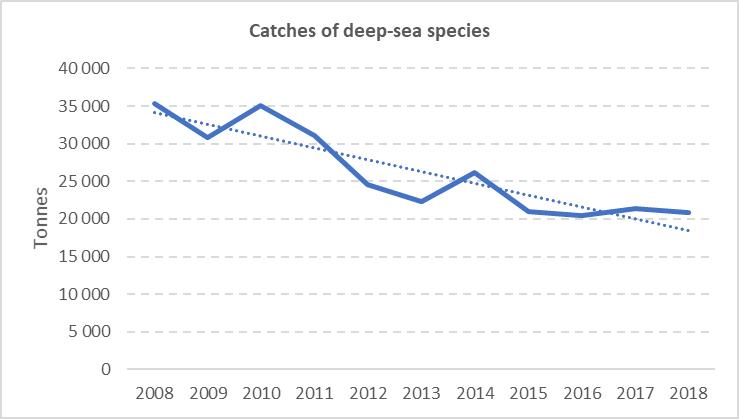
Evolution of EU reported catches of deep-sea species referred to in Annex I of the DSAR in the North-East Atlantic and in CECAF areas 34.1.1, 34.1.2 and 34.2 (except Greenland waters). Dotted line: trend
Source: based on Eurostat data
Based on information collected during the evaluation, an upturn in deep-sea fishing activities by bottom trawlers in EU waters is unlikely due to i) the 800m bottom trawl ban enforced by the DSAR, which reduced accessibility to certain commercial deep-sea species like grenadiers and black scabbardfish, and ii) the reduced economic incentives to commercialise deep-sea species due to negative consumer perceptions. Although implementation details are still unknown, the forthcoming act on the definition of existing fishing areas (Article 7.2 of the DSAR) and on identification of areas where VMEs are known or likely to occur (Article 9.6) is likely to introduce further spatial restrictions impacting the operational range of deep-sea fishing vessels.
|
|
(d) The completeness and reliability of data that Member States provide to scientific bodies for the purpose of stock assessment, or to the Commission in case of specific data calls
|
|
According to feedback from scientists working on stock assessment of deep-sea species, biological data and fisheries-dependent information collected by Member States are broadly adequate to support the scientific assessment of the status of stock of the main commercial deep-sea species (i.e. black scabbardfish, greater silver smelt, blue ling, Greenland halibut and grenadiers). As shown in the following figure (left), out of 22 deep-sea stocks reviewed by ICES, 14% are in category 1 for which analytical assessment is possible, 41% are in category 3 for which survey-based assessment indicate trends, and 45% are in ICES categories 5 and 6 for which the available data may just suggest trends at best. In terms of landings (right), 55% of deep-sea catches are obtained from stocks in category 1 and 43% obtained from stocks in category 3, with 2% of deep-sea catches obtained from stocks in categories 5 and 6.
|

|

|
Number of deep-sea stocks (left) and catches on deep-sea stocks (right) by ICES advice category
Source: own review of ICES advices
Neither the DSAR nor the EU Data Collection Framework could improve the situation, because i) the DSAR results in the reduction of catches of some commercial species (i.e. grenadiers) and associated by-catches with less fisheries dependent data available for stock assessment purposes, and because ii) the EU DCF exempts Member States from the collection of biological data in support of stock assessments for stocks where annual national catches are less than 200 tonnes, which is the case for most deep-sea species identified by the DSAR.
|
|
(e) The deep-sea stocks for which the scientific advice has improved
|
|
According to ICES, two stocks of greater silver smelt (ARU.27.5b6a and ARU.27.123a4) and the stock of black scabbardfish (BSF.27.NEA) are candidates for upgrade to the category of stocks with full analytical assessments and forecasts that are either age-/length structured or based on production models (ICES category 1). For category 1 stocks, ICES may provide advices on the basis of the MSY approach.
These three stocks are currently in the category of stocks for which only survey-based assessments provide trends (ICES category 3) triggering application of the ICES precautionary approach.
|
|
(f) The effectiveness of accompanying measures to eliminate discards and reduce catches of the most vulnerable species
|
|
The landing obligation that entered into force in 2019 for deep-sea fisheries will probably incentivise fishing vessels to reduce their amounts of unwanted catch as such unwanted catch are counted against quotas. The scope of application of the landing obligation to deep-sea species, including most vulnerable species (i.e. identification of species subject to landing obligation) falls under the remit of other EU instruments, in particular i) the annual general TAC and quota regulation, ii) the biennial deep-sea specific TAC and quota regulation and iii) the Technical Measures Regulation (EU) 2019/2014.
|
|
(g) The quality of the impact assessments carried out pursuant to Article 8
|
|
To date, there has been no impact assessment submitted in relation to Article 8 of the DSAR. This is due to the delayed implementation of the definition of existing fishing areas foreseen in Article 7 of the DSAR.
(N.B.: impact assessments are required by the DSAR for vessels wishing to engage in exploratory fishing outside defined existing fishing areas).
|
|
(h) The number of vessels and ports in the Union directly affected by the implementation of this Regulation
|
|
Based on Member States’ annual reports to the Commission, Member States issued 1 113 fishing authorisations to catch deep-sea species in 2018. Of these, 542 (49%) were targeting fishing authorisations and 571 (51%) were by-catch fishing authorisations. Spain issued 43% of total number of both types of fishing authorisations in 2018 followed by Portugal which issued 41%, France 8% and the United Kingdom 5%. Ninety-four percent of the 542 targeting fishing authorisations issued in 2018 were by Portugal (60%) and Spain (34%).
Based on data collected from Member States in the frame of this evaluation, the numbers of fishing authorisations issued each year between 2017 and 2020 appear to be rather stable. The consulted EU Member State authorities and fishermen associations also confirmed that there are no significant trends to be reported in relation to the number of fishing vessels catching deep-sea species as target species or as by-catch.
The main fishing ports in the Union through which some catches of deep-sea species are landed is shown in the following table. However, the relative importance of deep-sea species in total landings transiting through these ports could not be assessed. Yet, since catches of deep-sea species represent less than 1% of total catches in the Member States (except Portugal 4%), it is likely that most EU ports do not have a socio-economic dependence on landings of deep-sea species. Nonetheless, landings of deep-sea species are probably critical in some specific regional contexts, such as the outermost regions of Portugal (the Azores and Madeira). This is due to the specialisation of local fishing fleets, including small-scale fleets, on the exploitation of deep-sea species, in the absence of other alternatives.
|
Member State
|
Main fishing ports in relation to deep-sea fisheries
|
|
DE
|
Rostock, Bremerhaven
|
|
ES
|
Mugia, Burela, La Coruña, Cedeira, Santa Eugenia de Riveira, Cangas Aviles, Ondarroa Camariñas, Vigo, Marin, Cariño, Lastres, Gijon, Cillero, Santander, Castletownbere (IE), Killybegs (IE), Tromsø (NO)
|
|
FR
|
Boulogne s/Mer, Lorient, Concarneau, Lochinver (UK), Peterhead (UK)
|
|
NL
|
IJmuiden, Scheveningen, Amsterdam
|
|
PT
|
Matosinhos Nazaré, Peniche, Sesimbra, Olhão (Mainland)
Ponta Delgada, São Mateus, Praia da Vitória and Horta (Azores)
Funchal (Madeira)
|
|
UK
|
Grimsby, Macduff, Marin, Peterhead, Lochinver, North Shields
|
Source: Member States reports and feedback from stakeholders
|
|
(i) The effectiveness of measures established to ensure the long-term sustainability of deep-sea fish stocks and to prevent by-catch of non-target species, in particular by-catch of the most vulnerable species
|
|
The 800m bottom trawl prohibition (Article 8.4 of the DSAR) is the main measure implemented by the DSAR with an effect on environmental sustainability of the exploitation of deep-sea fish stocks. The 800m bottom trawl prohibition has been effective at protecting deep-sea commercial species with a majority of their biomass below that depth, like grenadiers and black scabbardfish, from fishing pressure by bottom trawlers. As shown in the following graph, EU catches of these two commercial deep-sea species in the West of Scotland and Rockall (ICES subarea 6) decreased by a factor of 4 for grenadiers, and by a factor of 2 for black scabbardfish between 2016 and 2019, with a clear decreasing trend from 2017. The impact of the 800m trawl prohibition on the accessibility of these two commercial deep-sea species was confirmed by fishing operators and scientists.

Evolution of EU catches of grenadiers and black scabbardfish in ICES subarea 6
Source: based on data published in ICES WGDEEP report (2020)
According to available scientific information, the restriction of bottom trawlers operations to waters shallower than 800m was effective at reducing the amount of by-catch, and in particular by-catch of deep-sea sharks and orange roughy, which the DSAR designates as “Most Vulnerable Species”. As shown in the next figure, the discard rate of French bottom trawlers fishing for deep-sea species in the West of Scotland and West of Ireland decreased from about 20% in 2013 to less than 5% in 2018, based on data collected by scientific observers.

Evolution of proportion of total weigh of discards / total weight of catches by French trawlers targeting deep-sea species in the West of Scotland and in the West of Ireland
Source: IFREMER – programme OBSMER. Data for métier OTB/OTT_DWS (demersal trawlers targeting deep-water species)
Note: the French bottom trawler fleet unilaterally committed to stop fishing operations below 800m starting in 2014
|
|
(j) the extent to which VMEs have been effectively protected through the restriction of authorised fishing activities to existing deep-sea fishing areas, the move-on rule and/or by other measures
|
|
At the time of drafting this evaluation, two DSAR flagship measures for the protection of VMEs could not be implemented (i.e. limiting deep-sea fishing activities to existing fishing areas, and the closures of areas where VMEs are known or likely to occur). As a result, VMEs located in EU waters below 400m and 800m depth are not yet fully protected from any significant adverse impacts caused by fishing gears through spatial closure measures. The 800m bottom trawl prohibition resulted in the protection of VMEs below 800m depth, but only from significant adverse impacts generated by the gear subject to prohibition.
The VME encounter protocol, including the move-on rule has been in force since 2017, but since then, no EU vessels have reported a VME encounter to their flag Member States. This possibly reflects a combination of a general decline in bottom fishing activity in EU waters and an enhanced awareness and capability of vessels to avoid coral and sponge areas. It is also known that bottom trawls are designed to catch fish and are poor sampling tools for most sessile benthic organisms and in general the catchability of VME indicator species by commercial fishing vessels is unknown. It cannot be excluded, however, that the lack of reports also reflects some failure by fishing masters to report actual encounters.
Overall, the DSAR has not been effective so far in protecting deep-sea vulnerable marine ecosystems from significant adverse impacts caused by fishing gear as a result of the delayed implementation of two of its key spatial measures. Independently of the effectiveness of the DSAR measures yet to be implemented, the DSAR will not address effective protection of VMEs located above 400m depth although available scientific evidences suggest that VMEs are present in EU waters in the 200 – 400m depth band.
|
|
(k) the application of the depth limitation of 800 metres
|
|
According to feedback from the Member States, the application of the depth limitation of 800m is controlled mostly through the vessel monitoring system (VMS) requiring any EU fishing vessel of length greater than 12 meters overall to transmit its position at least once every 2 hours according to the Control Regulation (EC) 1224/2009. The Control Regulation (EC) 1224/2009 provides other tools for enforcing the measure, including a capacity of polling the actual position of each vessel by Member States’ Fisheries Monitoring Centres, the possibility to require VMS information at shorter time intervals, and to cross-check VMS positions with positions transmitted by the Automatic Identification System (AIS) mandatory for any EU vessel of length greater than 15 m overall. The haul-by-haul reporting obligation enforced by the DSAR (Article 13) provides an additional effective tool for enhancing the monitoring of activities deployed by fishing vessels engaged in a deep-sea métier or fishing at depths below 400m.
Feedback from Member State authorities confirmed that the 800m bottom trawl prohibition is complied with by their flag vessels as confirmed by the absence of infringements since 2017.
|
Annex 5
List of EU Regulations and international instruments in relation to the DSAR applicable over the evaluation period
Deep-sea Access Regulation
Regulation (EU) 2016/2336 of the European Parliament and of the Council of 14 December 2016 establishing specific conditions for fishing for deep-sea stocks in the north-east Atlantic and provisions for fishing in international waters of the north-east Atlantic and repealing Council Regulation (EC) No 2347/2002. OJ L 354, 23.12.2016, p. 1–19
VME Regulation (international waters)
Council Regulation (EC) No 734/2008 of 15 July 2008 on the protection of vulnerable marine ecosystems in the high seas from the adverse impacts of bottom fishing gears. OJ L 201, 30.7.2008, p. 8–13
Technical measures Regulations
Until June 2019
Council Regulation (EC) No 850/98 of 30 March 1998 for the conservation of fishery resources through technical measures for the protection of juveniles of marine organisms. OJ L 125, 27.4.1998, p. 1–36
As from June 2019
Regulation (EU) 2019/1241 of the European Parliament and of the Council of 20 June 2019 on the conservation of fisheries resources and the protection of marine ecosystems through technical measures, amending Council Regulations (EC) No 1967/2006, (EC) No 1224/2009 and Regulations (EU) No 1380/2013, (EU) 2016/1139, (EU) 2018/973, (EU) 2019/472 and (EU) 2019/1022 of the European Parliament and of the Council, and repealing Council Regulations (EC) No 894/97, (EC) No 850/98, (EC) No 2549/2000, (EC) No 254/2002, (EC) No 812/2004 and (EC) No 2187/2005. PE/59/2019/REV/1. OJ L 198, 25.7.2019, p. 105–201
Control Regulation and its implementing Regulation
Council Regulation (EC) No 1224/2009 of 20 November 2009 establishing a Community control system for ensuring compliance with the rules of the common fisheries policy, amending Regulations (EC) No 847/96, (EC) No 2371/2002, (EC) No 811/2004, (EC) No 768/2005, (EC) No 2115/2005, (EC) No 2166/2005, (EC) No 388/2006, (EC) No 509/2007, (EC) No 676/2007, (EC) No 1098/2007, (EC) No 1300/2008, (EC) No 1342/2008 and repealing Regulations (EEC) No 2847/93, (EC) No 1627/94 and (EC) No 1966/2006. OJ L 343, 22.12.2009, p. 1–50.
Commission Implementing Regulation (EU) No 404/2011 of 8 April 2011 laying down detailed rules for the implementation of Council Regulation (EC) No 1224/2009 establishing a Community control system for ensuring compliance with the rules of the Common Fisheries Policy. OJ L 112, 30.4.2011, p. 1–153.
Proposal for a Regulation of the European Parliament and of the Council amending Council Regulation (EC) No 1224/2009, and amending Council Regulations (EC) No 768/2005, (EC) No 1967/2006, (EC) No 1005/2008, and Regulation (EU) No 2016/1139 of the European Parliament and of the Council as regards fisheries control, COM/2018/368 final.
Specific Control and Inspection Programmes
Commission Implementing Decision (EU) 2018/1986 of 13 December 2018 establishing specific control and inspection programmes for certain fisheries and repealing Implementing Decisions 2012/807/EU, 2013/328/EU, 2013/305/EU and 2014/156/EU. C/2018/8461 OJ L 317, 14.12.2018, p. 29–46
Deep-Sea species TAC and quota Regulation (biennial) applicable as from 2017 and until 2020
Council Regulation (EU) 2018/2025 of 17 December 2018 fixing for 2019 and 2020 the fishing opportunities for Union fishing vessels for certain deep-sea fish stocks. ST/14418/2018/INIT. OJ L 325, 20.12.2018, p. 7–17
Council Regulation (EU) 2016/2285 of 12 December 2016 fixing for 2017 and 2018 the fishing opportunities for Union fishing vessels for certain deep-sea fish stocks and amending Council Regulation (EU) 2016/72. OJ L 344, 17.12.2016, p. 32–45
General TAC and Quota Regulation (annual – incl. certain deep-sea species) applicable as from 2017 and until 2020
Council Regulation (EU) 2020/123 of 27 January 2020 fixing for 2020 the fishing opportunities for certain fish stocks and groups of fish stocks, applicable in Union waters and, for Union fishing vessels, in certain non-Union waters. ST/15319/2019/INIT. OJ L 25, 30.1.2020, p. 1–156
Council Regulation (EU) 2019/124 of 30 January 2019 fixing for 2019 the fishing opportunities for certain fish stocks and groups of fish stocks, applicable in Union waters and, for Union fishing vessels, in certain non-Union waters. OJ L 29, 31.1.2019, p. 1–166
Council Regulation (EU) 2018/120 of 23 January 2018 fixing for 2018 the fishing opportunities for certain fish stocks and groups of fish stocks, applicable in Union waters and, for Union fishing vessels, in certain non-Union waters, and amending Regulation (EU) 2017/127. OJ L 27, 31.1.2018, p. 1–168
Council Regulation (EU) 2017/127 of 20 January 2017 fixing for 2017 the fishing opportunities for certain fish stocks and groups of fish stocks, applicable in Union waters and, for Union fishing vessels, in certain non-Union waters OJ L 24, 28.1.2017, p. 1–172
Data Collection Regulation and implementing instruments
Until May 2017
Council Regulation (EC) No 199/2008 of 25 February 2008 concerning the establishment of a Community framework for the collection, management and use of data in the fisheries sector and support for scientific advice regarding the Common Fisheries Policy OJ L 60, 5.3.2008, p. 1–12.
Commission Regulation (EC) No 665/2008 of 14 July 2008 laying down detailed rules for the application of Council Regulation (EC) No 199/2008 concerning the establishment of a Community framework for the collection, management and use of data in the fisheries sector and support for scientific advice regarding the Common Fisheries Policy. OJ L 186, 15.7.2008, p. 3–5
As from May 2017
Regulation (EU) 2017/1004 of the European Parliament and of the Council of 17 May 2017 on the establishment of a Union framework for the collection, management and use of data in the fisheries sector and support for scientific advice regarding the common fisheries policy and repealing Council Regulation (EC) No 199/2008. OJ L 157, 20.6.2017, p. 1–21
Applicable for the period 2017-2019
Commission Implementing Decision (EU) 2016/1251 of 12 July 2016 adopting a multiannual Union programme for the collection, management and use of data in the fisheries and aquaculture sectors for the period 2017-2019 (notified under document C(2016) 4329). C/2016/4329. OJ L 207, 1.8.2016, p. 113–177
Applicable as from 2020
Commission Delegated Decision (EU) 2019/910 of 13 March 2019 establishing the multiannual Union programme for the collection and management of biological, environmental, technical and socioeconomic data in the fisheries and aquaculture sectors. C/2019/1848. OJ L 145, 4.6.2019, p. 27–84
Commission Implementing Decision (EU) 2019/909 of 18 February 2019 establishing the list of mandatory research surveys and thresholds for the purposes of the multiannual Union programme for the collection and management of data in the fisheries and aquaculture sectors. C/2019/1001. OJ L 145, 4.6.2019, p. 21–26
Western Waters Multiannual Plan
Regulation (EU) 2019/472 of the European Parliament and of the Council of 19 March 2019 establishing a multiannual plan for stocks fished in the Western Waters and adjacent waters, and for fisheries exploiting those stocks, amending Regulations (EU) 2016/1139 and (EU) 2018/973, and repealing Council Regulations (EC) No 811/2004, (EC) No 2166/2005, (EC) No 388/2006, (EC) No 509/2007 and (EC) No 1300/2008. PE/78/2018/REV/1. JO L 83 du 25.3.2019, p. 1–17
Basic CFP Regulation
Regulation (EU) No 1380/2013 of the European Parliament and of the Council of 11 December 2013 on the Common Fisheries Policy, amending Council Regulations (EC) No 1954/2003 and (EC) No 1224/2009 and repealing Council Regulations (EC) No 2371/2002 and (EC) No 639/2004 and Council Decision 2004/585/EC. OJ L 354, 28.12.2013, p. 22–61
NEAFC regulation
Regulation (EU) No 1236/2010 of the European Parliament and of the Council of 15 December 2010 laying down a scheme of control and enforcement applicable in the area covered by the Convention on future multilateral cooperation in the North-East Atlantic fisheries and repealing Council Regulation (EC) No 2791/1999. OJ L 348, 31.12.2010, p. 17–33.
MSFD Directive
Directive 2008/56/EC of the European Parliament and of the Council of 17 June 2008 establishing a framework for community action in the field of marine environmental policy (Marine Strategy Framework Directive) (Text with EEA relevance). OJ L 164, 25.6.2008, p. 19–40
Commission Decision (EU) 2017/848 of 17 May 2017 laying down criteria and methodological standards on good environmental status of marine waters and specifications and standardised methods for monitoring and assessment, and repealing Decision 2010/477/EU (Text with EEA relevance). C/2017/2901 OJ L 125, 18.5.2017, p. 43–74
Habitats Directive
Council Directive 92/43/EEC of 21 May 1992 on the conservation of natural habitats and of wild fauna and flora. OJ L 206, 22.7.1992, p. 7–50
International obligations
UN Resolution 59/25. Sustainable fisheries, including through the 1995 Agreement for the Implementation of the Provisions of the United Nations Convention on the Law of the Sea of 10 December 1982 relating to the Conservation and Management of Straddling Fish Stocks and Highly Migratory Fish Stocks, and related instruments (November 2004)
UN Resolution 61/105. Sustainable fisheries, including through the 1995 Agreement for the Implementation of the Provisions of the United Nations Convention on the Law of the Sea of 10 December 1982 relating to the Conservation and Management of Straddling Fish Stocks and Highly Migratory Fish Stocks, and related instruments (December 2006)
UN Resolution 64/72. Sustainable fisheries, including through the 1995 Agreement for the Implementation of the Provisions of the United Nations Convention on the Law of the Sea of 10 December 1982 relating to the Conservation and Management of Straddling Fish Stocks and Highly Migratory Fish Stocks, and related instruments (December 2009)
NEAFC Recommendation 19.2014 on the protection of vulnerable marine ecosystems in the NEAFC Regulatory Area (2014)
Annex 6
Literature cited
Auster, P.J., Gjerde, K., Heupel, E., Watling, L., Grehan, A., Rogers, A.D. (2011) Definition and detection of vulnerable marine ecosystems on the high seas: problems with the “move-on” rule. ICES Journal of Marine Science: Journal du Conseil 68, 254-264. 10.1093/icesjms/fsq074.
Bensch, A., Gianni, M., Gréboval, D., Sanders, J.S., Hjort, A. (2009) Worldwide review of bottom fisheries in the high seas. FAO Fisheries and Aquaculture Technical Paper. N° 522, Rev. 1 Rome, FAO. 2009., 145 p.
Bueno-Pardo, J., Ramalho, S.P., García-Alegre, A., et al. (2017) Deep-sea crustacean trawling fisheries in Portugal: quantification of effort and assessment of landings per unit effort using a Vessel Monitoring System (VMS). Scientific Reports 7, 40795. 10.1038/srep40795.
CEFAS, AZTI Tecnalia, MRAG, IEO, IMPA (2018) Scientific approaches for the assessment and management of deep-sea fisheries and ecosystems in RFMOs and RFBs Specific Contract N°8 - EASME/EMFF/2016/008.
COFREPECHE, MRAG, NFDS, POSEIDON (2014) Analyse économique de la flotte thonière de l'UE – Note de méthode. Contrat cadre MARE/2011/01 -Lot 3, contrat spécifique n°09. Bruxelles, 32p
EUROPEAN COMMISSION Staff Working Document (SWD/2012/202 final): Impact Assessment Accompanying the document Proposal for a Regulation of the European Parliament and of the Council establishing specific conditions to fishing for deep-sea stocks in the North-East Atlantic and provisions for fishing in international waters of the North-East Atlantic and repealing Regulation (EC) No 2347/2002
FAO (2009) International Guidelines for the Management of Deep-sea Fisheries in the High Seas. Rome. 73 pp.
FAO (2017) Report of the Technical Workshop on Deep-sea Fisheries and Vulnerable Marine Ecosystems of the Eastern Central Atlantic, Dakar, Senegal, 8–10 November 2016. FAO Fisheries and Aquaculture Report. 1184, Rome, Italy. 142 pp.
FAO (2018) Report of the FAO/CECAF Working Group on the Assessment of Demersal Resources –Subgroup North. Tenerife, Spain, from 6 to 15 June 2017/Rapport du Groupe de travail FAO/COPACE sur l’évaluation des ressources démersales –Sous-groupe Nord. Tenerife, Espagne, du 6 au 15 juin 2017. CECAF/ECAF Series/COPACE/PACE Séries. . No. 18/78, Rome, FAO. Licence: CC BY-NC-SA 3.0 IGO.
Farias, I., Morales-Nin, B., Lorance, P., Figueiredo, I. (2013) Black scabbardfish, Aphanopus carbo, in the northeast Atlantic: Distribution and hypothetical migratory cycle. Aquatic Living Resources. 10.1051/alr/2013061.
Gauduchon, T., Cornou, A.-S., Quinio-Scavinner, M., Goascoz, N., Dubroca, L., Billet, N. (2020) Captures et rejets des métiers de pêche françcais - Résultats des observations à bord des navires de pêche professionnelle en 2018. OBSMER. https://doi.org/10.13155/73122, 444 p.
Goujon, M. (2003) Informations sur les captures accessoires des thoniers senneurs gérés par les armements français d'après les observations faites par les observateurs embarqués pendant le plan de protection des thonidés de l'atlantique de 1997 à 2002. Col. Vol. Sci. Pap. ICCAT. 414-431.
ICES (2018) Report of the Working Group on Elasmobranch Fishes (WGEF), 19–28 June 2018, Lisbon, Portugal. ICES CM 2018/ACOM:16., 1306 pp.
ICES (2019a) ICES/NAFO Joint Working Group on Deep-water Ecology (WGDEC). ICES Scientific Reports.
ICES (2019b) Stakeholder workshop to disseminate the ICES deep-sea access regulation technical service, and scope the required steps for regulatory purposes (WKREG). ICES Scientific Reports. 1:79. 34 pp.
ICES (2019c) Working Group on Elasmobranch Fishes (WGEF). ICES scientific Reports. 964 pp.
http://doi.org/910.17895/ices.pub.15594
.
ICES (2019d) Working Group on the Biology and Assessment of Deep-sea Fisheries Resources (WGDEEP). ICES Scientific Reports. 1:21., 988pp.
http://doi.org/910.17895/ices.pub.15262
.
ICES (2020a) Working Group on the Biology and Assessment of Deep-sea Fisheries Resources (WGDEEP). ICES Scientific Reports. 2:38, 928pp.
http://doi.org/910.17895/ices.pub.16015
.
ICES (2020b) Working Group on the Ecosystem Effects of Fishing Activities (WGECO). ICES Scientific Reports. 2:26, 43 pp.
http://doi.org/10.17895/ices.pub.16005
Lorance, P. (2012) Répartition bathymétrique des espèces dites profondes. IFREMER RBE/EDERU/12-3822. 23 p.
Morato, T., Pham, C.K., Pinto, C., et al. (2018) A Multi Criteria Assessment Method for Identifying Vulnerable Marine Ecosystems in the North-East Atlantic. Frontiers in Marine Science 5. [In English] 10.3389/fmars.2018.00460.
Parker, S.J., Penney, A.J., Clark, M.R. (2009) Detection criteria for managing trawl impacts on vulnerable marine ecosystems in high seas fisheries of the South Pacific Ocean. Marine Ecology Progress Series 397, 309-317.
Prellezo, R., Iriondo, A., Santurtún, M., Valeiras, J. (2018) Research for the PECH Committee - Landing obligation and choke species in multispecies and mixed fisheries - the South Western Waters. European Parliament, Policy Department for Structural and Cohesion Policies, Brussels. 65 pp
Rihan, D. (2018) Research for the PECH Committee - Landing obligation and choke species in multispecies and mixed fisheries - the North Western Waters. European Parliament, Policy Department for Structural and Cohesion Policies, Brussels. 124 p.
Roos Diesel Analysis BV (2019) Study on engine power verification by Member States. European Commission - DG MARE.
STECF (2019a) The 2019 Annual Economic Report on the EU Fishing Fleet (STECF 19-06). Carvalho, N., Keatinge, M. and Guillen Garcia, J. editor(s), EUR 28359 EN, Publications Office of the European Union, Luxembourg, 2019. ISBN 978-92-76-09517-0, doi:10.2760/911768, JRC117567, 496 p.
STECF (2019b) Fisheries Dependent -Information – FDI (STECF-19-11). Publications Office of the European Union, Luxembourg, 2020.


