 EUROPEAN COMMISSION
Brussels, 23.5.2018
SWD(2018) 368 final
COMMISSION STAFF WORKING DOCUMENT
Accompanying the document
Recommendation for a
COUNCIL RECOMMENDATION
with a view to correcting the significant observed deviation from the adjustment path toward the medium-term budgetary objective
in Hungary
{COM(2018) 431 final}
COMMISSION STAFF WORKING DOCUMENT
Accompanying the document
Recommendation for a
COUNCIL RECOMMENDATION
with a view to correcting the significant observed deviation from the adjustment path toward the medium-term budgetary objective
in Hungary
1.Introduction
On 21 June 2013, the Council abrogated its decision on the existence of an excessive deficit in Hungary, on account of its correction in 2012, which, based on the Commission 2013 spring forecast, appeared durable.
Since then Hungary has been subject to the preventive arm of the Stability and Growth Pact, which requires sufficient progress towards the member state's medium-term budgetary objective (MTO). Hungary is also subject to the debt rule as its general government debt remains above 60% of GDP. On 12 July 2016, the Council addressed recommendations to Hungary in the context of the European Semester. In particular, in the area of public finances the Council recommended Hungary to achieve a fiscal adjustment of 0.6% of GDP in 2017 unless the medium-term objective (MTO) was respected with a lower effort.
Based on the Commission 2018 spring forecast, Section 2 of this document presents the macroeconomic and fiscal developments in 2017 and an outlook. Section 3 presents an assessment of compliance with the obligations stemming from the Stability and Growth Pact, including an overall assessment of the reasons for the deviation with respect to the preventive arm requirements. Section 4 proposes the necessary fiscal effort for 2018 to address the significant deviation, including an applicable expenditure benchmark rate compatible with the suggested annual improvement in the structural balance. Section 5 provides the overall conclusions.
2.Macroeconomic and fiscal developments in 2017 and outlook
In 2017, real GDP growth accelerated to 4.0%, from 2.2% in 2016, supported also by expansionary fiscal policy. The rebound in GDP growth was helped by tax reductions and increase in public investment. In addition, private consumption benefitted from a strong labour market and large administrative wage increases. Export growth accelerated, supported by the revival of the main export markets. A strong growth of domestic demand raised imports by an even larger amount, resulting in a negative contribution of net exports to GDP growth. The considerable reduction of employers' social security contribution mitigated the pass-through of wage increases to inflation; nonetheless consumer prices accelerated from 0.4% in 2016 to 2.4% in 2017.
The Commission 2018 spring forecast projects GDP growth to remain at 4%, before moderating to 3.2% in 2019. Cyclical factors, which are currently supporting growth, are expected to gradually wear off. Investment is expected to stabilize at a high level; with further investment limited by capacity shortages in construction. As readily available labour reserves are exhausted and unemployment falls to record low levels, job creation is projected to slow down. In addition, tailwinds from administrative wage increases are projected to gradually wear off, dampening real wage dynamics in 2019. The moderation of income growth is set to slow down private consumption growth in 2019.
Based on the estimates of the 2018 Commission spring forecast, Hungary's positive output gap is calculated to have widened in 2017, to 1.6% of GDP from 0.3% in 2016. Projected GDP growth remains above the potential in 2018 before falling below potential in 2019. With an output gap exceeding 1.5% of GDP, the economy is assessed to be in 'good times' in 2017-2019.
Table 1: Macroeconomic developments and forecast 2017-2018
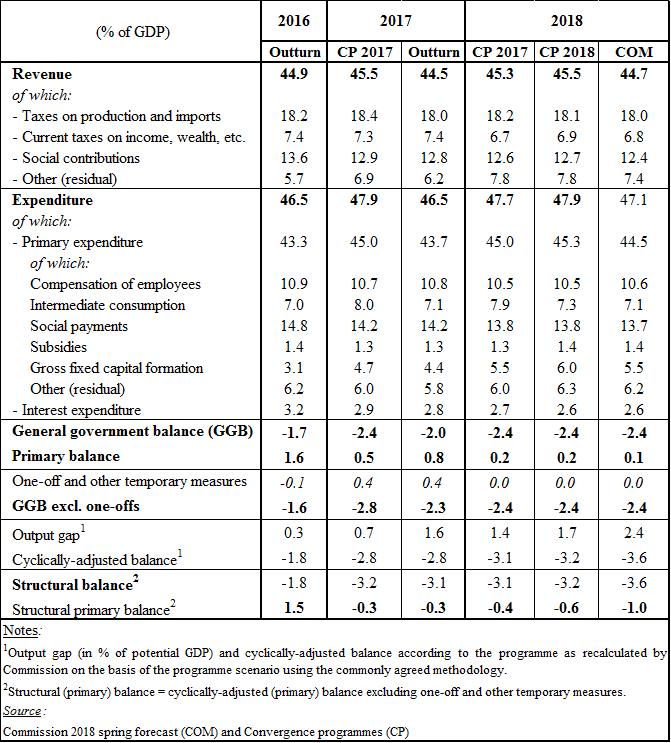
In 2017, the general government deficit rose to 2.0% of GDP, from 1.7% of GDP in 2016. In structural terms, this corresponds to a significant loosening of the fiscal stance with the structural balance estimated to have deteriorated from around -1.8% of GDP in 2016 to below -3% in 2017 (see Table 2). While the economy grew above its potential and at a high nominal rate, public finances were also helped by one-off receipts from agricultural land sales (0.4% of GDP, recorded as negative expenditure). In addition, government revenues benefited from a temporary extra corporate income tax payment (amounting to 0.6% and 0.7% of GDP in 2016 and 2017, respectively).
Despite the robust growth of major tax bases, the tax-to-GDP ratio dropped by 0.9% of GDP in 2017. This resulted from sizeable tax cuts, most notably (i) a 5 pps. reduction of the employers' social security contribution rate, (ii) a lowering of the corporate income tax, and (iii) decreasing VAT rates for selected items (see Table 3). The negative effect of tax cuts on revenues was partly compensated by extra income-related tax receipts as a result of accelerating wage increases induced also by a minimum wage hike and a reduction in social contributions. In parallel, government spending rose strongly. Aside from the increased spending on programmes fully matched by EU funds revenue, primary expenditure grew just slightly below nominal GDP (at 7.6% compared with 7.8%). The observed high growth in expenditure reflected measures, such as public sector pay raises, as well as the steeply increased spending on public investment projects. At the same time, interest outlays declined, even in nominal terms, providing a considerable deficit-moderating effect (0.4% of GDP).
The 2017 budget deficit remained below the 2017 Convergence Programme target of 2.4% of GDP. Whereas EU fund absorption fell short of planned, revenues from taxes and other sources exceeded the targets. On the expenditure side, spending on goods and services turned out to be significantly lower than expected. These deficit-improving developments were partially absorbed by higher-than-planned capital expenditure financed from domestic sources and extra spending on public wages and social transfers.
Looking ahead, the Commission 2018 spring forecast projects the headline deficit to peak at 2.4% of GDP in 2018. Further tax cuts, particularly an additional 2.5 pps. lowering of employers' social security contribution rate and continued selective VAT reductions, are expected to have a negative impact on the tax-to-GDP ratio. In addition, a significant deficit-increasing effect is projected to arise from the phasing-out of temporary revenues (i.e. land sales and the corporate tax windfall), which benefited the budget during 2016 and 2017. At the same time, overall primary expenditure (without EU funds) is projected to increase moderately relative to the forecast high nominal GDP growth, albeit still well above inflation. Thus the forecast slowdown in spending growth partly offsets the impact of the above-mentioned deficit-increasing developments in 2018. Based on a no-policy-change scenario, the government deficit is projected to decrease to 2.1% of GDP in 2019.
In the 2018 Convergence programme, the Hungarian authorities plan a headline deficit of 2.4% of GDP in 2018, in line with the Commission forecast, and a deficit of 1.8% of GDP in 2019, somewhat below the no-policy-change projection of the Commission. Both the total revenue and total expenditure planned for 2018 are higher than in the Commission forecast (see Table 2). The underlying macroeconomic projection of 4.3% of real GDP growth in 2018 is more optimistic than the Commission 2018 forecast, with a positive impact on tax receipts. Compared to the Commission forecast, the government target also counts on higher extra tax revenues generated by increased wage growth, due to further minimum wage increases and social security cuts. On the expenditure side, the planned public investment spending is notably higher. The lower public investment projection in the Commission forecast is based on assuming lower-than-planned EU fund absorption and slower implementation of projects financed from domestic sources, taking into account the increasing capacity constraints in construction.
Table 2: Composition of the budgetary adjustment
Table 3: Main discretionary revenue measures included in the Commission 2018 forecast (fiscal impact in % of GDP)
|
Title
|
2017
|
2018
|
2019
|
|
Reduction of employer's social security contribution (SSC) rate combined with the alignment of SSC allowances to the reduced rates (a rate reduction from 27% to 22% in 2017 and to 19.5% in 2018)
|
-1.4%
|
-0.75%
|
|
|
Extra payroll tax/SSC revenues due to minimum wage increases – direct, static effect (general wage minimum: 15% rise in 2017 and 8% in 2018; skilled workers: 25% rise in 2017 and 12% in 2018)
|
+0.35%
|
+0.1%
|
|
|
Reduction of the corporate income tax (replacing the two-bracket schedule with 10% and 19% tax rates with a single 9% rate)
|
-0.4%
|
|
|
|
Selective VAT rate cuts (2017: poultry, milk and eggs from 27% to 5%, restaurant meals and internet from 27% to 18%; 2018: fish and pork liver from 27% to 5%; restaurant meals and internet from 18% to 5%)
|
-0.2%
|
-0.2%
|
|
|
Measures to increase tax collection efficiency (the extension of online cashiers in services and the phasing-in online invoicing between companies)
|
+0.15%
|
+0.05%
|
|
|
Note:
The budgetary impact in the table as included in the Commission 2018 spring forecast. A positive sign implies that revenue increases as a consequence of this measure. The table includes measures with a fiscal impact of at least 0.1% of GDP over the examined period.
|
Table 4: Debt developments
In 2017, the government debt-to-GDP ratio declined by 2.4% of GDP, reaching 73.6%. This decrease was mainly driven by a favourable snow-ball effect reflecting the acceleration of nominal GDP growth and helped also by the primary surplus, while it was adversely affected by below-the-line developments (i.e. stock-flow adjustments). The Commission 2018 spring forecast projects a slowdown in the rate of debt reduction in 2018 due to an additional sizeable stock-flow adjustment effect, with the debt ratio decreasing only slightly to 73.3%. Thereafter, the debt ratio is projected to decline faster, falling to 71% in 2019 thanks to persisting high nominal GDP growth. The authorities' updated debt projection is broadly in line with the Commission forecast for 2018, while the authorities expect a lower debt ratio by the end of 2019 relative to the Commission, mainly on account of a higher GDP growth projection.
In 2017, Hungary is calculated to have complied with the debt rule as the debt-to-GDP ratio remained below the debt-reduction benchmark. A similar conclusion is reached for 2018 and 2019 on the basis of the updated national plans and the Commission 2018 spring forecast.
3.Compliance with the adjustment towards the MTO in 2017
Hungary's medium-term objective (MTO) is a deficit of 1.5% of GDP in structural terms.
On 12 July 2016, the Council addressed recommendations to Hungary within the context of the European Semester. In particular, in the area of public finances the Council recommended Hungary to achieve a fiscal adjustment of 0.6% of GDP in 2017, unless the medium-term objective (MTO) is respected with a lower effort.
The 2018 Convergence Programme indicates that the budgetary impact of the security-related measures in 2017 is significant, and provides adequate evidence of the scope and nature of these additional budgetary costs. The eligible additional expenditure for security-related measures in 2017 amounted to 0.17% of GDP. The provisions set out in Articles 5(1) and 6(3) of Regulation (EC) No 1466/97 cater for this additional expenditure, in that the severity of a terrorist threat is an unusual event, the impact of which on Hungary's public finances is significant, while sustainability should not be compromised by allowing for a temporary deviation from the adjustment path towards the MTO. Therefore, the required adjustment towards the medium-term budgetary objective for 2017 has been reduced to take into account the additional costs in 2017. Adding also the three-year carry-forward of the allowance for refugee and security related incremental costs, granted in 2015 and 2016, implies that Hungary is eligible for a temporary deviation under the unusual event clause amounting to 0.25% of GDP from the required adjustment path in 2017.
According to the Commission 2018 spring forecast, Hungary recorded a structural balance slightly above -1.8% of GDP in 2016, meaning that the initial position for 2017 was a distance of 0.25% of GDP from its MTO. Based on the adjustment matrix, and taking into account the distance from the MTO in the initial position as well as the eligible correction for the unusual event clause, Hungary is required to maintain its structural deficit position in 2017 vis-a-vis 2016 (i.e. a structural deficit of 1.8% of GDP). This is equivalent to the requirement to ensure a growth of government expenditure, net of discretionary revenue measures and one-offs, not higher than 1.5% in real terms.
In 2017, both the expenditure benchmark and the structural balance pillars point to a significant deviation from the required adjustment based on outturn data and the Commission 2018 spring forecast. The growth of net government expenditure was well above the applicable expenditure benchmark rate (deviation of 2.4% of GDP). As the structural balance deteriorated by 1.4% of GDP in 2017, while the requirement was to maintain the initial position, the structural balance pillar also clearly points towards that conclusion (deviation of 1.4% of GDP).
The overall assessment reveals that the expenditure benchmark is negatively affected by three elements. First, the medium-term growth rate applied as a reference underlying the expenditure benchmark is negatively impacted by the low estimated potential growth rates in the aftermath of the crisis. As a result, the currently estimated 10-year average potential growth rate is considerably higher (by 1 pp.). Second, the expenditure benchmark is also negatively affected by the use of a too low GDP deflator compared to the one reflecting the actual cost pressures on government expenditure. Third, the expenditure benchmark appears to underestimate the fiscal effort because some of the revenue windfalls could be considered permanent. This permanent effect is linked to extra tax revenues generated by the ripple effect of significant minimum wage increases on earnings above the statutory minimum as the wage-cost share in the economy was recovering towards its historic average. After taking into account these factors, the expenditure benchmark appears to adequately reflect the fiscal effort and still points to a significant deviation. This is confirmed by the reading of the structural balance, which after adjusting for the impacts of decreasing interest expenditure, investment volatility and a revenue windfall (filtering out the above mentioned permanent effect) also points to a risk of significant deviation.
Therefore the overall assessment confirms that a deviation from the adjustment path towards the MTO in 2017 was significant.
Table 5: Compliance with the MTO or the required adjustment towards it
4.new adjustment path to the MTO and required fiscal effort
Based on the Commission 2018 spring forecast, Hungary is in good economic times (as its output gap of +2.4% is above the threshold level of +1.5% of potential GDP). Hungary's public debt exceeds the 60% of GDP threshold. Hungary's structural balance in 2017 is estimated to have been 1.6% of GDP away from its MTO of -1.5% of GDP.
The required structural effort prescribed by Regulation (EC) No 1466/97 and the matrix of requirements, which factors in the prevailing economic circumstances and possible sustainability concerns, amounts to at least 1% of GDP in 2018.
The Commission 2018 spring forecast projects a further deterioration of the structural balance by 0.5% of GDP in 2018. Therefore, a minimum structural improvement of 1% of GDP in 2018 relative to the 2017 outturn translates into a need to adopt structural consolidation measures of a total yield of at least 1.5% of GDP in 2018 for the year as a whole, relative to the current baseline from the Commission 2018 spring forecast. Given the significant size of the required structural consolidation effort resulting from the minimum adjustment requirement, no additional required adjustment on top of the minimum 1% requirement would appear warranted.
Based on the Commission forecast, the above-mentioned 1% of GDP structural adjustment target is consistent with a nominal growth rate of net primary government expenditure of 2.8% in 2018, compared to the growth rate of 7.4% projected by the Commission.
5.Overall conclusion
In 2017, GDP growth rebounded to 4.0%, driven by domestic demand, which was supported by pro-cyclical fiscal policy and wage hikes. The headline deficit rose to 2% from 1.7% of GDP in 2016, while the economy grew above its potential and public finances were also helped by favourable temporary effects. The deficit increased mainly due to sizeable tax cuts. Meanwhile primary expenditure, net of spending fully matched by EU funds, increased firmly, albeit somewhat below the accelerating nominal GDP. The structural deficit increased to 3.1% of GDP, from 1.8% of GDP in 2016. The debt-to-GDP ratio decreased further, but remained above 70% of GDP.
Both the expenditure benchmark and the structural balance pillars point to a significant deviation in 2017. An overall assessment confirms that the observed deviation from the MTO in 2017 is significant.
An improvement in Hungary's structural balance by 1% of GDP in 2018 relative to the 2017 outturn would put Hungary on an appropriate adjustment path towards the MTO. Such an improvement is consistent with the nominal growth rate of net primary government expenditure not exceeding 2.8% in 2018.