 EUROPEAN COMMISSION
Brussels,7.3.2018
SWD(2018) 209 final
COMMISSION STAFF WORKING DOCUMENT
Country Report Croatia 2018
Including an In-Depth Review on the prevention and correction of macroeconomic imbalances
Accompanying the document
COMMUNICATION FROM THE COMMISSION TO THE EUROPEAN PARLIAMENT, THE COUNCIL, THE EUROPEAN CENTRAL BANK AND THE EUROGROUP
2018 European Semester: Assessment of progress on structural reforms, prevention and correction of macroeconomic imbalances, and results of in-depth reviews under Regulation (EU) No 1176/2011
{COM(2018) 120 final}
Contents
Executive summary
1.Economic situation and outlook
2.Progress with country-specific recommendations
3.Summary of the main findings from the Macroeconomic Imbalance Procedure indepth review
4.Reform priorities
4.1.Public finances* and taxation
4.2.Private sector debt and financial sector*
4.3.Labour market, social policies and education*
4.4. Competitiveness and investment*
4.5. Public governance*
Annex A: Overview table
Annex B: Macroeconomic Imbalance Procedure scoreboard
Annex C: Standard tables
References
LIST OF Tables
Table 2.1:CSR progress
Table 3.1:MIP Matrix
Table 4.1.1:Tax wedge comparison with peers
Table 4.2.1:Financial soundness indicators, all banks in Croatia
Table 4.5.1:Hospital beds by type, per 100 000 inhabitants, 2015
Table B.1:The MIP scoreboard for Croatia (AMR 2018)
Table C.1:Financial market indicators
Table C.2:Headline Social Scoreboard indicators
Table C.3:Labour market and education indicators
Table C.4:Social inclusion and health indicators
Table C.5:Product market performance and policy indicators
Table C.6:Green growth
LIST OF Graphs
Graph 1.1:
Real GDP growth by demand component
Graph 1.2:
Current account composition, gross external debt and net international investment position
Graph 1.3:
Inflation and main components in Croatia and the EU
Graph 1.4:
Contributions to rate of change in yearly unit labour costs
Graph 1.5:
Actual and potential output growth
7
Graph 2.1:
Level of implementation of 2014-2017 CSRs
Graph 4.1.1:
General government debt trends
Graph 4.1.2:
Active government guarantees
Graph 4.1.3:
Primary expenditure compared to peers in 2016
Graph 4.1.4:
Expenditure by main functions in 2015 compared to peers
Graph 4.2.1:
Debt composition of non-financial corporations
Graph 4.2.2:
Contributions to change in total corporate debt-to-GDP ratio
Graph 4.2.3:
Interest rates on bank loans to corporations
Graph 4.2.4:
Composition of household lending
Graph 4.2.5:
Contributions to change in total households debt-to-GDP ratio
Graph 4.2.6:
Dwellings price developments
Graph 4.2.7:
Evolution of NPLs and coverage ratio
Graph 4.2.8:
NPL sales and other NPL flows
Graph 4.3.1:
Activity, unemployment, long-term unemployment, youth unemployment, NEET and employment rates
Graph 4.3.2:
Employment rate by educational attainment
Graph 4.3.3:
Employment change year-on-year
Graph 4.3.4:
At-risk-of-poverty or social exclusion rate and two of its components (SMD, LWI)
Graph 4.3.5:
Early childhood education and care
Graph 4.4.1:
Exports of goods (volumes) in Croatia, EU15 and CEE10, index (2013=100)
Graph 4.4.2:
Goods' export growth (values) between 2013 and 2016 by markets and product type
Graph 4.4.3:
Global competitiveness index scores of Croatia and peers
Graph 4.4.4:
Connectivity index in Croatia and peers
Graph 4.5.1:
Cohesion Policy funding as an estimated share of public investment, 2015-2017
Graph 4.5.2:
Healthcare expenditure
Graph 4.5.3:
Staff in hospitals, 2015
LIST OF Boxes
Box 2.1: Tangible results delivered through EU support to structural change in in Croatia
Box 4.1.2: Efficiency of spending in Croatia
Box 4.2.3: Crisis and restructuring of Agrokor
Box 4.3.4: European Pillar of Social Rights in Croatia
Box 4.4.5: The role of Tourism in the Croatian economy
Box 4.4.6: Investment challenges and reforms in Croatia
Box 4.5.7: Policy Highlight: Developing a Comprehensive Curricular Reform
Executive summary
The favourable economic environment lends itself to stepping up reform efforts and ensuring sustainable and inclusive growth. Croatia's potential growth remains insufficient to enable faster convergence although projected to increase somewhat over the medium term. As the working age population continues shrinking and labour utilisation remains chronically low, Croatia's prospects of speeding up its economic growth will increasingly depend on the capacity to implement structural reforms. Raising potential growth requires structural reforms that will allow for faster productivity growth, higher participation in the labour market, and a business environment that is more attractive for investment ().
As the economy enters its fourth year of recovery, economic growth remains broad-based and robust. Following a sizeable acceleration in 2016, the real GDP growth rate in 2017 is projected to have remained at 3.2 %. Household consumption continues to be the main driver of growth, underpinned by resumed wage growth, steadily increasing employment and high consumer confidence. Investment is recovering, albeit at a slower pace than anticipated. On the external side, strong global demand and further market share gains pushed exports up, but the associated surge in imports of goods is projected to have resulted in net exports slightly detracting from growth in 2017.
The recovery is expected to continue in the next two years, with somewhat lower growth rates. Low potential output is preventing the economy from reaching higher growth rates in the longer run. Following several sharp declines in previous years, unemployment is set to continue decreasing at slower rates, on the back of an expected slowdown in outbound migration. Private consumption is expected to remain the driver of growth, as rising wages are projected to offset the effects of the rebound in inflation on disposable income. In 2018 and 2019, investment is expected to intensify, as uncertainties surrounding the restructuring of Agrokor unwind and the use of EU funding improves. Exports are projected to continue performing strongly, but imports are expected to increasingly weigh on the contribution of net exports to growth. With its steady expansion, tourism creates opportunities for employment and growth. However, challenges for policy planning to anticipate and respond to the growing and diversifying tourism demand lay ahead if this sector is to become a key driver of continued economic growth. In all, real GDP is forecast to expand by 2.8 % in 2018 and a further 2.7 % in 2019.
Public and private debt ratios continue decreasing, aided by the sustained economic recovery and domestic currency appreciation. With revenues boosted by the recovering economic activity, and spending contained, the general government is keeping a low deficit and the public debt ratio on a steadily declining path. Debt levels in the private sector are also falling, while credit activity is slowly picking up. Corporate debt remains only slightly above prudential levels, but vulnerable to foreign currency shocks. Reflecting declining private and public debt, and as the current account remains in a comfortable surplus, external debt is set to continue reducing.
Croatia has made limited progress in addressing the 2017 country-specific recommendations. Fiscal policy, supported by favourable macroeconomic conditions, has ensured a declining debt ratio, but structural measures have not advanced. Legislation needed to reinforce the fiscal framework has not been adopted, while the previously legislated recurrent property tax has been abandoned. Some steps are being taken to rationalise the healthcare system, in particular for hospitals. However, payment arrears in healthcare continue to grow. Measures planned for the social benefits system have been narrowed in scope, while the package of pension system reforms has been further postponed. Active labour market policy measures for low-skilled and long-term unemployed remain largely underutilised, while the education reform is still pending, despite some encouraging steps. Major public administration reforms are largely at a standstill. Measures to improve the business environment have advanced somewhat as regards relieving the administrative burden and reducing parafiscal charges. Some progress has been made in the sale of minority shares in state-owned enterprises and activating state property, while backlogs in the judicial system have marginally reduced. Some measures to address the high level of non-performing loans were put in place. The Croatian Bank for Reconstruction and Development has undergone an Asset Quality Review, the results of which are yet to be unveiled.
Regarding progress towards the national targets under the Europe 2020 strategy, Croatia is on track to reaching its targets, or has already done so, in energy efficiency, greenhouse gas emissions, renewables (except in transport), early school leaving and poverty and social exclusion. The target for tertiary education attainment by 2020 does not appear within reach, while the largest distance to target remains in R&D investment.
Croatia faces challenges with regard to a number of indicators of the Social Scoreboard supporting the European Pillar of Social Rights. These are related to equal opportunities, access to the labour market and fair working conditions. Economic growth has translated into reducing unemployment, but the employment rate remains comparatively very low. Croatia still faces a high rate of young people not in employment, education or training and low participation in active labour market policy measures. Croatia has a high share of people at-risk-of poverty or social exclusion.
The main findings of the in-depth review contained in this report and the related policy challenges are as follows:
·In 2017, the general government debt ratio is projected to have declined further on the back of continued growth and fiscal discipline. During the protracted crisis, the general government debt more than doubled, driven largely by deficits and reclassifications of state-owned enterprises' debt. The decline in the debt ratio from a high of almost 86 % started in 2015 and picked up pace in 2016. It is expected to have shrunk to around 80 % of GDP in 2017 and continue declining in the short term. The decrease has been driven by economic growth but also expenditure restraint. Nevertheless, public debt is still high in comparison with both pre-crisis levels and peer countries. Sustainability risks in the medium term have declined but remain relatively high, especially under some stress scenarios. Furthermore, it is subject to foreign currency risk, as the bulk of it is issued or denominated in foreign currency. Positive developments are the sustained reduction in the cost of debt servicing, the lengthening of maturities achieved in recent years as well as some improvements in debt management.
·Private sector debt reduction progressed, while still heavily exposed to currency risk. The decrease in private debt was driven by intensified economic activity. Furthermore, the continued appreciation of the national currency against the euro reduced the value of outstanding liabilities indexed to or denominated in foreign currency – a positive development that however highlights foreign currency risk. The pace of corporate and household debt reduction slowed down in 2017, following a pickup in net credit flows, which is supporting investment. However, in the corporate sector, debt is concentrated in a few segments and remains high relative to the sectors' financial assets, which may indicate potential solvency risks.
·Indirect credit risk weighs on the well-capitalised and increasingly profitable financial sector. Credit demand is recovering thanks to better macroeconomic conditions and lower interest rates. This, coupled with continued improvement in the quality of banks' assets and profitability, helped turn net credit flows positive in 2017. The relatively fast reduction of the non-performing loans ratio seen in 2016 was halted in 2017, as the underlying declining trend was partially offset by a net inflow of non-performing loans related to Agrokor's defaulted loans. Overall, indirect credit risk remains a source of vulnerability for the banking sector, in particular due to the extensive exposure to foreign currency of its corporate and household clients.
·The labour market continued to improve, but participation remains very low. In 2017, the unemployment rate fell to 11.1 %. Migration outflows and population ageing contributed to the reduction of the working age population, while activity and employment rates for both men and women are very low, partly due to care responsibilities and the availability of multiple pathways to early exit from the labour market. Despite an increase in employment on permanent contracts in 2017, the share of temporary contracts in total employment remains sizable. Youth and long-term unemployment are also on a downward path, but remain high. The social dialogue between the government and the social partners is overall underdeveloped.
·Competitiveness and investment are hindered by a restrictive business environment. The functioning of the product and capital markets is constrained, inhibiting the smooth allocation of resources to the most productive companies and sectors. The suboptimal performance of the research, development and innovation system represents an additional barrier to increasing the competitiveness of Croatian businesses. Liberalisation is progressing slowly as numerous professions and major sectors remain highly regulated. There remain a number of distortions to competition in the legal consultancy and tax advisory. Parafiscal charges and the administrative burden continue to constrain business creation and expansion. The implementation of the anti-corruption strategy suffers delays.
Other key structural issues analysed in this report, – which point to particular challenges for Croatia’s economy – are the following:
·The fragmentation of the public administration continues to weigh on efficiency in the provision of public services. Croatia’s marked territorial fragmentation and complex relations across levels of government are not conducive to the efficient utilisation of resources and delivery of public services. Weak administrative capacity hinders the implementation of public policies and a more effective use of European Structural Investment Funds. The wage setting framework lacks consistency across the public administration and public services. While backlogs in courts were reduced largely on the back of a reduced inflow of new cases, measures to improve the efficiency and quality of the justice system remain on the agenda. Some progress has been made in the disposal of minority ownership, and the government's list of companies of strategic and special interest has been further reduced. A more determined progress on the planned privatisation of state-owned enterprises has yet to be seen.
·Although falling, poverty and social exclusion levels are still high. This is particularly the case for the low skilled, the elderly and the disabled. Territorial differences are marked, with very high at-risk-of-poverty rates in some counties. The uneven provision of social services and a fragmented coverage of the population by the social protection system across the territory exacerbate existing disparities in labour market outcomes. The length of working lives is one of the shortest in Europe, impacting negatively on the adequacy of both current and future pensions and creating high risks of poverty in old age.
·Education and health outcomes point to structural weaknesses. Education system performance indicators have stagnated or worsened in most relevant areas, highlighting the need for reform. The recent measures to implement the national strategy for education, science and technology should, if maintained, help address the quality and inclusiveness challenges. Efforts to improve vocational education and training and equip the workforce with the skills needed in the labour market remain insufficient. Participation in adult education remains very low. Health outcomes continue to improve, but remain below the EU average. Some measures aimed at rationalising the hospital system were initiated in 2017. Hospitals, however, remain inadequately financed and overburdened with arrears.
1.
Economic situation and outlook
GDP growth
Croatia's economy continues on its path of recovery from one of the longest and deepest recessions in the EU. In the last three years, the economic recovery has been robust and broad-based, with economic growth on a more solid ground than the credit-driven growth leading up to the 2008 financial crisis. In 2017, domestic demand, and especially private consumption, remained the main engine of growth. Public consumption also contributed to growth following years of negative to neutral contribution. After a long-awaited rebound in 2015, investment picked up further in 2016, but showed signs of slowing down in 2017, under the impact of lower public sector investment and the operational and financial restructuring of the distressed food-processing and retail giant Agrokor (see Box 4.2.1). Exports continued to perform strongly, with goods' exporters gaining further market shares and tourism adding on its record growth achieved the year before. However, the strong internal demand and the relatively high import content of tourism boosted imports further, edging the overall contribution of net exports to GDP growth to the negative side (see Graph 1.1). Overall, in 2017 the real GDP growth rate is projected to have matched the rate of 3.2 % from the previous year.
Growth is expected to remain robust and real GDP is projected to finally reach the pre-crisis level in 2019. The economy continues to benefit from favourable external conditions, most notably from the positive trends in global trade and still increasing demand for Croatian exports. As the effects of the recent tax reform fade, private consumption is expected to maintain the momentum thanks to slow but steady employment growth and the pick-up in wage growth. Higher growth rates are projected for investment in 2018 and 2019, driven by the continued favourable financing conditions and increased use of EU funds. In all, the macroeconomic outlook is favourable, but short-run risks remain on the downside, as structural challenges keep weighing on the long-run growth potential, and uncertainties surrounding the outcome of Agrokor’s restructuring linger. The Commission’s winter 2018 forecast sees real GDP growth slowing down to 2.8 % in 2018 and 2.7 % in 2019.
|
Graph 1.1:Real GDP growth by demand component
|
|

|
|
Source: Eurostat.
|
External position
Despite the deteriorating trade balance, the current account surplus increases. Declining net exports combined with worsening terms of trade are set to drive a decrease in the overall trade balance of goods and services in 2017. However, the current account balance is projected to have increased to 3.1 % in 2017, in part thanks to the temporary improvement in the primary income balance owing to the profits in the largely foreignowned banking sector having fallen due to Agrokorrelated provisioning. The cyclically adjusted current account surplus of 4.2 % in 2017 was considerably above level of -1.5 % of GDP suggested by fundamentals (). The surplus is projected to remain at around 2 % during the forecast period.
The continued current account surplus translates into a further reduction of Croatia's external liabilities. By September 2017, gross external debt had fallen to just above 81 % of GDP 2017, and the NIIP had improved to -62 % of GDP, more than 30 pps above its lowest level attained in the aftermath of the crisis (see Graph 1.2). A continued kuna appreciation contributed to the reduction of the external debt ratio in 2017, but it also reminded of the extent of Croatia's debt exposure to currency shocks. The net external debt ratio is expected to continue declining in line with the continued growth and current account surpluses.
|
Graph 1.2:Current account composition, gross external debt and net international investment position
|
|

|
|
Source: Eurostat, Croatian National Bank.
|
Inflation and interest rates
Wage pressures and higher energy prices set the scene for a modest rebound in inflation. Tightening labour market conditions and wage increases in the public sector are projected to raise the cost of labour in both 2017 and 2018. This, coupled with rising energy prices, pushed inflation up to 1.3 % in 2017, after more than three years of negative or stagnant price dynamics. The headline inflation rate is projected to keep increasing slightly, with core inflation outpacing it and picking up towards the end of 2019.
Continued abundant liquidity in the financial system and the decreasing country risk premium are contributing to a further decline in interest rates. Interest rates on all new loans to households and non-financial corporations are decreasing, and most notably on loans for house purchases indexed in euro. These favourable trends in interest rates are expected to continue as the perception of country risk improves thanks to a solid economic outlook and improved public finances. Notably, Croatia's risk premium has reduced strongly, as reflected by the spread between the yield on Croatia's sovereign debt and the German bund dropping to just about 200 basis points at the end of 2017 from 390 in mid2016. However, it remains higher than for most EU countries.
|
Graph 1.3:Inflation and main components in Croatia and the EU
|
|
|
|
Source: Eurostat.
|
Public finances
The general government deficit decreases further as revenues surge and expenditures are contained. The general government deficit decreased sharply to 0.9 % of GDP in 2016, from 3.3 % the year before, leading Croatia out of the excessive deficit procedure in 2017. Revenues were boosted by the pick-up in economic activity, especially household consumption, employment and corporate profits. Primary expenditure growth was contained well below nominal GDP growth, while interest expenditure declined as debt was reduced and refinanced at lower interest rates. In spite of the negative budgetary impact of the recent tax rate reductions in 2017, the headline deficit is expected to have reduced further in 2017. Solid growth rates and low deficits in the coming years are set to keep the general government debt ratio on a declining path. The ratio is expected to have declined to below 80 % in 2017, and is set to fall below 75 % by 2019.
Private indebtedness
The reduction of private debt progressed further, but bank lending to households and corporates has resumed. By mid-2017, consolidated corporate and household debt decreased to roughly 67.8 % and 34.6 % of GDP, respectively – some 15 and 7 pps below the peaks registered in 2010. In 2017, the private debt ratio continued to decrease, mainly on account of GDP growth and, to a lesser extent, valuation effects, as the kuna continued appreciating against the euro, reducing the value of outstanding liabilities indexed to or denominated in foreign currency. In the corporate sector, debt reduction during 2016 was also driven by active deleveraging, with net aggregate credit flows remaining mildly negative. In 2017, however, loans to the non-bank private sector (adjusted for sales and securitisation) from domestic credit institutions increased by 3.4 %, with a sharp increase in new loans contracted in kuna with fixed rates, particularly in the household sector. While debt levels are still high, the decreasing debt servicing burden for both households and corporates is expected to continue supporting new credit. The private debt ratio is therefore set to keep decreasing, but at a slower pace than in recent years.
Labour market
The labour market continued to improve in 2017, but labour utilisation remains chronically low. Despite moderate improvements in the aftermath of the crisis, both the activity and the employment rates, respectively at 71.7 % and 65.6 % in Q3 2017 (see Graph 4.3.1), were among the lowest in the EU (average 78.2 % and 72.6 % respectively). The decline in the labour force was driven by negative migration flows and population ageing. Also as a result of this decline, the unemployment rate has been on a rapid declining path and is projected to have dropped to around 11.1 % in 2017, from 17.6 % in early 2014. The share of young people who are not in employment, education or training has decreased, but remains very high, as does the youth unemployment rate and the rate of long-term unemployed. With outbound migration pressures expected to ease and stable employment growth, the unemployment rate is projected to fall below 8 % in 2019. In 2017, new hiring on permanent contracts increased, but the share of temporary contracts in total employment remains sizable.
Despite low labour utilisation, the tightening labour market has resulted in renewed wage growth. The nominal compensation per employee has decreased every year since 2013, but it is projected to have increased by 2.5 % in 2017. Coupled with modest productivity growth, unit labour cost is projected to have increased by just over 1 % (see Graph 1.4). Wages are expected to continue increasing, following upward pressures from the legislated increases in the public sector, as well as from workforce shortages in several key sectors, such as tourism and construction.
|
Graph 1.4:Contributions to rate of change in yearly unit labour costs
|
|
|
|
Source: Eurostat, European Commission.
|
Social developments
The share of people at risk of poverty and social exclusion declined in 2016, but remains high. Risks of poverty and social exclusion (AROPE) are still high in Croatia, particularly for some vulnerable groups such as the disabled and the elderly (see Section 4.3). Croatia registers high shares of population living in severe material deprivation and in households with very low work intensity, exceeding the EU average by 5.0 and 3.2 pps, respectively. The share of people at risk of poverty (AROP) at 19.5 % is above the EU average and exceeds most of the peer countries (income data from 2015). Regional differences are particularly marked, with the AROP rate exceeding 40 % in some counties.
Inequality of income is close to the EU average, but risks of poverty and social exclusion remain particularly high among the low skilled. In 2016, the richest 20 % of Croatian households had five times as much income as the poorest 20 %, a ratio just below the EU average (2015 data). The distribution of market income was slightly less unequal than the EU average, while the impact of social transfers on poverty reduction was below EU average in 2016. The concentration of the risk of poverty and social exclusion among the low skilled, often living in rural areas, poses crucial challenges and weighs on the capacity of the country to reduce inequalities (see section 4.3.2).
Potential growth
Croatia is currently growing well above its estimated potential. The negative output gap is projected to have closed in 2017, and forecast to turn positive in 2018. The solid pick-up in investment is adding to potential growth, but the utilisation of labour input and the contribution of total factor productivity remain low, especially for a catching-up economy. Negative migration flows and population aging, in the context of one of the lowest activity rates in the EU weigh on the size of the working age population, with negative impact on the long-term prospects for employment growth. In the absence of policy measures capable of boosting the participation rate, the shrinking labour force is set to continue detracting from the growth potential (see Graph 1.5).
|
Graph 1.5:Actual and potential output growth
|
|

|
|
Source: European Commission, DG ECFIN.
|
|
|
Table 1.1:
Key economic and financial indicators - Croatia
|
|

|
(1) NIIP excluding direct investment and portfolio equity shares .
(2) Domestic banking groups and stand-alone banks, EU and non-EU foreign-controlled subsidiaries and EU and non-EU foreign-controlled branches.
Source: Eurostat and ECB as of 30 Jan 2018, where available; European Commission for forecast figures (Winter forecast 2018 for real GDP and HICP, Autumn forecast 2017 otherwise)
|
|
|
2.
Progress with country-specific recommendations
Progress with the implementation of the recommendations addressed to Croatia in 2017 () has to be seen in a longer term perspective since the introduction of the European Semester in 2014. Looking at the multi-annual assessment of the implementation of the CSRs since these were first adopted, almost half of all the CSRs addressed to Croatia have recorded at least 'some progress'. The rest recorded 'limited' or 'no progress' (see Graph 2.1). Most progress has been seen in the areas of labour market reform and fiscal policy.
|
Graph 2.1:Level of implementation of 2014-2017 CSRs
|
|
|
|
Source: European Commission.
|
Croatia has secured a timely and durable correction of its excessive general government deficit. In 2016, the general government headline deficit decreased markedly to 0.9% of GDP from 3.3% in 2015. This sharp reduction was driven by the economic recovery, but also by expenditure containment. The decrease in the headline deficit combined with GDP growth has resulted in a decrease in the debt ratio, which is expected to continue. Croatia exited the Excessive Deficit Procedure in June 2017.
Over the past years, Croatia has taken measures to reform the labour market, but the challenge of low labour participation has not been addressed. Two successive reforms, implemented in 2013 and 2014, enhanced the flexibility of the labour market. In particular, they facilitated the use of fixed-term contracts and flexible types of work (distance work, part-time work, seasonal work and agency work), and simplified in various ways the procedures for terminating employment contracts. The challenge of low labour utilisation however has still not received an adequate response, as measures encouraging longer working lives and a streamlining of pension provisions have not yet been carried out. In 2015, the assessment of disability claims was harmonised and moved to a new Single Expert Evaluation Body.
Steps have been taken to improve the judiciary system, the business environment, and the resilience of the financial sector. Insolvency procedures have been thoroughly revised, and the reformed judicial map has improved the efficiency of the system. There has been a reduction of backlogs in the judiciary, however challenges remain. Some parafiscal charges and the administrative burden for businesses have been reduced. In 2014, the comprehensive portfolio screening of the banking sector confirmed its robustness, and some identified weaknesses have been addressed. The share of non-performing loans remains relatively high, but they are well provisioned, and their sale has accelerated lately. The Croatian Bank for Reconstruction and Development (HBOR) has undergone an asset quality review.
Reforms of healthcare, state-owned enterprises and EU funds implementation have progressed slowly. The healthcare system continues to generate payment arrears. However, the authorities have taken initial steps towards the long-planned functional integration of hospitals. The management of state assets was transferred to a newly established ministry and their sale has advanced, but the announced improvement of corporate governance in state-owned enterprises has encountered delays. The implementation of projects co-funded from EU funds has improved over the past years, but remains hindered by limited administrative capacity and strategic planning.
Croatia has made limited () progress in addressing the 2017 country-specific recommendations (see Table 2.1). The unfolding of the Agrokor crisis in 2017 protracted a period of reform standstill during which Croatia undertook limited policy action. The introduction of the recurrent property tax, due in January 2018, has been postponed indefinitely. The reform agenda in the area of social protection has been narrowed in scope. The planned reforms in areas such as fiscal framework, pension system, public administration and public sector wages have been largely delayed.
European Structural and Investment Funds (ESI Funds) are pivotal in addressing key challenges to inclusive growth and convergence in Croatia. This is achieved by supporting the reduction of administrative procedures for businesses, reinforcing capacities in the research and business sectors and improving cooperation between enterprises and public research institution. ESI Funds are also instrumental in addressing challenges related to employment and social policies and via investments in infrastructure which help increase productivity and improve the access to healthcare for vulnerable groups and people living in deprived areas.
Member States can request from the Commission technical support to prepare, design, and implement growth-enhancing structural reforms. The Structural Reform Support Service (SRSS) provides, in cooperation with the relevant Commission services, tailor-made technical support, which does not require co-financing and is provided at a Member State's request. The support addresses priorities identified in the context of the EU economic governance process (i.e., implementation of country-specific recommendations), but the scope of the SRSS support is wider as it can also cover reforms linked to other Commission priorities, or reforms undertaken at the initiative of Member States.
Croatia has requested technical support from the SRSS to help implement reforms in various areas, such as: public administration and justice, growth and the business environment, healthcare, education, and the financial sector. In particular, the SRSS provides support for the implementation of curriculum reform; for measures aimed at improving adult education; for measures strengthening the governance of state-owned enterprises and monitoring of their restructuring plans; and for streamlined and increased transparency of social policies.
|
|
|
Table 2.1:CSR progress
|
|

|
|
Source: European Commission.
|
|
|
|
Box 2.1: Tangible results delivered through EU support to structural change in Croatia
Croatia is a beneficiary of significant European Structural and Investment Funds (ESI Funds) and can receive up to EUR 10.73 billion until 2020. This represents around 3 % of GDP annually over the period 2014-2018 and 80 % of public investment (
I
). By end-2017, an estimated EUR 4.2 billion (39 % of the total) was allocated to projects on the ground. This has paved the way for 734 new full-time equivalent employments having been created in the supported enterprises; supporting sustainable tourism and adding more than 314 000 visits per year of the cultural and natural heritage and attractions; increasing capacity of childcare and education for an additional 6 000 persons in the future. Out of the ERDF financing, approximately EUR 330 million will be delivered via financial instruments, which is a novelty compared to the 2007-2013 period, where financial instruments were not used.
ESI Funds help address structural policy challenges and implement country-specific recommendations. Actions cover, among others, a shift to a digital economy and e-systems, aimed at reducing the burden on businesses by making administrative procedures more efficient and effective. Support is provided to improve the effectiveness of the justice system. Investments in infrastructure (namely rail, road, broadband, energy and environment) are aimed at reducing regional disparities, promoting growth and increasing productivity. ESI Funds address challenges related to employment and social policies. The Action Plan for the Implementation of the Public Administration Development Strategy 2017-2020 defines actions on the strategic, legal, organisational and procedural level to develop quality management systems, rationalise administrative procedures, and implement human resources policies that foster skill development at all levels of public administration.
Various steps have been undertaken already as a precondition for ESI Funds support. A Smart Specialisation Strategy for research and innovation was developed with a view of building R&I capacities in research and business sectors and improving cooperation between enterprises and public research institutions. The comprehensive Transport Strategy adopted in August 2017 enables streamlining of projects in all modes of transport by defining the measures and setting the priorities on supranational and national level. The Sustainable Urban Mobility Plans at the level of functional regions focus on public transport, low/zero emission modes and will be accompanied by complementary mobility management policies. To ensure a more sustainable use of water resources, the River Basin Management Plan for Croatia has been adopted. In the health sector, specific actions are directed towards improving the access to healthcare in deprived areas and for vulnerable groups; supporting education of medical personnel in primary healthcare; and promoting specialisation programmes and the development of analytical tools in health management.
Croatia is advancing in the take up of the European Fund for Strategic Investments (EFSI). As of December 2017, the overall financing volume of operations approved under the EFSI amounted to EUR 187 million, which is expected to trigger total private and public investments of EUR 745 million. More specifically, 5 projects have been approved so far under the Infrastructure and Innovation Window (including 2 multi-country projects), amounting to EUR 120 million in EIB financing under the EFSI. This is expected to trigger nearly EUR 494 million in investments. Under the SME Window, 5 agreements with financial intermediaries have been approved so far. The European Investment Fund financing enabled by the EFSI amounts to EUR 67 million, which is expected to mobilise more than EUR 251 million in total investment. Close to 800 smaller companies or start-ups will benefit from this support. The energy sector ranks first in terms of operations and volume approved, closely followed by SMEs.
Funding under Horizon 2020, the Connecting Europe Facility and other directly managed EU funds is additional to the ESI Funds. By end-2017, Croatia has signed agreements for EUR 424 million for projects under the Connecting Europe Facility.
https://cohesiondata.ec.europa.eu/countries/HR
|
3.
Summary of the main findings from the Macroeconomic Imbalance Procedure indepth review
The in-depth review for the Croatian economy is presented in this report. In spring 2017, Croatia was identified as having excessive macroeconomic imbalances, in particular relating to the high levels of external and domestic debt, both largely denominated in foreign currency, in a context of low potential output growth. The 2018 Alert Mechanism Report (European Commission, 2017b) concluded that a new in-depth review should be undertaken for Croatia to assess developments relating to identified imbalances. Analyses relevant for the in-depth review can be found in section 4.1 for government debt, section 4.2 for private sector debt and the financial sector, section 4.3 for the labour market, section 4.4 for business environment and investment, and section 4.5 for public sector governance ().
Imbalances and their gravity
Government debt remains high. The debt ratio peaked at 85.8 % in 2014, driven by large government deficits and the materialisation of contingent liabilities in SOEs. It is expected to have declined to below 80 % of GDP in 2017, thanks to robust nominal growth and a declining general government deficit. Furthermore, the kuna appreciation decreased the value of the large portion of debt denominated in foreign currency. Sustainability risks for Croatia's public finances remain high in the medium term largely on account of the still high stock of debt. The fact that a large portion of the debt is denominated in foreign currency is also a source of risk.
The private debt-to-GDP ratio keeps reducing, but exposure to foreign currency and over-leverage of corporations are sources of risk. In the second quarter of 2017, consolidated corporate and household debt had decreased to 67.8 % and 34.6 % of GDP, respectively – some 15 and 7 pps below the peak registered in 2010. By mid-2017, private sector debt was close to or below the prudential country-specific threshold and only slightly above the level suggested by fundamentals, indicating that Croatia still faces limited deleveraging needs (see Section 4.2). Although their level of debt no longer appears exceedingly high, households and non-financial corporations are still exposed to foreign currency risk. Furthermore, in non-financial corporations, debt is high relative to gross financial assets or equity, signalling potential solvency risks for the corporate sector. Finally, a high stock of non-performing loans weighs on the private sector, with a particularly high share of such loans in construction and realestate activities, but also in wholesale and retail trade and manufacturing.
Continued current account surpluses are translating into a fast reduction of Croatia's net external liabilities. Thanks to a continued strong performance of exports, the current account stood at 2.5% of GDP in 2016. It increased further to 3.8 % of GDP in the third quarter of 2017, mainly due to the improvement in the income balance. The NIIP improved to -70 % of GDP in 2016 and declined further to -62.1 % by the third quarter of 2017, 36.5 pps above its record low from third quarter of 2011. In the third quarter of 2017, it declined further to 61.8% of GDP. Despite these notable improvements, the NIIP remains very negative. In particular, in 2016, the NIIP was still below its fundamental level and prudential threshold (). However, the composition of Croatia's external liabilities in terms of asset type – in particular, the high share of FDI and portfolio investment in equity – mitigates the vulnerability risks associated to the high level of the NIIP.
Low labour utilisation and slow productivity growth weigh on Croatia's potential output and adjustment capacity. Despite moderate improvements, in Q3 2017 both the activity rate (71.7 %) and the employment rate (65.6 %) were among the lowest in the EU, pointing to chronically low labour utilisation. Productivity growth remains low compared to the EU economies of Central and Eastern Europe. Total factor productivity (TFP) contributed negatively to potential growth in the crisis period, and continues to be relatively low. A strong presence of state-owned enterprises hinders a more efficient allocation of resources throughout the economy (see Section 4.5). Weak administrative capacity in the public sector as well as a burdensome business environment (see Section 4.4) weighs on productivity developments and on the economy's overall adjustment capacity.
Evolution, prospects, and policy responses
The debt ratio is expected to continue decreasing. The primary balance is expected to remain in surplus as the nominal GDP growth-interest rate differential, having turned positive, increases further, also owing to the refinancing of maturing debt at lower interest rates. Recent improvements to debt management could be conducive to an improved fiscal risk management. In addition, a significant portion of the debt previously financed through bank loans was refinanced by a bond, reducing and fixing the interest rate, extending the maturity and enabling better management.
The private debt ratio is set to keep decreasing, though at a slower pace than in recent years as new credit started to grow. During 2016, private debt reduction was mainly driven by real GDP growth and valuation effects, since the appreciation of the kuna against the euro reduced the value of outstanding liabilities indexed to or denominated in foreign currency. In the household sector, debt decreased notably due to a large number of write-offs following the statutory conversion of CHF-denominated loans into EUR-denominated loans at the end of 2015. In 2017, the slight rebound in inflation also supported debt reduction, whereas credit flows turning slightly positive worked in the opposite direction, slowing down the debt reduction pace. In 2017, the growth rate of loans to the non-bank private sector (adjusted for sales and securitisation) from domestic credit institutions increased to 3.4 %. The strongest impetus to credit growth in the non-financial corporate sector came from the increase in investment loans and working capital loans, while in the households sector it came from non-housing loans.
The banking sector remains well capitalised overall and banks' profitability has been increasing since 2016. Vulnerabilities are linked to the high exposure of corporations and households to foreign currency risk and, to some extent, interest rate risk. Maturity mismatches between assets and liabilities in the banking sector are also emerging, particularly in the increasing segment of kuna-denominated credit. Risks related to this mismatch are limited by the fact that, in the current low-interest rate environment, transaction deposits are increasingly fed with long-run savings. Bank asset quality has continued to improve, but the NPL ratio remains high, especially in the construction and real estate segment. By June 2017, the total stock of NPLs declined to 11.7 % (from a record high of 14.2 % in 2014) despite the inflow of loans classified as non-performing in the aftermath of the Agrokor crisis earlier in the year.
The impact of the Agrokor crisis on the Croatian economy has been limited so far, but related risks remain. Despite the fact that most of the Agrokor Group impairments have already been incurred in the first half of 2017, risks remain as the restructuring of Agrokor's may affect profitability during the rest of 2017 through greater provisioning in 2017 and possibly 2018. While the activation of measures on extraordinary administration in systematically important companies () contained the risk of a disorderly restructuring, the outcome of Agrokor's restructuring, in particular if the settlement is not reached, poses a significant downside risk to economic activity and the banking sector, in particular as financial losses and possible operational disruptions in the group and its supply chain may still materialize.
Croatia's current account surplus is above the norm suggested by the country's fundamentals and the NIIP-reducing benchmark. Continued current account surpluses are underpinned by the strong performance in exports, with exporters gaining further market shares and tourism expanding. In 2016, the current account balance exceeded the level suggested by fundamentals – that is, the current account norm, estimated at a deficit of around 1.5% of GDP. According to the Commission 2017 autumn forecast, the current account surplus is projected to remain at around 2 % over the forecast horizon. This is above the level needed over the medium term to bring the NIIP up to more sustainable levels – e.g. the levels suggested by the prudential and fundamentals-based benchmarks, even under pessimistic scenarios for nominal GDP growth. The country's net international investment position is set to further improve.
Croatia's economy is still growing well above its estimated potential growth rate. The output gap is projected to have closed in 2017 and turn positive in 2018. A strong pick-up in investment, somewhat delayed by the temporary decline in public sector investments and by the Agrokor crisis during 2017, is expected to support the growth potential. However, negative migration flows and population ageing restrain growth of the labour force (see section 4.3). After having attained a record high of 17.6 % in mid-2013, the unemployment rate is estimated to have contracted to around 11 % in 2017. It is expected to fall to pre-crisis levels by the end of 2019, aided by modest employment creation and labour force shrinking. Croatia continues to score poorly on several measures of goods and service market efficiency, and total factor productivity growth remains subdued (see Sections 4.4 and 4.5).
Overall assessment
The unwinding of debt-related imbalances is supported by a solid recovery, however vulnerabilities remain. Both public and private debt ratios to GDP keep reducing, but still represent sources of vulnerability for the economy. Despite significant improvements, public debt weighs on the country's credit rating and risk premium, and the related debt servicing costs weigh on the budget. Despite significant decreases, the remaining private deleveraging needs hinder the recovery of credit flows and a more substantial pick-up in investment. A large share of both public and private debt remains denominated in foreign currency, which implies exchange rate risks. The unemployment rate has reduced sharply, but remains high, while labour market participation lags significantly behind the EU average.
In the long run, low potential growth hinders the resolution of stock-related imbalances. Economic growth is projected to be robust over the forecast horizon. However, for a lasting adjustment, economic growth will need to remain sustained for a long period. This underlines the challenges that the persistently low labour utilisation and subdued productivity growth represent for the economy's potential growth.
Policy action has not yet contributed to boost the long-run growth potential and the economy's overall adjustment capacity. In the absence of effective policy measures to boost the participation rate, low labour utilisation is set to keep weighing on potential growth in the long run. Policy action to improve the business environment and modernise public sector governance, in support of TFP growth, have been largely delayed. Structural reforms are crucial to ensuring that Croatia can fully grasp the benefit of greater monetary and financial stability, while furthering the process of real economic convergence.
|
|
|
Table 3.1:MIP Matrix
|
|

|
|
|
|
(Continued on the next page)
|
|
Table (continued)
|
|
|
|

|
|
Source: European Commission.
|
|
|
4.
Reform priorities
4.1.
Public finances* and taxation
Croatia's deficit decreased markedly and the debt ratio was put on a declining path. In June 2017, the Council decided to abrogate the excessive deficit procedure for Croatia (), after the general government deficit reached 0.9 % of GDP in 2016, well below the 3 % Treaty threshold. The improvement was largely driven by economic growth supporting tax revenue and restraint of expenditure growth. The lower deficit contributed to the decrease in the debt ratio from 85.4 % in 2015 to 82.7 % in 2016. Nominal GDP growth and the appreciation of the kuna (which reduced the value of the large portion of debt in foreign currency) also contributed to the reduction of the debt-to-GDP ratio. In spite of the continued decrease in 2017 (to below 80 %), the debt ratio remains high, especially compared to peers (). It is expected to continue decreasing as the primary balance remains in surplus and the nominal GDP growth-interest rate differential grows having turned positive, also owing to the refinancing of debt at lower interest rates.
|
Graph 4.1.1:General government debt trends
|
|

|
|
Source: Eurostat.
|
Fiscal policy aims to turn the general government deficit into a surplus in the medium term. The 2018 budget, adopted in November 2017, is consistent with the policy direction in the previous two years and the 2017 convergence programme. In particular, the general government balance was planned at 0.5 % of GDP in 2018, before turning to a balanced budget in 2019 and a surplus of 0.8% of GDP in 2020. These targets seem within reach, also in light of the prudent projections for revenue growth in the budget and the fact that the deficit reductions achieved in 2016 and 2017 provide a good basis for further improvements. Based on the latest available data, the 2017 deficit is expected to turn out significantly lower than forecasted. Risks for public finances arise in the form of healthcare arrears (see Section 4.5), pending legal disputes (), guarantees and the impact of the Agrokor crisis. In particular, after slightly decreasing in the aftermath of the crisis, the level of guarantees issued by the government, mainly on the debt of SOEs, has been rising recently. Agrokor-related fiscal risks include HBOR's stock of outstanding loans issued to companies within Agrokor (ca. 0.15 % of GDP) as well as possible negative effects on tax revenue from creditors and suppliers to the Agrokor group.
Refinancing risks appear low in the short term. The government financing needs were met without difficulty in 2017, also thanks to ample liquidity in the banking sector and low and declining interest rates. Yields on government securities have continued to fall in 2017, significantly lowering the cost of refinancing maturing debt. Overall, short-term fiscal risks stemming from the fiscal and broader macro-financial conditions in Croatia have continued to decrease, thanks to the improving state of the public finances as well as GDP growth and deleveraging in the private sector, and appear low (
). The key risk remains the depreciation of the kuna, since 70 % of public debt is denominated in foreign currency, mainly euros.
|
Graph 4.1.2:Active government guarantees
|
|

|
|
Source: Croatian National Bank.
|
Fiscal sustainability risks remain low in the long term and declined somewhat in the medium term. Assessed on the basis of the autumn 2017 forecast, fiscal risks in the medium term declined since spring 2017, but remain high overall. In particular, the improved budgetary position implies that the size of fiscal adjustment in primary structural terms required to reduce the debt ratio to the 60 % Treaty reference value by 2032 has declined. Still, a sensitivity analysis of the public debt trajectory points to high sustainability risks in the medium term under a scenario which maintains the historic structural primary balance through 2028. It should nevertheless be noted that a 2017 outturn for the deficit and debt ratio better than expected and forecasted in autumn 2017 would further improve the fiscal sustainability risks in the medium term. In the long term, Croatia continues to face low fiscal risks (), largely related to the projected decrease in the spending requirements on pensions which is offset only partially by increased spending requirements on health. The improving country risk was reflected in the first upgrade of Croatia's rating since 2004 (), bringing it to a notch below investment grade.
As Croatia's deficit decreases, improving the quality of expenditure can help maintain or improve the quality of services provided. The focus of fiscal policy in recent years has been on decreasing the deficit in line with the requirements of the Stability and Growth Pact. This has been instrumental in restraining the build-up of public debt and subsequently putting the debt ratio on a declining path. Nevertheless, government expenditure in proportion to GDP remains higher compared to peer countries (see Graph 4.1.3), in line with the observed strong influence of the state in the economy.
|
Graph 4.1.3:Primary expenditure compared to peers in 2016
|
|
|
|
Source: Eurostat.
|
High spending in public administration and low spending in transport, education and R&D stands out for Croatia. In most categories, Croatia's expenditure ratio is in line with that of its peers. Social protection spending is slightly below the average in spite of the comparatively more severe economic situation in recent years. Even when the cost of debt servicing is excluded, Croatia spends considerably above average on general public services, which is mostly related to the cost of public administration at all levels of government. This confirms the conclusions on the analysis of territorial fragmentation in the 2017 Country report, which noted that in local units the administrative functions absorb more than one third of current expenditure, and in some cases the financing of the administration itself takes up to half of the units’ budgets. At the same time, spending is relatively low in Transport, as well as in Education and R&D spending – two areas that are crucial for sustainable growth. Trends indicate that, as a share of total, spending on Transport and Education has decreased in the period 2008-2015, while spending on Health has stagnated. Meanwhile, spending on economic affairs and recreation, culture and religion have been rising.
|
Graph 4.1.4:Expenditure by main functions in 2015 compared to peers
|
|

|
|
Source: Eurostat.
|
The estimated efficiency of spending is low in many areas. In order to assess the quality of public expenditure, a review of its composition has to be complemented by an analysis of its efficiency. The focus on efficiency allows reconciling the goal of sustainable public finances with the continued provision of adequate levels of public services to citizens. Measuring efficiency of public expenditures is a complex task. It crucially requires identifying the goals or outcomes that the public sector aims to achieve in each spending area examined. Public expenditures may fulfil various objectives, such as fairness and redistribution, macroeconomic stabilisation, the promotion of employment and growth. Box 4.1.1 presents the results of the analysis of expenditure efficiency in eight areas: police services, law courts, transport, health, education, research & innovation, social protection and social protection of the elderly. After defining the objectives in terms of output indicators for each expenditure area, it assesses the efficiency with which such expenditure is translated into the set outputs, using the best performing country in the sample as the benchmark. Overall, the analysis suggests there is scope for considerably improving the efficiency of spending in most areas, Social protection and Education being among those in which socioeconomic benefits could be highest.
Fiscal-structural issues
The long overdue adoption of new Fiscal Responsibility and Budget acts has again been delayed. The national budgetary framework remains underdeveloped. The transparency of fiscal policy suffers from the non-systematic use of sensitivity analyses in budgetary planning and a lack of methodological publications and ex-post evaluations of the official forecasts. The design of the national numerical fiscal rule remains flawed, as no consequences are defined for non-compliance. The domestic medium-term budgetary framework is only indicative for annual fiscal planning and the role of the Fiscal Policy Commission remains weak.
Croatia has initiated the ratification of the Treaty on Stability, Coordination and Governance. In the context of Croatia's announced intention to introduce the Euro, in January 2018 the Parliament adopted legislation whereby Croatia became a signatory to the Treaty on Stability, Coordination and Governance. Croatia is exercising its right of exemption from the Fiscal Compact provisions (such as the stipulation of the structural budget balance rule monitored by an independent institution) of the Treaty until Eurozone accession.
Improvements were made to the management of public debt. In November 2017, the government issued a EUR 1.25 billion bond as part of the refinancing of SOEs' debt. Besides reducing and fixing the interest rate and extending maturities, this enabled the authorities to concentrate a higher share of general government debt under the Treasury. In addition, the body assigned with debt management was upgraded to the level of a Directorate in the ministry of Finance, with increased staffing. Both these developments are expected to improve the effectiveness of debt management.
Taxation
The Croatian tax system strongly relies on indirect taxes. In proportion to GDP, indirect tax revenues (19.7 %) in Croatia are three times higher than direct taxes (6 %). They are significantly above EU average (13.6 %), but also the average for the peer countries. () The already legislated introduction of the property tax was postponed with no indication of whether and when will it be implemented. This type of tax is generally regarded as one of the least detrimental to growth.
The 2017 tax reform is expected to benefit only certain types of households. The reform, which most notably cut personal income tax rates and raised the personal tax allowance(), is projected to have decreased the tax liability for all households that were subject to income tax and increased the number of households that pay no tax. Simulations () project that the gains from the reform are largest at the lower end of the wage distribution in the cases of single earners and two-earner households with no children or one child. The tax wedge for a single worker (average wage) is projected to have decreased by 0.5 pp, with larger decreases for those earning 67 % and 50 % of the average wage (-2.3 pp and -1.2 pp, respectively). Decreases in the tax wedge for a two-earner household with two children are slightly larger at average wage level (-1.5 pp). However, the tax wedge for this household type does not decrease at lower wage levels (67 % and 50 % of average wage), as these incomes were not taxed already before the reform. Significant increases in the (non means-tested and non-capped) child tax allowances mean that the gains will have been highest for larger families at the upper end of the earnings distribution.
The reform is projected to increase inequality and provide limited support to employment. Although the tax burden and tax wedge were already low before the reform, the reduction of the tax wedge should benefit employment. However, the increase in the dependent spouse allowance could decrease incentives to work for second earners. Since households in the lowest deciles of the overall income distribution are unlikely to benefit from the reform (), the Gini coefficient which measures income inequality () is projected to have increased.
|
|
|
Table 4.1.1:Tax wedge comparison with peers
|
|

|
|
Source: European Commission, OECD.
|
|
|
|
Box 4.1.1: Efficiency of spending in Croatia
The analysis in this box assesses efficiency of public spending by comparing inputs (spending in a certain category) with outputs or outcomes (indicators mirroring the performance in the respective category) across countries, using a BCC model
II
of data envelopment analysis (DEA). This approach measures relative efficiency of inputs (spending) and ranks countries accordingly. The best-ranked country is considered to be at the efficiency frontier. The distance to the efficiency frontier provides a perspective of how much a certain country could improve its outcomes with its current level of spending – or – how much spending a country could allocate elsewhere or save, keeping the same outcomes. As the robustness of results obtained using this method depends on how well the choice of the outcome indicator isolates the effect of spending from extraneous variables, its applicability is limited to several areas.
The efficiency of Croatia's spending is assessed against those of its five CEE peers (Slovenia, Hungary, Slovakia, Czech Republic and Poland) in eight areas: police services, law courts, transport, health, education, research & innovation, social protection of people below 65 years of age and social protection of the elderly. Inputs in all cases relate to spending in the concerned category, but the time interval varies depending on both the nature of the category and the output indicators used. While healthcare and education are areas where spending takes a long time to produce results, this is to a smaller extent the case with police services, law courts or social protection. In the case of transport, infrastructure projects typically take a very long time to be completed. For this reason, in some instances average spending throughout a longer period is taken as input, but also the output indicator looks at progress made over the same longer period as opposed to the current state of play. The indicators and periods used are listed in the table below.

The results of the analysis of efficiency of public spending in Croatia paint a rather consistent picture across spending categories. Croatia is at the efficiency frontier in only one area (Social protection of the elderly) whereas in other areas tends to be below average and in some cases the lowest among peers. This is the case especially when spending is expressed as a percentage of GDP rather than nominal spending per capita, in view of Croatia's low GDP compared to peers.
In general, Croatia seems to fare worse in areas where its spending levels are high in comparison with peers, such as education or police services. Social protection of the elderly appears relatively ineffective but at the same time efficient. Namely, in the reference period Croatia had the highest share of elderly people at risk of poverty among peers (average of 24.3 % vis-à-vis the peer average of 9.5 % and EU average of 13.9 %), but at the same time Croatia's spending in this category was very low compared to peers. This result is in line with the pension adequacy risk highlighted by the Commission (see Section 4.3).When it comes to social protection of people below 65 years of age, Croatia's ranking is just below average (although still far from the efficiency frontier) while its spending levels are high with respect to peers (also due to the relatively high number of early retirees in Croatia). This confirms the view that their effectiveness of social benefits is hindered by poor targeting at those most in need and the existence of privileged categories such as war veterans (see section 4.3). In the area of transport, the relatively high spending seems to be moderately efficient, but here composition effects play a big role since spending in this category was very high in the first part of the period under consideration but sharply declined in the second part.

In order to assess the robustness of the results, alternative indicators were tested, largely confirming the initial results. In three areas, alternative input indicators were tested, namely: the number of judges (law courts) and medical doctors (health) per 100 000 inhabitants and teachers per 100 pupils (education). In the case of health and particularly law courts, the use of the alternative indicator decreases Croatia's efficiency score, suggesting that inefficiencies could in part be traced back to the sub-optimal allocation of human resources, which is in line with the observed uneven workload of judges. In that sense, the reorganization of the judicial network (see section 4.5) could help reduce inefficiencies. On the other hand, in education the use of an alternative input indicator substantially improves Croatia's efficiency score.
It should be noted that this analysis is based on data up to 2015. Given the extent of expenditure restraint recorded in 2016 and 2017 it is possible that the efficiency of spending has since improved. For a broader analysis of efficiency of spending in the EU, see European Commission (2016d).
|
4.2.
Private sector debt and financial sector*
Corporate debt
Corporate debt decreased as a percentage of GDP and corporations lowered their exposure to foreign currency. In the first half of 2017, the corporate debt-to-GDP ratio decreased by an additional 2.8 pps, to 67.8 % of GDP. Overall, the debt ratio dropped by approximately 15.6 pps from its 2010 peak value of 83.4 % of GDP. The reduction has been driven mainly by a substantial contraction in domestic loans denominated in foreign currency (by 7.5 pps) and in external corporate debt (by 7.9 pps). However, the exposure of Croatian companies to currency risk remains high, as 75 % of corporate debt, equivalent to approximately 51 % of GDP, was debt contracted abroad or denominated in foreign currency (see Graph 4.2.1).
|
Graph 4.2.1:Debt composition of non-financial corporations
|
|

|
|
Source: Croatian National Bank and Eurostat.
|
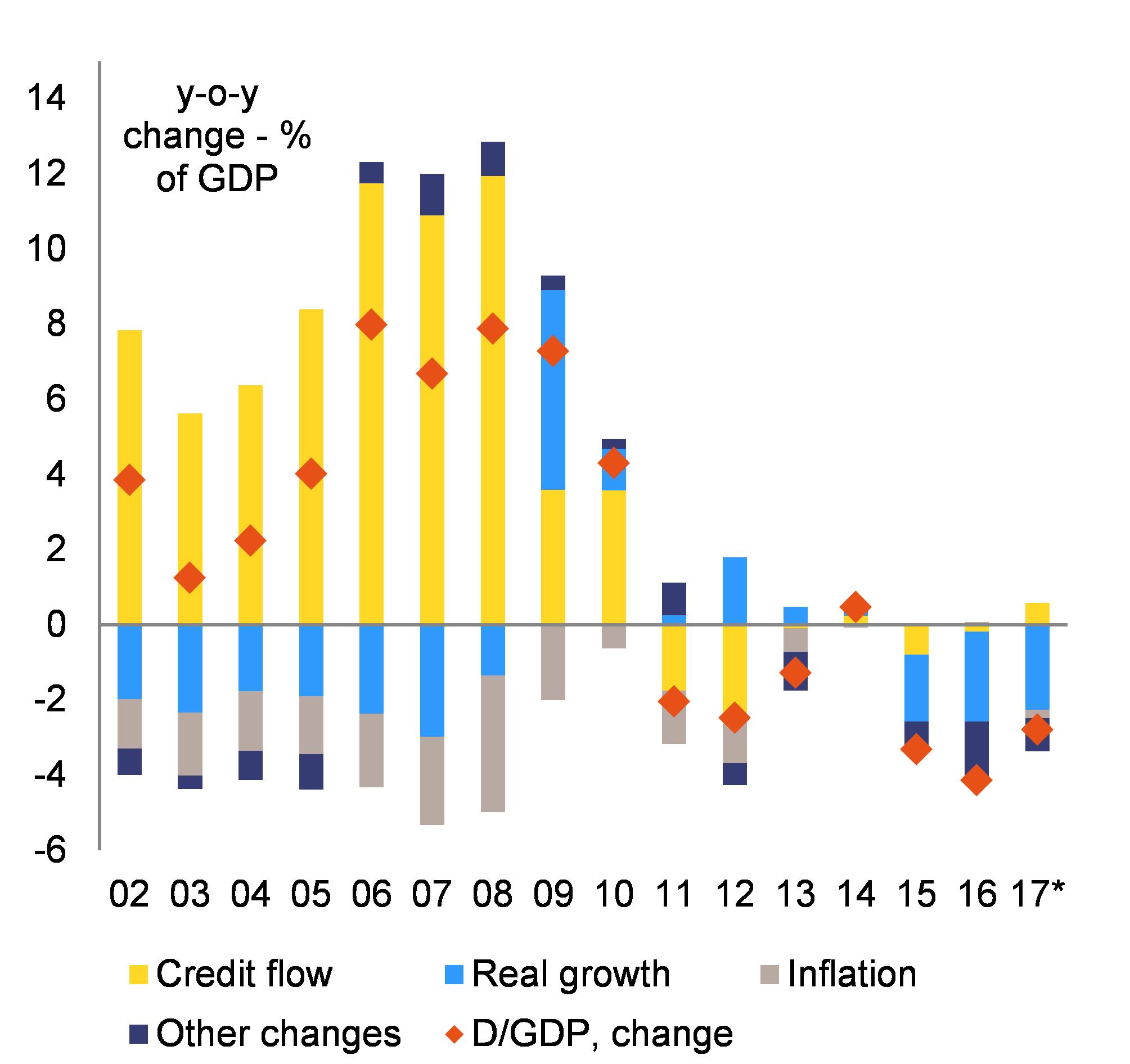
The economic recovery is supporting the reduction of corporate debt. Since 2015, the decrease in corporate debt has been mainly driven by dynamic economic activity, supported by the moderate pick-up in inflation in 2017. Write-offs and valuation effects, i.e. the appreciation of the Kuna against the Euro, also contributed to the reduction of corporate indebtedness since the first reduced the amount of non-performing loans, whereas the latter reduced the value of outstanding liabilities indexed to or denominated in foreign currency (see Graph 4.2.2). Debt reduction mainly took place in businesses in the hotel and restaurant sector as well as in the trade and construction sectors, which reduced their external loans by principal repayment, in addition to considerable write-offs. Taking into account the domestic banking sector only, negative credit flows to the corporate sector were still contributing to the reduction of corporate debt in 2015 and, to a small extent, 2016. However, in 2017, credit flows to the corporate sector had turned positive rising by 3.4 % - due to positive growth rates in the foreign currency segment more than compensating for the slightly decrease in flows in the domestic segment (see Graph 4.2.2).
|
Graph 4.2.2:Contributions to change in total corporate debt-to-GDP ratio
|
|
|
|
Source: Croatian National Bank and Eurostat.
|
Interest rates have been on a declining trend over the last few years and are expected to stay at low levels. This trend is more pronounced in loans indexed to and denominated in foreign currency. The decrease started in the second half of 2014 with big-size loans, followed by medium-sized loans in 2016, stabilizing between 2 and 3 % thereafter. Interest rates on loans denominated in domestic currency also decreased, but remain above those of peers (see Graph 4.2.3). The decrease is least visible in the short-term segment. The decrease in interest rates in the long-term segment reflects the mild fall in yields to maturity on Croatian long-term government bonds, ample liquidity and greater competition among domestic banks, particularly in offering more competitive (re)financing conditions. However, the continued parallel decline in interest rates in the euro area together with the still relatively high country risk premium for Croatia resulted in a widening spread between interest rates on corporate loans in Croatia for short-term loans, but a narrowing one with regard to long-term loans (see CNB, 2017).
|
Graph 4.2.3:Interest rates on bank loans to corporations
|
|

|
|
Source: European Central Bank.
|
The corporate debt ratio is not particularly high but subject to a number of vulnerabilities. Overall, by June 2017 the corporate debt ratio was close to the prudential threshold indicating potential risks and less than 10% of GDP above the level suggested by fundamentals. The decrease in the corporate debt ratio since 2010 has thus reduced risks significantly. One of the vulnerabilities is the high concentration of corporate debt in a few big companies, including also the Agrokor Group (see Box 4.2.1). Risks also arise in the form of high share of loans in foreign currency, especially for non-exporting companies. Notwithstanding the greater availability of less costly funding, corporate sector debt is also still exposed to interest rate hikes. However, this risk has been slightly reduced, due to an increase in the duration of average fixation period. In addition, both the ‘debt-to-gross financial assets’ and the ‘debt-to-equity’ ratios of the non-financial corporate sector are relatively high, highlighting potential solvency risks.
Household debt
Household debt as a percentage of GDP decreased further, despite the recovery of borrowing in 2017. By June 2017, the debt-to-GDP ratio in the household sector was down to 34.6 %, 7.3 pps below its 2010 peak value. In 2016, the reduction in the debt ratio was notably impacted by the statutory conversion of CHF-denominated loans into EUR-denominated loans (with interest rates capped at historical averages of equivalent EUR-denominated loans) at the end of 2015. In 2017, the pace of debt reduction slowed down despite intensifying economic activity, due to an upswing in credit flows (see Graph 4.2.5). On the one hand, credit standards for granting housing and consumer loans continued to ease throughout 2016 and early 2017, due to stronger competition among banks in offering more competitive (re)financing conditions, reduced costs of sources of financing and positive growth expectations. On the other, demand by households for loans picked up, due to growing consumer confidence, positive trends in the labour market and a favourable real estate market outlook (see Graph 4.2.4).
|
Graph 4.2.4:Composition of household lending
|
|

|
|
Source: Croatian National Bank and Eurostat.
|
The composition of household debt has been progressively changing towards HRK denominated loans. HRK-denominated loans rose by 5 % of GDP between 2010 and mid-2017. In addition to a steady trend towards borrowing in the national currency that started in 2013, the Swiss-franc loan conversion led many clients to refinance their newly converted EUR-denominated loans with HRK-denominated ones, thus substantially reducing the amount of loans exposed to foreign currencies (see Graph 4.2.4). In addition to a reduced propensity by households to borrow in a foreign currency following the Swiss franc experience, also banks were inclined to provide more kuna denominated loans due to, among other things, an increase in kuna sources of funding in their liabilities. This, amid a general fall in interest rates, contributed to reduce both the interest rates on HRK-denominated loans and the spread between interest rates on HRK and EUR loans. Notwithstanding this, more than half the outstanding stock of loans is still exposed to exchange rate shocks.
|
Graph 4.2.5:Contributions to change in total households debt-to-GDP ratio
|
|

|
|
Source: Croatian National Bank and Eurostat.
|
The household debt ratio is not particularly high and the interest rate risk is decreasing. In mid-2017, the household debt ratio was well below the prudential country-specific threshold but above the fundamentals-based benchmark, suggesting that risks are limited, although there remains scope for some deleveraging. Due to its composition, risks to household debt mainly stem from possible exchange rate shocks or interest rate hikes. However, interest rates on loans for house purchases and consumer loans have been decreasing since the end of 2015 and are expected to stay at low levels. In addition, there has been a recent decline in loans with variable interest rates and a simultaneous slow increase in loans with fixed interest rates. Namely, since the end of 2015, there has been a 9.2 % increase in loans for house purchases with fixed interest rates. However, a possible rise in reference interest rates remains a source of risk for clients, which in turn exposes the banking sector to indirect credit risk. In September 2017, the CNB issued recommendations to credit institutions aimed at mitigating such risk. The recommendations aim at increasing the transparency of information provided to consumers on debt servicing conditions while encouraging banks to extend their offer of loans at fixed rates and minimise the cost for consumers of refinancing existing loans at variable rates into loans with fixed rates.
Housing market
As the economic recovery gained ground, real prices of dwellings picked up by 2.1 % in 2016 in spite of low demand from the household sector. The rebound in house prices witnessed since 2016 has been driven by increases in the prices of existing real estate, which are nevertheless still below their 2010 levels. By contrast, the prices of new residential properties have continued to decline. House prices on the Adriatic coast and in Zagreb have contributed to the growth, while prices in other parts of the country remain subdued. In recent years, helped by increasing incomes on the one hand and subdued price dynamics on the other, the price-to-income ratio has decreased, signalling improved affordability of housing. Nevertheless, private demand remains subdued. This can partly be explained by a combination of negative demographic trends and an already high rate of home ownership.
|
Graph 4.2.6:Dwellings price developments
|
|

|
|
Source: Croatian Bureau of Statistics.
|
The abolition of tax exemptions was partly offset by the introduction of a subsidy scheme for first-time buyers. As part of the 2016 tax reform, the exemption from the property transaction tax for first time buyers was abolished. However, the new Act on State-subsidised Housing Loans aims to compensate, subject to certain criteria, first time buyers of residential property by providing more favourable borrowing conditions. The subsidy, funded from the state budget, covers half of the annuity during the first four years of the repayment period.
Access to finance
Companies' access to bank loans is gradually improving, also for small firms. Banks’ lending activity remains subdued, especially in the small business segment. According to the latest findings from the Survey on the Access to Finance of Enterprises, access to finance has generally improved, but on average remains more difficult for Croatian firms. In 2017, among the surveyed companies that applied for a bank loan, 71 % of them were granted a loan, compared with 61 % the year before. However, many surveyed companies (21 %) were still awaiting the outcome of their application, compared with 13 % the year before. Moreover, 11 % of all surveyed small firms did not apply for a bank loan due to fear of rejection, more than twice the EU average of 5 %. According to banks' responses to the bank lending survey, credit standards on loans to enterprises tightened mildly in the second and third quarters of 2017, with standards on loans to medium and small enterprises tightening the most. On the contrary, the latter experienced easing credit standards in the fourth quarter of 2017, while standards on loans to large enterprises kept tightening. Apart from direct bank lending, other sources of financing include loans and credit lines with subsidised interest rates from the Croatian Bank for Reconstruction and Development (HBOR), implemented through commercial banks () and loans from the Croatian Agency for SMEs, Innovations and Investments (HAMAG-BICRO), mainly to fund innovation and its commercialisation in entrepreneurship.
The European Structural and Investment Funds aim to facilitate financing for small firms. A set of new financial instruments supported by the European Regional Development Fund (ERDF) are meant to ease access to finance for small businesses and consequently boost entrepreneurship in Croatia. The debt instruments amount to a total of EUR 280 million and are expected to leverage approximately EUR 800 million of private investment. They are being developed under two financing agreements. One is implemented by the government agency HAMAG-BICRO and mobilises EUR 170 million in micro and small loans, individual guarantees and guarantees combined with interest subsidy. This instrument has proved successful, with a total disbursement rate of 41 % with the cut-off date 31 December 2017. The other, signed in October 2017, will be implemented by the Croatian Bank for Reconstruction and Development (HBOR). It will make a total of EUR 110 million available in growth and development loans. Implementation of this agreement is expected to start soon, and is planned to raise total private capital of EUR 105 million. The first tranche was paid from HBOR to financial intermediaries (3 selected commercial banks) in December 2017, but nothing has been disbursed yet.
Other sources of financing for companies remain largely underdeveloped. Over the past few years there has been very little progress in developing new venture capital funds in Croatia. The 2015 World Bank initiative on Innovation and Entrepreneurship Venture Capital Project – which aimed to strengthen risk capital financing for innovative small and medium-sized firms and start-ups in Croatia – did not produce results. However recently, thanks to incentive of ESI Funds funding, the Croatian government started negotiations with the EIF aiming at addressing early stage equity market needs. ESI Funds are expected to contribute EUR 35 million and the total expected leverage amounts to more than EUR 70 million. The agreement is planned to be signed by mid-March 2018 and the funds to start reaching beneficiaries by end 2018. In parallel, HBOR and EIF are discussing to jointly commit around EUR 70 million for later stage equity market needs. Both initiatives should provide significant support for Croatian venture capital and private equity market. EU funding recently supported a private equity fund with a target size of EUR 100 million, focusing on small firms in Croatia, Slovenia and Serbia (European Investment Bank, 2017), a sign that a venture capital ecosystem might be gradually taking shape.
Financial sector
Despite the Agrokor crisis, Croatian banks’ profitability and solvency have continued to improve since 2015. With a return on equity of 8.9 % in 2016, banks' profitability has largely recovered from the negative impact of the conversion of CHF-denominated loans (see Table 4.2.1). The solvency ratio is back to the level it had reached before the CHF conversion. Liquidity indicators remain relatively high. In 2016, the loan-to-deposit ratio dropped to its lowest level since 2004, before increasing mildly in the first half of 2017 as lending to the private sector started to recover.
The stock of non-performing loans (NPLs) continues to decline in the private sector, albeit at a slower pace. Both the NPL stock and NPL ratio have continued their downward trend, although more slowly than in 2016 (see Graph 4.2.7). By June 2017, the NPL ratio stood at 11.7 %, up from 11.6 % in June 2016. As of June 2017, NPLs were still significant in the private sector. Among non-financial corporations, the NPL ratio is about 26.3 %. Based on CNB data (), NPLs particularly affect the construction sector, which alone constitutes 17 % of the total NPL stock and where the NPL ratio has been above 60 % since June 2014. A high level of NPLs may hamper the ability of banks to extend new credit to firms, thus (partly) explaining why credit flows for the corporate sector are still weak. In the household sector the NPL ratio reached 8.8 % in June 2017, about 3 pps lower than its 2015 peak. NPLs in the household sector are predominantly found among mortgage loans. The reduction in the coverage ratio, namely the ratio between accumulated impairments and NPLs, has been mainly due to (i) the use of provisions, as certain banks wrote-off their Agrokor exposures and (ii) amendments to the automatic provisioning rules(), which led to some amount of provisioning reversals (see Table 4.2.1).
|
|
|
Table 4.2.1:Financial soundness indicators, all banks in Croatia
|
|

|
|
Source: European Central Bank, Consolidated Banking Data.
|
|
|
|
Graph 4.2.7:Evolution of NPLs and coverage ratio
|
|

|
|
Source: Croatian National Bank.
|
NPL sales continue to be the main contributor to the reduction in NPLs. NPL sales in 2017 are likely to compare closely to the previous year when total sales were already at historically high levels (see Graph 4.2.8). In addition, the overall economic improvement has led to an increasing share of restructured loans being reclassified as performing. In the upcoming period, this beneficial development may also be supported by the recently introduced amendment of reclassification rules by the CNB that enables banks to cure loans more easily and in line with the European Banking Authority guidelines. These positive developments have been offset by a net inflow of NPLs, which are partly due to defaulted exposures of banks to Agrokor entities. Well-functioning insolvency frameworks may facilitate the further reduction in NPLs.
|
Graph 4.2.8:NPL sales and other NPL flows
|
|

|
|
Source: Croatian National Bank.
|
The impact of the Agrokor crisis on Croatian banks has been limited so far, but risks remain. Roughly one fifth of Agrokor’s total loans are estimated to be from Croatian banks, and most of their impairments have already been incurred in the first half of 2017. The resulting flow of new NPLs and the relevant losses have been less than those predicted under an orderly restructuring scenario in CNB’s top-down stress test exercise, conducted in early 2017 (Croatian National Bank, 2017). Nevertheless, the banking sector could be indirectly affected by its exposure to Agrokor’s suppliers and by the wider impact on the Croatian economy of the Agrokor crisis.
|
Box 4.2.1: Crisis and restructuring of Agrokor
With around 30 000 employees and 2.2 % of the total gross value added in the economy, the Agrokor group is the largest private employer in Croatia. Having faced serious financial distress in early 2017, Agrokor was put under extraordinary administration in April. The potentially large impact on the Croatian economy and financial stability prompted the government to introduce a special law intended at minimizing the risk of a disorderly restructuring in systemically important companies. The law authorised a court-appointed extraordinary administrator, supervised by a council of creditors, to administer the processes of operational restructuring and negotiation of a settlement with the company's creditors. Agrokor's core business operations thus suffered only minor disruptions, which allowed the group to benefit from another record tourist season in Croatia.
In September an audit revealed that total liabilities in 2015 were over 20 % higher than previous official figures. Agrokor's equity thus turned out to be negative as borrowings stood at just over HRK 40 billion in 2016, representing more than 16 % of the country's total corporate debt or 11.5 % of GDP. Other liabilities, including most notably trade payables, amounted to more than HRK 16 billion (4.6 % of GDP).
In January 2018, the Commercial Court in Zagreb issued a final list of creditors' valid claims towards Agrokor, which formed the basis for determining voting rights in the council of creditors (
III
). After the establishment of voting rights, a negotiation period ensues which is required by the special law to result in a settlement by mid-2018, or else the procedure will turn into regular insolvency.
The still uncertain outcome of Agrokor's restructuring, particularly if no settlement is reached, poses a significant downside risk to the economic activity, as financial losses and possible operational disruptions in the group and its supply chain could be sizeable. However, the direct risk to the stability of the domestic financial sector should be contained, since the majority of Agrokor's borrowing relates to external debt contracted abroad, whereas Agrokor's debt held by the well-capitalised domestic banking sector is not highly concentrated.
|
The high exposure of the private sector to currency risks leads to indirect credit risk for the banking sector. At the end of December 2016, 86 % of total loans denominated in or indexed to a foreign currency were not hedged against currency-induced credit risk. Alongside the CNB recommendations to credit institutions discussed above and aimed at mitigating credit risk on consumer loans, the CNB enabled easier access to HRK funding of banks by amending the regulatory framework for monetary policy operations, as the high demand for HRK-denominated loans is putting pressure on the banking sector, due to an increasing problem of maturity mismatch. Indeed, banks may find it challenging to provide fixed-rate, long-term lending in HRK, given the lack of long-term HRK funding.
In 2017 the Parliament passed a number of financial laws. In summer 2017, the parliament introduced new legislation which annuls the validity of certain existing loans taken with foreign creditors. The CNB and the ECB were not consulted on the draft law, the implementation of which may prove problematic given the lack of precise data on the loans concerned and the lack of clarity on some of its key provisions. The most affected bank has lodged a complaint with the Constitutional Court. In October 2017, the parliament adopted a law to transpose the Mortgage Credit Directive, and the related by-laws were enacted by the CNB subsequently.
The authorities have not yet communicated the results and possible follow-up to the Asset Quality Review of HBOR in 2017. The Croatian National Bank oversaw the quality assurance and ensured that the AQR methodology closely followed the ECB methodology developed in 2014. One of the purposes of the AQR is to inform the government decisions on possible changes in the regulatory and governance structure of HBOR. The latter is indeed a development and promotional state-owned bank that presents a number of specificities, like a high share of direct lending (European Commission, 2017f).
4.3.
Labour market, social policies and education*
Labour market developments
The unemployment rate in Croatia has been falling considerably over the past year, but labour utilisation remains low. The unemployment rate decreased from 13.4 % in 2016 to 11.1 %in 2017. The drop resulted from the combined effect of increases in the employment rate and in the activity rate. However, at 65.6 % in Q3 2017, the employment rate was still one of the lowest in the EU; the activity rate was 71.7 % (Graph 4.3.1), compared to the EU average of 78.2 %. Between Q3 2016 and Q3 2017, the rate of long-term unemployment (LTU) declined to 3.9 % of the labour force (-1.5 pps), moving closer to the EU average of 3.3 % (). Overall, the chronically low labour utilisation in the Croatian economy continues to weigh on potential growth and on the country's adjustment capacity. There are also large territorial disparities in labour market outcomes. Based on 2016 registered unemployment data by county (Croatian Bureau of Statistics), the highest unemployment rate was almost four times the lowest rate. Most counties with the highest unemployment rates were located in the Eastern and Central part of the country.
Low participation and low employment are widespread across age groups and genders, and vulnerable groups are particularly affected. The activity and employment rate of both men and women are well below EU average. Men recorded the second lowest employment rate in the EU, while the employment rate of women is 10 pp lower than for men (56.6 % and 66.2 % respectively). Discouragement, skills gaps, care responsibilities as well as multiple pathways to early exits represent important barriers to employment (European Commission, 2017f). The rate of young people not in employment, education or training (NEET) (16.9 % in 2016) and the youth unemployment rate (26.4 % in 2017) both remain high. The employment rate of older workers in 2016 was the second lowest in the EU (38.1 %). Besides the numerous pathways to early exit from the labour market, this could also reflect insufficient focus on training for this age group. In 2016 at 37.9 %, the employment rate of low skilled workers was well below the EU average (53.6 %) and much lower than for medium and high skilled workers (see Graph 4.3.2). Finally, the activity gap between people with and without disabilities in 2015 was 28.9 pp above the EU average.
|
Graph 4.3.1:Activity, unemployment, long-term unemployment, youth unemployment, NEET and employment rates
|
|

|
|
Source: Eurostat, Labour Force Survey (LFS).
|
|
Box 4.3.1: Monitoring performance in light of the European Pillar of Social Rights
The European Pillar of Social Rights, proclaimed on 17 November 2017 by the European Parliament, the Council and the European Commission, sets out 20 key principles and rights to benefit citizens in the EU. In light of the legacy of the crisis and changes in our societies driven by population ageing, technological change and new ways of working, the Pillar serves as a compass for a renewed process of convergence towards better working and living conditions.
 Croatia faces challenges with regard to a number of indicators of the Social Scoreboard
supporting the European Pillar of Social Rights. This is notably the case for equal opportunities and access to the labour market and fair working conditions. Unemployment rate is decreasing. However, Croatia still faces a high rate of young people not in employment, education or training (NEETs), and low employment rates while only few of the jobseekers participate in active labour market policy measures. Croatia has high shares of people at-risk-of poverty or social exclusion. Nonetheless, the share of early school leavers is relatively low.
Croatia faces challenges with regard to a number of indicators of the Social Scoreboard
supporting the European Pillar of Social Rights. This is notably the case for equal opportunities and access to the labour market and fair working conditions. Unemployment rate is decreasing. However, Croatia still faces a high rate of young people not in employment, education or training (NEETs), and low employment rates while only few of the jobseekers participate in active labour market policy measures. Croatia has high shares of people at-risk-of poverty or social exclusion. Nonetheless, the share of early school leavers is relatively low.
Low participation in the labour market applies in particular to older workers. Among 55-64 years olds the employment rate stands at 38.1 %. Croatia has in recent years not been successful in addressing this issue, and this is raising concerns for the adequacy of the pension system in a context of demographic change.
The establishment of a network of Lifelong Career Guidance (LLCG) Centres across Croatia is a step forward in the integration of employment programmes. The Centres provide individual and tailored career guidance support to all Croatian citizens. One of their main aims is to create targeted measures for the identification and activation of youth NEETs. The Centres use a partnership-based model and work with relevant stakeholders at local and county levels. So far there are 13 Centres and the plan is to reach at least 22 by 2020. In addition, the Croatian Public Employment Service and the Ministry of Science, Education and Sports as well as the Ministry of Labour and Pension System have signed agreements on the establishment of data exchange systems between them. This will allow tracking the youth NEETs and exchanging changing data on the career intentions of students in their final year of study.
|
Active labour market measures are insufficiently targeted at vulnerable groups. In 2016 the participation of unemployed persons in active labour market measures (ALMPs) was very low, at 7 %. In early 2017, new ALMPs were announced, but from a preliminary evaluation, they do not seem to address the difficulties in entering the labour market for the long term unemployed and the low-skilled (). At the same time, the Croatian Youth Guarantee scheme is showing some promising results: it reached more than half (54 %) of NEETs aged 15-24 in 2016 (EU average 42.5 %), and 18 months after leaving the scheme, 68.3 % of participants were in employment. Regarding passive measures, the duration of unemployment benefits (relative to the qualifying contribution period) is short in Croatia, and the coverage (less than 15 % of the eligible population) remains low (European Commission, 2017a).
As of 2017, there has been a decrease in the number of new hires on temporary contracts and a sharp increase in new permanent contracts. The pick-up in economic activity and the improving conditions on the labour market favoured an increase in permanent contracts (Graph 4.3.3). In Q3 2017 however, temporary employees as a percentage of total employment still stood at 22.5 %, against an EU average of 14.8 %. As far as self-employed workers are concerned, in 2016 their share in total employment decreased to 12 %, of which the largest group were farmers (30%).
|
Graph 4.3.2:Employment rate by educational attainment
|
|

|
|
Source: Eurostat.
|
After years of wage moderation, wages have started growing again. Both nominal and real (GDP deflated) wage growth was negative in 2013 and 2014, followed by a slight increase in 2015. In 2016, nominal wages decreased marginally, while real wages stabilised as inflation was negative. Between 2014 and 2016, Croatia was amongst the EU countries with the highest gap between productivity and real wage growth, which supported cost-competitiveness gains (European Commission, 2017j). In 2017, the negotiated increase in public wages, combined with the improving economic conditions and the further tightening of the labour market are putting some upward pressure on wages. Nominal wages started growing again, at a projected rate of 2.5 % for the year as a whole, and are expected to continue growing at the same rate in 2018 and 2019. As inflation has turned positive, real wages are projected to have increased by 1.3 % in 2017 and to continue growing at a moderate rate of 0.4 % over the forecast horizon, remaining below productivity growth.
The authorities have adopted changes to the minimum wage. At the end of 2017, the gross minimum wage was raised by 5 % to EUR 456, which corresponds to the 42.9 % of the gross average wage in Croatia. In order to minimise the impact on labour costs, the base on which the employer contribution is calculated was cut by 50 % for those workers that have been employed for a period of more than 12 months on the minimum-wage, which risks creating an important low wage trap. In 2016, the coverage of the minimum wage was relatively low (6.6 % of the employed) and its incidence most pronounced in the poorest counties of Croatia and in a few sectors.
|
Graph 4.3.3:Employment change year-on-year
|
|

|
|
Source: Eurostat, Labour Force Survey (LFS).
|
The adoption of the announced legislation to harmonise wage setting for civil servants across the public administration has been further postponed. Initially planned to cover wage setting in the public sector as a whole, the new legislation will be enacted in two steps, first covering civil servants only, and at a second stage, public sector workers. Greater harmonisation of wage setting across the public administration would be achieved through the introduction of common wage grids and job complexity coefficients, based on more consistent job descriptions and skills frameworks. According to the authorities, the new legislation would also cover areas of the employment relationship of civil and public servants that are currently negotiated through collective bargaining. In the meantime however, the basic collective agreement regulating the rights of civil and public servants was renegotiated in December 2017, with validity until 2021. The collective agreements for six sectors expired in 2017 and are still due to be renegotiated. As far as state-owned enterprises (SOEs) are concerned, no further steps have been taken in setting up a coordinated system for collective bargaining.
Social Dialogue is not yet a well-developed practice in Croatia. Formally, Croatia has an established social dialogue structure in the form of a National Economic and Social Council. Social partners are invited to provide written contributions before the adoption of National Reform Programmes and other relevant legislative initiatives. However, the interaction between the authorities and the stakeholders is over all limited, and mostly confined to the provision of written feedback on some of the government proposed measures. Another inhibiting factor is that fragmentation seems to be central to limiting the overall capacity of trade unions to engage in social dialogue.
Social protection system
The rate of at-risk-of poverty and social exclusion declined in 2016, but remains high. In 2016, a large share of the population – 27.9% – was at risk of poverty or social exclusion (AROPE), compared to 23.5 % in EU (Graph 4.3.4). The share of people persistently facing a high at-risk-of-poverty rate (AROP) () was 14.5 %, whereas the percentage of the population living in overcrowded households () was more than double that of the EU average. Regional disparities are high and persistent, with at risk of poverty rates reaching over 40 % in many eastern and central municipalities and in rural areas (Croatian Bureau of Statistics). Particularly affected are the elderly and the disabled (). Moreover, 73.2 % of children of low skilled parents were at risk of poverty in 2016, against just the 2.9 % of children of high-skilled parents. This is the reflection of the very low employment rates among the low skilled. Parental education levels and poverty have strong impacts on children's chances to do well in school, to have access to quality health care and to reach their full potentials later in life.
|
Graph 4.3.4:At-risk-of-poverty or social exclusion rate and two of its components (SMD, LWI)
|
|

|
|
Source: Eurostat, European Union Statistics on Income and Living Conditions (EU-SILC).
|
The income support schemes on average seem inadequate to reduce poverty. The level of the minimum income offered by the Guaranteed Minimum Benefit (GMB) is inadequate, in particular for jobless households (European Commission, 2017a). Family benefits, and in particular child allowances do not cover adequately the poorest counties and their poverty reduction capacity is limited (). A number of steps have been taken recently to strengthen income support and support for households with children. Since February 2017, GMB recipients are allowed to take part in paid public works without losing entitlement to the benefit, thus combining the income support with incentives to (re)integrate in the labour market. In July 2017, parental and child benefits () were increased as a measure in support of demographic renewal (see Section 4.1). With a similar policy objective, in July 2017 the authorities also introduced a non-refundable subsidy that, under certain conditions, covers half of the monthly instalments of the first four years of new loans to purchase the first home (see Section 4.2).However, the success of this measure in hampering migration outflows of working age individuals would come with the downside of also hindering labour mobility within the highly fragmented national labour market.
Territorial disparities in the provision of social benefits result in increased inequality. The provision of social benefits in Croatia is shared between the central and sub-national government units. Following the decentralization of public functions initiated in 2001, regional and local sub-national units assumed the responsibility to provide and administer some social benefits (such as housing benefits, the lump-sum grant for new-born children and childcare services). However, due to the lower fiscal capacity of poorer local units to finance such benefits, this system results in an unequal treatment of citizens and exacerbates existing inequalities across the territory and weakens the social inclusion impact of the social safety net () (see Section 4.5).
The large variation in fiscal capacities of counties also affects the provision and use of child care services. High quality formal Early Childhood Education and Care (ECEC) plays an important role in children's development and supports participation in the labour market, especially of women. In 2015, only 11.8 % of children up to 3 years of age and 73.8 % of pupils aged between 4 and 6 were enrolled in ECEC. Local government units cover the large majority of ECEC expenses (Dobrotić and Matković, 2017) according to the current financing model, thus creating a strong link between ECEC access and counties' income (). As a result, and with the exception of counties with major city centres, the coverage of ECEC increases in line with GDP per capita in each county (Graph 4.3.5). The authorities announced plans to increase the participation in ECEC to 95 % by 2020. This will be difficult in the absence of a major reform of the ECEC financing system and possibly of the distribution of competences between central and sub-national government levels.
|
Graph 4.3.5:Early childhood education and care
|
|

|
|
Source: Centre for Peace Studies (2016) and Croatian Bureau of Statistics.
|
The consolidation of the benefits system with the aim to improve targeting and reduce poverty has not advanced. The authorities abandoned the establishment of the one-stop-shops as a central point for the administration and provision of social benefits and services, which used to be a flagship measure in successive past NRPs. The previously announced harmonisation of eligibility criteria and plans to consolidate more benefits under the GMB have also been suspended. The focus has instead shifted to improving the information system on benefits allocated throughout the territory. To this purpose, the authorities plan to harmonize the definitions of the benefits granted at local government level on the basis of the ESSPROS (European System of integrated Social Protection Statistics) nomenclature, and establish regular reporting channels from the local to the central government level.
The Croatian pension system continues to face medium and long term challenges. In 2017, the ratio of contributing workers to pension beneficiaries was at 1.2, reflecting unfavourable demographic trends, but also the existence of numerous pathways to early retirement and a still low statutory retirement age, especially for women. In 2016, only 38.1 % of people aged 55-64 were employed and only 14.8 % of all pensioners had 40 or more qualifying years. The average duration of working life is one of the lowest in EU (32.1 years in 2016). In 2016, the aggregate replacement ratio of pensions (0.39) was significantly lower than the EU average, resulting in a higher at risk of poverty rate for people aged 65+ (26.5 % vs 14.6 % EU in 2016). The 2018 Aging Report (forthcoming) projects that by 2070 the public pension expenditure as percentage of GDP will further fall by 3.8pp. Ensuring pension adequacy in the future will require increased pension contributions and/or longer working lives.
Existing discrepancies in the pension system pose also short term challenges. Successive interventions in the pension system – starting from the 1999 reform and including the establishment of a supplementary pillar in 2002 and the introduction, in 2007, of a pension supplement for those insured under the first pillar only – have left the cohort of people born between 1962 and 1984 with prospective pensions that could be up to 30 % lower than those for the older cohort. This is because of their short contribution history into the second pillar. Inflows into retirement from this cohort have just started and are expected to intensify in 2019. People with shorter working lives, and in particular women, will be most penalised. The authorities are exploring different options to tackle the situation.
The announced changes to the pension system, aimed at encouraging longer working lives, have not been implemented. Reform measures planned for December 2017 have been further postponed to mid-2018. These include the streamlining of the 100+ arduous or hazardous professions benefitting from more generous pension provisions, measures aimed at reducing access to early retirement, the increase of the statutory retirement age and the acceleration in the equalisation of retirement age for women and men. In the meantime, improvements have been introduced in the methodology applied for the medical assessment of disability pensions. The authorities have proposed to further extend the benefits granted to war veterans and their family members (),resulting in further increases of their pension ceilings (). Little progress has been made to support war veterans' re-integration into the labour market.
Education and skills
The low performance of Croatia's education system underlines the urgency of reform. The performance of the education system – measured in the context of the EU Education and Training 2020 process stagnates or has worsened in most of the relevant areas. These include performance in the 2015 OECD Programme for International Student Assessment (PISA) survey of 15 year-olds, tertiary education attainment, adult education, education investment and learning mobility (European Commission, 2017h). At the same time Croatia exhibits the lowest rate of early leaving from education and training in the EU (2.8 % vs 10.7 % EU average in 2016). The gap for early school leavers between pupils with and without disabilities however is one of the largest in the EU (14.5pps vs the EU average of 10.3pps in 2015).
The implementation of the education reforms announced in the Strategy for Education, Research and Technology faced delays. This affected in particular one of the strategy's most prominent priorities: the comprehensive curricular reform aimed at improving the quality and relevance of education. After a delay of almost a year, in autumn 2017 work began on the revision of the reform's draft documentation on the basis of a public consultation. The documentation is expected to undergo external reviews by spring 2018, with pilot implementation due to start in September 2018 in 3-5 % of schools. The introduction of obligatory subject Computer Science in the 5th and 6th grades of primary school is also planned for 2018. Currently, 10 % of Croatian schools are taking part in the ESI Funds-supported e-Schools project designed to prepare strategic documents, plans and policies to systematically integrate ICT into activities of all of primary and secondary schools by 2022.
Growth in tertiary graduates has slowed, while their employment rates have not yet returned to pre-crisis levels. Tertiary educational attainment in Croatia had been on an upward trend for the last decade but started declining in 2014. The proportion of 30- to 34-year-olds with tertiary education in 2016 was 29.5 % (), significantly below the EU average of 39.1 % and Croatia’s national 2020 target of 35 %. In 2008, 86.3 % of people who had completed tertiary education within the previous 1-3 years was in employment, while in 2016 this share was down to 74.7 % (EU average of 82.8 %), despite the recent pick-up in economic activity. The unemployment rate of tertiary graduates was at 7.8 % in 2016, the fourth highest in the EU.
Croatia lacks mechanisms to address the skills mismatch of tertiary education graduates. A 2017 employers' survey on how the tertiary education meets the needs of a competitive economy ranked Croatia 112th out of 137 global economies and among the lowest in the EU (World Economic Forum, 2017). Despite the annual recommendations from the Croatian Employment Service (CES) to reduce enrolment rates in business administration and law, there was no change between 2012 and 2016. Almost one in three Croatian students graduated in business and law, among the highest in the EU (31.4 % vs 24.3 %). The recent introduction of an ESF-supported 'science, technology, engineering and math' scholarship scheme aims to increase the pupils' interest in these subjects. Despite the analysis of CES on skills needed in the labour market, Croatia does not have a mechanism to match tertiary education admissions quotas with skills needs.
The implementation of the Croatian Qualifications Framework (CROQF) has begun. In order to improve the labour market relevance of education, the CROQF established 25 sectoral councils, consisting of educators, employers, stakeholders and representatives from the public administration. They were tasked to review and update the country's qualifications system. After delays in 2015 and 2016, the sectoral councils have now started updating over 300 qualification and occupation standards.
Secondary vocational education would benefit from further alignment with labour market needs. While Croatia has the highest percentage of secondary school students enrolled in vocational education and training (VET) programmes in the EU (71 %), their prospects of successful transition to the labour market remain limited. More than half of registered unemployed (average over the period 2010-2015) hold a secondary vocational education diploma. To increase the labour market relevance of VET, the authorities announced the adoption of the National Curriculum for Vocational Education, which is currently under review. This will be complemented by plans to develop sectorial curricula, establish an effective network of vocational schools and programmes and a quality assurance system, establish regional centres of competence and promote international mobility of teachers and students.
Employers play a marginal role in the provision of vocational education. VET is more and more carried out in school classrooms and outside of firms – which minimised the role of employers in vocational education. Even though both schools and employers see the benefits of implementing work-based learning strategies, a recent study showed that they would require additional support from public authorities (South East European Centre for Entrepreneurial Learning, 2017). A central role is due to be played by the Croatian Employment Service, which was tasked to analyse and forecast labour market skills needs in cooperation with the employers. Such analysis should inform the recommendations for the enrolment policy of various VET courses in secondary schools. However, so far the impact of skills anticipation activities on educational policy has been negligible (European Centre for the Development of Vocational Training and European Commission, 2017).
Croatia lags behind in upskilling and reskilling the working age population. Based on the European Working Conditions Survey, three out of four workers in 2015 had not attended any training over the previous year. EUROSTAT indicators show that in 2016 only 3 % (vs the EU average 10.8%) of Croatian adults (25-64) reported having participated in adult learning, with no difference between unemployed and employed persons and with slightly higher rates for more educated people (ISCED 5-8). Most of the participants are young adults, while older people (55-64) de facto do not participate. To improve the employability of adults with low skills, Croatia is working on improving the assessment of current and missing skills, the supply of adequate learning offers and the validation of acquired new skills ().
Systemic inefficiencies in the adult education system affect its labour market relevance. Croatia lacks systematic professional development programmes for adult educators, and non-formal and informal learning programmes are not properly assessed nor recognized. There are around 10 600 programmes, offered by 600 adult education institutions, many of which established without adhering to high quality criteria (Brčić Kuljiš and Koludrović, 2016). Furthermore, the lack of financial support to participants () is among the reasons behind the low participation rates in adult education. The regional distribution of institutions offering formal adult education is highly uneven (35 % are in Zagreb and in Splitsko-Dalmatinska County) leading to an increased inequality of access to learning. The adoption of the new Adult Education Act, the harmonization of procedures for adult education programmes with the CROQF and regular reporting on participation rates, may help addressing the current weaknesses.
4.4. Competitiveness and investment*
Trade performance
The competitiveness of the Croatian economy as gauged by its export performance is improving, but remains below peers. The 25 % share of exports of goods in GDP is only half the average share in Central and Eastern European economies (CEE10). Still, it is a substantial improvement compared to the 15 % of GDP in 2000.
|
Graph 4.4.1:Exports of goods (volumes) in Croatia, EU15 and CEE10, index (2013=100)
|
|

|
|
Source: Eurostat.
|
Weak export performance during the crisis can largely be linked to competitiveness losses and demand factors. Exports of goods grew strongly in the early 2000s (Graph 4.4.1), but as domestic demand boomed, the tightening labour market combined with a mild currency appreciation eroded international competitiveness. The real effective exchange rate (deflated by unit labour costs) continued to appreciate up until the end of 2009, leading to significant losses in export market shares. In addition, the slow growth in two of Croatia's major trading partners, Slovenia and Italy, weighed on the demand for Croatian goods, while the restructuring of the shipbuilding industry (started in 2013) further depressed exports. Consequently, total exports of goods decreased by 3 % in 2010-2012.
Following EU accession, exports rebounded strongly. Between the third quarter of 2013 and the third quarter of 2017, exports of goods expanded at an average rate of 9 % year-on-year. Such strong growth is linked to a turnaround in global demand, as well as policies geared to restore external competitiveness through wage restraint – including labour market reforms (2013-2014). Most notably, however, EU accession has opened up opportunities for Croatian firms, which continue making inroads into EU value chains and gaining market shares. Exports of services – mainly tourism – have also been growing strongly, as Croatia attracts more and more tourists from abroad and global demand for tourism grows in line with the recovery in disposable incomes.
|
Graph 4.4.2:Goods' export growth (values) between 2013 and 2016 by markets and product type
|
|

|
|
Source: Eurostat.
|
The structure of Croatia's goods exports is changing in terms of both markets and products. Following EU accession, merchandise exports grew particularly strongly towards the CEE10, while exports to countries in the Central European Free Trade Agreement (CEFTA) grew at a much slower pace. This suggests a weakening of historical trade ties with the ex-Yugoslavian economies and convergence to the export patterns of CEE10 economies, which are more geared towards the EU. Greater product differentiation underpinned the export growth in 2013-2016, as a number of Croatian products found their export markets for the first time. While the share of higher complexity exports () has increased in recent years, the aggregate complexity of Croatian exports (0.75) remains below the (simple) average of the CEE10 countries (0.93). Nevertheless, Croatia features areas of excellence in exports, especially in the pharmaceutical industry. Finally, the decoupling of exports from industrial production points to a strengthening of the import content of exports, in line with the increasing integration of Croatian companies into EU value chains.
Exports of goods have the potential to sustain Croatia's long-run growth prospects The positive trends in recent years suggest that Croatia could pursue a model of export-led growth to spur its economic convergence, much like its CEE10 peers (). Furthermore, a move towards higher complexity exports, as suggested by the existing areas of excellence, is more a question of competitiveness and allocation of resources than developing essential capabilities. In this sense, well-functioning product and capital markets which boost productivity and promote the reallocation of resources towards faster growing sectors are crucial. In the longer run, a stronger R&D&I system can boost competitiveness, particularly in emerging industries and industries where Croatia already enjoys a comparative advantage. Similarly, unlocking Croatia's labour supply potential and providing the workforce with the skills needed in innovative sectors could also help relax capacity constraints.
Business environment
Croatia is lagging behind in the pace of reform of the business environment. Croatia ranks last among peers in both performance and progress regarding the quality of its business environment. The World Economic Forum's Global Competitiveness Index shows Croatia stagnating while its peers advance (see Graph 4.4.3). Croatia's performance is comparatively low and deteriorating in the areas of institutions, innovation, goods and labour market efficiency. This mirrors the European Commission's findings on the fragmentation of the public administration (see Section 4.5), as well as the excessive regulation in product markets and some professions and barriers to investment (see Box 4.4.2).
|
Graph 4.4.3:Global competitiveness index scores of Croatia and peers
|
|

|
|
Source: World Economic Forum.
|
Progress is gradually being made in addressing burdensome regulation. The authorities continue to screen existing legislation for administrative burdens and subsequently amending legislation in order to reduce it. Meanwhile, the new SME test was finally adopted in April 2017. By setting out the criteria for regulatory impact assessments focused on SMEs, it has the potential to significantly improve the business environment for this class of firms. However, SMEs would need to be consulted in a more targeted way during the public consultation stage in order to really improve impact assessment. Two parafiscal charges were reduced and further reductions are in the pipeline, potentially resulting in substantial reductions.
|
Box 4.4.1: The role of Tourism in the Croatian economy
With its advantageous location and natural beauty, Croatia has been an important tourist destination ever since the surge in international tourism. International tourists' expenditure in Croatia amounts to almost 20% of GDP – by far the largest share compared to other European Union countries. Tourism has consequently generally been considered as a key driver of Croatia's economy. Despite several improvements in the diversification of the offer, Croatia mainly features a typical "sun and sea" tourism model, with stays concentrated in coastal areas and over the summer months. The accommodation offer is skewed towards relatively cheap structures (such as private holiday houses and camping grounds) and average tourist expenditure is below that recorded in EU peers. Recent econometric analysis sheds more light on the structural characteristics of the Croatian tourism sector and its contribution to GDP growth.
The international demand for Croatian tourism is more responsive to changes in income of source countries compared to other destinations in the Mediterranean. Structural differences in tourism models across countries are reflected in a different sensitivity of demand for tourism services to income and prices. The international tourism demand for Croatia and three other Mediterranean destinations was estimated using a comparable specification (Orsini and Ostojić, 2018) . Tourism demand was modelled as a function of purchasing power in the EU, the relative price of tourism services and travel costs in each country. The findings provide evidence that each percentage point increase in GDP in the EU drives the number of arrivals up by 4.3 % in Croatia, 4.0 % in Greece, 3.8 % in Spain and 2.8 % in Italy. This makes Croatia the most 'income elastic' destination in the Northern Mediterranean. The analysis confirms that tourism demand can be extremely sensitive to prices. In this respect, Croatia features the lowest price elasticity among the countries considered, but it is affected more than others by fluctuations in fuel prices. A 10 pps increase in the relative price of fuel decreases arrivals, overnight stays and spending by roughly 3 %. Tourism revenue in Croatia – more than other destinations – is found to be driven by the increasing number of tourists' arrivals and overnights, while the average spending per night per tourist tends to stagnate or even decrease. The analysis highlights that an excessive reliance on the current model of tourism may not be sustainable in the long-term. The supply of new and well differentiated tourism services could mitigate the risks of stagnation, maximise the impact on other sectors of the economy and reduce congestion and environmental costs.
Tourism is not likely to be a key driver of long-term economic growth in Croatia, but it is also not likely to have negative effects on other sectors. International economic literature has extensively delved into testing whether there is a long-run positive causal relation between tourism and economic growth, or whether tourism has negative effects by crowding out the development of other sectors (often referred to as the Dutch disease). The empirical findings in (Orsini and Pletikosa, 2018) demonstrate that neither seems to be particularly relevant for Croatia. The study was conducted using a model of a small open economy with two exporting sectors – manufactured goods and tourism services, through four key variables – exports of goods, tourism revenues, the real effective exchange rate and income of trading partners/potential tourists. Results suggest that the demand for Croatian tourism is less income elastic than the demand for goods, but more sensitive to changes in prices. The findings are consistent with the peculiarities of the Croatian tourism sector, including a high leakage rate (high share of imported goods in tourist consumption) and a contained impact on employment, as these factors insulate the rest of the economy from potential positive or negative spill-over effects. From a policy perspective, there are evident limitations in over-reliance on tourism for sustaining Croatia's process of economic convergence towards a more mature economy. Scaling up and diversifying the tourism model is likely to improve the positive contribution of the sector to GDP growth, but could also come at the cost of crowding out the more productive manufacturing sector.
|
Limited progress has been made in reforming professional services in Croatia. Some limited reform measures, such as the removal of fixed prices in several sectors, have been implemented over the last years. However, according to an indicator developed by the European Commission, the level of restrictiveness in Croatia remains higher than the weighted EU average for six of the seven analysed professions (architects, certified civil engineers, tax advisers, lawyers, patent agents, real estate agents, tourist guides). Moreover, the 2017 accounting law announced that compulsory licensing will be introduced for accounting services by 2019. In addition, with regard to legal services, fixed prices and advertising restrictions are still in place, although discussions are ongoing for their abolishment. Restrictions on having more than one office in the territory of Croatia and on retaining the title of lawyer if the profession is not exercised for more than six months also continue to apply. Moreover, the new Act on the provision of tourism services which was adopted on 15 December 2017 maintained the territorial restrictions on tourist guides, with separate exams for each of the 21 counties, and affecting also temporary service providers from other Member States.
Restrictive regulation across sectors continues to weigh on competitiveness. A strategy and regulatory framework conducive to the development of the collaborative economy is missing. In the accommodation sector, different requirements apply to different categories of short-term rentals. In the energy sector, the still highly regulated gas and electricity prices, both at retail and wholesale level, continue to limit competition by favouring incumbent firms and creating a barrier to market entry.
Registering a business remains burdensome. According to a study of the administrative formalities and burdens imposed on businesses, there is no single interface with integrated procedures for registering a business for all purposes (registration of an economic activity, for VAT purposes, for business income tax purposes, or as an employer). The procedures cannot be completed fully online and it is difficult to find information online. However, there is ongoing work to reform the Point of Single Contact (Ecorys Netherlands and Mazars, 2017). Companies face continued difficulties in transferring their registered offices in and out of Croatia due to inadequate rules and procedures.
Network industries, climate and environment
Broadband connectivity and coverage are improving, but remain low. In comparison to the EU average, Croatia underperforms in broadband coverage, divide between urban and rural areas, prices and take-up rates. Coverage of next generation access (NGA) fast fixed broadband technologies in rural areas (67 %) are among the lowest in the EU (average: 80 %). Also – at 73 % – 4G coverage (for fast mobile communications) is among the lowest in Europe (European Commission, 2018a). In June 2017 the European Commission found that Croatia's Next Generation Network Broadband plan worth over EUR 100 million meets EU state aid rules. The implementation of the scheme – aimed to increase coverage with a focus on least covered areas – has not started yet, pending government approval.
|
Graph 4.4.4:Connectivity index in Croatia and peers
|
|

|
|
Source: The Digital Economy and Society Index (DESI), European Commission.
|
Croatia’s primary and final energy consumption remains comfortably within the 2020 targets. Despite the targets allowing substantial increases, both primary and final energy consumption have been decreasing steadily since 2005. However, additional efforts regarding energy efficiency, especially in transport and industry, are needed to minimise the effects of the ongoing economic recovery. Primary energy consumption remains substantially above EU average (overall and for manufacturing, services and households), which points to unexploited efficiency potential, and it decreased slower than the EU average (with almost no decrease in the services sector). Until 2020, Croatia is expected to step up its energy efficiency actions and programs necessary to meet the cumulative saving requirements stemming from the Energy Efficiency Directive.
Croatia is expected to meet its greenhouse gas emission target by a wide margin. With a 28 % share of renewables in 2016, Croatia is well above its 2015/2016 indicative overall interim target, as well as its 2020 target of 20 %. However, with 1.3 % in 2016, Croatia is well below its target for the share of renewable energy in transport. At the same time, renewable energy accounted for 37.4 % in heating and cooling and 46.7 % in electricity generation. Electricity from renewable sources has mainly been promoted through a premium tariff and a guaranteed feed-in tariff for small installations allocated through tenders. The surcharge for financing renewable energy projects has been increased to maintain the sustainability of the support scheme, while the VAT rate on electricity was lowered to compensate for this increase. This could, however, lead to higher and less-efficient consumption of electricity, potentially extending the distance to targets.
The competitiveness of Croatia is increasing for the solar PV sector and decreasing in wind. Between 2005 and 2015, the revealed comparative advantage indicator for solar increased to above 1, meaning that the country increased its specialisation, while the trend was opposite in the wind sector, with the indicator having fallen below 1 In 2015, the relative trade balance () confirmed the competitiveness of the country as a net exporter of solar components, while it became a net importer of wind technology components, due to a strong trade deficit in wind turbine generating sets and gearboxes.
The longoverdue Waste Management Plan and Waste Prevention Programme were adopted in January 2017. Both documents are in line with the Commission circular economy package, putting Croatia on a path to a more circular economy. Subsequently, the Decision on Implementation of the Action Plan and the Ordinance on Municipal Waste were adopted in May 2017. The adoption of these documents constitutes fulfilment of the ex-ante conditionality on waste, which opens up a total of EUR 475 million from the ESI Funds to be used for, inter alia, separate waste collection and recycling infrastructure projects.
Research and development
Croatia's investment in R&D over the past decade remained stable, with limited public funding and slow progress in implementing ESI Funds. Croatia's R&D intensity was 0.84 % of GDP in 2015-2016. Business expenditure contributed with 0.37 % of GDP in 2016, ranking Croatia 24th in the EU. Meanwhile, public R&D intensity increased to 0.46 % of GDP in 2016 after years of stagnation. However, a growth at this rate is not sufficient for Croatia to reach its national Europe 2020 R&D intensity target of 1.4 % of GDP. Such a large distance to the target reveals a low focus on science and innovation in the policy strategy of the country.
The efficiency of the Croatian R&I system lags behind that of other EU Member States. As illustrated in Box 4.1.1, Croatia's efficiency of spending in R&I is in line with that of peers. However, compared to the EU average, the country's performance in quality scientific outputs is very low (). This is largely due to scarce public investment in R&D but also to a fragmented landscape of higher education institutions, a lack of incentives for researchers' careers and a significant neglect of the relevance of internationalising Croatia's science and innovation arena. ESI Funds funding is not matched by adequate efforts from the national budget. Public funding for research institutions is generally distributed evenly, without much regard for the assessment of performance. This puts a de facto cap on increases in research quality.
Fragmentation on all levels hinders the cooperation between research institutions and the business sector. Major universities have highly fragmented governance structures, which reduces efficiency and cooperation. Researchers lack incentives to produce high quality science, as publications in journals, irrespective of their quality, yield the same value for career promotion. Integration of international researchers is difficult due to rigid administrative rules. Cooperation with businesses is not incentivised by the academic system, which discourages commercialisation of scientific research. Researcher mobility between the private and public sectors is difficult and the cross-sector cooperation is under-developed (), although the introduction of ESIF-based schemes is improving the situation. Although innovative sectors still represent a relatively small share of the employed population (), there are pockets of excellence in niche sectors such as biotech and ICT where companies cooperate much more closely with research institutions. The policy responsibility in support of science and innovation appears fragmented () and the policy strategy is scattered across a number of policy actions with low critical mass, with no systematic evaluation of impact of R&I policies in place.
Some targeted efforts to reform the national science and innovation system are in the making. The smart specialisation strategy (S3) was adopted in 2016 and is being revised with a focus on the country's innovation strengths. Implementation is picking up pace with the announcement of a limited set of calls to support innovation, including one to establish Centres of Competence to support the implementation. Around EUR 665 million of ERDF funds have been allocated ().
Corruption
Corruption remains a prominent problem. The 2017 Special Eurobarometer on corruption (European Commission, 2017e) shows that tolerance to corruption in Croatia is increasing, with only 45 % of the respondents finding corruption unacceptable (EU average 70 %). At the same time, corruption is seen as much as a problem as in the previous 2013 survey. The share of people who think that corruption has increased or is at the same level as before is at 91 % (EU average 79 %) and those who report having been involved or having knowledge of bribery cases have increased to 28 % (in comparison to 24 % in 2013, EU average 12 %). At the same time, 95 % of the respondents having experienced or witnessed cases of corruption say that they did not report it, either because it would be pointless, difficult to prove, or for fear of retaliation.
The implementation record of anti-corruption measures is mixed. While Croatia has improved certain aspects of its anti-corruption policies and structures since joining the EU, several key elements still leave room for improvement. These include effective verification mechanisms for conflicts of interest and asset disclosure of public officials; protection of whistle-blowers; specific safeguards for the healthcare sector and effective risk control in public procurement, especially by contracting authorities with weaker control mechanisms; code of conduct for members of Parliament; inadequate technical and personnel resources of the Commission for the Prevention of Conflicts of Interest and not sufficiently proactive approach in its preventive role. Delays in the implementation of the Anti-Corruption Action Plan (2015–2016) were acknowledged by the national authorities in the Anti-Corruption Action Plan 2017–2018 which carries over a number of actions from the first (). The Worldwide Governance Indicators (World Bank, 2017b) show a declining trend in Croatia’s ranking on the control of corruption indicator while in the Global Competitiveness Index corruption moves from the 5th to the 4th biggest obstacle for business (World Economic Forum, 2017). Survey data (European Commission 2017d) show a similar trend, with 58% of business representatives considering corruption as a very serious or quite serious problem, up by 7 percentage points compared to 2015, with the EU average at 37 %.
Public awareness of whistle-blowing reporting channels and access to public information is low. In a 2017 business survey, respondents from Croatia were in penultimate place in terms of awareness of existing reporting channels for whistle-blowers (EY, 2017). Furthermore, 60 % of respondents (European Commission 2017e) declare not to know how to report corruption. Amendments to the Law on the right to access to information entered into force in August 2015, increasing transparency and helping decrease corruption opportunities at the central level. At regional level, research shows an increase in budget transparency of local entities (Ott et al., 2017). Despite this positive trend, the study underscores that there are still many local units that remain non-transparent. A new ordinance concerning the obligation to publish procurement plans and contract registers in a standardised format on the e-procurement platform entered into force on 1 January 2018.
Public procurement in the construction sector is vulnerable to corruption. Survey data on corruption (European Commission 2017d) indicates an increasing share of respondents who think that corruption in public procurement is very or fairly widespread (from 62 % in 2015 to 73 %). Unclear selection criteria are among the practices most widely reported (from 48 % in 2015 to 68 %). A recent study on public procurement in the construction sector shows that despite the sound legal framework and existing control mechanisms, the integrity of procurement in the sector is at risk due to a large share of in-house contracting by state-owned entities which are subject to weaker control. While there is limited use of restrictive procedures, competition for public contracts is surprisingly weak for a sector under considerable economic pressure. Around half of the total contract value is won by companies partially or fully owned by the state (Podumljak and Dávid-Barrett, 2015).
|
Box 4.4.2: Investment challenges and reforms in Croatia
Macroeconomic perspective
After taking a hard hit during the economic crisis, investment started slowly rebounding in 2015, recording a solid annual growth of 5.3 % in 2016. The sharp decline in investment spending during the recession was seen in both public and private sector, mainly driven by weak domestic demand, particularly in households, debt overhang, particularly in corporations, and tightened financing conditions. A stronger pick-up was anticipated in 2017, however, the ongoing operational and financial restructuring of the food-processing and retail giant Agrokor seems to have impacted investment decisions, especially in the manufacturing sector. Investment is expected to intensify in 2018 and 2019, driven by strong and increasing domestic demand, abating deleveraging needs, improving financing conditions and expected pick-up in the implementation of European Structural and Investment Funds.
Assessment of barriers to investment and ongoing reforms

As the macroeconomic and financing conditions continue to improve, a number of barriers stand in the way of creating a business environment more conducive to investment, as confirmed by the European Commission assessment (
IV
). Some measures have been adopted, particularly in the area of business environment, but most of the continually identified barriers to investment have yet to be fully addressed.
Main barriers to investment and priority actions underway
(1) The business environment remains burdened with parafiscal charges, frequent changes in regulation and its interference in market mechanisms in some sectors. The inefficiencies of the judicial system weigh on investors' perceived legal certainty. Weaknesses in the public administration hamper service delivery to businesses, not least of which is the still cumbersome and lengthy business registration process. (2) Companies are heavily reliant on traditional bank financing as capital markets remain underdeveloped and alternative avenues of financing, such as risk and venture capital, remain largely underutilised (see Section 4.2). (3) The limited high speed broadband coverage, especially in rural areas, and the very low take-up of ultrafast broadband limit the potential for investment in digital economy.
|
4.5. Public governance*
Public administration
The territorial fragmentation of the public administration weighs on efficiency of public service provision. Croatia is generally regarded as a relatively centralised country. However, the constitutional and legislative amendments of 1992 and 2001 led to a very high increase in the number of towns and municipalities. Despite being granted competencies and responsibilities in providing public services, many small local units lack the adequate financial, administrative and personnel resources to carry out decentralised functions (European Commission, country report, 2016b and 2017f). The current territorial organisation also creates numerous overlaps between central and local government. This is particularly evident in numerous branch offices of ministries and other central government bodies present at the county and local level. The high fragmentation of the public administration hinders the implementation of public policies, increases costs and inefficiency in the use of resources.
Key indicators for the public administration show a performance below the EU average. The Croatian public sector performance and government effectiveness ranked well below the EU average in 2015 (European Commission 2015 and 2016e, World Economic Forum). Weak administrative capacities largely hinder the implementation of strategic documents and the implementation of relevant reform measures. Evidence-based policy making is ranked at the EU average level, with large differences between the central and local government levels. Public consultations and regulatory impact assessments are improving at the central level, while at the local level they are practically non-existent, placing Croatia overall well below the EU average. The adopted regulatory impact assessment law (mandating ministries to analyse economic, environmental, societal, legal and administrative aspects of new regulations) is a step forward. Croatia however ranks unfavourably in the level of professionalism, impartiality and corruption of the civil service (EUPACK-Project, European Commission, 2018c). The indicator on public administration transparency is improving, mainly thanks to the implementation of the Right to Access Information Act and participation in the Open Government Partnership initiative since 2011.
Amendments to the law on financing local government units were adopted in December 2017. The draft legislation aims at simplifying the complex system of transfers and financing, as well as increasing transparency. It also introduces a new system of fiscal equalisation establishing a more efficient model of revenue sharing and reducing disparities in fiscal capacity across local units. According to the Ministry of Finance and the Institute for Public Finance, the changes are likely to have a broadly neutral impact, both on the central state budget and on the budgets of most local government units. However, the shortcomings in the functional distribution of competences across all government levels, and in administrative capacity in the smallest local units have yet to be addressed.
Other major reforms of the public administration have not considerably advanced. With the Strategy of Public Administration Development 2015-2020, the authorities plan to address the main weaknesses of the system, including territorial fragmentation, political influence in the recruitment process, poor design of working positions, lack of in-service training, subjective appraisals and inconsistencies in the salary system. The strategy, however remains largely unimplemented. The authorities have completed the analysis needed for the planned reduction of the 1200 branch and regional offices of the central administration operating at local level. The rationalisation plan is expected to start only in June 2018. Previous plans to rationalise the cumbersome system of state agencies have been suspended due to weak political support. The authorities are now planning to establish a new legal framework for state agencies, with a higher degree of homogeneity across the system and a defined set of criteria with which the existing agencies should comply.
The development of eGovernment services is progressing, mainly thanks to an improved access to Open Data. The platform eCitizen, launched in 2014, offered 43 different eServices in 2017 and continues to develop and integrate new features. The recently adopted Strategy for e-Croatia 2020 and its Action Plan, as well as the eGovernment and government digitisation plan (May 2017) are aimed at supporting positive developments in this policy area, including interoperable government systems and services to reduce bureaucracy. The plan updates proposals for policy and actions on government cloud services, shared ICT service, information management, eInclusion, open data and human resources.
|
Graph 4.5.1:Cohesion Policy funding as an estimated share of public investment, 2015-2017
|
|

|
|
Source: DG REGIO, Eurostat, DG ECFIN and Ameco
|
EU funds
A more efficient and effective use of ESI Funds requires strengthening of administrative capacities in the public administration. Weak strategic planning, low implementation capacities and organizational inconsistencies all contribute to poor administrative capacities. The authorities have identified the lack of administrative capacity as one of the most significant hindrances to the implementation of ESI funds and policies in Croatia (European Commission, 2016a and 2016c). For the period 2015 - 2017, the share of ESI Funds in public investment stood at 80 % and it is the second highest in EU (see Graph 4.5.1. and Box 2.1). In order to address the current weaknesses in the management system of ESI funds, the authorities have speeded-up recruitment of additional 676 staff in line ministries and identified the digitalisation of procedures as a priority. Despite these plans, there has been little evidence of progress.
Public administration reform measures are supported by the 2014-2020 ESI Funds' operational programmes. The priority axis ‘Good governance’ within the ESF aims at building and enhancing the administrative capacity in the public sector, more specifically, by supporting the modernisation of business processes, including upgrades of existing and the design of new e-government services. The funds also support the civil society, social dialogue and partnerships in the public sphere. By mid2017, however, no project was contracted under this priority axis. The priority axis 'Use of Information and Communication Technologies' within the ERDF also addresses the digitalisation of administrative services and aims at strengthening ICT applications for e-government, e-learning, einclusion, e-culture and e-health. These systems are expected to improve coordination, transparency, accountability, and consequently, the efficiency of the public administration. The allocation to esystems amounts to EUR 98.6 million, only 6.1 % of which was selected for support by end-2017.
Efficient use of ESI funds is key to supporting investment and implementing structural reforms. Having joined the EU in mid-2013, Croatia was exceptionally granted an additional year to close its 2007-2013 programming period. By the end date (December 2017) the rate of use of ESI Funds climbed to 81 % (from 78 % in 2016 and slightly below 50 % in 2015). Following the fulfilment of all required ex-ante conditionalities in 2017, the authorities are now focusing on implementing the 2014-2020 operational programmes, with the total allocation of EUR 10.73 billion (see Box 2.1). When implemented, the measures aimed at strengthening administrative capacity are expected to alleviate the current issues in implementation and the use of ESI funds.
State-owned enterprises
SOEs continue to play an important role in Croatia's economy due to their size and presence in numerous sectors. According to the analysis in last year's Country Report (European Commission, 2017f), SOEs in Croatia are marred by weak productivity. The gap in productivity between SOE's and their privately-owned peers is the widest among all CEE countries. In addition to reducing the average productivity in their respective sectors nominally, their prominent presence hampers the allocative efficiency of the market, as productive resources are diverted from the more efficient companies. The importance of reducing state ownership in companies of no strategic or special interest for the state through privatisation, and improving corporate governance in those that remain in state ownership, has been well recognised in National Reform Programmes over the recent years. However, the commitments taken to that effect have been followed through only partially.
State-owned assets are now directly managed at ministerial level. The new Ministry of State Assets has assumed direct authority over the enterprises of strategic and special interest, while the remaining SOEs and state-owned assets are managed through the Centre for Restructuring and Sale of State Assets (CERP). In 2017, some progress has been made on some of the commitments outlined in the latest National Reform Programme. In particular, efforts have intensified in the area of disposal of state-owned assets and enterprises. The Ministry has further reduced the list of companies of strategic and special interest by nine entities, paving the way for privatisation efforts to intensify in 2018. The new corporate governance code was adopted in December 2017. However, other key documents planned for adoption in 2017, including the new Act on Management and Disposal of State Assets are significantly delayed.
The government has made steps towards a more effective and transparent privatisation process. The implementation of the annual State Assets Management Plan for 2017 led to progress in the sale of state-owned dwellings and minority shares in non-strategic and not-of-special-interest enterprises. By September, total revenues from management and disposal of state assets reached 90 % of the planned revenue set out in the 2017 NRP. Privatisation was initiated for two major SOEs, both of which bear critical economic and social importance for the local community, and fresh private capital is widely seen as crucial for their survival. However, a more decisive effort in following through on the privatisation activities planned in the NRP is yet to be seen.
Justice system
Despite a further reduction in backlogs, court proceedings remain long and there is room for improvement of the quality and independence of justice. The decrease in backlogs has been largely achieved due to reduced caseload as courts resolved fewer cases. According to the 2018 EU Justice Scoreboard (European Commission, 2018a), length of court proceedings and backlogs in Croatia are among the most significant in the EU. In 2017, backlogs in first instance courts in civil, commercial, and enforcement cases decreased by 6 % (compared to 2016) and courts prioritized oldest cases. Proceedings in first instance courts remained slow with civil and commercial cases taking on average 884 and 730 days, respectively. However, at second instance, backlogs decreased both in civil cases before County courts (by 13 %) and significantly in commercial cases before the High Commercial Court (by 23 %), with length of proceedings increasing in civil cases (to 298 days), but further decreasing in commercial cases (to 789 days). A partial reform of the business processes has shown some results at the High Commercial Court, but has not been extended to other courts.
Criminal justice is experiencing issues of efficiency and quality, particularly regarding resources which are lacking. The backlogs increased at all criminal court instances and proceedings remained lengthy (638 days in Municipal courts, and 962 days for first instance cases in County courts). The criminal justice system appears to be reacting regarding cases of corruption among judges. The State Attorney's Office appears to be experiencing a resource issue, as according to the current framework criteria more than 20% State Attorney positions or equal to nearly 500 staff positions remain vacant, which could be a source of concern considering that the prosecution is currently occupied with large and complex economic and financial crime cases. Financial resources for experts, including on economic and financial crimes are not adequately budgeted for as 70 % of the State Attorney's Office budget is spent on disputes representing the state in international disputes mainly in arbitration procedures. The upgraded ICT in the State Attorney's Office allows for electronic exchange of court documents at some courts and the implementation of qualified electronic signatures is on-going.
Quality of justice could be further improved, through electronic communication with courts and a reform of the judicial map. Most court documents are delivered in physical form and electronic communication is being tested and gradually implemented between courts and police (in misdemeanour cases) and lawyers (particularly in commercial cases). However, more complete communication with other parties (e.g. public notaries, State Attorneys, tax administration, insolvency administrators, FINA) requires further preparation. Commercial judges gained access to the land registry and the registry of blocked accounts, but access to other registers (e.g. for vehicles, boats) is still lacking. A new reform of the judicial map is envisaged to merge most Misdemeanour courts (where the caseload has been decreasing) with Municipal courts, which could even-out the workload of judges and improve efficiency. Court directors, under the authority of the Court Presidents, who would be responsible for management of courts, are being considered.
Perceived judicial independence decreased further and the involvement of the National Security Agency in the appointment of first time judges raises further judicial independence concerns. The law envisaging the involvement of the National Security Agency in background checks of first-time appointed judges remains under constitutional review and the necessary amendments to remove this power have been announced and will have to be closely followed. The Council for the judiciary, which plays a key role in guaranteeing judicial independence, remains weak in its administrative capacity.
The inflow of corporate pre-insolvency and insolvency cases is decreasing while the number of personal insolvency cases remains low. Driven by economic growth, the influx of pre-insolvency and insolvency cases regarding companies significantly decreased, which helped the courts reduce backlogs. A draft report analysing the effects of the new personal insolvency framework shows an increasing (but still insignificant) number of personal insolvencies, mostly concerning persons with no assets, and a decreasing number of insolvency administrators ready to work on such cases, which appears to be a financial incentives issue. The average duration of proceedings increased both in pre-insolvency (to 416 days) and insolvency cases (to 334 days). Preliminary data submitted by the Ministry of Justice suggests that initiated insolvencies mainly involved micro companies without employees or assets, mostly in construction and trade.
Healthcare system
Health outcomes in Croatia have improved in recent years. With life expectancy of 74.4 and 80.5 years at birth in 2015 for men and women respectively, Croatia still scores below the EU average (77.9 and 83.3), but exceeds most of the peer countries. The relatively low life expectancy owes greatly to high mortality caused by cardiovascular diseases (almost twice the EU average) and certain cancers, but also to external causes of death, with 73 deaths per 100 000 inhabitants compared to EU average of 46 (OECD and European Observatory on Health Systems and Policies, 2017). Perinatal mortality, generally taken as a proxy of the effectiveness of a healthcare system, is below the EU average. However, infant mortality, which is influenced also by external factors, is still one of the highest. This suggests a relatively effective healthcare system and a need for better preventive measures outside it. For the positive trends in health outcomes to hold, the system will need to address the increasing pressures from rising costs and the particularly adverse demographic trends, particularly if the principles of solidarity in funding and universality in service provision are to be preserved.
Healthcare-related inequalities give a mixed picture. Differences in life expectancy between groups with different educational levels in Croatia are the lowest among all analysed Member States (). The percentage of Croats reporting unmet medical needs due to long waiting lists, costs of services and distance to providers is lower than in the EU on average. However, Croatia is one of the worst performers in unmet needs for people over 65, and scores well below the EU average in unmet needs due to distance alone, which may be attributed to the challenges in providing health care on islands and to the uneven geographical distribution of healthcare resources across the country.
Expenditure on healthcare in Croatia stagnates whereas costs increase across the EU. Healthcare expenditure in Croatia is at one of the lowest levels in EU. At only EUR 760 in 2015, healthcare expenditure per inhabitant was lower only in Romania, Latvia and Bulgaria. It is also well below the EU average when expressed as a percentage of GDP and in purchasing power standard per inhabitant. In the latter, it is lower even than the average of the 12 Member States joining the EU since 2004 (EU12, see Graph 4.5.2). Furthermore, while a vast majority of EU countries have been spending more and more on healthcare in recent years, which is commonly credited to rising expenses for technological advancement in medicine and population aging, Croatia has kept its total healthcare expenditure at a similar level since 2011.
|
Graph 4.5.2:Healthcare expenditure
|
|

|
|
Source: Eurostat.
|
Hospitals account for the largest share of total healthcare expenditure in Croatia. In 2015, 42 % of total healthcare expenditure was spent in hospitals, followed by 28 % spent through retailers and suppliers of medical goods. As such, the hospital system has been the subject of numerous analyses and reform efforts over the recent years. Reorganization through functional integration of hospitals is at the centre of the most recent efforts to rationalize spending and improve cost efficiency in the healthcare system. However, the distribution of hospitals is generally considered to be uneven, with a high concentration in and around the city of Zagreb. A further reduction in the number of hospitals, or in the range and scope of services they provide, raises concerns regarding a possible deterioration of access to healthcare in Croatia.
Costs of personnel account for more than half of all expenditure in hospitals in Croatia. These shares vary across the different types of hospitals, ranging from slightly above 50% in clinical-hospital centres to above 60% in special hospitals (Vehovec, 2014). Average numbers of medical doctors in hospitals across the observed groups of EU Member States do not vary substantially, albeit there are large differences across individual countries. However, significant differences may be observed in the number of nurses as well as in total hospital employment (see Graph 4.5.3). In both, Croatia has markedly lower numbers, particularly as regards the number of nursing staff. In all, these physical indicators seem to provide insufficient grounds for rationalising hospital expenses by reducing medical personnel
|
Graph 4.5.3:Staff in hospitals, 2015
|
|
|
|
Source: Eurostat.
|
Croatia is among the countries with a relatively high number of hospital beds. The total number of beds in hospitals was reduced by 7 % from 2011 to 2015, when it amounted to 556 per 100 000 inhabitants, higher than the EU average. Particularly high numbers of beds are available in rehabilitative and long-term care hospital facilities, well above the averages observed (see table 4.5.1). Conversely, the number of beds available for care for chronic impairments and reduced independence outside of hospitals is far lower. These numbers suggest a substantial scope for reorganizing the system by relieving hospitals from part of the costly long-term care.
|
|
|
Table 4.5.1:Hospital beds by type, per 100 000 inhabitants, 2015
|
|

|
|
Source: Eurostat.
|
|
|
Hospital expenses are under the increasing pressures from rising number of patients and lengthy treatments. With an average of 9.4 days per discharged patient, for all diseases, Croatia ranks second only to Hungary (9.5). This, coupled with above-average bed occupancy rate (), generates high costs for hospitals. For discharges related to pregnancy, child birth and puerperium, the average number of days spent in hospitals exceeds that in any other EU Member State. Furthermore, in the period from 2011 to 2015, the number of in-patient discharges remained constant, while day cases increased by a third. The hospitals managing to handle such a sizeable increase in turnover without substantially increasing the number of patients admitted overnight is by all means a positive development. However, the fast-rising number of day cases in hospitals possibly points to a healthcare system that does not fully utilise its primary care.
The healthcare system remains underfinanced and indebted. The regular sources of financing are insufficient to cover all the expenses, which causes outstanding debt (arrears) to accumulate in the system. These are eventually settled by one-off transfers from the state budget, the latest of which amounted to 3 % and 9 % of the state insurance fund's revenues in 2013 and 2014, respectively. The overall debt in mid-2017 stood at more than EUR 1.1 billion, half of which was outstanding debt. One of the reasons behind this is underpayment of health insurance premiums for the economically inactive population and of contributions collected from the special excises on tobacco. Hospital budgets, in particular, are strained by underfinancing, with the inadequately set spending limits still in force. The amount of arrears and overall debt levels currently generated in hospitals threaten the sustainability of the healthcare system.
The government has taken some measures aimed at rationalizing spending and increasing revenues. The number of paying clients in supplementary insurance was increased by 15 000 during 2017. The long-planned functional integration of hospitals was initiated in July 2017 as six pairs of hospitals signed their integration agreements. The National Plan for Development of Hospitals 2017-2020, along with the measures regulating non-medical activities in hospitals, is still pending.
|
Box 4.5.1: Policy Highlight: Developing a Comprehensive Curricular Reform
In order to modernise and improve its education system, in 2014 Croatia adopted the National Strategy for Education, Science and Technology (Strategy). The Strategy's headline activity in primary and secondary education is a comprehensive curricular reform. Due to successive elections and changes in political leadership, the reform was delayed between 2016 and 2017. Work has since restarted and a pilot implementation across 70 schools is planned from autumn 2018. The curricular reform has pioneered a number of best practices in policy development.
The curricular reform benefitted from a strong policy foundation. Embedding the reform into the Strategy for Education, Science and Technology ensured clear goals and coherence with other wider policy objectives. Furthermore, the planning of the curricula reform was comprehensive from the start. It included different aspects ranging from the development of a dedicated methodology ahead of the drafting of specific curricula, to the adaptation of textbooks and the training of teachers. Finally, the funding for the reform was appropriately devised and secured from both the national budget and the European Structural and Investment Funds.
The reform used state of the art approaches in policy development. The new curricula are founded on the approach set out in the European Qualifications Framework (EQF), which defines the European guidelines for educational programmes. EQF-based curricula use the so-called 'learning outcomes' approach to describe what pupils are expected to attain when they leave a class. The reform incorporates also the development of skills for the citizens of the future, such as learning to learn, entrepreneurship, the use of ICT, personal and social development and citizenship education. Finally, the draft curricula benefitted from an international peer review, partly supported by the European Commission's Structural Reform Support Service. Once finalised, the curricula will be first implemented through a pilot scheme, allowing the authorities to adjust the content where needed before the full rollout.
The reform was developed following principles of inclusion and transparency. The draft reform documents were developed by over 430 teachers seconded from the education system. They prepared more than 50 curricula proposals which were discussed by over 60 000 school heads, teachers, experts, institutional representatives and relevant NGOs over more than 700 events. Subsequently, a general public consultation was launched. Altogether, the expert and the public consultations jointly attracted over 3 700 observations by more than 900 institutions and individual experts. The expert groups are expected to redraft the curricula on the basis of these inputs by early 2018, when the final drafts will be submitted to the last public consultation. The transparency and inclusiveness of the process have ensured a wide base of support for the reform, including from the teacher unions, parents and the non-governmental sector.
Based on the experience of other EU Member States, the implementation of the curricular reform is likely to have a positive impact on the quality of the Croatian education system. The reform is, however, at an early stage and a number of important steps still need to be taken, among which the need to ensure full implementation of the reform and its coherence with the other actions in the Strategy. Equally important will be adjusting the full rollout on the basis of the feedback received from the pilot phase, and providing the appropriate support to teachers and schools. While the reform is yet to be implemented, the design, development and the consultation process that Croatia conducted so far could inform the reform efforts of other EU Member States in this policy area.
|
Annex A
Overview table
|
Commitments
|
Summary assessment ()
|
|
2017 Country-specific recommendations (CSRs)
|
|
CSR 1: Pursue its fiscal policy in line with the requirements of the preventive arm of the Stability and Growth Pact, which entails remaining at its medium-term budgetary objective in 2018. By September 2017, reinforce budgetary planning and the multiannual budgetary framework, including by strengthening the independence and mandate of the Fiscal Policy Commission. Take the necessary steps for the introduction of the value-based property tax. Reinforce the framework for public debt management, including by ensuring annual updates of the debt management strategy.
|
Croatia has made limited progress in addressing CSR 1
This overall assessment of CSR1 does not include an assessment of compliance with the Stability and Growth Pact.
|
|
·Pursue its fiscal policy in line with the requirements of the preventive arm of the Stability and Growth Pact, which entails remaining at its medium-term budgetary objective in 2018.
|
·The compliance assessment with the Stability and Growth Pact will be included in spring when final data for 2017 will be available.
|
|
·By September 2017, reinforce budgetary planning and the multiannual budgetary framework, including by strengthening the independence and mandate of the Fiscal Policy Commission.
|
·No Progress in reinforcing the budgetary framework. The new Fiscal Responsibility and Budget Acts, aimed at addressing many of the outstanding issues, have still not been adopted.
|
|
·Take the necessary steps for the introduction of the value-based property tax.
|
·No Progress in introducing the property tax. The already legislated introduction of the property tax, scheduled for January 2018 (as part of the tax reform adopted in 2016), was postponed without a timeframe for adoption.
|
|
·Reinforce the framework for public debt management, including by ensuring annual updates of the debt management strategy.
|
·Some Progress in reinforcing the framework for public debt management. A sizable share of central government debt relating to SOEs (previously in the form of loans) was refinanced by a bond issuance and the public debt management body was promoted to the status of a Directorate within the Ministry of Finance. Both developments should improve control over debt management.
|
|
CSR 2: Discourage early retirement, accelerate the transition to the higher statutory retirement age and align pension provisions for specific categories with the rules of the general scheme. Improve coordination and transparency of social benefits.
|
Croatia has made Limited Progress in addressing CSR 2
|
|
·Discourage early retirement, accelerate the transition to the higher statutory retirement age and align pension provisions for specific categories with the rules of the general scheme.
|
·No Progress in reforming the pension system. Reform measures planned for December 2017 are being further postponed to mid-2018. These include the streamlining of the 100+ arduous or hazardous professions benefitting from more generous pension provisions, measures aimed at reducing access to early retirement, the increase of the statutory retirement age and the acceleration in the equalisation of retirement age for women and men.
|
|
·Improve coordination and transparency of social benefits.
|
·Limited Progress in improving the social benefits system. The ambitious and long-planned establishment of the one-stop-shop as a central point for the administration and provision of social benefits and services has been abandoned. Similarly, the previously announced harmonisation of eligibility criteria for social benefits has been suspended. The focus has shifted to harmonizing definitions and classifications of social protection benefits and improving beneficiaries' records as well as data exchange between the central and local government level.
|
|
CSR 3: Improve adult education, in particular for older workers, the low-skilled and the long-term unemployed. Accelerate the reform of the education system.
|
Croatia has made Limited Progress in addressing CSR 3
|
|
·Improve adult education, in particular for older workers, the low-skilled and the long-term unemployed.
|
·Limited Progress in improving adult education. Coverage of Active Labour Market Policies (ALMPs) remains very low. In February 2017 the Croatian Employment Service (CES) adopted a new package of ALMP with focus on education. Concerns however remain with regard to the capacity of the CES to adapt its offer of employment/education measures to the needs of its beneficiaries. The authorities' efforts to increase participation in adult learning do not seem to be well coordinated with the provision of ALMPs by the CES (including reskilling and upskilling measures). The adoption of the new Adult Education Act and the Law on Vocational Education and Training has been further postponed.
|
|
·Accelerate the reform of the education system.
|
·Limited Progress in reforming the education system. The implementation of the reform previously suffered from numerous delays. Some activities were relaunched in 2017, and a pilot project to implement the curricular reform is due to start in September 2018. The necessary legislation amendments, including on the General Education Act, have not yet been discussed in Parliament. The adoption of a new bylaw on non-formal and informal learning is still pending.
|
|
CSR 4: Reduce the fragmentation and improve the functional distribution of competencies in public administration, while enhancing the efficiency and reducing territorial disparities in the delivery of public services. In consultation with social partners, harmonise the wage-setting frameworks across the public administration and public services.
|
Croatia has made No Progress in addressing CSR 4
|
|
·Reduce the fragmentation and improve the functional distribution of competencies in public administration, while enhancing the efficiency and reducing territorial disparities in the delivery of public services.
|
·No Progress in the public administration reform. The planned reduction of the branch-offices of the central administration (e.g. ministries) operating at local level has not yet started. Previous plans to rationalise the cumbersome state agencies system have been suspended. The authorities plan to establish first a new legal framework for states agencies. The government proposed amendments to the law on the financing of local government units, aims at simplifying the complex system of transfers and financing. The fragmentation and functional distribution of competencies of sub-national units have not been addressed.
|
|
·In consultation with social partners, harmonise the wage-setting frameworks across the public administration and public services.
|
·No Progress in harmonising the wage-setting frameworks across the public administration and public services. The new legislation on public sector wages has been postponed several times. The aim of the law is to achieve greater harmonisation of wages across the public administration through the introduction of common wage grids and job complexity coefficients, based on more consistent job descriptions and competences frameworks.
|
|
CSR 5: Speed up the divestment of state-owned enterprises and other state assets, and improve corporate governance in the state-owned enterprise sector. Significantly reduce the burden on businesses stemming from costs of regulation and from administrative burdens. Remove regulatory restrictions hampering access to and the practice of regulated professions and professional and business services. Improve the quality and efficiency of the justice system, in particular by reducing the length of civil and commercial cases.
|
Croatia has made Limited Progress in addressing CSR 5
|
|
·Speed up the divestment of state-owned enterprises and other state assets, and improve corporate governance in the state-owned enterprise sector.
|
·Limited Progress in SOEs divestment and improving corporate governance. The new Ministry has advanced efforts in sales of minority shares in state-owned companies and further reduced the list of companies of strategic and special interest. However, there are considerable delays in the legislation aimed at improving the management of state assets and corporate governance in SOEs.
|
|
·Significantly reduce the burden on businesses stemming from costs of regulation and from administrative burdens.
|
·Limited Progress in reducing the burden on business. The measuring and subsequent reduction of administrative burden has continued and two parafiscal charges have been reduced.
|
|
·Remove regulatory restrictions hampering access to and the practice of regulated professions and professional and business services.
|
·Limited Progress in liberalising regulated professions. Measures in this area were limited in scope and the restrictions most detrimental to the functioning of the economy remain in place.
|
|
·Improve the quality and efficiency of the justice system, in particular by reducing the length of civil and commercial cases.
|
·Limited Progress in improving the quality and efficiency of the justice system. Over the past year, the decrease in backlogs was driven mainly by reduced inflows, whereas proceedings remained long. Efficiency enhancing and modernisation measures in the system are progressing slowly.
|
|
Europe 2020 (national targets and progress)
|
|
Employment rate (age group 20 – 64) target set in the NRP: 65.2 %
|
The employment rate in Croatia has been slowly and steadily increasing (from 58.3% in 2013 to 65.6 % in Q3 2017). Even though Croatia has achieved the national target, its employment rate is still among the lowest in the EU and well below the EU average.
|
|
R&D target set in the NRP: 1.4 % of GDP
|
R&D intensity has maintained the same value as in previous year and equals 0.84 % of GDP. Croatia is not on track to meet the Europe 2020 target.
|
|
Greenhouse gas emissions, national target:
+11% between 2005 and 2020
|
Total GHG emissions in Croatia have been reduced by 27.5 % from 1990 to 2016. Based on the latest national projections submitted to the Commission, and taking into account existing measures, it is expected that Croatia will meet its GHG emission target by a wide margin (-12.5 % between 2005 and 2020).
|
|
2020 renewable energy target: 20 %
2020 renewable energy source (RES) in transport target: 10 %
|
With a renewable energy share of 28.2 % in 2016, Croatia is well above its target for 2020.
With a 1.3 % share of RES in transport, Croatia is well below its 2020 target.
|
|
Energy efficiency, 2020 energy consumption targets:
·11.2 Mtoe (primary energy consumption);
·7 Mtoe (final energy consumption).
|
Croatia's primary and final energy consumption remains below the country's 2020 energy efficiency targets.
8.0 Mtoe (primary energy consumption, 2015)
6.59 Mtoe (final energy consumption, 2015)
|
|
Early school leaving (ESL) target: 4 %
|
At 2.8 % Croatia remained among the leading EU Member States in ensuring that its young people complete secondary education. Both the national target of 4 % and the EU-level target of 10 % were comfortably met.
|
|
Tertiary education target: 35 %
|
Croatia's tertiary education attainment rate has been slowly declining since 2014 and stood at 29.5 % in 2016. The enrolment rates of the corresponding student cohort, together with the overall drop-out rates, make it unlikely that Croatia will meet its national target by 2020.
|
|
Target for reducing the number of people at risk of poverty or social exclusion, expressed as an absolute number of people: by 150 000.
|
The number of people at risk of poverty or social exclusion fell from 1.384 million in 2011 to 1.159 million in 2016. Therefore, the national target has already been met.
|
Annex B
Macroeconomic Imbalance Procedure scoreboard
|
|
|
Table B.1:The MIP scoreboard for Croatia (AMR 2018)
|
|

|
|
Source: European Commission 2017, Statistical Annex to the Alert Mechanism Report 2018, SWD(2017) 661.
|
|
|
Annex C
Standard tables
|
|
|
Table C.1:Financial market indicators
|
|

|
|
Source: European Commission (long-term interest rates); World Bank (gross external debt); Eurostat (private debt); ECB (all other indicators).
|
|
|
|
|
|
Table C.2:Headline Social Scoreboard indicators
|
|

|
|
|
|
|
|
|
|
Table C.3:Labour market and education indicators
|
|

|
|
|
|
|
|
|
|
Table C.4:Social inclusion and health indicators
|
|

|
|
Source: Eurostat, OECD
|
|
|
|
|
|
Table C.5:Product market performance and policy indicators
|
|

|
|
Source: European Commission; World Bank — Doing Business (for enforcing contracts and time to start a business); OECD (for the product market regulation indicators); SAFE (for outcome of SMEs' applications for bank loans).
|
|
|
|
|
|
Table C.6:Green growth
|
|

|
|
Source: European Commission and European Environment Agency (Share of GHG emissions covered by ETS); European Commission (Environmental taxes over labour taxes and GDP); Eurostat (all other indicators)
|
|
|
References
Bejaković, P. and al. (IPSOS) (2016), External evaluation of active labour market policy measures 2010-2013. Summary evaluation report, Croatian Employment Service, Zagreb (
www.hzz.hr/UserDocsImages/Sumarno%20evaluacijsko%20izvje%C5%A1%C4%87e_ENG_Vanjska%20evaluacija%20mjera%20aktivne%20politike%20tr%C5%BEi%C5%A1ta%20rada%202010%20-2013.pdf
).
Berti, K. et al. (2012), 'An early-detection index of fiscal stress for EU countries', European Economy Economic Paper, No 475, European Commission (DG Economic and Financial Affairs (DG ECFIN)), Brussels (
http://ec.europa.eu/economy_finance/publications/economic_paper/2012/pdf/ecp475_en.pdf
).
Brčić Kuljiš, M. and M. Koludrović (2016), Stanje i perspektive obrazovanja odraslih u Republici Hrvatskoj. Zbornik radova znanstveno-stručnog kolokvija, Filozofski Fakultet u Splitu, Split (
https://ec.europa.eu/epale/sites/epale/files/zbornik_radova_znanstveno-strucnog_kolokvija_-_stanje_i_perspektive_obrazovanja_odraslih_u_republici_hrvatskoj_2016.pdf
).
Center for Peace Studies (2016), Geometar nejednakosti, IPA 2011 Project (
http://nejednakost.cms.hr/obrazovanje/
).
Croatian National Bank (2017), Financial Stability Report, No 18, Croatian National Bank, Zagreb (
www.hnb.hr/documents/20182/1972383/e-fs-18-2017.pdf/c738405d-b8b7-4e6f-9819-2e0f72e39715
).
Dobrotić, I. and Matković, T. (2017), Pokazatelji obuhvaćenosti i ulaganja u redovne programe ranog i predškolskog odgoja i obrazovanja u Hrvatskoj u kontekstu postizanja ciljeva iz Barcelone i pedagoškog standarda, unpublished.
Ecorys Netherlands and Mazars (2017), Study about administrative formalities of important procedures and administrative burdens for businesses, study for the European Commission (DG for Internal Market, Industry, Entrepreneurship and SMEs (DG GROWTH)), European Commission, Luxembourg (
https://ec.europa.eu/growth/content/study-about-administrative-formalities-important-procedures-and-administrative-burdens-0_en
).
European Centre for the Development of Vocational Training (CEDEFOP) and European Commission (DG for Employment, Social Affairs and Inclusion (DG EMPL)) (2017), Skills anticipation in Croatia, Skills Panorama (
http://skillspanorama.cedefop.europa.eu/en/analytical_highligths/skills-anticipation-croatia
).
European Commission (2015), Attitudes of Europeans towards Tourism, Flash Eurobarometer, No 370, European Union, Brussels (
https://data.europa.eu/euodp/data/dataset/S1072_370
).
European Commission (2016a), Annual Implementation Report on the Operational Programme Competitiveness and Cohesion 2014-2020, European Commission, Brussels.
European Commission (DG for Economic and Financial Affairs (DG ECFIN)) (2016b), Country report Croatia 2016. Including an in-depth review on the prevention and correction of macroeconomic imbalances, European Economy Institutional Papers, European Commission, Brussels (
https://ec.europa.eu/info/sites/info/files/2017-european-semester-country-report-croatia-en.pdf
).
European Commission (2016c), Progress Report on the implementation of Partnership Agreement, European Commission, Brussels.
European Commission (2016d), Report on Public Finances in EMU, European Economy Institutional Papers, No 45, Publications Office of the European Union, Luxembourg (
https://ec.europa.eu/info/sites/info/files/ip045_en_0.pdf
).
European Commission (2016e), Public opinion in the European Union, Standard Eurobarometer, No 85, European Union, Brussels (
http://data.europa.eu/euodp/en/data/dataset/S2130_85_2_STD85_ENG
).
European Commission (DG for Employment, Social Affairs and Inclusion (DG EMPL)) (2017a), 2018 European Semester: Draft Joint Employment Report, European Commission, Brussels (
https://ec.europa.eu/info/publications/2018-european-semester-draft-joint-employment-report_en
).
European Commission (2017b), Alert Mechanism Report 2018, European Commission, Brussels (
https://ec.europa.eu/info/sites/info/files/economy-finance/com-2017-771-en.pdf
).
European Commission (2017c), Benchmarks for the assessment of private debt, Note for the Economic Policy Committee.
European Commission (2017d), Businesses’ attitudes towards corruption in the EU, Flash Business Eurobarometer, No 457, European Union, Brussels (
https://data.europa.eu/euodp/data/dataset/S2177_457_ENG
).
European Commission (2017e), Corruption. Report, Special Eurobarometer, No 470, European Union, Brussels (
https://data.europa.eu/euodp/data/dataset/S2176_88_2_470_ENG
).
European Commission (DG for Economic and Financial Affairs (DG ECFIN)) (2017f), Country report Croatia 2017. Including an in-depth review on the prevention and correction of macroeconomic imbalances, European Economy Institutional Papers, European Commission, Brussels (
https://ec.europa.eu/info/sites/info/files/2017-european-semester-country-report-croatia-en.pdf
).
European Commission (2017g), Digital economy and society index 2017 – Croatia, European Commission, Brussels (
https://ec.europa.eu/digital-single-market/en/news/digital-economy-and-society-index-desi-2017
).
European Commission (2017h), Education and Training Monitor 2017 — Country Analysis, Croatia, Publications Office of the European Union, Luxembourg (
http://ec.europa.eu/education/sites/education/files/monitor2017_en.pdf
).
European Commission (2017i), Empirical current account benchmarks: modelling the impact of demographic variables, LIME Working Group, 24 April 2017.
European Commission (DG for Employement, Social Affairs and Inclusion (DG EMPL)) (2017j), Labour Market and Wage Developments in Europe. Annual Review 2017, Publications Office of the European Union, Luxembourg (
https://publications.europa.eu/en/publication-detail/-/publication/2df2eaca-b3b0-11e7-837e-01aa75ed71a1/language-en
).
European Commission (DG Taxation and Customs Union (DG TAXUD)) (2017k), Taxation Trends in the European Union. Data for the EU Member States, Iceland and Norway. 2018 edition, European Union, Luxembourg (
https://ec.europa.eu/taxation_customs/sites/taxation/files/taxation_trends_report_2017.pdf
).
European Commission (2018a), Digital Scoreboard.
European Commission (DG Taxation and Customs Union (DG TAXUD)) (2018b), Taxation trends in the european union. Data for the EU member states, Iceland and Norway. 2018 edition, Publications Office of the European Union, Luxembourg, forthcoming.
European Commission (2018c), European Public Administration Country Knowledge (EUPACK) (
https://www.hertie-school.org/en/eupack/
).
European Investment Bank (EIB) (2017), 'EIB Group reaffirms commitment to financing in the Western Balkans', EIF press release, Luxembourg (
www.eif.org/what_we_do/equity/news/2017/wbedif_cosme_western_balkans.htm
).
EY (2017), EMEIA fraud survey 2017 (
https://fraudsurveys.ey.com/
).
GAN Integrity (2017), Croatia corruption report, GAN (
www.business-anti-corruption.com/country-profiles/croatia
).
National Statistics Office (2017), Gross domestic product for republic of Croatia. Nuts 2013 – 2nd level and counties, 2014, (
https://www.dzs.hr/Hrv_Eng/publication/2017/12-01-03_01_2017.htm
).
OECD and European Observatory on Health Systems and Policies (2017), Croatia: country health profile 2017, State of Health in the EU, OECD Publishing / European Observatory on Health Systems and Policies, Paris / Brussels (
http://dx.doi.org/10.1787/9789264283312-en
).
Ott, K. and al. (Institute of Public Finance) (2017), Budget transparency in Croatian counties, cities and municipalities, Institute of Public Finance, Zagreb (
www.ijf.hr/upload/files/file/ENG/newsletter/112.pdf
).
Podumljak, M. and E. Dávid-Barrett (2015), The public procurement of construction works: the case of Croatia, Anticorrp Project, Partnership for Social Development, Zagreb (
https://www.vkontrole.lt/tf/files/files/The%20Public%20Procurement%20of%20Construction%20Work-The%20Case%20of%20Croatia.pdf
).
Simoes, A. J. G. and C. A. Hidalgo (2011), 'The Economic Complexity Observatory: An Analytical Tool for Understanding the Dynamics of Economic Development', Scalable Integration of Analytics and Visualization, Papers from the 2011 AAAI Workshop, Association for the Advancement of Artificial Intelligence (AAI), Palo Alto (
https://pdfs.semanticscholar.org/7733/68ce1faa36d9ac833b3c3412d136033b91c1.pdf
).
South East European Centre for Entrepreneurial Learning (SEECEL) (2017), Strengthening the capacities of the chambers and partners to help SMEs to engage in apprenticeship. Analysis of the current status of the apprenticeship scheme in Croatia, Project Cap4App, Croatian Chamber of Economy, Zagreb (
www.hgk.hr/documents/seecel-reportfinalreviewed58e5fad85b0fe.pdf
).
Vehovec, M. (ed.) (2014), O zdravstvu iz ekonomske perspective, Ekonomski institut, Zagreb (
www.eizg.hr/hr-HR/O-zdravstvu-iz-ekonomske-perspektive-1417.aspx
).
World Bank (2017a), Doing business 2018. Reforming to create jobs, World Bank Group flagship report, International Bank for Reconstruction and Development / The World Bank, Washington DC (
www.doingbusiness.org/~/media/WBG/DoingBusiness/Documents/Annual-Reports/English/DB2018-Full-Report.pdf
).
World Bank (2017b), Worldwide Governance Indicators (
http://info.worldbank.org/governance/wgi/index.aspx#home
).
World Economic Forum (2017), Global competitiveness index 2017–2018, Croatia: Executive opinion survey.
-
(I)
()Public investment is defined as the sum of gross fixed capital formation, investment grants, and national expenditure on agriculture and fisheries.
-
(II)
Banker, Charnes, Cooper model, which assumes variable returns to scale.
-
(III)
() In the meantime, a provisional formation of the council is operational.
-
(IV)
() See ‘Challenges to Member States’ Investment Environments’, SWD (2015) 400 final

