
INT/1069
Innovation gap in the EU/
Horizon 2020 and Horizon Europe
OPINION
Section for the Single Market, Production and Consumption
The results and experiences of efforts to close the innovation gap in the EU in the light of Horizon 2020 and Horizon Europe programme
(exploratory opinion)
Rapporteur: Georgi STOEV
|
Referral
|
Presidency of the European Council, 18/3/2024
|
|
Legal basis
|
Article 304 of the Treaty on the Functioning of the European Union
|
|
Section responsible
|
Single Market, Production and Consumption
|
|
Adopted in section
|
5/9/2024
|
|
Outcome of vote
(for/against/abstentions)
|
76/0/0
|
|
Adopted at plenary session
|
D/M/YYYY
|
|
Plenary session No
|
…
|
|
Outcome of vote
(for/against/abstentions)
|
…/…/…
|
1.Conclusions and recommendations
1.1The European Economic and Social Committee (EESC) believes that the growing research and innovation gap among EU Member States has been a major challenge since the EU’s enlargement in 2004. To close this gap, three major issues need to be addressed in parallel: (1) ensuring access to equitable research and innovation funding in all Member States, (2) providing access to adequate research support infrastructure and professionals, working in management of supporting policies at national level, and (3) tackling co-financing burdens in different Member States. To ensure Europe’s long-term competitiveness, prosperity and global role as a geopolitical actor, efforts will be required at all levels and across all policy areas to close growth, productivity and innovation gaps between the EU and its international partners and competitors.
1.2The EESC calls on the European Commission to follow up the teaming for excellence and closing innovation gaps among the Member States, particularly in Widening Countries, in the field of research and innovation, as well as in the light of the preparation of the next research framework programme. The impact assessment on knowledge circulation and availability of results across Member States reveals the huge potential of networking through knowledge transfer and exchange of best practices. Additionally, the EU needs to intensify its support for the new EU Member States in order to facilitate effective synergies, to improve their financial capacity and provide administrative assistance and training. Furthermore, the EESC highlights that we need geographically inclusive cooperation in alliances of higher educational institutions and a smarter regulatory framework across the EU.
1.3The EESC emphasises the importance of aligning support such as trainings, impact assessment, effective participation of beneficiaries and enabling the participation of SMEs, through their engagement in smaller scale projects, which would also enable and further promote their participation in larger projects as well. The evaluation identified the following areas for improvement: broadening participation; further simplifying and reducing the administrative burden; improving the dissemination, exploitation and deployment of results; supporting the participation of women; and enhancing pathways of synergies with other initiatives at EU, national and regional level.
1.4The EESC supports the call for the European Commission to develop a Bureaucracy Reduction Action Plan, in particular by providing support for setting up the interfaces between different funding systems, where barriers still occur due to the mismatches of different approaches. Further efforts to involve companies, trade unions, CSOs and regions should be made in order to help identifying overlapping regulations, to reduce compliance burdens and reporting obligations.
1.5The EESC recommends the launch of ‘reality checks’ at European level to identify unnecessary bureaucratic barriers. By taking into account inflation development in the financial thresholds of the SMEs, the EC should extend the administrative exemptions already provided for SMEs and other beneficiaries. It can result in faster, more effective, simplified and transparent procedures for European funding programmes and State aid. Dissemination and exploitation support will help beneficiaries to unlock new sources of funding.
1.6The EESC believes that by providing the appropriate framework conditions for investment projects and creating an attractive and consumer-friendly investment environment, all these efforts could ensure competitiveness and strengthen innovation excellence by teaming up and creating linkages among academia, businesses, governments and civil society. This implies a focus on the implementation and simplification, and where necessary – the effectiveness of new regulations.
1.7To accelerate the development and modernisation of sustainable production capacities for industrial facilities and for infrastructure projects supported by Horizon Europe, the EESC advocates faster and simpler planning and approval procedures and further expanding on the implementation of open science. Accelerating the development of European digital commons can mobilise more investments, regarding AI and data infrastructures and improve European computing capacities, with effective access for European start-ups.
1.8The strengthening of the EU’s technological capabilities will accelerate digitalisation across industries and could increase the opportunities afforded by innovative technologies to ensure that the European regulatory framework unleashes the potential of the Single Market through a unified regulatory space. Such a framework has to preserve European innovation capacities, competitiveness and resilience. Its implementation should generate minimal red tape, it should be timely evaluated and, if necessary, improved.
1.9The EESC believes that such an approach can secure the value chain of changing digital technologies at the European level and mitigate the potential hegemony of major digital players, disseminating digital technologies (e.g. AI, big data, cloud, 5G, 6G, robotics) and can improve digital skills within companies and administrations. The EESC recommends to make a better use of the existing ERA Monitoring framework, European Innovation Scoreboard and Regional Innovation Scoreboard, aimed at enhancing the implementation, coordination and monitoring of research and innovation, with the support from social partners and specialised CSOs from the beneficiary countries.
2.Background and context
2.1The EU faces geopolitical tensions as well as competition for access to scarce resources. Questions relating to the definition of a common position vis-à-vis other world powers, in particular the United States and China, are also leading to the necessity of efforts to close the innovation gap among EU Member States.
2.2To date, most of the EESC opinions that have looked at geographical balance in the area of the EU’s research and innovation potential have addressed the issue only partially, as it has not been a central topic of the opinions in question. Addressing the issue of balancing the innovation gap in research and innovation among Member States is at the core of the Hungarian Presidency’s request. It stresses that it seems particularly important for the EU to further analyse experiences with and the results of measures and initiatives to narrow the research and innovation gap, in the light of the Horizon 2020 and Horizon Europe programmes (see Appendices 1 and 2).
2.3Open strategic autonomy and securing a leading role of the EU in developing and deploying critical technologies are among the topics, which the EESC refers to in its previous opinions that tie in with the subject of the current exploratory opinion (see Appendix 1).
2.4As the strategic importance of innovation procurement to reinforce European competitiveness is on the radar of Europe’s political leaders, the EESC points out the necessity of improving the EU’s public procurement rules to further integrate innovation with entrepreneurship of men and women in EU Member States and candidate countries. The May 2024 Council conclusions on knowledge valorisation recognise innovation procurement as a key instrument to valorise research and innovation results into societal use and economic value. They encourage all EU Member States to ensure the recognition of innovation procurement in their national and regional innovation strategies.
2.5Europe has enormous potential: skills, people, highly innovative companies from small firms to large multinationals, strong research institutions, the capital and the industrial base to succeed and take a leading role in key technologies. With the Single Market, EU Member States have one of the largest and most integrated markets, promoting a highly competitive social market economy. Nevertheless, the EESC stresses that the right policies must be put in place to spur private investment and innovation across the whole of the EU. This means eliminating unnecessary bureaucratic barriers, further developing the regulatory framework in a way that boosts economic momentum and fostering the mobilisation of the necessary public and private investments.
3.General comments
3.1The EESC takes into consideration the fact that, as highlighted by the Hungarian Presidency, the growing research and innovation gap among EU Member States has been a major challenge since the EU’s enlargement, due to a lack of financial capacity and administrative support among project beneficiaries within new EU Member States.
3.2The EESC is in favour of training for EU researchers, scientists, students, project and research managers, who are willing to apply for Horizon Europe framework programmes as coordinators or project partners. Professional education and training could help them to use practical tools and techniques for proposal writing (e.g. the enhanced Logical Framework Matrix, budgeting files, Open Science, and background knowledge) and to take the correct approach towards third parties (such as affiliated entities, associated partners, in-kind contributors and subcontractors) and make optimal use of them, and enable participants from EU Member States to submit proposals via the Participant Portal submission system and plan a balanced and eligible estimated budget.
3.3Horizon 2020 was the EU’s research and innovation funding programme from 2014 to 2020, with a budget of EUR 75.6 billion, and was then succeeded by Horizon Europe. Horizon Europe started in February 2021 as the European Union’s new seven-year research and innovation funding programme, with an overall budget of EUR 95.5 billion.
3.4The Horizon dashboard contains data on Horizon 2020 proposals, on Horizon Europe proposals, as well as data on previous Framework Programmes along with projects and participants, which can be filtered by theme, geographical area and organisation profile. According to the available statistics, the programme attracted over one million individual applications from 177 countries. Non-EU countries (depending on their status of non-EU associated countries or non associated third countries) were also eligible for funding in specific circumstances, relevant to each category, thus fostering research and innovation cooperation not just in Europe but globally, through funding for transnational R&I projects and collaborations that might not have been possible otherwise.
3.5According to the ex-post evaluation report, Horizon 2020 funded nearly 35 000 projects involving 40 000 organisations. Estimates suggest that, on top of Horizon 2020’s EUR 75.6 billion budget, an additional EUR 159 billion would have been needed to fund all the high-quality proposals submitted. The current Horizon Europe programme is in the mid-term of its implementation and its impact is yet to be analysed.
3.6To address the issue of geographical balance within the European Union, three pivotal challenges will need to be addressed: (1) access to equitable research and innovation funding among Member States, (2) access to adequate research support infrastructure and supporting policies at national level, and (3) tackling co-financing burdens in different Member States. It also seems necessary to assess the opportunities for innovation support for businesses, trade unions and NGOs.
4.Specific comments
4.1The EESC highlights the following topics as crucial elements in assessing a possible geographical imbalance in terms of research and innovation potential, by analysing results and experiences from the Horizon 2020 programme and the ongoing Horizon Europe programme:
4.1.1Impact assessment on knowledge circulation and availability of results across Member States should be done to ensure a multiplier effect for scientific and technological advancements in the R&I field across Europe. In the global context, the EU maintains a robust position, demonstrating strong performance in most indicators including in SMEs introducing product and process innovations and environment-related technologies.
4.1.2The EU still faces challenges compared to its main global competitors in areas such as intellectual assets, collaboration among innovative SMEs and R&D expenditure in the business sector.
4.1.3The reduction of the innovation gap and achieving a better balance in terms of budgets, minimising socioeconomic gaps in budgeting of projects (incl. wages, PM rates, etc.) between new and older Member States in the event of imbalances, set for similar knowledge and skills on different occasions.
4.1.4Effective project participation by beneficiaries from all Member States in research and in implementing innovations in the context of the Widening participation programme under Horizon Europe.
4.1.5Based on the experience with implementing the Recovery and Resilience Facility (RRF) in the EU Member States, long-term investments could ensure predictability and strengthen Europeans’ innovation potential, along with geographically balanced research infrastructure.
4.2The interim evaluation of Horizon 2020 identified a notable gap in venture and growth capital in the EU to scale up innovations. To help bridge this gap, a pilot started to run the European Innovation Council (EIC) during the last three years of Horizon 2020. Early indications show that the EIC pilot had a positive impact on the turnover and staffing levels of its beneficiaries. It also tackled a critical funding gap in high-risk areas where limited alternatives are available at national and regional levels.
4.3While Horizon 2020 made strides in bridging the gap between high-quality European research and market innovations, it has not fully closed this long-standing gap. Since its creation, the EIC has primarily funded breakthrough innovations, whereas the Regulation establishing Horizon Europe states that it should finance all types of innovation. Additionally, this instrument has funded projects concentrated mainly in a few countries: 25% of the funds has gone to France and 11% to Germany, posing the risk of creating innovation gaps within the EU territory. For this reason, the EIC should set the objective of identifying, developing and deploying high-risk innovations of all kinds, including incremental innovations. The trend marked by the EIC in this programming period has led to the orientation of investments towards purely 'deep tech' and disruptive innovations and to a de facto absence of support for other important forms of innovation. Furthermore, access must be guaranteed to all kinds of SMEs, enabling collaboration between different sizes and types of companies. It would also be crucial to reduce the complexity of the EIC Accelerator managing system, which now involves countless boards, working groups and digital platforms. Bureaucracy should be reduced and more flexibility should be ensured.
4.4It is also crucial to promote the participation of SMEs in prominent larger projects. Industrial participation must be encouraged by promoting: smaller and industry driven consortia; more specific research topics aimed at industrial adoption and market innovations, based on key enabling technologies (KETs). Furthermore, it would be desirable to foster the industrial participation in the Public-Private Partnerships (PPP), by preserving and expanding the scope and funding of the existing PPP, as they play a central role in the implementation of long-term R&I agendas, and thus in the EU’s long-term competitiveness. The insights and key conclusions, derived from this final evaluation of Horizon 2020, are set to play a crucial role not only in shaping the ongoing implementation of Horizon Europe, but also in influencing policy development for future research and innovation initiatives. This will ensure that the lessons learned from Horizon 2020 are effectively integrated into current and future programmes, improving their efficiency, relevance and impact on Europeans.
4.5The programmes contribute to the EU’s economic security, by making progress in all pillars of the European Economic Security Strategy: Promote, Partner and Protect. This also includes an effective screening of non-European investments in sensitive sectors and strengthening of Europe’s global partnerships.
4.6Collaborative projects should benefit from greater flexibility. Furthermore, a stronger focus should be placed on the impact and concrete results of projects, evaluating project proposals by adopting a result-oriented approach, meaning that during the selection procedures project proposals should be assessed and financed taking into account their potential effective impacts on European competitiveness. To enhance the effectiveness of projects, it is also crucial to conceive the Framework Programme in coherence with EU policies and political objectives looking at all possible synergies with other relevant EU funding programmes, including the RRF and the structural funds. To favour more effective synergies, an increased coordination among the interested European Commission Directorates General (DG RTD, DG GROW, DG REGIO, DG COMP, etc.) and the managing authorities at the different national levels must be achieved.
4.7Focusing on the specialisation on very specific topics and introducing internal thematic experts, able to guide potential applicants among the different financing instruments, could help the creation of a network of experts, who would be able to manage interdependence and synergies between programmes and guide potential applicants in the Widening countries. National Contact Points could help the process and financial support for activities including their networking, knowledge exchange and capacity building is needed.
Brussels,5 September 2024
The president of the Section for the Single Market, Production and Consumption
Sandra Parthie
APPENDIX 1: List of previous EESC opinions and links, related to the topic:
1.
Proposal for a Council recommendation on enhancing research security
(INT/1062)
2.
Introducing a European Innovation Stress Test
(INT/1045)
3.
A new European innovation agenda
(INT/996)
4.
European missions
(INT/967)
5.
Pact for Research and Innovation in Europe
(INT/962)
6.
Communication on the global approach to research, innovation, education and youth
(INT/941)
7.
Establishing the Joint Undertakings under Horizon Europe
(INT/936)
8.
A new European Research Area (ERA) for research and innovation
(INT/924)
9.
Horizon Europe
(INT/858)
10.
R&I – A renewed European agenda (Communication)
(INT/855)
APPENDIX 2: General introduction of Horizon 2020 and Horizon Europe & Figures
The core mission of the Horizon 2020 programme was to drive economic growth and create jobs through research and innovation (R&I), with a strong emphasis on excellent science, industrial leadership and tackling societal challenges. It aimed to adapt skills and promise new industrial jobs, by fostering the development and circulation of human capital in industry and working for better recognition of qualifications across borders. The Horizon 2020 financial facility leveraged EUR 77.5 billion in debt and equity for over 38 000 organisations, well above its targets, and fostered the development of venture capital ecosystems and networks.
According to the Commission’s evaluation report on the long-term effects of Horizon 2020, the programme is estimated to contribute an average annual increase of EUR 15.9 billion to EU GDP, totalling EUR 429 billion over the period 2014-2040. Horizon 2020 is also expected to have had a notable impact on job creation, with a net gain in employment levels reaching around 220 000 employees at its peak.
Horizon Europe facilitates collaboration and strengthens the impact of research and innovation in developing, supporting and implementing EU policies while tackling global challenges. It supports the creation and wider dissemination of excellent knowledge and technologies. It creates jobs, fully engages the EU’s talent pool, boosts economic growth, promotes industrial competitiveness and optimises investment impact within a stronger European Research Area (ERA).
The programme will soon enter its second strategic plan, which steers research and innovation funding for the period 2025-2027, addressing the key global challenges such as climate change, loss of biodiversity, the digital transition and an ageing population. The strategic plan sets out three strategic orientations for research and innovation investment under Horizon Europe for the years 2025-2027: (1) green transition, (2) digital transition, and (3) a more resilient, competitive, inclusive and democratic Europe.
What type of institutions have received the most funding since 1998?
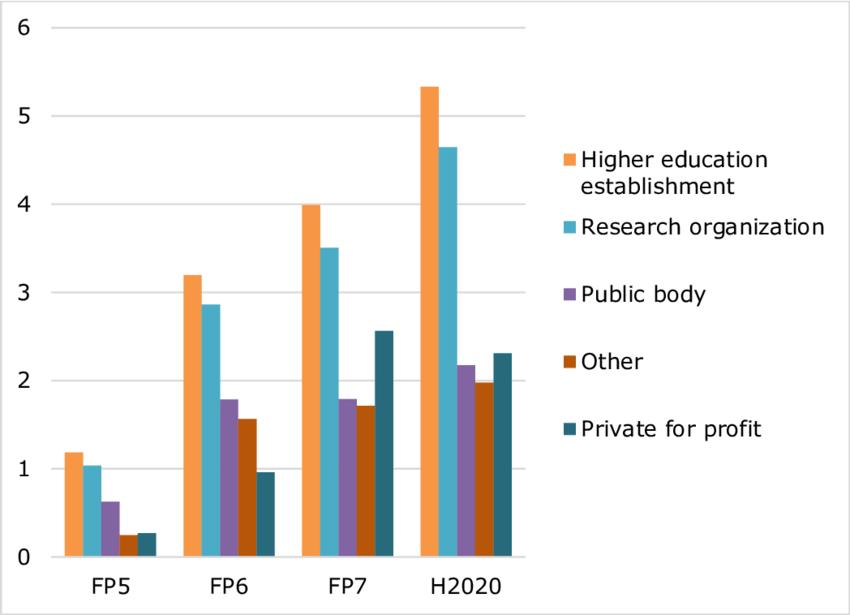
A few figures on what has been achieved so far.


Innovation performance compared to the EU 2017 among EU 27 Member States – A comparison to 2023.

The Innovation Leaders have particularly attractive research systems and are strong in digitalisation. The Strong Innovators demonstrate significant strengths in their innovation ecosystems (product and business innovations). Among the Moderate Innovators, there is a range of positive trends, in particular the development of collaboration in research; whereas Emerging Innovators have shown an overall positive trajectory in innovation performance, but they are still lagging. Although the performance differences have slightly narrowed among the Strong Innovators and Moderate Innovators between 2017 and 2024, they became more pronounced among the Innovation Leaders and Emerging Innovators. There are also persistent geographic differences in innovation performance, with Innovation Leaders and most Strong Innovators predominantly located in Northern and Western Europe, and many of the Moderate and Emerging innovators in Southern and Eastern Europe.
Croatia remained stable. Compared to the last edition:
·Denmark remains the most innovative EU country followed by Sweden, which led the rankings between 2017-2022.
·Two countries now belong to a different performance group.
·Estonia became a Strong Innovator following a steady growth pattern since 2017.
·Belgium, which was an Innovation leader in 2023, moved down to the Strong Innovators’ category, although it maintained its fifth position in the rankings overall.

Bulgaria has received approx. 60 million euros.
Greece- 696.9 million euros under the Horizon 2020 program. Romania- 109.75 million euros and Turkye-118 million euros.

Germany ~ €5 billion / 10 163 projects
United Kingdom ~ €4.52 billion / 10 052 projects
France ~ €3.27 billion / 8 094 projects
Spain ~ €2.81 billion / 8 700 projects
Italy ~ €2.56 billion / 7 999 projects
Netherlands ~ €2.37 billion / 5 219 projects
Belgium ~ €1.47 billion / 3 709 projects
Sweden ~ €1.09 billion / 2 553 projects
Austria ~ €877 million / 2 318 projects
Denmark ~ €790 million / 1 910 projects
Total money received: €24 786 499 878
_____________

