Contents
Contents
GLOSSARY
LIST OF TABLES
LIST OF FIGURES
Introduction
1.
Context and purpose of the initiative
1.1.
Legal context
1.2.
Policy context
1.2.1.
Sustainable use and protection of water and marine resources
1.2.2.
Transition to a circular economy
1.2.3.
Pollution prevention and control
1.2.4.
Protection and restoration of biodiversity and ecosystems
1.3.
Purpose of the Delegated Act
2.
Process followed for preparing the delegated act
3.
Key methodological choices
3.1.
Prioritisation, selection and classification of economic activities
3.2.
Setting technical screening criteria in line with the JRC methodology
3.2.1.
Defining types of substantial contribution
3.2.2.
Approaches to define substantial contribution
3.3.
Ensuring consistency across economic activities
3.4.
Assessment of compliance with Article 6(4) of the European Climate Law
3.5.
Level of ambition for technical screening criteria
3.5.1.
The sustainable use and protection of water and marine resources
3.5.2.
The transition to a circular economy
3.5.3.
Pollution prevention and control
3.5.4.
The protection and restoration of biodiversity and ecosystems
4.
Technical Screening Criteria for the environmental objectives
4.1.
Substantial contribution to the sustainable use and protection of water and marine resources
4.1.1.
Manufacturing
4.1.2.
Water supply, sewerage, waste management and remediation
4.1.3.
Disaster risk management
4.1.4.
ICT
4.2.
Substantial contribution to the transition to a circular economy
4.2.1.
Manufacturing
4.2.2.
Water supply, sewerage, waste management and remediation
4.2.3.
Construction and real estate
4.2.4.
ICT
4.2.5.
Services
4.3.
Substantial contribution to pollution prevention and control
4.3.1.
Manufacturing
4.3.2.
Water supply, sewerage, waste management and remediation
4.3.3.
Transport
4.4.
Substantial contribution to the protection and restoration of biodiversity and ecosystems
4.4.1.
Environmental protection and restoration activities
4.4.2.
Accommodation
4.4.3.
Agriculture and Fisheries
4.4.4.
Forestry
4.4.5.
Energy
4.4.6.
Manufacturing
4.4.7.
Water supply, sewerage, waste management and remediation
4.5.
Substantial contribution to climate change mitigation
4.5.1.
Manufacturing
4.5.2.
Transport
4.6.
Substantial contribution to climate change adaptation
4.6.1.
Environmental protection and restoration activities
4.6.2.
Water supply, sewerage, waste management and remediation
4.6.3.
Construction and real estate
4.6.4.
Disaster risk management
4.6.5.
Information and communication
4.6.6.
Professional, scientific and technical activities
5.
Expected costs and benefits of applying the Taxonomy Environmental Delegated Act under the EU Taxonomy
5.1.
Expected benefits
5.2.
Expected costs
6.
Monitoring and evaluation
7.
Annex
7.1.
Annex: List of prioritised activities by the contractor
7.2.
Annex: Consultations
7.2.1.
Public call for Feedback on the Platform draft report of preliminary recommendations
7.2.2.
Member States Expert Group feedback on Platform recommendations
7.2.3.
Member States Expert Group feedback on Commission draft Delegated Acts
7.2.4.
Platform feedback on Commission draft Delegated Acts
7.2.5.
Public call for feedback on the Commission draft Delegated Acts by the Commission
GLOSSARY
|
Term or acronym
|
Meaning or definition
|
|
BATs
|
Best Available Techniques
|
|
CAP
|
Common Agricultural Policy
|
|
CapEx
|
Capital Expenditure
|
|
CEAP
|
Circular Economy Action Plan
|
|
CFP
|
Common Fisheries Policy
|
|
CORSIA
|
Carbon Offsetting and Reduction Scheme for International Aviation
|
|
CSRD
|
Corporate Sustainability Reporting Directive
|
|
DMA
|
District Metering Area
|
|
DNSH
|
Do No Significant Harm
|
|
DPSIR
|
Driver, Pressure, State, Impact, Response
|
|
EAP
|
Environmental Action Programme
|
|
ESG
|
Environmental, social and governance factors
|
|
GHG
|
Greenhouse gas
|
|
IED
|
Industrial Emissions Directive
|
|
KPI
|
Key Performance Indicator
|
|
MSEG
|
Member States Expert Group
|
|
MSFD
|
Marine Strategy Framework Directive
|
|
NACE
|
Nomenclature statistique des Activités économiques
|
|
NFRD
|
Non-Financial Reporting Directive
|
|
OpEx
|
Operational Expenditure
|
|
PPWR
|
Packaging and Packaging Waste Regulation
|
|
PSF
|
Platform on Sustainable Finance
|
|
REACH
|
Registration, Evaluation, Authorisation and Restriction of Chemicals
|
|
SAF
|
Sustainable Aviation Fuels
|
|
SC
|
Substantial Contribution
|
|
SDGs
|
Sustainable Development Goals
|
|
SFDR
|
Sustainable Finance Disclosure Regulation
|
|
ST
|
Sector Team
|
|
TEG
|
Technical Expert Group on Sustainable Finance
|
|
TSC
|
Technical Screening Criteria
|
|
TWG
|
Technical Working Group
|
|
WFD
|
Water Framework Directive
|
LIST OF TABLES
Table 1: Technical Working Group Sector Teams
Table 2: Elements considered for the objective water and marine resources
Table 3: Elements considered for the objective circular economy
Table 4: Elements considered for the objective pollution prevention and control
Table 5: Elements considered for the objective biodiversity and ecosystems
Table 6: Summary of cases for type 4 activities
Table 7: List of activities recommended by the Platform on Sustainable Finance
Table 8: Activities for the objective of sustainable use and protection of water and marine resources
Table 9 : Activities for the objective transition to a circular economy
Table 10: Activities for the objective pollution prevention and control
Table 11: Activities for the objective protection and restoration of biodiversity and ecosystems
Table 12: Activities for the objective climate change mitigation
Table 13: Activities for the objective climate change adaptation
Table 14: Overview of benefits
Table 15: Overview of costs
Table 16: Measuring success of the EU Taxonomy for climate change mitigation and adaptation as established by the delegated act
Table 17: List of prioritised activities by the contractor
LIST OF FIGURES
Figure 1: The four basic conditions for economic activities in the Taxonomy Regulation
Figure 2: Process for developing technical screening criteria for the Taxonomy Environmental Delegated Act
Figure 3: Steps to establish robust, scientific, and evidence-based technical screening criteria for substantial contribution as illustrated in the JRC methodology
Figure 4: Types of substantial contribution
Figure 5: Enabling Task Force decision tree
Figure 6: Seven generic approaches for technical screening criteria
Figure 7: DPSIR framework
Figure 8: EEA report, Secondary material use; current standard and technical maximum; in Western Europe
Introduction
This staff working document accompanies the Environmental Delegated Act of the EU Taxonomy (‘Taxonomy Environmental Delegated Act’), which sets out technical screening criteria for substantial contribution to the four environmental objectives of the Taxonomy and for ‘do no significant harm’ to all environmental objectives against the requirements of the Taxonomy Regulation. In addition, the Taxonomy Environmental Delegated Act amends the Taxonomy Disclosures Delegated Act that reflects the reporting obligations for users laid down in the Taxonomy Environmental Delegated Act and in changes to the Climate Delegated Act.
This document also accompanies the targeted amendments made to the Climate Delegated Act to add further activities that can make a substantial contribution to climate change mitigation or adaptation, and to correct clerical mistakes or address some of usability issues in the Delegated Act. This document builds on the impact assessment that was published with the adoption of the Climate Delegated Act in June 2021.
This staff working document does not introduce new obligations for users. It is limited to providing an overview of the technical substance, uses and impacts of the Taxonomy Environmental Delegated Act and Taxonomy Climate Delegated Act in an indicative way. This staff working document accompanies and explains the context, purpose, content and impacts of the Taxonomy Environmental Delegated Act. The focus is mainly on the four environmental objectives under the EU Taxonomy in order not to repeat what has already been included in the impact assessment of the Climate Delegated Act. Only for the presentation of the technical screening criteria of the activities to be added in this Delegated Act to amend the Climate Delegated Act, will the document go more into details on the climate objectives.
As such, the document is divided into six sections.
Section 1 outlines the legal and policy context, as well as the purpose of the delegated act.
Sections 2 and 3 present the process and key methodological choices that were taken to select the activities presented in the delegated act and develop their technical screening criteria.
Section 4 then provides an overview of the technical screening criteria that have been published by the Platform on Sustainable Finance in March and November 2022. The section does not only cover the technical screening criteria for activities making a substantial contribution to the four environmental objectives, but also the proposed criteria for activities to be added to the Climate Delegated Act. These criteria were subject to a public consultation in the summer of 2021 as part of the preparatory work of the Platform on Sustainable Finance that has resulted in changes in the criteria as summarised in Annex 7.2.1 to this report. Furthermore, section 4 includes an assessment of the deviations in the draft delegated act from the recommendations of the Platform on Sustainable Finance. The assessment shows why the proposed deviations achieve a better balance between the Regulation’s requirements compared to the criteria proposed by the Platform and how these deviations are supported by additional evidence.
Section 5 includes an indicative estimation of the magnitude of the costs and benefits connected to the technical screening criteria of the Taxonomy Environmental Delegated Act.
Section 6 outlines the monitoring and evaluation of the Delegated Act.
1.Context and purpose of the initiative
The European Green Deal and the transition to a climate-neutral and sustainable economy by 2050 present considerable opportunities but also challenges for the EU. Investment in the green transition will help make Europe the first climate neutral continent and will help protect, conserve and enhance the EU’s natural capital, and protect the health and well-being of citizens from environment-related risks and impacts. Investments in our capacity to develop and manufacture clean technologies will also reinforce the EU’s competitiveness.
To implement the priorities set out by the Green Deal, the 8th Environmental Action Programme (EAP) 2021-2030 represents a legal commitment by the European Commission, the European Parliament, the Council of the European Union and EU Member States to the Green Deal’s 2030 and 2050 objectives and thus supports the Union’s common commitment to a fair green recovery. In addition to setting out six priority objectives for climate and environment policy to 2030 and an ambitious enabling framework, the EAP emphasises that social inequalities resulting from climate- and environment-related impacts and policies should be minimised and that measures that are taken to protect the environment and climate should be carried out in a socially fair and inclusive way.
To meet the objectives of the European Green Deal, the Union will need to invest an additional EUR 477 billion annually to decarbonise its economy, especially in the energy and transport sector. Moreover, the latest Environmental Implementation Review estimated that an EUR 110 billion is needed to meet the EU’s environmental objectives. Furthermore, additional investments of at least EUR 92 billion are needed for the Union to enhance its share of global clean technology manufacturing as outlined in the Green Deal Industrial Plan and Net-Zero Industry Act.
A large part of these investments will have to come from private funding. This is also in line with the Commission priority of building a future-ready economy that works for people and delivers stability, jobs, growth and investment. Regulation 2020/852 (the ‘Taxonomy Regulation’) – operationalised through Delegated Acts – was adopted on 18 June 2020 to classify environmentally sustainable activities and provide long-term signals to direct financial and capital flows to accelerate the fair green transition.
1.1.Legal context
The Taxonomy Regulation is an important piece of legislation in the EU’s sustainable finance framework to encourage a reorientation of capital flows towards sustainable investment and ensure market transparency. Notably, by providing companies, investors and policymakers with definitions of the economic activities that can be considered as environmentally sustainable, it is expected to add market transparency and help shift investments to economic activities where they are most needed for a fair green transition. The Taxonomy Regulation aims to help channel capital towards activities that substantially contribute to reaching the objectives of the European Green Deal, in particular, to (i) climate change mitigation, (ii) climate change adaptation, (iii) the sustainable use and protection of water and marine resources, (iv) the transition to a circular economy, (v) pollution prevention and control, and (vi) the protection and restoration of biodiversity and ecosystems. This framework will help mitigate the risk of ‘greenwashing’ and avoid the market fragmentation that can be caused by a lack of common understanding on environmentally sustainable economic activities.
The Taxonomy Regulation establishes four overarching conditions for environmental sustainability:
(I)it contributes substantially to one or more of the six environmental objectives set out in the Taxonomy Regulation;
(II)it does not significantly harm any of the other environmental objectives;
(III)it is carried out in compliance with the minimum (social) safeguards set out in the Taxonomy Regulation;
(IV)it complies with the “technical screening criteria” set out by the Commission through delegated acts. The technical screening criteria operationalise the conditions (i) and (ii) by specifying the performance requirements for any economic activity that determine under what conditions that activity (i) makes a substantial contribution to a given environmental objective, and (ii) does not significantly harm the other objectives.

Figure 1: The four basic conditions for economic activities in the Taxonomy Regulation
The Taxonomy Regulation acknowledges different means for an activity to make a substantial contribution to each objective. Across all objectives, it is recognised that activities may not only qualify due to their own performance, but also by enabling another activity or activities to substantially contribute.
The technical screening criteria that are set in the delegated acts are performance criteria for a specific economic activity that determine under what conditions i) the activity makes a substantial contribution to a given environmental objective (where relevant); and ii) it does not significantly harm the other objectives.
The Taxonomy Climate Delegated Act establishing the activities and technical screening criteria regarding the climate objectives was adopted on 4 June 2021 and published in the Official Journal of the European Union on 9 December 2021. It entered into application on 1 January 2022. To supplement the activities included in the first delegated act, a complementary delegated act covering the energy sectors of gas and nuclear amended the Climate Delegated Act (adoption by the Commission on 9 March 2022 and publication in the Official Journal on 15 July 2022) and entered into application on 1 January 2023. In addition, the Taxonomy Disclosures Delegated Act specifying the reporting obligations with respect to the key performance indicators that companies need to disclose under Article 8 of the Taxonomy Regulation was adopted on 6 July 2021 and published in the Official Journal on 10 December 2021. It entered into application on 1 January 2022.
The Taxonomy Environmental Delegated Act sets out the activities and technical screening criteria for the remaining four environmental objectives under the Taxonomy Regulation. The initiative is based on the empowerments set out in Articles 12(2), 13(2), 14(2) and 15(2) of the Taxonomy Regulation. The technical screening criteria are set in accordance with the requirements of Article 19 of that Regulation. In accordance with Article 31 of the Inter-institutional Agreement of 13 April 2016 on Better Law-Making, this Delegated Regulation combines in a single act four interrelated empowerments of the Taxonomy Regulation.
The Taxonomy Environmental Delegated Act is adopted alongside a Delegated Act with targeted amendments to the Climate Delegated Act. The amendments add a limited number of activities to the existing Climate Delegated Act which can help make an important contribution to the objective of climate change mitigation (Annex I) and climate change adaptation (Annex II),extend the scope of a few activities in a targeted way, and correct a small number of technical mistakes in the existing Act.
Finally, the Disclosures Delegated Act is amended to cater for the timing and content of reporting by relevant non-financial and financial undertakings of economic activities included in the Environmental Delegated Act and in the amendments to the Climate Delegated Act. The amendments also correct a small number of technical mistakes in the existing Disclosures Delegated Act.
1.2.Policy context
The four environmental objectives under the EU Taxonomy Regulation will support reaching the goals of the European Green Deal. The development of technical screening for the Delegated Act is therefore closely related to the EU environmental legislation and initiatives in the field of the sustainable use and protection of water and marine resources; the transition to a circular economy; pollution prevention and control and the protection and restoration of biodiversity and ecosystems.
1.2.1.Sustainable use and protection of water and marine resources
Aquatic and marine environments are essential for EU citizens and the economy, but climate change, environmental degradation and overexploitation are putting pressure on these environments and thus our precious water resources.
The sustainable management of water quality and quantity draws on the existing legislative framework while playing a pivotal role in the implementation of the European Green Deal and its subsequent initiatives. The Water Framework Directive (WFD) and the related legislative instruments, guidance and recommendations provide the main framework and the overall objectives for water policy in Europe, namely to attain good status of all surface and ground-waters.
With regard to flood risk prevention and management, the Floods Directive has established the requirement for flood risk management plans, which address all aspects of flood risk management focusing on prevention, protection, preparedness, including flood forecasts and early warning systems. Whilst the Directive has already improved flood risk management, further efforts are needed to strengthen awareness and secure better and more coordinated flood prevention, in line with climate change projections, and response. Such efforts are underway.
For the protection and use of marine resources, the Marine Strategy Framework Directive (MSFD) aims to achieve Good Environmental Status of the EU’s marine waters and to protect the resource base upon which marine-related economic and social activities depend. Since its adoption in 2008, the Commission produced a set of detailed criteria and methodological standards to help Member States implement its provisions.
There is also a significant financing gap in the provision of wholesome and clean drinking water and the protection of human health and the environment from the effects of untreated urban wastewater meeting the requirements of the Drinking Water Directive and the Urban Wastewater Treatment Directive respectively. With the present and future impacts of climate change, the challenge of water quantity management is becoming ever more urgent across Europe, affecting the achievement of the objectives of the water legislation. With the Water Framework Directive and Floods Directive, the EU has a legal framework that has been found largely fit for purpose. Reducing flood risk, however, requires sustained attention over a long period and cooperation across borders. Dealing with too little water is a matter of similar importance. Unsustainable patterns of water use across Europe are compounded by climate change, as it brings a persisting decline and higher variation in precipitation and generates higher levels of evaporation, causing longer periods of extreme droughts which add to already existing water scarcity in increasingly large parts of Europe.
Based on the implementation report issued in 2020, the MSFD is currently under revision to address the challenge faced in the first cycle and propose a forward-looking approach for the next decade to come.
1.2.2.Transition to a circular economy
The EU’s transition to a circular economy aims to decouple economic growth from resource use, reducing pressure on natural resources and creating sustainable growth and quality jobs. It is also a prerequisite to achieve the EU’s 2050 climate neutrality target and to halt biodiversity loss.
In March 2020, the Commission adopted the new Circular Economy Action Plan (CEAP), with the aim to help modernise the EU’s economy and draw benefits from the opportunities of the circular economy domestically and globally. The new CEAP includes systemic approaches to key value chains, including textiles, electronics, batteries, plastic and construction products.
The Commission also considered necessary to boost the market for secondary raw materials with mandatory recycled content. To achieve a higher use of secondary raw materials, the mandatory recycled content is being built into specific legislative acts, as for example batteries regulation. Furthermore, in order to move towards toxic-free material cycles and clean recycling, it is necessary to ensure that substances of concern in products and recycled materials are minimised.
In addition, action focuses on resource-intensive sectors such as textiles, construction, electronics and plastics. The Commission followed up to the 2018 Plastics Strategy by focusing on measures to tackle intentional releases of micro plastics and unintentional releases of plastics. The Commission also published an EU strategy for sustainable and circular textiles that aims at creating a greener and more competitive sector by increasing the durability of textile products and incentivising reuse, repair and recycling. The Commission issued in November 2022 a Communication on biobased, biodegradable and compostable plastics and sets out the conditions to ensure that the overall environmental impact of their production and consumption is positive. The Commission has adopted a proposal to revise the Packaging and Packaging Waste Directive (PPWR)to ensure that all packaging in the EU market is reusable or recyclable in an economically viable manner by 2030. In addition, the Commission will strengthen the implementation of the Directive on Single-use Plastics. Introduction of the extended producer responsibility under the different streams of legislation (for example electronic equipment) will also encourage more sustainable production and behaviour. The Commission also adopted a proposal for revision of the Waste Shipment Regulation in 2021.
The construction sector is responsible for more than a third of the waste generated in the EU. In October 2020 the Commission published the Renovation Wave Communication, whose objective is to at least double the annual energy renovation rate of residential and non-residential buildings by 2030 and to foster deep energy renovations. The Renovation Wave Action Plan also includes measures on the overall sustainability of the built environment, including on material recovery targets. To follow up on the Renovation Wave, the Commission proposed a review of the Energy Performance of Building Directive
. In addition, in March 2022 the Commission proposed a review of the Construction Products Regulation to ensure that the design of construction products is in line with the needs of the circular economy. The Commission also launched the flagship New European Bauhaus initiative, including to guide the construction industry towards a sustainable and inclusive future
1.2.3.Pollution prevention and control
Pollution to water, air and soil is the largest source of health problems and one of the main reasons for the loss of biodiversity. It also reduces the ability of ecosystems to provide services such as carbon sequestration and decontamination.
To pave the way towards a toxic-free environment, in May 2021 the Commission adopted the action plan ‘Towards Zero Pollution Action Plan for Air, Water and Soil’. The main objective of the action plan is to provide a compass for including pollution prevention in all relevant EU policies, maximising synergies in an effective and proportionate way, stepping up implementation and identifying possible gaps or trade-offs. To steer the EU towards the vision of having air, water and soil pollution reduced to levels not harmful to health and ecosystems for all in 2050, the action plan sets quantitative targets for 2030 to speed up pollution reduction.
With the aim of progressing towards the EU’s zero pollution ambition for a toxic-free environment, in April 2022 the Commission adopted a proposal for a revised Industrial Emissions Directive (IED) with the aim to (i) strengthen the implementation across Member States, (ii) increase investments in cleaner technologies, and (iii) include additional intensive farming and industrial activities. The IED aims to achieve a high level of protection of human health and the environment by reducing harmful industrial emissions across the EU, especially through the application of Best Available Techniques (BATs).
In addition, to protect human health and the environment against hazardous chemicals, the Commission published in October 2020 a Chemicals Strategy for Sustainability. The strategy complements the REACH Regulation and the Classification, Labelling and Packaging Regulation. It announces the Commission’s intention to (i) ban the most harmful chemicals in consumer products, though allowing their essential use; (ii) boost the investment and innovative capacity for production and use of chemicals that are safe and sustainable by design and throughout their life cycle; and (iii) establish a simpler ‘one substance one assessment’ process for the risk and hazard of chemicals.
1.2.4.Protection and restoration of biodiversity and ecosystems
Ecosystems provide essential services such as food, fresh water, clean air and shelter. Biodiversity loss and ecosystem collapse is one of the biggest threats facing humanity in the next decade. It also threatens the foundations of our economy, and the cost of inaction is high. The world lost an estimated EUR 3.5-18.5 trillion per year in ecosystem services from 1997 to 2011 owing to land-cover change, and an estimated EUR 5.5-10.5 trillion per year from land degradation. Specifically, biodiversity loss results in reduced crop yields and fish catches, increased economic losses from flooding and other disasters, and the loss of potential new sources of medicine.
Biodiversity in the EU is protected through the Birds and Habitats Directive and the Natura 2000 network of protected sites established under these two pieces of legislation. The Birds and Habitats Directive protect 230 habitat types and around 2000 species of European importance because they are endangered, vulnerable, rare, endemic or present outstanding examples of typical characteristics of one or more of Europe’s nine biogeographical regions. To ensure the protection and restoration of biodiversity and ecosystems, the Commission presented a Biodiversity Strategy in March 2020. The strategy aims to put Europe’s biodiversity on the path to recovery by 2030 by (i) establishing a larger EU-wide network of protected areas on land and at sea; (ii) launching an EU nature restoration plan; and (iii) introducing measures to support the implementation efforts further, such as improved financing and investments. Building on the Commission on Stepping Up EU Action to Protect and Restore the World’s Forests, the European Parliament and the Council also adopted the Regulation on deforestation-free products.
1.3.Purpose of the Delegated Act
The EU Taxonomy was created to mainstream financial risks stemming from sustainability issues and foster transparency in financial and economic activity on sustainability, ultimately allowing for a reorientation of capital flows towards sustainable investment.
In an impact assessment of 2018, the Commission identified two underlying problems that prevent this re-orientation of capital from a financial institution, as well as from an investor perspective. On the one hand, the impact assessment showed that relevant financial undertakings did not sufficiently consider environmental, social and governance factors (ESG) in their investment processes due to a lack of incentives. On the other hand, end-investors did not take these factors into account due to the high search costs they faced regarding what sustainable economic activities are and how ESG factors are integrated in investment and advisory processes. These problems were attributed to five main drivers, namely: (i) a lack of clarity and coherence of EU rules on duties towards investors/beneficiaries with respect to ESG integration in the investment and advisory process; (ii) a lack of disclosure regarding the level of ESG integration in the investment process; (iii) a lack of clarity on what can be considered a sustainable economic activity; (iv) the lack of comparable and readily available ESG information from firms and issuers and (v) short-termism.
The Commission presented a proportionate impact assessment accompanying the Taxonomy Climate Delegated Act in 2021. The document explained that the establishment of technical screening criteria for the climate objectives was necessary to counter the lack of clarity and uncertainty that investors face given the fragmentation of definitions of what constitutes an environmentally sustainable economic activity. This absence of clear information leads to a sub-optimal capital allocation with regards to their environmental impact.
This staff working document follows the arguments presented in the impact assessment of 2021 in that the Taxonomy Environmental Delegated Act is a precondition for the establishment of the EU Taxonomy as a classification system for environmentally sustainable economic activities.
The Taxonomy Environmental Delegated Act therefore supports the implementation of two out of the three general objectives presented: reorienting capital flows towards sustainable investments and fostering transparency in financial and economic activity on sustainability by reducing investor search costs in identifying sustainable economic activities.
Amendments to the Taxonomy Disclosures Delegated Act
In order to guide undertakings with respect to their disclosures regarding the activities included in the Taxonomy Environmental Delegated Act, and help markets adapt to the flow of data to achieve the objectives above, it is necessary to complement the Taxonomy Disclosures Delegated Act with a number of technical adjustments. These relate largely to the time sequence of the reporting, the modalities for the reporting of activities that may contribute to more than one environmental objective and adapting some of the reporting templates for financial undertakings, which until now only included data fields for disclosures in relation to activities in the Taxonomy Climate Delegated Act, in order to accommodate reporting for activities included in the Taxonomy Environmental Delegated Act, where relevant.
2.Process followed for preparing the delegated act
The Taxonomy Regulation defines the framework of the EU Taxonomy, including the requirements and scope of its delegated acts. When drafting the Taxonomy Climate Delegated Act, the Commission followed a multi-staged process to adopt technical screening criteria that are in line with the specific requirements of the Taxonomy Regulation. To ensure coherence, a similar process was followed in the drafting of the Taxonomy Environmental Delegated Act, as illustrated in Figure 2.
The work of the Platform on Sustainable Finance (or ‘the Platform’), an independent Commission expert group, was instrumental in the drafting process of the technical screening criteria. The Platform is mandated by Article 20 of the Taxonomy Regulation to advise the Commission on the technical screening criteria for the six objectives of the EU Taxonomy.
For this, a Technical Working Group (TWG) was set up as a subgroup of the Platform, composed of 32 experts and 3 observers. The TWG was again divided into 10 Sector Teams that were in charge of developing the technical screening criteria for activities in a specific sector.
Table 1
provides an overview of the Sector Teams and the sectors they covered.
|
Sector Team
|
Sectors covered
|
|
ST1
|
Agriculture, forestry and fishing
|
|
ST2
|
Mining and processing sectors
|
|
ST3
|
Manufacturing (chemicals, plastics, pharmaceuticals)
|
|
ST4
|
Manufacturing (machinery and equipment)
|
|
ST5
|
Manufacturing (textiles, wearing apparel, leather, food and beverages)
|
|
ST6
|
Energy
|
|
ST7
|
Construction and renovation, Information and Communication Technology (ICT), emergency services, flood risk prevention, civil engineering
|
|
ST8
|
Transport
|
|
ST9
|
Restoration and remediation, tourism
|
|
ST10
|
Water supply, sewerage and waste management
|
Table 1: Technical Working Group Sector Teams
In addition, in May 2022, the Platform set up an Enabling Task Force composed of 27 experts from the industry, NGOs and the European agencies. The Task Force was tasked to develop a horizontal framework to determine the concept and scope of enabling activities and to review the draft enabling activities developed by the TWG on the basis of that framework.
The TWG was led by two rapporteurs and the Chair of the Platform. They worked closely together with the Secretariat of the Platform that was composed of several Commission services and with the technical coordination group consisting of a larger group of Commission services. Based on clear work parameters from the Commission, the Platform contributed to stages 2 and 3 of the 4-stage process outlined in Figure 2, to deliver draft criteria recommendations to the Commission published in March and November 2022.
Figure 2: Process for developing technical screening criteria for the Taxonomy Environmental Delegated Act
Firstly, building on the NACE (Nomenclature statistique des Activités économiques) classification system for economic activities, a prioritisation exercise was performed to identify the economic activities that could be relevant to make a substantial contribution to one of the four environmental objectives of the EU Taxonomy. Based on this prioritisation exercise, a systematic approach was developed to establish on which grounds economic activities could make a substantial contribution to one of the four objectives and could therefore be included (or not) in the Taxonomy. As a result, a number of activities were selected for potential inclusion in the Taxonomy. This is further explained in Section 3.1.
Secondly, to ensure that the provisions of the Taxonomy Regulation were translated into the technical screening criteria, the Joint Research Centre of the European Commission (JRC) further developed the methodology for drafting technical screening criteria defined in the impact assessment to the Taxonomy Climate Delegated Act. This new methodology is described in the JRC report ‘Development of the EU Sustainable Finance Taxonomy – A framework for defining substantial contribution for environmental objectives 3-6’ , and further explained in section 3.2.
Thirdly, the draft technical screening criteria proposed by the Platform were published for stakeholder feedback from August to September 2021 (see summary of comments received in Annex 7.2.1). The feedback provided by stakeholders was carefully considered by the Platform before the publication of its final recommendations in March and November 2022 (see Section 4 in this report for a full list of the Platform’s recommended activities). The criteria were also discussed with the Member States Expert Group (MSEG) of the Commission on several occasions in particular on 6 April, 8 July, 4 October and 15 December 2022 and on 24 January 2023 (see summary of comments in Annex 7.2.2).
Lastly, the Commission carefully considered the recommended technical screening criteria proposed by the Platform and conducted further work to ensure that the criteria meet the requirements set out in Article 19 of the Taxonomy Regulation. The draft criteria were shared with the MSEG and the Platform on 5 April 2023 (see summary of comments respectively in Annexes 7.2.3 and 7.2.4) and published for a four-week feedback period from 5 April to 3 May 2023 (see summary of comments in Annex 7.2.5). In total, 646 respondent provided feedback
.
The draft delegated acts were also discussed with the Platform on Sustainable Finance on 19 April and 24 May 2023. The draft delegated acts were also presented to and discussed with the Member States’ experts and observers from the European Parliament, at meetings of the MSEG on 20 April 2023 and 25 May 2023. An ad hoc discussion with the Members of European Parliament took also place on 25 May 2023.
Overall, Platform, MSEG and stakeholders’ feedback was mostly positive and welcomed the inclusion of new objectives and sectors into the EU Taxonomy. Several concerns were also expressed, in particular as regards the lack of inclusion of certain sectors considered as critical and potential implication for undertakings whose activities are not covered under the Taxonomy. Comments were also largely divided between those proposing more or less stringent criteria. Some considered the calibration of the criteria for certain activities as insufficiently ambitious. On the other hand, others considered some of the criteria as too stringent, complex or narrow. Many comments also focused on usability of the criteria, reporting modalities and technical clarifications.
Based on careful examination of the feedback received, a targeted recalibration of some of the criteria, as well as other technical modifications, have been made during the finalisation of the Delegated Regulation. These concern numerous technical clarifications and simplification of the criteria, greater consistency with existing sectoral legislation, including references to upcoming reviews, and relevant national requirements to reflect subsidiarity, as well as improved coherence in the definition and presentation of various activities, including those labelled as transitional and enabling activities.
3.Key methodological choices
3.1.Prioritisation, selection and classification of economic activities
The Commission developed a methodology to select and prioritise economic activities for potential inclusion in the Taxonomy Environmental Delegated Act. This methodology followed a similar approach as developed by the Technical Expert Group on Sustainable Finance (TEG) in 2020, which determined the prioritisation of activities that could make a substantial contribution to climate change mitigation and adaptation. At that time, the TEG first selected priority macro-sectors based on their aggregate levels of greenhouse gas emissions using gCO2e (grams of carbon dioxide equivalent) as an indicator. From this, the TEG developed a list of prioritised macro-sectors and economic activities within these sectors that had the highest potential to reduce greenhouse gas emissions (improvement potential). The majority of these prioritised economic activities were included in the Taxonomy Climate Delegated Act that was adopted in July 2021. The impact assessment accompanying the delegated act provided a summary of the extent to which prioritised activities were included, as well as a reasoning for any deviations.
In order to select activities for the Taxonomy Environmental Delegated Act, the methodology was adapted to fit the requirements for assessing economic activities in the context of the four environmental objectives.
As such, instead of determining the reduction potential of an activity’s greenhouse gas emission, the Commission identified a variety of elements that were considered to assess the current environmental impact of an economic activity in relation to the four environmental objectives, as well as the potential to reduce this impact in the future (‘improvement potential’). The elements considered per environmental objective are summarised in
Table 2
to
Table 5
.
|
Sustainable use and protection of water and marine resources
|
|
Chemical pressures / Pollution
|
Oxygen demanding pollutants and nutrients (bio-degradable organic compounds in suspended, colloidal, or dissolved form)
|
|
|
Synthetic organic compounds (pesticides, detergents, food additives, pharmaceuticals, insecticides, paints, fibres, PCBs, solvents, PAHs, and VOCs,)
|
|
|
Oil
|
|
|
Pathogens (viruses, bacteria)
|
|
|
Inorganic pollutants (heavy metals, mineral acids, inorganic salts, other metals, complexes of metals with organic compounds, cyanides, sulphates, etc.)
|
|
Physical pressures
|
Water Footprint (life cycle approach)
|
|
|
Groundwater (drinking water, agriculture, mining activities, etc.)
|
|
|
Surface water
|
|
|
Hydro-morphological elements of water bodies (river continuity, morphological conditions, seafloor integrity)
|
|
|
Other physical pollutants (thermal pollution, radioactive pollutants, light pollution, and noise/vibration, suspended solids and sediments)
|
|
|
Microplastics and marine litter
|
|
Biodiversity & ecosystems
|
Marine habitats
|
|
|
Marine plants
|
|
|
Marine animals (except birds)
|
|
|
Freshwater habitats
|
|
|
Freshwater fish
|
Table 2: Elements considered for the objective water and marine resources
|
Transition to a Circular Economy
|
|
Raw Material Consumption (RMC) impact
|
Hazardous waste generation impact
|
|
Production impact
|
Non-hazardous waste generation impact
|
|
Use phase impact
|
Landfilling impact
|
Table 3: Elements considered for the objective circular economy
|
Pollution Prevention and Control
|
|
Pollution of air
|
SOx (sulphur oxides)
|
|
|
NOx (nitrogen oxides)
|
|
|
CO (carbon monoxide)
|
|
|
PM (particulate matter)
|
|
|
Heavy metals
|
|
|
POPs (persistent organic pollutants)
|
|
|
VOCs (volatile organic compounds)
|
|
|
ODS (ozone depleting substances)
|
|
|
NH3 (ammonia)
|
|
|
Other (hazardous) chemicals regulated by REACH and CLP and their compounds (e.g. SVHC, chlorine, fluorine, bromine, iodine, asbestos, cyanides, other CMRs, PBTs, EDCs)
|
|
|
Other physical pollutants (heat, noise, light, radiation, odour)
|
|
Pollution of water
|
Oxygen demanding pollutants and nutrients (bio-degradable organic compounds in suspended, colloidal, or dissolved form)
|
|
|
Synthetic organic compounds (pesticides, detergents, food additives, pharmaceuticals, insecticides, paints, fibres, PCBs, solvents, PAHs, and VOCs,)
|
|
|
Oil
|
|
|
Pathogens (viruses, bacteria)
|
|
|
Inorganic pollutants (heavy metals, mineral acids, inorganic salts, other metals, complexes of metals with organic compounds, cyanides, sulphates, etc.)
|
|
|
Microplastics and plastic particles
|
|
|
Other physical pollutants (heat, radiation, light, noise/vibration, suspended solids and sediments)
|
|
Pollution of soil
|
Inorganic pollutants
|
|
|
Organic compounds, including POPs, pesticides, pharmaceuticals and antibiotics
|
|
|
Nitrogen and phosphorous compounds
|
|
|
Other (physical) pollutants (vibrations, microplastics and plastic particles)
|
Table 4: Elements considered for the objective pollution prevention and control
|
Protection and restoration of biodiversity and ecosystems
|
|
Marine habitats
|
Freshwater fishes
|
|
Marine animals (except birds)
|
Terrestrial habitats
|
|
Marine plants
|
Terrestrial plants (including freshwater plants)
|
|
Freshwater habitats
|
Terrestrial animals (including freshwater animals except fish and birds)
|
Table 5: Elements considered for the objective biodiversity and ecosystems
On the basis of the elements considered, the Commission contracted a consultancy company to assist with the data collection and interpretation. This task included four main steps.
First, the contractor collected the relevant data for these elements from Eurostat at an activity level (NACE group or class).
Second, for each of the elements, the contractor attributed two scores to each activity capturing the magnitude of its environmental impact and improvement potential. The two scores were then multiplied to obtain a combined score for each element.
Third, the contractor created a final list of prioritised activities. While activities with the highest environmental impact were identified as relevant, the improvement potential was the most important factor. This is because an activity with a high impact, but a low reduction potential would not qualify for making a substantial contribution to one of the four environmental objectives. In addition, the contractor recognised that performing an activity in a different way is not the only way to improve its environmental performance, as the activity could also be substituted by a different activity. Therefore, in some cases, an activity was de-prioritised by the contractor to include the substitution activity instead.
Lastly, the contractor took into account that the Taxonomy not only covers economic activities that have a significant environmental impact, but also activities that significantly contribute to directly improving the state of the environment (activities “healing the environment”) or activities that directly enable other economic activities to achieve their improvement potential. As quantitative data on these aspects was limited, the contractor only identified relevant activities for each objective, relying on qualitative assessments and expert judgment.
As a result, 67 prioritised activities were identified for the development of technical screening criteria and potential inclusion in the Taxonomy Environmental Delegated Act (see Annex 7.1 for an overview of the prioritised activities).
The list of prioritised activities was revised by the Platform. For some of the activities, the Platform modified their scope in line with their findings, and hence their name, or decided not to develop technical screening criteria due to a lack of data or evidence, a lack of expertise within the Platform or due to diverging views of Platform members. These deprioritised activities were noted by the Platform for consideration for the development of future Delegated Acts under the EU Taxonomy.
3.2.Setting technical screening criteria in line with the JRC methodology
One of the requirements stated in Article 19 of the Taxonomy Regulation for an economic activity to count as environmentally sustainable is making a substantial contribution to at least one of the six environmental objectives. However, the Taxonomy Regulation itself does not define what counts as a substantial contribution, nor does it specify how to define it.
The European Commission’s Joint Research Centre (JRC) developed a framework to assess under which conditions an economic activity makes a substantial contribution to an environmental objective. It includes a step-by-step methodology (Figure 3) to establish robust, scientific, and evidence-based technical screening criteria (or ‘TSC’) for defining substantial contribution. This methodology is described in the JRC report ‘Development of the EU Sustainable Finance Taxonomy – A framework for defining substantial contribution for environmental objectives 3-6’. An earlier version of the methodology was shared with the Platform at the beginning of their mandate. However, important conceptual and legal discussions since have helped to develop certain aspects. Extracts of the updated methodology as published in the JRC report are included in section 3.2 of this document.
While the steps in the methodology are presented sequentially, in practice setting TSC requires following the methodological steps iteratively, as through increased background knowledge and understanding of the economic activity, prior steps would most likely need to be revised.

Figure 3: Steps to establish robust, scientific, and evidence-based technical screening criteria for substantial contribution as illustrated in the JRC methodology
Step 0: Starting point
Step 0 describes the starting point for setting technical screening criteria. This consisted at least of a name or NACE code of an activity and an environmental objective the activity would be considered for.
Step 1: How can the activity make a substantial contribution to the objective
The aim of step 1 was to develop an understanding on how the activity could make a substantial contribution. The subsequent guiding questions were used to determine and map out the potential ways to make a substantial contribution.
1. How does the activity impact/ help the given environmental objective? Does the activity have the potential to reduce pressure on the environment, improve the status of the environment, or enable any of the two? How?
2. Which are the most relevant environmental hotspots or contributions to the given objective along its value-chain on the basis of life cycle considerations?
3. Can the activity be performed in a way that is low impact vis-à-vis the environmental impact of such hotspots?
4. If not, is there a low-impact replacement activity that the Taxonomy could recognise instead?
5. Is there a key activity that enables such substantial contribution?
The guiding questions did not necessarily need to be answered individually. These only served to give guidance on determining possible substantial contributions for a specific activity and environmental objective. However, Step 1 was a crucial assessment step to identify all possibly relevant economic activities at a more granular level, as well as the potential ways of substantial contribution in broad terms to ensure that are properly considered in the following steps.
Step 2: Define the scope of the activity
Step 2 was about selecting the right level of granularity for the activity or activities considered. The right level of granularity was defined as the level at which homogeneous and consistent criteria were possible to be set. In general, a broader activity scope that would require different cases or approaches within the technical screening criteria was avoided.
The scope of the activity was thus redefined, providing a clear description, setting the boundaries of what was included (and excluded, where appropriate) as part of the activity. The description could include indicative NACE codes, with additional specifications in the cases where NACE categories were not adequate (e.g., too broad or narrow). The ad-hoc definition always prevailed.
Step 3: Type of substantial contribution
In Step 3, the relevant types of substantial contributions were determined for the analysed activity and environmental objective. These types of substantial contribution are presented and explained in Section 3.2.1.
Step 4: Reference points
In Step 4, two types of reference points were identified: forward-looking/end-state reference points and state-of-the-art reference points. The identification and analysis of forward-looking/end-state reference points (in EU policies, scientific reports, etc.) were useful to set the level of ambition. Most EU environmental-related policies set objectives and targets or, more broadly, levels of ambition, for the overall state of the environment or at the national/regional level rather than at the activity level. Identifying these reference points was crucial to guide their translation to the specific activity analysed.
The identification of the state-of-the-art reference points also helped to define the elements that could and could not be included in the Taxonomy criteria as the Taxonomy recognises activities/ levels of performance that can be invested in and, thus, are commercially available (i.e., TRL above 8).
Step 5: Selecting the approach
Step 5 was about selecting the most suitable approaches, as explained in Section 3.2.2. For selecting the most suitable approach, all relevant approaches identified were assessed against the requirements in Article 19 of the Taxonomy Regulation. Guidance indicating which approaches were likely or unlikely to be suitable for the specific substantial contribution types identified for a certain environmental objective was provided in the JRC report26.
An approach could not be selected without verification that a relevant level of ambition could be defined accordingly (Step 6). Therefore, steps 5 and 6 were carried out in parallel.
Step 6: Level of ambition
Drawing from available reference points (Step 4) and considering the approach selected to set the technical screening (Step 5), in this step, the level of ambition for the specific activity was defined. In addition, the level of ambition of the technical screening criteria was drafted to be aligned with the headline level of ambition of each environmental objective defined by the Platform on Sustainable Finance. Those headline levels of ambition are described in Section 3.5.
Step 7: Define criteria
The technical screening criteria for substantial contribution to the specific activity were defined by bringing the outcomes from the previous steps together. The technical screening criteria were drafted to strike the best balance between the different requirements in the Taxonomy Regulation (Article 19) and fulfilling the overall Taxonomy aims.
3.2.1.Defining types of substantial contribution
There are three main ways in which an activity can make a substantial contribution to an environmental objective, here referred to ‘substantial contribution types’ (or ‘SC types’):
(1) reducing pressure on the environment,
(2) directly improving the state of the environment (activities ‘healing the environment’), or
(3) directly enabling either of the two previous types.
It is worth noting that the types of substantial contribution vary in their applicability to the different environmental objectives.
The term ‘own performance activities’ is used to indicate collectively the first two classes above, because such activities are considered to make a substantial contribution by how they are performed, while the third class is about enabling other activities to make a substantial contribution. This classification is illustrated in the following graph:

Figure 4: Types of substantial contribution
Activities reducing pressure on the environment:
The reduction of the pressures on the environment must take place in relation to a baseline (i.e. the likely alternative scenario). In other words, the activity may have a negative environmental impact (by worsening the state of the environment) compared to no activity taking place. However, this negative impact is much smaller than that of the activities that would likely take place if the activity assessed was not carried out. By substituting activities which exert higher environmental pressures, the activity leads overall to a substantial reduction of environmental pressures.
The following cases can be distinguished:
·Economic activities that exert a significant pressure on at least one environmental objective, but which have the potential to decrease their environmental impact. These activities make a substantial contribution if they substantially reduce the pressure that they exert on the environment compared to business as usual, i.e. the same activities taking place without implementing improvement measures. The technical screening criteria define which improvement measures qualify to substantially reduce the economic activity's pressure on the environment. This approach is only partially applicable for the water protection and biodiversity objectives.
·Activities that have a low environmental impact and are helping to substantially reduce the pressure that other activities are exerting on the environment. The environmental benefits achieved from reducing the environmental impact of other activities must substantially outweigh the impact the activities exert themselves on the environment.
·Activities that have a low environmental impact and have the potential to substitute high impact activities, therefore, significantly reducing the overall pressure that is exerted on the environment. This needs to be justified on a life cycle consideration basis. A substantial contribution in this context is not possible by shifting the environmental burden to another life cycle stage. While many activities across the economy have a low environmental impact (education for example), not all of them replace high impact activities.
Activities directly improving the state of the environment:
This substantial contribution type implies that the economic activity leads to a direct improvement in the state of the environment, i.e. restoring the environment. In the case of biodiversity and ecosystem services, this substantial contribution type might include activities that significantly contribute to mitigating the damage caused by an activity that was previously carried out (e.g. building wildlife passages around roads).
Enabling activities
The Platform on Sustainable Finance set up an Enabling Task Force with the aim to develop a horizontal framework for enabling activities. With that framework, the Task Force aimed to provide advice to the Commission and future Platforms in following a coherent interpretation of Article 16 of the Taxonomy Regulation when setting technical screening criteria for enabling activities.
The main findings of the Platform’s horizontal framework build on the definition of enabling activities in Article 16 of the Taxonomy Regulation, which highlights a number of important characteristics of enabling activities.
First, the Platform’s framework follows the logic of Article 16 that for an activity to be considered enabling, it must directly enable another activity to make a substantial contribution to one or more of the six environmental objectives. That is, there is a clear link between the enabling activity and the target activity, resulting in a substantial positive environmental impact of the (“enabled”) target activity, whilst considering life cycle impacts of the enabling activity on all six environmental objectives. The Platform interpreted that the enabled substantial positive environmental impact should relate to the objective, for which a substantial contribution is targeted, rather than enabling an activity to meet DNSH requirements for other objectives. According to the Platform, enabling the existence of a downstream activity is not sufficient to be considered as enabling: an enabling activity has to have an “instrumental role” in the target activity complying with its criteria (see Step 5 of the Platform framework below).
Where the activity enables a broader objective rather than another economic activity, which is the case for activities making a substantial contribution to adaptation, the conditions of Article 16 of the Taxonomy Regulation apply to the identified “beneficiaries” of the enabling effect, e.g. a specific community or natural area.
Second, the horizontal framework of the Platform follows the logic of Article 16 in that an enabling activity should not lead to a lock in of assets that could be detrimental to long-term environmental goals. In some cases, an enabling activity may benefit some end uses without lock in, but may cause lock in effects elsewhere. For example, in adaptation, safeguards against maladaptation need to be in place to not inadvertently “increase the risk of an adverse impact on other people, nature or assets” while having a positive effect elsewhere.
Third the Platform recognized in their horizontal framework that enabling activities may include not only upstream activities from the target, but also horizontal activities that are closely related to the enabling activity. For example the activity “Manufacture, installation and associated services for leakage control systems enabling leakage reduction and prevention in water supply” includes not only the manufacturing of the leakage control systems, but also their installation, maintenance and repair. Where value chain activities are closely related, they may be summarised in one taxonomy activity and, where appropriate, be subject to one set of SC and DNSH criteria. However, each activity has to pass the test steps for enabling activities – as outlined below – by itself. Where activities require different criteria, separate taxonomy activities should be established.
Lastly, through the framework, the Platform aimed at making a distinction between enabling activities and own performance activities. They explained that economic activities should only be classified as enabling if own performance criteria for the environmental objective being targeted do not exist. If the analysis of an activity’s life cycle impacts suggests that rather than being classified as enabling, it should be included in the Taxonomy based on own performance criteria, this path should be given priority and considered for future work of the Platform’s Technical Working Group. This applies to all environmental objectives, except for climate change adaptation, for which activities may also be included with own performance and enabling criteria at the same time (so called “adapted-enabling” activities).
To make these considerations more accessible to readers, the Platform summarized its horizontal framework through the below decision tree outlining the steps that are required to assess whether an enabling activity should be included in the EU Taxonomy.

Figure 5: Enabling Task Force decision tree
On the basis of the horizontal framework, the Enabling Task Force re-assessed the scope and draft criteria for enabling activities that were developed by the Technical Working Group and published during the public consultation in August 2021. The assessment showed that some activities did not fit with the enabling framework, which led to the change of scope or adjustment of the technical screening criteria of the activities. In certain cases, the Task Force did not have the necessary expertise to adjust the criteria, leading to a de-prioritisation of the activities, which were included in a handover to the next Platform for future consideration. As a result, five enabling activities were adopted by the Platform in October 2022 (listed in
Table 7
).
Types of substantial contribution by environmental objective
It is worth noting that the types of substantial contribution vary in their applicability to the different environmental objectives.
Based on Articles 12 to 15 of the Taxonomy Regulation, that describe how an economic activity can make a substantial contribution to each environmental objective, substantial contribution types (or ‘SC types’) have been defined for the four remaining environmental objectives as summarised below.
Sustainable use and protection of water and marine resources:
·An activity with positive impact on the status of water bodies.
·An activity leading to an improvement in another activity (enabling activity). It relates to an activity leading to an improvement in another activity through the improvement of measures, upgrades, etc. An activity can make a substantial contribution by improving the environmental performance of another activity, in this case having a positive impact on the status of water bodies.
·An activity dealing with pressures to water bodies from other activities. An activity can make a substantial contribution by capturing pressures from other activities and mitigating them. An activity with pressures substantially lower than sector average. An activity which is responsible for some pressures to water bodies can make a substantial contribution by having lower pressures than the average of other activities within the same sector. The undertaking of the activity (construction or operation) cannot however lead to any additional degradation to the water bodies.
The last type can only contribute substantially to the water objective when replacing directly an activity with higher pressure on the environment in a water body that is not in good status. In case it is linked to a water body in good status it can only contribute substantially to preventing deterioration of bodies of water that already have good status if the pressure (lower than sector average) does not lead to the deterioration of that same status. Just having a pressure level lower than the sector average would not be sufficient (see table below).
|
|
The water body does not have good status
|
The water body has good status
|
|
Activity directly replaces another activity with higher pressures on the same water body
|
Contributes to achieving good status
(subject to compliance with TSC)
|
Contributes to preventing deterioration (subject to compliance with TSC)
|
|
Activity does not directly replace another activity
|
Does not contribute to achieving good status
|
Contributes to preventing deterioration (subject to compliance with TSC and depending in particular on level of pressure exerted by the activity)
|
Table 6: Summary of cases for type 4 activities
Transition to a circular economy:
·Circular Design & Production. Design and produce products and materials with the aim of long-term value retention and waste reduction; promote dematerialisation by making products redundant or replacing with radically different product or service.
·Circular Use. Life extension and optimised use of products and assets during use phase with the aim of resource value retention and waste reduction to support better usage and supporting service.
·Circular Value Recovery. Capture value from products and materials in the after-use phase.
Pollution prevention and control:
·Preventing or, where that is not practicable, reducing direct emissions of pollutants to air, water and land. Activities with high direct pollution emissions can reduce the pressure they directly exert on the environment compared to the baseline.
·Designing out indirect pollution. Activities manufacturing products or providing services with high emissions over their life-cycle can reduce the overall pressure exerted on the environment by designing the product or service in such a way to reducing or eliminating these emissions.
·Cleaning up pollution. Activities performing remediation may directly improve the state of the environment. For instance, the remediation of a former industrial site where land is polluted with chemicals or technologies cleaning litter pollution from the ocean.
Protection and restoration of biodiversity and ecosystems:
·Conserving the state of semi-natural or natural ecosystems. An activity directly maintaining or protecting the good ecological condition of specific semi-natural or natural ecosystem(s).
·Improving the state of semi-natural or natural ecosystems. An activity directly and substantially improving the condition of a semi-natural or natural ecosystem compared to its current condition.
·Maintaining sustainable use of managed ecosystems. An activity achieving a sustainable use of a managed ecosystems.
·Reducing the pressure on managed ecosystems. An activity or measure leading to a reduction of the existing pressure on a managed ecosystem, contributing to reaching and maintaining a sustainable use level.
·Mitigating previous impacts. An activity or measure significantly contributing to mitigating
the damage/impact caused by a previous activity/measure (‘legacy impact’) to which it holds no link. This includes any intervention/measure that can reduce the operational impacts on biodiversity of an existing infrastructure (e.g. wildlife passages on a road, etc.) or remediating/addressing a legacy impact caused by a previous economic activity, thereby reducing the pressure and achieving measurable and demonstrable conservation outcomes.
3.2.2.Approaches to define substantial contribution
The requirements of Article 19 of the Taxonomy Regulation provide guidance on how to define substantial contribution. However, a robust framework around the choice of approaches is needed to fulfil these requirements. Seven ‘generic’ approaches to defining EU Taxonomy criteria were presented in the JRC methodology. They have intrinsic strengths and weaknesses as presented below, notably with regards to the requirements set by the Taxonomy Regulation. However, the choice of one approach over the others mostly depended on the environmental objective and the activity or sector covered: the nature of the activity, the availability of data, etc., which were key in the selection of the most suitable approach. It is important to note that all approaches should be applied to develop criteria at activity level, and not at entity level.
The seven generic approaches developed are the following:
1.Impact-based approach: Criteria that are set within this approach require a certain level of impact of the activity on the environmental objective considered. The impact of an activity depends on the pressures that the activity exerts (e.g., water abstraction, GHG emissions) but also on the context in which an activity takes place (e.g. water availability in the area where the activity is located). Activities qualify if they operate above or below a given threshold.
2.Performance in relation to the environmental target: Criteria that are set within this approach require a certain level of performance defined in terms of the pressure that the activity exerts on the environment (e.g. GHG emissions, water abstraction, etc.). This pressure is measured with a specific performance metric (direct or proxy) relating to the environmental objective considered. Activities qualify if they achieve a certain level of performance derived from environmental considerations (EU policy, scientific literature). This performance-based approach is independent of the context where the activity takes place and only relies on the intrinsic performance of the activity.
3.Best-in-class performance: Like for the previous approach, the criteria require a certain level of performance of the activity, defined as a pressure, and measured under the relevant metric. Activities qualify if they operate above a threshold based on the performance currently achieved by best performers (e.g. the threshold can be the average level of performance achieved by the top 10% best activity operators in the EU).
4.Relative improvement: In this approach, the criteria require a minimum evolution of a metric over time. This can be the performance improvement of an underlying activity or asset (e.g. improving the energy performance of a building for a renovation activity) or the improvement of the state of the environment (e.g. reducing the amount of water pollutants by X% for a cleaning activity). Activities qualify if they are responsible for an improvement by at least a defined relative threshold, for instance, an energy efficiency improvement of at least 20% compared to a previous point in time.
5.Practice-based: This qualitative approach relies on a set of precise practices reducing the pressure or improving the state of the environment. These practices describe how the activity must be performed. Activities qualify if they adopt those practices. An example could be the approach for the activity “collection and transport of non-hazardous and hazardous waste” contributing to the circular economy objective.
6.Process-based: The criteria define a number of qualitative process-based steps to determine how to reduce the pressure or enhance the status of the environment. Activities qualify if they follow those steps and implementing the actions resulting from following them.
7.Nature of the activity: The criteria define the exact scope and description of the activity. Activities qualify if they fall within this scope/description independent of their performance. Such activities are then automatically eligible without any quantitative or qualitative requirements. These criteria can be used for a whole generic activity or for only a part of the activity.
These seven generic approaches are divided into three major classes, depending on how the criteria are measured, as shown below:
Figure 6: Seven generic approaches for technical screening criteria
Selecting the most suitable approach
Article 19 of the Taxonomy Regulation defines four broad requirements that the setting of technical screening criteria needs to comply with:
Øpolicy coherence: the approach allows to build on EU legislation, approaches and policy goals;
Øenvironmental ambition and integrity: the approach allows to follow conclusive scientific evidence and take into account life cycle considerations;
Øavoiding market distortions/ensure level playing field: the approach allows fair treatment of activities within the same sector;
Øusability of the criteria: the approach allows to develop criteria that are of easy and unambiguous implementation and verification.
Although the degree of compliance of each approach with each requirement depends on the environmental objective, on the type of substantial contribution and on the sector and activity considered, we identify some findings that are valid across the board. For certain environmental objectives, the JRC publication provides a systematic screening methodology to select the most suitable approach. In order to do so, for any individual economic activity, the alignment of each of the seven general approaches was evaluated against each of the four broad requirements defined in Article 19 of the Taxonomy Regulation.
It is recommended to use such systematic screening methodology to select the most suitable approach. When a systemic screening methodologyis not available, at least the following three guiding considerations should be followed:
1.Prefer quantitative approaches over qualitative ones. Article 19 of the Taxonomy Regulation dictates that the Technical Screening Criteria shall ‘be quantitative and contain thresholds to the extent possible, and otherwise be qualitative’. The first step is to identify for the activity assessed whether there are quantitative indicators that are usable and relevant. Supposing this is the case, quantitative approaches are to be preferred. Only if there is no relevant or usable quantitative indicator may one opt for a qualitative approach (i.e. practice and process-based approaches).
2.Check for major misalignment with the four broad requirements. In particular, the level playing field requirement can prove challenging to meet for the relative improvement approach or for some context-specific activities. The best-in-class approach can also contradict with the environmental integrity and policy coherence when setting a criteria too stringent for activities with low to no impacts on the environment. Keeping in mind the different dimensions of the requirements in Article 19 while setting the criteria may help to deal with potential trade-offs in a transparent and accountable manner and help to justify why priority is given in a certain case to one requirement over another.
3.A combination of approaches can be used. One approach may not be enough to cover the complexity of one activity. For that reason, the selection and combination of several approaches can lead to the formulation of more robust criteria. For example, the activity “renovation of existing buildings” is by nature contributing to the objective of transitioning to a circular economy as it retains parts of the buildings and is therefore less material intensive than the construction of new buildings. However, not all renovation projects necessarily make a substantial contribution to circular economy. Therefore, the substantial contribution criteria set performance metrics that the renovation project should achieve relating to the environmental objective considered. The combination of approaches can also be context-specific: the selection of one approach can be relevant under certain context-specific conditions, while another criterion based on another approach may be relevant in other situations. For instance, activities consuming water may have to meet different criteria (developed following a different approach) whether they are operated in water scarce or water abundant areas. The seven approaches defined are generic and have been identified based on the TEG’s technical work, but they should not preclude the use of other approaches that may be developed in the future. Finally, a combination of approaches is more likely to be used in the case of activities with a wide variety of different footprints.
3.3.Ensuring consistency across economic activities
An important step of the criteria development process was the carrying out of consistency checks to determine whether the criteria developed were consistent with the evolving methodological framework. As the methodological framework kept evolving during the TWG’s mandate (for instance regarding enabling activities), consistency checks were carried out in several instances to take into account the following considerations:
1.Activity descriptions and scope: This check served to assess whether the TWG’s Sector Teams had properly respected the methodology for defining the relevant scope of the activity. Particular attention was paid to ensuring that the activity descriptions did not integrate features that relate to technical screening criteria (e.g. setting a threshold in the description) as it could create additional complexity to the assessment of taxonomy eligibility and alignment. In addition, the Commission assessed whether and how similar activities may be covered under different objectives (i.e. overlap issue). It should be noted that while the coverage of an activity for several objectives isn’t a problem per se, overlaps may cause issues, for example criteria shopping
if coverage isn’t properly analysed.
2.Level of ambition: The consistency checks carried out aimed at assessing whether the criteria fit with the headline ambition levels of each environmental objectives as set out in the Taxonomy Regulation and further refined in the reports of the Technical Expert Group and the Technical Working Group of the Platform on Sustainable Finance. In particular, it allowed to identify cases in which criteria ran against the Commission’s guidance on article 12 and the TWG’s guidance on Biodiversity (which both followed the same logic).
3.Criteria shopping: To the extent possible, consistency checks attempted to identify and solve cases of criteria shopping. This task is eminently related to points 1 and 2.
4.Usability check: Finally, the consistency check was treated as an opportunity to analyse the overall usability of the criteria developed. Following the recommendations of the Data and Usability Subgroup’s September 2022 Report, the Commission ensured to the extent possible during the criteria development process that compliance with the criteria could be assessed objectively with a Yes/No question.
3.4.Assessment of compliance with Article 6(4) of the European Climate Law
The Commission assessed in particular the consistency of the Taxonomy Environmental Delegated Act with the climate-neutrality objective set out in Article 2(1) European Climate Law
and with ensuring progress on adaptation as referred to in Article 5 of that Law.
In accordance with the requirements set out in Article 17 of the Taxonomy Regulation, the Commission calibrated the technical screening criteria for ensuring that economic activities that contribute substantially to one of the environmental objectives do not cause significant harm (DNSH) to climate change mitigation so as to ensure that no activity that leads to significant greenhouse gas emissions (GHG) can be considered as environmentally sustainable. The potential of leading to high GHG emissions and thus significantly harming the climate change mitigation objective has been considered for each economic activity. For activities which present such potential, the DNSH to mitigation criteria were developed. For activities which present a low risk of high GHG emissions, no criteria were proposed. Wherever possible and appropriate, these DNSH to mitigation criteria cross-reference compliance with minimum requirements set out in EU law. Where EU legislation does not prescribe specific minimum performance related to the environmental ambition, the quantitative metrics in the legislation were used, such as EU Emission Trading System (ETS) installations data. The criteria can be both quantitative, such as GHG emissions, and qualitative, such as a requirement to have a methane leakage monitoring plan.
Similarly, the Commission calibrated the technical screening criteria to ensure that economic activities that contribute substantially to one of the environmental objectives do not cause significant harm to climate change adaptation so as to ensure that no activity that leads to an increased adverse impact of the current climate and the expected future climate, on the activity itself or on people, nature or assets can be considered as environmentally sustainable.
The approach taken to set out the DNSH to adaptation reflects the idea that all economic sectors need to be adapted. The DNSH to adaptation is based on whether the activity is climate-proof, i.e. whether any existing and future impacts that are material to the activity are identified and solutions are found to minimise or avoid possible losses or impacts on business continuity. The DNSH criteria set out a process-based requirement that is the same across all economic activities. This process-based criterion is proposed for all activities following the approach that climate change will affect the whole economy.
A similar consideration was made with respect to the amendments to the Taxonomy Climate Delegated Act to cover additional activities making substantial contribution to climate change mitigation and climate change adaptation. The overarching objective of the Taxonomy Regulation, which provides the legal basis for setting the technical screening criteria for activities making substantial contribution to climate change mitigation and climate change adaptation, is to support achieving climate-neutrality and climate resilience. Hence, within the framework of the Taxonomy Regulation, the consistency of the technical screening criteria with the climate-neutrality and resilience objectives was assessed.
3.5.Level of ambition for technical screening criteria
To define when an economic activity makes a substantial contribution to one of the environmental objectives under the EU Taxonomy, the Platform defined headline ambition levels for each objective. These levels demonstrated the desired end-state targets that would need to be achieved in order to be in line with the objectives under the European Green Deal.
The headline ambitions were set by using the DPSIR (Driver, Pressure, State, Impact, Response) framework as a starting point. The DPSIR is a systems analysis view showing the causal links between economic and social activities on the environment. In specific, the EEA explains that according to this framework “social and economic developments exert Pressure on the environment and, as a consequence, the State of the environment changes, such as the provision of adequate conditions for health, resources availability and biodiversity. Finally, this leads to Impacts on human health, ecosystems and materials that may elicit a societal Response that feeds back on the Driving forces, or on the state or impacts directly, through adaptation or curative action.”
By applying the DPSIR framework, the Platform showed that all four environmental objectives under the EU Taxonomy are interrelated, in terms of the means by which the objective is obtained and the effect it has of obtaining another objective. For instance, while pollution exerts pressure on the environment, affecting the state of biodiversity and ecosystems and water and marine resources, circular economy can be seen as a response to reduce pressure in both.

Figure 7: DPSIR framework
As such, the headline ambition level for each environmental objectives were set to reflect their positions in the DPSIR framework, while following the three principles enshrined in the Taxonomy Regulation:
·Be science-based
·Be based on international agreements that EU supports
·Reflect EU’s response to international agreements or EU’s leadership on an objective
The sections below provide a summary headline level of ambition for the four environmental objectives of the EU Taxonomy Regulation. It is drawn from work of the Platform with inputs from the relevant Commission services.
3.5.1.The sustainable use and protection of water and marine resources
Water bodies in the EU face significant pressures. Drought and water scarcity are affecting an increasing percentage of the EU’s surface and population. The EU Water Framework Directive (WFD) requires that authorities bring and maintain EU waters (inland surface waters, transitional waters, coastal waters and groundwater) in good status as regards quantity and quality. Member States need to implement all measures to achieve these objectives at the latest by 2027, when Member States can no longer apply the exemption that allows them to postpone reaching the objectives. The requirements include the prevention of deterioration, as well as the protection and enhancement of the status of aquatic ecosystems, through promoting sustainable water use based on a long-term protection of available water resources, and specific measures for the progressive reduction of discharges, emissions and losses of priority substances as well as the cessation or phasing-out of discharges, emissions and losses of the priority hazardous substances.
The increasing variability in water supply and the increased evaporation induced by climate change as well as the need to revert the decline in nature and biodiversity increase the importance of a forward-looking and strategic approach to integrated water management, including drought management plans and investments in both the water sector and key water use sectors. It also requires investments in adequate flood protection. As expressed in the water hierarchy, for both economic efficiency and sustainability reasons, efforts to increase the efficiency of water use should precede investments in increasing the water supply.
The marine environment is a precious heritage that must be protected, preserved and restored with the ultimate aim of achieving high levels of biodiversity and providing diverse and dynamic oceans and seas which are clean, healthy and productive. In that respect, the Marine Strategy Framework Directive promotes the integration of environmental considerations into all relevant policy areas with the goal to achieve or maintain good environmental status of EU marine waters. The key objectives of the MSFD include reducing pressures on marine biodiversity and restoring marine habitats; phasing out pollution to ensure that marine biodiversity, marine ecosystems and as a result human health no longer incur significant negative impacts and risks; ensuring the sustainable use of marine resources in line with the ecosystem-based approach.
3.5.2.The transition to a circular economy
By 2030 economic growth is decoupled from extraction of non-renewable resources and depletion of the stock of renewable resources is reversed, and by 2050 economic activity is absolutely decoupled from resource extraction, through environmental design for a circular economy to eliminate waste and pollution, keep materials and products in use at their highest value, and to regenerate ecosystems.
This ambition builds on a reduction of the EU27 material footprint (RME) by 50% by 2030 and by 75% by 2050 (compared to a 2015 baseline of 14t/capita) and raising the circular material use rate of all materials to increase the average to at least 25% by 2030, by increasing the durability, reparability, upgradability, reusability or recyclability of products, and by remanufacturing, preparing for reuse and recycling of used materials and products.
3.5.3.Pollution prevention and control
By 2030, pollution sources, sinks and pathways due to human activities have been fully identified and measures have been applied that prevent and eliminate pollution across air, water, soil, living organisms and food resources. By 2030, the production and use of substances, materials and products is safe and taxonomy-aligned.
·Substances of concern have been substituted and their production and use have been minimized, as far as possible. Where substances of concern are still being used, their use, presence in products and articles and quantities is being tracked to ensure adequate risk management throughout their life cycle.
·The sub-group of the most harmful substances, as well as ozone depleting substances are phased out from products for consumer or professional use, except when their use has been proven to be essential for society.
Legacy pollution is safely remediated and pollutants are destroyed or irreversibly transformed into safe materials. By 2030, pollution resulting from heat, noise, light and vibration has been identified and reduced to prevent, or if prevention is not practicable, minimize any adverse impact on human health and the environment.
The 2030 date has been used by the Platform in the overall headline ambition level to reflect these interim targets and the urgency to act, as well as provide coherence with other environmental objectives.
3.5.4.The protection and restoration of biodiversity and ecosystems
From today the world’s biodiversity needs to be put on the path to recovery and no deterioration in conservation trends and status of any protected habitats and species by 2030.
The 2030 mission of the Convention on Biological Diversity (CBD) requires parties to take urgent action to halt and reverse biodiversity loss to put nature on a path to recovery for the benefit of people and planet by conserving and sustainably using biodiversity, and ensuring the fair and equitable sharing of benefits from the use of genetic resources, while providing the necessary means of implementation.
The Kunming-Montreal Global Biodiversity Framework aims to maintain, enhance or restore the integrity, connectivity and resilience of all ecosystems and to substantially increase the area of natural ecosystems by 2050. Human induced extinction of known threatened species is halted, and, by 2050, extinction rate and risk of all species are reduced tenfold and the abundance of native wild species is increased to healthy and resilient levels. It also aims to ensure that biodiversity is sustainably used and managed and nature’s contributions to people, including ecosystem functions and services, are valued, maintained and enhanced, with those currently in decline being restored.
4.Technical Screening Criteria for the environmental objectives
On 3 August 2021, the Technical Working Group published its draft report for a call for feedback on preliminary recommendations on technical screening criteria for the four environmental objectives of the EU taxonomy. The public call for feedback ran from 3 August to 28 September 2021.
On 30 March 2022, the Technical Working Group presented a report on the final recommendations for 51 activities that could make a substantial contribution to one of the four environmental objectives of the EU Taxonomy, as well as four activities that could make a substantial contribution to climate change mitigation and nine activities that could make a substantial contribution to climate change adaptation.
A complementary report was published on 28 November 2022, which included technical screening criteria for 24 additional activities, including ten activities that could make a substantial contribution to climate change mitigation (seven of them reviewing the criteria for certain transport activities already covered in the Taxonomy Climate Delegated Act, marked in bold in the table below) and two activities for climate change adaptation. The complementary report also included the enabling framework developed by the Enabling Task Force of the Platform on Sustainable Finance, as well as five enabling activities.
The table below provides an overview of the activities (enabling activities in italics) covered in the final reports of the Platform on Sustainable for each of the four environmental objectives, as well as the two climate objectives.
|
Activities recommended by the Platform on Sustainable Finance
|
|
Climate change mitigation
|
Climate change adaptation
|
Water and marine resources
|
Transition to a circular economy
|
Pollution prevention and control
|
Biodiversity and ecosystems
|
|
Total: 14 activities
|
Total: 11 activities
|
Total: 7 activities
|
Total: 25 activities
|
Total: 11 activities
|
Total: 9 activities
|
|
Manufacture, installation, and servicing of high, medium and low voltage electrical equipment for electrical transmission and distribution that result in or enable substantial contribution to climate change mitigation
|
Restoration of ecosystems
|
Manufacture and installation of, and associated services for leakage control systems enabling a substantial contribution to the sustainable use and protection of water and marine resources
|
Manufacture of plastic packing goods
|
Manufacture of chemicals
|
Animal production
|
|
Manufacture of copper
|
Desalination
|
Nature based solutions (Nbs) for flood and drought risk prevention
and protection for both inland and coastal waters
|
Manufacture of electrical and electronic equipment
|
Manufacture of chemical products
|
Crop production
|
|
Manufacture of low carbon technologies for transport
|
Civil engineering
|
Remediation activities enabling restoration of waterbodies
|
Furniture: manufacturing, repairing/refurbishing/remanufacturing and sale of spare parts, sale of second-hand, product-as-a service and other circular use- and result-oriented service models
|
Manufacture of basic pharmaceutical products
|
Fishing
|
|
Inland passenger water transport
|
Emergency services – Emergency health services
|
Water supply
|
Wearing apparel, except articles of fur and leather: manufacturing,
repairing/refurbishing/remanufacturing and sale of spare parts, sale
of second-hand, product-as-a-service and other circular use- and
result-oriented service models
|
Manufacture of basic pharmaceutical preparations
|
Environmental refurbishment of facilities that produce electricity from
Hydropower
|
|
Inland freight water transport
|
Emergency services – Disaster response coordination
|
Urban Wastewater Treatment
|
Footwear and leather goods: manufacturing,
repairing/refurbishing/remanufacturing, sale of second-hand,
product-as-a-service and other circular use- and result-oriented
service models
|
Finishing of textiles
|
Manufacture of food products and beverages
|
|
Retrofitting of inland water and freight transport
|
Emergency services – Disaster relief
|
Sustainable urban drainage systems (SUDS)
|
Manufacture of food products and beverages
|
Tanning of leather
|
Conservation of habitats and ecosystems
|
|
Sea and coastal freight water transport, vessels for port operations and auxiliary activities
|
Emergency services – Search and rescue
|
Provision of IT/OT data-driven solutions that provide a substantial contribution to the use and protection of water and marine resources
|
Repair, refurbishment and remanufacturing, and sale of spare parts
|
Urban and suburban passenger land public transport
|
Restoration of biodiversity and ecosystems
|
|
Sea and coastal passenger water transport
|
Emergency services – Hazardous materials response
|
|
Preparation for re-use of end-of-life products
|
Remediation activities for pollution prevention and control
|
Remediation activities enabling restoration of ecosystems
|
|
Retrofitting of sea and coastal freight and passenger water transport
|
Emergency services – Firefighting
|
|
Sale of second-hand goods
|
Collection and transport of hazardous waste
|
Hotels, holiday, camping grounds and similar accommodation
|
|
Urban and suburban passenger land public transport
|
Emergency services – Technical protection response and assistance
|
|
Product-as-a-service and other circular use- and result-oriented
service models
|
Treatment of hazardous waste as a means for pollution prevention and control
|
|
|
Manufacturing of aircraft
|
Flood risk prevention and protection infrastructure
|
|
Marketplace for the trade of second-hand goods for reuse
|
Remediation of legally non-conforming landfills and abandoned or
illegal waste dumps
|
|
|
Leasing of aircraft
|
|
|
Construction of new buildings
|
|
|
|
Passenger and freight air transport
|
|
|
Renovation of existing buildings
|
|
|
|
Air transport ground handling operations
|
|
|
Demolition and wrecking of buildings and other structures
|
|
|
|
|
|
|
Maintenance of roads and motorways
|
|
|
|
|
|
|
Use of concrete in civil engineering works
|
|
|
|
|
|
|
Remediation activities for the transition to a circular economy
|
|
|
|
|
|
|
Phosphorus recovery from waste water
|
|
|
|
|
|
|
Production of alternative water resources
|
|
|
|
|
|
|
Collection and transport of non-hazardous and hazardous waste as
a means for material recovery
|
|
|
|
|
|
|
Treatment of hazardous waste as a means for material recovery
|
|
|
|
|
|
|
Recovery of bio-waste by anaerobic digestion and/or composting
|
|
|
|
|
|
|
Depollution and dismantling of end-of-life products for material recovery
|
|
|
|
|
|
|
Sorting and material recovery of non-hazardous waste
|
|
|
|
|
|
|
Provision of IT/OT data-driven solutions that provide a substantial contribution to circular economy
|
|
|
Table 7: List of activities recommended by the Platform on Sustainable Finance
The Commission revised the recommendations of the Platform from November 2022 to March 2023 to prepare for the drafting of the Taxonomy Environmental Delegated Act and the amendment to the Taxonomy Climate Delegated Act. During this revision phase, the Commission decided to take a two-step approach in developing the Taxonomy Environmental Delegated Act, whereas:
·A first set of activities, for which the proposed technical screening criteria were considered more advanced, was prioritised for adoption in June 2023.
·A second set of activities, for which the proposed technical screening criteria required more time for further assessment in order to comply with the requirements of Article 19 of the Taxonomy Regulation, was postponed for adoption at a later stage.
As a result, the list of activities included in the Taxonomy Environmental Delegated Act and amendment to the Taxonomy Climate Delegated Act differed in scope from the Platform’s recommendations.
The following sections provide an overview of the macro sectors and related activities that have been included in the first set of activities for the Taxonomy Environmental Delegated Act, as well as in the amendment to the Taxonomy Climate Delegated Act, per environmental objective.
For each environmental objective, the sections explain why a given macro sector was chosen for making a substantial contribution to the respective environmental objective, which activities are covered and what type of substantial contribution the criteria follow (see Section 3.2.1 for an overview of the different types of substantial contribution). In addition, the sections present for each sector and activity the changes that the Commission has made to the Platform’s recommendations on the scope or technical screening criteria of the activities. The changes were made to improve the usability of the activity, ensure coherence of the criteria with other activities in the proposed Taxonomy Environmental Delegated Actor to allow for consistency with the activities already included in the Taxonomy Climate Delegated Act. In addition, where an activity recommended by the Platform was not further developed or its adoption was postponed to the second set of activities, the sections outline the reasons for removing the activity or its de-prioritisation. Similarly, the sections explain the reasons why an additional activity not previously recommended by the Platform was added by Commission.
4.1.Substantial contribution to the sustainable use and protection of water and marine resources
For the objective of sustainable use and protection of water and marine resources, a total of 6 activities are covered in the Taxonomy Environmental Delegated Act capturing the macro-sectors of manufacturing, disaster risk management, remediation and water, and Information and Communication Technology (ICT).
One activity recommended by the Platform was not further developed, namely the activity Remediation activities enabling restoration of waterbodies. The activity is marked in italics in the table below.
|
Sustainable use and protection of water and marine resources
|
|
Macro sector
|
Proposed activities
|
|
Manufacturing
|
Manufacture, installation and associated services for leakage control technologies enabling leakage reduction and prevention in water supply systems
|
|
Water supply, sewerage, waste management and remediation
|
Water supply
Urban Wastewater Treatment
Sustainable urban drainage systems (SUDS)
Not developed: Remediation activities enabling restoration of waterbodies.
|
|
Disaster risk management
|
Nature based solutions for flood and drought risk prevention
and protection
|
|
ICT
|
Provision of IT/OT data-driven solutions for leakage reduction
|
Table 8: Activities for the objective of sustainable use and protection of water and marine resources
4.1.1.Manufacturing
Why is manufacturing covered:
Manufacturing activities are relevant for this objective in particular in case where they can be considered as enabling substantial contribution to the sustainable use and protection of water and marine resources.
Which activities would be covered: One activity is proposed to be covered for manufacturing: Manufacture, installation and associated services for leakage control technologies enabling leakage reduction and prevention in water supply systems. Manufacture of leakage control technologies was prioritised, as a critical element to control water supply system losses and thus enhance the water management and efficiency.
What type of substantial contribution was chosen:
The substantial contribution criteria focus on the need for the technologies provided to be aimed at controlling the pressure in district metering areas (DMAs) of the water supply system to a minimum pressure.
Changes to the Platform proposal
The Platform proposed to only include technologies aiming at reaching the leakage threshold value Infrastructure Leakage Leve (ILI) lower than or equal to 2.0 for existing water supply systems 1.5 for new water supply systems and 1.5 for the rehabilitation of water supply systems. However, the manufacturer or installer cannot guarantee that a specific leakage threshold can be achieved through the use of technologies manufactured or installed, as the leakage threshold of the water supply system is a result of a whole range of solutions and technologies implemented in the system under the control of the water supply system operator. The direct reference to a specific leakage threshold value have therefore been removed. The technical screening criteria focus on the need for the technologies to be aimed at controlling the pressure in district metering areas (DMAs). Minimum requirements to identify and avoid environmental degradation risks related to preserving water quality and avoiding water stress have also been inserted to address possible pressures from the activity. Certain technical changes and clarifications were also made.
4.1.2.Water supply, sewerage, waste management and remediation
Why are water supply, sewerage, waste management and remediation covered:
Water supply and sewerage activities have considerable potential to make a substantial contribution to the objective of sustainable use and protection of water and marine resources. The Taxonomy Regulation refers in particular to “protecting human health from the adverse impact of any contamination of water intended for human consumption” as well as to “increasing people’s access to clean drinking water”. Similarly, the Regulation specifically points to “improving protecting the environment from the adverse effects of urban and industrial waste water discharges” through “ensuring the adequate collection, treatment and discharge of urban and industrial waste waters”, as well to improving water management and efficiency, including by promoting the sustainable use of water through the long-term protection of available water resources.
Which activities would be covered: Three activities are proposed to be covered for water supply, sewerage, waste management and remediation: Water supply, Urban wastewater treatment, and Sustainable Urban Drainage systems (SUDS).
What type of substantial contribution was chosen:
The criteria for substantial contribution to this sector combine elements of a performance-based /impact--based approach with a process-based approach. For water supply, the requirements relating to achieving a specific Infrastructure Leakage Level aim to ensure higher level of water management efficiency. For waste water treatment and SUDS, criteria are partly impact and practice based. For all activities in this sector, the substantial criteria also require that the activity does not result in a deterioration of the status of the affected water bodies, and that it does not prevent the water body from achieving good status or good ecological potential.
Changes to the Platform proposal
Limited changes have been made to the criteria proposed by the Platform, aiming in particular to ensure a better alignment with the EU water legal framework. In particular, specific requirements have been introduced related to the non-deterioration of the status of the affected water bodies and the need to timely achieve good status or good ecological potential for these water bodies. Furthermore, impacts on marine waters were also addressed where relevant and some technical clarifications were made.
The Delegated Act does not include the activity “Remediation activities enabling restoration of waterbodies”. This is due to the fact that the Commission assessed the technical screening criteria for remediation activities proposed by the Platform for all the four environmental objectives (water, pollution, circular economy and biodiversity) and found that the main focus of the criteria in all four cases was on cleaning up pollution. Therefore, the Commission decided to only adopt technical screening criteria for pollution (see point 4.3.2.).
4.1.3.Disaster risk management
Why is disaster risk management covered:
Disaster Risk Management (DRM) activities constitute processes for designing, implementing, and evaluating strategies, policies, and measures to improve the understanding of disaster risk, foster disaster risk reduction and transfer, and promote continuous improvement in disaster preparedness and response practices, all with the explicit purpose of increasing human security, preserving well-being, ensuring quality of life, protecting the environment and cultural heritage and promoting sustainable development.
Which activities would be covered: One activity is proposed to be covered for disaster risk management: Nature based solutions for flood and drought risk prevention and protection.
What type of substantial contribution was chosen:
The substantial contribution criteria of the activity follow a combination of a nature of the activity and practice-based approach for substantial contribution criteria. The criteria require operators to ensure that the activity includes quantifiable and time bound measures to achieve the objectives for flood risk and drought risk reduction. In addition, operators need to set binding targets to be achieved over a defined timeframe that ensure that nature restoration or conservation actions are included and ecosystem co-benefits are achieved. Lastly, the activity’s effectiveness is evaluated through a monitoring programme that is periodically reviewed by experts.
Changes to the Platform proposal
Limited changes were introduced as compared to the Platform’s recommendations. In particular, the activity description was changed to extend the scope to also cover lakes as part of the river network, as well as wetland restoration measures. In addition, a substantial contribution criterion was added to ensure that environmental degradation risks related to preserving water quality and avoiding water stress are identified and addressed in accordance with the Water Framework Directive, and to preserve marine environment in accordance with the Marine Strategy Framework Directive. Furthermore, the requirement to have a monitoring programme in place that is periodically reviewed by an ad hoc committee composed of sector experts and the relevant regional or local managing authorities was rephrased to allow for more flexibility as the review is already required as part of the River Basin Management Plan under the Water Framework Directive. Lastly, the DNSH criteria for climate change mitigation, transition to a circular economy and protection and restoration of biodiversity and ecosystems were changed with a view of achieving consistency across the Environmental Delegated Act. The DNSH criteria to pollution prevention and control were already consistent with similar activities in the Climate Delegated Act.
4.1.4.ICT
Why is ICT covered:
The ICT sector is covered for the water objective as an enabler for improved management and efficiency of the water supply systems.
Which activities would be covered: One activity is proposed to be covered for ICT: Provision of IT/OT data-driven solutions for leakage reduction.
What type of substantial contribution was chosen:
The substantial contribution criteria focus on the need for the ICT solutions provided to be aimed at controlling, managing, reducing and mitigating leakage in water supply systems.
Changes to the Platform proposal
The Platform proposed to only include ICT solutions aiming at reaching the leakage threshold value ILI lower than or equal to 2.0 for existing water supply systems 1.5 for new water supply systems and 1.5 for the rehabilitation of water supply systems. However, the ICT provider cannot guarantee that a specific leakage threshold can be achieved through the use of solutions provided, as the leakage threshold of the water supply system is a result of a whole range of solutions and technologies implemented in the system under the control of the water supply system operator. The direct reference to a specific leakage threshold value have therefore been removed. The technical screening criteria focus on the need for the ICT solutions to aim at aimed at controlling, managing, reducing and mitigating leakage in water supply systems. Minimum requirements to identify and avoid environmental degradation risks related to preserving water quality and avoiding water stress have also been inserted in order to address possible pressures from the activity.
4.2.Substantial contribution to the transition to a circular economy
For the objective of transitioning to a circular economy, a total of 21 activities are covered in the Taxonomy Environmental Delegated Act capturing the macro-sectors of manufacturing, construction and real estate, remediation, waste and water management, services and ICT.
Four activities in the manufacturing sector were delayed to the second set of activities, namely: Furniture, Wearing apparel, Footwear and leather goods and Manufacture of food products and beverages. In addition, one activity was not developed in the water and waste management sector, namely Remediation activities for the transition to a circular economy. These activities are marked in italics in the table below.
|
Transition to a circular economy
|
|
Macro sector
|
Proposed activities
|
|
Manufacturing
|
Manufacture of plastic packaging goods
Manufacture of electrical and electronic equipment
Delayed: Furniture, Wearing apparel, Footwear and leather goods,
Manufacture of food products and beverages
|
|
Water supply, sewerage, waste management and remediation
|
Phosphorus recovery from wastewater
Production of alternative water resources for purposes other than human consumption
Collection and transport of non-hazardous and hazardous waste
Treatment of hazardous waste
Recovery of bio-waste by anaerobic digestion or composting
Depollution and dismantling of end-of-life products
Sorting and material recovery of non-hazardous waste
Not developed: Remediation activities for the transition to a circular economy.
|
|
Construction and real estate
|
Construction of new buildings
Renovation of existing buildings
Demolition and wrecking of buildings and other structures
Maintenance of roads and motorways
Use of concrete in civil engineering works
|
|
ICT
|
Provision of IT/OT data-driven solutions and software
|
|
Services
|
Repair, refurbishment and remanufacturing
Sale of spare parts
Preparation for re-use of end-of-life products and product components
Sale of second-hand goods
Product-as-a-service and other circular use- and result-oriented
service models
Marketplace for the trade of second-hand goods for reuse
|
Table 9 : Activities for the objective transition to a circular economy
4.2.1.Manufacturing
Why is manufacturing covered:
The circular economy reflects the need for economic activities to promote efficient use of resources, reduce waste and enable appropriate re-use and recycling of resources. When considering the circularity of a product, the design and production phases are key for ensuring durability and potential re-use of the product and for its recyclability. Those phases are also imperative for reducing the content of hazardous substances and substituting substances of very high concern in materials and products throughout their life cycle.
Which activities would be covered: Two activities are proposed to be covered under manufacturing: Manufacture of plastic packaging goods and Manufacture of electrical and electronic equipment.
What type of substantial contribution was chosen: The technical screening criteria for this sector are mostly practice-based, with addition of specific performance thresholds for certain elements. The criteria focus on design requirements for products’ longevity, reparability, and reuse, as well as requirements on the use of materials, substances and processes that allow for quality recycling of the product. Where possible, the criteria also require the use of recycled materials for the manufacturing of the product itself.
Changes to the Platform proposal
Criteria for both activities were adapted to take into account existing and upcoming relevant EU legislation.
For the manufacturing of plastic packaging, the Commission readjusted the criteria in order to build on the existing Packaging and Packaging Waste Directive 94/62/EC of the European Parliament and of the Council, as well as take into account to the extent possible the Commission’s proposal for a revision of EU legislation on Packaging and Packaging Waste which was adopted in November 2022. With this regard, the Commission amended the text on use of recycled content, design for reuse, as well as on the recyclability of the product. To ensure alignment with definitions in upcoming EU legislation, the Commission may review the criteria once the new legislation is adopted.
The Commission adjusted the Platform’s recommendation for the use renewable feedstock in order to make a substantial contribution. In the absence of market data to assess the 85% threshold recommended by the Platform, the Commission adapted the ambition level in accordance with the 2030 and 2040 targets proposed by the Commission’s Proposal for a Packaging and Packaging Waste Regulation. The criteria now require manufacturers to follow 2030 targets until 2028 (at least 35 % of the packaging product by weight consists of recycled post-consumer material for non-contact sensitive packaging and at least 10% for contact sensitive packaging) and 2040 targets from 2028 onwards (65% for non-contact sensitive and 50% for contact sensitive packaging).
The revised targets’ environmental, social and economic impacts have been assessed in the impact assessment accompanying the Commission’s Proposal for a Packaging and Packaging Waste Regulation. The Commission may revise the criteria to require higher ambition level, as the market evolves.
The Commission also replaced the Platform’s recommendation that allowed for the use of bio-based circular feedstock with a requirement to use bio-waste feedstock. The Platform’s suggestion was to include bio-based packaging on the same basis as recyclates in reaching the 85% recycled content threshold. The Commission instead chose to focus on the use of sustainable bio-waste feedstock with reference to the Renewable Energy Directive in relation to agricultural and forest based bio-waste, as that contributes more to the concept of circular economy.
The Commission added to the criteria additional categories of hazardous substances (skin sensitiser category 1 and chronic hazard to the aquatic environment category 1, 2, 3 or 4) in order to further specify the criteria and align with the Chemicals Strategy for Sustainability, as indicated in the Platform’s report.
With regard to the manufacturing of electrical and electronic equipment, the Commission clarified the scope of the activity, making it applicable to consumer, professional and industrial electrical and electronic equipment. The Commission expanded the criteria with additional requirements such as information on Critical Raw Materials for relevant components, provisions on information to costumers and provisions on producer responsibility, in order to align the ambition level with the existing or upcoming Commission’s proposals.
The Commission removed a general reference to Green Public Procurement requirements as one of the ways to demonstrate substantial contribution in order to remove potential compliance and verification risks that general referencing to these standards could bring in the context of complying with the Taxonomy criteria The Commission will require more time to assess the Platform’s recommendation for criteria on the manufacturing of furniture, wearing apparel, footwear and leather goods, due to complexity of criteria , as well as due to additional considerations the Commission might make in view of upcoming legislative proposals in that area . The Commission will also continue to analyse the Platform’s recommendation on the manufacturing of food products and beverages in order to ensure the alignment with the substantial contribution and do no significant harm criteria for this activity for different types of objectives, namely circular economy and biodiversity.
4.2.2.Water supply, sewerage, waste management and remediation
Why are water supply, sewerage, waste management and remediation covered: Proper and effective waste management is a key building block of the circular economy and helps prevent waste from having a negative impact on the environment and human health. The EU framework sets out a ’waste hierarchy’ under which waste prevention and re-use are the preferred options for treating waste, followed by recycling and energy recovery. Similarly, a circular approach to sewerage helps improve resource efficiency, increasingly important in the context of shortages of critical raw materials including water.
Which activities would be covered: Seven activities are proposed to be covered for water supply, sewerage, waste management and remediation: Phosphorus recovery from waste water, Production of alternative water resources for purposes other than human consumption, Collection and transport of non-hazardous and hazardous waste, Treatment of hazardous waste, Recovery of bio-waste by anaerobic digestion or composting, Depollution and dismantling of end-of-life products and Sorting and material recovery of non-hazardous waste.
What type of substantial contribution was chosen:
The technical screening criteria for this sector are mostly practice based, with addition of specific performance thresholds for certain activities.
Changes to the Platform proposal
Only limited changes have been made to the criteria proposed by the Platform, aiming in particular to ensure a better alignment with the EU water and waste legal framework. An explicit mention of recovery of critical raw materials was added where relevant to waste-related activities. For recovery of bio waste, production of chemicals was added as one of the outputs and addition of injection into the grid and conversion to hydrogen as one of the uses. Most changes were of technical character and/or aimed to provide clarifications.
The Delegated Act does not include the activity “Remediation activities enabling restoration of waterbodies”. This is due to the fact that the Commission assessed the technical screening criteria for remediation activities proposed by the Platform for all the four environmental objectives (water, pollution, circular economy and biodiversity) and found that the main focus of the criteria in all four cases was on cleaning up pollution. Therefore, the Commission decided to only adopt technical screening criteria for pollution (see point 4.3.2.).
4.2.3.Construction and real estate
Why are construction and real estate covered: Around 80% of investment in construction goes into buildings, and it is assumed that around 40% of these go into renovation works. Civil engineering represents the remaining 20% of investment in construction.
The built environment requires vast amounts of resources and accounts for about 50% of all extracted material. Construction is also responsible for 37.1% the EU’s total waste generated. However, only 8.6% of the built environment is considered as being “circular”. In addition, of the buildings that exist today, around 85% to 95% are expected to still be standing in 2050 and their renovation, while being an essential pillar of the EU’s climate and energy objectives, will generate large amounts of waste. The circular economy aspects, in particular implementing the practices of recycling and reuse of materials in the construction and civil engineering sectors will be crucial to achieve the transition to a circular economy.
Which activities would be covered: Three economic activities are proposed to be covered for construction and two for civil engineering: construction of new buildings, renovation of existing buildings, demolition or wrecking of buildings and other structures, maintenance of roads and motorways, and use of concrete in civil engineering works.
What type of substantial contribution was chosen:
a)Construction of new buildings, renovation of existing buildings and demolition or wrecking of buildings and other structures
For construction and renovation, the Platform proposed substantial contribution criteria aimed at a circular design and production by minimising the generation of waste during the construction process and the lifetime of the built asset. First, the criteria aim to ensure that the construction and demolition waste that is generated is being prepared for reuse or recycled. Second, the design of the buildings is to incorporate the concepts of efficiency, adaptability, flexibility and easy dismantling to enable a reuse or recycling when the building is deconstructed. Third, the Platform proposed a threshold of 50% to ensure that the materials used for the construction or renovation work would largely come from recycled or reused materials. In addition, it required an assessment of the building’s lifecycle Global Warming Potential and disclosing it to stakeholders.
The demolition or wrecking of buildings and other structures activity follows a circular value recovery type of substantial contribution criteria. That is, it defines the administrative points that the operator of the activity needs to undertake prior to the demolition (for instance a pre-demolition audit), and criteria on the reuse and recycling of the demolition waste generated in order to capture value from the products and materials after their use phase.
b)Maintenance of roads and motorway
For the maintenance of roads and motorways, the Platform set criteria in line with the objective of circular use, extending the life of the roads made out of asphalt, concrete or a combination of the two during its use phase with the aim of resource value retention and waste reduction. The substantial contribution criteria therefore aim to ensure that where road elements are removed, they are being prepared for reuse and are recycled, and that at least 50% of the road elements used in the maintenance come from recycled or reused materials. The Platform included two deviations to this target. First, it proposed to give national authorities that don’t permit recycled content in construction products or where they might be subject to a maximum value (%), two years from the adoption of the delegated act to review and revise national regulations and standards where possible. Second, it included a possible deviation from the target where the transport of the recycled or reused materials would lead to more CO2 emissions than the transport of virgin raw materials.
c)Use of concrete in civil engineering
The activity use of concrete in civil engineering also follows a circular design and production type of substantial contribution to the transition to a circular economy. Its substantial contribution criteria are in line with those defined for construction and renovation to ensure that the built asset is efficient, adaptable, flexible and easy to dismantle, and that the construction and demolition waste is prepared for reuse or recycling. Moreover, the Platform set a threshold of 60% of the concrete coming from reused or recycled sources, while ensuring that the transport of these secondary materials has a limited effect on CO2 emissions as compared to what the use of primary raw materials would have had.
Changes to the Platform proposal
a)Construction of new buildings, renovation of existing buildings and demolition or wrecking of buildings and other structures
The substantial contribution criteria of the construction, renovation and demolition activities were changed to align the level of ambition with relevant EU policies, and to improve the usability of the criteria.
First, certain proposed substantial contribution criteria were removed as they were considered redundant. For instance, the criterion proposed by the Platform on asbestos and the REACH regulation were removed as they were already covered in the Do No Significant Harm criteria for pollution prevention and control. In addition, the use of asbestos in new constructions or renovations is prohibited by law in the EU and therefore did not have to be set as a substantial contribution criterion in this Delegated Act.
Second, some substantial contribution criteria were streamlined to ensure consistency with the Taxonomy Climate Delegated Act. Although including a requirement for operators to calculate a buildings’ Global Warming Potential (GWP) can be seen as primarily a climate change mitigation indicator, its inclusion in the substantial contribution criteria for circular economy ensures that the full life cycle is given due consideration. As the criterion was already included in the Taxonomy Climate Delegated Act, the wording was streamlined. However, more details were added to the footnote of the criterion to explain to users that the Global Warming Potential (GWP) indicator should be reported as GWP fossil fuel, GWP biogenic carbon, GWP land use and land use change, as well as GWP overall, as presented in indicator 1.2 of the Level(s) framework.
Third, the Commission changed some criteria to improve their usability. For instance, definitions were included to clarify what the terms ‘preparing for reuse’, ‘recycling’, ‘backfilling’ or ‘secondary raw materials’ mean in the context of this Delegated Act. In light of concerns expressed by Member States and stakeholders (see Member States’ comments in Annex 7.2.2),a usability improvement was also made to the Platform’s proposed substantial contribution criteria that required at least 50% of the materials used during the construction or renovation process should come from recycled, reused or renewable sources materials, with sub-thresholds of 15% for recycling and reuse. These thresholds were replaced with material-based thresholds, where users are only required to report on the three heaviest (measured in mass kilogrammes) material categories used. This limits the calculation and reporting burden to the materials having the most impact in each individual building project.
The materials included in the substantial contribution criteria were selected by the Commission through a two-step approach. First, the materials used in a building were broken down into a comprehensive number of categories, inspired by the Level(s) framework. Second, the materials were assessed by their high potential for reducing negative impacts by recycling and/or reusing compared to the use of primary raw material. As a result, the following seven key categories of materials were selected: i) Concrete, natural agglomerated stone; ii) Brick, tile, ceramic; iii) Bio-based materials; iv) Glass, cellular glass insulation, mineral insulation, v) Non-biobased plastic, vi) Metals and vii) Gypsum. Certain similar material categories were brought together under the same threshold (for instance glass and mineral insulation) to allow operators more flexibility to meet the given threshold.
The thresholds per material were set in line with the latest scientific evidence of the European Environment Agency. In their report “Modelling the Renovation of Buildings in Europe from a Circular Economy and Climate Perspective”, the EEA provided an overview of the technical maximum secondary material use per material type used in construction in Western Europe as shown by the academic literature (see table 1.20 on p. 47 in the report).
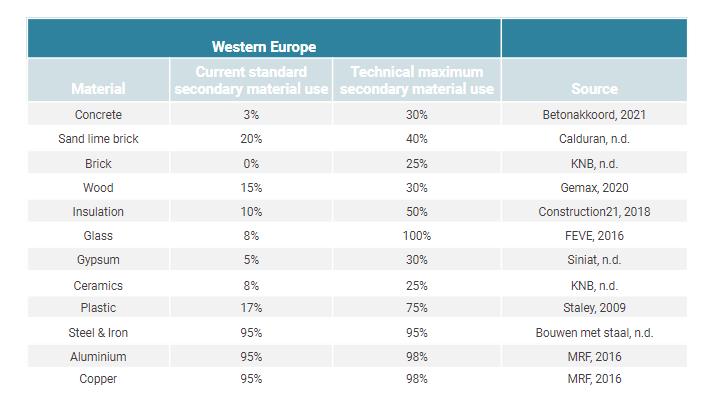
Figure 8: EEA report, Secondary material use; current standard and technical maximum; in Western Europe
To incentivise the use of an overall reduction in the use of materials especially primary raw materials, the thresholds were inverted from minimum secondary raw material thresholds (i.e. following a logic that increases use of re-used or recycled materials) to maximum primary raw material thresholds (i.e. aiming to decrease use of primary raw materials). For instance, while the EEA report showed that a minimum secondary material use threshold should be set no higher than 30%, the primary raw material threshold included in the Delegated Act inverted this to a maximum threshold of 70% primary raw material. The maximum thresholds for primary raw materials can be met either by re-using construction products, or by using new products with secondary material content, or a combination of the two.
Throughout all the substantial contribution criteria, the Commission set lower thresholds for the activity ‘Renovation of buildings’ as compared to the activity ‘Construction of new buildings’ to incentivise economic operators to prioritise renovation over new construction and thereby extend the service life of buildings. Therefore, thresholds of secondary raw materials required for each material flow were halved compared to the thresholds set for the ‘Construction of new buildings’ activity. For instance, if the threshold for primary raw material for the construction of new buildings is 60%, (i.e. 40% of secondary raw materials), the threshold for primary raw materials for the renovation of existing buildings was set at 80% (i.e. 40% / 2 = 20% of secondary raw materials). In addition, the threshold for non-hazardous construction and demolition waste prepared for reuse of recycling was set at 70% of for the renovation of buildings as compared to the 90% for the construction of new buildings. The threshold excludes backfilling, an avenue to downcycle recovered construction and demolition waste, and is therefore more stringent than the 70% threshold referred to in the DNSH criteria for circular economy for these activities in Annex I and II to the Taxonomy Climate Delegated Act.
For the activity demolition or wrecking of buildings and other structures, there were no changes to the substance of the criteria proposed by the Platform. The Commission only made drafting changes to align the criteria with those included for other activities in the sector (mainly construction and renovation).
b)Maintenance of roads and motorway
For the activity maintenance of roads and motorways, the Commission decided to extend the scope of the activity to also cover other vehicular and pedestrian ways, surface work on streets, roads, highways, bridges or tunnels (although excluding the non-road elements of bridges and tunnels), aerodrome runways, taxiways and aprons.
In addition, it removed the Platform’s proposal to allow national authorities two years to revise their regulations in the context of reaching the 50% recycling/reuse target, as not sufficient evidence could be found that multiple Member States would have such restrictions in place.
Furthermore, the deviation criterion on the transport of virgin raw materials was rephrased to a stand-alone criterion that prohibits the use of secondary raw materials where they are moved over a distance that is greater than 2.5 times the distance between the construction site and the nearest production facility for equivalent primary raw materials. The factor of 2.5 was chosen on the basis of the paper “Resources and waste management in Turin (Italy): the role of recycled aggregates in the sustainable supply mix”, which estimates that induced impacts from transport outweigh the avoided impacts by recycling when the transportation distance of recycled aggregate represents a 2 to 3-time increase.
Lastly, the Commission introduced an additional substantial contribution criterion for the recycling of metals to ensure that also the steel restraint systems that are often part of the roads come from recycled or reused materials.
c)Use of concrete in civil engineering
The Commission also introduced changes to the substantial contribution criteria of the activity use of concrete in civil engineering, mainly in order to align them with the criteria proposed in other activities in this sector. In addition, while the Platform proposed that at least 60% of the concrete should come from recycled or reused materials, the Commission changed the threshold to 70% of materials coming from primary raw materials (i.e. 30% of concrete coming from recycled or reused materials) to be in line with the threshold included under the ‘Construction of new buildings’ activity (see rationale for the 70% threshold for concrete above).
4.2.4.ICT
Why is ICT covered:
The ICT sector is covered for the circular economy objective as an enabler for technologies that can contribute to mapping out and monitoring a product’s functionality, effectiveness and efficiency in order to extend its lifetime. The information provided through the technologies are essential for actors along the value chain to retain or recover all useful components and materials.
Which activities would be covered: One activity is proposed to be covered for ICT: Provision of IT/OT data-driven solutions and software.
What type of substantial contribution was chosen:
The substantial contribution criteria mainly follow a nature of the activity approach as they define requirements for the different types of ICT solutions that are in the scope of the activity, including for remote monitoring and predictive maintenance, tracking and tracing, lifecycle assessment, design and engineering, supplier management and lifecycle performance management. In addition, the criteria include an element of a practice-based approach, requiring the operator to develop a waste management plan and to ensure that at the end of life, the equipment undergoes proper treatment for re-use, recovery or recycling.
Changes to the Platform proposal
Limited changes were made to the criteria proposed by the Platform, mainly to ensure consistency with the other IT/OT data-driven solutions for water leakage reduction included in the Annex I to the Environmental Delegated Act.
In addition, the Commission included clarifications in the substantial contribution criteria that the IT/OT data-driven solution only needs to meet one (or two in the case of substantial contribution criterion 2) of the capabilities listed under the criteria 2 to 7 in order to qualify for Taxonomy-alignment.
Moreover, the Commission added a substantial contribution criterion 8 to ensure that all IT/OT data-driven solutions are designed in line with the principles for the transition to a circular economy (e.g. high durability), their waste is managed and recycled at the end of life, and that the preparation for re-use, recovery or recycling operations are performed in line with the Directive on waste electrical and electronic equipment.
The Do No Significant Harm criteria to climate change mitigation and biodiversity were changed to “not applicable” (N/A) as the Platform used the DNSH criteria of Section 8.1 “Data processing, hosting and related activities” in Annex I to the Taxonomy Climate Delegated Act as a basis, which were deemed not relevant for the present activity as they focused on data centres rather than IT/OT data-driven solutions.
4.2.5.Services
Why are services covered:
The services sector in the Delegated Act covers circular services and innovative business models which contribute to extending the lifespan of existing products and limiting the use of resources, in line with the Circular Economy Action Plan.
Which activities would be covered: Six activities are proposed to be covered under manufacturing: Repair, refurbishment and remanufacturing, Sale of spare parts, Preparation for re-use of end-of-life products and product components, Sale of second-hand goods, Product-as-a-service and other circular use- and result-oriented service models, and Marketplace for the trade of second-hand goods for reuse.
What type of substantial contribution was chosen:
The technical screening criteria for activities in the Services sector combine the ‘nature of the activity’ approach with elements of practice or process-based approach and some specific performance requirements. The ‘nature of the activity’ approach appears relevant for this sector as the services and business models included are as such circular and aim at prolonging the use of products, thus reducing the need for primary raw materials. That approach is combined with criteria ensuring that best practices are followed and specific performance requirements for certain specific aspects.
Changes to the Platform proposal
Limited changes have been made to the criteria proposed by the Platform, aiming in particular to ensure a better alignment with the EU legislation. Sale of spare parts was made a separate activity distinct from Repair, refurbishment and remanufacturing. Criteria in the activities Sale of spare parts and Repair, refurbishment and remanufacturing were separated from the manufacturing of goods criteria (i.e. manufacture of furniture, manufacture of wearing apparel and manufacture of footwear and leather goods not included in this delegated act as explained in section 4.2.1). Where relevant, packaging criteria aligned with revised criteria for plastic packaging. The criteria for the services activities were classified by the Platform under the heading ‘Manufacturing’, however as most of those activities do not relate to manufacturing, the Commission decided to include them under a specific heading.
4.3.Substantial contribution to pollution prevention and control
For the objective of pollution prevention and control, a total of six activities are covered in the Taxonomy Environmental Delegated Act capturing the macro-sectors of manufacturing, and water supply, sewerage, waste management and remediation.
Four activities in the manufacturing sector were delayed to the second set of activities, namely: Manufacture of chemical substances, Manufacture of chemical products, Finishing of textiles and Tanning of leather, as well as one activity in the transport sector namely Urban and suburban passenger land public transport. These activities are marked in italics in the table below.
|
Pollution prevention and control
|
|
Macro sector
|
Proposed activities
|
|
Manufacturing
|
Manufacture of active pharmaceutical ingredients (API) or drug substances
Manufacture of basic pharmaceutical products
Delayed: Manufacture of chemicals, Manufacture of chemical products, Finishing of textile and, Tanning of leather
|
|
Water supply, sewerage, waste management and remediation
|
Collection and transport of hazardous waste
Treatment of hazardous waste
Remediation of legally non-conforming landfills and abandoned or
illegal waste dumps
Remediation of contaminated sites and areas
|
|
Transport
|
Delayed: Urban and suburban passenger land public transport
|
Table 10: Activities for the objective pollution prevention and control
4.3.1.Manufacturing
Why is manufacturing covered: Manufacturing activities are among the main cause of pollution to air, soil and water with potential severe impact on the environment and on human health. The prevention and reduction of pollutant factors in manufacturing processes would allow for more sustainable products and significantly lower environmental footprint.
Which activities would be covered: Two activities are proposed to be covered for manufacturing: Manufacture of active pharmaceutical ingredients (API) or active substances, and Manufacture of medicinal products.
What type of substantial contribution was chosen:
For Manufacture of Active Pharmaceutical Ingredients (API) or drug substances and Manufacture of pharmaceutical products, the Platform proposed substantial contribution criteria aimed at preventing and reducing environmental pollution originated by the manufacturing of API and pharmaceutical products. In order to make substantial contribution, the API or the ingredients that constitute the formulation of the pharmaceutical preparation are either naturally occurring substances or readily biodegradable or can be concluded to be mineralised. The API or the ingredients that constitute the formulation of the pharmaceutical preparation should also qualify as an appropriate substitute that is available in the market. The Platform also proposed criteria for the emission of pollutants at level of the installations.
Changes to the Platform proposal
Only limited changes were made to the criteria recommended by the Platform, mainly to ensure coherence with the generic DNSH criteria to pollution prevention and control regarding the use and presence of chemicals. Further changes were made to the DNSH to Mitigation to ensure their usability as well as to ensure that the footprint from the use of refrigerants was tackled.
The Platform also recommended pollution prevention and control criteria for Manufacture of chemicals, Manufacture of chemical products, Finishing of textiles and Tanning of leather activities. Due to the technical complexity of the criteria for these activities the Commission will continue its assessment of the Platform recommendations.
4.3.2.Water supply, sewerage, waste management and remediation
Why are water supply, sewerage, waste management and remediation covered: The waste sector is particularly relevant for the pollution prevention and control objective as in particular municipal waste can be a considerable source of pollution. Proper waste collection and treatment play a significant role in reducing pollution associated with waste while remediation activities can significantly contribute to directly improving the state of the environment (so called activities “healing the environment”).
Which activities would be covered: Four activities are proposed to be covered for water supply, sewerage, waste management and remediation: Collection and transport of hazardous waste, Treatment of hazardous waste, Remediation of legally non-conforming landfills and abandoned or illegal waste dumps, and Remediation of contaminated sites and areas.
What type of substantial contribution was chosen:
The criteria for waste activities focus on reducing direct emissions of pollutants to air, water and land through a combination of practice based requirements and specific performance requirements. The criteria for remediation activities focus on directly improving the state of the environment through cleaning up pollution from non-conforming landfills and contaminated sites.
Changes to the Platform proposal
Only limited changes were made to the criteria, principally to ensure a better alignment with the EU legal framework or provide technical clarifications. For treatment of hazardous waste, specific criteria focusing on liquid waste or waste discharged to water were deleted, given that these requirements specified in those criteria were already covered in a more comprehensive way by the criteria specified in point 1 (through references to BAT/BREFs requirements). For remediation, the requirement that the original activity that was source of contamination must be stopped has been removed and only the requirement that the activity must no longer be a source of potential pollution was kept.
4.3.3.Transport
The Platform has recommended technical screening criteria for only one transport activity substantially contributing to pollution prevention and control, namely Urban and suburban passenger land public transport. The Platform 1.0 has also worked on criteria for pollution for (non-public) land transport as well as inland water and maritime transport, but was not able to finalise and deliver those criteria. The Commission considers it more appropriate to develop the criteria for the different transport activities substantially contributing to pollution prevention and control at the same time in order to ensure having a coherent set of criteria for transport activities contributing to pollution prevention and control. Therefore, the Commission decided to delay the adoption of the criteria for Urban and suburban passenger land public transport.
4.4.Substantial contribution to the protection and restoration of biodiversity and ecosystems
For the objective of pollution prevention and control, a total of 2 activities are covered in the Taxonomy Environmental Delegated Act capturing the macro-sector of environmental protection and restoration activities.
A total of six activities were delayed by Commission for adoption in a second set of activities, namely Animal production, Crop production, Fishing, Forestry, Environmental refurbishment of facilities that produce electricity from hydropower, Manufacture of food products and beverages. In addition, one activity was not developed, namely Remediation activities enabling restoration of ecosystems. The activities are marked in italics in the table below.
|
Protection and restoration of biodiversity and ecosystems
|
|
Macro sector
|
Proposed activities
|
|
Environmental protection and restoration activities
|
Conservation, including restoration, of habitats, ecosystems and species
|
|
Accommodation
|
Hotels, holiday, camping grounds and similar accommodation
|
|
Agriculture and Fisheries
|
Delayed: Animal production, Crop production, Fishing
|
|
Forestry
|
Delayed: Forestry
|
|
Energy
|
Delayed: Environmental refurbishment of facilities that produce electricity from hydropower
|
|
Manufacturing
|
Delayed: Manufacture of food products and beverages,
|
|
Water supply, sewerage, waste management and remediation
|
Not developed: Remediation activities enabling restoration of ecosystems
|
Table 11: Activities for the objective protection and restoration of biodiversity and ecosystems
4.4.1.Environmental protection and restoration activities
Why are environmental protection and restoration activities covered:
[placeholder] Environmental protection and restoration activities are included as those activities actively or passively improve the condition of ecosystems, habitats and species or maintain them in good condition.
Which activities would be covered: One activity is proposed to be covered for environmental protection and restoration: Conservation, including restoration, of habitats, ecosystems and species.
What type of substantial contribution was chosen:
The activity of conservation, including restoration of habitats, ecosystems and species is by its nature directly contributing to the environmental objective of protection and restoration of biodiversity and ecosystems. The criteria for substantial contribution are mostly process- or practice-based and focus in particular on the implementation of specific management measures over a sufficiently long timespan to ensure conservation objectives can be achieved. The criteria also cover safeguards ensuring that the conservation targets have been reached as well as a guarantee of permanence of the restored or maintained site.
Changes to the Platform proposal
The Commission changed the approach proposed by the Platform to ensure a better alignment with the EU framework.
In the EU framework, conservation is understood widely and covers both maintenance of ecosystems, species, habitats or habitats of species in good condition and their restoration to good condition. The Habitats Directive defines “conservation” as “a series of measures required to maintain or restore the natural habitats and the populations of species of wild fauna and flora at a favourable status”. Restoration means the process of actively or passively assisting the recovery to good condition.
Therefore the Commission decided to opt for a single activity with criteria that allow to cover both the maintenance and restoration aspects. For example, the management plan can be replaced by an equivalent instrument, such as a restoration plan. As many criteria of the previously separate conservation and restoration activity were similar, combining them into one makes it less complex and more user-friendly.
The approach was also adjusted and simplified to accommodate a larger variety of possible conservation projects carried out by different entities (private or public). The criteria require an initial description of the area and a management plan, or an equivalent instrument, such as a restoration plan. It is also possible to also provide the information not included in the management plan through other means. A separate Governance Strategy and Business Plan are not required, but certain elements of those documents are included in the management plan requirements.
Furthermore, audit requirements were clarified. As regards offsetting, a clarification was inserted that only biodiversity net gains could be counted under the conservation activity. Furthermore, changes were made to the DNSH criteria to pollution prevention and control limiting the use of fertilisers including manure to where it is necessary to achieve the conservation and restoration objectives and following best practices and in compliance with applicable law.
4.4.2.Accommodation
Why is accommodation covered:
Tourism accommodation and leisure activities closely depend on the condition of the natural/landscape assets that constitute the attraction for the final users. For most types of tourism, biodiversity contributes significantly to the attractiveness and quality of destinations, and therefore to their competitiveness. It is therefore important to foster tourism that contributes to biodiversity conservation and restoration and reduces pressures on natural asset, whilst ensuring the compatibility of its activity, e.g. footprint, with the conservation and/or restoration objectives of the site.
Which activities would be covered: One activity is proposed to be covered for accommodation: Hotels, holiday, camping grounds and similar accommodation.
What type of substantial contribution was chosen:
The criteria for substantial contribution are mostly process or practice based, with certain elements of quantitative performance requirements, especially as regards the amount of the contribution. The activity provides for the possibility of a collective contribution by a group of establishments, in order to allow also small accommodations to use it.
Changes to the Platform proposal
The requirements relating to contribution to conservation activities in point 1 and the environmental requirements placed on the activity ensuring its compatibility with nature conservation in point 2 (and point 3.2 for larger operators) were made cumulative instead of alternative, as it was not certain whether alternative requirements would guarantee a sufficient level of substantial contribution in line with Article 15 of the Taxonomy Regulation. The approach now requires the operators of tourism activity to combine both contribution to a conservation activity in the proximity of the tourism activity and direct actions to ensure compatibility of the activity with biodiversity and nature conservation, to be specified in an action plan.
At the same time, the criteria have been adjusted to better focus on the contribution to biodiversity conservation that can be made by tourism operators. In order to make the criteria useable for a wide range of accommodations, point 1 contains a list of possible contributions to choose from. In addition, contributions can be financial or in kind. Requirements that are addressed to conservation activity operators rather than tourism have been removed. Changes were also made as regards requirements relating to sourcing of certified products, adding more flexibility and removing the requirement to reach 40% whilst requiring demonstrating continuous improvement in the share of such products.
4.4.3.Agriculture and Fisheries
Agriculture and fishing activities plays a central role in reversing biodiversity loss, and fostering other sustainable development goals. Careful calibration of such criteria is paramount in order to ensure science based and usable criteria for these activities. The Commission assessed that the Platform recommendation for these activities requires a deeper analysis and will therefore be developed at a later stage.
4.4.4.Forestry
Given the complex discussions within the Platform and diverging scientific and stakeholder views on forestry’s impact on biodiversity, the Commission sees the need for further reflection on this activity. For this reason, forestry criteria are not included in the Environmental delegated act at this stage.
Forestry and the way it can substantially contribute to climate change mitigation and adaptation are however already covered under the existing Climate Delegated Act.
4.4.5.Energy
The Commission has carefully assessed the Platform’s recommendations on the activity ‘Refurbishment of hydropower’ and considered that a more in-depth analysis and calibration of the criteria is required.
4.4.6.Manufacturing
Platform’s recommendation for criteria on manufacture of food products and beverages relies on the recommendation made on criteria for agriculture and fishing. For this reason, the Commission decided to address this activity at a later stage as well in order to ensure consistency.
4.4.7.Water supply, sewerage, waste management and remediation
The Delegated Act does not include the activity “Remediation activities enabling restoration of ecosystems”. This is due to the fact that the Commission assessed the technical screening criteria for remediation activities proposed by the Platform for all the four environmental objectives (water, pollution, circular economy and biodiversity) and found that the main focus of the criteria in all four cases was on cleaning up pollution. Therefore, the Commission decided to only adopt technical screening criteria for pollution (see point 4.3.2.).
4.5.Substantial contribution to climate change mitigation
The Taxonomy Environmental Delegated Act forms a package with a Delegated Act with amendments to the existing Taxonomy Climate Delegated Act by adding a number of further activities that could make a substantial contribution to climate change mitigation and adaptation, or complementing the criteria for a limited number of existing activities.
For the objective of climate change mitigation, a total of 17 activities are covered in the amendments to the Taxonomy Climate Delegated Act capturing the macro-sectors of manufacturing and transport.
Of the 13 recommendations of the Platform in this area, the Commission delayed one activity in the manufacturing sector, namely manufacture of copper in order to consider this activity more comprehensively with the manufacturing of other critical raw materials and upstream mining activities, in line with evolving EU policy. The activity is marked in italics in the table below.
In addition, the Commission added two activities for climate change mitigation that had not been developed by the Platform namely, manufacture of automotive and mobility components, manufacture of rail constituents as signalled in the Commission’s December 2022 Draft Notice on Frequently Asked Questions regarding Taxonomy criteria and amended three existing activities, in particular infrastructure for rail transport, infrastructure enabling low carbon water transport and low carbon airport infrastructure. The activities are marked in bold in the table below.
|
Climate Change Mitigation
|
|
Macro sector
|
Proposed new activities (in bold) or amendments to existing activities
|
|
Manufacturing
|
Manufacture, installation, and servicing of high, medium and low voltage electrical equipment for electrical transmission and distribution that result in or enable substantial contribution to climate change mitigation.
Delayed: Manufacture of copper
|
|
Transport
|
Manufacture of low carbon technologies for transport
Manufacture of automotive and mobility components
Manufacture of rail constituents
Inland passenger water transport
Inland freight water transport
Retrofitting of inland water and freight transport
Sea and coastal freight water transport, vessels for port operations and auxiliary activities
Sea and coastal passenger water transport
Retrofitting of sea and coastal freight and passenger water transport
Infrastructure for rail transport
Infrastructure enabling low carbon water transport
Low carbon airport infrastructure
Manufacturing of aircraft
Leasing of aircraft
Passenger and freight air transport
Air transport ground handling operations
|
Table 12: Activities for the objective climate change mitigation
4.5.1.Manufacturing
Why is manufacturing covered: The manufacturing of various types of low to high voltage electrical equipment can play a crucial role in ensuring the functioning and uptake of a sustainable low-carbon economy solutions, and supporting these other activities as necessary components, for example in the deployment of charging stations for zero-emission vehicles or electrical grids with transformers or switchgears. In order to ensure that their role is recognised in the Taxonomy, appropriate technical screening criteria for the manufacturing of those components and equipment are included to recognize them as a distinct activity where they help enable solutions for low carbon emissions in various target activities.
Which activities would be covered: manufacture, installation, and servicing of high, medium and low voltage electrical equipment for electrical transmission and distribution that result in or enable substantial contribution to climate change mitigation.
What type of substantial contribution was chosen:
Substantial contribution is in this case based largely on a nature of the activity approach, restricted to those components that relate to electric vehicle charging stations and supporting electric infrastructure. In addition, the substantial contribution includes transmission and distribution current-carrying wiring devices and non-current-carrying wiring devices for wiring electrical circuits, and large power and medium transformers, certain low voltage electrical products, equipment and systems, and high and medium voltage switchgears and control gears that increase the controllability of the electricity system, and communication, software and control equipment, products, systems and services under the condition that all those components or software solutions contribute to increasing the proportion of renewable energy or improve energy efficiency. Substantial contribution also comprises demand response and load shifting equipment, systems and services that increase the flexibility of the electricity system and support grid stability.
Substantial contribution excludes equipment that is directly used to connect, or reinforce the connection to, a power production plant that is more greenhouse gas intensive than 100 g CO2e/kWh measured on a life cycle basis. Substantial contribution also includes conditions whereby switchgears with insulating or breaking medium using, or whose functioning relies on gases with a Global Warming Potential above 10 are not compliant. Also, for all power ranges, switchgears containing SF6 are not compliant. They rules aim to accelerate further innovation and development, and boost market introduction, of technologies that do not deplete the ozone layer.
Changes to the Platform proposal
Limited changes have been made in order to clarify certain aspects, refer to relevant legislation and applicable standards or ensure coherence of criteria between the different activities.
The Platform also recommended criteria for the manufacture of copper. As set out in the Commission Communication on “A secure and sustainable supply of critical raw materials in support of the twin transition”, the Commission will further assess this together with the Platform in order to consider this activity more comprehensively with the manufacturing of other critical raw materials and upstream mining activities, in line with evolving EU policy.
4.5.2.Transport
Why is transport covered:
a)Air transport
The air transport sector accounts for 3% of GHG emissions in the EU27 and for 18% of GHG emissions in the transport sector as a whole. Emissions reductions in this sector continue to be vital for decarbonisation and the transition to a net-zero emissions economy. In accordance with the Green Deal objectives, all modes of transport, including air transport, will have to contribute to reductions in emissions in order to achieve the goal of climate neutrality by 2050, with a 90% reduction for transport overall needed compared to 1990 levels.
b)Post-2025 waterborne transport
Adjusted post-2025 criteria are needed for inland, maritime freight and passenger transport with a view to adapt the technical screening criteria to technical and economic feasibility but also to developments in the international ship energy efficiency and EU Fit for 55/FuelEU Maritime frameworks.
The post-2025 technical screening criteria for inland waterway vessels reflect now a gradual reduction of emissions towards 2050, which is based on the well-to-wake assessment of the greenhouse gas intensity of the energy used onboard inland waterways transport (IWT) vessels.
For maritime transport, first, the Energy Efficiency Design Index (EEDI) will increase stringency with ‘Phase 3’ criteria as of 1st January 2025, and it is important to ensure that criteria in the Taxonomy Climate Delegated Act remain relevant and fit-for-purpose.
Second, still in the field of ship energy efficiency, the Energy Efficiency of Existing Ships Index (EEXI) entered into force on 1 January 2023, and it is important to incorporate this development as criteria for the purposes of investment in purchase or leasing of ships.
Finally, with a view to adapt the technical screening criteria to the Fit for 55/FuelEU Maritime developments, an additional criterion for the greenhouse gas intensity for the energy used onboard is introduced. For inland waterways transport the same logic was applied.
c)Inland waterways transport (IWT) and low carbon airport infrastructure
The IWT infrastructure scope in the criteria of the Taxonomy Climate Delegated Act for climate change mitigation was previously quite limited (covering only recharging stations and transshipment infrastructure) e.g. as compared to rail. Recital 34 of the Taxonomy Climate Delegated Act signalled that, “in light of the potential of transport infrastructure to contribute to modal shift, it will be necessary to assess and where appropriate establish relevant technical screening criteria for overall infrastructure that is essential for low carbon transport modes, notably inland waterways.” As for low carbon airport infrastructure, the change aligns the scope with the other transport infrastructure activities in the Climate Delegated Act, by including transshipment with rail and water transport.
d)Components
The manufacturing of vehicles and rail rolling stock and infrastructure that are EU Taxonomy eligible or aligned depends on necessary components that play a key role in reducing GHG emissions or, in the case of rail, that are essential to the environmental performance, operation and functioning over the lifetime of trains and rail infrastructure that comply with the technical screening criteria, but are often manufactured by third parties in highly cross-integrated value chains. These components play a crucial role in ensuring the functioning and uptake of the final sustainable low-carbon economy solutions and supporting these target activities as integral components, for example for accelerating the take-off of zero-emission vehicles or the scaling up of the use of rail. In order to ensure that their role in helping enable decarbonisation of transport is recognised in the Taxonomy, appropriate technical screening criteria for the manufacturing of those components are included as distinct activities.
Which activities would be covered: Four activities are proposed to be covered for air transport: (i) Manufacturing of aircraft, (ii) Leasing of aircraft, (iii) Passenger and freight air transport, and (iv) Air transport ground handling operations. In addition, seven activities that were already included in the Taxonomy Climate Delegated Act are proposed to be updated based on Platform recommendations: (i) Manufacture of low carbon technologies for transport, (ii) Inland passenger water transport, (iii) Inland freight transport, (iv) Retrofitting of inland water passenger and freight transport, (v) Sea and coastal freight water transport, vessels for port operations and auxiliary activities, (vi) Sea and coastal passenger water transport and (vii) Retrofitting of sea and coastal freight and passenger water transport. Lastly, the Commission added two new activities for transport: (i) Automotive and personal mobility and (ii) railway components; and amended three others: (i) Infrastructure enabling low carbon water transport, (ii) Infrastructure for rail transport, and (iii) Low carbon airport infrastructure.
What type of substantial contribution was chosen:
a)Air transport
For aircraft manufacturing and leasing and passenger and freight air transport, the Platform proposed substantial contribution criteria to climate mitigation by covering: (i) zero direct CO2 emissions aircraft as low carbon activities, as well as (ii) the latest generation aircraft technology providing a significant performance improvement in terms of fuel efficiency and related GHG emissions reduction compared to the previous generation of aircraft and (iii) operation of an aircraft with sustainable aviation fuels (SAF) as transitional activities. The air transport criteria use a combination of some of the approaches described in Section 3. They aim, first, to accelerate the development and market introduction of zero direct CO2 emission aircraft. Second, they aim to incentivise the market uptake and replacement of previous generation, less fuel-efficient aircraft with the latest generation of fuel-efficient ones without contributing to fleet expansion. Third, they aim to incentivise the replacement of fossil jet fuel with sustainable aviation fuels. The criteria also incentivise the technical readiness of the aircraft fleet to operate with 100% SAF.
The Platform proposed that the eligibility of the latest generation aircraft does not contribute to increasing the aircraft fleet, which in itself could result in the growth of absolute emissions until the aircraft are operated with sustainable aviation fuels. The latest generation aircraft are identified in function of their fuel efficiency and associated GHG performance in relation to the margins to the International Civil Aviation Organisation new type (NT) CO2 standard and differentiated by three aircraft classes according to their maximum take-off mass. The aircraft not meeting the margins represent the previous generation aircraft that are significantly less fuel efficient. The replacement of the previous generation aircraft with the new generation aircraft leads to around 20-25% of GHG emission reductions per flight. The margins to the ICAO New Type CO2 standard were set taking into account the input of European Aviation Safety Agency (EASA), which is the competent authority in Europe for certifying aircraft types against the ICAO standards. The aircraft manufacturer will need to demonstrate that the performance of the aircraft complies with the margins to the ICAO standard, based on a certificate, or in the transitional period of three years, based on the manufacturer’s declaration substantiated by the reference data, and inform lessors and aircraft operators whether the aircraft they acquire meets those margins.
The latest generation aircraft produced for private or commercial business aviation are excluded considering their per passenger kilometre CO2 footprint compared to available transport alternatives. Further work would be needed to demonstrate how the manufacturing of such aircraft could contribute to the Taxonomy objectives. However, manufacturing of zero direct CO2 emissions aircraft is fully compatible with Taxonomy criteria regardless of its end use.
The criteria for aircraft manufacturing of the latest generation aircraft were defined until 31 December 2032 in order to ensure that the technological developments of the latest generation aircraft are reflected in the Taxonomy, while providing sufficient predictability for investments. Beyond this timeframe, as explained in Recital 11 of the Delegated Regulation, the criteria for aircraft manufacturing, and in particular the margins to the ICAO CO2 standard, will be re-examined. This may also impact the validity of the criteria for aircraft leasing and passenger and freight air transport concerning the latest generation aircraft, which apply beyond this timeframe, subject to regular review. However, lessors and aircraft operators are obliged to progressively uptake increasing shares of SAF as from 2030 to maintain the Taxonomy-alignment of such aircraft.
The Platform proposed that the aircraft replacement approach is implemented, in specific cases, through the replacement ratio representing the proportion of aircraft permanently withdrawn from use (such as through decommissioning
or other measures that guarantee that the withdrawn aircraft is not returned to the use anywhere worldwide) to aircraft delivered at a global level. The ratio is averaged over the preceding 10 years to provide a long-term stable indicator, minimising yearly variations. The ratio is then applied to the taxonomy eligible aircraft produced by the manufacturer to identify the percentage of its aircraft fleet that does not increase the global fleet. Only the revenues associated to that identified part of the fleet of aircraft can be labelled as Taxonomy-aligned.
The ratio allows to reflect the extent to which the uptake of the latest generation aircraft is linked to the permanent withdrawal of the previous generation models. The data on aircraft permanently withdrawn from use and delivered can be accessible from independent data providers, and the Commission, with the help of EASA, may consider publishing it in order to facilitate disclosures. In that case, the replacement ratio published by the Commission should be applied in order to ensure consistency and comparability of data.
The replacement ratio is applied to aircraft manufacturing as well as to aircraft leasing and passenger and freight air transport in case of a latest generation aircraft purchased before the criteria enter into application or when the non-complaint aircraft is permanently withdrawn from the fleet (i.e. sold or otherwise permanently transferred to another economically independent entity). Lessors and aircraft operators can claim full Taxonomy alignment related to the latest generation aircraft as of the entry into application of the criteria only when the non-compliant aircraft of previous generation is permanently withdrawn from use (“one-in, one-out”).
To ensure the GHG reductions, the aircraft being withdrawn should fulfil several requirements in order to guarantee that a fleet replacement results in an effective and significant performance improvement and related GHG reductions at aircraft level. First, the withdrawn aircraft GHG emissions do not meet the margins to the ICAO (NT) CO2 standards. Second, the replacement should concern the aircraft of similar or greater category of at least 80% of maximum take-off weight of the compliant aircraft. Third, to exclude aircraft already parked in long term storage facilities, the withdrawn aircraft must have a proof of airworthiness
dating back less than 6 months prior to the delivery of the compliant aircraft. Finally, in addition to the criteria proposed by the Platform, as explained further below, the Commission added that the withdrawn aircraft should have remained in the fleet of operators or leasing companies
within at least 12 months prior to its withdrawal.
Furthermore, the Platform proposed that the taxonomy compliant aircraft is compatible with the use of 100% SAF by 2028. The current technology and international fuel standards allow for the maximum use of up to 50% SAF blend. The fuel standardisation work is on-going to raise this level, which will allow to adapt and retrofit aircraft for technical compatibility with 100% SAF use by 2028.
For air transport operators and lessors, as of 2030, it is additionally required that the aircraft acquired for the replacement of the previous generation model is operated with the 15% SAF blend, increased by 2 percentage points annually thereafter. This incentivises a progressive replacement of fossil jet fuel use with the use of increasingly higher SAF blending ratios.
The Platform also proposed a standalone criterion whereby an aircraft is taxonomy compliant when it is operated with sustainable aviation fuels, corresponding to 5% SAF blend used in 2022, with the percentage of SAF increasing by 2 percentage points annually thereafter. The SAF use threshold reflects a broad scope of the Taxonomy criteria, since it applies to the fuel consumption by the compliant aircraft on all its flights performed, which include flights departing from airports located within and outside the EU.
The SAF production and use is currently extremely limited both at the EU and global level and most of the SAF technologies are not yet commercially mature. The ReFuelEU Aviation regulatory proposal introduced mandatory blending mandates on fuel suppliers that guarantee a minimum amount of SAF across the EU airports under the scope and will allow scaling up SAF production and supply in the EU. Over time, with technological progress and increased quantities, and once the transitional period under ReFuelEU Aviation is over by the end of 2034, SAF will be progressively available throughout Europe. Until then, aircraft operators may access SAF only in few selected hubs and not for all the connections they perform, while the access to SAF outside the EU will depend on the availability of such fuels falling within the EU definition of SAF in third countries.
For the purpose of usability, and in view of the SAF supply constraints, aircraft operators can prove compliance with the required minimum percentage of SAF use based on SAF quantities purchased for the use by their entire fleet. This means that the eligible aircraft do not necessarily have to physically uplift SAF molecules as long as those SAF molecules are physically uplifted by any aircraft in the fleet of the aircraft operator. Such an approach will avoid incentivising excessive fuel tankering or transport of small quantities of SAF to remote airports, notably during the transitional period under ReFuelEU Aviation, which in themselves may generate extra GHG emissions (unless the land transport is carried out by zero emission vehicles). In practical terms, the SAF requirement can be fulfilled by attributing an adequate quantity of SAF, purchased at the fleet level during the given year, to the eligible aircraft. This adequate quantity of SAF is defined in function of the minimum percentage of SAF required by the criteria in a given year and the eligible aircraft’s total aviation fuel use in that year.
To demonstrate the compliance with this criteria, a given batch of SAF should not be attributed more than once to the eligible aircraft in the fleet.
The verification of such data will be supported by the reporting requirements established under ReFuelEU Aviation regulation, the EU Emissions Trading Scheme (EU ETS) and the international framework of Carbon Offsetting and Reduction Scheme for International Aviation (CORSIA). The proposed SAF threshold takes account of the SAF market and regulatory developments, while it goes beyond the SAF quantities proposed to be mandated on aviation fuel suppliers under the ReFuelEU Aviation regulation.
For the air transport ground handling activity, the Platform proposed that only zero direct CO2 emissions vehicles and devices and equipment with zero direct CO2 emissions motor are eligible.
b)Post-2025 waterborne transport
The post -2025 technical screening criteria for waterborne vessels, with a declining trajectory for the GHG intensity of the energy used onboard, are covered as transitional alternatives to zero-emissions vessels. They rely largely on an approach referring to performance in relation to environmental targets. The criteria reflect a gradual reduction of emissions towards 2050, based on the well-to-wake assessment of the greenhouse gas intensity of the energy used onboard IWT vessels. The technical screening criteria for maritime freight and passenger transport are based on recently adopted international and Union reference values, to promote usability, following however a decreasing linear trajectory for the GHG intensity of the energy used onboard, instead of the one defined in FuelEU Maritime.
c)IWT and low carbon airport infrastructure
The new criteria update existing activities in the Climate Delegated Act. They do not imply any change to the approach for setting criteria used previously, but rather include, in the scope, the modernization of the IWT infrastructure (excluding dredging) under the condition that this modernization meets the guidelines of climate proofing adopted by the Commission in July 2021. The DNSH is adapted and reflects now the extended scope of the criteria. Regarding low carbon airport infrastructure, the change aligns the scope with the other transport infrastructure activities in the Climate Delegated Act, by including transshipment with rail and water transport.
d)Components
Two other activities are added: manufacture of automotive and mobility components, (including components for personal mobility devices with a propulsion that comes from the physical activity of the user, from a zero-emissions motor, or a mix of zero-emissions motor and physical activity such as bikes and e-bikes) and manufacture of rail constituents (rolling stock). They rely largely on a nature of the activity approach. For completeness, key rail infrastructure constituents (trackside) were added to the updated Section 6.14 on infrastructure for rail transport.
Changes to the Platform proposal
a)Air transport
The substantial contribution criteria for aircraft manufacturing and leasing and passenger and freight air transport were not changed in substance; they were however redrafted to improve clarity and usability. A few changes were also made to reinforce the criteria. First, an additional condition was introduced as concerns the aircraft to be withdrawn from use or the fleet whereby they should have remained in the fleet within at least 12 months prior to its withdrawal. This is to avoid that they are purchased solely for the purposes of Taxonomy. Second, based on the public feedback received, a requirement on SAF-use was added for leasing companies, to better align the criteria with those for aircraft operators and incentivise investments into SAF also by leasing companies. Third, the requirement for SAF-use for 2030 for aircraft operators (and leasing companies) was raised from 10%, based on the Platform proposal and methodology, to 15%, to ensure a high level of environmental ambition, while reflecting the status of the market for SAF and anticipated developments under ReFuelEU Aviation legislation. Finally, the do no significant harm on pollution control and prevention were modified by introducing a cumulative margin compared to noise ICAO standard in order to reflect the level of technological improvement already reached by most new aircraft.
b)Post-2025 waterborne transport
Compared to the Platform proposal, the following changes were introduced:
·Removal of the criteria meriting investments based on the use of energy onboard with more than 80% of GHG intensity reduction, on a Well-to-Wake basis, on the justification that some liquid biofuels or biogases could be used to meet this objective without any substantial change to ships energy systems. This would not represent incentive for new designs of intrinsically better ships (nor deployment of innovative energy systems).
·For maritime transport, energy efficiency criteria were substantially modified by 1) increase of the ambition for Energy Efficiency Design Index (EEDI) criteria for post 2025, so as to adapt to the entry into force of IMO EEDI Phase 3, together with requirements to for manufacturers and operators to ensure implementation of state-of-the-art control technologies against methane slip emissions; 2) introduction of Energy Efficiency for Existing Ships Index (EEXI), following the entry into force of this international framework on 1 January 2023 and on top of the proposed criteria on GHG intensity of the energy used onboard.
For IWT, new engine with higher energy efficiency are already required in the DNSH.
c)IWT and low carbon airport infrastructure
The Platform on Sustainable Finance did not work on the criteria. The additions stem from the need to ensure consistency with wider Union priorities. They are targeted and specific, regarding infrastructures supporting low carbon modes of transport, modal shift, and efficient handling of passengers and freight.
d)Components
The technical screening criteria and DNSH criteria for components (automotive and personal mobility, as well as for rail constituents and infrastructure) are not based on Platform proposals but are drawn up considering existing comparable criteria and the concerned low carbon target activities in transport included in the Climate Delegated Act. The additions are targeted at ensuring the inclusion of manufacturing of key components as enabling activities, in recognition of their role in the value-chain of these target activities in helping to achieve the resulting savings in GHG emissions. Notably, eligible automotive components are those which are type approved, designed, and constructed for use only in zero-emissions vehicles and buses and which are essential for delivering and improving the environmental performance of the vehicle. The manufacturing of tyres is not included, but they continue to be eligible under existing Section 3.6 (‘Other low carbon technologies’), pending further assessment of the potential substantial contribution of tyre-manufacturing to environmental objectives.
In practice, the relationship between the existing Section 3.3 (Manufacture of low carbon technologies for transport) and new Section 3.18 (Manufacture of automotive and mobility components) would be complementary for actors in the automotive supply chain. Car manufacturers should expect to see their relevant activities (and associated revenues and capex/opex) as eligible under Section 3.3, including as regards components manufactured in-house destined for eligible vehicle categories. Components purchased by them from external suppliers, or relevant investments in joint ventures with other third parties, could constitute eligible capex/opex under Section 3.3 also, where consistent with the scope of eligible capex/opex under the Disclosures Delegated Act. On the other hand, component manufacturers and suppliers who do not assemble the finished vehicles would expect to see the relevant part of their activities (and associated revenues and capex/opex) as eligible under Section 3.18.
4.6.Substantial contribution to climate change adaptation
For the objective of climate change adaptation, a total of 11 activities are covered in the amendments to the Taxonomy Climate Delegated Act capturing the macro-sectors of water supply, sewerage, waste management and remediation, construction and real estate, and disaster risk management.
Two activities recommended by the Platform were not further developed, namely the activities Restoration of ecosystems and Civil engineering. The activity is marked in italics in the table below.
The Commission added two activities for climate change adaptation namely, Software enabling climate risk management and Consultancy for climate risk management. These activities are marked in bold in the tables below.
|
Climate Change Adaptation
|
|
Macro sector
|
Proposed activities
|
|
Environmental protection and restoration activities
|
Not developed: Restoration of ecosystems
|
|
Water supply, sewerage, waste management and remediation
|
Desalination
|
|
Construction and real estate
|
Not developed: Civil engineering
|
|
Disaster risk management
|
Emergency services
Flood risk prevention and protection infrastructure
|
|
Information and communication
|
Software enabling climate risk management
|
|
Professional, scientific and technical activities
|
Consultancy for climate risk management
|
Table 13: Activities for the objective climate change adaptation
As climate change is likely to affect all sectors of the economy, all sectors of the economy will need to be adapted to the adverse impact of the current climate and the expected future climate. The Taxonomy Climate Delegated Act therefore established technical screening criteria for climate change adaptation for all sectors and economic activities that were covered by the technical screening criteria for climate change mitigation. Due to time constraints, the Platform and the Commission were not able at this stage to develop adaptation criteria also for the activities included in the Taxonomy Environmental Delegated Act to make them adapted to climate change.
4.6.1.Environmental protection and restoration activities
After careful analysis, the Commission considered that a specific restoration activity contributing to the adaptation objective was not needed at this stage.
The conservation activity contributing to the biodiversity objective (see Section 4.4.1) would aim mainly to support biodiversity objectives, but at the same time also contribute to adaptation. This is because giving more space for natural systems and processes will generally enhance the adaptive capacity and resilience of habitats, ecosystems and species (an aspect which the IPCC AR6 report stressed in particular).
In addition to making nature more resilient to climate change, conservation activities will usually enhance also the provision of adaptation-supporting ecosystem services for society, such as water regulation, local cooling, erosion control, landslide protection, coastal protection, etc.
4.6.2.Water supply, sewerage, waste management and remediation
Why are water supply, sewerage, waste management and remediation covered:
The water sector is covered through ‘water desalination’ as this activity becomes increasingly important as a non-conventional water supply source (according to the water mitigation hierarchy, after efficiency measures, storage and water reuse) to guarantee the availability of water supply in the situation of climate-induced water stress and droughts.
Which activities would be covered: One activity is proposed to be covered for water supply, sewerage, waste management and remediation: Desalination.
What type of substantial contribution was chosen:
The substantial contribution criteria follow the generic criteria for climate change adaptation already included in Annex II to the Climate Delegated Act. The generic criteria require the economic operator to implement ‘adaptation solutions’, made up of physical and non-physical solutions that substantially reduce the most important physical climate risks that are material to the activities. When meeting point 5 of the generic criteria, the activity can also be counted as an enabling activity where it provides ‘adaptation solutions’ that can increase the level of resilience to physical climate risks or contribute to adaptation efforts of other people, nature, cultural heritage, assets and other economic activities.
Changes to the Platform proposal
Changes relate mainly to DNSH criteria which were streamlined and aligned better with the EU legal framework. Certain requirements were also considered more relevant for pollution prevention and control than for water and biodiversity and were adjusted accordingly.
4.6.3.Construction and real estate
Built structures need to adapt to the increased occurrence of climate and weather extremes, including temperature and humidity changes, influenced groundwater levels, soil erosion change in permafrost or inland and coastal floods. At the same time, civil engineering provides other sectors with solutions to make those sectors more resilient to climate change. For instance, users of water infrastructure that is designed and built to be better adapted to future climate impacts are becoming more resilient. The Platform therefore developed technical screening criteria for the activity Civil Engineering to make a substantial contribution to climate change adaptation through its own performance and as an enabling activity (when also meeting substantial contribution criterion 5 of the generic adaptation criteria).
After careful assessment of the feedback received from stakeholders, the Commission decided to remove the activity from the amendments to the Climate Delegated Act as its scope fully overlapped with five “own performance” activities (not enabling) already included in Annex II to the Taxonomy Climate Delegated Act, most notably Sections 6.13 (Infrastructure for personal mobility, cycle logistics), 6.14 (Infrastructure for rail transport), 6.15 (Infrastructure enabling road transport and public transport), 6.16 (Infrastructure for water transport) and 6.17 (Airport infrastructure). As these activities can only make a substantial contribution through their own performance (i.e. they do not include substantial contribution criterion 5, which would allow them to be enabling as well), operators can only count the CapEx of the activities as Taxonomy-aligned.
Therefore, to address the enabling side of the proposed Civil engineering activity, the Commission aims to mandate the Platform on Sustainable Finance to develop targeted technical screening criteria for civil engineering as an enabling activity.
4.6.4.Disaster risk management
Why is disaster risk management covered:
Disaster Risk Management (DRM) activities constitute processes for designing, implementing, and evaluating strategies, policies, and measures to improve the understanding of disaster risk, foster disaster risk reduction and transfer, and promote continuous improvement in disaster preparedness and response practices, all with the explicit purpose of increasing human security, preserving well-being, ensuring quality of life, protecting the environment and sustainable development.
Addressing climate related hazards in this way is an integral part of climate change adaptation. Ensuring that emergency services are adapted to respond to climate related hazards that are increasing in intensity and frequency as a result of climate change is essential to enable other activities and society as a whole to adapt to a changing climate, and to avoid damages.
Disasters affect the natural and built environment negatively in different ways. For example, forest fires, besides decimating forests, release large amounts of carbon dioxide in the atmosphere, flash floods can contaminate soil and ground water bodies with sewage water and chemicals. Fires in buildings and industrial complexes release toxic fumes into the air. Extinguishing fires result in contaminated water being released into the natural environment and sewage system. Infrastructure that is not resilient to disasters must be rebuilt, associated with the environmental and carbon footprint of materials and the construction process.
Emergency services require equipment ranging from protective gear to firefighting trucks and special-purpose aircraft. This equipment is often manufactured for the specific requirements of disaster risk management activities such as emergency health services, search and rescue or firefighting. The Platform has so far focused on operational aspects of emergency services and not on the production of the equipment required by the emergency services. The production of such equipment should be included in the next review of the economic activities covered under this title.
Which activities would be covered: Two activities are proposed to be covered for disaster risk management: Emergency services, and Flood risk prevention and protection infrastructure.
What type of substantial contribution was chosen:
The substantial contribution criteria for both economic activities follow the generic criteria for climate change adaptation already included in Annex II to the Climate Delegated Act. The generic criteria require the economic operator to implement ‘adaptation solutions’ that consist of physical and non-physical solutions that substantially reduce the most important physical climate risks that are material to the activities. When meeting point 5 of the generic criteria, the activity can also be counted as an enabling activity where it provides ‘adaptation solutions’ that can increase the level of resilience to physical climate risks or contribute to adaptation efforts of other people, nature, cultural heritage, assets and other economic activities.
Changes to the Platform proposal
a)Emergency services
The Platform proposed seven separate economic activities related to Emergency services. These activities have been merged into one activity, which includes disaster response coordination, emergency health services, disaster relief, search and rescue, hazardous material response, firefighting and fire prevention, technical protection response and assistance in response to emergencies.
It was further clarified that all of the activities include preparedness activities directly related to emergency services, such as training and capacity building of staff and experts, including in teams, and service animals (if relevant) or volunteers, or putting in place training facilities to respond to climate change-attributable hazards. Early warning systems were further added to the list of horizontal preparedness activities, not just related to fires, with no DNSH implications.
Furthermore, the description was amended to refer to ‘modules’ to align the terminology with the UCPM Decision (EU) 1313/2013 and its related implementing acts. Following the UCPM Decision, the term ‘modules’ encompasses ‘material means’ that include ‘transport required to support the emergency intervention as relevant’ (for instance the material means related to aerial or ground fire-fighting such as helicopters, aircraft and vehicles, boats for rescue and aerial means of medical evacuation.
A number of changes were introduced to the ‘Do No Significant Harm’ criteria with the principles raised in a DG ECHO study on Greening of Civil Protection, completed after the publication of the Platform’s March report. For instance, a number of references to practices on greening of humanitarian aid and international guidelines on emergency health, search and rescue as well as medical waste disposal were added throughout the criteria. In addition, the requirement to report on Scope 3 emissions were added to the DNSH criteria to climate change mitigation as they account for approximately 70% of the greenhouse gas emissions stemming from humanitarian aid, notably for activities related to ‘disaster relief’ and ‘emergency health services’. To support users in their Scope 3 emission reporting, a footnote was introduced referring to a carbon calculator tool and guidance aiming to simplify the process of calculating GHG emissions stemming from emergency services activities. Furthermore, a number of references to practices on greening of humanitarian aid and international guidelines on emergency health, search and rescue as well as medical waste disposal, were added to the DNSH criteria.
Emergency services require equipment ranging from protective gear to firefighting trucks and special-purpose aircraft. This equipment is often manufactured for the specific requirements of disaster risk management activities such as emergency health services, search and rescue or firefighting. The criteria for Emergency services only focus on the operational aspects of emergency services and therefore don’t take into account the manufacture of the equipment, such as special purpose aircraft. The development of technical screening criteria for the manufacture of such equipment will be part of the mandate of the Platform on Sustainable Finance.
b)Flood risk prevention and protection infrastructure
Limited changes were made to the description of the activity to clarify its scope and address potential overlaps with other activities already included in the Taxonomy Climate and Environmental delegated acts, such as Nature-based solutions for flood and drought risk prevention and protection, Infrastructure for water transport, or consultancy enabling climate risk management (e.g. as regards to flood modelling and forecasting, flood hazard and risk mapping covered under the activity) and software enabling climate risk management (regarding early warning systems that are included in the scope of the activity). In this context, it is important to note that not all nature-based solutions are excluded from the present activity. The substantial contribution criterion 4 (c) rather requires economic operators to favour nature-based solutions. The exclusion of the ‘planning, construction, extension and operation of large-scale nature-based flood or drought management and wetland restoration measures covered by the activity Nature-based solutions for flood and drought risk prevention and protection’ was only added to the description to avoid potential overlaps between the two activities.
Moreover, the DNSH criterion to the sustainable use and protection of water and marine resources objective was amended to be consistent with the criteria of Section 4.5. “Electricity generation from hydropower” in Annex I to the Taxonomy Climate Delegated Act. Considering that flood risk prevention and protection activities, as well as (some) transport infrastructure works may have important direct impacts on water bodies potentially deteriorating their status, it was deemed necessary to further clarify how the criteria of Article 4(7) of the Water Framework Directive are to be implemented, including details on possible mitigation measures and, where appropriate, compensation measures, to address those impacts. The change was introduced with the aim of enhancing legal certainty and ensuring a more effective implementation of the Taxonomy delegated act also in third countries.
Lastly, the DNSH criteria for the transition to a circular economy and protection and restoration of biodiversity and ecosystems were changed with a view of achieving consistency across the Environmental Delegated Act.
4.6.5.Information and communication
Why is ICT covered: The ICT sector is covered for the climate change adaptation objective as an enabler for improved identification and management of climate risks relevant to an economic operator by developing software for forecasting, projection, monitoring, early warning systems, and risk management. Such software is a prerequisite for the efficient development and monitoring of targeted adaptation measures for physical climate risks and for some adaptation and disaster risk reduction measures itself, for instance IT-based early warning systems. Without software to deal with large amounts of data and systemic connections, risk assessments and adaptation monitoring would need significantly more time and resources and important risk management aspects might be overlooked.
The technical screening criteria for this activity were developed by a contractor for DG CLIMA. They were included in the draft amendments to the Taxonomy Climate Delegated Act due to their large enabling potential for climate change adaptation.
Which activities would be covered: One activity is proposed to be covered for information and communication: Software enabling physical climate risk management and adaptation.
What type of substantial contribution was chosen: The substantial contribution criteria for the activity are process-based. That is, they define a set of process-based steps that the activity has to follow to be deemed Taxonomy-aligned.
Changes to the initial proposal following public feedback
Following the public feedback period, the description of the activity was further refined through the addition of “delimiters” (i.e. exclusion of other activities from the scope) to address potential overlaps between the activity and other activities already covered in the Taxonomy Climate or Environmental Delegated Acts.
These delimiters were not introduced for activities where no overlap could be found. For instance, as the present activity is an enabling activity (therefore operators can count their turnover and CapEx as Taxonomy-aligned) it is different than the activity 8.2. ‘Computer programming, consultancy and related activities’ included in Annex II to the Climate Delegated Act, which makes a substantial contribution through its own performance. Furthermore, as the activity is focused on climate change adaptation it also does not overlap with the activity 8.2 ‘Data-driven solutions for GHG emissions reductions’ in Annex I to the Climate Delegated Act, which is focused on climate change mitigation.
Moreover, the DNSH criteria for the transition to a circular economy and for pollution prevention and control were changed to “not applicable” as the initial proposal included requirements for hardware that is used for developing the software, which falls outside of the scope of the activity (rather falls into the scope of data centres).
4.6.6.Professional, scientific and technical activities
Why are professional, scientific and technical activities covered:
This sector is covered for the climate change adaptation objective as an enabler for improved identification and management of climate risks relevant to an economic operator by supporting assessments of climate impacts, vulnerability or risk, or the development, implementation, monitoring, or evaluation of strategies, plans, or measures to address these risks. Such activities are a prerequisite for targeted adaptation measures.
The technical screening criteria for this activity were developed by a contractor for DG CLIMA. They were included in the draft amendments to the Taxonomy Climate Delegated Act due to their large enabling potential for climate change adaptation.
Which activities would be covered: One activity is proposed to be covered for professional, scientific and technical activities: Consultancy for physical climate risk management and adaptation.
What type of substantial contribution was chosen: The substantial contribution criteria for the activity are process-based. That is, they define a set of process-based steps that the activity has to follow to be deemed Taxonomy-aligned.
Changes to the initial proposal following public feedback
Following the public feedback period, the description of the activity was further refined to address potential overlaps between the activity and other activities already covered in the Taxonomy Climate or Environmental Delegated Acts. In addition, the DNSH criterion to mitigation was slightly amended to reflect the inherent risk.
5.Expected costs and benefits of applying the Taxonomy Environmental Delegated Act under the EU Taxonomy
As a preliminary observation, it should be noted that the Taxonomy Environmental Delegated Act will not as such create new categories of benefits and costs. The Taxonomy Environmental Delegated Act supplements the Taxonomy Regulation and follows the policy choices already made in that Regulation. The Taxonomy Regulation was subject to an impact assessment that provided an assessment of the economic, social and environmental impacts of the reporting under the EU Taxonomy. As regards the methodology and approaches to setting up the technical screening criteria, the Taxonomy Environmental Delegated Act also follows to a large extent the principles set out in the Taxonomy Climate Delegated Act. As regards reporting requirements, the requirements of the Taxonomy Regulation have been further specified in the Disclosures Delegated Act, which lays down the content and presentation of information to be disclosed.
The main added value of the Taxonomy Environmental Delegated Act is linked to the fact that it establishes technical screening criteria for economic activities contributing substantially to the remaining four environmental objectives, covering thus new economic sectors as part of the EU Taxonomy.
5.1. Expected benefits
The Taxonomy Environmental Delegated Act can be expected to enhance the benefits of the EU Taxonomy framework for investors, businesses and society. As a common tool for classifying economic activities as environmentally sustainable, it is expected to lower search costs for investors with respect to environmental aspects which until now have been less covered, but which are of crucial importance for the society, such as protection of biodiversity and restoration or the protection of water and marine resources.
Overall, the EU Taxonomy is also expected to support investor and stakeholder engagement and translate long-term environmental objectives into more tangible and credible transition paths. From a societal perspective, the EU Taxonomy is expected to encourage the scaling up of investments needed to make the EU economy more sustainable. However, it should be also clearly understood that the EU Taxonomy does not impose any limitations to the financing of sectors not included in the Taxonomy.
Environmental and social benefits are likely to result from the increase in financial flows into environmentally sustainable economic activities, thereby helping the EU deliver on its climate and environmental objectives as expressed notably in the Taxonomy Regulation. For example, companies with existing Taxonomy aligned activities could raise additional financing to extend those activities, or companies with Taxonomy-eligible but not aligned activities could raise additional financing to make those activities Taxonomy aligned (compared to a baseline scenario without Taxonomy).
At this point it is too early to provide quantitative figures that could estimate the expected benefits stemming from the use of the Taxonomy Environmental Delegated Act. The following table therefore presents a qualitative overview of the overall benefits of use of the EU Taxonomy (building on the summary of benefits presented in the Impact assessment accompanying the Taxonomy Climate Delegated Act, in Annex III, section 3.2). It distinguishes between benefits that can be expected to directly arise from obligations under the Taxonomy Regulation (direct) and those expected to arise as a result of the uses of the EU Taxonomy, including possible second-order effects of these obligations and uses (indirect).
|
I. Overview of Benefits
|
|
Type of benefit
|
Description
|
Stakeholders expected to benefit
|
|
Direct benefits
|
|
Science-based definitions and criteria on an economic activity level
|
Through the technical screening criteria of the Taxonomy, investors and credit institutions, are able to easily compare the climate and environmental performance of different economic activities with the assurance that their assessment is backed by science.
|
Companies, retail and institutional investors, credit institutions, researchers, civil society
|
|
Lower search costs for sustainable economic activities
|
The EU Taxonomy is a common tool for classifying economic activities as environmentally sustainable. This is expected to reduce investors’ search costs for investee companies that are prospectively likely to benefit from the transition to a more sustainable economy (indirect). It is also expected to reduce the expenses that institutional investors would spend on developing and updating their own classifications.
|
Financial intermediaries, credit institutions, institutional investors, retail investors and civil society.
|
|
Compass for the fair green transition
|
The EU Taxonomy translates long-term environmental objectives (e.g. on biodiversity) into more tangible activity-level criteria, providing an end goal that companies can use as a reference for their fair green transition.
|
Companies, financial intermediaries, credit institutions and institutional investors.
|
|
Monitoring progress and capital flows
|
The EU Taxonomy will make it easier to monitor capital flows towards green investments and thus keep track of the progress towards long-term environmental objectives.
|
Public authorities, researchers and the broader public.
|
|
Collection of environmental information and data
|
Through the disclosure requirements, the Taxonomy will make climate and environmental information more available for relevant authorities, researchers and the broader public. For instance, it will support the data collection for the European Single Access Point (ESAP), which will provide centralised access to publicly available information of relevance to financial services, capital markets and sustainability.
|
Companies, credit institutions, retail investors, financial intermediaries, institutional investors, researchers and civil society.
|
|
Indirect benefits
|
|
Enabling integration of environmental factors into financial products, loans and portfolios
|
The activity-level approach that the EU Taxonomy follows, can also help in designing new financial products (e.g. using Taxonomy exposure as a factor to add an environmental tilt to their portfolios) or loans. It could thus enable them to tap into relevant investment opportunities.
|
Financial intermediaries and institutional investors, ultimately also households buying financial products, and credit institutions.
|
|
Supporting investor and stakeholder engagement
|
The criteria and relevant disclosures are likely to help investors find a common language with investee companies.
|
Financial intermediaries and institutional investors, companies and civil society.
|
|
Attracting capital for companies with sustainable economic activities
|
With the EU Taxonomy in place, companies have the possibility to attract new financing and investors with sustainability preferences by credibly signalling their taxonomy alignment.
|
Companies, retail and institutional investors, credit institutions.
|
|
Attracting customers to sustainable economic activities
|
Alignment with the EU Taxonomy can boost a company’s reputation with their customers.
|
Companies.
|
|
Reflecting sustainability in business strategy
|
The better identification of a firms’ green assets (and transition risks) can be used as relevant information in a long-term business strategy.
|
Companies, financial intermediaries, institutional investors and civil society.
|
|
Enhancing confidence in financial products
|
By reducing the potential for greenwashing and subsequent reputational risk for banks and liability risk for all stakeholders, the EU Taxonomy is expected to help increase confidence in sustainable financial products over time (subject to alignment with the relevant legislation) and thus attract more end investors. It could also make it easier to compare financial products on environmental characteristics through the disclosed information or possible product labels /standards for financial instruments (e.g. the European Green Bond Standard).
|
Retail investors, financial intermediaries and civil society.
|
|
Holding companies accountable and reducing externalities
|
Information on the EU Taxonomy alignment (which implicitly includes compliance with DNSH and minimum safeguards) could help civil society to transparently assess companies’ impact on the environment and society . This information as part of corporate disclosures could also help to reduce externalities over time.
|
Civil society and public.
|
|
Improvements in the assessment of risks
|
The DNSH criteria of the Taxonomy define significant harm thresholds per activity that can be used as risk management signals by financial institutions.
|
Retail investors and financial intermediaries.
|
Table 14: Overview of benefits
5.2.Expected costs
The EU Taxonomy is not a mandatory list of economic activities to invest in. Actors in the market remain free to decide whether to align their activities, issuances, financial products, and investments to the EU Taxonomy, and the degree to which they wish to do so. Some undertakings or financial intermediaries can choose to strive for high alignment of their economic activities and financial products. Others may simply report low levels of alignment or even zero alignment if their economic activities are not eligible or if they do not fulfil the relevant technical screening criteria.
It is should be recalled that the Taxonomy Environmental Delegated Act is not a source of new reporting requirements. The reporting requirements have been laid down in the Taxonomy Regulation and specified in the Taxonomy Disclosures Delegated Act. The Taxonomy Environmental Delegated Act simply complements the already existing Taxonomy Climate Delegated Act by establishing technical screening criteria for new environmental objectives and new economic activities, thus allowing undertakings in economic sectors not covered so far by the EU Taxonomy to claim Taxonomy alignment. Therefore, the Environmental Delegated Act does not qualify for the analysis under the ‘one in, one out’ approach.
The Impact assessment accompanying the Taxonomy Climate Delegated Act, in Annex III, section 3.2, provided estimates of per company costs and overall costs for the total population of companies subject to the NFRD. The previously estimated ranges of per company costs could be expected to be relevant also for the Taxonomy Environmental Delegated Act. It was, however, not possible to estimate the incremental costs of the Taxonomy Environmental Act, in particular, due to the difficulties in determining the relevant population of undertakings within the economic activities/sectors covered by this Act within the whole population of undertakings subject to Article 8 of the Taxonomy Regulation.
While the scope of companies reporting under Article 8 of the Taxonomy Regulation has been expanded by the CSRD, the economic activities included in the Taxonomy Environmental Delegated Act are a small proportion of all the economic sectors, which are covered by the CSRD. Therefore, it is considered that a number of undertakings in economic sectors/activities covered by the Taxonomy Environmental Delegated Act are likely to be a small share of the total population of companies covered by the CSRD. In addition, for the purposes of the Taxonomy Environmental Delegated Act, the costs are expected to differ between companies depending on a number of factors, notably:
·complexity of the company: the number of economic activities that the company carries out overall and the number of its activities that are (already) covered by the EU Taxonomy; the number of different geographic areas in which the company operates and the number and structure of its facilities/sites.
·the degree to which the company is already collecting data on environmental impacts
and the degree to which it has systems in place for collecting such data. For example, companies in the sector of construction of buildings have already incurred the implementation costs for their reporting against the climate objectives. It is likely that those companies would not need to incur substantial additional costs to expand their reporting for that same activity against the circular economy objective, for which new technical screening criteria have been included into the Taxonomy Environmental Act.
·the degree to which the company’s existing accounting system and legal structure is aligned with the NACE classification system or other industry classification systems that can be mapped to NACE
.
·the company’s decision to internalise or externalise certain tasks and the extent to which companies will seek verification of these data.
The member organisations of the Platform estimated that the costs would likely depend on the size of the organisations, the number of identified Taxonomy-eligible activities and the number of employees working on the Taxonomy-alignment assessments.
The following table gives a qualitative overview of the main categories of costs from the use of the overall EU Taxonomy Framework for different types of stakeholders, distinguishing between direct and indirect costs and between one-off costs and recurring (which entities have to face repeatedly, either on an annual basis or other frequency) building on the summary of costs presented in the Impact assessment accompanying the Taxonomy Climate Delegated Act, in Annex III, section 3.2.
|
|
II. Overview of costs
|
|
|
Citizens/Consumers
|
Financial undertakings
|
Non-financial undertakings
|
Public administrations
|
|
|
One-off
|
Recurrent
|
One-off
|
Recurrent
|
One-off
|
Recurrent
|
One-off
|
Recurrent
|
|
Taxo-nomy dis-closures
|
Direct costs
|
None
|
None
|
One-off costs related to Taxonomy disclosure: i) developing or adapting adequate IT tools and processes (including in cases of regulatory updates); ii) familiarisation with the reporting obligations and hiring/training staff and competence development; iii) expected higher costs when collecting information for the first time (higher costs can be expected where information from investee companies would not be available). Some of these tasks could be handled through external service providers.
|
Taxonomy-related disclosures by financial intermediaries captured by CSRD (on entity level) or SFDR (on financial product level): i) updating the collected information, IT tools and processes, ii) acquiring relevant data to cover data gaps; iii) methodologies and expertise to assess data, iv) internal and external auditing, v) publishing the information.
|
Assessment and disclosures on Taxonomy alignment. Expected cost categories: i) familiarisation with the legislation and training;
ii) setting up and updating internal processes and systems (including in cases of regulatory updates); iii) setting up data collection (for those who do not capture such data for other purposes); iv) matching financial and non-financial information at an appropriate economic activity level. Some of these tasks could be handled through external service providers (which would imply somewhat higher costs than when done internally).
|
Assessment and disclosures on Taxonomy alignment. Expected cost categories: i) updating the information, IT tools and processes; ii) publishing the information; iii) internal and external auditing.
|
Regulators and supervisors in the EU who have already developed their own taxonomies could face costs to adapt their system (direct/indirect depending on use relation to Article 4 of the Taxonomy Regulation).
|
Monitoring and enforcement of compliance with Taxonomy Regulation
|
|
|
Indirect costs
|
|
Disclosure-related costs faced by intermediaries could be passed on into the cost of investment products with sustainability objectives. However, this effect would likely be limited by a strong competition in the sustainable funds market.
|
|
Potential pressure to provide information from institutional investors using wholesale products.
|
|
At risk of competitive disadvantage, potential pressure to provide information by those not subject to CSRD from investors or businesses across value chains.
|
Regulators and supervisors in the EU who have already developed their own taxonomies could face costs to adapt their system (direct/indirect depending on use relation to Article 4 of the Taxonomy Regulation).
|
|
Table 15: Overview of costs
|
Box : Categories of costs based on the CEPS study (CEPS, 2021)
Non-financial companies
The companies distinguished between internal and external resources needed for among others for the following activities:
I)familiarisation with the legislation and training: building knowledge of and familiarity with the technical screening criteria under the Taxonomy Environmental Delegated Act and the calculation methodology of the Taxonomy KPI over time. (One-off and to some extent recurring if new activities are defined or technical screening criteria are updated)
II)setting up new processes: putting new processes in place to gather the data from different departments of the company or stakeholders, involving a variety of people that would be needed in the process, including controllers, technicians, lawyers and consultants. (One-off and to some extent recurring if new activities are defined or technical screening criteria are updated)
III)development of information systems that allow the collection, analysis and consolidation of data at the required activity level (NACE industry classification) to assess Taxonomy-alignment (one-off and to some extent recurring if new activities are defined or technical screening criteria are updated)
IV)annual data collection: yearly data collection process and reporting/publishing as well as maintenance and keeping IT-systems and processes up to date (recurring)
V)matching financial and non-financial information at an appropriate economic activity level (recurring)
VI)recurring costs related to internal and external audits.
Financial companies
Responses from the CEPS survey were fewer and much more heterogeneous. To get further estimates on the potential costs associated with the reporting of the Taxonomy Environmental Delegated Act, financial undertakings that were members of the Platform were informally consulted. Financial undertakings named the collection of data, update of IT systems and consulting services as major factors of one-off costs. In terms of recurring costs, they regarded the continuous data management, portfolio assessments and auditing fees as being the most important cost factors. Based on these analyses the following cost categories could be expected:
I)familiarisation with the legislation and training: Becoming familiar with the reporting obligations of the Taxonomy and hiring/training staff or seeking external advice (one-off);
II)setting-up and updating internal processes and IT systems; annual update and maintenance (one-off costs and recurring costs);
III)recurring costs related to purchasing external data from a provider (or expanding existing data subscriptions to cover the EU Taxonomy);
IV)matching financial and non-financial information at an appropriate economic activity level, e.g. mapping available data against loan books and portfolio holdings and potential engagement with investee companies (recurring); and,
V)publishing the information (recurring)
VI)internal and external audits (recurring)
|
Companies not falling under the scope of the CSRD such as non-listed Small and Medium sized Enterprises (SMEs) or companies outside of the EU are not obliged to report under the Taxonomy Regulation. However, those that decide to voluntarily disclose against the EU Taxonomy are expected to face additional costs of disclosure deriving from, for example, translating certain references to EU legislation into an international context. These companies could also be impacted indirectly as a result of a growing demand among market participants for better, more comprehensive and more reliable non-financial information, including on Taxonomy alignment. Entities reporting voluntarily are assumed to have higher benefits than costs and therefore do not need to be covered by a separate cost assessment.
6.Monitoring and evaluation
The initial impact assessment that accompanied the Taxonomy Regulation proposal foresees to monitor success against the objective of “providing clarity at EU level on what are sustainable economic activities”. In line with the Commission’s Better Regulation agenda and the Inter- institutional Agreement on Better Law-Making, the Commission will monitor indicators relevant for the calibration and use of this delegated act as part of monitoring and evaluation activities for the broader Taxonomy Regulation.
Monitoring and review of the technical screening criteria
Monitoring for the delegated act will be done in close cooperation with the Platform on Sustainable Finance as established by Article 20 of the Taxonomy Regulation. The main tasks related to the Platform’s monitoring function are the following:
I)Advise the Commission on the technical screening criteria referred to in Article 19 of the Taxonomy Regulation, and the possible need to update those criteria;
II)Analyse the impact of the technical screening criteria in terms of potential costs and benefits of their application;
III)Advise the Commission on the usability of the technical screening criteria, taking into account the need to avoid undue administrative burdens;
IV)Assist the Commission in analysing requests from stakeholders to develop or revise technical screening criteria for a given economic activity;
V)Monitor and report regularly to the Commission on EU and Member State level trends regarding capital flows towards sustainable investment; and
VI)Advise the Commission on the possible need to amend the Taxonomy Regulation.
Further, the Platform in its second mandate will focus on monitoring the usability of the technical screening criteria and the data availability and quality, and advise on the possible measures to improve it, building on a range of stakeholder engagement activities. To define the mandate of the Platform, the Commission prepared relevant scoping papers that among others specify how the Platform would deliver on its monitoring role. The monitoring activities done by the Platform on Sustainable Finance will hence be a key input for the monitoring and future reviews of this policy.
Given the dynamic nature of the EU Taxonomy, regular monitoring and evaluation is also needed to update technical screening criteria in line with market developments. The updates are foreseen to be carried out approximately every five years, balancing the need to reflect the contribution of the latest market-ready technologies and the cost of adapting relevant systems to the changes in the criteria. In this regard, the Platform on Sustainable Finance will feed into this work, which will reflect available evidence and stakeholder input. In addition, the Commission will set up a Stakeholder Request Mechanism, an online tool that allows stakeholders to make suggestions on new activities to be added to the Taxonomy or to make potential changes to the technical screening criteria of existing activities.
In the case of tightening the criteria for certain economic activities, it is possible that some activities that had previously been considered Taxonomy-aligned may not qualify anymore. However, when tightening the technical screening criteria, the Platform and the Commission will be required by the Taxonomy Regulation to take into account the potential market impact, including the risk of certain assets becoming stranded as a result of the transition, as well as the risk of creating inconsistent incentives for sustainable investing. To identify potential unintended consequences and impacts of the EU Taxonomy and make its calibration faster to respond in a timely manner to potential distortions, the Commission will reflect together with the Platform on Sustainable Finance on the collection of further data to support monitoring, such as introducing the possibility for stakeholders to suggest other changes supported by evidence for the Platform’s consideration. The Platform’s role in advising the Commission on Taxonomy criteria and on the potential review of the Taxonomy Regulation will ensure that the framework is flexible enough to respond to potential risks and distortions in a timely manner and adequately consider stakeholder feedback.
Beyond the timely delivery of the delegated act, the Platform on Sustainable Finance and the Commission would monitor carefully that the calibration of the list of activities and technical screening criteria continues to correspond to the requirements set out in Article 19 of the Taxonomy Regulation with a view to identifying possible needs to update this calibration. The Platform and Commission would also monitor the expected results from the perspective of investors and businesses – i.e. whether the information provided by the EU Taxonomy is useful and sufficiently clear. The table below summarises the success indicators against which the delegated act could be monitored and what the expected data sources would be.
|
Type of indicator
|
Measure-ment of success
|
Indicator
|
Expected data source, frequency
|
Collected by
|
Target/direction
|
|
Calibration of the DA
|
DA achieves coherence and consistency across EU
legislation and objectives (requirement one)
|
Relevant EU rules and their changes are reflected timely in the DA.
|
EU legislation including delegated
legislation, to be monitored continuously
|
COM
|
Mapping is conducted; all relevant laws from the mapping are submitted for consideration to Platform on Sustainable Finance
|
|
Calibration of the DA
|
DA ensures environmental ambition and integrity (requirement two)
|
The calibration fits with the sectoral policies and pathways under the European Green Deal.
The calibration is adapted according to latest scientific findings and policy developments
|
COM
communications, EU legislation, to be monitored continuously
|
COM
|
Mapping is conducted; any changes in environmental ambition based on published documents are considered in the following update
|
|
Calibration of the DA
|
DA promotes a level playing field (requirement three)
|
Relevant technology developments are considered.
Platform on Sustainable Finance will consider whether it is appropriate to develop further indicator(s) for level playing field.
|
Dedicated Stakeholder Request Mechanism of the Platform on Sustainable Finance, collected continuously and considered before a planned update
|
Platform on Sustainable Finance
|
Feedback mechanism to be set up; all suggestions provided are noted by the Platform on sustainable finance.
|
|
Calibration of the DA
|
DA is usable (requirement four)
|
N/A (this aspect will be monitored indirectly with regards to the expected result)
|
-
|
-
|
-
|
|
Result indicator
|
Information considered relevant by investors
|
Surveyed investors consider the contents of the DA relevant and credible
|
Drawing on Platform expertise and networks
|
Platform on Sustainable Finance via COM
website
|
TBD (e.g. majority of respondents, and increasing over time)
|
|
Result indicator
|
Information sufficiently clear for businesses
|
Surveyed companies consider the contents of the DA sufficiently clear
|
Drawing on Platform expertise and networks
|
Platform on sustainable finance via COM website
|
TBD (e.g. half of respondents or more, increasing over time).
|
Table 16: Measuring success of the EU Taxonomy for climate change mitigation and adaptation as established by the delegated act
Companies from different sectors expressed concerns whether or not they will meet the criteria set out in this DA. Commission reflected on the inclusion of sectoral indicators in the table above, but concluded that indicators based on sectoral or activity alignment share would ultimately measure the approximate readiness of different sectors for environmental sustainability, treating the EU Taxonomy as a roadmap, rather than considering whether the EU Taxonomy has been well calibrated with regards to the level-playing field. Such information may nevertheless be collected as a contextual indicator. Ongoing close cooperation with the Platform as well as Member States Expert Group on Sustainable Finance and other stakeholders is expected to help detect potential further unintended consequences, shall they arise.
7.Annex
7.1.Annex: List of prioritised activities by the contractor
Ahead of the start of work of the Platform on Sustainable Finance, the Commission contracted a consultancy company to assist with the identification of relevant economic activities that could make a substantial contribution to one of the four environmental objectives under the EU Taxonomy. Based on a thorough methodology that is outlined in Section 3.1 of this staff working document, the contractor identified 67 activities across the four environmental objectives.
|
Sustainable use and protection of water and marine resources
|
Transition to a circular economy
|
Pollution prevention and control
|
Protection and restoration of biodiversity and ecosystems
|
|
Total: 16 activities
|
Total: 20 activities
|
Total: 17 activities
|
Total: 14 activities
|
|
Growing of non-perennial crops
|
Manufacture of rubber and plastic products
|
Crop production (including support activities for crop production)
|
Crop production
|
|
Growing of perennial crops
|
Manufacture of computer, electronic and optical products
|
Manufacture of chemicals and chemical products
|
Animal production
|
|
Manufacture of chemicals and chemical products
|
Manufacture of electrical equipment
|
Other passenger land transport; freight transport by road and removal
services; individual traffic
|
Tourism, sports and leisure activities
|
|
Inland passenger water transport
|
Manufacture of textiles
|
Manufacture of fabricated metal products + electrical and electronic
equipment + motor vehicles and transport equipment
|
Forestry and logging
|
|
Inland freight water transport
|
Manufacture of wearing apparel
|
Manufacture of basic pharmaceutical products and pharmaceutical
Preparations
|
Construction including conversion from other land uses
|
|
Sea and coastal passenger water transport
|
Construction of buildings
|
Electric power generation, transmission and distribution
|
Passenger or freight land transport
|
|
Sea and coastal freight water transport
|
Manufacture of leather and related products
|
Manufacture of textiles + Manufacture of wearing apparel
|
Hydropower (dams, weirs, run-off-the-river)
|
|
Manufacture of rubber and plastic products
|
Manufacture of food products
|
Manufacture of soap and detergents, cleaning and polishing preparations, perfumes and toilet preparations
|
Marine fishing
|
|
Manufacture of fabricated metal products + machinery and (electrical) equipment
|
Manufacture of wood and of products of wood and cork, except furniture; manufacture of articles of straw and plaiting materials
|
Manufacture of cement, lime and plaster
|
Water transport
|
|
Manufacture of leather and leather related products
|
Civil engineering
|
Water transport
|
Wind, wave and tidal power
|
|
Water collection, treatment and supply
|
Manufacture of chemicals and chemical product
|
Animal production
|
Manufacture of food and beverage products
|
|
Sewerage
|
Water collection, treatment and supply
|
Water collection, treatment and supply
|
Conservation or restoration of habitats (sometimes in connection with low impact tourism)
|
|
Waste collection, treatment and disposal activities; materials recovery
|
Sewerage
|
Sewerage
|
Forest fire fighting
|
|
Remediation activities and other waste management services
|
Waste collection, treatment and disposal activities; materials recovery
|
Waste collection, treatment and disposal activities; materials recovery
|
Remediation activities
|
|
Implementation of nature-based solutions for flood risk prevention and protection for both inland and coastal waters
|
Remediation activities and other waste management services
|
Waste Collection
|
|
|
Construction of flood risk prevention and protection infrastructure for inland and coastal floods
|
Repair of fabricated metal products, machinery and equipment
|
Materials recovery
|
|
|
|
Remediation activities and other waste management services
|
Remediation activities and other waste management service
|
|
|
|
Maintenance and repair of motor vehicles
|
|
|
|
|
(Sale), maintenance and repair of motorcycles and related parts and accessories
|
|
|
|
|
Repair of computers and personal and household goods
|
|
|
Table 17: List of prioritised activities by the contractor
7.2.Annex: Consultations
Experts and stakeholder views were collected at every stage of the development of the Taxonomy Environmental Delegated Act and the amendments to the Taxonomy Climate Delegated Act. Notably, during the preparation of its recommendations to the Commission, the Platform on Sustainable Finance undertook a call for feedback on a draft report on preliminary recommendations for technical screening criteria regarding the remaining four environmental objectives. The Member States Expert Group of the Commission provided its feedback to the recommendations of the Platform. In addition, the Commission carried out a public consultation on the draft Delegated Acts. Lastly, the Member States Expert Group and the Platform provided their feedbacks to the draft Delegated Acts.
Overview of the consultation activities outlined in this Annex:
·Public call for feedback on the Platform on Sustainable Finance draft report of preliminary recommendations for technical screening criteria for the EU Taxonomy
·Member States Expert Group feedback on Platform recommendations
·Member States Expert Group feedback on Commission draft Delegated Acts
·Platform on Sustainable Finance feedback on the Commission draft Delegated Acts
·Public call for feedback on the Commission draft Delegated Acts
7.2.1.Public call for Feedback on the Platform draft report of preliminary recommendations
The Platform on Sustainable Finance held the call for feedback on draft criteria to the four remaining environmental objectives from 3 August to 28 September 2021. The goal of this opportunity for stakeholder feedback was to gather further evidence and feedback on the draft recommendations for technical screening criteria proposed by the Platform.
The consultation was organized in relatively small set of structured questions to get feedback on Substantial Contribution criteria (5 questions), Do-no-significant-harm criteria (3 questions), Horizontal considerations with respect to the proposed technical screening criteria (2 questions) and a question on general feedback.
In total, 514 unique responses were received to the call for feedback. The largest part of respondents were business associations (38% of all respondents), while non-EU citizens were the smallest group (1%). 32% of the organisations responding to the call for feedback were large (250 employees or more), while 30% of those responses came from micro-organisations (9 employees or less).
Geographically, respondents were mostly based in Belgium (28%), Germany (13%), France (10%) and Sweden (8%). While 63% of respondents operate in the EU, 25% of the respondents operate globally.
Most responses were received for the Manufacturing (15%), Agriculture, forestry and fishing (12%), Electricity, gas, steam and air condition supply (10%). Yet, it should be noted that the Manufacturing sector encompassed more economic activities in the draft made public by the Platform for feedback.
Across the sectors, the comments indicated concerns about the robustness of the scientific basis for the criteria, the administrative burden on reporting companies, the availability of relevant data, the clarity of terms and concepts used and the alignment with existing legislation. The submissions also revealed diverging opinions on the level of ambition seen as adequate by stakeholders. For some sectors and activities, like Civil Engineering, some stakeholders argued that criteria should be adapted to the respective situation in each Member States.
The Technical Working Group of the Platform on Sustainable Finance carefully analysed the comments received and subsequently developed further and improved the technical screening criteria. Changes were made as a result of the comments, but only where those changes and comments were in line with the methodology for criteria development, that were consistent with the Taxonomy Regulation and in line with environmental ambition levels consistent with that Regulation.
7.2.2.Member States Expert Group feedback on Platform recommendations
The Member States Expert Group, which has a formal legal base as an expert group under the Taxonomy Regulation, was given the opportunity to provide feedback on the final recommendations of the Technical Working Group of the Platform. Comments were received in written and were exchanged on several occasions, in particular on 6 April, 8 July, 4 October and 15 December 2022 and on 24 January 2023. Member States' comments covered both usability aspects of the EU Taxonomy and its future implementation, as well as technical aspects in the different sectors.
Overall, the Commission received detailed feedback from 13 Member States on the Platform recommendations. In general, Member States welcomed the Platform recommendations and the proposed staged approach of the Commission to prioritise activities for a first Taxonomy Environmental Delegated Act and further work on the remaining activities. Most Member States provided elaborate and sector-specific comments.
With regard to the scope of the feedback, Member States also commented on usability and design questions. Some Member States referred in their comments to the Taxonomy Regulation and expressed the wish for the Commission to clarify certain disclosure requirements.
The summary of Member States’ feedback is split into three parts: (1) design and usability questions related to the EU Taxonomy; (2) cross-cutting issues on the criteria and activities; and (3) sector-specific feedback on the Platform recommendations. While the first section does not fall under the scope of the delegated act, the Commission would like to use the opportunity of the meeting with Member States to clarify outstanding questions. The feedback on the technical annex and cross-cutting issues will be considered by the Commission for the preparation of the delegated act.
7.2.2.1. Usability and Design questions
Further guidance on disclosure obligations
Almost all Member States expressed a wish for additional usability guidance and tools from the Commission. With regard to the disclosure obligations under the Taxonomy Regulation, Member States called on the Platform and the Commission to enhance the user friendliness and readability of a future delegated act, for the criteria to be easily applicable and intelligible for undertakings and stakeholders as it was applied to the Taxonomy Climate Delegated Act. In particular, Member States mentioned that the headings should clearly indicate the relevant environmental objective to which an economic activity makes a substantial contribution. MS also asked for special attention to be placed on developing criteria with no scope for interpretations and clear definitions, avoiding multiple environmental objectives for the same economic activity to prevent the opening of loopholes. Furthermore, Member States stressed the importance of transparency in the preparation of delegated acts and notes.
Level of ambition
Several Member States have commented on the level of ambition of the defining criteria. Member States mentioned that a coherent level of ambition needs to be ensured across all environmental objectives and the Commission should consider a cross-activity and cross-objective review to ensure consistency of approach with existing EU regulations and national laws. Furthermore, Member States stressed the importance of scientific evidence and strengthening of criteria by a systemic perspective, including through additional value chain considerations, especially in relation to activities contributing to the transition to a circular economy.
Viability
Member States have raised concerns about the viability of the criteria, as some Member States and micro enterprises (SMEs) cannot implement them due to intrinsic conditions, resulting in the obstruction of setting out a sustainable trajectory proportional to its capabilities. Member States worry this could potentially negatively reflect on the respective Member States and entities as non-aligned to the Taxonomy. Therefore, they called the Commission to take into account the specificities of Member States and the viability of meeting specific technical screening criteria in the future delegated act.
7.2.2.2. Cross-cutting remarks
Inconsistencies and factual errors
Some Member States pointed out discrepancies between some of the definitions that are used in the Platform report, e.g. the definition of repair, refurbishment and remanufacturing do not correspond to the definitions in the proposal for Ecodesign for Sustainable Products Regulation. Member States also pointed out that the definition of substances of concern and substances of very high concern (SVHC) needs to be aligned between sections. Furthermore, MS noted that the report refers in several places to Implementing Decision (EU) 2017/1442, which was annulled in January 2021 by a judgment of the European Court of Justice (case T-699/17). MS recall if there will not be any redraft approved, the implementing Decision 2017/1442 will expire in January 2024.
Inclusion of further sectors and activities
Several Member States indicated that additional activities should be included, in particular the aviation activity in transport, manufacture of transport, as well as waste to energy and mining activities.
Clarify criteria for enabling activities
Some MS underlined the importance of developing criteria for the bioeconomy as enabling technologies. In addition, MS expressed the need to clarify the threshold for an enabling activity to be considered as an enabling technology.
7.2.2.3. Sector specific remarks
Agriculture and Forestry
On agriculture, Member States generally requested further deliberation on the technical screening criteria proposed by the Platform require considerably as currently set out in reports, the criteria are not proportionate and only practicable for a small number of farm businesses.
Since the TFEU does not refer to a common forestry policy, many Member States recalled on the importance regarding the technical screening criteria of forestry to consider the differences in the natural conditions of Member States as well as their impact on agricultural and forestry practices applicable in the region, following Article 191 TFEU. In preparing its policy on the environment, the Union shall take account environmental conditions in the various regions of the Union, the socioeconomic development of the Union as a whole and the balanced development of its regions.
Furthermore, MS noted that the agriculture criteria should represent a balance between the Platform proposal and the Common Agricultural Policy (CAP) framework. Some Member States also called for organic farming to be included as one of criteria for substantial contribution to biodiversity.
Manufacturing
For manufacturing activities, Member States commented mostly on manufacture of chemical products and manufacture of plastic packaging goods. On manufacture of chemical products, Member States pointed out to include the substitution of PFAS that are not yet restricted under the REACH Regulation. In addition, Member States recalled the concern on the absence of definition of ‘essential use’ for chemicals, as the essential use concept is argued to be established via EU-legislation. Furthermore, Member States stressed the importance of including a concentration limit for chemicals and pharmaceuticals.
In addition, Member States addressed the need of stricter criteria regarding the manufacturing of plastic packaging goods and highlighted the importance of establishing EU-wide harmonised standards for recycler as well as the need for further improvements of recycling technologies. Member States also thanked the Platform for developing criteria on the manufacture of copper and encouraged further development on the extraction of critical raw materials.
As regards to the finishing of textiles, some Member States tackled the importance of assessing the derogations within the Taxonomy to the use of substances of concern.
Construction and civil engineering
Member States welcomed the criteria developed by the Platform in the construction and civil engineering sector. However, several Member States expressed concerns that the sub-thresholds of 15% set by the Platform regarding the use of recycled or reused materials in the construction or renovation of buildings, as well as in the use of concrete for civil engineering were impossible to achieve due to national constraints. In addition, they asked for further clarifications on the proposed criteria, for instance regarding the use of national documentation as a replacement for the Level(s) framework. Lastly, some Member States commented on the DNSH criteria of the activities, arguing that they were too strict to be applied in practice.
Water supply, sewerage, waste management, remediation, conservation and restoration, tourism and refurbishment of hydropower
MS mostly welcomed the recommendations of the Platform in this sector. They provided mainly technical comments regarding calibration of the technical screening criteria, their alignment with existing legislation, and made varying suggestion regarding the level of ambition.
Regarding hydropower, many Member States advised to avoid absolute thresholds with regards to the size and type of installations for refurbishment of hydropower..
Member States welcomed the inclusion of desalination in the Platform’s report but called for further development of the DNSH criteria for circular economy and pollution.
Transport, Manufacture of transport
Overall, MS commented on the importance of maintaining the EU level of ambition as regards to the technical screening criteria. Some Member States noted that the DNSH criteria for the transition to a circular economy should set light standards that promote the priorities in the Sustainable Products Initiative and supports the EU’s strategic autonomy. In addition, some Member States encouraged to take into account measures in the area of retrofitting or fuel efficiency programs, as these can achieve CO2 reductions in the existing fleet, which is particularly important in the air freight segment, where alternative, taxonomy-compliant aircraft are only available to a limited extent.
Furthermore, several Member States expressed their strong support for the inclusion of aviation criteria in the Taxonomy. Member States reiterated the views on the inclusion of Sustainable Aviation Fuels (SAF) infrastructure at airports and the recycling of aircraft in the 2021 Steer Group Report and partially in the Platform’s previous draft (and subsequently dropped). Member States noted that including airport infrastructure in the EU Taxonomy would allow the possibility of obtaining green financing in the form, for example, of green EU bonds.
7.2.3.Member States Expert Group feedback on Commission draft Delegated Acts
The Member States Expert Group was consulted on the draft Delegated Acts from 5 April to 3 May 2023. 18 Member States provided comments in written, of which most focused on construction and civil engineering activities (14 Member States), air transport activities (12 Member States) and water transport activities (11 Member States). The draft Delegated Act was also discussed with Member States on 25 May 2023 during the meeting of the Member States Expert Group on Sustainable Finance.
The majority of the comments were of technical nature, generally addressing issues relating to i) level of ambition of the criteria, ii) clarifications of the activity scope, and iii) usability of the criteria.
Member States strongly supported the inclusion of aviation and car components criteria in the Taxonomy. Member States also welcomed the revision of the Appendix C, while asking for further improvements, such as clarifying certain terms and concepts (i.e. “assessment of suitable alternatives” and “use under controlled conditions”) and align to existing legal requirements under chemicals legislation.
Several Member States urged the Commission to work on the inclusion and rapid adoption of further activities in the Taxonomy Delegated Acts, especially those which have been finalized by the Platform but not included in the Delegated Act, in particular manufacture of chemicals, manufacture of furniture, manufacture of food and beverages, forestry, agriculture.
Member States also asked for inclusion of additional activities to the Taxonomy, such as mining, dredging, waste to energy, or manufacturing of aircraft for climate change adaptation.
Annex I of the Environmental Delegated Act (water)
Most Member States’ comments relating to Annex I were of technical natures, suggested minor amendments or requested clarifications. With respect to water supply, some Member States raised questions about the application of the Infrastructure Leakage Levels. Questions were also raised around the application of requirements relating to achieving good status of water bodies and to non-deterioration of the status of water bodies.
Some Member States commented on the nature-based solution activity, asking to extend the scope of the activity to lakes as part of the river network, dredging, and to add additional coastal measures such as sand nourishment to the description. Member States also provided suggestions to change the DNSH criteria for pollution prevention and control, indicating that manure should not be treated differently than chemical fertilisers and that fertilisation rates should be set.
Five Member States commented on the nature-based solution activity, asking to extend the scope of the activity to lakes as part of the river network, dredging, and to add additional coastal measures such as sand nourishment to the description. Member States also provided suggestions to change the DNSH criteria for pollution prevention and control, indicating that manure should not be treated differently than chemical fertilisers and that fertilisation rates should be set.
Annex II of the Environmental Delegated Act (circular economy)
For manufacturing of plastic packaging, a number of Member States asked for ensuring the consistency between the Taxonomy criteria and the Commission’s Proposal for Regulation on packaging and packaging waste of 30 November 2022. Some Member States did not support the stimulation of bio-based and bio-waste in the criteria, while others called for inclusion of biobased plastics. Similarly, feedback was split on the ambition level for the use of circular feedstock with some Member States calling for aligning with the Platform’s recommendations and others calling to align with the ambition level set in the Commission’s Proposal for Regulation on packaging and packaging waste.
On manufacturing of electrical and electronic equipment, most comments were of technical natures, suggested minor amendments or requested clarifications on the text.
As regards water, sewerage and waste activities, Member States generally commented waste activities. Most comments consisted in technical suggestions to expand and complement the criteria. Member States shared different views – while certain suggested raising the level of ambition of certain criteria, others were rather in favour of relaxing those criteria. A number of comments related to the activity Collection and transport of non-hazardous and hazardous waste and concerned the inclusion of different materials among the fractions to be concerned separately. For recovery of bio-waste, some Member States were in favour of allowing further alternative input feedstocks and at higher proportions.
Member States generally welcomed the criteria for the six activities under services. Some Member States asked to adjust the sub-criteria for packaging and ensure consistency with the criteria under plastic packing goods. Member States also pointed to a need to strengthen the ambition of certain criteria beyond existing legal requirements.
For construction, renovation and demolition of buildings, Member States mainly pointed out that the criteria should reflect that operators need to prioritise renovation over the construction of new buildings. The Member States further expressed concerns with the thresholds set in the substantial contribution criteria for non-hazardous construction and demolition waste that is prepared for re-use or recycled, as well as with some of the material-based thresholds for recycled or reused materials, arguing that they were too ambitious. They further asked to amend the criterion on Global Warming Potential to include a quantitative threshold and disclose the GWP to the general public instead of only to investors and clients on demand. Moreover, they asked for further clarifications for some criteria, such as what electronic tools operators would be allowed to use to comply with the substantial contribution criteria.
For the civil engineering activities of maintenance of roads and motorways and use of concrete in civil engineering, Member States took the same approach as for the construction activities, arguing that the thresholds set in the substantial contribution criteria were too high. They further suggested changes to improve the usability of some criteria, for instance suggesting that bridges tunnels, dikes and sluices should be regularly inspected by nationally approved bodies, instead of being equipped with monitoring functions.
Only few Member States commented on the activity of IT/OT data-driven solutions, suggesting extending the scope of the activity to industrial symbioses, and asking for clarifications on the definition of preparing for reuse and recycling.
Annex III of the Environmental Delegated Act (pollution prevention and control)
On manufacture of pharmaceuticals, few Member States pointed to the need to include relevant BREF in the criteria. Only one Member State questioned the applicability of the criterion related to SVHC and one Member State asked the Commission to reintroduce the concept of essential use of chemicals.
As regards waste and remediation activities, most Member States’ comments were of technical nature. Suggestions were made to complement or clarify the criteria and certain definitions used.
Annex IV of the Environmental Delegated Act (biodiversity)
As regards the conservation activity, most Member States’ comments concerned offsetting and the ban on the use of manure. Member States noted a change of formulation regarding offsetting and requested clarifications, advising mostly not to consider offsetting as aligned with he activity. As regards manure, several Member States considered that manure should not be treated differently than chemical fertilisers and therefore should not be banned.
For tourism, most Member States’ questions were of technical nature and recommended further clarification of the criteria and of the terms used.
Annex I of the Climate Delegated Act (climate change mitigation)
Member States welcomed the criteria on manufacturing of automotive and rail components , with some suggesting that, for the manufacturing of automotive components, the indicative list of eligible components should be moved from the recital to the annex.
On aviation, those Member States that commented mostly supported the criteria, mainly querying some technical aspects and how they would work in practice and proposed some targeted changes to specific DNSH criteria. On SAF, some suggested aligning with recent ReFfuelEU Aviation legislation.
With regard to the waterborne transport criteria, some Member States noted that the criteria for inland shipping were not sufficiently stringent, and risked diverting investment away from market-ready zero-emissions technologies, while specific criteria for maritime risked creating a loophole for ships to simply switch from diesel to LNG, the upstream emissions of which would cancel out any benefit.
On high, medium and low electricity equipment, some Member States supported the inclusion of cables and some called for inclusion of sulfur hexafluoride SF6 gases in switchgears
Annex II of the Climate Delegated Act (climate change adaptation)
Member States provided limited comments on the activity Civil engineering, mostly asking for clarifications on the scope of the activity, such as whether it also includes refurbishments and airport terminals. In addition, Member States suggested to revise the DNSH criteria to, for instance, ensure a coherent use of definitions across the Delegated Act.
Only two Member States commented on the activities Consultancy and software enabling climate risk management and adaptation, suggesting to add the use of open access climate change adaptation standards, such as form the United Nations to the scope of the substantial contribution criteria, and asking for clarifications on the definitions of prepared for reuse and recycling.
On flood risk prevention and protection infrastructure, only two Member States provided comments that suggested to include dredging in the scope of the activity and to replace the DNSH criteria to water with defined and tangible targets.
Amendments to Annexes to the Disclosures Delegated Act
Some Member States asked for ensuring that reporting by non-financial undertakings against all environmental objectives facilitates creation by financial market participants of thematic funds specialised in a particular environmental objective. Some Member States asked for clarifications on, and improvements of consistency between, the disclosure requirements for financial and non-financial undertakings, including as regards the implementation timeline and on the template for insurance undertakings. Some Member States asked for the inclusion of SMEs into the Green Asset Ratio (GAR) of banks and other financial undertakings.
7.2.4.Platform feedback on Commission draft Delegated Acts
The Platform on Sustainable Finance delivered its opinion on the draft Taxonomy Delegated Acts on 3 May 2023. As regards the Taxonomy Environmental and Climate Delegated Act, the recommendations focused on improving the usability and applicability of the criteria and on ensuring the consistency of the criteria with the ambition of the Taxonomy Regulation and the relevant EU policy framework.
As regards the usability, the Platform recommended in particular clarification and simplification of certain criteria to allow standardised application and verification, adjusting the scope of certain activities so that they appropriately match the requirements of the technical screening criteria. The Platform also made some recommendations to reduce the data required from companies.
The Platform recommended in particular that further clarification is brought to the proposed new formulation in Appendix C setting out generic criteria for DNSH to pollution prevention and control, namely clarification regarding the terms used and the methodology for substitution to safer chemicals.
On the manufacturing of automotive components, the Platform advised that the indicative list of components should be moved from recitals to the technical screening criteria.
The Platform also advised that the activities Manufacture of aircraft, Leasing of aircraft, Air transport ground handling operations and Civil engineering should be labelled as enabling activities and that the technical screening criteria for those activities should be set out in accordance with the Enabling Framework proposed by the Platform. They also suggested that the changes to the transport infrastructure activities should be more clearly restricted to involve low carbon modes of transport only.
The Platform also advised to carefully assess potential overlaps between certain activities, especially those contributing to the climate change adaptation objective, in order to consider adjustments, where necessary. For instance, the Platform pointed out that the activity Civil engineering overlapped with activities already included in Annex II to the Taxonomy Climate Delegated Act (on climate change adaptation), in particular the Sections 6.13, 6.14, 6.15, 6.16 and 6.17.
As regards the consistency of the criteria with the ambition levels, the Platform recommended adjustments to certain criteria to reflect regulatory developments that have occurred between the publication of the Platform report and the publication of the draft delegated acts. Furthermore, the Platform also recommended to consistently take into account Platform’s advice contained in the Enabling Framework and to frame certain activities as enabling activities.
The Platform recommended in particular raising the requirements for the activity Plastic packaging goods in line with the recommendations of the previous Platform and advised to raise the ambition level for the Water transport activities. The Platform also advised to adjust the activity Urban wastewater treatment to take into consideration the recent policy developments, in particular the proposed revision of the Urban Wastewater Treatment Directive. In a similar vein, for aviation activities, the Platform advised to consider the latest policy developments, in particular the political agreement on the ReFuelEU Aviation Initiative, as well as the changes to the EU ETS rules on aviation.
Furthermore, the Platform urged the Commission to compliment the work and include relevant activities that the former Platform developed and for which the Platform’s recommended criteria have not been included in the draft, such as manufacture of chemicals.
As regards the Taxonomy Disclosures Delegated Act, the Platform has made several recommendations to the Commission. In particular, the PSF recommended that the Commission ensures that non-financial disclosures are made against all environmental objectives to which a company is aligned with no double counting, the codes of environmental objectives are harmonised and the consistency is increased across the Annexes of the Disclosures Delegated Act so that all necessary inputs for the disclosures of financial undertakings are readily available in the template for non-financial undertakings, including by adding a field for the financial year under reporting. The PSF recommended further more substantive changes to the reporting template for non-financial undertakings to facilitate the creation of thematic financial products by financial market participants. The PSF also recommended changes to the reporting of eligibility and aligned KPIs of financial undertakings. The PSF finally recommended that the Commission provides market participants with clear user-guides and worked examples to enable the new templates to be populated correctly.
7.2.5.Public call for feedback on the Commission draft Delegated Acts by the Commission
The Commission published the draft Delegated Acts on the Have Your Say Portal from 5 April to 3 May 2023 to gather public feedback.
In total, 630 unique responses were received to the call for feedback. The largest part of respondents were business associations (41% of all respondents), followed by companies (31%) EU citizens (11%) and NGOs (10%). The size of the entities that replied to the call for feedback was well distributed with 34% representing large companies, 15% medium-sized, 24% small and 26% micro enterprises. From a geographical point of view, respondents were mainly based in Belgium (30%), Germany (19%), France (13%) and Spain (6%).
Most responses were received on the draft Taxonomy Environmental Delegated Act, most notably on the Annex II on circular economy. The sectors of activities that received the most attention were construction and civil engineering, air transport and the manufacture of plastic packing goods.
Annex I of the Environmental Delegated Act (water)
Water supply and sewerage
Respondents had mixed view on the level of ambition of the activities, considering the criteria either to ambitious or not ambitious enough. For water supply, suggestions were made to lower or raise the Infrastructure Leakage Level (ILI) thresholds or to introduce specific mentions of certain alternative methods. For wastewater treatment, suggestions were made to raise the level of ambition of the criteria, taking into account the ongoing review of the Urban Wastewater Treatment Directive. Some respondents also questioned the usability of the requirements relating to non-deterioration of water bodies. For wastewater treatment, questions regarding the requirement to monitor methane leakage in the DNSH to climate change mitigation were also raised.
Nature based solutions
Some suggestions were made to extend the scope of the activity to also cover lakes, dredging or emergency response solutions (e.g. dewatering solutions). In addition, Some respondents also suggested to change the criterion for monitoring and periodical review to specify the actors to be involved in the ad-hoc committee. Suggestions were also raised for the DNSH criterion to climate change mitigation and pollution prevention and control.
Manufacturing and IT/OT data-driven solutions for leakage control and reduction
Respondents suggested to broaden the scope beyond leakage control and reduction in water supply systems. The application of requirements relating to environmental degradation risks was also questioned by some respondents.
Appendix B – DNSH criteria for the sustainable use and protection of water and marine resources
Following the feedback, the appendix was updated with a horizontally applicable reference to obligations under the Martine Strategy Framework Directive, to ensure the good environmental status of marine waters (rather than a separate reference to the same, for individual activities and the applicable DNSH criteria).
Annex II of the Environmental Delegated Act (circular economy)
Manufacture of plastic packing goods
The majority of respondents were concerned that criteria and definitions are not aligned with the Commission’s Proposal for Regulation on packaging and packaging waste of 30 November 2022 (PPWR). Several respondents asked to postpone developing the Taxonomy criteria until criteria after the adoption of the Regulation. Respondents also asked to define similar criteria for other materials (paper, glass) or to expand the activity to include other plastic products (not just packaging).
Respondents sent varying comments on the ambition level of the criteria on the use of circular feedstock, with majority requesting to lower the ambition level on recycled content to 2030 PPWR targets (35% of recycled feedstock) due to current technical feasibilities. Some respondents requested to increase the ambition to the targets set by the Platform (85%).
Responses were also split on inclusion of biomass or biowaste feedstock as a way of making substantial contribution to circular economy. Several respondents requested that criteria is expanded form biowaste to biomass, while a few called for removal of such criteria altogether.
Mixed responses were also submitted on the compostable plastic materials, with some calling to not promote compostable packaging and with others requesting to extend the scope of criteria.
Comments were also received on the provisions relating to chemicals, where respondents asked for different derogations, most prominently to allow for the use of enzymes, as they accelerate the degradation of biodegradable and compostable plastics.
Manufacturing of electrical equipment
Respondents asked for clarification that criteria under point 2 apply where relevant for specific product and do not exclude products where is impossible to comply with criteria due to the nature of the product (for example where product does not have the ability to store data). Several respondents also noted that qualitative descriptions are not suitable for implementation in product design because they cannot be quantified or measured and that Commission should reformulate, if possible, criteria based on such descriptions, such as ‘rich in critical raw material’ and ‘demonstrated superior recyclability’. Some technical comments were also made regarding various points of criteria, largely suggesting improvements to the usability of the text.
Water, sewerage and waste activities
For phosphorus recovery, some respondents asked to include recovery of nitrogen and of other nutrient and to cover additional technologies. For alternative water resources, suggestions were made to broaden the scope of the activity, to include previous and subsequent steps. Respondents had mixed views regarding the proposed thresholds phosphorus recovery.
Many respondents called to include waste-to-energy in the Taxonomy Delegated Acts. For recovery of bio-waste, suggestions were made by respondents to include other technologies and to allow further alternative input feedstocks and at higher proportions. For sorting and recovery, many respondents considered that the activity should also cover pure sorting and some asked to lower the requirement to convert at least 50% of waste into secondary raw material
For recovery of bio-waste, questions were raised regarding the DNSH to pollution prevention and control and the requirement to monitor methane leakage.
Construction and civil engineering
Across the five construction and civil engineering activities, stakeholders mainly pointed out that they were not able to achieve the thresholds set in the substantial contribution criteria for non-hazardous construction and demolition waste that is prepared for re-use or recycled, nor the material-based thresholds for primary raw materials. Stakeholders requested more information on how the material-based thresholds were set and asked for definitions and clarifications of the technical terms used in the substantial contribution criteria, such as preparing for re-use and recycling, or secondary raw materials. In addition, they pointed to usability issues of some of the presented criteria. For instance, while some stakeholders appreciated the use of the Level(s) framework as a harmonised reporting framework, others noted that the framework is not yet used by the industry. Lastly, respondents made suggestions to improve the usability of the DNSH criteria for the five activities.
IT/OT data-driven solutions
Respondents provided several suggestions to extend the scope of the activity to, for instance, cybersecurity protection, ITS and tolling systems or industrial processes. In addition, a large number of stakeholders asked to amend the substantial contribution criteria to improve their usability. For instance, they pointed out that companies would have difficulties showing that for a given IT/OT data-driven solution all of the capabilities listed in the substantial contribution criteria would need to be met simultaneously.
Services
Respondents provided suggestions to extend the scope of the activities to better capture the role of both retailers and wholesalers or include NACE codes for activities such as leasing and postal services. Some responses also pointed to usability issues with certain criteria due to lack of clear definitions and data availability.
Annex III of the Environmental Delegated Act (pollution prevention and control)
Manufacture of pharmaceuticals
On the manufacture of pharmaceuticals activities, respondents flagged that the activity description is too broad and not aligned with the corresponding technical screening criteria. Some respondents questioned the BREF referenced in the criteria asking to focus only on BREF that are relevant to pharmaceuticals. Finally, few stakeholders pointed to the need of ensuring alignment with DNSH criteria under Appendix C.
Appendix C DNSH criteria on the use and presence of chemical substances
Feedback received from stakeholders on Appendix C focused on the revisions of points f) and g). While respondents generally welcomed the revisions, most of those who mentioned Appendix C asked for further clarifications and guidance as regards both sub-criterion f) and g) and, specifically, regarding the assessment of availability of suitable alternatives substances as well as the use of substances under controlled conditions. Few respondents asked to maintain the reference to the concept of “essential use of chemical substances”. Among respondents who provided feedback to Appendix C the majority reported that implementing sub-criterion f) and sub-criterion g) is challenging. In this respect, respondents were divided between those asking a delayed application of both f) and g) and those asking for a phase-in period for point f) and the deletion of point g). More generally speaking, most stakeholders asked for more alignment of Appendix C with existing chemicals legislation.
Waste and remediation
Many respondents called for inclusion of waste-to-energy. Request were also made to clarify definitions of recyclable/non-recyclable waste. Furthermore, for the treatment of hazardous waste, many respondents asked to delete the requirement for an on-site laboratory to analyse samples.
Annex IV of the Environmental Delegated Act (biodiversity)
Conservation
Most comments focused on offsetting and expressed a strong opposition to wording suggesting that offsetting could be covered. Some respondents also insisted on the need to refer to global standards for biodiversity and ecosystems conservation.
As regards the DNSH to pollution prevention and control, some respondents considered that manure should not be treated differently than chemical fertilisers.
Tourism
Some suggestions to include other tourism activities. Respondents also underlined the need to require an analysis of the carrying capacity of the area.
Annex I of the Climate Delegated Act (climate change mitigation)
Manufacturing of automotive and rail components
Feedback from Member States, NGOs, the Platform and industry broadly welcomed the criteria. Some suggested that, for the manufacturing of automotive components, the indicative list of eligible components should be moved from the recital to the annex. Some industry feedback said that automotive and rail components should be in Section 3.3 or with the same scope (incl. some hybrid vehicles in case of automotive activities). Several suggested further smaller modifications, e.g. clarifying the inclusion of N3 and M3 vehicles in the description. Tyre manufacturers requested clarifying they can still use Section 3.6 on ‘Other low carbon activities’ pending further analysis of their potential substantial contribution to environmental objectives, while some queried whether tyres were, in fact, excluded or not from the new Section 3.18. Regarding rail, some noted a potential overlap between the Section 3.19 on rail constituents and Section 6.14 on rail infrastructure, which also includes components, and suggested a clearer delineation. Some also suggested further additions to the scope of the Sections and noted some difference in how the two Sections referred to eligible components.
Aviation
Feedback from the aviation industry (airlines, manufacturers, airports, leasing companies etc) largely supported the inclusion of the activities and the associated criteria. They noted this would help accelerate needed investments toward more efficient aircraft, and the development and uptake of Sustainable Aviation Fuel (SAF). Those Member States that commented mostly supported the criteria, mainly querying some technical aspects and how they would work in practice and proposed some targeted changes to specific DNSH criteria. On SAF, some suggested aligning with recent ReFfuelEU Aviation legislation.
Several industry actors said that the criteria are too demanding and could drive airline investment outside the EU. Some suggested business aviation should also be included as an aircraft category below 19 seats, while others would want CO2 margins above ICAO standards removed as well as the 5db margin to the Chapter 14 standard in the DNSH criteria. A number of contributions also requested to go further, e.g. that emergency aircraft services based on the work carried out by Platform 1.0 are also included in the Taxonomy, or the introduction of a stand-alone SAF criteria independent of the aircraft class and technology. Others noted that they would welcome more guidance on some technical aspects of how to apply the criteria e.g. how the requirement to use (scarce) SAF and the replacement ratio should function. Others urged that the consistency of the criteria with possible future reviews of ICAO standards should be clarified as well as sought confirmation that the revision of the criteria will take place after 2032, as reflected in the Platform’s advice in March 2022. Some (smaller) leasing companies signalled issues with how the replacement ratio would work for their lower fleet numbers. Some respondents suggested that eligible airport infrastructures should also be able to serve non-zero aircraft and that more ground handling operations should be covered, in line with Ground Handling Directive (96/67/EC).
As regards feedback from NGOs, they argued the criteria would not be in line with Art 10(2), given the existence of low carbon alternatives, especially for short-haul journeys (rail), nor the Paris Agreement or EU 2030 targets or the EU Climate Law. They say the margins above ICAO standards do not require sufficient emissions savings, and the replacement ratio would not prevent lock-in effects, and rather argued for a one-in-one-out scrappage and certification scheme. They pointed to a risk greenwashing and diverting investments away from genuine low carbon alternatives. Some said the criteria should increase the ICAO margins to levels discussed in an earlier study produced as part of the preparatory discussions and Platform work, and that SAF use should be raised, while others said the criteria rely excessively on the promise of SAF (the use of which is currently still very minimal). Some investor groups and analytics companies also questioned whether the criteria would be sufficiently stringent and expressed some doubts about the prospect of adequate SAF becoming effectively available. The Platform’s main recommendation on the other hand was to raise SAF requirements, notably in line with some recent steps taken by Sweden. Some stakeholders representing the rail industry echoed the concerns of NGOs on the prospect of aviation (and shipping, see below) to be included in the Taxonomy.
Waterborne transport
The waterborne transport industry broadly welcomed the inclusion of non-zero alternative criteria for the post-2025 period. However, many said that the GHG reduction trajectory should be clearly aligned with the FuelEU Maritime Regulation. Several said that GHG emissions should be consistently based on a lifecycle approach for maritime activities, and some signalled criticisms of reliance on EEDI/EEXI reference values in terms of direct emissions. A few noted that requiring energy efficiency 20% beyond the EEDI reference value should be lowered to 10%, and also criticised the retrofitting thresholds as too high. A few said the criteria should apply at fleet level, not ship-by-ship. Some pointed to concerns linked to safety in striving for the margins over EEDI/EEXI reference values. Some business associations called for reverting to Platform proposals in this area to incentivise efficiency and renewables take-up in all ships, less linked to EEDI/EEXI criteria. A few port infrastructure or navigation operators wanted to remove the exclusion of dredging from the waterway infrastructure activity.
Feedback from NGOs was generally critical. They said that the criteria for inland shipping were not sufficiently stringent, and risked diverting investment away from market-ready zero-emissions technologies, while specific criteria for maritime risked creating a loophole for ships to simply switch from diesel to LNG, the upstream emissions of which would cancel out any benefit. Many said that the inland water criteria should be rewritten, and that the option above for maritime activities should be scrapped, or that the EEDI -20% reference should be raised to 35%, and combined with declining lifecycle GHG emissions criteria.
The criticism about the possibility of ships switching to LNG was also picked up in some comments from the Platform and in the feedback of some Member States and MEPs.
Annex II of the Climate Delegated Act (climate change adaptation)
Desalination
As regards desalination, most comments focused on the criteria for DNSH to climate change mitigation. Some concerns were raised about the applicability of the criteria, in particular as regards the specific threshold for direct emissions.
Civil Engineering
Few stakeholders commented on the civil engineering activity, mainly asking for clarifications of the scope of the activity and the generic substantial contribution criteria for climate change adaptation. In addition, some stakeholders asked for changes in the DNSH criteria to climate change mitigation and circular economy.
Software and consultancy enabling climate risk management and adaptation
Stakeholders did not comment on the software activity. On consultancy, only limited comments were received that asked for clarifications of the scope of the activity.
Disaster risk management
Only limited comments were received on the two disaster risk management activities included for climate change adaptation. On Emergency Services, stakeholders mainly pointed out that they would like to see technical screening criteria for the manufacturing of aircrafts with a substantial contribution to climate change adaptation being included in future Delegated Acts. On flood risk prevention and protection infrastructure, stakeholders asked to extend the scope of the activity to further structural measures aimed at the prevention and protection against floods.
Amendments to Annexes to the Disclosures Delegated Act
Stakeholders welcomed the proposed amendments to the Disclosures Delegated Act to accommodate reporting against all environmental objectives into the reporting framework, including the activities covered by this Regulation. They also welcomed the technical corrections improving the usability of the reporting framework.
Additional technical corrections were made based on the feedback received from the stakeholders, including the Platform and Member States. Those include in particular the harmonisation of codes for economic activities and further consistency and usability improvements across the Annexes of the Disclosures Delegated Act for non-financial and financial undertakings, including ensuring that inputs needed for Taxonomy disclosures of financial undertakings are available in the template of the non-financial undertakings. In addition, non-financial undertakings were requested to consolidate in their disclosures the Taxonomy eligibility and alignment per environmental objective, which should facilitate creation by financial market participants of thematic financial products specialised in a particular environmental objective. Some stakeholders requested more time for implementation or made more substantive proposals for modifications of the reporting framework, such as inclusion of exposures to SMEs in the banking disclosures, that could be considered later within the broader review of the reporting framework provided under Article 9 of the Disclosures Delegated Act.

