 EUROPEAN COMMISSION
Brussels, 30.11.2016
SWD(2016) 420 final
COMMISSION STAFF WORKING DOCUMENT
Accompanying the document
REPORT FROM THE COMMISSION TO THE EUROPEAN PARLIAMENT, THE COUNCIL, THE EUROPEAN ECONOMIC AND SOCIAL COMMITTEE AND THE COMMITTEE OF THE REGIONS
Energy prices and costs in Europe
{COM(2016) 769 final}
Contents
Introduction
Energy prices
1
Electricity prices
1.1
Wholesale electricity prices
1.2
Retail electricity prices
1.2.1
Household Electricity Prices
1.2.1.1
Price evolution – Total prices
1.2.1.2
Price drivers – Main components
1.2.1.3
Price drivers – Sub- components
1.2.2
Industrial Electricity Prices
1.2.2.1
Price evolution – Total prices
1.2.2.2
Price drivers – Main components
1.2.2.3
Price drivers – Sub- components
1.2.3
Small vs. Large Industrial Consumer Prices
1.2.3.1
Price evolution – Total prices
1.2.3.2
Price drivers – Main components
1.2.3.3
Price drivers – Sub- components
Figure 1 – Monthly (day-ahead) wholesale electricity prices in European regions
Figure 2 – Monthly (day-ahead) wholesale electricity prices in Spain, Italy and Greece
Figure 3 –Wholesale electricity prices–European average, maximum and minimum
Figure 4 –Wholesale electricity prices in Europe, United States, Japan and Australia
Figure 5 – Power generation from different energy sources in the EU
Figure 6 –EU electricity prices vs coal, gas prices and renewables share in EU power generation.
Figure 7 - Composition of average electricity prices over time
Figure 8 - Evolution of the EU average household price (DC)
Figure 9 - Household electricity prices by country in 2015 (DC)
Figure 10 - Nominal price changes & prices relative to EU av. in 2015 for households (DC)
Figure 11 – Household electricity prices by country (DC)
Figure 12 - Weighted EU average household components (DC)
Figure 13 – Minutes of electricity supply disruption in EU Member States, 2013
Figure 14 – Customer satisfaction with electricity supply in the EU and G-20 countries
Figure 15 - Weighted average levels of taxes and levies for median households (DC)
Figure 16 - Share of EU average components for households (DC)
Figure 17 - Price components by country in 2015 for households (DC)
Figure 18 - Share of price components by country in 2015 for households (DC)
Figure 19 – Transmission & distribution shares in network tariffs in 2015 for households (DC)
Figure 20 - Composition of (EU weighted av.) Taxes & levies in 2015 for households (DC)
Figure 21 – Share of sub-components in (weighted EU av.) Taxes and Levies for households (DC)
Figure 22 - Household (DC) VAT costs in 2015 by country
Figure 23 - Evolution of the EU weighted average RES support cost for households (DC)
Figure 24 – EU average RES & CHP costs relative to EU average total price for households (DC)
Figure 25 - Nominal RES and CHP support cost by country in 2015 for households (DC)
Figure 26 – Share of RES & CHP support costs in national prices in 2015 (DC)
Figure 27 - Nominal cost of not- earmarked taxes for households (DC) in 2015
Figure 28 - Share of not-earmarked taxes(excl. VAT)in national prices in 2015 for households(DC)
Figure 29 - Nominal cost of social charges for households (DC) in 2015 by country
Figure 30 - Share of social charges in national prices in 2015 for households (DC)
Figure 31 - Nominal security of supply support cost for households (DC) in 2015 by country
Figure 32 - Evolution of the weighted average EU electricity price for industrial consumers (ID)
Figure 33 – Total prices for industrial consumers (ID) by country in 2015
Figure 34 - Nominal price changes & prices relative to EU av. price for industry (ID)
Figure 35 - Industrial (ID) price levels by reporting period and country
Figure 36 - Evolution of industrial (ID) EU weighted average components
Figure 37 - EU weighted average cost of taxes and levies in 2015 for industrial consumers (ID)
Figure 38 - Share of components in the EU average price for industrial consumers (ID)
Figure 39 - Total prices by component and country in 2015 for industrial consumers (ID)
Figure 40 – Shares of price components in the total price by country in 2015 for industry (ID)
Figure 41 – Shares of transmission and distribution costs in 2015 for industry (ID)
Figure 42 - Sub-components in Taxes and Levies in 2015 for industry (ID)
Figure 43 – Share of sub-components in Taxes and levies in 2015 for industry (ID)
Figure 44 - Evolution of (weighted EU av.) RES & CHP support cost for industry (ID)
Figure 45 – Share of RES& CHP support costs in the EU price over time for industry (ID)
Figure 46 - Nominal RES & CHP support cost in 2015 by country for industry (ID)
Figure 47 -– Share of RES & CHP support costs in national prices for industry (ID) in 2015
Figure 48 – Cost of not-earmarked taxes (excl. VAT) for industry (ID) in 2015
Figure 49 - Share of not-earmarked taxes (excl. VAT) in national prices for industry (ID) in 2015
Figure 50 - Social charges by country in 2015 for industrial consumers (ID) in 2015
Figure 51 - Share of social costs in national prices for industry (ID) in 2015
Figure 52 - Security of supply charges for industry (ID) in 2015
Figure 53 - Evolution of weighted EU average prices for small and large industrial consumers
Figure 54 - Small and large industrial prices by country in 2015
Figure 55 - Price changes & prices relative to EU av. in 2015 for small industrial consumers (IB)
Figure 56 - Price changes & prices relative to EU av. in 2015 for large industrial consumers (IF)
Figure 57 - EU weighted average components for small and large industrial consumers
Figure 58 - Weighted av. of taxes and levies for small and large industrial consumers
Figure 59 - Share of (EU weighted av.) components for small and large industrial consumers
Figure 60 - Price components by country in 2015 for small and large industrial consumers
Figure 61 - Share of price components by country in 2015 for small and large industrial consumers
Figure 62 – Shares of transmission & distribution charges in 2015 -for small and large industry
Figure 63 - Evolution of average RES & CHP support costs
Figure 64 – Share of RES and CHP support costs in the average EU price over time
Figure 65 - RES & CHP support costs by country in 2015
Figure 66 – Share of RES and CHP supports costs in 2015 by country
Table 1. Evolution and share of price components by consumer type
Table 2. Price dispersion by consumer type
Table 3. Overview of taxes and levies sub- components for small industrial electricity consumers (IB)
Table 4. Overview of taxes and levies sub- components for large industrial electricity consumers (IF)
Introduction
Having a good understanding of the evolution and drivers of energy prices and costs is essential. In a market economy prices are signals that allow for an efficient allocation of resources. Prices have an impact on costs, influencing our consumption and investment decisions.
Energy prices and costs are important for our economic growth, our personal budget and the competitiveness of our industry. Their economic impact can also affect the achievement of our energy and climate policy objectives. The cost-effectiveness of policy measures can also be related to the impact of such measures on energy prices and costs.
The Energy Union acknowledges that, and the EU energy policy initiatives to implement it are well aligned with this idea. The security of supply gas package (February 2016) and the recent package of legislative proposals (November 2016) for the promotion of energy efficiency, renewable energy sources as well as for a new market design for the electricity market; all have been devised by the European Commission taking into account the interactions and impact on energy prices and costs.
In January 2014 the Commission published a report on energy prices and costs in response to a request from the European Council. The report was widely welcomed and the EU Ministers for energy of the EU requested a follow up. The Commission acknowledged the importance of having a good understanding of energy prices and costs for reaching a fully functioning internal energy market and included the presentation of biennial analysis on energy prices and costs as an Action of the Strategy Framework for the Energy Union.
This report aims to shed more light on how energy prices evolved and which were the drivers of prices. The impact of energy prices and costs will also be looked at. The report also provides a general analysis of the energy costs' impact on the international competitiveness of EU industry by looking at the energy costs structures of EU sectors in an international perspective. It also looks more in detail to some sectors via specific case studies. The impact of energy prices on energy expenditure is also addressed in particular as regards that impact across different income levels of households in the EU.
The report relies on recent studies commissioned by the European Commission which partially address all these areas. In-house analysis from the Commission services completes the inputs on which this report is based. The quality of the analysis provided in the report is to a great extent owed to the high quality data on electricity and gas prices and on households energy expenditure collected by the Commission Services during the last months of 2015. This has allowed for an analysis which already includes 2015 data as well for an unprecedented level of detail in the subcomponents of electricity and gas prices.
The report goes deeper in the analysis of components with more detailed analysis of subcomponents. It provides analysis on the two main price subcomponents of energy networks (transmission and distribution). It also provides a rather detailed analysis of price subcomponents of taxes and levies, which allow us to identify the different impact on prices of taxes and levies used to finance certain policies (those used for supporting RES+CHP, nuclear, security of supply or social measures, etc.) as well as others taxes and levies used for other purposes (financing market or system operation, as well as fiscal needs).
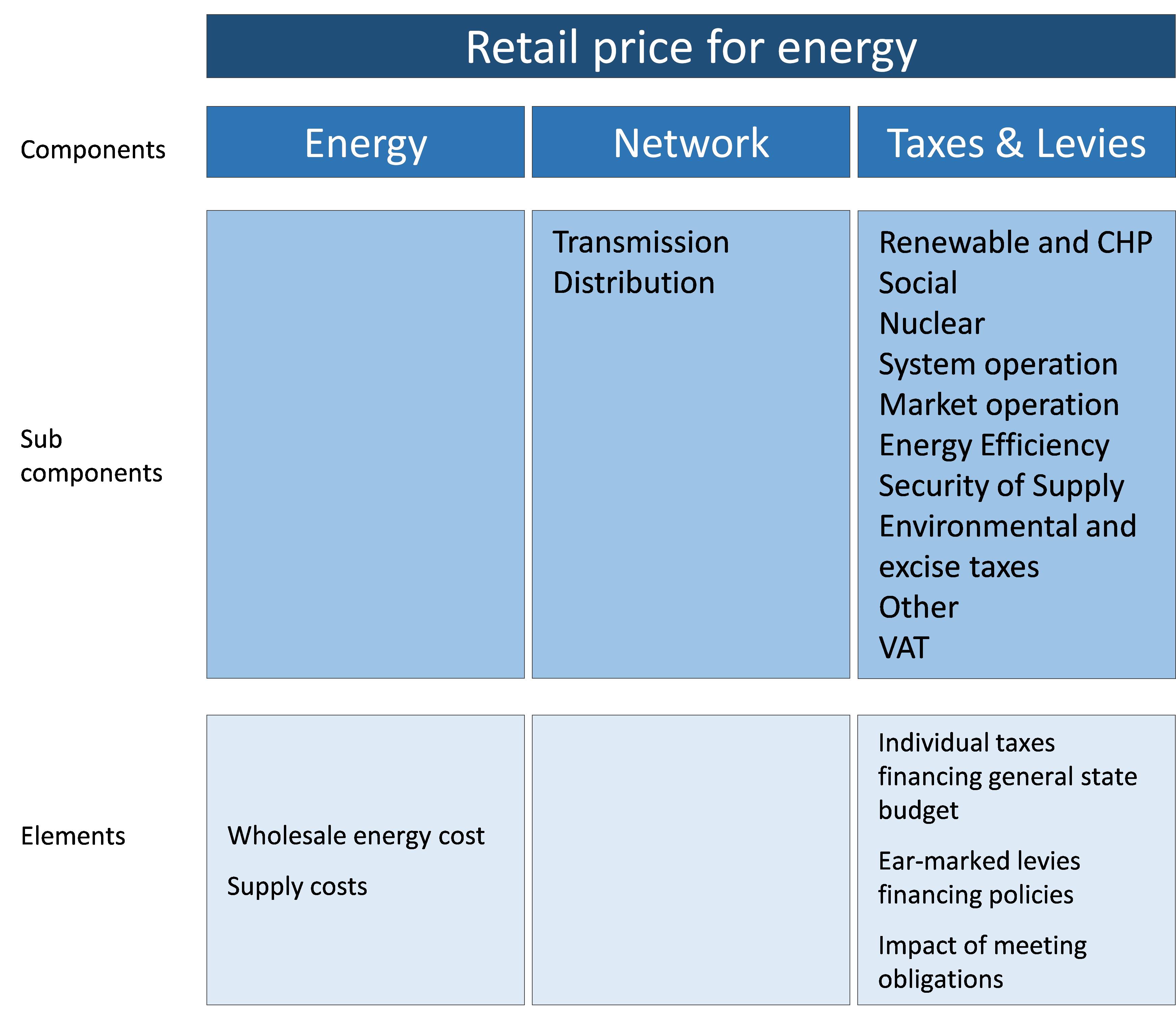
For electricity, gas and oil products, each chapter begins by looking at the developments in prices in the wholesale market and its drivers. Then retail price drivers and interactions between the wholesale and the retail market are examined. The report provides the most rigorous and exhaustive exploration of the data to date, and a more solid understanding of the factors driving energy prices in the EU.
The report then turns to the energy costs for the economy, households and industry. It shows the favourable evolution of the energy import bill of the EU in the last years and the underlying factors that have been driving down the bill. The report then makes a detail analysis of the impact of energy expenditure on households, looking at what factors explain such evolutions like the prices and consumption on different energy carriers (electricity, gas, solid fuels, etc.) and most importantly how energy expenditure affects households with different income levels.
The report also provides the industry perspective and makes an overview of the competitiveness of the EU and analyse the role of energy in the EU's competitiveness. Based on the results of various studies, the report details EU energy intensive sectors, i.e. those industries where energy can be a factor for competitiveness. In some selected energy intensive industries the report provides the evolution of energy costs shares and profit margins and makes a price sensitivity analysis. It then compares with EU trading partners EU industry prices, energy costs shares and profit margins as well as other indicators such as energy intensity. A synthesis of various studies with specific case studies of sectors and market products is made in order to provide a more detailed perspective of competitiveness developments in certain energy industries.
To complete the assessment of energy prices, the role of energy subsidies in the EU is addressed in the final chapters, as well as the implications for the development of government revenues and for inflation.
Energy prices
1Electricity prices
1.1Wholesale electricity prices
Over the last decade wholesale electricity markets in Europe have undergone fundamental transition in parallel with regulatory changes at national and EU level. In almost all EU Member States organised wholesale electricity exchange markets have been established, providing for trading opportunities for day-ahead, forward and intraday contracts, giving the right price signals for producers and consumers of electric power. Besides organised power trading platforms the so-called over-the-counter (OTC) markets also have an important role, especially in settling bilateral contracts between sellers and buyers of electricity.
Most of the European wholesale electricity markets are being linked together by market coupling, enhancing the potential welfare benefits of cross-border electricity trade and contributing to better price convergence across markets. Increasing market liquidity, cross-border trade in electricity and wholesale market coupling have all substantially contributed to the integration of national markets and to the realisation of the functioning European internal electricity market, especially for day-ahead and forward power contracts. However, even full market integration cannot assure perfect wholesale price convergence over time, therefore price volatility should be addressed by the market participants, through optimising their purchase contracts and hedging risk arising from price volatility.
In this subchapter the evolution of wholesale electricity prices between 2008 and early 2016 and the main drivers behind are analysed; focussing on the day-ahead base load contracts in different European markets, as the most detailed data we have are related to the day-ahead market.
Main findings
Although integration of wholesale electricity markets in the EU has been advancing well over the last few years, this has not necessarily resulted in perfect price convergence across different regions. However, in the first quarter of 2008 the price difference between the most expensive and the cheapest European wholesale electricity market was 44 €/MWh, eight years later this difference has shrunk to 24 €/MWh.
In parallel with high fossil fuel prices, European wholesale electricity prices peaked in the third quarter of 2008; then fell back as the economic crisis broke out, and slightly recovered between 2009 and 2012.
However, since 2012 wholesale prices have been decreasing, due to lower fossil fuel prices, increasing share of renewables in the EU power generation mix and low demand as electricity consumption decoupled from an already low economic growth, leading in various markets to overcapacity in power generation.
Compared to the average of 2008, the pan-European benchmark for wholesale electricity prices were down by 55% in the first quarter of 201, reaching 33 €/MWh on average, which was the lowest in the last twelve years.
Regional wholesale electricity benchmarks followed more or less the same trend since 2008, however, regional features, such as diverse electricity mixes, market couplings and interconnector capacities might substantially influence regional prices, especially on the short run.
As both coal import prices and natural gas prices decreased significantly since 2011/2012 the competition between the two fuels are rather influenced by other factors, such as low carbon prices. The share of natural gas has been permanently dwindling in the EU power generation mix, however as a result of unfavourable coal to gas ratios, large RES penetration and low carbon prices.
Different market factors, such as fuel mixes, renewables share, cross border flows and markets couplings and supplier concentration have different impacts on the wholesale price level.
While increasing share of renewable energy sources generally has decreasing impact on wholesale electricity prices, increase in coal, gas or carbon emission prices normally increases the price level, however, by different magnitudes in different regions in the EU and depending on the fuel source that is being replaced in the power generation mix.
Market concentration (the combined share of the top three electricity suppliers) and cross-border flows only have minor impact on the wholesale electricity price level at EU average.
Countries participating in market couplings normally have better wholesale electricity price convergence with their neighbours and temporary price differences are faster eliminated. Surpassing of the 10% threshold in electricity interconnection capacity only has a minor impact on electricity price level.
The influence of each market factor might strongly very across different regions. For example, the share of renewables and carbon prices have strong impact on wholesale price evolution in North Western Europe, while in Central and Eastern Europe the main price driver is the share of coal and gas in the generation mix.
Regional wholesale price comparison
As price evolution on national markets are being more and more interlinked with neighbouring markets, it is reasonable to make a comparison across Europe through looking at regional price benchmarks. The Central Western European power region (CWE) comprises of six countries, such as Germany, France, Belgium, the Netherlands and Luxembourg; and as Austria is practically the same pricing area as Germany, this country is also part of the CWE region. Since 2010 market coupling has been implemented, linking together the markets of the CWE region. The Nordpool region comprises of the non-EU member Norway, and other EU countries, such as Sweden, Denmark, Finland, Estonia, Latvia, and Lithuania. The market coupling, existing since the 1990ies in the Nordic region, was extended in 2012-2013 on the three Baltic States.
In February 2014 the CWE region, the Nordic region and the United Kingdom were linked together in a larger North-Western Europe coupled area (NWE), and this market coupling was extended in May 2014 to the Iberian region (Spain and Portugal). Although Ireland is not yet coupled with the NWE region, market developments in the UK strongly impact the Irish power market. In early 2015 Italy was also coupled with the NWE region. In May 2015 the so-called flow based coupling was implemented in the NWE region, contributing to significant increase in cross border electricity flows.
In Central and Eastern Europe (CEE region) four countries (Czech Republic, Slovakia, Hungary and Romania) are coupled since November 2014, while Poland is price coupled with Sweden.
Greece has an own functioning wholesale trading exchange, however, the Greek market is not coupled with any of its EU neighbours. In Bulgaria the new electricity exchange is operational since January 2016, while Croatia and Cyprus still do not have an own wholesale electricity exchange market. Malta is linked with Italy though an electricity interconnector since 2015, though it does not have an own functioning electricity trading platform.
In the following part the Platt's Pan-European Power Index (PEP) is used as European benchmark in order to show how regional average day-ahead wholesale electricity prices compare to each other and how they compare to the European average.
The next two charts (
Figure 1
) and (
Figure 2
) show the monthly evolution of the main regional and national wholesale day-ahead base load contracts since the beginning of 2008. Due to high fossil fuel prices in mid-2008, most of the wholesale prices and the PEP benchmark index as well reached its peak in the third quarter of 2008, and shortly after a steep fall in prices followed in parallel with the outbreak of the 2008-2009 economic crisis; resulting in a dramatic decrease in electricity demand in whole Europe.
As from mid-2009 the EU economy started to recover, demand for electricity also started to increase, however, there are clear signs of decoupling of electricity demand from the economic growth in the EU. Demand for electricity in the EU-28 grew less than the GDP over the last five-six years, which points to decreasing electricity intensity of the EU economy. Since the beginning of 2012 the PEP benchmark is on a downward path, owing to decreasing electricity generation costs besides subdued demand for power. At the beginning of 2016 the PEP fell to 30 €/MWh, being an unprecedented low level in the last twelve years.
Although general trends of wholesale price developments were quite similar across the EU, there were significant differences over the last few years between regional markets. As
Figure
1
shows, both Central Western and Central Eastern European regional averages followed closely the PEP benchmark. In the CWE region increasing share of renewables in Germany helped in pushing down electricity generation costs and in France the large share of nuclear in the power mix assured low-cost base load electricity generation. In the CEE region the role of coal (mainly in Poland and Czech Republic) and nuclear is important in assuring competitive base load power generation. Hydro generation has an important share in Romania and the import of hydro-based electricity, generated in the Balkans, also improves regional electricity supply, contributing to competitive price levels.
Wholesale electricity prices in the Nordic markets have been more volatile than the PEP benchmark, primarily owing to the importance of hydro in the regional generation mix. During cold and dry periods (with low hydro reservoir levels and generation), like at the beginning of 2010 and 2011, regional price spikes occurred, while during summer wet periods, like in July 2012 or July 2015 the Nordpool system price fell as low as 10 €/MWh on monthly average. Besides hydro power nuclear generation in Sweden and Finland also contributed to competitive regional base load prices. However, in the Baltic States and to lesser extent in Finland the local wholesale price has had significant premium for a long time as the lack of sufficient level of electricity interconnections hampered the flow of cheap hydro-based power to these countries. The inauguration of the LitPol and Nordbalt interconnectors in December 2015, linking Lithuania with Sweden and Poland, helped in reducing the price premium of the Baltic markets to other parts of the Nordpool coupled area, which underlines the importance of physical interconnections in the accomplishment of the EU internal electricity market.
In the United Kingdom the role of natural gas is decisive in setting the marginal electricity generation costs and thus the wholesale market prices. As until recent times the costs of generating electricity from natural gas remained high compared to other energy sources, the UK had a measurable price premium compared to continental Europe during the last three-four years (bearing in mind that in the CWE region renewables became an important wholesale electricity driver in the last few years). In order to comply with environmental standards, significant coal fired generation capacities have been retired in the country over the last three-four years, reducing the opportunity to generate power from cheap coal sources. Furthermore, due to the limited level of electricity interconnections between the UK and the CWE region, the UK could not import sufficient quantity of electricity that would have offered a competitive alternative to domestic generation.
Figure 1 – Monthly (day-ahead) wholesale electricity prices in European regions

Source: Platts and European power exchanges
As hydro generation plays a significant role in the electricity mix in the Iberian peninsula (Spain and Portugal, constituting a market with practically identical prices in both countries), volatility of wholesale prices is greater compared to the PEP benchmark. Wind and solar generation play an increasing role in the Iberian market, and in Spain nuclear has also a significant share. During winter periods hydro generation normally reaches its seasonal peak and wholesale prices are low (e.g.: In February-March of 2010, 2013 and 2014 the wholesale price fell until 20 €/MWh on average). During the dry summer season when high temperatures result in increasing demand for electricity (residential cooling needs), wholesale prices are higher than in other periods of the year. The summer period also coincides with the onset of the planned maintenance period of nuclear generation capacities, which result in switching to costlier coal and gas fired generation, especially in the periods of lower availability of intermittent generation sources (e.g.: wind and solar). Although in 2015 electricity interconnection between France and Spain has been reinforced, existing capacities are still not optimal to reduce price volatility in both markets through enabling sufficient cross-border electricity flows.
Over the last few years, as presented on
Figure 2
, Italy has always had a measurable price premium to the PEP benchmark, primarily owing to the country's structural import dependency on electricity and the large share of natural gas in its domestic generation mix. As natural gas prices decreased since the beginning of 2012 and the share of renewables (solar and wind) increased in the Italian generation mix, the wholesale price premium to major European peers shrank significantly. During hot summer periods when residential cooling needs increase significantly compared to other seasons, wholesale prices may show sudden upturns.
In EU comparison Greece has rather been among the expensive markets regarding the wholesale electricity prices. As natural gas, which has been imported at relatively high purchasing costs in comparison to other European countries in the last few years, has always had significant share in the country's energy mix, high power generation costs are also reflected in the overall wholesale price level. High domestic generation costs result in structural import dependency, as competitive import electricity from the Balkans helps in putting a lid on the increase of domestic wholesale prices. In parallel with decreasing natural gas prices the premium of the Greek market to the PEP benchmark also decreased at the beginning of 2016.
Figure 2 – Monthly (day-ahead) wholesale electricity prices in Spain, Italy and Greece

Source: Platts and European power exchanges
Looking at the timely evolution of wholesale electricity price ranges in Europe,
Figure
3
shows that over the last eight years wholesale electricity markets in Europe (EU countries with Norway and Switzerland) showed signs of convergence, as the lowest and the highest market price got closer to each other and to the PEP benchmark as well. However, in the short run significant price differentials may occur, as different local power generation mixes can result in differences in electricity generation costs, resulting in the divergence of wholesale prices across different markets, especially which would enable free flow of electricity being necessary for better price convergence.
Figure 3 –Wholesale electricity prices–European average, maximum and minimum

Source: Platts and European power exchanges
Box - Comparison of wholesale electricity prices in the EU with some of its international peers
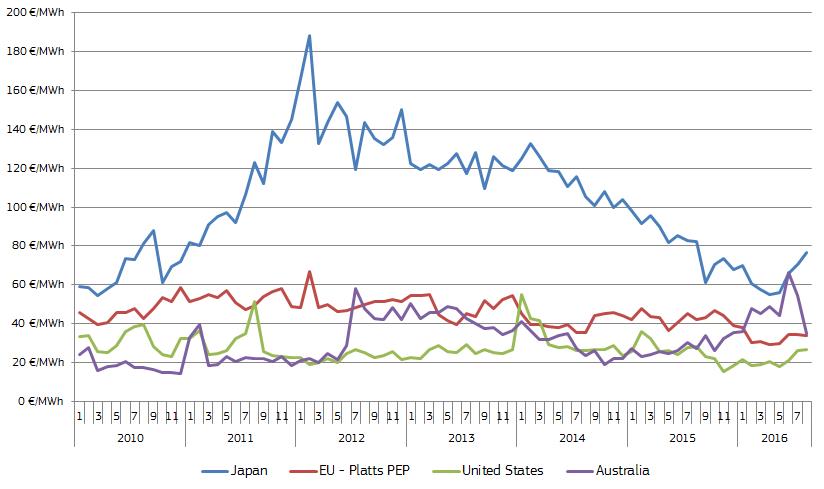
The next chart (Figure 4) shows that wholesale electricity prices in important commercial partners of the EU, such as the United States, Japan and Australia may substantially differ in certain periods.
During most of the time in the last six-seven years electricity prices in the US were lower than in the EU (in the first half of 2016 US prices were 35% lower than the EU average), primarily owing to low generation costs in the US, predominantly based on cheap domestic natural gas production. As during the last few years electricity generation costs also decreased in the EU, the EU-US price gap shrunk. However, during cold periods in the winter and hot periods in the summer US wholesale prices might suddenly turn up in parallel with increasing heating or cooling needs.
In 2011 and 2012 wholesale electricity prices in Japan were 2.5-3 times as high as in the EU, primarily owing to the consequences of the nuclear incident at the Fukushima power plant in March 2011, as practically the whole nuclear generation capacity in the country was taken offline and had to be replaced by more expensive gas-fired generation, based on Liquefied Natural Gas (LNG) imports. As from 2014 LNG prices started to converge among different regions in the world and underwent a significant decrease, electricity generation costs in Japan went down as well. Furthermore, some of nuclear generation capacities have been restarted so far, reducing the cost pressure on wholesale electricity prices. However, in the first half of 2016 wholesale electricity prices in Japan were still almost twice as high as in the EU.
Abundant domestic coal resources in Australia and increasing share of renewables in the electricity generation mix assures for the country having one of the lowest wholesale electricity prices in the world, though temporary factors (e.g.: policy measures, availability of coal supply routes, etc.) can result in sudden price increases.
Figure 4 –Wholesale electricity prices in Europe, United States, Japan and Australia
Source: PJM and ERCOT markets in the US, Platts in the EU, JPEX (Japan) and AEMO (Australia)
Changes in the EU power generation mix and the main drivers of wholesale electricity prices
Figure
5
shows the evolution of the EU-28 power generation from different energy sources between 2010 and 2015. As it has already been mentioned, generation and consumption of electricity in the EU decoupled from economic growth during the last few years; just as this chart shows but slightly decreasing trend (having high seasonality) of electricity generation. Between 2010 and 2015 the share of fossil fuels decreased by ten percentage points (from 51% to 41%), while the share of renewables doubled (rose from 8% to 17%) in power generation in the EU. At the same time the share of both nuclear and hydro remained practically the same.
Natural gas prices were relatively high compared to import coal prices in the EU over the last few years. While in 2008-2009 the estimated value of gas-coal price ratio was 1.7 on average, in 2014-2015 it amounted to 2.7, implying that gas-fired generation became costlier and the competitive disadvantage of gas increased compared to coal. In parallel with the recent fall in gas prices, the gas-coal price ratio has slightly improved, though in the first quarter of 2016 it was still above 2.
This has resulted in a permanent crowding out of natural gas from the EU electricity generation mix. However, albeit its existing cost advantage over natural gas, coal is also being gradually squeezed out from the EU power mix as renewables have been gaining ground.
Figure 5 – Power generation from different energy sources in the EU

Source: ENTSO-E
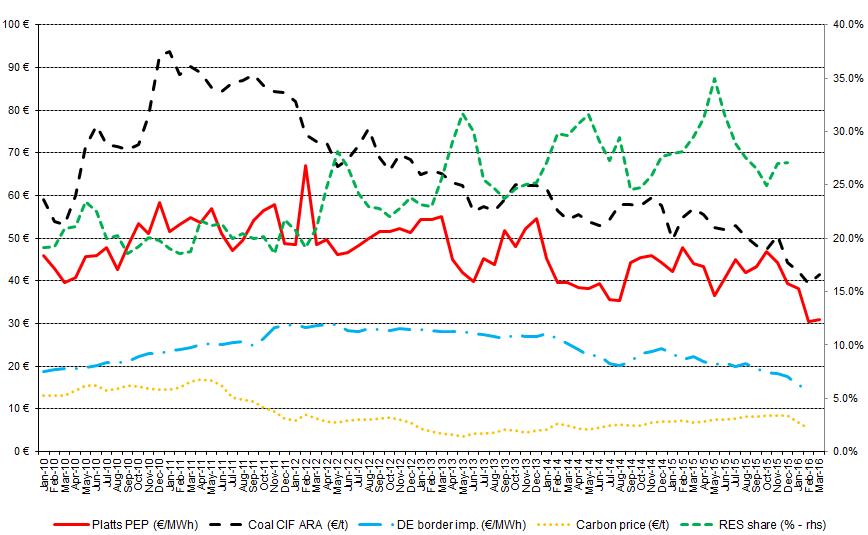
Figure 6
puts together the main factors driving electricity generation costs and wholesale electricity prices in the EU.
Figure 6 –EU electricity prices vs coal, gas prices and renewables share in EU power generation.
Source: Platts, BAFA
Platts PEP: Pan European Power Index (in €/MWh)
Coal CIF ARA: Principal coal import price benchmark in North Western Europe (in €/Mt)
DE border imp. stands for long term contract based import natural gas price on the German border (in €/MWh)
RES includes hydro, wind, solar and biomass; RES share in the total power generation estimation is based on monthly ENTSO-E data for the EU-28 as a whole
Carbon price: EUA emission allowances in €/tonnes of CO2 equivalent
Since the beginning of 2011 coal import prices in the EU (CIF ARA contract is used as a benchmark in North Western Europe) decreased from 90 €/Mt to 40 €/Mt, primarily owing to global coal oversupply, stemming from increasing exports from Colombia and the US (in the consequence of cheap domestic gas resources following the so-called 'shale gas revolution' coal has lost ground against natural gas in the US power generation mix) and decreasing demand in major consumer regions like China or in the EU.
Natural gas prices peaked at the beginning of 2012 after recovering from the lows measured in mid-2009. Since 2012 a gradual decrease in gas prices could be observed across Europe as gradually decreasing importance of oil-indexed gas contracts enables supply and demand forces to independently form market gas prices. Since the end of 2014 the decrease in gas prices has gained momentum, as the price fall of crude oil prices filtered in the oil-priced gas contracts as well. In February 2016 the average German gas import price fell below 15 €/MWh, being about the half of the average price measured in the first quarter of 2012. Hub prices in North Western Europe were even lower in the first quarter of 2016 (around 11-13 €/MWh).
Between April 2011 and May 2013 carbon emission allowance contracts underwent a significant price fall (decreasing from 17 €/tCO2e to 3.5 €/tCO2e). Since April 2013 carbon prices slightly recovered, however, they stayed below 10 €/tCO2e during the last three years. Low emission allowance prices have hardly been able to give any effective incentives to move towards generation sources with lower carbon emission intensity.
In parallel with decreasing fossil fuel and carbon prices, resulting in decreasing marginal costs of electricity generation, the share of renewable energy sources (wind, solar, biomass, also including hydro) has been gradually increasing over the last few years. In most of the EU countries fossil fuel costs set the marginal cost of electricity generation, being decisive for the wholesale electricity price. However, increasing share of renewables in the electricity mix shifted the generation merit order curve to the right, resulting in lower equilibrium price set by supply and demand. Consequently, we can say that increasing share of renewable energy sources have significantly contributed to low wholesale electricity prices in the EU markets.
In the consequence of these all, the PEP index, being in the range of 50-60 €/MWh in 2011/2012, decreased significantly and in the first quarter of 2016 it was around 33 €/MWh, which was, as it was mentioned, the lowest in the last twelve years.
In the previous paragraphs the main drivers behind the trend of wholesale price developments were described. In the following part quantitative estimation is provided on the impact of each market factor on the wholesale price level.
The impact of different market factors on wholesale electricity prices
In the report on Prices and costs of EU energy an econometric analysis has been presented in order to assess the influence of each market factor on wholesale electricity prices in the EU. Several factors, such as fossil fuel prices, the share of renewables, demand for electricity, electricity market concentration in different countries, existence of market couplings, etc. have been analysed and in the following points their impact is briefly described.
Panel data analysis shows highly significant values for shares of all energy sources in the EU except for nuclear power, and existing links between wholesale prices and market competition, integration as well as for demand for electricity and exchange rates (relative to the Euro).
These results should be interpreted by taking into account some general conditions that have been characteristic for the European wholesale electricity markets over the last few years. By looking at absolute changes in the wholesale electricity price level, providing details on the impact of renewables, oil, coal and gas share and price changes, it has been assumed that the average electricity price level in the EU was 40-50 €/MWh, the gas price level was around 10-15 €/MWh and the average coal price was around 50-70 €/Mt over the last few years, against which the price change details below in the bullet points should be measured.
The results show that if the share of renewables increases in the power generation mix, the impact on the wholesale electricity price might differ depending on the fuel source that is being replaced by renewables. As the share of renewable energy sources has been rapidly increasing over the last few years in many EU countries, the impact of one percent incremental increase can differ over time. The impact of renewables on wholesale electricity prices also shows measurable differences across different regions in the EU. When the impact of market concentration on the wholesale price level is analysed, a competitive, oligopolistic market structure is assumed against which the impact of increasing or decreasing concentration is measured on the overall electricity price level.
In detail, the results are:]
The econometric analysis shows a robust evidence that increase in renewables (solar and wind) share in the electricity generation mix by one percentage point reduces wholesale prices by 0.4€/MWh in the EU on average, however, the magnitude of the impact also depends on which generation source (mainly fossil fuels) is being replaced by renewables. The impact is stronger (amounting to 0.6-0.8 €/MWh) in North Western Europe, Baltics and Central and Eastern Europe. The econometric analysis looked at data with monthly frequency, however, the impact of renewables is suspected to be even stronger, if hourly price data had been taken into account (given the impact of renewables in different time periods of a day).
An increase in fossil fuel shares in the generation mix (gas, oil or coal) has an upward impact on the wholesale price level as econometric results show, however, depending on the region in the EU and at the expense of which fuel source this increase occurs, one percentage point increases in the fossil share results in an increase of the wholesale electricity price ranging from 0.2 to 1.3 €/MWh.
Similarly, increases in the price of the two main fuels setting marginal electricity generation costs (gas and coal) by one €/MWh and the increase in CO2 allowance (ETS) prices by one €/tCO2e,also have an upward impact on the wholesale electricity price level, ranging between 0.2 €/MWh and 0.8 €/MWh in different EU markets. Weak impact of CO2 prices on electricity prices also relates to the strong structural oversupply in the ETS market, weakening its impact on the generation mix.
Only weak relation has been identified between the increase in the market share of the top three suppliers (by one percentage point) and the wholesale price level (slightly positive relation) and between increasing cross border flows (by one percentage point) and decreasing wholesale prices (the impact was barely measurable) at EU level; in some regions these impacts might be stronger.
Countries belonging to one (or several) market coupling areas tend to have higher number of hours when local wholesale electricity prices converge with the neighbouring markets. The average price difference with the neighbours tend to decrease and temporary price differentials are eliminated faster in most cases after the coupling takes place. Uneconomic electricity flows against normal price differentials (from higher to lower price area) also significantly decreases after the coupling is implemented.
Analytical results do not show strong evidence on the impact of surpassing the 10% electricity interconnection capacity; in the case of countries being below this threshold we can find slightly higher prices than for the ones with higher interconnection than the 10% threshold.
Increasing demand for electricity (demand of households, as measured by external temperatures and demand in the business sector, as approximated by economic growth) definitely has upward impact on wholesale electricity prices, however, results are region-specific, depending on climate conditions and electricity intensity of a given country and economy. As generation fuel supply mostly depends on imports, weakening of the local currency leads to increasing wholesale electricity prices through higher generation costs.
The following major regional differences can be observed:
In the previous points general conclusions on the impact of each factor on wholesale electricity prices at European level were presented. In the next bullet points some qualitative results of these factors in different regions of Europe are summarised:
In the North-Western Europe region (Central and Western Europe, Nordpool and the UK) natural gas prices and emission allowance prices (ETS) had stronger impact on the wholesale price level than in Europe as a whole.
Temporary price differences in day-ahead wholesale prices between Germany and the neighbouring markets disappeared faster in recent years (2012-2015) than in earlier periods (before 2012). This indicates that the regional development of the internal market has had an effect in eliminating price differentials.
In the Nord Pool area as a whole change in the coal share showed a stronger impact on the wholesale electricity price level (given the significant share of coal in some countries of the region, like Denmark, Finland and Estonia) than in Europe on average.
In the Baltic States change in the share of renewables and natural gas had measurable influence on the wholesale electricity price, so had cross border electricity flows.
Cross border electricity flows also had measurable impact in Spain and France, as the interconnector capacity is still limited between the two countries and any increase in border flows might have a large marginal impact.
In the analysed Central and Eastern European countries change in the share of coal (especially high in Czech Republic) had a large impact, similarly to nuclear power in Hungary and Slovakia.
Concentration of the three largest electricity generators had particularly strong influence in countries like France, Austria, Italy, and Slovenia, and the change in the share of coal in power generation also significantly impacted wholesale prices in these countries.
1.2Retail electricity prices
The composition and drivers of retail prices are analysed based on a data collection designed and conducted by DG Energy of the European Commission. The gathered data set has distinct features:
Cost elements are allocated to harmonized main components, facilitating the targeted identification of price increase drivers on EU and national levels.
The main component "taxes & levies" is further disaggregated into 10 sub- components, facilitating the quantification of the impact of specific policies and fiscal measures.
The main component "network" is further decomposed into transmission and distribution costs.
Energy policy relevant levies and not- earmarked taxes are distinguished.
Summary
Retail prices increased at 3% annual rate for households and at 2% annual rate for industry. The average household price was 20.8 Eurocent/kwh while the average industrial price was 107.3 EUR/MWh in 2015. Large industrial consumers paid 84.5 EUR/MWh on average.
Price increases were driven by government imposed taxes, levies and regulated network tariffs. While VAT remained the largest tax element, RES support costs experienced the fastest growth. They accounted for 12% of the average median household price and for 23% of the average median industrial price in 2015. The impact of other policy supports costs such as energy efficiency, security of supply remained limited on EU level, however certain policies proved to be price increase drivers on Member State level. Taxes & levies increased at the annual rate of 7.9% and 18% for the average household and industrial consumer respectively.
The energy component diminished both in absolute and relative terms. By 2015 it was no longer the largest of the three components in half of the EU Member States and in the weighted EU average price. The energy component decreased at the annual rate of 0.3% and 2.8% for the average household and industrial consumer respectively.
Energy policy relevant levies were out weighted by tax instruments which do not necessarily finance energy or climate related policies. Not- earmarked taxes cost the average EU household 15% more than designated policy support costs.
Progress towards a single EU energy market is mirrored by the significant increase in the convergence of national energy components. Such became 15% and 12% less dispersed since 2008 for households and industry respectively. While total industrial prices also became less dispersed, for total household prices a different trend is to be observed as such are impacted by highly divergent national taxation and policy support costs. Total household prices became 9% more spread out across the EU from 2008 to 2015.
Diminishing energy components might negatively impact investments in the power sector. The energy component is the competitive part of the bill which determines the revenues of suppliers. Decreasing energy components decrease incentives in the private sector to invest in new or refurbished generation capacity. The lack of investment in turn might negatively impact security of supply on the long term.
The increase of the average electricity price slowed down to a marginal rate for households and prices decreased for industrial consumers from 2014 to 2015. This might negatively impact energy efficiency investments by both consumer types.
Figure 7 - Composition of average electricity prices over time

Source: European Commission, Member States
Table 1. Evolution and share of price components by consumer type
|
Consumer Type
|
Household (DC)
|
Industrial (ID)
|
Large industrial (IF)
|
|
Component
|
Annual growth
|
Share 2015
|
∆ share
|
Annual growth
|
Share 2015
|
∆ share
|
Annual growth
|
Share 2015
|
∆ share
|
|
Energy
|
-0.3%
|
36%
|
-10pp
|
-2.8%
|
49%
|
-21pp
|
-3.2%
|
58%
|
-19pp
|
|
Network
|
3.3%
|
26%
|
0pp
|
3.2%
|
19%
|
+1pp
|
3.1%
|
16%
|
+2pp
|
|
Taxes & Levies
|
7.9%
|
38%
|
+10pp
|
18%
|
32%
|
+20pp
|
16%
|
26%
|
+17pp
|
|
Total price
|
+3.2%
|
-
|
-
|
+2.3%
|
-
|
-
|
+0.8%
|
-
|
-
|
Source: European Commission, Member States
Table 2. Price dispersion by consumer type
|
Consumer type
|
Band
|
Year
|
Max/Min
|
Total price dispersion 2008-2015
|
Energy component dispersion
2008-2015
|
|
Household
|
DC
|
2008
|
3.2
|
+9%
|
-15%
|
|
|
|
2015
|
3.2
|
|
|
|
Small industrial
|
IB
|
2008
|
3.2
|
0%
|
-2%
|
|
|
|
2015
|
2.6
|
|
|
|
Med. industrial
|
ID
|
2008
|
2.9
|
-6%
|
-12%
|
|
|
|
2015
|
2.7
|
|
|
|
Large industrial
|
IF
|
2008
|
3.7
|
- 16%
|
-17%
|
|
|
|
2015
|
3.1
|
|
|
Source: European Commission, Member States
1.2.1Household Electricity Prices
The following chapter analyses electricity retail prices paid by consumers whose annual consumption falls in the range 2500 to 5000 kWh. This consumption band is defined by Eurostat terminology as DC and is the most representative consumption band in 23 out of 28 Member States of the European Union.
Summary
The average household price was 20.8 Eurocent/kwh in 2015. Household electricity prices increased at an annual rate of 3.2% since 2008 and diverged by a factor of 3 across the EU in 2015.
The energy component diminished both in nominal and relative terms on EU level as well as in most reporting countries. It remained the largest of the three components only in half of the reporting countries by 2015. The moderate decrease of the energy component (annual -0.3%) was overtaken by increases in the network (annual 3.3%) and taxes and levies (annual +7.9%) components, resulting in overall higher prices.
While VAT remained the largest cost element within the taxes and levies component, price increases were mostly driven by RES support costs (annual +22%) and not- earmarked taxes. Energy efficiency support costs grew annually by 73% but still remained to account for less than 1% of the total price in 2015.
Whilst prices for all other electricity and gas consumer types became more convergent since 2008, household electricity prices became 9% more dispersed. This is mostly due to the fact that they are strongly impacted by divergent national taxation and policy measures.
The energy component is the only part of the price which is determined by the market. The household EU average energy component became annually 2.3% less dispersed since 2008, mirroring the progress towards a single energy market.
Reporting countries impose a broad variety of taxes and policy support costs on household electricity bills, reflecting various national energy technology priorities, social structures, topographies and market structures. While designated policy support costs have often experienced notable increases, not- earmarked taxes (including VAT) still cost the average EU household 15% more in 2015.

1.2.1.1Price evolution – Total prices
The weighted average EU household price was 20.8 Eurocent/kWh in 2015. This average price increased from 16.65 Eurocent/kWh at the annual rate of 3.2% from 2008 to 2015. The average inflation was 1.5% during the same period. The increase of electricity retail prices has slowed down to a rate of 2% from 2014 to 2015. This might have negative impacts on energy efficiency investments by households in more efficient appliances and buildings.
Figure 8 - Evolution of the EU average household price (DC)

Source: European Commission, Member States
In 2015 the highest national price was more than three- fold of the smallest, as prices ranged from 9.42 Eurocent/kWh in Bulgaria to 30.55 Eurocent/kWh in Denmark. The highest and lowest prices in 2008 were recorded in the same countries with the same ratio.
Figure 9 - Household electricity prices by country in 2015 (DC)

Source: European Commission, Member States
Figure 10 - Nominal price changes & prices relative to EU av. in 2015 for households (DC)

Source: European Commission, Member States
Electricity prices on the island systems of Cyprus and Malta are largely dependent on international oil prices. Falling prices of the commodity are reflected in falling wholesale prices. Three Central- Eastern European countries, namely the Czech Republic, Hungary and Slovakia alongside Norway also reported decreasing nominal prices.
Figure 11 – Household electricity prices by country (DC)

Source: European Commission, Member States
1.2.1.2Price drivers – Main components
Total prices provide no information on the drivers of price developments. To facilitate the more focussed identification of price increase drivers, total prices are further decomposed into three main components. The components Energy, Network and Taxes & Levies disaggregate the total price along the value chain.
The Energy component typically includes cost elements such as the wholesale price of the commodity, various costs of the supply companies including their operational costs and profit margins, balancing energy as well as metering and billing charges. It also includes ETS costs, which are understood as production costs, rather than levies. The same holds for various taxes, such as property or vehicle taxes paid by supplier companies.
The Network component mainly consists of transmission and distribution tariffs. It might also include further cost elements, such as ancillary services.
The Taxes & Levies component includes a wide range of cost elements that highly vary from country to country. They reflect each country's energy technology priorities, social conditions, geographical characteristics and market structure. Levies are typically designated to specific technology, market or social bound policies, while taxes are general fiscal instruments feeding into the state budget.
Figure 12 - Weighted EU average household components (DC)

Source: European Commission, Member States
The weighted average energy component decreased at the annual rate of 0.3% and accounted for 7.49 Eurocent/kWh in 2015. From 2014 to 2015 the energy component decreased in 23 of the 30 reporting countries. By 2015 the energy component was no longer the largest of the three components in 14 out of 30 reporting countries and in the weighted EU average. The decrease in energy components can be linked to EU energy policies: increased competition resulting from market coupling, the unbundling of electricity generation from system operation, the fall in EU ETS carbon prices and the growth of power generation capacity with low operating costs (such as wind and solar power, in addition to existing nuclear and hydro power).
In 13 reporting countries the nominal level of energy costs increased from 2008 to 2015. In these countries the fall of wholesale prices has not translated into a reduction in the energy component. Such results may imply that price competition in a number of retail markets is weak, allowing suppliers to avoid passing on wholesale price reductions to retail prices.
Box - Pass through effect on electricity
Our 2014 report on energy prices and costs indicated that the fall in wholesale prices had not translated into a reduction in the energy component of retail prices, and that this result may imply that price competition in a number of retail markets was weak. The fact that cost fluctuations are reflected in final prices, is a sign that a market works properly. Such responsiveness of retail prices can however be diminished by the lack of competition and by the presence of price regulation (as it happens in some Member States) which can also be detrimental for competition by deterring new entrants. The analyses conducted in our 2016 report to test the cost reflectiveness of wholesale prices are overall aligned with these ideas.
To assess how wholesale prices impact the energy component of final prices (the pass through effect – see also box below), we should look at how quickly and how strongly energy supply prices adjust to changes in wholesale prices. The speed of the pass through could be evaluated by using a correlation analysis with lags between the retail price component and the wholesale price. A panel analysis based on fixed and random effects (which allow incorporating time series and country specific characteristics) was used to evaluate the magnitude of the pass-through.
Electricity
On the speed of the pass through, the correlation analysis reveals a heterogeneous picture across Europe in which wholesale prices seem to be passed through faster in some countries than in others [0 months in NO, SE, AT, LV while it takes 8 months in NL, IT, CZ, DE, FR]. These differences could depend on the market and tariff design of the retail markets, given that in some countries prices are still regulated, in some countries prices are fixed for a given time period (with monthly prices relying on old and new contracts) while in others they are indexed to the wholesale market price.
On the magnitude of the pass through the econometric analysis shows that wholesale prices are the main drivers and strongly affect the energy component (i.e. a price drop of 1 Eurocent would result in a decrease of the energy component by about €0.04 – 0.09 ct.).
The econometric analyses also show that there is an impact of the competitive structure and regulated prices on the pass through effect:
Markets with a market share above 80% of the three largest suppliers show a higher energy supply price (mean is about €1ct per kWh higher) while under regulation the energy price component seems to be slightly lower (mean is about €0.8 ct/kWh lower). However, low retail prices often go hand in hand with a low level of customer satisfaction as their service and range of products is modest, as the ACER MMR 2015 report highlights.
In a competitive and deregulated market the impact on wholesale prices is significantly stronger (about €0.2 ct/kWh per one Eurocent change for the household consumption band DC), signalling that suppliers react to wholesale price changes. Econometric analysis shows that competitive structure of markets and price regulation significantly impacts the pass through of wholesale price. Panel data analysis reveals that the speed and magnitude of the pass through differs between the group of Member States with competitive retail markets and the group of Member States with regulated prices. For the deregulated group it can be stated that the more competitive markets are, the higher the magnitude of the pass through.
There are further market characteristics, or different market behaviour or product designs, be it at the supply (e.g. number of suppliers, offers, price transparency) or demand side (switching behaviour) that certainly exert an influence on the energy component. However there are no suitable data available across all Member States to capture these factors.
Source: Ecofys study sections 3.2.2.1 & 3.2.2.2 and related Annex 2
Box - Cost reflectiveness of wholesale prices and the evolution of retail prices
Retail energy suppliers can compete on their offers on energy supply costs which depend to an important extent on wholesale energy prices. In a properly functioning market, the higher or lower wholesale prices should be translated to energy component of the (final) retail price. This however does not necessarily mean that retail prices will strictly mimic the evolution of lower energy costs given that retail prices are also impacted by the evolution of its other components (e.g. network costs and taxes & levies). E.g. in the energy market, lower wholesale should be passed through to final consumers in the form of lower cost of the energy supply component but this does not mean that final prices will necessarily decrease because network costs and taxes & levies could, for instance, have risen, compensating lower energy costs.
The network component increased at the annual rate of 3.3% and cost the average EU household 5.45 Eurocent/kWh in 2015. Network tariffs steadily increased over the whole observation period. From 2014 to 2015 they increased in 18 out of the 30 reporting countries. The network component was the largest of the three components in 7 reporting countries (BE, CZ, EE, NO, RO, SE) in 2015. In Poland energy costs were only marginally higher than network costs.
Box - Network quality and charges
A frequently used indicator for measuring the quality electricity networks is the annual number of minutes of supply disruption. Disruptions can occur at different levels of the transmission and distribution networks (e.g.: high voltage, middle voltage and low voltage networks). They can be planned (disruptions related to grid maintenance activities) or unplanned (those resulting from an unexpected event).
Error! Reference source not found.
shows that there are significant differences across EU Member States in the extent of electricity supply disruptions (data from 2013). The highest number of minutes of disruptions could be observed in Central Eastern European Member States (Romania, Latvia, Estonia, Croatia, Czech Republic, Lithuania, Poland) while disruptions were less frequent in North Western European countries (e.g.: Luxembourg, Denmark, Netherlands, Germany, Austria, Belgium). The duration of planned disruptions was also higher in those Member States with a higher number of the overall outage minutes, indicating lower quality electricity supply in those countries.
Figure 13 – Minutes of electricity supply disruption in EU Member States, 2013

Source: CEER Benchmarking Report 5.2 on the Continuity of Electricity Supply, February 2015
However, it is worth noting that in most EU Member States the annual interruption time has been decreasing over time, suggesting improvements in the quality of the electricity grid. In 2005 the EU average interruption time was 373 minutes, by 2009 this figure decreased to 365 minutes and by 2013 to 309 minutes.
Results of customer satisfaction surveys can also foster the understanding of the quality of electricity supply. They can be especially useful for global comparison. The satisfaction survey on electricity supply of the World Economic Forum (Global Competitiveness Index) takes into account basically two factors: disruptions and fluctuations of power voltage.
Error! Reference source not found.
shows that the quality of supply in the EU on average scores well when compared to other non-EU G-20 countries. On a scale of 1 to 7, the average satisfaction rate in the EU-28 was 5.95, while in the case of non-EU G-20 countries the same figure was 4.97. The upper third of the satisfaction ranking consists entirely EU Member States (with the exception of Canada), while in the lower third there were only five EU Member States (Bulgaria, Romania, Malta, Greece and Estonia):
Figure 14 – Customer satisfaction with electricity supply in the EU and G-20 countries

Source: World Economic Forum Global Competitiveness Index, 2014-15edition - (1=worst, 7= best)
Increased expenditure for improving network quality subsequently increases network costs. However, it is important to emphasise that good network quality does not always appear associated with higher network costs. In some cases network costs are higher in those EU Member States where the supply interruption periods are longer, or the consumer satisfaction is lower. It is therefore not easy to establish a direct link between the quality of electricity supply and network costs in a given country. In international comparison, it is even more difficult to analyse network cost differentials and their impact on the quality of electricity supply across different countries. For these reasons, a more thorough data collection and methodological considerations should be carried out to establish and quantify this impact (which goes beyond the framework of the current energy prices and costs staff working document).
The report by Ecofys on prices and costs of energy in the EU provides some descriptive information on the impact of different factors on electricity and gas network costs:
There are three potential factors to calculate network costs: A lump sum for the connection of an installation, a capacity fee for the connected capacity (e.g.: kW) and a consumption fee based on the usage of the network. In most countries, households only pay a consumption fee, sometimes there is a lump sum fee for the connection. For industries, the capacity fee for the connected capacity (or peak load) is often more important.
In the case of gas, network costs for households largely depend on the fixed price component and capacity elements. In the case of the existence of the former (fixed) component, network costs are significantly higher. For industrial customers we do not see such big differences.
Network costs can be driven by several factors, such as replacements (investments) of existing equipment, substitution or new infrastructures, number of connections, by renewables energy generation shares in the case of electricity, and the existence of fixed capacity charges
The taxes & levies component of household prices grew at a faster annual rate of 7.9% and accounted for 7.92 Eurocent/kWh in 2015. Taxes and levies continuously increased over the whole observation period, at times by double digit figures. From 2014 to 2015 the increase of the component slowed down to a pace of 2% and in 11 of the 30 reporting countries it even decreased. The taxes & levies component was the largest of the three components in 7 reporting countries as well as in the weighted EU average price (DK, DE, ES, PT, AT, LV, SK) in 2015. The two Member States (DK, DE) that recorded the highest prices in 2015, reported the highest taxes and levies components across all reporting countries. It is to be noted that only these two countries are represented in the top 5 countries with the highest retail prices. Contrarily, in Italy, Ireland (rank 3 and 4 on the list of highest prices) energy costs accounted for the largest part for the bill, while in Belgium (ranks 5) network costs weighted out the two other components.
Within the taxes and levies component, two sets of cost elements can be distinguished. Levies finance energy, environmental, climate change related and social policies, while taxes contribute to financing general public expenditure as outlined in the state budget. Taxes, such as excise duty, environmental or greenhouse gas emission taxes do not necessarily finance energy related policies. It is important to note that the current study analyses only the direct impact of policies and fiscal measures on retail prices. Some reporting countries supplement the financing of policies from the state budget. This means that additionally to the explicit levy, which represents a cost element in the retail price in the structure of the current study, policies are also supported by other public resources.
Non- energy policy relevant charges (taxes) were 15% higher than energy policy relevant charges (levies) in 2015. Taxes cost the average EU household 4.2 Eurocent/kWh in 2015. The average sum of costs related to policies such as renewable energy support, energy efficiency and vulnerable consumers equalled to 3.7 Eurocent/kWh, while taxes cost the average EU household 4.2 Eurocent/kWh. Levies made up 46% of the average taxes and levies component and 17% of the average total price. Taxes accounted for 54% of the average taxes and levies component and 20% of the average total price. These shares also reflect the development of VAT, which as an ad valorem tax is levied on the sum of the underlying components.
Figure 15 - Weighted average levels of taxes and levies for median households (DC)

Source: European Commission, Member States
Energy taxation is harmonised on EU level by Directive 2003/96/EC. The directive sets minimum levels for VAT and excise duty, however most Member States apply rates higher than the binding minimum levels. VAT, at different rates, exists in all reporting countries. Beyond VAT and excise duty, Member States are generally free to apply any additional national taxes. It should be noted that excise duty on some energy products, including electricity, is levied according to the volume of the product. Hence, it is determined independent of the price and its share in the final price will increase with falling prices. Excise duty on other products, such as natural gas is levied on the basis of their energy content. VAT is an ad valorem tax, determined as a percentage of the sum of all other costs, such as the energy component, network component and other taxes and levies. Hence, its share remains constant with falling prices.
Figure 16 - Share of EU average components for households (DC)

Source: European Commission, Member States
The relative share of the energy component in the total price gradually diminished over time. It decreased by 10 percentage points from 46% to 36%. The share of the Network component in the total price remained constant at 26%. The share of the taxes & levies component in the total price increased by 10 percentage points from 28% to 38%.
Figure 17 - Price components by country in 2015 for households (DC)

Source: European Commission, Member States
Figure 18 - Share of price components by country in 2015 for households (DC)

Source: European Commission, Member States
As of 2015 in 4 Member States the Taxes & Levies component accounts for at least 50% of the total price. In 4 Member States and Turkey the share of the Taxes & Levies component was 20% or below in the same year.
Developments within components
The current study introduces sub- components within the Network and Taxes & Levies components. These sub- components facilitate the more focussed analysis of developments within the two components.
Energy component
EU ETS costs are included in the energy component for all consumption bands. A 2014 study by DG ECFIN found that EU ETS costs had no significant impact on electricity prices. As the price of ETS allowances only moderately increased since, it can be stated that ETS costs further remain insignificant in terms of price increases.
The energy component is the only one of the three price components determined by market forces. Increasing competition is likely to lead to decreasing energy components. The share of the energy component decreased by 10 percentage points and accounted for 36% of the total price. The levels of the network and taxes & levies components are set by divergent national laws and regulations. Their joint share in the average median household price increased from 54% to 64%. As the part of the price which is set by market forces has been gradually decreasing, total prices are imperfect indicators for the measurement of price dispersion. The dispersion of the energy component however adequately reflects to progress towards an internal energy market. The energy component of the average median household price became 19% less dispersed since 2008. Results of econometric analysis support the finding that wholesale prices, which constitute the bulk of the energy component, became less spread out over time. The overall convergence however, conceals of shorter periods characterized by higher variance of the energy component. Increasing share of RES might be a contributing factor to the higher variance.
Network component
The Network component is broken down into two sub- components, namely Transmission and Distribution. Both transmission and distribution tariffs are regulated in all EU Member States as well as in Norway and Turkey. The allocation of cost elements (for example costs of infrastructure, losses, ancillary services and re-dispatching) to the two sub- components might differ from country to country. Therefore, cross- country comparisons are to be considered with caution. Household consumers are typically supplied with electricity by being connected to the distribution grid, therefore have to pay both transmission and distribution fees. 17 out of 30 reporting countries submitted the split between transmission and distribution costs.
Figure 19 – Transmission & distribution shares in network tariffs in 2015 for households (DC)

Source: European Commission, Member States
The share of distribution costs ranged from 13% in Italy to 100% in France, highlighting the lack of harmonized definitions of distribution and transmission tariffs. It is to be noted that there is no transmission system operator on Malta, therefore all costs are accounted for as distribution costs.
Taxes & Levies component
It is to be noted, that only explicitly reported cost elements could be allocated to specific policies and consequently taken into account for the analysis of sub- components. For example, RES support costs exist in several countries which could not report such costs explicitly. In other countries the revenues collected through a levy that supports a specific policy are complemented by other resources. Such additional resources are not covered by the underlying study.
Cost elements within the Taxes & Levies component were assigned to 10 sub- components. Sub- components 1-8 are considered energy policy relevant while sub- components 9-10 consist of general fiscal measures.
1. Renewable energy sources and combined heat and power (RES & CHP): contains any cost imposed to support renewable energy technologies, grid connection of renewable energy generation units and any support to combined heat and power.
2. Social: the most common cost elements in this sub- component are related to vulnerable consumers, social tariffs, island system tariff equalization, last resort supply, special tariffs, and sectorial employment policies.
3. Nuclear: includes any support to the nuclear sector, most notably nuclear decommissioning.
4. Energy Efficiency: includes any support to energy efficiency and energy saving measures.
5. Security of supply: includes any support to security of supply policies, support to indigenous electricity generation or fuel production and emergency stockpile fees.
6. Concession fees: include concession fees and other charges for the occupation of public and municipal land.
7. Regulator and Market: cost elements in this sub- component are typically imposed to finance the National Regulatory Agency (NRA) or the Market Operator.
8. Other Levies: the sub- component includes a small number of designated cost elements that could not be assigned to any of the above sub- components, most notably R&D, deficit annuities and public television fees.
9. Value Added tax (VAT): VAT is imposed on electricity and natural gas prices in every EU Member State as well as in Norway and Turkey.
10. Other taxes: this sub- component includes any manifestation of excise duties, environmental taxes as well as distribution, transmission and greenhouse gas emission taxes. If revenues from a tax are earmarked for specific policies, the tax was allocated to the policy specific sub- component.
Figure 20 - Composition of (EU weighted av.) Taxes & levies in 2015 for households (DC)

Source: European Commission, Member States
Figure 21 – Share of sub-components in (weighted EU av.) Taxes and Levies for households (DC)

Source: European Commission, Member States
VAT was the largest sub- component within the taxes and levies component. It accounted for 37% of the weighted average taxes and levies component while other not- earmarked taxes (such as, excise duties, environmental, greenhouse gas emission and distribution taxes) made up 17% of the taxes and levies component.
The largest energy policy relevant sub- component was RES & CHP accounting for 33% of the total Taxes & Levies component, followed by social cost elements (4%), concession fees (4%) and security of supply measures (1.2%). The share of energy efficiency, nuclear sector and institutional costs were each below 1%.
1.2.1.3Price drivers – Sub- components
Value Added Tax
VAT is imposed in all reporting countries on household electricity prices, whereas the EU VAT Directive explicitly allows Member States to apply reduced rates to electricity. As a result, VAT rates range from 6% in the United Kingdom to 27% in Hungary. As the largest sub- component, VAT made up more than a third of the weighted average taxes & levies component.
Figure 22 - Household (DC) VAT costs in 2015 by country

Source: European Commission, Member States
Renewable energy and Combined Heat and Power
This sub- component includes any support to renewable energy and combined heat and power generation. Explicit RES & CHP support costs were reported by 23 countries in 2015 for households. 5 EU countries did not report explicit RES or CHP cost elements. They are: Finland, Malta, Netherlands Poland and Sweden. Norway and Turkey also did not report explicit RES or CHP support costs. It is important to note that consumers in these countries are paying RES support despite the fact that such costs are not explicitly levied on electricity bills. They are captured either in the energy component or are financed through general fiscal measures. The Netherlands introduced a Sustainable Energy Levy in 2013 as part of the SDE+ mechanism. This levy could not be calculated separately for the current study.
Figure 23 - Evolution of the EU weighted average RES support cost for households (DC)

Source: European Commission, Member States
The EU 28 weighted average RES & CHP support cost tripled from 2008 to 2015. While the annual compound average growth rate of RES & CHP costs was 22% over the whole period, from 2014 to 2015 the increase slowed down to 4%.
Figure 24 – EU average RES & CHP costs relative to EU average total price for households (DC)

Source: European Commission, Member States
Figure 25 - Nominal RES and CHP support cost by country in 2015 for households (DC)

Source: European Commission, Member States
In 2015 Germany recorded the highest rate of RES & CHP support accounting for 61 Eurocent/kWh. The smallest amount of the same cost, 0.45 Eurocent/kWh was recorded in Croatia. In Hungary households are exempted from the RES levy as of 31 October 2013.
Figure 26 – Share of RES & CHP support costs in national prices in 2015 (DC)

Source: European Commission, Member States
While Germany recorded the highest nominal amount of RES & CHP cost to households, the share of supporting such policies was the highest in Portugal, accounting for almost a quarter of the total price. The smallest share of 3% was reported by Ireland.
Other not earmarked taxes
The sub- component includes any manifestation of excise duty, environmental- , greenhouse gas emission- , transmission- and distribution taxes. Minimum tax levels on energy products and electricity are harmonised on the EU level and are defined by the Council Directive 2003/96/EC. Normally those taxes are not earmarked to energy, climate or environment related policies. The sub- component excludes VAT.
Such taxes accounted for 6% of the weighted average EU price and 17% of the weighted average taxes & levies component. 21 reporting countries (19 EU member States, Norway and Turkey) imposed not- earmarked taxes (other than VAT) averaging at 1.29 Eurocent/kWh in 2015. Not- earmarked taxes increased at an annual rate of 2%.
Figure 27 - Nominal cost of not- earmarked taxes for households (DC) in 2015

Source: European Commission, Member States
Figure 28 - Share of not-earmarked taxes(excl. VAT)in national prices in 2015 for households(DC)

Source: European Commission, Member States
Not- earmarked taxes (other than VAT) accounted for 39% of the total price in Denmark, 18% in the Netherlands, 16% in Sweden and 14% in Finland. It is to be noted that the latter 3 countries could not report explicit RES support costs. In 13 Member States such taxes accounted for 1% or less of the total price.
Social charges
Social charges include any support to vulnerable consumers, island system tariff equalization, social funds and support to sectorial employment policies. Such charges were the second most important energy policy relevant charges across the EU in terms of nominal costs.
The impact of the weighted average social charge on the weighted average EU price was negligible (1.3%) and limited on the weighted average taxes and levies component (4%). The share of social charges in the weighted average EU taxes and levies component marginally increased by one percentage point from 3% to 4%
10 EU Member States imposed social charges during the reporting period. In Bulgaria and Portugal the reported cost element in 2015 was negative as social rebates effectively decreased the total prices in these countries. In Portugal the cost element was positive in years prior to 2015. The number of Member States imposing social levies in 2015 totalled at 9 as Hungary discontinued a social levy after 2012.
The United Kingdom's Warm Home Discount is a redistributive levy. All households pay towards this levy via their gas and electricity bills. All the money collected is recycled back as £140 annual rebates on the electricity bills of eligible low-income and vulnerable households. As such, the net effect of the policy on average dual fuel (gas and electricity) bills is £0. In the current study, only the gross cost is reflected as the rebate only applies to a subset of households.
Figure 29 - Nominal cost of social charges for households (DC) in 2015 by country

Source: European Commission, Member States
Figure 30 - Share of social charges in national prices in 2015 for households (DC)

Source: European Commission, Member States
In 2015 France reported the highest share of social charges of 5.6% in the total price while in Greece the share of such charges was 5.4%. In all other countries the share of social charges in the total price was below 2%.
Security of supply
Security of supply related levies were imposed by 10 Member States in 2015. It is to be noted that at the beginning of the observation period in 2008 only 6 Member States imposed such levies. The impact of the weighted average security of supply cost on the weighted average EU price was negligible (below half a percent). Security of supply charges accounted also for less than 1% of the average taxes & levies component.
Figure 31 - Nominal security of supply support cost for households (DC) in 2015 by country

Source: European Commission, Member States
In 2015 Slovakia reported the highest nominal level of security of supply related charges accounting for 1.21 Eurocent/kWh. In Portugal the charge manifested as a rebate and was therefore negative. The share of security of supply related charges in the total price is not significant in any of the reporting countries.
Other energy policy relevant charges
The explicit impact of other energy policy relevant costs remained limited. Cost elements imposed to support energy efficiency, nuclear sector and market operation policies account for 1% or less of the average EU price. Albeit concession fees for the occupation of public land account for 4% of the weighted average EU price, such fees are imposed only in four Member States (BE, DE, LU, PT). The relatively prominent presence of concession fees in the weighted average price is mostly due to the German concession fee of 1.89 €c/kWh. Charges for the financing of the National Regulatory Agency or a market operator are levied in 6 Member States (BE, CZ, PT, SK, SI, ES). Nuclear sector related levies are imposed by four Member States (BE, IT, SK, ES). Energy efficiency measures are explicitly levied also in 4 Member States (BE, IT, SI, UK).
1.2.2 Industrial Electricity Prices
The following chapter analyses electricity retail prices paid by industrial consumers whose annual consumption falls in the range 2000 to 20000 MWh. This consumption band is defined by Eurostat terminology as ID and is the most representative consumption band in the majority of EU Member States.
Summary
The average industrial price was 107 EUR/MWh in 2015.Industrial electricity prices increased at an annual rate of 2.3% since 2008 and diverged by a factor of 3 across the EU in 2015. From 2014 to 2015 the average industrial price decreased for the first time since 2008.
The energy component diminished both in nominal (at the annual rate of 2.8%) and relative terms (by 21 p.p.) but still remained the largest of the three components in all but 2 reporting countries and in the weighted EU average price.
Price increases were mostly driven by RES support costs and not- earmarked taxes other than VAT. Taxes and levies tripled on average from 2008 to 2015 for the industrial consumer, however due to their initial low level, they still accounted only for a third of the EU average price. Due to the recoverability of VAT, the taxes and levies component for industrial consumers consisted mostly (91%) of designated levies rather than not- earmarked taxes as seen in the case of households.
Industrial electricity prices became 10% less spread out across the EU since 2008. The energy component is the only part of the price which is determined by the market. The weighted EU average energy component became 12% less dispersed since 2008, mirroring the progress towards a single energy market.

1.2.2.1Price evolution – Total prices
The average industrial price was 107 €/MWh in 2015, having experienced an annual increase of 2.3% from 91 €/MWh in 2008. The average annual inflation rate accounted for 0.5% during the same period. While the average price steadily increased from 2008 to 2014, it marginally decreased from 2014 to 2015.
Figure 32 - Evolution of the weighted average EU electricity price for industrial consumers (ID)

Source: European Commission, Member States
In 2015 the highest recorded price was 2.7 fold of the smallest, as prices ranged from 54 €/MWh in Sweden to 148 €/MWh in Italy. The highest and lowest prices in 2008 were recorded in Cyprus and France respectively.
Median industrial electricity prices have marginally decreased on average across the EU from 2014 to 2015. This might negatively impact energy efficiency investment in more efficient industrial processes.
Figure 33 – Total prices for industrial consumers (ID) by country in 2015

Source: European Commission, Member States
Industrial electricity prices are less dispersed across Europe than their industrial counterparts. This is largely due to the fact that household electricity prices are more impacted by highly divergent national policy and fiscal driven additions.
Figure 34 - Nominal price changes & prices relative to EU av. price for industry (ID)

Source: European Commission, Member States
Figure 35 - Industrial (ID) price levels by reporting period and country

Source: European Commission, Member States
1.2.2.2Price drivers – Main components
For a detailed description, please consult the section on the
three main
components
.
Figure 36 - Evolution of industrial (ID) EU weighted average components

Source: European Commission, Member States
The average energy component decreased at the annual rate of 2.8% and accounted for 52.8 €/MWh in 2015. It decreased in 21 of 28 EU member States from 2014 to 2015. By 2015 the energy component remained the largest of the three components in all but 2 reporting countries (DE, SK).
In 7 EU Member States (HR,FR,IE,LV,PL,PT,UK) the nominal level of energy costs increased from 2008 to 2015. In these countries the fall in wholesale prices has not translated into a reduction in the energy component of retail prices despite the fact that this is the part of the energy bill where energy suppliers should be able to compete. Such results may imply that price competition in a number of retail markets is weak, allowing suppliers to avoid passing on recent wholesale price reductions to retail prices.
The average network component increased at the annual rate of 3.2% and cost the average industrial consumer 20.5 €/MWh in 2015. From 2014 to 2015 the network component increased in 16 out of 28 EU Member States. The network component was the largest of the three components only in Slovakia in 2015.
The taxes & levies component grew at the annual rate of 18%. Despite the significant increase, due to the component's initial low level it accounted for a fifth of the total price in 2015. Taxes and levies continuously increased from 2008 to 2014. From 2014 to 2015 the taxes & levies component decreased in 8 Member States. Due to decreases in these bigger Member States, the weighted EU average also shows a decrease. The taxes & levies component was the largest of the three components for median industrial consumers only in Germany in 2015. It is to be noted that VAT is recoverable for industrial consumers, therefore the current study analyses prices without VAT and other recoverable taxes.
Within the taxes and levies component, two sets of cost elements can be distinguished. Levies finance energy, environmental, climate change related and social policies, while taxes contribute to financing general public expenditure as outlined in the state budget. Taxes, such as excise duty, environmental or greenhouse gas emission taxes do not necessarily finance energy related policies. It is important to note that the current study analyses only the direct impact of policies and fiscal measures on retail prices. Some reporting countries supplement the financing of policies from the state budget. This means that additionally to the explicit levy, which represents a cost element in the retail price in the structure of the current study, policies are also supported by other public resources.
Due to the recoverability of VAT, the taxes and levies component for industrial consumers consists mostly (91%) of designated levies rather than not- earmarked taxes as seen in the case of households. The average sum of cost related to policies such as renewable energy support, energy efficiency and vulnerable consumers equalled to 30.8 €/MWh. Not- earmarked taxes cost the average industrial consumer 3.1 €/MWh.
Figure 37 - EU weighted average cost of taxes and levies in 2015 for industrial consumers (ID)

Source: European Commission, Member States
For further information on energy taxation, please consult page 36.
Energy taxation
Figure 38 - Share of components in the EU average price for industrial consumers (ID)

Source: European Commission, Member States
The relative share of the energy component in the total price gradually diminished, as it decreased by 22 percentage points from 71% to 49%. The share of the Network component in the total price remained constant at around 19%. The share of the Taxes& Levies component in the total price increased by 22 percentage points from 11% to 32%.
Figure 39 - Total prices by component and country in 2015 for industrial consumers (ID)

Source: European Commission, Member States
Figure 40 – Shares of price components in the total price by country in 2015 for industry (ID)

Source: European Commission, Member States
Developments within components
The current, second edition of the Energy Prices and Costs study introduces sub- components within the Network and Taxes & Levies components. These sub- components facilitate the more focussed analysis of developments within the two components.
Energy component
EU ETS costs are included in the energy component for all consumption bands. A 2014 study by DG ECFIN found that EU ETS costs had no significant impact on electricity prices. As the price of ETS allowances only moderately increased since, it can be stated that ETS costs further remain insignificant in terms of price increases.
Only one of the three price components, the energy component is determined by the market. Increasing competition contributes to decreasing energy components. The share of the energy component decreased by 21 percentage points and accounted for 49% of the average median industrial price in 2015. The level of the network and taxes & levies components are set by divergent national laws and regulations. Their joint share in the average median household price increased from 30% to 51%. As the part of the price which is set by market forces has been gradually decreasing, total prices are imperfect indicators for the measurement of price dispersion. The dispersion of the energy component however adequately reflects to progress towards an internal energy market. The energy component of the average median industrial price became 12% less dispersed since 2008.
Network component
The Network component is broken down into two sub- components, namely Transmission and Distribution. Both transmission and distribution tariffs are regulated in all EU Member States as well as in Norway and Turkey. The allocation of cost elements (for example costs of infrastructure, losses, ancillary services and re-dispatching) to the two sub- components might differ from country to country. Therefore, cross- country comparisons are to be considered with caution. Household consumers are typically supplied with electricity by being connected to the distribution grid, therefore have to pay both transmission and distribution fees. 18 out of 30 reporting countries submitted the split between transmission and distribution costs.
Figure 41 – Shares of transmission and distribution costs in 2015 for industry (ID)

Source: European Commission, Member States
The share of distribution costs ranged from 17% in Bulgaria to 97% in Lithuania, highlighting the lack of harmonized definitions of distribution and transmission tariffs. Another reason for this heterogeneity among Member States might be the fact that in certain countries industrial users are connected only to transmission grid, while in others industrial consumers are connected both to the distribution and transmission grid. It is to be noted that there is no transmission system operator on Malta, therefore all costs are accounted for as distribution costs.
Taxes & Levies component
It is to be noted, that only explicitly reported cost elements could be allocated to specific policies and consequently taken into account for the analysis. For example, RES or nuclear decommissioning costs exist in several countries which could not report such costs explicitly.
For a detailed description, please consult the section on Taxes & Levies
sub- components
.
Figure 42 - Sub-components in Taxes and Levies in 2015 for industry (ID)

Source: European Commission, Member States
 Figure 43 – Share of sub-components in Taxes and levies in 2015 for industry (ID)
Source: European Commission, Member States
The largest energy policy relevant sub- component in 2015 was RES & CHP accounting for 72% of the total Taxes & Levies component, followed by social cost elements (4%) and security of supply (3%). The EU weighted average share of energy efficiency, nuclear sector, concession fees and market operation related costs were each below 1%. Excise duty, environmental, greenhouse gas and distribution taxes made up 9% of the taxes and levies component.
1.2.2.3Price drivers – Sub- components
Value Added Tax
VAT is reimbursable for industrial consumers in all reporting countries, therefore it is not further analysed.
RES & CHP
Explicit RES & CHP support costs were reported by 22 countries in 2015 for industrial consumers. 6 EU countries did not report explicit RES or CHP cost elements. They are: Finland, Malta, Netherlands Poland, Sweden and the United Kingdom. Norway and Turkey also did not report explicit RES or CHP support costs. It is important to note that consumers in these countries are paying RES support costs despite the fact that such are not explicitly levied on electricity bills. The Netherlands introduced a Sustainable Energy Levy in 2013 as part of the SDE+ mechanism. This levy could not be calculated separately for the course of the current study. In the United Kingdom RES support costs are part of the Climate Change Levy which could not be further disaggregated in the course of the current study.
Figure 44 - Evolution of (weighted EU av.) RES & CHP support cost for industry (ID)

Source: European Commission, Member States
While the annual growth rate of RES & CHP costs was 27% over the whole period, from 2014 to 2015 the increase slowed down to 4%.
Figure 45 – Share of RES& CHP support costs in the EU price over time for industry (ID)

Source: European Commission, Member States
Figure 46 - Nominal RES & CHP support cost in 2015 by country for industry (ID)

Source: European Commission, Member States
In 2015 Germany recorded the highest rate of RES & CHP support accounting for 61 €/MWh. The smallest amount of the same cost, 2.3 €/MWh was reported by Ireland.
Figure 47 -– Share of RES & CHP support costs in national prices for industry (ID) in 2015

Source: European Commission, Member States
Germany recorded the highest share of RES & CHP costs accounting for 47% in the total price. The smallest share of 2% was reported by Ireland.
1.2.2.3.1Other not earmarked taxes
The sub- component includes any manifestation of excise duty, environmental- , greenhouse gas emission-, transmission- and distribution taxes. Minimum taxes on energy are harmonised on the EU level and are defined in the Council Directive 2003/96/EC. As a general rule those taxes are not earmarked to energy, environment or climate related policies.
Such taxes accounted for 3% of the weighted EU average price and 9% of the weighted EU average taxes & levies component. 24 reporting countries (23 EU member States and Turkey) imposed not- earmarked taxes other than VAT averaging at 3.1 €/MWh in 2015.
Figure 48 – Cost of not-earmarked taxes (excl. VAT) for industry (ID) in 2015

Source: European Commission, Member States
In 2015 Austria reported the highest nominal value of not- earmarked taxes (entirely consisting of excise duty), accounting for 15 €/MWh .
Figure 49 - Share of not-earmarked taxes (excl. VAT) in national prices for industry (ID) in 2015

Source: European Commission, Member States
Not- earmarked taxes, other than VAT accounted for 39% of the total price in Denmark. In 7 Member States such taxes accounted for 1% or less of the total price.
Social charges
Social charges include any support to vulnerable consumers, island system tariff equalization, sectorial employment policies and social funds. Such charges were the second most important energy policy relevant charges across the EU in terms of nominal cost. The impact of the weighted average social charge on the weighted average EU price was negligible (1.3%) and was limited on the weighted average taxes and levies component (4%). The share of social charges in the weighted average EU taxes and levies component has decreased by 5 percentage points from 9% to 4%.
10 EU Member States applied social charges during the whole reporting period however the Warm Homes Discount in the United Kingdom could not be separately reported in the course of the current study. In Bulgaria the reported cost element manifested in 2015 as a rebate and was therefore negative. In Portugal, while for households the cost element was a negative rebate, for industrial consumers it was positive in 2015. In Hungary a social levy related to restructuring employment in the coal industry is imposed on industrial prices while households are exempted.
Figure 50 - Social charges by country in 2015 for industrial consumers (ID) in 2015

Source: European Commission, Member States
Figure 51 - Share of social costs in national prices for industry (ID) in 2015

Source: European Commission, Member States
Security of Supply
Security of supply related levies were imposed by 12 Member States in 2015. It is to be noted that at the beginning of the observation period only 9 Member States imposed such levies.
The impact of the weighted EU average security of supply charge was below 1% both on the weighted EU average price and the weighted EU average taxes and levies component.
Figure 52 - Security of supply charges for industry (ID) in 2015

Source: European Commission, Member States
In 2015 Slovakia reported the highest nominal level of security of supply related charges accounting for 12 €/MWh. In Portugal the charge manifested as a rebate and was negative for households. For industrial consumers the cost element was positive.
Other energy policy relevant charges
The explicit impact of other energy policy relevant charges remained limited. Cost elements imposed to support energy efficiency, nuclear sector, concession fees and market operation, each accounted for 1% or less of the average EU price. Charges for the financing of the National Regulatory Agency or a market operator are levied in 6 Member States (BE, CZ, PT, SK, SI, ES). Nuclear sector related levies are imposed by four Member States (BE, IT, SK, ES). Energy efficiency measures are explicitly levied in 4 Member States (BE, IT, SI, UK) whereas in the United Kingdom ECO and CERT costs could not be separately reported in the course of the current study.
1.2.3Small vs. Large Industrial Consumer Prices
The following chapter compares the evolution and composition of electricity prices paid by small and large industrial consumers. The annual consumption of small industrial consumers falls in the range of 20 MWh to 500 MWh. This consumption band is defined by Eurostat as IB. The consumption of large industrial consumers falls in the range 70 000 MWh to 150 000 MWh. This consumption band is defined by Eurostat as IF.
Prices for small industrial consumers were reported by 27 EU member States, Norway and Turkey. Lithuania reported an average industrial price across all bands, which was analysed as the medium industrial price (ID). Prices for large industrial consumers were reported by 26 EU Member States. In Luxembourg large industrial prices are confidential due to the small number consumers in the consumption band.
1.2.3.1Price evolution – Total prices
The average small industrial price was 146 EUR/MWh in 2015 while large industrial consumers paid 84 EUR/MWh on average. The average price for small industrial consumers increased at the annual rate of 3.1% while the average price for large industrial consumers increased at a slower pace of 0.8%. The average annual inflation rate accounted for 0.5% during the same period.
Figure 53 - Evolution of weighted EU average prices for small and large industrial consumers

Source: European Commission, Member States
In 2015 prices for small industrial consumers ranged from 70 EUR/MWh in Norway and 72 EUR/MWh in Sweden to 188 EUR/MWh in Italy. Also Sweden recorded the lowest price of 41 EUR/MWh for large industrial consumers, while the highest price of 131 EUR/MWh was paid by large consumers in the United Kingdom. The highest large industrial price was more than three- fold of the smallest, while this ratio was 2.6 for small industrial prices. The variation coefficient for large industrial prices equalled to 0.27. The same figure for small industrial consumers was 0.26, indicating slightly more concentrated prices across the EU.
 Figure 54 - Small and large industrial prices by country in 2015
Source: European Commission, Member States
Figure 55 - Price changes & prices relative to EU av. in 2015 for small industrial consumers (IB)

Source: European Commission, Member States
The evolution of small industrial prices in nominal terms is highly divergent across the EU, ranging from 48% increase in Estonia to 26% decrease in Hungary. Nominal prices for small industrial consumers decreased from 2008 to 2015 in 11 reporting countries.
Figure 56 - Price changes & prices relative to EU av. in 2015 for large industrial consumers (IF)

Source: European Commission, Member States
Nominal prices decreased in 14 reporting countries from 2008 to 2015 (whereas Austria, Greece and Turkey could not report prices for 2008). National prices in most Member States were below the EU average, which was impacted by higher prices in countries accounting for larger consumption volumes.
1.2.3.2Price drivers – Main components
For a detailed description, please consult the section on the
three main components
.
Figure 57 - EU weighted average components for small and large industrial consumers
Source: European Commission, Member States
The EU average energy component decreased at the rate of -1.75% for small industrial consumers, while the energy component of large industrial prices experienced an even faster decrease of 3.2%. The energy component on average accounted for 66 EUR/MWH (small industrial) and 41 EUR/MWh (large industrial) in 2015. For small industrial consumers the energy component remained the largest of the three components in all but 4 reporting countries. In The Netherlands Taxes & Levies cost marginally more than the energy component, while in Estonia and the Czech Republic it was out weighted by network costs. In Slovakia both network costs and taxes and levies exceeded the energy component. For large industrial consumers the energy component remained the largest of the three components in all but two reporting countries. In Germany and Slovakia taxes and levies exceeded the energy component.
The decrease in energy costs can be linked to EU energy policies: increased competition resulting from market coupling, the unbundling of electricity generation from system operation, the fall in EU ETS carbon prices8 and the growth of power generation capacity with low operating costs (such as wind and solar power, in addition to existing nuclear and hydro power).
In a quarter of the reporting countries, the nominal level of energy costs increased from 2008 to 2015 for small industrial consumers. In these countries the fall in wholesale prices has not translated into a reduction in the energy component of retail prices despite the fact that this is the part of the energy bill where energy suppliers should be able to compete. Such results may imply that price competition in a number of retail markets is weak, allowing suppliers to avoid passing on wholesale price reductions to retail prices.
The average network component increased at the annual rate of 3% both for small and large industrial consumers. The network component on average accounted for 38 EUR/MWH (small industrial) and 13 EUR/MWh (large industrial) in 2015. The almost three- fold difference is due to the fact that large industrial consumers are often connected only to the transmission grid while small industrial consumers are connected both to the transmission and distribution grids and therefore have to pay network tariffs for both.
The taxes & levies component grew at the annual rate of 18% for small and at 16% for large industrial consumers, accounting for 41 and 22 EUR/MWh respectively. The average taxes and levies component for large industrial consumers was half of what small industrial consumers pay. This highlights the fact that large industrial consumers are often exempted or pay reduced tax rates and policy support costs. From 2014 to 2015 the increase of taxes and levies slowed down for both consumer types. Taxes and levies for small industrial consumers decreased in all but 5 reporting countries (DE, EL, IT, SE, TR) from 2014 to 2015. Taxes and levies for large industrial consumers decreased in 5 countries (BE, IT, PT, SE, TR).
In 2015 the average sum of costs related to energy policies equalled to 35 €/MWh and 20 €/MWh for small and large industrial consumers respectively. Taxes cost the average EU household considerably less, namely 6 €/MWh and 1.7 €/MWh .
Figure 58 - Weighted av. of taxes and levies for small and large industrial consumers

Source: European Commission, Member States
Figure 59 - Share of (EU weighted av.) components for small and large industrial consumers

Source: European Commission, Member States
The relative share of the energy component in the total price gradually diminished. It decreased by 18 percentage points from 63% to 45% for small industrial consumers. The relative share of the energy component in the total price for large industrial consumers experienced a similar decrease of 19 percentage points.
The share of the network component in the total price remained constant at 26% for small industrial consumers and experienced only moderate increase for large industrial consumers, growing by 3 p.p.to account for 16% of the total price in 2015.
The share of taxes and levies in the total price increased by 15 p.p. for both consumer types and accounted for 28% and 26% for small and large industrial consumers respectively. Albeit the absolute level of the taxes and levies component is much higher for small industrial consumers, the relative share of the component is almost equal for the two consumer types.
Figure 60 - Price components by country in 2015 for small and large industrial consumers

Source: European Commission, Member States
Figure 61 - Share of price components by country in 2015 for small and large industrial consumers

Source: European Commission, Member States
Developments within components
It is to be noted, that only explicitly reported cost elements could be allocated to specific policies and consequently taken into account for the analysis. For example, RES or nuclear decommissioning costs exist in several countries which could not report such costs explicitly.
For a detailed description, please consult the section on the
three main components
.
Energy component
EU ETS costs are included in the energy component for all consumption bands. A 2014 study by DG ECFIN found that EU ETS costs had no significant impact on electricity prices. As the price of ETS allowances only moderately increased since, it can be stated that ETS costs further remain insignificant in terms of price increases.
Only one of the three price components, the energy component is determined by the market. Increasing competition contributes to decreasing energy components. The share of the energy component decreased by 19 percentage points and accounted for 58% of the average large industrial price in 2015. The levels of the network and taxes & levies components are set by divergent national laws and regulations. Their joint share in the average large industrial price increased from 23% to 42%. As the part of the price which is set by market forces has been gradually decreasing, total prices are imperfect indicators for the measurement of price dispersion. The dispersion of the energy component however adequately reflects to progress towards an internal energy market. The energy component of the average large industrial price became 17% less dispersed since 2008.
Network component
The Network component is broken down into two sub- components, namely transmission and distribution. Both transmission and distribution tariffs are regulated in all EU Member States as well as in Norway and Turkey. The allocation of cost elements (for example costs of infrastructure, losses, ancillary services and re-dispatching) to the two sub- components might differ from country to country. Therefore, cross- country comparisons are to be considered with caution. Household consumers are typically supplied with electricity by being connected to the distribution grid, therefore have to pay both transmission and distribution fees.
17 out of 30 reporting countries submitted the split between transmission and distribution costs for the consumption band IB and 17 countries for the consumption band IF.
Figure 62 – Shares of transmission & distribution charges in 2015 -for small and large industry

Source: European Commission, Member States
Data within the network component remains un- comparable due to different methods of calculations across Member States. It is however visible, that large industrial consumers are often connected only to the transmission grid. Therefore, the share of distribution costs is much lower for the band IF in several reporting countries.
Taxes and Levies component
For a detailed description, please consult the section on Taxes and levies
sub- components
.
1.2.3.3Price drivers – Sub- components
It is to be noted, that only explicitly reported cost elements could be allocated to specific policies and consequently taken into account for the analysis.
RES support costs for small and large industrial consumers
Explicit RES & CHP support costs were reported by 22 countries for small industrial consumers and by 21 countries for large industrial consumers. It is visible from the below figures that in no reporting country are large industrial consumers completely exempted from paying RES and CHP support costs.
The EU weighted average cost of RES support increased from 4.9 EUR/MWh in 2008 to 27.1 EUR/MWh in 2015 for small industrial consumers and from 3.6 EUR/MWh to 15.9 EUR/MWh in 2015 for large industrial consumers. Support costs for the two consumer groups were initially similar however over time they became more differentiated as supports costs grew annually by 28% for small and by 24% for large industrial consumers.
Figure 63 - Evolution of average RES & CHP support costs

Source: European Commission, Member States
The share of average RES and CHP support costs in the total average price grew for both consumer groups by 15 percentage points from 4% to 19%.
Figure 64 – Share of RES and CHP support costs in the average EU price over time

Source: European Commission, Member States
Figure 65 - RES & CHP support costs by country in 2015

Source: European Commission, Member States
It is visible that in certain countries small industrial consumers pay significantly more than large industrial consumers. The difference in relative terms is the biggest in Belgium (15- fold), Greece (9- fold) and Spain (6- fold). In absolute terms Italy (23 EUR/MWh difference), Spain (21 EUR/MWh), Germany (20 EUR/MWh) and Greece (20 EUR/MWh) recorded the biggest differences
Figure 66 – Share of RES and CHP supports costs in 2015 by country

Source: European Commission, Member States
The share of RES & CHP support costs in respective national prices ranged from 36% in Germany to 3% in Ireland for small industrial consumers and from 41% in Germany to 1% in Ireland for large industrial consumers. Albeit RES & CHP support costs for small industrial consumers are higher or equal to the support costs paid by large industrial consumers in all reporting countries, the share of such support costs in the total national price was higher in 13 reporting countries for large industrial consumers.
Table 3. Overview of taxes and levies sub- components for small industrial electricity consumers (IB)
|
Sub- Component
|
Number of Countries
|
List of Countries
|
|
RES & CHP
|
21
|
AT, BE, BG, HR, CY, CZ, DK, EE, FR, DE, EL, HU, IE, IT, LV, LU, PT, RO, SK, SI, ES
|
|
Nuclear
|
4
|
BE, IT, SK, ES
|
|
Social
|
9
|
BE. BG, CY, FR, EL, HU, IT, PT, ES
|
|
Security of supply
|
9
|
BE, BG, DK, FI, DE, IE, PT, SK. ES
|
|
Concession fees
|
3
|
BE ,DE, PT
|
|
Regulation
|
6
|
BE, CZ, PT, SK, SI, ES
|
|
Energy efficiency
|
3
|
BE, IT, SI
|
|
Other Levies
|
7
|
BE, BG, DK, IT, ES, UK, TR
|
|
Other Taxes
|
25
|
AT, BG, HR, CY, CZ, DK, EE, FI, FR, EL, HU, IE, IT, LU, NL, PL, PT, RO, SK, SI, ES, SE, UK, NO, TR
|
Table 4. Overview of taxes and levies sub- components for large industrial electricity consumers (IF)
|
Sub- Component
|
Number of Countries
|
List of Countries
|
|
RES & CHP
|
20
|
AT, BE, BG, HR, CY, CZ, DK, EE, FR, DE, EL, HU, IE, IT, LV, PT, RO, SK, SI, ES
|
|
Nuclear
|
4
|
BE, IT, SK, ES
|
|
Social
|
9
|
BE. BG, CY, FR, EL, HU, IT, PT, ES
|
|
Security of supply
|
9
|
BE, BG, DK, FI, DE, IE, PT, SK. ES
|
|
Concession fees
|
3
|
BE ,DE, PT
|
|
Regulation
|
6
|
BE, CZ, PT, SK, SI, ES
|
|
Energy efficiency
|
3
|
BE, IT, SI
|
|
Other Levies
|
7
|
BE, BG, DK, IT, ES, UK, TR
|
|
Other Taxes
|
25
|
AT, BG, CY, CZ, DK, EE, FI, FR, EL, HU, IE, IT, NL, PL, PT, RO, SK, SI, ES, SE, UK, NO, TR
|


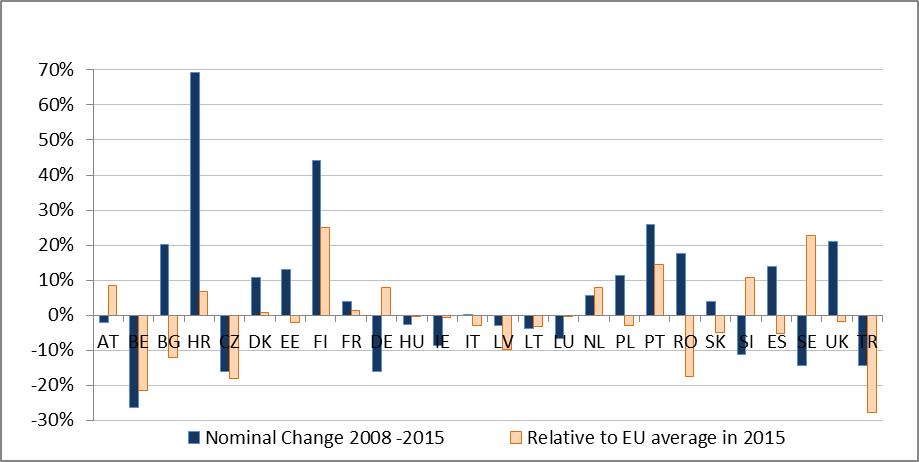


.jpg)