Table of contents
1.Introduction
1.1.
Purpose of the evaluation of the HBERs and Horizontal Guidelines
1.2.
Scope of the evaluation of the HBERs and the Horizontal Guidelines
2.Background to the intervention
2.1.
Overview of the competition policy framework
2.2.
Description of the intervention
2.2.1.
The R&D BER
2.2.2.
The Specialisation BER
2.2.3.
The Horizontal Guidelines
2.3.
Intervention logic and objectives
2.3.1.
General objective
2.3.2.
Specific objectives
2.4.
Evaluation baseline
3.Implementation / state of play
3.1.
Description of the current situation
3.1.1.
Incidence of horizontal cooperation agreements
3.1.2.
Use of the HBERs and Horizontal Guidelines
3.1.3.
Major trends and developments since 2011
3.2.
The Commission’s enforcement action regarding horizontal cooperation agreements
3.3.
The NCAs’ enforcement and policy action regarding horizontal cooperation agreements
3.3.1.
Enforcement practice by the NCAs
3.3.2.
National guidelines by the NCAs
4.Methodology
4.1.
Data gathering, methodology and analysis
4.2.
Additional evidence gathered through other Commission initiatives
4.3.
Processing and triangulating of the evidence collected
4.4.
Limitations of the analysis
4.4.1.
Evidence on HBERs related costs and benefits
4.4.2.
Representativeness of stakeholder feedback
4.4.3.
Limited evidence about consumer views
5.Analysis and answers to the evaluation questions
5.1.
Effectiveness
5.1.1.
The evaluation questions
5.1.2.
The main findings regarding the effectiveness of the intervention
5.2.
Efficiency
5.2.1.
The evaluation questions
5.2.2.
The main findings regarding the efficiency of the intervention
5.3.
Relevance
5.3.1.
The evaluation questions
5.3.2.
The main findings regarding the relevance of the intervention
5.4.
Coherence
5.4.1.
The evaluation questions
5.4.2.
The main findings regarding the coherence of the intervention
5.5.
EU added value
5.5.1.
The evaluation question
5.5.2.
The main findings regarding the EU added value of the intervention
6.Conclusions
Annex 1: Procedural information
Annex 2: Stakeholder consultation
Annex 3: Methods and analytical models
Annex 4: Overview of issues identified during the evaluation process
1.Introduction
Article 101(1) of the Treaty on the Functioning of the European Union (‘the Treaty’) prohibits agreements between undertakings that restrict competition, unless they contribute to improving the production or distribution of goods or to promoting technical or economic progress, while allowing consumers a fair share of the resulting benefits, in accordance with Article 101(3) of the Treaty.
Horizontal cooperation agreements are agreements entered into between companies operating at the same level in the market. Horizontal cooperation relates in most cases to cooperation between actual or potential competitors in areas such as R&D, production, purchasing, commercialisation or standardisation. It can also involve information exchange, either as a self-standing agreement or in the context of another type of horizontal cooperation agreement.
Horizontal cooperation agreements may give rise to substantial efficiencies, in particular if the companies involved combine complementary activities, skills or assets. For example, a standardisation agreement on an interoperability standard may limit competition between technologies but might also enable the creation of a new market and reduce the lead-time for an innovative product to reach the consumer. An R&D agreement may lead to fewer companies carrying out research in, for example, a particular type of medicine. It might however also lead to efficiencies where the combination of efforts leads to a quicker and better solution for the identified problem or enable a more costly or risky project than a party would have carried out on its own.
Horizontal cooperation agreements can however also lead to serious competition problems, in particular where they increase the market power of the parties to an extent that enables them to increase prices, limit output or variety or reduce innovation efforts.
Cartels are never efficiency enhancing and are therefore always illegal. They are not covered by the block exemption regulations and guidelines which are the subject of this evaluation.
Under Regulation (EEC) 2821/71
(‘Empowerment Regulation of 1971’), the Commission is empowered by the Council to adopt block exemption regulations, which define certain categories of agreements that generally fulfil the conditions of exemption under Article 101(3) of the Treaty.
On this basis, the Commission has adopted two block exemption regulations concerning horizontal cooperation agreements that are currently still in force: Commission Regulation (EU) No 1217/2010 of 14 December 2010 on the application of Article 101(3) of the Treaty on the Functioning of the European Union to certain categories of research and development agreements (‘R&D BER’) and Commission Regulation (EU) No 1218/2010 of 14 December 2010 on the application of Article 101(3) of the Treaty on the Functioning of the European Union to certain categories of specialisation agreements (‘Specialisation BER’). These two block exemption regulations will be referred to together as the ‘Horizontal Block Exemption Regulations’ or the ‘HBERs’.
The purpose of the HBERs is to define those categories of horizontal cooperation agreements for which it can be assumed with sufficient certainty that they fulfil the conditions of Article 101(3) of the Treaty and to exempt those from the prohibition contained in Article 101(1) of the Treaty.
The HBERs entered into force on 1 January 2011 and will expire on 31 December 2022.
The HBERs are accompanied by guidelines on the applicability of Article 101 of the Treaty on the Functioning of the European Union to horizontal cooperation agreements (‘Horizontal Guidelines’). The Horizontal Guidelines provide guidance on the assessment of different types of horizontal cooperation agreements under the HBERs and also more generally under Article 101(1) and Article 101(3) of the Treaty. Horizontal cooperation agreements which do not qualify for an exemption under the HBERs may nonetheless satisfy the conditions of the exemption provided by Article 101(3) of the Treaty. The Horizontal Guidelines are without prejudice to the case law of the Union courts concerning the application of Article 101 of the Treaty to horizontal cooperation agreements.
The following sections set out the purpose of the evaluation (see section 1.1 below), as well as its substantive and geographic scope (see section 1.2 below).
1.1.Purpose of the evaluation of the HBERs and Horizontal Guidelines
The purpose of the evaluation is to gather evidence on the functioning of the HBERs, together with the Horizontal Guidelines, which will serve as a basis for the Commission to decide whether it should let the HBERs and Horizontal Guidelines lapse, renew or revise them.
As required by the Commission’s Better Regulation Guidelines, the evaluation examines whether the objectives of the HBERs and the Horizontal Guidelines were met during the period of their application (effectiveness) and continue to be appropriate (relevance) and whether the HBERs and the Horizontal Guidelines, taking account of the costs and benefits associated with their application, were efficient in achieving their objectives (efficiency). It also considers whether the HBERs and the Horizontal Guidelines, as legislation at Union level, provided added value (EU added value) and are consistent with other Commission documents providing guidance on the application of Article 101 of the Treaty and related legislation with relevance for horizontal cooperation agreements (coherence).
The impact of the COVID-19 outbreak is not dealt with extensively in this Staff Working Document, given that these developments are very recent and the evidence gathered in the evaluation largely preceded the outbreak.
This Staff Working Document reflects the findings and views of the Commission’s staff. It does not prejudge the final nature or content of any act or acts that may be prepared by the Commission as a follow-up to this evaluation.
1.2.Scope of the evaluation of the HBERs and the Horizontal Guidelines
The substantive scope of the evaluation includes the HBERs and the Horizontal Guidelines, in their entirety. Insofar as the Horizontal Guidelines refer to the provisions of the HBERs and inform their application and interpretation, the evaluation of the HBERs would not be complete if it did not include the Horizontal Guidelines.
The geographic scope of the evaluation extends to all Member States. Article 101(1) of the Treaty has direct applicability in all Member States by virtue of the case law of the Union courts.
Regulation (EC) No 1/2003 created a system of parallel competences in which the competition authorities and the courts of the Member States, alongside the Commission, have the power to apply not only Article 101(1) of the Treaty, but also Article 101(3) of the Treaty.
When assessing the compatibility of horizontal cooperation agreements that may affect trade between Member States within the meaning of Article 101 of the Treaty, national competition authorities (‘NCAs’) and national courts are bound by the directly applicable provisions of the HBERs. The Horizontal Guidelines, which are binding on the Commission,
do not bind NCAs or national courts, but they typically take them into account when assessing the compatibility of horizontal cooperation agreements with Article 101 of the Treaty.
Against this background, the evaluation of the HBERs and the Horizontal Guidelines includes not only the decisional practice of the Commission but also that of the NCAs, as well as the relevant jurisprudence of national courts.
In view of the Commission’s obligation to informally seek advice from experts of the EFTA States for the elaboration of new legislative proposals,
the Commission has informed the EFTA States of the evaluation of the HBERs and the Horizontal Guidelines in order to provide them with an early opportunity to share their experience in this regard.
2.Background to the intervention
The following sections provide an overview of the EU competition policy framework for horizontal cooperation agreements (see section 2.1 below), a description of the HBERs and the Horizontal Guidelines (see section 2.2 below), a presentation of the intervention logic (see section 2.3 below) and a presentation of the impact assessment baseline for the HBERs and the Horizontal Guidelines (see section 2.4 below).
2.1.Overview of the competition policy framework
The purpose of the EU competition rules enshrined in the Treaty (notably Articles 101 and 102 of the Treaty) and related secondary EU law (such as Commission regulations) and soft law (such as Commission notices and guidelines) is to prevent competition from being distorted to the detriment of consumers, thereby contributing to achieving an integrated single market.
Article 101(1) of the Treaty prohibits agreements between undertakings, decisions by associations of undertakings and concerted practices, which may affect trade between Member States and which have as their object or effect the prevention, restriction or distortion of competition.
As an exception to this rule, Article 101(3) of the Treaty sets out that the prohibition contained in Article 101(1) of the Treaty may be declared inapplicable to agreements that are on balance efficiency-enhancing, provided that such agreements fulfil four cumulative conditions. They have to (i) contribute to improving the production or distribution of goods or to promoting technical or economic progress, (ii) while allowing consumers a fair share of the resulting benefits. Moreover, they (iii) must not impose restrictions that are not indispensable to the attainment of the aforementioned objectives, and (iv) must not afford the undertakings the possibility of eliminating competition in respect of a substantial part of the products concerned.
In light of the above, the assessment of agreements under Article 101 of the Treaty consists of two parts. The first step is to assess (in the context of Article 101(1) of the Treaty) whether an agreement between undertakings, which is capable of affecting trade between Member States, restricts competition. This is the case if it reveals a sufficient degree of harm to competition so that there is no need to examine its actual or potential effects (‘restriction by object’) or, absent such obvious harm to competition, if it results in actual or potential anti-competitive effects (‘restriction by effect’). The second step, which only becomes relevant when an agreement is found to restrict competition pursuant to Article 101(1) of the Treaty, is to determine (in the context of Article 101(3) of the Treaty) the procompetitive benefits produced by the agreement and to assess whether these procompetitive effects outweigh the anti-competitive effects resulting from the agreement.
The creation of a single market required that companies adapt to the conditions of the enlarged market and cooperation between companies was seen as a suitable means of achieving this. The Council thus adopted the Empowerment Regulation of 1971 to enable the Commission to declare by way of regulation that the provisions of Article 101(1) of the Treaty do not apply to certain types of horizontal cooperation agreements. This possibility covers horizontal cooperation agreements which enable companies to work more rationally and adapt their productivity and competitiveness to the enlarged market in order to make it easier for companies to cooperate in ways which are economically desirable and without adverse effect from the point of view of competition policy.
The Commission has made use of this empowerment by adopting various block exemption regulations concerning R&D and specialisation agreements since 1971.
2.2.Description of the intervention
2.2.1.The R&D BER
The R&D BER builds on the provisions of its predecessors, Regulation (EEC) No 418/85 and Regulation (EC) No 2659/2000.
The R&D BER aims at facilitating innovation. The introduction of new processes and products on the market stimulates competition within the single market and helps to strengthen the ability of European industry to compete internationally. Research and development plays an essential role as it promotes and maintains dynamic competition, characterised by initiation and imitation and in doing so assures economic growth.
The R&D BER exempts certain types of R&D agreements and the joint exploitation of their results. It covers R&D carried out jointly as well as ‘paid-for research’ agreements, in which one party finances the R&D activities carried out by the other party.
The exemption provided by the R&D BER applies irrespective of market shares for the duration of the research and development if the parties are not competitors and if they do not jointly exploit the results. If the parties jointly exploit the results, then the exemption applies for seven years from the time the products or technologies are first put on the market. After the seven years, the exemption continues to apply subject to a market share threshold of 25%.
If the parties are competitors at the time the R&D agreement is entered into, the exemption applies for the above-mentioned periods only if the combined market share of the parties to the agreement does not exceed 25% on the relevant product and technology markets.
The R&D BER distinguishes between agreements involving mere joint R&D and those that foresee a combination of joint R&D and joint exploitation by the parties. It clarifies that the joint exploitation of R&D results regarding products (i.e. by way of joint production and/or joint distribution) and regarding technologies (i.e. by way of joint licensing) are treated in the same way.
The R&D BER contains a number of conditions for exemption. All parties must have full access to the final results of the joint or ‘paid-for’ research and development, including any resulting intellectual property rights and know how. The R&D BER foresees certain possibilities in which such access rights can be limited. The R&D BER also contains a disclosure obligation, requiring that the parties to an R&D agreement have to disclose their existing and pending intellectual property rights relevant for the exploitation of the results by the other parties to the R&D agreement. This is intended to ensure that one of the parties cannot unduly impair the exploitation of the results by other parties to the agreement, thereby depriving customers and consumers of the benefits of joint R&D.
The R&D BER contains a list of so-called hardcore restrictions, which sets out provisions which are under not allowed to appear in R&D agreements that want to benefit from exemption. The list includes certain limitations of output or sales, price fixing and certain territorial restrictions.
2.2.2.The Specialisation BER
The Specialisation BER builds on the provisions of its predecessors: Regulation (EEC) No 2779/72; Regulation (EEC) No 3604/82; Regulation (EEC) No 417/85; and Regulation (EC) No. 2658/2000.
The adoption of these regulations is based on the consideration that specialisation agreements generally contribute to improving the production process and that they are particularly suited to strengthen the competitive position of small- and medium-sized firms. The favourable economic effects of specialisation lie in the achievement of economies of scale or, in a wider sense, in rationalization measures which enable firms to cut costs by concentrating operations. Such measures should lead, in conditions of effective competition, to lower prices and thus benefit the consumer.
The Specialisation BER applies to unilateral and reciprocal specialisation agreements and joint production agreements. A unilateral specialisation agreement is a form of outsourcing whereby one party agrees to fully or partially cease manufacturing certain products and to purchase them from another party who agrees to produce and supply them. In a reciprocal specialisation agreement, parties mutually bind themselves to fully or partially cease from producing certain, different, products and to purchase these from another party which in turn takes on the obligation to produce and supply them. In a joint production agreement, two or more parties agree to produce certain products jointly.
The exemption applies in case the combined market share of the parties does not exceed 20% on any of the relevant markets. Where the products concerned by a specialisation or joint production agreement are intermediary products which one or more of the parties use captively for the production of certain downstream products which they also sell, the exemption is also conditional upon the market share downstream not exceeding 20%. Similarly to the R&D BER, the Specialisation BER also contains a list of hard-core restrictions. These refer to price fixing, certain output or sales limitations and the allocation of markets and customers.
2.2.3.The Horizontal Guidelines
The Horizontal Guidelines are to a large extent a continuation of rules provided in the 2000 Horizontal Guidelines. They were, however, updated and adapted in order to address the issues identified during the 2008-2009 review process.
The Horizontal Guidelines complement the R&D and Specialisation BERs by providing guidance on the interpretation of the provisions in the BER and by addressing R&D and specialisation agreements not covered by these regulations as well as information exchange, joint purchasing, commercialisation and standardisation agreements.
The Horizontal Guidelines set out the basic principles for the assessment of such horizontal cooperation agreements under Article 101 of the Treaty. They are intended to provide better guidance to market participants, helping them to self-assess whether or not an agreement restricts competition and, if so, whether it would qualify for an exemption. They further clarify that cooperation has to be assessed in its economic context taking into account both the nature of the agreement and the parties’ combined market power, which determine — together with other structural factors — the capability of the horizontal cooperation to reduce overall competition to a significant extent.
The Horizontal Guidelines explain that there are some instances where the nature of the cooperation indicates from the outset that it is caught by Article 101(1) of the Treaty. This concerns primarily agreements that restrict competition by means of price fixing, output limitation or sharing of markets, customers or sources of supply (hardcore restrictions).
On the other hand, the Horizontal Guidelines provide that there are also some horizontal cooperation agreements regarding which it can be said from the outset that Article 101(1) of the Treaty does not generally apply. These include agreements between non-competitors, agreements between competing companies that cannot independently carry out the project or activity covered by the cooperation, or cooperation concerning an activity which does not influence the relevant parameters of competition. These horizontal cooperation agreements would normally only come under Article 101(1) of the Treaty if they involve firms with significant market power and are likely to cause foreclosure problems vis-à-vis third parties.
All other agreements need to be examined in the light of each of the two criteria (nature of the agreement and market power and market structure) in order to decide whether they fall under Article 101(1) of the Treaty.
In the absence of hardcore restrictions and below a certain level of market power, defined in terms of market share, the Horizontal Guidelines provide so called ‘safe harbours’ for purchasing agreements and commercialisation agreements. Similar to coverage by a block exemption regulation, once inside these safe harbours, economic operators do not normally have to assess the impact of their agreements on the market.
In the case of purchasing agreements, while recognising that there is no absolute threshold which indicates that buying cooperation creates some degree of market power and thus falls under Article 101(1) of the Treaty, the Horizontal Guidelines provide that in most cases it is unlikely that such market power exists if the parties to the agreement have a combined market share of less than 15% on the purchasing market(s) as well as a combined market share of less than 15% on the selling market(s). Where an agreement below these market share thresholds falls under Article 101(1) of the Treaty, the Horizontal Guidelines state that it is likely to fulfil the conditions of Article 101(3) of the Treaty.
In the case of commercialisation agreements which do not involve the fixing of prices, the Horizontal Guidelines provide that, in most cases, it is unlikely that a sufficient degree of market power exists if the parties to the agreement have a combined market share of less than 15%. Where an agreement below this level of market share falls under Article 101(1) of the Treaty, the Horizontal Guidelines state that it is likely to fulfil the conditions of Article 101(3) of the Treaty.
Concerning the chapter on standardisation agreements, the Horizontal Guidelines aim at ensuring that standards are set in such a way that the specific benefits of standard-setting are realised and passed on to European consumers and businesses. At the same time, the Horizontal Guidelines aim to avoid possible negative effects, such as reduced price competition, foreclosure of innovative technologies and exclusion or discrimination resulting from preventing effective access to a standard. The standardisation chapter gives guidance on how to ensure that the process of selecting industry standards is competitive and that, once the standard is adopted, access is given on fair, reasonable and non-discriminatory (‘FRAND’) terms to interested users. To this end, the standardisation chapter sets out the criteria under which standardisation agreements would normally fall outside the prohibition of Article 101 of the Treaty (‘safe harbour’). Moreover, the chapter gives detailed guidance on standardisation agreements that do not fulfil the safe harbour criteria and clarifies that there is no presumption of illegality outside the safe harbour. The chapter also clarifies that standard-setting organisations can use unilateral disclosure provisions to ensure that the organisation and the industry would have an informed choice not only on quality but also on price when selecting which technology should be included in the standard. The chapter further contains guidance and examples on standard terms.
With regard to information exchange, the Horizontal Guidelines give guidance on how to assess the compatibility of information exchanges with EU competition law. The chapter on information exchange contains a set of principles and criteria to assess whether an information exchange is likely to be considered as having as its object a restriction of competition (e.g. when it concerns individualised information on intended future prices or quantities). It also provides guidance for the assessment of the restrictive effects and efficiencies of information exchanges that do not aim at restricting competition (e.g. for statistical or benchmarking purposes).
The Horizontal Guidelines do not contain a separate chapter on environmental agreements which was still present in the 2000 Horizontal Guidelines. According to the 2008-2009 review process, standard-setting in the environment sector – which is what the chapter dealt with – was more appropriately dealt with in the standardisation chapter. Other aspects of environmental agreements are to be assessed under the relevant chapters of the Horizontal Guidelines, be it on R&D, production or commercialisation agreements.
2.3. Intervention logic and objectives
As explained in section 1.2 above, this evaluation looks at the functioning of the R&D and Specialisation BERs, together with the Horizontal Guidelines, as a whole. Therefore, the intervention logic (summarised in Figure 1 below) refers to the R&D and Specialisation BERs in their entirety, together with the Horizontal Guidelines (i.e. the intervention), and not only to the specific provisions that were changed when the revised framework was introduced in 2010.
2.3.1.General objective
The general objective of the intervention is to make it easier for companies to cooperate in ways which are economically desirable and without adverse effects from the point of view of competition policy.
2.3.2.Specific objectives
The intervention also has specific objectives, which are to ensure an effective protection of competition and to provide adequate legal certainty for companies. Finally, the intervention aims at simplifying administrative supervision by providing a framework for the Commission, NCAs and national courts for the assessment of horizontal cooperation agreements.
The objectives of the R&D and Specialisation BERs, together with the Horizontal Guidelines, are better understood in the context of the wider legal framework for applying Article 101 of the Treaty.
Regulation (EC) No 1/2003 abolished the notification of agreements to the Commission as established by the previous Council Regulation (EEC) No 17/62.
Companies therefore can no longer notify their agreements to the Commission in order to benefit from immunity from fines. They have to self-assess the compliance of their agreements with Article 101 of the Treaty. In order to do this, companies can rely on the existing case law of the Union courts, as well as on the enforcement practice of the Commission and the NCAs. However, the assessments in such judgments and decisions are case-specific and cannot always be directly applied to other markets and different practices. Consequently, irrespective of their precedent value, they provide a limited degree of legal certainty to businesses. In the absence of broader guidance drafted in more general terms, self-assessing agreements can create a significant burden, especially for SMEs, which may lack the necessary resources and/or legal expertise. There was therefore a need to provide greater legal certainty and more guidance for companies that enter into horizontal cooperation agreements to assist them with their self-assessment. This was also in line with Article 103(2)(b) of the Treaty, which provides that the Council, in laying down rules for the application of Article 101(3) of the Treaty, should aim to simplify administration to the greatest possible extent.
Regulation (EC) No 1/2003 also decentralised the application of Article 101(3) of the Treaty by empowering NCAs and national courts, alongside the Commission, to apply Article 101(3) of the Treaty, which in the past was a prerogative of the Commission only. This decentralised enforcement system created a need to provide a common framework of assessment for the NCAs (and national courts), in order to foster a consistent application of Article 101 and ensure that companies operating across the EU could benefit from a level playing field.
Figure 1 – Intervention logic for the HBERs and the Horizontal Guidelines
2.4.Evaluation baseline
As explained in Section 2, the HBERs and the Horizontal Guidelines were preceded by a number of earlier versions of HBERs and Horizontal Guidelines. For the past 20 years, stakeholders have therefore been able to rely on Commission guidance in the self-assessment of their horizontal cooperation agreements. The Commission services consider that a situation without any form of guidance assisting companies in their self-assessment is not a sound, or desired, policy option. As main point of comparison for the evaluation, the Commission services have therefore taken the hypothetical situation of not having the R&D and Specialisation BERs in place, but only the Horizontal Guidelines. As the Horizontal Guidelines contain both interpretations of the provisions in the HBERs and self-standing guidance, the hypothetical situation would concern Horizontal Guidelines without reference to the HBERs but with the current market share thresholds – where these are now also provided – and the self-standing guidance. The evaluation thus looks at the functioning of the R&D and Specialisation BERs as compared to a situation in which the assessment of whether horizontal cooperation agreements comply with Article 101 of the Treaty would have to be done only in light of the Horizontal Guidelines and other Commission guidance, relevant case law at EU and national level, as well as the enforcement practice of the Commission and the NCAs.
For the efficiency analysis, the evaluation in addition compares the current situation with the situation before the intervention (i.e. when the 2000 R&D and Specialisation BERs and the 2000 Horizontal Guidelines were in place). This allowed stakeholders to determine whether the current rules have increased their costs or resulted in added benefits in comparison to the previous situation.
3.Implementation / state of play
3.1.Description of the current situation
The HBERs and the Horizontal Guidelines are measures assisting in the enforcement of and compliance with Article 101 of the Treaty. The intervention forms a common framework of assessment of horizontal cooperation agreements for companies, the Commission, NCAs and national courts, in order to ensure that companies operating across the EU could benefit from a level playing field.
3.1.1.Incidence of horizontal cooperation agreements
The incidence of horizontal cooperation agreements in the last ten years was assessed based on the evidence gathered during the evaluation. The most relevant findings derived from a public consultation with stakeholders and the evaluation support study prepared by an external consultancy group.
20 out of the 77 respondents to the public consultation indicated that they have been involved in horizontal cooperation agreements since the introduction in 2010 of the R&D and Specialisation BERs and in 2011 of the Horizontal Guidelines. By order of importance, these horizontal cooperation agreements concerned R&D and standardisation cooperation agreements, information sharing, purchasing agreements, commercialisation agreements, production/specialisation agreements, or other types of horizontal cooperation.
The evaluation support study also asked a panel of mostly small- and medium-sized enterprises (‘SMEs’) about the incidence of horizontal cooperation agreements, and this resulted in similar responses:
Table 1 – Summary of interviews by type of agreement and country
|
Type of agreement
|
Austria
|
France
|
Italy
|
Poland
|
Slovakia
|
Sweden
|
Grand Total
|
|
Research and development agreements
|
13
|
11
|
11
|
14
|
7
|
11
|
67
|
|
Production/specialisation agreements (any form of joint production cooperation)
|
12
|
11
|
15
|
11
|
10
|
11
|
70
|
|
Information exchange practices
|
13
|
12
|
18
|
10
|
5
|
15
|
73
|
|
Commercialisation agreements (cooperation in the selling, distribution or promotion of products)
|
12
|
14
|
14
|
13
|
5
|
10
|
68
|
|
Standardisation agreements (agreements aimed at developing technical standards in the industry)
|
6
|
10
|
9
|
9
|
3
|
8
|
45
|
|
Joint purchasing agreements
|
9
|
10
|
7
|
13
|
15
|
10
|
64
|
|
Agreements concerning environmental aspects or other sustainability goals
|
8
|
10
|
10
|
9
|
6
|
9
|
52
|
|
Others
|
5
|
6
|
7
|
10
|
6
|
5
|
39
|
|
Grand Total
|
78
|
84
|
94
|
89
|
57
|
80
|
482
|
Source: Evaluation support study, Table 2.
The evaluation support study also examined the type of agreements reported by industry:
Table 2 – Types of agreements by industry
|
Industry
|
R&D
|
Specialisation
|
Commercialisation
|
Information exchange
|
Joint Purchasing
|
Standardisation
|
Sustainability
|
Others, non-covered
|
|
Accommodation and food service activities
|
0
|
0
|
3
|
3
|
1
|
5
|
3
|
1
|
|
Agriculture
|
7
|
18
|
9
|
5
|
4
|
5
|
11
|
2
|
|
Arts, entertainment and recreation
|
0
|
0
|
2
|
2
|
3
|
0
|
0
|
2
|
|
Clothing, apparel & footwear
|
2
|
5
|
9
|
13
|
9
|
1
|
6
|
3
|
|
Construction
|
3
|
8
|
1
|
4
|
3
|
4
|
5
|
2
|
|
Consumer electronics
|
1
|
4
|
8
|
4
|
3
|
2
|
2
|
1
|
|
Energy
|
10
|
5
|
3
|
4
|
0
|
4
|
8
|
5
|
|
Financial and insurance activities
|
1
|
0
|
1
|
0
|
0
|
0
|
0
|
0
|
|
Food and beverage
|
3
|
2
|
4
|
5
|
14
|
3
|
3
|
2
|
|
Furniture
|
0
|
3
|
7
|
4
|
2
|
2
|
2
|
1
|
|
Household appliance
|
3
|
7
|
8
|
0
|
9
|
5
|
2
|
4
|
|
Human health
|
10
|
3
|
0
|
4
|
3
|
1
|
1
|
0
|
|
Information and communication
|
5
|
0
|
4
|
4
|
1
|
1
|
2
|
0
|
|
Pharmaceutical
|
11
|
5
|
1
|
4
|
4
|
1
|
3
|
3
|
|
Professional and technical activities
|
3
|
2
|
1
|
4
|
4
|
4
|
0
|
5
|
|
Real estate activities
|
0
|
0
|
0
|
5
|
3
|
2
|
0
|
0
|
|
Telecommunications
|
1
|
2
|
0
|
2
|
0
|
0
|
2
|
1
|
|
Transportation and storage
|
0
|
0
|
4
|
4
|
0
|
5
|
2
|
3
|
|
Other industry, please specify
|
7
|
6
|
3
|
2
|
1
|
0
|
0
|
4
|
|
Grand Total
|
67
|
70
|
68
|
73
|
64
|
45
|
52
|
39
|
Source: Evaluation support study, Table 7.
3.1.2.Use of the HBERs and Horizontal Guidelines
The Commission services asked respondents to the public consultation whether they consulted the rules. Out of the 77 respondents to the public consultation, the majority indicated that they consult the HBERs occasionally (once or twice a year). A slightly smaller group consult the HBERs more frequently, while there is also a sizeable group that never consults these instruments. The numbers for the Horizontal Guidelines are different as more than half of the respondents frequently consult the text for guidance (see
Table 3
).
Table 3 – How often respondents consult the different texts for guidance

Source: Factual summary of the open public consultation, p. 5 (Figure 4).
The evaluation support study also asked the question whether companies consult the HBERs and Horizontal Guidelines in practice. Among the respondents of the study that were party to an R&D, a specialisation or another type of horizontal cooperation agreement, only a limited number indicated that they had occasionally (once or twice a year) or frequently (several times per year) consulted the HBERs or the Horizontal Guidelines for guidance on the establishment and implementation of their horizontal cooperation agreements. This is likely due to the fact that the evaluation support study focused on obtaining the views of SMEs.
With regard to the use of the HBERs and the Horizontal Guidelines by NCAs, several NCAs indicated that they did not yet have to apply the HBERs in practice, as they were not involved in investigations of R&D or specialisation agreements. However, most of the NCAs had applied the Horizontal Guidelines in their investigations. In addition, some NCAs have issued national guidelines on horizontal cooperation agreements that to a certain extent complement and/or further clarify the Commission’s Horizontal Guidelines.
3.1.3.Major trends and developments since 2011
The Commission services gathered evidence on major trends and developments from several sources directly related to horizontal cooperation agreements (see section 4.1 below) as well as from other Commission’s initiatives (see section 4.2 below).
The stakeholders, which consist notably of companies, business associations, law firms and the NCAs, identified two major developments that present a challenge in the application and interpretation of the HBERs and the Horizontal Guidelines: (i) the digitisation of the economy, and (ii) the need to ensure sustainable development.
The digitisation of the economy and the increasing dependence on big data. Digitisation has fundamentally altered the way data is generated, stored, processed, exchanged and distributed. In combination with the internet, digitisation has led to the emergence of new cooperation possibilities and business models. Developments in artificial intelligence further create additional possibilities for new forms of innovation and societal and economic opportunities. Platforms and their ecosystems, typically active in various business areas, have taken up an important role between traditional suppliers and customers while at the same time manufacturers also exert competitive pressure by means of dual distribution models. The competitiveness of firms increasingly depends on their ability to access data.
The topic of sustainability was raised by many respondents to the public consultation and the NCA consultation as a significant development over the last 10 years. The European Green Deal appears to have given a new impetus to companies to pursue sustainability initiatives. Many respondents however consider that for such initiatives to succeed, it is important for companies to be able to cooperate. They also consider that it is of equal importance to have clarity on when such cooperation is compatible with EU competition rules and when it is not.
Besides these two major trends, stakeholders also identified several other market developments that, to a lesser extent, present a challenge in the application and interpretation of the HBERs and the Horizontal Guidelines. Below is an overview of the developments mentioned most in the context of this evaluation.
Globalisation was raised by respondents to the public consultation as a development that places increased competitive pressure on notably retailers and wholesalers. Global trade has strongly developed, despite the emergence of a certain degree of protectionism at international level. Trade in services and data flows are and will remain crucial in the years to come. Over the medium to long term, intensification of trade either in terms of goods or services will benefit the world economy by spurring global efficiency, knowledge transfers, and innovation. However, this will also bring additional pressure to EU companies to become and/or remain competitive at domestic, EU and international level.
Market concentration. Nowadays, many markets are supplied by a limited number of companies. Several stakeholders in the public consultation considered further concentration of the market a major development over the last ten years. In particular, respondents pointed to the creation of (grocery) retail alliances.
Standard essential patents. Several respondents to the public consultation also mentioned issues relating to standardisation based on patent-protected technologies as a significant development. They reported that more and more industries have begun to employ standardised technologies, ranging from smart manufacturing, grids and cities and other Internet of Things applications. Organisations engaged in standard setting or standard development have developed rules and practices to ensure the licensing of patents that are essential for their standards (‘standard essential patents’ or ‘SEPs’) on FRAND terms. The increased use of SEPs has created opportunities and challenges for those companies relying on standards. A smooth licensing environment is essential to the success of a standard, resulting in a variety of new market players and cooperation models (e.g. in relation to wireless communication technologies).
Competition law enforcement. Some respondents mentioned that competition law enforcement over the last ten years has increased, resulting in more infringement decisions and higher fines. The Commission’s 2019 Annual Report on Competition indicates that in 2018 and 2019 there has been a significant increase in the number of antitrust cases.
The review of the HBERs and the Horizontal Guidelines will take these reported developments into account as well as the experience acquired by the Commission and the NCAs in the assessment of horizontal cooperation agreements.
3.2.The Commission’s enforcement action regarding horizontal cooperation agreements
With regard to the Commission’s enforcement practice since 2009, the Commission has adopted a few decisions of which the centre of gravity was a horizontal cooperation agreement.
In 2010, with the Oneworld decision, the Commission closed its investigation of horizontal cooperation agreements between three airlines subject to a series of commitments. The commitments offered by British Airways, American Airlines and Iberia were made binding upon them for a period of ten years from the date of adoption of the decision. The case concerned horizontal cooperation agreements establishing a revenue-sharing joint venture covering all passenger air transport services on their transatlantic routes between Europe and North America. The agreements provided for extensive cooperation, which included pricing, capacity and scheduling coordination, as well as revenue sharing.
The Commission raised preliminary competition concerns regarding six transatlantic routes. On these routes, the parties’ position was particularly strong and there were high barriers to entry or expansion. The agreements could eliminate competition between the parties, which the competitors would not be able to replicate on the routes of concern, and could restrict third parties’ access to connecting traffic, which was of key importance for operations on the transatlantic routes.
The parties offered commitments to address the Commission’s preliminary competition concerns. These commitments include making slots available for competitors at certain airports, concluding special prorate agreements with competitors on the transatlantic routes of concern (e.g. obtain favourable terms from the parties to carry connecting passengers on flights), and regular reporting obligations to the Commission, among other conditions and obligations.
A similar approach was taken by the Commission in 2013 regarding a horizontal cooperation agreement between Air Canada, United Airlines and Lufthansa through which the parties established a revenue-sharing joint venture. The parties addressed the preliminary concerns raised by the Commission through a series of commitments made binding upon the parties for a period of ten years from the date of adoption of the decision.
In the Refrigerants case, the Commission issued a Statement of Objections in 2014 addressed to Honeywell and DuPont regarding their horizontal cooperation agreements of 2010 relating to production arrangements and the development of production processes concerning a new refrigerator for use in car air conditioning systems.
In 2006, the EU adopted new standards on air conditioning systems in motor vehicles with the aim of reducing harmful emissions and combating global warming. R-1234yf was the only commercially available refrigerant with a sufficiently low global warming potential (GWP) to comply with the new EU standards. Honeywell and DuPont were the only two suppliers of R-1234yf to carmakers. The Commission was concerned that these cooperation agreements between Honeywell and DuPont could hinder competition on the market for R-1234yf.
However, in 2017, the Commission closed these proceedings after careful assessment of the evidence and responses from both defendants and interested third parties.
3.3.The NCAs’ enforcement and policy action regarding horizontal cooperation agreements
3.3.1.Enforcement practice by the NCAs
The enforcement practice of the NCAs since 2009 regarding horizontal cooperation agreements is described in an external evaluation support study (or ‘evaluation study’) commissioned by Commission services and carried out by an independent contractor. The evaluation study was published in May 2021.
Between 1 January 2011 and 31 March 2020, NCAs were active enforcers in the area of horizontal cooperation agreements with a total of 202 reported cases from which 126 were considered relevant for the purpose of the evaluation. Out of these 126 cases, 25 led to a prohibition decision and 20 to a commitment decision by the responsible NCA. The reported reasons for not pursuing the remaining cases were mainly a lack of evidence and the fact that the parties to the agreement had already changed its contents before any final decision by the NCA. The reported cases also include agreements the NCAs looked into informally, without launching formal proceedings.
The reported cases can cover several types of horizontal cooperation agreements, if the parties agreed on multiple forms of horizontal cooperation within the same agreement. Therefore, the 126 cases by NCAs involved 174 horizontal cooperation agreements, as 39 cases dealt with more than one type of horizontal cooperation agreement.
Table 4
provides an overview of the different types of horizontal cooperation agreements subject to scrutiny by NCAs of the Member States, Norway and the UK. NCAs from 11 countries did not report any relevant cases for the relevant time period and are therefore not included in the table.
The most common type of horizontal cooperation agreement subject to NCA investigations were commercialisation agreements (i.e. 50 out of 174 investigated agreements), followed by information exchange agreements (36) and specialisation/production agreements (31). Least common were R&D agreements and agreements labelled as environmental/sustainability agreements, with six and five occurrences respectively (see
Table
4
).
Table 4 – Horizontal cooperation agreements by Member State and type of agreement
|
Country
|
Number of NCA investigations
|
Number of horizontal cooperation agreements
|
|
|
|
R&D agreements
|
Specialisation / production agreements
|
Information exchange agreements
|
Purchasing agreements
|
Commercialisation agreements
|
Standardisation agreements
|
Environmental / sustainability agreements
|
Others, non-covered
|
Total number of agreements
|
|
BG
|
2
|
|
1
|
|
1
|
|
|
|
|
2
|
|
DE
|
40
|
4
|
11
|
10
|
9
|
18
|
2
|
2
|
2
|
58
|
|
DK
|
18
|
|
2
|
4
|
5
|
8
|
5
|
|
1
|
25
|
|
EL
|
3
|
|
1
|
|
|
2
|
|
|
|
3
|
|
ES
|
8
|
|
1
|
2
|
2
|
4
|
1
|
|
|
10
|
|
FI
|
5
|
|
3
|
|
|
3
|
|
|
|
6
|
|
FR
|
4
|
|
|
3
|
|
|
1
|
|
|
4
|
|
HU
|
1
|
|
|
1
|
|
|
|
|
|
1
|
|
IT
|
6
|
1
|
3
|
1
|
1
|
4
|
|
|
1
|
11
|
|
LT
|
1
|
|
|
|
1
|
|
|
|
|
1
|
|
LV
|
2
|
|
|
|
|
2
|
|
|
|
2
|
|
NL
|
12
|
|
4
|
3
|
3
|
2
|
1
|
1
|
|
14
|
|
NO
|
3
|
|
|
2
|
1
|
|
|
|
2
|
5
|
|
PT
|
1
|
|
|
|
1
|
|
|
|
|
1
|
|
RO
|
1
|
|
|
|
|
1
|
|
|
|
1
|
|
SE
|
14
|
1
|
5
|
7
|
|
5
|
3
|
2
|
1
|
24
|
|
SI
|
1
|
|
|
|
|
|
|
|
1
|
1
|
|
UK
|
4
|
|
|
3
|
|
1
|
1
|
|
|
5
|
|
Total
|
126
|
6
|
33
|
36
|
24
|
50
|
12
|
5
|
8
|
174
|
Source: Evaluation support study, Table 12.
The reported cases concerning horizontal cooperation agreements span across different economic sectors. Many NCA cases involved the construction sector (31), the arts, entertainment and recreation sector (23), the financial and insurance activities sector (21) and the information and communication sector (18). However, there is no typical type of horizontal cooperation agreement for a specific economic sector.
Table 5
provides an overview of the outcome of the NCA investigations. Most investigations of the NCAs did not result in a negative decision. The cases concerning specialisation, joint purchasing and standardisation agreements were often closed without a negative decision. NCAs used more frequently prohibition or commitment decisions in cases concerning commercialisation and information exchange agreements.
Table 5 – Horizontal cooperation agreement investigations by type of outcome
|
Type of agreement
|
Discontinued proceedings
|
Rejection of complaint
|
Prohibition decision
|
Commitment decision
|
Other outcome
|
Total
|
|
Multiple agreements
|
11
|
5
|
9
|
9
|
5
|
39
|
|
Specialisation agreements
|
4
|
3
|
|
3
|
2
|
12
|
|
Information exchange agreements
|
7
|
1
|
7
|
1
|
5
|
20
|
|
Purchasing agreements
|
4
|
2
|
2
|
|
4
|
12
|
|
Commercialisation agreements
|
10
|
|
4
|
6
|
6
|
26
|
|
Standardisation agreements
|
4
|
2
|
2
|
1
|
1
|
10
|
|
Environmental agreements
|
|
1
|
|
|
3
|
4
|
|
Others, non-covered
|
1
|
|
2
|
|
|
3
|
|
Total
|
41
|
14
|
25
|
20
|
26
|
126
|
Source: Evaluation support study, Table 14.
3.3.2.National guidelines by the NCAs
In addition to enforcement through investigations, 9 NCAs (i.e. BE, BG, DE, DK, LU, LV, NL, NO and UK) have issued competition law guidance with regard to horizontal cooperation agreements during the period concerned. Most of these NCA guidelines are meant to complement the Commission’s Horizontal Guidelines, by providing more detailed information and guidance on specific topics such as, for example, joint bidding agreements (e.g. the Danish
and Norwegian
guidelines), SMEs (e.g. the German
guidelines and the Dutch
guidelines on tariff agreements for self-employed persons in collective labour agreements), and trade associations (e.g. the Belgian
and the Dutch
guidelines).
The guidelines of the Latvian NCA cover one type of agreement that is not mentioned in the Horizontal Guidelines, namely agreements in the field of inland carriage by rail and carriage by road.
The UK authorities adopted guidance on the public transport ticketing schemes block exemption
, guidance on cooperation between competitors on the smart meter roll-out.
Both the Luxembourg and UK
NCA also issued specific guidance in response to COVID-19.
Finally, the Dutch NCA has published draft guidelines on sustainability agreements.
They aim to provide guidance to economic operators concerning the compatibility with competition rules of agreements that seek to achieve environmental goals.
4.Methodology
4.1.Data gathering, methodology and analysis
The Commission services used a wide range of data sources to collect evidence to answer the evaluation questions.
For the purpose of this evaluation, a Roadmap was published on 5 September 2019 for a four-week period. The Commission services received feedback from 13 stakeholders including business associations, companies, an academic/research institution and a non-governmental organisation. Between 6 November 2019 and 12 February 2020, the Commission services carried out a public consultation to gather stakeholders’ views on the functioning of the HBERs, together with the Horizontal Guidelines. The public consultation aimed to gather qualitative and quantitative evidence on all five evaluation criteria (i.e. effectiveness, efficiency, relevance, coherence and EU added value). The Commission services received 77 contributions to the public consultation submitted through the online survey. Among the 77 contributions, there were 3 academic and research institutions, 30 business associations, 25 companies, two non-governmental organisations, one public authority, one EU citizen, one trade union, and 14 others (8 of which were law firms). Eight stakeholders also submitted comments in the context of the public consultation, but not through the Commission’s Better Regulation page. The summary report of the contributions to the public consultation was published on the Better Regulation Portal and the dedicated HBERs review webpage on DG Competition's website on 7 April 2020. The summary report is also part of the synopsis report provided in Annex 2 to the Staff Working Document.
The Commission services also conducted a targeted consultation of NCAs and the competition authorities from the United Kingdom and Norway. This consultation was partly based on the same questionnaire as the one used in the public consultation. The remaining part of the questionnaire aimed at obtaining the experiences from the NCAs in view of the specific objective of the intervention as regards the simplification of administrative procedures by the NCAs and the national courts. The information provided by NCAs contributed to the assessment of all five evaluation criteria. A summary report of the targeted NCA consultation was published on the dedicated HBERs review webpage on DG Competition's website on 20 October 2020. It is also part of the synopsis report provided in Annex 2 to the Staff Working Document.
The Commission services commissioned an external evaluation study in order to carry out an independent evaluation of the functioning of the HBERs, together with the Horizontal Guidelines, with a particular focus on the evaluation criteria of effectiveness, relevance and efficiency.
The purpose of the evaluation study was to gather qualitative and quantitative information on the basis of five tasks:
I.Analysis of cases of NCAs, national court judgments and NCA guidelines;
II.Analysis of incidence of horizontal cooperation;
III.Analysis of cost savings generated by the HBERs and Horizontal Guidelines;
IV.Obtaining the views of consumer organisations; and
V.Further analysis of three specific types of horizontal cooperation agreements, namely joint purchasing agreements, sustainability agreements and information exchange.
In order to fulfil these tasks, the contractor performed desk research, computer assisted telephone interviewing (CATI) and in-depth follow-up interviews with a representative sample of stakeholders from six different Member States. As a result, the evaluation study comprises (i) responses from 300 individual companies (mainly SMEs but also some large companies (4%)) obtained through the CATI program, (ii) 67 in-depth semi-structured interviews of businesses, trade associations and law firms, and (iii) 6 interviews with consumer organisations. It also included the analysis of six case studies and 202 NCAs and court cases.
The final report of the evaluation study was published on the dedicated HBERs review webpage on DG Competition’s website in May 2021.
In the course of the evaluation, the Commission services received several spontaneous submissions from stakeholders who had either not participated in the public consultation or wanted to supplement their contribution to the public consultation with additional evidence. All such submissions were published on the dedicated HBERs review webpage on DG Competition's website,
except for a few where stakeholders had asked the Commission services not to publish for confidentiality reasons.
Due to the applicable restrictions caused by the COVID-19 pandemic, a stakeholder workshop that was scheduled to take place in June 2020 had to be cancelled.
4.2. Additional evidence gathered through other Commission initiatives
The Commission services have gathered additional evidence relevant to the review of the HBERs, together with the Horizontal Guidelines, through several initiatives, namely: (i) the review of the Vertical Block Exemption Regulation (‘VBER’) and the Guidelines on Vertical Restraints (‘Vertical Guidelines’), (ii) the Special Advisers’ report on competition policy for the digital era (the ‘Special Advisers’ report’), (iii) the 2020 Call for contributions on Competition Policy and the Green Deal, (iv) the Joint Research Centre (‘JRC’) Report on Retail Alliances in the Supply Chain (the ‘JRC Report on Retail Alliances’ or ‘JRC Report’), (v) the 2020 EU Survey on Industrial R&D Investment Trends, and (vi) several developments in matters linked to standardisation.
The review of the VBER and the Vertical Guidelines
At the end of 2018, the Commission launched an evaluation assessing the functioning of the VBER and the accompanying Vertical Guidelines in view of their expiry on 31 May 2022.
During this evaluation, the Commission services gathered evidence from various sources, including a public consultation, a targeted NCA consultation, a stakeholder workshop, an evaluation support study, spontaneous stakeholder submissions and evidence gathered through other Commission initiatives.
In the context of the public consultation, some respondents considered that there is a lack of coherence between the VBER and the Vertical Guidelines, on the one hand, and the HBERs and the Horizontal Guidelines, on the other hand, for example concerning the assessment of information exchanges in the context of dual distribution; perceived inconsistencies as regards the definition of potential competitors; and difficulties with identifying the dividing line between the different block exemption regulations.
The Special Advisers’ report on competition policy for the digital era
On 20 May 2019, the Special Advisers’ report on competition policy for the digital era was published. The Executive Vice-President for Competition, Commissioner Margrethe Vestager, had asked them to explore how competition law should evolve to ensure that also in the digital era it continues to benefit consumers.
The Special Advisers’ report addresses data sharing and data pooling arrangements that are relevant for the current review of the HBERs, together with the Horizontal Guidelines. Such arrangements will frequently be procompetitive but can become anti-competitive. Their competition law assessment will necessarily depend, inter alia, on the type of data shared, the precise form of the data sharing arrangement or data pool as well as the market position of the parties concerned.
The Special Advisers’ report provides examples of situations in which data sharing and data pooling arrangements can become anti-competitive, namely: (i) competitors who are denied access (or granted access only on less favourable terms) might be foreclosed from the market; (ii) the data sharing arrangement may amount to an anti-competitive information exchange where it includes competitively sensitive information; (iii) the sharing or pooling of data can discourage competitors from differentiating and improving their own data collection and analytics pipelines; (iv) finally, there may be cases where the granting of access to data on non-FRAND terms may result in an exploitative abuse. The report considers that all these competition concerns remain subject to the efficiency defence under Article 101(3) of the Treaty.
The Special Advisors’ report concludes that the competition issues derived from data sharing and data pooling are a relatively new and under-researched topic in competition law and more legal clarity on the principles guiding the competition law assessment may significantly facilitate and promote data sharing.
The 2020 Call for contributions on Competition Policy and the Green Deal
In October 2020 the Commission launched a consultation on how competition policy can contribute to the attainment of the Green Deal objectives and in February 2021 Executive-Vice President Vestager hosted a public debate on this issue. The Commission will publish a separate report on the learnings from that consultation process. A number of NCAs have also reflected independently on how sustainability objectives can be incorporated in competition law assessment.
The JRC Report on Retail Alliances
On 4 and 5 November 2019, the Commission (DG AGRI and JRC) organised a workshop, in response to a call from the Parliament, on the nature and functioning of retail alliances and their implications for the agricultural and food supply chain. The findings of the workshop, gathering all relevant stakeholders, are presented in the JRC Report on Retail alliances in the agricultural and food supply chain.
The JRC Report advocates a balanced view when considering retail alliances. Due to their diversity in form and activities it is hard to derive general conclusions and a case-by-case assessment is more appropriate. The JRC Report concluded that the current legal framework provides adequate tools to address potential concerns about the practices of retail alliances and to protect both consumers and upstream suppliers. Such tools include competition law, in particular Chapter 5 of the Horizontal Guidelines on purchasing agreements, and legislation on unfair trading practices both at EU and national level. However, given the limited case law and practice regarding the potential harm to upstream suppliers, the JRC Report suggests to give increased attention and orientation for this issue in guidelines by competition authorities.
The 2020 EU Survey on Industrial R&D Investment Trends
On 17 December 2020, the Commission published ‘The 2020 EU Survey on Industrial R&D Investment Trends’. Investment in R&D is one of the recognised keys to fuel the digital and green transitions in Europe. The Survey targeted a self-selecting sample of the top 1000 EU and UK headquartered R&D investors from the 2019 EU R&D Scoreboard and remained open online for 6 months. The Survey provides evidence on the R&D activities of these top EU R&D corporate investors identified for the past 15 years. This is performed via a survey of R&D levels and trends, location strategies, and other activities of these companies, which are responsible for the bulk of private R&D in the Union.
According to the Survey, in the case of large companies, the majority of R&D work is done in-house (75%). Only a quarter of the R&D work is done in collaboration with third parties (17%) or is outsourced (8%). The characteristics of R&D collaboration are illustrated in
Figure 2
(below).
Figure 2 – R&D collaboration characteristics
Source: Survey on EU R&D, p. 19
The Survey on EU R&D concluded that the size of the undertaking is an important determinant for how external R&D is organised. Large companies (i.e. more than 50000 employees) prefer to do R&D in collaboration with third parties, as a way of internalising new knowledge, rather than outsourcing.
More than half of the R&D collaborations analysed in the Survey were vertical in nature, performed with either suppliers (33%) or clients (22%). Specialised R&D firms act as R&D collaborator one third of the time, while competitors are least searched for partners for R&D collaboration (11%).
The Survey also found that for large companies R&D collaborations were almost evenly split between single partners (57%) and consortia (43%), while small companies prefer single partnerships (82% and 18%, respectively). Moreover, companies tend to collaborate with other companies of similar size.
Developments in matters linked to standardisation
Since 2011, a number of different EU and national events address specific standardisation related issues. These concerned in particular the matter of SEPs and include the following:
·The general framework of European standardisation policy which includes Regulation (EU) No 1025/2012 and the announced standardisation strategy;
·The Guidelines on the application of Article 101 of the Treaty on the Functioning of the European Union to technology transfer agreements of 2014;
·The judgment of the Court of Justice of the European Union (‘CJEU’) of 16 July 2015, Huawei v. ZTE;
·The Communication of 2017 entitled ‘Setting out the EU approach to Standard Essential Patents’ the European Commission endorsed by Council Conclusions 6681/18;
·The Commission’s Action Plan on Intellectual Property (‘IP Action Plan’) to support the EU’s recovery and resilience adopted on 25 November 2020;
·Several judgments of national courts.
For the purpose of the evaluation of the HBERs and the Horizontal Guidelines, some relevant aspects are described below.
Concerning SEP licensing, one of the most disputed questions is whether SEP holders are under an obligation to grant FRAND licenses to entities at any level of the value chain requesting such licenses or whether they can select the level in the value chain where they grant FRAND licenses. In some cases, this licensing is horizontal in nature when it involves cross-licensing between companies that compete at the same level of the value chain. In other cases, it is a vertical transaction which is subject to the Technology Transfer Block Exemption Regulation (‘TTBER’). In the ‘Contribution to the Debate on SEPs’ of 2021, the Group of Experts on Licensing and Valuation of Standard Essential Patents (‘SEPs Expert Group’), a Commission Expert Group appointed in 2018, did not take a position on this issue but proposed a number of principles that could guide the licensing of SEPs in the value chain, namely licensing at a single level in a value chain, a requirement of an uniform FRAND royalty and the passing of the FRAND royalty downstream.
The Contribution of the SEPs Expert Group also raises questions, for example for aspects related to patent pools. According to some members of this SEPs Expert Group, transaction costs could be further reduced if implementers were allowed to form groups to jointly negotiate licenses on behalf of their group members. However, those members point out that the mechanism and controls to form and operate these license control groups in compliance with the relevant competition rules would need to be developed.
The IP Action Plan of November 2020 announced that the Commission will further promote transparency and predictability in SEP licensing in the most affected sectors, combined with possible reforms. These may include regulatory proposals if and where needed, aiming to clarify and improve the SEPs framework and offer effective transparency tools.
Finally, competition problems may also arise when the midstream manufacturer is in competition with the SEP holder and, for implementing the license, would have to disclose its customers to this competing SEP holder. This issue has also been discussed for example in the Contribution of the SEPs Expert Group, according to which many, if not all, major SEP holders have Chinese walls between their licensing departments and their commercial departments to prevent such flows of information. Similar problems may also arise when SEP licensing is done at end product level, and the same solutions can be applied.
4.3.Processing and triangulating of the evidence collected
For the purposes of the evaluation of the HBERs and Horizontal Guidelines, evidence from the various sources had to be analysed and triangulated.
The main sources of the evidence used to inform the assessment of each evaluation criterion are listed in the table below. A further breakdown of this table, which includes the evaluation questions for each criterion and a more detailed reference to the sources used, is provided in the evaluation matrix contained in Annex 3 to the Staff Working Document.
|
Sources
|
Public consultation
(including spontaneous submissions)
|
Targeted NCA consultation
|
Evaluation Study
|
Other Commission initiatives
|
|
Criteria
|
|
|
|
|
|
Effectiveness
|
✔
|
✔
|
✔
|
✔
|
|
Efficiency
|
✔
|
✔
|
✔
|
|
|
Relevance
|
✔
|
✔
|
✔
|
✔
|
|
Coherence
|
✔
|
✔
|
|
✔
|
|
EU added value
|
✔
|
✔
|
|
|
In line with the general objective of the HBERs and Horizontal Guidelines, the evidence-gathering carried out by the Commission services focused primarily on the views of other agencies enforcing EU competition law (i.e. NCAs) and companies having to self-assess the compliance of their horizontal cooperation agreements with Article 101 of the Treaty on the functioning of the EU. Through the targeted consultation and some of the tasks of the evaluation study, the Commission services collected the views of NCAs, which were complemented with the Commission’s own experience in this area and additional research performed by the contractor. Through the public consultation and some of the tasks of the evaluation study, the Commission services collected mainly the views of businesses (both large companies and SMEs), business associations and law firms advising companies and associations in this area of law.
For the assessment of each evaluation criterion, the Commission services proceeded as follows:
The assessment started with the results of the public consultation. An in-depth analysis of the feedback resulted in a preliminary but comprehensive understanding of the main issues faced by stakeholders as regards the functioning of the current rules. It allowed the Commission services to establish the issues on which stakeholders held common positions, as well as the issues on which their positions diverged. The assessment of the specific issues raised was done based on (i) the examples and the level of detail provided by stakeholders to support their concerns with concrete evidence, (ii) the variety of different positions and (iii) the extent to which different types or groups of stakeholders shared the same view.
The targeted consultation of the national competition authorities aimed to gather their perspective on the five evaluation criteria. It provided a significant amount of evidence on the experience of the NCAs in applying the HBERs and the Horizontal Guidelines, as well as their views on a number of specific issues with the current rules.
The evidence of the public consultation was compared to and contrasted with the evidence resulting from the targeted consultation of the NCAs. The combination of these sources resulted in a more complete and balanced understanding of the areas where the HBERs, together with the Horizontal Guidelines, have not been functioning well, or not functioning as well as they could.
On this basis, the evaluation study was designed to (i) enrich the list of issues raised by expanding the number of stakeholders interviewed (in particular involving more SMEs and seeking the views of consumer organisations) and (ii) further deepen and/or add a different perspective on issues that were already identified (with the aim of correcting for potential biases that might have been present in the evidence collected previously).
The combined results of the public consultation, the NCA consultation and the evaluation study provided the stakeholders’ perspective on the effectiveness, efficiency, relevance, coherence and EU added value of the HBERs, together with the Horizontal Guidelines.
4.4.Limitations of the analysis
The analysis of the different evaluation criteria, including the methodology applied and the evidence sources used for that purpose, is subject to the following limitations: the difficulty of gathering quantitative evidence on costs and benefits related to the HBERs and the Horizontal Guidelines (see section 4.4.1 below), a certain lack of representativeness of stakeholder feedback (see section 4.4.2 below) and a lack of information about consumer views (see section 4.4.3 below). Each of these sections describes the nature of the limitation and the extent to which it was possible to address it in the evaluation.
4.4.1.Evidence on HBERs related costs and benefits
As regards the evaluation criterion of efficiency, it proved difficult to collect quantitative evidence on the costs of applying the HBERs and the Horizontal Guidelines. This is mainly due to the fact that companies appear to assess the costs they incur to ensure compliance of their business operations with EU competition law at a general level. Businesses therefore do not appear to distinguish between the type of agreement concerned or the instrument relied on for the purposes of their self-assessment (e.g. HBERs or Horizontal Guidelines).
The difficulty of gathering cost-related evidence is reflected in the low response rate of stakeholders to questions in the public consultation aimed at gathering best effort estimates of HBERs related compliance costs. The majority of the stakeholders that replied to the section on efficiency indicated that they did not know whether (i) costs had increased or decreased compared with the previous legislative framework; whether (ii) the cost of ensuring compliance would increase or decrease in the absence of the HBERs if only the Horizontal Guidelines applied, or whether (iii) costs are proportionate to the benefits reported by the HBERs and the Horizontal Guidelines. Nor were the NCAs able in the context of the targeted consultation to quantify the costs that the application of the HBERs, together with the Horizontal Guidelines, created for them.
In the same way, it proved difficult to obtain quantitative evidence on the balance between the benefits and the costs of applying the HBERs and the Horizontal Guidelines. Companies only provided qualitative evidence in reply to the question in the public consultation relating to this issue, which reflects the difficulty to properly estimate this parameter. The same applies to the NCAs.
To overcome this limitation, the study aimed to gather additional evidence about costs and benefits related to the application of the HBERs and the Horizontal Guidelines on the basis of six case studies in the form of interviews. The interviewed respondents were a mix of medium and large sized companies and two business associations. As reported in the study, none of the respondents could provide specific figures concerning the costs in question but all of them provided a qualitative assessment.
The lack of quantitative data in relation to these two issues made it difficult to provide a robust quantitative assessment of the efficiency of the HBERs and the Horizontal Guidelines. The conclusions drawn in section 5.2 below therefore essentially rely on the qualitative evidence provided by stakeholders in response to the public consultation and in the context of the evaluation study.
4.4.2.Representativeness of stakeholder feedback
Evaluation activities subject to voluntary participation, by definition, do not necessarily lead to representative results. While the Commission services received contributions from a large variety of stakeholder groups, some of them accounted for a higher share of responses than others. However, this did not have any meaningful impact on the results of the evaluation since the areas identified by stakeholders as either functioning well or not functioning well did not differ to an appreciable extent within a particular stakeholder group. This means that a more limited participation of some stakeholder groups did not result in a less complete overview of the views of those stakeholder groups on the functioning of the HBERs and Horizontal Guidelines.
Moreover, the evaluation study aimed at reducing any potential bias within each stakeholder group to the detriment of small and medium sized stakeholders who may not have had the resources to participate in the public consultation.
In the assessment set out in section 5.1 below, reference is made to specific stakeholder groups whenever the views reported were held primarily by one or more different stakeholder groups. While indicative of a trend, the fact that a view was broadly shared by all or only some of the stakeholder groups, does not however mean that the evaluation disregards diverging views, both within the same or across different stakeholder groups/sectors. This is also reflected in Annex 4 to this Staff Working Document, which presents the different views and issues raised by stakeholders per type of horizontal cooperation agreement, regardless of whether they were supported by a large or small number of stakeholders. These views will be taken into account in any next steps following the evaluation.
4.4.3.Limited evidence about consumer views
Consumers and consumer associations only made a limited contribution to this evaluation, even though they were specifically addressed in the context of the evaluation study commissioned by the Commission services. There are several reasons for this.
First, the HBERs, together with the Horizontal Guidelines, are a technical piece of legislation, which is primarily aimed at providing guidance to companies self-assessing compliance of their horizontal cooperation agreements with EU competition law. Consumers and consumer associations may therefore be neither aware of their existence, nor familiar with their functioning.
Second, despite having a potential impact on the prices at which consumers buy products and services and the choice of products and services available to them, consumers are neither a party to horizontal cooperation agreements, nor privy to the conditions stipulated in such agreements.
5.Analysis and answers to the evaluation questions
This section presents the assessment of the HBERs, together with the Horizontal Guidelines, based on the five evaluation criteria (effectiveness, efficiency, relevance, coherence and EU added value).
5.1. Effectiveness
5.1.1.The evaluation questions
The general objective of the HBERs, together with the Horizontal Guidelines, is to make it easier for undertakings to cooperate in ways which are economically desirable and without adverse effects from the point of view of competition policy.
The first of the specific objectives of the HBERs and the Horizontal Guidelines is to ensure an effective protection of competition. The second is to provide adequate legal certainty to stakeholders, making it easier for them to perform the self-assessment required under Regulation (EC) No 1/2003. These objectives are closely linked to the general objective. Horizontal cooperation agreements that comply with Article 101 of the Treaty will increase the competitiveness of the European economy while ensuring effective competition for the benefit of European businesses and consumers. Similarly, by providing legal certainty to companies as to what business actions they can undertake without a risk of infringing EU competition law, the Commission reduces the compliance costs of companies that have to do a self-assessment.
Finally, the HBERs, together with the Horizontal Guidelines, also aimed at simplifying administrative supervision by providing a framework for the Commission, NCAs and national courts for the assessment of horizontal cooperation agreements.
As part of the effectiveness analysis, the Commission services have investigated whether the HBERs, together with the Horizontal Guidelines, have met these objectives. For this purpose, the Commission services commissioned an evaluation study and in parallel asked stakeholders in the public consultation and the NCAs first of all whether the intervention has contributed to promoting competition in the EU.
The Commission services further verified in the public consultation whether the stakeholders felt that the HBERs and the Horizontal Guidelines as a whole have provided adequate legal certainty. The assessment of this objective sought to determine whether the rules provide increased legal certainty, as compared to a situation without the HBERs, but also whether there is room for improvement in achieving this objective. It should be kept in mind when assessing this objective that the assessment by stakeholders of the level of legal certainty provided by the HBERs and the Horizontal Guidelines may depend on the difficulties they encounter when applying the rules to their particular field of activity.
Therefore, the assessment of this objective relies not only on the stakeholders’ overall perception of the level of legal certainty achieved by the intervention as a whole, which reflects their views on the usefulness of the exemptions, but also pays particular attention to the specific areas of the intervention for which stakeholders (even if only a few) consider that there is uncertainty. In order to allow the Commission services to perform this more detailed analysis of the replies, the Commission services asked the stakeholders in the public consultation whether individual provisions in the HBERs and specific chapters in the Horizontal Guidelines provided adequate legal certainty. The Commission services also asked the stakeholders in the public consultation whether the intervention provided legal certainty to other types of horizontal cooperation agreements outside those specifically identified in the HBERs and Horizontal Guidelines. The Commission services asked NCAs similar questions in their targeted consultation and this objective also formed part of the evaluation study.
To assess whether the effects observed could be credited to all parts of the intervention, the Commission services asked the stakeholders in the public consultation whether the HBERs and the Horizontal Guidelines increased legal certainty compared with a situation where the HBERs would not exist but only the Horizontal Guidelines applied.
The HBERs set out a number of conditions that R&D and specialisation agreements need to meet in order to benefit from the block exemption. These conditions have been defined with the purpose to give exemption only to those agreements for which it can be assumed with sufficient certainty that they generate efficiencies that outweigh, in line with Article 101(3) of the Treaty, the harm caused by the restriction of competition. The Horizontal Guidelines complement the HBERs providing an analytical framework to assess the most common types of horizontal cooperation agreements, including all forms of R&D and specialisations agreements. The Commission services have therefore asked stakeholders in the public consultation and NCAs whether the HBERs and Horizontal Guidelines have allowed them to correctly identify the horizontal cooperation agreements that are compliant with Article 101 of the Treaty. In order to allow the Commission services to perform a more detailed analysis of the replies, also here the Commission services have asked stakeholders and NCAs whether individual provisions in the HBERs and specific chapters in the Horizontal Guidelines contributed to this purpose.
To measure whether the intervention indeed met the objective of simplifying the application of competition rules by public authorities, the Commission services asked the NCAs whether the R&D and Specialisation BERs simplified their application of competition rules compared to a situation where the HBERs would not exist but only the Horizontal Guidelines applied.
5.1.2.The main findings regarding the effectiveness of the intervention
Overall, the HBERs and the Horizontal Guidelines have made it easier for companies to cooperate in ways which are economically desirable and without adverse effects from the point of view of competition policy.
The intervention promotes competition and offers legal certainty to companies in the conception and implementation of their horizontal cooperation agreements. This applies especially to the HBERs that are directly applicable in the Member States and thereby prevent that NCAs and national courts apply the rules in a divergent manner. Both HBERs offer a safe harbour in the form of a market share threshold which facilitates the self-assessment of horizontal R&D and specialisation agreements. The HBERs recognise the economic efficiencies that certain R&D and specialisation agreements bring and their procompetitive nature. Companies also appreciate the lists of hard core restrictions in the HBERs. As long as companies meet the requirements of the HBERs in their horizontal cooperation agreements, they have the legal certainty that they do not infringe Article 101 of the Treaty. The specific chapters on R&D agreements and production agreements in the Horizontal Guidelines complement the HBERs and assist companies in applying the HBERs’ rules.
The evaluation showed that, in particular, the binding nature of the HBERs provided additional legal certainty compared to a hypothetical situation in which only the Horizontal Guidelines would exist.
The Horizontal Guidelines set out the general analytical framework for the assessment of horizontal cooperation agreements under Article 101 of the Treaty, in line with their objectives. The Horizontal Guidelines thereby offer legal certainty in the self-assessment of a larger number of horizontal cooperation agreements, even beyond those explicitly mentioned in individual chapters. The level of legal certainty that the Horizontal Guidelines provide differs for various types of horizontal cooperation agreements covered by the Horizontal Guidelines.
The HBERs and Horizontal Guidelines also meet their objective as regards the simplification of the administrative supervision. They facilitate and simplify the assessment of horizontal cooperation agreements by the Commission, the NCAs and national courts. Notably the use of definitions, market share thresholds and lists of hard core restrictions assist the NCAs in assessing R&D and specialisation agreements under Article 101 of the Treaty. The Horizontal Guidelines meet this objective because they bring further guidance and clarifications on the assessment and provide practical examples of the analysis of different types of horizontal cooperation agreements. Even though the Horizontal Guidelines are not binding on the Member States, many NCAs use the intervention as a comprehensive framework in their assessment of horizontal cooperation agreements.
The intervention has however not fully lived up to its potential as notably the results from the public consultation and from the evaluation study have identified a number of areas where effectiveness can be improved.
The evaluation indicated that the rules are not always adapted to the developments that have taken place over the last ten years. This applies notably as regards digitisation and sustainability.
The respondents to the public consultation and the evaluation study have also commented that the rules in the HBERs are in general too rigid and complex for some sectors (e.g. non-traditional and/or dynamic sectors) and therefore do not allow horizontal cooperation agreements to reach their full potential. In addition, the evidence indicated that some of the provisions in the HBERs, notably in the R&D BER, are unclear and difficult to interpret, which affects the effectiveness of the intervention.
Some of the evidence, notably that supplied by respondents to the public consultation, points at the fact that the scope of the Specialisation BER is too limited. This is not confirmed by other evidence, notably not by the replies of the NCAs to their targeted consultation, so it is not yet possible to draw conclusions on this point.
The evidence also suggests that certain stakeholders, in particular companies, business associations and law firms, consider that the market share thresholds in the HBERs are too low.
The evidence shows that especially companies and law firms consider market definition and the calculation of market shares complex and burdensome due to the difficulty of gathering the information needed to make such assessments. While the use of market share thresholds in the instruments under evaluation brings legal certainty, the proper definition of the markets can be complex and uncertain in areas subject to rapid technological development.
According to the general outcome of the evaluation, the Horizontal Guidelines do not fully meet the objectives as they are not binding on the NCAs and national courts, do not offer a safe harbour for all pro-competitive horizontal cooperation agreements and are not adapted to the developments over the last ten years as regards, for example, innovation facilitated by digitisation and collaboration needed to address sustainability objectives. The guidance in some chapters of the Horizontal Guidelines is described as vague and insufficiently clear. As a consequence, there is a risk that companies tend to adopt a cautious approach in the case by case assessment of their horizontal cooperation agreements. The lack of legal certainty may lead companies to abandon their cooperation projects for fear of failing to meet the requirements of Article 101(3) of the Treaty and unintentionally chill incentives to engage in socially desirable R&D cooperation. The fact that the Horizontal Guidelines are not binding on national competition authorities in the Member States is seen as a weakness which could entail divergent enforcement standards which also may have a chilling effect on horizontal cooperation.
Effective protection of competition
The evidence has established that the HBERs and Horizontal Guidelines meet their objective of providing effective protection of competition.
The majority of respondents to the public consultation, across all stakeholders groups, perceived that the HBERs and the Horizontal Guidelines have contributed to promoting competition. Within that group, most respondents considered that the HBERs and the Horizontal Guidelines have contributed only to a certain extent or only in specific sectors to the promotion of competition.
Respondents with an overall positive opinion supported their view by pointing out, for example, that the HBERs and Horizontal Guidelines have made a considerable contribution to the consistent application of Article 101 of the Treaty throughout the Union. They have generated a balanced legal framework that has been useful for assessing cooperation agreements between competitors, such as R&D and standardisation agreements, enabling rather than inhibiting legitimate cooperation and preserving incentives to innovate.
The respondents that consider the positive effect to be limited mentioned as reasons for this, for example, the perceived lack of guidance regarding certain types of horizontal cooperation agreements that were not explicitly mentioned in the HBERs or the Horizontal Guidelines. Sustainability agreements and infrastructure sharing agreements were mentioned here in particular as an area where guidance was lacking. Contributors also mentioned that the current HBERs and Horizontal Guidelines are not adapted to recent developments in the market, such as the dynamics of the digital economy, the entry of disruptive technologies or big-data applications, which impede effective self-assessment. Respondents also believed that further clarity from the Commission through a fast-track guidance process would be welcomed, for example, if the horizontal cooperation is of a certain magnitude and/or complexity.
A limited number of respondents were neutral regarding the contribution of the HBERs and Horizontal Guidelines to promoting competition. These respondents pointed to the vagueness of some chapters of the Horizontal Guidelines and the strictness of the HBERs, especially compared to other non-EU competition rules.
As regards the views from the NCAs, the majority considered that the HBERs and the Horizontal Guidelines have contributed to promoting competition in the Union. The NCAs explained that the Horizontal Guidelines contributed to promoting companies’ compliance with competition rules when entering into horizontal cooperation agreements. In addition, NCAs indicated that the Horizontal Guidelines helped to reduce the risk of divergent application of Article 101 of the Treaty in individual Member States and were very useful when evaluating the benefits and competitive concerns of horizontal cooperation agreements and other arrangements. One NCA also mentioned that in the absence of the HBERs and the Horizontal Guidelines, companies would have difficulty distinguishing horizontal cooperation agreements from cartels and assessing such agreements under Article 101 of the Treaty. This would make such agreements excessively risky and unlikely to materialise despite the potential benefits for consumers that they may bring.
Only a few NCAs indicated that the HBERs and the Horizontal Guidelines partly contributed to the promotion of competition. These NCAs pointed out that the effects of these rules were by their nature relatively limited in scope and that their ability to promote competition might be probably reduced to certain forms of cooperation (e.g. R&D) and certain sectors and markets, such as purchasing markets.
Legal certainty
Respondents to the public consultation and the evaluation study as well as the NCAs were asked to assess the level of legal certainty provided by the HBERs and the Horizontal Guidelines for specific types of horizontal cooperation agreements.
Information exchange
The evidence gathered in the evaluation suggests that Chapter 2 of the Horizontal Guidelines, that deals with information exchange, in general does not fully meet the objective of providing legal certainty. The evidence shows however a difference in the opinion of those that use the chapter for the self-assessment of their agreements (mostly companies, business associations and law firms) and those that use the chapter for the enforcement of competition law (the NCAs).
Notably the respondents to the public consultation and those featured in the evaluation study feel that the chapter could be further adjusted to developments over the last ten years, in particular related to digitisation. In particular, the chapter does not provide sufficient guidance on information exchange in new business models that have developed as a consequence of digitisation. The evaluation also finds that the information exchange section provides insufficient legal certainty concerning types of information exchange that may be considered as pro-competitive. Also, the guidance does not take into account developments in the case law of the Court of Justice of the European Union and of national courts in the last ten years.
The NCAs on the other hand considered that Chapter 2 of the Horizontal Guidelines provided sufficient legal certainty for them in the assessment of information exchanges.
The evidence gathered in the evaluation suggests that Chapter 2 of the Horizontal Guidelines does not fully meet its objective regarding the provision of legal certainty.
The majority of the respondents to the public consultation considered that Chapter 2 of the Horizontal Guidelines provided insufficient legal certainty allowing them to take part in information exchanges without the risk of infringing EU competition law. They pointed in particular at the lack of guidance regarding forms of information exchange they consider as permitted and pro-competitive, such as exchanges in the context of restructuring and data pooling of non-sensitive data. Companies, business associations and law firms have also commented on the fact that in their view too many forms of information exchange are described as restrictive of competition in the chapter, or even as a restriction by object. Because of this perceived restrictive view, companies feel they may forego opportunities for horizontal cooperation. Respondents have pointed to a number of specific paragraphs in the chapter in order to highlight the lack of concrete guidance necessary for self-assessment, notably in the sections on market characteristics and characteristics of the information exchange. This applies for instance to the indirect exchange of information, unilateral announcements, the qualification as strategic data and the exchange of aggregated data. Respondents have also argued that the chapter lacks guidance on information exchange between parent companies and their joint venture(s). In this respect they consider the current guidance to differ from that provided by the case law and EU merger control rules.
The developments over the past ten years also contributed to the reported lack of legal certainty of the chapter on information exchange. Companies, business associations and law firms indicated that the rise of scenarios whereby parties are at the same time in a horizontal and vertical relation increased the need to provide sensitive information for the purpose of the vertical relationship. The current text does not provide clear guidance for such situations. Similarly, several of these respondents considered that the chapter brought too little legal certainty regarding information exchanges linked to digitisation in general. More specifically, stakeholders considered in this regard that there is a lack of guidance on data pooling/data sharing, the use of algorithms and data exchanges in ecosystems and infrastructure sharing, notably in telecommunications.
Overall, the NCAs considered that Chapter 2 of the Horizontal Guidelines provided sufficient legal certainty for them in the assessment of information exchanges. Several NCAs mentioned that they have applied the rules incorporated in the chapter and it provided a helpful framework for their investigations.
The NCAs that considered that the chapter lacked legal certainty mentioned that guidance was insufficient regarding certain (more recent) concepts such as data sharing and data pooling, illegal signalling, the use of benchmarks by trade associations, hub and spoke arrangements and the definition of genuine public information. NCAs also pointed at recent case law that was not reflected in the Chapter.
Although in the course of the evaluation study a relatively high number of CATI respondents agreed to discuss information exchange agreements (29 small enterprises, 24 micro enterprises, 19 medium enterprises and 1 large enterprise took part in CATI interviews), only 13 out of these 73 respondents had ever consulted the relevant chapter in the Horizontal Guidelines. Those 13 respondents generally considered that the chapter provided sufficient legal certainty.
The respondents to the semi-structured interviews held in the context of the evaluation study (i.e. companies, business associations and law firms) took a similar view as the stakeholders that responded to the public consultation. Also here, respondents mentioned that the information exchange chapter lacks guidance on when an exchange of information is not deemed a restriction by object. In general, respondents to the semi-structured interviews commented on the lack of examples in the guidelines regarding the specificities of particular markets (e.g. those in which they were active). Notably examples regarding new business models in the digital economy are missing from the current chapter. Consumer organisations also considered that the digitisation of the economy entails that the current rules on information exchange do not meet present and future challenges. In addition, new digital business models blur the separation between horizontal and vertical relations such as in the case of integrated business models. The guidance is therefore considered insufficient for cases where suppliers engage in vertical information exchange on volumes and prices, while simultaneously selling directly to consumers. The Horizontal Guidelines also lack specific examples about intra-ecosystem and platform-based information exchange to offer companies greater legal certainty.
The difference between the views of the respondents to the public consultation and those mentioned in the study on the one hand and the NCAs on the other hand, may be related to the different use they make of the Horizontal Guidelines. Some NCAs specified that the chapter provided legal certainty for them in their investigations of horizontal cooperation agreements. The views of companies using the chapter for the self-assessment of their agreements do not necessarily have to be similar. Several of the NCAs also indicated that they did not have much experience with investigating horizontal cooperation agreements.
R&D agreements
The evidence gathered in the evaluation suggests that the R&D BER, together with Chapter 3 of the Horizontal Guidelines, are overall useful instruments that increase legal certainty as compared to a situation without the BER.
Nevertheless, the R&D BER is considered complex. The evaluation identified certain provisions that, according to stakeholders lack clarity, are difficult to apply or are no longer adapted to recent market developments.
Respondents to the public consultation, the evaluation study and a few NCAs considered that, in particular, the clarification of several definitions included in the R&D BER and the Horizontal Guidelines (e.g. R&D poles), the conditions for exemption and/or the calculation of market shares (to determine whether the threshold is met) are among the most challenging provisions of the R&D BER.
The evaluation also indicated that the inclusion of practical and more up-to-date examples and references to recent case law could increase legal certainty.
The evidence gathered in the evaluation suggests that the R&D BER and Chapter 3 of the Horizontal Guidelines are overall useful instruments that increase legal certainty but do not fully meet their objective regarding the provision of legal certainty.
The majority of the respondents to the public consultation across stakeholder groups indicated that the R&D BER and Chapter 3 of the Horizontal Guidelines did not provide sufficient legal certainty allowing them to conclude horizontal R&D agreements without the risk of infringing competition law. The results of the public consultation highlighted the existence of a number of issues affecting the effectiveness of the rules.
First, the public consultation queried about the list of definitions that applies to R&D agreements that can benefit from an exemption under the R&D BER. Respondents, such as business associations, companies and law firms, were evenly split on whether these definitions allowed or not to identify horizontal R&D agreements that did not violate Article 101 of the Treaty. Among the negative remarks, respondents pointed out that some definitions and concepts of the R&D BER and Chapter 3 of the Horizontal Guidelines were too complex, which might have led to an overly cautious interpretation of the rules. Hence, further clarification and guidance would be required to increase legal certainty, such as on the notions of ‘joint exploitation’, ‘field of use’, ‘R&D poles’ or ‘competition in innovation’.
Second, respondents (e.g. companies and some law firms) also considered that the conditions for exemption regarding access to the final results of the R&D, access to pre-existing know-how and joint exploitation (Article 3 of the R&D BER) did not allow to correctly identify R&D agreements compliant with Article 101 of the Treaty. Several aspects were considered unclear, namely the requirement of ‘full access’ rights, the access to ‘pre-existing know-how’ and the notion and calculation of ‘compensation’ among the parties to the agreement.
Third, the market share threshold of 25% for competing undertaking, the absence of a market share threshold for non-competing undertakings and the application of these thresholds under Articles 4 and 7 of the R&D BER were considered challenging. Respondents (including business and legal associations, companies and several law firms) considered that they did not allow to correctly identify compliant R&D agreements and pointed, among other issues, to the challenges that the calculation of market shares presents as well as the coherence/alignment with other competition rules of the threshold of the R&D BER and its application. Some of these respondents also considered that the 25% market share threshold should be increased.
Fourth, the majority of respondents to the public consultation that expressed a view considered that the other provisions of the R&D BER provided legal certainty, namely the list of hardcore restrictions (Article 5 of the R&D BER), the list of obligations included in horizontal R&D agreement to which the exemption does not apply (‘excluded restrictions’) (Article 6 of the R&D BER) and, to a lesser extent, the duration (7 years) of the exemption applicable to R&D agreements between not competing undertakings where the results were jointly exploited. Respondents considered that these provisions contributed to identify horizontal R&D agreements compliant with Article 101 of the Treaty.
Last, some respondents across different stakeholder groups (such as companies and business associations) considered that ‘paid-for’ R&D cooperation should be removed from the R&D BER and assessed under different regulations such as the TTBER; while other respondents request the inclusion of up to date practical examples and references to recent case law to increase legal certainty.
Despite the issues identified, all the respondents to the public consultation that expressed a view considered that the R&D BER increased legal certainty compared with a situation where only the Horizontal Guidelines existed and applied. The reason for this was notably the binding nature of the R&D BER. The BERs bind national courts and competition authorities of the Member States, while the Horizontal Guidelines do not. Also, the safe harbours provided by the R&D BER offer more legal certainty than a self-assessment conducted solely on the basis of the Horizontal Guidelines.
In contrast with some of the results of the public consultation, the majority of the NCAs noted that the R&D BER provides sufficient legal certainty and simplifies the application of competition rules at national level compared to a situation where only the Horizontal Guidelines existed and applied. According to these NCAs, the R&D BER offers useful guidance clearly establishing under which conditions horizontal R&D agreement are exempted such as market share threshold and hardcore restrictions, which help companies identify the agreements that are exempted from Article 101 of the Treaty.
A few NCAs, on the other hand, agreed with the respondents to the public consultation that there are certain areas where guidance is lacking, namely clarification of certain definitions (e.g. R&D poles) and an update of the rules are necessary to reflect recent market developments and case law on horizontal cooperation agreements. Furthermore, a few NCAs also considered that a uniform interpretation of the provisions of the Horizontal Guidelines might not always be achieved due to their non-binding nature vis-à-vis NCAs, Union and national courts.
The main findings of the evaluation study support that the R&D BER and Chapter 3 of the Horizontal Guidelines provide an adequate degree of legal certainty. In particular, stakeholders (mainly SMEs) identified as key strengths of the R&D BER that it facilitates self-assessment, encourages a consistent application of EU competition rules and reduces the need for external legal support.
However, respondents to the evaluation study also considered that there were areas where the guidance provided was insufficient. Respondents pointed in this regard to (i) the definitions that apply to R&D agreements that can benefit from the exemptions, (ii) the conditions for exemption, (iii) the definition of the relevant market, and (iv) the market share thresholds and the calculation of the market shares.
First, respondents to the evaluation study highlighted that the technicalities and complexity of the R&D BER may lead to misunderstandings and misinterpretations.
Second, some large companies perceive the requirements for access to intellectual property under Article 3 of the R&D BER as strict. They also consider that the conditions for joint exploitation lack clarity in order to meet the requirements of the exemption under the R&D BER.
Third, the definition of the relevant market in R&D agreements presents specific challenges. Large companies mentioned that it is quite hard to define product and technology markets due to the nature of these agreements, which often ‘create’ a product or a market that did not exist at the time of the R&D agreement. According to the stakeholders participating in the in-depth (or semi-structured) interviews and having R&D agreements in place, the R&D BER was written with relatively stable markets in mind, while in practice the research activity covered by such agreements is more dynamic.
Fourth, respondents to the evaluation study also mentioned uncertainty relating to the market share thresholds in the R&D BER. In particular, the analysis of whether the parties’ market shares meet the prescribed thresholds is rather complex, burdensome and subject to uncertainty. This analysis seems particularly difficult for R&D agreements concluded in high-technology markets. The dynamic nature of these markets poses an additional challenge to identify the (actual and potential) market players and the size of the market.
Moreover, the market definition and the calculation of market shares was also considered difficult, especially for SMEs, mostly due to the administrative burden and to the lack of technical skills.
Finally, a large majority of the respondents to the Survey on EU R&D (i.e. top EU and UK R&D investors) indicated that the rules of the R&D BER were clear and comprehensive. Moreover, 91% of the respondents indicated that the given examples of R&D cooperation and business models were adequate.
However, several respondents considered that there are certain provisions that could hinder R&D collaboration, namely (i) the definition of ‘paid-for’ R&D cooperation and the definitions in Chapter 3 of the Horizontal Guidelines, which were considered too specialised and rather obscure due to the use of jargon that is too specialized; as well as (ii) the requirement of full access to the joint final results and to the pre-existing know-how. In addition, respondents also requested that non-horizontal R&D cooperation agreements be generally exempted.
In conclusion, the evidence gathered from the sources indicated above suggests that, despite the existence of several issues, stakeholders seem to largely support that the R&D BER increases legal certainty as compared to a situation without the BER and where only the Horizontal Guidelines would apply.
Specialisation agreements
The evidence gathered in the evaluation suggests that the Specialisation BER, together with Chapter 4 of the Horizontal Guidelines on production agreements, are overall useful instruments that increase legal certainty as compared to a situation without the Specialisation BER.
Nevertheless, the evaluation identified certain aspects that, according to the respondents to the public consultation and the evaluation study, as well as a few NCAs, could be improved, namely the market share threshold, its application and calculation, the potentially limited scope of the Specialisation BER and the lack clarity of some definitions and the conditions necessary to benefit from an exemption under the Specialisation BER.
The evaluation also identified the need to provide more guidance on the relationship between the Specialisation BER and other EU competition law regulations (such as the Merger Regulation, the Technology Transfer Block Exemption Regulation and the VBER).
The evidence gathered in the evaluation suggests that the Specialisation BER and Chapter 4 of the Horizontal Guidelines are overall useful instruments that increase legal certainty but do not fully meet their objective regarding the provision of legal certainty.
The respondents to the public consultation (e.g. business associations, companies and law firms) are almost evenly split between those that consider that the Specialisation BER and Chapter 4 of the Horizontal Guidelines on production agreements do not provide sufficient legal certainty to conclude agreements without the risk of infringing competition law (20 respondents), and those that consider that they do (19 respondents). However, the assessment of the specific provisions of the Specialisation BER paints a more positive picture.
First, on the negative side, the majority of respondents to the public consultation indicated that the market share threshold of 20% and its application (Articles 3 and 5 of the Specialisation BER) did not allow to identify agreements compliant with Article 101 of the Treaty. Mainly business associations and legal professionals (e.g. law firms) requested an increase of the market share threshold, while they also referred to issues concerning the calculation of the market shares, the implementation period during which the exemption continues to apply once the 20% share has been exceeded (up to 2 calendar years) or the coherence between the threshold of the Specialisation BER and other EU and national competition law regulations.
Second, several respondents across different stakeholders groups referred to the need to update and/or expand the scope of the Specialisation BER to include other types of specialisation and production agreements (e.g. tolling agreements).
Third, on the positive side, the slight majority of the respondents that expressed a view (including business associations, companies and a few law firms) indicated that the definitions that apply for the purpose of the Specialisation BER provide legal certainty. However, several law firms and legal associations disagreed. They indicated that some definitions were unnecessarily complex and several aspects of the Specialisation BER could be clarified and simplified in order to increase legal certainty, such as the notions of unilateral and reciprocal specialisation, joint production or joint distribution. In addition, the application of the definitions of the Specialisation BER to different types of specialisation agreements was considered difficult.
Fourth, the majority of respondents (mainly business associations and law firms) to the public consultation that expressed a view considered that the explanations on the type of specialisation agreements to which the exemption applies under Article 2 of the Specialisation BER and the list of hardcore restrictions such as price fixing certain limitation of output sales or allocation of markets/customers (Article 4 of the Specialisation BER) allowed to identify agreements compliant with Article 101 of the Treaty. Only a limited number of respondents disagreed, including a legal association for whom certain aspects would require further clarification such as whether there is a requirement to accept exclusive purchase or supply obligations to benefit from the exemption under Article 2 of the Specialisation BER.
Last, all the respondents that expressed a view across different stakeholders groups (except two) considered that the Specialisation BER increased legal certainty compared with a situation where only the Horizontal Guidelines existed and applied. The two respondents that disagreed did not provide any explanations.
The majority of the NCAs generally considered that the Specialisation BER and Chapter 4 of the Horizontal Guidelines on production agreements provided sufficient legal certainty to conclude these types of agreements without the risk of infringing competition law.
However, a few NCAs considered that further clarification and guidance would be advisable to increase legal certainty, namely on (i) the notions of unilateral specialisation, joint production, joint distribution or price fixing, (ii) the calculation of market shares thresholds in dynamic markets and/or markets in which services are offered at zero prices and on (iii) the relationship between the Specialisation BER and other regulations such as the TTBER and the VBER.
The evaluation study pointed out that the overall level of legal certainty provided by the Specialisation BER and Chapter 4 of the Horizontal Guidelines is considered high. Respondents indicated that the Specialisation BER facilitated self-assessment and ensured consistency in the application of EU competition rules.
Nevertheless, the CATI interviews indicated that one of the main difficulties related to the Specialisation BER concerns the need for external support to conduct their self-assessment, which is in line with the main sources of difficulty identified by the CATI respondents which concern (i) understanding the definitions that apply to specialization/production agreement that can benefit from an exemption and (ii) understanding the conditions for exemption. The respondents to the semi-structured interviews also pointed to (iii) some perceived discrepancies between the Specialisation BER and other EU competition law regulations (such as the Merger Regulation, the TTBER and the VBER). In addition, another issue raised in the context of the evaluation study concerns the insufficient guidance provided by the examples in the Horizontal Guidelines, which are considered too theoretical in nature and, hence, impractical as explanatory tools.
In conclusion, the evidence gathered from the sources indicated above suggests that, despite the existence of some issues, stakeholders seem to largely support that the Specialisation BER increases legal certainty as compared to a situation without the BER and where only the Horizontal Guidelines would apply.
Purchasing agreements
The evidence gathered in the evaluation suggests that Chapter 5 of the Horizontal Guidelines is overall a useful instrument that provides some degree of legal certainty for companies engaging in joint purchasing agreements.
Still, the evaluation identified that, according to stakeholders, certain provisions of Chapter 5 of the Horizontal Guidelines lack clarity, in particular, on the distinction between joint purchasing agreements and buyer cartels, joint negotiation and joint bidding. Chapter 5 is also no longer adapted to recent market developments, in particular as regards the increased importance of joint purchasing agreements between retailers in the EU, so-called retail alliances. Its analysis is too much focussed on positive downstream effects on consumers without sufficient consideration for potential negative effects on suppliers and competitors.
The evaluation also identified that, according to stakeholders, the safe harbour provided by Chapter 5 should be increased by raising the market share thresholds in line with other areas of EU competition law.
Overall, the NCAs considered that Chapter 5 of the Horizontal Guidelines provided sufficient legal certainty for the assessment of purchasing agreements. Few NCAs indicated that some parts were too abstract and in part unclear.
The evidence gathered in the evaluation suggests that Chapter 5 of the Horizontal Guidelines is overall a useful instrument that provides some degree of legal certainty for companies engaging in joint purchasing agreements but does not fully meet its objective regarding the provision of legal certainty.
Respondents to the public consultation are almost evenly split, also within the different stakeholder groups, as regards the question whether Chapter 5 of the Horizontal Guidelines provides sufficient legal certainty. Many respondents consider that Chapter 5 is not up to date with changes caused inter alia by the digitisation of the economy and the proliferation of joint purchasing agreements between retailers in the EU, so-called retail alliances. A wide array of respondents covering individual companies, business associations (retailers in particular) and law firms and an association of competition lawyers and economists, also consider that the safe harbour is too limited as the market share threshold is too low.
Several law firms and associations of competition lawyers and economists consider that the chapter does not contain sufficient guidance on the distinction between joint purchasing agreements and buying cartels and between joint purchasing and joint bidding or joint negotiation respectively. They also consider that it lacks clarification of the degree of integration required and the balancing between efficiencies and greater buyer power created by joint purchasing agreements.
Finally, respondents representing manufacturers and retailers raised specific issues regarding retail alliances. While many retailers only seek some clarification and especially more practical examples, some retailers question the need for two consecutive assessments as they consider that the horizontal and vertical aspects should be assessed together. Manufacturers consider that Chapter 5 of the Horizontal Guidelines should address particular practices applied by retailers through their alliances (including, for example (i) cooperation where they do not purchase any products but aggregate their buyer power to extract fees for services, (ii) collective delisting, and (iii) exchange of information). Manufacturers also request a clarification in the Horizontal Guidelines about the position of retailers as regards their dual role as both customers and as competitors with their own private label products.
Overall, the NCAs considered that Chapter 5 of the Horizontal Guidelines provided sufficient legal certainty for the assessment of purchasing agreements. Few NCAs indicated that some parts were too abstract and in part unclear. Furthermore, a few NCAs pointed to a lack of guidance on market concentration, purchasing power and joint bidding. Some NCAs also favoured more clarity on the distinction between joint purchasing and buyer cartels or collective boycotts.
The evaluation study finds that legal certainty is overall ensured by Chapter 5 of the Horizontal Guidelines but the respondents mentioned a lack of clarity on some aspects. For example, it lacks clear guidance on how legitimate joint purchasing is distinguished from an outright buyer cartel.
Many respondents indicated that the current safe harbour of 15% for joint purchasing agreements is not reasonable or consistent with other provisions of EU competition law regulations (such as the EUMR and the VBER), where safe harbour rules allow considerably higher market shares.
In addition, the study identified the increasing cooperation between retailers through national and European retail alliances as one of the main trends in the retail sector in the EU. Through such alliances, retailers cooperate on procurement from and services provided to manufacturers. The proliferation of these alliances has led to increased scrutiny by the Commission
and NCAs.
The study notes that the effects on competition and ultimately on consumer benefit are debated in an increasing number of publications on the topic and this was also reflected in the feedback collected. Manufacturers and retailers strongly disagree about the fitness for purpose of Chapter 5 of the Horizontal Guidelines. Manufacturers consider that the chapter on joint purchasing does not sufficiently take into account the possible harmful effects upstream nor some practices used by retail alliances, such as collective fee extraction mechanisms and collective delisting. On the other hand, according to most retailers, the current Horizontal Guidelines ensure positive effects on consumer prices (prices decreased or did not increase), consumer choice and product innovation. They mainly argue in favour of raising the current safe harbour of 15%.
The evidence from the JRC Report puts the focus on a case-by-case assessment of retail alliances under competition law and, therefore, suggests to provide more attention and orientation, especially in view of the limited case law and decisional practice, in guidelines by competition authorities, and in particular to the potential harm to upstream suppliers.
Agreements on Commercialisation
The evidence gathered in the evaluation suggests that Chapter 6 of the Horizontal Guidelines is complex and does not necessarily increase legal certainty by allowing companies to conclude commercialisation agreements without the risk of infringing competition law.
The evaluation identified certain provisions that require further guidance, namely the assessment of joint bidding and non-indispensable consortia.
Moreover, the evaluation revealed a need to update the examples provided in the Horizontal Guidelines to take into account the recent case law of the Court of Justice of the European Union and market developments (e.g. digital markets and new forms of cooperation such as digital infrastructure sharing).
The evaluation did show that the criticism is not shared equally among all stakeholder groups. NCAs considered overall that Chapter 6 of the Horizontal Guidelines provided sufficient legal certainty for the assessment of commercialisation agreements.
The evidence gathered in the evaluation suggests that Chapter 6 of the Horizontal Guidelines does not fully meet its objective regarding the provision of legal certainty.
The majority of respondents (business associations, companies and law firms) to the public consultation indicated that Chapter 6 of the Horizontal Guidelines on commercialisation agreements did not provide sufficient legal certainty to conclude these agreements without the risk of infringing EU competition law.
First, several respondents pointed out that the Horizontal Guidelines should provide guidance on how to assess stand-alone temporary unions of consortia, including non-indispensable consortia (i.e. those in which the parties can compete or are able to meet the tender requirements on their own). The assessment of consortia presents additional challenges such as the definition of the relevant market or the assessment of price fixing in the framework of the consortia.
Second, a few respondents (legal professionals and a company) referred to the market share threshold applicable to commercialisation agreements (15%). One respondent requires an increase of the threshold; while two respondents suggest adding a general exemption for joint sales activities and marketing agreements if the combined market share of the parties to the agreement is below 15%.
Last, some respondents also pointed to (i) the lack of examples in Chapter 6 of the Horizontal Guidelines that take into account or reflect recent market developments, for example concerning digital markets, platforms or new business practices connected to digitisation, and (ii) the need to clarify certain notions such as the concept of price-fixing within the framework of a horizontal commercialisation agreement as well as (iii) the interplay between Chapter 6 of the Horizontal Guidelines and other EU competition rules, in particular those covering vertical aspects (e.g. the VBER).
Contrary to the respondents of the public consultation, NCAs considered overall that Chapter 6 of the Horizontal Guidelines provided sufficient legal certainty for the assessment of commercialisation agreements. However, a few NCAs pointed out that (i) the guidance on joint bidding and consortia is insufficient, and that (ii) the examples provided in Chapter 6 are not sufficiently up to date and do not take into account recent market developments or the case law of the Court of Justice of the European Union.
The evaluation study suggests that the rules on commercialisation agreements included in Chapter 6 of the Horizontal Guidelines are rather complex but still capable of ensuring an adequate or high level of legal certainty.
However, it appears that commercialisation agreements do not tend to be perceived by stakeholders as stand-alone agreements but as part of a R&D and/or a specialisation agreements, which is likely to increase the complexity of the self-assessment.
First, according to the CATI respondents, the need for external support to conduct the self-assessment is one of the main factors that discourage reaching commercialisation agreements.
Second, several large companies pointed out that the examples provided in Chapter 6 are not sufficiently detailed to allow them to understand the legal consequences of particular commercialisation agreements. CATI respondents indicated that the lack of legal certainty and the risk of possible fines is also one of the key factors that discourage reaching commercialisation agreements.
Last, some law firms indicated that there is a lack of clarity regarding the notion of joint selling and the assessment of consortia, as well as the definition of competitors and non-competitors and the regulatory frameworks that apply to agreements reached among each of them.
In conclusion, while the evidence gathered through the public consultation and that gathered through the targeted NCAs consultation and the evaluation study are not aligned on the level of legal certainty provided by Chapter 6 of the Horizontal Guidelines, the evidence suggests that respondents share some common concerns that affect the effectiveness of the chapter, namely complexity of the rules, lack of guidance regarding consortia and up to date examples.
Standardisation agreements
The evidence gathered in the evaluation suggests that Chapter 7 of the Horizontal Guidelines, is overall a useful instrument that increases legal certainty.
Nevertheless, the evaluation identified certain provisions that lack clarity or are difficult to apply, in particular as regards the requirement to license SEPs on FRAND terms and the meaning of unrestricted participation in the standard setting process. These issues were raised in the public consultation, the evaluation study or in other Commission initiatives in standardisation matters.
The evidence gathered in the evaluation suggests that Chapter 7 of the Horizontal Guidelines is overall a useful instrument that increases legal certainty but does not fully meet its objective regarding the provision of legal certainty.
Respondents to the public consultation were split on the question of whether Chapter 7 of the Horizontal Guidelines on standardisation agreements provides sufficient legal certainty to conclude such agreements without the risk of infringing competition law.
The main reasons mentioned for the view that Chapter 7 of the Horizontal Guidelines would not provide sufficient legal certainty as regards standardisation agreements were the nature of the guidance and more specifically the fact that standardisation agreements do not benefit from a block exemption regulation.
Respondents also noted that Chapter 7 of the Horizontal Guidelines only provides high level guidance and does not deal with most commonly encountered situations in practice such as the interpretation of FRAND licensing terms and how to address licensing disputes in practice. Other respondents referred to the lack of clarity as regards the rules applicable to cooperation outside of standardisation bodies, before it becomes clear that a certain cooperation would lead to the development of an industry standard as well as to whether social and non-technical standards would be included in the guidance. Some respondents also considered that Chapter 7 of the Horizontal Guidelines are not allowing sufficient flexibility in the standard-setting process, particularly as regards the requirement for unrestricted participation in the standard-setting process. Other respondents raised the problem of transparency with regard to Standard Essential Patents.
Lastly, there were diverging views expressed in the public consultation as to the meaning of the safe harbour condition to provide a commitment to offer to license essential IPR ‘to all third parties’ on FRAND terms as set out in paragraph 285 of the Horizontal Guidelines. Respondents noted that this safe harbour condition was interpreted in different and opposing ways in practice: while some interpreted this as condition to offer a license to all third parties irrespective of their place in the value chain, others interpreted this as only being a condition to offer a license to all third parties at one level of the value chain.
The NCAs considered that Chapter 7 of the Horizontal Guidelines provides sufficient legal certainty on standardisation agreements. Two NCAs thought that given the importance of standards in shaping markets, Chapter 7 misses guidance on a fair licensing system for standards, updated to reflect case law developments and the increasing use of SEP-protected technologies. In particular, according to the Communication from the Commission to the Institutions on ‘Setting out the EU approach to standard essential patents’ the creation of patent pools or other licensing platforms, within the scope of EU competition law, should be encouraged. Finally, one NCA added that the evaluation and potential revision of the current rules needs to be business-model neutral in order not to distort the market-created level playing field.
The evaluation study found that the view on the legal certainty provided by Chapter 7 of the Horizontal Guidelines is relatively aligned across all types of stakeholders from whom views were collected. Compared to what has been discussed for most of the other types of agreements, even the smaller companies participating in the CATI interviews showed a lower level of satisfaction on the degree of legal certainty afforded by the current guidance on standardisation agreements. The evaluation study identified three reasons for this: (i) the vague formulation in paragraph 295 as regards unrestricted participation leaving room for misinterpretation as well as leading to cumbersome negotiations, (ii) the lack of reference to open source software and how this would be dealt with in the standardisation process, and (iii) the divergent interpretation of the safe harbour condition in paragraph 285 to ‘license to all third parties’.
The developments in matters linked to standardisation also point to most of the issues identified above. The SEPs Expert Group most recently made suggestions on how to address certain issues, such as the level in the value chain at which a FRAND license should be granted, the joint negotiation of licenses and the question of flows of information in the context of licensing. The IP Action plan of November 2020 announced that the Commission would further promote transparency and predictability in SEP licensing.
Other types of horizontal cooperation agreements
The evidence gathered in the evaluation suggests that the HBERs and Horizontal Guidelines do not provide sufficient legal certainty with regard to other types of horizontal cooperation agreements. Notably the guidance on agreements pursuing sustainability objectives, which is currently incorporated for what concerns environmental standards in Chapter 7 of the Horizontal Guidelines, is considered insufficient.
Moreover, the evidence obtained indicates that stakeholders consider that data pooling, data sharing and network sharing agreements are also among the types of horizontal cooperation agreements that are either not included or not sufficiently addressed by the Horizontal Guidelines.
The analytical framework that is provided by the HBERs and Horizontal Guidelines was intended to deal with the most common types of horizontal cooperation agreements. The different chapters of the Horizontal Guidelines identify these most common types: information exchange, R&D, production, joint purchasing, commercialisation and standardisation agreements. The Horizontal Guidelines recognise that there is a potentially large number of types and combinations of horizontal cooperation. The Horizontal Guidelines are intended to assist companies also in the self-assessment of other horizontal cooperation agreements with Article 101 of the Treaty.
The evidence gathered in the evaluation suggests that the Horizontal Guidelines do not fully meet their objective regarding the provision of legal certainty on other types of horizontal cooperation agreements.
Respondents to the public consultation consider that – out of all types of other horizontal cooperation agreements not expressly mentioned in the Horizontal Guidelines – sustainability agreements should have been specifically addressed in order to increase legal certainty. Respondents also considered that the information exchange chapter does not adequately cover new types of horizontal cooperation regarding benchmarking, data pooling and data sharing. In addition, they consider that insufficient legal certainty is provided on types of collaboration regarding artificial intelligence, ecosystems, network sharing and platforms. Respondents made similar comments regarding the joint purchasing chapter that currently does not sufficiently cover new types of retail alliances or buyer arrangements.
The NCAs identified broadly the same categories of agreements. Most stressed the need for more guidance on sustainability agreements as they felt such guidance is lacking in the standardisation chapter. At least one NCA mentioned that the Horizontal Guidelines should also reflect the particularities of cooperation in digital markets, e.g. joint digital platforms, especially trading platforms, vertically integrated platforms offered to competitors, joint bidding agreements, block chain agreements, data pooling/sharing, GDPR agreements. Other types of agreements mentioned by at least one NCA include: swaps of obligations to deliver, quality standards, hub and spoke arrangements, labour market agreements, price signalling, agreements related to the COVID-19 crisis or other crises, airline alliances and network sharing.
The evaluation study found that respondents consider that the Horizontal Guidelines do not contain guidance for, notably, horizontal cooperation agreements aiming to promote sustainability initiatives and for other types of cooperation in the digital market.
Sustainability agreements are not defined nor addressed explicitly in the current text of the Horizontal Guidelines. According to the respondents to the evaluation study, this is a source of legal uncertainty. The EU Green Deal is seen by many as an additional reason for the Commission to provide legal certainty on the applicability of the competition rules to sustainability agreements to enable businesses to engage in large scale cooperation agreements.
Clarity is also sought on what type of benefits can be taken into account in the assessment of sustainability agreements to outweigh the possible restrictive effects on competition of such agreements. Some respondents argue for accepting a broad range of benefits (e.g. reduction in CO2 emissions, animal welfare), irrespective of whether they occur in the relevant market or out of it (so-called ‘out of market efficiencies’). Difficulties related to the identification and quantification of such benefits are however acknowledged. Some stakeholders argued that companies may be discouraged from entering into sustainability agreements due to the legal risk of a competition law infringement. NCAs also rarely dealt with cases involving this type of horizontal cooperation in recent years.
The absence of specific provisions on network sharing agreements and data pooling raised concerns of companies operating in media and telecommunication sectors: these stakeholders highlighted the competitive risk associated to infrastructural investments which are essential in developing digital applications and networks (from the Internet of Things to the rollout of 5G).
Another source of legal uncertainty concerns digital markets and, in particular, the definition of such markets. Such market definition is often characterised by the presence of many ‘zero price markets’ which make the product market definition and the related market share criteria for exemptions complex. In this sense, stakeholders commented that the concept of ‘hardcore restriction’, especially in the telecommunication market, might be misleading: it might be difficult to fall under an exemption (defined only through market shares), as there are only a few big players that hold significant market shares. Stakeholders argued that in this investment-intensive industry, the critical mass to achieve long-term competitive outcomes might be achieved only through horizontal cooperation between competitors: for instance, stakeholders argued that the assessment of network sharing agreements should not be based only on market shares, but rather on pro-competitive aspects related to this type of cooperation (e.g. better quality of service, faster deployment of new technologies, consumer benefits connected to innovation).
The current Horizontal Guidelines has also triggered some criticisms on their relevance in business environments characterised by data-intensive forms of cooperation.
Simplifying administrative supervision
The Commission services asked NCAs in the targeted consultation whether they considered that the HBERs and Horizontal Guidelines met the third specific objective: to simplify administrative supervision.
Most of the NCAs indicated that they could not answer the question whether the R&D and Specialisation BERs had simplified the application of EU competition rules compared to a situation where only the Horizontal Guidelines would exist. As reason for this hesitance, the NCAs indicated that they did not have (extensive) experience in investigating R&D and Specialisation agreements. The NCAs that did feel that their administrative supervision was simplified by the HBERs considered especially that the binding nature of the R&D and Specialisation BERs offered more legal certainty. Other NCAs mentioned that the HBERs and the Horizontal Guidelines complement each other.
According to the NCAs, the Horizontal Guidelines have clearly met their objective of simplifying administrative supervision. NCAs considered that the Horizontal Guidelines provide comprehensive guidance to both companies and authorities on how to assess the compatibility of different horizontal cooperation agreements with EU competition rules. They also noted that national courts take the Horizontal Guidelines into consideration in their cases.
5.2.Efficiency
5.2.1.The evaluation questions
Efficiency considers the relationship between the resources required in the application of the HBERs, together with the Horizontal Guidelines, and the changes generated by them. It considers whether the HBERs and the Horizontal Guidelines were efficient in achieving their objectives, taking into account the costs and benefits associated with applying them.
In accordance with the current framework for applying Article 101 of the Treaty, businesses have to self-assess their horizontal cooperation agreements to ensure compliance with Article 101 of the Treaty. The HBERs and the Horizontal Guidelines aim to facilitate this self-assessment by creating safe harbours for certain horizontal cooperation agreements that can be considered with sufficient certainty as efficiency-enhancing. These rules also create a common framework for the assessment of horizontal cooperation agreements under Article 101 of the Treaty across the EU. In this context, it is important to note that the HBERs, together with the Horizontal Guidelines, do not impose any additional compliance obligations on companies beyond those reflected in Article 101 of the Treaty. Nevertheless, in order to verify whether their horizontal cooperation agreements can benefit from the safe harbours provided by the HBERs and the Horizontal Guidelines, companies need to check them against the conditions set out in these rules, which may entail costs.
In assessing whether the HBERs, together with the Horizontal Guidelines, have been efficient in achieving their objectives, the Commission services asked the stakeholders in the public consultation, the NCAs and the external consultants several questions on costs and benefits.
With the information obtained, the Commission services analysed the different kinds of costs that are associated with applying the HBERs and Horizontal Guidelines. The Commission services then measured how these costs have evolved compared to the previous legislative framework (Regulation (EC) No 2659/2000 on R&D, Regulation (EC) No 2658/2000 on Specialisation agreements and the accompanying Horizontal Guidelines). The Commission services also asked respondents to consider what would have happened to the costs had the HBERs not been there but only the Horizontal Guidelines.
Finally, the Commission services weighed whether the costs of applying the HBERs, together with the Horizontal Guidelines, in the self-assessment of a particular horizontal cooperation agreement are proportionate to the benefits these bring, namely the facilitation of the companies’ self-assessment.
5.2.2.The main findings regarding the efficiency of the intervention
The evidence gathered in the evaluation was not sufficient to allow the Commission services to conclude on the costs that companies incur for self-assessing the compatibility of their horizontal cooperation agreements with Article 101 of the Treaty with the help of the HBERs and the Horizontal Guidelines. Most stakeholders were only able to give a qualitative analysis of the costs of the intervention. They identified in general two types of costs: (i) direct costs (i.e., costs directly derived from the self-assessment of the agreements with the help of the HBERs and the Horizontal Guidelines) and (ii) indirect costs (e.g. missed opportunities, changes in company strategy or potential fines). Moreover, the costs of applying the HBERs and the Horizontal Guidelines vary depending on several factors, including the industry and the type of agreement.
Overall, costs were generally considered proportionate to the benefits of having the HBERs and the Horizontal Guidelines.
Furthermore, the evidence gathered did not allow to determine the evolution of the costs compared to the previous regulatory framework, even if there are some indications that costs have decreased and that they would be higher in the absence of the HBERs.
In particular NCAs considered that costs would increase without the HBERs, because of the lack of safe harbours, the need to have national regulations or more guidance or intervention from the NCAs, which would be more difficult to provide.
Costs associated with applying the HBERs and the Horizontal Guidelines
The evidence gathered in the evaluation was not sufficient to allow the Commission services to draw conclusions on the costs that companies incur for self-assessing the compatibility of their horizontal cooperation agreements with Article 101 of the Treaty with the help of the HBERs and the Horizontal Guidelines.
Respondents to the public consultation identified a variety of costs associated with the application of the HBERs. The respondents were less specific when identifying the costs of applying the Horizontal Guidelines.
Respondents differentiated between direct and indirect costs. Direct costs would be those associated to or derived from the self-assessment of their horizontal cooperation agreements. These costs relate to salaries and legal fees derived from internal and external legal advice, respectively. They also include compliance costs throughout the lifecycle of the agreement (including costs derived from the supervision of meetings). Other direct costs involved hiring economic consultants, contract negotiations and training costs.
However, respondents to the public consultation considered that the application of the HBERs, together with the Horizontal Guidelines, also include indirect costs, unrelated to the self-assessment but associated with it. These are costs due to implementation delays or loss of business opportunities, as well as strategic and long-term industry costs, investment costs (e.g. research costs, market research costs, patent costs), marketing costs, infrastructure costs, production and sales costs, packaging and transport costs and/or recycling costs, among others, caused by the legal uncertainty created by the rules or the excessive stringency of the rules.
Moreover, the costs of assessing the application of the HBERs and the Horizontal Guidelines vary depending on several factors, including the industry and the type of agreement. For example, a few respondents indicated that costs associated with the application of the R&D BER are high because the exemption is too narrow and requires conducting many individual assessments. Another respondent noted that concerning joint purchasing agreements (Chapter 5 of the Horizontal Guidelines) costs increased depending on whether they meet or not the safe harbour criteria foreseen in these guidelines.
Respondents considered that costs associated with the assessment of horizontal cooperation agreements that fall outside the safe harbour can sometimes deter some cooperation projects. Some respondents also stated that transaction and implementation costs were incurred due to ambiguities regarding, in particular, Chapter 7 of the Horizontal Guidelines that deals with standardisation. They also pointed out that SMEs tend to feel these costs the most.
In terms of estimating the costs of applying the HBERs and/or the Horizontal Guidelines, the majority of respondents to the public consultation considered that it was very difficult or impossible to estimate them and that they did not know or could not provide an estimate of these costs.
With regard to the costs for companies, one NCA indicated that the guidance on information exchange and the examples provided in Chapter 2 of the Horizontal Guidelines have reduced the time required to assess horizontal cooperation agreements and therefore reduced the costs of this analysis. However, another NCA considered that the lack of harmonisation in the EU due to the non-binding nature of the Horizontal Guidelines is a potential risk factor for increased costs, given the obligation to comply with different jurisdictional standards.
The evaluation study found that regulatory uncertainty concerning horizontal cooperation agreements represents a risk for businesses: this risk can be translated to increased direct legal and economic advisory costs and/or to potential indirect costs, such as missed opportunities, changes in company strategy or potential fines. These costs are not directly generated by specific provisions included in the HBERs or the Horizontal Guidelines but they are rather a consequence of the perceived lack of sufficient legal certainty.
Concerning the quantification of costs, the evaluation study pointed out that neither interviewees nor the NCAs were able to quantify the costs of applying the HBERs and the Horizontal Guidelines. Some of the companies that took part in the case studies attempted to quantify the costs by referring to the time spent on compliance assessment by their respective in house legal teams. The time required ranged from one day – for agreements the in house legal team had a lot of experience with – to one month if the legal team’s assessment was partly dependent on information provided by the business team. Some respondents mentioned that questions regarding information exchange, specialisation and standardisation were considered simpler while more time was needed for assessing complex R&D agreements.
Cost of ensuring compliance if the HBERs were not in place but only the Horizontal Guidelines applied
While most respondents to the public consultation were not able to provide an answer to this question, more than a third of the respondents considered that costs would increase if the HBERs would not be in place. The main reasons identified were the loss of legal certainty and of consistency the HBERs bring across the Union.
The responses of the NCAs provided a similar result as the public consultation. While only a minority of the NCAs were able to reply, those NCAs referred to an increase in compliance costs for companies stemming from the need to hire consultants/legal advisers, the loss of safe harbours and the absence of harmonisation requiring companies to follow diverse national regulations.
This was also the position of the NCAs regarding their own costs for ensuring compliance with the rules. NCAs considered that costs would increase without the HBERs, because of the lack of safe harbours, the need to have national regulations or more guidance or intervention from the NCAs which would be more difficult to provide. One NCA added that the Specialisation BER provides an analytical framework based on economics and case law, which is very useful to analyse cases.
The evaluation study pointed out that a significant number of respondents were not able to provide a response to this question; however, those that were able to respond considered that costs would be higher in the absence of the HBERs.
Cost evolution compared with the previous legislative framework
The majority of respondents to the public consultation did not know whether the costs generated by the application of the R&D BER increased or decreased compared with the previous legislative framework. Some respondents considered that costs increased, while few indicated that costs decreased.
One respondent that applied the Specialisation BER considered that the costs of assessing the application of the Specialisation BER and the Horizontal Guidelines have decreased compared to the previous legislative framework, except in the insurance industry in which the self-assessment costs have overall increased given that the former Insurance Block Exemption Regulation offered clearer requirements specifically aimed at the insurance industry. Other respondents indicated that the reason for the costs increase was the complexity of the rules.
Those respondents that held that costs, on the contrary, have decreased stated that the current legislative framework is easier to apply and clearer than the previous one. They also mentioned that the current HBERs and Horizontal Guidelines are more consistent amongst themselves and better drafted than their predecessors.
The majority of the NCAs were not able to assess how the costs have evolved, but those that took a position indicated that the costs generated by the application of the HBERs or the Horizontal Guidelines decreased for companies compared to the previous legislative framework. The NCAs also considered that the same would be true with regard to the costs for public authorities generated by the application of the HBERs or the Horizontal Guidelines.
The evaluation study considered that most stakeholders were not able to assess how the costs generated by assessing horizontal cooperation agreements under the HBERs and the Horizontal Guidelines have evolved in comparison to the previous regulatory framework. However, one respondent with experience applying the previous regime indicated that costs have decreased due to the increased ease of application of the current framework.
Benefits of having the HBERs and the Horizontal Guidelines
The evidence gathered in the evaluation establishes that the costs that companies incur for self-assessing the compatibility of their horizontal cooperation agreements with Article 101 of the Treaty with the help of the HBERs and the Horizontal Guidelines is proportionate to the benefits.
When asked about the benefits of having the HBERs and the Horizontal Guidelines, the majority of respondents to the public consultation considered that the costs associated with their application were proportionate to their benefits.
A similar view was expressed by the majority of the NCAs. In particular, several NCAs mentioned that the self-assessment made by companies simplifies the application of competition rules by NCAs and decreases the costs of their intervention. Some NCAs also mentioned that the HBERs and the Horizontal Guidelines provide a reliable reference and framework that help addressing cases faster and reduces the number of complaints and requests for guidance.
The evaluation study indicated that the NCAs and several interviewees estimated that the costs are proportionate to the benefits. However, with regard to horizontal commercialisation agreements, information exchanges and standardisation agreements, the benefits brought by the Horizontal Guidelines were considered somewhat limited in comparison to the costs of self-assessment, in particular due to the lack of legal certainty, insufficient guidance and/or the need of further in-depth legal analysis.
5.3.Relevance
5.3.1.The evaluation questions
Relevance looks at whether the objectives of the intervention still meet the needs and problems identified by stakeholders.
The assessment of the relevance of the HBERs, together with the Horizontal Guidelines, focuses on whether their objectives have proven to be appropriate and whether they still correspond to the current needs, taking into account the market developments that have taken place since their adoption.
In assessing whether the HBERs, together with the Horizontal Guidelines, are still relevant, the Commission services focused on two main aspects.
First, the Commission services assessed what stakeholders consider the major trends and developments that had an impact on the effectiveness of the HBERs and Horizontal Guidelines. The major trends and developments identified refer to topics such as the pursuit of sustainability goals and digitisation (see also section 3.1.3).
Second, the Commission services assessed whether, in view of these trends and developments, the objectives of the HBERs and the Horizontal Guidelines still meet the needs and problems of the stakeholders. As set out in Section 2.3, the general objective of the intervention is to make it easier for companies to cooperate in ways which are economically desirable and without adverse effect from the point of view of competition policy. The linked objectives are (i) to ensure an effective protection of competition; (ii) to provide adequate legal certainty for companies and (iii) to simplify administrative supervision.
The Commission services also considered how well adapted the intervention is to the major trends and market developments.
Even though the exemptions in the HBERs rely on conditions that require some interpretation, notably to allow their application to types of cooperation that did not exist at the time of adoption of the HBERs, it cannot be excluded that subsequent market developments may nevertheless have led to gaps in the exemption or resulted in a lack of clarity as to how the exemption applies to new types of horizontal cooperation agreements. Similarly, the analytical framework provided by the Horizontal Guidelines was intended to cover the most common types of horizontal cooperation agreements. Major trends and developments may have changed what these most common types are.
Therefore, the Commission services asked stakeholders in the public consultation and the NCAs whether major trends and developments have affected the relevance of the HBERs and the Horizontal Guidelines. In the context of the evaluation study, the Commission services requested the contractor to assess how the prevalence of different types of horizontal cooperation agreements has evolved since 2011. The evaluation study also specifically considered whether the most common types of horizontal cooperation agreements as identified in the Horizontal Guidelines still match the experience of stakeholders.
5.3.2.The main findings regarding the relevance of the intervention
The evaluation identified two major trends and developments, namely the pursuit of sustainability goals and digitisation. Other trends and developments mentioned were globalisation, market concentration, issues related to standard essential patents, and increased competition law enforcement.
The evidence gathered during the evaluation suggests that the objectives of the HBERs and the Horizontal Guidelines are still relevant. If anything, digitisation and globalisation have made it more important to protect competition and provide adequate legal certainty. For the NCAs, the objective of simplifying the administrative supervision remains relevant especially in view of the decentralised application of EU competition law.
Overall, the combination of block exemption regulations and guidelines appears appropriate for meeting the objectives. For stakeholders involved in R&D cooperation and in specialisation agreements, the provision of a binding exemption combined with guidance on how to apply the conditions for exemption continues to meet their needs.
While many stakeholders have indicated that the Horizontal Guidelines overall meet their objectives (and are therefore generally effective), the nature of this intervention means that they are less suitable to meet their need for legal certainty. Guidelines do not offer the same level of legal certainty as a block exemption regulation. Overall, however, stakeholders recognise the Horizontal Guidelines as still relevant. However, the identified trends and developments mean that for stakeholders not all chapters of the Horizontal Guidelines are considered equally relevant. The increased importance of sustainability goals for instance entails that the Horizontal Guidelines are less relevant for the self-assessment of sustainability agreements which are not specifically addressed. In addition, technological developments stemming from digitisation entail that for many stakeholders it has become more difficult to distinguish between horizontal and vertical aspects of cooperation.
Major trends and developments
The respondents to the public consultation identified a number of major trends that affected the application of the HBERs and the Horizontal Guidelines.
The most important development is the pursuit of sustainability goals. Respondents believe that this results in increased demand by consumers and businesses for sustainable, ethical and environmentally friendly business practices.
The second most important development for respondents was digitisation. This covers a wide range of issues such as an increasing reliance on digital technologies, the impact of data on competition in both innovative and traditional markets, data pooling, data sharing and algorithms. Further issues that were mentioned in this regard were the digitisation of the audiovisual business, the development of more complex products and IT landscape, tendencies to more data and platform driven business models, the emergence of two-sided technology platforms, artificial intelligence, Internet of Things, and of FinTech and cryptocurrencies.
Another important development concerns globalisation and increased international competition. Respondents specifically mentioned competition with companies from other jurisdictions where competition rules are less strict and/or where they compete with state-sponsored players. Respondents indicated that under these conditions European companies often have difficulties competing on their own and, therefore, need to cooperate.
Other major developments identified by respondents to the public consultation concerned recent developments in the case law of the Union courts, for example, as regards the concept of single economic entity; the changing standardisation landscape, which resulted in a variety of new market players, in particular in the Internet of Things and related sectors; the emergence of purchasing alliances that are formed mainly by retailers; the strengthening of private enforcement; the need for infrastructure sharing to roll out new technologies, the dissolution of traditional competitive structures, the blurring of lines between horizontal and vertical structures, and the emergence of dual distribution, etc.
The NCAs also raised most of the major trends that were mentioned by the respondents to the public consultation as affecting the application of the HBERs and the Horizontal Guidelines because these are not sufficiently addressed in the current texts. In particular, the NCAs pointed to major developments such as the pursuit of sustainability goals, digitisation (including the digital economy, platforms or e-commerce), developments of national and Union case law and standardisation, among others.
The evaluation study pointed out that the digitisation of the economy and the increased importance of the pursuit of sustainability objectives are the two major trends identified by stakeholders as having an impact on the relevance of the objectives of the current regulatory framework.
Moreover, the evaluation study found out that the NCAs have increasingly investigated typologies of agreements that are currently not explicitly mentioned in the Guidelines. In particular, NCAs have investigated a number of cases concerning data sharing, sustainability and joint bidding agreements. The NCAs have assessed these types of agreements by relying on different chapters of the Horizontal Guidelines.
Relevance
The evidence gathered during the evaluation suggests that the objectives of the HBERs and the Horizontal Guidelines are still considered relevant.
Considering the major trends and developments described above, the majority of the respondents to the public consultation indicated that the objectives of the HBERs and the Horizontal Guidelines are still relevant. Stakeholders expressed notably that the provision of adequate legal certainty, making it easier for companies to perform the self-assessment required under Regulation (EC) No 1/2003, is essential. Stakeholders consider legal certainty about the agreements they can conclude without infringing Article 101 of the Treaty crucial to grow and innovate. In addition, stakeholders consider that the protection of competition is all the more important in a digital Europe where the industry has to deal with global challenges.
While respondents considered that the objectives of the HBERs and Horizontal Guidelines are still relevant, many respondents were also of the view that the range of situations in which companies now cooperate requires an update of the rules. Some respondents would like to ensure that the rules reflect the Commission’s recent enforcement practice and that the examples are made more relevant to the modern digitised economy and other major trends and developments. Similarly, some respondents believed that the rules should reflect the Commission’s wider policies and the needs of today’s society. The Commission’s Green Deal was explicitly mentioned in this regard. Some respondents also recommended to reflect, where applicable, recent case law of the Union courts in the texts.
The HBERs and the Horizontal Guidelines are also still considered relevant. However, a limited number of respondents disagreed and a significant number of respondents were unable to provide a view.
In particular, the rules concerning standardisation agreements, R&D agreements and information exchanges were largely considered relevant, while the rules concerning commercialisation agreements generated a less clear result. Respondents were almost evenly split between those that did not have a view and those that considered the rules remain relevant.
The majority of the NCAs agreed with the respondents to the public consultation that the objectives of the HBERs and the Horizontal Guidelines and the instruments themselves are still relevant. Notably in view of the decentralised enforcement of EU competition law, the objective of simplifying administrative supervision remains relevant for the NCAs. Even if some clarifications and updates are needed, in particular regarding recent trends and developments (e.g. digitisation, case law of the Union courts, etc.), the NCAs considered that the current texts still provide a useful and efficient framework.
As indicated above, the evaluation study identified two major trends that have had an impact on the HBERs and the Horizontal Guidelines, namely the digitisation of the economy and the increased importance of the pursuit of sustainability goals.
According to the study, new digital trends reduce, in particular, the relevance of the Horizontal Guidelines in the treatment of commercialisation agreements. New forms of cooperation, such as infrastructure sharing, data sharing and data pooling are currently missing from the chapter on commercialisation agreements. Additionally, as pointed out by an industry association in the broadcasting sector, partnerships for the provision of media content (e.g. partnerships for the creation of joint Video-On-Demand platforms) could be included as new types of commercialisation agreements, promoting innovation and quality content.
The digitisation of the economy also affects the relevance of the Horizontal Guidelines concerning information exchange practices, due to the increasing relevance of data over the past decade. In particular, stakeholders mentioned the lack of clarity in cases of information exchange in digital business models such as platforms, ecosystems and hybrid cooperation models; combinations of horizontal and vertical relations for the exchange of information in digital ecosystems and data pooling.
With regard to sustainability, the findings of the evaluation study point out that one of the main gaps in the Horizontal Guidelines is the lack of guidance on agreements aimed at achieving sustainability goals. This grey area is twofold: on one hand, there is a question on what can be defined as a horizontal cooperation agreement pursuing a sustainability goal, without providing a too broad definition that leaves room for the phenomenon of ‘greenwashing’. On the other hand, there is uncertainty on the competitive assessment of sustainability agreements that have already been concluded among firms. Such agreements are currently assessed as one of the categories of agreements mentioned in the Horizontal Guidelines, such as, for example, standardisation agreements.
Finally, a number of stakeholders argued that the Horizontal Guidelines do not provide guidance in the assessment of societal benefits and of economic efficiencies generated by sustainability agreements (e.g. reduction in gas emissions, increased animal welfare, etc.). At the moment, ‘non-monetary’ outcomes of such agreements are not correctly weighted: the focus on the short term (e.g. the impact on product prices) does not capture future, longer term environmental efficiencies (e.g. reduction in CO2 emissions).
5.4.Coherence
5.4.1.The evaluation questions
When assessing the coherence of the HBERs and Horizontal Guidelines, other Commission rules and guidance on the application of Article 101 of the Treaty as well as other EU legislation with relevance for horizontal cooperation agreements have to be taken into account. In addition, rules and guidance can also be provided by other sources outside the Commission, such as by case law from the Court of Justice of the European Union or national courts, or by national rules.
As regards other Commission rules and guidance on the application of Article 101 of the Treaty, a number of guidelines, notices and other block exemption regulations touch upon concepts and issues also dealt with in the HBERs and Horizontal Guidelines. For example, the Article 81(3) Guidelines provide additional guidance on the application of the four conditions for exemption and therefore also apply when carrying out an individual self-assessment of horizontal cooperation agreements covered by the Horizontal Guidelines. Similarly, the VBER and Vertical Guidelines, as well as the TTBER and the Guidelines on Technology Transfer Agreements, and the Market Definition Notice contain references to the HBERs and/or the Horizontal Guidelines, even though they apply to different types of agreements.
In addition, it is necessary to assess whether other EU legislation with relevance for horizontal cooperation agreements, in particular the EU Merger Regulation, is coherent with the HBERs and Horizontal Guidelines.
The Commission services asked stakeholders in the open public consultation and the NCAs whether the HBERs and Horizontal Guidelines are in their view coherent with other legal instruments and policies. The Commission services also asked whether the HBERs and Horizontal Guidelines are coherent with other existing or upcoming legislation or policies at EU or national level.
5.4.2.The main findings regarding the coherence of the intervention
The evidence gathered in the evaluation shows that the HBERs and Horizontal Guidelines are overall coherent with other Commission rules and guidance on the application of Article 101 of the Treaty. Nevertheless, the evaluation revealed that there is room for improvement, in particular regarding the coherent treatment of horizontal cooperation and vertical agreements and the alignment between the current texts and recent case law of the Union courts.
Moreover, some respondents indicated that the coherence between the HBERs and Horizontal Guidelines, and certain EU competition law regulations, such as the Technology Transfer Block Exemption Regulation and the Merger Regulation, could be clarified and improved. This is equally the case as regards coherence with other Commission policies such as the Green Deal, initiatives in the field of digitisation and data sharing or the renewed EU industrial policy.
Nearly all NCAs considered that the HBERs and Horizontal Guidelines are coherent with other instruments and case law.
The evidence gathered during the evaluation suggests that the HBERs and the Horizontal Guidelines are generally considered coherent with other Commission rules and guidance on competition, even though there is room for improvement. Regarding the coherence between the HBERs and the Horizontal Guidelines and other policies, it is notable that it were the respondents to the open public consultation who flagged potential issues. The NCAs did not share this view.
Coherence with other instruments and case law that provide guidance on the interpretation of Article 101 of the Treaty
The majority of respondents to the public consultation indicated that the HBERs and Horizontal Guidelines, are coherent with other instruments and case law that provide guidance on the interpretation of Article 101 of the Treaty (e.g. other block exemption regulations, the Vertical Guidelines and the Article 81(3) Guidelines).
However, several respondents raised coherence issues between the rules applicable to horizontal cooperation and vertical agreements. Some respondents pointed out that often it is difficult to determine which set of rules is applicable for a specific agreement.
For example, some respondents considered that R&D agreements and information exchanges are treated differently in a horizontal and in a vertical context. In their opinion, pure horizontal relationships are treated in a stricter manner than in the case of mixed cooperation (horizontal and vertical). A respondent also mentioned that the clear separation between horizontal and vertical relations has changed with the rise of integrated business models. Another respondent pointed out that the definition of ‘short period of time’ is not aligned between the competition rules on vertical agreements and the R&D BER. An additional respondent considered that the risk of horizontal foreclosure, in particular regarding unaffiliated brands, should not be addressed in the Vertical Guidelines.
In addition, several respondents indicated that coherence between the HBERs, together with the Horizontal Guidelines (in particular with standardisation agreements), and the TTBER could be improved.
Nearly all NCAs considered that the HBERs and Horizontal Guidelines are coherent with other instruments and case law that provide guidance on the interpretation of Article 101 of the Treaty.
However, some NCAs indicated that there was room for improvement, for example, regarding the coherent treatment of horizontal cooperation and vertical agreements and the alignment between the current texts and recent case law of the Union courts (e.g. case law on standard essential patents).
Other comments referred to the fact that the Horizontal Guidelines do not distinguish consistently between horizontal cooperation agreements and cartels as it is done in the Guidelines on the Effect on Trade.
Coherence with other EU or national legislation
The respondents to the public consultation were more critical as regards coherence with other existing and/or upcoming legislation or policies at EU level, with more respondents believing that there is a lack of coherence between the HBERs and Horizontal Guidelines, and these instruments and policies.
Several respondents highlighted that it is difficult to combine the provisions of the R&D BER and Horizontal Guidelines with the provisions of other competition rules, in particular the EU Merger Regulation (e.g. discrepancies in the definition of several concepts and the market share thresholds), Article 102 of the Treaty and state aid rules.
Outside competition law, the most recurrent comments received by respondents as regards areas in which the antitrust policy as laid down in the HBERs and Horizontal Guidelines is not sufficiently coherent with other Commission policies concerned, such as the Green Deal, the on-going initiatives in the field of digitisation and data sharing or the EU industrial policy.
In addition, other respondents pointed out that the HBERs and Horizontal Guidelines, could also be better articulated vis-à-vis the Geo-Blocking Regulation (including with regard to retail alliances), the Platform to Business Regulation
, the EU policy initiatives on labour law (e.g. collective bargaining for self-employed) or the Directive (EU) 2019/1023 on preventive restructuring frameworks (e.g. information exchanges).
The views of NCAs were more positive with most NCAs considering that the HBERs and the Horizontal Guidelines are coherent with other existing or upcoming legislation or policies at EU or national level. Two NCAs also noted that the assessment of horizontal cooperation agreements promoting sustainability goals should be taken into account better.
5.5.EU added value
5.5.1.The evaluation question
The question of whether the HBERs and Horizontal Guidelines, provide added value as an intervention at EU level has to be answered against the background that competition law is an area where the EU has exclusive competence. This means that the EU alone is allowed to legislate and adopt binding acts in this area, whereas the Member States are only allowed to legislate if empowered by the EU to implement these acts. In addition, the Empowerment Regulation of 1971 grants only the Commission, and not the Member States, the power to adopt block exemption regulations for certain categories of horizontal cooperation agreements.
Therefore, in the absence of the HBERs and Horizontal Guidelines, which is the relevant point of comparison for the assessment, stakeholders would be deprived of the safe harbour that only an EU intervention can provide. Instead of being able to rely on a simple set of EU rules, they would have to rely on other instruments when self-assessing the compliance of their horizontal cooperation agreements with Article 101 of the Treaty.
5.5.2.The main findings regarding the EU added value of the intervention
Based on the evidence gathered, the HBERs and Horizontal Guidelines provide EU added value. With the safe harbours from EU competition law, which can only be granted at EU level, the HBERs offer uniform conditions for exemption as compared to more general and nationally fragmented guidance on the application of Article 101 of the Treaty. In addition, in a significant number of Member States there are no national guidelines available.
The evidence gathered in the evaluations allows the Commission services to establish that the HBERs and Horizontal Guidelines offer EU added value.
The majority of respondents to the public consultation indicated that the R&D BER and the Horizontal Guidelines have added value in the assessment of the compatibility of horizontal cooperation agreements with Article 101 of the Treaty. The results were less clear with regard to the Specialisation BER. The majority of respondents to the public consultation were unable to provide a view, while a smaller number of respondents considered that the Specialisation BER has added value.
Many respondents explained that the HBERs and Horizontal Guidelines have contributed to the uniform application of these rules across the EU. Moreover, respondents pointed out that the HBERs and Horizontal Guidelines provide a clear benefit and a well-balanced approach, in particular, given that there is limited case law available at EU and national level. One respondent stated that the most important contribution provided by the Horizontal Guidelines is a methodology for the self-assessment of agreements.
However, several respondents pointed out that there was room for improvement. They indicated that the ongoing review of the HBERs and Horizontal Guidelines was an opportunity to update these rules and provide greater legal certainty, especially by reflecting recent market developments such as digitisation, sustainability and globalisation. Another respondent indicated that the Commission and the NCAs should focus their attention on developing consistent case law across the Union.
Only two respondents to the public consultation considered that the Specialisation BER (one respondent) and the Horizontal Guidelines (one respondent) did not add value. The latter respondent pointed out that the Horizontal Guidelines remain occasionally vague and are not as specific and clear as needed.
A slight majority of the NCAs considered that the R&D and the Specialisation BERs have added value in the assessment of the compatibility of horizontal cooperation agreements with Article 101 of the Treaty. The other NCAs were not able to provide a view. The response regarding the Horizontal Guidelines was clearer, the large majority of the NCAs indicated that these guidelines have provided added value.
In their comments, several NCAs referred to the contribution of the HBERs and the Horizontal Guidelines to the uniform application of competition law across the EU and how they offer a simple and effective self-assessment tool and help NCAs focus on other agreements that are more detrimental to competition.
Furthermore, in line with the respondents to the public consultation, NCAs stressed the added value of the HBERs and the Horizontal Guidelines as tools assisting in the proper interpretation and application of EU competition law, particularly in view of the limited case law and decisional practice of the Commission and NCAs.
6.Conclusions
Based on the assessment developed in the previous sections, this section presents the conclusions on the evaluation of the HBERs, together with the Horizontal Guidelines.
The scope of the evaluation covers the HBERs and the Horizontal Guidelines, in their entirety and extends to all EU Member States.
The evaluation is based on evidence gathered from various sources, including stakeholder views obtained through an open public consultation. This evidence was complemented and cross checked with the Commission’s and NCAs’ own experiences and additional research performed as part of an (external) evaluation support study. The evaluation was subject to certain limitations, which did not, however, have any meaningful impact on the results of the evaluation. In particular, (i) it was not possible to gather reliable quantitative evidence on the HBERs and the Horizontal Guidelines’ related costs and benefits, (ii) there was a certain lack of representativeness of stakeholder feedback due to the voluntary nature of participation in the public consultation, and (iii) consumer views were lacking to some extent, likely due to the fact that the HBERs and the Horizontal Guidelines are technical pieces of legislation and that consumers are neither a party to horizontal cooperation agreements, nor privy to the conditions that they contain.
Other limitations concerned the relatively low number of substantive replies from stakeholders to the public consultations and the evaluation study, the limited decisional practice and case law of the Commission, the NCAs and EU/national courts concerning the assessment of horizontal cooperation agreements in the last decade, as well as the limited number of additional sources of information (e.g. national guidelines/guidance, specialised articles, etc.).
Overall, the evidence gathered in the evaluation suggests that the HBERs, together with the Horizontal Guidelines, are useful instruments and remain relevant for stakeholders. While the evidence gathered from stakeholders and NCAs in the evaluation was not conclusive on the costs that the application of the rules entail, the evidence does establish that the costs are considered proportionate to the benefits. The evidence from all sources also suggests that the intervention has clear EU added value. The evaluation has therefore shown that it is not in the interest of stakeholders to let the intervention lapse.
Nonetheless, the evaluation has identified a number of issues, in particular as regards the clarity of the rules and their ability to address new market developments, which limit notably the effectiveness, efficiency and coherence of the intervention. Overall, evidence gathered from all sources strongly suggests that the intervention should not be simply renewed without a revision. An overview of the key issues raised in this regard is mentioned below.
Some of the provisions in the HBERs and the Horizontal Guidelines are considered unclear, overly strict and difficult to interpret. This applies in particular to the R&D BER and provisions in the chapters of the Horizontal Guidelines on information exchange, R&D, production and commercialisation agreements. Many companies, business associations, law firms and NCAs have pointed at improvements that can be made to the texts to ensure that these instruments become clearer and less ambiguous.
The evidence gathered notably from stakeholders, NCAs and through the evaluation support study suggests that the use of safe harbours in the form of market share thresholds in the HBERs and the Horizontal Guidelines increases legal certainty. Some companies, business associations and law firms consider that the market share thresholds in the HBERs and Horizontal Guidelines are too low to exempt all agreements that comply with Article 101 of the Treaty. The arguments provided by stakeholders are however not conclusive. In this respect, the Commission needs to balance two of the special objectives of the intervention, notably to ensure an effective protection of competition and the provision of adequate legal certainty for companies.
The evaluation has also shown that notably companies and law firms consider market definition and the calculation of market shares complex and burdensome due to the difficulty of gathering the information needed to make such assessments. This applies notably to R&D but also to digital markets that are characterised by the presence of many ‘zero price markets’ which encumbers product market definition and market share calculation.
Evidence provided by some companies and business associations suggests that the scope of the Specialisation BER is too narrow and should be expanded to cover additional types of horizontal cooperation agreements. Some companies and business associations consider that the scope of the R&D BER is too wide in so far as it includes ‘paid-for’ R&D. As there is no consensus on these matters, a further assessment is needed of possible improvements that could increase the effectiveness of the intervention in this regard.
The evaluation also identified areas of the rules that do not refer to enforcement decisions and case law issued since the adoption of the rules. The evidence provided by all types of stakeholders mention in this regard both case law from the Court of Justice of the European Union as well as from national courts. Also, in some cases, stakeholders have pointed at the decisional practice of the Commission or certain NCAs that could serve as examples for additional guidance. This comment applies in particular to the R&D BER and the corresponding chapter on R&D agreements in the Horizontal Guidelines, the chapters on information exchange, joint purchasing, commercialisation and standardisation agreements. The analysis suggests updating the intervention to ensure that guidance from relevant case law is reflected appropriately.
The evaluation sought in particular the views of stakeholders regarding other types of horizontal cooperation agreements not explicitly mentioned in the HBERs or the Horizontal Guidelines. While the Horizontal Guidelines were conceived as a framework that would also provide general guidance on the application of Article 101(3) of the Treaty to horizontal cooperation agreements not explicitly mentioned in a specific BER or a chapter of the guidelines, the evaluation shows that all types of stakeholders share the view that the intervention does not provide sufficient legal certainty for such other types of horizontal cooperation agreements. This lacuna influences both the effectiveness and the relevance of the intervention. Addressing these gaps and areas where the rules are no longer adapted to trends and developments that occurred since 2010 would also improve their ability to simplify administrative supervision by NCAs and national courts.
The evidence gathered from all sources suggests that notably guidance on agreements pursuing sustainability goals is lacking. Such type of agreements are currently not defined nor addressed explicitly in the Horizontal Guidelines and this results in legal uncertainty. Improvements are required to increase legal certainty on sustainability initiatives and to maintain the relevance of the intervention. The evidence does not yet allow for a conclusion on the types of benefits that can be weighed against the possible restrictive effects on competition of such agreements. Further assessment is necessary in this regard.
In addition, the evidence gathered overall demonstrates that stakeholders lack guidance on many of the new cooperation models that have appeared as a result of digitisation. Information exchange is often mentioned in this regard, as cooperation in digital markets has expanded the possibilities to share and pool data. Some evidence also points at legal uncertainty regarding network sharing agreements which often involve large investments. Additional guidance should be considered for these areas to ensure that stakeholders involved in such types of horizontal cooperation benefit from the necessary legal certainty to self-assess their agreements and for the intervention to remain relevant.
The lack of legal certainty provided by certain chapters of the Horizontal Guidelines results in additional costs for companies that are self-assessing their cooperation agreements. The evaluation allowed for an identification of certain areas in the chapters on information exchange, commercialisation and standardisation agreements that currently do not provide sufficient legal certainty. Updates and improvements of these chapters should ensure that the costs of applying the Horizontal Guidelines remain proportionate to the benefits of the intervention.
The evidence gathered in the evaluation shows that the HBERs and Horizontal Guidelines are overall coherent both with other Commission rules and guidance on the application of Article 101 of the Treaty. Still, the evidence makes clear that there is room for improvement, in particular regarding the coherent treatment of horizontal cooperation and vertical agreements. Moreover, coherence between the HBERs and Horizontal Guidelines on the one hand, and certain EU competition law regulations, such as the Technology Transfer Block Exemption Regulation and the EU Merger Regulation on the other hand, could be improved. Coherence with other Commission policies such as climate policy, initiatives in the field of digitisation and data sharing or the renewed EU industrial policy, could also be clarified and improved.
***
Annex 1: Procedural information
1.1.Lead DG, Decide Planning/CWP references
The Directorate-General for Competition of the European Commission (‘DG Competition’) is the lead DG for the evaluation of Commission Regulation (EU) No 1217/2010 of 14 December 2010 on the application of Article 101(3) of the Treaty on the Functioning of the European Union to certain categories of research and development agreements (‘R&D BER’) and Commission Regulation (EU) No 1218/2010 of 14 December 2010 on the application of Article 101(3) of the Treaty on the Functioning of the European Union to certain categories of specialisation agreements (‘Specialisation BER’) (together ‘HBERs’). The HBERs entered into force on 1 January 2011 and will expire on 31 December 2022.
The Guidelines on the applicability of Article 101 of the Treaty on the Functioning of the European Union to horizontal cooperation agreements (‘Horizontal Guidelines’) are also the object of this evaluation, insofar as they are inherently linked to the HBERs, they refer to their provisions and inform their application and interpretation
The review was registered in the Decide Planning with the reference ‘PLAN/2019/5721’.
1.2.Organisation and timing
The evaluation of the HBERs, together with the Horizontal Guidelines, was launched on 19 July 2019 in order to ensure sufficient time for carrying out the procedural steps required by the Commission’s Better Regulation Guidelines. The evaluation roadmap, which set out the background of the evaluation as well as its purpose and scope, was published on 5 September 2019. The evaluation roadmap also presented the consultation activities that would be conducted by the Commission services during the evaluation (notably an open public consultation, an external evaluation support study and a consultation of the NCAs) and explained the data collection methodology that would be followed to gather relevant information for the purpose of the evaluation.
The evaluation of the HBERs, together with the Horizontal Guidelines, was carried out in close cooperation with an Inter-service Steering Group (‘ISG’), comprising representatives from interested Commission Directorates and services. The ISG contained representatives of the Directorates-General SANTE, ENER, JRC, RTD, REGIO, CNECT, CLIMA, ECFIN, GROW, TRADE, MARE, AGRI, ENV, EAC MOVE and FISMA, as well as the Secretariat-General and the Legal Service, which are associated by default to any such initiative. The ISG was consulted on the evaluation roadmap, the consultation strategy and the open public consultation aimed at collecting the views of the stakeholders in the context of the public consultation and the NCAs in the context of a targeted consultation. The ISG also reviewed the summary of the results of the public consultation and of the feedback of the NCAs. The ISG was likewise consulted on the tender specifications and the milestones for the evaluation support study and the Staff Working Document.
The evaluation of the HBERs, together with the Horizontal Guidelines, was carried out in close cooperation with the NCAs, which were consulted on the milestones for the evaluation support study and the Staff Working Document.
The different milestones of the evaluation phase are reflected in the table below:
|
Timing
|
Step
|
|
19 July 2019
|
Launch of the evaluation in the Commission’s Decide Planning
|
|
August 2019
|
Inform ISG in writing on:
-- timing of the review (evaluation phase)
-- draft evaluation roadmap
|
|
5 September 2019
|
Publication of the evaluation roadmap (4-weeks comments period)
|
|
10 October 2019
|
1st ISG Meeting with the following agenda items:
-- feedback from public consultation on Evaluation Roadmap;
-- draft evaluation questionnaire for public consultation;
-- draft consultation strategy, and
-- draft intervention logic and the evaluation matrix.
|
|
6 November 2019
|
Publication of the open public consultation (14-weeks comments period)
|
|
10 December 2019
|
Dedicated ISG meeting to discuss standardisation agreements and standard essential patents
|
|
20 February 2020
|
2nd ISG Meeting with the following agenda items:
-- presentation of the comments on the evaluation roadmap, and
-- terms of reference for evaluation support study (after prior consultation)
|
|
19 March 2020
|
Signature of the contract of the evaluation support study
|
|
7 April 2020
|
Publication of the summary report of the public consultation
|
|
15 September 2020
|
1st Draft of the final report on the evaluation support study
|
|
25 September 2020
|
Interim report on the evaluation support study
|
|
19 October 2020
|
Publication of the summary report of the NCA contributions
|
|
20 October 2020
|
3rd ISG Meeting (video-conference) with the following agenda items:
-- presentation of the summary report of the NCA contributions;
-- update on the interim report and the first draft final report of the evaluation support study, and
-- update on the sustainability work stream
|
|
4 and 20 November 2020
|
2nd Draft of the final report on the evaluation support study (parts I and II)
|
|
17 December 2020
|
Publication of JRC’s 2020 EU Survey on Industrial R&D Investment Trends
|
|
18 December 2020
|
Circulate to ISG and NCAs (via e-mail):
-- the 2nd draft of the final report on the evaluation support study
|
|
10 February 2021
|
3rd Draft of the final report on the evaluation support study
|
|
24-26 February 2021
|
Circulate to ISG and NCAs (via e-mail):
-- the draft Staff Working Document
-- the final report on the evaluation support study
|
|
9 March 2021
|
4th ISG Meeting (video-conference) with the following agenda item:
-- consultation on the draft Staff Working Document
-- presentation of the final report on the evaluation support study
|
|
12 March 2021
|
Circulate to ISG (via e-mail):
- the revised draft Staff Working Document
|
|
19 March 2021
|
Circulate to ISG (via e-mail):
-- the 2nd revised draft Staff Working Document
|
|
30 March 2021
|
Launch of the Inter-Service Consultation (15-working days period)
|
|
4 May 2021
|
Publication of the final report on the evaluation support study
|
|
6 May 2021
|
Publication of SWD
|
1.3.External Evaluation Support Study
As explained in section 4.1 above, the evaluation was supported by an external evaluation support study. The objective of the study is to provide qualitative and quantitative evidence on the effectiveness, efficiency and relevance of the HBERs and the Horizontal Guidelines. In particular, the study aims at assessing whether and to what extent the HBERs and the Horizontal Guidelines are in line with recent market developments. The study also included an analysis of the enforcement action of the NCAs with regard to horizontal cooperation agreements, as well as case studies on the costs and benefits of applying the HBERs, together with the Horizontal Guidelines.
The evaluation study was tendered on the basis of DG Competition’s framework contract for evaluations and impact assessments in the field of antitrust. The framework contract is based on the cascade procedure, according to which a request for an offer for a specific contract is made to the first placed tenderer, who can then decide to submit an offer or to reject the request. In the latter case, the request is passed on to the second placed tenderer.
The first placed tenderer was a consortium led by VVA Brussels (an Italian-based public policy consultancy), which includes LE Europe Limited, Grimaldi Studio Legale sprl, WIK-Consult GMBH and the Österreichisches Institut für Wirtschaftsforschung (WIFO).
The first placed tenderer was invited to submit an offer for the evaluation study on 7 February 2020. On the basis of this offer, the Commission services signed the contract for the evaluation study with the consortium led by VVA on 19 March 2020 for a period of (initially) 26 weeks. The contractor submitted the interim report of the evaluation study to the Commission in August 2020. The contractor submitted several draft final reports between September 2020 and February 2021, and the final report on 29 April 2021. The ISG was consulted on the interim documents related to the evaluation study.
Annex 2: Stakeholder consultation
2.1.Introduction
This annex presents the results of the consultation activities performed in the context of the evaluation of the (i) Commission Regulation (EU) No 1217/2010 of 14 December 2010 on the application of Article 101(3) of the Treaty on the Functioning of the European Union to certain categories of research and development agreements (‘R&D BER’) and (i) Commission Regulation (EU) No 1218/2010 of 14 December 2010 on the application of Article 101(3) of the Treaty on the Functioning of the European Union to certain categories of specialisation agreements (‘Specialisation BER’) (together ‘HBERs’), together with the Guidelines on the applicability of Article 101 of the Treaty on the Functioning of the European Union to horizontal cooperation agreements (‘Horizontal Guidelines’).
The consultation strategy for the evaluation indicates that the objective of the consultation process is to deliver an in-depth evaluation of high quality concerning key competition issues arising in horizontal cooperation agreements from the perspective of the businesses and of EU competition law enforcement.
2.2.The consultation activities
The evaluation of the HBERs, together with the Horizontal Guidelines involved different consultation activities, namely:
·a consultation on the evaluation roadmap;
·an open public consultation based on an online questionnaire;
·a targeted consultation of national competition authorities.
These consultation activities aimed to gather evidence on the functioning of the HBERs and the Horizontal Guidelines since their adoption in 2010 to inform the decision on whether the Commission should let them elapse, prolong their duration or revise them in order to take proper account of new market developments. To that end, the Commission services focused in particular on trying to understand which areas of the rules have not functioned well or have not functioned as well as they could have, and the underlying reasons.
Despite being outside the scope of the evaluation, many stakeholders provided input on the changes they consider necessary to improve the functioning of the rules and what these changes should look like. This input has nevertheless been analysed and taken into account to the extent that it provided useful insights into why the rules are considered not to have functioned as well as they could have. Any reference to such proposed changes by stakeholders in the following summaries of the various consultation activities should therefore be understood in this context.
2.3.Stakeholder groups covered by the consultation activities
Based on a mapping exercise relying on the Commission’s experience of enforcing Article 101 of the Treaty and the information gathered through the feedback received on the evaluation roadmap, the Commission services identified the following stakeholder groups as being similarly interested in (and also similarly affected by) the evaluation of the HBERs, together with the Horizontal Guidelines.
From a business perspective, there is a very diverse stakeholder group with interest in the evaluation process, namely (i) companies with business operations in the EU, engaged in various sectors of the economy, including companies that carry out research and companies engaged in production activities; (ii) law firms advising them on related competition issues will have a comparable interest; (iii) industry associations, (iv) and academics with a focus on EU competition law and notably on horizontal cooperation agreements.
From an enforcement perspective, the experience gained by the national competition authorities of the Member States in applying the HBERs, together with the Horizontal Guidelines, was considered of particular interest for the evaluation.
2.4.Consultation on the evaluation roadmap
The evaluation roadmap was published on the Commission’s initiatives website on 5 September 3019 after which a four-week consultation was open for public feedback until 3 October 2019.
2.4.1.Overview of the respondents
The Commission services received 13 responses as feedback to the evaluation roadmap. The large majority of the entities that provided feedback were business associations (9 responses out of 13). Feedback was also received from two companies, one law firm and one NGO. As to the breakdown by country of origin, 5 respondents were established in Belgium, 3 were established in Germany and the other four respondents were established in France, the Netherlands, Spain and Sweden.
2.4.2.Overview of the submissions
The feedback provided showed overall support for the Commission’s initiative to perform the evaluation. Stakeholders generally indicated that the HBERs, together with the Horizontal Guidelines, should be maintained, but reviewed, for example to address issues that have arisen in its interpretation, as well as new market developments.
Stakeholders raised a number of issues as regards the functioning of the rules. With regard to the HBERs, stakeholders indicated that the Commission could take this opportunity to provide more clarity on the rules, review the exemption criteria, the market shares thresholds and ensuring the coherence of these rules with other EU rules and policies.
In addition, concerning the Horizontal Guidelines, stakeholders indicated that this was a chance to provide further guidance on information exchanges, joint purchasing agreements (including retail alliances), standardisation (including FRAND terms and conditions), as well as addressing the challenges brought by major market developments such as sustainability and digitisation.
On the consultation process, stakeholders suggested increasing the deadline for responding to the public consultation, making sure that the public consultation allowed for submission of supporting documents and ensuring that any changes to the HBERs and/or the Horizontal Guidelines are based on empirical, market-based evidence.
Finally, some stakeholders expressed an interest in participating in other consultation activities (e.g. stakeholder workshop), as well as an interest in having other channels of communication with the Commission (in particular allowing for the transmission of confidential information, e.g. bilateral discussions).
2.5.Summary of the open public consultation
A summary report of the open public consultation was published on 7 April 2020.
2.5.1.Introduction
The Commission services ran an open public consultation on the evaluation of the HBERs, together with the Horizontal Guidelines, from 6 November 2019 to 12 February 2020.
The open public consultation targeted both citizens and stakeholders in order to gather views on the functioning of the HBERs and the accompanying Horizontal Guidelines. The questionnaire was published in English, French and German. Participants could reply in any of the 24 official languages of the Union.
The public consultation was also promoted through various stakeholder meetings, presentations at conferences and the DG Competition’s website.
The public consultation took the form of an online survey, with a mix of closed and open questions, allowing for the submission of supporting documents.
The Commission services received 77 contributions to the public consultation submitted through the online survey. It also received 8 position papers in the context of the public consultation. These largely echoed the issues raised in the contributions to the public consultation.
The statistics computed in this summary are based only on contributions to the public consultation submitted through the online questionnaire. The input has been analysed using a data analysis tool, complemented by manual analysis.
Due to a technical failure of the uploading option provided in the online survey tool, in several instances the Commission services had to collect and upload manually the attachments that respondents intended to submit with their reply. This was the main reason for the delay with which the contributions to the public consultation were published on the Better Regulation Portal.
2.5.2.Profile of respondents to the open public consultation
Among the 77 respondents, there are 3 academic and research institutions, 30 business associations, 25 companies, 2 non-governmental organisations, 1 public authority, 1 EU citizen, 1 trade union, and 14 others (8 of which are law firms). The majority of contributions were submitted in English, German and French.
The distribution of replies across organisation size (76 respondents apart from the private citizen) is tilted towards large organisations, with replies from 40 large organisations (250 or more employees), 10 medium (50 to 249 employees), 15 small (10 to 49 employees) and 12 micro (1 to 9 employees) organisations.
Across organisation scope, the distribution of replies is tilted towards international organisations, with 52 international (68%) and 24 national (32%) organisations.
Business associations that responded either represent the interests of national members in specific industry sectors or focus their activities on a specific sector but have members in several Member States or the entire EU, for instance those active in the telecommunications sector.
Among the 25 companies that responded to the consultation, 21 companies were international (84%) and 4 were national (16%) in scope. The activities of the international companies typically cover several EU Member States, with each Member State having at least 5 respondent companies operating there. Of the national companies, 2 operate in Germany, another one in Italy and one in Lithuania.
The law firms represent the interests of several clients. These respondents have their headquarters in Belgium, France, the United Kingdom and the United States but tend to have clients in several Member States and beyond.
The academic and research institutes that responded to the consultation come from Belgium, Germany and Italy. All 3 share a specific interest in intellectual property licensing.
The trade union that responded is an umbrella organisation for trade unions, representing 90 national confederations and 10 sectoral federations from 38 countries, and the interests of the 2 non-governmental organisations lie mainly in the area of fair trade.
The companies that responded to the public consultation cover several sectors of the European economy.
Table 6
provides an overview of the distribution of the companies/business organisations across the 2-digit NACE Rev.2 code.
Table 6 – Distribution of the companies/business organisations across the 2-digit NACE Rev.2 code
|
NACE Code
|
Count
|
|
06
|
Extraction of crude petroleum and natural gas
|
1
|
|
19
|
Manufacture of coke and refined petroleum products
|
1
|
|
20
|
Manufacture of chemicals and chemical products
|
2
|
|
23
|
Manufacture of other non-metallic mineral products
|
1
|
|
26
|
Manufacture of computer, electronic and optical products
|
7
|
|
27
|
Manufacture of electrical equipment
|
1
|
|
28
|
Manufacture of machinery and equipment n.e.c.
|
1
|
|
29
|
Manufacture of motor vehicles, trailers and semi-trailers
|
2
|
|
30
|
Manufacture of other transport equipment
|
1
|
|
35
|
Electricity, gas, steam and air conditioning supply
|
3
|
|
42
|
Civil engineering
|
1
|
|
46
|
Wholesale trade, except of motor vehicles and motorcycles
|
1
|
|
47
|
Retail trade, except of motor vehicles and motorcycles
|
5
|
|
49
|
Land transport and transport via pipelines
|
2
|
|
58
|
Publishing activities
|
2
|
|
60
|
Programming and broadcasting activities
|
3
|
|
61
|
Telecommunications
|
6
|
|
62
|
Computer programming, consultancy and related activities
|
5
|
|
63
|
Information service activities
|
1
|
|
64
|
Financial service activities, except insurance and pension funding
|
1
|
|
71
|
Architectural and engineering activities; technical testing and analysis
|
1
|
|
72
|
Scientific research and development
|
2
|
|
73
|
Advertising and market research
|
1
|
Source: Factual summary of the open public consultation, p. 4 (Table 1).
2.5.3.Horizontal cooperation agreements of the respondents to the open public consultation
Out of the 25 companies that responded to the consultation: 13 companies participated in R&D cooperation, 7 were parties to cooperative production/specialisation agreements, 10 were involved in information sharing agreements, 10 participated in purchasing cooperation, 7 in commercialisation agreements, 11 in standardisation cooperation agreements and 8 companies indicated that they participated in other types of agreements (e.g. sustainability agreements, infrastructure sharing agreements, sharing of logistic facilities, etc.).
A limited number of companies relied upon the exemptions provided by the R&D BER (8 companies) and by the Specialisation BER (3 companies). However, out of all 77 respondents, the majority consult the HBERs and the Horizontal Guidelines at least once or twice a year while many of them indicated that they consulted the texts frequently (several times per year).
Figure 3 – How often respondents consult the HBERs and/or the Horizontal Guidelines
Source: Factual summary of the open public consultation, p. 5 (Figure 4).
2.5.4.Contributions to the open public consultation
The public consultation aimed at collecting views and evidence from the public and stakeholders on the following five evaluation criteria: effectiveness, efficiency, relevance, coherence and EU added value. The below summary of the contributions to the public consultation is therefore structured around these five evaluation criteria.
Effectiveness (Have the objectives been met?)
In order to evaluate whether the HBERs, together with the Horizontal Guidelines, have met their objectives, stakeholders were asked three sets of questions.
The 1st set of questions inquired whether the respondents perceived the HBERs and the HGL to have contributed to the promotion of competition in the EU: 27 respondents noted an overall positive effect (35%) and 33 perceived this contribution to be only limited (43%). 3 respondents thought that the rules were neutral regarding competition in the EU (4%). Companies were more critical about the HBERs and the Horizontal Guidelines than other types of respondents. 68% considered that their positive effect was limited.
Figure 4 – Promotion of competition

Respondents with a positive opinion supported their view by pointing out, for example, that the HBERs and HGL contribute to an increased level of legal certainty. They also mentioned that the rules acknowledge the procompetitive nature of many horizontal cooperation agreements. Respondents also pointed to the contribution of the rules to the uniform application of Article 101 of the Treaty in all Member States.
The respondents that consider the positive effect to be limited mentioned as reasons for this, for example, the perceived lack of guidance regarding certain types of horizontal cooperation. Sustainability agreements were mentioned here in particular as an area where guidance was lacking. Respondents also mentioned that some details should be clarified or updated in order to provide more legal certainty. They also believed that in order for the rules to be relevant, dynamics of the digital economy would need to be reflected in them. Other respondents also believed that the rules were too strict or inflexible.
The 2nd set of questions aimed at assessing the level of legal certainty provided by the current legal framework.
In this set, a first group of questions aimed at identifying whether the HBERs and the specific sections in the Horizontal Guidelines have provided sufficient legal certainty to conclude different types of horizontal cooperation agreements without the risk of infringing competition law.
Respondents did not consider that the current rules (in both HBERs and Horizontal Guidelines combined) provide sufficient legal certainty for any type of horizontal cooperation agreements. The responses are most balanced (i.e. the number of ‘no’ and ‘yes’ replies are nearly equal) for production (specialization) agreements and standardisation agreements; while the opinions were least favourable on information exchange and for agreements not specifically addressed in the Horizontal Guidelines.
Figure 5 – Legal certainty by type of horizontal cooperation agreement

Source: Factual summary of the open public consultation, p. 7 (Figure 7).
In their replies, respondents explained that while the current rules are useful as guidance, recent market developments and business realities have diminished the legal certainty provided. They argued that the Commission needed to update and clarify the rules in relation to certain aspects in order to provide or increase legal certainty. Respondents pointed at developments in the case law of the European Court of Justice in this respect. Respondents also argued that the safe harbours provided by the rules would need to be expanded in order to allow for more instances of horizontal cooperation. Respondents felt that the amount of legal certainty provided is diminished by the lack of market share thresholds and other safe harbours outside the field of application of the two HBERs. The rules are also viewed by respondents as too complex and technical and therefore difficult to interpret, which again diminishes legal certainty.
A second group of questions aimed at gauging whether the HBERs in themselves increased legal certainty, in comparison to a situation where only the Horizontal Guidelines were available. Though nearly half of the respondents could not answer these questions, among those who answered, for both block exemption regulations, the reply was a strong ‘yes’.
Figure 6 – HBERs’ capacity to increase legal certainty

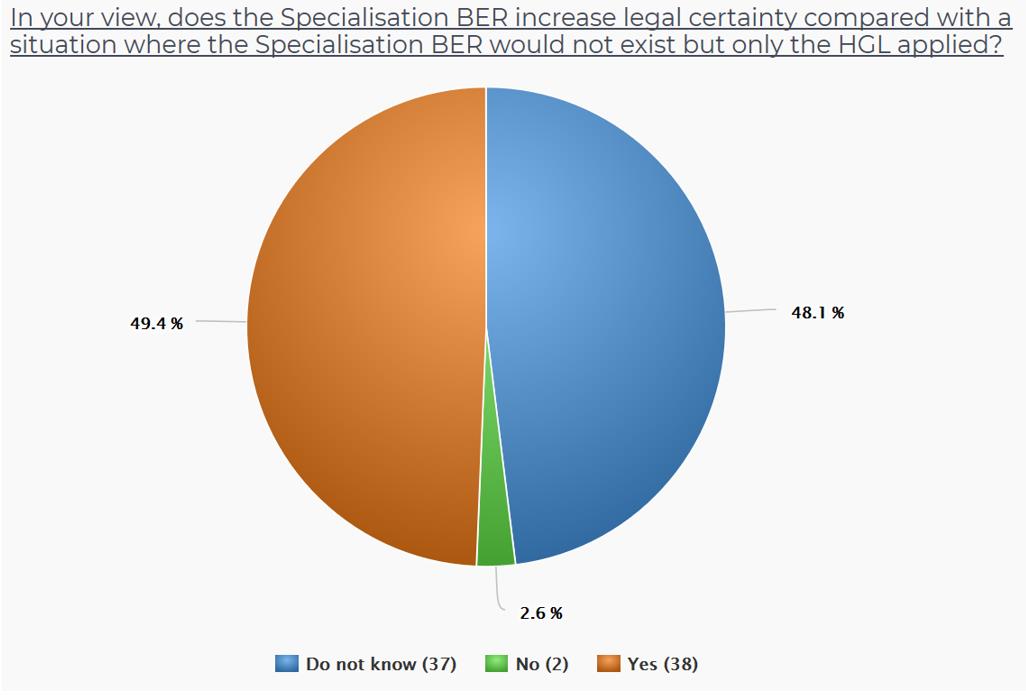
In their clarification, respondents argued in favour of ‘yes’ notably because the HBERs are binding on Member State courts and competition authorities and the Horizontal Guidelines are not. Other respondents replied that the safe harbours provided by both HBERs offer more legal certainty than is offered by self-assessment under Article 101 TFEU. Two respondents were of the opinion that the Specialisation BER did not increase legal certainty compared with a situation where only the Horizontal Guidelines applied but did not provide an explanation.
Finally, a third group of questions concerned other types of cooperation agreements, in particular (i) whether the Horizontal Guidelines provided sufficient legal certainty regarding horizontal cooperation agreements not specifically addressed in the guidelines (e.g. sustainability agreements) and (ii) whether these other types of horizontal cooperation agreements should have been specifically addressed in order to increase legal certainty.
More than 30 respondents did not know how to answer these questions, but 38 of the remaining respondents replied ‘no’ to the first question and 42 respondents replied with a ‘yes’ to the second question.
Figure 7 – Other types of horizontal cooperation agreements


Respondents considered that sustainability agreements deserved a specific section outside the examples given in the standardisation chapter. Respondents also mentioned that the information exchange section did not cover sufficiently new developments regarding benchmarking, data pooling and data sharing and other new types of collaboration regarding artificial intelligence, ecosystems, network sharing and platforms. Respondents made similar comments regarding the joint purchasing section that currently does not sufficiently cover new types of retail alliances or buyer arrangements.
In addition, the consultation also asked stakeholders whether there are other types of horizontal cooperation agreements outside those identified in the HBERs that would satisfy the conditions of Article 101(3) of the Treaty. Horizontal cooperation agreements that were mentioned are, for instance, data sharing agreements, collective bargaining, sustainability agreements, joint purchasing agreements, joint bidding agreements, co(re)insurance agreements within the meaning of the former Insurance BER and joint commercialisation agreements.
The 3rd set of questions focused on whether the two HBERs correctly identify those horizontal cooperation agreements that are compliant with Article 101 TFEU.
Regarding the R&D BER, the consultation asked stakeholders for their opinion whether specific elements of the regulation correctly identify horizontal cooperation agreements that do not violate Article 101 of the Treaty, namely the list of definitions, the conditions for exemption, the market share thresholds and their applications, the duration of the exemption, the list of hardcore restrictions and the list of excluded restrictions.
Figure 8 – R&D BER and compliance with Article 101 of the Treaty

Source: Factual summary of the open public consultation, p. 10 (Figure 11).
As regards the list of definitions, respondents that provided explanations to their reply commented on the fact that certain definitions require further clarification. Regarding the conditions for exemption, they mentioned that the current rules are difficult to apply and no longer match business realities. Regarding the market share thresholds for competing companies respondents mentioned that they were too low or that it was difficult to define markets and establish the market shares with certainty. Concerning the duration of the exemption, 7 respondents mentioned that this provision would require clarification or that the limited duration should be abolished entirely. Similarly, 7 respondents commented that there should be no list of hardcore restrictions or that some of the items on the list needed clarification or deletion. One respondent also mentioned that the list of excluded restrictions was unduly strict.
Regarding the Specialisation BER, the consultation asked stakeholders for their opinion whether specific elements of the regulation correctly identify cooperation agreements that do not violate Article 101 TFEU, namely the list of definitions, the explanations on the type of specialisation agreements to which the exemption applies, the market share threshold and its application and the list of hardcore restrictions.
Figure 9 – Specialisation BER and compliance with Article 101 of the Treaty

Source: Factual summary of the open public consultation, p. 11 (Figure 12).
Respondents commented on the complexity of applying the definitions to different types of specialisation agreements. One respondents pointed at incoherence between the definitions and the explanations of the specialisation agreements. As regards the market share threshold, some respondents found the 20% barrier too low and considered it inconsistent with the guidance provided in merger control. Regarding the list of hardcore restrictions, one respondent mentioned that the list should have been complemented with other excluded restrictions, as is the case for the R&D BER.
At the end of the section on effectiveness, the Commission services asked respondents whether the HBERs and the Horizontal Guidelines had any impacts that were not expected or not intended. The majority of those who replied to this question believe that indeed there were such unintended consequences. Respondents commented that the complexity of the current rules, notably as regards market definitions and calculation of market shares, has hampered the conclusion of horizontal cooperation agreements. Respondents also mentioned that they have applied a restrictive approach to the rules to ensure maximum legal certainty, thereby foregoing opportunities that would require self-assessment. Respondents also mentioned unintended effects as regards the joint purchasing rules in Chapter 5 of the Horizontal Guidelines (2 respondents) and the rules on standardisation in Chapter 7 of the Horizontal Guidelines (8 respondents).
Efficiency (Were the costs involved proportionate to the benefits?)
In order to evaluate the efficiency of the HBERs, together with the Horizontal Guidelines, the Commission services asked stakeholders about the costs and benefits associated with these competition rules and whether the costs were proportionate with the benefits.
The Commission services first asked stakeholders about the different types of costs associated with applying the HBERs and the Horizontal Guidelines. Around 30 respondents were not able or willing to reply to the question, stated that they did not know the costs, the remaining contributors mentioned: (i) legal costs relating to internal and external legal advice, and costs of hiring economic consultants, (ii) opportunity cost (e.g. abandon or delay business plans) caused by the legal uncertainty created by the rules or the excessive stringency of the rules, (iii) transaction and implementation costs incurred due to ambiguities regarding, in particular standardisation agreements and (iv) other costs such as extra training costs. Respondents also pointed out that SMEs tend to feel these costs the most.
Respondents pointed out that it was very difficult to impossible to estimate the costs of applying the HBERs and the Horizontal Guidelines. One respondent tried to estimate them as the minimal legal costs to respond to standard essential patent (‘SEP’) license demands (€5 000-10 000); another respondent as the conception (€10 000), set up and putting into place costs (€3 000) of compliance guidelines and procedures. One respondent presented a non-exhaustive list of monetary elements, including legal fees, salary of the parties’ staff involved in negotiations, additional capex and opex linked to the need to prevent hypothetical antitrust risk, missed business opportunities, slower entrance of an important competitor and loss of consumers’ welfare. Respondents also mentioned, referring to SEPs disputes, that the costs incurred were often so high that SMEs were forced to accept anticompetitive settlement terms under a non-disclosure agreement, or abandon their business ventures altogether.
The Commission services also asked stakeholders for their views on how the costs generated by the application of the HBERs or the Horizontal Guidelines have evolved compared with the previous legislative framework (the 2000 R&D BER, the 2000 Specialisation BER and the 2000 Horizontal Guidelines). 7 respondents believed that costs have increased and 3 were of the opinion that costs have decreased, while 67 could not reply to the question.
Among the 7 respondents that believed that costs have increased: (i) one respondent pointed out that previous legislation offered clearer requirements specifically for the insurance industry (Insurance BER 358/2003 and Insurance BER 267/2010), (ii) another respondent referred to additional training-related expenses in relation to standardisation agreements, (iii) two respondents pointed out the excessive complexity of the rules and their lack of flexibility and (iv) two other respondents mentioned the increase of legal fees and the stricter enforcement policy.
Those 3 respondents that believed that costs have decreased stated that: (i) the current legislative framework is easier to apply and clearer than the previous one, and that (ii) the HBERs and the Horizontal Guidelines are more consistent amongst themselves and better drafted than their predecessors, and that (iii) costs were further reduced due to R&D funding agreements now being covered and exclusive licensing to one of the parties being permitted.
The Commission services also asked stakeholders what would have happened to the costs of applying the rules had the HBERs not been in place but only the HGL. The respondents that replied agreed in their reply that costs would have increased, due to the loss of legal certainty and the loss of consistency the HBERs bring across the Union.
When asked about the benefits of having the HBERs and the Horizontal Guidelines, respondents mentioned, for example, increased legal certainty, decrease in legal and compliance costs and saving management time. They also mentioned that the reduction of costs is due to increased uniformity and the homogeneous application of the exemption requirements of Article 101(3) of the Treaty throughout the Union.
Finally, the consultation asked stakeholders to weigh the costs and benefits of applying the competition rules on horizontal cooperation agreements. Most of those respondents that could answer these questions were of the opinion that the costs are proportionate to the benefits, even if the HBERs and the Horizontal Guidelines could be further improved.
Figure 10 – Costs v benefits of applying HBERs and the Horizontal Guidelines

Source: Factual summary of the open public consultation, p. 15 (Figure 17).
Relevance (Is EU action still necessary?)
In order to evaluate whether the objectives of the HBERs, together with the Horizontal Guidelines, are still up to date in light of major trends and developments, the consultation asked stakeholders several questions.
First, the consultation asked stakeholders to specify any major trends or developments that affected the application of the HBERs and the Horizontal. 52 respondents referred to such developments in their reply that covered a wide range of topics.
The most important development according to respondents (25 responses) is the pursuit of sustainability goals.
The second most important development for respondents was digitisation (18 responses). This covered a wide range of issues such as increasing reliance on digital technologies, the impact of data on competition in both innovative and traditional markets, data pooling, data sharing and algorithms. Further issues that were mentioned in this regard were the digitalisation of the audiovisual business, more complex product and IT landscape, tendencies to more data and platform driven business models, emergence of two-sided technology platforms, artificial intelligence, Internet of Things, and the emergence of FinTech and cryptocurrencies.
Third, another important development was globalisation and increased international competition (13 responses). Respondents also specifically mentioned competition with companies from other jurisdictions where competition rules are less strict and that often EU companies have difficulties to compete alone, therefore they need to cooperate.
In addition, respondents also referred to: (i) the need to update the HBERs and the Horizontal Guidelines in order to reflect recent developments in the case law of the European Court of Justice, for example, the case law on single economic entity (9 responses); (ii) the changing standardisation landscape (8 responses) (e.g. the increased use of standard essential patents, the cross-sectorial and global nature of standardisation agreements, and that technology developments have caused wireless communication technologies as well as other standardised technologies to be implemented in new industry sectors, resulting in a variety of new market players, in particular in the Internet of Things and related sectors); (iii) the emergence of purchasing alliances that are formed mainly by retailers; (iv) platforms that were mentioned in the context of digitalisation and regarding their increased importance in e-commerce and the gig economy.
Other issues that were brought up by some respondents were (i) the increased enforcement activity by competition authorities and the strengthening of private enforcement, which increases the need for more legal certainty; (ii) recent EU initiatives not necessarily reflected in competition rules, for example in the area of sustainability and green technologies; (iii) the need for infrastructure sharing to roll out new technologies; (iv) the dissolution of traditional competitive structures and the blurring of lines between horizontal and vertical structures; and (v) the emergence of dual distribution, etc.
However, despite the above major trends, most respondents considered that the rules are still relevant. While respondents believed that the objectives are still relevant, they were also of the view that the range of situations in which companies now cooperate requires an update to the rules, for example, ensuring that the rules reflect the Commission's recent enforcement practice and that the examples are made more relevant to the modern digitalised economy.
Figure 11 – Relevance of the horizontal cooperation agreements covered by the HBERs and the Horizontal Guidelines
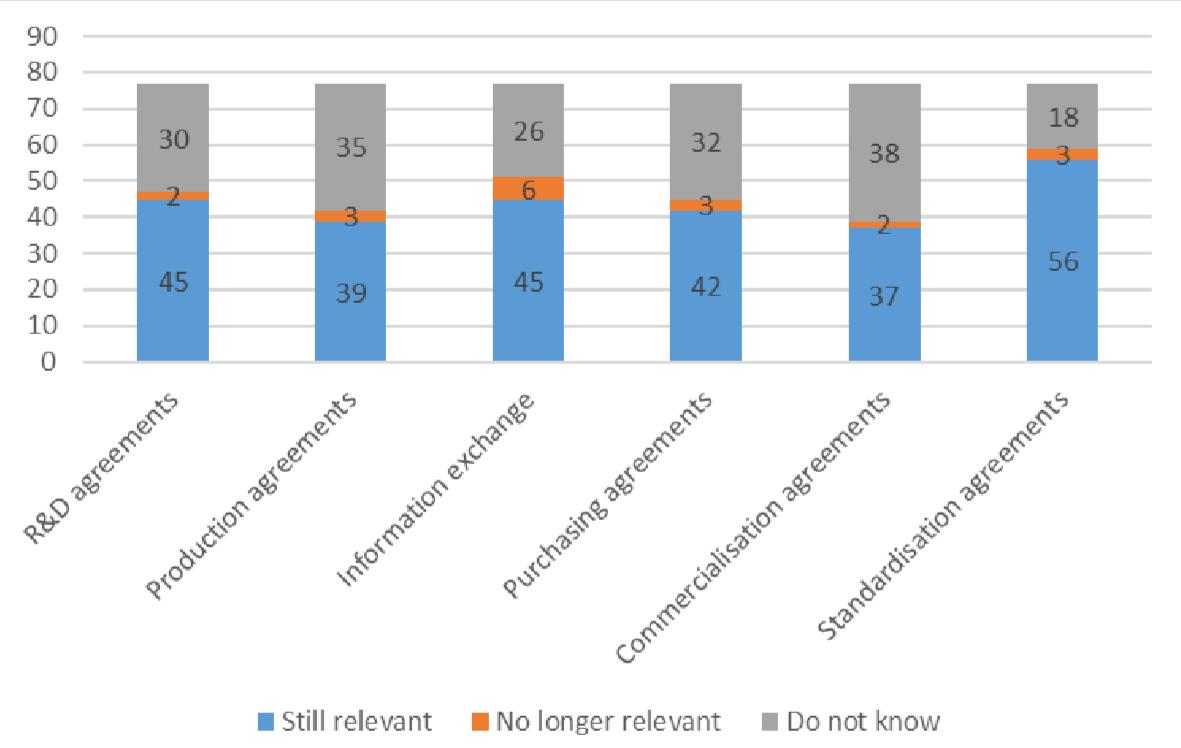
Source: Factual summary of the open public consultation, p. 15 (Figure 17).
Coherence (Does the policy complement other actions or are there contradictions?)
The consultation evaluated whether the HBERs and the Horizontal Guidelines were coherent with other legal instruments and policies.
First, the Commission services focused on coherence with other Commission’s instruments that provide guidance on the interpretation of Article 101 of the Treaty (e.g. other Block Exemption Regulations, the Vertical Guidelines and the Article 101(3) Guidelines). 43% of the respondents believed that the rules are coherent with other such instruments and 21% believed that they are not.
Respondents that believed that different instruments interpreting Article 101 TFEU were incoherent mentioned:
·uncertainty on the applicability of Article 101 TFEU in certain situations (e.g. unclear if a parent that exercises decisive influence over a joint venture could coordinate its competitive conduct with the JV);
·coherence with the Technology Transfer Block Exemption Regulation could be improved (e.g. discrepancies in the definitions of ‘technology markets’ and ‘potential competitor’);
·rules on vertical agreements (i.e. VBER and Vertical Guidelines), in particular the blurring of the boundary between horizontal and vertical cooperation and the seemingly different treatment of certain conducts, such as information exchange and R&D cooperation, in a horizontal and vertical context;
·possible incoherence with the Horizontal Merger Guidelines (e.g. definition of ‘potential competitor’), as well as
·partial incoherence with Regulation (EC) No 1184/2006 applying certain rules of competition to the production and trade in certain agricultural products.
Second, the Commission services asked about coherence between competition rules on horizontal agreements and existing/upcoming legislation/policies at EU or national level. 27% of respondents believed that they are coherent, while 46% believed that there is a lack of coherence between these instruments and policies.
Based on their explicit mentioning the policy areas, respondents believed that the antitrust policy as laid down in the HBERs and Horizontal Guidelines is not sufficiently coherent with:
·the Commission’s climate policy (11 respondents);
·on-going initiatives in the field of digitalisation, including data sharing (7 respondents);
·the EU’s industrial policy (5 respondents);
·the Commission’s ‘Communication on Setting out the EU approach to Standard Essential Patents’(2 respondents) as well as the uniformed application of competition law in SEP licensing related decisions by national courts (4 respondents);
·others, such as the broader IP regulation and external actions policy (e.g. obligation to foster the sustainable economic, social and environmental development of developing countries), the EU Electronic Communications Code (‘EECC’), the Directive (EU) 2019/1023 on preventive restructuring frameworks et. al., labour law (e.g. the right to collective bargaining for workers and self-employed).
EU Added Value (Did EU action provide clear added value?)
The consultation finally evaluated whether the HBERs and the Horizontal Guidelines have provided a clear added value in the assessment of the compatibility of horizontal cooperation agreements with Article 101 of the Treaty. Those respondents that could answer this question gave an almost unanimous reply that they do.
Figure 12 – Added value of the HBERs and the Horizontal Guidelines

Source: Factual summary of the open public consultation, p. 15 (Figure 17).
Respondents explained that the rules have contributed to the uniform application of rules across the EU. Further, respondents pointed out that the HBERs provide a uniform exemption across all Member States. Nevertheless, one respondent suggested that the Commission and the NCAs should develop a consistent approach also for situations outside the HBERs. One respondent also noted that, as there is little case law available on the application of EU competition law on horizontal cooperation agreements, as well as little enforcement activity by the Commission and NCAs in this area, the HBERs and the Horizontal Guidelines provide a clear benefit.
2.6.Summary of the targeted consultation of national competition authorities
A summary report of the consultation of national competition authorities was published in October 2020.
2.6.1.Introduction
In the context of the evaluation of the HBERs and the related Horizontal Guidelines, the Commission services asked the National Competition Authorities (‘NCAs’) to share their experience in applying these rules. NCAs are bound by the HBERs when assessing horizontal cooperation agreements. In contrast, the Horizontal Guidelines are non-binding for the NCAs, but nevertheless taken into account by all of them.
2.6.2.Overview of the respondents
The NCAs were asked to fill in two different surveys: one about their opinion regarding the three instruments and another one on each of their cases that concerned horizontal cooperation.
The Commission services received 29 contributions (27 Member States, Norway and the United Kingdom) to the general survey. With regard to the case survey, the consultation asked NCAs to exclude cartel cases. As a result, 11 NCAs reported that they have not had any cases concerning horizontal cooperation agreements. The remaining 18 NCAs had varying experience: some only had a handful of cases while one NCA had as many as 41 cases since 1 January 2011.
2.6.3.Overview of the submissions
Overall, the NCAs consider that the Commission should maintain the three instruments, while using the review to clarify and adjust the current rules, notably in light of market developments over the last decade.
The purpose of this summary is to outline the main points raised by the NCAs without regard to the number of contributions addressing a particular point or whether a particular point of view is shared by all the NCAs. Therefore, in the following, reference is made generically to ‘NCAs’. However, for issues on which NCAs expressed diverging views, both sides of the argument are presented.
2.6.4.Contributions to the consultation
This summary provides the NCAs’ general views on the evaluation of the HBERs and the Horizontal Guidelines following the five evaluation criteria established by the Better Regulation Requirements,
i.e. effectiveness, efficiency, relevance, coherence and EU added value, including the comments made by the NCAs as regards the functioning of some specific aspects of the HBERs and the Horizontal Guidelines.
Effectiveness (Have the objectives been met?)
In order to evaluate whether the HBERs, together with the Horizontal Guidelines, have met their objectives, NCAs were asked about (i) promotion of competition, (ii) legal certainty and (iii) simplification of the application of competition rules by public authorities.
Promotion of competition
Out of the 29 NCAs that contributed to the consultation, 22 NCAs considered that the HBERs and the HGL have contributed to promoting competition in the EU and 3 NCAs indicated that they partly contributed. 4 NCAs replied that they did not know.
The NCAs explained that the Horizontal Guidelines (i) contributed to promote companies’ compliance with the competition rules when entering into horizontal cooperation agreements (16 NCAs) and (ii) helped to reduce the risk for divergent application of Article 101 of the Treaty in the individual Member States (4 NCAs).
Other NCAs with a positive perception indicated that:
·the general analytical framework provided by the Horizontal Guidelines is very useful when evaluating the benefits and competitive concerns of horizontal cooperation agreements and other arrangements. Without the Horizontal Guidelines, the assessment of horizontal cooperation agreements would be much more burdensome;
·in the absence of the HBERs and Horizontal Guidelines, companies would have difficulty distinguishing horizontal cooperation agreements from cartels and assessing such agreements under Article 101 TFEU. This would make such agreements excessively risky and unlikely to materialise despite the potential benefits for consumers that they may bring;
·the Horizontal Guidelines might contribute to promoting competition by clarifying that smaller merchants can, under certain circumstances, make use of economies of scale by establishing purchasing associations, which may increase the merchants' readiness to cooperate and build a counterbalance to the potential market power of bigger companies.
However, among the NCAs with a less positive view, they explained that:
·the Horizontal Guidelines offer insufficient legal certainty regarding the assessment as ‘by object’ or ‘by effect’ infringements and the factors that should be taken into account when analysing the legal and economic context of horizontal cooperation agreements. However, one NCA did not share this view regarding the chapter on information exchange;
·the HBERs and Horizontal Guidelines (i) were most relevant for purchasing and commercialisation agreements and in the telecommunications, services and intellectual property rights sector; and that they (iii) are useful tools that have indeed contributed to promoting competition in the EU, yet their effect is by nature relatively limited in scope. They are meant to complement other available tools and guidelines that pursue the same high-level objective of fostering competition in the EU.
Legal certainty
Respectively 18 (for the Specialisation BER) and 19 (for the R&D BER) NCAs considered that the HBERs provided sufficient legal certainty. However, one NCA indicated that the respective articles on market share thresholds provide that the market share shall be calculated on the basis of value; and only if market sales value data are not available, estimates based on other reliable market information may be used. However, especially in digital markets sales value may not represent market share correctly despite its availability.
Other NCAs mentioned that they missed guidance in the HBERs on horizontal cooperation agreements concerning (i) sustainability objectives that clearly create benefits to the larger group of consumers and the society as a whole and do not restrict competition more than necessary; (ii) public health issues; and (iii) joint purchasing or selling agreements where the parties have a relatively small market share.
Specifically, regarding R&D BER and Chapter 3 of the Horizontal Guidelines, 19 NCAs indicated that these rules provide sufficient legal certainty on R&D agreements for companies. The same number of NCAs also considered that the R&D BER increases legal certainty compared with a situation where the R&D BER would not exist but only the HGL applied. 8 NCAs did not have experience in applying the R&D BER or the HGL; however, one NCA added that guidance documents are always of value, even if an authority did not investigate any cases.
Three NCAs indicated that the interpretation of the Horizontal Guidelines, for example due to its non-binding nature, might differ between Member States, but the provision of a safe harbour in the BER for agreements between companies below certain market share thresholds contributed to increased legal certainty.
Some NCAs suggested improvements that could be done in the existing rule to boost legal certainty, in particular that HBERs and the Horizontal Guidelines (i) could be improved in some areas, such as on ‘R&D poles’ or innovation spaces; that they (ii) do not reflect market developments and case law on horizontal cooperation, and that (iii) some of the drafting is not clear enough, in particular, regarding the hardcore restrictions (Article 5(b) R&D BER) and the definition of ´connected companies´ (Article 1(2) R&D BER). In addition, (iv) one NCA commented that market definition is always a highly debated topic in competition cases and even more so in R&D intensive markets. There may often be insufficient information as to the market share of (other) parties even if the market was defined before.
Regarding Specialisation BER and Chapter 4 of the Horizontal Guidelines, 18 NCAs considered that these rules provided sufficient legal certainty so companies can conclude production/specialisation agreements without the risk of infringing competition law; and 16 NCAs considered that the Specialisation BER increased legal certainty compared with a situation where only the Horizontal Guidelines would exist.
However, NCAs mentioned
several issues affecting the effectiveness of the Specialisation BER and the Horizontal Guidelines that are described below.
One NCA suggested the extension of the definition of unilateral specialisation to agreements between more than two parties as long as the market shares are below the relevant thresholds.
Other NCAs commented on the lack of clarity regarding: (i) the definitions, the scope of application and the assessment of agreements covered by the Specialisation BER; (ii) the material demands for exemption; (iii) whether the specialisation may take place on the production level, and not only specialisation on e.g. the customer level; (iii) the definition of ‘product’ with the exemption of distribution services (Article 1(1)(f) Specialisation BER); (iv) the definition of price fixing in Article 4 of the Specialisation BER and (v) whether the definitions in the Specialisation BER would cover joint bidding in a public procurement context.
Two NCAs mentioned that guidance is missing in relation to (i) joint production and joint distribution; (ii) the distinction of specialisation agreements from vertical agreements, and (iii) the relationship to other regulations like the TTBER or the VBER.
Regarding Chapters 2, 5, 6 and 7 of the Horizontal Guidelines, 20 NCAs considered that they provided sufficient legal certainty on horizontal cooperation agreements regarding information exchange, joint purchasing, commercialisation and standardisation; while 6 NCAs disagreed and 3 did not know.
Several NCAs pointed at guidance lacking, notably regarding information exchange (Chapter 2) and joint purchasing agreements (Chapter 5). In particular,
·concerning information exchange, one NCA found it particularly helpful in explaining and exemplifying the circumstances in which the exchange of information is likely to restrict competition and those in which it may have pro-competitive effects. While 3 NCAs remarked that the chapter could be improved by clarifying a number of concepts, namely data sharing and data pooling, illegal signalling, the use of benchmarks by trade associations, hub and spoke arrangements and genuine public information;
·regarding joint purchasing agreements, one NCA indicated that the Horizontal Guidelines had been of high relevance for its enforcement practice. Nevertheless, some paragraphs in the section were considered too abstract and unclear in part. Furthermore, some NCAs pointed out that (i) guidance was lacking on the notions of market concentration, purchasing power and joint bidding, and that (ii) clarifications are needed on (1) how to distinguish between collective boycott and joint purchasing, (2) how to address purchase agreements between competitors when these have not resulted in a reduction of the final consumer price, (3) how to distinguish between legitimate joint purchasing agreements and buyer cartels, and (4) how user groups on digital platforms may collectively bargain.
Finally, some NCAs mentioned with regard to the Horizontal Guidelines that (i) the provisions on environmental agreements had been removed from the 2010 Horizontal Guidelines; that (ii) the guidelines should take into account the enforcement challenges posed by digital markets (e.g. market definition); that (iii) the guidelines should refer to the most recent cases and case law concerning horizontal cooperation agreements; that (iv) they could provide guidance on the existing market shares thresholds when assessing market power, and that (v) the guidelines lacked guidance on issues of cooperation in the labour market, including on no poaching and wage fixing agreements.
Regarding other types of horizontal cooperation agreements that are currently not specifically addressed in separate sections of the Horizontal Guidelines, 6 NCAs considered that the Horizontal Guidelines provided sufficient legal certainty, 12 NCAs disagreed and 11 did not know.
More concretely, several NCAS stressed the need for more guidance on: (i) agreements pursuing sustainability goals as they felt such guidance in the standardisation chapter is lacking (11 NCAs); (ii) joint bidding, suggesting introducing a separate chapter in the Horizontal Guidelines (6 NCAs) and on (iii) different types of agreements relating to digital platforms. These and other types of agreements mentioned by at least one NCA are included in
Figure 13
.
Figure 13 – Horizontal agreements not addressed in a specific section in the HGL for which guidance is lacking according to NCAs
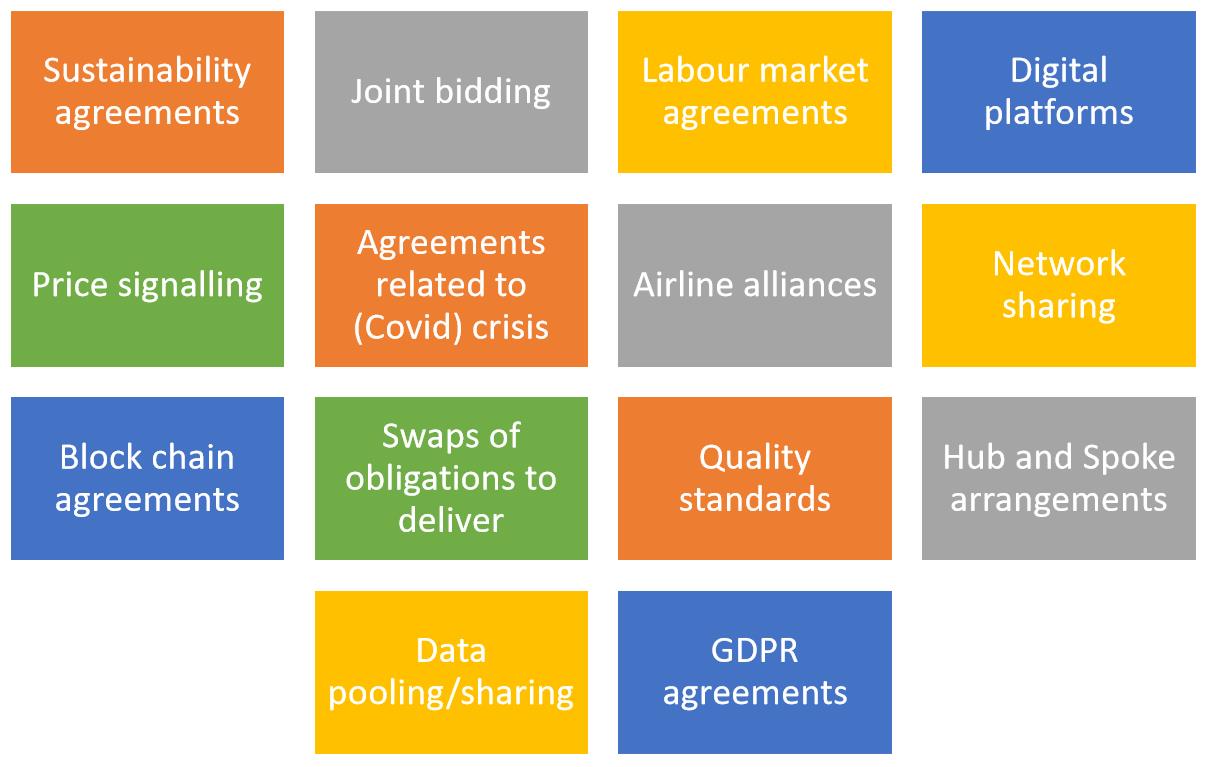
Source: Summary of the contributions of NCAs, p. 8 (Figure 5)
Simplification of the application of competition rules by public authorities
Part of the questionnaire was dedicated to questions relating to the application of competition rules by the NCAs themselves, namely whether the HBERs and Horizontal Guidelines simplify the application of competition rules.
The majority of the NCAs indicated that they did not know the reply to these questions, mostly because they did not have (extensive) experience in investigating R&D and specialisation agreements. However, the majority of the NCAs (25 out of 29) indicated that the Horizontal Guidelines simplify the application of competition rules compared to a situation with no HBERs or Horizontal Guidelines.
Among the NCAs with a positive view, some NCAs mentioned that the Horizontal Guidelines provide comprehensive guidance to both companies and authorities on how to assess the compatibility of different cooperation agreements. They also remarked that the national courts take the Horizontal Guidelines into consideration in their cases.
Efficiency (Were the costs involved proportionate to the benefits?)
In order to evaluate the efficiency of the HBERs, together with the Horizontal Guidelines, the Commission services asked NCAs about the costs and benefits associated with these competition rules and whether the costs were proportionate with the benefits.
The majority of the NCAs were not able to provide replies to the questions in this section of the consultation or to provide an estimation of the costs.
Regarding costs for companies, the NCAs that provided a response indicated that the HBERs and the Horizontal Guidelines led to a reduction of costs for companies, mainly due to reduced legal costs stemming from the ‘safe harbours’ and simplification of the rules (6 NCAs).
Moreover, according to 11 NCAs, the cost for companies would increase if there would be no HBERs. The increase in compliance costs would stem from the need to hire consultants/legal advisers and the loss of safe harbours. In addition, one NCA considered that safe harbours and hard-core restrictions could eventually be introduced in the Horizontal Guidelines and another NCA referred to the absence of harmonisation requiring companies to follow diverse national regulations.
Regarding the costs for the NCAs, 6 NCAs indicated that the costs generated by the application of the HBERs or the Horizontal Guidelines had decreased compared with the previous legislative framework. In general, the NCAs indicated that the current framework provides more legal clarity and reflects better the modern business models compared to the previous regime.
Moreover, respectively 11 (for the R&D BER) and 12 (for the Specialisation BER) NCAs indicated that the costs of the authorities for ensuring compliance would increase without the HBERs in place. Costs would increase because of the lack of thresholds, the need to have national regulations or more guidance or intervention from the NCAs that would be more difficult to provide. Nevertheless, one NCA felt that costs would decrease given that companies were less likely to engage in harmful R&D cooperation with competitors in the absence of the R&D BER.
NCAs considered that legal certainty was the main benefit in having the HBERs and the Horizontal Guidelines (11 NCAs). These NCAs mentioned that (i) the procedure goes faster because of the Horizontal Guidelines, (ii) the benefit of legal conformity in all Member States, (iii) the reduction of costs and that (iv) the national court takes the Horizontal Guidelines into account when assessing whether the NCA has met the required legal standards in its decisions.
In addition, one NCA mentioned that the Horizontal Guidelines provide an analytical framework for screening possible future cases and one NCA indicated that, considering that the Specialisation BER allows some price fixing, the market share threshold might be too high if definitions are being interpreted broadly.
Several NCAs considered that costs of applying the HBERs (9 NCAs for the Specialisation BER and 10 NCAs for the R&D BER) and the Horizontal Guidelines (17 NCAs) are proportionate to the benefits. In fact, some NCAs specified that they see no costs with the BERs, only benefits.
Relevance (Is EU action still necessary?)
In order to assess the relevance of the HBERs and the Horizontal Guidelines, the Commission services asked the NCAs whether the objectives of the texts are still up-to-date considering the developments that have taken place since their publication. The majority of the NCAs (15 NCAs for the R&D BER and 16 NCAs for the Specialisation BER, a range between 19 and 22 for the Horizontal Guidelines) considered that the HBERs and the Horizontal Guidelines are still relevant, even though the NCAs provided many suggestions for major trends that have affected the application of these rules and that the NCAs felt are insufficiently dealt with in the current texts.
Figure 14 – Major trends according to NCAs that affect the application of the HBERs and the Horizontal Guidelines

Source: Summary of the contributions of NCAs, p. 11 (Figure 6)
Several NCAs indicated that despite the relevance of the HBERs and the Horizontal Guidelines, there was some room for improvement. In particular, some NCAs commented that (i) the texts might not be suitable for the digital/internet economy, where different efficiencies and market dynamics might apply, (ii) additional guidance may be required on information exchange in distribution agreements when the supplier is also a direct competitor of the distributor; as well as (iii) further guidance on a fair licensing system for standards, updated to reflect case law developments and the increasing use of SEP-protected technologies. In particular, according to the ‘Communication on setting out the EU approach to standard essential patents’ the creation of patent pools or other licensing platforms, within the scope of EU competition law, should be encouraged.
Finally, one NCA added that the evaluation and potential revision of the current rules needs to be business-model neutral in order not to distort the level market-created playing field.
Coherence (Does the policy complement other actions or are there contradictions?)
The consultation evaluated whether the HBERs and the Horizontal Guidelines were coherent with other legal instruments and policies.
The majority of the NCAs considered that the HBERs and the Horizontal Guidelines are coherent with other instruments and/or case law that provide guidance on the interpretation of Article 101 of the Treaty (e.g. other block exemption regulations, the Commission Guidelines on Vertical Restraints and the Commission Guidelines on the application of Article 101(3) TFEU) (25 NCAs), and that they are also coherent with other existing or upcoming legislation or policies at EU or national level (17 NCAs).
However, several NCAs mentioned that the Horizontal Guidelines: (i) are missing clarity on some horizontal elements of vertical agreements; that (ii) some of their provisions and concepts seemed at odds with similar provisions in the VBER and the Vertical Guidelines (in particular, one NCA mentioned the need to harmonise the rules on ‘dual distribution’). The Horizontal Guidelines also (iii) do not seem to distinguish consistently between horizontal cooperation agreements and cartels as is done in the Guidelines on the Effect on Trade; and there is a (iv) need to update the concept of restrictions by object. In addition, the Horizontal Guidelines (v) require to include recent case law on the requirement of SEP holders to respect FRAND terms or the general principles relating to FRAND licensing in accordance with the 2017 ‘Communication on Setting out the EU approach to Standard Essential Patents’.
Finally, 2 NCAs noted that that the assessment of horizontal cooperation agreements promoting sustainability goals should be taken into account better.
Added Value (Did EU action provide clear added value?)
NCAs generally consider that the HBERs and the Horizontal Guidelines have added value in the assessment of the compatibility of horizontal cooperation agreements with Article 101 of the Treaty (between 15-21 NCAs, depending on whether it concerned one of the BERs or the Horizontal Guidelines). They consider that a lapse of the HBERs and the Horizontal Guidelines would seriously undermine harmonisation in the enforcement of Article 101 of the Treaty across the EU.
Specifically, the NCAs refer to (i) the useful legal criteria, (ii) the coherency amongst Member States, (iii) the instruments being more specific than other more general ones, (iv) the simple self-assessment tools, (v) the legal certainty, (vi) the reduced complexity and legal costs for the parties, (vii) the increased competition law compliance; (viii) and the increased number of pro-competitive R&D agreements concluded – to the benefit of consumers.
Several NCAs (9) reported that national guidelines on horizontal cooperation were issued and one NCA explained that such national guidelines are currently considered.
The national guidelines that were mentioned cover issues such as joint bidding, collective bargaining for self-employed workers, small and medium sized enterprises and information exchange. As reasons for adopting national guidelines, the NCAs mentioned requests from specific stakeholder groups (trade associations, SMEs) to assist them with their self-assessment. NCAs also adopted guidelines to act as complement to the Horizontal Guidelines where it was felt that the national situation required additional guidance.
In addition, two NCAs reported that they issued specific guidance on cooperation in light of the COVID-19 crisis and one authority is envisaging adopting national guidance only if the future Horizontal Guidelines would not cover certain topics.
2.7.Other consultation activities
In addition to the above-mentioned consultations, the Commission services received a number of spontaneous submissions from stakeholders throughout the evaluation. Some of these contributions were submitted by stakeholders that had participated in the public consultation and were therefore intended to supplement their views with additional evidence. Other submissions were received from business associations that had not participated in the public consultation. These submissions largely echoed the issues already raised in the different consultation activities. All such submissions were published on the dedicated HBERs review webpage on DG Competition’s website, except for a few submissions which stakeholders had asked the Commission services not to publish for confidentiality reasons. The Commission services used the latter to enhance its understanding of particular stakeholders’ positions but did not rely on the information contained therein for any of the conclusions in the Staff Working Document.
Throughout the evaluation, the Commission services also met bilaterally with stakeholders that requested this. These meetings aimed at discussing the submissions made by stakeholders, either in the context of the public consultation or outside of it, or the process of the evaluation.
Annex 3: Methods and analytical models
|
Evaluation criteria and questions
|
Indicators
|
Sources
|
|
Effectiveness
|
|
|
|
1.Do you perceive that the HBERs and the Horizontal Guidelines have contributed to promoting competition in the EU?
|
-HBERs and Horizontal Guidelines ensure an effective protection of competition.
-HBERs and Horizontal Guidelines provide adequate legal certainty to stakeholders, making it easier to self-assess horizontal cooperation agreements.
-Specific provisions of HBERs and Horizontal Guidelines for which there is uncertainty.
-HBERs and Horizontal Guidelines provide legal certainty to other types of horizontal cooperation agreements outside those specifically identified in these rules.
-Effects of the Horizontal Guidelines in the absence of the HBERs.
-HBERs and Horizontal Guidelines simplify administrative supervision by providing a framework for the competition authorities and the national courts.
|
-Open public consultation, section on effectiveness.
-External support study: responses to the evaluation questions for Tasks 1, 2, 4 and 5.
-Targeted consultation of NCAs.
-Enforcement practice of the Commission and NCAs.
|
|
2.Have the HBERs and the Horizontal Guidelines provided sufficient legal certainty that companies can conclude horizontal cooperation agreements without the risk of infringing competition law?
|
|
|
|
3.Do the HBERs simplify the application of competition rules for the National Competition Authorities compared with a situation where the HBERs would not exist but only the Horizontal Guidelines applied?
|
|
|
|
Efficiency
|
|
|
|
4.What are the costs associated with the application of the HBERs and the Horizontal Guidelines?
|
-Costs of self-assessment of horizontal cooperation agreements.
-Difference of costs of compliance under HBERs versus projected costs of compliance under Horizontal Guidelines only.
-Difference of costs of compliance under HBERs and Horizontal Guidelines versus costs of compliance under Commission Regulations (EC) No 2659 and 2658/2000.
-Benefits of the HBERs and Horizontal Guidelines.
|
-Open public consultation, section on efficiency.
-External support study: responses to the evaluation questions for Tasks 1, 3 and 4.
-Targeted consultation of NCAs.
|
|
5.Do the costs of ensuring compliance of horizontal cooperation agreements with Article 101 of the Treaty would be different if the current HBERs were not in place but only the Horizontal Guidelines applied?
|
|
|
|
6.Have the costs generated by the application of the HBERs, together with the Horizontal Guidelines, evolved compared to the 2000 HBERs and the 2000 Horizontal Guidelines?
|
|
|
|
7.Does the application of the HBERs and the Horizontal Guidelines generate costs that are proportionate to the benefits they bring?
|
|
|
|
Relevance
|
|
|
|
8.Are the objectives of the HBERs and the Horizontal Guidelines still up-to-date considering the developments that have taken place since their publication?
|
-Major trends and market developments identified in stakeholders' and NCAs' responses.
-Whether the objectives of the HBERs and the Horizontal Guidelines still meet the needs and problems of the stakeholders, considering major trends and market developments.
|
-Open public consultation, section on relevance.
-External support study: responses to the evaluation questions for Tasks 1, 2, 4 and 5.
-Targeted consultation of NCAs.
-Enforcement practice of the Commission and NCAs.
|
|
Coherence
|
|
|
|
9.Are the HBERs, together with the Horizontal Guidelines, coherent with other Commission instruments that provide guidance on the interpretation of Article 101 of the Treaty and with other EU legislation with relevance for horizontal cooperation agreements?
|
-Identification of relevant legislation and assessment of level of coherence of HBERs and Horizontal Guidelines with it.
|
-Open public consultation, section on coherence.
-Targeted consultation of NCAs.
|
|
EU added value
|
|
|
|
10.Do the HBERs, together with the Horizontal Guidelines, as an intervention at EU level, add value in the assessment of the compatibility of horizontal cooperation agreements with Article 101 of the Treaty?
|
-Benefits for stakeholders of the presence of HBERs and Horizontal Guidelines compared to absence of them.
|
-Open public consultation, section on EU added value.
-Targeted consultation of NCAs.
|
Annex 4: Overview of issues identified during the evaluation process
4.1.Overview of issues identified during the evaluation process
This section sets out the areas for which stakeholders consider that the HBERs, together with the Horizontal Guidelines, are not functioning well or not functioning as well as they could, including the underlying reasons.
4.1.1.General issues
In general, respondents consider that many of the terms and definitions used in the HBERs and Horizontal Guidelines lack clarity. They have pointed at different provisions in the HBERs and paragraphs in the Horizontal Guidelines that contain terms for which they consider the explanation is ambiguous or otherwise unclear. Some respondents require additional guidance on the application of certain concepts such as the ‘commonality of costs’.
Some respondents point out that the HBERs and the Horizontal Guidelines are insufficiently aligned with other Commission legislation, such as the VBER, the TTBER and the EUMR. They pointed at discrepancies in the definitions of several concepts used in the intervention and in these other texts (e.g. non-full functionality joint ventures, potential competitors, etc.).
In connection with this, several respondents consider that the HBERs and the Horizontal Guidelines do not provide sufficient legal certainty regarding their application to joint ventures and connected companies. They feel that the current rules do not reflect recent case law of the Court of Justice of the European Union on the single economic entity doctrine. Other respondents consider that the guidance provided differs from the rules applied in merger control.
Some respondents also consider that the HBERs and Horizontal Guidelines lack clarity on the assessment of the centre of gravity of horizontal cooperation agreements. This applies notably in cases where the cooperation involves a combination of different types of horizontal cooperation agreements.
A related issue raised by respondents in connection with different horizontal cooperation agreements covered by the HBERs and the Horizontal Guidelines is that these agreements nowadays often include some vertical elements. Guidance that is solely aimed at the horizontal relationship between competitors may therefore be insufficient to self-assess all aspects of an agreement that can also encompass relations between non-competitors.
A number of respondents indicate that the focus in the HBERs and the Horizontal Guidelines is too much on the by object nature of restrictions of competition linked to horizontal cooperation agreements. They mention that this leads to an overly cautious approach in the self-assessment, as companies fear high fines. Respondents also consider that the HBERs and the Horizontal Guidelines lack guidance concerning the elements required to fulfil the conditions of Article 101(3) of the Treaty, notably as regards the efficiencies required, and regarding the definition and identification of potential competitors, notably in innovation and digital markets.
Several respondents have reported difficulties defining the relevant market(s) concerned by their horizontal cooperation agreement, as well as difficulties assessing and calculating their market shares and those of other players. This problem is raised for different chapters of the Horizontal Guidelines and for the HBERs. Respondents consider that these problems are increased as a consequence of digitisation. Some respondents consider that small and medium sized enterprises especially encounter difficulties with market definitions and calculation of market shares due to the administrative burden they bring and the lack of technical skills to assess these elements.
Some respondents pointed out that guidelines by nature offer less legal certainty than block exemption regulations. They argue that certain types of horizontal cooperation agreements pursue efficiencies similar to R&D and specialisation agreements and therefore argue in favour of more block exemption regulations or a block exemption regulation with a wider scope, but they do not identify any specific type of agreements for which this should be done. Other respondents consider that there is a lack of safe harbours in the form of market share thresholds in the Horizontal Guidelines or that the existing thresholds should be increased.
Respondents consider in general that the guidance in the HBERs and the Horizontal Guidelines is not sufficiently adapted to recent developments. They mention notably the pursuit of sustainability goal as well as digitisation and its accompanying development of new technologies, business models and sectors.
Respondents also consider that the HBERs and Horizontal Guidelines are not adapted to the recent case law of the Court of Justice of the European Union. They point at several judgments and opinions of Advocates General that should be incorporated in the guidance provided. In addition, some respondents consider that the Commission should follow the decision practice of specific NCAs on topics such as information exchange, even if that decision practice is not binding vis-à-vis the Commission or the Court of Justice of the European Union.
A number of respondents consider that the level of guidance that can be provided by instruments such as the HBERs and the Horizontal Guidelines in general is insufficient. They would prefer a possibility of voluntary ex-ante consultations with the Commission or a voluntary fast-track notification procedure.
Similarly, respondents consider that the examples provided in the Horizontal Guidelines are outdated, too limited or not representative for actual cooperation projects.
There are several additional types of horizontal cooperation agreements for which individual stakeholders feel that guidance is currently lacking. The agreements most often mentioned concern sustainability goals. However, respondents also mention that the Horizontal Guidelines lack specific guidance among others for joint bidding agreements, joint production and distribution agreements, new forms of cooperation in the telecom/digital sector, infrastructure sharing, data pooling/sharing/data access agreements cooperation between small- and medium-sized enterprises and collective bargaining. Some respondents also mentioned that guidance is lacking on industrial alliances or industry wide cooperation agreements which combine different types of horizontal cooperation. Other respondents consider that there is insufficient guidance to assist the self-assessment of cooperation between competitors with the aim of restructuring companies at risk of insolvency.
In addition, respondents suggested that procedural modifications to allow the Commission to provide direct guidance (e.g. a voluntary fast-track notification procedure) could be useful.
Finally, some respondents consider that the HBERs and Horizontal Guidelines are insufficiently aligned with other EU policies (besides sustainability and digitisation). They mention in particular trade and industrial policy, pharmaceutical policy, IP regulation, connectivity, environmental protection, IPCEI, EU Data Space and social equity.
4.1.2.R&D agreements (R&D BER and Chapter 3 of the Horizontal Guidelines)
Respondents consider that the R&D BER is too complex and leads to an overly cautious interpretation of the applicable rules. Some respondents to the public consultation indicated that a simplification of these rules could be achieved, for example, by adopting a general horizontal BER.
Moreover, respondents requested the clarification of several notions addressed in the R&D BER and in Chapter 3 of the Horizontal Guidelines, including the boundaries between joint R&D, paid-for R&D and agreements falling outside R&D, and the notions of ‘joint exploitation’, ‘field of use’ restrictions, ‘compensation’, ‘competition in innovation’, ‘R&D poles’ or ‘decisiveness’. Furthermore, the concept of ‘not competing undertaking’ seems to also raise issues.
Some respondents consider that the HBERs and the Horizontal Guidelines do not provide sufficient guidance on the early stages of R&D. They consider that the scope of the R&D BER should be extended to cover early stages of R&D (including basic research) where any prospect of commercialisation is years away and no determination of R&D poles is possible.
Moreover, several respondents consider that paid-for R&D cooperation should be removed from the R&D BER and assessed under the Subcontracting Notice or the TTBER. Other respondents consider that, alternatively, the requirement for full access to the final results of paid-for R&D cooperation should be removed.
With regard to the conditions for exemption described under Article 3 of the R&D BER, several respondents pointed to their lack of clarity, complexity and counter-intuitive description, as a result their interpretation requires the assistance of competition law experts. Respondents indicated that several aspects were considered problematic and/or unclear, in particular the requirements to provide ‘full access’ to R&D results and access to ‘pre-existing know-how’. Some of the exceptions foreseen to the principle of full access were also considered insufficient, namely the exception concerning research institutes and academic bodies that seems to base the exception on the alleged incorrect assumption that they are normally not active in the exploitation of results. In addition, respondents also pointed that the notion of ‘compensation’ exchange between the parties of the horizontal cooperation agreements require more guidance, in particular, on objective methods to safely calculate it.
Several respondents consider that the market share threshold of 25% is too low to exempt pro-competitive R&D agreements and should be increased. Alternatively, some respondents consider that the market share threshold should be aligned with the market share threshold in the EUMR and TTBER. Some respondents also consider that a safety margin should be introduced in case an agreement surpasses the threshold. Moreover, respondents indicated that further guidance was necessary on how to calculate market shares in technology and innovation markets, including the possibility of looking at a period longer than a year for the calculation of market shares.
With regard to non-competing undertakings, some respondents point out that the R&D BER should state more clearly the absence of a market share threshold. Moreover, respondents consider that the duration of the exemption for non-competing companies (7 years) under Article 4(1) of the R&D BER is too short for sectors in which R&D costs are very high and cannot be recovered within the 7-year time frame. Respondents also considered that the provision is unclear with regard to the point in time in which the 7 year period starts.
Finally, as indicated in the section on General Issues (Annex 4, section 4.1.1 above), respondents also raise all or some of these issues in connexion with horizontal R&D agreements.
4.1.3.Specialisation agreements (Specialisation BER and Chapter 4 of the Horizontal Guidelines)
Several concepts included in the Specialisation BER and/or in Chapter 4 of the Horizontal Guidelines raise issues for several respondents due to their lack of clarity, including the notions of ‘reciprocal specialisation agreements’, ‘joint production’, ‘joint distribution’ and ‘price fixing’ in the context of joint distribution. Some respondents also consider that unilateral specialisation, as defined in Article 1(1)(b) of the Specialisation BER, should not be restricted to agreements between two parties. In addition, the application of the definitions of the Specialisation BER to different types of specialisation agreements was considered difficult.
The scope of the Specialisation BER and/or in Chapter 4 of the Horizontal Guidelines was considered limited and respondents indicated that the scope should be updated and/or expanded to include other types of specialisation and production agreements (e.g. tolling agreements).
Respondents consider that the conditions to benefit from the exemption require further clarification, in particular whether there is a requirement to accept exclusive purchase or supply obligations to benefit and the scope of the exemption between joint ventures and parent companies.
Several respondents consider that the current markets share threshold of 20% is too low to exempt pro-competitive horizontal specialisation agreements. Some respondents also consider that a safety margin should be introduced in case an agreement surpasses the threshold. A few respondents request to increase of the market share threshold, while they also referred to issues concerning the calculation of the market shares, the implementation period during which the exemption continues to apply once the 20% share has been exceeded (up to 2 calendar years) or the coherence between the threshold of the Specialisation BER and other EU and national competition law regulations.
In addition, respondents also request further clarification and guidance regarding ‘non-compete’ clauses after the conclusion of the horizontal cooperation agreement; the boundaries between the Horizontal Guidelines, the VBER and the subcontracting Notice, in particular whether the Horizontal Guidelines covers all forms of horizontal subcontracting agreements while the VBER and the subcontracting Notice cover only vertical subcontracting agreements; and the clarification of the relationship between the Specialisation BER and other EU competition law rules such as the TTBER.
Finally, as indicated in the section on General Issues (Annex 4, section 4.1.1 above), respondents also raise all or some of these issues in connexion with horizontal Specialisation agreements.
4.1.4.Information exchange (Chapter 2 of the Horizontal Guidelines)
Respondents consider that the chapter contains too little guidance to allow for self-assessment of horizontal cooperation agreements. They consider that there are many pro-competitive forms of information exchange that are currently not addressed in the chapter. Horizontal cooperation mentioned in this regard cover information exchange in mergers and acquisitions projects or the initial stages of horizontal cooperation, in restructuring scenarios, for the purposes of the compilation of industry statistics, in the context of eco-systems and in areas where interoperability is needed.
Respondents from the banking, automotive, insurance and agricultural sectors feel that their sectors would benefit from individual guidance. Other respondents requested individual guidance on information exchange in carbon emissions trading, trade associations and joint purchasing cooperation.
Some respondents also consider that legal certainty is lacking due to the absence of a market share threshold or other safe harbour.
4.1.5.Purchasing agreements (Chapter 5 of the Horizontal Guidelines)
A wide array of respondents covering individual companies, business associations (retailers in particular) and law firms consider that the market share thresholds of 15% are too low to exempt pro-competitive purchasing agreements. Some respondents propose a general increase of the market share threshold to between 20 and 30% in order to align them with other EU competition law regulations, such as the R&D BER, the EUMR or the VBER. Other respondents propose a differentiation of the market share threshold with different percentages applying to the purchasing and selling markets.
Several law firms and associations of competition lawyers and economists consider that legal certainty is lacking due to a perceived difficulty to distinguish between joint purchasing and buying cartels as both involve an agreement on purchase prices. In this regard they point at recent Commission decisions covering buying cartels and the need to clarify the factors that influence the distinction between legitimate purchasing arrangements and by object buying cartels. Few respondents raised uncertainty about the importance of the form of the joint purchasing agreement or the degree of integration required and about the distinction between joint purchasing and joint bidding or joint negotiation.
Several law firms and associations of competition lawyers and economists consider that the underlying economic approach to joint purchasing agreements and the balance between efficiencies created by the joint purchasing agreement and greater buyer power is too much focused on the impact downstream through the pass-on of efficiencies to consumers, in particular, in the form of lower prices. The Horizontal Guidelines would not sufficiently address harmful effects of buyer power on suppliers or competitors.
Finally, several respondents indicated that the Horizontal Guidelines do not provide sufficient guidance on retail alliances nor enough practical examples. Respondents representing retailers complained about the fragmented, national purchasing markets mainly due to the supply strategy of manufacturers. This would result in an artificial increase in the negotiation power of retail alliances compared to such large suppliers and is further aggravated by the use of territorial supply constraints by the latter. A respondent criticises the fact that joint purchasing agreements by a group of retailers are subject to two consecutive tests, namely first an assessment of the horizontal agreement and, subsequently, an assessment of the vertical agreements. According to this respondent, horizontal elements should neither be viewed in isolation nor take precedence over vertical elements but should instead be assessed together. Other respondents, mainly representing suppliers, are lacking guidance in Chapter 5 of the Horizontal Guidelines on certain practices applied by retail alliances, such as (i) collectively extracting fees unrelated to any genuine service, (ii) collective delisting, and (iii) anti-competitive exchange of information. They also request a clarification about the position of retailers, in particular, as regards their dual role as both customers of manufacturers’ products and competitors with their own private label products.
4.1.6. Agreements on commercialisation (Chapter 6 of the Horizontal Guidelines)
Some respondents consider that the market share threshold of 15% is too low to exempt procompetitive commercialisation agreements. Some respondents propose in this regard to add a general exemption for joint sales activities and marketing agreements if the combined market share of the cooperating companies is below 15%.
Several respondents consider that the chapter should provide more elaborate guidance on joint bidding and consortia agreements, including non-indispensable consortia (i.e. those in which the parties could compete or meet the tender requirements on their own). The definition of relevant markets for stand-alone temporary unions or consortia and the assessment of price-fixing in the framework of consortia were also raised by respondents as issues.
Moreover, respondents also raised the need to clarify the concept of ‘joint sales’ and ‘price-fixing’ in the context of commercialization agreements (besides consortia), and to clarify the interplay between Chapter 6 of the Horizontal Guidelines and other EU competition rules, in particular those covering vertical aspects (e.g. the VBER).
Finally, as indicated in the section on General Issues (Annex 4, section 4.1.1 above), respondents also raise some of these issues in connexion with horizontal commercialisation agreements.
4.1.7.Standardisation agreements (Chapter 7 of the Horizontal Guidelines)
Several respondents commented on the guidance in this chapter on the interaction between the protection of intellectual property rights and competition law.
Several respondents consider that the chapter contains insufficient guidance on the so-called FRAND commitment (the commitment to ensure access to the users of the standard on fair, reasonable and non-discriminatory terms and conditions). They point in this regard specifically to the safe harbour condition to license to all third parties on FRAND terms with respondents expressing opposing views and considering that the safe harbour condition in paragraph 285 of the Horizontal Guidelines leaves room for different interpretations. Other respondents consider the meaning of FRAND to be unclear, including as regards the criteria to determine whether a license offer is FRAND.
Several respondents also point out that the requirement in the Horizontal Guidelines for unlimited participation in the setting of the standard is too strict and/or that the conditions for allowed restricted participation are too difficult to meet in practice.
Other respondents raised the problem of transparency with regard to Standard Essential Patents and revealed diverging views as to the disclosure requirements in the Horizontal Guidelines, in particular as regards whether the Guidelines should require blanket disclosure or rather specific disclosure of Standard Essential Patents prior to the adoption of the standard.
Some respondents also consider that legal certainty is lacking due to the absence of a market share threshold or other safe harbour.
***


