 EUROPEAN COMMISSION
Brussels, 2.6.2021
SWD(2021) 406 final
COMMISSION STAFF WORKING DOCUMENT
In-Depth Review for Croatia
in accordance with Article 5 of Regulation (EU) No 1176/2011 on the prevention and correction of macroeconomic imbalances
Accompanying the
COMMUNICATION FROM THE COMMISSION TO THE EUROPEAN PARLIAMENT, THE COUNCIL, THE EUROPEAN CENTRAL BANK, THE EUROPEAN ECONOMIC AND SOCIAL COMMITTEE, THE COMMITTEE OF THE REGIONS AND THE EUROPEAN INVESTMENT BANK
Economic policy coordination in 2021: overcoming COVID-19, supporting the recovery and modernising our economy
{COM(2021) 500 final} - {SWD(2021) 401 final} - {SWD(2021) 402 final} - {SWD(2021) 403 final} - {SWD(2021) 404 final} - {SWD(2021) 405 final} - {SWD(2021) 407 final} - {SWD(2021) 408 final} - {SWD(2021) 409 final} - {SWD(2021) 410 final} - {SWD(2021) 411 final} - {SWD(2021) 412 final}
Contents
Executive summary
1.Assessment of Macroeconomic Imbalances
2.Thematic Issue: External Imbalances
3.Thematic Issue: Private Debt
LIST OF Tables
Table 1.1:Assessment of Macroeconomic Imbalances Matrix - Croatia
Table 1.2:Selected economic and financial indicators, Croatia
Table 2.1:Selected external indicators, Croatia
Table 3.1:Private debt indicators, Croatia
LIST OF Graphs
Graph 1.1:
Contribution to potential growth
Graph 2.1:
Thematic Graphs: External imbalances
Graph 2.2:
NIIP scenarios
Graph 3.1:
Thematic Graphs: Household debt
Graph 3.2:
Thematic Graphs: Non-financial corporate debt
Graph 3.3:
Thematic Graphs: Non-performing loans
Executive summary
The 2021 Alert Mechanism Report concluded that an in-depth review should be undertaken for Croatia to examine further the persistence of imbalances or their unwinding. In February 2020, under the previous annual cycle of surveillance under the Macroeconomic Imbalances Procedure, the Commission identified macroeconomic imbalances in Croatia. These imbalances related to high levels of external, private and government debt in a context of low potential growth. The analysis shows that these vulnerabilities remain. It should be noted that the context of the assessment of vulnerabilities in this year’s in-depth review (IDR) for Croatia is markedly different from last year. Also, the evolution of the COVID-19 pandemic, the strength of the recovery, and possible structural implications of the crisis are all still surrounded by high uncertainty, requiring caution in the assessment. In general, policy action over the past year focused on cushioning the impact of the COVID-19 shock and facilitating the recovery. This has added to indebtedness but should support adjustment in the medium-term. Looking forward, the Recovery and Resilience Facility provides an opportunity to address imbalances, investment and reforms needs.
Main observations and findings of this IDR analysis are:
·This IDR is informed by the 2021 spring forecast, which expects a recovery in economic activity in Croatia with the easing of the COVID-19 crisis. After the steep drop of 8% in 2020, real GDP is projected to increase by 5% this year and 6.1% next year, allowing the economy to recover its pre-pandemic level by the end of 2021 (in quarterly terms).
·The COVID-19 pandemic exposed vulnerabilities linked to the composition of Croatia’s current account flows as Croatia’s sizeable tourism sector was severely hit. The current account balance turned negative in 2020, with a deficit equal to 1.1% of GDP, due to a sharp deterioration in the trade balance largely driven by the decline in tourism. The current account balance as a whole is expected to mildly worsen in 2021 before recovering somewhat in 2022. The negative net international investment position (NIIP) declined slightly to -52% of GDP in 2020, but should resume its pre-pandemic upward trajectory already in 2021, reaching the prudential benchmark in 2022. The composition of Croatia’s external liabilities remains favourable as the NIIP excluding non-defaultable instruments (NENDI) has been close to balance in 2020.
·After declining for five years, the public debt ratio rose by 16 percentage points to its highest level on record (88.7% of GDP) in 2020. The increase is due to the combined effect of the fall in economic activity (GDP fell by 8% in 2020) and the measures put in place to address the COVID-19 pandemic and support the economy (resulting in a deficit of 7.4% of GDP in 2020). The debt ratio is expected to start declining already in 2021 and, as economic output recovers, fall to slightly below 83% of GDP in 2022.
·2020 marked a turnaround as private sector debt-to-GDP increased after several years of improvements. Private sector debt increased by 10 percentage points to 101.4% of GDP in 2020. This reversal came as a result of a sharp drop in GDP, accompanied by higher borrowing needs of corporates in light of the COVID-19 crisis. The banking sector remains well capitalised and has become more resilient since Croatia joined the Single Supervisory Mechanism as part of its euro adoption process, but challenges remain. Increased bank provisioning suggests an expected rise in non-performing loans going forward. An increase in the number of insolvencies, particularly those in sectors severely hit by the COVID-19 pandemic, could increase the banks’ already high levels of non-performing loans.
·Reforms and investments addressing structural rigidities in Croatia’s economy should lift the growth potential. Croatia’s low growth potential remains an obstacle for a swift recovery after the COVID-19 pandemic and for its catching up with the EU. Reforms, particularly those to improve labour productivity, reduce the complexity of the business environment, improve efficiency of the public sector, will contribute to increase the pace of Croatia’s convergence process towards the EU average.
1.
Assessment of Macroeconomic Imbalances
Introduction
In February 2020, over the previous annual cycle of surveillance under the Macroeconomic Imbalances Procedure, the Commission identified “macroeconomic imbalances” in Croatia. These imbalances related to high levels of government, private and external debt in a context of low potential growth. The 2021 Alert Mechanism Report published in November 2020 concluded that a new in-depth review (IDR) should be undertaken for Croatia with a view to assess the persistence or unwinding of imbalances.
The context of the assessment of vulnerabilities this year is markedly different from last year's IDRs, which took place before the COVID-19 pandemic. The evolution of the pandemic, the strength of the recovery, and possible structural implications of the crisis are still surrounded by high uncertainty requiring caution in the assessment. Policy action over the past year focused on cushioning the impact of the COVID-19 shock and on facilitating the recovery. While this supports adjustment in the medium-term through stronger fundamentals, it also has added to indebtedness. Follow-up to country-specific recommendations from 2019 and 2020, including those that are MIP-relevant, is taking place in the context of the assessment of the Recovery and Resilience Plans (RRPs). The analysis of policies in the present report was finalised before the formal submission of RRPs and does not draw on information included in RRPs. It is therefore without prejudice to the Commission’s assessment of RRPs, which is ongoing at the time of publication of this report.
The assessment follows a similar structure as the IDRs that were included in Country Reports in recent annual cycles. This chapter presents the main findings for the assessment of imbalances, also summarised in the MIP assessment matrix. The assessment is backed by selected thematic chapters that look more at length at the external position and private debt developments, both of which have been specifically hard hit by the pandemic. Spillovers and systemic cross-border implications of imbalances are also taken into account. In addition, also assessments of structural issues made in previous IDRs and in the context of fiscal assessments are considered if relevant.
Macroeconomic context
Real GDP is forecast to grow strongly after the COVID-19 crisis, surpassing its pre-crisis annual level in 2022. Growth in Croatia rebounded strongly in the third quarter of 2020, after the unprecedented contraction in the first half of the year. Overall GDP fell by 8% in 2020 and growth is forecast at 5% in 2021 and 6.1% in 2022, by then surpassing the 2019 level by 2.4%. Potential growth is forecast to recover from the sharp drop in 2020 and reach 2.6% in 2022. The negative output gap is set to close by 2022. The current account balance is forecast to gradually improve, but remain mildly negative (-0.7% of GDP) in 2022, and still well below the surplus registered in 2019 (2.7%). The unemployment rate is forecast to return to its 2019 level of 6.6% by 2022 on the back of job creation. HICP-measured inflation is expected to pick up mildly, reaching 1.3% in 2020, driven by energy and processed food prices.
The economic recovery is expected to be broad-based as private consumption gets a boost from pent-up demand while tourism starts to recover from a steep drop. The lifting of pandemic-related constraints on consumption in combination with pent‑up demand and accumulated involuntary savings is set to boost private consumption, which is performing rather well as the labour market has been relatively shielded from the crisis. The gradual recovery of tourism from a steep drop is forecast to add strongly to economic growth, even though tourism is not expected to reach its 2019 levels by 2022. Having recovered much faster than services, going forward exports of goods are projected to add to growth more mildly. Investment is set to benefit from the increased absorption of European Structural and Investment Funds and from the RRF. The vaccination pace in Croatia initially lagged behind the EU average, hindered by delays in deliveries and organisational issues, but it has since picked up pace. Restrictions and containment measures have been less severe than in most countries and were lifted relatively early. Policy measures to protect jobs were extended and modified regularly in order to keep in line with the imposed restrictions. They are projected to be phased out by end-2021. Downside risks to growth most notably relate to the extent to which the pandemic is curbed in both Croatia and its key emissive tourist markets in time for the tourist season. Low administrative capacity also presents a risk for a swift absorption of the EU funds available to Croatia.
Imbalances and their gravity
After five years of declining, the high public debt ratio rose markedly in 2020 as a result of the COVID-19 pandemic. In the period 2015-2019, Croatia’s public debt ratio decreased by 12 percentage points driven by both nominal GDP growth and prudent fiscal policies, which resulted in three consecutive government surpluses from 2017 to 2019. In 2020, the COVID-19 pandemic reduced economic output by 8.0%. In addition to the direct impact on the debt ratio through the denominator effect, the policy response to the pandemic resulted in a deficit of 7.4% of GDP which needed to be financed by new borrowing. As a result of these two effects, the debt ratio increased by almost 16 percentage points to 88.7% of GDP, the highest on record. The latest debt sustainability analysis confirms that the country faces medium risk in the medium term (). The gravity of the imbalance represented by the elevated public debt ratio is mitigated by the fact that both the debt that was refinanced in recent years and the newly accumulated debt in 2020 have been issued at very low rates and with relatively long maturities. As a result, in spite of the growing stock of public debt, the cost of its servicing has declined substantially. On the other hand, the newly accumulated debt was largely issued or denominated in euro, increasing exposure to foreign exchange risks. However, given the historic stability of the exchange rate, the high degree of euroisation of the economy, stable external competitiveness and Croatia’s entry in ERM2, foreign exchange risks are expected to be contained.
Croatia’s financial sector is exposed to the lingering effects of the COVID-19 outbreak, in particular due to its direct linkages with the country’s large tourism sector. The Croatian banking sector has one of the highest exposures within the EU to sectors that are most vulnerable to the outbreak and the containment measures. Nevertheless, the banking system has ample absorption capacity, with high regulatory capital (CET1: 22.4% in Q3 2020, among the highest within the EU) and provisioning levels (coverage ratio: 66.2%, the highest within the EU). Banking sector profitability has been moderate and declined in light of the COVID-19 crisis but remained positive in Q2 2020. The banking system has also improved its asset quality significantly in recent years, driven partly by effective supervisory pressure. As part of Croatia’s entry into the ERM2, the authorities have also successfully amended the legal framework and engaged in necessary assessments, which paved the way for the banking system’s accession into the Single Supervisory Mechanism (SSM) as well as the Single Resolution Mechanism (SRM). From October 2020, the ECB exercises direct supervision over significant institutions in Croatia. In particular, the ECB’s comprehensive assessment, which was finalised in June 2020, resulted in no additional capital needs.
2020 marked a turnaround as private sector debt-to-GDP increased after several years of improvements. The consolidated corporate and household debt levels for 2020 are estimated at 63% and 38% of GDP respectively. Despite this increase in debt levels, both household and corporate debt levels remain below their respective prudential thresholds (). Nevertheless, both debt levels remain high compared to their thresholds based on fundamentals. The increase in household debt can largely be attributed to an increase in long-term debt resulting from increased mortgage lending which was supported by the government’s housing loans subsidy programme. The loan subsidy programme has also been found to further stoke strong house price increases. To combat the negative effects of the COVID-19 pandemic, two programmes of government guarantees were approved on the basis of the temporary framework for state aid measures: one supporting liquidity of exporters and another programme of favourable loans for SMEs. A minimum three-month moratorium to clients hit by the pandemic on the repayment of credit liabilities was agreed with the banking sector. The amount of loaned funds covered by the moratorium peaked in mid-2020 (when it covered 15% of all loaned funds) and has halved by the end of Q1-2021. The bulk of the remaining moratoria is expected to expire by the end of Q2-2021. There was also a moratorium on enforcement on accounts of natural persons, along with a suspension of accruing of interest in this period. Corporate debt remains high relative to gross financial assets or equity, signalling a persistently high debt overhang and solvency risks for the corporate sector. The private-sector debt profile has continued to improve. The share of debt exposed to foreign exchange risk has been reducing in recent years, reaching 63% for businesses and 45% for households, respectively, in 2020,reflecting the increasing propensity of both businesses and households to borrow in domestic currency and repay their foreign-currency-denominated debt. While exposure to foreign currency risks remains relatively high, the risks themselves seem contained in the context of stable competitiveness outlook and the historical stability of the kuna vis-à-vis the euro, which has been affirmed by its participation in the Exchange Rate Mechanism (ERM2) as of July 2020 as part of Croatia’s intention to adopt the euro. Businesses and households also benefitted from low interest rates and a tendency towards fixed interest rates.
The pandemic exposed vulnerabilities due to the composition of Croatia’s current account flows as it severely hit Croatia’s sizeable tourism sector. In 2020, a steep decline in output exceeded the fall in aggregate demand, which has led to a substantial widening of the trade deficit. After six years of recording a surplus, the current account turned negative in 2020, with a deficit equal to -1.1% of GDP, due to a sharp deterioration in trade balance largely driven by decline in travel income. Despite the crisis, foreign direct investment kept flowing into the economy during 2020. After improving by 45 percentage points over nine years, the net international investment position declined by 2 percentage points in 2020 to -52% of GDP, largely due to the contraction in nominal GDP. The composition of Croatia’s external liabilities remains favourable as the NIIP excluding non-defaultable instruments (NENDI) stood at only -3.4% in 2020, well above its prudential benchmark. Central bank reserves remained sizeable, at 38.5% of GDP end of 2020, despite several substantial foreign exchange interventions to counter kuna depreciation pressures in the first half of 2020.
Croatia’s potential growth remains among the lowest in Central and Eastern Europe, despite having increased over the past few years. Low potential growth hinders Croatia’s convergence capacity towards the EU average. Low allocative efficiency, a cumbersome business environment and an inefficient public sector weigh on total factor productivity (TFP) (Graph 1.1). Labour productivity growth is low, especially for a converging economy. The labour market reaction to the disruption in economic activity was quick, but contained, as the government’s wage and liquidity support measures mitigated the fall in employment. The evolution of the COVID-19 pandemic and the associated lockdown measures, including travel restrictions, will be a key determinant in Croatia regaining growth momentum.
|
Graph 1.1:Contribution to potential growth
|
|

|
|
Source: European Commission Services
|
Evolution, prospects, and policy responses
The public debt ratio is expected to start declining already in 2021. As economic output recovers, the public debt ratio is set to resume its decline through the denominator effect, dipping below 83% of GDP in 2022. This decline is not expected to be as pronounced as in the pre-pandemic period, as the general government balance is not expected to recover as fast as economic output in the medium term. A positive circumstance is that both the maturing debt in recent years, but also the newly accumulated debt, have been refinanced at very low rates, which means that the increased stock of debt will not be reflected in rising debt servicing costs for now.
Increased bank provisioning suggests an expected rise in non-performing loans going forward. The withdrawal of government support schemes (most notably loan repayment moratoria) may lead to an increase in the share of bad debt. Coupled with an overall increase in debt, this could give rise to insolvencies in sectors severely hit by the pandemic, which could in turn increase banks’ non-performing loan portfolios. On the other hand, favourable developments will help suppress the private debt ratio driven mainly by the positive denominator impact of the strong economic growth projected for 2021 and 2022. Lending to corporations is likely to remain at moderate levels, given tightening of lending standards as well as the already existing high levels of debt and non‑performing loans.
After taking a hit in 2020, external imbalances should start to recover as of 2021. The trade balance is expected to start improving already as of 2021 as tourism begins to recover. However, the current account balance as a whole is expected to dip to -2% of GDP in 2021 before recovering somewhat in 2022. The net international investment position should resume its pre-pandemic upward trajectory already in 2021, rising to around -45% of GDP in 2022, and thus reaching the prudential benchmark for the first time.
Reforms and investments addressing structural rigidities in Croatia’s economy should lift the growth potential. The unemployment rate reversed its rapid fall seen over recent years with an increase to 7.5% in 2020. While strong government support mitigated the impact of the crisis on the labour market, enhancing the labour contribution to potential growth will require increasing Croatia’s chronically low activity rate. In addition, Croatia is facing a shrinking labour force due to aging and net emigration. The unemployment rate is forecast to start declining at a moderate pace to 7.2% in 2021 and 6.6% in 2022. Croatia’s large tourism sector (which used to account for 17% of GVA) was hit particularly hard by the pandemic in 2020 and is expected to operate below capacity also in 2021 due to longer lasting disruptions in international travel and changes in consumer preferences.
Croatia joined the Exchange Rate Mechanism (ERM2) in July 2020 as part of the euro adoption process. Whilst there are numerous benefits to euro area membership, being part of the currency area also entails responsibilities to its members. Most notably, pursuing a sound fiscal policy and an ambitious structural reform agenda are core responsibilities to prevent the build-up of imbalances and rendering the country uncompetitive under a fixed exchange rate regime. As part of Croatia’s ERM2 process, Croatia committed to implement measures to strengthen the anti-money laundering framework, reduce the administrative and financial burden on the economy, improve governance of state-owned enterprises and strengthen the national insolvency framework. Furthermore, Croatia joined the Single Resolution Mechanism in 2020. The Croatian National Bank became part of the Single Supervisory Mechanism (SSM) with the ECB exercising direct supervision over significant institutions in Croatia from October 2020.
Overall assessment
2020 was an exceptional year, which put a sudden halt to the positive trajectory of correcting the Croatia’s imbalances built up over the past number of years. Though vulnerabilities will remain, Croatia’s debt imbalances are expected to subside somewhat in the near term given the more positive economic outlook. Public debt rose to a new high in 2020, using up the substantial buffer created over the past five years. However, it is expected to resume its downward trajectory already as of 2021 as the economy starts to recover. The current account balance turned into deficit in 2020 due to significant deterioration in the trade balance amid a strong decline in international travel. While the current account is not expected to improve quickly, the net lending position is projected to stay positive, supported by the capital account surplus. Along with nominal GDP growth, this is forecast to lead to improvements also in the NIIP. The Croatian banking sector remains well capitalised, while becoming more robust and resilient since joining the Single Supervisory Mechanism. At the same time, increased provisioning seems to reflect the heightened risk of many Croatian firms facing difficulties as the crisis measures are wound up. Non-performing loans rose marginally in 2020.
Croatia’s low growth potential remains an obstacle for a swift recovery after the pandemic and for its economic convergence with the EU. Increasing the labour contribution to potential growth will require raising the low activity rate, which requires strong measures, particularly given Croatia’s demographic challenges. Productivity growth remains curtailed by weak allocative efficiency, a cumbersome business environment, and an inefficient public sector, prompting the need for ambitious structural reforms. The Recovery and Resilience Facility presents Croatia with the opportunity to implement many of the needed reforms and investments. A productive use of funds from the Recovery and Resilience Facility (the assessment of which lies outside the scope of this report) will help create jobs and sustainable growth, while modernising the economy, and allowing it to recover in a balanced, resilient, forward-looking and sustained manner.
|
|
|
Table 1.1:Assessment of Macroeconomic Imbalances Matrix - Croatia
|
|

|
|
|
|
(Continued on the next page)
|
|
Table (continued)
|
|
|
|

|
|
Source: European Commission Services
|
|
|
|
|
|
Table 1.2:Selected economic and financial indicators, Croatia
|
|

|
|
Source: Eurostat and ECB as of 2021-05-05, where available; European Commission for forecast figures (Spring forecast 2021)
|
|
|
2.
Thematic Issue: External Imbalances
In 2020, a steep decline in output exceeded the fall in aggregate demand, which has led to a substantial widening of the trade deficit. After a period of roughly matched output and demand, a trade deficit re-emerged in 2018, as the increase in domestic demand outpaced the rise in output (Graph 2.1(a)). Following a slight narrowing of the trade deficit in 2019, it widened strongly due to developments in the current crisis, characterised mainly by the strong decline in exports, primarily of services, and a small increase in government consumption that helped cushion the decline in domestic demand. Gradual improvements in the trade balance are projected over the forecast period.
Increase in government borrowing has led to decline of the economy’s net lending/borrowing position last year, while private sector maintained its savings surplus. Gradually improving from the trough in 2011, general government reached small savings surpluses between 2017 and 2019 (Graph 2.1(b)). In 2020, government recorded large net borrowing related to the crisis and the fiscal support programs. While other sectors increased their saving surpluses on aggregate, the overall economy’s position worsened to 1.5% of GDP, down from 4.7% in 2019. Government’s position is forecast to improve in 2021, while private sector is expected to reduce its surplus, leading to a lower, but still positive net lending of the overall economy in 2021, that should increase slightly in 2022.
In the six years leading up to 2020, the Croatian economy recorded strong current account surpluses (Graph 2.1(c)). These were mainly related to the continued deleveraging of both private and public sectors, as well as a decline in construction investment. The contribution of the economic cycle has been negative since 2016. Compared to the preceding boom-bust period, the trade balance significantly improved, even turning positive in a few years, owing to the strong tourism sector and continued export market share gains observed since Croatia joined the EU in 2013. Over the same period, capital account surpluses expanded as well. Since 2015, the current account consistently and considerably exceeded the level explained by fundamentals, as well as the levels needed to reach the prudential NIIP threshold in 10 years (Table 2.1). Consequently, external stock imbalances narrowed markedly supported also by relatively strong nominal GDP growth with NIIP standing at -52% of GDP in 2020.
The COVID-19 pandemic exposed vulnerabilities due to the composition of Croatia’s current account flows as it severely hit Croatia’s sizeable tourism sector. The current account turned negative again in 2020, with a deficit equal to -1.1% of GDP, due to a sharp deterioration in trade balance largely driven by decline in travel income (Graph 2.1(c)). These negative trends were partly offset by improvements in both, primary and secondary income accounts. The recorded current account balance is only mildly below the current account norm, which is estimated at -0.5% of GDP (Table 2.1). Surprisingly, exports of goods contracted only slightly in 2020. The current account is projected to decline by another 0.9 percentage points of GDP in 2021, despite some improvement in the trade balance. In 2022, the current account should improve again, to slightly above the 2020 level, on the account of further improvements in the trade balance, driven by the continued gradual recovery in exports of services. Growing capital account balance, supported by stronger uptake of EU funds, helped mitigate the rise in external imbalances in 2020, providing a substantial contribution to net lending position of 1.5% of GDP. While no large change in the capital account balance is projected for 2021, in 2022 it is projected to further strengthen by the expected new inflows from the Recovery and Resilience Fund.
Despite the crisis, foreign direct investment kept flowing in the economy during 2020. This was largely driven by an increase in FDI equity liabilities, equal to 2.4% of GDP, coupled with a small increase in Croatian residents’ FDI equity assets abroad, by 0.4%, while net flows of intercompany debt were of negligible size. There was a net outflow in portfolio equity amounting to 1% of GDP, a three quarters of which was due to Croatian residents’ investment in foreign portfolio equity. As for the debt instruments, net outflows have been recorded, with net incurrence in external liabilities of 1.6% of GDP for portfolio debt. Central bank further increased its holdings of the reserve assets. Interestingly, despite some atypical developments in the first half of 2020, in net terms, across the main types of financial instruments (Graph 2.1(d)), and for 2020 as a whole, the financial flows broadly followed the same pattern that has been observed over the last few years before the current crisis. Overall, in 2020, Croatian residents acquired foreign asset worth 3.8% of GDP across all instruments, and incurred new liabilities towards non-residents in the amount equal to 2.1% of GDP.
Steady improvements in the net international investment position ended in 2020 as NIIP declined by 1 percentage point, to -52% of GDP (Graph 2.1(e)). The decline was due to strong contraction in nominal GDP. Despite the projected current account deficits, with the recovery of the nominal GDP, and with the solid and increasing capital account surplus, the NIIP is projected to rise sharply, reaching for the first time its prudential benchmark in 2022 at 45% of GDP (Table 2.1). The composition of Croatia’s external liabilities remains favourable as the NIIP excluding non-defaultable instruments (NENDI) stood at only -3.4% in 2020, well above its prudential benchmark (Table 2.1). Central bank reserves remained sizeable, at 38.5% of GDP end of 2020, despite several substantial foreign exchange interventions to counter kuna depreciation pressures in the first half of 2020 (Graph 2.1(f)). While monetary and financial institutions have had a small positive NIIP since 2016, general government and private sector display negative NIIP values, though with a significant share of equity for the private sector. Gross external debt picked up markedly to 82.6% of GDP by end of 2020, compared to 75.4% of GDP end of 2019, mainly on the account of declining nominal GDP. Rise in government borrowing in external markets to finance economic support measures also contributed to higher gross external debt.
Medium-term NIIP projections show that Croatia could come close to a balanced NIIP position by the 2030 (Graph 2.2). This holds true under the baseline scenario. () Under a more adverse illustrative scenario describing a hypothetical slower tourism recovery than in the baseline (see the footnote to Graph 2.2 below), the NIIP should also approach zero by 2030 and exceed the prudential and fundamental benchmarks in 2023 and 2028, respectively. A more optimistic illustrative scenario, assuming higher capital account balances than in the baseline (see the footnote to Graph 2.2) results in slightly positive NIIP in 2029.
External risks are further mitigated with Croatia’s entry into the ERM2 in July 2020.
Joining ERM2 in 2020 is an important milestone in Croatia’s efforts to join the euro area. Croatia must now participate in the mechanism without severe tensions, in particular without devaluing the kuna’s central rate against the euro, for at least two years in order to fulfil the exchange rate convergence criterion. For a country joining the euro area, the benefits are diverse and felt on a broad scale. Besides stable prices, a more transparent and competitive market, and better access to capital, they include also reduced transaction costs in foreign trade and the elimination of the currency risk for intra-euro area transactions.
|
|
|
Table 2.1:Selected external indicators, Croatia
|
|

|
|
Source: (a) Eurostat, (b) AMECO, (c) European Commission calculations, (d) WIOD database
|
|
|
|
Graph 2.1:Thematic Graphs: External imbalances
|
|

|
|
Source: European Commission Services
|
|
Graph 2.2:NIIP scenarios
|
|

|
|
Source: ECFIN Staff calculations
|
3.
Thematic Issue: Private Debt
After several years of decreasing private debt levels, 2020 marked a turning point as private debt increased by 10 percentage points to stand at 101% of GDP. This reversal came as a result of a sharp drop in GDP, accompanied with higher borrowing needs of corporates in light of the COVID-19 crisis. To combat the negative effects of COVID-19, two programmes of government guarantees were approved on the basis of the temporary framework for state aid measures: one supporting liquidity of exporters and another programme of favourable loans for SMEs A minimum three-month moratorium to clients hit by the pandemic on the repayment of credit liabilities was agreed with the banking sector. The amount of loaned funds covered by the moratorium peaked in mid-2020 (when it covered 15% of all loaned funds) and has halved by the end of Q1-2021. The bulk of the remaining moratoria is expected to expire by the end of Q2-2021. Private sector credit flows, in % of GDP, decelerated from 1.7% in 2019 to 1.3% in 2020. During the second half of 2020, growth of private sector borrowing slowed as banks tightened credit standards for corporate loans. The non-performing loans ratio slightly increased in 2020 to 5.4%. However, there is a risk that NPLs will increase sharply once temporary policies to protect borrowers that were introduced to combat the negative effects of COVID-19 crisis are phased out. High levels of kuna liquidity in the banking sector continued to grow, supporting the favourable financing environment. Over the past number of years, the exposure of private-sector debt to foreign exchange risk has been reduced substantially, though the level remains high.
Household debt
In 2020, household debt increased to 38.3% of GDP up from 34.6% at the end of 2019. The increase in household debt can largely be attributed to an increase in long-term debt resulting from increased mortgage lending (Graph 3.1(a) and Graph 3.1(b)). In 2020, the household debt ratio remained almost 17 percentage points below the prudential threshold for Croatia (55%), but 18 percentage points above the fundamentals-based benchmark (20%) (Graph 3.1(c)).
Households continued to borrow despite the economic uncertainty brought about by the COVID-19 pandemic. The year-on-year growth of bank loans to households as a percent of GDP slowed in 2020 to 0.8% from 2.4% in 2019 (Graph 3.1(d)). Despite credit standards tightening in the first half of 2020, banks eased credit standards for households in the second half of the year thanks to a more optimistic economic outlook and buoyant property market. The annual growth of general-purpose cash loans decelerated substantially in 2020. This decrease came after the CNB in 2019 recommended that banks level out the conditions for assessing the creditworthiness of housing and non-housing loans with longer maturities.
The government’s housing loans subsidy programme fuelled the annual growth of housing loans, which accelerated from 6.4% in 2019 to 7.7% in October 2020 (Graph 3.1(b)). That loan subsidy programme has been found to further stoke the strong house price increase. () Real house price growth continued to increase in 2020 rising by 7.4%, slightly down from 8.1% in 2019, but still far above the EU median. While the house price valuation indicators that use comparison with historical averages suggest that the overall valuation gap is still negative (Graph 3.1(e)), housing affordability in Croatia has been quite low for a longer period of time, when compared to other countries. ()
Interest rates on long-term household borrowing remained almost unchanged in 2020 on the back of expansionary monetary policy pursued by the Croatian National Bank. Household exposure to interest rate risks continue to decline, as fixed-rate loans become increasingly common. Almost half of household loans granted in 2020 were with fixed interest rates. The share of loans granted with fixed interest rates has almost doubled since 2015 (from 25% to 49%).
Corporate debt
Consolidated non-financial corporate sector debt reached 63.1% of GDP in 2020, up from 56.5% a year earlier. The increase in the debt ratio was driven by the sharp contraction in GDP in 2020 (Graph 3.2(a)). In 2020, the corporate debt ratio was some 5 percentage points below the prudential threshold estimated for Croatia, but was significantly (22 percentage points) above what the fundamentals would suggest, which indicates scope for further debt reduction (Graph 3.2(b)). Despite declining over the past few years, corporate debt remains high relative to gross financial assets or equity, signalling a persistently high debt overhang and solvency risks for the corporate sector (Graph 3.2(c)). Overall, corporate loans remain characterized by a strong cross-border component (Graph 3.2(d)): loans by domestic banks account for roughly a third of corporate debt (23% of GDP in 2020). Cross border loans to NFCs were at similar scale in 2020, of which half were intra-company loans. The remaining 14% of GDP of NFC debt is accounted for by other loans, the bulk of which seems owed to foreign banks in foreign currency. ()
Total loans to the non-financial corporate sector increased by 5.6% in 2020, largely due to lending in the first months of 2020. Loans to non-financial corporations hit a new five year high in April 2020 as corporations renegotiated investment loans and rolled over working capital loans. Given the economic uncertainty and increased risk environment after the COVID-19 pandemic hit in March 2020, banks tightened credit standards. The pace of lending growth slowed in the second half of 2020, but continued to tick upwards towards the end of the year.
Borrowing costs remained low thanks to expansionary monetary policy, while the interest rate exposure of corporates continued to abate with higher take up of fixed-rate loans. Interest rates on short-term borrowing in kuna by non-financial corporations remained stable in the first half of 2020, while interest rates on long-term corporate loans with a currency clause increased by approximately 80 basis points compared to end 2019 levels. Interest rates on renegotiated loans increased, while interest rates on new loans decreased over the same period. Interest rates were slightly higher in the second quarter of 2020, when the share of renegotiated loans increased considerably due to the granting of the deferral of payment. In addition, as liquidity financing associated with the COVID-19 crisis was granted at fixed interest rates, the share of corporate loans with variable interest rates fell by two additional percentage points. The share of fixed interest rate loans for non-financial corporations increased to 45% by the end of March 2020.
Currency risks
Currency related risks reduced somewhat in 2020 as Croatia moved a step closer to adopting the euro as it joined the Exchange Rate Mechanism (ERM2) in July. Croatia’s steps towards adopting the euro help to ease currency related risks. Croatia’s adherence to ERM2 means that the ECB firepower assists the CNB in stabilizing the euro-kuna exchange rate. Since foreign currency exposures are by now almost exclusively to the euro, joining the euro area is bound to nearly eliminate the exchange rate risks to private-sector balance sheets.
The exposure of private-sector debt to foreign exchange risk has been reduced substantially, though the level remains high. Currency risk in the corporate sector remains high with the share of domestic loans denominated in or indexed to a foreign currency increasing slightly in 2020 to 63% up from 62% at the end of 2019 (see Table 1). The share of kuna-denominated debt in total household loans rose marginally in 2020 with 55% of household loans denominated in kuna, up from 54% at end 2019. Almost half of Croatian household loan liabilities are thus still denominated in foreign currency, by far the highest level in the EU. Yet the level of kuna-denominated household debt still marks a turnaround since 2012, when 80% of households’ outstanding loans were denominated in or indexed to a foreign currency. To some extent though, the exposure to foreign exchange loans may be explained by the exposure of households to euro–denominated revenue. In this vein, private-sector loans denominated in currencies other than kuna or euro have virtually vanished over the past decade. () In addition, households hold significant foreign-currency deposits, representing nearly 80% of total outstanding deposits, which, if matched, could significantly mitigate risk.
Non-performing loans
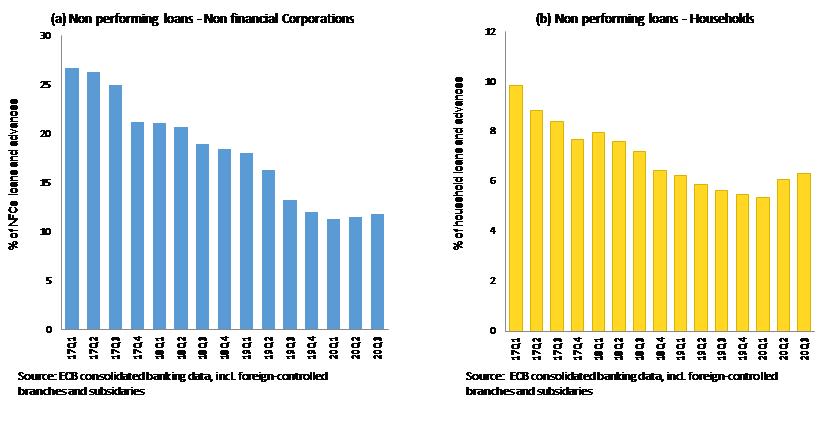
The level of non-performing loans (NPL) in Croatia ranks high among EU Member States and above the EU average. The Croatian banking sector has made great progress over the past number of years in reducing the level of NPLs from 13.6% in 2014 to 5.2% end of 2019. The level increased slightly to 5.4% in the third quarter of 2020. Despite the downward trajectory before 2020, the level remained considerably higher than the EU average of 2.7%. In addition, in case of an increase in corporate insolvencies following the ending of governments’ business support measures and policies introduced in the context of the COVID-19 pandemic, the level of NPLs could rise going forward. NPLs of non-financial corporations remained broadly unchanged during 2020, reaching 11.9% of corporate loans at the end of the third quarter of 2020 (Graph 3.3(a)). The rise of NPLs for households has been much more pronounced in 2020, with the ratio of NPLs increasing to 6.3% at the end of the third quarter, from 5.5% at the end of 2019 (Graph 3.3(b)). Nevertheless, the banking sector remains well capitalised with high regulatory capital (CET1: 22.4% in the third quarter of 2020, among the highest within the EU) and provisioning levels (coverage ratio: 66.2%, the highest within the EU).
|
|
|
Table 3.1:Private debt indicators, Croatia
|
|

|
|
Source: (a) Eurostat, (b) Ameco, (c) European Commission calculations, (d) ECB
|
|
|
|
Graph 3.1:Thematic Graphs: Household debt
|
|

|
|
Source: European Commission Services
|
|
Graph 3.2:Thematic Graphs: Non-financial corporate debt
|
|

|
|
Source: European Commission Services
|
|
Graph 3.3:Thematic Graphs: Non-performing loans
|
|
|
|
Source: European Commission Services
|


