 EUROPEAN COMMISSION
Brussels,7.3.2018
SWD(2018) 220 final
COMMISSION STAFF WORKING DOCUMENT
Country Report Portugal 2018
x0009
Including an In-Depth Review on the prevention and correction of macroeconomic imbalances
Accompanying the document
COMMUNICATION FROM THE COMMISSION TO THE EUROPEAN PARLIAMENT, THE COUNCIL, THE EUROPEAN CENTRAL BANK AND THE EUROGROUP
2018 European Semester: Assessment of progress on structural reforms, prevention and correction of macroeconomic imbalances, and results of in-depth reviews under Regulation (EU) No 1176/2011
{COM(2018) 120 final}
Contents
Executive summary
1.Economic situation and outlook
2.Progress with country-specific recommendations
3.Summary of the main findings from the Macroeconomic Imbalance Procedure in-depth review
3.1.Imbalances and their gravity
3.2.Evolution, prospects and policy responses
3.3.Overall assessment
4.Reform priorities
4.1.Public finances and taxation
4.2.Financial sector, private indebtedness and housing market
4.3.Labour market, education and social policies
4.4.Competitiveness, investment and public administration
4.5. Sectoral policies
Annex A: Overview table
Annex B: Macroeconomic Imbalance Procedure scoreboard
Annex C: Standard tables
References
LIST OF Tables
Table 1.1:Key economic, financial and social indicators - Portugal
Table 2.1:Summary table on 2017 CSR assessment
Table 3.1:Macroeconomic Imbalance Procedure assessment matrix - Portugal 2018
Table B.1:The Macroeconomic Imbalance Procedure scoreboard for Portugal (AMR 2018)
Table C.1:Financial market indicators
Table C.2:Headline Social Scoreboard indicators
Table C.3:Labour market, education and social indicators
Table C.4:Social inclusion and health indicators
Table C.5:Product market performance and policy indicators
Table C.6:Green growth
LIST OF Graphs
Graph 1.1:
Contributions to real GDP growth
Graph 1.2:
Contributions to potential growth
Graph 1.3:
Activity, employment and unemployment rates (quarterly)
Graph 1.4:
Employment by type
Graph 1.5:
Labour underutilisation
Graph 1.6:
At-risk-of-poverty or social exclusion rate and components
Graph 1.7:
Current Account (CA) and Net International Investment Position (NIIP)
Graph 1.8:
Return on equity (%), domestic banks
Graph 1.9:
Sectoral breakdown of domestic loans to nonfinancial corporations (NFCs)
Graph 2.1:
Overall multiannual implementation of 2014-2017 CSRs to date
Graph 4.1.1:
Interest rates and GDP growth shocks
Graph 4.1.2:
Fiscal consolidation
Graph 4.2.1:
Saving with domestic banks
Graph 4.2.2:
Valuation gap on price/income, price/rent and fundamental model valuation gaps
Graph 4.2.3:
Overdue loans as % of total loans by NFC's size
Graph 4.2.4:
Private sector indebtedness
Graph 4.3.1:
Employment and employment rate by educational attainment, changes between Q32014 and Q32017, age group 2064
Graph 4.3.2:
Disposable income inequality before and after tax and transfers
Graph 4.3.3:
Early school leavers, NEET and tertiary attainment
Graph 4.4.1:
Labour productivity growth based on shift-share analysis % changes contributions in pps
Graph 4.4.2:
Labour productivity per hour worked and total factor productivity
Graph 4.4.3:
Labour productivity growth breakdown, (percentage changes; contributions in pps)
Graph 4.4.4:
FDI stocks by sectors
Graph 4.4.5:
Impact on labour productivity in manufacturing of tackling services restrictions
50
LIST OF Boxes
Box 2.1: Tangible results delivered through EU support to structural change in Portugal
Box 4.1.1: Impact of the 2018 Personal Income Tax reform: EUROMOD based simulation of the impact of the 2018 PIT reform
27
Box 4.3.1: Monitoring performance in light of the European Pillar of Social Rights
Box 4.3.2: Green Book on Labour Relations 2016
Box 4.4.1: Investment challenges and reforms in Portugal
Box 4.5.1: Policy highlights: Fighting social challenges with innovation
Executive summary
The Portuguese economy has continued to recover both in terms of growth and employment. Economic activity has accelerated and has become more broad-based, with investment and exports picking up. Employment grew even faster than GDP, particularly in labour-intensive services while wage growth remained subdued. Imbalances are receding in the context of favourable macroeconomic and financial conditions, but public and private debt and the negative net external position remain at high levels. Challenges also remain in terms of labour productivity, the still high income inequality and labour market segmentation as well as the low level of investment. Addressing these challenges would reduce the risk of a slowdown, should the external environment and financial conditions become less supportive. (
)
Portugal's recovery has strengthened. Real GDP growth is estimated at 2.7 % in 2017, up from 1.5 % in 2016, driven by acceleration in investment and exports. Private consumption remains an important contributor to growth but is expected to slow down slightly over the medium term, and the net external trade contribution to growth is expected to become broadly neutral. GDP growth is projected to slow down to 2.2 % in 2018 and 1.9 % in 2019 as positive cyclical effects are projected to fade away and output approaches its potential.
Higher revenue and lower interest rates enabled the headline deficit to be further reduced while the structural deficit remains broadly stable. The favourable economic cycle together with the decline in interest payments would allow for reductions in the structural deficit to ensure a sustainable budgetary position over the medium term. However, the currently planned structural adjustment lacks ambition. Containing expenditure growth and using gains from lower interest expenditure would help accelerate public debt reduction.
Portugal has made some (
) progress in addressing the 2017 countryspecific recommendations. In the area of public finances there was limited progress in improving the financial sustainability of state owned enterprises and in decreasing health sector arrears. Some progress can be seen in the broadening of the spending review and in the pension system. While limited progress was observed in measures to promote hiring on open-ended contracts there was some progress in activation of long-term unemployed people and on the minimum wage whose increases so far have not affected job creation. In the financial sector there was some progress in implementing a strategy addressing non-performing loans and improving access to capital. Limited progress was observed in decreasing administrative burden and tackle regulatory barriers in construction and business services. But some progress was made in improving insolvency and tax proceedings.
Regarding progress in reaching the national targets under the Europe 2020 strategy, Portugal is performing well in greenhouse gas emissions reduction, renewable energy and energy efficiency targets and increasing the employment rate (73% in 2017). The early school leaving rate dropped significantly in previous years, but slightly increased in 2016 and remains well above the EU average. There are still considerable obstacles to achieving the targets on R&D investment, tertiary education attainment and poverty reduction.
Portugal faces challenges with regard to a number of indicators of the Social Scoreboard supporting the European Pillar of Social Rights. The high share of people at risk of poverty and social exclusion is declining, but the impact of social transfers (other than pensions) on poverty reduction is limited. Income inequality has also started to subside but remains high, in a context where household disposable income is still below pre-crisis levels. While employment keeps recovering steadily, labour market segmentation remains a serious challenge, with young people particularly affected. The level of digital skills among the adult population is also below the EU average. On the upside, Portugal does well in terms of participation of children in formal childcare and has recently taken measures to promote work-life balance.
The main findings of the in-depth review contained in this report and the related policy challenges are as follows:
·The external position has been improving on the back of current account surpluses and higher nominal growth. The net international investment position was still negative at -104.7 % of GDP at the end of 2016, but is decreasing thanks to small but continuous current account surpluses and a pickup in growth. Current account surpluses will need to be sustained for an extended period of time to decisively bring down the still very high external liabilities.
·Public debt started decreasing from a high level and further fiscal consolidation would contribute to ensuring a steady decline. With no further bank recapitalisations expected, public debt is estimated to have started decreasing to reach 126.4 % of GDP in 2017. Ensuring public debt sustainability in the medium and long term hinges on a structural improvement in public finances and a sustainable budgetary consolidation. In this context, progress in broadening the spending review is set to have a positive effect, which could be larger with even more ambitious savings targets. In a similar vein, controlling expenditure, managing debt and improving the financial sustainability of state-owned enterprises are essential aspects to improve public finances. At the same time, the sustainability of the pension and health systems remains important with hospital arrears representing a particular challenge.
·Private indebtedness is decreasing at an appropriate pace linked mainly to faster economic growth though the debt stock is also decreasing in absolute values. Household and corporate debt ratios are declining but are still beyond prudent levels weighing negatively on investments and potential growth.
·The adjustment process in the Portuguese banking sector is ongoing, but challenges remain, including a declining but still high stock of non-performing loans. Portuguese banks remain among the least capitalised and have lower profits than their EU counterparts. However, capital increases together with the ongoing efforts to reduce costs and asset quality improvement are improving financial sector prospects. While falling in absolute terms, the still high proportion of non-performing loans (14.6 % in September 2017) remains a burden and a risk for banks' financial soundness. If not solved, it could be a barrier for new investments. A comprehensive strategy for a faster reduction of non-performing assets is therefore being implemented. Quicker winding-up of non-viable firms through insolvency procedures and a secondary market for non-performing loans could free credit supply for new investments and lower risks to the banking sector.
·Employment is fast increasing contributing to a decrease in total unemployment while wage pressure remains low. The labour market continued to improve strongly in 2017 benefitting from the job-rich recovery. Unemployment declined considerably from 11.2 % in 2016 to 9 % in 2017 and is now lower than the euro area average. The employment rate reached its highest level since 2008. This has not put significant pressure on wages as most of the job openings were in sectors with low-skill profiles and lower-than-average salaries. In addition, some labour market slack still persists, preventing wage growth from a significant increase. Youth and long-term unemployment remain a concern.
·Labour productivity growth remains sluggish in the medium term, limiting the potential to converge towards the EU average. While total factor productivity is estimated as a major contributor to potential growth, value added per employee dropped further in 2017 due mainly to the high number of jobs created in labour intensive sectors such as tourism-related services and residential construction. The relatively low-skill level of the labour force, small size of firms and other bottlenecks in the product and labour markets remain significant barriers to productivity increases. The low share of investment in GDP also contributed to a labour productivity slowdown.
Other key structural issues analysed in this report, which point to particular challenges for Portugal’s economy, are the following:
·Minimum wage increases have supported the incomes of low-wage workers and do not seem to negatively affect job creation. In particular, the minimum wage increases have not prevented the employment rate of low-skilled workers from rebounding during the recovery, also thanks to expansion in labour-intensive sectors such as tourism and construction. Nevertheless, risks remain concerning the employability of this segment of workers. The compression of the wage structure decreases the education premium, reducing also the incentive for workers to upgrade their skills. The Government and social partners keep monitoring the impact of minimum wage developments.
·Despite an increase in permanent hiring, the proportion of workers on temporary contracts is high. This raises doubts on the effectiveness of recent measures to tackle labour market segmentation. Hiring workers on temporary contracts is widespread with a large wage gap between temporary and permanent employees. While new measures to address segmentation are subject to discussions with social partners, no action is currently planned to review the legal framework for dismissals.
·Poverty and inequality indicators have improved further. The at-risk-of-poverty or social exclusion rate is getting closer to the EU average and the income share of the poorest 20 % increased since 2015. Despite the strong redistributive effect of the tax and benefit system, the level of income inequality is high. The effectiveness of social transfers (excluding pensions) in lifting people out of poverty is low. The adequacy of the minimum income scheme has been improved but remains limited while housing affordability is an increasing challenge for low-income households.
·Programmes are being rolled out and reforms implemented in Vocational Education and Training to upgrade the skills of the adult population. Their effectiveness in upgrading worker's basic skills (numeracy, literacy and digital) and ultimately raising productivity will depend on the coverage and quality of the training offered, going beyond the mere recognition of skills. The National Digital Competences Initiative aims to strengthen digital literacy, yet it is too early to ascertain its impact. Early school leaving has decreased significantly in the last decade, but is still above the EU average and slightly increased in 2016. Young people from a disadvantaged socioeconomic background show on average lower educational achievements. While the attainment of qualifications in tertiary education is increasing, the employability of recent graduates is below average.
·Measures to improve the business environment have been put in place, but regulatory restrictions remain in business services. New credit lines and programmes matching firms with equity investors, are improving the business environment, including SMEs access to capital. Capital financing is however limited. Administrative burden is decreasing thanks to simplification programmes. Restrictions in business services are being assessed but so far no action has been taken and regulatory barriers in professional services still restrict competition. Case backlog in courts is decreasing but time in court remains long, in particular for insolvent firms, and the system’s performance scores low compared with the EU average. Construction investment is increasing due to raising demand, but sector restrictions remain. Corruption and transparency in public procurement are still perceived by businesses as areas of concern.
·Improvements in network industries and business digitisation are visible while there is room for improvement in innovation. Key bottlenecks remain in the innovation system, such as barriers for university-business cooperation and better synergies between R&D and other intangible assets. Energy prices in Portugal and energy intensity in transport and industry sectors are high. However, market concentration is decreasing. The rail system is still underused especially the connection with Spain and some projects are facing delays.
1.
Economic situation and outlook
GDP growth
Economic growth picked up to 2.9 % yearonyear in the first half of 2017 and moderated to 2.5 % yearonyear in the third quarter. Full-year growth is estimated at 2.7 % in 2017, driven by acceleration in investment and exports. Private consumption remains an important contributor to growth but is expected to slow down slightly over the medium term along with a marginal increase in the household saving rate, which remains well below its historical average. Strong domestic demand also keeps imports robust and therefore the net external trade contribution to growth is expected to be broadly neutral over the forecast period (Graph 1.1). Overall, GDP growth is projected to slow down somewhat in the medium term as the positive cyclical effects are projected to fade away bringing the actual output closer to its potential.
|
Graph 1.1:Contributions to real GDP growth
|
|

|
|
Source: Eurostat
|
Investment growth rose strongly from 1.6 % in 2016 to nearly 10 % in 2017 but its share in GDP remained low at around 16 %. Following a strong increase in 2017, equipment investment is expected to ease in 2018 before picking up again in 2019. These fluctuations are largely due to the large boost from the capacity upgrade in the country’s biggest automotive company in 2017. After a strong rebound in 2017, investment in construction is set to moderate over the forecast period, as it is not expected to reach the pre-crisis level any time soon. Over the medium term, investment is expected to be driven by improved corporate profits, a modest recovery in bank lending and some acceleration in implementing EU funds (see section 4.4.2).
Exports of goods and services increased substantially in 2017. The positive cycle in tourism and the automotive industry expansion are expected to keep exports growing above global trade volumes also in 2018. Export growth is however projected to be more in line with trade partners over the medium term as tailwinds from car manufacturing and tourism are likely to weaken while productivity gains are set to remain subdued. Imports are projected to grow strongly, driven by domestic demand and the large import component of the export-oriented automotive industry. Consequently, the current account is projected to retain a small surplus over the forecast period. This is also helped by a decline in the projected interest payments to non-residents, following the sovereign rating upgrades in 2017 that led to a significant drop in the government bond yields.
Short and medium-term risks are broadly balanced, while long-term risks are tilted to the downside. Economic activity has increased, becoming more broad-based, with a strong pick-up in investment and exports which are expected to remain robust over the medium term. However, weak productivity growth, population ageing, limited specialisation in sectors with higher value added, relatively low labour skills, and deterioration in the capital stock might dampen potential growth perspectives (see 4.4.1).
Potential growth
Potential growth improved over recent years, but convergence to the EU in terms of income and productivity remains weak. Although Portugal is projected to have grown above the EU average in 2017, this is partly driven by cyclical improvements. Furthermore, the medium-term outlook, based on potential growth estimates, shows that the income gap relative to more advanced Member States is likely to remain broadly stable unless a further structural improvement is achieved.
Total factor productivity and job creation support potential growth. On the other hand, despite the rebound in investment since the second half of 2016, the contribution from capital accumulation is still slightly negative in 2017 and is expected to turn only slightly positive in 2018 and 2019. Despite some recent improvements, high public and private debt, including a large share of non-performing loans, as well as regulatory barriers and structural weaknesses in product and labour markets (see Section 4) are still having a negative impact on investment and growth. Following a significant deterioration during the crisis, the labour market has improved substantially since 2014, becoming a positive contributor to potential growth (Graph 1.2).
|
Graph 1.2:Contributions to potential growth
|
|

|
|
Source: European Commission
|
Inflation
Inflation increased from 0.6 % in 2016 to 1.6 % in 2017 due mainly to the impact of energy and accommodation costs. Inflation is set to stabilise at around 1.5 % over the forecast period, reflecting moderate wage dynamics and subdued price developments in the group of non-energy industrial goods. Some upward risks to inflation arise from the impact of tourism on accommodation and other tourism-related services, particularly in off-peak periods where the growth rate in foreign tourist visits could be still significant.
Labour market
In line with economic developments, the recovery of the Portuguese labour market continues. Supported by strong employment growth, unemployment dropped considerably from 11.2 % in 2016 to 9.0 % in 2017 (Graph 1.3) and the provisional monthly rate moved to 7.8 % at the end of the year. Unemployment has thus dropped to its lowest level since 2004 and is already below the euro area average. The economy added about 150,000 jobs in 2017 and employment growth reached 3.3 %, continuing to grow faster than GDP. The employment rate increased from 70.6 % in 2016 to estimated 73.0 % (age 20-64) in 2017, which is only slightly below the pre-crisis rate of 73.4 % in 2008. The recovery has reduced outward migration, but the demographic imbalance resulting from past migration might create labour supply shortages especially for high skilled workers (see Section 4.3). Over the medium term, job creation is expected to decelerate becoming more into line with GDP growth. Unemployment is set to decline further in 2018 and 2019.
|
Graph 1.3:Activity, employment and unemployment rates (quarterly)
|
|

|
|
Source: Eurostat, LFS
|
Despite the significant labour market improvements wage growth remains moderate. Nominal wages are growing broadly in line with consumer price inflation despite the strong increase in employment. As some labour market slack(
) remains (Graph 1.5) and most job openings are in sectors with lower-than-average salaries, only a moderate wage increase is expected over the forecast period. The latter also contributed to weak labour productivity performance (see Section 4.4.1) in 2016-2017 due mainly to high job creation in labour intensive sectors such as tourism-related services and residential construction. Nominal wage growth is expected to remain moderate in 2017 and 2018 and real wages are expected to move broadly in line with productivity. It is however possible that the current positive economic cycle could build up some wage pressure over the medium term, particularly in sectors with higher demand for skilled labour.
In recent years new jobs were mainly created on open-ended contracts, but temporary employment remains high. Employment growth almost exclusively consisted of permanent jobs in the first three quarters of 2017 (Graph 1.4). However, the creation of permanent jobs did not reduce the proportion of temporary employees which remained stable at 21.9 % (Q32017, age group 20-64), still one of the highest in the EU (see Section 4.3.1). In addition, the broader indicators on labour supply have not fully recovered from the crisis levels suggesting that some structural weakness in the labour market persist (Graph 1.5) (see section 4).
|
Graph 1.4:Employment by type
|
|

|
|
Source: Eurostat, LFS
|
|
Graph 1.5:Labour underutilisation
|
|

|
|
Source: Eurostat
|
Social developments
Poverty indicators have significantly improved in recent years on the back of stronger economic activity and employment. The at-risk-of-poverty or social exclusion rate has decreased from 26.6 % in 2015 to 25.1 %, in 2016, getting closer to the EU average of 23.5 %. This is mostly linked to a drop in the share of severely materially deprived people (from 9.6 % to 8.4 %) and in the percentage of people living in low work intensity households (from 10.9 % to 9.1 %). A further decrease to 23.3 % in 2017 (income reference year 2016) is estimated based on (preliminary) national statistics. Monetary poverty is also decreasing, although improved labour market conditions are not leading yet to a reduction in the in-work poverty risk which could be linked to the increase in overall incomes (see Section 4.3.2). On the other hand, the effectiveness of social transfers (except pensions) in lifting people out of monetary poverty is still low (see Section 4.3.2).
Income inequality is improving but remains high when compared to the EU average. In 2016, the income of the richest 20 % of the population was 5.9 times that of the poorest 20 %, against an EU average of 5.1. This ratio has slightly decreased since 2015, partly reversing an upward trend between 2011 and 2014, thanks to an increase in the income share of the poorest 20 %. This is on the back of improving labour market conditions and the positive impact of minimum wage increases on lower incomes. A further decrease to 5.7 in 2017 is estimated based on (preliminary) national statistics. The rise in disposable income between 2014 and 2016 has affected all income classes, but is more significant for the lower-income groups. The S80/S20 ratio remains above its lowest level of 5.6 in 2010. In addition, health and education inequalities remain issues of concern (see Sections 4.3.2 and 4.3.3). Household disposable income is still below pre-crisis levels. While GDP improved slightly between 2010 and 2017, household income actually decreased in the same period. This shows difficulties to achieve inclusive growth in that period due to a limited trickle-down to improve families’ income.
|
Graph 1.6:At-risk-of-poverty or social exclusion rate and components
|
|

|
|
Source: Eurostat, EU-SILC
|
External position and competitiveness
Net external liabilities remain among the highest in the EU. The net international investment position (NIIP) decreased in 2015-2016 but reversed slightly at the end of September 2017. This reversal was however due to valuation effects from the higher price in government bonds held by non-residents while the net impact from the flows in the current and capital accounts were still positive. At 104.7 % of GDP, NIIP remains significantly beyond the estimated country-specific prudential threshold of 48 %(
) and the current account, at around 0.1 %, is below the estimated benchmark of 2 % for closing the gap to the NIIP prudential level over a 10-year period(
). The NIIP structure improved meanwhile due to the increased net inflow of foreign direct investment (FDI). However, net FDI still plays a small role in the NIIP while net marketable external debt accounts for 66% of GDP in 2016 (Graph 1.7), indicating a continued potential risk to external sustainability.
|
Graph 1.7:Current Account (CA) and Net International Investment Position (NIIP)
|
|

|
|
Source: Eurostat
|
External flows are expected to continue reducing the stock of external liabilities but at a slow pace. The current account posted a small surplus in 2016 and is projected to remain only slightly positive in the medium term. Exports are gaining further importance in the economy but their impact on the current account is expected to be offset by a similar growth in imports, as investment demand is picking up from historically low levels (see Section 3).
The evolution of unit labour costs is broadly in line with main trading partners. Despite past increases in the minimum wage and strong labour demand, wage developments remain contained and to a large extent offset the negative impact of the weak productivity performance on competitiveness. Overall, the latest economic developments do not indicate immediate cost pressures on competitiveness. Nevertheless, the afore-mentioned risks of a possible build-up of wage pressures over the medium run may also pose risks of a slowdown in the export-led recovery of the economy over the medium and long run, even if some upgrade of exports quality is noticeable.
Non-cost competitiveness indicators developed positively over recent years, as seen from the increase in total factor productivity. Portugal's share in global exports increased by 3.5 % in 2016 and a stronger increase is projected for 2017. Exports also exceeded the growth in imports from main trading partners by 2 % in 2016 and the strong performance is projected to continue in 2018, reflecting the above-mentioned impact of tourism and car manufacturing.
Financial Sector
The adjustment process in the Portuguese banking sector is ongoing. Portugal still has the EU's third highest non-performing loan (NPL) ratio (after Greece and Cyprus). Profitability turned positive again in the first half of 2017. The capital ratio is one of the EU’s lowest. Return on equity improved in the first half of the 2017 but is now only slightly positive leaving the Portuguese banks still in a weak position. The system’s Tier 1 capital ratio (a measure of a bank's core equity capital to its total risk-weighted assets) stands at 13.8 % in Q2-17, still below the EU average, but already somewhat improved following the recapitalisations of the largest banks (see Sections 3 and 4.2).
|
Graph 1.8:Return on equity (%), domestic banks
|
|

|
|
Source: European Commission
|
Private indebtedness
Private debt is on a steady downward trend since 2012 though it is still above prudent levels. In consolidated terms, the share of private debt in GDP fell to 171.4 % at end2016. This is well above the estimated prudential and fundamental thresholds, which lies in the vicinity of 78 % and 105 %, respectively (
). Loans to tradable sectors accounted for about 53 % of total loans at the end of June 2017 and increased by 11 pps. since early 2009, reflecting the stronger deleveraging pressures in the non-tradable sectors, particularly in construction. The share of manufacturing is still quite low with 17 % of the total value of loans although credit growth to the manufacturing sector accelerated in 2017. On the other hand, this low level may also reflect the fact that manufacturing companies depend less on bank lending, as they have access to alternative sources of financing such as bonds, equity or financing through foreign-owned parent companies. The overdue loan ratio in the tradable sector remains around 10 %, which is 10 pps. below the value in the non-tradable sector in Q22017. The increasing share of loans to the tradable sector and its low rate of NPLs contributed to the reallocation of resources, which is essential for successfully rebalancing the Portuguese economy (see Section 3).
|
Graph 1.9:Sectoral breakdown of domestic loans to nonfinancial corporations (NFCs)
|
|

|
|
Source: Bank of Portugal
|
Public Finances
Public finances are benefitting from the strong recovery and substantially decreasing interest expenditure. The headline deficit is projected to have decreased from 2.0 % in 2016 to 1.4 % of GDP in 2017 according to the Commission's 2017 autumn forecast, mainly due to the accelerated economic recovery, decreasing interest expenditure and lower-than-budgeted public investment(
). As the improvement in the headline deficit is mostly cyclical in nature and supported by lower interest expenditure without being accompanied by discretionary fiscal consolidation measures, the structural balance is expected to have improved only slightly in 2017.
In 2018 and 2019, the headline and structural deficit ratios are expected to remain broadly stable lacking further structural consolidation. The headline deficit is forecast to remain stable at 1.4 % of GDP in 2018 as higher recovery-related revenue and lower interest expenditure are used to compensate for increases in primary expenditure and reductions in personal income tax revenue. As the impact of discretionary measures and savings in interest expenditure is expected to be broadly neutral, the structural balance is also projected to remain broadly stable in 2018. Under the forecast's no-policy-change assumption, the headline deficit is set to reduce slightly to 1.2 % in 2019 while the structural balance is set to remain largely unchanged. The structural primary balance is forecast to deteriorate by about ½ % of GDP over the forecast horizon. Risks to the fiscal outlook are tilted to the downside, linked to uncertainties surrounding the macroeconomic outlook and the potential deficit increasing impact of banking support measures in 2017.
The debt-to-GDP ratio is expected to have started falling in 2017 from very high levels. Portugal’s gross public debt-to-GDP ratio is forecast to have fallen to 126.4 % in 2017, and to further decrease to 124.1 % in 2018 and 121.1 % in 2019, due to primary budget surpluses, higher nominal GDP growth, lower interest payments and planned decreases in the cash buffer (see section 3).
|
|
|
Table 1.1:Key economic, financial and social indicators - Portugal
|
|

|
|
Source: Eurostat and ECB as of 30 Jan 2018, where available; European Commission for forecast figures (Winter forecast 2018 for real GDP and HICP, Autumn forecast 2017 otherwise)
|
|
|
2.
Progress with country-specific recommendations
Progress with the implementation of the recommendations addressed to Portugal in 2017(
) has to be seen in a longer term perspective since the introduction of the European Semester in 2011. Looking at the multi-annual assessment of the implementation of the Country Specific Recommendations (CSRs) since these were first adopted in 2014(
), 65 % of all the CSRs addressed to Portugal have recorded at least 'some progress' while 35 % of these CSRs recorded 'limited' or 'no progress' (see Graph 2.1). Most progress was observed for CSRs where the challenges posed to the Portuguese economy were also larger. These relate to the reform of labour contracts, some aspects of social assistance as well as reduction in private indebtedness. However, given the dimension of the remaining challenges in these areas, further work is still warranted.
|
Graph 2.1:Overall multiannual implementation of 2014-2017 CSRs to date
|
|

|
|
Source: European Commission
|
Portugal has progressively corrected its headline deficit and made some progress in carrying out an expenditure review. Following the financial crisis, Portugal went through a period of an increasing debt-to-GDP ratio and a worsening budget balance leading to an excessive deficit. With the consolidation effort that took place during the adjustment programme and in the years after, in 2016 the deficit went below the 3 % threshold for the first time in more than a decade. In 2017, Portugal is expected to have reached a government budget deficit of 1.4 % of GDP and the debt-to-GDP ratio to start dropping after having stabilised around 130 %. In the last two years Portugal started an expenditure review that has been progressively broadened to several policy areas and in recent years has made efforts to improve the sustainability of the pension system and of the financial situation of state-owned enterprises. Some progress has also been achieved in terms of improving tax compliance. An area where sustainability challenges remain is the health sector and in particular the permanently high arrears.
Over the past years Portugal improved debt restructuring mechanisms and reduced the debt bias. The high private indebtedness and large share of non-performing loans accumulated during the crisis increased the need for debt restructuring mechanisms. These have been put in place allowing viable firms to engage in restructuring processes at an early stage. In order to provide incentives for firms to use more capital financing Portugal has also reduced the debt bias in taxation. Measures have also been taken to improve the sustainability of State Owned Enterprises but their indebtedness remains high.
Significant progress was made in improving the attractiveness of vocational training and the coverage of social assistance. To tackle the low skill level of the adult population in Portugal, Government authorities have significantly improved the vocational and education training system in terms of quality and coverage. In order to dampen the negative social effects of the economic crisis, Portugal broadened the coverage of social assistance including the minimum income scheme, partly reverting earlier measures going in the opposite direction. Some progress was also observed in improving the efficiency of public employment services to facilitate the activation of the unemployed. An evaluation of reforms in the employment protection system was carried out and measures were taken to increase incentives to hiring on open-ended contracts, although their impact is still not sufficient to tackle labour market segmentation.
Competition authorities and cooperation between firms and universities were strengthened and the efficiency of network industries has improved. Cooperation between universities and the business sector could still be improved but measures have been taken to strengthen links. More resources have been ensured to the national regulators and the competition authority. Measures to improve the sustainability of the energy system and reduce costs have been implemented. Progress has also been made to improve efficiency in the transport sector namely in rail and ports.
Some progress has been achieved in increasing transparency and improving the efficiency of the judicial system. Measures have been taken to reduce the case backlog in terms of proceedings with the number of cases being finalised higher than those entering courts. Transparency has increased in particular regarding concessions and public private partnerships even though direct awards remain high.
Portugal has made some (
) progress in addressing the 2017 countryspecific recommendations. In the area of public finances there was overall limited progress with a more positive evolution seen in the broadening of the spending review in line with euro area recommendations and ensuring pension sustainability. Limited progress was observed in promoting hiring on open-ended contracts but some progress is observed in activation of long-term unemployed and as concerns the minimum wage that in spite of recent increases has not hampered job creation. Overall some progress in the financial sector namely for addressing non-performing loans and improving access to capital. Although some simplifications have been introduced for business-administration relations (such as E-government initiatives) and new studies aimed at assessing regulatory restrictions are on-going, limited progress was observed in reforming regulations in the business and construction services sectors, as no regulatory reform has been yet put in place for the various professional business services and for the construction sector as a whole.
ESI Funds are pivotal in addressing key challenges to inclusive growth and convergence in Portugal, notably by improving the business environment via facilitating access to finance for SMEs, promoting synergies between academia and business, and stimulating entrepreneurship and innovation to favour job creation. ESI Funds also help strengthen links between vocational training and labour market needs; they help reduce early school leaving and improve coordination between social and employment services and support the provision of adequate social protection coverage.
|
|
|
Table 2.1:Summary table on 2017 CSR assessment
|
|

|
|
Source: Commission Services
|
|
|
Member States can request from the Commission technical support to prepare, design and implement growth-enhancing structural reforms. The Structural Reform Support Service (SRSS) provides, in cooperation with the relevant Commission services, tailor-made technical support, which does not require co-financing and is provided at a Member State's request. The support addresses priorities identified in the context of the EU economic governance process (i.e., implementation of country-specific recommendations), but the scope of the SRSS support is wider as it can also cover reforms linked to other Commission priorities, or reforms undertaken at the initiative of Member States.
Portugal has requested technical support from the SRSS to help implement reforms in various areas such as: revenue administration and public financial management and growth and the business environment. In particular, the SRSS provides support to help develop a framework for the new budget law and implement an accounting framework based on international public sector accounting standards. It is also providing support to improve the functioning of an inter-ministerial coordination platform and to reduce administrative burden in the national regulatory framework.
|
Box 2.1: Tangible results delivered through EU support to structural change in Portugal
Portugal is a beneficiary of significant European Structural and Investment Funds (ESI Funds) support and can receive up to EUR 25.8 billion until 2020. This represents around 2 % of GDP annually over the period 2014-2018 and 77% of public investment (
I
). By 31 December 2017, an estimated EUR 16.8 billion (65 % of the total) was allocated to projects on the ground. This has paved the way for over 8 500 enterprises to receive support with over 1 000 to introduce new products and 450 enterprises cooperating with research institutions. EU investments contribute to raising the capacity of childcare infrastructure to accommodate an additional 32 000 children, and to improve health services for more than 2.7 million people; 76 000 higher education students have benefited from grants and 17 000 adults are participating in professional education and training courses; 40 000 youngsters and 11 000 adults have been integrated in the labour market; over 3 000 people with disabilities are also receiving support to help them participate in the labour market. Over 43 000 young people have been supported; more than 29 000 young people 'Not in Education, Employment or Training' have benefited from traineeships and 14 000 from support in employment, education or training. Out of the EU financing, EUR 2.6 billion is planned to be delivered via financial instruments, which is a five-fold increase compared to the 2007-2013 period.
ESI Funds help address structural policy challenges and implement country-specific recommendations. Actions financed cover promoting R&D and synergies between academia and business; improving access to finance for small and medium-sized enterprises, stimulating entrepreneurship and innovation in order to favour job creation and rebalance the economy towards a higher share of the tradable sector; improving the effectiveness of the justice system; enhancing efficiency and safety in the railways sector; supporting women's' participation in the labour market; strengthening links between vocational training and the labour market and adult learning development. ESI Funds are contributing to addressing the alignment of salaries with productivity; the reduction of early school leaving and improving the coordination between social and employment services and providing adequate social protection coverage.
Various reforms were undertaken already as precondition for ESI Funds support (
II
). Smart Specialisation Strategies for research and innovation were developed to focus efforts on product specialisation with strong market potential and to concentrate investments on each region’s relative strengths. This has also helped improve cooperation between enterprises and public research institutions. The national and regional transport plans have allowed to focus investments on mature and strategic projects, implemented not only with support from ESI Funds, but also from the Connecting Europe Facility (CEF) and national funding. Reform of public procurement, including e-procurement is increasing the efficiency of public spending and building administrative capacity.
Portugal is advancing the take up of the European Fund for Strategic Investments (EFSI). As of December 2017, overall financing volume of operations approved under the EFSI amounted to EUR 1.9 billion, which is expected to trigger total private and public investment of EUR 5.5 billion. More specifically, 18 projects involving Portugal have been approved so far under the Infrastructure and Innovation Window (including 6 multi-country projects), amounting to EUR 1.1 billion in EIB financing under the EFSI. This is expected to trigger about EUR 3.2 billion in investments. Under the SME Window, 10 agreements with financial intermediaries have been approved so far. European Investment Fund financing enabled by the EFSI amounts to EUR 801 million, which is expected to mobilise approximatively EUR 2.3 billion in total investment. Over 2 000 smaller companies or start-ups will benefit from this support. SMEs rank first in terms of operations and volume approved, followed by environment.
Funding under Horizon 2020, the Connecting Europe Facility and other directly managed EU funds is additional to the ESI Funds. By the end of 2017, Portugal has signed agreements for EUR 678 million for projects under the Connecting Europe Facility.
|
3.
Summary of the main findings from the Macroeconomic Imbalance Procedure in-depth review
Introduction
The in-depth review for the Portuguese economy is presented in this report. In spring 2017, Portugal was identified as having excessive macroeconomic imbalances, in particular relating to stock variables and the pace of their adjustment. This refers in particular to external, public and private debt, banking sector vulnerabilities and weak labour productivity along with labour market segmentation and a high, albeit decreasing, share of long-term unemployment. The 2018 Alert Mechanism Report (European Commission, 2017f) concluded that a new in-depth review should be undertaken for Portugal to assess developments relating to identified imbalances. Analyses relevant for the in-depth review can be found in: Public finances and taxation (Section 4.1); Financial sector: banking sector, access to finance, private indebtedness, highly negative net international investment position (Section 4.2); Labour market: high youth and long-term unemployment (Section 4.3); Investment: external competitiveness, private and public investment, business environment (Section 4.4); Sectoral policies such as R&D and energy (Sections 4.5.1 and 4.5.2) (
).
3.1.
Imbalances and their gravity
The country's net international investment position (NIIP) remains a significant source of vulnerability, as its level of 104.7 % at the end of 2016 is one of the most negative in the EU and goes beyond the estimated prudential and fundamentally-explained thresholds, which stand at of 48 % and 34 %, respectively (
). The structure of external liabilities remains dominated by marketable debt, which is a riskier type of external financing, despite the shift towards FDI financing flows over the past years. The ratio of net external debt to GDP is also declining but remains high.
Sustained current account surpluses are necessary to improve the NIIP to more prudent levels. Aided by the private sector deleveraging process, the current account moved to a small surplus in 2016-2017 that is close to the current account 'norm'(
) implied by fundamentals. Sustaining this surplus over the long run is crucial to address the highly negative NIIP along with the assumed positive balance in the capital account. Yet, even if the surplus were to be kept at current levels, the NIIP would only reach the prudential threshold by around 2030.
Private debt is on a steady downward path but still remains above prudential and fundamental thresholds. Both the corporate and household debt ratios are beyond the estimated country-specific prudential thresholds. For households, a debt ratio of 73 % compares with a prudential value close to 30 % of GDP. For corporations, the debt ratio of 99 % is approximately twice as much as the estimated prudential ratio. In addition, the legacy of non-performing loans (NPLs) stands out as a key weakness in the financial system although the scope of the imbalance is declining. The risk exposure is mainly to the corporate sector, which accounts for 65 % of all NPLs. The capacity of the financial sector to deal with NPLs is further limited by weak, albeit improving, profit margins and capital buffers.
Public debt remains high and the underlying interest rate burden continues to inhibit public investments. The ratio of public debt to GDP has been relatively stable at around 130 % of GDP since 2014. Better credit ratings are also contributing to lower debt service costs. However, the overall interest burden on the government budget remains one of the highest in the EU.
The recent strong increase in job creation has substantially improved the country's labour market. Most indicators improved considerably as headline unemployment dropped to 9 % in 2017. Long-term and youth unemployment also decreased significantly, bringing the scope of imbalances to a much lower level.
Productivity in Portugal has been below the EU average over recent years. Although total factor productivity has been a major contributor to the country's potential growth, weak performance in labour productivity keeps income levels below the EU average. Labour productivity is still restrained by product and labour market structural weaknesses, including a high share of low-skilled employees and labour market segmentation. This is despite the ongoing adjustment towards export-oriented sectors.
Risks linked to renewed dynamism in the housing sector appear to be contained currently. The rebound in house prices in 2016 and 2017 is seen as a correction from previously low levels of valuation and construction activity and is currently not considered indicative of an imbalance. Nevertheless, it would warrant closer monitoring if the current rapid pace of real house price growth is sustained over the medium term.
3.2.
Evolution, prospects and policy responses
Portugal's net international investment position improved from 112.0 % of GDP at the end of 2015 to 104.7 % at the end of 2016 but reversed to 105.2 % as of September 2017. This reversal is due to valuation changes (estimated at 3 % of GDP) from the increased price of Portuguese government bonds held by non-residents. The pace of adjustment is expected to improve the external position at a relatively slow pace, as the current account is forecast at a surplus of 0.1 % of GDP in 2017 and 0.2 % in both 2018 and 2019. This is against an estimated annual surplus of 2 % of GDP needed to bring the NIIP to its estimated prudential level of 48 % over a 10-year period. The structure of external liabilities improved over recent years due to a shift from debt to foreign direct investment (FDI). The FDI component in the NIIP widened to 33.0 % as of September 2017 relative to 29.9 % at the end of 2016 and 26.3 % at the end of 2015. The share of net external debt to GDP meanwhile contracted from 100.8 % at the end of 2015 to 94.5 % at the end of 2016 and 92.3 % as of September 2017 (see Section 1).
Policy measures aimed at improving the business environment have taken place that can contribute to improving competitiveness. This was mainly in the area of administrative simplification, identifying ways to further reduce restrictions in business services and regulated professions, and efforts to reduce the backlog in the judicial system. Measures have also been taken to attract foreign investors and improve competitiveness by addressing issues related to internationalisation of SMEs, labour skills and innovation.
Private debt has declined over recent years and the outlook remains favourable. In consolidated terms, the private debt-to-GDP ratio fell from 210.3 % at end2012 to 171.4 % at end2016, declining in both the corporate and the household sectors. Data for 2017 confirm that the process of deleveraging continues (see Section 1). This reflects the positive denominator impact of economic growth on debt ratios (passive deleveraging) and a slight decrease in the absolute value of household and corporate debt (active deleveraging). The pace of adjustment appears adequate but it nevertheless weighs on investment and potential growth.
The high NPL stock remains a key weakness in the financial system and is being addressed by a three-pronged strategy. The aggregate NPL ratio dropped to 14.6 % in September 2017 from 17.6 % a year earlier, according to ECB data covering domestic and foreign-owned banks. However, it remains among the highest in the EU and well above the EU average. Corporate NPLs are a particular concern as they account for about two-thirds of the total NPL stock. The strategy to reduce the burden of corporate NPLs is detailed in section 4.2.1. The strategy is being rolled out, but some of the measures have been only recently approved or are being implemented. The banks with the largest NPL ratios have submitted plans for substantial reduction in bad loans by 2021 (see Sections 1 and 4.2).
Public debt declined from 130.1 % of GDP at end-2016 to estimated 126.4 % at end-2017. The ratio is projected to drop further by an average of around 3 pps in 2018 and 2019. The recent improvement in macroeconomic variables, in particular nominal and potential GDP growth, has made the structural adjustment needed to ensure compliance with the transitional debt rule less demanding. The public spending review in place since March 2016 is slowly being translated into implemented measures. The review was originally focused on education, healthcare, state-owned enterprises, public real estates and centralised public procurement, to which the government has since committed to add the justice and internal affairs sectors. Despite progress in the spending review, hospital arrears continue rising with the implementation of cost-reducing measures still pending (see Section 1).
Labour productivity declined slightly in 2016-2017 but is set to improve as of 2018. The weak performance in both 2016 and 2017 is mostly cyclical due to the high rate of job creation in labour intensive sectors such as tourism-related services and residential construction. The forecast recovery as of 2018 is based on expectations for a less strong and more broad-based increase in employment. Other factors behind the weak labour productivity performance are linked to the low investment levels and some product and labour markets' rigidities such as restrictions remaining in business services and barriers to resource allocation as shown by the high labour market segmentation. The low level of qualification of the adult population also plays an important role.
The labour market continues to improve at a strong pace. Unemployment dropped from 11.2 % in 2016 to provisionally estimated 9.0 % in 2017, supported by strong employment growth. This positive trend is expected to continue in 2018 and 2019, though at a slower pace. The activity rate also improved and while the share of long-term unemployed people is almost half of total unemployment, it decreased substantially in absolute terms. As labour market indicators improve, there is no evidence yet of wage overheating, as a large part of the employment growth is skewed to low-wage sectors and some slack on the market appears still in place.
Activation and training measures can help improve some of the remaining labour market weaknesses. On top of various measures taken in recent years to promote activation, the one-stop-shops for employment planned for Q12018 will provide integrated services to individuals and employers, giving options depending on their profile and ensuring coordination with other public services. The goal is to improve the effectiveness of activation measures, focusing on the long-term unemployed and younger workers. A programme to improve adults' qualifications (Qualifica) is being implemented. It is an improvement compared with previous programmes since it includes a stronger training component. It also has broad coverage, through an expanded network of qualification centres expecting half a million participants until 2019 focusing on low-skilled adults.
3.3.
Overall assessment
The balance of risks improved over the past year. In terms of flows, most imbalances are reverting, also helped by the more positive economic environment. This is particularly true for employment conditions, which have improved significantly with unemployment rates now reaching pre-crisis levels. The pace of deleveraging in the private sector is also advancing at a steady pace while the government debt ratio is expected to drop gradually as from 2017.
Stock imbalances remain high, mainly in terms of NPLs, public and external debt. Despite the recent improvement, Portugal’s vulnerabilities, which are mostly of a long-lasting, stock-imbalance nature, remain significant. The government and external debt ratios are still high. The large, albeit decreasing, level of NPLs, low profitability and low capital ratios highlight vulnerabilities in the banking sector. Adjustment issues in the labour market have been to a large extent resolved, reflecting the strong employment growth and the fall in unemployment, and the risks there are mostly linked to the low labour productivity, which remains a major weaknesses of the Portuguese economy.
|
|
|
Table 3.1:Macroeconomic Imbalance Procedure assessment matrix - Portugal 2018
|
|

|
|
|
|
(Continued on the next page)
|
|
Table (continued)
|
|
|
|

|
|
|
|
(Continued on the next page)
|
|
Table (continued)
|
|
|
|

|
|
Source: Commission Services
|
|
|
4.
Reform priorities
4.1.
Public finances and taxation
4.1.1.Fiscal policy (public debt and debt developments)*
General Government debt is projected to decline in the short and medium term but remains very high. In the context of the global financial crisis and subsequent recession, very high fiscal deficits, the reclassification of off-balance sheet items and entities into the general government perimeter and stabilising interventions in the financial system resulted in a steep rise in general government debt by over 30 pps. of GDP between 2010 and 2013. Following a stabilisation at around 130 % of GDP from 2014 to 2016, the country's gross debt-to-GDP ratio is projected to have seen a first substantial decline to 126 % of GDP in 2017 while remaining one of the highest public debt levels in the euro area. The projections in the following analysis are based on the Commission’s 2017 autumn forecast. Following an acceleration of GDP growth and substantial decreases in interest payments and supported by planned decreases in the cash buffer, the debt-to-GDP ratio is projected to continue its decline by around 2.5 pps. per year in 2018 and 2019 reaching 121 % at the end of 2019. The primary balance is projected to have reached 2.5 % of GDP in 2017 and forecast to decrease to 2 ¼ % in 2018 and 2019, increasing future financing needs (see sections 1 and 3).
Following a more pronounced fall in the short-term, the gross public debt-to-GDP ratio is expected to decline moderately in the medium-term and to stabilise towards the end of the projection horizon. Model simulations of debt sustainability have been carried out that incorporate the scenario of the 2017 autumn forecast until 2019 and other technical assumptions for the medium term (
). Under the baseline no-policy change scenario, the results suggest that, following the more pronounced decline until 2019, the debt ratio will only decline moderately by around 1pp per year over the medium term before stabilising at around 115 % of GDP towards 2028 (see Graphs 4.1.1 and 4.1.2).
|
Graph 4.1.1:Interest rates and GDP growth shocks
|
|

|
|
Source: European Commission
|
The moderately declining debt-to-GDP trajectory in the baseline scenario is sensitive to potential rises in sovereign yields and to adverse economic developments. The debt sustainability analysis reveals that the debt stabilisation path of the baseline is broadly robust across a number of reasonable scenarios, but plausible shocks could considerably worsen the dynamics of Portugal’s public debt (see Graph 4.1.1). Potential shortfalls in nominal growth, sharp interest rate rises or decreasing fiscal efforts could put the public debt ratio on an upward path. An unsustainable debt trajectory could have adverse consequences for Portugal’s economic stability and lead to negative outward spill-overs via the sovereign risk channel.
The very high government debt is a burden on public finances. High public debt implies a smaller fiscal margin for manoeuvre to absorb adverse macroeconomic shocks and cope with possible rises in interest rates. The still relatively high, albeit declining, interest bill (projected at 3.9 % of GDP in 2017 as compared to 2.0 % for the euro area) also restricts the scope for public investment spending.
In the absence of further fiscal consolidation and reforms to boost growth, safeguarding fiscal sustainability and continuing to sufficiently reduce debt will be a challenge. The very high debt ratio implies a significant adjustment burden, which requires the conditions that enable debt reduction to be steadily maintained in the coming decades, including sustained economic growth. Sustainability can be safeguarded through permanent budgetary discipline, in line with the requirements of the Stability and Growth Pact (see Graph 4.1.2). The implementation of the reformed budget framework law and strengthened revenue collection could contribute to fiscal adjustment. Healthcare expenditure now accounts for the largest share of ageing costs, posing corresponding implications for long-term sustainability. Recently adopted reforms may affect the medium and long-term sustainability of the pension system.
|
Graph 4.1.2:Fiscal consolidation
|
|

|
|
Source: European Commission
|
4.1.2.Fiscal sustainability (including pensions and healthcare)*
Several reforms have reduced risks to the long-term sustainability of the pension system, while the government has expressed its commitment to duly factor sustainability into any new initiatives. The long-term sustainability of the pension system has been strengthened in the last few years, notably through the increase in the statutory retirement age from 65 to 66 years and by linking future increases to the evolution of life expectancy(
), as well as by restricting access to early retirement. Some recent measures are however expected to contribute to higher pension spending in the short term. In October 2017 a new early retirement scheme without penalty for people who had very long careers entered into force. It allows people who are now 60 years or older and that have made contributions for 48 years or more(
) to the social security or the legacy civil service pension system to retire without penalty. It will be fully operational from 2018. According to the Portuguese authorities, the change is expected to result in a one-off surge of about 11 500 people in 2018 who had been waiting to retire, while the effect on subsequent years should be smaller. Moreover, in addition to the regular pension indexation linked to inflation and GDP growth, an extraordinary update of lower pensions was carried out in 2017. It will be carried out again in 2018, with a particular focus on those pensions not updated between 2011 and 2015. The index for a range of welfare transfers affecting pensions was also unfrozen in 2017 so it can develop in line with inflation and economic growth.
Supported by the economic upswing, budgetary transfers to the social security system are set to end in 2018. For the first time in recent years, the extraordinary transfers from the state budget to finance the social security deficit will end in 2018. The end of the extraordinary transfers will be enabled primarily by the projected strong increase in social contributions (+5.6 % or around EUR 900 million) linked to the positive economic environment and the improvements in the labour market. Given the simultaneous increase in the social security system's spending on pensions of 5.1 % (around EUR 800 million), combined with the end of extraordinary transfers, the surplus of the social security system is projected to fall from around EUR 1.5 billion in 2017, to around EUR 1 billion in 2018.
Certain revenues are being earmarked to the Social Security Financial Stabilisation Fund. In 2017, the Portuguese authorities started earmarking the revenue collected from the additional real estate tax (Adicional ao IMI) to the reinforcement of the Financial Stabilisation Fund. From 2018 onwards, every year an additional 0.5 % of the corporate income tax revenue will be earmarked to the Fund, progressively reaching 2 % in 2021. The Financial Stabilisation Fund is not meant to be used until the mid2020s, when it is supposed to cover the social security system's deficit. Earmarking revenues in this way does not address the underlying issue of increased spending on pensions, in particular when the earmarking does not relate to new revenues.
The short-term sustainability of the health system is not ensured. Hospital arrears continued to increase by EUR 293 million in 2017 in spite of an extraordinary release of around EUR 400 million for the clearance of arrears in December. The average payment period of State Owned Enterprises (SOEs) in the health sector increased by 9 days to reach 112 in the first half of 2017. This is against the overall SOE average payment period which increased by 2 days to reach 72 over the same period. Among the 10 SOEs with the highest increases in operating expenses, 9 are in the health sector. The continuing accumulation of arrears in certain hospitals highlights problems with under-budgeting, monitoring and enforcement practices, along with personnel expenses and increasing demand pressures also being cited as factors. The announced capital injections into hospitals of EUR 500 million both at the end of 2017 and in early 2018 should help decrease arrears in the coming months. The pattern of periodic injections of funds for clearing arrears, however, does not appear to tackle the underlying hospital management issues which result in their accumulation.
While measures are being implemented to try to contain hospital expenditure, their impact remains to be seen. The financial management of the regional health administrations, which in the past has led to delayed payments and sometimes heavy financial penalties, has been centralised for a range of areas. Hospitals have increased their efficiency by setting up a shared resource management platform so as to enable the use of National Health System facilities and reduce reliance on the private sector. External evaluations of the boards of directors have also been introduced, as well as multi-year contracts with state-owned hospitals. Starting in 2018, authorities will start rolling out the integrated responsibility centres (attributing more autonomy to hospital teams in an effort to promote efficiency and organisational innovation). In addition, a joint Budget Analysis Unit by health and finance ministries is expected to tackle the hospital arrears problem and to increase the quality of budget planning. Plans to introduce financial incentives for hospitals to reach their targets are also currently being discussed within the Ministry of Finance. Overall, it remains unclear whether these reforms will be sufficient to prevent further arrears and ensure robust control over spending.
The burden of healthcare spending on the budget is projected to be among the largest in the EU in the long term. In the long run, pressures from the costs of ageing point to increased public spending on health from 5.9 % of GDP in 2016 (below the EU average of 6.8 %) to 8.3 % in 2070, which represents a 2.4 pp increase compared to the projected EU average increase of 0.9 pp. A comprehensive strategy to tackle the health-related costs of ageing, including chronic diseases, would be beneficial. Future pressures from investment needs are also substantial given that a large part of the equipment in the NHS is out of date. A detailed discussion on access to healthcare is presented in Section 4.3.2.
Significant measures are continuously taken to improve cost-effectiveness in the National Health Service. The value of goods and services purchased centrally in the health sector continued its increase in 2017, and is expected to grow further in 2018. Data for the first quarter of 2017 estimated EUR 35 million of savings due to the centralisation of NHS purchasing. Progress has also been made with digitisation, to strengthen the integration of the health system and to reduce redundancies, such as those associated with repeated medical exams. Although the market share of generic medicine in the NHS market has increased greatly compared to the 2011 level, the share seems to have broadly stabilised in recent years. The market share of certain biosimilar medicines(
), however, grew largely over the last two years. This development is being promoted through minimum-market share objectives for specific biosimilars in hospitals, as well as improved information about both generics and biosimilars to prescribers. More generally, annual medicine price revisions and agreements with suppliers continue to yield savings.
4.1.3.Fiscal framework and SOE*
The spending review exercise is gradually being expanded into new sectors. The expenditure review continues to cover education, healthcare, state owned enterprises (SOEs), public sector real estate management and centralised public procurement, with justice and internal affairs being the most recent additions. Some progress has already been made in the justice sector, with advancements in the 'Closer Justice' Plan to strengthen efficiency, due to be completed in 2019; as well as the 'Tribunal+' project which aims to optimise the working time of justice officers. In addition, there are plans to reduce the costs and inefficiencies associated with the legal treatment of seized vehicles are in development. A series of reforms in the internal affairs sector have also been planned but are not yet ready to be implemented. The reforms include the outsourcing of support functions to free up resources for operations and eliminating redundancies and replicated administrative tasks.
Improved human resource management to reduce absenteeism was presented as a priority for the 2018 spending review. The authorities estimate that EUR 60 million (10 in the education sector, 50 across other sectors) will be saved by reducing absenteeism in 2018. The focus will initially be on the education sector, where a review of medical panels, combined with the introduction of a new monitoring system, is expected to enable unnecessary sick leaves to be identified. If the approach proves successful, the intention is to apply the new measures across the remaining public administration sectors. A performance-related scheme aiming to incentivise civil servants to develop new ways of reducing expenditure without compromising public service provisions has also been adopted. This scheme does not apply to SOEs, and therefore not to hospitals either.
Ambitious savings targets for the 2018 spending review are a positive development. The total projected savings from the spending review exercise in 2018 amounts to around EUR 290 million (0.14 % of GDP) in a single year, compared to the expected cumulative savings of 0.1 % of GDP over 3 years announced in the 2017 budget. Overall, the inclusion of additional sectors and the introduction of more ambitious savings targets are welcome improvements. A broadening of the exercise to cover an even larger share of general government spending would represent another positive step forward.
There are further delays in implementing of the reformed Budget Framework Law (BFL). Together with an integrated accrual-based public accounting system, the BFL aims to improve management ownership, and ensure effective budgeting and budget implementation, as well as monitoring and reporting at all public administration levels focussing more strongly on medium to long-term accountability. Preparatory work, mostly the setting-up of IT systems, has been progressing, especially concerning the state accounting entity project (
). In terms of regulatory preparation a series of decree laws will require adjusting and consolidating. While the effective application of the new accounting framework should start in January 2018, the 2019 budget will not yet be prepared under the new framework due to the accumulating delays in implementing the BFL so far. As full completion by the 2018 target is no longer achievable, the three-year transition period for full BFL application will have to be extended with a phased postponement in applying most of the new BFL features. Overall, while the preparatory steps for thoroughly implementing the BFL have progressed, albeit more slowly than originally planned, it would appear important to maintain an ambitious timeline in the upcoming amendment in order to keep up the momentum for implementation in the short term.
While the financial position of SOEs is improving the lack of a systematic approach to budgetary transfers to SOEs remains an issue. The government estimates a net income for non-financial public companies of EUR 461 million in 2017, projected to fall to EUR 118 million in 2018 down from EUR 1.3 billion in 2014. Operational results also continue to improve (except in the health sector), albeit more slowly than in previous years, and despite the rising personnel costs linked to the unfreezing of wages. The total non-consolidated debt of public corporations included in general government remains high, however, at 19.0 % of GDP (approximately EUR 36 billion) in September 2017. This represents a fall of 1.3 pp of GDP relative to September 2016 (Bank of Portugal, 2017). According to the DBP, authorities have committed to limit the overall growth of public company debt to 2 % per year(
) (net of capital increases and the financing of new investments), although a more ambitious debt reduction target could be considered. A debt management and recapitalisation plan for SOEs is ongoing to reduce indebtedness and lower interest costs. The current ad-hoc practice of budgetary transfers to SOEs would benefit from being more predictable, however, in order to minimise moral hazard; promote the right incentives; and underpin a solid, long-term improvement in SOE sustainability.
Measures to improve SOE monitoring are ongoing although their impact remains to be seen. The upgrade of the SIRIEF(
) system to automatically draw information from the accounting systems of public companies will be widely applied in 2018. Activity and Budget Plans submitted by SOEs to UTAM (Ministry of Finance's task force on SOE monitoring), are beginning to be evaluated more comprehensively and with a longer time horizon (3 years). In 2018 the analysis of the impact of these plans on public accounts will no longer be limited to larger companies or groups, and will be carried out in a more regular and systematic way. Beginning in 2018, instruments ensuring that the Activity and Budget Plans are properly implemented will be put in place. These include early warning mechanisms and an assessment methodology allowing public companies to be ranked by their degree of risk so as to prioritise the follow-up effort. A detailed cost reduction programme can be required from at-risk SOEs. Accountability will also be improved through the introduction of incentives for good governance and for reaching objectives. Furthermore, SOE investments will be evaluated by UTAM on a case-by-case basis.
4.1.4.Taxation issues including tax administration*
Net revenues of new taxes appear limited while the government intends to ensure the broad stability of corporate tax legislation. The revenue from the new tax on sugary drinks up to October 2017 seems in line with expectations regarding the EUR 80 million target for 2017. However, the progressive additional real estate tax introduced in 2017 and earmarked for the Social Security's Financial Stabilisation Fund may bring significantly lower net revenue than expected. While gross revenues of around EUR 130 million are expected for 2017 only EUR 50 million has effectively been assigned to the Stabilisation Fund. The reduced transfer to the Fund reflects the expected impact of the deductibility of the additional real estate tax for rented-out properties in personal income tax declarations. Corporate income tax (CIT) rules have been broadly kept stable in 2017 except for a limited broadening of the scope of the tax allowance for corporate equity (ACE) intended to decrease the corporate debt bias (see below). While the 2018 draft budget did not include any major changes to CIT rules either, Parliament adopted an increase of the State surcharge from 7 % to 9 % for large companies with profits exceeding EUR 35 million. This was accompanied by a measure increasing incentives for reinvesting profits.
A new reform of personal income tax (PIT) is set to significantly affect revenue from direct taxation as of 2018. In addition to the already previously planned full abolishment of the PIT surcharge also for higher tax brackets, new PIT reform measures were introduced in the 2018 budget that aim to lower the tax burden on low-to-middle income earners(
). The reform measures include inter alia an increase in the number of tax brackets and an increase in the level of the net income guarantee ('mínimo de existência'). The corresponding reductions in PIT revenue could be somewhat higher than projected in the 2018 Draft Budget report (see Euromod-based simulation in Box 4.1.1). As the withholding tax tables may not already fully reflect the reform as of January 2018, part of the revenue losses may however only materialise when the 2018 PIT declarations are made in spring 2019. The PIT reform is estimated not to have an income inequality-reducing impact, as most of the benefits would be concentrated on the top half of the income distribution (Box 4.1.1).
Despite attempts to broaden the tax base reduced VAT rates are widely used. The VAT gap of Portugal (11.46 %), measuring tax collection efficiency is slightly below the EU average (12.77 %) and has decreased to its lowest level since 2011 according to the last available data (2015). However, the VAT policy gap of Portugal, which measures the impact of reduced rates and exemptions on VAT efficiency, remains considerably higher than the EU average (50.75 %, compared to an average of 44 %, see CASE, Study and Reports on the VAT Gap in the EU-28 2017 Final Report, TAXUD/2015/CC/131, 2017, p.54.). This needs to be assessed in light of recent changes to the VAT legislation that are not yet reflected in the indicators above, which have further extended the application of reduced rates(
). Hence, it appears worthwhile for Portugal to consider comprehensively assessing the impact of past changes on VAT system efficiency.
Recent measures have been enacted to tackle the corporate debt bias in taxation. Historically, the tax system itself has encouraged debt financing, through a differential corporate tax treatment of debt and equity, which incentivised businesses to accumulate excessive amounts of debt. Since January 2017, deductible interest expenses will be limited to the higher limit of 30 % of cash flow income or EUR 1 million. In addition to the recently revised ACE rules, this is expected to have some positive impacts in lowering the corporate debt bias, especially for companies with very high amounts of debt. The new ACE rules apply only to new equity investment. They avoid brining undue benefits to pre-existing investments, while being extended in scope. Consistent monitoring and evaluation of the performance of these two measures would allow to ascertain if further refinements are needed.
Dealing with taxes in Portugal is still burdensome, despite recent simplification efforts. In addition to past measures on improving the tax administration's efficiency (European Commission e), a series of new administrative simplification measures are included under Programa Simplex. Some of them were already introduced in 2016 (such as the online registry of non-habitual residents for PIT). Moreover, in the framework of the strategic plan against tax fraud for 20152017, other measures have been implemented. The number of e-invoices issued during 2016 increased by 3.6 % compared to the previous year, and taxpayers largely make use of online declaration of PIT forms (94.97 % of the total). Other initiatives include the almost full pre-filling of personal income tax returns and a new digital service for obtaining investment tax codes. These new processes have significantly reduced the elapsed time for handling procedures, increased taxpayer satisfaction and reduced administration costs. However, the average number of hours needed to comply with tax obligations (243 hours) remains the fifth highest among EU and EFTA countries (World Bank, 2017b). Moreover, the recurrent budget allocated to IT, expressed as % of the total recurrent budget of the tax administration, was only 5.7 % in 2015 (OECD). Increasing the efficiency and coordination between the different services within the tax administration remains a priority. Close monitoring of the overall impact of the measures would help ensure the cohesion of the system and identify weaknesses and areas for improvement.
Improving the efficiency in collecting tax arrears remains a challenge. Significant court backlogs remain regarding tax proceedings, which hamper the administration's efficiency in collecting tax arrears. In 2015, the % of total Portuguese tax debt that was older than 12 months remained among the highest in the EU (87.5 % of CIT-, 84.8 % of PIT-, and 90.9 % of VAT-related tax debt), which suggests the current procedures are not agile. Moreover, the total year-end tax debt (including debt considered not collectable) as a % of total net revenue was 36.34 % in 2015, which represents an increase of 6.79 pps in the period 2011-2015 (OECD).
|
Box 4.1.1: Impact of the 2018 Personal Income Tax reform: EUROMOD based simulation of the impact of the 2018 PIT reform
In 2018 Portugal is implementing a Personal Income Tax (PIT) reform affecting the number of tax brackets and the net income guarantee, in addition to the previously decided full reversal of the surcharge for the higher tax brackets. The size of the ensuing revenue and distributional effects were measured using EUROMOD (
III
) in a simulation exercise by the Joint Research Centre and DG ECFIN.
The most important new element of the 2018 PIT reform is the redesign of the tax bracket structure via the introduction of two additional brackets (dividing into two the previous second and third brackets) and a decrease of the lower limit of the fourth tax bracket. Thus, the marginal tax rates for the lower parts of the previous second and third brackets have been reduced from 28.5 % to 23 % and from 37 % to 35 % respectively. At the same time the lower limit of the previous fourth tax bracket with a marginal tax rate of 45 % has been reduced from EUR 40 522 to EUR 36 856. In addition to the tax brackets redesign the second major new element is the update of the tax-exempted net income guarantee ('mînimo de existência') that is now linked to the social support index (IAS). Further to the update of the IAS to EUR 428.90 EUR for 2018, the net income guarantee has thus risen from EUR 8 500 in 2017 to EUR 9 006.90 in 2018 (i.e. 1.5 IAS x 14 months). A third element is the abolition of the PIT surcharge. In line with the political decision taken already in the 2017 budget discussions, the PIT surcharge, that was still applicable at reduced rates for the full 2017 income for the higher tax brackets, has been fully abolished for all tax brackets for 2018 income (in terms of withholding tables it had already been gradually phased out by 1 December 2017).
The simulation used 2017 Portuguese tax-benefit calculation rules as a baseline scenario. In order to isolate the effects of the full surcharge abolishment, the change in the tax bracket structure and the rise in the net income guarantee, these three elements have been simulated in separate incremental steps. The full abolishment of the PIT surcharge for 2018 revenue also for higher tax brackets results in a negative Government revenue impact of around EUR 140 million. The change in the tax brackets and the rise in the net income guarantee imply additional revenue losses of around EUR 440 million and EUR 30 million respectively. Thus, the total implied revenue losses as compared to the 2017 baseline would add up to around EUR 610 million, i.e. around 5 % of the baseline PIT revenue. The revenue losses of around EUR 470 million related to the change in the tax brackets and the rise in the net income guarantee are somewhat above the estimate of around EUR 385 million included in the draft budget report.
All three measures have positive effects on the mean equivalised household disposable income (
IV
) in aggregated terms. In distributional terms, both the full reversal of the surcharge for the higher tax brackets and the change in the bracket structure lead to increases in the Gini coefficient, implying a more unequal distribution of income, which is only marginally offset by a minor decrease of the coefficient induced by the rise in the net income guarantee. The surcharge abolishment for high brackets benefits basically only the last decile of the income distribution. As the lower five deciles were already mostly exempted from personal income tax or paying the lowest bracket rate, the change of the structure for the intermediary brackets mostly benefits the upper five deciles. The rise in the net income guarantee mainly benefits the mean equivalised disposable income for the fifth decile. The overall distributional impact thus shows a regressive pattern, with the main beneficiaries being the households on the top-half of the income distribution.
|
4.2.
Financial sector, private indebtedness and housing market
4.2.1.Banking sector*
The capitalisation and profitability of Portuguese banks are below EU peers, but asset quality is improving. Strong economic performance, lower unemployment and improved consumer confidence can be traced in the gradually improving outlook for the banking sector. Better prospects for the financial sector also reflect capital increases, the restructuring efforts taking place throughout the banking sector, and the weak but slowly improving asset-quality indicators. Yet, profitability forecasts remain poor, due to the following factors: the high amount of non-performing loans (NPLs) on the balance sheet of Portugal's lenders, the relatively weak credit conditions and the low interest rate environment (see below). Despite the weak profits, which have been preventing banks from generating capital organically and led to equity increases directly from shareholders capitalisation levels are gradually converging towards European peers. The business model followed by many Portuguese banks consists of increasing fees and the prices of banking operations. In the long term, this could be threatened by digitisation trends which will increasingly provide lower cost service solutions for consumers.
Tackling the bad asset problem is a priority for both banks and national authorities. Throughout 2016 and 2017 banks managed to bolster their capital levels through a variety of measures and, more importantly, to attract international investors. The authorities in turn took several important decisions to allow banks to improve their profitability and deal more efficiently with legacy bad debt. Key measures included extending the duration of the loan to the national resolution fund, the sale of Novo Banco and the announcement of a comprehensive three-pronged strategy to deal with bad assets. The three largest banks holding a substantial share of all NPLs, created a credit management platform explained further down.
Savings still grow despite the lowest deposit remuneration on record (see Graph 4.2.1). Aggregate deposits are still growing and account for the vast majority of the Portuguese banks’ funding. Contrary to other Member States, Portuguese banks are forbidden by law to charge negative interest rates, even to large companies. This increases the incentives for multinationals to deposit excess liquidity in Portugal.
Portugal has one of the highest NPL ratios in the EU. By the end of September 2017 the overall NPL ratio was 14.6 % (European Central Bank) compared to 17.2 % at end-2016. In absolute terms NPLs decreased by EUR 10.2 billion since the peak, mainly due to NPL portfolio sales and a diminished flow of new NPL. Nonetheless the ratio is still approximately three times the euro area average (European Central Bank, Q3-2017). Without the reduction in total loans (denominator effect) the ratio would have come down faster. Broken down by sector, non-performing exposures of mortgage loans amount to 6.5 %, consumer loans 9.6 % whereas corporate NPLs are still 27.5 %; compared to 7.2 %, 12.4 % and 30.3 % in June 2016 respectively. On the back of falling NPLs in absolute terms the average coverage ratio rose slightly to 45.9 % (ECB), 2.7 pps higher than in June 2016 (EU average is 45 %).
|
Graph 4.2.1:Saving with domestic banks
|
|

|
|
Source: Bank of Portugal
|
The strategy to address NPLs already covers the most important aspects, and some steps have been taken to facilitate their recovery. The issue of legacy non-performing assets is recognised by the authorities as a key vulnerability of the financial system. The focus is on NPLs from non-financial corporations, which make up 65 % of all NPLs and were valued at around EUR 25 billion. This issue is being addressed by a three-pronged strategy: (i) changes to the judicial, legal and tax systems, (ii) prudential/supervisory measures led by the Single Supervisory Mechanism (SSM); and (iii) NPL management solutions (discussed in the next paragraph).The strategy’s legal strand is essentially focused on enabling the early restructurings of firms, while ensuring that non-viable companies are prevented from applying for various pre-insolvency proceedings and thus benefitting from creditors’ protection — often used as a strategy to delay the inevitable liquidation. Also, the strategy’s judicial pillar is focused on expediting insolvency proceedings (see Section 4.4.4). The secondary market for bad assets was further boosted by the Credit Recovery Funds, which started the divestment of some of the assets that were in the funds. The strategy’s supervisory strand focuses on providing guidance to banks on how to efficiently decrease NPLs. In addition, steps have been taken to tackle constraints to the recovery of NPLs. They target (i) the ability for banks to fiscally recognise write-offs; and (ii) the incentive for creating a secondary market for NPLs, by enabling new servicing companies to enter the market. The success of this strategy heavily depends on how well it is implemented.
Banks are taking measures to address their high level of NPLs. Banks have submitted five-year NPL reduction plans to the supervisor. The plans are based on SSM guidance and include measures such as cash recoveries, foreclosures, sales of NPLs and write-offs, and the use of SSM guidance on NPLs. Furthermore, various NPL management solutions are part of the third pillar of the comprehensive strategy to tackle the banking system’s legacy NPLs. Among these, a relevant initiative being put forward by banks is the ‘coordination platform’. This platform is a specific approach to deal with NPLs from non-financial corporations (NFCs), which aims to promote strengthened creditor coordination to expedite credit restructuring. The platform also intends to attract both public and private funds and technical assistance to restructure viable businesses but it remains to be seen how it will be operationalised. While this platform will not solve once for all the NPL problem, it will be helpful in the medium term for more challenging cases.
Profitability remains very low seen from a European perspective, in part due to non-recurring restructuring costs and high impairment levels, hampering the build-up of organic capital. While net intermediation income remained relatively stable – predominately thanks to lowered deposit remuneration – the lowered flow of impaired loans in 2017 explains why profitability improved somewhat. Banks cut costs through closing branches and early retirement schemes, both of which have high up-front costs while only yielding benefits later. Consequently the cost-to-income ratio remains high at 62.5 % (EBA data for the biggest banks) in June 2017. Given that Portugal still has one of the highest branch densities in the EU more consolidation efforts seem warranted. Concerning return on equity ECB data from June 2017 shows 0.2 % for the Portuguese banks as a whole, compared to 0.6 % in June 2016.
Portuguese banks managed to issue shares and attract shareholders yet their capital base remains low. The system's capital and reserves amounted to EUR 36.3 billion in September 2017, increasing from EUR 29.8 billion in December 2016. CGD, BCP and Montepio together strengthened their capital in 2017 by more than EUR 6 billion in total. Still, Portuguese banks are amongst Europe's least capitalised. Banco de Portugal cites CET1 with 13.2 % in June 2017. Further increases are planned. Lone Star, who bought Novo Banco in October, has injected EUR 1 billion during 2017. Novo Banco will have to issue EUR 400 million in subordinated debt until the end of 2018. CGD also plans another EUR 430 million Additional Tier 1 bond issue in 2018. These additional injections will not change the picture substantially but contribute to bridge the gap to EU peers. Nevertheless, if Portuguese banks are to become more profitable, they may have to generate capital organically and dispose more quickly of NPLs.
Improved profitability prospects attracted foreign investors to invest in Portuguese credit institutions. Foreign investors play an increasingly important role in the Portuguese banking sector. BPI continued deconsolidating its Angolan exposure and in February 2017 the Spanish CaixaBank group reinforced its position in the bank, which now amounts to 84.5 %. Millennium BCP, the second biggest bank in the system, increased capital and added the Chinese conglomerate Fosun to its list of strategic shareholders. Santander Totta, owned by the Spanish Santander group, continues to grow its balance sheet through consolidating its operations with Banco Popular’s Portuguese subsidiary, following the resolution of Banco Popular Español. Following a three-year process Novo Banco’s sale was completed in October 2017 when US private equity fund Lone Star closed the deal to acquire 75 % of the bank in exchange for Novo Banco being recapitalised by EUR 1 billion. Fully Portuguese owned banks such as the sector’s biggest bank CGD and Montepio, the country’s sixth largest, also carried out capital increases, which in the case of CGD was conducted through public recapitalisations as it is a 100% state-owned bank. Montepio changed into a limited liability company, a legal status that reinforces shareholding, governance and the strategic orientation of the bank.
4.2.2.Housing market*
|
Graph 4.2.2:Valuation gap on price/income, price/rent and fundamental model valuation gaps
|
|

|
|
Source: European Commission
|
Real estate prices are back to 2009 levels and the pace of mortgages decrease slowed down. House price inflation rose from 7.1 % in 2016 to 10.4 % year-on-year in Q32017. The deflated house price index increased by 6 % in 2016 and is estimated to have risen even more in 2017. Real estate prices are back to 2009 levels implying a 20 % real appreciation since 2013 following a depreciation of 17 % between 2010 and 2013. Commercial real estate prices grow slower than those for residential housing. Newly granted mortgages between January and September 2017 more than quadrupled from their 2012-2013 average. Yet they are only around a quarter of the 2003 to 2007 average. Consequently amortisations still outweigh new mortgages and their stock still shrinks with 2.3 % year-on-year by the end of Q32017. If adjusted for all non-transaction related issues (
) the decrease is 1.4 %.
Prices are still recovering from the crisis slump with price hikes mostly restricted to tourist areas. Concentration of price hikes in tourist areas, including projects for transforming residential properties into accommodation facilities suggest that the housing market is currently mainly driven by external demand and tourism-related investments. Domestic factors appear much weaker as the stock of mortgage loans is still declining. The price increase in 2016-2017 comes after a long period of decline and is so far seen as a correction of past undervaluation rather than an accumulation of new imbalances. Based on the synthetic valuation gap (an average of a model-based assessment and deviations from price-to-income and price-to-rent ratios), real house prices are still deemed slightly undervalued. Nonetheless, the rapid price increases are affecting internal demand and might aggravate the issue of housing affordability (Section 4.3.2). Remaining restrictions in the construction sector should be assessed to understand if they are a barrier for increasing housing supply (see Section 4.4.3).
4.2.3.Access to Finance*
The amount of bank loans granted to the corporate sector continued to contract but at a slower pace. Overall private sector loans fell by 4.0 % between September 2016 and September 2017. Company loan stock fell by 6.7 %. As Portuguese banks have off-loaded some NPL portfolios, the adjusted decline is only 1.2 %. The loan-to-deposit ratio fell slightly from 80.9 % in Q2-2016 to 79.4 % in Q22017 — by shrinking loans rather than by growing deposits. The contraction in providing credit affects both SMEs and large companies. In September 2017 the proportion of debtors with overdue credit amounted to 26.4 % (Bank of Portugal). The deleveraging process is ongoing with an aggregate reduction of private debt. As a result firms' access to bank loans is reduced. Additionally, interest rates in Portugal are among the highest in the euro area (2.75 % in September 2017 against 1.57 %).
Portuguese SMEs are highly dependent on bank credit. Loans to micro-companies and SMEs accounted for the largest share of the total loans to Portuguese NFC. SMEs have higher NPL ratios (Graph 4.2.3). Micro and small corporates are somewhat riskier than bigger corporates, which firstly is reflected in the higher NPL rations on that segment and secondly explains also the higher interest rates they receive. Big corporates face fewer impediments to finance through alternative sources such as issuances of bonds and equity.
|
Graph 4.2.3:Overdue loans as % of total loans by NFC's size
|
|
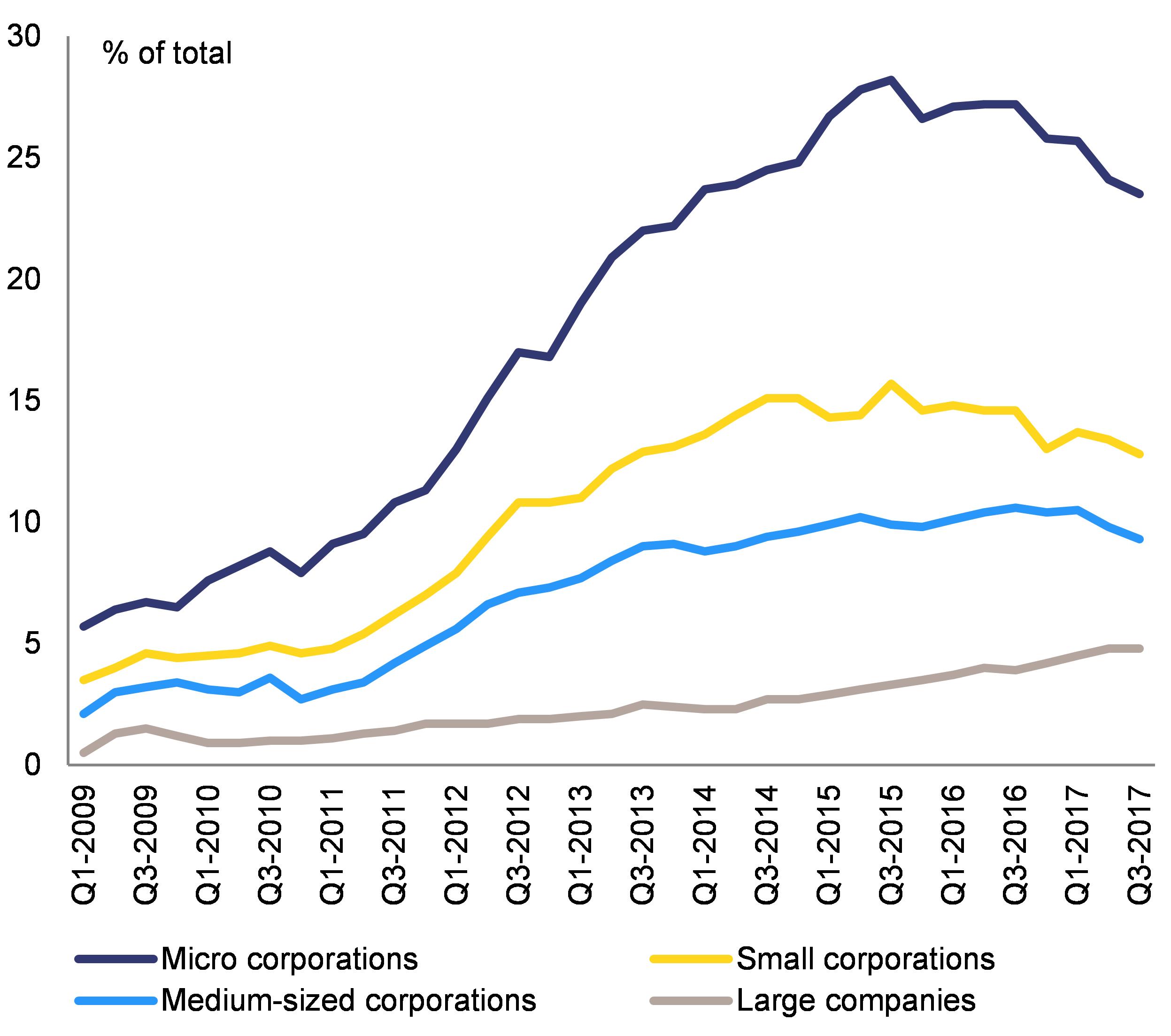
|
|
Source: Bank of Portugal
|
A high level of NPLs is making banks more prudent when allocating credit. While corporate loans attributed to firms in the best risk quartile are growing among heavy interbank competition, loans to heavily indebted firms are on the other hand decreasing. Still, Portuguese companies benefited in general from the low interest rate environment which facilitates to a certain extent and alongside other factors the survival of over-indebted firms. According to recent estimates, around 14 % of the capital stock was sunk into so called "zombie firms" in 2013 in Portugal (see McGowan et al., 2017). Once interest rates are on the rise again, some of these firms may find it increasingly difficult to pay back loans, which in turn would heighten the default risk and negatively affect investment demand. Highly indebted firms are particularly exposed to rising interest rates (Antonecchia et al., 2016), since their profits are primarily channelled to repay debts. Higher rates could fully jeopardise their capacity to invest, which would in turn have a negative impact on economic growth. Therefore, policies aimed at facilitating the exit of non-viable businesses and enhancing business dynamics would reduce the risk of inefficient capital allocation and by the same token reduce the flow of new NPLs in a higher interest rate environment.
Through increased risk differentiation banks redirect credit towards less indebted firms with promising business models. Banks increasingly differentiate loan supply across credit risk levels and high NPLs do not seem to have much impact on the loan supply to healthy firms with a promising, low-risk business model. On the contrary, there is intense competition among banks for the best risks and the corporate loan interest rates halved since 2012. The median mark-up for the best risk quartile was below 2 % in September 2017. Banks increased their lending to this quartile by 5 % year-on-year. Loan stocks concerning the second best risk quartile stayed flat whereas they decreased for the two worst risk quartiles – partially through write-offs and NPL work-out. Analysis from Banco de Portugal shows that companies which reduced investment since 2011 had an average debt to total assets ratio of around 36 % in 2011 and fell roughly 2 pps. Those which increased investment had a debt to total assets ratio around 28 % in 2011 and increased 1 pp. This is a welcome development as it adds to macro-financial stability, helps the country on its deleveraging path and – through channelling funds to the more productive sectors – contributes to resource reallocation towards growing sectors.
There are significant efforts being made to improve SMEs’ access to finance. In 2017, access to finance was the most important concern for 10 % of Portuguese SMEs (7 % at EU level)(
). This figure fell considerably from 19 % in 2013. Portugal provided new and earmarked funds for SMEs, not only for working capital and company growth, but also for capitalising indebted companies. New legislative initiative and public support schemes have been introduced such as guarantees for bank loans, credit lines and funds. For instance, in January 2017 a new credit line of EUR1.6 billion was launched to support SMEs, including a partial guarantee from private mutual guarantee societies and a partial public counter-guarantee. It comes on top of a EUR 1 billion credit line launched in 2016. Concerning the 2018 Budget, new financial instruments have been launched under the programme Capitalizar (see section 4.4.3): an upgrade of the Linhas Capitalizar (some additional EUR 1.6 billion) and two new credit lines: for exporting companies (EUR 600 million), and for the financing of mid-cap companies (EUR 400 million). Bank loans alongside credit lines remain the most relevant sources of financing for Portuguese SMEs. Improving access to capital may increase the low company survival rates. During 2014-2020 there will be EUR 5 billion EU funds to support SMEs. In the last two years, the approval of financial incentives to SME support projects significantly increased with almost 3.5 EUR billion committed and half the projects already implemented.
Firm survival rates remain low. Only 46.5 % of firms established in 2008 were in business in 2010, whereas only 50.6 % of those established in 2012 survived to 2014. The survival rate did not change substantially after the crisis while the number of companies established in 2012 was far lower than in 2008. This suggests that in Portugal there are significant difficulties for companies trying to survive (see Felix, S. 2017). Limited access to capital (both in terms of availability of capital and entrepreneurs’ awareness of existing opportunities) may be one of the main determinants for the low competitiveness of new firms.
Alternative sources of finance are still of little relevance to Portuguese firms. In 2016 all private equity investments were well below the EU average. Moreover, as regards equity capital, in 2017 only 3 % of SMEs considered it relevant or used it. Start-up Portugal (an umbrella programme for entrepreneurship) was set up to offer alternatives to bank loans. The programme promotes new financing methods such as equity crowdfunding, peer-to-peer lending and co-investment with key national and international investors. Venture capital investments as a proportion of GDP are low (0.008 % in 2016 according to Invest-Europe). Portugal Ventures the entity responsible for public venture capital investment has the capacity to intervene in strategic sectors such as IT, life sciences, tourism and in projects at a stage whereby the risk is perceived to be too high for private investors. The total equity ratio on total assets for companies was 32 % in 2015 (Banco de Portugal 2017a) which is low by EU standards. Almost a third of Portuguese companies are in negative equity (29 %), particularly smaller ones.
Venture capital funding fell since the crisis, hindering the growth potential of Portuguese firms. Venture capital investments as a percentage of GDP have not yet recovered to the pre-crisis level. Traditionally some of the most significant venture capital investors in the country come from the banking sector, which is typically more risk-averse, channelling funds to more mature, predictable (less risky)businesses. Venture Capital comes mainly from state and bank sources both accounting for around two-thirds of the country´s venture capital investments. The information and communications technology (ICT) sector is the most represented sector both in the amount received and the number of companies receiving support (Invest-Europe). Portugal Ventures, a public venture capital company, invests in seed rounds of Portuguese startups in tech, life sciences and tourism and has invested more than EUR 260 million in 116 companies since its creation in 2012. It has announced that another EUR 10 million will be provided for tech-based start-ups. However, the stock market does not have much appeal as there were not any initial public offerings since 2014 (Euronext New Listings Lisbon). Since some venture capitalists aim to get quick returns on investment (e.g. through an initial public offering) boosting the stock market is key.
Smaller firms are being helped to access capital markets. Within the Capitalizar programme there are new regulatory initiatives to enable firms to access capital market financing and to provide wider investing options for investors. On the equity side, in June 2017, a new legal investment tool was created to allow SMEs to indirectly access stock market financing. This new type of investment tool is specially designed for indirect investments in SMEs which are pooled into a corporate collective investment scheme which is allowed trade in a regulated market. On the debt side, a new type of money market security was created, the short-term debt certificates, which broaden the range of debt securities available to issuing SMEs, which are eligible for investment by mainstream investment funds. Both measures enable companies to diversify their sources of funding beyond debt, while offering more choice to investors (Decree-Law 77/2017, 30 June).
4.2.4.Private indebtedness*
Private debt, though elevated, is on a steady downward trend. In consolidated terms, the share of private debt in GDP fell from 210 % at end2012 to 171 % at end2016. The distance to the indicative MIP threshold of 133 % was thus nearly halved dropping 1/8th annually, which is fast if compared to the public debt reference pace (the Stability and Growth Pact adjustment benchmark of 1/20th annually). At end-2016, consolidated corporate debt accounted for 58 % of the total private debt a similar value compared with four years earlier, indicating that both household and corporate sectors are deleveraging at a similar pace. Using quarterly Banco de Portugal data on the stock of non-consolidated debt, the largest debt levels as of September 2017 are reported in trade (23 % of GDP), manufacturing (22 %), and utilities (18 %). The amounts for construction and real estate stand at 13 % in each sector. The debt levels are declining in all sectors but the steepest drop is recorded in construction. The debt accumulated by large companies accounts for 43 % of GDP while the value for micro-firms is 34 % of GDP. Both groups are reducing their debt burden at similar rates.
While the pace of deleveraging looks adequate, private debt remains well above the estimated prudential and fundamentals benchmarks(
). Both of the benchmarks for Portugal are estimated as more stringent than the MIP threshold (see Section 3). However, the pace of reduction in the debt ratios appears significant. Moreover, the latest improvement in the bank capitalisation ratios and macroeconomic performance and outlook is likely to increase both the prudential and fundamental benchmarks with a positive impact on the pace of debt adjustments. These conclusions apply for corporate and household sectors alike where the distance to the said benchmarks is significant but also the ongoing adjustment is strong. In the corporate sector, the consolidated debt ratio of 98.9 % at end2016 exceeds the prudential and fundamental benchmarks estimated in the vicinity of 47 % and 75 % respectively in 2016. In the household sector, the debt ratio of 72.5 % stands against estimated benchmarks that are close to 30%. Furthermore, debt sustainability indicators suggest that the saving rate of the household sector would have to increase in order to ensure medium to longterm sustainability of its balance sheet(
).
|
Graph 4.2.4:Private sector indebtedness
|
|

|
|
Source: Eurostat
|
The debt structure is improving but problems persist. The debt structure highlights some vulnerability in the private sector but is improving. The main issue is the large, albeit declining, share of NPLs (see Section 4.2.1). The problem is more pronounced in the corporate sector, accounting for about two-thirds of all NPLs. In the household sector, the burden of NPLs is less pronounced. However, the rate of debt reduction takes place in the context of low saving rates, which are estimated to have risen only marginally to 6.2 % in 2017 from 5.8 % in 2016 that is still significantly below historical values. The debt burden and related structural issues are thus having a negative impact on investments and growth that is partly offset by the increasing role of FDI inflows, whose share in the country's net external position is rising (see Section 4.4.3).
4.3.
Labour market, education and social policies
4.3.1.Labour market*
Labour market conditions keep improving, thanks to the economic recovery but youth unemployment remains a challenge. Unemployment keeps falling steadily and the employment rate reached its highest level since 2008 (see Section 1). Youth unemployment is also decreasing but remains high at 22.8 % in Q4-2017, (compared to 16.2 % in the EU). At the same time the rate of young people not in education, employment, or training (NEET) is below the EU average at 10.6 % in 2016 mostly due to the lower share of inactive NEETs. Long-term unemployment has fallen rapidly, and is now at the same level as the euro area. As a proportion of the active population, it amounted to 4.3 % in Q32017 down from a peak of 9.3 % in Q32013. Older unemployed people find it more difficult to get work. Almost three-quarters of 50-64 year olds have been unemployed over the long term.
Wage growth in Portugal slowed down significantly in the wake of the economic and financial crisis in 2008. Nominal wage growth resumed in 2015 and returned to levels broadly in line with developments in productivity, inflation and unemployment (see Section 1 and European Commission, 2017c). Compensation of employees per hour worked is significantly below EU average, despite improving between 2015 and 2016. This reflects sluggish productivity and moderate wage growth over the last decade, as well as the large proportion of (comparatively low-paid) temporary employees.
Recent minimum wage increases have supported the incomes of low-wage workers, but led to a compression of the wage structure. The 2017 increase of the minimum wage (fixed at EUR 557 per month) was the third since 2014, pointing to a cumulative increase of 14.2 %. The government also decided to further increase it by 4.1 % to EUR 580 per month, as of 1 January 2018. In absolute levels, the minimum wage remains low around EU 675 per month on a 12-months basis (since it is paid 14 times a year) when compared to the EU average. However, it is high when compared to the Portuguese average and median wage levels (of which it represents respectively 47.2 % and 65.3 % in 2016)(). Recent increases led to a substantial rise in the number of employees covered, up to 21.6% in the third quarter of 2017 (Government of Portugal, 2017) further compressing the wage structure. The ongoing compression reduces the skills wage premium, in particular between low and mid-skilled workers, lowering incentives for the low skilled to invest in education and training. Skill upgrading is a major concern in a context where almost half the labour force is low skilled (see section 4.4.3).
|
Graph 4.3.1:Employment and employment rate by educational attainment, changes between Q32014 and Q32017, age group 2064
|
|

|
|
Source: Eurostat, LFS
|
|
Box 4.3.1: Monitoring performance in light of the European Pillar of Social Rights
The European Pillar of Social Rights, proclaimed on 17 November 2017 by the European Parliament, the Council and the European Commission, sets out 20 principles and rights to benefit citizens in the EU. In light of the legacy of the crisis and changes in our societies driven by population ageing, digitalisation and new ways of working, the Pillar serves as a compass for a renewed process of convergence towards better working and living conditions.
Portugal faces challenges with regard to a number of indicators of the Social Scoreboard (
) supporting the European Pillar of Social Rights. The country shows a positive yet moderate progress in terms of poverty and social exclusion, although the impact of social transfers (other than pensions) on poverty reduction is limited. Notwithstanding recent reforms, the challenge of income inequality also remains prominent, in a context of disposable income still below pre-crisis levels. After being heavily affected by the crisis, the labour market continues its quick recovery, and the employment rate records on the EU average, with a very limited gender employment gap. Labour market segmentation and unemployment remain a challenge, with youth being particularly affected. The health status of Portuguese people is relatively good but health inequalities remain.
 Albeit from high levels, the early school leaving rate decreased significantly, and is on track to reach Europe 2020 national target of 10 %. The rate fell from 34 % in 2008 to 14 % in 2016, also thanks to recent policy efforts. Educational outcomes keep improving, but concerns remain over equity. The adult population is still characterised by low levels of skills, including digital skills.
Portugal has recently taken steps improving work-life balance. 47.2 % of children aged 0-3 were in formal childcare in 2016, supporting equal opportunities in the labour market. Policy measures to promote work-life balance, namely on further extension of parental leave rights have been recently taken. In particular, Portugal recently extended the period of paternity leave to up to 25 working days (formerly 20 working days), 15 of which are mandatory (previously 10) and must be taken during the first month after the birth.
|
Minimum wage increases continue in a context of strong job creation. While the number of low-skilled workers employed has fallen by about 42 000 since 2014, the number of low-skilled people of working age has fallen even more (as a result of the ongoing upskilling of the population) (Graph 4.3.1). Thus, their employment rate has actually increased by 5.9 pps. This is more than the increase recorded for medium-skilled workers (5.3 pps). The employment rate of low-skilled workers is comparatively high in Portugal (68.4 % in the third quarter of 2017 in the age group 20-64), but it has fallen by almost 3 percentage points in 10 years. Meanwhile over the same period the employment rate of medium-skilled people has increased by around 7 pps. Overall, this evidence suggests that, while the minimum wage increases did not stop the employment rate of low-skilled workers from rebounding during the recovery, helped by expansion in labour-intensive sectors such as tourism and construction, the employability of these workers (which is affected by long-term structural changes in the economy) remains at risk. Quarterly reports to monitor minimum wage developments are published by the government and discussed with social partners.
Despite the recent large increase in permanent contracts, labour market segmentation remains high. The share of workers on temporary contracts is among the highest in the EU (see Section 1). In 2016, 85.5 % of temporary employees (aged 20-64) were in this situation involuntarily. Self-employment (without employees) is on a long-term decline; it dropped from more than 18 % of total employment at the beginning of the 2000s to 11.4 % in 2016. This trend is mostly due to a decrease in agriculture and manufacturing, while a moderate increase is recorded in professional services and other service activities. This may be related, in some cases, to ‘bogus’ self-employment. According to analysis by Eurofound (2017), 34 % of self-employed people in Portugal (one of the highest shares in the EU) have this status because there is no other work available.
While transitions from temporary to permanent jobs are increasing, temporary contracts remain the norm for unemployed finding a job. The annual transition rate from temporary to permanent employment has increased during the recovery. It was about 30 % in 2016 up from 24 % in 2013 and higher than the EU average of 23.7 % in 2015 (EU-SILC data). Meanwhile the transition rate from temporary contracts into unemployment fell by around a third (from 17.4 % in 2014 to 11.3 % in 2016, although slightly higher than the EU average of 9.9 % in 2015). It is still much more likely for an unemployed person to get a temporary rather than a permanent contract (18.3 % v 4.7 % in 2016; the ratio among the two values, 3.9, is among the largest in the EU).
The wage gap between temporary and permanent employees is very high and increased during the crisis. In particular, the measure that allows a comparison of otherwise similar workers shows that this wage gap increased from 14 % in 2010 to 15 % in 2014, and is among the highest in the EU (European Commission, 2017c). The wage gap increases along with income quintiles, and is highest for the top 20 % of the country's income distribution. This suggests a challenge especially for highly educated workers.
Measures taken to promote the creation of permanent jobs proved effective but with limited coverage. In January 2017 the government reviewed its employment support programme to promote hiring on open-ended contracts. Two measures were introduced to promote hiring on permanent contracts (Contrato-Emprego) and support the conversion of traineeships into permanent contracts (Prémio-Emprego). These measures were effective but their coverage is limited. Exemptions of social contributions for hiring people belonging to vulnerable groups (e.g. long-term unemployed and young people) on open-ended contracts were also introduced. Also more labour inspectors are being recruited and greater coordination between labour inspection, tax and social security services is being promoted.
Possible measures to address labour market segmentation will be subject to tripartite discussions. Following the publication of the Green Book on Labour Relations (see Box 4.3.2) the government began discussions with social partners on possible measures to further tackle segmentation, including a possible reduction of the maximum cumulative duration of fixed-term contracts and limiting the legal reasons for their use. No action is currently planned to review the legal framework for dismissals which, as discussed in the 2017 country report and in OECD (2017c) can act as discouraging elements to open-ended hiring, as well as cumbersome court procedures.
Collective agreements are increasing but remain below pre-crisis levels. The government and the majority of social partners agreed in January 2017 to suspend the ‘expiry rule’ (according to which expired collective agreements can be terminated at the request of one of the parties) for 18 months, to promote social dialogue and revive collective bargaining. Data for 2017 actually points to an acceleration in collective agreements(
), with 208 signed in 2017 (with 46 % at firm level) compared to a total of 146 in 2016. In June 2017, the rules on extending agreements were also changed. The new framework introduces the analysis of economic variables, drops fixed (although loose) representativeness criteria and introduces a swifter administrative deadline to publish extension ordinances (35 working days - RCM 82/2017, 09/06). The impact of the new rules on wage setting practices (see Post-Programme Surveillance Report Summer 2017) will be monitored over the following quarters. The proportion of extensions for published agreements increased in 2017 to 41 % (from 24 % in 2016) but remains below 2008 level (46 %).
The Youth Guarantee measures have helped lower youth unemployment. On average during 2016 almost 6 out of every 10 NEETs aged under 25 were registered in the Youth Guarantee scheme (compared to an EU average of 42.5 %). This is a noticeable improvement on 2015 (48.8 %). More than half of those who left the Youth Guarantee in 2016 (56 %) were in employment or in education and training within 6 months. Follow-up data on the long-term outlook suggest that outcomes are sustainable. However, achieving the target of providing an offer within 4 months is proving difficult with follow-up data showing this is not being reached. Since 2014 the percentage of young people still in the preparatory phase after 4 months has increased (by more than 32 pps) and stood at 55 % in 2016, above the EU average (49 %).
Some progress has been made to improve active labour market policies and address long-term unemployment. In October 2016 a model of personalised support was introduced in Public Employment Services. The aim is to ensure personalised and integrated support to users on the basis of a tailor-made personalised plan, in particular for the long-term unemployed, until they are effectively integrated into the labour market. The monitoring framework of the Council Recommendation on integrating the long-term unemployed (European Commission d) shows that almost all registered long-term unemployed people had a job integration agreement in 2016 (98.3 %, against an EU average of 56.2 %). Among them, 20.6 % regained employment (14.2 % in the EU). However, this percentage was lower for people with low education and those aged 55-64. Recent national data point to an increase in the proportion of recipients of unemployment benefits integrated into the labour market (from 12.8 % in November 2014 to 17.5 % in November 2017). In addition, the average number of months that recipients were registered with the Public Employment Services decreased from 16.7 in November 2014 to 12.7 in November 2017. The Government plans to implement one-stop shops in the first quarter of 2018 to provide integrated services to individuals and employers and ensure coordination of Public Employment Services with other services. Portugal is also developing measures to offer combined support to recruitment of young and older workers, mainly long-term unemployed (Contrato-Geração).
Portugal’s recent economic and labour market recovery has reduced outward migration. Net emigration continues to fall (from around 37 300 in 2012 to 8 300 in 2016) but remains negative. The crude net emigration rate has decreased over the same period from 3.6 % to 0.8 %. Still, 40.5 % of permanent emigrants in 2016 were highly qualified (against 29.9 % in 2015). The economic recovery will probably not be enough to reverse the accumulated net outflow of migrants over recent years. Shortages in labour supply for low and high skilled workers might emerge if not compensated through migration inflows. In the health sector a significant number of professionals were recruited from EU and non-EU countries (e.g. 1 836 non-national doctors in Portugal in 2015 - European Centre of Expertise Expertise in the field of labour law, employment and labour market policies, 2017).
While the employment gender gap remains low, the difference in pay between women and men is increasing fast. The difference between the employment rates for women and men amounted to 6.8 pp in 2016, below the EU average. The gap narrowed during the crisis years, and has not widened during the recovery. On the contrary the (unadjusted) gender pay gap recorded the largest increase in the EU (by 4.5 %) between 2013 and 2015, reaching 17.8 % (now higher than the EU average of 16.3 %). The gender pay gap is wider among individuals with higher education levels. The Government is enforcing an agenda for equality in the labour market. This includes a law on gender quotas to ensure a balance between women and men on the administrative and supervisory boards of public-sector firms and listed companies (Law 62/2017). The national Parliament is discussing a bill to promote equal pay between women and men.
4.3.2.Social policies
Improvements in poverty and inequality continue. Poverty indicators improved since the beginning of the recovery, although inequality remains high (see Section 1). The latest national data and Eurostat projections suggest that improvements are continuing. The at-risk-of poverty rate is set to decline from 19 % in 2016 (referring to 2015 incomes) to 18.3 % in 2017 (referring to 2016 incomes) according to the latest national data (provisional). Also, Eurostat flash estimates(
) show a decrease in this indicator, driven by rising disposable incomes of lower-income households. Preliminary national data also suggest a recent reduction in inequality, namely the ratio of incomes earned by the top 20 % to the bottom 20 % of the income distribution is set to decrease from 5.9 in 2016 to 5.7 in 2017.
In-work poverty remains high, also due to the overall improvement in median disposable income. Stable at 10.9 % in 2016, it slightly reduced to 10.8 % in 2017 (provisional data for 2016 income), remaining higher than the EU average (9.5 % in 2016). It is a particular problem for workers on temporary contracts (13.5 % v 6.6 % for workers on a permanent job) and for families with children (13.0 % vs 8.3 % for households without dependent children). The low impact so far of the minimum wage in reducing in-work poverty can be linked to the entire population having their disposable income improved since the poverty line is measured as 60 % of median equivalised disposable income.
The redistributive capacity of the tax and benefit system contributed to reducing market inequality and thus income inequality. As evident in Figure 4.3.3, market income inequality (as measured by the Gini coefficient (
) before taxes and transfers) had been rising constantly from 2011 to 2014 up to 56.3 (among the highest in the EU). This reflected deteriorating labour market conditions up to 2014 and increasing labour market segmentation. It then started decreasing in 2015. Conversely, the Gini coefficient after tax and transfers remained relatively stable during the crisis and has decreased since 2014, down to 33.9 in 2016. This suggests that the tax and benefits system played an important role in combatting income inequalities, notably in the last 5 years (see IMF 2017; European Commission 2017c). (
)
|
Graph 4.3.2:Disposable income inequality before and after tax and transfers
|
|

|
|
Source: European Commission calculations with Eurostat, SILC data.
|
|
Box 4.3.2: Green Book on Labour Relations 2016
The Green Book on Labour Relations, commissioned by the Ministry of Labour, was published in December 2016 and is a portrait of the Portuguese labour market. The main goal is to contribute to an informed discussion of the last decade of Portuguese labour market developments and to involve social partners and political decision makers (among others) in the analysis to support a tripartite discussion on labour market regulation and collective bargaining.
According to Green Book, Portugal had an increase in flexible working conditions between 2008 and 2013 and a large decrease in the index of employment protection of workers with permanent contracts between 2010 and 2013. Also, these reforms did not solve the issue of labour market segmentation and were actually followed by a proliferation of non-permanent employment. Some forms of individual dismissal in place are not used because they remain too complex, namely dismissal due to inadaptation.
Regarding unemployment, the Green Book points out a significant increase of active measures in the labour market between 2011 and 2015 with almost half of these directed to the creation of fixed-term contracts (46.4 %). Relevant changes in the labour legislation are also mentioned, such as changes in the redundancy regime (on the amounts of compensation due in case of termination of employment contracts and in dismissal for maladjustment) and in the working time arrangements (with the creation of the individual hour bank, reduction of the remuneration due for overtime work and elimination of compensatory rests).
Regarding collective labour relations, the Green Book highlights stagnation in the number of work councils constituted and their activity. A significant decrease between 2011 and 2014 of collective bargaining instruments is also mentioned, as well as a drop in collective labour agreements and workers covered since 2011. Recent social tripartite agreements regarding minimum wage are also highlighted.
|
Recent measures to improve social safety nets could help reverse the decline in the effectiveness of social transfers in lifting people out of poverty. The impact of social transfers (other than pensions) on poverty reduction lies below the EU average and has been decreasing during recent years, from 32.2 % in 2010 to 24 % in 2016. This decrease might result from increasing incomes, and lead to an increase in the poverty threshold. The indicator is based on 2015 incomes that do not reflect the most recent policy measures aimed at increasing social safety nets for low-income earners. In 2016 and 2017 Portugal aimed to strengthen its social protection system through a comprehensive strategy. Policy changes introduced in 2016 clearly had a progressive effect on the income distribution (Euromod, 2017) (
). Updates have been put in place concerning the amounts in minimum income, the solidarity supplement for the elderly, low pensions and family benefits. In 2017, the indexing reference of social support (the Social Support Index-IAS) was updated for the first time since 2011, from EUR 419 to 421.
Despite efforts made, the adequacy of the minimum income scheme is limited. Following a first reform in 2016 focused on the equivalence scales for the calculation of the minimum income benefits, Portugal made important changes to the minimum income legal scheme (Rendimento Social de Inserção) in 2017, to reinforce its capacity to integrate and protect persons living in poverty, without discrimination by nationality (
). Despite an increase of the total of recipients by 1.8% (in November 2017 – Social Security Statistics) over the previous year, the level of coverage in Portugal ranks among the lowest. The net incomes of minimum-income recipients are very low when compared with the poverty threshold and net incomes of low-wage earners. This remains a challenge as the European Pillar of Social Rights emphasizes that ensuring access to minimum income benefits is essential for groups lacking sufficient resources, as is the right to access enabling goods and services. In contrast, Portugal ranks close to or above EU average for indicators related to coverage and adequacy of unemployment benefits (
).
The coverage of self-employed people and those holding atypical jobs by the social protection system remains limited, but action was recently taken to address this issue. Portugal is one of the countries with the highest percentage of employed people aged 15-64 at risk of not being entitled to sickness benefits (over 10 %) though universal access to healthcare is provided for (ESPN, 2017). New legislation aiming at enlarging social protection coverage for self-employed workers was adopted in January 2018, to be effective in the course of the year. It reduces the waiting time period to access the sickness subsidy from 30 to 10 days. It also introduces a new unemployment benefit regime for workers considered to be economically dependent, with a reduced minimum contribution period from 720 to 360 days (the criteria for being classified as economically dependent were also made less strict). The Government estimates an increase in the number of potential beneficiaries from 68,000 to 95,000 people.
A new social inclusion benefit and a scheme to support independence for people with disabilities have been recently approved. The latter targets people with disabilities who are over18 and have a disability above 60 %, aiming to help them access employment. Under this new measure, in addition to receiving the new social benefit (approximately EUR 264, non-means-tested for single beneficiaries) people with disabilities will be able to earn up to a certain amount of income from work, potentially increasing their employability and reducing the risk of poverty. This scheme to support to an independent life is to be launched as a pilot project and aims to test a model of assistance that enables people with disabilities to become independent (both at personal and professional level).
Housing affordability may become an issue for low-income households in view of recent increases in house prices. Despite a slight decrease when compared to 2015 (33.5 %) almost 30 % (29.1 %) of the resident population with lower incomes are overburdened by housing costs (
). In addition, the recent rise in housing prices is likely to worsen the situation for people who have low incomes and are socially deprived, particularly in the country’s two largest cities (Section 4.2.2). To address the issue, the government is implementing ‘a new generation of housing policies’ (several measures have recently been approved) which intend to introduce tax incentives for owners to rent at lower prices. Portugal performed well concerning housing deprivation, yet 10.3 % of people lived in a condition of insufficient living space, the same percentage as the 2 previous years (below EU average). However, the severe housing deprivation rate decreased between 2014 and 2016.
The pension system provides wide coverage except for people with intermittent careers. According to the 2018 Pensions Adequacy Report (forthcoming) the Portuguese pension system provides wide coverage. However it risks being unable to ensure the elderly are appropriately protected against poverty and social exclusion in cases of intermittent careers even if pension adequacy indicators show improvements between 2008 and 2016. If labour market segmentation is not reduced, this problem can worsen given the large proportion of temporary workers who typically have more periods without work. As this is affecting mainly younger cohorts, it has an impact in their pension contribution careers and lead to weaker protection in old age. On the other end of the spectrum are people with very long contribution careers. Therefore, the government started rolling out an early retirement reform (see Section 4.1.2) applying softer or no penalties to workers who started working at an early age and paid social contributions for many years.
The health status in Portugal is above the EU average but health inequalities remain a general problem. At the age of 65, Portuguese women can expect to live only a quarter of their remaining years free of disability, while for men the figure is two-fifths. Self-reported unmet needs for medical care equal the EU average and reflect efforts undertaken so far. Only 3 % of the Portuguese population report unmet needs due to cost, distance or waiting time (Eurostat) but there are differences between income groups. Despite a system of exemptions on user charges to ensure equal access to health, the recorded rate of user charges in 2015 was 10 times higher for the lowest income group (6.4) than for the highest income group (0.6). User charges were reduced for the first time in 2016 and expanded the groups eligible for exemptions, including unemployed, pregnant women, children and those with certain medical conditions. Its impact has yet to be evaluated.
Despite universal coverage, geographical gaps in providing services hinder access. Government measures have tried to simplify the recruitment process for general practitioners. By end-2016 the proportion of National Health System users registered with a general practitioner reached 92.1 % of the population. Remaining key challenges are (i) ensuring health workers are appropriately distributed across different geographical areas and (ii) providing incentives to retain and motivate staff with the required skills. There are significant differences in health indicators between the large metropolitan areas of Lisbon and Oporto and the interior regions. People living in rural areas face barriers in accessing healthcare which are mainly geographic, such as being too far from a central hospital that can treat a wide variety of diseases, notably oncological.
4.3.3.Education, vocational training and skills*
Educational outcomes keep improving, but there are equity concerns. The proportion of low achievers in Portugal decreased in all subjects tested (PISA, 2015) and the country is now above the OECD and EU averages for the first time. Despite these positive trends, the proportion of low achievers among students from the bottom socioeconomic quartile is 25 pps higher than that from the top socioeconomic quartile. Portugal has the third highest rate of grade repetition in the EU (31 %). The gaps between non-migrants and people with a migrant background — as measured by early school leaving rates, PISA performance and grade retention — are comparatively small.
Early school leaving in Portugal remains higher than the EU average but recent improvements in education outcomes could be the result of greater efficiency in education provision. The early school leaving rate fell from 34 % in 2008 to 13.7 % in 2015 and increased slightly to 14 % in 2016. While some of the decrease might come from emigration of pupils not recorded, it is still something to be monitored. The gender gap in terms of school attainment however, is also above the EU average, with higher early school leaving rates for men. Several measures are being implemented to encourage educational success and reduce drop-out rates throughout basic and secondary education. These include: the promotion of full-time schooling; the national programme for fostering educational success ("Programa Nacional de Promoção do Sucesso Escolar"- PNPSE); and the enhancement of the capacity of teachers and directors and the development of strategies adapted to the specific difficulties of individual students. A tutoring system for early dropout reached 80 % of all eligible students, engaging 2.700 tutors. The progress of several education system indicators set against the reduced level of spending seems to indicate a certain success in the reforms implemented. Possible improvement in this area is being explored by the Commission-supported OECD Portugal School Resources Review started in 2017. The final report will be released by spring 2018.
Decentralisation of the school system is ongoing and autonomy is being promoted. Building on the successful pilot of transferring pre-school and primary school competences to municipalities (meals, social assistance and transport), a number of new contracts are being signed with municipalities. They deal with non-teaching staff, complementary educational activities and equipment management. In addition, inter-administrative contracts are being signed focused on administrative autonomy, staffing of special projects, infrastructures and logistic and community engagement. This significant coverage is promising but it may be challenging as concerns securing the necessary resources both at local and national levels. Within the national programme PNPSE, schools can propose on voluntary basis new pedagogical initiatives adapted to their student population and receive additional resources to develop them. During the first year of implementation 98.6 % of all schools joined the plan and over 50 % of them implemented between 80 % to 100 % of planed actions.
The employment rate of recent graduates remains below the EU average, but tertiary attainment keeps growing. Tertiary attainment was 34.6 % in 2016 (age 30-34), approaching the EU average of 39.1 %. However, the national target of 40 % by 2020 might be difficult to achieve. Despite the high employability of science, engineering, technology, and mathematics graduates, there is a low student uptake in these fields (Governo de Portugal, 2016). The employment rate of recent tertiary graduates increased to 77.8 % in 2016, but remains below the EU average of 82.8 % and below the national pre-crisis level. The tertiary education attainment rate for people with disabilities is low in Portugal. (20.9 % vs 29.4 % in the EU-SILC 2015).
|
Graph 4.3.3:Early school leavers, NEET and tertiary attainment
|
|

|
|
Source: Eurostat, LFS
|
Portugal’s labour force is still characterised by relatively low skill levels. In 2016 only 52 % of those employed in Portugal were mid-or high-skilled compared with an EU average of 82 %. The problem is more acute for people over 40 (44 % against an EU average of 80 %) than for younger people (67 % against EU 87 %). This prevents productivity increases and investment in higher value-added productions (Sections 1 and 4.4). It also highlights the importance of having broad coverage in vocational education and training (VET) programmes to promote lifelong learning. Adult participation in training was 9.6 % in 2016, below the EU average of 10.8 %. Also, only 50 % of citizens in 2017 possessed basic or above basic digital skills and 27 % had no digital skills at all (mostly because they do not use the internet or do so seldom), whereas the EU average stood at 57% and 17% respectively. The risk of certain groups being digitally excluded such as the elderly particularly in rural areas, those on low incomes and those with low education levels, is particularly high in Portugal. Only 31 % of people belonging to these groups had at least basic digital skills in 2017, 9 pps below the EU average (European Commission, Digital Scoreboard). INCoDe.2030, which was launched in 2017, aims to stimulate and reinforce digital literacy (see section 4.5.3) but it is too early to ascertain its impact.
Recent initiatives aim to increase VET attractiveness and boost participation in upper secondary vocational programmes. While the proportion of upper secondary students (ISCED 3) enrolled in VET remained stable in 2015 at 44.9 % (below the EU average 47.3 %), the employment rate of recent VET graduates increased from 68.6 % in 2015 to 69.8 % in 2016, but below the EU average of 75 %. The publication in early 2017 of the national credit system aims to increase transparency and address overlaps and fragmentation of VET programs. Nevertheless, the system is only applicable to double certification training within the national qualifications catalogue. The recently launched ‘Qualifica Portal’ may help obtain information easier, enabling users to consult programme-related services and tools.
The effectiveness of the Qualifica Programme in boosting adult education will depend on the coverage of the training component. There are 300 Qualifica centres and the authorities launched the ‘Qualifica passport’, a technological tool that organises the educational and training courses already carried out and suggests new qualification courses, identifying different targets adjusted to the profile of each user. The Qualifica Programme objectives are similar to previous qualification recognition programmes (Novas Oportunidades 20052012 or Centros para a Qualificacao e Ensino Profissional 2013) but has a stronger training component. It contributes towards achieving the objectives of the Upskilling Pathways Recommendation. It is still early to assess the adequacy and impact of Qualifica in increasing literacy, numeracy and digital skills but recent national data show that the programme (launched in March 2017) is exceeding the expected targets so far. The capacity of this programme in effectively upgrading the skills of the labour force will depend on the coverage and quality of the training component, going beyond the mere recognition of competences.
4.4.
Competitiveness, investment and public administration
4.4.1.Competitiveness*
The share of exports in GDP keeps increasing. Exports rose from 30 % of GDP in 20072010 to 40 % in 2016 and are projected at 43 % in 2017 and 45 % in 2018. There are signs of improvement in the value-added structure of export industries though part of the increase is also driven by cyclical factors, particularly tourism, or temporary developments such as the large capacity upgrade in the car production industry. Yet, the share of high-technology products in total exports remains small though gradually rising from a historical low of 3 % in 2010 to the latest reported 3.8 % in 2015 against a non-weighted EU average of 12.3 %.
Unit labour costs (ULC) have been growing broadly in line with trading partners. The indicator dropped 6 % between 2010 and 2014 following a very long period of steady increase. In 2015, ULC were stable and started to increase again in 2016. The growth slowed in 2017 due to moderation in wages, despite the increase in the minimum wage, and it is expected to moderate further in 2018 due to improvement in productivity. Overall, ULC are expected to grow broadly in line with trading partners over the medium run. The latest dynamics do not yet pose risks to cost competiveness as the country's export market share in global trade increased by 3.5 % in 2016 and is projected to increase in 2017 and 2018 together with improved profitability in the corporate sector. However, there are risks that the positive economic cycle, particularly in tourism, can add upward pressure on ULC and slow down the export-led recovery. Therefore, policy measures aimed at improving the business environment are important for both cost and non-cost competitiveness and for a further shift from debt to FDI financing.
Participation in global value chains is increasing but from low base. In the last five years there was a rebalancing towards exports, supported also by foreign investments. Yet, the share of domestic value added created from global value chains is relatively small (Amador and Stehrer 2014, data for 2011). Intermediate production levels especially assembly are likely to add less value. In 2014 Portugal displayed a weaker participation in exports of goods with higher value added and kept its comparative advantage in production of labour-intensive and low- to medium-value added activities. The later contributes to only a modest catching-up in productivity visàvis the EU. In terms of global value chains Portugal seems to be positioned in upstream input on services and downstream on manufacturing. The share of manufacturing in gross exports is higher than in added value. In 2014 in Portugal the share of gross intra-EU exports in low-tech manufacturing was 40 % visàvis a share of 27 % in value added and in high-tech 32 % vis-à-vis 14 %. The opposite is true for services, for example logistics represent 9 % of gross exports but 23 % in value added and the share of business services in gross exports is 2 % vis-à-vis 10 % in value added.
|
Graph 4.4.1:Labour productivity growth based on shift-share analysis % changes contributions in pps
|
|

|
|
Source: European Commission
|
The positive structural effect on labour productivity increased since the crisis. Of the 1.4 % average productivity increase in Portugal between 1995 and 2007, structural change from sectorial reallocation (or shift effect) only accounted for less than 0.2 pps (Graph 4.4.1). This impact nearly doubled in 20082016 although the change took place mostly in the first part of this period as the recent expansion in labour-intensive sectors, particularly tourism as well as construction in 2017 is having an opposite impact. Improved productivity within sectors is still having a stronger positive impact on total labour productivity but its role has declined in the period of 2008-2016 relative to the previous ten years.
Labour productivity is expected to remain below the average level in the euro area in both 2016 and 2017. Portugal's GDP per employee in purchasing power standards is estimated at 78 % of the euro area average in 2016 and at 68% for GDP per hours worked. Labour productivity dropped by 0.1 % in 2016 in terms of value added per worker and improved by 0.5% in terms of hours worked. Moreover, labour productivity is projected to drop again in 2017 as employment grew faster than GDP. This is largely due to the above-mentioned strong and partly cyclical expansion in labour intensive sectors such as tourism and tourism-related services as well as the rebound in residential construction. Although the impact of productivity on competitiveness is offset by the moderate wage developments, it is limiting the country's potential to converge towards the average EU levels. On the other hand, total factor productivity retains a positive trend since 2012 indicating that efficiency gains in other factors of production are partly offsetting the recent deterioration in labour productivity.
|
Graph 4.4.2:Labour productivity per hour worked and total factor productivity
|
|

|
|
Source: European Commission
|
The low level of labour productivity in Portugal could be linked to the relatively small firm size. Productivity is particularly low for micro-firms (1-9 employees) in the services sector. Furthermore, in recent years, labour productivity growth of small firms has been lower than that of their counterparts in other Member States, in particular in the service sector (see OECD (b)). Conversely, low firm-level productivity may as well be keeping their size relatively small as productivity growth often precedes increases in firm size (see Moral-Benito 2016). In this respect, regulatory restrictions in certain sectors (e.g. services), and barriers to company growth hamper productivity and hurt business dynamics. Indeed, administrative and regulatory barriers still restrict competition in services. Furthermore, constraints in the access to capital for SMEs may also negatively impact productivity growth (see Ferrando and Ruggieri 2015 and section 4.2).
4.4.2.Investment situation and challenges*
Private investments and profitability are increasing. Private investment is expected to reach 14.5 % of GDP in 2017, reflecting a strong impact from the capacity upgrade in the automotive industry financed primarily through external sources. Nevertheless, the level of investments remains among the lowest in the EU and continues to be restrained by the large stock of indebtedness and deleveraging needs. Portuguese corporates started to recover from deep-seated structural problems. Profitability indicators of NFC's improved significantly in Q22017, but still remain below (except transportation and storage activities) the pre-crisis level. An operational results (EBIDTA) over total assets indicator reports a stronger drop and weaker recovery in the non-tradable industries such as construction. The attractiveness of the tradable sector is increasingly contributing to the shift from non-tradable to tradable sectors in terms of resources reallocation.
The decrease in labour productivity in recent years could be also linked to lower investment levels. Investment is an important driver of labour productivity growth. Capital deepening (i.e. the amount of fixed capital per worker) up to 2013, positively contributed to labour productivity evolution during that period. During the crisis, strong labour shedding, in a context of slowdown in the investment rate mitigated the drop in capital deepening. During the recovery fast employment creation lead to a decline in capital deepening, despite some recovery in investment and a slowdown in labour productivity in recent years.
|
Graph 4.4.3:Labour productivity growth breakdown, (percentage changes; contributions in pps)
|
|

|
|
Source: European Commission
|
Foreign direct investment is increasing and can contribute to reduce imbalances and foster overall investment. Private investments reached historical lows of around 13 % of GDP over the 20122015 period but increased to 14 % in 2016, helped by improved corporate profits and increased FDI inflow. The steepest increase in net FDI took place in 20122014 when the net stock of FDI widened from 18.6 % of GDP at end2011 to 31.2 % at end2014. The growth rate slowed down somewhat afterwards, reaching 34.7 % of GDP as of September 2017. It should be also noted that real estate purchases by non-residents had a substantial weight on FDI inflows particularly in 20152016. Shifting external debt towards FDI instruments can contribute to reduce imbalances.
European funds have contributed to attenuate cyclical effects. The European cohesion policy has provided, in relative terms, a higher support in bad economic times, playing thus a very much needed counter-cyclical role. The share of the policy in total public investment has varied considerably; it has been around 40 % before the crisis while it has increased dramatically in recent years, mostly because of the intense fall of public investment financed by the national and local budgets. Over the three years 2015–2017, EU funding under Cohesion policy was equivalent to more than 75 % of total government spending on investment (EU is 8.5 %).
|
Graph 4.4.4:FDI stocks by sectors
|
|

|
|
Source: European Commission
|
4.4.3.Business environment, services and construction*
Portugal launched positive initiatives to improve the business environment. In June 2017, 20 new measures were added to the Capitalizar programme (
). In addition to new credit lines (see Section 4.2.3); the new measures are expected to be implemented during the first quarter of 2018. These include: the development of early warning and out-of-courts mechanisms (see Section 4.4.4) for insolvent firms; the creation of a Business Gateway website by the IAPMEI (Portuguese SMEs Public Agency) to centralise the information on financial support; the reversion of the burden of proof for new management and insolvency administrators regarding the company’s tax debit; and the launch of business training to promote interaction between firms and new stakeholders. Moreover, in November 2017 Portugal approved the Internacionalizar programme to accelerate the internationalisation of SMEs. The main objectives are increasing: the value of exports up to 50 % of GDP by 2020; the number of exporting SMEs; and the gross national value added. Other initiatives focus on entrepreneurship, (such as the Start-up Portugal programme), and on digitising the economy (including Programa Industria 4.0).
Simplification measures are also ongoing to reduce the administrative burden. Nova University evaluated the impact of selected Simplex+ 2016 measures (strategy for simplifying public administration) on firms, resulting in EUR 624 million in savings for companies and 490 000 hours of work saved in the public administration. An evaluation of Simplex+ 2017 is ongoing. Some planned measures under Simplex+ 2017 include: expanding Espaço Empresa(
) to local investment desks run by municipalities, with back office supported from the central administration; replacing paper files for digital files for tax inspection; introducing pre-filled VAT forms for micro-firms. The SMEs test was implemented through the programme ‘Custa Quanto?’, although its impact is not yet fully clear. The shift towards e-procurement is expected to increase SME participation in public tenders. At the same time, e-government applications (Estratégia TIC” (ICT Strategy), PNR (National Program of Reforms), the Citizen Spot and Citizen Shop Network and the Simplex Program support the national strategy for reorganising and modernizing public administration services.) aim to make public administrative services more efficient. To tackle the complexity of licensing and administrative procedures, Portugal promoted the adoption of policy measures in line with the ‘responsive administration principle’. Improvements in the business environment can help to attract more FDI thereby shifting the composition of Portugal's external financing structure towards lower risk instruments.
Administrative and regulatory barriers still restrict competition in the professional services. Portugal is one of the Member States with the highest number of regulated services sectors. Moreover, the regulatory burden on service providers, along with the administrative burden of related control schemes, remains high. Professional regulations are significantly higher than the EU average, according to Commission guidance issued in January 2017. The by-laws for highly regulated professions introduced restrictions such as the prohibition of professional companies corporate groups or, mainly regarding legal professions, kept longstanding restrictions on advertising or even multiple and overlapping legal form, shareholding, management and multidisciplinary restrictions. Reserves of activities to highly regulated professions subject to this restrictive legal framework are extensive keeping out competitors wishing to provide ancillary services. There are also concerns on the effect of this restrictive legal framework on competition in the professional services market which could result in: prices increasing; choice, innovation and the quality of services being lowered. A study by the OECD and the Portuguese Competition Authority will assess by mid-2018 the need to further simplify regulations for Ports & Maritime services, for the transports sector and its professions and for 13 highly-regulated professions.
Regulatory and administrative restrictions in construction services may restrict supply, including in the housing sector. Although the market access regime for construction services in general has been simplified in 2015, in the context of the financial assistance programme, for both establishing and temporary cross-border providers, the fee system for registration remains complex compared to other countries, and is not proportional to the administrative cost of the approval process. Services providers are also subject to an annual fee for the duration of the registration. The fees system for building controls, on the other hand, is determined at national level while the rates are fixed at local level. The number of authorities involved in the process of approving submission demands necessary for a building permit under the regular procedure is far higher than other EU countries. Additionally, Portugal does not have fully adopted performance based standards for building works and most of existing standards use prescriptive approaches. In 2017 Portugal ranked 32nd in ‘dealing with construction permits’ (World Bank, 2017a). Actions taken to simplify the regulatory burden to the construction environment include the 2016 SIMPLEX+ programme although with limited regulatory impact, and recent amendments of the Public Procurement Code (see section 4.4.4). Foreign providers face several authorization procedures to operate in the Portuguese construction market regarding several construction segments such as installation services. Registration for temporary cross border services providers for those segments is similar to that of permanent ones, albeit generally lighter. Although expected soon, mutual recognition of insurances is not yet operational. Such restrictions can be a barrier to FDI.
Restrictions for certain regulated professions in the construction sector are high and skills shortages may intensify in the short term. Restrictions to accessing regulated professions in the construction sector are higher than the EU average for professionals such as civil engineers and architects, whereas the field involving real estate agents has been deregulated in 2013. Although the number of job vacancies in the construction sector decreased significantly since 2010, the pattern started to change in 2014. Regarding skills supply, students enrolled in construction related disciplines (such as engineering, manufacturing, architecture) dropped by 23.4 % in the period 2010-2015. Only a third of civil engineers required in the sector enter the job market every year and there will be an increasing need of foreign skilled workers if this shortage persists (Order of Engineers). The sector also suffers shortages in manpower. Around 240 000 Portuguese workers in the construction sector have emigrated (Association of Civil Engineering and Public Works Professionals).
Portugal is a front-runner in developing a regulatory framework for collaborative short-term accommodation services. All hosts renting out private properties are now obliged to register electronically and comply with basic standards including fire safety. Mandatory registration allows authorities to check properties, verify income tax payments and monitor effects on local communities. Registration is not costly and no authorisation is required. The scheme has helped Portugal to quickly develop as a major tourism destination. It especially helped long-established accommodation providers who were unable to meet increasing consumer demand. However, collaborative urban passenger transport services are not well developed due to access restrictions and uncertainty over licenses (Frazzani, 2016). As a result, hired transport is dominated by traditional taxi services. The Portuguese Competition Authority has proposed to remove or relax the barriers to increase competition in the sector (cf. Autoridade da Concorrencia 2016).
4.4.4.Public Administration*
The Portuguese justice system continues to improve its efficiency although the length of proceedings remains a problem. The disposition time for first instance administrative law cases continued to be long in 2016 (911 days), although it had fallen from 2015 (989 days). Disposition time for first instance litigious civil and commercial cases also decreased slightly in 2016 (289 days) compared to 2015 (315) according to 2018 EU Justice Scoreboard.Various measures aimed at increasing the efficiency and quality of justice have been undertaken. In 2017 a number of legislative measures were carried out to increase the Courts human resources and to enable better access to justice (
). In parallel, a number of technical and administrative measures were also undertaken in 2017, such as: establishing an interface between the tax authority and the fiscal courts’ computer systems; launching a dedicated website for legal representatives; optimising the administrative and fiscal courts’ information system; and improving the training courses for judges.
A number of measures slated for adoption have the potential to improve efficiency and quality of the justice system. For example, further specialisation within existing courts like new sections in the administrative court dealing with public officials’ claims and the creation of two sections in the tax courts (one for tax execution and one for reviewing the administrative infringement procedures). Other proposals include: creating an advisory body (high judges, academics, lawyers) within the Council of the Judiciary; rapid reaction teams of judges for solving pending cases; the strengthening of management powers of court presidents; and increased recruitment of judges, prosecutors and court clerks.
The recovery process of viable firms is being facilitated. New rules for the extrajudicial restructuring of firms (PER) aim at preventing non-viable firms from misusing it. New requirements include a certification issued by an accountant or auditor that the company is not insolvent and a first proposal of the recovery plan with the agreement minimum 10 % of creditors. The objective is a clearer split with viable firms recurring to PER and court insolvency processes mainly used by insolvent firms. If it will incentivise the use of out-of-court proceedings remains to be seen: while PER and judicial liquidation are enforceable towards everyone, currently out-of-court arrangements are only binding towards participating creditors. The Business Recovery Mediator providing assistance to SMEs and a legal framework for out-of-court collateral repossession can also help firm restructuring.
Most difficulties remain on proceedings for insolvent firms. While the number of pending cases in insolvency courts is decreasing, the average duration of insolvency processes is still high, around 40 months in 2016 and has been increasing since 2012 most likely also as a result of the economic crisis. It is a very long judicial process with complex proceedings for a credit recovery rate lower than 8 %. The recovery rate could improve if the insolvency process from when the company becomes insolvent until the case is closed, would be faster and if insolvent companies could be declared insolvent earlier.
Digital solutions are helping to modernise Portugal's public administration. The country remains among the EU leaders in the area of digital public services in terms of both demand and supply (European Commission Digital Scoreboard). However, there are difficulties in further increasing uptake in a context where segments of the population lack the necessary digital skills. The Council for Information and Communication Technologies is developing a new governance model for ICT in Public Administration (in alignment with Simplex+, see Section 4.4.3) to help reduce administrative costs for citizens and companies. Several sectoral digitisation measures have likewise been launched (e.g. Plano de Ação Justiça + Próxima) and promising initiatives have been put in place, such as the use of electronic medical prescriptions and pre-filled tax returns (see also section 4.1.4). In 2017, Portugal hosted the Sharing & Reuse Conference organised by the European Commission and the Administrative Modernisation Agency as well as the European Conference on Digital Government. This signals the country's active involvement in this area.
The new Public Procurement Code can improve competition in public procurement. The new Code (Código dos Contratos Públicos) was adopted in August 2017 (Decree-Law 111-B/2017) with the objective of transposing the European Public Procurement Directives (
) and entered into force in January 2018. The new rules aim at promoting transparency and better management of public contracts. In particular a contract manager figure is created to give support in technically and financially complex contracts. The revision also brings stricter restrictions on the use of direct awards and it includes a prior consultation of three tenders mandatory for higher value non-competitive procedures.
Direct awards and the use of non-competitive procedures remained high and exante and expost public procurement controls are still weak (see European Commission Country Report 2017). According to the IMPIC (Instituto dos Mercados Públicos, do Imobiliário e da Construção, I.P.) monthly reports which use data from the dedicated online public procurement platform (BASE) (
) contracting authorities in Portugal often make use of the direct award procedure. Audits by the Ministry of Finance (
) also identified a frequent use of the direct awards (in 85% of the procedures published in BASE between 2013 and 2015) and an insufficient justification according to material criteria. The notion of extreme urgency is sometimes interpreted in a too broad manner, leading to an unduly use of direct awards. The Public Procurement Code aims at addressing these issues by for example reducing the threshold for direct awards. Transparency and reliability of public procurement data are however improving.
Portuguese firms believe that illegal practices are widespread in public procurement, most notably tailor-made specifications for certain companies (74%, EU average 61%), conflicts of interests in evaluation of bids (69%, EU average 54%). In the EU, Portugal shows the highest number of businesses who believe that abuse of emergency grounds to justify the use of non-competitive or fast-track procedures in are widespread in public procurement in Portugal in the EU (76%, EU average 46%) and one of the highest proportion of companies who believe that the abuse of negotiated procedures is widespread (66%, EU average 48% - Eurobarometer 2017).
Corruption is an area of concern for businesses in Portugal, but reforms are slow. A 2017 Eurobarometer survey shows that 58 % of business representatives in Portugal consider corruption a problem for their company (EU average: 37 %), while favouritism and nepotism is considered a problem by 55 % of companies (EU average: 40 %). 70 % of businesses operating in Portugal think that the only way to succeed in business is to have political connections (EU average: 42 %). The ad hoc parliamentary committee for improving transparency in public office set up in March 2016 has not yet concluded its work and many of the anticorruption pledges introduced in the government programme (Governo de Portugal 2015) have not yet been adopted. These include dedicated lobbying regulation, a code of conduct to political offices holders, senior public officials and civil servants, a public registry of interests for local government officials and a ban on the acceptance of judicial cases against public bodies for Members of Parliament’s work as lawyers.
Progress continues in repressing corruption, but efforts need to be stepped up as regards prevention. The Prosecutor General continues efforts to improve the effectiveness of anti-corruption investigations by digitalizing the collection and analysis of evidence. A number of individuals and companies have recently been indicted in a single large high-level case, which is ongoing. The Prosecutor General is strengthening cooperation with audit and control bodies to improve the detection of corruption. On the preventive side, prevention plans set up in each public institution have been largely formalistic and not adapted to each organisation nor complemented by adequate monitoring, but some efforts are being done by the Council for the Prevention of Corruption and some ministries to improve the culture of integrity in public institutions.
Improvements in institutional quality amplify the gains of tackling service restrictions. Structural reforms are more likely to succeed with well-functioning institutions and good governance. Lifting governance indicators to the level of the best performing country would generate productivity gains that are on average one and a half times that of tackling services restrictions alone (cf. Curnis and Manjón Antolín 2017). Aspects related to corruption control and accountability are of particular relevance. Reforms in these areas could amplify the productivity gains in manufacturing of tackling service restrictions. The sectors that would benefit the most would be food and textiles industries, which represent over a third of Portugal's manufacturing added value.
|
Graph 4.4.5:Impact on labour productivity in manufacturing of tackling services restrictions
|
|

|
|
Source: European Commission; Curnis and Antolín 2017
|
|
Box 4.4.1: Investment challenges and reforms in Portugal
1. Macroeconomic Perspective
Portugal experienced a substantial decline in investment over the period of 2000 -2013 followed by a modest recovery in 2014-2016 and a more substantial increase during 2017. Yet, investment is expected to remain at 16% of GDP in 2017, one of the lowest in the EU and a substantial decline from the 28% peak in 2000 when it was among the highest in the EU. The high public and private debt stock restraints investments imposing significant deleveraging needs. Non-debt financing such as FDI and EU funds are therefore of major importance and both played a positive role for the 2017 rebound along with improved corporate profitability. The positive cycle in tourism boosting construction, and the capacity upgrade in the major automotive producer also contributed to the rebound. Public sector investments remain low at 2% of GDP and heavily dependent on the EU funds cycle.
2. Assessment of barriers to investment and ongoing reforms
Main barriers to investment and priority actions underway
In addition to macroeconomic constraints, restrictions in some business services and regulated professions as well as network industries still play an important role in Portugal. Innovation performance remains low and there is still little R&D investment. The current strategy of fiscal consolidation through decreasing public investment can have negative spillovers to the rest of the economy. The increasing house prices highlight the need to reduce barriers to construction services. Some aspects of the legal framework for individual dismissals may prevent a better resource allocation which has impacts on productivity and investment capacity. The fact that there is a large share of micro and small firms also means that many firms have little capacity to invest.
Deleveraging needs, a high level of non-performing loans coupled with underdeveloped capital markets limit the investment capacity of many over indebted firms. Faster insolvency procedures for non-viable firm together with a smooth restructuring of still viable companies could improve capital allocation.
R&D investment remains low and concentrated on the public sector. Synergies between R&D investments and other intangible assets remain untapped. Public and private investments in competencies such as training and organisational capital as % of GDP are below EU average. The share of ICT investments in GDP declined since 2000.
|
4.5.
Sectoral policies
4.5.1.R&D and innovation *
R&D investment remains low and concentrated on the public sector. R&D intensity has not recovered to the pre-crisis level of 1.58 % of GDP and was only 1.27 % in 2016. At the same time, this reflected the first increase in R&D since 2009. The decline in business R&D after 2009, from 0.75 % to only 0.61 % of GDP in 2016, largely explains that negative evolution, mostly driven by a contraction of investments in services. Within this sector, telecommunications registered the biggest fall though showing some signs of recovery in 2016. Public R&D expenditure as % of GDP remained relatively stable during the crisis but is still below the EU average in 2016 (0.64 % in Portugal and 0.69 % in the EU). The public sector is responsible for the funding of 47 % of R&D expenditure in Portugal, as compared to 42% of funding by the private sector. In most other EU countries R&D is instead concentrated on the private sector (Eurostat R&D data). The government has the ambition to achieve a level of overall R&D investment of 3 % by 2030 with a relative share of 1/3 public and 2/3 of business expenditure.
Synergies between R&D investments and other intangible assets remain untapped. Public and private investments in competencies such as training and organisational capital as % of GDP are below EU average. The share of ICT investments in GDP declined since 2000 (European Commission, 2018 and OECD data on ICT investments). These developments undermine potential increases in firm productivity and their capacity to reap the benefits from digitalisation. This may widen the gap between the most productive firms and the laggards which is already significant (Gouveia et al, 2017). Nonetheless, it should be underlined that the government has launched the initiative "Industry 4.0" to increase the capacity of firms to cope with digitalisation in key strategic sectors and INCoDe.2030, to stimulate and guarantee the development of digital competences and encouraging entrepreneurship in young people. The IAPMEI-SME Academy focus is on training to develop professional skills and managerial capabilities in SMEs.
Structural change towards knowledge-intensive sectors has not kicked-off though certain traditional, low-medium tech sectors are creating more value. Portugal experienced a decline in the aggregate value-added share of high and medium-high-tech manufacturing and knowledge-intensive services between 2000 and 2015 (European Commission 2018 and Eurostat). The relatively lower business R&D intensity of these sectors hinders the upgrade of the economic productive structure of the country. This impacts the technological composition of the export sector and on the overall upgrade of the economic structure. (European Commission e)
The human resources base in Science and Technology is expanding but weakened by emigration. The emigration of highly-qualified researchers limits the positive impact of that development to boost the scientific excellence and innovation output performance of the country. The number of science and engineering graduates per thousand population increased between 2007 and 2014, with Portugal ranking 8th in the EU in 2014. The share of researchers in total employment also expanded between 2000 and 2015. Yet, especially since the crisis, the country struggles to retain qualified graduates and researchers (Gomes et al, 2015). The shortage of skilled staff relevant to the development needs of firms in certain sectors such as ICT is lacking. Scientific quality is nonetheless stable over time and the openness of science has increased. Highly-cited publications remained relatively constant between 2007 and 2014, amid a significant growth in absolute publication levels, although below the EU average. The openness of research in Portugal, as measured by its share of international co-publications in total publications, has increased from 51.7 % in 2007 to 60.9 % in 2016 also in line with the EU positive trend.
Weak academia-business links hamper knowledge transfer and commercialisation. Public-private co-publications decreased between 2008 and 2015 and Portugal ranked only 21st in the EU in 2015. There was also no substantial progress in relation to public expenditure on R&D financed by businesses. A low number of large and multinational companies in the country, when compared to other Member States, limit this cooperation. Moreover, links between scientific research and SMEs remain suboptimal. While in the EU the share of innovative SMEs involved in cooperation was 31.5 % in 2014, for Portugal this share was around half of the EU average (Eurostat, CIS 2014). This can be partially traced back to low-medium tech companies being unaware or unable to benefit from such collaboration.
Mutual trust between universities and businesses is not sufficiently incentivised. Career progression still follows a rigid and pyramidal track mostly based on publications not allowing researchers to explore avenues of “entrepreneurial research”. Firms in general do not recognise added value in cooperating with universities. There is a lack of short-cycle vocational training and education (Hasanefendic et al. 2016), which TESPs (Curso Técnico Superior Profissional) want to tackle. Incentives and rewards to engage in such cooperation are underdeveloped. The lack of contractual standardisation in the management of Intellectual Property rights hinders the economic exploitation of the results from scientific research. The public sector still employs around two out of three of the available researchers in Portugal (Eurostat data for researchers FTE). Efforts by the government to set up new policy instruments to foster the employment of PhDs in academic and non-academic sectors are noticeable, including through the public programme "INTERFACE", launched in 2017. The programme has the ambition to support 300 new PhDs in interface centres, 500 new PhDs in businesses and 400 researchers to work on applied research.
Entrepreneurial activity is improving, although innovation performance remains moderate. Portugal had the fifth highest enterprise birth rates of the EU in 2015 (Eurostat). Entrepreneurial intention is on the rise though still more due to necessity than opportunity-driven (GEM, 2017). Employment in fast-growing enterprises in innovative sectors is below the EU average but has increased. Portugal ranks only 24th in the Innovation Output indicator 2017. ´Ease-of-doing business´ improved between 2010 and 2017 (World Bank, 2017a) but product markets efficiency and intellectual property protection can still be improved (WEF, 2017). Risk capital for innovation in 2016 was significantly below the pre-crisis level (section 4.2.3). Regarding participation in Horizon2020, Portugal has an applicant success rate similar to EU average.
4.5.2.Energy, climate change and environment *
While integration of the Portuguese electricity market with Spain is on track, integration in gas is weaker. The Portuguese electricity system is directly connected to the Spanish system and indirectly to France. The electricity interconnection level with Spain should be achieved with the finalisation of ongoing Projects of Common Interest. The low interconnection capacity between Spain and France limits Portugal's potential export of renewable electricity beyond the Iberian Peninsula. The Iberian Gas Market MIBGAS started operation in December 2015, with the aim of achieving in the future one single market with Portugal, similarly to the electricity sector (based on bilateral agreements between both Member States). During its first year of operation, some progress has been made, but MIBGAS liquidity is still far below the liquidity levels of the main European gas hubs (only 2 % of the domestic demand was negotiated in MIBGAS in 2016). Measures were taken to increase market liquidity, including the appointment in January 2017 of a market creator (Gunvor International BV) but integration so far remains weak.
Energy prices in Portugal remain high. Wholesale electricity prices are slightly above the EU average and from 2013 to 2016 decreased by 9.6 % while the EU average saw a 14.8 % reduction. Wholesale gas prices are also above the EU average and between 2013 and 2016 decreased 40.2 % but less than the EU average price decreased (46.3 %). Retail electricity and gas prices are above the EU average. In the period 20132016, household electricity prices increased in nominal terms by 7.8 %. One of the major drivers of this increase were taxes and levies, which in 2016 represented almost half of the total final price of electricity. These include not only the fiscal taxes but also energy system levies for network costs, renewable energy subsidies and repayment of the tariff debt. National gas prices for households are also amongst the highest in the EU, which can be explained mainly by lack of competition and a limited development of the MIBGAS. Nevertheless, for the period 20112016, nominal gas prices decreased 12.6 %, while on average the EU by only 10 %.
Concentration in the energy market is decreasing. Portugal has one of the highest annual supplier switching rates in Europe (26.6 % on its electricity retail market), above the EU average (6.2 %). Since 2005 the concentration level of the electricity power generation market has improved substantially and is now slightly below the EU average. Concentration in the gas supply market is high but below the EU average. The entry in force of the digital platform “Poupa Energy” in November 2017, which informs consumers about domestic electricity and gas market offers, could further enhance transparency and competition.
Still on track to reach the national energy efficiency target in 2020, but efforts needed. Final and primary energy consumption slightly increased in 2016 compared to the previous year, despite an overall decreasing trend in the period from 2005 to 2015. As the achieved energy savings are possibly linked to the slowdown in economic activity, Portugal might need to make additional efforts to ensure that the levels of primary and final energy consumption are kept in line with the indicative national 2020 targets.
The transport and industry sectors have space to lower their energy intensity. Primary energy intensity in Portugal remained on the level of the previous year while primary energy intensity throughout the EU decreased. Only a minor energy intensity reduction was recorded in the industrial sector, which remains above EU average. In 2016 in Portugal, transport was the biggest energy consuming sector with around 42 % share in the total final energy consumption, above the EU average of 33 %.(
) The energy consumption of Portugal's industry sector was in 2016 at around 27 % in total final energy consumption. The energy consumption of the residential sector (16%) is substantially below the EU average (25 %) which can be explained by a mild climate, high energy prices which impact affordability and consequently the level of the energy poverty. On the services sector consumption is slightly below EU average, with a share in total final energy consumption of 13 %. A positive development concerns the use of the European Fund for Strategic Investments to finance the construction of nearly-zero-energy buildings in Portugal. The use of EU Cohesion funds in energy efficiency demonstrations in public infrastructure projects and in SMEs, in line with the operational programme, is also expected to deliver important energy savings.
Portugal is among the best renewable energy performers. In 2016, Portugal continued to experience an increasing share of renewable energy in its final energy consumption. The country's overall renewable energy share for that year is expected to have reached 28.5 %, above its indicative interim target (25.2%). In 2016 more than half of electricity consumption (54.1 %(
) came from renewable sources, mostly hydro and wind. In May 2016, the country’s electricity demand was met by renewable energy alone for four and a half days straight on. In the heating and cooling sector, the renewables share increased for the first time since 2009 and is expected to have reached 35.1%. On the transport sector, even though levels in 2015 (7.4 %) have shown a significant increase on the previous year (+3.4 %), Portugal still has to make an effort to reach the 10 % target by 2020.
Strategies are in place for the long term energy and carbon policy. Portugal aims at becoming carbon neutral by 2050 and has launched the Carbon Neutrality Roadmap 2050. The existing policy framework includes the National Programme for Climate Change and the National Strategy on Adaptation to Climate Change. Portugal foresees by 2030 a reduction in total GHG emission between 30%-40% compared to 2005 (dependent on the outcome of the EU 2030 climate legislation). Between 2015 and 2016, GHG emissions decreased by 2.5 % and 7.9 % in ETS sectors. The largest sectors in terms of GHG emissions were the energy sector (25.6 % of total GHG emissions), followed by transport (24.5 %), industry (21 %), agriculture (10 %) and waste (9.6 %). As of 2018, Portugal initiated the phase out of the exemptions on excise duties on coal for power production and began the application of the carbon tax on coal for that purpose. .
Portugal is heavily affected by forest fires due to more extreme weather conditions and changes in land use. Since 2000, forest fires affected over 24,000 km2 or nearly 25 % of the total country area. The total number of wildfires has gone down during the last 15 years, but the country still suffers from episodes of catastrophic 'megafires' which burn very large areas and are almost impossible to extinguish unless weather conditions change. In 2017, Portugal recorded the worst fire season in history in terms of burned area (about 5,000 km2) property damages and above all of loss of human lives. Extreme weather such as heatwaves, severe droughts and strong winds are expected to occur more frequently in the context of climate change.
Policy and management options for reducing forest fires need to address their root causes. Changes in land use and forest management favoured the accumulation of large amounts of fuel and increased the fire-proneness of forests and therefore also fire risk and magnitude. Examples are abandonment of pastoralism and agriculture, neglect of traditional forest management leading to compact forest and shrub masses or significant expansion of fire prone eucalyptus or pine plantations. Apart from investments into restoring the forests affected, more efforts are needed to prevent the outbreak of wildfires and to minimise the conditions for their spread and progression. This should include policies to strengthen forest resilience and avoid highly fire-prone forests, particularly if left unmanaged.
Portugal faces environmental challenges in the area of water and waste management, air quality and nature protection. The Commission's Environmental Implementation Review, published in February 2017, has identified as main challenges for Portugal: improving waste management and developing the potential of the circular economy, enhancing the effective protection of the Natura 2000 network, and following up on the implementation of marine strategies to meet a good environmental status of marine waters. As mentioned before climate change causing more extreme weather such as heatwaves and droughts is an added challenge for water management.
4.5.3.Transport and digital sector
Low digital skills increase the risks of digital exclusion and can slowdown productivity improvements. The share of Portuguese citizens who in 2017 used the internet at least weekly continues to be, at 71 %, well below the EU average of 81%. In the same year, 22 % of the Portuguese adult population had never used the internet compared with about 13 % for the EU as a whole. This is partly explained by low digital skills levels (section 4.3.3). The share of people in the active labour force with no digital skills in Portugal is, at 18 % (mostly because they do not use the internet or do so seldom), nearly twice as high as the EU average (European Commission, Digital Scoreboard). In April 2017, Portugal launched a new National Digital Competences Initiative (INCoDe.2030) as well as the Strategy and Action Plan for Digital Employability. It includes measures to fight digital inclusion and promote digital literacy as well as to further develop training, reskilling and advanced digital technology specialisation and R&I. It also sets quantitative targets for 2020, 2025 and 2030. Several 'flagship projects' have been presented as part of the first phase of implementation.
Although Portugal fares relatively well in terms of uptake of digital technologies by businesses, there is room for further progress, particularly among SMEs. About 25 % of Portuguese companies can be considered to have high or very high levels of digital intensity, compared to an EU average of 21.5 % (2017 data, Digital Scoreboard). Conversely, the share eCommerce in corporate turnover (16 %) is almost 2 pp. below the EU average, and the share of companies selling online is flattening out, with SMEs being significantly less active in this respect than their larger counterparts. The national digital agenda includes a target to increase by 55 % by 2020 the number of companies using e-commerce (baseline 2011) as well as measures to increase SME participation in the digital economy. In January 2017, the Prime Minister presented the national strategy for the digitisation of the economy, Indústria 4.0. It encompasses 64 measures involving both public and private sector actors and has a strong focus on human capital development. It is expected to mobilise EUR 4.5 billion, including EUR 2.26 billion from the ESI Funds over the next four years and benefit about 50,000 enterprises operating in Portugal. Implementation has already begun, with five calls for applications closed as of end-2017 (actions to promote digitisation of SMEs via technology upgrades, productive innovation and training and re-skilling).
|
Box 4.5.1: Policy highlights: Fighting social challenges with innovation
"Portugal Social Innovation" is an example of an advanced initiative investing in social innovation and entrepreneurship projects, making Portugal a pioneer in the development of social innovation with the support of the ESF. Portugal 2020 is the main national strategy framing this initiative and mobilising approximately € 150 million aimed at creating an ecosystem of social innovation and entrepreneurship. It has a particular emphasis on facilitating investment in the social economy and finding innovative solutions for social challenges. Some examples of good practices with a social innovation component already running on the ground are addressed to unemployed young people from different backgrounds, including young NEETs (who are not in employment, education or training), whose main objective is to increase the employability and socio-professional inclusion, have developed effective training-program methodologies and reached out very significant employability rates.
The State Budget for 2018 also includes a fiscal incentive measure towards Social Innovation for the first time. In November of 2017, the Portuguese Parliament approved a tax benefit that encourages investment in "Social Impact Bonds". This new tax benefit is an incentive to stimulate the involvement of national companies in the development of innovative solutions to solving social problems. From 2018 onwards, all the financial flows that companies invest in Social Impact Bonds will be recognized in IRC (corporate income tax) as expenses of that fiscal year with an increase of 130 %. The Social Impact Bonds are one of the four financial instruments of the Portugal Social Innovation initiative that supports projects within the areas of Employment, Social Protection, Health, Justice and Education.
|
Albeit slowly, port concessions renegotiations are progressing and the reform of the port labour law is bringing positive results. The Leixões port concession has been renegotiated, seemingly yielding positive results in terms of lower port user charges and further investment in the port. The renegotiation of the concession of Lisbon Containers Terminal is under progress and expected to be concluded in the first semester of 2018. The renegotiation of Sines Port concession is expected to start in Q1-2018. The renegotiations of port concessions foresee performance-oriented objectives, economic and financial sustainability and also port efficiency objectives. The renegotiations need to be in line with EU procurement legislation, in particular Directive 2014/23/EU. The port labour reform of 2013 has substantially improved the competitiveness of Portuguese ports, but also led to some social instability. Achievements of the port labour reform made in particular regarding ensuring competition in the provision of port services would need to be safeguarded. This is particularly relevant in view of recent developments concerning the reform of port labour in Spain. A ruling considered that the trade union monopoly provision of port services in Spain was illegal. Spanish trade unions have subsequently strongly resisted efforts by the Spanish authorities to open up the port labour market to comply with the ruling of the European Court of Justice.
Railways are still widely underused in the connection with Spain. A detailed joint strategy by Portugal and Spain including the deployment of rail interoperability in the Iberian Peninsula and its connection with the French rail network is still missing. A comprehensive plan would include the identification of the intermediate steps, terminals, interconnections needed to benefit from the Spanish network upgrade and the development of the international gauge. This could boost the international rail performance, which is crucial to address the peripheral situation of Portugal and exploit the potential of Portuguese ports, so far harmed by a "road-only" model. Freight rail traffic intensity remains among the lowest in Europe.
Delays in railway investments present a problem given the county's low rail density. Ambitious yet realistic plans regarding rail infrastructure projects are essential in a context where Portugal has among the lowest rail densities in the EU. The main projects co-funded by the Connecting Europe Facility (CEF) are facing delays which in some cases cannot be overcome. There seems to be insufficient capacity in terms of skilled personnel involved in the development of projects co-funded by the CEF. Investment has improved compared to 20072013, when most grant agreements had to be cancelled leading to an overall underinvestment in rail infrastructure, but it is still sub-optimal.
Annex A: Overview table
|
Commitments
|
Summary assessment ()
|
|
2017 Country-specific recommendations (CSRs)
|
|
CSR 1: Ensure the durability of the correction of the excessive deficit. Pursue a substantial fiscal effort in 2018 in line with the requirements of the preventive arm of the Stability and Growth Pact, taking into account the need to strengthen the ongoing recovery and to ensure the sustainability of Portugal’s public finances. Use windfall gains to accelerate the reduction of the general government debt-to-GDP ratio. Step up efforts to broaden the expenditure review to cover a significant share of general government spending across several policies. Strengthen expenditure control, cost effectiveness and adequate budgeting, in particular in the health sector with a focus on the reduction of arrears in hospitals and ensure the sustainability of the pension system. To increase the financial sustainability of state-owned enterprises set sector-specific efficiency targets in time for the 2018 budget, improving state-owned enterprises’ overall net income and decreasing the burden on the state budget.
|
Portugal has made Limited Progress in addressing CSR 1.
This overall assessment of CSR 1 does not include an assessment of compliance with the Stability and Growth Pact.
|
|
Ensure the durability of the correction of the excessive deficit. Pursue a substantial fiscal effort in 2018 in line with the requirements of the preventive arm of the Stability and Growth Pact, taking into account the need to strengthen the ongoing recovery and to ensure the sustainability of Portugal’s public finances. Use windfall gains to accelerate the reduction of the general government debt-to-GDP ratio.
|
|
|
Step up efforts to broaden the expenditure review to cover a significant share of general government spending across several policies.
|
·Some Progress. The savings from the spending review in 2018 are more ambitious than previously at EUR 290 m. The exercise is also being expanded into new sectors, as justice and internal affairs have been added to the existing areas of education, healthcare, SOEs, public sector real estate management and centralised public procurement. Some progress has already been made in the justice sector, such as the introduction of efficiency-enhancing reforms in the courts, while plans to reduce the costs associated with the legal treatment of seized vehicles are under development, although the extent of estimated savings from the latter are unclear. A series of reforms in the internal affairs sector are being planned but have not yet reached the stage of implementation. Human resource management more generally (including recruitment procedures, incentives for staff to innovate) is being presented as a cross-sectorial area for savings, with a particular focus on reducing absenteeism. Broadening the review to cover an even more significant share of general government spending across several policy areas would represent another positive step forward.
|
|
Strengthen expenditure control, cost effectiveness and adequate budgeting, in particular in the health sector with a focus on the reduction of arrears in hospitals
|
·Limited Progress. Limited progress has been achieved on the reduction of hospital arrears, which keep increasing. Certain initiatives have been announced, such as a new Budget Analysis Unit as well as the implementation of Integrated Responsibility Centers in 2018, although it remains unclear whether these efforts will be sufficient to address the hospital arrears problem. Some progress has been made however in terms of increasing cost-effectiveness in the National Health Service, for instance through an increased reliance on centralised purchasing, increasing digitisation and through efforts to increase the use of generics and biosimilars.
|
|
and ensure the sustainability of the pension system.
|
·Some Progress. A far-reaching proposal for early retirement reform was announced in spring 2017 with the potential to deteriorate the sustainability of the pension system. The scope of the reform, however, has since been limited to the first phase concerning only very long careers (with a limited fiscal impact). The potential implementation of further phases (with a substantial fiscal impact) originally scheduled for 2018 onwards has been suspended.
·For the first time in recent years, the extraordinary transfers from the state budget to finance the social security deficit will end in 2018. The end of the extraordinary transfers will be enabled primarily by the projected strong increase in social contributions. Certain discretionary measures are, however, also increasing pension expenditure in 2018 (early retirement for very long careers, extraordinary pension increases.)
·A portion (0.5%) of the corporate income tax revenue is set to be earmarked to the Financial Stabilisation Fund in 2018. This earmarking is planned to increase in a progressive way by 0.5 pps. per year until it reaches 2% in 2021. This is projected to transfer EUR 70 m to the Fund in 2018. Earmarking funds in this way does not, however, represent new sources of revenue as such.
|
|
To increase the financial sustainability of state-owned enterprises set sector-specific efficiency targets in time for the 2018 budget, improving state-owned enterprises’ overall net income and decreasing the burden on the state budget.
|
·Limited Progress. The SIRIEF system's upgrade to automatically draw information from the accounting systems of public companies will be widely applied in 2018. Activity and Budget Plans submitted by SOEs to UTAM (the Ministry of Finance's task force on SOE monitoring), are beginning to be evaluated more comprehensively, with new tools such as an SOE risk assessment methodology to be deployed in 2018. While the DBP committed to limit the overall growth of public company debt to 2% per year (net of capital increases and the financing of new investments), total non-consolidated debt of public corporations included in general government remains high, and is only falling slowly. The State is continuing its recapitalisations of SOEs in order to reduce indebtedness and improve financial results. The 2018 DBP projects the total net income of non-financial public companies to remain negative but to continue to improve (EUR -118 m in 2018), an improvement from the very large losses previously incurred (EUR -461 m in 2017 and EUR -1293 m in 2014). Operational results (EBITDA) of SOEs generally improved between Q2-2016 and Q2-2017, particularly in the transport sector, although the results for the health sector are worsening.
|
|
CSR 2: Promote hiring on open-ended contracts, including by reviewing the legal framework. Ensure the effective activation of the long-term unemployed. Together with social partners, ensure that minimum wage developments do not harm employment of the low-skilled.
|
Portugal has made Some Progress in addressing CSR 2
|
|
Promote hiring on open-ended contracts, including by reviewing the legal framework.
|
·Limited Progress. On promoting hiring on open-ended contracts, there are planned measures like ContratoGeração (support granted for hiring, as a general rule, on permanent contracts), the revision of labour law to restrict the use of fixed-term contracts (with ongoing discussions with social partners) and tax incentives for the use of permanent contracts. In 2018 negotiations will be initiated between the Government and the social partners in the Permanent Committee for Social Dialogue in order to find concerted responses to the main challenges identified in the Green book on Labour Relations and to include measures to reduce market segmentation work.
|
|
Ensure the effective activation of the long-term unemployed.
|
·Some Progress. The monitoring framework of the Council Recommendation on integrating the long-term unemployed shows that almost all registered long-term unemployed people had a job integration agreement in 2016, of which 20.6% regained employment. The implementation of one-stop shops for Public Employment Services and Social Services is planned in the first quarter of 2018. This measure has been included in the Budget for 2018. The planned Contrato-Geração also addresses long-term unemployed in the form of cumulative incentives for the simultaneous recruitment of young unemployed people (or the ones searching for their first job) and the long-term unemployed, aiming to focus support on the ones with greatest difficulty in entering or returning to the labour market. According to Portuguese authorities, PES’s structures and measures to support the creation of entrepreneurial projects and self-employment will also be evaluated and the re-evaluation of the Contratos Emprego-Inserção will be implemented with the purpose of bringing them back to their original goal in activating the unemployed and the inactive.
|
|
Together with social partners, ensure that minimum wage developments do not harm employment of the low-skilled.
|
·Some Progress. Minimum wage increased three times since October 2014, pointing to a cumulative increase of 14.2%. A further increase happened in January 2018 (EUR 580). In absolute level, the minimum wage remains low when compared to the EU but it is high when compared to the Portuguese average and median wage. This compressed wage structure has led to a substantial rise in the number of employees covered (from 19.6% in October 2014 to 23.3% in October 2016). The employment rate of low-skilled workers is comparatively high in Portugal and minimum wages increases have not prevented their employment rate from rebounding. The Portuguese government publishes quarterly reports to monitor minimum wage developments, which are discussed with social partners. In this context, the Portuguese Government takes into account the quarterly monitoring of minimum wage increases impacts, which have been developed within the CPCS (standing committee for social dialogue).
|
|
CSR 3: Step up efforts to clean up the balance sheets of credit institutions by implementing a comprehensive strategy addressing non-performing loans, including by enhancing the secondary market for bad assets. Improve the access to capital, in particular for start-ups and small and medium-sized enterprises.
|
Portugal has made Some Progress in addressing CSR 3
|
|
Step up efforts to clean up the balance sheets of credit institutions by implementing a comprehensive strategy addressing non-performing loans, including by enhancing the secondary market for bad assets.
|
·Some Progress. Following an exhaustive analysis of the banks' bad loans by type, vintage, size and sector of activity, the issue of non-performing loans is being addressed by a three-pronged strategy: changes to the judicial, legal and tax systems; prudential/supervisory actions led by the central bank following SSM guidance and NPL management solutions. Many of the measures so far announced have already been either approved or implemented. In that context a simplified regime aiming to facilitate the transfer of NPL portfolios is in the legislative pipeline. The regime will allow mass registration of the transfer of collateral and the mass communication to courts in insolvency proceedings.
|
|
Improve the access to capital, in particular for start-ups and small and medium-sized enterprises.
|
·Some Progress The government took several actions to improve access to capital. Among them, in 2017 new financial instruments have been introduced in the Capitalizar programme, and the implementation of several announced measures is expected in the course first of quarter of 2018, including a Business Gateway website to centralize the financing support information. Moreover, the authorities recently approved the new programme Internacionalizar, which foresees financial instruments to support SMEs, notably to foster exports. However, for the time being, alternative sources of finance remain overall of little relevance for Portuguese firms, and venture capital did not yet recover to the pre-crisis level.
|
|
CSR 4: Implement a roadmap to further reduce the administrative burden and tackle regulatory barriers in construction and business services by the end of 2017. Increase the efficiency of insolvency and tax proceedings.
|
Portugal has made Limited Progress in addressing CSR 4
|
|
Implement a roadmap to further reduce the administrative burden
|
·Limited Progress. The SIMPLEX program is introducing some administrative simplification for public procurement and some horizontal issues relevant for business-administration relations, mainly through e-Government initiatives of digitalisation and implementation of the once-only principle. However, SIMPLEX seldom includes amending applicable procedural rules such as shorter deadlines, fewer competent authorities involved, inclusion of tacit approval, reduction of document submission requirements. Development of the Point of Single Contact remains slow.
|
|
and tackle regulatory barriers in construction and business services by the end of 2017.
|
·Limited Progress. No reform was put in place regarding business services however some authorisations in the construction sector for gas and electrical installations were replaced by declarations of responsible professionals.
|
|
Increase the efficiency of insolvency and tax proceedings.
|
·Some Progress Disposition time for first instance litigious civil and commercial cases decreased slightly in 2016 (289 days) compared to 2015 (315 days). A range of measures aiming at increasing the efficiency and quality of justice has been undertaken in 2017 and a number of measures are planned for 2018.
|
|
Europe 2020 (national targets and progress)
|
|
Employment rate target (20-64 years old): 75%
|
The employment rate (age 20-64) increased from 70.6 % in 2016 to 73.0 % in 2017. The target is thus expected to be reached.
|
|
R&D target: 3%
1.27% (2016)
|
Since 2009 R&D intensity in Portugal has been on decline, from 1.58% in 2009 to 1.24% of GDP in 2015. However, 2016 is the first year in which this negative trend is reverted, with a R&D intensity of 1.27% of GDP due to a recuperation in the business R&D intensity.
|
|
Greenhouse gas (GHG) emissions target:
-National Greenhouse gas (GHG) emissions target:
1% in 2020 compared to 2005 (in non-ETS sectors)
|
Portugal non-ETS emission decreased by 17 % between 2005 and 2016, and has achieved its 2016 target (an emissions increase of no less than 3 %) by a 20 pps gap. According to the latest national projections based on existing measures, non-ETS emissions will decrease by 17 % between 2005 and 2020. The 2020 target is consequently expected to be met by 18 percentage points.
|
|
2020 Renewable energy target:
31%
|
Portugal is on track to meet its target for 2020. In 2016, the country's overall renewable energy share is expected to have reached 28.5 %,
The renewable energy share in transport continued to increase and in 2016 is expected to have reached 7.5 %. However, Portugal still has to make an effort to reach the 10% target by 2020.
|
|
Energy efficiency target.
Portugal has set an indicative national energy efficiency target of 25% reduction of final energy consumption in 2020, which implies reaching a 2020 level of 22.5 Mtoe primary consumption and 17.4 Mtoe final energy consumption.
|
Portugal is on track to meet its national target. The slowdown of the economic activity might also have contributed to this.
The primary and final energy consumption has been decreasing steadily between 2005 and 2015 by 13% and 15,6% respectively. However, in 2016 both energy consumption levels increased slightly (by 1.84% and 0.63%) reaching a level of 22,1 Mtoe and 16,1 Mtoe, respectively Portugal might need efforts to keep energy consumption in check in the coming years and ensure that the levels of primary and final energy consumption remain below the indicative national 2020 targets.
|
|
Early school leaving target: 10%
|
14,0% (2016)
Early school leaving has decreased significantly in the last decade and Portugal is on track to reach its Europe 2020 national target of 10 %, Although this rate is still above the EU average and slightly increased in 2016
|
|
Tertiary education target: 40%
|
34.6% (2016)
Tertiary attainment in Portugal has significantly increased over the past decade and is approaching the EU average, but the national target of 40% by 2020 might be difficult to achieve.
|
|
Risk of poverty or social exclusion target: the target envisages reducing the number of person in or at risk of poverty and social exclusion by 200 000 persons in 2020.
|
The number of people at risk of poverty or social exclusion reduced in 163.000, meaning less than half-way towards achieving 200.000 persons in 2020.
|
Annex B: Macroeconomic Imbalance Procedure scoreboard
|
|
|
Table B.1:The Macroeconomic Imbalance Procedure scoreboard for Portugal (AMR 2018)
|
|

|
|
Source: European Commission 2017, Statistical Annex to the Alert Mechanism Report 2018, SWD(2017) 661.
|
|
|
Annex C: Standard tables
|
|
|
Table C.1:Financial market indicators
|
|

|
|
Source: European Commission (long-term interest rates); World Bank (gross external debt); Eurostat (private debt); ECB (all other indicators).
|
|
|
|
|
|
Table C.2:Headline Social Scoreboard indicators
|
|

|
|
Source: Eurostat
|
|
|
|
|
|
Table C.3:Labour market, education and social indicators
|
|

|
|
(5) Average of first three quarters of 2017, unless for the youth unemployment rate (annual figure).
Source: Eurostat, OECD
|
|
|
|
|
|
|
|
|
|
Table C.4:Social inclusion and health indicators
|
|

|
|
(6) Fixed broadband take up (33%), mobile broadband take up (22%), speed (33%) and affordability (11%), from the Digital Scoreboard.Source: Eurostat, OECD
|
|
|
|
Table C.5:Product market performance and policy indicators
|
|

|
|
Source: European Commission; World Bank — Doing Business (for enforcing contracts and time to start a business); OECD (for the product market regulation indicators); SAFE (for outcome of SMEs' applications for bank loans).
|
|
|
|
|
|
Table C.6:Green growth
|
|

|
|
* European Commission and European Environment AgencySource: European Commission and European Environment Agency (Share of GHG emissions covered by ETS); European Commission (Environmental taxes over labour taxes and GDP); Eurostat (all other indicators)
|
|
|
References
Amador J., and Stehrer R., Portuguese Exports in the Global Value Chains, Banco de Portugal, 2014
Austrian Institute of Economic Research (WIFO), the Vienna Institute for International Economic Studies (wiiw), the Economic and Social Research Institute (ESRI), Drivers and Obstacles to Competitiveness in the EU: The Role of Value Chains and the Single Market, Vienna, 21 July 2017
Autoridade da Concorrencia, Report on competition and regulation of public passenger transport services by car hire, December 2016
Braguinsky S., Branstetter L., and Regaterio A. (2011), “The incredible shrinking Portuguese firm”, NBER Working Paper No. 17265, 2011
Bank of Portugal (2017), December Statistical Bulletin, Lisbon
Banco de Portugal (2017a), «Autonomia financeira das empresas portuguesas», Paulo Soares Esteves, Banco de Portugal, March 2017.
Curnis C. and Manjón Antolín M (forthcoming 2018), Impact of the Economic Governance
Eurobarometer (2017), Report "Business' attitudes towards corruption in the EU" 457, December 2017
EUROMOD (2017) “Effects of tax-benefit policy changes across the income distributions of the EU-28 countries: 2015-2016”, EUROMOD Working Paper 10/17, Institute for Social and Economic Research, University of Essex.
European Commission (a), 2017 SBA Fact Sheet Portugal, 2017
European Commission (b), Quarterly Report 16 No.1|21 A macroeconomic perspective on non-performing loans (NPLs), 2017
European Commission (c), Labour market and wage developments in Europe 2017, Directorate-General for Employment, Social Affairs and Inclusion, 2017
European Commission (d), Indicator Framework for Monitoring the Council Recommendation on the integration of the long-term unemployed into the labour market, forthcoming.
European Commission (e), Country Report 2017
European Commission 2017 (f), Alert Mechanism Report 2018.
European Commission - DG Research & Innovation, "Science, Research and Innovation Performance of the EU 2018" (forthcoming); data from SPINTAN (Smart Public Intangibles) and INTAN (on market sector data on intangible assets) project
European Centre of Expertise in the field of labour law, employment and labour market policy (2017), An in-depth analysis of the emigration of skilled labour, forthcoming.
ESPN 2017, Thematic Report on access to social protection for people working as self-employed or on non-standard contracts — Portugal, 2017.
Ferrando A., and Ruggieri A., Financial constraints and productivity: evidence from euro area companies, Working Paper Series no. 1823, European Central Bank, 2015
Frazzani S., Grea G., and Zamboni A., Study on passenger transport by taxi, hire car with driver and ridesharing in the EU, Grimaldi, CERTeT Università Luigi Bocconi, Wavestone, 2016
Fontoura Gouveia, A., Santos, S. and Gonçalves, I (2017), “The impact of structural reforms on productivity: the role of the distance to the technological frontier”, OECD Productivity Working Papers, 2017-08, OECD Publishing, Paris.
Government of Portugal (2017): "Retribuição Mínima Mensal Garantida: Acompanhamento do Acordo sobre RMMG, 6.º Relatório", Ministério do Trabalho, Solidariedade e Segurança Social, October 2017.
Governo de Portugal (2015), Programa do XXI Governo
Governo de Portugal (2016), Relatório Sobre A Avaliação do Acesso ao Ensino Superior.
http://www.portugal.gov.pt/media/22022458/relatorio-avaliacao-acesso-ensino-superior.pdf
Hasanefendic et al. (2016) "Training students for new jobs: The role of technical and vocational higher education and implications for science policy in Portugal",Technological Forecasting and Social Change, Vol. 113, Part B.
IMF, "Fiscal Monitor - Tackling Inequality", October 2017
Kanjou Augé I., Kastrissianakis S., and Manjón Antolín M., (forthcoming 2018), The microeconomic dimension of non-performing loans
Moral-Benito E., Growing by learning: firm-level evidence on eth size-productivity nexus, Bank of Spain, 2016
OECD (2017a), Economic surveys Portugal 2017, February 2017
OECD (2017b), Entrepreneurship at glance 2017, OECD Publishing, Paris, 2017
OECD (2017c), Labour market reforms in Portugal 2011-2015. A preliminary assessment, OECD publishing, Paris, 2017
OECD/European Observatory on Health Systems and Policies (2017), Portugal: Country Health Profile 2017, State of Health in the EU, OECD Publishing, Paris/European Observatory on Health Systems and Policies, Brussels.
http://dx.doi.org/10.1787/9789264283527-en
Pereira, M. et Al (2017) Produtividade na justiça cível em Portugal: Uma questão incontornável num sistrema congestionado
Storz, M. et Al (2017) Do we want these two to tango? On zombie firms and stressed banks in Europe, European Central Bank Working Paper Series No. 2104
World Bank (2017a), Doing Business report 2018, October 2017
World Bank (2017b), Paying taxes report 2017, World Bank and Pwc LLP, 2017
-
(I)
()Public investment: gross fixed capital formation + investment grants + national spending on agriculture and fisheries
-
(II)
()Before programmes are adopted, Member States are required to comply with a number of so-called ex-ante conditionalities, which aim at improving conditions for the majority of public investments areas.
-
(III)
()EUROMOD is the tax-benefit microsimulation model for the EU. It simulates individuals' and households' benefit entitlements and tax liabilities (including social security contributions) according to the rules in place in each Member State. Simulations are based on representative survey data from the European Statistics on Income and Living Conditions (EU-SILC) and cover the main elements of direct taxation, social contributions and non-contributory benefits. Data of 2015 with incomes reported in the survey referring to 2014.
-
(IV)
()All deciles were constructed based on the equivalised household disposable income corresponding to the "total income of a household, after tax and other deductions, that is available for spending or saving, divided by the number of household members converted into equalised adults; household members are equalised or made equivalent by weighting each according to their age, using the so-called modified OECD equivalence scale".


