EUROPEAN COMMISSION
Brussels, 26.2.2019
SWD(2019) 40 final
COMMISSION STAFF WORKING DOCUMENT
Second River Basin Management Plans - Member State: Estonia
Accompanying the document
REPORT FROM THE COMMISSION TO THE EUROPEAN PARLIAMENT AND THE COUNCIL
on the implementation of the Water Framework Directive (2000/60/EC) and the Floods Directive (2007/60/EC)
Second River Basin Management Plans
First Flood Risk Management Plans
{COM(2019) 95 final} - {SWD(2019) 30 final} - {SWD(2019) 31 final} - {SWD(2019) 32 final} - {SWD(2019) 33 final} - {SWD(2019) 34 final} - {SWD(2019) 35 final} - {SWD(2019) 36 final} - {SWD(2019) 37 final} - {SWD(2019) 38 final} - {SWD(2019) 39 final} - {SWD(2019) 41 final} - {SWD(2019) 42 final} - {SWD(2019) 43 final} - {SWD(2019) 44 final} - {SWD(2019) 45 final} - {SWD(2019) 46 final} - {SWD(2019) 47 final} - {SWD(2019) 48 final} - {SWD(2019) 49 final} - {SWD(2019) 50 final} - {SWD(2019) 51 final} - {SWD(2019) 52 final} - {SWD(2019) 53 final} - {SWD(2019) 54 final} - {SWD(2019) 55 final} - {SWD(2019) 56 final} - {SWD(2019) 57 final} - {SWD(2019) 58 final} - {SWD(2019) 59 final} - {SWD(2019) 60 final} - {SWD(2019) 61 final} - {SWD(2019) 62 final} - {SWD(2019) 63 final} - {SWD(2019) 64 final} - {SWD(2019) 65 final} - {SWD(2019) 66 final} - {SWD(2019) 67 final} - {SWD(2019) 68 final} - {SWD(2019) 69 final} - {SWD(2019) 70 final} - {SWD(2019) 71 final} - {SWD(2019) 72 final} - {SWD(2019) 73 final} - {SWD(2019) 74 final} - {SWD(2019) 75 final} - {SWD(2019) 76 final} - {SWD(2019) 77 final} - {SWD(2019) 78 final} - {SWD(2019) 79 final} - {SWD(2019) 80 final} - {SWD(2019) 81 final} - {SWD(2019) 82 final} - {SWD(2019) 83 final} - {SWD(2019) 84 final}
Table of contents
Acronyms and definitions
Foreword
General Information
Status of second river basin management plan reporting
Key strengths, improvements and weaknesses of the second River Basin Management Plans
Recommendations
Topic 1
Governance and public participation
1.1
Assessment of implementation and compliance with WFD requirements in second cycle
1.2
Main changes in implementation and compliance since first cycle
1.3
Progress with Commission recommendations
Topic 2 Characterisation of the River Basin District
2.1.
Assessment of implementation and compliance with the WFD requirements in the second cycle
2.2.
Main changes in implementation and compliance since the first cycle
2.3.
Progress with Commission recommendations
Topic 3 Monitoring, assessment and classification of ecological status in surface water bodies
3.1.
Assessment of implementation and compliance with WFD requirements in second RBMPs
3.2.
Main changes in implementation and compliance since first RBMPs
3.3.
Progress with Commission recommendations
Topic 4 Monitoring, assessment and classification of chemical status in surface water bodies
4.1.
Assessment of implementation and compliance with WFD requirements in second cycle
4.2.
Main changes in implementation and compliance since first cycle
4.3.
Progress with Commission recommendations
Topic 5 Monitoring, assessment and classification of quantitative status of groundwater bodies
5.1.
Assessment of implementation and compliance with the WFD requirements in the second cycle
5.2.
Main changes in implementation and compliance since the first cycle
5.3.
Progress with Commission recommendations
Topic 6 Monitoring, assessment and classification of chemical status of groundwater bodies
6.1.
Assessment of implementation and compliance with the WFD requirements in the second cycle
6.2.
Main changes in implementation and compliance since the first cycle
6.3.
Progress with Commission recommendations
Topic 7 Designation of Heavily Modified and Artificial Water Bodies and definition of Good Ecological Potential
7.1.
Assessment of implementation and compliance with the WFD requirements in the second cycle for designation
7.2.
Main changes in implementation and compliance since the first cycle
7.3.
Progress with Commission recommendations
Topic 8 Environmental objectives and exemptions
8.1.
Assessment of implementation and compliance with WFD requirements in second cycle
8.2.
Main changes in implementation and compliance since first cycle
8.3.
Progress with Commission recommendations
Topic 9 Programme of measures
9.1.
Assessment of implementation and compliance with WFD requirements in second cycle
9.2.
Main changes in implementation and compliance since first cycle
9.3.
Progress with Commission recommendations
Topic 10 Measures related to abstractions and water scarcity
10.1.
Assessment of implementation and compliance with the WFD requirements in the second cycle
10.2.
Main changes in implementation and compliance since the first cycle
10.3.
Progress with Commission recommendations
Topic 11 Measures related to pollution from agriculture
11.1.
Assessment of implementation and compliance with the WFD requirements in the second cycle
11.2.
Main changes in implementation and compliance since the first cycle
11.3.
Progress with Commission recommendations
Topic 12 Measures related to pollution from sectors other than agriculture
12.1.
Assessment of implementation and compliance with WFD requirements in second cycle
12.2.
Main changes in implementation and compliance since first cycle
12.3.
Progress with Commission recommendations
Topic 13 Measures related to hydromorphology
13.1.
Assessment of implementation and compliance with WFD requirements in second cycle
13.2.
Main changes in implementation and compliance since first cycle
13.3.
Progress with Commission recommendations
Topic 14 Economic analysis and water pricing policies
14.1.
Assessment of implementation and compliance with the WFD requirements in the second cycle
14.2.
Main changes in implementation and compliance since the first cycle
14.3.
Progress with Commission recommendations
Topic 15 Considerations specific to Protected Areas (identification, monitoring, objectives and measures)
15.1.
Assessment of implementation and compliance with the WFD requirements in the second cycle
15.2.
Main changes in implementation and compliance since the first cycle
15.3.
Progress with Commission recommendations
Topic 16 Adaptation to drought and climate change
16.1.
Assessment of implementation and compliance with the WFD requirements in the second cycle
16.2.
Main changes in implementation and compliance since the first cycle
16.3.
Progress with Commission recommendations
Acronyms and definitions
|
EQS Directive
|
Environmental Quality Standards Directive
|
|
FD
|
Floods Directive
|
|
Km
|
Kilometre
|
|
km2
|
Kilometre squared
|
|
KTM
|
Key Type of Measure
|
|
PoM
|
Programme of Measures
|
|
QA/QC Directive
|
Quality Assurance / Quality Control Directive
|
|
RBD
|
River Basin District
|
|
RBMP
|
River Basin Management Plan
|
|
WFD
|
Water Framework Directive
|
|
WISE
Annex 0
|
Water Information System for Europe
Member States reported the structured information on the second RBMPs to WISE (
Water Information System for Europe
). Due to the late availability of the reporting guidance, Member States could include in the reporting an Annex 0, consisting of a short explanatory note identifying what information they were unable to report and the reasons why. This Annex was produced using a template included in the reporting guidance. If Member States reported all the required information, this explanatory note was not necessary.
|
|
|
|
|
|
|
|
|
|
|
|
|
|
|
|
Foreword
The Water Framework Directive (WFD) (2000/60/EC) requires in its Article 18 that each Member State reports its River Basin Management Plan(s) (RBMPs) to the European Commission. The second RBMPs were due to be adopted by the Member States in December 2015 and reported to the European Commission in March 2016.
This Member State Assessment report was drafted on the basis of information that was reported by Member States through the Water Information System for Europe (WISE) electronic reporting.
The Member State Reports reflect the situation as reported by each Member State to the European Commission in 2016 or 2017 and with reference to River Basin Management Plans (RBMP) prepared earlier. The situation in the Member States may have changed since then.
General Information
Map A
Map of River Basin Districts
Source: WISE, Eurostat (country borders)
|
|
|
|
International River Basin Districts (within European Union)
|
|
|
|
|
International River Basin Districts (outside European Union)
|
|
|
|
|
National River Basin Districts (within European Union)
|
|
|
|
|
Countries (outside European Union)
|
|
|
|
|
Coastal Waters
|
The information on areas of the national RBDs including sharing countries is provided in Table A:
Table A: Overview of Estonia‘s River Basin Districts
|
RBD
|
Name
|
Size (km2)
|
Coastal water area (km2)
|
Countries sharing RBD
|
|
EE1
|
West-Estonian
|
23478
|
12949
|
-
|
|
EE2
|
East-Estonian
|
19047
|
1552
|
LV, RU
|
|
EE3
|
Koiva
|
1309
|
0
|
LV
|
Source: WISE electronic reporting
The share of Estonia in the respective international RBDs is 9.3 % (Gauja/Koiva) and 30.2 % (East-Estonia/Narva).
Table B: Transboundary river basins by category and % share in Estonia
|
Name international
river basin
|
National RBD
|
Countries sharing RBD
|
Co-ordination category
|
Total 1-4
|
|
|
|
|
2
|
|
|
|
|
|
km²
|
%
|
km²
|
%
|
|
Gauja/Koiva
|
EE3
|
LV, RU
|
1309
|
9.3
|
1309
|
9.3
|
|
East-Estonia/Narva (including Lake Peipsi/ChudskoeChudskoe, Lake Pihkva/Pskovskoye)
|
EE2
|
LV, (RU)
|
17000
|
30.2
|
17000
|
30.2
|
Source: WISE electronic reporting. Estonia subsequently noted that RU shares RBD EE2.
Category 1: International agreement, permanent co-operation body and international RBMP in place.
Category 2: International agreement and permanent co-operation body in place.
Category 3: International agreement in place.
Category 4: No co-operation formalised.
Status of second river basin management plan reporting
All three RBMPs of Estonia (National West-Estonian River Basin Management Plan, National East-Estonian River Basin Management Plan, National Koiva River Basin Management Plan) were published on 7 January 2016. Documents are available from the European Environment Agency (EEA) EIONET Central Data Repository
https://cdr.eionet.europa.eu/
.
Key strengths, improvements and weaknesses of the second River Basin Management Plans
The main strengths and shortcomings of the second RBMPs of Estonia are as follows:
·Governance and public consultation
·A broad range of stakeholder groups were actively involved in the preparation of Estonia’s RBMPs, including via advisory groups.
·Estonia has strengthened cooperation with Latvia, including via the preparation of a common “roof report” for one RBMP.
·Characterisation of the RBD
·Improvements to the delineation of groundwater bodies have been made, based on better knowledge and conceptual understanding of groundwater, mapping of pressures and the consideration of water horizons.
·No transitional water body has been delineated and no reason for this was provided in the RBMPs.
·Several of the national types for Estonia in all of the RBDs do not appear to have corresponding intercalibration types: three coastal water body, five lake water body and two river water body types. Type-specific reference conditions have only been established for some relevant biological quality elements and none were established for hydromorphological quality elements. This leads to some weaknesses in the classification of status/potential according to these quality elements.
·Generally, the assessment of pressures on surface waters for the second RBMPs uses more quantitative data and is more specific to water bodies. However, a relatively high proportion of pressures are still identified as “unknown”.
·Inventories of emissions have been established for all RBDs for 35 of the 41 Priority Substances. Tier 1 of the methodology was used for several substances, including for some of the substances relevant at RBD level, which is not in line with the recommendation from the CIS Guidance Document n°28. Tiers 1+2 was used for other substances. The data quality was uncertain or very uncertain.
·Monitoring, assessment and classification of ecological status
·There were significant increases in the number of surveillance monitoring sites in all three relevant water categories since the first RBMPs. Operational monitoring sites in coastal waters were reported for the first time in the second RBMPs. However, the number of operational monitoring sites in lakes and rivers decreased.
·There are still significant gaps in the quality elements (QE) monitored for surveillance purposes e.g. morphological conditions and biological quality elements in some water categories and RBDs.
·For River Basin Specific Pollutants, more than 85 % of all water bodies were not monitored and more than 90 % were not classified.
·The selection of River Basin Specific Pollutants seems to rely on expert judgment. The Environmental Quality Standards were set in accordance with Technical Guidance Document n. 27.
·The confidence in classification is reported as low for most of the water bodies that were classified in good ecological status/potential.
·The number of assessment methods for biological quality element increased since the first RBMP for all relevant water categories.
·The number of water bodies in less than good ecological status/potential increased for all water categories in all RBDs, except lakes in the East-Estonian RBD.
·Monitoring, assessment and classification of chemical status in surface water bodies
·Between the two RBMPs, there was a large decrease in the proportion of surface water bodies with good chemical status from 99 % to 10 % and a significant increase in the proportion with unknown status from 0 to 88 %. This results from changes in the assessment methodology and from the increase in the number of priority substances monitored. These changes led to a more robust assessment of chemical status compared to the first RBMP, although in a limited proportion of water bodies.
·All territorial waters and almost all coastal water bodies were monitored but only about 20 % of inland water bodies were monitored. The status of the non-monitored was unknown.
·All water bodies classified were associated with medium confidence in the classification.
·In two of the three RBDs, 39 of the 41 Priority Substances were monitored in water. Monitoring was performed for only four substances in the Koiva RBD. All substances identified as discharged were monitored (however not all Priority Substances are included in the inventories, so it is unclear whether all discharged substances were identified). The frequency of monitoring was lower than the recommended minimum frequencies for a large majority of substances.
·Mercury, hexachlorobenzene and hexabutadiene were monitored in biota for status assessment but only in what seems to be a very limited number of sites in coastal and territorial waters, in two of the three RBDs. The frequency of monitoring met the recommended minimum frequency in a majority of monitoring sites. No biota monitoring was performed in the Koiva RBD.
·Trend monitoring in sediment and/or biota covered several 11 of the 14 required Priority Substances in two of the three RBDs, and the number of water bodies monitored appears to be very limited. The monitoring was performed at the recommended minimum frequency at some but not all sites. No trend monitoring was reported in the Koiva RBD.
·Monitoring, assessment and classification of chemical and quantitative status of groundwater bodies
·There are 39 groundwater bodies in Estonia with no monitoring for quantitative status. According to information subsequently provided by Estonia, there is quantitative groundwater monitoring, which was not reported, but not yet covering all groundwater bodies.
·Groundwater dependent ecosystems and groundwater associated surface waters have now been considered in the assessment.
·Not all groundwater bodies at risk are covered by operational monitoring and not all substances causing risk are covered.
·Designation of Heavily Modified and Artificial Water Bodies and definition of Good Ecological Potential
·The methodology for heavily modified water bodies designation includes criteria for assessing substantial changes in character, general criteria for the assessment of significant adverse effects and provides general information on the assessment of better environmental options (“other means”). However, information has not been found on the outcomes of the assessment of significant adverse effects and of better environmental options for all individual heavily modified water bodies.
·For the second RBMPs, a method for defining good ecological potential has been developed at national level. This has been defined mostly in terms of hydromorphology with biology being used to a limited extent. In the first RBMPs good ecological potential was not defined.
·Environmental objectives and exemptions
·Environmental objectives for ecological and chemical status of surface water bodies have been reported in all RBDs as well as for chemical and quantitative status of groundwater. Information is also provided on when the objectives will be achieved.
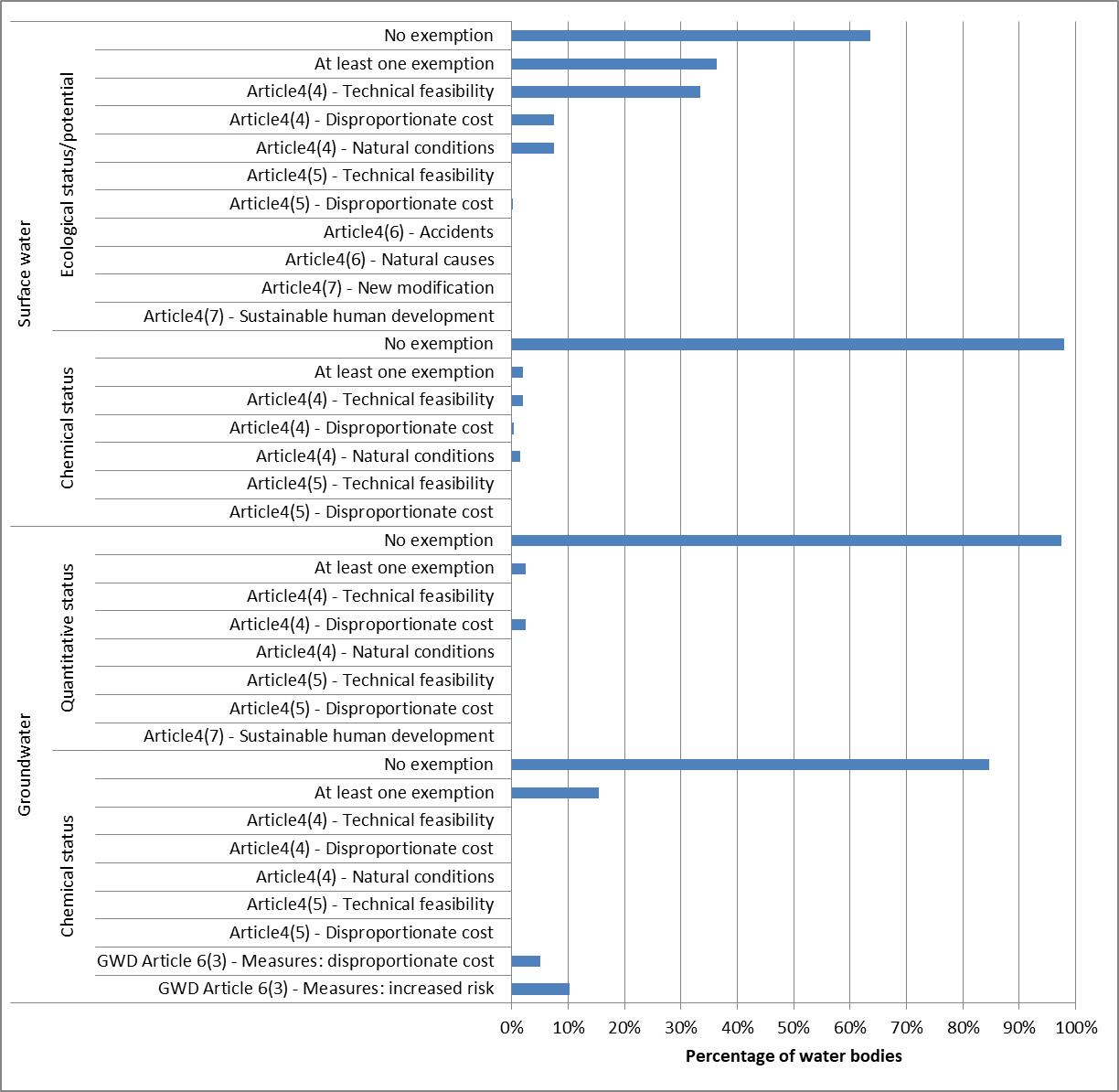
·WFD exemptions have not been applied and justified for groundwater chemical status although not all groundwater bodies are in good status in 2015.
·There is still a lack of clear criteria for the application of "technical feasibility", "disproportionate costs" and "natural conditions".
·Programme of Measures
·With regard to the PoM, significant progress has been made, particularly in reducing uncertainties, reporting costs of measures, and in identifying the gap to good status. Cost-Effectiveness analysis has been introduced to aid in the selection of measures.
·For surface waters, KTMs were reported as operational for all significant pressures causing failure of objectives, and for most significant pressures in groundwater. Specific measures were reported to be operational under each of these KTMs. KTMs to address River Basin Specific Pollutants causing a risk of failure in surface water are needed in the East-Estonian RBD and Koiva RBDs.
·Measures related to abstractions and water scarcity
·Water abstraction pressures are not reported as relevant for Estonia, with only one RBD (East-Estonian) having 5 % of groundwater bodies in bad quantitative status.
·The Water Exploitation Index+ is not calculated, but water quantity data have been reported.
·Measures related to pollution from agriculture
·There is a clear link between agricultural pressures and agricultural measures. At the time of PoM drafting a specific so-called second phase of the pressure analysis and risk assessment had been carried out. During this additional pressure analysis, mapped pressure sources were associated with the status of the water body and the quality elements causing the less-than-good status.
·Agricultural measures are mostly mandatory and their level of ambition appears limited.
·General binding rules in line with Article 11(3)(h) WFD to control diffuse pollution are applied in all basins.
·Mandatory safeguard zones are established around protection areas that are used or intended to be used for drinking water.
·Financing of measures is secured in all basins.
·Measures related to pollution from sectors other than agriculture
·In the context of this topic, Estonia reported only generic measures in relation to the Priority Substances and other pollutants causing failure, and most of them were of an information-gathering nature.
·Many of the surface water bodies suffering pressures from urban wastewater discharges are predicted to achieve good status only by 2027, mostly as a result of phosphorus. The level of compliance and timing to reach compliance are not addressed in detail within the RBMPs, although a separate action plan is said to outline the cost of measures and the deadlines as regards improvements to urban waste water treatment.
·Measures related to hydromorphology
·Several hydromorphological measures are clearly reported to address significant hydromorphological pressures in the second cycle, while in the first RBMPs, no hydromorphological measures at all had been identified by the time of adoption of the RBMPs.
·Ecological flows have been derived for all relevant water bodies in all RBDs but they have been partially implemented, with relevant work still ongoing.
·Economic analysis and water pricing policies
·In relation to Article 9, environmental and resource costs are not fully covered.
·Considerations specific to Protected Areas (identification, monitoring, objectives and measures)
·Additional individual objectives for protected Birds and Habitat Areas have not been set.
·Adaptation to drought and climate change
·Climate change was considered in all RBDs, on the basis of the Common Implementation Strategy guidance document on how to adapt to climate change. No Drought Management Plans were developed.
Recommendations
·Estonia should include clear information in national RBMPs on international coordination efforts in order to increase transparency.
·Estonia should continue to improve international cooperation, including coordinated assessments of the technical aspects of the WFD such as ensuring a harmonized approach for status assessment and a coordinated PoM in order to ensure the timely achievement of the WFD objectives.
·Estonia needs to delineate adequately transitional water bodies or provide a clear explanation for their non-existence.
·Work on the identification of pressures and their apportionment among sectors needs to continue, as several of them are reported as unknown. This is necessary so that adequate measures can be put in place.
·Reference conditions need to be established for all relevant Quality Elements for all surface waters.
·Inventories of emissions, discharges and losses of chemical substances need to be completed.
·Estonia should further improve monitoring of surface water to ensure meeting WFD requirements, as there are still significant gaps and there has been a decrease in the number of operational monitoring sites in lakes and rivers. Monitoring should cover all relevant quality elements in all water categories both in surveillance and operational monitoring. Monitoring frequencies should be in line with the minimum recommended frequency, especially for surveillance monitoring, unless adequately justified.
·Estonia should have a clear and transparent method for the selection of River Basin Specific Pollutants and provide clear information on how their status is determined. Estonia should develop, for all River Basin Specific Pollutants, Environmental Quality Standards that meet the minimum requirements for the protection of freshwater and marine ecosystems from possible adverse effects, as well as of human health.
·Estonia should continue and step up efforts to assess the status of all water bodies. Monitoring should be performed in a way that provides sufficient temporal resolution and spatial coverage (including in biota), to reach sufficient confidence in the assessment for all water bodies, if necessary in combination with robust extrapolation/grouping methods. If a different matrix or reduced frequencies are used, the corresponding explanations should be provided, as required by the Directive.
·Trend monitoring should be further improved to ensure that all the relevant substances specified in Directive 2008/105/EC are monitored in a way that provides sufficient spatial coverage and temporal resolution, in all RBDs.
·Estonia needs to continue working towards a cleared status assessment and improved level of confidence for groundwater bodies through better operational monitoring.
·The review of the assessment of groundwater status needs to be completed.
·Efforts need to be continued to fully meet all the requirements of Article 4(3) in a transparent way. Significant adverse effects on the use or the wider environment and the lack of significantly better environmental options need to be defined and specified. This will ensure transparency in the process of designation and objective setting.
·If water bodies are failing to achieve the WFD environmental objectives, exemptions need to be justified. Estonia did not apply WFD exemptions for the chemical status of groundwater bodies although not all groundwater bodies are in good status, but applied exemptions according to the Groundwater Directive. The understanding of the different nature of exemptions according to the WFD and Groundwater Directive needs to be improved and exemptions properly applied.
·Estonia should continue to improve transparency and uncertainty in the justification of exemptions by developing and applying clear criteria for technical feasibility, disproportionate costs and natural conditions for the application of Article 4(4). These need to be clearly distinguishable from the criteria and justifications for the application of Article 4(5) exemptions.
·A thorough assessment of proposed new modifications should be ensured in line with the requirements of the WFD and as further specified by the Judgment of the Court in case C-461/13. The RMBPs should clarify whether impacts of proposed new projects were assessed. In case of expected deterioration or non-achievement of good status/potential ensure that the project can only be authorised in case the specific conditions as outlined in WFD Article 4(7) are fulfilled. All conditions for the application of Article 4(7) for individual projects must be included and justified in the RBMPs as early in the project phase as possible which will allow for improved transparency.
·In the third RBMPs, Estonia should clearly state to what extent, in terms of area covered and pollution risk mitigated, basic measures (minimum requirements to be complied with) or supplementary measures (designed to be implemented in addition to basic measures) will contribute to achieving the WFD objectives and identify sources of funding (e.g. CAP Pillar 1, RDP), as appropriate, to facilitate successful implementation of these measures. Explicit links in the RBMPs between the WFD and supporting programmes and instruments (e.g. ND, RDP etc.) need to be ensured and both nitrogen and phosphorus shall be included in the general binding rules.
·Estonia should take a more ambitious approach to tackling non-agricultural pollution by identifying substance-specific measures that go beyond information-gathering actions, and by assessing the effectiveness of planned measures and applying supplementary measures where necessary to achieve the objectives.
·Estonia should continue its efforts to establish ecological flows for all relevant water bodies, and ensure its implementation as soon as possible.
·Estonia should continue prioritising the use of green infrastructure and/or natural water retention measures that provide a range of environmental (improvements in water quality, flood protection, habitat conservation etc.), social and economic benefits which can be in many cases more cost-effective than grey infrastructure.
·Cost recovery should be applied for water use activities having a significant impact on water bodies. Any exemption should be justified using Article 9(4). Estonia should also present in a transparent manner how financial, environmental and resource costs have been calculated and how the adequate contribution of the different users is ensured. The water-pricing policy should be set out in a transparent fashion and a clear overview of estimated investments and investment needs should be provided.
·There seems to be little or no progress on the assessment on the water requirements of Birds and Habitat Directives Protected Areas in order to achieve favourable conservation status. Further work is needed to address this issue.
Topic 1Governance and public participation
1.1Assessment of implementation and compliance with WFD requirements in second cycle
1.1.1Administrative arrangements – river basin districts
Estonia prepared three River Basin Management Plans (RBMPs), one for each of its River Basin Districts (RBDs): West-Estonian, East-Estonian and Koiva.
Two of Estonia's RBDs are part of international RBDs: East-Estonian is part of an international RBD shared with Latvia and Russia (including Lakes Peipsi/Chudkoe and Pihkva/Pskovskoye, shared with Russia); Koiva is part of an international RBD shared with Latvia.
1.1.2Administrative arrangements – competent authorities
Estonia reports three competent authorities: The Ministry of Environment, the Environmental Board and the Environment Agency. The Ministry of Environment’s main roles are: enforcement of regulations; economic analysis; preparation of the RBMP and PoM; public participation, and; coordination of implementation. The main role of the Estonian Environmental Board is the implementation of measures. The Estonian Environment Agency is responsible for the monitoring and assessment of groundwater and surface water, pressure and impact analysis and reporting to the Commission.
This represents a change from the previous cycle: the 2012 Commission Staff Working Document for the first cycle reports the Ministry of the Environment as the competent authority for all of Estonia's RBDs.
1.1.3River Basin Management Plans – structure and Strategic Environmental Assessments
Estonia does not have sub-plans for its RBMPs.
Estonia did not report that Strategic Environmental Assessments had been carried out for its RBMPs.
1.1.4Public consultation
For all three RBMPs, the public and interested parties were informed by: direct mailing, Internet, invitations to stakeholders, local authorities, media (papers, TV, radio), meetings, printed material and social networking. Documents were available for download and paper copies were available in municipal buildings. Documents were available for the requisite 6 months. There was no international coordination of public participation.
For all three RBDs, the following stakeholders were actively involved in the development of the RBMPs: agriculture/farmers, energy/hydropower, fisheries/aquaculture, local/regional authorities, NGOs/nature protection and water supply and sanitation.
The mechanisms for active involvement were: the establishment of advisory groups, involvement in drafting and regular exhibitions.
For all three RBDs, public consultation had the following impacts: addition of new information, adjustment to specific measures, changes to the selection of measures, commitment to action in the next RBMP cycle and commitment to further research.
1.1.5Integration with the Floods Directive and the Marine Strategy Framework Directive
A joint consultation process was carried out for the RBMPs and Flood Risk Management Plans prepared under the Floods Directive
.
For West-Estonian and East-Estonian, joint consultation was held with the Marine Strategy Framework Directive
.
1.1.6International coordination and cooperation
As noted above, East-Estonian is part of an international RBD shared with Latvia and Russia and Koiva is part of international RBD shared with Latvia. For both, Estonia reports that there is an international agreement and a permanent co-operation body in place (designated as category 2).
The RBMP for Koiva states that international co-operation with Latvia is based on an agreement between the Estonian and Latvian Ministries of Environment. Areas of cooperation included: characterisation, joint monitoring, pressures/measures assessment, economic analysis and water pricing, and a joint communication strategy and public participation activities. The RBMP for East-Estonian, part of an RBD shared with both Latvia and Russia, does not discuss transboundary cooperation with Latvia.
A “roof report” has been prepared for the RBDs shared with Estonia, as Latvia informed: in 2016, Latvian and Estonian experts together produced a background document for the Koiva/Gauja RBD, which among the other things includes measures proposed in both countries. The background document was approved by Estonian and Latvian water directors.
Estonia’s co-operation with Russia occurs within the framework of the Joint Committee for Estonian-Russian Transboundary Water Bodies, created in 1997, including two expert groups under the Joint Committee, one for monitoring and assessment and the other for integrated water management. Estonia subsequently clarified that co-operation in the frame of the first expert group includes environmental monitoring and assessment of transboundary water bodies, while the second group’s task is related to issues on transboundary water management and implementation of related measures under RBMPs. The expert groups and the Joint Committee meet at least once per year; their work includes analysis of the implementation of RBMPs.
1.2Main changes in implementation and compliance since first cycle
The 2012 Commission Staff Working Document for the first cycle reports the Ministry of the Environment as the sole competent authority for all Estonia's RBDs. In the WISE reporting for the second cycle, three bodies are identified: the Ministry of Environment, the Estonian Environment Agency (created in 2013) and the Estonian Environment Board.
1.3Progress with Commission recommendations
·Recommendation: Ensure coherent trans-boundary cooperation in PoMs development (with Latvia).
Assessment: The international coordination category for both East-Estonian and Koiva, both shared with Latvia, in the second cycle is the same as that in the first cycle: category 2 (i.e. international agreement and permanent cooperation body in place). Consequently, international Programmes of Measures have not been prepared for these RBDs.
The RBMP for Koiva states that international co-operation with Latvia is based on an agreement between the Estonian and Latvian Ministries of Environment. Areas of cooperation included: characterisation, joint monitoring, pressures/measures assessment, economic analysis/water pricing and a joint communication strategy and public participation activities. The RBMP for East-Estonian, part of an RBD shared with both Latvia and Russia, does not discuss transboundary cooperation with Latvia.
In 2016, however, Estonian and Latvian officials prepared a “roof report” for the Koiva/Gauja RBD, which among other topics discussed measures in the national RBMPs.
Consequently, Estonia has partially implemented the recommendation.
Topic 2 Characterisation of the River Basin District
2.1.Assessment of implementation and compliance with the WFD requirements in the second cycle
2.1.1.Delineation of water bodies and designation of heavily modified and artificial water bodies
Overall, the number of surface water bodies remained largely the same between the first and second RBMPs (
Table 2.1
). New territorial water bodies were delineated in the West-Estonian and East-Estonian RBDs for the second RBMP. In the second RBMP, 74 % of identified surface water bodies were natural, 20 % were designated as heavily modified and 6 % as artificial water bodies. The situation was fairly similar in the first RBMPs, as shown in
Figure 2.1
. The water uses and physical alterations have been reported for each heavily modified water body category.
For groundwater bodies, there was a 50 % increase in total number from the first to the second RBMPs, with this increase seen across all RBDs (
Table 2.3
). Across all three RBDs a total of 13 groundwater bodies were added to the 26 groundwater bodies initially delineated in the first RBMPs. It is explained that the objective of establishing a larger number of smaller bodies of groundwater was to better organise the protection of their chemical and quantitative status. Based on the information found in the RBMPs, groundwater bodies that were not previously delineated according to the boundaries of the RBD are now delineated clearly within the RBDs. In terms of groundwater pressure sources, they have been more thoroughly mapped and identified in the second cycle, making it possible to better delineate groundwater bodies. In addition, new groundwater bodies were delineated in areas where more than 10 m3 per day was abstracted from the aquifer but where a groundwater body had not previously been delineated.
The delineation of the groundwater bodies and description of boundaries and hydrogeological conceptual models has been compiled in accordance with the Common Implementation Strategy Guidance n. 26, "Risk Assessment and the Use of Conceptual Models for Groundwater" (2011)
. Better knowledge and conceptual understanding of groundwater was achieved in the second RBMPs thanks to the work done in 2012 "Description of the boundaries of groundwater bodies and the development of hydrogeological conceptual models of groundwater bodies", as explained in the RBMPs. In particular, Estonia has considered the hydrostratigraphic position of the water layers, the location in terms of the RBDs, the coastline and the state border.
Table 2.1
Number and area/length of delineated surface water bodies in Estonia for the second and first cycles
|
Year
|
RBD
|
Lakes
|
Rivers
|
Coastal waters
|
|
|
|
Number of water bodies
|
Total area (km2) of water bodies
|
Number of water bodies
|
Total length of water body (km)
|
Number of water bodies
|
Total area (km2) of water bodies
|
|
2016
|
EE1
|
41
|
71
|
358
|
6,078
|
14
|
12,965
|
|
2016
|
EE2
|
41
|
1,898
|
268
|
5,152
|
2
|
1,553
|
|
2016
|
EE3
|
7
|
8
|
19
|
364
|
0
|
0
|
|
2016
|
Total
|
89
|
1,978
|
645
|
11,594
|
16
|
14,518
|
|
2010
|
EE1
|
41
|
71
|
358
|
6,320
|
14
|
12,949
|
|
2010
|
EE2
|
40
|
1,885
|
267
|
5,413
|
2
|
1,552
|
|
2010
|
EE3
|
8
|
9
|
20
|
374
|
0
|
0
|
|
2010
|
Total
|
89
|
1,966
|
645
|
12,106
|
16
|
14,501
|
Source: WISE electronic reporting
Figure 2.1
Proportion of surface water bodies in Estonia designated as artificial, heavily modified and natural for the second and first cycles. NB - the numbers in parenthesis are the numbers of water bodies in each water category.
Source: WISE electronic reporting
Table 2.2
shows the differences in size distribution of surface water bodies between the second and first cycles. The size distribution largely remained the same between the two cycles. The minimum size criteria reported were 10 km2 catchment area for rivers and 0.5 km2 surface area for lakes.
Table 2.2
Size distribution of surface water bodies in Estonia in the second and first cycles
|
Year
|
|
Lake area (km2)
|
River length (km)
|
Coastal (km2)
|
|
|
RBD
|
Min
|
Max
|
Average
|
Min
|
Max
|
Average
|
Min
|
Max
|
Average
|
|
2016
|
EE1
|
0.2
|
9.41
|
1.74
|
2.62
|
4.16
|
3.39
|
42.3
|
5,549.09
|
926.07
|
|
2016
|
EE2
|
0.02
|
1,511.55
|
46.3
|
0.7
|
18.21
|
6.61
|
596.08
|
956.77
|
776.42
|
|
2016
|
EE3
|
0.12
|
2.33
|
1.16
|
|
|
|
|
|
|
|
|
|
|
|
|
|
|
|
|
|
|
|
2010
|
EE1
|
0.2
|
9.41
|
1.74
|
2.63
|
4.16
|
3.4
|
42.18
|
5,543.93
|
924.95
|
|
2010
|
EE2
|
0.02
|
1,495.69
|
47.13
|
0.58
|
17.89
|
5.02
|
596.19
|
956.04
|
776.12
|
|
2010
|
EE3
|
0.11
|
2.33
|
1.15
|
|
|
|
|
|
|
Source: WISE electronic reporting
Table 2.3
Number and area of delineated groundwater bodies in Estonia for the second and first cycles
|
Year
|
RBD
|
Number
|
Area (km2)
|
|
|
|
|
Minimum
|
Maximum
|
Average
|
|
2016
|
EE1
|
16
|
1.4
|
20,501.46
|
3,653.55
|
|
2016
|
EE2
|
20
|
8.9
|
11,811.44
|
2,617.75
|
|
2016
|
EE3
|
3
|
172.31
|
1,309.03
|
738.8
|
|
2016
|
Total
|
39
|
|
|
|
|
|
|
|
|
|
|
|
2010
|
EE1
|
10
|
117
|
20,547.00
|
6,088.20
|
|
2010
|
EE2
|
14
|
25
|
13,024.00
|
4,160.93
|
|
2010
|
EE3
|
2
|
446
|
1,334.00
|
890
|
|
2010
|
Total
|
26
|
|
|
|
Source: WISE electronic reporting.
Table 2.4
summarises the information reported by Estonia on how water bodies have evolved between the two cycles. It shows that the main changes were for groundwater bodies with the aggregation of water bodies and the creation of new ones.
Table 2.4
Type of change in delineation of groundwater and surface water bodies in Estonia between the second and first cycles
|
Type of water body change for second cycle
|
Groundwater Body
|
Lake Water Body
|
River Water Body
|
Coastal Water Body
|
|
Aggregation
|
12
|
|
|
|
|
Splitting
|
8
|
|
|
|
|
Aggregation and splitting
|
13
|
|
|
|
|
Change in code
|
4
|
|
|
|
|
Extended area
|
|
|
|
|
|
Creation
|
2
|
|
|
|
|
Deletion
|
26
|
|
|
|
|
No change
|
|
89
|
645
|
16
|
|
|
|
|
|
|
|
Total water bodies before deletion
|
65
|
89
|
645
|
16
|
|
Delineated for second cycle (after deletion from first cycle)
|
39
|
|
|
|
Source: WISE electronic reporting
2.1.2.Identification of transboundary water bodies
Transboundary river water bodies have been designated for each RBD, transboundary lake water bodies in East-Estonian and Koiva and one transboundary coastal water body in West-Estonian. No transboundary groundwater bodies have been identified.
The delineation of transboundary surface water bodies with neighbouring Latvia (Koiva RBD) was one of the objectives of a project (Gauja/Koiva project in the years 2011-2013) that has been mentioned in the RBMP. There is no explicit information in the East-Estonian RBMP about the delineation of transboundary water bodies with Russia.
2.1.3.Typology of surface water bodies
The number of surface water body types appears to have decreased overall by about 20 % between the first and second RBMPs (
Table 2.5
). Member States were asked to report ‘Not applicable’ if there is no corresponding intercalibration type for national types. Many national types (heavily modified, artificial and natural) have been intercalibrated. Several of the national types for Estonia in all of the RBDs do not appear to have corresponding intercalibration types: three coastal water body, five lake water body and two river water body types.
For the Koiva RBD (shared with Latvia) typologies were adjusted for transboundary surface water bodies under the 2011-2013 project. One of the recommendations of the project was to adjust the typology and the classification of the quality between the two countries. This is on-going work that will continue in the third cycle. For the East-Estonian RBD (shared with Russia) there is no evidence that the typology has been coordinated with Russia.
Table 2.5
Number of surface water body types at RBD level in Estonia for the first and second cycles
|
RBD
|
Rivers
|
Lakes
|
Coastal
|
|
|
2010
|
2016
|
2010
|
2016
|
2010
|
2016
|
|
EE1
|
9
|
5
|
3
|
5
|
3
|
5
|
|
EE2
|
9
|
6
|
3
|
7
|
0
|
1
|
|
EE3
|
12
|
5
|
4
|
3
|
3
|
0
|
|
TOTAL
|
|
7
|
|
8
|
|
6
|
Source: WISE electronic reporting
Note that the total is not the sum of the types in each RBD as some types are shared by RBDs.
2.1.4.Establishment of reference conditions for surface water bodies
Table 2.6
shows the percentage of surface water body types in Estonia with reference conditions. Type-specific reference conditions have been established for some or all relevant biological quality elements and all physicochemical quality elements. Type-specific reference conditions do not appear to have been established for hydromorphological quality elements in rivers but have been established for 50 % of types in lakes.
In the second RBMPs there is no information about the coordination of the identification of type-specific reference conditions with neighbouring countries. It is stated in the RBMPs that coordination of the approaches and methods of the main aspects of water management plans would be an objective to be addressed possibly in future projects (for the third cycle).
Table 2.6
Percentage of surface water body types in Estonia with reference conditions established for all, some and none of the biological, hydromorphological and physicochemical quality elements. Numbers in parenthesis are the number of types in each category.
|
Water category
|
Water types
|
Biological quality elements
|
Hydromorphological quality elements
|
Physicochemical quality elements
|
|
Lakes (8)
|
All
|
|
|
100%
|
|
|
Some
|
100%
|
50%
|
|
|
|
None
|
|
50%
|
|
|
Rivers (7)
|
All
|
|
|
100%
|
|
|
Some
|
100%
|
100%
|
|
|
|
None
|
|
|
|
|
Coastal (6)
|
All
|
100%
|
|
100%
|
|
|
Some
|
|
|
|
|
|
None
|
|
100%
|
|
Source: WISE electronic reporting
2.1.5.Characteristics of groundwater bodies
The geological formation of the aquifer types in which groundwater bodies reside, along with details of whether groundwater bodies are layered or not, is reported. Further characterisation work has been reported since the first cycle with the inclusion of the assessment of linkages to surface water bodies and terrestrial ecosystems.
2.1.6.Significant pressures and impacts on water bodies
For surface waters, in the second RBMPs, unknown anthropogenic pressure was reported for 71 % of water bodies. The most significant pressures on surface water bodies were reported to be dams, barriers and locks affecting 25 % of water bodies (
Figure 2
.2). In the first RBMPs, Estonia only reported pressures at an aggregated level making it difficult to compare reporting of pressures between the two cycles. There has been an apparent increase in hydromorphological pressures (
Figure 2.3
) and unknown anthropogenic pressures (or other pressures).
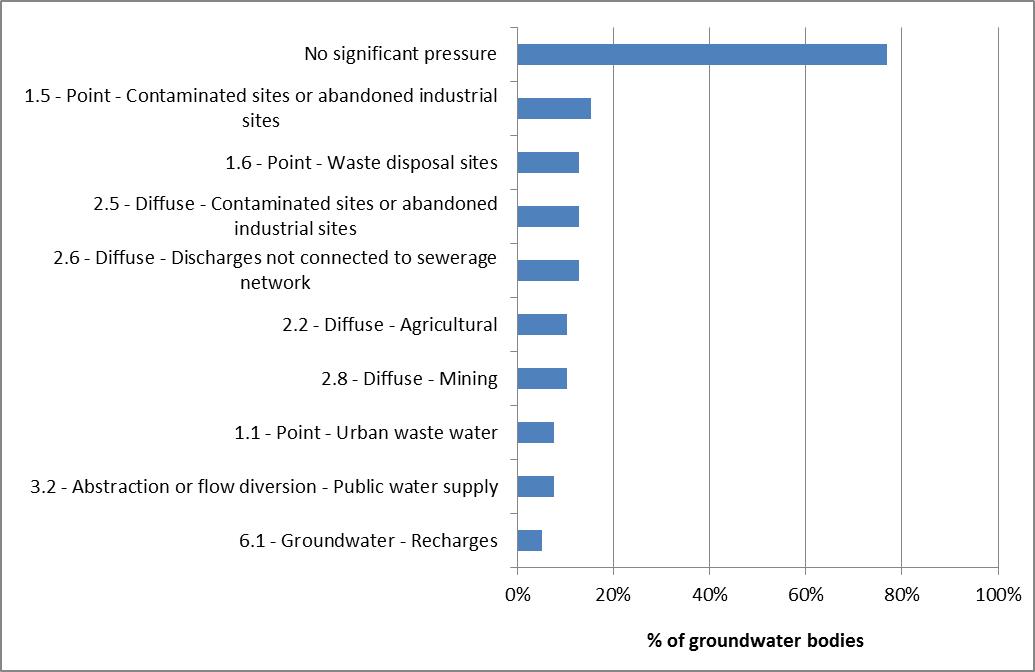
For groundwater bodies, “no significant pressure” was reported for 77 % of groundwater bodies. The most significant pressures reported were point - contaminated sites or abandoned industrial sites (15 %), diffuse - contaminated sites or abandoned industrial sites (13 %), point - waste disposal sites (13 %) and diffuse - discharges not connected to sewerage network (13 %) (
Figure 2.2
).
In the second RBMPs it was reported that nine pressures were not assessed for surface waters, including introduced species and diseases. The criteria for the identification of pressures have been described more specifically in a background document of the second RBMPs. The basis for the distribution of pressures in Estonia was an indicative list of potential pressure sources presented in the Guidance for reporting under the WFD.
Figure 2.2
The 10 most significant pressures on surface water bodies and groundwater bodies in Estonia for the second cycle
Source: WISE electronic reporting
In the second RBMPs, the most significant impact on surface water bodies was classified as an “unknown impact type” (67 % of water bodies
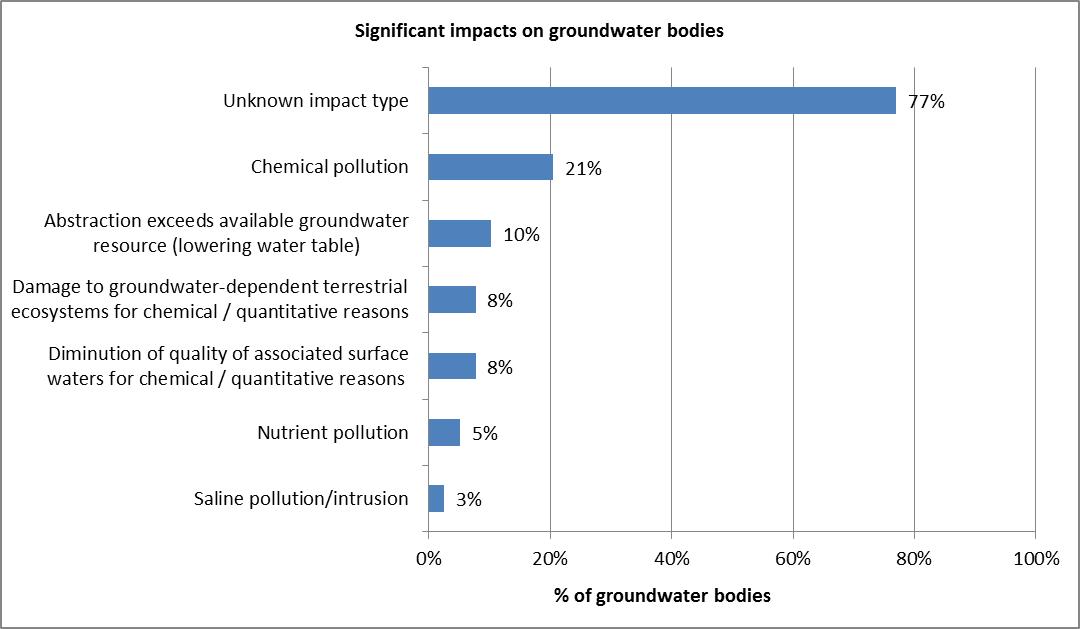
), followed by altered habitats due to morphological changes (21 %). The situation was similar in groundwater bodies, with 77 % of water bodies with reported impacts classified as unknown
. Estonia did not report on impacts in the first RBMPs.
In the second RBMPs a relatively high proportion of pressures are still classified as “unknown”. It is explained that in these cases the reason for the poor status is unclear or unknown and the pressure sources for the water body are uncertain. The RBMPs reported that investigative monitoring in the catchment areas with unknown impacts is planned, which will help provide an overview of the water body and the pressures, after which further steps would be taken to improve the status of the water body to good.
Figure 2.3
Comparison of pressures on surface water bodies in Estonia in the first and second cycles. Pressures presented at the aggregated level. NB - there were 750 identified surface water bodies for the second cycle and 754 for the first cycle
Source: WISE electronic reporting
Figure 2.4
Significant impacts on surface water and groundwater bodies in Estonia for the second cycle. Percentages of numbers of water bodies
Source: WISE electronic reporting
2.1.7.Definition and assessment of significant pressures on surface waters
For surface waters, a combination of both expert judgement and numerical tools were used for defining pressures from point sources, diffuse, abstraction and other significant pressures. The significance of pressure sources was determined in the first RBMPs using mostly expert judgment. For the second RBMPs more quantitative data was used such as data from land and water use. In the second RBMPs, the pressures assessment was more precisely presented, by water body, rather than generalised, identifying the pressures on the basis of the boundary of the catchment area and the geographic location of the pressure sources.
Significance of pressures is reported to have been defined in terms of thresholds. Pressures have been assessed on the basis of the following categories: point sources, diffuse sources, water abstraction, water flow regulation or morphological alterations, use of surface water bodies and use of coastal water.
To determine pressure sources, including significant ones, the risk of not achieving the environmental objectives for water bodies due to various pressure sources was analysed, taking into account the trends affecting pressure sources and the likelihood of the trend development. The probable vulnerability to pressures was classified as: at risk, possibly at risk, and not at risk. The risk was reported to be based on two aspects: 1) whether or not the environmental objectives have been achieved; and 2) identifying the pressures from human activity that caused the failure to achieve the environmental objectives.
The mapped pressure sources were then linked to the status of the water body and to quality elements displaying poor status. As a result of the analysis, it was determined whether the effect of the pressure source actually influences the status of the water body. It is stated in the RBMPs that a clear link was established between the status and pressure sources.
2.1.8.Definition and assessment of significant pressures on groundwater
For groundwater it was reported that a combination of expert judgement and numerical tools were used to define diffuse and point source pressures, abstractions and artificial recharge. Information about the tools used to define significant pressures on groundwater bodies is provided in the available background document "Programme of measures and actions to reduce pressures that cause risk of damage and poor status of groundwater bodies" (2015). A significant pressure on a groundwater body is defined as a pressure from human activity, which may deteriorate the status of the groundwater body. Conceptual models together with hydrogeological models and expert judgement were used.
The significance of pressures is reported to be defined in terms of thresholds. The list of polluting substances that are a risk to groundwater and their thresholds were reported not to have changed since the first RBMPs. The significance of pressures is reported not to be linked to the potential failure of objectives.
2.1.9.Groundwater bodies at risk of not meeting good status
In two of the three RBDs, 13-45 % of groundwater bodies were reported to be at risk of failing to meet good chemical status. The pollutants putting groundwater bodies at risk of failing good chemical status have been reported.
In two of the three RBDs 19-25 % of groundwater bodies were reported to be at risk of failing to meet good quantitative status.
2.1.10.Quantification of gap to be filled and apportionment of pressures
The Priority Substances and other substances causing failure of good chemical status have been reported. Measures to tackle these substances to achieve good status by 2021 have been reported and the indicator gap is reported to be zero (i.e. good status to be reached) for all substances.
2.1.11.Inventories of emissions, discharges and losses of chemical substances
Article 5 of the Environmental Quality Standards Directive
requires Member States to establish an inventory of emissions, discharges and losses of all Priority Substances and the eight other pollutants listed in Part A of Annex I EQS Directive for each RBD, or part thereof, lying within their territory. This inventory should allow Member States to further target measures to tackle pollution from priority substances. It should also inform the review of the monitoring networks, and allow the assessment of progress made in reducing (or suppressing) emissions, discharges and losses for priority substances. Estonia reported that 35 of the 41 Priority Substances and groups of Priority Substances were included in the inventories for each RBD. The Priority Substances and groups of priority substances not included in any of the inventories were: tetrachloroethylene, the group of polycyclic aromatic hydrocarbons, carbon tetrachloride, trichloroethylene, cyclodiene pesticides (aldrin, dieldrin, endrin, isodrin), and DDT (total DDT and DDT-p,p’). The two-step approach from the Common Implementation Strategy Guidance Document n°28
has been followed for all substances considered in the inventories. Tier 1 of the methodology was implemented for most of the substances included in the inventories (including some substances deemed relevant at RBD level). For a limited number of substances a combination of Tier 1 (point source information) and Tier 2 (riverine load) was implemented. The data quality was assessed as uncertain or very uncertain.
The reasons for the inventory not being complete for all Priority Substances and pollutants are presented in the Annex 2 of the RBMPs. It was reported that the information on substances not included was insufficient during the reference period (2008-2010). The following reasons were listed: 1) no information on the quantities of substances, both in terms of imports and usage; 2) no information on the content of hazardous substances in products; 3) insufficient monitoring data (due to the high cost of analyses and results below the limit of detection); 4) unclear effects on the aquatic biota; 5) information obtained about hazardous substances from the environmental permits during the reference period was limited.
2.2.Main changes in implementation and compliance since the first cycle
Overall the number of surface water bodies remained the same between the first and second RBMPs. For groundwater bodies there was a 50 % increase in total number between the first and second RBMPs. In the second cycle, 74 % of identified surface water bodies were natural with 20 % being designated as heavily modified and 6 % as artificial water bodies. This is similar to the first cycle. The number of surface water body types appears to have decreased overall by about 20 % between the first and second RBMPs.
In the first RBMPs, Estonia only reported pressures at an aggregated level and therefore it is difficult to compare reporting of pressures between the two cycles. Since the first RBMPs there has been an apparent increase in hydromorphological pressures and unknown anthropogenic pressures (or other pressures) for surface water bodies.
2.3.Progress with Commission recommendations
The Commission recommendations based on the first RBMPs and first PoM requested action on the following:
·Recommendation: Where there are currently high uncertainties in the characterisation of the RBDs, identification of pressures, and in the assessment of status, these need to be addressed in the current cycle, to ensure that adequate measures can be put in place before the next cycle.
·Recommendation: Focus in the second RBMP on better linking pressures to impacts and measures, including by source apportionment, and provide a clear assessment of how many of the pressures (and their sources) have to be reduced to achieve the WFD goals.
·Recommendation: Describe clearly in the second RBMPs how status will be derived for non- monitored water bodies and to restrict and streamline the use of expert judgement.
Assessment: In the first RBMPs, Estonia only reported pressures at an aggregated level, which makes it difficult to compare reporting of pressures between the first and second RBMPs. There has been an apparent increase in hydromorphological pressures and unknown anthropogenic pressures (or other pressures).
In the second RBMPs a relatively high proportion of pressures are still classified as “unknown”. It is explained that in these cases the reason for the poor status is unclear or unknown and the pressure sources for the water body are uncertain. The RBMPs reported that investigative monitoring in the catchment areas with unknown impacts is planned, which will help provide an overview of the water body and the pressures, after which further steps would be taken to improve the status of the water body to good. The relatively high proportion of pressures that were classed as “unknown” and the fact that further monitoring data is reported to be required, indicates that further improvement should be made in defining pressures and impacts and linking them together.
For both surface waters and groundwater bodies, the significance of pressures is reported to be defined in terms of thresholds but not to be linked to the potential failure of objectives. However, the RBMPs show that there is a link to status in the assessment of significance for both surface water and groundwater. The RBMPs also show that the methods for determining significance for the second RBMPs are based on more quantitative tools compared with the first RBMPs. For groundwater, conceptual models together with hydrogeological models and expert judgement were used.
Several of the national types for Estonia in all of the RBDs do not appear to have corresponding intercalibration types; three coastal water body, five lake water body and two river water body types.
Partial progress has been made on this recommendation.
·Recommendation: Finalise the setting of all reference conditions for the purpose of the second RBMP; any gap (i.e. lake diatoms) should be explained in the second RBMPs.
Assessment: Type-specific reference conditions have been established for some or all relevant biological quality elements and all physicochemical quality elements. Type-specific reference conditions do not appear to have been established for hydromorphological quality elements in rivers but have been established for 50 % of types in lakes. Therefore there still appears to be some gaps in the setting of all reference conditions.
·Recommendation: Improve the assessment of hydromorphological significant pressures taking into account all significant alterations, e.g. drainage, infrastructure, barriers etc.
Assessment: Significant hydromorphological pressures have been taken into account in the reporting of significant pressures and account for 24 % in total. However, there are some specific categories that have been excluded from the assessment, including: Physical alteration of channel/bed/riparian area/shore – Navigation, Dams, barriers and locks – Navigation, Hydrological alteration – Transport, Hydrological alteration – Aquaculture, and Hydromorphological alteration - Physical loss of whole or part of the water body. No reasons for these exclusions are provided in the RBMPs. Generally the assessment of pressures on surface waters for the second RBMP uses more quantitative data and is specific to water bodies. The recommendation has partially been fulfilled.
·Recommendation: Cover diffuse sources in the inventory of pollution sources elaborated in the second RBMPs to the highest extent possible (e.g. agricultural sources of cadmium, pesticides; storm water run-off, etc.).
Assessment: Estonia reported that 35 of the 41 Priority Substances and groups of Priority Substances were included in the inventories for each RBD. The reasons for the inventory not being complete for all Priority Substances and pollutants are presented in the Annex 2 of the RBMPs. It was reported that the information on substances not included was insufficient during the reference period (2008-2010).
The inventory itself is not available in the main reports of the RBMPs (probably because of the large file size), instead it is available on the website of the Ministry of the Environment.
For many substances, only point sources have been considered when establishing the inventory, while diffuse sources were not considered.
This recommendation has not been fulfilled.
·Recommendation: Estonia needs to complete the identification of sources of chemical pollution, to enable effective measures to be put in place to reduce chemical pollution for Priority Substances, and other pollutants, and then progressively reduce and phase-out priority hazardous substances where relevant.
Assessment: As regards the completion of the inventories of emissions, and the sources taken into account, see recommendation above.
While not all substances are included in the inventories, and not all sources were taken into account, the Priority Substances and other substances identified as causing failure of good chemical status have been reported, as well as measures to tackle these substances to achieve good status by 2021. The indicator gap is reported to be zero (i.e. good status will be reached by 2021) for all substances.
This recommendation has been partially fulfilled
Topic 3 Monitoring, assessment and classification of ecological status in surface water bodies
3.1.Assessment of implementation and compliance with WFD requirements in second RBMPs
3.1.1. Monitoring of ecological status/potential
Monitoring programmes
Article 8(1) of the WFD requires Member States to establish monitoring programmes for the assessment of the status of surface water and of groundwater in order to provide a coherent and comprehensive overview of water status within each RBD.
Separate operational and surveillance monitoring programmes were reported for each RBD, though the operational programme for the Koiva RBD was reported not to be relevant to any water category. The operational programme in the West Estonian RBD did not include lakes even though such water bodies were delineated in this RBD.
Monitoring sites
Table 3.1
gives the number of sites used for different purposes for the second RBMPs and
Table 3.2
compares the number of monitoring sites used for surveillance and operational purposes from the first to the second RBMPs.
Table 3.2
shows that there are many more monitoring sites included in the surveillance monitoring programme than in the operational monitoring programme for rivers and lakes.
Table 3.1
Number of monitoring sites in relevant water categories used for different purposes in Estonia.
|
Monitoring Purpose
|
Lakes
|
Rivers
|
Coastal
|
Territorial
|
|
OPE - Operational monitoring
|
7
|
72
|
34
|
0
|
|
SUR - Surveillance monitoring
|
360
|
315
|
128
|
10
|
|
Total sites irrespective of purpose
|
367
|
387
|
162
|
10
|
Source: WISE electronic reporting
Table 3.2
Number of sites used for surveillance and operational monitoring in Estonia for the second and first RBMPs. Note that for reasons of comparability with data reported for the first plans, the data for the second RBMPs does not take into account whether sites are used for ecological and/or chemical monitoring
|
|
Rivers
|
Lakes
|
Coastal
|
Territorial
|
|
|
Surv.
|
Op
|
Surv.
|
Op
|
Surv
|
Op.
|
Surv.
|
Op.
|
|
Second RBMP
|
|
|
|
|
|
|
|
|
|
EE_1
|
182
|
50
|
102
|
0
|
121
|
24
|
0
|
5
|
|
EE_2
|
129
|
22
|
231
|
7
|
7
|
10
|
0
|
5
|
|
EE_3
|
4
|
0
|
27
|
0
|
0
|
0
|
0
|
0
|
|
Total by type of site
|
315
|
72
|
360
|
7
|
128
|
34
|
10
|
0
|
|
Total number of monitoring sites
|
387
|
367
|
162
|
10
|
|
First RBMP
|
|
|
|
|
|
|
|
|
|
EE_1
|
101
|
26
|
36
|
2
|
47
|
0
|
0
|
0
|
|
EE_2
|
84
|
56
|
65
|
26
|
8
|
0
|
0
|
0
|
|
EE_3
|
4
|
1
|
8
|
0
|
0
|
0
|
0
|
0
|
|
Total by type of site
|
189
|
83
|
109
|
28
|
55
|
0
|
0
|
0
|
|
Total number of monitoring sites
|
272
|
137
|
55
|
0
|
Source: Member States electronic reports to WISE.
Overall in Estonia there were significant increases in the number of surveillance monitoring sites in coastal waters (55 to 128 sites), lakes (109 to 360 sites) and rivers (189 to 315 sites) from the first to the second RBMPs. 10 monitoring sites were also reported for territorial waters for the second RBMPs. In contrast there were decreases in the number of operational monitoring sites in lakes (28 to 7 sites) and rivers (83 to 72 sites). There were no operational monitoring sites in coastal waters in the first plans but in the second plans 34 sites were reported. No operational monitoring sites were reported in lakes in the Western Estonian and Koiva RBDs, and in rivers in the Koiva RBD, in spite of significant pressures on the water bodies in these categories and RBDs having been reported, and some water bodies being at less than good status/potential.
Figure 3.1
shows the percentage of water bodies included in surveillance and operational monitoring in Estonia for the first RBMPs and second RBMPs.
Figure 3.1
Percentage of water bodies included in surveillance and operational monitoring in Estonia for the first RBMPs (2010) and second RBMPs (2016). Note no differentiation is made between water bodies included in ecological and/or chemical monitoring.
Source: WISE electronic reporting
Overall in Estonia the number of delineated coastal, lakes and river water bodies remained the same between the two plans, though there were small increases (one water body) and equivalent decreases in the numbers delineated in some RBDs and water categories. All coastal water bodies were included in surveillance monitoring for both plans. A smaller proportion of lakes and a larger proportion of rivers were included in surveillance monitoring for the second RBMPs compared to the first. For the first plan no coastal water bodies were included in operational monitoring, while for the second plan 31 % were included. However, there was a significant decrease in the proportion of lake water bodies (15 % to 3 %) and river water bodies (11 % to 5 %) included in operational monitoring for the second RBMP compared to the first.
Figure 3.2
shows the proportion of water bodies in each ecological status/potential class that are included in surveillance monitoring in Estonia. For coastal water bodies (there are none at high status) all water bodies in each class are monitored.
Figure 3.2
Proportion of water bodies in each ecological status/potential class that are included in surveillance monitoring in Estonia. Note: Standard colours and class descriptors for ecological status based on WFD Annex V, Article 1(4)2(I) used for illustration purposes.
Source: WISE electronic reporting A differentiated presentation between ecological status and potential and including all types of quality element can be viewed here -
https://tableau.discomap.eea.europa.eu/t/Wateronline/views/WISE_SOW_QualityElement_Status_Compare/SWB_QualityElement_Group?iframeSizedToWindow=true&:embed=y&:display_count=no&:showAppBanner=false&:showVizHome=no
In two RBDs (West-Estonian and Koiva) no lakes in less than good ecological status/potential were included in operational monitoring, and in the Koiva RBD none of the three river water bodies in less than good status/potential were included in operational monitoring.
Water bodies with a poor or bad status in the last two years were selected for monitoring. Water bodies for which required measures are known or being already implemented to achieve the necessary status were excluded, according to information in the RBMPs
. This would indicate that there is no control of the efficiency of measures, and no follow up of the gradual improvement towards good status
.
Most lake water bodies in each class are monitored. For rivers, all water bodies in bad status are monitored, as well as 72 % in poor status, whereas 50 % or less river water bodies in moderate, good or high status are monitored.
Quality elements monitored (excluding River Basin Specific Pollutants)
Table 3.3
shows the quality elements used for the monitoring of lakes and rivers for the second RBMPs; no differentiation is made between purposes of monitoring.
For the first RBMPs all relevant quality elements (biological, general physicochemical and hydromorphological) were being monitored in rivers but for lakes and coastal waters some quality elements were missing (phytobenthos in some lake types; morphological conditions and tidal regime in coastal waters).
For the second RBMPs macroalgae and angiosperms are not monitored in coastal waters though phytobenthos (normally associated with rivers and lakes) are reported to be monitored
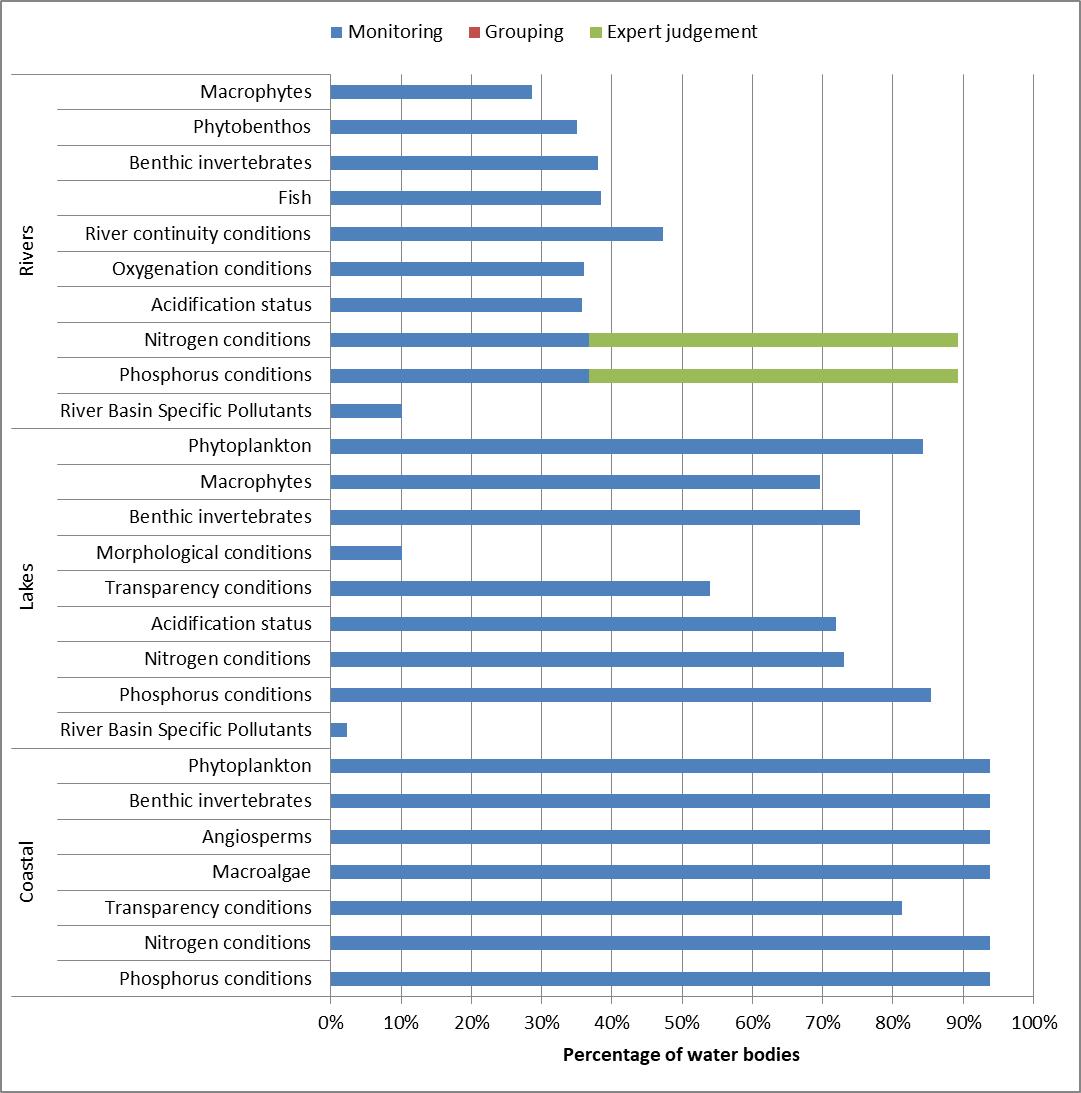
. Morphological conditions are not monitored and all required general physicochemical quality elements are monitored in coastal waters. All relevant biological and general physicochemical quality elements are reported to be monitored in lakes but morphological conditions are not monitored. All relevant biological and general physicochemical quality elements are reported to be monitored in most rivers but morphological conditions are not monitored at all in any of them. In addition, macrophytes are not monitored in two of the three RBDs with rivers. The proportion of river water bodies monitored for the different biological quality elements is low (20-30 %), while it is much higher in lakes and coastal waters (50-100 %).
Table 3.3
Quality elements monitored for the second RBMPs in Estonia (excluding River Basin Specific Pollutants). Note: quality elements may be used for surveillance and/or operational monitoring
|
Biological quality elements
|
|
|
Phytoplankton
|
Macrophytes
|
Phytobenthos
|
Angiosperms
|
Macroalgae
|
Benthic invertebrates
|
Fish
|
Other species
|
|
Lakes
|
Yes
|
Yes
|
Yes
|
|
(Yes)
|
Yes
|
Yes
|
|
|
Rivers
|
Yes
|
Yes
|
Yes
|
|
|
Yes
|
Yes
|
|
|
Coastal
|
Yes
|
|
Yes
|
No (Yes)
|
No (Yes)
|
Yes
|
|
|
|
Hydromorphological quality elements
|
|
|
Hydrological or tidal regime
|
Continuity conditions
|
Morphological conditions
|
|
Lakes
|
Yes
|
|
No (Yes)
|
|
Rivers
|
Yes
|
No (Yes)
|
No (Yes)
|
|
Coastal
|
Yes
|
|
No
|
|
General physicochemical quality elements
|
|
|
Transparency conditions
|
Thermal conditions
|
Oxygenation conditions
|
Salinity conditions
|
Acidification status
|
Nitrogen conditions
|
Phosphorus Conditions
|
Silicate
|
Other determinand for nutrient conditions
|
|
Lakes
|
Yes
|
Yes
|
Yes
|
No
|
Yes
|
Yes
|
Yes
|
Yes
|
No (Yes)
|
|
Rivers
|
Yes
|
No
|
Yes
|
No
|
Yes
|
Yes
|
Yes
|
No
|
No (Yes)
|
|
Coastal
|
Yes
|
No
|
No
|
Yes
|
No
|
Yes
|
Yes
|
Yes
|
No
|
Source: WISE electronic reporting Estonia subsequently noted that additional monitoring should have been reported. The missing quality elements are shown in brackets.
In the surveillance monitoring programme for coastal waters, there are no water bodies where all the required biological quality elements are included.
However, for rivers and lakes, the situation seems better with 65-70 % of the water bodies monitored for all the required biological quality elements. None of the water bodies included in surveillance monitoring in any category or RBD was monitored for all the required hydromorphological quality elements. 63 % of lake water bodies included in surveillance monitoring were monitored for all required physicochemical quality elements, but this is not the case for any of river water bodies included in surveillance monitoring.
For operational monitoring, three biological quality elements were used in coastal waters: phytoplankton, phytobenthos and benthic invertebrates, while phytoplankton, benthic invertebrates and fish were used in lakes. The predominantly used biological quality element in rivers was benthic invertebrates, followed by phytobenthos and fish.
The frequency of monitoring was not in line with the minimum recommended frequencies for almost all monitored water bodies for the different biological quality elements in rivers and coastal waters. This was better for lakes, where 20-30 % of the monitored water bodies had at least the minimum recommended frequencies for the different biological quality elements.
River Basin Specific Pollutants and matrices monitored
Estonia did not report at the generic quality element level whether River Basin Specific Pollutants are monitored; however, information was reported at the site level on which specific chemical substances are monitored.
Member States were not asked explicitly to report in their electronic reports to WISE which specific River Basin Specific Pollutants had been identified or which ones are specifically monitored. The information on which ones are monitored in surface waters was obtained from the reported monitored chemical substances that are not Priority Substances: it is assumed that these are River Basin Specific Pollutants. On this basis 117 River Basin Specific Pollutants
were reported to be monitored in Estonia as a whole: 18 substances in fish, 52 in settled sediment and 116 in water. They were monitored in coastal, lake, river and also territorial waters (
Table 3.4
). However, more than 90 % of all water bodies are not assessed for River Basin Specific Pollutants, and more than 85 % are not monitored for these substances.
Environmental quality standards are developed only for water, and not for sediment or biota. It is unclear how other monitored River Basin Specific pollutants are assessed in the absence of Environmental Quality Standards.
Table 3.4
Number of sites used to monitor River Basin Specific Pollutants reported in the second RBMPs and non-priority specific pollutants and/or other national pollutants reported in the first RBMPs in Estonia. Note the data from both cycles may not be fully comparable as different definitions were used and also not all Member State reported information at the site level meaning that there were no equivalent data for the first RBMPs
|
RBMP
|
|
Lakes
|
Rivers
|
Coastal
|
Territorial
|
|
second
|
Sites used to monitor River Basin Specific Pollutants
|
94
|
140
|
47
|
0
|
|
first
|
Sites used to monitor non-priority specific pollutants and/or other national pollutants
|
ND
|
ND
|
ND
|
ND
|
Sources: WISE electronic reporting ND = no data
The analytical methods used were reported to comply with the requirements of Article 4(1) of Directive 2009/90/EC
for all substances monitored for which there are environmental quality standards.
Annex V of the WFD provides guidance on the frequency of monitoring of the different quality elements: once every three months is recommended for “other pollutants” which are taken here to equate to river basin specific pollutants. Surveillance monitoring should be carried out for each monitoring site for a period of one year during the period covered by a RBMP i.e. six years. For river basin specific pollutants this should be done four times for the surveillance year, and for operational monitoring four times a year for each year of the cycle.
Of the 109 River Basin Specific Pollutants included in surveillance monitoring, two were monitored at least at the recommended minimum frequency at all sites where they were monitored, while for 85 pollutants no sites were monitored at least at the minimum recommended frequency. Of the 46 River Basin Specific Pollutants included in operational monitoring, none were monitored at least at the recommended minimum frequency at all sites where they were monitored, and for 37 pollutants none of the monitoring sites were.
Annex V, section 1.3.4 of the WFD does not explicitly define the matrices to which the minimum recommended frequency of monitoring of River Basin Specific Pollutants (“Other Pollutants”) applies. Recommended monitoring frequencies are specified for Priority Substances in biota and sediment in Article 3(2)(c) of EQS Directive 2008/105/EC: this is once per year for operational and surveillance monitoring purposes. For consistency this recommended frequency of once per year has been applied to the monitoring of River Basin Specific Pollutants in biota/sediment.
Of the 18 River Basin Specific Pollutants monitored in fish, none were sampled at least at the recommended frequency at all sites where they were monitored, and for one substance it was at none of the sites. Of the 52 River Basin Specific Pollutants monitored in settled sediment, two were sampled at least at the required frequency at all sites where they were monitored, while for 49 substance it was at none of the sites.
Transboundary surface water body monitoring
No monitoring sites were reported to be associated with international monitoring networks.
Use of monitoring results for classification
For coastal waters, the classification of all biological quality elements was based on monitoring results, and the number of classified water bodies was the same as the number directly monitored. For the general physicochemical quality elements, the number of water bodies classified based on monitoring was also the same as those directly monitored. However, only three of these quality elements (transparency, phosphorus and nitrogen) were classified, while also oxygen, salinity, pH and silicate were monitored, but not classified. The hydromorphological quality elements were not classified in coastal waters, but hydrological and tidal regimes were monitored for some water bodies. River Basin Specific Pollutants were not classified, even though some were monitored in coastal waters.
For lakes and rivers, the situation was different, with many mismatches between the number of water bodies classified reported to be based on monitoring and the number directly monitored. These mismatches mainly show more classified water bodies based on monitoring than those directly monitored for almost all the biological and hydromorphological quality elements. This is especially apparent for macrophytes and continuity in rivers, and for morphology in lakes. The RBMPs indicate that classification has sometimes been based on older monitoring data, which may explain these mismatches. Conversely, some biological quality elements have been directly monitored but not classified, such as phytobenthos and fish in lakes and phytoplankton in rivers. The same applies to some general physicochemical quality elements, such as oxygen in lakes, and to hydrology in lakes. The RBMPs indicate that this monitoring is done to provide a better basis for developing classification methods, which are missing for those quality elements. For the general physicochemical quality elements nitrogen and phosphorus, a large proportion (~60%) of the river water bodies is classified based on expert judgement. Finally, for River Basin Specific Pollutants, 2 % of lake and 10 % of river water bodies were classified based on monitoring results.
3.1.2.Ecological Status/potential of surface water
The ecological status/potential of surface water bodies in Estonia for the second RBMPs is illustrated in
Map 3.1
.
All water bodies have been classified, except one heavily modified river in the East-Estonian RBD. The proportion of water bodies reported to be in good or better ecological status or potential is 60 % for rivers, 67 % for lakes and 13 % for coastal waters. The overall distribution of ecological status/potential classes for all water categories combined are given for each RBD in
Map 3.1
. The proportion of water bodies in good or better status is almost the same (60 %) in the two large RBDs (West-Estonian and East-Estonian), while it is higher (75 %) in the smaller Koiva RBD.
Map 3.1
Ecological status or potential of surface water bodies in Estonia
|
|
High
|
|
|
Good
|
|
|
Moderate
|
|
|
Poor
|
|
|
Bad
|
|
|
Unknown
|
|
|
River Basin Districts
|
|
|
Countries outside the European Union
|
Source: WISE, Eurostat (country borders)
Note: Standard colours based on WFD Annex V, Article 1.4.2(i).
A differentiated presentation of this data between ecological status and potential and including all types of quality element can be viewed here -
https://tableau.discomap.eea.europa.eu/t/Wateronline/views/WISE_SOW_QualityElement_Status_Compare/SWB_QualityElement_Group?iframeSizedToWindow=true&:embed=y&:display_count=no&:showAppBanner=false&:showVizHome=no
Figure 3.3
shows the confidence in the classification of ecological status/potential.
Figure 3.3
Confidence in the classification of ecological status or potential of surface water bodies in Estonia based on the most recently assessed status/potential
Source: WISE electronic reporting
The confidence in classification of ecological status is given as high or medium for most lakes and coastal waters water bodies, but low for a larger proportion of river water bodies (62 %). It should be noted that the confidence in classification is reported as low for most of the water bodies classified to be in good ecological status or potential, while the confidence is reported as high for most of the water bodies classified to be in moderate or poor ecological status or potential (Figure 3.3).
Information in the RBMPs indicated that the confidence of the status assessment is based on the quality of the data and the length of the period covered by the data, the spatial representativeness of the monitoring program and the variability of the results of the assessment of the different quality elements. The actual criteria used to assess confidence as described in the RBMPs.
No information has been found in the RBMPs concerning plans to improve the level of confidence and precision in the classification of ecological status. This is a problem, in particular for water bodies in good status, where the large majority has been assessed with low confidence (40 % of all surface water bodies in Estonia). There is a risk that the proportion of water bodies in good ecological status is overestimated because of the low confidence in the classification of most of those water bodies.
Figure 3.4
compares the ecological status of surface water bodies for the first plans with that for the second RBMPs and that expected by 2015. A higher proportion of water bodies were classified as good in the first plans.
Figure 3.4
Ecological status or potential of surface water bodies in Estonia for the second RBMPs, for the first RBMPs and expected in 2015. The number in parenthesis is the number of surface water bodies for each cycle. Note the period of the assessment of status for the second RBMPs was 2006 to 2013. The year of the assessment of status for first plans is not known
Source: WISE electronic reporting
Member States were asked to report the expected date for the achievement of good ecological status/potential. The information for Estonia is shown in
Figure 3.5
.
Figure 3.5
Expected date of achievement of good ecological status/potential of surface water bodies in Estonia. The number in the parenthesis is the number of water bodies in each category
Source: WISE electronic reporting
Most of the water bodies in Estonia (63 %) were expected to achieve good ecological status or potential by 2015, while the proportion reported to be in good status or potential in the second plans is 59 % based on data before 2013 (
Figure 3.4
). The expectations are different for lakes than for rivers with 70 % of the lakes expected to achieve good status or potential by 2015, but only 62 % of the rivers. Less than 20 % of coastal water bodies were expected to achieve good status by 2015. The remaining water bodies are expected to achieve good status or potential by 2021 or 2027 (
Figure 3.5
). No water bodies were reporting as having less stringent objectives already achieved.
Classification of ecological status in terms of each classified quality element
Figure 3.6 shows the ecological status/potential of the biological quality elements used in the classification of lakes and rivers in Estonia.
In rivers, only nutrients are monitored and classified in a high proportion of water bodies, and are reported to be in good or better ecological status for the majority of classified water bodies. The macrophytes, phytobenthos and benthic invertebrates are also in good or better status in the majority of classified water bodies, but the proportion of classified water bodies is less than half of the total number of water bodies. The classification of rivers in good ecological status has low confidence for most of the water bodies, which is probably related to the low confidence criteria, but also with underlying problems with the nutrients classification methods.
A high proportion of water bodies are monitored and classified for many biological and general physicochemical quality elements in lakes (phytoplankton, macrophytes and benthic invertebrates, nutrients) and coastal waters (all required biological quality elements, transparency and nutrients). The confidence in classification is high for most of the water bodies in these water categories. In coastal waters, all the biological quality elements except phytoplankton are in good or better ecological status in the majority of the classified water bodies. In lakes, all the classified biological quality elements and nutrients are in good or better ecological status for the majority of the classified water bodies.
Four biological quality elements were used in the classification of 15 of the 16 coastal water bodies: phytoplankton gave the “worst” status/potential classification with 60 % of classified water bodies being in less than good status/potential. Three biological quality elements were used in the classification of lakes with macrophytes having the largest proportion (42 %) of classified water bodies in less than good status. For rivers, the ecological status/potential in terms of the four different biological quality elements shows good or even high status for most water bodies classified for these elements, except for fish, which shows less than good status/potential for most (65 %) of the water bodies classified (
Figure 3.6
).
Figure 3.6
Ecological status/potential of the biological quality elements used in the classification of lakes and rivers in Estonia.
Note that water bodies with unknown status/potential have been excluded from the figure
Source: WISE electronic reporting
Figure 3.7
compares the classification of biological quality elements in terms of ecological status/potential for the two cycles. It should be noted that this comparison should be treated with caution as there are differences between the numbers of surface water bodies classified for individual elements from the first to the second RBMPs. This presents a mixed picture, with phytoplankton and macrophytes showing an increased number of surface water bodies at high or good status compared to the first RBMPs and phytobenthos, benthic invertebrates and fish showing a reduced number.
Figure 3.7
Comparison of ecological status/potential in Estonia according to classified biological quality elements in rivers and lakes from the first to the second RBMPs.
Source: WISE electronic reporting
Figure 3.8
and
Figure 3.9
show the basis of the classification of ecological status/potential of rivers and lakes in Estonia for the second RBMPs.
Figure 3.9
shows that a significant number of lake and coastal water bodies were classified using hydromorphological elements. Biological quality elements were used for classification in the greatest proportion of river water bodies, while River Basin Specific Pollutants were generally not used in the classification.
Figure 3.8
The classification of the ecological status or potential of rivers and lakes in Estonia using one, two, three or four types of quality element. Note: The four types are: biological; hydromorphological, general physicochemical and River Basin Specific Pollutants.
Source: WISE electronic reporting
Figure 3.9
The percentage of river and lake water bodies in Estonia where no biological quality element or no hydromorphological (HYMO) or no general physicochemical (PHYSCHEM) or no RBSP (River Basin Specific Pollutant) has been used in the classification of ecological status or potential
Source: WISE electronic reporting
The basis of the classification of the individual quality elements (by monitoring, grouping or expert judgement) is illustrated in
Figure 3.10
.
Figure 3.10
Basis of the classification of ecological status/potential in Estonia. The percentages are in terms of all waterbodies in each category.
Source: WISE electronic reporting
Grouping is not listed as a method for classifying quality elements in any of the RBDs.
In summary, the ecological status for many quality elements is reported as unknown, not applicable or monitored but not used in a large number of water bodies (especially in rivers).
In rivers, only nutrients are monitored and classified in a high proportion of water bodies, and are reported to be in good or better ecological status for the majority of classified water bodies. The macrophytes, phytobenthos and benthic invertebrates are also in good or better status in the majority of classified water bodies, but the proportion of classified water bodies is less than half of the total number of water bodies. The classification of rivers in good ecological status has low confidence for most of the water bodies, which is probably related to the low confidence criteria, but also with underlying problems with the nutrients classification methods.
A high proportion of water bodies are monitored and classified for many biological and general physicochemical quality elements in lakes (phytoplankton, macrophytes and benthic invertebrates, nutrients) and coastal waters (all required biological quality elements, transparency and nutrients). The confidence in classification is high for most of the water bodies in these water categories. In coastal waters, all the biological quality elements except phytoplankton are in good or better ecological status in the majority of the classified water bodies. In lakes, all the classified biological quality elements and the nutrients are in good or high ecological status/potential for the majority of the classified water bodies.
The ecological status/potential reported for the different biological quality elements shows good or high status for most of the water bodies classified for these elements, except fish in rivers, which shows moderate or worse status for most of the water bodies classified for fish (
Figure 3.6
).
Assessment methods for the biological quality elements
The methods reported for the biological quality elements covers almost all the gaps remaining from the first RBMPs: macrophytes in rivers, phytobenthos and fish in lakes, and macroalgae and angiosperms in coastal waters. However, there are still a few remaining gaps. These are:
·Rivers: The reference conditions of fish in large rivers (Narva River) are not described and there is no indicator of status assessment. The indicator of the large river phytoplankton is reported to be under development. For macrophytes, there is a method, but the class boundaries are currently not intercalibrated. Reference conditions for benthic invertebrates may require corrections for some types.
·Lakes: For fish, the development of an indicator for small lake fish is reported to be underway, the development of indicators reflecting the fish status of the very large lakes Võrtsjärv and Lake Peipus will begin in the near future. The indicator for phytoplankton in the Lake Võrtsjärv needs to be corrected and the indicator for littoral benthic invertebrates of the Peipus shore has been developed, but not yet implemented.
·Coastal waters: Class boundaries for indicators for phytoplankton, benthic invertebrates and phytobenthos methods in the Gulf of Riga are not intercalibrated.
The sensitivity of the different biological quality element methods to different pressures/impacts are reported and consistent with the reported impacts: Phytoplankton and the benthic aquatic flora (macrophytes, phytobenthos, macroalgae and angiosperms) are sensitive to nutrients. Benthic invertebrates are sensitive to nutrients, organic pollution and hydromorphological impacts. Fish is sensitive to nutrients and hydromorphological impacts.
Intercalibration of biological quality element methods
Only half of the national types are linked to a common intercalibration type. No explicit information has been provided in the RBMPs or background documents regarding the approach used to translate the results from the common intercalibrated types to all other national types. There are also some mismatches between certain typology factors for the national types and the intercalibration types to which they are linked, such as humic substances and size for rivers and exposure for coastal waters. Biological methods for macrophytes and fish in rivers have not yet been intercalibrated, according to the RBMPs and background documents.
Assessment methods for hydromorphological quality elements
Hydrological or tidal regime is not assessed in terms of ecological status/potential in rivers, lakes and coastal waters. The morphological conditions of lakes and coastal waters (but not rivers) are reported to be assessed in terms of ecological status/potential and the classification boundaries are related to the class boundaries for the sensitive biological quality elements. River continuity is assessed in terms of ecological status/potential and the classification boundaries are related to the class boundaries for the sensitive biological quality elements.
Hydrological conditions are monitored in some rivers and lakes. According to the RBMPs), the reference conditions for the hydromorphological assessment methods are not properly linked to the sensitive biological quality elements in a number of water bodies assumed to be in reference conditions.
Assessment methods for general physicochemical quality elements
Nutrient and oxygenation conditions and acidification status are assessed in terms of ecological status/potential in in all three water categories and the classification boundaries are related to the class boundaries for the sensitive biological quality elements. The same applies to transparency conditions in lakes and coastal waters. Thermal condition in all three water categories and salinity in coastal waters are also assessed in terms of ecological status/potential but their classification is not related to the class boundaries for the sensitive biological quality elements.
Standards were reported for 9 general physicochemical quality elements in rivers indicative of oxygenation conditions, acidification status and nutrient conditions, 12 in lakes indicative of transparency, oxygenation conditions, acidification status and nutrient conditions and 5 in coastal waters indicative of transparency conditions, acidification status and nutrient conditions. All were reported to be consistent with the good‐moderate status boundary of the relevant sensitive biological quality elements.
The standards for general physicochemical quality elements have the same range of values for all water categories and all types. The nutrient standards for total phosphorus are close to the saturation level for nutrient sensitive biological quality elements (0.1 milligrams per litre) but they are still indicated to support good status for these biological quality elements, based on the reporting in WISE. Based on information provided in the RBMPs, however, the general physicochemical standards are not linked to the Good/Moderate boundary for sensitive biological quality elements. It has been acknowledged that there is a lack of a proper analysis of whether the high/good and good/moderate status class boundaries for total nitrogen and total phosphorus correspond to the same class boundaries for phytobenthos (diatoms) and macrophytes in rivers. This analysis is stated to be possible after the implementation of the new monitoring programme.
Selection of River Basin Specific Pollutants and use of Environmental Quality Standards
River Basin Specific Pollutants have been identified based on those identified in other countries and adapted to local conditions using expert judgement. Substances from the oil shale industry, such as phenols and metals have also been identified as River Basin Specific Pollutants.
Environmental Quality Standards were reported for 16 River Basin Specific Pollutants in water only. The environmental quality standards were reported to be derived according to the Technical Guidance Document No 27
and the analytical methods used for all substances meet the minimum performance criteria laid down in Article 4(1) of the QA/QC Directive (2009/90/EC)
for the strictest standard applied.
There is no information on how the River Basin Specific Pollutants were used in the overall classification of ecological status. The environmental quality standard values are reported to be both annual average and maximum allowable concentrations and are applicable at a national scale.
Overall classification of ecological status (one-out, all-out principle)
The one-out-all-out principle has been reported to be used for the classification of all water bodies, but there is no detailed information on how this was done, for example when some of the biological or supporting quality elements have unknown status.
3.2.Main changes in implementation and compliance since first RBMPs
There are a greater number of biological quality element methods developed than in the first RBMPs for all water categories: macrophytes in rivers, phytobenthos and fish in lakes, macroalgae and angiosperms in coastal waters, many general physicochemical quality elements in rivers, lakes and coastal waters, and one hydromorphological quality element in rivers (continuity) and lakes (morphology).
In general ecological status/potential has deteriorated since the first RBMPs in terms of a higher proportion of water bodies in less than good status/potential for the second RBMPs than for the first for all water categories in all RBDs, with the exception of lakes in the East-Estonian RBD, where there is a lower proportion in less than good status/potential now than for the first plan.
The confidence in classification of ecological status/potential has deteriorated since the first RBMPs for rivers, showing low confidence in 62 % of the cases in the second RBMPs, in contrast to around 45 % in the first RBMPs.
The proportion of surface water bodies expected to achieve good status/potential after 2015 has increased from 20 % in the first plan to 37 % in the second plan.
A few water bodies have changed class for the biological quality elements, with changes observed in both directions. However, for fish in rivers most of the changes are to a worse class, while for benthic invertebrates, most of the changes are to the better. None of the biological quality element changes are reported as being consistent, except one lake in the East-Estonian RBD, where all the biological quality elements show a consistent change. The other changes are reported to be due to changes in assessment systems.
Environmental quality standard values are reported for water for 16 River Basin Specific Pollutants for rivers and lakes.
Overall in Estonia there were significant increases in the number of surveillance monitoring sites in coastal waters (55 to 128 sites), lakes (109 to 360 sites) and rivers (189 to 315 sites) between the two RBMPs. 10 monitoring sites were also reported for territorial waters for the second RBMPs. In contrast there were decreases in the number of operational monitoring sites in lakes (28 to 7 sites) and rivers (83 to 72 sites). There were no operational monitoring sites in coastal waters in the first plans but in the second plans 34 sites were reported. No operational monitoring sites were reported in lakes in the Western Estonian and Koiva RBDs, and in rivers in the Koiva RBD, in spite of significant pressures on the water bodies in these categories and RBDs having been reported, and some water bodies being at less than good status/potential.
For the first RBMPs all relevant quality elements (biological, general physicochemical and hydromorphological) were being monitored in rivers but for lakes and coastal waters some quality elements were missing (phytobenthos in some lake types; morphological conditions and tidal regime in coastal waters).
For the second RBMPs macroalgae and angiosperms are not monitored in coastal waters though phytobenthos (normally associated with rivers and lakes) are reported to be monitored
. Morphological conditions are not monitored and all required general physicochemical quality elements are monitored in coastal waters. All relevant biological and general physicochemical quality elements are reported to be monitored in lakes but morphological conditions are not monitored. All relevant biological and general physicochemical quality elements are reported to be monitored in most rivers but morphological conditions are not monitored at all in any of them. In addition, macrophytes are not monitored in two of the three RBDs with rivers. Therefore in terms of changes since the first plans it seems that there has been deterioration in the monitoring undertaken with morphological conditions not being monitored in any surface water body, and river continuity not monitored in rivers. There are still gaps in the biological quality elements monitored in coastal waters and macrophytes in rivers in two RBDs.
Overall in Estonia a smaller proportion of lakes and a larger proportion of rivers were included in surveillance monitoring for the second RBMPs compared to the first. For the first plan no coastal water bodies were included in operational monitoring, while for the second plan 31 % were included. However, there was a significant decrease in the proportion of lake water bodies (15 % to 3 %) and river water bodies (11 % to 5 %) included in operational monitoring for the second RBMP compared to the first.
3.3.Progress with Commission recommendations
·Recommendation: Where there are currently high uncertainties in the characterisation of the RBDs, identification of pressures, and in the assessment of status, these need to be addressed in the current cycle, to ensure that adequate measures can be put in place before the next cycle. The monitoring network was relatively weak, with a low density of monitoring stations.
Assessment: Overall in Estonia there were significant increases in the number of surveillance monitoring sites in coastal waters (55 to 128 sites), lakes (109 to 360 sites) and rivers (189 to 315 sites) from the first to the second RBMPs. 10 monitoring sites were also reported for territorial waters for the second RBMPs. In contrast there were decreases in the number of operational monitoring sites in lakes (28 to 7 sites) and rivers (83 to 72 sites). There were no operational monitoring sites in coastal waters in the first plans but in the second plans 34 sites were reported
.
This recommendation has been partially fulfilled as further work is still needed to ensure that all quality elements are properly and assessed and that reference conditions are set for all biological quality elements.
·Recommendation: Estonia needs to develop chemical status monitoring programmes, to ensure all relevant priority substances and River Basin Specific Pollutants are identified, and that adequate operational and surveillance monitoring is put in place. It would be helpful to specify exactly which industrial pollutants are causing failure.
Assessment: Details on the monitoring of 117 River Basin Specific Pollutants (non Priority Substances) for the second plans were reported. However, the methodology for the identification of these River Basin Specific Pollutants relied to a large extent on expert judgment. In addition environmental quality standards were derived for only 16 River Basin Specific Pollutants, and none of them were for biota and sediment, while some River Basin Specific Pollutants were monitored in these matrices. Furthermore, most River Basin Specific Pollutants were not monitored at the WFD minimum recommended frequency.
It can be concluded that more progress is still needed on this recommendation.
·Recommendation: There is currently a relatively high proportion of water bodies, both groundwater and surface water bodies which are in good or better status, with the exception of the coastal waters that are almost all failing to achieve good status. There are also few unknowns, despite a monitoring network which was not WFD compliant for the first RBMPs. Estonia needs to confirm this status assessment through the next round of surveillance monitoring exercises to ensure confidence in the assessment. A WFD compliant surveillance monitoring programme should be in place, the results of which should be used to provide the status assessment in the second RBMPs.
Assessment: There has been a significant increase in the number of surveillance monitoring sites reported for the second plans. All coastal water bodies were included in surveillance monitoring for both the first and second RBMPs s. A smaller proportion of lakes were included in surveillance monitoring for the second RBMPs compared to the first, while the proportion for rivers increased. There are still significant gaps in the quality elements (quality elements) monitored for surveillance purposes, e.g. morphological conditions and biological quality elements in some water categories and RBDs. In addition, there is a very low rate of alignment with the Annex V recommended frequencies for the monitoring of biological quality elements. For example, in terms of the surveillance monitoring of rivers, only 2 % of the water bodies monitored for phytobenthos are done so at the recommended frequency, and this is the case for only 2 % of water bodies for benthic invertebrates and 6 % for fish.
It can be concluded that limited progress has been made.
·Recommendation: Further efforts are needed to ensure the monitoring networks become WFD compliant, such as to establish a monitoring programme for coastal waters, monitoring of all relevant quality elements both in surveillance and operational monitoring.
Assessment: Overall in Estonia there were significant increases in the number of surveillance monitoring sites in coastal waters (55 to 128 sites) compared to the first RBMPs. There were no operational monitoring sites in coastal waters for the first plan but for the second RBMPs 34 sites were reported
. For the second plans macroalgae and angiosperms are not monitored in coastal waters, though phytobenthos (normally associated with river and lakes) are reported. Therefore, none of the coastal water bodies included in surveillance monitoring were monitored for all required biological quality elements. Morphological conditions were not monitoredand all required general physicochemical quality elements were monitored.
It can be concluded that there has been limited progress on this aspect.
Topic 4 Monitoring, assessment and classification of chemical status in surface water bodies
4.1.Assessment of implementation and compliance with WFD requirements in second cycle
4.1.1.Monitoring of chemical status in surface waters
Monitoring sites and monitored water bodies used for monitoring of chemical status
Member States have to implement surveillance and operational monitoring programmes in accordance with the requirements of the WFD and of the EQS Directive for the assessment of ecological status/potential and chemical status.
Surveillance monitoring programmes should allow Member States to supplement and validate the impact assessment procedure, to efficiently and effectively review the design of their monitoring programmes, and to assess the long-term changes in natural conditions and those resulting from widespread anthropogenic activity. For operational purposes, monitoring is required to establish the status of waterbodies identified as being at risk of failing to meet their environmental objectives, and to assess any changes in the status of such waterbodies resulting from the PoM.
Section 3.1.1 of this report summarises the characteristics of the surveillance and operational monitoring programmes in Estonia for the second cycle.
Figure 4.1
summarises the proportion of sites used for the monitoring of chemical status in lakes and rivers for the second RBMP. In this figure, no distinction is made between sites used for surveillance and/or operational purposes. More detailed information can be found on the website of the European Environment Agency
.
Figure 4.1
Proportion of sites used for monitoring of chemical status and, for comparison, ecological status, in Estonia. The number in parenthesis next to the category is the total number of monitoring sites irrespective of their purpose
Source: WISE electronic reporting
A significant proportion of monitoring sites are used for assessment of ecological status (100 %, 98 %, 80 % and 78 % of sites for lakes, rivers, territorial and coastal waters respectively) with a considerably lower proportion of sites used for monitoring of chemical status (26 %, 38 %, 70 % and 30 % of sites for lakes, rivers, territorial and coastal water respectively).
Figure 4.2
summarises the proportion of water bodies monitored for chemical status in surface waters for the second RBMP. In this figure no distinction is made between sites used for surveillance and/or operational purposes. Also given is the proportion of water bodies monitored for any purpose and, for comparative purpose, those for ecological status.
Figure 4.2
Proportion of total water bodies in each category monitored, monitored for chemical status and, for comparison, monitored for ecological status, in Estonia. The number in parenthesis next to the category is the total number of water bodies in that category.
Source: WISE electronic reporting
Only 16 % of river water bodies were monitored for chemical status, compared with 64 % and 94 % of lake and coastal water bodies. All territorial waters are also monitored for chemical status.
All water bodies failing to achieve good chemical status were reported to be monitored in the West-Estonian and East-Estonian RBDs. All water bodies in the Koiva RBD were reported to have good chemical status.
Long-term trend monitoring and monitoring of Priority Substances in water, sediment and biota for status assessment
Monitoring for status assessment
Requirements
Article 8.1 of the WFD requires Member States to establish monitoring programmes in order to provide inter alia a coherent and comprehensive overview of water status within each RBD. The amount of monitoring undertaken in terms of priority substances, frequency and numbers of sites should be sufficient to obtain a reliable and robust assessment of status. According to the EQS Directive (version in force in 2009), mercury, hexachlorobenzene and hexachlorobutadiene have to be monitored in biota for status assessment, unless Member States derived a standard for another matrix, which is at least as protective as the biota standard.
Spatial coverage
According to WISE, all Priority Substances, except Total DDT, brominated diphenylethers and Trichlorobenzenes were reported to be monitored across surface water bodies in the West-Estonian and East-Estonian RBDs. (Estonia subsequently clarified that Trichlorobenzenes were actually monitored). Only four substances
were monitored in the Koiva RBD. All of these substances are monitored in water.
In the West-Estonian and Koiva RBDs, no lake water bodies are monitored for Priority Substances but in the East-Estonian RBD 95% of lake water bodies were monitored. In contrast, all coastal water bodies in the West-Estonian and 50% in the East-Estonian RBD were monitored for more than 10 Priority Substances
. Regarding rivers, 89, 96 and 95% of water bodies in the West-Estonian, East-Estonian and Koiva RBDs respectively, were not monitored for any Priority Substances. Territorial waters were monitored in the East-Estonian RBD for more than 10 substances.
Mercury, hexachlorobenzene and hexachlorobutadiene are monitored in biota in the West-Estonian (14 coastal water bodies) and East-Estonian RBDs (one coastal water body) but not in the Koiva RBD.
Frequencies
The WFD indicates that, for the surveillance and operational monitoring of Priority Substances in water, the frequency of monitoring should be at least monthly for one year during the RBMP cycle and at least monthly every year, respectively. Monitoring in biota for status assessment should take place at least once every year according to the EQS Directive. In all cases greater intervals can be applied by Member States if justified on the basis of technical knowledge and expert judgement.
The reported sampling frequency in water is at least as high as the recommended minimum frequency for surveillance and operational monitoring for only four Priority Substances (lead, nickel, mercury, cadmium) in rivers. For all other Priority Substances and water categories, the reported frequencies are less than the recommended minimum frequency.
Monitoring frequencies for mercury, hexachlorobenzene and hexachlorobutadiene in biota meet the recommended minimum frequency at the majority of monitoring sites.
Monitoring for long-term trend assessment
Requirements
Article 3.3 of the EQS Directive (version in force in 2009) requires Member States to monitor 14 priority substances
that tend to accumulate in sediment and/or biota, for the purpose of long-term trend assessment. Monitoring should take place at least once every three years, unless technical knowledge and expert judgment justify another interval.
Spatial coverage
Eleven of the 14 substances are monitored either in sediment and/or biota for trend assessment in the East and West Aegean RBDs, and this monitoring is reported to be both for status and long-term trend assessment. No monitoring in sediment or biota was reported in the Koiva RBD.
The West Estonian RBD and the East Estonian RBDs monitored 10
of the 14 relevant substances in sediment in respectively 10 and seven river water bodies. These RBDs also monitored six of the 14 substances in biota in respectively 14 and one coastal water bodies. Monitoring for long-term trend assessment was not undertaken in territorial waters and lakes.
Frequencies
Monitoring of biota is undertaken between one and three times per year and from at least once to three times per cycle. Monitoring of sediment is undertaken between one and two times per year and from at least once to three times per cycle. Some but not all of these meet the recommended minimum frequency.
Monitoring of Priority Substances that are discharged in each RBD
Annex V of the WFD states, in Section 1.3.1 (Design of surveillance monitoring), that “Surveillance monitoring shall be carried out for each monitoring site for a period of one year during the period covered by a RBMP for [inter alia]: priority list pollutants which are discharged into the river basin or sub-basin.” Section 1.3.2 (Design of operational monitoring) of the Directive states that “In order to assess the magnitude of the pressure to which bodies of surface water are subject Member States shall monitor for those quality elements which are indicative of the pressures to which the body or bodies are subject. In order to assess the impact of these pressures, Member States shall monitor as relevant [inter alia]: all priority substances discharged, and other pollutants discharged in significant quantities.”
Member States are therefore required to monitor all Priority Substances which are discharged into the river basin or sub-basin.
In the West Estonian and East Estonian RBDs, 32 Priority Substances are included in inventories. Of these 32, 7
are discharged and 30 are monitored including those discharged
.
In the Koiva RBD, 32 Priority Substances are in inventories; however none is assessed as discharged. Nevertheless, four Priority Substances are monitored: lead, mercury, nickel and cadmium
.
Performance of analytical methods used
The analytical methods used for all Priority Substances are reported to meet the minimum performance criteria laid down in Article 4(1) of Directive 2009/90/EC
for the strictest standard applied.
The method of dealing with measurements of Priority Substances lower than the limit of quantification is as specified in Article 5 of Directive 2009/90/EC.
4.1.2.Chemical Status of surface water bodies
Member States are required to report the year on which the assessment of chemical status is based. This may be the year that the surface water body was monitored. In case of grouping this may be the year in which monitoring took place in the surface water bodies within a group that are used to extrapolate results to non-monitored surface water bodies within the same group. In Estonia as a whole the chemical assessments were carried out in 2014 for 94% of water bodies and with almost all the remaining water bodies assessed in 2012 and 2013. This general pattern occurred in the East Estonian and West Estonian RBDs. In the Koiva RBD the remaining water bodies were assessed in 2013 only.
The chemical status of surface water bodies for the second RBMP is illustrated in
Map 4.1
. This is based on the most recent assessment of status.
Map 4.1
Chemical status of surface water bodies in Estonia based on the most recently assessed status of the surface water bodies Note: Standard colours based on WFD Annex V, Article 1(4)3.
Source: WISE, Eurostat (country borders)
Table 4.1
shows the chemical status of surface waters for the first and second RBMPs.
Table 4.1
Chemical status of surface water bodies in Estonia for the second and first RBMPs. Note: the number in parenthesis next to the water category is the number of water bodies. Note: Chemical status assessment is based on the standards laid down in EQS Directive 2008/105/EC (version in force on 13 January 2009). Some Member States did not implement the Directive in the first RBMPs as the transposition deadline was in July 2010, after the adoption of the first RBMPs
|
Category
|
Good
|
Failing to achieve good
|
Unknown
|
|
|
Number
|
%
|
Number
|
%
|
Number
|
%
|
|
second RBMP
|
|
|
|
|
|
|
|
Rivers (645)
|
69
|
11%
|
3
|
0.50%
|
573
|
89%
|
|
Lakes (89)
|
2
|
2%
|
|
|
87
|
98%
|
|
Coastal (16)
|
|
|
12
|
75%
|
4
|
25%
|
|
Territorial (2)
|
2
|
100%
|
|
|
|
|
|
Total
|
73
|
10%
|
15
|
2%
|
664
|
88%
|
|
first RBMP
|
|
|
|
|
|
|
|
Rivers (645)
|
641
|
99%
|
4
|
1%
|
|
|
|
Lakes (89)
|
89
|
100%
|
|
|
|
|
|
Coastal (16)
|
16
|
100%
|
|
|
|
|
|
Total
|
746
|
99%
|
4
|
1%
|
0
|
0%
|
Source: WISE electronic reporting
Surface water bodies not monitored for chemical status are reported as unknown status. Large percentages of surface water bodies are reported to be unmonitored (88-96 % depending on the water category). In addition, not all water bodies reported as monitored appears to be classified.
Figure 4.3
shows the confidence in the classification of chemical status for the second RBMP. In all RBDs, the water bodies classified on the basis of monitoring were classified with medium confidence. (Water bodies not monitored were not classified). Confidence in the classification of chemical status for the first RBMPs was not reported.
Figure 4.3
Confidence in the classification of chemical status of surface water bodies in Estonia based on the most recently assessed status/potential
Source: WISE electronic reporting
Figure 4.4
compares the chemical status of surface water bodies reported in the first RBMP with that reported in the second RBMP (based on the most recent assessment of status) and that expected by 2015. Between the two RBMPs, there was a large decrease in the proportion of surface water bodies with good chemical status from 99 to 10 % and a significant increase in the proportion with unknown status from 0 to 88 %. However, 98 % of water bodies were expected to reach good status by 2015.
The assessment of chemical status reported in the second RBMP was expected to be based on the standards laid down in the EQS Directive (version in force on 13 January 2009
). Some Member States did not implement the Directive in the first RBMPs as the transposition deadline was in July 2010, after the adoption of the first RBMPs.
Figure 4.4
Chemical status of surface water bodies in Estonia for the second RBMP, for the first plan and expected in 2015. The number in the parenthesis is the number of surface water bodies for both cycles. Note the period of the assessment of status for the second RBMP was 2011 to 2014. The year of the assessment of status for first RBMP is not known
Source: WISE electronic reporting
From the figure above, it is not entirely clear how so many water bodies can be in good chemical status in 2015, when their status is unknown in the second RBMPs.
Directive 2013/39/EU amended the EQS Directive. In particular, it sets more stringent environmental quality standards for seven substances
.Member States were asked to report whether the new standards caused the status of their surface water bodies to appear to deteriorate. This was not the case in Estonia.
Good chemical status should be reached by 2021 in relation to the revised environmental quality standards, unless Member States apply exemptions under WFD Article 4(4) or less stringent objectives under WFD Article 4(5).
Member States were asked to report the expected date for the achievement of good chemical status. The information is shown in
Figure 4.5
. All lakes and territorial waters, more than 99% of rivers and 19% of coastal waters were expected to be at good chemical status by the end of 2015 with all water bodies expected to reach Good status by the end of the second cycle.
Figure 4.5
Expected date of achievement of good chemical of surface water bodies in Estonia. The number in the parenthesis is the number of water bodies in each category
Source: WISE electronic reporting
Priority Substances causing the failure of good chemical status
Member States were expected to report exceedances for individual substances on the basis of the more stringent 2013 Environmental Quality Standards (see above).
Four substances are causing failure in 14 waterbodies. These substances are shown in
Figure 4.6
, together with the proportion of surface waterbodies failing for each of them.
The substance causing the greatest proportion of waterbodies to fail to achieve good chemical status was mercury; causing failure in all 12 water bodies, followed by dichloromethane and pentachlorophenol (exceeding their standards in two water bodies each) an nickel (one failure).
Figure 4.6
Priority Substances causing failure to achieve good chemical status in surface water bodies in Estonia
Source: WISE electronic reporting
Overall for surface water bodies in Estonia, the largest proportion of exceedances was for the maximum allowable concentration-environmental quality standards for mercury (80% of the exceedances). There were no exceedances reported for the annual average environmental quality standards.
Ubiquitous persistent, bioaccumulative and toxic Priority Substances
According to article 8(a) of the EQS Directive
, eight priority substances and groups of priority substances are behaving like ubiquitous, persistent, bioaccumulative and toxic substances
. These substances are generally expected to cause widespread exceedances, and their emissions can be challenging to tackle (e.g. due to long-range atmospheric transport and deposition). In order to show the progress made in tackling other priority substances, Member States have the possibility to present the information related to chemical status separately for these substances.
The influence of ubiquitous persistent, bioaccumulative and toxic Priority Substances on the assessment of chemical status in Estonia is assessed by Estonia as limited. Overall 2 % of surface water bodies fail to achieve good status; 1.6 % of surface waters fail due to one such substance (mercury) with the remainder failing due to other substances. However, the true extent of the influence of these substances cannot be fully determined because a large proportion of surface water bodies (88%) has been assigned an unknown status class because they have not been monitored.
This is illustrated in the 2018 State of Water report of the European Environment Agency
.
Priority Substances used in the assessment of chemical status compared to those monitored
All 41 Priority Substances are reported to be used in the assessment of chemical status in the West-Estonian and East-Estonian RBDs. According to WISE all these substances are monitored in each of these RBDs, apart from Trichlorobenzenes (all isomers)
, total DDT and brominated diphenylethers.
In the Koiva RBD, all 41 Priority Substances were reported to be used in the assessment of status, however only four were monitored (cadmium, lead, nickel, mercury)
.
Application of alternative environmental quality standards for water, biota and sediment
According to the EQS Directive, Member States may opt to apply environmental quality standards for another matrix than the one specified in the Directive for a given substance. If they do so, they have to ensure the environmental quality standard they set in the other matrix (or matrices) offers at least the same level of protection as the standard established in the Directive.
According to WISE, Estonia applied 18 of the standards from Annex I of the EQS Directive to assess chemical status. Alternative and/or additional standards were reported for the remaining Priority Substances, in biota (including in fish) and settled sediment; these standards were reported as applied at national scale. It is however unclear how these standards were set. For some of the substances for which an additional standard was set, it is also unclear how these were applied as in some cases no monitoring seemed to be reported for the substance in the corresponding matrix.
Use of mixing zones
Article 4 of the EQS Directive provides Member States with the option of designating mixing zones adjacent to points of discharge in surface waters. Concentrations of priority substances may exceed the relevant environmental quality standard within such mixing zones if they do not affect the compliance of the rest of the surface water body with those standards. Member States that designate mixing zones are required to include within their RBMPs a description of the approaches and methodologies applied to define such zones, and a description of the measures taken to reduce the extent of the mixing zones in the future.
Mixing zones have been designated in the West-Estonian and East-Estonian RBDs, but not in the Koiva RBD. Where mixing zones have been designated, they are reported to have been designated following the tiered approach as laid down in the ‘Technical Background Document on Identification of Mixing Zones’
. The two RBDs reported that measures have been put in place to reduce the extent of the mixing zones.
Background concentrations and bioavailability
The EQS Directive stipulates that Member States have the possibility, when assessing the monitoring results against the environmental quality standard, to take into account:
(a) natural background concentrations for metals and their compounds, if they prevent compliance with the environmental quality standard, and;
(b) hardness, pH or other water quality parameters that affect the bioavailability of metals.
None of the three RBDs reported information on whether natural background concentrations or bioavailability were taken into account.
4.2.Main changes in implementation and compliance since first cycle
Between the two RBMPs, there appears to be an increase in monitoring sites for operational purposes (an increase of three sites) due to an increase in coastal sites but a decrease in lake and river sites. However, there has been a decrease in the number of surface water bodies monitored (a decrease of 44) due to a relatively large decrease in river monitoring. For surveillance monitoring the number of sites has increased by 544, and the number of water bodies monitored has increased by 51. No explanation is available in the RBMPs to account for these changes.
The RBMPs acknowledge that the data for monitoring programmes has been uneven over the years and, in some cases, insufficient in terms of catchment areas, pressures, population density, water volume and water regime, and state that a greater focus should be given to data collection when planning the next monitoring program. No explicit information has been found in the RBMPs relating to transboundary monitoring programmes. Since there are no international RBMPs for transboundary RBDs in Estonia, it can be assumed that there is no transboundary surface water monitoring programme for the monitoring of Priority Substances.
The reporting of chemical status has changed significantly from the first to second RBMPs. In the first RBMPs the chemical status of surface water bodies was assessed using a broad range of substances, not just Priority Substances, although there was actually little monitoring data (data was available mainly for heavy metals, phenols and some plant protection products). In the first RBMPs, no Priority Substances were identified as exceeding their standards (only phenols – not a priority substance - were failing in the few locations assessed). In the absence of monitoring data, expert judgment was used for classification on the basis of analysis of pressures and applied to all surface water bodies. In the second RBMP, the chemical status was assessed based on the list of Priority Substances. Monitoring data was gathered for a larger number of these substances, in slightly less than a quarter of the water bodies. The status of non-monitored water bodies was reported as unknown. These methodological changes, as well as the increase in the monitoring data available explain the large decrease in the proportion of surface water bodies with good chemical status from 99.5 to 10% and the significant increase in the proportion with unknown status from 0 to 88%.
4.3.Progress with Commission recommendations
The Commission recommendations based on the first RBMPs and first PoM requested action on the following:
·Recommendation: Where there are currently high uncertainties in the characterisation of the RBDs, identification of pressures, and in the assessment of status, these need to be addressed in the current cycle, to ensure that adequate measures can be put in place before the next cycle.
Assessment: Between the first and second RBMPs there has been a large decrease in proportion of surface water bodies with good chemical status from 99.5 to 10 % and a significant increase in the proportion with unknown status from 0 to 88 %; the remainder failed to achieve good chemical status. This general pattern occurred across all three RBDs and all Natural/Heavily Modified/Artificial water body categories. Water bodies were classified on the basis of monitoring data only, and this classification was always associated with medium confidence in the assessment. Water bodies not monitored were assigned unknown status. While there has been some progress with the monitoring of chemical status in terms of the range of Priority Substances monitored which has fed into a more robust assessment of chemical status compared to first RBMP, the spatial extent of the monitoring programme remains limited. This recommendation is partially fulfilled.
·Recommendation: Estonia needs to develop chemical status monitoring programmes, to ensure all relevant Priority Substances and River Basin Specific Pollutants are identified, and that adequate operational and surveillance monitoring is put in place. It would be helpful to specify exactly which industrial pollutants are causing failure.
Assessment: Progress with monitoring programmes for chemical status assessment is described in the following recommendations (see below).
Estonia has reported to WISE the Priority Substances causing failure in the water bodies monitored. However, there are 88% of water bodies that are not monitored and assigned unknown status; so the full extent of industrial pollutants causing failure may be underestimated.
This recommendation is partially fulfilled.
·Recommendation: Mercury, hexachlorobenzene and hexachlorobutadiene are not the only Priority Substances for which monitoring in a non-water matrix (biota in these three instances, with reference to the biota standards in the environmental quality standard) is appropriate. The requirement for trend monitoring in sediment or biota specified for several substances in Article 3(3) of the Environmental Quality Standards Directive will also need to be reflected in the next RBMPs.
Assessment: Mercury, hexachlorobenzene and hexabutadiene were monitored in biota for status assessment but only in what seems to be a very limited number of sites in coastal and territorial waters, in two of the three RBDs. The frequency of monitoring met the recommended minimum frequency in a majority of monitoring sites. No biota monitoring was performed in the Koiva RBD.
Trend monitoring in sediment and/or biota covered several 11 of the 14 required Priority Substances in two of the three RBDs, and the number of water bodies monitored appears to be very limited. The monitoring was performed at the recommended minimum frequency at some but not all sites. No trend monitoring was reported in the Koiva RBD.
This recommendation is partially fulfilled.
·Recommendation: There is currently a relatively high proportion of water bodies, both groundwater and surface water bodies which are in good or better status, with the exception of the coastal waters that are almost all failing to achieve good status. There are also few unknowns, despite a monitoring network which was not WFD compliant for the first RBMPs. Estonia needs to confirm this status assessment through the next round of surveillance monitoring exercises to ensure confidence in the assessment.
Assessment: The chemical status of surface water bodies reported in the second RBMP differs significantly from that reported in the first RBMP. In the second RBMP, 10 % of water bodies are in good status; 2 % fail to achieve good status and 88 % are unknown status.
The methodology used for the assessment changed significantly between the two RBMPs. The status assessment in the second RBMP was based on monitoring for the 12 % of water bodies classified and was assigned medium confidence. Non-monitored water bodies were in unknown status in the second RBMP, while in the first RBMPs they were classified based in expert judgment (often as reaching good chemical status). Chemical status assessment in the second RBMP only considers priority substances, while other substances were also taken into account in the first RBMP.
The changes observed in the chemical status also result from the improvements in the monitoring programmes. Between the two RBMPs, the number of surveillance monitoring sites and water bodies monitored increased, as well as the number of priority substances monitored. However, a large number of surface water bodies remain unmonitored for Priority Substances.
This recommendation is partially fulfilled.
·Recommendation: Further efforts are needed to ensure the monitoring networks become WFD compliant, such as to establish a monitoring programme for coastal waters, monitoring of all relevant quality elements both in surveillance and operational monitoring.
Assessment: See the assessment of the above recommendation for a description of the improvements of the monitoring programmes.
The monitoring programmes reported in the second RBMP for chemical status include monitoring in all water categories. All territorial waters and almost all coastal water bodies were monitored but this was the case for only about 20 % of inland water bodies.
39 of the 41 Priority Substances were monitored in water in two of the three RBDs, while monitoring was performed for only four substances in the Koiva RBD. All substances identified as discharged were monitored (however not all priority substances are included in the inventories, so it is unclear whether all discharged substances were identified). The frequency of monitoring was lower than the recommended minimum frequencies for a large majority of substances.
For an assessment of monitoring performed in biota for status assessment, and of the long-term trend monitoring, see the related recommendation above.
Efforts have been made to improve the monitoring programmes used to underpin the assessment of chemical status but some shortcomings remain. One of the main shortcomings is that the extent of the monitoring programme remain insufficient to allow classification of all water bodies, in the absence of robust grouping/ extrapolation methodologies. This recommendation is partially fulfilled.
·Recommendation: Include for the second RBMP Priority Substances in chemical status assessment and River Basin Specific Pollutants in ecological status assessment
Assessment: All 41 Priority Substances (and not other substances) are reported to be used in the assessment of chemical status. This part of the recommendation is fulfilled.
Topic 5 Monitoring, assessment and classification of quantitative status of groundwater bodies
5.1.Assessment of implementation and compliance with the WFD requirements in the second cycle
5.1.1.Monitoring of quantitative status in groundwater
Data reported to WISE indicates that there are 39 groundwater bodies in Estonia. According to the WISE reporting on monitoring purposes, quantitative monitoring was not carried out in any of these groundwater bodies (Table 5.1). In total about 21 % of the groundwater bodies are at risk. However, the RBMPs state that all groundwater bodies are subject to quantitative monitoring with details given in a Chapter entitled ‘Assessment of quantitative status’
.
The number of groundwater bodies increased by 50 %, from 26 in the first RBMP to 39 in the second RBMP, but the total groundwater body area remained almost the same. Four groundwater bodies remained unchanged since the first RBMP.
The number of monitored groundwater bodies was 24 out of 26 in the first RBMP and the number of monitoring sites for quantitative status was 265. For the second RBMP,
Table 5.2
shows the number of monitoring sites for quantitative status as reported in WISE, and the number of monitoring sites and their purpose is listed in
Table 5.3
. Due to missing data and the changes in delineation of groundwater bodies, the quantitative monitoring situation in the second RBMP cannot be assessed or compared to the first RBMP
.
No information was reported in WISE on how many groundwater bodies are identified as Drinking Water Protected Areas.
Table 5.1
Number of water bodies in Estonia directly monitored and the purpose of monitoring
|
European Union RBD Code
|
Total ground-water bodies directly monitored
|
Monitoring Purpose
|
|
|
|
CHE - Chemical status
|
NID - Nutrient sensitive area under the Nitrates Directive - WFD Annex IV.1.iv
|
OPE – Operatio-nal monitor-ing
|
QUA – Quantitative status
|
SOE - EIONET State of Environ-ment monitoring
|
SUR – Surveil-lance monitoring
|
|
EE1
|
16
|
0 (16)
|
0 (2)
|
5
|
0 (12)
|
0 (12)
|
16
|
|
EE2
|
20
|
0
|
0 (3)
|
6
|
0 (15)
|
0 (20)
|
20
|
|
EE3
|
3
|
0 (3)
|
0
|
0
|
0 (3)
|
0 (2)
|
3
|
Source: WISE electronic reporting. The numbers in brackets were subsequently provided by Estonia.
Table 5.2
Proportion of groundwater bodies in Estonia monitored for quantitative status
|
European Union RBD Code
|
No of groundwater bodies with quantitative monitoring
|
Total No. groundwater bodies
|
% of total groundwater bodies monitored for quantitative status
|
|
EE1
|
0 (12)
|
16
|
0 (75)
|
|
EE2
|
0 (12)
|
20
|
0 (75)
|
|
EE3
|
0
|
3
|
0
|
Source: WISE electronic reporting. The numbers in brackets were subsequently provided by Estonia.
Table 5.3
Number of groundwater monitoring sites in Estonia and their purpose
|
European Union RBD Code
|
Total ground-water monitor-ing sites
|
Monitoring Purpose
|
|
|
|
CHE – Chemi-cal status
|
DRI - Groundwater abstraction site for human consumption
|
NID - Nutrient sensitive area under the Nitrates Directive - WFD Annex IV.1.iv
|
OPE – Opera-tional monitoring
|
QUA – Quanti-tative status
|
SOE - EIONET State of Environ-ment monitor-ing
|
SUR - Surveillance monitor-ing
|
|
EE1
|
238
|
0 (144)
|
0 (65)
|
0 (48)
|
62
|
0 (94)
|
0 (98)
|
176
|
|
EE2
|
312
|
0 (163)
|
0 (66)
|
0 (75)
|
98
|
0 (149)
|
0 (117)
|
214
|
|
EE3
|
4
|
0 (4)
|
0 (4)
|
0
|
0
|
0
|
0 (4)
|
4
|
Source: WISE electronic reporting. The numbers in brackets were subsequently provided by Estonia.
5.1.2.Assessment and classification of quantitative status for groundwater
Map 5.1
displays the most recently assessed quantitative status of groundwater bodies. It shows that 38 out of 39 groundwater bodies (97 %) were in good quantitative status and one (3 %) was failing good status (
Figure 5.1
). In terms of area this means that 1 % was failing good quantitative status.
Figure 5.2
shows that, with the exception of three groundwater bodies (high confidence), there is low confidence in status classification. All groundwater bodies had and still have a known status, in the first and in the second RBMP.
The total number of groundwater bodies failing good quantitative status remains the same since the first RBMP: one groundwater body and 1 % in terms of area. Nevertheless, the RBMP and background documents indicate that groundwater bodies have been subdivided and new ones have been formed. This is stated in the RBMP as the reason why all groundwater bodies cannot be directly compared with the results of the first RBMP.
In all three RBDs water balance was assessed by a comparison of annual average groundwater abstraction against the ‘available groundwater resource’ for every groundwater body.
The reasons for the failure of good quantitative status of groundwater bodies are shown in Figure 5.3. The one groundwater body is failing good status due to failing the water balance test which means that the long-term annual average rate of groundwater abstraction is exceeding the available groundwater resource. The expected date of achievement of good quantitative status is unknown, as shown in
Figure 5.4
.
In all RBDs the criterion of ‘available groundwater resource’ has been fully applied in accordance with WFD Article 2(27), and all environmental objectives have been considered in status assessment.
In total eight groundwater bodies are at risk of failing good quantitative status, all due to failing the water balance test.
Map 5.1
Map of the most recently assessed quantitative status of groundwater bodies
Note: Standard colours based on WFD Annex V, Article 2(2)( 4).
Source: WISE, Eurostat (country borders)
Figure 5.1
Quantitative status of groundwater bodies in Estonia for the second RBMP, for the first RBMP and expected in 2015. The number in parenthesis is the number of groundwater bodies for both cycles. NB - the period of the assessment of status for the second RBMP was 2007 to 2012. The year of the assessment of status for first RBMP is not known.
Source: WISE electronic reporting
Figure 5.2
Confidence in the classification of quantitative status of groundwater bodies in Estonia based on the most recent assessment of status
Source: WISE electronic reporting
Figure 5.3
Reasons for the failure of good quantitative status of groundwater in Estonia based on the most recent assessment of status
Source: WISE electronic reporting
|
Notes:
‘Water balance’ = long-term annual average rate of abstraction exceeds the available groundwater resource which may result in a decrease of groundwater levels.
|
|
‘Surface water’ = Failure to achieve Environmental Objectives (Article 4 WFD) for associated surface water bodies resulting from anthropogenic water level alteration or change in flow conditions; significant diminution of the status of surface waters resulting from anthropogenic water level alteration or change in flow conditions.
|
|
‘Groundwater dependent terrestrial ecosystems’ = Significant damage to groundwater dependent terrestrial ecosystems resulting from an anthropogenic water level alteration.
|
|
‘Saline or other intrusion’ = Regional saline or other intrusions resulting from anthropogenically induced sustained changes in flow direction.
|
Figure 5.4
Expected date of achievement of good quantitative and good chemical status of groundwater bodies in Estonia.
Source: WISE electronic reporting
5.1.3.Consideration of groundwater associated surface waters and/or groundwater dependent ecosystems
In 26 out of 39 groundwater bodies there are groundwater associated surface waters and none of them are related to a risk. Groundwater associated surface waters have been considered in status assessment in all RBDs.
There are 19 out of 39 groundwater bodies linked to terrestrial ecosystems and none of them are linked to an identified risk. Groundwater dependent terrestrial ecosystems and the needs of terrestrial ecosystems have been considered in status assessment in all three RBDs.
5.2.Main changes in implementation and compliance since the first cycle
Conclusions with regard to the monitoring of quantitative status of groundwater bodies cannot be made due to missing data for the second RBMP.
The overall status appears not to have changed.
The RBMPs do not contain separate chapters or summaries of changes or updates related to this topic; however some relevant information was found scattered in background documents.
The number of groundwater bodies increased by 50 %, from 26 in the first RBMP to 39 in the second RBMP, but the total groundwater body area remained almost the same. Four groundwater bodies remained unchanged since the first RBMP, while most groundwater bodies have been subdivided and new ones have been created.
The RBMPs mention that the assessment of the improvement in the achievement of the environmental objectives from the previous period could not be carried out unambiguously, since the boundaries of groundwater bodies and the basics for assessing their status have changed. For example, the number of groundwater bodies for West-Estonian and East-Estonian has increased significantly - groundwater bodies have been subdivided and new ones have been created. This is stated in the RBMP as the reason why all groundwater bodies cannot be directly compared with the previous RBMP.
Changes in status assessment have been referred in the RBMP as being due to several reasons resulting from the data and methodology used, including: supplementary quality indicators to be determined; the results of surveys in addition to monitoring data; a regularly updated monitoring program; and new monitoring wells. It seems that the methodology for determining the quantitative status of groundwater bodies might have been updated, but this is not explicitly explained in the RBMP. It is therefore not clear whether significant changes took place in the assessment methodology.
Regarding the changes in quantitative status of groundwater bodies, these results are reported within certain tables of this topic in all the RBMPs - the change in status is presented using the following terms: better, worse or same (no change happened). For most groundwater bodies, quantitative status remained good, the exception being one groundwater body in East-Estonian RBD (Ida-Viru oil shale basin groundwater body), for which quantitative status remained poor.
5.3.Progress with Commission recommendations
The Commission recommendations based on the first RBMPs and first PoM requested action on the following:
·Recommendation: Where there are currently high uncertainties in the characterisation of the RBDs, identification of pressures, and in the assessment of status, these need to be addressed in the current cycle, to ensure that adequate measures can be put in place before the next cycle. The methodology for identifying significant pressures and impacts is weak. The monitoring network was relatively weak, with a low density of monitoring stations.
Assessment: This recommendation concerning uncertainties in status assessment is still not fulfilled as confidence in status assessment remains generally low. The RBMPs indicate that the methodology for determining the quantitative status of groundwater bodies may have been updated, however this is not explicitly explained.
·Recommendation: There is currently a relatively high proportion of water bodies, both groundwater and surface water bodies which are in good or better status, with the exception of the coastal waters that are almost all failing to achieve good status. There are also few unknowns, despite a monitoring network which was not WFD compliant for the first RBMPs. Estonia needs to confirm this status assessment through the next round of surveillance monitoring exercises to ensure confidence in the assessment.
Assessment: In the WISE reporting on monitoring purposes, Estonia did not report any quantitative monitoring in groundwater bodies, while the RBMPs assessed state that all groundwater bodies are subject to quantitative monitoring and each RBMP contains a whole sub-chapter on this subject under the chapter ‘Assessment of quantitative status’
. The recommendation has been partially fulfilled.
·Recommendation: The review of the assessment of groundwater status needs to be completed.
Assessment: This recommendation cannot be assessed as in the assessed RBMP it is indicated that the methodology for determining the quantitative status of groundwater bodies might have been updated, but this is not explicitly explained.
Topic 6 Monitoring, assessment and classification of chemical status of groundwater bodies
6.1.Assessment of implementation and compliance with the WFD requirements in the second cycle
6.1.1.Monitoring of chemical status in groundwater
The total number of groundwater bodies is 39. All groundwater bodies are subject to surveillance monitoring (
Table 5.1
) but not all groundwater bodies at risk are subject to operational monitoring. In total 11 groundwater bodies (28%) are at risk but in East-Estonian nine groundwater bodies are at risk and only six are monitored and in West-Estonian two groundwater bodies are at risk and five are monitored.
The number of groundwater bodies increased significantly by 50 % from 26 in the first RBMP to 39 in the second RBMP but the total groundwater body area remained almost the same. Four groundwater bodies remained unchanged since the first RBMP.
The number of groundwater bodies with surveillance monitoring increased from 20 out of 26 in the first RBMP to full coverage (39 groundwater bodies) in the second RBMP. The number of monitoring sites is listed in
Table 5.3
and shows that the number of surveillance monitoring sites has been significantly increased from 154 in the first RBMP to 394 in the second RBMP. The number of operational monitoring sites has been significantly increased since the first RBMP, from 25 to 160.
All substances at risk of causing deterioration in chemical status are subject to surveillance monitoring but not all of these substances are covered by operational monitoring. All WFD core parameters nitrate, ammonium, electrical conductivity, oxygen and pH are monitored in all RBDs.
6.1.2.Assessment and classification of chemical status in groundwater
Map 6.1
and
Figure 6.1
display the most recently assessed chemical status of groundwater bodies. It shows that 31 out of 39 groundwater bodies (79 %) were of good chemical status, and the remaining eight groundwater bodies (21 %) are failing good status. In terms of area this means that about 5 % are failing good quantitative status.
Figure 6.2
shows the confidence in status classifications which is medium and mainly low. All groundwater bodies had and still have a clear status, in the first and in the second RBMP.
Map 6.1
Map of the most recently assessed chemical status of groundwater bodies in Estonia
Note: Standard colours based on WFD Annex V, Article 2.4.5.
Source: WISE, Eurostat (country borders)
Figure 6.1
Chemical status of groundwater bodies in Estonia for the second RBMP, for the first plan and expected in 2015. The number in the parenthesis is the number of groundwater bodies for both cycles. NB - the period of the assessment of status for the second RBMP was 2007 to 2012. The year of the assessment of status for first plan is not known.
Source: WISE electronic reporting
Figure 6.2
Confidence in the classification of chemical status of groundwater bodies in Estonia based on the most recent assessment of status
Source: WISE electronic reporting
The total number of groundwater bodies failing good status increased since the first RBMP from one (4 %) to eight (21 %) groundwater bodies (Figure 6.1). In terms of groundwater body area, the percentage of total groundwater body area at poor status has increased from 1 % in the first RBMP to 5 % in the second RBMP. The expected date of achievement of good chemical status is shown in
Figure 5.4
.
The reasons for the failure of good chemical status of groundwater bodies are shown in
Figure 6.3
. For all eight groundwater bodies the general assessment of the chemical status for the groundwater body as a whole failed. This assessment considers the significant environmental risk from pollutants across a groundwater body and a significant impairment of the ability to support human uses.
Figure 6.4
shows the pollutants causing failure of status and sustained upward trends.
The calculation of the extent of exceedance of a groundwater quality standard or a groundwater threshold value is in all RBDs based on the number of monitoring sites in the groundwater body.
In all RBDs groundwater threshold values have been established for all pollutants or indicators of pollution causing a risk of failure of good chemical status. The RBMPs and background documents do not indicate that all Groundwater Directive
Annex II substances have been considered. In all three RBDs natural background levels have been considered in the status assessment.
A trend methodology is available and assessments have been performed in all RBDs.
Figure 6.3
Reasons for failing good chemical status in Estonia for the most recent assessment of status
Source: WISE electronic reporting.
Notes:
|
‘Surface water’ = Failure to achieve Environmental Objectives (Article 4 WFD) in associated surface water bodies or significant diminution of the ecological or chemical status of such surface water bodies.
|
|
‘Groundwater dependent terrestrial ecosystems’ = Significant damage to terrestrial ecosystems which depend directly on the groundwater body.
|
|
‘Saline or other intrusion’ = Regional saline or other intrusions resulting from anthropogenically induced sustained changes in flow direction.
|
|
‘Drinking Water Protected Area’ = Deterioration in quality of waters for human consumption.
|
|
‘General water quality assessment’ = Significant impairment of human uses; significant environmental risk from pollutants across the groundwater body.
|
6.1.3.Consideration of groundwater associated surface waters and/or groundwater dependent ecosystems
In 26 out of 39 groundwater bodies there are groundwater associated surface waters and none of them are related to a risk. Groundwater associated surface waters have been considered in status assessment in all RBDs.
There are 19 out of 39 groundwater bodies linked to terrestrial ecosystems in each RBDs and none of them are linked to identified risks. Groundwater dependent terrestrial ecosystems have been considered in status assessment in all RBDs.
Groundwater associated aquatic ecosystems and groundwater dependent terrestrial ecosystems have not been considered in the establishment of groundwater threshold values.
Figure 6.4
Top ten groundwater pollutants causing failure of good chemical status in Estonia
Source: WISE electronic reporting).
Note: only 6 pollutants reported causing failure.
Figure 6.5
Top ten pollutants with upward trends in groundwater bodies in Estonia
Source: WISE electronic reporting.
Figure 6.6
Percentage of groundwater bodies in Estonia at risk of failing good chemical status and good quantitative status for the second RBMP
Source: WISE electronic reporting.
6.2.Main changes in implementation and compliance since the first cycle
The RBMPs do not contain separate chapters or summaries of changes or updates related to this topic; however, some relevant information was found in background documents, albeit scattered.
The number of groundwater bodies increased by 50 % from 26 in the first RBMP to 39 in the second RBMP, in West-Estonian and East-Estonian, but the total groundwater body area remained almost the same. Groundwater bodies have been subdivided and new ones have been created, only four groundwater bodies remained unchanged since the first RBMP.
Monitoring of groundwater bodies has improved. All groundwater bodies are now subject to surveillance monitoring but not all groundwater bodies at risk are subject to operational monitoring.
The status situation has deteriorated. The total groundwater body area at poor status has increased from 1 % in the first RBMP to 5 % in the second RBMP and from one groundwater body to eight groundwater bodies. Due to the significant changes in the delineation of groundwater bodies, the groundwater bodies cannot be directly compared. The changes in status results from several factors: re-delineation/splitting of groundwater bodies; significant change of pressures; a regularly updated monitoring program; new monitoring wells; more data; the determination of supplementary quality indicators, and; a modification of the status classification methodology. Detailed explanations were not found in the RBMP. Also the acceptable extent of exceedances of quality standards and threshold values has been tightened (now 20 %).
The main reason for the increasing number of groundwater bodies failing good status is reported to be the increasing exceedances of threshold values, in particular for phenols, nitrates, pesticides, petroleum products and PAHs, by point sources and diffuse sources of pollution.
Although not all groundwater bodies can be directly compared with the first cycle, the updates and amendments contributed to a more precise assessment of the status of each groundwater body.
6.3.Progress with Commission recommendations
The Commission recommendations based on the first RBMPs and first PoM requested action on the following:
·Recommendation: Where there are currently high uncertainties in the characterisation of the RBDs, identification of pressures, and in the assessment of status, these need to be addressed in the current cycle, to ensure that adequate measures can be put in place before the next cycle. The methodology for identifying significant pressures and impacts is weak. The monitoring network was relatively weak, with a low density of monitoring stations.
Assessment: This recommendation concerning uncertainties in status assessment has not been fulfilled as confidence in status assessment is still low.
·Recommendation: There is currently a relatively high proportion of water bodies, both groundwater and surface water bodies which are in good or better status, with the exception of the coastal waters that are almost all failing to achieve good status. There are also few unknowns, despite a monitoring network which was not WFD compliant for the first RBMPs. Estonia needs to confirm this status assessment through the next round of surveillance monitoring exercises to ensure confidence in the assessment.
Assessment: This recommendation has been partially fulfilled. All groundwater bodies are subject to surveillance monitoring but not all groundwater bodies at risk of failing good status are subject to operational monitoring. The status results are still of low confidence.
·Recommendation: Further efforts are needed to ensure the monitoring networks become WFD compliant, such as to establish a monitoring programme for coastal waters, monitoring of all relevant quality elements both in surveillance and operational monitoring.
Assessment: This recommendation has been partially fulfilled. All groundwater bodies are subject to surveillance monitoring and all substances causing risk are covered, but not all groundwater bodies at risk of failing good status are subject to operational monitoring and not all substances causing risk are covered.
·Recommendation: The review of the assessment of groundwater status needs to be completed.
Assessment: The recommendation cannot be fully assessed as in the RBMPs it is indicated that the methodology for determining the quantitative status of groundwater bodies was updated, however it is not explicitly explained in detail in the RBMP for chemical status.
Topic 7 Designation of Heavily Modified and Artificial Water Bodies and definition of Good Ecological Potential
7.1.Assessment of implementation and compliance with the WFD requirements in the second cycle for designation
7.1.1.Designation of Heavily Modified and Artificial Water Bodies
Heavily modified water bodies are designated in the categories of rivers and coastal waters and artificial water bodies are designated in the categories of lakes and rivers (
Figure 7.1
). Only a few (5) river heavily modified water bodies are reservoirs. These water bodies were all originally rivers.
The majority of river heavily modified water bodies are designated due to agricultural land drainage. It is outlined in the RBMPs that heavily modified water bodies are those water bodies that are regularly dredged and redesigned for land improvement purposes. The water use for which coastal water bodies are designated as heavily modified is not specified according to the uses listed in WISE (reported as “other”). The main physical alterations of river heavily modified water bodies are land drainage and weirs/dams/reservoirs. Coastal heavily modified water bodies are affected by weirs/dams/reservoirs.
A 2008 methodological background document, which is applicable to the national level, provides specific information on how significant adverse effects of restoration measures on the use and the wider environment have been defined. The methodology has established general criteria (not linked to a specific use) for the assessment of significant adverse effects on the use and the wider environment (e.g. related to the reduction of the electricity production), effects on employment and entrepreneurship, reduction of cultural history attractiveness and loss of revenue from a tourist attraction.
The same methodology also provides information on the assessment of better environmental options (“other means”). Regarding heavily modified water bodies designated due to land drainage, it is stated that the only alternative is the construction of polder systems for the maintenance of drained land. It is concluded that this alternative is unpractical and economically expensive.
Figure 7.1
Proportion of total water bodies in each category in Estonia that has been designated as heavily modified or artificial
Source: WISE electronic reporting
7.1.2.Definition of Good Ecological Potential for Heavily Modified and Artificial Water Bodies
Good ecological potential is reported as defined in all three RBDs, following the Common Implementation Strategy Guidance approach (approach based on biological quality elements as illustrated in Common Implementation Strategy Guidance No 4). Good ecological potential is defined for groups of heavily modified water bodies/artificial water bodies of the same use/physical modification in all three RBDs.
A method for good ecological potential has been developed at a national level, which is based on the same classification approach as the one used for the ecological status of natural water bodies on the basis of monitoring results.
Good ecological potential is also reported as defined in terms of biology in the three RBDs. The biological quality element for which biological values have been derived to define maximum and good ecological potential are phytobenthos, macrophytes, benthic invertebrates, fish, phytoplankton, macroalgae, and angiosperms.
However, according to the information found in the second RBMPs, the ecological potential seems to be defined mostly in terms of hydromorphology. Biological values have only been derived in cases where monitoring data (survey monitoring, operational monitoring or data collected through different projects) are available (using methods for status assessments). For many heavily modified water bodies/artificial water bodies, biological values have not been derived, because monitoring data is not available and hydromorphology has been used as a proxy.
For rivers, methods for assessing fish and benthic invertebrates are reported as sensitive to altered habitats due to morphological changes. For coastal waters, only methods for assessing benthic invertebrates are reported as sensitive to hydromorphology.
Mitigation measures for defining good ecological potential have been reported in all three RBDs. They are related to continuity issues (fish ladders, bypass channels) and removal of structures. However, no description of the ecological changes expected due to the mitigation measures was found.
A comparison between good ecological potential and good ecological status has been made in all three RBDs.
7.2.Main changes in implementation and compliance since the first cycle
No significant changes have been noted in the numbers of designated heavily modified water bodies and artificial water bodies since the first RBMPs. It is mentioned though that there has been an update of the list of heavily modified water bodies based on a report of the Ministry of Environment 2014 ("Overview of Major Water Management Problems"), during which the validity of heavily modified water bodies was checked, taking into account updated status assessments. Based on the information found in the second RBMPs, it is concluded that overall no changes have been made to the heavily modified water bodies designation methodology since the first cycle.
A key change, however, concerns the definition of good ecological potential. In the first RBMPs, good ecological potential was not defined, while in the second RBMPs, good ecological potential is reported as defined for all three RBDs.
7.3.Progress with Commission recommendations
The Commission recommendations based on the first RBMPs and first PoM requested action on the following:
·Recommendation: The designation of HMWBs should comply with all the requirements of Article 4(3). The assessment of significant adverse effects on their use or the environment and the lack of significantly better environmental options should be specifically mentioned in the RBMPs. This is needed to ensure transparency of the designation process.
Recommendation: Assess for the second RBMPs all potential HMWB in relation to "other means" that can be a better environmental option and restoration option. In accordance with WFD requirements, take action to restore HMWB if feasible.
Recommendation: Be transparent for the second RBMP in the HMWB designation process and provide rationale for the changes done since the first RBMP.
Assessment: Overall, the methodology for heavily modified water bodies designation has not changed since the first RBMPs. The methodological document from 2008 included information on criteria for assessing substantial changes in character, and general criteria for the assessment of significant adverse effects of measures on the use and wider environment. The methodology also provides general information on the assessment of better environmental options (“other means”).
Information has not been found on the outcomes of the assessment of significant adverse effects on the use and of better environmental options for all individual heavily modified water bodies.
Therefore, the recommendation is considered as partially fulfilled.
Topic 8 Environmental objectives and exemptions
8.1.Assessment of implementation and compliance with WFD requirements in second cycle
8.1.1.Environmental objectives
The environmental objectives are defined in Article 4 of the WFD. The aim is long-term sustainable water management based on a high level of protection of the aquatic environment. Article 4(1) defines the WFD general objective to be achieved in all surface and groundwater bodies, i.e. good status by 2015. Within that general objective, specific environmental objectives are defined for heavily modified water bodies (good ecological potential and good chemical status by 2015
), groundwaters (good chemical and quantitative status by 2015) and for Protected Areas (achievement of the objectives of the associated Directives by 2015 unless otherwise specified).
Environmental objectives for ecological and chemical status in surface water and chemical and quantitative status in groundwater have been reported in all RBDs. However, for groundwater there is a significant number of water bodies where the achievement of status by 2021 or 2027 is unknown, especially for quantitative status in the Koiva RBD and for chemical status in the East-Estonian RBD. According to the East-Estonian RBMP there is also the risk that some groundwater bodies might not reach the environmental objective by 2021 due to the continuation of the extraction of oil shale, poor chemical status and increased inputs of pollutants.
Member States are also required to specify additional environmental objectives and standards in Protected Areas where these are required to ensure the requirements of the associated Directive are met. An assessment of such additional objectives for Estonia is provided in Chapter 15 of this report.
Assessments of the current status of surface and groundwater bodies in Estonia are provided elsewhere in this report: for ecological status/potential of surface waters (Chapter 3); chemical status of surface waters (Chapter 4); quantitative status of groundwater bodies (Chapter 5); chemical status of groundwater bodies (Chapter 6); status of surface and groundwater bodies associated with Protected Areas (Chapter 15).
For the second cycle, Member States agreed to report the date when they expect each surface and groundwater body to meet its environmental objective. This information is summarised for Estonia elsewhere in this report: for ecological status/potential of surface waters (Chapter 3); chemical status of surface waters (Chapter 4); quantitative status of groundwater bodies (Chapter 5); chemical status of groundwater bodies (Chapter 6).
8.1.2.Exemptions
Where environmental objectives are not yet achieved exemptions can be applied in case the respective conditions are met and the required justifications are explained in the RBMP.
Figure 8.1
summarises the percentage of water bodies expected to be at least in good status in 2015 and the use of at least one exemption for the four main sets of environmental objectives.
Figure 8.1
Water bodies in Estonia expected to be in at least good status in 2015 and use of exemptions. 1 = Surface water body ecological status/potential; 2 = surface water body chemical status; 3 = Groundwater body quantitative status; 4 = Groundwater body chemical status
Source: WISE electronic reporting For some water bodies the date for achievement of good status is unknown.
Article 4 of the WFD allows under certain conditions for different exemptions to the objectives: extension of deadlines beyond 2015, less stringent objectives, a temporary deterioration, or deterioration for / non-achievement of good status / potential due to new modifications, provided a set of conditions are fulfilled. The exemptions under WFD Article 4 include the provisions in Article 4(4) -extension of deadline, Article 4(5) - lower objectives, Article 4(6) - temporary deterioration and Article 4(7) - new modifications / new sustainable human development activities. Article 4(4) exemptions may be justified by: disproportionate cost, technical feasibility or natural conditions, and Article 4(5) by disproportionate cost or technical feasibility. In addition, Article 6(3) of the Groundwater Directive
allows Member States to exempt inputs of pollutants to groundwaters under certain specified circumstances.
Figure 8.2
summarises the percentage of water bodies subject to each type of exemption (and reason) in relation to the four types of environmental objective in Estonia.
Figure 8.2
Type of exemptions applied to surface water and groundwater bodies for the second RBMP in Estonia. Note: Ecological status and groundwater quantitative status exemptions are reported at the water body level. Chemical exemptions for groundwater are reported at the level of each pollutant causing failure of good chemical status, and for surface waters for each Priority Substance that is causing failure of good chemical status
Source: WISE electronic reporting
Application of Article 4(4)
As in the first cycle Estonia is applying Article 4(4) in the second cycle. In West-Estonian and East-Estonian RBDs it seems that the number of applications of Article 4(4) has increased for surface waters. While in the first cycle Article 4(4) was not applied in the Koiva RBD it has been applied now.
As in the first RBMPs, the justification for surface water in relation to Article 4(4) refers to technical feasibility, disproportional costs and natural conditions. According to the PoM of the second RBMPs, exemptions are mainly applied due to technical feasibility reasons. The justification outlines that it takes longer to fix the problem than there is time available, or that there is no information on the cause of the problem, so the solution cannot be identified. The justification is supported by practical cases with further details presented. A further explanation states that research studies are required first in order to implement measures that ensure to improve the status of a body of water. For example: a significant number of exemptions in the West-Estonian and East-Estonian RBDs relate to migration barriers. For some water bodies there are actions intended to improve the fish migration conditions, but due to the need for preparatory projects there is no certainty which technical solutions will be available. Therefore, it is reported that subsequent improvements towards the objectives will only to be possible if suitable measures are found during the second RBMP cycle.
According to WISE reporting the reasons for disproportionate costs are affordability and distribution of costs. The RBMP further refers also to alternative financing options and the assessment of affordability and solvency which led to disproportionately high costs. In the assessment the total costs of the measures and the applicable grant schemes were compared. It is stated that the assessment results revealed there are no measure in the PoM of the second RBMPs which implementation would be unfeasible due to disproportionate costs. This conclusion is expressed in the PoM Annex 1 (PoM table for surface water) where no new exemptions are linked with Article 4(4). Thus, no additional exemptions have been applied in the second RBMP compared to the first RBMP.
The plan refers to further steps for justifying disproportional costs which include particularly studies, assessments and pre-projects agreed upon within the framework of PoM, which aim to determine the cost of the measures. According to the PoM there are studies being carried out in the second cycle during which the costs of measures will be determined, followed by assessments of affordability and cost-benefit. If needed, the necessary grant schemes must be developed where a solvency analysis shows that the costs of implementing the measure are disproportionate.
According to the PoM of the second RBMPs, the justification of natural reasons for exemptions relates primarily to the inertia of ecosystems. The plan refers to the fact that the recovery of several ecosystems takes longer than one WFD cycle after the elimination of the pressure (e.g. higher levels of mercury in the Estonian coastal marine fish). Therefore, the PoM of the second RBMPs provides time extensions in achieving objectives for coastal water bodies as well as for certain lakes and rivers.
The drivers behind Article 4(4) exemptions are agriculture, hydropower, fisheries and aquaculture, forestry and urban development. In addition, the West-Estonian and East-Estonian RBDs report industry and transport. East-Estonian also mentioned as a driver tourism and recreation. The drivers behind Article 4(4) in the East-Estonian RBD for groundwater are industry and energy.
The main pressures to surface waters for not meeting good ecological status in all RBDs are point and diffuse sources and a variety of hydromorphological alterations. A similar range of significant pressures are responsible for exemptions under Article 4(4) in relation to chemical status (
Table 8.1
).
Table 8.1
Pressure responsible for Priority Substances in Estonia failing to achieve good chemical status and for which exemptions have been applied
|
Significant pressure on surface water bodies
|
Failing Priority Substances
|
Article 4(4) - Technical feasibility exemptions
|
Article 4(4) - Disproportionate cost exemptions
|
Article 4(4) - Natural conditions exemptions
|
|
|
Number
|
Number
|
|
|
|
1.1 - Point - Urban waste water
|
3
|
9
|
2
|
7
|
|
1.3 - Point - IED plants
|
2
|
2
|
2
|
|
|
1.4 - Point - Non IED plants
|
1
|
1
|
1
|
|
|
2.1 - Diffuse - Urban run-off
|
2
|
2
|
2
|
|
|
2.10 - Diffuse ––Other
|
1
|
12
|
|
12
|
|
2.5 - Diffuse - Contaminated sites or abandoned industrial sites
|
3
|
3
|
3
|
|
|
2.6 - Diffuse - Discharges not connected to sewerage network
|
1
|
12
|
|
12
|
|
4.2.1 - Dams, barriers and locks - Hydropower
|
1
|
1
|
1
|
|
|
4.2.8 - Dams, barriers and locks - Other
|
1
|
1
|
1
|
|
|
8 - Anthropogenic pressure - Unknown
|
1
|
12
|
|
12
|
Source: WISE electronic reporting
The impacts in surface waters are nutrient pollution and altered habitats due to morphological changes (includes connectivity) in all basins and chemical pollution in the West-Estonian and East-Estonian RBDs. The impacts of Article 4(4) exemptions to groundwater are unknown in the West-Estonian and Koiva RBDs. In East-Estonian RBD the impacts on groundwater are diminution of quality of associated surface waters for chemical / quantitative reasons: abstraction exceeds available groundwater resource (lowering water table), damage to groundwater-dependent terrestrial ecosystems for chemical / quantitative reasons, and chemical pollution.
Application of Article 4(5)
Article 4(5) was not used in the first RBMPs but is newly applied in the second cycle in surface waters within the East-Estonian RBD. No Article 4(5) is applied to groundwater. The justification is related to disproportionate costs.
Regarding justifications for applying exemptions under Article 4(5) it can be seen from the PoM that disproportionate costs are used as an argument in the East-Estonian RBD for one water body (Narva reservoir). The general justification given is that it would be unreasonably expensive and achieving the objectives in other ways is too costly. No further explanations were provided, including details on the alternative measures.
The drivers behind the Article 4(5) exemption in surface waters are industry and urban development. The impacts of Article 4(5) exemptions are chemical pollution, altered habitats and nutrient pollution.
Application of Article 4(6)
No exemptions according to Article 4(6) have been applied.
Application of Article 4(7)
No exemptions according to Article 4(7) have been applied. However, it remains unclear from the RBMPs if the impact of the new modifications on the water status been assessed or if there are no new modifications.
Application of Article 6(3) Groundwater Directive
No exemptions according to Article 6(3) of the Groundwater Directive
have been applied in either the West-Estonian or Koiva RBDs. According to WISE in East-Estonian the exemption has been applied in two groundwater bodies because of disproportionate costs and in four water bodies because of measures that would increase risks. It remains unclear why for these water bodies no exemption related to either Article 4(4) or Article 4(5) has been reported in the plan. Some information was found in the RBMP and background documents, but only indirect links can be made as there is no reference made to WFD Article 4(4), Article 4(5) or the Groundwater Directive Article 6(3) regarding exemptions for groundwater bodies.
For groundwater in East-Estonian contaminated sites, waste disposal sites mining and discharges from not connected sewage systems are reported as the main pressures.
It remains unclear for the East-Estonian RBD whether an inventory of exemptions from measures required to prevent or limit inputs of pollutants into groundwater has been established or not.
As a result, based on the information provided in the East-Estonian RBMP it can be concluded that both the WFD and the Groundwater Directive exemptions are not properly applied. Moreover, the status may further deteriorate as no concrete or long-term measures are established or implemented within the RBMP framework.
8.2.Main changes in implementation and compliance since first cycle
Article 4(5) was not used in the first RBMPs but is newly applied in the second cycle in surface waters within the East-Estonian RBD. Article 4(4) was not previously applied in the Koiva RBD but has now been applied. In the West-Estonian and East-Estonian RBDs it seems that the number of applications of Article 4(4) has increased. The Member State report for the first cycle stated that Article 4(7) was formally not applied in Estonia. However, Estonia had reported six uses of article 4(7) to WISE (four in West-Estonian RBD, two in East-Estonian RBD) due to "sustainable human development", but limited or no supporting information was provided in the first RBMPs. Estonia subsequently clarified that derogations according to Article 4(7) were given during the preparation of projects, which were expected to bring new and relevant modifications for these water bodies. Later, this did not seem to be the case anymore and this information was reviewed. In the second RBMPs, no application of Article 4(7) has been reported.
8.3.Progress with Commission recommendations
The Commission recommendations based on the first RBMPs and first PoM requested action on the following:
·Recommendation: The use of exemptions under Article 4(7) should be based on a thorough assessment of all the steps as requested by the WFD, in particular an assessment on whether the project is of overriding public interest and whether the benefits to society outweigh the environmental degradation, and the absence of alternatives that would be a better environmental option. Furthermore, these projects may only be carried out when all possible measures are taken to mitigate the adverse impact on the status of the water. All conditions for the application of Article 4(7) in individual projects must be included and justified in the RBMPs as earlier in the project planning as possible.
Assessment: There is too little information available to establish whether or not this recommendation has been fulfilled. No exemptions according to Article 4(7) have been applied in the second cycle. However, it remains unclear from the plans if the impact of the new modifications on the water status been assessed or if there are no new modifications.
·Recommendation: Improve transparency in the application of exemptions for the second RBMPs; include the cost effectiveness of measures in the RBMP; and define the criteria for the application of "technical unfeasibility", "disproportionate costs" and "natural conditions".
Assessment: The recommendation is partly fulfilled as exemptions are outlined for each water body. Based on the information provided in the East-Estonian RBMP it can be concluded that neither the WFD nor the Groundwater Directive exemptions are properly applied although not all groundwater bodies are in good status in 2015. Also, there is still a lack of clear criteria that have been developed for the application of "technical feasibility", "disproportionate costs" and "natural conditions".
Topic 9 Programme of measures
The aim of this chapter is to provide an overview of the PoM reported by Member States; more specific information on measures relating to specific pressures (for example arising from agriculture) is provided in subsequent chapters.
The Key types of measures (KTM) referred to in this section are groups of measures identified by Member States in the Programme of Measures, which target the same pressure or purpose. The individual measures included in the Programme of Measures (being part of the RBMP) are grouped into Key types of measures for the purpose of reporting. The same individual measure can be part of more than one Key Types of Measure because it may be multi-purpose, but also because the Key types of measures are not completely independent silos. Key types of measures have been introduced to simplify the reporting of measures and to reduce the very large number of Supplementary Measures reported by some Member States (WFD Reporting Guidance 2016).
A Key Types of Measure may be one national measure but it would typically comprise more than one national measure. The 25 predefined Key types of measures are listed in the WFD Reporting Guidance 2016.
The Key types of measures should be fully implemented and made operational within the RBMP planning period to address specific pressures or chemical substances and achieve the environmental objectives.
9.1.Assessment of implementation and compliance with WFD requirements in second cycle
9.1.1.General issues
An indication as to whether or not measures have been fully implemented and made operational is when they have been reported as being planned to tackle significant pressures (at the Key Types of Measure level). Significant pressures are also reported at the water body level. It would therefore be expected that there would be measures planned in the RBMP to tackle all significant pressures. For surface water, KTMs were reported for all significant pressure types, reported to be causing water bodies to fail to achieve good status in all three RBDs. For the West-Estonian and East-Estonian RBDs KTMs for individual or groups of substances were also included.
For groundwater, KTMs were reported for all significant pressure types causing water bodies to fail to achieve good status in the West-Estonian and East-Estonian RBDs (except diffuse mining in the West-Estonian RBD) and KTMs for individual or groups of substances were also reported, e.g. monobasic phenols, oil fractions C10-40, and polycyclic aromatic hydrocarbons in both RBDs. Estonia has reported that there are no significant pressures on groundwater in the Koiva RBD.
Estonia has mapped the number of national basic and supplementary measures against KTMs in all three RBDs. No additional KTMs have been developed by Estonia. Five national basic measures have been mapped against only three KTMs, and 52 supplementary measures against 12 KTMs. Of the 52 supplementary measures, 19 % were mapped against KTM2 - Reduce nutrient pollution from agriculture and a further 19 % against KTM21 - Measures to prevent or control the input of pollution from urban areas, transport and built infrastructure. The basic measures reported fulfil only two of the requirements of Article 11(3). Three measures relate to the implementation of the Urban Waste Water Treatment Directive (91/271/EEC), and one relates to the implementation of the Integrated Pollution Prevention Control Directive (96/61/EC) and the Industrial Emissions Directive (2010/75/EU) fulfilling the requirements of Article 11(3)(a). The one other measure mapped to KTM2 - Reduce nutrient pollution from agriculture is reported to fulfil the requirements of Article 11(3)(h): Measures to prevent or control the input of pollutants from diffuse sources liable to cause pollution. Estonia has provided an inventory of national basic measures, which includes supplementary measures, and measures for the Koiva RBD.
The KTMs reported to be tackling significant pressures have all had national measures mapped against them in all three RBDs, apart from KTM13 – Drinking water protection measures (e.g. establishment of safeguard zones, buffer zones etc.). This KTM has been reported as being operational to address significant pressures in the East-Estonian RBD, but no national measures have been mapped against this KTM.
KTMs have been identified to address all River Basin Specific Pollutants and substances causing a failure of objectives respectively in surface water and groundwater in the West-Estonian RBD, and for groundwater in the East-Estonian RBD. These include C10-40 oil fractions, monobasic phenols and polycyclic aromatic hydrocarbons in both RBDs, and also nitrate, sulphate and pesticides in the East-Estonian RBD. There is no information on measures to address River Basin Specific Pollutants in surface water in the East-Estonian and Koiva RBDs (Estonia has reported that there is no significant pressure on groundwater in the Koiva RBD).
For groundwater the number of water bodies failing objectives due to substances is provided for the West-Estonian and East-Estonian RBDs. There is no information on River Basin Specific Pollutants causing failure of objectives in surface water.
Two Priority Substances (mercury and nickel) have been reported to cause failure of objectives in surface water in the West-Estonian RBD and three Priority Substances (mercury, dichloromethane and pentachlorophenol) have been reported as causing failure in surface water in the East-Estonian RBD. The number of water bodies failing objectives has also been reported for both RBDs. Both Priority Substances are covered by KTMs in the West-Estonian RBD, whilst KTMs have been adopted to address mercury and dichloromethane (but not pentachlorophenol) in the East-Estonian RBD. There is no information for the Koiva RBD.
Estonia reported a significant amount of information on the progress that was expected to have been achieved from the implementation of the first PoM. Indicators of the scale and extent of the pressures or chemical substances to be reduced by measures to achieve Environmental Objectives, and indicators of the remaining measures that are needed to be made operational to achieve Environmental Objectives were provided for a wide range of pressures and substances in the West-Estonian and East-Estonian RBDs, and for a more limited range of pressures in the Koiva RBD for 2015. The level of ambition for the second PoM is significantly reduced, with pressures on only three water bodies being addressed in the West-Estonian RBD and pressures in seven water bodies being addressed in the East-Estonian RBD. As no information has been reported on the number of water bodies expected to fail to achieve good status as a result of significant pressures it is not possible to determine whether the achievements planned for 2015 have been achieved, nor whether the measures planned to be achieved by 2021 are sufficient.
Cost-effectiveness analysis is an appraisal technique that provides a ranking of alternative measures on the basis of their costs and effectiveness, where the most cost-effective has the highest ranking. For the first PoM Estonia did not undertake a cost-effectiveness analysis. For this PoM a combination of quantitative and qualitative cost-effectiveness analyses was carried out in all three RBDs to support the selection of new measures proposed.
A critical factor in the success of the implementation of the PoM is the availability of funding to support the investments required. The costs of measures have been reported by Estonia for the first cycle (covering years 2009-15) as a total of all requirements under WFD Article 11(3)a-l, Article 11(4) and Article 11(5), and as a total for all three RBDs (i.e. a total for Estonia) as €891.6 m. For the second cycle total investment required and annual operational and maintenance costs are presented for the years 2016-21 separately for Article 11(3)a requirements (measures required to implement Community legislation for the protection of water) and Articles 11(3)b-l, Article 11(4) and Article 11(5) (all other measures) for all three RBDs. Depreciation has been included in the calculations. In the West-Estonian RBD it is planned that a total investment of €88 m is needed for the implementation of measures required by Article 11(3)a with annual operation and maintenance costs of €0.242 m during the period 2016-2021. An investment of €192m is needed for the implementation of other measures (required by Article 11(3)b-l, Article 11(4) and Article 11(5)) with annual operation and maintenance costs of €7.809 m. In the East-Estonian RBD, a €36.45 m investment is needed to implement the measures specified in Article 11(3)a with annual operation and maintenance costs of €0.438 m, and €169 m of investment is needed to implement other measures (required by Article 11(3)b-l, Article 11(4) and Article 11(5)) with annual operation and maintenance costs of €5.929 m. In the Koiva RBD no investment is needed for Article 11(3)a measures but €2.6 m is of investment is required to implement other measures (required by Article 11(3)b-l, Article 11(4) and Article 11(5)) with annual operation and maintenance costs of €0.175 m. In total, Estonia a total investment of €488 m is needed – this is almost half the investment required for the implementation of the first PoM.
European Union investment funding figures are presented for the first and second cycles; for 2009-15 funding seems to be shown as a total for Estonia as €613.2 m. For 2016-21 the WestEstonian RBD is expecting to receive €119.27 m, the East-Estonian RBD €104.34 m and the Koiva RBD €1.28 m, a total of €224.89 m, just over a third of the European Union support received for the first PoM. Estonia has reported that financing has been secured for the implementation of the second PoM for all sectors.
Estonia has reported that joint consultation on the RBMPs and the Marine Strategy carried out and that preparation of the RBMPs and PoM was co-ordinated with the Marine Strategy Framework Directive
in the West-Estonian and East-Estonian RBDs, but there was no assessment of the need for additional measures. The Koiva RBD is landlocked. National and RBD specific measures that are relevant to the Marine Strategy Framework Directive and the relevant basic measure types are listed for all three RBDs, including the number of basic measures (marked 0 for the Koiva RBD).
The RBMPs and Floods Directive
Flood Risk Management Plans have been integrated in all three RBDs. Joint consultation of RBMPs and Flood Risk Management Plans was carried out, the objectives and requirements of the Floods Directive were considered in the second RBMPs and PoM, drought management and use of Natural Water Retention Measures have been included in the PoM, and financial commitments have been secured for flood protection in all three RBDs. However, the design of new and existing structural measures, such as flood defences, storage dams and tidal barriers, has not been adapted to take account of the WFD environmental objectives in any of the RBDs, nor has WFD Article 9(4) been applied to impoundment for flood protection.
9.1.2.Measures related to other significant pressures
The only other significant pressure that has been identified is “Anthropogenic pressures – unknown” in surface water in all three RBDs. Indicators of the scale and extent of the pressures or chemical substances to be reduced by measures to achieve Environmental Objectives, and indicators of the remaining measures that are needed to be made operational to achieve Environmental Objectives were provided for 2015 and 2021 (none for 2027). The pressures were all addressed with KTM14 “Research, improvement of knowledge base reducing uncertainty”, and the number of water bodies requiring to be tackled was expected to be reduced considerably by 2021. There is no information for other significant pressures on groundwater.
9.1.3.Mapping of national measures to Key Types of Measure
It was expected that Member States would be able to report their PoM by associating their national measures with predefined Key Types of Measure. Key Types of Measure are expected to deliver the bulk of the improvements through reduction in pressures required to achieve WFD Environmental Objectives. A Key Type of Measure may be one national measure but it would typically comprise more than one national measure. Member States are required to report on the national measures associated with the Key types of measures, and whether the national measures are basic (Article 11(3)a or Article 11(3)b-l) or supplementary (Article 11(4)).
Table 9.1
summarises the number of national measures that have been mapped to the relevant Key types of measures in Estonia. Also shown is the number of RBDs for which the KTM has been reported. Table 9.2 then summarises the type of basic measures associated with the national measures mapped against the KTM (information is very limited for Estonia).
Table 9.1
Mapping of the types of national measures to Key Types of Measure in Estonia
|
Key Type of Measure
|
National basic measures
|
National supplementary measures
|
Number of RBDs where reported
|
|
KTM1 - Construction or upgrades of wastewater treatment plants
|
3
|
3
|
3
|
|
KTM2 - Reduce nutrient pollution from agriculture
|
1
|
10
|
3
|
|
KTM4 - Remediation of contaminated sites (historical pollution including sediments, groundwater, soil)
|
|
2
|
2
|
|
KTM5 - Improving longitudinal continuity (e.g. establishing fish passes, demolishing old dams)
|
|
8
|
3
|
|
KTM6 - Improving hydromorphological conditions of water bodies other than longitudinal continuity
|
|
2
|
2
|
|
KTM7 - Improvements in flow regime and/or establishment of ecological flows
|
|
2
|
3
|
|
KTM12 - Advisory services for agriculture
|
|
4
|
3
|
|
KTM14 - Research, improvement of knowledge base reducing uncertainty
|
|
6
|
3
|
|
KTM15 - Measures for the phasing-out of emissions, discharges and losses of Priority Hazardous Substances or for the reduction of emissions, discharges and losses of Priority Substances
|
|
1
|
2
|
|
KTM16 - Upgrades or improvements of industrial wastewater treatment plants (including farms).
|
1
|
1
|
2
|
|
KTM21 - Measures to prevent or control the input of pollution from urban areas, transport and built infrastructure
|
|
10
|
3
|
|
KTM22 - Measures to prevent or control the input of pollution from forestry
|
|
3
|
3
|
|
Total number of Mapped Measures
|
5
|
52
|
|
Source: Member States reports to WISE
Table 9.2
Type of basic measure mapped to Key types of measure in Estonia
|
Key Type of Measure
|
Basic Measure Type
|
|
|
IPPC IED
|
Pollutants diffuse
|
Urban Waste Water
|
|
KTM1 - Construction or upgrades of wastewater treatment plants
|
|
|
3
|
|
KTM16 - Upgrades or improvements of industrial wastewater treatment plants (including farms).
|
1
|
|
|
|
KTM2 - Reduce nutrient pollution from agriculture
|
|
1
|
|
Source: Member States reports to WISE
Key
|
‘IPPC IED’ = Integrated Pollution Prevention Control Directive (96/61/EC) and the Industrial Emissions Directive (2010/75/EU) .
|
|
‘Pollutants diffuse’ = Article 11(3)(h): Measures to prevent or control the input of pollutants from diffuse sources liable to cause pollution.
|
|
‘Urban Waste Water’ = Urban Waste Water Treatment Directive (91/271/EEC)
|
9.1.4.Pressures for which gaps to be filled to achieve WFD objectives and the Key types of measures planned to achieve objectives
Member States are required to report the gaps that need to be filled to achieve WFD Environmental Objectives in terms of all significant pressures on surface waters and groundwaters, in terms of Priority Substances causing failure of good chemical status and in terms of River Basin Specific Pollutants causing failure of good ecological status/potential. Member States were asked to report predefined indicators of the gaps to be filled or other indicators where relevant. Values for the gap indicators were required for 2015 and 2021, and were optional for 2027.
The information reported in WISE on the gaps to fulfil to achieve good ecological status include detailed data on the significant pressures on surface and groundwaters that may cause failure on the environmental objectives. For chemical status, the Member States reported the specific chemical substances causing failure.
This information is reported at the sub-unit level. Sub-units are smaller geographic areas within particular RBDs identified by Member States. Not all Member States have defined and reported sub-units.
Member States were required to report which KTMs are to be made operational to reduce the gaps to levels compatible with the achievement of WFD environmental objectives. A number of indicators were predefined for each KTM. Values of the indicators for the second and subsequent planning cycles were also to be reported to give an indication of the expected progress and achievements: the values for 2027 could be optionally reported. This means that the value of the indicator will be reduced with time as measures are implemented. A value of zero is comparable with 100 % good ecological status or potential or good chemical status.
This information was reported at sub-unit level, or at RBDs level if sub-units have not been reported by the Member State.
9.2.Main changes in implementation and compliance since first cycle
The level of implementation of the first cycle of PoM in all three RBDs (West-Estonian, East-Estonian and Koiva) was reported as “all measures started”, but unexpected planning delays, lack of finance, and a lack of a mechanism for implementing measures were identified as obstacles to the implementation of the PoM in all RBDs. Pressures causing failure of WFD objectives have been identified, including chemical substances, and measures have been put in place for most of these. Gap analyses have been reported for 2015 and 2021, with all gaps expected to be closed by 2021.
For the first PoM cost-effectiveness analysis was not used for the selection of measures. For the second PoM a combination of quantitative and qualitative cost-effectiveness analyses was carried out in all three RBDs to support the selection of new measures proposed.
New legislation or regulations to implement the PoM in the first cycle was reported necessary and already adopted in all three RBDs.
9.3.Progress with Commission recommendations
·Recommendation: Where there are currently high uncertainties in the characterisation of the RBDs, identification of pressures, and in the assessment of status, these need to be addressed in the current cycle, to ensure that adequate measures can be put in place before the next cycle.
Assessment: Pressures causing failure of WFD objectives have been identified, including chemical substances, and measures have been put in place for most of these. From a Topic 9 perspective this recommendation has been fully addressed. (Further relevant information may be obtained from Chapters 2-6).
·Recommendation: Estonia needs to improve its information relating to costs of measures, including ensuring that the calculation of disproportionate costs, distinguishes between costs for basic and supplementary measures.
Assessment: The costs of measures have been reported. (Further information may be gained from Chapters 8 and 14). From a Topic 9 perspective this recommendation has been fully addressed.
·Recommendation: Focus in the second RBMP cycle on better linking pressures to impacts and measures, including by source apportionment, and provide a clear assessment of how many of the pressures (and their sources) have to be reduced to achieve the WFD goals.
Assessment: This has been addressed in the gap analyses, with all gaps expected to be closed by 2021. From a Topic 9 perspective this recommendation has been fully addressed.
·Recommendation: Integrate the action plan for the Ordovician Ida-Viru oil-shale basin in the Programme of Measures of the second RBMPs.
Assessment: The data reported to WISE do not contain any reference to this, except that the River Basin Specific Pollutants which are being addressed in groundwater in the East-Estonian RBD where Ida-Viru is situated include C10-40 oil fractions, pollutants that could be related to an oil-shale basin. No reference could be found in the RBMPs and background documents uploaded to WISE to the action plan for the Ordovician Ida-Viru oil-shale basin in the East-Estonian RBMP, including in the PoM. There is also no indication that there are plans in place for the preparation of the action plan
.
·Recommendation: Make more explicit the links between other supporting programmes and legislation relevant to the WFD, such as urban wastewater treatment and programmes for Nitrate Vulnerable Zones (NVZs). The contribution of these supporting programmes to achieving the objectives of the WFD should be shown in quantitative terms.
Assessment: Measures reported in the second PoM include KTM1 - Construction or upgrades of urban wastewater treatment plants, and KTM2 - Reduce nutrient pollution from agriculture; gap indicators are reported as “number of water bodies requiring measures”. This recommendation has been partially addressed.
Topic 10 Measures related to abstractions and water scarcity
10.1.Assessment of implementation and compliance with the WFD requirements in the second cycle
10.1.1.Water exploitation and trends
Water abstraction pressures are not reported as relevant for Estonia, with the East-Estonian RBD having 5 % of groundwater bodies in bad quantitative status. The Water Exploitation Index+ is not calculated, but water quantity data have been reported within Europe’s State of Environment report. Water scarcity is not considered an issue at the international level. The RBMPs include a water resource allocation and management plan.
10.1.2.Main uses for water consumption
No data have been reported for the uses of water consumption because water quantity pressures are not reported as significant.
10.1.3.Measures related to abstractions and water scarcity
Regarding basic measures (Article 11(3)(e)), there is a concession, authorisation and/or permitting regime to control water impoundment and abstractions as well as a register of impoundments and abstractions for surface and groundwater. Small abstractions are exempted from these controls. Measures promoting efficient and sustainable water use (Basic Measure Article 11(3)(c)) were implemented in the first cycle, and new measures and/or significant changes were planned for the second cycle.
Measures for the prior authorisation of artificial recharge or augmentation of groundwater bodies (Article 11(3)(f)) were implemented in the first cycle, and new measures or significant changes are planned for the second cycle.
Complementary measures under KTMs are reported for addressing abstraction pressures on groundwater in the East-Estonian RBD: KTM13 - Drinking water protection measures (e.g. establishment of safeguard zones, buffer zones etc.), KTM14 - Research, improvement of knowledge base reducing uncertainty and KTM21 - Measures to prevent or control the input of pollution from urban areas, transport and built infrastructure. These all target urban water use. The KTM also seem to close the gap until 2021 according to the indicators reported (pressure indicators seem to drop to zero in 2021) and no further measures are indicated after 2021.
Water reuse is not foreseen as a measure.
10.2.Main changes in implementation and compliance since the first cycle
As stated above, new measures promoting efficient and sustainable water use were planned for the second cycle and changes were also planned in the second cycle with regard to the prior authorisation of artificial recharge or augmentation of groundwater bodies.
10.3.Progress with Commission recommendations
There were no Commission recommendations on this topic.
Topic 11 Measures related to pollution from agriculture
11.1.Assessment of implementation and compliance with the WFD requirements in the second cycle
Agriculture is assessed as a significant pressure on water quality (nutrients) and morphological changes due to drainage in all RBDs in surface water and groundwater. Pesticides are an issue for groundwater in the East-Estonian RBD. While in the first cycle soil erosion was mentioned as a significant pressure, this is not the case in the second cycle. Measures implemented are reported to match the pressures. At the time of PoM drafting a specific so-called second phase of the pressure analysis and risk assessment had been carried out. During this additional pressure analysis, mapped pressure sources were associated with the status of the water body and the quality elements causing the less-than-good status. 11 water bodies were assigned as “endangered”. However, it is further stated that only a quantitative characterisation of diffuse pressure was made. Therefore, it is unclear from the RBMPs how precisely they have defined sources of nitrate and phosphate pollution or if it is done at all.
In Estonia, measures to reduce leaching from agricultural and arable land are largely integrated into the Water Act (quantitative, time-based and location-based restrictions on fertilizer and manure spreading) and the Industrial Emission Act (large farm complexes). These measures are also applied outside Nitrate Vulnerable Zones. In the second RBMP period, supervision of these requirements is said to be taking place and possibly, it is one of the ways to check if the relevant measures are targeted at the right farmer/right location in the second RBMPs. Also, measures for agricultural diffuse pressure have a link with the support mechanisms for environmentally sound management planned in the Estonian Rural Development Plan. There are several types of measures taken into consideration to help deliver the WFD, from studies and administrative measures to technical measures.
Technical measures are basic and supplementary measures under KTM2 - Reduce nutrient pollution from agriculture (e.g. Controlling the existence of manure storage facilities and their environmental compliance, tightening the threshold for livestock units related to the obligation to maintain a manure storage facility, revision of the requirements set in the integrated environmental permits issued for the large farms and if necessary, setting stricter requirements). The majority of the KTM2 measures are mandatory (14 out of 18).
No national measures associated with KTM3 - Reduce pesticides pollution from agriculture have been established for Estonian RBMPs.
There are five supplementary KTM12 measures established and they all are voluntary. Hydromorphological measures are also applied. It should be noted that neither the RBMPs nor the Programmes of Measures have explicitly associated the planned measures with KTM codes, including no added information if the measures are assigned as mandatory or voluntary or both. It should be noted that the background documents used to provide the information below have not been published yet:
Basic measures (Article 11(3)(h)) for the control of diffuse pollution from agriculture at source are applied only in Nitrate Vulnerable Zones except in Koiva where the same rules apply across the whole RBD. General binding rules in line with Article 11(3)(h) of WFD to control diffuse pollution are applied in all basins. In the West-Estonian and East-Estonian RBDs, there are differentiated rules for different parts of the RBDs. In Estonia the same rules apply across the whole RBD, but only for other pollutants (not nitrates and phosphorus). No information is provided on the area of agricultural land to be covered by measures to achieve environmental objectives. It appears that no gap assessment was performed.
Since KTM13 - Drinking water protection measures are targeted primarily at groundwater protection in Estonia, the relevant information regarding these measures is not found in the background document mentioned above. However, some associations with KTM13 are provided in the PoM in Annex 2, which was prepared for groundwater. Based on Annex 2 there is one measure related to KTM13 that has been established for some of the groundwater bodies (but no details as to whether it is mandatory or voluntary): preparation of projects for the groundwater recharge areas that covers drinking water protection areas. It is presented as research or a study.
However, mandatory safeguard zones are established around protection areas that are used or intended to be used for drinking water and which have a project-specific daily water abstraction of more than 10m3 or serving more than 50 people. In order to prevent the deterioration of water quality and to protect the facilities of water protection areas, movement is limited and economic activity restricted in the area, except for service of water supply facilities, forest maintenance, mowing (of grasses), and water monitoring. Another objective is to protect the water from diffuse pollution (in particular, nitrogen and phosphorus) for which the relevant measures (obligations, restrictions) are mostly established in national legal acts. These are the measures that have not been separately presented in the RBMPs, for the purpose of avoiding duplication with legislation. In the RBMPs assessed, it has been acknowledged that diffuse pollution from agriculture, in particular, threatens the quality of shallow groundwater in unprotected groundwater areas. It is stated that the measures for reduction of leaching from agricultural lands are largely integrated into the national legal acts - Water Act (quantitative, time- and location-based restrictions on fertilizer and manure spreading) and the Industrial Emission Act (large livestock farms). In the next RBMP period, a review of these requirements is said to be taking place. In very general terms it is indicated that the actions assigned in the previous PoM (first cycle) have been implemented, although they are mainly measures which are continuous (diffuse pollution) or divided into phases (point-source pollution) which will continue to be implemented in the next RBMP period (second cycle).
Based on the RBMPs and Programmes of Measures assessed, additional control measures on land to prevent diffuse pollution have been considered, however not very explicitly. It is indicated in the Programmes of Measures that with the help of modelling it will be considered whether the diffuse pollution from agriculture is dominant in total nutrient pollution of a water body. Forestry and populated areas (10 people/ha or more) without public sewerage are other significant diffuse pollution sources An additional criterion of relevance used was the (nature) conservation status of a water body, for example, water bodies where the nature conservation regulation calls for habitat restoration are prioritised (considered to be more relevant). The following control measures to prevent diffuse pollution (not necessarily additional) that are presented in the Programmes of Measures are:
·additional supervision over compliance with environmental requirements (measures for the protection of surface water and groundwater) in livestock buildings;
·additional control for misuse of fertilizers (enhanced monitoring);
·supplementary supervision over farm record keeping;
·following the time-based and quantitative restrictions on the application of fertilizer and manure to minimise the nutrient pollution from agricultural land;
·coordination and approval of layout plans for liquid manure storage;
Additionally, it is outlined that for water bodies, for which ecological status is unclear i.e. where pollution sources not clearly identified and/or where no effective measures currently exist, further studies are needed.
Based on the information about the measures provided in the Programmes of Measures, the RBMPs intend to rely mostly on mandatory measures. There are no significant differences between the RBDs in that regard.
Farmers/Farmers' Unions have been consulted under the Public Consultation process in all basins.
In the first cycle financial commitments were not clear; in the second cycle it is reported that financing of measures is secured in all basins. Information on investments for agricultural measures between 2009 and 2015 is provided.
11.2.Main changes in implementation and compliance since the first cycle
In the first cycle, soil erosion was mentioned as a significant pressure but this is stated not to be the case in the second cycle. Measures implemented are reported to match the pressures in the second cycle. No gap assessment was carried out.
In the next RBMP period, a review of requirements relating to diffuse pollution from agriculture (in particular, associated with risks to the quality of shallow aquifers in unprotected groundwater areas) is said to be taking place. In very general terms it is indicated that the actions assigned in the previous PoM (first cycle) have been implemented. Mainly those are measures which (by the nature of their implementation) are either continuous (for diffuse pollution) or phased (for point-source pollution) measures that have continued to be implemented in the second cycle.
For water bodies for which ecological status is unclear, pollution sources are not clearly identified and/or where no effective measures currently exist, further studies have been and will be implemented.
In the first cycle, financial commitments were not clear; in the second cycle it is reported that financing of measures is secured for all basins.
11.3.Progress with Commission recommendations
The Commission recommendations based on the first RBMPs and first PoM requested action on the following:
·Recommendation: Make more explicit the links between other supporting programmes and legislation relevant to the WFD, such as urban wastewater treatment and programmes for Nitrate Vulnerable Zones (NVZs). The contribution of these supporting programmes to achieving the objectives of the WFD should be shown in quantitative terms.
Assessment: In all the RBMPs assessed, there is a separate chapter for other programmes and plans that are to be considered in the process of the RBMP. The following supporting programmes are presented: Action Plan for the Nitrate Vulnerable Zone (Nitrate Vulnerable Zone), Baltic Sea Action Plan, and the Estonian Marine Strategy. However, there is a lack of quantitative assessment of their contribution. For example, regarding the Nitrate Vulnerable Zone Action Plan, all that is stated is that its main objective is to help achieve the objectives set by the RBMPs – to achieve or preserve the good status of the water bodies and ensure safe drinking water for people by the management of nitrogen load from agricultural production. No further assessment or numbers are provided on how exactly this action plan supports the implementation of the RBMPs. Regarding the measures of the Baltic Sea Action Plan; the relevant ones are included and integrated in the PoM of the RBMPs, according to relevance in specific water bodies. These certain measures are outlined with their unique codes in this RBMP chapter. But there is no quantitative assessment of their contribution. It is just stated that the objective of the planned measures is ensuring the good status and sustainability of the marine environment of the Baltic Sea. As it is noted in the RBMPs, the PoM only reflect the measures that are directly needed/foreseen for achieving the environmental objectives of the WFD - good ecological status of water bodies. The same conclusion goes for the Estonian Marine Strategy – the objective has been presented, but there is no quantitative assessment. Some consolation lies in the fact that the preparation of the Marine Strategy Programme and also the Baltic Sea Action Plan was carried out in parallel with the drafting of the RBMPs.
The recommendation has been partially fulfilled.
·Recommendation: Estonia needs to further develop co-operation with farmers at the different stages of the preparation of the Programme of Measures. This is important, as it will ensure technical feasibility, acceptance and the expected success.
Assessment: Farmers have been consulted and binding requirements to control nutrient pollution have been established. The recommendation has been fulfilled.
·Recommendation: Put in place measures in line with Article 11(3)(h) of WFD to control diffuse pollution (controls mean binding requirements - not voluntary measures, such as the code of good practice).
Assessment: General binding rules in line with Article 11(3)(h) of WFD to control diffuse pollution are applied in all basins. In EE1 and EE2 there are differentiated rules for different parts of the RBDs. In EE the same rules apply across the whole RBD. Only other pollutants are covered by then, but not nitrate and phosphorus. So this recommendation has not been fulfilled.
Topic 12 Measures related to pollution from sectors other than agriculture
12.1.Assessment of implementation and compliance with WFD requirements in second cycle
In the context of this topic, pollution is considered in terms of nutrients, organic matter, sediment, saline discharges and chemicals (Priority Substances, River Basin Specific Pollutants, groundwater pollutants and other physico-chemical parameters) arising from all sectors and sources apart from agriculture. Key types of measures (KTM) are groups of measures identified by Member States in their Programmes of Measures which target the same pressure or purpose. A KTM could be one national measure but would typically comprise more than one national measure. The same individual measure can also be part of more than one KTM because it may be multipurpose but also because the KTMs are not completely independent of one another.
Eight KTMs, relevant to non-agricultural sources of pressures causing failure of WFD objectives, have been reported for all RBDs in Estonia. These KTMs are:
·KTM1 – Construction or upgrades of wastewater treatment plants.
·KTM4 – Remediation of contaminated sites.
·KTM13 – Drinking water protection measures
·KTM 14 – Research, improvement of knowledge base reducing uncertainty.
·KTM15 - Measures for the phasing-out of emissions, discharges and losses of Priority Hazardous Substances or for the reduction of emissions, discharges and losses of Priority Substances.
·KTM16 - Upgrades or improvements of industrial wastewater treatment plants (including farms).
·KTM21 – Measures to prevent of control the input of pollution from urban areas, transport and built infrastructure.
·KTM22 – Measures to prevent or control the input of pollution from forestry.
KTM13 is reported only for the East-Estonian RBD while the other eight KTMs are reported in both the East- and West-Estonian RBDs. Three KTMs are reported for the Koiva RBD.
The WFD specifies that Programmes of Measures shall include, as a minimum, “basic measures” and, where necessary to achieve objectives, “supplementary measures” when basic measures are not enough to address specific significant pressures. Quantitative information on basic and supplementary measures used to tackle pollution from non-agricultural sources (number of measures per KTM) has been provided for most Estonian RBDs. However, for the West-Estonian and East-Estonian RBDs this information has been provided for two KTMs only and no such information has been provided for the Koiva RBD.
Estonia provided more information on basic measures required under Article 11.3(c to k). Authorization and/or permitting regimes to control waste water point source discharges are in place in all RBDs for surface and groundwater. A register of waste water discharges (Basic measures Article 11(3)(g)) is available in all Estonian RBDs for surface and groundwater. Small discharges are exempted from controls in all Estonian RBDs. Some direct discharges to groundwater are authorised in accordance with Article 11(3)(j) in all Estonian RBDs.
At present, the reporting to WISE states that there are measures in place to eliminate or reduce pollution from Priority Substances and other substances (Basic measures Article 11(3)(k)) in all Estonian RBDs. In the West-Estonian and East-Estonian RBDs, KTMs have been made operational to reduce pressures from specific Priority Substances and River Basin Specific Pollutants that are causing non-compliance.
The Estonian RBMPs state that the monitoring programmes of 2010-2013 found the concentrations of the majority of Priority Substances identified in the water bodies to be below the environmental quality standards; however in the West-Estonian and East-Estonian RBDs, exceedances have occurred. In the East-Estonian RBD this was reported to have happened for heptachlor epoxide, pentachlorophenol, fluoranthene, nonylphenols, octylphenols, and brominated diphenylethers. The main pressure sources of Priority Substances in the East-Estonian RBD were wastewater treatment plants, bottom sediments and oil shale extraction and treatment activities. The Priority Substances for which exceedances were determined in a few samples in the West-Estonian RBD were di(2-ethylhexyl)phthalate (DEHP), nickel, nonylphenols and octylphenols. The main pressure sources of Priority Substances in the West-Estonian RBD were wastewater treatment plants, bottom sediments, industrial areas and diffuse pollution.
Measures have been planned for all those Priority Substances causing status failure, however in a very general manner. For example, the RBMPs assessed do not explicitly associate individual Priority Substances that cause failure with particular KTMs or other measures. Instead, only measures mainly aimed at understanding the sources of Priority Substances are applied; they are across all RBDs and are of an administrative nature:
·registration of hazardous chemicals in the National Chemical Register;
·inventory of hazardous chemicals;
·clarification and tightening of requirements for Priority Substances in water legislation;
·additional monitoring of priority hazardous substances in industry; and
·informing the population on the management of Priority Substances.
The RBMPs also mention the need to continue exploring the possibilities of removing historical pollution from contaminated sites.
It is of note that for about 84 % of over 2,400 surface water bodies there is still no information on chemical status.
There is very little information about River Basin Specific Pollutants in Estonia. It is has been stated in the RBMPs that River Basin Specific Pollutants in the first RBMPs were not addressed because they were not identified. For the second cycle it is stated that these pollutants and their limit values are based on the corresponding substances identified in other countries and their limit values are adapted to the local circumstances, based on expert judgment. There have been 31 River Basin Specific Pollutants added to the relevant regulation under the Estonian Water Act. Based on the PoM Annex 1 concrete measures have been planned for barium and phenols in the West-Estonian and East-Estonian RBDs, and these two River Basin Specific Pollutants appear to be the main substances causing failure. A study of potential natural concentrations and potential sources of these two substances is planned at the national level. There are also zinc and petroleum products considered as River Basin Specific Pollutants causing failure, however measures addressing these are more general, mostly of administrative nature (usually supervision and updating of the requirements that had been set previously). KTMs have been reported for other River Basin Specific Pollutants (As, Ni) but no information on these was found in the RBMP. There are no River Basin Specific Pollutants causing failure in the Koiva RBD, but this is probably due to gaps in monitoring.
Based on the PoMs Annex 2, it can be concluded that measures are planned for all pollutants causing failure of good chemical status in groundwater. Measures are particularly established in the East-Estonian RBD which contains most (seven) of the Estonian groundwater bodies that have failed to meet good chemical status. Most of the measures planned for these pollutants are of a research type: pre-assessment or pollution study. Additional measures include safe disposal of the residual waste, construction or upgrading of water treatment systems in landfills, construction of treatment systems for storm water and other contaminated water in oil products storage facilities. The pollutants causing failure of good chemical status are mainly phenols, toluene, xylene, PAH and petroleum products.
Wastewater treatment related measures were part of the PoM in the first RBMP, and the continuation of their implementation is planned also in the second RBMP. In some cases, industrial wastewater is a pressure causing poor status. It is stated in the RBMPs that additional measures should be set within environmental permits, targeting the upgrade of wastewater treatment plants. The monitoring of industrial wastewater discharges must also be improved. It is acknowledged in the RBMPs that a particular problem that needs to be given a lot more attention in the second cycle is the control of emissions of hazardous substances. The control of the use of hazardous substances should be organised and made more systematic in order to avoid their introduction into water bodies. An important issue is the distribution of the roles of controlling hazardous substances between the different parties, also the respective obligations and rights must be clarified so that priority hazardous substances can be avoided and the emissions of hazardous substances reduced. Measures aiming at limiting emissions of hazardous substances are of an administrative nature.
12.2.Main changes in implementation and compliance since first cycle
It was mentioned in the first RBMPs concerning substance specific measures that an inventory and source tracking of pollution should be carried out in water bodies in which exceedance of threshold values for phenols and oil products had been revealed by monitoring. Measures implemented in order to reduce discharges of phenols into the water environment are described in a national programme.
12.3.Progress with Commission recommendations
The Commission recommendations based on the first RBMPs and first PoM requested action on the following:
·Recommendation: Estonia needs to complete the identification of sources of chemical pollution, to enable effective measures to be put in place to reduce chemical pollution for priority substances, and other pollutants, and then progressively reduce and phase-out priority hazardous substances where relevant.
Assessment: Estonia reported that measures are planned or in place to eliminate or reduce pollution from Priority Substances and other substances causing failure; however they are of a very general nature. For example, the RBMPs assessed do not explicitly associate individual Priority Substances that cause failure to particular KTMs or other measures. Instead, only measures mainly aimed at understanding the sources of Priority Substances are applied; they are applied across all RBDs and are of an administrative nature. Therefore this recommendation has only been partially fulfilled.
·Recommendation: Make more explicit the links between other supporting programmes and legislation relevant to the WFD, such as urban wastewater treatment and programmes for Nitrate Vulnerable Zones (Nitrate Vulnerable Zones). The contribution of these supporting programmes to achieving the objectives of the WFD should be shown in quantitative terms.
Assessment: Measures to tackle urban point sources are reported in all RBDs and they are also quantified in the East Estonian and West Estonian RBDs, but not in the Koiva RBD.
In all the RBMPs assessed there is a separate chapter for other programmes and plans that are to be taken into account in river basin management planning. The following supporting programmes are presented: Action Plan for the Nitrate Vulnerable Zone, Baltic Sea Action Plan, and Estonian Marine Strategy. However there is a lack of quantitative assessment of the effects of these plans. For example, regarding the Nitrate Vulnerable Zone Action Plan it is only stated that its main objective is to help achieve the main objective set by the RBMPs – to achieve or preserve the good status of the water bodies and ensure safe drinking water for people – but there is no further quantitative assessment of how this action plan supports the implementation of RBMPs. Regarding the measures of the Baltic Sea Action Plan the relevant measures are included and integrated in the Programmes of Measures of the RBMPs, according to their relevance in specific water bodies. These measures focus on wastewater treatment (improvement of nitrogen and phosphorus removal) but there is no quantitative assessment of their contribution. It is just stated that the objective of the planned measures is to ensure the good status and sustainability of the marine environment of the Baltic Sea. The same conclusion goes for the Estonian Marine Strategy – the objective has been presented, but no quantitative assessment has been done.
This recommendation is partially fulfilled.
·Recommendation: Provide complete information on the level of compliance, and timing to reach compliance, by agglomerations, including information on funding, in accordance with Directive 91/271/EEC (article 15 and following).
Assessment: Measures to tackle urban point sources are reported in WISE for all RBDs.
Information associated with the Urban Waste Water Treatment Directive
in the RBMPs is rather general. It is mentioned that additional investments in wastewater treatment (construction and rehabilitation of sewage systems and urban wastewater treatment plants) are needed, even beyond the scope of PoM, to ensure compliance with other Directives and national requirements. According to the RBMPs, increases in pollution charges (a roughly 10 % increase in fees each year) have had an impact because after upgrade the wastewater treatment systems have become considerably more effective, mainly due to investments made. The cost of the measures and the deadlines for implementation are said to be specified in the separate action plan designated for PoM implementation, and possibly therefore the level of compliance and timing to reach compliance are not addressed in detail within the Estonian RBMPs. It is stated in the RBMPs that for a number of measures it can be expected that their implementation will continue in the third cycle. Surface water bodies associated with pressures from urban wastewater treatment plants have generally extended deadlines for achieving environmental objectives. For example there are 61 of 105 water bodies in West-Estonian with an extended deadline of 2027, mostly due to their current poor ecological status. From the 105 water bodies associated with urban wastewater treatment plant pressure in the West-Estonian RBD, 24 do not comply with the permit requirements, mostly due to phosphorus. The corresponding numbers are higher in the East-Estonian RBD, with 91 of 131 water bodies having an extended deadline of 2027.
Funding for these measures is foreseen to come from the state budget, from local governments, European Union funds or from the private sector.
Overall this recommendation is partially fulfilled.
Topic 13 Measures related to hydromorphology
13.1.Assessment of implementation and compliance with WFD requirements in second cycle
Significant hydromorphological pressures are identified only for rivers in the 3 RBDs. Except for a few water bodies affected by continuity barriers due to hydropower, all other significant hydromorphological pressures are not assigned to one of the specified sectors according to WISE (sector is reported as “other”).
Operational KTM to address these pressures are clearly identified and include KTM5, KTM6, KTM7 as well as research activities (KTM14). Based on the national PoM, although hydromorphological measures are planned, in many cases they are not specifically described but presentations remain generic. This is largely due to the fact that many of the measures are of investigative nature or are not related to concrete projects yet. Overall, the information provided gives evidence for the following types of measures being planned: continuity measures (fish ladders, by pass channels, removal of structures especially of beaver dams), habitat restoration, sediment management, re-meandering, setting of ecological flows, and dredging minimisation.
In terms of basic measures, there is an authorisation and/or permitting regime in place to control physical modifications in all RBDs, which covers changes to the riparian area of water bodies according to WFD Article 11(3)i. There is also a register of physical modifications of water bodies.
Overall management objectives and quantitative objectives in terms of restoring river continuity have been set in all three RBDs.
Win-win measures in terms of achieving the objectives of the WFD and Floods Directive, drought management and use of Natural Water Retention Measures are included in the PoM of all three RBDs, but KTM23 on Natural Water Retention Measures is not reported as operational to tackle any significant pressures.
The design of new and existing structural measures, such as flood defences, storage dams and tidal barriers, has not been adapted to take into account WFD objectives.
Ecological flows have been derived for all relevant water bodies in all three RBDs. Their implementation is partial as derived ecological flows have only been implemented for some water bodies, but relevant work is still ongoing. Based on the PoM, the specific measures for achieving ecological flows are planned to be implemented in the second cycle (2016-2021).
Specific measures for achieving ecological flows are planned specifically in the East-Estonian RBD for the Narva river with the aim to direct water from the Narva reservoir back to the natural river bed and ensure the ecological minimum flow. In order to ensure the ecological flow and water regime of the water body on the expanded river section, relevant permit conditions are established, supervised and monitored. This type of measure (of administrative nature) is planned and implemented for many of the water bodies in all three RBDs. It should be noted that in the Estonian context this particular measure is not explicitly assigned as basic measure (imposing controls on uses impacting the flow regime), but as a planned additional measure.
Indicators on the gap to be filled for significant hydromorphological pressures and KTM value indicators are reported for 2015 and 2021. Information provided in the WISE reporting shows that there will be considerable progress in closing the gap by 2021 in terms of all types of significant hydromorphological pressures (physical and hydrological alterations, continuity barriers). Information from the second RBMPs though indicates that many exemptions (extended deadline) set for 2027 are associated with migration barriers and therefore measures to improve fish migration.
Depending on the measure, the financing of measures is foreseen from state budget, local authorities, the European Union and from the private sector. From the information provided in the national PoM, though, it seems overall unclear for which measures a budget is clearly allocated in the second RBMPs.
13.2.Main changes in implementation and compliance since first cycle
A major improvement seems to be that a number of hydromorphological measures are clearly reported as operational (KTM5, KTM6, KTM7) to address significant hydromorphological pressures in the second RBMPs, while in the first RBMPs, no hydromorphological measures had been identified by the time of the adoption of the plans. According to information in the second RBMPs, hydromorphological measures have become more specific in the second cycle compared to general indications in the first cycle. However, several measures are still not specifically described and presentations remain generic; specific information on the technical measures is provided only for some water bodies.
13.3.Progress with Commission recommendations
The Commission recommendations based on the first RBMPs and first PoM requested action on the following:
·Recommendations: “Ensure that its ecological flow methodology is compatible with Good Ecological Status (GES), and that it takes into account the CIS guidance that has been adopted.” "
Assessment: Although ecological flows are reported to have been derived for all relevant water bodies in all three RBDs, the RBMPs do not present any information on an updated ecological flow methodology or to having used the Common Implementation Strategy guidance on ecological flows. Therefore, based on information found, the recommendation on updating the ecological flow methodology has not been fulfilled.
·Recommendation: “Consider and prioritise the use of green infrastructure and/or natural water retention measures that provide a range of environmental (improvements in water quality, flood protection, habitat conservation etc.),social and economic benefits which can be in many cases more cost-effective than grey infrastructure”
Assessment: The WISE reporting indicates that no natural water retention measures (KTM23) are made operational to tackle significant pressures. In addition, no reference is found in any of the RBMPs on a national or regional strategy that prioritises the implementation of natural water retention and green infrastructure measures. Therefore, this recommendation has not been fulfilled.
Topic 14 Economic analysis and water pricing policies
14.1.Assessment of implementation and compliance with the WFD requirements in the second cycle
The definition of water services has been expanded to include abstraction uses. These "new" water services are associated to abstraction in a wider sense, but narrowly speaking are divided into abstraction in industry, abstraction in mining, abstraction in agriculture, and abstraction in electricity production (cooling water). Hydro-energy generation is not defined as a water service.
For the water services, it is stated that the level of financial cost recovery is at 100 % (apart from households/sewage where it is 86% on average); however, environmental costs are not covered. It is not clear whether the calculations of cost recovery have changed from the first cycle.
A contribution to cost recovery is assured for at least households, industry and agriculture; it is however not clear whether the contribution is adequate. Other water uses are defined, but without a link to Article 9 of the WFD.
It was reported to WISE that no uses contribute to cost recovery.
Environmental and resource costs are calculated as in the first cycle, but reported as only partially covered by existing pricing mechanisms (pollution charges and the tax for water resource use) and that more analysis is needed for determining the total costs and needs for additional financial coverage.
The economic analysis is reported as having been updated.
14.2.Main changes in implementation and compliance since the first cycle
It can be deduced that some information has been updated (e.g. "expansion" of the water services definition though inclusion of a number of "self-services") and the economic analysis is reported as having been updated.
14.3.Progress with Commission recommendations
The Commission recommendations based on the first RBMPs and first PoM requested action on the following:
·Recommendation: Estonia should ensure the application of broad definition of water services for the purpose of Article 9 implementation by inclusion of water abstraction for inter alia hydro-energy generation. Estonia should assure adequate contribution to cost-recovery of different water uses disaggregated at least into households, industry and agriculture.
Assessment: A broader definition of water services is used than in the first cycle. Based on the RBMPs the "new" water services are associated to abstraction in a wider sense, but narrowly speaking are divided into abstraction in industry, abstraction in mining, abstraction in agriculture, and abstraction in electricity production (cooling water). However, abstractions seem not to be regarded as separate uses/services, but as part of industry and agriculture; the across-the-board determination of cost recovery rates for these services at 100 % hints at a flat assessment/treatment of abstractions. Additionally, abstractions for hydro-energy generation are not included.
For the water services, it is stated that the level of financial cost recovery is at 100 % (apart from households/sewage where it is 86% on average); however, environmental costs are not recovered. The contribution is not disaggregated into households, industry and agriculture.
Other activities linked to significant pressures not considered as water services and not reported as exempted under Article 9(4) (in particular, these are presented as significant water uses based on Article 4 and Annex III of the WFD) are:
a.Diffuse pollution from agriculture: mainly nutrient pollution from farmland and manure storage facilities.
b.Diffuse pollution from forest drainage areas: Forest drainage involves nutrient pollution and the transfer of nutrients to water bodies.
c.Pollution from rainwater in densely populated areas: point and diffuse pollution of hazardous and priority substances and the transfer of nutrients.
d.Residue pollution (industrial sites, landfills, etc.): point and diffuse pollution of hazardous and priority substances and the transfer of nutrients.
e.Hydromorphological pressure associated with drainage of arable lands.
f.Beaver dams on the rivers: The environmental pressure of beaver dams is the hydromorphological pressure on the rivers. Landowners are responsible for the removal of beaver dams.
g.Fish farming: causes environmental pressure through the transfer of nutrients from fishponds.
h.Water use for hydropower production.
i.The presence of dams and other blocking facilities on rivers not related to hydropower.
Other activities are linked to significant pressures not considered as water services and without a contribution to cost recovery (see above).
A contribution to cost recovery is assured for at least households, industry and agriculture; it is however not clear whether the contribution is adequate. Hence, the recommendation has been partly fulfilled.
In the three RBMPs it is not always possible to clearly differentiate environmental and resource costs from one another.
With regard to environmental and resource costs, the explanation is provided that environmental costs are currently partially covered by existing pricing mechanisms (pollution charges and the tax for water resource use) and that more analysis is needed for determining the total costs and needs for additional financial coverage.
According to the RBMPs, the number of water bodies for which the achievement of environmental objectives is in danger increases due to the pressure and extent of water use. Therefore, an economic analysis was carried out to assess the environmental impact of the pressure of water use, and then a compensatory mechanism was found and described to compensate for these costs through additional measures.
Environmental and resource costs seem to be estimated quantitatively based on the costs of these measures, using the same approach as in the first cycle (no changes reported).
In conclusion, there is partial progress on this recommendation.
Topic 15 Considerations specific to Protected Areas (identification, monitoring, objectives and measures)
15.1.Assessment of implementation and compliance with the WFD requirements in the second cycle
Information is provided for surface water protected areas related to all relevant Directives and for groundwater dependent protected areas under the Habitats
and Birds
Directives (
Table 15.1
). The same applies to nitrate vulnerable
groundwater areas.
Table 15.1
Number of Protected Areas of all types in each RBD of Estonia, for surface and groundwater
|
Protected Area type
|
Number of Water Bodies Associated with
|
|
|
Rivers
|
Lakes
|
Transitional
|
Coastal
|
Groundwater
|
|
Abstraction of water intended for human consumption under Article 7
|
2
|
1
|
|
|
2360
|
|
Recreational waters, including areas designated as bathing waters under Directive 76/160/EEC
|
18
|
9
|
|
26
|
|
|
Protection of species where the maintenance or improvement of the status
of water is an important factor in their protection, including relevant Natura 2000 sites designated under Directive 79/409/EEC (Birds)
|
62
|
30
|
3
|
26
|
15
|
|
Protection of habitats or species where the maintenance or improvement of the status
of water is an important factor in their protection, including relevant Natura 2000 sites designated under Directive 92/43/EEC (Habitats)
|
263
|
62
|
3
|
82
|
42
|
|
Nutrient-sensitive areas, including areas designated as vulnerable zones under Directive 91/676/EEC and areas
designated as sensitive areas under Directive 91/271/EEC
|
1
|
1
|
|
|
1
|
|
Areas designated for the protection of economically significant aquatic species (fish and shellfish)
|
109
|
3
|
|
|
|
|
Other
|
|
|
|
|
|
Source: WISE electronic reporting
No information is provided for groundwater Drinking Water Protected Areas
(
Table 15.2
). There was a substantial number of monitoring sites (127) for groundwater identified Drinking Water Protected Areas in the first cycle and these sites have also been left out of the status assessment for the second cycle
.
A new delineation of groundwater bodies has been carried out leading to an increased number of groundwater bodies since the first cycle. Groundwater bodies have been subdivided and new groundwater bodies have been formed. It is explained that the aim of establishing a larger number of smaller groundwater bodies is to better organize the protection of their chemical and quantitative status.
No status assessment of groundwater Drinking Water Protected Areas has been reported. For both quantitative and qualitative status (
Figure 15.1
), relatively few Nitrates, Habitats and Birds protected areas related to groundwater have been reported - in general with low confidence which corresponds to the missing monitoring specifically for groundwater protected areas.
Figure 15.1
Status of water bodies associated with the Protected Areas report for Estonia. NB - based on status/potential aggregated for all water bodies associated with all Protected Areas.
Source: WISE electronic reporting
For surface water protected areas, a comprehensive status report has been delivered (
Figure 15.1
). In general, the confidence of the status assessment is either high or low - and this is also the case for the different types of protected areas except for bathing water areas
, where the confidence in general is high.
This lack of monitoring specifically related to all types of protected areas might not meet the WFD requirements.
Only some types of protected areas – Drinking Water Protected Areas (Article 7), bathing waters, habitats and nitrate vulnerable areas have been incorporated into the RBMPs. This means that protected areas related to e.g. the Birds Directive or Urban Waste Water Treatment Directive
are not included in the RBMPs.
For the types of protected areas that have been incorporated in the RBMPs, additional objectives have not been set except for bathing water areas. There are two explanations for this:
1.For groundwater dependent protected areas it is stated for both Birds and Habitat areas, that achieving good status for the groundwater is sufficient also to reach the favourable conservation status.
2.For all types of surface water protected areas it is stated that additional objectives have not been set because additional needs are not known.
It is possible that a “default” approach has been used, and is not based on an assessment of the individual protected area. If this is the case it might not meet the requirements in the WFD.
Table 15.2
Number of monitoring sites associated with Protected Areas in Estonia
|
Protected Area type
|
Number of monitoring sites associated with Protected Areas in
|
|
|
Ground-water
|
Lakes
|
Rivers
|
|
Protection of habitats or species where the maintenance or improvement of the status of water is an important factor in their protection, including relevant Natura 2000 sites designated under Directive 92/43/EEC (Habitats)
|
|
|
|
|
Nutrient-sensitive areas, including areas designated as vulnerable zones under Directive 91/676/EEC and areas designated as sensitive areas under Directive 91/271/EEC
|
123
|
|
|
|
|
|
|
|
Source: WISE electronic reporting
Safeguard zones to protect drinking water have been implemented with a differentiated size approach depending on actual needs. It is not clear from the RBMPs what kind of restrictions are imposed in the safeguard zones.
Exemptions have not been used for either groundwater or surface water.
15.2.Main changes in implementation and compliance since the first cycle
There seems to be a significant change in the strategy for the delineation of groundwater bodies resulting in an increased number of groundwater bodies.
The monitoring activity related to protected areas appears to have changed considerably. In the first RBMPs, a rather comprehensive monitoring program was reported with activities for all relevant types of protected areas. No such data was reported in WISE in the second cycle
.
15.3.Progress with Commission recommendations
·Recommendation: "Assess the requirements of Birds and Habitats areas and, if additional water requirements (quality/ quantity) are needed to achieve favourable conservation status, and include them as additional objectives in the second RBMPs."
Assessment: Objectives have not been set - either because the achievement of the good status is assessed to be sufficient to reach the favourable conservation status (groundwater dependent habitat and bird areas) or because additional needs are not known (surface water areas). It seems as if no assessment of each individual protected area has been made and that the reported information is more or less a default. There thus seems not to have been any progress in relation to this recommendation.
Topic 16 Adaptation to drought and climate change
16.1.Assessment of implementation and compliance with the WFD requirements in the second cycle
Climate change was considered in all RBDs and it is stated that the guidance on how to adapt to climate change (Common Implementation Strategy Guidance Document No. 24) was used. Climate change was considered for flood management and for the preferential selection of robust adaptation measures. It was also used when assessing direct and indirect climate pressures.
KTM24 is not made operational to tackle any significant pressure and no national measures are mapped against KTM 24. This is a contradiction to the reporting as Estonia has made a preferential selection of robust adaptation measures.
No specific sub-plans addressing climate change are reported.
According to the 2012 Topic Report on Water Scarcity and Drought in RBMPs, droughts are not relevant for the country. No exemptions have been applied for Estonia following Article 4(6) due to prolonged droughts.
No Drought Management Plans have been developed in Estonia. This situation is similar to the first cycle (Topic report on: Assessment of Water Scarcity and Drought aspects in a selection of European Union River Basin Management Plans).
16.2.Main changes in implementation and compliance since the first cycle
Climate change issues were not discussed in the first RBMPs but have been included in the second cycle.
No Drought Management Plans have been developed in Estonia. This situation is similar to the first cycle (see Topic report on: Assessment of Water Scarcity and Drought aspects in a selection of European Union River Basin Management Plans).
16.3.Progress with Commission recommendations
No recommendations were made by the Commission regarding drought management or climate change.