 EUROPEAN COMMISSION
Strasbourg, 19.10.2021
SWD(2021) 290 final
COMMISSION STAFF WORKING DOCUMENT
Turkey 2021 Report
Accompanying the document
Communication from the Commission to the European Parliament, the Council, the European Economic and Social Committee and the Committee of the Regions
2021 Communication on EU Enlargement Policy
{COM(2021) 644 final} - {SWD(2021) 288 final} - {SWD(2021) 289 final} - {SWD(2021) 291 final} - {SWD(2021) 292 final} - {SWD(2021) 293 final} - {SWD(2021) 294 final}
Table of Contents
1.Introduction
1.1. Context
1.2. Summary of the report
2.Cluster 1: The Fundamentals of the Accession Process
2.1.Functioning of democratic institutions and Public Administration Reform
2.1.1. Democracy
2.1.2. Public Administration Reform
2.2.Rule of law and fundamental rights
2.2.1.Chapter 23: Judiciary and fundamental rights
2.2.3Chapter 24: Justice, freedom and security
2.3 Economic criteria
2.3.1. The existence of a functioning market economy
2.3.2. The capacity to cope with competitive pressure and market forces within the Union
2.4. Public Procurement, Statistics, Financial control
Chapter 5: Public procurement
Chapter 18: Statistics
Chapter 32: Financial control
3.Good neighbourly relations and regional cooperation
4.Ability to assume obligations of membership
Cluster 2: Internal Market
Chapter 1: Free movement of goods
Chapter 2: Freedom of movement for workers
Chapter 3: Right of establishment and freedom to provide services
Chapter 4 - Free movement of capital
Chapter 6: Company law
Chapter 7: Intellectual property law
Chapter 8: Competition policy
Chapter 9: Financial services
Chapter 28: Consumer and health protection
Cluster 3: Competitiveness and inclusive growth
Chapter 10: Information society and media
Chapter 16: Taxation
Chapter 17: Economic and monetary policy
Chapter 19: Social Policy and employment
Chapter 20: Enterprise and industrial policy
Chapter 25: Science and Research
Chapter 26: Education and culture
Chapter 29: Customs union
Cluster 4: The Green agenda and sustainable connectivity
Chapter 14: Transport policy
Chapter 15: Energy
Chapter 21: Trans-European networks
Chapter 27: Environment and climate change
Cluster 5: Resources, agriculture and cohesion
Chapter 11: Agriculture and rural development
Chapter 12: Food safety, veterinary and phytosanitary policy
Chapter 13: Fisheries
Chapter 22: Regional policy and coordination of structural instruments
Chapter 33: Financial and budgetary provisions
Cluster 6: External relations
Chapter 30: External relations
Chapter 31: Foreign, security and defence policy
5.Annex I – Relations between the EU and Turkey
1.Introduction
1.1.
Context
Turkey remains a key partner for the European Union. Turkey has been linked to the EU by an Association Agreement since 1964 and a Customs Union was established in 1995. The European Council granted Turkey the status of candidate country in December 1999 and accession negotiations were opened in October 2005. Within the framework of accession negotiations, 16 chapters have been opened and one of these was provisionally closed. The General Affairs Council conclusions of June 2019 reiterated the Council’s position of June 2018 that under the current circumstances, Turkey’s accession negotiations have effectively come to a standstill, no further chapters can be considered for opening or closing
. Over the reporting period, the Turkish government did not reverse the negative trend as regards the reform agenda despite the Turkish government’s repeated commitment to the objective of EU accession. The EU’s serious concerns on the continued deterioration of democracy, the rule of law, fundamental rights and the independence of the judiciary have not been addressed. There was further backsliding in many areas.
Relations with the EU deteriorated until December 2020, mostly due to actions taken by Turkey in the Eastern Mediterranean, directly challenging the rights of the Republic of Cyprus in its maritime zones. In addition, there was a sharp increase in provocative action taken by Turkey against Greece, a failure to advance in the Cyprus settlement process, and assertive action by Turkey in most of the surrounding regional conflicts, in ways that often were at odds with broader EU interests. Two individuals remain listed under the November 2019 framework for restrictive measures for Turkey’s unauthorised drilling activities in the Eastern Mediterranean
. The duration of this framework was extended by an additional year in November 2020
.
Tensions in the Eastern Mediterranean eased in the beginning of 2021. The EU re-affirmed that it has a strategic interest in a stable and secure environment in the Eastern Mediterranean and in the development of a cooperative and mutually beneficial relationship with Turkey. The EU offered to nurture a more positive dynamic in EU-Turkey relations by expressing readiness to engage with Turkey in a phased, proportionate and reversible manner in a number of areas of common interest, subject to the conditionalities set out by the European Council. In that context high level dialogues were held on climate and migration and security to be followed by the dialogue on health soon. At the same time, the European Union remained committed to defending its interests and those of its Member States and uphold regional stability.
Turkey continued its enormous efforts to host the largest refugee population in the world with around 3.7 million Syrians under temporary protection and more than 320 000 non-Syrians, including those who hold or have applied for international protection status. The EU Facility for Refugees in Turkey contributed to these efforts, with the full EUR 6 billion operational budget of the Facility contracted by the end of 2020 and over EUR 4.2 billion had been disbursed by August 2021. In addition to the EUR 6 billion already mobilised under the EU Facility for Refugees, in 2020 and 2021 EUR 585 million were earmarked from the EU budget for humanitarian support and to continue two important cash support programmes for refugees. In June 2021, the Commission proposed to allocate EUR 3 billion in additional assistance to Syrian refugees and host communities in Turkey.
The March 2016 EU-Turkey Statement continued yielding results and remained the key framework governing cooperation on migration despite Turkey’s repeated calls to update the Statement. Problems arose over implementation of the Statement due to Turkey’s unilateral suspending returns of irregular migrants and rejected asylum seekers from the Greek islands from March 2020 onwards, the emergence of alternative smuggling routes to Cyprus and Italy.
The reporting period continued to be marked by the detrimental impact of the global COVID-19 pandemic. By early October, Turkey had recorded around 7.2 million cases and about 64 000 deaths related to the pandemic. Around 71 % of the population had been fully vaccinated. Turkey took considerable measures to boost domestic demand and soften the economic repercussions of the pandemic. Since the beginning of the pandemic the EU has stood by Turkey and taken several measures, including by reallocating over EUR 103 million of EU funds to help prevent and treat COVID-19 and to mitigate the economic and social impact.
1.2. Summary of the report
There are serious deficiencies in the functioning of Turkey’s democratic institutions. Democratic backsliding continued during the reporting period. Structural deficiencies of the presidential system remained in place. Key recommendations of the Council of Europe and its bodies remain to be addressed. The Parliament continued to lack the necessary means to hold the government accountable. The constitutional architecture continued to centralise powers at the level of the Presidency without ensuring a sound and effective separation of powers between the executive, legislative and the judiciary. In the absence of an effective checks and balances mechanism, the democratic accountability of the executive branch remains limited to elections. Targeting of the opposition parties continued, including by the Constitutional Court’s acceptance of an indictment by the Chief Public Prosecutor of the Court of Cassation seeking to close down the second largest opposition party, which contributed to weakening political pluralism in Turkey. During the report period, the President dismissed the governor of the Central Bank twice.
Despite ending the state of emergency in July 2018, certain legal provisions granting extraordinary powers to government authorities and retaining several restrictive elements from the emergency rule remained integrated into law, which continued to have a significant impact on democracy and fundamental rights. In July 2021, Turkey's parliament approved a bill that extends the duration of these restrictive elements of the state of emergency for one more year. The Inquiry Commission on the State of Emergency has not yet finalised examining its caseload concerning the public servants who were dismissed by decree during the emergency rule.
Pressure on mayors from opposition parties by the ruling coalition government further weakened local democracy. Mayors from the opposition parties faced administrative and judicial investigations. In the south-east, the forcefully dismissed mayors continued to be replaced by government-appointed trustees, denying citizens their chosen representation. In most cases, the incoming trustees have kept the municipal assemblies suspended. Hundreds of local politicians and elected office holders were arrested on terrorism-related charges.
The situation in the south-east remained very worrying. The government carried out domestic and cross-border security and military operations in Iraq and Syria. The security situation remained precarious in border areas with recurrent terrorist acts by the Kurdistan Workers’ Party (PKK), which remains on the EU list of persons, groups and entities involved in acts of terrorism. The EU unambiguously condemned the PKK’s attacks and expressed solidarity with the families of the victims. While the government has a legitimate right to fight terrorism, it is essential that it does so in accordance with the rule of law, human rights and fundamental freedoms. Anti-terror measures need to be proportionate. There were no developments on the resumption of a credible political process to achieve a peaceful and sustainable solution. Human rights organisations and opposition parties reported serious violations of human rights by security forces.
Around 4 000 members and officials of the People’s Democratic Party (HDP) remain in prison, including a number of parliamentarians. In June, the Constitutional Court accepted an indictment demanding the closure of the HDP, seeking a political ban for 451 HDP executives, including the party’s co-chairs and all past and present members of Parliament and executives as well as a freeze on the party’s bank accounts. There were pending requests by the prosecution in the Parliament to lift the immunity of almost all HDP lawmakers.
On civil society issues, serious backsliding continued. Civil society faced continuous pressure and their space to operate freely has continued to diminish limiting their freedom of expression and freedom of association. The new law on preventing financing of proliferation of weapons of mass destruction raises concerns with regard to possible restrictions on the activities of human rights defenders and civil society.
The legal and institutional framework governing the security and intelligence sector remained unchanged with reinforced civilian oversight of the security forces under the presidential system. The government took steps to further consolidate the civilian control of the security forces.
Turkey has some level of preparation/is moderately prepared in the field of public administration reform. It made no progress during the reporting period. Turkey lacks a comprehensive public administration reform agenda and a lead institution in charge of the process. Concerns remained over the accountability of the administration and human resources management. The political will to reform is still lacking. Although policy coordination among central government institutions remained strong, policymaking is not evidence-based or participatory. The politicisation of the administration continued. Women’s representation remained low in the higher echelons of the bureaucracy.
Turkey’s judicial system is at an early stage of preparation. The serious backsliding observed since 2016 continued. Concerns remained, in particular over the systemic lack of independence of the judiciary and undue pressure on judges and prosecutors. The new human rights action plan envisages certain positive measures but it does not address any of the key shortcomings related to the independence of the judiciary. In particular, no measures are envisaged to improve respect for the principle of the separation of powers or to improve the structure and the selection process of members of the Council of Judges and Prosecutors, long outstanding recommendations of the Council of Europe Venice Commission and the European Commission. Despite their acquittal, none of the judges or prosecutors dismissed following the coup attempt were reinstated. The lack of objective, merit-based, uniform and pre-established criteria for recruiting and promoting judges and prosecutors remains a source of concern. The institution of criminal law judges of peace continued to raise concerns over their jurisdiction and practice.
Regarding the fight against corruption, Turkey remained at an early stage of preparations and made no progress in the reporting period. The country did not establish anti-corruption bodies in line with Turkey’s international obligations. The flaws of the legal framework and institutional architecture allowed undue political influence in the investigation and prosecution phases of corruption cases. The accountability and transparency of public institutions need to be improved. The absence of an anti-corruption strategy and action plan indicated a lack of will to fight decisively against corruption. Most of the Council of Europe’s Group of States against Corruption (GRECO) recommendations have not been implemented. Overall, corruption is widespread and remains an issue of concern.
Turkey has some level of preparation in the fight against organised crime and made limited progress. Cooperation between Europol and Turkey is based on a Strategic Agreement on Cooperation, which entered into force in July 2004. Negotiations concerning an international agreement on the exchange of personal data between Europol and the Turkish authorities competent for fighting serious crime and terrorism are ongoing, requiring Turkey to reform its legislation aligning its data protection law with the European standards. Turkey should improve its track record on dismantling criminal networks and confiscating criminal assets. The legal framework regulating the fight against money laundering and terrorist financing needs to be improved in line with the recommendations of the Financial Action Task Force (FATF) and those of the Venice Commission on the law on preventing financing of proliferation of weapons of mass destruction. Efforts are needed to improve the legislation on cybercrime and witness protection.
The deterioration of human and fundamental rights continued. Many of the measures brought in during the state of emergency remain in force. The legal framework includes general guarantees of respect for human and fundamental rights but the legislation and practice still need to be brought into line with the European Convention on Human Rights (ECHR) and the European Court of Human Rights (ECtHR) case-law. Broad-scale restrictions imposed on the activities of journalists, writers, lawyers, academics, human rights defenders and critical voices continued to have a negative effect on the exercise of their freedoms and have led to self-censorship. Turkey’s refusal to implement ECtHR rulings, notably in the cases of Selahattin Demirtaş and Osman Kavala, further increased concerns regarding the judiciary’s adherence to international and European standards. Turkey’s withdrawal from the Istanbul Convention also put into question its commitment to such standards. The new human rights action plan, which promised reforms in a number of areas, does not address critical issues.
Serious backsliding continued on freedom of expression. Legislation and its implementation, especially national security and anti-terrorism provisions, continued to contravene the European Convention on Human Rights and other international standards and to diverge from ECtHR case law. The dissemination of opposition voices and freedom of expression were negatively affected by the increasing pressure and restrictive measures. Criminal cases and convictions of journalists, human rights defenders, lawyers, writers, opposition politicians, students and social media users continued.
There was further serious backsliding in the area of freedom of assembly and association in light of recurrent bans, disproportionate interventions and excessive use of force in peaceful demonstrations, investigations, administrative fines and prosecutions against demonstrators on charges of terrorism-related activities. Legislation and its implementation are not in line with the Turkish Constitution, European standards or with international conventions.
The rights of the most disadvantaged groups and of persons belonging to minorities need better protection. Roma remained largely excluded from formal jobs and their living conditions severely deteriorated. Gender-based violence, discrimination, hate speech against minorities, in particular against lesbian, gay, bisexual, transgender, intersex and queer (LGBTIQ) persons are still a matter of serious concern.
On migration and asylum policy, Turkey made some progress. After the incidents of March 2020 when Turkey actively encouraged migrants and refugees to take the land route to Europe through Greece, the situation has eventually de-escalated. Some progress was made on strengthening surveillance and protection capacity of the eastern land border. The EU-Turkey Statement of March 2016 continued to deliver results and Turkey continued to play a key role in ensuring effective management of migratory flows along the eastern Mediterranean route. The return of irregular migrants from the Greek islands under the EU-Turkey Statement remained however suspended by Turkey citing COVID-19 restrictions. However, resettlements from Turkey to the EU resumed in July 2020 despite restrictions. Although the volume of irregular arrivals to Greece fell, smuggling routes to Italy and to the government-controlled areas of Cyprus were increasingly used. Turkey has still not implemented the provisions relating to third-country nationals in the EU-Turkey readmission agreement, despite these entering into force in October 2017. Overall, the number of illegal border crossings between Turkey and Greece still remained significantly lower than it was prior to the adoption of the EU-Turkey Statement.
Turkey continued to make significant efforts to host and meet the needs of the largest refugee community in the world. The full operational budget of EUR 6 billion under the Facility for Refugees was contracted by the end of 2020 and over EUR 4.2 billion was disbursed by August 2021. Efficient integration measures are necessary to address the extended presence of refugees in the country. Access to public health for migrants and refugees should be increased. No outstanding visa liberalisation benchmarks were fulfilled. Turkey still needs to further align its legislation with the EU acquis on visa policy.
Turkey’s increasingly assertive foreign policy continued to collide with EU priorities under the CFSP, notably due to its support for military action in the Caucasus, Syria and Iraq. While the institutional framework enabling Turkey's participation in the CFSP and the Common Security and Defence Policy (CSDP) is in place, Turkey maintained a very low alignment rate of around 14 %. Turkey’s military support in Libya, including the deployment of foreign fighters on the ground, and its persistent criticism of, and lack of cooperation with Operation IRINI, are detrimental to the EU’s effective contribution to the UN arms embargo implementation, and have led to conflicting approaches on Libya. Turkey wants to see a stable and prosperous Syria, an objective it shares with the EU. However, Turkey pursued its own military action in northern Syria, including through Turkish-backed militias. At the same time, Turkey increased the provision of basic services and extended its infrastructure networks in northern Syria.
In November 2020, the Council extended the duration of the existing framework for restrictive measures in response to Turkey’s unauthorised drilling activities in the Eastern Mediterranean. In its conclusions of December 2020, the European Council strongly condemned Turkey’s unilateral actions, provocations and escalated rhetoric against the EU, EU Member States and European Leaders. The tensions in the Eastern Mediterranean decreased as from the beginning of 2021. Turkey stopped its illegal hydrocarbon exploration activities in the maritime zones of Greece and Cyprus. However, in early October Turkish warships obstructed the vessel Nautical Geo from conducting a survey in the Cypriot Exclusive Economic Zone, and Turkey issued a NAVTEX for conducting seismic surveys which would encompass parts of Cyprus’ EEZ. Furthermore, Turkey continued undertaking actions towards changing the status of the fenced-off city of Varosha with unacceptable unilateral decisions which go against the relevant UN SC Resolutions 550 (1984) and 789 (1992). The EU has strongly condemned Turkey’s unilateral steps and the unacceptable announcements made by the Turkish President and the leader of the Turkish Cypriot community on 20 July 2021 on the further reopening of the fenced-off town of Varosha in Cyprus, and called for the immediate reversal of these actions and the reversal of all steps taken on Varosha since October 2020.
The EU has repeatedly stressed the need for Turkey to respect the sovereign rights of EU Member States, which include entering into bilateral agreements and exploring and exploiting their natural resources in accordance with the EU acquis and international law, including the UN Convention on the Law of the Sea. Turkey needs to commit itself unequivocally to good neighbourly relations, international agreements and to the peaceful settlement of disputes in accordance with the United Nations Charter, having recourse, if necessary, to the International Court of Justice.
Turkey failed to ensure full and non-discriminatory implementation of the Additional Protocol to the EU-Turkey Association Agreement and the removal of all the obstacles to the free movement of goods, including restrictions on direct transport links with Cyprus. There was no progress on normalising bilateral relations with the Republic of Cyprus and the informal talks in April 2021 failed to pave the way for the resumption of formal negotiations.
The March 2021 and the June 2021 European Council recalled the European Union’s strategic interest in a stable and secure environment in the Eastern Mediterranean and in the development of a cooperative and mutually beneficial relationship with Turkey. In light of the discontinuation of illegal drilling activities, the resumption of bilateral talks between Greece and Turkey and the forthcoming, at that time, talks on the Cyprus problem under the auspices of the United Nations, the leaders offered to nurture a more positive dynamic in EU-Turkey relations. To this end, they expressed readiness to engage with Turkey in a phased, proportionate and reversible manner in a number of areas of common interest, subject to Turkey meeting the established conditionalities set out in previous European Council conclusions, and provided that the de-escalation in the Eastern Mediterranean is sustained. The leaders called on Turkey to abstain from renewed provocations or unilateral actions in breach of international law. Taking into account the Joint Communication, they reaffirmed the determination of the European Union, in case of such action, to use the instruments and options at its disposal to defend its interests and those of its Member States as well as to uphold regional stability.
Turkey continued to assert the validity of the Turkish-Libyan maritime delimitation and military agreements of 2019. The EU considers this an infringement of the sovereign rights of third States, not complying with the Law of the Sea and having no legal consequences for third States.
Regarding the economic criteria, the Turkish economy is well advanced, but made no progress over the reporting period and serious concerns persist over its functioning. The authorities issued a sizeable and wide-ranging set of measures to boost domestic demand and soften the economic repercussions of the COVID-19 pandemic. As a result, the economy rebounded quickly from the crisis, reaching pre-crisis levels already in the third quarter of 2020. Amid a strong policy response to the crisis, institutional and policy coordination weaknesses undermined the credibility and effectiveness of authorities’ actions and the imbalances increased. The macroeconomic policy mix relied too heavily on the credit channel, while direct fiscal support measures were rather limited in view of the magnitude of the social and labour market challenges. The strong monetary expansion last year weakened the lira, increased inflation and dollarization, and triggered portfolio outflows. The closing of the current account deficit in 2019 turned out to be short-lived and external imbalances remain a major vulnerability. Monetary policy tightened in autumn 2020 but the abrupt dismissal of the central bank governor in March 2021, only four months after his appointment, stirred financial market instability and called into question the authorities’ commitment to reducing inflation.
The institutional and regulatory environment weakened further and there are persistent issues with the predictability, transparency, and implementation of regulations. Market exit remained costly and slow. The informal sector declined during the crisis but still accounts for a large part of the economy. State intervention in price setting mechanisms persists. The provision of State aid lacks proper rules on implementation, enforcement and transparency. Supported by loose monetary policy until the autumn 2020 and favourable regulatory measures, bank lending grew strongly, spurred in particular by state-owned banks. The banking sector remained well capitalised, benefiting from regulatory forbearance and other crisis-mitigation measures. The pandemic had a deeply negative impact on the labour market and on poverty. The number of discouraged workers increased significantly and employment levels fell far below from where they were a few years ago. Female labour market participation and employment remained at particularly low levels. The proportion of young people not in employment, education or training increased.
Turkey made limited progress and has a good level of preparation in achieving the capacity to cope with the competitive pressure and market forces within the EU. Despite some progress made in improving access to education, the mismatch between the education system and labour market needs persists. Expenditure on research and development continued increasing at a slow pace, but remained well below the government’s target. Supported by favourable financing conditions and concessional lending, investment activity rebounded in 2020. Progress was made with regard to the diversification of energy supplies and the development of the renewable energy sector. The extension of local content requirement practices continued to raise concerns. The relative share of the EU in Turkey’s foreign trade slightly increased, despite extensive deviations by Turkey from its obligations under the EU-Turkey Customs Union.
Regarding its ability to assume the obligations of membership, Turkey’s alignment with the EU acquis was very limited and pursued on a rather ad hoc basis.
The internal market cluster is key to the good functioning of the Customs Union and to integrating Turkey in the EU’s single market. Turkey has achieved a good level of preparation for the free movement of goods. Although it continued to align with technical EU legislation under the ‘New and Global Approach’, technical barriers to trade remain, which hamper the good functioning of the Customs Union. Preparations in the areas of freedom of movement for workers and right of establishment and freedom to provide services are at an early stage as many professions are closed to EU nationals. Turkey is moderately prepared on free movement of capital notably because of the substantial remaining obstacles for acquisitions of assets and real estate. It improved its legal framework regulating the fight against money laundering and terrorism financing. It has reached a good level of preparation in terms of the legislative alignment of consumer and health protection, as exemplified by Turkey’s strong vaccination campaign against COVID-19. However, in both areas, there is a need to strengthen administrative capacity, consultations and coordination among stakeholders. Turkey has some level of preparation in the area of competition policy. There is a continued lack of State aid implementation rules, enforcement and transparency, while the institutional set up remains incomplete. In the cluster on competitiveness and inclusive growth, there has been mostly backsliding on the economic-related chapters. This was notably the case on enterprise and industrial policy, mainly due to Turkey bringing in measures incompatible with EU industrial policy principles, and on economic and monetary policy, reflecting intensified political pressure on the central bank. There was also backsliding in the area of social policy and employment, linked to the curtailment of trade union rights, the lack of genuine social dialogue and persistent levels of informal economic activity. On taxation, while Turkey is moderately prepared, there is a need for a clear strategy, avoiding frequent changes in tax rates and enabling tax information exchange with all EU Member States. Turkey maintains a good level of preparation for the customs union but made limited progress, including in its implementation. Turkey’s deviations from its obligations under the EU-Turkey Customs Union continue, contributing to a high number of trade irritants. Turkey has some level of preparation in the area of information society and media. It continued backsliding, mostly due to inadequate competition, concentration of media ownership and the lack of independence of regulatory authorities. Turkey’s preparations in the area of science and research are well advanced and it continued to implement the action plan to boost the national research and innovation capacity and to align with the European Research Area (ERA). Turkey is moderately prepared on education and culture, and needs to further improve inclusive education, with a particular focus on girls and children from disadvantaged groups.
Regarding the cluster on the Green Agenda and Sustainable Connectivity, Turkey is moderately prepared in transport and energy policies. It has made some progress on energy and transport networks, with the construction of the Halkali-Kapikule railway line connecting the Bulgarian border to Istanbul continuing. Turkey has some level of preparation on environmental and climate change and faces critical environmental and climate challenges, both as regards mitigation and adaptation. It made some progress, including the ratification of the Paris Agreement on climate change and increasing capacity in waste management, wastewater treatment and on legislative alignment, but enforcement and implementation remain weak. Turkey needs to follow up with an enhanced nationally determined contribution under the Paris Agreement, long-term strategic decarbonisation and adaptation plans and appropriate legislation reflecting them domestically. .
On the cluster covering resources, agriculture and cohesion, Turkey reached some level of preparation in the area of agriculture and rural development. However, there was backsliding over the reporting period, as its agricultural policy diverged from the main principles of the EU common agricultural policy. Turkey is a major exporter of food products to the EU, and made limited progress in the area of food safety, veterinary and phytosanitary policy. Turkey needs to make further progress on meeting EU standards, particularly on pesticide residues. It made good progress on fisheries in implementing the fisheries law, resources and fleet management, and inspection and control. Turkey is moderately prepared in the area of regional policy and the coordination of structural instruments. Overall, it made some progress in this area, especially in accelerating the absorption of IPA II funds and in addressing some structural weaknesses. Turkey has some level of preparation in the area of financial and budgetary provisions and made limited progress during the reporting period to strengthen administrative capacity or to design implementing rules for the correct application of the own resources system.
Turkey is moderately prepared in the area of external relations, notably due to the continuing deviations from the Common Customs Tariff and the common commercial policy. It made limited progress in the reporting period, when it successfully concluded a trade agreement with the UK after the EU-UK agreement. Turkey has some level of preparation in the area of foreign, security and defence policy. There was backsliding in the framework of political dialogue on foreign and security policy as Turkey’s increasingly assertive foreign policy collided with the EU priorities under the common foreign and security policy.
Overall, in many areas further significant efforts are needed on legislative alignment with the EU acquis. In all areas, implementation and enforcement needs substantial improvement. Ensuring the independence of regulatory authorities and developing administrative capacity are key for Turkey to achieve further progress.
2.Cluster 1: The Fundamentals of the Accession Process
2.1. Functioning of democratic institutions and Public Administration Reform
2.1.1. Democracy
There are serious deficiencies in the functioning of Turkey’s democratic institutions. Democratic backsliding as well as deep political polarisation continued during the reporting period. Structural deficiencies of the presidential system remained in place. Despite ending the state of emergency in July 2018, certain legal provisions granting extraordinary powers to government authorities and retaining several restrictive elements of the emergency rule remained integrated into law. In July 2021, Turkey's Parliament approved a bill that extends the duration of these restrictive elements of the state of emergency for one more year. The Inquiry Commission on the State of Emergency has not yet finalised the examination of its caseload concerning the public servants who were dismissed by decree during the emergency rule. This prevented them from launching appeal procedures.
Elections
No elections were held in the reporting period. In the south-east, mayors, elected in 2019 and forcefully dismissed, continued to be replaced by government-appointed trustees, which is a source of significant concern as it undermines local democracy and denies citizens their chosen representation. The new human rights action plan foresees changes to the legislation on political parties and elections, which provides an opportunity to bring Turkish legislation in line with international obligations and standards for conducting democratic elections. Turkey needs to take steps to improve the broader environment for elections.
The legal framework for elections and political parties remains problematic and needs to be aligned with the outstanding recommendations of the Office for Democratic Institutions and Human Rights (ODIHR) and the Venice Commission. Turkey also needs to address broader questions with regard to democratic media plurality and provide equal and fair conditions to all political parties and candidates.
The human rights action plan announced in March 2021 foresees changes to the legislation on political parties and elections. This represents an important opportunity as past elections were marked by undue restrictions of certain fundamental freedoms, including the right to vote and be elected and the freedom of expression. Turkey should introduce key amendments to the election legislation with proper consultation, which would provide stability of the legal framework in line with international good practice.
In the south-east, 48 mayors had been forcefully dismissed and replaced by government-appointed trustees, denying citizens their chosen representation. No steps were taken to address the June 2020 opinion of the Venice Commission, according to which decisions to deny mayoral mandates to HDP candidates who received the highest number of votes at the municipal elections of March 2019 in six municipalities and to give these mandates to second-placed AKP candidates, were deemed not consistent with international norms and standards, and should be reversed. The Venice Commission further emphasised that, while the removal of elected officials may exceptionally be justified by the need to prevent officials from abusing their office to favour terrorist activities, replacing elected officials by candidates who lost the election, without repeating elections, cannot be justified on this basis.
Parliament
The presidential system has largely weakened the Parliament’s legislative and oversight functions. The President possessed vast legislative powers and continued to curtail the legislative role of the Parliament through presidential decrees and decisions regulating key policy areas. Policy deliberations forging cross-party consensus rarely occurred. The Parliament continued to lack the necessary means to hold the government accountable. Targeting of the opposition parties continued, including by the Constitutional Court’s acceptance of an indictment by the Chief Public Prosecutor of the Court of Cassation seeking to close down the second largest opposition party, which contributed to the weakening of political pluralism in Turkey.
Inter-party electoral alliances were sustained in the Parliament. The parliamentary majority of the ruling AKP-led alliance marked the Parliament’s legislative and agenda-setting functions. Opposition parties failed to exert influence in parliamentary discussions. Key public policy discussions forging cross-party compromises very seldom occurred within the Parliament.
The presidential system has weakened the Parliament’s legislative function, in particular due to the extensive use of Presidential decrees and decisions. During the reporting period, the Parliament adopted 61 pieces of legislation out of the 821 proposed bills. 77 presidential decrees were issued on a wide range of policy areas including in the socio-economic policy areas, which do not fall within the remit of presidential decrees.
As an example, the withdrawal from the Istanbul Convention, which had been unanimously ratified by the Parliament in 2011, was implemented by a presidential decision, without any involvement of the Parliament.
Parliamentary oversight of the executive remained very weak. The Parliament lacks the necessary means to hold the government to account. Members of Parliament can only address written questions to the Cabinet members. They cannot ask questions to the President. Presidential decrees remained exempt from parliamentary control. Parliamentary oversight of public spending needs to be improved.
The judiciary systematically targeted parliamentarians from the opposition parties on the account of alleged terrorism-related offenses. Currently, 4 000 HDP members and officials remain in prison, including a number of parliamentarians. In June 2021, the Justice Ministry’s prosecutors submitted to the Turkish Grand National Assembly summaries of proceedings seeking to lift the legislative immunity of 20 opposition lawmakers from six different opposition parties. The parliamentary immunity system did not provide adequate legal protection that would allow the parliamentarians from the opposition to express their opinions within the boundaries of freedom of speech.
Legal actions against representatives of the opposition parties, notably the People’s Democratic Party (HDP), increasingly endangered political pluralism. In the current legislative term, four opposition deputies were stripped of their immunities and arrested due to terrorism-related charges. One of them re-gained his parliamentary status after his appeal to the Constitutional Court. Two former co-chairs Selahattin Demirtaş and Figen Yüksekdağ and other former HDP deputies remained in jail.
In June 2021, the Constitutional Court accepted an indictment seeking the closure of the HDP. The Prosecutor alleged that the HDP became the focus of activities aiming to disrupt the indivisible integrity of the State with its nation by acting as an extension of the Kurdistan Workers’ Party (PKK). The prosecutor also sought a political ban of 451 HDP members and a freeze of the party’s bank account. The move to close down the second largest opposition party appears to be politically motivated and seriously undermines the legitimacy of the Turkish democratic institutions and political pluralism in the country.
The legal framework for elections and political parties remains problematic. The 10 % electoral threshold is the highest among Council of Europe members. It contradicts the case law of the European Court of Human Rights (ECtHR) and hinders the representation of many Turkish voters. Turkey did not take any step to align with the outstanding recommendations of the OSCE Office for Democratic Institutions and Human Rights and the Venice Commission (see also Elections).
Representation of women in Parliament remained low (17.32 %). Despite the Committee on Equality of Opportunity for Women and Men and some individual deputies’ efforts, the Parliament did not prioritise advancing gender equality across the country.
Governance
The presidential system continues to be characterised by a lack of checks and balances and by politicisation of the public administration. Most regulatory authorities remain directly linked to the Presidency. The recommendations of the Council of Europe Venice Commission on the presidential regime still need to be addressed. Pressure on mayors from opposition parties by the ruling coalition government further weakened local democracy.
The presidential system remained characterised by a lack of the necessary checks and balances required to safeguard against an excessive concentration of power in one office and to ensure the independence of the judiciary, as highlighted in the 2017 opinion of the Venice Commission. The presidential system negatively affected the functioning of the branches of government and the state administration. The President’s political accountability is limited to elections, due to a lack of effective checks and balances.
The use of traditional instruments of oversight of the executive by Parliament, such as a vote of confidence and the possibility of oral questions to the executive, is still not possible; only written questions can be addressed to the Vice-President and ministers. The politicisation of the administration, judiciary and the security sector further increased. Most of the key institutions are directly attached to the Presidency. The civil service has been politicised, especially in the senior managerial levels.
The legal framework enabled undue political influence over regulatory authorities. Most regulatory authorities remain directly linked to the Presidency and the President has the power to nominate the heads of the vast majority of the public regulatory authorities. During the reporting period, the President dismissed twice the governor of the Central Bank.
Despite the increase in the caseload of the Ombudsman, the institution remained silent on politically critical issues concerning fundamental rights. The Ombudsman still lacks ex officio powers to initiate investigations and to intervene in cases with legal remedies.
Local government
The pressure of the government over opposition mayors further intensified. Mayors of the opposition parties faced politically motivated administrative and judicial investigations. The Court of Cassation upheld the prison sentence for the Istanbul provincial chair of the main opposition Republican People’s Party (CHP), Canan Kaftancıoğlu, who was charged for her social media posts.
The situation of local democracy in the south-east further deteriorated. 48 HDP mayors were removed from office on grounds of terrorism-related changes since the local elections in 2019. Additionally, one CHP mayor in the region of Izmir was replaced due to alleged links to the Gülen movement. Governors, as trustees, continued to hold the posts of the dismissed mayors. In most cases, the incoming trustees have kept the municipal assemblies suspended. Hundreds of local politicians and elected office holders were arrested on terrorism-related charges. All these measures ran counter to the basic premises of democracy by denying citizens their chosen representation. According to the Venice Commission, the voters’ choice needs to be restored either by reinstating the suspended mayors or determination of acting mayors by the elected municipal assemblies or by organising repeat elections.
A lawsuit was filed against İstanbul Metropolitan Mayor Ekrem İmamoğlu on the grounds that in his press release of November 2019 he allegedly insulted the members of the Supreme Election Council (YSK) after the İstanbul elections had been cancelled.
The legal framework regulating the Ministry of Interior’s tutelary powers over elected local office holders was not revised in line with Turkey’s commitments under the European Charter of Local Self-Government.
The municipal law envisages local administrations' engagement with citizens and civil society. Citizens’ assemblies, which aim to bring together professional and civil society organisations and other local stakeholders, remained inactive in most provinces. Some municipalities increased their level of transparency and accountability through innovative solutions, such as live broadcasting of municipal tenders.
The representation of women at local level continued to be low. Only 2 of 30 (6.6 %) metropolitan mayors and 42 of 1 389 (3 %) mayors are women.
Civil Society
Serious backsliding regarding the civil society environment continued. Civil society faced continuous pressure and their space to operate freely has continued to diminish, limiting their freedom of expression and freedom of association. Turkey did not implement the ECtHR judgement, which ruled for the immediate release of Osman Kavala, a prominent human rights defender. His continued pre-trial detention, further prolonged on 1 September 2021, had a deterrent effect on the work of the civil society at large. Human rights organisations, which were closed under the state of emergency, were not offered any legal remedy in relation to confiscations.
The new law on preventing financing of proliferation of weapons of mass destruction raises concerns with regard to possible restrictions on the activities of human rights defenders and civil society.
Despite all impediments, civil society remained vocal, involved in civic life and reported on developments as much as possible. Systematic and inclusive mechanisms for consulting a wide spectrum of rights based civil society organisations, notably on new legislation and policies need to be in place.
A powerful and diverse civil society is a crucial component of any democratic system and should be acknowledged and treated as such by the state institutions. Civil society organisations in Turkey continued to make crucial contributions on key challenges facing the country, notably in the areas of education, anti-discrimination, female workforce participation, awareness-raising regarding ethnic and social tolerance, hate crimes monitoring and support for refugees. Civil society working in the area of human rights faced increased pressure, in particular following detentions and arrests of activists and human rights defenders. Court cases with severe sentences and frequent investigations led to increased challenges and a hostile environment for the civil society.
The ongoing court case of prominent human rights defender Osman Kavala, held in pre-trial detention since November 2017, is deeply worrying in view of the relevant ECtHR judgment, which became final in May 2020. The judgement underlined that in addition to violating Osman Kavala’s right to liberty and security, his pre-trial detention is serving ulterior purpose, namely to silence him and dissuade other human rights defenders, contrary to Article 18 of the ECHR. The Council of Europe urged the Turkish authorities to ensure Osman Kavala’s immediate release. In December 2020, the Constitutional Court rejected for the second time the individual application from Osman Kavala concluding that his right to personal liberty and security had not been violated. As underlined by the Commissioner for Human Rights, the decision of the Istanbul 13th Assize Court of 1 September 2021 to prolong the detention of Mr Osman Kavala perpetuates the violation of both his human rights and of Turkey’s obligation to abide by a final judgment of the European Court of Human Rights. Another symbolic case against human rights defenders, the Büyükada case was pending before the Court of Cassation.
Portrayal in some media outlets of some of activists as criminals, including for accepting funds from international donors remains a matter of serious concern. Defamatory rhetoric by public officials casts serious doubt on the respect for a fair trial and the presumption of innocence.
The pressure faced by female politicians and women’s organisations activists characterised by frequent detention, investigation, and arrest created a serious hurdle for the exercise of freedom of association, freedom of expression, and for participation in political life. Discriminatory discourse and hate speech targeting LGBTIQ community increased.
International non-governmental organisations, including those providing humanitarian aid to refugees, also faced difficulties in their work in Turkey. No effective domestic remedy was provided for the confiscation of assets from civil society organisations closed by emergency decrees.
The legal framework regulating the work of civil society organisations lacks clarity in terms of the distribution of responsibilities among public institutions as well as arbitrariness in the implementation of the relevant legislation. It was still compulsory for all associations to register all their members in the information system of the Ministry of Interior. This legal obligation is not in line with the OSCE/Council of Europe guidelines on freedom of association. The overly broad definition of terrorism and its interpretation by the judiciary has a worrisome deterrent effect on civil society.
The law on preventing financing of proliferation of weapons of mass destruction came into force in December 2020 after a speedy parliamentary procedure without any prior consultation and public debate. Three UN Special Rapporteurs, among many national and international stakeholders, shared their concerns over the law and argued that it might pose new limitations to freedom of association and has a negative impact on fundraising. The Venice Commission, while fully recognising Turkey’s difficult security situation, also shared these concerns. It underlined that the introduced measures go beyond what is necessary and proportional, and some of them will have a chilling effect on NGOs. The law on collection of aid continues to impose burdensome requirements for permits that discourage fundraising activities by civil society organisations. These include prior notification for each fundraising activity and lengthy authorisation processes. Public funds are not distributed in a transparent way and the distribution process does not allow for the full involvement of civil society organisations and other stakeholders at every stage. The existing tax system impedes the functioning and development of foundations and associations. The status of ‘public benefit’ for associations and ‘tax exemption’ for foundations is vaguely defined and granted by the President. The space for foreign donors, which provide financial support to civil society in Turkey under current Turkish legislation, is increasingly shrinking.
Other barriers to civil society and freedom of association remain, notably cumbersome administrative procedures and repetitive frequent inspections and fines. Provisions restricting registration, procedures for obtaining required permits and the functioning of associations need to be revised, including facilitating the activities of international and national NGOs working with refugees and migrants in Turkey.
There is still no comprehensive government strategy or mechanism in place for cooperation with civil society or for improving the legal framework. Nor is there any legal framework or transparent and consistent practice for public consultations. Independent civil society organisations are largely excluded from the consultations that are part of policy-making processes and monitoring. It is crucial that the elements of full participatory approach are adopted for a functioning democracy. Overall, the legal, financial and administrative environment needs to be more conducive to developing civil society in Turkey.
Civilian oversight of the security forces
The legal and institutional framework governing the security and intelligence sector remained unchanged, with strengthened civilian oversight under the presidential system. Broad powers over the security forces lie within the executive branch. During the reporting period, the government took steps to further consolidate civilian control of the security forces. As of March 2021, the Ministry of Defence was entitled to propose military personnel’s promotion and appointment, a legal mandate that previously belonged to the General Staff.
However, the transparency and accountability of military, police and intelligence services remained very limited. The culture of impunity remained prevalent and the security personnel continued to enjoy significant judicial and administrative shelters in cases of alleged human right violations and disproportionate use of force. In June 2021, the Parliament adopted a law introducing legal shelters and exceptions to the military personnel. Except the cases of in flagrante delicto, the investigation of offences committed by the military staff is subject to prior authorisation. The parliamentary oversight of the security agencies was ineffective. The legal framework for overseeing military expenditure was not improved.
There were further dismissals and arrests of officers in relation to the coup attempt of July 2016.
Situation in the east and south-east
The situation in the south-east remained very worrying. The government carried out domestic and cross-border security and military operations in Iraq and Syria. The security situation remained precarious in border areas with recurrent terrorist acts by the Kurdistan Workers’ Party (PKK), which remains on the EU list of persons, groups and entities involved in acts of terrorism. The EU unambiguously condemned the PKK’s attacks and expressed solidarity with the families of the victims. While the government has a legitimate right to fight terrorism, it is essential that it does so in accordance with the rule of law, human rights and fundamental freedoms. Anti-terror measures need to be proportionate. There were no developments on the resumption of a credible political process to achieve a peaceful and sustainable solution.
Visits by his family and lawyers to life-sentence serving PKK leader Öcalan were allowed only intermittently. There were renewed hunger strikes in several prisons demanding an end to Öcalan’s isolation and protesting against human rights violations in prisons.
Provincial governorates declared recurrent military security zones in rural settlements. The curfew in six districts of Diyarbakir's Sur municipality, in place since December 2015, was not lifted. The Venice Commission’s opinion on the legal framework governing curfews are yet to be implemented. Investigations into the deaths of civilians during security operations under curfews in 2015-2016 in towns such as Cizre did not progress.
Human rights organisations and opposition parties reported serious violations of human rights by security forces, including alleged instances of torture, ill-treatment, arbitrary arrests and procedural rights violations in prisons and in police and gendarmerie establishments.
Eastern and south-eastern provincial governors declared frequent blanket bans on all demonstrations and events, with the longest repeated ban in Van in force since 2016. A very broad interpretation of the fight against terrorism, growing restrictions imposed on the rights of journalists, political opponents, bar associations and human rights defenders working on the Kurdish issue raised repeated concerns. Associations, Kurdish-language media outlets, and cultural rights institutions remained mostly closed. In April 2021, the Constitutional Court annulled a provision of the emergency decree that set the basis for the closures of media outlets on the ground of "posing a threat to national security” in 2016. The Constitutional Court also reversed a provision that paved the way for the seizure of the properties of those that were shut down.
Attempts to link the HDP to a terrorist organisation, and prosecute it accordingly, intensified. In June, the Constitutional Court accepted an indictment demanding to close down the HDP, seeking political ban for 451 HDP executives, including the party’s co-chairs and all past and present members of Parliament and executives as well as a freeze on the party’s bank accounts. There were hundreds of new detentions and arrests of elected representatives and mayors, municipal council members and municipal executives in the east and south-east of Turkey on terrorism-related charges. Requests by the prosecution in the Parliament to lift the immunity of almost all HDP lawmakers are pending. Former HDP co-chair Selahattin Demirtaş was not released from prison despite two final ECtHR judgements ruling for his immediate release. The Constitutional Court’s ruling of June 2020 on the violation of Demirtaş’s right to liberty and security was not implemented.
Overall, 48 elected mayors were replaced by state appointed trustees, out of the 65 municipalities won by the HDP in the March 2019 local elections. Since the first trustee appointment in June 2019, 83 co-mayors were detained. Currently six HDP co-mayors are in prison, and five co-mayors are under house arrest. In metropolitan municipalities alone, almost 100 elected municipal assembly members were suspended. These dismissals and arrests triggered reactions across the political landscape and civil society, as well as from the international community. As a long-standing member of the Council of Europe and a candidate country, Turkey must safeguard its democratic system, including the freedom of political association.
Court cases launched against government-funded construction projects on cultural, historical, and religious heritage sites damaged in 2015 and 2016 are ongoing. There were renewed tensions around several projects, which are considered to be culturally and environmentally destructive, such as the mining project in Tunceli Mountains, which is part of a national park and a sacred site for Alevis. The Ilisu Dam on the Tigris River flooded most of the historic town in Hasankeyf and surrounding sites, natural habitats and historical heritage. The serious risk of such damages had been raised for years by residents and activists.
There was still no comprehensive, consistent approach in place in relation to missing persons, to the exhumation of mass graves or to the independent investigation of all alleged cases of extrajudicial killing by security and law enforcement officers. Most of the investigations into cases of enforced disappearance from the 1990s have faced the 20-year statute of limitations. Out of more than 1 400 cases of missing persons, only 16 court cases have been launched. 14 ended in acquittals of the alleged perpetrators, two are ongoing and two other cases are before the Court of Cassation.
Refugees and internally displaced persons
Turkey continues to host the largest number of refugees worldwide. According to Turkey’s Directorate-General of Migration Management, Turkey hosted 3 670 342 Syrian refugees with temporary protection status, some 92 000 Syrians with legal residency and 110 000 Syrians with Turkish citizenship. The number of Syrian refugees who voluntarily returned to Syria from Turkey stood at 420 000 according to the Turkish government. Besides the Syrian refugees, Turkey hosts 320 000 asylum-seekers and refugees from countries including Iraq, Afghanistan, Iran and Somalia as of January 2021, according to the United Nations High Commissioner for Refugees.
In 2020, Turkey granted international protection (refugee status, conditional refugee status or, subsidiary protection) to 8 753 applicants (5 449 in 2019). The authorities rejected 10 674 applications compared with 5 212 in 2019. The backlog of international protection applications remains high. Human rights organisations and lawyers reported challenges with access to registration in several provinces. Barriers to registration compound vulnerability of applicants as they increase the risk of detention and deportation. In December 2020, 886 653 foreign nationals holding residence permits were present in Turkey, including humanitarian residence holders.
Turkey continued to refuse to resume the readmission of returnees from the Greek islands, interrupted in March 2020, citing COVID-19 restrictions despite the European Commission’s repeated requests to fully implement all the provisions of the EU-Turkey Statement. However, resettlement of Syrians from Turkey to the EU Member States resumed in July 2020 with the necessary health precautions in place.
Disaggregated data on the impact of the COVID-19 pandemic on refugees was not available. The pandemic had a disproportionately negative effect on vulnerable groups including refugees and internally displaced persons, who were already living in dire economic conditions. Many refugees lost jobs in the informal sectors of the economy. Others continued to be exploited in the informal economy and their poverty and unregistered status inhibited access to health care, social security, benefits and other services. Administrative requirements, restrictions on the freedom of movement and prejudice were among the main obstacles to secure a formal (legal) employment.
Turkey made sustained significant efforts to provide support for refugees and ensure wider access to healthcare and schooling, with 768 839 children enrolled in formal education by December 2020, compared to 684 728 children in 2019. However, more than 400 000 school-aged refugee children were still out-of-school and did not have any access to education opportunities. Syrian refugees continued to benefit from free-of-charge healthcare provided in 177 Migrant Health Centres funded by the EU through its Facility for Refugees in Turkey and in Turkish hospitals. Many cities continued to enhance municipal services and infrastructure to respond to the population increase as a result of the influx of refugees.
Turkey needs to further align its practice with European standards in removal centres, in particular with regard to protection of human rights, including access to legal counselling and interpreters and protection of vulnerable groups, in particular children staying with their families.
There was limited progress on the situation of internally displaced persons resulting from the violence in the south-east in the 1990s and in more recent years. The COVID-19 pandemic exacerbated economic exclusion and deteriorating living conditions for internally displaced persons.
2.1.2. Public Administration Reform
Turkey has some level of preparation/is moderately prepared in the field of public administration reform. There was no progress during the reporting period. Overall, the country lacks a comprehensive public administration reform agenda and a relevant leading institution in charge. Concerns remained over the accountability of the administration and human resources management. The political will to reform is still lacking. Policymaking is not evidence-based or participatory. The politicisation of the administration continued. Women’s representation remained low in the higher echelons of the bureaucracy. Last year’s recommendations were not implemented.
In the coming year, Turkey should in particular:
®prepare and present an inter-institutional public administration reform plan in line with EU principles and values, and with the necessary political ownership and support;
®ensure that the Inquiry Commission on the State of Emergency Measures provides for an effective remedy, which safeguards the right of every individual to a fair administrative process;
®introduce merit-based appointments and promotions for the senior managerial positions of the civil service.
Strategic framework for public administration reform
Turkey has not produced an overarching strategy or planning document on public administration reform. The continued absence of political support and the limited ownership shown by the administration have further compromised the conditions for a comprehensive governance reform. Several planning documents and sectoral policy documents on various aspects of public administration reform exist but provide only a fragmented framework. Most of these policy documents do not specify the expected costs of reform measures, so financial sustainability of public sector reforms is not guaranteed (see Chapter 32 – Financial control). An administrative unit legally entitled to coordinate, design, and monitor public administration reforms needs to be established. Such a unit would need to coordinate with the Ministry of Treasury and Finance, to ensure coherence of strategic and fiscal planning and efficiently address managerial accountability.
Policy development and coordination
The centralisation of policymaking under the presidential system continued. The collegiate decision making was further reduced by the stronger role of the Presidency. Policy coordination among central government institutions has remained strong in practice. The Presidential administration and the Presidential Councils continued to play an increasing role in policy making, while the policymaking role of ministries further diminished. Most regulatory authorities are linked by law to the Presidency.
The link between policymaking and financial planning remains weak. An inclusive and evidence-based policymaking process is still absent and there is no legal obligation for the Presidency and ministries to conduct public consultations. During the reporting period, public consultations seldom took place.
Evidence-based policymaking instruments, such as regulatory impact assessments were not used by the executive and by the legislative branch which has no resources to conduct them. In the absence of systematic ex-post monitoring and public reporting on the implementation of key government programmes, the public scrutiny of government's work has remained inadequate, contributing to the lack of accountability of the administration.
Public financial management
Turkey continues lacking an overarching public financial management reform programme. The annual budget is prepared as part of the medium-term budgetary framework. Public procurement legislation is not in line with the EU acquis. The vast number of exemptions inserted into the Law on Public Procurement disrupts public transparency and accountability (See also Chapter 5). In the absence of adequate ex-post monitoring and reporting, major public investment programmes lack transparency. There is no clear strategy for domestic revenue mobilisation; ad hoc tax changes continued (see also Chapter 16). The implementation of the strategy and an action plan for the fight against the informal economy (2019-2021) continued at a good pace.
As regards external audit, the Turkish Court of Accounts’ ex-post controls continued to provide substantive information for parliamentary oversight as well as for the public. The Court of Accounts’ reports produced mass media coverage about alleged corruption and misuse of public resources. However, there remained certain shortcomings. Under the Law on the Turkish Court of Accounts, certain institutions are exempted from the Court’s remit and, thus, from the associated parliamentary scrutiny. The parliamentary and judicial follow-up to audit reports need to be improved.
The limited parliamentary oversight of the budget resulted in reduced budget transparency. The Turkish State Wealth Fund lacks accountability and transparency; its investments and borrowing is not integrated into the budget. Annual budgetary figures are aggregated and the budget reports are hard to comprehend. Opportunities for citizens to engage in the budgetary process were absent in the reporting period.
Public service and human resources management
The civil service remains substantially governed by the Civil Servants’ Act of 1965. The need for new legislation on the public service has been raised several times, but a non-systematic approach continued to prevail. Turkey is still missing an overall civil service strategy and overall monitoring report on the implementation of civil service policy.
The civil service legal framework does not guarantee neutrality, continuity or merit-based recruitment and promotion procedures. Numerous reported incidents affirmed the politicisation of the civil service. The President dismissed two Central Bank Governors in the reporting period. Moreover, between March and May 2021, the President dismissed and replaced four of the Central Bank’s seven-member Monetary Policy Committee. The first phase of external recruitment for entry-level positions is based on merit, whereas the oral interview phase remains poorly regulated and thus open to political patronage. Nepotism was prevalent in the absence of competitive objective criteria for the top civil service posts and access to top civil service positions was prone to political interference.
Accountability of the administration
In the presidential system, the organisation of the state administration follows centralised lines of accountability to the Presidency. Accountability of agencies remains largely weak and internal control and audit does not function effectively. Most executive institutions are formally embedded in ministries, although they retain autonomy over day-to-day operational management. The roles and responsibilities of different institutions are still not fully clear, which has a negative impact on efficiency, transparency and accountability.
State institutions are required to submit annual accountability reports on the use of resources to achieve targets, but a systematic follow-up mechanism by the executive was not put in place. Institutions lack a culture of managerial accountability and delegation of responsibilities (see Chapter 32 - Financial control).
Citizens’ right to good administration is formally ensured through relevant internal and external oversight arrangements, such as internal audit and control units, and the Turkish Court of Accounts. The impact of the control functions was however limited. The role of oversight institutions such as the Ombudsman remained limited in the absence of ex officio powers (see Governance).
The right to access public information is regulated by the Law on the Right to Information. There is no centralised independent body in charge of overseeing the implementation of the law. The law allows for broad exemptions on grounds of protecting state secrets, commercial secrets and personal data. The absence of a revised legislation covering those areas of exemption, limits the citizens’ access to information.
Easy online access led to about 1.3 million applications for access to information in 2020, with 7 % of refusals.
Concerns remain as regards the Inquiry Commission on the State of Emergency Measures. There are 11 544 applications pending. Strong concerns remain as to whether each case is being examined individually, the rights of defence of those dismissed are respected and the assessment procedure is in line with international standards. Since there were no hearings, there was a general lack of procedural rights for applicants and decisions were taken on the basis of the written files related to the original dismissal, all of which called into question the extent to which the Inquiry Commission is an effective judicial remedy.
Service delivery to citizens and businesses
There is still no law on general administrative procedures in Turkey. The lack of such legal framework makes it difficult to assess to what extent the principles of good administration are guaranteed and hinders work on simplifying administrative procedures as well as cutting red tape. In this context, citizens and businesses are faced with increasing legal uncertainty.
There is no central policy or co-ordination mechanism for improving horizontally the overall quality of services. Most of the institutions developed service delivery standards within their own legal remit. No institution is responsible for overall promotion or measurement of the quality of public services. Given the particular conditions imposed by the COVID-19 pandemic, e-government services and administrative simplification progressed further. The number of e-government users exceeded 54.2 million. Ministries, central government agencies and municipalities developed their online services.
2.2. Rule of law and fundamental rights
Chapter 23: Judiciary and fundamental rights
The EU’s founding values include the rule of law and respect for human rights. An effective (independent, of quality and efficient) judicial system and effective fight against corruption are of paramount importance, as is respect for fundamental rights in law and in practice.
Turkey is at an early stage of applying the EU acquis and European standards in this area. Serious backsliding continued during the reporting period. Major issues identified in previous reports were not addressed, in particular the systemic lack of independence of the judiciary and the urgent need to improve the human rights situation. A new human rights action plan, while a welcomed initiative in principle, did not present concrete steps to remedy the most acute problems in this area.
Undue pressure on judges and prosecutors continued to have a significant negative effect on the independence and the overall quality of the judiciary. The negative effects of the large-scale dismissals of judges and prosecutors continued to weigh on the efficiency and professionalism of the judiciary. Turkey’s refusal to implement the rulings of the European Court of Human Rights further increased concerns regarding its judiciary’s adherence to the international and European standards.
Corruption remained widespread and continued to be an issue of concern. There was no progress in addressing the many gaps in the Turkish anti-corruption framework, which is a sign of a lack of will to fight decisively corruption.
Serious backsliding continued on human rights. Broad restrictions imposed on the activities of journalists, writers, lawyers, academics, human rights defenders and critical voices continued to have a negative effect on the exercise of their freedoms. Turkey’s withdrawal from the Istanbul Convention raised further concerns about its adherence to international human rights standards. The damage caused by the state of emergency on the fundamental rights and the related legislation adopted was not remedied.
Functioning of the judiciary
Turkey is at an early stage in this area. Serious backsliding continued as further judicial decisions contradicted the ECtHR case law. The new human rights action plan envisages certain measures to improve the independence of the judiciary. However, the human rights action plan does not address any of the key shortcomings related to the independence of the judiciary. Despite their acquittal, none of the judges or prosecutors dismissed following the coup attempt were reinstated. The lack of objective, merit-based, uniform and pre-established criteria for recruiting and promoting judges and prosecutors remains a source of concern. No changes were made to the institution of criminal law judges of peace and concerns remain regarding their jurisdiction and practice.
The recommendations of last year were not addressed. In the coming year, Turkey should in particular:
®create a political and legal environment that allows the judiciary to perform its duties independently and impartially, respecting European standards; strengthen judicial responsibilities, with the executive and legislature fully respecting the separation of powers; and ensure that lower courts respect judgments by the Constitutional Court, whose decisions should follow ECtHR jurisprudence;
®amend the structure and process of selecting the members of the Council of Judges and Prosecutors so that the role and influence of the executive is limited, and introduce safeguards against any interference by the Council of Judges and Prosecutors or high level officials in judicial proceedings;
®provide effective guarantees against transfers of judges without their consent;
®in accordance with the guaranteed judicial independence under the Constitution, limit any suspension of judges from office to cases where there are well-founded suspicions of serious misbehaviour and take measures to remedy the damage caused by the dismissals that took place in breach of procedural rights;
®revise the system of disciplinary proceedings so that it is based on objective criteria without undue influence from the executive;
®in relation to the administrative and judicial measure taken against individuals, ensure that any allegation of wrongdoing or crime is subject to due process, based on concrete evidence, in line with fully transparent procedures under the authority of an independent judiciary;
®ensure that all judicial proceedings respect fundamental rights, including procedural rights, in particular the presumption of innocence, individual criminal responsibility, legal certainty, the right to defence, the right to a fair trial, equality of arms and the right to an effective appeal.
Strategic documents
The implementation of the Judicial Reform Strategy for 2019-2023 continued. The Judicial Reform Strategy Action Plan was announced in October 2020. According to the authorities, the rate of implementation of the Strategy is around 50 %. However, there is no evidence-based assessment of the results of its implementation.
A new human rights action plan announced in March 2021 foresees some notable improvements, including limited activities to improve the independence of the judiciary. However, it does not effectively address the key shortcomings to tackle the systemic lack of the independence of the judiciary. Most importantly, the human rights action plan does not address the Venice Commission’s opinion on the constitutional amendment of April 2017, referring to the principle of separation of powers and the revision of the structure of the Council of Judges and Prosecutors.
Management bodies
Concerns remain around the structure of the Council of Judges and Prosecutors, the lack of independence from the executive and the appointment process of its members. In accordance with the Constitution, four members out of 13 are appointed by the President and seven members are appointed by Parliament by qualified majority. None is elected by their peers. In May 2021, the President appointed four new members and the Parliament appointed seven new members. The remaining two seats are attributed ex officio to the Minister of Justice and the Deputy Minister, who are also appointed by the President. The budget allocated to the Council of Judges and Prosecutors is 93 163 000 TRY (9 150 405 EUR) for 2020 and 103 209 000 TRY (10 148 850 EUR) for 2021.
Due to its lack of independence, the Council of Judges and Prosecutors remains suspended, since December 2016, from participating in the European Network of Councils for the Judiciary.
Independence and impartiality
Although judicial independence is set out in the Constitution and the relevant legislation, there were further concerns regarding the independence and impartiality of the judiciary. In June 2021, the Constitutional Court accepted the indictment to close the second largest opposition party HDP.
The shortcomings identified in the December 2016 opinion of the Venice Commission, related to the minimal standards for dismissals of judges as well as legal safeguards regarding the transfer of judges and prosecutors are yet to be addressed. Appeals against such transfers are possible but usually unsuccessful. Throughout 2020, the transfers of judges and prosecutors without their consent and without any justification apart from requirements of the service continued. In May 2021, the Council of Judges and Prosecutors transferred 3 070 judges and prosecutors, just before the end of the Council’s mandate. Overall, 3 968 judges and public prosecutors were dismissed for alleged links to the Gülen movement since the attempted coup.
The human rights action plan foresees a few activities to improve the independence of the judiciary, including the prevention of frequent transfer of judges, geographical guarantees for judges and prosecutors, a review of the disciplinary and promotion system of judges and prosecutors and an improved inspection system based on objective criteria. Most of these activities were already included in the Judicial Reform Strategy.
Representatives of the executive and the legislature continued to publicly criticise and openly reject the ECtHR case law and the Constitutional Court. The leader of the MHP, part of the ruling coalition, pleaded for the abolition of the Constitutional Court. The Council of Judges and Prosecutors took no action against the members of courts who refrained from abiding by Constitutional Court judgments. Judicial independence was further undermined by public comments of representatives from the executive and legislature, including from the President over ongoing judicial cases.
Justice professionals frequently resorted to pre-trial detention, while European standards consider it a last resort measure and for the shortest amount of time. The ECtHR concluded in several cases, including in the judgement of Selahattin Demirtaş, that the judicial authorities’ decision to extend the detention was based on grounds that were not sufficient to justify such decision and its duration.
The recommendations of the Venice Commission’s opinion on the criminal peace judgeships have not been implemented. Under the current system, criminal law judges of peace have far-reaching powers while objections to their decisions are not reviewed by a higher judicial body but by another criminal judge of peace.
Lawyers, especially those providing legal assistance to Human Rights Defenders and civil and political activists, faced considerable obstacles in performing their work, including pressure and external interferences. Such interferences entail the refusal of admissions to the profession of lawyer for those who were dismissed by a state of emergency decree. The elections of most of the Bar Associations were prevented from taking place due to the COVID-19 pandemic. Consequently, the elections of the Union of Turkish Bar Associations were not held.
Accountability
Mechanisms to detect breaches of the integrity rules and enforce disciplinary penalties need to be made effective and free from political interference. However, they are undermined by the lack of independence of the Council of Judges and Prosecutors. Some members of the judiciary were subjected to sanctions for the legitimate exercise of their professional duties. The examination lodged in February 2020, by the Council of Judges and Prosecutors into the three judges who acquitted the defendants in the Gezi Park trial due to a lack of evidence is still pending.
The obligation of judges and prosecutors to declare their assets every five years is still applicable. It remains important to have a credible and functioning verification system and to ensure that due follow-up is given to late or wrong declarations of assets. No information is available as to sanctions imposed in case of breach of this procedure.
Professionalism and competence
Recruitments of judges and prosecutors continued to be carried out through a non-transparent selection process. The Ministry of Justice supervises the selection boards for new judges and prosecutors, and manages their yearly appraisal. The Council of Judges and Prosecutors itself plays no role in the selection boards, even though it takes the final decision on recruitment. There was no progress concerning the establishment of objective, merit-based, uniform and pre-established criteria for recruiting and promoting judges and prosecutors. The legal exam introduced in October 2019 for prospective judges, lawyers or public notaries to be conducted by the Higher Education Council has yet to take place.
Quality of justice
The pre-service training of candidate judges and prosecutors as well as in-service trainings continued to be delivered by the Justice Academy of Turkey. While the Academy has scientific, administrative and financial autonomy by law, concerns remain related to its independence, as it has no general assembly or board of directors and the management is left to its president, who is appointed by the President of the Republic. The lack of independence of the Academy affects its capacity to provide training programmes that meet the requirements of openness, competence and impartiality. The European Judicial Training Network (EJTN) decided at its 2021 General Assembly to maintain the suspension of the observer status of the Judicial Academy of Turkey decided in 2017.
The human rights action plan envisages modifications of the seating order to ensure that defendants enjoy a more effective access to the legal assistance of a lawyer during the hearing. The objectives announced in the human rights action plan should also improve the quality of judicial decisions in terms of legal reasoning and factual evidence. Particularly in terrorism-related cases, there is a need to eliminate the concerns that evidence extracted coercively may be used to convict people. Evidence presented by the defence needs to be duly reflected in the court’s assessment. The system of confidentiality of decisions should be revised, as it is still used in many cases to limit access to justice and the right of defence.
Frequent transfers of judges and prosecutors continued to negatively affect the quality of justice along with posting of newly recruited judges and prosecutors with less experience to the criminal courts.
Efficiency
While the Judicial Reform Strategy aimed to increase the quality and quantity of human resources, this goal was not achieved yet and did not lead to a reduction of the current backlog of cases. The budget for the judiciary was almost TRY 20 billion in 2020 (around EUR 2.02 billion), representing 0.32 % of GDP and EUR 25 per inhabitant and TRY 24 billion for 2021 (around EUR 2.42 billion).
Large parts of the judiciary continued to be under severe pressure to handle cases in a timely manner, as the effects of the large-scale dismissals were still observed. Regarding the backlog of cases in the high courts, in June 2021 there were 43 372 pending cases for the Constitutional Court, compared to 36 265 in June 2020, and 133 428 for the Council of State as of 31 March 2021. In 2020, the regional court of appeals received a total of 724 558 cases and dealt with 799 974 cases. It settled 780 193 cases. The Code of Procedures in general is free of formalism and does provide adequate tools in cases of urgency. Nevertheless, abusive delays are not sanctioned. Individual applications to the Constitutional Court continued to increase. Since the individual applications started in September 2012, it received a total of 295 038 individual applications as of 31 December 2020 and has concluded 257 108 of them. The Court has found violation of at least one of rights in 14 027 applications. The number of pending applications is 37 930. In 2020, 40 402 applications were lodged and 45 414 were concluded.
As of April 2021, there were 19.7 judges and 8.6 prosecutors per 100 000 inhabitants (against the European average of 21 judges/12 prosecutors per 100 000 inhabitants). There were 21 979 judges and prosecutors in total, 1 379 of whom were recruited in 2020.
Fight against corruption
Turkey is at an early stage in the fight against corruption and there was no progress during the reporting period. The country has not established anti-corruption bodies in line with the United Nations Convention against Corruption, to which Turkey is party. The flaws of the legal framework and institutional architecture allowed undue political influence in the investigation and prosecution phases of corruption cases. The accountability and transparency of public institutions need to be improved. The absence of an anti-corruption strategy and action plan indicated a lack of will to fight decisively corruption. Most of the Council of Europe’s Group of States against Corruption (GRECO) outstanding recommendations have not been implemented. Overall, corruption is widespread and remains an issue of concern.
In this regard, the Commission’s recommendations of the last years are maintained. In the coming year, Turkey should in particular:
®effectively implement its international obligations in relation to the fight against corruption, including adhering to the United Nations Convention against Corruption and the Council of Europe Conventions;
®ensure effective follow-up to the recommendations issued by the GRECO, including by adopting the necessary legislation;
®establish a track record of successful prosecution of, and convictions for high-level corruption;
®adopt an anti-corruption strategy, reflecting a clear political will and vision to effectively address corruption, underpinned by a credible and realistic action plan.
Track record
The track record of investigation, prosecution and conviction in corruption cases remained poor, particularly in relation to high profile corruption cases implicating politicians and public officials. The President dismissed the Minister of Trade in April 2021, amidst allegations of a corruption scandal implicating her family members and advisors in public tenders. Despite suspicions raised by public revelations, no judicial investigation was launched. The main opposition party, CHP, filed a motion requesting a parliamentary inquiry commission to investigate the allegations. Corruption-related sentences need to be more dissuasive. The corruption perception remains high and was further exacerbated by public accusations from a mafia leader targeting several government members and public figures for their alleged involvement in corruption and other crime cases.
Institutional framework
Prevention measures
Turkey has still not established any permanent, functionally independent anti-corruption body. Inspection units within the administration remained ineffective. The coordination between various preventive bodies such as the audit and inspection units and the prosecution offices remained inadequate. The legal framework of anti-corruption also remained weak in the private sector. There were no awareness-raising campaigns on anti-corruption.
Law enforcement
There were no prosecution services nor courts specialised in anti-corruption cases. The executive exerted undue political influence over judicial police. Financial investigations were not systematically carried out in corruption and organised crime cases. Financial control of political parties remained ineffective.
Legal framework
Turkey is party to all international anti-corruption conventions. However, Turkey fails to fully align with the provisions of these conventions. Previous anti-corruption strategies and action plans have not been effectively followed up. The legislative reforms foreseen in previous anti-corruption strategies have not been undertaken. The legislation on whistle-blower protection and public procurement is not aligned with the EU acquis.
No tangible progress was made to implement GRECO’s recommendations. In its Second Interim Compliance Report under the Fourth Evaluation Round, published in March 2021, GRECO concluded that no changes intervened in Turkey since the adoption of the Interim Report in March 2019: out of 22 recommendations in the area of “Corruption prevention in respect of members of Parliament, judges and prosecutors”, only three remain satisfactorily implemented. Nine recommendations are still only partially implemented and ten recommendations remain not implemented. GRECO further underlined the absence of a law on ethical conduct for members of Parliament and the lack of measures to ensure integrity of Members of Parliament.
Under the Third Evaluation Round, officially closed in October 2020 after 10 years, Turkey implemented satisfactorily only seven of the 17 recommendations. More specifically, as regards the transparency of political financing which was assessed under that Round, only one GRECO recommendation out of nine has been fully implemented over the last 10 years.
Shortcomings remain unaddressed in the Criminal Code, which do not meet the standards put in place by the Criminal Law Convention on Corruption. The significant number of exemptions included in the Law on Public Procurement created a grey area for corruption. The legal privileges and shelters of public officials, such as the requirement for prior authorisation from their hierarchy before starting an investigation of alleged wrongdoing, continued to provide legal protection for public officials in anti-corruption criminal and administrative investigations. The legal framework on preventing, prosecuting and issuing penalties for conflicts of interest as well as on declaring, verifying and disclosing assets remained inadequate and unaddressed. Turkey took no steps to align its legislation governing lobbying.
Strategic framework
The 2010-2014 as well as 2016-2019 anti-corruption strategies and their respective action plans failed to meet most of their stated objectives. Outstanding measures have not yet been implemented. Turkey again failed to take measures that will strengthen its overall capacity to coordinate, implement and monitor all anti-corruption actions among the relevant preventive institutions and law enforcement agencies.
Fundamental rights
The deterioration of human rights continued and no progress was made on last year’s recommendations. Many of the measures introduced during the state of emergency remain in force and continue to have a profound and devastating impact on people in Turkey. The legal framework includes general guarantees of respect for human and fundamental rights but the legislation and practice still need to be brought into line with the European Convention on Human Rights (ECHR) and the European Court of Human Rights (ECtHR) case-law.
The Council of Europe’s Parliamentary Assembly continued its monitoring of Turkey’s respect for human rights, democracy and the rule of law. Broad scale restrictions imposed on the activities of journalists, writers, lawyers, academics, human rights defenders and critical voices continued to have a negative effect on the exercise of their freedoms and lead to self-censorship. Turkey’s continued refusal to implement ECtHR rulings, notably in the cases of Selahattin Demirtaş and Osman Kavala, further increased concerns regarding the judiciary’s adherence to the international and European standards.
Turkey’s withdrawal from the Istanbul Convention also questioned its commitment to such standards. The new human rights action plan, which promised reforms in a number of areas, does not address critical issues.
In addition to addressing the shortcomings set out in this section, which have still not been addressed, in the coming year Turkey should in particular:
®align criminal and anti-terror legislation and their implementation with European standards, ECHR and ECtHR case-law and Venice Commission recommendations;
®ensure that any allegation of offence is subject to due process, based on concrete evidence and fully transparent procedures under the authority of an independent and impartial judiciary, and fully respecting the right to a fair trial and relevant procedural rights, in particular the presumption of innocence, individual criminal responsibility, legal certainty, the right to defence, equality of arms and the right to an effective appeal;
®ensure the effectiveness of the Inquiry Commission on the State of Emergency Measures as a domestic remedy and that all public-sector employees arbitrarily dismissed during the state of emergency continue to be re-instated, and appropriately compensated for any harm, including loss of earnings;
®effectively tackle all forms of violence against women, including domestic violence, psychological and physical abuse, sexual harassment, rape, crimes committed in the name of “honour”, stalking, and forced marriage; implement measures to prevent violence against women, to protect the victims and to prosecute the perpetrators.
Turkey is a party to most international human rights instruments, although the respect for fundamental rights in practice continued to be undermined. The withdrawal from the Council of Europe Convention on preventing and combating violence against women and domestic violence (“Istanbul Convention”) was widely considered to be an important setback. It also led to renewed legal debates regarding Turkey’s possibility to withdraw from other international conventions. In June 2021, the Constitutional Court ruled that the President has the authority to withdraw Turkey from international conventions by Presidential decree and rejected the request for the suspension of the enforcement of the withdrawal from the Istanbul Convention made by a number of political parties and CSOs. Turkey has not yet signed the International Convention for the Protection of all Persons from Enforced Disappearance and the Optional Protocol to the International Covenant on Economic, Social and Cultural Rights. The full monitoring procedure by the Parliamentary Assembly of the Council of Europe continued.
In 2020, the European Court of Human Rights (ECtHR) found violations of the ECHR in 97 cases (out of 104) relating mainly to freedom of expression, the right to liberty and security, protection of property, the right to fair trial, freedom of assembly and association, respect for private and family life and right to life. During the reporting period, 10 790 new applications were registered by the ECtHR. In January 2021, the total number of Turkish applications pending before the Court was 13 491. There are currently 225 cases against Turkey in the enhanced monitoring procedure.
In the case of Selahattin Demirtaş v. Turkey (No. 2), in December 2020, the Grand Chamber of the ECtHR ruled that by initially detaining Mr Demirtaş and then prolonging his detention for over four years, the Turkish Government had pursued an ulterior motive of preventing him from carrying out his political activities, depriving voters of their elected representative, and ‘stifling pluralism and limiting freedom of political debate: the very core of the concept of a democratic society’. The ruling concluded that Turkey had violated Article 18 of the ECHR, while there were insufficient reasons for continued detention and ordered for his immediate release. The Court also stated that the continuation of Mr Demirtaş’ pre-trial detention would amount to prolongation of the violations of ECHR, as well as breach of Turkey’s obligation to abide by the Court’s judgment in accordance with Article 46(1) of ECHR. At the same time, the Grand Chamber found no violation of Article 5(4) ECHR concerning lack of speedy judicial review by the Turkish Constitutional Court.
In the case of Kavala v. Turkey, in March 2021 the Committee of Ministers of the Council of Europe recalled the ECtHR’s findings that the applicant’s arrest and pre-trial detention took place in the absence of evidence to support a reasonable suspicion he had committed an offence (violation of Article 5 § 1 of the Convention) and pursued an ulterior purpose, namely to silence him and dissuade other human rights defenders (violation of Article 18 taken in conjunction with Article 5 § 1); and that the one year and nearly five months taken by the Constitutional Court to review his complaint was insufficiently “speedy”, given that his personal liberty was at stake (violation of Article 5 § 4). The Council of Ministers reiterated their call for the applicant’s immediate release. Finally, the Council of Ministers decided to examine the applicant’s situation at each regular and human rights meeting of the Committee until such time that he is released.
In March 2021, the Committee of Ministers of the Council of Europe reviewed Cyprus v. Turkey as well as Varnava and others. The Committee underlined that it remained urgent for the Turkish authorities to maintain their proactive approach to providing the Committee on Missing Persons (CMP) with all necessary assistance. The Committee urged the Turkish authorities to provide the CMP proprio motu with all information from all the relevant Turkish archives, including military archives, relating to burial sites. The Committee noted with interest the information provided by the Turkish authorities on the progress of investigations conducted by the “Missing Persons Unit” in the northern part of Cyprus. Finally, the Committee insisted again firmly on the unconditional obligation of Turkey to pay without further delay the just satisfaction awarded by the European Court in Cyprus v. Turkey and Varnava v. Turkey.
Regarding the implementation of the Demopoulos v. Turkey decision of 5 March 2010, 6 856 applications from Greek Cypriot owners have to date been lodged with the Immovable Property Commission (IPC). As of June 2021, 1 227 applications had been concluded through amicable settlements and 34 through formal hearings. Altogether, the IPC has so far paid out the equivalent of approximately EUR 368 million in compensation.
On the promotion and enforcement of human rights, a new human rights action plan was adopted and published in March 2021. The defined objectives of the human rights action plan include: a stronger system for the protection of human rights, strengthening the independence of the judiciary and the right to a fair trial, legal predictability and transparency, protection and enhancement of freedom of expression, association and religion, strengthening of individual liberty and security and safeguarding the physical and moral integrity and the private life of individuals. It also foresees to improve protection of property rights, protection of vulnerable groups, to strengthen social welfare, and provide a high-level administrative and social awareness on human rights. The human rights action plan foresees 393 activities to be implemented within two years. Several foreseen activities are repetitions of actions included in earlier strategy documents.
Although numerous consultations and workshops were held in the preparation of the human rights action plan, including with some rights-based civil society organisations, no advance draft of the human rights action plan was shared with relevant stakeholders. This prevented meaningful input on policy proposals. The Council of Europe and the European Commission were not consulted on the basis of an elaborated draft, only on an initial outline. The human rights action plan does not include specific objectives, activities, indicators, references and timelines. No evidence-based assessment of the implementation of the human rights action plan on the Prevention of ECHR violations (2014-2019), the previous strategy document in this area, was used to prepare the new action plan.
The human rights action plan does not address critical issues underpinning the deteriorating and worrying human rights situation in Turkey. In particular, the action plan does not address the primary criticism incorporated in the opinion of the Venice Commission on the constitutional amendment of April 2017, including on the independence of the judiciary. No concrete plans are presented for amending the Turkish Penal Code, the Anti-Terror Law, the Internet Law, the Code on Criminal Procedures, and the Law on Enforcement of Sentences. The action plan does not refer to gender equality.
The Human Rights and Equality Institution of Turkey (HREI) and the Ombudsman are the main human rights institutions. The Ombudsman Institution only processes complaints against the actions of the public administration and has no ex-officio powers while the HREI only accepts cases outside the remit of the Ombudsman. Neither of these institutions is operationally, structurally or financially independent, and their members are not appointed in compliance with the Paris Principles. The HREI has not applied for an accreditation to the Global Alliance for National Human Rights Institutions and does not comply with the European Commission’s Recommendation on Standards for Equality Bodies.
The effectiveness of both institutions in dealing with applications is very limited. In 2020, HREI received 1 363 applications, visited 13 institutions including prisons and 10 visits were carried out by June 2021; 10 visit reports are pending. Certain HREI members demonstrated a negative attitude towards basic human rights, including gender equality, women's rights, LGBTIQ rights, and expressed support for the withdrawal from the Istanbul Convention, all of which contradict the stated objectives of the institution.
A total of 2 591 applications were filed to the Parliament’s Human Rights Inquiry Committee in 2020.
Human rights defenders faced increasing pressure through intimidation, judicial prosecutions, violent attacks, threats, surveillance, prolonged arbitrary detention and ill-treatment. This continued to have a chilling effect on the independent civil society. Smear campaigns by some media outlets close to the government and an aggressive rhetoric by high government officials towards human rights defenders continued to create a climate of fear and narrowed the space for critical views. Furthermore, lawyers providing legal assistance to human rights defenders and civil and political activists continued to face considerable obstacles in performing their work and were themselves at risk of arrest, detention and prosecution.
In January 2021, in the Gezi case of human rights defenders and civil society representatives, the Court of Appeals overturned the February 2020 ruling that had acquitted the nine defendants and imposed a travel ban on them.
The Turkish authorities did not follow up on the Council of Europe Committee of Ministers’ regular interim resolutions strongly urging Osman Kavala’s immediate release. In December 2020, the Constitutional Court also published its reasoned judgement where it rejected the second individual application of Osman Kavala, concluding that the applicant's right to personal liberty and security had not been violated. On 1 September 2021, an Istanbul Court ruled to prolong the detention of Mr Kavala.
The trials continued against the group of 11 human rights defenders in the Büyükada Island case for alleged links to a terrorist organisation. A regional court upheld the convictions of four of them, including the former director of Amnesty International Turkey on terrorist charges. The case is pending before the Court of Cassation where its Chief Prosecutor has demanded to acquit three defendants but to uphold the prison sentence for the former Amnesty International director.
In February 2021, the Minister of Interior harshly criticised the Human Rights Association following its press statement on the deaths of 13 Turkish citizens in northern Iraq's Gara region. Subsequently, the Human Rights Association chairperson was briefly detained by the police.
Many women human rights defenders and activists were detained and faced pecuniary fines while protesting against the withdrawal from the Istanbul Convention.
The court case regarding the killing of Lawyer Tahir Elçi in 2015, then chairperson of the Diyarbakır Bar Association, started in Diyarbakır in October 2020.
Concerning the right to life, no steps were taken to ensure credible and effective investigations into reported killings by the security authorities, which remains a serious concern. According to independent data, in 2020 the right to life of at least 3,291 people was violated. In March 2021, the Constitutional Court concluded that the right to life of a Nigerian citizen killed by the police during his detention in 2007 was violated, and sentenced the responsible police officer to 16 years of imprisonment. Two villagers in Van province who were taken away by a military helicopter and allegedly tortured after being detained in November 2020 applied to the Constitutional Court. One of the villagers subsequently died of his injuries. There is still no credible investigation carried out into this incident. As a positive development, the Diyarbakır Governorate gave permission in April to investigate a police officer in the case of a 12-year-old child killed in 2015.
Overall, impunity is a major source of concern. The legislation adopted in June 2016 granting judicial privileges to the security forces and increasing the risk of impunity is still in force. The authorities need to take urgent measures to align this legislation with the ECtHR case-law and standards. No measures were taken to effectively investigate and sanction the reported killings by the security authorities in the southeast, especially in relation to the events in 2015. In the court case on the killing of a university student during the Newroz celebrations in Diyarbakır in 2017, the perpetrator police officer was acquitted in November 2020 of the charge of “killing with intent”. In many cases, authorities denied permission to prosecute public servants. Alleged cases of abductions and enforced disappearances by security or intelligence services in several provinces continue to be reported since the attempted coup with no adequate investigations carried out. The cases of at least two dozen persons allegedly abducted by state agents for many months have not yet been effectively investigated by the Turkish authorities. In April 2021, the Ministry of Interior issued a circular preventing citizens from recording videos of police officers during demonstrations, raising further concerns over the weakening of law enforcement officers’ accountability and the prevention of evidence collection.
Credible and grave allegations of torture and ill-treatment continued to be reported. According to available reports, torture and ill-treatment still occur in detention centres, prisons and in informal places of detention as well as on the streets, mostly during demonstrations and meetings. There are reported allegations of torture and ill-treatment in prisons. Ill-treatment and excessive use of force took place in particular during the demonstrations in the Boğaziçi University protests and the Pride marches. There was an increase in the number of claims of strip searches while entering the prison facilities or while being detained. Although the legislation allows such practice in certain circumstances, rights activists and victims argue that strip searches are often implemented not in accordance with procedures. The publication of the pending 2016 report of the Council of Europe’s Committee for the Prevention of Torture (CPT) was not authorised by the authorities. The last CPT visit to Turkey took place in January 2021. The Human Rights and Equality Institution of Turkey (HREI), which should act as the national preventive mechanism, does not meet the key requirements under the Optional Protocol to the UN Convention against Torture and other Cruel, Inhuman or Degrading Treatment or Punishment (UNCAT) and is not yet effectively processing cases referred to it. Effective prison monitoring boards need to be set up.
The legislation, which allows for a maximum police custody period of up to 12 days, is in contravention of ECtHR case law (maximum of four days) and needs to be revised. Complaints, reports and any indications of torture or ill-treatment need to be investigated swiftly, effectively and impartially; perpetrators must be prosecuted and convicted in line with Turkey’s international obligations, in particular with the ECHR and the UNCAT.
Overcrowding and deteriorating prison conditions continue to be a source of deep concern. Turkey was the Council of Europe Member State with the highest overcrowding rate (127 inmates per 100 available places). The new human rights action plan includes an overall commitment to improve living conditions in prisons and address the well-being of juveniles.
Allegations continued of human rights violations in prisons, including arbitrary restrictions on the rights of detainees, denial of access to medical care and the use of torture, mistreatment, prevention of open visits, and solitary confinement.
Hunger strikes in some prisons demanded an end to PKK leader Öcalan’s isolation and an end to violations of detainees’ rights in prisons. Investigations of allegations of abuse and inhuman or degrading conditions continued to be limited, and the results of such investigations were not generally documented in a publicly accessible manner. Prison monitoring boards remained largely ineffective and the HREI, which should act as the national preventive mechanism is not independent. The government did not allow NGOs to monitor prisons. The Human Rights Inquiry Committee has received 3 363 applications on human rights violations from detainees and prisoners since June 2018 but has found no violations in any of the cases.
On the protection of personal data, no steps were taken to align the 2016 data protection law with the EU acquis. This constitutes an obstacle to the possible cooperation with Eurojust, Europol and, more generally, in a number of policy areas. Turkey still needs to address inter alia concerns on the exceptions for law enforcement and the independence of the Personal Data Protection Authority. Turkey still has not yet signed the 2018 Protocol amending the Convention for the Protection of Individuals with regard to Automatic Processing of Personal Data (Council of Europe, CETS No 223).
On freedom of thought, conscience and religion, freedom of worship continued to be generally respected. The lack of legal personality of non-Muslim communities remains a serious issue and the Venice Commission recommendations on the legal status of non-Muslim religious communities and the right of the Orthodox Patriarchate of Istanbul to use the title “Ecumenical” have yet to be implemented. The long lasting problem of election procedures of minority foundations was not addressed. Several ECtHR judgments regarding conscientious objection are yet to be implemented. School textbooks need to be revised in order to remove all discriminatory elements against all religions and faith groups.
Following the decision to turn Hagia Sophia into a mosque in July 2020, two UNESCO advisory missions took place in October 2020 and January/ February 2021, to review the impacts of change of status of Hagia Sophia and Chora (another museum among the World Heritage Sites in Turkey that was converted into a mosque in August 2020), on the Outstanding Universal Value of the properties. No steps were taken to open the Halki (Heybeliada) Greek Orthodox Seminary, which remains closed since 1971.
Hate speech and hate crimes against Christians and Jews continued to be reported (see below - Minorities). Alevis faced hate crimes, and investigations in this regard remained ineffective. A comprehensive legal framework in line with European standards needs to be put in place, and appropriate attention must be paid to implementing the ECtHR judgments on compulsory religion and ethics classes and Alevi worship places. Protestants faced problems with recognition of their places of worship. Several foreign protestant clergy members were deported or denied entry and refused visa permits.
The increased work and influence of the Religious Affairs Presidency (Diyanet) continued in all spheres of public life. Its President publically targeted atheists in his several speeches.
-----------------------------------------------------------------------------------------------------------------
Freedom of expression
Turkey is at an early stage in this area and the serious backsliding continued over the reporting period. Legislation and its implementation, especially related to national security and anti-terrorism provisions, continued to contravene the European Convention on Human Rights and other international standards and to diverge from the case-law of the ECtHR. The dissemination of opposition voices and freedom of expression were negatively affected by the increasing pressure and restrictive measures. Criminal cases and convictions of journalists, human rights defenders, lawyers, writers, opposition politicians, students and social media users continued.
The Directorate of Communication linked to the Presidency, in charge of issuing press accreditation, continued to face strong criticism as a considerable number of press cards cancelled in 2020 were not renewed. The blocking and erasing of online content without a court order on an inappropriately wide range of grounds, based on the Internet Law and the general legal framework, continued.
The recommendations of the last four annual reports of the Commission were not addressed. In the coming year, Turkey should in particular:
®release journalists, human rights defenders, lawyers, writers and academics being held in pre-trial detention;
®ensure a safe, plural and enabling environment for the media to carry out their work independently and without fear of reprisals and dismissals. This includes ending the practice, exercised by both state and non-state agents, of intimidating, interfering with and putting pressure on the media;
®revise the existing legislation, in particular the Anti-Terror Law, the Criminal Code, the Data Protection Law and the Internet Law, to comply with European standards and ensure that it is implemented in a manner which does not curtail freedom of expression;
®ensure that criminal law provisions on defamation and on other similar offences are not used as a means of putting pressure on critical voices.
Intimidation of journalists
Arrests, detentions, prosecutions, convictions and dismissals of media staff leading to censorship and self-censorship among media professionals further increased, including for their reporting activities on COVID - 19. Overall, an estimated 60 journalists were in prison. In 2020, at least 48 journalists were taken into custody, 23 journalists were sentenced to a total of 103 years in prison. As of January 2021, at least 353 journalists have been prosecuted in the last two and a half years. In 2020, trials were launched against at least 53 journalists. Threats and physical attacks on journalists and media organisations due to their work continued during the reporting period. Civil society organisations reported that in the first weeks of 2021, five opposition journalists from around Turkey were physically assaulted. In total, at least 18 journalists were attacked in 2020; attacks continued in 2021.
Judicial cases against critical newspapers continued. In November 2020, a Court of Appeals reversed the ruling of acquittal of 2019 of three defendants standing trial for having participated in the “Editors-in-Chief on Watch” campaign in solidarity with the Özgür Gündem newspaper closed in 2016. There was no reparation for damages incurred by private media companies and their staff by the takeover by the state during and after the state of emergency.
Legislative environment
The current legislation regarding anti-terrorism, the internet, intelligence services and the Criminal Code, all impede freedom of expression and run counter to European standards. Selective and arbitrary application of the legislation continued to raise concerns as it infringes the basic principles of the rule of law and right to a fair trial.
Implementation/institutions
The criminal legislation continued to allow journalists’ prosecution and imprisonment on extensive charges of terrorism (see - Judiciary), insulting public officials, and/or allegedly committing crimes against the state and the government. Exercise of constitutional rights were cited as crimes and used as grounds for indictments, which often failed to establish direct and credible links with the alleged offence. For example participating in press statements, or trade union activities are cited as support to terror organisations. Critical journalists were intimidated with judicial investigations and court decisions. The space for civil society organisations was further limited by the criminal convictions and fines imposed on human rights defenders for participating in demonstrations, issuing press statements and carrying out legitimate activities. The Press Advertisement Agency (BiK) continued to impose bans on public advertising for media that criticised the government.
The accreditation of journalists and the system of issuing press cards needs to be reformed. The removal of press cards on security grounds had a deterrent effect on the work of foreign correspondents in Turkey. According to the authorities, 1 238 press cards had been cancelled between December 2018 and December 2020.
The journalist and writer Ahmet Altan, who had been imprisoned for the last four years under controversial charges, was eventually released by the Court of Cassation in April 2021.
Article 299 of the Turkish Penal Code on insulting the President, which foresees a maximum sentence of four years in prison, was used extensively to prosecute critical voices. Investigations, arrests and prosecutions of journalists, writers, opposition politicians, students, youth and social media users (including children), for insulting the President, continued.
As a matter of example, in March 2021 the Turkish Parliament revoked the parliamentarian status of opposition HDP deputy Ömer Faruk Gergerlioğlu after the Court of Cassation upheld his prison sentence for “spreading terrorist propaganda” based on a retweet of a newspaper article that was still online at the date of reporting.
In April 2021, an investigation was launched against officials of the opposition party CHP for allegedly insulting the President, after they accused the government of causing the Central Bank to run out of foreign exchange reserves and requested transparency on this issue.
In April 2021, a judicial investigation was launched against 10 retired admirals, who signed a statement expressing their concerns over the government’s possible intention to withdraw from the 1936 Montreux Convention. In reaction, the President said that the retired admirals’ comments went beyond freedom of expression and aimed to inspire a military coup. The 10 former admirals were detained for eight days before being released under judicial control.
In several cases, the European Court of Human Rights ruled that the Turkish Government violated Article 10 of the ECHR, including in the cases against journalist and MP Ahmet Şık, Cumhuriyet daily and singer Atilla Taş who got a prison sentence in relation to the coup attempt in July 2016.
According to independent data, the authorities detained at least 2 123 protesters in at least 320 peaceful assemblies on suspicion of “inciting hatred” and “violating the law on demonstrations” and for “resisting police orders.” The President, the leader of the MHP party and the Minister of Interior used inflammatory and polarising rhetoric calling the students “terrorists” and stigmatising the LGBTIQ community. After the appointment of a new rector to the Boğaziçi University by a presidential decision in January 2021, students from Boğaziçi and other universities supported by the university’s academics started protests. Many students were charged with inciting hatred and insulting religious values. In July 2021, by a presidential decision, the Boğaziçi Rector was taken off duty.
The Constitutional Court issued several judgements in individual applications in which it concluded that the right to freedom of expression was violated. In spite of a Constitutional Court decision of July 2019, that established a violation regarding individuals known as ‘Peace Academics’, and the consequent acquittals that followed, only very few academics were reinstated and received a negligible compensation. The State of Emergency Commission has still not examined a single ‘Peace Academics’ case since July 2017, when it started receiving applications. Few academics have applied to the Constitutional Court due to lack of decision by the State of Emergency Commission.
In April 2021, after an application of the main opposition Republican People's Party (CHP), the Constitutional Court repealed the article of a statutory decree that paved the way for closing newspapers, television channels and agencies and seizing their assets during the state of emergency, on the grounds that they pose a threat to national security. According to the Constitutional Court, a court ruling is necessary even for a temporary closure, thus, the direct closure of media outlets constitutes the severest interference in fundamental rights and freedoms. Nevertheless, the decision on this issue came after many seized assets and licences had been sold.
There are no official statistics on banned websites, or the blockage of content based on decisions of criminal law judges of peace.
Public Service Broadcasters
The public service broadcaster Turkish Radio and Television Corporation (TRT) is affiliated with the Presidential Communication Authority, and the Radio and Television Supreme Council (RTÜK) with the Ministry of Culture and Tourism. The editorial policy of TRT closely reflects the government’s official lines. There was no improvement in the independence and neutrality of RTÜK. Members continue to be elected by Parliament without consultation of civil society or professional media organisations.
RTÜK continued to suspend and fine independent television and radio channels for their broadcasting content on the vague grounds that it is ‘contrary to the national and moral values of society, general morality and the principle of family protection’. It issued an excessive amount of monetary penalties on TV outlets critical of the government while mostly ignoring complaints against pro-government ones according to a report issued by a RTÜK member. RTÜK opened an investigation against a CHP deputy for "insulting the army" after he criticised the sale of a military factory to Qatar, and issued a pecuniary fine on Habertürk TV for airing his words. A new independent OLAY TV was closed down after 26 days of broadcasting due to pressures from the government.
Economic factors
The Broadcasting Law does not ensure fair competition, as it does not prevent monopolisation. The ownership of the Turkish media outlets lacks transparency and a few holding groups are close to the government, which undermines the independence of editorial policies. The economic pressure on independent media outlets was heightened because the state-sponsored advertising was not fairly distributed. The agency responsible for the distribution of the state advertising budget took no steps to increase its accountability and transparency, in particular it did not publish its annual reports. Independent and sustainable financing of the public service broadcaster is not ensured.
Internet
Amendments to the Internet Law, adopted in August 2020, now require social media companies with more than one million users in Turkey to establish an office in the country and locally store Turkish users’ data. Social media companies are also required to address court removal and/or blocking orders within 24 hours and individual users’ takedown and/or blocking requests within 48 hours. Social media companies face fines of TL 5 to 10 million if they fail to respond to takedown and blocking requests within the time specified and are obliged to pay compensation for damages incurred. As of April 2021, all companies, including Facebook, TikTok, Twitter and YouTube complied with the new legislation, raising concerns that the government will be able to easily require the removal of content deemed objectionable and companies will have little recourse to challenge such requests.
Professional organisations and working conditions
The representation of journalists is still divided between the professional journalists’ associations and the pro-government union. Journalism in Turkey continued to be a precarious and risky profession, with low wages, high risk of judicial harassment and lack of job security. Working conditions continue to be instable, trade union rights are insufficient and labour legislation is not properly applied. Obtaining press cards and arbitrary accreditations remain major problems. Investigative journalism, politically sensitive issues continue to be subject to editorial pressure, self-censorship and judicial harassment (see also Chapter 10 - Information society and media).
-----------------------------------------------------------------------------------------------------------------
There was serious backsliding in the area of freedom of assembly and association where legislation and its implementation are not in line with the Turkish Constitution, European standards or with international conventions that Turkey is party to. There was an increase in application of bans, disproportionate interventions and excessive use of force in peaceful demonstrations, investigations, administrative fines and prosecutions against demonstrators on charges of terrorism-related activities. The applicable ECtHR case-law on freedom of assembly needs to be implemented without delay and relevant national laws need to be revised accordingly.
A new law adopted in December 2020 on preventing financing of proliferation of weapons of mass destruction risks to increase further the pressure over civil society organisations. This law was based on the recommendations of the Financial Action Task Force (FATF). However, there are strong concerns expressed by Turkish civil society, the Council of Europe’s Venice Commission and Commissioner for Human Rights as well as UN Special Rapporteurs regarding several aspects of the legislation. The law notably vests the authority to the Ministry of Interior and Provincial Governors to dismiss NGO executives based on ongoing "terrorism-related" investigations or convictions, as well as suspends the activities of NGOs. The Ministry and Governors are also authorised to monitor the NGOs' fundraising activities and impose penalties for unpermitted campaigns. Furthermore, all associations and foundations will be obliged to inform the Ministry on donations they receive coming from abroad. The law was not prepared in a participatory manner and was adopted in record time. Prior to its adoption, 694 independent civil society organisations issued a statement against the draft law. Several pro-AKP associations and foundations also campaigned against it. After the adoption of the law, many rights-based NGOs faced audits by the Ministry, especially those receiving foreign funds. Any measures taken to counter terrorism must comply with Turkey’s other obligations under international law, including in the area of human rights.
In January 2021, an amended regulation gave police and intelligence services access to military weaponry upon the Minister of Defence’s approval. Such weapons can be handed over in case of terrorism, societal incidents and acts of violence that seriously threaten national security, public order and public security.
Protests for political and socio-economic rights were banned in several provinces on many occasions. Demonstrations of dismissed civil servants demanding to be reinstated and of workers demonstrating for their health rights were stopped. 37 persons were sentenced for participating in the environmental protests organised in 2011 against the thermal power plant Project in Gerze. The power plant project was cancelled for violating the Law on Forests in 2015 but the protesters continued to be sentenced for their protests.
Newroz was celebrated by millions of people in the south-east on 20 March 2021. However, events and demonstrations related to the Kurdish issue, protests against the appointment of trustees or organised by opposition groups were prohibited on security grounds. Several provincial governors, especially in the east and south-east, continued to use extraordinary powers contained in a law introduced after the end of the state of emergency to restrict the right to peaceful assembly, including through the imposition of blanket bans. In 2020, blanket bans on assemblies were issued 253 times and bans on specific assemblies were imposed 115 times.
The Law on Meetings and Demonstrations allows the administration to adopt decisions on the basis of abstract, discretionary and arbitrary criteria regarding the prohibition of meetings and demonstrations. Prohibitions based on the justification of disruption of public order, ensuring peace and internal security as well as a number of additional abstract claims were routinely used. In the 15-day bans imposed regularly by the provincial governorates in many provinces, reference is made to the relevant articles of the law and no justification is cited.
The appeals process of the case launched by the Human Rights Association to cancel the October 2018 regulation which obliges associations to disclose all their members to authorities, continued. Court cases against members and founders of the Rosa Women’s Association also continued. Rosa and other associations in the south-east were subject to police raids and operations. A court case was launched against 46 human rights defenders and relatives of victims of enforced disappearances who are part of the Saturday Mothers group in Istanbul.
Turkey’s new Green Party filed a court case against the Interior Ministry for failing to complete registration procedures after submission of all necessary documents for six months. A petition on the establishment of the Humanity and Freedom Party is pending before the Ministry for the past three years. A closure case against the Anadolu Kultur is pending.
Issues of labour and trade union rights are further covered in Chapter 19 - Social policy and employment.
On property rights, the Inquiry Commission on the State of Emergency Measures is slow to issue decisions, lacks transparency and does not provide an effective domestic remedy for confiscations. In March 2021, the Directorate-General for Foundations (DGF) took over the ownership of the Taksim Gezi Park from the Istanbul Metropolitan Municipality (IBB). The IBB announced it would file a court case to contest this decision.
In the south-east, restoration of cultural and religious heritage and urban housing construction continued, as well as court cases regarding the 2016 expropriations in Sur. Regarding the implementation of the Law on Foundations to minority communities, most of the appeals for the restitution of property were pending either before a local court or before the ECtHR. The case of the Mor Gabriel Monastery Syriac Orthodox Church Foundation’s forestry lands was pending before the ECtHR Grand Chamber. Other cases in relation to the ownership of the land of the Mor Gabriel Monastery were ongoing. Other non-Muslim community foundations have properties not returned yet. Specific concerns regarding Christians and Jews in Antakya who are not covered by the Foundations Law were not addressed. The Council of Europe’s recommendations on protecting property rights and education rights still need to be fully implemented. The Council of Europe Resolution 1625 (2008) regarding property rights on the islands of Gökçeada (Imbros) and Bozcaada (Tenedos) still needs to be fully implemented. No steps were taken to revise the relevant legislation on the issue of property rights of non-Muslim minorities and legislation covering all issues of property rights.
In the field of non-discrimination, legislation is still not in line with European standards or enforced fully in practice. There are serious concerns that the Law on Security Investigations and Archive Checks of April 2021 will lead to profiling and discrimination of those selected and appointed to public posts as well as to further politicisation and stigmatisation of large sections of the society. This law introduces a wide range of factors – not restricted to past final convictions – when making investigations. The HREI, which is also in charge of applying non-discrimination legislation, only finalised 43 decisions in 2020 out of 276 applications. School textbooks still need to be revised, especially regarding some content on secularism, religion and gender inequality. Turkey should urgently adopt a law on combating discrimination in line with the EU acquis as well as the ECHR, including sexual orientation and gender identity. No steps were taken to ratify Protocol 12 of the Convention, which provides for the general prohibition of discrimination, or to implement the recommendations of the Council of Europe’s European Commission against Racism and Intolerance. Hate crime legislation is still not in line with international standards and it does not cover hate offences based on sexual orientation, ethnicity, age or gender identity. Hate speech and hate crime are not prohibited by the anti-discrimination law. No progress was made towards the ratification of the Additional Protocol to the Convention on Cybercrime, concerning the criminalisation of acts of a racist and xenophobic nature committed through computer systems.
In the area of gender equality there was important backsliding on women’s rights. Turkey’s withdrawal from the Council of Europe Convention on preventing and combatting violence against women and domestic violence (the Istanbul Convention), followed by the adoption of a presidential decision in March 2021, represents a clear regression on the rights of women and girls. This decision compromises the women and girls’ rights and combatting gender-based violence in Turkey, and sets a dangerous precedent. Following the withdrawal, hate speech increased in the media against women organisations. In July 2021, the Constitutional Court rejected the request for the suspension of the enforcement of the withdrawal and decided that it was within the President’s remit to withdraw from the Istanbul Convention. On 1 June, the day Turkey officially withdrew from the Istanbul Convention, the President announced the Fourth National Action Plan for Combating Violence against Women (2021-2025).
The weak implementation of legislation and low quality of available support services, also exacerbated by a negative rhetoric from high-level officials and from some parts of the society against gender equality, remained of serious concern. Lack of judicial and administrative deterrence against perpetrators of crimes against women continued to be a matter of concern. A parliamentary commission was established to investigate the causes of violence against women and determine the measures to be taken. According to reports, 300 women were killed in 2021 and another 171 women died under suspicious circumstances. Turkey lacks a comprehensive data collection system in this area to assess the scale and nature of the issue. In court cases of violence against women, discretionary mitigation continued to be applied.
Other key issues are increased female unemployment and extreme poverty and hunger, especially in the east and south-east. Incest was reported by civil society to be increasing but there was no policy action or acknowledgement of this problem by the authorities. The promotion of stereotyped gender roles, including in the school textbooks and in the media, need to be addressed without delay. Statements by the Ministry of Interior targeting women’s organisations and feminists for alleged terrorist links threatened the existence of women’s associations. Independent women’s rights organisations continued to be largely excluded from the process of drafting relevant laws and developing policies and regulations regarding women’s issues. The Government should ensure that investigation and prosecution of domestic violence and the specialised services available to survivors and witnesses of violence are in line with international standards.
There was limited progress on the rights of the child. In October 2020, a dedicated department was established under the Ministry of Justice, mandated to promote rights and services for vulnerable groups in the justice system. Despite the improvement of meeting rooms in courts, problems in the juvenile justice system persist. Juveniles continued to face arrest and detention on charges of membership of terrorist organisations, often for long periods and not always in specialised institutions for children. The quality of legal aid for juveniles and rehabilitation activities continued to be a matter of concern. Despite steps taken to improve conditions in the detention centres, allegations of ill-treatment continued to be reported. The draft National Strategy and Action Plan for the Prevention of Early and Forced Marriage is yet to be adopted. With the COVID-19 pandemic, gaps widened regarding access to quality inclusive education. Child protection mechanisms and services remained limited. Refugee children and their families were at a heightened risk and faced specific challenges in accessing the national child protection system.
Concerning the rights of persons with disabilities, Turkey lacks an independent implementation and monitoring framework in line with the UN Convention on the Rights of Persons with Disabilities. Turkey lacks reliable, up-to-date data on the situation of persons with disabilities. The Ministry of Family, Labour and Social Services prepared a “vision 2030 without barriers” policy document addressing the needs of persons with disabilities. Independent living and an inclusive, accessible society are among the eight priority policy areas. Turkey declared 2020 as the “Accessibility Year”, and launched a public information campaign including an accessibility award. An accessibility guideline for built environment was published. Still, the legal deadline for making public spaces more accessible was extended for the sixth time in July 2020. The number of accessible public buildings and public transport vehicles remained low and increased at a slow pace. The work of the National Monitoring and Evaluation Committee for the Convention needs to be stepped up. No national action plan on the rights of persons with disabilities is in place. Medical, charitable and paternalistic approaches remain dominant among the public and some public officials. Disability policies need to be mainstreamed across all policy areas and monitored with participation of disability organisations.
A family based early identification and intervention programme was launched to address developmental risks of young children. Alternative care options for children with disabilities in institutions should be expanded. Turkey continued capacity-building activities to promote inclusive education services at all levels. However, school closures due to the COVID-19 negatively affected access of children with disabilities to education, despite broadcasting school classes online and on TV. Participation at early childhood education level was particularly low. In the field of employment, the number of public servants with disabilities exceeded 57 000 in 2020, and the rate is close to 3 %. The employment rate in the private sector is much lower, partly due to limited physical accessibility, prejudices and skills mismatch. Turkey has no mental health legislation and no independent body to monitor mental health institutions.
The lack of protection of the fundamental rights of lesbian, gay, bisexual, transgender, intersex and queer (LGBTIQ) persons raised further serious concerns. Hate speech and smear campaigns by government officials and media against the LGBTIQ community increased, notably following the withdrawal from the Istanbul Convention and during the Boğaziçi students’ protests. In February, the Boğaziçi LGBTI+ Studies Club was closed by a rectorate decision without proper justification.
High-level state officials regularly referred to national and moral values while targeting LGBTIQ. A criminal investigation was opened into the Ankara Bar Association after it filed a complaint against Diyanet’s President for his homophobic speech. The Minister of Interior and many media blamed the EU and the USA for funding LGBTIQ NGOs.
Discrimination, intimidation and violence against the LGBTIQ community continued to be a major problem, including against refugees. NGO reports indicated that a total of 1 476 hate speech items and discriminatory remarks about LGBTIQ were published in Turkish newspapers in 2020. Hate speech and crimes against LGBTIQ persons were not effectively prosecuted. In November 2020, the Ministry of Trade decided to impose an 18+ warning on "LGBT and rainbow-themed products" on e-commerce sites. The Ministry of Interior sent a letter to several city councils, inquiring about LGBTIQ councils, their activities and their budget. The court case against Middle East Technical University (METU) students who took part in a pride gathering on the university campus in May 2019 continued. The Regional Administrative Court approved the verdict of an Ankara administrative court to annul the "second indefinite ban on LGBTI+ activity" declared by the Governor's Office of Ankara in October 2018. Overall, freedom of assembly and association and freedom of expression for LGBTIQ NGOs was largely restricted. LGBTIQ activities and pride parades were banned or prevented by police in several provinces, including the biggest one in Istanbul, in June. The police intervened violently against a journalist and LGBTIQ demonstrators and at least 20 persons were detained.
On procedural rights, efforts are needed to further align legislation with European standards. Due to its failure to respect procedural rules, Turkey has been repeatedly condemned by the ECtHR for violating the right to a fair trial and presumption of innocence. The anti-Terror Law still bans access to defence during the first 24 hours of police custody and the maximum detention period of up to 12 days before the detainee is brought before a judge is still in place. The lack of professional interpretation services in judicial proceedings continued to be a problem. The authorities undermined fair trial guarantees by targeting lawyers for their professional activities. Lawyers continued to be subject to increasing pressure, taken into custody, detained, exposed to legal harassment through investigations and criminal proceedings. Those dismissed by state of emergency decrees continued to be often barred from acting as lawyers, with a few exceptions following the July 2020 judgement of the Constitutional Court that this was a violation of their right to exercise their profession.
Hate speech and hate crime remain a serious issue for minorities. Acts of vandalism and destruction on minority worship places and cemeteries need to be investigated. Very few offenders were effectively prosecuted. No steps were taken to revise school textbooks to delete remnants of discriminatory references. The election of board members of minority foundations had been halted by the State since 2013 after annulment of the existing regulation. In March 2021, in a landmark ruling, an administrative court overruled the circular that had annulled the regulation. However, the Ankara Regional Court of Appeals recently decided that it is up to the Council of State (CoS) to decide on this issue. Therefore, minority foundations all over Turkey can still not hold their board member elections, pending the CoS judgement. In April 2021, a 25-month prison sentence was issued against a Syriac Orthodox Priest for allegedly aiding a terrorist organisation. State subsidies for minority schools had almost come to a halt. Subsidies to the newspapers run by members of the Armenian, Greek, and Jewish communities need to be granted by the Press Advertising Authority (BiK). The court case against public officials involved in the killing of Armenian journalist Hrant Dink in 2007 ended in March 2021 with the acquittal of 37 of the 77 defendants. The files of 12 defendants who fled Turkey were separated because they could not be heard in this trial. The Parliamentary Human Rights Inquiry Committee established a sub-committee to look into the rights violations during the recent war between Armenia and Azerbaijan. Full respect for and protection of language, religion, culture, cultural heritage and fundamental rights of minorities in accordance with European standards have yet to be achieved. As the Venice Commission underlined in 2010, Turkey should continue the reform process and introduce legislation, which makes it possible for all non-Muslim religious communities to acquire legal personality.
Concerning Roma, the Government declared 8 April as the “Roma Day”. Turkey’s first National Roma Strategy will expire in 2021 and has yielded limited results so far. A new national strategy is yet to be adopted. The authorities initiated measures to strengthen the monitoring and evaluation of the Strategy implementation but overall, the Roma community and independent civil society were not systematically and transparently involved. There are no sectoral strategies targeting Roma. The shift to distance education due to the COVID-19 pandemic negatively affected the participation of Roma children and youth in education, in the absence of access to internet or appropriate devices by many poverty-stricken households. Allegations of abuse of Roma children by wrongly diagnosing them with mental disabilities or learning difficulties continued. Employment and living conditions of Roma citizens deteriorated severely in the reporting period as most Roma did not have fixed incomes. No specific housing programme for Roma was completed, while several urban transformation projects covered Roma populated districts. Due to lack of title deed ownership by most Roma families, projects ended up with Roma moving out to find shelter elsewhere.
There is a need for increasing the availability of quality, relevant data for monitoring the socio-economic situation in Roma densely populated districts. A few cases of alleged hate speech towards Roma was reported and brought to courts by NGOs. The Ombudsman and the Human Rights and Equality Institution of Turkey did not carry out specific work on Roma inclusion. No public awareness campaign on the rights of Roma were conducted in the reporting period. Turkey needs to develop intersectoral campaigns on rights of Roma women, as a gender sensitive approach is missing in the National Roma Strategy. Turkey also needs to ensure sustainable inclusion of Roma and other vulnerable groups in post-COVID-19 recovery measures. No EU-Turkey Joint Roma Seminar was held so far.
On cultural rights, the Government did not legalise the provision of public services in languages other than Turkish. Legal restrictions on mother-tongue education in primary and secondary schools remained in place. In April 2021, the Minister of National Education stated that no language other than Turkish shall be taught as a mother tongue to Turkish citizens at any institution of education. Optional courses in Kurdish are provided in public state schools, as well as university programmes in Kurdish, Arabic, Syriac and Zaza. In March 2021, the Ministry announced quotas for teacher appointments, and only three teachers were allocated for Kurdish elective language courses throughout Turkey. The increased powers of the governors and arbitrary censorship continued having a negative impact on arts and culture, already negatively impacted by the COVID-19 pandemic. Previous efforts of ousted HDP municipalities to promote the creation of language and culture institutions in these provinces were further undermined. Kurdish cultural and language institutions, Kurdish media outlets and numerous art spaces remained closed in the aftermath of the coup attempt, which contributed to a further shrinking of cultural rights. (See also Chapter 26 - Education and culture).
2.2.3Chapter 24: Justice, freedom and security
The EU has common rules for border control, visas, external migration and asylum. Schengen cooperation entails the lifting of border controls inside the EU. There is also cooperation in the fight against organised crime and terrorism, and judicial, police and customs cooperation.
Turkey is moderately prepared in the area of justice, freedom and security. There was some progress, in particular in the area of migration and asylum policy. Some progress was made on strengthening surveillance and protection capacity of the eastern land border. The return of irregular migrants from the Greek islands under the EU-Turkey Statement remained suspended since March 2020. Although the volume of irregular arrivals to Greece have fallen, smuggling routes to Italy and to the government-controlled areas of Cyprus are being increasingly used. Turkey has still not implemented the provisions relating to third-country nationals in the EU-Turkey readmission agreement, despite these entering into force in October 2017. Turkey continued to make significant efforts to host and meet the needs of almost four million refugees, and in preventing illegal crossings towards the EU. Turkey still needs to align its legislation on data protection with European standards. Most of the recommendations of last year were not addressed and remain valid. In the coming year, Turkey should in particular:
®fully implement the EU-Turkey Statement of March 2016, notably the returns from Greece and the prevention of irregular routes to all Member States and implement all the provisions of the EU-Turkey readmission agreement towards all EU Member States;
®align legislation on personal data protection with European standards, to allow for the conclusion of an international agreement for the exchange of personal data between Europol and Turkey;
®revise legislation and practices on terrorism in line with the European Convention on Human Rights, European Court of Human Rights case-law and the EU acquis and practices. The proportionality principle should be observed in practice;
®adopt and implement a strategy and action plan on border management with the aim to enhance coordination between border services at the national and international levels.
Fight against organised crime
Turkey has some level of preparation in the fight against organised crime; however there was limited progress overall. The majority of the recommendations from last year remain to be addressed.
In the coming year, Turkey should in particular:
®collect and use aggregate statistics to facilitate threat assessment, policy development and implementation and improve the track record on dismantling criminal networks and confiscating criminal assets;
®improve the legal framework regulating the fight against money laundering and terrorist financing further to the 2019 Financial Action Task Force (FATF) Mutual Evaluation Report and in line with the recommendations of the Venice Commission regarding the law on the prevention of financing of the proliferation of weapons of mass destruction;
®improve its legislation on cybercrime and witness protection;
®establish an Asset Recovery Office in line with the EU acquis;
®conclude an international agreement on cooperation with Eurojust.
Institutional set-up and legal alignment
There are a number of specialised departments dealing with various forms of organised crime, under two main law enforcement agencies, namely the gendarmerie and the police under the Ministry of Interior (MoI). The Coast Guard Command is also an important force in the prevention of the crime of smuggling and trafficking in human beings. Operational capacity continued to be strengthened through new recruitments and trainings.
The legal framework for the fight against organised crime and police cooperation is partially aligned with the EU acquis. With the adoption of the law on prevention of financing of the proliferation of weapons of mass destruction in December 2020, certain provisions were introduced to the Criminal Procedure Code and the Law on Prevention of the Financing of Terrorism regarding the confiscation of assets deriving from criminal activity (see below section on fight against terrorism).
The Ministry of Interior continued the implementation of the 2019-2021 action plan for the implementation of the National Strategy on Fight against Organised Crime. This is the second action plan implemented in line with the Strategy setting out actions to reach the overall aims, including an effective institutional cooperation and coordination, as well as stronger international cooperation. The Ministry of Interior reported that the implementation rate of the Action Plan reached 90 %.
Implementation and enforcement capacity
Measures taken after the attempted coup of July 2016 continued to impact the professional capacity of the law enforcement agencies. In 2020, 126 personnel (officers, non-commissioned officers, civil servants) from the Coast Guard Command were dismissed (104 in 2019) mostly on the basis of terrorism-related investigations. Between January 2020 and April 2021, 2 915 personnel (officers, non-commissioned officers and specialised sergeants) from the gendarmerie were dismissed (2 304 in 2019) due to terrorism and other disciplinary charges. Around 14 900 personnel of the above categories have been recruited by the Gendarmerie and Coast Guard in the same period.
In 2020, 41 707 cases of organised crime (Articles 314, 315 and 220 of the Turkish Criminal Code) were adjudicated in front of criminal courts. 17 305 of these cases resulted in convictions with 21 043 persons being convicted (in 2019, there were 1 544 cases with 2 374 convictions). More than 600 operations have been carried out by the Gendarmerie and Turkish National Police (TNP) on organised crime, cybercrime, smuggling (including migrant smuggling and trafficking in human beings).
The Gendarmerie strengthened its Department on Combatting Cybercrime with new human resources and trainings whereas the TNP carried out cyberpatrols working 24/7, including in the Dark Web. In 2020, 17 911 cases of cybercrime (Articles 243/1, 244, 103, 226 of the Turkish Criminal Code) were tried before a criminal court. 5 364 cases resulted in convictions of 5 778 persons.
Concerning firearms trafficking, 2 749 small and light weapons (SALW) were seized by the Gendarmerie and 141 614 by the TNP in the reporting period. In 2020, 519 cases of firearms trafficking (Articles 12 of the Turkish Criminal Code) were brought before a criminal court, 169 of these were concluded with a conviction involving 311 persons.
Cooperation between Europol and Turkey is based on the Strategic Agreement on Cooperation since July 2004. The completion of an international agreement on the exchange of personal data between Europol and the Turkish authorities competent for fighting serious crime and terrorism is still pending as the Turkish data protection legislation is still not in line with the EU acquis. A Turkish Liaison Officer is seconded to Europol since 2016.
In 2020, Turkey was involved in three cases of organised crime opened at Eurojust and participated in a coordination meeting organised in one of them.
A Cooperation Agreement with the European Union Agency for Law Enforcement Training (CEPOL) has been in place since 2010. Exchange programmes and training programmes were carried out involving the Gendarmerie and the TNP.
Turkey raised criticism on the high number of extradition requests linked to terrorism offences that were not accepted (notably by EU countries) on grounds of refugee status or citizenship granted to the person concerned. Turkey also raised concerns on the high number of red notices issued for individuals wanted for terrorism that were either denied or deleted by INTERPOL.
Turkey continues to be an important transit and destination country for trafficking in human beings. By the end of 2020, the number of victims identified by Turkish authorities stood at 282, representing a slight increase compared to 2019 when the number of victims identified was 215. By April 2021, 104 victims of trafficking in human beings have been identified. The majority of victims have been subject to sexual exploitation followed by labour force exploitation. In 2020, 88 cases of trafficking in human beings (Article 80 of the Turkish Criminal Code) were brought before criminal courts of Turkey. 16 of these concluded with the conviction of 30 offenders.
In 2020, the Directorate General of Migration Management (DGMM) established a shelter for victims of human trafficking in Aydın, which brings the total capacity to hosts victims to 90. The Commission Coordinating the Fight against Human Trafficking encompassing representatives of DGMM, law enforcement agencies and the judiciary convened several times during 2020. Turkey provided various anti-trafficking training to law enforcements agencies, prosecutors and judges through national initiatives and funding from the international community.
Turkey worked with the Council of Europe (CoE) to improve the prevention and fight against trafficking in human beings through the implementation of the relevant CoE Convention. A new action plan on trafficking in human beings called for by the CoE Group of Experts on Action against Trafficking in Human Beings (GRETA) is outstanding. Skills and efforts to identify victims of trafficking in human beings by law enforcement agencies and the judiciary need to be strengthened in particular when considering the large number of vulnerable persons in the country. Public awareness on indicators of victimhood need to be enhanced to discourage exploitation. Trafficking for sexual exploitation and slavery, of persons in need of international protection should be investigated and monitored closely. Reasons leading to lack of prosecution of the crime of trafficking in human beings should be identified. Data on criminal incidents, apprehensions linked to the crime of trafficking in human beings, prosecutions, sentences should be analysed to develop a corresponding response.
Cooperation in the field of drugs
Institutional set-up and legal alignment
During the reporting period, no institutional changes were introduced. Turkey has developed a hierarchical multi-layer structure to fight against drug abuse. The High Council for the Fight against Drugs is responsible for inter-institutional coordination and monitoring. It includes all ministers involved in achieving the objectives of the National Strategy and Action to Combat Illegal Drugs for 2018-2023.
The Turkish Monitoring Centre for Drugs and Drug Addiction (TMCDDA), attached to the Turkish National Police, has been a full member of the European Monitoring Centre for Drugs and Drug Addiction (EMCDDA) since 2014. Its mandate is to monitor all aspects of the use and abuse of illicit drugs, both at national and international level. It is also in charge of drafting the annual Turkish Drug Report. The TMCDDA manages Turkey’s National Early Warning System (NEWS) on new psychoactive substances. A total of 928 new psychoactive substances have been included in the national legislation, 50 of which were put on the list in 2020, and an additional 10 in the first quarter of 2021. TMCDDA’s newly developed ‘instant data flow system’ became operational. The system uses encryption and anonymisation to safeguard personal data, while processing aggregate data for monitoring and reporting to European and international organisations.
Implementation and enforcement capacity
Turkey remains a transit route for drugs between Asia and Europe. In 2020, Turkish Law Enforcement conducted operations that resulted in the seizure of, inter alia, 93 741 221 kg of cannabis (including skunk), 1 960 kg of cocaine, 11 096 328 ecstasy tablets and 2 875 182 captagon tablets. Compared to 2020, there was an increase in the seized amounts of cannabis, cocaine and ecstasy tablets, and a decrease in other mentioned illicit drugs.
In 2020, a total of 54 325 cases (58 354 in 2019) involving 75 907 suspects (78 226 in 2019) were initiated by the prosecution for illicit drug related offences, with 18 478 suspects (21 482 in 2019) convicted. Only 345 convictions were related to production and trafficking of drugs, while the rest concerned convicted dealers, suppliers and users. In the field of prevention, the Ministry of Health (MoH) operates 81 Counselling Centres in 64 provinces. In 2020, six new Centres became operational. In addition to MoH, Turkish NGOs also operate counselling centres. The Anti-Drug Counselling Hot Line received 52 660 calls in 2020. With the consent of the caller, return calls are made to monitor and follow up treatment processes.
There are 133 treatment centres for drug dependence in 24 provinces. 55 of the centres focus on inpatient treatment, with nine dedicated for children. The remaining 78 are outpatient centres, with 11 serving children exclusively. Interpretation services are available in treatment centres. In 2020, outpatient and inpatient treatment was provided to almost 212 000 patients in these centres.
Fight against terrorism
Turkish efforts to tackle terrorism resulted in an improved security climate, but Turkey still faces threats from terrorist groups. The EU has condemned all acts of terrorist violence perpetrated in Turkey. The Government has a legitimate right and responsibility to fight terrorism, but efforts need to be undertaken in accordance with the rule of law, human rights, and fundamental freedoms. Amending the Anti-Terror Law and practices in line with EU standards and the EU acquis remains an essential step.
In its threat perception, Turkey has prioritised the fight against the PKK and the dismantling of the Gülen movement. The PKK remains on the EU’s list of persons, groups and entities involved in acts of terrorism.
Institutional set-up and legal alignment
The General Directorate of Security of the Ministry of Interior has a specialised police unit responsible for counter-terrorism. The institutional capabilities are well-developed. Turkey needs to bring its legislation on terrorism and corresponding practices in line with European standards.
Turkey also faces severe money laundering and terrorist financing risks. Aiming to mitigate these risks, Turkey has made progress in strengthening its anti-money laundering/countering the financing of terrorism (AML/CFT) framework over the years. The Financial Crimes Investigation Board, in coordination with other relevant institutions, prepared a comprehensive national risk assessment document in 2018. In line with this document and outstanding Financial Action Task Force (FATF) recommendations, the country still needs to develop a comprehensive strategy and action plan on anti-money laundering and financing of terrorism.
In December 2020, Turkey adopted a law on the prevention of financing of the proliferation of weapons of mass destruction with a view to comply with relevant UN Security Council Resolutions and the FATF recommendations. The law also addresses the outstanding FATF recommendations on tightening rules and regulations regarding NGOs to prevent financing of terrorism. However, there are strong concerns that the implementation of the law could further restrict the legitimate activities of NGOs and put additional pressure on critical voices. The Venice Commission of the Council of Europe noted with concern that certain solutions chosen by the legislator go beyond the scope of the UN Security Council Resolutions and FATF recommendations, since the new provisions apply to all associations, irrespective of their goals and records of activities, and lead to far reaching consequences for basic human rights. The implementation of the Law, notably the provisions regulating the control of the NGOs, needs to be proportionate and pursue a risk-based approach. It is paramount that any measures taken to counter terrorism are in line with Turkey’s obligations under international law, and in particular international human rights law (see Chapter 23 - Judiciary and fundamental rights).
The effectiveness and timeliness of the asset freezing mechanism improved. The government, for the first time since the adoption of the Law on the Prevention of Financing of Terrorism in 2013, froze the assets of 377 people and organisations on grounds of terrorism-related charges in April 2021. Additionally, the most recent decisions of the United Nations Security Council Sanctions Committee were effectively implemented within 24 hours through Presidential Decisions in 2021.
Implementation and enforcement capacity
Turkey continued its efforts to fight home-grown and foreign terrorist fighter (FTF) cells. Cooperation continued with EU Member States on detecting and repatriating FTFs, which is one of the key areas of joint interest. Since 2011, Turkey issued entry bans for more than 100 000 foreigners and deported more than 8 000 foreign terrorist fighters or suspected foreign terrorist fighters, of which over 1 000 in 2020. However, police and judicial cooperation with EU Member States and EU agencies in combating terrorism remained limited due to the absence of a personal data protection law in line with European standards and the EU acquis, and differences over the definition of, and penalties for, terrorist offences. Turkey should continue its efforts to effectively prevent and counter radicalisation leading to violent extremism and terrorism, in full compliance with fundamental rights.
The Turkish financial intelligence unit (MASAK) developed a strong institutional capacity and in cooperation with other financial institutions, established a sound track-record during the reporting period. MASAK increased its staff number by 51 recruits and opened a new branch in Istanbul. The number of suspicious transaction reports submitted to MASAK reached 237 531 and the number of files analysed by MASAK stood at 10 298 in 2020. The number of convictions for money laundering increased in recent years. There were 53 convictions for money laundering in 2018, which significantly increased to 95 convictions in 2019, and 92 convictions in 2020. In February 2021, the Ministry of Justice issued a circular, which envisaged launching systematic inter-agency financial investigations in money laundering and terrorism financing investigations. Still, the track record as well as the cooperation between the law enforcement agencies, prosecution and financial intelligence agency need to be further improved.
Legal and irregular migration
Institutional set-up and legal alignment
The Ministry of Interior’s Directorate-General of Migration Management (DGMM) is the key institution for managing migration in Turkey. The DGMM continued to employ a limited number of psychologists, social workers, interpreters, and lawyers, some of which are financed by the EU. Even though foreseen in the Law on Foreigners and International Protection, DGMM has still not established its overseas organisation in consulates of Turkey abroad.
Turkey’s Strategy Document and National Action Plan on Irregular Migration covering the period 2019-2025 was endorsed by the Migration Board. The strategy was prepared with the technical assistance of the International Organisation for Migration (IOM), with EU financial support. The action plan identifies institutions in charge of each strategic priority, timelines and indicators to measure the effectiveness of implementation. A six-monthly reporting mechanism is set up to monitor the implementation of the plan.
The implementing regulation following the amendment to the Law on Foreigners and International Protection introducing alternatives to detention, which entered into force in December 2019, still needs to be adopted.
Turkey set up a National Assisted Voluntary Return mechanism. A cooperation protocol between DGMM, the Ministry of Foreign Affairs, the Turkish Cooperation and Coordination Agency (TIKA) and the Red Crescent was signed in September 2020 to that end and a pilot return operation of 44 Afghanis was carried out in April 2021.
In February 2021, the Ministry of Interior (MoI) published a regulation that allows the MoI to assign designated private areas as Intermediary Agencies for carrying out procedures linked to the issuance of residence permits for foreigners and submitting the applications to the provincial directorates for migration management (PDMMs) for a residence permit on their behalf.
Implementation and enforcement capacity
The EU-Turkey Statement continued to be the main framework of cooperation between the EU and Turkey on migration. Following the events at Pazarkule border crossing point between Turkey and Greece in March 2020, the rhetoric on non-prevention of irregular migration to the EU gradually toned down. Turkey expressed interest in the renewal of the EU-Turkey Statement on a number of occasions.
According to the IOM, 72 migrants lost their lives in the Eastern Mediterranean in 2020. Additionally, at least 60 migrants died when a boat carrying them westwards sank in Lake Van in eastern Turkey. There was an average of around 40 daily irregular arrivals from Turkey to Greece in 2020, down from 202 in 2019. Migrants from Afghanistan, Syria and Somalia were recorded as the top three nationalities on the sea route to Greece, whereas nationals of Turkey, Afghanistan and Syria were the top three groups on the land route. Concerning the migratory routes to other Member States, Cyprus continued to be the second most common EU destination for irregular migrants arriving from Turkey (mostly via the non-government controlled areas). Overall, in 2020, around 5 800 irregular arrivals were recorded to Cyprus. Furthermore, the sea route to Italy saw an increase in smuggling activities with irregular arrivals from Turkey going up by more than 100 %. The total number of irregular arrivals from Turkey to the EU in 2020 was 18 736, against 75 974 in 2019.
As of August 2021, the total number of arrivals from Turkey to the EU was still around 20 % lower compared to the same period last year. The migratory pressure at the Turkish-Greek land and sea borders remained low (roughly 60 % less compared to 2020), whereas sustained migratory activity continued to be register along the sub-route to Italy (more than 100 % increase). The total number of irregular arrivals to Cyprus also increased by more than 40 %.
In parallel, the number of irregular migrants apprehended within Turkey also substantially decreased from 454 662 in 2019 to 122 302 in 2020, due to border closures and global restrictions to movement brought by COVID-19, as well as the reduced intensity of smuggling activities. As in the past years, irregular migrants from Afghanistan, Syria and Pakistan were the most frequently apprehended nationalities. The Turkish Coast Guard rescued 20 380 irregular migrants at seas in the reporting period, compared to 60 802 in 2019. Turkey has persistently raised concerns about alleged migrant arrival prevention measures (so-called ‘pushbacks’) enforced by the Greek authorities in the Aegean Sea, but Greece has rejected these allegations.
No progress was made as regards the full implementation of the EU-Turkey Readmission Agreement. Turkey maintained its position that it would not implement the provisions concerning third-country nationals until the visa requirement for its citizens travelling to the Schengen Area is lifted. EU Member States lodged 498 readmission requests for Turkish nationals; 344 were accepted by Turkey and 74 were effectively readmitted.
Return of irregular migrants from the Greek islands was unilaterally suspended by Turkey on public health grounds in March 2020 and remained so as of June 2021. The Commission and Greece have repeatedly called on Turkey to resume return operations in line with the commitments made under the EU-Turkey Statement. The resumption of returns to Turkey remains key to effectively fight irregular migration and human smuggling networks in the region. Between 2016 and 2020, 2 140 persons, including 412 Syrian nationals, were readmitted to Turkey from Greece under the ‘One-for-One’ scheme. The bilateral Readmission Protocol between Greece and Turkey remained suspended. Turkey did not readmit third-country nationals from Bulgaria under either the bilateral border agreement or the EU-Turkey Readmission Agreement.
As regards resettlement from Turkey to the EU under the ‘One-for-One’ scheme, 2 422 Syrian refugees were resettled to 11 Member States in the reporting period, despite the global suspension of resettlement operations in the first half of 2020 owing to the COVID-19 outbreak. Moreover, the Resettlement Support Facility run by the European Asylum Support Office in Istanbul facilitated the processing of 1 017 resettlement candidates in 2020. The total number of Syrian refugees resettled from Turkey to the EU Member States under the ‘One-for-One’ scheme reached 30 477 as of 22 August 2021. At the same time, 422 258 Syrian refugees were voluntarily repatriated from Turkey to Syria between 2016 and 2020 according to the government. Of these, 101 000 were monitored by the office of the United Nations High Commissioner for Refugees (UNHCR) with respect to the voluntary nature of the repatriations.
Turkey effectively returned 41 379 irregular migrants to third countries in 2020, against 103 858 in 2019. None of these was carried out within the scope of the readmission agreements that are in force between Turkey and third countries. Turkey did not sign any new readmission agreements in the reporting period.
Currently, Turkey hosts a sizeable number of the Afghan refugees. According to the Turkish authorities, in August 2021, Turkey hosted 300 000 Afghan nationals, 182 000 of whom were registered with the authorities. However, given the growing negative perception of migrants in Turkey, the Turkish authorities stated that Turkey is not able to admit more migrants. Turkish authorities are committed to strengthen border control at the eastern and southern borders and to resume return operations to Afghanistan as soon as possible. The Turkish government deployed additional police and gendarmerie forces to the border area and took measures to improve their border surveillance system. The President also announced the acceleration of the ongoing construction of the security wall on the border between Turkey and Iran.
The number of removal centres stands at 26 with a total capacity of 16 108 people. Compared to the previous years, overcrowding was not observed in 2020, owing to the decrease in irregular crossings and apprehensions. Despite the increase in the number of lawyers handling cases in removal centres (from 4 187 in 2019 to 7 168 in 2020), access to legal counselling remained low, considering hundreds of thousands of migrants apprehended and placed in removal centres. Media, lawyers and NGOs reported incidents and allegations of human rights violations, including suicide, gender-based violence and barriers to accessing legal aid. The newly adopted human rights action plan foresees the establishment of an effective mechanism to review the complaints regarding the conditions in the Removal Centres.
The number of foreigners legally residing in Turkey stood at 886 653 at the end of 2020, down from 1 101 030 in 2019. This decrease was a consequence of the travel restrictions, the backlog of pending applications that could not be processed due to the restrictions, and the new stricter rules on the renewal of tourism resident permits. Following the reintroduction in September 2018 of the lowered minimum amount of investment required to apply for Turkish investor citizenship scheme, 16 653 foreign investors received Turkish citizenship. Such schemes pose risks as regards security, money laundering, tax evasion, terrorist financing, corruption and infiltration by organised crime. As a candidate country, Turkey should refrain from any measure that could jeopardise the attainment of the EU’s objectives when using its prerogatives to award nationality (see Chapter 4 – Free movement of capital).
DGMM carried out a series of meetings, trainings, and workshops with foreigners, students, academics, NGOs and staff of public administrations to implement the Harmonisation Strategy Document and National Action Plan adopted in 2018. Migration Information centres were set up in a number of provinces also with EU financial support.
Asylum
Institutional set-up and legal alignment
The DGMM is the main institution responsible for all asylum-related procedures. The status determination processes are carried across the provincial directorates of migration management (PDMMs) and are harmonised by the International Protection Bureaus (Decision Centres) in Ankara and Istanbul, established in 2018 and 2019 respectively, with a view to reduce case backlog. Specialising on interviews and drafting decisions, these Decision Centres processed 2 480 applications in 2020.
Legislation in this area is partially aligned with the EU acquis. The Law on Foreigners and International Protection maintains the reservation (geographical limitation) expressed in the New York Protocol of the 1951 Geneva Convention, according to which the vast majority of persons seeking international protection in Turkey cannot apply for fully-fledged refugee status but for ‘conditional refugee’ status and subsidiary protection only. Conditional refugee status limits the stay in the country ‘until the moment a recognised conditional refugee is resettled to a third country’. Syrian refugees are granted a specific refugee status under the Temporary Protection Regulation.
Implementation and enforcement capacity
Turkey continued to host the largest refugee community in the world, with 3.7 million Syrians under temporary protection and more than 320 000 non-Syrians including those who hold or applied for international protection status. The number of asylum seekers declined over the reporting period; 31 334 international protection applications were lodged in 2020, down from 56 417 in 2019. This is partly explained by overall decrease in cross-border migratory movements due to COVID-19 restrictions and reflects the global decrease in asylum applications. Of the 31 334 applications, 22 606 were Afghans, 5 875 were Iraqis and 1 425 were Iranians. In 2020, Turkey granted international protection (refugee status, conditional refugee status or subsidiary protection) to 8 753 applicants, a notable increase from 5 449 in 2019. The authorities rejected 10 674 applications compared to 5 212 in 2019.
NGOs reported considerable challenges with access to registration in the first place, where individuals wishing to lodge an application in PDMMs are referred to other PDMMs, without a formal documentation and referral system. Such de-facto barriers to registration hinder access to all other essential services and put asylum seekers in an irregular situation if apprehended. Effective access to international protection at borders, airports and removal centres remain limited as reported by NGOs and lawyers. As of December 2020, 237 interpreters worked at PDMMs and Decision Centres, particularly for status determination interviews. The availability of interpretation services needs to be further improved.
While a large majority of Syrians are registered and reside in various provinces across Turkey, 57 321 Syrians are hosted in seven temporary accommodation centres, down from 63 518 in 2019. Throughout 2020, the DGMM continued the verification of data of Syrians under temporary protection, updating and completing the information gathered during their original registration. In 2020, 895 499 new verification procedures were carried out.
The DGMM uses GöçNet, a government database containing data on applicants for temporary and international protection, including biometric data in the form of photos and fingerprints. The police and gendarmerie have access to GöçNet.
Cooperation between the DGMM and the European Asylum Support Office (EASO) continued in 2020 with the implementation of the EASO-DGMM Cooperation Roadmap 2019-2021, which aims to support the DGMM in areas relating to country of origin information, training system, decision centres and mobile units, information management and analysis, people with special needs and contingency planning.
The Turkish authorities increased efforts to facilitate entrance to the labour market and encourage legal employment. Applicants for international protection, conditional refugee status holders and people under temporary protection (Syrians) can apply for work permits. The COVID-19 pandemic increased the unemployment rate among refugees by 88 % since March 2020, with 63 % of them being food insecure, according to recent NGO reports.
In 2020, the full operational budget of EUR 6 billion of the EU Facility for Refugees in Turkey (FRIT) was committed and contracted, with over EUR 4.2 billion disbursed by August 2021. On top of the Facility, the EU also committed EUR 535 million to continue humanitarian support to refugees. The fifth annual report on the EU Facility for refugees in Turkey provides evidence of the results achieved so far, and how vital the Facility is in supporting refugees and host communities in Turkey. The Facility mobilises both humanitarian and development assistance for refugees and host communities in Turkey to meet basic needs, increase access to education and healthcare, including for vulnerable groups, children and women.
Visa policy
Turkey made no progress in meeting the six unfulfilled benchmarks of the visa liberalisation roadmap, namely on the anti-terror law, personal data protection legislation, the implementation of the EU-Turkey readmission agreement, cooperation agreement with Europol, implementation of the GRECO recommendations on anti-corruption, and the judicial cooperation with all EU Member States. Negotiations are ongoing with a view to concluding an international agreement between Europol and Turkey.
Turkey changed its visa policy towards Iraqi nationals by abolishing the possibility of electronic visa and lifted the passport requirement for short stays entries for the nationals of Azerbaijan.
Turkey needs to further harmonise its visa policy with the EU’s visa policy. This would include further aligning Turkish visa requirements with the EU lists of visa-free and visa-required countries, full phasing-out of the issuing of visas at borders (currently citizens of 24 countries are eligible to obtain visa on arrival) and of electronic visas, and ensuring that the issuing of visas at its diplomatic missions is carried out in line with the conditions and procedures set out in the EU Visa Code. Turkey continues to apply a discriminatory visa regime towards Cyprus, while it has abolished short stay visa requirements for 26 EU Member States.
Schengen and external borders
Institutional set-up and legal alignment
During the reporting period, no new legislation was adopted. The coordination of the work of the state bodies dealing with border management matters is the responsibility of the Directorate-General of Provincial Administration under the Ministry of Interior (MoI). The Border Management Implementation Board, which should meet twice a year, met for the fourth time in October 2020 since its establishment in 2016. Its supervising body, the Integrated Border Management Coordination Board, has not met so far.
The National Coordination and Joint Risk Analysis Centre in Ankara, which was also formally established by the above Regulation in 2016 and which has received significant EU funding, has not become operational yet.
In February 2021, the institute of Heads of Civil Border Administration was established by Presidential Decree, taking over the border management responsibilities from Governors in eleven border regions (mostly in the East of the country). The basic aim of this reform step was to strengthen coordination of border management matters at central level under the supervision of Directorate-General of Provincial Administration. In addition, two departments of the MoI in charge of irregular migration matters, the Counter Trafficking of Migrants and the Border Gates Departments, were merged into one service in 2020.
In order to bring the country’s border management system in line with the EU acquis, Turkey should further enhance inter-service and international cooperation, accelerate the adoption of an Integrated Border Management (IBM) strategy and update its National Action Plan to Implement Turkey’s IBM Strategy of 2006. It also needs to enact new legislation to set up a non-military border management body in charge of all aspects of border management, including border surveillance at the ‘green’ border, which is currently under the responsibility of the Turkish Land Forces. Turkey has committed to remove all anti-personnel landmines by 31 March 2022, in order to fulfil its obligations under the Ottawa Treaty. So far, only a small border stretch of a total of 2 949 km has been cleaned entirely. Turkey needs to increase substantially national investment to clean mined areas along the border with Syria, Iraq, Iran, Armenia as well as inside Turkey. Significant financial support for de-mining is currently provided by the EU.
Implementation and enforcement capacity
Turkey continued investing significant efforts and financial means in the modernisation of border security at the land frontier. After the construction of a wall and a barbed-wire fence, along the Syrian border, similar works, including the installation of modern communication and surveillance masts, continued at the Iranian border, partially funded by the EU. Identical masts are being erected also at the Western land border.
Relations with the European Border and Coast Guard Agency (Frontex), which are based on a three-year Cooperation Plan covering the period 2020-2022, were negatively impacted by incidents at the Greek-Turkish land border and the Aegean Sea. Turkey does not participate in Joint Operations of Frontex. Frontex has a liaison officer permanently based in Ankara. Cooperation with neighbouring Greece and Bulgaria in the framework of a trilateral Police and Customs Co-operation Centre at the Bulgarian-Turkish border crossing point Kapitan Andreevo/Kapıkule continued.
Judicial cooperation in civil and criminal matters
Judicial cooperation in civil and commercial matters is regulated by the Law on International Civil Law and Procedural Law, circulars, and international conventions. Turkey is a party to most of the international conventions. Turkey still needs to accede to relevant international conventions in the area of civil justice, many of which were drawn by the Hague Conference on Private International Law, including in particular the Hague Convention of 30 June 2005 on Choice of Court Agreements. Turkey has not yet ratified the European Convention on the Compensation of Victims. More effective measures are needed to ensure an acceptable reduction in delays to proceedings resulting from the 1980 Hague Convention on civil aspects of international child abduction and to foster the use of international mediation in such cases.
The main legislation governing the judicial cooperation in criminal matters is in place since 2016 and Turkey has acceded to most of the international conventions. The new legislation entails new mechanisms to speed up the international judicial cooperation in criminal matters, which has started to yield positive results. 13 mutual legal assistance requests following the introduction of video conferencing have been processed, out of which two have been finalised. Under the new ‘consensual extradition’ procedure, extradition of an offender now takes 1-2 months in average as opposed to classic extradition procedure lasting around a year. As for the transfer of sentenced persons, introduction of the procedure of ‘exact execution’ paved the way to the removal of the obligation of local courts to comply with the domestic legislation. In 2020, under the new procedure, overall 42 convicts were transferred to Turkey from other countries, while five convicts were transferred from Turkey to other countries. However, the independence and accountability of the justice system has to be substantially strengthened for a smooth application of the principle of mutual recognition of judgements and court decisions in criminal matters.
During 2020, trainings on conventions on international legal assistance and corruption and on the effective use of international cooperation and the investigation methods of offences on financing of terrorism and money laundering were provided to 1 146 candidate judges and prosecutors.
In 2020, EU Member States accepted six extradition requests from Turkey, while 50 were rejected and 150 are pending. There were four extradition requests from EU Member States, which are all pending. EU Member States accepted five transfers of convicts to Turkey and Turkey accepted four transfers to EU Member States. Six contact points have been designated by Turkey to coordinate and follow-up judicial cooperation with EUROJUST. In 2020, Turkey was involved in 22 EUROJUST cases on terrorism, cybercrime, migrant smuggling, corruption and fraud, an 83 % increase compared to the previous year (12 cases). However, the personal data protection law is not yet in line with European standards, which prevents the start of negotiations for an agreement with the EU on cooperation with EUROJUST. Cooperative relations should be established also with the European Public Prosecutor’s Office (EPPO), which started its operational activities in June 2021.
2.3 Economic criteria

In line with the conclusions of the European Council in Copenhagen in June 1993, EU accession requires the existence of a functioning market economy and the capacity to cope with competitive pressure and market forces within the Union.
Economic governance has become even more central in the accession process in recent years. The Commission's monitoring takes place in two processes: the Economic Reform Programme exercise and the assessment of compliance with the economic criteria for accession. Each enlargement country prepares an annual Economic Reform Programme (ERP), which sets out a medium-term macro-fiscal policy framework and a structural reform agenda aimed at ensuring competitiveness and inclusive growth. The ERPs are the basis for country-specific policy guidance jointly adopted by the EU and the Western Balkans and Turkey at ministerial level each year.
2.3.1. The existence of a functioning market economy
The Turkish economy is well advanced, but made no progress over the reporting period and serious concerns persist over its functioning.
The authorities delivered a sizeable and wide-ranging set of measures to boost domestic demand and soften the economic repercussions of the COVID-19 pandemic. As a result, the economy rebounded quickly from the crisis, reaching pre-crisis levels already in the third quarter of 2020. Amid a strong policy response to the crisis, institutional and policy coordination weaknesses undermined the credibility and effectiveness of authorities’ actions and imbalances increased. The macroeconomic policy mix relied too heavily on the credit channel, while direct fiscal support measures were rather limited in view of the magnitude of the social and labour market challenges. The strong monetary expansion last year weakened the lira, increased inflation and dollarisation, and triggered portfolio outflows. The closing of the current account deficit in 2019 turned out to be short-lived and external imbalances remain a major vulnerability. Monetary policy tightened in autumn 2020 but the abrupt dismissal of the central bank governor in March 2021, only four months after his appointment, stirred financial market instability and called into question the authorities’ commitment to reducing inflation.
The institutional and regulatory environment weakened further and there are persistent issues with predictability, transparency, and implementation of regulations. Market exit remained costly and slow. The informal sector declined during the crisis but remains large. State intervention in price setting mechanisms persists. The provision of State aid lacks proper implementation rules, enforcement and transparency. Supported by loose monetary policy until the autumn 2020 and favourable regulatory measures, bank lending grew strongly, spurred in particular by state-owned banks. The banking sector remained well capitalised, benefiting from regulatory forbearance and other crisis-mitigation measures. The pandemic had a deeply negative impact on the labour market and poverty. The number of discouraged workers increased significantly and employment levels fell far below their height a few years ago. Female labour market participation and employment remained at particularly low levels. The proportion of young people not in employment, education or training increased.
The Commission’s recommendations from 2020 were not fully implemented and remain valid. In order to improve the functioning of the market economy Turkey should in particular:
®rebalance the policy mix towards a tighter monetary policy stance and use part of the available fiscal space for a targeted increase of budget expenditure to soften the crisis impact on the labour market and alleviate poverty;
®strengthen the independence of the central bank and improve monetary policy credibility in order to anchor inflation expectations and stabilise the exchange rate;
®strengthen the business environment, reduce state interference in price setting, and enhance the transparency and control of State aid;
®step up active labour market policies, in particular for young people and women, as well as the social dialogue.
Economic governance
Despite a strong policy response to the crisis, institutional and policy coordination weaknesses undermined the credibility and effectiveness of authorities’ actions. Turkey delivered a sizeable and wide-ranging set of measures to boost domestic demand and soften the economic repercussions of the COVID-19 pandemic. This helped the economy to return quickly to growth, being one of the few in the world to avoid a contraction last year. However, the excessive reliance on the credit channel weakened the lira, depleted foreign exchange reserves, and increased inflation, dollarisation, external imbalances and inequalities. Monetary policy has slowly reversed course in the summer of 2020 and tightened more decisively since November under the watch of a new central bank governor. However, the abrupt dismissal of the governor in March 2021, barely four months into office, has called this policy shift and the turn to a simplified and more transparent policy framework into question. Maintaining a sufficiently tight monetary policy stance over a prolonged period remains a challenging task, as demonstrated by a long history of missed targets and rapid policy reversals. The frequent changes at the helm of the central bank are the starkest manifestation of continued institutional weakness in the country’s Presidential system. Successive changes of the head of the statistical institute (TURKSTAT) and the fast dismantling of newly created advisory boards on price statistics and labour market undermined TURKSTAT’s independence and credibility. The policy guidance jointly agreed at the May 2020 Economic and Financial Dialogue between the EU and the Western Balkans and Turkey was implemented partially, with the rate of implementation improving over previous years.
Macroeconomic stability
 The Turkish economy was resilient and rebounded quickly from the crisis, but the recovery was uneven across sectors. Following a short-lived contraction in the second quarter due to containment measures, real GDP reached pre-crisis levels already in the third quarter of 2020. Overall, a large policy stimulus and a strong growth momentum shortly before the pandemic helped the economy expand by 1.8 % in 2020. The good performance extended into the first two quarters of 2021 with growth rates of 7.2 % and 21.7 % y/y, respectively. After contracting in 2019, domestic demand returned to growth in 2020. Favourable monetary conditions strongly supported robust private consumption and investment. An outsized build-up of stocks, another important contributor to growth, has started to unwind only by the end of 2020. Import growth remained relatively strong, affected by exceptionally high non-monetary gold imports, but retracted since the fourth quarter of 2020 and turned negative in early 2021. After the initial shock from the pandemic, exports of goods rebounded quickly. They gathered pace along with the firming up of global demand and as price competitiveness gains supported a further expansion of Turkey’s market share in some non-EU markets. The economic recovery, however, remained uneven because of the high exposure to international tourism and transport – two of the most heavily affected sectors in the pandemic, which still feel its impact. Due to tepid pre-crisis growth, resulting from the unwinding of imbalances after the currency turmoil of 2018, Turkey’s real income convergence with the EU reversed – in 2019 its per capita GDP in purchasing power standards was only 59 % of the EU average, down from a high of 68 % in 2015. However, it rebounded to 64 % in 2020 as the Turkish economy performed much better in comparison to a strong decline in the EU.
 The closing of the current account deficit in 2019 turned out to be short-lived and external imbalances remain a major vulnerability. With domestic demand returning to growth, higher import of non-monetary gold due to increased financial instability, and a crisis-induced weakening in exports, the current account moved back to a deficit of 5.2 % of GDP in 2020. The deficit declined somewhat in the beginning of 2021, driven by the recovery in exports of goods, imports suppression, and lower gold imports. However, it remained relatively high, reflecting the strength of domestic demand, still subdued service exports, and negative terms of trade due to global commodity price increases. The strong monetary expansion in 2020 not only weakened the lira but also triggered financial market instability and portfolio outflows. Official foreign exchange reserves have been the main source of financing of these outflows and of the widening current account deficit. As a result, central bank reserves currency composition worsened and reserves fell by more than 20 %, to their lowest level in a decade, while its net foreign assets (excluding borrowed funds) turned negative. Net foreign direct investment has further declined in recent years and remained marginal, despite growing price competitiveness.
Turkey remains highly exposed to geopolitical risks and changes in global financing conditions. Geopolitical tensions, rising economic imbalances and overall policy uncertainty affected negatively the country risk premium and investor confidence in Turkey. With the exception of the short period between November 2020 and March 2021, marked by clear steps towards monetary policy normalisation, the five-year credit default swaps remained elevated above 350 basis points. The depreciation of the lira drove the external debt ratio further up to 62.7 % of GDP at the end of 2020. Turkey’s external position, thus, is very vulnerable amidst an uncertain geopolitical environment and in view of a possible tightening of global financing conditions. The continued ability in particular of the banking sector to roll over its short-term external debt and the improvement in the short-term positive net foreign exchange position of the non-financial sector are key factors attenuating this vulnerability.
 Inflation increased and price pressures have become entrenched primarily due to the lack of monetary policy credibility. The weakness of the lira, which lost 24 % against the U.S. dollar in 2020 and another 14 % by mid-June 2021, continued to be a major inflationary factor. In addition, food prices increased markedly by the end of 2020 and have remained elevated since then. Persistently high food price inflation not only hurts disproportionately the poor, but also points to deep-rooted structural problems in the agricultural sector, like long supply chains and underdeveloped logistics and storage. Thus, despite lower energy prices in 2020, inflation stayed in the double-digits, ending 2020 at 14.6 %. As energy and other commodity prices increased since the beginning of 2021, inflation picked up further to 19.25 % y/y in August. Producer prices also continued their steep rise, from 5.5 % y/y last May to 45.5 % in August 2021, pointing to persistent inflationary pressures. The central bank was slow to react to rising inflation last year and started to tighten its policy only in August 2020. It tightened more decisively under a new central bank governor who, between November and March, raised the key policy rate by 875 basis points to 19 %. However, his abrupt dismissal triggered financial market instability and called into question the authorities’ commitment to reducing inflation. The policy rate has remained unchanged since March, despite increasing inflation and inflationary expectations. The frequent dismissals of central bank governors and recurrent pressure by the authorities on monetary policy decision-makers to lower interest rates severely undermine the bank’s independence and its credibility and come at the cost of higher country risk premiums, and exchange rate and financial market instability.
Fiscal policy tightened at the height of the crisis, despite numerous crisis-related measures. The fiscal support package to cushion the crisis impact amounted to slightly more than 2 % of GDP, while most of the support (around 10 % of GDP) was off budget in the form of new or deferred loans backed by public guarantees. At central government level, the budget deficit was 3.4 % of GDP in 2020 – significantly below the revised target of 4.9 % of GDP. The general government deficit declined from 3.2 % of GDP in 2019 to 2.8 % of GDP in 2020, notwithstanding a sharp increase in interest payments and lower revenue from the central bank. The growing domestic demand and targeted tax increases on certain goods, such as motor vehicles, supported revenue. There was a rather modest increase in social spending and transfers to households and limited tax reductions and payment deferrals. However, the good revenue performance and cuts in government consumption and investment expenditure outweighed the impact of these measures on the deficit and allowed the government to reduce the budget deficit and achieve a better than planned result in 2020. While signalling a return to strict spending discipline, which had been a major economic policy asset until 2017, fiscal policy tightened in the midst of the crisis, restraining its support to the economy. The recently revised 2021 deficit took into account the better than planned revenue performance in 2020 (by 2.5 % of GDP) and cut the central government deficit target by 0.7 percentage points to an estimated 3.5 % of GDP. Although the budget deficit outperformed targets by a wide margin, government debt continued rising. It went up by close to 7 percentage points to 39.8 % of GDP in 2020 and continued growing in early 2021 mainly because of the depreciation of the lira. In addition, fiscal risks related to various contingent liabilities increased as well.
The macroeconomic policy mix relied too heavily on the credit channel and a loose monetary policy. Monetary policy overreacted to the crisis and the excessive credit creation spilled over to weaken the lira, worsen financial market volatility, and increase inflation. Direct fiscal support measures, on the other hand, were rather limited in view of the magnitude of the social and labour market challenges. Hence, a rebalancing of the policy mix towards a tighter monetary policy stance and using part of the available fiscal space for a targeted increase of budget expenditure would be needed. Institutional weaknesses, low policy credibility and geopolitical risks seriously undermine the effectiveness of the policy mix.
Functioning of product markets
Business environment
Turkey’s institutional and regulatory environment weakened, while government intentions to improve the business climate are at an early stage. Starting a business is still relatively cumbersome, while market exit has also remained costly and time-consuming. Nevertheless, the pandemic intensified both market entry and exits. The number of newly established businesses increased by 20.5 % in 2020 as compared to 2019. In parallel, the number of liquidated companies increased by 9.9 % and the number of closed ones by 16.4 % during the same timeframe. There has been further backsliding in the areas of contract enforcement and insolvency resolution. Even though alternative dispute resolution mechanisms have been promoted, commercial judicial processes are slow and a large backlog of commercial court cases remains. The implementation of the legislation to improve the insolvency system is behind schedule and the process remains inefficient. In order to mitigate the impact of the COVID-19 pandemic on businesses, all pending and new enforcement and bankruptcy procedures were put on hold until 15 June 2020 and concordat proceedings were suspended as well. Turkey lacks a systematic consultation mechanism with business organisations and social partners during the preparation of new legislation.
There has been serious backsliding in recent years with regard to the judicial system. Regulatory enforcement and the constraints on government power worsened the most, while scores on fundamental rights and open government declined from already low levels. The Government adopted a Human Rights Action Plan and an Economic Reform Package in March 2021, envisaging a number of actions, including the development of alternative dispute resolution methods, strengthening specialised courts and reviewing public procurement legislation. Turkey further improved its performance in the area of property rights. However, intellectual property right enforcement remains very weak (see Chapter 7). The number of companies managed under the trusteeship of the Savings Deposits Insurance Fund is still high. As of the end of 2020, the management of 796 companies based in 38 provinces across Turkey with a total asset value of TRY 70.3 billion (EUR 7.8 billion) and with a total of 40 061 employees, remained under the trusteeship of the Fund. Neither a schedule for resolving the release of all companies from trusteeship, nor appropriate, effective and timely means of legal redress are in place.
The informal sector remained structurally high, representing a considerable share of economic activity, well above the OECD average. The share of unregistered employment fell below 30 % in 2020, mainly due to the decline in informal jobs in sectors seriously affected by the COVID-19 pandemic, such as tourism and construction. The authorities continued to implement the Action Plan and Strategy for the fight against the informal economy (2019-2021). The results of the actions taken so far are, however, difficult to assess. Among others, the Revenue Administration aims to increase the level of voluntary compliance, strengthen audit capacity, review and regulate the legislation, enhance inter-agency data sharing and increase awareness, but no concrete performance indicators against which to measure progress had been set.
State influence on product markets
The state continues intervening in the price-setting mechanism in key sectors. More than a quarter of the consumer basket is composed of goods whose prices are set or heavily influenced by public authorities (price limits, tax rate adjustments). Meanwhile, Turkish regulators have been carrying out intensive price audits across all provinces to investigate unfair pricing and stockpiling practices. In 2020, 495 firms have been found guilty of charging exorbitant prices, mostly on food, protective masks, sanitizers and other basic goods. The total amount of the administrative fines imposed by the Unfair Price Evaluation Board reached TRY 15.5 million. Within the scope of COVID-19 pandemic measures, Turkey reduced the VAT for a comprehensive list of goods and services from 18 % to 8 % and from 8 % to 1 % for others until the end of July 2021. VAT for private education services (for 2020-2021 academic years) was also lowered from 8 % to 1 %. The delivery of the COVID-19 vaccines will also be subject to a reduced VAT rate until 31 December 2021.
State aid transparency and control remained weak. Legislation to implement the State aid law, originally scheduled to be passed a decade ago, has still not been adopted. Turkey has not formally set up a comprehensive State aid inventory or adopted an action plan to align all State aid schemes with the EU acquis. Additionally, Turkey has abolished the administrative structure responsible for implementing State aid legislation, while transferring its mandate to the Economic Policies Council. The Directorate-General for Economic Programs and Research, established in 2019 under the Ministry of Treasury and Finance, was assigned the role of coordinating State aid. The current structure of State aid control is considered neither independent nor operational (see Chapter 8). The project-based support reached 34 projects with an investment amount of TRY 115.2 billion as of June 2021. Small and medium enterprises (SMEs) benefit from numerous support measures and initiatives, for which there is a lack of systematic monitoring, and evaluations are at an early stage.
Privatisation and restructuring
The pace of privatisation has lost momentum, partly due to the crisis, while the sovereign wealth fund expanded its hold in key sectors of the economy. Privatisation receipts decreased sharply over the last three years, from USD 1.4 billion in 2018 to USD 22 million in 2020. The privatisation of state-owned sugar factories has been ongoing in the reporting period. For 2021, the Privatisation Administration has targeted the privatisation of electricity generation plants, ports, inspection services for legal metrology and real assets. Government assets owned by the Turkey Wealth Fund (TWF) appear to be ring fenced from privatisation. The TWF holds shares in major companies in the financial, telecommunications, petrochemicals, real estate, mining, agriculture and transport sectors. In 2020, it increased further its presence in the telecommunications and financial sectors. It took over public insurance and individual pension companies with the aim of consolidating them and increasing its share in the non-banking financial industry in Turkey. While remaining the largest shareholder in Borsa Istanbul, it sold 10 % of its shares to the Qatar Investment Authority in November 2020. The TWF made some progress towards meeting the Santiago principles on transparency and accountability by publishing its activity reports and consolidated financial statements for the years 2018 and 2019, but there is still room for improving transparency. According to its consolidated financial statements, at the end of 2019, its total assets amounted to TRY 1.5 trillion (34 % of GDP). The TWF continues benefiting from certain exemptions from the rules, granted following the outbreak of the COVID-19 pandemic to support companies of strategic importance in distress. These exemptions are mostly related to (publicly held) corporations’ transactions, merger and acquisition, unlawful exercise of control, and shareholders’ rights.
Functioning of the financial market
Financial stability
The financial sector went through a rapid expansion, but faces adjustment needs in view of the upcoming lifting of forbearance measures. Commercial banks, state-owned banks in particular, were the main vehicle of the policy response to the crisis. Despite rapid credit growth, the banking sector remained broadly stable, partly thanks to the relief provided by forbearance measures. The capital adequacy ratio of the banking sector declined somewhat in early 2021, but at 17.5 % in July it was still above the regulatory minimum and historic averages. Pandemic-related incentives, which were extended until September 2021, continued to affect positively bank capital positions. Regulatory measures (extension of the period for delinquent loans to be classified non-performing to 180 days and postponement of loan instalments) and the rapid growth in lending had a strong impact on the non-performing loan (NPL) ratio, which even declined from 5.3 % in the beginning of 2020 to 3.7 % in July 2021. Stage 2 loans (loans for which the risk of non-payment has increased significantly) have also remained broadly stable at around 11 % over this period, although loan restructuring continued to cloud proper assessment. Bank profitability declined somewhat from an already low level because of increased funding and provisioning costs and lower income from fees. Profitability continued to be lower in state-owned banks, largely because of the authorities’ heavy reliance on these banks to boost lending. The dollarisation of the system increased from an already high level as the private sector’s desire to hedge against exchange rate volatility triggered a further expansion in foreign exchange and gold deposits, with their share rising from around half of all deposits in mid-2020 to 56 % in June 2021. Despite an increased country risk premium spilling over to their creditworthiness, commercial banks managed to maintain the rollover ratio of their external loans consistently above 90 % and continued to manage their excess foreign exchange liquidity through the swap markets.
Access to finance
Supported by loose monetary policy and strong regulatory measures, bank lending grew strongly. The authorities took wide-ranging measures to stimulate credit and provide liquidity support to the economy. Consequently, loan growth accelerated rapidly in 2020. Although it slowed down as monetary policy changed course and regulatory changes expired in the autumn of 2020, total credit increased significantly since the beginning of 2020 to 66 % of GDP in June 2021. State-owned banks have led the lending spree and expanded their market share. Credit increased strongly both in the corporate and retail segment last year, spurred also by the support offered by the Credit Guarantee Fund, which doubled its allowable loan limits and extended its mandate beyond SMEs to households. While decelerating markedly in early 2021, the growth of household loans still remained robust until mid-2021. Total bank assets increased from 104 % of GDP in 2019 to 121 % in 2020, while the share of foreign-owned banks in total assets declined slightly from 26.5 % to 25.1 %. The interest rate spread between USD commercial loans and deposits has declined since the beginning of 2020 and was around its long-term average in the first half of 2021. The spread in lira increased also approached its average but from a low level.
Functioning of the labour market
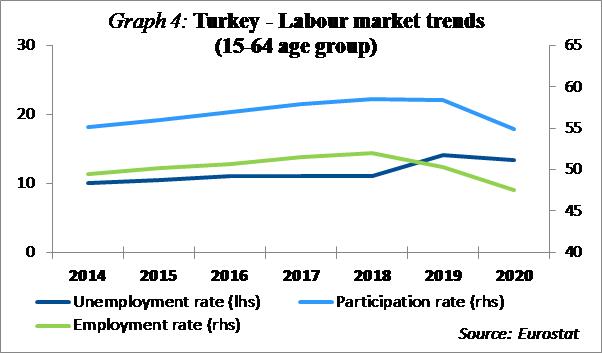 The pandemic had a major negative impact on employment and poverty. The labour market had not yet fully recovered from the 2018 recession, when the pandemic hit. Repeated lockdowns and reduced economic activity, in particular in a number of labour-intensive sectors, led to a sharp decline in employment, most notably in construction and services. Although the government introduced a job retention scheme, financed by the Unemployment Insurance Fund, and a ban on lay-offs, which benefitted millions of people, employment (15 years and above) fell by close to 3 million or 10 % y/y in April 2020. It started to recover in the summer and increased further by June 2021, with a notable rebound of industrial employment. However, employment levels and the employment rate remained below their height a few years ago. The pandemic increased the number of discouraged workers and the labour force participation rate fell to a low of 46.2 % in April 2020, before partially recovering to 51.2 % in the second quarter of 2021. Male and youth employment bore the brunt of the crisis, while female labour market participation and employment declined as well from already particularly low levels. The rate of youth not in employment, education or training increased further. Undeclared work declined as the pandemic affected relatively more sectors with higher informality. The unemployment rate was broadly stable at around 13 % on average in 2020 but declined by mid-2021. The slack on the labour market, however, was evident by the rise in the composite indicator of labour underutilisation, which takes into account time-related underemployment and potential labour force. While traditionally under 20 %, it went up to close to 30 % of the labour force in the spring of 2020 and was still elevated in the second quarter of 2021. The job-retention measures that had shielded the labour market in the crisis were lifted in June. Regional labour market disparities are significant, with the unemployment rate ranging from 8.0 % to 33.5 % in 2020. After nearly two decades of continuous decline, poverty increased sharply in recent years because of the deteriorating labour market situation. The proportion of people with per capita consumption of below $5.5 a day (2011 PPP) went up from 8.5 % in 2018 to an estimated 12.2 % in 2020. Income inequality worsened as well with the Gini coefficient rising to 0.41 in 2020 – its highest level in a decade.
2.3.2. The capacity to cope with competitive pressure and market forces within the Union
|
Turkey has made limited progress and has a good level of preparation in achieving the capacity to cope with the competitive pressure and market forces within the EU. Despite some progress made in improving access to education, the mismatch between the education system and labour market needs persists. Expenditure on research and development continued increasing at a slow pace, but remained well below the government’s target. Supported by favourable financing conditions and concessional lending, investment activity rebounded in 2020. Progress was made with regard to the diversification of energy supplies and the development of the renewable energy sector. The extension of local content requirement practices continued to raise concerns. The relative share of the EU in Turkey’s foreign trade slightly increased, despite extensive deviations by Turkey from its obligations under the EU-Turkey Customs Union.
The Commission’s recommendations from 2020 were not fully implemented and remain valid. In order to improve competitiveness and support long-term growth, Turkey should in particular:
®continue increasing enrolment in education, improve vocational education and training and better adapt education and training to labour market needs;
®take steps to open the gas market to competition;
®remove all protectionist measures not in line with the EU-Turkey Customs Union.
|
Education and innovation
Turkey has made some progress in terms of improving access to education. Total expenditure on education was TRY 259.2 billion (6.0 % of GDP) in 2019, representing a real increase of 2.6 % year-on-year. Government spending was around three quarters of it or 4.4 % of GDP in 2019, increasing by 0.1pp from 2018. In the 2019-2020 school year, enrolment rates continued increasing for preschool, primary (first 4 years), lower secondary (second 4 years), and in upper secondary education (final 4 years). However, the net enrolment rate remained particularly low in the age group 3-5 years and declined in the tertiary education, while dropout rates remained high in secondary education. (see Chapter 26). The proportion of students in vocational and technical secondary education fell further to 28.6 % (from 37.2 % five years ago). The share of pupils in religious education remained broadly stable at close to 11 % in the upper secondary education, but increased in the lower secondary education to 13.6 %, up from 7.3 % five years ago. During the COVID-19 pandemic, Turkey has launched distance learning through state-run channels and internet platforms. Gender inequality in the educational system remains high. The scores obtained by Turkish students in the OECD 2018 PISA (Programme for International Student Assessment) test improved, but still remained below the OECD average. Despite some improvements, the unemployment rate among people with higher education was 12.8 % in 2020. There is a persistent mismatch between the requirements of the labour market and the skills acquired in the education system. However, as part of its Eleventh Development Plan, Turkey is increasing its efforts to align the education system with the requirements of the labour market, especially by further updating vocational and technical education, developing digital competencies and skills and supporting the participation of young people in the labour market.
The private sector continues to lead research and development efforts. Research and development expenditure increased gradually from 0.8 % of GDP in 2013 to around 1.1 % in 2019, but still remained well below the government’s target of 1.8 % by 2023 and also below the EU average of 2.2 %. Almost two thirds of this investment came from the private sector. Cooperation between research institutions and the private sector still needs to be further strengthened. While the number of domestic patent applications increased by 0.9 % in 2020 as compared to 2019, Turkey’s total international patent applications decreased by 10.9 % in the same period.
Physical capital and quality of infrastructure
Supported by favourable financing conditions and concessional lending, investment activity rebounded in 2020. High investment, in particular in non-tradable sectors, contributed to the accumulation of macroeconomic imbalances that led to the abrupt depreciation of the lira in 2018. The ensuing correction was short-lived and, driven by significant monetary easing and government-subsidised lending, investment bounced back to 27.4 % of GDP in 2020. The share of construction in total investment went down from a plateau of 56 % in 2013-2018 to 46 % in 2020. The share of investment in machinery and equipment followed the opposite pattern, rebounding strongly from 34 % in 2018 to 42 % in 2020. Public investment had been broadly stable for years at close to 4 % of GDP. However, because of efforts to limit government expenditure and contain the budget deficit, it fell sharply to below 3 % in 2019-2020. The government has further advanced preparatory works for the Istanbul Canal project, connecting the Black Sea to the Sea of Marmara, despite strong domestic opposition, environmental and social concerns, and unclear financing and economic returns.
Despite improved diversification of energy supplies, issues remain with competition and pricing mechanisms in the energy sector. The dominant market position of the vertically integrated National Petroleum Corporation BOTAŞ remained unchanged. This affects the viability of the recently established Energy Exchange Istanbul (EXIST), where a market of derivatives is expected to be launched in 2021. This should provide more depth and liquidity to the energy market. The update to the natural gas market law is long overdue. Good progress was made in the diversification of energy supplies, thanks to the now operational Trans-Anatolian Pipeline (TANAP) transmitting gas to the European section of the Southern Gas Corridor (SGC) and the significantly increased liquefied natural gas imports in 2020. The renewable energy sector of Turkey continued to grow with the support of a generous feed-in-tariff scheme. A new financial support scheme entered into force in June 2021 (after the previous one expired) and facilities commissioned until December 2025 will benefit from it for the next 10 years that follow. It offers overall lower support than before and is denominated in Turkish lira. The state made a commitment to update the mechanism every quarter in order to adjust it for inflation and exchange rate fluctuations. The new scheme continues the financial incentives for the use of domestic equipment (55 % at the minimum) in renewable energy installations. The extension of the Local Content Requirement (LCR) practices in Turkey continues to raise concerns. These practices contradict WTO and the EU-Turkey Customs Union rules and affect the EU and other international companies’ competitiveness on the Turkish energy market.
Connectivity increased further but remained well below OECD average. The government considers accelerating the digital transformation a key priority to boost productivity and competitiveness of the economy. The number of broadband internet subscribers reached 82.4 million in 2020, up from 76.6 million in 2019. Mobile broadband penetration slightly increased, though it is still below the OECD average. The share of households with access to internet at home grew from 88.3 % in 2019 to 90.7 % in 2020. Over the same period, internet usage by individuals aged 16-74 also increased from 75.3 % to 79.0 %. The share of individuals using e-government services reached 51.5 % in 2020. The number of 4.5G subscribers increased to 77.3 million in the first quarter of 2021, of which 53.8 million were active users.
Sectoral and enterprise structure
The services sector continued to dominate the economy, but has been strongly impacted by the COVID-19 pandemic. Its share in total value added decreased from 57.2 % to 54.9 % between 2019 and 2020, mainly as contact-intensive sectors, such as hospitality and travel, were hard hit by the pandemic-related restrictions. Some sectors, like financial and insurance activities, and information and communication, however, performed very well, increasing also their economic weight. The construction sector, which had been one of the main sectors driving economic growth before 2018, saw its share falling from 8.5 % in 2017 to 5.2 % in 2020 – a level not seen in 15 years. Employment in the construction sector decreased from 7.5 % in 2017 to 5.6 % of total employment in 2019 and remained largely unchanged in 2020. Industry accounted for 20.6 % of employment in 2020, up by 0.7pps from its 2019 level. In spite of the pandemic, it managed to increase its share of GDP from 21.1 % to 22.1 % between 2019 and 2020. Although representing only 6.7 % of GDP in 2020, agriculture continues to be an important sector, employing 17.7 % of the workforce (down by 0.4pps from its 2019 level).
Small and medium-sized enterprises (SMEs) are the backbone of the economy. SMEs employ around three quarters of Turkey’s workforce and generate more than half of the economy’s total value added. Turkey continued to implement various economic support schemes, mostly targeting SMEs. In order to limit the negative effects of the COVID-19 pandemic, Turkey adopted support mechanisms for enterprises consisting of labour-related schemes (partial redundancy, short-time work, wage subsidy) and payment deferral measures (taxes, social security premiums, utility bills), while also providing financial support through loan guarantees, direct lending and subsidies. The SME support administration KOSGEB extended the scope of its TechnoInvest support programme to new products such as personal protective equipment and disinfectants and granted additional grace periods for eligible companies. Further assistance was provided in support of SMEs’ digitalisation and internationalisation. There were also limited direct cash transfers to restaurants and cafes in order to compensate their turnover loss due to repeated lockdowns.
Economic integration with the EU and price competitiveness
Despite a notable Brexit effect, economic integration with the EU remained high. In 2020, Turkey remained the EU’s sixth largest trading partner, while the EU remains by far Turkey’s largest trading partner. The share of the EU in Turkish exports decreased from 42.4 % in 2019 to 41.3 % in 2020 while the share of Turkish imports coming from the EU-27 slightly increased from 32.3 % to 33.4 % between 2019 and 2020. Trade with the United Kingdom represented 6.6 % of total exports and 2.5 % of imports in 2020. The EU remained the largest source of foreign direct investment (FDI) in Turkey. The EU’s share in the overall stock of FDI declined from 72 % in 2013 to 62 % in 2020 (58 % in 2019). Trade openness declined slightly in 2020, as the pandemic led to a contraction of exports of services. The fall in the lira’s value intensified in 2020, leading to a significant further depreciation of the real effective exchange rate, which reached its lowest level on record since 1994. Turkey maintained the additional duties, of which the scope significantly increased during the COVID-19 pandemic, on a large number of products of non-EU origin and in free circulation within the EU-Turkey Customs Union. The forced localisation policy in the pharmaceutical sector, which the EU has challenged at the World Trade Organisation, remained in place, while non-tariff barriers such as import surveillance and customs checks, which were intensified during the pandemic, continued to hinder trade flows.

2.4. Public Procurement, Statistics, Financial control
Chapter 5: Public procurement
EU rules ensure that the public procurement of goods and services in any Member State is transparent and open to all EU companies on the basis of non-discrimination and equal treatment.
Turkey is moderately prepared in the area of public procurement, made no progress over the reporting year and large gaps remained in its alignment with the EU acquis. Turkey maintained offsets and discriminatory local content favouring practices. There was no implementation of the 2020 report's recommendations.
In addition to addressing the shortcomings set out below, Turkey should in particular:
®revise its public procurement legislation to further align it with the 2014 EU Directives on public procurement including utilities, concessions and public private partnerships and to increase transparency;
®repeal exemptions contradictory to the EU acquis and eliminate the discriminatory domestic price advantage and offset practices;
®establish a fully independent complaint review mechanism, separate from the legislative and regulatory responsibilities of the public procurement authority.
Institutional set-up and legal alignment
Concerning the legal framework, Turkey’s national public procurement legislation broadly reflects the principles of the Treaty on the Functioning of the European Union. However, compulsory domestic price advantages and offsets (such as the Industry Cooperation Programme which has similar effects with the offset practices), that allow authorities to demand compensating measures if goods are not produced domestically, are discriminatory and thus contradict the EU acquis. Turkey removed the lower limit for application of such offset practice.
The Public Procurement Law (PPL) is partly aligned with the 2004 EU Public Procurement Directives. However, many sector-specific laws limit transparency and the coverage of public procurement rules is significantly reduced by a long and increasing list of exclusions of varying importance and scope. In June 2020, procurement by the State Supply Office of goods and services became obligatory for public institutions and organisations. The implementation of this mandatory centralised purchasing system practically increases the scope of exclusions since the procurements by the State Supply Office under the threshold of TRY 18.6 million (EUR 1.97 million) are exempted from the PPL. The threshold is also higher than the ones applicable for supplies and services in the EU.
Turkey still does not have a functioning single framework for coordinating, supervising and monitoring PPP operations.
Turkey's 11th Development Plan (2019-2023) aims at increasing domestic production particularly for chemicals, pharmaceuticals and medical devices, electronics, machinery and electrical equipment, automotive and railway services sectors by means of using public procurement as a subsidising tool. For such purpose, a compulsory domestic price advantage of up to 15 % remains available for ‘medium and high-technology industrial products’ and the offset practices are promoted. The percentage of international tenders where domestic price advantage applied is high and has increased from 33 % in 2017 to 48 % in 2020, while the overall value of such tenders increased from 44 % to 47 % of the total during the same timeframe. Within tenders above the international procurement thresholds, domestic price advantage distorting competition against international tenderers was applied in 56 % of supply, 60 % of work, 20 % of consultancy and 71 % of service tenders, corresponding to 53 %, 57 %, 24 % and 70 % of total value, respectively.
The operational independence of the Public Procurement Board within the Public Procurement Authority (PPA) is potentially impaired, since the President of the Republic is authorised to directly appoint its president and members without any specific requirements on education and sector experience.
Implementation and enforcement capacity
The size of the public procurement market in Turkey narrowed from 7.5 % of GDP in 2017 to 3.3 % in 2019. In 2020, the market accounted for 3.4 % of GDP reflecting the decrease in the financial resources allocated to the public services. In 2020, the number of PPP projects was three, down from eight in 2019.
Monitoring of the contract awards and implementation is satisfactory. The PPA issues statistics on a six-month basis, which provide the source for measuring performance and making improvements to the public procurement system. PPA should transparently continue reporting the number of international tenders (regardless of international procurement thresholds) where domestic price advantage is applied.
Contracting authorities’ capacity to manage public procurement processes continued to improve. Within the framework of COVID-19 administrative package, the PPA instructed the procurement authorities to use electronic procurement for the new and cancelled tenders. As a result, during the COVID-19 pandemic period in 2020, electronic procurement implementation, which was put into practice in the last quarter of 2016, became an important tool and reached 17 359 (4,551 in 2019) procurements corresponding to TRY 38.3 billion (TRY 4.1 billion in 2019).
Mechanisms to identify and address corrupt and fraudulent practices are in place, including rules on integrity and conflict of interest. However, the use of the negotiated procedure, which corresponds to more than one fourth of all tenders (both in value and number), significantly increased in the last four years. When using this procedure, a specific sub-article (“Article 21/b” of the PPL) allows the contracting authorities to limit competition and transparency. In 2020, Article 21/b was used in 90 % of the tenders (in value) where the negotiated procedure applied. Such a widespread use led to allegations of political influence on public tenders. Turkey needs to develop instruments to evaluate contract performance including the economic, effectiveness, and efficiency of public procurement proceedings. Turkey should also develop a risk indicator system that signals potential integrity problems in the procurement process.
Efficient remedy system
The right to legal remedy is secured in the Constitution and the PPL lays down the institutional set up and mechanism for handling complaints. The review and remedies system provides for effective, swift and competent handling and resolution of complaints and sanctions. However, further alignment of the legislation with the EU Remedies Directive is needed. For such purpose, Turkey needs to establish a fully independent procurement review board, separate from the public procurement authority and ensuring the independence of board members.
The implementation capacity of the Public Procurement Board remains stable with 334 staff. The Public Procurement Board received 2 316 complaints in 2020 (3.53 % of contracts which allow for complaints), compared with 1 864 complaints in 2019, at the time amounting to 2.87 % of the contracts. The appointment policy and the Board’s position as part of the PPA remained a concern. A fully independent Public Procurement Board would prevent possible conflicts of interest and ensure transparency.
Chapter 18: Statistics
EU rules require that Member States are able to produce good quality statistics in line with the principles of the European statistics Code of Practice and based on professional independence, impartiality, reliability, transparency, and confidentiality. Common rules are provided for the methodology, production and dissemination of statistical information.
Turkey is moderately prepared in the area of statistics. Turkey made some progress in further aligning with the EU acquis and in improving the compliance level with respect to annual national accounts and the Excessive Deficit Procedure. Frequent changes of the president of the Turkish Statistical Institute (TurkStat) and other management positions significantly undermine the institution’s credibility. There was limited implementation of last year’s recommendations.
In addition to addressing the shortcomings set out below, in the coming year Turkey should in particular:
®further align national accounts and financial accounts with the European System of Accounts 2010 (ESA 2010);
®broaden and further reinforce coordination between TurkStat and other data providers;
®improve statistics on agriculture, migration and asylum.
As regards statistical infrastructure, Turkey’s statistics legislation is based on the European Statistics Code of Practice. TurkStat is associated to the Ministry of Treasury and Finance. There were increasing concerns regarding the transparency of the appointment and dismissal procedures within TurkStat, including in the post of its president, undermining significantly the institution’s credibility. Efforts continued to improve the use of public institutions' administrative records and their integration into statistical production but the cooperation between TurkStat and other data providers should be developed further. Registers in the statistical office are updated regularly. The main classifications are aligned with the EU acquis.
For macroeconomic statistics, efforts continued to integrate administrative records into the national accounting system. Turkey improved annual national accounts by providing population data. However, employment data according to ESA 2010 was not provided. The GNI inventory submitted to Eurostat in 2017 still needs to be further aligned with Eurostat’s GNI Inventory Guide and the GNI calculations need to be brought fully in line with ESA 2010. TurkStat did not transmit the annual institutional sector accounts for 2019. Turkey made progress on the coverage and timeliness of the quarterly national accounts, however, quarterly sector accounts were not available. Turkey produces highly compliant statistics on international trade in goods. It improved quality and coverage of excessive deficit procedure tables. Turkey also made some progress in the implementation of Eurostat’s methodology guidance, the provision of extensive explanatory notes on the data as well as the delimitation of the general government sector. It transmitted data on government revenue expenditure and detailed taxes based on ESA 2010 for 2009-2019. Further efforts are still required on fiscal reporting and notifications under the excessive deficit procedure. Turkey continued reporting quarterly balance of payments and international investment position data on a regular basis.
Business statistics improved with the use of administrative records for indicators. Short-term statistics are largely aligned. Research and development statistics are fully compliant. The annual surveys on information and communication technology are largely compliant with EU standards. Rail, maritime and regional transport statistics are highly compliant, but further progress is still needed on road freight data. Tourism statistics are available, but need to be further aligned with the EU acquis. Foreign affiliate statistics have not been transmitted yet to Eurostat.
As for social statistics, the survey on income and living conditions is carried out in compliance with EU standards and data are sent to Eurostat. Social protection statistics are highly compliant with EU standards and labour market statistics are fully aligned. TurkStat made some revisions in its labour force statistics in accordance with the new acquis. Data for the labour cost index is regularly provided, although incomplete. The Structure of Earnings Survey is conducted every four years in compliance with the EU legislation. TurkStat did not provide quarterly job vacancy survey. Statistics on education and vocational training are available. Public health statistics are available, while further progress is needed for data on health expenditure and non-monetary healthcare. Crime statistics are produced, but efforts are needed on criminal justice statistics. Statistics on immigration and emigration are produced. Asylum statistics are not yet collected according to the EU requirement.
As regards agricultural statistics, no agricultural census has been carried out since 2001. Statistics for crop and for most of the critical animal production, milk and dairy are available. Supply balance sheets are also available for almost all basic crop products and for wine. The economic accounts for agriculture are not fully compliant with the EU acquis. The results of the 2016 farm structure survey have still not been transmitted to the Eurofarm system.
Energy statistics are highly compliant with the EU requirements. Energy prices are sent regularly to Eurostat in good quality. As for environmental statistics, waste and water statistics are produced, but further process is needed on water resources and water abstraction statistics. Environmental accounts on greenhouse gas emissions and statistics on environmental taxes, material flow and environmental protection expenditure are available. Significant efforts were made to improve the compilation of the monetary environmental accounts modules.
Chapter 32: Financial control
The EU promotes the reform of national governance systems to improve managerial accountability, sound financial management of income and expenditure, and external audit of public funds. The financial control rules further protect the EU’s financial interests against fraud in the management of EU funds and the euro against counterfeiting.
Turkey has a good level of preparation on financial control. Limited progress was made in the reporting period, while last year’s recommendations were not addressed. Audit reports of the Turkey Wealth Fund (TWF) were published on its website, and some companies of the Fund are directly audited by the Turkish Court of Accounts (TCA). However, the TWF remained not fully subject to the direct audit by the TCA. The anti-fraud coordination service (AFCOS) network has yet to be re-established. The purpose, authority and responsibility of internal audit is undermined by the absence of a legal requirement to have internal audit units in Ministries. Last year’s recommendations remain valid.
In the coming year, Turkey should in particular:
®update the Public Internal Financial Control policy paper and its action plan and ensure that a formal coordination, monitoring and reporting framework is put in place for the updated action plan;
®re-establish the AFCOS network and adopt a national anti-fraud strategy;
®reconsider the arrangements that would include municipalities and state-owned enterprises in the treasury single account.
Public internal financial control (PIFC)
The strategic framework is partially in place. The update of the Public Internal Financial Control policy paper has not made progress since 2012. Turkey still lacks a comprehensive strategic framework for public administration reform and for public finance management. Public finance management related goals are found in different planning documents and strategies by various institutions, and there is no mechanism in place to coordinate implementation of reforms and to ensure regular monitoring and reporting. Exceptional management and control procedures or derogations applied by the authorities during the COVID-19 crisis need to be well documented, accompanied by adequate safeguards and considered for special audits.
The Turkish administration has a uniform management structure that combines elements of managerial accountability and delegation with a results-oriented performance management system. Further efforts are needed to address harmonisation of legislation, managerial accountability, including reporting structures, delegation of decision-making responsibilities, and functioning of internal control. The Public Financial Management and Control (PFMC) Law applies to all public institutions and defines the elements of financial control. It sets out the relevant responsibilities of the heads of public institutions, including managerial duties and the delegation of authority to authorising officers, with the Ministry of Finance and Treasury assigned a coordinating role.
The PFMC Law regulates internal control, which functions largely in line with international standards. Full implementation of internal control systems continues to be negatively impacted by capacity and ownership issues. The application of risk management is still at an early stage, and monitoring and reporting of irregularities are yet to be further developed. Turkey has a treasury single account, but the inclusion of local administrations and state-owned enterprises within its scope raises concerns.
Internal audit practice is regulated in line with international standards in the PFMC Law. An internal audit manual and a code of ethics are in place, as are manuals prepared by the Central Harmonisation Unit, but they have not been updated since 2013. There is no legal requirement for Ministries to have an internal audit unit, just internal auditors, and there is no formal status for heads of internal audit as a Unit Head. There is no entity performing the role of an Audit Committee and auditors report directly to their Deputy Ministers or a senior manager. These reporting arrangements could compromise auditors’ independence in planning and performing their work. There is generally a lack of data on internal audit planning and implementation of recommendations. There is no systematic follow-up of the implementation of internal audit recommendations. The existing lack of clarity in the legislation and in the practice between the internal audit and inspection organisations do compromise the effectiveness of the internal audit function.
Two Central Harmonisation Units (CHUs) are tasked with setting standards, monitoring and reporting on PIFC implementation. The CHU for financial management and control defines standards and methodology, provides guidance, training and overall coordination to public administrations in this field, and does not perform internal control quality reviews. The Internal Audit Coordination Board is the CHU for internal audit, which notably monitors the internal audit systems of the public administrations, develops internal audit standards and publishes manuals. The Internal Audit Coordination Board consists of seven members appointed by the President for a period of four years and is now fully attached to the Ministry of Finance and Treasury. Efforts should be made to ensure its independence and to strenghten its capacity, organisational structure and adequate resources to fulfill its mandate.
External audit
The constitutional and legal framework provides for the independence of the Turkish Court of Accounts (TCA). The TCA law is in line with International Organisation of Supreme Audit Institutions (INTOSAI) standards. It provides for an almost exhaustive audit mandate and gives the TCA full discretion in discharging its responsibilities. Concerns exist around fiscal discipline, transparency and accountability in relation to the Turkey Wealth Fund (TWF), chaired by the President of the Republic and not fully subject to the direct audit by the TCA. Some companies in the TWF portfolio are audited by the TCA and some TWF activities are not subject to external audit. The TWF is audited by an independent audit firm and by auditors appointed by the President. Audit reports of the TWF are submitted to the Plan and Budget Committee of the Parliament and published on the TWF website. There are no notes accompanying the financial statements, which may raise concerns in terms of full transparency.
The TCA has both audit and judicial functions. In 2020, it had 1,874 staff, including 830 auditors in comparison to 1,861 staff in 2019, of which 804 were auditors. The TCA is implementing its 2019-2023 Strategic Plan which notably foresees the development of risk-based audit and strengthening its human resources capacity. The TCA published a Communication Strategy on the Plan in 2020.
The TCA has improved the quality of audit work and now carries out “value for money” performance audits as per international standards (7 started in 2019 and 3 started in 2020). The TCA annually submits four audit reports to the Parliament (External Audit General Evaluation Report, Accountability General Evaluation Report, Financial Statistics Evaluation Report, and Report on State-owned Economic Enterprises) in addition to a statement of general conformity. The reports of the TCA are only considered by the Parliament during its deliberations on the budget.
Regarding the impact of audit work, the TCA assesses the internal control environment of audited entities as part of its audit work, and thus contributes to PIFC development. The TCA reports on state-owned enterprises are analysed by the commission of state-owned enterprises of the Parliament, while other audit reports are analysed by the Parliament committee on planning and budget. The TCA reports are published online every year, with the exception of those on state-owned economic enterprises. TCA recommendations should be systematically and swiftly implemented by the audited institutions. A working group between the TCA and the Ministry of Treasury and Finance is operational. Increased parliamentary scrutiny on TCA audit findings and recommendations is still needed. There is a need for separating discussion on budget and audit issues. The establishnent of a working group between the TCA and the Parliament solely dedicated to discuss performance of public institutions and their spending could be instrumental in this regard.
Protection of the EU’s financial interests
While Turkey has reached a good level of EU acquis alignment, it still needs to fully align its legislation with the EU Directive on the fight against fraud to the Union’s financial interests by means of criminal law. The State Supervisory Council (SSC) was designated as the anti-fraud coordination service (AFCOS), but an AFCOS network, involving other relevant authorities, has to be re-established. Turkey also needs to adopt a national anti-fraud strategy. Turkey should significantly strengthen its cooperation with the European Commission during investigations, and continue to report irregularities and suspected fraud cases. Turkey reported 672 cases to the Commission via the online irregularity management system from 2012 to 2020, of which 72 cases in 2020. Turkey needs to continue to develop a solid track record on cooperation on investigations and reporting of irregularities.
Protection of the euro against counterfeiting
Turkey has reached a high level of EU acquis alignment in this area. Technical analysis of counterfeit money, including euro banknotes and coins, is carried out by a dedicated department in the Central Bank and technical analysis of counterfeit coins including euro coins are performed by the Turkish State Mint. Credit institutions that do not withdraw counterfeits from circulation are subject to financial penalties. Turkey takes part in the actions of the Pericles 2020 programme.
3.Good neighbourly relations and regional cooperation
Cyprus
Due to continued and new unauthorised Turkish hydrocarbon exploration activities in the maritime zones of Cyprus and Greece, tensions in the Eastern Mediterranean and Aegean Sea increased in the second half of 2020. In November 2020, the Council extended the existing framework for restrictive measures in response to Turkey’s unauthorised drilling activities in the Eastern Mediterranean. In its conclusions of December 2020, the European Council strongly condemned Turkey’s unilateral actions, provocations and escalated rhetoric against the EU, EU Member States and European leaders.
The tensions in the Eastern Mediterranean decreased in the beginning of 2021. Among other steps taken, Turkey stopped illegal drilling activities in the maritime zones of Cyprus. The European Council of March 2021 stated that provided that this de-escalation is sustained and that Turkey engages constructively, and subject to the established conditionalities set out in previous European Council conclusions, in order to further strengthen the recent dynamic, the EU is ready to engage with Turkey in a phased, proportionate and reversible manner to enhance cooperation in a number of areas of common interest. The June 2021 European Council reiterated its full commitment to the comprehensive settlement of the Cyprus problem on the basis of a bicommunal, bizonal federation with political equality, in accordance with the relevant UN Security Council Resolutions. It underlined the importance of the status of Varosha and called for full respect of UN Security Council Resolutions, in particular Resolutions 550, 789 and 1251.
Following the change in leadership of the Turkish Cypriot Community in December 2020, the United Nations senior official for Cyprus held a series of meetings with representatives of the two Cypriot communities. For the first time in almost four years, new informal talks took place on the future of the island of Cyprus between the two Cypriot communities and the island’s three Guarantor Powers, the UK, Turkey and Greece in Geneva in April 2021. The informal meeting did not pave the way for the resumption of formal negotiations. The European Council of June 2021 regretted this development.
Turkey continued to challenge the status of the fenced-off city of Varosha. Several representatives of the Turkish government, including the President and the Vice President visited Varosha, promising financial support to the development of the area. The December 2020 European Council reiterated its October 2020 conclusions and condemned Turkey’s unilateral steps in Varosha and called for full respect of UN Security Council Resolutions 550 and 789. On 27 July 2021, the High Representative strongly condemned on behalf of the EU Turkey’s unilateral steps and the unacceptable announcements made by the Turkish President and the leader of the Turkish Cypriot community on 20 July 2021 on the further reopening of the fenced-off town of Varosha. In addition the High Representative welcomed the Statement made by the President of the UN Security Council on behalf of the Council on 23 July 2021.
As emphasised in the Negotiating Framework and Council declarations, Turkey is expected to actively support the negotiations on a fair, comprehensive and viable settlement of the Cyprus issue within the UN framework, in accordance with the relevant UN Security Council resolutions and in line with the principles on which the EU is founded and the EU acquis. It is important that Turkey reaffirms its commitment to and constructive engagement to the United Nations-led settlement talks on Cyprus in line with the relevant UN Security Council Resolutions, including in its external aspects. No unilateral actions should be taken that could raise tensions on the island and undermine a return to talks. Related to Varosha, Turkey must immediately reverse the unilateral actions announced on 20 July 2021 and all steps taken on Varosha since October 2020 that run contrary to relevant UN Security Council resolutions.
Turkey continues to refuse to recognise the Republic of Cyprus. Despite repeated calls by the Council and the Commission, Turkey has still not complied with its obligations as outlined in the Declaration of the European Community and its Member States of 21 September 2005 and in Council Conclusions, including those of December 2006 and December 2015. Turkey has not fulfilled its obligation to ensure full and non-discriminatory implementation of the Additional Protocol to the Association Agreement and has not removed all obstacles to the free movement of goods, including restrictions on direct transport links with the Republic of Cyprus.
Turkey continued to veto applications by the Republic of Cyprus to join several international organisations, including the Organisation for Economic Co-operation and Development (OECD).
Peaceful settlement of border disputes
After December 2020, a more positive dynamic in the EU-Turkey relations was observed following the de-escalation in the Eastern Mediterranean through the discontinuation of illegal hydrocarbon exploration and drilling activities by Turkey in the maritime zones of Cyprus and Greece and the resumption of exploratory talks between Turkey and Greece in January 2021. These talks should remain a valuable channel of communication between both sides to find common ground for the start of negotiations on the delimitation of the continental shelf. The European Council of March 2021 welcomed these developments. In addition, the European Council reaffirmed that the EU would remain committed to defending its interests and those of its Member States as well as to upholding regional stability. The Greek Foreign Minister visited Ankara on 15 April and the Turkish Foreign Minister visited Athens on 30-31 May where a mutual desire to promote a positive agenda was ascertained. The Greek Prime Minister and Turkish President met on 14 June.
The possible extension of Greek territorial waters to 12 nautical miles in the Aegean Sea under Article 3 of the United Nations Convention on the Law of the Sea continued to weigh on Greece-Turkey relations, as the 1995 declaration of the Turkish Grand National Assembly that any unilateral action by Greece to extend its territorial waters would be considered casus belli still holds.
Greece and Cyprus continue to complain about repeated violations and the militarisation of their territorial waters and airspace by Turkey. Flights over Greek inhabited areas continued to be reported, in violation of international law. Overflights of Greek mainland in the Evros river border region were also reported. As highlighted by the Council, and stemming from obligations under the Negotiating Framework, Turkey is expected to unequivocally commit to good neighbourly relations, international agreements and the peaceful settlement of disputes having recourse, if necessary, to the International Court of Justice. Turkey must avoid threats and actions that damage good neighbourly relations, normalise its relations with the Republic of Cyprus and respect the sovereignty of all EU Member States over their territorial sea and airspace as well as all their sovereign rights, including inter alia the right to explore and exploit natural resources, in accordance with EU and international law, in particular the United Nations Convention on the Law of the Sea (UNCLOS). Accordingly, Turkey is expected to refrain from any drilling activities of hydrocarbons in the maritime zones of other states.
The bilateral Memorandum of Understanding on the delimitation of maritime jurisdiction areas between Turkey and the National Accord Government of Libya signed in November 2019 remains in place despite the fact that it ignored the sovereign rights of Greece in the area concerned, infringes upon the sovereign rights of third States, does not comply with the United Nations Convention on the Law of the Sea and cannot produce any legal consequences for third States.
Regional cooperation
Good neighbourly relations form an essential part of Turkey’s process of moving towards the EU. Bilateral relations with other enlargement countries were generally good, but remained challenging with neighbouring EU Member States, particularly Greece and Cyprus. Tensions in the Aegean Sea and Eastern Mediterranean were not conducive to good neighbourly relations and undermined regional stability and security. Turkey continued to conduct its proactive foreign and economic policy with the Western Balkans and supported the countries of the region in their respective efforts in joining NATO and the EU. Turkey also improved its relations in the fields of culture and security. Turkey assumed the Chairmanship-in-office of the South-East European Cooperation Process (SEECP) in June 2020 for one year. The Turkish authorities continued to exert pressure on authorities in the Western Balkans to locally prosecute and extradite alleged members of the Gülen movement. Turkey provided medical equipment and aid to all Western Balkans in their fight against the COVID-19 pandemic.
Turkey-Albania relations are strong. At a High-Level Strategic Cooperation Council in January 2021, both countries agreed to further upgrade bilateral cooperation in a number of areas. Turkey was the biggest foreign investor in Albania and a big donor of humanitarian and medical aid during the COVID-19 pandemic.
Turkey’s relations with Bosnia and Herzegovina remained positive. The tripartite Bosnia and Herzegovina Presidency paid an official visit to Turkey in March 2021. Turkey agreed to donate 30 000 coronavirus vaccines to Bosnia and Herzegovina.
Turkey maintained strong cultural and economic ties with Kosovo
*.
Turkey and Montenegro continued developing their bilateral cooperation in all fields. Turkey was actively engaged in the economic, educational and cultural sector of North Macedonia. Turkey continued to provide humanitarian and development assistance to the country.
Turkey developed its overall relations with Serbia and further increased its investments there, with the biggest Turkish investment being the Serbian section of the Belgrade-Sarajevo highway. A high-level visit took place in October 2020.
4.Ability to assume obligations of membership
Cluster 2: Internal Market
This cluster covers: free movement of goods (Chapter 1), freedom of movement for workers (Chapter 2), right of establishment and freedom to provide services (Chapter 3), free movement of capital (Chapter 4), company law (Chapter 6), intellectual property law (Chapter 7), competition policy (Chapter 8), financial services (Chapter 9), and health and consumer protection (Chapter 28). This cluster is key to the good functioning of the EU-Turkey Customs Union and to integrating Turkey in the EU’s single market.
Turkey has achieved a good level of preparation for the free movement of goods. Although it continued to align with technical EU legislation under the ‘New and Global Approach’, technical barriers to trade remain, which hamper the good functioning of the Customs Union. Preparations in the areas of freedom of movement for workers and right of establishment and freedom to provide services are at an early stage as many professions are closed to EU nationals.
Turkey is moderately prepared on free movement of capital notably because of the substantial remaining obstacles for acquisitions of assets and real estate. It improved its legal framework regulating the fight against money laundering and terrorism financing, but needs to ensure that implementation does not restrict the legitimate rights of NGOs. There is a good level of preparation in terms of legislative alignment of consumer and health protection, as exemplified by Turkey’s strong vaccination campaign against COVID-19. However, in both areas, there is a need to strengthen administrative capacity, consultations and coordination among stakeholders. Turkey has some level of preparation in the area of competition policy. There is a continued lack of State aid implementation rules, enforcement and transparency, while the institutional set up remains incomplete.
Chapter 1: Free movement of goods
The free movement of goods ensures that many products can be traded freely across the EU based on common rules and procedures. Where products are governed by national rules, the principle of the free movement of goods prevents these from creating unjustified barriers to trade.
Turkey has achieved a good level of preparation for the free movement of goods. It made no progress in addressing last year’s recommendations. While alignment with technical EU legislation under the ‘New and Global Approach’ continued, technical barriers to trade remained in place, preventing the free movement of some goods. Requirements discriminating against EU products remained, violating Turkey’s obligations under the Customs Union. Turkey increased its product safety controls under the risk-based import control system, leading to unjustified checks and causing delays in EU products’ access to the Turkish market.
In the coming period, Turkey should in particular:
®eliminate non-tariff barriers to the free movement of goods that are in breach of Customs Union obligations, such as surveillance regimes for the import of certain products, export restrictions, prior registration requirements, conformity assessments and inspections, licensing surveillance and other documentation requirements for imports and non-acceptance of EU good manufacturing practices certificates;
®reconsider schemes imposing local content requirements or relocation of production particularly in the area of medicines for human use;
®increase the coverage and effectiveness of market surveillance measures.
General principles
The framework for the free movement of goods is largely in place in Turkey. However, issues related to implementation still remain. A range of non-tariff barriers to the free movement of goods that are in breach of Customs Union obligations are still in place and some were introduced in the reporting period. These included surveillance regimes for the import of certain products, export restrictions, prior registration requirements, conformity assessments and inspections under the risk-based import control system, licensing surveillance and other documentation requirements, as well as non-acceptance of EU good manufacturing practices certificates and discrimination against EU products. Furthermore, schemes to ensure the local manufacture or local content requirements create de facto market access barriers for EU products and are considered not in line with the Customs Union. The prior authorisation requirement for exports of some personal protective equipment (PPE) introduced in March 2020 is still in place.
Non-harmonised area
Turkey adopted a new regulation on mutual recognition in the non-harmonised area in March 2021 in line with the EU acquis. The number of notifications of product legislation from Turkey increased from 7 in 2020 to 13 in 2021. Considering Turkey’s economic size, legislative activity and link with the European Union under the Customs Union, this is insufficient.
Harmonised area: quality infrastructure
Turkey is aligned with the EU acquis on technical regulations, standards, conformity assessment, accreditation, metrology, and market surveillance. Implementing regulations were published on general product safety, the Conformité Européenne mark (CE mark), conformity assessment bodies, notified bodies and conformity assessment methods.
The Turkish Standards Institute is independent and able to implement European and international standards. It has adequate staff resources and financing, and since 2012 is a full member of the European Committee for Standardisation (CEN) and the European Committee for Electrotechnical Standardisation (CENELEC). By April 2021, it had adopted 21 372 national standards aligned with European standards. The rate of harmonisation with CEN and CENELEC standards is 99 % and 96 %, respectively. Eight Turkish economic operators are full members of the European Telecommunications Standards Institute (ETSI) and one is an observer.
Turkey had 51 notified bodies, two technical approval bodies and three recognised third-party organisations in place as of June 2021. The Turkish Accreditation Agency (TÜRKAK) is a signatory of nine multilateral agreements as part of the European cooperation for Accreditation association. TÜRKAK was admitted to the mutual recognition of data agreement (MAD) of the OECD Good Laboratory Practices Working Group (OECD-GLP) in February 2020. The National Metrology Institute (TÜBITAK-UME) is a member of the European Association of National Metrology Institutes (EURAMET) and participates in the Committee of the European Metrology Programme for Innovation and Research (EMPIR). The Ministry of Industry and Technology participates in the European Legal Metrology Organisation (WELMEC).
Turkey performs market surveillance in line with the EU acquis and submits its annual programme to the European Commission. According to initial data from the Ministry of Trade, the overall budget allocated to market surveillance decreased by 20 % in 2020. There was a decrease of 32 % in the number of products subject to market surveillance checks in 2020 as compared to 2019. Market surveillance is not performed on the basis of risk assessment. Surveillance remained very limited with regard to e-commerce while the volume of online shopping increased. About 26 % of unsafe products were subject to fines in 2019 as compared to 31 % in 2018. This decline raises concerns about the enforcement of product safety legislation.
Harmonised area: sectoral legislation
On the ‘new and global approach’ product legislation, legislation aligned to the EU acquis was adopted on radio equipment, medical devices and in vitro diagnostic medical devices. Implementing legislation was issued on lifts and equipment and protective systems intended for use in potentially explosive atmospheres. Turkey adopted implementing legislation on energy labelling and eco-design requirements for various product groups.
On ‘old approach’ product legislation, Turkey adopted legislation to align with EU acquis on emission limits of internal combustion engines for non-road mobile machinery and labelling of tyres with respect to fuel efficiency. Concerns exist with regard to the implementation of EU acquis on cosmetics in terms of registration requirements and notifications on the product tracking system. Amending legislation on agricultural and forestry tractors was adopted in April 2021 postponing enforcement deadlines to 1 January 2023. Turkey amended the legal base on the licensing of medicinal products for human use, allowing the approval of emergency use of vaccines. Turkey did not accept EU good manufacturing practice (GMP) certificates on medicines for human use, in contradiction to Customs Union rules. Turkey’s schemes impose the requirement of local manufacturing on medicines for human use and on agricultural and forestry tractors, which create market access barriers for EU products. Turkey is only partly aligned with the European Regulation on Registration, Evaluation, Authorisation and Restriction of Chemicals (REACH). Turkey’s product safety controls on imported goods processed through the electronic TAREKS system require additional documentation and information for products coming from the EU, contrary to Customs Union provisions. In 2021, textiles and footwear were also covered by this requirement.
On procedural measures, there is a specific licensing and regulation system for economic operators dealing with drug precursors, with a strict follow-up and monitoring system in cooperation with the police and customs authorities. Turkey is aligned with the EU acquis regarding licensing procedures for firearms. There was no progress on alignment with the EU acquis on cultural goods.
Chapter 2: Freedom of movement for workers
Citizens of one Member State have the right to work in another Member State and must be given the same working and social conditions as other workers.
Preparations in the area of freedom of movement for workers are at an early stage and there was no progress during the reporting period.
There was no progress on access to the labour market or coordination of social security systems. So far, Turkey has concluded 15 bilateral social security agreements with EU Member States, but no new bilateral social security agreements were signed during the reporting period. There were no developments on future participation in the European employment services network (EURES).
Chapter 3: Right of establishment and freedom to provide services
EU natural and legal persons have the right to establish themselves in any Member State and to provide cross-border services. For certain regulated professions, there are rules on mutual recognition of qualifications. Postal services are gradually being opened up to competition.
Preparations in the area of right of establishment and freedom to provide services are at an early stage. There was no progress in the reporting period. Substantial efforts are still required to align with the EU acquis. There was no implementation of the 2020 Report's recommendations which remain valid.
In the coming year, Turkey should in particular:
®align with the Services Directive on the provision of cross-border services and set up a Point of Single Contact;
®align with EU acquis in the area of postal services;
®align its national legislation with the EU acquis in the area of the mutual recognition of professional qualifications.
There was no progress on the right of establishment where many requirements continue to restrict this right.
Regarding the freedom to provide cross-border services, registration, licensing and authorisation requirements are still in place for service providers registered in the EU. The Point of Single Contact has not been set up yet. Preparations are still ongoing to transform the retail sector information system (PERBIS) into a sector-specific Point of Single Contact.
No progress was made in the area of postal services. Regarding the provision of universal postal service, Turkey is yet to align with the Postal Services Directive. A reserved area in the standard postal letter service sector and exclusive rights of the universal service provider are still maintained. National legislation is also still to be aligned with the provisions of the Regulation on cross-border parcel delivery services.
On the mutual recognition of professional qualifications, some regulated professions still require reciprocal recognition. Nationality and language requirements have not been removed. Alignment of national legislation with the EU acquis in this area needs to continue.
Chapter 4 - Free movement of capital
In the EU, capital and investments must be able to move without restriction and there are common rules for cross-border payments. Banks and other economic operators apply certain rules to support the fight against money laundering and terrorist financing.
Turkey is moderately prepared on free movement of capital. Overall, there was some progress in this area in the reporting period. Legislation on real estate acquisition is not aligned with the EU acquis. Restrictions imposed on capital outflows and foreign exchange-denominated transactions after the August 2018 currency crisis are still in force. In the light of the recommendations of the Financial Action Task Force (FATF), Turkey moderately improved its legal framework regulating the fight against money laundering and terrorism financing. There was limited progress in the implementation of last year’s recommendations.
In addition to addressing the shortcomings set out below, Turkey should in particular:
®draft and adopt an action plan on real estate acquisition by foreigners to lift restrictions and increase transparency;
®further align with the EU acquis by strengthening measures to prevent the misuse of its financial system for the purpose of money laundering and the financing of terrorism;
®ensure full compliance with the outstanding FATF recommendations in the fight against terrorist financing and money laundering, and in line with the recommendations of the Venice Commission regarding the law on the prevention of financing of the proliferation of weapons of mass destruction.
On capital movements and payments, Turkey’s legislation on real estate acquisition by foreigners remains opaque and does not apply to all EU nationals in a non-discriminatory way. Immovable property acquisition by citizens of neighbouring countries in border provinces is restricted. An action plan to further liberalise the purchase of real estate by foreigners needs to be adopted and implemented, bringing Turkey’s laws in line with the EU acquis. Restrictions applying to foreign ownership remain in place in many sectors such as radio and TV broadcasting, aviation and maritime transportation, mining and electricity market. The restrictions introduced after the August 2018 currency crisis on capital movements for residents and non-banking corporations, in particular for transactions denominated in foreign currencies, are still in place. The obligation of transferring back the proceeds derived from export transactions into the country is still in force. The Banking and Supervision Agency (BRSA) eased the restrictions previously introduced in April 2020 regarding domestic banks’ ability to do swap operations and other derivatives operations with foreign counterparties. It exempted first international development banks and then non-resident banks from several of the restrictions imposed on access to Turkish lira liquidity under some conditions. It relaxed the limit for banks’ foreign-exchange swap, forward and option transactions with foreign entities and increased the amount of lira swap and derivative products sold by banks to non-residents.
Turkey has reached a good standard in payment systems. The Association of Payment and Electronic Money Institutions of Turkey (TÖDEB) was established as a public occupational organisation in June 2020. It is mandatory for a payment and electronic money institution to become member of this association. The Central Bank has introduced a new retail payment system in January 2021. The Instant and Continuous Transfer of Funds (FAST) system allows fund holders to transfer instantly money between their accounts at different banks on a 24/7 basis. At this stage, only banks operating in Turkey can participate in the system. The FAST system was launched with a transaction upper limit of TRY 50 and then raised to TRY 1 000. The Central Bank banned in April 2021 the use of crypto currency and crypto assets directly or indirectly as an instrument of payment.
Turkey made limited progress in the fight against money laundering and financing of terrorism. The Financial Crimes Investigation Board (MASAK), the Turkish Financial Intelligence Unit, developed a sound track-record during the reporting period. The number of suspicious transaction reports submitted to the MASAK reached 237 531 and the number of files analysed by MASAK was 10 298 in 2020. There were 53 convictions for money laundering in 2018, which increased to 95 convictions in 2019 and 92 convictions in 2020.
In December 2020, the Parliament adopted the law on preventing financing of proliferation of weapons of mass destruction. Its declared objectives are to ensure compliance of Turkish legislation and procedures with relevant UN Security Council Resolutions. The law also aims at strengthening national capacity in fighting money laundering and financing of terrorism and complying with the FATF recommendations in terms of increasing effectiveness and dissuasiveness of the Turkish legal framework on terrorist financing and proliferation. Furthermore, the law reformed the legal framework to prevent the abuse of non-profit organisations for the financing of terrorism. Given the importance of the law and clear indications that some of its aspects threaten the very existence of NGOs, it is important that any measures taken to counter terrorism are in line with Turkey’s obligations under international law, and in particular international human rights law. Turkey needs to continue addressing outstanding recommendations to avoid FATF listing in line with the first enhanced follow-up report by the FATF. Failure to address these recommendations puts Turkey at risk of being included in the EU list of high-risk third countries presenting strategic deficiencies in their anti-money laundering/countering financing of terrorism regimes.
The government, for the first time since the adoption of the terrorism financing law of 2013, used the domestic asset freezing instrument against 377 people and organisations in April 2021. Legal provisions are sufficient to conclude that the United Nations Security Council Resolutions are implemented without delay.
Turkey maintains its citizenship law, which enables foreign investors to obtain Turkish citizenship. The conditions are either to invest USD 250 000 in Turkish real estate, which must be maintained for a minimum of 3 years, or deposit USD 500 000 into a Turkish bank account, to be held for a minimum of 3 years with no access to funds. Such investor citizenship schemes pose risks for the EU. A robust monitoring system linked to this scheme should be put in place, in particular to counter possible security risks such as money laundering, terrorist financing and infiltration of organised crime. Particular attention should be given to enhanced customer due diligence in the context of the investors’ citizenship programme.
Chapter 6: Company law
The EU has common rules on the formation, registration and disclosure requirements of a company, with complementary rules for accounting and financial reporting, and statutory audit.
Turkey is well advanced in the area of company law. Limited progress was made in this area through improved commercial registry e-services, and in the area of corporate governance and shareholder rights. As no progress was made on financial reporting, the 2020 recommendations remain valid.
In the coming year, Turkey should in particular:
®make progress in alignment with the EU acquis in the company law area;
®adopt the financial reporting standards for small and micro companies to achieve further EU acquis alignment.
On company law, no legislative action was taken during the reporting period. Alignment is needed on some outstanding issues including cross-border mergers, domestic mergers and divisions, and takeovers, while alignment is also needed with the 2019 company law acquis on the use of digital tools and on cross-border operations. As regards the disclosure of company documents there are still no provisions in place requiring publication of annual accounts for all limited liability companies in the business register. The Ministry of Trade improved commercial registry e-services to include the general assembly module, electronic document and electronic announcement services. However, it is still not possible to file online company documents to the business register or to complete fully online the registration process of limited liability companies in the business register. In the area of corporate governance and shareholder rights, Turkey has adopted significant measures in the field of material transactions or Environmental, Social and Governance reporting in the context of listed companies.
Concerning corporate accounting and auditing, alignment with the EU acquis on financial reporting standards for small and micro companies is long pending. There is still no clarity concerning alignment of non-financial information and reports on payments to government.
Specific provisions apply for the statutory audit of public-interest entities, and a system of investigations and sanctions for the companies that are subject to independent audits is in place. The Public Oversight, Accounting and Auditing Standards Authority has inspected and investigated selected audit files of 70 audit firms and 4 auditors in 2020. Further work is required to align with the EU acquis on accounting and statutory audit.
Chapter 7: Intellectual property law
The EU has harmonised rules for the legal protection of intellectual property rights (IPR) and of copyright and related rights. Rules for the legal protection of IPR cover, for instance, patents and trademarks, designs, biotechnological inventions and pharmaceuticals. Rules for the legal protection of copyright and related rights cover, for instance, books, films, computer programmes and broadcasting.
Turkey has a good level of preparation in this area in terms of legislation. There was no progress during the reporting period. Despite some trainings for the customs officers on counterfeiting and increased online services for industrial property holders, there was an increase in counterfeit goods originating from Turkey. Recommendations from last year’s report were only partially met and remain valid.
In the coming year, Turkey should in particular:
®improve enforcement measures to efficiently fight against industrial and intellectual property infringements including online sales of counterfeit and pirated goods, improve the specialisation in Intellectual Property Rights (IPR) courts and the procedures to obtain search and seizure warrants at lower criminal courts;
®sustain a constructive dialogue with IPR owners to improve efficient implementation and effective enforcement of the new Industrial Property Law in particular in cases of cancellation requests of an unused registered trademark and in cases of accelerated and simplified destruction procedures;
®ensure collection and processing of accurate statistical data, especially on effective judicial enforcement of intellectual and industrial property rights, with a view to facilitating the analysis of systemic IPR deficiencies in Turkey.
Concerning copyright and related rights, no progress was achieved as the long pending draft Copyright Law was not adopted. Training on copyright and related rights protection was organised for police officers and anti-piracy commission members. Despite the high level of alignment with the EU acquis, systemic issues with regard to collective rights management continued negatively affecting the overall efficiency of the copyright system.
Even though physical piracy by street vendors decreased due to the COVID-19 pandemic conditions, unauthorised use of copyrighted material via online platforms increased. Pirate traders were opening e-shops at well-known e-commerce websites. Economic interests of consumers and producers were infringed without efficient redress.
The long awaited code of conduct for patent agents and trademark agents was adopted and the supervision of trademark and patent agents improved considerably. Enforcement of trademarks has become faster and more effective in the course of the reporting period. The Turkish Patent and Trademark Office (TPTO) continued to expand the use of online applications and developed its call centre services.
Concerning judicial enforcement, the establishment of specialised Intellectual Property (IP) courts has strengthened the quality of IPR enforcement in Turkey by creating a framework in which consistent jurisprudence can be developed. However, most of the specialised and experienced IPR judges and prosecutors are no longer serving, while the number of IPR courts remains insufficient. Despite the possibility to demand higher sanctions, the criminal courts rarely order deterrent fines for commercial scale IP infringements. Difficulties in obtaining search and seizure warrants against counterfeit goods worsened, particularly in Istanbul. Enforcement authorities, in particular the police and judges, lack sufficient resources and training to take efficient action against IP infringements. Although the industrial property legislation allows for accelerated destruction, the related provisions were still not properly enforced. IPR in Turkey continued to be hampered by long judicial proceedings, insufficient level of compensation, delayed verdicts on penalties, and storage costs of goods (paid by rights holders). Revocation, opposition and invalidation procedures for trademarks were disproportionally expensive and overly long. Judges continued to excessively require expert witness statements, since judges lack the required level of specialisation. Conflict of interest situations of expert witnesses remained unsolved.
On counterfeiting, Turkey continued to be among the top producers of counterfeit beverages, perfumes, cosmetics, shoes, clothing, and personal accessories. Online sales of counterfeit goods at well-known websites and consumer complaints about those goods increased.
raining sessions for customs officers on counterfeit goods were organised with the participation of around 100 trademark owners. Access to properly prepared statistical data on IPR was not ensured. Moreover, judicial statistics on IPR were not publicly accessible.
There is a need for awareness campaigns run by IPR-related public institutions on the dangers of counterfeiting and piracy on public health and consumer safety, as well as on the economic benefits of IPR-intensive sectors.
Chapter 8: Competition policy
EU rules protect free competition. They include antitrust rules against restrictive agreements between companies and abuse of dominant position and also include rules on concentrations between companies, which would significantly impede competition. EU rules also set out a system of State aid control. Governments are only allowed to grant State aid if restrictive conditions are met, with a view to prevent distortion of competition.
Turkey has some level of preparation in the area of competition policy. There was some progress during the reporting period concerning the alignment of the competition legislation with the EU acquis. Serious concerns persist as regards the legislative framework, enforcement capacity and transparency in the field of State aid. The Commission’s recommendations from previous years were not addressed and remain valid.
In addition to addressing the shortcomings set out below, Turkey should in particular:
®set up an operationally independent State aid authority and ensure transparent implementation of the State aid rules;
®ensure implementation of the State Aid law by adopting implementing legislation without further delay;
®provide access to a transparent and up-to-date inventory of all aid schemes.
Anti-trust and mergers
The legislative framework is broadly aligned with the EU acquis. The Law on the Protection of Competition broadly reflects Article 101 and 102 of the Treaty on the Functioning of the European Union. Implementing legislation in this field is largely in place. In June 2020, Turkey amended the Law on the Protection of Competition and introduced a significant impediment on effective competition test on mergers and acquisitions, “de minimis” rule, as well as commitments and settlement procedures. The implementing legislation concerning the “de minimis” rule and the commitment procedure were put into force in March 2021.
Regarding the institutional framework, the Turkish Competition Authority is responsible for implementing the Law on the Protection of Competition. Its remit is very similar to that of the European Commission. The Competition Board is the decision making body of the Turkish Competition Authority and is governed by seven members. Although the Turkish Competition Authority is affiliated to the Ministry of Trade, it has administrative and financial autonomy. However, the direct appointment of the President and the members of the Competition Board by the President of the Republic without specific requirements on education and sector experience and involvement of other relevant institutions (e.g. the Turkish Parliament) impairs the independence of the Turkish Competition Authority.
The enforcement capacity of the Turkish Competition Authority is adequate. In 2020, overall implementation was effective and the number of decisions in the area of antitrust (65, as compared to 69 in 2019), exemption/negative clearance decisions (34, as compared to 35 in 2019) and merger/acquisition/joint venture/privatisation (208, as compared to 220 in 2019) remained in the same range as in the previous year. The total amount of principal fines imposed by the Authority for the infringements of competition cases (fines related to substance) significantly increased to TRY 1.9 billion from an average of TRY 290 million for the previous five years. The total number of ex-officio investigations and preliminary investigations remained low (from 10 in 2019, to 8 in 2020). The Turkish Competition Authority conducted an average of 32 dawn raids throughout 2020. The Turkish Competition Authority needs to publish detailed data on complaints having led to investigations and dawn raids, in order to ensure transparency of its enforcement capacity. In 2020, 80 % of the 155 judgements concluded as a result of the appeals against the Turkish Competition Authority decisions were upheld by Turkish courts.
State aid
The legislative framework is partially in line with the EU acquis. State aid regulations do not cover the agriculture, fisheries and services sectors, which are not part of the EU-Turkey Customs Union. Turkey’s primary State aid law is broadly in line with Articles 107 and 108 of the Treaty on the Functioning of the European Union. However, it is not practically enforceable due to the lack of implementing legislation and an operational institutional framework. Turkey repealed a set of deadlines previously defined in the law and empowered the President to delay the enforcement of implementing legislation for an unlimited period. Therefore, Turkey still needs to adopt an action plan for alignment of the legislation with the EU acquis.
Concerning the institutional framework, the Economic Policies Council is responsible for implementing the State aid law and the President of the Republic is the appointing authority of this Council's members. The Directorate-General for Economic Programs and Research, established under the Ministry of Treasury and Finance, coordinates State aid. The existing structure is not considered operationally independent.
Turkey is not implementing State aid control, notably because the organisational structure is not functional and the implementing legislation is not in force. In 2020, the implementation of the project-based investment programme, where public support is provided on a selective basis, reached 34 projects with an investment amount of TRY 115.16 billion. In 2019, Turkey put in place the technology-driven industry initiative embedded in the project-based investment programme and the general 2012 incentives scheme. This incentive scheme is aimed at securing or increasing the domestic production in medium-high- and high-technology level products, such as chemicals, pharmaceuticals, medical and dental instruments, computers, electronics and optics, electrical devices, machinery, transportation vehicles and other industrial products critical to the development of the selected sectors as identified in the 11th Development Plan. In 2021, Turkey announced a total of 919 products to be supported within the scope of this scheme. Award decision within the first call announced for the machinery sector in October 2019 were finalised in May 2021 and did not include financial information on the support granted. The lack of a transparent State aid inventory covering all aid schemes, including the amount or budgeted amount of the state support granted, is a source of concern.
Liberalisation
Competition and State aid rules apply to state-owned enterprises. However, the competences concerning the privatisation process lie with the President, who has assumed power over the privatisation decisions and procedures.
Chapter 9: Financial services
EU rules aim at ensuring fair competition between and the stability of financial institutions, namely banking, insurance, supplementary pensions, investment services and securities markets. They include rules on authorisation, operation and supervision of these institutions.
Turkey has a good level of preparation in the area of financial services. There was some progress during the reporting period, with the adoption of the implementing regulation for the preparation of prevention plans by systemically important banks. Turkey also took important steps towards accelerating the digital transformation of the banking sector. There was little implementation of the 2020 report's recommendations.
In addition to addressing the shortcomings set out below, in the coming year Turkey should in particular:
®further strengthen bank governance and supervision, crisis management and the resolution framework;
®improve the transparency of asset quality review by publishing the details of stress test scenarios and methodology;
®continue to support the development of Turkish capital markets and their proper supervision.
Regarding banks and financial conglomerates, Turkey adopted the regulation laying down the principles and procedures for the preparation and implementation of the prevention plans by systemically important banks. They are required to assess any potential systemic and/or bank-related risks that could lead to deterioration of their financial structure and to present accordingly measures to mitigate those risks to the Banking Regulation and Supervision Agency.
In in order to encourage lending and sustain economic activity in the wake of the COVID-19 crisis, the Turkish authorities adopted a series of measures, including application of low reserve requirements for banks with a growing lending portfolio, credit extensions, instalment postponements and flexible loan payment options. As of the end of 2020, the Central Bank lifted the rules linking the reserve requirement ratios and remuneration rates to real loan growth rates of banks. The Banking Regulation and Supervision Agency abolished completely the asset ratio requirement imposed to commercial and participation banks as of 1 January 2021, which was introduced in April 2020 to promote lending and support the economy during the pandemic crisis. The capital adequacy ratio of the banking sector fell to 17.9 % in April 2021, but remained above the regulatory minimum and historic averages.
As part of the measures to mitigate the economic impact of the COVID-19 outbreak, the time allowed for certain loans to remain unpaid before they are classified as non-performing loans was increased from 90 to 180 days, until 31 December 2020. This measure was further extended until end of September 2021. This measure and the increase of new loans contributed to the decline in the ratio of non-performing loans from 5.3 % in the beginning of 2020 to 3.7 % in April 2021. Turkey needs to conduct comprehensive and transparent asset quality review processes and adopt a resolution plan for the non-performing loans.
There was further progress in adapting new technological developments to banking services. The Banking Regulation and Supervision Agency introduced electronic agreements for various financial transactions and developed remote identification methods to help banks acquire new clients and establish contractual relationships in electronic environment.
In the area of insurance and occupational pensions, Turkey adopted in June 2020 the legislative framework related to the organisational structure, duties and authorities and the working principles and procedures of the Insurance and Private Pension Regulation and Supervision Agency. The Agency effectively became operational.
As regards financial market infrastructure, Borsa Istanbul introduced some amendments in the trading principles, the listing of capital market instruments and in the market structure of the equity market, mainly in view of increasing market liquidity.
In the area of securities markets and investment services, the Banking Regulation and Supervision Agency changed the legislative framework to expand the scope of financial instruments eligible for repo and reverse repo transactions, such as for debt instruments issued by the Turkish Wealth Fund and the participation shares of some investment funds. Saving finance companies were included in the scope of the law on financial leasing, factoring and financing companies and thus entered under the supervision of the Agency.
Chapter 28: Consumer and health protection
EU rules protect consumers’ economic interests and in relation to product safety, dangerous imitations and liability for defective products. The EU also ensures high common standards for tobacco control, blood, tissues, cells and organs as well as medicines for human and veterinary use. The EU also ensures high common standards for upholding patients’ rights in cross-border healthcare and tackling serious cross-border health threats, including communicable diseases.
There is a good level of preparation for legislative alignment of health and consumer protection. There was limited progress on last year’s recommendations, with positive developments on institutional capacity in public health. Positive developments were also noted on establishing a constructive dialogue with stakeholders and on strengthening the consumer movement.
In the coming year, Turkey should continue to:
®strengthen consumer rights enforcement and further improve coordination and cooperation with the consumer movement and with enforcement bodies; increase raising awareness activities; take more measures on infringements in the digital environment and for special needs consumers;
®increase its institutional/administrative capacity, inter-sectoral cooperation, financial resources and appropriate diagnostic facilities to address public health issues at central and provincial level.
Consumer protection
The national legislation is mostly aligned with the EU acquis on consumer protection in non-safety related issues. In July 2020, the implementing legislation on identifying main responsibilities and ethical principles of expert witnesses assigned to consumer arbitration committees was adopted, which was considered to be a positive development. Further implementing legislation on renewal, certification, marketing of second-hand products and authorisation of renewal centres which aims at increasing consumer awareness and preventing consumer complaints in this field was adopted in August 2020. An action plan and an agenda for supporting consumer organisations were adopted and a specialised unit for Consumer NGOs in the Ministry of Trade was established.
The Consumer Information System (TÜBİS), which allows consumers to submit and track their complaints electronically, significantly shortened the duration of the processing of consumer complaints. The first public policy analysis on consumer protection in Turkey was prepared. Dialogue among consumer NGOs was strengthened leading to the establishment of the first confederation of consumer organisations. Countrywide trainings for judges and arbitration committee members, traders, public institutions and consumer NGOs continued. Further and sustainable efforts are needed to improve consumer rights enforcement, consumer awareness and education, cooperation and coordination of sectoral stakeholders. Online sales of unsafe or counterfeit products threatening public health and consumer safety via e-commerce web-sites needs further regulation and monitoring.
With regard to safety-related measures, the Unsafe Products Information System (GÜBİS) continued to make available information to consumers. The DG for Consumer Protection and Market Surveillance of the Ministry of Trade carried out product controls in 1 242 companies in 2020. The number of products inspected was 10 960 278, out of which 1 567 950 products were found unsafe and removed from the market, and administrative fines totalling TRY 995 033 of were imposed against 35 companies.
Public health
On horizontal aspects of public health, the COVID-19 pandemic has pushed the health system and healthcare workers to their limits. Turkey was successful in keeping new case and mortality rates much lower at the onset of the outbreak, compared to other countries in the region. However, between end July and November 2020, the official reports included only the number of patients requiring medical attention, and did not include confirmed asymptomatic cases. At the end of November 2020, Turkish authorities adjusted the daily COVID-19 case count to international practice of counting all detected cases, including asymptomatic ones. Turkey was affected by a third wave in early 2021, leading to a sharp increase in number of people to be treated in intensive care units, fatalities and the imposition of a strict new national lockdown in April 2021. By early September 2021, more than 6.5 million people have been infected by COVID-19 and nearly 59 000 lost their lives as per official figures. According to local authorities and professional association, the actual numbers could be higher. More precise data regarding socio-demographic variables and key factors associated with the spread of the pandemic is needed for the fight against COVID-19.
Turkey launched its anti- COVID-19 vaccination programme in January 2021. As of beginning of September, 63 % of the population had received two doses. Turkey is supporting six projects on national vaccine development, including one in the form of a nasal spray. Turkey stated its commitment of intent to participate in the COVAX facility but has not officially joined.
In the field of communicable diseases, the EU supported Turkey to build capacity by providing tools, guidelines, and technical support for strengthening inter-sectoral coordination and enabled it to train personnel at central and provincial levels in support of the COVID-19 response. It also helped to reinforce the physical and human resources capacity of the ‘National virology laboratory’ for genomic surveillance and supported Turkey towards a well-functioning early warning and response system, in the area of epidemiology and surveillance capacity of the public health system. Cross-sectoral linkages and coordination with other relevant structures, including the area of civil protection, remain to be enhanced. Turkey needs to strengthen and further expand capacities for population-based surveillance and testing for COVID-19 to monitor trends and detect clusters.
The COVID-19 outbreak had an impact on the capacity of the health system to continue the delivery of essential health services. The ability to address and respond to non-communicable diseases was disrupted, including for children. Non-communicable diseases are the leading causes of death and disability accounting for 89 % of all deaths, according to WHO.
In the field of tobacco control, the regulation of March 2019 requiring plain packaging and larger health warnings by the manufacturer started to be implemented in December 2019. From January 2020, tobacco products with previous packaging are not allowed to be sold in the domestic market.
As the mental health services were disrupted by the pandemic, the Ministry of Health established a hotline to offer consultation services on a 24/7 basis for the patients with mental health disorders. The National mental health action plan aimed to promote mental wellbeing was revised to cover the period 2020-23. An independent body to monitor and inspect mental health institutions remains to be established.
As regards health inequalities, overall access to health services was maintained also for refugees throughout the COVID-19 pandemic. At the same time, the most vulnerable, including poorer segments of society, those working in the informal economy and refugees were affected disproportionately due to COVID-19-related restrictions and reduced economic activity. This has led to reduced access to food and adequate nutrition for households with low earnings.
In the field of substances of human origin, despite COVID-19, there was good progress. The patient blood management strategy and action plan was completed and national patient blood management guidelines were published. Hemovigilance system became operational and the entire transfusion system was integrated to the overall personal health data recording system at national level. The capacity remains insufficient for enforcement, inspection of blood banks and transfusion centres at central and local levels and for tissue and organ transplantation. Turkey ranks first in the world for living organ donors, however, the rate for deceased organ donors is low due to religious, cultural, and ethical reasons resulting in high numbers of patients on waiting lists.
Cluster 3: Competitiveness and inclusive growth
This cluster covers: information society and media (Chapter 10), taxation (Chapter 16), economic and monetary policy (Chapter 17), social policy and employment (Chapter 19), industrial policy (Chapter 20), science and research (Chapter 25), education and culture (Chapter 26), and customs union (Chapter 29).
Turkey has some level of preparation in the area of information society and media. It continued backsliding, mostly due to inadequate competition, concentration of media ownership and the lack of independence of regulatory authorities. Turkey’s preparations in the area of science and research are well advanced and it continued to implement the action plan to boost the national research and innovation capacity and to align with the European Research Area. Turkey is moderately prepared on education and culture, and needs to further improve inclusive education, with a particular focus on girls and children from disadvantaged groups.
On the economy-related chapters, there has been mostly backsliding during the reporting period. This was notably the case on enterprise and industrial policy, mainly due to Turkey bringing in measures incompatible with EU industrial policy principles, and on economic and monetary policy, reflecting intensified political pressure on the central bank. There was also backsliding in the area of social policy and employment, linked to the curtailment of trade union rights, the lack of genuine social dialogue and persistent levels of informal economic activity.
On taxation, while Turkey is moderately prepared, there is a need for a clear strategy, avoiding frequent changes in tax rates and enabling tax information exchange with all EU Member States. Turkey maintains a good level of preparation for the customs union but made limited progress, including in its implementation. Turkey’s deviations from its obligations under the EU-Turkey Customs Union continue, contributing to a high number of trade irritants.
Chapter 10: Information society and media
The EU supports the smooth functioning of the internal market for electronic communications, electronic commerce and audio-visual services. The rules protect consumers and support universal availability of modern services.
Turkey has some level of preparation in the area of information society and media. Backsliding continued. Inadequate competition in broadband market, excessive taxation and costs for operators and consumers of information and communications technologies remained. Serious concerns regarding the lack of transparency of media funding, concentration of media ownership, political influence on editorial policies, restrictions on freedom of expression and lack of independence of regulatory authorities were not addressed.
As last year’s recommendations were not addressed, they remain valid. In the coming year Turkey should in particular:
®align the universal service, authorisation arrangements, market access and rights of way in electronic communications with the EU acquis;
®strengthen the independence of the regulatory authority and its board members and amend the Internet Law in line with the Venice Commission’s recommendations with a view to ensuring media pluralism;
®take steps to strengthen the public broadcaster’s independence.
On electronic communications and information and communications technologies, no progress was made in aligning the legislation with the EU acquis on market access and universal service. The lack of independence of the Board and the Cyber Security Council remains a concern.
Competition in fixed voice market improved. The share of alternative fixed voice operators was 58.5 % in the third quarter of 2020, against 49.4 % in 2019. Lack of sufficient competition in the broadband market remains. Mobile broadband penetration slightly increased to 78.2 % in the third quarter of 2020 against the OECD average of 112.8 %. The fixed broadband penetration rate was 19.1 % compared to the OECD average of 31.4 %. The number of 4.5G subscribers remained nearly stable with 76.5 million in the third quarter of 2020 compared to 76 million subscribers in the last quarter of 2019. The Internet Law was not brought in line with the UN and Council of Europe recommendations. This remains a source of concern.
Regarding the information society services, the National Cyber Security Strategy (2020-2023) was published. The number of services offered from the e-Government Gateway rose from 5170 in 2019 to 5450 in 2020 and to 5479 in April 2021. The number of integrated institutions is 791. The proportion of citizens using e-government slightly increased from 51.2 % in 2019 to 51.5 % in the first quarter of 2020.
In the area of audio-visual policy, Turkey’s mainstream media and TV stations are largely controlled by pro-government companies whose other commercial interests obstruct media independence, encourage self-censorship and limit the scope of public debate. The need to access fair, balanced and impartial news coverage became even more vital during the COVID-19 pandemic. Channels critical of the Government’s handling faced heavy monetary fines by the media regulator Radio and Television Supreme Council (RTÜK). In April, the Constitutional Court repealed Article 2/4 of the Statutory Decree no. 6755, which paved the way for closing newspapers, TV channels and agencies during the State of Emergency “on the grounds that they pose a threat to national security”. As a consequence, decisions for closing 17 newspapers, 4 radio channels, 4 TV channels (25 media outlets in total) were repealed.
In the first quarter of 2021, RTÜK imposed 57 administrative monetary fines and a total of 22 broadcast suspension penalties on TV outlets whereas no action was taken against radio outlets in this period. With the 2019 Regulation on Radio, Television and Voluntary Online Broadcasts, RTÜK also has the authority to inspect online broadcasts, including news websites broadcasting from abroad. It obliges media service providers and platform operators that wish to provide services solely on the internet, to obtain broadcasting licenses. As of April 2021, the Supreme Council granted Internet-TV television broadcasting licence to 280 media service providers, Internet-RD radio broadcasting licence to 640 media service providers and Internet-IBYH online on-demand media service licence to 32 media service providers. Concerns over the regulation - lacking clarity in terms of its scope, definitions, licencing criteria and costs, and containing controversial provisions regarding jurisdiction and restricting access to online content - were not addressed.
The Law Amending the Regulation of Internet Broadcasts and the Prevention of Crimes Committed Through Such Broadcasts, known as the Social Media Law came into force in October 2020. Social media companies with more than one million users in Turkey are required to establish legal in-country representation and to store user data of Turkish citizens to servers in the country. The law purports to make the internet safer for users, combatting cybercrime and hate speech. Despite early resistance, all social media companies have now complied. In April 2021, the Ministry of Interior announced initiation of legal proceedings against 5,478 persons, including detention of 261 persons and arrest of 11 persons due to their social media posts in March (see political criteria).
Concerns over the independence of RTÜK were not addressed. Parliament elects the nine members of the Supreme Council in proportion to the political party groups. This cannot exclude political interference. Concerns over the editorial independence of the public broadcaster TRT were also not addressed. TRT’s senior management is appointed by the President. TRT regularly disregarded the voice of the opposition, minorities and the activities of civil society organisations critical of government policies.
A course on media literacy is included under the list of elective courses for primary and secondary schools. The course programme is based on four basic skills of media literacy: access, analysis, evaluation and production. Additionally, there is a guiding book for secondary schools that covers new issues such as social media, digital rights and responsibilities.
Chapter 16: Taxation
EU rules on taxation cover value added tax and excise duties as well as aspects of corporate taxation. They also deal with cooperation between tax administrations, including the exchange of information to prevent tax evasion.
Turkey is moderately prepared in the area of taxation, where no progress was made. Recommendations of the last year were addressed only partially. In the tax screening process for the purposes of the EU list of non-cooperative jurisdictions, concerning the automatic exchange of financial account information, Turkey still needs to activate effectively exchange relationships with all EU Member States, without any exception.
In the coming year, Turkey should in particular:
®put arrangements in place for the effective implementation of the automatic exchange of tax information with all EU Member States;
®align the range of excisable energy products with the EU acquis;
®continue the fight against the informal economy and transparently present the progress through performance indicators.
In the area of indirect taxation, a wide range of products continued to be subject to a 1 % value added tax (VAT), contrary to the EU acquis. Turkey needs to further align the legislation on structure, exemptions, special schemes and the scope of reduced rates with the EU acquis. In 2020, as part of the measures against the COVID-19 pandemic, Turkey reduced the VAT for a long list of goods and services from 18 % to 8 % and some others (including accommodation) from 8 % to 1 %. The measure was extended until the end of July 2021. In addition, VAT for private education services (for 2020-21 academic year) was lowered from 8 % to 1 % and delivery of the COVID-19 vaccines until 31 December 2021 is subject to a 1 % VAT rate.
Although the overall level of taxation on cigarettes is close to EU levels, Turkey’s legislation on cigarette excise duties is not in line with the EU acquis in terms of the specific and proportional elements of the tax. Excise duties on energy products are generally well above the EU minimum rates. However, contrary to the EU acquis, coal and electricity are not subject to excise duties. Kerosene is subject to excise duty, but a 0 % tax rate applies. Implementation of a digital services tax (on digital advertising, content and intermediary services) at 7.5 % has started since March 2020. The systematic practices of introducing temporary tax cuts, restructuring public debts and capital repatriation, which disrupt voluntary tax compliance, continued in 2020.
In the area of direct taxation, in December 2020 Turkey introduced its sixth capital repatriation programme since 2008. Such uninterrupted periods of capital repatriation have adverse effects on sustainable voluntary tax collection. In April 2021, Turkey once again temporarily increased the corporate tax from 20 % to 25 % for the current year and to 23 % for 2022, which impairs the predictability of the tax structure. Corporate tax was already temporarily increased from 20 % to 22 % for 2018, 2019 and 2020. The new rates are above the 21.5 % average for statutory corporate income tax among EU Member States. Turkey delayed the implementation of the luxury housing tax, which was introduced in 2019 for residential property with a value exceeding TRY 5 million until 2021.
Regarding administrative cooperation and mutual assistance, on 18 February 2020, EU Finance Ministers called on Turkey to comply with the requirements for effective exchanges of information under the OECD Common Reporting Standard by 31 December 2020. By the end of 2020, while Turkey had activated the exchange of information with 21 Member States, Turkey had made no progress in the effective exchange of information with the remaining six Member States.
In its Conclusions of February 2021 the Council called on Turkey to fully commit on a high political level by 31 May 2021 to effectively activate automatic information exchange relationships with the six remaining Member States by 30 June 2021, and to send information for fiscal year 2019 to all Member States by 1 September. In May 2021, the Turkish Minister of Treasury and Finance provided such high level commitment in writing and by June, Turkey activated the automatic exchange of information with all Member States expect Cyprus.
Turkey’s level of implementation concerning the Multilateral Convention to Implement Tax Treaty-Related Measures to Prevent Base Erosion and Profit Shifting measures, particularly with respect to Country-by-Country Reporting, is also being monitored. Turkey remained committed to improving its rating (due towards end of 2022) by the Global Forum on Transparency and Exchange of Information for Tax Purposes for the implementation of the international standard for exchange of information on request. Failure to fulfil these commitments would put Turkey at risk of being included in the EU list of non-cooperative tax jurisdictions.
In the context of the COVID-19 response measures, in March 2020, the Turkish Revenue Administration (TRA) laid down the principles of tax-related components of the stimulus package. The following categories of taxpayers were granted ‘force majeure’ status for the period of 1 April to 30 June 2020 (or during the curfew declared by the Ministry of Interior): (i) taxpayers with income tax liability in terms of commercial, agricultural and professional earnings; (ii) taxpayers operating in 17 sectors directly affected by the COVID-19 outbreak; (iii) taxpayers operating in sectors where activities at the workplace were temporarily suspended by the Ministry of Interior; (iv) taxpayers and certified public accountants having chronic illness or aged 65 and over. Force majeure status meant that the deadline for submitting tax statements was extended to July 2020, and the due date for taxes was extended by six months.
In January 2021, the taxpayers operating in sectors where employment at the workplace was temporarily suspended starting from 18 November 2020, were also considered to be in force majeure. In November 2020, the implementation of the 2 % tax (1 % until the end of 2020) on accommodation services was also delayed until 1 January 2022.
Regarding operational capacity and computerisation, the TRA actively uses an electronic document management system. The e-tax statement implementation, initiated in 2004, reached 99.92 % in 2020. Efforts to establish an integrated public finance management information system are ongoing. The implementation of the Strategy and an Action Plan for the fight against the informal economy (2019-21) continued but no performance indicators were set to monitor the progress.
Chapter 17: Economic and monetary policy
EU rules require the independence of central banks and prohibit them from directly financing the public sector. Member States coordinate their economic policies and are subject to fiscal, economic and financial surveillance.
Turkey has some level of preparation in the area of economic and monetary policy. Backsliding continued during the reporting period, reflecting the intensified political pressure on the central bank. The successive dismissals of several governors undermined central bank independence and credibility and contributed to the erosion of market confidence. While the Economic Reform Programme (ERP) was submitted on time, fiscal notifications were submitted with some delays. There was limited implementation of the 2020 report's recommendations.
In the coming year Turkey should:
®strengthen the independence and credibility of the central bank;
®implement an appropriate monetary policy stance in view of achieving and maintaining price stability;
®further align fiscal reporting and notifications under the excessive deficit procedure with ESA 2010.
On monetary policy, as set out in the legal framework, the primary objective of the central bank is to maintain price stability, with inflation target being jointly determined with the government. However, the central bank has drifted away from the 5 % inflation target over the last decade and Turkey has been recording double-digit inflation rate since 2017, with an accelerating trend during the reporting period. Amid the growing inflationary pressure and deterioration of macroeconomic imbalances, the central bank hiked its policy rate by 1,075 basis points, from 8.25 % to 19 % between August 2020 and March 2021. After November 2020, the decisions of the central bank indicated a policy shift, prioritising price stability, a simplification of the monetary policy framework and to some extent increased transparency in monetary policy operations. However, the unexpected dismissal of the central bank governor in March 2021 again raised uncertainty about the course of monetary policy, and triggered a new episode of exchange rate depreciation, a fall in foreign exchange reserves, a rise in inflation expectations and a spike in the risk premium, largely reversing the gains made since November 2020.
The legislative changes introduced under the new presidential system have increased the powers of the President of the Republic as regards the appointment and dismissal procedures of the central bank governor, vice-governors and members of the Monetary Policy Committee. The three successive dismissals of the central bank governor in less than two years reflect growing political interference in monetary policy. These managerial changes combined with the political pressure on the central bank to lower interest rates further undermine its institutional and operational independence as well as its credibility. According to the central bank law, monetary financing of the public sector is prohibited and the public sector does not have privileged access to financial institutions. The principles for allocating the annual net profit of the central bank were changed in the law, as the obligatory allocation of 20 % of the profit to the Reserve Fund was cancelled and the transfer of accumulated extraordinary reserve funds to the Treasury without approval of the General Assembly was enabled. This was followed by very large transfers of the central bank profit to the Treasury.
On economic policy, good progress was made regarding the quality of public finance. The 2021 budget law was prepared in line with program budgeting. However, further alignment with the Directive on requirements for budgetary frameworks is needed, including the introduction of numerical fiscal rules and the establishment of an independent fiscal body that monitors the compliance with these rules. Although Excessive Deficit Procedure (EDP) tables were sent in better quality and coverage, there is still room for improvement in EDP and government finance statistics. Turkey also needs to improve the credibility of macroeconomic forecasts and present a more comprehensive alternative macroeconomic scenario.
The 2021-2023 Economic Reform Programme (ERP) was submitted on time. The structural reform priorities were better specified than in previous years. However, further efforts are needed to improve the quality of these measures in terms of description, timeline, estimated impact, risks and performance. The policy guidance set out in the conclusions of the Economic and Financial Dialogue of May 2020 was partially implemented, with the rate of implementation improving over previous years.
Chapter 19: Social Policy and employment
EU rules in the social field include minimum standards for labour law, equality, health and safety at work and non-discrimination. They also promote social dialogue at European level.
Turkey has some level of preparation in the area of social policy and employment. There was backsliding during the reporting period. The 2020 recommendations were not implemented. In the coming year, Turkey should in particular:
®remove obstacles limiting the enjoyment of trade union rights and use social dialogue effectively, including for COVID-19 socio-economic recovery measures;
®improve the implementation of legislation pertaining to workers’ rights, notably labour law and health and safety at work;
®promote employment of women by stepping up work-life balance policies and care services and develop policy tools for the transition to formal employment in the aftermath of the pandemic, including for migrant workers and workers under temporary protection.
Turkey is moderately prepared in the field of labour law, but considerable gaps in enforcement and implementation remain. The labour law does not cover agriculture and forestry workplaces with less than 50 employees, neither domestic workers, except for matters of health and safety at work. A regulation on teleworking was published in March 2021, the impact of which is yet to be seen. In 2020, the rate of undeclared work fell to 30.6 % (2019: 34.5 %), largely due to the COVID-19 pandemic. The number of labour inspectors (2019: 1060) remained below the benchmarks set by the International Labour Organisation (ILO). In 2019, the number of inspected workplaces fell by 60 % (7,298; 2018: 18,952). The legal ban on lay-offs introduced as part of the employment protection measures was extended until 30 June 2021. Turkey continued the implementation of the national programme to eliminate child labour, which remains a serious issue. No official data are available on the involvement of refugee children in child labour.
In the field of health and safety at work, Turkey is largely aligned with the EU framework directive. However, the obligation for low hazard workplaces with less than 50 employees to use occupational safety specialist and workplace doctors was postponed, for the fourth time, until July 2023. The national health and safety at work strategy expired in 2018, and the National Health and Safety at Work Council is inactive since 2018. In April 2020 legislation was adopted to protect health care professionals from violence and harassment, increasing penalties for perpetrators. Official data indicate a drop in the number of occupational fatalities from 1 541 in 2018 to 1 147 in 2019. The top risk sectors were construction and transport. A very low number (1 091) of occupational diseases was reported to the social security institution in 2019, pointing to underreporting. COVID-19 increased health and safety risks in certain sectors. According to independent sources, 330 health workers lost their live at work in 2020 (compared to 27 fatalities in 2019).
There was no progress in social dialogue. The Economic and Social Council has not convened since 2009. The tripartite consultative committee did not convene either in the reporting period. Some trade unions and employers’ associations put forward joint declarations regarding measures to be taken in the context of the COVID-19 pandemic. 14.4 % of registered private sector employees and 65.4 % of the public servants allowed to unionise are trade union members; however, only 7.8 % of registered private sector employees are covered by collective agreements. The double thresholds for collective bargaining which exist at workplace and sector levels, and the lack of right to strike for public servants continue to be major deficiencies for the alignment with international labour standards and the functioning of social dialogue. The list of public institutions whose employees are not allowed to unionise remained wide compared to ILO standards. Police crackdowns on various trade union protests, systematic dismissals of workers attempting to organise (despite the ban on lay-offs), arrests and criminal prosecutions of trade union executive members continued.
On employment policy, the labour market situation deteriorated further. The employment rate (20-64) continued to drop from 53.8 % in 2019 to 51 % in 2020. decrease from 34.4 % to 32 % for women and for men from 73.2 % to 70.1 %). The decrease in the unemployment rate (15-74) from 13.7 % in 2019 to 13.2 % in 2020 was likely due to the ban on lay-offs and unemployed people withdrawing from the labour force. In fact, the labour force participation rate fell from 58.4 % in 2019 to 54.9 % in 2020(women from 38.7 % to 35 %, men from 78.1 % to 74.6 %). TURKSTAT started to publish the composite measure of labour underutilisation rate (15+) which reached 27.4 % in April 2021.
The youth unemployment rate (15-24) remained almost unchanged (2020: 25.1 %, 2019: 25.2 %), whereas the youth labour participation rate decreased markedly from 44.3 % (2019) to 39.0 % (2020) (men from 55.8 % to 50.1 %, women from 32.4 % to 27 %). The rate of young people neither in employment nor education or training (NEET) aged 15-29 increased further (2020: 32 %, 2019: 29.5 %). Contrary to previous years, the increase was higher for men (from 18.3 % to 21.3 %) than for women (from 40.8 % to 42.8 %).
The number of job and vocational counsellors in the Turkish Employment Agency (ISKUR) remained at the same level (4 781). COVID-19 restrictions led to a significant decrease in the number of people benefiting from active labour market programmes or on-the-job-trainings. Information on the effectiveness of the programmes is limited. ISKUR started to implement a new counselling model targeting NEETs registered in its database, reaching out to around 175 000 NEETs.
To alleviate the negative impact of COVID-19 on the labour market, Turkey initiated the ‘Social Protection Shield’ programme. Application criteria for short-term work allowance (SWA), equivalent to 60 % of a minimum wage, were eased; by mid-April 2021, more than 3.7 million employees were granted a SWA, and the scheme was prolonged until the end of June 2021. Under the ban on lay-offs, since April 2020 more than 2.5 million employees received a cash support of half of the net minimum salary, hardly sufficient to make ends meet without additional income or savings. In August 2020, the ‘normalisation support programme’ was launched, which benefitted more than 3 million workers. As of April 2021, the total amount of support provided exceeded TRY 51.4 billion.
Informality continued to undermine the social security system. Moreover, informal workers could not benefit from the SWA or cash wage support. The specific situation of Syrian refugees and migrants may require tailor-made policy responses. It is estimated that approximately one million Syrian refugees are employed, 95 % informally. The most recent available official data indicate that by the end of 2019, slightly less than 100 000 work permits were granted to Syrian refugees. Roma citizens have been affected disproportionately in terms of job and income loss in the COVID-19 crisis. For people with disabilities, Turkey needs to expand supported employment practices, besides promoting inclusive workplaces and provision of appropriate work equipment (see Chapter 23 – Judiciary and fundamental rights).
Turkey has a good level of preparation for using the European Social Fund. The Ministry of Labour and Social Security continues to manage similar sectoral funds under IPA programmes, covering areas of employment, education, lifelong learning and social inclusion (see Chapter 22 - Regional policy and coordination of structural instruments).
Concerning social inclusion and social protection, Turkey does not have a specific policy framework for poverty reduction in place. The regular poverty and inequality measuring does not yet capture the impact of the COVID-19 pandemic. The COVID-19 pandemic and higher inflation have worsened the social situation of the population, despite the support measures provided by the government. Since there is no universal last-resort minimum income scheme in place, the existing social assistance schemes were increased by relatively small one-off payments. At-risk-of-poverty-or-social-exclusion rate increased to 33.2 % in 2019 (up from 32.4 % in 2018 and considerably higher than the EU-27 average of 21.1 %). The at-risk-of poverty rate reached 22.4 % in 2019 (EU-27: 16.5 %). According to the 2020 survey on income and living conditions conducted by Turkstat, persistent poverty rate reached 13.7 % (2018:12.7 %). The severe-material-and-social-deprivation rate rose to 15.9 % (2018: 15.4 %). Income inequality remained well above the EU average with a Gini co-efficient of 0.41. The income quintile ratio (P80/P20) rate was 8.3 %. Inequalities and poverty have increased further in 2020.
In 2020, social assistance payments amounted to TRY 69.3 billion or 1.37 % of GDP. Quality social services including care services for elderly people need to be enhanced. Municipalities also provide social services and assistance at local level, amounting to 11 % of total social assistance. Some municipal fundraising programmes in response to COVID-19 were blocked by the government in 2020 for allegedly political motivations. The implementation of the National Roma Strategy remained limited. Turkey continued the provision of a wide range of public and social services to almost 4 million refugees, of which 3.6 million are Syrian nationals placed under the temporary protection regime. These efforts are partially funded by the EU.
Turkey has no integrated strategy or action plan for non-discrimination in employment and social policy, and no data are available in this area. Discrimination on the grounds of sexual orientation and gender identity is not prohibited by law. Roma remain largely excluded from formal jobs in the absence of targeted policy measures. The hate speech/negative attitude towards LGBTIQ increased, which may have negative impact on access to employment and social protection. Discriminatory legislation and practices against persons with disabilities to access employment in certain occupations such as judges, prosecutors are still in place (see Chapter 23 – Judiciary and fundamental rights).
On equality between women and men in employment and social policy, the gender gap in the labour market remains very high. Discriminatory stereotypes concerning roles and responsibilities of women and men remain a concern. The gender employment gap of 38.1 percentage points in 2020 is the highest among candidate countries and potential candidates. The enrolment rate in early childhood education (children aged 3-5) was still low at 41.78 %. The implementation of some programmes supporting employment of mothers with small children continued, however the number of beneficiaries is marginal. Representation of women in decision-making positions remained very limited (see Chapter 23 – Judiciary and fundamental rights).
Chapter 20: Enterprise and industrial policy
EU enterprise and industrial policy strengthens competitiveness, facilitates structural change and encourages a business-friendly environment that stimulates small and medium-sized firms.
Turkey is moderately prepared in the area of enterprise and industrial policy. There was backsliding in the reporting period, mainly due to the introduction of measures incompatible with EU industrial policy principles. Major challenges concern the compatibility of localisation and public procurement practices with the EU industrial policy principles, the lack of transparency in State aid for large investments, the large informal economy, long-term financing needs of small and medium-sized enterprises and the insufficient legal framework for microfinance. Recommendations of last year’s report were addressed to a very limited extent.
In the coming year, Turkey should in particular:
®remove schemes, such as local content requirements and public procurement price premiums, that are incompatible with industrial policy principles and substitute them with measures that encourage innovation effectively;
®publish the results of the implementation of the industry strategy from 2019 to 2021 as well as the amounts distributed under the Industry Support Programme.
®conduct an assessment study of all SME support measures for their impact and identification of gaps and overlaps.
On enterprise and industrial policy principles, Turkey adopted a comprehensive economic reform package in March 2021, which contains measures for the further digitalisation of public and business services for enterprises, enhancing digital skills (see Chapter 10), reforming State aid and similar incentives, internationalisation of SMEs, and the green transformation of industry, including notably the preparation of a circular economy plan (see Chapter 27). However, the package also includes measures incompatible with EU industrial policy principles and in some instances, with the commitments under the Customs Union, such as the strategic use of public procurement to the advantage of domestic producers, purchase guarantees for technology transfer, subsidies for the manufacturing of key export products and localisation. Turkey maintained the scope of the 15 % domestic price advantage in public procurement with compulsory use for medium and high-technology industrial products. The percentage of international tenders where domestic price advantage applied further increased in 2020 (see also Chapter 5). Turkey established an Industrialisation Executive Board in October 2020, tasked to take strategic decisions on public procurement and the localisation of supply chains among other issues. Localisation schemes continue to be in place or are planned in a number of sectors like pharmaceuticals, medical devices, biotechnological products and agricultural, and forestry tractors. A stronger research and innovation policy (see Chapter 25) under a more predictable innovation-friendly regulatory environment can constitute a more effective and EU-compatible strategic alternative.
The results of performance indicators of the Industrial Strategy adopted in 2019 were not published. The informal economy remains a key challenge for Turkey. The implementation of the Action Plan and Strategy for the fight against the informal economy (2019-2021) continued with its focus on repression without addressing underlying business environment factors. Results are difficult to assess, since no concrete performance indicators were set and no data published. Turkey’s performance in enforcing contracts and resolving insolvency deteriorated in 2020. The Ministry of Industry and Technology established a virtual one-stop-shop portal for information about investment support per sector in order to facilitate domestic and foreign direct investment.
On enterprise and industrial policy instruments, Turkish legislation is not yet fully harmonised with the Late Payment Directive. The 11th Development Plan and the Industrial Strategy focus on technological transformation of manufacturing. Turkey intends to support investment in 400 product groups in strategically chosen sectors such as machinery, computer, electronic, optics, electrical hardware, pharmaceuticals, chemistry, and transport vehicles under a technology-focused Industry Support Programme. In the first call of the programme, 10 investment projects were supported with a total volume of EUR 81 million in the machinery sector. The repartition of State aid for these investments was not disclosed, contrary to the commitments under the EU-Turkey Customs Union. Turkey continued to implement various schemes supporting companies, particularly small and medium firms. Support for innovation eco-systems is fragmented across numerous programmes with regional concentration of beneficiaries, lacking a territorially-balanced approach. Smart specialisation strategies were formulated in some regions, but there is limited information about their implementation. During the COVID-19 pandemic, Turkey used various support mechanism for enterprises consisting of labour-related schemes (partial redundancy, short work, wage subsidy), deferral measures (taxes, social security premiums, utility bills) and financial support through loan guarantees, direct lending and subsidies. The assistance was largely dominated by a credit impulse, led by state-owned banks. As of June 2021, limited direct cash support was provided to tradesmen, small businesses and artisans. The share of the stimulus package is estimated to be 12 % of GDP and some four fifths came through the credit channel.
Several technical assistance and financing schemes run by the SME support administration (KOSGEB) were operational. Additional schemes supported companies operating in COVID-19-relevant sectors. 87 technology development zones were in place, 73 of them operational. Their transition to Green Organised Industrial Zones could foster renewable energy and circular economy innovations. By January 2021, 1 277 patents were obtained from 39 940 completed projects (in comparison to 1 117 patents from 33 921 completed projects in the previous reporting period). Turkey remained active in the COSME programme, the Erasmus for Young Entrepreneurs and the Enterprise Europe Networks).
Chapter 25: Science and Research
The EU provides significant support for research and innovation. All Member States can benefit from the EU’s research programmes, especially where there is scientific excellence and solid investment in research.
|
Overall, Turkey’s preparations in the area of science and research are well advanced. Turkey made some progress during the reporting period. Notably, the implementation of the action plan to boost the national research and innovation capacity as well as its alignment with the European Research Area (ERA) has contributed positively to Turkey’s better performance in Horizon 2020. Turkey also started informal association discussions for Horizon Europe. Recommendations of last year’s report were addressed at good extent except for the new National Science, Technology and Innovation Strategy which is not completed yet.
In the coming year, Turkey should in particular:
®continue its efforts towards aligning its national research area (TARAL) with the ERA;
®finalise the update of the National Science, Technology and Innovation Strategy;
®assess its Horizon 2020 performance and prepare for Horizon Europe to maximise the benefits of EU R&I Framework Programmes.
|
On research and innovation policy, the share of the R&D expenditure to GDP increased to 1.06 % in 2019 compared with 1.03 % in 2018 (EU28 average was 2.19 %). The total number of full time equivalent R&D personnel increased to 182 847 in 2019 (by 6.2 %) compared with 172 119 in 2018. The share of female personnel remained at 32 %. Although the progress in figures continues, the gap between actual figures and the EU28 average remained significant. In 2020, the preparations for the new Science Technology and Innovation Strategy continued with the preparation of “Prioritized R&D and Innovation (RDI) Fields” document. The strategy should contribute to further impact of RDI outputs for more socio-economic benefits.
In 2020, the implementation of Turkey’s action plan to boost the national research and innovation capacity, as well as its alignment with the European Research Area (ERA), contributed positively to Turkey’s performance in Horizon 2020. Turkey’s success rates in 2019 and 2020 improved substantially compared to the average of previous years. However, the overall performance throughout the Horizon 2020 programme has been lower than expected, compared to Turkey’s R&I capacity. Turkey needs to assess its performance in Horizon 2020 and continue its actions to increase the participation to the next Framework Programme, Horizon Europe.
On Innovation Union, Turkey dropped from a ‘moderate innovator’ in 2020 to ‘emerging innovator’ according to the European Innovation Scoreboard for 2021. The country fell from 74 % to 55 % of the EU average. This strong decline was due to reduced performance on the indicators using innovation survey data, enterprises providing ICT training, job-to-job mobility of human resources in science and technology, among others.
On Smart Specialisation, with the support of EU funds Turkey started to improve Smart Specialisation Strategy development, implementation and networking capacities at national and regional levels. Five regions have been registered in the EU Joint Research Centre’s Smart Specialisation Platform.
Turkey took several actions as a response to COVID-19 pandemic. These included launching the COVID-19 Turkey Platform that is involved in vaccine and drug development projects, specific calls to support research activities on diagnosis and treatment of COVID-19 and to analyse the social and economic impacts of COVID-19.
Chapter 26: Education and culture
The EU supports cooperation in education and culture through funding programmes and the coordination of Member State policy through the open method of coordination. Member States must also prevent discrimination and ensure quality education for children of migrant workers, including those from disadvantaged backgrounds.
Turkey is moderately prepared on education and culture. There was some progress on this chapter, notably regarding the good functioning of the national qualifications system. Turkey also recognises the value of culture in development policies and encourages the promotion and protection of its cultural heritage. Last year’s recommendations were only partially implemented and remain valid.
In the coming year, Turkey should in particular:
®further improve inclusive education, with a particular focus on girls and children from disadvantaged groups and closely monitor and continue work to reduce the proportion of school drop-outs;
®further ensure the good functioning of the Turkish Qualifications Framework and Turkish Higher Education Quality Council;
®take concrete steps to implement the 2005 UNESCO Convention on the Protection and Promotion of the Diversity of Cultural Expressions.
As regards education, access to early childhood education (ECE) in Turkey varies by age group and region. While the net enrolment rate for pre-school education (age 5) further increased from 68.3 % to 71.2 % during the 2019-2020 school year (70.4 % for girls, 72 % for boys), the combined net enrolment rate for children in Turkey aged between 3 and 5 remains low at only 41.8 %. Flexible and community-based ECE models need to be implemented, guided by clear targets and strategies, which cover vulnerable children. The overall quality of ECE services requires improvement.
The net enrolment rate in primary schools grew slightly from 92.1 % to 93.6 %, with 93.5 % for girls and 93.7 % for boys. In lower secondary school, the net enrolment rate grew from 93.3 % to 95.9 %, with a rate of 96.1 % for girls and 95.7 % for boys. In upper secondary education net enrolment increased from 84.2 % to 85.0 % (84.9 % for girls, 85.2 % for boys). In higher education, the net enrolment rate decreased from 44.1 % to 43.4 % (46.3 % for girls, 40.6 % for boys).
Both the number and the rate of students in special education (students with special needs who are in regular classes) increased slightly in 2020, from 398 815 in 2019 to 425 774 in 2020, which represents an increase from 1.65 % to 1.74 %. However, there is a large disparity between number of girls and boys with special needs in education (269,897 male versus 155,877 female students).
Turkey has been participating in the EU education programmes since 2004. Applications for the Erasmus+ programme further increased from 12 467 in 2019 to 13 079 in 2020, showing a continuous high interest of Turkish education stakeholders in the programme. 1 497 new projects were finally contracted in 2020 for an amount of EUR 124 million. In addition, applications for the European Solidarity Corps (ESC) programme increased from 349 in 2019 to 896 in 2020; EU support was awarded to 269 projects for an amount of EUR 6.12 million (181 volunteering projects and 88 solidarity projects) involving more than 2 000 participants. To mitigate the negative effects of the COVID-19 pandemic on both beneficiaries and potential beneficiaries of Erasmus+ and the ESC, Turkey implemented measures recommended by the European Commission.
Turkey is at an advanced stage of implementing the Bologna process, although significant quality differences persist among Turkey's 207 higher education institutions. The reorganisation of the Turkish Higher Education Quality Council (THEQC), the national authority evaluating Turkish higher education institutions, led to greater administrative and financial independence. THEQC became a member of the European Association for Quality Assurance in Higher Education (ENQA) in April 2020.
THEQC added an institutional accreditation programme to its quality assurance activities in 2020. In order to guarantee its effectiveness, relevant higher education regulation and procedures need to be further adapted to THEQC regulations. Furthermore, THEQC should aim to further increase the size of permanent staff in order to strengthen its operational independence.
Implementation of a national vocational qualifications system by the Vocational Qualifications Authority (VQA) is ongoing. VQA, the competent authority for preparing national occupational standards and national qualifications and for authorising certification bodies, is also in charge of implementing the Turkish Qualifications Framework (TQF).
As of June 2021, the number of occupational standards and qualifications approved by the VQA increased satisfactorily for the functional implementation of the Turkish Qualification Framework; however, the number of vocational qualifications certificates still needs to be increased substantially. Studies regarding the full implementation of TQF continued under the coordination of the VQA. Private education certificates were integrated within the framework of VQA certificates.
Although the European Qualifications Framework is referenced within the TQF, Turkey needs to ensure that principles and procedures relating to quality assurance, credit systems, inclusion of qualifications, and validation of non-formal and informal learning are fully in place. In the formal vocational education and training sector, implementing the modular curricula and credited module system, instead of the current class passing system, remains an important issue for the effective implementation of the TQF.
As for culture, the Strategic Plan for 2019-2023 continued to be implemented. The strategy aims to develop Turkey's cultural richness and diversity, support Turkey’s transformation into an information society, facilitate access to culture and arts, increase the contribution of cultural industries to national income and strengthen intercultural interaction through cultural diplomacy. The strategy also underlines the need for increased cooperation with local governments, private and civil initiatives with the overall decision-making power resting with the Ministry of Culture and Tourism (MoCT). Cultural non-governmental organisations continued their efforts to strengthen civic participation in policy making and strategy formulation.
The General Directorate of Copyrights of the MoCT is responsible for the coordination and implementation of the 2005 UNESCO Convention on the Protection and Promotion of the Diversity of Cultural Expressions. Concrete action for the implementation of the Convention is yet to be taken.
The COVID-19 pandemic exposed the vulnerability of the cultural sector. Public authorities offered support, but the measures did not represent a sufficient and permanent response. Without the necessary support and financial resources to keep them alive during the periods of lockdown, several theatre companies and galleries had to permanently close.
Local authorities have the power to cancel artistic and cultural events. In November 2020, the Malatya International Film Festival was cancelled by the metropolitan municipality of Malatya. The cancellation followed the announcement of the festival committee that a gender-neutral “Best Performance” award would be given instead of “Best Actor and Actress” awards. In a written statement by the municipality, it was stated that the decision manifested an approach incompatible with local values. The Kurdish theatre play Bêrû (“Faceless” by Dario Fo) was banned in October 2020 on grounds of disturbing general public order and close links to the PKK (see Chapter 23 - Judiciary and fundamental rights).
On youth and sport, Turkey has a relatively young yet ageing population and its median age is 32.6 (EU median age: 44). 13 million Turkish citizens are aged between 15 and 24.
Turkey is among the top beneficiaries of the European Solidarity Corps (ESC) EU Programme, targeting youth. The Government expressed interest in renewing participation in the ESC in the 2021-2027 period. Between 2014 and 2020, under Erasmus+, 2 320 youth mobility and volunteering projects piloted by Turkish organisations were selected for a global amount of EUR 51.1 million. In 2020, there were 283 selected youth projects for an amount of EUR 9.5 million.
Voluntary work continued to be promoted both officially and through civil initiatives. Turkey continued to take part in the European Sports Week initiative.
Channels of youth participation in decision making processes, however, remained limited or ineffective. Government efforts are underway to establish a national youth council. Meanwhile, there is already an independent national youth council, granted an observer member status by the European Youth Forum in 2019, yet not recognised by the Government.
Chapter 29: Customs union
All Member States are part of the EU customs union and follow the same customs rules and procedures. This requires legislative alignment, adequate implementing and enforcement capacity, and access to the common computerised customs systems.
Turkey maintains a good level of preparation for the customs union. There was limited progress in the reporting period. Turkey continued to apply additional duties on imports of a large number of products originating in third countries, which are in free circulation in the EU, or imported from third countries, in violation of the basic provisions of the EU-Turkey Customs Union. Duty relief, free zones and surveillance measures remain not fully aligned with the EU acquis. This is not compatible with Turkey’s obligations under the Customs Union either. The recommendations from last year were implemented to a limited degree.
In the coming year, Turkey should in particular:
®step up efforts to fully align new legislation with the EU Customs Code;
®bring risk-based controls and simplified procedures in line with the EU acquis;
®fully eliminate import and export restrictions hampering the effective free movement of goods.
®withdraw additional duties on imported products and fully align its import duties with the EU’s Common Customs Tariffs.
There was limited progress in the area of customs legislation. Turkey amended part of its legislation to remove the requirement for a certificate of origin for goods in free circulation in the EU, except for implementation of specific trade defence measures. However, Turkey’s legislation remained contradictory in this area and implementation still remained ambiguous, which led the customs administration to provide successive clarifications. Also, Turkish customs law is yet to be harmonised with the EU Customs Code and more efforts are needed to improve risk-based controls and simplified procedures with a view to facilitating legitimate trade, while ensuring security and safety. The designation of specialised customs offices is contrary to the provisions of the Customs Union. Rules on surveillance, free zones and duty relief are yet to be aligned with the EU acquis. Turkey maintained additional duties applied on imports of a large number of products originating in third countries, which are in free circulation in the EU or imported from third countries. It also maintained export restrictions on copper scrap and the restriction on certain leather products. These measures are in breach of the Customs Union rules, as reported last year. Turkey continued to unilaterally apply disproportionally high duties on imports of sweet corn in contradiction with Customs Union rules.
On administrative and operational capacity, efforts to strengthen customs enforcement capacity for border controls continued. Further alignment is required to improve customs enforcement of intellectual property rights. Risk-based controls to enforce safety and security measures need to be significantly improved. Turkey implements the computerised transit system as part of its membership of the Convention on a Common Transit Procedure. However, tariff IT systems are not yet in place. The IT strategy in line with business initiatives still needs to be implemented and the documented customs business processes aligned to the legal basis need to be kept up-to-date.
Cluster 4: The Green agenda and sustainable connectivity
This cluster covers: transport policy (Chapter 14), energy (Chapter 15), trans-European networks (Chapter 21) and environment and climate change (Chapter 27).
Turkey is moderately prepared in transport policy. It made limited progress in the reporting period, notably linked to the adoption of the road safety strategy and the update of the intelligent transport system strategy. On energy, while Turkey is moderately prepared, it needs to further work on the gas market liberalisation and develop cooperation on nuclear safety and security. Turkey has made some progress on energy and transport networks, with the construction of the Halkali-Kapikule railway line connecting the Bulgarian border to Istanbul continuing.
Turkey has some level of preparation in the area of environment and climate change, and faces critical environmental and climate challenges, both as regards mitigation and adaptation. It made some progress, including the ratification of the Paris Agreement on climate change and increasing capacity in waste management, wastewater treatment and on legislative alignment, but enforcement and implementation remain weak. Turkey needs to follow up with an enhanced nationally determined contribution under the Paris Agreement, long-term strategic decarbonisation and adaptation plans and appropriate legislation reflecting them domestically.
Chapter 14: Transport policy
The EU has common rules for technical and safety standards, security, social standards, and market liberalisation in road transport, railways, inland waterways, combined transport, aviation and maritime transport.
Turkey is moderately prepared in transport policy. Limited progress was made in the reporting period. Last year’s recommendations were addressed partially: Turkey adopted a road safety strategy and an action plan covering 2021-2030 period as well as the updated intelligent transport system (ITS) strategy and the corresponding action plan until 2023.
In the coming year Turkey should in particular:
®prepare a new transport strategy covering all modes of transport in line with the Commission’s Sustainable and Smart Mobility Strategy to establish concrete targets for substantial mitigation from transport sector emissions until 2030 and 2050;
®adopt its new railways sector reform and phase out the subsidies to the incumbent railway operator;
®consider the European Intelligent Transport Systems (ITS) Framework Architecture as the overarching ITS architecture especially in the urban areas.
As regards the EU acquis on general transport, the Turkish transport legislation is not fully aligned with the acquis. Turkey is still not aligned with the Clean Power for Transport package. Urban mobility requires a more comprehensive policy framework and a clear institutional set up between central and local authorities.
On road transport, the legal framework is at a good level of preparation regarding the alignment with the EU acquis. Some progress was made in the reporting period. Turkey adopted its Road Safety Strategy and Action plan in line with the Stockholm Declaration 2020 and the EU Road Safety Policy Framework 2021-2030. The Ministry of Interior was appointed as the Road Traffic Safety Lead Agency. Turkey adopted a new Intelligent Transport System (ITS) Strategy which also foresees the adoption of a structured legal framework to reach safe, smart and sustainable mobility. Turkey cooperated effectively under the EU’s Green Lanes initiative, during the COVID-19 pandemic Turkey is expected to align with the revisions of road transport acquis regarding the First Mobility Package as these concern driving and rest periods, positioning by means of the tachograph, access to the occupation of road transport operator and the international haulage market, as well as posting drivers in the road transport sector.
Turkey is moderately prepared in the field of rail transport. Some progress was made during the reporting period. The institutional setup of the Turkish railways (TCDD) still does not provide for effective independence neither of the railway operator from the infrastructure manager, nor of the railway regulator from the Ministry of Transport and Infrastructure. A new railway sector reform is needed and a new comprehensive railway framework law needs to be adopted. Regulation on railway interoperability is still in its final stage of preparation. Subsidies to the incumbent railway operator, continued to hamper the railway liberalisation process.
Turkey achieved a good level of preparation in aligning with the EU acquis in the field of maritime transport. Limited progress was made during the reporting period. The maritime single window established in 2019 should be streamlined with the acquis. The Directorate General of Maritime Affairs in cooperation with the European Maritime Safety Agency organised training on Marpol Annex VI, ballast water management, and marine pollution. Turkey should align with the new acquis on extensive application of the once-only principle on port reception facilities for the delivery of waste from ships.
Turkey has limited inland waterways and it has not signed the main international agreements on this issue. Turkey has not yet aligned with the relevant EU legislation on inland waterway.
While Turkey is moderately prepared in the field of aviation, there was no progress during the reporting period. Further efforts are needed to align Turkish regulations with the EU, particularly in air traffic management and aviation safety. The Commission’s mandate for negotiations on a comprehensive air transport agreement expired without reaching a result and no progress was made on the working arrangements between the Turkish Directorate-General for Civil Aviation and the European Union Aviation Safety Agency (EASA). Moreover, the lack of adequate communication between air traffic control centres in Turkey and Cyprus continued to compromise air safety in the Nicosia flight information region, requiring an operational solution.
There was limited progress on combined transport. In April 2021, the concept of ‘green logistics / transporter’ was added to the scope of the draft legislation on combined freight transport.
As long as restrictions remain in place on vessels and aircrafts registered in Cyprus, related to Cyprus, or whose last port of call was Cyprus, Turkey will not be in a position to fully implement the EU acquis relating to this chapter.
Chapter 15: Energy
EU energy policy covers security of supply, the internal energy market, hydrocarbons, renewable energy, energy efficiency, nuclear energy, nuclear safety and radiation protection.
Turkey is moderately prepared in this chapter. Overall, limited progress was made with Turkey continuing to develop its regulatory framework on nuclear energy, despite structural and staffing issues at the new regulatory body. The good progress on security of supply continued. The 2020 recommendations were addressed to some extent.
On hydrocarbons, Turkey stopped illegal drilling activities in the maritime zones of Cyprus and the tensions in the Eastern Mediterranean decreased in the beginning of 2021.
In the coming year, Turkey should in particular:
®deepen natural gas market reform by setting up a legally binding plan and a timetable for the unbundling of activities and establishing transparent, cost-reflective and non-discriminatory pricing in the gas sector. It should also update the natural gas market law to ensure compatibility with the EU's Third Energy Package;
®adopt legislation in line with the Euratom acquis, clarifying structural, staffing and coordination issues in nuclear energy regulation and guarantee the independence of the newly established nuclear energy regulator; to complete legislative alignment in nuclear safety and stress tests on the Akkuyu nuclear power plant;
®engage to discontinue local content requirement practices in the renewable energy sector, as such practices contradict WTO and EU-Turkey Customs Union rules.
The good progress on security of supply continued, thanks to the now operational Trans-Anatolian Pipeline (TANAP) transmitting gas to the European section of the Southern Gas Corridor (SGC). The gas flow to Europe started on 1 January 2021 with the completion of the Trans Adriatic Pipeline (TAP). The construction of Turkey's third Floating Storage Regasification Unit (FSRU) LNG terminal, operated by BOTAŞ, on the Aegean coast was completed. The Turkstream pipeline, linking Russia to Turkey, became fully operational and started to deliver gas to several southern EU Member states markets.
On the internal energy market, limited progress was made on transparent, cost-reflective and non-discriminatory pricing mechanisms for electricity and gas. The vertically integrated BOTAŞ continued to enjoy dominant market position. This affects the true viability of the recently established Energy Exchange Istanbul (EXIST), where a market of derivatives was launched in 2021. This should provide more depth and liquidity to the market.
The natural gas market law update is long overdue. The lack of progress on Turkey’s gas market liberalisation is linked to, among others, the lack of transparency around the pending renegotiation of some of the country’s long-term natural gas supply contracts with Russia.
In 2020, Turkey's spot LNG imports increased markedly. The spot volumes from Qatar grew by 32.1 %, compared to last year, to 3.2 bcm. Spot LNG imported from the United States reached 3 bcm, which is an increase of 144 % in comparison to last year. Turkey imported LNG also from Norway, France, Spain and Cameroon.
On hydrocarbons, Turkey is at an advanced stage of alignment with the EU legislation but it has to further align with Directive 2013/30/EU on the Safety of Offshore Oil and Gas Operations, also as regards transit of hydrocarbons. Due to continued and new unauthorised Turkish hydrocarbon exploration activities in the maritime zones of Cyprus and Greece, tensions in the Eastern Mediterranean and Aegean Sea increased in the second half of 2020. In November 2020, the Council extended the duration of the existing framework for restrictive measures. Turkey stopped illegal drilling activities in the maritime zones of Cyprus and the tensions in the Eastern Mediterranean decreased in the beginning of 2021.
Following a strategy of maximising the use of domestic and renewable energy sources, in 2020, the share of the country’s renewable energy in the electricity generation reached 44 %, most of which came from hydropower (29 % percent). The ratio of renewable energy installations in the total installed power generation capacity increased from 45 % last year to 51 % in 2020.
The growth in Turkey’s installed renewable energy capacity was driven mainly by private investments benefitting from a preferential USD-based feed-in-tariff, expiring in mid-2021. The extension of that support mechanism was announced in January 2021. Like before, a new financial support scheme entered into force in June 2021 (right after the current one expires) and facilities commissioned until December 2025 will benefit from it for the next 10 years that follow. Contrary to the previous scheme, the new one is based on the Turkish Lira. The new scheme continues the additional financial incentives for the use of domestic equipment in renewable energy installations initially by 5 years, until 2026. That extension of the Local Content Requirement (LCR) practices in Turkey continues to raise concerns. LCR practices, applied especially in state-defined Renewable Energy Zones, contradict WTO and the EU-Turkey Customs Union rules and affect the EU’s and other international companies’ competitiveness on the Turkish energy market.
There was some progress in the implementation of adopted legislation on energy efficiency. The National Energy Efficiency Action Plan (NEEAP) of 2018 reflects Turkey's efforts to achieve the objectives set out in the country's Energy Efficiency Strategy, on a year-by-year basis towards 2023. There is insufficient clarity on policy continuation and sustainability beyond that timeline. The national energy efficiency financing mechanism, envisaged under the NEEAP, is still not in place, despite the EU’s recommendation on its timely adoption. National financing mechanism for energy efficiency was not established. Procedures and principles regarding Energy Performance Contracts in the public sector were published in August 2020.
On nuclear energy, nuclear safety and radiation protection, Turkey continued to develop its regulatory framework despite structural and staffing issues at the new regulatory body. Regulations on Management of Radiological Emergencies, on Nuclear Security of Nuclear Facilities and Nuclear Materials, on Safeguards, on Nuclear Export Control, on Environmental Reinstatement Activities of Areas Exposed to Radioactive Pollution and on Administrative Sanctions of the Nuclear Regulatory Authority were adopted. In March 2021, the country’s Constitutional Court annulled the 2018 Law by which the Nuclear Regulatory Authority (NDK) was established; to avoid a legal vacuum, the Court gave a transition period of one year for the nuclear regulatory body to continue its activities and requested the Government to prepare a new legislation which should enter into force no later than March 2022.
The Turkish Energy, Nuclear and Mineral Research Authority (TENMAK), responsible, among others, for radioactive waste management and disposal, research and training activities in the nuclear energy sector, succeeded the older Turkish Atomic Energy Authority (TAEK). The transition of qualified personnel and functions between the two authorities in the nuclear energy sector has happened with little transparency.
Regarding the Akkuyu nuclear power plant and following Turkey’s voluntary commitment of 2011 to conduct stress tests using the EU model, an agreement between the Commission and the Turkish nuclear regulatory authority has been reached to move from the previously envisaged two-phase approach to a more streamlined, single-phase approach. The next step will be the organisation of a transparent peer review of Turkey’s National Report by the Commission and the European Nuclear Safety Regulators Group, in which Turkey participates as an Observer.
Turkey still needs to accede to the Joint Convention on the Safety of Spent Fuel Management and on the Safety of Radioactive Waste Management; and become a member of the European Community Urgent Radiological Information Exchange system.
Chapter 21: Trans-European networks
The EU promotes trans-European networks in the areas of transport and energy to strengthen the internal market and contribute to growth and employment.
Turkey is well advanced on trans-European networks. There is some progress on energy networks, thanks to the now operational Trans-Anatolian Pipeline (TANAP) transmitting gas to the European section of the Southern Gas Corridor (SGC) as well on transport networks given that the construction of the Halkali-Kapikule railway line connecting the Bulgarian border to Istanbul continued. Last year’s recommendations were only partially addressed.
In addition to addressing the shortcomings set out below, in the coming year Turkey should in particular:
®accelerate efforts to align with key pieces of the EU acquis to facilitate alignment in TEN-T networks;
®establish a transparent, cost-reflective and non-discriminatory gas transit regime in line with the EU acquis;
®accelerate efforts for the preparations of the third bridge railway connections.
As regards energy networks, there was some progress on energy networks, thanks to the now operational Trans-Anatolian Pipeline (TANAP) transmitting gas to the European section of the Southern Gas Corridor (SGC). As regards gas networks and Transmission System Operator (TSO) cooperation, the membership of Turkey’s National Petroleum Corporation (BOTAŞ) to the European Network of Transmission System Operators for Gas (ENTSO-G) is not foreseen. The state-owned BOTAŞ remained vertically integrated and dominant on Turkey’s gas market with its trading and grid operator functions, which stifles market competition. The natural gas market law update is long overdue. Limited progress was made on establishing a transparent, cost-reflective and non-discriminatory pricing in the gas sector. (See Chapter 15 - Energy). Although the Turkish electricity Transmission System Operator's (TEIAŞ) observer membership of the European Network of Transmission System Operators for Electricity (ENTSO-E) was not renewed, TEIAŞ continues to be present in technical discussions of relevant working groups.
As regards electricity networks, the modernising and upgrading of the Turkish electricity network in line with the ENTSO-E standards continued. An important challenge for the Turkish electricity system will be to provide for a secure integration of increased amounts of renewable energy. In terms of interconnections with Europe, Turkey can import 650 MW of electricity and export 500 MW through its existing lines with Bulgaria and Greece. Technical studies for expansion of these lines and a new interconnection with Romania through the Bulgarian system are ongoing.
As regards transport networks, Turkey continued to regularly encode TEN-T network data to the transport information management systems (TIMS). 38 % of the Halkali-Kapikule railway line project has been completed despite the COVID-19 pandemic context. The railway monitoring board was established and the first meeting was held in September 2020. Turkey needs to accelerate the work towards preparation and financing of the third Istanbul bridge connections, as this is a condition in the financing agreement with the EU. The remaining land acquisition and the interface of the Canal Istanbul project with the development of these railway projects continue to be a source of concern.
Chapter 27: Environment and climate change
The EU promotes strong climate action, sustainable development and protection of the environment. EU law contains provisions addressing climate change, water and air quality, waste management, nature protection, industrial pollution, chemicals, noise and civil protection.
Turkey has some level of preparation in this area, and faces critical environmental and climate challenges, both as regards mitigation and adaptation. There was some progress, including in relation to the ratification of the Paris Agreement by the Turkish Parliament and thereby addressing an important recommendation from last year. In the field of climate, Turkey needs to follow up with an enhanced nationally determined contribution under the Paris Agreement, long-term strategic decarbonisation and adaptation plans and appropriate legislation reflecting them domestically. Positive developments were noted on increasing capacity in waste management and wastewater treatment as well as legislative alignment, but enforcement and implementation remain weak. Last’ year recommendations were implemented only partially and remain mostly valid. More ambitious and better coordinated environment and climate policies need to be established and implemented. Strategic planning, substantial investment and stronger administrative capacity are required as well.
In the coming year, Turkey should in particular:
®complete alignment with the directives on waste, water and industrial pollution, and ensure that the Environmental Impact Assessment Directive is correctly implemented;
®ensure alignment with the EU acquis and actual implementation on public participation and the right to access environmental information;
®Enhance and implement its contribution to the Paris Agreement on climate change, and complete its alignment with the EU acquis on climate action.
Environment
Turkey has achieved some level of preparation in the area of horizontal legislation. Turkey has an Environmental Impact Assessment (EIA) legislation which is mostly aligned with the EU EIA Directive. However procedures for transboundary consultations are not aligned with the EIA and the Strategic Environmental Assessments (SEA) Directives. Regarding the implementation of the EIA legislation, there are remaining concerns about the non-application or politicisation of court decisions in controversial projects with high environmental impacts and the respect of the right to environmental information. The public concerns on the Canal İstanbul Project - an artificial sea-level waterway connecting the Black Sea and the Sea of Marmara - led to several court cases against the EIA approval. A comprehensive impact analysis is still required for this major project as well as the initiation of transboundary consultations with the riparian EU Member States and other states of the Black Sea and the Mediterranean Sea. Turkey is still not party to the Aarhus and Espoo Conventions. Turkey has aligned with the SEA Directive in some sectors, while gradual implementation for different sectors was ongoing. Alignment on environmental liability remains limited. Turkey revised its By-law on Environmental Inspections in June 2021. The National Environment Agency was established in December 2020 and is expected to become operational by 2022.
Turkey is part of the EU sea basin strategy Common Maritime Agenda for the Black Sea (CMA) endorsed by Ministerial declaration in May 2019. The CMA is a regional cooperation framework to support sustainable blue economy in the Black Sea whose goal is to focus on healthy marine and coastal ecosystems.
On air quality, national legislation still needs to be adopted in line with EU directives on ambient air quality and national emissions ceilings. Severe air pollution in some cities is reported on an annual basis. A national strategy for air quality monitoring is in place and all 8 planned regional networks are established and operational. The Stage II Petrol vapour recovery legislation is in place for new installations and a phased implementation approach is adopted for existing installations.
The legal framework on waste management is partially aligned with the new EU acquis. Turkey adopted a strategy promoting a zero waste management approach, the efficient use of natural resources, landfilling reduction and increased recycling and reuse. In December 2020, Turkey introduced a ban on import of mixed plastics as of 2021, but did not ratify the Basel Convention 2019 Amendment. The legislation on zero waste adopted in July 2019 continued to be implemented. The Ministry is the main responsible institution for waste management policy making. Turkey deferred its plans to introduce the deposit system from 2021 to 2022. Alignment and capacity for sorting, recycling and medical waste treatment continued. Significant efforts are necessary to implement waste management plans at local and regional level. Legislation on ship recycling which would mirror the requirements of the EU Ship Recycling Regulation was not adopted. There are concerns regarding safety, sound waste management and environmental hazards in the ship recycling facilities registered in the EU list of ship recycling facilities. In the meantime, the current notification procedure practices are in line with the Basel Convention.
In the area of water quality, the legislative alignment is advanced but implementation and enforcement should be improved. Transboundary consultations on water issues are still at an early stage. Turkey did not align yet with the revised EU Directive on Drinking Water. Wastewater treatment capacity increased as a result of continuous investments and with the establishment of 1,134 waste water treatment plants in the country, reached a coverage of 87 % of the municipal population. Turkey aims to reach 100 % by 2023. Turkey still needs to align with the EU Marine Strategy.
Turkey has some level of preparation on nature protection. No progress was made on adopting the framework legislation, the national biodiversity strategy and an action plan. Planning and construction in wetlands, forests and natural sites are still not in line with the EU acquis. The institutional framework for managing future Natura 2000 sites needs to be streamlined and adequately resourced. The review of the status of protected areas continued over 2020 in a non-transparent and non-participatory manner resulting in the changes in status and boundaries of a number of potential Natura 2000 areas.
In industrial pollution and risk management, alignment with the EU acquis is at an early stage. Turkey still needs to align with the Industrial Emissions Directive, European Pollutant Release and Transfer Register (E-PRTR) legislation, the eco-management and audit scheme, solvents and the Paints Directive.
On chemicals, the overall level of legislative alignment is advanced but implementation and enforcement remained weak. Turkey is only partly aligned with the European Regulation on Registration, Evaluation, Authorisation and Restriction of Chemicals (REACH). Registration process started in January 2021 via the Chemicals Registration System (CRS) with a transitional period of enforcement from 2021 until 2023. Turkey adopted legislation aiming at the alignment with the latest EU Directive on Persistent Organic Pollutants in March 2021.
Alignment with legislation on noise is well advanced but implementation and enforcement need to be improved. Noise mapping and local noise action plans were not finalised.
On civil protection, Turkey’s collaboration under the EU Civil Protection Mechanism (UCPM) increased in 2020, both in registering capacities to the European Civil Protection Pool and offering assistance under the UCPM during emergencies. Turkey also showed more interest in obtaining support under the UCPM. Turkey submitted the country’s national risk assessment report. It still has to submit the summary of the assessment of risk management capability and information on priority prevention and preparedness measures for certain types of disaster risks, as required by the revised EU civil protection legislation. Turkey is encouraged to install the Secure Trans European Services for Telematics between Administrators (sTESTA) system to be able to connect through the Common Emergency Communication and Information System (CECIS) with the Emergency Response Coordination Centre (ERCC) of the European Commission.
Climate change
Turkey made some progress on climate change over the reporting period, notably with the ratification of the Paris Agreement in October 2021 (pending submission of its ratification instrument to the United Nations) and announcing the country would aim at reaching net-zero emissions by 2053. These steps need to be followed up with the swift adoption of an enhanced nationally determined contribution and a long-term strategy under the Paris Agreement, consistent with the EU climate framework and factoring in the perspective of net-zero by 2053; the existing national strategy and action plan address climate change mitigation concerns only partially and in a short-term perspective (up to 2023). Mainstreaming of climate action into other sector policies remained limited. Regarding its other commitments under the UN Framework Convention on Climate Change, Turkey submitted the latest national inventory on greenhouse gasses in April 2021.
Turkey’s legislation was not aligned with the Emission Trading Directive and with the EU’s economy-wide greenhouse gas monitoring mechanism. Turkey still needs to fully implement the Fuel Quality Directive. Alignment on emissions standards for new cars was also pending. An alignment plan for the Carbon Capture and Storage Directive needs to be established.
Cluster 5: Resources, agriculture and cohesion
This cluster covers: agriculture and rural development (Chapter 11), food safety, veterinary and phytosanitary policy (Chapter 12), fisheries (Chapter 13), regional policy and coordination of structural instruments (Chapter 22), and financial and budgetary provisions (Chapter 33).
Turkey reached some level of preparation in the area of agriculture and rural development. There was backsliding in the reporting period, as its agricultural policy diverged from the main principles of the EU common agricultural policy. Turkey is a major exporter of food products to the EU, and made limited progress in the area of food safety, veterinary and phytosanitary policy. Turkey needs to make further progress on meeting EU standards, particularly on pesticide residues. It made good progress on fisheries, in implementing the fisheries law, resources and fleet management, and inspection and control.
Turkey is moderately prepared in the area of regional policy and the coordination of structural instruments. Overall, it made some progress in this area, especially in accelerating the absorption of IPA II funds and in addressing some structural weaknesses. Turkey has some level of preparation in the area of financial and budgetary provisions and made limited progress during the reporting period to strengthen administrative capacity and to design implementing rules for the correct application of the own resources system.
Chapter 11: Agriculture and rural development
The common agricultural policy supports farmers and rural development. This requires strong management and control systems. There are also common EU rules for quality policy and organic farming.
Turkey reached some level of preparation in the area of agriculture and rural development. There was backsliding with respect to the recommendations from last year. There is still no strategy for producing agricultural statistics. Turkey’s agricultural support policy is moving away from the common agricultural policy’s principles and Turkey restricts imports of agricultural products from the EU.
In the coming year, Turkey should in particular:
®adopt and start to implement a strategy for producing agricultural statistics;
®develop and start to implement a strategy to align its agricultural support policy with the EU acquis, including the definition of cross-compliance standards.
On horizontal issues, the Ministry of Agriculture and Forestry took measures to minimise the negative impact of the COVID-19 pandemic. In this regard, several initiatives were introduced such as the digital agricultural market, agricultural research and innovation, an awareness raising campaign on food waste, and digitalisation of training and extension services.
Turkey continued to move away from the principles governing agricultural direct support under the common agricultural policy, notably by increasing the support coupled to production and aiming at shifting to a region or basin-based management model.
Turkey needs to take further steps for the implementation of the integrated administration and control system (IACS). The farm accountancy data network (FADN) covers all 81 provinces and was integrated into the agricultural production and registration system. The agricultural census is not yet complete and the strategy for agricultural statistics remains to be adopted. Further alignment with EU policies requires the decoupling of payments from production and linking area-based payments to well-defined cross-compliance standards.
On common market organisation, a regulation on beef carcass classification was published. Sharp decline in imports of live cattle, beef and derivate products from the EU continued in the reporting period. Turkey is yet to fully implement its obligations under the EU-Turkey trade agreement for agricultural products, by opening quotas for beef and live animals on a lasting basis. Proper and transparent management of import quotas needs to be implemented.
On rural development, the EU instrument for pre-accession assistance for rural development programme (IPARD II) continued operating relatively well in terms of calls organised, applications submitted and contracts signed despite the COVID-19 pandemic. Ten calls were organised (of which 2 calls in 2020). 24 223 project proposals were submitted (of which 5 870 proposals in 2020), 8 502 contracts signed (of which 4 249 in 2020). Turkey amended its IPARD II programme to increase the uptake of the measures and to accelerate spending of the available funds. Under the LEADER measure, contracts were signed with 50 Local Action Groups in 12 provinces and consultations started to expand LEADER applications in 15 additional provinces. The National Rural Network continued its activities aimed at a more efficient implementation of the programme and coordination among various stakeholders. Implementation of the pilot agri-environment-climate measure continued, including the preparation to expand its scope by adding a biodiversity protection operation. Turkey started actively preparing its next programme – IPARD III.
On quality policy, Turkey continued to implement legislation on the protection of Geographical Indicators, which is largely aligned to the EU acquis. Alignment with the EU acquis on principles and implementation of organic farming is well advanced. The Turkish Accreditation Agency accredits organic agriculture control bodies.
Chapter 12: Food safety, veterinary and phytosanitary policy
EU hygiene rules for foodstuff production ensure a high level of food safety. Animal health and welfare and the safety of food of animal origin are safeguarded together with the quality of seeds, the plant protection material, the protection against harmful organisms and animal nutrition.
Turkey reached some level of preparation in the area of food safety, veterinary and phytosanitary policy. There was limited progress in the past year concerning the implementation of animal identification and registration. Last year’s recommendations were only partially taken up. Food establishments are yet to be upgraded to meet relevant EU standards. Full implementation of the EU acquis in this area requires significant further work.
In the coming year, Turkey should in particular:
→ upgrade food establishments to meet EU standards, and submit a national programme,
→ make significant progress in meeting EU pesticide residues - maximum residue limits, and submit a monitoring plan;
→ make further progress in addressing zoonoses.
There was limited progress in aligning and implementing the EU acquis on general food safety. The number of RASFF-notifications (Rapid Alert System for Food and Feed) on findings of pesticide residues in fruits and vegetables imported from Turkey into the EU remained unacceptably high, especially in 2020 when new standards on chlorpyrifos and chlorpyrifos-methyl became applicable. Turkish authorities are requested to do their utmost to improve this situation.
Turkey is yet to fully align its veterinary policy with the EU acquis. The identification and registration of bovines and small ruminants continued. Turkey extended the electronic identification system to cattle. Identification and registration of equiadea started. Border control posts (BCP) at land and sea borders, and at the (EU-funded BCP) Sabiha Gökçen Airport in Istanbul were not fully operational.
Turkey continued its fight against animal diseases. Foot and mouth disease outbreaks decreased as a result of mass vaccination. The disease-free zone ensured by vaccination in the area of western Turkey bordering Bulgaria and Greece was maintained by strict movement controls. Vaccination against lumpy skin disease continued. Significant efforts are still needed to fully align with the EU acquis on transmissible spongiform encephalopathies and surveillance systems, including full compliance with the February 1998 Decision of the EU - Turkey Association Council on the trade regime for agricultural products. A Regulation concerning sampling, transport, import, export and laboratory conditions on the trade regime of veterinary biological samples was published.
Implementation of the legislation concerning animal welfare during transport was not launched and further structural and administrative work is necessary to fully implement the EU acquis in this area. There was some progress on zoonoses, with the implementation of the Salmonella control programme.
Turkey continued implementing training, inspection and monitoring programmes for the placing of food, feed and animal by-products on the market. The administrative capacity for official controls was improved. No progress was made on developing the national plan for upgrading agri-food establishments. Significant work is still needed to apply the new rules on registering and approving food establishments. Substantial work is also required on animal by-products. Provisions for funding inspections are not yet aligned with the EU system.
Alignment of food safety rules with the EU acquis advanced on issues such as labelling, additives and purity criteria, flavourings, food supplements and enzymes. Progress on specific rules for feed remained limited.
Progress on the phytosanitary policy remained limited. Alignment is yet to be ensured for novel food and for genetically modified organisms.
Chapter 13: Fisheries
The common fisheries policy lays down rules on fisheries management, protects living resources of the sea and limits the environmental impact of fisheries. This includes setting catch quotas, managing fleet capacity, rules on markets and aquaculture and support for fisheries and coastal communities.
Turkey has some level of preparation in the area of fisheries. Good progress was made as regards implementation of the fisheries law, resources and fleet management, and inspection and control. Last year’s recommendations were largely taken up.
In the coming year, Turkey should in particular enhance further multilateral cooperation on fisheries, including at the General Fisheries Commission for the Mediterranean (GFCM), the Ministerial Conference on Black Sea fisheries sustainability and at the GFCM post-2020 Strategy Conference, including on fisheries management, compliance and illegal, unreported and unregulated fishing.
Some progress was made on resources and fleet management. Following the amendment of fisheries law, legislation regulating commercial and recreational fishing was published in August 2020. The legislation, which includes provisions on technical measures (such as minimum mesh size, depth, and distance from the coast, fishing gear, minimum sizes, maximum percentages of bycatch), covers the period of 2020-2024. The information systems established to manage fisheries and fishing fleet became functional and contributed to monitoring, control and surveillance. The institutional capacity of data collection and stock assessment improved.
On inspections and control, good progress was made in legislative alignment and on implementation of the recommendations of the International Commission for the Conservation of Atlantic Tunas and the General Fisheries Commission for the Mediterranean. Control measures and sanctions were further improved with implementation of the amended fisheries law.
On market policy, through EU financial assistance Turkey improved the institutional capacity and awareness on fisheries producer organisations. Regarding international agreements, Turkey continued cooperating with the EU in the regional and international platforms. As the EU implements provisions of the United Nations Convention on the Law of the Sea, inter alia in the common fisheries policy, Turkey’s ratification of the Convention would improve cooperation with the EU on fisheries and maritime policy.
Chapter 22: Regional policy and coordination of structural instruments
Regional policy is the EU’s main investment policy for sustainable and inclusive economic growth. Member States bear responsibility for its implementation, requiring adequate administrative capacity and sound financial management of project design and execution.
Turkey is moderately prepared in the area of regional policy and the coordination of structural instruments. Overall, some progress was made in this area, especially in accelerating the absorption of IPA II funds and in addressing some structural weaknesses. Last year’s recommendations remain valid. In the coming year, Turkey should in particular:
®improve the formulation of a general framework and appropriate statistical tools for monitoring and evaluation of the National Strategy for Regional Development (NSRD) and Regional Development Agencies' (RDA) performance.
®continue the implementation of the action plan established by the National IPA Coordinator (NIPAC), National Authorising Officer (NAO) and Audit Authority (AA) in order to strengthen the monitoring activities concerning the implementation of sector operational programmes and prioritisation of actions as well as improve the overall performance in managing EU funds.
No progress was made in the legislative framework. Mechanisms for evidence-based policymaking, policy and programme evaluations, and impact assessment are not yet in place.
Formulation of a general framework and appropriate statistical tools for monitoring and evaluation of the National Strategy for Regional Development (NSRD) and Regional Development Agencies' (RDA) performance needs to be improved. Implementing legislation, which would enable the RDAs’ involvement in the decision-making processes at regional level, was not enacted. Despite the existence of a NSRD and the RDAs, regional level considerations were still not fully included in policy-making at central level. The linkage between policy documents and institutional plans remained weak and led to deficiencies in the proper allocation of resources.
On the institutional framework, some improvements concerning capacities for IPA II management such as tendering, contracting, and payment execution were achieved. The functioning of the IMBC authorities is monitored by the National IPA Coordinator office (NIPAC) in coordination with the National Authorising Officer (NAO) under the regular oversight of the Presidential Office. The Financial Cooperation Committee, which groups all IMBC authorities, met regularly. The role of the NIPAC needs to be further strengthened to ensure effective coordination amongst ministries, prioritisation of interventions under IPA III and monitoring of impacts. Organisational measures within the Ministry of Treasury and Finance need to fully guarantee the independence of the Audit Authority from the influence of the other bodies that are under its audit scope.
There continued to be progress in strengthening the administrative capacities of IPA management authorities, when it comes to internal procedures, contracting and disbursement rates. The implementation of the action plan established by the NIPAC and NAO continued to deliver positive results, despite some delays posed by the COVID-19 pandemic and related measures.
Some progress was made in programming. Project pipelines were established by all IPA structures for the IPA II period 2014-2020 under multi-annual operational programmes (MAAPs), despite budgetary cuts applied to 2019 and 2020 allocations. Turkey submitted action documents for 2021 and 2022 IPA allocations; however the number and overall budget of these proposals was excessive in light of the available annual resources in the EU budget, indicating a weak prioritisation capacity of the NIPAC.
Limited progress was achieved on monitoring and evaluation. Steps were taken to improve the project implementation, data analysis and overall monitoring capacity. All managing authorities and the National IPA Coordinator (NIPAC) have their own Information/Management Information Systems and a technical assistance for Result Oriented Monitoring was supporting the NIPAC office to monitor the implementation. However, capacities must be further strengthened, on-the-spot checks monitoring activities improved, and reporting at outcome level enhanced.
Concerning financial management, control and audit, no de-commitments were performed at the end of 2020, notably because of increasingly higher absorption and contracting rates in the MAAPs, despite the adverse effect of the COVID-19 pandemic and related measures. Implementation and disbursements rates, however, need to further progress. The Audit Authority strengthened its capacities; it still needs to improve quality controls, control methodology and knowledge of its staff concerning audit of infrastructure projects and verification of performance aspects, including compliance with sound financial management rules and outcome achievement (see Chapter 32 – Financial control).
Chapter 33: Financial and budgetary provisions
This chapter covers the rules governing the funding of the EU budget (‘own resources'). These resources mainly consist of: (i) contributions based on the gross national income of each Member State; (ii) customs duties; (iii) the non-recycled plastic resource and (iv) a resource based on value-added tax. Member States must have the appropriate administrative capacity to adequately coordinate and ensure the correct calculation, collection, payment and control of own resources.
Turkey has some level of preparation in the area of financial and budgetary provisions. Limited progress was made during the reporting period. Solid coordination structures, administrative capacity and implementing rules for the correct application of the own resources system will need to be set up in due course. Last year’s recommendation was not addressed.
In the coming year, Turkey should in particular further align the GNI Inventory with Eurostat’s GNI Inventory Guide.
Basic principles and institutions in the underlying policy areas linked to the application of the own resources system are already in place (see Chapters 16 - Taxation, 18 - Statistics, 29 - Customs union and 32 - Financial control). The Customs Union with the EU on processed agricultural goods and industrial goods (with the exception of coal and steel products) continues to ensure considerable alignment of Turkey’s customs legislation with the EU acquis on customs while a draft customs law aligned with the Union Customs Code is yet to be adopted. This will facilitate preparation in traditional own resources, i.e. mainly customs duties.
For the value added tax-based resource, preparation is needed to correctly calculate the VAT base and the weighted average rate. Sound measures are needed to combat VAT and customs duties fraud and resolute actions are needed to tackle the non-observed economy. Turkey needs to further align the legislation on structure, exemptions, special schemes and the scope of reduced rates with the EU acquis.
Concerning the gross national income-based resource, Turkey needs to continue its efforts to bring its national accounts and GNI calculations fully in line with the European system of accounts (ESA 2010) and to improve exhaustiveness of the estimates, ensuring that they take account of the non-observed economy. There is a need to further align the GNI inventory with the Eurostat’s Inventory Guide and improve the timely transmission of data.
As concerns the administrative infrastructure, Turkey needs to set up a fully operational coordination structure, with appropriate administrative capacity and implementing rules, to ensure that it will be able to correctly calculate, forecast, account for, collect, pay, control and report own resources to the EU in line with the EU acquis.
Cluster 6: External relations
There are two chapters in this cluster: external relations (Chapter 30), and foreign, security and defence policy (Chapter 31). Turkey is moderately prepared in the area of external relations, notably due to the continuing deviations from the Common Customs Tariff and the common commercial policy. It made limited progress in the reporting period, when it successfully concluded a trade agreement with the UK after the EU-UK agreement.
Turkey has some level of preparation in the area of foreign, security and defence policy. There was backsliding in the framework of political dialogue on foreign and security policy as Turkey’s increasingly assertive foreign policy continued to collide with the EU priorities under the common foreign and security policy.
Chapter 30: External relations
The EU has a common trade and commercial policy towards third countries, based on multilateral and bilateral agreements, and autonomous measures. There are also EU rules in the field of humanitarian aid and development policy.
Turkey is moderately prepared in the area of external relations. There was limited progress in the reporting period, notably in light of the conclusion of the agreement with the United Kingdom after the completion of the EU-UK new agreement. Turkey’s large deviation from the Common Customs Tariff remained with a wide scope of additional customs duties, and divergence from the EU Generalised Scheme of Preferences remained in place infringing on the EU-Turkey Customs Union. The recommendations from last year were not implemented.
In the coming year, Turkey should in particular:
→ urgently re-align the customs tariff with the Common Customs Tariff;
→ complete alignment with the EU’s Generalised Scheme of Preferences and dual-use export control regime.
There was no progress on the common commercial policy. The additional duties applied on a large number of imported products remained in place and were further expanded to additional product categories. The imposition of additional duties significantly impaired Turkey’s once good level of alignment with the EU common commercial policy. In addition, Turkey did not converge to the EU’s Generalised Scheme of Preferences in terms of either countries or products. New investigations initiated on the basis of weak evidence, and the use of safeguards where more targeted trade defence measures - such as the anti-dumping instrument - would have been more appropriate, remained a cause of concern. There is a need for closer coordination between the EU and Turkey within the World Trade Organisation, in particular on the Doha Development Agenda, in the OECD and the G-20.
On export controls on dual-use goods, Turkey did not align with the EU position on certain multilateral export control arrangements, such as the Wassenaar Arrangement on Export Controls for Conventional Arms and Dual-Use Goods and Technologies, and the Missile Technology Control Regime. There is still no alignment with the EU position on medium- and long-term export credits.
Regarding bilateral agreements with third countries, Turkey concluded a free trade agreement with the United Kingdom following the entry into force of the EU-UK Trade and Cooperation Agreement, aiming for trade continuity after the withdrawal of the UK from the EU. Turkey continued to implement its free trade agreement with Malaysia, although the EU has no such agreement with that country. In addition, Turkey concluded and implemented an agreement with Venezuela.
As for development policy and humanitarian aid, official development assistance (ODA) granted by Turkey stood at EUR 7 billion, equivalent to 1.12 % of its gross national income (GNI) in 2020, thus further exceeding the 0.7 % target enshrined in the Sustainable Development Goal 17. This assistance was largely directed towards humanitarian support for the Syria-related activities on Turkey’s own territory.
Chapter 31: Foreign, security and defence policy
Member States must be able to conduct political dialogue under EU foreign, security and defence policy, to align with EU statements, to take part in EU actions and to apply agreed sanctions and restrictive measures.
Turkey has some level of preparation in the area of foreign, security and defence policy. There was backsliding in the framework of political dialogue on Common Foreign and Security Policy (CFSP) as Turkey’s increasingly assertive foreign policy continued to collide with the EU priorities under CFSP, notably due to its support for military actions in the Caucasus, Syria and Iraq. While the institutional framework enabling Turkey's participation in CFSP and the Common Security and Defence Policy (CSDP) is in place, Turkey maintained a very low alignment rate of around 14 %. Turkey’s military support in Libya, including the deployment of foreign fighters on the ground, and its persistent criticism of, and lack of cooperation with Operation IRINI, are detrimental to the EU’s effective contribution to the UN arms embargo implementation, and have led to conflicting approaches on Libya. Turkey wants to see a stable and prosperous Syria, an objective it shares with the EU. The recommendations from last year were addressed only to a very limited extent.
In the coming year, Turkey should in particular:
®take decisive steps to significantly improve alignment with EU declarations and Council decisions on the Common Foreign and Security Policy;
®enhance further the political dialogue on foreign and security policy with the EU.
The high level political dialogue between the EU and Turkey on foreign and security policy issues did not take place. The political dialogue took place only at senior official level. In December 2020 and in June 2021, the President of the European Council and the President of Turkey held a telephone call discussing outcomes of European Council debates on Turkey; Contacts at Presidential and Ministerial level continued, notably in the framework of the April 2021 meeting of the Presidents of the European Council and the European Commission with the President of Turkey in Ankara. In August 2021, the President of the European Council and the President of Turkey held a telephone call on the situation in and around Afghanistan. The High Representative/Vice President met his Turkish counterpart on several occasions. Turkey attended a number of events organised or supported by the EU, including the Brussels V Syria Conference in March 2021. Discussions focused on regional conflicts, in particular Syria, Libya, Iraq, Afghanistan, Eastern Europe and the South Caucasus.
(See Political criteria – Regional issues and international obligations - for more information on developments on bilateral relations with other enlargement countries and EU Member States.)
The institutional framework enabling Turkey's participation in the common foreign and security policy (CFSP) and the common security and defence policy (CSDP) is in place both at the Ministry of Foreign Affairs and the Ministry of Defence. CFSP alignment remained at very low levels reaching 14 % as of August 2021 compared to 11 % in 2020 and 21 % in 2019. Turkey in particular never aligns with EU restrictive measures, including that of economic sanctions. Regarding CSDP, Turkey participated in Operation EUFOR ALTHEA as the biggest non-EU troop contributor.
Turkey continued to seek its involvement in EU defence initiatives (PESCO, EDF). Turkey’s narrow interpretation of the EU-NATO cooperation framework continued to pose an obstacle to building a genuine organisation-to-organisation relationship, in particular by limiting the exchange of information and blocking the inclusive participation of all Member States in joint activities of the two organisations.
The Turkish Ministry of Foreign Affairs’ annual strategic document “Enterprising and Humanitarian Foreign Policy” is regularly updated and presented to the Parliament for approval. Turkey posits foreign policy narratives such as “local and national”, “strong in the ground, strong at the table” or “the world is bigger than five”. Turkey’s foreign policy dialogues with non-EU actors increasingly focused on trade and defence cooperation. Turkey stressed the importance of global cooperation in the fight against the COVID-19 pandemic.
As a supporter of multilateralism, Turkey was contributing to nine international (UN, NATO and EU-led) peace support and observer missions. Turkey participated at the virtual UN General Assembly in September 2020, making a strong plea for multilateralism, and continued to voice support for the reforming of the UN Security Council. It reiterated its dedication to the 2030 Agenda of the Sustainable Development Goals. Turkey participated at the virtual G20 Riyadh Summit in November 2020 and the virtual OSCE Ministerial Council in December 2020.
Turkey participates in, and complies with, the different international regimes/instruments concerning the non-proliferation of weapons of mass destruction. However, it obstructs participation of the Republic of Cyprus in the Conference on Disarmament.
With regard to hybrid threats, in the context of international conflicts and crises, the circulation of false information on social media and in mainstream media has been observed also in the Turkish information environment. Access to factual information, while guaranteeing the full respect for freedom of media, is crucial to mitigate the deepening of existing tensions and to facilitate peace building as well as conflict prevention.
Despite a number of challenges in bilateral U.S.-Turkish relations, Turkey remains an important partner and NATO ally for the United States. The Turkish purchase of Russian S‑400 air defence missiles has led to Turkey being subjected to US Countering America’s Adversaries through Sanctions Act (CAATSA) sanctions, in force since April 2021. Notwithstanding the imposed sanctions, Turkey kept refusing to part with its military investment. The competent US appeals court’s decision was pending over Turkey’s state-owned Halkbank’s role in helping Iran evading US sanctions. Turkey continued to demand the US to extradite Fetullah Gulen for having orchestrated the 2016 coup attempt in Turkey. US support to the Syrian Democratic Forces (SDF) was a major grievance of Turkey. However, the engagement of the new US administration with Turkey, including at the Leaders’ level was constructive. The US administration expressed its intention to engage closely with Turkey on regional issues, including Afghanistan, humanitarian access to Syria, and counterterrorism activities. Canada cancelled export permits for military goods and technology to Turkey following the results of an investigation into allegations that Canadian technology was being used by the Azerbaijani military forces in the Nagorno-Karabakh conflict.
Turkey maintained its contacts with the countries of Latin America through its humanitarian diplomacy, providing medical supplies and equipment to Paraguay, Brazil and Venezuela.
Turkey continued to pay a particular attention towards Africa. The Third Turkey-Africa Economic and Business Forum was organised online in October 2020, in collaboration with the African Union Commission. Turkish interests and businesses are particularly active in Somalia, not without risks as often illustrated by al-Shabaab attacks on Turkish contractors.
Turkey improved its rhetoric and made repeated outreach towards Egypt. Respective positions were still divergent on many issues, notably Libya, energy cooperation in the Eastern Mediterranean and the Muslim Brotherhood. Turkey also softened its tone towards Israel, however, it continued to criticise its settlement policy and intervened in defence of Palestinian interests, in particular during the flare-up of violence in May 2021.
Regarding relations with Libya, Turkey repeatedly expressed that it favours an agreement in the framework of the Libyan political process. Turkey quickly contacted the new Libyan interim administration under the leadership of interim Prime Minister Dbeibah and the Head of the Presidential Council Menfi. Turkey continued to assert the validity of the Turkish-Libyan maritime delimitation and military agreements of 2019 which the EU considers an infringement upon the sovereign rights of third States, not complying with the Law of the Sea and having no legal consequences for third States. In April 2021, the first Turkey-Libya High Level Strategic Cooperation Council was held, focusing on political and economic aspects. Both sides signed five Memoranda of Understanding, mainly in the construction sector.
The persistent foreign interference in Libya continued to challenge seriously the implementation of the UN-led Berlin process. Turkey claimed that the UN embargo provisions, the articles on withdrawal of foreign elements and the suspension of military training in the cease-fire agreement are not applicable to the legitimate government. On a regular basis, the Turkish Ministry of Defence issued statements on ongoing training with Libyan forces and the legitimate presence of Turkish military forces. The presence of mercenary forces was a complicating factor. Turkey maintained its unjustified opinion that Operation IRINI is not balanced and that it disproportionally targets the Government of National Accord. After the incident with the interception of the Turkish vessel by Operation IRINI, the EU and Turkey established a clear line of communication to prevent potential miscommunication.
The EU listed a Turkish shipping company in the framework of violations of the Libya weapons embargo.
Turkey remained committed to the political process in Syria and engaged with Russia and Iran in the framework of the Astana Process, complementing the Geneva Process. Turkey actively supported the work of the Constitutional Committee and continued to lend support and assistance to the opposition. One year after the Syrian regime’s latest large-scale offensive on Idlib, the cease-fire agreed in March 2020 between Turkey and Russia held during the reporting period, although cease-fire violations and military flare-ups regularly took place. Turkish troops significantly reinforced their military presence in the region. Turkey started dismantling certain military observation posts, which were encircled by Syrian regime forces. Since August 2020, joint Turkish-Russian patrols in Idlib on the M4 highway no longer took place due to Russian safety concerns for its troops. The presence of radical elements in Idlib made for a complex picture on the ground.
Since Operation Peace Spring in October 2019, Turkey and the opposition forces it backs kept control of the area between Tel Abyad and Ras al-Ayn, going 30 kilometres deep into the Syrian territory. The situation in this region remained fragile. Turkish forces engaged in “retaliation operations” in northeast Syria, in a claimed reaction against infiltration attempts by Syrian Democratic Forces (SDF). Turkey attached no credibility to the intra-Kurdish dialogue in northeast Syria.
Governors in Turkish provinces adjacent to Syria played a central role in building administrative capacities in Turkish-controlled northern Syria. Turkey developed housing and infrastructure in the regions it controlled, linking them to those of Turkey; it also provided basic services to the local population. However, the human rights situation in northern Syria under the control of Turkish forces and Turkey-affiliated armed groups remained a matter of concern. The Turkish authorities supported activities conducted by the Syrian Interim Government to bring back stability and create administrative structures on the ground. Despite efforts being made, as an occupying power Turkey needs to continue to address the human rights issue. Turkey cooperated with the United Nations High Commissioner for Refugees.
Turkey maintained close relations with Iraq and various high-level meetings took place. Turkey also maintained good relations with the authorities of the Kurdistan Region of Iraq. Turkey continued its anti-terrorism operations in the Iraqi territory, in particular against the PKK groups and entities involved in acts of terrorism. The recrudescence of such operations in April and May 2021 was criticised by the government of Iraq. Turkey welcomed the Al Ula Declaration ending the dispute among the members of the Gulf Cooperation Council. Turkey had an intensive cooperation, including a military base with Qatar, which is also engaged financially in Turkey. The relations with the Kingdom of South Arabia improved, despite the case of the Kashoggi murder, while the relations with the United Arab Emirates remained tense.
Turkey supported the safeguarding of the Joint Comprehensive Plan of Action on Iran and acknowledged the EU initiatives on the matter. Turkey maintained a high-level dialogue with Iran. Some tensions with Iran could be noticed in the context of the Syrian and north-Iraqi theatres.
Turkey and Russia further developed their bilateral cooperation in a range of areas, including cooperation on defence, economy, energy, tourism and culture. They maintained an intensive involvement in, and coordination on regional conflicts in Syria, Libya and Nagorno-Karabakh, despite providing political and military support to opposing parties. Turkish and Russian leaders spoke regularly. Turkey also coordinated with Russia to water down the NATO response to the forced diversion of an EU plane over Belarus.
Relations with Ukraine further developed, with the Ukrainian President’s visit in Turkey in April 2021, notably in the areas of defence and aerospace as well as tourism. Turkey continued to stand on Ukraine's side regarding Russia's illegal annexation of Crimea and support to the "rebels" in the Donbass region.
Regarding the South Caucasus countries, Turkey focused its cooperation on energy, including TANAP and the Baku-Tbilisi-Ceyhan pipeline, as well as connectivity. The Vice Prime Minister and Minister of Foreign Affairs of Georgia visited Turkey in March 2021. Turkey considered that bilateral issues between Georgia and Russia could be better addressed in a multilateral platform. Turkey took a leading role in supporting Azerbaijan military efforts in Nagorno-Karabakh, providing military assistance, intelligence and weapons, and reportedly support through foreign fighters. As a consequence, relations with Armenia did not improve.
The “Asia Anew” initiative announced by Turkey’s Foreign Minister in August 2019 seeks to diversify Turkey’s diplomatic relations and enhance its ties with the continent. Joint projects with ASEAN were further developed, including on tourism, science and technology, higher education, disaster response and demining.
Turkey and China continued working together to align Turkey's Middle Corridor infrastructure strategy with China's Belt and Road Initiative. Chinese financial investments into Turkey increased. A direct train link between the two countries was inaugurated. In December 2020, China ratified the bilateral extradition agreement with Turkey. The ratification of the agreement by Turkey was pending. Turkey further developed its cooperation with Indonesia in the defence industry area. Turkey and Japan made no progress in negotiations for an economic partnership deal. Turkey’s Foreign Minister visited Pakistan in January 2021 and inaugurated a new Consulate General in Karachi. He visited Bangladesh and Indonesia in December 2020, aiming to increase cooperation in the fields of economy and defence industry.
Turkey invested further into the relations with the Turkic-speaking Kazakhstan, Uzbekistan, Turkmenistan, and Kyrgyzstan focusing on trade, connectivity and energy. The Turkish Foreign Minister visited Tajikistan in March 2021 to attend the 9th Ministerial Conference of the Heart of Asia-Istanbul Process. The latter platform focuses on Afghanistan, where Turkey seeks to play a key role in the Taliban-led country and maintain its presence in Kabul.
5.Annex I – Relations between the EU and Turkey
Within the framework of accession negotiations, 16 chapters have been opened so far and one of these was provisionally closed. In June 2019, the General Affairs Council reiterated the Council’s position of June 2018 that Turkey has been moving further away from the European Union. Turkey's accession negotiations have therefore effectively come to a standstill and no further chapters can be considered for opening or closing. The EU Leaders confirmed that dialogue on rule of law and fundamental rights remains an integral part of the EU-Turkey relationship.
The Council conclusions of July 2019, adopted in response to Turkey’s provocative actions in the Eastern Mediterranean, remain valid. The Council decided to suspend negotiations with Turkey on the Comprehensive Air Transport Agreement, not to hold for the time being the EU-Turkey Association Council as well as further meetings of the EU-Turkey high-level dialogues, to endorse the Commission’s proposal to reduce the pre-accession assistance to Turkey for 2020, and to invite the European Investment Bank to review its lending activities in Turkey, notably with regard to sovereign-backed lending. The EU extended the existing framework for restrictive measures in response to Turkey’s unauthorised drilling activities in the Eastern Mediterranean. Two Turkish individuals remain on the list of designations under this sanctions framework. The EU also listed a Turkish shipping company in the framework of violations of the Libya weapons embargo.
The European Council repeatedly stated that the EU has a strategic interest in a stable and secure environment in the Eastern Mediterranean and in the development of a cooperative and mutually beneficial relationship with Turkey. The European Council of June 2021 welcomed the de-escalation in the Eastern Mediterranean, which needs to be sustained, and reiterated the EU’s readiness to engage with Turkey in a phased, proportionate and reversible manner to enhance cooperation in a number of areas of common interest, subject to the established conditionalities set out in March and in previous European Council conclusions. The October 2020 European Council also stressed that in case of renewed unilateral actions or provocations in breach of international law, the EU will use all the instruments and the options at its disposal, including in accordance with Article 29 TEU and Article 215 TFEU, in order to defend its interests and those of its Member States.
Reforms and developments in Turkey continued to be monitored by the bodies set up under the Association Agreement, with subcommittees kept being held throughout the reporting period. The Commission, jointly with the European External Action Service, has maintained EU-Turkey relations in all key areas of joint interest based on a broad engagement. In December 2020, the President of the European Council and the President of Turkey held a telephone call, followed by contacts at Presidential and Ministerial level. In April 2021, the Presidents of the European Council and of the European Commission met with the President of Turkey in Ankara. The High Representative/Vice President met his Turkish counterpart on several occasions. The political dialogue took place at senior officials level.
Turkey remains the EU’s sixth largest trading partner, while the EU is Turkey’s largest. Two out of five goods traded by Turkey come from or go to the EU and a significant part of foreign direct investment in Turkey originates in the EU. As part of the Economic Reform Programme exercise, Turkey participated in the multilateral economic dialogue with the Commission and Member States held in July 2021 to prepare the country for participation in multilateral surveillance and economic policy coordination as part of the EU’s Economic and Monetary Union. The EU and Turkey also continue to coordinate in the framework of the G‑20.
Regarding the Customs Union, the Commission adopted a recommendation for opening of negotiations with Turkey on the modernisation of the Customs Union in December 2016. This recommendation has been forwarded to the Council where it has been under consideration, without prejudice to Member States' position. In March 2021, the EU Leaders invited the Commission to intensify talks with Turkey to address current difficulties in the implementation of the Customs Union, ensuring its effective application to all Member States, and invited in parallel the Council to work on a mandate for the modernisation of the Customs Union. Such a mandate may be adopted by the Council subject to additional guidance by the European Council. The Commmision intensified the engagement with Turkey to discuss issues hampering the smooth functioning of the Customs Union, including in the framewok of the Customs Union Joint Committee in July 2021.
In the area of visa, migration and asylum, the implementation of the March 2016 EU‑Turkey Statement has continued to deliver concrete results in reducing irregular and dangerous crossings on the Eastern Mediterranean Route to Europe and in saving lives at sea. Turkey sustained its considerable efforts to provide significant support to close to 4 million refugees, of which 3.7 million Syrians. In the context of the EU-Turkey visa liberalisation dialogue, no outstanding visa liberalisation benchmarks were fulfilled. The EU and Turkey continued negotiations, launched in November 2018, on an international agreement on the exchange of personal data between Europol and the Turkish authorities competent for fighting serious crime and terrorism.
Turkey and the EU continued to have fruitful cooperation under the Facility for Refugees in Turkey. The Facility manages a total of EUR 6 billion. The full operational budget of the Facility was contracted by the end of 2020; disbursements have reached over EUR 4.2 billion in August 2021, with the balance to be disbursed in the course of implementation of Facility projects. Facility funding continued to support projects focused on humanitarian assistance, education, migration management, health, municipal infrastructure, and socio-economic support. In 2020 and 2021, EUR 585 million were earmarked from the EU budget for humanitarian support and the continuation of two important cash support programmes for refugees. In March 2021, the members of the European Council agreed that the assistance of the European Union for the refugees and host communities be continued. In June 2021, the Commission proposed to allocate EUR 3 billion in additional assistance to Syrian refugees and host communities in Turkey
Regarding bilateral financial assistance, projects under the Instrument for Pre-accession Assistance (IPA) for Turkey continued to be implemented, in compliance with the guidance of the EU Budgetary Authority. Financial assistance under the IPA III will focus on priorities linked to the fundamental pillars of the enlargement strategyas well as on building more resilient and more sustainable economies and societies after the impact of the COVID-19 pandemic.
Turkey participates in the following EU programmes: Erasmus+, Horizon 2020, Customs 2020, Fiscalis 2020, COSME (Competitiveness of Enterprises and Small and Medium-sized Enterprises) and EASI (Employment and Social Innovation). Since 2019 it has also participated in the European Solidarity Corps programme. Turkey participates in the European Environmental Agency, the European Monitoring Centre for Drugs and Drug Addiction and the Civil Protection Mechanism.
|
STATISTICAL DATA (as of 09.09.2021)
|
|
|
|
|
|
|
|
|
Turkey
|
|
|
|
|
|
|
|
|
|
|
|
|
|
|
|
|
|
Basic data
|
Note
|
2008
|
2015
|
2016
|
2017
|
2018
|
2019
|
|
Population (thousand)
|
|
70 586 s
|
77 696 s
|
78 741 s
|
79 815 s
|
80 811 s
|
82 004 s
|
|
Total area of the country (km²)
|
1)
|
780 053 w
|
780 077 w
|
780 077 w
|
780 077 w
|
780 085 w
|
780 085 w
|
|
|
|
|
|
|
|
|
|
|
National accounts
|
Note
|
2008
|
2015
|
2016
|
2017
|
2018
|
2019
|
|
Gross domestic product (GDP) (million national currency)
|
|
1 002 757
|
2 350 941
|
2 626 560
|
3 133 704
|
3 758 316
|
4 320 191
|
|
Gross domestic product (GDP) (million euro)
|
|
525 995
|
777 042
|
785 619
|
760 497
|
658 464
|
679 510
|
|
GDP (euro per capita)
|
|
7 400
|
9 930
|
9 910
|
9 470
|
8 090
|
8 230
|
|
GDP per capita (in purchasing power standards (PPS))
|
|
12 680
|
19 440
|
19 080
|
19 720
|
19 530
|
18 940
|
|
GDP per capita (in PPS), relative to the EU average (EU-27 = 100)
|
|
49.3
|
67.6
|
65.8
|
66.1
|
63.3
|
59.3
|
|
Real GDP growth rate: change on previous year of GDP volume (%)
|
|
0.8
|
6.1
|
3.3
|
7.5
|
3.0
|
0.9
|
|
Employment growth (national accounts data), relative to the previous year (%)
|
|
:
|
:
|
:
|
:
|
:
|
:
|
|
Labour productivity growth: growth in GDP (in volume) per person employed, relative to the previous year (%)
|
|
:
|
:
|
:
|
:
|
:
|
:
|
|
Unit labour cost growth, relative to the previous year (%)
|
|
:
|
:
|
:
|
:
|
:
|
:
|
|
**3 year change (T/T-3) in the nominal unit labour cost growth index (2015 = 100)
|
|
:
|
:
|
:
|
:
|
:
|
:
|
|
Labour productivity per person employed: GDP (in PPS) per person employed relative to EU average (EU-27 = 100)
|
|
:
|
:
|
:
|
:
|
:
|
:
|
|
Gross value added by main sectors
|
|
|
|
|
|
|
|
|
Agriculture, forestry and fisheries (%)
|
|
8.3
|
7.8
|
7.0
|
6.8
|
6.4
|
7.1
|
|
Industry (%)
|
|
21.7
|
22.4
|
22.2
|
23.3
|
24.9
|
24.2
|
|
Construction (%)
|
|
7.6
|
9.2
|
9.6
|
9.6
|
7.9
|
6.0
|
|
Services (%)
|
|
62.3 s
|
60.7 s
|
61.2 s
|
60.3 s
|
60.7 s
|
62.8 s
|
|
Final consumption expenditure, as a share of GDP (%)
|
|
74.7
|
73.8
|
74.1
|
73.0
|
70.9
|
72.4
|
|
Gross fixed capital formation, as a share of GDP (%)
|
|
26.7
|
29.6
|
29.1
|
29.9
|
29.7
|
25.9
|
|
Changes in inventories, as a share of GDP (%)
|
|
2.1
|
- 1.4
|
- 1.1
|
0.8
|
- 0.4
|
- 1.1
|
|
Exports of goods and services, relative to GDP (%)
|
|
23.6
|
24.5
|
23.1
|
26.0
|
31.2
|
32.7
|
|
Imports of goods and services, relative to GDP (%)
|
|
27.0
|
26.6
|
25.2
|
29.7
|
31.3
|
29.9
|
|
Gross fixed capital formation by the general government sector, as a percentage of GDP (%)
|
|
:
|
:
|
:
|
:
|
:
|
:
|
|
|
|
|
|
|
|
|
|
|
Business
|
Note
|
2008
|
2015
|
2016
|
2017
|
2018
|
2019
|
|
Industrial production volume index (2015 = 100)
|
|
68.8
|
100.0
|
103.4
|
112.7
|
114.2
|
113.6
|
|
Number of active enterprises (number)
|
|
:
|
2 941 233 w
|
2 981 381 w
|
3 100 412 w
|
3 160 371 w
|
3 228 421 w
|
|
Birth rate: number of enterprise births in the reference period (t) divided by the number of enterprises active in t (%)
|
|
:
|
12.9
|
13.0
|
14.1
|
13.3
|
12.9 w
|
|
Death rate: number of enterprise deaths in the reference period (t) divided by the number of enterprises active in t (%)
|
|
:
|
11.4
|
11.2
|
12.1
|
:
|
:
|
|
People employed in SMEs as a share of all persons employed (within the non-financial business economy) (%)
|
|
:
|
75.1 sw
|
74.6 sw
|
74.2 sw
|
:
|
:
|
|
Value added by SMEs (in the non-financial business economy) (EUR million)
|
|
:
|
124 863 sw
|
130 934 sw
|
127 683 sw
|
106 199 sw
|
110 591 sw
|
|
Total value added (in the non-financial business economy) (EUR million)
|
|
:
|
228 309 w
|
241 711 w
|
236 088 w
|
202 005 w
|
208 171 w
|
|
|
|
|
|
|
|
|
|
|
Inflation rate and house prices
|
Note
|
2008
|
2015
|
2016
|
2017
|
2018
|
2019
|
|
Consumer price index (CPI), change relative to the previous year (%)
|
|
10.4 d
|
7.7 d
|
7.7 d
|
11.1 d
|
16.3 d
|
15.2 d
|
|
**Annual change in the deflated house price index (2015 = 100)
|
|
:
|
:
|
:
|
:
|
:
|
:
|
|
|
|
|
|
|
|
|
|
|
Balance of payments
|
Note
|
2008
|
2015
|
2016
|
2017
|
2018
|
2019
|
|
Balance of payments: current account total (million euro)
|
2)
|
- 26 805.1 w
|
- 28 986.2
|
- 24 218.4
|
- 35 995.3
|
- 17 588.5
|
6 087.2
|
|
Balance of payments current account: trade balance (million euro)
|
2)
|
- 35 978.4 w
|
- 43 375.6
|
- 36 013.9
|
- 51 370.2
|
- 33 861.9
|
- 15 000.2
|
|
Balance of payments current account: net services (million euro)
|
2)
|
12 855.6 w
|
21 856.4
|
18 511.9
|
22 968.3
|
25 774.4
|
31 826.1
|
|
Balance of payments current account: net balance for primary income (million euro)
|
2)
|
- 5 168.6 w
|
- 8 768.7
|
- 8 289.2
|
- 9 811.8
|
- 10 153.0
|
- 11 484.5
|
|
Balance of payments current account: net balance for secondary income (million euro)
|
2)
|
1 486.3 w
|
1 301.7
|
1 572.8
|
2 218.4
|
651.9
|
745.8
|
|
Net balance for primary and secondary income: of which government transfers (million euro)
|
|
:
|
465.6
|
1 009.3
|
1 644.7
|
223.5
|
547.5
|
|
**3 year backward moving average of the current account balance relative to GDP (%)
|
|
:
|
- 5.0
|
- 3.8
|
- 3.8
|
- 3.5
|
- 2.2
|
|
**Five year change in share of world exports of goods and services (%)
|
|
:
|
11.8
|
16.6
|
6.9
|
5.8
|
7.6
|
|
Net balance (inward - outward) of foreign direct investment (FDI) (million euro)
|
2) 3)
|
11 763.7 w
|
12 768.8 w
|
9 748.8 w
|
7 433.8 w
|
7 937.3 w
|
5 473.9 w
|
|
Foreign direct investment (FDI) abroad (million euro)
|
2) 3)
|
- 1 733.1 w
|
4 337.0
|
2 517.4
|
2 321.7
|
3 054.2
|
2 618.7
|
|
of which FDI of the reporting economy in the EU-27 countries (million euro)
|
2) 3)
|
:
|
- 1 837.2 w
|
- 972.9 w
|
713.8
|
1 718.2
|
- 1 240.3 w
|
|
Foreign direct investment (FDI) in the reporting economy (million euro)
|
2) 3)
|
13 496.7 w
|
17 103.2 w
|
12 417.6 w
|
9 754.8 w
|
10 991.5 w
|
8 095.6 w
|
|
of which FDI of the EU-27 countries in the reporting economy (million euro)
|
2) 3)
|
:
|
8 078.3 w
|
3 872.4 w
|
2 555.0
|
3 143.6
|
663.1
|
|
**Net international investment position, relative to GDP (%)
|
|
- 25.8 w
|
- 44.2 w
|
- 42.3 w
|
- 53.7 w
|
- 46.3 w
|
- 45.4 w
|
|
Year on year rate of change in gross inflow of remittances (in national currency) from migrant workers (%)
|
4)
|
17.7 sw
|
6.2 sw
|
- 10.8 sw
|
- 13.3 sw
|
:
|
:
|
|
|
|
|
|
|
|
|
|
|
Public finance
|
Note
|
2008
|
2015
|
2016
|
2017
|
2018
|
2019
|
|
General government deficit / surplus, relative to GDP (%)
|
|
:
|
0.5 w
|
- 1.3 w
|
- 2.8 w
|
- 2.9 w
|
- 4.5 w
|
|
General government gross debt relative to GDP (%)
|
|
:
|
27.4 w
|
28.0 w
|
28.0 w
|
30.2 w
|
32.6 w
|
|
Total government revenues, as a percentage of GDP (%)
|
|
:
|
32.2 w
|
32.5 w
|
31.2 w
|
31.8 w
|
31.0 w
|
|
Total government expenditure, as a percentage of GDP (%)
|
|
:
|
31.7 w
|
33.8 w
|
34.0 w
|
34.7 w
|
35.4 w
|
|
|
|
|
|
|
|
|
|
|
Financial indicators
|
Note
|
2008
|
2015
|
2016
|
2017
|
2018
|
2019
|
|
Gross external debt of the whole economy, relative to GDP (%)
|
5)
|
36.6 sw
|
46.7 sw
|
47.4 sw
|
53.4 sw
|
:
|
:
|
|
Gross external debt of the whole economy, relative to total exports (%)
|
|
157.7 w
|
189.7 w
|
205.0 w
|
203.7 w
|
186.4 w
|
176.7 w
|
|
Money supply: M1 (banknotes, coins, overnight deposits, million euro)
|
|
39 927.2 w
|
98 076.2 w
|
103 610.0 w
|
99 085.3 w
|
84 551.1 w
|
108 082.9 w
|
|
Money supply: M2 (M1 plus deposits with maturity up to two years, million euro)
|
|
203 839.8 w
|
374 337.2 w
|
380 863.3 w
|
357 979.4 w
|
321 665.1 w
|
367 703.2 w
|
|
Money supply: M3 (M2 plus marketable instruments, million euro)
|
|
214 472.6 w
|
387 803.0 w
|
393 176.4 w
|
370 812.2 w
|
330 904.3 w
|
384 031.8 w
|
|
Total credit by monetary financial institutions to residents (consolidated) (million euro)
|
6)
|
131 876.4 w
|
396 277.9
|
410 574.0
|
377 902.8
|
349 175.5
|
406 046.7
|
|
**Annual change in financial sector liabilities (%)
|
|
:
|
14.4
|
17.0
|
20.8
|
17.6
|
18.9
|
|
**Private credit flow, consolidated, relative to GDP (%)
|
7)
|
:
|
10.9 w
|
7.1 w
|
9.1 w
|
2.3 w
|
3.3 w
|
|
**Private debt, consolidated, relative to GDP (%)
|
|
:
|
79
|
84
|
84
|
82
|
80
|
|
Interest rates: day-to-day money rate, per annum (%)
|
|
16.09
|
10.70
|
9.32
|
11.58
|
17.76
|
20.52
|
|
Lending interest rate (one year), per annum (%)
|
|
23.21 w
|
16.85 w
|
15.79 w
|
18.12 w
|
28.89 w
|
15.82 w
|
|
Deposit interest rate (one year), per annum (%)
|
8)
|
19.12 w
|
10.72 w
|
10.33 w
|
13.53 w
|
22.31 w
|
14.56 w
|
|
Euro exchange rates: average of period (1 euro = … national currency)
|
|
1.906
|
3.026
|
3.343
|
4.121
|
5.708
|
6.358
|
|
Trade-weighted effective exchange rate index, 42 countries (2010 = 100)
|
|
106
|
65
|
60
|
50
|
36
|
32
|
|
**3 year change (T/T-3) in the trade-weighted effective exchange rate index, 42 countries (2010 = 100)
|
|
-8.8 sw
|
-23.3 sw
|
-29.1 sw
|
-44.2 sw
|
-46.3 sw
|
-47.0 sw
|
|
Value of reserve assets (including gold) (million euro)
|
2)
|
50 485.5 w
|
99 624.2 w
|
95 863.2 w
|
95 361.6 w
|
78 770.5 w
|
94 413.6 w
|
|
|
|
|
|
|
|
|
|
|
External trade in goods
|
Note
|
2008
|
2015
|
2016
|
2017
|
2018
|
2019
|
|
Value of imports: all goods, all partners (million euro)
|
|
136 441
|
186 536
|
179 468
|
207 000
|
188 337
|
181 038
|
|
Value of exports: all goods, all partners (million euro)
|
|
89 557
|
129 555
|
128 792
|
139 229
|
142 290
|
153 201
|
|
Trade balance: all goods, all partners (million euro)
|
|
- 46 884
|
- 56 981
|
- 50 676
|
- 67 771
|
- 46 047
|
- 27 836
|
|
Terms of trade (export price index / import price index * 100) (number)
|
9)
|
100.5 sw
|
107.1 sw
|
111.2 sw
|
105.0 sw
|
102.3 sw
|
102.7 sw
|
|
Share of exports to EU-27 countries in value of total exports (%)
|
|
42.0 s
|
37.2 s
|
39.7 s
|
40.9 s
|
43.3 s
|
42.2 s
|
|
Share of imports from EU-27 countries in value of total imports (%)
|
|
34.4 s
|
35.3 s
|
36.3 s
|
33.6 s
|
32.9 s
|
31.6 s
|
|
|
|
|
|
|
|
|
|
|
Demography
|
Note
|
2008
|
2015
|
2016
|
2017
|
2018
|
2019
|
|
Crude rate of natural change of population (natural growth rate): number of births minus deaths (per thousand inhabitants)
|
|
12.7
|
11.8
|
11.2
|
10.8
|
10.1
|
9.1
|
|
Infant mortality rate deaths of children under one year of age (per thousand live births)
|
|
15.7
|
10.7
|
10.0
|
9.2
|
9.3
|
9.1
|
|
Life expectancy at birth: male (years)
|
|
:
|
75.4
|
75.4
|
75.7
|
76.2
|
76.4
|
|
Life expectancy at birth: female (years)
|
|
:
|
81.0
|
81.0
|
81.3
|
81.6
|
81.8
|
|
|
|
|
|
|
|
|
|
|
Labour market
|
Note
|
2008
|
2015
|
2016
|
2017
|
2018
|
2019
|
|
Economic activity rate for persons aged 20–64: proportion of the population aged 20–64 that is economically active (%)
|
|
53.4
|
59.9
|
60.9
|
61.9
|
62.3
|
62.2
|
|
*Employment rate for persons aged 20–64: proportion of the population aged 20–64 that are in employment (%)
|
|
48.4
|
53.9
|
54.4
|
55.3
|
55.6
|
53.8
|
|
Male employment rate for persons aged 20–64 (%)
|
|
72.7
|
75.3
|
75.5
|
76.1
|
76.0
|
73.2
|
|
Female employment rate for persons aged 20–64 (%)
|
|
24.9
|
32.5
|
33.2
|
34.5
|
35.2
|
34.4
|
|
Employment rate for persons aged 55–64: proportion of the population aged 55–64 that are in employment (%)
|
|
27.5
|
31.8
|
33.4
|
34.4
|
35.3
|
33.6
|
|
Employment by main sectors
|
|
|
|
|
|
|
|
|
Agriculture, forestry and fisheries (%)
|
|
:
|
20.4 s
|
19.5 s
|
19.4 s
|
18.4 s
|
18.1 s
|
|
Industry (%)
|
|
:
|
20.1 s
|
19.5 s
|
19.1 s
|
19.7 s
|
19.8 s
|
|
Construction (%)
|
|
:
|
7.2 s
|
7.3 s
|
7.4 s
|
6.9 s
|
5.5 s
|
|
Services (%)
|
|
:
|
52.4 s
|
53.7 s
|
54.1 s
|
54.9 s
|
56.6 s
|
|
People employed in the public sector as a share of total employment, persons aged 20–64 (%)
|
|
14.0 w
|
13.5 w
|
13.8 w
|
13.3 w
|
15.4 w
|
16.8 w
|
|
People employed in the private sector as a share of total employment, persons aged 20–64 (%)
|
|
86.0 w
|
86.5 w
|
86.2 w
|
86.7 w
|
84.6 w
|
83.2 w
|
|
Unemployment rate: proportion of the labour force that is unemployed (%)
|
|
9.8
|
10.3
|
10.9
|
10.9
|
10.9
|
13.7
|
|
Male unemployment rate (%)
|
|
9.7
|
9.2
|
9.6
|
9.4
|
9.6
|
12.4
|
|
Female unemployment rate (%)
|
|
10.0
|
12.6
|
13.7
|
13.9
|
13.8
|
16.5
|
|
Youth unemployment rate: proportion of the labour force aged 15–24 that is unemployed (%)
|
|
18.5
|
18.5
|
19.5
|
20.5
|
20.2
|
25.2
|
|
Long-term unemployment rate: proportion of the labour force that has been unemployed for 12 months or more (%)
|
|
2.6 w
|
2.2
|
2.2
|
2.4
|
2.4
|
3.2
|
|
Unemployment rate for persons (aged 25–64) having completed at most lower secondary education (ISCED levels 0-2) (%)
|
|
8.3
|
8.9
|
9.1
|
8.9
|
9.1
|
12.3
|
|
Unemployment rate for persons (aged 25–64) having completed tertiary education (ISCED levels 5-8) (%)
|
|
6.5
|
8.3
|
9.3
|
9.4
|
9.8
|
10.6
|
|
|
|
|
|
|
|
|
|
|
Social cohesion
|
Note
|
2008
|
2015
|
2016
|
2017
|
2018
|
2019
|
|
Average nominal monthly wages and salaries (national currency)
|
10)
|
956 w
|
1 828 w
|
2 031 w
|
2 287 w
|
2 509 w
|
2 857 w
|
|
Index of real wages and salaries (index of nominal wages and salaries divided by the inflation index) (2016 = 100)
|
|
:
|
:
|
:
|
:
|
:
|
:
|
|
GINI coefficient
|
|
43
|
42
|
43
|
43
|
43
|
42
|
|
Poverty gap
|
|
30.0
|
27.8
|
26.6
|
26.4
|
25.8
|
27.4
|
|
*Early leavers from education and training: proportion of the population aged 18–24 with at most lower secondary education who are not in further education or training (%)
|
|
45.5
|
36.4
|
34.3
|
32.5
|
31.0
|
28.7
|
|
|
|
|
|
|
|
|
|
|
Standard of living
|
Note
|
2008
|
2015
|
2016
|
2017
|
2018
|
2019
|
|
Number of passenger cars relative to population size (number per thousand population)
|
|
95.0
|
134.0
|
142.0
|
149.0
|
151.0
|
150.0
|
|
Number of mobile phone subscriptions relative to population size (number per thousand population)
|
|
920.0 bw
|
935.2 w
|
940.4 w
|
964.0 w
|
977.0 w
|
972.0 w
|
|
Mobile broadband penetration (per 100 inhabitants)
|
|
0.0 w
|
49.7 w
|
64.8 w
|
70.5 w
|
74.5 w
|
75.0 w
|
|
Fixed broadband penetration (per 100 inhabitants)
|
|
8 w
|
12 w
|
13 w
|
15 w
|
16 w
|
17 w
|
|
|
|
|
|
|
|
|
|
|
Infrastructure
|
Note
|
2008
|
2015
|
2016
|
2017
|
2018
|
2019
|
|
Density of railway network (lines in operation per thousand km²)
|
11)
|
11.2 sw
|
13.0 ds
|
13.0 ds
|
13.1 ds
|
13.2 ds
|
13.3 s
|
|
Length of motorways (kilometres)
|
|
1 922
|
2 282
|
2 542
|
2 657
|
2 842
|
3 060
|
|
|
|
|
|
|
|
|
|
|
Innovation and research
|
Note
|
2008
|
2015
|
2016
|
2017
|
2018
|
2019
|
|
Public expenditure on education relative to GDP (%)
|
|
:
|
:
|
4.7
|
4.4
|
4.3
|
:
|
|
*Gross domestic expenditure on R&D relative to GDP (%)
|
|
0.69
|
0.88
|
0.94
|
0.95
|
1.03
|
1.06
|
|
Government budget appropriations or outlays on R&D (GBAORD), as a percentage of GDP (%)
|
|
0.27
|
0.34
|
0.35
|
0.34
|
0.35
|
0.35
|
|
Percentage of households who have internet access at home (%)
|
|
25.0
|
70.0
|
76.0
|
81.0
|
84.0
|
88.0
|
|
|
|
|
|
|
|
|
|
|
Environment
|
Note
|
2008
|
2015
|
2016
|
2017
|
2018
|
2019
|
|
*Index of greenhouse gas emissions, CO2 equivalent (1990 = 100)
|
|
176.7 w
|
215.4 w
|
226.9 w
|
238.8 w
|
237.5 w
|
:
|
|
Energy intensity of the economy (kg of oil equivalent per 1 000 euro GDP at 2015 constant prices)
|
|
187.2
|
171.4
|
175.0
|
175.3
|
167.7
|
168.4
|
|
Electricity generated from renewable sources relative to gross electricity consumption (%)
|
|
17.4 w
|
31.5 w
|
32.3 w
|
29.4 w
|
32.2 w
|
43.6 w
|
|
Road share of inland freight transport (based on tonne-km) (%)
|
|
94.4 w
|
95.9 w
|
95.6 w
|
95.4 w
|
94.8 w
|
:
|
|
|
|
|
|
|
|
|
|
|
Energy
|
Note
|
2008
|
2015
|
2016
|
2017
|
2018
|
2019
|
|
Primary production of all energy products (thousand TOE)
|
|
28 661
|
31 459
|
35 705
|
36 466
|
39 909
|
45 134
|
|
Primary production of crude oil (thousand TOE)
|
|
2 134
|
2 657
|
2 721
|
2 695
|
3 010
|
3 102
|
|
Primary production of solid fuels (thousand TOE)
|
|
16 373
|
12 798
|
15 498
|
15 682
|
16 547
|
17 429
|
|
Primary production of gas (thousand TOE)
|
|
838
|
314
|
302
|
292
|
351
|
390
|
|
Net imports of all energy products (thousand TOE)
|
|
72 480 s
|
103 741 s
|
106 071 s
|
116 755 s
|
109 980 s
|
105 649 s
|
|
Gross inland energy consumption (thousand TOE)
|
|
99 480
|
132 361
|
139 634
|
150 445
|
148 120
|
150 123
|
|
Gross electricity generation (GWh)
|
|
198 354
|
261 288
|
273 694
|
296 429
|
303 852
|
302 796
|
|
|
|
|
|
|
|
|
|
|
Agriculture
|
Note
|
2008
|
2015
|
2016
|
2017
|
2018
|
2019
|
|
Agricultural production volume index of goods and services (at producer prices) (2010 = 100)
|
|
:
|
:
|
:
|
:
|
:
|
:
|
|
Utilised agricultural area (thousand hectares)
|
|
39 095.0
|
38 551.0
|
38 328.0
|
38 120.0
|
38 239.0
|
37 712.0
|
|
Livestock numbers: live bovine animals (thousand heads, end of period)
|
12)
|
10 859.9 w
|
14 127.8
|
14 222.2 p
|
16 105.0 p
|
17 220.9 p
|
17 872.3 w
|
|
Livestock numbers: live swine (thousand heads, end of period)
|
|
1.7 w
|
1.6 w
|
1.3 w
|
1.4 w
|
1.6 w
|
1.4 w
|
|
Livestock numbers: live sheep and live goats (thousand heads, end of period)
|
|
29 568.2 sw
|
41 924.1 s
|
41 329.2 ps
|
44 312.3 s
|
46 117.4 sw
|
48 481.5 sw
|
|
Raw milk available on farms (thousand tonnes)
|
|
12 243.0 w
|
18 654.7 w
|
18 489.2 w
|
20 699.9 w
|
22 120.7 w
|
22 960.4 w
|
|
Harvested crop production: cereals (including rice) (thousand tonnes)
|
|
29 287.0
|
38 637.0
|
35 724.9
|
36 598.8
|
34 705.8
|
35 202.1
|
|
Harvested crop production: sugar beet (thousand tonnes)
|
|
15 488.0
|
16 023.0
|
19 465.0
|
21 149.0
|
18 900.0
|
18 055.0
|
|
Harvested crop production: vegetables (thousand tonnes)
|
|
27 259.0
|
29 552.0
|
30 267.0
|
30 826.0
|
29 987.0
|
31 041.0
|
Source: Eurostat and the statistical authorities in Turkey
|
|
: = not available
|
|
|
b = break in series
|
|
|
d = definition differs
|
|
|
p = provisional
|
|
|
s = Eurostat estimate
|
|
|
w = data supplied by and under the responsibility of the national statistical authority and published on an "as is" basis and without any assurance as regards their quality and adherence to EU statistical methodology
|
|
|
* = Europe 2020 indicator
|
|
|
** = Macroeconomic Imbalance Procedure (MIP) indicator
|
|
|
|
|
|
Footnotes:
|
|
1)
|
Area values are calculated by reference to corine classifications and adapted to LUCAS.
|
|
2)
|
Average of year exchange rate used to convert to euros.
|
|
3)
|
Based on BPM5.
|
|
4)
|
End of year exchange rate used to convert to Turkish Lira.
|
|
5)
|
End of year exchange rate used to convert to euros.
|
|
6)
|
The exchange rate is the Central Bank buying rate at the end of the year. Data cover loans granted by MFIs to residents. Participation Banks and Investment and Development Banks are included.
|
|
7)
|
Data cover debt securities and loans.
|
|
8)
|
Average of monthly data. Overnight deposit facility.
|
|
9)
|
Indices are calculated with Fisher index formula and are 2010=100
|
|
10)
|
Source: Income and Living Conditions Survey.
|
|
11)
|
Main lines only.
Area values are calculated by reference to corine classifications and adapted to LUCAS.
|
|
12)
|
Excluding buffaloes.
|

