 EUROPEAN COMMISSION
Brussels, 31.5.2017
SWD(2017) 194 final
COMMISSION STAFF WORKING DOCUMENT
IMPACT ASSESSMENT
Accompanying the document
Proposal for a Regulation of the European Parliament and of the Council
amending Regulation (EC) No 1071/2009 and Regulation (EC) No 1072/2009 with a view to adapting them to developments in the sector
{COM(2017) 281 final}
{SWD(2017) 195 final}
Contents
1
What is the problem and why is it a problem?
1.1
Context
1.2
Description of the main problems
1.3
Underlying drivers of the problems
1.3.1
Problem Driver 1: Inconsistent and ineffective enforcement of legal framework
1.3.1.1
Root cause A: Differing levels of monitoring/control of compliance among Member States
1.3.1.2
Root cause B: Limited and ineffective cooperation between Member States
1.3.1.3
Root cause C: Difficulties to enforce current rules on cabotage
1.3.1.4
Root cause D: Insufficient information available to authorities for enforcement
1.3.2
Driver 2: Different implementation of the rules
1.3.2.1
Different interpretations of certain cabotage provisions in Regulation (EC) No 1072/2009
1.3.2.2
Different practices related to the conditions for access to the occupation in Regulation (EC) No 1071/2009
1.3.2.4
Additional requirements for establishment in some Member States
1.3.2.5
Different approaches adopted regarding transport of empty containers / pallets
1.3.3
Driver 3: Different scope of application of the rules
1.4
How would the problem evolve, all things being equal (baseline scenario)
1.4.1
Cabotage activity
1.4.2
Letterbox companies
1.4.3
Administrative costs
1.4.4
Use of light commercial vehicles (LCV)
2
Why should the EU act?
3
What should be achieved?
4
What are the various options to achieve the objectives?
4.1
Step 1: Considered policy measures & mapping with problem drivers
4.2
Step 2: Consider policy measures which are retained after a preliminary assessment by drivers and root causes
4.3
Step 3: Combining the policy measures into policy options
5
What are the impacts of the different policy options and who will be affected?
5.1
Analysis of economic impacts
5.1.1
Impact on business (cost of operation)
5.1.2
Impacts on level of transport activity
5.1.3
Impacts on the level of compliance with the Regulations
5.1.4
Impacts on costs and benefits (costs savings) for national authorities
5.1.5
Specific impact on SMEs
5.1.6
Impact on competition and functioning of the market
5.1.7
Impact on prices to users of hauliers services and to consumers
5.2
Analysis of social impacts
5.2.1
Impacts on working conditions
5.2.2
Impacts on EU integration/free movement
6
How do the options compare?
6.1
Effectiveness and efficiency
6.2
Coherence
6.3
Conclusion – preferred policy options
7
How would actual impacts be monitored and evaluated?
1What is the problem and why is it a problem?
1.1Context
Market context
In 2014 road freight transport accounted for around 49% of freight volume moved in the EU-28, a share which has remained largely unchanged over the past decade. Around two thirds (64%) of road freight movements are within Member States and around one third (36%) is between Member States.
According to Eurostat data, the total volume of road freight transport in the EU-28 was around 1,725 billion t-km in 2014, some 10% less than during its peak in 2007, but showing a small increase compared to 2009 (1,700 billion t-km). This development has been shaped by the global financial and economic crisis, which has had severe impacts on the EU. Cross-trade has grown significantly in recent years due to the fact that international transport activities are completely liberalised within the EU.
Vehicles registered in the EU-13 perform a far greater share of international operations, including cross-trade and cabotage, than vehicles registered in the EU-15, which haul almost 80% of their freight within their national boundaries.
Cabotage accounted for 1.8% of national transport activity in 2014 (in terms of t-km). The share of cabotage has roughly doubled between 2004 and 2013, but this seems to be mainly due to the lifting of special transitional restrictions in 2009 and 2012 on hauliers from most countries that joined the EU in 2004 and 2007, respectively, rather than by the adoption of Regulation (EC) No 1072/2009. Cabotage grew by 80% between 2010 and 2014 alone. Germany, France, Italy, the UK and Sweden are the main Member States where cabotage operations take place, accounting for 82% of total cabotage in the EU. Two thirds of all EU-28 cabotage (67%) is carried out in Germany and France. The share of cabotage carried out in EU-13 states is virtually zero. In 2014, around 29% of all cabotage activity was carried out by Polish operators.
In 2016 there were 563,598 registered road freight transport enterprises in Europe, employing around 2.9 million people.
Policy context
Regulation (EC) No 1071/2009 on access to the occupation of road transport operator (hereafter "Regulation (EC) No 1071/2009") and Regulation (EC) No 1072/2009 on access to the international road transport market (hereafter "Regulation (EC) No 1072/2009") were adopted as a part of a package of measures aimed at modernising the rules governing admission to the occupation of road transport operator and access to the road transport market.
As a global objective, the Regulations aim to support the completion of the internal market in road transport, its efficiency and competitiveness. While international transport operations have been fully liberalised, national transport is still partly restricted for non-resident hauliers through restrictions on cabotage operations.
Regulation (EC) No 1071/2009 sets the provisions that undertakings must comply with in order to access the occupation of road transport operator (passenger and freight). It also lays down certain provisions to regulate and facilitate enforcement by Member States, including by establishing a European Register of Road transport Undertakings (ERRU).
Regulation (EC) No 1072/2009 lays down the provisions to be complied with by undertakings that wish to operate on the international road haulage market and on national markets other than their own (cabotage). It includes provisions related to the documents to be issued to such undertakings by the Member State of registration (Community Licence), as well as to drivers from third countries (driver attestation). Finally, it also sets down provisions regarding the sanctioning of infringements and cooperation between Member States in that context.
A REFIT ex post evaluation of the Regulations which was carried out in 2014-2015 concluded that the Regulations were only partly effective in achieving their original objective of creating balanced conditions for competition between resident and non-resident hauliers. The main difficulties encountered were linked to the practical application and enforcement of these principles. Differences in interpretation of the provisions of the Regulations by Member States and hauliers, inconsistencies in enforcement practices and lack of cooperation between Member States have hindered the effective enforcement of the Regulations and brought about legal uncertainty for transport operators. However, the Regulations did not have any discernible effect in terms of reinforcing the level of compliance with the social and safety rules due to the indirect nature of this relationship.
This impact assessment concerns a REFIT initiative, whose objectives are to reduce the regulatory burden both for public authorities and private operators. The adoption of the Regulations in 2009 already had these objectives, but the ex post evaluation showed a potential room for improvement in terms of reduction of the compliance costs for transport operators and of enforcement costs for national authorities. Besides from the REFIT nature of the initiative, the main objective of this impact assessment is to consider possible improvements of the competitive conditions in the road haulage market and achieve an adequate balance between the different interests of stakeholders. The two objectives are inter-linked, in the sense that improving the efficiency of hauliers contributes to a better internal market. Even small improvements in the cost structure of hauliers may have very significant impacts in the overall structure of the market, given the size of the sector at stake.
The initiative is also part of a broader review of the road transport legislation, further described in annex 9. Together with Directive 2006/1/EC on the use on the use of hired vehicles for the carriage of goods by road, the Regulations set the legal framework for hauliers to operate in the EU.
1.2Description of the main problems
The main problems and their underlying drivers are summarised below.
Figure 1: Intervention logic
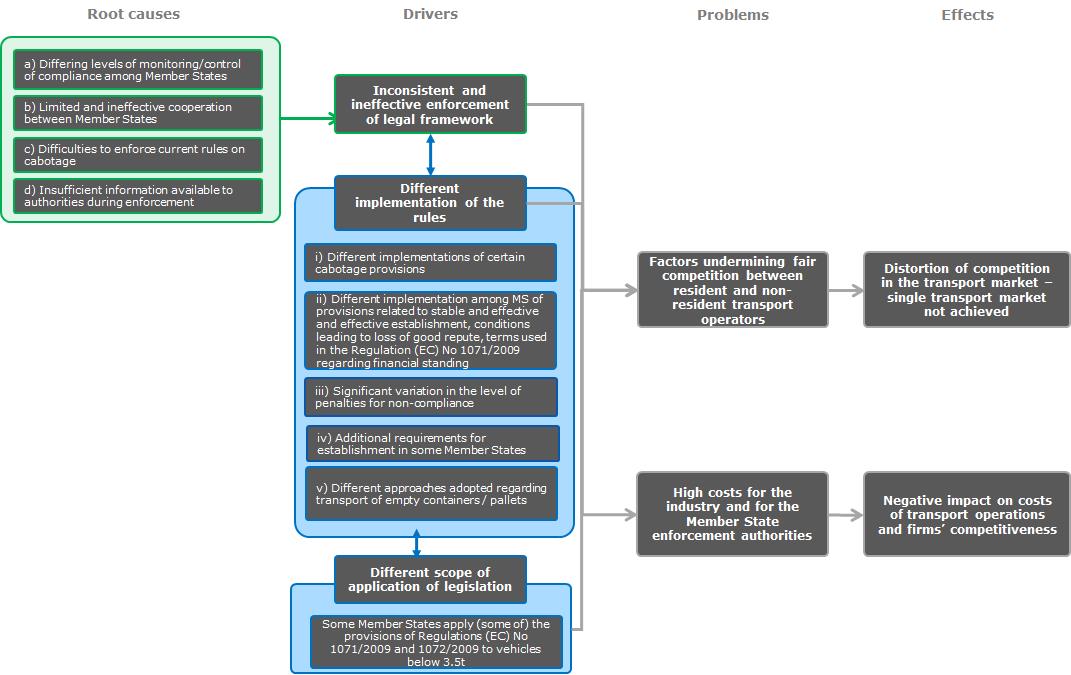
Following the assessment of the evaluation results and further Commission work, two main problems have been identified in relation to the EU rules on access to the occupation of road haulier and to the intenational road transport market: factors undermining fair competition between resident and non-resident transport operators and
high costs for the industry and for Member State enforcement authorities.
There are several factors contributing to these problems which are outside the scope of EU competence, notably the significant labour cost differentials between Member States and the limited national resources available for enforcement of the rules on access to the profession and to the market. For example, in the context of the support study for the ex post evaluation of the Regulations, enforcers from Bulgaria (480 staff), Latvia (28 staff), Sweden (160 staff), Ireland (11 staff), Spain (400 traffic agents and 150 employees of the administrative organs), Romania (317 staff) and the Netherlands (unknown number of staff) considered that they have an insufficient number of staff. Although there are no quantitative estimates of the costs of enforcing the Regulations, an indication thereof may be found in the cost of enforcement of the rules on working time, driving time and rest periods ("the social rules") as reported by Member States. This cost was around €10.6 million per year on average per Member State (in the period 2011-2012) and varied from less than €1 million in some Member States to €127 million in one Member State. The estimated total staff costs for enforcement of the social rules in the EU27 was €501 million in 2012.
While these factors are considered as important exogenous elements to the present initiative, they are external to the Commission intervention.
The specific causes of the main problems and the related provisions are discussed further in the section below describing the “problem drivers”.
1.2.1Factors undermining fair competition between resident and non-resident transport operators
The road freight transport sector is composed largely of small firms and is characterised by thin profit margins. Balanced conditions for competition between resident and non-resident hauliers and the respective enforcement are therefore vital to ensure the benefits of a single EU market. The Regulations aimed to set out a common framework for access to the EU road transport market. Ensuring consistent regulatory standards for market access is needed to prevent transport firms located in Member States with lower standards gaining an unwarranted competitive advantage over firms in Member States with higher standards. However, the Regulations leave certain aspects open for interpretation. In addition, differences in the monitoring and enforcement practices can introduce competitive distortion by providing inconsistent incentives for compliance with the rules.
This situation contributes to higher risks of illegal activities, such as illegal cabotage and the setting-up of letterbox companies, although it is difficult to quantify the extent of infringements due to the poor availability of relevant data.
The cost differentials between transport operators are a factor to consider while discussing the incentives for carrying out cabotage operations (including illegal ones), as well as establishing letterbox companies and/or out flagging activities. In this context, the diversity of administrative requirements under company law and fiscal rules across the EU Member States, particularly as regards corporate income taxation may play an important role in influencing business decisions on the country of establishment for their companies. Likewise, driver costs, including wage and social security contributions, play a very important role, since they represent a significant part of the operating costs of hauliers, ranging from around 20% to around 40% of overall operating costs, depending on the Member State of hiring.
Letterbox companies
The term "letterbox companies" refers to companies "established" in a Member State where they do not carry out their administrative functions or commercial activities, in violation of Article 5 of Regulation (EC) No 1071/2009. They are usually set-up by hauliers operating in high-wage Member States, but seeking to benefit from the lower labour costs or taxes in place in other Member States. They are a key concern for many stakeholders. These fraudulent practices can create unfair competition and potentially undercut legitimate businesses by avoiding certain costs (such as social contributions and taxes). They are also usually associated with poor working conditions of drivers.
Table 1: Member State information on infringements of stable and effective establishment criterion
|
Member State
|
Reported infringements of establishment criterion
|
Infringement rate (as % of total authorisations granted)
|
|
BG
|
47
|
0.22%
|
|
DE
|
13
|
0.04%
|
|
PL
|
65
|
0.41%
|
|
SI
|
94
|
0.81%
|
|
UK
|
50
|
0.20%
|
Source: Member States reports for period Jan 2013 to Dec 2014.
The ex-post evaluation support study estimated that there were at least 430 letterbox companies in 2012 in the EU. Although the absolute number of companies infringing the requirement of stable and effective establishment being detected is relatively low (below 1% of companies investigated), these figures do not capture companies that were able to avoid detection. This suggests that the official infringement rates may not be a reliable indicator of the extent of letterbox companies being set up.
Also, specific cases of letterbox companies have been brought to the attention of the Commission. For example, in 2014 the Belgian authorities requested the Commission to intervene on their behalf in order for the Slovak authorities to investigate suspected letterbox subsidiaries set up by Belgian hauliers in Slovakia. The Slovak authorities carried out on-site inspections concerning 42 companies. Several companies were found not to comply with the establishment provisions of Regulation (EC) No 1071/2009. In one case, the authorisation had already been withdrawn and for nine other companies the respective authorisations were withdrawn following the inspections. In March 2017, there was an investigation by the Belgian authorities into Belgian hauliers having established letterbox companies in Portugal and Slovakia. The Belgian authorities found 25 letterbox companies registered in the same address in Slovakia, 3 people were arrested and the estimated unpaid social contributions in Belgium amounted to €6-€7 million.
Moreover, 75 (43%) of respondents to the open public consultation considered that the setting up of letterbox companies to be a widespread practice, whilst only 9% (16) considered this to be only a minor issue. 88% of respondents from associations representing road transport workers (29 out of 33) considered that this was a widespread practice, a much greater percentage than from any other respondent category (mostly between 25-44%).
According to the ex-post evaluation, the cost advantage of setting up a letterbox company for hauliers is 31% in relation to a properly-established company. Within a highly competitive industry such as road transport, this level of cost differential is very significant. The fiscal loss per vehicle per year for the Member State where the company should be established (where the haulier actually operates) is around €6,000. Labour-related losses per driver per year for the Member State where the drivers should be paying social contributions are in the range of €30,000-€40,000. For example, a French driver's salary costs are up to 2.4 times higher than those of a Polish driver. If it is assumed that letterbox companies employ, on average, the same number of workers as legally-established hauliers (5 workers per haulier, i.e. approx. 3 million workers divided by 600,000 hauliers), this would yield an EU-wide annual loss of income for the Member States where the drivers should be paying social contributions in the range of €64.5-€86 million. However, these estimates must be taken with great prudence. They are not based on an EU-wide study of the impacts of letterbox companies, but rather on partial data analysis. Therefore, they are just intended to give an indication of the order of magnitude of the impact that letterbox companies have on fiscal revenues for Member States. In any event, these figures show a high incentive for companies to set-up letterbox companies, a very significant impact on hauliers' costs and considerable fiscal losses for the Member States where the companies should be established.
The negative impacts of letterbox companies appear to be disproportionately large due to the cost advantage they have over competing firms which comply with the legislation. According to the results of the open public consultation, 63% of respondents (110) felt that the presence of letterbox companies leads to a competitive disadvantage for hauliers established in some Member States, which have to compete with other hauliers operating in the same Member State but illegally established elsewhere. There is a clear divide between EU-15 respondents (77% indicating very important or significant impact) and EU-13 (31% indicating very important or significant impact). Among different categories of stakeholders, most medium and large hauliers (14 out of 22) did not consider this as an important problem. In contrast, transport workers (27 out of 32 respondents) and their representatives consider this as an important problem.
Illegal cabotage
The available statistics suggest that the level of illegal cabotage detected by checks might not be of a significant size in most Member States for which data are available. In particular, the infringement rate is less than 1% in Germany, the UK, Poland, Italy and Denmark. In Sweden, data collected through a smartphone application suggested that there were 1,590 trucks engaged in cabotage and potentially 379 engaged in illegal cabotage (24%). In France, 7% of vehicles stopped for cabotage controls were issued an infringement. An Austrian study reports that illegal cabotage represents 3.28% of national transports in Austrian commercial freight traffic.
More generally, there have also been significant concerns expressed over the low levels of effectiveness of cabotage checks, which could affect the detection of illegal cabotage and underestimate the respective share. The calculations based on the cost differentials (see section 1.4) suggest that currently illegal cabotage represents 0.56% of cabotage activity at the EU aggregate level, but that it will continue to affect some Member States more than others (with illegal cabotage rates ranging from close to zero, up to 6.4%).
Even though the level of illegal cabotage is reported to be relatively low (below 1% of all cabotage activity) this practice has a significant economic impact on the sector. Cabotage represented 1.8% of national traffic in 2014. The overall volume of cabotage in the EU in 2014 was around 29,500 million tonne-kilometres. Cabotage has increased 80% between 2010 and 2014 alone. It is concentrated in only a few Member States (82% of cabotage activity takes place in France and Germany), with cabotage penetration rates ranging from 0% in Croatia to over 8% in Belgium). Thus, illegal cabotage has the potential to affect seriously national operators established in the Member States where most illegal activity takes place.
As regards the economic damage generated by illegal cabotage, an indirect estimate can be made when looking at national studies and practices. In Denmark, the sanction for a cabotage infringement has been calculated in relation to the estimated economic benefit of the operation, so that the sanction has a dissuasive effect. The Danish authorities have calculated that the cost advantage of each cabotage operation was around €4,700 for each single operation and have set the indicative fine in accordance. The Austrian study referred to above indicates that cabotage activity generates damages of around €50,000 per vehicle per year and around €500 million in damages annually for the Austrian economy, in terms of lost business for Austrian hauliers. If the estimated EU aggregate level of illegal cabotage (0.56%) is applied to the annual damage calculated for the Austrian industry for all of the cabotage activity (€500 million), this yields an annual damage due to illegal cabotage of €2.8 million in Austria. Taking into account that Austria accounts for around 1.2% of cabotage in the EU, the estimated annual amount of damage, in terms of lost business for national hauliers, from illegal cabotage activity would be around €230 million per year at the EU aggregate level. However, these estimates must be taken with great prudence. They are not based on an EU-wide study of the impacts of illegal cabotage, but rather on specific national studies and partial data analysis. They are just intended to give an indication of the order of magnitude of the impact that illegal cabotage has on the road haulage industry.
While the prevalence of illegal cabotage and letterbox companies may seem relatively limited based on the data presented above, these illegal practices have wider-reaching consequences. Several Member States have adopted national uncoordinated measures to fight illegal cabotage and letterbox companies, such as the systematic application of the national minimum wage laws to hauliers providing international transport services and cabotage in their territory. These national measures have significant consequences on the internal market in terms of high costs for non-resident hauliers.
Part of these practices which undermine fair competition between resident and non-resident transport operators is attributable to the implementation and enforcement of the Regulations. This is further discussed in the section below describing the “problem drivers”.
1.2.2High costs for the industry and for Member State enforcement authorities
Input from the hauliers' survey carried out in support of this impact assessment suggests that the costs of complying with Regulation (EC) No 1071/2009 and Regulation (EC) No 1072/2009 represent today around 8% and 7% of the hauliers' operating costs, respectively.
Data from the ex post evaluation of the Regulations shows the following costs of complying with the rules for the whole industry:
·The professional competence criterion on access to the profession costs between €15 and €21 million due to the need for training of the transport manager, which is broadly in line with the ex ante estimated cost before the adoption of the legislation;
·The requirement to have a transport manager was reported to cost between €0 and €13 million to the industry, which is also in line with the ex ante estimated cost before the adoption of the legislation;
·The requirement of financial standing, which was expected to generate savings of €33 million for the industry before the adoption of the legislation due to the possibility to provide bank guarantees, actually resulted in additional costs of between €6 and €8 million, based on the undertaking survey;
·The introduction of harmonised control documents (Community licence and driver attestation) generated savings of between €11 and €18 million due to faster road side checks (reduction of 15 minutes on the road side and 45 minutes of back office time for hauliers);
·The criterion for a stable and effective establishment was found not to trigger any additional costs by 81% of the undertakings replying to the survey.
Moreover, the analysis performed in support of this impact assessment suggests some additional sources of ineffieciency. This in particular refers to the use of paper transport documents, which generates operating costs for businesses. The switch from paper to electronic transport documents is associated with cost savings from €4.34 in the Netherlands to €6.21 in Belgium. There are around 377 million international paper transport documents being used annually in Europe. The opportunity cost of not changing to electronic transport documents is therefore estimated at €1.6-€2.3 billion per year.
For the industry, insufficiently specific rules or rules which leave open too many options also lead to costs to locate information on, and understand, national rules, especially where there are language barriers, as well as a higher risk of unintentional non-compliance and subsequent fines. These problems affect in particular small hauliers, which have limited resources available. However, it has not been possible to quantify these costs.
Regarding Member State authorities and enforcers, data from the ex post evaluation of the Regulations shows that the main implementation cost concerned the setting up or upgrading of national electronic registers. The overall costs amounted to €18 million, falling short of the anticipated €53 million.
In accordance with Article 16(5) of Regulation (EC) No 1071/2009, Member States were required to interconnect their national electronic registers by 31 December 2012. In order to better monitor the compliance of road transport with the rules in force, the Commission has set up ERRU, a system that allows a better exchange of information between Member States. The ERRU allows exchange of information between Member States about: 1) transport managers who are declared unfit to manage the activities of a road transport undertaking; 2) the most serious infringements committed by hauliers in any Member State, which may lead to the loss of good repute; and 3) other infringements committed by hauliers in any Member State. The ERRU system provides a means to interconnect the national registries through the exchange of structured messages to a central hub. The interconnection of the registers via ERRU did not generate significant costs.
However, the benefits of using this system have been uneven. Moreover, implementation and progress towards achieving more cooperative and effective enforcement is unequal across the Member States, for example given difficulties in securing timely cooperation from Member States. ERRU has not yet reached its full potential in terms of benefits for national authorities, because not all Member States are interconnected yet and because the system is underused. The first issue has been tackled by the Commission through infringement procedures against the Member States concerned. The second issue is mostly due to slow uptake by Member States.
Among stakeholders that responded to the open public consultation, 43% (65) indicated that the costs incurred by hauliers to meet the requirements of the Regulations were important or very important, whereas 40% (62) consider the costs to be of little importance or not significant at all. Hauliers, national authorities and consumers consider that these compliance costs for transport operators are important. Medium and large hauliers display the greatest agreement, with 13 of 18 respondents (72%) considering these costs as at least important to road transport operators (4 respondents suggested that they were very important). By contrast, responses from associations representing road transport workers and individual workers consider the costs to be of little importance, with 10 out of 16 (63%) of respondents indicating this. Whereas respondents did not report on the reasons why they think that costs for hauliers to comply with the Regulations are high or not, it can be presumed that hauliers are in a better position to judge about the importance of the costs they incur to comply with the Regulations than other categories of stakeholders. This could be the situation in particular in the case of drivers hired by medium and large hauliers, who are less acquainted with the administrative and accounting parts of the business.
1.3Underlying drivers of the problems
The underlying problem-drivers (1) inconsistent and ineffective enforcement; and (2) shortcomings of the rules, are causes of the current regulatory deficiencies. They are inter-linked, because the shortcomings of the rules lead to different enforcement practices. Both contribute to legal uncertainties for all those concerned by the rules and further lead to higher risk of non-compliance and to additional costs for national authorities and businesses.
Problem-driver (3) different scope of application of the rules, could in principle be treated within the problem driver concerning different implementation of the rules (2). However, due to the political importance of the subject, it was decided to present this issue as an isolated element and treat it separately in the assessment.
1.3.1Problem Driver 1: Inconsistent and ineffective enforcement of legal framework
Enforcement of the different provisions of the Regulations is mainly a responsibility of Member States. Enforcement practices across different Member States differ widely in terms of the number and stringency of checks carried out. This is in part due to different levels of political priority given to control of the legislation, as well as to variations in the level of resources and experience available in the enforcement agencies.
A lack of effective enforcement is a major concern among stakeholders, as evidenced by the research carried out in the ex-post evaluation support study carried out by Ricardo et al (2015). One of the major concerns over social and safety issues in the sector relates to the practice by some hauliers of setting up letterbox companies. Controlling such practices frequently requires cross-border cooperation and access to specific information that may not be readily available to all enforcement officers (see root causes B, C and D below).
1.3.1.1Root cause A: Differing levels of monitoring/control of compliance among Member States
The number of checks carried out in each Member State with regard to the four criteria on access to the occupation of road transport operator under Regulation (EC) No 1071/2009 varies widely, and are clearly not in proportion, even after allowing for different Member State size and the industry's relevance.For example, in Bulgaria, 5,640 undertakings were checked for stable and effective establishment in 2014, whereas in Estonia, 120 checks were carried out in the period 2013-2014. In Estonia, 50 checks of good repute and 50 checks of professional competence were carried out in the period 2013-2014. In Romania, 2,543 checks of good repute were carried out in 2013 and 2,760 in 2014. In Spain, 12,415 investigations were carried out regarding the four criteria on access to the occupation of road transport operator during the period 2013-2014.
Some Member States dedicate substantial resources to the control of illegal cabotage under Regulation (EC) 1072/2009, while other Member States practically do not control cabotage operations at all. For example, 183,200 checks were carried out in Germany in 2014, while only 229 checks were carried out in the UK in the period from March 2012 to March 2013.
The majority of respondents to the open public consultation (120 out of 167; 72%) considered that there was significant or very significant variance in the control of cabotage operations and this is a view shared across almost all types of stakeholders (with the exception of transport workers and relevant associations, with only 13 out of 33 considering that there is significant or very significant variance) and both in the case of EU15 and EU13 Member States. The main impacts associated by the stakeholders with this variance include:
-Increased compliance costs for hauliers (56% out of a total of 149 respondents);
-Competitive disadvantage for hauliers from some Member States (64% out of a total of 153 respondents, but only 44% among 56 EU13 respondents)
The official Commission monitoring data and stakeholder evidence show that there are also differences in the stringency of certain controls. For example, regarding checks of good repute, in the first reporting period on the implementation of Regulation (EC) No 1071/2009 (from 4/12/2011 to 31/12/2012), seven Member States
reported that there were no declarations of unfitness (loss of good repute). Conversely, in Hungary and Italy declarations of unfitness were quite high (129 and 348, respectively).
In the second reporting period (from 01/01/2013 to 31/12/2014), most Member States which reported data
still noted that there were no declarations of unfitness, whereas there were high numbers in other Member States, such as Italy (680)
and the United Kingdom (493). This suggests that some Member States are more lenient than others in the application of this criterion (although some differences may also be attributable to different compliance cultures) and that these differences have persisted.
1.3.1.2Root cause B: Limited and ineffective cooperation between Member States
Exchanges of information between Member States regarding enforcement of Regulation (EC) No 1071/2009 are limited. Information on exchanges of information in the second reporting period on the implementation of Regulation (EC) No 1071/2009 (from 01/01/2013 to 31/12/2014) shows that in most cases there is very little interaction and the overall situation is highly uneven.
Table 2: Summary of administrative cooperation (via ERRU and other means)
|
|
Number of notifications of serious infringements
|
Number of requests for checks of good repute
|
|
|
Sent to other Member States
|
Received from other Member States
|
Sent to other Member States
|
Received from other Member States
|
|
Total
|
17,008
|
1,477
|
91,511
|
559,211
|
|
CR2 index*
|
87% (PL and UK)
|
61% (BG and SL)
|
88% (UK and SV)
|
50% (BG and LV)
|
|
Share of Member States which reported fewer than 10 incidences
|
43%
|
21%
|
50%
|
43%
|
Notes: 14 countries reported information: BG, DK, ES, ET, FR, HR, LT, LU, LV, PL, RO, SL, SI, UK
Source: European Commission, 2016. *CR2 index is the concentration ratio, representing the share of total activity that is due to the two most active countries.
The CR2 index indicates the concentration of total activity in the top two most active Member States. This indicator shows that for all types of information exchange, the majority of total activity is carried out by only two Member States (although the representation of countries in the top two varies). Additionally, a substantial share of Member States report fewer than 10 individual requests in all categories (between 21% and 50% depending on the category), showing that a large number of Member States are not actively exchanging information. Qualitatively, based on the stakeholders' contributions, Ricardo et al (2015) confirms the highly uneven situation, with several Member States, such as Cyprus, Lithuania, Malta, the Czech Republic, the Netherlands and Slovakia indicating that there were no exchanges of information at all. In addition, several Member States (e.g. France, Denmark) have reported difficulties in obtaining responses to queries made to other Member States regarding investigations into letterbox companies.
A majority of respondents to the open public consultation (83%; 145) considered that there are at least some instances of lack of cooperation in monitoring compliance with the stable and effective establishment criterion, whilst only 2% (3) considered that Member States are cooperating well in this respect. The stakeholder group which criticised more strongly cooperation between Member States were the associations representing road transport workers, 79% of whom (26 out of 33) considered that Member States were not cooperating at all. Most other respondent categories felt that there were only some instances of lack of cooperation.
This lack of cooperation concerning letterbox companies has led to a situation where such companies are being set up in several Member States (see section 1.2.1 above).
1.3.1.3Root cause C: Difficulties to enforce current rules on cabotage
Confirming the legality of cabotage operations on the basis of the CMR consignment notes exclusively was highlighted as an issue in Ricardo et al (2015) due to two main factors:
·Firstly, the CMR document does not necessarily contain all of the information needed to verify whether a cabotage operation is in compliance with the rules. A review of the literature confirms that enforcement bodies do not have the means to check for infringements of the cabotage rules. Particular difficulties were mentioned by respondents to the survey of enforcers carried out in the context of the ex-post evaluation support study concerning the verification of the start of cabotage operations, their link to the international carriage, the calculation of the 7-day period (when precisely this should start) and the identification of the number of journeys carried out within that period.
·Secondly, there is a possibility that documents are falsified or hidden. For instance, many industry representatives consider that presentation of consignment note evidence is not reliable, because documents can simply be hidden by drivers in order to conceal cabotage operations. Anecdotal evidence suggests incidents of counterfeit documents in some countries (such as Spain and Austria), although the extent of such practices is unknown in these countries and more widely. Such falsification can only be detected by detailed controls at the hauliers’ offices, but not during roadside checks.
Among the respondents to the open public consultation, 41% (72) felt that the cabotage rules are difficult to enforce, 18% (31) very difficult and 11% (19) virtually impossible. Among national authorities, who are directly responsible for their enforcement, these percentages are even higher (only 1 out of 18 indicated that it is easy to enforce cabotage). In contrast, small hauliers and medium and large transport operators are more positive, with 38% (7 out of 18) and 29% (7 out of 23) considering that it is easy to enforce cabotage, respectively.
The difficulties described above contribute directly to the driver of ineffective enforcement (of the rules on cabotage), since effective enforcement requires access to necessary information and documents.
1.3.1.4Root cause D: Insufficient information available to authorities for enforcement
The development of national electronic registers and the European Register of Road transport Undertakings (ERRU) were key aspects of the Regulations intended to result in more efficient and effective enforcement. ERRU allows exchange of information about transport managers who are declared unfit, information on infringements committed by hauliers in any Member State that may lead to the loss of good repute and other infringements committed by hauliers in any Member State.
This type of information is crucial to the enforcement activities of licencing authorities. However, other information which is important for enforcement is not included in the national electronic registers and in ERRU. For example, the registration plate numbers of the vehicles in use by the operator, financial information about the company and its risk rating are not included. When it comes to cross-border enforcement situations (e.g. on-site inspections to check for possible letterbox companies), such information must be requested on a case by case basis and outside of ERRU by the enforcement authorities of one Member State to the enforcement authorities of the other Member State. This is confirmed, for example, by the exchanges between the Commission and the Belgian and Slovak authorities regarding investigations into the existence of letterbox companies in Slovakia mentioned in section 1.3.1.2.
1.3.2Driver 2: Shortcomings of the rules
Legally, there can only be one correct interpretation of the rules, in particular given that regulations are directly applicable to Member States and do not require any transposition measures. Whenever a Member State departs from the correct interpretation of the rules, the Commission has the obligation to start an infringement procedure against that Member State. However, practice has shown that certain provisions either leave open too many options for Member States or are not sufficiently specific.
There are several specific issues which are linked to this driver and which are elaborated in the following sections. These examples show the extent of the shortcomings of the existing rules.
1.3.2.1Insufficiently specific cabotage provisions in Regulation (EC) No 1072/2009
The cabotage provisions are stipulated in Article 8(2) of Regulation (EC) No 1072/2009. Hauliers may carry out three cabotage operations in the host Member State within seven days following an international journey – known shorthand as the “3 in 7 rule”. Within that period, hauliers may carry out the three cabotage operations in any Member State transited on their return journey under the condition that they are limited to one operation per Member State transited, within three days of the unladen entry into its territory. In any case, cabotage must always be limited to three operations within seven days.
Ricardo et al (2015) found that some Member States, such as the Netherlands, allow several loading and unloading points per operation. Conversely, partial loading and/or unloading is regarded as a separate trip in other Member States, such as Denmark. In Poland, it depends on whether the loads are for the same customer (in which case they are counted as one operation) or for different customers (in which case they are counted as separate cabotage operations). The Commission has started infringement procedures against two Member States in this respect (see section 2). This lack of specificity of the rules means that hauliers must be aware of the rules in each individual country, or else risk penalties.
Moreover, the lack of clarity in the provisions was identified by enforcers responding to the survey carried out in Ricardo et al (2015) as one of the most important contributing factors to difficulties in enforcement. Among the respondents to the open public consultation, 75% of respondents (131 out of 175) considered that the cabotage rules are not sufficiently clear and the majority felt that the outcome of this lack of clarity and the uncertainty this brings increased costs of compliance and administrative costs for transport operators (56% considered that the impact was at least very important).
1.3.2.2Rules on access to the occupation in Regulation (EC) No 1071/2009 leave open too many questions
There are several areas of Regulation (EC) No 1071/2009 which leave open too many questions. Each of these areas is discussed further below.
Stable and effective establishment
Article 5 of Regulation (EC) No 1071/2009 specifies that undertakings must have an office in which they keep their core business documents and an operating centre with the appropriate technical equipment and facilities in the Member State of establishment. Moreover, once an authorisation is granted, they need to have at least one vehicle at their disposal which is registered in that Member State.
Although the minimum requirements of stable and effective establishment have been implemented by all Member States, one of the main difficulties experienced by Member States in the control of letterbox companies is how precisely to define an operating centre. For example, in Luxembourg the establishment has to be proportional to the size of the company, the manager has to be present in the operating centre on a regular basis and the existence of a parking space is checked, although it is not a legal requirement. In Poland, a stable and effective establishment is defined as a place equipped with technical equipment and technical devices appropriate to carry out transport activities in a structured and continuous manner, which includes at least one of the following elements: a parking place, an unloading area or equipment for maintenance of vehicles.
Among the respondents to the open public consultation, there is a largely even split between those which consider that the definition of stable and effective establishment is sufficiently clear and those that do not (47% versus 43%, respectively). Associations representing road transport workers and individual workers considered that the definition is not sufficiently clear (76%). In contrast, 65% of small hauliers and 82% of medium-to-large sized hauliers consider that the definition is clear enough.
The responses suggest that this can lead to significant impacts on the costs to hauliers, both for compliance and administration (39% and 38% of respondents indicated a significant impact on these costs, respectively). It is also suggested that this may somewhat lead to a competitive disadvantage to hauliers from some Member States.
The definition of infringements leading to loss of good repute
Under Article 6(2) of Regulation (EC) No 1071/2009, Member States must determine whether loss of good repute would constitute a disproportionate response to an undertaking (or relevant person) committing a criminal offense or one of the most serious road transport offenses. Some Member States report that this analysis is carried out on a case-by-case basis and as such there is no specific procedure (e.g. Bulgaria) or that they are in the process of setting up the respective requirements (e.g. Italy). Other Member States (in particular France and Estonia) have defined very detailed procedures to determine whether loss of good repute is disproportionate. In Spain, there has not been a single case of an operator losing its good repute, since revoking good repute is considered to be a disproportionate punishment in general.
Once good repute is lost, there are also different procedures for its reinstatement. For example, the period of time that must elapse before rehabilitation can take place varies widely (6 months in Spain and Italy, 1 year in Romania, 2 years in Belgium, 3 years in Denmark and 10 years in Luxembourg). This may happen automatically (e.g. in Italy, Luxembourg) or through following training and passing an exam (UK, Sweden, Denmark). Finally, some Member States have no specific rehabilitation procedures (e.g. Ireland, Latvia and Bulgaria).
The persons checked for good repute also vary. Article 6 of Regulation (EC) No 1071/2009 states that Member States shall consider the conduct of the undertaking, its transport managers and “any other relevant person” in its assessment. To reduce the risk of “front men”, some Member States require other persons to be checked, such as CEOs and general partners in partnerships (Finland) or legal representatives of the undertakings (Latvia).
Among the respondents to the consultation, 70% indicated that this is a major problem, a view shared by all categories of respondents. The respondents considered that this leads to a very important impact on the level of competitiveness of hauliers across Member States and important compliance costs.
Financial standing
Article 7 of Regulation (EC) No 1071/2009 contains the requirements for demonstrating appropriate financial standing. Undertakings must show that, every year, they have at their disposal capital and reserves totalling at least €9,000 when only one vehicle is used and €5,000 for each additional vehicle used. A number of issues raise doubts according to the national ministries that responded to the consultation carried out in the context of the ex-post evaluation of the Regulations:
·The following terms used in the Regulation were considered unclear:
oWhat exactly is meant by professional insurance (Austria);
oWhat should be understood by the notion of capital and reserves (Belgium, Finland, Germany);
oWho could be the mentioned duly accredited person having a right to certify the annual accounts of the transport undertaking (Estonia);
oWith regard to the bank guarantee, it is not clear who is to be declared on the guarantee (Germany, Italy, Slovakia);
oWhat liability needs to be covered by the insurance (Latvia, Slovakia).
·Article 13(1)(c) is not clear insofar as it does not explain how it is to be demonstrated that the financial standing requirement will again be satisfied on a permanent basis. The conditions for the derogation enshrined in Article 7(2) are not clear, in particular what is meant by professional liability insurance (Ireland).
·It is not defined how a newly established enterprise, in the absence of annual accounts, has to prove its financial standing (Lithuania, Germany).
The diverse responses listed above suggest that many terms used in the Regulation leave open too many options for Member States.
1.3.2.3Significant variation in the penalty systems for non-compliance
In terms of the penalties in place for infringements of the Regulations, there is significant variation between Member States. Figure 1 shows the level of fines applicable to cabotage infringements. Converting the fines on a purchasing power parity basis (right-hand graph) makes the discrepancies larger, indicating that socioeconomic differences between the Member States cannot explain the differences. For example, the level of the fine for exceeding the maximum 6-day or fortnightly driving time limits by 25% or more is up to €300 in Latvia and up to €15,000 in Germany.
Figure 2: Financial penalties applicable to cabotage infringements in selected MS (€, left and €PPP right)

Source: (Ricardo et al, 2015).
Similarly, infringements of Regulation (EC) No 1071/2009 categorised at the same level of seriousness may attract vastly different fines with ten-fold differences reported in some areas. For example, the most serious infringements are fined between €1,001 and €6,000 in Spain, between €2,040 and €2,720 in Romania and up to €200,000 in Germany. Serious infringements are fined between €401 and €1,000 in Spain, between €910 and €1,360 in Romania and up to €100,000 in Germany.
Besides from the financial penalties, there are also different types of sanctions applied by Member States to cabotage infringements, as shown in Table 3.
Table 3: Sanctions other than financial penalties applied in relation to cabotage infringements
|
Penalty
|
Applicable
|
Not applicable
|
|
Retention/immobilisation of vehicle
|
Belgium, UK, Netherlands, France, Poland, Germany, Italy
|
Norway, Bulgaria, Czech Republic, Romania, Latvia
|
|
Retention of trailer
|
UK, Netherlands, France
|
Belgium, Norway, Germany, Bulgaria
|
|
Retention of goods
|
Norway
|
Belgium, UK, Netherlands, Germany, France, Bulgaria
|
|
Other
|
Belgium*, UK**, France**
|
|
* Belgium: requirement to return to the place of loading in order to unload the goods or requirement to reload the goods into another vehicle in order to continue the trip in a legal way.
** In France and in the UK there is the possibility of imposing a one-year ban from performing cabotage.
Source: (Ricardo et al, 2015).
There are also differences in terms of the persons or undertakings bearing liability. While most Member States consider that the driver/haulier is the sole responsible for infringements of Regulation (EC) No 1072/2009, several Member States have introduced provisions rendering shippers and freight forwarders co-liable for infringements of the cabotage rules.
These differences in the level of the financial penalties and in the ancillary sanctions applied to infringements of the Regulations lead, on the one hand, to difficulties for hauliers to understand and cope with the different national legislations and, on the other hand, to some of them being in a less advantageous position, notably those which operate mainly in markets where the penalties are higher.
The open public consultation also confirmed that the significant variation between Member States in terms of the level and type of the sanctions applicable to infringements of the Regulations is considered to be a major problem for the road haulage sector. Only 16% of respondents did not consider this to be a problem. There is also strong agreement among respondents that this variation has a very important impact in terms of competitive disadvantage for certain hauliers (83% of respondents considered this). In addition, 59% and 52% felt that this has at least a very important impact on the costs of compliance and administration, respectively.
1.3.2.4Additional requirements for establishment in some Member States
Article 3(2) of Regulation (EC) No 1071/2009 allows Member States to impose additional requirements in order for undertakings to have access to the occupation of road transport operator on top of the four requirements laid down in Article 3(1) thereof, as long as these are proportionate and non-discriminatory.
This possibility has been taken up by several Member States. The most common additional requirement is for hauliers to have a parking space, which is applied in Austria, Bulgaria, Ireland, Slovakia and the UK. Slovakia added an additional requirement for the transport manager to be at least 21 years old. In Spain there is an additional requirement that applicants must have three vehicles representing at least one payload of 60 tonnes.
The possibility for Member States to set additional conditions on access to the profession of road haulier means that the same undertaking can be eligible for entry in the road haulage sector in one Member State, but not in another Member State.
A majority of the respondents to the open public consultation (52%) consider that the imposition of additional conditions on access to the occupation of road haulier by some Member States constitutes a major problem for the road haulage sector. This is a view shared by all the respondent categories. Moreover, most respondents consider that this has a number of negative effects on the haulage sector across the EU: 70% of respondents felt that this issue would result in at least an important impact, causing competitive disadvantage to hauliers from some Member States (47% felt that this would have a very significant impact). 53% and 59% felt that this would have at least a very important impact on the costs of administration and of compliance, respectively.
1.3.2.5Insufficiently specific rules regarding transport of empty containers / pallets
There are doubts on whether international transport operations involving empty containers or pallets give the hauliers the right to perform cabotage operations. Some Member States, such as the Netherlands, Belgium, Poland and Ireland treat the transport of empty containers or pallets as any other commodity. Other Member States, such as Denmark and Romania do not consider that the transport of empty containers or pallets give the hauliers the right to perform cabotage operations.
1.3.3Driver 3: Different scope of application of the rules
Article 1(4)(a) of Regulation (EC) No 1071/2009 excludes from the scope of the Regulation vehicles with a permissible laden mass of up to 3.5 tonnes (light commercial vehicles; henceforth "LCVs"). However, under the same Article Member States are allowed to lower this limit and apply (part of) the provisions of the Regulation to this type of vehicle. This possibility has been used by several Member States. The information collected from the survey of national authorities and input from industry, as well as information from the ex-post evaluation support study shows that LCVs are covered – fully or partly – in a few Member States. Seven Member States apply the same requirements to LCVs and heavy goods vehicles (henceforth "HGVs"). France has introduced specific requirements concerning financial standing in the case of LCVs (€900/vehicle) and a smaller number of hours to prove professional competence (10 hours of training). Requirements related to good repute are also in place in the Czech Republic, but no other provisions are in place.
Regulation (EC) No 1072/2009 does not explicitly exclude LCVs from its scope. Article 1(5)(c) thereof exempts LCVs from the requirement of holding a Community licence or any other type of carriage authorisation for the purpose of international carriage of goods by road for hire and reward within the EU. Eight Member States apply the cabotage restrictions of Regulation (EC) No 1072/2009 to LCVs (Belgium, Czech Republic, Denmark, Greece, Finland, France, Slovakia and Sweden).
Table 4: Summary of the legal framework concerning the use of LCVs in road freight transport
|
|
Member States
|
No.
|
Comments
|
|
Regulation 1071/2009
|
|
Fully covered
|
BE(for over 0.5t) EL, FI, IT, LV, NL(for over 0.5t), SE
|
7
|
|
|
Partially covered
|
CZ, FR
|
2
|
CZ: Good repute requirements
FR: Professional competence (training of 10 hours); financial standing (€ 900/vehicle)
|
|
Not covered
|
BG, DE, DK, EE, ES, HR, HU, LU, PL, RO, UK
|
11
|
DK expected to introduce legislation in 2018
|
|
No info
|
AT, CY, IE, LT, MT, PT, SK, SL
|
8
|
|
|
Regulation 1072/2009
|
|
Fully covered
|
BE, CZ, DK, EL, FI, FR, SE, SK
|
8
|
|
|
Partially covered
|
-
|
|
|
|
Not covered
|
BG, DE, EE, ES, HR, HU, LU, LV, NL, PL, RO, UK
|
12
|
DK expected to introduce legislation in 2018
|
|
No info
|
AT, CY, IE, IT, LT, MT, PT, SL
|
8
|
|
Sources: National authorities survey, Ricardo et al, 2015, NEA, 2010
The ex post evaluation of the Regulations identified a potential switch by operators to LCVs and, as a result, different ways in which Member States extended the Regulations to LCVs, as a potential unintended effect in the internal market. However, due to the restricted focus of the ex-post evaluation, which looked mainly into the vehicles under the scope of the Regulations, the application of the rules to LCVs was not assessed in detail. Therefore, the Commission decided to further investigate this issue in the context of the impact assessment exercise.
More generally, there appears to be growing concern over the use of LCVs and the fact that they are not covered by the same legislation as heavy goods vehicles (including rules in other areas, such as the legislation on driving and working times and rest periods). A joint statement made by the Ministers of Transport of Austria, Belgium, Denmark, France, Germany, Italy, Luxemburg and Norway by letter of 27 September 2016 urged the Commission to take "measures to prevent the disproportionate development of the use of LCVs for international transport operations".
LCV activity is concentrated in a few Member States. In 2015, four countries accounted for 70% of total EU LCV activity in Gt-km. Conversely, in most other Member States the absolute level of LCV activity is fairly minor. 15 Member States were estimated to have less than 1 Gt-km of LCV activity in 2015. This pattern of high concentration is expected to remain out to 2035.
Among the respondents to the open public consultation, there is a fairly even split between respondents who regard the application of some of the provisions of the Regulations to LCVs by some Member States as a problem (36%) and those who do not (30%). While 64% of respondents from associations representing road transport workers and individual workers consider that this is not a problem, 50%, 52% and 53% of respondents from logistics industry representatives, medium and large hauliers and small hauliers, respectively, consider that this is a major problem that needs to be addressed.
The regulatory and market trends concerning LCVs are further discussed in section 1.4.4.
1.4How would the problem evolve, all things being equal (baseline scenario)
In order to assess how the problems identified above are likely to evolve in case of no policy intervention, several assumptions are made concerning the evolution of the main internal and external problem drivers.
The methodological framework used for the purposes of this impact assessment is based on the definition of the cost differentials between transport operators. The costs considered in the model cover both variable costs which depend on vehicle mileage, such as fuel, tyre costs, maintenance & repair, insurance, driver costs including salary, bonuses and other contributions (e.g. pensions) and fixed costs which are independent of vehicle mileage, such as ownership taxes (excise duty, axle tax), vehicle financing & possession costs and overhead costs (costs incurred by hauliers to operate the business, regardless of revenue). In particular, Ricardo et al (2015) found that cost differentials are related to incentives for carrying out cabotage, as well as establishing letterbox companies and/or out-flagging activities. Therefore, quantifying how the cost differentials evolve over time forms the basis of the modelling. These assumptions, as well as a detailed description of the models used and of the results obtained, are further explained in Annex 4.
It is important to highlight an important methodological challenge, which was carefully considered while developing this impact assessment. The review of the Regulations is closely linked to the ongoing review of the road social legislation, including the possible clarification of the conditions of application and enforcement of the Posting of Workers Directive (96/71/EC) in the road transport sector. This Directive implies that a driver engaged in international transport, including cabotage, is, under certain circumstances, considered as posted and thus has to be paid the minimum rates of pay set by law or universally applicable collective agreement in the Member State(s) where he or she operates. While this Directive formally applies to the road transport sector, there is a wide consensus on the fact that existing rules are not effectively applied, also due to the lack of sector-specific enforcement tools.
The effective application of such rules would have a significant impact on driver costs and consequently on overall operating costs and international transport activity. In the baseline scenario it is considered that the Posting of Workers Directive is not effectively applied and that driver costs thus continue to follow the cost structure of the country of establishment of the international haulier (i.e. driver costs do not change as a result of international/cabotage operations being carried out). On the other hand, an alternative scenario was developed in order to reflect the effective application to transport operations of the host-country minimum wage, in accordance with existing rules under the Posting of Workers Directive, as a consequence of the possible establishment of sector-specific rules and enforcement tools in the medium term. In this alternative scenario, a "time-based approach" is established to determine the potential application of the posting of workers rules to transport operations. Driver costs are assumed to be aligned with the minimum wage of the host Member State after 7 days of activity there, from 2020 onwards (as currently considered in the context of the revision of the road social legislation). This "time-based approach" serves simply as a calculation tool (sensitivity analysis) to isolate the impacts of this initiative from other initiatives, notably the effective application and enforcement of the posting rules under the social road initiative, but does not constitute an alternative baseline scenario.
The situation today in terms of driver costs is already somewhere between the two extremes (the baseline scenario and the time-based approach) and with time could move more towards the latter, with existing rules being formally and thoroughly applied, especially in the case of cabotage operations. The baseline scenario and the time-based approach therefore represent the two theoretical extremes in terms of driver costs, for the purpose of the analysis. Whereas the analysis of impacts is made against the baseline scenario exclusively, whenever particular policy measures and policy options are sensitive to the time-based approach, this is acknowledged in the analysis.
On 8 March 2016 the Commission adopted a proposal for a targeted revision of the rules on posting of workers. This proposal introduces changes in the areas of remuneration of posted workers, rules on temporary work agencies and long-term posting. The more relevant change for the present initiative is the remuneration of posted workers. The proposal foresees that posted workers are subject to equal rules on pay as local workers, set by law or by universally applicable collective agreements, instead of the "minimum rate of pay" set by the host Member State, as currently is the case. Since the Commission's proposal for a targeted revision of the rules on posting of workers has not been adopted by the European Parliament and the Council yet, the time-based approach assumes simply the application of the minimum wage of the host Member State and not the same rules on pay as local workers. In case the Commission's proposal is adopted, the effective application of posting rules currently considered in the context of the revision of the road social legislation could result in somewhat higher wage costs than those considered in this impact assessment under the time-based approach (the difference being: wage costs of host Member State minus minimum wage of host Member State).
The wage cost differentials between different Member States are expected to decrease between 2020 and 2035. As expected, under the time-based approach this decrease would be more significant than under the baseline scenario, given the thorough application of the host-country minimum wage in the former.
1.4.1Cabotage activity
The aggregate cabotage penetration rate is expected to decrease by around 9% in the 2012-2035 timeframe in the baseline scenario (or 18% under the time-based approach).
In the baseline scenario, this change is largely driven by reductions in labour cost differentials, mainly driven by wage costs, seen in the EU reference scenario. Under the time-based approach, there is a clear effect of a more thorough implementation of the revised rules on the posting of workers (assumed to enter into force in 2020), which effectively forces a higher wage convergence, which may in turn affect the cabotage penetration rates, yet discounting for social security contributions and other taxes, which would continue to be paid in the home Member State. The assumptions for the development of international trade levels in both scenarios are the same (i.e. aligned with the EU reference scenario), so the difference between the two scenarios is purely driven by the wage cost differentials.
In absolute terms, the overall amount of cabotage (expressed in t-km) is forecast to increase by around 30% in the regarded timeframe for the baseline scenario (or by around 20% for the time-based approach). This increase in total activity (despite the reduction in the penetration rate) is due to the projected increases in overall transport activity across the EU up to 2035 (in line with the projections of the EU Reference Scenario). While overall international transport activity is forecast to grow significantly following GDP growth, cabotage activity grows less rapidly, due to the expected moderate wage convergence between Member States, which renders cabotage activity somewhat less attractive.
The development of illegal cabotage is estimated to be 0.56% of cabotage activity at the aggregate EU-28 level. Bearing in mind the limitations in the model, the quantitative estimates must be interpreted with some caution. In any event, the baseline scenario estimates can be conservatively interpreted to predict a relatively low (likely less than 1%), but consistent, level of illegal cabotage at the EU level. It should be noted that, contrary to the absolute amount of cabotage, the time-based approach is not expected to have an impact on the relative level of illegal cabotage, provided that the posting rules are adequately enforced.
1.4.2Letterbox companies
In a similar way as for illegal cabotage, the official reporting of infringements of the stable and effective establishment criterion was used as a proxy for the extent of letterbox companies. However, infringements could be under-reported (if letterbox companies are able to evade detection). Evidence from Ricardo et al (2015) suggests that the absolute number of companies infringing the requirement of stable and effective establishment being detected is relatively low – around 1% of companies. However, this figure does not capture companies that were able to avoid detection and various anecdotal reports suggest the continued presence of letterbox companies.
Ricardo et al (2015) found that incentives for establishment of letterbox companies are strongly related to differences in the costs of operation, notably wage and social security costs, corporate tax regimes and fiscal rules applicable to transport vehicles. International road transport operators conduct transport in many countries, so it is natural to consider where it is most appropriate to register their trucks, hire their workers and pay taxes based on the lowest costs.
In a similar way as for illegal cabotage, the estimations are not reported for each Member State due to the lack of data. At the EU level, the average infringement rate (as an indicator of letterbox companies) is 0.19% of total authorisations granted in the base year. This falls to 0.11% of authorisations in 2035, due to the slight convergence of total operating costs foreseen in the baseline. Overall, this equates to an estimated total number of letterbox companies of around 430 in 2012, falling to 270 in 2035. Again, the EU aggregate values smooth out significant variation, ranging from estimated rates of zero letterbox companies (for example in higher cost Member States) to a maximum of 0.4% of authorisations in lower cost Member States.
The estimates of letterbox companies do need to be interpreted with great caution, given the limitations discussed above and should be taken as an indicator of risk.
The effective application of posting rules currently considered in the context of the revision of the road social legislation is expected to result in higher wage costs for hauliers performing significant international transport and cabotage activities concentrated on few Member States. Since differences in wage costs are one of the main incentives for hauliers to set-up letterbox companies (see section 1.2.1), it can be expected that such hauliers will have less incentives to set-up letterbox companies and therefore that the number of letterbox companies will be reduced. However, the magnitude of this impact cannot be quantified, notably because it depends on how effective the enforcement of the posting rules will be.
1.4.3Costs for national authorities and industry
As regards national authorities, data from the support study for the ex-post evaluation of the Regulations suggested that the major enforcement costs (incurred by authorities) are related to the implementation and running of ICT systems and the employment of staff.
Given that ERRU is expected to be completed in the next few years, some reductions in enforcement costs are expected in the baseline scenario. According to the estimates, explained further in Annex 4, once ERRU is fully operational in the coming years, the reduction of the current level of total enforcement costs in the baseline is €7.38 million, a reduction of almost €5 million compared to costs in 2015.
As regards hauliers, the costs linked to compliance with Regulation (EC) No 1071/2009 and Regulation (EC) No 1072/2009 are expected to remain constant in the baseline scenario, i.e. around 8% and 7% of the hauliers' operating costs respectively (see section 1.2.2). This is because all of the costs and savings linked to compliance with the Regulations have already materialised.
In the absence of intervention, the use of paper transport documents is expected to be progressively reduced as more and more Member States move towards the use of electronic transport documents, such as the eCMR. Part of the very significant savings from switching from paper to electronic transport documents (see section 1.2.2) are therefore expected to materialise in the baseline scenario. It is however not posible to quantify which part of those potential benefits will be achieved, since this depends on Member States deciding to accept electronic transport documents, such as the eCMR, and on industry take-up of electronic documents.
As regards the shortcomings of the rules which, as explained in section 1.2.2 also lead to costs for hauliers to locate information on, and understand, national rules, it is assumed in the baseline scenario that the current practices will be maintained, in the absence of information that Member States would be considering changes.
1.4.4Use of light commercial vehicles (LCV)
The reference scenario is the EU forecast of future trends within the transport sector based on the current policy framework. It can therefore be taken, broadly, as an indication of expected changes in LCV activity due to underlying macroeconomic trends (such as population growth, GDP growth, technology progress etc.). Figure 2 shows that the total activity of LCVs is expected to rise from 95 Gt-km in 2015 to 141 Gt-km in 2035 (an increase of 48%).
Figure 3: Projected change in total LCV activity, EU-28 (Gt-km)

Source: European Commission reference scenario, 2016a
This increase is largely due to the expected growth of the e-commerce sector, which is where LCVs are used the most, from 2.45% (2014) to 6% (2020) of EU GDP. Figures from the UK, which is the only Member State having dedicated LCV statistics, show that transport by LCVs increased by 38% between 2000 and 2016.
The EU reference scenario does not split the share of domestic versus international transport carried out by LCVs. Furthermore, there is typically no monitoring of international goods traffic by LCVs in the EU. Consequently, there is considerable uncertainty about the overall level of activity and number of LCVs active in international traffic throughout the EU.
This is clearly a major limitation for the development of the baseline scenario, as the market share of LCVs will likely vary between domestic and international transport. It is to be expected that LCVs are more prevalent in national transport due to their deployment in cities and on shorter routes. There have been various reports of Eastern European LCVs targeting express freight traffic in Germany and France (both international and cabotage). During the interviews carried out in the context of the support study for the impact assessment, a number of stakeholders representing the road haulage industry at the EU (IRU) and national level (France, Germany, and Denmark) referred to an increasing presence of foreign registered LCVs in hire-and-reward traffic.
To address this limitation, available data sources related to the use of foreign registered LCVs at national level are used to estimate the levels of use of LCVs in international transport. Since the available data concerning competition between HGVs and LCVs is concentrated on Germany and France, the analysis is restricted to these two Member States, although it can be extrapolated to other Member States. On this basis, the share of LCVs involved in international traffic in terms of kilometres is estimated at 3.2%, corresponding to 0.11% of international traffic in terms of ton/kilometre (a HGV carries on average 28 times the load of a LCV). The number of foreign registered LCVs active in international traffic in Germany and France is expected to rise from 7,061 and 4,802 currently to 9,086 and 7,153, respectively, in 2035.
On the basis of the limited available data, assuming a standard share of LCVs in total international transport (3.2% is the best estimate – see above) is considered as an appropriate assumption for defining the baseline scenario.
The regulatory landscape concerning the use of LCVs is another important variable that can affect the use of LCVs in both domestic and international transport. The situation concerning application of the Regulations to LCVs across Member States is described in table 4 above. From the 20 Member States which provided information about the application of the Regulations to LCVs, 9 already applied fully or partly Regulation (EC) No 1071/2009 and 10 applied fully Regulation (EC) No 1072/2009 to LCVs (see table 4).
In the absence of EU intervention, concerns over the use of LCVs are expected to continue to grow. Some Member States are considering extending Regulation (EC) No 1071/2009 and/or Regulation (EC) No 1072/2009 to these vehicles. Responses received in the interviews with UETR and the Danish hauliers associations indicate that the Danish government is working on a draft law for LCVs which could be adopted in 2018 and preliminary discussions on this issue have also started in the Netherlands. Given the growing concern of Member States with this issue, it can be expected that further Member States will consider similar extensions.
2Why should the EU act?
The general competence for this initiative derives from the aim to complete the internal market as stipulated under Title I 'Internal Market' in Article 26 of the Treaty on the Functioning of the European Union ("TFEU"). It is also in line with EU competence under Title VI 'Transport' of the TFEU (in particular Article 91). The applicability of Title VI to road transport is stipulated in Article 100 TFEU.
As explained under the problem definition section, efforts made so far both by the Commission and by the Member States to clarify the provisions of the Regulations and facilitate their enforcement have not been effective.
The Commission services have been replying informally to interpretation questions by Member States and other stakeholders. They have also published an interpretative document on the cabotage rules ("The new cabotage regime under Regulation (EC) No 1072/2009"). This document, however, has no legally binding character. The Commission services also discussed implementation issues at several Road Transport Committees. However, this has not sufficed to guarantee the harmonised implementation of the rules.
Certain Member States have put in place measures to further define the provisions related to cabotage, for example by establishing that one cabotage operation cannot include several loading and unloading operations. The Commission has pursued infringement procedures against these Member States. There are also several Member States complementing the criteria on access to the occupation of road transport operator with additional criteria which are not foreseen in Regulation (EC) No 1071/2009 (e.g. a minimum number of trucks, a minimum age of the transport manager). Whenever these provisions infringe the Regulations, the Commission has acted accordingly. However, these infringement procedures have not been sufficient to address the shortcomings of the rules. They only address implementation measures which are contrary to EU law, but they cannot be used to further specify the rules or to reduce the options available for Member States.
Efforts made so far by Member States to spot the existence of letterbox companies and to remedy the issue through enforcement action have not been successful, in particular because of the lack of cooperation between Member States authorities (e.g. requests from one Member State to another Member State to investigate a given company remain unanswered) and because of the different level of control between Member States (some Member States do not systematically check the effective establishment requirement).
These Regulations have established new rules which, not least in terms of their shortcomings and divergences in their enforcement, have led to a patchwork of regulatory systems in the EU, a situation the Regulations were designed to prevent. This resulted in significant costs for hauliers, which need to comply with different rules depending on the Member States in which they operate.
The road transport market has a strong international character. A third of road freight movements in the EU are between Member States. As a result, a large share of non-resident drivers is active on national roads. For instance, 38% of the kilometres made on German toll roads by trucks in 2013 were made by foreign vehicles.
Therefore, the common rules provided for by the Regulations are intended to ensure, for operators wishing to establish themselves in another Member State, equal conditions as compared to domestic operators and better approximation of the conditions under which such establishment may take place in the different Member States. For hauliers operating temporarily within a Member State other than their country of registration and subject to the rules relating to cabotage, the Regulations are meant to ensure competition on an equal footing between all operators.
The existing divergent enforcement practices in Member States lead to legal uncertainty and unequal competitive conditions. To this extent, rules adopted unilaterally by Member States would fail to achieve balanced conditions for competition between resident and non-resident hauliers. In any event, in all areas covered by the Regulations, EU competence is exclusive (Article 2(1) TFEU), so that Member State action is anyway excluded.
For these reasons, action at the EU level is justified.
3What should be achieved?
The present initiative aims at ensuring the effectiveness of the original system put in place through the adoption of the Regulations, namely:
1.To help achieve balanced conditions for competition between resident and non-resident hauliers; and
2.To reduce costs for businesses and ensure efficient enforcement of the rules.
The two main specific objectives, which are directly linked to the general objectives indicated above and which mirror the problem drivers, are the following:
1.To ensure coherent and consistent monitoring and enforcement of the existing rules in Member States; and
2.To better specify the rules and reduce the options available for Member States.
By better specifying the rules and promoting more coherent and consistent monitoring and enforcement thereof, the effectiveness of enforcement should be improved. This should lead to a reduction of the levels of non-compliance (e.g. illegal cabotage and letterbox companies).
Reducing costs for businesses to operate and comply with the rules is expected to lead to more efficient transport operations, while more effective enforcement should lead to a better use of public resources.
There are clear synergies between the general and specific objectives of the intervention. Improving the efficiency of hauliers contributes to a better internal market. Even small improvements in the cost structure of hauliers may have very significant impacts in the overall structure of the market, given the size of the sector at stake. Also, more specific rules and less options available for Member States (e.g. similar conditions on access to the occupation) will lead to coherent enforcement of the rules, even if the intensity of enforcement may still differ. There are in principle no trade-offs between the two main specific objectives of the intervention, in the sense that pursuing both objectives in parallel is not expected to jeopardise achievement of either one of them.
Both of the stated specific objectives were supported by the large majority of stakeholders in the open public consultation. A large majority of respondents fully agreed with the first objective (80%; 140 out of 175) and with the second (89%; 156 out of 175). There was also no subgroup of respondents that disagreed with any of these two objectives.
The objectives of the present intervention are consistent with the objectives of the other road initiatives currently being pursued, in particular the initiative dealing with social issues in road transport. Indeed both initiatives aim at strengthening the internal market for road transport, by promoting a consistent application of the rules throughout the EU and more effective and efficient enforcement thereof.
4What are the various options to achieve the objectives?
The stakeholder consultation, the expert meetings, independent research and the Commission's own analysis have allowed the Commission to identify different policy measures, which served as a basis for the identification of the main policy options (policy packages). The following process was applied for establishing the policy options:
·Step 1: Identify an extensive list of policy measures addressing the problems (considered policy measures);
·Step 2: Consider policy measures which are retained after a preliminary assessment;
·Step 3: Combine the considered policy measures into policy options and identify options which can be discarded.
4.1Step 1: Considered policy measures & mapping with problem drivers
A long list of policy measures addressing various root causes and drivers was considered after extensive consultations with the stakeholders.
This list was subsequently screened on the basis of the following criteria:
·Legal feasibility: Options must respect the principle of conferral. They should also respect any obligation arising from the EU Treaties (and relevant international agreements) and ensure respect of fundamental rights. Legal obligations incorporated in existing primary or secondary EU legislation may also rule out certain options.
·Technical feasibility: Technological and technical constraints may not allow for the implementation, monitoring and/or enforcement of theoretical options.
·Effectiveness and efficiency: It may already be possible to show that some options would uncontrovertibly achieve a worse cost-benefit balance than some alternatives.
·Political feasibility: Options that would clearly fail to garner the necessary political support for legislative adoption and/or implementation can also be discarded.
·Proportionality: Options may clearly restrict the scope for national decision making over and above what is needed to achieve the objectives satisfactorily.
As a result of this initial screening, a number of policy measures was discarded from the initial analysis (see Annex 5 for the list of measures and the underlying justification).
4.2Step 2: Consider policy measures which are retained after a preliminary assessment by drivers and root causes
Table 5: Retained policy measures
Driver 1 - Inconsistent and ineffective enforcement of legal framework
Root cause a): Differing levels of monitoring and control among Member States
|
|
Measures
|
Description
|
|
1
|
Promote common training of enforcement officers
|
A similar approach to that used in the social rules, under which a common EU training curriculum is foreseen, would be followed.
|
|
2
|
Introduce cross-border joint controls
|
Impose a minimum number of concerted cross-border roadisde cabotage checks per year in a similar way to those applicable under the social legislation. Given the lack of experience with this type of check, the minimum number would be 3 per year instead of the 6 per year required under the social rules. The controls could be combined with those under the social rules.
|
|
3
|
Introduce a minimum number of checks of compliance with the cabotage provisions
|
Introduce a minimum number of checks of compliance with the cabotage provisions, like in the social rules. Member States would be required to check 3% of the cabotage operations carried out in their territory. The basis for the calculation would be the statistics on the number of tonnes-Km of cabotage operations in each Memebr State in year t-2 (Eurostat statistics). These controls could be combined with the required controls under the social rules.
|
Root cause b): Limited and ineffective cooperation between Member States
|
|
Measures
|
Description
|
|
4
|
Open up the national risk-rating systems
|
Article 9 of Directive 2006/22/EC requires Member States to establish a risk classification system covering infringement of the social rules. Article 12(1) of Regulation (EC) No 1071/2009 requires Member States to extend this risk classification system to cover all infringements which may lead to loss of good repute (listed in Article 6 of Regulation (EC) No 1071/2009). This measure would consist in making the national risk rating systems accessible to other Member States' enforcement authorities in order to promote exchange of information on high-risk companies and to target checks.
|
|
5
|
Set a maximum time period for replies to reasoned questions from other Member States
|
A maximum time period for replies to reasoned questions from other Member States regarding stable and effective establishment would be set, along with a procedure for escalation it these timescales are not met. This reinforced cooperation between Member States would be based on the relevant provisions of the Posting of Workers Enforcement Directive (Directive 2014/67/EC). The period would be aligned with Directive 2014/67/EC, i.e. Member States would be obliged to reply to reasoned questions from other Member States within 25 working days, unless a shorter time limit is mutually agreed. This measure would be focused on good repute (which is already the type of information being exchanged via ERRU) and stable and effective establishment (because of the suspected letterbox companies) only. It would not be extended to professional competence and financial standing (since these criteria are easier to check and, if the haulier has a licence, it should be assumed that these criteria are met).
|
|
6
|
Adopt common classification of riskiness of undertakings
|
Adopt common classification of undertakings (green, yellow and red label) used to indicate increasing level of risk of non-compliance and allowing more targeted inspections. Further harmonisation of national risk classification systems would render cooperation between Member States more effective, since there would be a common understanding of the riskiness of hauliers allowing targeted checks.
|
|
7
|
Identify minimum common data/information to be included in risk rating systems
|
A list of factors would be established to determine the risk level of each operator (e.g. no. of infringements of the social rules, the conditions on access to the profession and the cabotage rules). Member States would keep the freedom to determine exactly how to weight these factors in the risk assessment.
|
Root cause c): Difficulties to enforce current rules on cabotage
|
|
Measures
|
Description
|
|
8
|
Remove maximum number of cabotage operations (now 3) and reduce the maximum period (7 days)
|
Move to a pure time-based limitation to cabotage operations. An unlimited number of operations could be performed within 4 days of the full unloading in the context of an incoming international carriage into the host Member State. Removing the maximum number of cabotage operations, while keeping the maximum period of 7 days is also considered as a sub-option.
Note: a shorter period was not considered, as this would likely make it difficult for hauliers to carry out cabotage operations, especially in large Member States. No other possibilities of revising the current cabotage rules were put forward by stakeholders, apart from the introduction of a second restriction, i.e. a waiting period (see section 4.1), and therefore no other measures were considered.
|
|
9
|
Share best practices on how to conduct cabotage checks
|
Set up a platform for Member States to exchange best practices on how to conduct cabotage checks more effectively and efficiently, in particular on how to use evidence other than the transport documents (CMR) to check compliance with the rules (such as tachograph data).
|
|
10
|
Stipulate evidence needed to prove the legality of cabotage operations
|
Clearly stipulate that the haulier must keep on board the vehicle clear evidence of the cabotage operations, as well as of the related incoming international journey. The required documents can be produced during the inspection and the driver must be allowed to contact the head office in order to ask for the relevant evidence, in case it is not immediately available in the truck.
|
|
11
|
Mandatory use of GNSS digital tachograph for enforcement of cabotage rules
|
Tachograph Regulation (Regulation (EU) No 165/2014) establishes the date by which new trucks must be fitted with the digital tachograph. The measure would consist in obliging Member States to use the digital tachograph for control of the legality of cabotage operations in case the inspected trucks are fitted with this technology under the terms set by Regulation (EU) No 165/2014.
|
|
12
|
Mandatory acceptance of electronic consignment notes by enforcers after a certain date
|
Obligation for Member States to accept the evidence transmitted electronically as sufficient proof of the legality of international and cabotage operations. Data transmitted electronically should be in a revisable structured format which can be used directly for storage and processing by computers. Electronic consignment notes allow the enforcers to use the data later and cross-check it with the national electronic register and to develop software to treat the data in a more automatic way. During the roadside check, drivers may contact the head office to request the transmission of the data required as proof of legality of the operation by electronic means, such as the eCMR.
|
Root cause d): Insufficient information available to authorities during enforcement
|
|
Measures
|
Description
|
|
13
|
Increase the amount of information available in ERRU
|
Currently, ERRU contains general data on transport companies (name, address, type of authorisation, number of vehicles, etc.) and data concerning the number, category and type of serious infringements which may lead to loss of good repute (serious infringements of driving and rest time rules, maximum weights and dimensions, training of drivers, roadworthiness, etc.). This information would be extended to: all infringements of the condition on stable and effective establishment, financial standing and professional competence, registration plate numbers of all vehicles in use by the operator, number of employees of the undertaking, past and current companies managed by transport managers, risk rating of the operator, total assets, liabilities, equity and turnover of the undertaking during the last 2 years.
|
|
14
|
Extend access to additional data in ERRU to road side check officers.
|
Implementing Regulation (EU) 2016/480 requires that road side officers have access to ERRU by 2019. However, this is limited to the Community licence content of ERRU. This measure consists of extending access for road side officers to other information in ERRU (see measure 14).
|
|
15
|
Compare data on operators collected from road side and company checks with official data provided by operators
|
Compare data on operators collected from road side and company checks with official data provided by operators in national electronic registers and ERRU to detect data conflicts and flag them in the national electronic registers, ERRU and the risk rating systems as part of the operator’s compliance record to indicate the need for more in depth checks.
|
Driver 2 – Shortcomings of the rules
Issue i: Insufficiently specific cabotage provisions in Regulation (EC) No 1072/2009
|
|
Measures
|
Description
|
|
16
|
Clarify the possibility of “groupage” transport in cabotage
|
It would be clarified that one cabotage operation can include several loading and/or unloading operations, following the defintion given in the Q&A which has been published by the Commission services.
|
|
17
|
Creation of an online platform with information about the different national cabotage regimes
|
Member States would post comprehensive information relating to the national rules applicable to cabotage operations in the online platform to be created by the Commission services.
|
Issue ii): Rules on access to the occupation in Regulation (EC) No 1071/2009 leave open too many options
|
|
Measures
|
Description
|
|
18
|
Review reference points for effective and stable establishment
|
The reference points for effective and stable establishment are revised to ensure that the establishment in a given Member State is effective and stable. The following points or part of them are added:
- the operator must holds assets and employ staff commensurate with the establishment’s scope of activity;
- the company must be subject to VAT and pay taxes in the Member State of establishment;
- the company must have a significant operational or transport activity in the country of establishment;
- the drivers must have the possibility of accessing the office;
- the original haulier licence, the labour contracts and other core business documents can be accessed from the physical office (including electronic access);
- the company must have a transport manager in the Member State of establishment who can be contacted via different electronic means;
- the company must have at least one commercial contract in the country of establishment.
Note: this list is based on stakeholders' suggestions, current national practices and further Commission analysis.
|
|
19
|
Clarifying the conditions on good repute, including the relevant persons to be checked for good repute
|
Set a minimum period, i.e. 12 months, before which it is not possible for an operator who has lost his good repute to get his licence back. Clarify that apart from the transport manager, CEOs, general partners in partnerships and legal representative(s) of the undertaking should also to be checked for good repute.
|
|
20
|
Clarifying the conditions on financial standing
|
Clarify that there are several ways to prove financial standing (e.g. bank guarantees/insurances, available balance on company credit cards and others). Thus, newly established enterprises could prove their financial standing without having to submit their accounts.
|
|
21
|
Development of a practical guide
|
A practical guide would be developed for the correct interpretation of the EU rules on access to the occupation of road transport operator.
|
Issue iii): Significant variation in penalty systems for non-compliance with the rules
|
|
Measures
|
Description
|
|
22
|
Introduce co-liability principle for shippers and freight forwarders
|
Lay down the principle that shippers and freight forwarders are co-liable with the transport operator in case they knowingly commission transport services involving infringements of the Regulations (e.g. illegal cabotage operations).
|
|
23
|
Extend the empowerment of the Commission in relation to the classification of infringements and revise the lists of serious infringements
|
This measure would consist of: 1) extending the empowerment for the Commission to come forward with a classification of infringements which are not related to safety; 2) revising annex IV of Regulation (EC) No 1071/2009 on the most serious infringements; 3) revising the list of serious infringements of national and EU law. This would allow the Commission, by delegated act, to introduce illegal cabotage in the classification of serious infringements (see measure 25) and to further refine the classification of all infringements ("serious" or "most serious"). However, the level of penalties will remain up to Member States, having regard to the subsidiarity principle.
|
|
24
|
Introduce illegal cabotage in the classification of serious infringements leading to the loss of good repute
|
Introduce illegal cabotage in the classification of serious infringements which, in addition to those set out in annex IV of Regulation (EC) No 1071/2009, may lead to the loss of good repute.
|
Issue iv): Additional requirements for access to the profession in some Member States
|
|
Measures
|
Description
|
|
25
|
Withdraw the right for Member States to add additional requirements for access to the profession
|
Article 3(2) of Regulation (EC) No 1071/2009, which allows Member States to add additional requirements for access to the profession on top of the 4 criteria listed in Article 3(1), would be repealed.
|
|
26
|
Allow Member States to add requirements for access to the profession only in exceptional circumstances
|
Article 3(2) of Regulation (EC) No 1071/2009 would be revised in order to make it more explicit that additional requirements for access to the profession would only be acceptable in exceptional circumstances to be previously notified by Member States to the Commission, which would have the right to vet such additonal criteria through a decision.
|
Issue v): Insufficiently specific rules regarding transport of empty containers / pallets
|
|
Measures
|
Description
|
|
27
|
Clarify the treatment applicable to the transport of empty containers or pallets
|
Clarify that whenever the transport of these goods is itself subject to a contract, it should be considered as a transport operation on its own right, but not otherwise.
|
Driver 3: Different scope of application of the Regulations
|
|
Measures
|
Description
|
|
28
|
Extend scope of Regulation (EC) No 1071/2009 to LCVs partially
|
Two criteria on access to the profession would be extended to LCVs, namely:
- Effective and stable establishment (same as for HGVs, while the size of the establishment must be proportional to the size of the haulier)
- Appropriate financial standing: €1,800 for the first vehicle, €900 for each additional vehicle (€9,000 and €5,000 respectively for HGVs).
Note: these criteria are expected to be the less demanding in terms of additional costs and burdens for LCV operators. The criteria on good repute and professional competence are expected to trigger higher costs for hauliers (see section 6.3).
|
|
29
|
Extend scope of Regulation (EC) No 1072/2009 to LCVs partially
|
The cabotage restrictions would be extended to LCVs, but not the requirements for a Community licence and driver attestations.
Note: several Member States already apply the cabotage restrictions to LCVs and therefore this measure is considered to be the less demanding in terms of additional costs and burdens for LCV operators, whereas the additional requirements for Community licence and driver attestations are expected to trigger higher costs.
|
|
30
|
Extend scope of Regulation (EC) No 1071/2009 to LCVs fully
|
All of the criteria on access to the profession would be extended to LCVs.
|
|
31
|
Extend scope of Regulation (EC) No 1072/2009 to LCVs fully
|
All of the requirements of Regulation (EC) No 1072/2009 would be extended to LCVs, namely the requiremenst for a Community licence and driver attestations and the cabotage restrictions.
|
An assessment of the possible interactions of these policy measures with the parallel ongoing revision of the social legislation is presented in annex 7. The interactions with the social file are twofold: 1) measures intended to improve enforcement under this file will benefit enforcement of the social rules and vice versa; 2) the combination of the new cabotage rules with the time-based approach for posting will ease the enforcement of both sets of rules.
4.3Step 3: Combining the policy measures into policy options
Table 6 – Definition of policy packages
|
Policy package 1 - Clarification of the legal framework (P1)
|
|
This focuses on:
·Measures aimed at clarifying existing ambiguities and further specifying the rules without substantially changing them;
·Measures aimed at easing enforcement, whenever such measures are not expected to involve significant compliance costs or administrative burden.
|
|
Policy package 2 - Strengthening of enforcement (P2)
|
|
Besides the measures in policy package 1, this package includes:
·Measures aimed at strengthening enforcement, but which might involve significant compliance costs or administrative burden.
This policy package does however not significantly change the overall framework of the rules.
|
|
Policy package 3 - Extensive revision of the Regulations (P3)
|
|
In addition to the measures in policy package 2, this includes further measures intended to substantially change the existing legal framework, notably by:
·Changing the cabotage regime;
·Changing the rules on access to the profession (e.g. conditions for a stable and effective establishment).
The additional measures of policy package 3 in relation to policy package 2 focus on changing the conditions of competition in the market. They change the possibility to perform cabotage, the impact of cabotage infringements on the good repute of the hauliers and the requirements for establishment, These measures could have a significant impact on hauliers' behaviour and on the distribution of activity between low-wage and high-wage Member States.
Changes to the substance of the rules also require accompanying changes to the requirements for enforcement and monitoring, in order to support the transition.
|
|
Policy package 4 –- Extension of the scope of the Regulations (P4)
|
|
This includes extending the application of the Regulation(s) to include LCVs used for hire and reward fully or partially. This policy package could be combined with any of the other policy packages.
Two sub-options under policy package 4 are considered to reflect different levels of coverage of LCVs:
·4a - Partial extension of the scope (partial inclusion of LCVs);
·4b - Full extension of the scope (full inclusion of LCVs).
Design of policy options 4a and 4b allows for different types of regulatory extension. In particular, for both sub-options the analysis performed further in section 5 looked into three different ways of implementation:
•Simultaneous extension (partial/full) of Regulations (EC) No 1071/2009 and No 10721/2009;
•Extension (partial/full) of Regulation (EC) No 1071/2009 only;
•Extension (partial/full) of Regulation (EC) No 1072 /2009 only.
|
The policy packages have been defined so as to reflect an increasing level of regulatory intervention and entailing an increasing level of expected impacts. They are also cumulative, in the sense that all measures in policy package 1 are also part of policy package 2, which itself includes further measures, and so on. This is intended to facilitate and structure the analysis of the impacts, given the large number of measures which must be assessed. Creating different sub-options within each option and/or creating additional combinations of measures would render the analysis overly complex. Most of the measures identified in policy packages 1 and 2 directly address specific issues of clarification / enforcement which were clearly identified in the REFIT ex post evaluation of the Regulations. Therefore, it is not considered useful, for example, to combine a more interventionist option (policy package 3) with the exclusion of individual policy measures foreseen under less interventionist policy options (policy packages 1 and 2).
Whereas each policy package is assessed as one single and unified option in order to ease the analysis, whenever it becomes apparent that there are single policy measures included in a package which trigger, on their own, significant impacts, these are signalled clearly in the analysis and in the final assessment of the preferred option.
Some policy measures, notably those in policy package 1, involve both non-regulatory instruments (non-binding measures) and/or regulatory instruments.
The different policy measures have been adjusted to take into account the different policy packages in which they are included. For example, clarifications in P1 (non-regulatory intervention) would be in the form of guidance, whereas clarifications in other packages would be implemented in the text of the Regulations (regulatory intervention). Similarly, while voluntary measures would be part of P1, in case the same measures are made mandatory, they will be considered as part of P2 and P3.
A preliminary assessment of various policy interventions looked into the possible option of repealing parts of the Regulations considered as ineffective or too costly for businesses or national authorities. However, the REFIT ex post evaluation concluded that the existing provisions were essentially adequate and effective, while the main problems identified related to their interpretation, implementation and enforcement. Therefore, this option was discarded.
Table 7 below links the individual policy measures with the problem drivers and root causes identified in the problem definition and the respective policy packages.
Table 7: Definition of policy packages
Key: V=Voluntary; M= Mandatory; ✓: included
|
Policy measure
|
P1
|
P2
|
P3
|
P 4a
|
P4b
|
|
Driver 1: Inconsistent and ineffective enforcement of legal framework
|
|
Root cause a: Different levels of monitoring/control of compliance among Member states
|
|
1.Promote common training of enforcement officers
|
✓ V
|
✓ M
|
✓ M
|
|
|
|
2.Introduce cross-border joint controls
|
✓ V
|
✓ M
|
✓ M
|
|
|
|
3.Introduce a minimum number of checks of compliance with the cabotage provisions
|
|
✓
|
✓
|
|
|
|
Root cause b: Limited and ineffective cooperation between Member States
|
|
4.Open up the national risk-rating systems
|
✓ V
|
✓ M
|
✓ M
|
|
|
|
5.Set a maximum time period for replies to reasoned questions from other MS
|
|
✓
|
✓
|
|
|
|
6.Adopt common classification of riskiness of undertakings
|
✓ V
|
✓ M
|
✓ M
|
|
|
|
7.Identify minimum common data to be included in risk rating systems
|
✓ V
|
✓ M
|
✓ M
|
|
|
|
Root cause c: Difficulties to enforce current rules on cabotage
|
|
8.Remove maximum number of cabotage operations (currently 3) and reduce the maximum period (7 days)
|
|
|
✓
|
|
|
|
9.Share best practices on how to conduct cabotage checks
|
✓
|
✓
|
✓
|
|
|
|
10.Stipulate evidence needed to prove the legality of cabotage operations
|
|
✓
|
✓
|
|
|
|
11.Mandatory use of GNSS digital tachograph for enforcement of cabotage rules
|
|
✓
|
✓
|
|
|
|
12.Mandatory acceptance of electronic consignment notes by enforcers after a certain date
|
|
✓
|
✓
|
|
|
|
Root cause d: Insufficient information available to authorities during enforcement
|
|
13.Increase the amount of information available in ERRU
|
✓ V
|
✓ M
|
✓ M
|
|
|
|
14.Extend access to additional data in ERRU to road side check officers
|
|
✓
|
✓
|
|
|
|
15.Compare data on operators collected from road side and company checks with official data provided by operators.
|
|
✓
|
✓
|
|
|
|
Driver 2: Different national practices concerning the rules
|
|
Issue i: Different implementation of cabotage provisions in Regulation (EC) No 1072/2009
|
|
16.Clarify the possibility of “groupage” transport in cabotage
|
✓
|
✓
|
✓
|
|
|
|
17.Creation of an online platform with information about the different national cabotage regimes
|
✓
|
✓
|
✓
|
|
|
|
Issue ii: Different implementation of conditions for access to the occupation in Regulation (EC) No 1071/2009
|
|
18.Review reference points for effective and stable establishment
|
|
|
✓
|
|
|
|
19.Clarify the conditions on good repute
|
✓
|
✓
|
✓
|
|
|
|
20.Clarify the conditions on financial standing
|
✓
|
✓
|
✓
|
|
|
|
21.Development of a practical guide
|
✓
|
✓
|
✓
|
|
|
|
Issue iii: Significant variation in penalty systems for non-compliance
|
|
22.Introduce co-liability principle for shippers and freight forwarders
|
✓ V
|
✓ V
|
✓ M
|
|
|
|
23.Extend the empowerment of the Commission in relation to the classification of infringements and revise the lists of serious infringements
|
|
|
✓
|
|
|
|
24.Introduce illegal cabotage in the classification of serious infringements which may lead to the loss of good repute
|
|
|
✓
|
|
|
|
Issue iv: Additional requirements for establishment in some Member States
|
|
25.Remove the possibility for Member States to add additional requirements for access to the profession
|
|
|
✓
|
|
|
|
26.Allow Member States to include additional requirements for establishment only in exceptional circumstances and after notification to the Commission
|
✓
|
✓
|
✓
|
|
|
|
Issue v: Different approaches adopted regarding transport of empty containers / pallets
|
|
27.Clarify the treatment applicable to the transport of empty containers /pallets
|
✓
|
✓
|
✓
|
|
|
|
Driver 3: Different scope of application of the Regulations
|
|
Issue i: Some Member States apply (some of) the provisions of the Regulations to vehicles below 3.5t
|
|
28.Extend scope of Regulation (EC) No 1071/2009 to LGVs partially
|
|
|
|
✓*
|
|
|
29.Extend scope of Regulation (EC) No 1072/2009 to LGVs partially
|
|
|
|
✓*
|
|
|
30.Extend scope of Regulation (EC) No 1071/2009 to LGVs fully
|
|
|
|
|
✓*
|
|
31.Extend scope of Regulation (EC) No 1072/2009 to LGVs fully
|
|
|
|
|
✓*
|
* As mentioned in Table 6, there are several ways to implement policy options 4a and 4b, which can include several combinations involving extention of the scope of one or both Regulations.
5What are the impacts of the different policy options and who will be affected?
The analysis of impacts covers all of the policy options. The key impacts are captured quantitatively at a level of detail consistent with the available data, otherwise they are treated qualitatively. Based on a set of assumptions, a cost-differential model was developed by the external consultant to assess the development of the baseline (see section 1.4) and the assessment of the effect of various policy measures within a 15-year timespan (from 2020 to 2035). The key output variables which result from the overarching modelling framework include: 1) cost differentials between transport operators; 2) level of cabotage operations (legal and illegal) across the EU; and 3) presence of letterbox companies across the EU. Some of the other important impacts (e.g. levels of regulatory costs for different groups) are estimated based on the desk and field research. All costs and benefits are summarised over the 15-year period 2020-2035 and Net Present Values are calculated based on the social discount rate. Every policy measure presented below is compared against the results of the baseline scenario, unless stated otherwise.
5.1Analysis of economic impacts
5.1.1Impacts on business (cost of operation)
The measures in policy package 1 are not expected to have any significant impacts on the costs of operation of hauliers. Major costs would only arise as a result of measures that might involve significant changes to administrative processes or measures that would require investment in equipment. However, policy package 1 is mainly focused on clarifications of the existing legal framework or changes that aim to improve enforcement (these would mainly affect enforcers’ costs, rather than hauliers' costs).
One measure in policy package 2 has potentially significant impacts on costs of operation.
The mandatory acceptance of electronic consignment notes (e.g. e-CMR (PM 12)) is expected to lead to significant cost savings. This would affect not only cabotage activity, but also have the co-benefit of allowing the wider use of e-CMR for international transport operations. The fact that national enforcement authorities would be obliged to accept electronic transport documents in all international transport operations would allow hauliers to replace paper documents with electronic documents in their international operations. Generalised benefits from moving to e-CMR include: lower handling costs, faster administration and invoicing, reduction of errors, better control/monitoring and real-time access to information. This would therefore significantly contribute to regulatory simplification for the benefit of hauliers. The total cost savings due to this measure are calculated to be in the range of €6,180-€8,850 million over the period 2020-2035 (€610-€880 million per year) considering the change against the baseline scenario.
|
Policy package 2 is expected to lead to overall savings between €5,969 and €8,849 million over the period 2020-2035.
|
Two additional measures in policy package 3 are expected to lead to significant changes in costs. No indications were given in the survey of hauliers that major cost implications were expected from other measures.
To explore the potential cost implications of changes to the reference points for stable and effective establishment (PM18), the upper and lower bounds of the potential cost ranges were assessed, based on data from the hauliers' survey. The weighted average increase in overhead costs reported by hauliers in case these requirements are introduced is 36% for EU-13 hauliers and 18% for EU-15 hauliers. EU-13 hauliers expect a higher percentage cost increase for every criterion. This would correspond to an annual additional cost of €1.090 million for the sector in the period 2020-2035 and an accumulated overall cost of €12,010 million for the whole period.
Given that the number of respondents to the survey of hauliers was rather low, it is considered that there is a risk that the results are not necessarily representative when taken at face value. Qualitatively, responses from the interviews suggest that the survey-derived estimates could be pessimistic. Several respondents indicated that for legally operating international hauliers, there should not be any significant cost implications from the proposed measures. As a result of these uncertainties, a lower bound estimate was calculated, reducing the above-mentioned upper bound estimate by 10%, giving estimated cost increases of 16% for EU-15 and 33% for EU-13 hauliers.
It should be stressed that these additional costs are expected only if the full list of additional criteria for stable and effective establishment are implemented (see description of PM18 in section 4.2). Whereas no individual quantitative assessment was done for each single criterion, it can be expected that the implementation of only part of the additional criteria will result in significantly lower costs for operators. This would be the case in particular if the most demanding criteria are excluded, such as requirements for commercial contracts and employment of staff, which were considered to be potentially costly.
Moreover, the impact of this measure on business costs is expected to be asymmetrical. Operators which already today have stable and effective establishments (with operating centres, business documents, transport manager, subject to taxes, etc.) are expected to incur very little, if any, additional cost to comply with this measure. On the contrary, operators with letterbox companies or those which do not yet comply with all of the establishment criteria included in this measure, will incur significant additional costs to conform to the stricter criteria.
Therefore, the overall estimate of the additional business costs from this measure has to be taken with great precaution.
As regards the measure to remove the maximum number of cabotage operations (currently 3) and reduce the maximum period for cabotage operations from 7 days to 4 (PM8), there were some indications from the survey of hauliers that this would have an impact on overhead costs due to a loss in flexibility to organise transport. Based on data from the hauliers' survey, the weighted average estimated increase in overhead costs due to this measure was reported as 3.5%, with the bulk of costs reported by EU-13 firms (5.2% weighted average increase), while the weighted average increase in cost reported by EU-15 firms was -0.8% (i.e. it would result in cost savings).
The input from the interviews with industry associations suggested that increases in overhead costs could arise because hauliers would find it more difficult to locate appropriate loads within a 4-day limit and compliance could be more challenging in larger Member States.
This is also reflected in the responses to the hauliers survey, where it was suggested that cabotage behaviour in terms of number of trips and distance per trip would not substantially change under this measure, i.e. the limitation on cabotage activity is more to do with the number of trips that can be physically carried out per day given the distances involved and hence removal of the number of operations does not have a large impact on cabotage activity parameters.
However, the measure would have a positive impact on regulatory simplification for hauliers, in the sense that they would need to carry less documents in the truck as proof of the legality of cabotage operations (i.e. no need for the waybills regarding the national cabotage operations, just the waybill for the international incoming carriage).
Converting these estimates into additional cost increases using the same process as described above for the establishment criteria results in total additional annual costs of €3.4 million across the EU (€40 million for the period 2020-2035).
The sub-option of keeping the maximum period for cabotage operations unchanged (at 7 days), would not reduce flexibility. Hence, no impact on costs would be expected.
|
In addition to costs and savings identified under the previous policy option, policy package 3 is expected to lead to overall costs between €4,740 and €7,766 million over the period 2020-2035 under the baseline scenario. In the sub-option of maintaining the maximum cabotage period at 7 days, this cost would be between €1,690 and €5,616 million.
|
Policy package 4, involving the extension of the scope of the Regulations to LCVs will lead to an increase in compliance costs for hauliers that make use of LCVs in their operations.
Based on data from the hauliers' survey, the expected average increase in annual operating costs from the introduction of each of the four key provisions of Regulation (EC) No 1071/2009 is 3.3%-6% for haulage companies using LCVs only, totalling 20% for the 4 criteria (weighted average based on replies to the survey of hauliers from 10 firms using only LCVs). The estimated increase represents an upper estimate of the possible costs, since it does not allow for any possible synergies or the possibility that firms may already meet some of these requirements.
As a lower bound estimate, the share of the costs for complying with Regulation (EC) No 1071/2009 for firms which are already covered by the Regulation (firms that use HGVs) can be taken into account. The responses to the hauliers’ survey suggest that compliance with Regulation (EC) No 1071/2009 for hauliers which already apply the Regulation today represents around 8% of the total operating costs (6.2% among respondents in EU-15 and 8.2% in EU-13). Thus, the additional cost of complying with Regulation (EC) No 1071/2009 is considered to be between 8% and 20% of operating costs.
As regards a partial extension of the rules, based on the hauliers' survey the criterion of professional competence is considered to be the most costly to comply with (6% increase in costs for hauliers using only LCVs and 4.7% for hauliers using both LCVs and HCVs). On the basis of the support study for an evaluation of Regulations (EC) No 1071/2009 and No 1072/2009, compliance with this criterion triggers training costs of around €1,000-€1,200 per undertaking. The estimated combined effect of an extension of the criteria on financial standing and stable establishment to LCV operators is an increase in operating costs in the range of 4%-10%. There is significant uncertainty as to the precise number of companies that would be affected by this measure but, on the basis of the available data, it is estimated that this number would be within a range of 23,000-114,000 across the EU (see section 1.4.4. and annex 4).
Concerning the extension of Regulation 1072/2009, a total increase in annual operating costs of 15% is expected from the introduction of the requirement for a Community licence and the cabotage restrictions (weighted average based on replies to the survey of hauliers from 10 firms using only LCVs). Like for the extension of Regulation (EC) No 1071/2009 to LCVs, the 15% cost increase is considered as an upper bound of the possible impact. The input from the hauliers' survey suggests that compliance with Regulation (EC) No 1072/2009, for hauliers which already apply the Regulation today, represents around 7% of the total operating costs (5% in EU-15 and 8% in EU13). Thus, based on data from the hauliers' survey the additional cost of complying with Regulation (EC) No 1072/2009 is considered to be between 7% and 15% of operating costs. It was not possible to quantify the impact of a partial extension of Regulation (EC) No 1072/2009, as the extent to which LCV operators are involved in cabotage activities is unknown.
The number of operators possibly affected is smaller than those falling under Regulation (EC) No 1071/2009, since it only concerns LCVs involved in international transport (estimated at 3.2% of overall traffic in terms of kilometres covered or 0.11% in terms of ton/kilometres - see section 1.4.4. and annex 4). At the EU28 level, the total number of hauliers affected should not exceed 3,000, considering that in one of the main cabotage markets (FR), LCVs are already subject to cabotage restrictions.
5.1.2
Impacts on level of transport activity
The main measures of policy package 1 that could be expected to have an impact on transport activity are the two clarifications linked to the cabotage operations, i.e. 1) clarification of the possibility of "groupage" transport in cabotage and 2) clarification of the treatment applicable to the transport of empty containers or pallets.
For both clarifications, the available evidence suggests that the measures would lead to some changes, although the impacts are expected to be minor because the changes will only affect a subset of operations in a subset of Member States. Moreover, cabotage typically only accounts for a small share of transport (less than 2% of national transport activity in 2013 – see section 1.1). Since the measures tend to allow cabotage operations where previous interpretations are more restrictive in some Member States, the overall impact could be expected to be a slight increase in cabotage activity.
The measures of policy package 2 aim to set more rigorous requirements for enforcement and information exchange. As for policy package 1, the majority of such measures should not be expected to significantly impact transport activity. The only relevant measure which could have an impact is the mandatory acceptance of electronic consignment notes by enforcers after a certain date (PM12).
This measure may have an impact on overall transport activity by changing the cost of cabotage trips and hence the attractiveness of engaging in cabotage. Section 5.1.1 indicates the estimated savings of the measure for business (€4.34 per trip from e-CMR). Based on the cabotage model used in the support study for this impact assessment (see annex 4), policy package 2 is expected to lead to a 3% increase in cabotage in 2035.
|
Overall, policy package 2 is expected to lead to a small (3%) increase in cabotage in 2035, arising as a result of the savings in business costs.
|
On top of the measures discussed for policy packages 1 and 2, in policy package 3, two measures are expected to have an impact on transport activity: 1) changes to the cabotage rules (PM8) and 2) changes to the reference points for stable and effective establishment (PM18).
Removal of the maximum number of cabotage operations and reduction of the maximum period for cabotage operations from 7 to 4 days (PM8) is expected to have a negligible impact on hauliers' cabotage behaviour. According to the hauliers' survey, the weighted average changes were estimated to be -0.1% for the number of cabotage operations per day (-0.6% for the 55 EU-13 respondents and +1.2% for the 25 EU-15 respondents). Such small overall changes cannot be interpreted as signals of major changes in underlying behaviour and hence it is assumed that these parameters (number of cabotage operations per day and distance per cabotage operation) would remain constant under policy package 3.
Based on these parameters and on the cabotage model used in the support study for this impact assessment (see annex 4), the impact of this measure on the overall level of cabotage activity is quite substantial, given that the maximum period to perform cabotage operations would be significantly reduced. In the option where the 4-day limit is imposed, there is therefore a substantial drop in cabotage activity (31% in 2035), due to the loss of flexibility related to the reduced time available for cabotage activity. As discussed in Section 5.1.1, it is expected that hauliers would find it more difficult to locate appropriate loads and this would limit their ability to engage in cabotage. In the sub-option where the limit of 7 days is kept, there is a slight increase (+3%) in cabotage activity compared to the baseline due to the cost savings expected from policy package 2. A reduction to 6 days or 5 days would result in a reduction in cabotage activity of 8% and 20%, respectively (linear interpolation). If the maximum period for cabotage is reduced to 4 days, the significant reduction in cabotage activity will affect mainly hauliers which perform most of the cabotage activity in the EU, which could lose business to national operators established in the most cabotaged Member States.
The second measure in policy package 3 which could affect transport activity is the option to revise the reference points for stable and effective establishment (PM18). In principle, changes to the requirements could impact on the overhead/operating costs of firms, which may in turn affect their competitiveness on cabotage markets. The extent of the expected cost increases is detailed in section 5.1.1 above. These figures were encoded in the cabotage model and the results show a small reduction (-3%) in cabotage activity when the measure was implemented on top of policy package 2.
|
In addition to the costs and savings identified under the previous policy option, policy package 3 is expected to lead to a substantial reduction in cabotage (-35%) if the period available for cabotage is reduced to 4 days or to a small reduction (-3%) if the time period remains at 7 days.
|
The extension of the Regulations (under policy packages 4a and 4b) to cover LCVs is expected to have an impact on the level of use of LCVs in domestic and international transport.
It should be noted though that it is not clear to what extent the Regulations do or do not play a role in the decision to use LCVs in (international) transport operations. The responses of hauliers concerning their reasons for using LCVs suggest that the absence of requirements in relation to the two Regulations is less important than other operational considerations. These include: appropriateness for the specific type of operations, vehicle and operating costs, flexibility and also the expectations from freight forwarders. Nonetheless, they are still considered as important by around 50% of respondents which use LCVs and replied to the survey. This view was also supported by a number of stakeholders during the interviews. Haulage associations from a number of countries (DK, CZ, UK) claimed that LCVs are in most cases not appropriate for long distance operations and are predominantly used for shorter distances and in urban transport. The analysis of the situation in the five case study countries (FR, DE, DK, RO and PL) seems to support this conclusion, even though there are also references to an increasing use of LCVs. NEA (2010) also support this conclusion on the basis that HGVs are significantly cheaper than LCVs, both per tonne of freight (16% cheaper) and per m3 (60%). At the same time, the hauliers’ survey also suggests that LCVs do compete with HGVs in both domestic and international transport. 31% of respondents (21 out of 67) felt that LCVs strongly compete with HGVs in international operations and 31% that they represent some competition. Among HGVs users, 13 out 33 respondents (39%) indicated that they strongly compete.
According to the results of the hauliers' survey, the extension of the scope of Regulation (EC) No 1071/2009 to LCVs should, in general, have only a minor impact on the level of use of LCVs by transport operators. Between 8 and 12 out of 67 respondents which replied to the survey (around 15-20%) indicated that the provisions will lead to the decision to reduce the use of LCVs or stop using them completely (depending on the criteria to be applied), while a slightly higher share (10 to 19 out of 67; 15%-28%) suggested that there should be an increase. Most stated there should not be any impact.
In the case of the extension of Regulation (EC) No 1072/2009 to LCVs, the hauliers’ responses suggest that this would probably lead to a reduced level of use of LCVs in international transport and in cabotage operations. This is particularly the case in relation to the application to LCVs of a maximum number of days or number of operations to perform cabotage. Among firms using only LCVs, 7 out of 10 considered that the proposed measures will have a negative effect or even make them decide to stop using LCVs in international operations. Firms which also use HGVs were less pessimistic. Only 9 out of 20 of them considered that this would reduce the level of use of LCVs. Taking also into consideration the results presented in section 5.1.1 concerning the role of costs and flexibility in operations, it is reasonable to expect that the extension of the cabotage provisions to LCVs would probably lead to a reduction in the level of use of LCVs in international transport.
Contrary to the concerns expressed by hauliers above, the introduction of legislation covering the use of LCVs in cabotage in France does not appear, as reported by the French authorities (Ministère de l'Écologie, du Développement durable et de l’Énergie, 2016), to have limited the use of LCVs in international transport. However, according to the French hauliers association, the key issue is the weak enforcement of the Regulation.
Overall, the available evidence provides only limited indications about the possible impact of the extension of the scope of the Regulations to LCVs on the level of transport activity. It should be expected that any impact on costs of operation and reduction in the flexibility of operations will have some impact on the use of LCVs. However, in the case of domestic operations it is most probably the case that the extension of Regulation (EC) No 1071/2009 would, overall, not affect the level of use of LCVs, given that this is usually driven by demand for the specific services and the significant flexibility and cost advantages provided. In contrast, in the case of international and cabotage operations, the extension of Regulation (EC) No 1072/2009 would probably have a negative impact (reduce) the level of use of CVs, given that it would reduce the flexibility for the use of such vehicles. However, given the very small estimated share of LCVs in international transport, any impact on the overall level of activity should be, in absolute figures, rather limited. Partial extension of the two Regulations would have even less relevant impacts on overall transport activity.
5.1.3Impacts on the level of compliance with the Regulations
In general, the impact on compliance derives from improvements in enforcement. In the short-run, improvements in enforcement might lead to increased infringement detection rates (since better enforcement increases the probability of infringements being detected and punished). This should not be confused with a change in the underlying compliance rates, which in the very short-run would remain constant (since actors would not immediately react to the changes in enforcement) and would adjust more gradually to changes in the enforcement regime. It is the longer-term effects that are of more interest and relevance to the analysis of impacts. It is widely considered that increasing the probability of being caught in an illegal activity has a deterrent effect on infringement rates. This long-term causal chain is the main rationale used to support the analysis in the following sections.
Policy package 1 includes several measures which aim to improve enforcement of the Regulations: 1) promotion of a common training for enforcement officers (PM1); 2) voluntary cross-border joint controls (PM2); 3) clarifications of the conditions for good repute (PM19); 4) voluntary changes to risk rating systems (PM4, PM6 and PM7); 5) voluntary changes to ERRU (PM14); and 6) sharing of best practices on how to conduct cabotage checks (PM9). Also, several measures are intended to clarify the rules (e.g. clarify evidence needed for cabotage operations, possibility of "groupage" transport, treatment applicable to transport of empty containers, etc.).
The overall impact of these measures on the level of compliance with the Regulations is expected to be positive, but limited due to their voluntary nature. They would lead however to an improvement in cross-border cooperation, more harmonised enforcement practices / interpretation of the rules, sharing of best practices and providing more consistent dissuasive signals to hauliers regarding the loss of good repute. The measures listed above that aim to clarify the rules for hauliers and promote a common understanding would help to resolve issues with unintentional or accidental non-compliance, which has been found to be driven by differences in national interpretations across Member States (Ricardo et al, 2015). These differences create complications for hauliers trying to comply with the rules, especially if information is difficult to find or there are language barriers.
Policy package 2 includes the same measures as policy package 1, although the voluntary measures would now be made mandatory. On top of the mandatory nature of the measures, several additional policy measures are included which are expected to have a relevant impact in terms of strengthened enforcement. Introducing a minimum number of checks (PM3) of compliance with the cabotage provisions by national authorities is expected to have a significant impact on compliance with the rules, not only by increasing the number of checks in the Member States which currently do not meet this minimum threshold, but also because of the expected increase in the effectiveness of checks generated by the increased use of risk-targeting (PM 6) and the mandatory upgrades of the risk-rating systems and ERRU (PM4, 7, 13 and 14), which are part of policy package 2. If these minimum checks of cabotage operations are set at 3%, the potential to reduce infringements of the Regulations is estimated at 58%, whereas if it is set at 1% less Member States will be impacted (since some are already conducting this minimum amount of checks) and thus the positive impact on cabotage infringements is lower (30%). However, these impacts assume that Member States are able to deploy the necessary resources for enforcement without sacrificing quality. Facilitating cross-border checks on establishment and good repute provisions by introducing maximum periods for Member States to reply to requests from other Member States (PM 5) is expected to improve the reply rate between by 26% to 50%, given that currently timely replies are received in only 50% of the cases. The clarification of the evidence needed to prove the legality of cabotage operations (PM10) is expected to improve enforcement, but the exact impact is not quantified.
|
On top of the effects discussed for policy package 1, the overall impacts of policy package 2 on the level of compliance with the Regulations are expected to be strongly positive, in particular due to the mandatory upgrades of the risk-rating systems and ERRU, combined with a minimum number of cabotage checks. If these minimum checks of cabotage operations are set at 3%, the potential of policy package 2 to reduce infringements of the Regulations is estimated at 62%. This reduction in infringements goes down to 37% if minimum checks of cabotage operations are set at 1%.
|
Changes to the cabotage rules under policy package 3 are expected to lead to better enforcement, given that control of the number of cabotage operations is considered difficult by enforcement authorities (Ricardo et al (2015)). The removal of the maximum number of cabotage operations (PM8) would simplify the rules for cabotage by referring to a single limitation (in terms of the maximum number of days), rather than both days and number of operations as is currently the case. This will help to reduce unintentional non-compliance with the rules. Unclear provisions and differing interpretations of cabotage were found to be one of the factors that contribute to unintentional non-compliance in Ricardo et al (2015). Strengthened criteria for stable and effective establishment (PM18) are also expected to lead to a reduction in the number of letterbox companies. This positive impact is expected to arise because, together with strengthened enforcement through improved cooperation between Member States (policy package 2), this measure will reduce the incentives to set up letterbox companies by between 10% and 11% due to the lower cost savings available (incremental costs to businesses due to the stronger criteria to be met). Also, as mentioned in section 1.4.2 the effective application of posting rules currently considered in the context of the revision of the road social legislation (time-based approach) is expected to further reduce the number of letterbox companies, although the magnitude of this impact cannot be quantified. On the enforcement side, the stricter standards for establishment should lead to more letterbox companies being detected, but it was not possible to quantify this impact. The introduction of co-liability principles for shippers and freight forwarders (PM 22) is expected to lead to minor improvements in enforcement due to increased understanding of the rules among customers of hauliers. However, enforcement issues are expected, for example where the operator, the shipper and the consignee are located in different Member States. Introducing illegal cabotage in the classification of serious infringements (PM24) leading to the loss of good repute is also expected to have a dissuasive effect against infringements of the cabotage rules by enforcement authorities. However, it was not possible to quantify the extent of this impact.
|
In addition to costs and savings identified under the previous policy option, the overall expected impacts of policy package 3 on the level of compliance with the Regulations are expected to be strongly positive, adding to the already significant impacts expected from policy package 2. Notably, additional reductions in the risk of formation of letterbox companies are expected due to the strengthened establishment criteria (10% to 11% reduction in this risk). Some improvements are expected due to all of the other measures, including more positive effects due to the co-liability principle, more harmonised definitions of infringements and easier enforcement of cabotage.
|
In relation to the impact of the extension of the scope of the two Regulations to cover the use of LCVs under policy packages 4a and 4b, there are different possible impacts depending on the type and underlying reasons for non-compliance. A distinction should be made between unintentional non-compliance (due to a lack of familiarity with the rules or due to inability to meet specific requirements) and intentional non-compliance (where unscrupulous hauliers seek to gain competitive advantage by circumventing the rules). Moreover, besides compliance among hauliers using LCVs, the implications for firms already covered by the Regulations (i.e. those using HGVs) should be considered.
Full extension of the scope of Regulation (EC) No 1071/2009 to LCVs is expected, in the short term, to lead to a higher level of unintentional and intentional non-compliance among hauliers using LCVs than those using HGV (depending on the level of familiarity with the rules of the LCV operators, compliance costs for those operators and the effectiveness of enforcement by the national enforcement authorities). In the long term, both types of non-compliance are expected to decrease as LCV operators become more acquainted with the rules and as enforcement of the rules improves.
Partial extension of the scope of Regulation (EC) No 1071/2009 to LCVs with reduced requirements (particularly in relation to financial standing) is expected to reduce compliance costs in relation to the full extension scenario and therefore also reduce incentives for intentional non-compliance among hauliers using LCVs. Unintentional non-compliance is also expected to be lower in the short-term than in the full extension scenario, given that there are less criteria to comply with. In the long term, however, the likely impacts on both intentional and non-intentional non-compliance are expected to be similar to the full extension scenario.
Full extension of the scope of Regulation (EC) No 1072/2009 to LCVs is expected, in the short term, to lead to a higher level of unintentional and intentional non-compliance among hauliers using LCVs than those using HGV (depending on the level of familiarity with the cabotage rules of the LCV operators, compliance costs for those operators and the effectiveness of enforcement by the national enforcement authorities). In the long term, both types of non-compliance are expected to decrease as LCV operators become more acquainted with the cabotage rules and as enforcement of the rules improves, making it difficult for unscrupulous hauliers to use LCVs to circumvent cabotage rules.
Partial extension of the scope of Regulation (EC) No 1072/2009 to LCVs, for example exempting operators from the requirement to hold a Community license, should not make any difference in terms of compliance levels both in the short term and in the long term, when compared to the full extension scenario.
5.1.4Impacts on costs and benefits (costs savings) for national authorities
Most measures under policy package 1 are not expected to have measurable impacts on costs or savings for national authorities. Policy package 1 was indeed designed to have little impact on compliance costs and administrative burden. Since most measures are voluntary, there will only be an impact in case the measures are taken up voluntarily by the authorities. The most relevant costs which could arise would be in case all or most of Member States voluntarily undertake training (PM1) and make changes to risk rating systems and ERRU.
Measures included in policy package 2 aim to strengthen enforcement and are, in general, expected to entail a significant cost for national authorities.
The common training of officers and joint EU training curriculum (PM1) would trigger training costs estimated at €32-€54 million in the period 2020-2035.
Setting a minimum number of checks of compliance with the cabotage provisions (PM3) would trigger additional enforcement costs of €50.4-€172,3 million in the period 2020-2035 in the event that 3% of all cabotage operations would have to be checked and additional enforcement costs of €0.6-€20.5 million if a 1% target is set. However, it should be underlined that these controls could be combined with the required checks of compliance with the social rules on driving and working time and rest periods. This would lower the enforcement costs of this measure. However, it is not possible to quantify the extent of the reduction, since it is up to Member States to organise the way they conduct checks.
In the case of the mandatory increase of the information available in ERRU (PM13) and of extending this additional information to roadside officers (PM14), the extra costs would be limited, given that most authorities already have the required infrastructure in place (as confirmed by TISPOL). Moreover, there is already an implementing act concerning the access of roadside officers to ERRU. Thus, some of the estimated costs, mainly those related to the set-up of the system, should not be associated to this specific measure. The set-up costs for the whole of the EU28 would amount to €1.5 million, which together with the maintenance costs in the period 2020-2035 would increase to total costs of between €6.2 and €7.7 million, depending on the existing systems already in place. However, both measures are expected to generate savings, in the form of faster controls and increasing capacity to work on a risk basis, which would outweigh the extra costs. Also, the mandatory increase of the information available in ERRU and its extension to roadside officers is expected to increase the attractiveness of this enforcement tool, which is likely to increase its use. This, in turn, should increase the cost savings for public authorities from completion of the interconnection of national electronic registers assumed under the baseline scenario (see section 1.4.3). However, the magnitude of this impact cannot be quantified. Finally,
ERRU is a tool which goes beyond the enforcement of the (internal market) rules of the Regulations. It serves the purpose of enforcement of social legislation (driving and rest times). This means that introducing the risk rating of the hauliers in ERRU and extending this additional information to roadside officers will allow them to better target hauliers which have records of non-compliance with the social rules. This will have a positive impact (although impossible to quantify) on enforcement costs of the social rules.
Measures linked to the risk-rating systems (PM4, PM6 and PM7) would require some preparatory work by the national authorities and could face language constraints. These measures are estimated to bring about an annual cost increase for the EU28 enforcement authorities of around €0.4 million, amounting to €5.2 million over the 2020-2035 period.
Concerning the introduction of a maximum time period for replies to questions regarding establishment (PM5), only 1 enforcement authority out of 18 considered that this would generate additional costs. 7 out of 18 considered that this would not generate any additional costs.
No costs are foreseen for the mandatory use of GNSS digital tachograph for enforcement (PM11) either, since this measure is already required by 2034 (as provided in the tachograph Regulation) and the only additional requirement would be to use it also for control of cabotage operations.
On the contrary, the mandatory acceptance of electronic consignment notes (e-CMR) (PM12) by enforcers could lead to estimated savings from faster checks of €10.8 million, assuming that the total time needed to carry out checks is reduced by 10%. The set-up costs for this measure are expected to be limited, given that most of the necessary infrastructure is already in place.
|
The overall expected impacts of policy package 2, taking into account additional costs and benefits for national authorities are additional net costs in the range of €105.3-€320.9 million for the EU 28 over the period 2020-2035.
|
Measures considered under policy package 3 introduce significant changes to the existing legal framework, by changing the cabotage regime and the rules on access to the profession. They also require accompanying changes to the requirements for enforcement and monitoring, in order to support the transition.
The only measure which is considered by enforcement authorities to have some impact on costs and savings is changing the cabotage rules (PM8). Assuming a net reduction of the time needed for one cabotage check by 10% across the whole of the EU stemming from removing the need to check multiple consignment notes and the consequent regulatory simplification, annual savings would amount to €3.2 million (€35.9 million of the period 2020-2035). If the measure leads to a 25% reduction in the time needed, annual savings will be in the range of €8.1 million (€ 97.6 million over the period 2020-2035). However, these estimates should be treated with significant caution, given the assumptions made. Additionally, the removal of the maximum number of cabotage operations will have a positive impact (savings) on the cost associated with the introduction of a minimum number of checks for cabotage under policy package 2. The reduction in the time needed should lead to a reduction to the estimated costs of up to €43.1 million over the 2020-2035 period.
|
In addition to costs and savings identified under previous policy option, policy package 3 is expected to lead to savings from reduced time and resources needed to control cabotage, resulting in overall cost in the range of €65.2-€165.6 million depending on the impact of the measure on the time needed to conduct cabotage checks. These could reduce the additional net costs from policy package 2.
|
As regards the extension of rules to LCVs under policy package 4, in principle, such an extension would imply significant increase of the enforcement effort required, given the increase in the vehicles and operators covered.
As regards the extension of Regulation (EC) No 1071/2009 to LCVs, additional costs can be expected for Member States where the Regulation does not apply to LCVs, linked to an increased number of inspections of licensed operators using only LCVs (those using both HGVs and LCVs already have to be inspected). A number of Member States already apply the rules to LCVs fully or partly (see section 1.3.3). For these Member States there are no additional enforcement costs. The estimated additional costs, in the form of increased staff requirements, for the Member States which do not yet apply the Regulation to LCVs are estimated to be in the range of €4.4-€21.6 million for the whole of the EU for the period 2020-2035. A partial extension of the rules is not expected to reduce these costs significantly.
As regards extension of Regulation (EC) No 1072/2009 to LCVs, additional costs can be expected for Member States where the Regulation does not apply to LCVs, linked to an increased number of roadside checks for LCVs performing cabotage operations. A number of Member States already apply the rules to LCVs (see section 1.3.3). For these Member States there are no additional enforcement costs. The estimated additional enforcement costs are in the range of €0.2-€11.9 million for Germany for the period 2020-2035 (best estimate). Costs across the EU28 could be potentially two to three times higher.
|
Policy package 4 is expected to lead to additional enforcement costs of €4.4-€21.6 million for the EU 28 in the period 2020-2035 in case only Regulation (EC) No 1071/2009 is extended to LCVs (partly or fully) and to additional costs of the same order in case both Regulations are fully or partly extended to LCVs.
|
5.1.5Specific impact on SMEs
As mentioned in section 1.2.1, 90% of enterprises in the sector have fewer than 10 employees, while 99% have less than 50 employees. Therefore, all of the measures considered under the different policy packages would affect first and foremost SMEs and, in particular, small and very small hauliers. It is therefore difficult to consider excluding SMEs from any such policy measures, as this would render the measures applicable only to a tiny minority of the sector.
Most of the policy measures envisaged in all policy packages would have no more than proportional impact on SMEs, in particular very small hauliers.
The only measure which could be expected to have a significant and more than proportional negative impact on SMEs and very small hauliers is changing the reference points for stable establishment (PM18). Given that this measure requires a certain administrative capacity and entails compliance costs, it would represent a more than proportional burden for very small undertakings.
Policy package 4 could also affect to a greater extent very small undertakings, given that they make greater use of LCVs. However, there would also be expected benefits in terms of professionalization of the LCV sector and fairer competition. It cannot be precisely estimated whether these benefits will outweigh the additional compliance costs of extending the scope of the Regulations to this type of vehicle.
Several other policy measures are expected to have a more than proportional positive impact on very small hauliers: 1) setting precise requirements on how a newly established enterprise can prove its financial standing (minor positive impacts on firms at the start of their existence, when they are more likely to be smaller); 2) creation of an online platform where Member States can post comprehensive information relating to applicable national rules (very small hauliers have fewer resources to dedicate to researching different national rules); and 3) developing practical guide for interpretation of EU rules (very small hauliers have fewer resources to dedicate to researching different national rules).
5.1.6Impact on competition and functioning of the market
A number of the measures under consideration are expected to have an impact on the functioning of the road haulage market, business relocation and levels of competition. They include all those that are expected to affect the access of hauliers to the markets of other Member States and the ability or willingness to perform cabotage operations through changes to the respective costs of operation.
The assessment of impacts on business costs (section 5.1.1) and transport activity (section 5.1.2) already identified a number of policy measures that are expected to have a significant impact on costs of operation and, subsequently on the levels of cabotage. The most relevant measure with the potential to impact on the functioning of the market is the change of the cabotage rules reducing the maximum period to 4 days (PM8) under policy package 3. As explained in section 5.1.2 this measure could lead to a sizeable reduction (-31%) in the overall level of cabotage activity performed on an annual basis in relation to both baselines. Thus, the measure can also be expected to reduce the level of competition in the domestic freight transport market, given that cabotage operators are in direct competition with hauliers established in Member States for the same freight. In contrast, simply removing the number of operations while keeping the period at 7 days should have a much smaller (+3%) positive impact on overall cabotage and consequently on competition in the national transport markets.
As regards policy package 4, it can be expected that firms using LCVs for hire and reward would experience additional costs which may lead certain hauliers – particularly small sized ones – to reduce their activity in national markets. On the other hand, any requirements under Regulation (EC) No 1071/2009 would contribute to the professionalization and quality of the LCV sector. The sector is currently characterised by a lack of transparency, since it is in general subject to no or very little rules in terms of licensing and other regulatory requirements. Thus, extending some of the requirements of Regulation (EC) No 1071/2009 to LCV operators would increase transparency in the sector. This would also contribute to fair competition between HGVs and LCVs. To the extent that LCVs do compete with HGVs – a point where there are diverging views expressed within the industry - the extension of the scope is expected to contribute to fairer competition. Besides from compliance with the Regulations at stake (see section 5.1.3), the (partial) extension of the Regulations to LCVs is expected to have a "dragnet effect" on compliance with other road transport rules. Through the professionalization of the sector, it can be expected that operators using LCVs will become more aware of issues linked to road safety, labour legislation, working and driving times and rest periods, etc. These positive externalities cannot however be measured. In the case of the extension of Regulation (EC) No 1072/2009, the previous analysis (see section 5.1.2) suggests that probably it will lead to a reduction in the use of LCVs in cabotage operations, but this is a very small share of the market. Overall, the impact on market structure, competition and business relocation would be marginal.
5.1.7Impact on prices to users of hauliers services and to consumers
Overall, any impact of the policy measures under consideration is expected to be passed through to users of hauliers’ services. This is because profit margins in the sector are generally very small (Ricardo et al, 2015), meaning that hauliers have limited opportunities to absorb additional costs, while at the same time demand for road haulage services is largely inelastic (Significance and CE-Delft, 2010). Costs are therefore more likely to be passed through to end users and consumers, since demand would not drop significantly in response to price increases.
The proposed changes to stable and effective establishment (under policy package 3) are expected to have the greatest impact on costs, leading to an increase of 15%-18% of the overhead costs of hauliers in EU-15 and 33%-36% for EU-13 hauliers. However, given that overhead costs only represent between 8-15% of the total operating costs, the total impact of this measure on operating costs would be in the range of 1-4%. To the extent that such increases in costs are not reduced by an increase in efficiency of operations, the relative increase in operating costs should be expected to pass through to their users in the form of increased prices. This is particularly the case for small distance operations and for categories of products (e.g. perishable) for which road freight is the only option and alternative transport modes are not available.
Under policy package 2, the mandatory acceptance of electronic documents is the only measure with sizeable impacts, expected to lead to overall cost savings for the whole sector. Such cost savings might either be translated into increased profit for the firms in the sector or, given the intense level of competition, pass through to users of services in the form of reduced prices.
Finally, in the case of policy package 4, the estimated 8%-20% increase in operating costs in the case of the extension of Regulation (EC) No 1071/2009 to hauliers that use LCVs (as analysed in section 5.1.1) might lead to a similar increase in the prices for the users of such road freight services. Taking also into account that LCVs are mainly used in short distance urban freight transport (e.g. courier services, deliveries), where there is limited scope for the use of alternative modes, the extension of the scope should be expected to lead to an increase in the prices for users of such services. In the case of Regulation (EC) No 1072/2009, the extension of the scope of the Regulation is also expected to lead to increased operating costs of up to 15%. However, given the very small share of LCVs in the cabotage market, there should not be any impact on the prices: any additional costs would probably be absorbed by hauliers.
Finally, in terms of impacts on prices to final consumers, any impacts would be extremely limited since transportation represent only a small proportion (typically no more than 5-10%) of the overall cost of a product (Rodrigue, et al., 2017). Thus, even in the case of 100% cost pass-through from hauliers to users of their services, the impact on final prices should be very limited.
5.2Analysis of social impacts
As explained in section 5.1.2 above, none of the policy packages is expected to have a significant impact on the overall level of transport activity within the EU.
Policy package 3 is expected to lead to a substantial reduction in cabotage activity (-35%) only if the option of reducing the maximum period to perform cabotage from 7 day to 4 days is retained (-3% if the maximum period is maintained at 7 days). Since cabotage accounts for under 2% of national transport activity, which itself accounts for around two thirds of overall road transport activity in the EU (see section 1.1), this reduction in cabotage activity is not expected to have any major impact on the overall level of transport activity. In any event, this reduction in cabotage activity would most probably be easily absorbed by national hauliers assuming that demand stays constant. Non-resident hauliers would, for their part, most probably replace this loss in cabotage activity by increasing their national (or even international) transport activities, again assuming a constant demand. Therefore, it is not expected that the reduction in cabotage activity from policy package 3 would have any significant impact on the overall level of transport activity within the EU.
Apart from policy package 3 with the option of reducing the maximum cabotage period to 4 days, none of the other policy packages has any significant expected impact on the level of cabotage (or any other type of transport activity).
Consequently, no relevant impact is expected from any policy package on the amount of jobs available in the road freight transport sector.
The following analysis of social impacts of the different policy options will therefore only cover the impacts on working conditions and impacts on EU integration / free movement.
5.2.1Impacts on working conditions
There is an indirect link between the policy measures and the impacts on working conditions, job quality and infringement of social rules. These are second-order effects that follow from changes in the presence of letterbox companies and the level of illegal cabotage.
A second relevant linkage is between changes in cabotage activity levels and social conditions in the sector. There are strong suggestions in the literature that the added competitive pressure within the international road haulage market due to cabotage penetration, combined with the differentials in labour costs and employment conditions between Member States, are creating incentives for unfair competitive practices (including social dumping) (ETF, 2012a; SDG, 2013a; Broughton, 2015). A number of reports have also highlighted the difficult conditions in the sector in light of decreasing profit margins and growing competition from EU-13 Member States (TRT, 2013; ITF, 2009; European Parliament, 2013a), which may contribute to downward pressure on wages and job quality for drivers. It should be noted that this potential impact is mostly relevant under the baseline scenario, where the posting of workers rules for transport are not effectively enforced, driver wages would continue to follow the cost structure of the Member State of establishment and hence divergences between labour and social conditions in Member States are expected to persist. In the time-based approach, the host-country minimum wages are effectively applied and promote a certain convergence between wages by ensuring that non-domestic drivers are paid the current minimum rates of pay of the host Member State after a theoretical threshold of 7 days (under the assumption that wage differentials are the main driver of price differentials – Ricardo et al, 2015). Moreover, it is important to note that the linkages are indirect and that increases in cabotage activity do not automatically lead to negative social impacts, but rather they can increase the risk of such illegal practices.
The measures of policy package 2 are expected to have strong positive impacts – potentially around 37-62% reduction in illegal cabotage activity - and smaller (unquantifiable) reductions in letterbox companies (see section 5.1.3). Overall, the measures could have a strong positive impact on social conditions.
The measures of policy package 3 would be expected to substantially reduce cabotage activity by around one-third compared to the baseline in 2035, in case the maximum cabotage period is reduced from 7 days to 4 days (see section 5.1.2). This could be seen as reducing the risks that price competition in the sector would lead to greater pressure to break social rules (see above) and hence there could be a positive impact on social conditions. The measures are expected to have an even more profound effect on illegal activity compared to policy package 2, especially regarding reductions in letterbox companies (see section 5.1.3). In the interviews, the co-liability of freight forwarders and shippers was highlighted as one of the measures that could significantly improve the situation for the drivers and hauliers. Comments from interviews with industry associations from Denmark and Germany suggest that shippers and freight forwarders in some cases knowingly accept prices that can only be delivered with illegal activity and often push for such low prices. The pressure put on hauliers and drivers by the customers has a very detrimental effect on the working conditions.
Overall, policy package 3 should be expected to have the most positive effect on social conditions out of all of the packages.
The results from the open public consultation show that the majority of respondents expect policy package 4 to have a positive effect on working conditions. When it comes to the extension of the scope of Regulation (EC) No 1071/2009 to LCVs, 62% of respondents felt that it would have a very positive or positive impact (26% and 36%, respectively). In terms of an extension of the scope of Regulation (EC) No 1072/2009 to LCVs, the picture is similar: 61% of respondents expect a very positive or positive impact (23% and 37%, respectively). For both measures the share of respondents that consider the measure to have a negative impact is low (for both measures only 4% state either “negative” or “very negative”). No information could be obtained as to why the extension was expected to have the expressed positive or negative effect.
Input provided by the German authorities through the interviews, and an Irish transport company in the hauliers’ survey, highlighted concerns that an increase of LCV use by non-resident drivers often goes together with detrimental working conditions for the drivers. However, it is difficult to establish the extent of this link based on data.
Other benefits that are highlighted by the interviewees and have positive impact on the working conditions for drivers are:
-Professionalization of the sector (in the case of Regulation (EC) No 1071/2009) which could mean for the drivers better qualification and job satisfaction;
-Fairer competition (for both Regulations), which could decrease the pressure on drivers.
5.2.2Impacts on EU integration/free movement
The only policy measure under policy package 2 which is expected to have an impact on the free movement and on EU integration is the mandatory acceptance of electronic documents (PM12). It would have a positive impact on the free movement/single market, in the sense that it would ease international transport operations.
As regards policy package 3, changing the cabotage rules by removing the maximum number of cabotage operations (PM8), would contribute to increased freedom of movement for hauliers conducting cabotage. Hence, if the period for cabotage was kept at 7 days, freedom of movement will be increased. The improved freedom of movement might be counterbalanced by reducing the maximum period for cabotage operations (from 7 to 4 days).
6How do the options compare?
6.1Effectiveness and efficiency
The effectiveness of the options is examined against the policy objectives identified in section 3. The criteria presented below are used to help assess effectiveness. Given that regulatory costs are also part of the policy objectives, the efficiency of the policy packages is also considered in parallel.
Table 8 – Objectives and assessment criteria related to the effectiveness of policy options
|
General objectives
|
Specific objectives
|
Assessment criteria
|
|
Ensure balanced conditions for competition between resident and non-resident hauliers.
|
Ensure coherent and consistent monitoring and enforcement of the existing rules in Member States.
|
·Changes to effectiveness of monitoring and enforcement of Regulations
·Changes to levels of non-compliance (illegal cabotage operations and letterbox companies)
|
|
·
|
Ensure coherent interpretation and application of the existing rules in Member States.
|
·Contribution to coherent application of rules across the EU-28
|
|
Reduce costs for businesses and ensure efficient enforcement of the rules.
|
Reduce burdens for national authorities and transport undertakings
|
·Changes to compliance and administrative costs for businesses
·Changes to costs for authorities for implementation and enforcement
|
The results of the analysis of impacts is summarised as follows:
Table 9: Comparison of impacts of policy packages in terms of achieving the objectives (in comparison to baseline) (Figures provided represent Net Present Values for the period 2020-2035 in million Euros; Costs are shown as positive figures and savings are shown as negative figures)
|
Strongly negative
|
Weakly negative
|
No or limited impact
|
Weakly positive
|
Strongly positive
|
|
|
|
|
PP1
|
PP2
|
PP3
(4 days)
|
PP3
(7 days)
|
PP4a (full extension)
|
PP4b (partial extension)
|
|
Effectiveness
|
|
Coherent and consistent monitoring and enforcement of the existing rules in Member States
|
|
Effectiveness of monitoring and enforcement of Regulations
|
Small positive effect
|
Significant positive effect by improved access and exchange of information
More and more targeted checks
|
PP2 & Significant positive effect on letterbox from more demanding standards on establishment
|
Positive effect by limiting intentional non-compliance attempting to circumvent existing rules
|
|
Levels of non-compliance
|
Small positive effect on reducing intentional and unintentional non-compliance
|
Strong reduction in cabotage infringements by 62% (potential savings of €140 million per year for compliant hauliers)
|
Strong reduction in cabotage infringements by 62% & 10% decrease in risk of letterbox companies (potential reduction in fiscal losses for Member States where the hauliers should be established of €6.5-€8.6 million per year and prevention of creation of 14 letterbox companies per year)
|
Possible increase in unintentional non-compliance (short term)
Gradually similar to HGVs
|
Reduced non-compliance as a result of less demanding provisions
|
|
Coherent interpretation and application of the existing rules in Member States.
|
|
Coherent application of rules across the EU-28
|
Small positive effect on the basis of voluntary cooperation, joint controls, common procedures for good repute and clarification of rules
|
Significant positive effect based on EU-wide cooperation, joint action and common rules for cabotage checks and clarification of rules
|
PP2+ small positive effect on the basis of common infringement classification
|
Significant positive effect by ensuring common approach in regulating the use of LCVs
|
|
Efficiency (total costs in € millions)
|
|
|
|
Reduce administrative burdens for national authorities and transport undertakings
|
|
Compliance and administrative costs for businesses
|
No expected impacts to hauliers
|
-€5,969 to -€8,849
|
€4,740 to €7,766
|
€1,690 to €5,616
|
8%-20% increase in operating costs for 23,000-114,000 operators (Reg. 1071/2009)
7-15% increase in operating costs for less than 3,000 operators (Reg. 1072/2009)
|
Reduced impacts in comparison to PP4a (level depends on specific measures).
4-10% increase in operating costs for establishment and financial standing criteria
|
|
Costs for authorities for implementation and enforcement
|
Very limited/insignificant costs due to voluntary nature of measures
|
€105.3 to €320.9
|
€65.2 to €165.6
|
€4.4 to €21.6 (Reg. 1071/2009)
€0.2 to €11.9 in Germany (Reg. 1072/2009)
|
Similar to PP4a
|
The effectiveness of Policy package 1 would be positive, but limited. It would not bring about any compliance costs for businesses and only very limited implementation and enforcement costs for national authorities. In terms of cost-effectiveness, policy package 1 is rated highly.
Policy package 2 would be very effective in terms of reducing the level of non-compliance with the Regulations and improving their enforcement. Reducing the level of illegal cabotage by 62% could lead to €140 million per year of savings for compliant hauliers. It also would have a significant positive impact on the coherent application of the rules in the EU. Policy package 2 would also be cost-effective, bringing about significant savings for businesses, even though it would also entail significant (but much lower) implementation and enforcement costs for national enforcement authorities.
Policy package 3 would bring significant additional gains in terms of strengthening the enforcement of Regulation (EC) No 1071/2009 on top of policy package 2, leading to a reduced risk of formation of letterbox companies in the range of 10%-11% (the creation of 14 letterbox companies per year could be avoided). Further improvements, on top of those under policy package 2 could also be expected due to all other measures, including positive effects due to co-liability principles, more harmonised definitions of infringements and easier enforcement of cabotage. However, these effectiveness gains would come at a significant potential cost for businesses related to the provisions on stable and effective establishments. The costs of the specific measures are estimated in the range of €10.8-€12.0 billion (section 5.1.1). Moreover, these significant additional costs from the stable and effective establishment might have a significant impact on self-employed and very small hauliers if they are not proportionately applied. However, as mentioned in section 5.1.1, these additional costs are expected only if the full list of additional criteria for stable and effective establishment is implemented. It can be expected that the implementation of only part of the additional criteria would result in significantly lower costs for operators. The requirements for commercial contracts and employment of staff are considered to be the most costly to comply with, while the requirements to keep the business documents in the operating centre and to be subject to the fiscal system of the Member State of establishment are considered to trigger no additional costs.
Moreover, the impact of this measure on business costs would be expected to be asymmetrical. Operators which already today have stable and effective establishments (with operating centres, business documents, transport manager, subject to taxes, etc.) are expected to incur very little, if any, additional cost to comply with this measure. On the contrary, operators with letterbox companies or those which do not yet comply with all of the establishment criteria included in this measure, would incur significant additional costs to conform to the stricter criteria.
Therefore, the overall estimate of the additional business cost from this measure is only indicative and depends on the precise criteria to be applied. The measure could be expected to have a neutral to slightly negative impact on the costs of compliant (well-established) operators, while it should have a significant negative impact on costs of non-compliant (illegally established) and "lightly" established operators. Other measures, such as changes to the maximum period of cabotage operations from 7 to 4 days are also expected to have cost implications for business. Conversely, costs for authorities under policy package 3 are slightly less than those estimated for policy package 2.
Policy package 4 would bring significant additional gains in terms of the coherent application of the rules across the EU. Any requirements under Regulation (EC) No 1071/2009 would both contribute to the professionalization and quality of the LCV sector and also contribute to fair competition between HGVs and LCVs. Besides from compliance with the Regulations at stake, the (partial) extension of the Regulations to LCVs would be expected to have a "dragnet effect" on compliance with other road transport rules. Through the professionalization of the sector, it can be expected that operators using LCVs would be more aware of issues linked to road safety, labour legislation, working and driving times and rest periods, etc. These positive externalities cannot however be quantified. It also would have a slight positive impact on the effectiveness of monitoring and enforcement of the Regulations. However, these positive impacts would come at a significant cost to businesses (in particular small ones) and to enforcers. Partial extension of Regulations (EC) No 1071/2009 and/or 1072/2009 to LCVs presents the advantage of having similar positive impacts to full transposition, while reducing the additional compliance costs for businesses and, to a lesser extent, the respective enforcement costs for authorities. The estimated combined effect of an extension of the criteria on financial standing and stable establishment to LCV operators is an increase in operating costs in the range of 4%-10% (compared to 7%-15% for the full extension of Regulation (EC) No 1071/2009) and therefore this option is preferred. The other criteria on access to the profession, i.e. good repute and professional competence are expected to trigger significantly higher costs for businesses or have indirect impacts on other areas of road transport policy. The criterion of professional competence is considered to be the most costly to comply with (6% increase in costs for hauliers using only LCVs and 4.7% for hauliers using both LCVs and HCVs; see section 5.1.1). It triggers training costs of around €1,000-€1,200 per undertaking (see section 5.1.1). The training itself, which includes matters such as social and fiscal law, seems disproportionate given the smaller size of these operators in comparison with operators using HGVs. One of the essential conditions to comply with the good repute criterion is respect of the social rules (driving and working time and rest periods), which is controlled to a large extent through the tachograph. Since these rules do not apply to LCV operators, which are not obliged to install the tachograph, the good repute criterion would have to be specific to LCV operators. Therefore, the preferred option is to extend to LCV operators only the criteria which are less costly to comply with and do not have indirect impacts on other areas of road transport policy.
6.2Coherence
In terms of the coherence with EU policy, the following aspects have to be examined:
·Internal coherence among the policy measures under consideration;
·Coherence with key EU policy objectives;
·Coherence with other relevant EU legislation, including Social legislation in road transport, Combined Transport Directive, Tachograph Regulation and the Posting of Workers Directive.
In general, there are no specific issues regarding internal coherence, inconsistencies or gaps among the policy packages, which were designed in a way to ensure that all root causes and drivers are addressed. This is particularly the case for packages 2 and 3, which include mandatory measures that are expected to work in a complementary manner to strengthen effectiveness of enforcement by increasing consistency, improving communication, cooperation and increasing clarity. This is probably less the case for policy package 1, which includes voluntary measures that may not be adopted by all Member States and thus, in practice, only partly address some of the problems identified.
A full extension of the scope of the Regulations to cover LCVs under policy package 4 is coherent with the other measures aiming to address the existing problems identified in the problem definition. LCVs can be used to circumvent compliance with the two Regulations and therefore an extension of the scope, whether full or partial, should help close this loophole. At the same time though, authorities and hauliers affected may find that implementation of the additional measures under the other policy packages (mainly 2 and 3) can be more challenging and demanding if the extension of the scope takes place in parallel. In that respect, a longer transition period may help mitigate any negative impacts.
As regards coherence with key EU policy objectives, several aspects should be considered, such as the impact on the operation of the transport markets, including impact on transport activity, impact on SMEs and social impacts, notably on working conditions.
Policy package 1 would not be expected to have significant impacts in terms of increased coherence with other EU policies.
Policy package 2 would be expected to improve coherence with other EU policies. It would have a positive impact on very small undertakings, in particular because of the mandatory acceptance of electronic transport documents. Policy package 2 would also be expected to have a positive impact on working conditions.
Policy package 3 would carry the risk of decreasing cabotage activity (in case the maximum period is reduced to 4 days) and therefore having a possibly negative impact on the transport market. Maintaining the 7-day period (while removing the maximum number of operations) would probably have a small positive impact. Some burden on very small hauliers could be expected through the establishment conditions (especially if these are not strictly proportional to size), while a positive impact is expected in terms of working conditions and a reduction of the incentives for business relocation and out flagging.
Policy package 4 would be expected to contribute to better working conditions linked to the professionalization of the sector, while it also would carry a cost to very small hauliers. These additional costs could be mitigated by reducing the requirements applicable to LCV operators, without major loss in terms of the effectiveness of the measures.
As regards coherence with other relevant EU legislation, a number of measures under consideration should have synergies in terms of helping to strengthen the enforcement of social legislation, an area where further improvements are needed (Ricardo et al, 2015b). There are interactions with existing provisions and enforcement mechanisms of the social legislation (or with measures under consideration in the context of the parallel review process of the social legislation that is ongoing). Overall, by strengthening enforcement and improving cooperation in the context of Regulation (EC) No 1071/2009 and 1072/2009 the proposed packages should contribute to strengthening the effectiveness of social legislation while in parallel benefiting from synergies that can lead to cost savings. Policy packages 2 and 3 are the most relevant in that respect.
In terms of the Posting of Workers Directive (96/71/EC), possible clarifications of the posting rules applicable to road transport have been considered as part of the time-based approach. While there are some interactions due to the impact of the posting rules on cabotage activity, overall the clarification of posting rules for road transport makes little difference to the assessment of impacts of all of the packages and does not change the preference ordering of the policy packages.
No significant coherence issues have been established regarding the interaction between the different policy packages and the Combined Transport Directive or the Tachograph Regulation.
6.3Conclusion – preferred policy option
The preferred policy option is a combination of policy package 3 (7 days cabotage) and policy package 4b (partial extension of Regulation (EC) No 1071/2009 to LCVs).
It is overall the most effective option, particularly in terms of reducing illegal cabotage and letterbox companies. Policy Package 3 with the scenario of maximum 4 days of cabotage is expected to have a significant negative impact on cabotage activity. However, maintaining the current number of maximum days (7) while removing the maximum number of operations has a small positive impact in terms of cabotage activity and improves enforceability while reducing some costs for businesses. Alternative maximum periods for cabotage (5 and 6 days) will have a less negative impact on cabotage activity than a reduction to 4 days.
In relation to policy package 2, policy package 3 (7 days cabotage) is significantly more costly for businesses, because of the expected increased costs for operators originated by the stricter criteria for a stable and effective establishment. However, for the reasons mentioned in section 6.1 this cost can be significantly reduced by not implementing the full list of criteria foreseen under policy measure 18. Retaining only the least costly criteria, such as being subject to the fiscal system of the Member State, keeping the business documents in the operating centre and having assets which are proportional to the size of the activity, while eliminating the most costly criterion, namely the requirement for commercial contracts in the Member State of establishment, is expected to reduce the overall cost of the measure by at least 70%. As mentioned in section 5.1.1, the requirements for core business documents to be held in the office and for the operator to be subject to the fiscal system of the Member State are expected to trigger no additional costs. Additionally, the costs are expected to be borne essentially by non-compliant and "lightly" established operators (those which do not yet comply with the new criteria), while well-established hauliers will bear little or no extra costs. Finally, the measure has a considerable positive effect in terms of reducing the risk of creation of letterbox companies (10%), which leads to more balanced conditions for competition between resident and non-resident hauliers and is a core intended effect of the intervention. It is therefore considered that the extra costs to businesses are compensated by the additional effectiveness of the measure (see table 10 below). Overall the preferred option is expected to lead to lead to significant uptake of the measures by Member States. Besides from the measures intended to ease enforcement and make it more efficient (mainly policy package 2), the revised cabotage restrictions are expected to make enforcement much easier and straightforward.
Finally, horizontal policy package 4 has significant benefits in terms of professionalization and quality of the LCV sector and also contributes to fair competition between HGVs and LCV. The (partial) extension of the Regulations to LCVs is expected to have a "dragnet effect" on compliance with other road transport rules. Policy package 4 also improves coherence in the application of the rules to the EU freight sector for hire and reward. On the other hand, it carries additional costs for businesses and for enforcement authorities (even though the number of operators affected is limited). The partial extension of the rules to LCVs (such as reduced requirements for financial standing in relation to Regulation (EC) No 1071/2009 and proportionate establishment criteria) under policy package 4b appears preferable to a full extension of the scope. It is less costly for business, while still providing largely similar benefits in terms of the addressing the issue of unfair competition and potential to circumvent the provisions of the Regulation. As explained in section 1.4.4 around half of the Member States already apply fully or partly Regulation (EC) No 1071/2009 to LCV operators and others are considering taking similar action. Although the available evidence in relation to the extent to which LCVs are being used, in particular in international transport, is relatively limited, there is growing concern by Member States in this respect, which is reflected in the fact that they are unilaterally extending the Regulations to operators using LCVs. It is therefore considered appropriate to take preventive action in this area, although a full extension of the Regulations to LCV operators is considered excessive at this stage, given the high cost that this is expected to trigger for operators.
The preferred options are proportionate to the problems that have been identified and they do not go beyond what is needed to solve them. A particular issue might be raised regarding the proportionality of policy package 4b, given the lack of quantitative data to establish the problem. However, it is considered that a "light touch approach" to regulation of LCVs is proportionate and no further action in this regard is to be considered before more solid data is gathered in the context of a close monitoring of the evolution of LCVs in road transport (see section 7).
As mentioned in section 1.1, this impact assessment concerns a REFIT initiative, one of the key objectives of which is to reduce the regulatory burden for private operators. However, measures intended to improve enforcement, for example, do not have a direct impact on business costs, but rather an indirect impact in terms of fairer competition and therefore a better competitive position for compliant hauliers.
The following table summarises the expected impacts of the preferred option on business costs ("REFIT balance")..
Table 10: "REFIT" balance of the preferred option (Figures provided represent Net Present Values for the period 2020-2035 in million Euros; Costs are shown as positive figures and savings are shown as negative figures)
|
Policy measures
|
Range of quantitative impacts
|
Qualitative assessment/comments
|
|
Preferred policy package
|
< -€5,195 to -€6,940
|
The combined savings for businesses from the preferred option would be lower than those from policy package 3 (7 days cabotage) alone. However, they would not be much lower, given that: 1) the expected increase in operating costs for LCV operators from policy package 4b affects only between 4% and 20% of road freight operators; 2) the average turnover and operating costs of LCV operators are much lower than those of HGV operators.
|
|
In particular:
|
|
|
|
Measures linked to the strengthening of enforcement (starting from policy package 2)
|
-€5,969 to -€8,849
|
Policy package 2 leads to very high savings for businesses, due mainly to the mandatory acceptance of electronic documents.
|
|
Measures linked to substantial changes in the Regulations (policy package 3 with 7 days cabotage)
|
-€2,726 to -€5,246
|
The quantitative estimate is based on the assumption that a partial application of the additional criteria on establishment (excluding the most costly measures) would reduce the cost of the policy measure for businesses by 70%. The estimate corresponds to all measures of policy package 3 and only partial application of establishment criteria with the less costly criteria (being subject to the fiscal system of the Member State, keeping the business documents in the operating centre and having assets which are proportional to the size of the activity).
|
|
Implementing full list of criteria for stable and effective establishment
|
€10,810 to €12,010
|
The full application of the list of criteria for stable and effective establishment generates very significant costs for businesses. However, the application of only some of the criteria (excluding the ones which are considered to generate more costs), leads to much lower additional costs for businesses. Thus, the actual impact on business costs is expected to be much lower than the quantitative estimate (by 70%). Moreover, the additional costs are supported by illegally established hauliers and "lightly established" hauliers only, thus leading to a competitive advantage for compliant hauliers and to more balanced conditions for competition between resident and non-resident hauliers.
|
|
Measures linked to policy package 4b
|
4%-10% increase in operating costs for 23,000-114,000 operators
|
The quantitative estimate is based on the assumption that a partial extension of Reg. 1071/2009 to LCVs would generate 50% less costs for businesses than a full extension thereof.
|
7How would actual impacts be monitored and evaluated?
The evaluation arrangements of the impacts of this initiative, as well as the identification of the operational objectives and monitoring plan for the preferred options are presented in detail in annex 8.
These have been developed on the basis that policy package 3 (7 days cabotage and with only partial extension of the criteria on stable and effective establishment), in combination with partial extension to cover LCVs (policy package 4b) is the preferred policy option.
A set of operational objectives were derived from the respective generic and specific objectives of the initiative, which reflect the nature and type of measures adopted.
The monitoring framework foresees, in particular, the need for reinforced monitoring and data collection about two issues: 1) the level of use of electronic documentation and smart tachographs; 2) the level of use of LCVs in domestic and international transport.
Data on the former issue is important to measure the actual impact of the two respective policy measures on the level of cost savings for operators (expected to be very high in the case of the mandatory acceptance of electronic transport documents).
As regards the latter issue, while the preferred option is to extend partially Regulation (EC) no 1071/2009 to LCVs, it is acknowledged that the existing information on the prevalence of this type of vehicle in national and international transport for hire and reward is not sufficient to support a precise regulatory framework for these vehicles. Therefore, close monitoring and data collection is necessary to follow the market trends in this respect, in order to support timely policy making.
The monitoring of these two issues will be done through a combination of national data gathering and a specialised study to be contracted by the Commission. This monitoring should start immediately after the entry into force of the Regulations.
The future evaluation of the intervention should look at whether it has led to a decrease in the level of illegal cabotage and the number of letterbox companies and whether it has had an impact on regulatory costs for businesses (in particular LCVs) and enforcement costs for authorities. Assuming that the Regulations would enter into force in 2020, a first evaluation could be performed in 2025. An indicative list of the key evaluation indicators could be:
·Illegal cabotage: percentage of illegal cabotage operations in overall cabotage operations as reported by Member States once every two years. The preferred option is expected to lead to a reduction of illegal cabotage of around 60%, once the required share of cabotage checks are reached. A reduction of more than 30% in this rate 5 years after the Regulations enter into force could be considered as a positive outcome.
·Letterbox companies: the percentage of illegally-established hauliers detected by Member States in proportion to the number of hauliers checked, as reported by Member States every two years. The preferred option is expected to lead to a reduction in the risk of creation of letterbox companies of around 10%, through improved cooperation between Member States and strengthened establishment criteria. A reduction of more than 5% in this rate 5 years after the Regulations enter into force could be considered as a positive outcome.
·Level of costs for businesses: the reduction in costs for businesses to comply with the Regulations, as reported by hauliers in a survey to be conducted for the evaluation. Several measures are expected to have a significant impact on regulatory costs for businesses, notably the mandatory acceptance of electronic transport documents. Overall, the preferred policy option is expected to save €5.2-€7 billion in regulatory costs. A reduction of more than €3 billion 5 years after the Regulations enter into force could be considered as a positive outcome.
·Level of costs for LCV operators: the increase in costs for LCV operators to comply with the Regulations, as reported by them in a survey to be conducted for the evaluation. The partial extension of Regulation (EC) No 1071/2009 to LCV operators is expected to lead to a 4%-10% increase in their operating costs. An increase of costs within this bracket 5 years after the Regulations enter into force could be considered as a positive outcome.
·Level of costs for national authorities: the increase in enforcement costs for national authorities, as reported by them in a survey to be conducted for the evaluation. Several measures are expected to have an impact on enforcement costs for national authorities, such as the minimum number of checks of compliance with the cabotage provisions, the increase in the amount of information available in ERRU and the improvements in the risk rating systems. Overall, the preferred policy option is expected to trigger additional enforcement costs of €55.8-€170 million. An increase of less than €100 million 5 years after the Regulations enter into force could be considered as a positive outcome.
·Take-up of electronic transport documents: percentage of electronic documents used by hauliers compared to paper documents, as reported by Member States on the basis of the results of road side checks. This indicator is also driven by external factors (e.g. ratification of eCMR protocol by Member States) and thus the impact of the Regulations should be expurgated from these factors. An increase in the use of electronic transport documents of 10% which can be attributed to the Regulations 5 years after they enter into force could be considered as a positive outcome.
·Level of cabotage activity: the level of cabotage activity as reported by Eurostat. The preferred option (with 7 days of cabotage) is expected to be neutral in terms of the level of cabotage activity and the intervention is intended not to substantially change the cabotage penetration rate, in order to keep an adequate balance in terms of competitive conditions. This indicator is also driven by external factors (e.g. differences in wage levels between Member States, adoption and enforcement of clear rules on the posting of workers) and thus the impact of the Regulations should be expurgated from these factors. An increase or decrease in the cabotage penetration rate of less than 15% which can be attributed to the Regulations 5 years after they enter into force could be considered as a positive outcome.