Table of Contents
1.
Introduction
2.
Background – the EU judicial training framework
a)
EU judicial training framework
b)
Financial support
c)
Judicial training results from 2021to 2024
3.
Has EU-funded training on EU law improved the knowledge of, and had a positive impact on the daily practice of justice professionals?
a) Participants’ general rates of satisfaction with EU-funded judicial training
b)
Long-term impacts of EU-funded judicial training
c)
Quality and sustainability of judicial training according to objective indicators
4.
How can the Commission better support judicial training?
a)
Coordination and coherence of different funding opportunities
b)
Monitoring, statistical data collection and dissemination of training material
5.
Training needs related to the digitalisation of justice, including the use of AI
Annex – Methodology
1.Introduction
This Commission staff working document reports on the results of a stock-taking of judicial training on topics related to EU law during the 2021 to 2024 period. It is based on evidence gathered through an external contractor, the European Commission’s outreach activities to stakeholders, information gathered by the Commission and published in its annual Judicial Training Reports and data gathered from managing EU funding of judicial training activities. More information can be found in the
interim evaluation of the Justice programme 2021- 2024
.
The stock-taking covers the duration of the
European Judicial Training Strategy 2021-2024
(the JTS), insofar as outcomes, data and information on judicial training activities have been available in 2024. This report focuses on the findings of an assessment centred on three topics:
·the effectiveness of judicial training,
·ways the European Commission can better support the achievement of the JTS objectives,
·training needs related to the digitalisation of judicial systems, including the use of AI.
Its aim is to identify where there is room for improvement and ‘lessons learnt’, as input into the European Judicial Training Strategy for 2025 – 2030.
2.Background – the EU judicial training framework
a)EU judicial training framework
Training is a national competence, but the EU still has a role to play in training the judiciary and judicial staff in civil and criminal matters according to Articles 81(2)(h) and 82(1)(c) of the Treaty on the Functioning of the European Union. The European Commission prepares multiannual judicial training strategies aimed at EU and national training providers, Member States and professional networks. The European Commission supports, coordinates, partly funds, and monitors the implementation of these strategies.
b)Financial support
The European Commission supports Member States and training providers in giving judicial training through funding. The EU
Justice programme
, with a total budget of EUR 305 million for 2021-2027, dedicates the largest proportion (36%, or about EUR 15-16 million a year) of funding to judicial training in civil and criminal EU law, the rule of law and the independence and impartiality of judges. The funds are fully spent as an operating grant to the
European Judicial Training Network (EJTN)
, of about EUR 11.2 million a year, as action grants for cross-border training projects, of about EUR 4 million a year, and, to a lesser extent, for procurement activities (below EUR 1 million a year).
The EJTN receives most of the available funding for judicial training. Its activities are almost entirely financed from the EU operating grant awarded annually. The EJTN is the coordinating body for judicial training on matters related to EU law. Its members are all EU Member States’ judicial training institutes and the Academy of European Law (ERA). The EJTN develops and organises annual EU cross-border training, implementing the objectives of the Judicial Training Strategies, and, in line with its statute, coordinates national cross-border training activities.
The following chart from the
2024 Judicial Training Report
shows the share various EU funds contribute to training of justice professionals on key areas of EU policies, which, however, do not necessarily overlap with the objectives of the JTS.
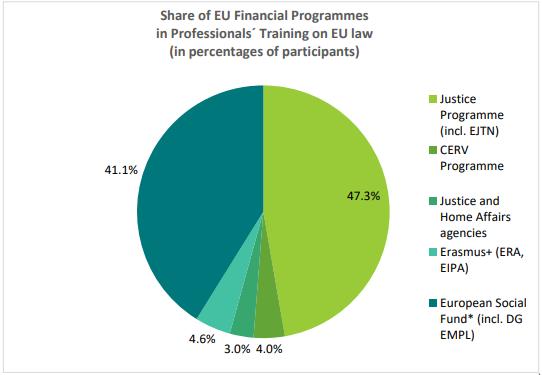
The lion’s share of training on EU law – about 80% – is financed from national budgets. Moreover, organisations of justice professionals, bar associations and other stakeholders organise training courses on EU law on their own initiative, including cross-border training courses, and from their own budgets.
c)Judicial training results from 2021to 2024
While the previous strategy targeted mainly judges and prosecutors, the JTS has broadened the scope to other legal professionals. It has also set annual quantitative objectives for each target group, requiring that every year 65% of all judges and prosecutors in the EU, 15% of court staff, 15% of private lawyers, 30% of notaries, and 20% of bailiffs, receive training on EU law. None of the professional groups, except notaries and court staff in 2022, reached these targets by 2023. The year 2023 even saw a considerable drop in participation from the year 2022 for most professional groups, except lawyers, whose participation rate remained stable.
Table 1: Participation in continuous EU law training in the EU (%)
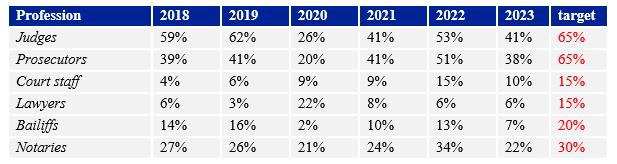
Source: European Commission annual European Judicial Training Reports.
Average participation rates over the 2021-2023 period increased across almost all professional groups compared to the baseline period of 2018-2020. Participation of court staff increased from 6% to 11% on average. Participation of prosecutors increased by about 10%, but judges dropped by 5%.
In absolute numbers, a cumulated number of 2 million justice professionals have received training on EU law since 2011 - the year the first Judicial Training Strategy was adopted - with a steady annual increase. However, in 2023, the participation rates of most professional groups dropped. Significant disparities in training participation rates remain across Member States and professional groups.
Besides setting out quantitative goals, the JTS has expanded legal training on EU law to judge-craft and digital skills. Training offers in digitalisation are increasing overall, but the proportion of digitalisation-related training has remained very low, at only around 2.5% in 2023. IT skills training increased from around 18% in 2022 to around 24% in 2024. This suggests that while the need for more training on IT-related topics is recognised, the existing training offers may not be sufficiently comprehensive. More training is needed to keep pace with the dynamics of the digital transition.
Between 2021 and 2023, over 11 000 EU-funded exchanges of justice professionals included short-term exchanges (one to two weeks) in courts, prosecution services, and judicial training institutes, as well as longer-term placements and study visits to the Court of Justice of the EU, the European Court of Human Rights, and Eurojust. EJTN exchanges have consistently received high satisfaction ratings.
3.Has EU-funded training on EU law improved the knowledge of, and had a positive impact on the daily practice of justice professionals?
To measure the effectiveness of training, the JTS requires EU training providers to evaluate each of their training activities. However, especially on long-term impacts, there was little or no information available, as explained under Evaluation of training events in c).
The following information is therefore based on surveys and interviews done by an external contractor to support the stock-taking of judicial training.
a) Participants’ general rates of satisfaction with EU-funded judicial training
The replies to a survey, sent by an external contractor to EU-funded training participants, show high or very high satisfaction rates of participants: 4.8 out of 5 for increased awareness of new topics, 4.7 out of 5 for increased knowledge, 4.2 out of 5 for better skills, 4.1 out of 5 for closer cooperation with peers, and 4.8 out of 5 overall
.
b)Long-term impacts
of EU-funded judicial training
According to the interviews, participants in EU-funded judicial training confirmed that the training had had a long-term impact. Participants were more confident in dealing with EU law-related matters, particularly in priority areas such as the Charter of Fundamental Rights of the European Union, as well as with mutual recognition and cross-border judicial cooperation instruments. Participants could boost their skills, create lasting cross-border contacts, and gain knowledge of the use of cross-border cooperation instruments. Most participants who were interviewed generally said that the training had led to behavioral changes but only provided a few examples of where they had applied their new legal knowledge-
Surveys and interviews conducted by an external contractor with participants and national training institutes show that stakeholders value above all the cross-border dimension of EU-funded training. They appreciate the opportunities for professional exchange, rather than the transmission of detailed legal knowledge. National training institutes said that they would continue to offer training on EU law even without EU funding, but only a minority said they would invest in cross-border professional exchanges to replace EU-funded training. EU-funded training is also seen as a model, raising awareness of EU-related topics and encouraging their inclusion in national training programmes, which is seen as a positive thing.
To improve effectiveness, detailed training courses on EU law in national training programmes should therefore be aligned with EU-funded training courses and coordination between different funding opportunities improved.
c)Quality and sustainability of judicial training according to objective indicators
Little information on the impacts of judicial training can be gleaned from evaluations by participants, but the quality, relevance and therefore sustainability of training events can also be measured using objective indicators such as the use of needs assessments, modern training methods, the effective evaluation of training events and the broad dissemination of training material These components required by the JTS are used as award criteria for any grant for judicial training funded from the Justice programme and as contractual obligations in grant agreements between the Commission and beneficiaries.
Needs assessments
Needs assessments underpinning the content of the annual EJTN training catalogue and the training offers funded through action grants are in place. They are evidence-based on consultations of and conferences with the targeted professional groups, their organisations and networks, training providers, national ministries and national judicial training schools. The methods are effective, with an emphasis on structured dialogue and personal exchanges.
Training methods
A broad mix of training methods is applied across EU-funded training projects. The number of online training courses and webinars has increased post-COVID, complementing traditional, in-person sessions. Participants appreciate interactive workshops and hands-on formats, applying advanced education for adults, particularly formats that lend themselves to networking and mutual learning. The EJTN supports traditional, in-person training as the gold standard, while recognising the benefits of blended and online approaches. Contributions during a meeting of the Commission expert group on European judicial training confirmed that while online training reaches larger audiences, it remains crucial to continue organising exchange programmes where colleagues from different countries meet in person, to support the creation of lasting professional networks and raise awareness of the European dimension of judicial work.
Participants who were interviewed said they appreciated the practical nature of the training they had received (especially when given by their peers), and the opportunity to discuss cases with peers from other countries. They considered the duration of the training to have been adequate, making it possible for them to fit it in alongside their professional obligations. However, some participants who were interviewed expressed concerns that the typical 1.5-day training sessions risked being too short to allow for a deep understanding of complex legal topics or to create lasting learning and networking opportunities. They suggested that follow-up events, as part of the overall training programme, could make training more sustainable and increase its long-term impact. Members of the Commission expert group on European judicial training also suggested placing more emphasis on projects with follow-up modules for a greater learning impact.
Feedback from a conference involving training providers and representatives of legal professionals suggests that training methods should keep up with modern technology, by including AI-supported learning, virtual reality scenarios and individualised, step-by-step e-learning solutions in all official EU languages
.
Evaluation of training events
The existing evaluation obligations of beneficiaries of EU grants have not generated sufficient information on the long-term impact of judicial training. Short- and long-term evaluations are a contractual requirement of EU grant agreements, but they have not been done systematically. Surveys and questionnaires based on the Kirkpatrick model have been the beneficiaries’ preferred evaluation method
. They have usually been distributed to participants immediately after a training event and again six months later. However, response rates for immediate post-training surveys are often low, not exceeding 50%. Measures taken by beneficiaries to improve feedback rates (reminders, personal contacts) – often at the request of the Commission in monitoring the progress of training projects – demand considerable effort without achieving significantly better outcomes. Questionnaires to measure long-term impacts have often not been sent at all or have only been sent to a small number of participants.
As a result, there is a lack of systematic information on the actual impact of judicial training across the EU, particularly the effectiveness of promoting the consistent and correct application of EU law. So more must be done to improve evaluation. The effective measuring of the long-term impacts of a training project requires clarity about what the project aims to achieve. Poorly thought-out questions about behavioural changes, for example, will not produce good results, unless there is a realistic definition of training objectives. However, to evaluate long-term impacts, an evaluation method based solely on personal answers to questionnaires from training participants may be inadequate and just putting more pressure on them to answer might not produce reliable results. Additional approaches should also be considered to improve, complement or replace questionnaires. Possible alternative evaluation methods, especially for long-term impacts, could be follow-up focus groups/structured interviews where participants reflect on behavioural and organisational changes, workplace integration and contextual factors, sample success stories or peer review, that could be integrated into judicial exchange programmes. The EJTN
Guidelines for Evaluation of Judicial Training Practices
, which beneficiaries are obliged to take into account, allow for such flexibility. To measure the broader systemic effect of judicial training, the Commission could more systematically use
EU Justice Scoreboard
data to assess progress in this area.
Dissemination of training material
The sustainability of EU-funded judicial training activities is linked to the dissemination and continued accessibility of training materials to people other than the original participants. A good dissemination strategy is part of the selection and evaluation criteria. Beneficiaries often make training materials available on project websites, professional networks, social media, and LinkedIn, but dissemination remains fragmented and inconsistent. Project websites are often not updated and are deactivated after a while, resulting in the loss of content that could be of value to a broader audience.
Training materials are shared on the EJTN website and the websites of training providers such as the ERA, but there is no systemic approach to centralising such content. Training participants often share training content with peers on their own initiative. However, this practice lacks structured support and recognition and is not part of broader dissemination strategies. Nor does the Commission systematically monitor whether training content remains accessible, relevant or up to date after a project has ended.
4.How can the Commission better support judicial training?
The Commission defines priority training topics in its Judicial Training Strategy, based on an extensive needs assessment
. The Commission supports effective judicial training on these topics mainly through funding as well as monitoring and dissemination of training material.
a)Coordination and coherence of different funding opportunities
The Commission has, in particular through the direct management of funding schemes, a role to play in coordinating judicial training on EU law.
Action grants and operating grants from the EU Justice programme
The Commission, in the work programmes of the EU Justice programme and call documents, explicitly states that projects funded by action grants must complement and not duplicate activities implemented by the EJTN receiving an operating grant. However, the exact interplay of the two funding strands is not further determined, for example regarding the coverage of individual Member States or professional groups not represented by the EJTN. There is also no mechanism ensuring that training activities under the different funding strands complement each other thematically: the EJTN typically offers one training course per year per topic, but action grant funded training offers often cover similar themes without a clear connection to the EJTN’s training schedule or existing content.
Applicants for action grants are asked to set out in their proposals how their project builds on or complements previously funded projects. As a result, projects often cover content similar to previously awarded projects. However, they do not systematically create synergies or address geographical, thematic or other gaps that would require targeted complementing training initiatives. As a remedy, the Commission could launch more calls to address specific shortcomings that are hampering that objectives are fully achieved. The Commission could also define in their calls sub-aspects of a training topic that allow for coordinated and integrated training offers of several applicants. Through action grants, the Commission could also more systematically support professional associations or networks of target groups that do not fall under the mandate of the EJTN.
Judicial training under other EU funds
Other EU funds also cover judicial training to support their policy area. The Single Market programme (SMP) and LIFE programme for the environment and climate action can be used to fund related training for judges, e.g. on consumer protection or EU environmental law. The Internal Security Fund (ISF) can cover public prosecutors’ training in, for example, migration law, criminal law on terrorism, the trafficking of human beings, or e-evidence. The European Union Anti-Fraud programme (EUAF) may fund judicial training of judges and prosecutors and, possibly, other judicial staff dealing with the protection of the EU’s monetary interests. Similarly, training under the Citizens, Equality, Rights and Values programme (CERV), though not primarily targeting training of the judiciary, could be of interest to justice professionals. The European Social Fund Plus (ESF+) provides funding in, among others, the areas of employment, digital justice and social rights. It can support judicial training related to these areas for judges, prosecutors, and court- and prosecution staff. Unlike the other EU funds, the ESF+ contributes to nationally funded training.
Erasmus+ funds professional exchanges, including for lawyers and court staff, and gives an operating grant to the EU judicial training institutes the Academy of European Law (ERA) and the European Institute for Public Administrations (EIPA). Other programmes support the training of legal professionals from non-EU countries, with a focus on fundamental rights and the rule of law. One such programme is the Instrument for Pre-Accession Assistance (IPA) III for the Western Balkans. The ESF+ accounts for the largest share of funding of judicial training after the EU Justice programme, funding, among others, training on the digitalisation of justice for legal professionals.
Erasmus+ creates synergies with the EU Justice programme, by giving ERA and the EIPA an operating grant to secure the long-term financial stability of these major EU judicial training providers, who also receive action grants from the EU Justice programme for individual projects. This enabled ERA to create the European Forum of the Judicial and Legal Professions in 2022, a network that supports more structured dialogue among EU judicial practitioners about the training needs of and challenges for different professions, in particular with regard to General Data Protection Regulation requirements.
However, coordination and exchanges between the Commission departments managing the various funding instruments, in addition to the inter-service consultation mechanism, could be improved. For instance, the suggests that the training delivered under the ESF+, as the EU fund that provides the highest proportion of funding for judicial training after the EU Justice programme, could be better aligned with the objectives of the Judicial Training Strategies. An appropriate choice, as well as better bundling and coordination of projects using existing internal coordination mechanisms or new structured exchanges on the management of various funding instruments, could ensure the best use of available budgets and produce more synergies.Topics to be better coordinated could be training content, target groups, training types and the timing of calls. In coordinated call documents, grant applications could be given better guidance on geographical, or thematic gaps, where more training offers are needed, and how to optimise the use of existing parallel funding opportunities.
Judicial training on EU law funded from national budgets
As 80% of training on EU law is funded nationally
, national training providers are pivotal to ensure the correct application of EU-acquis across the EU. Judicial training is a national competence, so the Commission has limited influence on how and whether the objectives of the Judicial Training Strategies are implemented.
The 2024 Judicial Training Report shows that in 2023, only 37% of the responding Member States offered initial judicial training on EU law, and only 28% of the offered continuous judicial training on EU law. This seems to indicate that training on EU law is not sufficiently covered across all Member States and professional groups.
According to a survey sent by the external contractor to national training institutes, most of the national training institutes that responded to it said that they incorporate EU law content into their national training programmes
. While, according to the survey, most national training institutes that responded to it said that the objectives of the JTS had an impact on increasing knowledge of EU law, only 29% of respondents felt that the JTS had helped increase the training budget for judges and prosecutors in their countries, and only 38% of respondents felt that content from EU-funded training activities had been integrated into national training offers
.
The Expert Group on Judicial Training has suggested that more direct communication with national judicial training providers may be necessary to raise their awareness of the JTS and its objectives and of their responsibilities to implement them through national training. Direct communication could help clarify the JTS objectives and deliverables expected from national training. According to the Expert Group on Judicial Training, the exchange of experience among national training schools and the sharing of national training programmes could also contribute to improving EU-wide coherence in judicial training curricula on EU law.
The EJTN, tasked with coordinating national training on EU law
, is not making full use of its coordination capacity, with the resulting lack of synergies between EU- and nationally funded training making judicial training less effective.
Existing mechanisms and platforms for coordinating different sources of funding for judicial training
The Commission regularly organises conferences with national and EU training providers, professional networks and -associations that provide a platform for structured dialogue. These conferences are mainly held to identify training needs. Representatives of EU professional networks interviewed by the external contractor for this stock-taking felt that this format does not fully use its potential. Additional focused events to exchange experience on selected topics could serve to streamline and improve the quality of national training on the EU-acquis across the EU. During Commission outreach activities, training providers also said they wanted to hold conferences on specific topics.
The demand for more concentrated efforts in the use of EU funding and knowledge sharing needs to be addressed.
The conferences could further serve as a forum to make the common training priorities, as set out in a Judicial Training Strategy better known and to raise awareness of the European dimension of judicial training (see also under a) above). Such a further developed forum could also help to better integrate into the implementation of an EU Judicial Training Strategy the expertise and commitment of EU professional networks.
b)Monitoring, statistical data collection and dissemination of training material
Besides funding and conferencing, the Commission supports the implementation of judicial training through numerous information, coordination, networking and outreach activities to all stakeholders, bilaterally or through conferences. In 2021, the Commission launched the
European Training Platform
(ETP) on its e-justice portal to support and centralise the dissemination of judicial training material. The ETP is intended as a one-stop shop, to provide links to available EU-funded training material and handbooks. With only a few hundred visits every month, the ETP has still not gained enough visibility and does not yet refer to enough quality training material. National training providers interviewed said that there would be no link to the ETP from their websites or platforms. The Commission is in the process of simplifying and refocusing the platform and adding material to it.
The Commission annually publishes the
European Judicial Training Report
, a monitoring instrument based on statistical data transmitted by stakeholders on rates of participation in various training activities across Member States and professional groups. The report contains aggregated data broken down according to several parameters. The Commission collects the statistical information about judicial training on EU law from various sources under different funding mechanisms, including national funding. Transparency and benchmarking as facilitated by the Judicial Training Report can help Member States close gaps in their training programmes and improve their training offers.
However, several limitations affect the accuracy, comparability, and completeness of the data. For instance, total participants data from action grants-funded projects spanning over several years are accumulated with annual participants data in EJTN training. Inconsistencies also arise, because the concept of training on EU law used in the survey is not interpreted uniformly by the various national contact points. Finally, the data on total participation used for the Judicial Training Report is incomplete, as every year there are Member States that do not provide input, especially when multiple national training institutes are involved.
5.Training needs related to the digitalisation of justice, including the use of AI
The training needs addressed in the JTS remain relevant also in the future, but all groups of legal professional groups agree that digital training will become more urgent in the future, as the digital transition of justice system is progressing. Conferences with the judicial training community, stakeholder outreach activities and interviews with legal professionals confirm that there is a growing demand for more systematic and comprehensive training to support the digital transition of judicial systems, including the use of AI and digital tools. Training needs most frequently mentioned in interviews and various outreach activities conducted by the Commission include the handling of electronic evidence, critical issues related to data protection, cybersecurity, data storage and sharing, effective use of case law and legislation databases and digital company registers, the use of AI in justice and awareness of potential bias, e-filing systems, the use of cross-border cooperation tools, videoconference hearings, cybersecurity, cybercrime, privacy and data protection. Training on digitalisation/AI topics has also seen the largest increase in EU-funded judicial training projects
.
National training institutes responding to a survey done for the purposes of this stock-taking confirmed that they are planning to increase training for legal professionals, focused on digital tools and the skills required to use them
. Training providers pointed out the need to involve IT professionals in both designing and giving training, on, for example, e-CODEX (a decentralised IT system for the cross-border exchange of judicial data) and cross-border cooperation tools. National training institutes have reported that they expect the judiciary to recruit more IT specialists to put IT solutions into practice for daily work purposes and to design related and IT training courses. IT experts should in turn be trained on how to work with legal professionals to design and implement IT tools and IT training courses, ensuring they are user-friendly, practical and intuitive. The same applies to project managers responsible for setting up and managing new IT system Organisation leaders also need training to manage their organisations’ digital transition and address possible staff resistance to change.
Judicial training stakeholders and professionals confirmed that there was demand for training on the rule of law, fundamental rights and EU law on cross-border judicial cooperation. Training must remain flexible and responsive to needs that arise from the adoption of legal instruments.
Training must be tailored to the needs of the various groups of judicial professionals and take varying levels of digital skills and maturity into account. Different learning styles should also be acknowledged and addressed through training methods. On-the-job learning was considered an effective way of ensuring people get hands-on experience. This should be combined with continuous opportunities for peer learning, cross-border exchanges, and training focused on shared digital challenges across the EU.
Annex – Methodology
The stock-taking was carried out by the Directorate-General for Justice and Consumers in 2024. It was supported by an external contractor who produced a study on the findings
, with a focus on the effectiveness of EU-funded training, the relevance and coherence of EU-wide training on EU law under various funding opportunities, and the effectiveness of the Commission’s supporting measures.
It draws mainly on a combination of desk research using quantitative and qualitative data sources, the European Commission’s monitoring data, surveys and interviews, conference reports and Commission out-reach activities.
Desk research included project information and documents from the European Commission’s internal tools for monitoring grant procedures and project implementation, interim and progress reports from grant beneficiaries, final evaluation reports on the completion of projects implemented with Commission support, needs assessments and annual reports of EU training providers including the European Judicial Training Network (EJTN), the Academy of European Law (ERA) and the European Institute of Public Administration (EIPA), as well as the European Commission’s annual judicial training reports providing detailed data on participation in training disaggregated by profession, training format and thematic focus. Additional information comes from the European Commission’s Justice Scoreboard and the evaluation report on the preceding Judicial Training Strategy for 2011-2020, in particular in the form of data on participation for comparison. A review of political and policy papers supported the assessment of programmes’ coherence with and complementarity of the programmes with EU policies or other funding programmes with similar objectives. The review also helped identify links between the programmes and their broader policy context.
66 semi-structured interviews were conducted with a broad range of training participants in various training events (judges, prosecutors, court staff, trainers, bailiffs, prison and probation staff). Training participants interviewed had taken part in judicial training funded through action grants from the EU Justice Programme. They were identified by the external contractor with the help of the training providers and had agreed to be interviewed.
The external contractor collected the views of national training institutes in a survey. Further evidence on the impact of judicial training comes from EU surveys of training participants and feedback surveys of beneficiaries on individual projects immediately after a training course. These interviews and surveys helped in particular to gather evidence on the impacts of judicial training funded by the EU.
A
call for evidence
published on the European Commission’s ‘Have your Say’ website on 2 April 2024 had yielded 18 replies by the deadline of 30 April. Additional replies received after the deadline were taken into account. Respondents – EU citizens, training providers, NGO, professional networks and organisations, - largely acknowledge the positive impacts of the EU Judicial Training Strategy on the quality and coherence of judicial training on the EU-acquis across the EU. They, however, also point out room for improvement, in particular with regard to the evaluation and monitoring of judicial training, as well as regards a need for more direct communication of the Commission with stakeholders. Several respondents stressed the need for more training on the digitalisation of justice including cross-border cooperation tools and AI. Other training needs mentioned concern restorative justice, environmental crime, and non-contentionary civil proceedings.
Conferences, bilateral stakeholder contacts, and Commission outreach activities during 2021-2024 also contributed to the evidence base. These include two European Judicial Training Conferences in April 2023 (Judicial Training: the right skills to embrace the digitalisation of justice) and April 2024 (Judicial Training: Supporting the Digitalisation of Justice).
Limitations include variable data quality, especially in national reporting, and training participants’ availability for interviews. The stock-taking was done in 2024, with most action grant-funded judicial training activities under the EU Justice programme still ongoing, so there is limited data on long-term impacts. The limitations were mitigated through cross-checks and cautious interpretation. Throughout the process, data triangulation was used to ensure that the findings were strong and consistent.
This comprehensive methodology supports a nuanced and evidence-based assessment of progress under the European JTS and provides a solid foundation for future policy development.


