ISSN 1977-091X
Official Journal
of the European Union
C 31
English edition
Information and Notices
Volume 61
27 January 2018
|
ISSN 1977-091X |
||
|
Official Journal of the European Union |
C 31 |
|
|
|
||
|
English edition |
Information and Notices |
Volume 61 |
|
Notice No |
Contents |
page |
|
|
II Information |
|
|
|
INFORMATION FROM EUROPEAN UNION INSTITUTIONS, BODIES, OFFICES AND AGENCIES |
|
|
|
European Commission |
|
|
2018/C 31/01 |
Non-opposition to a notified concentration (Case M.8740 — Schmolz+Bickenbach/Assets of Asco Industries) ( 1 ) |
|
|
2018/C 31/02 |
Authorisation for State aid pursuant to Articles 107 and 108 TFEU — Cases where the Commission raises no objections or the measure does not constitute aid ( 1 ) |
|
|
IV Notices |
|
|
|
NOTICES FROM EUROPEAN UNION INSTITUTIONS, BODIES, OFFICES AND AGENCIES |
|
|
|
Council |
|
|
2018/C 31/03 |
||
|
2018/C 31/04 |
||
|
|
European Commission |
|
|
2018/C 31/05 |
||
|
|
Authority for European Political Parties and European Political Foundations |
|
|
2018/C 31/06 |
||
|
|
NOTICES FROM MEMBER STATES |
|
|
2018/C 31/07 |
|
|
V Announcements |
|
|
|
PROCEDURES RELATING TO THE IMPLEMENTATION OF THE COMMON COMMERCIAL POLICY |
|
|
|
European Commission |
|
|
2018/C 31/08 |
||
|
|
OTHER ACTS |
|
|
|
European Commission |
|
|
2018/C 31/09 |
Information notice — public consultation — Geographical indications from the Swiss Confederation |
|
|
|
|
|
(1) Text with EEA relevance. |
|
EN |
|
II Information
INFORMATION FROM EUROPEAN UNION INSTITUTIONS, BODIES, OFFICES AND AGENCIES
European Commission
|
27.1.2018 |
EN |
Official Journal of the European Union |
C 31/1 |
Non-opposition to a notified concentration
(Case M.8740 — Schmolz+Bickenbach/Assets of Asco Industries)
(Text with EEA relevance)
(2018/C 31/01)
On 22 January 2018, the Commission decided not to oppose the above notified concentration and to declare it compatible with the internal market. This decision is based on Article 6(1)(b) of Council Regulation (EC) No 139/2004 (1). The full text of the decision is available only in English and will be made public after it is cleared of any business secrets it may contain. It will be available:
|
— |
in the merger section of the Competition website of the Commission (http://ec.europa.eu/competition/mergers/cases/). This website provides various facilities to help locate individual merger decisions, including company, case number, date and sectoral indexes, |
|
— |
in electronic form on the EUR-Lex website (http://eur-lex.europa.eu/homepage.html?locale=en) under document number 32018M8740. EUR-Lex is the online access to European law. |
|
27.1.2018 |
EN |
Official Journal of the European Union |
C 31/2 |
Authorisation for State aid pursuant to Articles 107 and 108 TFEU
Cases where the Commission raises no objections or the measure does not constitute aid
(Text with EEA relevance)
(2018/C 31/02)
|
Date of adoption of the decision |
21.12.2017 |
|||
|
Aid number |
SA.49509 (2017/N) |
|||
|
Member State |
Slovakia |
|||
|
Region |
Východné Slovensko, Západné Slovensko, Stredné Slovensko |
— |
||
|
Title (and/or name of the beneficiary) |
Preferential taxes for biofuels |
|||
|
Legal basis |
Zákon č. 358/2015 Z. z., Zákon č. 98/2004 Z. z. o spotrebnej dani z minerálneho oleja v znení neskorších predpisov (ďalej len „zákon č. 98/2004 Z. z.“) |
|||
|
Type of measure |
Scheme |
— |
||
|
Objective |
Environmental protection |
|||
|
Form of aid |
Tax rate reduction |
|||
|
Budget |
Overall budget: EUR 607.08 (in millions) |
|||
|
Intensity |
0 % |
|||
|
Duration (period) |
01.01.2018 - 31.12.2023 |
|||
|
Economic sectors |
All economic sectors eligible to receive aid |
|||
|
Name and address of the granting authority |
|
|||
|
Other information |
— |
|||
The authentic text(s) of the decision, from which all confidential information has been removed, can be found at:
http://ec.europa.eu/competition/elojade/isef/index.cfm.
IV Notices
NOTICES FROM EUROPEAN UNION INSTITUTIONS, BODIES, OFFICES AND AGENCIES
Council
|
27.1.2018 |
EN |
Official Journal of the European Union |
C 31/3 |
COUNCIL DECISION
of 23 January 2018
on the appointment of the member of the European Statistical Advisory Committee representing the Council
(2018/C 31/03)
THE COUNCIL OF THE EUROPEAN UNION,
Having regard to the Treaty on the Functioning of the European Union,
Having regard to Decision No 234/2008/EC of the European Parliament and of the Council of 11 March 2008 establishing the European Statistical Advisory Committee and repealing Council Decision 91/116/EEC (1),
Having regard to the recommendation of the Economic and Financial Committee of 30 November 2017,
Whereas:
|
(1) |
On 22 April 2013 the Council appointed Mr Maurizio VICHI as the representative of the Council in the European Statistical Advisory Committee (2). His current term expires on 31 March 2018. |
|
(2) |
Mr Maurizio VICHI is eligible to serve a second 5-year term as the member representing the Council in the European Statistical Advisory Committee, |
HAS ADOPTED THIS DECISION:
Article 1
Mr Maurizio VICHI is hereby reappointed for a second 5-year term as member representing the Council in the European Statistical Advisory Committee.
Article 2
This Decision shall enter into force on 1 April 2018.
Done at Brussels, 23 January 2018.
For the Council
The President
V. GORANOV
(1) OJ L 73, 15.3.2008, p. 13.
(2) Council Decision of 22 April 2013 on the appointment of the member of the European Statistical Advisory Committee representing the Council (OJ C 127, 4.5.2013, p. 1).
|
27.1.2018 |
EN |
Official Journal of the European Union |
C 31/4 |
COUNCIL DECISION
of 23 January 2018
appointing members and alternate members of the Advisory Committee on Freedom of Movement for Workers for Italy
(2018/C 31/04)
THE COUNCIL OF THE EUROPEAN UNION,
Having regard to the Treaty on the Functioning of the European Union,
Having regard to Regulation (EU) No 492/2011 of the European Parliament and of the Council of 5 April 2011 on freedom of movement for workers within the Union (1), and in particular Articles 23 and 24 thereof,
Having regard to the lists of candidates submitted to the Council by the Governments of the Member States,
Whereas:
|
(1) |
By its Decision of 20 September 2016 (2), the Council appointed the members and alternate members of the Advisory Committee on Freedom of Movement for Workers (the ‘Committee’) for the period from 25 September 2016 to 24 September 2018. |
|
(2) |
The government of Italy has submitted nominations for several posts to be filled, |
HAS ADOPTED THIS DECISION:
Article 1
The following are appointed members and alternate members of the Advisory Committee on Freedom of Movement for Workers for the period ending on 24 September 2018:
I. TRADE UNION REPRESENTATIVES
|
Country |
Members |
Alternate members |
|
Italy |
Mr Salvatore MARRA Mr Giuseppe CASUCCI |
Ms Ilaria FONTANIN |
II. EMPLOYERS' ASSOCIATIONS REPRESENTATIVES
|
Country |
Members |
Alternate members |
|
Italy |
Ms Paola ASTORRI Mr Fabio ANTONILLI |
Ms Serena FACELLO |
Article 2
The Council shall appoint members and alternate members not yet nominated at a later date.
Article 3
This Decision shall enter into force on the date of its adoption.
Done at Brussels, 23 January 2018.
For the Council
The President
V. GORANOV
(1) OJ L 141, 27.5.2011, p. 1.
(2) Council Decision of 20 September 2016 appointing the members and alternate members of the Advisory Committee on Freedom of Movement for Workers (OJ C 348, 23.9.2016, p. 3).
European Commission
|
27.1.2018 |
EN |
Official Journal of the European Union |
C 31/6 |
Euro exchange rates (1)
26 January 2018
(2018/C 31/05)
1 euro =
|
|
Currency |
Exchange rate |
|
USD |
US dollar |
1,2436 |
|
JPY |
Japanese yen |
135,95 |
|
DKK |
Danish krone |
7,4428 |
|
GBP |
Pound sterling |
0,87335 |
|
SEK |
Swedish krona |
9,8005 |
|
CHF |
Swiss franc |
1,1632 |
|
ISK |
Iceland króna |
|
|
NOK |
Norwegian krone |
9,5655 |
|
BGN |
Bulgarian lev |
1,9558 |
|
CZK |
Czech koruna |
25,357 |
|
HUF |
Hungarian forint |
309,80 |
|
PLN |
Polish zloty |
4,1422 |
|
RON |
Romanian leu |
4,6663 |
|
TRY |
Turkish lira |
4,6635 |
|
AUD |
Australian dollar |
1,5380 |
|
CAD |
Canadian dollar |
1,5325 |
|
HKD |
Hong Kong dollar |
9,7222 |
|
NZD |
New Zealand dollar |
1,6943 |
|
SGD |
Singapore dollar |
1,6259 |
|
KRW |
South Korean won |
1 323,68 |
|
ZAR |
South African rand |
14,7883 |
|
CNY |
Chinese yuan renminbi |
7,8693 |
|
HRK |
Croatian kuna |
7,4190 |
|
IDR |
Indonesian rupiah |
16 558,53 |
|
MYR |
Malaysian ringgit |
4,8179 |
|
PHP |
Philippine peso |
63,492 |
|
RUB |
Russian rouble |
69,5246 |
|
THB |
Thai baht |
39,037 |
|
BRL |
Brazilian real |
3,9149 |
|
MXN |
Mexican peso |
23,0670 |
|
INR |
Indian rupee |
79,1055 |
(1) Source: reference exchange rate published by the ECB.
Authority for European Political Parties and European Political Foundations
|
27.1.2018 |
EN |
Official Journal of the European Union |
C 31/7 |
Decision of the Authority for European political parties and European political foundations
of 27 September 2017
to register Transform Europe
(Only the English text is authentic)
(2018/C 31/06)
THE AUTHORITY FOR EUROPEAN POLITICAL PARTIES AND EUROPEAN POLITICAL FOUNDATIONS,
Having regard to the Treaty on the Functioning of the European Union,
Having regard to Regulation (EU, Euratom) No 1141/2014 of the European Parliament and of the Council of 22 October 2014 on the statute and funding of European political parties and European political foundations (1), in particular Article 9 thereof,
Having regard to the application received from Transform Europe,
Whereas:
|
(1) |
The Authority for European political parties and European political foundations (‘Authority’) received an application for registration as a European political foundation under Article 8(1) of Regulation (EU, Euratom) No 1141/2014 from Transform Europe (the ‘applicant’) on 15 September 2017 and a revised version of part of that application on 21 September 2017 and 26 September 2017. |
|
(2) |
The applicant submitted documents proving that it satisfies the conditions laid down in Article 3 of Regulation (EU, Euratom) No 1141/2014, the declaration in the form set out in the Annex to that Regulation, and the statutes of the applicant, containing the provisions required by Article 5 of that Regulation. |
|
(3) |
The application is further supported by a statement by notary Valérie Bruyaux pursuant to Article 15(2) of Regulation (EU, Euratom) No 1141/2014 certifying that the applicant has its seat in Belgium and that the applicant’s statutes are in conformity with the relevant provisions of national law. |
|
(4) |
The applicant submitted additional documents in accordance with Articles 1 and 2 of Commission Delegated Regulation (EU, Euratom) 2015/2401 (2). |
|
(5) |
Pursuant to Article 9 of Regulation (EU, Euratom) No 1141/2014, the Authority has examined the application and supporting documentation submitted, and considers that the applicant satisfies the conditions for registration laid down in Article 3 of that Regulation and that the statutes contain the provisions required by Article 5 of that Regulation, |
HAS ADOPTED THIS DECISION:
Article 1
Transform Europe is hereby registered as a European political foundation.
It shall acquire European legal personality on the date of the publication of this Decision in the Official Journal of the European Union.
Article 2
This Decision shall take effect on the day of its notification.
Article 3
This Decision is addressed to:
|
Transform Europe |
|
Square de Meeûs 25 |
|
1000 Bruxelles/Brussel |
|
BELGIQUE/BELGIË |
Done at Brussels, 27 September 2017.
For the Authority for European political parties and European political foundations
The Director
M. ADAM
(1) OJ L 317, 4.11.2014, p. 1.
(2) Commission Delegated Regulation (EU, Euratom) 2015/2401 of 2 October 2015 on the content and functioning of the Register of European political parties and foundations (OJ L 333, 19.12.2015, p. 50).
ANNEX
STATUTS
§ 1 Dénomination et siège
L’association a le statut d’association sans but lucratif et est régie par le Titre III et IIIter de la loi belge du vingt-sept juin mil neuf cent vingt et un sur les associations sans but lucratif, les fondations, les partis politiques européens et les fondations politiques européennes (dans les présents statuts «la loi»).
L’Association est dénommée (et sera inscrite au registre des associations du tribunal de district) sous le nom de «Transform Europe», et en abrégé «TE».
Le siège de Transform Europe est établi à Bruxelles, au lieu élu par le Conseil d’Administration de l’association. Il est actuellement à 1000 Bruxelles, Square de Meeûs 25, dans l’arrondissement judiciaire de Bruxelles.
§ 2 Buts
L’objet de l’Association consiste à promouvoir la pensée alternative et le dialogue politique visant à transformer les sociétés actuelles afin de développer une Europe sociale, féministe, écologique, démocratique et pacifique commune ainsi que la solidarité mondiale. L’objet de l’Association sera satisfait
|
— |
en organisant des débats publics, |
|
— |
en encourageant l’analyse critique et la recherche, |
|
— |
par la création et le soutien de médias de communication. |
Transform Europe opère en tant que réseau autonome gouverné par ses membres et observateurs. Sur le plan politique, elle est affiliée au Parti de la gauche européenne.
§ 3 Statut d’association sans but lucratif
L’Association poursuit exclusivement et directement des buts non lucratifs. Elle n’agit pas par intérêt personnel et n’est pas motivée par ses propres objectifs économiques. Les fonds de l’Association ne peuvent être utilisés qu’aux fins décrites dans les présents statuts. Personne ne peut bénéficier de dépenses non conformes aux objets de l’Association ou d’émoluments disproportionnellement élevés.
§ 4 Admission des membres et leur représentation au sein de l’Association
L’association est composée de membres effectifs dont le nombre ne peut être inférieur à trois.
L’adhésion à l’Association est uniquement ouverte aux fondations et autres associations reconnues légalement. Elles doivent soutenir les objectifs de l’association spécifiés par § 2. Celles-ci peuvent devenir membres effectifs ou membres observateurs. Les membres effectifs sont autorisés à voter lors des assemblées générales et peuvent être élus au conseil d’administration ou au comité de vérification. Les membres observateurs peuvent participer aux assemblées, auxquelles ils sont invités, en tant que consultants. Ils peuvent faire une demande d’adhésion en tant que membre effectif au bout d’un an.
Les demandes d’adhésion doivent être adressées par écrit et leur approbation nécessite une résolution unanime de l’assemblée générale. Une demande d’adhésion à part entière soumise par un membre observateur résidant dans un pays où un membre à part entière (ou plusieurs) est/sont présent(s) doit être déposée avec ce/ces membre(s) pour être discutée en assemblée générale.
Chaque membre doit être représenté au sein de l’Association par une personne physique (représentant) formellement désignée par écrit par le conseil d’administration habilité de l’organisation du membre. La désignation doit être présentée au conseil d’administration de l’Association et peut être révoquée par la nomination d’un nouveau représentant. La révocation prend effet lorsque le conseil d’administration a été informé par écrit de la désignation du nouveau représentant.
§ 5 Démission des membres
Un membre peut démissionner de l’Association à tout moment en notifiant par écrit sa démission au Conseil d’administration.
§ 6 Exclusion des membres
Les membres peuvent être exclus de l’Association s’ils commettent une faute grave et intentionnelle portante atteinte aux intérêts de l’Association. Les décisions relatives aux exclusions sont adoptées par un vote de l’assemblée générale nécessitant au moins les trois quarts des voix des membres.
§ 7 Frais d’adhésion
Les frais d’adhésion sont versés le 1er janvier de chaque année au titre de l’année à venir. La cotisation annuelle s’élève à 100 EUR. Toute modification de la cotisation annuelle doit faire l’objet d’une résolution de l’assemblée générale sans que ce montant ne puisse excéder 5 000 EUR (5 000 EUR) par an.
§ 8 Conseil d’administration
Le conseil d’administration doit être composé d’au moins trois personnes représentantes des membres de Transform Europe. Le conseil d’administration doit être élu par l’assemblée générale pour une période de deux ans mais continue d’assurer ses fonctions après l’expiration de son mandat jusqu’à ce qu’un nouveau conseil d’administration soit élu. Le conseil d’administration peut prendre ses décisions aussi bien au cours de réunions que par téléphone ou courrier électronique. Les décisions doivent être consignées dans le procès-verbal et distribuées à tous les membres de l’Association au plus tard deux semaines après leur adoption.
Si un membre du conseil d’administration prend sa retraite au cours de son mandat, ce poste reste vacant jusqu’à la prochaine réunion de l’Association.
Le conseil d’administration élit parmi ses membres un coordinateur politique qui représentera Transform Europe publiquement et au tribunal. Le coordinateur politique est élu avec une majorité d’au moins trois quarts pour une période ne dépassant pas deux ans. Aucun membre du conseil d’administration ne peut être élu Coordinateur politique plus de deux fois de suite.
Le conseil d’administration peut désigner un conseiller scientifique et stratégique et mettre en place un comité consultatif scientifique.
Le conseil d’administration désigne un trésorier et un ou plusieurs administrateurs (jusqu’à trois) qui, en collaboration avec le coordinateur politique, sont responsables du travail quotidien de l’Association et de la mise en œuvre des résolutions de l’assemblée générale et du conseil d’administration.
Le conseil d’administration prend connaissance des comptes annuels établis par le trésorier avant de les soumettre aux vérificateurs externes.
§ 9 Comité de vérification interne
L’assemblée générale élit un comité de vérification interne dont la responsabilité est de contrôler les comptes annuels et de certifier que les opérations inscrites dans lesdits comptes annuels sont conformes aux décisions prises par l’assemblée générale et le conseil d’administration. Le comité de vérification interne fait part de ses observations à l’assemblée générale et demande à ce que quitus soit donné au conseil d’administration. Le comité de vérification interne n’a pas de mandat politique mais a le droit de formuler des recommandations dans le but d’améliorer la gestion financière de l’Association.
§ 10 Assemblées générales
Sont de la compétence exclusive de l’assemblée générale:
|
a) |
la nomination et la révocation des administrateurs et des vérificateurs; |
|
b) |
la décharge à octroyer aux Administrateurs et vérificateurs; |
|
c) |
l’approbation des comptes et budgets; |
|
d) |
la modification des statuts sociaux; |
|
e) |
l’exclusion d’un membre effectif |
|
f) |
la dissolution de l’association; |
|
g) |
Tous les cas où les statuts l’exigent; |
L’assemblée générale ordinaire a lieu une fois par an. Des assemblées générales extraordinaires sont organisées lorsque les intérêts de l’Association l’imposent ou lorsqu’un cinquième des membres le demande au conseil d’administration, par courrier postal ou électronique, indiquant l’objet et les raisons de leur action. En cas de nécessité, et avec l’accord d’au moins deux tiers des membres, des assemblées peuvent avoir lieu par l’intermédiaire de systèmes de messagerie instantanée ou par téléphone. Les décisions doivent être consignées dans le procès-verbal par un membre du conseil d’administration. Le procès-verbal doit être approuvé par au moins deux autres membres du conseil d’administration et transmis à tous les autres membres de l’Association au plus tard deux semaines après la date de l’assemblée. Les objections relatives au procès-verbal doivent être communiquées par écrit au plus tard trois semaines après la réception du procès-verbal.
L’assemblée générale adopte les comptes annuels et décharge de toute responsabilité le trésorier et le conseil d’administration.
§ 11 Convocation des assemblées générales
Les assemblées générales doivent être convoquées par le conseil d’administration, qui enverra par courrier des invitations comprenant les détails de l’ordre du jour qu’il a fixé. Les invitations doivent être envoyées quatre semaines à l’avance. Cette exigence sera réputée satisfaite si l’invitation est envoyée dans les délais à la dernière adresse du membre connue par l’Association.
Des invités peuvent être conviés à participer aux assemblées générales. Le conseil d’administration doit préciser ce point dans l’invitation. Chaque membre a droit de formuler des objections à de telles invitations sous trois semaines. L’invité sera alors rayé de la liste.
§ 12 Conduite des assemblées générales
L’assemblée générale est réputée disposer d’un quorum si plus de 50 pour cent des membres de l’Association sont présents ou représentés. Si l’assemblée générale ne dispose pas d’un quorum, une nouvelle assemblée générale assortie du même ordre du jour doit être convoquée sous quatre semaines. La nouvelle assemblée est réputée disposer d’un quorum quel que soit le nombre de membres présents ou représentés.
L’assemblée générale est présidée par un membre du conseil d’administration. Si ces derniers ne sont pas disponibles, l’assemblée générale doit élire un président. Le président de l’assemblée doit désigner un responsable du procès-verbal.
L’ordre du jour défini par le conseil d’administration peut être amendé ou complété par une résolution de l’assemblée générale. Toute motion à cet effet doit être adoptée par l’assemblée générale à la majorité des votes valides exprimés, les abstentions étant considérées comme des votes invalides. Les motions concernant l’exclusion de membres ou les amendements des statuts et les motions relatives aux changements des objets de l’Association ou à sa dissolution exigent une majorité de trois quarts des votes valides exprimés.
Les votes se font généralement à main levée. Si un quart des membres présents l’exige, un scrutin écrit doit être organisé.
§ 13 Saisie des résolutions
Les résolutions doivent être consignées par le responsable du procès-verbal (§ 12) dans un rapport précisant la date et le lieu de l’assemblée ainsi que l’issue du vote. Le rapport doit être signé par le président de l’assemblée et par le responsable du procès-verbal.
Tout membre effectif peut en prendre connaissance, au siège de l’association.
§ 14 Dissolution de l’Association et dévolution de ses actifs
La demande de dissolution de l’association peut être avancée à l’écrit par au moins cinq de ses membres. La dissolution de l’association ne peut être décidée qu’à l’occasion d’une assemblée générale extraordinaire avec une majorité des trois quarts. Cette assemblée générale extraordinaire décide à qui les actifs doivent être transférés et nomme un liquidateur. Si l’Association est dissoute ou résiliée ou si son objet initial n’est plus pertinent, ses actifs seront transférés à une organisation à but non lucratif soutenant les mêmes objectifs, ou des objectifs similaires, que l’association.
Septembre 2017
Assemblée générale de Transform Europe
NOTICES FROM MEMBER STATES
|
27.1.2018 |
EN |
Official Journal of the European Union |
C 31/12 |
Update of the list of border crossing points as referred to in Article 2(8) of Regulation (EU) 2016/399 of the European Parliament and of the Council on a Union Code on the rules governing the movement of persons across borders (Schengen Borders Code) (1)
(2018/C 31/07)
The publication of the list of border crossing points as referred to in Article 2(8) of Regulation (EU) 2016/399 of the European Parliament and of the Council of 9 March 2016 on a Union Code on the rules governing the movement of persons across borders (Schengen Borders Code) (2) is based on the information communicated by the Member States to the Commission in conformity with Article 39 of the Schengen Borders Code.
In addition to the publication in the Official Journal, a regular update is available on the website of the Directorate-General for Migration and Home Affairs.
AUSTRIA
Replacement of the information published in OJ C 420, 22.11.2014.
LIST OF BORDER CROSSING POINTS
Airports and aerodromes
Airports
|
(1) |
Graz |
|
(2) |
Innsbruck |
|
(3) |
Klagenfurt |
|
(4) |
Linz |
|
(5) |
Salzburg |
|
(6) |
Wien — Schwechat |
Aerodromes
|
(1) |
Dobersberg |
|
(2) |
Eferding |
|
(3) |
Feldkirch heliport |
|
(4) |
Feldkirchen – Ossiacher See |
|
(5) |
Ferlach-Glainach |
|
(6) |
Freistadt |
|
(7) |
Friesach-Hirt |
|
(8) |
Fürstenfeld |
|
(9) |
Gmunden |
|
(10) |
Goldeck Talstation |
|
(11) |
Hofkirchen |
|
(12) |
Hohenems-Dornbirn |
|
(13) |
Glock Ferlach heliport |
|
(14) |
Kapfenberg |
|
(15) |
Kirchdorf-Micheldorf |
|
(16) |
Krems-Langenlois |
|
(17) |
Kufstein-Langkampfen |
|
(18) |
Lanzen-Turnau |
|
(19) |
Leoben-Timmersdorf |
|
(20) |
Lienz-Nikolsdorf |
|
(21) |
Ludesch heliport |
|
(22) |
Mariazell |
|
(23) |
Mayerhofen |
|
(24) |
Niederöblarn |
|
(25) |
Nötsch im Gailtal |
|
(26) |
Pinkafeld |
|
(27) |
Pöchlarn-Wörth |
|
(28) |
Punitz-Güssing |
|
(29) |
Reutte-Höfen |
|
(30) |
Ried-Kirchheim |
|
(31) |
St. Andrä im Lavanttal |
|
(32) |
St. Donat–Mairist |
|
(33) |
St. Georgen am Ybbsfeld |
|
(34) |
St. Johann/Tirol |
|
(35) |
Scharnstein |
|
(36) |
Schärding-Suben |
|
(37) |
Schruns ‘Sanatorium Dr Schenk’ heliport |
|
(38) |
Seitenstetten |
|
(39) |
Spitzerberg |
|
(40) |
Stockerau |
|
(41) |
Trieben |
|
(42) |
Villach LKH heliport |
|
(43) |
Völtendorf |
|
(44) |
Vöslau |
|
(45) |
Weiz-Unterfladnitz |
|
(46) |
Wels |
|
(47) |
Wiener Neustadt/Ost |
|
(48) |
Wolfsberg |
|
(49) |
heliport Wucher Zürs – Lech am Arlberg |
|
(50) |
Zell am See |
|
(51) |
Zwatzhof heliport |
|
(52) |
Langenlebarn — limited to military flights |
|
(53) |
Zeltweg — limited to military flights |
List of previous publications
|
|
|
|
|
|
|
|
|
|
|
|
|
|
|
|
|
|
|
|
|
|
|
|
|
|
|
|
|
|
|
|
|
|
|
|
|
|
|
|
|
|
|
|
|
|
|
|
|
|
|
|
|
|
|
|
|
|
|
|
|
|
|
|
|
|
|
|
|
|
|
|
|
|
|
|
|
|
|
|
|
|
|
|
|
|
|
|
|
|
|
|
|
|
|
|
|
|
|
|
|
|
|
|
|
|
(1) See the list of previous publications at the end of this update.
V Announcements
PROCEDURES RELATING TO THE IMPLEMENTATION OF THE COMMON COMMERCIAL POLICY
European Commission
|
27.1.2018 |
EN |
Official Journal of the European Union |
C 31/16 |
Notice of initiation of an expiry review of the anti-dumping measures applicable to imports of certain tube and pipe fittings originating in Turkey, Russia, Korea and Malaysia
(2018/C 31/08)
Following the publication of a Notice of impending expiry (1) of the anti-dumping measures in force on the imports of certain tube and pipe fittings originating in Turkey, Russia, Korea and Malaysia, the European Commission (‘the Commission’) has received a request for review pursuant to Article 11(2) of Regulation (EU) 2016/1036 of the European Parliament and of the Council of 8 June 2016 on protection against dumped imports from countries not members of the European Union (2) (‘the basic Regulation’).
1. Request for review
The request was lodged on 25 October 2017 by the Defence Committee of the Steel Butt-Welding Fittings Industry (‘the applicant’) on behalf of Union producers representing ca. 51 % of the total Union production of certain tube and pipe fittings.
2. Product under review
The product subject to this review is tube or pipe fittings (other than cast fittings, flanges and threaded fittings), of iron or steel (not including stainless steel), with a greatest external diameter not exceeding 609,6 mm, of a kind used for butt-welding or other purposes, currently falling within CN codes ex 7307 93 11, ex 7307 93 19 and ex 7307 99 80 (TARIC codes 7307931191, 7307931193, 7307931194, 7307931195, 7307931199, 7307931991, 7307931993, 7307931994, 7307931995, 7307931999, 7307998092, 7307998093, 7307998094, 7307998095 and 7307998098) (‘the product under review’), and originating in Turkey, Russia, Korea and Malaysia.
3. Existing measures
The measures currently in force are a definitive anti-dumping duty imposed by Commission Implementing Regulation (EU) No 1283/2014 (3), as amended by Implementing Regulation (EU) 2016/306 (4), against imports from Korea and Malaysia and a definitive anti-dumping duty imposed by Council Implementation Regulation (EU) No 78/2013 (5) against imports from Russia and Turkey.
There are also measures in place against the product under review originating in China, which were extended to Taiwan, Indonesia, Sri Lanka and the Philippines (6).
4. Grounds for the expiry review
The request is based on the grounds that the expiry of the measures would be likely to result in continuation and/or recurrence of dumping and continuation and/or recurrence of injury to the Union industry.
4.1. Allegation of likelihood of continuation and/or recurrence of dumping
The allegation of likelihood of continuation of dumping for Turkey is based on a comparison of domestic price with the export price (at ex-works level) of the product under review when sold for export to the Union.
In the absence of reliable data on domestic prices for Russia, the allegation of likelihood of continuation of dumping is based on a comparison of a constructed normal value (manufacturing costs, selling, general and administrative costs (SG&A) and profit) in Russia with the export price (at ex-works level) of the product under review when sold for export to the Union.
The allegation of likelihood of recurrence of dumping for Korea is based on a comparison of domestic price with the export price (at ex-works level) of the product under review when sold for export to the US, in view of the absence of significant import volumes from Korea to the Union.
In the absence of reliable data on domestic prices for Malaysia the allegation of likelihood of recurrence of dumping is based on a comparison of a constructed value (manufacturing costs, selling, general and administrative costs (SG&A) and profit) in Malaysia with the export price (at ex-works level) of the product under review when sold for export to the US, in view of the absence of significant import volumes from Malaysia to the Union.
On the basis of the above comparisons, which show dumping for the four countries concerned as alleged by the applicant, the Commission considers that there is a likelihood of continuation of dumping from Turkey and Russia and a likelihood of recurrence of dumping from Korea and Malaysia.
4.2. Allegation of likelihood of continuation or recurrence of injury
The applicant alleges the likelihood of continuation or recurrence of injury.
In this respect, the applicant showed that, even after restructuring, the Union industry is still in a fragile situation A revocation of the anti-dumping measures on imports from Turkey, Russia, Korea and Malaysia would lead to a further deterioration of an already difficult situation.
The applicant has also provided sufficient evidence showing that, should measures be allowed to lapse, the current import level of the product under review from the countries concerned to the Union is likely to increase due to the potential of the manufacturing facilities of the exporting producers in the countries concerned. In addition, as the United States have imposed high anti-dumping duties against some of the most important exporters to the EU, there is a risk of trade diversion from those markets to the EU if measures lapse.
The applicant further indicates that exports from the four countries concerned at dumped prices exerted a price pressure on the European Union industry in some cases for more than a decade, and that the prices have not yet gone back to what would be a level playing field and healthy competition.
Therefore, as indicated by the applicant, the existing measures would still be necessary to prevent the recurrence of massive imports at dumped and injurious prices.
5. Procedure
Having determined, after consulting the Committee established by Article 15(1) of the basic Regulation, that sufficient evidence exists to justify the initiation of an expiry review, the Commission hereby initiates a review in accordance with Article 11(2) of the basic Regulation.
The expiry review will determine whether the expiry of the measures would be likely to lead to a continuation or recurrence of dumping of the product under review originating in the countries concerned and a continuation or recurrence of injury to the Union industry.
5.1. Review investigation period and period considered
The investigation of a continuation or recurrence of dumping will cover the year 2017 (‘the review investigation period’). The examination of trends relevant for the assessment of the likelihood of a continuation or recurrence of injury will cover the period from 1 January 2014 to the end of the investigation period (‘the period considered’).
5.2. Procedure for the determination of a likelihood of continuation or recurrence of dumping
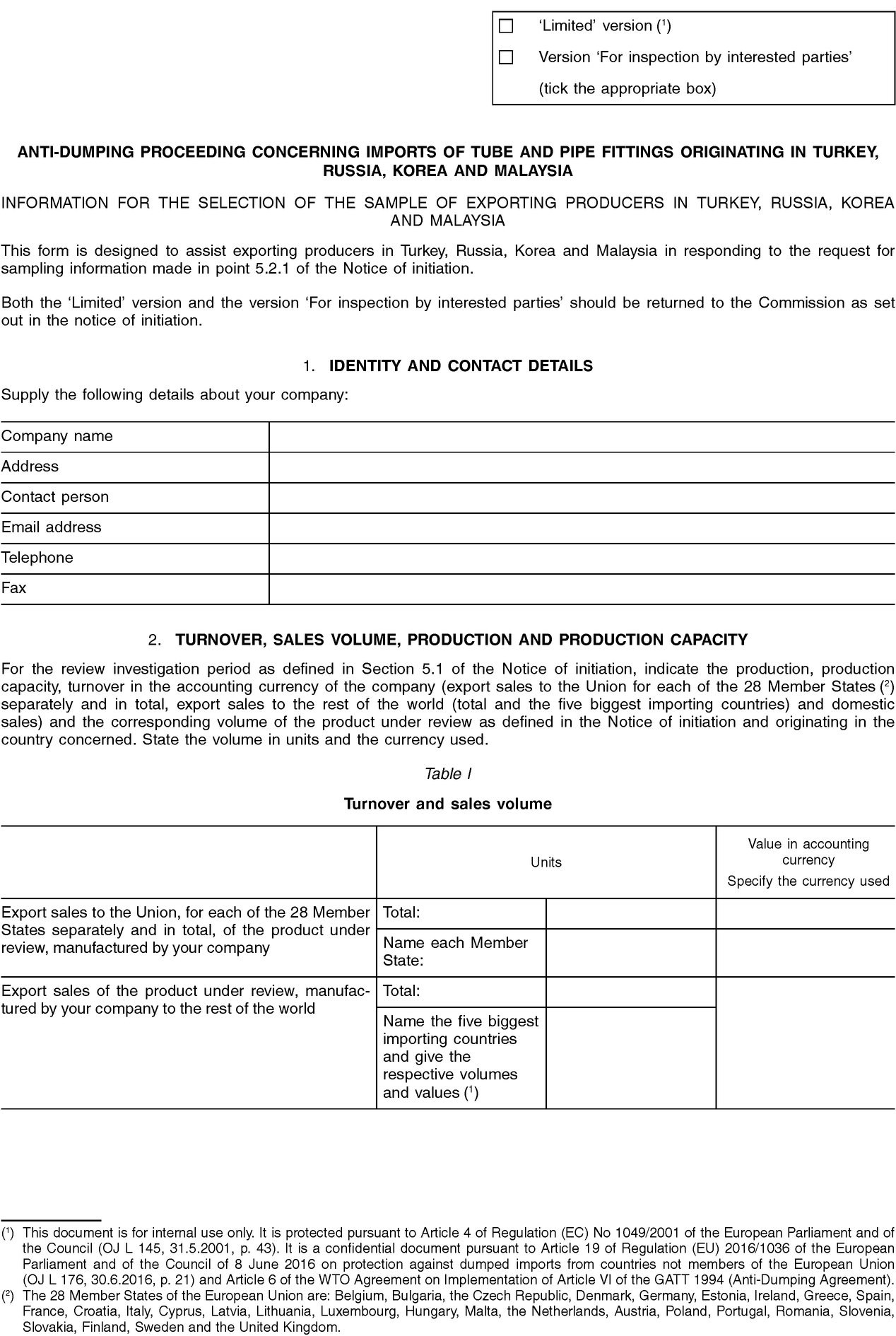
Exporting producers (7) of the product under review from the countries concerned, including those that did not cooperate in the investigations leading to the measures in force, are invited to participate in the Commission investigation.
5.2.1. Investigating exporting producers
Procedure for selecting exporting producers to be investigated in Turkey, Russia, Korea and Malaysia
In view of the potentially large number of exporting producers in the four concerned countries involved in this expiry review and in order to complete the investigation within the statutory time limits, the Commission may limit the exporting producers to be investigated to a reasonable number by selecting a sample (this process is also referred to as ‘sampling’). The sampling will be carried out in accordance with Article 17 of the basic Regulation.
In order to enable the Commission to decide whether sampling is necessary, and if so, to select a sample, all exporting producers, or representatives acting on their behalf, including the ones who did not cooperate in the investigations leading to the measures subject to the present review, are hereby requested to make themselves known to the Commission. These parties have to do so within 15 days of the date of publication of this Notice in the Official Journal of the European Union, unless otherwise specified, by providing the Commission with the information on their company(ies) requested in Annex I to this Notice.
In order to obtain the information it deems necessary for the selection of the sample of exporting producers, the Commission will also contact the authorities of the countries concerned and may contact any known associations of exporting producers.
All interested parties wishing to submit any other relevant information regarding the selection of the sample, excluding the information requested above, must do so within 21 days of the publication of this Notice in the Official Journal of the European Union, unless otherwise specified.
If a sample is necessary, the exporting producers will be selected based on the largest representative volume of production, sales or exports which can reasonably be investigated within the time available. All known exporting producers, the authorities of the countries concerned and associations of exporting producers will be notified by the Commission, via the authorities of the countries concerned if appropriate, of the companies selected to be in the sample.
In order to obtain the information it deems necessary for its investigation with regard to exporting producers, the Commission will send questionnaires to the exporting producers selected to be in the sample, to any known association of exporting producers and to the authorities of the four concerned countries.
All exporting producers selected to be in the sample will have to submit a completed questionnaire within 37 days from the date of notification of the sample selection, unless otherwise specified.
Without prejudice to the possible application of Article 18 of the basic Regulation, companies that have agreed to their possible inclusion in the sample but are not selected to be in the sample will be considered to be cooperating (‘non-sampled cooperating exporting producers’).
5.2.2. Investigating unrelated importers
Unrelated importers of the product under review from Russia, Turkey, Korea and Malaysia to the Union, including those that did not cooperate in the investigation leading to the measures in force are invited to participate in this investigation.
In view of the potentially large number of unrelated importers involved in this expiry review and in order to complete the investigation within the statutory time limits, the Commission may limit to a reasonable number the unrelated importers that will be investigated by selecting a sample (this process is also referred to as ‘sampling’). The sampling will be carried out in accordance with Article 17 of the basic Regulation.
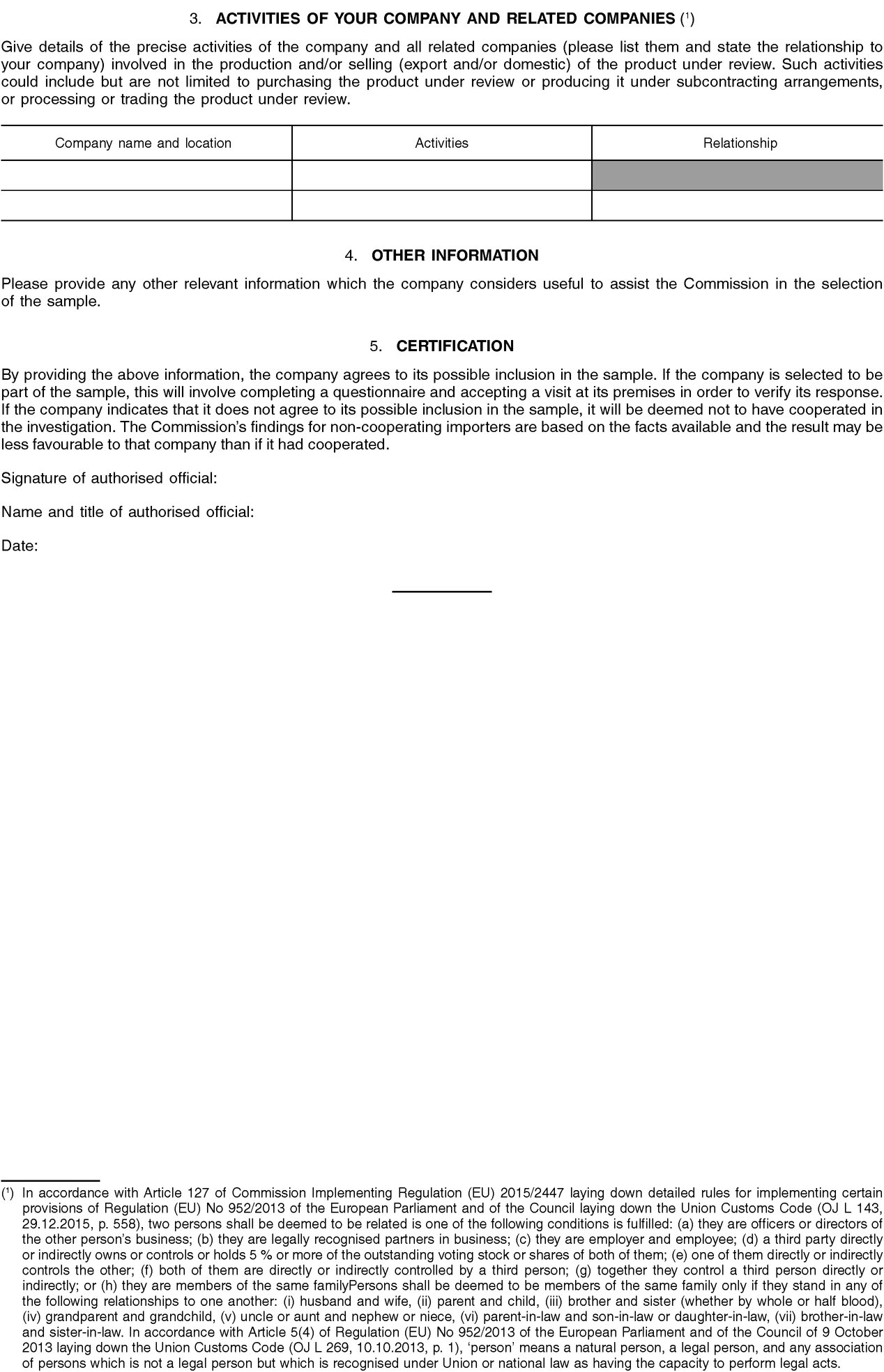
In order to enable the Commission to decide whether sampling is necessary and, if so, to select a sample, all unrelated importers, or representatives acting on their behalf, including the ones who did not cooperate in the investigation leading to the measures subject to the present review, are hereby requested to make themselves known to the Commission. These parties must do so within 15 days of the date of publication of this Notice in the Official Journal of the European Union, unless otherwise specified, by providing the Commission with the information on their companies requested in Annex II to this Notice.
In order to obtain information it deems necessary for the selection of the sample of unrelated importers, the Commission may also contact any known associations of importers.
All interested parties wishing to submit any other relevant information regarding the selection of the sample, excluding the information requested above, must do so within 21 days of the publication of this Notice in the Official Journal of the European Union, unless otherwise specified.
If a sample is necessary, the importers may be selected based on the largest representative volume of sales of the product under review in the Union which can reasonably be investigated within the time available. All known unrelated importers and associations of importers will be notified by the Commission of the companies selected to be in the sample.
In order to obtain the information it deems necessary for its investigation, the Commission will send questionnaires to the sampled unrelated importers and to any known association of importers. These parties must submit a completed questionnaire within 37 days from the date of the notification of the sample selection, unless otherwise specified.
5.3. Procedure for the determination of a likelihood of a continuation or recurrence of injury
In order to establish whether there is a likelihood of a continuation or recurrence of injury to the Union industry, Union producers of the product under review are invited to participate in the Commission investigation.
5.3.1. Investigating Union producers
In view of the large number of Union producers involved in this expiry review and in order to complete the investigation within the statutory time limits, the Commission has decided to limit the Union producers to be investigated to a reasonable number by selecting a sample (this process is also referred to as ‘sampling’). The sampling is carried out in accordance with Article 17 of the basic Regulation.
The Commission has provisionally selected a sample of Union producers. Details can be found in the file for inspection by interested parties. Interested parties are hereby invited to consult the file (for this they should contact the Commission using the contact details provided in Section 5.7 below). Other Union producers, or representatives acting on their behalf, including Union producers who did not cooperate in the investigations leading to the measures in force, that consider that there are reasons why they should be included in the sample must contact the Commission within 15 days of the date of publication of this Notice in the Official Journal of the European Union.
All interested parties wishing to submit any other relevant information regarding the selection of the sample must do so within 21 days of the publication of this Notice in the Official Journal of the European Union, unless otherwise specified.
All known Union producers and/or associations of Union producers will be notified by the Commission of the companies finally selected to be in the sample.
In order to obtain the information it deems necessary for its investigation, the Commission will send questionnaires to the sampled Union producers and to any known associations of Union producers. These parties must submit a completed questionnaire within 37 days from the date of the notification of the sample selection, unless otherwise specified.
5.4. Procedure for the assessment of Union interest
Should the likelihood of continuation or recurrence of dumping and injury be confirmed, a decision will be reached, pursuant to Article 21 of the basic Regulation, as to whether maintaining the anti-dumping measures would not be against the Union interest. Union producers, importers and their representative associations, users and their representative associations, and representative consumer organisations are invited to make themselves known within 15 days of the date of publication of this Notice in the Official Journal of the European Union, unless otherwise specified. In order to participate in the investigation, the representative consumer organisations have to demonstrate, within the same deadline, that there is an objective link between their activities and the product under review.
Parties that make themselves known within the above deadline may provide the Commission with information on the Union interest within 37 days of the date of publication of this Notice in the Official Journal of the European Union, unless otherwise specified. This information may be provided either in a free format or by completing a questionnaire prepared by the Commission. In any case, information submitted pursuant to Article 21 will only be taken into account if supported by factual evidence at the time of submission.
5.5. Other written submissions
Subject to the provisions of this Notice, all interested parties are hereby invited to make their views known, submit information and provide supporting evidence. Unless otherwise specified, this information and supporting evidence must reach the Commission within 37 days of the date of publication of this Notice in the Official Journal of the European Union.
5.6. Possibility to be heard by the Commission investigation services
All interested parties may request to be heard by the Commission investigation services. Any request to be heard must be made in writing and must specify the reasons for the request. For hearings on issues pertaining to the initial stage of the investigation the request must be submitted within 15 days of the date of publication of this Notice in the Official Journal of the European Union. Thereafter, a request to be heard must be submitted within the specific deadlines set by the Commission in its communication with the parties.
5.7. Instructions for making written submissions and sending completed questionnaires and correspondence
Information submitted to the Commission for the purpose of trade defence investigations shall be free from copyrights. Interested parties, before submitting to the Commission information and/or data which is subject to third party copyrights, must request specific permission to the copyright holder explicitly allowing (a) the Commission to use the information and data for the purpose of this trade defence proceeding; and (b) to provide the information and/or data to interested parties to this investigation in a form that allows them to exercise their rights of defence.
All written submissions, including the information requested in this Notice, completed questionnaires and correspondence provided by interested parties for which confidential treatment is requested shall be labelled ‘Limited’ (8). Parties submitting information in the course of this investigation are invited to reason their request for confidential treatment.
Parties providing ‘Limited’ information are required to furnish non-confidential summaries of it pursuant to Article 19(2) of the basic Regulation, which will be labelled ‘For inspection by interested parties’. These summaries must be sufficiently detailed to permit a reasonable understanding of the substance of the information submitted in confidence.
If a party providing confidential information fails to show good cause for a confidential treatment request or does not furnish a non-confidential summary of it in the requested format and quality, the Commission may disregard such information unless it can be satisfactorily demonstrated from appropriate sources that the information is correct.
Interested parties are invited to make all submissions and requests by email including scanned powers of attorney and certification sheets, with the exception of voluminous replies which shall be submitted on a CD-ROM or DVD by hand or by registered mail. By using email, interested parties express their agreement with the rules applicable to electronic submissions contained in the document ‘CORRESPONDENCE WITH THE EUROPEAN COMMISSION IN TRADE DEFENCE CASES’ published on the website of the Directorate-General for Trade: http://trade.ec.europa.eu/doclib/docs/2011/june/tradoc_148003.pdf The interested parties must indicate their name, address, telephone and a valid email address and they should ensure that the provided email address is a functioning official business email which is checked on a daily basis. Once contact details are provided, the Commission will communicate with interested parties by email only, unless they explicitly request to receive all documents from the Commission by another means of communication or unless the nature of the document to be sent requires the use of a registered mail. For further rules and information concerning correspondence with the Commission including principles that apply to submissions by email, interested parties should consult the communication instructions with interested parties referred to above.
Commission address for correspondence:
|
European Commission |
|||
|
Directorate-General for Trade |
|||
|
Directorate H |
|||
|
Office: CHAR 04/039 |
|||
|
1049 Bruxelles/Brussel |
|||
|
BELGIQUE/BELGIË |
|||
|
6. Non-cooperation
In cases where any interested party refuses access to or does not provide the necessary information within the time limits, or significantly impedes the investigation, findings, affirmative or negative, may be made on the basis of facts available, in accordance with Article 18 of the basic Regulation.
Where it is found that any interested party has supplied false or misleading information, the information may be disregarded and use may be made of facts available.
If an interested party does not cooperate or cooperates only partially and findings are therefore based on facts available in accordance with Article 18 of the basic Regulation, the result may be less favourable to that party than if it had cooperated.
Failure to give a computerised response shall not be deemed to constitute non-cooperation, provided that the interested party shows that presenting the response as requested would result in an unreasonable extra burden or unreasonable additional cost. The interested party should immediately contact the Commission.
7. Hearing Officer
Interested parties may request the intervention of the Hearing Officer in trade proceedings. The Hearing Officer acts as an interface between the interested parties and the Commission investigation services. The Hearing Officer reviews requests for access to the file, disputes regarding the confidentiality of documents, requests for extension of time limits and requests by third parties to be heard. The Hearing Officer may organise a hearing with an individual interested party and mediate to ensure that the interested parties’ rights of defence are being fully exercised.
A request for a hearing with the Hearing Officer should be made in writing and should specify the reasons for the request. For hearings on issues pertaining to the initial stage of the investigation the request must be submitted within 15 days of the date of publication of this Notice in the Official Journal of the European Union. Thereafter, a request to be heard must be submitted within specific deadlines set by the Commission in its communication with the parties.
For further information and contact details interested parties may consult the Hearing Officer’s web pages on DG Trade’s website: http://ec.europa.eu/trade/trade-policy-and-you/contacts/hearing-officer/
8. Schedule of the investigation
The investigation will be concluded, pursuant to Article 11(5) of the basic Regulation within 15 months of the date of the publication of this Notice in the Official Journal of the European Union.
9. Possibility to request a review under Article 11(3) of the basic Regulation
As this expiry review is initiated in accordance with the provisions of Article 11(2) of the basic Regulation, the findings thereof will not lead to the existing measures being amended but will lead to those measures being repealed or maintained in accordance with Article 11(6) of the basic Regulation.
If any interested party considers that a review of the measures is warranted so as to allow for the possibility to amend the measures, that party may request a review pursuant to Article 11(3) of the basic Regulation.
Parties wishing to request such a review, which would be carried out independently of the expiry review mentioned in this Notice, may contact the Commission at the address given above.
10. Processing of personal data
Any personal data collected in this investigation will be treated in accordance with Regulation (EC) No 45/2001 of the European Parliament and of the Council (9).
(1) OJ C 466, 14.12.2016, p. 20.
(2) OJ L 176, 30.6.2016, p. 21.
(3) Commission Implementing Regulation (EU) No 1283/2014 of 2 December 2014 imposing a definitive anti-dumping duty on imports of certain tube and pipe fittings, of iron or steel, originating in the Republic of Korea and Malaysia following an expiry review pursuant to Article 11(2) of Council Regulation (EC) No 1225/2009 (OJ L 347, 3.12.2014, p. 17).
(4) Commission Implementing Regulation (EU) 2016/306 of 3 March 2016 amending Implementing Regulation (EU) No 1283/2014 imposing a definitive anti-dumping duty on imports of certain tube and pipe fittings, of iron or steel, originating in the Republic of Korea and Malaysia following an interim review pursuant to Article 11(3) of Council Regulation (EC) No 1225/2009 (OJ L 58, 4.3.2016, p. 38).
(5) Council Implementing Regulation (EU) No 78/2013 of 17 January 2013 imposing a definitive anti-dumping duty and collecting definitely the provisional duty imposed on imports of certain tube and pipe fittings of iron or steel originating in Russia and Turkey (OJ L 27, 29.1.2013, p. 1).
(6) OJ L 282, 28.10.2015, p. 14.
(7) An exporting producer is any company in the country concerned which produces and exports the product under review to the Union market, either directly or via third party, including any of its related companies involved in the production, domestic sales or exports of the product under review.
(8) A ‘Limited’ document is a document which is considered confidential pursuant to Article 19 of the basic Regulation and Article 6 of the WTO Agreement on Implementation of Article VI of the GATT 1994 (Anti-Dumping Agreement). It is also a document protected pursuant to Article 4 of Regulation (EC) No 1049/2001 of the European Parliament and of the Council (OJ L 145, 31.5.2001, p. 43).
(9) Regulation (EC) No 45/2001 of the European Parliament and of the Council of 18 December 2000 on the protection of individuals with regard to the processing of personal data by the Community institutions and bodies and on the free movement of such data (OJ L 8, 12.1.2001, p. 1).
OTHER ACTS
European Commission
|
27.1.2018 |
EN |
Official Journal of the European Union |
C 31/26 |
INFORMATION NOTICE — PUBLIC CONSULTATION
Geographical indications from the Swiss Confederation
(2018/C 31/09)
The Agreement between the EU and the Swiss Confederation on trade in agricultural products (1) entered into force in 2002. Annex 7 to the Agreement concerns trade in wine-sector products. This Annex foresees the protection of designations of origin and geographical indications of both parties.
The two parties are in the process of updating the list of denominations protected pursuant to this Annex. In this context, the protection in the European Union, as geographical indications, of the following names of the Swiss Confederation is under consideration:
|
— |
Aargau |
|
— |
Appenzell Ausserrhoden |
|
— |
Calamin |
|
— |
Dézaley |
|
— |
Dézaley-Marsens |
|
— |
Jura |
The Commission invites any Member State or third country or any natural or legal person having a legitimate interest, resident or established in a Member State or in a third country, to submit opposition to such protection by lodging a duly substantiated statement.
Statements of opposition must reach the Commission within two months of the date of this publication. Statements of opposition should be sent to the following email address:
AGRI-A5-GI@ec.europa.eu
Statements of opposition shall be examined only if they are received within the time limit set out above and if they show that the protection of the name proposed would:
|
(a) |
conflict with the name of a plant variety or an animal breed and as a result is likely to mislead the consumer as to the true origin of the product; |
|
(b) |
be wholly or partially homonymous with that of a name already protected in the Union under Regulation (EU) No 1151/2012 of the European Parliament and of the Council of 21 November 2012 on quality schemes for agricultural products and foodstuffs (2), Regulation (EU) No 1308/2013 of the European Parliament and of the Council of 17 December 2013 establishing a common organisation of the markets in agricultural products (3) and Regulation (EC) No 110/2008 of the European Parliament and of the Council of 15 January 2008 on the definition, description, presentation, labelling and the protection of geographical indications of spirit drinks (4), or contained in the agreements the Union has concluded with the following countries:
|
|
(c) |
in the light of a trade mark's reputation and renown and the length of time it has been used, be liable to mislead the consumer as to the true identity of the product; |
|
(d) |
jeopardise the existence of an entirely or partly identical name or of a trade mark or the existence of products which have been legally on the market for at least five years preceding the date of the publication of this notice; |
|
(e) |
or if they can give details from which it can be concluded that the name for which protection is considered is generic. |
The criteria referred to above shall be evaluated in relation to the territory of the Union, which in the case of intellectual property rights refers only to the territory or territories where the said rights are protected. The possible protection of these names in the European Union is subject to the successful conclusion of these negotiations and subsequent legal act.
(1) OJ L 114, 30.4.2002, p. 132.
(2) OJ L 343, 14.12.2012, p. 1.
(3) OJ L 347, 20.12.2013, p. 671.
(4) OJ L 39, 13.2.2008, p. 16.
(5) Council Decision 2009/49/EC of 28 November 2008 concerning the conclusion of an Agreement between the European Community and Australia on trade in wine (OJ L 28, 30.1.2009, p. 1).
(6) Council Decision 2002/979/EC of 18 November 2002 on the signature and provisional application of certain provisions of an Agreement establishing an association between the European Community and its Member States, of the one part, and the Republic of Chile, of the other part (OJ L 352, 30.12.2002, p. 1).
(7) Council Decision (EU) 2016/1623 of 1 June 2016 on the signing, on behalf of the European Union and provisional application of the Economic Partnership Agreement between the European Union and its Member States, of the one part, and the SADC EPA States, of the other part (OJ L 250, 16.9.2016, p. 1).
(8) Council Decision 97/361/EC of 27 May 1997 concerning the conclusion of an Agreement between the European Community and the United Mexican States on the mutual recognition and protection of designations for spirit drinks (OJ L 152, 11.6.1997, p. 15).
(9) Council Decision 2011/265/EU of 16 September 2010 on the signing, on behalf of the European Union, and provisional application of the Free Trade Agreement between the European Union and its Member States, of the one part, and the Republic of Korea, of the other part (OJ L 127, 14.5.2011, p. 1).
(10) Agreement establishing an Association between the European Union and its Member States, on the one hand, and Central America on the other (OJ L 346, 15.12.2012, p. 3).
(11) Trade Agreement between the European Union and its Member States, of the one part, and Colombia and Peru, of the other part (OJ L 354, 21.12.2012, p. 3) and Protocol of Accession to the Trade Agreement between the European Union and its Member States, of the one part, and Colombia and Peru, of the other part, to take account of the accession of Ecuador, (OJ L 356, 24.12.2016, p. 3).
(12) Council Decision 2001/916/EC of 3 December 2001 on the conclusion of an Additional Protocol adjusting the trade aspects of the Stabilisation and Association Agreement between the European Community and their Member States, of the one part, and the former Yugoslav Republic of Macedonia, of the other part, to take account of the outcome of the negotiations between the parties on reciprocal preferential concessions for certain wines, the reciprocal recognition, protection and control of wine names and the reciprocal recognition, protection and control of designations for spirits and aromatised drinks (OJ L 342, 27.12.2001, p. 6).
(13) Council Decision 2004/91/EC of 30 July 2003 on the conclusion of the Agreement between the European Community and Canada on trade in wines and spirit drinks (OJ L 35, 6.2.2004, p. 1).
(14) Council Decision 2006/232/EC of 20 December 2005 on the conclusion of the Agreement between the European Community and the United States of America on trade in wine (OJ L 87, 24.3.2006, p. 1).
(15) Council Decision 2006/580/EC of 12 June 2006 concerning the signing and conclusion of the Interim Agreement on trade and trade-related matters between the European Community, of the one part, and the Republic of Albania, of the other part — Protocol 3 on reciprocal preferential concessions for certain wines, the reciprocal recognition, protection and control of wine, spirit drinks and aromatised wine names (OJ L 239, 1.9.2006, p. 1).
(16) Council Decision 2007/855/EC of 15 October 2007 concerning the signing and conclusion of the Interim Agreement on trade and trade-related matters between the European Community, of the one part, and the Republic of Montenegro, of the other part (OJ L 345, 28.12.2007, p. 1).
(17) Council Decision 2008/474/EC of 16 June 2008 on the signing and conclusion of the Interim Agreement on trade and trade-related matters between the European Community, of the one part, and Bosnia and Herzegovina, of the other part — Protocol 6 (OJ L 169, 30.6.2008, p. 10).
(18) Council Decision 2010/36/EC of 29 April 2008 concerning the signing and conclusion of the Interim Agreement on trade and trade-related matters between the European Community, of the one part, and the Republic of Serbia, of the other part (OJ L 28, 30.1.2010, p. 1).
(19) Council Decision 2013/7/EU of 3 December 2012 on the conclusion of the Agreement between the European Union and the Republic of Moldova on the protection of geographical indications of agricultural products and foodstuffs (OJ L 10, 15.1.2013, p. 1).
(20) Association Agreement between the European Union and its Member States, of the one part, and Ukraine, of the other part (OJ L 161, 29.5.2014, p. 3).
(21) Council Decision 2012/164/EU of 14 February 2012 on the conclusion of the Agreement between the European Union and Georgia on the protection of geographical indications of agricultural products and foodstuffs (OJ L 93, 30.3.2012, p. 1).