Table of contents
1Introduction
1.1
Purpose and scope of the evaluation
2What was the expected outcome of the intervention?
2.1
Description of the intervention and its objectives
2.2
Point(s) of comparison
3How has the situation evolved over the evaluation period?
4Evaluation findings
4.1
To what extent was the intervention successful and why?
4.1.1
Effectiveness
4.1.2
Efficiency
4.1.3
Coherence
4.2
How did the EU intervention make a difference and to whom?
4.3
Is the intervention still relevant?
4.3.1
Scope
4.3.2
Procedural aspects
4.3.3
Market access
4.3.4
Strategic objectives
4.3.5
Governance
4.3.6
Conclusions - Relevance
5What are the conclusions and lessons learned?
5.1
Overall conclusions
5.2
Lessons learned
Annex IProcedural Information
Annex IIMethodology
Annex IIIEvaluation matrix and answers to the evaluation questions
Annex IVOverview of benefits and costs
Annex VStakeholders’ consultation
Annex VISupplementary information and data
Annex VIIECJ case law
Annex VIIIBibliography
Glossary
|
Term or acronym
|
Meaning or definition
|
|
BRT
|
Better Regulation Toolbox
|
|
CfE
|
Call for Evidence
|
|
CPV
|
Common Procurement Vocabulary as set out in Regulation (EC) No 2195/2002.
|
|
CRI
|
Corruption Risk Index
|
|
Directives, the
|
The EU public procurement Directives 2014/23/EU, 2014/24/EU and 2014/25/EU
|
|
DPS
|
Dynamic Purchasing System(s)
|
|
ECA
|
European Court of Auditors
|
|
ECJ
|
European Court of Justice
|
|
EEA
|
European Economic Area
|
|
ESPD
|
European Single Procurement Document
|
|
GPA
|
WTO Government Procurement Agreement
|
|
GPP
|
Green Public Procurement
|
|
IP
|
Innovation partnership
|
|
IT
|
Information technology
|
|
LRAs
|
Local and regional authorities
|
|
MEAT
|
Most economically advantageous tender (as defined in Article 67 of Directive 2014/24/EU)
|
|
MS
|
Member States
|
|
OPC
|
Open Public Consultation
|
|
PPDS
|
Public Procurement Data Space
|
|
PPI
|
Public procurement of innovation
|
|
SDGs
|
Sustainable development goals
|
|
SMEs
|
Small and medium enterprises
|
|
SPP
|
Sustainable public procurement (includes green and social)
|
|
SRPP
|
Socially responsible public procurement
|
|
TED
|
Tenders electronic daily - Supplement to the Official Journal of the EU
|
|
Triennial reporting / reports
|
Reporting under Article 45 of Directive 2014/23/EU, Articles 83 and 85 of Directive 2014/24/EU and Articles 99 and 101 of Directive 2014/25/EU
|
|
Utilities
|
Water, energy, transport and postal services sectors or entities operating in these fields.
|
Country codes used in the text:
AT - Austria
BE - Belgium
BG - Bulgaria
DE - Germany
DK - Denmark
CY - Cyprus
CZ - Czechia
EE – Estonia
FI - Finland
FR- France
EL - Greece
HR - Croatia
HU - Hungary
IE - Ireland
IT - Italy
LV - Latvia
LT - Lithuania
LU - Luxembourg
MT - Malta
NL – Netherlands, the
PL - Poland
PT - Portugal
RO - Romania
SK - Slovakia
SI – Slovenia
ES - Spain
SE - Sweden
IS – Iceland
LI – Liechtenstein
NO – Norway
1Introduction
With public authorities in the EU spending around 15% of GDP a year on public procurement, rules on the procurement of goods, services and works are key for ensuring public funds are invested efficiently while preventing corruption and anti-competitive practices. This is why European Commission President von der Leyen has announced a revision of the EU public procurement rules, emphasising the strategic importance of public procurement and announcing the introduction of made in Europe criteria for certain strategic sectors. Executive Vice-President Séjourné additionally underlined the enormous potential of public procurement as part of the European investment strategy to boost EU competitiveness, resilience and economic security.
EU law sets out minimum harmonised public procurement rules to create a fair, transparent and competitive single market for businesses and to improve the efficiency and integrity of public spending, providing better value for public money. These rules govern the way contracting authorities and entities purchase goods, works and services. The rules are transposed into national legislation and apply to tenders whose monetary value exceeds agreed thresholds. For tenders of lower value, national rules complying with the general principles of EU law apply.
The procurement of goods, services and works by public authorities in the EU amounts to around EUR 2.6 trillion (
Table
83
, p. ), representing roughly 15% of GDP and up by around 1% compared with the pre-COVID period. In many sectors such as energy, transport, waste management, social protection and the provision of healthcare or education services, public authorities are the main buyers. Around one quarter of the total procurement value is subject to EU rules and published on the EU Tenders Electronic Daily (TED)
. Between 2018 and 2023, an average of 44 000 contracting authorities in the Member States (
Figure
78
, p. ) published on TED approximately 198 000 contract award notices each year of an average annual value of EUR 616 billion of public contracts awarded to nearly 155 000 companies annually (
Figure
79
, p. ). The value of procurement contracts published on TED more than doubled over the last decade (in real terms, adjusted for inflation).
Given the significant volume of public investments, Enrico Letta in his March 2024 report on the future of the Single Market called for better leveraging of public procurement practices and the simplification of processes to support the European Industrial Market. Subsequently, in his report on EU competitiveness, Mario Draghi highlighted the need to use European public resources strategically to achieve the key policy objectives of competitiveness, strategic autonomy, resilience and sustainability.
1.1Purpose and scope of the evaluation
This evaluation aims to assess the effects of the Directives adopted by the European Parliament and the Council in 2014 on public procurement between approximately 2016 and 2024. The evaluation covers Directive 2014/24/EU on public procurement [“Classical”]; Directive 2014/23/EU on the award of concession contracts [“Concessions”]; and Directive 2014/25/EU on procurement by entities operating in the water, energy, transport, and postal services sectors [“Utilities”], hereafter referred to as a whole as “the Directives” or “the 2014 Directives”.
In a special report on public procurement in the EU, the European Court of Auditors (ECA) in 2023 underlined that the tools the Directives offer have not been made the most of to achieve their objectives and boost competition. Analysing several indicators based on EU TED data (e.g. the share of single bidding, the number of direct awards, the number of cross-border bids), the ECA concluded that competition on the EU public procurement markets had decreased in the 2011-2021 period.
The EU Council subsequently underlined the need to avoid an unnecessary administrative burden for public buyers and economic operators, including small and medium enterprises (SME), and considered in this respect that the complexity of the legislation relating to public procurement may deter economic operators from taking part in public procurement. The Council asked the Commission to carry out an in-depth analysis of the existing framework and to examine the root causes behind the decrease of competition in the EU public procurement market.
The European Parliament in 2025 adopted an own initiative report on Public Procurement, calling upon the Commission to simplify the current framework, reducing bureaucracy and regulatory burdens, while maintaining high social and environmental standards and boosting EU competitiveness.
2What was the expected outcome of the intervention?
The 2014 Directives (i.e. the intervention subject to this evaluation) aimed to simplify procurement procedures, provide flexibility for contracting authorities, promote fair access for all economic operators, including SMEs, and secure the best value for money in public procurement by improving transparency, integrity, and legal certainty. The resulting EU rules aimed at improving environmental sustainability, social inclusion, and innovation, all underpinned by a strong focus on efficiency and competition. Promoting the use of digital tools and transitioning to full eProcurement were considered key for making the tendering process faster, more transparent, and less burdensome.
2.1Description of the intervention and its objectives
The Impact Assessment of 2011 accompanying the legislative proposal identified the following problems behind the intervention logic:
·Disproportionate procedures defined in EU rules, which generating excess costs (especially for smaller contracts), with significant differences across Member States in the time procurement took.
·Complex EU rules defining scope and coverage, which generate uncertainty, lead to risk-averse and 'box-ticking' behaviour by public purchasers to the detriment of the quality of procurement outcomes.
·Emergence of different models and fragmented national procurement administration and resource dispersion, resulting in inconsistent application, control and monitoring across the EU.
·Incorrect application of public procurement rules and, in some instances, the incorrect transposition of the Directives into national legislation.
The rationale for EU intervention was based on a fundamental need to enable the single market to realise its full potential. The general objectives were:
·to give economic operators fair access and encourage cross-border competition;
·to ensure the best value for money;
·to achieve optimal societal outcomes;
·to support the fight against corruption.
These objectives were translated into specific and operational objectives:
·comprehensive rules on scope and coverage;
·simplified and clarified procedures;
·the promotion of strategic public procurement;
·the facilitation of transparent market access, in particular for SMEs; and
·administrative organisation and governance (see
Figure
1
overleaf).
The intervention was supported by inputs in the form of substantial financial, human and institutional resources, engaged both at EU level and in the form of contributions from Member States. This has led, on the one hand, to the adoption, transposition and effective implementation of these rules (activities); and, on the other hand, to the development of new national public procurement rules, as well as better coordination, reporting and monitoring activities (results).
The expected results included greater clarity and certainty for stakeholders, more efficient and flexible procurement procedures, better alignment of public procurement with EU strategic priorities, greater market openness and more competition, in particular cross-border competition, as well as strengthened administrative governance and greater integrity. In the long term, the expected impact was an integrated and efficient European public procurement market, delivering added value and greater accountability, while remaining resilient to external challenges and changing policy priorities.
Figure 1: Intervention logic

2.2Point(s) of comparison
The main point of comparison for assessing the intervention in this evaluation is the state of the public procurement market before the existing legislative framework entered into application in 2016 (noting that some Member States were late transposing the Directives). For selected elements, the time frame may be adjusted: extended to covering long-term phenomena or shortened due to data limitations. Overall, the evaluation covers the period between 2016 and 2024. Given the importance of the ECA (2023) report, this evaluation will also make frequent reference to the findings made by the EU’s independent external auditor.
3How has the situation evolved over the evaluation period?
The Directives were adopted on 26 February 2014, with a transposition deadline into national legislation of 18 April 2016. All Member States have since transposed these Directives, with the last transposition taking place in early 2020 (the exact transposition dates per Member State, are provided in
Table
85
, p. 196). Member States transposed the Directives in a number of ways: some use one legal instrument for Classical and Utilities, others separate instruments per Directive, and some adopt a unified approach to all areas, including concessions. Beyond the scope of the Directives', Member States have discretion, resulting in varying approaches to below-threshold procurement.
The Commission has monitored Member States’ compliance with the Directives, assessing both transposition and conformity. During the compliance checks, it identified shortcomings in the following areas: scope, modification of contracts, exclusion criteria, procedures, award criteria, and subcontracting. The Commission launched infringement procedures against several Member States for either non-transposition or non-conformity issues. These concerned primarily the award of contracts without proper EU-level procedures and the modification of contracts. Monitoring has also highlighted instances of incorrect application, with the Council adopting 31 country-specific recommendations under the European Semester between 2017-2024 to address the matter. The Commission has particularly paid attention to the monitoring of procurement funded by EU funds, through the ex-ante conditionality (applicable until 2021) and the current horizontal enabling conditionality under the Conditionality Regulation.
From 2016 to March 2025, the European Court of Justice (ECJ) issued 107 judgments on public procurement, primarily relating to Directive 2014/24/EU. Common issues include exclusion grounds, subcontracting, contract modifications, and concessions.
During the period assessed, several new legislative acts adopted by the European Parliament and the Council introduced new public procurement provisions. As a result, public procurement is now regulated not only by the 2014 Directives, but also by over 50 different and often sector-specific EU legal acts (
Table
101
, p. 252) covering a wide range of topics, such as new guiding principles for public procurement, exclusion grounds, international aspects of procurement, and resilience or social criteria.
4Evaluation findings
4.1To what extent was the intervention successful and why?
This evaluation assesses the effectiveness, efficiency, relevance, coherence and EU added value of the Directives in line with the methodology set out in the Better Regulation Guidelines and Better Regulation Toolbox (BRT). As noted in Section 2.2, for certain elements, the time frame may be adjusted - extended to capture longer-term phenomena for comparative purposes or shortened when constrained by data limitations. The methodology applied, as well as sources used, are detailed in Annex II.
4.1.1Effectiveness
This section assesses the extent to which the 2014 Directives have been effective in achieving their stated objectives. The structure of this section mirrors the key problem blocks identified in the Impact Assessment of 2011 that accompanied the legislative proposal and focuses on scope, procedural aspects, market access, strategic objectives and governance. Each of these aspects pursued different objectives. With regards to scope and procedural aspects, the Directives aimed at achieving greater legal certainty. Market access, strategic procurement and governance were objectives by themselves.
4.1.1.1Scope
The Directives sought to clarify the scope of EU procurement rules above certain thresholds by providing greater clarity and legal certainty in relation to i) the actors covered; and ii) the subject matter.
In the open public consultation (hereafter: the “OPC”), stakeholders expressed mixed views on whether the Directives enhanced legal certainty in procurement procedures, with 38.4% (266 replies) agreeing and 35.9% (248 replies) disagreeing (
Figure
13
, p. 112). However, 45.4% of companies replying to the survey agreed that the Directives gave greater legal certainty on the compliance with procurement procedures (59 replies). When asked whether the scope of the applicable rules became clearer, stakeholders' views were divided: 41.1% responded positively (284 replies), while nearly 36.9% (255 replies) disagreed. Companies predominantly indicated their agreement (47.3%, 62 replies), compared to 27.5% that disagreed (36 replies). For public authorities, 71 contributions (36%) considered that clarity had improved, while 91 (46.2%) took the opposite view (
Figure
4
and
Table
8
, p. 104). Finally, when asked whether the Directives have led to a more consistent application of public procurement policy across EU countries, nearly half of OPC respondents (45%, 304 replies) had no opinion. Among those expressing a view, a greater share agreed (30.1%, 203 replies) than disagreed (24.9%, 168 replies). In particular, all but one reply from trade unions (51 responses) indicated a negative view about the consistency of application of the rules. Companies and business associations provided predominantly positive feedback, though not by a large margin (
Figure
53
and
Table
57
, p. 162).
However, it should be noted that the Directives do not stand on their own - they are transposed into a national procurement system with oftentimes additional procedural steps regarding e.g. the preparation of the tender or the composition of an evaluation committee. The long times required for the transposition of the Directives, with multiple delays across Member States hints at a complex public procurement system.
4.1.1.1.1Rules on appropriate actors
To improve legal certainty and clarity the 2014 Directives codified existing case-law on the actors covered and provided new streamlined definitions of contracting authorities and entities. The objective was to address “grey zones” that existed with regard to the actors subject to public procurement and difficulties for contracting authorities to determine their classification (contracting authority, public undertaking, body governed by public law, etc.), both identified in the evaluation of the previous procurement Directives dating back to 2004.
Ensuring legal certainty when determining who is subject to public procurement (in the case of contracting authorities) or who has access to procurement contracts (for economic operators) is key for a level playing field and the use of public procurement as an investment instrument. Yet, Member States’ reporting under Article 45 of Directive 2014/23/EU, Articles 83 and 85 of Directive 2014/24/EU and Articles 99 and 101 of Directive 2014/25/EU (hereafter: “Triennial reporting”) frequently identified some of the new provisions introduced by the Directives as unclear or problematic. These new provisions included public contracts between entities within the public sector, exclusion grounds, reliance on the capacities of other entities and, abnormally low tenders
. Furthermore, in another consultation carried out in 2025 with Member States’ first instance review bodies
, they indicated that the different scopes of application of the Directives are not always clearly understood in practice, with the definitions of contracting authority and contracting entity still posing difficulties in their application.
In addition, several contributions to the OPC and the Call for Evidence (hereafter: “CfE”) both from economic operators and contracting authorities point to recurring difficulties in determining the correct legal framework, with instances of misapplication of Directives and legal disputes over applicable rules
. Review bodies and contracting authorities also highlighted inconsistencies in the interpretation of key definitions - such as “public contract”, “central government authority”, and “body governed by public law”- and noted that differences in national and EU legal terminology further complicate implementation.
Moreover, additional evidence gathered through the evaluated period have emphasized
the need for clarity of the Directives in relation to the access of third country economic operators without secured access to EU public procurement markets. While the Directives do not guarantee access to economic operators from countries with whom the EU does not have a reciprocal agreement, contracting authorities often face uncertainty as to how to determine the origin of the economic operator. These difficulties are exacerbated when it comes to determining the origins of the products or services in the tender. Despite Directive 2014/25/EU including the possibility to limit the countries from which the goods and services come from, consultations with both contracting authorities and economic operators reveal that this possibility is rarely used, with complexity and the need to have specialised knowledge of customs legislation often cited as main burdens.
The considerations above show that when it comes to determine who is subject to public procurement rules and in which situations, issues over legal certainty and clarity regarding the interplay of the different Directives persist. This is confirmed by the continuous and frequent interpretation of the topics highlighted above by the ECJ with more than 100 cases related to the interpretation of the Directives and multiple infringement cases opened against Member States.
4.1.1.1.2Subject-matter of procurement
With regard to the subject-matter of procurement, the 2014 Directives aimed to address the lack of legal certainty as to which activities are covered by EU public procurement rules, while maintaining the division between Classical and Utilities introduced in the 2004 reform (Directive 2014/24/EU and Directive 2014/25/EU, respectively). To that purpose, the Directives introduced i) new rules on public-public cooperation; ii) a new regime for social services (simplifying the pre-existing division under Directive 2004/18/EC); iii) improved rules to opt-out from utilities provisions; and iv) new rules on concessions. In addition, the Directives introduced new concepts—such as those on exclusion grounds, in-house awards, contract modifications or conditions governing the execution of the contract.
To provide contracting authorities with sufficient legal certainty to adapt to different national legal traditions, the Directives introduced a significant number of optional provisions allowing Member States and contracting authorities to tailor the Directives to their national needs. Directive 2014/23/EU lays down 25 optional provisions, Directive 2014/24/EU 48 optional provisions, and Directive 2014/25/EU 42 such provisions. The implementation of these options varies significantly by Member State and topic.
To clarify the exemptions on public-public cooperation, the Directives incorporated in the legal framework certain aspects arising from the case law pertaining vertical and horizontal cooperation between public authorities. The modifications aimed to clarify in which cases contracts concluded within the public sector are excluded from the application of public procurement rules, while preventing a distortion on competition.
During consultations with Local and Regional Authorities, public-public cooperation was often mentioned as an area of concern. Provisions in the Directive were aimed at providing contracting authorities with sufficient flexibility to deliver the services needed to their citizens, yet oftentimes contracting authorities - particular those of smaller size- found the current provisions not certain enough and not matching their needs. When needing to have recourse to public-public cooperation, contracting authorities often reported lack of legal certainty with regards to the feasibility to use the regime, citing among others difficulties in determining the level of control over an entity or quantifying the activities performed in the open market. In addition, recent case law has raised concerns regarding the compatibility of in-house arrangements when it comes to e.g. competition law, i.e. Irgita.
In addition, lack of proper application of public-public cooperation rules is an issue often detected by Commission’s auditors, when examining the application of public procurement rules to projects financed by EU cohesion policy funds.
The above shows that with regards to public-public cooperation, the Directives did not achieve the intended level of clarity and legal certainty.
For contracts related to social and other specific services, the Directives merged Annexes A and B of Directive 2004/18/EC to create a new “light regime”. The goal of this revision was to offer greater legal certainty to contracting authorities, while ensuring flexibility to adapt to different national legal traditions. The light regime allows contracting authorities to procure social and other specific services more flexibly and to reserve the participation of contracts to certain types of organisations. Moreover, the Directives’ rules are applicable only above a threshold that is significantly higher than for regular public procurement contracts.
When comparing the total number of calls for competition published on TED concerning social and other specific services with those where the light regime was used, nearly four out of five of the contract award notices potentially falling under the light regime were subject to the general rules in the Directives instead. In addition, the possibility to reserve the participation to the contract has only been used 70 times between 2016 and 2022.
An analysis of 100 out of 357 contracts published between 2017-2020 revealed a lack of clarity as to how the light regime is to be used, with 44 contracts applying the light regime to the wrong Common Procurement Vocabulary (CPV) code, 49 contracts applying the light regime wrongly to correct CPV codes and only 7 contracts applying correctly the light regime to the appropriate CPV codes. This analysis, albeit small, illustrates that the intended objective of providing a clear regime for social services has not been achieved.
Beyond a lack of clarity, the reasons for the low uptake of the light regime may be either a lack of added value for an additional regime running in parallel to a wide range of other procedures (see Section 4.1.1.2.1), and/or relate to the professional capacities of contracting authorities (see Section 4.1.1.5.3).
The Utilities Directive in its Article 34 provides for a mechanism to exclude certain activities from the scope of the public procurement rules if they are directly exposed to competition on markets to which access is not restricted. The Directive allows Member States, or contracting entities directly, to request the Commission to confirm that the Directive does not apply to the award of contracts for a specific activity. In practice, most requests for derogations concern the postal and energy sectors.
The revision of Article 34 of Directive 2014/25/EU aimed to clarify the objective criteria to determine when an activity is subject to competition, and in particular the notion of “relevant geographical markets”. The clarification efforts have been seemingly successful to the extent that no major negative feedback from stakeholders have been gathered during the consultation exercise. Nonetheless, the exemption process itself can be legally complex and time-consuming for the utilities operator that requests the Commission to confirm that the Directive does not apply to the award of contracts for a specific activity. Finally, differences in market conditions across Member States may lead to regulatory fragmentation across similar sectors.
Concession contracts differ from standard public contracts because they are usually high-value, complex, and involve the transfer of an operating risk. This complexity justifies a more flexible set of rules for awarding them. Directive 2014/23/EU on the award of concession contracts was adopted to address the absence of a coherent, all-encompassing EU-level framework for concessions, as the absence of a clear legal framework across the EU was causing distortions in the functioning of the internal market. Directive 2014/23/EU clarified and expanded the scope of application of EU public procurement rules by introducing a precise definition of concessions and extending coverage to both works and services concessions across all sectors, including utilities. It clarified the cases in which a contract concluded between a contracting authority and an economic operator is not subject to the concession award rules. It established mandatory EU-wide publication for high-value contracts, applied remedies rules to ensure legal protection, and introduced flexible but transparent award principles - marking a major step in harmonizing and simplifying concessions regulation across the EU.
Although Directive 2014/23/EU has helped harmonize procurement laws across Member States, significant inconsistencies remain. The term "concession" is still interpreted differently across countries and sectors - sometimes equated with licenses or authorizations - leading to fragmented legal frameworks. These discrepancies create uncertainty and higher costs for cross-border operators, who cannot rely on a single, uniform understanding of what constitutes a concession. This often results in misunderstandings about applicable rules and definitions, affecting both contracting authorities and economic operators.
Furthermore, concerning the operating risk, which is a key feature distinguishing concessions from other public contracts, only a few Member States adopted the definition exactly as set out in the Directive, while most use slightly different wording, and some omitted it entirely. These variations may lead to inconsistent treatment of similar contracts across the EU, potentially excluding them from the Directive’s scope and creating legal uncertainty. The situation is further complicated by differing national approaches to public-private partnerships, where definitions and their relationship to concession rules remain unclear or inconsistent across Member States.
However, in targeted consultations with stakeholders operating in the field of concessions, economic operators praised the flexibility and simplification offered under the Concession’s directive.
4.1.1.1.3Conclusions - Scope
The 2014 Directives did not achieve their objective of providing legal certainty and clarity with regard to the actors subject to public procurement rules. The introduction of new concepts and the interplay between the three legal instruments generated novel interpretative challenges. With regard to the rules on appropriate actors as well as the definition of the subject matter, the Directives did not translate into increased legal certainty. On utilities, the clarification of the opt-out system has worked as intended, although there is still a margin for further clarification. As for concessions, the Directives have increased legal certainty, while selected definitions have caused a significant number of case law on the matter. Overall, stakeholders predominantly consider that the Directives have not resulted in greater legal certainty or clarity.
4.1.1.2Procedural aspects
The 2014 Directives aim to make public procurement procedures simpler and more flexible, thereby reducing the administrative burden associated with conducting procedures above the EU thresholds and giving contracting authorities a toolbox comprised of six procedures and two procuring techniques. Simplification measures included faster procedures, easier modification of contracts and digital tools. However, it should be noted that Member States often introduce additional rules on public procurement (gold-plating), that add complexity to the procedures. Additional source of complexity could be contracting authorities themselves. According to a consultation carried out by the Committee of the Regions among local and regional authorities, 69% of respondents consider additional rules at national or regional level a source for the complexity of public procurement procedures.
4.1.1.2.1Flexibility of procedures
The Directives aimed at providing contracting authorities with flexibility to adapt to their different purchasing needs, while ensuring a transparent system and a competitive procurement market. This flexibility is translated into the possibility to choose among the above-mentioned different procurement procedures and techniques.
The three directives offer different options to contracting authorities. To offer the maximum flexibility possible, Directive 2014/23/EU does not set out rules on procedures but rather guiding principles. On the other hand, Directive 2014/24/EU sets out open and restricted procedures as the standard and Directive 2014/25/EU offers also the possibility to have recourse to the negotiated procedure with publication. In both Directive 2014/24/EU and Directive 2014/25/EU, innovation partnership is designed to cater to the procurement of innovative solutions.
During the examined period, the majority of procurement processes in the EU followed the open procedure. According to Ecorys (2025), the share of open procedure rose from 73% before the adoption of the Directives (2006–2010) to 82% in 2017–2024. Between 2017 and 2024, six Member States (EL, HR, LV, MT, PT, and RO) used open procedures for 90% or more of their above-threshold procurements. The observed increase in openness occurred primarily at the expense of the restricted procedure, whose share declined from more than one tenth in 2006–2010 to barely 2% in the most recent period (2017-2024). This shift towards more open procedures appears to be driven mainly by the utilities sector with usage rising from 39% before the Directives, to 54% in 2024 (
Figure
86
, p. 218). Under the Classical Directive alone, the share of open procedures has been high and stable, but with a peak of 89% in 2019 (
Figure
85
, p. 217), which could have meant a rising trend that was impacted by COVID.
The Directives included the possibility to use the negotiated procedure without publication when there are no suitable tenders, no competition in the market or due to extreme urgency. As reported by Ecorys (2025), the use of this procedure has decreased from 7% in 2006-2010, to around 5% in 2017-2024 in terms of the number of contract award notices, despite a recent health crisis and supply chain disruptions. According to Da Rosa, I. et al. (2025), the value of negotiated procedure without publication accounted for 3.87% before the Directives, compared to 3.44% in the post-adoption period (i.e. on average, the use of direct award procedures in the Member States has decreased by 0.43%). However, the proportion of direct awards in recent years still exceeded 5% in five Member States (even if it dropped from nine Member States before the new rules entered into application). It should be noted however, that while its use has decreased, the absence of publication obligations makes it ill-suited for achieving the Directive’s transparency goals and ensuring the effective use of public expenditure to drive strategic investment.
Even with a wide range of procedures available, nearly half of the respondents (49.3%, 342 replies) in the OPC expressed dissatisfaction with the level of flexibility provided by the Directives (e.g. a broader choice of procedures and procurement techniques), against 31.3% (217 replies) indicating that sufficient flexibility in the public procurement system was provided (Figure 5, p. 105). Among the most dissatisfied stakeholder groups were public authorities, business associations and companies, with 56.1%, 46.8% and 46.2% negative replies, respectively (
Table
9
, p. 105). This is often linked to the fact that Directive 2014/24/EU only allows negotiations in limited circumstances, such as justified technical difficulties (competitive procedure with negotiation) or extreme urgency (negotiated procedure without publication), which in fact limit the flexibility of contracting authorities.
In addition to the possibility of using negotiation to minimise the risk of cancellations, experts from Member States, contracting authorities and economic operators often signal the added value of negotiations during past crises. This is echoed in the OPC, where many respondents considered that the Directives have not been capable to address urgent situations (42.1%, 284 negative replies;
Figure
55
, p. 165) or major supply chain disruptions (43.9%, 297 negative replies;
Figure
56
, p. 166). During the stakeholder consultations economic operators also signalled the added value of negotiations in such circumstances. As part of the workshop organised by Altaee (2025), experts from Member States reported that whether the conditions for the use of negotiated procedures are met is often only known in retrospect, which creates legal uncertainty
. As a result, decision-making is hampered, and response times may be delayed—ultimately failing to address the urgency of the situation effectively. As an example, Altaee (2025) reported that the use of negotiated procedures without publication was only effective in early stages of the COVID crisis
. This is because one of the criteria needed for a situation to be considered “urgent” was its unforeseeability, which made this procedure ill-suited for a long-term crisis.
Outside urgent situations, in consultation with contracting authorities, particularly local and regional authorities, the use of framework agreements or dynamic purchasing systems (DPS) is often mentioned as mechanisms to simplify the procurement process and overcome uncertainty. These techniques allow contracting authorities to pull the demand and create stable relationships with the market through central purchasing bodies.
With regards to data concerning framework agreements, when compared with the period before the reform, their use has significantly evolved. According to Ecorys (2025), starting at an average of 17% in 2006-2010, the share of framework agreements in the total value of procurement reached 37% in 2017-2024. In terms of the number of contracts, this value increased from 11% in the baseline period to 19% in the most recent time interval (2017-2024), which indicates relatively high value of these contracts. The increased use of framework agreements seems to reflect a gradual shift toward more strategic and long-term procurement practices.
While this evolution suggests a more structured and strategic approach to procurement, the implementation of these agreements varies across Member States. Notably, according to Da Rosa, I. et al. (2025), in 14 Member States, more than 50% of framework agreements are established with a single supplier - a practice that has increased by 4.8% on average in recent years. This trend raises concerns about the potential impact on market competition, as single-supplier frameworks may limit opportunities for other economic operators. Although such models can offer efficiency, continuity and predictability, they may also reduce competitive pressure and pose transparency and integrity risks, especially when individual contracts under these frameworks are not clearly disclosed.
With regards to the DPS, its use since the introduction of the Directives is rather modest – Ecorys (2025) estimated that in 2017-2024, DPS accounted for around 0.5% of the number of contracts (a decrease from 1.1% in 2006-2010), which corresponded to 1.9% of contract value (an increase from 0.7% in 2006-2010), which indicates a neat increase in the average value of a DPS between the two evaluated time periods. As a general observation, this technique is more frequently used for goods (3.1% in terms of contract value in 2017-2024). According to Da Rosa, I. et al. (2025), DPS increased from an average of 9 to 39 systems per Member State annually, which indicates an uptake in demand pulling.
4.1.1.2.2Simplification
Simplification was a further key objective of the Directives. The reform aimed to make procedures easier to apply for both contracting authorities and entities and economic operators. The Directives sought to lower the administrative burden and facilitate faster, more efficient procurement processes. In this way, simplification was intended not only to improve compliance with the rules but also to contribute to a more effective functioning of the internal market. The simplification of the legal framework was to be achieved inter alia through the provision of shorter procedures (notably reducing the minimum time required for the submission and award of contracts and reducing documentation requirements) and changes to the rules pertaining to the modification of contracts. This was to be complemented by new digital tools.
Generally speaking, the simplification objectives of the 2014 reform have not been met according to stakeholders responding to the OPC. In total, 54.1% (364 replies) stated that the Directives did not lead to simpler rules, with only 17.8% (121 replies) taking the opposite view (
Figure
8
, p. 108). The lack of simplification was perceived above all by trade unions (52 negative replies out of 54) or by as much as 2/3 of public authorities (123 negative replies out of 197). Companies and business associations followed suit in their discontent, with both groups giving roughly 43% negative replies (
Table
12
, p. 108). This confirms the prevailing perception that the Directives have not led to the awaited simplification and streamlining of the procedures.
As regards the length of procedures, procurement procedures can be divided into three stages: the time spent in the preparation of the procurement itself by the contracting authority; the time needed for an economic operator to submit a bid; and the time spent by the contracting authority evaluating the offers before awarding the contract. For the period of submission of bids and evaluation, the Directives introduced shortened minimum times.
As regards the preparation of procurement documents, the Directives sought to specify which documents can be requested from economic operators as well as the references that can be used in technical specifications. This simplification, however, has been affected by a number of additional pieces of legislation containing procurement provisions (see Section
4.1.3.2
). With additional obligations governing the preparation of the procurement documents, supplementing those already introduced at national level, contracting authorities face a multiplication of rules that oftentimes contradict themselves and risk legal certainty. These issues increase the length of the preparatory stage, which according to surveys among TED users (hereafter: “TED survey”) run by Ecorys (2025) is perceived as the most burdensome by 53% of contracting authorities (one-off procurements) and 54% of authorities in case of framework agreements. Among companies, the pre-proposal phase is considered the most burdensome but only in framework contracts (48%). In one-off calls for tender, it is the proposal phase that is seen as burdensome by the largest share of respondents (43%).
With regard to the time for the submission of offers, Ecorys (2025) estimates that the median days went from 48 in 2006-2010 to 30 in 2017-2024, which mirrors the change in the legal framework. However, the time spent in the evaluation - from the deadline of submission until the award, excluding potential litigation - went from an average of 58 days (2006-2010) to 62 (2017-2024). For open procedures, the median days from the deadline for submissions to the award increased from 53 in the period 2006-2010 to 59 in 2017-2024. The length of all other procedures has been reduced (e.g. the negotiated procedures saw decrease from 127 to 115 days, negotiated without publication from 58 to 34 days, and restricted procedures from 160 days in 2006-2010 to 142 in 2017-2024).
When asked about the timing of procedures under the Directives compared with below EU thresholds procurement, OPC respondents indicated that the Directives never lead to faster procedures in 38% of cases or (rarely) in 17%. The most negative view was shared by public authorities: three quarters of them (148 respondents) considered procedures above the EU thresholds to be slower than those carried out below the thresholds. More than half of business associations (54.9%, or 55 replies) shared the above negative opinion, as did half of the NGOs (32 replies) and 45.1% (55 replies) of companies (
Figure
60
and
Table
64
, p. 172). When compared with private procurement, less than 4.2% of respondents considered that the Directive led to faster purchases, while 48.8% of respondents (315 replies) indicated that it is never or rarely the case (
Figure
70
, p. 183).
Furthermore, stakeholders’ perception of the extent to which the Directive contributed to achieving better value for money in the procurement of works, goods, and services was rather negative – only 26.3% (184 replies) believed it did, while 42.4% (297 replies) disagreed. The group of stakeholders providing the most negative feedback were the trade unions (94.5%, 52 replies), who disagreed with the statement that the Directives helped obtain better value for money. Public authorities were also predominantly sceptical (44.7%, 88 negative replies, compared to 27.3%, 54 noting a positive impact). Companies’ views were divided, with 36.6% (49 replies) seeing no improvement in value for money and 31.4% (42 replies) acknowledging a positive role of the Directives. A similar split was observed among business associations - 33%, 36 negative opinions, compared to 28.4%, 31 positive ones (Figure 3 and
Table
7
, p. 103).
The Directives clarified the possibilities to introduce modifications in procurement, while ensuring that those would not undermine the transparency of procurement or a level playing field in the internal market. These changes aimed to provide contracting authorities with the possibility to amend their contracts in case of technological changes or price indexations. According to Da Rosa, I. et al. (2025), since the adoption of the Directives 10.96% of contracts were modified. For three Member States, the value exceeds 25% of the total number of procedures.
The topic of modifications was also extensively discussed in a workshop with procurement experts from different Member States by Altaee (2025). It was concluded that the current modification regime had failed to meet its simplification objectives, particularly in light of a changing procurement landscape where contracting authorities are more often faced with exogenous shocks in the supply chain or emergency crisis such as the COVID pandemic. This is further emphasized by an increased rate of cancelled procedures. As discussed with the experts during the workshop conducted by Altaee (2025), representatives from Member States expressed that the complexity of current modification rules leads in many instances to an early cancellation of the procedure and the obligation to re-tender -with the additional administrative burden for both contracting authorities and economic operators. It was suggested that excess in cancellations does not occur when negotiation is available, as contracting authorities can adapt earlier to technical changes or price indexations. Some Member States (e.g. SK) already provide such possibility below the thresholds.
The issues above regarding the length of procedures, modifications and possibility to negotiate were also echoed in consultations with Member State’s authorities. Together with the replies in the OPC, these emphasize the differences between transactions under the Directives and private procurement, with public procurement being perceived as complex, rigid and overbearing (
Figure
68
to
Figure
77
, pp. 181-190), thus hampering its potential to unlock economic development.
4.1.1.2.3Digital Procurement
Digital or electronic public procurement (eProcurement) refers to the use of electronic communications, transactions and tools for purchasing by public sector organisations. These tools include the mandatory use of electronic means of communication for all procurement procedures - including the submission of offers (eSubmission) - and limitations to the use of national digital signatures.
To complement simplification and flexibilization efforts, the Directives introduced a series of digital tools aimed to lower the administrative burden and to make procurement faster. These tools include the mandatory use of electronic means of communication for all procurement procedures: from the publication of notices, over free access to procurement documents to the submission of offers.
The introduction of eProcurement as the default method of running public procurement is generally positively perceived by the end users. For example, OPC respondents agreed or strongly agreed that eProcurement helped lower the administrative burden (42%, 288 replies). Positive views were most evident among EU citizens (69.2% favourable opinions based on 36 out of 52 replies), followed by companies with 57.4% (74 firms) that noted reductions in administrative burden and 39.6% of public authorities (78 replies) sharing similar view (
Figure
6
and
Table
10
, p. 106). With regard to the impact of eProcurement on the faster conduct of procedures, companies provided predominantly positive feedback (51.6%, 66 replies), while contracting authorities were of the opposite view (41.1% disagreed with the statement, based on 81 replies). Nevertheless, the overall feedback indicated that digitalisation made procurement faster (37.7%, 258 replies; Figure 7 and
Table
11
, p. 107).
Similarly, feedback received from Member States that recently invested in eProcurement platforms revealed the following benefits: improved procurement efficiency and the growth of a new market for eProcurement providers, creating jobs and fostering a competitive ecosystem. Digitizing tender calls has made it easier for businesses, especially SMEs, to access opportunities as well as facilitate engagement in procurement processes. The shift to a paperless process conserves environmental resources and cuts costs. eProcurement helps anti-corruption and significantly improves screening and detection of anti-competitive practices efforts by enabling access to extensive contract data, enhancing transparency. In a reply to an internal survey Member States highlighted the use of eProcurement systems brought several advantages, both operational and strategic, that strengthened the efficiency, transparency and quality of the entire purchasing process.
According to OECD (2025), 18 Member States report that they have integrated their eProcurement systems with other digital government systems to allow the real-time exchange of information
, which is undoubtedly sign of the right approach in terms of governance of public procurement (even if not imposed by the Directives). At the same time, there is significant potential to further enhance system integration, as only 8 Member States have integrated their eProcurement systems with tax registries, 1 with beneficial ownership databases and 2 with budgeting systems
. The lack of integration often forces economic operators to have to resubmit documentation requested through the procurement process, originating additional administrative burden.
The introduction of the European Single Procurement Document (ESPD) aimed to ease the access of economic operators to procurement by creating a self-declaration model providing preliminary evidence concerning exclusion and selection criteria. While the Directives established the minimum information that needs to be available in the ESPD, Member States had discretion in designing their national ESPDs. In workshops held by the Commission to facilitate the uptake of eProcurement, stakeholders argued that the ESPD has increased administrative burdens for both contracting entities and tenderers due to its unnecessary complexity and detailed documentation that needs to be resubmitted with every tender. This is often due to the lack of a harmonised format, recognised across Member States, the amount of information required and the need for customization of requirements in each procurement procedure. Moreover, a survey on the use of the ESPD conducted in 2020 indicated that the lack of a harmonised format at EU level, automatic pre-filling and interoperability with existent databases added administrative burden to economic operators. The relevance of these challenges was pointed out by respondents to the OPC, with 39.2% (269 replies) indicating that they believe the rules in the Directives aimed at simplifying procedures, such as the ESPD, are no longer relevant or adequate. This view is particularly pronounced among public authorities, where more than half (53.6%, 105 replies) consider the rules aimed at procedural simplification no longer relevant (Figure 15 and
Table
19
, p. 115).
4.1.1.2.4Conclusions – Procedural aspects
The 2014 Directives were only partially effective in meeting the objectives to simplify and make public procurement procedures more flexible. The introduction of several procedures did not translate into more flexibility in practice, as contracting authorities chose to make use of the standard open procedure in 82% of cases. Contracting authorities and economic operators found the procedures available rigid as they did not translate into the possibility to adapt to unforeseeable situations or to negotiate the best outcomes of their procurement. In some sectors contracting authorities used mechanisms strengthened by the 2014 Directives to aggregate demand, with a significant increase in the use of framework agreements, now accounting for 1/3 of contracts value. Simplification was supported through the roll-out of eProcurement, even if some of the tools introduced, in particular the ESPD, did not meet their intended aims.
4.1.1.3Market access
The 2014 public procurement reform sought, in terms of market access, to ensure fair and open competition and to establish a level playing field for all economic operators, including SMEs. It also aimed to facilitate unhindered cross-border participation by firms from other Member States as well as from non-EU countries. The extent to which these objectives have been met is discussed below.
4.1.1.3.1Competition
Since the entry into implementation of the Directives, the number of contract notices published on TED increased by nearly 70%, while the real value of above-threshold procurements more than doubled. Such growth in above-threshold participation may suggest improved accessibility of procurement opportunities.
Additionally, as discussed in Section 4.1.1.2.1, contracting authorities increasingly favoured open procedures for procurements above EU thresholds (see Section 4.1.1.2.1), with their share reaching a peak of 89% in 2019 and many Member States using it for 90% or more of their above-threshold procurements in 2017-2024. Also from a global perspective, the EU market is relatively open. According to World Bank (2025), as much as 94% of the total awarded value above EU thresholds being conducted through competitive procedures (
Figure
83
, p. 216), including the above-mentioned open procedure but also other unrestricted formats such as competitive dialogue, etc. In a broader context, this stands in contrast to for example the U.S. federal government procurement system, where a significantly larger share of contracts is awarded through non-competitive or limited competition procedures (
Figure
84
, p. 216).
From a sectoral perspective, Ecorys (2025) estimates that environment, general government activities, social protection, education and health were the areas where the open procedure was most frequently used (all above 86% in terms of the number of contracts in 2017–2024, compared to 78-75%, before the reform, i.e. 2006-2010). At the other end of the spectrum are the utilities sectors, such as electricity (rising from 22% in 2006-2010, to 35% in the most recent period where data is available i.e. 2017-2024) and gas and heat (increasing from 23% to 45%). One of the most striking changes was observed in the gas and oil sector, where the share of open procedures rose from 17% in 2006-2010 to 68% in the above-mentioned latest period available.
The competitive nature of the market is also evidenced by the fact that the median market share of the main supplier by market was 16% (considering all markets that awarded at least EUR 10 million during 2018-2023 and published at least 20 notices). The analysis of market structure also shows that in the EU27, 75 markets have shown the concentration level above 50% of the awarded value going to a single supplier. Although any such cases call for further analysis and monitoring, these figures indicate significantly lower concentration levels than in the UK and NO, suggesting a more competitive structure within the EU public procurement market.
Market structure analysis also reveals that most large contracting authorities in the EU appear to have a diversified supplier base. Among contracting authorities that awarded at least EUR 10 million and published at least 20 notices between 2018 and 2023, the median market share held by the main supplier was 21%, with an average of 26%.
Despite the indicators cited above confirming the relatively high level of competition of the EU public procurement market, stakeholders responding to the OPC do not necessarily share this perception – when asked whether the Directives have led to more competition in public procurement markets (e.g. by making it easier for companies to enter through increased transparency), 27.2% of respondents (185 replies) believe that they did, while 46.2% (315) hold the opposite view. The negative perception was predominant among contracting authorities (54.1%, 106 replies disagreed with the positive impact of the Directives on competition), while views were more mixed among companies (36.6%, 48 replies in favour, compared to 34.4%, 45 disagreeing). Business associations were somewhat more sceptical - 30.2% (32 replies) were in favour, while 41.5% (44 replies) disagreed with the statement that the Directives had a positive impact on competition (
Figure
20
and
Table
24
, p. 122). OPC respondents were also asked about the Directive’s role in fostering competition – the second set of questions focused on their perception of current market conditions. In this part of the survey, 37.6% of respondents (259 replies) considered the level of competition in the EU public procurement market to be too low. This view was particularly common among public authorities (51.3%, 101 out of 197 replies), business associations (42.5%, 46 replies), and EU citizens (41.5%, 22 replies). A slightly lower share (32.9%, 226 replies) found the level of competition adequate - predominantly academic institutions (45.5%, 15 replies), NGOs (41.8%, 28 replies), firms (38.5%, 50 replies), and around one-third of public authorities and business associations (66 and 36 replies respectively). A small share (11.1%) perceived competition as too high (
Figure
40
and
Table
44
, p. 147).
In this part of the survey, 37.6% of respondents (259 replies) considered the level of competition in the EU public procurement market to be too low, including 51.3% of public authorities (101 out of 197 replies) and 42.5% of business associations (46 replies) as well as EU citizens (41.5%, 22 replies). The perception of too low competition was followed by as slightly smaller share of those that found it adequate (32.9%, 226 replies) - predominantly NGOs 41.8% (28 replies), academic institutions 45.5% (15 replies), firms 38.5% (50 replies), and around one-third of public authorities and business associations and (66 out of 197 replies and 36 out of 108, respectively). A smaller share (11.05%) perceived competition as too high, and 18.46% (127 replies) had no opinion on the matter (
Figure
40
and
Table
44
, p. 147).
Finally, respondents’ views on changes in the level of competition in the EU public procurement market over the last eight years, are mixed. Around one-quarter (170 replies) believe it has decreased, another one-quarter (165 replies) think it has increased, and 21.28% (143 replies) say it has remained the same. A further 28.9% have no opinion (
Figure
47
and
Table
51
, p.154). Overall, this distribution suggests no clear consensus among stakeholders on the trend in competition over the period.
When discussing further aspects of EU public procurement related to market access, it is worth recalling that ECA (2023) concluded that the EU experienced a notable decline in competition between 2011 and 2021. According to ECA (2023), the number of bidders per procedure almost halved over the last decade, decreasing from an average of 5.7 bidders to 3.2. This is confirmed by Ecorys (2025), according to which the average number of bids dropped from 5.4 in 2006-2010 to 3.4 in 2017-2024.
In line with the Council’s conclusions calling for an in-depth analysis on the root causes behind the reduction in competition identified by the ECA (2023), it is useful to explore the data in greater depth to better understand the underlying patterns. This was done by World Bank (2025), which found that whilst in 2018-2023 around 67% of the awards received three bids or less, the largest contracts drove higher turnouts resulting in 58% of the awarded value counting four or more bidders (
Figure
87
, p. 218). When looking at the bidder turnout by contract sizes, the number of bids received clearly increases with the value of the call for tender, with high-value contracts attracting more economic operators on average compared to smaller projects (
Figure
88
, p. 219). For example, contracts valued over EUR 20 million attracted an average of more than 9.2 tenders, with a median of 3. Despite representing only 2.1% of the total number of contract notices, these high-value contracts accounted for 62.1% of the total awarded value.
As far as the level of single-bidder procedures (i.e. awarding a contract after receiving only one offer), the ECA estimated that over the 2011-2021 period, the rate of single bidding across the EU increased from 23.5% to 41.8 % of all procedures. Examining the same issue, Da Rosa, I. et al (2025) confirms that the proportion of single-bidder procedures increased after the introduction of the Directives, however only by an average of 3.8% (i.e. 15.66% and 19.43% over the two periods under review). This difference is due to the fact that the indicator in Da Rosa, I. et al. (2025) does not include framework agreements nor direct awards, primarily because the latter is analysed separately. According to the same source, after the adoption of the Directives the proportion of single-bidder procedures exceeded 25% in seven Member States (compared to six Member States before 2014). However, the data show that based on the average of the 10 years examined some countries indeed have a relatively high single bidder rates (more than 30%), notably CY, CZ, HR, HU, LV, PL, and SI. Yet, for some countries, the trend decreased in 2016-2023 (in particular HR, HU, RO, SK). Nonetheless, the fact that the EU average has increased according to both sources cited above paints an unfavourable picture of the practice in the majority of Member States.
When examining the frequency of direct awards (i.e. negotiated procedures without prior publication of a contract notice), it appears more informative to treat this indicator separately from single bidding, as the factors explaining why a procurement procedure attracts only one bidder, differ from the reasons why a contracting authority decides to procure goods or services through a non-competitive or non-transparent procedure. In particular, the former is predominantly driven by external factors, while the latter reflects internal ones. Such an approach is also taken by Da Rosa, I. et al. (2025), who analysed direct awards as an indicator distinct from single-bid procedures. According to this source, the overall use of the direct award procedures has slightly declined whereas the performance of Member States is diverse. Before the entry into application of the Directives, the proportion of direct awards exceeded 5% in nine Member States and its average level was 3.87%. In the post-Directives period, the same proportion exceeded 5% in only five Member States with an EU average of 3.44%. Finally, when interpreting the frequency of direct awards, it should be also kept in mind that, an increase in reported direct awards may - paradoxically - reflect greater diligence and improved transparency, with previously unannounced awards now being disclosed. Furthermore, at least in certain markets their use may have increased in recent years due to external shocks such as health or security crises (e.g. the procurement of personal protective equipment during the COVID pandemic). According to Ecorys (2025), the sharp rise in negotiated procedures without prior publication in 2020, suggests a strong link to public buyers’ response to the COVID pandemic - when excluding purchases under CPV divisions 33 (Medical equipment, pharmaceuticals, and personal care products) and 85 (Health and social work services), the spike in 2020 becomes much less pronounced, and the share of such procedures has nearly returned to 2019 levels. Additionally, this is confirmed by econometric modelling, which supports the hypothesis that the use of negotiated procedures without prior publication declined following the transposition of the Directives but rose sharply in response to the pandemic (
Figure
89
, p. 219). It is also to be noted that although the propensity of contracting authorities to use the negotiated procedure without publication tended to decline in the 2020-2023 period after the temporary COVID spike, there were Member States where the opposite can be observed.
Referring to the stakeholders’ opinions, neither the frequency of single bidding nor the frequency of direct awards appears to be a major concern for most of them. In both cases, a large share of the OPC respondents – 41.1% (282 replies) for single bidding and 33.3% (226 replies) for direct awards – have no opinion on the matter. Among those expressing a view on the frequency of single bidding, 28.7% consider it too frequent (197 replies), 24.5% find it adequate (168), and only 5.7% (39) think it is too rare (
Figure
41
and
Table
45
, p. 148). For direct awards, 14.6% (99 replies) see them as too frequent, 29.2% (198 replies) as adequate, and 22.9% (155 replies) as too rare (
Figure
42
and
Table
46
, p. 149), indicating that concerns about excessive use are less common than one might expect based on the TED usage data and the conclusions of ECA (2023) report.
Furthermore, 57.8% of OPC respondents (376 replies) believe that the high frequency of single bidding is not linked to procurement practices, but rather to market structure or other factors outside procurement. Around one-quarter (165) see it as a sign of bad procurement practices, while 16.9% (110 replies) do not agree with either statement (
Figure
44
and
Table
48
p. 151). This indicates that most stakeholders attribute single bidding primarily to structural market conditions rather than procedural shortcomings.
As for the opinions on the usage of direct awards, most respondents (67%, 438 replies) view it as legitimate under certain circumstances and as a way to facilitate flexibility and timeliness of procedures. This view is most pronounced among public authorities (91.8% agreed with the statement, 179 replies). Similarly, two-thirds of companies (72 replies) perceived direct awards as a legitimate practice, a view also shared by 46.5% of business associations (47 replies). Only 13.9% (91 replies) consider it a sign of bad procurement practices, while 19.1% (125 replies) do not agree with either statement (
Figure
45
and
Table
49
, p.152). As with single bidding, this suggests that stakeholders tend to attribute the use of direct awards to acceptable or context-driven reasons rather than to poor procurement conduct.
4.1.1.3.2SMEs participation
With small and medium enterprises (SMEs) accounting for 49% of combined EU company turnover, increasing their access to public procurement markets was an important objective of the 2014 reform. The Directives included several provisions aimed at facilitating SME access, including on the division of procedures into lots. The aim was to overcome challenges SMEs face when seeking to participate in public procurement procedures, which according to Celotti, P. et al. (2021) include complex selection criteria, low trust in procurement procedures and procurers, high administrative burden. In addition, many Member States took policy measures to support SME participation and examples of good practices include guidelines on how to divide contracts (FI, DK) or helpdesks and training programmes both for contracting authorities and economic operators. Some Member States advanced the digitisation of procurement procedures (single platform, e-invoicing, online publication at low thresholds, etc.) as a means to reduce administrative burden and facilitate SME access and reduced documentation burden to this end, while others streamlined conditions for participating in calls for tenders (economic or experience requirements, participation guarantee, etc.).
Assessing the effectiveness of these measures, ECA (2023) concluded that there was no significant increase in the access of SMEs to procurement procedures following the 2014 reform. These findings were echoed by the OPC responses: only 27.4% of respondents (188 replies) agreed that the Directives made life easier for SMEs, while 44.8% (307 replies)disagreed with this statement — in particular, two-thirds of public authorities (115 replies), 44.8% of NGOs (30 replies), 44.6% of business associations (49 replies), and 36.7% of firms (47 replies) did not agree that the SMEs can bid easily(
Figure
22
and
Table
26
, p. 124).
However, these findings are not supported by recent data - according to Ecorys (2025), SMEs were more successful in winning procurement procedures after the 2014 reform. In the period 2017-2024, SMEs won 71% of above EU thresholds contracts, that accounted for 55% of the total value published on TED, compared to 61% by number of awards 41% by value in 2013. This increase can be linked with the introduction of SME friendly provisions in the Directives, such as lower financial requirements or division into lots. De Bas, P. et al. (2019) found that - compared to no lots - the proportion of awards that SME can secure increases by 4% for supply contracts, 2% for service contracts, and 6% for works. Similarly, SMEs were also successful when participating in below the thresholds procedures winning 81% of contracts (by number) and 75% (by value) in 2017–2024. Information shared by Member States as part of their Triennial Reporting confirms that SMEs are more successful in securing procurement contracts below the thresholds presumably given their smaller values (
Figure
91
, p. 222).
4.1.1.3.3Cross-border participation
Cross-border procurement typically remained low, with only a small share of contracts awarded to firms established in other EU Member States or third countries. According to VVE (2017), the average level of direct cross-border procurement before the 2014 reform (i.e. 2009-2015) was 1.7% of contract awards issued by EU countries, while in terms of value it accounted for 3% (
Table
90
, p. 223). This relatively low level of direct cross-border sourcing in public procurement also holds true after the entry into application of the Directives. According to World Bank (2025), only about 2% of the number of awards and 4% of the awarded value was granted to economic operators not established in the awarding country (encompassing both companies from another EU Member State and companies from third countries). Merely utilities award contracts more often to cross-border suppliers (9% of awarded value was won by firms located in another country that the one of contracting entity). The above findings are broadly in line with a previous post-adoption study on the subject, notably Prometeia (2021), which estimated the level of direct-cross border procurement at 2.4% in terms of the number of awards and 4.1% in terms of value (
Figure
92
, p. 223). The share of direct cross-border procurement is correlated with contract value: for procurements above EUR 50 million, the shares are 5.2% and 5.5%, respectively. The level of direct cross-border awards also varies significantly between countries with smaller countries characterised by relatively high share of such procurement (e.g. 13.7% in number and 31.4% in value in CY, or 42.9% and 56.0% respectively in MT). In contrast, larger Member States with a large industrial base tend to source the majority of works, goods, and services domestically (e.g. 1.3% in number and 1.9% in value in FR, or 1.5% and 3.0% in DE, respectively). Secondly, direct cross-border procurement is heavily influenced by the physical distance between the buyer and the seller - around 40% of direct cross-border procurement took place within 500 km and 30% occurred between 500 and 1 000 km.
In terms of sectoral differences, some products show particularly high levels of tradability. For example, direct cross-border awards accounted for around 12.7% by value (3.7% by number) in transport equipment, 12.5% by value (11.8% by number) in laboratory, optical, and precision equipment, and 11.9% by value (6.4% by number) in electrical machinery. Within the above sectors, intra-EU participation predominates, although specific situations arise in certain sectors and cases involving companies from third countries.
The fact that there is a higher participation of non-EU companies in some sectors is also confirmed by experience from the application of the Foreign Subsidies Regulation
.
However, overall data on direct cross-border public procurement does not reflect the full complexity not only of supply chains, which are sometimes divided between numerous companies and subcontractors, but also in terms of the structure of companies themselves: a company may participate in a public contract under its branch registered in the same Member State as contracting authority, when in reality its global ultimate owner is from another Member State, potentially outside the EU. The same is pointed out by World Bank (2025). Indeed, the average level of indirect cross-border procurement before the 2014 reform (i.e. 2009-2015) was 21.9% of all contract awards issued by EU countries, while in terms of value it accounted for 20.4% (
Table
90
, p. 223). After the entry into application of the Directives, the indirect access to procurement market through affiliates still represents around one-fifth of overall procurement (20.2% by number of awards and 21.6% by value) of which some 80% being intra-EU procurement and the remaining 20% (i.e., around 4% of the overall procurement) being extra-EU, with significant variations across sectors. For example, medical equipment, pharmaceuticals: 61.3% in value and 50.2% in number; office and computing machinery: 41.4% in value and 23.3% in number; software package and information systems: 42.2% in value and 26.4% in number; laboratory, optical and precision equipment: 38.6% in value and 37.4% in number; electrical machinery, apparatus: 37.7% in value and 22.4% in number; transport equipment and auxiliary products to transportation: 33.1% in value and 27.3% in number of indirect cross-border procurement.
In this general context, while most cross-border markets are intra-EU, and the participation of suppliers from outside the EU represents a smaller share in terms of value and number, feedback received during stakeholders’ consultations pointed towards persisting market access inequalities, with non-European companies allowed to participate in EU tenders without European companies benefiting from reciprocal market access. Previous case studies support these observations.
The Directives were intended to facilitate cross-border bidding, and a majority of OPC respondents consider that this is the case: 53.4% (365 replies) agreed or strongly agreed that the rules ensure equal treatment of bidders from other EU countries at all stages of the process and support the objective evaluation of tender. This view was expressed by 81.8% of academic institutions (27 replies), 65.1% of firms (82 replies), 54.6% of NGOs (36 replies), 52.8% of public authorities (104 replies), and 52.7% of business associations (58 replies). In contrast, only 12% (82 replies) of respondents disagreed or strongly disagreed with the above statement (
Figure
21
and
Table
25
, p. 123). Similarly, when replying to another question from the OPC, 37.6% of respondents (256 replies) agreed that the Directives made it easier to bid on public contracts from abroad - for example, through the introduction of eProcurement tools. The stakeholders’ groups that noticed a positive influence of the Directives included 54.5% of academic institutions (18 replies), 48% of firms, 39.4% of NGOs (26 replies), and 35.8% of business associations (39 replies). However, at the same time 21.3% of respondents (145 replies) disagreed with the above, including public authorities (42.1%, 83 replies) that provided predominantly negative opinions (
Figure
23
and
Table
27
, p. 125).
Advancements in the adoption of eProcurement (see Section 4.1.1.2.3.) have reduced administrative burden and established a shared terminology and procedural base within the EU public procurement market that lowers barriers for companies seeking to participate in public tenders within and beyond their national borders. However, for intra EU‑participation, some barriers lie beyond the scope of the Directives and relate to regulatory fragmentation of the single market (in particular in services), persisting barriers to labour mobility, physical distance between suppliers and the place of delivery, inconsistent documentation requirements and language differences. These barriers are reflected in the continued low share of actual cross-border awards.
4.1.1.3.4Conclusions – Market access
The 2014 Directives have been partially effective in maintaining competition in EU public procurement markets. While the number of bidders per procedure has decreased from an average of 5.4 (2006-2010) to 3.4 (2017-2024), high value contracts (e.g. worth more than EUR 20 million) still receive on average more than 9 bids. The use of open procedures increased, and the supplier base remained diverse. The proportion of single-bidder procedures increased by 3.8% (from 15.66% before the entry into application of the Directives), while the use of direct awards remained broadly stable.
SMEs are generally performing well in securing procurement contracts, in particular where these are of lower values or divided into lower value lots. Overall, the access of SMEs to above EU thresholds procurement procedures appears to have improved on the back of the 2014 reform, also due to supportive measures taken by Member States.
With regards to direct cross-border participation, the Directives present a mixed picture, as only about 4% of awarded value and just 2% of the number of contracts is awarded directly to firms established in other EU Member States or third countries. At the same time, indirect cross-border procurement (around 20% of overall procurement) suggests a deeper degree of cross-border integration, reflecting complex value chains and corporate structures.
Comments from stakeholders indicate that the EU procurement framework is widely perceived as ensuring equal treatment, but concerns remain regarding the significant participation by non-EU firms especially in strategic sectors.
4.1.1.4Strategic objectives
An important novelty of the 2014 public procurement reform was the explicit objective of supporting broader policy goals, such as sustainability, innovation and social considerations. Among other provisions, the Directives clarified the possibility to award contracts on the basis of criteria other than price such as quality.
The Directives sought to advance strategic goals through legal tools, encouraging the uptake of green, innovation, and social aspects in public procurement. These legal tools were complemented with supportive policies, encouraging pilot projects and strategic guidance (see Section 4.1.1.5.3), while still leaving it to Member States and contracting authorities to set their own ambitions and targets at national and local level, for example, in Commission’s communication, Making Public Procurement work in and for Europe.
Despite the above efforts, ECA (2023) found that the share of awards based on lowest price had increased over the period 2011-2021. The recent figures broadly confirm the above, indicating that since the implementation of the Directives, the number of contracts awarded on the basis of the most economically advantageous tender (MEAT) criteria has declined from 70% in 2006-2010 to 63% in 2017-2024. However, Ecorys (2025) points out that the increase may be attributed to changes in the composition of tenders rather than actual changes in the use of award criteria. When taking the above into account, the study shows that the use of non-price criteria remained relatively stable across years and begins to rise after reaching a low point in 2017 (
Figure
90
, p. 220). Moreover, higher value contracts were more likely to include non-price criteria.
According to the TED survey run by Ecorys (2025), nowadays contracting authorities consider that both price and quality criteria are more important than before the 2014 reform, with the importance attached to price increasing from 35% in 2008-2010 to 59% in 2019-2024, and on quality increasing from 36% to 63% respectively. As far as economic operators are concerned, the importance they attach to price only has decreased from 70% in 2008-2010 to 38% in 2019-2024, however their perceptions concerning quality remained roughly the same (i.e. the weight on quality was identified as important by 56% respondents in the past, compared to 53% recently) Clearly, whether or not non-price criteria are used in award processes captures only one aspect of the procurement processes as sustainability considerations are often included already in technical specifications or contract conditions, therefore it is the composition of tenders that account for much of the observed decrease.
When OPC respondents were asked about their perception of the current level of use of price only as award criteria, nearly half of respondents (49.1%, 337 replies) considered the frequency of awards based on price only to be too high. This view was most strongly expressed by trade unions (52 out of 53 replies), followed by NGOs (78.8%, 52 replies), business associations (66.1%, 72 replies), and firms (53.9%, 69 replies). Another one-third of respondents (34.7%, 238 replies) found the frequency of such awards to be adequate - mainly public authorities (66.5%, 129 replies) and academic institutions (60.6%, 20 replies;
Figure
43
and
Table
47
, p. 150). Furthermore, over one-third of respondents (36.8%, 247 replies) consider the high frequency of price-only awards a sign of bad procurement practices. Meanwhile, 29% of respondents (195 replies) think that high quality can be ensured through technical requirements. This was the predominant view among public authorities (56.4%, 110 replies), followed by one-third of authorities (63 replies) who considered price only awards to be more efficient in certain circumstances (e.g. as a simpler and faster way to purchase homogenous goods). The latter approach was shared overall by 26.7% of respondents (179 replies), including 48.5% (16 replies) of academic institutions and 30.9% (38 replies) of firms (
Figure
46
and
Table
50
, p. 153).
Next, the OPC investigated whether the Directives had encouraged strategic procurement objectives (environmental sustainability, social responsibility, and innovation), by asking both sides of the market separately:
·Public authorities were positive with regards to green procurement - nearly 56% (109 replies) agreed or strongly agreed that the Directives have encouraged them to buy environmentally friendly works, goods and services (Table 33, p. 133). Similarly, 55% of public authorities (108 replies) believed the Directives encouraged socially responsible purchasing (Table 34, p. 134) and 45% saw similar impact in the case of innovative solutions (Table 35, p. 135).
·Economic operators were more measured in their feedback. Only one in three economic operators (43 replies) agreed that the Directives prompted them to increase their efforts to meet environmental standards, while 44% (59 replies) did not share this view. Business organisations were somewhat more positive: 39% (44 replies) acknowledged a beneficial impact of GPP, although 37% (42 replies) still disagreed (Table 36, p. 137). When asked whether the rules encouraged firms to consider social aspects more in their operations, 42% of business associations agreed (47 replies). Among companies, the picture was mixed: one-third recognised some spillover effects (43 replies), while 41% (54 replies) took the opposite view (Table 37, p. 137). The weakest perceived impact concerned innovation, with only 22% of firms (29 replies) and 20% of business associations (22 replies) affirming an additional positive effect. In both groups, nearly half of respondents disagreed (Table 38, p. 138).
Taken together, the replies to the above OPC questions suggest that the potential for using public procurement as a tool to achieve broader strategic goals is predominantly put in practice by contracting authorities, but also by some economic operators. The distribution of replies among firms is broadly consistent with the feedback received through other consultation channels, indicating difficulties in implementing provisions on IPP compared to, for example, GPP. Private suppliers seem to need more clarity, or operational support to make these objectives a reality in day-to-day procurement practice.
Additionally, as mentioned earlier Ecorys (2025) collected data on the actual use of environmental, social and innovation award criteria by contracting authorities and economic operators whose contact data was provided in notices published on TED in 2019-2024. According to the most recent TED survey, for contracting authorities, the environmental priorities featured in 28% of framework contracts and 22% in one-off contracts, social considerations in 25% for both contract types and innovation aspect in 8% and 7% in one-off and framework contracts, respectively. To compare, economic operators considered environmental considerations in 35% of one-off contracts and 30% of framework contracts, social considerations in 29% of framework contracts and 26% in one-off contracts, and innovation considerations in 22% of one-off contracts and 17% of framework contracts (
Table
91
, p. 223).
Turning to the effects of the promotion of strategic policy objectives, Altaee (2025), based on stakeholders’ feedback on strategic procurement, found that the fact that the Directives incorporated strategic policy goals alongside its foundational objectives of transparency and market efficiency created difficulties for contracting authorities. According to Altaee (2025), reconciling the focus on transparency, market efficiency, and an increasingly broad set of strategic policy goals (e.g. sustainability, social inclusion, and innovation) was challenging as the Directives lack a coherent structure to guide public buyers in balancing competing priorities, resulting in fragmented and sometimes contradictory implementation. Altaee (2025) also pointed out that as a result, public buyers often found themselves in a dilemma: they are expected to deliver on ambitious policy goals (e.g. social inclusion or equal opportunity) but are restricted in how they can shape procurement processes to do so. The disconnection between policy intent and legal interpretation undermined the framework’s strategic potential, according to Altaee (2025).
The following sections provide more details on each of the three components of strategic procurement (i.e. sustainable / green, innovation, social).
4.1.1.4.1Green
To enable green public procurement (GPP) the 2014 Directives for the first time explicitly provide for the possibility for contracting authorities to include environmental characteristics in different stages of public procurement procedures. The Directives did, however, not provide for any legal definitions or harmonisation in this regard. To facilitate the uptake of environmental elements in public procurement, the European Commission subsequently developed numerous activities and tools, such as the Green Public Procurement Helpdesk, voluntary Green Public Procurement Criteria and EU Ecolabel Manuals , the Urban Agenda for the EU Public Procurement, and the project Public Buyers Community - Big Buyers Working Together
.
Some Member States also undertook a variety of measures to embed green and circular principles into procurement practices. These initiatives included, for example, the adoption of national mandatory green criteria and GPP-related targets or development of GPP action plans and strategies.
The voluntary nature of the GPP provisions in the Directives, coupled with the absence of any definition of GPP, has led to important regulatory differences between Member States and an unequal implementation of GPP across the EU. These differences have been exacerbated by the adoption of numerous EU legal instruments containing specific and differing provisions on GPP.
Due to the absence of harmonised definitions and national differences in implementation, data collection and monitoring, the actual uptake levels of GPP across Member States is difficult to measure. Nevertheless, data from a subset of Member States for which information is available reveals a significant variation of practices, with some Member States mainstreaming GPP across procurement procedures. For example, LT reported as much as 89.3% of its procurement value dedicated to green initiatives in 2023, due to making GPP nearly universal. DK and FI also showed strong engagement, with DK’s green procurement volume at 59.9% in 2022, and FI achieving 48.3% in 2023. According to data from 14 Member States, the average of green public procurement in terms of contract number is just under 25%. In terms of procurement value (data from 10 Member States), the average stands at roughly 37%, indicating a more significant emphasis on green criteria in high-value contracts. Yet, as mentioned above, these results should be interpreted with caution, as they are based on non-aligned data collection methodologies and contain potential self-reporting bias.
The key opportunities and challenges are well summarised by ICLEI – Local Governments for Sustainability, pointing out that the implementation of GPP offers several benefits for Local and Regional Authorities, such as reduced environmental impacts, energy efficiency and enhanced public reputation, while on the other hand facing challenges such as potentially higher upfront costs, the need for administrative resources to manage often technically demanding GPP procedures or supply chain constraints.
In terms of more detailed practical feedback on the current rules, labels are seen by stakeholders as a successful tool to promote sustainable solutions and ease the procurement process. However, the possibility for economic operators to provide equivalent label or another proof of equivalence is frequently reported by stakeholders as leading to serious inefficiencies due to its time-intensiveness and necessity of technical knowledge. Secondly, stakeholders highlight the difficulties experienced with the obligation under the existing Directives to link sustainability criteria to the subject matter of contracts.
Interesting insights on the GPP have been provided by an OECD survey conducted in 2022 and carried out in 38 countries. Results from this survey clearly show that countries increasingly recognise GPP as a major driver for innovation. In fact, in 2022, 35 out of 38 OECD members had adopted a national GPP policy or framework, 21 of these countries were EU Member States, which indicates the role of the Directives in promoting the uptake of GPP.
4.1.1.4.2Social
The 2014 aimed to facilitate socially responsible public procurement (SRPP), defined as procurement that takes into account one or several social considerations for advancing social objectives, such as employment opportunities, decent working conditions, or social inclusion, among others.
On the back of the 2014 reform, the European Commission has launched various initiatives aimed at promoting SRPP and providing support to Member States over the past decade. These efforts included the provision of training sessions for public procurement officers in all 27 Member States (“Buying for Social Impact” 2018 and “We Buy Social” 2022 projects), the publication of guidance documents (“Buying Social Guide” 2021, “How to apply SRPP” 2025), the compilation of good SRPP examples (“71 Good Practice Cases” 2020), the creation of a social and green support helpdesk for contracting authorities (“GPP Helpdesk”), the development of communication materials, media campaigns, information webinars, the Union of Skills, etc.
Although comprehensive data on the actual use of SRPP across the EU and at national level is scarce, SRPP has been gaining traction in recent years, with Member States increasing efforts to integrate social considerations into their public procurement practices. The level of maturity in implementing SRPP, however, varies significantly across Member States. While some Member States have implemented specific legal provisions, policies and strategies to drive the effective use of SRPP, others are still at an initial stage where the use of SRPP is far from being a common practice. Top-performing Member States often share common success factors, such as the adoption of public procurement strategies addressing the social dimension, the presence of dedicated support centres or networks providing guidance and expertise to contracting authorities, or the introduction of specific minimum targets for socially responsible public contracts. This is exemplified by countries like FR, which has set a national target of having 30% of its procurement contracts include at least one social consideration by the end of 2025, or ES, which has established a specific target for reserved contracts at central level, currently set at 10%.
However, Member States also report several challenges when pursuing SRPP, such as lack of clear guidance about correct implementation, difficulties in measuring social impact, challenges in connecting social considerations to the subject matter of a contract, and the absence of a generally accepted definition of SRPP. In addition to this, the widespread use of the lowest price as the sole award criterion, along with the lack of monitoring and reporting mechanisms for social provisions act as further barriers for enhanced implementation of SRPP.
4.1.1.4.3Innovation
Like green public procurement, the 2014 Directives aim to support the procurement of innovative solutions. To this end, the Directives introduced a definition of innovation procurement as well as an innovation specific procurement procedure, namely innovation partnerships. Beyond these, the legal framework remains non-prescriptive and no innovation-specific targets have been set.
To help public buyers navigate legal uncertainties by clarifying how EU public procurement rules apply to innovation-oriented procedures, the Commission published Guidance on Innovation Procurement and developed supportive initiatives such as the Urban Agenda, the Public Buyers Community Platform - Big Buyers Working Together, training courses, or actions under the New European Innovation Agenda, adopted on 5 July 2022.
Despite the above initiatives, the uptake of public procurement of innovation (PPI) remains very low across Member States. Overall, it represents a marginal share of total public procurement value and volume. Only few Member States monitor the take up of PPI and indicate that the uptake is very low. The Member State reporting the highest take up is LT (2.6% in value terms in 2023). In many other Member States the percentage is below 1%, with few contracts awarded every year.
The innovation partnership procedure, introduced to stimulate the development of innovative solutions in public procurement, has seen only limited uptake in practice with only 199 contracts awarded in 2016-2023, with over EUR 8.5 billion in contract value. It has been used only in 17 Member States (i.e. contracting authorities from 10 Member States never used this procedure). Top three countries for the number of contracts awarded in 2023 were FI (28 cases), CZ (27) and FR (27). Stakeholders often point to its procedural complexity, the perceived risks, and the preference for more familiar procurement methods as key reasons for its underuse. As a result, its intended role as a driver of innovation has not been achieved despite the Commission’s initiatives to that effect.
Strategic and institutional challenges such as risk aversion or the need to provide for upfront investments are often cited as explanations for the low uptake of the public procurement of innovation. Furthermore, the most pressing issues identified explaining this low uptake are: the absence of clearly defined legal bases for running PPI procedures, lack of flexibility in the legal framework, the lack of capacity, professionalisation, the risk adverse mind-set of public buyers, a lack of standardized tools and templates to ensure compliance with the legal framework, and persistent ambiguity surrounding audit and compliance procedures. These findings were confirmed by consultations held as part of the Innovation Procurement Hubs initiative. As far as start-ups are concerned, feedback received from the OPC points to difficulties for such companies in participating in public tenders.
The use of overly detailed technical specifications by contracting authorities hampers the participation of innovative suppliers, de facto decreasing competition. Furthermore, as more innovative solutions come to the market, the pre-existing technical specifications might limit their eligibility under longer time-framed techniques such as framework contracts. Other identified barriers to the participation of innovative firms are the use of selection criteria based on past performance requirements, or high turnover requirements. While the Directives leave the discretion to establish provisions concerning the transfer of Intellectual property rights (IPR), the contractual arrangements used by contracting authorities often denote a lack of strategic insight to allow innovative suppliers to grow while adhering to the interest of public authorities. This aligns with the results of the OPC, which indicate that the provisions in the Directives concerning the transfer of IPR to support innovation through public procurement are among the least well-understood and least clearly assessed by stakeholders (
Figure
39
and
Table
43
, p. 143, as well as Section 4.3.4. on the relevance of rules on strategic public procurement).
The lack flexibility of contractual arrangements and risk-sharing models - both essential to supporting innovation - are not yet sufficiently addressed in the current regulatory framework, as confirmed also with the results in Section 4.1.1.2. Moreover, existing procurement processes often lack the flexibility to accommodate iterative development, co-design, and phased implementation - approaches particularly suited to innovative projects and necessary to achieve the potential of public procurement as an investment tool. These findings are supported by a study performed by Altaee (2025) investigating the relevance and added value of the currently legal framework.
4.1.1.4.4Conclusions – Strategic objectives
The 2014 Directives marked a step forward in promoting green, social and innovation procurement. The voluntary approach chosen in 2014 enabled Member States and contracting authorities to pursue strategic policy objectives through procurement procedures and adapt rules to their policy objectives and specific context, but led to an uneven adoption across the EU due to its voluntary nature. This flexible approach avoided rigid requirements not always easy to apply.
Contracting authorities do use green public procurement, but its uptake varies across countries. On average, according to data reported by 14 Member States, slightly below 25% of contracts include green procurement criteria. The uptake of innovative public procurement is monitored only by a few Member States but seems to have been limited in practice, with a percentage of less than 1% in many Member States and few contracts awarded each year. Finally, the adoption of socially responsible public procurement is difficult to evaluate, but available data suggests that it has gained ground.
The integration of strategic objectives into public procurement legislation has also been reflected in the increasing number of sector-specific legislative acts. However, many stakeholders have expressed concern about this proliferation and particularly about a lack of legal coherence.
4.1.1.5Governance
The Directives aimed at strengthening the governance framework by increasing the transparency of the activity of contracting authorities and thus, preventing corruption and fostering the professionalisation of public buyers.
Increased transparency, by means of a fully digital public procurement system, enables contracting authorities or economic operators to monitor and prevent corruption and anti-competitive (i.e. bid-rigging) practices more efficiently. Open competition creates a system of mutual accountability that acts as a deterrent to abuse and ensures better value for public money. Higher levels of competition undoubtedly serve as one of key instruments in preventing corruption. When multiple firms compete for public contracts, it becomes more difficult to justify the selection of a suboptimal or overpriced offer, thereby limiting opportunities for favouritism or bribery. High value competitive procedures also attract broader scrutiny—from competitors, media, and civil society—which raises the reputational and legal risks of corrupt practices.
The professionalisation of procurement practices is a key element to ensure the most efficient use of public funds and take full advantage of public procurement as a leverage for growth
. To support the work of contracting authorities, the Directives acknowledged the need for professionalising the procurement workforce. By including this aspect in the Directives, the EU laid the groundwork for more skilled and capable contracting authorities.
4.1.1.5.1Transparency
To support open and fair competition, the Directives aimed to promote transparency through a series of both mandatory and optional measures and notably the transition to digital public procurement (eProcurement).
First and foremost, the Directives required the advertisement of procurement notices, contract modifications and the award of each contract. The compilation of all notices in TED allows contracting authorities and economic operators to keep a transparent and easily accessible record. Since the adoption of the Directives the number of published tenders has almost doubled, indicating a strong increase of the transparency of public contracts. In addition, the number of countries offering direct links to procurement documents on the TED platform rose from 11 in 2018 to 24 by 2025. However, the same legal framework results in different behaviours and, consequently, different outcomes. For example, the disclosure of data on contract modifications is highly heterogeneous, as some Member States actively disclose their data, while others do not.
Additional mandatory measures include the provision of electronic access, free of charge (eAccess), to the procurement documents from the date of publication of the contract notice. This enabled economic operators to have equal opportunities to engage in procurement. Free access to the contracting authority’s documents helps that any attempts to unduly favour one economic operator against another can be detected more easily.
In a major effort to further enhance transparency, the Commission in 2024 launched the Public Procurement Data Space (PPDS) under the European data strategy, supported by the Commission data initiative for public procurement, as an integrated EU-wide platform for public procurement data so far dispersed across EU, national, and regional levels. EU countries are encouraged to link their data sources to the PPDS, which can be supported by the EU Technical Support Instrument (TSI).
Da Rosa, I. et al. (2025) underlines the potential of PPDS in addressing challenges stemming from a lack of integrated data, pointing out that a coherent understanding of EU public procurement relies heavily on national data and that integrating TED with national datasets opens this possibility. Currently the PPDS includes approximately eight years of procurement information (2018-2025) from TED and the national procurement information from DE, AT, FI and NO.
Measures to enhance procurement transparency are widely supported by stakeholders, with nearly two-thirds of OPC respondents (427 out of 691 replies) recognising a clear role of the Directives in doing so. The groups of stakeholders showing the most favourable opinions were in particular: academic institutions (87.9%, 29 replies), public authorities (77%, 151 replies), business associations (60.6%, 66 replies), companies (57.7%, 78 replies), and NGOs (56.1%, 37 replies;
Figure
12
and
Table
16
p. 112). As far as contracting authorities are concerned, the above has been confirmed in TED surveys run by Ecorys (2025), where this group indicated that transparency is for them increasingly important (i.e. 57% in 2008-2010, compared to 82% in 2019-2024).
The effectiveness of transparency supporting fair and competitive procurement procedures critically depends on the quality of data provided. Problems such as missing, incorrect, or inconsistent data undermine the reliability of procurement information, which in turn affects stakeholders' ability to engage confidently with the system and make it more difficult for national competition authorities to detect and investigate anti-competitive practices. Despite regulatory efforts, the lack of publication of key information such as award criteria, contract duration, and price weighting has increased in many Member States, particularly after 2016. For example, missing award criteria rose from 8.4% to 34.1%, and the lack of price weighting data now affects over half of all procedures. These gaps discourage participation, especially from less experienced or cross-border bidders, and reduce the overall integrity of the procurement process. They complicate the work of contracting authorities and prevent the use of automated data tools to prevent corruption (Rabuzin and Modrusan, 2019)
.
4.1.1.5.2Corruption, anti-competitive practices and integrity
The Directives aimed at creating a strong framework against corruption and anti-competitive (bid-rigging) practices by introducing rules on conflict of interests and ensuring the exclusion from public procurement of economic operators convicted/sanctioned for these kinds of infringements.
Despite the existing regulatory framework, public procurement remains in most Member States an area at high risk of corruption, even if efforts of Member States to mitigate corruption risks in relation to public procurement are continuous. The total cost of corruption risk in public procurement in the EU-27 between 2016 and 2021 across all sectors has been estimated at EUR 29.6 billion. To counter this risk, the Commission has undertaken various initiatives, such as the Integrity Pacts Pilot Project or the Anti-Fraud Knowledge and Resource Centre.
The corruption risk in public procurement as measured by the Corruption Risk Index (CRI) at the EU level varies significantly between 2016 and 2021. The risk in CRI values increased 10% between 2019-2021, following a decrease between 2016-2018. According to the 2024 Eurobarometer, 37% of respondents believe that bribery and the abuse of power for personal gain are widespread among officials responsible for awarding public tenders. Similarly, 52% of EU respondents in Transparency International’s Global Corruption Barometer express doubt that government contracts are awarded competitively. Instead, they believe that public procurement in their countries is frequently influenced by bribes or personal connections.
In contrast to the above, the OPC results paint a more positive picture – stakeholders’ perception of whether the Directive help reduce corruption and fend off political pressure in public procurement was generally favourable (37.8%, 258 replies) – 44.2% of firms (57 replies), 42.1% of business associations (45 replies), and roughly half of academic institutions (17 replies) agreed with the statement. Another one-third of stakeholders (35.1%, 240 replies) expressed a neutral view - this was the predominant position among public authorities (46.2%, 91 replies). Finally, only 14.5% of respondents (99 replies) disagreed with the statement that the Directives play a positive role in reducing corruption and fending off political pressure (Figure 9 and
Table
13
, p. 109). Similarly, 36.9% of respondents (254 replies) - mainly public authorities (43.2%, 85 replies), companies (42.6%, 55 replies) and business associations (42.6%, 46 replies) - believed that the Directives fostered a culture of integrity and fair play in public procurement, whereas one-third (200 replies) chose a neutral stance, including 38.6% of public authorities (76 replies). In contrast, 24.1% of respondents (166 replies) held the opposite view (Figure 10 and
Table
14
, p. 110). Another source – a survey run by Ecorys (2025) confirms that both contracting authorities and economic operators have consistently valued fairness. The share of contracting authorities that attach importance to fairness in public procurement rose significantly, from just 55% in 2010 to 78% in 2025. For economic operators, the importance of fairness has remained stable at 55-56%.
It is important to stress that there are noticeable differences among Member States that might be explained by an interplay of factors influencing these results. For instance, some countries have a high overall value of contracts (and a high overall number of contracts), but also a relative high corruption risk across their public procurement contracts over the years respectively to the EU-27 average. Other countries, in comparison, have lower corruption risk index (CRI) values but a really high overall value of the contracts for one of the years, leading to high costs of corruption risk.
Recent surveys confirm that even for years 2023 and 2024 (after Covid-19), the risk of corruption is perceived as continuing on an upward trend. Business perceptions echo these concerns. The 2024 Eurobarometer on Businesses’ attitudes towards corruption in the EU shows that 27% of companies surveyed across the EU that have participated in a procurement procedure, think that corruption has prevented them from winning a public tender or a public procurement contract in practice in the last three years.
Expressing themselves on the type of irregularities experienced, companies highlight specifications that are tailor-made for particular companies as “very” or “fairly widespread” practice in their country (61%); widespread conflicts of interest in the evaluation of bids (52%); collusive bidding (50%); abuse of emergency grounds to justify use of non-competitive or fast-track procedures (46%); abuse of negotiated procedures (45%); and amendments of contract terms after conclusion of the contract (40%).
While transparency tools introduced by the Directives provide for elements to counteract the risk of corruption and anti-competitive practices, identified gaps in data quality and missing information, such as selection method (award criterion), procedure type, winner name, contract value etc., are associated with the risk of corruption and bid-rigging and raise concerns about the fairness of procurement outcomes and undermine the effectiveness of the 2014 reform.
4.1.1.5.3Professionalisation
While the Directives do not include direct measures affecting the professionalisation, they laid the groundwork for a more skilled and capable procurement workforce. Professional contracting authorities are indispensable to ensure a stronger governance model, where transparency is maintained, corruption prevented and strategic policy objectives can be pursued. Since the entry into application of the Directives, the Commission has taken many steps to support professionalisation of public procurement (
Table
92
, p. 247), notably through the adoption of a Recommendation encouraging the development and implementation of long term professionalisation policies in the Member States (October 2017), and the launch of a European competency framework for public buyers (ProcurCompEU), a toolbox designed to help public administrations, contracting authorities and procurement practitioners improve their knowledge, skills and competences in the field of procurement (December 2020). In 2022, the professionalisation of the public procurement workforce was designated as one of the twelve Flagship Technical Support Projects for 2023 in the public governance agenda. Additionally, throughout the years the Commission has provided practical guidance materials and training programs to foster the exchange of best practices, guidance on avoidance of most common errors in procurement, and encourage the uptake of green, socially responsible and PPI. These initiatives have provided a structured framework and practical tools to support Member States in developing long-term professionalisation strategies.
Despite the efforts being done at EU and Member States’ level, challenges still persist. Skills and competency gaps, limited competency models and certification frameworks, insufficient training opportunities in advanced procurement topics, low attractiveness of the profession along with the difficulty in retaining skilled procurement professionals are recurrent themes in many countries. A significant barrier is the limited recognition of procurement as a standalone profession.
In this context, it’s worth noting the mixed results emerging from the OPC survey, where one-third of respondents agreed that the Directives contributed to the professionalisation of public buyers (38.4%, 263 replies), while a similar share did not perceive such an effect (33.6%, 230 replies). As far as positive feedback is concerned, it came from 35.5% of business associations (38 replies), 41.1% of public authorities (81 replies), 47.3% of firms (61 replies), as well as 63.6% of academic institutions (21 replies). In contrast, trade unions were the group where negative views were most prominent, with 50 out of 52 replies disagreeing that the Directives have contributed to increased professionalisation of public buyers (
Figure
11
and
Table
15
, p. 111).
The share of unsuccessful procurement procedures offers yet another interesting indicator of the administrative capacity of contracting authorities. With the overall EU average failure rate of 14.57% - due to the absence or invalid bids or discontinued procedures-, in some Member States this exceed 25%. These figures highlight systemic inefficiencies that may result from poor planning, ambiguous requirements, but also insufficient market awareness.
4.1.1.5.4Conclusions – Governance
The extent to which the 2014 Directives improved the transparency, integrity and professionalisation of the procurement system, remains uneven and difficult to measure, as the effective governance of public procurement depends heavily on the availability of reliable and comparable data. Yet, widespread data gaps and quality issues both at EU and national level undermine the transparency and integrity of the system, as well as the ability of Member States to steer procurement in line with policy objectives and assess compliance with the Directives to avoid potential corruption and/or anti-competitive practices. Therefore, the goals of the Directives have not been fully achieved regarding the principles of transparency and integrity.
With regards to professionalisation, the increasing complexity of procurement, driven by its alignment with broader strategic policy goals and external pressures such as geopolitical instability and technological challenges, has reinforced the critical need for a highly skilled procurement workforce and administrative capacity. However, while substantial progress has been made at both EU and national level, professionalisation of public procurement remains uneven.
4.1.2Efficiency
The efficiency in public procurement is increasingly within focus, particularly among public buyers, according to a recent TED survey among users. When asked about the importance of selected aspects of public procurement procedures, “efficiency” was indicated by 41% of contracting authorities in 2008-2010, while in the recent survey this share rose to 77% (
Table
93
, p. 246). Given the central role of efficiency in determining the overall role of public procurement as a policy measure, it should be acknowledged that the system frequently requires balancing competing policy objectives. The evaluation has identified, mainly through the feedback provided by stakeholders, several elements that may involve unavoidable trade-offs, for example:
·Aggregation of demand through framework agreements or central purchasing bodies can increase transactional efficiency and reduce costs. At the same time, such aggregation may unintentionally restrict access for SMEs, who struggle to compete in large, bundled contracts.
·While the aim of promoting greener procurement supports important EU environmental and climate change objectives, it can contradict the objective to simplify procurement. Incorporating GPP criteria can, in practice, increase the complexity of these procedures, as designing, verifying, and monitoring environmental requirements requires technical expertise and additional documentation, which can discourage participation, particularly among SMEs.
·Increased flexibility, such as easier access to negotiations, can streamline procedures and enhance efficiency. However, such flexibility may also reduce transparency and undermine safeguards against corruption.
·Greater competition generates higher savings. However, it also comes at a cost: the more bidders take part, the more unsuccessful participants there will be, whose efforts represent foregone costs for the economy.
Therefore, when evaluating the overall cost benefit balance of the Directives, it should be kept in mind that the net efficiency outcome may be shaped by policy choices that prioritise certain objectives at the expense of others. These trade-offs can be justified, as the long-term benefits or positive externalities—such as environmental sustainability or social inclusion—outweigh immediate costs.
Considering the abovementioned policy context, the overall efficiency of the Directives will largely depend on the balance between:
·direct costs and benefits, such as direct compliance costs vs. better price–quality ratios in public procurement transactions on the benefits side, and
·indirect (societal) costs and benefits, such as lost opportunities for innovation if procedures that are too burdensome vs. indirect benefits for society, such as long- and short-term environmental gains from GPP.
4.1.2.1Direct costs and benefits
In terms of direct costs and benefits of the intervention, this evaluation identified direct compliance cost that predominantly take the form of administrative costs of running the public procurement procedures, which are borne by contracting authorities and economic operators (Section 4.1.2.1.1 below), as well as adjustment costs borne by the Member States (Section 4.1.2.1.2 below). Secondly, the direct costs of the intervention also encompass the enforcement costs, which are linked to the monitoring of the implementation of the Directives and are borne by the Member States’ administrations (see Section of 4.1.2.1.3, concerning the Triennial reporting). Finally, the transactional savings (understood as direct regulatory benefits) are also discussed below.
4.1.2.1.1Time and cost-effectiveness of procedures
There are two main ways to understand and measure the time-effectiveness of procurement procedures, and they capture different dimensions of the process:
·Time actually spent working on the procedure (person-days): this measures the active effort required from staff (contracting authorities as well as economic operators) to process the procurement, such as drafting documents, evaluating bids, and preparing award decisions. It constitutes direct compliance costs.
·Time elapsed between the submission deadline and contract award (calendar days): this captures the overall duration of the award process from an external perspective. It encompasses periods during which the authorities actively evaluate tenders but may also include periods where no work is actively carried out (e.g., waiting for approvals or scheduling delays). It provides a more indirect measure, relevant for suppliers and market responsiveness and constitutes indirect costs related to market functioning.
These two indicators are complementary: person-days show the internal effort involved, while calendar days indicate how quickly the process delivers results.
In terms of direct compliance costs of the Directives, the median number of person-days spent on public procurement procedures above EU thresholds significantly decreased from 108 days in 2008-2010 to 57 days in 2019-2024. Referring to main procedure type, the total days for open procedures declined from 107 to 64. Negotiated procedures saw total days decrease from 116 to 71, and framework agreements from 70 to 49 (
Table
94
, p. 246). One of the factors behind this improvement was a reduction in time spent on carrying out procurement procedures due to improved efficiency among contracting authorities and economic operators. Nonetheless, other factors contributing to the overall results were not linked to efficiency gains. These included a decrease in the number of bids received per procedure and a less frequent use of the most time-consuming restricted procedure.
When it comes to the time necessary to evaluate offers, Ecorys (2025) estimates that median days till award above EU thresholds increased by 4 days on average, from 58 days in 2008-2010 to 62 days in the post-Directives period. The time to evaluate offers has increased most notably for framework contracts and e-auctions (66 to 94 days and 50 to 78 days, respectively). Interestingly, since the implementation of the new rules, the time to evaluate bids for framework contracts or in e-auctions has been quite similar above and below EU thresholds.
Looking at time-effectiveness from yet another perspective, those with direct experience in public procurement were asked about the effort required at different procurement phases (
Table
95
, p. 246) - contracting authorities identified the pre-award phase as the most burdensome, both for one-off contracts (53%) and for framework agreements (54%). The same applies to economic operators: 48% of firms participating in framework agreements and 41% involved in one-off bidding considered this phase burdensome. Unlike contracting authorities, however, economic operators also pointed to the proposal phase as particularly demanding (43%), though to a lesser extent for framework agreements (37%).
Building on the above data regarding the duration of procedures in terms of person-days and assigning a monetary value to this time, Ecorys (2025) found that in constant prices, the overall costs of procedures above EU thresholds have increased in the analysed period, from about EUR 34 600 in 2008-2010 to about EUR 43 200 in 2019-2024. However, as a percentage of the contract value, the cost decreased over time accounting for on average 0.9%. Looking at the different types of procedures separately, the total cost increased from about EUR 34 600 to about EUR 46 400 per open procedure and from about EUR 32 700 to about EUR 42 900 per negotiated procedure. The cost of restricted procedures decreased, but so did their use (hence, overall, this aspect matters less). The average cost per procedure for contracting authorities decreased from EUR 6 900 in 2008-2010 to EUR 6 000 in 2019-2024, while it increased for economic operators from EUR 4 700 to EUR 11 400, mainly driven by the high cost of firms’ participation in framework agreements (EUR 12 100). In contrast, the costs of participation in framework agreements have decreased for contracting authorities from EUR 6 000 per contract in 2008-2010 to EUR 3 500 in 2019-2024. Finally, most TED survey respondents find the above costs broadly affordable when weighed against the potential gains from successful procurements.
For comparative reasons, one can also refer to a study by Oslo Economics and Inventura (2023) for the Norwegian Ministry of Trade, Industry and Fisheries, that estimates transaction costs in public procurement. The above EU threshold transactions cost on average NOK 156 000–367 000 (EUR 15 400 – EUR 36 300) per procedure. In relative terms, these costs represent 0.2–0.5% of contract values, which is notable given that the Norwegian study included both the preparation and execution of the competition as well as contract follow-up. The Danish Competition Authority (2019) estimated transaction costs in procurement above EU thresholds at 2.6% (i.e. average administrative cost out of total contract value until contract signing of contract) for contracting authorities and 2% for the winning economic operators. The relative administrative costs were decreasing according to contract value.
Comparisons with below EU thresholds procurement
In 2010, 60% of contracting authorities indicated that procedures exceeding EU thresholds were more time-consuming than those below the thresholds. According to Ecorys (2025), fewer than 1 in 3 respondents continued to report these issues nowadays. For the economic operators this perception dropped albeit less abruptly, from 35% in 2010 to 27% in the post-Directive period. As far as cost are concerned, initially, 39% of contracting authorities felt that costs were higher above EU thresholds, compared to below thresholds procurement - in case of contracting authorities, this difference had narrowed to 21% most recently. For economic operators, cost differences remained relatively stable over time. Overall, the perceived differences between procedures above and below EU thresholds for both aspects (i.e. timeliness and cost) have decreased, indicating either more streamlined processes above EU thresholds or suggesting that the two tiers now operate as an increasingly integrated market.
According to the respondents to OPC survey, carrying out transactions under the Directives’ rules is generally not seen as simpler than procurement below EU thresholds. Only 16.4% provided positive feedback (109 replies), while more than half considered it rarely or never simpler (58.6%, 391 replies;
Figure
58
, p. 170). When asked about better value for money, only 9.9% of respondents (66 out of 666) replied positively. By contrast, nearly half gave negative replies (“rarely” 34% and “never” 11% - 300 replies altogether;
Figure
59
, p. 171). Finally, only 19% of respondents (126) considered the Directives result in faster procedures, compared to almost 55% (364) that gave negative replies (
Figure
60
, p. 172). Overall, the prevailing opinion leans noticeably towards scepticism, although a sizeable group acknowledges the advantages of at least some elements of the regime above EU thresholds.
Comparisons with private procurement
In 2008-2010, the majority of economic operators reported that public procurement was more time-consuming and costly than private sector purchasing (58% and 59% respectively). This perception declined to 39% (time) and 34% (cost) in the post adoption period (2019-2024). Consistent with these developments, the proportion of economic operators who considered public procurement to be more efficient than private sector procurement rose from 24% in 2008-2010 to 35% on average in 2019-2024. These trends suggest a gradually growing recognition of the cost and time-effectiveness of public procurement compared with the private market.
As far as the OPC is concerned, the respondents were also asked to compare selling under the Directives’ rules to private procurement - only a very small share of respondents answered that buying under the Directives was simpler (3.7%, 24 replies), while the majority indicated the opposite (49.2%, 320 replies;
Figure
68
, p. 181). With regard to achieving better value for money, they were equally sceptical, with predominantly negative feedback (32%, 210 replies), however the largest group (38%, 246 replies) unable to judge (
Figure
69
, p. 182). Finally, almost half of respondents (48.8%, 315 replies) considered that selling under the Directives is rarely or never faster than private procurement (
Figure
70
, p. 183).
4.1.2.1.2Investment in IT infrastructure by Member States
As part of the evaluation, a survey among Member States was conducted to understand the costs associated with the setup and maintenance of the eProcurement systems that were necessary in order to implement the Directives. The Commission received responses from 14 Member States and NO. All of the EU countries reported recent substantial investments in eProcurement systems between the year 2023 and now (
Table
5
, p. 90), following the entry into application of eForms. Except for one Member State that outsources this service to private providers, 13 countries use state owned systems or a combination of publicly and privately owned systems (e.g. eProcurement system(s) run by governmental agencies or CPBs).
The size and financial commitment towards the systems varied significantly among the Member States, influenced largely by the size of the country. Ranging from several hundred thousand euros to EUR 10 million, with a median cost around EUR 1.4 million. The majority of these costs, around 65% to 100%, were dedicated to system design and development, with the remaining resources allocated toward planning and testing. Operational and maintenance costs also varied widely, with the median cost reaching almost EUR 240 thousand per year. Some Member States also included the cost of guidance and training when reporting the recurrent costs.
4.1.2.1.3Cost of the Triennial reporting
As noted earlier, the Directives also require triennial reporting under Article 45 of Directive 2014/23/EU, Articles 83 and 85 of Directive 2014/24/EU and Articles 99 and 101 of Directive 2014/25/EU. This obligation constitutes administrative cost resulting from these rules. An estimate of the effort required to prepare each national evaluation suggests an average workload of around 0.35 full-time equivalents (FTEs) per Member State for the period 2021-2024, primarily involving administrative coordination, data extraction, and analysis and drafting. This varies from 0.24 FTE for those with smaller populations to 0.63 FTE for the largest and is borne once every three years.
4.1.2.1.4Transactional savings
From a broader perspective, the economic literature consistently points to a positive relationship between competition and cost efficiency in public procurement. For example, according to Bek Aagaard, K. & Gregers Linaa, J. (2024) contracting authorities obtain an average 4.6% price reduction when two bids are received instead of only one. With four bids received, the contract price is 9.7% lower compared to having received one bid. It is also evident that the price is, for example, approximately 5.1% lower if the contracting authority receives four bids instead of two (9.7% - 4.6%). Moreover, based in DK public procurement data, the analysis indicates that stronger competition lowers the likelihood of an overpriced winning bid, defined as a contract price exceeding the expected value by more than 20%. Finally, their estimations show that, on average, an additional bid is accompanied by a 2.5% decrease in the price of the contract. Significant price reductions were in particular observed in regional government procurements, in works contracts, and in procedures awarding contracts on the basis of lowest price rather than MEAT (
Figure
98
, p. 249). The above findings are also in the same order of magnitude as in the previous evaluation of the EU public procurement rules, which found that a contracting authority that publishes an invitation to tender and uses an open procedure may expect total benefits equivalent to savings of 3.8 % on the final contract value. According to the same source, overall prices for EU advertised procedures were 2.5-10% lower than contracting authorities initial estimates.
4.1.2.2Indirect cost and benefits
While direct costs and benefits can usually be identified more easily, indirect effects - both positive and negative - are significantly more challenging to measure. Even where contracting authorities and firms comply with the rules, overly complex or prescriptive requirements can create additional burdens. These may not always be reflected in direct financial terms, yet they still result in lost opportunities and inefficiencies.
The first type of indirect costs (i.e. negative effects on market functioning) identified in the evaluation is related to the increase in duration of procedures from the submission deadline to award which reflect the external efficiency and speed of the process. This indicator matters for market responsiveness and planning by suppliers (see Section 4.1.2.1.1). Additionally, as emerges in particular, from stakeholder’s feedback, other indirect costs are related to reduced competition, limited market access, reduced investment and diminished innovation. Annex VI (
Table
100
, p. 251) offers further details supported by examples, summarised as follows:
·Administrative and legal complexity introduced by sectoral legislation on mandatory GPP lead to missed broader benefits, including a reduced uptake of sustainable practices and the loss of positive spillover effects that procurement could otherwise generate in the economy.
·Overly prescriptive or restrictive rules, such as excessive financial requirements for SMEs, can result in missed opportunities for growth and job creation especially at regional and local levels, where SMEs are often embedded in local economies.
·Informational asymmetries due to linguistic requirements such as tender documentation available only in the language of the contracting authority, can lower supplier diversity. A narrower supplier base subsequently reduces the resilience of supply chains.
·Weak incentives for pre-commercial procurement, such as the lack of adequate risk sharing mechanisms for bidders, discourage firms from investing in new solutions due to high risks and uncertain returns. This hesitancy can lead to foregone innovation, depriving both the public sector and the wider economy of potential long-term benefits.
In the short term, all the above-mentioned factors may deter firms from bidding, resulting in a narrower pool of competitors, which ultimately results in higher costs for contracting authorities.
Regarding indirect benefits, the evaluation provided evidence on the following outcomes resulting from the Directives:
·Indirect compliance benefits (i.e. spill-over effects): the Directives encouraged to - a different degree - greener, more innovative, and inclusive practices in particular by contracting authorities, setting an example for the wider market. They also improved public services through eProcurement and advanced the professionalisation of public administration.
·Wider macroeconomic benefits: the Directives promoted SME participation, fostering grassroots economic growth and offering wider societal benefits. This was achieved through the use of greener, more innovative, and inclusive products and services by public administrations.
·Other non-monetary benefits: the Directives facilitated easier policy monitoring by providing access to structured data, enabling citizens to more easily verify the efficient and effective use of public funds.
Finally, regarding indirect benefits, a survey organised among Member States concerning the costs of setting up and maintain eProcurement systems (See Section 4.1.2.1.3), reported numerous advantages from introducing eProcurement systems, with improved transparency and easier monitoring of corruption risks and bid-rigging being the most significant. This often resulted in higher participation, ultimately fostering more competitive environment. Keeping online platforms open and transparent also helped the contracting authorities gain expertise from one another. Users also appreciated the systems becoming more user-friendly and incorporating features such as alerts and improved search, and filter mechanisms, which help to streamline procurement processes. Furthermore, the usage of modern eProcurement systems significantly contributes to standardizing procurement documentation, simplifying supervision processes, reducing administrative burdens, and enhancing security. One Member State reported significant improvements in user satisfaction with an integrated platform supporting all phases of the tendering process, while another noted increased efficiency in tender publication, auditability, compliance, and accessibility for SMEs.
4.1.2.3Overall balance between cost and benefits
The evaluation has provided new insights into transactional cost with the average cost of procedure estimated at EUR 43 200 for the period 2019-2024 (an increase from EUR 34 600 before the 2014 reform), though as a share of contract value these costs declined to 0.9% (from 1.4%). In terms of savings, making public procurement processes more streamlined and competitive can generate significant benefits - for every additional bid, there is an average 2.5% reduction in the contract price. This indicates that, despite the transaction costs involved, the system’s overall efficiency is positive in terms of direct effects, as the gains in value for money significantly surpass the procedural burden.
From a broader perspective, the evaluation suggests that while indirect costs largely take the form of missed opportunities, these appear to be, to a large extent, offset by the wider benefits generated by the Directives. These benefits, although more diffuse, are significant: enhanced transparency and accountability with benefits in terms of reduced corruption, easier policy monitoring through more structured data than before the reform, and the wider societal gains from encouraging greener, more innovative and inclusive practices. Consequently, while the rules may entail considerable costs (predominantly direct), the broader value they bring to the economy and society indicates that the system generates net benefits when assessed from a long-term and collective outlook.
4.1.3Coherence
This section aims to examine to what extent the three evaluated Directives are still coherent among themselves - both in terms of provisions as well as objectives - and, whether the Directives are still coherent with the general policy framework in which they are expected to perform.
4.1.3.1Internal coherence
The Directives aimed at achieving multiple objectives, including the increase of the efficiency of public spending, facilitating in particular the participation of SMEs and to enable procurers to make better use of public procurement in support of environmental, social and innovation policy objectives.
According to ECA (2023) the inclusion of multiple objectives in the 2014 reform resulted in an unsatisfactory progress of the evolution of public procurement practices, with some objectives conflicting among themselves. However, based on a study
carried out for the purpose of this evaluation, no significant conflict between the main objectives of the Directives was found. Instead, Caranta, R. (2025) argues that the Directives established a balanced framework without undermining efficient public purchasing, and without evidence of major inconsistencies.
Caranta, R. (2025) considered that legal uncertainty stems from the fact that the Directives do not address Institutional Public-Private Partnerships. This can be justified from the fact that the cooperation between public authorities and private entities by means of the creation of joint-ventures is excluded from the scope of Directive 2014/23/EU, in line with the principle of free administration (Treaty principles remain applicable however).
Additionally, the provisions on contract execution appear insufficient to fully support the internal market and the achievement of strategic objectives and integrity aspects, as highlighted by Caranta, R. (2025). In particular, the Directives do not establish rules on the enforcement of environmental, social and labour law obligations. While this ensures that contracting authorities will be able to adapt to the national legal traditions, according to Caranta, R. (2025), the lack of a harmonised approach creates a fragmentation of the legal framework and undermines the achievement of strategic objectives.
Regarding more specifically the relationship among the three Directives and the objectives these pursue, the study made by Caranta, R., (2025) found that they largely share the same objectives, although sustainability is less prominent in Directive 2014/23/EU. Many of the provisions in the Directives are the same or with very similar wording. Compared to Directive 2014/24/EU, Caranta, R. (2025) considered that Directives 2014/23/EU and 2014/25/EU place greater emphasis on flexibility, and while some rules reflect this (e.g. on qualification systems or more flexible procedures), many others do not. Conversely, some differences in rules (e.g. on selection and exclusion regime or conflicts of interest) are not justified by the specificities of Directives 2014/23/EU and 2014/25/EU, according to Caranta, R. (2025). Additionally, the analysis done by Caranta, R. (2025) concluded that the existence of multiple legal texts and the difficulty in distinguishing their respective scope confuse stakeholders, including national courts, further contributing to the risk of inconsistent application of the rules. The latter was also mentioned in the targeted consultation with Member State’s first instance review bodies.
As for the stakeholders’ consultation, the results suggest that while a notable share of respondents (29.7%, 199 replies) perceive the three Directives as coherent, a larger proportion are either neutral (35.8%, 240 replies) or unsure (21.8%, 146 replies), indicating a widespread lack of a clear opinion. Only a minority (12.8%, 86 replies) explicitly disagreed with the statement. Among public authorities, the neutral stance prevailed (40.5%, 79 replies), while 31.8% (62 replies) agreed with the coherence of the Directives. Similarly, 32.3% of economic operators (40 replies) were neutral, followed by 30.1% (38 replies) who held no opinion on the subject (
Figure
48
and
Table
52
, p.157). This distribution implies that, although overt criticism of coherence is limited, there is no strong consensus affirming it either, possibly reflecting limited awareness of the interplay between the Directives or mixed experiences with their practical application. Along the same lines, while 39.1% of the OPC respondents (262 replies) agree that the objectives of the Directives were met coherently, nearly have of the respondents remain neutral or uncertain - 26.9% expressed neutral views (180 replies), while 21.2% selected the “don’t know” option (142 replies) - and 12.84% explicitly disagree. The overall distribution of replies suggest that clarity about the objectives is still not universal and many may lack sufficient familiarity or practical experience to form a strong view (
Figure
49
and
Table
53
, p. 158).
While ECA (2023) found the objectives in the Directives contradictory, the evaluation shows that the Directives are not incoherent, but rather that their interpretation and application poses difficulties for stakeholders -which is consistent with the findings in Section 4.1.1.1. These difficulties can be explained by the application of the Directives in combination with additional national legislation. With regards to the objectives of public procurement these have remained broadly coherent. The broadening of procurement policy objectives by additional sectoral legislation did, however, increase the complexity of EU procurement rules to be applied by contracting authorities and economic operators, as also highlighted by ECA (2023) and as further developed in Section 4.1.3.2 below.
4.1.3.2External coherence
The EU public procurement legislative framework, traditionally regulating procedural rules for contracts over certain value, has been expanded over the last years, to include numerous legal instruments at the EU level (directives and regulations) with substantial requirements on public procurement.
These overlapping legal frameworks—ranging from energy and defence to digital and environmental regulation—have added new layers of complexity to an already intricate system, triggering its fragmentation. As a result, contracting authorities and economic operators face growing difficulties in interpreting and applying the rules consistently, which risks undermining legal clarity, compliance, and the coherence of public procurement as a policy tool.
According to Janssen, W.A. (2025), the problems related to coherence between the Directives (2014/24/EU, 2014/23/EU and 2014/25/EU) and other EU legislative instruments regulating public procurement can be divided into two levels:
·The first level concerns issues such as: incoherency in use of terminology (e.g. use of distinct definitions of “life-cycle” in Regulation 2024/1781 and Directive 2014/24/EU) and scope (e.g. public procurement requirements in Directive 2023/1791 apply also to procedures below the thresholds of the Directives and to certain purchases that are excluded from them); absence of appropriate cross-references to the Directives, unclear substantive overlap without legal conflict (as between Article 18(2) Directive 2014/24/EU and Article 9 Minimum Wage Directive 2022/2041), or differences in reporting and monitoring requirements. In addition, while some of these additional instruments cover Concessions, other do not, without any clear rationale.
·The second level of concerns relates to incoherence in terms of legal conflict, meaning that conflicting legal obligations between the Directives and other legislative instruments lead to violations of EU law when applied concurrently (as e.g. the inclusion of a compliance with due diligence requirements in the Corporate Sustainability Due Dilligence Directive 2024/1760 creates a legal incoherence with the “link to the subject matter” requirement under the Directives).
With regards to the Charter of Fundamental Rights, the Directives are coherent and do not represent a significant impact - neither positive nor negative.
During the OPC, stakeholders expressed concerns over the coherence of the 2014 procurement Directives with procurement rules contained in sectoral legislation that emerged over the past years, with 36.9% of respondents (248 replies) disagreeing or strongly disagreeing that these rules are coherent and only 10.9% (73 replies) supporting the view of coherence between the Directives and sectoral legislation (
Figure
52
and
Table
56
, p. 161). On the other hand, stakeholders did not express strong views on either the coherence between defence and security procurement legislation (Directive 2009/81/EC) and the Directives or the coherence of the Directives with the legislation on remedies, with many respondents having no opinion on these two matters.
Altaee (2025) too underlined that public procurement experts highlighted the complexity stemming from the expanding body of sectoral legislation, which introduces additional green and social requirements that public buyers must follow in addition to the 2014 procurement Directives. According to Altaee (2025), this fragmentation, with no clear mechanism for coherence or hierarchy, risks overwhelming those responsible for public procurement and diluting the impact of policies.
Similarly, the European Committee of the Regions in a recent report underlines that the scope of EU public procurement rules extending beyond the Directives and including sector-specific (vertical) as well as horizontal regulations and directives has created a complex framework for local and regional authorities to navigate, especially in certain sectors.
4.1.3.3Conclusions - coherence
During the evaluated period the Directives remained consistent between them, albeit their interpretation has suffered from some inconsistencies. While only limited issues concerning the internal coherence of the Directives were thus identified, the introduction of numerous procurement provisions in other legal acts has led to a fragmentation of the regulatory framework, causing concerns regarding legal coherence and applicability. Moreover, the scope of the procurement rules has become increasingly uncertain for users as a result.
4.2How did the EU intervention make a difference and to whom?
The primary objective of harmonising public procurement in the EU was to create a level playing field for businesses across the EU, ensuring fair competition, delivering best value for money, and promoting the free movement of goods and services. Given this objective, it can be said that the Directives have brought tangible benefits that would have been difficult for Member States to achieve individually: the continued harmonisation of public procurement rules at EU level has played an important role in creating a more equitable and transparent environment for both public authorities and economic operators. The Directives also provide a solid, common basis for creating strategic leverage for public procurement as a policy instrument. Given the importance of public procurement in today's economic and political, the objectives and needs addressed by the European public procurement Directives continue to justify action at EU level.
4.3Is the intervention still relevant?
This section analyses the extent to which the 2014 Directives are still relevant in 2025. This assessment takes place against the background of a changed geopolitical situation, shifting global trade patterns, a loss of economic competitiveness in the EU, the need to ensure the stability and resilience of the EU’s economic infrastructure and to promote sustainability, among other things.
4.3.1Scope
The objectives set in 2014 to improve legal certainty and clarity remain highly relevant today. As a public investment tool, public procurement offers considerable potential for contributing to a more integrated and stronger single market, but this requires a clear regulatory framework.
The objective of providing legal certainty is particularly relevant in a context where certain legal measures introduced in 2014 are still being questioned today. For example, the rules on public-public cooperation and internal public procurement appear to be among the most contested areas as regards the scope of the Directives. Only 18.5% of respondents to the OPC (125 replies) considered these rules to be still relevant and appropriate, while a much larger proportion (39.3%, 166 replies) disagreed, including half of public authorities (98 replies) and 43 out of 48 trade unions (Figure 28 and
Table
32
, p. 130). This significant gap reflects ongoing concerns about the clarity, scope or practical application of these provisions, suggesting that the current legal framework may not fully reflect the operational realities or evolving needs of public authorities, in particular at local and regional level, that are engaging in such forms of public cooperation.
The proliferation in recent years of legislative acts containing public procurement provisions has led to concerns among contracting authorities and economic operators, who are finding it increasingly difficult to interpret and apply the rules correctly, confirming the continued importance of ensuring legal clarity and certainty. As already discussed in Section 4.1.3.2 this is also reflected in the results of the OPC, where only 10.9% of respondents (73 replies) considered that EU sectoral legislation was consistent with the 2014 Directives (
Figure
52
, p. 161). Such uncertainty and inconsistency can undermine the attainment of the strategic goals underlying the sectoral acts, hindering efforts to drive sustainability and innovation and to deliver public value.
4.3.2Procedural aspects
The objectives set out in 2014 to make procurement procedures simpler and more flexible appear more important than ever.
Indeed, 47.9% of OPC respondents (398 replies) believe that the Directives’ rules aimed at increasing procedural flexibility (e.g. the choice of available procedures, time limits for submitting offers, contract modifications) are no longer fit for purpose. Negative opinions in this respect are especially pronounced among public authorities (54.8%, 108 replies) and trade unions (49 out of 51 replies), while business associations and firms expressed more mixed views (
Figure
16
and
Table
20
, p. 116).
Feedback collected from stakeholders suggests that the procurement system has not always proved agile enough for public buyers to anticipate and respond to supply disruptions. The existent procedures have turned out to be sometimes too complex and insufficiently flexible to manage risks. Contracting authorities have not been able to respond to price shocks or strategic dependencies.
The current framework does not seem adequate to deal with possible security challenges such as cybersecurity, non-defence security, as well as with crisis situations, especially in case of prolonged crises. OPC respondents echoed this concern. When asked whether the Directives are fit for purpose in situations of supply-chain disruptions (e.g. during a health, energy, or security crisis) 43.9% disagreed (297 replies) – the disagreement was most prevalent among firms (51.6%, 64 replies) and business associations (48.6%, 53 replies). Finally, academic institutions were even stronger in their views on the Directives no longer being fit for purpose in case of major supply shortages with 60.6% (20) negative replies (
Figure
56
and
Table
60
, p. 166).
In terms of procedural set-up, the current legal framework has proven to be rigid and complex, particularly with regard to the documents required by contracting authorities. This is exacerbated by additional requirements stemming from additional sectoral legislation or national rules (see Section 4.3.4 below). Finally, the insufficient relevance of the current procedural set-up should be considered in the context of governance objectives (see Section 4.3.5 below), namely transparency, prevention of corruption and anti-competitive practices, integrity and professionalisation.
4.3.3Market access
The objectives set for 2014, as well as the relevance and adequacy of EU rules on market access, are among the most debated issues nearly ten years after the adoption of the Directives. In terms of market access objectives, the issue of cross-border procurement remains central, as public procurement is one of the driving forces behind the single market, enabling companies to participate in public contracts in other Member States.
The Directives’ rules on eProcurement are broadly seen as relevant and adequate in facilitating market access. Nearly half of OPC respondents (49.2%, 335 replies) supported this view, including two-thirds of public authorities (125 replies), more than half of firms (70 replies), and 45.9% of business associations (50 replies), while only a small minority (13.8%, 94 replies) expressed disagreement or strong disagreement (
Figure
25
and
Table
29
, p. 127). This positive balance suggests that the eProcurement provisions have largely met stakeholders’ expectations and continue to serve as an effective tool for enhancing transparency, reducing administrative burdens, and improving access to procurement opportunities while fighting irregular practices (
Figure
25
, p. 126).
The Directives’ rules on market access for companies from other EU countries are generally viewed today as relevant and adequate, with 38.1% of respondents expressing agreement. While a smaller share (23.1%) disagrees, the difference indicates a moderately positive perception of the current framework (
Figure
26
, p.128). This suggests that, although the rules are seen as broadly fit for purpose to ensure fair access to the EU public procurement market, there may still be practical or structural barriers limiting the full effectiveness.
However, views on the Directives’ rules concerning market access for companies from non-EU countries differ from the above-mentioned positive perception. Only 16.1% of OPC respondents (109 replies) considered the rules on market access for companies from third countries to be still relevant and adequate, while a significantly larger share (36.3%, 246 replies) disagreed. In particular, the majority of contracting authorities disagreed with such statement (52.6%, 103 replies), while among business associations and companies the lack of relevance and adequacy of the current rules was shared by 39.6% (42 replies) and 37.3% (47 replies), respectively. 91.7% of trade unions and 45.5% (15 replies) of academic institutions indicated neutral views (
Figure
27
and
Table
31
, p. 129). During consultations, contracting authorities indicated that they often face uncertainty in relation to the access to the EU public procurement markets of economic operators originating from third countries with which the EU does not have international commitments, with doubts among different stakeholders remain regarding the participation of economic operators from such third countries.
According to Altaee (2025), several Member States expressed concern on the dependence on external suppliers. The same source reports that the Directives have not helped in reducing dependence on non-EU suppliers for critical materials and technology, a strategic necessity to secure economic and strategic autonomy given the current changing geopolitical landscape. Asked whether the Directives are fit for purpose to contribute to the EU’s strategic autonomy, including the security of EU supply chains, OPC respondents show a predominantly critical perception: 49.3% of respondents disagree (337 replies), compared to only 11.8% (81 replies) who agreed. The disagreement was most prevalent among business associations (57.8%, 63 replies), firms (53.5%, 69 replies) and academic institutions (45.5%, 15 replies). Trade unions were even stronger in their views – 49 out of 51 believe the Directives are no longer fit for purpose to contribute to the EU’s strategic autonomy (
Figure
54
and
Table
58
, p. 75). Moreover, the written contributions respondents explained that the Directives lack mechanisms to address strategic dependencies; particularly the reliance on single-country suppliers from countries outside the EU for essential goods emerges as a critical gap of the current framework in terms of market access.
4.3.4Strategic objectives
The objective set in 2014, which was to advance strategic objectives using legal tools, encouraging the consideration of environmental, innovative and social aspects in public procurement, while striving to minimise potential negative effects, remains highly relevant today given the geopolitical, competitiveness and climate challenges that the EU is facing.
The strategic objectives are generally regarded by the stakeholders as relevant and adequate, though the level of support varies across themes. The rules supporting green procurement receive a moderately positive assessment as regards their relevance and adequacy today, with 39.3% of respondents (273 replies) in agreement and 32% (222 replies) disagreeing (
Figure
35
and
Table
39
, p. 139). Socially responsible procurement rules enjoy even stronger support, with 42.9% of respondents (296 replies) finding them relevant and adequate, against 34% (235 replies) holding an opposite opinion (
Figure
36
and
Table
40
, p. 140). The rules designed to foster innovation (such as innovation partnerships and competitive dialogue) receive an almost evenly split assessment: 32.2% (222 replies) consider them adequate, while 31.9% (220 replies) disagree or strongly disagree (
Figure
37
, p. 141).
More generally, the overall framework of the Directives for supporting strategic procurement—such as through the use of quality criteria—is viewed with cautious approval. A smaller share of OPC respondents (35.1%, 242 replies) agrees that these rules remain relevant and adequate, compared to 42.2% who disagree (291 replies). This narrow margin reflects a degree of ambivalence among stakeholders: while many recognise the potential of MEAT and similar tools to promote value-based and strategic outcomes, others may find their practical application complex or insufficiently impactful (
Figure
38
and
Table
42
, p. 142). These results suggest that, while the strategic provisions of the Directives are broadly seen as conceptually sound, their practical effectiveness may vary depending on the stakeholder group and the specific objective pursued.
Building on the previous sections, while the existing strategic objectives remain relevant, new priorities have emerged alongside social, environmental and innovation aspects. In the policy guidelines for the next European Commission 2024-2029, the President of the European Commission emphasized that the revision of public procurement must allow for the introduction of a European preference approach in certain strategic sectors, alongside the current objectives. These efforts would bolster the initiatives under the Clean Industrial Deal and support the development of a strong and resilient market base, including for lead markets where concrete measures on the demand side are needed to build a business case for decarbonised products, ensuring security of supply with critical, crisis-relevant products. These new strategic objectives, driven largely by geopolitical developments such as supply chain disruption, have been repeatedly highlighted by stakeholders in various consultations and the OPC.
4.3.5Governance
The governance objectives set for 2014, namely transparency and anti-corruption, integrity and professionalisation, remain highly relevant today. On transparency (e.g. EU-wide publication via TED), the OPC respondents expressed a positive view 47.7% (325 replies) believe the rules remain adequate and relevant, while only 19.9% consider them no longer fit for purpose (
Figure
17
and
Table
21
, p. 117). Less favourable views were expressed regarding the current rules on monitoring (e.g. the quality of data provided in TED), with only 25.3% of respondents (173 replies) considering them still relevant and adequate, compared to 28.9% (190 replies) who view them as no longer fit for purpose (
Figure
18
and
Table
22
, p. 118). Finally, the Directives' rules on integrity (e.g. exclusion grounds, conflict of interest rules) are considered still relevant and adequate by 42% of respondents (289 replies), in contrast to 33.2% (224 replies) who disagree or strongly disagree with this view (
Figure
19
and
Table
23
, p. 119).
4.3.6Conclusions - Relevance
The 2014 Directives and the objectives they aimed to achieve remain highly relevant today, and in some cases even more so than in 2014. In particular, the need to simplify public procurement is even more important today, given Europe’s competitiveness challenges. Likewise, rolling out sustainable works, products and services is even more urgent today than it was in 2014 given accelerated climate change and wider environmental challenges. In the current geopolitical context, the 2014 objective of fostering an integrated internal market has become increasingly important for securing Europe’s strategic autonomy and economic security amid growing global challenges. New needs have arisen in this regard since 2014 as a result of geopolitical developments.
5What are the conclusions and lessons learned?
5.1Overall conclusions
The 2014 Directives have been partially effective in reaching their stated objectives.
Firstly, regarding legal clarity and scope, the introduction of new concepts and the interaction between the three legal instruments have created new challenges in terms of interpretation. As for the rules on appropriate actors, the Directives have not reduced uncertainty, as the new provisions lacked legal clarity. With regards to defining the scope of the Directives, the new light regime did not lead to greater legal certainty. For utilities, the Directives brought some improvement with the clarification of the derogation system. The Directives have increased legal certainty with regards to concessions. The proliferation of procurement provisions in sectoral legislative texts has created concerns regarding legal clarity and coherence of these provisions with the 2014 Directives.
Secondly, with regard to simplification and streamlining of the procedures, the 2014 Directives have only partially been effective in this objective. Although several procedures were introduced, these have not translated into practical flexibility. The 2014 Directives mainly translated flexibility into a large number of procedures, rather than into an ability to adapt to unpredictable situations or to negotiate the best outcomes for the public contracts. However, certain sectors have leveraged the mechanisms strengthened by the Directives to aggregate demand. Even a decade on, majority of respondents to the OPC survey do not believe that the Directives have established simpler rules for EU public procurement, with only less than 1 in 5 stating otherwise. The roll-out of eProcurement has supported simplification efforts, even if some of the tools introduced, in particular the ESPD, have not achieved their intended objectives.
Thirdly, with regard to competition and market outcomes, the 2014 Directives have been partly effective in maintaining competition in EU public procurement. While the average number of bids per procedure dropped from more than 5 to above 3, contracts exceeding EUR 20 million received an average of around 9 bids, the use of open procedures increased to 82% and the supplier base remains diversified. However, the Directives did not alter the single-bid phenomenon, with the proportion of single-bidder procedures increasing by 3.8% on average, and little impact on the use of direct awards, which noted a minor decrease. SMEs have seen increased access to public procurement, in line with their overall share in the economy, as the Directives have encouraged SME participation by providing tools to facilitate the division of contracts into lots.
Fourthly, as far as direct cross-border participation is concerned it remained relatively stable in terms of market share with less than 5% of contracts awarded directly to firms established in other EU Member States or third countries. However, this relatively low figure does not capture the full complexity of the underlying value chains – the latter is better expressed by indirect cross-border procurement, which represents around 20% of total procurement, with significant variations across sectors.
Fifthly, with regard to promoting strategic public procurement (green, social, innovative), the Directives have been partially effective. The voluntary approach chosen in 2014, which was a major innovation introduced by the Directives, allowed Member States and contracting authorities to pursue strategic policy objectives through procurement procedures and to tailor the rules to their policy objectives and specific context, but led to uneven uptake across the EU. Green public procurement is implemented unevenly. The uptake of socially responsible public procurement has gained traction. The uptake of innovative public procurement is limited in practice, representing a marginal share of the total value and volume of public procurement. The adoption of sustainable and innovation procurement provisions in sectoral legislation raises stakeholder concerns about a lack of coherent rules.
Sixth, it is difficult to measure the effectiveness of the 2014 Directives in terms of governance. Effective public procurement governance relies on the availability of reliable and comparable data. However, data gaps and quality issues remain widespread, both at EU and national level. This undermines the transparency and integrity of the system and renders the prevention of corruption and the detection of bid-rigging practices more difficult, as well as the ability of Member States to steer public procurement in line with wide policy objectives. The integration of data above and below EU thresholds remains a challenge, with initiatives such as the PPDS still at an early stage. The ambition to foster a procurement environment of integrity and professionalisation remains unevenly realized. As the developments in the last decade have increased complexity of aligning public procurement with strategic policy objectives and external pressures such as geopolitical instability and technological challenges, professionalization has become increasingly important.
In terms of overall efficiency, the evaluation concluded that while the rules entail direct administrative costs, these are lower than before the 2014 reform (on average at 0.9% of the contract value compared to 1.4% earlier). From a broader perspective, while indirect costs largely take the form of missed opportunities, they appear to be, to a large extent, offset by the indirect benefits generated by the Directives, including enhanced transparency and accountability achieved through eProcurement tools. Overall, the evaluation concluded that the EU public procurement system generates net benefits.
While limited issues with the internal coherence of the Directives were identified, the introduction of numerous procurement provisions in other legal acts has led to a fragmentation of the regulatory framework, causing concerns regarding legal coherence and applicability.
The evaluation confirmed that the above objectives remain highly relevant, particularly given today’s competitiveness challenges. If anything, the objectives to simplify rules and reduce administrative burden as well as to pursue strategic policy objectives have become more important than they were in 2014. New rules have also arisen notably as regards EU strategic autonomy and economic security.
As discussed in Annex II, while certain limitations are acknowledged, the robustness of the findings presented in this evaluation is considered satisfactory.
In conclusion, the 2014 Directives have partially met their intended objectives.
5.2Lessons learned
The 2014 Directives established rules on how to procure goods, services and works that were designed to ensure fair competition and deliver best value for money while optimising societal outcomes and aid the fight against corruption. While these objectives have been partially achieved, the procedural rules are widely perceived as complex and insufficiently flexible to allow contracting authorities to effectively pursue their public investment goals. The inclusion of procurement provisions in sector-specific EU legislation and their interplay with the 2014 Directives has moreover resulted in concerns over regulatory coherence and consistency, further complicating public procurement.
With the 2014 reform, public procurement legislation has become a tool to pursue strategic policy objectives. While the implementation of strategic procurement across Member States is uneven, green, innovative and social procurement continue to be strategic priorities, as underlined in the Clean Industrial Deal and the Competitiveness Compass.
The procurement framework is moreover under pressure to accommodate new strategic priorities, such as economic security and strategic autonomy. Market access inequalities however persist, with non-European companies at times allowed to participate in EU tenders without European companies benefiting from reciprocal market access. Recent geopolitical developments underscore the importance of procurement legislation supporting strategic autonomy.
Transparency and high-quality data are essential for effective governance, strategic decision-making and to fight corruption. The evaluation shows significant improvements in transparency but the existence of data gaps and low data quality at both the EU and national levels makes it difficult to direct public investment in line with policy objectives and to monitor procurement activities to prevent bid-rigging.
The continuous increase in the complexity of procurement over the evaluation period reinforces the need for highly qualified staff in contracting authorities. Past investments in the professionalization and capacity building of procurement personnel have had a positive impact but have not been sufficient to maximize strategic impacts and to achieve policy objectives.
These lessons indicate that the current public procurement framework is not sufficiently agile, coherent, and strategically oriented to effectively respond to both current and emerging challenges.
Annex IProcedural Information
1.Lead DG, Decide reference and, if relevant, Work Programme reference
DG for Internal Market, Industry, Entrepreneurship and SMEs (DG GROW).
Decide entry PLAN/2024/2225.
2.Derogations granted and justification
Not applicable.
3.Organisation and timing
The evaluation report for the EU public procurement directives was planned for Q3 2025 on the Commission Work Programme 2025.
A call for evidence and an open public consultation run from 13.12.2024 to 7.03.2025.
Interservice Steering Group meetings took place on 5.11.24, 18.03.2025 and 9.07.2025.
The following Commissions services participated: DG AGRI, DG BUDG, DG CNECT, DG COMP, DG DEFIS, DG DIGIT, DG EAC, DG EMPL, DG ENV, DG ESTAT, DG FISMA, DG GROW, DG HERA, DG HOME, DG INTPA, JRC, DG MOVE, DG NEAR, DG REFORM, DG REGIO, DG RTD, DG SANTE, SG, SJ, DG TAXUD, DG TRADE.
In line with better regulation principles, an Interservice Consultation ran between 12.09.2025 and 25.09.2025. Where possible, all comments from the different Commission services were taken into account.
4.Consultation of the Regulatory Scrutiny Board (if relevant)
Not relevant.
5.Evidence used together with sources and any issues regarding its quality
The analysis presented in this evaluation report is based on sources that are listed in Annex VII – Bibliography.
Annex IIMethodology
As with any evaluations, the overall findings may differ across countries. Such differences have been pointed out to the fullest extent possible, within the constraints of the available data. As mentioned in Section 2.2, with regard to the main data sources used in this evaluation, the following points of reference are used:
·Da Rosa et al. (2025) compare data from 2013–2015 and 2016–2023, interpreted as before and after the 2014 Directives;
·Ecorys (2025) analyses 2006–2010 and 2017–2024, interpreted as before and after the 2014 Directives; in cases where more granular information is available, the report presents data on a yearly basis;
·World Bank (2025) report covers years 2018–2023.
The presented findings are based on a methodology combining various elements, such as:
·Data analysis:
-Data analysis of TED across all Member States and selected national data, covering above- and below- EU threshold procurement [Ecorys (2025), World Bank (2025)].
-Data analysis of TED across all Member States covering above EU threshold procurement [Da Rosa, I. et al. (2025), Ecorys (2025), World Bank (2025)].
-Data analysis of TED data merged with third parties’ private datasets containing company financial information [Ecorys (2025)].
·Surveys, consultations:
-Online TED survey among contracting authorities and economic operators, including SMEs and start-ups, concerning public procurement contracts for which notices were published on TED during 2006–2010 and 2017–2024 [Ecorys (2025)]
-Online survey among Member States representatives concerning costs of IT infrastructure (i.e. in-house research).
-Online consultation carried out within the OPC and CfE (i.e. in-house research, see Annex V).
-Targeted in-person stakeholders’ consultations (i.e. in-house research, see Annex V).
-Workshops and interviews with procurement officials, business associations, and experts [Altaee (2025), Ecorys (2025)].
·Econometric models to investigate:
-the effects of the transposition of the 2014 Public Procurement Directives (simple OLS regression models) [Ecorys (2025)].
-the temporary effects of contracting authorities’ responses to the COVID-19 pandemic (a nearest-neighbour matching approach, which calculated the average treatment effect (ATE) of the ‘treatment’ variable on the outcome variable of interest) [Ecorys (2025)].
·Case studies of specific contexts and practices [Ecorys (2025)].
·Trend analysis comparing results with the 2011 Impact Assessment accompanying the legislative proposal [Ecorys (2025), World Bank (2025)].
·Desk research [Caranta, R. (2025), Jansens, W.A. (2025), in-house research].
Methodology for estimates on the total government expenditure on public procurement
The following section explains the methodology used in this evaluation to estimate the government expenditure on public procurement and its subcomponents. The main source of data used in the Evaluation for the above purpose was the annual government finance statistics (GFS) data collected by Eurostat on the basis of the European System of Accounts (ESA2010) transmission programme. As defined in ESA2010, paragraph 2.111: “The general government sector (S.13) consists of institutional units which are non-market producers whose output is intended for individual and collective consumption, and are financed by compulsory payments made by units belonging to other sectors, and institutional units principally engaged in the redistribution of national income and wealth”.
Government total expenditure comprises several categories, out of which the following three items can be used to estimate the government expenditure on works, goods and services:
·P.2, “intermediate consumption”: the purchase of goods and services by government;
·P.51g, “gross fixed capital formation”: consists of acquisitions, less disposals, of fixed assets during a given period plus certain additions to the value of non-produced assets realised by the productive activity of producer or institutional units. Fixed assets are tangible or intangible assets produced as outputs from processes of production that are themselves used repeatedly, or continuously, in processes of production for more than one year;
·D.632_PAY, “social transfers in kind - purchased market production, expenditure”.
In plain words, the general government procurement is defined as the sum of intermediate consumption (goods and services purchased by governments for their own use, such as accounting or information technology services), gross fixed capital formation (acquisition of capital excluding sales of fixed assets, such as building new roads) and social transfers in kind via market producers (purchases by general government of goods and services produced by market producers and supplied to households).
Two ways to measure the the time-effectiveness of procurement procedures
There are two main ways to understand and measure the time-effectiveness of procurement procedures, and they capture different dimensions of the process:
·Time actually spent working on the procedure (person-days):
This approach measures the active effort required from staff to process a procurement file. It includes the hours or days people (either on behalf of the economic operators or contracting authorities) spend on tasks such as drafting tender documents, collecting and evaluating bids, handling clarifications, and preparing award decisions. Expressed in person-days, this is a direct measure of administrative burden, as it reflects the real resources (staff time and, indirectly, salary costs) dedicated to the procedure.
·Time elapsed between the submission deadline and the contract award (calendar days):
This approach looks at the overall duration of the procedure, measured in days from the deadline for submitting offers until the contract award. It may include periods where no one is actively working on the file (e.g., waiting for approvals, internal scheduling gaps, holidays). This measure is more indirect, as it reflects how long the process takes from an external perspective (e.g. for suppliers waiting for results), but it does not capture how intensively the contracting authority is engaged during that period.
In practice, the two indicators are complementary:
·Person-days capture the internal effort and direct costs of running a procedure.
·Calenda days reflect the external efficiency and speed of the process, which matter for market responsiveness and planning by suppliers.
A procedure can therefore be fast in terms of staff effort but still very long overall if there are many “empty days,” or conversely, it can be fast but resource-intensive if many people work on it over a short period.
Triennial reporting
This evaluation draws from the contributions foreseen under the Triennial reporting that Member States submitted during the most recent reporting period covering the time between 1 January 2021 and 31 December 2023. In the context of the above obligations, the Commission received reports from 27 EU Member States, as well as one report from Norway as a member of the European Economic Area (EEA).
As a general observation, with the new reporting template developed by the European Commission, the national reports have provided more quantitative data than in the previous monitoring period. Although comparability has improved thanks to the standardisation of national reports, difficulties remain in aggregating the data, since the responses from the Member States may emphasise certain points and omit others while statistical difficulties at national level hinder exhaustive reporting.
Collection of data on the cost and duration of procedures
In 2022 and 2025, two similar surveys were run based on information on awarded contract published on TED, referred to as data covering 2019-2024. Both studies resulted in the following turnout: data on characteristics of contracting authorities and winners are available for 4,746 respondents, qualitative data on procurements for 1,480 respondents and quantitative data on costs for several hundred respondents. On costs, combined 2019-2024 data are available for 215 contracting authorities and 422 winners of public contracts.
Dedicated external studies
The following dedicated studies were commissioned to external consultant in order to support the work on the evaluation of the Directives:
·Altaee (2025). Evaluation of the EU public procurement directives – Study on relevance and EU added value, Altaee written by Samira Bousetta, July 2025 (
https://data.europa.eu/doi/10.2873/3480868
).
·Caranta, R. (2025). Coherence in the EU public procurement directives. A study into the internal coherence between the objectives, the principles and the provisions in the EU public procurement and concessions directives, University of Turin, 2025, (
https://data.europa.eu/doi/10.2873/3304248
).
·Da Rosa, I., Tátrai, T., Tresó, D. (2025). Evaluation of Transparency and Integrity, 2014 Public Procurement Directives, (
https://data.europa.eu/doi/10.2873/9217244
).
·Ecorys (2025), Cost-Benefit Analysis on the Quality and Efficiency of Public Procurement Procedures, Final Report, European Commission: Directorate-General for Internal Market, Industry, Entrepreneurship and SMEs, Ecorys, Publication Office, 2025 (publication pending).
·Janssen, W.A. (2025), The coherence of public procurement legislation in the European Union. A Study for the EU Commission into the external coherence between the public procurement directives and other legislative instruments regulating public procurement, Utrecht University & University of Groningen (
https://data/europa.eu/doi/10.2873/7419429
).
·World Bank (2025), European Union: Competition in Public Procurement, © World Bank (publication pending).
A complete bibliography is provided in Annex VIII.
Robustness and limitation of findings
The robustness of finding presented in this evaluation is considered satisfactory, although certain limitations are acknowledged and discussed below. In particular, the following limitations should be mentioned regarding the data quality:
·Completeness of below-threshold data varies significantly across Member States. In countries where tenders are not systematically published or are only partially available, the comparability of above/below threshold analyses is weakened. Secondly, the heterogeneity of the national sources may result in imperfect de-duplication between national sources and TED despite efforts undertaken by the consultant.
·The 2023–2024 introduction of eForms caused additional challenges in terms of ensuring continuous reporting, coverage and coherence. The quality of the final dataset may be imperfect despite efforts undertaken by the consultant.
·TED faces several data quality issues, particularly information about the winning company and contract values. With regard to the latter, errors such as missing amounts, or exceptionally high or low figures suggesting data entry mistakes or incomplete reporting are frequent. Additionally, practices for estimating contract values vary across Member States, reducing comparability and affecting the reliability of aggregated analyses. To address these issues, consultants were asked to perform data cleaning and validation before use. Yet, the quality of the final dataset may be imperfect despite efforts undertaken by the consultant.
Secondly, the following limitations should be mentioned regarding the surveys:
·The survey achieved a low response rate (1–2%), potentially introducing non-response bias.
·No survey responses were collected on concessions due to the lack of available concession data.
·Responses may have been influenced by recall bias, especially for tenders from earlier years or when respondents had changed roles or organisations. To reduce this risk, the survey focused on tenders awarded between early 2022 and the end of 2024.
Thirdly, the following limitations should be mentioned regarding the methodological approach:
·Causal inference: although econometric techniques were applied to control for confounding factors, the observational nature of the data limits the ability to establish causal relationships. Unobserved or omitted variables may still affect the results, requiring cautious interpretation.
·Quantification of benefits: certain benefits and costs, particularly those linked to strategic, social, or environmental objectives, could not be fully monetised or quantified.
·Comparability over time: shifts in procurement practices, changes in legal frameworks, and external shocks (e.g., COVID-19, security crisis) during the 2014–2024 period may limit comparability across years and Member States.
Annex IIIEvaluation matrix and answers to the evaluation questions
Table 1: Evaluation matrix
|
Question
|
Sub-question
|
Judgement criteria
|
Indicators
|
Data sources
|
|
|
|
|
|
|
|
To what extent was the intervention successful and why (effectiveness, efficiency, coherence)?
|
|
Q1: Have the Directives promoted fair access for all economic operators and encourage cross-border competition?
[addresses Objective 1]
|
-What is the level of competitiveness of the EU public procurement market?
-Is the access to the EU public procurement market equal to all types of economic operators and across all sectors?
-What are the main internal and external factors behind the evolution of key procurement outcomes which drive fair access and competition over time?
-Are there any trade-offs between achieving fair access and encouraging cross-border competition vs other objectives of the Directives (e.g. better value for money [Q2] can be achieved via the aggregation of demand which may impede the SMEs access to public procurement [Q1])?
|
The degree to which the Directives offer fair market access and create level playing field for all economic operators.
|
·Market competitiveness indicators (Tenderer turnout, Use of open competitive procedures, concentration of awards by market, Concentration of awards by buyer, new entrants, budget utilization)
·Cross border procurement participation
·SMEs participation in public procurement
·Perceptions on: competition level, equal treatment, SMEs access, market access of companies from other countries, legal certainty concerning the compliance with procurement procedures.
|
·World Bank (2025)
·Ecorys (2025)
·Triennial reporting
·Replies to selected OPC questions, CfE
·In-house research
|
|
Q2: Have the Directives delivered best value for money?
[addresses Objective 2]
|
-What are the main costs and benefits for contracting authorities and economic operators resulting from the Directives?
-How do the costs of procurement procedures compare with their benefits?
-How is the cost benefit ratio of the public procurement procedures affecting different stakeholders?
-To what extent, if at all, the Directives have contributed to administrative burden reduction?
-Is there any evidence of excessive burden and simplification potential?
-Which aspects of the Directives are the most and least efficient for contracting authorities and economic operators in terms of resources that are mobilised during the different phases of the public procurement procedures?
-Are there any trade-offs in terms of delivering best value for money vs achieving other objectives of the Directives (e.g. best value for money [Q2] can be achieved via the aggregation of demand which may impede the SMEs access to public procurement [Q1])?
|
The extent to which the Directives achieve optimal cost-benefit ratios and administrative efficiency for contracting authorities and economic operators while minimizing administrative burden.
|
·Costs of procedures
·Quantifiable and non-quantifiable benefits
·Perceptions on: better value for money, clarity of the scope, procedural simplification, procedural flexibility, the level of administrative burden when procuring, timeliness of the procedures.
|
·Ecorys (2025)
·Triennial reporting
·Replies to selected OPC questions, CfE
·In-house research
·EU-survey among MS
|
|
Q3: Have the Directives achieved the best possible outcomes for society, especially in terms of strategic goals?
[addresses Objective 3]
|
-What costs and benefits do contracting authorities and economic operators incur when seeking to achieve strategic objectives through public procurement rules?
-How is the cost benefit ratio of strategic public procurement affecting different stakeholders?
-Have the strategic procurement provisions in the Directives acted as a driver of innovation and sustainability across MSs?
-Are there any trade-offs in terms of achieving the best possible outcomes for society vs. other objectives of the Directives (e.g. whether or not green public procurement [Q3] can be achieved, but at the expense of procedural simplification [Q1, Q2])?
|
The extent to which the Directives enable the achievement of strategic societal objectives, particularly sustainability, innovation and social, while maintaining an appropriate balance between such goals and other procurement objectives.
|
·The frequency of use of green/social / innovative public procurement
·The cost of procedures involving strategic objectives
·Perceptions on: the procurement of environmentally friendly, socially responsible and innovative works, goods and services
|
·Ecorys (2025)
·Altaee (2025)
·Triennial reporting
·Replies to selected OPC questions, CfE
·In-house research
|
|
Q4: Have the Directives helped fight against corruption?
[addresses Objective 4]
|
-Have the Directives help fight against corruption or any other non-competitive practices in public procurement (e.g. collusion, bid rigging)?
-Which aspects of the Directives are the most and least efficient in the fight against corruption for contracting authorities and economic operators?
-Have the Directives contributed to improve the professionalisation of public procurement in the EU?
-Are there any trade-offs in terms of fighting corruption vs. achieving other objectives of the Directives (e.g. more rigid and transparent rules [Q4] mean less flexibility of the rules [against Q1 and Q2]; or, more trust based rules may create space for irregular bidding practices [against the objective of Q4]).)?
|
The degree to which the Directives prevented corruption or other non-competitive practices in public tenders.
|
·Market competitiveness indicators (Tenderer turnout, Use of open competitive procedures, Concentration of awards by market, Concentration of awards by buyer, New entrants, Budget utilization)
·Perceptions on: the extent to which the Directives helped reduce corruption and fend off political pressure in public procurement, fostered a culture of integrity and fair play in public procurement, increased the professionalisation of public buyers, increased transparency, monitoring (e.g. the quality of data provided in TED)
|
·World Bank (2025)
·Ecorys (2025)
·Da Rosa, I. et al. (2025)
·Triennial reporting
·Replies to selected OPC questions, CfE
·In-house research
|
|
Q5: Are the Directive coherent internally and externally?
[addresses Objectives 1-4]
|
-Are the Directives coherent with each other?
-Are the Directives’ objectives coherent with each other? If not, does the legislation strike the right balance between conflicting objectives?
-Is there sufficient coherence in the way EU legal acts address procurement related aspects?
-Have the Directives led to a more consistent application of public procurement policy across EU countries?
-Are the Directives aligned with economic policy goals of other relevant EU legal acts (e.g. support for SMEs and small mid-caps, sectoral rules such as the Net-Zero Industry Act or Clean Vehicles Directive)?
|
The extent to which the Directives demonstrate internal coherence between their respective objectives and provisions and strike the right balance when objectives conflict.
The degree to which the Directives maintain external coherence with other EU legal acts and policy goals, while promoting consistent application of public procurement policy across Member States.
|
·Description of changes in legal settings since the adoption of the Directive that could influence their internal and external coherence.
·Perceptions on: the coherence between three Directives, the objectives of the Directives are coherent with each other, the Directives and EU public procurement legislation on defence and security procurement, remedies, EU legislation relating to public procurement (e.g. sectoral rules such as the Net-Zero Industry Act or Clean Vehicles Directive)
|
·Triennial reporting
·Replies to selected OPC questions, CfE
·Caranta, R. (2025)
·Jansens, A.W. (2025)
·In-house research
|
|
·How did the EU intervention make a difference and to whom?
|
|
Q6: What is the added-value of the Directives?
[addresses Objectives 1-4]
|
-Do the Directives contributed to results beyond what would have been achieved by Member States acting alone?
-To what extent did the provisions of the Directives help the internal market reach its full potential?
-Have the Directives led to any spill-over effects leading to a more consistent application of public procurement policy across EU countries (e.g. above EU threshold rules are voluntarily adopted in below threshold procurement)?
|
The extent to which the Directives generate added value compared to national procurement rules.
|
·Perceptions on: comparisons with below threshold procurement, consistency of the rules across the EU.
|
·Triennial reporting
·Replies to selected OPC questions, CfE
·Altaee (2025)
·In-house research
|
|
·Is the intervention still relevant?
|
|
Q7 What is the relevance of the Directives?
[addresses Objectives 1-4]
|
-Are the Directives relevant vis-à-vis the current/future needs in particular:
-- Are the Directives still relevant and adequate given the changing circumstances (e.g. climate change, recent crises such as COVID, supply chain disruptions due to military threats, etc.)?
-- Are the Directives still relevant and aligned with the goals of other relevant EU polices, such as the support for SMEs and small mid-caps, environment (e.g. “do no significant harm” principle), the digital agenda (e.g. “digital by default” principle), simplification?
|
The extent to which the Directives provide MSs and contracting authorities with the necessary tools to respond to changing circumstances, and the suitability of the rules for adapting to evolving needs.
The extent to which the Directives remain aligned with recently developed EU policies in other domains related to public procurement.
|
·Perceptions of relevance of the rules across Q1 to Q4.
·Perceptions on: contribution to the EU’s strategic autonomy (including the security of EU supply chains), fitness for purpose in urgent situations, fitness for purpose if there are major supply shortages (e.g. supply-chain disruptions during a health, energy or security crisis).
|
·Altaee (2025)
·Da Rosa, I. et al. (2025)
·Replies to selected OPC questions, CfE
·In-house research
|
Annex IVOverview of benefits and costs
Table 2: Overview of costs and benefits identified in the evaluation
|
|
|
Contracting authorities (CA)
|
Economic operators
(EO)
|
Member States’ administrations
|
EU citizens / society
|
|
|
|
Quantity
|
Comment
|
Quantity
|
Comment
|
Quantity
|
Comment
|
Quantity
|
Comment
|
|
COSTS
|
|
Direct compliance costs
|
Adapting IT systems to Standard Forms or eForms
|
OO
|
0 €
|
n.a.
|
0 €
|
n.a.
|
1.4 million € per MS
|
Median cost, see section 4.1.2
|
0 €
|
n.a.
|
|
|
Maintenance of eProcurement IT systems (e.g. cost of staff, overheads)
|
RE
|
0 €
|
n.a.
|
0 €
|
n.a.
|
240 000 € per MS
|
Median cost (yearly), see section 4.1.2
|
0 €
|
n.a
|
|
|
Costs of complying with public procurement procedures*
|
RE
|
6 000 € per procedure
|
Average cost of describing needs, publishing call for tender, evaluating offers, awarding
|
11 400 € per procedure
|
Average cost of collecting information, processing, submitting offer
|
0 €
|
n.a.
|
0 €
|
n.a.
|
|
|
Time needed to comply with public procurement procedures*
|
RE
|
20 days
|
Average number of days spent on describing needs, publishing call for tender, evaluating offers, awarding
|
11 days
|
Average number of days spent on information, processing, submitting offer
|
0 €
|
n.a.
|
0 €
|
n.a.
|
|
Enforcement costs
|
Information and monitoring
|
RE
|
0 €
|
n.a.
|
0 €
|
n.a.
|
0.35 FTE per MS every three years
|
average workload for Art. 83 reporting (1 in 3 years)
|
n.a.
|
n.a.,
|
|
|
Cost of remedies, if a bidder challenges noncompliance with the Directives
|
RE
|
0 €
|
n.a. (not covered by this evaluation)
|
0 €
|
n.a. (not covered by this evaluation)
|
0 €
|
n.a. (not covered by this evaluation)
|
0 €
|
n.a.
|
|
Indirect costs
|
Indirect costs related to market functioning
|
RE
|
Award takes longer (58 compared to 62 days)
|
Delays in launching the projects as number of days till award increased
|
0 €
|
n.a.
|
0 €
|
n.a.
|
Award takes longer (58 compared to 62 days)
|
Lost opportunities to society due to contracts not awarded earlier
|
|
|
Indirect costs related to market functioning
|
RE
|
0 €
|
n.a.
|
0 €
|
n.a.
|
0 €
|
n.a.
|
Not readily measurable
|
Possibility of reduced competition, market access, investment/ innovation if rules too burdensome
|
|
BENEFITS
|
|
Direct benefits
|
Better value for money (incl. savings)
|
RE
|
2.5-10% savings
|
overall prices for EU advertised procedures were lower than contracting authorities initial estimates
|
|
|
|
|
Not readily measurable
|
Budgetary savings
|
|
|
Lower admin burden (time-efficiency)
|
RE
|
2 person-days less
|
Less time spent on procedures than before the 2014 Directives
|
5 person-days less
|
Less time spent on procedures than before the 2014 Directives)
|
|
|
|
|
|
|
Environmental and social direct benefits
|
RE
|
Not readily measurable
|
More environmentally sustainable and socially inclusive products and services procured
|
|
|
|
|
Not readily measurable
|
More environmentally sustainable and socially inclusive products and services procured
|
|
Indirect benefits
|
Environmental and social indirect benefits - wider economic benefits, social and environmental impacts
|
RE
|
0 €
|
n.a.
|
0 €
|
n.a.
|
0 €
|
n.a.
|
Not readily measurable
|
Positive spillover effect to economy generating wider macroeconomic benefits
|
Table 3: Simplification and burden reduction (savings already achieved)
|
|
Contracting authorities (CA)
|
Economic operators (EO)
|
Member States’ administrations
|
EU citizens/ society
|
|
|
Quantitative
|
Comment
|
Quantitative
|
Comment
|
Quantitative
|
Comment
|
Quantitative
|
Comment
|
|
Shorter duration of procedures (direct compliance cost savings): The median number of person-days spent per public procurement procedure above EU thresholds decreased from 108 days in 2008-2010 to 57 days in 2019-2024. These total numbers of days are calculated by multiplying the median days per economic operator by the number of bids, and adding these to the median days per contracting authority.
|
|
RE
|
22 person days in 2008-2010 →20 person days in 2019-2024
|
Median person days spent per procedure (all types combined)
|
16 person days in 2008-2010 →11 person days in 2019-2024
|
Median person days spent per procedure (all types combined)
|
|
|
|
|
Table 4: Potential simplification and burden reduction (savings)
|
|
Contracting authorities
|
Economic operators
|
Member States’ administrations
|
EU citizens/ society
|
|
|
Quantity
|
Comment
|
Quantity
|
Comment
|
Quantity
|
Comment
|
Quantity
|
Comment
|
|
Description: Even further advancement in eProcurement
|
|
Type: Recurrent
|
Not readily measurable
|
Reduction in transaction costs due to digital workflows
|
Not readily measurable
|
Reduction in transaction costs due to digital workflows
|
Around 1% of the total public procurement spending
|
Even further advancement in eProcurement could generate annual savings of around 1% of total public procurement by Member States, resulting from: (i) increased competition through better access for buyers to market information; (ii) enhanced intergovernmental cooperation through opportunities for joint procurement; and (iii) reduced favouritism and corruption through greater transparency.
|
Not readily measurable
|
Even further advancement in eProcurement could generate savings for society, resulting from: (i) increased competition through better access for buyers to market information; (ii) enhanced intergovernmental cooperation through opportunities for joint procurement; and (iii) reduced favouritism and corruption through greater transparency.
|
This estimate is based on the generalisation of the conclusions of a study by Utrecht University on a national public procurement data space in the Netherlands, which is based on three mechanisms: (i) increased competition through better access for buyers to market information; (ii) enhanced intergovernmental cooperation through opportunities for joint procurement; and (iii) reduced favouritism and corruption through greater transparency. This assumption is largely confirmed by the Commission's survey on eProcurement systems and related costs in Member States, carried out as part of its evaluation: respondents report that eProcurement delivers multiple benefits—most notably higher participation—which typically strengthens competitive outcomes.
For the Netherlands, the study calculated potential annual savings of between €140 million and €465 million. In the context of total public procurement expenditure in the Netherlands in 2023, which amounted to €116 billion, this equates to savings of between 0.12% and 0.40%. Taking the Netherlands as a benchmark for medium size population Member States, and comparing this result with estimates for :
·Member States with a small population: Finland. A 2024 study estimated that implementing advanced eProcurement measures could lead to annual savings of €100 million. Given Finland's annual public procurement expenditure of around €45 billion, this estimation is around 0.25%
·Member States with a large population: Italy. Consip (the national central purchasing body) estimates around €4.0 billion in annual savings from its eProcurement instruments in 2024, benchmarked against Italy’s public procurement expenditure of roughly €251 billion (11.8% of 2023 GDP of €2.128 trillion), this corresponds to about 1.6% of total procurement
In order to obtain a single benchmark figure, we calculate a weighted average based on the purchases of these three standardised estimates. Using the median values for the Netherlands (0.26%), Finland (0.22%) and Italy (1.6%), the weighted average is approximately 1.07%. However, it is to be highlighted that this is an estimate: results will vary depending on the size of each country, its governance model and, above all, the degree of digital adoption, centralisation.
Annex VStakeholders’ consultation
This Annex documents key consultation activities conducted in the context of the evaluation of the Directives.
Aa number of meetings with stakeholders took place between 2024 and 2025, including meetings with Member States as part of the Commission Expert group on Public Procurement (EXPP), Commission Multi-Stakeholders Expert group on e- Procurement (EXEP), Commission Stakeholder Expert Group on Public Procurement (SEGPP), as summarised below.
Commission Expert Group on Public Procurement (EXPP)
The EXPP meet on seven occasions to discuss the evaluation of the public procurement directives: 4 July 2024, 14 November 2024, 31 January 2025, 27 March 2025, and 11 June 2025.
Commission multi-Stakeholder Group on Public Procurement (EXEP)
The EXPP meet on three occasions to discuss the evaluation of the public procurement directives among other topics: 27 & 29 November 2024, 6 February 2025, and 5 & 6 June 2025.
Commission Stakeholder Expert Group on Public Procurement (SEGPP)
With the occasion of the evaluation of the public procurement directives, the Commission renewed the mandate of the SEGPP. This group met on three occasions to discuss the evaluation as well as future opportunities for improvement: 12 February 2025, 15 April 2025, 17 June 2025.
Survey among Member States concerning eProcurement IT Systems
As part of the evaluation, a survey among Member States was conducted in July 2025 to understand the costs associated with the setup and maintenance of the eProcurement systems. The survey aimed to determine the level of investments made by the Member States in connection with the introduction of electronic public procurement systems, covering both one-off investments related to the development and implementation of the software, and recurring investments associated with their maintenance and staffing costs.
The Commission received responses from 14 Member States (BE, HR, DK, EE, FI, FR DE, HU, LV, MT, RO, SK, SI, SE) and Norway. All EU countries reported recent substantial investments in eProcurement systems between the year 2023 and now (
Table
5
) hence since the entry into application of eForms. Except for one Member State that outsources this service to private providers, 12 countries use state owned system or a combination of publicly and privately owned systems (e.g. eProcurement system(s) run by governmental agencies or CPBs).
Table 5: Year in which the last major investment in the eProcurement system was completed
|
Year
|
Number of Member States
|
|
2023
|
7
|
|
2024
|
3
|
|
2025 or ongoing
|
4
|
|
Total
|
14
|
Source: In-house survey among Member States, July 2025.
Selected quotes received from the Member States:
-“The new platform is modern, intuitive, and actively maintained and supported, which has significantly improved user satisfaction. We now have an integrated platform that is continuously evolving into an end-to-end platform, supporting our users throughout both the pre- and post-award phases of the tendering process.”
-“The increased integration between different phases, the availability of more functionalities, and greater visibility encourages users to use the platform more frequently and more effectively. As a result, both users and policymakers are starting to gain access to better-quality data.”
-“Although in 2023 users struggled to transition from previous standard notices to eForms, feedback from users about eForms and their ease of completion is now positive.”
-“The upgrade is primarily intended to make it easier for companies, especially SMEs, to find and participate in public tenders.”
-“As a bidder, users will experience improved search functionality, allowing them to search all tenders and expected procurements from Danish authorities – including EU tenders. The new user interface makes it easy and clear to search for tenders, even on mobile.”
-“Once-Only Principle: the system […] enables for the transfer of entered data through all stages of public procurement, including transferring data from the procurement plan to the preliminary consultation (if published) and to the public procurement procedure (procurement documentation).”
-“Other benefits are high user satisfaction and efficiency gains by the CAs compared to manual email competitions. Also, the usage of joint procurement has grown although we have no evidence of the effect of our systems.”
-“[…] there was a shift away from manually checking notices before publication, transitioning to automated system validations, which enables faster publication of eForms (3 working days were reduced to immediate publishing after approval of the eForm (below-threshold) or publication in the EU OJ (above-threshold)).”
-“In the long term, the aggregation of [national] data with European data (via PPDS) can attract more EU bidders and make procurements more competitive.”
-“…both at the EU and national levels, consistent benefits are anticipated: cost and time savings due to automation, increased transparency and accountability, better access for companies, and high-quality data for decision-making.”
-“The introduction of eForms is the single largest external cost driver over the past five years, but also an investment in future security, competitiveness and long-term market position.”
-“The use of e-procurement systems brings several significant advantages, both operational and strategic, that strengthen the efficiency, transparency and quality of the entire purchasing process. Digitalization means efficiency and time savings. By automating central parts such as tender management, contract follow-up and evaluation, manual work is reduced and procurement times are shortened. Digital systems also bring a higher degree of transparency and legal certainty.”
-“The obligation […] to use e-procurement systems […] has positively impacted procurement efficiency. It drove the creation of a new business sector for eProcurement system providers through a free-market approach, leading to dozens of companies offering diverse solutions to contracting authorities. This created jobs and a dynamic, competitive ecosystem benefiting both providers and buyers.”
-“Publishing calls for tender digitally, accessible via any compatible browser, increased contract visibility and bid numbers, boosting competitiveness. SMEs, in particular, gained access to opportunities they previously lacked the resources to monitor. Public buyers benefited from receiving more bids, reducing procurement costs, and identifying alternative solutions to meet their needs.”
-“Digitising procurement, using eProcurement platforms for document and information exchange, reduced costs for operators submitting applications and bids while cutting paper use, conserving natural resources, and protecting the environment.”
-“Mandatory eProcurement enabled access to extensive procurement contract data, aiding anti-corruption efforts by identifying risks, such as repeated awards to the same operators. Open data access promotes transparency, allowing citizens, journalists, and researchers to monitor public fund use and policy commitments. This data simplifies litigation by providing judges and claimants with verification means and supports public procurement monitoring, contributing to policy development and impact studies.”
-“Public procurement data, available via the national open data portal […]helps operators, especially SMEs, identify trends and monitor opportunities such as contract end dates. Contracting authorities can identify buyers with similar procurements, aiding in sourcing, requirement definition, and tender preparation.”
Strategic Procurement Dialogues
Additionally, the Strategic Procurement Dialogues were carried out in the Member States between May 2023 and November 2024. The objective of this project was to provide a dialogue between key stakeholders on the use of public procurement as a lever for innovative and sustainable public policy development. As part of this project 23 workshops have been organised. The workshops were structured to address three core areas of strategic public procurement (green procurement, social procurement, public procurement of innovation). Overall, about 700 stakeholders (public buyers at central, regional and local level, trade associations, public bodies, etc.) took part in the workshops. The project ended in January 2025 with a final conference which was designed to showcase the findings and perspectives that have emerged from the conducted workshops, with an emphasis on the developed roadmaps or action plans developed by Member States. A Community of Platform has been created on the Public Buyers Community Platform to share information and know how between participants about strategic procurement.
Targeted consultations
Commission Expert Group on Social Economy and Social Enterprise
A targeted consultation with the Commission Expert Group on Social Economy and Social Enterprise (GECES) took place on 28 April 2024, following two previous meetings where GECES experts drafted a cohesive report to contribute to the evaluation and revision of the Directives. The report highlights that while the Directives have partially succeeded in enabling procurers to use public procurement to support common societal goals, several barriers remain: fear of litigation, lack of training and advice services, and insufficient data. Additionally, although the current Directives have facilitated access to public procurement for social economy entities, some contracting authorities still lack knowledge of social provisions, and there is a need for greater legal clarity, as well as control and enforcement mechanisms. To address these issues, several suggestions were put forward, both on the legislative and non-legislative side.
On the legislative side, GECES recommends several changes to the Directives. These include establishing a minimum percentage of public procurement that shall be awarded through contracts reserved for the social economy, making the division into lots compulsory as of a certain contract value (to favour SMEs and Social Economy Entities participation), and introducing compulsory social and environmental aspects. Additionally, GECES suggests introducing production process-related criteria, such as governance and local anchorage, in the contract award criteria, and making the MEAT the standard logic in public tenders. Other recommendations include making price-revision clauses mandatory and attaching an updateable weighting system for social and environmental selection criteria to the Directive.
On the non-legislative side, GECES recommends several measures to support the effective implementation of the Directives. These include providing clarification on the meaning of "disabled and disadvantaged persons", creating a consultation and advice service on the use of SRPP, and supporting the creation of networks of "facilitators of social clauses". GECES also suggests creating a database at EU level of best practices, providing continuous training for Contracting Authorities, and annexing a model template for socially responsible public procurement to the new directive.
Rail Supply Industry Expert Group
A meeting with the Rail Supply Industry Expert Group took place on 11 December 2024. Participants represented both industry and public authorities operating in the rail sector. Participants expressed their concern about the proliferation of legal obligations affecting procurement coming from different legal acts, these are oftentimes contradictory and deter economic operators from engaging in procurement. The rail supply industry has experienced economic loses due to inflation as well as price dumping from third countries, that can undermine competition.
NGOs working on environment, human rights and social responsibility
Targeted consultation of NGOs working on environment, human rights and social responsibility took place on the 28 March 2025. Discussion was organised around a set of questions addressing environmental and social considerations in public procurement and in particular:
·barriers to supporting sustainability and social responsibility through public procurement as well as possible solutions to them,
·possible reconciliation of easier-to-apply public procurement rules for public buyers and suppliers (simplification) with strengthened environmental sustainability and social responsibility,
·possible streamlining of existing legislative framework regulating green and social aspects of public procurement.
Additional elements particularly considered in the discussion were labels and price (ensuring that the financial offer for a public contract is well balanced with strategic sustainability objectives and a high-quality delivery). Input provided by NGOs revealed that challenges to including environmental and social considerations in public procurement are of very various nature: certain very specific to green and social aspects, others of more general nature. In particular, NGOs indicated as main barriers: complex legal framework & legal uncertainty, lowest-price criteria dominance (preventing social enterprises from competing fairly), lack of a clear mandate for sustainability in procurement, limited capacity of contracting authorities, challenges related to the use of labels & due diligence, barriers to access public contracts for SMEs. In addition, NGOs proposed solutions to some of the identified problems.
Advisory group on Green Public Procurement
The meeting of the Advisory group on Green Public Procurement (GPP AG) during which the group was consulted on the evaluation of the Directives took place on the 10 July 2025. Discussion was organised around the questions specific to environmental aspects in public procurement, the same as the ones discussed during the NGO meeting but focused only on environment. The GPP AG members provided their input on identified barriers and problems on one hand, and on proposed solutions and recommendations to them on the other.
The most discussed subjects were the use of labels and their equivalence and data availability and reliability. Other subjects of discussion were: absence of a strategic approach to the GPP, limited procurers capacity, difficulties to regulate markets that are very dynamic, decrease of competition in public procurement, lack of market engagement, unclear legislation, complexity of issue of the link to the subject matter, lack of clear guidance and of carbon standards, administrative burden, failure of a one-size-fits-all method, lack of consideration of corporate sustainability responsibility.
Stakeholders active in the field of utilities and concessions
A targeted stakeholder consultation was held on 14 May 2025 with companies active in the utilities, concessions and energy sectors. The debate featured two open discussion sessions on the simplification needs of the current public procurement legal framework and the role of strategic considerations.
During discussions on the simplification of the rules, stakeholders noted that the scope of the Directives is not entirely coherent, for instance with regards to the coverage of certain economic operators, activities, or sectors. Participants highlighted that divergent implementation increases administrative burdens (e.g. ESPD). Consensus emerged on the limited opportunities for negotiation before awarding contracts and the inflexibility in their modification. Regarding the strategic role of public procurement, participants agreed on the need to revise the MEAT criteria to emphasise social and sustainability factors beyond price. However, they expressed mixed views on whether these criteria should be voluntary or mandatory. Concerns were raised about the administrative burdens and inconsistencies created by sectoral legislation.
In addition, the Commission strived to ensure that a wide range of consultations was available and, when feasible, supplemented these with bilateral meetings with a diverse range of stakeholders (Table 5 below).
Table 6: Number of evaluation-related bilateral meetings per category of stakeholder in 2023-2025
|
Type of Stakeholder
|
N
|
|
Representatives of National Authorities
|
4
|
|
Local and Regional Authorities
|
14
|
|
Private Sector representatives
|
67
|
Source: In-house research.
Feedback from local and regional authorities
Representatives from national, local, and regional authorities were consulted in several ad hoc meetings upon request. In addition, feedback from local and regional authorities was gathered through the Report of the Committee of the Regions Reg Hub.
The public procurement legal landscape is fragmented due to an overlap between national rules, the Directives and sector-specific procurement legislation. This overlap often results in legal uncertainty and complexity. As stated by representatives from local authorities in Spain, preparation of the tender documentation often requires more than a year time, due to the need to comply with additional national law requirements.
A similar concern was echoed by a national association for cities and towns when explaining that gold-platting is common, and that it is usually made through regular modification of national procurement rules that impede the development of a knowledge base and consistent practices.
A common agreement between local and regional authorities is that negotiations should be generally allowed in procurement in order to maximize the value for money. With regards to the use of strategic procurement, local and regional authorities often face legal constrains when trying to use public procurement to support the local or regional economic and industrial base.
Lastly, with regards to areas where the flexibility intended in the Directives did not sufficiently materialise, local and regional authorities often expressed their dissatisfaction with the regime of modification of contracts and in-house rules.
Feedback on Call for Evidence and Open Public Consultation
From 13 December 2024 until 7 March 2025, interested parties could provide feedback to the Commission’s Call for Evidence (CfE) and Open Public Consultation (OPC).
As the evaluation is a backward-looking exercise – in line with Better Regulation principles, when taking into account the feedback from the CfE and OPC, answers with forward looking content were not considered.
This synopsis report should be regarded solely as a summary of the contributions made by stakeholders concerning the evaluation of the 2014 Directives. It cannot in any circumstances be regarded as the official position of the Commission or its services. Responses to the consultation activities cannot be considered as a representative sample of the views of the EU population.
Synopsis report
1.Who responded to the Open Public Consultation?
The Open Public Consultation (OPC) received 733 replies with respondents representing diverse groups of stakeholders. The most replies we received from the public authorities (27% - 199 replies), followed by companies and businesses (20% - 150 replies) and business associations (16% - 119 replies). Other respondents included NGOs (10% - 71 replies), trade unions (8% - 55 replies), EU citizens (7% - 53 replies), academic/research institutions (5% - 34 replies) and consumer organizations (1).
Figure 2: Replies received by users type

More than a quarter of respondents were from Germany (26% - 193), followed by Belgium (14% - 102), France (10% - 75) and Spain (6% - 43). Besides the Members States, the Commission received replies from the following countries: United States (5), Norway (4), Switzerland (4), Andorra (1), Algeria (1), Ukraine (1), United Kingdom (1), Israel (1).
Out of the 199 replies from the public authorities (as the most represented type of stakeholder) 86 (43%) were from Germany, followed by 15 replies (8%) from the Dutch public authorities. Furthermore 91 (46%) replies were from local public authorities, 58 (29%) from national, 37 (19%) from regional and 13 (6%) from international public authorities.
As for the company/businesses (as the second most represented type of stakeholder), out of the 150 replies, 89 (60%) came from large businesses (250 employees or more), 24 replies (16%) from medium (50 to 249 employees), 14 (9%) from small (10 to 49 employees) and 23 (15%) from micro (1 to 9 employees) enterprises.
In terms of experience with public procurement, 82% of companies participating in OPC have bid for public contracts in the last 8 years. On the demand side, 95% of contracting authorities declared that they been carrying out public procurement procedures in the last 8 years. Overall, the prevailing experience related to above EU threshold procurement (nearly 85% of respondents), while the remaining share indicated more frequent involvement in procurement below the EU thresholds.
2.Who responded to the Call for Evidence?
The Call for Evidence (CfE) received 949 feedback instances. Again, most replies came from public authorities (21% - 196 replies), followed in this case by EU citizens (18% - 168), business associations (17% - 160), companies and businesses (16% - 156) and NGOs (13% - 120). Other respondents include academic/research institutions (3% - 29), trade unions (2% - 16), non-EU citizens (4), consumer organisations (2) and environmental organization (2).
The geographical origin of the CfE contributions was more spread, with Germany still in the lead (15% - 141), followed by Belgium (14%- 132), Sweden (9% - 85), France (9% - 83) and Poland (9% - 75). Individuals or organisations based in the following non-EU countries also submitted feedback: Norway (10), United States (7), United Kingdom (7), Switzerland (4), Ukraine (3), and Israel (2).
3.Overview of feedback received from OPC and CfE
The public consultation and call for evidence have aimed at providing the Commission with an additional understanding of public opinion regarding the Directives, the attainment of their objectives, and the relevance of their provisions. While all quantitative data is presented below, a focused analysis first introduces the main topics raised by the different stakeholders. This section is organised by themes corresponding to the objectives of the intervention and is divided into two parts: a complete overview of the quantitative results received, followed by key messages drawn from free-text contributions and attached position papers. The selected quotes from the written contributions received in the OPC and the CfE were chosen for their ability to most accurately reflect the prevailing themes and opinions emerging from the consultation. They serve to complement the numbers shown in the graphs and tables, in order to provide a clearer and more nuanced picture. It should be noted that these quotes are only examples and do not cover all the opinions shared in the consultation.
Simpler, more flexible rules, value for money, transparency, integrity
Quantitative analysis – key findings
Regarding the attainment of the Directives’ objectives, 49% of respondents believe that they did not make the public procurement system flexible enough and 54% think that the Directives did not establish simpler rules for the public procurement system.
Respondents tend to agree that the digitalisation of public procurement (eProcurement) has helped to lower the administrative burden (42% of respondents agree with this statement) and has made the procurement of works, goods and services faster (38% agree).
Companies/businesses are more positive than public authorities regarding the benefits of eProcurement. 57% of companies agree that eProcurement helped to reduce the administrative burden, compared to 40% of public authorities. On the speed of procedures, 52% of companies agree that digitalization had a positive impact, compared to 34% of public authorities. 38% of respondents believe that the Directives have helped to reduce corruption (only 15% disagree), while 62% of them agree that the Directives have increased transparency by setting the proper framework for the publication of tenders at all stages of the public procurement procedure.
With regards to the relevance of the rules set out in the Directives, most of respondents (48%) think that the rules aiming at increasing procedural flexibility (e. g. the choice of available procedures, time limits for submitting offers, contract modifications) are no longer relevant and adequate.
In contrast, the same percentage of respondents (48%) consider the Directives’ rules on transparency (e.g. EU-wide publication via TED) to be still relevant and adequate.
Feedback from written contributions
The 2014 Directives aimed to modernize EU procurement by promoting digitalization, transparency, and SME access, but challenges remain. Despite efforts to simplify procedures, administrative burdens for SMEs persist, and the anticipated increase in their participation hasn't materialized. While digitalization has facilitated processes, other complexities and burdens remain, particularly in tender documentation and procedures. The lack of high-quality data to measure directive outcomes is also a concern. Positive impacts include clarifying procurement principles and the benefits of eProcurement, though practical issues in implementation pose obstacles. Overall, procurement is often seen as legally driven rather than commercially focused, which could hinder realizing its full societal value.
Easier market access, SMEs and cross-border participation
Quantitative analysis -key findings
When asked about the attainment of the market access objectives set by the Directives, most of respondents (46%) disagree that the Directives have resulted in more competition in public procurement markets. 54 % of public authorities are of this view, but only 34% of companies/businesses and 42% of business associations.
Most respondents (53%) believe that the Directives ensure the equal treatment of bidders from other EU countries in all stages of the process and the objective evaluation of tenders. Only 12% disagree. 38% of respondents consider that the Directives have made it easier to bid on public contracts from abroad (e.g. through eProcurement). This majority opinion is not shared by public authorities - 42% disagree with it.
Regarding the relevance of the Directives’ rules, almost half of respondents (49%) consider that the rules on eProcurement are still relevant and adequate to facilitate market access.
While 38% of the respondents find the Directives’ rules on market access of companies from other EU countries still relevant and adequate, only 16% consider relevant and adequate rules on market access applicable to companies from non-EU countries.
Feedback from written contributions
According to many stakeholders the directive's goal of achieving a Single Market in procurement is still hindered by national preferences, language barriers, and inconsistent implementation across Member States, affecting fair competition. The absence of a unified European standard for sustainability criteria further complicates cross-border participation. The complex procurement law particularly challenges SMEs and start-ups due to a lack of expertise. Despite subcontracting clauses intended to aid SME access, they often lead to longer chains and pressure on subcontractor conditions. A multitude of national procurement platforms creates additional burdens, especially for SMEs lacking specialized departments. persisting market access inequalities, with non-European companies allowed to participate in EU tenders without European companies benefiting from reciprocal market access. Additionally, while the EU adheres to the Government Procurement Agreement, many partner countries maintain restrictions, limiting mutual market openness
Addressing strategic challenges
Quantitative analysis – key findings
Public authorities agree that the Directives have encouraged contracting authorities to buy works, goods and services which are environmentally friendly (56%), socially responsible (55%), and innovative (45%). However, all other respondent groups are less positive. For instance, companies/businesses disagree that the Directives have encouraged contracting authorities to buy works, goods and services which are environmentally friendly (46%), socially responsible (50%), and innovative (54%).
Opinions on the impact of the Directives’ objectives on suppliers are diverse. However, more respondents disagree than agree that the Directives encouraged companies to make greater efforts in meeting environmental standards, consider social aspects, and use innovative solutions in their economic activities. Specifically, 33 % of respondents feel that the Directives did not motivate companies to meet environmental standards, 38% believe they did not foster consideration of social aspects, and 39% think that they did not promote wider use of innovative solutions. These numbers are particularly high in responses provided by companies/businesses. 44% of them disagree that the Directives encouraged companies to make greater efforts in meeting environmental standards, 41 % disagree on social aspects, and 54% on innovative solutions. Noticeably, the number of public authorities who stated “don’t know” is higher than for other questions (40%).
Furthermore, overall, there is some agreement that the Directives’ rules that aim for environmentally friendly procurement (e.g. quality assurance standards and environmental management standards) and for socially responsible procurement (e.g. reserved contracts, requirements on accessibility for people with disabilities and design for all users) are still relevant and adequate. 39% and 43% of respondents say so, respectively. Regarding the Directives’ rules on supporting innovation, the percentage of respondents who agree that these rules are still relevant and adequate is the same as the percentage of those who disagree (32%). 35% of respondents said that they agree that the Directives’ rules on supporting all types of strategic procurement (e.g. the use of the most economically advantageous tender) are still relevant and adequate, while 42% were of the opposite view.
Feedback from written contributions
The predominant focus on the lowest price in EU procurement undermines quality and excludes social enterprises with higher costs. The MEAT principle, intended to promote value-driven procurement, lacks clear guidance. Many Member States prioritize price over quality, leaving social and environmental criteria underutilized. Contracting authorities often lack resources and expertise, leading to inconsistent implementation of sustainability criteria. Various regulations cause fragmentation, complicating strategic procurement. While some other legal acts promote inclusive procurement, such as for social enterprises, overall objectives face challenges, including market access disparities and insufficient strategic alignment across Member States.
The increasing complexity of EU procurement legislation is reducing competition by making tender preparation difficult, especially for SMEs without resources to handle bureaucracy. Strategic procurement goals, like innovation quotas, can conflict with competition objectives. Selection criteria favor large companies, contributing to market concentration and reduced bidder numbers. Fragmented regulations and lack of harmonization across levels create complex, daunting processes. Existing mechanisms to support SMEs are underutilized due to low awareness. The focus on lowest price undermines job quality and public value, while corruption concerns are more linked to direct awards than tender procedures.
Competition
Quantitative analysis – key findings
38% of the respondents consider that the level of competition in the EU public procurement market is too low, compared to 11% who think that it is too high and 33% who say that it is adequate. Based on OPC replies, no significant conclusion could be drawn on whether competition had increased, remained the same or decreased over the last 8 years: 25% of respondents think that it decreased, 21% that it remained the same, and 25% that it increased.
Regarding the frequency of awards based on price only, nearly half of the respondents (49%) consider it to be too high, followed by 35% who believe that it is adequate and only 3% who think that it is too low. For 37% of the respondents the high frequency of price only awards is a sign of bad procurement practices (among which 57% of business associations and 40% of companies/businesses). 29% believe that high quality can be assured through technical requirements (in particular, 56% of public authorities) and 27% that price only awards may be more efficient in certain circumstances (e.g. a simpler and faster way to buy homogenous goods).
The frequency of single bidding is considered too high by 29% of respondents, adequate for 25% but too low only for 6%. Interestingly, a high number of respondents (41%) do not have an opinion on this issue. An absolute majority of the respondents (58%) agree that the high frequency of single bidding is not linked to procurement practices but due to market structure or other factors unrelated to procurement, and only one quarter of respondents (25%) think that it is a sign of bad procurement practices.
The frequency of direct awards is considered adequate by 29% of respondents, too low by 23%, while only 15% respondents think that it is too high. 33% of respondents did not have an opinion on it. The high frequency of direct awards is not a sign of bad procurement practices for most respondents. Only 14% chose that response in the questionnaire, compared to 67% who answered that it is a legitimate procurement practice under certain circumstances and may facilitate the flexibility and timeliness of procedures.
Coherence
Quantitative analysis – key findings
Most respondents (39%) believe that the objectives of the three Directives are coherent with each other. However, EU legislation relating to public procurement (e.g. sectoral rules such as the Net Zero Industry Act or Clean Vehicles Directive) are not thought to be coherent with the Directives by the largest part of respondents (37% vs 11% who think that sectoral files are coherent).
Feedback from written contributions
The regulatory framework for public procurement in the EU has grown significantly more complex, particularly following the 2014 directive reform. This provided more clarity and uniformity but also created challenges and uncertainty, making it difficult for contracting authorities to stay updated. Detailed procedures stemming from various legal acts related to procurement increase the administrative burden. Further complications arise from the ongoing case law from the European Court of Justice that must be considered in procurement processes
Resilience
Quantitative analysis – key findings
Most respondents (49%) disagree that the Directives are fit for purpose to contribute to the EU’s strategic autonomy (including the security of EU supply chains). 42% think that the Directives are not fit for purpose in urgent situations. 44% consider that they are not fit for purpose in case of major supply shortages (e.g. supply-chain disruptions during a health, energy or security crisis). 38% think that the Directives do not ensure that security considerations are properly addressed by the contracting authorities.
Feedback from written contributions
The current EU public procurement framework lacks agility in addressing market failures and supply crises, as the rigid structure of directives inhibits swift responses. Although exemptions exist for extreme conditions, they are underutilized due to complexity. Concerns are raised about the dominance of non-EU providers in critical sectors, such as digital services, affecting data security and strategic autonomy. National security safeguards are deemed insufficient, with inadequate mechanisms to exclude risky operators and products. The COVID pandemic exposed the inflexibility of urgent procurement provisions, underscoring the directives' inadequacy in crises, such as migration surges or infrastructure attacks. The need for speed and agility in procurement for emergencies like policing is constrained by directives focused on competition and equal business access.
Other themes – comparison with below EU thresholds procurement
Quantitative analysis - key findings
Compared with procurement below thresholds, carrying out transactions under the Directives is rarely or never considered to be simpler (opinion expressed by 59% respondents), better value for money (opinion of 45% of respondents), faster (55% of respondents), more transparent and fairer (opinion of 36% of all respondents and 54% of public authorities), more professional opinion of 31% of all respondents(and 51% of public authorities), subject to more competition (38% of respondents), more environmentally friendly (38% of respondents), more socially responsible (42%of respondents, more supportive of innovation (43% of respondents), and better in preventing corruption (34% of respondents).
Other themes – comparison with private procurement
Quantitative analysis – key findings
Compared with private procurement, carrying out transactions under the Directives is rarely or never considered to be simpler (the view expressed by 49% of respondents), better value for money (32%), faster (49%), more professional (21%), subject to more competition (20%), more environmentally friendly (20%), more socially responsible (18%,), and more supportive of innovation (31%).
On the other hand, compared with private procurement, carrying out transactions under the Directives is considered as more transparent and fairer by 22% of all respondents and better in preventing corruption by 19%.
Distribution of replies for each OPC question
Simpler, more flexible rules, value for money, transparency, integrity
A detailed distribution of replies for each question is provided below.
Figure 3. The directives helped contracting authorities get better value for money when procuring works, goods and services

Table 7. The directives helped contracting authorities get better value for money when procuring works, goods and services, by type of respondent (first row has frequencies and second row has row percentages)
|
Contribution given as
|
The directives helped buyers get better value for money
|
|
|
Strongly agree
|
Agree
|
Neutral
|
Disagree
|
Strongly disagree
|
Don't know
|
Total
|
|
Academic/research inst.
|
0
|
9
|
15
|
8
|
0
|
1
|
33
|
|
|
0.00
|
27.27
|
45.45
|
24.24
|
0.00
|
3.03
|
100.00
|
|
Business association
|
6
|
25
|
36
|
26
|
10
|
6
|
109
|
|
|
5.50
|
22.94
|
33.03
|
23.85
|
9.17
|
5.50
|
100.00
|
|
Company/business
|
4
|
38
|
34
|
35
|
14
|
9
|
134
|
|
|
2.99
|
28.36
|
25.37
|
26.12
|
10.45
|
6.72
|
100.00
|
|
Consumer organization
|
0
|
0
|
1
|
0
|
0
|
0
|
1
|
|
|
0.00
|
0.00
|
100.00
|
0.00
|
0.00
|
0.00
|
100.00
|
|
EU citizen
|
3
|
13
|
15
|
18
|
3
|
1
|
53
|
|
|
5.66
|
24.53
|
28.30
|
33.96
|
5.66
|
1.89
|
100.00
|
|
NGO
|
2
|
14
|
22
|
19
|
7
|
6
|
70
|
|
|
2.86
|
20.00
|
31.43
|
27.14
|
10.00
|
8.57
|
100.00
|
|
Other
|
3
|
12
|
17
|
11
|
6
|
0
|
49
|
|
|
6.12
|
24.49
|
34.69
|
22.45
|
12.24
|
0.00
|
100.00
|
|
Public authority
|
5
|
49
|
49
|
31
|
57
|
6
|
197
|
|
|
2.54
|
24.87
|
24.87
|
15.74
|
28.93
|
3.05
|
100.00
|
|
Trade union
|
0
|
1
|
2
|
32
|
20
|
0
|
55
|
|
|
0.00
|
1.82
|
3.64
|
58.18
|
36.36
|
0.00
|
100.00
|
|
Total
|
23
|
161
|
191
|
180
|
117
|
29
|
701
|
|
|
3.28
|
22.97
|
27.25
|
25.68
|
16.69
|
4.14
|
100.00
|
|
|
Figure 4. The directives made the scope of the applicable rules clearer

Table 8. The directives made the scope of the applicable rules clearer, by type of respondent (first row has frequencies and second row has row percentages)
|
Contribution given as
|
The directives made the scope of the applicable rules clearer
|
|
|
Strongly agree
|
Agree
|
Neutral
|
Disagree
|
Strongly disagree
|
Don't know
|
Total
|
|
Academic/research inst.
|
2
|
12
|
10
|
6
|
0
|
1
|
31
|
|
|
6.45
|
38.71
|
32.26
|
19.35
|
0.00
|
3.23
|
100.00
|
|
Business association
|
9
|
45
|
27
|
18
|
5
|
5
|
109
|
|
|
8.26
|
41.28
|
24.77
|
16.51
|
4.59
|
4.59
|
100.00
|
|
Company/business
|
8
|
54
|
24
|
29
|
7
|
9
|
131
|
|
|
6.11
|
41.22
|
18.32
|
22.14
|
5.34
|
6.87
|
100.00
|
|
Consumer organization
|
0
|
0
|
0
|
1
|
0
|
0
|
1
|
|
|
0.00
|
0.00
|
0.00
|
100.00
|
0.00
|
0.00
|
100.00
|
|
EU citizen
|
7
|
20
|
9
|
9
|
6
|
1
|
52
|
|
|
13.46
|
38.46
|
17.31
|
17.31
|
11.54
|
1.92
|
100.00
|
|
NGO
|
2
|
33
|
9
|
14
|
2
|
7
|
67
|
|
|
2.99
|
49.25
|
13.43
|
20.90
|
2.99
|
10.45
|
100.00
|
|
Other
|
2
|
17
|
11
|
10
|
6
|
3
|
49
|
|
|
4.08
|
34.69
|
22.45
|
20.41
|
12.24
|
6.12
|
100.00
|
|
Public authority
|
10
|
61
|
30
|
38
|
53
|
5
|
197
|
|
|
5.08
|
30.96
|
15.23
|
19.29
|
26.90
|
2.54
|
100.00
|
|
Trade union
|
0
|
2
|
1
|
51
|
0
|
0
|
54
|
|
|
0.00
|
3.70
|
1.85
|
94.44
|
0.00
|
0.00
|
100.00
|
|
Total
|
40
|
244
|
121
|
176
|
79
|
31
|
691
|
|
|
5.79
|
35.31
|
17.51
|
25.47
|
11.43
|
4.49
|
100.00
|
|
|
Figure 5. The directives provided sufficient flexibility in the public procurement system (e.g. a broader choice of procedures and procurement techniques)

Table 9. The directives provided sufficient flexibility in the public procurement system (e.g. a broader choice of procedures and procurement techniques), by type of respondent (first row has frequencies and second row has row percentages)
|
Contribution given as
|
The directives provided sufficient flexibility in the PP system
|
|
|
Strongly agree
|
Agree
|
Neutral
|
Disagree
|
Strongly disagree
|
Don't know
|
Total
|
|
Academic/research inst.
|
4
|
10
|
9
|
7
|
3
|
0
|
33
|
|
|
12.12
|
30.30
|
27.27
|
21.21
|
9.09
|
0.00
|
100.00
|
|
Business association
|
5
|
31
|
19
|
42
|
9
|
3
|
109
|
|
|
4.59
|
28.44
|
17.43
|
38.53
|
8.26
|
2.75
|
100.00
|
|
Company/business
|
4
|
43
|
20
|
47
|
14
|
4
|
132
|
|
|
3.03
|
32.58
|
15.15
|
35.61
|
10.61
|
3.03
|
100.00
|
|
Consumer organization
|
0
|
1
|
0
|
0
|
0
|
0
|
1
|
|
|
0.00
|
100.00
|
0.00
|
0.00
|
0.00
|
0.00
|
100.00
|
|
EU citizen
|
2
|
15
|
15
|
14
|
4
|
2
|
52
|
|
|
3.85
|
28.85
|
28.85
|
26.92
|
7.69
|
3.85
|
100.00
|
|
NGO
|
2
|
31
|
13
|
11
|
7
|
3
|
67
|
|
|
2.99
|
46.27
|
19.40
|
16.42
|
10.45
|
4.48
|
100.00
|
|
Other
|
2
|
12
|
9
|
18
|
8
|
0
|
49
|
|
|
4.08
|
24.49
|
18.37
|
36.73
|
16.33
|
0.00
|
100.00
|
|
Public authority
|
7
|
47
|
31
|
44
|
66
|
1
|
196
|
|
|
3.57
|
23.98
|
15.82
|
22.45
|
33.67
|
0.51
|
100.00
|
|
Trade union
|
0
|
1
|
5
|
47
|
1
|
1
|
55
|
|
|
0.00
|
1.82
|
9.09
|
85.45
|
1.82
|
1.82
|
100.00
|
|
Total
|
26
|
191
|
121
|
230
|
112
|
14
|
694
|
|
|
3.75
|
27.52
|
17.44
|
33.14
|
16.14
|
2.02
|
100.00
|
|
|
Figure 6. The digitalisation of public procurement (eProcurement) helped lower the administrative burden when procuring works, goods and services
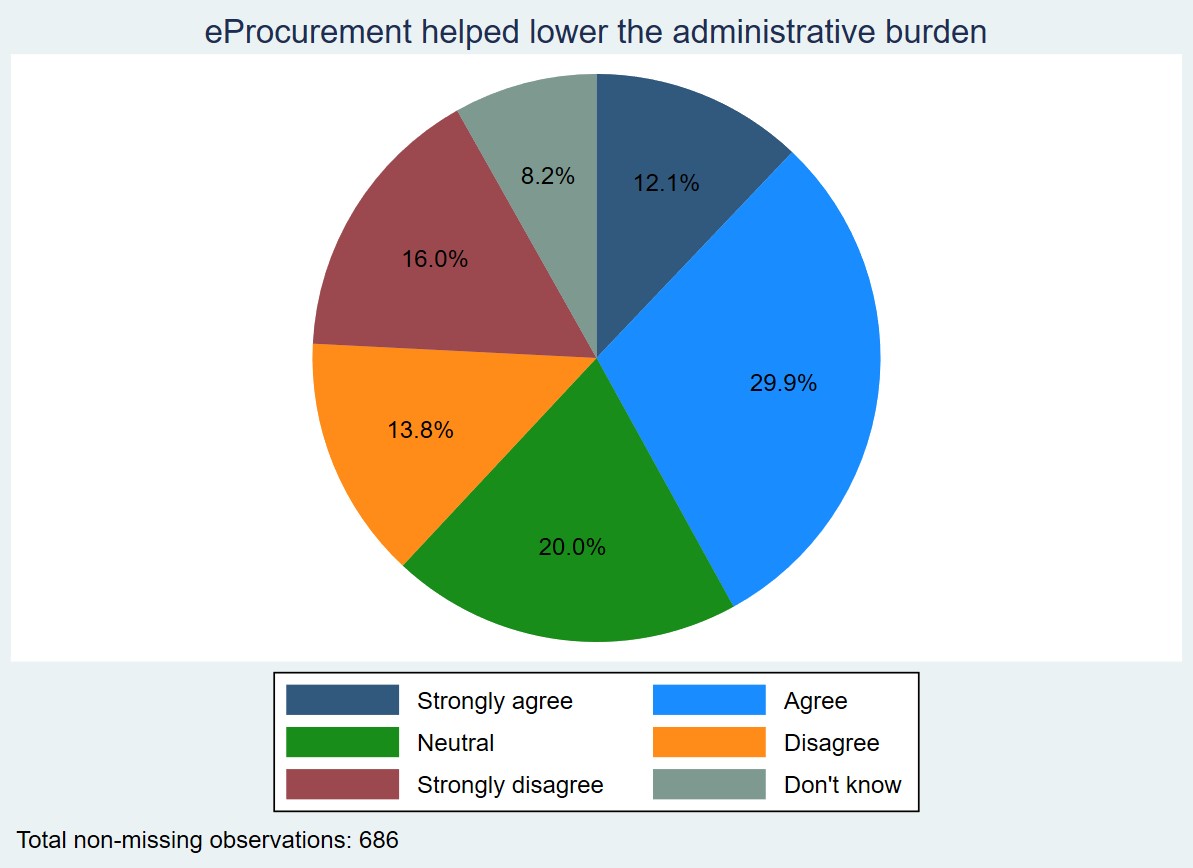
Table 10. The digitalisation of public procurement (eProcurement) helped lower the administrative burden when procuring works, goods and services, by type of respondent (first row has frequencies and second row has row percentages)
|
Contribution given as
|
eProcurement helped lower the administrative burden
|
|
|
Strongly agree
|
Agree
|
Neutral
|
Disagree
|
Strongly disagree
|
Don't know
|
Total
|
|
Academic/research inst.
|
4
|
10
|
4
|
6
|
8
|
1
|
33
|
|
|
12.12
|
30.30
|
12.12
|
18.18
|
24.24
|
3.03
|
100.00
|
|
Business association
|
10
|
39
|
23
|
16
|
10
|
10
|
108
|
|
|
9.26
|
36.11
|
21.30
|
14.81
|
9.26
|
9.26
|
100.00
|
|
Company/business
|
26
|
48
|
20
|
23
|
10
|
2
|
129
|
|
|
20.16
|
37.21
|
15.50
|
17.83
|
7.75
|
1.55
|
100.00
|
|
Consumer organisation
|
0
|
0
|
0
|
1
|
0
|
0
|
1
|
|
|
0.00
|
0.00
|
0.00
|
100.00
|
0.00
|
0.00
|
100.00
|
|
EU citizen
|
14
|
22
|
3
|
2
|
6
|
5
|
52
|
|
|
26.92
|
42.31
|
5.77
|
3.85
|
11.54
|
9.62
|
100.00
|
|
NGO
|
3
|
15
|
13
|
2
|
4
|
30
|
67
|
|
|
4.48
|
22.39
|
19.40
|
2.99
|
5.97
|
44.78
|
100.00
|
|
Other
|
6
|
12
|
9
|
8
|
10
|
4
|
49
|
|
|
12.24
|
24.49
|
18.37
|
16.33
|
20.41
|
8.16
|
100.00
|
|
Public authority
|
20
|
58
|
19
|
35
|
62
|
3
|
197
|
|
|
10.15
|
29.44
|
9.64
|
17.77
|
31.47
|
1.52
|
100.00
|
|
Trade union
|
0
|
1
|
46
|
2
|
0
|
1
|
50
|
|
|
0.00
|
2.00
|
92.00
|
4.00
|
0.00
|
2.00
|
100.00
|
|
Total
|
83
|
205
|
137
|
95
|
110
|
56
|
686
|
|
|
12.10
|
29.88
|
19.97
|
13.85
|
16.03
|
8.16
|
100.00
|
|
|
Figure 7. The digitalisation of public procurement (eProcurement) made it faster to procure works, goods and services

Table 11. The digitalisation of public procurement (eProcurement) made it faster to procure works, goods and services, by type of respondent (first row has frequencies and second row has row percentages)
|
Contribution given as
|
eProcurement made it faster to procure
|
|
|
Strongly agree
|
Agree
|
Neutral
|
Disagree
|
Strongly disagree
|
Don't know
|
Total
|
|
Academic/research inst.
|
3
|
11
|
7
|
8
|
3
|
1
|
33
|
|
|
9.09
|
33.33
|
21.21
|
24.24
|
9.09
|
3.03
|
100.00
|
|
Business association
|
9
|
42
|
26
|
10
|
6
|
15
|
108
|
|
|
8.33
|
38.89
|
24.07
|
9.26
|
5.56
|
13.89
|
100.00
|
|
Company/business
|
26
|
40
|
29
|
25
|
5
|
3
|
128
|
|
|
20.31
|
31.25
|
22.66
|
19.53
|
3.91
|
2.34
|
100.00
|
|
Consumer organisation
|
0
|
0
|
0
|
1
|
0
|
0
|
1
|
|
|
0.00
|
0.00
|
0.00
|
100.00
|
0.00
|
0.00
|
100.00
|
|
EU citizen
|
12
|
15
|
10
|
7
|
3
|
5
|
52
|
|
|
23.08
|
28.85
|
19.23
|
13.46
|
5.77
|
9.62
|
100.00
|
|
NGO
|
3
|
10
|
12
|
5
|
2
|
35
|
67
|
|
|
4.48
|
14.93
|
17.91
|
7.46
|
2.99
|
52.24
|
100.00
|
|
Other
|
3
|
17
|
10
|
12
|
3
|
4
|
49
|
|
|
6.12
|
34.69
|
20.41
|
24.49
|
6.12
|
8.16
|
100.00
|
|
Public authority
|
13
|
53
|
46
|
72
|
9
|
4
|
197
|
|
|
6.60
|
26.90
|
23.35
|
36.55
|
4.57
|
2.03
|
100.00
|
|
Trade union
|
0
|
1
|
45
|
4
|
0
|
0
|
50
|
|
|
0.00
|
2.00
|
90.00
|
8.00
|
0.00
|
0.00
|
100.00
|
|
Total
|
69
|
189
|
185
|
144
|
31
|
67
|
685
|
|
|
10.07
|
27.59
|
27.01
|
21.02
|
4.53
|
9.78
|
100.00
|
|
|
Figure 8. The directives set out simpler rules for the EU public procurement system

Table 12. The directives set out simpler rules for the EU public procurement system, by type of respondent (first row has frequencies and second row has row percentages)
|
Contribution given as
|
The directives set out simpler rules for the EU PP
|
|
|
Strongly agree
|
Agree
|
Neutral
|
Disagree
|
Strongly disagree
|
Don't know
|
Total
|
|
Academic/research inst.
|
1
|
3
|
13
|
13
|
3
|
0
|
33
|
|
|
3.03
|
9.09
|
39.39
|
39.39
|
9.09
|
0.00
|
100.00
|
|
Business association
|
0
|
22
|
37
|
37
|
11
|
2
|
109
|
|
|
0.00
|
20.18
|
33.94
|
33.94
|
10.09
|
1.83
|
100.00
|
|
Company/business
|
1
|
31
|
35
|
43
|
11
|
9
|
130
|
|
|
0.77
|
23.85
|
26.92
|
33.08
|
8.46
|
6.92
|
100.00
|
|
EU citizen
|
2
|
16
|
9
|
11
|
13
|
1
|
52
|
|
|
3.85
|
30.77
|
17.31
|
21.15
|
25.00
|
1.92
|
100.00
|
|
NGO
|
1
|
8
|
17
|
14
|
9
|
10
|
59
|
|
|
1.69
|
13.56
|
28.81
|
23.73
|
15.25
|
16.95
|
100.00
|
|
Other
|
0
|
8
|
10
|
19
|
9
|
0
|
46
|
|
|
0.00
|
17.39
|
21.74
|
41.30
|
19.57
|
0.00
|
100.00
|
|
Public authority
|
2
|
26
|
35
|
60
|
63
|
11
|
197
|
|
|
1.02
|
13.20
|
17.77
|
30.46
|
31.98
|
5.58
|
100.00
|
|
Trade union
|
0
|
0
|
1
|
47
|
5
|
1
|
54
|
|
|
0.00
|
0.00
|
1.85
|
87.04
|
9.26
|
1.85
|
100.00
|
|
Total
|
7
|
114
|
157
|
244
|
124
|
34
|
680
|
|
|
1.03
|
16.76
|
23.09
|
35.88
|
18.24
|
5.00
|
100.00
|
|
|
Figure 9. The directives helped reduce corruption and fend off political pressure in public procurement procedures

Table 13. The directives helped reduce corruption and fend off political pressure in public procurement procedures, by type of respondent (first row has frequencies and second row has row percentages)
|
Contribution given as
|
The directives helped reduce corruption
|
|
|
Strongly agree
|
Agree
|
Neutral
|
Disagree
|
Strongly disagree
|
Don't know
|
Total
|
|
Academic/research inst.
|
3
|
14
|
9
|
4
|
1
|
2
|
33
|
|
|
9.09
|
42.42
|
27.27
|
12.12
|
3.03
|
6.06
|
100.00
|
|
Business association
|
7
|
38
|
32
|
5
|
5
|
20
|
107
|
|
|
6.54
|
35.51
|
29.91
|
4.67
|
4.67
|
18.69
|
100.00
|
|
Company/business
|
9
|
48
|
27
|
17
|
8
|
20
|
129
|
|
|
6.98
|
37.21
|
20.93
|
13.18
|
6.20
|
15.50
|
100.00
|
|
Consumer organisation
|
0
|
1
|
0
|
0
|
0
|
0
|
1
|
|
|
0.00
|
100.00
|
0.00
|
0.00
|
0.00
|
0.00
|
100.00
|
|
EU citizen
|
8
|
10
|
10
|
13
|
9
|
2
|
52
|
|
|
15.38
|
19.23
|
19.23
|
25.00
|
17.31
|
3.85
|
100.00
|
|
NGO
|
3
|
25
|
12
|
2
|
1
|
22
|
65
|
|
|
4.62
|
38.46
|
18.46
|
3.08
|
1.54
|
33.85
|
100.00
|
|
Other
|
1
|
19
|
19
|
4
|
1
|
5
|
49
|
|
|
2.04
|
38.78
|
38.78
|
8.16
|
2.04
|
10.20
|
100.00
|
|
Public authority
|
20
|
49
|
91
|
15
|
7
|
15
|
197
|
|
|
10.15
|
24.87
|
46.19
|
7.61
|
3.55
|
7.61
|
100.00
|
|
Trade union
|
0
|
3
|
40
|
5
|
2
|
0
|
50
|
|
|
0.00
|
6.00
|
80.00
|
10.00
|
4.00
|
0.00
|
100.00
|
|
Total
|
51
|
207
|
240
|
65
|
34
|
86
|
683
|
|
|
7.47
|
30.31
|
35.14
|
9.52
|
4.98
|
12.59
|
100.00
|
|
|
Figure 10. The directives fostered a culture of integrity and fair play in public procurement

Table 14. The directives fostered a culture of integrity and fair play in public procurement, by type of respondent (first row has frequencies and second row has row percentages)
|
Contribution given as
|
The directives fostered a culture of integrity and fair play
|
|
|
Strongly agree
|
Agree
|
Neutral
|
Disagree
|
Strongly disagree
|
Don't know
|
Total
|
|
Academic/research inst.
|
3
|
16
|
9
|
5
|
0
|
0
|
33
|
|
|
9.09
|
48.48
|
27.27
|
15.15
|
0.00
|
0.00
|
100.00
|
|
Business association
|
7
|
39
|
38
|
10
|
6
|
8
|
108
|
|
|
6.48
|
36.11
|
35.19
|
9.26
|
5.56
|
7.41
|
100.00
|
|
Company/business
|
4
|
51
|
32
|
21
|
12
|
9
|
129
|
|
|
3.10
|
39.53
|
24.81
|
16.28
|
9.30
|
6.98
|
100.00
|
|
Consumer organisation
|
0
|
0
|
1
|
0
|
0
|
0
|
1
|
|
|
0.00
|
0.00
|
100.00
|
0.00
|
0.00
|
0.00
|
100.00
|
|
EU citizen
|
3
|
15
|
18
|
6
|
6
|
4
|
52
|
|
|
5.77
|
28.85
|
34.62
|
11.54
|
11.54
|
7.69
|
100.00
|
|
NGO
|
0
|
14
|
9
|
10
|
1
|
32
|
66
|
|
|
0.00
|
21.21
|
13.64
|
15.15
|
1.52
|
48.48
|
100.00
|
|
Other
|
2
|
14
|
16
|
8
|
2
|
7
|
49
|
|
|
4.08
|
28.57
|
32.65
|
16.33
|
4.08
|
14.29
|
100.00
|
|
Public authority
|
12
|
73
|
76
|
17
|
11
|
8
|
197
|
|
|
6.09
|
37.06
|
38.58
|
8.63
|
5.58
|
4.06
|
100.00
|
|
Trade union
|
0
|
1
|
1
|
45
|
6
|
0
|
53
|
|
|
0.00
|
1.89
|
1.89
|
84.91
|
11.32
|
0.00
|
100.00
|
|
Total
|
31
|
223
|
200
|
122
|
44
|
68
|
688
|
|
|
4.51
|
32.41
|
29.07
|
17.73
|
6.40
|
9.88
|
100.00
|
|
|
Figure 11. The directives increased the professionalisation of public buyers

Table 15. The directives increased the professionalisation of public buyers, by type of respondent (first row has frequencies and second row has row percentages)
|
Contribution given as
|
The directives increased the professionalisation of buyers
|
|
|
Strongly agree
|
Agree
|
Neutral
|
Disagree
|
Strongly disagree
|
Don't know
|
Total
|
|
Academic/research inst.
|
3
|
18
|
6
|
5
|
0
|
1
|
33
|
|
|
9.09
|
54.55
|
18.18
|
15.15
|
0.00
|
3.03
|
100.00
|
|
Business association
|
7
|
31
|
30
|
20
|
7
|
12
|
107
|
|
|
6.54
|
28.97
|
28.04
|
18.69
|
6.54
|
11.21
|
100.00
|
|
Company/business
|
8
|
53
|
25
|
19
|
13
|
11
|
129
|
|
|
6.20
|
41.09
|
19.38
|
14.73
|
10.08
|
8.53
|
100.00
|
|
Consumer organisation
|
0
|
1
|
0
|
0
|
0
|
0
|
1
|
|
|
0.00
|
100.00
|
0.00
|
0.00
|
0.00
|
0.00
|
100.00
|
|
EU citizen
|
3
|
18
|
11
|
10
|
3
|
6
|
51
|
|
|
5.88
|
35.29
|
21.57
|
19.61
|
5.88
|
11.76
|
100.00
|
|
NGO
|
1
|
15
|
12
|
13
|
1
|
24
|
66
|
|
|
1.52
|
22.73
|
18.18
|
19.70
|
1.52
|
36.36
|
100.00
|
|
Other
|
4
|
20
|
5
|
13
|
3
|
4
|
49
|
|
|
8.16
|
40.82
|
10.20
|
26.53
|
6.12
|
8.16
|
100.00
|
|
Public authority
|
16
|
65
|
39
|
67
|
6
|
4
|
197
|
|
|
8.12
|
32.99
|
19.80
|
34.01
|
3.05
|
2.03
|
100.00
|
|
Trade union
|
0
|
0
|
1
|
50
|
0
|
1
|
52
|
|
|
0.00
|
0.00
|
1.92
|
96.15
|
0.00
|
1.92
|
100.00
|
|
Total
|
42
|
221
|
129
|
197
|
33
|
63
|
685
|
|
|
6.13
|
32.26
|
18.83
|
28.76
|
4.82
|
9.20
|
100.00
|
|
|
Figure 12. The directives increased transparency by setting the proper framework for the publication of tenders at all stages of the public procurement procedure

Table 16. The directives increased transparency by setting the proper framework for the publication of tenders at all stages of the public procurement procedure, by type of respondent (first row has frequencies and second row has row percentages)
|
Contribution given as
|
The directives increased transparency
|
|
|
Strongly agree
|
Agree
|
Neutral
|
Disagree
|
Strongly disagree
|
Don't know
|
Total
|
|
Academic/research inst.
|
8
|
21
|
3
|
0
|
0
|
1
|
33
|
|
|
24.24
|
63.64
|
9.09
|
0.00
|
0.00
|
3.03
|
100.00
|
|
Business association
|
8
|
58
|
21
|
14
|
3
|
5
|
109
|
|
|
7.34
|
53.21
|
19.27
|
12.84
|
2.75
|
4.59
|
100.00
|
|
Company/business
|
14
|
62
|
27
|
14
|
5
|
10
|
132
|
|
|
10.61
|
46.97
|
20.45
|
10.61
|
3.79
|
7.58
|
100.00
|
|
Consumer organisation
|
0
|
1
|
0
|
0
|
0
|
0
|
1
|
|
|
0.00
|
100.00
|
0.00
|
0.00
|
0.00
|
0.00
|
100.00
|
|
EU citizen
|
6
|
29
|
12
|
2
|
1
|
2
|
52
|
|
|
11.54
|
55.77
|
23.08
|
3.85
|
1.92
|
3.85
|
100.00
|
|
NGO
|
4
|
33
|
14
|
4
|
0
|
11
|
66
|
|
|
6.06
|
50.00
|
21.21
|
6.06
|
0.00
|
16.67
|
100.00
|
|
Other
|
5
|
26
|
10
|
3
|
3
|
2
|
49
|
|
|
10.20
|
53.06
|
20.41
|
6.12
|
6.12
|
4.08
|
100.00
|
|
Public authority
|
30
|
121
|
30
|
7
|
4
|
4
|
196
|
|
|
15.31
|
61.73
|
15.31
|
3.57
|
2.04
|
2.04
|
100.00
|
|
Trade union
|
0
|
1
|
45
|
5
|
1
|
1
|
53
|
|
|
0.00
|
1.89
|
84.91
|
9.43
|
1.89
|
1.89
|
100.00
|
|
Total
|
75
|
352
|
162
|
49
|
17
|
36
|
691
|
|
|
10.85
|
50.94
|
23.44
|
7.09
|
2.46
|
5.21
|
100.00
|
|
|
Figure 13. The directives gave greater legal certainty on the compliance with procurement procedures

Table 17. The directives gave greater legal certainty on the compliance with procurement procedures, by type of respondent (first row has frequencies and second row has row percentages)
|
Contribution given as
|
The directives gave greater legal certainty on the compliance
|
|
|
Strongly agree
|
Agree
|
Neutral
|
Disagree
|
Strongly disagree
|
Don't know
|
Total
|
|
Academic/research inst.
|
4
|
18
|
5
|
4
|
1
|
1
|
33
|
|
|
12.12
|
54.55
|
15.15
|
12.12
|
3.03
|
3.03
|
100.00
|
|
Business association
|
7
|
43
|
25
|
19
|
13
|
4
|
111
|
|
|
6.31
|
38.74
|
22.52
|
17.12
|
11.71
|
3.60
|
100.00
|
|
Company/business
|
4
|
55
|
31
|
25
|
10
|
5
|
130
|
|
|
3.08
|
42.31
|
23.85
|
19.23
|
7.69
|
3.85
|
100.00
|
|
Consumer organisation
|
0
|
0
|
1
|
0
|
0
|
0
|
1
|
|
|
0.00
|
0.00
|
100.00
|
0.00
|
0.00
|
0.00
|
100.00
|
|
EU citizen
|
4
|
20
|
15
|
8
|
4
|
1
|
52
|
|
|
7.69
|
38.46
|
28.85
|
15.38
|
7.69
|
1.92
|
100.00
|
|
NGO
|
0
|
15
|
23
|
15
|
4
|
9
|
66
|
|
|
0.00
|
22.73
|
34.85
|
22.73
|
6.06
|
13.64
|
100.00
|
|
Other
|
3
|
15
|
18
|
8
|
5
|
0
|
49
|
|
|
6.12
|
30.61
|
36.73
|
16.33
|
10.20
|
0.00
|
100.00
|
|
Public authority
|
12
|
65
|
36
|
27
|
53
|
4
|
197
|
|
|
6.09
|
32.99
|
18.27
|
13.71
|
26.90
|
2.03
|
100.00
|
|
Trade union
|
0
|
1
|
0
|
3
|
49
|
0
|
53
|
|
|
0.00
|
1.89
|
0.00
|
5.66
|
92.45
|
0.00
|
100.00
|
|
Total
|
34
|
232
|
154
|
109
|
139
|
24
|
692
|
|
|
4.91
|
33.53
|
22.25
|
15.75
|
20.09
|
3.47
|
100.00
|
|
|
Figure 14. The directives facilitated prompt payments to subcontractors for the works, goods and services offered

Table 18. The directives facilitated prompt payments to subcontractors for the works, goods and services offered, by type of respondent (first row has frequencies and second row has row percentages)
|
Contribution given as
|
The directives facilitated prompt payments to subcontractors
|
|
|
Strongly agree
|
Agree
|
Neutral
|
Disagree
|
Strongly disagree
|
Don't know
|
Total
|
|
Academic/research inst.
|
1
|
8
|
6
|
6
|
5
|
7
|
33
|
|
|
3.03
|
24.24
|
18.18
|
18.18
|
15.15
|
21.21
|
100.00
|
|
Business association
|
0
|
16
|
34
|
22
|
14
|
21
|
107
|
|
|
0.00
|
14.95
|
31.78
|
20.56
|
13.08
|
19.63
|
100.00
|
|
Company/business
|
2
|
24
|
37
|
24
|
13
|
28
|
128
|
|
|
1.56
|
18.75
|
28.91
|
18.75
|
10.16
|
21.88
|
100.00
|
|
Consumer organisation
|
0
|
0
|
0
|
1
|
0
|
0
|
1
|
|
|
0.00
|
0.00
|
0.00
|
100.00
|
0.00
|
0.00
|
100.00
|
|
EU citizen
|
3
|
15
|
8
|
12
|
6
|
7
|
51
|
|
|
5.88
|
29.41
|
15.69
|
23.53
|
11.76
|
13.73
|
100.00
|
|
NGO
|
0
|
3
|
28
|
8
|
0
|
27
|
66
|
|
|
0.00
|
4.55
|
42.42
|
12.12
|
0.00
|
40.91
|
100.00
|
|
Other
|
1
|
7
|
15
|
13
|
5
|
8
|
49
|
|
|
2.04
|
14.29
|
30.61
|
26.53
|
10.20
|
16.33
|
100.00
|
|
Public authority
|
4
|
23
|
49
|
21
|
20
|
80
|
197
|
|
|
2.03
|
11.68
|
24.87
|
10.66
|
10.15
|
40.61
|
100.00
|
|
Trade union
|
0
|
1
|
1
|
25
|
22
|
1
|
50
|
|
|
0.00
|
2.00
|
2.00
|
50.00
|
44.00
|
2.00
|
100.00
|
|
Total
|
11
|
97
|
178
|
132
|
85
|
179
|
682
|
|
|
1.61
|
14.22
|
26.10
|
19.35
|
12.46
|
26.25
|
100.00
|
|
|
Figure 15. The directives’ rules aiming at procedural simplification (e.g. eProcurement, European single procurement document 'ESPD', the use of self-declarations) are still relevant and adequate

Table 19. The directives’ rules aiming at procedural simplification (e.g. eProcurement, European single procurement document 'ESPD', the use of self-declarations) are still relevant and adequate, by type of respondent (first row has frequencies and second row has row percentages)
|
Contribution given as
|
Rules on procedural simplification
|
|
|
Strongly agree
|
Agree
|
Neutral
|
Disagree
|
Strongly disagree
|
Don't know
|
Total
|
|
Academic/research inst.
|
0
|
13
|
12
|
6
|
2
|
0
|
33
|
|
|
0.00
|
39.39
|
36.36
|
18.18
|
6.06
|
0.00
|
100.00
|
|
Business association
|
7
|
31
|
30
|
26
|
6
|
8
|
108
|
|
|
6.48
|
28.70
|
27.78
|
24.07
|
5.56
|
7.41
|
100.00
|
|
Company/business
|
17
|
40
|
24
|
40
|
6
|
5
|
132
|
|
|
12.88
|
30.30
|
18.18
|
30.30
|
4.55
|
3.79
|
100.00
|
|
Consumer organisation
|
0
|
0
|
0
|
1
|
0
|
0
|
1
|
|
|
0.00
|
0.00
|
0.00
|
100.00
|
0.00
|
0.00
|
100.00
|
|
EU citizen
|
10
|
13
|
9
|
15
|
2
|
3
|
52
|
|
|
19.23
|
25.00
|
17.31
|
28.85
|
3.85
|
5.77
|
100.00
|
|
NGO
|
3
|
10
|
7
|
19
|
2
|
24
|
65
|
|
|
4.62
|
15.38
|
10.77
|
29.23
|
3.08
|
36.92
|
100.00
|
|
Other
|
1
|
14
|
9
|
14
|
9
|
2
|
49
|
|
|
2.04
|
28.57
|
18.37
|
28.57
|
18.37
|
4.08
|
100.00
|
|
Public authority
|
9
|
41
|
34
|
40
|
65
|
7
|
196
|
|
|
4.59
|
20.92
|
17.35
|
20.41
|
33.16
|
3.57
|
100.00
|
|
Trade union
|
0
|
0
|
35
|
16
|
0
|
0
|
51
|
|
|
0.00
|
0.00
|
68.63
|
31.37
|
0.00
|
0.00
|
100.00
|
|
Total
|
47
|
162
|
160
|
177
|
92
|
49
|
687
|
|
|
6.84
|
23.58
|
23.29
|
25.76
|
13.39
|
7.13
|
100.00
|
|
|
Figure 16. The directives' rules aiming to increase procedural flexibility (e. g. the choice of available procedures, time limits for submitting offers, contract modifications) are still relevant and adequate

Table 20. The directives' rules aiming to increase procedural flexibility (e. g. the choice of available procedures, time limits for submitting offers, contract modifications) are still relevant and adequate, by type of respondent (first row has frequencies and second row has row percentages)
|
Contribution given as
|
Rules on procedural flexibility
|
|
|
Strongly agree
|
Agree
|
Neutral
|
Disagree
|
Strongly disagree
|
Don't know
|
Total
|
|
Academic/research inst.
|
0
|
20
|
3
|
9
|
1
|
0
|
33
|
|
|
0.00
|
60.61
|
9.09
|
27.27
|
3.03
|
0.00
|
100.00
|
|
Business association
|
7
|
28
|
22
|
36
|
8
|
6
|
107
|
|
|
6.54
|
26.17
|
20.56
|
33.64
|
7.48
|
5.61
|
100.00
|
|
Company/business
|
13
|
36
|
24
|
44
|
9
|
5
|
131
|
|
|
9.92
|
27.48
|
18.32
|
33.59
|
6.87
|
3.82
|
100.00
|
|
Consumer organisation
|
0
|
1
|
0
|
0
|
0
|
0
|
1
|
|
|
0.00
|
100.00
|
0.00
|
0.00
|
0.00
|
0.00
|
100.00
|
|
EU citizen
|
8
|
18
|
4
|
15
|
5
|
2
|
52
|
|
|
15.38
|
34.62
|
7.69
|
28.85
|
9.62
|
3.85
|
100.00
|
|
NGO
|
1
|
25
|
11
|
14
|
3
|
10
|
64
|
|
|
1.56
|
39.06
|
17.19
|
21.88
|
4.69
|
15.63
|
100.00
|
|
Other
|
2
|
11
|
9
|
18
|
9
|
0
|
49
|
|
|
4.08
|
22.45
|
18.37
|
36.73
|
18.37
|
0.00
|
100.00
|
|
Public authority
|
12
|
45
|
30
|
44
|
64
|
2
|
197
|
|
|
6.09
|
22.84
|
15.23
|
22.34
|
32.49
|
1.02
|
100.00
|
|
Trade union
|
0
|
0
|
2
|
49
|
0
|
0
|
51
|
|
|
0.00
|
0.00
|
3.92
|
96.08
|
0.00
|
0.00
|
100.00
|
|
Total
|
43
|
184
|
105
|
229
|
99
|
25
|
685
|
|
|
6.28
|
26.86
|
15.33
|
33.43
|
14.45
|
3.65
|
100.00
|
|
|
Figure 17. The directives' rules on transparency (e.g. EU-wide publication via TED) are still relevant and adequate
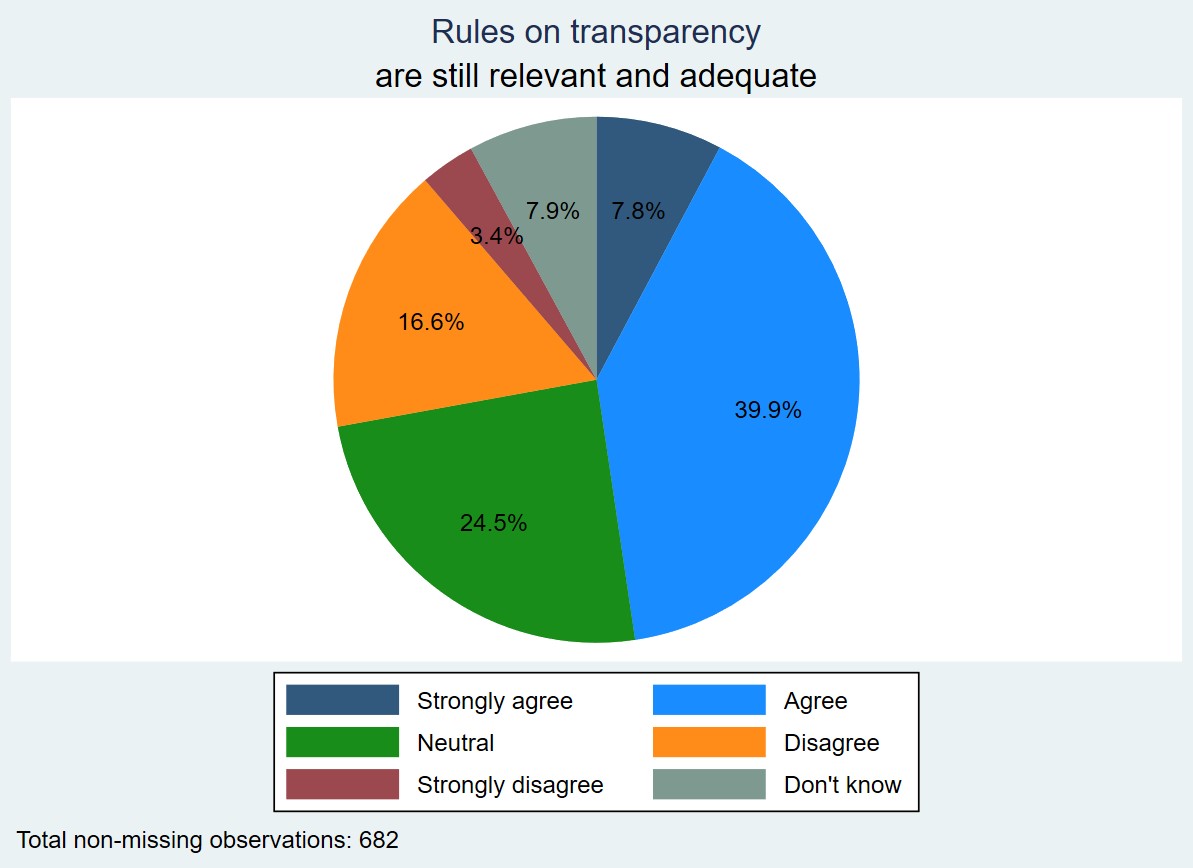
Table 21. The directives' rules on transparency (e.g. EU-wide publication via Tenders Electronic Daily 'TED') are still relevant and adequate, by type of respondent (first row has frequencies and second row has row percentages)
|
Contribution given as
|
Rules on transparency
|
|
|
Strongly agree
|
Agree
|
Neutral
|
Disagree
|
Strongly disagree
|
Don't know
|
Total
|
|
Academic/research inst.
|
2
|
19
|
3
|
5
|
3
|
1
|
33
|
|
|
6.06
|
57.58
|
9.09
|
15.15
|
9.09
|
3.03
|
100.00
|
|
Business association
|
3
|
62
|
20
|
8
|
2
|
12
|
107
|
|
|
2.80
|
57.94
|
18.69
|
7.48
|
1.87
|
11.21
|
100.00
|
|
Company/business
|
15
|
60
|
29
|
13
|
5
|
5
|
127
|
|
|
11.81
|
47.24
|
22.83
|
10.24
|
3.94
|
3.94
|
100.00
|
|
Consumer organisation
|
0
|
1
|
0
|
0
|
0
|
0
|
1
|
|
|
0.00
|
100.00
|
0.00
|
0.00
|
0.00
|
0.00
|
100.00
|
|
EU citizen
|
8
|
19
|
15
|
4
|
2
|
4
|
52
|
|
|
15.38
|
36.54
|
28.85
|
7.69
|
3.85
|
7.69
|
100.00
|
|
NGO
|
1
|
20
|
8
|
11
|
2
|
23
|
65
|
|
|
1.54
|
30.77
|
12.31
|
16.92
|
3.08
|
35.38
|
100.00
|
|
Other
|
9
|
19
|
14
|
3
|
1
|
3
|
49
|
|
|
18.37
|
38.78
|
28.57
|
6.12
|
2.04
|
6.12
|
100.00
|
|
Public authority
|
15
|
72
|
78
|
17
|
8
|
5
|
195
|
|
|
7.69
|
36.92
|
40.00
|
8.72
|
4.10
|
2.56
|
100.00
|
|
Trade union
|
0
|
0
|
0
|
52
|
0
|
1
|
53
|
|
|
0.00
|
0.00
|
0.00
|
98.11
|
0.00
|
1.89
|
100.00
|
|
Total
|
53
|
272
|
167
|
113
|
23
|
54
|
682
|
|
|
7.77
|
39.88
|
24.49
|
16.57
|
3.37
|
7.92
|
100.00
|
|
|
Figure 18. The directives' rules on monitoring (e.g. the quality of data provided in TED) are still relevant and adequate
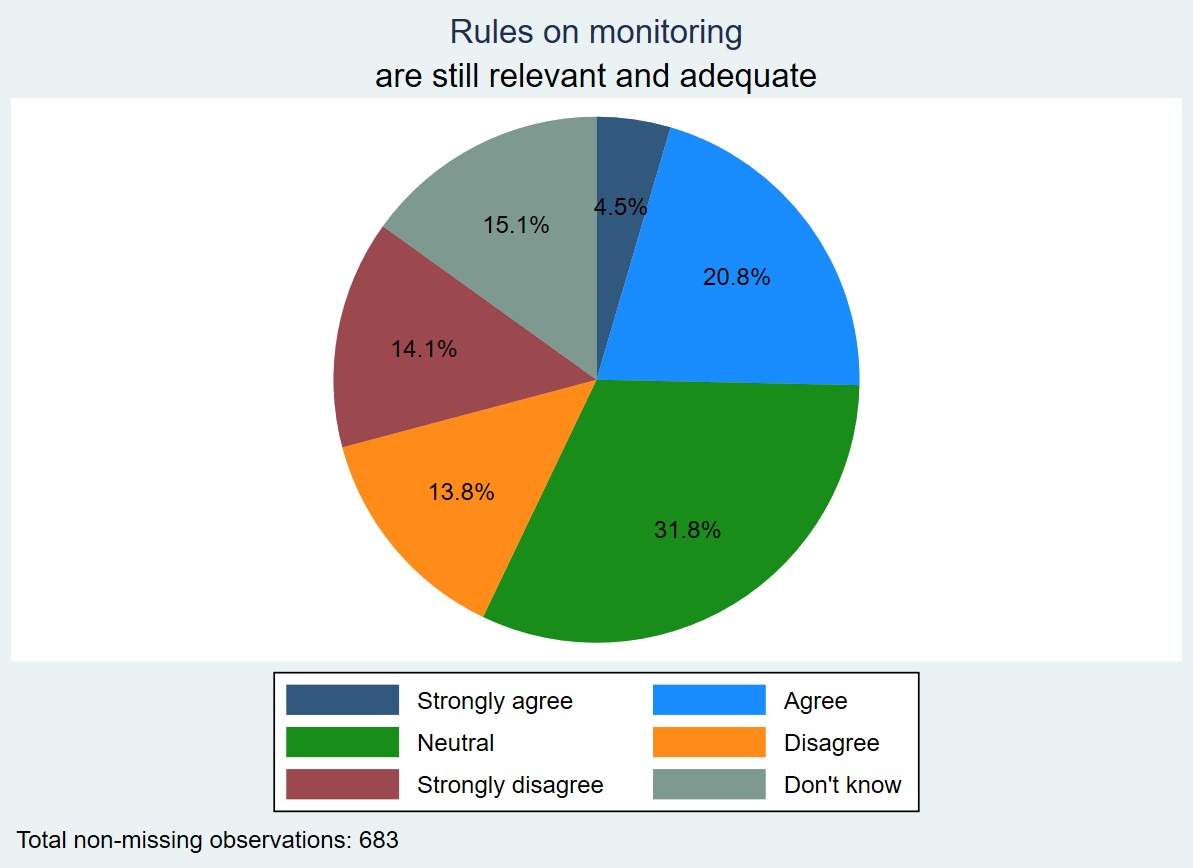
Table 22. The directives' rules on monitoring (e.g. the quality of data provided in TED) are still relevant and adequate, by type of respondent (first row has frequencies and second row has row percentages)
|
Contribution given as
|
Rules on monitoring
|
|
|
Strongly agree
|
Agree
|
Neutral
|
Disagree
|
Strongly disagree
|
Don't know
|
Total
|
|
Academic/research inst.
|
1
|
9
|
13
|
2
|
6
|
2
|
33
|
|
|
3.03
|
27.27
|
39.39
|
6.06
|
18.18
|
6.06
|
100.00
|
|
Business association
|
6
|
26
|
35
|
16
|
1
|
23
|
107
|
|
|
5.61
|
24.30
|
32.71
|
14.95
|
0.93
|
21.50
|
100.00
|
|
Company/business
|
8
|
35
|
39
|
23
|
6
|
17
|
128
|
|
|
6.25
|
27.34
|
30.47
|
17.97
|
4.69
|
13.28
|
100.00
|
|
Consumer organisation
|
0
|
1
|
0
|
0
|
0
|
0
|
1
|
|
|
0.00
|
100.00
|
0.00
|
0.00
|
0.00
|
0.00
|
100.00
|
|
EU citizen
|
6
|
13
|
17
|
2
|
6
|
6
|
50
|
|
|
12.00
|
26.00
|
34.00
|
4.00
|
12.00
|
12.00
|
100.00
|
|
NGO
|
0
|
5
|
12
|
12
|
9
|
27
|
65
|
|
|
0.00
|
7.69
|
18.46
|
18.46
|
13.85
|
41.54
|
100.00
|
|
Other
|
1
|
16
|
14
|
9
|
5
|
4
|
49
|
|
|
2.04
|
32.65
|
28.57
|
18.37
|
10.20
|
8.16
|
100.00
|
|
Public authority
|
9
|
36
|
86
|
27
|
15
|
23
|
196
|
|
|
4.59
|
18.37
|
43.88
|
13.78
|
7.65
|
11.73
|
100.00
|
|
Trade union
|
0
|
1
|
1
|
3
|
48
|
1
|
54
|
|
|
0.00
|
1.85
|
1.85
|
5.56
|
88.89
|
1.85
|
100.00
|
|
Total
|
31
|
142
|
217
|
94
|
96
|
103
|
683
|
|
|
4.54
|
20.79
|
31.77
|
13.76
|
14.06
|
15.08
|
100.00
|
|
|
Figure 19. The directives' rules on integrity (e.g. exclusion grounds, conflict of interest rules) are still relevant and adequate

Table 23. The directives' rules on integrity (e.g. exclusion grounds, conflict of interest rules) are still relevant and adequate, by type of respondent (first row has frequencies and second row has row percentages)
|
Contribution given as
|
Rules on integrity
|
|
|
Strongly agree
|
Agree
|
Neutral
|
Disagree
|
Strongly disagree
|
Don't know
|
Total
|
|
Academic/research inst.
|
1
|
21
|
7
|
2
|
1
|
1
|
33
|
|
|
3.03
|
63.64
|
21.21
|
6.06
|
3.03
|
3.03
|
100.00
|
|
Business association
|
11
|
39
|
28
|
12
|
6
|
9
|
105
|
|
|
10.48
|
37.14
|
26.67
|
11.43
|
5.71
|
8.57
|
100.00
|
|
Company/business
|
16
|
50
|
23
|
21
|
11
|
7
|
128
|
|
|
12.50
|
39.06
|
17.97
|
16.41
|
8.59
|
5.47
|
100.00
|
|
EU citizen
|
12
|
15
|
12
|
4
|
6
|
3
|
52
|
|
|
23.08
|
28.85
|
23.08
|
7.69
|
11.54
|
5.77
|
100.00
|
|
NGO
|
1
|
32
|
4
|
13
|
1
|
11
|
62
|
|
|
1.61
|
51.61
|
6.45
|
20.97
|
1.61
|
17.74
|
100.00
|
|
Other
|
2
|
20
|
12
|
11
|
2
|
2
|
49
|
|
|
4.08
|
40.82
|
24.49
|
22.45
|
4.08
|
4.08
|
100.00
|
|
Public authority
|
11
|
58
|
35
|
72
|
11
|
5
|
192
|
|
|
5.73
|
30.21
|
18.23
|
37.50
|
5.73
|
2.60
|
100.00
|
|
Trade union
|
0
|
0
|
2
|
32
|
19
|
0
|
53
|
|
|
0.00
|
0.00
|
3.77
|
60.38
|
35.85
|
0.00
|
100.00
|
|
Total
|
54
|
235
|
123
|
167
|
57
|
38
|
674
|
|
|
8.01
|
34.87
|
18.25
|
24.78
|
8.46
|
5.64
|
100.00
|
|
|
Selected quotes from written contributions:
·“The 2014 Directives have contributed significantly to modernising procurement practices across the EU. However, to fully realise their objectives, reforms should prioritise digitalisation, transparency, sustainability, SME access, and stronger monitoring and enforcement mechanisms. These improvements will help create a more resilient, innovation-driven, and accountable procurement system that delivers greater value to society” (OPC, an academic/research institution from Ireland).
·“The current Directive contains good actions such as the simplification of procurement procedures aimed at facilitating the access of small and medium-sized enterprises to tenders. However, the simplifications have led in several cases to increased administration for both tenderers and contracting entities” (CfE, a regional public authority from Denmark).
·“The original goal of the 2014 public procurement reform, namely the simplification of public procurement, has not been achieved. The directives claim to simplify public procurement, strengthen the internal market, and, in particular, increase the participation of SMEs. However, administrative burdens remain high, the duration of procedures has increased, and the participation of small and medium-sized enterprises has remained virtually unchanged” (CfE, a business association from Austria).
·“The Estonian Public Procurement Act and the public procurement directives on which it is based are generally appropriate and fulfil their objectives. The concerns that arise in the course of public procurement are rather related to practical issues that often arise from overly zealous compliance with requirements, i.e. from the requirements of a specific contracting authority that do not arise from the law or the directives” (CfE, a business association from Estonia).
·“Both contracting authorities and economic operators consider the preparation of documentation and procedures to be very labour-consuming and time-consuming, which discourages economic operators from participating in public procurement. […] The current procedures are too complex and bureaucratic, thus deterring potential contractors” (CfE, a large company from Poland).
·“The Competition Authority considers that the procurement directives have produced positive results by clarifying the application of the basic procurement principles of non-discrimination, equal treatment, proportionality, transparency and mutual recognition. The fact that it is a regulatory framework for how procurement is to be carried out, not a regulatory framework for what is to be acquired, provides a lot of benefit when it is followed” (CfE, a national authority from Sweden).
·“With reference to the questions related to eProcurement, it is recognised the importance of the objectives the EU directives aim to in terms of lowering the administrative burden as well as making the procurement steps faster. However, the implementation of the directives into the Italian national law is, in some cases, resulted in a higher number of administrative fulfilments which make the entire procurement process heavier and even, for certain aspects, more expensive, thus off-setting the advantages proposed in the European regulatory framework” (OPC, a large company from Italy).
·“On the one hand digitalisation decreased the administrative burden associated with the downstream phase. On the other hand, it did not reduce the burden of procedures related to the award of contracts for works, goods and services” (OPC, a business association from France).
·“eProcurement and electronic communication made procedures quicker and simpler” (OPC, a large company from Germany).
·“Better data is needed to measure whether the goals are achieved. The current data is often of low quality and not goal-oriented but focused on tender processes” (CfE, an academic/research institution from the Netherlands).
·“Public procurement is dominated by legal professionals and is seen by many as a “legal process”, not a commercial arrangement that should maximize end value for society at large. Buyers focus more on not doing anything wrong, than maximizing utility (doing it right)” (CfE, a medium company from Sweden).
Easier market access, SMEs and cross-border participation
A detailed distribution of replies for each question is provided below.
Figure 20. The directives resulted in more competition in public procurement markets (e.g. rules on transparency make it easier for companies to enter markets)

Table 24. The directives resulted in more competition in public procurement markets (e.g. rules on transparency make it easier for companies to enter markets), by type of respondent (first row has frequencies and second row has row percentages)
|
Contribution given as
|
The directives resulted in more competition in PP markets
|
|
|
Strongly agree
|
Agree
|
Neutral
|
Disagree
|
Strongly disagree
|
Don't know
|
Total
|
|
Academic/research inst.
|
1
|
7
|
8
|
12
|
3
|
1
|
32
|
|
|
3.13
|
21.88
|
25.00
|
37.50
|
9.38
|
3.13
|
100.00
|
|
Business association
|
3
|
29
|
24
|
29
|
15
|
6
|
106
|
|
|
2.83
|
27.36
|
22.64
|
27.36
|
14.15
|
5.66
|
100.00
|
|
Company/business
|
3
|
45
|
29
|
31
|
14
|
9
|
131
|
|
|
2.29
|
34.35
|
22.14
|
23.66
|
10.69
|
6.87
|
100.00
|
|
Consumer organisation
|
0
|
0
|
0
|
1
|
0
|
0
|
1
|
|
|
0.00
|
0.00
|
0.00
|
100.00
|
0.00
|
0.00
|
100.00
|
|
EU citizen
|
2
|
21
|
4
|
15
|
8
|
3
|
53
|
|
|
3.77
|
39.62
|
7.55
|
28.30
|
15.09
|
5.66
|
100.00
|
|
NGO
|
0
|
15
|
4
|
14
|
23
|
9
|
65
|
|
|
0.00
|
23.08
|
6.15
|
21.54
|
35.38
|
13.85
|
100.00
|
|
Other
|
2
|
13
|
5
|
15
|
11
|
3
|
49
|
|
|
4.08
|
26.53
|
10.20
|
30.61
|
22.45
|
6.12
|
100.00
|
|
Public authority
|
1
|
43
|
41
|
39
|
67
|
5
|
196
|
|
|
0.51
|
21.94
|
20.92
|
19.90
|
34.18
|
2.55
|
100.00
|
|
Trade union
|
0
|
0
|
30
|
4
|
14
|
1
|
49
|
|
|
0.00
|
0.00
|
61.22
|
8.16
|
28.57
|
2.04
|
100.00
|
|
Total
|
12
|
173
|
145
|
160
|
155
|
37
|
682
|
|
|
1.76
|
25.37
|
21.26
|
23.46
|
22.73
|
5.43
|
100.00
|
|
|
Figure 21. The directives set out rules that ensure the equal treatment of bidders from other EU countries in all stages of the process and the objective evaluation of tenders

Table 25. The directives set out rules that ensure the equal treatment of bidders from other EU countries in all stages of the process and the objective evaluation of tenders, by type of respondent (first row has frequencies and second row has row percentages)
|
Contribution given as
|
The directives ensure equal treatment of bidders from the EU
|
|
|
Strongly agree
|
Agree
|
Neutral
|
Disagree
|
Strongly disagree
|
Don't know
|
Total
|
|
Academic/research inst.
|
4
|
23
|
4
|
0
|
0
|
2
|
33
|
|
|
12.12
|
69.70
|
12.12
|
0.00
|
0.00
|
6.06
|
100.00
|
|
Business association
|
7
|
51
|
21
|
14
|
3
|
14
|
110
|
|
|
6.36
|
46.36
|
19.09
|
12.73
|
2.73
|
12.73
|
100.00
|
|
Company/business
|
12
|
70
|
20
|
11
|
5
|
8
|
126
|
|
|
9.52
|
55.56
|
15.87
|
8.73
|
3.97
|
6.35
|
100.00
|
|
EU citizen
|
6
|
27
|
8
|
8
|
2
|
2
|
53
|
|
|
11.32
|
50.94
|
15.09
|
15.09
|
3.77
|
3.77
|
100.00
|
|
NGO
|
1
|
35
|
11
|
5
|
1
|
13
|
66
|
|
|
1.52
|
53.03
|
16.67
|
7.58
|
1.52
|
19.70
|
100.00
|
|
Other
|
3
|
21
|
14
|
7
|
1
|
4
|
50
|
|
|
6.00
|
42.00
|
28.00
|
14.00
|
2.00
|
8.00
|
100.00
|
|
Public authority
|
17
|
87
|
68
|
14
|
8
|
3
|
197
|
|
|
8.63
|
44.16
|
34.52
|
7.11
|
4.06
|
1.52
|
100.00
|
|
Trade union
|
0
|
1
|
44
|
3
|
0
|
0
|
48
|
|
|
0.00
|
2.08
|
91.67
|
6.25
|
0.00
|
0.00
|
100.00
|
|
Total
|
50
|
315
|
190
|
62
|
20
|
46
|
683
|
|
|
7.32
|
46.12
|
27.82
|
9.08
|
2.93
|
6.73
|
100.00
|
|
|
Figure 22. The directives made it easier for SMEs to bid for public contracts (e. g. the possibility to divide tenders into lots)

Table 26. The directives made it easier for SMEs to bid for public contracts (e. g. the possibility to divide tenders into lots), by type of respondent (first row has frequencies and second row has row percentages)
|
Contribution given as
|
The directives made it easier for SMEs to bid
|
|
|
Strongly agree
|
Agree
|
Neutral
|
Disagree
|
Strongly disagree
|
Don't know
|
Total
|
|
Academic/research inst.
|
2
|
11
|
1
|
9
|
7
|
2
|
32
|
|
|
6.25
|
34.38
|
3.13
|
28.13
|
21.88
|
6.25
|
100.00
|
|
Business association
|
3
|
28
|
23
|
33
|
16
|
7
|
110
|
|
|
2.73
|
25.45
|
20.91
|
30.00
|
14.55
|
6.36
|
100.00
|
|
Company/business
|
6
|
32
|
25
|
32
|
15
|
18
|
128
|
|
|
4.69
|
25.00
|
19.53
|
25.00
|
11.72
|
14.06
|
100.00
|
|
Consumer organisation
|
0
|
0
|
0
|
0
|
1
|
0
|
1
|
|
|
0.00
|
0.00
|
0.00
|
0.00
|
100.00
|
0.00
|
100.00
|
|
EU citizen
|
2
|
16
|
12
|
10
|
9
|
4
|
53
|
|
|
3.77
|
30.19
|
22.64
|
18.87
|
16.98
|
7.55
|
100.00
|
|
NGO
|
1
|
25
|
6
|
22
|
8
|
5
|
67
|
|
|
1.49
|
37.31
|
8.96
|
32.84
|
11.94
|
7.46
|
100.00
|
|
Other
|
1
|
10
|
9
|
14
|
11
|
4
|
49
|
|
|
2.04
|
20.41
|
18.37
|
28.57
|
22.45
|
8.16
|
100.00
|
|
Public authority
|
9
|
41
|
25
|
46
|
69
|
7
|
197
|
|
|
4.57
|
20.81
|
12.69
|
23.35
|
35.03
|
3.55
|
100.00
|
|
Trade union
|
0
|
1
|
41
|
4
|
1
|
1
|
48
|
|
|
0.00
|
2.08
|
85.42
|
8.33
|
2.08
|
2.08
|
100.00
|
|
Total
|
24
|
164
|
142
|
170
|
137
|
48
|
685
|
|
|
3.50
|
23.94
|
20.73
|
24.82
|
20.00
|
7.01
|
100.00
|
|
|
Figure 23. The directives made it easier to bid on public contracts from abroad (e.g. through eProcurement)

Table 27. The directives made it easier to bid on public contracts from abroad (e.g. through eProcurement), by type of respondent (first row has frequencies and second row has row percentages)
|
Contribution given as
|
The directives made it easier to bid from abroad
|
|
|
Strongly agree
|
Agree
|
Neutral
|
Disagree
|
Strongly disagree
|
Don't know
|
Total
|
|
Academic/research inst.
|
2
|
16
|
8
|
4
|
1
|
2
|
33
|
|
|
6.06
|
48.48
|
24.24
|
12.12
|
3.03
|
6.06
|
100.00
|
|
Business association
|
6
|
33
|
33
|
11
|
3
|
23
|
109
|
|
|
5.50
|
30.28
|
30.28
|
10.09
|
2.75
|
21.10
|
100.00
|
|
Company/business
|
12
|
48
|
25
|
10
|
7
|
23
|
125
|
|
|
9.60
|
38.40
|
20.00
|
8.00
|
5.60
|
18.40
|
100.00
|
|
Consumer organisation
|
0
|
0
|
0
|
1
|
0
|
0
|
1
|
|
|
0.00
|
0.00
|
0.00
|
100.00
|
0.00
|
0.00
|
100.00
|
|
EU citizen
|
2
|
26
|
9
|
3
|
6
|
7
|
53
|
|
|
3.77
|
49.06
|
16.98
|
5.66
|
11.32
|
13.21
|
100.00
|
|
NGO
|
0
|
26
|
13
|
2
|
2
|
23
|
66
|
|
|
0.00
|
39.39
|
19.70
|
3.03
|
3.03
|
34.85
|
100.00
|
|
Other
|
1
|
18
|
12
|
4
|
4
|
10
|
49
|
|
|
2.04
|
36.73
|
24.49
|
8.16
|
8.16
|
20.41
|
100.00
|
|
Public authority
|
11
|
54
|
38
|
25
|
58
|
11
|
197
|
|
|
5.58
|
27.41
|
19.29
|
12.69
|
29.44
|
5.58
|
100.00
|
|
Trade union
|
0
|
1
|
43
|
3
|
1
|
1
|
49
|
|
|
0.00
|
2.04
|
87.76
|
6.12
|
2.04
|
2.04
|
100.00
|
|
Total
|
34
|
222
|
181
|
63
|
82
|
100
|
682
|
|
|
4.99
|
32.55
|
26.54
|
9.24
|
12.02
|
14.66
|
100.00
|
|
|
Figure 24. The directives' rules on SMEs' market access are still relevant and adequate

Table 28. The directives' rules on SMEs' market access are still relevant and adequate, by type of respondent (first row has frequencies and second row has row percentages)
|
Contribution given as
|
Rules on SMEs' market access
|
|
|
Strongly agree
|
Agree
|
Neutral
|
Disagree
|
Strongly disagree
|
Don't know
|
Total
|
|
Academic/research inst.
|
0
|
10
|
5
|
12
|
2
|
4
|
33
|
|
|
0.00
|
30.30
|
15.15
|
36.36
|
6.06
|
12.12
|
100.00
|
|
Business association
|
5
|
29
|
23
|
29
|
10
|
14
|
110
|
|
|
4.55
|
26.36
|
20.91
|
26.36
|
9.09
|
12.73
|
100.00
|
|
Company/business
|
2
|
41
|
32
|
27
|
9
|
15
|
126
|
|
|
1.59
|
32.54
|
25.40
|
21.43
|
7.14
|
11.90
|
100.00
|
|
Consumer organisation
|
0
|
0
|
0
|
0
|
1
|
0
|
1
|
|
|
0.00
|
0.00
|
0.00
|
0.00
|
100.00
|
0.00
|
100.00
|
|
EU citizen
|
5
|
14
|
13
|
14
|
1
|
5
|
52
|
|
|
9.62
|
26.92
|
25.00
|
26.92
|
1.92
|
9.62
|
100.00
|
|
NGO
|
0
|
10
|
23
|
16
|
8
|
10
|
67
|
|
|
0.00
|
14.93
|
34.33
|
23.88
|
11.94
|
14.93
|
100.00
|
|
Other
|
0
|
17
|
10
|
12
|
6
|
3
|
48
|
|
|
0.00
|
35.42
|
20.83
|
25.00
|
12.50
|
6.25
|
100.00
|
|
Public authority
|
7
|
38
|
41
|
40
|
61
|
9
|
196
|
|
|
3.57
|
19.39
|
20.92
|
20.41
|
31.12
|
4.59
|
100.00
|
|
Trade union
|
0
|
0
|
38
|
10
|
0
|
1
|
49
|
|
|
0.00
|
0.00
|
77.55
|
20.41
|
0.00
|
2.04
|
100.00
|
|
Total
|
19
|
159
|
185
|
160
|
98
|
61
|
682
|
|
|
2.79
|
23.31
|
27.13
|
23.46
|
14.37
|
8.94
|
100.00
|
|
|
Figure 25. The directives' rules on eProcurement are still relevant and adequate as a tool to facilitate market access

Table 29. The directives' rules on eProcurement are still relevant and adequate as a tool to facilitate market access, by type of respondent (first row has frequencies and second row has row percentages)
|
Contribution given as
|
Rules on eProcurement to facilitate market access
|
|
|
Strongly agree
|
Agree
|
Neutral
|
Disagree
|
Strongly disagree
|
Don't know
|
Total
|
|
Academic/research inst.
|
1
|
20
|
6
|
5
|
0
|
1
|
33
|
|
|
3.03
|
60.61
|
18.18
|
15.15
|
0.00
|
3.03
|
100.00
|
|
Business association
|
7
|
43
|
34
|
12
|
1
|
12
|
109
|
|
|
6.42
|
39.45
|
31.19
|
11.01
|
0.92
|
11.01
|
100.00
|
|
Company/business
|
14
|
56
|
32
|
8
|
4
|
12
|
126
|
|
|
11.11
|
44.44
|
25.40
|
6.35
|
3.17
|
9.52
|
100.00
|
|
Consumer organisation
|
0
|
0
|
0
|
1
|
0
|
0
|
1
|
|
|
0.00
|
0.00
|
0.00
|
100.00
|
0.00
|
0.00
|
100.00
|
|
EU citizen
|
6
|
23
|
15
|
3
|
3
|
3
|
53
|
|
|
11.32
|
43.40
|
28.30
|
5.66
|
5.66
|
5.66
|
100.00
|
|
NGO
|
2
|
14
|
25
|
7
|
1
|
18
|
67
|
|
|
2.99
|
20.90
|
37.31
|
10.45
|
1.49
|
26.87
|
100.00
|
|
Other
|
2
|
22
|
15
|
5
|
2
|
3
|
49
|
|
|
4.08
|
44.90
|
30.61
|
10.20
|
4.08
|
6.12
|
100.00
|
|
Public authority
|
12
|
113
|
21
|
32
|
8
|
8
|
194
|
|
|
6.19
|
58.25
|
10.82
|
16.49
|
4.12
|
4.12
|
100.00
|
|
Trade union
|
0
|
0
|
46
|
1
|
1
|
1
|
49
|
|
|
0.00
|
0.00
|
93.88
|
2.04
|
2.04
|
2.04
|
100.00
|
|
Total
|
44
|
291
|
194
|
74
|
20
|
58
|
681
|
|
|
6.46
|
42.73
|
28.49
|
10.87
|
2.94
|
8.52
|
100.00
|
|
|
Figure 26. The directives' rules on market access of companies from other EU countries are still relevant and adequate

Table 30. The directives' rules on market access of companies from other EU countries are still relevant and adequate, by type of respondent (first row has frequencies and second row has row percentages)
|
Contribution given as
|
Rules on market access of companies from other EU countries
|
|
|
Strongly agree
|
Agree
|
Neutral
|
Disagree
|
Strongly disagree
|
Don't know
|
Total
|
|
Academic/research inst.
|
2
|
17
|
9
|
2
|
1
|
1
|
32
|
|
|
6.25
|
53.13
|
28.13
|
6.25
|
3.13
|
3.13
|
100.00
|
|
Business association
|
4
|
49
|
19
|
11
|
7
|
18
|
108
|
|
|
3.70
|
45.37
|
17.59
|
10.19
|
6.48
|
16.67
|
100.00
|
|
Company/business
|
10
|
45
|
29
|
13
|
11
|
16
|
124
|
|
|
8.06
|
36.29
|
23.39
|
10.48
|
8.87
|
12.90
|
100.00
|
|
Consumer organisation
|
0
|
0
|
0
|
1
|
0
|
0
|
1
|
|
|
0.00
|
0.00
|
0.00
|
100.00
|
0.00
|
0.00
|
100.00
|
|
EU citizen
|
4
|
19
|
10
|
5
|
9
|
6
|
53
|
|
|
7.55
|
35.85
|
18.87
|
9.43
|
16.98
|
11.32
|
100.00
|
|
NGO
|
1
|
23
|
13
|
6
|
0
|
23
|
66
|
|
|
1.52
|
34.85
|
19.70
|
9.09
|
0.00
|
34.85
|
100.00
|
|
Other
|
1
|
17
|
15
|
6
|
3
|
7
|
49
|
|
|
2.04
|
34.69
|
30.61
|
12.24
|
6.12
|
14.29
|
100.00
|
|
Public authority
|
6
|
60
|
37
|
74
|
6
|
12
|
195
|
|
|
3.08
|
30.77
|
18.97
|
37.95
|
3.08
|
6.15
|
100.00
|
|
Trade union
|
0
|
0
|
46
|
0
|
1
|
1
|
48
|
|
|
0.00
|
0.00
|
95.83
|
0.00
|
2.08
|
2.08
|
100.00
|
|
Total
|
28
|
230
|
178
|
118
|
38
|
84
|
676
|
|
|
4.14
|
34.02
|
26.33
|
17.46
|
5.62
|
12.43
|
100.00
|
|
|
Figure 27. The directives' rules on market access of companies from non-EU countries are still relevant and adequate

Table 31. The directives' rules on market access of companies from non-EU countries are still relevant and adequate, by type of respondent (first row has frequencies and second row has row percentages)
|
Contribution given as
|
Rules on market access of companies from non-EU countries
|
|
|
Strongly agree
|
Agree
|
Neutral
|
Disagree
|
Strongly disagree
|
Don't know
|
Total
|
|
Academic/research inst.
|
0
|
9
|
15
|
6
|
0
|
3
|
33
|
|
|
0.00
|
27.27
|
45.45
|
18.18
|
0.00
|
9.09
|
100.00
|
|
Business association
|
3
|
8
|
24
|
26
|
16
|
29
|
106
|
|
|
2.83
|
7.55
|
22.64
|
24.53
|
15.09
|
27.36
|
100.00
|
|
Company/business
|
2
|
22
|
31
|
26
|
21
|
24
|
126
|
|
|
1.59
|
17.46
|
24.60
|
20.63
|
16.67
|
19.05
|
100.00
|
|
Consumer organisation
|
0
|
1
|
0
|
0
|
0
|
0
|
1
|
|
|
0.00
|
100.00
|
0.00
|
0.00
|
0.00
|
0.00
|
100.00
|
|
EU citizen
|
2
|
16
|
8
|
4
|
17
|
6
|
53
|
|
|
3.77
|
30.19
|
15.09
|
7.55
|
32.08
|
11.32
|
100.00
|
|
NGO
|
0
|
3
|
11
|
9
|
1
|
42
|
66
|
|
|
0.00
|
4.55
|
16.67
|
13.64
|
1.52
|
63.64
|
100.00
|
|
Other
|
0
|
10
|
14
|
9
|
5
|
10
|
48
|
|
|
0.00
|
20.83
|
29.17
|
18.75
|
10.42
|
20.83
|
100.00
|
|
Public authority
|
4
|
29
|
38
|
83
|
20
|
22
|
196
|
|
|
2.04
|
14.80
|
19.39
|
42.35
|
10.20
|
11.22
|
100.00
|
|
Trade union
|
0
|
0
|
44
|
2
|
1
|
1
|
48
|
|
|
0.00
|
0.00
|
91.67
|
4.17
|
2.08
|
2.08
|
100.00
|
|
Total
|
11
|
98
|
185
|
165
|
81
|
137
|
677
|
|
|
1.62
|
14.48
|
27.33
|
24.37
|
11.96
|
20.24
|
100.00
|
|
|
Figure 28. The directives' rules on public-public cooperation and in-house procurement are still relevant and adequate
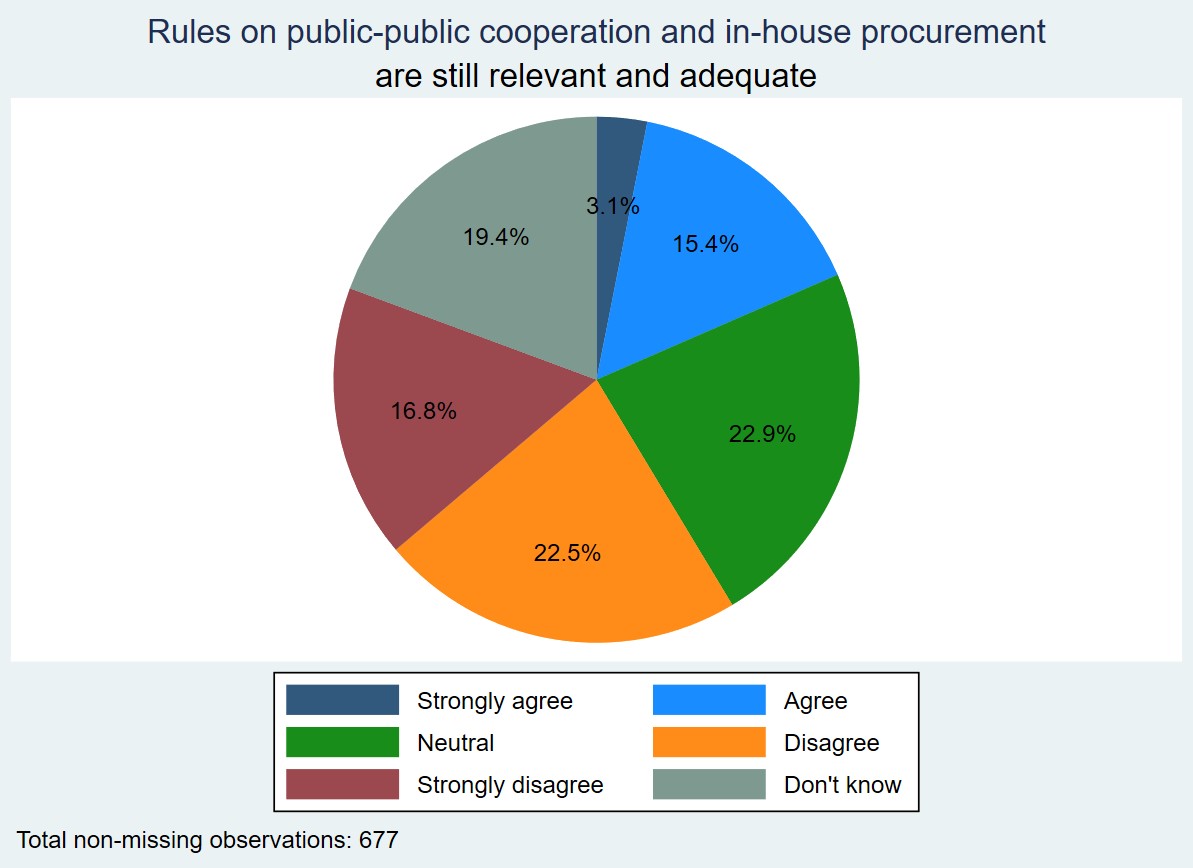
Table 32. The directives' rules on public-public cooperation and in-house procurement are still relevant and adequate, by type of respondent (first row has frequencies and second row has row percentages)
|
Contribution given as
|
Rules on public-public cooperation and in-house procurement
|
|
|
Strongly agree
|
Agree
|
Neutral
|
Disagree
|
Strongly disagree
|
Don't know
|
Total
|
|
Academic/research inst.
|
1
|
8
|
7
|
10
|
2
|
5
|
33
|
|
|
3.03
|
24.24
|
21.21
|
30.30
|
6.06
|
15.15
|
100.00
|
|
Business association
|
5
|
14
|
26
|
21
|
18
|
20
|
104
|
|
|
4.81
|
13.46
|
25.00
|
20.19
|
17.31
|
19.23
|
100.00
|
|
Company/business
|
8
|
29
|
39
|
14
|
8
|
29
|
127
|
|
|
6.30
|
22.83
|
30.71
|
11.02
|
6.30
|
22.83
|
100.00
|
|
Consumer organisation
|
0
|
1
|
0
|
0
|
0
|
0
|
1
|
|
|
0.00
|
100.00
|
0.00
|
0.00
|
0.00
|
0.00
|
100.00
|
|
EU citizen
|
2
|
14
|
9
|
12
|
9
|
6
|
52
|
|
|
3.85
|
26.92
|
17.31
|
23.08
|
17.31
|
11.54
|
100.00
|
|
NGO
|
0
|
0
|
12
|
9
|
3
|
42
|
66
|
|
|
0.00
|
0.00
|
18.18
|
13.64
|
4.55
|
63.64
|
100.00
|
|
Other
|
1
|
5
|
14
|
13
|
6
|
10
|
49
|
|
|
2.04
|
10.20
|
28.57
|
26.53
|
12.24
|
20.41
|
100.00
|
|
Public authority
|
4
|
33
|
43
|
30
|
68
|
19
|
197
|
|
|
2.03
|
16.75
|
21.83
|
15.23
|
34.52
|
9.64
|
100.00
|
|
Trade union
|
0
|
0
|
5
|
43
|
0
|
0
|
48
|
|
|
0.00
|
0.00
|
10.42
|
89.58
|
0.00
|
0.00
|
100.00
|
|
Total
|
21
|
104
|
155
|
152
|
114
|
131
|
677
|
|
|
3.10
|
15.36
|
22.90
|
22.45
|
16.84
|
19.35
|
100.00
|
|
|
Selected quotes from written contributions:
·“While the directive aims to create a single EU procurement market, many countries still apply national preferences, language barriers, and restrictive local rules that limit fair competition” (CfE, a large company from Finland).
·“Sadly, most tenders are just impossible to bid on, as they are provided only in the local language” (CfE, a small company from Greece).
·“The main barriers arising from the Public Procurement Directives result from clauses that grant a margin of free appreciation to Member States. While this framework allows Member States the flexibility to transpose the Directive into national law, it can result in significant differences in implementation” (CfE, a large company from Portugal).
·“There is also a lack of a single European standard for sustainability criteria. Many Member States have developed their own rules and requirements, but these are not harmonised at European level. In particular, this makes cross-border participation in procurement procedures more difficult and results in additional red tape” (CfE, a large company from Austria).
·“Public sector contracts are an interesting market segment for companies. In practice, however, the complex procurement law is perceived as a challenge, since medium-sized companies or start-ups in particular do not have employees with procurement law expertise due to their structure” (CfE, an advice centre from Germany).
·“In its 2023 report on public procurement in the EU, the European Court of Auditors found that the last reform of public procurement rules did not lead to greater participation of small and medium-sized enterprises (SMEs) in public tenders. […] The main cause is not the current legal framework itself, but rather its inadequate implementation by the procuring entities. In practice, there is often a lack of know-how to make procurement procedures pro-competitive and SME-friendly” (CfE, a business association from Germany).
·“Subcontracting clauses under public contracts have not had the desired effect of allowing SMEs better access to public tenders. On the contrary it has resulted in longer subcontracting chains and a downward pressure further exercised along the chain, as a result of main contractors keeping profit margins tight, putting subsequent pressure on subcontractors, as a result creating a negative impact on the employment conditions of workers in the chain” (CfE, a trade union from Belgium).
·“The large number of different allocation platforms in the Member States constitutes a significant barrier to pan-European competition in the above-threshold area. While the publication of tenders is usually not a problem, the submission of offers is associated with considerable challenges. Each platform follows its own pattern, which is particularly burdensome for small and medium-sized enterprises (SMEs). As SMEs do not usually have specialised departments for public procurement, the time required to prepare tender documents individually for each platform increases enormously” (CfE, a business association from Germany).
·“From the bidder’s point of view, there are too many platforms for publishing tenders and no uniform standard for either the content of the publication or the processing” (CfE, a large company from Germany).
·“Companies from third countries often offer dumping prices, while EU bidders do not have equal access to their markets” (CfE, an academic/research institution from Croatia).
Addressing strategic challenges
A detailed distribution of replies for each question is provided below.
Figure 29. The directives encouraged contracting authorities to buy environmentally friendly works, goods and services

Table 33. The directives encouraged contracting authorities to buy environmentally friendly works, goods and services, by type of respondent (first row has frequencies and second row has row percentages)
|
Contribution given as
|
Encouraged CA to buy environmentally friendly
|
|
|
Strongly agree
|
Agree
|
Neutral
|
Disagree
|
Strongly disagree
|
Don't know
|
Total
|
|
Academic/research inst.
|
1
|
12
|
7
|
7
|
5
|
1
|
33
|
|
|
3.03
|
36.36
|
21.21
|
21.21
|
15.15
|
3.03
|
100.00
|
|
Business association
|
2
|
41
|
16
|
34
|
11
|
7
|
111
|
|
|
1.80
|
36.94
|
14.41
|
30.63
|
9.91
|
6.31
|
100.00
|
|
Company/business
|
2
|
46
|
17
|
40
|
21
|
7
|
133
|
|
|
1.50
|
34.59
|
12.78
|
30.08
|
15.79
|
5.26
|
100.00
|
|
Consumer organisation
|
0
|
0
|
0
|
1
|
0
|
0
|
1
|
|
|
0.00
|
0.00
|
0.00
|
100.00
|
0.00
|
0.00
|
100.00
|
|
EU citizen
|
1
|
17
|
7
|
14
|
12
|
2
|
53
|
|
|
1.89
|
32.08
|
13.21
|
26.42
|
22.64
|
3.77
|
100.00
|
|
NGO
|
0
|
15
|
21
|
21
|
10
|
2
|
69
|
|
|
0.00
|
21.74
|
30.43
|
30.43
|
14.49
|
2.90
|
100.00
|
|
Other
|
0
|
15
|
13
|
12
|
8
|
0
|
48
|
|
|
0.00
|
31.25
|
27.08
|
25.00
|
16.67
|
0.00
|
100.00
|
|
Public authority
|
8
|
101
|
39
|
30
|
12
|
6
|
196
|
|
|
4.08
|
51.53
|
19.90
|
15.31
|
6.12
|
3.06
|
100.00
|
|
Trade union
|
0
|
0
|
31
|
15
|
2
|
1
|
49
|
|
|
0.00
|
0.00
|
63.27
|
30.61
|
4.08
|
2.04
|
100.00
|
|
Total
|
14
|
247
|
151
|
174
|
81
|
26
|
693
|
|
|
2.02
|
35.64
|
21.79
|
25.11
|
11.69
|
3.75
|
100.00
|
|
|
Figure 30. The directives encouraged contracting authorities to buy socially responsible works, goods and services

Table 34. The directives encouraged contracting authorities to buy socially responsible works, goods and services, by type of respondent (first row has frequencies and second row has row percentages)
|
Contribution given as
|
Encouraged CA to buy socially responsible
|
|
|
Strongly agree
|
Agree
|
Neutral
|
Disagree
|
Strongly disagree
|
Don't know
|
Total
|
|
Academic/research inst.
|
0
|
13
|
6
|
8
|
5
|
1
|
33
|
|
|
0.00
|
39.39
|
18.18
|
24.24
|
15.15
|
3.03
|
100.00
|
|
Business association
|
4
|
36
|
20
|
30
|
15
|
6
|
111
|
|
|
3.60
|
32.43
|
18.02
|
27.03
|
13.51
|
5.41
|
100.00
|
|
Company/business
|
1
|
42
|
17
|
39
|
25
|
7
|
131
|
|
|
0.76
|
32.06
|
12.98
|
29.77
|
19.08
|
5.34
|
100.00
|
|
Consumer organisation
|
0
|
0
|
0
|
1
|
0
|
0
|
1
|
|
|
0.00
|
0.00
|
0.00
|
100.00
|
0.00
|
0.00
|
100.00
|
|
EU citizen
|
1
|
12
|
10
|
11
|
16
|
3
|
53
|
|
|
1.89
|
22.64
|
18.87
|
20.75
|
30.19
|
5.66
|
100.00
|
|
NGO
|
0
|
14
|
21
|
18
|
14
|
1
|
68
|
|
|
0.00
|
20.59
|
30.88
|
26.47
|
20.59
|
1.47
|
100.00
|
|
Other
|
0
|
15
|
17
|
11
|
7
|
0
|
50
|
|
|
0.00
|
30.00
|
34.00
|
22.00
|
14.00
|
0.00
|
100.00
|
|
Public authority
|
7
|
101
|
39
|
32
|
13
|
5
|
197
|
|
|
3.55
|
51.27
|
19.80
|
16.24
|
6.60
|
2.54
|
100.00
|
|
Trade union
|
0
|
0
|
0
|
9
|
43
|
0
|
52
|
|
|
0.00
|
0.00
|
0.00
|
17.31
|
82.69
|
0.00
|
100.00
|
|
Total
|
13
|
233
|
130
|
159
|
138
|
23
|
696
|
|
|
1.87
|
33.48
|
18.68
|
22.84
|
19.83
|
3.30
|
100.00
|
|
|
Figure 31. The directives encouraged contracting authorities to buy innovative works, goods and services
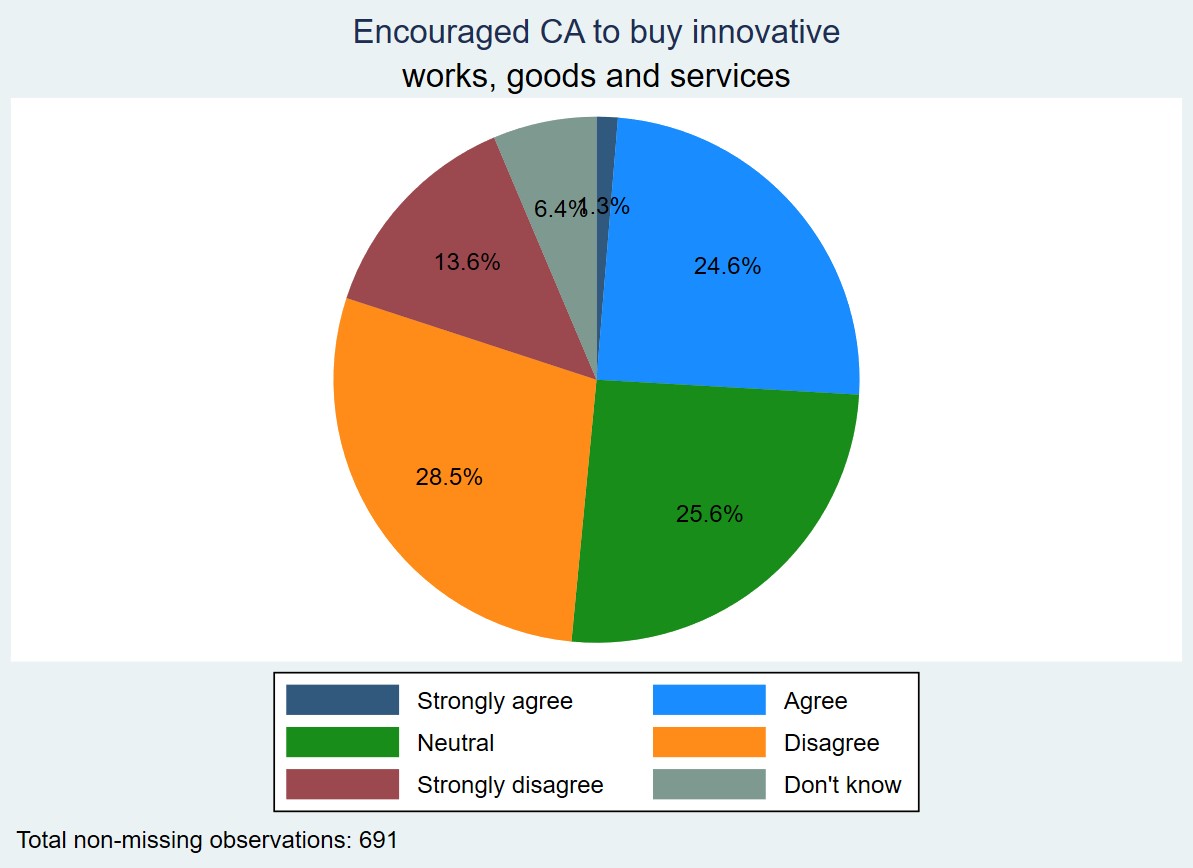
Table 35. The directives encouraged contracting authorities to buy innovative works, goods and services, by type of respondent (first row has frequencies and second row has row percentages)
|
Contribution given as
|
Encouraged CA to buy innovative
|
|
|
Strongly agree
|
Agree
|
Neutral
|
Disagree
|
Strongly disagree
|
Don't know
|
Total
|
|
Academic/research inst.
|
1
|
8
|
6
|
9
|
4
|
5
|
33
|
|
|
3.03
|
24.24
|
18.18
|
27.27
|
12.12
|
15.15
|
100.00
|
|
Business association
|
1
|
22
|
19
|
46
|
17
|
7
|
112
|
|
|
0.89
|
19.64
|
16.96
|
41.07
|
15.18
|
6.25
|
100.00
|
|
Company/business
|
0
|
28
|
20
|
45
|
26
|
12
|
131
|
|
|
0.00
|
21.37
|
15.27
|
34.35
|
19.85
|
9.16
|
100.00
|
|
Consumer organisation
|
0
|
0
|
0
|
1
|
0
|
0
|
1
|
|
|
0.00
|
0.00
|
0.00
|
100.00
|
0.00
|
0.00
|
100.00
|
|
EU citizen
|
0
|
10
|
8
|
19
|
15
|
0
|
52
|
|
|
0.00
|
19.23
|
15.38
|
36.54
|
28.85
|
0.00
|
100.00
|
|
NGO
|
0
|
11
|
21
|
19
|
9
|
7
|
67
|
|
|
0.00
|
16.42
|
31.34
|
28.36
|
13.43
|
10.45
|
100.00
|
|
Other
|
0
|
10
|
18
|
14
|
6
|
1
|
49
|
|
|
0.00
|
20.41
|
36.73
|
28.57
|
12.24
|
2.04
|
100.00
|
|
Public authority
|
7
|
81
|
47
|
34
|
17
|
11
|
197
|
|
|
3.55
|
41.12
|
23.86
|
17.26
|
8.63
|
5.58
|
100.00
|
|
Trade union
|
0
|
0
|
38
|
10
|
0
|
1
|
49
|
|
|
0.00
|
0.00
|
77.55
|
20.41
|
0.00
|
2.04
|
100.00
|
|
Total
|
9
|
170
|
177
|
197
|
94
|
44
|
691
|
|
|
1.30
|
24.60
|
25.62
|
28.51
|
13.60
|
6.37
|
100.00
|
|
|
Figure 32. The directives encouraged companies to make greater efforts in meeting environmental standards in their economic activities
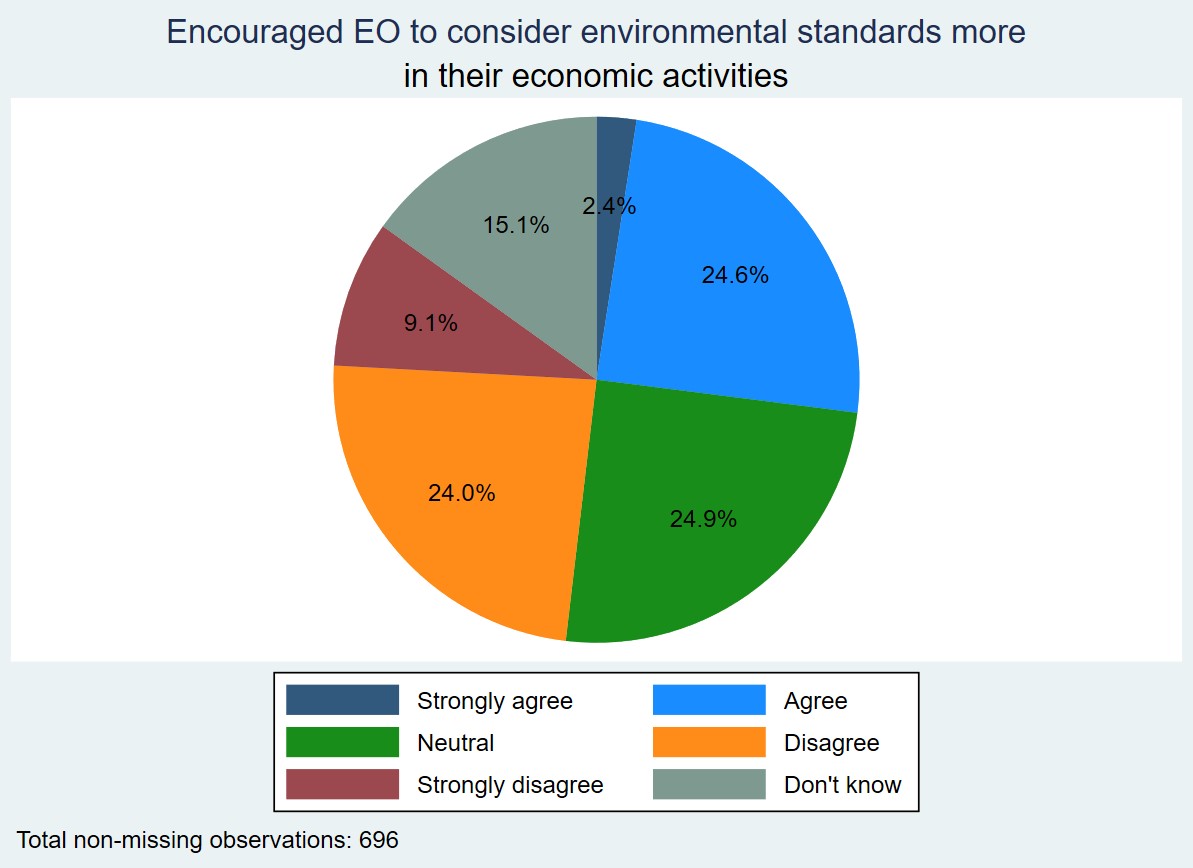
Table 36. The directives encouraged companies to make greater efforts in meeting environmental standards in their economic activities, by type of respondent (first row has frequencies and second row has row percentages)
|
Contribution given as
|
Encouraged EO to consider environmental standards more
|
|
|
Strongly agree
|
Agree
|
Neutral
|
Disagree
|
Strongly disagree
|
Don't know
|
Total
|
|
Academic/research inst.
|
1
|
11
|
7
|
4
|
5
|
5
|
33
|
|
|
3.03
|
33.33
|
21.21
|
12.12
|
15.15
|
15.15
|
100.00
|
|
Business association
|
2
|
42
|
18
|
36
|
6
|
9
|
113
|
|
|
1.77
|
37.17
|
15.93
|
31.86
|
5.31
|
7.96
|
100.00
|
|
Company/business
|
6
|
37
|
24
|
38
|
21
|
7
|
133
|
|
|
4.51
|
27.82
|
18.05
|
28.57
|
15.79
|
5.26
|
100.00
|
|
Consumer organisation
|
0
|
0
|
0
|
1
|
0
|
0
|
1
|
|
|
0.00
|
0.00
|
0.00
|
100.00
|
0.00
|
0.00
|
100.00
|
|
EU citizen
|
1
|
16
|
11
|
16
|
7
|
2
|
53
|
|
|
1.89
|
30.19
|
20.75
|
30.19
|
13.21
|
3.77
|
100.00
|
|
NGO
|
1
|
10
|
22
|
18
|
11
|
6
|
68
|
|
|
1.47
|
14.71
|
32.35
|
26.47
|
16.18
|
8.82
|
100.00
|
|
Other
|
1
|
10
|
14
|
14
|
4
|
6
|
49
|
|
|
2.04
|
20.41
|
28.57
|
28.57
|
8.16
|
12.24
|
100.00
|
|
Public authority
|
5
|
45
|
45
|
24
|
9
|
69
|
197
|
|
|
2.54
|
22.84
|
22.84
|
12.18
|
4.57
|
35.03
|
100.00
|
|
Trade union
|
0
|
0
|
32
|
16
|
0
|
1
|
49
|
|
|
0.00
|
0.00
|
65.31
|
32.65
|
0.00
|
2.04
|
100.00
|
|
Total
|
17
|
171
|
173
|
167
|
63
|
105
|
696
|
|
|
2.44
|
24.57
|
24.86
|
23.99
|
9.05
|
15.09
|
100.00
|
|
|
Figure 33. The directives encouraged companies to consider social aspects more in their economic activities

Table 37. The directives encouraged companies to consider social aspects more in their economic activities, by type of respondent (first row has frequencies and second row has row percentages)
|
Contribution given as
|
Encouraged EO to consider social aspects more
|
|
|
Strongly agree
|
Agree
|
Neutral
|
Disagree
|
Strongly disagree
|
Don't know
|
Total
|
|
Academic/research inst.
|
0
|
12
|
7
|
5
|
5
|
4
|
33
|
|
|
0.00
|
36.36
|
21.21
|
15.15
|
15.15
|
12.12
|
100.00
|
|
Business association
|
4
|
43
|
27
|
23
|
7
|
7
|
111
|
|
|
3.60
|
38.74
|
24.32
|
20.72
|
6.31
|
6.31
|
100.00
|
|
Company/business
|
2
|
41
|
28
|
37
|
17
|
7
|
132
|
|
|
1.52
|
31.06
|
21.21
|
28.03
|
12.88
|
5.30
|
100.00
|
|
Consumer organisation
|
0
|
0
|
0
|
1
|
0
|
0
|
1
|
|
|
0.00
|
0.00
|
0.00
|
100.00
|
0.00
|
0.00
|
100.00
|
|
EU citizen
|
0
|
15
|
14
|
11
|
9
|
2
|
51
|
|
|
0.00
|
29.41
|
27.45
|
21.57
|
17.65
|
3.92
|
100.00
|
|
NGO
|
0
|
11
|
20
|
21
|
11
|
5
|
68
|
|
|
0.00
|
16.18
|
29.41
|
30.88
|
16.18
|
7.35
|
100.00
|
|
Other
|
0
|
8
|
15
|
14
|
7
|
5
|
49
|
|
|
0.00
|
16.33
|
30.61
|
28.57
|
14.29
|
10.20
|
100.00
|
|
Public authority
|
5
|
37
|
46
|
29
|
12
|
68
|
197
|
|
|
2.54
|
18.78
|
23.35
|
14.72
|
6.09
|
34.52
|
100.00
|
|
Trade union
|
0
|
0
|
0
|
8
|
45
|
0
|
53
|
|
|
0.00
|
0.00
|
0.00
|
15.09
|
84.91
|
0.00
|
100.00
|
|
Total
|
11
|
167
|
157
|
149
|
113
|
98
|
695
|
|
|
1.58
|
24.03
|
22.59
|
21.44
|
16.26
|
14.10
|
100.00
|
|
|
Figure 34. The directives encouraged companies to make wider use of innovative solutions in their economic activities

Table 38. The directives encouraged companies to make wider use of innovative solutions in their economic activities, by type of respondent (first row has frequencies and second row has row percentages)
|
Contribution given as
|
Encouraged EO to make wider use of innovative solutions
|
|
|
Strongly agree
|
Agree
|
Neutral
|
Disagree
|
Strongly disagree
|
Don't know
|
Total
|
|
Academic/research inst.
|
1
|
11
|
3
|
8
|
2
|
8
|
33
|
|
|
3.03
|
33.33
|
9.09
|
24.24
|
6.06
|
24.24
|
100.00
|
|
Business association
|
1
|
21
|
29
|
44
|
10
|
7
|
112
|
|
|
0.89
|
18.75
|
25.89
|
39.29
|
8.93
|
6.25
|
100.00
|
|
Company/business
|
1
|
28
|
24
|
47
|
24
|
7
|
131
|
|
|
0.76
|
21.37
|
18.32
|
35.88
|
18.32
|
5.34
|
100.00
|
|
Consumer organisation
|
0
|
0
|
0
|
1
|
0
|
0
|
1
|
|
|
0.00
|
0.00
|
0.00
|
100.00
|
0.00
|
0.00
|
100.00
|
|
EU citizen
|
0
|
14
|
9
|
15
|
11
|
3
|
52
|
|
|
0.00
|
26.92
|
17.31
|
28.85
|
21.15
|
5.77
|
100.00
|
|
NGO
|
0
|
7
|
6
|
21
|
7
|
26
|
67
|
|
|
0.00
|
10.45
|
8.96
|
31.34
|
10.45
|
38.81
|
100.00
|
|
Other
|
1
|
5
|
13
|
16
|
6
|
8
|
49
|
|
|
2.04
|
10.20
|
26.53
|
32.65
|
12.24
|
16.33
|
100.00
|
|
Public authority
|
2
|
25
|
51
|
31
|
14
|
71
|
194
|
|
|
1.03
|
12.89
|
26.29
|
15.98
|
7.22
|
36.60
|
100.00
|
|
Trade union
|
0
|
0
|
38
|
10
|
0
|
1
|
49
|
|
|
0.00
|
0.00
|
77.55
|
20.41
|
0.00
|
2.04
|
100.00
|
|
Total
|
6
|
111
|
173
|
193
|
74
|
131
|
688
|
|
|
0.87
|
16.13
|
25.15
|
28.05
|
10.76
|
19.04
|
100.00
|
|
|
Figure 35. The directives’ rules that aim for environmentally friendly procurement (e.g. quality assurance standards and environmental management standards) are still relevant and adequate
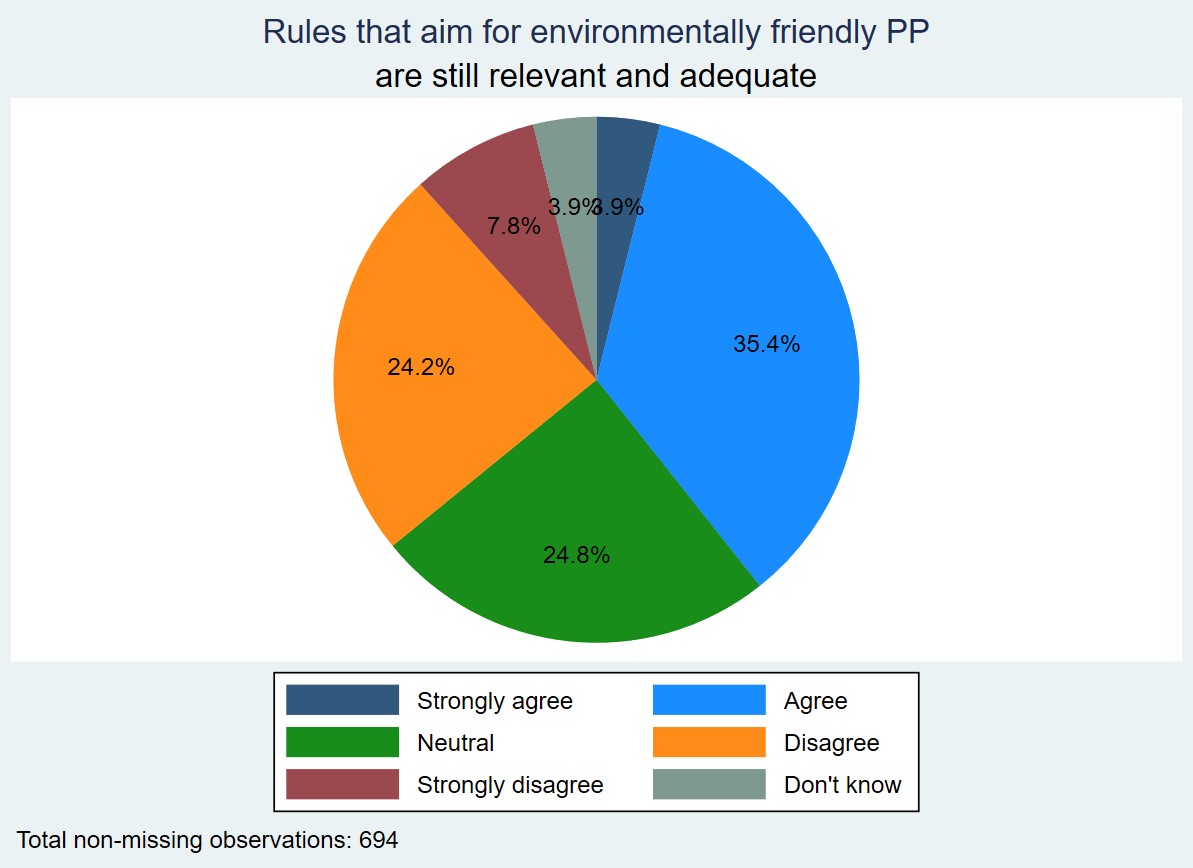
Table 39. The directives’ rules that aim for environmentally friendly procurement (e.g. quality assurance standards and environmental management standards) are still relevant and adequate, by type of respondent (first row has frequencies and second row has row percentages)
|
Contribution given as
|
Rules that aim for environmentally friendly PP
|
|
|
Strongly agree
|
Agree
|
Neutral
|
Disagree
|
Strongly disagree
|
Don't know
|
Total
|
|
Academic/research inst.
|
1
|
13
|
9
|
7
|
1
|
2
|
33
|
|
|
3.03
|
39.39
|
27.27
|
21.21
|
3.03
|
6.06
|
100.00
|
|
Business association
|
3
|
40
|
29
|
21
|
9
|
9
|
111
|
|
|
2.70
|
36.04
|
26.13
|
18.92
|
8.11
|
8.11
|
100.00
|
|
Company/business
|
4
|
47
|
35
|
29
|
11
|
7
|
133
|
|
|
3.01
|
35.34
|
26.32
|
21.80
|
8.27
|
5.26
|
100.00
|
|
Consumer organisation
|
0
|
0
|
0
|
1
|
0
|
0
|
1
|
|
|
0.00
|
0.00
|
0.00
|
100.00
|
0.00
|
0.00
|
100.00
|
|
EU citizen
|
4
|
21
|
10
|
9
|
8
|
1
|
53
|
|
|
7.55
|
39.62
|
18.87
|
16.98
|
15.09
|
1.89
|
100.00
|
|
NGO
|
5
|
14
|
8
|
29
|
11
|
2
|
69
|
|
|
7.25
|
20.29
|
11.59
|
42.03
|
15.94
|
2.90
|
100.00
|
|
Other
|
1
|
16
|
9
|
18
|
5
|
0
|
49
|
|
|
2.04
|
32.65
|
18.37
|
36.73
|
10.20
|
0.00
|
100.00
|
|
Public authority
|
9
|
95
|
39
|
40
|
8
|
5
|
196
|
|
|
4.59
|
48.47
|
19.90
|
20.41
|
4.08
|
2.55
|
100.00
|
|
Trade union
|
0
|
0
|
33
|
14
|
1
|
1
|
49
|
|
|
0.00
|
0.00
|
67.35
|
28.57
|
2.04
|
2.04
|
100.00
|
|
Total
|
27
|
246
|
172
|
168
|
54
|
27
|
694
|
|
|
3.89
|
35.45
|
24.78
|
24.21
|
7.78
|
3.89
|
100.00
|
|
|
Figure 36. The directives’ rules that aim for socially responsible procurement (e.g. reserved contracts, requirements on accessibility for people with disabilities and design for all users) are still relevant and adequate

Table 40. The directives’ rules that aim for socially responsible procurement (e.g. reserved contracts, requirements on accessibility for people with disabilities and design for all users) are still relevant and adequate, by type of respondent (first row has frequencies and second row has row percentages)
|
Contribution given as
|
Rules rules that aim for socially responsible PP
|
|
|
Strongly agree
|
Agree
|
Neutral
|
Disagree
|
Strongly disagree
|
Don't know
|
Total
|
|
Academic/research inst.
|
2
|
13
|
9
|
2
|
5
|
2
|
33
|
|
|
6.06
|
39.39
|
27.27
|
6.06
|
15.15
|
6.06
|
100.00
|
|
Business association
|
12
|
38
|
28
|
15
|
6
|
9
|
108
|
|
|
11.11
|
35.19
|
25.93
|
13.89
|
5.56
|
8.33
|
100.00
|
|
Company/business
|
10
|
46
|
37
|
24
|
7
|
6
|
130
|
|
|
7.69
|
35.38
|
28.46
|
18.46
|
5.38
|
4.62
|
100.00
|
|
Consumer organisation
|
0
|
0
|
0
|
1
|
0
|
0
|
1
|
|
|
0.00
|
0.00
|
0.00
|
100.00
|
0.00
|
0.00
|
100.00
|
|
EU citizen
|
9
|
17
|
7
|
9
|
8
|
3
|
53
|
|
|
16.98
|
32.08
|
13.21
|
16.98
|
15.09
|
5.66
|
100.00
|
|
NGO
|
7
|
12
|
7
|
30
|
8
|
4
|
68
|
|
|
10.29
|
17.65
|
10.29
|
44.12
|
11.76
|
5.88
|
100.00
|
|
Other
|
1
|
17
|
12
|
13
|
6
|
0
|
49
|
|
|
2.04
|
34.69
|
24.49
|
26.53
|
12.24
|
0.00
|
100.00
|
|
Public authority
|
10
|
102
|
32
|
39
|
9
|
4
|
196
|
|
|
5.10
|
52.04
|
16.33
|
19.90
|
4.59
|
2.04
|
100.00
|
|
Trade union
|
0
|
0
|
0
|
2
|
51
|
0
|
53
|
|
|
0.00
|
0.00
|
0.00
|
3.77
|
96.23
|
0.00
|
100.00
|
|
Total
|
51
|
245
|
132
|
135
|
100
|
28
|
691
|
|
|
7.38
|
35.46
|
19.10
|
19.54
|
14.47
|
4.05
|
100.00
|
|
|
Figure 37. The directives’ rules on supporting innovation (e.g. innovation partnership, competitive dialogue) are still relevant and adequate

Table 41. The directives’ rules on supporting innovation (e.g. innovation partnership, competitive dialogue) are still relevant and adequate, by type of respondent (first row has frequencies and second row has row percentages)
|
Contribution given as
|
Rules supporting innovation
|
|
|
Strongly agree
|
Agree
|
Neutral
|
Disagree
|
Strongly disagree
|
Don't know
|
Total
|
|
Academic/research inst.
|
1
|
10
|
9
|
7
|
1
|
5
|
33
|
|
|
3.03
|
30.30
|
27.27
|
21.21
|
3.03
|
15.15
|
100.00
|
|
Business association
|
1
|
29
|
28
|
34
|
8
|
10
|
110
|
|
|
0.91
|
26.36
|
25.45
|
30.91
|
7.27
|
9.09
|
100.00
|
|
Company/business
|
5
|
37
|
37
|
34
|
14
|
5
|
132
|
|
|
3.79
|
28.03
|
28.03
|
25.76
|
10.61
|
3.79
|
100.00
|
|
Consumer organisation
|
0
|
0
|
0
|
1
|
0
|
0
|
1
|
|
|
0.00
|
0.00
|
0.00
|
100.00
|
0.00
|
0.00
|
100.00
|
|
EU citizen
|
3
|
20
|
6
|
11
|
9
|
4
|
53
|
|
|
5.66
|
37.74
|
11.32
|
20.75
|
16.98
|
7.55
|
100.00
|
|
NGO
|
2
|
7
|
16
|
24
|
3
|
15
|
67
|
|
|
2.99
|
10.45
|
23.88
|
35.82
|
4.48
|
22.39
|
100.00
|
|
Other
|
1
|
10
|
14
|
16
|
7
|
1
|
49
|
|
|
2.04
|
20.41
|
28.57
|
32.65
|
14.29
|
2.04
|
100.00
|
|
Public authority
|
6
|
90
|
41
|
37
|
9
|
13
|
196
|
|
|
3.06
|
45.92
|
20.92
|
18.88
|
4.59
|
6.63
|
100.00
|
|
Trade union
|
0
|
0
|
44
|
5
|
0
|
0
|
49
|
|
|
0.00
|
0.00
|
89.80
|
10.20
|
0.00
|
0.00
|
100.00
|
|
Total
|
19
|
203
|
195
|
169
|
51
|
53
|
690
|
|
|
2.75
|
29.42
|
28.26
|
24.49
|
7.39
|
7.68
|
100.00
|
|
|
Figure 38. The directives’ rules on supporting all types of strategic procurement (e.g. the use of the most economically advantageous tender) are still relevant and adequate
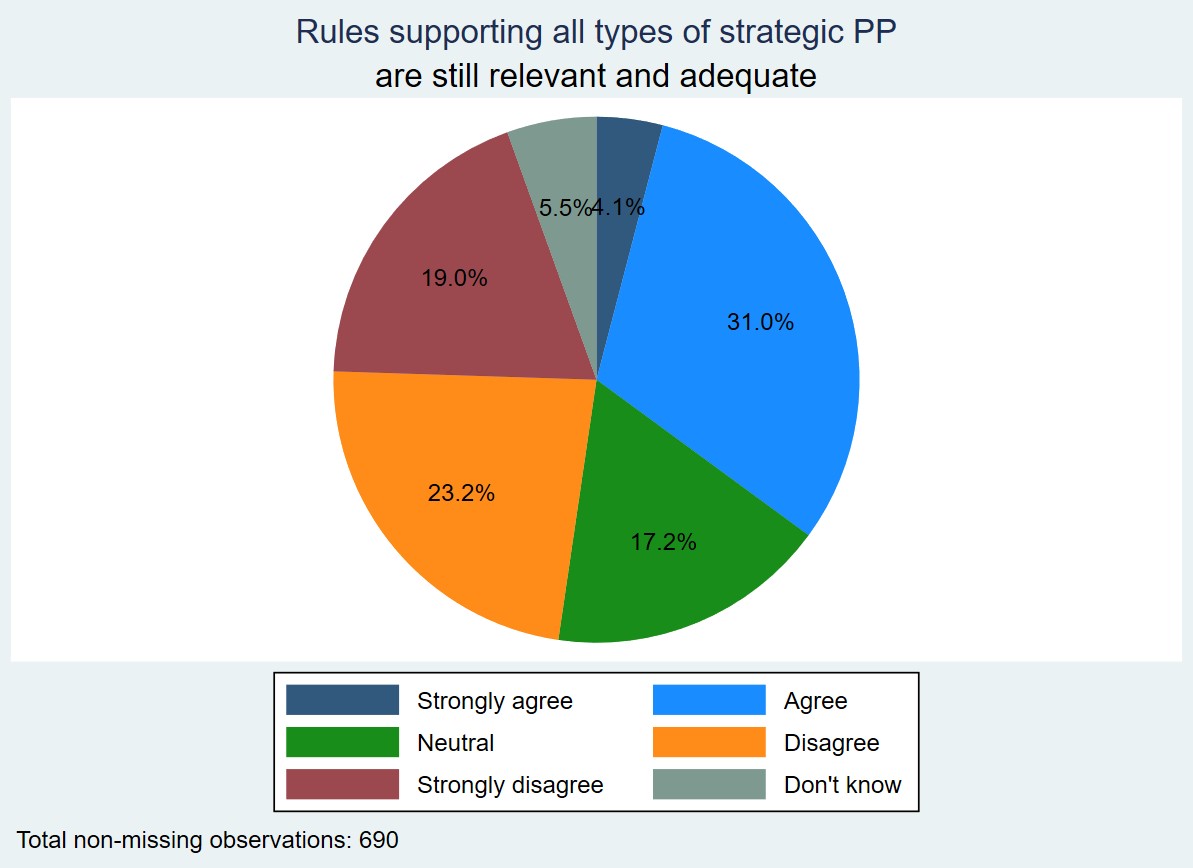
Table 42. The directives’ rules on supporting all types of strategic procurement (e.g. the use of the most economically advantageous tender) are still relevant and adequate, by type of respondent (first row has frequencies and second row has row percentages)
|
Contribution given as
|
Rules supporting all types of strategic PP
|
|
|
Strongly agree
|
Agree
|
Neutral
|
Disagree
|
Strongly disagree
|
Don't know
|
Total
|
|
Academic/research inst.
|
0
|
16
|
10
|
7
|
0
|
0
|
33
|
|
|
0.00
|
48.48
|
30.30
|
21.21
|
0.00
|
0.00
|
100.00
|
|
Business association
|
4
|
29
|
14
|
29
|
22
|
11
|
109
|
|
|
3.67
|
26.61
|
12.84
|
26.61
|
20.18
|
10.09
|
100.00
|
|
Company/business
|
6
|
33
|
25
|
38
|
19
|
10
|
131
|
|
|
4.58
|
25.19
|
19.08
|
29.01
|
14.50
|
7.63
|
100.00
|
|
Consumer organisation
|
0
|
0
|
1
|
0
|
0
|
0
|
1
|
|
|
0.00
|
0.00
|
100.00
|
0.00
|
0.00
|
0.00
|
100.00
|
|
EU citizen
|
6
|
10
|
11
|
11
|
12
|
3
|
53
|
|
|
11.32
|
18.87
|
20.75
|
20.75
|
22.64
|
5.66
|
100.00
|
|
NGO
|
1
|
10
|
8
|
31
|
14
|
3
|
67
|
|
|
1.49
|
14.93
|
11.94
|
46.27
|
20.90
|
4.48
|
100.00
|
|
Other
|
1
|
17
|
11
|
10
|
7
|
1
|
47
|
|
|
2.13
|
36.17
|
23.40
|
21.28
|
14.89
|
2.13
|
100.00
|
|
Public authority
|
10
|
99
|
38
|
32
|
8
|
10
|
197
|
|
|
5.08
|
50.25
|
19.29
|
16.24
|
4.06
|
5.08
|
100.00
|
|
Trade union
|
0
|
0
|
1
|
2
|
49
|
0
|
52
|
|
|
0.00
|
0.00
|
1.92
|
3.85
|
94.23
|
0.00
|
100.00
|
|
Total
|
28
|
214
|
119
|
160
|
131
|
38
|
690
|
|
|
4.06
|
31.01
|
17.25
|
23.19
|
18.99
|
5.51
|
100.00
|
|
|
Figure 39. The directives’ rules on the transfer of intellectual property rights to enable public procurement to drive innovation are still relevant and adequate
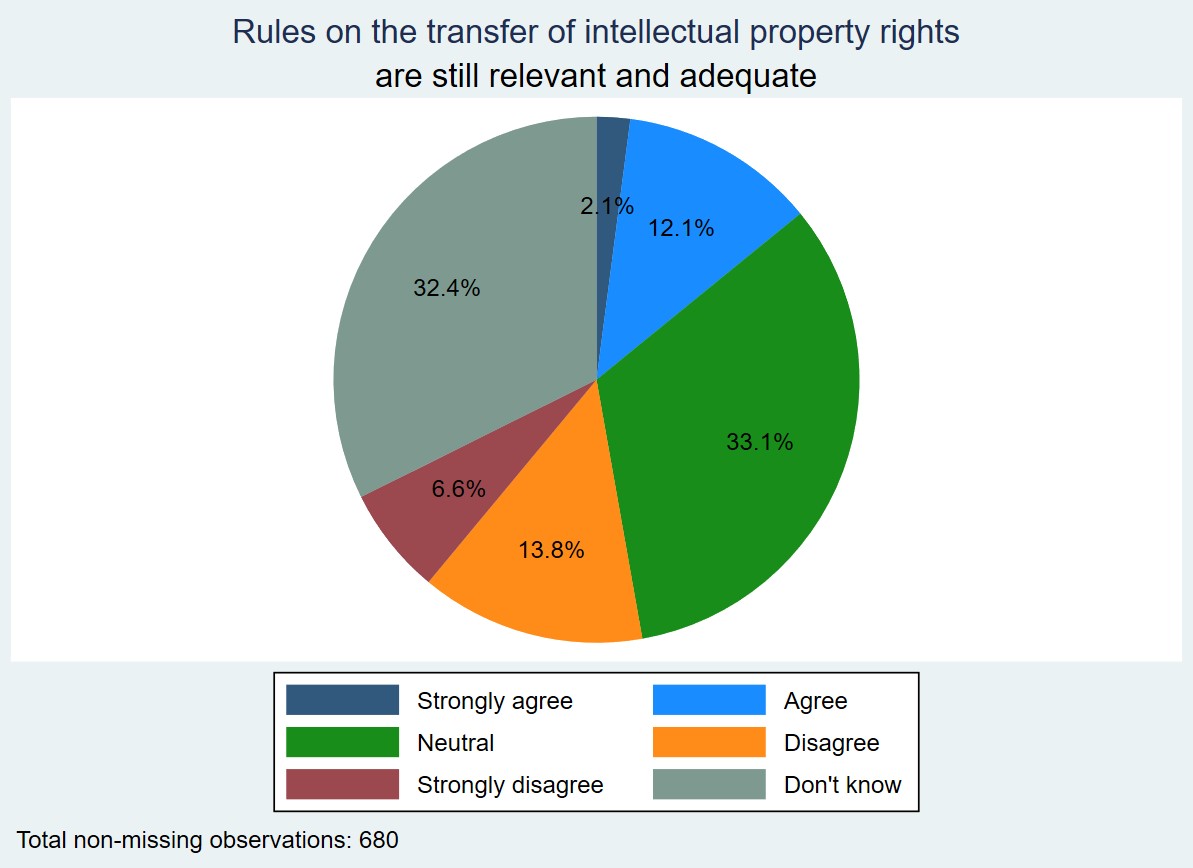
Table 43. The directives’ rules on the transfer of intellectual property rights to enable public procurement to drive innovation are still relevant and adequate, by type of respondent (first row has frequencies and second row has row percentages)
|
Contribution given as
|
Rules on the transfer of intellectual property rights
|
|
|
Strongly agree
|
Agree
|
Neutral
|
Disagree
|
Strongly disagree
|
Don't know
|
Total
|
|
Academic/research inst.
|
0
|
6
|
14
|
3
|
2
|
8
|
33
|
|
|
0.00
|
18.18
|
42.42
|
9.09
|
6.06
|
24.24
|
100.00
|
|
Business association
|
1
|
14
|
31
|
25
|
3
|
35
|
109
|
|
|
0.92
|
12.84
|
28.44
|
22.94
|
2.75
|
32.11
|
100.00
|
|
Company/business
|
3
|
22
|
45
|
18
|
8
|
29
|
125
|
|
|
2.40
|
17.60
|
36.00
|
14.40
|
6.40
|
23.20
|
100.00
|
|
Consumer organisation
|
0
|
1
|
0
|
0
|
0
|
0
|
1
|
|
|
0.00
|
100.00
|
0.00
|
0.00
|
0.00
|
0.00
|
100.00
|
|
EU citizen
|
3
|
7
|
16
|
6
|
6
|
14
|
52
|
|
|
5.77
|
13.46
|
30.77
|
11.54
|
11.54
|
26.92
|
100.00
|
|
NGO
|
1
|
4
|
8
|
7
|
14
|
33
|
67
|
|
|
1.49
|
5.97
|
11.94
|
10.45
|
20.90
|
49.25
|
100.00
|
|
Other
|
0
|
6
|
16
|
10
|
6
|
11
|
49
|
|
|
0.00
|
12.24
|
32.65
|
20.41
|
12.24
|
22.45
|
100.00
|
|
Public authority
|
6
|
21
|
50
|
23
|
6
|
89
|
195
|
|
|
3.08
|
10.77
|
25.64
|
11.79
|
3.08
|
45.64
|
100.00
|
|
Trade union
|
0
|
1
|
45
|
2
|
0
|
1
|
49
|
|
|
0.00
|
2.04
|
91.84
|
4.08
|
0.00
|
2.04
|
100.00
|
|
Total
|
14
|
82
|
225
|
94
|
45
|
220
|
680
|
|
|
2.06
|
12.06
|
33.09
|
13.82
|
6.62
|
32.35
|
100.00
|
|
|
Selected quotes from written contributions:
·“The lowest price criterion still prevails, which reduces the quality of the delivered goods and services” (CfE, an academic/research institution from Croatia).
·“The MEAT principle was introduced to shift focus from "lowest price wins" to value-driven procurement. However, its implementation lacks clear guidance, such as how to balance price against other criteria” (CfE, a large company from Germany).
·“Most Member States’ contracting authorities still award tenders based on the lowest price or cost and thus quality criteria and social, environmental and innovation considerations are not included in tender documents. Whereas it has been proven that including these considerations in the award criteria strongly encourages social entrepreneurship” (CfE, a business association from Ireland).
·“Despite the 2014 Directives Art. 70 introduction of voluntary social and environmental considerations, the predominance of the lowest price as the sole criterion systematically excludes social enterprises from competing, as their social and green activities entails higher upfront costs than mainstream businesses. This undermines the potential for public procurement to create public value and restrains entry for SMEs offering socially and environmentally innovative solutions” (CfE, an NGO from Belgium).
·“We believe that the current EU legal framework does not provide sufficient legal certainty for procuring authorities wishing to effectively protect and promote collective bargaining, quality jobs, the climate and the environment. Current rules and the lack of strong and effective social conditions have created a downward pressure on labour costs and collective bargaining, and subsequently also working conditions and wages for workers under public contracts. Social, environmental and climate criteria should not be seen as discriminatory against economic operators but rather as lever for improving the quality of goods and services procured as well as quality of employment for workers” (CfE, a trade union from Belgium).
·“Although the inclusion of sustainability criteria is possible, it must be related to the subject-matter of the contract (2014/24/EU, recital 97) and is a voluntary "can” criterion. In practice, there is still uncertainty as to what is legally possible and integrating sustainable criteria can be complex. The implementation of SPP often depends on the commitment of individual employees in public institutions. As public purchasers often do not have the time and capacities to explore new possibilities (that also come with more bureaucracy), it is difficult to shift the focus on sustainability” (CfE, an NGO from Germany).
·“Under current public procurement rules, environmental considerations in public contracts are voluntary. This leads to fragmentation across Member States, regulatory complexity, and investment uncertainty” (CfE, a medium company from Ireland).
·“Different kinds of horizontal objectives, including goals and rules to promote sustainability, innovations, European production or other similar, interfere with the core of procurement, that is public buying. The increasing amount of sectoral regulations and directives make it impossible for local authorities to grasp the total content of obligatory legislation” (CfE, a local public authority from Finland).
·“Due to various other directives and regulations (such as CVD, HDV-VO, NZIA, etc.), there has been a strong fragmentation of (special) procurement law provisions across a large number of EU legal acts in recent years” (CfE, a business association from Austria).
·“Public Procurement directives promote integration of multiple secondary policy objectives in public procurement: preserving the environment, innovation, SMEs, responsible business conduct. Sometimes those objectives compete or conflict between each other complicating tasks for public buyers (ex. rational use of public budget vs environmental objective). So, the public procurement legal framework lacks strategic public procurement goals balancing principles that could ease the tasks for public buyers and businesses” (CfE, a national public authority from Lithuania).
·“Not all the objectives of the directives have been achieved. Major shortcomings are visible mainly in the areas of achieving strategic autonomy of the EU, promoting a culture of honesty and fair play in public procurement, supporting strategic public procurement, encouraging enterprises to make greater efforts to comply with environmental standards in their economic activities, as well as taking into account social standards in their economic activities. All these problems are linked to the too free access to the EU market of non-EU countries” (CfE, a citizen from Poland).
·“Our experience has shown that socially inclusive Public Procurement - easing access to contracts to social economy enterprises and foundations - can support the creation of high-quality employment opportunities for vulnerable and disadvantaged groups, including persons with disabilities. This is why the 2014 Public Procurement Directive set a number of mechanisms that have proven to be valuable catalysts for the employment of persons with disabilities” (CfE, an NGO from Belgium).
·“The basic objective of ‘fair competition’ and the taking into account of social and environmental aspects are laid down in the broad guidelines, giving the Member States and users a certain freedom of action and organisation. Overall, the rules appear to be appropriate. But as a result of the design and in combination with increasing legal, technical, socio-political objectives and crises, there is a considerable additional effort for users and a burden on staff” (OPC, a local public authority from Germany).
·“Regulations governing procurement procedures have little impact on the practice of public buyers. Much more influence is exerted by auditing authorities, particularly audit criteria. Public buyers will always act in the manner expected by auditors. If audits focus on the formal legal correctness of procurement procedures, public purchasers will focus on the same” (CfE, a citizen from Poland).
·“The voluntary Green Public Procurement (GPP) framework has been inconsistently applied across EU member states, creating market obstacles to incorporating sustainability in public procurement” (CfE, a microcompany from Spain).
·“There are insufficient resources, budget, and expertise at the level of contracting authorities to implement this type of directives. The objectives to be achieved are not always clear, nor are the means and methods to achieve them. […] Small contracting authorities (CAs) also lack the means to verify the actual compliance of providers’ commitments and the certified products supplied” (OPC, a citizen from Belgium).
·“There are still a lot of contracting authorities who aren’t acquainted yet with socially responsible public procurement or green procurements. Thus, the strategic role that the appropriate implementation of public procurement rules should have is considerably affected, given the limited administrative capacity of the local public authorities representing the small municipalities. Also, other causes are related to the inconsistencies which intervened when modifying the provisions of the main legislative acts adopted for the transposition of the EU directives” (CfE, a citizen from Romania).
Competition
A detailed distribution of replies for each question is provided below.
Figure 40. Level of competition in the EU public procurement market

Table 44. Level of competition in the EU public procurement market, by type of respondent (first row has frequencies and second row has row percentages)
|
Contribution given as
|
The level of competition in the EU PP market is ...
|
|
|
Too high
|
Adequate
|
Too low
|
No opinion
|
Total
|
|
Academic/research inst.
|
3
|
15
|
11
|
4
|
33
|
|
|
9.09
|
45.45
|
33.33
|
12.12
|
100.00
|
|
Business association
|
11
|
36
|
46
|
15
|
108
|
|
|
10.19
|
33.33
|
42.59
|
13.89
|
100.00
|
|
Company/business
|
28
|
50
|
35
|
17
|
130
|
|
|
21.54
|
38.46
|
26.92
|
13.08
|
100.00
|
|
Consumer organisation
|
1
|
0
|
0
|
0
|
1
|
|
|
100.00
|
0.00
|
0.00
|
0.00
|
100.00
|
|
EU citizen
|
12
|
16
|
22
|
3
|
53
|
|
|
22.64
|
30.19
|
41.51
|
5.66
|
100.00
|
|
NGO
|
6
|
28
|
20
|
13
|
67
|
|
|
8.96
|
41.79
|
29.85
|
19.40
|
100.00
|
|
Other
|
2
|
15
|
22
|
8
|
47
|
|
|
4.26
|
31.91
|
46.81
|
17.02
|
100.00
|
|
Public authority
|
5
|
66
|
101
|
25
|
197
|
|
|
2.54
|
33.50
|
51.27
|
12.69
|
100.00
|
|
Trade union
|
8
|
0
|
2
|
42
|
52
|
|
|
15.38
|
0.00
|
3.85
|
80.77
|
100.00
|
|
Total
|
76
|
226
|
259
|
127
|
688
|
|
|
11.05
|
32.85
|
37.65
|
18.46
|
100.00
|
|
|
Figure 41. Frequency of single bidding (awarding a contract after only receiving one offer)

Table 45. Frequency of single bidding (awarding a contract after only receiving one offer), by type of respondent (first row has frequencies and second row has row percentages)
|
Contribution given as
|
The frequency of single bidding is ...
|
|
|
Too high
|
Adequate
|
Too low
|
No opinion
|
Total
|
|
Academic/research inst.
|
14
|
16
|
0
|
3
|
33
|
|
|
42.42
|
48.48
|
0.00
|
9.09
|
100.00
|
|
Business association
|
48
|
17
|
3
|
41
|
109
|
|
|
44.04
|
15.60
|
2.75
|
37.61
|
100.00
|
|
Company/business
|
27
|
45
|
9
|
47
|
128
|
|
|
21.09
|
35.16
|
7.03
|
36.72
|
100.00
|
|
Consumer organisation
|
0
|
0
|
0
|
1
|
1
|
|
|
0.00
|
0.00
|
0.00
|
100.00
|
100.00
|
|
EU citizen
|
22
|
13
|
5
|
13
|
53
|
|
|
41.51
|
24.53
|
9.43
|
24.53
|
100.00
|
|
NGO
|
16
|
9
|
2
|
39
|
66
|
|
|
24.24
|
13.64
|
3.03
|
59.09
|
100.00
|
|
Other
|
17
|
12
|
1
|
18
|
48
|
|
|
35.42
|
25.00
|
2.08
|
37.50
|
100.00
|
|
Public authority
|
51
|
56
|
18
|
71
|
196
|
|
|
26.02
|
28.57
|
9.18
|
36.22
|
100.00
|
|
Trade union
|
2
|
0
|
1
|
49
|
52
|
|
|
3.85
|
0.00
|
1.92
|
94.23
|
100.00
|
|
Total
|
197
|
168
|
39
|
282
|
686
|
|
|
28.72
|
24.49
|
5.69
|
41.11
|
100.00
|
|
|
Figure 42. Frequency of direct awards (negotiated procedure without publication of a contract notice)

Table 46. Frequency of direct awards (negotiated procedure without publication of a contract notice), by type of respondent (first row has frequencies and second row has row percentages)
|
Contribution given as
|
The frequency of direct awards is ...
|
|
|
Too high
|
Adequate
|
Too low
|
No opinion
|
Total
|
|
Academic/research inst.
|
7
|
12
|
9
|
5
|
33
|
|
|
21.21
|
36.36
|
27.27
|
15.15
|
100.00
|
|
Business association
|
29
|
32
|
11
|
37
|
109
|
|
|
26.61
|
29.36
|
10.09
|
33.94
|
100.00
|
|
Company/business
|
19
|
33
|
23
|
53
|
128
|
|
|
14.84
|
25.78
|
17.97
|
41.41
|
100.00
|
|
Consumer organisation
|
0
|
0
|
0
|
1
|
1
|
|
|
0.00
|
0.00
|
0.00
|
100.00
|
100.00
|
|
EU citizen
|
12
|
19
|
12
|
9
|
52
|
|
|
23.08
|
36.54
|
23.08
|
17.31
|
100.00
|
|
NGO
|
9
|
8
|
6
|
42
|
65
|
|
|
13.85
|
12.31
|
9.23
|
64.62
|
100.00
|
|
Other
|
10
|
18
|
6
|
13
|
47
|
|
|
21.28
|
38.30
|
12.77
|
27.66
|
100.00
|
|
Public authority
|
9
|
75
|
82
|
27
|
193
|
|
|
4.66
|
38.86
|
42.49
|
13.99
|
100.00
|
|
Trade union
|
4
|
1
|
6
|
39
|
50
|
|
|
8.00
|
2.00
|
12.00
|
78.00
|
100.00
|
|
Total
|
99
|
198
|
155
|
226
|
678
|
|
|
14.60
|
29.20
|
22.86
|
33.33
|
100.00
|
|
|
Figure 43. Frequency of awards based on price only (as different from the most economically advantageous awards)

Table 47. Frequency of awards based on price only (as different from the most economically advantageous awards), by type of respondent (first row has frequencies and second row has row percentages)
|
Contribution given as
|
The frequency of awards based on price only is ...
|
|
|
Too high
|
Adequate
|
Too low
|
No opinion
|
Total
|
|
Academic/research inst.
|
9
|
20
|
0
|
4
|
33
|
|
|
27.27
|
60.61
|
0.00
|
12.12
|
100.00
|
|
Business association
|
72
|
16
|
2
|
19
|
109
|
|
|
66.06
|
14.68
|
1.83
|
17.43
|
100.00
|
|
Company/business
|
69
|
31
|
6
|
22
|
128
|
|
|
53.91
|
24.22
|
4.69
|
17.19
|
100.00
|
|
Consumer organisation
|
1
|
0
|
0
|
0
|
1
|
|
|
100.00
|
0.00
|
0.00
|
0.00
|
100.00
|
|
EU citizen
|
32
|
12
|
4
|
5
|
53
|
|
|
60.38
|
22.64
|
7.55
|
9.43
|
100.00
|
|
NGO
|
52
|
7
|
1
|
6
|
66
|
|
|
78.79
|
10.61
|
1.52
|
9.09
|
100.00
|
|
Other
|
15
|
23
|
0
|
11
|
49
|
|
|
30.61
|
46.94
|
0.00
|
22.45
|
100.00
|
|
Public authority
|
35
|
129
|
9
|
21
|
194
|
|
|
18.04
|
66.49
|
4.64
|
10.82
|
100.00
|
|
Trade union
|
52
|
0
|
0
|
1
|
53
|
|
|
98.11
|
0.00
|
0.00
|
1.89
|
100.00
|
|
Total
|
337
|
238
|
22
|
89
|
686
|
|
|
49.13
|
34.69
|
3.21
|
12.97
|
100.00
|
|
|
Figure 44. Do you agree with either of these statements about the high frequency of single bidding?

Table 48. Do you agree with either of these statements about the high frequency of single bidding? Answer by type of respondent (first row has frequencies and second row has row percentages)
|
Contribution given as
|
High frequency of single bidding
|
|
|
It is a sign of bad procurement practices
|
It is not linked to procurement practices, but due to market structure or other factors unrelated to procurement
|
I don't agree with either of the statements above
|
Total
|
|
Academic/research inst.
|
4
|
22
|
7
|
33
|
|
|
12.12
|
66.67
|
21.21
|
100.00
|
|
Business association
|
45
|
35
|
20
|
100
|
|
|
45.00
|
35.00
|
20.00
|
100.00
|
|
Company/business
|
36
|
62
|
22
|
120
|
|
|
30.00
|
51.67
|
18.33
|
100.00
|
|
Consumer organisation
|
0
|
1
|
0
|
1
|
|
|
0.00
|
100.00
|
0.00
|
100.00
|
|
EU citizen
|
16
|
21
|
13
|
50
|
|
|
32.00
|
42.00
|
26.00
|
100.00
|
|
NGO
|
25
|
13
|
17
|
55
|
|
|
45.45
|
23.64
|
30.91
|
100.00
|
|
Other
|
14
|
27
|
7
|
48
|
|
|
29.17
|
56.25
|
14.58
|
100.00
|
|
Public authority
|
22
|
152
|
22
|
196
|
|
|
11.22
|
77.55
|
11.22
|
100.00
|
|
Trade union
|
3
|
43
|
2
|
48
|
|
|
6.25
|
89.58
|
4.17
|
100.00
|
|
Total
|
165
|
376
|
110
|
651
|
|
|
25.35
|
57.76
|
16.90
|
100.00
|
|
|
Figure 45. Do you agree with either of these statements about the high frequency of direct awards?

Table 49. Do you agree with either of these statements about the high frequency of direct awards? Answer by type of respondent (first row has frequencies and second row has row percentages)
|
Contribution given as
|
High frequency of direct awards
|
|
|
It is a sign of bad procurement practices
|
It is a legitimate procurement practice under certain circumstances and may facilitate the flexibility and timeliness of procedures
|
I don't agree with either of the statements above
|
Total
|
|
Academic/research inst.
|
2
|
29
|
2
|
33
|
|
|
6.06
|
87.88
|
6.06
|
100.00
|
|
Business association
|
28
|
47
|
26
|
101
|
|
|
27.72
|
46.53
|
25.74
|
100.00
|
|
Company/business
|
22
|
72
|
24
|
118
|
|
|
18.64
|
61.02
|
20.34
|
100.00
|
|
Consumer organisation
|
0
|
1
|
0
|
1
|
|
|
0.00
|
100.00
|
0.00
|
100.00
|
|
EU citizen
|
9
|
32
|
9
|
50
|
|
|
18.00
|
64.00
|
18.00
|
100.00
|
|
NGO
|
12
|
41
|
7
|
60
|
|
|
20.00
|
68.33
|
11.67
|
100.00
|
|
Other
|
10
|
29
|
9
|
48
|
|
|
20.83
|
60.42
|
18.75
|
100.00
|
|
Public authority
|
7
|
179
|
9
|
195
|
|
|
3.59
|
91.79
|
4.62
|
100.00
|
|
Trade union
|
1
|
8
|
39
|
48
|
|
|
2.08
|
16.67
|
81.25
|
100.00
|
|
Total
|
91
|
438
|
125
|
654
|
|
|
13.91
|
66.97
|
19.11
|
100.00
|
|
|
Figure 46. Do you agree with either of these statements about the high frequency of price only awards?

Table 50. Do you agree with either of these statements about the high frequency of price only awards? Answer by type of respondent (first row has frequencies and second row has row percentages)
|
Contribution given as
|
High frequency of price only awards
|
|
|
It is a sign of bad procurement practices
|
It may be more efficient in certain circumstances (e.g. a simpler and faster way to buy homogenous goods)
|
High quality can be assured through technical requirements
|
I don't agree with either of the statements above
|
Total
|
|
Academic/research inst.
|
4
|
16
|
11
|
2
|
33
|
|
|
12.12
|
48.48
|
33.33
|
6.06
|
100.00
|
|
Business association
|
60
|
17
|
15
|
13
|
105
|
|
|
57.14
|
16.19
|
14.29
|
12.38
|
100.00
|
|
Company/business
|
50
|
38
|
25
|
10
|
123
|
|
|
40.65
|
30.89
|
20.33
|
8.13
|
100.00
|
|
Consumer organisation
|
1
|
0
|
0
|
0
|
1
|
|
|
100.00
|
0.00
|
0.00
|
0.00
|
100.00
|
|
EU citizen
|
14
|
23
|
10
|
4
|
51
|
|
|
27.45
|
45.10
|
19.61
|
7.84
|
100.00
|
|
NGO
|
42
|
5
|
9
|
9
|
65
|
|
|
64.62
|
7.69
|
13.85
|
13.85
|
100.00
|
|
Other
|
15
|
16
|
15
|
2
|
48
|
|
|
31.25
|
33.33
|
31.25
|
4.17
|
100.00
|
|
Public authority
|
11
|
63
|
110
|
11
|
195
|
|
|
5.64
|
32.31
|
56.41
|
5.64
|
100.00
|
|
Trade union
|
50
|
1
|
0
|
0
|
51
|
|
|
98.04
|
1.96
|
0.00
|
0.00
|
100.00
|
|
Total
|
247
|
179
|
195
|
51
|
672
|
|
|
36.76
|
26.64
|
29.02
|
7.59
|
100.00
|
|
|
Figure 47. Level of competition in the EU public procurement market over the last 8 years
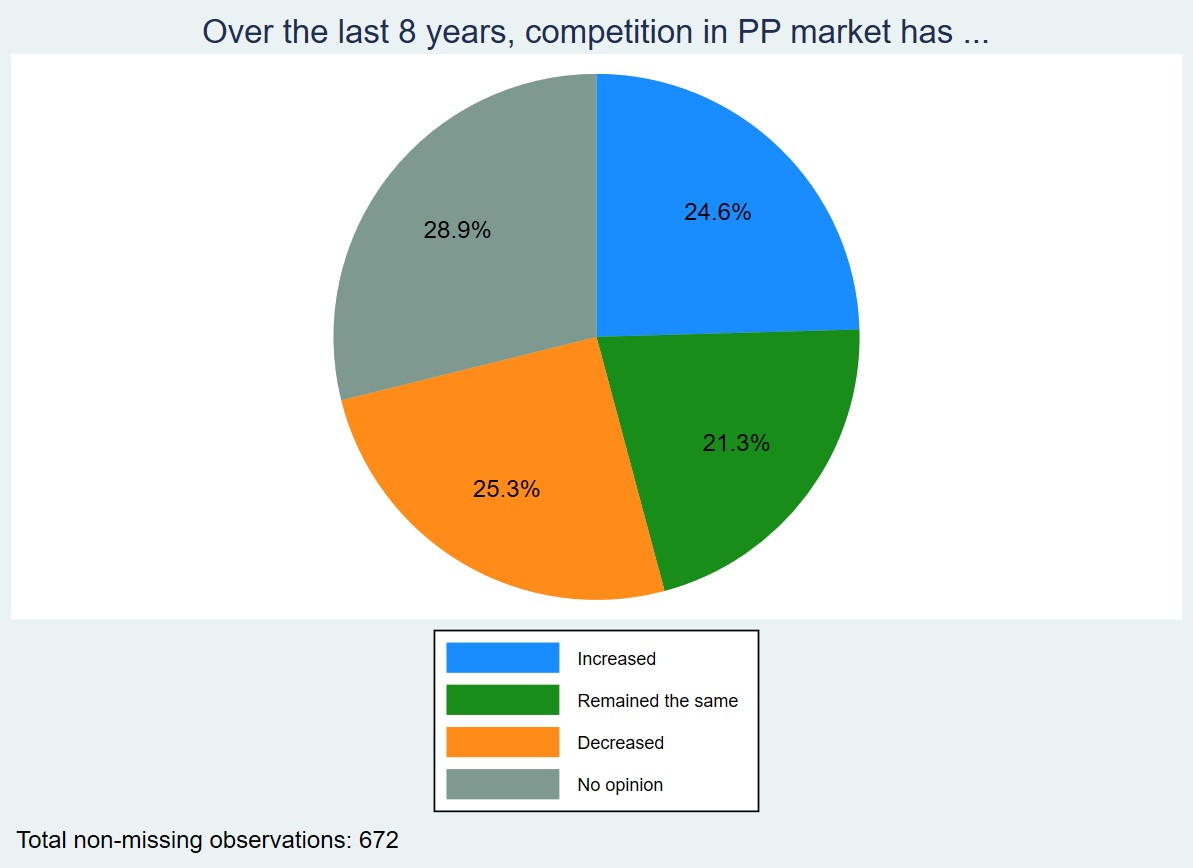
Table 51. Level of competition in the EU public procurement market over the last 8 years, by type of respondent (first row has frequencies and second row has row percentages)
|
Contribution given as
|
Over the last 8 years, competition in PP market has ...
|
|
|
increased
|
remained the same
|
decreased
|
no opinion
|
Total
|
|
Academic/research inst.
|
6
|
6
|
14
|
7
|
33
|
|
|
18.18
|
18.18
|
42.42
|
21.21
|
100.00
|
|
Business association
|
25
|
15
|
37
|
29
|
106
|
|
|
23.58
|
14.15
|
34.91
|
27.36
|
100.00
|
|
Company/business
|
46
|
17
|
29
|
31
|
123
|
|
|
37.40
|
13.82
|
23.58
|
25.20
|
100.00
|
|
Consumer organisation
|
0
|
1
|
0
|
0
|
1
|
|
|
0.00
|
100.00
|
0.00
|
0.00
|
100.00
|
|
EU citizen
|
14
|
10
|
16
|
11
|
51
|
|
|
27.45
|
19.61
|
31.37
|
21.57
|
100.00
|
|
NGO
|
7
|
2
|
16
|
39
|
64
|
|
|
10.94
|
3.13
|
25.00
|
60.94
|
100.00
|
|
Other
|
7
|
11
|
17
|
13
|
48
|
|
|
14.58
|
22.92
|
35.42
|
27.08
|
100.00
|
|
Public authority
|
21
|
80
|
41
|
54
|
196
|
|
|
10.71
|
40.82
|
20.92
|
27.55
|
100.00
|
|
Trade union
|
39
|
1
|
0
|
10
|
50
|
|
|
78.00
|
2.00
|
0.00
|
20.00
|
100.00
|
|
Total
|
165
|
143
|
170
|
194
|
672
|
|
|
24.55
|
21.28
|
25.30
|
28.87
|
100.00
|
|
|
Selected quotes from written contributions:
·“The drafting of tenders is becoming increasingly complex due to increasingly complex legislation. For tenderers, this also applies to the preparation and submission of tenders. This is an important reason why there is a decrease in the level of competition” (CfE, a large company from Belgium)
·“The more we are trying to reach strategic goals within procurement, especially forced ways (e.g. innovative quotas), the less we care about competition effect. We can’t have both” (OPC, a public authority from Slovenia).
·“Although the aim of the Public Procurement Law is to increase competition and promote the participation of companies in them, excessive bureaucracy and inflexibility are a problem due to which many micro-enterprises do not even try to start. Preparing procurement documentation takes a lot of time and requires specific knowledge, but often small enterprises do not have enough time and human resources to start procurement without a guarantee, while large enterprises that can afford specialists to prepare documents actively participate in procurement” (CfE, a citizen from Latvia).
·“The EU claims it wants to promote SMEs but most of the selection criteria are set for large companies. This leads to an ever growing concentration of companies and reduction of number of bidders, reducing the competition and creating a high dependency of the EU on a more and more limited number of companies” (CfE, a medium company from Belgium).
·“In particular, the fragmentation of regulations on public procurement at national, regional, and local level, the lack of harmonization with European directives and the “gold plating” of EU regulations are leading to complex procedures and a continuing decline in the number of bidders. This, in turn, is increasingly leading to a “one-bidder problem” and often significantly reduces competition, also to the detriment of public procurers” (CfE, a business association from Germany).
·“There are already European mechanisms in place to encourage VSE/SME access to public procurement, including mechanisms that guarantee a form of European protectionism. The main difficulty lies in the low take-up of these mechanisms, due to stakeholders' lack of awareness of them, and the obstacles encountered by the various stakeholders in effectively implementing the existing framework” (CfE, a business association from France).
·“The root cause for SMEs not participating is on one hand the complexity of the rules but even more so the overly stringent terms and conditions of the contract that is to be signed after the tendering procedure” (OPC, an agency from Poland).
·“The purpose of EU public procurement and concessions rules must be to ensure that public funds and taxpayers’ money are awarded in a way that supports quality jobs and social progress. Unfortunately, however, procurement rules and the lack of strong and effective social conditions have created a downward pressure on labour costs and collective bargaining, and subsequently also working conditions and wages for workers under public contracts. Still today, lowest price remains the most frequently used standalone criterion, which has had a significant negative impact on the quality of goods, services and works procured, and the quality of employment for workers” (CfE, a trade union from Belgium).
·“Corruption in public procurement is not related to tendering procedures. It happens elsewhere e.g. in direct awards where no awarding decision is published (no notices at all), during contracting period” (OPC, an agency from Finland).
Coherence
A detailed distribution of replies for each question is provided below.
Figure 48. The three public procurement directives are coherent with each other

Table 52. The three public procurement directives are coherent with each other, by type of respondent (first row has frequencies and second row has row percentages)
|
Contribution given as
|
The three PP directives are coherent with each other
|
|
|
Strongly agree
|
Agree
|
Neutral
|
Disagree
|
Strongly disagree
|
Don't know
|
Total
|
|
Academic/research inst.
|
2
|
10
|
3
|
4
|
0
|
14
|
33
|
|
|
6.06
|
30.30
|
9.09
|
12.12
|
0.00
|
42.42
|
100.00
|
|
Business association
|
2
|
33
|
29
|
16
|
1
|
23
|
104
|
|
|
1.92
|
31.73
|
27.88
|
15.38
|
0.96
|
22.12
|
100.00
|
|
Company/business
|
3
|
31
|
40
|
11
|
1
|
38
|
124
|
|
|
2.42
|
25.00
|
32.26
|
8.87
|
0.81
|
30.65
|
100.00
|
|
Consumer organisation
|
0
|
1
|
0
|
0
|
0
|
0
|
1
|
|
|
0.00
|
100.00
|
0.00
|
0.00
|
0.00
|
0.00
|
100.00
|
|
EU citizen
|
2
|
20
|
15
|
7
|
2
|
5
|
51
|
|
|
3.92
|
39.22
|
29.41
|
13.73
|
3.92
|
9.80
|
100.00
|
|
NGO
|
0
|
17
|
12
|
18
|
0
|
19
|
66
|
|
|
0.00
|
25.76
|
18.18
|
27.27
|
0.00
|
28.79
|
100.00
|
|
Other
|
2
|
13
|
16
|
7
|
0
|
10
|
48
|
|
|
4.17
|
27.08
|
33.33
|
14.58
|
0.00
|
20.83
|
100.00
|
|
Public authority
|
4
|
58
|
79
|
15
|
3
|
36
|
195
|
|
|
2.05
|
29.74
|
40.51
|
7.69
|
1.54
|
18.46
|
100.00
|
|
Trade union
|
1
|
0
|
46
|
1
|
0
|
1
|
49
|
|
|
2.04
|
0.00
|
93.88
|
2.04
|
0.00
|
2.04
|
100.00
|
|
Total
|
16
|
183
|
240
|
79
|
7
|
146
|
671
|
|
|
2.38
|
27.27
|
35.77
|
11.77
|
1.04
|
21.76
|
100.00
|
|
|
Figure 49. The objectives of the three public procurement directives are coherent with each other

Table 53. The objectives of the three public procurement directives are coherent with each other, by type of respondent (first row has frequencies and second row has row percentages)
|
Contribution given as
|
The objectives of the directives are coherent with each other
|
|
|
Strongly agree
|
Agree
|
Neutral
|
Disagree
|
Strongly disagree
|
Don't know
|
Total
|
|
Academic/research inst.
|
3
|
13
|
2
|
1
|
0
|
14
|
33
|
|
|
9.09
|
39.39
|
6.06
|
3.03
|
0.00
|
42.42
|
100.00
|
|
Business association
|
2
|
44
|
22
|
10
|
0
|
25
|
103
|
|
|
1.94
|
42.72
|
21.36
|
9.71
|
0.00
|
24.27
|
100.00
|
|
Company/business
|
4
|
42
|
37
|
6
|
1
|
34
|
124
|
|
|
3.23
|
33.87
|
29.84
|
4.84
|
0.81
|
27.42
|
100.00
|
|
Consumer organisation
|
0
|
1
|
0
|
0
|
0
|
0
|
1
|
|
|
0.00
|
100.00
|
0.00
|
0.00
|
0.00
|
0.00
|
100.00
|
|
EU citizen
|
1
|
24
|
16
|
4
|
1
|
5
|
51
|
|
|
1.96
|
47.06
|
31.37
|
7.84
|
1.96
|
9.80
|
100.00
|
|
NGO
|
0
|
35
|
11
|
4
|
0
|
15
|
65
|
|
|
0.00
|
53.85
|
16.92
|
6.15
|
0.00
|
23.08
|
100.00
|
|
Other
|
2
|
19
|
13
|
4
|
0
|
10
|
48
|
|
|
4.17
|
39.58
|
27.08
|
8.33
|
0.00
|
20.83
|
100.00
|
|
Public authority
|
7
|
65
|
76
|
5
|
2
|
38
|
193
|
|
|
3.63
|
33.68
|
39.38
|
2.59
|
1.04
|
19.69
|
100.00
|
|
Trade union
|
0
|
0
|
3
|
46
|
2
|
1
|
52
|
|
|
0.00
|
0.00
|
5.77
|
88.46
|
3.85
|
1.92
|
100.00
|
|
Total
|
19
|
243
|
180
|
80
|
6
|
142
|
670
|
|
|
2.84
|
36.27
|
26.87
|
11.94
|
0.90
|
21.19
|
100.00
|
|
|
Figure 50. EU public procurement legislation on defence and security procurement is coherent with the three public procurement directives

Table 54. EU public procurement legislation on defence and security procurement is coherent with the three public procurement directives, by type of respondent (first row has frequencies and second row has row percentages)
|
Contribution given as
|
EU PP legislation on defence - coherence with the PP dir.
|
|
|
Strongly agree
|
Agree
|
Neutral
|
Disagree
|
Strongly disagree
|
Don't know
|
Total
|
|
Academic/research inst.
|
1
|
6
|
5
|
2
|
1
|
18
|
33
|
|
|
3.03
|
18.18
|
15.15
|
6.06
|
3.03
|
54.55
|
100.00
|
|
Business association
|
0
|
5
|
26
|
5
|
5
|
66
|
107
|
|
|
0.00
|
4.67
|
24.30
|
4.67
|
4.67
|
61.68
|
100.00
|
|
Company/business
|
2
|
12
|
29
|
4
|
0
|
75
|
122
|
|
|
1.64
|
9.84
|
23.77
|
3.28
|
0.00
|
61.48
|
100.00
|
|
Consumer organisation
|
0
|
0
|
0
|
0
|
0
|
1
|
1
|
|
|
0.00
|
0.00
|
0.00
|
0.00
|
0.00
|
100.00
|
100.00
|
|
EU citizen
|
1
|
9
|
15
|
5
|
2
|
19
|
51
|
|
|
1.96
|
17.65
|
29.41
|
9.80
|
3.92
|
37.25
|
100.00
|
|
NGO
|
0
|
1
|
9
|
3
|
0
|
52
|
65
|
|
|
0.00
|
1.54
|
13.85
|
4.62
|
0.00
|
80.00
|
100.00
|
|
Other
|
0
|
3
|
13
|
1
|
2
|
28
|
47
|
|
|
0.00
|
6.38
|
27.66
|
2.13
|
4.26
|
59.57
|
100.00
|
|
Public authority
|
5
|
18
|
31
|
9
|
4
|
126
|
193
|
|
|
2.59
|
9.33
|
16.06
|
4.66
|
2.07
|
65.28
|
100.00
|
|
Trade union
|
0
|
0
|
45
|
2
|
0
|
1
|
48
|
|
|
0.00
|
0.00
|
93.75
|
4.17
|
0.00
|
2.08
|
100.00
|
|
Total
|
9
|
54
|
173
|
31
|
14
|
386
|
667
|
|
|
1.35
|
8.10
|
25.94
|
4.65
|
2.10
|
57.87
|
100.00
|
|
|
Figure 51. EU public procurement legislation on remedies is coherent with the three public procurement directives

Table 55. EU public procurement legislation on remedies is coherent with the three public procurement directives, by type of respondent (first row has frequencies and second row has row percentages)
|
Contribution given as
|
EU PP legislation on remedies - coherence with the PP dir.
|
|
|
Strongly agree
|
Agree
|
Neutral
|
Disagree
|
Strongly disagree
|
Don't know
|
Total
|
|
Academic/research inst.
|
5
|
11
|
7
|
1
|
0
|
9
|
33
|
|
|
15.15
|
33.33
|
21.21
|
3.03
|
0.00
|
27.27
|
100.00
|
|
Business association
|
2
|
23
|
29
|
9
|
1
|
43
|
107
|
|
|
1.87
|
21.50
|
27.10
|
8.41
|
0.93
|
40.19
|
100.00
|
|
Company/business
|
4
|
31
|
33
|
2
|
0
|
52
|
122
|
|
|
3.28
|
25.41
|
27.05
|
1.64
|
0.00
|
42.62
|
100.00
|
|
Consumer organisation
|
0
|
1
|
0
|
0
|
0
|
0
|
1
|
|
|
0.00
|
100.00
|
0.00
|
0.00
|
0.00
|
0.00
|
100.00
|
|
EU citizen
|
2
|
11
|
14
|
7
|
1
|
16
|
51
|
|
|
3.92
|
21.57
|
27.45
|
13.73
|
1.96
|
31.37
|
100.00
|
|
NGO
|
0
|
5
|
8
|
0
|
0
|
51
|
64
|
|
|
0.00
|
7.81
|
12.50
|
0.00
|
0.00
|
79.69
|
100.00
|
|
Other
|
0
|
12
|
13
|
0
|
3
|
19
|
47
|
|
|
0.00
|
25.53
|
27.66
|
0.00
|
6.38
|
40.43
|
100.00
|
|
Public authority
|
5
|
46
|
34
|
7
|
1
|
100
|
193
|
|
|
2.59
|
23.83
|
17.62
|
3.63
|
0.52
|
51.81
|
100.00
|
|
Trade union
|
0
|
0
|
0
|
5
|
44
|
1
|
50
|
|
|
0.00
|
0.00
|
0.00
|
10.00
|
88.00
|
2.00
|
100.00
|
|
Total
|
18
|
140
|
138
|
31
|
50
|
291
|
668
|
|
|
2.69
|
20.96
|
20.66
|
4.64
|
7.49
|
43.56
|
100.00
|
|
|
Figure 52. EU legislation relating to public procurement (e.g. sectoral rules such as the Net-Zero Industry Act or Clean Vehicles Directive) is coherent with the three public procurement directives

Table 56. EU legislation relating to public procurement (e.g. sectoral rules such as the Net-Zero Industry Act or Clean Vehicles Directive) is coherent with the three public procurement directives, by type of respondent (first row has frequencies and second row has row percentages)
|
Contribution given as
|
EU legislation relating to PP - coherence with the PP dir.
|
|
|
Strongly agree
|
Agree
|
Neutral
|
Disagree
|
Strongly disagree
|
Don't know
|
Total
|
|
Academic/research inst.
|
1
|
1
|
7
|
5
|
1
|
17
|
32
|
|
|
3.13
|
3.13
|
21.88
|
15.63
|
3.13
|
53.13
|
100.00
|
|
Business association
|
1
|
10
|
31
|
25
|
9
|
31
|
107
|
|
|
0.93
|
9.35
|
28.97
|
23.36
|
8.41
|
28.97
|
100.00
|
|
Company/business
|
2
|
16
|
32
|
13
|
12
|
48
|
123
|
|
|
1.63
|
13.01
|
26.02
|
10.57
|
9.76
|
39.02
|
100.00
|
|
Consumer organisation
|
0
|
1
|
0
|
0
|
0
|
0
|
1
|
|
|
0.00
|
100.00
|
0.00
|
0.00
|
0.00
|
0.00
|
100.00
|
|
EU citizen
|
0
|
9
|
17
|
12
|
3
|
10
|
51
|
|
|
0.00
|
17.65
|
33.33
|
23.53
|
5.88
|
19.61
|
100.00
|
|
NGO
|
0
|
4
|
9
|
16
|
7
|
30
|
66
|
|
|
0.00
|
6.06
|
13.64
|
24.24
|
10.61
|
45.45
|
100.00
|
|
Other
|
0
|
6
|
9
|
10
|
7
|
15
|
47
|
|
|
0.00
|
12.77
|
19.15
|
21.28
|
14.89
|
31.91
|
100.00
|
|
Public authority
|
2
|
20
|
33
|
68
|
13
|
60
|
196
|
|
|
1.02
|
10.20
|
16.84
|
34.69
|
6.63
|
30.61
|
100.00
|
|
Trade union
|
0
|
0
|
2
|
34
|
13
|
1
|
50
|
|
|
0.00
|
0.00
|
4.00
|
68.00
|
26.00
|
2.00
|
100.00
|
|
Total
|
6
|
67
|
140
|
183
|
65
|
212
|
673
|
|
|
0.89
|
9.96
|
20.80
|
27.19
|
9.66
|
31.50
|
100.00
|
|
|
Figure 53. The directives led to a more consistent application of public procurement policy across EU countries

Table 57. The directives led to a more consistent application of public procurement policy across EU countries, by type of respondent (first row has frequencies and second row has row percentages)
|
Contribution given as
|
The directives led to consistent PP policy across the EU
|
|
|
Strongly agree
|
Agree
|
Neutral
|
Disagree
|
Strongly disagree
|
Don't know
|
Total
|
|
Academic/research inst.
|
1
|
13
|
8
|
2
|
0
|
9
|
33
|
|
|
3.03
|
39.39
|
24.24
|
6.06
|
0.00
|
27.27
|
100.00
|
|
Business association
|
2
|
37
|
12
|
14
|
15
|
25
|
105
|
|
|
1.90
|
35.24
|
11.43
|
13.33
|
14.29
|
23.81
|
100.00
|
|
Company/business
|
3
|
39
|
22
|
25
|
2
|
34
|
125
|
|
|
2.40
|
31.20
|
17.60
|
20.00
|
1.60
|
27.20
|
100.00
|
|
Consumer organisation
|
0
|
1
|
0
|
0
|
0
|
0
|
1
|
|
|
0.00
|
100.00
|
0.00
|
0.00
|
0.00
|
0.00
|
100.00
|
|
EU citizen
|
2
|
18
|
7
|
10
|
7
|
8
|
52
|
|
|
3.85
|
34.62
|
13.46
|
19.23
|
13.46
|
15.38
|
100.00
|
|
NGO
|
0
|
13
|
9
|
11
|
3
|
28
|
64
|
|
|
0.00
|
20.31
|
14.06
|
17.19
|
4.69
|
43.75
|
100.00
|
|
Other
|
1
|
12
|
9
|
5
|
2
|
18
|
47
|
|
|
2.13
|
25.53
|
19.15
|
10.64
|
4.26
|
38.30
|
100.00
|
|
Public authority
|
10
|
51
|
26
|
14
|
7
|
88
|
196
|
|
|
5.10
|
26.02
|
13.27
|
7.14
|
3.57
|
44.90
|
100.00
|
|
Trade union
|
0
|
0
|
0
|
2
|
49
|
1
|
52
|
|
|
0.00
|
0.00
|
0.00
|
3.85
|
94.23
|
1.92
|
100.00
|
|
Total
|
19
|
184
|
93
|
83
|
85
|
211
|
675
|
|
|
2.81
|
27.26
|
13.78
|
12.30
|
12.59
|
31.26
|
100.00
|
|
|
Selected quotes from written contributions:
·“The regulation of public procurement in the EU has significantly expanded and become more complex over the past two decades. In particular, the 2014 directive reform added substantially to the existing regulations, leading also to some inconsistencies in the provisions” (CfE, a citizen from Finland)
·“Procurement law is becoming increasingly complex, not least by all laws and regulations. On the one hand, it provides clarity and uniformity, but on the other hand it also creates complexity and uncertainty. We must ensure that the rules do not go through. There is an increasing number of rules and it is almost impossible to keep up to date as a contracting authority that we all have to comply with” (OPC, a regional public authority from the Netherlands).
·“Because the procedures in the directives are quite detailed and vary from one directive to another, it takes a lot of time in practice to find out which specific provisions apply. This greatly increases the administrative burden” (CfE, a large public buyer from the Netherlands).
·“This system is also partly complicated by the European Commission’s implementing rules, which have not yet been adopted, which should go to the level of the award criteria” (CfE, a regional public authority from Austria).
·“The European Court of Justice is continually issuing case law on the procurement directives, which must be taken into account in the conduct of procurement procedures” (CfE, a business association from Austria).
Resilience
A detailed distribution of replies for each question is provided below.
Figure 54. The directives are fit for purpose to contribute to the EU’s strategic autonomy (including the security of EU supply chains)

Table 58. The directives are fit for purpose to contribute to the EU’s strategic autonomy (including the security of EU supply chains), by type of respondent (first row has frequencies and second row has row percentages)
|
Contribution given as
|
Fit for purpose to contribute to the EU's strategic autonomy
|
|
|
Strongly agree
|
Agree
|
Neutral
|
Disagree
|
Strongly disagree
|
Don't know
|
Total
|
|
Academic/research inst.
|
1
|
6
|
9
|
9
|
6
|
2
|
33
|
|
|
3.03
|
18.18
|
27.27
|
27.27
|
18.18
|
6.06
|
100.00
|
|
Business association
|
3
|
11
|
16
|
41
|
22
|
16
|
109
|
|
|
2.75
|
10.09
|
14.68
|
37.61
|
20.18
|
14.68
|
100.00
|
|
Company/business
|
2
|
16
|
23
|
42
|
27
|
19
|
129
|
|
|
1.55
|
12.40
|
17.83
|
32.56
|
20.93
|
14.73
|
100.00
|
|
Consumer organisation
|
0
|
0
|
0
|
0
|
0
|
1
|
1
|
|
|
0.00
|
0.00
|
0.00
|
0.00
|
0.00
|
100.00
|
100.00
|
|
EU citizen
|
2
|
6
|
9
|
17
|
11
|
7
|
52
|
|
|
3.85
|
11.54
|
17.31
|
32.69
|
21.15
|
13.46
|
100.00
|
|
NGO
|
1
|
6
|
21
|
16
|
10
|
11
|
65
|
|
|
1.54
|
9.23
|
32.31
|
24.62
|
15.38
|
16.92
|
100.00
|
|
Other
|
0
|
3
|
16
|
16
|
7
|
6
|
48
|
|
|
0.00
|
6.25
|
33.33
|
33.33
|
14.58
|
12.50
|
100.00
|
|
Public authority
|
3
|
20
|
80
|
43
|
21
|
29
|
196
|
|
|
1.53
|
10.20
|
40.82
|
21.94
|
10.71
|
14.80
|
100.00
|
|
Trade union
|
0
|
1
|
0
|
3
|
46
|
1
|
51
|
|
|
0.00
|
1.96
|
0.00
|
5.88
|
90.20
|
1.96
|
100.00
|
|
Total
|
12
|
69
|
174
|
187
|
150
|
92
|
684
|
|
|
1.75
|
10.09
|
25.44
|
27.34
|
21.93
|
13.45
|
100.00
|
|
|
Figure 55. The directives are fit for purpose in urgent situations, allowing contracting authorities to procure works, goods and services in a timely manner and even make purchases more quickly when necessary

Table 59. The directives are fit for purpose in urgent situations, allowing contracting authorities to procure works, goods and services in a timely manner and even make purchases more quickly when necessary, by type of respondent (first row has frequencies and second row has row percentages)
|
Contribution given as
|
Fit for purpose in urgent situations
|
|
|
Strongly agree
|
Agree
|
Neutral
|
Disagree
|
Strongly disagree
|
Don't know
|
Total
|
|
Academic/research inst.
|
1
|
9
|
7
|
8
|
7
|
1
|
33
|
|
|
3.03
|
27.27
|
21.21
|
24.24
|
21.21
|
3.03
|
100.00
|
|
Business association
|
4
|
22
|
28
|
23
|
22
|
9
|
108
|
|
|
3.70
|
20.37
|
25.93
|
21.30
|
20.37
|
8.33
|
100.00
|
|
Company/business
|
2
|
26
|
18
|
35
|
30
|
12
|
123
|
|
|
1.63
|
21.14
|
14.63
|
28.46
|
24.39
|
9.76
|
100.00
|
|
Consumer organisation
|
0
|
0
|
0
|
0
|
0
|
1
|
1
|
|
|
0.00
|
0.00
|
0.00
|
0.00
|
0.00
|
100.00
|
100.00
|
|
EU citizen
|
4
|
11
|
3
|
17
|
15
|
2
|
52
|
|
|
7.69
|
21.15
|
5.77
|
32.69
|
28.85
|
3.85
|
100.00
|
|
NGO
|
1
|
23
|
9
|
11
|
5
|
16
|
65
|
|
|
1.54
|
35.38
|
13.85
|
16.92
|
7.69
|
24.62
|
100.00
|
|
Other
|
0
|
9
|
8
|
18
|
11
|
2
|
48
|
|
|
0.00
|
18.75
|
16.67
|
37.50
|
22.92
|
4.17
|
100.00
|
|
Public authority
|
3
|
84
|
30
|
44
|
28
|
6
|
195
|
|
|
1.54
|
43.08
|
15.38
|
22.56
|
14.36
|
3.08
|
100.00
|
|
Trade union
|
0
|
1
|
37
|
9
|
1
|
2
|
50
|
|
|
0.00
|
2.00
|
74.00
|
18.00
|
2.00
|
4.00
|
100.00
|
|
Total
|
15
|
185
|
140
|
165
|
119
|
51
|
675
|
|
|
2.22
|
27.41
|
20.74
|
24.44
|
17.63
|
7.56
|
100.00
|
|
|
Figure 56. The directives are fit for purpose if there are major supply shortages (e.g. supply-chain disruptions during a health, energy or security crisis)

Table 60. The directives are fit for purpose if there are major supply shortages (e.g. supply-chain disruptions during a health, energy or security crisis), by type of respondent (first row has frequencies and second row has row percentages)
|
Contribution given as
|
Fit for purpose if there are major supply shortages
|
|
|
Strongly agree
|
Agree
|
Neutral
|
Disagree
|
Strongly disagree
|
Don't know
|
Total
|
|
Academic/research inst.
|
0
|
2
|
9
|
13
|
7
|
2
|
33
|
|
|
0.00
|
6.06
|
27.27
|
39.39
|
21.21
|
6.06
|
100.00
|
|
Business association
|
0
|
10
|
24
|
34
|
19
|
22
|
109
|
|
|
0.00
|
9.17
|
22.02
|
31.19
|
17.43
|
20.18
|
100.00
|
|
Company/business
|
6
|
13
|
22
|
36
|
28
|
19
|
124
|
|
|
4.84
|
10.48
|
17.74
|
29.03
|
22.58
|
15.32
|
100.00
|
|
Consumer organisation
|
0
|
0
|
0
|
0
|
0
|
1
|
1
|
|
|
0.00
|
0.00
|
0.00
|
0.00
|
0.00
|
100.00
|
100.00
|
|
EU citizen
|
3
|
6
|
5
|
17
|
16
|
5
|
52
|
|
|
5.77
|
11.54
|
9.62
|
32.69
|
30.77
|
9.62
|
100.00
|
|
NGO
|
2
|
20
|
11
|
10
|
4
|
18
|
65
|
|
|
3.08
|
30.77
|
16.92
|
15.38
|
6.15
|
27.69
|
100.00
|
|
Other
|
0
|
8
|
9
|
17
|
11
|
3
|
48
|
|
|
0.00
|
16.67
|
18.75
|
35.42
|
22.92
|
6.25
|
100.00
|
|
Public authority
|
1
|
67
|
30
|
49
|
29
|
20
|
196
|
|
|
0.51
|
34.18
|
15.31
|
25.00
|
14.80
|
10.20
|
100.00
|
|
Trade union
|
0
|
0
|
39
|
7
|
0
|
2
|
48
|
|
|
0.00
|
0.00
|
81.25
|
14.58
|
0.00
|
4.17
|
100.00
|
|
Total
|
12
|
126
|
149
|
183
|
114
|
92
|
676
|
|
|
1.78
|
18.64
|
22.04
|
27.07
|
16.86
|
13.61
|
100.00
|
|
|
Figure 57. The directives are fit for purpose to ensure that security considerations are properly addressed by the contracting authorities

Table 61. The directives are fit for purpose to ensure that security considerations are properly addressed by the contracting authorities, by type of respondent (first row has frequencies and second row has row percentages)
|
Contribution given as
|
Fit for purpose to address security considerations
|
|
|
Strongly agree
|
Agree
|
Neutral
|
Disagree
|
Strongly disagree
|
Don't know
|
Total
|
|
Academic/research inst.
|
0
|
9
|
9
|
3
|
5
|
7
|
33
|
|
|
0.00
|
27.27
|
27.27
|
9.09
|
15.15
|
21.21
|
100.00
|
|
Business association
|
0
|
11
|
30
|
20
|
20
|
26
|
107
|
|
|
0.00
|
10.28
|
28.04
|
18.69
|
18.69
|
24.30
|
100.00
|
|
Company/business
|
2
|
21
|
28
|
26
|
18
|
29
|
124
|
|
|
1.61
|
16.94
|
22.58
|
20.97
|
14.52
|
23.39
|
100.00
|
|
Consumer organisation
|
0
|
0
|
0
|
0
|
0
|
1
|
1
|
|
|
0.00
|
0.00
|
0.00
|
0.00
|
0.00
|
100.00
|
100.00
|
|
EU citizen
|
3
|
8
|
6
|
15
|
12
|
8
|
52
|
|
|
5.77
|
15.38
|
11.54
|
28.85
|
23.08
|
15.38
|
100.00
|
|
NGO
|
0
|
3
|
10
|
11
|
2
|
38
|
64
|
|
|
0.00
|
4.69
|
15.63
|
17.19
|
3.13
|
59.38
|
100.00
|
|
Other
|
0
|
3
|
10
|
12
|
8
|
14
|
47
|
|
|
0.00
|
6.38
|
21.28
|
25.53
|
17.02
|
29.79
|
100.00
|
|
Public authority
|
1
|
23
|
84
|
32
|
24
|
31
|
195
|
|
|
0.51
|
11.79
|
43.08
|
16.41
|
12.31
|
15.90
|
100.00
|
|
Trade union
|
0
|
0
|
1
|
44
|
1
|
3
|
49
|
|
|
0.00
|
0.00
|
2.04
|
89.80
|
2.04
|
6.12
|
100.00
|
|
Total
|
6
|
78
|
178
|
163
|
90
|
157
|
672
|
|
|
0.89
|
11.61
|
26.49
|
24.26
|
13.39
|
23.36
|
100.00
|
|
|
Selected quotes from written contributions:
·“The current EU public procurement framework does not provide sufficiently agile mechanisms to respond effectively to market failures that result in significant shortages of essential goods and services. While the directives allow for certain exceptions in urgent and extreme circumstances, their rigid structure often limits the ability of contracting authorities to react swiftly and appropriately to sudden supply crises” (CfE, a business association from Spain)
·“The Directives rightly provide for exclusions relating to “third States”, but they are extremely complex to implement and are, in fact, little used/usable” (CfE, a business association from France).
·“In various critical sectors, particularly in the provision of digital services, member companies have observed an almost hegemonic presence of providers from third- party countries to the detriment of European businesses. This situation is particularly evident in digital services supplied to ministries and public entities with sovereign functions, raising significant concerns about data security and the strategic autonomy of EU member states” (CfE, a business association from France).
·“European tender regulation offers the possibility to award directly to social enterprises, but not to award to local SMEs. This is because tender regulation leans on market integration as the penultimate goal. In practice local authorities (e.g. municipalities) experience difficulties in not being able to award to local SMEs. This is problematic primarily because local economies are insufficiently stimulated. In addition, local supply chains are almost always more sustainable as less transportation is needed” (CfE, a small company from the Netherlands).
·“The protection of (national) security in public procurement is understated in the European directives. The scope for controlling economic operators and/or excluding specific product groups to ensure safety is insufficient. For example, the mandatory and optional grounds for exclusion do not give sufficient scope to avoid doing business with an economic operator in case of very strong indications of non-integrity or fraudulent behaviour. By extension, the principles of proportionality and controllability often limit other measures to ensure security” (CfE, a local public authority from the Netherlands).
·“The EU added value of the European directives is no longer proportionate to ensuring safety in various situations. (Geopolitical) developments have led to a need to provide more scope for mitigating risks, such as the removal of camera systems developed and/or manufactured by parties based in countries with an offensive cyber agenda/offensive intelligence programme targeting the Netherlands and Dutch interests. Or the removal of manufacturers that facilitate or have facilitated the possibility of cultural genocide or ethnic profiling” (CfE, a local public authority from the Netherlands).
·“Directives 2014/24/EU, 2014/25/EU do not elaborate on how Member States can safeguard national security interest throughout implementation of the awarded public contract. […] For example, procurement of information and communication technologies or their maintenance services may require the management of national security risks due to the use of insecure (unreliable) information technologies” (CfE, a national public authority from Lithuania).
·“The COVID-19 pandemic has shown that these provisions for urgent procurement and emergencies are not flexible enough and lead to legal uncertainty” (CfE, a regional public authority from Austria).
·“The current rules do not address situations of urgency, such as mass border crossings by irregular migrants, hybrid conflicts or direct acts of sabotage on critical infrastructure” (CfE, a national public authority from Poland).
·“For an emergency authority such as the police, where maintaining a constant operational readiness is crucial for the police to live up to its purpose, it is more important than ever that it is also possible, in terms of procurement, to act quickly and agilely on changes in the crime and threat picture, whether this is due to geopolitical changes and decisions or developments in the behaviour of criminal actors. The increased need for speed and agility is only to some extent supported by the current procurement directives. These mainly pursue other and important objectives such as promoting competition for public tasks and creating equal access for businesses across the EU to public contracts. The ‘price’ for achieving this objective is the imposition of far-reaching obligations (and limits) on public contracting entities, which must be taken into account when awarding a public contract” (CfE, a national authority from Denmark).
Other themes – comparison with below EU thresholds procurement
A detailed distribution of replies for each question is provided below.
Figure 58. When compared with procurement below thresholds, carrying out transactions under the directives’ rules is… simpler

Table 62. When compared with procurement below thresholds, carrying out transactions under the directives’ rules is… simpler, by type of respondent (first row has frequencies and second row has row percentages)
|
Contribution given as
|
Simpler
|
|
|
Always
|
Very often
|
Sometimes
|
Rarely
|
Never
|
Don't know
|
Total
|
|
Academic/research inst.
|
2
|
5
|
6
|
3
|
15
|
2
|
33
|
|
|
6.06
|
15.15
|
18.18
|
9.09
|
45.45
|
6.06
|
100.00
|
|
Business association
|
5
|
12
|
14
|
38
|
22
|
11
|
102
|
|
|
4.90
|
11.76
|
13.73
|
37.25
|
21.57
|
10.78
|
100.00
|
|
Company/business
|
3
|
18
|
25
|
31
|
28
|
18
|
123
|
|
|
2.44
|
14.63
|
20.33
|
25.20
|
22.76
|
14.63
|
100.00
|
|
Consumer organisation
|
0
|
0
|
0
|
0
|
1
|
0
|
1
|
|
|
0.00
|
0.00
|
0.00
|
0.00
|
100.00
|
0.00
|
100.00
|
|
EU citizen
|
2
|
15
|
9
|
14
|
8
|
1
|
49
|
|
|
4.08
|
30.61
|
18.37
|
28.57
|
16.33
|
2.04
|
100.00
|
|
NGO
|
0
|
5
|
6
|
10
|
21
|
22
|
64
|
|
|
0.00
|
7.81
|
9.38
|
15.63
|
32.81
|
34.38
|
100.00
|
|
Other
|
2
|
7
|
11
|
5
|
19
|
4
|
48
|
|
|
4.17
|
14.58
|
22.92
|
10.42
|
39.58
|
8.33
|
100.00
|
|
Public authority
|
8
|
24
|
19
|
34
|
106
|
4
|
195
|
|
|
4.10
|
12.31
|
9.74
|
17.44
|
54.36
|
2.05
|
100.00
|
|
Trade union
|
0
|
1
|
0
|
35
|
1
|
13
|
50
|
|
|
0.00
|
2.00
|
0.00
|
70.00
|
2.00
|
26.00
|
100.00
|
|
Total
|
22
|
87
|
90
|
170
|
221
|
75
|
665
|
|
|
3.31
|
13.08
|
13.53
|
25.56
|
33.23
|
11.28
|
100.00
|
|
|
Figure 59. When compared with procurement below thresholds, carrying out transactions under the directives’ rules is… better value for money

Table 63. When compared with procurement below thresholds, carrying out transactions under the directives’ rules is… better value for money, by type of respondent (first row has frequencies and second row has row percentages)
|
Contribution given as
|
Better value for money
|
|
|
Always
|
Very often
|
Sometimes
|
Rarely
|
Never
|
Don't know
|
Total
|
|
Academic/research inst.
|
1
|
1
|
14
|
3
|
9
|
5
|
33
|
|
|
3.03
|
3.03
|
42.42
|
9.09
|
27.27
|
15.15
|
100.00
|
|
Business association
|
0
|
9
|
45
|
23
|
3
|
22
|
102
|
|
|
0.00
|
8.82
|
44.12
|
22.55
|
2.94
|
21.57
|
100.00
|
|
Company/business
|
2
|
12
|
46
|
33
|
8
|
22
|
123
|
|
|
1.63
|
9.76
|
37.40
|
26.83
|
6.50
|
17.89
|
100.00
|
|
Consumer organisation
|
0
|
0
|
0
|
0
|
0
|
1
|
1
|
|
|
0.00
|
0.00
|
0.00
|
0.00
|
0.00
|
100.00
|
100.00
|
|
EU citizen
|
1
|
8
|
16
|
17
|
7
|
1
|
50
|
|
|
2.00
|
16.00
|
32.00
|
34.00
|
14.00
|
2.00
|
100.00
|
|
NGO
|
0
|
4
|
9
|
10
|
18
|
23
|
64
|
|
|
0.00
|
6.25
|
14.06
|
15.63
|
28.13
|
35.94
|
100.00
|
|
Other
|
0
|
6
|
15
|
14
|
8
|
5
|
48
|
|
|
0.00
|
12.50
|
31.25
|
29.17
|
16.67
|
10.42
|
100.00
|
|
Public authority
|
3
|
18
|
45
|
91
|
21
|
17
|
195
|
|
|
1.54
|
9.23
|
23.08
|
46.67
|
10.77
|
8.72
|
100.00
|
|
Trade union
|
0
|
1
|
0
|
33
|
2
|
14
|
50
|
|
|
0.00
|
2.00
|
0.00
|
66.00
|
4.00
|
28.00
|
100.00
|
|
Total
|
7
|
59
|
190
|
224
|
76
|
110
|
666
|
|
|
1.05
|
8.86
|
28.53
|
33.63
|
11.41
|
16.52
|
100.00
|
|
|
Figure 60. When compared with procurement below thresholds, carrying out transactions under the directives’ rules is… faster

Table 64. When compared with procurement below thresholds, carrying out transactions under the directives’ rules is… faster, by type of respondent (first row has frequencies and second row has row percentages)
|
Contribution given as
|
Faster
|
|
|
Always
|
Very often
|
Sometimes
|
Rarely
|
Never
|
Don't know
|
Total
|
|
Academic/research inst.
|
2
|
7
|
3
|
1
|
18
|
2
|
33
|
|
|
6.06
|
21.21
|
9.09
|
3.03
|
54.55
|
6.06
|
100.00
|
|
Business association
|
1
|
16
|
15
|
33
|
23
|
14
|
102
|
|
|
0.98
|
15.69
|
14.71
|
32.35
|
22.55
|
13.73
|
100.00
|
|
Company/business
|
5
|
29
|
16
|
18
|
37
|
17
|
122
|
|
|
4.10
|
23.77
|
13.11
|
14.75
|
30.33
|
13.93
|
100.00
|
|
Consumer organisation
|
0
|
0
|
0
|
0
|
1
|
0
|
1
|
|
|
0.00
|
0.00
|
0.00
|
0.00
|
100.00
|
0.00
|
100.00
|
|
EU citizen
|
3
|
11
|
12
|
9
|
14
|
1
|
50
|
|
|
6.00
|
22.00
|
24.00
|
18.00
|
28.00
|
2.00
|
100.00
|
|
NGO
|
1
|
7
|
3
|
7
|
25
|
21
|
64
|
|
|
1.56
|
10.94
|
4.69
|
10.94
|
39.06
|
32.81
|
100.00
|
|
Other
|
1
|
11
|
9
|
4
|
19
|
4
|
48
|
|
|
2.08
|
22.92
|
18.75
|
8.33
|
39.58
|
8.33
|
100.00
|
|
Public authority
|
12
|
19
|
12
|
35
|
113
|
4
|
195
|
|
|
6.15
|
9.74
|
6.15
|
17.95
|
57.95
|
2.05
|
100.00
|
|
Trade union
|
0
|
1
|
28
|
6
|
1
|
14
|
50
|
|
|
0.00
|
2.00
|
56.00
|
12.00
|
2.00
|
28.00
|
100.00
|
|
Total
|
25
|
101
|
98
|
113
|
251
|
77
|
665
|
|
|
3.76
|
15.19
|
14.74
|
16.99
|
37.74
|
11.58
|
100.00
|
|
|
Figure 61. When compared with procurement below thresholds, carrying out transactions under the directives’ rules is… more transparent and fair

Table 65. When compared with procurement below thresholds, carrying out transactions under the directives’ rules is… more transparent and fair, by type of respondent (first row has frequencies and second row has row percentages)
|
Contribution given as
|
More transparent and fair
|
|
|
Always
|
Very often
|
Sometimes
|
Rarely
|
Never
|
Don't know
|
Total
|
|
Academic/research inst.
|
3
|
11
|
11
|
0
|
5
|
3
|
33
|
|
|
9.09
|
33.33
|
33.33
|
0.00
|
15.15
|
9.09
|
100.00
|
|
Business association
|
5
|
15
|
37
|
24
|
5
|
16
|
102
|
|
|
4.90
|
14.71
|
36.27
|
23.53
|
4.90
|
15.69
|
100.00
|
|
Company/business
|
3
|
28
|
37
|
24
|
7
|
24
|
123
|
|
|
2.44
|
22.76
|
30.08
|
19.51
|
5.69
|
19.51
|
100.00
|
|
Consumer organisation
|
0
|
1
|
0
|
0
|
0
|
0
|
1
|
|
|
0.00
|
100.00
|
0.00
|
0.00
|
0.00
|
0.00
|
100.00
|
|
EU citizen
|
3
|
13
|
19
|
5
|
7
|
2
|
49
|
|
|
6.12
|
26.53
|
38.78
|
10.20
|
14.29
|
4.08
|
100.00
|
|
NGO
|
1
|
12
|
25
|
7
|
1
|
17
|
63
|
|
|
1.59
|
19.05
|
39.68
|
11.11
|
1.59
|
26.98
|
100.00
|
|
Other
|
0
|
4
|
23
|
11
|
3
|
7
|
48
|
|
|
0.00
|
8.33
|
47.92
|
22.92
|
6.25
|
14.58
|
100.00
|
|
Public authority
|
4
|
28
|
50
|
78
|
27
|
7
|
194
|
|
|
2.06
|
14.43
|
25.77
|
40.21
|
13.92
|
3.61
|
100.00
|
|
Trade union
|
0
|
0
|
1
|
34
|
0
|
14
|
49
|
|
|
0.00
|
0.00
|
2.04
|
69.39
|
0.00
|
28.57
|
100.00
|
|
Total
|
19
|
112
|
203
|
183
|
55
|
90
|
662
|
|
|
2.87
|
16.92
|
30.66
|
27.64
|
8.31
|
13.60
|
100.00
|
|
|
Figure 62. When compared with procurement below thresholds, carrying out transactions under the directives’ rules is… more professional

Table 66. When compared with procurement below thresholds, carrying out transactions under the directives’ rules is… more professional, by type of respondent (first row has frequencies and second row has row percentages)
|
Contribution given as
|
More professional
|
|
|
Always
|
Very often
|
Sometimes
|
Rarely
|
Never
|
Don't know
|
Total
|
|
Academic/research inst.
|
0
|
4
|
13
|
1
|
6
|
9
|
33
|
|
|
0.00
|
12.12
|
39.39
|
3.03
|
18.18
|
27.27
|
100.00
|
|
Business association
|
1
|
18
|
37
|
17
|
4
|
27
|
104
|
|
|
0.96
|
17.31
|
35.58
|
16.35
|
3.85
|
25.96
|
100.00
|
|
Company/business
|
2
|
23
|
40
|
21
|
9
|
28
|
123
|
|
|
1.63
|
18.70
|
32.52
|
17.07
|
7.32
|
22.76
|
100.00
|
|
Consumer organisation
|
0
|
1
|
0
|
0
|
0
|
0
|
1
|
|
|
0.00
|
100.00
|
0.00
|
0.00
|
0.00
|
0.00
|
100.00
|
|
EU citizen
|
5
|
8
|
17
|
7
|
7
|
5
|
49
|
|
|
10.20
|
16.33
|
34.69
|
14.29
|
14.29
|
10.20
|
100.00
|
|
NGO
|
0
|
10
|
8
|
8
|
3
|
24
|
53
|
|
|
0.00
|
18.87
|
15.09
|
15.09
|
5.66
|
45.28
|
100.00
|
|
Other
|
0
|
5
|
16
|
7
|
10
|
8
|
46
|
|
|
0.00
|
10.87
|
34.78
|
15.22
|
21.74
|
17.39
|
100.00
|
|
Public authority
|
5
|
27
|
45
|
27
|
72
|
18
|
194
|
|
|
2.58
|
13.92
|
23.20
|
13.92
|
37.11
|
9.28
|
100.00
|
|
Trade union
|
0
|
0
|
30
|
4
|
1
|
14
|
49
|
|
|
0.00
|
0.00
|
61.22
|
8.16
|
2.04
|
28.57
|
100.00
|
|
Total
|
13
|
96
|
206
|
92
|
112
|
133
|
652
|
|
|
1.99
|
14.72
|
31.60
|
14.11
|
17.18
|
20.40
|
100.00
|
|
|
Figure 63. When compared with procurement below thresholds, carrying out transactions under the directives’ rules is… subject to more competition

Table 67. When compared with procurement below thresholds, carrying out transactions under the directives’ rules is… subject to more competition, by type of respondent (first row has frequencies and second row has row percentages)
|
Contribution given as
|
Subject to more competition
|
|
|
Always
|
Very often
|
Sometimes
|
Rarely
|
Never
|
Don't know
|
Total
|
|
Academic/research inst.
|
1
|
11
|
9
|
5
|
4
|
3
|
33
|
|
|
3.03
|
33.33
|
27.27
|
15.15
|
12.12
|
9.09
|
100.00
|
|
Business association
|
0
|
10
|
30
|
31
|
15
|
15
|
101
|
|
|
0.00
|
9.90
|
29.70
|
30.69
|
14.85
|
14.85
|
100.00
|
|
Company/business
|
6
|
19
|
30
|
35
|
10
|
23
|
123
|
|
|
4.88
|
15.45
|
24.39
|
28.46
|
8.13
|
18.70
|
100.00
|
|
Consumer organisation
|
0
|
1
|
0
|
0
|
0
|
0
|
1
|
|
|
0.00
|
100.00
|
0.00
|
0.00
|
0.00
|
0.00
|
100.00
|
|
EU citizen
|
3
|
4
|
22
|
7
|
11
|
2
|
49
|
|
|
6.12
|
8.16
|
44.90
|
14.29
|
22.45
|
4.08
|
100.00
|
|
NGO
|
1
|
7
|
26
|
7
|
4
|
17
|
62
|
|
|
1.61
|
11.29
|
41.94
|
11.29
|
6.45
|
27.42
|
100.00
|
|
Other
|
0
|
6
|
17
|
9
|
10
|
6
|
48
|
|
|
0.00
|
12.50
|
35.42
|
18.75
|
20.83
|
12.50
|
100.00
|
|
Public authority
|
4
|
38
|
47
|
33
|
66
|
7
|
195
|
|
|
2.05
|
19.49
|
24.10
|
16.92
|
33.85
|
3.59
|
100.00
|
|
Trade union
|
0
|
0
|
33
|
2
|
1
|
14
|
50
|
|
|
0.00
|
0.00
|
66.00
|
4.00
|
2.00
|
28.00
|
100.00
|
|
Total
|
15
|
96
|
214
|
129
|
121
|
87
|
662
|
|
|
2.27
|
14.50
|
32.33
|
19.49
|
18.28
|
13.14
|
100.00
|
|
|
Figure 64. When compared with procurement below thresholds, carrying out transactions under the directives’ rules is… more environmentally friendly

Table 68. When compared with procurement below thresholds, carrying out transactions under the directives’ rules is… more environmentally friendly, by type of respondent (first row has frequencies and second row has row percentages)
|
Contribution given as
|
More environmentally friendly
|
|
|
Always
|
Very often
|
Sometimes
|
Rarely
|
Never
|
Don't know
|
Total
|
|
Academic/research inst.
|
1
|
2
|
11
|
2
|
11
|
6
|
33
|
|
|
3.03
|
6.06
|
33.33
|
6.06
|
33.33
|
18.18
|
100.00
|
|
Business association
|
0
|
11
|
35
|
17
|
6
|
31
|
100
|
|
|
0.00
|
11.00
|
35.00
|
17.00
|
6.00
|
31.00
|
100.00
|
|
Company/business
|
3
|
14
|
44
|
19
|
13
|
31
|
124
|
|
|
2.42
|
11.29
|
35.48
|
15.32
|
10.48
|
25.00
|
100.00
|
|
Consumer organisation
|
0
|
0
|
0
|
0
|
1
|
0
|
1
|
|
|
0.00
|
0.00
|
0.00
|
0.00
|
100.00
|
0.00
|
100.00
|
|
EU citizen
|
3
|
3
|
14
|
13
|
10
|
7
|
50
|
|
|
6.00
|
6.00
|
28.00
|
26.00
|
20.00
|
14.00
|
100.00
|
|
NGO
|
1
|
1
|
12
|
14
|
3
|
32
|
63
|
|
|
1.59
|
1.59
|
19.05
|
22.22
|
4.76
|
50.79
|
100.00
|
|
Other
|
0
|
5
|
13
|
8
|
11
|
11
|
48
|
|
|
0.00
|
10.42
|
27.08
|
16.67
|
22.92
|
22.92
|
100.00
|
|
Public authority
|
1
|
13
|
29
|
36
|
80
|
34
|
193
|
|
|
0.52
|
6.74
|
15.03
|
18.65
|
41.45
|
17.62
|
100.00
|
|
Trade union
|
0
|
1
|
27
|
6
|
1
|
14
|
49
|
|
|
0.00
|
2.04
|
55.10
|
12.24
|
2.04
|
28.57
|
100.00
|
|
Total
|
9
|
50
|
185
|
115
|
136
|
166
|
661
|
|
|
1.36
|
7.56
|
27.99
|
17.40
|
20.57
|
25.11
|
100.00
|
|
|
Figure 65. When compared with procurement below thresholds, carrying out transactions under the directives’ rules is… more socially responsible

Table 69. When compared with procurement below thresholds, carrying out transactions under the directives’ rules is… more socially responsible, by type of respondent (first row has frequencies and second row has row percentages)
|
Contribution given as
|
More socially responsible
|
|
|
Always
|
Very often
|
Sometimes
|
Rarely
|
Never
|
Don't know
|
Total
|
|
Academic/research inst.
|
1
|
1
|
7
|
7
|
10
|
7
|
33
|
|
|
3.03
|
3.03
|
21.21
|
21.21
|
30.30
|
21.21
|
100.00
|
|
Business association
|
5
|
9
|
39
|
15
|
8
|
25
|
101
|
|
|
4.95
|
8.91
|
38.61
|
14.85
|
7.92
|
24.75
|
100.00
|
|
Company/business
|
8
|
12
|
35
|
19
|
13
|
36
|
123
|
|
|
6.50
|
9.76
|
28.46
|
15.45
|
10.57
|
29.27
|
100.00
|
|
Consumer organisation
|
0
|
0
|
0
|
0
|
1
|
0
|
1
|
|
|
0.00
|
0.00
|
0.00
|
0.00
|
100.00
|
0.00
|
100.00
|
|
EU citizen
|
6
|
6
|
11
|
12
|
9
|
6
|
50
|
|
|
12.00
|
12.00
|
22.00
|
24.00
|
18.00
|
12.00
|
100.00
|
|
NGO
|
0
|
1
|
12
|
15
|
3
|
33
|
64
|
|
|
0.00
|
1.56
|
18.75
|
23.44
|
4.69
|
51.56
|
100.00
|
|
Other
|
0
|
3
|
15
|
9
|
10
|
11
|
48
|
|
|
0.00
|
6.25
|
31.25
|
18.75
|
20.83
|
22.92
|
100.00
|
|
Public authority
|
2
|
11
|
36
|
38
|
77
|
29
|
193
|
|
|
1.04
|
5.70
|
18.65
|
19.69
|
39.90
|
15.03
|
100.00
|
|
Trade union
|
0
|
1
|
0
|
32
|
3
|
13
|
49
|
|
|
0.00
|
2.04
|
0.00
|
65.31
|
6.12
|
26.53
|
100.00
|
|
Total
|
22
|
44
|
155
|
147
|
134
|
160
|
662
|
|
|
3.32
|
6.65
|
23.41
|
22.21
|
20.24
|
24.17
|
100.00
|
|
|
Figure 66. When compared with procurement below thresholds, carrying out transactions under the directives’ rules is… more supportive for innovation
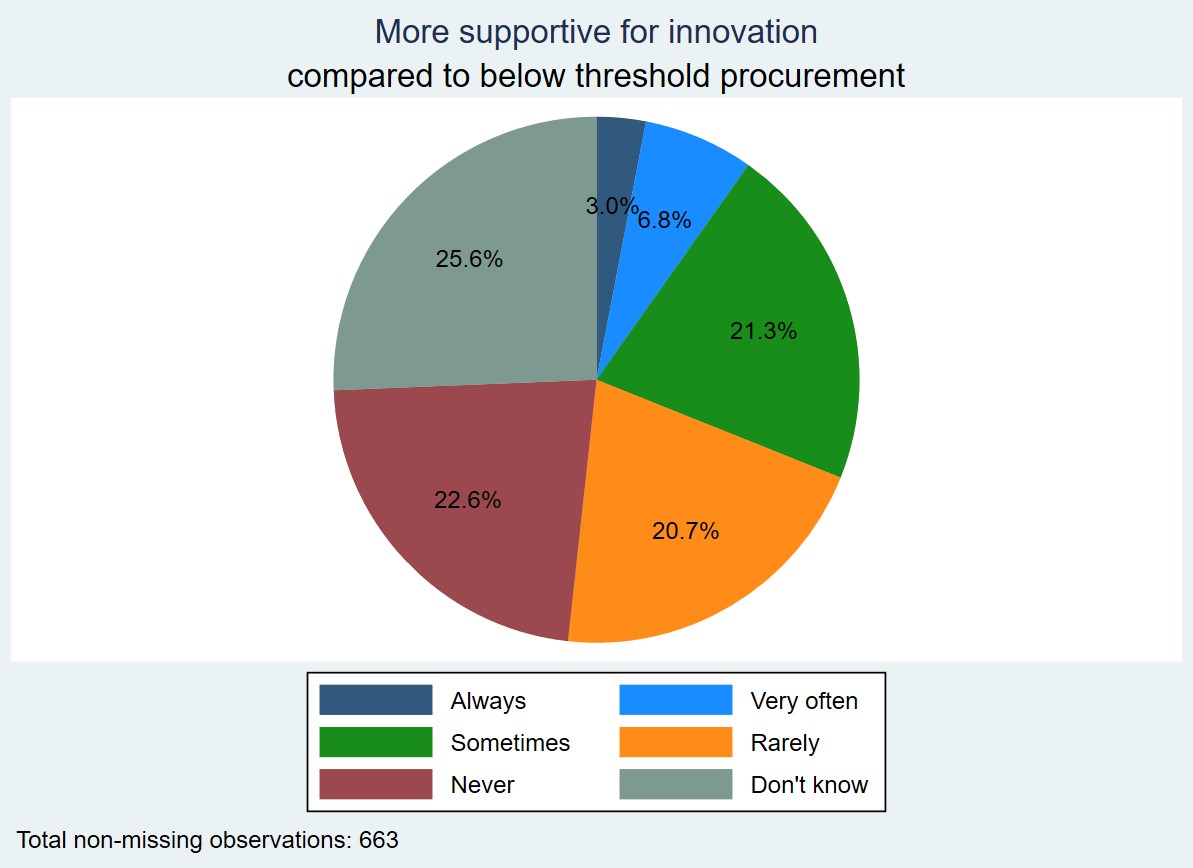
Table 70. When compared with procurement below thresholds, carrying out transactions under the directives’ rules is… more supportive for innovation, by type of respondent (first row has frequencies and second row has row percentages)
|
Contribution given as
|
More supportive for innovation
|
|
|
Always
|
Very often
|
Sometimes
|
Rarely
|
Never
|
Don't know
|
Total
|
|
Academic/research inst.
|
1
|
1
|
5
|
5
|
12
|
9
|
33
|
|
|
3.03
|
3.03
|
15.15
|
15.15
|
36.36
|
27.27
|
100.00
|
|
Business association
|
6
|
6
|
23
|
27
|
9
|
30
|
101
|
|
|
5.94
|
5.94
|
22.77
|
26.73
|
8.91
|
29.70
|
100.00
|
|
Company/business
|
8
|
14
|
22
|
27
|
23
|
30
|
124
|
|
|
6.45
|
11.29
|
17.74
|
21.77
|
18.55
|
24.19
|
100.00
|
|
Consumer organisation
|
0
|
0
|
0
|
0
|
1
|
0
|
1
|
|
|
0.00
|
0.00
|
0.00
|
0.00
|
100.00
|
0.00
|
100.00
|
|
EU citizen
|
4
|
4
|
9
|
16
|
9
|
7
|
49
|
|
|
8.16
|
8.16
|
18.37
|
32.65
|
18.37
|
14.29
|
100.00
|
|
NGO
|
0
|
1
|
11
|
10
|
5
|
37
|
64
|
|
|
0.00
|
1.56
|
17.19
|
15.63
|
7.81
|
57.81
|
100.00
|
|
Other
|
0
|
5
|
11
|
11
|
11
|
10
|
48
|
|
|
0.00
|
10.42
|
22.92
|
22.92
|
22.92
|
20.83
|
100.00
|
|
Public authority
|
1
|
13
|
31
|
37
|
79
|
33
|
194
|
|
|
0.52
|
6.70
|
15.98
|
19.07
|
40.72
|
17.01
|
100.00
|
|
Trade union
|
0
|
1
|
29
|
4
|
1
|
14
|
49
|
|
|
0.00
|
2.04
|
59.18
|
8.16
|
2.04
|
28.57
|
100.00
|
|
Total
|
20
|
45
|
141
|
137
|
150
|
170
|
663
|
|
|
3.02
|
6.79
|
21.27
|
20.66
|
22.62
|
25.64
|
100.00
|
|
|
Figure 67. When compared with procurement below thresholds, carrying out transactions under the directives’ rules is… better in preventing corruption

Table 71. When compared with procurement below thresholds, carrying out transactions under the directives’ rules is… better in preventing corruption, by type of respondent (first row has frequencies and second row has row percentages)
|
Contribution given as
|
Better in preventing corruption
|
|
|
Always
|
Very often
|
Sometimes
|
Rarely
|
Never
|
Don't know
|
Total
|
|
Academic/research inst.
|
0
|
4
|
10
|
4
|
7
|
8
|
33
|
|
|
0.00
|
12.12
|
30.30
|
12.12
|
21.21
|
24.24
|
100.00
|
|
Business association
|
5
|
17
|
15
|
11
|
6
|
47
|
101
|
|
|
4.95
|
16.83
|
14.85
|
10.89
|
5.94
|
46.53
|
100.00
|
|
Company/business
|
5
|
29
|
12
|
14
|
14
|
48
|
122
|
|
|
4.10
|
23.77
|
9.84
|
11.48
|
11.48
|
39.34
|
100.00
|
|
Consumer organisation
|
0
|
0
|
1
|
0
|
0
|
0
|
1
|
|
|
0.00
|
0.00
|
100.00
|
0.00
|
0.00
|
0.00
|
100.00
|
|
EU citizen
|
4
|
9
|
11
|
8
|
11
|
7
|
50
|
|
|
8.00
|
18.00
|
22.00
|
16.00
|
22.00
|
14.00
|
100.00
|
|
NGO
|
17
|
3
|
12
|
5
|
4
|
23
|
64
|
|
|
26.56
|
4.69
|
18.75
|
7.81
|
6.25
|
35.94
|
100.00
|
|
Other
|
3
|
3
|
11
|
10
|
12
|
9
|
48
|
|
|
6.25
|
6.25
|
22.92
|
20.83
|
25.00
|
18.75
|
100.00
|
|
Public authority
|
5
|
23
|
31
|
28
|
77
|
28
|
192
|
|
|
2.60
|
11.98
|
16.15
|
14.58
|
40.10
|
14.58
|
100.00
|
|
Trade union
|
0
|
0
|
30
|
15
|
1
|
3
|
49
|
|
|
0.00
|
0.00
|
61.22
|
30.61
|
2.04
|
6.12
|
100.00
|
|
Total
|
39
|
88
|
133
|
95
|
132
|
173
|
660
|
|
|
5.91
|
13.33
|
20.15
|
14.39
|
20.00
|
26.21
|
100.00
|
|
|
Selected quotes from written contributions
·“The current directives have, however, contributed to a risk-averse culture and a paper-based tendering standard. This applies to tenders above the thresholds but also below, where the majority of PP takes place. Many buyers replicate the methods they have learned for EU tenders in private ones, even when this is overly complex” (CfE, an academic/research institution from the Netherlands).
·“We are in a situation where the volume of contracts awarded outside the PPA regime is enormous. This may give the impression of an increased risk of non-transparency” (CfE, a business association from Czechia).
·“A considerable number of orders fall below the EU procurement threshold and are subject to national law. Even under simpler national legislation, certain utilities may find it more attractive to extend old contracts with providers they deem suitable, allowing smaller orders to be booked faster. This practice can lead to inefficiencies and a lack of competition” (CfE, a large company from Belgium).
Other themes – comparison with private procurement
Quantitative analysis – key findings
A detailed distribution of replies for each question is provided below.
Figure 68. When compared with private procurement, selling under the directives’ rules is… simpler

Table 72. When compared with private procurement, selling under the directives’ rules is… simpler, by type of respondent (first row has frequencies and second row has row percentages)
|
Contribution given as
|
Simpler
|
|
|
Always
|
Very often
|
Sometimes
|
Rarely
|
Never
|
Don't know
|
Total
|
|
Academic/research inst.
|
2
|
0
|
1
|
3
|
13
|
13
|
32
|
|
|
6.25
|
0.00
|
3.13
|
9.38
|
40.63
|
40.63
|
100.00
|
|
Business association
|
0
|
2
|
9
|
38
|
30
|
24
|
103
|
|
|
0.00
|
1.94
|
8.74
|
36.89
|
29.13
|
23.30
|
100.00
|
|
Company/business
|
1
|
6
|
13
|
23
|
50
|
24
|
117
|
|
|
0.85
|
5.13
|
11.11
|
19.66
|
42.74
|
20.51
|
100.00
|
|
Consumer organisation
|
0
|
0
|
0
|
0
|
1
|
0
|
1
|
|
|
0.00
|
0.00
|
0.00
|
0.00
|
100.00
|
0.00
|
100.00
|
|
EU citizen
|
1
|
1
|
4
|
11
|
29
|
4
|
50
|
|
|
2.00
|
2.00
|
8.00
|
22.00
|
58.00
|
8.00
|
100.00
|
|
NGO
|
1
|
0
|
4
|
11
|
5
|
40
|
61
|
|
|
1.64
|
0.00
|
6.56
|
18.03
|
8.20
|
65.57
|
100.00
|
|
Other
|
1
|
3
|
3
|
6
|
18
|
15
|
46
|
|
|
2.17
|
6.52
|
6.52
|
13.04
|
39.13
|
32.61
|
100.00
|
|
Public authority
|
1
|
4
|
12
|
15
|
64
|
93
|
189
|
|
|
0.53
|
2.12
|
6.35
|
7.94
|
33.86
|
49.21
|
100.00
|
|
Trade union
|
1
|
0
|
44
|
2
|
1
|
3
|
51
|
|
|
1.96
|
0.00
|
86.27
|
3.92
|
1.96
|
5.88
|
100.00
|
|
Total
|
8
|
16
|
90
|
109
|
211
|
216
|
650
|
|
|
1.23
|
2.46
|
13.85
|
16.77
|
32.46
|
33.23
|
100.00
|
|
|
Figure 69. When compared with private procurement, selling under the directives’ rules is… better value for money

Table 73. When compared with private procurement, selling under the directives’ rules is… better value for money, by type of respondent (first row has frequencies and second row has row percentages)
|
Contribution given as
|
Better value for money
|
|
|
Always
|
Very often
|
Sometimes
|
Rarely
|
Never
|
Don't know
|
Total
|
|
Academic/research inst.
|
2
|
1
|
7
|
3
|
7
|
12
|
32
|
|
|
6.25
|
3.13
|
21.88
|
9.38
|
21.88
|
37.50
|
100.00
|
|
Business association
|
0
|
1
|
25
|
30
|
11
|
35
|
102
|
|
|
0.00
|
0.98
|
24.51
|
29.41
|
10.78
|
34.31
|
100.00
|
|
Company/business
|
1
|
6
|
25
|
33
|
21
|
31
|
117
|
|
|
0.85
|
5.13
|
21.37
|
28.21
|
17.95
|
26.50
|
100.00
|
|
Consumer organisation
|
0
|
0
|
0
|
0
|
1
|
0
|
1
|
|
|
0.00
|
0.00
|
0.00
|
0.00
|
100.00
|
0.00
|
100.00
|
|
EU citizen
|
1
|
5
|
11
|
15
|
13
|
5
|
50
|
|
|
2.00
|
10.00
|
22.00
|
30.00
|
26.00
|
10.00
|
100.00
|
|
NGO
|
0
|
2
|
8
|
3
|
3
|
44
|
60
|
|
|
0.00
|
3.33
|
13.33
|
5.00
|
5.00
|
73.33
|
100.00
|
|
Other
|
2
|
1
|
10
|
4
|
14
|
15
|
46
|
|
|
4.35
|
2.17
|
21.74
|
8.70
|
30.43
|
32.61
|
100.00
|
|
Public authority
|
3
|
7
|
28
|
17
|
32
|
102
|
189
|
|
|
1.59
|
3.70
|
14.81
|
8.99
|
16.93
|
53.97
|
100.00
|
|
Trade union
|
0
|
0
|
45
|
2
|
1
|
2
|
50
|
|
|
0.00
|
0.00
|
90.00
|
4.00
|
2.00
|
4.00
|
100.00
|
|
Total
|
9
|
23
|
159
|
107
|
103
|
246
|
647
|
|
|
1.39
|
3.55
|
24.57
|
16.54
|
15.92
|
38.02
|
100.00
|
|
|
Figure 70. When compared with private procurement, selling under the directives’ rules is… faster

Table 74. When compared with private procurement, selling under the directives’ rules is… faster, by type of respondent (first row has frequencies and second row has row percentages)
|
Contribution given as
|
Faster
|
|
|
Always
|
Very often
|
Sometimes
|
Rarely
|
Never
|
Don't know
|
Total
|
|
Academic/research inst.
|
2
|
0
|
0
|
5
|
12
|
13
|
32
|
|
|
6.25
|
0.00
|
0.00
|
15.63
|
37.50
|
40.63
|
100.00
|
|
Business association
|
0
|
3
|
10
|
30
|
32
|
27
|
102
|
|
|
0.00
|
2.94
|
9.80
|
29.41
|
31.37
|
26.47
|
100.00
|
|
Company/business
|
1
|
6
|
13
|
26
|
45
|
25
|
116
|
|
|
0.86
|
5.17
|
11.21
|
22.41
|
38.79
|
21.55
|
100.00
|
|
Consumer organisation
|
0
|
0
|
0
|
0
|
1
|
0
|
1
|
|
|
0.00
|
0.00
|
0.00
|
0.00
|
100.00
|
0.00
|
100.00
|
|
EU citizen
|
1
|
4
|
3
|
9
|
29
|
4
|
50
|
|
|
2.00
|
8.00
|
6.00
|
18.00
|
58.00
|
8.00
|
100.00
|
|
NGO
|
0
|
2
|
2
|
12
|
5
|
39
|
60
|
|
|
0.00
|
3.33
|
3.33
|
20.00
|
8.33
|
65.00
|
100.00
|
|
Other
|
2
|
1
|
5
|
6
|
19
|
13
|
46
|
|
|
4.35
|
2.17
|
10.87
|
13.04
|
41.30
|
28.26
|
100.00
|
|
Public authority
|
0
|
5
|
11
|
17
|
64
|
92
|
189
|
|
|
0.00
|
2.65
|
5.82
|
8.99
|
33.86
|
48.68
|
100.00
|
|
Trade union
|
0
|
0
|
45
|
2
|
1
|
2
|
50
|
|
|
0.00
|
0.00
|
90.00
|
4.00
|
2.00
|
4.00
|
100.00
|
|
Total
|
6
|
21
|
89
|
107
|
208
|
215
|
646
|
|
|
0.93
|
3.25
|
13.78
|
16.56
|
32.20
|
33.28
|
100.00
|
|
|
Figure 71. When compared with private procurement, selling under the directives’ rules is… more transparent and fair

Table 75. When compared with private procurement, selling under the directives’ rules is… more transparent and fair, by type of respondent (first row has frequencies and second row has row percentages)
|
Contribution given as
|
More transparent and fair
|
|
|
Always
|
Very often
|
Sometimes
|
Rarely
|
Never
|
Don't know
|
Total
|
|
Academic/research inst.
|
1
|
9
|
6
|
2
|
1
|
13
|
32
|
|
|
3.13
|
28.13
|
18.75
|
6.25
|
3.13
|
40.63
|
100.00
|
|
Business association
|
1
|
19
|
27
|
14
|
8
|
34
|
103
|
|
|
0.97
|
18.45
|
26.21
|
13.59
|
7.77
|
33.01
|
100.00
|
|
Company/business
|
5
|
24
|
36
|
10
|
15
|
28
|
118
|
|
|
4.24
|
20.34
|
30.51
|
8.47
|
12.71
|
23.73
|
100.00
|
|
Consumer organisation
|
1
|
0
|
0
|
0
|
0
|
0
|
1
|
|
|
100.00
|
0.00
|
0.00
|
0.00
|
0.00
|
0.00
|
100.00
|
|
EU citizen
|
8
|
11
|
11
|
8
|
6
|
5
|
49
|
|
|
16.33
|
22.45
|
22.45
|
16.33
|
12.24
|
10.20
|
100.00
|
|
NGO
|
2
|
9
|
7
|
2
|
1
|
40
|
61
|
|
|
3.28
|
14.75
|
11.48
|
3.28
|
1.64
|
65.57
|
100.00
|
|
Other
|
3
|
7
|
14
|
0
|
6
|
15
|
45
|
|
|
6.67
|
15.56
|
31.11
|
0.00
|
13.33
|
33.33
|
100.00
|
|
Public authority
|
10
|
35
|
23
|
9
|
19
|
93
|
189
|
|
|
5.29
|
18.52
|
12.17
|
4.76
|
10.05
|
49.21
|
100.00
|
|
Trade union
|
0
|
0
|
44
|
2
|
0
|
3
|
49
|
|
|
0.00
|
0.00
|
89.80
|
4.08
|
0.00
|
6.12
|
100.00
|
|
Total
|
31
|
114
|
168
|
47
|
56
|
231
|
647
|
|
|
4.79
|
17.62
|
25.97
|
7.26
|
8.66
|
35.70
|
100.00
|
|
|
Figure 72. When compared with private procurement, selling under the directives’ rules is… more professional

Table 76. When compared with private procurement, selling under the directives’ rules is… more professional, by type of respondent (first row has frequencies and second row has row percentages)
|
Contribution given as
|
More professional
|
|
|
Always
|
Very often
|
Sometimes
|
Rarely
|
Never
|
Don't know
|
Total
|
|
Academic/research inst.
|
0
|
3
|
10
|
1
|
1
|
17
|
32
|
|
|
0.00
|
9.38
|
31.25
|
3.13
|
3.13
|
53.13
|
100.00
|
|
Business association
|
0
|
6
|
27
|
22
|
12
|
34
|
101
|
|
|
0.00
|
5.94
|
26.73
|
21.78
|
11.88
|
33.66
|
100.00
|
|
Company/business
|
3
|
17
|
37
|
13
|
17
|
30
|
117
|
|
|
2.56
|
14.53
|
31.62
|
11.11
|
14.53
|
25.64
|
100.00
|
|
Consumer organisation
|
0
|
0
|
1
|
0
|
0
|
0
|
1
|
|
|
0.00
|
0.00
|
100.00
|
0.00
|
0.00
|
0.00
|
100.00
|
|
EU citizen
|
6
|
7
|
13
|
10
|
9
|
5
|
50
|
|
|
12.00
|
14.00
|
26.00
|
20.00
|
18.00
|
10.00
|
100.00
|
|
NGO
|
0
|
4
|
10
|
4
|
0
|
42
|
60
|
|
|
0.00
|
6.67
|
16.67
|
6.67
|
0.00
|
70.00
|
100.00
|
|
Other
|
1
|
5
|
14
|
5
|
6
|
15
|
46
|
|
|
2.17
|
10.87
|
30.43
|
10.87
|
13.04
|
32.61
|
100.00
|
|
Public authority
|
4
|
17
|
34
|
12
|
22
|
100
|
189
|
|
|
2.12
|
8.99
|
17.99
|
6.35
|
11.64
|
52.91
|
100.00
|
|
Trade union
|
0
|
0
|
45
|
0
|
1
|
3
|
49
|
|
|
0.00
|
0.00
|
91.84
|
0.00
|
2.04
|
6.12
|
100.00
|
|
Total
|
14
|
59
|
191
|
67
|
68
|
246
|
645
|
|
|
2.17
|
9.15
|
29.61
|
10.39
|
10.54
|
38.14
|
100.00
|
|
|
Figure 73. When compared with private procurement, selling under the directives’ rules is… subject to more competition

Table 77. When compared with private procurement, selling under the directives’ rules is… subject to more competition, by type of respondent (first row has frequencies and second row has row percentages)
|
Contribution given as
|
Subject to more competition
|
|
|
Always
|
Very often
|
Sometimes
|
Rarely
|
Never
|
Don't know
|
Total
|
|
Academic/research inst.
|
1
|
2
|
10
|
5
|
1
|
13
|
32
|
|
|
3.13
|
6.25
|
31.25
|
15.63
|
3.13
|
40.63
|
100.00
|
|
Business association
|
5
|
10
|
33
|
21
|
5
|
29
|
103
|
|
|
4.85
|
9.71
|
32.04
|
20.39
|
4.85
|
28.16
|
100.00
|
|
Company/business
|
11
|
18
|
22
|
31
|
7
|
28
|
117
|
|
|
9.40
|
15.38
|
18.80
|
26.50
|
5.98
|
23.93
|
100.00
|
|
Consumer organisation
|
0
|
1
|
0
|
0
|
0
|
0
|
1
|
|
|
0.00
|
100.00
|
0.00
|
0.00
|
0.00
|
0.00
|
100.00
|
|
EU citizen
|
9
|
13
|
13
|
6
|
4
|
5
|
50
|
|
|
18.00
|
26.00
|
26.00
|
12.00
|
8.00
|
10.00
|
100.00
|
|
NGO
|
0
|
8
|
9
|
2
|
0
|
42
|
61
|
|
|
0.00
|
13.11
|
14.75
|
3.28
|
0.00
|
68.85
|
100.00
|
|
Other
|
2
|
3
|
12
|
5
|
9
|
15
|
46
|
|
|
4.35
|
6.52
|
26.09
|
10.87
|
19.57
|
32.61
|
100.00
|
|
Public authority
|
4
|
25
|
24
|
15
|
18
|
103
|
189
|
|
|
2.12
|
13.23
|
12.70
|
7.94
|
9.52
|
54.50
|
100.00
|
|
Trade union
|
0
|
0
|
45
|
3
|
0
|
2
|
50
|
|
|
0.00
|
0.00
|
90.00
|
6.00
|
0.00
|
4.00
|
100.00
|
|
Total
|
32
|
80
|
168
|
88
|
44
|
237
|
649
|
|
|
4.93
|
12.33
|
25.89
|
13.56
|
6.78
|
36.52
|
100.00
|
|
|
Figure 74. When compared with private procurement, selling under the directives’ rules is… more environmentally friendly

Table 78. When compared with private procurement, selling under the directives’ rules is… more environmentally friendly, by type of respondent (first row has frequencies and second row has row percentages)
|
Contribution given as
|
More environmentally friendly
|
|
|
Always
|
Very often
|
Sometimes
|
Rarely
|
Never
|
Don't know
|
Total
|
|
Academic/research inst.
|
2
|
1
|
9
|
3
|
3
|
14
|
32
|
|
|
6.25
|
3.13
|
28.13
|
9.38
|
9.38
|
43.75
|
100.00
|
|
Business association
|
1
|
7
|
38
|
16
|
3
|
39
|
104
|
|
|
0.96
|
6.73
|
36.54
|
15.38
|
2.88
|
37.50
|
100.00
|
|
Company/business
|
0
|
12
|
38
|
20
|
7
|
41
|
118
|
|
|
0.00
|
10.17
|
32.20
|
16.95
|
5.93
|
34.75
|
100.00
|
|
Consumer organisation
|
0
|
0
|
0
|
0
|
0
|
1
|
1
|
|
|
0.00
|
0.00
|
0.00
|
0.00
|
0.00
|
100.00
|
100.00
|
|
EU citizen
|
1
|
7
|
13
|
13
|
7
|
9
|
50
|
|
|
2.00
|
14.00
|
26.00
|
26.00
|
14.00
|
18.00
|
100.00
|
|
NGO
|
0
|
0
|
14
|
3
|
2
|
43
|
62
|
|
|
0.00
|
0.00
|
22.58
|
4.84
|
3.23
|
69.35
|
100.00
|
|
Other
|
1
|
2
|
8
|
9
|
7
|
19
|
46
|
|
|
2.17
|
4.35
|
17.39
|
19.57
|
15.22
|
41.30
|
100.00
|
|
Public authority
|
4
|
10
|
27
|
12
|
22
|
113
|
188
|
|
|
2.13
|
5.32
|
14.36
|
6.38
|
11.70
|
60.11
|
100.00
|
|
Trade union
|
0
|
0
|
44
|
1
|
1
|
3
|
49
|
|
|
0.00
|
0.00
|
89.80
|
2.04
|
2.04
|
6.12
|
100.00
|
|
Total
|
9
|
39
|
191
|
77
|
52
|
282
|
650
|
|
|
1.38
|
6.00
|
29.38
|
11.85
|
8.00
|
43.38
|
100.00
|
|
|
Figure 75. When compared with private procurement, selling under the directives’ rules is… more socially responsible

Table 79. When compared with private procurement, selling under the directives’ rules is… more socially responsible, by type of respondent (first row has frequencies and second row has row percentages)
|
Contribution given as
|
More socially responsible
|
|
|
Always
|
Very often
|
Sometimes
|
Rarely
|
Never
|
Don't know
|
Total
|
|
Academic/research inst.
|
2
|
2
|
8
|
3
|
3
|
14
|
32
|
|
|
6.25
|
6.25
|
25.00
|
9.38
|
9.38
|
43.75
|
100.00
|
|
Business association
|
1
|
7
|
38
|
13
|
5
|
39
|
103
|
|
|
0.97
|
6.80
|
36.89
|
12.62
|
4.85
|
37.86
|
100.00
|
|
Company/business
|
1
|
15
|
40
|
14
|
7
|
39
|
116
|
|
|
0.86
|
12.93
|
34.48
|
12.07
|
6.03
|
33.62
|
100.00
|
|
Consumer organisation
|
0
|
0
|
0
|
0
|
0
|
1
|
1
|
|
|
0.00
|
0.00
|
0.00
|
0.00
|
0.00
|
100.00
|
100.00
|
|
EU citizen
|
1
|
10
|
14
|
13
|
5
|
6
|
49
|
|
|
2.04
|
20.41
|
28.57
|
26.53
|
10.20
|
12.24
|
100.00
|
|
NGO
|
0
|
2
|
14
|
3
|
2
|
41
|
62
|
|
|
0.00
|
3.23
|
22.58
|
4.84
|
3.23
|
66.13
|
100.00
|
|
Other
|
2
|
1
|
8
|
8
|
7
|
20
|
46
|
|
|
4.35
|
2.17
|
17.39
|
17.39
|
15.22
|
43.48
|
100.00
|
|
Public authority
|
4
|
15
|
23
|
11
|
21
|
114
|
188
|
|
|
2.13
|
7.98
|
12.23
|
5.85
|
11.17
|
60.64
|
100.00
|
|
Trade union
|
0
|
0
|
44
|
1
|
1
|
3
|
49
|
|
|
0.00
|
0.00
|
89.80
|
2.04
|
2.04
|
6.12
|
100.00
|
|
Total
|
11
|
52
|
189
|
66
|
51
|
277
|
646
|
|
|
1.70
|
8.05
|
29.26
|
10.22
|
7.89
|
42.88
|
100.00
|
|
|
Figure 76. When compared with private procurement, selling under the directives’ rules is… more supportive for innovation

Table 80. When compared with private procurement, selling under the directives’ rules is… more supportive for innovation, by type of respondent (first row has frequencies and second row has row percentages)
|
Contribution given as
|
More supportive for innovation
|
|
|
Always
|
Very often
|
Sometimes
|
Rarely
|
Never
|
Don't know
|
Total
|
|
Academic/research inst.
|
2
|
0
|
5
|
7
|
5
|
13
|
32
|
|
|
6.25
|
0.00
|
15.63
|
21.88
|
15.63
|
40.63
|
100.00
|
|
Business association
|
0
|
4
|
28
|
24
|
14
|
32
|
102
|
|
|
0.00
|
3.92
|
27.45
|
23.53
|
13.73
|
31.37
|
100.00
|
|
Company/business
|
2
|
8
|
27
|
30
|
17
|
33
|
117
|
|
|
1.71
|
6.84
|
23.08
|
25.64
|
14.53
|
28.21
|
100.00
|
|
Consumer organisation
|
0
|
0
|
0
|
0
|
0
|
1
|
1
|
|
|
0.00
|
0.00
|
0.00
|
0.00
|
0.00
|
100.00
|
100.00
|
|
EU citizen
|
0
|
5
|
9
|
18
|
9
|
8
|
49
|
|
|
0.00
|
10.20
|
18.37
|
36.73
|
18.37
|
16.33
|
100.00
|
|
NGO
|
0
|
0
|
8
|
4
|
4
|
46
|
62
|
|
|
0.00
|
0.00
|
12.90
|
6.45
|
6.45
|
74.19
|
100.00
|
|
Other
|
2
|
0
|
10
|
9
|
9
|
16
|
46
|
|
|
4.35
|
0.00
|
21.74
|
19.57
|
19.57
|
34.78
|
100.00
|
|
Public authority
|
3
|
8
|
17
|
22
|
26
|
112
|
188
|
|
|
1.60
|
4.26
|
9.04
|
11.70
|
13.83
|
59.57
|
100.00
|
|
Trade union
|
0
|
0
|
44
|
1
|
1
|
3
|
49
|
|
|
0.00
|
0.00
|
89.80
|
2.04
|
2.04
|
6.12
|
100.00
|
|
Total
|
9
|
25
|
148
|
115
|
85
|
264
|
646
|
|
|
1.39
|
3.87
|
22.91
|
17.80
|
13.16
|
40.87
|
100.00
|
|
|
Figure 77. When compared with private procurement, selling under the directives’ rules is… better in preventing corruption

Table 81. When compared with private procurement, selling under the directives’ rules is… better in preventing corruption, by type of respondent (first row has frequencies and second row has row percentages)
|
Contribution given as
|
Better in preventing corruption
|
|
|
Always
|
Very often
|
Sometimes
|
Rarely
|
Never
|
Don't know
|
Total
|
|
Academic/research inst.
|
1
|
11
|
4
|
1
|
1
|
14
|
32
|
|
|
3.13
|
34.38
|
12.50
|
3.13
|
3.13
|
43.75
|
100.00
|
|
Business association
|
2
|
14
|
19
|
6
|
5
|
55
|
101
|
|
|
1.98
|
13.86
|
18.81
|
5.94
|
4.95
|
54.46
|
100.00
|
|
Company/business
|
3
|
28
|
18
|
11
|
7
|
48
|
115
|
|
|
2.61
|
24.35
|
15.65
|
9.57
|
6.09
|
41.74
|
100.00
|
|
Consumer organisation
|
0
|
1
|
0
|
0
|
0
|
0
|
1
|
|
|
0.00
|
100.00
|
0.00
|
0.00
|
0.00
|
0.00
|
100.00
|
|
EU citizen
|
7
|
7
|
17
|
4
|
4
|
10
|
49
|
|
|
14.29
|
14.29
|
34.69
|
8.16
|
8.16
|
20.41
|
100.00
|
|
NGO
|
1
|
4
|
7
|
2
|
0
|
46
|
60
|
|
|
1.67
|
6.67
|
11.67
|
3.33
|
0.00
|
76.67
|
100.00
|
|
Other
|
2
|
5
|
11
|
3
|
8
|
17
|
46
|
|
|
4.35
|
10.87
|
23.91
|
6.52
|
17.39
|
36.96
|
100.00
|
|
Public authority
|
8
|
28
|
22
|
9
|
19
|
102
|
188
|
|
|
4.26
|
14.89
|
11.70
|
4.79
|
10.11
|
54.26
|
100.00
|
|
Trade union
|
0
|
0
|
42
|
3
|
1
|
3
|
49
|
|
|
0.00
|
0.00
|
85.71
|
6.12
|
2.04
|
6.12
|
100.00
|
|
Total
|
24
|
98
|
140
|
39
|
45
|
295
|
641
|
|
|
3.74
|
15.29
|
21.84
|
6.08
|
7.02
|
46.02
|
100.00
|
|
|
Selected quotes from written contributions
·“The procedures are complicated and much less flexible than in the private sector, which is one of the key factors discouraging entrepreneurs from participating in public procurement procedures” (CfE, a public authority from Poland).
·“Procedures are excessively complicated and inflexible compared to those in the private sector. This constitutes a strong deterrent to participation in public procurement” (CfE, a large company from Italy).
Annex VISupplementary information and data
This annex provides additional information and data underpinning the conclusions of the evaluation. The numbering of sections in this annex correspond to those in the main part of the document.
Refers to section 1. Introduction
General government expenditure on public procurement
As explained in Annex II, the general government expenditure can be disaggregated into national accounts components, in order to remove from this total the expenditure which is clearly not in the scope of procurement legislation, such as: wages, salaries, employers' social contributions, subsidies, etc. The three retained cost items, namely P.2 (intermediate consumption), P.51g (gross fixed capital formation) and D.632 (social transfers in kind - purchased market production) can serve as a proxy for the upper range value of public procurement of the general government. The estimates for the last four years are provided below.
Table 82: General government expenditure on procurement in EU-27 by component, Percentage of gross domestic product (GDP) [%]
|
|
2020
|
2021
|
2022
|
2023
|
|
Gross fixed capital formation
|
3.5
|
3.4
|
3.3
|
3.6
|
|
Intermediate consumption
|
6.1
|
6.2
|
6.1
|
6.1
|
|
Social transfers in kind, purchased market production, expenditure
|
5.5
|
5.6
|
5.4
|
5.3
|
|
Total
|
15.1
|
15.2
|
14.8
|
15.0
|
Source: https://doi.org/10.2908/GOV_10A_MAIN
The general government expenditure on public procurement in nominal values by Member State is provided in
Table
83
, while in terms of the share of GDP in
Table
84
below.
Table 83: General government expenditure on procurement in EU-27, Million euro [€]
|
|
2020
|
2021
|
2022
|
2023
|
|
Austria
|
54 597
|
62 991
|
66 344
|
71 364
|
|
Belgium
|
68 876
|
75 827
|
83 098
|
88 890
|
|
Bulgaria
|
6 752
|
7 377
|
8 672
|
10 668
|
|
Croatia
|
8 491
|
9 013
|
9 388
|
12 069
|
|
Cyprus
|
2 174
|
2 658
|
2 888
|
3 282
|
|
Czechia
|
31 289
|
33 578
|
38 241
|
44 175
|
|
Denmark
|
43 101
|
45 822
|
46 869
|
47 205
|
|
Estonia
|
4 020
|
4 551
|
5 069
|
5 827
|
|
Finland
|
43 049
|
44 755
|
47 231
|
51 849
|
|
France
|
373 256
|
411 514
|
432 195
|
454 366
|
|
Germany
|
636 364
|
680 857
|
718 428
|
744 525
|
|
Greece
|
19 653
|
22 644
|
25 405
|
27 995
|
|
Hungary
|
23 016
|
25 209
|
25 710
|
29 759
|
|
Ireland
|
30 760
|
33 215
|
36 622
|
41 309
|
|
Italy
|
192 520
|
211 355
|
222 464
|
242 429
|
|
Latvia
|
4 153
|
4 727
|
4 887
|
5 235
|
|
Lithuania
|
5 484
|
5 325
|
6 329
|
7 849
|
|
Luxembourg
|
8 040
|
8 245
|
9 212
|
9 978
|
|
Malta
|
1 857
|
2 027
|
2 074
|
2 399
|
|
Netherlands
|
166 947
|
181 721
|
191 368
|
208 917
|
|
Poland
|
63 930
|
69 252
|
79 267
|
102 092
|
|
Portugal
|
19 597
|
21 850
|
23 678
|
25 548
|
|
Romania
|
24 489
|
26 115
|
31 050
|
39 689
|
|
Slovakia
|
11 493
|
12 266
|
13 788
|
15 313
|
|
Slovenia
|
5 904
|
7 125
|
8 315
|
9 014
|
|
Spain
|
129 529
|
140 957
|
154 672
|
171 089
|
|
Sweden
|
83 055
|
89 738
|
93 027
|
92 887
|
|
Total
|
2 062 394
|
2 240 717
|
2 386 290
|
2 565 723
|
Source: https://doi.org/10.2908/GOV_10A_MAIN
Table 84: General government expenditure on public procurement in EU-27, Percentage of GDP [%]
|
|
2020
|
2021
|
2022
|
2023
|
|
Austria
|
14.4
|
15.4
|
14.8
|
15.0
|
|
Belgium
|
14.9
|
15.0
|
14.9
|
14.8
|
|
Bulgaria
|
10.9
|
10.2
|
10.1
|
11.2
|
|
Croatia
|
16.7
|
15.5
|
13.9
|
15.6
|
|
Cyprus
|
9.7
|
10.4
|
9.8
|
10.5
|
|
Czechia
|
14.2
|
13.4
|
13.3
|
13.7
|
|
Denmark
|
13.8
|
13.3
|
12.1
|
12.5
|
|
Estonia
|
14.6
|
14.4
|
14.0
|
15.4
|
|
Finland
|
18.1
|
18.0
|
17.7
|
19.0
|
|
France
|
16.0
|
16.3
|
16.1
|
16.3
|
|
Germany
|
18.4
|
18.3
|
18.0
|
17.8
|
|
Greece
|
11.8
|
12.3
|
12.3
|
12.4
|
|
Hungary
|
16.5
|
16.2
|
15.2
|
15.3
|
|
Ireland
|
8.1
|
7.4
|
7.1
|
8.1
|
|
Italy
|
11.4
|
11.5
|
11.1
|
11.3
|
|
Latvia
|
14.2
|
14.5
|
13.5
|
13.3
|
|
Lithuania
|
10.9
|
9.3
|
9.3
|
10.6
|
|
Luxembourg
|
12.3
|
11.3
|
11.8
|
12.6
|
|
Malta
|
13.0
|
12.2
|
11.3
|
11.7
|
|
Netherlands
|
20.6
|
20.4
|
19.2
|
19.7
|
|
Poland
|
12.0
|
11.9
|
12.0
|
13.5
|
|
Portugal
|
9.7
|
10.0
|
9.8
|
9.6
|
|
Romania
|
11.0
|
10.7
|
11.0
|
12.2
|
|
Slovakia
|
12.2
|
12.0
|
12.5
|
12.4
|
|
Slovenia
|
12.5
|
13.6
|
14.6
|
14.1
|
|
Spain
|
11.4
|
11.4
|
11.2
|
11.4
|
|
Sweden
|
17.3
|
16.6
|
16.8
|
17.2
|
|
EU-27
|
15.1
|
15.2
|
14.8
|
15.0
|
Source:
https://doi.org/10.2908/GOV_10A_MAIN
Finally, it is also according to the OECD that the COVID pandemic led to a spike in public procurement relative to GDP in 2020. These increases are due both to governments purchasing goods and services to support their COVID responses, and GDP falling as a result of the crisis.
Figure 78: Number of contracting authorities and entities publishing in TED, 2018-2023, EU 27

Source: World Bank (2025), European Union: Competition in Public Procurement, p. 24.
Figure 79: Number of companies that have won contracts published on TED, 2018-2023, EU 27

Source: World Bank (2025), European Union: Competition in Public Procurement, p. 23.
Refers to section 3.1. Current state of play
Directives 2014/23/EU, 2014/24/EU and 2014/25/EU were adopted on 26 February 2014, with a deadline for transposition into national legislation of 18 April 2016 for all Member States. There were delays in several Member States, resulting in a few infringement procedures for non‑transposition, but all three Directives have been fully transposed by all the Member States (the last country to transpose being Spain early 2020 - for the exact transposition dates,
Table
85
below). In addition, and with only a few exceptions, the Commission launched infringement procedures against Member States for non-conformity of their national legislation with the Directives.
Table 85: Transposition dates
|
|
Directive 2014/23/EU
|
Directive 2014/24/EU
|
Directive 2014/25/EU
|
|
AT
|
21-08-2018
|
21-08-2018
|
21-08-2018
|
|
BE
|
29-06-2017
|
22-06-2017
|
22-06-2017
|
|
BG
|
04-12-2017
|
15-04-2016
|
15-04-2016
|
|
CY
|
17-02-2017
|
14-04-2016
|
09-12-2016
|
|
CZ
|
08-06-2016
|
08-06-2016
|
08-06-2016
|
|
DE
|
06-05-2016
|
06-05-2016
|
06-05-2016
|
|
DK
|
19-01-2016
|
19-01-2016
|
19-01-2016
|
|
EE
|
03-07-2017
|
03-07-2017
|
03-07-2017
|
|
EL
|
10-08-2016
|
10-08-2016
|
10-08-2016
|
|
ES
|
10-02-2020
|
13-11-2017
|
13-11-2017
|
|
FI
|
05-10-2017
|
05-10-2017
|
05-10-2017
|
|
FR
|
18-04-2016
|
15-04-2016
|
15-04-2016
|
|
HR
|
20-07-2017
|
05-01-2017
|
05-01-2017
|
|
HU
|
10-03-2016
|
10-03-2016
|
10-03-2016
|
|
IE
|
29-05-2017
|
24-10-2016
|
24-10-2016
|
|
IT
|
21-04-2016
|
21-04-2016
|
21-04-2016
|
|
LT
|
15-06-2017
|
02-05-2017
|
02-05-2017
|
|
LU
|
09-07-2018
|
08-04-2018
|
08-04-2018
|
|
LV
|
24-05-2017
|
03-03-2017
|
04-04-2017
|
|
MT
|
28-10-2016
|
28-10-2016
|
28-10-2016
|
|
NL
|
30-06-2016
|
30-06-2016
|
30-06-2016
|
|
PL
|
29-11-2016
|
19-08-2016
|
19-08-2016
|
|
PT
|
31-08-2017
|
31-08-2017
|
31-08-2017
|
|
RO
|
25-05-2016
|
02-06-2016
|
02-06-2016
|
|
SE
|
08-05-2017
|
08-05-2017
|
08-05-2017
|
|
SI
|
20-02-2019
|
21-04-2016
|
21-04-2016
|
|
SK
|
02-05-2016
|
02-05-2016
|
02-05-2016
|
|
UK
|
20-03-2019
|
20-03-2019
|
21-04-2016
|
Source: Commission services
The method of regulation varies in the Member States. Several Member States use the same legal instrument for Classical and Utilities in the regulation of procurement above EU thresholds
. Other Member States use three different legal instruments per each Directive separately
while other Member States chose to use a single legal instrument for Classical, Utilities and Concessions
.
Member States retain full discretion for the regulation of public procurement and of concessions outside the scope of the EU Directives and this is evidenced by their different approaches to regulation of below-threshold procurement. Several Member States provide that several rules applicable to contracts above the EU thresholds are made applicable, with a few exceptions, to contracts below thresholds albeit some of which have been customised. Several Member States may also provide for a simplified regime for certain contracts below the EU thresholds. Refers to Section 4.1.1.1. Scope.
Rules on appropriate actors
The infringement procedures that are opened by the Commission in its role as "guardian of the Treaty" are one possible source of information on provisions that give rise to difficulties at the stage of implementation (whether in legislative acts or in connection with individual award procedures). The obligations under the Directives (respectively, Directives 2014/24/EU, 2014/23/EU and 2014/25/EU) had to be transposed by Member States into national law by 18 April 2016.
No (or only minor) conformity issues were identified for seven (7) Member States, for all the three directives. As for the other twenty-one (21) Member States, non-conformity infringement procedures have been launched in several packages between January 2019 and now.
Regarding the compliance check of the national transposition measures, the work focused on the assessment of the following thirteen (13) issues/topics: scope, public-public cooperation, modification of contracts, light regime, procedures/instruments, exclusion criteria, transparency, conflicts of interest/prior involvement, horizontal social clause, abnormally low tenders, subcontracting, award criteria and remedies. This methodology allowed us to identify the main breaches requiring enforcement action while ensuring the equal treatment of Member States, but also a coherent, balanced and proportionate approach in the conformity checks.
In this regard, the most common/major transposition issues for which the Commission launched non-conformity infringement proceedings appear to concern the following: scope (for 12 Member States), modification of contracts (for 10 Member States), exclusion criteria (for 7 Member States), transparency (for 7 Member States), procedures/instruments (for 6 Member States), award criteria (for 3 Member States), subcontracting (for 3 Member States).
Regarding the cases of individual bad application, two "filters" were applied when selecting the cases to be examined. The first was to limit the examination to cases after the entry into application of the 2014 Directives. The second consisted in not looking at complaints which did not result in the launching of infringement proceedings. Many of these complaints did not result in infringement proceeding because they did not substantiate a breach of EU law. While some of these complaints showed a possible breach of EU law, the Commission decided not to pursue these cases in line with policy set in the Communication “EU law: Better results through better application” (2017/C 18/02) which gives priority to cases of non-conformity of national legislation with EU legislation over individual cases of bad application.
A search of such cases from 2016 onwards gives a total of eleven (11) cases concerning eight (8) Member States. It should be borne in mind that each case has its own specificities, that they may involve more than one issue and may concern more than one legal basis. At a fairly high level of abstraction, it is nevertheless possible to reduce the questions raised by these cases so as to identify a certain number of broad issues that occur with some frequency.
The most frequent issue, recurring in five (5) Member States, concerns cases where a contract had been awarded without there having been an award procedure with prior publication at the EU level. Another recurrent issue observed in three (3) Member States concerns modification of contracts which does not fulfil the conditions set in the Directives. Finally, for the sake of completeness, three cases were identified, concerning three Member States, for which the issues raised are so diverse that they cannot meaningfully be reduced/classified into the above categories.
Subject matter of procurement - Article 77 of Directive 2014/24/EU
The Directives provided contracting authorities with tools for using procurement as a social lever and as a vehicle to achieve social goals and support social inclusion. In most Member States, the provision of socially oriented services or services with social purposes falls under the responsibility of public sector often complemented by non-governmental, non-profit organisations, due to their impact on the protection of welfare and population health and the fact that they are not necessarily governed by the market logic.
These services have specific characteristics rendering the award procedures set out in the Directives inappropriate for procuring them. Article 76, paragraph 2, list the characteristics of these services: “quality, continuity, accessibility, affordability, availability and comprehensiveness of the services, the specific needs of different categories of users, including disadvantaged and vulnerable groups, the involvement and empowerment of users and innovation”.
Furthermore, these services to the person, such as certain social, health and educational are considered to be of limited cross border dimension
and are provided within a context that varies widely amongst Member States
due to different administrative, organisational and cultural circumstances. Member States should therefore have large discretion to organise the choice of service providers.
To reflect the different cultural traditions regarding the provision of social services and their limiter cross border dimension, the EU legislator subordinated the procurement of social services to separate, more flexible and tailored, simpler rules (i.e., to a “light regime”) set out in Articles 19 of Directive 2014/23/EU on the award of concession contracts, Article 74 of Directive 2014/24/EU on public procurement, as well as Article 91 of Directive 2014/25/EU on procurement by entities operating in the water, energy, transport and postal services sector. By establishing a specific regime, the EU legislator pursued the objectives of simplification and of alleviating the administrative burden for contracting authorities and economic operators. In addition, this light regime for social and other specific services has a higher threshold: EUR 750 000 and EUR 1 million (Directives 2014/24/EU and 2014/25/EU, respectively).
Despite the range of options provided by Directives, the non-governmental and non-profit organisations involved in the provision of social services, face difficulties concerning access to public contracts. Therefore, to facilitate this access, Article 77 of Directive 2014/24/EU and Article 94 of Directive 2014/25/EU include the possibility for Member States to reserve the award of those service contracts to a certain type of economic operator, i.e., for organisations which are based on employee ownership or active employee participation in their governance, and for existing organisations such as cooperatives
.
The possibility to reserve the award of social service contracts was presented first during the legislative process as a response to the eurozone crisis and the need to ensure the continuity of services
in a context of widespread privatisations. By using reserved contracts, Member States could facilitate the access to procurement markets to a certain type of economic operators whilst promoting social considerations, inter alia reinvestment of profits towards the pursuit of a public service or the use of cooperative management structures
.
Given the above reasons services such as certain social, health, or educational services are excluded from the full application of the Directives. A specific regime (hereafter: “the light regime”) has been therefore established for public contracts and concessions for these services, as defined in Article 19 of Directive 2014/23/EU on the award of concession contracts, Article 74 of Directive 2014/24/EU on public procurement, as well as Article 91 of Directive 2014/25/EU on procurement by entities operating in the water, energy, transport and postal services sector.
The services covered by the light regime are defined by a list of CPV codes included in Annexes to the Directives, namely Annex IV of Directive 2014/23/EU, Annex XIV of Directive 2014/24/EU, and Annex XVII of Directive 2014/25/EU. The CPV codes are grouped in 15 broad categories, such as:
·Health, social and related services;
·Administrative social, educational, healthcare and cultural services;
·Compulsory social security services (conditionally);
·Benefit services;
·Other community, social and personal services including services furnished by trade unions, political organisations, youth associations and other membership organisation services;
·Religious services;
·Hotel and restaurant services;
·Legal services, to the extent not excluded pursuant to point (d) of Article 10;
·Other administrative services and government services;
·Provision of services to the community;
·Prison related services, public security and rescue services to the extent not excluded pursuant to point (h) of Article 10;
·Investigation and security services;
·International services;
·Postal services;
·Miscellaneous services.
The categories of services presented in the list above are very similar to the previous so-called “Part B” or “Type B” services under Directive 2004/17/EC and 2004/18/EC the rules of which were applied until 2016. Some differences include the treatment of ‘Office Personnel’ services, and ‘Other’ services. The current rules cover fewer services and some contracts formerly subject to the Type B services rules are now subjected to the full Directives’ procurement rules.
The light regime gives wider discretion on how to organise the choice of the service providers in the way they consider most appropriate on condition that sufficient advertising and compliance with the principles of transparency and non-discrimination is ensured. Title II of the Directive 2014/24/EU on “Rules on Public Contracts” does not apply to these services. It means, that public entities are not required to use the standard EU procurement procedures that are available for other public contracts. Authorities can use those procedures if helpful, or tailor those procedures according to their own needs, or design their own procedures altogether.
When comparing the use of the light regime across countries, the available data show that the vast majority of such procedures took place in France and Germany (each of these countries published around 17% of all contract award notices in the analysed period), followed by Spain (12%), Italy and Poland (around 9% of the notices). The overall shares in the number of contract award notices published across all Member States between 2016 and 2020 is presented on Figure 2 below.
Figure 80: Percentage by country of contract award notices published under CPV codes or standard form relevant to the light regime in 2016-2022

Source: in-house analysis, TED (N=98,267).
Interestingly, the Member State which had the highest proportion of publications on standard forms designated for the light regime were those that did not lead in the overall publication levels related to services falling under the material scope of light regime. Hungary demonstrated the highest proportion, with around 67% of all its notices being published on light regime forms, followed by FI with nearly 64% and EE (56%). DE was the only country with a relatively high level of publications in services covered by the light regime, these publications show a high share of the usage of standard forms relevant to the light regime (40%) too. ES used these standard forms in 1/3 of the publications of services related to the light regime. On the other side of the spectrum, some countries have barely used standard forms at all, despite publication of notices related to services covered by the light regime (notably CY, LU, MT and SK).
Figure 81: Contract award notices published under CPV codes relevant to the light regime or using SF21 to SF23 in 2016-2022, by country and types of standard forms [number]

Source: in-house analysis, TED (N=98,267).
To conclude, the majority of countries show a relatively low usage of the standard forms dedicated to the light regime, in comparison with the overall number of contract award notices potentially related to the light regime. This seems to mean that many contracting authorities and entities decided to apply the classical procurement rules for the award of services rather than the light regime.
In terms of value, procurement worth around EUR 137 billion was published under the light regime over the seven years covered by this analysis. The total yearly amounts spent increased from around EUR 12 billion in 2016 to nearly EUR 23.9 billion in 2019 and then fell slightly in the last years. Comparing the average annual value of awarded contracts to the total value of calls for tender published on TED, it can be concluded that the light regime accounts for around 3.2% of the total public procurement published on TED in the period covered by this report. As the share in terms of value is lower than expressed in the number of contract award notices (i.e. 7%), therefore the light regime typically concerned contracts with lower values than what was typically purchased on the market.
In the overall value of public procurement carried out under the light regime, there is clearly a dominance of two broad sectors (i.e. “Health, social and related services” and “Administrative social, educational, healthcare and cultural services”).
The awards of contract to firms located abroad were rare, but they did occur – on average such activity accounted for 1% of awarded contracts (or 1.2% of their value). In some sectors such as “International services” foreign bidders won as much as 15 % of contracts with 1 in 10 of the firms coming from outside of the EU. However, it shall be noted that the sectors with higher direct cross-border penetration accounted for a relatively low share of the light regime market in general.
Subject matter of procurement - Article 34 of Directive 2014/25/EU
Articles 34 and 35 of Directive 2014/25/EU set out a mechanism for exempting certain public service contracts in certain Member States from the application of public procurement rules in clearly defined circumstances. This exemption framework recognises that, although public services in the water, energy, transport and postal sectors are essential for the proper functioning of the economy and social development in the Union, they may be subject to sufficient competitive pressure under certain market conditions to render mandatory public procurement procedures unnecessary.
Pursuant to Article 34(1), contracts intended to enable the activities referred to in Articles 8 to 14 of the Directive are not subject to the provisions of that Directive where two conditions are fulfilled: the activity must be directly exposed to competition and access to the market concerned must not be restricted in the Member State concerned. Direct exposure to competition is evaluated in accordance with Article 34(2), taking into account the characteristics of the products or services, the existence of substitute or substitutable products or services, the price conditions and the actual or potential presence of several suppliers or service providers. The relevant geographic market shall comprise the area in which undertakings supply and demand the products or services in question, with sufficiently homogeneous conditions of competition and distinct from those of neighbouring areas.
The procedural framework provided for in Article 35 allows Member States or contracting entities, where national law so permits, to request the Commission to confirm that the Directive does not apply to the award of contracts for a specific activity. Since the Directive came into application, the Commission has received more than fifty formal requests for derogations under this mechanism.
Many of these requests relate to postal and energy services. A recent example in the postal sector is the exemption decision of 29 November 2024, which relates to domestic and international standard parcel delivery services in Slovakia. When defining the relevant market, the Commission found that Slovak postal service providers offer significant scope for supply-side substitution, as they all use the same network and distribution chains for express and standard services. The geographic market is defined as national, covering Slovakia. Following its assessment, the Commission concluded that both conditions under Article 34(1)—direct exposure to competition and unrestricted market access—were met, thereby establishing that Directive 2014/25/EU should not apply.
The other two sectors are ports and airports and transport, which have been the subject of only five decisions in total since 2016. One of the most recent decisions was adopted on 18 July 2024 concerning commercial passenger rail transport in Sweden. Unlike the decision in Slovakia, the conclusions of the Commission's market analysis indicate that the provision of commercial passenger rail transport services is not exposed to competition within the meaning of Article 34. Consequently, the Directive continues to apply to contracts intended to enable the exercise of this activity in Sweden.
Refers to section 4.1.1.1. Scope
The 2014 Public Procurement Directives introduced a significantly higher number of optional provisions compared to the 2004 framework, which contained relatively few such options. Specifically, Directive 2014/23/EU introduced 25 options, Directive 2014/24/EU 48, and Directive 2014/25/EU 42.
Member States have implemented these options in their systems to varying degrees, as detailed in
Table
86
,
Table
87
and
Table
88
. The level of uptake differs significantly depending on the topic. For example:
·A large majority of Member States implemented the option to apply the Directives’ rules to contracts below the thresholds, with some specificities (under Directives 2014/23/EU and 2014/24/EU). In contrast, uptake under Directive 2014/25/EU shows less variation between Member States.
·The vast majority of Member States chose not to implement the option providing for the obligation for contracting authorities to divide contracts into lots (Directives 2014/24/EU and 2014/25/EU).
·All Member States transposed the provisions on reserved contracts, either in full or with certain restrictions (Directives 2014/24/EU and 2014/25/EU).
Table 86: Flexibility options for Member States and Contracting authorities under Directive 2014/23/EU on concessions
|
N°
|
Option
|
Article of Directive 2014/23/EU
|
YES
|
NO
|
|
|
Broadening the scope of the Directive
|
******
|
******
|
******
|
|
1
|
Specific exclusions from the scope of the Directive not transposed at all into national law OR not transposed to their full extent (including public-public cooperation)
|
4(2), 10 (except paragraph 4), 11-17, 25
|
PL RO ES FR FI PT HU LT CZ SK HR LV
|
MT NL CY BE BG LU EE IT DE DK SE IE EL AT SI
|
|
2
|
Directive's rules applicable also to contracts under the thresholds
|
8
|
HU MT SK CZ IT RO HR ES BG FR FI (partially), IT FI PT PL EL LU AT
|
NL CY EE DE DK BE IE LT LV SI SE
|
|
3
|
Extension of Directive's rules to any other situation than the ones referred above
|
|
BG ES
|
HU MT SK NL CZ SE RO HR CY LT BE LU EE IT FR DE DK FI PT IE EL LV AT SI PL
|
|
|
Simplified regime for social and other specific services
|
******
|
******
|
******
|
|
4
|
|
19
|
not applicable
|
ES IT LV
|
|
|
Reserved concessions
|
******
|
******
|
******
|
|
5
|
Transposition of the reserved concessions provision to its full extent
|
24
|
HU MT PL NL IT SE RO HR CY ES BE LU EE FR DE DK FI PT IE EL AT SK SI CZ
|
CZ LT BG LV
|
|
|
Economic operators
|
******
|
******
|
******
|
|
6
|
Obligation for legal persons to indicate the name and qualifications of the staff responsible for the performance
|
26(1) 2nd subparagraph
|
HR
|
Not obligatory but allowed in: BG DE IT HU MT NL CZ RO CY ES LT EE FR DK FI PT PL IE EL BE LU LV AT SK SI SE
|
|
7
|
Establishment of standard terms for how groups of economic operators meet the requirements concerning economic and financial standing or technical and professional ability
|
26(2) 2nd subparagraph
|
SK ES IT
|
MT PL NL CZ SE RO LT BE BG EE FR DK FI PT CY IE EL HU HR LU LV AT SI DE
|
|
|
Communication
|
******
|
******
|
******
|
|
8
|
If already decided, choice of means of communication
|
29(1)
|
not applicable
|
|
|
9
|
Introduction of eProcurement obligations that go beyond those laid down in the Directive.
|
29(1)2nd subparagraph
|
HU MT SK NL CZ SE LT BG DE PT ES LV DK IT
|
PL RO HR CY LU EE FR IT BE IE EL FI AT SI
|
|
|
Horizontal "social" clause
|
******
|
******
|
******
|
|
10
|
Adoption of new measures to ensure that in the performance of contracts economic operators comply with the applicable obligations in the field of environmental, social and labour law established by Union law, national law, collective agreements or by international environmental, social and labour law provisions of Annex X.
|
30(3)
|
HU MT SK CY LT BE BG IT DE FI PT SE EL NL LV AT ES
|
PL CZ RO HR EE FR DK IE LU SI
|
|
|
Technical and functional requirements
|
******
|
******
|
******
|
|
11
|
Characteristics of the works and services shall refer to the specific process of production or provision (e.g. environmental performance level) (=obligation)
|
36(1) 2nd subparagraph
|
|
NL BG EE FR FI PT
Possibility provided for in: LT HU MT PL SK CZ SE HR CY ES BE LU IT DE DK IE EL LV AT SI
|
|
|
Exclusion grounds
|
******
|
******
|
******
|
|
12
|
Mandatory exclusion of economic operator in breach of its obligations relating to the payment of taxes or social security contributions
|
38(5) 2nd subparagraph
|
HU MT SK CZ RO ES LT BE BG LU EE FR DE DK FI PT LV AT SI PL
|
NL SE CY IT IE HR EL
|
|
13
|
Derogation from mandatory exclusion provided for in Articles 38(4) and (5)
|
38(6)
|
MT RO CY LT BE EE FR DK PT IE EL DE HR AT SI SE
|
HU SK NL ES BG IT FI LU LV PL CZ
|
|
14
|
Are any/all of the facultative exclusion grounds of Article 38(4), made mandatory for contracting authorities?
|
38(7)
|
MT PL SK RO ES LT BE BG FR IT DK FI PT LV AT SI HU CZ
|
NL SE HR CY LU EE DE IE EL
|
|
15
|
Obligation to exclude economic operators at any time during the procedure in case of non-payment of taxes and social contributions or in presence of facultative exclusive grounds
|
38(8) 2nd subparagraph
|
HU MT SK IT BE BG ES EE FR DE DK PT RO EL CZ HR AT SI LV
|
NL SE CY LT LU FI IE PL
|
|
|
Award criteria
|
******
|
******
|
******
|
|
16
|
Mandatory use of environmental, social or innovation-related award criteria
|
41(2) 1st subparagraph 2nd sentence
|
|
HU BG MT PL SK NL CZ SE RO HR ES LT BE LU EE FR IT DE DK FI PT CY IE EL LV AT SI
|
|
|
Subcontracting
|
******
|
******
|
******
|
|
17
|
Obligation for contracting authorities to ask tenderers to indicate the share of the contract that it intends to subcontract to third parties and any proposed subcontractors
|
42(2)
|
IT RO ES LT BG LU EL HR LV AT SI
|
HU SK NL CZ SE CY EE FR DE DK FI PT PL BE IE MT
|
|
18
|
Obligation for the main contractor to give name, contact details and legal representatives of its subcontractors
|
42(3) 2nd subparagraph
|
HU MT SK CZ IT HR CY ES BG LU EE FR FI PL BE EL PT LT LV AT SI RO
|
NL SE DE DK IE
|
|
19
|
Obligations under 42(3) 1st subparagraph extended to supply contracts or services contracts other than those concerning services provided at the facilities under the direct oversight of the contracting authority or to suppliers involved in works or services contracts.
|
42(3) 4th subparagraph point a)
|
SK HR BG LU FR BE EL LV AT RO ES
|
PL NL CZ SE CY EE IT DE DK FI PT IE HU LT SI MT
|
|
20
|
Obligations under 42(3) 1st subparagraph extended to subcontractors of the concessionaire’s subcontractors or further down the supply chain.
|
42(3) 4th subparagraph point b)
|
HR LU FR BE RO LT LV AT SE ES SI
|
MT PL SK NL CZ CY BG EE I DE DK FI PT IE EL HU
|
|
21
|
Obligation for contracting authorities to verify whether there are grounds for exclusion of subcontractors pursuant to Article 38(4) to (10)
|
42(4)(b)
|
MT PL RO HR ES LT BG LU IT FR DE DK PT BE EL LV AT SI
|
SK NL CZ CY EE FI SE IE HU
|
|
22
|
Obligation for contracting authorities to require that the economic operator replaces a subcontractor in case of non-compulsory grounds for exclusion.
|
42(4)(b)
|
MT PL SK RO HR ES BG FR IT DK FI EL LV AT HU SI
|
NL CZ CY LU EE DE SE BE IE PT LT
|
|
23
|
Provision of more stringent liability rules under national law
|
42(5)
|
IT ES
|
MT PL SK NL CZ SE RO HR CY LT BG LU EE FR DE DK FI PT BE IE EL HU LV AT SI
|
|
24
|
If measures have been adopted pursuant to 42(1) and (3), is their applicability limited to certain types of contracts, certain categories of contracting authorities or economic operators or as of certain amounts?
|
42(6)
|
BE RO
|
MT PL SK NL CZ SE CY ES LT BG LU EE FR IT DE DK FI PT IE EL HU HR LV AT SI
|
|
|
Modifications
|
******
|
******
|
******
|
|
25
|
Transposition of the provisions on modifications of concession contracts to their full extent
|
43
|
HU MT PL NL IT SE CY LT BE BG LU EE FR DE DK FI PT IE AT SI RO CZ ES
|
EL HR SK LV
|
Table 87: Flexibility options for Member States and contracting authorities under Directive 2014/24/EU on public procurement
|
N°
|
Option
|
Article of Directive 2014/24/EU
|
YES
|
NO
|
|
|
Broadening the scope of the Directive
|
******
|
******
|
******
|
|
1
|
Specific exclusions of service contracts from the scope of the Directive not transposed at all into national law OR not transposed to their full extent
|
10
|
PL RO ES DE PT LV BE HR CZ
|
BG HU LT MT SK NL IT SE CY SI IE EE DK FI LU EL AT
|
|
2
|
Provisions on the exemption of public-public cooperation not transposed at all into national law OR not transposed to their full extent
|
12
|
LT FI PL HU
|
BG HR MT FR NL CZ SE RO BE CY ES SI IE EE IT DE DK PT LU LV EL AT SK
|
|
3
|
Directive's rules applicable also to contracts under the thresholds
|
4
|
BG HR HU LT MT PL IT RO BE CY ES SI SK FI PT LU LV EL AT CZ
|
NL IE EE SE FR DE DK
|
|
4
|
Extension of Directive's rules to any other situation than the ones referred above
|
|
BG HU ES CZ
|
HR LT MT PL SK FR NL SE RO BE CY SI IE EE IT DE FI PT LU LV EL AT DK
|
|
|
Additional flexibility/simplification for contracting authorities (CAs)
|
******
|
******
|
******
|
|
5
|
Simplified publicity rules for sub-central authorities (use of Prior Information Notices instead of contract notice, in case of restricted procedure and competitive procedure with negotiation)
|
26(5)
|
BG HU LT CZ SE CY IE FR IT DE LU EL AT
|
MT PL SK NL RO BE ES SI EE DK FI PT LV HR
|
|
6
|
Negotiated procedure without prior publication made available to CAs to their full extent
|
26(6)
32
|
BG HR HU LT MT PL SK NL CZ IT SE RO BE CY ES SI IE EE FR DE DK FI PT LU LV EL AT
|
|
|
7
|
Setting time-limit by mutual agreement by sub-central authorities
|
28(4)
29(1) last sentence
|
BG HU LT SK NL CZ SE CY IE IT DE DK FI LU EL HR AT
|
MT PL RO BE ES SI EE PT LV
|
|
8
|
Possibility for CAs to examine the bids before checking the absence of exclusion grounds
|
56(2)
|
BG HU LT MT PL SK NL CZ SE CY SI IE EE FR DE DK FI LU LV IT EL BE HR RO AT
|
ES PT
|
|
9
|
Possibility for CAs to request EOs to submit, supplement, clarify or complete the information or documentation
|
56(3)
|
BG HR HU LT MT PL SK NL CZ IT SE RO BE CY ES SI IE EE FR DE DK FI PT LU LV EL AT
|
|
|
|
Central Purchasing Bodies (CPBs)
|
******
|
******
|
******
|
|
10
|
Possibility for CAs to acquire supplies and/or services from a CPB offering wholesale services (Article 2(1) point (14)a)
|
37(1) 1st subparagraph
|
BG HR HU MT LT PL SK FR NL CZ IT SE BE CY ES SI IE EE DE DK FI PT LU LV EL RO AT
|
|
|
11
|
Possibility for CAs to acquire supplies and/or services from a CPB offering intermediary services (Article 2(1) point (14)b)
|
37(1) 2nd subparagraph
|
BG HR HU LT MT PL SK FR NL CZ IT SE BE CY ES SI IE EE DE DK FI PT LU LV EL RO AT
|
|
|
12
|
Obligation for CAs to have recourse to CPBs or to one or more specific CPBs offering wholesale services (Article 2(1) point (14)a)
|
37(1) 3rd subparagraph
|
BG LT PL SK CY EL ES SI IE EE PT LVAT HU
|
HR MT FR NL CZ IT SE BE DE DK FI LU RO
|
|
13
|
Obligation for CAs to have recourse to CPBs or to one or more specific CPBs offering intermediary services (Article 2(1) point (14)b)
|
37(1) 3rd subparagraph
|
BG HU LT PL SK IT CY EL ES IE EE PT LV AT SE
|
HR MT FR NL CZ BE SI DE DK FI LU RO
|
|
14
|
Limitation for CAs to use services of CPBs located in other Member States
|
39(2) 2nd subparagraph
|
BG HU SK
|
HR LT MT PL FR NL CZ SE RO BE ES CY SI IE EE DE DK FI PT LU LV EL AT IT
|
|
|
Division into lots
|
******
|
******
|
******
|
|
15
|
Possibility for CAs to combine several or all lots
|
46(3)
|
LT MT SK FR NL SE RO CY ES IE EE IT DE DK FI PT PL LU LV EL HR CZ AT
|
BG HU BE SI
|
|
16
|
Obligation for CAs to divide contracts into lots
|
46(4)
|
BG LT FR SI IT DE PT LU ES
|
HR HU MT PL SK CZ SE RO BE CY IE EE DK FI LV EL NL AT
|
|
|
eProcurement
|
******
|
******
|
******
|
|
17
|
Mandatory use of e-catalogues
|
36(1) 2nd subparagraph
|
RO
|
BG HR HU LT MT PL SK NL CZ SE BE ES CY SI IE EE FR IT DE DK FI PT LU LV EL AT
|
|
18
|
Postponement of transition to electronic communication until 18 October 2018
|
90(2) 1st subparagraph
|
BG HU PL SK NL CZ IT RO CY BE IE EE SI FR DE DK FI LU EL AT
|
HR LT MT SE ES PT LV
|
|
19
|
Postponement of transition to electronic communication for central purchasing bodies until 18 April 2017
|
90(2) 2nd subparagraph
|
BG HU PL NL CZ RO CY IE FR DE SI DK FI LU LV EL AT
|
HR LT MT SE ES PT BE IT SK
|
|
20
|
Postponement of the exclusive use of ESPD in electronic form until 18 April 2018
|
90(3)
|
BG HR PL NL CZ IT RO CY BE IE FR DE DK FI LU EL
|
LT MT SK SE ES SI EE PT AT HU LV
|
|
21
|
Postponement of the possibility for EOs not to submit supporting documents where the concerned CA already possesses these documents, until 18 October 2018
|
90(4)
|
HU RO CY IE FR DK LU AT
|
BG HR LT MT PL SK NL CZ SE ES SI EE IT DE FI PT LV EL BE
|
|
22
|
Postponement of the obligatory use of e-Certis until 18 October 2018
|
90(5)
|
BG HR CZ RO CY IE FR DE DK LU EL AT
|
LT MT PL SK NL SE ES SI EE IT FI PT LV BE HU
|
|
|
Horizontal "social" clause
|
******
|
******
|
******
|
|
23
|
Adoption of new measures to ensure that in the performance of contracts EOs comply with the applicable obligations in the field of environmental, social and labour law established by Union law, national law, collective agreements or by international environmental, social and labour law provisions of Annex X.
|
18(2)
|
BG HU LT MT RO BE CY SI IE IT FR DE FI PT LV SE EL NL ES SK AT
|
PL CZ EE DK LU HR
|
|
|
Exclusion grounds
|
******
|
******
|
******
|
|
24
|
Mandatory exclusion by CAs of EO in breach of its obligations relating to the payment of taxes or social security contributions
|
57(2) 2nd subparagraph
|
BG HR HU LT SK FR CZ IT RO BE ES SI IE EE DE DK FI PT LU LV EL AT PL
|
NL SE CY MT
|
|
25
|
Derogation from mandatory exclusion provided for in Articles 57(1) and (2)
|
57(3)
|
BG MT FR CZ SE RO BE CY SI IE EE DE DK PT EL LT NL HR AT SK LV
19
|
HU PL ES IT FI LU
|
|
26
|
Are any/all of the facultative exclusion grounds of Article 57(4), made mandatory for CAs?
|
57(4) 1st subparagraph
|
BG HU MT PL SK FR CZ RO ES BE IT DK FI PT LV EL LT AT
|
HR NL SE CY SI IE EE DE LU
|
|
27
|
Non-exclusion of EO if it is able to perform contract in case it should be excluded on the basis of Article 57(4) point b) (i.e. bankruptcy, insolvency etc)
|
57(4) 2nd subparagraph
|
BG PL FR RO CY SI IE IT PT LU EL HR SE AT HU
|
LT MT SK NL CZ BE ES EE DE DK FI LV
|
|
28
|
Obligation for CAs to exclude EO at any time during the procedure where it turns out that EO falls under non-compulsory exclusion grounds of Article 57(4)
|
57(5) 2nd subparagraph
|
BG HU SK FR RO ES IT DK FI PT LV BE LT HR AT CZ
|
MT NL SE CY SI IE EE DE PL LU EL
|
|
29
|
Obligation for CAs to require the substitution by the EO of the entity on which the EO relies upon, in case of non-compulsory exclusion grounds
|
63(1) 2nd subparagraph
|
BG HU LT SK FR RO ES IT DK FI PT PL LV HR AT
16
|
SE NL CZ CY SI IE EE DE LU EL BE
|
|
|
List of approved economic operators
|
******
|
******
|
******
|
|
30
|
Existence/Establishment of lists(s) of approved EOs
|
64
|
BG HU SK CZ RO BE CY ES EE IT DE DK PT LU EL
|
LT MT PL NL SE SI IE FR FI LV HR AT
|
|
|
Reserved contracts
|
******
|
******
|
******
|
|
31
|
Transposition of the reserved contracts provisions
|
20
|
BG HR HU LT MT PL FR NL CZ IT SE RO CY ES BE SI IE EE DE DK FI PT LU LV EL AT SK
|
|
|
|
Contract award criteria
|
******
|
******
|
******
|
|
32
|
Prohibition for CAs to use "price only" or "cost only" as the sole award criteria
|
67(2) last subparagraph
|
HU PL CZ IT RO CY SI FR FI LV EL LT HR AT
|
BG SK MT NL SE IE EE DE DK PT LU BE ES
|
|
33
|
Obligation for CAs to use specific award criteria, e.g. sustainable development, fair trade, green procurement, social criteria, innovation criteria, CO2 cars' emissions
|
67(2)
|
BG SI IT LV RO, LT
|
HU PL SK MT NL CZ SE BE CY ES IE EE FR DE DK FI PT LU EL HR AT
|
|
34
|
Existence/Adoption of a national method for calculating life-cycle cost
|
68
|
BG HR HU
|
LT MT PL SK NL CZ SE RO BE CY ES SI IE EE FR IT DE DK FI PT LU LV EL AT
|
|
|
Subcontracting
|
******
|
******
|
******
|
|
35
|
Obligation for CAs to ask tenderers to indicate the share of the contract that it intends to subcontract to third parties and any proposed subcontractors
|
71(2)
|
BG HR IT RO ES SI LV EL LT AT
|
HU SK NL CZ SE CY IE EE FR DE DK FI PT BE PL MT
|
|
36
|
Possibility for direct payments to subcontractors
|
71(3)
|
BG HR LT PL SK FR CZ IT CY SI PT LU LV EL BE ES
|
MT NL SE RO IE EE DE DK FI AT HU
|
|
37
|
Obligation for the main contractor to give name, contact details and legal representatives of its subcontractors
|
71(5) 2nd subparagraph
|
BG HR HU LT SK FR CZ IT ES SI EE DK FI PT LU LV EL BE CY AT
|
MT NL SE RO IE DE PL
|
|
38
|
Obligations of 71(5) 1st subparagraph extended to supply contracts or services contracts other than those concerning services provided at the facilities under the direct oversight of the CA or to suppliers involved in works or services contracts.
|
71(5) 5th subparagraph point a)
|
BG HR LT SK ES SI FR IT LU LV EL BE HU AT DK
|
MT NL CZ SE RO CY IE EE DE FI PT PL
|
|
39
|
Obligations of 71(5) 1st subparagraph extended to subcontractors of the main contractor's subcontractors or further down the supply chain.
|
71(5) 5th subparagraph point b)
|
PT LU LV EL BE AT ES IT
|
BG HR LT PL SK NL CZ RO CY SI IE EE FR DE DK FI SE MT HU
|
|
40
|
Obligation for CAs to verify whether there are grounds for exclusion of subcontractors pursuant to Article 57
|
71(6) point b)
|
BG HU MT FR RO ES SI IT DE PT LU LV BE LT HR EL AT
|
SK NL CZ CY IE EE DK FI PL SE
|
|
41
|
Obligation for CAs to require that the EO replaces a subcontractor in case of non-compulsory grounds for exclusion.
|
71(6) point b)
|
BG HU MT PL SK FR RO ES SI IT DK FI PT LU LV LT HR EL AT
|
NL CZ CY IE SE EE DE BE
|
|
42
|
Provision of more stringent liability rules under national law or to go further under national on direct payments to subcontractors
|
71(7)
|
HR IT LU ES
|
BG LT MT SK NL CZ SE RO CY SI IE EE FR DE DK FI PT PL LV EL BE HU AT
|
|
43
|
If measures have been adopted pursuant to 71(3), (5) and (6), is their applicability limited to certain types of contracts, certain categories of CAs or EOs or as of certain amounts?
|
71(8)
|
PL SI IT FR LV DK BE HU
|
BG LT MT SK CZ RO CY ES IE EE FI PT LU EL BE HR AT
|
|
|
Abnormally low tenders
|
******
|
******
|
******
|
|
44
|
Adoption at national level of a definition/set of criteria to define abnormally low tenders
|
69
|
BG LT SK IT SI PL BE HR ES LV
|
HU MT FR NL CZ SE CY IE EE DE DK FI PT LU EL RO AT
|
|
|
Modification of contracts
|
******
|
******
|
******
|
|
45
|
Transposition of the provisions on modifications of contracts to their full extent
|
72
|
LT MT PL SK NL IT SE BE CY IE EE FR DE DK FI LU AT ES
|
BG HU CZ RO SI PT EL HR LV
|
|
|
Simplified regime for social and other specific services
|
******
|
******
|
******
|
|
46
|
If already decided, briefly explain the regime that shall apply to social and other specific services
|
76(1)
|
not applicable
|
|
|
47
|
Obligation for the CAs to award contracts on the basis of the best price-quality ratio only, taking into account quality and sustainability criteria for social services
|
76(2)
|
PL IT RO CY ES
|
BG HU LT MT SK NL CZ SE BE SI IE EE FR DE DK FI PT LU LV EL HR AT
|
|
48
|
Transposition of the possibility for CAs to reserve contracts under the specific conditions and for the identified services of Article 77
|
77
|
HR HU MT PL FR IT RO BE CY SI IE EE DK PT LU EL ES SE AT
|
BG LT SK NL CZ DE FI LV
|
Table 88: Flexibility options for Member States and contracting authorities under Directive 2014/25/EU on Procurement by entities operating in the water, energy, transport and postal services sectors
|
N°
|
Option
|
Article of Directive 2014/25/EU
|
YES
|
NO
|
|
|
Broadening the scope of the Directive
|
******
|
******
|
******
|
|
1
|
Specific exclusions of service contracts from the scope of the Directive not transposed at all into national law OR not transposed to their full extent
|
21
|
PT LV BE CZ FR ES
|
BG HR HU LT MT PL SK NL IT SE RO CY SI EE IE DE DK FI LU EL AT
|
|
2
|
Provisions on the exemption of public-public cooperation not transposed at all into national law OR not transposed to their full extent
|
28
|
LT PL
|
BG HR HU MT FR CZ NL SE RO ES BE CY SI EE IE IT DE DK FI PT LU LV EL AT SK PL
|
|
3
|
Directive's rules applicable also to contracts under the thresholds
|
15
|
BG HR HU LT MT IT RO ES BE SI PT CY EL AT CZ
|
PL FR SE NL EE IE DE DK FI LU LV SK
|
|
4
|
Provisions on the exemption of contracts awarded to an affiliated undertaking or to a joint venture not transposed at all into national law OR not transposed to their full extent
|
29, 30
|
|
BG HR HU MT PL SK FR CZ NL SE RO ES BE CY SI EE IE IT DE DK FI PT LU LV EL AT LT
|
|
5
|
Exclusion of exploration for oil and (natural) gas not transposed into national law
|
14(a) compared to Art. 7(a) of 2004/17/EC
|
|
BG HR HU LT MT PL SK FR CZ NL SE RO ES BE CY SI EE IE IT DE DK FI PT LU LV EL AT
|
|
6
|
Exclusion of certain “other services than postal services” not transposed into national law: added value electronic services; financial services, philatelic services, logistics services (see list in points a) to d) of Art. 7 of Directive 2014/24/EU)
|
13(c) compared to Art. 6(2)(c) of 2004/17/EC (2nd and 4th to 6th indents)
|
|
BG HR HU LT PL SK FR CZ NL IT SE RO ES BE CY SI EE IE DE DK FI PT LU LV EL AT MT
|
|
7
|
Extension of Directive's rules to any other situation than the ones referred above
|
|
BG HU ES
|
HR LT MT PL SK FR CZ NL SE RO BE CY SI EE IE IT DE DK FI PT LU LV EL AT
|
|
|
Activities directly exposed to competition
|
******
|
******
|
******
|
|
8
|
Possibility for a CE to submit an exemption request to the Commission
|
35(1)
|
BG HR HU LT MT SK CZ NL IT SE RO ES BE CY SI IE FR DE FI PT PL LU LV AT
|
DK ΕΕ
|
|
|
Additional flexibility/simplification for contracting authorities (CAs) and/or contracting entities (CEs)
|
******
|
******
|
******
|
|
9
|
Negotiated procedure without prior call for competition made available to CEs to their full extent
|
44(5)
|
BG HR HU LT MT PL SK CZ NL IT SE RO ES BE CY SI EE FR DE DK FI PT LU LV EL AT
|
|
|
10
|
Possibility for CEs to examine the bids before checking the absence of exclusion grounds
|
76(7)
|
BG HU LT MT PL SK CZ NL SE BE CY SI EE IE FR FI LU LV EL HR DE RO AT DK
|
ES IT P
|
|
11
|
Possibility for CAs to request EOs to submit, supplement, clarify or complete the information or documentation
|
76(4)
|
BG HR HU LT MT PL SK CZ NL IT SE RO ES BE CY SI EE IE FR DE DK FI PT LU LV EL AT
|
|
|
|
Central Purchasing Bodies (CPBs)
|
******
|
******
|
******
|
|
12
|
Possibility for CEs to acquire supplies and/or services from a CPB offering wholesale services (Article 2(10) point a)
|
55 (1) 1st subparagraph
|
BG HR HU LT MT PL SK FR CZ NL IT SE ES BE CY SI EE IE DE DK FI PT LU LV EL RO AT
|
|
|
13
|
Possibility for CEs to acquire supplies and/or services from a CPB offering intermediary services (Article 2(10) point b)
|
55(1) 2nd subparagraph
|
BG HR HU LT MT PL SK FR CZ NL IT SE ES BE CY SI EE IE DE DK FI PT LU LV EL RO AT
|
|
|
14
|
Obligation for CEs to have recourse to CPBs or to one or more specific CPBs offering wholesale services (Article 2(10) point a)
|
55(1) 3rd subparagraph
|
CY EE IE LT PT, FI PL HU
|
BG HR MT SK FR CZ NL IT SE ES BE SI DE DK FI LU LV EL RO AT
|
|
15
|
Obligation for CEs to have recourse to CPBs or to one or more specific CPBs offering intermediary services (Article 2(10) point b)
|
55(1) 3rd subparagraph
|
BG CY EE IE LT PT PL HU SE
|
HR MT SK FR CZ NL IT ES BE SI DE DK FI LU LV EL RO AT
|
|
16
|
Limitation for CEs to use services of CPBs located in other Member States
|
57(2) 2nd subparagraph
|
BG SK IT HU
|
HR LT MT PL FR CZ NL SE RO ES BE CY SI EE IE DE DK FI PT LU LV EL AT
|
|
|
Division into lots
|
******
|
******
|
******
|
|
17
|
Possibility for CEs to combine several or all lots
|
65(3)
|
LT MT SK FR NL SE RO ES CY EE IE IT DE DK FI PT PL LU LV EL HR CZ A
|
BG HU SI BE
|
|
18
|
Obligation for CEs to divide contracts into lots
|
65(4)
|
BG FR IT SI DE PT ES
|
HR HU LT MT PL SK CZ SE RO BE CY EE IE DK FI LU LV EL NL AT
|
|
|
eProcurement
|
******
|
******
|
******
|
|
19
|
Mandatory use of e-catalogues
|
54(1) 2nd subparagraph
|
RO
|
BG HR HU LT MT PL SK CZ NL IT SE ES BE CY SI EE IE FR DE DK FI PT LU LV EL RO AT
|
|
20
|
Postponement of transition to electronic communication until 18 October 2018
|
106(2) 1st subparagraph
|
BG HU PL SK CZ NL IT RO BE CY EE IE FR DE DK FI LU EL SI AT
|
HR LT MT SE ES PT LV
|
|
21
|
Postponement of transition to electronic communication for central purchasing bodies until 18 April 2017
|
106(2) 2nd subparagraph
|
BG HU PL CZ NL IT RO CY IE FRDE DK FI LU LV SI AT
17
|
HR LT MT SE ES EE PT BE EL SK
|
|
|
Horizontal "social" clause
|
******
|
******
|
******
|
|
22
|
Adoption of new measures to ensure that in the performance of contracts EOs comply with the applicable obligations in the field of environmental, social and labour law established by Union law, national law, collective agreements or by international environmental, social and labour law provisions of Annex XIV.
|
36(2)
|
BG HU LT MT SK RO BE CY SI IE FR IT DE FI PT LV SE EL NL AT ES
|
PL CZ EE DK LU HR
|
|
|
Exclusion grounds
|
******
|
******
|
******
|
|
23
|
Are any/all of the facultative exclusion grounds of Article 57(4) of Directive 2014/24/EU part of the exclusion grounds to be used by CEs/CAs?
|
80(1) 3rd subparagraph
|
BG HR HU LT PL SK FR CZ NL RO ES CY SI EE IT DE FI PT LU LV BE EL AT DK
|
MT SE IE
|
|
24
|
Obligation for CEs to require the substitution by the EO of the entity on which the EO relies upon, in case of non-compulsory exclusion grounds to which the CE has referred
|
79(2) 2nd subparagraph
|
BG HU MT SK FR SE RO ES IT DK FI PT PL LU LV HR AT
|
LT CZ NL CY EE IE DE EL BE SI
|
|
|
Reserved contracts
|
******
|
******
|
******
|
|
25
|
Transposition of the reserved contracts provisions
|
38
|
BG HR HU LT MT PL FR CZ NL IT SE RO ES BE CY SI EE IE DE DK FI PT LU LV EL AT SK
|
|
|
|
Contract award criteria
|
******
|
******
|
******
|
|
26
|
Prohibition for CEs to use "price only" or "cost only" as the sole award criteria
|
82(2) last subparagraph
|
HU PL CZ IT RO CY SI FR FI LT HR AT LV
|
BG MT SK NL SE ES BE EE IE DE DK PT LU EL
|
|
27
|
Obligation for CEs to use specific award criteria, e.g. sustainable development, fair trade, green procurement, social criteria, innovation criteria, CO2 cars' emissions
|
82(2)
|
IT LV RO LT
|
BG HU MT PL SK CZ NL SE ES BE CY SI EE IE FR DE DK FI PT LU EL HR AT
|
|
28
|
Existence/Adoption of a national method for calculating life-cycle cost
|
83
|
HR HU
|
BG LT PL SK CZ NL SE RO ES BE CY SI EE IE IT FR DE DK FI PT LU LV EL MT AT
|
|
|
Subcontracting
|
******
|
******
|
******
|
|
29
|
Obligation for CEs to ask tenderers to indicate the share of the contract that it intends to subcontract to third parties and any proposed subcontractors
|
88(2)
|
BG HR HU IT RO ES SI LV EL LU AT
|
LT SK CZ NL SE PL CY EE IE FR DE DK FI PT BE
|
|
30
|
Possibility for direct payments to subcontractors
|
88(3)
|
RO BG HR LT PL SK FR CZ IT CY SI PT LU LV EL BE ES
|
MT NL SE EE IE DE DK FI AT HU
|
|
31
|
Obligation for the main contractor to give name, contact details and legal representatives of its subcontractors
|
88(5) 2nd subparagraph
|
BG HR LT SK FR CZ IT RO ES SI EE FI LU LV EL BE PT AT CY HU
|
MT NL SE IE DE DK PL
|
|
32
|
Obligations of 88(5) 1st subparagraph extended to supply contracts or services contracts other than those concerning services provided at the facilities under the direct oversight of the CE or to suppliers involved in works or services contracts.
|
88(5) 5th subparagraph point a)
|
BG HR SK SI IT FR LU LV EL BE HU AT ES
|
CZ NL SE RO CY EE IE DE DK FI PT LT MT PL
|
|
33
|
Obligations of 88(5) 1st subparagraph extended to subcontractors of the main contractor's subcontractors or further down the supply chain.
|
88(5) 5th subparagraph point b)
|
LV EL BE LU AT ES
|
BG HR LT PL SK CZ NL RO CY SI EE IE FR IT DE DK FI PT SE HU MT
|
|
34
|
Obligation for CAs to verify whether there are grounds for exclusion of subcontractors pursuant to Article 57 of Directive 2014/24/EU
|
88(6) point b)
|
BG HU LT MT FR RO ES SI IT DK PT LU LV BE HR AT DE
|
SK CZ NL CY EE IE FI PL SE EL
|
|
35
|
Obligation for CAs to require that the EO replaces a subcontractor in case of non-compulsory grounds for exclusion.
|
88(6) point b)
|
BG HU LT MT PL SK FR RO ES SI IT DK FI PT LU LV HR AT
|
CZ NL CY EE IE DE SE EL BE
|
|
36
|
Provision of more stringent liability rules under national law or to go further under national on direct payments to subcontractors
|
88(7)
|
HR IT LU ES
|
BG LT MT SK CZ NL SE RO CY SI EE IE FR DE DK FI PT PL LV EL BE HU AT
|
|
37
|
If measures have been adopted pursuant to 88(3), (5) and (6), is their applicability limited to certain types of contracts, certain categories of CEs/CAs or EOs or as of certain amounts?
|
88(8)
|
PL SI IT FR LV HU BE (for 88(5) and it depends for 88(6))
6(5)
|
BG LT MT SK CZ RO ES CY EE DE DK FI PT LU EL BE HR AT
|
|
|
Abnormally low tenders
|
******
|
******
|
******
|
|
38
|
Adoption at national level of a definition/set of criteria to define abnormally low tenders
|
84
|
BG LTIT SI PL BE HR RO LV ES
|
HU MT FR CZ NL SE CY EE IE DE DK FI PT LU AT SK
|
|
|
Modification of contracts
|
******
|
******
|
******
|
|
39
|
Transposition of the provisions on modifications of contracts to their full extent
|
89
|
LT MT PL SK NL IT SE RO ES BE CY EE IE FR DE DK FI LU AT CZ
|
BG SI PT EL HR HU LV
|
|
|
Simplified regime for social and other specific services
|
******
|
******
|
******
|
|
40
|
If already decided, briefly explain the regime that shall apply to social and other specific services
|
93(1)
|
not applicable
|
|
|
41
|
Obligation for the CEs to award contracts on the basis of the best price-quality ratio only, taking into account quality and sustainability criteria for social services
|
93(2)
|
PL IT RO CY ES
|
BG HU LT MT SK CZ NL SE BE SI EE IE FR DE DK FI PT LU LV EL HR AT
|
|
42
|
Transposition of the possibility for CEs to reserve contracts under the specific conditions and for the identified services of Article 94
|
94
|
HR HU MT PL FR IT RO BE CY SI EE IE DK PT LU EL AT SE ES
|
BG LT SK CZ NL DE FI LV
|
Cancellations
According to a recent report, a quarter of the Danish EU tenders published during the first three quarters of 2021 were subsequently cancelled (
Figure
82
, p. 216). The data for 2021 are preliminary, but point to a slight increase from 2020, when just over 25 % of the contracts tendered for were cancelled. Cancellations may result in increased transaction costs for both order and-bidders, as procuring entities and companies invest resources in organising tenders.
Figure 82: Share of cancelled tenders and lots, 2017-2021
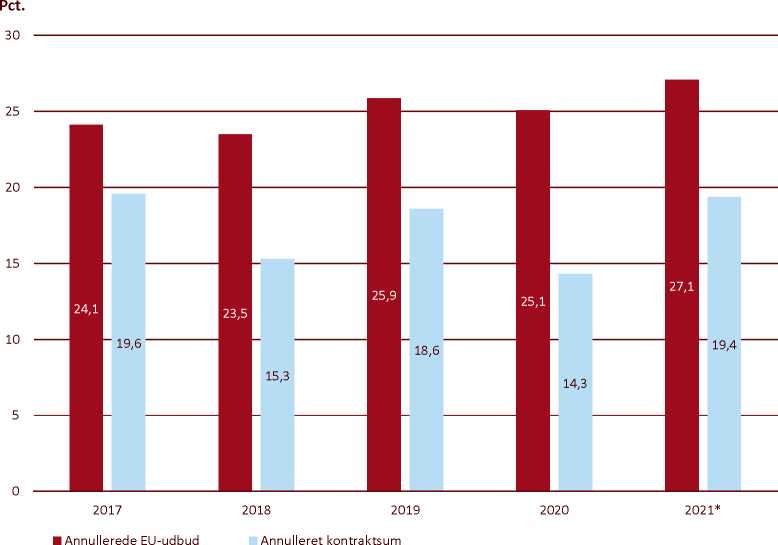
Note: Based on 11.696 tenders divided into 31.059 contracts published between 2017 and the third quarter of 2021. All invitations to tender were completed before 1 May 2022 with a contract award notice. Both public contracts and framework agreements are concluded. Prophylaxis notices, including invitations to tender which, following an annulment, have been put into negotiation, are not included in the statement of accounts. Observations with missing contract value have been replaced by the average value for the year of the invitationto tender, orders, type of contract and whether the task has been tendered as a framework contract or public contract. For framework agreements, the estimated max. value shallbe used for the entire duration of the framework agreement.
* The estimate of 2021 is based on the first three quarters of 2021.
Source: The Competition and Consumer Authority’s mapping of Danish EU tenders on the basis of the TED database.
Refers to section 4.1.1.2. Procedural aspects
Figure 83: Distribution of awarded value and volume of awards between competitive procedures and others in 2018-2023, EU 27 [%]
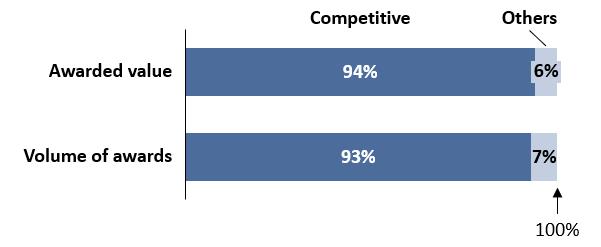
Source: World Bank (2025). European Union: Competition in Public Procurement…, p. 53
Figure 84: Use of competitive procurement procedures between TED data and data from US Federal Government procurement

Source: World Bank (2025), European Union: Competition in Public Procurement, p. 55.
Refers to section 4.1.1.3. Market access
Figure 85: Types of procedures in number of contract award notices, classical sector (2014-2024)

Source: Ecorys (2025), Cost-Benefit Analysis… p.51.
Figure 86: Types of procedures in number of contract award notices, utilities sector (2014-2024)

Source: Ecorys (2025), Cost-Benefit Analysis…, p. 51.
Figure 87: Number of bidders and awarded value (top)/number of awards (bottom) in 2018-2023, EU 27

Source: World Bank (2025). European Union: Competition in Public Procurement…, p. xx.
Figure 88: Average number of bidders by procurement value in 2018-2023, EU 27 [EUR]

Source: World Bank (2025). European Union: Competition in Public Procurement..,,p. 52.
Figure 89: Evolution of the use of the negotiated procedure without prior publication above EU thresholds, raw and balanced metrics, with assumed trends and effects (2013-2024)

Source: Ecorys (2025), Cost-Benefit Analysis…, p. 69.
Figure 90: Evolution of the use of MEAT criteria above EU thresholds, raw and balanced metrics [%]

Source: Ecorys (2025), Cost-Benefit Analysis…, p. 58.
Thresholds
The Directives apply to tender procedures for contracts with an estimated value above designated thresholds, which are likely to be of interest to suppliers across the Internal Market. Member States retain discretion for the regulation of public procurement outside the scope of the Directives (so called “below-threshold procurement”). On the one hand, the national rules are often similar to procurement above the EU thresholds, such as rules for electronic procurement, qualitative selection, evaluation of tenders, award criteria, technical specifications, setting-up of framework agreements, etc. On the other hand, below-threshold regimes may foresee shorter time limits for submission of tenders, less demanding requirements for publication or selection of tenders. Some countries allow for even less prescription in organising national procurement, as it takes the form of administrative guidance rather than formal legislation. Given the above, for certain aspects of the procurement rules, the monetary thresholds—above or below which specific rules apply—may constitute a key element of the overall EU public procurement framework.
The monetary value of EU thresholds is set in the Government Procurement Agreement (GPA) and based on SDRs. Every two years the European Commission ensures alignment with the GPA by reviewing the thresholds in the Directives, updating their value to the average exchange in SDRs over the two years prior to the revision.
For the current period 2024-2025 thresholds levels are set as follows: EUR 143 000 for service contracts other than those in Annex XIV Directive 2014/24/EU, design contests and supply contracts awarded by central government authorities; EUR 221 000 for subsidised services, all supplies contracts and design contest awarded by sub-central contracting authorities; EUR 443 000 supply contracts, service contracts other than those in Annex XVII Directive 2014/25/EU and design contests awarded by Utilities; EUR 750 000 services listed in Annex XIV Directive 2014/24/EU; EUR 1 000 000 services listed in Annex XVII Directive 2014/25/EU; EUR 5 538 000 all works and subsidised works contracts under Directive 2014/24/EU and Directive 2014/25/EU, all works or services concessions under Directive 2014/23/EU.
As explained above, the procurement Directives are only applicable to contracts whose value is above certain financial thresholds. Such contracts are considered relevant to the Internal Market, since they are deemed to be of interest to economic operators located in other Member States (the so called “cross-border interest”). Their award must comply with the EU public procurement rules and principles ensuring that the contracts are assigned on an open, transparent and non-discriminatory basis. On the contrary, contracts below the thresholds are subject, in general, only to national rules. However, in case they have cross-border interest, these contracts have to respect the general principles and rules of the Treaty on the Functioning of the European Union (TFEU).
The thresholds therefore reflect the level at which the tenders are presumed to be of cross-border interest and, in consequence, are more likely to generate competition from suppliers based in other Member States. The thresholds are also set to ensure that the administrative costs of using a tender procedure that is fully subject to EU rules are proportionate to the value of the contract. Compliance and transaction costs on both contracting authorities and suppliers have also to be considered when justifying the threshold system.
The thresholds are set in Article 8 of Directive 2014/23/EU, Article 4 of Directive 2014/24/EU and Article 15 of Directive 2014/25/EU, reflect and are revised every two years
to update their alignment with the thresholds of the GPA, as such, thresholds for social services not covered by GPA are not revised and have remained stable at 750 000 EUR (Directive 2014/24/EU) and 1 000 000 EUR (Directive 2014/25/EU).
The thresholds within the concerned Directives vary according to three main factors: the sector (Concessions, Classical or Utilities), the type of contract (works, goods, services), and the type of contracting authority (central government authorities, sub-central authorities or others). Table below presents the value of thresholds during the evaluated period.
Table 89: Evolution of the thresholds in the period 2014-2024.
|
|
2024-2025
|
2022-2023
|
2020-2021
|
2018-2020
|
2016-2017
|
2014-2015
|
|
Purchases of goods and services by central authorities
|
143.000 €
|
140.000 €
|
139.000 €
|
144.000 €
|
135.000 €
|
134.000 €
|
|
Purchases of goods and services by sub-central authorities
|
221.000 €
|
215.000 €
|
214.000 €
|
221.000 €
|
209.000 €
|
207.000 €
|
|
Purchases of goods and services by Utilities
|
443.000 €
|
431.000 €
|
428.000 €
|
443.000 €
|
418.000 €
|
414.000 €
|
|
Purchases of works and concessions (all entities)
|
5.538.000 €
|
5.382.000 €
|
5.350.000 €
|
5.548.000 €
|
5.225.000 €
|
5.186.000 €
|
|
Social services (Directive 2014/24/EU)
|
750.000 €
|
750.000 €
|
750.000 €
|
750.000 €
|
750.000 €
|
750.000 €
|
|
Social services (Directive 2014/25/EU)
|
1.000.000 €
|
1.000.000 €
|
1.000.000 €
|
1.000.000 €
|
1.000.000 €
|
1.000.000 €
|
Source: European Commission
SMEs participation
According to Eurostat, in 2022, the EU had 32.3 million enterprises, employing 160 million persons. Of that total, 99% were micro and small enterprises employing up to 49 persons. Micro and small enterprises employed 77.5 million persons, i.e. almost half (48%) of the total number of all persons employed in enterprises. They generated EUR 11.9 trillion in turnover, representing 31% of the total (EUR 38.3 trillion). The 240 000 medium-sized enterprises (50-249 persons employed) represented 0.8% of all enterprises accounting for 15% of the employment and 18% of the turnover. Even though large enterprises (more than 249 persons employed) represented only 0.2% of the total number of enterprises, they employed more than a third of the business labour force (37%) and generated more than half (51%) of the turnover.
Figure 91: Value of contracts awarded to SMEs in percentage of the total value of public procurement contracts awarded

Source: In-house analysis based on the Triennial reporting
Table 90: Direct and indirect cross-border shares of the value and number of awards, yearly

Source: JIIP Joint Institute for Innovation Policy (2017) Measurement of impact of cross-border penetration in public procurement, Final report, February 2017, p. 27.
Figure 92: Number (left) and value (right) of awards by type of procurement, percentage on total 2016-2019

Source: Prometeia (2021). Study on the measurement of cross-border..., p. 20.
Refers to section 4.1.1.4. Strategic objectives
Table 91: Use of environmental, social and innovation award criteria (multiple answers possible)
|
|
Contracting authorities
|
Economic operators
|
|
|
One-off
|
Framework contracts
|
One-off
|
Framework contracts
|
|
Environmental
|
22%
|
28%
|
35%
|
30%
|
|
Social
|
25%
|
25%
|
29%
|
26%
|
|
Innovation
|
8%
|
7%
|
22%
|
17%
|
|
None of the above
|
56%
|
53%
|
54%
|
47%
|
|
Total (n)
|
217
|
120
|
452
|
484
|
Source: Ecorys (2025), Cost-benefit analysis…, p. 58.
Refers to section 4.1.1.4.1. Strategic - Green
State of green public procurement across Member States
Measuring and monitoring the uptake of Green Public Procurement (GPP) across EU member states is complex due to several key factors. The lack of standardization in definitions and standards of what constitutes "green" procurement makes it difficult to compare data across Member States. This issue is compounded by differences in data collection methods. Some Member States have robust mechanisms for tracking GPP activities, while others lack the resources needed to collect GPP data. Additionally, regulatory differences and the voluntary nature of GPP policies contribute significantly to inconsistent monitoring adoption rates.
Together, these factors create substantial challenges in accurately assessing the progress and effectiveness of GPP across the EU. Although comparability is therefore limited, the publicly available data in Member States offers a first glimpse into how GPP is progressing. This section aims to synthesize such data.
Based on in-house research covering EU-27, three distinct approaches seem to emerge for measuring Green Public Procurement (GPP) uptake. Each approach varies in its methods of data collection and the breadth of its analytical scope. However, they all consistently utilize two main metrics: volume percentage and value percentage. The volume percentage indicates the proportion of the total number of tenders that incorporate green criteria, effectively measuring the frequency of GPP practices across public tenders. The value percentage assesses the monetary aspect, representing the proportion of the total procurement budget that is allocated to tenders including green criteria.
This section discusses the diverse approaches taken by Member States to analyse the level of GPP uptake. However, all outlined methods merely confirm the presence of environmental considerations in public procurement without evaluating their effectiveness, hence potentially misrepresenting a genuine commitment to GPP.
-Method 1: Self-reporting via Tender Publishing Portals
Some Member States (e.g., HR, SI, FR) monitor the uptake of GPP based on the information filled in procurement notices in national tender publishing portals, which involves a straightforward input, typically a checkbox, where procurement officers indicate whether environmental considerations have been incorporated into the procurement process. Therefore, this is a type of self-reporting mechanism. Such an approach for documenting environmental considerations in public procurement is straightforward but exhibits several limitations. As it fundamentally depends on self-reporting, which might not always be accurate, it might lead to discrepancies in data quality and the possibility of superficial compliance, i.e., greenwashing. Furthermore, the lack of standardized definitions for "environmental consideration" across various contracting authorities creates inconsistencies.
-Method 2: Online surveys or reporting templates disseminated among contracting authorities
Another approach (e.g., SL, IE), involves conducting online surveys or filling in reporting templates by selected contracting authorities. This method involves designing surveys to capture information about the utilization of GPP practices. The surveys are distributed to a selected number of contracting authorities, providing insights from those directly involved in procurement. Such an approach may lead to overreporting due to selection bias, where surveys/report templates predominantly target authorities or sectors already known for their GPP engagement. Furthermore, this methodology inherently suffers from limited reach, as it does not encompass all contracting authorities.
-Method 3: Text mining for green criteria
The third method (e.g., in DK) involves tracking the percentage of tenders that contain potentially green criteria through text mining. This process includes a detailed examination of tender documents for specific "green" keywords or phrases indicative of environmental criteria. Identifying these terms allows analysts to classify tenders as “green”. However, this method's effectiveness is limited by its reliance on specific keywords, which are not standardized across the EU. This could lead to underreporting, as some tenders that incorporate green practices may not use these specific terms. Moreover, the method may not fully capture the depth or effectiveness of the green criteria applied if the terms are mentioned superficially. There is also a risk of greenwashing, where contracting authorities include green terms primarily to comply with policy mandates or enhance their public image, rather than to implement substantial environmental improvements.
Uptake of GPP practices across Member States
Lithuania distinguished itself by allocating 89.3% of its procurement value in 2023 to green initiatives, though the volume data remains unspecifie. Such a high uptake of GPP has been spurred by Government Act that made it mandatory for almost every public procurement to be green.
Spain incorporated green criteria in 46.2% of its procurement processes in 2023.
Denmark's engagement was also notable, with 59.9% of its public procurements volume being potentially green in 2022. Such uptake it driven mainly by soft measures, such as guidelines published by the Danish Competition Authority.
Ireland reported 29% of its procurement volume and 34% of value as green in 2022. This uptake has been mainly driven by the soft measures such as three GPP guidance documents that have been published since 2014.
Finland's commitment to GPP was evident with 48.3% of its procurement volume being green in 2023.
Slovenia recorded 28.55% of its procurement procedures as green with a corresponding value of 34.30% in 2023. This is mainly driven by the national regulation on GPP that specifies 22 green public procurement items for which GPP is mandatory.
In 2023, in France 54.7% of State procurement contracts included an environmental consideration This figure should increase in the coming years with the decree that outlines a list of 16 product categories and establishes minimum purchase percentages for 2024, 2027, and 2030. The previous legislative measure that contributed to enhanced uptake of GPP is, for instance, the national law on climate change and resilience.
Croatia reported 21% of its procurement processes and 13% of its procurement value as green in 2023. As of 2025, the Croatian Government also made GPP mandatory for 17 product groups for central government procurements.
In Slovakia the increased adoption of GPP has primarily resulted from mandatory GPP for 5 product groups as per resolution from the Government office and amending the national public procurement act that mandates the integration of environmental considerations from 2022, setting a target for at least 6% of annual contracts to be green, with exceptions for specific cases such as low-value contracts.
Hungary reported 20% of volume and 18% of value of green public contracts below EU threshold in 2023. The GPP in Hungary is statutory mandatory for 3 product groups (i.e., food, construction and vehicles) and GPP is mandatory for procurements run by Hungarian central purchasing body for specific product groups.
Latvia, in 2024, recorded 4.9% of its procurement volume as green with 46,1% in value. This is primarily driven by the national regulation from 2017 that established mandatory GPP criteria for 9 product groups, voluntary criteria for 14 product groups as well as the methodology of life cycle costs for energy consuming products.
For Estonia, the latest available data is from 2020, and it shows that 4.5% of its procurement processes were green with 16% in value.
In 2023 in Portugal the promotion of environmental sustainability was reflected in 6 582 procedures with environmental criteria, which accounted for 3.72% of the total procedures. Framework agreements have the highest incidence, with 7% using environmental criteria. This is complemented by a comprehensive strategy aiming to foster the use of environmental, social and innovation criteria in public procurement.
Sweden reported 10% of procurement volume to be green in 2023. However, since the obligation to indicate green considerations only applies to procurements below the threshold, the reported figure likely underestimates the actual adoption of green procurement practices. Starting from 2024 this will change and it will also be mandatory to state in all procurement notices whether considerations are taken to environmental sustainability.
According to the data of the Public Procurement Office, in 2023, the total value of green public procurement (excluding value added tax) in Poland amounted to PLN 11.9 billion, i.e. 4.3% of total value of awarded public procurement.
Lastly, in Italy the observatory on GPP reported that in 2024 56% of contracting auhtorities have implemented GPP. This level has been reached due to national legislation that set from 2016 onwards mandatory GPP criteria for 21 product groups.
Refers to section 4.1.1.4.2. Strategic – Social
Socially responsible public procurement (SRPP) has been increasingly recognized as a tool for promoting social inclusion, improving labor standards, and ensuring ethical supply chains within public contracts. However, the extent and manner of implementation vary significantly across EU member states. The following analysis categorizes measures taken by different countries, highlighting their approaches and challenges in a chronological order.
2004-2018
Effective data collection and monitoring are essential for assessing the impact of socially responsible public procurement and ensuring its successful implementation. Even though several Member States established mechanisms to track the integration of social criteria in public procurement processes, before 2018 data collection was still in its early stages, resulting in limited hard numbers on contracts and their value, with significant gaps in reporting and comprehensive monitoring.
HR reported that the number of public procurement procedures reserved to sheltered workshops and economic operators in line with article 20 of the Directives was only 1.
In DK in 2016, 60,8 % of relevant tenders used social clauses.
EE transposed the directives on 1.09.2017. Before that date the information on socially responsible procurements was not available. During the last quarter of 2017, from 1.09.2017 until 31.12.2017, a total of 1,196 procurements were published, with 94 falling under the scope of the directives, including one that was socially responsible. In total, 8 socially responsible procurements were published during the last three months of 2017.
In FR overall, there was a slow but steady increase in the number of social clauses in the drafting of administrative contracts (from 9.9% in value terms in 2014 to 11.5% in 2016). As with environmental clauses, local authorities increased average rates, both in terms of the number of contracts and the amounts, while the State continued to occupy an intermediate position between the latter and the "other" buyers, except in 2015.
The average rates of use of social clauses were slightly lower than the rates of use of environmental clauses (on average over the period 2014-2016, all buyers combined, and rounding: 10% compared to 12% in number of contracts, 11% compared to 13% in associated amount).
In HU the total proportion of socially responsible public procurement procedures up to 2018 was 2.28%.
In MT, in 2016, 37 procurement processes were screened using the BPQR criteria, and in 2017, 47 processes were screened.
In PL in 2017, data on contracts exceeding EU thresholds, as reported in annual submissions to the President of the Public Procurement Office under Article 98 of the Public Procurement Law, revealed several key trends in the integration of social aspects into public procurement. The most widely applied social criterion was the requirement for employment under an employment contract, which accounted for 2,865 procedures. Additionally, 205 procedures incorporated social or employment-related aspects as part of contract performance conditions. Accessibility for disabled individuals or universal design principles were considered in 425 procedures. The use of social labelling appeared in 41 procedures in contract descriptions and in 35 procedures as a bid evaluation criterion. Other social aspects were factored into tender evaluations in 371 cases. Furthermore, 15 procedures were conducted as reserved contracts for health, social, or cultural services. The data also classified contracts by the type of awarded entity, including social cooperatives, sheltered workshops, and vocational activation facilities.
In terms of quantitative data, SK recorded 24 public procurement procedures incorporating SRPP criteria in 2017, with only one above-threshold tender and 23 below-threshold tenders meeting SRPP standards. Additionally, 15 below-threshold tenders were reserved for sheltered workshops and economic operators in accordance with Article 20 of Directive 2014/24/EU. The ‘light regime’ for social and other specific services was not utilized in 2017, reflecting the ongoing challenges in implementing SRPP at a national level.
In SL the number of public procurement procedures incorporating socially responsible contract performance clauses criteria above the EU threshold was 1.043 and below the EU threshold (beginning from EUR 20 000) was 975. Finally, the number of public procurement procedures reserved to sheltered workshops and economic operators in line with article 20 of Directive 2014/24/EU was 4.
In 2017 in ES 8.779 public procurement procedures with social responsibility criteria were held and 217 procurement procedures reserved for protected operators under Article 20 Directive 2014/24/EU.
NL highlighted the fact that quantitative indicators on SRPP were fairly limited, as it is generally an aspect of procurement procedures rather than a procedure in itself. For example, many contracting authorities will incorporate social criteria into their procedures, but this will not show up in data. Nevertheless, they reported the following information for 2017: the number of contracts valued above EU thresholds was 2538 and below EU thresholds was 958.
In NO, Difi and Ethical Trading Initiative Norway (ETI Norway) conducted a survey on the use of socially responsible contract performance clause criteria. The survey looked at whether contracting authorities stipulated requirements on compliance with basic human rights in the supply chain, such as ILO’s core conventions, within procurements of five high risk product categories (goods). The survey shows the development in the use of such requirements from 2009-2016. In 2016 requirements on compliance with ILO’s core conventions or stricter were used in 51 % of the procurements that were part of the survey (n=255). It’s important to notice that this survey looked at the use of such requirements before the implementation of the new procurement Act in Norway, which came into force in January 2017.
2018
Several Member States moved in the direction of creating legal frameworks and introducing reserved contracts to promote the initial adoption of socially responsible public procurement. Countries such as BG, HU, LV, LT, LU, MT SK and SL implemented legislative measures that allow contracting authorities to reserve procurement opportunities for social enterprises, sheltered workshops, and businesses employing disadvantaged individuals.
Before 2018, multiple Member States implemented policies and strategies to facilitate the adoption of socially responsible procurement. Some examples are: BE (national and regional initiatives focused on ethical standards, combating social dumping, and improving working conditions in public procurement), DK ("Follow or explain" principle), FI (government guidelines and partnerships promoting responsible procurement, including ecolabeling and social clauses), IE (Social Considerations Advisory Group established to explore social clauses in procurement), NL (strong emphasis on Social Return on Investment (SROI) and International Social Conditions (ISV) in procurement; SE, NO (the Agency for Public Management and eGovernment (Difi) provides online guidance and risk analysis tools for compliance monitoring), DE, and FR(issued standardized guidelines).
Additionally, some Member States also included social criteria in procurement processes: ES, SE, CY.
To promote employment and inclusion, Member States leveraged SRPP as a strategic tool. For instance, in FI the HANDU project (2015-2017) promoted employment for disadvantaged individuals. Other examples can be found in DK, EE, PL, SL, and SE (through a national public procurement strategy).
Another major objective was to combat social dumping and ensure fair working conditions. BE created a Social Information and Research Service (SIRS) which fights social dumping through inspections and data analysis. LU, MT and NO all have similar practices to ensure that socially responsible public procurement supports fair labor conditions.
2021
Up to 2021, the application of SRPP remained relatively consistent compared to 2018. Some measures taken involve, again, legal frameworks, action plans, training initiatives, and the inclusion of social criteria in public procurement.
Many Member States still incorporated social responsibility into their national legislation. Some example are: AT, CZ, FR, HU, PL, SL, BG, ES, and BE.
Several Member States implemented national strategies and action plans to further SRPP. FR's National Action Plan on Sustainable Procurement (2015-2020) structured efforts to promote sustainable development, including social aspects. PT's National Strategy for Equality and Non-Discrimination (2018-2030) and Action Plan for Equality Between Women and Men (2018-2021) supported gender equality within procurement. NL had a national programme for SPP (including SRPP) (2021-2025).
Many Member States maintained in their legislation the possibility to reserve contracts for specific groups. BG mandated reserving contracts for specialized enterprises or cooperatives for persons with disabilities, ensuring that at least 30% of employees in certain contracts belong to disadvantaged groups. Other examples are LV, MT, PL, and SL.
Employment and social inclusion have been prioritized through various contract requirements. FI's national law includes clauses on minimum employment terms and conditions. Comparable cases are PL, SE, and LV.
Training and knowledge dissemination have played a significant role in promoting SRPP. ES implemented various training activities, conferences, and inter-ministerial committees to incorporate social criteria into public procurement. FR provided workshops, training sessions, and an annual award for sustainable public procurement. PL conducted training courses, national conferences, and distributed materials to support social criteria in procurement. SL organized training sessions and consultations, has a help desk for contracting authorities, and offers certifications such as the ‘Family-Friendly Enterprise’ certificate.
Guidelines and supporting tools have been developed to facilitate the implementation of SRPP. Some Member States that have produced them are FR (guide on the social aspects of public procurement to raise awareness), HU (from the Prime Minister’s Office), LV, SL (guidelines for procuring security and cleaning services), ES, and RO.
Several Member States maintained specific procurement criteria to promote social objectives: BG, PL (includes social aspects in the evaluation of abnormally low tenders), SL (mandates compulsory social selection criteria for certain labour-intensive services), MT, and LV.
Some Member States established monitoring and enforcement mechanisms. For instance, SL requires a six-monthly mandatory verification of exclusion grounds for economic operators in labour-intensive services and expanded labour law offence exclusions. Similar cases are SE and HU (maintains a list of sheltered workshops to enhance SRPP).
Innovation has also been a focus in SRPP measures. PT’s National Innovation Agency (ANI) collaborates with public procurement bodies to integrate innovation into procurement in sector such as health, space, biotechnology, agriculture, agribusiness and sea. Finland drafted a code of conduct for ICT suppliers to ensure socially responsible conditions.
Public awareness and networking efforts have also been undertaken in many Member States such as FR, PL (launched an in-depth study on sustainable public procurement), LV, RO (organized working groups and conferences, such as the 2019 event on “Concrete Opportunities to Acquiring Social Value in and through Public Procurement”).
According to reports from Member States in the context of art.83 of the Directive, in 2021 the most common existing SRPP regulatory requirement in member states was mandatory requirements regarding employment from vulnerable groups or specific SRPP requirements for the performance of contracts (both have 4 mentions). In comparison, in 2024 the most common were mandatory exclusion grounds related to SRPP (14 mentions) and general legal obligation imposing SRPP goals (13 mentions).
In 2021, the main SRPP policies implemented in member states were primarily guidelines designed to encourage SRPP (mentioned 4 times). However, by 2024, these guidelines were complemented by optional training sessions, events, and workshops to promote SRPP (15 mentions), as well as efforts to monitor and report on the use of SRPP criteria (12 mentions). Additionally, there was the introduction of an online information tool for sharing best practices on SRPP (12 mentions), and the establishment of national competence centres or specific working groups dedicated to advancing SRPP usage (11 mentions).
Despite the efforts, some challenges persist in ensuring the widespread adoption of socially responsible public procurement.
The key challenges encountered by member states in 2021 were lack of guidance on implementation/insufficient implementation of policies on SRPP (6 mentions), risk of legal actions for wrong application of SRPP or a perception of some public buyers that such a risk exists, and lack of policy guidance and support on SRPP (both 5 mentions). In 2024 the main challenge to face was lack of capacity of public procurement staff (17 mentions) along with again risk of legal actions for wrong application of SRPP or a perception of some public buyers that such a risk exists (15) and lack of professionalisation of public procurement staff (14).
2024
According to information submitted in the last round of Triennial reporting in 2024, socially responsible public procurement (SRPP) has evolved into a crucial policy instrument across EU member states, fostering fair labour conditions, social inclusion, and sustainable development through public contracts.
Legislative measures play a fundamental role since many EU member states have introduced laws and policies that require or encourage the inclusion of social criteria in public contracts: LU (the Amended Public Procurement Law (2018) includes a horizontal social clause and exclusion grounds), DE, FR (sets a target of 30% of procurement to include social consideration by 2025 in the Climate and Resilience Act), EL, LI (Public Procurement Law mandates at least 2% of the budget be allocated to social enterprises), DK, and NO.
Several Member States also introduced reserved contracts for social purposes other than those under Article 77 Directive 2014/24/EU. By setting aside specific contracts for organizations that employ vulnerable individuals, such as people with disabilities or those facing barriers to the labour market, governments ensure that public spending directly contributes to social inclusion.
For example, in IT Article 47 of Legislative Decree 77/2021 mandates contracts for disabled persons and gender equality. Other examples are BG, BE, MT, SL, PT, EL, EE, FI and ES.
To enhance fairness in public procurement, many countries have implemented social clauses that require contractors to uphold labour rights, fair wages, and ethical working conditions. These clauses help combat social dumping and promote equal opportunities by integrating specific requirements, such as the inclusion of internships, limits on subcontracting, and compliance with collective agreements. Other instances in Member states are NO, FR ("comply or justify" approach), BE (Wallonia), and MT.
Monitoring and compliance mechanisms are essential components of SRPP, allowing governments and regulatory bodies to track the performance of procurement activities, verify adherence to social clauses, and ensure transparency in the execution of contracts.
In BE, the Social Information and Investigation Service (SIIS) screens contractors for compliance with labour laws. Other Member States the implement these mechanisms are NO (Public Procurement Survey), EL, and DE.
Member states across Europe recognized the importance of specialized training programs and developed various initiatives to enhance the professionalization of procurement officers. Several countries developed training programs including FI, SE, IT, RO and EE.
Strategic and digital approaches enhance efficiency, transparency, and impact assessment. Many member states are leveraging digital platforms and data-driven tools: FR is developing a national digital platform for sustainable procurement; IT uses an open data space to monitor SRPP inclusion through open data platforms.
While there are still challenges in obtaining quantitative data on social and green procurement, the introduction of eForms is expected to improve access to such data and enhance the ability to monitor and follow up on procurement outcomes. Nonetheless, the number of Member States that could report some figures on the implementation of SRPP at national level increased in 2024 in comparison with previous reporting exercises.
In LV the share of socially responsible public procurement in 2023 was 0.4%.
In EE, the share of socially responsible of public procurement in 2023 was 0.7%.
In FL in 2023 the number of procurement notices promoting social sustainability was 4983, accounting for 49.9% (volume).
In IT, monitoring the integration of social considerations in public procurement has become a key priority, particularly following the implementation of the National Recovery and Resilience Plan (PNRR), which mandates the inclusion of strategic criteria, both environmental and social, in procurement processes. Digitalization plays a crucial role in advancing these efforts, with the creation of standardized templates for calls for tender and improved data management systems. Engaging stakeholders in the monitoring process is essential, ensuring that civil society organizations participate in overseeing public spending and are empowered to hold institutions accountable. As part of the Open Government Action Plan, efforts are underway to link datasets from the National Anti-Corruption Authority (ANAC) with other open data sources, promoting transparency and accessibility. The objective is not only to track the inclusion of social criteria in procurement but also to assess their tangible impact on employment, gender balance, and other social indicators. A "comply or justify" approach has been introduced to encourage greater adherence to social procurement criteria, requiring contracting authorities to either implement these measures or provide a clear rationale for their exclusion. Ultimately, transparency is recognized as a powerful tool for preventing corruption.
In LT, the new public procurement database includes an analytical tool to measure the usage of criteria in LT (above/below threshold and including which criteria is used and in which part of the tender)
In PL, in 2023 the share of Socially responsible public procurement contracts was 4.7% among the contracting authorities and 7.6% among economic operators.
As part of their Triennial report, HU showcased a study on the evolution of public procurement with social aspects between 2019 and 2023. In 2020, the negative impact of the coronavirus pandemic caused a significant drop in data on public procurement procedures, and this was reflected in the significantly low values of public procurement for social purposes (from 308 contracts in 2019 to 107 in 2020). In 2021, however, both the number and value of public procurement procedures involving social aspects increased significantly, by more than 20 percent compared to the previous year's figure (130 contracts). In 2022, they observed rather stagnation in the main data of social procurement compared to a year earlier. In 2023, however, there was a significant increase: 191 public procurement procedures containing social aspects were conducted, during which contracting authorities spent HUF 29.3 billion, which is almost one and a half times the previous year's figure, both in terms of value and number of pieces.
Similarly in ES, in total, with 68,812 SRPP contracts, SRPP stood at 41.2% in 2023. Total volume in 2023 was 53.5%.
In conclusion, despite efforts to track socially responsible public procurement, the available data remains insufficient, and Member States differ significantly in their methodological approaches to monitoring and reporting. The lack of standardized data collection makes it challenging to compare progress across countries or assess the overall effectiveness of SRPP initiatives. Moreover, measuring the real-life impact of these policies requires evaluating long-term social outcomes such as improved labor conditions, increased employment opportunities for disadvantaged groups, and overall social sustainability. As SRPP practices continues to evolve, greater emphasis on data harmonization and impact assessment will be crucial to ensuring its success and scalability across the EU.
With regards to the procurement of contracts that could potentially be subject to the ‘light regime’, their total number has decreased from 13% in 2014-2015 to 11% in 2016-2024. However, in terms of value they have remain constant between 13% and 14%. (See
Figure
)
Figure 93: Share of social services (IIB services in 2004 Directives) above EU thresholds, 2006-2024

Source: Ecorys (2025), Cost-Benefit Analysis…, p. 53
Refers to section 4.1.1.4.3. Strategic – Innovation
Before 2018, many countries were just beginning to lay the groundwork for the implementation of public procurement of innovation, so data the subject was limited. Several Member States were still addressing foundational challenges, with only a few early initiatives in place. Some notable examples are reported here.
In LT, the Agency for Science, Innovation and Technology (MITA) launched a project aimed at promoting PPI and pre-commercial procurement as part of the Lithuanian Innovation Development Programme (2014-2020). The Ministry of Economy also published guidelines on innovative public procurement in 2014, and MITA offered consultations to contracting authorities to support innovation in procurement. In PL, significant efforts were made to provide training, workshops, and guidance materials to support public buyers in incorporating innovation into procurement practices. Similarly, SE established early training programs, guidance materials, and methodological support, including funding for public procurement of innovation, as well as efforts to bundle demand for innovative solutions.
In FR, more comprehensive actions compared to other Member States were taken to foster public procurement of innovation. The Prime Minister’s 2013 circular required ministries to develop roadmaps for innovative purchasing, with designated referents in each ministry. Various tools were introduced, such as an innovation purchasing platform and the Impact software to track innovative purchases. FR also launched regional initiatives to promote local awareness and a program for the healthcare sector. A key initiative was the DAJ Guide to Innovative Procurement, which offered methods to integrate innovation into procurement, alongside a legal framework that included innovation partnerships, competitive procedures, and sourcing consultations. The German government established the Competence Center for Innovative Procurement (KOINNO), which offered advisory services to public procurement agencies and facilitated connections with innovative suppliers. Germany also incorporated innovation-related criteria into procurement processes to encourage the adoption of new solutions.
Overall, the Member States made varying levels of progress before 2018, with some countries focusing more on awareness-raising, methodological support, and training as starting points, while others, like FR and DE, developed comprehensive legal and institutional frameworks to promote the integration of innovation into public procurement practices. However, challenges remained across the board, including resource limitations, a lack of clear data, and legal barriers.
Starting from the 2021 reporting, we can observe that EU Member States undertook a variety of initiatives to further promote public procurement of innovation.
Several Member States such as ES, FR, HU, and LU focused on developing and enhancing frameworks and guidelines to facilitate the implementation of PPI. In 2021, FR published a report of evaluation on the application of public procurement of innovation below the EU threshold which provides an overview of the period December 2018 - December 2021. A total of 231 contracts were reported during the experiment, with 172 contracts fully detailed and used for analysis. Usage peaked in late 2019 but slowed in 2020 and early 2021, likely due to the COVID crisis. Buyers included state administrations (41%), local authorities and public entities (40%), and others such as national public establishments (19%). The state’s central administrations and hospital sectors were primary users. Services dominated (54%), particularly in digital technologies, followed by goods (39%) and works (7%). Nearly half of the contracts were valued between EUR 75 000 and EUR 100 000. SMEs benefited the most, receiving 80% of the contracts.
In terms of providing direct support to contracting authorities, several countries like Croatia and Estonia established or strengthened competence centers and platforms, along with specific programs for the implementation of innovative solutions (Poland, Malta).
Member States also recognized the crucial role of training and capacity-building to equip public procurement professionals with the necessary skills to manage public procurement of innovation effectively, and helpdesks to assist contact authorities and tenderers (IE, PL, SI). Alongside these efforts, France, Latvia, and Romania engaged in promotion and awareness-raising activities to further publicize the benefits of public procurement of innovation.
Looking toward the future, several countries set long-term strategic goals to integrate innovation into public procurement. For example, LT, through its Innovation Development Program, set an ambitious target for 2021-2030, aiming for at least 20% of public procurement in all sectors to involve public procurement of innovation, pre-commercial procurements, and research procurements.
Finally, countries like BE and NL fostered collaboration between public authorities and innovation providers through platforms and hubs.
According to the contributions from Member States under the Triennial reporting of the Directive, up to 2021, the lack of professionalization among procurement staff was the key issue (11 mentions in the Triennial reports), while other challenges appeared less prominent, likely due to the overall low level of implementation of public procurement of innovation at the time. By comparison, in 2024 the most significant challenges identified were lack of professionalization of public procurement staff (16 mentions), lack of capacity of public procurement staff (17 mentions), and risk or a perception of a risk amongst public buyers of higher procurements costs (19 mentions).
In order to address the primary challenges they faced, Member States have implemented a variety of measures to promote public procurement of innovation, with notable progress across different categories of support.
Competence centres have emerged as a key driver in fostering innovation. Some examples are Austria’s IÖB competence centre, Germany’s KOINNO competence centre, NL, PT, SE, PL, IT. For instance, Finland’s KEINO competence centre reported 11% of total procurement as innovative in 2022, although its activities were largely phased out in 2024 following the end of Ministry funding. Lithuania’s competence center, along with its GovTech Lab, provides guidelines, helpdesks, and funding mechanisms. In the period from 2011 to 2023, they reported the highest number of innovative public procurements per year was 37 (2022). Additionally, a significant increase in innovative public procurements was observed from 2018 to 2020. The largest share of the value of innovative procurements from the total value of procurements was observed in 2023, accounting for as much as 2.3%. The share of volume of innovative procurements for the period from 2013 to 2022 ranges from 0.02 to 0.1.
Guidelines, tools, and support materials such as helpdesks play a crucial role in enabling contracting authorities to adopt innovation-focused public procurement practices. They are present in FR, HU, CY, SE, LV, NL, and SI.
Training and capacity-building initiatives are critical in equipping public servants with the skills necessary for public procurement of innovation (AT, DE, SE, FI, MT). For instance, RO incorporated innovation topics into training programs through the SIPOCA 625 project, which also included professionalization efforts for public procurement staff.
Monitoring and data collection efforts have been emphasized by several Member States to track progress and identify areas for improvement. Estonia’s national public procurement strategy includes targets for innovation in both value and volume for 2025 and 2035, with PPI accounting for 0.2% of total procurement in 2023. LV registered that public procurement of innovation accounted for 0.05% in 2023. ES reported that, considering together public procurement of innovation and the available data on pre-commercial public procurement, government procurement would account for 11.9% of the total public procurement of innovation. With regards to public procurement of innovation in the strict sense, during the study period, from 2021 to 2023, 1 173 public procurement of innovation contracts have been formalised. In PL, in 2023, the share of public procurement of innovation was 0.6% among contracting authorities and 2.5% among economic operators.
In Norway, according to the Procurement Survey (2022), the use of public procurement of innovation was limited. The proportion who stated that they use innovative procurements is 8%. From 2017 to 2022, approximately 30 innovation partnerships have been initiated, and just as many before commercial procurements (of which 19 are StartOff projects). The procurement survey shows that contracting authorities have a limited dialogue with the market before publishing the call. Barriers that are mentioned among public clients are management support, management focus, and (management) prioritization to set aside time and resources to obtain an overview of opportunities in the market.
Funding and incentives are instrumental in driving PPI. AT, LT, PT, IE, and MT all provide funding mechanisms to support contracting authorities. For instance, in Italy there is a funding program called Smarter Italy, implemented by the Agency for Digital Italy, which allows public administrations to co-finance innovative projects.
Finally, Member States have adopted strategic frameworks to guide their efforts. DK developed the Innovation Barometer, which shows that out of all public sector innovations (100%), 16% are public-private innovations, 11% are innovative public procurements, and 2% are innovative public tenders. However, the innovation partnership procedure is rarely used in DK, with fewer than 20 cases since 2016, though other procedures such as negotiated and competitive dialogue are more common. Romania, through its national strategy and implementation plan, has used public procurement of innovation for the procurement of construction work, the purchase and installation of equipment necessary for scientific research, such as a high-power laser system or a Gamma-ray – National Institute for Research and Development ”Horia Hulubei” - financed by EU funds (POC project).
Innovation Partnerships (2016-2023)
The trend of innovation partnership (IP) has shown significant growth both in terms of the number and value of contracts awarded. Between 2016 and 2023, a total of 199 contracts were awarded, with over EUR 8.5 billion in contract value. In 2023, the value of contracts awarded surged, with 67% of that value allocated to green, social, or digitalization purposes. CZ emerged as the leading country for the number of IP contracts awarded in 2023.
As presented in
Figure
94
below, the overall number of contracts awarded peaked in 2020 with 39 contracts estimated at EUR 659 million. 90% of cases concern the Classical Directive. Many contracts were below the EU threshold of EUR 140 000, with a few reaching exceptional values and the largest contract surpassing EUR 5 billion. The total value of published IP amounted to EUR 8.5 billion. After manual corrections and applying average-based replacement for missing values, the estimated contract value increased to EUR 8.9 billion. The average contract value, excluding the above-mentioned contract with an extremely high value, was EUR 9.2 million.
Figure 94: Total value of IP contracts awarded (excluding contracts with extremely hight value)

Source: In-house research
Overall, there was a peak in contract values in 2020, followed a sharp decrease likely influenced by the COVID pandemic, then the trend has again turned upward in 2023.
Innovation partnership contracts were awarded in 18 different countries (17 from EU-27 and NO) over the period from 2016 to 2023. The top three countries for the number of contracts awarded in 2023 were Finland (28 cases), the Czech Republic (27 cases), and France (27 cases).
There were also examples of cross-border collaboration in IP. Out of the 199 contracts awarded, 17 were awarded to non-EU companies, representing 8.8% of the total. The value of these cross-border IP contracts amounted to EUR 84 million, which represents 4.6% of the total contract value. Notably, two IP contracts were awarded outside the EU+EEA, to Switzerland and India.
In terms of the number of contracts awarded, the breakdown by sector shows that mobility (17%), ICT (13%), and environment (12%) were the leading sectors. However, when evaluating the value of contracts awarded, the construction sector stands out as the leader, with mobility becoming the dominant sector when including outliers.
When categorizing the innovation partnerships by policy objective, green and digitalization emerged as the most frequently used objectives. However, when assessing the value of contracts, "social" objectives dominated after the more general category of "other" policy objectives.
Interestingly, 22% of the innovation partnership contracts were awarded to consortia, a figure significantly higher than the 6% of public procurement contracts awarded in general from 2018 to 2022 (
Figure
95
). This indicates a greater level of collaboration between companies in the IP procedure.
Figure 95: Consortia in innovation partnership procedures compared to all public procurement procedures in 2018- 2022 [%]

Source: In-house analysis
Small and medium-sized enterprises (SMEs) have played a significant role in the Innovation Partnership process. A total of 126 of the 199 IP contracts (approximately 63%) involved SME participation. While SME participation had been increasing until 2019, it declined after the pandemic, although the share of contracts involving SMEs has remained relatively stable. The total contract value awarded with SME participation amounts to EUR 834 million, representing 62% of the total value, excluding outliers. SME participation was distributed rather evenly across sectors, following the general distribution of contracts awarded by sector.
Figure 96: SMEs participation in innovation partnership (based on the number of contracts awarded)

Source: In-house analysis
Finally, in terms of the presence of AI cases in innovation partnerships, 15 such cases were observed in 7 countries from 2016 to 2023. The country with the highest number of AI contracts was FI, with a total of 6. The other countries either had 2 or 1 contract. The total value of the AI-related contracts was EUR 20.6 million, with an average of EUR 1.4 million. The value trend has been increasing, with a peak of EUR 9.41 million in 2020.
The sector with the highest number of contracts was urban planning (6) followed by public services (5). The sector with the highest value of contract was energy with EUR 8 million. The most common AI type use for urban planning was smart sensors and image recognition. Also, natural language processing was widely used in public services and ICT. One example of smart sensors and image recognition project in urban planning was launched by the city of Prague in 2020 which procured the development of a traffic management system to manage traffic based on real-time vehicle numbers, traffic intensity, and directionality at transport hubs, for smooth traffic flow.
Refers to section 4.1.1.5. Governance
Table 92: Initiatives to support professionalisation
|
Initiative
|
More information
|
|
Recommendation to Member States on Professionalisation of public procurement
|
https://eur-lex.europa.eu/legal-content/EN/TXT/?uri=CELEX%3A32017H1805
|
|
European Competency Framework for public buyers
|
https://commission.europa.eu/funding-tenders/tools-public-buyers/professionalisation-public-buyers/procurcompeu-european-competency-framework-public-procurement-professionals_en
|
|
Training program for centralised procurement organisations - PPE+ Europe 2024-2028
|
https://public-buyers-community.ec.europa.eu/communities/ppe-europe-2024-2028
|
|
Big Buyers for Climate and Environment Project 2023-2027
|
https://public-buyers-community.ec.europa.eu/about/big-buyers-working-together
|
|
Public Buyers Community Platform
|
https://public-buyers-community.ec.europa.eu/
|
|
The Public Procurement Gazette
|
https://ec.europa.eu/newsroom/growth/newsletter-archives/39013
|
|
Study “Single bidding and non-competitive tendering procedures in EU co-funded projects”
|
https://ec.europa.eu/regional_policy/en/information/publications/reports/2019/single-bidding-and-non-competitive-tendering
|
|
Guidance to Member States and contracting authorities on the application of the collusion-related exclusion ground provided for by the Directives.
|
https://eur-lex.europa.eu/legal-content/EN/TXT/PDF/?uri=CELEX:52021XC0318(01)&from=EN
|
|
2020 Guidance of the European Commission on using the public procurement framework in the emergency situation related to the COVID-19 crisis
|
https://eur-lex.europa.eu/legal-content/EN/TXT/?uri=CELEX%3A52020XC0401%2805%29
|
|
Public Procurement Data Space (PPDS)
|
https://www.public-procurement-data-space.europa.eu/en
|
|
Study on Digital Transformation of Public Procurement
|
https://ec.europa.eu/docsroom/documents/40102
|
|
Integrity Pacts project
|
https://ec.europa.eu/regional_policy/policy/how/improving-investment/integrity-pacts_en
|
|
Feasibility study concerning the actual implementation of a joint cross-border procurement procedure by public buyers from different Member States
|
https://op.europa.eu/en/publication-detail/-/publication/85572a0c-f102-11e7-9749-01aa75ed71a1/language-en
|
|
Joint Public Procurement for Security (H2020 grant)
|
https://www.iprocurenet.eu/home/toolbox-2/
|
|
Study on the Analysis of the SMEs' participation in public procurement and the measures to support it.
|
https://op.europa.eu/en/publication-detail/-/publication/eec8227c-ecc4-11ea-b3c6-01aa75ed71a1
|
|
Guidance on the participation of third-country bidders and goods in the EU procurement market
|
https://commission.europa.eu/funding-tenders/tools-public-buyers/public-procurement-and-non-eu-participation_en
|
|
Access2Markets portal
|
https://webgate.ec.europa.eu/procurementbuyers/#/procumementlocation
|
|
Q&A: Participation in the EU procurement market of bidders from non-covered third countries (cases C-652/22, Kolin, and C-266/22, Qingdao)
|
https://public-buyers-community.ec.europa.eu/resources/qa-participation-eu-procurement-market-bidders-non-covered-third-countries-cases-c-65222
|
|
FAQs on sanctions against Russia and Belarus, with focus on the following provision: Article 5k of Council Regulation (EU) No 833/2014.
|
https://finance.ec.europa.eu/system/files/2024-01/faqs-sanctions-russia-public-procurement_en.pdf
|
|
Public Procurement e-competence centre for Public Buyers
|
https://commission.europa.eu/funding-tenders/tools-public-buyers_en
|
|
Guidance on public investment into sustainable infrastructure projects
|
https://single-market-economy.ec.europa.eu/document/download/98b904a2-d688-4592-aaf6-a76ead62b7c8_en
|
|
Dialogues with the Member States on Strategic Public Procurement
|
https://public-buyers-community.ec.europa.eu/communities/public-procurement-dialogues
|
|
Study on PP as a strategic tool, green, social, innovation, SMEs.
|
https://op.europa.eu/en/publication-detail/-/publication/6a5a4873-b542-11e7-837e-01aa75ed71a1/language-en
|
|
Fostering the uptake of the strategic use of procurement to pursue Cohesion policy objectives
|
https://ec.europa.eu/regional_policy/policy/how/improving-investment/public-procurement_en
|
|
External training on new Directives and strategic procurement (social, green and innovative)
|
https://ec.europa.eu/regional_policy/policy/how/improving-investment/training_en
|
|
"WeBuySocialEU": initiative to promote Socially Responsible Public Procurement (SRPP)
|
https://www.aeidl.eu/webuysocialeu/
|
|
Update of the Buying Social guide
|
https://ec.europa.eu/docsroom/documents/45767
|
|
Research for good practices in the field of socially responsible public procurement
|
https://ec.europa.eu/info/making-socially-responsible-procurement-work-71-good-practice-cases_en
|
|
EU Green Public Procurement Helpdesk
|
https://green-business.ec.europa.eu/green-public-procurement/green-public-procurement-helpdesk_en
|
|
Public Procurement of Nature Based Solutions
|
https://op.europa.eu/en/publication-detail/-/publication/d75b2354-11bc-11eb-9a54-01aa75ed71a1
|
|
Collection of Good Practices in Green Public Procurement
|
https://green-business.ec.europa.eu/green-public-procurement/good-practice-library_en?f%5B0%5D=oe_page_subject%3Ahttp%3A//data.europa.eu/uxp/c_163e1e96&page=0
|
|
Uptake of BIM in public procurement
|
Roadmap: Building Information Modelling and public procurement community of practice | Public Buyers Community
|
|
Study on strengthening EU-funded security research and innovation – 20 years of EU-funded civil security research and innovation (2025)
|
https://op.europa.eu/en/publication-detail/-/publication/4ab7d386-f8a8-11ef-b7db-01aa75ed71a1
|
|
CERIS event on innovation procurement
|
CERIS SSRI event on Innovation Procurement - European Commission
|
|
European Research and Innovation days (2024) thematic day on innovation procurement in civil security
|
European Research and Innovation Days | Research and Innovation
|
|
Innovation Procurement Hubs 2025-2029 to equip public administrations with the resources, guidance, and collaborative network needed to either establish or strengthen an Innovation Procurement Hub.
|
Innovation Procurement Hubs (IPH) | Public Buyers Community
|
|
Urban Agenda Partnership on Innovative and Responsible Public Procurement
|
https://www.urbanagenda.urban-initiative.eu/partnerships/public-procurement
|
|
Training program - Procure Innovation EU
|
https://public-buyers-community.ec.europa.eu/communities/procure-innovation-eu
|
|
Guidance on Innovation Procurement
|
https://ec.europa.eu/docsroom/documents/45975
|
|
Public Procurement Procedures and Instruments in Support of Innovation
|
https://ec.europa.eu/docsroom/documents/47179
|
|
Quick guide from practitioners on the innovation partnership
|
https://ec.europa.eu/docsroom/documents/47178
|
|
Studies on the Value of the Innovation Partnership
|
https://ec.europa.eu/docsroom/documents/49655
https://ec.europa.eu/docsroom/documents/49656
https://ec.europa.eu/docsroom/documents/49657
|
|
European Assistance for Innovation Procurement – EAFIP
|
https://projects.research-and-innovation.ec.europa.eu/en/strategy/support-policy-making/shaping-eu-research-and-innovation-policy/new-european-innovation-agenda/innovation-procurement/eafip
|
|
European Innovation Procurement Awards
|
https://eic.ec.europa.eu/eic-prizes/european-innovation-procurement-awards_en
|
|
Benchmarking of national investments and policy frameworks for innovation procurement
|
https://research-and-innovation.ec.europa.eu/strategy/support-policy-making/shaping-eu-research-and-innovation-policy/new-european-innovation-agenda/innovation-procurement/benchmarking-innovation-procurement-investments-and-policy-frameworks-across-europe_en
|
|
Horizon Europe co-financing for public buyers to do innovation procurements + co-financing for Regional Innovation Valleys to support and implement innvation procurements regionally/locally
|
https://research-and-innovation.ec.europa.eu/strategy/support-policy-making/shaping-eu-research-and-innovation-policy/new-european-innovation-agenda/innovation-procurement/horizon-europe-funding-pcp-and-ppi_en
|
|
EIC Innovation Procurement Programme
|
https://eic.ec.europa.eu/eic-funding-opportunities/bas/eic-innovation-procurement-programme_en
|
|
Connecting public buyers with innovation ecosystems via the Innovation Procurement Brokers (Innobrokers)
|
https://innovation-procurement.org/innobrokers/
|
|
AI Procurement Clauses
|
https//public-buyers-community.ec.europa.eu/communities/procurement-ai/resources/eu-model-contractual-ai-clauses-pilot-procurements-ai
|
|
"TAIEX REGIO PEER2PEER" (study visits, expert missions, workshops)
|
https://ec.europa.eu/regional_policy/policy/how/improving-investment/regio-peer-2-peer/taiex-regio-peer-2-peer_en
|
|
Pilot Project - Tailor-made and specifically targeted assistance to MS to improve PP administrative capacity
|
Slovakia:
https://web-archive.oecd.org/temp/sections/public-procurement-country-projects/responsible-procurement-slovak-republic/index.htm
Bulgaria:
https://www.oecd.org/en/publications/public-procurement-training-for-bulgaria_75403761-en.html
|
|
Study on Public Procurement good practice sharing across the EU for improving the delivery of European Structural and Investment (ESI) Funds
|
https://ec.europa.eu/regional_policy/information-sources/publications/studies/2016/stock-taking-of-administrative-capacity-systems-and-practices-across-the-eu-to-ensure-the-compliance-and-quality-of-public-procurement-involving-european-structural-and-investment-esi-funds_en
E-Library of good practices in Public Procurement:
https://ec.europa.eu/regional_policy/policy/how/improving-investment/public-procurement/e-library_en
|
|
Training on Public Procurement (Directives 2014 and strategic procurement)
|
https://ec.europa.eu/regional_policy/policy/how/improving-investment/training_en
|
|
Promoting Strategic Public Procurement in the implementation of projects financed by EU Cohesion Policy Funds
|
https://ec.europa.eu/regional_policy/policy/how/improving-investment/public-procurement_en
|
|
Index for rating Contracting Authorities according to their performance ("Trip advisor")
|
https://ec.europa.eu/regional_policy/en/information/publications/reports/2017/7th-report-on-economic-social-and-territorial-cohesion#:~:text=The%20Commission%20published%20on%209,for%20cohesion%20policy%20after%202020
https://ec.europa.eu/regional_policy/en/information/publications/working-papers/2017/assessing-the-quality-of-government-at-the-regional-level-using-public-procurement-data
|
|
Update of Auditor's checklists for public procurement errors based on changes introduced by the new PP Directives and update of guidelines on financial corrections.
|
https://ec.europa.eu/regional_policy/sources/guidance/GL_corrections_pp_irregularities_annex_EN.pdf
|
|
Stock-taking study of current MS performance in PP and past capacity building initiatives and efforts
|
https://ec.europa.eu/regional_policy/information-sources/publications/studies/2016/stock-taking-of-administrative-capacity-systems-and-practices-across-the-eu-to-ensure-the-compliance-and-quality-of-public-procurement-involving-european-structural-and-investment-esi-funds_en
|
|
Update of the Practical Guidance on the avoidance of the most common errors taking the new EU Procurement directives into account.
|
https://ec.europa.eu/regional_policy/en/information/publications/guidelines/2018/public-procurement-guidance-for-practitioners-2018
|
|
New financial product to de-risk innovation procurement
|
https://research-and-innovation.ec.europa.eu/news/all-research-and-innovation-news/new-financial-products-derisk-innovation-procurement-2024-07-03_en
|
Refers to section 4.1.2 Efficiency
Table 93: Importance of selected aspects of public procurement procedures (multiple answers possible)
|
|
Contracting authorities
|
Economic operators
|
|
|
2008 - 2010
|
2019 - 2024
|
2008 - 2010
|
2019 - 2024
|
|
Transparency
|
57%
|
82%
|
56%
|
57%
|
|
Fairness
|
55%
|
78%
|
56%
|
55%
|
|
Efficiency
|
41%
|
77%
|
45%
|
45%
|
|
Clarity
|
---
|
72%
|
---
|
55%
|
|
Weight on quality
|
36%
|
63%
|
56%
|
53%
|
|
Weight on price
|
35%
|
59%
|
70%
|
38%
|
|
Risk of complaints
|
32%
|
51%
|
25%
|
24%
|
|
Time
|
28%
|
61%
|
57%
|
38%
|
|
Number of bids
|
18%
|
54%
|
50%
|
35%
|
|
Cost
|
14%
|
25%
|
40%
|
31%
|
|
Foreign bids
|
4%
|
10%
|
39%
|
26%
|
Source: Ecorys (2025), Cost-Benefit Analysis…, p. 64.
Table 94: Median person days spent per public procurement procedure above EU thresholds, 2008-2024
|
|
Average 2008-2010
|
Average 2019-2024
|
|
|
CA days
|
EO days
|
Total days
|
CA days
|
EO days
|
Total days
|
|
Open
|
21
|
15
|
107
|
22
|
12
|
64
|
|
Restricted
|
28
|
19
|
130
|
28
|
20
|
88
|
|
Negotiated
|
22
|
20
|
116
|
25
|
13
|
71
|
|
Framework contracts - all calls
|
16
|
14
|
70
|
18
|
10
|
49
|
|
Overall
|
22
|
16
|
108
|
20
|
11
|
57
|
Source: based on Ecorys (2025), Cost-Benefit Analysis…, p. 59.
Table 95: Ranking of the extent to which various phases of public procurement are burdensome
|
|
Contracting authorities
|
|
Economic operators
|
|
Phase
|
One-off
|
Framework contracts - stage 1
|
Phase
|
One-off
|
Framework contracts - stage 1
|
|
Pre-award
|
53%
|
54%
|
Pre-proposal
|
41%
|
48%
|
|
Award
|
29%
|
33%
|
Proposal
|
43%
|
37%
|
|
Post-award
|
19%
|
13%
|
Post-proposal
|
17%
|
15%
|
|
Total (n)
|
175
|
96
|
Total (n)
|
435
|
403
|
Source: Ecorys (2025), Cost-Benefit Analysis…, p. 55.
Table 96: Cost per above EU thresholds public procurement procedure [EUR], 2008-2024
|
|
Average 2008-2010
|
Average 2019-2024
|
|
|
CA cost
|
EO cost
|
Total cost
|
In %
|
CA cost
|
EO cost
|
Total cost
|
In %
|
|
Open
|
6,400
|
4,400
|
34,600
|
1.3
|
8,100
|
10,900
|
46,400
|
1.4
|
|
Restricted
|
11,200
|
7,600
|
52,200
|
0.5
|
11,400
|
8,800
|
37,800
|
0.7
|
|
Negotiated
|
7,200
|
4,900
|
32,700
|
1.1
|
10,900
|
9,100
|
42,900
|
2.9
|
|
Framework contracts - all calls
|
6,700
|
4,000
|
30,300
|
2.0
|
3,500
|
12,100
|
40,800
|
0.6
|
|
Overall
|
6,900
|
4,700
|
34,600
|
1.4
|
6,000
|
11,400
|
43,200
|
0.9
|
Source: based on Ecorys (2025), Cost-Benefit Analysis…, p. 60.
Table 97: Average transaction costs for EU tenders relative to contract value - Danmark [%]
|
|
Contracting Authority
|
Winning Bidder
|
|
Average share of transaction cost relative to contract value
|
2.6
|
2.0
|
|
Median transaction cost
|
1.3
|
0.8
|
|
Maximum observation
|
19.5
|
16.2
|
|
Minimum observation
|
0.01
|
0.01
|
|
Number of observations
|
163
|
188
|
Source: Konkurrence- og Forbrugerstyrelsen (2019). Transaktions …, p.13
Table 98: Transaction costs per procurement type - Norway
|
Procurement type
|
Resource usage per procurement
|
Number of procurements
|
Share of contract value
|
|
Below nat. threshold, not published
|
~NOK 92 000 (~EUR 9 100)
|
12,200–13,400
|
~12%
|
|
Above nat. threshold, below EU thresholds
|
NOK 146 000–253 000
(EUR 14 450 - 25 000)
|
~3,000
|
2–13%
|
|
Above EU thresholds
|
NOK 156 000 – 367 000
(EUR 15 400 - 36 300)
|
~4,900
|
0.2–0.5%
|
Source: Oslo Economics (2023) Offentlige anskaffelser i 2022, based on Table 3-5, p.23.
Estimate of costs for the Triennial reporting
This estimate is based on a task breakdown approach calibrated for the 2021–2023 reference period, in line with the reporting requirements set out in the “Procurement Monitoring Report Template, as part of the Member States' reporting process under Directives 2014/23/EU, 2014/24/EU and 2014/25/EU”. For the baseline scenario, the total effort is estimated at around 600 hours, divided between three components as follows:
·Administration (~150 hours), including planning, project management, institutional coordination, consultations, quality assurance, legal requirements and submission;
·Data extraction (~250 hours), including compiling data sets above and below the thresholds, monitoring system statistics, SME and competition indicators, data cleaning and reconciliation;
·Analysis and drafting (~200 hours), including quantitative and qualitative analysis and report drafting.
The duration of these tasks serves as a benchmark in a three-tier model depending on the population of the Member State:
·Small (population ≤ 7 million): 0.7 × baseline
·Medium (7–20 million): 1.0 × baseline
·Large (>20 million): 1.8 × baseline
This estimate can be converted to full-time equivalents (FTEs) according to the convention that 1 FTE-year equals 1,720 hours.
Table 99: Estimated costs, by Member State, of the Triennial reporting
|
MS
|
Population
|
Hours
|
FTE
|
|
AT
|
Medium
|
600
|
0.35
|
|
BE
|
Small
|
420
|
0.24
|
|
BG
|
Small
|
420
|
0.24
|
|
HR
|
Small
|
420
|
0.24
|
|
CY
|
Small
|
420
|
0.24
|
|
CZ
|
Medium
|
600
|
0.35
|
|
DE
|
Large
|
1 080
|
0.63
|
|
DK
|
Medium
|
600
|
0.35
|
|
EE
|
Small
|
420
|
0.24
|
|
EL
|
Medium
|
600
|
0.35
|
|
ES
|
Large
|
1 080
|
0.63
|
|
FI
|
Medium
|
600
|
0.35
|
|
FR
|
Large
|
1 080
|
0.63
|
|
HU
|
Medium
|
600
|
0.35
|
|
IE
|
Small
|
420
|
0.24
|
|
IT
|
Large
|
1 080
|
0.63
|
|
LT
|
Small
|
420
|
0.24
|
|
LU
|
Small
|
420
|
0.24
|
|
LV
|
Small
|
420
|
0.24
|
|
MT
|
Small
|
420
|
0.24
|
|
NL
|
Medium
|
600
|
0.35
|
|
PL
|
Large
|
1 080
|
0.63
|
|
PT
|
Medium
|
600
|
0.35
|
|
RO
|
Medium
|
600
|
0.35
|
|
SE
|
Medium
|
600
|
0.35
|
|
SI
|
Small
|
420
|
0.24
|
|
SK
|
Small
|
420
|
0.24
|
Source: in-house analysis
Figure 97: Price reduction compared to receiving one bid [%]

Source: Bek Aagaard, K., & Gregers Linaa, J. (2024). The impact of competition…., p.11
Figure 98: Price reductions with one additional bid [%]

Source: Bek Aagaard, K., & Gregers Linaa, J. (2024). The impact of competition…., p.9
Table 100: Indirect cost types - examples
|
Problem identified in public procurement rules
|
Practical example
|
Market entry barrier level
|
Long term or wider societal effect(s)
|
Indirect cost type
|
Risk level of such effect(s) taking place
|
|
|
|
|
|
Reduced competition
|
Reduced market access
|
Reduced investment / innovation
|
|
|
Administrative and legal complexity
|
Sectoral legislation affecting procurement rules
|
+++
|
Foregone wider benefits due to increased complexity and the loss of positive spillover effects that procurement can generate in the economy
|
+++
|
+++
|
+
|
High risk in view of stakeholders’ feedback that confirms the administrative and complexity, as well as lack of coherence introduced by sectoral legislation
|
|
Overly prescriptive or restrictive rules
|
Excessive financial requirements for SMEs
|
+++
|
Missed opportunities for growth and job creation especially at regional and local level, as SMEs are often embedded in local economies
|
+++
|
+++
|
+
|
Medium risk in view of the stakeholders’ feedback on SMEs market access barriers in public procurement (but SMEs are improving their share)
|
|
Informational asymmetries due to linguistic requirements
|
Tender documentation available only in the contracting authority’s language
|
++
|
Lower diversity of suppliers – a narrower supplier base reduces resilience in supply chains
|
++
|
+++
|
+
|
Non-negligible risk in view of the by low level of cross-border participation (but machine translations may help overcoming the problem)
|
|
Weak incentives for pre-commercial procurement
|
Lack of adequate risk sharing vehicles for the bidders
|
++
|
Firms may refrain from investing in new solutions due to high risks and uncertain returns from investments; can lead to foregone innovation, depriving both the public sector and the wider economy of potential long-term benefits
|
+
|
+
|
+++
|
Medium to non-negligible risk in view of the low uptake of IPP (but only affects selected sectors, albeit very important ones)
|
Scale used: +low, ++ medium, +++ high; source: in-house analysis.
Refers to section 4.1.3 Coherence
Table 101: List of sectoral legal acts with public procurement provisions
|
Year
|
Title
|
|
2014
|
Directive 2014/55/EU of the European Parliament and of the Council of 16 April 2014 on electronic invoicing in public procurement Text with EEA relevance
|
|
2014
|
Regulation (EU) No 654/2014 of the European Parliament and of the Council of 15 May 2014 concerning the exercise of the Union's rights for the application and enforcement of international trade rules and amending Council Regulation (EC) No 3286/94 laying down Community procedures in the field of the common commercial policy in order to ensure the exercise of the Community's rights under international trade rules, in particular those established under the auspices of the World Trade Organization
|
|
2014
|
Council Regulation (EU) No 833/2014 of 31 July 2014 concerning restrictive measures in view of Russia's actions destabilising the situation in Ukraine
|
|
2017
|
Directive (EU) 2017/1371 of the European Parliament and of the Council of 5 July 2017 on the fight against fraud to the Union's financial interests by means of criminal law
|
|
2018
|
Directive (EU) 2018/1673 of the European Parliament and of the Council of 23 October 2018 on combating money laundering by criminal law
|
|
2018
|
Directive (EU) 2018/2001 of the European Parliament and of the Council of 11 December 2018 on the promotion of the use of energy from renewable sources (recast)
|
|
2019
|
Directive (EU) 2019/882 of the European Parliament and of the Council of 17 April 2019 on the accessibility requirements for products and services
|
|
2019
|
Directive (EU) 2019/713 of the European Parliament and of the Council of 17 April 2019 on combating fraud and counterfeiting of non-cash means of payment and replacing Council Framework Decision 2001/413/JHA
|
|
2019
|
Directive (EU) 2019/944 of the European Parliament and of the Council of 5 June 2019 on common rules for the internal market for electricity and amending Directive 2012/27/EU (recast)
|
|
2021
|
Regulation (EU) 2021/696 of the European Parliament and of the Council of 28 April 2021 establishing the Union Space Programme and the European Union Agency for the Space Programme and repealing Regulations (EU) No 912/2010, (EU) No 1285/2013 and (EU) No 377/2014 and Decision No 541/2014/EU
|
|
2021
|
Directive (EU) 2021/1187 of the European Parliament and of the Council of 7 July 2021 on streamlining measures for advancing the realisation of the trans-European transport network (TEN-T)
|
|
2022
|
Regulation (EU) 2022/1031 of the European Parliament and of the Council of 23 June 2022 on the access of third-country economic operators, goods and services to the Union’s public procurement and concession markets and procedures supporting negotiations on access of Union economic operators, goods and services to the public procurement and concession markets of third countries (International Procurement Instrument – IPI)
|
|
2022
|
Directive (EU) 2022/2041 of the European Parliament and of the Council of 19 October 2022 on adequate minimum wages in the European Union
|
|
2022
|
Council Regulation (EU) 2022/2372 of 24 October 2022 on a framework of measures for ensuring the supply of crisis-relevant medical countermeasures in the event of a public health emergency at Union level
|
|
2022
|
Regulation (EU) 2022/2371 of the European Parliament and of the Council of 23 November 2022 on serious cross-border threats to health and repealing Decision No 1082/2013/EU
|
|
2022
|
Directive (EU) 2022/2381 of the European Parliament and of the Council of 23 November 2022 on improving the gender balance among directors of listed companies and related measures
|
|
2022
|
Directive (EU) 2022/2555 of the European Parliament and of the Council of 14 December 2022 on measures for a high common level of cybersecurity across the Union, amending Regulation (EU) No 910/2014 and Directive (EU) 2018/1972, and repealing Directive (EU) 2016/1148 (NIS 2 Directive)
|
|
2022
|
Regulation (EU) 2022/2560 of the European Parliament and of the Council of 14 December 2022 on foreign subsidies distorting the internal market
|
|
2023
|
Regulation (EU) 2023/588 of the European Parliament and of the Council of 15 March 2023 establishing the Union Secure Connectivity Programme for the period 2023-2027
|
|
2023
|
Directive (EU) 2023/970 of the European Parliament and of the Council of 10 May 2023 to strengthen the application of the principle of equal pay for equal work or work of equal value between men and women through pay transparency and enforcement mechanisms
|
|
2023
|
Regulation (EU) 2023/1115 of the European Parliament and of the Council of 31 May 2023 on the making available on the Union market and the export from the Union of certain commodities and products associated with deforestation and forest degradation and repealing Regulation (EU) No 995/2010
|
|
2023
|
Regulation (EU) 2023/1542 of the European Parliament and of the Council of 12 July 2023 concerning batteries and waste batteries, amending Directive 2008/98/EC and Regulation (EU) 2019/1020 and repealing Directive 2006/66/EC
|
|
2023
|
Regulation (EU) 2023/1781 of the European Parliament and of the Council of 13 September 2023 establishing a framework of measures for strengthening Europe’s semiconductor ecosystem and amending Regulation (EU) 2021/694 (Chips Act) (
|
|
2023
|
Directive (EU) 2023/1791 of the European Parliament and of the Council of 13 September 2023 on energy efficiency and amending Regulation (EU) 2023/955
|
|
2023
|
Regulation (EU) 2023/2418 of the European Parliament and of the Council of 18 October 2023 on establishing an instrument for the reinforcement of the European defence industry through common procurement (EDIRPA)
|
|
2023
|
Regulation (EU) 2023/2675 of the European Parliament and of the Council of 22 November 2023 on the protection of the Union and its Member States from economic coercion by third countries
|
|
2024
|
Regulation (EU) 2024/1083 of the European Parliament and of the Council of 11 April 2024 establishing a common framework for media services in the internal market and amending Directive 2010/13/EU (European Media Freedom Act)
|
|
2024
|
Regulation (EU) 2024/1157 of the European Parliament and of the Council of 11 April 2024 on shipments of waste, amending Regulations (EU) No 1257/2013 and (EU) 2020/1056 and repealing Regulation (EC) No 1013/2006
|
|
2024
|
Directive (EU) 2024/1203 of the European Parliament and of the Council of 11 April 2024 on the protection of the environment through criminal law and replacing Directives 2008/99/EC and 2009/123/EC
|
|
2024
|
Regulation (EU) 2024/1252 of the European Parliament and of the Council of 11 April 2024 establishing a framework for ensuring a secure and sustainable supply of critical raw materials and amending Regulations (EU) No 168/2013, (EU) 2018/858, (EU) 2018/1724 and (EU) 2019/1020
|
|
2024
|
Directive (EU) 2024/1226 of the European Parliament and of the Council of 24 April 2024 on the definition of criminal offences and penalties for the violation of Union restrictive measures and amending Directive (EU) 2018/1673
|
|
2024
|
Directive (EU) 2024/1275 of the European Parliament and of the Council of 24 April 2024 on the energy performance of buildings
|
|
2024
|
Regulation (EU) 2024/1610 of the European Parliament and of the Council of 14 May 2024 amending Regulation (EU) 2019/1242 as regards strengthening the CO2 emission performance standards for new heavy-duty vehicles and integrating reporting obligations, amending Regulation (EU) 2018/858 and repealing Regulation (EU) 2018/956
|
|
2024
|
Directive (EU) 2024/1712 of the European Parliament and of the Council of 13 June 2024 amending Directive 2011/36/EU on preventing and combating trafficking in human beings and protecting its victims
|
|
2024
|
Regulation (EU) 2024/1735 of the European Parliament and of the Council of 13 June 2024 on establishing a framework of measures for strengthening Europe’s net-zero technology manufacturing ecosystem and amending Regulation (EU) 2018/1724
|
|
2024
|
Regulation (EU) 2024/1747 of the European Parliament and of the Council of 13 June 2024 amending Regulations (EU) 2019/942 and (EU) 2019/943 as regards improving the Union’s electricity market design
|
|
2024
|
Directive (EU) 2024/1760 of the European Parliament and of the Council of 13 June 2024 on corporate sustainability due diligence and amending Directive (EU) 2019/1937 and Regulation (EU) 2023/2859
|
|
2024
|
Regulation (EU) 2024/1781 of the European Parliament and of the Council of 13 June 2024 establishing a framework for the setting of ecodesign requirements for sustainable products, amending Directive (EU) 2020/1828 and Regulation (EU) 2023/1542 and repealing Directive 2009/125/EC
|
|
2024
|
Regulation (EU) 2024/2747 of the European Parliament and of the Council of 9 October 2024 establishing a framework of measures related to an internal market emergency and to the resilience of the internal market and amending Council Regulation (EC) No 2679/98 (Internal Market Emergency and Resilience Act)
|
|
2024
|
Regulation (EU) 2024/2803 of the European Parliament and of the Council of 23 October 2024 on the implementation of the Single European Sky (recast)
|
|
2024
|
Regulation (EU) 2024/2847 of the European Parliament and of the Council of 23 October 2024 on horizontal cybersecurity requirements for products with digital elements and amending Regulations (EU) No 168/2013 and (EU) 2019/1020 and Directive (EU) 2020/1828 (Cyber Resilience Act)
|
|
2024
|
Regulation (EU) 2024/3110 of the European Parliament and of the Council of 27 November 2024 laying down harmonised rules for the marketing of construction products and repealing Regulation (EU) No 305/2011
|
|
2025
|
Regulation (EU) 2025/40 of the European Parliament and of the Council of 19 December 2024 on packaging and packaging waste, amending Regulation (EU) 2019/1020 and Directive (EU) 2019/904, and repealing Directive 94/62/EC
|
|
2025
|
Regulation (EU) 2025/327 of the European Parliament and of the Council of 11 February 2025 on the European Health Data Space and amending Directive 2011/24/EU and Regulation (EU) 2024/2847
|
Source: In-house analysis
Annex VII ECJ case law
Overview of the case law of the European Court of Justice on Directives 2014/23/EU, 2014/24/EU, and 2014/25/EU (as of March 2025).
Key judgments by the European Court of Justice
Between 2016 and March 2025, the European Court of Justice (ECJ) received 107 requests for preliminary rulings concerning the Directives, as well as 2 infringements referrals from the Commission. These were complemented by two instances where a Commission decision on art. 34 Directive 2014/25/EU were challenged. The overwhelming majority of these cases concerned Directive 2014/24/EU. The most frequently addressed issue concerned the grounds for exclusions (7 cases), followed by: in-house and cooperation between contracting authorities, principles of procurement and general principles of TFEU, subcontracting and reliance on the capacities of other entities, and contract modification (6 cases); concessions (5 cases); specific exclusions for service contracts, technical specifications, and selection criteria (4 cases); restricted procedure and negotiated procedure without publication, and self- cleaning and maximum duration of the exclusion period (3 cases); public contract and public works contract, reserved contracts, confidentiality, third-country operators, framework agreements, award criteria, and abnormally low tenders (2 cases). In one case, the Court dealt with issues related to bodies governed by public law, essential security interests, economic operators, central purchasing bodies, European Single Procurement Document (ESPD), conditions for performance of contracts, enforcement, and postal services.
It is important to note that this overview highlights the most prominent and influential cases within the reference period and does not constitute an exhaustive list of all ECJ rulings on public procurement.
The summary below aims to provide an overview of the most frequently addressed topics in the European Court of Justice (ECJ) jurisprudence on public procurement divided by Directive.
Table 102: Overview of the case law of the European Court of Justice on Directive 2014/23/EU on concessions
|
Article 38 Directive 2104/23/EU – Selection of and qualitative assessment of candidates
|
|
C-375/17
|
Art. 49 TFEU and 56 TFEU must be interpreted as not precluding national rules, such as those in the case in the main proceedings, which provide, for the concession for management of the Lotto, a sole concessionaire model, unlike other games, prediction games and betting, to which a multiple concessionaire model applies, provided that the national court establishes that the national rules actually pursue, in a consistent and systematic manner, the objectives relied on by the Member State concerned (para 53).
Art. 49 and 56 TFEU and the principles of non-discrimination, transparency and proportionality must be interpreted as meaning that they do not preclude national rules and the relevant implementing acts, which provide for the concession for management of the Lotto, a high basic contract value, provided that that value is formulated in a clear, precise and unambiguous manner and that it is objectively justified (para 64).
Also, Art. 49 and 56 TFEU do not prevent a provision contained in a model concession contract relating to a call for tenders and which provides for the withdrawal of the concession for management of the Lotto (i) for any type of offence in relation to which indictment is provided for and which, because of its nature, seriousness, method of commission and connection with the activity for which the concession was awarded, the contracting authority takes the view that it is such as to preclude the concessionaire possessing the requisite reliability, professionalism and moral quality, (ii) or if the concessionaire infringes the rules on the prevention of irregular, unlawful and covert gaming and, in particular, where the concessionaire itself, or a company controlled by or linked to it, wherever located, markets other games comparable to the Lotto without possessing the requisite licence, provided that those clauses are justified and are proved to be proportionate to the objective pursued and comply with the principle of transparency, which is for the national court to determine in the light of the guidance set out in the present judgment (para 85).
|
|
C-472/19
|
Art. 38(9) of Directive 2014/23 must be interpreted as precluding national legislation which does not allow an economic operator which has been definitively convicted of one of the offences referred to in Art. 38(4) of that directive and which, on that ground, is automatically prohibited from participating in concession contract award procedures to provide evidence that it has taken compliance measures capable of demonstrating its restored reliability (para 25).
The assessment of the appropriateness of the compliance measures taken by an economic operator can be entrusted to the judicial authorities, provided that the national rules put in place for that purpose satisfy all the requirements laid down in Art. 38(9) of that directive and that the relevant procedure is compatible with the time limits laid down by the concession contract award procedure. National legislation which can allow the judicial authorities to release a person from an automatic prohibition on participating in concession contract award procedures following a criminal conviction, to lift such a prohibition or to remove any mention of the conviction in the criminal record, provided that such judicial procedures effectively satisfy the conditions laid down and the objective pursued by that system and, in particular, make it possible, when an economic operator wishes to take part in a concession contract award procedure, to lift, in a timely manner, the prohibition affecting it, on the sole basis of the compliance measures claimed by that operator and assessed by the competent judicial authority in accordance with the requirements laid down in that provision (para 38).
|
|
C-486/21
|
An operation entrusted to an economic operator whose financial contribution is allocated to the purchase of electric vehicles to provide a rental service and in which the revenue of that economic operator will derive mainly from the tariffs paid by the users of that service is a “services concession”, since such characteristics that the economic operator is responsible for the risks related to that concession. A contribution from the contracting authority in the form of waiving parking fees and covering the costs of regular maintenance of the parking spaces cannot eliminate the operating risk for the economic operator.
As for the threshold for the applicability of Directive 2014/23/EU, the contracting authority must estimate the ‘total turnover of the concessionaire generated over the overall duration of the contract’. However, alternatively, the contracting authority may also take the view that such threshold is reached where the investments and costs to be borne by the concessionaire clearly exceed that threshold of applicability.
Art. 38(1) of Directive 2014/23, read in conjunction with point 7(b) of Annex V to and Recital 4 of that directive, and with Art. 4 and point III.1.1 of Annex XXI to Implementing Regulation 2015/1986, must be interpreted as meaning that a contracting authority may require, as criteria for the selection and qualitative assessment of candidates, that economic operators be enrolled on a trade register or on a professional register, provided that an economic operator can rely on being enrolled on a similar register in the Member State in which it is established (para 92). It would, however, be disproportionate, particularly, to require that all the members of a temporary business association be capable of pursuing the professional activity under concession (para 101).
|
|
Article 43 Directive 2014/23/EU – Modification of contracts during its term
|
|
Joined cases C-721/19 and C-722/19
|
Art. 49 TFEU and 56 TFEU must be interpreted as not precluding national rules, such as those in the case in the main proceedings, which provide, for the concession for management of the Lotto, a sole concessionaire model, unlike other games, prediction games and betting, to which a multiple concessionaire model applies, provided that the national court establishes that the national rules actually pursue, in a consistent and systematic manner, the objectives relied on by the Member State concerned (para 53).
Art. 49 and 56 TFEU and the principles of non-discrimination, transparency and proportionality must be interpreted as meaning that they do not preclude national rules and the relevant implementing acts, which provide for the concession for management of the Lotto, a high basic contract value, provided that that value is formulated in a clear, precise and unambiguous manner and that it is objectively justified (para 64).
Also, Art. 49 and 56 TFEU do not prevent a provision contained in a model concession contract relating to a call for tenders and which provides for the withdrawal of the concession for management of the Lotto (i) for any type of offence in relation to which indictment is provided for and which, because of its nature, seriousness, method of commission and connection with the activity for which the concession was awarded, the contracting authority takes the view that it is such as to preclude the concessionaire possessing the requisite reliability, professionalism and moral quality, (ii) or if the concessionaire infringes the rules on the prevention of irregular, unlawful and covert gaming and, in particular, where the concessionaire itself, or a company controlled by or linked to it, wherever located, markets other games comparable to the Lotto without possessing the requisite licence, provided that those clauses are justified and are proved to be proportionate to the objective pursued and comply with the principle of transparency, which is for the national court to determine in the light of the guidance set out in the present judgment (para 85).
|
|
C-683/22
|
The judgment contains some important clarifications regarding the admissibility of contract modifications under Directive 2014/23 (see in particular paras 64, 68, 72, 98 and 99 of the judgment):
A concessionaire’s failure to fulfil contractual obligations cannot, per se, be regarded as a circumstance which a diligent contracting authority could not foresee for the purposes of Art. 43(1)(c) point (c) of Directive 2014/23. Therefore, a concessionaire’s failure to fulfil its contractual obligations is not liable to justify modification of a concession during its term without opening up to competition.
Transfers of the concessionaire’s shares, whether to new shareholders or to existing shareholders, do not result in the replacement of the original concessionaire by a new concessionaire, as foreseen in Art. 43(1)(d) subpara 1 of Directive 2014/23, but merely in modifications to the composition or distribution of that concessionaire’s shares.
The new obligations imposed on the concessionaire, such as the payment of financial compensation or the strengthening of the safety standards of the conceded motorway network, fall outside the presumption established in Art. 43(4)(b) of the directive, under which modifications which change the economic balance of the concession in favour of the concessionaire must always be regarded as substantial.
Should the modification not be required to be the subject of a new award procedure, since it falls within one of the situations provided for in Art. 43(1) and (2) of Directive 2014/23, it is clear that the only provision establishing an obligation on the part of the contracting authority to verify the reliability of the concessionaire is in point (d)(ii) of the first subparagraph of Art. 43(1) of the directive. Under that provision, where a new concession replaces the initial concessionaire as a consequence of universal or partial succession into the position of the initial concessionaire, following corporate restructuring, including takeover, merger, acquisition or insolvency, the new concessionaire must fulfil the criteria for qualitative selection initially established.
|
|
C-526/17
|
The applicable EU legislation is that in force at the date of amendment of a concession contract and the fact that the original concession contract was concluded prior to the adoption of EU rules on the matter is therefore without consequence (para 60).
The change of the termination date of a concession provides the concessionaire with a significant additional period of time to operate it and as that concessionaire receives its remuneration by operating that motorway, considerably increases its remuneration (para 75). That extension of the original duration of that concession by 18 years and 2 months therefore constitutes a material change to the conditions of the existing concession (para 76). Such modification infringes the equal treatment obligation laid down in Article 2 of Directive 2004/18 and the obligation to publish a contract notice laid down in Article 58 of that directive (para 77).
Arguments based on the need to maintain the economic balance of the original concession contract between the parties, in so far as they refer to the concession in its entirety, cannot be accepted to justify such modification (para 78).
|
|
|
|
Table 103: Overview of the case law of the European Court of Justice on Directive 2014/24/EU on public procurement
|
|
Article 2 Directive 2014/24/EU - Definitions
|
|
C-28/23
|
A collection of agreements binding a Member State to an economic operator that includes a grant agreement and an undertaking to purchase, constitutes a “public works contract” within the meaning of Art. 1(2)(b) of Directive 2004/18 if it creates reciprocal obligations between the Member State and the economic operator like an obligation to construct a football stadium in accordance with the conditions specified by the Member State and a unilateral option in favour of that economic operator corresponding to an obligation on the part of the Member State to purchase that stadium, and grants the same economic operator State aid recognised by the Commission as being compatible with the internal market.
|
|
C-606/17
|
The concept of ‘contract for pecuniary interest’ includes a decision by which a contracting authority directly awards to a specific economic operator specific-purpose funding for the manufacture of products to be supplied free of charge by that economic operator to various authorities which are exempt from payment of any consideration to the supplier (except for the payment of a fixed sum for transport costs) (para 32).
Art. 1(2)(a) and Art. 2 of Directive 2004/18 must be interpreted as precluding national rules which, by treating private ‘classified’ hospitals as equivalent to public hospitals on account of their integration into the system of national public healthcare planning governed by special agreements that are distinct from ordinary accreditation relationships with other private parties that participate in the system of provision of healthcare services, take them outside the scope of national and EU rules on public contracts, where, at the same time, they receive public funding specifically for the manufacture and supply of those products (para 43).
|
|
Joined cases C-155/19 and C-156/19
|
Art. 2(1)(4)(a) of Directive 2014/24 must be interpreted as meaning that an entity entrusted with tasks of a public nature exhaustively defined by national law may be regarded as having been established for the specific purpose of meeting needs in the general interest, not having an industrial or commercial character, within the meaning of that provision, even though it was established not in the form of a public authority but of an association governed by private law and some of its activities, for which it enjoys a self-financing capacity, are not public in nature.
The second part of the alternative referred to in Art. 2(1)(4)(c) of Directive 2014/24 must be interpreted as meaning that where a national sports federation has management autonomy under national law, that federation may be regarded as being subject to management supervision by a public authority only if it emerges from an overall analysis of the powers which that authority has in relation to that federation that there is active management control which, in practice, calls into question that autonomy to such an extent as to allow the authority to influence the federation’s decisions with regard to public contracts. The circumstance that the various national sports federations exert an influence over the activity of the public authority concerned on account of their majority participation in that authority’s main deliberative and collegiate bodies is relevant only if it can be established that each federation, considered individually, is in a position to exert a significant influence over the public supervision exercised by that authority over it with the result that that supervision would be offset and such a national sports federation would thus regain control over its management, notwithstanding the influence of the other national sports federations in a similar situation.
|
|
Article 10 Directive 2014/24/EU – Specific exclusions for service contracts
|
|
Joined cases C-213/21 and C-214/21
|
Art. 10(h) of Directive 2014/24/EU does not preclude national legislation which provides that emergency ambulance transport services may be awarded, by contract, on a preferential basis, only to voluntary organisations, and not to social cooperatives which can offer rebates associated with their activities to their members.
|
|
C-264/18
|
Arbitration and conciliation services, covered by Art. 10(c), are not comparable with other services included within the scope of application of Directive 2014/24. It follows that the EU legislature was able, in the exercise of its discretion, to exclude the services covered by Art. 10(c) of Directive 2014/24 from its scope of application without infringing the principle of equal treatment (para 33).
Legal services connected, even occasionally, with the exercise of public authority are not comparable, because of their objective characteristics, with the services included in the scope of application of Directive 2014/24. Having regard to that objective difference, the EU legislature was also able, in the exercise of its discretion, to exclude those services from the scope of Directive 2014/24 without infringing the principle of equal treatment (para 40).
|
|
C-465/17
|
Concept of “danger prevention” covers both collective and individual risks.
Both the care of patients in an emergency situation in a rescue vehicle by an emergency worker/paramedic and transport by a qualified ambulance fall within the concept of “danger prevention” (para 36).
The exclusion covers only certain emergency services provided by non-profit organisations or associations and that must not go beyond what is strictly necessary (paras 43 and 51): Qualified ambulance covered by CPV code 85143000-3 where it is (1) undertaken by personnel properly trained in first aid and (2) provided to a patient whose state of health is at risk of deterioration during that transport (para 51).
Art. 10(h) of Directive 2014/24 precludes public aid associations recognised in national law as civil protection and defence associations from being regarded as ‘non-profit organisations or associations’, within the meaning of that provision, in so far as, under national law, recognition as having public aid association status is not subject to not having a profit-making purpose and, second, that organisations or associations whose purpose is to undertake social tasks, which have no commercial purpose and which reinvest any profits in order to achieve the objective of that organisation or association constitute ‘non-profit organisations or associations’ within the meaning of that provision (para 61).
|
|
C-260/17
|
Art. 10(g) of Directive 2014/24 must be interpreted to the effect that the notion of ‘employment contracts’ covers labour contracts such as those at issue in the main proceedings, that is to say, fixed-term, individual labour contracts which are concluded with persons selected on the basis of objective criteria, such as the duration of unemployment, previous experience and the number of minor dependent children they have (para 33).
The provisions of Directive 2014/24, Art. 49 and 56 TFEU, the principles of equal treatment, transparency and proportionality, and Art. 16 and 52 of the Charter do not apply to a decision of a public authority to make use of employment contracts such as those at issue in the main proceedings in order to perform certain tasks falling within its public interest obligations (para 40).
|
|
Article 12 Directive 2014/24/EU – Public contracts between entities within the public sector
|
|
Joined Cases C-383/21 and C-384/21
|
In proceedings between legal persons governed by public law, when the Member State concerned has failed to transpose that directive into national law within the prescribed period, Art. 12(3) and 12(4) of Directive 2014/24 have a direct effect.
For a contracting authority to be considered to exercise a joint control over a legal person, it shall have a member acting as its representative in the decision-making bodies of that legal person and that member may also represent other contracting authorities.
For the purposes of establishing that a contracting authority exercises jointly with other contracting authorities a control over the contracting legal person similar to that which they exercise over their own departments, the requirement laid down in Art. 12(3) of Directive 2014/24, that a contracting authority be represented on the decision-making bodies of the controlled legal person, is not satisfied solely on the basis that the representative of another contracting authority, who is also a member of the board of directors of the first contracting authority, sits on the board of directors of that legal person. Art. 12(4) of Directive 2014/24 must be interpreted as meaning that a public contract conferring on a contracting authority public service tasks which form part of a cooperation between other contracting authorities is not excluded from the scope of that directive where, in performing those tasks, the contracting authority to which those tasks have been entrusted does not seek to achieve objectives which it shares with the other contracting authorities, but merely contributes to the attainment of objectives which only those other contracting authorities have in common.
|
|
C-719/20
|
Where a public contract has been awarded, without being put out to competitive tender, to a public capital company, the acquisition of that company by another economic operator may lead to the contractor no longer being able in practice to be treated in the same way as the internal departments of the contracting authority, and, therefore, to the performance of the public contract concerned no longer being able to continue without a call for tenders since that contracting authority can no longer be deemed to be using its own resources (paras 37 and 38).
Since the public contract at issue in the main proceedings was awarded initially to an in-house entity without a call for tenders, a change in the contractor cannot fall within the scope of Art. 72 of Directive 2014/24 (para 43).
Directive 2014/24 must be interpreted as precluding national legislation or practice under which the performance of a public contract, awarded initially, without a call for tenders, to an in-house entity over which the contracting authority exercised, jointly, control similar to that which it exercises over its own departments, is automatically continued by the economic operator which acquired that entity, following a tendering procedure, where that contracting authority does not have such control over that operator and does not hold any shares in its capital (not even indirectly).
|
|
C-429/19
|
Cooperation between contracting authorities cannot be said to exist where a contracting authority which is responsible for a task in the public interest within its territory does not itself perform the entirety of that task but rather commissions another contracting authority that is independent of it and is likewise responsible for that public interest task within its own territory to carry out one of the operations required in return for consideration (para 39). The sole fact that both parties to an agreement are themselves public authorities does not as such rule out the application of public procurement rules (para 31).
Drawing up a cooperation agreement presupposes that the public sector entities which intend to conclude such an agreement establish jointly their needs and the solutions to be adopted (para 33).
The development of cooperation between entities belonging to the public sector has an inherently collaborative dimension, which is not present in a public procurement procedure falling within the scope of the rules laid down by Directive 2014/24 (para 32).
The existence of cooperation between entities belonging to the public sector is based on a strategy which is common to the partners to that cooperation and requires the contracting authorities to combine their efforts to provide public services (para 34).
|
|
C-796/18
|
A public contract within the meaning of Art. 2(1)(5) of Directive 2014/24 which satisfies the conditions laid down in Art. 12(4)(a) to (c) of Directive 2014/24 retains its legal nature as a ‘public contract’, even if those rules are not applicable to it (para 35).
An agreement which (i) provides that one contracting authority is to transfer software to another contracting authority free of charge and (ii) is linked to a cooperation agreement under which each party to that agreement is required to make available to the other party, free of charge, any further developments of the software that it may create constitutes a ‘public contract’ within the meaning of Art. 2(1)(5) of that directive where it is clear from the terms of those agreements and from the applicable national rules that the software will, in principle, be subject to adaptations (para 53).
Cooperation between contracting authorities may fall outside the scope of the public procurement rules laid down in that directive where that cooperation relates to activities ancillary to the public services that are to be provided, even individually, by each cooperation partner, provided that those ancillary activities contribute to the effective performance of those public services (para 62).
Cooperation between contracting authorities must not have the effect, in accordance with the principle of equal treatment, of placing a private undertaking in a privileged position vis-à-vis its competitors (para 76).
|
|
Joined cases C-89/19 and C-91/19
|
Art. 12(3) of Directive 2014/24 must be interpreted as not precluding a provision of national law which makes the conclusion of an in-house transaction, also referred to as an ‘in-house contract’, conditional on it not being possible to use a public procurement procedure and, in any event, on the demonstration by the contracting authority of the benefits specifically arising, for society at large, from recourse to an in-house transaction (para 42).
Art. 12(3) of Directive 2014/24 must be interpreted as not precluding a provision of national law which prevents a contracting authority from acquiring a shareholding in an entity whose shareholders are other contracting authorities where that shareholding cannot guarantee control or a power of veto and where that contracting authority intends to later acquire joint control and, consequently, the possibility of directly awarding contracts to that entity whose share capital is owned by a number of contracting authorities (para 47).
|
|
C-285/18
|
Art. 12(1) of Directive 2014/24 must be interpreted as not precluding a rule of national law whereby a Member State imposes a requirement that the conclusion of an in-house transaction should be subject, inter alia, to the condition that public procurement does not ensure that the quality of the services performed, their availability or their continuity can be guaranteed, provided that the choice made in favour of one means of providing services in particular, made at a stage prior to that of public procurement, has due regard to the principles of equal treatment, non-discrimination, mutual recognition, proportionality and transparency (para 50).
The conditions to which the Member States subject the conclusion of in-house transactions must be made known by means of precise and clear rules of the substantive law governing public procurement, which must be sufficiently accessible, precise and predictable in their application to avoid any risk of arbitrariness (para 57).
The conclusion of an in-house transaction which satisfies the conditions laid down in Art. 12(1)(a) to (c) of Directive 2014/24 is not as such compatible with EU law (para 64), as the Member States or the contracting authorities must have due regard to, inter alia, the principles of equal treatment, non-discrimination, mutual recognition, proportionality and transparency (para 61).
|
|
Article 15 Directive 2014/24/EU – Defence and security
|
|
C-601/21
|
Regarding the exemptions based on essential security interests in Art. 15(2) and (3) of Directive 2014/24, the Court referred to C-187/16 Commission v Austria (State printing office) and held that although these exemptions provide discretion to the Member States as to the level of protection sought for their essential security interests, a Member State wishing to avail itself of those derogations must establish that the protection of such interests could not have been attained within a procurement procedure as provided for by the Directive (paras. 77 and 82). The legal status of the company responsible, at the national level, for printing official documents, does not relieve the Member State concerned, subject to the applicability of Art. 12 of Directive 2014/24, from the obligation to demonstrate that its objectives could not have been attained within a competitive tendering procedure (para 84).
The Court found that Poland had failed to demonstrate that – for the majority of the official documents – the justifications relied on with respect to these documents, i.e., security of supply and protection of security of the documents/information, could not be protected by less restrictive means, such as selection criteria, technical specifications, national security clearance and contractual obligations (paras 85-96). Thus, for contracts concerning these documents, Poland had failed to fulfil its obligations under Directive 2014/24.
However, the Court found that the personal documents of members of the military and their identity cards, as well as the service cards of police officers, border guards, state security agents, etc., present a direct and close link to the objective of protecting national security, which may justify additional confidentiality requirements (see para 107).
|
|
Article 18 – Principles of procurement
Principles arising from the Treaties
|
|
C-737/22
|
The principles of equal treatment and transparency set out in Art. 18(1) of Directive 2014/24 do not preclude, in a procedure for the award of a public contract divided into lots, the tenderer which has submitted the second most economically advantageous tender from being awarded, in accordance with the terms set out in the procurement documents, a lot on the condition that the tenderer accepts to deliver the supplies and perform the services relating to that lot at the same price as that offered by the tenderer which submitted the most economically advantageous tender and which has therefore been awarded to another, larger lot of that contract. Such a method does not, in fact, contain any element of negotiation.
|
|
C-769/21
|
A decision to withdraw an invitation to tender must be adopted in compliance with the rules of EU law, in particular with the general principles of EU law such as the principles of equal treatment, transparency and proportionality, which are also referred to in Art. 18(1) of Directive 2014/24. The principle of proportionality must be interpreted as precluding national legislation which requires the contracting authority to terminate a public procurement procedure where, in the event of withdrawal of the tenderer originally selected for having submitted the most economically advantageous tender, the tenderer which submitted the next most economically advantageous tender constitutes with the tenderer originally selected a single economic operator.
|
|
C-309/18
|
The principles of legal certainty, equal treatment and transparency, must be interpreted as meaning that they do not preclude national legislation according to which failure to list the labour costs separately, in a financial tender submitted in a procedure for the award of public services, results in that tender being excluded without the possibility of supplementing or amending the tendering documentation, even where the obligation to list those costs separately was not set out in the tender documents, in so far as that requirement and that possibility of exclusion are clearly provided for by the national legislation on public procurement expressly referred to in those tender documents. However, if the provisions of the tender procedure do not enable the tenderers to list those costs in their financial tenders, the principles of transparency and proportionality must be interpreted as not precluding tenderers from being allowed to regularise their position and to comply with the obligations under the relevant national legislation within a period set by the contracting authority (para 32).
|
|
C-699/17
|
Contract at issue is below EU threshold, therefore assessed in the light of Art. 49 and 56 TFEU and the principles of equal treatment and non-discrimination and obligation of transparency.
The fact that a contract follows from the application of a collective agreement does not, in itself, have the result of excluding that contract from the scope of the rules applicable to public procurement (para 57).
The exercise of one of the rights to bargain collectively cannot allow a contracting authority to avoid its obligation to respect the fundamental rules of the Treaty (para 60).
|
|
Joined Cases C-523/16 and C-536/16
|
EU law, and in particular Art. 51 of 2004/18 (now: Art. 59[4] of Directive 2014/24), the principles relating to the award of public contracts, including the principles of equal treatment and transparency referred to in Art. 10 of Directive 2004/17 and Art. 2 of Directive 2004/18, and the principle of proportionality must be interpreted as not precluding, in principle, national legislation establishing a mechanism of assistance in compiling the documentation, under which the contracting authority may, in a procedure for the award of a public contract, invite any tenderer whose tender is vitiated by serious irregularities within the meaning of that regulation to rectify its tender, subject to the payment of a financial penalty, provided that the amount of that penalty is consistent with the principle of proportionality, which it is for the referring court to determine (para 65).
However, those provisions and principles must be interpreted as precluding national legislation establishing a mechanism of assistance in compiling the documentation under which the contracting authority may require a tenderer, on payment of a financial penalty, to remedy the lack of a document which, according to the express provisions in the contract documentation, must result in the exclusion of that tenderer, or to eliminate the irregularities affecting its tender such that any corrections or changes would amount to a new tender (para 65).
|
|
Article 19 Directive 2014/24/EU – Economic operators
|
|
C-219/19
|
National legislation cannot prevent non-profit-making entities from being able to take part in a procurement procedure for the award of a public contract for engineering and architectural services, even though those entities are entitled under national law to offer the services covered by the contract in question.
|
|
Article 20 Directive 2014/24/EU – Reserved contracts
|
|
C-598/19
|
When Member States decide to reserve to certain participants the right to participate in public procurement procedures, they enjoy a degree of latitude in implementing the conditions laid down in Art. 20 of Directive 2014/24 (para 24). As for the objective of Art. 20 of Directive 2014/24, the EU legislature wanted to promote, by means of employment and occupation, the integration of disabled or disadvantaged persons in society (para 26). In social policy, Member States have a wide margin of discretion in defining the measures likely to achieve a given social and employment policy objective (para 27). Provided fundamental rules of TFEU are respected and mainly principle of equal treatment and principle of proportionality, the conditions which it sets out are not exhaustive and that Member States may, where appropriate, stipulate additional criteria which the entities referred to in that provision must satisfy in order to be allowed to participate in reserved public procurement procedures.
|
|
Article 21 Directive 2014/24/EU - Confidentiality
|
|
C-54/21
|
Member States’ national law cannot impose that any information communicated by tenderers to the contracting authority is published or communicated to other tenderers. In particular, contracting authorities may choose what to make publicly available or not, with the exception of information falling under trade secret which must remain confidential.
The contracting authority must, in order to determine whether it will refuse a tenderer whose admissible tender has been rejected access to the information which other tenderers submitted concerning (i) their relevant experience and the references relating thereto, (ii) the identity and professional qualifications of the persons that they have proposed to perform the contract or the sub-contractors and (iii) the design of the projects to be performed under the public contract and the manner of performance of that contract, assess whether that information has a commercial value outside the scope of the public contract in question, where its disclosure might undermine legitimate commercial concerns or fair competition. The contracting authority may, moreover, refuse to grant access to that information where, even though it does not have such commercial value, its disclosure would impede law enforcement or would be contrary to the public interest. In any case, the essential context of the information must be accessible to all tenderers (para 85).
A contracting authority may include ‘project development design’ and the ‘description of the manner of performance of the contract’ among the award criteria, provided that those criteria are accompanied by indications enabling the contracting authority to make a specific and objective assessment of the tenders submitted (para 96).
In case of non-disclosure of information that has been wrongly classified as confidential in proceedings against a public contract award decision, the contracting authority is not obliged to adopt a new contract award decision if national law provides for measures to bring a new action against the award already issued or measures that restore the right to an effective remedy (para 108).
|
|
C-927/19
|
Regarding the protection of the confidentiality of information transmitted to the contracting authority by an economic operator, a contracting authority which has received a request to disclose information deemed confidential contained in the tender of the competitor to whom the contract has been awarded is not required to disclose that information where its transmission would lead to a breach of the rules of EU law relating to the protection of confidential information, even if the request of the economic operator is made in the context of an administrative review by that operator concerning the legality of the contracting authority’s assessment of the competitor’s tender (para 137). However, the contracting authority cannot be bound by an economic operator’s mere claim that the information transmitted is confidential, since that economic operator must demonstrate that the information it objects to disclosure is genuinely confidential (para 117). Where the contracting authority refuses to disclose such information or where, while refusing such disclosure, it dismisses the application for administrative review lodged by an economic operator concerning the lawfulness of the assessment of the tender of the competitor concerned, the contracting authority is required to balance the applicant’s right to good administration with its competitor’s right to protection of its confidential information in order that the refusal or dismissal decision is supported by a statement of reasons and the unsuccessful tenderer’s right to an effective remedy is not rendered ineffective (para 137).
As regards the scope of the obligations incumbent on the competent national court in judicial proceedings against the decision of the contracting authority rejecting a request for access to the information sent by the successful operator or in the context of an appeal against a decision of a contracting authority rejecting an administrative appeal brought against such a refusal decision, that court is required to balance the applicant’s right to an effective remedy against the right of its competitor to the protection of his confidential information and his secrets. To that end, that court, which must necessarily have the confidential information and business secrets in order to be able to make an informed decision on the communicable nature of that information, must examine all the relevant matters of fact and law and review the adequacy of the statement of reasons for the decision by which the contracting authority refused to disclose confidential information or that by which it rejected the administrative appeal brought against the prior refusal decision. It must also be able to annul the refusal decision or the decision rejecting the administrative review if they are unlawful and, where appropriate, refer the case back to the contracting authority, or even take a new decision itself if authorised by national law (para 137).
As regards the scope of the powers of the national court dealing with disputes between an economic operator excluded from the award of a contract and a contracting authority, that court may depart from the assessment made by the contracting authority as to the lawfulness of the conduct of the economic operator to whom the contract was awarded and, therefore, to draw all the necessary inferences from that assessment in its decision. Thus, as the case may be, that court may rule on the substance of the matter or refer the case to the competent contracting authority or national court for that purpose. On the other hand, in accordance with the principle of equivalence, such a court may raise of its own motion the plea alleging an error of assessment committed by the contracting authority only if national law so permits (para 148).
|
|
Article 25 Directive 2014/24/EU – Conditions relating to the GPA and other international agreements
|
|
C-266/22
|
The Court refers to case C-652/22 (Kolin Inşaat).
In the present case, there was no provision of EU law which required the admission to or the exclusion from public procurement procedures of economic operators of a third country which has not concluded an international agreement with the European Union guaranteeing equal and reciprocal access to public procurement. In the absence of an EU-derived power or an EU act that may be implemented, it is prohibited for Member States to legislate in the area of the common commercial policy. Therefore, the national legislation at issue in the main proceedings requiring the contracting authority to exclude those economic operators cannot be applied. It is incumbent on the contracting authority to decide, in the circumstances referred to in the preceding paragraph of the present judgment, whether it is appropriate to admit or exclude the consortium (para 64).
Art. 3(1)(e) TFEU, which confers on the EU an exclusive competence in the area of common commercial policy, read in conjunction with Art. 2(1) TFEU, must be interpreted as precluding, in the absence of an EU act requiring or prohibiting access to public procurement of economic operators of a third country which has not concluded an international agreement referred to in Art. 25 of Directive 2014/24, a contracting authority of a Member State from excluding an economic operator of such a third country on the basis of a legislative act that that Member State adopted without having been empowered to do so by the European Union, it being irrelevant in that regard that that legislative act entered into force after the publication of the contract notice (para 67).
|
|
Article 28 Directive 2014/24/EU – Restricted Procedure
|
|
C-697/17
|
The first sentence of Art. 28(2) of Directive 2014/24 must be interpreted, with regard to the requirement for the legal and substantive identity of the economic operator submitting a tender to correspond to that of the preselected operator, and in the context of a restricted procedure for the award of a public contract, as not preventing a preselected candidate which has agreed to acquire another preselected candidate, under a merger agreement concluded between the preselection stage and the tendering stage, but completed after the tendering stage, from submitting a tender (para 54).
|
|
Article 32 Directive 2014/24/EU – Use of negotiated procedure without prior publication
|
|
C-376/21
|
The contracting authority may use a negotiated procedure without prior publication according to Art. 32(2)(a) of Directive 2014/24 where three cumulative conditions are satisfied (if no tender or no suitable tender is submitted in open or restricted procedure provided that the initial conditions of the contract are not substantially altered and that a report is sent to the Commission where it so requests) (para 59).
In order to be able to demonstrate that the contract in question was not designed with the intention of excluding it from the scope of Directive 2014/24 or of artificially narrowing competition, as required by the second subparagraph of Art. 18(1) thereof, the contracting authority must be able to prove that the price on which it has agreed with the successful tenderer corresponds to the market price and that it does not exceed the estimated value of the contract. In so doing, the contracting authority complies with the principle that the burden of proving the actual existence of exceptional circumstances justifying a derogation under Art. 32 of that directive lies on the person seeking to rely on that derogation (para 69).
By establishing that the price of the contract concluded at the end of the negotiated procedure without prior publication corresponds to the market price, the contracting authority demonstrates that it has made the best possible use of public funds (para 70).
|
|
C-578/23
|
Even though the wording of Art. 31(1)(b) of Directive 2004/18 (now: Art. 32[2][b][ii] of Directive 2014/24) does not expressly require that the situation of exclusivity must not be attributable to the contracting authority, a contracting authority is required to do everything that can reasonably be expected of it in order to avoid the application of a negotiated procedure without prior publication. Therefore, a contracting authority must establish, first, that the two cumulative conditions under Art. 31(1)(b) of Directive 2004/18 (existence of technical/artistic reasons or reasons connected with the protection of exclusive rights linked to the subject matter of the contract + fact that those reasons make it absolutely necessary to award the contract to a particular economic operator) are satisfied and, second, that the existence of technical or artistic reasons or reasons connected with the protection of exclusive rights linked to the subject matter of the contract is not attributable to it.
|
|
Article 33 Directive 2014/24/EU – Framework agreements
|
|
Joined Cases C-274/21 and C-275/21
|
A contracting authority may no longer rely, for the purpose of awarding a new contract, on a framework agreement in respect of which the quantity and/or maximum value of the works, supplies or services concerned laid down therein has or have already been reached, unless the award of that contract does not entail a substantial modification of that framework agreement, as provided for in Art. 72(1)(e) of Directive 2014/24 (para 68).
|
|
C-23/20
|
The contract notice must indicate the estimated quantity and/or the estimated value as well as a maximum quantity and/or a maximum value of the supplies under a framework agreement and that that agreement will no longer have any effect once that limit is reached (para 74).
The indication by the contracting authority of the estimated quantity and/or the estimated value as well as of a maximum quantity and/or a maximum value of the supplies under a framework agreement is of considerable importance for a tenderer, since it is on the basis of that estimate that he or she will be able to assess his or her ability to perform the obligations arising from that framework agreement (para 63). If the maximum estimated value or quantity, which such an agreement covers, were not indicated or if that indication were not legally binding, the contracting authority could flout that maximum quantity. As a result, the successful tenderer could be held contractually liable for non-performance of the framework agreement if he or she were to fail to supply the quantities requested by the contracting authority, even though those quantities exceed the maximum quantity in the contract notice (para 64).
|
|
Article 42 Directive 2014/24/EU – Technical specifications
|
|
C-424/23
|
The list of the methods for formulating technical specifications in Art. 42(3) of Directive 2014/24 is exhaustive. However, according to Art. 42(4), contracting authorities may exceptionally refer to a specific make or source, a particular process, or another specific element referred to in the first sentence of Art. 42(4) when justified (i) by the subject-matter of the contract or (ii) when a sufficiently precise and intelligible description of the subject matter of the contract pursuant to Art. 42(3) is not possible. In the latter case the reference has to be accompanied by the words “or equivalent”.
A requirement for specific materials must be classified as a reference to a “type” or “specific production” having the effect of favouring or eliminating certain undertakings or certain products within the meaning of the first sentence of Art. 42(4).
Such a requirement may, in particular, follow inevitably from the subject matter of the contract where it is based on the aesthetic sought by the contracting authority, or on the need for a work to be in line with its environment, or where, in the light of a performance or functional requirement formulated pursuant to Art. 42(3)(a), the use of products made of that material is inevitable. In such situations, no alternative based on a different technical solution is conceivable. Where the use of a material does not follow inevitably from the subject matter of the contract, the contracting authority may not, without adding the words “or equivalent”, require a particular material to be used.
Where certain undertakings or certain products are excluded on the basis of a technical specification which is incompatible with the rules set out in Art. 42(3) and (4), that exclusion necessarily infringes the obligation, set out in Art. 42(2), to ensure that technical specifications afford equal access to the procurement procedure and do not unduly restrict competition.
|
|
C-513/23
|
Provision(s) concerned: The obligation to add the words “or equivalent” if technical specifications are formulated by reference to standards, including national standards transposing European standards, also applies if EU standards transposed by national standards have been published in the OJ. A national legislation that explicitly requires the addition of “or equivalent” does not conflict with Art. 42(3)(b) of Directive 2014/24.
|
|
C-413/17
|
Art. 18 and 42 of Directive 2014/24 must be interpreted as not imposing on the contracting authority, in establishing technical specifications in a procurement procedure concerning the acquisition of medical supplies, by principle, prioritising either the importance of the individual characteristics of the medical supplies or the importance of the result of their functioning, but requiring that the technical specifications, as a whole, comply with the principles of equality of treatment and proportionality. It is for the national court to assess whether, in the dispute before it, the technical specifications at issue comply with those requirements (para 45).
|
|
Article 57 Directive 2014/24/EU – Exclusion Grounds
|
|
C-66/22
|
Member States have to transpose the voluntary grounds for exclusion as set out in Art. 57(4) of Directive 2014/24/EU. Member States can decide that contracting authorities apply those grounds for exclusion as an obligation or as a possibility. Such obligation or at least possibility has to be given also to the contracting entities under Art. 80 of Directive 2014/25/EU. The decision of the contracting authority/entity on the reliability of an economic operator, adopted pursuant to the ground for exclusion laid down in Art. 57(4)(d) of Directive 2014/24/EU, must state the reasons on which it is based. National legislation cannot confer on the national competition authority alone the power to decide on the exclusion of economic operators from award procedures on account of breach of competition rules.
|
|
C-682/21
|
Art. 18(1) and Art. 57(4)(g) of Directive 2014/24 must be interpreted as precluding national rules or practice under which, when the contracting authority terminates early a public contract awarded to a group of economic operators on account of significant or persistent deficiencies which have resulted in the non-performance of a substantive requirement in relation to that contract, each member of that group is automatically entered on a list of unreliable suppliers and thereby temporarily prevented, in principle, from participating in new public procurement procedures. Automatic categorisation as unreliable supplier is hence unacceptable.
Each member of the group which is de jure responsible for the proper performance of a public contract must, before its name is entered on a list of unreliable suppliers, have the opportunity to demonstrate that the deficiencies which led to the early termination of the contract were unrelated to its individual conduct. Where it transpires, following a specific and individual assessment of the conduct of the operator concerned in the light of all the relevant factors, that that operator was not the cause of the deficiencies and it could not reasonably be required to do more than it did in order to remedy those deficiencies, Directive 2014/24 precludes that operator from being entered on the list of unreliable suppliers (para 50).
|
|
C-416/21
|
Point (d) of the first subparagraph of Art. 57(4) of Directive 2014/24 covers cases in which economic operators enter into any anticompetitive agreement and cannot be limited solely to the agreements between undertakings referred to in Art. 101 TFEU.
Although the existence of an agreement within the meaning of Art. 101 TFEU must be regarded as falling within the optional ground for exclusion set out in point (d) of the first subparagraph of Art. 57(4) of Directive 2014/24, the fact remains that the latter provision has a broader scope, which also covers economic operators which have entered into anticompetitive agreements that do not fall within Art. 101 TFEU. Therefore, the mere fact that such an agreement between two economic operators does not fall within that article does not prevent it from being covered by that optional ground of exclusion (para 48).
However, Art. 57(4)(d) of Directive 2014/24 necessarily presupposes that there is a common intention on the part of at least two different economic operators (para 49). It cannot be considered that two economic operators who, in substance, pass through the same natural person to take their decisions, may enter into ‘agreements’ between them, in so far as there do not appear to be two separate intentions that are capable of converging (para 50).
Art 57(4) of Directive 2014/24 lists exhaustively the optional grounds for exclusion capable of justifying the exclusion of an economic operator from participation in a procurement procedure for reasons based on objective factors relating to its professional qualities, to a conflict of interest or to a distortion of competition that would arise from its involvement in the preparation of that procedure (para 54).
However, Art. 57(4) does not prevent the principle of equal treatment, provided for in Art. 36(1) of Directive 2014/25, from precluding the award of the contract in question to economic operators which constitute an economic unit and whose tenders, although submitted separately, are neither autonomous nor independent (para 57).
|
|
C-927/19
|
Regarding the optional grounds for exclusion from all procedures for the award of a public contract, the Court has held that an exclusion measure may not be imposed on all the members of a group of economic operators where an economic operator, which is a member of that group, has been guilty of misrepresentation in supplying the information required for verification of the absence of grounds for exclusion of the group or of its compliance with the selection criteria, without his partners having been aware of that misrepresentation (para 158).
|
|
C-395/18
|
Art. 57(4)(a) of Directive 2014/24 does not preclude national legislation under which the contracting authority has the option, or even the obligation, to exclude the economic operator who submitted the tender from participation in the contract award procedure where the ground for exclusion referred to in that provision is established in respect of one of the subcontractors mentioned in that operator’s tender. However, that provision, read in conjunction with Art. 57(6) of that directive, and the principle of proportionality preclude national legislation providing for the automatic nature of such exclusion (para 55).
|
|
C-267/18
|
Art. 57(4)(g) of Directive 2014/24 must be interpreted as meaning that the subcontracting, by an economic operator, of part of the works under a prior public contract, decided upon without the contracting authority’s authorisation and which led to the early termination of that contract, constitutes a significant or persistent deficiency shown in the performance of a substantive requirement under that public contract, within the meaning of that provision, and is therefore capable of justifying that economic operator being excluded from participation in a subsequent public procurement procedure if, after conducting its own evaluation of the integrity and reliability of the economic operator concerned by the early termination of the prior public contract, the contracting authority which organises that subsequent procurement procedure considers that such subcontracting entails breaking the relationship of trust with the economic operator in question. Before deciding such an exclusion, the contracting authority must however, in accordance with Art. 57(6) of that directive, read in conjunction with Recital 102 thereof, allow that economic operator the opportunity to set out the corrective measures adopted by it further to the early termination of the prior public contract (para 38).
|
|
C-41/18
|
A national provision under which the lodging of a legal challenge to a decision adopted by a contracting authority to terminate a public contract early on account of major deficiencies in the performance thereof prevents the contracting authority which issues a further call for tenders from conducting an assessment, at the stage of selecting tenderers, of the reliability of the operator concerned by that early termination is incompatible with Art. 57(4)(c) and (g) of Directive 2014/24 (para 42).
The reliability of the successful tenderer is quintessential in public procurement procedures. It is for the contracting authority to assess whether an economic operator should be excluded from a public procurement procedure. It follows from the wording of Art. 57(4), as well as Recital 101 of Directive 2014/24, that it is the contracting authorities, and not a national court, that have been entrusted with determining whether an economic operator must be excluded from a procurement procedure (para 28). The option available to any contracting authority to exclude a tenderer from a procurement procedure is particularly intended to enable it to assess the integrity and reliability of each of the tenderers (para 29). The contracting authorities must be able to exclude an economic operator 'at any time during the procedure' and not only after a court has delivered its judgment (para 31).
Any automatism would be at odds with the principle of proportionality that requires a contracting authority to take into account the minor nature of the irregularities committed.
|
|
C-387/19
|
The possibility for economic operators to provide evidence of the corrective measures taken may be exercised both on their own initiative and on the initiative of the contracting authority, as well as at the time of submission of the request to participate or the tender as at a later stage of the procedure (para 28). Member States may provide that evidence of corrective measures must be provided voluntarily by the economic operator concerned when submitting its request to participate or its tender, just as they may also provide that such evidence may be provided after that economic operator has been formally invited to do so by the contracting authority at a later stage of the procedure (para 30).
|
|
Article 58 Directive 2014/24/EU – Selection criteria
|
|
C-332/20
|
The creation of a joint venture by a contracting authority and a private economic operator is not covered as such by the rules of EU law on public contracts or services concessions. That being so, it is necessary to ensure that a capital transaction does not, in reality, conceal the award to a private partner of contracts which might be considered to be ‘public contracts’ or ‘concessions’. Furthermore, the fact that a private entity and a contracting entity cooperate within a mixed-capital entity cannot justify failure to observe those rules when awarding such a contract to that private entity or to that mixed capital entity (para 53).
Art. 58 of Directive 2014/24 and Art. 38 of Directive 2014/23 allow a contracting authority to exclude an economic operator from the procedure seeking, first, to form a semi-public company and, second, to award that company a service contract, where that exclusion is justified by the fact that, on the basis of the indirect participation of that contracting authority in that economic operator, the maximum participation of that contracting authority in that company, as determined in the call-for-tenders documents would be, in practice, exceeded if that contracting authority selected that economic operator as its partner, in so far as the excess participation serves to increase the financial uncertainty borne by that contracting authority (paras 93 and 98).
|
|
C-195/21
|
Art. 58(1) and (4) of Directive 2014/24 do not preclude a contracting authority from being able to impose, under the selection criteria relating to the technical and professional abilities of the economic operators, stricter requirements than the minimum requirements set by the national legislation, provided that such requirements are appropriate to ensure that a candidate or tenderer has the technical and professional abilities to perform the contract to be awarded, that they are related to the subject matter of the contract and that they are proportionate to it.
|
|
C-927/19
|
As regards the criteria for selecting economic operators, the Court states that the obligation on them to demonstrate that they achieve a certain average annual turnover in the area covered by the public contract at issue constitutes a selection criterion relating to the economic and financial capacity of economic operators within the meaning of Art. 58(3) of Directive 2014/24 (para 72). Where the contracting authority has required that economic operators have achieved a certain minimum turnover in the area covered by the public contract in question, an economic operator may, in order to prove its economic and financial standing, rely on income received by a temporary group of undertakings to which it belonged only if it actually contributed, in the context of a specific public contract, to the performance of an activity of that group analogous to the activity which is the subject matter of the public contract for which that operator seeks to prove its economic and financial standing (para 82).
As regards the technical requirements contained in a call for tenders, the Court considers that Directive 2014/24 does not preclude technical requirements from being understood both as selection criteria relating to technical and professional capacity, as technical specifications and/or as conditions for performance of the contract (para 84).
|
|
Article 59 Directive 2014/24/EU – European Single Procurement Document (ESPD)
|
|
C-631/21
|
A joint undertaking be it temporary or permanent, must submit to the contracting authority only its own ESPD when it intends to participate, on an individual basis, in a public procurement procedure. The submission of an ESPD for each of its joint partners is only required in case the joint undertaking considers that it needs to call on the own resources of the joint partners for the performance of the contract.
|
|
Article 63 Directive 2014/24/EU – Reliance on the capacities of other entities
|
|
C-642/20
|
By requiring the undertaking which is the agent of the group of economic operators to provide ‘the majority’ of the services in relation to all the members of the group, that is to say to provide the majority of all the services covered by the contract, the Italian Public Procurement Code lays down a stricter condition than that provided for by Directive 2014/24 which merely authorises the contracting authority to provide, in the contract notice, that certain critical tasks are to be performed directly by a participant in the group of economic operators (para 37). A rule which requires the agent of the group of economic operators to perform directly itself the majority of the tasks – goes beyond what is allowed by Directive 2014/24 (para 40).
The intention of the EU legislature is, in accordance with the objectives set out in Recitals 1 and 2 of Directive 2014/24, to limit what can be imposed on a single operator of a group, following a qualitative approach in order to facilitate the participation of groups such as temporary associations of small- and medium-sized undertakings in public procurement procedures (para 42).
|
|
C-210/20
|
Provision(s) concerned: Art. 63 of Directive 2014/24/EU, read in conjunction with Art. 57(4)(h) and in the light of the principle of proportionality, must be interpreted as precluding national legislation under which the contracting authority must automatically exclude a tenderer from a public procurement procedure in the case where an ancillary undertaking on whose capacities that tenderer intends to rely made an untruthful declaration as to the existence of criminal convictions that have become final, without being able to require or, at the very least, in such a case, permit that tenderer to replace that entity (para 45).
While Member States may lay down an obligation for the contracting authority to require that economic operator to make such a replacement, they cannot, by contrast, deprive that contracting authority of the option to require such a replacement on its own initiative. Member States may only replace that option with an obligation for the contracting authority to make such a replacement (para 33).
Even before requiring a tenderer to replace an entity whose capacities it intends to use, on the ground that it is in one of the situations referred to in Art. 57(1) and (4) of Directive 2014/24, Art. 63 presupposes that the contracting authority will give that tenderer and/or that entity the opportunity to submit to it corrective measures which it may have adopted in order to remedy the irregularity found and, consequently, to demonstrate that it may once again be considered a reliable entity (para 36).
|
|
C-27/15
|
Art. 63(1) and (2) of Directive 2014/24 provide that it is possible for the contracting authority to require that the entity which is relied on to satisfy the conditions laid down with regard to economic and financial standing is to be jointly liable (Art 63(1), third subparagraph, of Directive 2014/24) or to require that, with regard to certain types of contracts, certain critical tasks are to be performed directly by the tenderer (Art. 63(2) of that directive). Those provisions do not therefore impose specific limits on the possibility of divided reliance on the capacities of third-party undertakings and, in any event, such limits should have been expressly set out for in the call for tenders in respect of the contract at issue, which is not the case in the main proceedings (para 33).
The principle of equal treatment and the obligation of transparency must be interpreted as precluding the exclusion of an economic operator from a procurement procedure on the grounds that it has failed to fulfil an obligation which does not expressly arise from the documents relating to that procedure or out of the national law in force, but from an interpretation of that law and those documents and from the incorporation of provisions into those documents by the national authorities or administrative courts (para 51).
|
|
C-403/21
|
The contracting authority has the option of imposing as selection criteria obligations under special laws applicable to the activities that may be required to be carried out in the context of performing the public contract and are not of significant importance. The contracting authority may equally, in the exercise of that broad discretion, consider that it is not necessary to include those obligations amongst the selection criteria.
Where an economic operator wants to rely on the capacities of other entities, it suffices for it to prove to the contracting authority that it will have at its disposal the resources necessary, for example, by producing a commitment by those entities to that effect. Subcontracting constitutes only one of the means by which an economic operator may rely on the capacities of other entities and it cannot, therefore, be required of it by the contracting authority.
|
|
Article 67 Directive 2014/24/EU – Contract award criteria
|
|
C-546/16
|
Directive 2014/24 should be interpreted as not precluding national legislation, such as that at issue in the main proceedings, which allows contracting authorities to lay down, in the documents governing an open procurement procedure, minimum requirements as regards the technical evaluation, so that the tenders submitted which do not reach a predetermined minimum score threshold at the end of that evaluation are excluded from the subsequent evaluation based on both technical criteria and price (para 39).
Art. 67 of Directive 2014/24 does not preclude the possibility, at the contract award stage, of excluding, as a first step, submitted tenders which do not reach a predetermined minimum score threshold as regards the technical evaluation. In that regard, it appears that a tender, which does not reach such a threshold does not correspond, in principle, to the needs of the contracting authority and must not be taken into account for the determination of the most economically advantageous tender. The contracting authority is thus not required, in such a case, to determine whether the price of such a tender is lower than the prices of tenders not eliminated which reach that threshold and thus correspond to the needs of the contracting authority (para 32). In that context, it should also be specified that if the contract is awarded after the technical evaluation, the contracting authority will necessarily have to take account of the price of tenders which reach the minimum threshold from a technical point of view (para 33).
Art. 66 of Directive 2014/24 must be interpreted as not preventing national legislation allowing contracting authorities to lay down, in the documents governing an open procurement procedure, minimum requirements as regards the technical evaluation, so that the tenders submitted which do not reach a predetermined minimum score threshold at the end of that evaluation are excluded from the subsequent evaluation based on both technical criteria and price (para 39).
Even if, following the technical evaluation, there is only one tender left for the contracting authority to consider, that authority is in no way required to accept that tender. In such circumstances, if the contracting authority considers that the procurement procedure is, in view of the specificities and the subject matter of the contract concerned, characterised by a lack of effective competition, it is open to that authority to terminate that procedure and, if necessary, to launch a new procedure with different award criteria (para 41).
The fact that Directive 2014/24 provides for the possibility of certain procedures, such as those referred to in Art. 29(6), Art. 30(4) and Art. 31(5) thereof, being conducted in successive stages, does not permit the conclusion that a two-step evaluation of tenders during the contract award stage would be inadmissible in the case of an open procedure such as that at issue in the main proceedings (para 35).
|
|
Article 69 Directive 2014/24/EU – Abnormally low tenders
|
|
C-669/20
|
In this judgment the Courty interprets the relevant provisions of Directive 2009/81; however, it stresses that that interpretation can be transposed to the provisions of Directive 2014/24 where those provisions are, in essence, identical to those of Directive 2009/81 (para 31).
A contracting authority is under an obligation (1) to identify suspect tenders, (2) to allow the tenderers concerned to demonstrate their genuineness by asking them to provide the details which it considers appropriate, (3) to assess the merits of the information provided by the persons concerned and (4) to take a decision as to whether to admit or reject those tenders. It is only on condition that the reliability of a tender is, a priori, doubtful that the obligations arising from those articles are imposed on the contracting authority (para 36).
Comparison with other competing tenders cannot constitute the sole criterion used by the contracting authority to identify tenders which appear suspect (para 37). The inapplicability of a criterion laid down by national law for the purpose of assessing the abnormally low nature of a tender is not such as to exempt the contracting authority from its obligation, to identify suspect tenders and to carry out, where there are such tenders, an inter partes examination (para 39).
Where a contracting authority has failed to initiate a procedure to verify whether a tender might be of an abnormally low nature, its assessment may be subject to judicial review (para 48).
|
|
C-367/19
|
The fact that the award of the contract could be of economic value to the tenderer in that it would open up access to a new market or enable the tenderer to receive references, is too uncertain and is therefore insufficient to characterise the contract as a ‘contract for pecuniary interest’ (para 28).
Since a tender at a price of EUR 0.00 could be classified as an abnormally low tender within the meaning of Art. 69 of Directive 2014/24, where a contracting authority is presented with such a tender, it must follow the procedure provided for in that provision and ask the tenderer to explain the amount of the tender. It follows from the underlying logic of Art. 69 of Directive 2014/24 that a tender cannot be automatically rejected on the sole ground that the price proposed is EUR 0.00 (para 31).
|
|
Article 70 Directive 2014/24/EU – Conditions for performance of contracts
|
|
C-295/20
|
The obligation to obtain the consent for shipments of waste from one Member State to another neither relates to suitability to pursue the professional activity as referred to in Art. 58(1)(a) of Directive 2014/24 (para 45) nor to the economic and financial standing of an economic operator as referred to in Art. 58(1)(b) of the directive (para 46). Equally, it does not fall within the concept of ‘technical and professional capacity of the candidate or tenderer’ within the meaning of point (c) of the first subparagraph of Art. 58(1) of Directive 2014/24/EU (para 49). Such consent constitutes a condition for performance of contract (para 52).
A tenderer can wait until it is awarded the contract before supplying proof that it fulfils the conditions of performance of the contract (para 62). Art. 70 of Directive 2014/24, read in conjunction with Art. 18(1), must be interpreted as precluding the rejection of a tender on the sole ground that, at the time of submitting the tender, the tenderer has not produced proof that it meets a condition of performance of the contract concerned (para 63).
|
|
Joined Cases C-496/18 and C-497/18
|
Art. 83 of Directive 2014/24 and Art. 99 of Directive 2014/25, which are drafted in identical terms, cannot be interpreted as requiring Member States to provide for, or as precluding them from providing for, a mechanism for a review brought by an authority of its own motion in the public interest, such as that at issue in the main proceedings (para 77). Art. 83(1) and (2) of Directive 2014/24 and Art. 99(1) and (2) of Directive 2014/25, which require Member States to ensure that the application of public procurement rules is controlled by one or more authorities, bodies or structures, contain minimum requirements (paras 81 and 82). Therefore, those provisions do not prohibit the Member States from providing for the existence of right to initiate proceedings ex officio by a national review body (paras 83 and 84). On the other hand, where such ex officio powers are provided for, it falls within the scope of EU law insofar as the public contracts, which are the subject of such a review fall within the material scope of the public procurement directives (para 85). Consequently, that procedure must comply with EU law, including the general principles of EU law, including the principle of legal certainty (para 86).
|
|
Article 71 Directive 2014/24/EU - Subcontracting
|
|
C-402/18
|
Principles of freedom of establishment and freedom to provide services (Art. 49 and 56 TFEU), Art. 25 of Directive 2004/18 (now: Art. 71 of Directive 2014/24) and the principle of proportionality preclude national rules pursuant to which no more than 30% of the total value of the contract may be subcontracted and the successful contractor must apply in respect of the subcontracted services the same unit prices as those stipulated in the decision awarding the contract, with a reduction of not more than 20%.
|
|
C-63/18
|
Directive 2014/24 must be interpreted as precluding national legislation, which limits to 30% the share of the contract, which the tenderer is permitted to subcontract to third parties.
|
|
Article 72 Directive 2014/24/EU – Modification of contracts during their term
|
|
Joined cases C-441/22 and C‑443/22
|
Provision(s) concerned: For the purposes of classifying a contract modification as ‘substantial’, within the meaning of Art.72(1)(e) and Art. 72(4) of Directive 2014/24, the parties to the contract do not need to have a written agreement for that modification, since a common intention to make the modification in question may also be inferred, inter alia, from other written evidence from those parties. Indeed, an interpretation according to which the finding of a substantial modification is conditional on the existence of a written agreement would facilitate the circumvention of the rules relating to the modification of ongoing contracts.
Ordinary weather conditions or a ban to execute works over a certain period of time stemming from applicable national law are to be considered as something that a diligent contracting authority could foresee when preparing the public procurement procedure.
|
|
C-719/20
|
For the summary of conclusions see “In-house and vertical cooperation” above
|
|
C-461/20
|
Provision(s) concerned: The succession may involve the taking over, by the new contractor, of all or only part of the assets of the initial contractor and may therefore involve the transfer only of a public contract or of a framework agreement making up the assets of the initial contractor (para 23). Such succession remains subject to the condition that the new contractor fulfils the qualitative selection criteria initially established (para 25).
An economic operator which, following the insolvency of the initial contractor which led to its liquidation, has taken over only the rights and obligations of the initial contractor arising from a framework agreement concluded with a contracting authority must be regarded as having succeeded in part of that initial contractor, following corporate restructuring, within the meaning of Art. 72(1)(d)(ii) of Directive 2014/24 (para 38).
|
|
Article 77 Directive 2014/24/EU – Reserved contracts for certain services
|
|
C-436/20
|
Services normally provided for remuneration constitute economic activities, since the essential characteristic of remuneration resides in the fact that it constitutes financial consideration for the service in question, without however having to be paid for by the recipient of that service (para 60).
Services provided for remuneration which, without falling within the exercise of public powers, are carried out in the public interest and and without a profit motive and are in competition with those offered by operators pursuing a profit motive may be regarded as economic activities (para 63).
Art. 76 and 77 of Directive 2014/24 do not preclude national legislation which reserves the right for private non-profit organisations to conclude, subject to a competitive bidding process, agreements under which those organisations provide social services in the form of personal assistance in return for reimbursement of the costs which they incur, irrespective of the estimated value of those services, even where those organisations do not satisfy the requirements laid down in Art. 77, provided, first, that the legal and contractual framework within which the activity of those organisations is carried out contributes effectively to the social purpose and objectives of solidarity and budgetary efficiency on which that legislation is based and, second, that the principle of transparency, as specified in particular in Art. 75 of that directive, is respected (para 102).
A criterion, which requires that, from the time of submission of their tenders, tenderers are located in the territory of the place concerned by the social services to be provided, is clearly disproportionate to the attainment of the objective to ensure the proximity and accessibility of the social services that are the subject of a contractual action agreement (paras 107 and 109). Therefore, the location of the economic operator in the locality where the services are to be provided cannot constitute a selection criterion.
|
Table 104: Overview of the case law of the European Court of Justice on Directive 2014/25/EU on procurement by entities operating in the water, energy, transport and postal service sectors (Utilities).
|
Article 13 Directive 2014/25/EU – Postal services
|
|
C-521/18
|
It is not sufficient that the services which are the subject of that contract make a positive contribution to the activities of the contracting entity and increase profitability, in order to be able to establish the existence of a connection between that contract and the activity falling within the scope of the postal sector, for the purposes of Art. 13(1) of Directive 2014/25 (para 42). It is, therefore, appropriate to consider as activities relating to the provision of postal services, within the meaning of that provision, all activities which actually serve to carry out the activity falling within the postal services sector, by enabling that activity to be carried out adequately, having regard to the normal conditions under which it is carried out, to the exclusion of activities carried out for purposes other than the pursuit of the sectoral activity concerned (para 43).
Art. 13(1) of Directive 2014/25 must be interpreted as applying to activities consisting in the provision of caretaking, reception and access control services for the premises of postal services providers, where such activities are connected with the activity falling within the postal sector, in the sense that such activities actually serve to carry out that activity by enabling it to be carried out adequately, having regard to the normal conditions under which it is carried out (para 52).
|
|
Article 43 Directive 2014/25/EU – Conditions relating to the GPA and other international agreements
|
|
C-652/22
|
Only the EU has competence to adopt an act of general application concerning access, within the EU, to public procurement procedures for economic operators of a third country which has not concluded an international agreement with the European Union guaranteeing equal and reciprocal access to public procurement, by establishing either a system of guaranteed access to those procedures for those economic operators or a system which excludes them or provides for an adjustment of the result arising from a comparison of their tenders with those submitted by other economic operators (para 61).
In the absence of acts adopted by the European Union, it is for the contracting entity to assess whether those economic operators should be admitted to a public procurement procedure and, if it decides to admit them, whether provision should be made for an adjustment of the result arising from a comparison between the tenders submitted by those operators and those submitted by other operators (para 63).
Given that those economic operators do not enjoy a right to no less favourable treatment under Article 43 of Directive 2014/25, it is open to the contracting entity to set out, in the procurement documents, arrangements for treatment intended to reflect the objective difference between the legal situation of those operators, on the one hand, and that of economic operators of the European Union and of third countries which have concluded an agreement with the European Union, within the meaning of Article 43 of that directive, on the other hand (para 64).
An action by one of those operators seeking to complain that the contracting entity has infringed requirements, such as transparency or proportionality, can be examined only in the light of national law and not of EU law (para 66).
|
|
Article 57 Directive 2014/25/EU – Procurement involving contracting entities from different Member States
|
|
C-480/22
|
The criterion of connection adopted by the EU legislature in Art. 57(3) of Directive 2014/25 is territorial in nature, which, moreover, corresponds to the general rule, which is apparent, in essence, from the second subparagraph of Art. 57(1) of that directive, according to which any contracting entity is to comply with the rules in force in the Member State in which it is established (para 28). If the central purchasing body and the contracting entity are located in different Member States, it must be held that what is at issue is the award of a cross-border contract carried out through a central purchasing body (para 29). The fact that a regional authority or a body governed by public law exercising control over the contracting entity belongs to a particular Member State does not constitute a relevant criterion connecting such an entity to that Member State under Art. 57(3) of Directive 2024/25.
The conflict-of-law rule of Art. 57(3) of Directive 2024/25 does not only determine the substantive law applicable to cross-border contracts and central purchasing bodies, but also the law relating to the review procedures to which those contracts and those activities may give rise.
|
|
Article 60 Directive 2014/25/EU – Technical specifications
Article 62 Directive 2014/25/EU – Test reports, certification and other means of proof
|
|
Joined cases C-68/21 and C-84/21
|
Art. 60 and 62 must be interpreted as meaning that in the light of the definition of the term ‘manufacturer’ in Art. 3(27) of Directive 2007/46, they preclude a contracting authority from accepting, in the context of a call for tenders for the supply of spare parts for buses intended for public service, as proof of the equivalence of components, covered by the regulatory acts listed in Annex IV to Directive 2007/46 and proposed by the tenderer, a declaration of equivalence issued by that tenderer where that tenderer cannot be regarded as being the manufacturer of those components.
|
|
Article 80 Directive 2014/25/EU – Use of exclusion and selection criteria provided for under Directive 2014/24/EU
|
|
C-124/17
|
Art. 80 of Directive 2014/25 read in conjunction with Art. 57(6) of Directive 2014/24 must be interpreted as not precluding a provision of national law which requires an economic operator wishing to demonstrate its reliability despite the existence of a relevant ground for exclusion to clarify the facts and circumstances relating to the criminal offence or the misconduct committed in a comprehensive manner by actively cooperating not only with the investigating authority, but also with the contracting authority, in the context of the latter’s specific role, in order to provide it with proof of the re-establishment of its reliability, to the extent that that cooperation is limited to the measures strictly necessary for that examination (para 33).
In that regard, it should be noted that the contracting authority must be able to ask an economic operator, which has been held responsible for a breach of competition law to provide the decision of the competition authority concerning it. The fact that the transmission of such a document might facilitate the introduction of a civil liability action by the contracting authority against that economic operator is not such as to call that finding into question. It must be borne in mind that, among the measures, which an economic operator must take in order to establish its reliability is the provision of evidence that it has paid or undertaken to pay compensation in respect of any damage caused by the criminal offence or misconduct, which it committed (para 30).
Art. 57(7) of Directive 2014/24 must be interpreted as meaning that, where an economic operator has been engaged in conduct falling within the ground for exclusion referred to in Art. 57(4)(d), which has been penalised by a competent authority, the maximum period of exclusion is calculated from the date of the decision of that authority (para 42).
|
|
Article 89 Directive 2014/25/EU – Modification of contracts during their term
|
|
C-263/19
|
National legislation, which, in the context of a review procedure initiated ex officio by a supervisory authority, allows an infringement to be attributed to, and a fine imposed on, not only the contracting authority but also the successful tenderer for the contract where, when a public contract is modified during its performance, the rules on public procurement have been unlawfully disapplied. However, where the national legislation provides for a review procedure, that procedure must comply with EU law, including the general principles of that law, in so far as the public contract concerned itself falls within the scope ratione materiae of the directives on public procurement, either ab initio or following its unlawful modification (para 67).
|
Annex VIII Bibliography
·Altaee (2025), Evaluation of the EU public procurement directives – Study on relevance and EU added value, July 2025 (
https://data.europa.eu/doi/10.2873/3480868
)
·Caranta, R. (2025), Coherence in the EU public procurement directives. A study into the internal coherence between the objectives, the principles and the provisions in the EU public procurement and concessions directives, University of Turin, 2025, (
https://data.europa.eu/doi/10.2873/3304248
)
·Da Rosa, I., Tátrai, T., Tresó, D. (2025), Evaluation of Transparency and Integrity, 2014 Public Procurement Directives, (
https://data.europa.eu/doi/10.2873/9217244
)
·Ecorys(2025), Cost-Benefit Analysis on the Quality and Efficiency of Public Procurement Procedures, Final Report, DG GROW, Rotterdam, 2025 (publication pending)
·Janssen, W. A. (2025), The coherence of public procurement legislation in the European Union. A Study for the EU Commission into the external coherence between the public procurement directives and other legislative instruments regulating public procurement, Utrecht University & University of Groningen (
https://data/europa.eu/doi/10.2873/7419429
)
·OECD (2025a), Government at a Glance 2025, OECD Publishing, Paris,
https://doi.org/10.1787/0efd0bcd-en
·OECD (2025b), Promoting Strategic and Green Public Procurement in France: Professionalising the State Procurement Function, OECD Public Governance Reviews, OECD Publishing, Paris,
https://doi.org/10.1787/70da2048-en
.
·Titl, V., & Schotanus, F. (2025), Onderzoek naar een nationale dataspace voor overheidsopdrachten, Utrecht University, February 2025 (
https://research-portal.uu.nl/en/publications/onderzoek-naar-een-nationale-dataspace-voor-overheidsopdrachten
).
·World Bank (2025), European Union: Competition in Public Procurement, © World Bank (publication pending)
·Bek Aagaard, K., & Gregers Linaa, J. (2024), The impact of competition for public contracts on public finances. 2023, 1–23. (
https://kfst.dk/media/bmgjjy3w/the-impact-of-competition-for-public-contracts-on-public-finances.pdf
)
·ECA (2023), Special report 28/2023: Public procurement in the EU – Less competition for contracts awarded for works, goods and services in the 10 years up to 2021, European Court of Auditors, Luxembourg December 2023 (
https://www.eca.europa.eu/en/publications?ref=SR-2023-28
)
·Oslo Economics (2023), Offentlige anskaffelser i 2022, Utarbeidet på oppdrag for Nærings- og fiskeridepartementet, 17. august 2023 (https://osloeconomics.no/wp-content/uploads/2023/11/OE-rapport-2023-51.-Rapport-til-anskaffelsesutvalget.-Offentlige-anskaffelser-i-2022.pdf )
·Celotti, P. et al (2021), SME needs analysis in public procurement: Final report, European Commission, DG GROW, Brussels, February 2021 (
https://single-market-economy.ec.europa.eu/publications/analysis-smes-needs-public-procurement_en#details
).
·Prometeia (2021). Study on the measurement of cross-border penetration in the EU public procurement market, Final report, European Commission, DG GROW, Brussels, Prometeia SpA, BIP Business Integration Partners – Spa, Economics for Policy a knowledge Center of Nova School of Business and Economics Lisboa, Publications Office, March 2021 (
https://op.europa.eu/en/publication-detail/-/publication/c7fcd46a-b84d-11eb-8aca-01aa75ed71a1/language-en#
).
·OECD (2021), Government at a Glance 2021, OECD Publishing, Paris, (https://doi.org/10.1787/1c258f55-en).
·EC (2020). Report on the ESPD survey, European Commission, Luxembourg 2020 (
https://data.europa.eu/doi/10.2873/697154
)
·de Bas, P. et al. (2019), Analysis of the SMEs' participation in public procurement and the measures to support it, Directorate-General for Internal Market, Industry, Entrepreneurship and SMEs, Brussels, October 2019,, Brussels, October 2019, (
https://op.europa.eu/en/publication-detail/-/publication/eec8227c-ecc4-11ea-b3c6-01aa75ed71a1
)
·Konkurrence- og Forbrugerstyrelsen (2019), Transaktions - omkostninger ved EU-udbud (https://kfst.dk/media/54393/20190425-transaktionsomkostninger-ved-eu-udbud.pdf )
·VVE (2017). Measurement of impact of cross-border penetration in public procurement, European Commission, Directorate-General for the Internal Market and Services, VVE, London Economics, JIIP, Publications Office, February 2017, (
https://op.europa.eu/en/publication-detail/-/publication/5c148423-39e2-11e7-a08e-01aa75ed71a1/language-en#
).
·Commission Staff Working Paper, Impact Assessment, SEC/2011/1585 final (
https://eur-lex.europa.eu/legal-content/EN/TXT/?uri=CELEX:52011SC1585
)
·Commission Staff Working Paper, Evaluation Report, Impact and Effectiveness of EU Public Procurement Legislation, SEC(2011) 853 final, Brussels 27.6.2011 (Part 1:
https://ec.europa.eu/docsroom/documents/15468/attachments/1/translations
; Part 2:
https://ec.europa.eu/docsroom/documents/15469/attachments/1/translations
).