 EUROPEAN COMMISSION
Brussels, 23.2.2023
SWD(2023) 46 final
COMMISSION STAFF WORKING DOCUMENT
IMPACT ASSESSMENT REPORT
Accompanying the document
Proposal for a Regulation
of the European Parliament and of the Council on measures to reduce the cost of deploying gigabit electronic communications networks and repealing Directive 2014/61/EU (Gigabit Infrastructure Act)
{COM(2023) 94 final} - {SEC(2023) 96 final} - {SWD(2023) 47 final}
Table of Contents
1.Introduction: Political and legal context
1.1.Political context
1.2.Legal context
2.Problem definition
2.1.What are the problems?
2.2.What are the problem drivers?
2.3.Who is impacted and how?
2.4.How likely is the problem to persist?
3.Why should the EU act?
3.1.Legal basis
3.2.Subsidiarity: Necessity of EU action
3.3.Subsidiarity: Added value of EU action
4.Objectives: What is to be achieved?
4.1.General objective
4.2.Specific objectives
5.What are the available policy options?
5.1.What is the baseline from which options are assessed?
5.2.Description of the policy options
5.3.Options discarded at an early stage
6.What are the impacts of the policy options?
6.1.Economic impact
6.2.Societal impact
6.3.Environmental impact
6.4.Conclusions
7.How do the options compare?
7.1.Comparison based on economic, societal and environmental impact
7.2.Comparison of policy options per criteria
8.Preferred option
8.1.Outcome of comparison of policy options
8.2.REFIT (simplification and improved efficiency)
8.3.Application of the ‘one in, one out’ approach
9.How will actual impacts be monitored and evaluated?
Annex 1: Procedural information
1.Lead DG, Decide Planning/CWP references
2.Organisation and timing
3.Consultation of the RSB
4.Evidence, sources and quality
Annex 2: Stakeholder consultation (Synopsis report)
1.Introduction
2.General remarks
3.Evaluation of the overall functioning of the Broadband Cost Reduction Directive
4.Subject matter and scope
5.Access and availability of physical infrastructure and of in-building physical infrastructure
6.Coordination of civil works
7.Transparency measures
8.Permit granting procedures
9.Environmental impact of electronic communications networks
10.Governance and enforcement: Competent bodies and other horizontal provisions (penalties, dispute resolution)
11.Legal instrument
Annex 3: Who is affected and how?
1.Practical implications of the initiative
1.1.Costs to stakeholders
1.2.Benefits
2.Summary of costs and benefits
3.Implications for ECN operators
3.1.Obligations impacting ECN operators
3.2.Costs
3.3.Benefits
4.Implications for other network operators
4.1.Obligations impacting other network operators
4.2.Costs on other network operators
4.3.Benefits to other network operators
5.Implications for construction companies
5.1.Obligations impacting construction companies
5.2.Costs on construction companies
5.3.Benefits to construction companies
6.Implications for owners of private non-network facilities
6.1.Applicable obligations
6.2.Costs for owners of private non-network facilities
6.3.Benefits for owners of private non-network facilities
7.Implications for national, regional or local public authorities
7.1.Obligations impacting national, regional or local public authorities
7.2.Costs on national, regional or local public authorities
7.3.Benefits on national, regional or local public authorities
8.Implications for national administrations, Dispute Settlement Bodies and SIP management authorities
8.1.Obligations impacting national administrations, DSBs and SIP management authorities
8.2.Costs for national administrations, Dispute Settlement Bodies and SIP management authorities
8.3.Benefits for national administrations, Dispute Settlement Bodies and SIP management authorities
9.Implications for customers
9.1.Obligations impacting consumers
9.2.Costs for consumers
9.3.Benefits for consumers
10.Implications for SMEs
10.1.Obligations impacting SMEs
10.2.Costs for SMEs
10.3.Benefits for SMEs
11.Relevant sustainable development goals
Annex 4: Detailed description of the four policy options
Annex 5: Analytical methods
Annex 6: Environmental impact (details)
Annex 7: Potential key performance indicators (KPIs) for the monitoring system
Annex 8: Evaluation report SWD
List of figures:
Figure 1: Interactions between legal instruments
Figure 2: Problem Tree
Figure 3: Intervention logic
Figure 4: Set-up costs by stakeholder type
Figure 5: Fixed broadband network emissions 2020-2030
Figure 6: Fixed broadband deployment emissions 2023-2030
Figure 7: Mobile / wireless broadband network emissions 2023 - 2030
List of tables:
Table 1: Time required to deploy a site
Table 2: Permit exemptions foreseen by Member States
Table 3: Policy options in a nutshell
Table 4: Estimates of the increases of the different options on infrastructure sharing, co-deployment, and the timeframes for deployment (step 1)
Table 5: Outcomes of the model (step 2)
Table 6: Incremental impact options on GDP up to 2030 (billion EUR) from 5G and fixed VHCN
Table 7: Emissions from operation of fixed broadband networks 2023-2030
Table 8: Emissions from deployment of fixed broadband networks 2020-2030
Table 9: Emissions from deployment of fixed broadband networks 2020-2030 with proportion of deployment technique as Status Quo
Table 10: Emissions from operation of mobile broadband networks 2023-2030
Table 11: Summary of macro-economic, societal and environmental impact
Table 12: Comparison of policy options – overview
Table 13: Potential cost savings associated with the preferred option
Table 14: Problems to goals of the revised instrument
Table 15: Main benefits to stakeholders to 2030
Table 16: Overview of Benefits (total for all provisions) – Preferred option
Table 17: Overview of costs- Preferred option
Table 18: Assumed effects of regulatory options in detail
Table 19: Regional Clusters
Table 20: FTTH only
Table 21: FTTH up to 90% coverage and then FWA
Table 22: Emissions from deployment of fixed broadband
Table 23: Potential indicators
Glossary
|
Term or acronym
|
Meaning or definition
|
|
ADSL/VDSL
|
Asymmetric Digital Subscriber Line / Very high-bit-rate Digital Subscriber Line
|
|
ARPU
|
Average Revenue per User
|
|
BCRD
|
Broadband Cost Reduction Directive
|
|
BEREC
|
Board of European Regulators for Electronic Communications
|
|
CAM
|
Connected and Automated Mobility
|
|
CAPEX
|
Capital Expenditure
|
|
CO2e
|
Carbon dioxide equivalent
|
|
CEF
|
Connected Europe Facility
|
|
DESI
|
Digital Economy and Society Index
|
|
DOCSIS
|
Data Over Cable Service Interface Specification
|
|
DSB
|
Dispute Settlement Body
|
|
ECN
|
Electronic Communications Networks
|
|
EECC
|
European Electronic Communications Code
|
|
eMBB
|
enhanced Mobile Broadband
|
|
FTTH/B
|
Fibre To the Home/Building
|
|
FTTC
|
Fibre to the Cabinet
|
|
FWA
|
Fixed Wireless Access
|
|
GDP
|
Gross Domestic Product
|
|
GHG
|
Greenhouse Gas
|
|
GPON
|
Gigabit passive optical network
|
|
HVT
|
High-Value Target
|
|
ICT
|
Information and communications technology
|
|
IoT
|
Internet of Things
|
|
ISSG
|
Inter-service Steering Group
|
|
KPI
|
Key Performance Indicator
|
|
LCA
|
Life Cycle Assessment
|
|
LTE
|
Long Term Evolution (a mobile technology)
|
|
NBP
|
National Broadband Plans
|
|
NGA
|
Next Generation Access
|
|
NRA
|
National Regulatory Authority
|
|
NUTS
|
Nomenclature of Territorial Units for Statistics
|
|
P2P
|
Point to Point
|
|
P2MP
|
Point to Multipoint
|
|
REFIT
|
Regulatory Fitness and Performance Programme
|
|
SAWAP
|
Small-area wireless access point
|
|
SIP
|
Single Information Point
|
|
SMP
|
Significant Market Power
|
|
WACC
|
Weighted Average Cost of Capital
|
|
VHCN
|
Very High Capacity Network
|
|
5G
|
Next generation (5th) of wireless/mobile technologies
|
1.Introduction: Political and legal context
The present Impact Assessment accompanies the legislative proposal for a revised legal instrument following the review of the Broadband Cost Reduction Directive (‘BCRD’ or ‘the Directive’) adopted on 15 May 2014. The revision was announced in the 2020 Communication on ‘Shaping Europe’s Digital Future’, which mentions that for digital infrastructure and networks alone, the EU has an investment gap of EUR 65 billion per year.
This is a REFIT initiative. The current Directive does not include a review clause, but a review at this time is justified by the partial effectiveness and efficiency of the current Directive to achieve its original objectives, the market and technological changes occurred since 2014 and the increased need for very high capacity fixed and mobile connectivity from businesses and citizens and the need to ensure that by 2030 the Union achieves Gigabit coverage to all EU households and 5G in all populated areas on time and with the minimum possible cost for private and public actors. Given the necessary procedures of adoption and transposition as well as transition measures, and the time required to plan and execute investments, a review at a later stage would not be able to contribute to the 2030 connectivity targets.
The roll-out of high-speed fixed and mobile electronic communications networks across the Union requires substantial investments. The BCRD aimed to facilitate and incentivise the rollout of these networks by lowering the costs of deployment with a set of minimum harmonised requirements relating to civil works coordination and access to physical infrastructure, in order to exploit synergies across sectors and re-use existing physical infrastructure. Ceteris paribus this should make broadband roll-out more effective and reduce the social and environmental costs linked to them, such as pollution and nuisances.
Indeed, a major part of those costs can be attributed to inefficiencies in the roll-out process related to the use of existing passive infrastructure (such as ducts, conduits, manholes, cabinets, poles, masts, antenna installations, towers and other supporting constructions), bottlenecks related to coordination of civil works, burdensome administrative permit granting procedures, and bottlenecks concerning in-building deployment of physical infrastructure. These inefficiencies lead to higher costs for deployments, in particular in rural areas, but not only.
The BCRD builds on measures already deployed by (only) some Member States across the Union to contribute to the establishment of a digital single market. To do so, it provides for rights and obligations on network operators (meaning providers of public electronic communications networks (‘electronic communications operators’ or ‘ECN operators’) and undertakings providing a physical infrastructure for gas, electricity, heating and water (except for drinking water) production, transport or distribution services or for transport services). It lays down rights for ECN operators to access existing physical infrastructure irrespective of its location under fair and reasonable terms, without prejudice to the rights of the owner of the land or of the building in which the infrastructure is located.
The BCRD should have been implemented by January 2016. The 2018 Commission’s report on the implementation of the BCRD revealed a late and inconsistent implementation across the EU and persisting inefficiencies, hindering the potential impact of cost reduction measures to foster a more efficient and faster deployment of electronic communications networks across the EU. As shown in the evaluation report (Annex 7), at present the Directive’s objectives have only partially been achieved.
The review aims to address persistent obstacles to the deployment of fixed and mobile electronic communications networks, notably VHC networks, in particular by reducing deployment costs and time. Stakeholders, Member States, and experts consistently acknowledge that these problems persist despite the implementation of the BCRD and the other instruments within the electronic communications framework that contribute to facilitate network deployments as well as the more recent Connectivity Toolbox consisting of Member States best practices in the area of cost reduction (see section 1.2). The cost of civil works to deploy the physical infrastructure to host electronic communications networks constitutes a significant portion (which could be up to 80%) of the overall cost of deploying high-speed broadband infrastructure.
While within the same scope overall, the review will ensure the alignment with new EU connectivity ambitions, focusing on incentivising gigabit speeds, and facilitating timely and less costly very high capacity networks (‘VHCN’) deployment, including fibre and 5G, with significant attention to EU environmental targets.
1.1.Political context
As the BCRD, the proposed review only addresses one – albeit extremely important – factor in VHCN roll-out, i.e. the cost of building networks. Hence, it can contribute to accelerating the deployment, but not in itself guarantee the achievement of the 2030 Gigabit connectivity targets, even in the best of cases.
On an aggregate level VHCN deployment depends first of all on a number of exogenous factors, such as the pre-existing legacy infrastructures which can partially substitute VHC networks. For example, in some Member States existing cable networks were upgraded with DOCSIS 3.0 and 3.1 to reach NGA bandwidths; in other Member States there were no such cable networks in place. Equally, there are considerable differences in costs for rolling out networks depending on the geographic characteristics of the areas (mountains, islands, remote areas) and the different population density levels that lead to different cost and levels of profitability, the competitive market situation, the demand by consumers and business (influenced by e.g. digital skills levels of the population) and the take-up of services (which for example is much higher in northern Member States) or, finally, housing settlement patterns (single-family housing vs. apartment blocks). Moreover, heritage preservation legislation in historic cities or other restrictive local urbanistic rules can make deployment very onerous even in areas which in theory are well-suited for very profitable roll-out, such as urban areas. As a result, network roll-out should not be expected to be identical across Member States, even if all Member States pursued identical policies.
In addition, VHCN deployment is affected by national policies that follow the EU pro-competitive regulatory framework for electronic communications but are shaped to local, regional and national future connectivity needs. Subsidies through Member States’ national broadband plans (‘NBPs’) aim to make broadband coverage available across a country/region by focusing on areas where VHCN deployments are otherwise deemed not to be economically viable; solutions proposed for NBP projects have predominantly focused on fibre solutions. In the future, Member States will also pursue policies in the framework of the proposal for a Digital Decade policy programme once it enters into force that will stimulate demand, for example by improving citizens’ digital skills and offering eGovernment solutions.
Against this background of different starting situations and similar but not identical policies, the key factors for electronic communications networks operators are the expected return on investment of VHCN, which is basically the difference between expected revenues and deployment cost, and the possibility to raise the necessary financing, which depends inter alia on the type and size of the project. Thus, a reduction in deployment costs will inevitably make investments more likely to be profitable and hence, in a competitive environment, increase VHCN deployment prospects. This effect holds independently of all the other factors mentioned above. One should also note that for both profitability and the raising of finance, long-term regulatory certainty is of paramount importance, as changes in the legal rules can have an immediate effect of costs, revenues and cash flow.
However, the Evaluation report (see Annex 8) has shown that the BCRD has not been fully effective in reducing costs of broadband networks deployments and thereby contributing to full network coverage in all Member States. It is true that all measures currently included in the BCRD have proven important and relevant to reduce the cost of deployment of electronic communications networks, including regarding access and coordination with other utilities and transport networks.
Nevertheless, the minimum harmonisation nature of the Directive, with many voluntary provisions as well as considerable scope for exclusions or exemptions, has led to its non-homogeneous implementation. On the one hand, some Member States implemented the Directive in a minimum fashion. On the other hand, some Member States went beyond the provisions of the Directive.
Some provisions have been more intensively applied than others (e.g. provisions on transparency of existing infrastructure and access to it are more used than provisions on coordination of civil works) and outcomes are variable. One of the lessons learnt from the evaluation of the implementation of the current Directive is that more clarity or guidance on some provisions of the Directive as well as enhanced, fully digitized information platforms/SIPs, including for permit granting, could significantly reduce the administrative burden associated with network rollout. This shows considerable scope to refocus and improve the Directive. Similarly, the Fit for Future Platform notes that there is still room for improvement in some Member States.
At the same time, demand for bandwidth from households and businesses is increasing rapidly across the EU. Modelling of expected bandwidth requirements in the near future (i.e. to 2025) by the Commission’s external consultants, ICF, WIK & EcoAct study (the ‘ICF, WIK & EcoAct study’ or the ‘support study’) , suggests that a significant proportion of end-users will require downstream bandwidths of at least 1Gbit/s and upstream bandwidths of 600Mbit/s or more in the home. In practice, supporting bandwidths of this level upgradable for future needs is likely to require the widespread deployment of Fibre to the Home (FTTH) technology, or 5G Fixed Wireless Access (FWA) in areas where FTTH is not economically viable.
An FTTH connection consists of optical fibre all the way to the consumer plug in the wall. A FWA technology consists of fibre until a relay station close to the customer premises and a wireless connection from there to the customer.
In addition, demand by consumers and business for fast and ubiquitous connectivity has unexpectedly but considerably increased by the drastic confinement measures taken during the acute phase of the COVID pandemic. They forced an unprecedented number of people to resort to their home internet access for work, education and leisure. Digital technologies and robust infrastructure are now imperative for accessing everything from health services to culture, in big cities as well as in rural areas. This resulted in a sharp increase of network traffic, driven primarily by video-related services. According to ETNO, up to 50% increase in voice traffic, up to 40% increase in mobile data traffic, and up to 70% in fixed data traffic were observed. According to OECD, in the wake of the COVID-19 pandemic bandwidth consumption increased by up to 60%, as a result of practices such as home working.
In response to these developments, the ‘Communication on a 2030 Digital Compass: the European way for the Digital Decade’ and the Decision on the 2030 Policy Programme ‘Path to the Digital Decade’ established new EU connectivity goals: by 2030 all European households should be covered by a Gigabit network, with all populated areas covered by 5G. The ambition is that “nobody should be left behind”, and the population living and the businesses operating in rural should have the same opportunities as their counterparts in urban areas. It also reflects the above-mentioned new needs resulting from the COVID pandemic and the increased reliance of society and businesses on advanced digital secured connectivity.
The Council Conclusions on Shaping Europe's Digital Future of 9 June 2020 stress that the COVID pandemic has demonstrated the need for fast and ubiquitous connectivity. This situation calls on Member States, in close cooperation with the Commission, to develop a set of best practices to reduce the costs of network deployment and facilitate the roll-out of very high capacity infrastructures, including fibre and 5G. Last but not least, the climate targets of the European Green Deal, enshrined into Europe’s first Climate Law by the Council and Parliament in June 2021, require the highest possible resource efficiency.
1.2.Legal context
The Broadband Cost Reduction Directive is part of the regulatory framework for electronic communications. It lays down some minimum rights and obligations applicable to the use of existing infrastructure (and related provision of relevant information), the speeding up of permit granting procedures, and pre-equipment and access to in-building physical infrastructure for new and majorly renovated buildings.
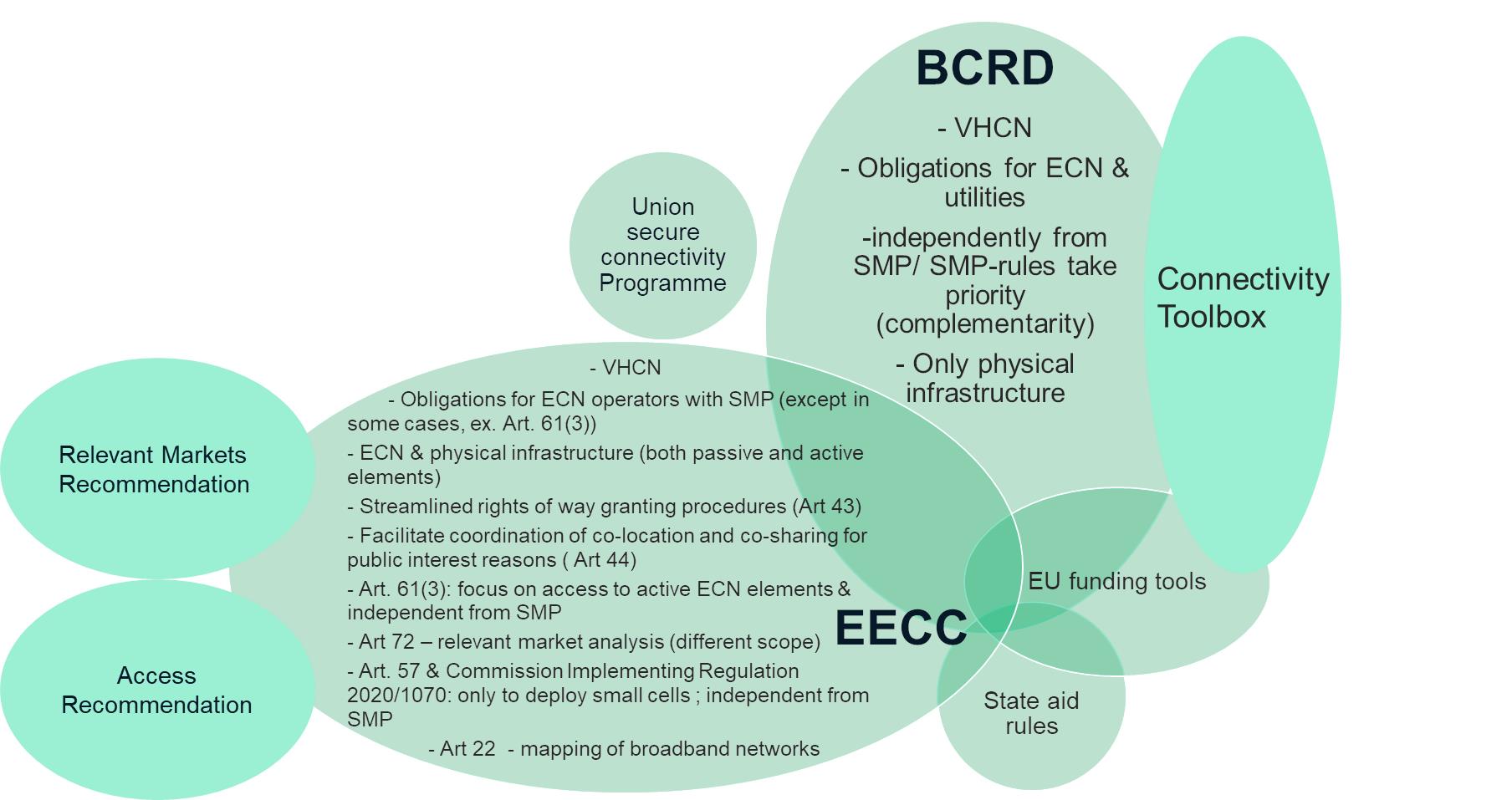
Contrary to other instruments supporting the achievement of EU fixed and mobile broadband targets (i.e. the European Electronic Communications Code – EECC or the Code) which mainly, save in specific cases, provide for the possibility to impose obligations on electronic communications operators with a dominant position - significant market power (SMP) - in a given electronic communication market, the BCRD imposes obligations of access, transparency and civil works coordination on any undertaking operating an electronic communications network or providing physical infrastructure in the provision, distribution or transport of gas, water and sewerage and transport, irrespectively of whether they hold SMP. Moreover, whereas other instruments provide for the possibility to impose obligations for any element of an electronic communications networks, including passive elements (e.g. ducts, masts, poles, antennas, cables) and active elements (e.g. base stations, routers, switches), the BCRD only covers passive physical infrastructure (ducts, masts and poles but not antennas or cables). Moreover, whilst Article 57 of the EECC aims to ease conditions for the deployment of ‘Small Area Wireless Access Points’ (SAWAPs or small cells) that are active elements of a wireless / mobile network, it does not cover the deployment of other types of cells that can be crucial to the deployment of 5G networks.
Provisions relating to the assignment of spectrum for 5G and the new digital decade 5G targets require from Member States the timely availability of specific harmonized 5G pioneer bands, namely the 700 MHz, the 3.6 GHz and the 26 GHz bands, for the development of 5G networks. This entails the rollout of the necessary wireless / mobile infrastructure, in particular the deployment of Small-area wireless access points (SAWAPs or small cells), and therefore requires the facilitation of their installations. The BCRD is complementary to these provisions in the sense that it concerns the physical infrastructure needed, inter alia, for the backhaul connection of the base stations (including small cells) to the core network via fibre, which will ensure the necessary high capacity for the provision of 5G services and will contribute significantly, by reducing their wireless connections to the core network, to the reduction of exposure of the general public to electromagnetic fields (EMF).
In September 2020, the framework was complemented by a Recommendation on a Connectivity Toolbox aimed at reducing the cost of deployment of Very High Capacity Networks (VHCN) and ensuring timely access to 5G radio spectrum. The subsequent ‘Connectivity Toolbox’ agreed by Member States in March 2021 includes 22 best practices related to network cost reduction. The best practices cover some of the areas currently included in the BCRD, notably those regarding permits, access to physical infrastructure and transparency related measures and dispute resolution, which were considered the most critical in the short term. However, there are other areas, such as coordination of civil works (except for transparency aspects) and in-building physical infrastructure, which are not covered by the Connectivity Toolbox, thereby leading to limitations in terms of its overall potential. Moreover, the ‘Connectivity Toolbox’ is not a binding legal instrument, and its implementation is left to Member States’ initiative.
Between April and November 2021, Member States submitted their roadmaps providing plans to implement the Connectivity Toolbox. Overall, there was wide variety of roadmaps both in terms of content and format and some were lacking sufficient details, which have made it difficult to grasp the reality of such plans. Despite some good examples, in most cases the roadmaps only proposed to implement a limited number of best practices. By June 2022, the Commission has received 22 reports (from 21 Member States and Norway) on the implementation of the Connectivity Toolbox. The Connectivity Toolbox has triggered non-homogeneous action in some Member States and as regards specific areas (e.g. guidelines on dispute settlement mechanisms or legal requirements for appropriate permit fees), while a relatively high number of measures are still ongoing (e.g. introducing permit exemptions and fast track permit granting procedures, or ensuring the availability of information in SIP) and certain best practices have rarely been implemented (e.g. tacit approval or fast track procedures for rights of way, ensuring access to publicly controlled physical infrastructure or establishing a coordinator/promoter body in relation to the latter access requests).
While in general, the Connectivity Toolbox has collected a good set of best practices which could possibly improve to some extent the effectiveness of some provisions of the current Directive, the final overall impact would depends on the willingness of Member States to keep focus on finalising implementation of the numerous on-going practices, given that this is in essence a voluntary exercise.
Moreover, the recent Commission proposal for a Union Secure Connectivity Programme aims to facilitate broadband access by satellite to areas that lie beyond the reach of other fixed and mobile electronic communications network infrastructure. That’s possible because satellite communications provide limited capacity but ubiquitous coverage, which is complementary to terrestrial networks (ground-based in a form of cable links such as fibre broadband or wireless). The system will also provide connectivity over geographical areas of strategic interest, for instance Africa and the Arctic, as part of the EU Global Gateway strategy. It can also ensure minimum connectivity in emergency situations such as in Ukraine during the war. Nevertheless, satellite is not considered to be a substitute for fixed broadband technologies from a performance perspective, and its main purpose is to ensure resilience and provide ubiquitous high-speed broadband capacity for governmental users including in otherwise ‘dead zones’ rather than the Gigabit speeds required in the post-COVID digital era.
Finally, it should be noted that there are funding initiatives to support high speed (and Gigabit-capable) broadband in rural and other less well served areas, including the digital part of the Connected Europe Facility (CEF and CEF Digital), post-COVID recovery funds, and national State Aid initiatives. The recently revised Guidelines on State aid for broadband networks, also contribute to accelerate and extend broadband deployment by clarifying when public support is in line with competition rules.
Figure 1: Interactions between legal instruments
The public consultation confirmed the relevance of BCRD’s objectives to facilitate and incentivise the roll-out of electronic communications networks; however the improvements achieved are not considered to mirror expectations, mainly due to the heterogeneity of BCRD implementation across Member States. The Body of European Regulators (BEREC) is of the view that the impact of the BCRD was limited to those Member States with no prior similar framework. Only limited effectiveness is recognized by the ECN operators as regards reinforced coordination of civil works, which is considered burdensome and leading to delays in projects’ deployment. The lowest progress is registered in reduction of time and cost of permit granting. The views of ECN operators and of public authorities converge as regards the need for reconciliation and ensuring coherence between the BCRD and the EECC.
2.Problem definition
2.1.What are the problems?
The Evaluation Report shows that the current Directive has only been partially effective in achieving its objective and that a number of improvements would be required to make it suitable to support EU’s new connectivity needs and ambitions. That’s because the flexibility allowed to the Member States not to implement certain measures or to apply exemptions resulted in an inconsistent implementation across the EU. Additional reasons why the Directive was not fully effective in tackling the problems mentioned are imputable to a lack of clarity of certain formulations in the Directive (i.e. ‘fair and reasonable’ conditions of access or ‘alternative means’) which led to complex, costly and inconsistent implementation. Also, significant problems remain in particular with regard to permit granting, which is critical for timely VHCN deployment. Finally, some network or non-network physical infrastructure that would have facilitated deployments were not included in the scope of the Directive.
In addition, new problems stemming from the evolving market, technologies and stakeholders needs have emerged. First, the ambition in terms of network performance has increased from 30Mbps to at least 100 Mbps and even further to 1 Gigabit by 2030. Therefore, significant gaps remain between the EU’s connectivity goals of complete VHCN coverage by 2030 and the actual network coverage. Total VHCN coverage in the EU increased between 2013 and 2020 from 16% to 59% of households, but less than half of households (42%) benefit from a futureproof FTTH connection. While good progress has been made in Member States such as Latvia, Spain, Portugal and Sweden, coverage of FTTH remains below 15% in certain Member States such as Germany, Greece and Belgium. The problem is even more evident in rural areas, for which FTTH coverage on average across the EU is only 28%, with some Member States (notably Bulgaria, Belgium and Greece) having rural FTTH coverage close to zero.
Second, the latest generation of wireless (including mobile technology), 5G, has matured and is now set to take on a large role in economic life. Yet, despite the emergence of providers of wireless physical infrastructure such as « tower companies » that account for over 35% of the wireless physical infrastructure in Europe, 5G coverage is still limited in most cases (5G coverage in Europe by mid-2020 amounted to only 14% of populated areas in 14 Member States), and operators’ focus has thus far been on providing 5G for enhanced mobile broadband (eMBB) in lower frequency bands including the newly auctioned 700MHz band, which mainly involves the upgrade of existing sites and associated backhaul (e.g. to dark fibre – potentially in conjunction with FTTH deployment), typically by upgrading existing sites.
Therefore, in the context of new EU connectivity targets and objectives and the regulatory, market and technological developments as well as the findings of the evaluation, the main problems tackled by this initiative are (i) the high deployment costs for VHCN (in practice, mostly FTTH and mid-band 5G), and (ii) persisting slow deployment of electronic communications networks.
Figure 2: Problem Tree

Source: European Commission
High deployment costs
High deployment costs for VHCN, including FTTH and mid-band 5G, undermine deployment incentives and viability of new deployments. A key factor in the deployment of physical infrastructure suitable to host broadband, and more specifically VHCN networks is represented by the high costs required to plan, design and rollout a network, including the costs to build civil engineering infrastructure, e.g. ducts, masts etc., and in particular the costs to excavate the ground to build ducts suitable to host an electronic communication network. That applies to ECN networks in general, but the problem is more acute for fibre (last mile) and 5G (densification) which are the technologies expected to help meeting the connectivity targets at this stage of technological development.
Total costs are estimated at EUR 145bln to reach 90% households with FTTH from today’s level, which is the baseline scenario assumed by the support study (see section 5.1). This amount includes EUR 3.8bln of public subsidies. Based on current figures regarding costs of labour, equipment and materials, civil works represent around 70% of the total capital expenditure (capex) required in deploying FTTH in a greenfield scenario.
Experience from the BCRD evaluation shows that measures that facilitating access to existing physical infrastructure and related information provisions (transparency) allow ECN operators to reduce by 10-30% the cost of deployment for fixed networks and by more than 30% the cost of deployment of wireless, including mobile, networks. Obligations to coordinate civil works which are publicly fully or partially financed, and related information measures (transparency) allow network operators to reduce up to 30% the costs of deployment and share risks when deploying networks including new physical infrastructure. This figure can go up to 50% savings in case of civil works coordination with other utilities.
In-building infrastructure also represents a substantial proportion of the costs of deploying FTTH, accounting for 10-15% of the cost per household. Assuming that 10% of buildings will have suitable in-building infrastructure for the deployment of FTTH, EUR 11.5bn can thus be estimated for new in-building infrastructure. To reach the remaining households, often in less densely populated areas, a further EUR 20bln (including EUR 7bln in subsidies) may also be needed. Any reduction in the investments needed would enable network operators to use more financial resources to invest in additional VHCN coverage or performance enhancement.
The problem of high costs to deploy is particularly serious with respect to fixed networks in rural areas, because access lines are long and, as rural areas are less populated, fewer customers provide operators with less opportunity to recover their investment/deployment costs. Those areas are therefore less profitable. For example, the support study shows that while the cost of deploying FTTH to a household in a dense urban area is less than EUR 1,000 on average across the EU, the average cost increases to nearly EUR 2,000 when serving customers in rural areas. Costs of around EUR 200 per household can also be incurred to deploy in-building infrastructure to be able to connect end-users (e.g. to deploy ducts and fibre from the basement of the building to the apartment)
.
In the absence of significant subsidies (or higher prices for rural customers), many rural areas would remain unserved with VHCN, and customers in those areas would be cut off from digital access to employment, healthcare and educational benefits that are available in other areas. There is already a gap between urban and rural areas: EU rural VHCN coverage went from 4% to 28% between 2013 and 2020, less than half total coverage (59%).
High costs are also a significant challenge hampering the deployment of the new 5G networks, which currently make extensive use of mid-band frequencies (below 6 GHz). Deploying mobile networks using these mid-band frequencies such as 3.6 GHz pioneer 5G band will require the deployment of hundreds of thousands of small cells, including SAWAPs but not only
, many of which will require fibre backhaul as well as potential costs relating to site leasing and permits
.
Persisting slow deployment of networks
In order to start deploying a wireless/mobile network, network operators need to obtain permits and access to sites (rights of way). However, the procedures to obtain such permits and rights of way have been reported to be long and complex (e.g. the average duration was 12 months in Czech Republic and almost 8 months in Germany compared to the mandatory deadline of 4 months). Complex and lengthy procedures do not only increase costs for network operators, but also increase the risk of not timely reaching the digital targets on full Gigabit and 5G coverage due to slow deployment. Delays in obtaining permits and rights of way can add one to two years to the timing for the deployment of wireless VHCN in particular as well as (in some cases) costs associated with the process of obtaining permits and other permissions that can amount to 10-20% in the case of base stations.
The difficulty in obtaining permits is seen as a factor which can slow down deployment considerably. A majority of stakeholders pointed towards the lack of coordination between the various authorities competent for granting permits, the multiplicity of permits needed for ECN deployment, the lack of electronic means/procedures for permit applications and the non-respect of the deadline to grant all ECN deployment related permits, including those for rights of way.
In addition, the persistent diversity of rules pertaining to access terms and conditions, permit granting, level and availability of information required to request access or civil works coordination, within and across Member States is so great that it slows down the network rollout at European level as investment plans need to be adapted to local rules and works have to be subcontracted separately, in function of the solution chosen for each area. The fact that local presence needs to be ensured in every municipality throughout very long periods (starting before rollout plans are defined through to the completion of the projects) puts resource constraints on companies willing to roll out across regions and countries. The lack of transparency on permits rules and procedures, including those of rights of way, also prevents proper planning across borders (e.g. in cross-border cities/municipalities; borders areas in general). ECN operators estimate that the teams to handle permit applications for fixed and mobile infrastructure from multiple authorities cost EUR 75m annually across the EU.
Additional delays in network deployments have also resulted from long and costly disputes among operators to obtain access to existing physical infrastructure. BCRD attempts to address this problem, but certain BCRD provisions (‘fair and reasonable’ terms and conditions) suffer from a lack of clarity. As a result, several Member States have clarified access terms and conditions through disputes or guidelines, which are however very different across Member States despite addressing the same problem.
2.2.What are the problem drivers?
Driver 1: Absent, incomplete or outdated information on the existing physical infrastructure.
The lack of transparency on suitable available infrastructure has a significant impact on the cost and time of deployment since it reduces the effectiveness of the actual access to physical infrastructure. While transparency on physical infrastructure has significantly improved since the application of the Directive, the extent to which such information is complete and up to date has been a significant challenge. Moreover, information about the exact location of physical infrastructure (geo-referencing) as well as about public non-network infrastructure or facilities is available via a Single Information Point (SIP) in only a limited number of Member States (as this is not an obligation under the current BCRD), which would appears to be a significant shortcoming for future deployment of mobile networks in particular.
Many stakeholders are concerned about the quality and completeness of information on existing physical infrastructure owned by network operators. The information available about the location of the physical infrastructure often is outdated and/or potentially inaccurate (or insufficiently specific), and incomplete, if not provided by all relevant parties (network operators and public authorities).
Many stakeholders68 are concerned about the quality and completeness of information on existing physical infrastructure owned by network operators. BEREC is of the opinion that the gathering of information on physical infrastructure is hindered by the way the process is currently foreseen in the BCRD, i.e. on a request basis and mostly optional via the SIP. The Fit for Future Platform underlines the risk that stakeholders involved in the rollout of broadband could inadvertently damage critical infrastructure.
Driver 2: Persisting difficulties in accessing existing physical infrastructure (by reference to current definition in the Directive but also including non-network infrastructure owned or controlled by public bodies, such as public buildings or street furniture) to deploy new networks.
The Evaluation report shows that Member States have implemented the BCRD with varying speeds of implementation (most were late) and with a different degree of implementation. Where there is no ubiquitous SMP-based access due to the lack of ducting (e.g. Germany), where there exist a patchwork of different operators in different areas (e.g. Lithuania, Hungary, Slovakia and Poland) or where SMP obligations on the wholesale local access markets have been withdrawn (e.g. Romania, Bulgaria), the access to physical infrastructure under the Directive has been effective. On the other hand, in Member States where SMP-based access is effective (e.g. France and Portugal) or where there is widespread availability of dark fibre (e.g. Sweden), the access to physical infrastructure for the purposes of deploying high speed broadband under the Directive remains limited. As a result, the shared use of existing physical infrastructure between ECN operators varies between Member States, depending, among others, on the availability and quality of the existing physical infrastructure. The shared use of ducts pursuant to the BCRD covers from up to 1% of the total length of the reach of the incumbent network in Germany and Finland, 2.3% in Hungary, 4% in Estonia to up to 20% (Poland and Italy), while BCRD-based pole access is more used than BCRD-based access to ducts,
Nearly three quarters of disputes referred to Dispute Settlement Bodies (DSBs) under the BCRD concern access to existing physical infrastructure, with most concerning denial of access or terms and conditions for access. The limited data available on the take-up of BCRD-based physical infrastructure access seems to indicate that there are significant differences in the take-up of physical infrastructure access in different Member States, which may have been influenced inter alia by differences in the conditions for physical infrastructure access.
Based on estimates by the support study, costs involved in running Dispute Settlement Bodies are estimated at EUR 5m per annum for the EU 27. Costs to establish a SIP range from EUR 150,000 to EUR 2.5m (depending on scope / complexity) with an average of EUR 0.5m in annual maintenance costs per Member State. Costs for network operators (to negotiate access and provide information) are estimated at approximately EUR 68m per annum EU-wide (but some of these costs may have pre-dated the BCRD or may have arisen in its absence).
Access to physical infrastructure based on obligations imposed by national regulatory authorities (NRAs) on operators designated with SMP is not always a realistic alternative to BCRD-based access. There are some Member States where SMP-based access to physical infrastructure is not available on a widespread basis. That may be because no ECN operator has been designated as having SMP in a relevant market linked to broadband deployment, or because the SMP operator does not have full coverage or its network is partially deployed within ducts and partially directly buried in the ground. In addition, there are circumstances where SMP-based access may not be available (due to lack of space) or where access to utility physical infrastructure may be more suitable or more cost effective.
Access to non-network physical infrastructure such as public buildings or street furniture is not covered by the BCRD, yet can be a significant cost factor. For example, for deploying the small cells required for the new 5G networks (including but not restricted to SAWAPs) costs are estimated around 40% higher than if non-network physical infrastructure were subject to equivalent obligations.
Most alternative ECN operators and their associations, including those owned by local authorities, consider the current access obligations as appropriate. A significant number of stakeholders disagree with the suggestion that the ‘fair and reasonable’ principle for access to physical infrastructure has been applied effectively. On the other hand, a number of public authorities are of the view that the principle has been applied effectively and efficiently.
Irrespective of their market position, many ECN operators have requested the extension of such obligations to non-network physical infrastructure held by public bodies. Mobile operators claimed they lack information about the location of other (non-network) facilities (such as public buildings and street furniture) which might be suitable to deploy mobile infrastructure.
Driver 3: Lack of suitable in-building infrastructure and fibre wiring and challenges in timely accessing it. The access to in-building infrastructure improved following the implementation of the Directive. In-building infrastructure represents a challenge for the timely deployment of VHCN for the majority of ECN operators. They report that in some Member States there is no adequate in-building infrastructure available to host new fibre networks, or where it has been installed, that there are many cases where the cabling does not meet their needs from a technological perspective (e.g. only coax, twisted copper pair), or does not reflect the required topology (Gigabit passive optical network (GPON) or point to multi-point v point to point (P2P) fibre). Lack of suitable physical infrastructure means that ECN operators incur significant costs in deploying new in-building infrastructure, sometimes including in-building ducts and cable trays. Moreover, terms and conditions, including unreasonable prices of access, the diverse ownership of in-building infrastructure and a lack of compliance by building owners with obligations to allow access to ECN operators for the purpose of installing in-building infrastructure remain key concerns for ECN operators. They estimate the cost of deploying new in-building infrastructure including dark fibre in buildings at between EUR 100 and EUR 450 per dwelling.
In situations where in-building infrastructure for the deployment of VHCN infrastructure exists, locating and negotiating access can take considerable time and require significant human resources for both ECN operators and for the owners of those infrastructures, notably in cases where there are multiple owners of that infrastructure (e.g. different local and regional authorities, regional utilities, or landlords). The challenge increases when building regulations and electronic communications legislation are handled at different levels of a Member State’s administration. In some Member States, these problems resulted in a large number of disputes between ECN operators and building owners. ECN operators note that the building and construction sector may not be fully aware of the rules stemming from the BCRD, while competent authorities may not be fully active in their enforcement.
Stakeholders consider that the in-building infrastructure can be an important bottleneck for the deployment of new networks and its importance is likely to increase in the future. Some ECN operators deplore that alternative installation methods for deploying fibre are not considered by some local authorities and that private buildings’ owners would often block changing in-building infrastructures because of cost reasons. In BEREC’s experience, problems have been found when in-building infrastructures are built in such a way that they do not technically allow third party access.
Driver 4: Limited civil work coordination.
The lack of information about planned civil works is also challenging the efficient ECN rollout, as this limits the opportunities for timely and efficient coordination and might even trigger interruption of planning or works in cases where projects address the same areas simultaneously. Yet, as pointed out by the Fit for Future Platform, the co-use of existing infrastructure for broadband, water and gas could also limit the negative impact of deployment of broadband networks on the environment. Still, ECN operators report that delays associated with co-ordination and complex procedures are the most problematic aspects of civil works co-ordination.They also observe that the procedures for civil works co-ordination are cumbersome or vary from one authority to the other, or that there are challenges in agreeing on cost sharing.
As regards the availability of information on planned civil works, low progress is reported following the Directive. ECN operators complain that they do not receive any notification of planned civil works, including for road works, sufficiently in advance to enable them to consider it in their forward planning. Most ECN operators report limited use of this possibility. Civil works co-ordination has only been extensively used in few Member States (such as Belgium, Slovenia, and to a more limited extent Sweden and Finland) that have defined procedures, provided guidelines on cost sharing and facilitated interaction between network operators. Requirements for proactive notification of planned civil works to the SIP are in place only in a few cases, such as Belgium and Lithuania, and in many cases information about planned civil works is available only on request or with a delay. Delays associated with co-ordination are problematic, since procedures for civil works co-ordination are cumbersome, vary from one authority to the other, or raise challenges in agreeing on cost sharing: disputes concerning coordination of civil works represent about 9% of all disputes between 2015 and 2020. Moreover, given the limited time offered to join planned civil works, the dispute resolution process may not be sufficiently agile to timely address such issues.
A vast majority of stakeholders agree coordination of civil works may bring benefits for the joint deployment of networks. ECN operators indicate three main beneficial outcomes: cost reduction, more sustainable network deployment and low burden on citizens, but express caution as synergies with non-electronic communications are limited. Public authorities express a more optimistic view and recall the need for improving administrative coordination to foster deployment of networks. BEREC is of the view that coordination of civil works has a high potential for cost savings, but that this potential is often not realised, including due to lack of information on relevant opportunities and the difficulty to synchronise plans.
Driver 5: Unviable overbuild of ECN networks. In some cases, requiring ECN operators deploying very high capacity networks to provide access to their physical infrastructure to competitors or to coordinate civil works could undermine the business case for the roll-out. This is the case in particular in the rural and most remote areas where deployment of several infrastructures might not be financially viable. In practice, unviable overbuild concerns situations where a –usually non-incumbent or alternative- network operator plans to invest in rolling out a network in a rural area (low population/low revenue perspective/lower chances to recover the investment) and in the same area a – usually incumbent - operator requests coordination of civil works to upgrade its typically existing high-speed electronic communications network into very high capacity network. While this situation would generate more infrastructure-based competition (i.e. the same ducts would host parallel fibre networks) in less profitable areas, by generating an extra capacity which could result in the inability to recover the investment made, it also risks dis-incentivising the investment from the alternative operator in the first place. This issue is of high concern for some network operators in Germany
, and it is likely that the problem will increase and extend to other Member States as operators move more and more to deploy in rural areas.
These repercussions on the investment incentives of first movers in those areas can occur even if State Aid could be granted for the rollout and even if the wholesale network access prices or the cost apportioning of civil works are adjusted to take into account the impact on the business case, as provided in Article 3 and 5 of the BCRD. For example, operators could abstain from investing in new deployments fearing that their business case is undermined. Thus, unviable overbuild can result in less rather than more deployment. It is therefore of outmost importance to strike the right balance between facilitating shared access to infrastructure and coordination of civil works via regulation and preserving operators’ incentives to invest in rolling out new networks.
Driver 6: Procedural complexity, timeframes and costs for permits and rights of way. Obtaining access, permits or rights of way may be problematic for deploying operators, due to the challenges below:
-the need to obtain several permits and rights of way, especially when they are delivered by different authorities (or the lack of a single point of entry), associated with the lack of coordination;
-the lengthy and diverse procedures, also due to the lack of electronic processes (manual systems and processes for permit granting are associated with longer processing times and potentially higher costs for the authorities concerned);
-the non-respect of the deadlines to conclude the procedure; and
-the lack of explicit rules, including on compensation, if requirements for permit-granting procedures are not met, in particular deadlines and refusal conditions.
While the permit granting procedure has improved, very few public authorities provided information about the actual timeframes taken to process permit applications, and data comes mostly from the operators interviewed. Yet, according to the support study, the maximum and average time taken to receive a decision for a permit application for fixed deployments exceeded the 4-month limit currently imposed in the context of the BCRD in a number of cases, (the average time was 12 months in Czech Republic and almost 8 months in Germany; the maximum time reported was 8 months in Spain and 6 months in Portugal). 50% of mobile network operators have experienced timeframes more than a year for permit approval. In the same line, the Evaluation report shows that timelines for permit applications have not been enforced in all Member States. At the same time, most Member States use some measures to facilitate the timely granting of permits, either through compensation for damages, permit exemptions or - in some Member States - through tacit approval if a decision has not been made within the deadline (although these are often specific to certain type of permits (e.g. fixed or wireless) only). Still, permit granting practices and fees still vary widely.
Table 1: Time required to deploy a site

Source: Mobile Network Deployment Policy and Implementation of the Broadband Cost Reduction Directive in Europe, GSMA Report, March 2021
Several ECN operator representatives responding to the support study survey or at the BCRD consultant workshop in June 2021 highlighted concerns over their ability to access public facilities in the context of deploying mobile infrastructure. High costs to obtain rights of way for mobile sites (of between EUR 12,000 and 23,000) have also been reported in some Member States, and operators noted that there was a lack of national policies and/or mechanisms to provide for dispute resolution in many cases. Furthermore, those already high costs risk further increasing due to potential speculative practices by land owners.
In many cases, procedures for the deployment of wireless infrastructure necessary for the new 5G networks became longer and more complex than those for fixed infrastructure. The cost of site leasing could present a major challenge for mobile operators, if site leasing costs for small cells are not significantly reduced compared to current costs charged for larger cell sites. Costs for the latter can amount to 15% of the operating costs associated with 4G and basic 5G access networks in Europe.
2.3.Who is impacted and how?
ECN operators are directly impacted by all the problem drivers. The resulting higher costs and longer duration of network deployment could limit the scale of investments that ECN operators can make and/or affect their profitability. Larger ECN operators, including those with nationwide and multi-national footprints, are particularly affected by the large number of authorities involved in obtaining permits for ECN deployment and access to sites for installing mobile infrastructure. Meanwhile, smaller ECN operators without their own legacy ducts and poles (including operators that could be characterised as SMEs) are hampered by a lack of effective options to access physical infrastructure and the opportunity to coordinate civil works, which may undermine their ability to compete for State Aid or to deploy alternative FTTH networks in competition to, or in place of deployment by incumbent operators. When they do deploy their own physical infrastructure, smaller ECN operators deploying VHCN also fear that requirements to let other operators access their physical infrastructure or co-ordinate civil works will lead to unviable duplication of VHCN and undermine their business case. Delays or limitations in the deployment of fixed and mobile VHCN have a knock-on effect on other elements of the value chain including impacts on revenues for equipment manufacturers and the manufacturers of fibre cables.
Energy and transport companies as well as other network operators face a lack of clarity regarding the application of the BCRD and have concerns that the terms under which they are required to provide access or to co-ordinate civil works may not allow them to recoup their costs or may not take into account security or health risks associated with their core business. The existing system under the BCRD based on individual dispute resolution creates uncertainty for these players and is associated with high administrative costs.
Consumers, in particular those in rural areas, face limitations on access to Gigabit broadband, which restrict their ability to make use of advanced digital applications. This could limit their ability to benefit from remote healthcare and education or to engage in home working. Consumers also face disruption when operators dig the streets in parallel instead of co-ordinating their deployment, as well as further disruption and increased costs when ECN operators are forced to deploy FTTH wiring inside buildings which were not pre-equipped with this infrastructure.
Lack of access to, or high prices for Gigabit connectivity is also a significant challenge for businesses, and in particular SMEs and smaller public facilities (such as doctor’s surgeries, libraries) because it limits their ability to benefit from productivity gains associated with faster broadband and advanced digital applications. Thus, delays in achieving full VHCN coverage could affect EU’s wider digital development and capacity for industrial leadership and public sector transformation, which are key pillars of the EU’s Digital Decade goals. SMEs are likely to be disproportionately impacted as they may rely on mass-market Gigabit broadband solutions, whereas larger businesses may be able to afford bespoke connectivity solutions including leased lines to support their bandwidth needs.
Municipalities and/or other competent authorities have to deal with multiple separate requests for access to public physical infrastructure or civil works coordination when they act as a network operator as well as with requests for permits and rights of way from ECN operators, increasing administrative workload. For them, manual systems and processes for permit granting are associated with longer processing times and potentially higher costs. They also have to factor in the uncertainty in case of disputes which hampers forward planning and efficient resource allocation.
Finally, slower transition to modern FTTH and 5G networks results in relatively increased GHG emissions from electronic communications networks themselves, since existing electronic communications networks, such as FTTC/G.fast or cable DOCSIS 3.1 are less energy efficient in transmitting data traffic. Deployment models such as network sharing and co-ordination of civil works also serve to reduce GHG emissions associated with network deployment. Moreover, slow deployment of fixed and mobile VHCN limits the potential for other sectors to use digitisation as a means to achieve energy savings, undermining the achievement of the European Green Deal targets, especially in rural and remote sites in sectors such as agriculture, energy generation, and transport.
A majority of stakeholders pointed out factors that negatively impact roll-out: the lack of coordination between the various authorities competent for granting permits, the multiplicity of permits needed for ECN deployment, the lack of electronic means/procedures for permit applications and the non-respect of the deadline to grant all ECN deployment related permits, including those for rights of way. An association of municipalities has cited challenges implementing EU rules setting exemptions for permits for certain categories of small cells (the SAWAPs).
2.4.How likely is the problem to persist?
The outcome of the evaluation suggests that measures taken under the current Directive are unlikely to lead to significant improvements in most aspects related to the two identified problem areas explained above.
As explained in detail in section 5.1, instruments such as Article 57 of the EECC or the Connectivity Toolbox are unlikely to solve all the problems identified across the EU, and in particular the challenges to locate and access sites for wireless/mobile deployment or the lack of suitable in-building infrastructure and fibre and the limited coordination of civil works. Article 57 of the EECC, when transposed and implemented, will still be limited to the deployment of small cells that meet certain criteria while leaving out other network elements which need to be installed for 5G. Similarly, a review of existing measures by Member States as well as commitments made in the Connectivity Toolbox roadmaps and measures implemented so far show that in many cases there are no concrete action taken in relation to the agreed best practices for reducing the cost of deploying fixed and mobile broadband. Moreover, the scope of the Toolbox does not include all areas covered by the BCRD (excluding for instance access to in-building wiring, civil work coordination, except for transparency measures).
Lengthy and complex processes result in excessively high administrative costs. For example, ECN operators employ large teams to handle permit applications for fixed and wireless / mobile infrastructure from multiple authorities at an estimated cost of more than EUR 75m annually across the EU. These estimates do not reflect the cost to local authorities and other competent authorities of processing permit applications for ECN deployment, which could be at least of the same magnitude, and likely higher, given the large number of local and regional authorities active across the EU.
Complex processes and the lack of clarity about terms to access public facilities are also expected to impact wireless / mobile deployment, and particularly for the deployment of 5G in mid-bands (below 6 GHz), as well as 5G development in millimetre wave bands (26 GHz and above), because the use of higher frequencies will require extension in backhaul networks and the deployment of new sites. Projections suggest that under current conditions, deployment of 5G in mid-bands, in particular in the 3.6 GHz pioneer band, is likely to be restricted to major cities and highways, and that it may reach only around 30% of the population at the end of 2025.
Moreover, the cost of negotiating access to multiple small cell sites (including those needed to install SAWAPs) owned by different public bodies is significant and time consuming for ECN operators and public authorities. Overall, the support study estimates that if resources needed for access requests by the largest fixed mobile converged operators increase by one third to address increased access requirements for mobile sites and rights of way linked to 5G densification and FTTH expansion, additional costs would amount to around EUR 24m across the EU.
Delays in the availability of advanced 5G services are also expected. Investments in outdoor small cells (including but not limited to SAWAPs), a necessary infrastructure, to support more advanced applications such as Connected and Automated Mobility (CAM) are not yet prioritised by most mobile network operators according to interviews by study consultants, and a 2021 study by Analysys Mason suggests that comprehensive deployment of ‘full 5G’ (beyond dense urban areas) and support for associated use cases is likely to begin only in 2025, and that by 2030. Coverage of massive MIMO will reach only between 30-60% of the population and 10% in terms of geographic area on a purely commercial basis. This would leave many significant roads, transport links and agricultural areas unserved, as well as certain healthcare facilities and municipal buildings.
3.Why should the EU act?
3.1.Legal basis
The new instrument will amend the BCRD which was adopted under Article 114 of the Treaty on the Functioning of the European Union (TFEU).
Despite improvements since the regulation of electronic communications started the establishment of a single telecoms market in the Union, electronic communications markets remain national (see merger control decisions), with different supply and demand conditions, different spectrum licences awarded on a national basis, and different (albeit harmonised) regulatory regimes. Telecom operators must adapt their strategies to national constraints and differences even when they form part of larger multinational groups. This fragmentation of the EU market alongside national borders prevents the EU from reaping the full potential of an EU-wide telecoms market. While there are around 50 mobile, and more than 100 fixed operators in the EU, the four main European mobile operators (i.e. Deutsche Telekom, Vodafone, Orange and Telia) hold over 60% of the mobile market. At the national level where competition occurs, the level of concentration is high with 16 Member States having three mobile network operators, 9 Member States having four and 2 Member States having five. In certain Member States, the number of distinct mobile telecoms network infrastructures is even lower than the number of operators due to existing network sharing arrangements (e.g. in Denmark or Italy). Nonetheless, ECN operators are not able to realise scale effects because differences in national rules keep telecom markets mainly national. Even for the big four operators, scale effects are limited because they operate in national markets and do not seem to fully harmonise their offerings and operational systems.
Yet, digital infrastructures, comprising among others fibre cables supporting fixed electronic communications, and antennas required to provide mobile communications, including in remote areas, have a strong downstream effect on cross-border trade and services provision, since many services can only be provided where an adequately performant network is in place all across the EU. Hence, they are essential to ensure the proper establishment and functioning of a market for digital products and services within the EU, e.g. fixed and wireless/mobile communications, data services, and the digital transformation of manufacturing, health, construction, agriculture and mobility ecosystems.
For example, deployment of mid-band 5G is needed to support 5G applications (e.g. Internet of Things - IoT) that are intrinsically multi-national or facilitate cross-border connections, such as Connected Automotive Mobility; such vehicles could not travel in areas where VHCN is lacking. More generally, full connectivity everywhere is required for moving applications if they are to take advantage of the single market. Similarly, many “data-hungry” advanced industrial and technical applications, including in particular artificial intelligence (AI) applications, the European Quantum Communication Infrastructure (EuroQCI) Initiative and high-performance computing, for example used for smart farming or environmental surveillance, rely on ubiquitous coverage (including in remote areas). Moreover, the applications that are playing an increasingly important economic role due to the COVID pandemic, such as videoconferencing, also rely overwhelmingly on VHCN. The European Data Strategy adopted in February 2020 foresees that the global data volume will reach 175 zettabytes and the data processing model will change to 80% smart connected objects and 20% centralised computing facilities by 2025. The successful and efficient rollout of highly secured and state-of-the-art fibre and 5G network are therefore indispensable for future digital services and the industrial data wave.
Hence, ubiquitous VHCN coverage is crucial to ensure that these services can be provided seamlessly cross-border. When roll-out costs are higher than necessary, which will ceteris paribus reduce deployment of VHCN, provision of many of these services will become impossible in a number of areas, negatively impacting the function of the internal market.
Therefore, in view of the objective of improving the conditions for the establishment and functioning of the internal market, Article 114 of the TFEU remains the appropriate legal basis.
3.2.Subsidiarity: Necessity of EU action
Experience acquired with the implementation of the BCRD has demonstrated that the common objective to provide the EU with full high speed broadband coverage could not be achieved by Member States alone within a reasonable time and with the highest possible savings of private and public investment. The measures that Member States have adopted so far to incentivise network deployments and in particular to reduce the cost and time of deployment differ greatly, sometimes even from region to region and from municipality to municipality. This patchwork of rules and practices at national and sub-national levels, facilitated by the fact that a Directive allows for more flexible transpositions, hinders the further development and growth of European companies – e.g. electronic communication companies, equipment manufacturers, or civil engineering companies – by significantly increasing the administrative overhead costs of VHCN deployment. Fragmented approaches across Member States to solve the same problems increase complexity and costs especially for multi-national operators, which have made half of investment in electronic communications across the EU. Given that the current legal instrument is a Directive, it has not been possible to limit effectively the variety of fees charged to operators. For smaller companies this fragmentation constitutes an obstacle in their efforts to reach economies of scale at EU level in the face of increasingly global competition.
While the recently adopted European Electronic Communications Code is harmonising different aspects related to the authorisation regime, SMP regulation and consumer protection, it does not address obstacles specifically linked with network deployment such as local permits rules, bottlenecks to access existing non-SMP physical infrastructure or to coordinate civil works. In the absence of additional policy action at European level, it is likely that the patchwork of rules at national and sub-national levels resulting from the implementation of the BCRD will persist or accentuate and, as such, will increase the fragmentation of the internal market. At the same time, the problems encountered to accelerate VHCN deployment (see section 2.1) are common to most if not all Member States. The causes of the problems (see section 2.2) are also similar across the Member States, and reducing costs and streamlining administrative procedures as key tools to address these problems are equally valid in all Member States. Thus, the absence of a harmonised set of rules such as would be provided by a Regulation makes market entry from other Member States unnecessarily difficult, as operators need to invest a second and third time in regulatory compliance. Yet entering in almost each national market is a core part of the competitive strategies of multinational market players, to the benefit of the internal market.
VHCN deployment that is slower, less widespread and more expensive than necessary would in particular jeopardise a swift exploitation of the possibilities afforded by 5G, which will be one of the most critical building blocks of our digital economy and society in the next decade. The launch of commercial 5G services will require substantial investments into the densification of wireless/mobile networks, small cells and other types of wireless infrastructure as well as backhaul connections to the core network via VHCN in order to achieve the distinct 5G capabilities, such as area traffic capacity, connection density or user experienced data rates.
One should note that in particular the deployment of fixed VHCN backhaul connections will, by reducing wireless connections to the core network, contribute significantly to the reduction of exposure of the general public to electromagnetic fields (EMF)
. To date, twenty Members States apply the Council Recommendation levels/limits, while seven impose stricter limits than those of the Recommendation, but use them as a reference level. The fragmentation of nationally applicable limits risks public trust in the Council Recommendation 1999 and thus in the development of 5G networks, despite the fact that the consistent application of EMF limits is in line with Article 45 (2) (h) and 58 of the Code. However, this cannot directly be tackled by EU action, since the legal competence to regulate the emission power of mobile stations, and therefore the exposure of the public to EMF, is primarily in the hands of the Member States Reducing the exposure can however make this fragmentation less relevant.
5G will support new types of applications connecting devices and objects, including Connected and Automated Mobility, the Internet of Things (IoT), but also ad hoc tailor- made connectivity solutions for a number of vertical industrial sectors (automotive, healthcare, transport, utilities, manufacturing, logistics, energy distribution, agriculture, education, tourism, media and entertainment), where today's networks provide only inferior "one size fits all" solutions. Although many of these transformations have already started on the basis of existing networks, it is anticipated that they will reach their full potential only with the deployment of 5G. As a result, 5G success in Europe is expected to generate highly qualified jobs in the ICT sector and the adjoining ecosystems estimated at up to two million jobs in the EU.
3.3.Subsidiarity: Added value of EU action
Fragmented availability of information and fragmented access to physical infrastructure as well as the lack of digital information platforms/tools and of digital permit granting systems (at least on a national level) give rise to significant unnecessary administrative costs for the industry and to longer deployment processes, and thus hamper entry and expansion by electronic communication providers. High deployment costs are particularly pronounced for non-incumbent fixed and mobile operators which do not have their own legacy physical infrastructure, and thus a failure to ensure effective access to physical infrastructure or support civil works co-ordination can tilt the playing field in favour of existing (often nationally based) large players at the expense of potential challengers, in particular cross-border entrants, thus affecting the good functioning of the internal market. The immediate benefit of EU action would be that the EU would have a clear and predictable framework supporting network deployment.
Measures at EU level would allow more efficient planning and investment deployment processes (and thus economies of scale) for ECN operators. For example, network operators active in several Member States would be able to negotiate access to physical infrastructure, and to obtain permits including rights of way, more easily and at less cost, as well as to deploy fibre in-buildings more efficiently. Moreover, such economies of scale and associated savings would go beyond the electronic communications sector and would spread to other industries as well (e.g. equipment manufacturers could have an EU market for technical solutions enabling cross-utility cooperation; construction companies could benefits from cross-border works).
As a result, EU action would also facilitate specific cross-border projects promoted by the EU. The Connecting Europe Facility makes available EUR 2.07 bn for the development of projects of common interest relating to the deployment of and access to safe and secure very high capacity networks, including an indicative list of 5G corridors, ensuring that major terrestrial transport paths have uninterrupted 5G coverage. The deployment of these projects of common interest encompass: finalising commercial and technical plans, applying for permits and rights of way, performing civil works and installing equipment and, finally, connecting customers. The first three phases will significantly benefit from EU action improving the BCRD. It will allow network operators involved in projects of common interest better planning and implementation of the concerned multi-country digital connectivity infrastructures. All Member States would be affected by inefficient deployment.
As estimated in the ICF, WIK & EcoAct study, with a better enforcement of more adapted rules of the Directive, the EU could save EUR 2bn of public resources and EUR 10bn of private investment in the deployment of FTTH networks (cost of non-action). EU inaction would also acquiesce to slow deployment of full fixed and 5G networks, and allow excessive bureaucracy to cause cost to ECN operators and public administrations, which may exceed EUR 40m per year, mostly for additional staff handling access and permit requests. On the other hand, if uncoordinated action were taken at national level, at most a 3 months reduction on average in the timeframes to deploy mobile infrastructure could be achieved to across the EU. Finally, EU inaction would risk depriving certain regions in the EU of the full benefits of digitalisation, which means furthering the digital divide and inequalities between EU citizens.
Finally, the major building renovation wave by 2030 triggered by the Green Deal objectives also represents a huge opportunity for high performant in-building infrastructure, including fibre readiness. According to the Commission Communication, 35 million building units should be renovated by 2030 to become more energy efficient. Moreover, the increased rate and depth of building renovation will have to be maintained also post-2030 in order to reach EU-wide climate neutrality by 2050. The cost of equipping new and majorly renovated buildings with highly performant in-building infrastructure, including fibre ready infrastructure, is marginal comparing with the overall renovation cost. Therefore, EU action regarding in-building infrastructure and the related standards should ensure that all Member States use this opportunity to make significant progress in this direction at the same time and with the same speed.
Stakeholders considered that the (albeit minimum) harmonisation brought by the BCRD was effective compared with national measures, in particular in providing regulatory stability and legal certainty. To a more limited extent stakeholders, in particular national administrations and NRAs, considered the BCRD to increase economies of scale for companies with operations in multiple Member States, and to facilitate doing business across the EU.
A large group of operators and most business associations recall the need for further harmonization and regulation at EU level, especially regarding administrative procedures such as permit granting to overcome market fragmentation, whereas a smaller number of ECN operators indicate the need for allowing Member States leeway to implement and enforce EU legislation.
Meanwhile, a vast majority of public authorities is more reluctant than operators regarding measures at EU level. Advanced local authorities do not want to change their successful systems, while less advanced ones others fear not only additional costs but also have issues with the distribution of competencies between central and local authorities.
4.Objectives: What is to be achieved?
4.1.General objective
The main aim to which the revision of the BCRD should ultimately contribute is the fulfilment of the 2030 Gigabit connectivity targets set by the Commission and supported by the Council. To do so, the objective of the revised legal instrument resulting from the review of the BRCD is to increase coverage and facilitate the deployment of fixed and mobile very high capacity networks in the EU, thereby contributing to a better functioning of the internal market.
The EU’s new ambition for 2030 on a digital transformation of the economy and society, which is human-centric and respectful of the sustainability, means that every citizen and business in the EU should be put in the position to benefit from the opportunities offered by digitalisation, no matter where they are located, in urban or in rural areas. This requires VHCN-level connectivity, since capacity and performance needs of businesses cannot adequately be satisfied by less capable networks. Moreover, rural areas should not be excluded from the digital transformation, as, for instance, many citizens may decide to work remotely or need remote health services in those areas. Similarly, in order to support territorial cohesion businesses located in rural areas should be able to benefit from VHCN deployment underpinning high quality level digital solutions, like for ex. smart factories or smart farming. It should be underlined that since this Directive is part of a broader framework (see section 1), the revision of the BCRD, while increasing coverage and facilitating deployment is not able to achieve the VHCN connectivity targets and objectives on its own.
4.2.Specific objectives
This initiative’s specific objectives are to
1.Reduce costs of VHCN deployment by optimising the deployment and re-use of physical infrastructure
Network operators seeking to re-use existing physical infrastructure in order to deploy VHCN should be able to find easily all the relevant information about such physical infrastructure by consulting a platform where that information should have been provided in electronic form by private operators and public authorities. Network operators deploying new VHCN should also be able to count on obtaining access to existing and suitable physical infrastructure (including non-network facilities and in-building infrastructure) at fair and reasonable conditions, while safeguards should be in place to prevent unviable overbuild. Publicly funded civil works should be coordinated whenever there is an interest by an ECN operator.
2.Reduce costs of VHCN deployment through consistent, streamlined and digitised administrative procedures required for network deployment across the EU
Procedures, permit granting and rights of way required for VHCN deployment should be organised in such a way as to minimise bureaucracy and delays, including through approximation of rules, where appropriate.
These objectives are also consistent with the European Green Deal, as fibre and 5G networks are expected to increase energy savings in other sectors as well in the operation of electronic communications, thereby contributing to reductions in greenhouse gas emissions by 2030. Moreover, by further promoting the re-use of existing physical infrastructure and the coordination of civil works, the revised legal instrument promotes a more environmental friendly deployment of ECN. The specific objectives are also consistent with the Charter of Fundamental Rights, and in particular with Article 16 (Freedom to conduct a business), Article 17 (Right to property), and Article 37 (Environmental protection).
Figure 3: Intervention logic
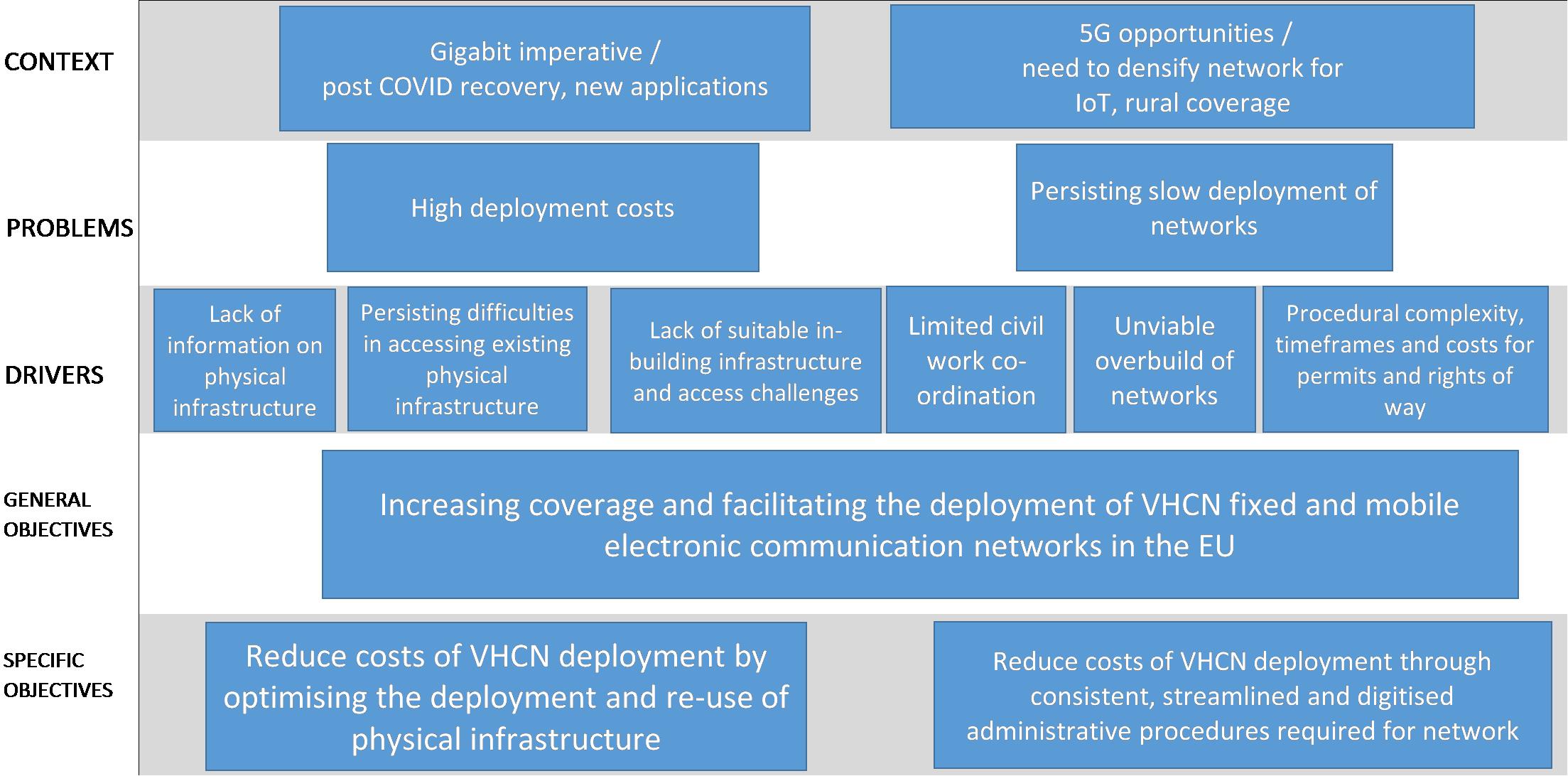
Source: European Commission based on support study
5.What are the available policy options?
Four policy options have been examined. They generally reflect a progression from less to more ambitious changes and from lower to higher EU-level harmonisation.
The project team, supported by the external consultant, elaborated a number of measures which were considered apt to support the objectives of reducing costs of network deployments and optimise administrative procedures. Given that the bundling of individual measures in the options is inherently subjective and combinations of measures in the different areas are multiple, the project team identified the following criteria that could inform its choice of bundling, notably:
(I)the number of changes and the areas affected by such changes,
(II)the extent of obligations imposed on public authorities or network operators, and
(III)the level of harmonisation overall.
The choice of individual measures to feed into specific policy options (and the several policy options) also took account of stakeholders’ consultations and proportionality considerations. These were notably presented during the validation workshop organised by the consultant which took place in January 2022. The resulting options and logic are the following (see more detailed description of the four policy options and their content in Annex 4):
5.1.What is the baseline from which options are assessed?
The baseline would consist in the continuation of the implementation of the current Directive, together with the rest of the EU regulatory framework for electronic communications (notably the Code), and the (voluntary) Connectivity Toolbox.
Article 57 of the Code and the related Commission Implementing Regulation are expected to somewhat reduce the administrative burden as well as the cost of deploying small-area wireless access points (SAWAPs) by establishing exclusions at EU level from permits for those small cells which meet certain criteria and require public authorities to provide access to certain non-network facilities including street furniture and public transport facilities, which are suitable to host SAWAP on fair and reasonable terms. However, the negotiation process for accessing public sites is likely to be complicated, often involving a range of local and regional actors, and there is likely to be limited information about the location and suitability of relevant infrastructure for SAWAPs
.
Moreover, the timely deployment of 5G will require network elements other than SAWAPs, i.e. larger in terms of volume and emission power, which will also require access to different assets or physical infrastructure than those covered by Article 57 of the Code. There are very few Member States that have extended the principle of access beyond SAWAPs, as set out in Article 57(4) EECC and/or provided information about the location of facilities (including public buildings) with support for the conclusion of access agreements via a coordinating body, and it is too early to assess the impact.
The Connectivity Toolbox contains a recommendation that access should be facilitated to public infrastructure for facilities which go beyond the narrow definition of SAWAPs. However, having regard to the Member States’ Connectivity Toolbox Roadmaps, there are few concrete plans and actions taken by national administrations to take active measures that would go beyond the requirements of Article 57 EECC.
On the other hand, the implementation of the Connectivity Toolbox (together with measures introduced beforehand) should help for instance increase the use of civil works co-ordination due to the pro-active notification of planned works, while the introduction of exemptions for certain categories of works is expected to streamline permit application processes. However, current experience shows that permit exemptions are limited to specific cases and the approaches taken vary widely, which could perpetuate a fragmented approach.
Table 2: Permit exemptions foreseen by Member States
|
Case
|
MS
|
|
Associated network elements (boxes, conduits…)
|
1
|
|
Masts/cabinets/antennas/cables satisfying certain criteria
|
11
|
|
Minor works
|
2 regarding rights of way, 1 under conditions
|
|
Technical innovation/Technical adaptation on existing masts/supports
|
2
|
|
Infrastructure contained in framework agreements
|
2
|
|
Cable deployment on electricity poles
|
3
|
|
Certain categories of infrastructure (optical fibre, cables under certain conditions)
|
4
|
|
Deployments on already existing physical infrastructure
|
3
|
|
Building permit exemption for the majority of electronic communication networks
|
1
|
Source: Summary Report of Best Practices of the Special Group for developing a common Union Toolbox for connectivity
Moreover, an assessment of the Connectivity Toolbox roadmaps shows that there are no concrete plans to introduce digital platforms for permit granting or require simultaneous processing of permits and rights of way and permit applications with alignment of the deadline in several Member States, and a significant number of Member States have no plans to provide guidelines on the interpretation of wholesale pricing principles for access to physical infrastructure or cost allocation in the context of civil works co-ordination. But even taking these few cases into account, guidelines on wholesale charges for access to physical infrastructure at national level could also increase complexity and divergence in the application of the principles set out in the EU legislation.
Furthermore, the Connectivity Recommendation and the related Toolbox do not contain any provision relating to in-building infrastructure, even though this element constitutes a substantial portion of the cost of deploying VHCN (estimated at 10-15%) and ECN operators consider that challenges persist in many Member States. Only a limited number of Member States have introduced standards and certification measures to address this bottleneck at national level, and where they exist, the degree of enforcement varies, and obligations apply only to the buildings which are newly built or renovated. For these reasons, the support study assumes that under the status quo only 10% of buildings still to be reached by FTTH across the EU will have high-speed broadband ready in-building infrastructure pre-installed, and that ECN operators accessing additional buildings may in some cases still need to invest in in-building fibre and potentially elements of in-building infrastructure to connect customers to FTTH.
The review of the BCRD is conducted in parallel with the work on a new Commission Recommendation on VHCN, which will provide guidance to NRAs on remedies to be imposed on operators with SMP, with a view to foster efficient investment in VHCN, while promoting competition in retail services. In particular, the new recommendation could provide guidance on the obligations that should be imposed on these operators with regard to access to their physical infrastructure assets and the price control obligations imposed in relation to the access to these assets. However, the recommendation would address only networks owned or operated by SMP operators, and its provisions would not be binding on the NRAs.
In this baseline scenario ICF, WIK & EcoAct’s projections show that, on average, duct access will be used for 5% and pole access for 15% of new fixed and mobile VHCN deployment by 2030. In addition, around 3% of new deployments could be based on co-ordination of civil works. These projections would still imply that a substantial proportion of newly constructed VHCN infrastructure will be deployed based on greenfield deployment, resulting in unnecessary costs and excess GHG emissions associated with construction, or can only realistically be deployed by operators which have their own physical infrastructure, which could limit the prospects for competition for public funds (thereby raising costs) or restrict infrastructure competition. Moreover, ECN operators would still need to expand existing teams handling permit applications and access to sites for the deployment of VHCN infrastructure (including access to buildings, as well as network infrastructure) to support deployments of FTTH and mid-band 5G by around 20% on average. Local authorities may also need to devote additional resources to handle these requests.
Taking into account the above as well as the Member States national broadband plans adopted in connection with the EU Gigabit society targets for 2025 together with the allocation of additional state aid and EU funds, ICF, WIK & EcoAct expect that under the status quo, VHCN coverage in the EU will reach around 65% by 2025 and 90% by 2030 (current total VHCN coverage is 59%). While these forecasts could be optimistic in view of the uncertainty regarding the actual use of State aid and EU funding, they are consistent with projections made by Analysys Mason, although below those made by IDATE for the FTTH Council Europe. From 2025 onwards, ICF, WIK & EcoAct assume that cable networks will be gradually transitioned towards FTTH and thus eventually incorporated within the FTTH figures.
Similarly, based on available literature and experience with the deployment of previous generations of mobile technology, ICF, WIK & EcoAct predict that 5G population coverage based on low frequencies such as 700MHz (‘basic’ 5G) as a proportion of the population will be largely complete by the end of 2026. However, geographic coverage will continue to lag behind
. Moreover, deployment of mid-band 5G, which will support higher bandwidths and low latency IoT applications, is likely to be restricted to major cities and highways, reaching 30% of the population at the end of 2025 and extending to only 75% by 2030. Some streamlining of resources would occur but 5G adoption in Europe (excluding IoT and Fixed Wireless Access (FWA)) would significantly lag behind that of the US and Japan by 2025
and EU’s FTTH coverage would be below that of China and Japan.
The recent Commission initiative on a Union Secure Connectivity Programme complements the BCRD while having a different objective. The latter aims to facilitate broadband access by satellite to areas that lie beyond the reach of other fixed and mobile electronic communications network infrastructure. However, satellite is not considered to be a substitute for fixed broadband technologies from a performance perspective, and its main purpose is to ensure resilience and provide ubiquitous high-speed broadband capacity for governmental users including in otherwise ‘dead zones’ rather than the Gigabit speeds required in the post-COVID digital era. It should also be noted that under that initiative, the EU would have the right to prioritise the provision of governmental services over commercial services. The Secure Connectivity initiative is part of the EU’s attempts to improve its strategic autonomy, i.e. being less reliant on non-EU actors, especially regarding technology. It should also be noted that satellite and 5G for wireless/mobile connectivity, including Fixed Wireless Access (FWA), are different technologies. Both 5G FWA and satellite will be used though to provide connectivity in rural areas, islands and outermost regions. Speeds they can provide are also different.
5.2.Description of the policy options
The table below presents the different measures included in each policy option.
Except for option 1 (minimalistic changes), the policy options do not differ as to the legal form to be chosen for the revised legal instrument which should take the form of a revised Regulation covering all substance areas. A Regulation will overcome the current shortcomings resulting from the extent of the optional provisions of the BCRD (which led to a very patchy and minimalistic implementation). A Regulation would ensure uniform implementation, while not requiring Member States to transpose its provisions, thereby inherently opening up the possibility that the new provisions could produce their positive impact on deployments cost reduction in a shorter time period, thus providing more timely support to the achievement of the Digital Decade connectivity targets. Moreover, a Regulation would also reduce the risk of national over-regulation beyond the EU requirements (“gold-plating”) which increases the regulatory burden to EU businesses. A Regulation would therefore achieve the greatest impact in terms of the advancement of Gigabit networks deployment.
Table 3: Policy options in a nutshell
|
Option 1 – Update, clarify and align (minimalistic approach)
|
Option 2 – Extend and strengthen, exclude VHCN from obligations
|
Option 3 (preferred) – Extend and strengthen with partial harmonisation
|
Option 4 – Extend and strengthen with full application to private assets and full harmonisation
|
|
Minimal “facelift”, mainly to align with EECC (VHCN scope instead of high-speed networks), mandate some currently voluntary measures (transparency, permit granting) and clarify certain provisions
|
Option 1 + the following:
Exemptions for VHCN networks in order to address investment incentive problems (e.g. overbuild)
Extension of access obligations to include publicly controlled (non-network) physical infrastructure (with exceptions for proportionality)
Strengthening obligations on permit granting (interim deadlines, exemptions, etc.)
|
Option 2 (without VHCN exemption) + the following:
Addressing investment incentive problems via detailed EU rules and EU level guidance (for access to physical infrastructure and coordinated civil works), rather than broad exemptions
Improved transparency: information sent by all network operators (with exceptions for proportionality), georeferenced information, all planned civil works, fully digitised SIPs
Major strengthening of obligations on permit granting procedures (e.g. tacit approval, ‘one-stop-shop’ fully digitised platform, EU definition of permit exemptions, fees limited to admin costs, consistency of permit granting procedures at national level)
Mandate in-building fibre wiring and standardisation / certifications, of in-building physical infrastructure (national level) and guidance on access to in-building (EU level)
|
Option 3 + the following:
Extension of obligations to all private network operators and other private agents holding non-network assets (for access to physical infrastructure, civil works coordination, transparency)
Single consolidated digital platform for physical infrastructure, planned civil works and optionally permits
Mandate in-building fibre wiring, standardisation of in-building physical infrastructure (EU level) and guidance on access to in-building (EU level)
|
Policy option 1 - brings only few changes, does not extend much obligations (only in 2 areas: permits and transparency) and brings no further EU harmonisation. It is very minimalistic with some corrections and updates and no major changes in the obligations, except for a few. Policy option 1 relies on the consideration that a slightly revised Directive, coupled with the continued implementation of the Connectivity Toolbox best practices and the rest of the electronic communications framework, could be a balanced minimalistic way to improve the effectiveness of the most critical areas of the BCRD. First, mandating the provision of information held by public bodies in electronic format via SIP would address the problem of lack of or incomplete information about existing physical infrastructure. Second, mandating permit applications by electronic means and compensation for damages incurred due to delays in permit granting procedures would address the problem of reducing time and costs needed to obtain permits.
Among ECNs, a substantial majority support the submission of permit applications by electronic means. A large majority of other operators as well as of public authorities equally agrees that a key measure is the submission of permit applications by electronic means.
In addition, the Directive would also align it with the European Electronic Communications Code and its objectives, in particular the deployment of VHCN, which makes it technologically neutral and future-proven. Finally, Option 1 would clarify some existing provisions with the view to align different interpretations of the same provisions across Member States (such as permits, publicly financed projects subject to civil works coordination) and clarify that assets subject to EECC or state aid obligations are excluded from parallel BCRD access obligations. Given its minimalistic changes, this option is expected to produce a limited impact thereby strengthening the single market only to a limited extent.
Policy option 2 - brings more changes and new obligations (although mainly to public bodies while exempting VHCN operators from some) but not much new harmonisation as it still leaves Member States margin to define several elements. Concretely, this option (but also options 3 and 4) increases the obligations on public authorities notably as regards access to their non-network public physical infrastructure because it is critical for VHCN deployment, notably of 5G mobile networks. Instead it exempts VHCN assets and projects from access to physical infrastructure obligations and civil work coordination to reduce the burden on VHCN operators and remove all together the risks of unviable overbuild (however in so doing it risks emptying most of the regulation of its value). Option 2 leaves margin to Member States to define still many elements (such as the exceptions for sensitive public buildings or assets which could be defined by Member States themselves, and a coordinating body which, where appointed by Member States - in some they already exist - could facilitate the access requests and the processing of the request by public authorities).
This option is expected to improve measures on access to existing physical infrastructure, transparency, civil work coordination and reduce administrative burden by facilitating permit granting. It is therefore likely to strengthen the single market, by for instance facilitating market entry from different Member States or facilitating deployment of 5G networks which can support cross-border services and applications.
Irrespective of their market position, many ECN operators have requested the extension of access and transparency obligations to non-network physical infrastructure held by public bodies, as well as clearer and simpler rules on permits.
Policy option 3 overall increases the changes (which affect all areas of the BCRD) and introduces new obligations which are both on public bodies and network operators and the level of EU harmonisation. Option 3 would largely maintain the measures included in Option 2 (including the enlargement of the scope of the obligation to grant access to non-network publicly owned physical infrastructure and the few permit measures) but instead of providing for an exemption for VHCN infrastructure, it would define clearer rules in the Regulation on key aspects of access to physical infrastructure and civil works coordination (such as ‘fair and reasonable’ access conditions, alternative means of access or cost apportioning for coordinated civil works) as well as on grounds for refusal of access to physical infrastructure or coordination of civil works. Such rules would be accompanied by guidance at EU level to ensure a consistent application and a harmonized approach to similar problems. Thus, the problem of unviable overbuild would be tackled through EU rules and guidelines, allowing to limit the refusals to provide access or coordinate civil works to more specific circumstances and on a case-by-case basis compared to Option 2. This option would also establish consistent rules and processes on permit granting at national level supported by a ‘one-stop-shop’ based on a single national digital platform/tool, tacit approvals of permit requests/rights of ways where possible, and limit permit fees to the level of administrative cost. Deployments subject to exemption from permit granting would be specified at EU-level. This option would hence overall address the problems of high complexity, timeframes and costs to obtain permits and rights of way in a more harmonised manner.
ECNs and their business associations, public authorities and operators of physical infrastructure intended to host ECN largely support integrating permit granting and setting a single entry point (one-stop shop). However, public authorities (notably local authorities which are competent for permit granting in most of the Member States) which already use digital platforms for permit granting (sometimes not limited to ECN) or for making available information on physical infrastructure and civil works have concerns if they would not be able to keep their current digital systems/tools while those who would have to build one from scratch have concerns as regards the administrative burden, cost and time associated with setting-up a ‘one-stop-shop’.
To improve transparency conditions and access to information, this option would expand information requirements on existing physical infrastructure (i.e. which shall be geo-referenced and provided directly by all network operators (public and private), with some exceptions to ensure proportionality) as well as on planned civil works (proactive notification of all planned civil works) and require both sets of information to be available in respective digital platforms, and if possible interconnected.
The majority of stakeholders, including BEREC, consider that the availability of constantly updated information via the SIP on planned civil works and on physical infrastructure is relevant to network deployment, including information on georeferenced location. According to most of stakeholders, a unique information repository to be populated by network operators and public bodies would be the best mechanism for ensuring the most appropriate and efficient access to relevant information regarding existing physical infrastructure and planned civil works. In BEREC’s view, an obligation for all network operators to proactively make available via the SIP the relevant information on planned civil works would increase coordination and respectively decrease investment costs.
In order to address problems of lack of or access to suitable in-building infrastructure and to ensure every EU household has access to Gigabit connectivity, this option would mandate fibre-ready in-building infrastructure and fibre in-building in every new (or majorly renovated) household as well as standardisation of in-building physical infrastructure at national level and guidance on access to in-building infrastructure at EU level (together and consistent with that of access to physical infrastructure). As this option is expected to significantly improve measures on access to existing physical infrastructure, transparency, civil work coordination and reduce administrative burden by facilitating permit granting, it would also strengthen the single market, by for instance facilitating market entry from different Member States or ensuring 5G networks are developed to support cross-border services and applications.
BEREC’s view is that in-building physical infrastructure should not only be accessible but also should be built so that access is possible, making newly constructed buildings ‘broadband ready’. ECN operators see the provision of suitable in-building infrastructure and the access to it as an absolute necessity for residential fibre roll-out and call for enhancing the current provisions on in-building infrastructure, including raising the ambition from high-speed to VHCN/fibre. They also propose an obligation for building owners to deploy and give access to in-building fibre wiring. However, some public authorities deplore the lack of obligation for co-owners to invest in in-building infrastructure. Most stakeholders see technical standards and guidelines as key for the provision of suitable in-building infrastructure and to reduce the number of disputes.
Policy option 4 - is the most far reaching in terms of number of changes, it further extends obligations to private network operators owing physical infrastructure and to private agents owing assets which are not part of a network (e.g. commercial buildings) and harmonises all elements at EU level. Option 4 would entail maximum EU-level harmonisation, because it would include all the measures in policy option 3, but it would extend new obligations for network operators, public authorities and even other private operators. Specifically, it would extend access and transparency obligations to certain private assets (e.g. commercial buildings) and obligations of civil works coordination also to projects which are not publicly funded. This option would mandate the establishment of a combined single digital platform for existing physical infrastructure, planned civil works and, optionally, permit granting procedures. Finally, this option would mandate standardisation of in-building physical infrastructure at EU level (compared to standardisation at national level in policy option 3). Because of the number and reach of the changes it would bring, this is likely to be the option that would strengthen the single market the most.
5.3.Options discarded at an early stage
The repeal of the existing Directive would imply removing current EU-level obligations and relying entirely on soft law measures such as the Connectivity Toolbox to guide Member States in limiting costs and administrative burdens at national level. The option was considered (broadly on qualitative terms) but discarded upfront as the identified problems would be expected to increase, given the lack of some minimum harmonised rules, for example in areas such as establishing deadlines for permit granting procedures or promoting coordination of civil works. Also having in mind that broadly all categories of stakeholders have confirmed the relevance of BCRD and its objectives and pointed to areas of improvements, the repeal option should be discarded.
6.What are the impacts of the policy options?
In order to proceed with the assessment of the economic, societal and environmental impacts of the four policy options, we have mainly relied on the results provided by a cost model and theory-based modelling exercise developed as part of the support study by ICF, WIK & EcoAct, which is briefly described below (see Annexes 5 and 7 for the full description of the methodology and underlying assumptions).
The model used in the support study is a detailed bottom-up cost model, covering the use of FTTH and 5G Fixed Wireless Access in the access network and used to calculate the cost savings and potential expansion in VHCN deployment. The main parameters are the cost of deployment per km in different scenarios (e.g. under asphalt, aerial), the cost of network elements to be deployed (ducts, poles, fibre cables etc) and the Weighted Average Cost of Capital (WACC) which are derived from cost data used in regulatory cost models prepared by one of the contractors for the German electronic communications regulatory authority.
The type of model used, the underlying assumptions and rationale for those assumptions are described in Annex 5 and in more detail in Annex 4 of the support study. The assumptions used for the modelling were based in part on inputs from stakeholders via surveys and interviews (as well as on benchmarks) carried out as part of the support study. The assumptions made concerning the impact of the different options on outcomes concerning infrastructure re-use and other factors are shown in Tables 1 and 15 (in Annex 5). The different elements of each option are listed alongside assumptions regarding the directional effects (showed using + and -). These are then used to adjust the model inputs for factors such as the proportion of shared ducts and poles, and civil works coordination, the wholesale charge for access to physical infrastructure, etc.
The assumptions made concerning the impact of the different policy options on outcomes concerning infrastructure re-use and other factors used for the modelling were partly based on inputs from stakeholders via surveys, interviews and workshops (as well as on benchmarks), as part of the support report. These assumptions were presented to the stakeholders during a workshop organised by the contractors of the support study on 27 January 2022 where the contractors presented the methodology and main conclusions of the support study and stakeholders had the possibility to comment.
It should be noted that according to the consultants, the modelling approach is very mature because it has been used and continuously updated in various projects (prior to being applied to the impact assessment of this initiative). In doing so, the model has received peer quality reviews from the consultant group, as well as reviews by different project partners/customers, national regulatory authorities and governments. In general, the use of a regulatory cost model as a basis for the exercise makes the calculation more robust than other types of more simplistic modelling.
The expected direct policy effects of the different policy options on accessing existing infrastructure and civil works co-ordination as well as their effects on the timing of VHCN deployment (step 1) were fed into a specially adapted cost and viability model developed by contractors. This in turn provided estimates of the impact of the policy options on the cost of FTTH and 5G deployment, and the potential additional coverage that could be achieved if cost savings were reinvested in VHCN deployment (step 2). These scenarios were translated into effects on broadband speed and bandwidth consumption (step 3), which enabled an assessment of the economic and environmental impact of the policy options on GDP and GHG emissions, based on correlations between these factors established in academic literature (step 4). The societal impact is instead described in qualitative terms.
6.1.Economic impact
The cost model calculates the total capex requirements and viability of deployment in given areas on the basis of assumptions made regarding the degree of infrastructure sharing and civil works co-ordination that might result from the different policy options. Assumptions concerning the effects of different options on the degree of infrastructure sharing and civil works co-ordination (step 1) have been developed on the basis of data gathered from dispute settlement bodies and ECN operators alongside interviews conducted for the support study and relevant literature revised by the contractors. The following table summarises the main estimates for step 1:
Table 4: Estimates of the increases of the different options on infrastructure sharing, co-deployment, and the timeframes for deployment (step 1)
|
|
Baseline
|
Option 1
|
Option 2
|
Option 3
|
Option 4
|
|
Shared use of ducts (% new VHCN deployment in existing PI)
|
5%
|
6%
|
6%
|
8%
|
8%
|
|
Shared use of poles (% new VHCN deployment in existing PI)
|
15%
|
17%
|
17%
|
20%
|
20%
|
|
% new deployment based on civil works co-ordination
|
3%
|
3%
|
3%
|
5%
|
7%
|
|
Wholesale price for access to existing physical infrastructure (wholesale price per metre for duct access EUR)
|
0.05
|
0.05
|
0.05
|
0.04
|
0.04
|
|
Wholesale price for access to existing physical infrastructure (wholesale price per metre for pole access EUR)
|
0.04
|
0.04
|
0.04
|
0.03
|
0.03
|
|
Total sites needed to provide universal low frequency 5G coverage
|
5275
|
5275
|
5275
|
5275
|
5275
|
|
Cost of deploying macrocells (cumulative present value of costs EUR)
|
110, 000
|
110000
|
99000
|
94000
|
92000
|
|
Cost of deploying small cells (average cost per installation EUR)
|
34
|
34000
|
29000
|
24000
|
23000
|
|
Cost of in-building infrastructure per premise (greenfield) EUR
|
200
|
200
|
200
|
200
|
200
|
|
% premises for which there is a reduction in cost for in-house infrastructure
|
10%
|
12%
|
12%
|
17%
|
15%
|
|
% cost reduction compared with newly built infrastructure
|
30%
|
35%
|
35%
|
75%
|
75%
|
|
Wholesale market share attainable in less dense areas (where duplication is not viable)
|
70%
|
70%
|
75%
|
75%
|
75%
|
|
Average time taken to achieve 90% FTTH coverage from a baseline of 65% (months)
|
60
|
60
|
57
|
54
|
56
|
|
Average time taken to deploy full 5G to achieve 75% population coverage (via 3.6 GHz) from a baseline of 30% coverage (months)
|
60
|
59
|
54
|
52
|
54
|
Source: support study
On the basis of detailed modelling using an adapted bottom-up cost model for the deployment of VHCN, the support study estimated the following impact in terms of km of new network built by 2030 depending on the degree of infrastructure sharing and co-ordination of civil works achieved with the different options. The efficiencies achieved could reduce the cost of deployment and reduce the required subsidies. The next step has assessed what would be the VHCN coverage increase in case the savings are all reinvested in additional FTTH coverage beyond the base case in which case FTTH coverage is assumed to reach 90% by 2030 (scenario A) or in case they are all reinvested in deploying 5G FWA in unserved areas (scenario B) rather than deploying FTTH or maintaining FTTC in those areas. The increase in the deployment of mid-band 5G has also been estimated. Both scenarios are relevant, and ECN operators and Member States (via subsidy programmes) might choose either option or a combination depending on the specific characteristics of the rural areas to be served and the bandwidth needs of the populations / industry in those areas. These scenarios are useful in terms of allowing a quantitative comparison of the options, even if there would be many factors affecting the actual decision about the use-reinvestments of the cost savings achieved.
The following table summarises the main results after step 2, which already show that options 2 and 3 are the ones which are contributing the most to the objectives of the imitative (namely Gigabit coverage for all households in the EU and 5G in all populated areas):
Table 5: Outcomes of the model (step 2)
|
|
Outcomes of the model (step 2)
|
|
|
Shared infrastructure / co-deployment (km)
|
Cost / subsidy savings (bln EUR)
|
VHCN coverage by 2030 (FTTH / 5G FWA)
|
Coverage of mid-band 5G
|
|
Baseline
|
249,662
|
-
|
90% / 90%
|
75%
|
|
Option 1
|
292,702
|
4.8 / 0.4
|
91.6% / 97%
|
75%
|
|
Option 2
|
297,407
|
1.6 / 1.6
|
93.5% / 98.5%
|
76.5%
|
|
Option 3
|
468,344
|
14.5 / 2.4
|
96.5% / 99.1%
|
77%
|
|
Option 4
|
528,498
|
17.5 / 2.6
|
96.8% / 99.2%
|
77%
|
Source: support study
Then the model assesses the impact in terms of broadband speed and bandwidth consumption, to finally obtain the outcome in terms of GDP, jobs and GHG emissions. Table 7 included at the end of this section provides for the overall conclusions of this analysis. As a result, policy options 3 and 4 are likely to have the most significant positive impacts for economic and societal development as well as in limiting GHG emissions from the electronic communications sector during a period where bandwidth consumption is expected to expand rapidly.
There is widespread literature on the topic of economic impact of improved broadband quality in terms of GDP growth and job creation. Literature suggest that the increased availability of VHCN that could be supported through the revision of the BCRD is likely to create positive spill-over effects as digitisation is used to improve energy efficiency in other highly polluting sectors such as buildings and transport. In addition, a key driver of economic benefits from 5G is expected to come from knock-on effects in other sectors resulting from 5G applications (including IoT), such as in healthcare, manufacturing, transport, energy or agriculture. However, these effects could not be quantitatively assessed.
Drawing on the literature, the support study assessed the economic impact based on a theory-based model estimating how expected increases in fixed and mobile speeds resulting from the different policy options for the revision of the BCRD might impact GDP. The modelling approach draws on the elasticities estimated respectively by the 2SLS model in Bohlin Rohman Kongaut (2017) for FTTH and Edquist et al. (2018) for the impact of 5G on the basis of the impact that resulted from 4G) . The main results of the theory-based modelling exercise developed in the support study are provided in this section (see Annex 5 for more details).
As regards the impact of 5G (2023-2030) and fixed VHCN (2023-2030) on GDP, the following table displays the overall increment to GDP resulting from increased fixed VHCN and 5G deployment compared with the baseline and distinguishing scenarios A and B for fixed network reinvestment.
Table 6: Incremental impact options on GDP up to 2030 (billion EUR) from 5G and fixed VHCN
|
Scenario
|
Option 1
|
Option 2
|
Option 3
|
Option 4
|
|
5G + fixed VHCN (A)
|
21
|
56
|
105
|
109
|
|
5G + fixed VHCN (B)
|
16
|
26
|
39
|
39
|
Source: support study
As shown above, scenario A (savings are reinvested in additional FTTH coverage beyond the base case) appears to have a greater GDP impact than scenario B (savings are reinvested in deploying 5G FWA in unserved areas) across all policy options, suggesting that the impact of the increases in VHCN coverage that could be achieved by focusing on 5G FWA rather than FTTH in rural areas are counteracted by the reduced speeds that would be achieved by serving rural customers with FWA instead of FTTH.
However, policy-makers might consider that equity gains might exceed economic gains in the second scenario. More generally, there is an ongoing debate in the literature over the equity-efficiency trade-off considering that investing in rural areas would address the digital divide but at the expense of not pursuing efficiency gains. The theory of efficient markets indicates that resources should be allocated where the return on investment is maximized. In contrast, investing in rural areas would improve digital equity by reducing digital disparities. However, the final results on GDP impact of both scenarios are uncertain given the number of factors intervening.
Moreover, the modelling has also estimated that the additional bandwidths and reach of the FTTH networks could contribute to the creation of around 154,000 jobs under policy option 1, 338,000 jobs under policy option 2, 627,000 jobs under policy option 3 and 656,000 under policy option 4. The estimations regarding the impact of increased VHCN deployment on jobs are considered less robust than those on GDP because there is less peer reviewed literature available and the results of research which has been conducted vary, potentially because studies focus on specific countries such as Sweden and the US, and may not be representative. For this reason, the estimates regarding impact on jobs should be given less emphasis and treated as rough estimates (or alternatively shown through directional symbols such as ‘+’, ‘++’ etc.). It should be noted that the rough estimates given should be underestimates, because they do not take into account potential effects on job creation from 5G applications. There are (commercial) studies listed in the report about the potential effect of 5G on job creation, but such estimates are very speculative because they look at the possible effects of new applications that have not yet been rolled out to any significant degree in Europe or elsewhere, and there is limited data available on which to conduct empirical research.
Although difficult to quantify, it is expected that there will be a spillover effect on different sectors of the economy from 5G and IoT. For example, new IoT applications in fields ranging from CAM, smart cities to smart factories, smart agriculture and smart grids, can positively impact productivity in those sectors and bring competitive advantages for business while also creating jobs. Such effects could have a multiplier effect with different rounds of impacts as discussed in the literature.
6.2.Societal impact
The examples of societal benefits from Gigabit broadband are numerous and include home care applications, greater educational opportunities, support for teleworking and improved entertainment options, as well as boosting consumer welfare. In a recent study in the UK assessing the impact of superfast broadband on wellbeing, Simetrica-Jacobs found that having access to superfast broadband was associated with an increase in wellbeing worth around £225 (equivalent to around EUR260) per household per year. Although in this study, superfast broadband was defined as having a download speed of only 24Mbit/s, other research confirms that services which require higher bandwidths could provide equal (or even greater) contributions to consumer welfare and play an important role in reducing inequalities.Inadequate broadband connectivity is likely to be particularly accentuated in rural areas, because the cost of deployment is significantly higher. The effects of inadequate connectivity (amongst other factors) may have been amongst the drivers of rural unemployment and depopulation. Various studies suggest that improved broadband connectivity in rural areas could help to reverse the trend of depopulation of rural areas and ensure more equitable distribution of economic benefits. There is a wide range of literature that suggests that rural communities that would otherwise suffer from depopulation and unemployment benefit disproportionately from the deployment of Gigabit infrastructure, as it supports rural job creation and offers the potential for remote households to benefit from remotely delivered services including education and healthcare. According to the latest World Social Report published by the UN in May 2021, improved Internet access and connectivity will provide better jobs and higher standards of living for the roughly 3.4 billion people living in rural areas.
Faster broadband can also support more efficient delivery of healthcare in rural areas (as well as elsewhere). A study assessing developments in Sweden found significant savings in using digital FTTH-based homecare especially in rural areas. It concluded that even with limited adoption, these solutions could contribute to annual net cost reductions of $0.6m in a rural municipality with 8,000 residents by 2020. In another study, examining the effects of ultrafast broadband deployed in the rural country of Cornwall in the UK, Garner et al. (2019) found, that eHealth readiness improved over 18 months from 4.36 out of 10 to 4.59 out of 10. The authors concluded that one of the reasons for improved readiness for the adoption of eHealth services was the rollout of ultra-fast broadband, which increased both peoples personal ability to use eHealth and their methods of access.
One important function of Gigabit broadband, which has received increased attention following the COVID-19 pandemic, is the ability to support remote working. Teleworking may be associated with many benefits for employees, such as increased job satisfaction, organizational commitment, and job performance and lower work stress and exhaustion. A quantitative model estimation by SQW (2013) of the projected social impacts of faster broadband speeds (although not FTTH per se) shows that the increase in teleworking driven by faster broadband would save about 60 million hours of leisure time per annum in the UK by 2024. In addition, by avoiding commuting costs, the additional teleworking enabled by faster broadband would lead to total household savings rising to £270 million p.a. by 2024, and would result in lower pollution. Furthermore, SQW projected that increased productivity from teleworking could reach £1.8 billion by 2024. However, Samek Lodovici et al. (2021) note on a societal level that teleworking may contribute to the emergence of new employment and social inequalities, between those who can telework and those who cannot, because they are employed in non–teleworkable sectors/occupations or have no access to a broadband connection. Thus, the absence of a suitable connection to support teleworking (and the failure to digitize in sectors which could take advantage of remote working opportunities) could have detrimental effects on equality and societal cohesion.
The COVID-19 pandemic has also highlighted the importance of ultrafast connectivity for education, confirming the need not only to ensure high performance connectivity for students but also for schools and higher education institutions themselves. A recent report from the Broadband Commission as well as a White Paper by Hyperoptic illustrate, on the basis of various case studies, the overall benefits education and school connectivity can bring to society.
Moreover, many of the existing studies focus on the effects of FTTH or higher speed fixed broadband infrastructure, because applications for these technologies are already well-developed, but it should be noted that, due to its additional capacity as well as quality characteristics 5G could support the development and use of new types of innovative content, applications and services which contribute to societal welfare including improvements in transport (both private and public) and smart city applications.
As regards the implications for the initiative, the societal impact of the different policy options for the revision of the BCRD is intrinsically linked to their capability to accelerate and expand fixed and mobile VHCN deployment. As policy options 3 and 4 have been shown to have the greatest potential in this area (see previous section), we can also conclude that these policy options would provide the greatest contribution to wider societal benefits including reductions in the urban-rural digital divide, and improved access to digital healthcare and remote education or teleworking solutions. Policy option 2 would provide only moderate benefits and policy option 1 only limited benefits, linked to their expected effect in terms of VHCN deployment. Importantly, pursuing policy options 3 or 4 would also provide monetary savings for governments engaged in subsidizing broadband deployment of around EUR 2.4bln, which could potentially be used either to invest in more rural coverage (through FWA or FTTH) or to directly invest in public services.
In addition, policy options 3 and 4 would contribute to the increased re-use of existing infrastructure and co-ordination of civil works, which would limit roadworks and construction, which can itself be a source of social cost to nearby residents. In fact, according to the cost and viability model of the support study, policy options 3 and 4 would more than double re-use of existing infrastructure and civil works co-ordination, reducing the amount of new (greenfield) deployed networks from 530,000km under the baseline scenario to around 250,000km.
In conclusion, policy options 3 and 4 would give rise to the largest societal benefits, both directly by avoiding around 280,000 km of new civil works and indirectly – by supporting the expansion of fixed and mobile VHCN to reduce the urban rural digital divide or by releasing around EUR2.4bln funds that would otherwise have been used for broadband subsidies for other potential social or economic purposes.
6.3.Environmental impact
Digital connectivity infrastructure is essential for achieving the twin digital and green transition, which are main priorities for the Commission. In 2019, the European Commission adopted a Communication on the European Green Deal, which sets out a target for the EU to achieve climate neutrality by 2050. The Commission has also proposed an interim target to reduce greenhouse gas (GHG) emissions by at least 55% by 2030 compared with 1990. Digital technologies will play a key role in the transition to a green economy, as they are important enablers of energy efficiency in other sectors.
In this section, the modelling is considering the potential effects of revisions to the BCRD on emissions associated with both the deployment and operation of VHCN, which are considered in the modelling exercise (see Annexes 5 and 6 for more information). The assessment of the environmental impact in terms of greenhouse gas emissions of three distinct factors is provided below: fixed network operation, fixed network deployment (most significant impact) and wireless, including mobile, network operation.
The modelling developed in the support study has assessed total electricity consumption of the access network based on number of total subscribers over time across the different policy options. This implicitly accounts for the increase in data consumption that is expected across all policy options and in particular policy options 3 and 4. Electricity consumption estimates were based on Oberman (2020), Godlovitch et al. (2020) and JRC’s Code of Conduct on Energy Consumption of Broadband Equipment (EC JRC, 2020). Assessing the GHG emissions from the electricity, the support study considers the electricity grid mix emissions based on Buck, et al., (2019).
The results for fixed broadband operation are summarized in the table below, which shows that in the baseline scenario, aggregate emissions across the 2020-2030 period is 23.98 million tonnes CO2e. All policy options lead to reductions in emissions with a maximum reduction of 240,300 tonnes CO2e in policy option 3. Comparatively, however, this is only a 1% reduction compared to the status quo. The main driver of reduction in emissions is the shift in subscribers from the less energy efficient technologies (ADSL, FTTC/VDSL and cable) towards the more energy-efficient FTTH. The results of the modelling exercise show that policy options involving higher increases in FTTH deployment (namely options 3 and 4) result in lower overall emissions, as the efficiency gains compensate for the effect of data consumption increases. The results are presented in the following table.
Table 7: Emissions from operation of fixed broadband networks 2023-2030
|
|
Baseline
|
Option 1
|
Option 2
|
Option 3
|
Option 4
|
|
Aggregate t CO2e
|
23,983,665
|
23,898,511
|
23,801,256
|
23,743,365
|
23,764,980
|
|
Difference vs baseline
|
|
-85,154
|
-182,409
|
-240,300
|
-218,685
|
|
Relative difference
|
|
-0.36%
|
-0.76%
|
-1.00%
|
-0.91%
|
Source: support study
The deployment of electronic communications networks also results in GHG emissions (and other environmental impacts) although likely a lower proportion of the total impact of ECN on GHG emissions than network operation. Accessing existing physical infrastructure (as an alternative to deployment of new physical infrastructure) therefore provides an opportunity not only to reduce costs but also to avoid a large amount of the environmental impact that otherwise would have been associated with creation and deployment of new infrastructure.
The results for fixed broadband deployment are summarized in the following table which shows that in the baseline aggregate emissions for deployment across the 2020-2030 period is 13.7 million tonnes CO2e. All policy options lead to increases in emissions up to 1.1 million tonnes for policy options 3 and 4. This represents over 8% increase compared to the baseline.
Table 8: Emissions from deployment of fixed broadband networks 2020-2030
|
|
Baseline
|
Option 1
|
Option 2
|
Option 3
|
Option 4
|
|
Aggregate t CO2e
|
13,708,197
|
13,853,193
|
14,283,662
|
14,889,433
|
14,830,603
|
|
Difference vs baseline
|
|
144,996
|
575,465
|
1,181,236
|
1,122,406
|
|
Relative difference
|
|
1.06%
|
4.20%
|
8.62%
|
8.19%
|
|
Emissions intensity t CO2e/km
|
4.67
|
4.64
|
4.63
|
4.46
|
4.42
|
Source: Support study
The results across all policy options are driven by additional new deployment needed to achieve higher FTTH coverage, e.g. 7% increase in new ducts for policy option 3. So despite all options having a higher proportion (and absolute length) of deployment in existing ducts and poles, this is outweighed by the simultaneous need for new ducts and poles linked to increased coverage.
While in the case of fixed/mobile network operations the difference of emissions compared to the baseline is positive (i.e. a reduction of emissions); in the case of fixed network deployment, it is on the contrary negative (an increase of emissions, which for policy options of 3 and 4 represents 8% increase compared to the baseline – see table 5). This is due to the expected additional km of VHCN networks (see results of step 2 of the model), with policy options 3 and 4 leading to the highest additional deployment of networks, as well as to the highest environmental impact related to fixed network deployment. The assessment shows that all policy options are leading towards a higher proportion of network deployment based on existing ducts and poles. However, it is to be noted that this positive result is outweighed by the simultaneous need for new ducts and poles linked to the increased coverage which also results (to various extent) under the different policy options (e.g. as a result of the application of the envisaged measures, the VHCN networks coverage is expected to increase and therefore requires deployment of new ducts and poles in addition to the use of the measures under the initiative and therefore there is an associated environmental impact related to fixed network deployment).
In order to be able to identify the benefits brought by this initiative, the model does a further step and calculates what would have been the emissions derived from fixed network deployment for all the policy options, in case the deployment had been done in the same proportions of new and existing ducts/poles and civil works coordination as in the baseline (e.g. not taking into account the measures envisaged in the policy options). The results are summarised in table 6 below, which shows the benefits brought in terms of avoided emissions by the envisaged measures under the different policy options for the same amount of fixed network deployment. This exercise leads to avoided emissions of up to 0.86 million tonnes CO2e in policy option 4 and 0.70 million tonnes CO2e in policy option 3, while the amount is less for policy options 1 (0.11 million tonnes of CO2e) and 2 (0.13 million tonnes of CO2e).
These results put into value that, despite the net increase on GHG emissions derived from the fixed network deployment, the foreseen measures contribute to lowering the emissions. It also confirms that accessing existing physical infrastructure (as an alternative to deployment of new physical infrastructure – greenfield approach) and coordinating civil works provide an opportunity not only to reduce costs but also to avoid a large amount of the environmental impact that otherwise would have been associated with the creation and deployment of new infrastructure in case such additional infrastructure is deployed in the absence of new measures under the BCRD.
Table 9: Emissions from deployment of fixed broadband networks 2020-2030 with proportion of deployment technique as Status Quo
|
|
Baseline
|
Option 1
|
Option 2
|
Option 3
|
Option 4
|
|
Aggregate t CO2e
|
13,708,197
|
13,965,453
|
14,419,146
|
15,589,390
|
15,688,087
|
|
Difference vs baseline
|
|
257,256
|
710,949
|
1,881,193
|
1,979,890
|
|
Relative difference
|
|
1.88%
|
5.19%
|
13.72%
|
14.44%
|
|
Avoided emissions
(t CO2e)
|
|
112,260
|
135,484
|
699,957
|
857,484
|
Source: Support study
Upgrading mobile networks presents an opportunity in the ability to increase bitrates and connectivity, but equally presents challenges as total energy consumption may increase as legacy systems remain in place (Sabelle, et al., 2016). Even if traffic moves away from legacy mobile networks, 2G and 3G, in favour of 5G their energy consumption would remain. As suggested by JRC’s Code of Conduct on Energy Consumption of Broadband Equipment (EC JRC, 2020) nearly 70% of the power busy-hour-load-state consumption is used in the low-load state. Switching off these systems could therefore lead to an overall reduction in energy consumption. This is confirmed in an article by McKinsey where they identify a number of tools to help reduce energy consumption. Here they identify shut down of legacy systems (2G) could lead to energy savings of 3% (Lee, et al., 2020).
The modelling has assessed total energy consumption of the access network and the results are summarized in the following table on emissions from mobile broadband network operation. This shows that in the baseline (policy option 0), aggregate emissions across the 2023-2030 period is 4.01 million tonnes CO2e. All policy options lead to reductions in emissions with a maximum reduction of 1,121 tonnes CO2e in policy options 3 and 4. Comparatively, however, these are insignificant reductions of less than 0.1% compared to the baseline. The main driver of reduced emissions is the increased energy efficiency of 5G. However, increased energy efficiency is counterbalanced by expectations of significant increases in data consumption linked to the deployment of 5G networks (and in particular mid-band 5G).
Table 10: Emissions from operation of mobile broadband networks 2023-2030
|
|
Baseline
|
Option 1
|
Option 2
|
Option 3
|
Option 4
|
|
Aggregate t CO2e
|
4,015,672
|
4,015,268
|
4,015,587
|
4,014,551
|
4,014,551
|
|
Difference
|
|
-403
|
-85
|
-1,121
|
-1,121
|
|
Relative difference
|
|
-0.01%
|
0.00%
|
-0.03%
|
-0.03%
|
Source: Support study
6.4.Conclusions
On the basis of what is presented in the previous sections, the following table provides an overview of the macroeconomic, societal and environmental impacts that are expected to result from the different policy options and which are analysed and compared in detail in section 7. Only scenario A (savings are reinvested in additional FTTH coverage beyond the base case) is depicted here, as it appears to have a greater GDP impact.
Table 11: Summary of macro-economic, societal and environmental impact
|
|
Economic Impact
|
Societal Impact
|
Environmental Impact
(t CO2e)
|
|
|
GDP increased linked to reinvestment of savings (FTTH/mid-band 5G)
|
Jobs (resulting from additional FTTH)
|
Reduced inequality
|
Net environmental impact
|
Fixed deployment (avoided emissions)
|
|
Option 1
|
EUR 21bln (EUR17bln/EUR4bln)
|
0.0008% / 154,000
|
(+)
|
59,439
|
-112,260
|
|
Option 2
|
EUR56bln (EUR41bln/EUR15bln)
|
0.0018% / 338,000
|
+
|
392,971
|
-135,484
|
|
Option 3
|
EUR105bln (EUR76bln/EUR29bln)
|
0.0033% / 627,000
|
++
|
939,815
|
-699,957
|
|
Option 4
|
EUR109bln (EUR80bln/EUR29bln)
|
0.0034% / 656,000
|
++
|
902,600
|
-857,484
|
Source: support study
The symbol ‘(+)’ indicates positive but limited benefits, ‘+’ moderate benefits and ‘++’ high benefits.
Finally, in relation to the so-called “do not harm principle”, no significant negative impact on the environment has been identified. No significant harm is expected to be done to the climate and environmental objectives of the European Green Deal by the application of the envisaged measures under the policy options considered for this initiative. On the contrary, the underlying goal of the revised measures (to encourage sharing of physical infrastructure and coordinated network deployment which should boost the deployment of FTTH and full 5G, as well as the digitalisation of access to relevant information and permit granting procedures) is consistent with improved energy efficiency as well as limiting nuisance and other negative environmental effects associated with civil works. The Impact Assessment also notes that digital connectivity infrastructure would help other sectors to become ‘greener’ and therefore is essential for achieving the twin digital and green transition, which are main priorities for the Commission.
7.How do the options compare?
7.1.Comparison based on economic, societal and environmental impact
As regards the economic impact, if the cost savings from increased infrastructure re-use and streamlined processes are reinvested in FTTH, we anticipate an increase to GDP of EUR76-EUR80bln in the period up to 2030 if policy option 3 or 4 are implemented while these figures drop to EUR17bln and EUR41bln if policy options 1 and 2 are implemented. In addition, measures which accelerate the deployment of mid-band 5G are expected to contribute around EUR29bln to economic growth under policy options 3 and 4, policy options 1 and 2 providing relatively for EUR4bln and EUR15bln. The additional bandwidths and reach of the fibre network under those policy options could contribute to the creation of around 627,000-656,000 jobs EU-wide, policy options 1 and 2 providing relatively for 154,000 and 338,000. In addition, a further significant boost to economic growth could result from the boost to digitisation of other industries (including energy, transport, manufacturing, etc.) that will be facilitated by 5G IoT under these policy options, but the precise impacts are difficult to quantify.
As regards the societal impact, by enabling a wider section of society to benefit from Gigabit broadband, policy options 3 and 4 are also likely to have positive societal impacts, in particular by reducing the urban-rural digital divide; while policy option 2 is expected to provide certain positive impact and policy option 1 more limited positive effect. As the COVID pandemic has shown, advanced connectivity is overall particularly important as an essential enabler for teleworking, remote education or health. In addition, reductions in civil works that could be enabled through greater re-use of existing infrastructure should reduce disruption and noise pollution from civil works, which can be viewed as a social cost.
As regards the environmental impact, the reviewed BCRD, which will further support the re-use of existing facilities or the co-ordination of civil works and update its scope to support VHCN deployment, should also have positive effects on greenhouse gas emissions, by fostering the deployment of technologies (FTTH and 5G) which are more energy efficient during the operational phase. We estimate that the reductions in greenfield deployments that may result from policy options 3 and 4 could avoid 0.7 and 0.8 million tonnes in GHG emissions respectively and 0.1 million tonnes both for policy options 1 and 2 in the period to 2030 compared with a situation where FTTH is deployed to the same extent, but based on the current more limited reliance on infrastructure sharing.
The migration to more energy efficient FTTH and 5G technologies should also help to limit the increases in GHG emissions that would otherwise arise as a result on increasing demands for bandwidth. If coupled with the phase-out of legacy technologies over the next 10 years, we anticipate that the increased FTTH coverage resulting from policy options 3 and 4 should lead to reductions of around 1% in GHG emissions compared with the status quo in the period up to 2030 and around 0.03% savings in emissions from the operation of mobile networks; the respective figures for policy option 1 being 0.36% and 0.01% and for policy option 2 0.76% and 0%. Importantly, if policy options 3 or 4 are pursued, emissions are not expected to increase compared with the status quo, despite projections that bandwidth consumption would increase 9-fold in fixed networks and 19-fold for mobile by 2030. We did not take into account knock-on effects that could arise from improved energy efficiency due to the accelerated deployment of 5G and its use in sectors such as transport, agriculture and energy. Literature suggests that these could significantly outweigh any direct impacts on GHG emissions coming from electronic communications networks themselves.
To conclude from the assessment done so far on the basis of the modelling, policy options 3 and 4 are likely to have the most significant positive impacts for economic and societal development as well as in limiting GHG emissions from the electronic communications sector during a period where bandwidth consumption is expected to expand rapidly. Instead, when taking into account the more granular assessment on the basis of specific criteria of effectiveness, efficiency, coherence, feasibility and EU added value provided in the next section, policy option 3 appears as the preferred option.
7.2.Comparison of policy options per criteria
In line with the Better Regulation Guidelines, we have carried out a detailed analysis of the elements which compose each policy option, allowing for a comparison. The support study has quantified to the extent possible and rated the potential impacts of the baseline scenario and the four policy options considered.
The main factors considered for the assessment of the four policy options, which are described in section 5.2) are summarised below.
Effectiveness
Baseline: While the existing BCRD in combination with the Connectivity Toolbox and Article 57 EECC would enable certain improvements in reducing costs in broadband deployment, the application of these measures is unlikely on its own to deliver the cost reductions and easing of the administrative burden that is required to timely meet the EU connectivity targets. Identified inefficiencies of the current Directive will therefore persist and fragmented application is likely to remain. Permit granting processes may improve somewhat, but outcomes will remain patchy. Use of infrastructure sharing and coordinated civil works would improve to a certain extent but most VHCN deployment would be greenfield. As shown in table 2, we expect that under the status quo, there will be 250,000km of deployment by 2030 based on BCRD measures and VHCN coverage in the EU will reach around 65% by 2025 and 90% by 2030, due to national broadband plans adopted in connection with the EU Gigabit society targets and forthcoming adaptations to the Toolbox Roadmaps together with the allocation of significant amounts of State Aid and EU funds. As regards the deployment of mid-band 5G (based on 3.6 GHz band), it is expected that 75% of the population would be covered by 2030.
Policy option 1: The amendments foreseen will have limited positive effects and their impact on fixed (and especially mobile) VHCN deployment is likely to be limited as shown in table 2. Policy option 1 would increase network deployment by 290,000 km based on the use of cost-saving measures including re-use of existing infrastructure and civil works co-ordination. This policy option could lead to cost reductions in FTTH deployment of around EUR5bln and create the potential for a reduction in subsidies by around EUR0.43bln. If the costs saved are reinvested in additional FTTH deployment, the model indicates that FTTH coverage could be extended to reach 91.6%. If saved costs are invested instead in deploying the lower cost solution 5G FWA, VHCN coverage levels of 99% could be achieved. Coverage of mid-band 5G is expected to reach 75% under this option, thereby achieving limited additional coverage compared with the baseline.
As regards reducing costs through more consistent, streamlined and digitised administrative procedures required for network deployment, only a limited effect is expected derived from (only) mandating that permit applications are submitted by electronic means. At the same time, such a measure would be in line with the principle of digital by default and therefore constitute an improvement compared to the baseline.
Policy option 2: By addressing the problem of unviable overbuild through VHCN exemption, this option would improve the business case for VHCN deployment in less dense areas (thereby substantially contributing to reducing requirements for subsidies). However, it also risks limiting the potential for infrastructure competition in more urban areas, which could limit quality and choice for consumers overall. A more targeted exemption (e.g. in white areas as defined for state aid or by way of Art.22 geographical surveys) would not be easy to implement as experience has shown that definition of these areas is difficult and constantly evolving and will rely on alternatives mappings under state aid or article 22 being timely available and up to date. This policy option would contribute to reduce the costs and administrative burden of deploying VHCN, in particular for mobile deployment thanks to the extension of obligations to access existing physical infrastructure to cover also non-network infrastructure owned by public bodies for the purposes of VHCN deployment. According to operators favouring transparency on non-network assets, it was considered that this measure would have a moderate to significant impact on their ability to make use of non-network PIA. As regards consistent, streamlined and digitised administrative procedures, this policy option would broadly bring the same limited effects as policy option 1. Improvements regarding permit granting procedures would also likely be effective to some extent in reducing the timeframes to obtain permits, but would not address the problems associated with the variety of different authorities, rules and procedures.
Policy option 2 would increase network deployment to around 300,000 km based on the use of cost-saving measures including re-use of existing infrastructure and civil works co-ordination. It could lead to certain decline in infrastructure competition due to measures which would limit unviable overbuild. However, this carries a benefit in terms of additional subscribers and moreover the improved business case for the ‘first mover’ ECN operator due to the higher market shares in the deployment area coupled with cost-saving measures under this option (cost reductions of EUR1.6bln)could reduce the need for subsidies by around EUR1.6bln compared with the status quo. If the costs saved are reinvested in additional FTTH deployment, the model indicates that FTTH coverage could be extended to reach 93.5%. If saved costs are invested instead in deploying the lower cost solution 5G FWA, VHCN coverage levels of 98% could be achieved. This policy option is likely to contribute to the acceleration in the deployment of mid-band 5G, potentially contributing to additional coverage of 2% compared with the status quo, due to provisions on access to non-network infrastructure and associated information. Coverage of mid-band 5G is expected to reach 76.5% under Option 2.
Policy option 3: This policy option will be the most effective in reducing costs for fixed and mobile VHCN deployment as well as the related administrative burdens. In addition to supporting the deployment of small cells (not limited to SAWAPs) and other wireless infrastructure through the expansion of obligations to access existing physical infrastructure to non-network elements, the development of EU-level guidance is likely to address key challenges regarding access to physical infrastructure and civil works co-ordination, including pricing, thereby further incentivising them while preserving the business case for VHCN deployment (providing for a case by case approach to addressing the issue of unviable overbuild). This policy option contains a number of measures which would make the provisions of the revised legal instrument more effective, such as the reinforcement of information obligations including the setting of digitised platforms, and the introduction of standards at national level and mandating FTTH in-building wiring in new and majorly renovated buildings.
As regards consistent, streamlined and digitised administrative procedures, a higher impact is expected from this policy option due to the fact that SIPs should be fully digitised (and interconnected where possible) and a digital permit platform should also be established (‘digital by default’ principle). Moreover, this policy option also introduces measures such as the EU-level defined exemptions for permits and the setting and use of advanced digital platforms for permit granting, the streamlining of procedures and authorities involved, and tacit approval which are expected to be instrumental to improve enforcement against permits timeframes, thereby significantly streamlining permit granting procedures overall.
Policy option 3 would increase network deployment to around 470,000 km, based on the use of cost-saving measures including re-use of existing infrastructure and civil works co-ordination. Moreover, the increased take-up of cost-saving measures such as re-use of existing infrastructure and co-ordination of civil works would counter-act the cost increasing effects of connecting more households, resulting in a reduction in the total cost of achieving a 90% coverage rate for FTTH of around EUR15bln and a reduction in required subsidies of EUR2.4bln compared with the status quo. If the costs saved are reinvested in additional FTTH deployment, the model indicates that FTTH coverage could be extended to reach 96.5%. If saved costs are invested instead in deploying the lower cost solution 5G FWA, VHCN coverage levels of 99% could be achieved. This policy option could enable an increase in coverage of mid-band 5G to around 77% of the population by 2030 compared with 75% in the status quo.
Policy option 4: This policy option provides the potential for a high degree of cost savings in VHCN deployment for ECN operators. However, by widening the scope of obligations on private network operators and applying a maximum degree of harmonisation, it risks applying obligations in certain cases where they may not be necessary to achieve positive outcomes, and creating delays in cases where there are existing well-functioning national processes, standards or separate platforms that would need to be transformed to meet new EU-level requirements. These shortcomings may mean that policy option 4 may at best fail to improve on the cost and time saving which can be achieved under policy option 3, while at worst it could introduce delays in the adaptation of permit granting systems and the implementation of in-building standards which undermine the achievement of positive outcomes. As regards streamlining and digitising administrative procedures, a slightly higher impact than policy option 3 is expected due to the fact that SIPs for existing physical infrastructure and civil works should be consolidated with the digital permit platform (‘digital by default’ principle).
Policy option 4 would increase network deployment to nearly 530,000 km based on more than double use of cost-saving measures including re-use of existing infrastructure and civil works co-ordination. This option could add further cost savings (EUR17.5bln) and reductions in subsidies (EUR2.6bln) although the extent of these savings is not significantly greater than those that can be achieved under policy option 3. If the costs saved are reinvested in additional FTTH deployment, the model indicates that FTTH coverage could be extended to reach 96.8%. If saved costs are invested instead in deploying the lower cost solution 5G FWA, VHCN coverage levels of 99% could be achieved. This policy option could enable an increase in coverage of mid-band 5G to around 77% of the population by 2030.
Efficiency
Baseline: The total recurring administrative costs associated with processing permits, processing physical infrastructure access requests and civil works co-ordination (with or without dispute resolution) and for providing information – are approximately EUR275m per annum, and could rise to around EUR315m in connection with the deployment of a significant number of small cells, which could increase both access-related administrative costs and costs relating to permits (for those deployments not falling within the SAWAPs permit exemption). The higher proportion of these recurrent costs are by far supported by ECN operators (EUR 201.3m), followed by other network operators (EUR 50.3m), local authorities (EUR 50.9m), authorities managing SIPs and dispute resolution processes (EUR 9.36m) and construction companies (EUR 2m).
The costs directly linked with the implementation of the BCRD are costs associated with DSB and SIP management. Other costs would likely have been incurred at higher levels in the absence of the BCRD, if operators sought access to physical infrastructure or civil works co-ordination in the absence of any support from BCRD rules, or ECN operators may have avoided making requests for access or civil works co-ordination, leading to significantly higher construction costs. These cost estimations provide a rough benchmark against which we compare administrative costs associated with proposed changes to the BCRD.
Policy option 1: It is associated with very limited (direct) costs but also limited benefits in terms of reduced deployment costs and improved administrative processes for VHCN, given the limited changes foreseen. Provisions such as a mandatory SIP and electronic processing of permits are in line with eGovernment initiatives and will give rise to wider benefits to public authorities, which save on administrative costs in the medium term. Yet this option would give rise to cost-savings in VHCN deployment which could amount to as much as EUR5bln EU-wide.
Policy option 2: The benefits of this policy option are on balance likely to outweigh the costs, because the expenses associated with implementing some of the foreseen changes will contribute to longer term cost savings and support the digitisation of public services. Specifically, this policy option could give rise to cost savings of around EUR2bln compared with the status quo in achieving FTTH deployment to reach 90% of households, and substantially reduce the required subsidies (by EUR1.5bln) in part because exclusion of VHCN-hosting assets from obligations could improve the business case for VHCN deployment in the most remote areas including those in receipt of public funding.
Policy option 3: This policy option brings significant benefits in reducing costs for VHCN deployment alongside its potential to reduce administrative complexity and associated costs at least in the medium term. As a result, the benefits of this policy option appear to significantly outweigh the costs, which in the short term are roughly estimated at around EUR70m for all stakeholders
, with public authorities supporting the highest proportion (approx. EUR 35-40m one-off for local authorities in relation mainly to permit granting procedures and digitised permit platforms
, and EUR 10-15m one-off and EUR 6-7m recurrent for DSB/SIPs).
It is expected that ECN operators might incur around EUR 15m of set-up costs in connection with their input into permit granting systems and SIPs (alongside associated changes to internal processes and data gathering methods) as well as their participation in the development of standards for in-building infrastructure and EU-level guidance. Other non-ECN network operators may also have set-up costs of around EUR 5-7m relating to new requirements in a few countries to submit information directly to the SIP and their input into the development of guidance on access to physical infrastructure and civil works co-ordination. Moreover, representatives of construction companies may incur costs of around EUR 1-2m providing input to the development of standards for in-building infrastructure including fibre, in those countries where such standards are not yet in place.
The various measures in the area of permit granting which are meant to streamlined these procedures are expected to provide for EUR 15m per annum cost savings in terms of administrative simplification for ECN operators. Moreover, building companies would benefit from standards on in-building infrastructure and wiring which should guarantee a more efficient FTTH pre-equipment of new and majorly renovated buildings (no estimate). This policy option also foresees the establishment of certain guidance/standards at national (in-building infrastructure) and EU (access to in-building infrastructure, some criteria for access to existing physical infrastructure and civil works coordination) level, which should facilitate the implementation of relevant provisions as well as the resolution of potential disputes resulting in cost savings for ECN operators of EUR 24 m per annum.
Policy option 4: It involves a number of provisions that would increase administrative costs in particular for privately financed network operators and policy-makers at EU level. The new provisions on permit granting and in-building wiring and infrastructure could provide important benefits in theory to ECN operators, and in particular operators operating cross-border that would benefit from fully harmonised conditions. However, these benefits are likely to be achievable only following a lengthy period of implementation including process re-engineering and the revision of existing standards. Thus, benefits in terms of accelerated deployment would be unlikely to be realised in the medium term and the transformation would involve significant cost. There could be some benefits to expanding access obligations to private non-network facilities and extending transparency and notification obligations to privately financed operators because they would increase the potential access and civil works coordination opportunities. However, the incremental advantages are likely to be limited in view of the preference by ECN operators to obtain access to public non-network facilities and to use solutions other than civil works co-ordination where available (such as access to network and public non-network assets under BCRD or SMP access to physical infrastructure), while the additional cost is high (the total cost of preparing the EU level provisions on in-building infrastructure might amount to around EUR 5.2m over the length of the process
). In conclusion, the costs associated with policy option 4 are likely to exceed the benefits, this option being associated with significantly high implementation costs.
Coherence: The main elements to consider as regards coherence are (i) the alignment with other initiatives and legal instruments at EU level (external coherence), in particular the EECC, the Digital Compass Communication and the proposal for a Digital Decade Policy Programme
, and (ii) the alignment within the grounds to reject requests for access to existing physical infrastructure and for coordination of civil works (internal coherence).
Maintaining the current BCRD without amendment would not be coherent with the EU’s more ambitious Gigabit objectives (external coherence) and also risks perpetuating a potential (internal) incoherence (or lack of clarity) within the revised legal instrument concerning the potential grounds to reject requests respectively for access to physical infrastructure and civil works co-ordination. All policy options would ensure the coherence of the revised legal instrument with the renewed connectivity ambition of the EECC and the more recent Digital Decade Communication and policy programme, while policy options 2, 3 and 4 would also address the potential incoherence within the current Directive regarding the grounds to reject requests for access to physical infrastructure and for civil works co-ordination by way of VHCN exemption (policy option 2) or by defining specific circumstances for rejection (policy options 3 and 4). Policy options 2, 3 and 4, would further reinforce the coherent application of the EECC and BCRD in the treatment of access to non-network facilities and the processing of rights of way, while policy options 3 and 4 would also ensure coherence in the application of access obligations to physical infrastructure under SMP and BCRD provisions, and the handling of in-building wiring and associated obligations for access to wiring and physical infrastructure in buildings.
EU added value: Policy option 1 would maintain a significant degree of flexibility for Member States in the application of rules to reduce the cost of deploying broadband infrastructure, but would add limited value compared with the status quo, which has proven ineffective in particular in tackling the complexities and regional fragmentation involved in obtaining permits and access rights for networks deployments. Policy option 2 achieves some added value but would not fully tackle the problem of fragmented systems and rules (for ex. regarding terms and conditions for access to physical infrastructure and civil works coordination or permits which will continue to be defined at national or regional level). Policy option 3 achieves the highest degree of added value compared with Member States acting alone in particular because it secures harmonisation in areas which are vital for the rapid deployment of fixed and mobile VHCN EU-wide (including access to sites for 5G deployment, the removal of barriers created by fragmentation in the permit granting process and the deployment of FTTH in-building) while maintaining flexibility for Member States in areas which are best addressed at national level, including in particular for the definition of standards for in-building infrastructure or the decision of whether or not to extend certain obligations to privately financed operators. And policy option 4 although in theory seems to provide for high EU added value, it may raise difficulties as it would involve decisions being made at EU-level (in particular regarding EU standards for in-building infrastructure, and extension of certain obligations to private network operators), undermining Member State’s ability to take timely action which reflects the situation on the ground.
Legal/political feasibility
Baseline: As a continuation policy option, it is highly feasible. Member States and their public administrations are expected to support this policy option, relying on the continuation of the implementation of the Directive, which provides for minimum harmonisation, and the voluntary improvements under the Connectivity Toolbox. On the contrary, ECN operators are calling to strengthen and use to the maximum the potential of the Directive at a time where they are facing pressure to increase VHCN investment. Overall, political feasibility at EU level is doubtful as the EU has committed to reach ambitious Digital Decade connectivity targets by 2030 and the costs of deploying the underlying physical infrastructure remains very high.
Policy option 1: This policy option based on minimum revisions is likely to be supported by Member States and public administrations, except possibly some local authorities (for example, those not advanced on electronic procedures for permit granting) as some of the currently voluntary provisions on permit granting procedures are turned mandatory. ECN operators are expected to consider it too thin on the basis of the problems reported as regards VHCN deployment. If this policy option is pursued, we cannot expect a significant contribution of this initiative for reducing the costs of VHCN deployments and therefore reaching the 2030 Digital Decade connectivity targets.
Policy option 2: Some ECN operators are expected to support this policy option, as some of them (and their associations) have suggested the possibility to limit the scope of the revised legal instrument’s obligations to only other (non-telco) network operators (although some incumbents are at the same time advocating for the relief of SMP obligations in favour of the more horizontal BCRD provisions), but they are likely to consider that it falls short on some aspects related to transparency, permit granting or in-building. Non-telco network operators (utilities, transport) would not favour it as the new regime would rely mainly on their physical infrastructure/civil works, and the addition of non-network public assets. National authorities in charge of implementing the new provisions could raise questions as to how to delineate the newly defined scope based on what would be considered (or not) VHCN deployment, this could raise some feasibility issues. Public authorities may complain of the burden to implement the new access/transparency measures for non-network public assets suitable for VHCN deployment (though there is already a precedent in Art. 57 EECC) and of a shift of obligations mainly on public authorities/operators rather than on private ones. The optional measure of establishing a coordinating body for access requests to public physical infrastructure may to a certain extent alleviate this concern.
Policy option 3: This policy option provides for a more balanced approach of obligations on public authorities and private network operators and tackles the most important bottlenecks identified, so we expect that this will be much supported by ECN operators. Public authorities would most probably consider this policy option going beyond what is necessary or proportional (e.g. in terms of EU harmonisation) and too costly and burdensome and will instead favour status quo or policy option 1. They would possibly complain about the access/transparency obligations on public assets, which is however critical for improving the effectiveness of provisions on access to physical infrastructure and coordination of civil works. Guidance on different elements related to access and civil works coordination would most probably be welcomed by all parties (operators and public administrations) as they would contribute to fewer disputes overall and swifter access and coordination (although public authorities and BEREC/NRAs are of the view that Member States are best placed to develop such guidance). The full set of measures proposed in the area of permit granting is expected to be resisted by local authorities –although their competence to deliver permits would remain untouched- while very much supported by telecoms operators as addressing the major deployment bottleneck. In the context of the Connectivity Toolbox, a couple of Member States have reported that tacit approval could raise constitutional concerns in their countries, for which exceptions could be considered. Finally, it might be possible to finance the implementation of some of the proposed measures (such as the one on digitised platforms) through post COVID EU recovery funds. Overall, considering some concrete elements introduced to ensure proportionality (for example as regards categories of public building/assets subject to access obligations, transparency measures and tacit approval), this policy option is considered as highly feasible both in legal and political terms.
Policy option 4: The extension of obligations for access to private non-network physical infrastructure should be done in careful compliance with property law and, in this regard, policy option 4 could be considered as going beyond what is needed to address the identified problems, in particular as most ECN operators were calling for being able to access non-network public assets (in addition to existing network elements) but seemed comfortable with relying on commercial negotiations for other types of assets. The extension of the civil works coordination to all privately and publicly funded projects would be opposed by network operators, which could argue the measure could unnecessarily delay their planned deployments. The consolidation of the SIPs on physical infrastructure, planned civil works, and possibly also permit granting into a single consolidated national digital platform could theoretically be useful for a more efficient implementation of the measure under the new instrument (and welcomed by telecoms operators), but it could also entail significant costs for administrations and difficulties for a timely implementation; it could meet some resistance as it may be necessary to change existing digital platforms. It might be possible though to finance the implementation of some of the proposed measures (such as the one on digitised platforms) through post COVID EU recovery funds. Finally, the EU standards for in-building infrastructure could face difficulties/delays in definition and implementation as building practices might widely differ from one Member States to the other, might not provide results in the short term. This policy option is therefore likely to be opposed both by private entities (holding private non-network assets) and public authorities, which would be politically difficult to support as possibly perceived too far reaching in terms of new obligations and EU harmonisation.
The quantitative/qualitative analysis presented in more detail above is summarised in the following table showing the main conclusions in terms of impacts per criteria:
Table 12: Comparison of policy options – overview
|
|
Effectiveness
|
Efficiency
|
Coherence
|
EU added value
|
Feasibility
|
|
|
Reduced deployment cost/burden
|
Consistent, streamlined and digitised administrative procedures
|
Administrative cost (short / long run)
|
Benefits in relation to cost
|
Internal
|
External
|
|
Legal
|
Political
|
|
Option 1
|
+
|
+
|
--- / --
|
+
|
-
|
+
|
+
|
+++
|
-
|
|
Option 2
|
+
|
++
|
--- / -
|
++
|
+
|
++
|
++
|
++
|
+
|
|
Option 3
|
++
|
+++
|
---- / ++
|
+++
|
+
|
+++
|
+++
|
++
|
+++
|
|
Option 4
|
+++
|
+++
|
----- / +
|
++
|
+
|
+++
|
++
|
+
|
++
|
Source: European Commission based on support study
The symbols ‘+’/‘-’ indicate limited positive/negative impact compared to the baseline, symbols ‘++’/‘--’ indicate moderate positive/negative impact and symbols ‘+++’/‘---’ indicate high positive/negative impact.
8.Preferred option
8.1.Outcome of comparison of policy options
Based on the assessment provided in section 7, the outcome of the comparison of the policy options points to policy option 3 as the preferred option and results as follows:
As described in section 7.1, when looking at the socioeconomic and environmental impact, policy options 3 and 4 are likely to have the most significant positive impacts for economic and societal development as well as in limiting GHG emissions from the electronic communications sector. In particular, policy option 3 is expected to bring EUR109bln of increase of GDP up to 2030 linked to the reinvestment of cost savings, is likely to have positive societal impacts in particular by reducing the urban-rural digital divide and could avoid 0.7 million tonnes in GHG emissions in the period to 2030 compared with a situation where FTTH is deployed to the same extent but based on the current more limited reliance on infrastructure sharing and should lead to reductions of around 1% in GHG emissions compared with the status quo in the period up to 2030 and around 0.03% savings in emissions from the operation of mobile networks.
Regarding effectiveness, except for option 4, policy option 3 provides for the greatest impact in terms of new networks deployed by 2030 re-using physical infrastructure and coordinating civil works (470,000 km instead of 250,000 km under baseline, 290,000 km under policy option 1 or 300,000 km under policy option 2) as well as in reducing the cost of FTTH deployment to 90% of households (by EUR 14.5bln instead of EUR 4.8bln under policy option 1 and 1.6bln under policy option 2) and reduced the required public subsidies (by EUR 2.4bln instead of EUR 0.43bln under policy option 1 or EUR 1.6 under policy option 2). If these savings are reinvested in further VHCN deployment, they could contribute to 96.5% coverage of FTTH or 99.1% coverage if 5G FWA rather than FTTH is used to serve the final 10% of households beyond the 90% that are assumed served by FTTH under the status quo (compared with respectively 91.6% (FTTH scenario) and 97% (FWA scenario) under policy option 1, 93.5% (FTTTH scenario) and 98.5% (5G FWA scenario) under policy option 2 and the slightly better results of 96.8% (FTTH scenario) and 99.2% (5G FWA scenario) under policy option 4). We also estimate that policy option 3 could accelerate the deployment of mid-band 5G, by simplifying the process of deploying small cells (including but not limited to SAWAPs as defined in the EECC and associated Implementing Regulation), as well as enabling an increase in coverage of mid-band 5G to around 77% of the population by 2030 (same under policy option 4) compared with 75% in the status quo and policy option 1 (with 76.5% under policy option 2).
Concerning efficiency, policy option 3 involves significant certain short term costs (EUR70m), in particular linked to the establishment of consistent permit granting procedures and the establishment of digital platforms for the processing of permits for ECN deployment. However, once these procedures and platforms are established, policy option 3 is expected to lead to longer term administrative cost savings not only for ECN operators, but also for public authorities including municipalities as indicated in Section 8.2. In addition to providing legal certainty and fostering take-up of cost saving measures by ECN operators, measures under policy option 3 such as the provision of clearer rules in the legislation potentially alongside EU-level guidance on conditions for access to physical infrastructure and to in-building infrastructure, as well as on cost allocation for civil works co-ordination and for grounds for refusal are also expected to reduce the administrative burden on DSBs and authorities co-ordinating the provision of access to non-network public facilities. In addition to providing medium-term administrative cost savings, policy option 3 could also act as a catalyst for digitisation of local Government processes and the adoption of smart city initiatives, which offer the prospect of delivering wider economic and societal benefits.
Although policy option 4 could achieve slightly higher cost savings or increase the potential for VHCN compared with policy option 3 in the long run, these benefits are likely to be outweighed by persisting additional administrative and other costs, that would apply to owners of private non-network facilities (including tower companies and commercial building operators) and to private network operators all considered together, which would be affected respectively by the extension of obligations for access to non-network facilities to cover all property owners; and by the extension of civil works co-ordination obligations to cover privately financed deployments. Policy option 4, which foresees the establishment of standards for in-building infrastructure at EU-level, could delay the implementation compared with a national approach and require the revision of existing effective national standards in some countries. Policy options 1 and 2 would require less up-front investment by European, national and local authorities than policy options 3 and 4, because these options do not require the development of standards for in-building wiring nor consistent procedures and digital platforms for permit granting or for SIPs at a national level, but equally, they would not significantly reduce the existing high and persistent administrative burden that ECN operators currently face when planning to deploy VHCN, and could have unintended effects on VHCN investment.
All policy options would ensure that the BCRD is made coherent with wider objectives for Gigabit connectivity and avoid potential overlaps between BCRD obligations on access to physical infrastructure and those based on SMP or State Aid, so in this respect Option 3 is not specific. Instead, policy option 1 would not fully address a problem of internal coherence in the BCRD whereby the business case for VHCN deployments will continue to be taken into account for obligations to access physical infrastructure but not for civil works co-ordination, while other policy options would do. All policy options but option 1 would increase coherence between the BCRD and EECC by elaborating on the Art 57 EECC provisions concerning access to public non-network facilities as well as the provisions in the EECC on rights of way. By including provisions requiring the standardisation of in-building infrastructure including a requirement for the installation of in-building fibre, policy options 3 and 4 would additionally complement existing provisions in the EECC which set out conditions under which access to in-building wiring may be mandated (Article 61 EECC) and thus offer the greatest prospect of coherence between the BCRD and other legal instruments.
Overall, policy option 3 is likely to provide the greatest degree of added value at EU level, while preserving flexibility for Member States on aspects which are best decided locally, such as the development of standards for in-building infrastructure for use by construction firms, or the decision on whether to extend civil works co-ordination obligations to private network operators. Instead, Policy option 1 would provide limited added value beyond the current BCRD, which has been found in the context of the evaluation of the BCRD to be only partially effective in addressing administrative burdens and costs which are hampering VHCN deployment. Policy option 2 would address some concerns, notably regarding access to non-network public facilities, as well as offering some improvements to timeframes for permits and rights of way. However, its added value at EU level would be limited in view of the fact that it does not tackle the fragmentation in regulatory decision-making and permit-granting procedures and the lack of suitable in-building infrastructure and wiring, which have been identified by ECN operators as core barriers to the deployment of VHCN. Conversely, policy option 4 would extend the EU’s remit into areas which are likely to be more efficiently handled at a national level including standards for in-building infrastructure, and would also harmonise regulation at a maximal level (extending obligations for access to non-network infrastructure and civil works co-ordination to private network operators) which may not be proportionate in all circumstances.
Policy option 3 provides also for the higher ranking in terms of legal and political feasibility. This policy option addresses all the different relevant areas with a comprehensive set of measures in all of them. It also considers some limitations in order to ensure proportionality (see for example, the possible limitation to the transparency obligations on network operators and public authorities, on tacit approval for permits to take account of constitutional issues, or the establishment of a body coordinating access request to non-network physical infrastructure). The various elements of this policy option offer a credible solution to the identified problems and persistent bottlenecks and in terms of reducing costs for VHCN deployment in view of the EU 2030 Digital Decade connectivity targets. Overall, this policy option presents a focused policy intervention with an intensity proportional to its objectives. Moreover, it is designed in a way that is future-proofed as for example it does not refer to specific technologies (besides the in-building infrastructure and wiring measures).
To conclude, policy option 3 would provide the optimal combination for effectively reducing costs in deployment of VHCN networks by deployment and re-use of physical infrastructure and through more consistent, streamlined and digitised administrative procedures required for network deployment. It best balances short term implementation costs with medium term benefits, and limits unnecessary regulatory burdens, by ensuring that Member States can take decisions based on national circumstances in areas where this would be most efficient. Therefore, policy option 3 constitutes the preferred option for the revision of the BCRD.
8.2.REFIT (simplification and improved efficiency)
Several measures under policy option 3 are relevant in terms of administrative simplification and improved efficiency, in particular the various measures in the area of permit granting (e.g. tacit approval, ‘one-stop-shop, EU definition of permit exemptions, fees covering admin costs, consistency of permit granting procedures at national level, interim deadlines for considering a completed application) which are meant to streamlined these procedures (EUR15m per annum). Moreover, building companies would benefit from standards on in-building infrastructure and wiring which should guarantee a more efficient FTTH pre-equipment of new and majorly renovated buildings (no estimate).
On the other hand, policy option 3 is adding some new obligations/rules mainly for public authorities (the previously referred measures for permit granting, access to publicly controlled non-network physical infrastructure and related transparency obligations), as well as for network operators (transparency obligations). However, having fully digitised SIPs should also contribute to simplify the compliance with the transparency obligations by all relevant stakeholders (public authorities and network operators). The preferred policy option also foresees the establishment of certain guidelines/standards at national (in-building infrastructure) and EU (access to in-building infrastructure, some criteria for access to existing physical infrastructure and civil works coordination) level, which should facilitate the implementation of relevant provisions as well as the resolution of potential disputes (EUR 24 m per annum).
The most significant quantifiable cost savings associated with the preferred option 3 are shown in the following table, quantitative estimates could not be established for all the various elements of the preferred option as available data was variable or there was no supporting data available. For example, it is expected that local authorities could save time and achieve significant cost savings as a result of the proposed reform and digitisation of permit granting applications as well as the (optional) proposals to co-ordinate access to public facilities for ECN operators. However, the degree of cost savings is difficult to estimate for this stakeholder group, in view of the large number of bodies and variations in current practices. In addition, it should be noted that while they are expected to be directionally accurate, all quantifications should be considered as estimates, and may under or over-estimate the actual savings that result from the measure. Nevertheless, as argued by the Fit for Future Platform, opting for more sustainable forward-looking technologies can also prevent costs that would occur at a later stage when dismantling outdated infrastructure.
Table 13: Potential cost savings associated with the preferred option
|
REFIT Cost Savings – Preferred Option(s)
|
|
Description
|
Amount
|
Comments
|
|
Cost savings related to the deployment of VHCN
|
|
Reduced cost to deploy FTTH to 90% households
|
EUR 15bln reduced investment, EUR 2.4bln reduced subsidy
|
This is the aggregate cost saving for network deployment resulting from improved prospects for access to physical infrastructure and civil works co-ordination (supported by transparency measures) as well as reduced costs for in-building infrastructure and wiring. This includes cost savings to ECN operators of around EUR 1.3bln due to pre-installation of in-building fibre. However, construction companies could incur costs of around EUR 675m to deploy such fibre.
|
|
Administrative cost savings
|
|
Reduced cost for ECN operators to negotiate access to physical infrastructure/ reduction in disputes
|
EUR 24m per annum
|
The preferred option is expected to mitigate administrative cost increases on ECN operators (and public authorities and DSBs) that would otherwise occur in the context of locating sites and negotiating access to physical infrastructure, including for sites for mid-band 5G. Clearer rules at EU level are expected to reduce the need for dispute resolution in relation to access to physical infrastructure and civil works co-ordination.
|
|
Reduced cost to process civil works permit applications
|
EUR 15m per annum
|
This represents expected cost savings to ECN operators. Cost savings are also likely to be realised by local authorities.
|
Source: support study
8.3.Application of the ‘one in, one out’ approach
The administrative costs for businesses relevant for the OIOO calculations relate to the new transparency obligations (providing information about existing physical infrastructure and pro-active notification of planned civil works, both georeferenced). They could not at this stage be adequately estimated. The administrative costs related to these obligations are expected to be limited as only few Member States do not have those requirements already in place or some of them plan to implement them in the near future. Moreover, the costs for businesses related to the need to create or adapt interfaces and train personnel to interact with any new digital permit granting systems and digitised information platforms (Single Information Points) were calculated with other non-administrative costs and cannot be isolated.
The expected benefits for businesses due to the administrative savings which could be estimated amount approx. to EUR 40m per annum. The administrative cost savings result from the streamlining of access negotiations and reductions in related disputes (approx. EUR 24m per annum) and from the streamlined permit application processes (approx. EUR 15m per annum). These benefits can possibly be extended to other sectors (beyond electronic communications) in case the permit platforms are implemented and used also by these sectors, as is the case already in several Member States.
There are a number of other areas where cost savings are expected but there are no estimates, such as benefits for ECN operators resulting from the increased utilisation of the physical infrastructure of non-telco network operators (which could be accrued by approx. EUR 14m as a result of the (optional) introduction of a coordination body for access requests to public assets) and from expanded civil works co-ordination as well as benefits for construction companies resulting from in-building standards.
Given the limitations faced in the quantification exercise of costs and benefits derived from the preferred policy option, we cannot make a definite quantified conclusion as regards the overall balance of administrative costs and benefits pursuant to the OIOO. However, given the nature of the instruments and the fact that most costs are one-off while most benefits are recurrent (EUR 40m per annum), we can expect a positive overall balance.
9.How will actual impacts be monitored and evaluated?
Monitoring of the impact of the revised BCRD is one of the important factors to ensure the success of this initiative in contributing to the achievement of the 2030 Digital Decade connectivity targets. This has proved challenging under the current Directive, in particular as it did not set out specific reporting obligations nor define monitoring KPIs and therefore several potentially adequate indicators are not currently collected by national authorities.
In the following table, we relate the problems identified in the context of this Impact Assessment to the goal which the revised BCRD seeks to address and for which specific indicators are to be agreed.
Table 14: Problems to goals of the revised instrument
|
Problem
|
Goal
|
|
Challenges to access existing network physical infrastructure
|
Increased re-use of existing network physical infrastructure
|
|
Challenges to access public physical infrastructure
|
Increased use of public physical infrastructure for VHCN deployment
|
|
Unnecessary duplication of civil works
|
Increased civil works co-ordination
|
|
Lack of or incomplete information about existing physical infrastructure (including network and non-network infrastructure suitable for the deployment of VHCN), planned works
|
Coherent, up-to-date and precise information about the location of existing and planned network infrastructure as well as information concerning the location of public facilities suitable for the deployment of ECN
|
|
High complexity, timeframes and cost to obtain permits / rights of way
|
Simpler, and less burdensome (shorter and less costly) permit granting procedures
|
|
Lack of suitable (or access to suitable) in-building infrastructure and wiring
|
Increased number of FTTH-ready homes
|
Source: support study
Annex 6 includes a table listing potential indicators which could help monitoring the different areas of the future initiative, building on indicators included in the original 2013 BCRD Impact Assessment, and also reflecting indicators identified in the 2018 WIK/ VVA study on the Implementation and Monitoring of the Directive. The discussions already initiated with Member States in the Communications Committee (COCOM) for monitoring the implementation of BCRD through KPIs may be continued in order to agree the most appropriate, useful and feasible set of indicators as well as the practical details of the implementation of the monitoring system (templates, periodicity, authorities concerned, etc.). In doing so, available indicators in existing reports (DESI, Digital Decade, etc.) should be considered, as well as the associated reporting costs for new KPIs.
To further improve the on-going COCOM process, the new instrument could mandate Member States, in close cooperation with the Commission within COCOM, to define an appropriate set of indicators to monitor the revised legal instrument and ensure the respective data gathering.
Annex 1: Procedural information
1.Lead DG, Decide Planning/CWP references
The review of the Broadband Cost Reduction Directive is one of the actions announced in the Commission’s Communication ‘Shaping Europe’s Digital Future’ as part of the initiatives which would contribute to achieving the aim that ‘technology works for people’ and was part of the Commission’s Work Programme 2020.
This proposal was prepared under the lead of the Directorate-General Communication Networks, Content and Technology (CNECT), in particular Directorate B ‘Connectivity’, Unit B1 – Electronic Communications Policy. The process of the review was started in March 2020 and the DECIDE reference is PLAN/2020/7443. The evaluation and impact assessment for the Broadband Cost Reduction Directive’s review are carried-out in a ‘back-to-back’ process.
2.Organisation and timing
In accordance with the Better Regulation Guidelines, an Inter-service steering group (ISSG) was set up with representatives from various Directorates General and services of the Commission to assist DG Communication Networks, Content and Technology in the preparation of the Impact Assessment and legal proposal. The ISSG is composed of representatives of Commission Directorate-Generals for Competition; Economic and Financial Affairs; Energy; Environment; Climate action; Internal Market, Industry, Entrepreneurship and SMEs; Legal Service; Mobility and Transport; Regional and Urban Policy; Secretariat-General.
The ISSG steered and monitored the progress of the exercise, ensuring the necessary quality, independence and usefulness of the evaluation. These services with a policy interest in the review of the Broadband Cost Reduction Directive have been associated in the development of this analysis and have provided support through the main steps of the process.
The ISSG met (online) for the first on 29 April 2020, where it provided support for the preparation of the consultation of the Roadmap/Inception impact assessment and the draft Consultation strategy. Shortly after the ISSG was consulted on the draft terms of reference for the support study. In July 2020, the ISSG was consulted on the draft questionnaire for the wide public consultation covering both backward and forward-looking aspects and its members were informed of the outcome of this exercise (factual summary report). ISSG members were invited to participate and were informed of the outcome of the different consultation activities which were run during the first semester of 2020 (Commission and study workshops). On 2 December 2021, the ISSG met (online) and discuss the draft evaluation SWD and accompanying support study and comments were received by 9 December 2021. On 4 February 2022, the ISSG met to discuss the draft Impact Assessment SWD (and accompanying support study) and the final evaluation SWD, and comments received orally and in written have been duly considered for the finalisation of this Impact Assessment.
3.Consultation of the RSB
The upstream meeting of the Regulatory Scrutiny Board (RSB) of 18 November for impact assessment report gave the RSB members the opportunity to make suggestions also on the evaluation report (e.g. lessons learnt). This report has duly addressed the various remarks made, as appropriate. It is worth noting that this is without prejudice of any further RSB comments in the scrutiny of 16 March 2022.
The RSB reviewed the Impact Assessment report on 16 March 2022 and gave a positive opinion. Based on the Board's recommendations for improvement
, the Impact Assessment has been revised as follows:
|
Comments of the RSB
|
How and where comments have been addressed
|
|
(B) Summary of findings
|
|
(B1) The report does not clearly set out the incremental value of the revised legal instrument .
It does not explain the different determinants affecting the roll-out of very high capacity networks, including national and EU rules and other initiatives.
It does not bring out clearly enough the single market aspects of both the problems and the options, including stakeholders’ views.
|
Section 1.1 has been improved to provide more clarity about the incremental value of the revised legal instrument and the determinants affecting the roll-out of very high capacity networks.
Section 3 and 5.2 have been improved to clarify the single market aspects of the problems, and options respectively.
|
|
(B2) The report does not sufficiently explain the importance of the 5G standard and building the very high capacity cross-border infrastructure and sharing it for its successful deployment.
|
The importance of 5G and of building the required infrastructure for 5G deployment has been better explained throughout the document. In particular, section 3 expands on the importance of 5G to support cross-border applications, in various industry sectors as well as on the importance of fixed VHCN infrastructure to support the deployment of 5G.
|
|
(B3) The report is not sufficiently clear on the methodological assumptions and parameters underpinning the econometric models used for the analysis of economic and environmental impacts.
It does not clearly argue the net positive environmental impact.
|
Section 6 and Annex 5 have been improved to provide more clarity about the econometric models used, including the assumptions, robustness, extrapolation, etc.
Section 6.3 presents more clearly the net environmental impact.
|
|
(C) What to improve
|
|
(C1) The report should be clear and more explicit about the incremental nature and value of the proposal to help render the analysis more proportionate.
It should explain better the different determinants affecting the deployment of very high capacity networks, also with reference to fibre optic investments for 5G connectivity, the different initial situations of the Member States and national and local regulations in place.
|
Please refer to points B1, B2 and B3 above. In addition, in improving section 1.1 on the incremental value of the revised legal instrument and the determinants affecting the roll-out of very high capacity networks, reference was made to fibre optic investments for 5G connectivity, also adding explanations on the different initial situations across Member States.
|
|
(C2) The report should strengthen the single market dimension of the analysis, explaining the rationale for building EU-wide, cross-border connectivity and expanding the arguments relating to market entry and the scale effects restrained by the current differences in national rules. It should also take into account the evolution of multinational market players and their competitive strategies in Europe (i.e. entering in almost each national market).
As public authorities in the Member States seem more reluctant on deepened harmonisation measures, the report should explain their positions and the rationale behind them.
|
Section 3 has been improved to clarify the single market dimension of the analysis. The rationale for building cross-border connectivity as well as arguments relating to market entry and the scale effects, also relating to market players’ strategies to enter national markets are clarified in sections 3.1 and 3.2.
Moreover, section 3.3 expands on the position of public authorities.
|
|
(C3) The report should explain the central importance of 5G as the new generation technology standard for broadband mobile networks, and explain why, in this context, the roll-out of optical fibre and infrastructure sharing is vital for the successful deployment of 5G technology and how this will impact on different stakeholders beyond the electronic communications sector.
The report should also mention other factors generating fragmentation in this respect (i.e. national differences in electromagnetic emissions) that are not tackled by this initiative, but which may nonetheless affect expected harmonisation outcomes.
|
Section 3 has been improved to better explain the importance of 5G, also to support applications in other industry sectors than the electronic communications sector.
Specifically, other factors generating fragmentation in this respect (i.e. national differences in electromagnetic emissions) that are not tackled by this initiative, are explained in sections 3.2 and the 3.3.
|
|
(C4) The report should provide more detail on aspects pertaining to competition in relation to existing physical infrastructure within the electronic communication sector as well as with other network operators.
It should also better discuss the trade-offs between the needs for infrastructure sharing and the risk of excess capacity (overbuild).
|
Section 2.2 has been improved to better explain aspects relating to competition in relation to existing physical infrastructure and the trade-offs between the needs for infrastructure sharing and the risk of excess capacity.
|
|
(C5) With regard to the econometric modelling, the report should explain to what extent the specific measures proposed could be disentangled from other factors that may affect deployment decisions.
It should expand the presentation of the underlying assumptions in terms of their origin and robustness, including the extrapolation methodology, to allow for easier and more credible assessment of the performance of policy options.
The analysis of environmental impacts should better explain and disaggregate the parameters used in the model, to allow for better understanding of the effects and to present, with more clarity and convincing arguments, the net positive impacts on the CO2 and other Green House Gas emissions.
|
The econometric modelling is built on assumptions explained in detail in the report and the annexes, including the limitations as regards disaggregation of results.
Section 6 and Annex 5 have been improved to provide more clarity about the modelling including origin of the assumptions, robustness, extrapolation, etc.
Section 6.3 provides further information on the analysis of the environmental impact and presents more clearly the net impacts.
|
|
(C6) The report should explain the envisaged legal delivery instrument for the revised legal instrument when discussing subsidiarity and proportionality aspects.
|
Additions in chapter 5.2, indicate that the preferred instrument would be a regulation.
|
4.Evidence, sources and quality
The variety of views which have been collected through the extensive consultation activities contributed to the objectivity and independence of the evaluation, and allowed to cross-check data. Various sources have been used for evidence gathering, in particular:
·implementation reports: implementation, monitoring and screening exercises run by DG CONNECT regularly; annual reports issued by DG CONNECT covering market and regulatory developments in electronic communications such as the Digital Economy and Society Index (DESI).
·2018 Commission report on the implementation of the Broadband Cost Reduction Directive.
·dedicated support study: Support for the evaluation of current measures at European and national level to reduce the cost of deployment of electronic communications networks and for the preparation of an impact assessment to accompany an EU initiative to review Directive 2014/61/EU (VIGIE 2020/0647), The objective of the study is to support the evaluation of the Directive by assessing the effect of measures adopted under this Directive (including voluntary measures and measures going beyond scope of the Directive), taking into account the effect of other measures related to the reduction of the cost of high-speed broadband deployment adopted at national level. The study also supports the preparation of an impact assessment to accompany a possible Commission initiative for the review of the Directive by contributing to the problem definition and assessing the impact of a number of policy options and refining them as necessary. To this end, the support study conducted targeted consultations consisting of surveys, interviews, case studies and workshops. The study also took into consideration the results of the open public consultation and, eventually, the roadmaps developed by Member States for the implementation of the Common Union Toolbox of best practices to foster connectivity that Member States submitted between April and November 2021.
·literature review: several reports and studies related to the Broadband Cost Reduction Directive were reviewed and an extensive literature review was carried out.
·Opinion of the Fit for Future Platform on “How to favour interconnectivity between the digital and the green transition, including through simplification?” This opinion emphasized the importance of better access to data through improved co-use and governance of existing physical infrastructure for broadband roll out.
·stakeholders’ consultations:
o
stakeholder feedback
for the Roadmap/Inception Impact Assessment (19 June 2019- 17 July 2020);
o
public consultation
(02 December 2020 – 02 March 2021) covering both backward and forward looking aspects. A factual report was published and the detailed analysis of the responses was done using stakeholder mapping;
oonline participatory workshops on network deployment: drivers and barriers for network deployment on 27 January 2021 (
summary report
) and on institutional aspects of BCRD on 22 February 2021 (
summary report
);
o
BEREC’s opinion
on the revision of the Broadband Cost Reduction Directive covering both backward and forward looking aspects;
otargeted consultation of local and regional authorities (2nd meeting of Committee of the Regions-European Commission Broadband Platform of 15 June 2021, online workshop with Living-in.EU signatories of 28 October 2021 (
event report
). This was carried out as not sufficient representativeness of sub-national authorities was ensured through the rest of the consultation activities and in order to have more robust and comprehensive data;
obilateral meetings, including with market stakeholders and their associations.
Annex 2: Stakeholder consultation (Synopsis report)
1.Introduction
The Commission has carried out an evaluation of the current measures under the Broadband Cost Reduction Directive and the impact assessment of a possible revised instrument, in a back-to-back process.
In this context the Commission organized a stakeholders’ feedback exercise through ‘Have you Say’ webpage (June/July 2020), carried out a public consultation and organized also participatory workshops on network deployment (Q1 2021). Moreover, on 11 March 2021, the Board of European Regulators for Electronic Communications (BEREC) provided an opinion .
The public consultation involved 96 respondents from 25 countries (22 Member States, UK, Norway and China). The respondents' profiles reflect the self-selecting nature of public consultations and call for caution when interpreting the results, since they cannot be considered as a representative sample of all European stakeholders or of all stakeholders within a category of stakeholders, nor do their comments represent equal weight. Three NRAs participated in the public consultation.
2.General remarks
All stakeholders agree high quality connectivity plays a vital role in the current COVID-19 crisis and the economic recovery. COVID-19 crisis has increased data consumption. Accordingly, electronic communications networks (‘ECN’) operators experienced an increase in connection demand and data traffic. Business associations assert BCRD review has to be coherent with the EECC, and the EU should provide harmonized rules to foster investment on network deployment while, at the same time, avoid excessive regulation and obligations towards operators.
A large group of operators and most business associations recall the need for further harmonization and regulation at EU level, especially regarding administrative procedures such as permit granting to overcome market fragmentation. Whereas a smaller number of operators indicate the need for allowing Member States leeway to implement and enforce EU legislation. Meanwhile, a vast majority of public authorities is more reluctant than operators regarding measures at EU level.
All respondents stress at least one of the following areas in which public administrations could facilitate the deployment of electronic communications networks besides public funding: administrative burdens, access to publicly owned infrastructure and relevant information for deployment.
3.Evaluation of the overall functioning of the Broadband Cost Reduction Directive
There is a general heterogeneity in stakeholders’ views regarding to what extent the BCRD has been effective to achieve its general objective to reducing the cost for high-speed electronic communications networks deployment.
Only limited effectiveness is recognized by the ECN operators as regards reinforced coordination of civil works, which is considered burdensome and leading to delays in projects’ deployment, despite the procedures and deadlines for agreeing the coordination of civil works between operators introduced by the BCRD. The lowest progress, is registered in reduction of time and cost of permit granting.
In BEREC’s view, the BCRD provisions have no impact on SMP regulation, which can be considered to be a stricter framework. For instance, the pricing principle for SMP regulation is typically cost orientation, whereas for BCRD access it is ‘fair and reasonable’. As regards symmetric regulation under Art. 61(3) EECC, BEREC considers that there is a certain overlap, in particular with Art. 9 BCRD on access to in-building (physical) infrastructure.
4.Subject matter and scope
According to the majority of stakeholders, BCRD concepts and definitions should be aligned with the European Electronics Communication Code (EECC). Most stakeholders are of the view that the BCRD review is timely as it must take into consideration technological, market and regulatory developments. The revised text should also be aligned with the objectives of the Gigabit Society Communication and the current scope of the Directive should be updated, e.g. the threshold of 30 Mbps which was the target set in 2010 is perceived as inappropriate for today’s needs.
Overall, the measures covered by the Directive are perceived as relevant. Effective permit granting procedures are the most critical aspect for a timely and efficient deployment of electronic communications networks. The availability of relevant information is affecting network deployment.
BEREC advises caution on a possible change of scope of the rights and obligations under the BCRD from high-speed electronic communications networks to VHCNs, which could lead to methodological problems.
5.Access and availability of physical infrastructure and of in-building physical infrastructure
The lack of availability of suitable physical infrastructure, the lack of information on existing physical infrastructure, the difficulty to agree on terms and conditions of access with owners of physical infrastructure and the relatively slow dispute resolution process led to a more costly or lengthy network deployment. Costs linked to access to physical infrastructure are in the range of 60% to 80% of the overall costs of fixed network deployment and of 40% to 60% in the cased of mobile networks.
Most alternative ECN operators and their associations, including those owned by local authorities, consider the current access obligations as appropriate, but argued that their imposition would best suit SMP operators if imposed exclusively on them. SMP operators and their associations call for stricter rules, in order to avoid cases of refusals or high prices, which increase costs and slow down deployment and complain that the same assets are often subject to both BCRD and SMP-based access obligations. Irrespective of their market position, many ECN operators have requested the extension of such obligations to non-network physical infrastructure held by public bodies.
A significant number of stakeholders disagree with the suggestion that the ‘fair and reasonable’ principle for access to physical infrastructure has been applied effectively. Many operators and associations argue that the ‘fair and reasonable’ principle is not sufficiently precise and leaves a wide margin of discretion to dispute settlement bodies, thereby reducing predictability on the outcome. To increase effectiveness and efficiency, operators and their associations call for guidelines at national or at the EU level on the ‘fair and reasonable’ principle and for stronger enforcement of the deadlines for dispute settlement. On the other hand, a number of public authorities are of the view that the principle has been applied effectively and efficiently.
BEREC evaluates the overall functioning of the DSB as very positive and considers that DSB decisions have provided guidance to market participants beyond the specific case by setting references for fair and reasonable terms and conditions. BEREC is of the view that the adoption of specific guidelines or rules by national authorities to assist the DSB in applying the BCRD contributes to the efficient and effective functioning of the dispute resolution process.
There is in general a strong support for the criteria provided in Article 3 for refusing access to existing physical infrastructure. However, for the availability of viable alternative means of access, fewer stakeholders expressed support. Mainly SMP operators argue this criterion might undermine the objectives of the BCRD by incentivizing the deployment of dark fiber in order to refuse access to ducts. Other operators, such as wholesale-only and fibre operators, consider this criterion not only appropriate, but in fact, crucial for the viability of their business model. There is a call for more guidance on the application of the criteria to prevent undue refusals for access.
BEREC considers that the reasons for access refusal are already well developed and that there is no need for more specific rules.
Stakeholders consider that the in-building infrastructure can be an important bottleneck for the deployment of new networks and its importance is likely to increase in the future. There is a call for enhancing the current provisions and also to propose an obligation for building owners to deploy and give access to in-building fibre wiring. In BEREC’s experience, problems have been found when in-building infrastructures are built in such a way that they do not technically allow third party access.
6.Coordination of civil works
A vast majority of stakeholders agree coordination of civil works may bring benefits for the joint deployment of networks, in terms of cost reduction, more sustainable network deployment and low burden on citizens. Nevertheless, ECN operators’ associations express certain caution as regards coordination of civil works with utilities arguing synergies with non-telecommunications are limited because of different work methods and timing and the subsequent requirements for maintenance while the network is in operation. BEREC is of the view that coordination of civil works has a high potential for cost savings, the exact level of which depends on several factors.
Although the coordination of civil works is perceived as burdensome and time and human resource consuming, it is recognized as a driver of efficiency and cost savings. Timely information sharing on planned civil works and civil works coordination at reasonable costs is essential.
BEREC stresses the importance of good data availability on planned construction works and suggests fostering it further as well as DSB guidance on costs allocation.
BEREC considers that the obligation to coordinate should be imposed on all network operators, irrespective of source of financing, as this would increase the possibilities to share costs of civil engineering. Such an extension may require the implementation of more precise criteria on a refusal of coordination.
7.Transparency measures
There is merit in making available information through the single information point (‘SIP’). Majority of stakeholders, including BEREC, consider that the availability of constantly updated information via the SIP on planned civil works and on physical infrastructure is relevant to network deployment.
ECN operators value access to information through the SIP, notably as regards: (i) physical infrastructure from public bodies, (ii) civil works in progress or planned by public authorities, (iii) acquisition and construction of sites for the deployment of mobile base stations, and on (iv) physical infrastructure from ECN operators. BEREC is of the opinion that the gathering of information on physical infrastructure is hindered by the way the process is currently foreseen in the BCRD, i.e. on a request basis and mostly optional via the SIP. As regards the entities that are under obligations to provide information, BEREC considers it appropriate that also organisations other than public sector bodies (e.g. network operators) make information on existing physical infrastructure available via the SIP. On planned civil works, BEREC points out that the current provisions in the BCRD do not oblige a database of planned civil works by network operators that are fully or partially financed by public means. In BEREC’s view, an obligation for all network operators to proactively make available via the SIP the relevant information on planned civil works would increase coordination and respectively decrease investment costs.
8.Permit granting procedures
The difficulty in obtaining permits is seen as a factor which can slow down deployment considerably. As regards factors that negatively impact the complexity and length of permit granting procedures to deploy or upgrade electronic communications networks, majority of stakeholders pointed towards the lack of coordination between the various authorities competent for granting permits, the multiplicity of permits needed for ECN deployment, the lack of electronic means/procedures for permit applications and the non-respect of the deadline to grant all ECN deployment related permits, including those for rights of way. The factor which all stakeholders consider as the less important to negatively affect permit-granting is the lack of explicit rules.
As regards potential measures for streamlining the permit granting procedures, the majority of stakeholders indicated the availability of an integrated permit granting procedure that encompasses all different procedures of each of the competent authorities involved and of the possibility to submit permit applications by electronic means; a single entry point (one-stop-shop), acting as an intermediary, routing permit applications to any competent authority (national, regional or local); coordination and monitoring by a single body (or set of bodies) of permit granting procedures by all the authorities’ in charge; the harmonization of permit procedures at Member State level or at EU level and the centralisation of the competence for all permits in one authority within the Member State.
In BEREC’s view, it would be easier for operators to apply for permits at a single point, as they would not need to know the (local) authority for granting the permit. This role could be played by the SIP.
BEREC is of the view that it would not be appropriate to establish the SIP as a centralised permit granting authority. BEREC notes that NRAs are (typically) not permit granting authorities and, in case the tasks of the SIP were assigned to the NRA, this would change the tasks of NRAs completely.
A large majority of stakeholders agree simplified permit procedures facilitate network deployment and propose some measures. For instance, tacit approval/deemed consent is well considered by ECN and other type of operators, whereas a vast majority of public authorities don’t mention or discard such approach. As regards public authorities’ feedback, a vast majority agree on simplifying permit procedures.
9.Environmental impact of electronic communications networks
Less than half of stakeholders consider that the deployment and operation of networks could have a moderate or more significant environmental impact. Conversely, most stakeholders consider the environmental impact of deployment and operation of networks as less significant.
Stakeholders agree that both energy efficiency and carbon intensity of used energy have at least some contribution to greenhouse gas emissions resulting from the operation of electronic communications networks.
Feedback provided suggests that a single criterion might not be sufficient or appropriate, and that a combination of criteria might be required to qualify networks as environmentally sustainable.
10.Governance and enforcement: Competent bodies and other horizontal provisions (penalties, dispute resolution)
The appropriateness of the dispute settlement system provided in the Directive is seen more critically by network operators than by public authorities. Stakeholders were more positive regarding disputes related to access to existing physical infrastructure and in-building infrastructure compared to other provisions. In general, more stakeholders found the current dispute resolution mechanism as appropriate for the access to infrastructure or coordination of civil works (respectively Art. 3 and 5) than for the respective transparency disputes (Art. 4 and 6).
According to BEREC, the principle of the dispute settlement process foreseen in the BCRD is appropriate, but the effects in different Member States depend on the pre-existing legal framework and/or market conditions.
11.Legal instrument
The choice made of a Directive as a legal instrument to regulate the measures to reduce the cost of deploying electronic communications networks is seen as appropriate by most public authorities (81%). The views from network operators (including ECN operators) are mixed, with 40% of stakeholders finding the choice of a Directive as a legal instrument to be appropriate, 30% disagreeing and more than 27% being neutral.
With regard to the choice of instrument for the future, 39% of the respondents would support a shift to a regulation with 35% of respondents disagreeing, while the choice of a directive with maximum harmonization is supported by a limited number of respondents (25%). 47% of respondents consider that a minimum harmonization directive (similar to the current situation) is the best way forward, while 29% of respondents disagree.
Annex 3: Who is affected and how?
1.Practical implications of the initiative
The proposed changes to the BCRD would not introduce any obligations directly impacting SMEs as purchasers of Gigabit services. SMEs acting as ECN operators or other (non-ECN) network operators may be impacted the same way as other businesses under those categories of stakeholders (see Annex 2 of support study for more information). SMEs acting as ECN operators or other network operators may in particular include certain small scale local fibre investors or local utilities which are present in some Member States. Effects which are specific to SMEs acting as ECN or other network operators are highlighted in this section.
1.1. Costs to stakeholders
The introduction of the preferred option is expected to entail set-up costs in particular in relation to the streamlining and digitisation of permit granting procedures and systems and the adaptation of SIPs to include up-to-date and georeferenced information from public authorities and network operators including information about non-network facilities suitable for ECN deployment (such as public buildings, street furniture). Some (more limited) set-up costs may also be incurred in relation to the development of rules and any associated EU Guidelines for PIA, access to in-building and civil works co-ordination as well as standards for in-building infrastructure.
As a rough approximation based on assumptions that are described in more detail in this Annex, the preferred option might involve quantifiable set-up costs of around EUR70m. The estimated distribution of set-up costs amongst the different stakeholder types is shown in the following figure.
Figure 4: Set-up costs by stakeholder type
__________________________________
 _
_
Source: support study
The large proportion (roughly EUR35m in total) estimated in relation to local authorities relates to changes to permit granting procedures (including the introduction of new categories of permit-exempt works) and the introduction of digital platforms for permit granting in those countries where it is not otherwise envisage. However, it is likely that a portion of this cost would be borne by national administrations (potentially with support from EU funding for digitisation programmes). It is also likely that local authorities will incur costs to digitise information about their assets (those which are suitable for ECN deployment) for inclusion in the SIP, but the level of this cost is difficult to determine, and depends on the degree to which information is already available in electronic form, which is compatible with submission to a digital platform. The provision for exemptions based on proportionality should also serve to limit costs to public authorities of making available information about their facilities in cases where they would clearly be unsuitable or there is insufficient demand to justify the costs incurred, for example.
SIP management authorities are estimated to incur incremental set-up costs due to the improvements to the SIP platform associated with the preferred option of around EUR6.75m, and may also incur around EUR3.5m annually in related maintenance and enforcement.
The cost implications to DSBs arising from the preferred option are expected to be relatively limited amounting to some EUR0.7m in set-up costs (in connection with the preparation of EU level guidelines on PIA, in-building infrastructure and civil works co-ordination) and an additional EUR0.4m in recurring costs across the EU. The increased workload is expected to result from the inclusion of public non-network facilities within the scope of the dispute settlement process. However, this is expected to be offset by a reduction in the number of disputes due to the adoption of EU-level guidelines on PIA, civil works co-ordination and access to in-building physical infrastructure.
EUR1.1m in set-up costs might be incurred by DSBs and/or authorities responsible for building standards in the development of national standards for in-building infrastructure in countries where such standards are not already in place, while recurring costs of around EUR2.2m per annum might be incurred in related enforcement activities.
One can anticipate that ECN operators across the EU might incur around EUR15m of set-up costs in connection with their input into permit granting systems and SIPs (alongside associated changes to internal processes and data gathering methods) as well as their contributions to the development of standards for in-building infrastructure and EU-level Guidelines. For larger operators, the main impacts are likely to be associated with changes to the permit granting system and the need (in a few countries) to submit information about existing and planned deployment in georeferenced format directly to the SIP. Smaller ECN operators as well as other non-ECN network operators may also be required to submit information about existing and planned physical infrastructure directly to the SIP in some countries as a result of the preferred option. However, impacts could be limited if exemptions to the obligations are provided for on the grounds of proportionality. As regards the costs of providing input regarding Guidelines and standards, experience suggests that SME ECN operators may limit the costs their incur individually by relying more on trade associations for representation.
Other non-ECN operators may also have set-up costs of around EUR5.6m relating to new requirements in a few countries to submit information directly to the SIP and their input into the development of Guidelines on PIA and civil works co-ordination. Smaller non-ECN operators in a few countries would (like larger players) need to submit information about existing physical infrastructure to the SIP for the first time. In some cases e.g. for local utilities, this may require the digitisation of information about their network, and common formats to submit information about planned works. The precise costs of this process are difficult to estimate, but may be limited if as described above, there is the possibility for exemptions based on proportionality.
Finally, one can estimate that representatives of construction companies may incur costs of around EUR1.1m providing input to the development of standards for in-building infrastructure including fibre, in those countries where such standards are not yet in place.
It should be noted that a large part of the costs that may be incurred by local authorities, SIP management authorities and DSBs are likely to be passed to ECN operators in the context of fees for permit applications, dispute resolution and access to the SIP platform. Incremental costs to construction companies of deploying in-building fibre (estimated at around EUR50 per household) are also likely to be passed to consumers and SMEs in the context of building purchases or rental fees.
Tower companies and other private owners of non-network facilities (such as commercial building owners) are not expected to incur significant costs as a result of the preferred option.
1.2.Benefits
Consumers and SMEs purchasing VHCN are expected to be the main beneficiaries of the implementation of the preferred option, as (depending on how cost savings are distributed) they could benefit from potential price reductions for Gigabit broadband and/or the expansion of Gigabit services to cover a greater proportion of premises (around 6.5% additional premises if FTTH is deployed or 9.1% if savings are reinvested in 5G FWA). A recent study found that having access to superfast broadband was associated with an increase in wellbeing worth around EUR260 per household per year. Accelerated deployment of mid-band 5G could also improve access for SMEs to innovative IoT services, which may offer new business opportunities or support productivity gains.
ECN operators are expected to benefit from significantly reduced administrative burdens and cost savings in VHCN deployment, which could enable them to further expand their networks or engage in retail price reductions to boost take-up. Specifically, due to better access to existing physical infrastructure and civil works co-ordination the required private investment (CAPEX) needed from ECN operators to reach 90% FTTH coverage under the preferred option is estimated to be around EUR12bln lower than under a status quo in which there is more limited infrastructure re-use and collaboration, while ECN operators could also accelerate deployment of mid-band 5G. The benefits described would apply in particular to ECN operators without their own nationwide physical infrastructure, including regional and local players, which may be SMEs. In addition, ECN operators which invest in their own network infrastructure are expected to save an estimated EUR40m in administrative costs annually as a result of improvements in the permit-granting regime as well as enhanced clarity and improved access to physical infrastructure in general and to public facilities in particular. The introduction of measures such as permit exemptions and tacit approval, where not already mandated, should also significantly cut times (and reduce administrative costs) for ECN operators to obtain a permit for VHCN deployment. The reductions in bureaucracy in permit granting and improved access to public non-network facilities could also benefit tower companies seeking to install additional infrastructure.
Local authorities are also expected to benefit from the proposed changes to the BCRD, as implementation of permit exemptions, tacit approval (where feasible) and the introduction of digital platforms for permit granting is expected to lead to significant efficiencies in the medium to long term. Precise estimates are difficult to make, but it is possible that the introduction of permit exemptions and digital permit granting systems could reduce annual costs to local authorities associated with processing deployment permits by EUR3.5m or more in those countries which are not otherwise planning to streamline permit granting processes. Although the BCRD applies specifically to ECN, it is not excluded that local authorities and national administrations could choose (if this is not yet the case) to extend the principles applied to ECN to increase efficiency in administrative procedures for other sectors, benefiting both the authorities and stakeholders concerned.
Member States also gain from potential savings of EUR2.4bln in subsidies that would otherwise have been required to deploy FTTH to 90% of households. These savings could be reinvested to achieve increased VHCN coverage or deliver benefits in other sectors.
Lastly, it should be noted that there are potential benefits to be gained for construction companies from the installation of in-building fibre, if certification is accompanied by labelling schemes which could serve to boost the value of property,
and for other network operators, if they are able to benefit from increased revenues or cost-savings associated with facility sharing or if they can exploit the presence of VHCN to engage in digitisation activities benefiting their own operations (e.g. smart energy, smart waste management, etc.).
2.Summary of costs and benefits
An overview of the main benefits and quantifiable costs associated with the preferred option compared with the status quo are provided in the following tables. For the assessment of other benefits and costs which may be less significant or less readily quantifiable please refer to Annex 2 of the support study. Please note that not all the data presented below would be relevant for the offsetting exercise following the approach of the one-in-one-out principle.
In the table concerning costs, the symbols ‘+’ and ‘-’ are used respectively to indicate cost savings and additional costs in cases where the amounts cannot be readily quantified. ‘+ /-’ is used to indicate situations where costs might increase or decrease depending on the situation e.g. the introduction of requirements for public authorities to make available access to their physical infrastructure on fair and non-discriminatory terms might either lead to increased or reduced administrative costs depending on whether the Member States concerned make use of measures to standardise terms and potentially co-ordinate interactions between ECN operators and the public authorities concerned.
Figures provide an indication of the approximate costs linked to the implementation of the preferred option. In particular for costs relating to permit granting processes and platforms as well as the SIP, significant differences in cost between countries are likely depending on whether the countries concerned already have or are planning to take the measures that would be mandated under the preferred option. This has been taken into account in the estimations to the extent feasible. It should be noted that all figures are estimates, and should be considered as directional indicators concerning the impact, rather than definitive conclusions concerning the costs to be incurred. The assumptions behind the estimates are explained in the relevant sections. All cost estimations are based on FTE at the level of ISCO 2 (professionals) except for costs related to the processing of permit applications, which are assumed to be conducted by staff at the level of ISCO 3 (technicians and associated professionals). An 8 hour day and 225 working days per year are assumed. A summary table is also provided showing the assumptions regarding the number of FTE (and number of countries assumed affected by cost) in each case.
Table 15: Main benefits to stakeholders to 2030
|
I. Overview of benefits – Preferred option
|
|
|
ECN operators
|
Other network operators
|
Tower companies
|
Construction companies
|
Member States
|
DSBs / SIP management authorities
|
Local Authorities
|
Citizens/ Consumers
|
SMEs (ECN and users)
|
|
PIA guidelines, extension to non-network facilities
|
~EUR12bln reduced capex in VHCN deployment. Annual savings of ~EUR24m in administrative costs
|
Revenue and cost saving opportunities, synergies with digitisation of core business (e.g. smart energy)
|
|
|
Reduced subsidy requirements to reach 90% coverage with FTTH ~ EUR2.4bln
|
Fewer disputes and less resources needed to resolve disputes if clear guidance available
|
Revenue and cost saving opportunities, synergies with digitisation of core business (smart cities)
|
Reduced Gigabit broadband prices or increased Gigabit coverage (by 6.5% if FTTH or 9.1% if 5G FWA)
|
Same as consumers. SME ECN Operators without own physical infrastructure reap most benefits from BCRD cost reductions
|
|
Clarification of civil works obligation and guidelines on cost allocation
|
|
|
|
|
|
|
|
|
|
|
Improvements to SIP
|
|
|
|
|
|
Digital platforms increase operational efficiency
|
Support for urban planning and smart city development
|
|
|
|
Strengthened provisions on permit granting
|
Accelerated deployment, annual savings of EUR15m in administrative costs
|
Accelerated deployment and saved administrative costs if MS extend digital platforms to cover all networks
|
Accelerated deployment, reduced administrative costs
|
|
Medium term efficiencies / cost savings
|
|
Medium term efficiencies / cost savings – potentially around EUR3-4m per year
|
|
Reduced burdens for SME ECN operators
|
|
Mandated in-building FTTH
|
Accelerated deployment, savings of around EUR200 for new / renovated premises
|
|
|
Increased property value / rental income
|
|
|
|
Reduced FTTH connection costs, increased infrastructure competition
|
As for consumers and ECN operators
|
Source: support study
Table 16: Overview of Benefits (total for all provisions) – Preferred option
|
I. Overview of Benefits (total for all provisions) – Preferred Option
|
|
Description
|
Amount
|
Comments
|
|
Direct benefits
|
|
Member States
|
~ EUR2.4billion
|
Cost savings in VHCN deployment leading to the opportunity to reduce subsidies for FTTH deployment by EUR2.4bln
|
|
Electronic Communication Network (ECN) operators:
|
~EUR12billion
|
Reduced capex in VHCN deployment
Cost savings due to improved access to existing infrastructure and co-deployment opportunities
|
|
Local Authorities
|
EUR3-4m savings per annum
|
The savings come from:
·Digitisation of permit-granting processes, permit exemptions and tacit approval
·Requirements to provide access to non-network public facilities
Strengthened information requirements for civil works co-ordination
|
|
Indirect benefits
|
|
Increased VHCN
|
|
Additional 6.5% households served by FTTH or 9.1% by 5G FWA if cost savings are reinvested in VHCN
|
|
Improved job opportunities
|
627,000 jobs EU-wide
|
|
|
Improved economic prosperity
|
~EUR109billion
|
Uplift in GDP in the period to 2030 if cost savings are reinvested in FTTH
|
|
Administrative cost savings related to the ‘one in, one out’ approach*
|
|
Electronic Communication Network (ECN) operators:
|
~EUR40m savings per annum
|
Administrative cost savings from streamlining of access negotiations / reductions in disputes (~EUR24m per annum)
Administrative cost savings from streamlined permit application processes (~EUR15m per annum)
|
Source: support study
Table 17: Overview of costs- Preferred option
|
II. Overview of costs – Preferred option
|
|
|
Citizens/Consumers
|
Businesses
|
Administrations
|
|
|
One-off
|
Recurrent
|
One-off
|
Recurrent
|
One-off
|
Recurrent
|
|
Action (a)
|
Direct adjustment costs
|
EUR50 per installation
|
|
Electronic Communication Network (ECN) operators:
* EUR15m
Other network operators:
* EUR5-7m Construction companies: * EUR1-2m
|
|
Local Authorities: * EUR35-40m
DSBs/SIPs management Authorities: * EUR10-15m
|
|
|
|
Direct administrative costs
|
|
|
|
|
|
DSBs/SIPs management Authorities:
* EUR6-7m per year
|
|
|
Direct regulatory fees and charges
|
|
|
|
|
|
|
|
|
Direct enforcement costs
|
|
|
|
|
|
|
|
|
Indirect costs
|
|
|
|
|
|
|
|
Costs related to the ‘one in, one out’ approach
|
|
Total
|
Direct adjustment costs
|
|
|
Administrative costs, such as the transparency obligations (implementing georeferencing, providing information about existing physical infrastructure, pro-active notification of planned civil works)
|
|
|
|
|
|
Indirect adjustment costs
|
|
|
|
|
|
|
|
|
Administrative costs (for offsetting)
|
|
|
|
|
|
|
Source: support study
3.Implications for ECN operators
1.
2.
3.1.Obligations impacting ECN operators
ECN operators are impacted by nearly all the planned changes to the BCRD under the preferred option including:
·Clarification that assets subject to access obligations under EECC or State Aid would not also be subject to BCRD obligations
·Clarifications around the scope of the civil works co-ordination obligations and potential to deny requests
·The extension of physical infrastructure access obligations to include access to public non-network facilities (not limited to SAWAP)
·Requirement for fully digitised SIPs, requirement for network operators to provide information to the SIP, improvements to information available on the SIP (e.g. through georeferencing, pro-active updating) and its extension to public non-network facilities
·Greater clarity on the rules regarding physical infrastructure access wholesale pricing and cost allocation for civil works co-ordination
·Streamlining of the processes to obtain permits and Rights of Way including exemptions, tacit approval (where feasible), the introduction of digital platforms, and the limitation of fees to administrative cost
·Requirements for the installation of FTTH in-building physical infrastructure and fibre and associated standards and rules/guidance for access conditions
·Associated reporting obligations
3.2.Costs
Option 3 does not entail significant new implementation costs for ECN operators. However, ECN operators are also likely to be involved in the elaboration of new Guidelines and implementation of new procedures, which may result in these stakeholders incurring certain set-up costs, as follows.
Improvements to the SIP
Significant participation by ECN operators may be required in Member States consultations on improvements to the operation of the SIP to include information directly from ECN and other network operators (where this is not already the case) and to expand its current scope.,. However, a significant proportion of Member States already have or are planning to develop SIPs meeting these requirements, limiting ECN operator efforts. An average of 1 FTEs from amongst the ECN operators and trade associations in each Member State over 1.5 years would imply a cost to engage in this development of around EUR 2.1m EU-wide.
In the implementation phase, the requirement to provide information in georeferenced format might imply additional costs for some ECN operators, since ECN operators without records in this format would need to update their records. However, it seems reasonable to assume that many ECN operators would already have georeferenced network information and at least 16 Member States already have or plan to implement georeferencing. Nonetheless, for some operators that were not planning to introduce this measure, this obligation is likely to result in set-up costs. The precise level of cost is difficult to quantify in the absence of information about how many of the records are already georeferenced.
The incremental costs of obligations for network operators to provide pro-actively, directly to the SIP, information concerning existing infrastructure and about planned civil works are likely to be limited because there are few countries which do not already have these requirements in place or are planning to introduce them. Moreover, ECN and other network operators in all EU Member States are already obliged to respond to information requests under the BCRD. In addition, ECN operators should also in principle already have information about planned works in the context of planning procedures which could be provided to a SIP. Costs of providing this information could be limited if there is agreement on a standardised format for the information to be used in the context of both planning applications and submission to the SIP for civil works co-ordination.
There is also in principle a possibility that by some ECN operators use newly required information about planned civil works from other ECN operators to pre-empt VHCN deployments planned by their rivals, but this effect could be limited if, as proposed, a VHCN operator could deny civil works co-ordination in cases where there has been no announcement about the intention to deploy by the requesting party, whether in the context of Article 22 EECC or a consultation procedure in the context of the award of State Aid.
Streamlining of processes to obtain permits and RoW
Experience from the implementation of the permit exemptions for SAWAPs shows that ECN operators are likely to be very active in providing input into the definition of permit exemptions at EU level, in supporting the implementation of exemptions in the different Member States, and in ensuring the effective implementation of digital systems for permit granting for VHCN deployment. Moreover, ECN operators may need to create or adapt interfaces and train personnel to interact with any new digital permit granting systems. If industry contributes 3FTE per MS over a 2 year period for the above tasks, the set-up cost would be EUR 8.4m. ECN operators (as well as any other users of a digitised permit granting system) could potentially be called upon to meet all or part of the expenses associated with the implementation of a digital permit granting system. However, if the significant upfront costs of the digitising the system are distributed over a sufficient number of years and if as expected digitisation reduces ongoing operational costs the cost for individual permit applications would decline.
Moreover, where the costs for the development of digital permit granting systems are covered by eGovernment support programmes (including EU funds which have been made available for this purpose), there might not be a need to recover these costs from ECN operators (or the national budget).
Access to physical infrastructure and civil works co-ordination Guidelines
ECN operators are likely to be called upon to contribute in the elaboration of EU Guidelines concerning Access to physical infrastructure, civil works co-ordination, and access to in-building infrastructure. Their contribution might be required at two or three discrete stages in the process. If, over a period of 2 years, for each Member State 1 FTE from across the industry is involved in elaborating guidelines on PIA and 0.25 FTE for the aspect of the Guidelines concerning cost allocation in civil works co-ordination, the one-off costs would be EUR 2.8m and EUR 0.7m respectively.
In-building infrastructure
ECN operators will also need to engage in the development of national standards for in-building infrastructure in those countries where standards do not already cover the requirements for in-building fibre. Based on information provided by national administrations in the context of the WIK ICF questionnaire in Q1 2021, at least 10 Member States have standards which cover in-building fibre or could be readily adapted to support in-building fibre,
whilst 9 Member States did not have such standards in place. Information was not available for the remaining 8 countries. If 1 FTE from amongst ECN operators is engaged in this topic for 1.5 year in 14 Member States, the cost would be approximately EUR1.1m.
Reporting obligations
It is assumed that ECN operators will be requested to provide data once every 3 years to the authorities (concerning usage of access to physical infrastructure and civil works co-ordination) and to consultants possibly employed by the European Commission (concerning their perceptions regarding the effectiveness of the provisions of the BCRD).
Since NRAs already gather data on the use of SMP PIA and other wholesale indicators in the context of market reviews, the incremental cost to ECN operators of gathering such data should not be significant, In cases where it is clearly indicated by ECN operators that they are reliant on certain key providers of access or co-ordination under the BCRD, such as a major utility, information could be collected from this source rather than from multiple ECN operators, in order to reduce the administrative cost of data gathering.
Summary of costs
Overall, quantifiable set-up costs of approximately EUR 15m might be incurred by ECN operators across Europe in connection with the implementation of mandatory elements of the preferred option, of which the major part is expected to be linked to improvements to permit granting systems and the SIP. Additional costs might be incurred in particular to produce georeferenced records in cases where this is not planned to be required and is not already in place amongst ECN operators. However, this cost is not readily quantifiable. Recurring costs are likely to be minimal for this group of stakeholders.
A summary of the potential costs that could be incurred by ECN operators in connection with the preferred option is shown below. Where the measures give rise to cost savings, these are discussed in relation to the section on “benefits” below.
Estimate of quantifiable administrative costs (and cost savings) for ECN operators: BCRD preferred option.
|
|
ECN operators
|
|
|
One-off
|
Recurrent
|
|
PIA guidelines, extension to non-network facilities
|
Direct costs
|
EUR2.8m
|
EUR24m
|
|
|
Indirect costs
|
N/R
|
N/R
|
|
Clarification of civil works obligation and guidelines on cost allocation
|
Direct costs
|
EUR0.7m
|
++
|
|
|
Indirect costs
|
N/R
|
N/R
|
|
Extended transparency, digitised SIP
|
Direct costs
|
EUR2.1m (+ imp cost)
|
Potential, but limited
|
|
|
Indirect costs
|
N/R
|
Strategic response
|
|
Strengthened provisions on permit granting
|
Direct costs
|
EUR8.4m
|
EUR15m
|
|
|
Indirect costs
|
N/R
|
N/R
|
|
Mandated in-building FTTH
|
Direct costs
|
EUR1.1m
|
+++
|
|
|
Indirect costs
|
N/R
|
N/R
|
|
Total quantifiable
|
15.10
|
|
Source: support study
Note: Negative figures represent cost savings
3.3.Benefits
ECN operators are expected to benefit from improved access to existing physical infrastructure, improved opportunities for civil works co-ordination, more comprehensive information concerning existing infrastructure and improved availability of in-building physical infrastructure and fibre. This should reduce the costs of deployment for ECN operators. The preferred option is estimated to reduce the total cost of deploying FTTH to 90% of households by 2030 by around EUR14.5bln compared with the status quo. The required private investment (CAPEX) needed from ECN operators to reach 90% FTTH coverage under this option is estimated to be around EUR12bln lower than under the status quo. These CAPEX savings could be passed onto customers to foster increased take-up of FTTH connections by consumers, or could be used by ECN operators to extend coverage into areas which would otherwise be considered unprofitable.
The preferred option is also likely to reduce administrative costs for ECN operators in relation to access negotiations. Whilst the resourcing requirements for ECN operators for negotiating access to physical infrastructure are expected to increase, notably in connection with the deployment of 5G small cells other than SAWAPs under the status quo, this impact would be counteracted under the preferred option by the inclusion of non-network public facilities within the scope of the revised legal instrument and provision of clear guidelines at EU level concerning terms and conditions for access. Clearer rules at EU level could also reduce the need for dispute resolution in relation to network access to physical infrastructure and civil works co-ordination in the significant number of countries where there are no existing guidelines in these respects. This could amount to cost savings compared with the status quo of around EUR24m across Europe, if on average resourcing in access negotiation departments amongst MNOs would otherwise need to increase by around one third to handle the additional sites.
The preferred option could also reduce ongoing expenses associated with permit applications and RoW for both fixed and mobile VHCN deployments. If the streamlining of permit granting applications reduces resourcing needs for permit applications within ECN operators by around one third, counteracting expected increases resulting from additional applications for 5G mid-band deployment, this could reduce administrative costs for ECN operators associated with permit granting across the EU by an estimated EUR31m to around EUR61m Of these, cost savings specifically linked to the BCRD might account for around EUR15m per annum, taking into account existing plans to streamline permit granting systems.. The requirement that fees for permits should be limited to administrative cost should also reduce the cost for ECN operators in those cases where fees are currently considered to be set at excessive levels, and it should ensure that future cost savings in permit granting are passed on to ECN operators. However, the level of such savings is difficult to estimate in the absence of information about the degree to which permit granting charges currently exceed above administrative cost.
It is expected that improvements in the completeness and accuracy of information via SIPs should also reduce resourcing needs amongst ECN operators in network planning. However, the precise degree of savings depends inter alia on how much information is made available about non-network public facilities, for which information requirements would be subject to “proportionality” rules and is therefore difficult to estimate, .
The improvements in permit granting procedures as well as the expansion of obligations to access public facilities should enable ECN operators to accelerate the deployment of mid-band 5G. They should cut about 8 months from the estimated 5 year timeframe to achieve 75% coverage of the population with 5G based on 3.6 GHz frequencies and enable an expansion in mid-band 5G deployment to reach 77% of the population by 2030 (compared with 75% in the baseline).Increased coverage of mid-band 5G and the associated support for mid-band IoT applications could in turn support expanded business opportunities and revenues within the sector, although projections around the specific scale of the opportunities vary. Deployment of services based on millimetre waves would also be facilitated.
The preferred option would also reduce the potential overlapping of obligations applying to SMP operators and ECN operators with obligations under State Aid, by clarifying that BCRD obligations should not apply to the same assets that are subject to access obligations under SMP or State aid decisions. Finally, ECN operators deploying VHCN (even if publicly financed) would also be able to deny requests for civil works co-ordination (thereby reducing the obligations that would otherwise apply) if they offer a suitable alternative and/or if the requesting operator had not declared its intention to deploy in the context of infrastructure surveys (Art 22 EECC) or consultation procedures conducted during the award of State Aid.
An overview of the estimated quantifiable benefits to ECN operators is provided in the following table.
Estimated quantifiable benefits to ECN Operators by 2030
|
II Overview of Benefits (ECN Operators) by 2030 – Preferred Option
|
|
Description
|
Amount
|
Comments
|
|
Direct benefits
|
|
Cost savings due to improved access to existing infrastructure and co-deployment opportunities
|
EUR12bln reduced CAPEX enabling addition 6.5% coverage of FTTH
|
|
|
Administrative cost savings from streamlining of access negotiations / reductions in disputes
|
EUR24m per year
|
Cost savings compared with status quo where resourcing for access negotiations would be expected to increase due to 5G small cell deployments
|
|
Administrative cost savings from streamlined permit application processes
|
EUR15m per year
|
|
|
Waiver on BCRD PIA obligations for assets regulated under SMP / State Aid
|
Not quantifiable – but linked to increased certainty, reduced administrative burden
|
|
|
Reduced obligations on publicly funded VHCN deployments to engage in civil works co-ordination (where requestor has not previously declared intention to deploy)
|
Not quantifiable, but may support VHCN business case for State Aid funded operators
|
|
|
Indirect benefits
|
|
Increased revenue opportunities from 5G IoT
|
Significant, but estimations vary
|
|
Source: support study
4.Implications for other network operators
4.1.Obligations impacting other network operators
Other network operators (besides ECN operators) are not expected to face significant changes to their current obligations as a result of the implementation of the preferred option. Some changes will however apply as follows:
·Changes in transparency obligations imply that non-ECN network operators will need to provide information about physical infrastructure to the SIP directly, with pro-active notification of planned civil works and georeferencing of all information
·The adoption of more specific rules and associated EU level Guidelines concerning terms and conditions for access to physical infrastructure (Article 3) and cost allocation for civil works co-ordination (Article 5), may affect terms and conditions for access and co-ordinated deployment.
·Clarification of the scope of the civil works co-ordination obligation (e.g. deployments which are fully or partly publicly funded) may also affect some non-ECN network operators.
4.2.Costs on other network operators
It is assumed that other (non-ECN) network operators, like ECN operators, would engage in the development of any EU-level guidelines concerning the terms and conditions for access to physical infrastructure and civil works co-ordination. Although the focus of other network operators would be on the terms and conditions for access to network facilities specifically (and not on non-network facilities which would be covered for the first time under the BCRD), , it is assumed that the same resources would be devoted as those provided by ECN operators (i.e. 2.5 FTE in total over the duration of the process). given the diversity of actors involved in different sectors.
It is possible that the introduction of more precise rules and/or EU Guidelines may lead to reductions in wholesale charges for non-telecom access to physical infrastructure in some cases (e.g. if wholesale charges were previously excessive or if only incremental costs are required to be covered in case CAPEX is recovered elsewhere). On the other hand, it is also possible that other network operators might be required to bear a higher proportion of costs in the case of civil works co-ordination than under the status quo, if the existing cost allocation arrangements are found not to be reasonable. The net effect of these developments may be positive for other network operators (in terms of overall cost reductions and potentially increases in profits) if greater certainty over, and potentially lower charges lead to greater utilisation of access to physical infrastructure and civil works co-ordination than under the status quo and if the pricing regimes applied permit other network operators to benefit from increased revenues and / or cost reductions.
It is not possible to quantify any potential costs (or benefits) from potential changes to the pricing regime for other network operators, because they depend on the precise definition of the new rules and associated Guidelines and their application alongside the impact on the take-up of access to physical infrastructure and civil works co-ordination. Negative effects are however expected to be limited. Non-ECN network operators might also benefit from reduced administrative costs linked to the easier negotiation of access to physical infrastructure and civil works co-ordination, if the introduction of clearer rules on terms and conditions (including price) and/or potential Guidelines at EU level, reduce reliance on dispute resolution.
Non-ECN network operators may be called upon to provide input concerning the improvement of the SIP, and may need to invest in changes to their systems to reflect new requirements. If providing input on changes to the SIP entails the use of 1 FTE over 1.5 years per Member State, then the total “set-up” cost would be EUR2.1m across the EU27 (equivalent to the resourcing provided by ECN operators).
The requirement to provide information in georeferenced format imply set-up costs for some non-ECN operators just like for ECN operators (see above). Equally, requirements for network operators to provide information to the SIP directly concerning existing infrastructure and provide information about planned civil works pro-actively could also increase recurring administrative costs for non-ECN network operators just like they do for ECN network operators (see above).
A summary of the estimated cost impacts to other network operators is provided in the following table.
Estimated administrative costs for other network operators linked to the preferred BCRD option.
|
|
One-off
|
Recurrent
|
|
PIA guidelines, extension to non-network facilities
|
Direct costs
|
EUR2.8m
|
+
|
|
|
Indirect costs
|
N/R
|
+ / -
|
|
Clarification of civil works obligation and guidelines on cost allocation
|
Direct costs
|
EUR0.7m
|
N/R
|
|
|
Indirect costs
|
N/R
|
+ / -
|
|
Extended transparency, digitised SIP
|
Direct costs
|
EUR2.1m
|
Potential, but limited
|
|
|
Indirect costs
|
N/R
|
N/R
|
|
Strengthened provisions on permit granting
|
Direct costs
|
N/R
|
N/R
|
|
|
Indirect costs
|
N/R
|
N/R
|
|
Mandated in-building FTTH
|
Direct costs
|
N/R
|
N/R
|
|
|
Indirect costs
|
N/R
|
N/R
|
|
Total quantifiable
|
5.60
|
|
Source: support study
4.3.Benefits to other network operators
Non-ECN network operators would not be the direct beneficiaries of changes to the BCRD. However, they may benefit indirectly from increased utilisation of their physical infrastructure and expanded and more efficient civil works co-ordination (if an increased use outweighs any potential price decreases and if they are allowed to retain some of the profits from these activities). They could also exploit the presence of VHCN to engage in digitisation activities which support productivity and sustainability within their own operations (e.g. smart energy, smart waste handling, connected and automated mobility). Other network operators could also benefit from accelerated digitisation of the permit granting process if Member States chose to pursue solutions which apply beyond the electronic communication sector.
It should be noted that the clarification that the civil works co-ordination obligation applies only to works that are publicly funded, rather than operators which may be partly or wholly publicly owned, could exclude certain works which were previously captured by this obligation under national legislation.
Overall, it is not possible to quantify the benefits as they depend to a large extent on precise access terms and how Member States choose (or not) to implement requirements beyond the ones required in the revised legal instrument.
Estimated benefits for other network operators linked to the preferred BCRD option.
|
II Overview of Benefits (Other network operators) – Preferred Option
|
|
|
Description
|
Amount
|
Comments
|
|
|
Direct benefits
|
|
|
Indirect benefits
|
|
|
Increased re-use of infrastructure and civil works co-ordination
|
Increased revenue and cost-saving opportunities from facility sharing. Benefits potentially significant, but difficult to quantify and depends on precise access terms. Potential to accelerate digitisation initiatives.
|
|
|
|
Potential acceleration of digital permit platforms
|
Potentially significant, but difficult to quantify and depends on application by MS of platforms beyond ECN
|
Potentially significant benefits if MS choose to implement digital platforms for all network operators
|
|
Source: support study
5.Implications for construction companies
5.1.Obligations impacting construction companies
The main obligation impacting construction companies is the requirement in the preferred option to make new buildings and major renovations FTTH-ready by deploying suitable in-building infrastructure, including dark fibre, and complying with national standards.
5.2.Costs on construction companies
10 out of 19 Member States which responded to the WIK ICF questionnaire reported that they already have standards in place at national level concerning in-building infrastructure. A review of a selection of these standards tends to confirm that in most cases they are suitable for FTTH, because they encompass the installation of FTTH (the majority of cases) or (e.g. in Lithuania) require the installation of cable trays and ducting that could easily support FTTH installation. Nevertheless, for at least a further 10 countries (and potentially more) an obligation to deploy FTTH-ready in-building infrastructure would require construction companies to change existing practices, as well as to contribute to the development of the new standards.
If the development of standards for in-building infrastructure involves 1 FTE from the construction sector in 14 Member States working the equivalent of fulltime for 1.5 years alongside experts from ECN operators and from building standards authorities, the total cost for the constructor sector would be around EUR1.1m EU-wide. Furthermore, it is possible that the standards adopted might affect the materials and increase the costs associated with internal ducting (and potentially the deployment of wiring by construction companies) in newly build houses and major renovations compared with the status quo. Estimates from ECN operators suggest that the greenfield cost to install VHCN-ready in-building infrastructure could vary between EUR100-EUR450 per household depending on the cost of labour and type of housing.
This might appear to be a significant amount that would fall on construction companies when renovating or building homes, especially when one considers that the EU is seeking to renovate 35m buildings by 2030 in conjunction with targets to reduce building-related GHG emissions. However, the actual cost would be significantly less because not all renovations are sufficiently profound to trigger the obligation. Also, additional costs would only apply for countries which do not already have FTTH-based standards in place and – importantly - the additional cost to a construction company would likely be considerably less because it would have anyway needed to deploy some form of in-building infrastructure to house energy and other cables, even in the absence of standards for FTTH in buildings. Moreover, the standardisation of the requirements might lead to cost-savings by limiting the time spent on designing bespoke solutions.
In any case, it should be kept in mind that building owners would pass on the cost of these deployments to purchasers of the property, residents or network operators. Thus, this obligation should not result in a net increase in one-off costs for construction companies, although they might contribute to marginally higher sale costs or maintenance costs. Building companies may however be subject to compliance costs linked to the monitoring and enforcement of this requirement. The level of these costs is difficult to quantify as it would depend on the nature of the enforcement regime, and the degree to which the requirement would demand additional documentation, as opposed to adjustments to documentations which are already mandatory.
5.3.Benefits to construction companies
In addition to the benefits from streamlining and simplification that standardisation of in-building requirements could bring, construction companies could potentially benefit from increased valuations if a labelling scheme is introduced to market buildings as “FTTH-ready”. The potential benefits of this approach can be seen in South Korea which introduced a Certification Programme for Broadband Buildings, including a voluntary labelling scheme in 1999.
The Korean labelling system is applied to multi-dwelling residential buildings with more than 50 residential units, and commercial buildings with a surface area exceeding 3300 m2. The scheme is considered a success, with benefits also accruing to building companies. For example, a report by Ovum for the World Bank notes that “the initiative [the certification program] has been welcomed by developers as it has allowed them to charge more for buildings with broadband services, and it has resulted in many partnerships between construction firms, ISPs, and telecom services providers”
. Other studies suggest that “The system provides builders with a means for differentiating their products—a useful feature in so highly competitive an industry”.
Although it is not possible to quantify the potential benefits of such a scheme, if introduced in Europe, it seems reasonable to expect that any financial benefits associated with increased property prices would more than outweigh the limited incremental cost to property developers of installing FTTH in-building.
Estimated benefits for construction companies linked to the preferred BCRD option.
|
II Overview of Benefits (total for all provisions) – Preferred Option
|
|
|
Description
|
Amount
|
Comments
|
|
|
Direct benefits
|
|
|
Requirement for new and renovated buildings to be FTTH-ready based on standards defined at national level
|
Standards for in-building infrastructure could streamline and simplify the construction process
|
|
|
|
Indirect benefits
|
|
|
Requirement for new and renovated buildings to be FTTH-ready based on standards defined at national level
|
Potential increased value from the sale or rental of property
|
Requires associated labelling system
|
|
Source: support study
6.Implications for owners of private non-network facilities
6.1.Applicable obligations
The changes to the BCRD proposed in the preferred option would not involve the imposition of any new obligations on stakeholders which are not public bodies and/or which do not fall within the definition of “network operators” in the context of the BCRD.
Thus, for example, private owners of non-network assets, such as tower companies and owners of commercial buildings, would continue to lie outside the scope of the BCRD.
6.2.Costs for owners of private non-network facilities
The preferred option would not result in significantly increased administrative costs for the owners of private non-network facilities. However, infrastructure owners such as tower companies or commercial building operators might find that requirements which aim at improving transparency and conditions for access to non-network public facilities (such as the rooftops of public buildings, street furniture, potentially publicly owned land) may give rise to increased competition for the provision of hosting. The impact of this is difficult to assess. Feedback from stakeholders in the context of the WIK ICF workshop as well as input to the Commission public consultation suggest that there is unlikely to be significant competitive impact on operators of commercial buildings, since ECN operators specifically favour access to public infrastructure because of the number of facilities involved, spacing (e.g. in relation to street furniture) and common ownership – at least within a specific municipality. The impact on tower companies may depend on the value added facilities they provide.
6.3.Benefits for owners of private non-network facilities
Certain owners of private non-network facilities, and specifically tower companies may benefit from some of the provisions in the preferred option – in particular those which serve to improve conditions to obtain permits for civil works (including construction) needed to deploy elements of VHCN, or exclude certain categories of works from the need for a permit. Tower companies might also themselves benefit from improved access to public non-network facilities, if they are allowed by Member States to also use such access to install their infrastructure.
7.Implications for national, regional or local public authorities
7.1.Obligations impacting national, regional or local public authorities
A number of the obligations planned under the preferred option would impact the activities of national, regional or local authorities, and give rise to costs and/or benefits for this group of stakeholders.
The extension of the access to physical infrastructure obligation to cover non-network public facilities would require public authorities (and/or other owners of public property) to meet reasonable requests for access to infrastructure suitable for the installation of VHCN. These authorities would be required to follow the directions of the dispute resolution body in cases where agreement on terms and conditions cannot be found.
The extension of the transparency obligation to include information about non-network public facilities, where proportionate, would require public authorities (and/or other owners of public property) to identify and provide information about the location of their facilities which are suitable for the deployment of VHCN.
Requirements to pro-actively notify planned works would apply to local or other public authorities (in their capacity as network operators) planning works to roads and any other infrastructure covered by the provisions on civil works coordination in the revised legal instrument .
The requirements concerning permit granting and Rights of Way would require local authorities to collaborate, together with national administrations and other stakeholders, on the definition of permit exemptions. Local authorities would need to adapt processes for handling Rights of Way over public property so that these processes work in tandem with permit applications, and to overhaul current (potentially manual) systems for permit applications so that processes are consistent at national level and applications for ECN construction (at a minimum) are conducted via a digital platform. There would also be a new intermediate deadline to declare whether or not applications are complete, and would require Member States to pursue where possible an approach of “tacit approval” in cases where no decision is made within 4 months. Local authorities would need to work with other relevant authorities involved in permit granting to ensure that all relevant inputs are taken into account within the period permitted for permit granting.
Local authorities would also be affected by the obligation to set charges for permit applications at levels which do not exceed administrative cost, and may be affected by the requirement that ECN operators could seek compensation for damages if the timeframes for permit applications are not met.
Finally, local authorities may be impacted by reporting obligations which require them to provide data on the numbers of applications and associated timeframes etc.
7.2.Costs on national, regional or local public authorities
The preferred option is expected to give rise to significant short-term implementation costs for national, regional or local public authorities in some countries, in particular in relation to permit granting measures and information requirements for public non-network facilities. Other measures are unlikely to result in significant cost increases compared with the status quo, and there is a significant potential for the measures imposed on local public authorities via the BCRD to deliver overall cost savings and public benefits in the medium to long term, as discussed in the “benefits” section.
Measures relating to permits and Rights of Way
The requirement for a digital platform for permit granting together with the requirement for consistency at national level of permit granting procedures are likely to have the greatest impact on short term implementation costs for national or regional/local public authorities. This obligation is likely to require investments in IT systems for those countries which do not already have and are not already planning to implement a digital system for permit granting. According to the Roadmaps submitted by public authorities as well as responses to the WIK ICF questionnaire 5 Member States already have a fully digitised system for permit granting, and another 6 report that their system is partially digitised. 7 Member States report that they have plans to digitise their permit granting system or expand existing digital systems. However, this still leaves 9 Member States out of the 27 which produced roadmaps by November 2021 that would have to introduce digitised systems because of the legislative proposal. Moreover, it is not clear how many of the other Member States will implement fully digitised permit granting platforms, and target dates have not been given in all cases.
It is difficult to identify the specific costs associated with implementing digital systems for permit granting from national accounts, because public authorities often only report a global budget for digitisation, without giving the necessary details. However, there is a wide variety of costs, which may depend in particular on the scope of the system and the efficiency of implementation. For example, the cost of implementing a fully digital permit granting system in the Netherlands is said to have ballooned from an initial estimate of EUR300m to EUR2bln. However, this system is intended to cover all types of permits, and much lower costs have been reported in other cases. In another example, the Belgian authorities report that their digital platform for permit granting had a set-up cost of EUR1.2m. Moreover, commercial solutions e.g. MOOR-WOW are offered to municipalities by organisations such as Visma Roxit Netherlands for EUR0.25 per inhabitant. Overall, based on interviews conducted for the study including interviews with the developers of permit granting systems, the cost of establishing a digital platform for permits required by network operators in a medium-sized country is estimated at EUR2m with ongoing resourcing estimated at around 25FTE. Such a platform would cover utility and water networks as well as ECN.
If changes to the Directive result in 10 Member States needing to invest in digital permit granting systems, and if the cost is EUR1m in each case for the platform (for the aspect linked to ECN permits), the resulting EU-wide total set-up cost for the platform alone would be EUR10m. However, additional costs might be incurred by local public authorities to align the underlying processes for permit applications and train staff about the new system. If around 25 FTE are involved per Member State concerned over a period of 2 years additional procedural related costs linked to digitising the permit granting process may amount to a total of EUR20m. However, transformation costs are unlikely to be entirely met by local Government. Development of the platform could be led by the national Government and some or all of the related activities could be paid for under programmes linked to eGovernment for which EU funding is available. Even where the costs are born by local government, they could ultimately be recovered from ECN operators (and potentially others depending on the scope of the system) in permit application fees.
The implementation of a uniform EU-wide system for (minimum) permit exemptions, which goes beyond the current exemptions applying to SAWAP under Article 57 of the EECC, may also give rise to short term implementation costs, since local authorities need to adapt existing processes and systems to reflect these new exclusions. For example, a local authority representative interviewed for the study suggested that 50 FTE had been involved in establishing processes for the handling of Article 57 EECC by local authorities within their medium sized country, equivalent to a cost of around EUR2.6m per annum over a number of years. They expressed concerns that a similar cost could be incurred if the BCRD expands on Article 57 EECC and is associated with additional permit exemptions as well as expanding on the access requirements for public facilities. If the estimated EUR2.6m cost per annum were replicated across the EU 27 and the process took 3 years overall, then a total cost of EUR210m might be incurred.
However, this estimate is likely to be too high. A number of Member States already have extensive exemptions for the deployment of ECN networks, while other Member States are planning permit exemptions in the context of the implementation of their Roadmaps under the Connectivity toolbox,
to the extent that only 5 Member States have not announced any plans to implement this measure. The costs are likely to be further reduced as a result of the changes to IT systems and processes that have already been introduced in the context of implementing permit exemptions for small cells under Article 57 EECC and the parallel requirement to introduce digital systems for permit granting. Ultimately, if 10 Member States are required to introduce or change existing permit exemptions as a result of new requirements for permit exemptions at EU level, and if they each require 5 FTE to do so, the total additional cost would be approximately EUR2m.
It is possible that aligning timeframes to grant Rights of Way and permits might also entail an initial set-up cost for public authorities as they adapt internal procedures. However, especially in cases where it is the same authority which is responsible for both granting Rights of Way on public property and permits (e.g. a local public authority), there should be some efficiencies associated with this alignment from an operational perspective. On the other hand, where there are different bodies involved, more resources might be required as the alignment would require co-ordination between the bodies, and the potential need to resolve disputes if there are differences of view between the parties. On balance, it is reasonable to expect that the effect overall in terms of ongoing administrative costs for public authorities of an alignment between RoW and permit granting processes would be neutral, but with differences between Member States depending on the starting point.
The requirement for local public authorities to provide a declaration of completeness for permit applications within a given period may require changes to the prioritisation of resources to ensure that this initial step is completed in the required timeframe. However, if tacit approval is introduced at the same time (see benefits), this could allow resources to be refocused without the need to increase overall resourcing for permit granting activities relating to ECN.
The potential for ECN operators to sue for damages in case permit granting applications exceed the required period is not expected to give rise to major new costs because other measures are likely to significantly reduce the number of permit applications (exemptions) and aid compliance with deadlines where permits are required (digital platforms, tacit approval), decreasing the probability that the required period is exceeded.
Requirements to limit charges for permit applications to administrative cost would only affect those authorities where there is not already a requirement of this nature, and where costs are currently above administrative cost. It is not possible to quantify the impact of this measure.
Provision of information about non-network public facilities to the SIP
The expansion of the SIP to include information about public non-network facilities is likely to entail implementation and recurring costs for the diverse set of bodies which hold information about public assets, including local authorities. The administrative costs are likely to be most significant in cases where information about public assets is not yet available in electronic form or where the format of the information is not consistent. Given historic experience with SIPs, the process of integrating information on street furniture, public and commercial buildings is likely to take considerable time. In view of these cost and time implications for public authorities, it would be necessary to clearly define (at Member State level) which information should be provided and limit the inclusion of information to non-network facilities which are likely to be useful for the purposes of ECN network deployment. For example, it may not be proportionate to require the inclusion of street furniture which is not capable of accommodating 5G small cells due to power or weight restrictions. In addition, if information about public sector facilities is readily available in a separate SIP (distinct from the SIP established under the BCRD), it may not be proportionate to require it to be integrated into a single SIP, as the same result could be achieved by a less intrusive measure, i.e. including links to the websites where that information can be found.
Provision of access to non-network facilities
As the new rules and Guidelines on access to physical infrastructure will encompass access to non-network physical infrastructure, including assets owned by local public authorities, local public authority representatives will be called upon to contribute to the development of these guidelines. It can be assumed this would involve similar resources (from representative bodies) as has been assumed for those applicable to other stakeholders, i. e. around EUR2.8m. Local public authorities could also usefully contribute to the guidelines concerning civil works co-ordination.
Furthermore, each municipality and regional authority is likely to require resourcing to handle the expected additional requests for access to non-network public facilities, which would be included in the BCRD under the preferred option. However, some requests of this kind (relating specifically to SAWAP and the facilities listed in the EECC) would arise in conjunction with Article 57 EECC, regardless of any amendment to the BCRD, and thus the effect of the preferred option would only relate to any additional requests not falling within the scope of Article 57. Moreover, it should be noted that requests for access to public infrastructure would be likely to occur in connection with 5G deployment (for small cells, including but not limited to SAWAP and other network elements) irrespective of whether public authorities have an obligation to handle these requests under the BCRD or not. It is therefore not clear that the extension of access obligations to non-network public facilities would by itself generate additional administrative costs that would not otherwise be incurred by the public sector or (if requests from public authorities are refused) by private property owners. These administrative costs are likely to be recoverable from access seekers and thus it is access seekers that would ultimately bear the burden of their request.
Moreover, the preferred option envisages a scenario whereby public authorities could appoint a co-ordinating body to develop standard contracts and manage contacts between access seekers and public property owners. It seems likely that this would generate considerable efficiencies and cost savings if it avoids even a fraction of the resources that would otherwise be spent by individual local authorities, noting that there are a total of 87,182 municipalities across the EU. For example an office staffed by an average of 2 FTEs to support the co-ordination of access requests to public bodies (similar to the current average resourcing of DSBs in the EU), would cost a total of EUR2.8m across the EU 27, whereas if each local authority saves 0.5% of an FTE through the introduction of standardised processes and a co-ordinating body for network operators, this would save around EUR14m. Thus, it seems reasonable to expect that the introduction of a co-ordination mechanism as recommended in the preferred option would reduce costs compared with a status quo in which multiple requests for access to public facilities are made, but no co-ordination mechanism exists.
Whilst it is possible that local authorities could receive lower fees for access to public facilities due to the introduction of guidelines for access to such facilities and associated enforcement by DSBs, the introduction of a system to access public facilities alongside dispute resolution procedures could also increase demand of the use of public facilities by ECN operators relative to the use of privately owned facilities. This could lead to a new revenue stream for these facilities which could be beneficial for local authorities. The effects and direction of the net impact would depend on the nature of the rules and guidance concerning wholesale charges for access to public facilities.
Pro-active notification of civil works
The obligation to provide proactive notification for planned civil works, might affect local public authorities in their capacity as “network operators”. However, this requirement is unlikely to give rise to significantly increased costs for local public authorities in view of the fact that local public authorities would normally be expected anyway to give advance notice of roadworks. Some adaptations might be required however to agree on a common format and procedure for notification for the purposes of possible civil works co-ordination.
Monitoring
Reporting by local public authorities concerning use of public facilities and permit granting may require the establishment of reporting mechanisms and online tools with which to gather information. These could nevertheless be developed at the same time as other digitisation measures such as the provision of digital records to the SIP and the development of digital permit granting platforms. It can be assumed in any event that local public authorities have a record of the number of permits granted of differing types. Standardising the format for reporting and including information concerning the timeframe should not only beg useful for the evaluation of the revised BCRD but also assist local public authorities in evaluating administrative efficiency.
Information will be needed concerning newly built apartments and major renovations in the context of assessing the effectiveness of measures on in-building infrastructure and wiring. There may be other reasons for local public authorities to ensure that such information is recorded on a standardised basis, since information about renovations is also relevant to green building targets, and thus significant incremental costs are not expected.
Overview
An overview of the potential scale of costs for national, regional or local public authorities resulting from the preferred option compared with the status quo is provided in the following table. It should be noted, however, that a large portion of this cost relates to provisions in the preferred option to digitise and improve processes for permit granting, which could be provided in part by national administrations and/or supported by EU funding on digitisation.
Estimated administrative costs to national, regional or local authorities linked to the preferred BCRD option.
|
|
National, regional or local Authorities
|
|
|
One-off
|
Recurrent
|
|
PIA guidelines, extension to non-network facilities
|
Direct costs
|
EUR2.8m
|
+
|
|
|
Indirect costs
|
N/R
|
+ / -
|
|
Clarification of civil works obligation and guidelines on cost allocation
|
Direct costs
|
EUR0.7
|
+
|
|
|
Indirect costs
|
N/R
|
+ / -
|
|
Improved transparency, improved SIP
|
Direct costs
|
-- Public facility info
|
+
|
|
|
Indirect costs
|
N/R
|
N/R
|
|
Strengthened provisions on permit granting
|
Direct costs
|
EUR32m
|
-EUR3.5m
|
|
|
Indirect costs
|
N/R
|
N/R
|
|
Mandated in-building FTTH
|
Direct costs
|
N/R
|
N/R
|
|
|
Indirect costs
|
N/R
|
N/R
|
Source: support study
7.3.Benefits on national, regional or local public authorities
National, regional or local authorities are not the direct beneficiaries of the revised legal instrument. However, introducing the required measures could bring benefits to the efficiency of these authorities, notably local authorities, in the medium to long term and contribute to their provision of value added services to their local communities.
Regarding permit granting procedures, a number of public authorities which have implemented a digital platform have observed that this led to administrative efficiencies in the processing of individual permit applications, which presumably could also translate into cost savings or the reallocation of municipal resources to other services. For example, the Gigabitbüro in Germany reports that following the implementation of digital systems by a region in Northern Germany, the time taken for building permits was reduced by 30%. According to Digital Denmark digitisation saves 296 million euro per year, Ministries in Denmark have reduced case processing time by 30% and transparency in Ministries and organisations increased by 96%. Meanwhile, in Ireland, the MapRoad Roadworks Licensing (MRL) system has contributed to a turnaround time of just 30 days for the majority (80%) of licences for which applications were received, with an overall average of 17 days in 2019. Public authorities in Lithuania also report that their digital permit granting system allows for permits to be processed for just EUR100 per application.
It should also be noted that the provisions under the preferred option to harmonise at EU level further categories of permit exemptions (beyond SAWAPs) and to mandate tacit approval (where possible) should in principle reduce the administrative burden on local public authorities by reducing the number of required permits and by limiting the need for proactive decisions. If the average number of permits requested per Member State per year under the status quo is 7,500 and the widening of permit exemptions leads to a reduction in the number of permits required by around 20% (reversing increases in applications that might otherwise have incurred in connection with the deployment of 5G mid-band infrastructure (including, but not limited to SAWAP)), and assuming that processing each remaining permit application costs EUR100 following the implementation of digital platforms (rather than an estimated EUR130 in the status quo), then savings of around EUR9.5m annually could be achieved by local public authorities compared with the status quo across the EU (or EUR3.5m if one takes into account only the reduced costs in the approximately 10 countries which have not yet announced concrete plans to digitise their permit systems and/or introduce wide permit exemptions).
As previously noted, the consolidation of processes for RoW and permits, when conducted by the same authority could also give rise to cost savings, once the necessary procedural changes have been made.
Regarding the provision of information on non-network public facilities, it should be noted that public authorities which are not yet producing electronic records might benefit from the availability of information about public facilities in an electronic and possibly geo-referenced format in relation to their other tasks, too, such as maintenance of street furniture, or provision of new services to citizens in the context of smart city developments. Indeed, the digitisation of records and updating of public facilities to be able to accommodate ECN equipment could form part of a smart city strategy, which could in turn contribute to improvements in citizens’ welfare as well as potentially to economic growth.
Likewise, the provision of access to public facilities might increase available revenues for those facilities, enabling investment in more modern facilities, although this potential benefit would depend on the terms of access to public facilities.
The provision of pro-active notification of planned works to foster civil works co-ordination could limit the need to process multiple applications for civil works in the same area and limit disturbance for local residents. In addition, depending on the applicable guidance concerning cost allocation, it is possible that increased use of civil works co-ordination could reduce the costs of roadworks for local authorities or other authorities responsible for maintaining transport infrastructure in their capacity as transport network operators.
An overview of the benefits is provided below.
Expected benefits to national, regional or local authorities linked to the preferred BCRD option.
|
II Overview of Benefits (total for all provisions) – Preferred Option
|
|
Description
|
Amount
|
Comments
|
|
Direct benefits
|
|
Digitisation of permit-granting processes, permit exemptions and tacit approval
|
Reduced timescales and cost for processing permit applications
|
Benefits are likely in the medium-long term
|
|
Requirements to provide access to non-network public facilities
|
Potential new revenue opportunities supporting investment in public facilities
|
Depends on the terms of access
|
|
Strengthened information requirements for civil works co-ordination
|
Reduced costs for roadworks due to contributions from ECN operators
|
|
|
Indirect benefits
|
|
Information gathering and provision of access to non-network facilities
|
Acceleration of smart city initiatives
|
|
Source:support study
8.Implications for national administrations, Dispute Settlement Bodies and SIP management authorities
8.1.Obligations impacting national administrations, DSBs and SIP management authorities
The preferred option would require a number of adaptations to the activities of national administrations, DSBs, SIP management authorities and potentially other Government agencies. These include:
·Contribution to the development and enforcement of EU Guidelines concerning PIA and civil works co-ordination.
·Dispute resolution concerning access to public non-network public facilities (beyond the disputes arising in connection with Article 57 EECC)
·Requirement for public bodies to enter information about existing physical infrastructure on a SIP as well as elaboration of the SIP to include information about non-network public facilities, geo-referencing, pro-active notification of planned civil works, and co-ordination between the different SIPs
·Contribution to the development of national standards for in-building infrastructure and EU guidelines concerning access to in-building infrastructure.
·Contribution to the development of streamlined processes for permit granting (including consistency at national level, exemptions, tacit approval and alignment of RoW and permit granting timescales) and the development of a digital platform.
·Costs associated with monitoring
8.2.Costs for national administrations, Dispute Settlement Bodies and SIP management authorities
Costs associated with dispute resolution and associated Guidelines on access to physical infrastructure and civil works co-ordination
Expanding the scope of BCRD access obligations to cover non-network elements could lead to additional administrative costs for DSBs as a result of the expansion in their remit and the ensuing increase in the range and number of disputes. However, it should be noted that such costs would be additional to the status quo only to the extent that they result in requests for access to non-network public facilities (and associated dispute resolution where terms are not agreed) for assets that go beyond those covered in Article 57 of the EECC. This would likely concern in particular to seek access to rooftops (as not expressly covered under the transposition of Article 57) and to facilities which do not fall within the category of physical infrastructure suitable to install SAWAPs under the EECC.
As noted in the BCRD Evaluation report study, based on responses to a questionnaire from national administrations, it is estimated that around 2.5 FTE per DSB on average have been engaged in handling access to physical infrastructure disputes, amounting to 70 FTE across the EU27. If DSBs are additionally required to handle disputes about access to public non-network infrastructure, this might reasonably be expected to increase the PIA-related caseload by up to 1 FTE per DSB – i.e. potentially an additional 27 FTE. However, it is possible that around half of this increase (i.e. 13.5 FTE) might have been anticipated in the context of the implementation of Article 57 EECC, as a result of DSBs resolving disputes around access to public facilities suitable for the deployment of SAWAP.
In addition, by providing greater clarity to stakeholders engaged in commercial negotiation, the introduction of EU-level Guidelines on access to physical infrastructure, civil works co-ordination and in-building access to physical infrastructure could reasonably be expected to reduce the number of disputes and their complexity and therefore reduce resourcing requirements amongst DSBs compared to a situation where decisions are taken on a case-by-case basis at national level. If as a result of the Guidelines, only 10 FTE (rather than an estimated 13.5 as previously noted) are required by DSBs across the EU to handle disputes regarding access to non-network public infrastructure, and if clarity also reduces disputes concerning access by network infrastructure by a further 2 FTE EU-wide, the additional cost for operating the DSB compared with the status quo would be around EUR0.4m per annum EU-wide.
As regards the cost of developing the guidelines themselves, if an average of 0.5 FTE is engaged in providing input to these Guidelines in each of the Member States over the duration of the process, the total “set-up” cost to national administrations/DSBs would be around EUR0.7m, of which the majority may be focused on access to physical infrastructure.
Costs associated with standards for in-building infrastructure
Another provision that would incur administrative costs is the requirement to introduce standards at national level for in-building physical infrastructure including fibre. Given the technical nature of these standards, implementing this requirement could involve a number of senior experts working sporadically over a period of 1-2 years. For example, if the development of standards for in-building infrastructure involved 1 FTE in 14 Member States working the equivalent of fulltime for 1.5 years in conjunction with representatives from the construction sector and from ECN operators, the total cost would be around EUR1.1m EU-wide.
There will also be costs associated with the ongoing monitoring of compliance with standards and associated enforcement action. However, additional costs will only be incurred in countries which do not currently have standards for in-building infrastructure and associated compliance regimes, and costs could be limited through the use of self-certification. If nonetheless, an average of an additional 3 FTE are engaged in monitoring and compliance with in-building infrastructure standards in 14 Member States, this would result in recurring costs of around EUR2.2m.
Costs associated with SIP development
Set-up costs would be incurred for SIP management authorities under the preferred option to upgrade transparency requirements to provide for fully digitised platforms for the SIP, gather information from all network operators on the SIP (rather than only public information held by public bodies) and information from public bodies holding non-network public facilities, as well as to establish georeferencing and pro-active notification of planned civil works.
The obligation for SIP platforms to be fully digitised will entail investment in software to enable information to be directly posted onto the SIP by information providers rather than processed by hand, as well as ensuring that relevant information is shown automatically and digitally, e.g. on a map, in response to a user query. Examples of digital platforms include SIPs established in Germany and Portugal. Although precise information about the number of platforms which are not yet fully digitised is not available, it seems likely that a number of SIPs would require updating to bring them into line with this requirement.
According to information provided by national administrations, set-up costs for SIPs vary widely across the EU from EUR15,000 to more than EUR2.5m. It can be assumed that many of the SIPs today (and especially those involving higher set-up costs) are already fully digitised, and Roadmaps provided by national administrations show that many SIPs already include or will be updated to include geo-referencing and the pro-active notification of planned civil works. Nevertheless, it is possible that additional expenditure would be required for some of the SIPs which were less costly and used manual back-ends. Effective platforms would also need to be established in the few countries which do not yet have an operational SIP. If EUR250,000 is needed on average to upgrade or build new SIPs to meet the requirements of full digitisation across the EU, as well the other requirements (taking into account that some countries already meet or are planning to meet this criterion while in others investment would be needed to meet the conditions of the preferred option), the total one-off cost of updating SIPs for SIP management authorities across Europe would be around EUR6.75m.
These upgrades could also incorporate introducing the potential to accept information from network operators and public authorities directly for those few countries in which network operators do not already submit information to the SIP. A fully digitised SIP should lead to reduced operational costs. However, increased efforts may be needed to ensure compliance with requirements to submit information, including in countries where network operators have not yet been directly required to provide this information. Recurring resources employed for SIP management range currently from 1FTE to more than 20FTE in Germany, with an estimated average of around 5 FTE. If on average an additional 2.5 FTE are required in each Member State to support the operation of the expanded SIP and associated enforcement, the preferred option could be associated with additional costs of around EUR3.5m.
Costs associated with streamlining the permit granting process
National administrations and/or DSBs would be involved in the development of EU-level exemptions for permit granting. If 1 FTE is involved over a 2 year period per Member State, the cost for this activity would be around EUR2.8m.
National administrations, and potentially also other bodies such as DSBs, BCOs and/or SIP management bodies, are likely to need to co-ordinate or support local and regional authorities in the development of nationwide consistent and streamlined processes for permit granting and exemptions as well as the development of digital platforms for permit granting. The costs associated with developing the platforms and processes are noted in the section relating to “local authorities”. The proportion of costs attributed to different types of authorities (and the source of the funding, including potential use of EU funding to support such initiatives) is likely to vary between Member States.
Monitoring
A pre-requisite for the effective monitoring of the revised BCRD is the centralised gathering of data per Member States by DSBs, and where applicable SIP management authorities, an exercise which has not yet taken place. Hence, it is necessary for Member States to assign responsibility for the centralised gathering of data concerning permit granting and civil works co-ordination. This could for example be done by the same body as might be assigned for the co-ordination of requests for access to public facilities, or the BCO or DSB.
DSBs could limit the incremental cost of data gathering exercises by timing data gathering to align with other data gathering exercises, e.g. in the context of market information or reviews. In cases where it is clearly indicated by ECN operators that they are reliant on certain key providers of access or co-ordination under the BCRD, such as a major utility, information could be collected from this source rather than from multiple ECN operators, in order to reduce the administrative cost of data gathering.
Information about the number of buildings with in-building FTTH should be available from the authority responsible for enforcing building standards and regulations, and could be obtained by examining the number of buildings receiving certification (or self-certification).
Overall, the cost of data gathering in relation to the BCRD can in general be limited by integrating data collection in the course of regular data gathering, monitoring and enforcement activities.
Overview
An overview of the costs of the preferred option to national administrations, DSBs, SIP controllers and/or other Government agencies are shown in the following table. The total set-up costs of the reforms are estimated at roughly EUR8.1m, with recurring annual costs of around EUR7.4m EU-wide. These costs would however not be evenly distributed, but would depend on the current status of SIP digitisation within the Member States and the existence (or otherwise) of standards for in-building infrastructure.
Estimated costs to national administrations, DSBs, SIP controllers linked to the preferred BCRD option.
|
|
National administrations, DSBs / SIP management authorities, other authorities
|
|
|
One-off
|
Recurrent
|
|
PIA guidelines, extension to non-network facilities
|
Direct costs
|
EUR0.6m
|
EUR0.5m
|
|
|
Indirect costs
|
N/R
|
N/R
|
|
Clarification of civil works obligation and guidelines on cost allocation
|
Direct costs
|
EUR0.1m
|
-EUR0.1m
|
|
|
Indirect costs
|
N/R
|
N/R
|
|
Improved transparency, improved SIP
|
Direct costs
|
EUR6.75m SIP dev.
|
EUR3.5
|
|
|
Indirect costs
|
N/R
|
N/R
|
|
Strengthened provisions on permit granting
|
Direct costs
|
EUR2.8m (+ % LA costs)
|
N/R
|
|
|
Indirect costs
|
N/R
|
N/R
|
|
Mandated in-building FTTH
|
Direct costs
|
EUR1.1m
|
EUR2.2m
|
|
|
Indirect costs
|
N/R
|
N/R
|
Source: support study
8.3.Benefits for national administrations, Dispute Settlement Bodies and SIP management authorities
The main direct benefit to national administrations of the preferred option is the potential to reduce the subsidies required to achieve extensive deployment of FTTH. In particular, it is estimated that the preferred option could allow savings in subsidies of EUR2.4bln across the EU.
If they choose to reinvest these savings to increase VHCN coverage, national administrations could also derive benefits (including consumer satisfaction) from the potential for increased VHCN coverage and take-up, acceleration of 5G IoT applications and the ensuing boost to GDP and jobs as well as specific reductions in inequality (in particular between urban and rural areas).
In addition, DSBs could also benefit from administrative cost savings resulting from EU-level rules and Guidelines, which should increase legal certainty and thus reduce the number and complexity of disputes, although resourcing needs for DSBs are expected to increase overall due to the expansion of the scope of access to physical infrastructure to cover non-network facilities. Investment in digitisation should also reduce administrative costs for those SIP management authorities which currently rely on a manual system to process and update information.
Expected benefits to national administrations, DSBs, SIP controllers linked to the preferred BCRD option.
|
II Overview of Benefits (total for all provisions) – Preferred Option
|
|
Description
|
Amount
|
Comments
|
|
Direct benefits
|
|
Cost savings in VHCN deployment
|
Opportunity to reduce subsidies for FTTH deployment by EUR2.4bln
|
|
|
Indirect benefits
|
|
Increased VHCN
|
Additional 6.5% households served by FTTH or 9.1% by 5G FWA if cost savings are reinvested in VHCN
|
|
|
Improved job opportunities
|
627,000 jobs EU-wide
|
|
|
Improved economic prosperity
|
EUR109bln uplift in GDP in the period to 2030 if cost savings are reinvested in FTTH
|
|
Source: support study
9.Implications for customers
9.1.Obligations impacting consumers
The proposed changes to the BCRD would not introduce any obligations directly impacting consumers.
9.2.Costs for consumers
The only provision in the preferred option which could give rise to costs for consumers is the obligation to install FTTH in-building for new and majorly renovated buildings. Although the cost of this element may not be expressly identified, it is likely that the cost to construction companies of meeting this obligation would (at least in part) be passed on to consumers through increased pricing for the property or in rental charges. The cost of equipping a building with the necessary in-building ducting and wiring is estimated at EUR200 on average on the basis of interviews with ECN operators. However, there is already an obligation within the BCRD to equip new and majorly renovated buildings with in-building infrastructure (ducts and cable trays) which is estimated to account for at least EUR150 of this cost. Thus, the incremental cost may be around EUR50 per household purchasing or renting a new or renovated building.
However, the pre-installation of in-building wiring is also likely to reduce the connection charge for a FTTH-based service by a similar amount and by 2030 more than 90% of households are expected to be passed by FTTH (or up to 96% if the cost savings from the BCRD are reinvested in FTTH), and legacy infrastructure is expected to have been largely switched off (in the case of copper) or upgraded to FTTB (in the case of cable). Thus, the obligation to make new or renovated buildings FTTH-ready is unlikely to lead to additional costs, but rather influence the timing of costs for consumers, resulting in a payment during the building or renovation phase rather than potentially in connection with the subscription to a broadband service..
9.3.Benefits for consumers
Consumers should experience direct benefits from the preferred option linked to the requirement to install in-building physical infrastructure and notably wiring. The availability of in-building wiring could accelerate the process of subscribing to a Gigabit-capable broadband service, and reduce the connection costs for consumers at the point of subscription. Consumers in more densely populated areas could also benefit from increased competition in Gigabit-capable broadband services, as – by removing what would otherwise be a significant element (and bottleneck) of the deployment cost - the availability of in-building wiring should improve the business case for alternative providers of Gigabit services to deploy to the household concerned. The introduction of standards for in-building physical infrastructure and wiring should also remove the need for costly duplication of in-building infrastructure or renovation of in-building infrastructure in cases where the initial installation was not suitable for FTTH, thereby reducing the costs to consumers of subscribing to an alternative infrastructure-based Gigabit broadband provider.
Another important direct benefit of the measures concerning access to physical infrastructure and civil works co-ordination is that it should reduce the noise and disruption associated with construction works, notably due to the reduction of the number of civil works undertaken.
Consumers are also likely to experience significant indirect benefits from the preferred option. The nature of these benefits will depend on how cost savings achieved as a result of preferred option are distributed.
For example:
·Cost savings to ECN operators could be passed on to consumers through lower prices for broadband, while reductions to the State Aid and/or EU funding required could be used to fund increased VHCN coverage or to subsidise other infrastructure or services.
·If cost savings resulting from the preferred option are reinvested in VHCN, consumers (especially those in rural areas) could benefit from improved coverage and better quality broadband. Modelling carried out as part of the support study suggests that, if the funds saved are reinvested in FTTH, this could result in an additional 6.5% of households having access to FTTH (taking total household coverage of FTTH to 96.5% by 2030). Alternatively, even greater coverage could be achieved of VHCN if the saved funds are reinvested in 5G FWA. This could result in 99.1% coverage of VHCN by 2030 with 9.1% provided on the basis of FWA.
Knock-on effects for consumers, particularly benefitting those in rural areas, include improved job opportunities and economic prosperity. The increased network reach of Gigabit infrastructure has also been shown to significantly support the provision of advanced healthcare, education and social services to more remote areas. These benefits are further elaborated in the Impact Assessment (Chapter 7).
Overview of estimated benefits to consumers – preferred option.
|
II Overview of Benefits to consumers – Preferred Option
|
|
Description
|
Amount
|
Comments
|
|
Direct benefits
|
|
Requirements and standards for in-building physical infrastructure and wiring
|
Faster and better quality connection to Gigabit services. Increased opportunities for infrastructure-based choice (in more densely populated areas). Reduced need for multiple installations of in-building infrastructure, saving cost
|
|
|
Indirect benefits
|
|
Cost savings
|
Potential reductions in connection charges for VHCN
|
|
|
Increased VHCN coverage
|
Additional 6.5% households served by FTTH or 9.1% by 5G FWA if cost savings are reinvested in VHCN
|
|
|
Improved job opportunities
|
627,000 jobs EU-wide
|
|
|
Improved economic prosperity
|
EUR109bln uplift in GDP in the period to 2030 if cost savings are reinvested in VHCN
|
|
Source: support study
10.Implications for SMEs
10.1.Obligations impacting SMEs
The proposed changes to the BCRD would not introduce any obligations specifically impacting SMEs as purchasers of Gigabit services. SMEs acting as ECN operators or other (non-ECN) network operators may be impacted as described in the sections relating to those categories of stakeholders. SMEs acting as ECN operators or other network operators may in particular include certain small scale local fibre investors or local utilities which are present in some Member States. Those effects that are specific to SMEs acting as ECN or other network operators are highlighted in this section.
10.2.Costs for SMEs
SMEs acting as ECN operators would be subject to the same costs that apply to other ECN operators, except where/if proportionality measures are introduced to reduce the burden on smaller operators. Requirements to submit information about existing infrastructure directly to the SIP and to proactively notify planned civil works are likely to be in place for SME ECN operators (as for other operators) in many Member States already, while obligations for information to be in georeferenced format are also in place or planned in a number of Member States. The cost to ECN and non-ECN network operator SMEs of meeting these requirements could be reduced if provisions are made to exempt certain players and/or size of works from obligations on the basis of proportionality, which may require an assessment of the cost to the players concerned of providing this information in relation to the demand (or absence of demand) for access to this information. The cost to SMEs of providing the information may – despite their limited administrative staff - however be low in cases where they already have the data available in the appropriate georeferenced format.
SME network operators may choose to limit their involvement in the development of Guidelines and standards or rely on trade associations to provide input to these developments on their behalf, in order to reduce the administrative burden applying to them.
As regards indirect costs, some very localised SMEs acting as ECN operators may face increased competition from larger ECN operators or even other SMEs operators active in the same market if the simplification of permit granting procedures and RoW facilitates expansion by other operators.
SMEs acting as purchasers of Gigabit services would be subject to the same costs as apply to other consumers. Specifically, SMEs may be charged by construction companies or building operators for the cost of installing FTTH in-building infrastructure and wiring. As previously noted, the cost of equipping a building with the necessary in-building ducting and wiring is estimated at EUR200 on average on the basis of interviews with ECN operators. However, there is already an obligation within the BCRD to equip new and majorly renovated buildings with in-building infrastructure (ducts and cable trays) which is estimated to account for at least EUR150 of this cost. Thus, the incremental cost of installing in-building physical infrastructure and wiring may be around EUR50 per SME purchasing or renting a new or renovated building.
However, the pre-installation of in-building wiring is also likely to reduce the connection charge for a FTTH-based service by a similar amount and by 2030 more than 90% of premises are expected to be passed by FTTH (or up to 96% if the cost savings from the BCRD are reinvested in FTTH), and legacy infrastructure is expected to have been largely switched off (in the case of copper) or upgraded to FTTB (in the case of cable). Thus, the obligation to make new or renovated buildings FTTH-ready is unlikely to lead to additional costs, but rather influence the timing of costs for SMEs, resulting in a payment during the building or renovation phase rather than in connection with the subscription to a broadband service, if the broadband service provider chooses to apply charges in full.
10.3.Benefits for SMEs
Certain SMEs acting as ECN operators (those which are independent from utilities) are likely to have limited physical infrastructure of their own. These players are likely to be the primary beneficiaries of the improved access to physical infrastructure and associated cost reductions which are associated with the preferred option. SMEs acting as ECN operators and other network operators could reap benefits from the development of clearer rules and guidelines around access to physical infrastructure and civil works co-ordination, as this could lead to the reduction in the need for costly dispute resolution and to accelerated access to physical infrastructure and civil works coordination.
In addition, SMEs should benefit from reduced overbuild of their VHCN networks in less dense areas due to improved clarity concerning their potential to deny the possibility for civil works co-ordination (in cases where the requesting party had not previously announced their intention to deploy or where they offer alternative access options). Clearer rules and guidelines concerning wholesale pricing of access to physical infrastructure may also ensure that the impact on the business case for SMEs deploying VHCN of offering access to physical infrastructure is consistently and coherently taken into account across the EU. Many of the other measures under the preferred option which will benefit ECN operators more generally (such as improvements to access to public non-network facilities and permit granting procedures) are likely to provide significant benefits to SMEs acting as ECN operators because today, due to their small scale, such operators may be disproportionately impacted by administrative costs, complexity and delays associated with obtaining permits, Rights of Way and access to public facilities. Indeed, reducing the administrative burden in these areas could facilitate SMEs which currently focus in specific local areas to expand their network to other regions.
SMEs acting as consumers of Gigabit broadband services should experience direct benefits from the preferred option linked to the requirement to install in-building physical infrastructure and notably wiring. The availability of in-building wiring could accelerate the process of subscribing to a Gigabit-capable broadband service, and reduce the connection cost at the point of subscription. SMEs in more densely populated areas could also benefit from increased competition in Gigabit-capable broadband services, as – by removing what would otherwise be a significant element of the deployment cost - the availability of in-building wiring should improve the business case for alternative providers of Gigabit services to deploy to the premise concerned. The introduction of standards for in-building FTTH ready physical infrastructure should also remove the need for costly duplication of in-building infrastructure or renovation of in-building infrastructure in cases where the initial installation was not suitable for FTTH, thereby reducing the costs to small businesses of subscribing to an alternative infrastructure-based Gigabit broadband provider.
SMEs are also likely to experience significant indirect benefits from the preferred option. The nature of these benefits will depend on how cost savings achieved as a result of preferred option are distributed.
For example:
·Cost savings to ECN operators could be passed on to consumers including SMEs through lower prices for broadband, while reductions to the amount of State Aid and/or EU funding required could be used to fund increased VHCN coverage or to subsidise other infrastructure or services
·If cost savings resulting from the preferred option are reinvested in VHCN, SMEs (especially those in rural areas) could benefit from improved coverage and better quality broadband. Modelling from the study team suggests if the funds saved are reinvested in FTTH, this could result in an additional 6.5% of premises having access to FTTH (taking total household coverage of FTTH to 96.5% by 2030). Alternatively, even greater coverage could be achieved of VHCN if the saved funds are reinvested in 5G FWA. This could result in 99.1% coverage of VHCN by 2030 with 9.1% provided on the basis of FWA.
Knock-on effects for SMEs, particularly affecting those in rural areas, include the potential for productivity gains and improved access to the digital economy. SMEs could also benefit from the accelerated deployment of mid-band 5G, which may provide scope for additional and enhanced IoT services.
Overview of estimated benefits to SMEs – preferred option.
|
II Overview of Benefits (total for all provisions) – Preferred Option
|
|
Description
|
Amount
|
Comments
|
|
Direct benefits
|
|
Improved PIA and civil works co-ordination conditions
|
Reduced costs for SMEs deploying VHCN, more consistent interpretation of rules ensuring that PIA pricing takes into account the impact on the business case of operators deploying VHCN
|
|
|
Clarification of terms under which civil works co-ordination may be denied
|
Reduced threat of overbuild, improving business case
|
|
|
Requirements and standards for in-building FTTH physical infrastructure and wiring
|
Faster connection for SMEs to Gigabit services. Increased opportunities for infrastructure-based choice (in more densely populated areas). Reduced need for multiple installations of in-building infrastructure, saving cost
|
|
|
Indirect benefits
|
|
Cost savings
|
Potential reductions in connection charges for VHCN
|
|
|
Increased VHCN coverage
|
Additional 6.5% premises served by FTTH or 9.1% by 5G FWA if cost savings are reinvested in VHCN
|
|
|
Accelerated mid-band 5G
|
Earlier / more widespread opportunities to benefit from 5G IoT
|
|
|
Improved productivity and economic prosperity
|
EUR109bln uplift in GDP in the period to 2030
|
|
Source: support study
11.Relevant sustainable development goals
No significant impact of the review of the BCRD regarding the UN sustainable development goals can be anticipated though, by fostering widespread advanced connectivity, it would indirectly constitute an enabler towards some of the goals, mainly industry, innovation and infrastructure (goal 9) as well as sustainable cities and communities (goal 11), climate action (goal 13), good health and well-being (goal 3), quality education (goal 4), reduced inequality (goal 10), clean energy (goal 7), and decent work and economic growth (goal 8).
Annex 4: Detailed description of the four policy options
Option 1 would involve a limited set of changes focused on (i) update of the scope to more advanced networks, (ii) clarification of certain provisions/obligations, which may have been implemented in differing ways across the Member States; and (iii) mandating certain measures that are currently voluntary, but which the assessment of detailed options, including Member States Connectivity Toolbox best practices suggests could contribute to achieving effective outcomes. This option includes:
·Objectives (Article 1)
·Updating the Directive objectives so that they are aligned with the EECC and the new Digital Decade connectivity targets, in particular replacing ‘high-speed electronic communications networks’ with ‘very high capacity networks’.
·Clarifications on existing provisions (Articles 3, 5 and 7)
·Clarifying that physical infrastructure assets which are subject to access obligations under the EECC or under state aid obligations would not also be subject to access obligations under the BCRD;
·Clarifying that the obligation to meet reasonable requests for civil works coordination is associated with civil works projects which are wholly or partially publicly financed, and does not refer to the public/private character of the ownership of the network operator concerned;
·Clarifying that obligations related to permits including the requirement that permits should be granted within 4 months from the receipt of the application, and should include all permits necessary to deploy and operate electronic communications networks.
·Transparency for physical infrastructure (Article 4)
·Mandating the provision of information held in electronic format by public bodies on existing physical infrastructure of any network operator via the SIP, thereby making the current voluntary provision obligatory.
·Permit granting (Article 7)
·Mandating that permit applications should be submitted by electronic means and that operators can claim compensation for damages incurred as a result of delays in the permit granting procedures, making the current voluntary provisions concerning permit granting obligatory.
Option 2 would include all the amendments associated with option 1. It would additionally provide that VHCN-related assets and deployments should be excluded from access obligations and obligations to co-ordinate civil works (to avoid disincentivising network investment) and at the same time extend the scope of the directive to enable ECN operators to benefit from access to and information regarding non-network elements owned or controlled by public authorities, which are suitable for the deployment of ECNs. It would also address requests of ECN operators to strengthen obligations concerning the timing of the processing of permits and would require Member States to define the scope of deployments which should be exempted from permits.
Specifically, in addition to the provisions described in option 1, option 2 would involve the following measures.
·Access to existing physical infrastructure (Article 3)
·Extending the scope of the BCRD access obligations to cover non-network physical infrastructure owned or controlled by public authorities which is suitable for the deployment of ECN (including rooftops of public buildings, street furniture, etc.) and which is suitable for the deployment of ECN, with some exemptions to ensure proportionality. Member States could optionally facilitate the implementation of this measure by appointing a coordinating body which could develop model contracts and facilitate contracts and access;
·Exempting physical infrastructure assets that have been deployed for the purpose of hosting a VHCN from the obligation to provide access to existing physical infrastructure.
·Transparency for physical infrastructure (Article 4)
·Providing for the inclusion of information about non-network physical infrastructure owned or controlled by public authorities within the SIP (reflecting the extension of physical infrastructure access obligations to include these assets), but with some exceptions where needed to ensure the proportionality of these obligations.
·Coordination of civil works (Article 5)
·Exempting VHCN deployments from the obligation to coordinate civil works.
·Permit granting (Article 7)
·Establishing an interim deadline within which permit granting authorities should determine the completeness of applications, and requiring Member States to specify in advance the reasons justifying an extension of the deadlines;
·When both permits and right of ways are necessary, requiring that a decision on both is made within the same 4-month deadline as from the reception of a complete application;
·Requiring Member States to define the scope of deployments which may benefit from an exemption from permits.
Option 3 would include all the amendments associated with option 1 and as option 2 would also involve an adjustment of the scope of the current BCRD, extending access and transparency obligations to assets held by public bodies and strengthening permit provisions. However, instead of exempting VHCN deployments/assets from physical infrastructure access and civil works co-ordination obligations, it would address concerns about investment incentives (as well as about potentially excessive wholesale charges) through legal provisions accompanied by more detailed guidance. There would be EU level guidance for access and civil works related aspects, fostering more harmonisation, and at the national level for access to in-building physical infrastructure to facilitate adaptations based on national circumstances. On transparency and permit granting, this option would build on options 1 and 2, with new provisions aimed at fostering the implementation of best practice solutions (provision of information by network operators, proactive notification of civil works, georeferenced information, digitised SIPs for physical infrastructure and civil works where possible interconnected). It would also mandate national standards.
This option would also establish consistent rules and processes on permit granting at national level supported by a ‘one-stop-shop’ based on a single national digital platform, tacit approvals of permit requests, and limit permit fees to the level of administrative cost. Deployments subject to exemption from permit granting would be specified at EU-level, thereby addressing the problems of high complexity, timeframes and costs to obtain permits in a more harmonised manner. Finally, in order to address problems of lack of or access to suitable in-building infrastructure and to ensure every EU household has access to Gigabit connectivity, this option would mandate fibre in-building in every new (or majorly renovated) household as well as standardisation of in-building physical infrastructure at national level and guidance on access to in-building infrastructure at EU level (together and consistent with that of access to physical infrastructure).
Specifically, in addition to the measures already described in option 1, option 3 would involve the following measures:
·Access to existing physical infrastructure (Article 3)
·Extending the scope of the BCRD access obligations to cover non-network physical infrastructure owned or controlled by public authorities (including rooftops of public buildings, street furniture, etc.) and which is suitable for the deployment of ECN, with some exemptions to ensure proportionality. Member States could optionally facilitate the implementation of this measure by appointing a coordinating body which could develop model contracts and facilitate contacts and access;
·Specifying rules and developing guidance at EU level on the application of the provisions on access to existing physical infrastructure, which would elaborate on:
othe application of the ‘fair and reasonable’ access conditions including price with recommendations on how DSBs should set charges in different circumstances, with the aim of ensuring that wholesale charges are not excessive, while also taking into account the impact on the access provider’s business case when establishing access prices;
othe circumstances in which it would be reasonable for ECN operators to deny access to physical infrastructure on the basis that they provide an ‘alternative means of access’ which is available on ‘fair and reasonable conditions’;
·Transparency for physical infrastructure (Article 4)
·Providing for the inclusion within the SIP of information about non-network physical infrastructure owned or controlled by public authorities (reflecting the extension of obligations for access to existing physical infrastructure to include these assets), but with some exceptions where needed to ensure the proportionality of these obligations;
·Providing for the inclusion within the SIP of existing physical infrastructure by all network operators (public and private), with some exceptions to ensure proportionality;
·Requiring information in the SIP to be geo-referenced;
·Requiring that SIPs for existing infrastructure and planned civil works are set up as fully digitised platforms, interconnected where possible.
·Coordination of civil works (Article 5)
·Specifying rules and developing guidance at EU level on the application of the provisions on coordination of civil works, including in particular the apportioning of costs between the ECN operator requesting co-ordination and the network operator undertaking the civil works;
·Defining the circumstances in which civil works coordination can be denied; for instance in cases where suitable physical infrastructure is ensured and/or where there has been no prior interest to deploy in that area expressed by the requestor in the context of an Art. 22 procedure under the EECC or in the context of a state sid procedure.
·Transparency in civil works co-ordination (Article 6)
·Requiring both public and private network operators to proactively notify their planned civil works;
·Requiring information in the SIP to be geo-referenced.
·Permit granting (Article 7)
·Establishing an interim deadline within which permit granting authorities should determine the completeness of permit applications and requiring Member States to specify in advance reasons justifying an extension of the deadlines;
·When both permits and right of ways are necessary, requiring that a decision on both is made within the same 4-month deadline as from the reception of a complete application;
·Mandating Member States to apply the principle of tacit approval after the 4 months deadline for permit granting is passed wherever feasible;
·Requiring Member States to ensure that permit granting procedures for the purposes of ECN deployment are processed and coordinated via a digital platform (‘one-stop-shop’), noting that such a platform should not necessarily be limited to ECN permits but could also be used for other sectors;
·Requiring Member States to ensure that any rules regarding permits for civil works (including rights of way) are nationally consistent and published in advance;
·Requiring charges for permit applications to be limited to administrative cost;
·Empowering the EC to define deployments which are subject to an exemption from the need for a permit.
·In-building physical infrastructure and access to in-building physical infrastructure (Articles 8 and 9)
·Mandating FTTH in-building wiring for new buildings and buildings subject to extensive renovation, subject to possible exemptions for MS in areas/cases where the obligation would be disproportionate;
·Requiring Member States to establish standards (at national level) and certification (allowing for self-certification) of in-building VHCN/FTTH-ready physical infrastructure for new and renovated buildings;
·Specify rules and develop EU level guidance on the application of the provisions on access to in-building physical infrastructure.
·Option 4 builds on option 3, but goes further in terms of EU harmonisation, and extends obligations under the Directive, such that obligations on civil works coordination would apply to privately financed as well as publicly financed projects, and obligations to provide access to non-network assets would apply to commercial actors as well as public bodies. It also sets ambitious goals regarding digitisation of digital platforms. Specifically, option 4 involves the following measures, in addition to those set out under option 1. This option would mandate the establishment of a combined single digital platform for existing physical infrastructure, planned civil works and, optionally, permit procedures. Finally, this option would mandate standardisation of in-building physical infrastructure at EU level.
·Access to existing physical infrastructure (Article 3)
·Extending the scope of the BCRD access obligations to cover non-network physical infrastructure owned or controlled by public authorities (including rooftops of public buildings, street furniture, etc.) and suitable for ECN deployment, with some exemptions to ensure proportionality, as well as assets owned by private entities which are suitable for VHCN deployment such as commercial buildings and non-network assets owned by tower companies. Member States could optionally facilitate the implementation of this measure by appointing a coordinating body which could develop model contracts and facilitate contacts and access. This measure goes beyond those outlined in options 2 and 3 through the inclusion of privately owned non-network assets.
·Specifying rules and developing guidance at EU level on the application of the provisions on access to existing physical infrastructure, which would elaborate on:
othe application of the ‘fair and reasonable’ access conditions including price with recommendations on how DSBs should set charges in different circumstances, with the aim of ensuring that wholesale charges are not excessive, while also taking into account the impact on the access provider’s business case when establishing access prices;
othe circumstances in which it would be reasonable for ECN operators to deny access to physical infrastructure on the basis that they provide an ‘alternative means of access” which is available on ‘fair and reasonable conditions’.
·Transparency for physical infrastructure (Article 4)
·Providing for the inclusion within the SIP of information about non-network physical infrastructure owned or controlled by public authorities as well as by private entities (reflecting the extension of physical infrastructure access obligations to include these assets as well as the extension of access obligations to private networks operators too), but with some exceptions where needed to ensure the proportionality;
·Providing for the inclusion within the SIP of existing physical infrastructure by all network operators (public and private), with some exceptions to ensure proportionality;
·Requiring information in the SIP to be geo-referenced;
·Requiring information about existing physical infrastructure and planned civil works to be consolidated into a single digital platform.
·Coordination of civil works (Article 5)
·Expanding the obligation to engage in civil works co-ordination to also cover privately financed civil works carried out by network operators;
·Defining the circumstances in which civil works coordination can be denied; for instance in cases where suitable physical infrastructure is ensured and/or where there has been no prior interest to deploy in that area expressed by the requestor in the context of an Art. 22 procedure under the EECC or in the context of a state aid procedure. This is already in option 3;
·Specifying rules and developing guidelines at EU level on the application of the provisions on coordination of civil works, including in particular the apportioning of costs between the ECN operator requesting co-ordination and the network operator undertaking the civil works.
·Transparency for planned civil works (Article 6)
·Requiring both public and private network operators to proactively notify their planned civil works;
·Requiring information in the SIP to be geo-referenced;
·Requiring information about existing physical infrastructure and planned civil works to be consolidated into a single digital platform.
·Permit granting (Article 7)
·Establishing an interim deadline within which permit granting authorities should determine the completeness of permit applications and requiring Member States to specify in advance reasons justifying an extension of the deadlines;
·When both permits and right of ways are necessary, requiring that a decision on both is made within the same 4-month deadline from the reception of a complete application;
·Mandating Member States to apply the principle of tacit approval after the 4 months deadline for permit granting is passed wherever feasible;
·Requiring Member States to ensure that permit granting procedures for the purposes of ECN deployment are processed and coordinated via a digital platform (‘one-stop-shop’), noting that such a platform should not necessarily be limited to ECN permits but could also be used for other sectors. Optional provision to integrate the processing of digital permit applications into the single digital platform for information on existing physical infrastructure and planned civil works;
·Requiring Member States to ensure that that any rules regarding permits for civil works (including rights of way) are nationally consistent and published in advance;
·Requiring charges for permit applications to be limited to administrative cost;
·Empowering the EC to identify deployments which are subject to an exemption from the need for a permit.
·In-building physical infrastructure and access to in-building physical infrastructure (Articles 8 and 9)
·Mandating FTTH in-building wiring for new buildings and buildings subject to extensive renovation;
·Standardisation at EU level and certification (possibly allowing for self-certification) of in-building VHCN/FTTH-ready physical infrastructure for new and renovated buildings;
·Define rules and develop EU-level guidelines on the application of the provisions on access to in-building physical infrastructure including the interpretation of fair and reasonable terms and conditions, including price.
Table: Summary of policy options in detail
|
|
Option 1: Update, clarify and align
|
Option 2: Extend and strengthen, exclude VHCN from obligations
|
Option 3: Extend and strengthen with partial harmonisation
|
Option 4: Extend and strengthen with full application to private assets and full harmonisation
|
|
Main provisions
|
Minimal update mainly to align and ensure coherence with EECC, make some clarifications and make some provisions mandatory
|
Option 1+ Extension of access obligations to non-network physical infrastructure assets, exemptions from physical infrastructure and coordination for VHCN deployments to address investment incentive problems (e.g. fear of overbuild), strengthening of obligations on public authorities
|
Option 1+ Rules and EU guidance to clarify access to physical infrastructure (incl. in-building) and for civil works co-ordination conditions and take into account impact on business case , strengthening of permit granting procedures and national standards for in-building infrastructure
|
Option 3+ Extension of obligations to all private operators and, where relevant, certain non-operators (for access and for in-building infrastructure) and standards for in-building infrastructure at EU level
|
|
Art 1
Scope
|
Update objectives to VHCN
|
Update objectives to VHCN
|
Update objectives to VHCN
|
Update objectives to VHCN
|
|
Art 3
Access to existing physical infrastructure – obligation to meet reasonable requests
|
Clarify that assets subject to access obligations under EECC or State Aid would not also be subject to BCRD obligations
|
Extend access obligations to public non-network physical infrastructure and optionally set up a coordinating body
|
Extend access obligations to public non-network physical infrastructure and optionally set up a coordinating body
|
Extend access obligations to public and private non-network physical infrastructure, and optionally set up a coordinating body
|
|
|
|
Clarify that assets subject to access obligations under EECC or State Aid would not also be subject to BCRD obligations
|
Clarify that assets subject to access obligations under EECC or State Aid would not also be subject to BCRD obligations
|
Clarify that assets subject to access obligations under EECC or State Aid would not also be subject to BCRD obligations
|
|
|
|
Exempt PI hosting VHCN from obligation for access to physical infrastructure
|
Specify rules and develop EU-level guidance on application of provisions for access to physical infrastructure including pricing and grounds for denial of access
|
Specify rules and develop EU-level guidance on application of provisions for access to physical infrastructure including pricing and grounds for denial of access
|
|
Art 4
Transparency
(access-related) provided by Member States
|
Mandate public bodies holding data in electronic format to provide it to the SIP
|
Mandate public bodies holding data in electronic format to provide it to the SIP
|
Mandate public bodies and all network operators (with exceptions for proportionality) holding data in electronic format to provide it to the SIP
|
Mandate public bodies and all network operators holding data in electronic format to provide information to the SIP
|
|
|
|
Extend information / SIP obligations to public non-network physical infrastructure with some exceptions to ensure proportionality
|
Extend information / SIP obligations to public non-network physical infrastructure with some exceptions to ensure proportionality
|
Extend information / SIP obligations to public and private non-network physical infrastructure with some exceptions to ensure proportionality
|
|
|
|
|
Require information to be georeferenced
|
Require information to be georeferenced
|
|
|
|
|
Require SIPs for existing infrastructure and planned civil works to be set up as fully digitised platforms, and where possible interconnected
|
Require SIPs for existing infrastructure and planned civil works to be consolidated into a single digital platform
|
|
Art 5
Civil works coordination – right to negotiate and reasonable access to (partially) publicly financed networks
|
Clarify that obligation applies to “civil works” which are publicly financed
|
Clarify that obligation applies to “civil works” which are publicly financed
|
Clarify that obligation applies to “civil works” which are publicly financed
|
Extend obligation so that network operators are required to meet reasonable requests for civil works co-ordination for all civil works (publicly or privately funded)
|
|
|
|
Exempt VHCN deployments from civil works co-ordination obligation
|
Define circumstances under which civil works co-ordination may be denied (e.g. where suitable access to physical infrastructure is ensured and/or where there has been no prior interest to deploy declared in context of Art 22 EECC / State Aid)
|
Define circumstances under which civil works co-ordination may be denied (e.g. where suitable access to physical infrastructure is ensured and/or where there has been no prior interest to deploy declared in context of Art 22 EECC / State Aid)
|
|
|
|
|
Specify rules and mandate EU level guidance concerning cost allocation for civil works co-ordination
|
Specify rules and mandate EU level guidance concerning cost allocation for civil works co-ordination
|
|
Art 6
Transparency by network operators concerning planned civil works
|
|
|
Require pro-active notification of planned civil works for both publicly and privately funded deployments
|
Require pro-active notification of planned civil works for both publicly and privately funded deployments
|
|
|
|
|
Require information to be georeferenced
|
Require information to be georeferenced
|
|
|
|
|
Require SIPs for existing infrastructure and planned civil works to be set up as fully digitised platforms
|
Require SIPs for existing infrastructure and planned civil works to be consolidated into a single digital platform
|
|
Art 7
Permit granting procedures duration and compensation for damages
|
Clarify that timeframes and associated obligation apply to all permits required to deploy and operate ECN networks
|
Clarify that timeframes and associated obligation apply to all permits required to deploy and operate ECN networks
|
Clarify that timeframes and associated obligation apply to all permits required to deploy and operate ECN networks
|
Clarify that timeframes and associated obligation apply to all permits required to deploy and operate ECN networks
|
|
|
Mandate permit applications by electronic means
|
Mandate permit applications by electronic means
|
Mandate the set-up of a digital platform for permit granting procedures
|
Mandate the set-up of a digital platform for permit granting procedures with optional integration into the consolidated SIPs for physical infrastructure and civil works co-ordination.
|
|
|
Mandate right to claim compensation for damages incurred as a result of delays in the permit granting procedures
|
Mandate right to claim compensation for damages incurred as a result of delays in the permit granting procedures
|
Mandate right to claim compensation for damages incurred as a result of delays in the permit granting procedures
|
Mandate right to claim compensation for damages incurred as a result of delays in the permit granting procedures
|
|
|
|
|
Require MS to ensure that all rules for permit granting are nationally consistent and published in advance
|
Require MS to ensure that all rules for permit granting are nationally consistent and published in advance
|
|
|
|
Establish deadline for declaration of completeness of applications and require MS to specify in advance reasons for extension of deadlines
|
Establish deadline for declaration of completeness of applications, require MS to specify in advance reasons for extension of deadlines, and mandate MS to apply the principle of tacit approval, wherever feasible
|
Establish deadline for declaration of completeness of applications, require MS to specify in advance reasons for extension of deadlines, and mandate MS to apply the principle of tacit approval, wherever feasible
|
|
|
|
Require that both processes for permits and rights of way are done within 4 months
|
Requiring that both processes for permits and rights of way are done within 4 months
|
Requiring that both processes for permits and rights of way are done within 4 months
|
|
|
|
Require MS to define the scope of deployments exempt from permits
|
Empower EC to define deployments benefitting from permit exemptions
|
Empower EC to define deployments benefiting from permit exemptions
|
|
|
|
|
Limit charges for permit applications to administrative cost
|
Limit charges for permit applications to administrative cost
|
|
Art 8
Al buildings equipped with in-building physical infrastructure
|
|
|
Mandate FTTH in-building wiring for new buildings and buildings subject to major renovations, subject to possible exemptions.
|
Mandate FTTH in-building wiring for new buildings and buildings subject to major renovations.
|
|
|
|
|
Require MS to establish standards at national level and certification of in-building VHCN/FTTH-ready physical infrastructure for new and renovated buildings
|
Empower the EC to establish standards and certification of in-building VHCN/FTTH- ready physical infrastructure for new and renovated buildings
|
|
Art 9
Right to roll out and access on reasonable request to in-building physical infrastructure
|
|
|
Require EU to adopt guidance concerning access to in-building physical infrastructure
|
Require EU to adopt guidance concerning access to in-building physical infrastructure
|
Annex 5: Analytical methods
This annex describes the four steps used in the modelling that is referred in section 6, further details can be found in the support study.
The quantification of economic and environmental impacts associated with the different options for the revision of the BCRD is based on a four-step process as shown in the following diagram.

_______________________________________________________________________________
Source: support study
In the first step, the effects of the different policy options on infrastructure re-use and civil works co-ordination as well as the impact on the timing of VHCN deployment is assessed.
In a second step, these parameters are used as input to the WIK’s cost and viability model, which in turn provided estimates regarding the potential cost savings or increased VHCN (FTTH and 5G) coverage that could be achieved by 2030 as a result of the different options.
In a third step, it is estimated what the projected increases in VHCN coverage would mean for consumers in terms of the average speeds they would enjoy and the per user (and total bandwidth) that would be consumed.
In the finally step evaluates the:
·Implications of the increased speeds on macroeconomic outcomes such as GDP and jobs; and
·Implications of the increased bandwidth use alongside the increased re-use of infrastructure on environmental outcomes such as Greenhouse Gas Emissions
The results of the analysis as well as the high level assumptions underlying steps 1, 2 and 4, and detailed assumptions for step 3 are presented in chapter 7 of the support study.
Step 1: Estimating the impact of the different options on cost reductions and increased deployment
In this chapter, we describe the assumptions which were made concerning the effect of the different options on infrastructure re-use, civil works co-ordination and the speed of deployment.
Assumptions underlying the Impact Assessment models
An overview of the assumptions made concerning the impact of the different options on outcomes concerning infrastructure re-use and other factors is shown in the following table. The different elements of each option are listed alongside assumptions regarding the directional effects (showed using + and -). These are then used to adjust the model inputs for factors such as the proportion of shared ducts and poles, and civil works co-ordination, the wholesale charge for PIA, etc. References to small cells include but are not limited to small cells which fall within the definition of SAWAP under Article 57 EECC. The focus is on the effects of the BCRD review on FTTH and mid-band 5G deployment but note that it could also influence the ease of deployment of 5G in the millimetre wave band.
Table 18: Assumed effects of regulatory options in detail
|
|
|
|
Status as of December 2030
|
|
|
|
|
|
|
|
|
|
|
|
|
|
Shared use of ducts (% new VHCN deployment in existing PI)
|
Shared use of poles (% new VHCN deployment in existing PI)
|
% new deployment based on civil works co-ordination
|
Wholesale price for access to existing physical infrastructure (wholesale price per metre for duct access)
|
Wholesale price for access to existing physical infrastructure (wholesale price per metre for pole access)
|
Total sites needed to provide universal low frequency 5G coverage
|
Cost of deploying macrocells (cumulative present value of costs EUR)
|
Cost of deploying small cells (average cost per installation EUR)
|
Cost of in-building infrastructure per premise (greenfield)
|
% premises for which there is a reduction in cost for in-house infrastructure
|
% cost reduction compared with newly built infrastructure
|
Wholesale market share attainable in less dense areas (where duplication is not viable)
|
Average time taken to achieve 90% FTTH coverage from a baseline of 65%
|
Average time taken to deploy full 5G to achieve 75% population coverage (via 3.6 GHz) from a baseline of 30% coverage months
|
|
Baseline
|
Status quo
|
5%
|
15%
|
3%
|
0.05
|
0.04
|
5275
|
110,000
|
34,000
|
EUR
200
|
10%
|
30%
|
70%
|
60
|
60
|
|
Option 1
|
Minimum revisions
|
6%
|
17%
|
3%
|
0.05
|
0.04
|
5275
|
110000
|
34000
|
200
|
12%
|
35%
|
70%
|
60
|
59
|
|
Art 1
|
Update objective to VHCN
|
0
|
0
|
0
|
0
|
0
|
0
|
0
|
0
|
0
|
+
|
+
|
0
|
0
|
0
|
|
Art 4
|
Mandatory SIP for info held by public bodies
|
+
|
+
|
0
|
0
|
0
|
0
|
0
|
0
|
0
|
0
|
0
|
|
0
|
0
|
|
Art 7
|
Clarify scope, permit granting by electronic means, compensation for damages
|
0
|
0
|
0
|
0
|
0
|
0
|
0
|
0
|
0
|
0
|
0
|
0
|
+
|
+
|
|
Option 2
|
Extend and strengthen some provisions, exclude VHCN deployments
|
6%
|
17%
|
3%
|
0.05
|
0.04
|
5275
|
99000
|
29000
|
EUR 200
|
12%
|
35%
|
75%
|
57
|
54
|
|
Art 1
|
Update objective to VHCN
|
0
|
0
|
0
|
0
|
0
|
0
|
0
|
0
|
0
|
+
|
+
|
0
|
0
|
|
|
Art 3, 4
|
Extend PIA to non-network public infrastructure, with associated information
|
0
|
0
|
0
|
0
|
0
|
0
|
+
|
+
|
0
|
0
|
0
|
0
|
0
|
++
|
|
Art 3
|
Mandatory SIP for info held by public bodies
|
+
|
+
|
0
|
0
|
0
|
0
|
0
|
0
|
0
|
0
|
0
|
0
|
0
|
0
|
|
Art 7
|
Permit exemptions, clarifying permit deadlines, simultaneous RoW
|
0
|
0
|
0
|
0
|
0
|
0
|
0
|
0
|
0
|
0
|
0
|
0
|
+
|
+++
|
|
Art 3, 5
|
Exclude VHCN deployments from PIA and from co-deployment obligations
|
-
|
0
|
-
|
0
|
0
|
0
|
0
|
0
|
0
|
0
|
0
|
+
|
0
|
0
|
|
Option 3
|
Extend and strengthen all provisions, targeted harmonisation
|
8%
|
20%
|
5%
|
0.04
|
0.03
|
5275
|
94000
|
24000
|
EUR200
|
17%
|
75%
|
75%
|
54
|
52
|
|
Art 1
|
Update objective to VHCN
|
0
|
0
|
0
|
0
|
0
|
0
|
0
|
0
|
0
|
+
|
+
|
0
|
0
|
0
|
|
Art 3, 4
|
Extend PIA to non-network public infrastructure, with associated information
|
0
|
0
|
0
|
0
|
0
|
0
|
+
|
+
|
0
|
0
|
0
|
0
|
0
|
++
|
|
Art 4
|
Mandatory digital SIP, info from all network operators
|
+
|
+
|
0
|
0
|
0
|
0
|
0
|
0
|
0
|
0
|
0
|
0
|
0
|
0
|
|
Art 3, 5
|
EU Guidelines on conditions for PIA and for civil works co-ordination
|
+
|
+
|
+
|
+
|
+
|
|
+
|
+
|
0
|
0
|
0
|
+
|
+
|
+
|
|
Art 4, 6
|
Proactive notification of planned civil works, georeferencing of information and integration of SIPs (common digital platform) on existing infrastructure and planned civil works
|
+
|
+
|
+
|
0
|
0
|
0
|
0
|
0
|
0
|
0
|
0
|
0
|
0
|
0
|
|
Art 3, 5
|
Clarification on potential to refuse PIA / civil works co-ordination in case of a VHCN deployment
|
-
|
0
|
-
|
0
|
0
|
0
|
0
|
0
|
0
|
0
|
0
|
0
|
0
|
0
|
|
Art 7
|
Permit exemptions defined at EU level, Digital platform for permit granting, clarify deadlines and simultaneous RoW
|
0
|
0
|
0
|
0
|
0
|
0
|
0
|
0
|
0
|
0
|
0
|
0
|
++
|
+++
|
|
Art 8, 9
|
Mandate in-building FTTH, Standards at national level for in-building infrastructure, guidelines on access to in-building infrastructure
|
0
|
0
|
0
|
0
|
0
|
0
|
0
|
0
|
0
|
++
|
+++
|
0
|
0
|
0
|
|
Option 4
|
Extend to private bodies, full harmonisation
|
8%
|
20%
|
7%
|
0.04
|
0.03
|
5275
|
92000
|
23000
|
EUR 200
|
15%
|
75%
|
75%
|
56
|
54
|
|
Art 1
|
Update objective to VHCN
|
0
|
0
|
0
|
0
|
0
|
0
|
0
|
0
|
0
|
+
|
+
|
0
|
0
|
0
|
|
Art 3, 4
|
Extend PIA to non-network public infrastructure, with associated information
|
0
|
0
|
0
|
0
|
0
|
0
|
++
|
++
|
0
|
0
|
0
|
0
|
0
|
++
|
|
Art 3, 5
|
EU Guidelines on conditions for PIA and for civil works co-ordination
|
+
|
+
|
+
|
+
|
+
|
0
|
+
|
+
|
0
|
0
|
0
|
+
|
+
|
+
|
|
Art 4
|
Mandatory digital SIP, info from all network operators
|
+
|
+
|
0
|
0
|
0
|
0
|
0
|
0
|
0
|
0
|
0
|
0
|
0
|
0
|
|
Art 7
|
Permit exemptions defined at EU level, Digital platform for permit granting, clarify deadlines and simultaneous RoW
|
0
|
0
|
0
|
0
|
0
|
0
|
0
|
0
|
0
|
0
|
0
|
0
|
++
|
+++
|
|
Art 5
|
Extend civil works co-ordination obligation to private network operators
|
0
|
0
|
+
|
0
|
0
|
0
|
0
|
0
|
0
|
0
|
0
|
0
|
0
|
0
|
|
Art 4, 6
|
Requiring information from public and private network operators about physical infrastructure + pro-active notification of planned civil works by all operators with integrated SIP for existing and planned infrastructure
|
+
|
+
|
+
|
0
|
0
|
0
|
+
|
+
|
0
|
0
|
0
|
0
|
0
|
0
|
|
Art 7
|
Permit exemptions defined at EU level, Digital platform for permit granting, clarify deadlines and simultaneous RoW
|
0
|
0
|
0
|
0
|
0
|
0
|
0
|
0
|
0
|
0
|
0
|
0
|
++
|
+++
|
|
Art 8, 9
|
Mandate FTTH in-building, Standards at EU level for in-building infrastructure, EU-level guidelines on access to in-building infrastructure
|
0
|
0
|
0
|
0
|
0
|
0
|
0
|
0
|
0
|
+
|
+++
|
0
|
0
|
0
|
Source: support study
Impact of measures on access to physical infrastructure
The assumptions regarding re-use of physical infrastructure and civil works co-ordination are based on data concerning the use of these techniques from DSBs and ECN operators and expectations about how this use might evolve under given policy measures. For example, reliance on duct access under the BCRD is currently estimated to be relatively limited. According to estimations provided by national authorities, it covers less than 1% of the total length of the reach of the incumbent network in Germany and Finland, and is estimated at only 2.3% in Hungary. Figures are understood to be considerably higher for Poland and Italy, but still lie at 20% or less as a proportion of the length of the incumbent duct network. Pole sharing is expected to be more widely used in part because there is historic experience of using utility poles for VHCN deployment in several countries (including FR, PT) and the conditions for SMP pole access tend to be less well established than for duct access. Figures available from countries such as Hungary and Poland put the use of pole sharing at around 10% of the total length of the incumbent aerial network, while some operators deploying FTTH in rural areas with support from State Aid report much higher use of utility poles up to 70% or more. Increased transparency is expected to support some increased duct and pole re-use under the BCRD compared with the status quo for Options 1 and 2. Additional duct and pole re-use under the BCRD is expected for Options 3 and 4 due to the introduction of rules and potentially guidelines on terms and conditions for PIA at the EU level, which many ECN operators consider would contribute to increased take-up of BCRD PIA. The adoption of EU level rules is also expected to contribute to wholesale price reductions for PIA (when considered on average). An example of wholesale charges for BCRD PIA before and after regulatory intervention can be seen in Italy, where charges by Enel, the energy utility for a 20 year IRU for a miniduct were initially set at around EUR8 (approx. EUR0.03 per meter and month), but these levels were reduced subsequently to around annually EUR4.51 per miniduct following dispute resolution (approx. EUR0.02 per meter and month), with significantly lower charges for subsequent miniducts.
Impact of measures on civil works co-ordination
The proportion of deployment based on civil works co-ordination is expected to remain low in comparison with PIA. Interviews conducted for this study suggest that networks based on joint deployment make up around 10% of new deployments in Sweden and 25% in Slovenia. However, these countries are at the forefront of best practice in civil works co-ordination, with municipalities which actively engage in encouraging co-ordinated deployment. The degree of deployment based on civil works co-ordination is estimated at close to zero in other countries which provided information and the degree of usage of this measure was reported as low by the vast majority of ECN operators in the context of the WIK ICF survey conducted in Q1 2021. Some improvements are expected, because a number of Member States reported in the context of Connectivity Toolbox Roadmaps that they are planning to introduce pro-active notification of planned civil works. However, not all Member States are planning to introduce this measure and timelines for implementation may slip. Moreover, in the absence of harmonised guidelines concerning the conditions for such co-ordination and in particular the allocation of cost, and given the existence of alternatives (such as BCRD PIA and SMP PIA), the take-up of civil works co-ordination under the status quo is expected to be limited. Some increased use of civil works co-ordination is expected under Option 3 as a result of the introduction of EU-level rules and improved transparency about planned civil works. Further use of civil works co-ordination is expected under Option 4 due to the extension of civil works co-ordination obligations to privately financed assets.
Impact of measures relating to non-network facilities
Some of the scenarios modelled in the WIK NGA model include the deployment of wireless infrastructure in combination with FTTH or on a standalone basis. We assume in the base case that the total investment requirement for a macrocell is around EUR110,000 and EUR34,000 for a small cell. These estimates are based on available literature concerning the costs for the different elements associated with deploying 5G wireless infrastructure. In a June 2020 research paper, drawing on case studies from the UK and Dutch markets Li and Forzati estimate capex and opex associated with 5G macro cell upgrades and the deployment of 5G small cells. This reflects a total investment cost of EUR110,127.80 for a macrocell and around EUR50,000 on average for a small cell (assuming an equal proportion of urban and rural sites). Our reduced estimate of EUR34,000 for a small cell, takes into account the effects of Article 57 EECC which should lead to reductions in the cost for civil works on small cells due to the exclusion of small cells from permit requirements and improvements in access conditions resulting from Article 57(4) EECC. Interviews in the German market conducted in the context of the preparation of regulatory cost models, suggest that the average investment required to deploy a microcell is EUR140,000 and small cell is EUR45,000, while a 2018 Accenture study puts the average deployment cost per small cell in the US at USD33,460 (around EUR28,850), of which as much as 29% (EUR8,366) was estimated as being associated with regulatory approvals. Our estimate for the small cell cost lies between these two figures. We assume that the extension of PIA to cover public non-network facilities and the requirement for Member States to adopt permit granting exemptions at a national level under Option 2 could contribute to cost reductions for the installation of macrocells and small cells. Costs would be further reduced under Option 3 due to the adoption of EU-level rules concerning terms and conditions for PIA (including non-network facilities) and the introduction of further EU-level permit exemptions. Additional cost reductions could be achieved under Option 4 due to the extension of PIA to cover private non-network facilities.
Impact of measures relating to in-building physical infrastructure and wiring
Interviews suggest that the cost involved in deploying in-building infrastructure and in-building fibre could range from EUR100-EUR450 per premise in a greenfield scenario (with significant variations linked to the type of building (e.g. SDU vs MDU) as well as differences in labour costs across the EU). In the absence of widespread standards and enforcement for in-building infrastructure, the fact that in-building infrastructure will only apply to new buildings and major renovations, along with the fact that the BCRD refers only to “high-speed-ready” infrastructure (and not VHCN or FTTH-ready), we assume that only 10% of premises connected by ECN Operators will already contain suitable in-building infrastructure across the EU by 2030 in the base case. For those premises, we further assume, drawing on interviews conducted for this study that only a part of these dwellings also have suitable in-building fibre and the quality of in-building infrastructure may be variable (especially in the absence of standards), and thus that cost-reductions of 30% could be achieved in deploying in-building infrastructure compared with the absence of any in-building infrastructure. Some limited improvements to in-building infrastructure could be expected under Options 1 and 2 due to the updating of the objective for the BCRD, such that in-building infrastructure would be required to be “VHCN-ready” rather than “high-speed broadband” ready. Further significant reductions could be expected to the costs to ECN operators of deploying in-building infrastructure and wiring in new and renovated buildings under Options 3 and 4, because they would require the installation of in-building fibre in such buildings with associated standards. Option 3 is expected to deliver these benefits more quickly than option 4 (and thereby enable more new and renovated premises to be addressed) because it would rely on standards adopted at national level, rather than EU-level standards which may take more time to adopt and may require a further implementation step and potential changes to existing standards currently applied at national level. Options 3 and 4 could also increase the proportion of households for which savings can be achieved for ECN operators in the deployment of in-building infrastructure and wiring due to the introduction of EU-level rules and/or guidelines concerning access to in-building infrastructure, including infrastructure which may have been installed by ECN operators in buildings which are not new or renovated, or were constructed prior to the entry into force of the revised BCRD. The cost reductions estimated for in-building infrastructure and wiring reflect a balance between premises where ECN operators would not incur any costs because all costs would have been met by the building operator / tenant and premises where ECN operators would need to make a contribution to the cost (to another ECN operator), but cost reductions could be achieved by sharing this in-building infrastructure.
Impact of measures concerning overbuild
70% take-up of FTTH access lines is assumed by 2030. This relatively high figure reflects the fact that most of the lines that will be built between 2026 and 2030 will be in less dense areas where only one network is viable, and assumes gradually increasing rate of subscriptions to broadband as well as copper switch-off and transfer of existing broadband customers onto the new fibre network by 2030. Options 2-4 could potentially enable ECN operators deploying VHCN to achieve a higher take-up rate by restricting the potential for the BCRD to be used to overbuild VHCN. In the case of Option 2, this would be achieved by excluding assets hosting VHCN from PIA and civil works co-ordination obligations entirely, while under Options 3 and 4, this would be achieved in areas where network duplication is not viable through EU-level rules and guidelines and clarifications on the circumstances in which a request for civil works co-ordination may be rejected.
Impact of measures concerning permit granting and Rights of Way
The base case for fixed (FTTH) deployment assumes that FTTH deployment will proceed at the same pace as currently (with a linear trajectory) and that coverage will reach around 65% in 2025 and 90% of households by 2030. As regards the timeframes for 5G deployment, available literature and experience with the deployment of previous generations of mobile technology, suggest a timeframe of around 5 years for the deployment of basic 5G (on lower frequencies), with coverage expected to be largely complete by 2025/6. As regards “full” 5G based on midband spectrum, deployments are not expected to begin in earnest until 2023, and the main deployment phase is expected to lie between 2025-2030. For the purposes of the Impact Assessment, under the status quo, two deployment “waves” are expected for 5G, the first (between 2020-2025 in the shape of an “s” curve) resulting in relatively complete coverage of basic eMBB, and the second (a linear deployment between 2025-2030 involving significant expansion in the number of small cells) supporting rural coverage, transport and agriculture use cases. Ongoing upgrades to increase bandwidth and performance can be expected in between these periods.
Permits are assumed to be an important factor affecting the timeframe to deploy fixed and (to an even greater extent) wireless networks. Rights of Way and access negotiations can also add time to the deployment process. Stakeholders responding to the WIK ICF questionnaire report that the timeframes associated with obtaining the necessary sites and permissions for the deployment of wireless infrastructure can range from 4 months to as long as 2 years. Option 1 is expected to lead to some limited time saving focused on wireless deployment, due to the clarification that all permits are within the scope of Article 7 of the BCRD. Option 2 is expected to further accelerate deployment (in particular although not only) for wireless technologies as a result of provisions on non-network PIA, Rights of Way and permit granting exemptions at national level. Further acceleration is expected as a result of the strengthened permit granting provisions in Options 3 and 4 including digital permit granting platforms, the requirement for tacit approval (where possible), and permit exemptions at EU level.
Step 2 and 3: Estimation of cost reductions and coverage effects: The WIK NGA-Model
The WIK NGA model
The assumptions described in the previous chapter have been entered into the WIK-NGA model, which was developed to calculate investments, costs and profitability of FTTH deployment. Since WIK only have reliable data on the precise distribution of households and network architecture for Germany, detailed cost modelling was carried out for Germany and is then extrapolated to other countries in the EU, subject to adjustments to key parameters to reflect country-specific features, which are further described in the following sections.
The profitability of fibre optic roll-out depends to a large extent on the costs of the access network per subscriber and is therefore dependent on the number of households or connections per route kilometre. The costs (investments and operating costs) when combined with the revenues (calculated based on take-up and ARPUs) enable an assessment of the number of connections or the resulting market share that must be achieved in order to supply a given area with FTTH on an economically viable basis.
With the NGA cost model, the architecture of an FTTH-P2P (point-to-point)
access network was modelled. The model is based on extensive processing of spatial data
based on a scorched node approach. This means that the existing central office (HVT) locations (access points to the Telekom Germany copper network) are retained in Germany and will function as MPoP (Metropolitan Point of Presence) in a fiber optic world
. The Deutsche Telekom network architecture is thus used as a blueprint. The results are only intended as a guide, as network architectures and possible access points can differ depending on the operator.
Modelling approach
|
FTTH-P2P
|
In principle, fiber optic architectures can be distinguished in terms of the topology of the passive access network and the active network components that illuminate the fibers in the central office and at the end customer. On the one hand, there is point-to-point (point-to-point, P2P) topology, in which all households are connected to the central office, the MPoP, with their own fiber optics. As in the previous copper connection network, this line does not have to share with other connections. On the other hand, there is the so-called point-to-multipoint (point-to-multipoint, P2MP) topology, in which there is a dedicated line for each connection only on a section of the connection between the connection and MPoP. The traffic of the connections is concentrated at any point in between (the distribution point) and transmitted together on one fiber to the MPoP.
In this study, only a point-to-point (point-to-point, P2P) topology is modelled because this is the most future-oriented connection technology on the market.
The subscriber access network consists exclusively of a continuous fiber optic connection from the central optical distribution frame (ODF) at the Metropolitan Point of Presence (MPoP) to the end point.
|
|
Bottom-Up-Modelling
|
For the NGA model, investments that are necessary to set up and operate an FTTH network are determined bottom-up. In total, the costs for:
the access network from the MPoP to the end customer,
the active technology (in the MPoP and at the end customer),
the concentration and core network.
The model converts all investments into monthly cost values, taking into account the different lifetimes of assets and the weighted average cost of capital (WACC). This means that the costs already include an appropriate return on the capital employed. Operating costs are for the most part added to investment values by means of surcharges, but sometimes also explicitly calculated bottom-up (e.g. energy costs of active technology in the MPoP and square meter requirements of the MPoPs). Other items are included directly as costs and are not shown on the investment side (concentration and core network, sales). Overhead costs are included via a surcharge on investment and operating costs.
|
|
Steady State
|
The present model is based on a steady-state view, i.e. the gradual migration from copper to fiber optic access networks is not taken into account. A flat rate of 70% is assumed as the maximum addressable demand. This takes into account the fact that, on the one hand, in individual households only mobile phone services are used and, on the other hand, there are also households that do not want and request broadband access. The focus of the analysis is based on a medium to long-term competitive situation and the requirements for penetration and ARPU, which result from the cost structure of fiber optic networks.
|
|
ARPU
|
The profitability of the fiber optic roll-out is determined using the costs associated with the roll-out on the one hand and the expected income from realized services on the other. The monthly income assumed here (Average Revenue per User, ARPU) results proportionally from income for single play (VoIP), double play (VoIP and Internet data service) and triple play (VoIP, Internet, IPTV). Based on experience, we assume an average monthly ARPU of EUR38.18 for FTTH networks in Germany.
|
|
WACC
|
The WACC (Weighted Average Cost of Capital) is assumed to be 5.2% in the model. For the sensitivity analysis performed in this study, a more precise value is not needed, as only the relative delta results are considered.
|
|
Market Share
|
The maximum achievable demand per connection area is estimated at 70% of households for the status quo. For the remaining 30% of households per connection area, it is assumed, as already explained above, that they either use an alternative infrastructure provider, a mobile radio solution or are not interested in a broadband connection and therefore do not appear as a demand on the market.
|
|
In-house cabling
|
The model takes into account the installation of optical fibers within the building, the in-house cabling, as the costs of the optical fiber roll-out, which in the base scenario was assumed to be borne by the network operator, which is to be covered by the ARPU. They are only incurred when the first customer in the building has been acquired, and not already when an expansion area is being developed across the board. This parameterization of the model therefore reflects the worst case, which is economically less favourable for the network operator.
If in-building infrastructure is available in the building, only cabling costs and potentially connectors and splices are required.
In cases where there is no suitable in-building infrastructure including most existing buildings, the cable routing systems have to be retrofitted or the cables are laid directly (possibly under plaster or in suspended ceilings). In Europe, building infrastructures are often found on the outer wall (facade cabling (but also waste water)).
|
|
Cable laying
|
Civil engineering works generally make up the largest share of investments in the construction of a new network. For model results of high quality, it is therefore crucial to map this position as precisely as possible. Route lengths and prices for civil engineering and laying work, which represent relevant initial values for this, were included in the calculation of civil engineering investments. Expenses for branch sleeves, cable ducts and their average distance from one another are explicitly taken into account in the model as investment parameters.
According to WIK’s assessment, the determined price level as well as the structural parameters of the civil engineering installation differ from connection area to connection area. In sparsely populated areas, for example, the relative share of unpaved areas is higher, which lowers the average price per meter of laying compared to urban areas. It can also be assumed that there will be smaller cable ducts in rural areas, because the number of households and thus the number of fibers per km² will decrease here.
The route lengths were determined in a route length determination model that uses an optimization algorithm. Along the course of the road, this algorithm determines the optimal route length between the building and the central office or cabinet or shaft. It also optimizes the bilateral and one-sided laying along the road. The consideration that the cheaper alternative is always laying on one side does not go far enough. For example, if there are buildings on both sides of the street, one-sided laying could be the more cost-intensive option, because here buildings on the other side of the street could only be connected with comparatively cost-intensive street crossings. Considerations like this make it clear with which accuracy route lengths were determined.
The route lengths were determined individually for each connection area of the network, so that a total of around 1,500 iterative calculations were included in the parameterization. Each connection area is assigned to a cluster according to its connection density.
Aerial cables are another option for fiber optic connections in buildings. Relatively low investments are associated with this type of laying, which is relevant from the network operator's point of view. The study therefore only takes into account the use of aerial cables for the fiber optic network in individual scenarios.
|
|
Variable Cost per Customer
|
In general, we assume that a network operator will roll-out a cluster to 100% of the addressable customers, because each of them could in principle be won as a customer and its connection should not be delayed by long-lasting construction work (100% homes passed). Nevertheless, there are also variable costs for connecting the individual customers. The network operator only provides active equipment for implemented and connected customers (e.g. the subscriber port in the Ethernet switch of the MPoP (FTTH) and the CPE). The model therefore treats expenses for this equipment as variable investments. The costs for in-house cabling are also variable in the case of FTTH. With FTTH, the model records optical distributors in the MPoP in such a way that each household is stored on ports on the household side. The ports pointing to the network side, however, grow with the number of actually implemented customers. If required, the operators install a port and a patch cable for each customer. The variable costs per customer differ depending on the architecture, but are low in comparison with the costs that the basic roll-out (homes passed) requires in the roll-out area.
|
|
Number of MPoP
|
For the entire access network of Germany we have mapped a number of 7896 MPoP and thus access areas, parametrized and calculated individually.
|
|
Cable sizes, conduits and cable trenches
|
In principle, a standard trench is provided that can accommodate up to eight cables in ducts. The standard assumption here is installation in empty ducts. If there is more demand, the model endogenously determines the corresponding extensions.
|
|
Greenfield- and Brownfield-Approach
|
The modelling takes place on the basis of a greenfield scenario in which all civil engineering work has to be carried out from new. Potentially existing, usable empty duct infrastructures to reach the access point are not taken into account or are rented at replacement costs. As part of a sensitivity analysis, we estimate the investment savings when using existing ducts and determine the impact on the costs of such a brownfield installation. The assumptions regarding duct and pole re-use in the status quo and alternative scenarios are described in more detail in the previous chapter.
|
|
5G Basestations
|
Normally the WIK NGA-Model is only used to calculate investment, cost and profitability for a fibre network serving households and business with access to broadband. But it is possible to additionally calculate fiber connections to basestations of a mobile network and take into account the cost for the basestation. Therefore the number and cost of basestations need to be estimated in parametrized in the model.
For the estimation of cost for the basestations we have estimated the number of required “regular basestations” on one hand and for “small cells” on the other hand. With that we have performed a rough estimate of the mixed cost per basestation.
“Regular basestations” are assumed to provide basic coverage of the whole area, while “small cells” are used to provide additionally needed capacity in residential areas. The number of “regular basestations” was estimated by the area to be covered and the covered area of one basestation based on the assumed frequency for the individual area. For more dense areas (<550 inhabitants per km² [urban]) we have assumed a covered radius of 0.7km per basestation. For medium dense areas (<2550 inhabitants per km² [suburban]) we have assumed a covered radius of 1.4km per basestation. For low density areas (>=2550 inhabitants per km² [rural]) we have assumed a covered radius of 3.5km per basestation. The number of “small cells” in addition to the “regular basestations” was estimated for the fraction of area with buildings by using different radii depending on the household density of the area.
|
Calculation of the Impact of Options for Germany
Four different Options in addition to the baseline have been defined in order to reflect the impact of combinations of measures. Option 0 is the baseline, while Options 1 to 4 consider different potential policy measures. Each of the Options 1 to 4 are compared against the base case of Option 0.
The impact of each of the 5 Options is assessed in the WIK NGA model for Germany in 3 different ways resulting in 15 calculations:
A)FTTH only scenario, not considering the 5G base stations and small cells
B)Combined scenario, considering 5G together with household coverage of FTTH
C)5G only scenario in the absence of FTTH coverage
A summary of the results for Germany is provided in the following chart.
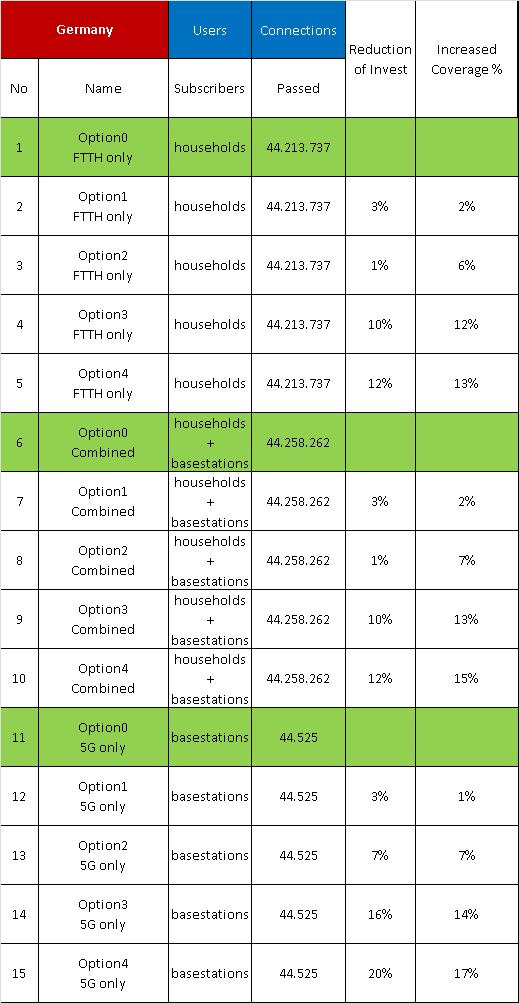
Extrapolation of model results to EU27
The model estimates the impacts on cost and potential increased VHCN deployment of the different policy options for all countries across the EU. Results for each country and each NUTS3 region within each country are available, but are to be characterised as estimates. Germany has been used as a baseline as the consultants had prepared cost models for the German regulatory authority and thus have extremely detailed and granular information about the costs of deployment in different areas and for different types of deployment (e.g. in ducts / aerial) – sufficient to support charge control calculations, and withstand a high degree of scrutiny on that basis.
The results from Germany are not merely assumed to apply to other countries (i.e., there is no simple extrapolation), but rather have been mapped so that the modelling of costs in countries other than Germany reflects the types of areas present in each country (by population density from dense urban to rural), as well as differences in labour cost and WACC, which are the main drivers of deployment cost. In addition, the model also considers the existing FTTH coverage in each NUTS3 area in each country, and calculates the additional cost required to achieve 90% FTTH coverage per country on that basis. The modelling assumes (reflecting the actual decision-drivers of ECN operators) that lowest cost premises will be deployed first leaving the least profitable 10% of households unserved under the baseline. All options include an assessment not only of the cost savings to serve 90% compared with the status quo, but also what percentage of households beyond the 90% could be additionally served by reinvesting those savings in additional VHCN coverage in the least profitable areas.
After the detailed calculations with the WIK NGA model were performed for all of the approx. 8000 access areas of Germany, the results were assigned to 8 regional cluster. Then for each of the 15 calculations estimation formulas were developed, based on household density to create country specific estimations for:
-Investment per household
-Cost per household
-WACC
During the application of the estimation formulas, the country specific labour cost was taken into account.
Regional Clusters
Depending on the household density [HH/km²] each German access area as well as each EU27 NUTS3 region can be assigned to one of the eight Regional Clusters:
Table 19: Regional Clusters

Source: support study
Investment
The estimation formula for Investment is developed for each of the 15 calculations. The formula estimates the investment per household [EUR/HH] per household density [HH/km²].
Cost
The estimation formula for Cost is developed for each of the 15 calculations. The formula estimates the Cost per household per month [EUR/HH] per household density [HH/km²].
WACC
In order to determine the country specific adaption of the WACC all of the 15 calculations have been again calculated with a different WACC within the WIK NGA model. The result is an individual slope of the linear relationship regarding the WACC. With this slope the extrapolated cost per household and month, based on the WACC for Germany, can be adapted to the country specific WACC.
Additional calculations
Additional calculations were performed to estimate the required investments to reach a coverage of 90% for FTTH under the 5 options (Option 0 to 4). Then based on this the saving of each of the Options (Option 1 to 4 compared to Option 0) was either used (re-invested) to build additional FTTH or used to build additional 5G FWA.
Total investments and subsidies to reach 90% FTTH coverage from current coverage
For this calculation, the investments per household, the cost per household and month and the subsidy need per household of the calculations performed for the option 0, called “status quo” (baseline) in the previous step were taken together with the current FTTH coverage of each of the NUTS3 regions to calculate the values for a desired coverage of 90%. As some of the NUTS3 regions already have a current coverage of 90% or even more, the starting point is not exactly 90%, but 90,6%.
For this calculation the number of missing households (from current coverage to coverage of 90%) was added to the number of already covered households and then set in ratio to all households of EU27.
FTTH coverage achievable if the savings are re-invested in more FTTH
For this calculation, the reduced cost linked to applying options 1 to 4 to the missing households was assessed. Then the savings due to the reduced cost by using the options was used to calculate the additional coverage which was possible with the savings. In this case the savings were re-invested in additional FTTH coverage of households.
Table 20: FTTH only

Source: support study
FTTH and 5G FWA coverage if the savings are re-invested in 5G FWA
For this calculation, the reduced cost linked to applying options 1 to 4 to the missing households was assessed. Then the savings due to the reduced cost by using the options was used to calculate the additional coverage which was possible with the savings. In this case the savings were re-invested in additional coverage of households with 5G FWA.
Table 21: FTTH up to 90% coverage and then FWA

Source: support study
Step 4a: Methodology for the estimation of GDP and employment impacts
Impact on GDP
There is widespread literature on the topic of economic impact of improved broadband quality in terms of GDP growth and job creation. Literature suggest that the increased availability of VHCN that could be supported through the revision of the BCRD is likely to create positive spill-over effects as digitisation is used to improve energy efficiency in other highly polluting sectors such as buildings and transport. In addition, a key driver of economic benefits from 5G is expected to come from knock-on effects in other sectors resulting from 5G applications (including IoT), such as in healthcare, manufacturing, transport, energy or agriculture. However, these effects could not be quantitatively assessed.
Drawing on the literature, the support study assessed the economic impact based on a theory-based model estimating how expected increases in fixed and mobile speeds resulting from the different policy options for the revision of the BCRD might impact GDP. The modelling approach draws on the elasticities estimated respectively by the 2SLS model in Bohlin Rohman Kongaut (2017) for FTTH and Edquist et al. (2018) for the impact of 5G. The main results of the contractor’s theory-based modelling exercise are provided in this section.
In order to assess the impacts of the different options on GDP, the effects of each option on the potential increased deployment of FTTH and 5G were assessed, and these were transformed into projections concerning the evolution in the share of different technologies, which were then converted into average broadband speeds.
The theory-based model, used in the support study, was built on literature review to estimate how expected increases in fixed and mobile speeds resulting from the different policy options for the revision of the BCRD might impact GDP. The modelling approach incorporates the estimated elasticities estimated respectively by the 2SLS model in Bohlin Rohman Kongaut (2017) for FTTH and Edquist et al. (2018) for the impact of 5G. TFP and employment enter the production function as input variables rather than outputs.
Edquist et al. (2018) found that a 1% increase in coverage results in 0.02% GDP growth per capita. The authors made use of data for 4G technology from the OECD countries panel. This means that the impact can be described by the following formula:
where is the GDP in year t in natural logarithm, is the speed of broadband in year t in natural logarithm and are a set of determinants of GDP variables such as productivity, employment, etc., in natural logarithms. As the variables in the equation are expressed in natural logarithms, can be understood as an elasticity as below:
Therefore, BB speed contributes to GDP growth. Projected increases in broadband download speeds arising from the different options were then converted to GDP impacts based on the equation above. Calculations were made for each year between 2020-2030 and the results are resented in the main report.
Impact on employment
Various studies have identified links between FTTH or faster broadband and employment.
An OECD report which examined the effect of fibre networks in 290 municipalities in Sweden for the period 2010 – 2012 further found that on average 10% higher FTTP/FTTB penetration is correlated with a 1.1% higher employment rate, when controlling for other significant factors such as urbanisation level, population evolution, income, education level and business creation.
Using a two-way fixed effects regression model on a panel of 3,142 U.S. counties for the period 2001 – 2013, Lapointe (2015)
shows that a 10% increase in the percentage of households with access to fibre (FTTP/B) network is associated with a 0.13% increase in total employment and a 0.1% increase in the number of firms at the county-level.
Canada, Singer et al. (2015)
investigate the effect of FTTP rollout on employment on the basis of the deployment experiences in 39 regions between 2009 and 2014. They estimate that fibre deployment to 100% of a region is associated with an increase in employment of about 2.9% – even if the region already previously benefited from a broadband infrastructure.
Relying on panel data covering more than 36,000 municipalities located in metropolitan France over 6 years, from 2010 to 2015, Hasbi (2017) also observes a positive average effect on unemployment reduction resulting from the deployment of Next Generation Access Networks.
As regards the effects of Gigabit speeds, utilizing a panel of 496 U.S. counties sampled from 2011 to 2014, Bai (2017)
found that increasing broadband speeds from 100 Mbit/s to 1 Gbit/s was more effective in boosting country employment than increasing speeds from 3 Mbit/s to 100 Mbit/s., Similar to the findings that GDP effects may be subject to diminishing marginal returns, Bai found that increasing broadband speeds beyond 1 Gbit/s would have a smaller, although still positive, effect on employment. However, it is also possible that new applications and the increased bandwidth requirements associated with teleworking in the wake of the COVID pandemic, might increase the employment effects and productivity gains
associated with speeds above 1Gbit/s.
A number of studies have been also completed in the last few years that include forecasts of the employment impact of 5G. Tech4i2 (2019) estimates for Switzerland that 5Genabled output will be supporting 137,000 jobs (1.5% of the population) in 2030.
Omdia (2019) forecasts a slightly more conservative net positive impact by 5G on employment of 0.6% of the population across five countries analysed by 2030.
Research has started into the next generation of mobile technology 6G. However, it is not expected that this technology will be deployed until after 2030
beyond the timeframe covered by this study.
Theory-based modelling for the quantitative impacts
Drawing on the literature, a theory-based model to estimate how expected increases in fixed and mobile speeds resulting from the different policy options for the revision of the BCRD might impact GDP was developed as part of the support study. The modelling approach draws on the estimated elasticities estimated respectively by the 2SLS model in Bohlin Rohman Kongaut (2017) for FTTH and Edquist et al. (2018)
for the impact of 5G. TFP and employment enter the production function as input variables rather than outputs.
For the impact of increased fixed broadband speeds on GDP, two scenarios are considered:
•Scenario A: All savings from infrastructure sharing and co-ordination of civil works is reinvested in additional FTTH coverage beyond the base case in which case FTTH coverage is assumed to reach 90% by 2030
•Scenario B: All savings from increased infrastructure sharing are reinvested in deploying 5G FWA in unserved areas (beyond the 90% coverage assumed in the base case scenario) rather than deploying FTTH or maintaining ADSL or FTTC/VDSL in those areas.
Accumulated impact (2021-2030) of FTTH on GDP (EUR billion)
|
Scenario
|
Option 0
|
Option 1
|
Option 2
|
Option 3
|
Option 4
|
|
A
|
2,835
|
2,852
|
2,876
|
2,911
|
2,915
|
|
B
|
2,835
|
2,847
|
2,846
|
2,845
|
2,845
|
Source: support study
Scenario A appears to have a greater GDP impact than scenario B across all policy options, suggesting that the impact of the increases in VHCN coverage that could be achieved by focused on 5G FWA rather than FTTH in rural areas are counteracted by the reduced speeds that would be achieved by serving rural customers with FWA instead of FTTH.
However, policy-makers might consider that equity-gains might exceed economic gains in the second scenario. More generally, there is an ongoing debate in the literature between an equity-efficiency trade-off considering that investing in rural areas would address the digital divide but at the expense of giving up efficiency gains. The theory of efficient markets indicates that resources should be allocated where the return on investment is maximized
. In contrast, investing in rural areas would improve digital equity by reducing such disparities. However, the final results on the GDP of both scenarios are uncertain given the number of factors intervening. For example, a lower digital divide could result in higher convergence of regional GDP where rural areas could catch up with a higher return on investment assuming that the stock of capital accumulation in these areas is lower than more mature urban areas where economic growth rates tend to be smaller
. In other words, while underdeveloped areas receive investment the growth is at a high speed and then as accumulation reaches its maximum rates tend to decrease.
The figure below shows the anticipated impact on GDP growth per capita of FTTH download speed over 10 years (2021-2030) for scenario A, based on the elasticity of GDP growth per capita – estimated at 0.08% GDP increase per each point of broadband speed by Bohlin Rohman Kongaut (2017). Such results are consistent with the literature, highlighting FTTH role in enhancing economic performance.
Scenario A - FTTH download speed impact on GDP growth

Source: support study
The figure below shows the same for scenario B. The expected economic growth is a multiple of the FTTH download projections, that is, an elasticity coefficient multiplies the projected download speed. The GDP growth curve reflects the marginal increase in FTTH deployment (year on year). The series peak in 2025 reflects reduced marginal growth as deployment extends to areas which are more challenging and/or require State Aid. Prior to 2026, all policy options are aligned, as this represents the time period before the revised BCRD comes into effect.
Scenario B - download speed impact on GDP growth
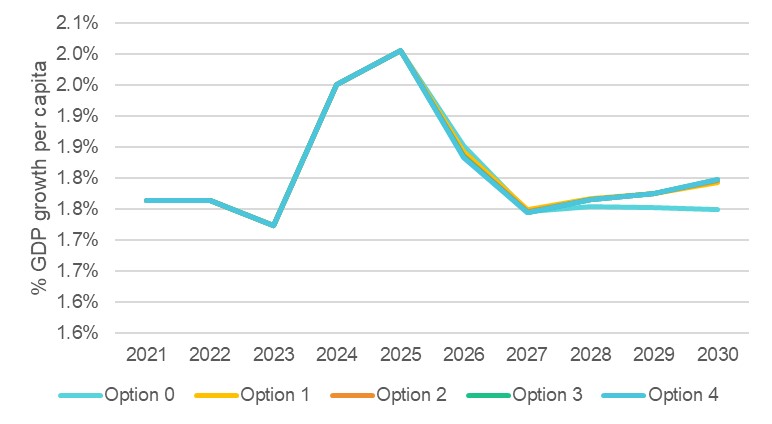
Source: support study
Literature concerning the effects of FTTH deployment on jobs have varied outcomes, which may be associated with differences in the specific communities that they consider. If we take a midpoint between the effects described by Mölleryd, B. (2015),
and Lapointe
(2015),
and assume that a 10% increase in FTTP/B penetration is associated with a 0.5% increase in employment, then the options described could have the following effects on jobs compared with the status quo.
Estimated effects of options on jobs
|
|
Option 1
|
Option 2
|
Option 3
|
Option 4
|
|
% increase compared with base
case
|
0.0008%
|
0.0018%
|
0.0033%
|
0.0034%
|
|
Additional jobs
|
154,000
|
338,000
|
627,000
|
656,000
|
Source: support study
The impact of 5G on GDP
The estimated impact of 5G on GDP is obtained using the GDP-elasticity to mobile coverage broadband estimated by Edquist et al. (2018). The authors found that a 1% increase in coverage results in 0.02% GDP growth per capita. The authors made use of data for 4G technology from the OECD countries panel. Given the limited availability of quantitative studies on 5G related to the novelty of such technology, this study seems the most appropriate at the moment. However, it should be noted that relying on these results, presupposes that the positive GDP effects of speed increases associated with 4G will continue to apply as speeds increase further with increasing take-up of 5G. The annual change decreases in time as the projections assume a positive but decreasing growth rate.
The overall impact for the different options over the reference period is summarized in the table below. The results are consistent with the literature, including IHS Markit (2019)
which estimates an increment of EUR 13.5 trillion for global GDP and the Accenture report
which estimates an impact of EUR 1 trillion over the period 2021-2025 for the EU.
Cumulative 5G impact on GDP 2023-2030 (in EUR billion)
|
Option 0
|
Option 1
|
Option 2
|
Options 3
|
Option 4
|
|
2,060
|
2,064
|
2,075
|
2,089
|
2,089
|
Source: support study
Finally, the table below displays the overall increment to GDP resulting from increased fixed VHCN and 5G deployment compared with the baseline and distinguishing scenarios A and B for fixed network reinvestment.
Incremental impact options on GDP up to 2030 (billion EUR) for 5G and fixed VHCN
|
Scenario
|
Option 1
|
Option 2
|
Option 3
|
Option 4
|
|
5G + fixed VHCN (A)
|
21
|
56
|
105
|
109
|
|
5G + fixed VHCN (B)
|
16
|
26
|
39
|
39
|
Source: support study.
Although difficult to quantify, it is expected that there will be a spillover effect on different sectors of the economy from 5G and IoT. For example, new IoT applications in fields ranging from Connected Automotive Mobility, smart cities to smart factories, smart agriculture and smart grids, can impact productivity in those sectors and bring competitive advantages for business while also creating jobs. Such effects could have a multiplier effect with different rounds of impacts as discussed by the literature
. These possible 5G-specific effects have not been included in the calculations due to the significant uncertainties associated with measuring impacts of technologies that are not yet widely deployed and for which there is thus limited empirical evidence, but could provide an additional upside over the effects outlined in the study.
Step 4b: Methodology for the estimation of environmental impacts
In order to estimate the environmental impact of increased FTTH and full 5G coverage, we first derived estimates for increases in bandwidth consumption associated with the increased deployment and associated take-up of different technologies, as well as deriving (from the WIK NGA model) the total km of deployment conducted in new trenches vs deployment based on re-use of existing infrastructure and co-ordination of civil works. The bandwidth use per technology and degree of infrastructure sharing was then translated into environment impacts based on linkages identified in literature. The details are provided below.
Fixed broadband operation
To investigate the impact of the BCRD on the amount and timing of annual bandwidth consumption across wired access networks, utilize the findings by Oberman (Nachhaltigkeitsvergleich der Zugangsnetz-Technologien FTTC und FTTH, 2020). The electricity consumption across different types of access network technologies was investigated.
The improvement in energy efficiency is not explicitly included as the access network speeds have been assumed to increase. This leads to an electricity efficiency improvement of approximately 23% per year.
Based on the numbers (see [WIK IA Study]) we identify an electricity intensity of 0.26 kWh per GB in 2020 falling to 0.02 kWh/GB in 2030. This is not far from the figures used by Andrae & Edler (On Global Electricity Usage of Communication Technology: Trends to 2030, 2015) of 0.11-0.28 kWh/GB in 2020 and 0.061–0.17 kWh/GB in 2030. It is also well within the range identified by Coroama et al. (The energy intensity of the internet: home and access networks, 2015) 0.006-136 kWh/GB noting that these values represent different scopes and boundaries.
Estimating the emissions from the access network technologies, we account for the shift in electricity generation in the EU from fossil fuels to renewables. This has been done based on calculations made by Buck, et al., (European Energy Transition 2030: The Big Picture, 2019) showing decrease from 0.362 kg CO2e per kWh in 2015 to 0.159 kg CO2e per kWh. We assume a linear path from between the two years.
Fixed broadband deployment
In assessing the environmental impact of the BCRD across the different options, we have assessed the emissions associated with different types of fixed broadband deployment. Specifically, we assess conventional deployment, use of existing ducts and poles, and civil works coordination.
Solivan (Life Cycle Assessment on fiber cable construction methods, 2015) assessed the environmental impact associated with different deployment techniques. The share of trenching in greenfield is approximately 10-40%, hence we assume an average of 25%. With the remaining 75% being done in conventional excavation in asphalt.
In the case of use of existing ducts, Ecobilan (Developing a generic approach for FTTH solutions using LCA methodology, 2008) calculated the environmental impact associated with this. We use their results to estimate the emissions for use of existing ducts and for deployment on new poles. No explicit data is available for use of existing poles, so we assume a similar emissions profile to ducts can be achieved.
The emissions figures used are summarized in Table 22.
Table 22: Emissions from deployment of fixed broadband
|
kg CO2e
|
New ducts
(25% greenfield)
|
Existing ducts & poles
|
Civil works coordination
|
New poles
|
|
Per 1km
|
5358
|
197
|
3555
|
3029
|
Source: support study
Mobile broadband operation
To investigate the impact of the BCRD on the amount and timing of annual bandwidth consumption across networks, we build upon the model developed by (Andrae & Edler, 2015). Here the electricity consumption for 4G (LTE) is found to be 0.6 kWh per GB in 2010 (Malmodin, Lundén, Moberg, Andersson, & Nilsson, 2014). As a best estimate the energy efficiency is assumed to improve by 22% annually until 2020 and 5% until 2030.
For 5G we refine the model to differentiate between basic 5G and full 5G. Laidler (Curtailing carbon emissions - can 5G help?, 2019) estimates that a 5G cell has 8-15% the electricity intensity compared to a like-for-like 4G cell. mmWave 5G has potential to fall to 1-2% of a 4G cell, we therefore estimate that midband (3.6 GHz) may be able to obtain electricity intensity of 6.5% of 4G using the midpoints. We therefore estimate the energy intensity of 5G to be:
Basic 5G: 0.069 kWh per GB
Full 5G: 0.025 kWh per GB
We also account for the shift in electricity generation in the EU from fossil fuels to renewables. This has been done based on calculations made by Buck, et al., (European Energy Transition 2030: The Big Picture, 2019) showing decrease from 0.362 kg CO2e per kWh in 2015 to 0.159 kg CO2e per kWh. We assume a linear path from between the two years.
Annex 6: Environmental impact (details)
This annex provide additional details, from the support study on the environmental impact of the policy options described in section 6.
Fixed broadband operation
The results of the analysis in the support study show a significant reduction in electricity intensity for data traffic, kWh per GB. Across all the policy options it shows an average of 89% reduction from 2020 to 2030, with an electricity intensity that is 7% lower in policy option 3 compared to the Status Quo scenario.
The electricity intensity is estimated to be 0.22 kWh per GB in 2020 falling to 0.02 kWh/GB in 2030. This is not far from the figures used by Andrae & Edlerof 0.110.28 kWh/GB in 2020 and 0.061–0.17 kWh/GB in 2030. It is also well within the range identified by Coroama‑ et al. 0.006-136 kWh/GB, noting that these values represent different scopes and boundaries.
The main driver of reduction in emissions from the Status Quo to Options 1-4 is the shift in subscribers from the less energy efficient ADSL, FTTC/VDSL and cable towards the more energy-efficient FTTH. Therefore options involving higher increases in FTTH result in lower overall emissions. The figure below maps the change in emissions across the policy options for the period of 2020-2030. As is clear from the graph the emissions are expected to be significantly less in 2030 compared to 2020. This is partly driven by the reduction in electricity consumption for the data traffic and partly by reduction in the emissions intensity of the electricity generation.
Figure 5: Fixed broadband network emissions 2020-2030
_______________________________________________________________________________________

_______________________________________________________________________________________
Source: support study
Fixed broadband deployment
Sharing infrastructure provides an opportunity not only to reduce costs but also to avoid a large amount of the environmental impact that otherwise would have been associated with creation and deployment of new infrastructure.
This is for example confirmed by Ecobilan where blowing fibre between existing manholes has significantly lower impact compared to alternative deployments such as traditional civil works. This is mainly because restoring the affected surfaces is the largest driver of impact in deployment. Therefore, where excavation of existing pavement can be avoided environmental impact is lowest.
Where sharing of existing infrastructure is not feasible, the choice of deployment technique can support in limiting environmental impacts of electronic networks. Based on Praticò et al. road pavement has a carbon footprint of between 75 and 81.8 kg CO2e per m2. Micro trenching with a typical width of less than 25 mm can therefore reduce the emissions from asphalt by up to 95% compared to conventional trenching with a width of 0.75 m, equivalent to over 50 tonnes CO2e per km deployed. Where micro trenching may not be feasible, Narrow Trenching can still potentially achieve lower environmental impacts compared to the conventional excavation. Further reductions can be achieved if asphalt excavation can be avoided entirely such as through ploughing in a greenfield deployment.
The figure below illustrates the contribution of different deployment methods to the overall emissions. It is clear that conventional excavation accounts for the majority of emissions across all policy options (>90%). This is due to most new deployment happening in new ducts as well as conventional deployment having significantly higher (>30x) emissions per km. These are realistic assumptions for a new entrant deploying FTTH. However, there are scenarios under which emissions from deployment might be lower than shown. For example, infrastructure re-use could be higher if entrant operators are able to make significant use of SMP PIA in addition to PIA provided under the BCRD, or if a significant proportion of the new deployment is conducted by incumbent operators making use of their existing infrastructure. It should also be noted that it was assumed new ducts are excavated 75% in asphalt. If deployment is done in larger proportion in greenfield, the emissions would be lower.
Figure 6: Fixed broadband deployment emissions 2023-2030
Source: support study
Mobile / wireless broadband operation
The research in the support study suggest that the technological development across the mobile network generations show clear improvements in energy intensity for the data transferred. On an absolute level, however, this is counteracted by increases in traffic on the networks. The growth in data traffic and which networks handles this traffic has a large influence on the energy consumption. However it is clear that introducing newer mobile network technologies and phasing out legacy systems appear to be an effective way to reduce energy consumption per unit of data and as a result environmental impact.
The support study has assessed total energy consumption of the access network based on number of total subscribers and data consumption over time across the different policy options.
Similar to the fixed broadband network, results show a significant reduction in electricity intensity for data traffic, kWh per GB. Across all the policy options it shows an average of over 93% reduction from 2020 to 2030. With an electricity intensity that is 2% lower in policy option 4 compared to the Status Quo scenario. This is reduction is due to assumed efficiency improvement as well as the shift of data traffic from LTE to 5G.
The figure below maps the change in data consumption across the options (driven by the installation of more performant 5G technology) along with the associated change in emissions across the policy options for the period of 2023-2030. As is clear from the graph the emissions are expected to be significantly less in 2030 compared to 2023 even in the status quo. This is partly driven by the reduction in electricity consumption for the data traffic and partly by reduction in the emissions intensity of the electricity generation.
Figure 7: Mobile / wireless broadband network emissions 2023 – 2030
Source: support study
Mobile / wireless broadband deployment
Deployment of mobile networks will likely to contribute to GHG emissions and potentially other environmental impacts. However, the support study were not able to quantify the deployment-related impacts of the different options for mobile networks for a number of reasons. Firstly, it could be expected that certain options (in particular options 2-4) could accelerate mobile deployment, but in doing so would affect the timing of deployment compared with the status quo, rather than the extent of deployment. Thus, these options may only lead to a temporal shift in emissions. Secondly, literature on the environmental impact of 5G deployment is limited as this is still a developing field of research. Lastly, the majority of the impact of 5G deployments is expected to relate not to the towers, but to the deployment of backhaul. However, this is already captured within the assessment of the impact of fixed network deployment, and thus there would be a risk of double counting, if a separate mobile-specific analysis is performed.
Knock-on effects in other sectors
The knock-on effects that could arise from improved energy efficiency due to the accelerated deployment of 5G were not quantitatively assessed in the support study. However literature suggest that in addition to supporting the reduction of GHG emissions associated with ECN network deployment and operation, the increased availability of VHCN that could be supported through the revision of the BCRD is likely to create positive spill-over effects as digitisation is used to improve energy efficiency in other highly polluting sectors such as buildings and transport.
For example, a 2015 GeSi report on the carbon impact of mobile communications
argues that applications based on mobile communications can support a reduction in emissions which is approximately five times greater than the carbon emissions from mobile networks themselves. Specifically, the authors claim that mobile communications have enabled a reduction of 180 million tonnes of CO2e a year across the USA and Europe. They claim that 70% of these reductions have been driven by the use of machine-to-machine technologies in buildings, transport and the energy sector, where devices are able to communicate automatically with each other without requiring human intervention. In addition, the authors note that the use of smartphones has enabled behavioural changes in lifestyle and working, which contribute towards a further 20% decrease in emissions.
A similar finding is reported in a 2017 report by the IEA,
which examines the impact of digitalization on energy demand in transport, buildings and industry. The report also illustrates how digitalization has increased productivity in oil, gas, coal, and power supply. Bieser & Hilty found 54 studies assessing indirect environmental effects of ICT. Most commonly the studies investigated “virtual mobility (e.g., telecommuting), virtual goods (e.g., digital media), and smart transport (e.g., route optimization)”.
Annex 7: Potential key performance indicators (KPIs) for the monitoring system
Table 23: Potential indicators
|
|
Objective
|
Indicator
|
Definition
|
Type of indicator
|
Unit of measurement
|
Data source
|
Frequency of measurement
|
Baseline
|
Target 2030
|
|
Specific objectives
|
Reduced costs for fixed and mobile VHCN deployment
|
% cost reduction in VHCN deployment due to BCRD (separate fixed, mobile / wireless)
|
Perception of ECN operators concerning the cost reduction in VHCN deployment linked to the BCRD compared with the status quo
|
Qualitative
|
%
|
ECN operator survey (potentially complemented by results of theoretical model)
|
Every 3 years
|
Not available
|
10%
|
|
|
Streamlined administrative procedures for network deployment
|
% administrative cost reductions linked to VHCN deployment due to BCRD
|
% reductions in FTE linked to administrative improvements in permit granting / access / transparency
|
Qualitative
|
%
|
ECN operator survey
|
Every 3 years
|
Not available
|
20%
|
|
Operational objectives
|
Increased re-use of existing physical infrastructure
|
% network based on physical infrastructure re-use (separate ducts, poles)
|
% new underground and aerial network infrastructure (cables) deployed through re-use of existing physical infrastructure (excluding re-use based on SMP regulation)
|
Quantitative
|
km, %
|
MS questionnaire, ECN survey
|
Annual
|
Not available for most MS
|
28%
|
|
|
|
Satisfaction with access to physical infrastructure for fixed deployment
|
ECN operator satisfaction with potential for access to physical infrastructure for fixed deployment (including backhaul) under new instrument
|
Qualitative
|
Ranking (-2 to +2)
|
ECN operator survey
|
Every 3 years
|
See evaluation report
|
1
|
|
|
|
% new wireless sites based on access to public non-network infrastructure (separate macrocells, small cells - to be defined)
|
Proportion of sites newly deployed by ECN operators which make use of access to public non-network infrastructure
|
Quantitative
|
no. %
|
ECN operator survey
|
Annual
|
Not available
|
50% (for small cells)
|
|
|
|
Satisfaction with access to physical infrastructure for mobile network deployment
|
ECN operator satisfaction with potential for access to physical infrastructure for mobile deployment (active equipment) under new instrument
|
Qualitative
|
Ranking (-2 to +2)
|
ECN operator survey
|
Every 3 years
|
Not available
|
1
|
|
|
Increased civil works co-ordination
|
% new network physical infrastructure deployed through civil works co-ordination
|
Proportion of physical infrastructure deployed in co-ordination with other ECN or other network operators
|
Quantitative
|
km, %
|
MS questionnaire, ECN survey
|
Annual
|
Not available for most MS
|
5%
|
|
|
|
Satisfaction with civil works co-ordination
|
ECN operator satisfaction with potential for civil works co-ordination under new instrument
|
Qualitative
|
Ranking (-2 to +2)
|
ECN operator survey
|
Every 3 years
|
See evaluation report
|
1
|
|
|
Increased availability and quality of information concerning existing infrastructure and planned civil works via the SIP
|
No. requests to the SIP for information about existing physical infrastructure (separate network physical infrastructure and non-network physical infrastructure)
|
Record of the requests made for information about existing physical infrastructure on the SIP, as a measure of the quality / popularity / relevance of the SIP
|
Quantitative
|
No.
|
MS questionnaire
|
Annual
|
See evaluation report
|
nr
|
|
|
|
No. facilities relating to non-network public infrastructure reported on the SIP
|
Record of the amount of information gathered concerning non-network infrastructure, such as street furniture, rooftops, etc.
|
Quantitative
|
No.
|
MS questionnaire
|
Annual (3 yearly data gathering)
|
Not available
|
nr
|
|
|
|
No. notifications concerning planned civil works
|
Record of the number of pro-active notifications concerning planned civil works
|
Quantitative
|
No.
|
MS questionnaire
|
Annual (3 yearly data gathering)
|
Not available
|
nr
|
|
|
|
Satisfaction with transparency (separate network physical infrastructure, non-network physical infrastructure, planned civil works)
|
ECN operator satisfaction with availability of information on physical infrastructure and planned civil works under new instrument
|
Qualitative
|
Ranking (-2 to +2)
|
ECN operator survey
|
Every 3 years
|
See evaluation report
|
1
|
|
|
Streamlined permit granting
|
% VHCN deployments not requiring a permit (separate mobile infrastructure, km fixed infrastructure / backhaul)
|
Assessment of scope of VHCN deployments which fall within permit exemptions
|
Qualitative
|
No. %
|
ECN operator survey
|
Every 3 years
|
Not available
|
25%
|
|
|
|
Ave. and max. timeframe to receive all relevant permits (separate fixed and mobile deployments)
|
Assessment of absolute timeframes for permit delivery from the experience of ECN operators
|
Quantitative
|
Months
|
ECN operator survey
|
3 yearly
|
See evaluation report
|
Ave. below 4 months for fixed / mobile and in all MS. Maximum not above 6 months
|
|
|
|
% permits (incl RoW) delivered within 4 and 6 months (by tacit approval or otherwise)
|
Compliance with 4 month deadline as reported by MS
|
Quantitative
|
%
|
MS questionnaire
|
Annual (3 yearly data gathering)
|
Not available
|
90% permits delivered within 4 months
|
|
|
|
Satisfaction with permit granting (i) timeframes; (ii) procedures; and (iii) fees
|
ECN operator satisfaction with permit granting
|
Qualitative
|
Ranking (-2 to +2)
|
ECN operator survey
|
3 yearly
|
See evaluation report
|
1
|
|
|
All new and majorly renovated buildings to be equipped with in-building FTTH and wiring
|
% buildings FTTH-ready (including wiring)
|
% new and majorly renovated buildings equipped with fibre-ready infrastructure and wiring
|
Quantitative
|
%
|
MS questionnaire, ECN survey
|
Annual (3 yearly data gathering)
|
Not available
|
95% of new and majorly renovated buildings certified as FTTH-ready
|
|
|
|
Satisfaction with (i) availability of in-building infrastructure and wiring; and (ii) access to in-building infrastructure and wiring
|
ECN operator satisfaction with in-building infrastructure
|
Qualitative
|
Ranking (-2 to +2)
|
ECN operator survey
|
3 yearly
|
See evaluation report
|
1
|
Source: support study
Annex 8: Evaluation report SWD
See separate document.
EUROPEAN COMMISSION
Brussels, 23.2.2023
SWD(2023) 46 final
COMMISSION STAFF WORKING DOCUMENT
IMPACT ASSESSMENT REPORT
Accompanying the document
Proposal for a Regulation
of the European Parliament and of the Council on measures to reduce the cost of deploying gigabit electronic communications networks and repealing Directive 2014/61/EU (Gigabit Infrastructure Act)
{COM(2023) 94 final} - {SEC(2023) 96 final} - {SWD(2023) 47 final}
TABLE OF CONTENTS
1.1
INTRODUCTION
1.2
Purpose of the evaluation
1.3
Scope of the evaluation
2
BACKGROUND TO THE INTERVENTION
2.1
Description of the intervention and its objectives
2.2
Background of the intervention, baseline and points of comparison
3
IMPLEMENTATION / STATE OF PLAY
3.1
Transposition
3.2
Implementation
3.2.1
Access to existing physical infrastructure (Article 3)
3.2.2
Coordination of civil works (Article 5)
3.2.3
Transparency concerning physical infrastructure (Article 4) and planned civil works (Article 6)
3.2.4
Permit granting procedures (Article 7)
3.2.5
In-building physical infrastructure (Article 8) and access to it (Article 9)
3.2.6
Competent bodies and other horizontal provisions (Article 10)
3.3
Evolution of the Sector
4
ANALYSIS AND ANSWERS TO THE EVALUATION QUESTIONS
4.1
Effectiveness
4.1.1
Effectiveness as regards the operational objectives
4.1.1.1
Increasing the use of existing physical infrastructure suitable for high speed broadband rollout (OP1)
4.1.1.2
Increasing cooperation in civil engineering projects relevant for broadband rollout through the EU (OP2)
4.1.1.3
Streamlining the administrative procedures related to network rollout throughout the EU (OP3)
4.1.1.4
Increasing the provision of buildings with high-speed ready infrastructure throughout the EU and access to it (OP4)
4.1.2
Effectiveness as regards the general and specific objectives
4.2
Efficiency
4.2.1
Efficiency in regard to the operational objectives
4.2.1.1
Increasing the use of existing physical infrastructure suitable for high speed broadband (part of OP1)
4.2.1.2
Increasing cooperation in civil works relevant for broadband rollout through the EU (OP2)
4.2.1.3
Streamlining the administrative procedures related to network rollout throughout the EU (OP3)
4.2.1.4
Increasing the provision of buildings with high-speed ready infrastructure throughout the EU and access to it (OP4)
4.2.2
Efficiency in regard to the general and specific objectives
4.3
Relevance
4.3.1
Relevance of the general and specific objectives
4.3.2
Relevance of the operational objectives
4.3.2.1
Increasing the use of existing physical infrastructure suitable for broadband rollout (OP1)
4.3.2.2
Increasing cooperation in civil projects relevant for broadband rollout through the EU (OP2)
4.3.2.3
Streamlining the administrative procedures related to network rollout throughout the EU (OP3)
4.3.2.4
Increasing the provision of buildings with high-speed ready infrastructure throughout the EU and access to it (OP4)
4.3.3
Continued relevance of the current objectives against new needs
4.4
Coherence
4.4.1
Coherence with other EU policies
4.4.2
Internal coherence
4.5
EU-added value
5
CONCLUSIONS
5.1
Summary of the evaluation
5.1.1
Effectiveness
5.1.2
Efficiency
5.1.3
Relevance
5.1.4
Coherence
5.1.5
EU added value
5.2
Lessons learnt
5.3
Next steps
ANNEX I. PROCEDURAL INFORMATION
ANNEX II: METHODOLOGY
Evidence gathering
Deviations from the Roadmap
Collation/Triangulation of evidence
Limitations
ANNEX III: METHODS USED IN PREPARING THE EVALUATION
ANNEX IV: SUMMARY OF COST/BENEFITS
REGULATORY COSTS
REGULATORY BENEFITS
LIST OF FIGURES
Figure 1: Schematic illustration of current Directive provisions
Figure 2: Intervention logic and evaluation criteria
Figure 3: DESI Connectivity indicator, by sub-dimensions
Figure 4: 2021 DESI connectivity dimension across the EU (Source: DESI 2021, European Commission)
Figure 5: Fixed very high capacity network (VHCN) coverage at EU level (% of households), 2013-2020. (Source: IHS Markit, Omdia and Point Topic, Broadband coverage in Europe studies.)
Figure 6: ECN operator views on the practical outputs of the Directive between 2017 and 2021 (Source: Responses to online survey carried-out under the ICF, WIK & EcoAct study)
Figure 7: Estimates of km access to ducts and poles provided under the Directive or pre-existing legislation 2015-2020 (source the ICF, WIK & EcoAct study)
Figure 8: Average and maximum time to obtain permits for civil works (months) – operator perspective; (Source: WIK ICF questionnaire ECN operators Q1 2021)
Figure 9: The perception of respondents to the public consultation as regards the efficiency of the Directive (source: EC public consultation)
Figure 10: Next generation access (NGA) broadband coverage in the EU (% of households), 2020, total versus rural
Figure 11: Incumbent operator market share by technology in the EU (% of subscriptions), July 2020 (source: DESI 2021 telecom chapter)
Figure 12: To what extent is it relevant for the deployment of ECNs to coordinate civil works with the following types of networks? (scale from -2 not relevant at all to 2 very relevant) (Source: The ICF, WIK & EcoAct study & responses to the public consultation)
Figure 13: SWOT analysis for the Directive
Figure 14: Stakeholders consultation matrix
LIST OF TABLES
Table 1: Estimated costs to network operators associated with access to physical infrastructure, information systems and planning applications
Table 2: Estimated administrative costs to network operators associated with the Directive
GLOSSARY
|
Term or acronym
|
Meaning or definition
|
|
5G
|
Next generation (5th) of wireless/mobile technologies
|
|
B2B
|
Business to business
|
|
BCO
|
Broadband Competence Offices
|
|
BCRD
|
Broadband Cost Reduction Directive
|
|
BEREC
|
Body of European Regulators for Electronic Communications
|
|
COCOM
|
Communications Committee
|
|
DESI
|
Digital Economy and Society Index
|
|
DSB
|
Dispute Settlement Body
|
|
ECN
|
Electronic Communications Networks
|
|
EECC
|
European Electronic Communications Code
|
|
EMF
|
Electromagnetic Field
|
|
ERDF
|
European Regional and Development Fund
|
|
FTE
|
Full-Time Equivalent
|
|
FTT C/H/B
|
Fibre To the Cabinet/Home/Building
|
|
FWA
|
Fixed Wireless Access
|
|
LTE
|
Long-Term Evolution
|
|
NGA
|
Next Generation Access
|
|
NRA
|
(Telecommunications) National Regulatory Authorities
|
|
P2P
|
Point to Point
|
|
REFIT
|
Regulatory Fitness and Performance Programme
|
|
RoW
|
Rights of Way
|
|
SAWAP
|
Small area wireless access points
|
|
SMP
|
Significant Market Power
|
|
RRF
|
Recovery and Resilience Facility
|
|
VDSL
|
Very high-speed digital subscriber line
|
|
VHCN
|
Very High Capacity Networks
|
1.1INTRODUCTION
1.2Purpose of the evaluation
The review of the Broadband Cost Reduction Directive (BCRD or the Directive) is one of the actions announced in the Commission’s Communication ‘Shaping Europe’s Digital Future’ as part of the initiatives which would contribute to achieving the aim that “technology works for people”.
It aims to assess the appropriateness of the current rules and whether they have contributed to the objective of lowering the cost of deployment of (fixed and mobile) high-speed electronic communications networks (“ECN”).
Different to other legislative tools that are part of the regulatory framework for electronic communications, the Directive imposes obligations on undertakings present in other network industries (namely gas, electricity, heating, sewage, water and transport) owning physical infrastructure suitable to host ECN elements as well as on electronic communication providers irrespectively of whether they hold significant market power (“SMP”).
This evaluation constitutes the basis for the impact assessment of a potential revised legislative instrument, in a back-to-back process. The revised instrument should address the identified shortcomings and match the objectives of 2018 European Electronic Communications Code (the Code or EECC), which improve regulatory conditions, incentivise private investments and promote connectivity and access to, and take-up of, very high capacity networks (VHCN) by all EU citizens and businesses, as well as the new ambition set out in the Digital Compass Communication and the 2030 Policy Programme “Path to the Digital Decade”, which provide that by 2030 all European households should be covered by a Gigabit network and all populated areas covered by 5G networks.
1.3Scope of the evaluation
The evaluation concerns a single legislative instrument: the Broadband Cost Reduction Directive and covers all Member States during the period from the start of the application period (1 July 2016 for most provisions) until approximately mid-2021.
This report relies on an independent support study carried out by a consortium of external contractors and on the feedback received through the consultations on the roadmap/inception impact assessment (June 2020) and on the Directive review (December 2020- March 2021), Commission workshops (January and February 2021) and the opinion of the Body of European Regulators for electronic communications (BEREC) of March 2021.
The Directive does not contain a legal obligation to review the functioning of this piece of legislation but it requires that the Commission reports on its implementation to the European Parliament and the Council by 1 July 2018. The 2018 Commission’s report on the implementation of the Directive concluded that the Directive was transposed with significant delays in most Member States. The report also revealed an inconsistent implementation across the EU and persisting inefficiencies, which hinder the potential impact of cost reduction measures to foster a more efficient and faster deployment of electronic communications networks across the EU, and which would call for a review. The report also presented a number of recommendations in order to maximise its effective implementation.
Moreover, the existing instrument requires a review in light of the technological, market and regulatory developments since its adoption in 2014, notably the recent paradigm shift in terms of connectivity needs revealed by the COVID pandemic and reflected in the 2030 Digital Decade targets set out in the Digital Decade Compass Communication and the 2030 Policy Programme “Path to the Digital Decade”, all of which calls for fostering a more efficient and faster deployment of Gigabit networks.
2BACKGROUND TO THE INTERVENTION
2.1Description of the intervention and its objectives
The Directive was adopted on 15 May 2014 in the context of the targets set in the 2010 Digital Agenda for Europe. The objective of the Directive is to facilitate and incentivise the roll-out of high-speed electronic communications networks (general objective - GO) by promoting the joint use of existing physical infrastructure (specific objective - SO1) and lowering the costs of deployment (specific objective – SO2)
The key challenges the Directive seeks to address are related to:
1)inefficiencies (e.g. high sunk costs generated by civil engineering works – e.g. for digging, ducting etc.) or bottlenecks (e.g. lack of information on and access to existing) concerning the use of existing physical infrastructure (such as, for example, ducts, conduits, manholes, cabinets, poles, masts, antennae, towers and other supporting constructions);
2)bottlenecks related to co-deployment (lack of information on and access to planned civil works);
3)inefficiencies regarding administrative permit granting (diversity and complexity of permit granting procedures) and
4)bottlenecks concerning in-building deployment.
These bottlenecks and inefficiencies led to high costs and heavy administrative burdens for undertakings wishing to deploy networks.
Therefore the operational objectives (OP) of the Directive were as follows:
1)increasing the use of existing passive infrastructure suitable for broadband rollout (OP1), by achieving more transparency concerning this infrastructure, as well as a more consistent and effective regulatory regime concerning access to it, regardless of the owner;
2)increasing cooperation in civil works relevant for broadband rollout through the EU (OP2), in particular by ensuring transparency and by increasing legal certainty for cross-sector / cross-utility cooperation;
3)streamlining the administrative procedures related to network rollout throughout the EU (OP3), mainly by increasing the transparency and coordination of the permit granting processes, while ensuring the enforcement of deadlines and
4)increasing the provision of buildings with high-speed ready infrastructure throughout the EU and access to it (OP4), so as to reduce the costs and burdens associated with retro-fitting.
Pursuant to its legal base, Article 114 TFEU, the Directive intends to improve the functioning of the internal market by increasing the availability of physical infrastructure intended to host elements of ECN and its efficient deployment across the EU.
The Directive provides for minimum harmonization (establishing certain minimum obligations complemented with a number of voluntary ones), allowing Member States some flexibility to reflect national circumstances.
The Directive set up a set of minimum harmonised measures comprising four main pillars (Figure 1): (i) access to existing physical infrastructure, (ii) coordination of planned civil works, (iii) permit granting procedures and (iv) requirements for in-building physical infrastructure for new buildings and major renovations. It also included provisions to ensure transparency of relevant information through Single Information Points (SIPs) and dispute resolution mechanisms in case agreements between parties could not be reached as well as laying down penalties for non-compliance.

Figure 1: Schematic illustration of current Directive provisions
2.2Background of the intervention, baseline and points of comparison
Before the Directive entered into force, the operation and provision of ECNs and services in the EU were still highly fragmented along national borders. Such fragmentation represented a challenge for development and growth of European companies - telecom companies, equipment manufacturers, etc. - and an obstacle for operators wanting to reach economies of scale at European level in the face of increasingly global competition.
Prior to the Directive, various Member States had already measures at national or local level aiming to facilitate cross sector network deployment
, the access to the existing physical infrastructure, coordination of civil works or permit granting procedures, in-building infrastructure
or implemented local or central physical infrastructure atlas or infrastructure register. Some of these measures were broader (e.g. more information on existing physical infrastructure) or stricter (e.g. shorter deadlines) than the measures provided by the Directive. However those practices were scarce and dispersed.
Differences in regulatory requirements sometimes prevented cooperation across utilities and raised barriers to entry for new network operators and new business opportunities, hindering the development of a single market for use and deployment of physical infrastructures for high-speed electronic communications networks. ECN operators had reported various difficulties, including: administrative burdens linked to long-lasting and diverse permit granting procedures, high fees for permits and access to physical infrastructure, lack of relevant and adequate information on existing physical infrastructure and planned civil works, lack of electronic procedures for permit granting, difficulties in accessing building infrastructure and legal uncertainty due to lack of clear pricing and cost sharing rules. This resulted overall in a slower, more costly and less efficient deployment of ECNs. The Directive aimed to address these challenges.
The timely deployment of fibre and 5G networks is crucial for European competitiveness and a major enabler for future digital services. Substantial investments at EU, national, regional and local levels are necessary to achieve the ambitious 2030 connectivity targets which would benefit all EU citizens and businesses, a significant portion of which is represented by the cost of civil engineering works. Adding to the current national and EU funding resources, including through the Recovery and Resilience Facility (RRF), it is crucial to ensure a reduction of the cost of new network deployments.
In September 2020, the Commission adopted the Connectivity Toolbox
Recommendation
calling on Member States to boost investment in very high-capacity broadband connectivity infrastructure to address the increased connectivity needs which were evidenced by the COVID 19 pandemic. The aim of the Recommendation was for Member States to develop a Toolbox of best practices for reducing the cost of deploying ECN and for a more efficient access to 5G radio spectrum, therefore partly building on the implementation of some of the Directive provisions. In March 2021,
Member States agreed on a Union Toolbox
of 39 best practices (22 of them closely linked to the Directive provisions). Shortly after, all Member States provided the Commission with their national
roadmaps for the implementation of the Connectivity Toolbox
. In April-June 2022 Member States reported on their implementation.
Figure 2 provides a schematic overview of the intervention logic and evaluation criteria, including the needs, problems and issues preceding the Directive, its objectives, the desired outputs and results and impacts. This schematic overview will be used for the evaluation of the Directive in the following sections.
Figure 2: Intervention logic and evaluation criteria
3IMPLEMENTATION / STATE OF PLAY
3.1Transposition
The Directive had to be transposed by Member States by 1 January 2016, to become applicable in all Member States from 1 July 2016.
All Member States except Italy were late with the transposition, prompting the Commission to send letters of formal notice for non-communication in March 2016. The Commission subsequently sent reasoned opinions to 19 Member States in September 2016. In July 2017, the Commission referred two Member States (Belgium and Slovakia) to the European Court of Justice (CJEU) for non-communication of measures transposing the Directive and called on the CJEU to impose daily penalty payments on them from the day of the judgement until national law transposing the Directive was in force. In January 2018, the Commission decided to refer three other Member States (Bulgaria, Slovakia and The Netherlands) to the CJEU and asked for financial penalties to be imposed pursuant to Article 260(3) of the Treaty on the Functioning of the European Union (TFEU). However, following notifications on full transposition by those Member States, the Commission closed the case for Slovakia in January 2018, for Bulgaria in May 2018 and for the Netherlands in July 2018. In July 2020, the CJEU declared that the Kingdom of Belgium had failed to fulfil its obligations under Article 13 of the BCRD and ordered the Kingdom of Belgium to pay daily penalties for this failure until it had complied with its obligations. The Kingdom of Belgium complied with the order of the CJEU in 2020.
On 7 April 2017, the Commission received one complaint related to transposition of the Directive in Bulgaria that was closed on 28 April 2017 as Bulgaria brought an end to the infringement of EU law by adopting various legislative changes.
3.2Implementation
All Member States made good progress as regards the implementation of the Directive. Some Member States have also implemented the voluntary provisions of the Directive or have adopted national measures going beyond its provisions, as presented below.
No infringement procedure has been launched for incorrect implementation of the Directive. Judicial proceedings based on a request for a preliminary ruling concerning the interpretation of Article 8(3) of Directive 2002/19/EC on access to, and the interconnection of, electronic communications networks and associated facilities (Access Directive) and Article 1 (subject matter and scope), Article 3 (access to existing physical infrastructure) and Article 4 (transparency concerning physical infrastructure) of the Directive are pending. The Commission continues to monitor compliance of national measures with the Directive.
3.2.1Access to existing physical infrastructure (Article 3)
Article 3 of the Directive requires Member States to ensure that network operators meet reasonable requests for access to their physical infrastructure (such as ducts, poles and masts) for the deployment of high-speed electronic communications networks under fair and reasonable terms and conditions, including price. Access may only be refused under certain conditions, one of which involves the provision of alternative wholesale electronic communications services on fair and reasonable terms. If agreement cannot be reached, disputes may be referred to a dispute settlement body (DSB).
In principle, all Member States have implemented this article, but only a few have also provided for the right of public ECN operators to offer access to their physical infrastructure for the purpose of deploying networks other than ECNs. Some of the most extensive applications of the provisions on access to physical infrastructure can be seen in Poland, Germany, Hungary, Romania, Denmark (especially in relation to wireless infrastructure, e.g. access to masts) and Portugal. Although it is often used for the deployment of FTTH and fibre backhaul (e.g. Italy), in some countries (e.g. Austria, Hungary, Lithuania, Portugal and to a lesser extent Spain), the Directive-based access has been used to access support structures for the deployment of wireless infrastructure such as base stations, and this is considered an important use case for the Directive-based access by many ECN operators. The DESI telecom reports also report increasing use of infrastructure sharing for wireless network.
Some of the Member States also went beyond the scope of access provisions of the Directive and adopted measures on pricing methodology (in legislation or guidelines), reference offer, access to assets owned by non-network operators (e.g. municipalities) or access to non-network elements (e.g. public buildings, street furniture). It is worth noting that some Member States distinguish between pricing for physical infrastructure owned by ECN operators and owned by operators of other networks than ECNs. Some Member States have also clarified the interpretation of provisions on access to physical infrastructure such as those regarding the “fair and reasonable” pricing principle through dispute settlements.
3.2.2Coordination of civil works (Article 5)
Article 5 of the Directive requires Member States to ensure that network operators performing, directly or indirectly, civil works financed by public means meet reasonable requests to coordinate civil works for the purpose of deploying high-speed electronic communications networks. To this end, Article 5 confers on any network operator the right to negotiate agreements on the coordination of civil works with undertakings providing or authorised to provide ECNs.
All Member States have implemented this article, but only a few established rules for cost sharing principles or procedures for civil works coordination. About half of Member States have extended obligations to meet requests for co-ordination of civil works to privately financed network operators (in such cases the exemptions are also applied to both publicly and privately financed civil works), while about two thirds of Member States provide for exemptions from the obligation to meet requests for coordination of civil works based on insignificance importance, critical national infrastructure or urgent repair. Any exemption from the obligation provided for in this Article has to be notified to the Commission.
3.2.3Transparency concerning physical infrastructure (Article 4) and planned civil works (Article 6)
Article 4 of the Directive requires all network operators to provide a minimum set of information in response to a reasonable request made by an ECN operator. This information must be provided within two months of receiving a written request, and network operators must also meet reasonable requests for on-site surveys of specific elements of their physical infrastructure.
Member States may also require public sector bodies to make available the information they hold via a Single Information Point (SIP) by electronic means. Although optional, this provision of the Directive has prompted most countries to implement it or to further develop SIPs that were in place previously. Most SIPs go beyond the minimum requirements of the Directive (to cover information which is directly provided by network operators, including more information on or even beyond the existing physical infrastructure). Geo-referencing is also foreseen in some Member States (e.g. Austria, Germany, Poland and Portugal). Particularly extensive SIPs have been deployed in Slovenia, Finland, Poland, Germany, Portugal, and Bulgaria. At the same time, a few countries have SIPs still under development or decided not to implement a SIP. However, for some of the Member States that did not implement this provision, for example Denmark, the concerned information is available via multiple information systems rather than a “single” information point. Furthermore, in a few countries, for example Germany, public sector bodies have to provide the same information as network operators if they own or operate a network.
While about two thirds of the Member States require network operators to make available information regarding planned civil works via a SIP, about half of the Member States have operational SIPs concerning planned civil works. Therefore, SIPs for civil works co-ordination are still under development or are not present in some Member States. Most of the SIPs for planned civil works have been made operational in the context of the implementation of the Directive and improvements to the SIP platforms have also been made in countries where these had existed prior to the Directive, such as Sweden and Belgium. However, SIPs on civil works co-ordination contain for the most part only the minimum information and typically do not require operators to notify planned works proactively. Moreover, about half of the Member States have introduced exemptions for civil works of insignificant value or for critical national infrastructure. All exemptions have to be notified to the Commission.
About half of the SIPs used to provide information about civil works co-ordination are the same as those used for information about existing physical infrastructure. To this aim, in about one fifth of Member States the SIP contains more contextual info like maps and in about one third of Member States the SIPs also provide information on planned civil works that network operators pro-actively made available. These include countries where civil works co-ordination is in more widespread use.
In a few Member States, the obligation to provide information via the SIP on planned civil work coordination applies only to publicly funded operators.
3.2.4Permit granting procedures (Article 7)
In almost all Member States, the competence to grant civil works permits lies with local authorities.
Pursuant to Article 2(10) of the Directive, ‘permit’ means an explicit or implicit decision of a competent authority following any procedure under which an undertaking is required to take steps in order to legally carry out building or civil engineering. Therefore, procedures and costs for permit applications also relate to obtaining of rights of way (RoW).
The vast majority of Member States have implemented SIPs which contain information about permit granting procedures, but these have in some cases been implemented in a minimum fashion e.g. by providing links to relevant information elsewhere. The option to make permit or RoW application submissions via electronic means has been introduced in a significant number of Member States, and is planned in the coming years also for Italy, Slovenia and Czech Republic. Some municipalities in Sweden also offer the option for applications to be submitted by email. However, only a few Member States have opted for ‘one-stop-shop’ (i.e. dispatching the requests to the relevant authorities and communicating single permit) or even for digital platforms (SIPs).
Deadlines for the granting of permits have been set in many cases below the 4 months provided for in Article 7 of the Directive.
However, when looking at actual implementation, in most Member States, not all permits are granted within the maximum four months deadline (and procedures are longer and more complex for wireless than for fixed infrastructures) and timelines for permit applications have not been enforced in all Member States. Most countries use some measures to facilitate the timely granting of permits, either through compensation for damages or – in some countries - through tacit approval if a decision has not been made within the deadline (although these are often specific to certain type of permits (e.g. fixed or wireless only)). However, measures to enforce the overall four months deadlines seem to be missing in some countries. While several different authorities are involved in granting the RoW, the
summary report of best practices
, shows that a few Member States already implemented a tacit approval procedure with a deadline of 1-4 months. A one-stop-shop procedure with a single decision also applies in some Member States as far as the competences for granting RoW and granting permits lie within the same authority. In some Member States building permits and RoW can be applied for in parallel while in other Member States acquiring RoW is a precondition for civil construction permits. In addition, in some Member States (e.g. Austria), RoW in public properties are free of charge.
3.2.5In-building physical infrastructure (Article 8) and access to it (Article 9)
Provisions regarding in-building have been generally implemented by Member States and a few Member States built on in-building infrastructure measures pre-dating the Directive. Few Member States have introduced high-speed broadband-ready labels, an optional measure under Article 8 of the Directive. Few Member States also mandate standards for in-building physical infrastructure or even for the wiring that should be deployed inside the duct, thus covering elements that go beyond the physical infrastructure. More than half of the Member States have introduced exemptions for single dwelling units or where the costs incurred would be disproportionate.
In most Member States transposition of Article 9 has not gone beyond the minimum requirements of the Directive. Some countries including Germany, Hungary and Lithuania have established rules (through legislation, guidelines or dispute resolution) regarding the conditions of access to in-building infrastructure as a result of the Directive, while other countries including France, Spain and Poland have measures in place which pre-date the Directive.
3.2.6Competent bodies and other horizontal provisions (Article 10)
As regards the institutional set-up, in most Member States, the tasks of the DSB were fully or partially assigned to the National Regulatory Authorities (NRAs) and to other bodies in two Member States. The tasks of the SIP were assigned fully or partially to the NRAs in about half of Member States while in the other half of Member States other bodies were put in charge for performing the function of the SIP, such as ministries, energy agencies, utility and road planning/ mapping or local authorities. In addition to the progress mentioned in 3.2.1-3.2.6, further progress and ongoing efforts have been reported in the context of the implementation of the Connectivity Toolbox.
3.3Evolution of the Sector
The European Commission's
Digital Agenda (DAE) Scoreboard of 2013
shows that, prior to the adoption of the Directive, 54% of EU citizens had broadband available at speeds greater than 30 Mbps. 36% of EU citizens were accessing the internet via a portable computer or other mobile device (access via mobile phone was up to 27% in 2012) and the 4th generation mobile (LTE) coverage reached 26%. However, only 2% of European homes had ultrafast broadband subscriptions (above 100 Mbps), far from the EU's 2020 target of 50%.
The Directive has applied as of 1 July 2016. The
2017 DESI telecom report
showed (for 2016) that, as regards connectivity, 74% of EU homes subscribed to fixed broadband, and over one third of these connections were high-speed. The number of high-speed subscriptions went up by 74% in two years. 4G mobile networks cover on average 84% of the EU's population (as the average of each mobile telecom operator's coverage within each country).
Since the application of the Directive, Member States have made progress towards achieving the connectivity objectives of the European Gigabit Society (see Figure 3).

Figure 3: DESI Connectivity indicator, by sub-dimensions
The 2021 DESI report shows that, overall, broadband connectivity has improved both from the demand and the supply side. The next generation access (NGA) coverage reached 87% of EU households, while fixed very high capacity networks (VHCNs) are available to 59% of households. Malta, Denmark, Luxembourg and Spain lead on VHCNs with coverage of at least 90% of homes. Across the EU, 77% of households had a fixed broadband subscription in 2020, compared to 70% five years ago. Since the adoption of the Directive, seven times more households are taking up broadband services of at least 100 Mbps, reaching the level of 34% of households in 2020.
DESI 2021 also reveals important differences between EU Member States, as well as between urban and rural areas. Figure 4 shows Member State’s performance as regards the connectivity dimension.
Weighted score (0 to 100)

Figure 4: 2021
DESI connectivity dimension
across the EU (Source: DESI 2021, European Commission)
In rural areas, only 60% of households have access to a fast broadband connection of at least 30 Mbps and the coverage of households with VHCN reaches only 28% of the households (Figure 5).

Figure 5: Fixed very high capacity network (VHCN) coverage at EU level (% of households), 2013-2020. (Source: IHS Markit, Omdia and Point Topic, Broadband coverage in Europe studies.)
As regards mobile connectivity, 4G (LTE) is almost ubiquitous with 99.7% of populated areas covered by at least one operator in the EU. Moreover, the gap between rural and overall 4G coverage almost closed, as rural coverage of 4G stood at 98.6% in 2020.
By the end of August 2021, 25 of the 27 Member States had assigned spectrum in the 5G pioneer bands. Following the spectrum assignments, 13 Member States started commercial 5G network deployments by mid-2020. A number of regional agreements for 5G corridors for automated driving have also been signed.
4ANALYSIS AND ANSWERS TO THE EVALUATION QUESTIONS
This section follows a bottom-up approach, analysing first the operational objectives, most of which are sub-categories of the specific objectives, which then feed into the general objective (see section 2.1).
4.1Effectiveness
4.1.1Effectiveness as regards the operational objectives
Evaluation question: To what extent has the Directive met all its operational objectives (OP1-OP4)?
The 2018 Commission’s report on the implementation of the BCRD highlighted the improvements in access to physical (including in-building) infrastructure and the information relating to them since the Directive was applied. The report also indicated limited progress in supporting coordination of civil works, easing the process of applying for civil works permits or facilitating access to buildings for the installation of in-building infrastructure. The progress registered since then is shown in Figure 6.

Figure 6: ECN operator views on the practical outputs of the Directive between 2017 and 2021 (Source: Responses to online survey carried-out under the ICF, WIK & EcoAct study)
4.1.1.1Increasing the use of existing physical infrastructure suitable for high speed broadband rollout (OP1)
This operational objective (OP1) is to be achieved with clear rules regarding access to existing physical infrastructure and related transparency measures.
The Directive has resulted in increased access to existing physical infrastructure but unequal across the EU. The uneven progress could trigger increased costs or problems, with impact on the functioning of the internal market. For example, since the transposition of the Directive, increased use of duct and pole access resulted in Hungary, Poland, Finland, Lithuania and Germany (Figure 7). The
2019 DESI telecom report for Italy
also reports significant re-use of existing physical infrastructure made possible by the Directive, in the context of the
Italian ultra-broadband plan
. Where there is no ubiquitous SMP-based access due to the lack of ducting (e.g. Germany), where the existence of a patchwork of different operators in different areas (e.g. Lithuania, Hungary, Slovakia and Poland) or where SMP obligations on the wholesale local access markets have been withdrawn (e.g. Romania, Bulgaria) the access to physical infrastructure under the Directive has been effective. However, shared use of ducts pursuant to the Directive covers from up to 1% of the total length of the reach of the incumbent network in Germany and Finland, 2.3% in Hungary, 4% in Estonia to up to 20% (Poland and Italy). The Directive-based pole access is more used than the Directive-based access to ducts, ranging from about 10% of the total length of the incumbent aerial network (e.g. Hungary and Poland), to about 70% or more for some operators deploying FTTH in rural areas with public support.

Figure 7: Estimates of km access to ducts and poles provided under the Directive or pre-existing legislation 2015-2020 (source the ICF, WIK & EcoAct study)
On the other hand, in Member States where SMP-based access is effective (e.g. France and Portugal) or where there is widespread availability of dark fibre (e.g. Sweden), the access to physical infrastructure for the purposes of deploying high speed broadband under the Directive remains limited. Therefore, the shared used of existing physical infrastructure between ECN operators varies between Member States and depends, among others, on the availability and quality of the existing physical infrastructure.
As regards sharing of physical infrastructure with different utilities, Croatia reported (
2019 DESI telecom
) the use of physical infrastructure (poles) of the electrical distribution networks by telecom operators for deployment of high-speed networks. Various countries such as Lithuania (
2020 DESI telecom
), Poland (
2020 DESI telecom
), Romania (
2020 DESI telecom
) and Hungary (
2020 DESI telecom
) report bottlenecks and long-lasting disputes related to access to energy utilities infrastructure. However, sharing of physical infrastructure with gas, water and sewerage networks is less used by ECN operators as less suitable for their needs than the infrastructure of electricity or transport infrastructure companies. Nevertheless, there are also Member States (e.g. Italy, Denmark) where fibre deployments have largely been driven by access to physical infrastructure of local energy utility companies.
Overall, where effectively applied, these provisions of the Directive have led to nearly 100,000km of re-use of duct and aerial infrastructure across the EU, to cost savings of up to 10-30% of deployment cost and have enabled a proportional expansion in coverage and accelerated the VHCN deployment by some months.
Despite these positive outcomes, further challenges to ECN network deployment include the fragmentation of the rules on the authorisations necessary to access infrastructure at municipal level, the lack of coordination between competent authorities, the different types of taxes that operators are required to pay to local authorities for network deployment (
2020 DESI for Portugal
) as well as excessive fees for access to masts (
2019 DESI telecom Poland
).
Various Member States reported an increased number of disputes on access to existing physical infrastructure (representing 73% of all Directive disputes in five years). The binding decisions of the DSBs provide guidance to market participants beyond a specific case, for example by setting references for fair and reasonable terms and access conditions. BEREC also recalls the importance of an effective sanction regime (as in Article 11 of the Directive) for the effectiveness of the dispute resolution. However, in some cases (e.g. in Italy), an established ‘mediation rule’ – providing clarifications on the application of the Directive – has been effective in helping parties to reach voluntary access agreements without the DSBs.
Finally, the Directive provides measures as regards the institutional independence of the DSBs from network operators. However, in some Member States national legislation includes access to the physical infrastructure owned or controlled by public authorities. BEREC recalls that in Spain, 60% of the disputes solved by the DSBs concerned public administrations. Thus, the political and functional independence of the DSBs is essential to guarantee fair and efficient dispute settlement.
In light of the above, it could be concluded that the Directive has introduced a more consistent and at least partially effective regulatory access regime to physical infrastructure.
Evaluation sub-question: To what extent the transparency on existing physical infrastructure improved since the application of the Directive?
Information on existing physical infrastructure could be gathered either via the SIP or from the public sector bodies or network operators, upon written request. In all Member States, competent bodies ensuring the SIP function concerning existing physical infrastructure gather data from multiple sources and sectors. In some cases, they also integrate it into a repository and make it available via digital platforms with enhanced features, such as the provision of a graphic presentation of the data, the possibility to choose between several scales, or to export and print out the data, or to search, zoom and outline map. However, where SIPs contain only the minimum information and limited features, their effectiveness remains limited.
As the use of SIP is not mandatory for requests regarding physical infrastructure (Articles 4(1) to 4(4) of the Directive), the SIP might not possess complete and comprehensive minimal information to ensure transparency on existing physical infrastructure. Infrequent updates rendering the information out-of-date, absence of information from important stakeholders including in some cases utilities and/or public authorities, lack of information about masts and poles in some countries, and/or difficulties with the presentation of information also reduce the effectiveness of transparency measures and of the SIPs. Thus, some ECN operators prefer using local contacts for obtaining the relevant information.
Notwithstanding these concerns, it is generally agreed that the transparency and ease of accessing information about existing infrastructure is a pre-requisite for gaining access to it. While in 2018 there was a particularly high number of requests for information about existing physical infrastructure in Portugal and a considerable number of them in Austria, Italy, Germany and France, it reached thousands (e.g. Germany and Slovenia), tens of thousands (e.g. Finland) or even hundreds of thousands (e.g. Belgium and Sweden – where SIPs preceded the Directive) in 2020. At the same time, in some Member States, the use of the SIP is low. However, few formal requests for information to the SIP does not necessarily mean ineffectiveness or low demand, as this also happens where the SIPs provide advanced features and make the information publicly available.
A common feature of the SIPs in Finland, Germany, Portugal and Slovenia is that they cover information concerning masts and towers alongside ducts and poles. The German SIP includes information on fibre and radio links and in Portugal information on available capacity is optionally included. These SIPs (except Finland) are also amongst the few displaying additional information beyond the minimum required (e.g. geo-referenced information), and in all cases apart from Slovenia are integrated with SIPs for the co-ordination of civil works. The more comprehensive information the SIP makes available, the more transparency on existing physical infrastructure is ensured and triggers the SIP’s more intensive use (e.g. more than 35,000 requests to SIP for existing physical infrastructure in Finland in 2018 and 2020, respectively). However, the lack of information regarding physical infrastructure suitable for installing new base stations appears to be a significant challenge.
As there are a number of countries where the SIPs are still under development, and others where the national administration chose not to implement a SIP (see section 3.2.3), this might have limited or impeded the access to the information on existing physical infrastructure. However, while network operators in Italy and Portugal consider that the SIP in their country has facilitated the use of access to existing physical infrastructure, operators in Germany and Austria consider that it has had a limited effect. When information on existing physical infrastructure is not made available via the SIP (by public sector bodies or network operators), effective access to information on existing physical infrastructure has to be provided upon written request.
The evidence shows that the ease of accessing information about existing infrastructure has improved since the implementation of the Directive. The Directive has thus been at least partially effective. Furthermore, BEREC considers NRAs the best placed to perform the functions of the national SIP. Some ECN operators also argue that when the SIP is operated by another entity than the NRA (see section 3.2.6), it offers limited added informational value and introduces an additional layer of complexity.
Disputes concerning transparency on existing infrastructure represent about 15% (shared with the ones on transparency on civil works) of all disputes opened between 2015-2020, showing that there are still concerns as regards the access to information on existing physical infrastructure. This significant increase also shows a higher demand for such information.
In light of the above, it could be concluded that the transparency on existing physical infrastructure has improved since the application of the Directive.
However, many ECN operators still consider that Directive-based access has not sufficiently been granted, disparities persist as regards terms and conditions for access and that a harmonized level of incentives for broadband rollout is not achieved (high deployment costs, complex and long procedures for gaining access to physical infrastructure under fair and reasonable terms and conditions, including price). The lack of or insufficient mapping of physical infrastructure available, including in the case of publicly owned infrastructure or subsidized ECNs, the insufficient digitalization of procedures to get access, high cost of access (e.g. access to utilities’ physical infrastructure) are also limiting the effectiveness of the Directive with regard to this operational objective.
Overall, access to existing physical infrastructure suitable for high speed broadband rollout has increased since the Directive. However, as there are still challenges with regards to access to the existing infrastructure and related information, we could conclude that the Directive was partially effective with regard to this operational objective (OP1).
4.1.1.2Increasing cooperation in civil engineering projects relevant for broadband rollout through the EU (OP2)
This operational objective (OP2) has to be achieved by ensuring transparency and by legal certainty for coordination of civil works (including cross-sector/ cross-utility).
The Directive introduced clear obligations as well as procedures and deadlines for the coordination of civil works. It facilitates network operators other than ECN to also coordinate civil works.
Positive results are reported in particular in Member States where procedures for co-ordination of civil works are in place (see section 3.2.2) and where ECN providers have made significant use of this possibility. Many requests for coordination of civil works were noted in Belgium and Slovenia, where advanced and efficient transparency measures are in place. Figures regarding jointly-deployed new networks vary across Member States and operators. For example, it amounted to less than 5% of total new infrastructure deployed in Austria and France, 10% in Sweden and 10-90% in Slovenia. Some local authorities (e.g. City of Stockholm) report that 50% of all civil works are already co-deployed, but only 10% of fibre civil works are co-deployed. However, on one hand these outcomes might not be solely triggered by the Directive. On the other hand, these countries are at the forefront of best practices in civil works coordination, with some municipalities actively encouraging coordinated deployment. Where effectively applied, these provisions of the Directive had led to cost savings of up to 10-30%, and enabled a proportional (10-30%) expansion in coverage.
However, the usage of co-ordination of civil works for the deployment of high speed broadband as well as progress in easing the process of applying for civil works in many Member States are still limited. Nearly half of the respondents to the public consultation (mostly ECN operators) consider that provisions on coordination of civil works have been less effective. One cited reason for low effectiveness is the absence of a public body responsible for the overall coordination of civil works in a territory. The limited effectiveness is also due to cumbersome coordination procedures that differ from one area or local authority to another, lack of clear specification of the upfront costs for coordination, not enough easy-to-use information as regards publicly financed civil works, too short notice period prior to the execution of civil works as well as the diversity of technical requirements (e.g. due to the different depth, size of trenches and security concerns). These are also confirmed by the latest DESI telecom reports. While some ECN operators perceive the obligation as coercive, without properly rewarding the achievement of the levels of ambition in network roll-out, some public authorities point to the lack of awareness about these obligations.
The disputes concerning coordination of civil works represent about 9% of all disputes between 2015 and 2020 and they are reported in particular in Austria, Germany, Finland, Sweden and Slovenia. Moreover, given the limited time offered to join planned civil works, the dispute resolution process may not be sufficiently agile to timely address such issues.
In light of the above, it could be concluded that the Directive has introduced a consistent regime for coordination of civil works, however with limited effectiveness and uptake so far.
Evaluation question: To what extent the transparency on civil works improved since the application of the Directive?
As regards the availability of information on planned civil works, low progress is reported following the Directive. A significant number of works were notified to SIPs in Belgium, Finland, Slovenia, Slovakia and Sweden. Some advanced municipalities (e.g. City of Stockholm) report long time use of online tools where all planned excavation works are notified in advance. At the same time, the number of notifications is still relatively low in Germany, Portugal and Lithuania.
The limited transparency may be linked to the way this provision has been implemented (i.e. with minimum information and often upon request). The timing of information and short notice periods for participation in co-ordination of civil works are critical for the transparency on planned civil works. BEREC also recalls that the Directive does not impose a digital register of planned civil works by network operators that are fully or partially financed by public means. Thus, it might be difficult for a network operator to identify planned civil works that can be of interest and suitable for coordination. However, higher take up of civil works co-ordination is noted where there is pro-active notification of planned civil works.
Low requests for coordination of civil works might also be due to concerns about the associated burdensome procedures and costs (and potential delays) for civil works coordination. However, demand might be limited in some countries, even with more pro-active implementation, as alternative options (e.g. self-build or access to existing physical infrastructure, where available) seem more attractive to operators in many countries as a means of reducing the cost of high speed broadband roll-out.
In light of the above, it could be concluded that the transparency on civil works coordination has improved since the application of the Directive. Proactive notification of civil works by all network operators as well as more comprehensive SIPs on civil works facilitate the take-up of civil works coordination provisions.
Overall, while cooperation in civil works relevant for broadband rollout has increased through the EU since the introduction of the Directive, it remains uneven and limited. We could conclude that the effectiveness of the Directive with regard to this operational objective (OP2) is limited.
4.1.1.3Streamlining the administrative procedures related to network rollout throughout the EU (OP3)
This operational objective (OP3) is to be achieved mainly by enhancing coordination of the permit granting processes and related information, while ensuring the enforcement of deadlines.
While the transparency on permit granting procedure has increased, the coordination of the permit granting processes (e.g. with regard to RoW or among various competent authorities) is still scattered. Permit granting practices and fees still vary widely, with significant variations in the actual timeframes for permits between countries and even between permits for wireless and fixed network deployment (section 3.2.4.). Timeframes of up to 6-8 months to receive a permit for fixed network deployment are reported in certain countries (i.e. Portugal, Spain and Italy), but also delays of up to a maximum of 24 months for wireless infrastructure (Figure 8). Croatia also reports (
2020 DESI telecom
) a long-lasting permit-granting process for the roll-out of ECN infrastructure (usually taking 1-2 years), more stringent requirements in the spatial plans adopted by 428 municipalities and excessive right-of-way fees charged by local municipalities. This clearly shows that more could be done to enforce the timelines for permit granting processing in all Member States.
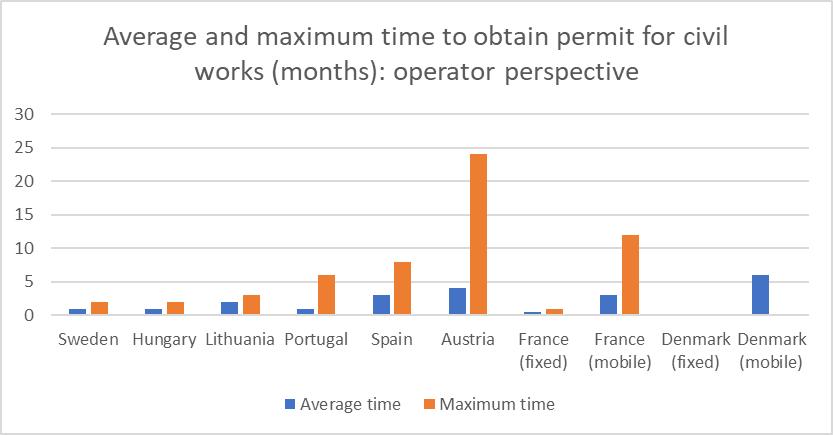
Figure 8: Average and maximum time to obtain permits for civil works (months) – operator perspective; (Source: WIK ICF questionnaire ECN operators Q1 2021)
In many cases, procedures for the deployment of wireless infrastructure became longer and more complex than those for fixed infrastructure. This may be due to the greater public scrutiny to which masts and antennas may be subject to (i.e. due to their visual impact and concerns over electromagnetic emissions (EMF)) as well as to greater number of permits, consultation processes and bodies involved other than local authorities. High (sometimes non-cost based) fees imposed by competent authorities together with lengthy EMF authorisations or local restrictions (e.g. in sensitive areas such as old historical city centers) appear to be the most important persisting barriers for mobile networks’ deployment. This is also reflected in the last DESI telecom reports.
Overall, the lack of harmonization, notably at national level, and the burdensome local planning and permit procedures requiring operators to deal with multiple authorities are delaying ECN roll-out. Moreover, as in most of the Member States permits are issued by local authorities, operators cannot gather all the necessary permits at a single entity or from a single authority. Therefore, ECN operators consider that the variety of rules and processes, the optional nature of electronic processes, in some cases the exclusion of other permissions (beyond civil works permits) from the targeted timeframes, the possibility to extend the timeframes and the lack of mandatory provisions to enforce the deadlines (section 3.2.4) have contributed to low effectiveness of the Directive in this regard.
Furthermore, the low effectiveness of these Directive’s provisions might also be linked to the need, fees and time to obtain RoW that delay network deployment in many cases. Delays in obtaining permits and RoW can add one to two years to the timing for the deployment of wireless VHCN in particular as well as (in some cases) costs associated with the process of obtaining permits and other permissions that can amount to 10-20% in the case of base stations. Furthermore, high costs to obtain permits and/or RoW for mobile sites (of between €12,000 and €23,000) have also been reported. To address these concerns, some countries have established detailed rules or guidelines e.g. concerning the fees that may be charged – especially by public sector bodies and/or road operators (section 3.2.4).
However, the Directive has paved the way for national legislations going beyond its provisions that simplify and streamline the permit granting procedures (via fast-track procedures, permit exemptions, electronic submission of building permits applications, tacit approval of the applications, etc.) and that have reduced, in some countries, the established deadlines, in particular for fixed networks. At least one third of the Member States use tacit approval, permit exemptions (e.g. replaced by a notification) or streamlined or fast track (reduced procedures and deadlines) permit granting procedures. It is also expected that the Connectivity Toolbox will further spread and increase the use of some of these best practices.
While some stakeholders (both public authorities and ECN operators/business associations) consider that the Directive has indirectly had a positive impact on local permit granting procedures and has accelerated the deployment of high speed broadband networks by reducing cost and time expenses, nearly half of respondents to the public consultation consider the Directive ineffective in reducing the time and costs of permit granting.
In light of the above, we could conclude that despite some improvements in terms of transparency and accelerated permit procedures, the Directive was rather ineffective as regards the operational objective of streamlining the administrative procedures related to network rollout throughout the EU (OP3).
4.1.1.4Increasing the provision of buildings with high-speed ready infrastructure throughout the EU and access to it (OP4)
The progress made in ensuring that suitable in-building infrastructure became available in new and majorly renovated buildings is visible. However, the access to the in-building infrastructure is not yet satisfactory. The last several DESI telecom reports highlight some persisting challenges related to the access to in-building infrastructure.
Regarding the equipment of new and majorly renovated buildings with high-speed-ready in-building physical infrastructure, effective implementation of the provisions appears to be linked to the definition of standards setting out what is meant by high-speed-ready in-building infrastructure, and the associated access point, and mechanisms to monitor and enforce adherence to these standards. The rules for in-building infrastructure (including standards) in place in countries such as France, Spain and Portugal are seen as effective. Moreover, they are essential components in the strategies for FTTH deployment in those countries.
Standards and certifications are not required by the Directive, but more than one third of Member States have developed such standards (see section 3.2.5). In most of these cases the standards and the associated certification of in-building infrastructure have included standards for the installation of in-building wiring to be deployed within the duct and have paved the way towards the introduction of high-speed broadband-ready labels. However, few Member States have applied this option and there is limited data on their take-up. Moreover, the reference to “high-speed ready” physical infrastructure could be understood as referring to physical infrastructure suitable for the deployment of copper or coaxial cable termination, with the risk that the physical infrastructure installed would not be suitable for fibre termination. In addition, the lack of awareness of the construction sector regarding their related obligations is limiting the effectiveness of these measures.
The access to in-building infrastructure improved following the implementation of the Directive. However, unsuitable installed infrastructure or the terms and conditions, including unreasonable prices of access, the diverse ownership of in-building infrastructure and a lack of compliance by building owners with obligations to allow access to ECN operators for the purpose of installing in-building infrastructure remain key concerns for ECN operators. Due to challenges in implementation, the Directive was only partially effective in ensuring effective access to in-building infrastructure. The absence of more guidance on conditions for access to in-building physical infrastructure is a shortcoming of the Directive. To ensure transparency and a clearer framework for access to in-building infrastructure, the Italian NRA is drafting guidelines on access to in-building infrastructure.
Where effectively applied, the Directive had led to cost savings of up to 10%, and enabled a proportional expansion in coverage. However, the potential benefits of this measure have not been fully realised. Some ECN operators still allege unjustified refusals for access to the in-building infrastructure as well as a high number of long-lasting disputes with the owners of the existing in-building infrastructure. However, the disputes regarding access to in-building infrastructure represent only 3% of all disputes opened between 2015-2020.
In light of the above, we could conclude that the Directive was effective as regards the provision regarding in-building infrastructure, but only partially effective as regards the access to it. Thus, the Directive is only partially effective as regards OP4.
As on overview of all operational objectives (OP1-OP4), the biggest improvements associated with the Directive relate to access to and information about physical infrastructure (OP1). Much smaller improvements are observed regarding information about civil works co-ordination (OP2), permit granting (OP3) and access to in-building infrastructure (OP4). The processes for permits represents the area causing most problems for operators and where the least progress has been made following the Directive.
4.1.2Effectiveness as regards the general and specific objectives
Evaluation question: To what extent has the Directive met its general and specific objectives? (see section 2.1.)
Evidence indicates that the implementation of the Directive facilitated the roll-out of very-high speed electronic communication networks by creating a stable regulatory framework.
It has notably led to cost savings for some ECN operators and significantly reduced implementation time of end-users connections including due to, in some Member States, well-advanced or partially digitalized permit application/issuing. The Directive has enabled the acceleration of deployment of high speed broadband, in most cases, by “some months”, although e.g. even by half a year or more in Italy. The Directive has also had a moderate impact on cost savings for ECN operators (10-30% from the access provisions of the Directive, up to 10-30% from coordination of civil works and up to 10% from in-building infrastructure (and access to it) provisions). Some public authorities also acknowledge benefits such as cost savings associated with the development of the ECN infrastructure, an increase in projects through cooperation agreements, improvement of the infrastructure cadastre and burden reduction through simplified (and in some cases digital) procedures. Overall, where effectively applied, the Directive is linked to nearly 100,000km of re-use of duct and aerial infrastructure between 2016 and 2020. However, this still constitutes a relatively limited proportion of the available physical infrastructure(section 4.1.1.1). Therefor, the Directive helped, to a limited extent, to expand high-speed broadband networks.
However, only 20% of respondents to the public consultation consider the Directive effective in facilitating the roll-out of high-speed electronic communication networks at a lower cost (while 26% remained neutral and 43% consider it ineffective). The ECN operators consider the effectiveness of the Directive limited because of legal uncertainties (e.g. regarding terms and conditions for access, including pricing, or on cost apportioning for coordinated civil works), higher civil engineering and deployment costs and delays (in case of co-deployment), lack of obligation for the administrations to digitalize their procedures or to coordinate their decisions, insufficient enforcement measures as well as the loss of some investment incentives for the first movers. Network operators other than ECN report no cost savings due to the Directive.
As regards the governance and institutional aspects of the Directive, the general view is that the NRAs are best placed to perform the functions of the national DSB. The NRAs have a good understanding of the overall EU regulatory framework for ECN and can rely on their sound experience gathered in access disputes related to SMP-regulation. However, the dispute settlement mechanisms could be improved, as there are challenges associated with it, in particular as regards the timely adoption of the decision (see Annex III, add_3).
The choice of a directive as a legal instrument to regulate the measures to reduce the cost of deploying ECNs seemed appropriate. In the public consultation, most public authorities (81%) shared this view, while the views from ECN operators and their associations are more mixed, with 40% of them supporting the use of a Directive and 30% disagreeing (and more than 27% being neutral). During consultation activities various stakeholders also called for enhanced governance of the legal instrument with the aim to increase its effectiveness, including by means of a regulation or a directive with maximum harmonization (39% and 25% of respondents to the relevant question, respectively), while 47% of respondents are in favor of using a directive with minimum harmonization (similar to the current Directive)
The Directive provided flexibility to the Member States to take into account their varied national circumstances while at the same time failing to achieve a certain level of effective harmonization. Moreover, the implementation of the Directive is under the responsibility of several public authorities and no authority has the overall competence to monitor the implementation, potentially limiting its overall effectiveness. As showed above, the progress is unequal across the EU and between the pillars of the Directive (e.g. more progress as regards access to the physical infrastructure and the related transparency obligations and less on coordination of civil works). The patchy outcomes (in terms of coverage with high-speed broadband networks and more-efficient network roll-out, including from public funds) and outputs (in terms of streamlined permit granting procedures, increased co-deployment and infrastructure sharing and improved access to in-building infrastructure) would suggest that at least for some aspects using a regulation might ensure a better enforcement and thus make the legislative instrument more effective. However, some business associations of ECN operators that call for more harmonized rules also urge to avoid excessive regulation and obligations on network operators.
Despite some progress, as the overall outputs, outcomes and effects of the Directive are limited and uneven, it can be concluded that the Directive has not achieved its full potential in terms of effectiveness. However, the Directive has set-up a strong framework that can be strengthen with the necessary requirements to reduce the current market fragmentation and divergences of interpretation by competent authorities.
4.2Efficiency
4.2.1Efficiency in regard to the operational objectives
4.2.1.1Increasing the use of existing physical infrastructure suitable for high speed broadband (part of OP1)
Evaluation question: To what extent do the benefits outweigh the costs of access to physical infrastructure (PI) measures? (relates to OP1);
The benefits and costs linked to the use of access related provisions of the Directive vary between categories of stakeholders.
ECN operators do not report significant changes in administrative costs triggered by the use of access provisions. They typically employ 1-2 FTEs to deal with access requests (see also Annex IV). However, their benefits from using the Directive-based access provisions are important: cost savings of 10-30% of project cost for high speed broadband, acceleration of project roll-out by some months and proportional coverage increase (see section 4.1.1.1). BEREC notes that in case of mobile infrastructure sharing, passive sharing enables 10-20% cost savings, large scale radio access network (RAN) sharing could reach 25-30% cost savings and full consolidation could lead to over 40% cost savings. Overall, for ECN operators the benefits of access provisions outweigh the costs, but this may vary by Member States and by type of operator. For example, ECN operators without their own extensive duct and pole networks could make substantial net gains from effective implementation of the Directive-based access provisions, at relatively limited cost. One factor that impacts the cost and benefits for ECN operators is the lack of guidance on the application of the ‘fair and reasonable’ principle and of stronger enforcement of the prescribed deadlines for dispute settlement (four months). These led to longer dispute settlements, unpredictable outcomes and eventually delayed access.
Network operators other than ECN consider that the costs outweigh the benefits, in particular where the other network is not suitable for ECN rollout (e.g. sewage, in certain conditions) and the obligation to provide access becomes burdensome (e.g. potential risk of deterioration of the network and maintenance conditions due to shared use). They also expect appropriate compensation for the provision of wholesale access.
The public authorities/DSBs consider that the benefits outweigh the costs in relation to access provisions. The benefits for the DSBs include a unified legal tool that network operators can refer to when resolving questions and settling disputes around sharing of physical infrastructure without requiring a binding decision from the DSB and thus reducing the associated costs. However, the costs of the DSB associated with access-related disputes resolution is increasing, at least in some Member States. For example, the DESI reports show disputes on cross-sectoral access requests (including pricing) in Cyprus, Romania, Poland and Greece. Spain also reported in 2018 (
2018 DESI telecom
) that dispute settlement under Directive is becoming a prominent function within its NRA. The total current cost of all dispute resolutions concerning access to physical infrastructure is estimated at around 70 FTEs across the EU as a whole (on average ~2.5 FTEs per DSB).
As regards the cost-savings for public authorities, they may be significant. For example, in the public consultation, one public authority reported them at 12% of project costs due to the introduction of co-location or co-utilization as award criteria for using EU or public funds. Thus, access provisions may significantly increase the efficiency of public subsidies.
Increased high-speed broadband coverage and accelerated project rollout by few months mean potentially new customers and shorter times for the provision of services to consumers. Therefore, the customers/citizens also benefit from access provisions of the Directive.
Overall, the provisions on access to existing infrastructure outweigh the costs and bring particularly significant benefits to both ECN providers, public authorities/DSBs and end-users. However, greater attention to establishing principles for access conditions, including price may further increase its efficiency.
Evaluation question: To what extent do the benefits outweigh the costs of transparency measures concerning physical infrastructure? (relates to OP1);
ECN operators need information on existing physical infrastructure of network operators in order to be able to use it. However, the eventual benefits of having access to this information depends on its completeness and accuracy. The administrative costs for network operators depend on whether they are required to pro-actively notify information to a SIP, and (if not) on how many individual requests they make or receive. The administrative burden of handling information requests outside a SIP can in particular be higher in cases where network operators receive a large number of requests. For example, a mobile network operator employed three FTEs to handle more than 200 requests for information about its existing infrastructure within the previous three years.
Making the relevant information available via the SIP promotes access to existing infrastructure and potentially reduces the DSBs’ burden with disputes settlement in this regard. A centralized platform for this information, such as the SIP, has the advantage that operators planning to roll-out an ECN do not need to know beforehand whose physical infrastructure is relevant in the area of interest. Uniform procedures across the different national administrative levels (national, regional and local) as well as single information platforms play a significant role in reducing administrative burden for both network operators and public authorities.
Meanwhile the cost of updating the SIP, where one exists, may depend on the format and the level of detail required and frequency of updating. An alternative ECN operator reported three FTEs to maintain information about existing infrastructure on a comprehensive SIP, while a major energy company and supplier of access to physical infrastructure to ECN operators about five FTEs.
As regards the cost of establishing and maintaining a SIP from the perspective of the body undertaking this task, this ranges from around EUR 150,000 to EUR 2,8 million, with a higher initial investment for the set-up, while annual maintenance requires from around EUR 50,000 to around EUR 1.2 million and/or between 5-15 FTEs, depending on the scope and complexity of the SIP. Gathering or provisioning of information could be improved by automating the information supply and by using electronic interfaces.
The ECN operators and the DSBs (mainly NRAs) consider that the benefits of these provisions outweigh the associated costs. However, for network operators other than ECN (which may be subject to access requests, but which do not benefit from reciprocal access possibilities) the costs seem to outweigh or balance the benefits.
We could thus conclude that, overall, the benefits of requirements to provide information about existing physical infrastructure outweigh the cost, in view of their importance for facilitating ECN deployment.
Looking more broadly at the overall impact of these provisions (access to and information about the existing physical infrastructure (OP1)), we could consider the operational objective (OP1) efficient (except for networks operators other than ECN).
4.2.1.2Increasing cooperation in civil works relevant for broadband rollout through the EU (OP2)
Evaluation question: To what extent do the benefits outweigh the costs of increasing cooperation in civil works relevant for broadband rollout through the EU? (relates to OP2)
The coordination of civil works presents three main benefits: cost reduction, more sustainable network deployment and low burden on citizens. Data gathered from various consultation activities (e.g. public consultation, interviews, case studies, surveys, workshops) indicate that for ECN operators the cost savings resulting from successful coordination in civil works, in comparison with fully independent deployment, is estimated at about 10-30% for fixed networks, more than 30% for mobile networks and up to 50% when utilities consider telecoms in their infrastructure plans (larger ducts). However, the exact amount of cost savings is difficult to quantify because it depends on various factors, such as the number of involved undertakings and technical parameters (e.g. topology, trench depth, trench profile in case of underground deployment).
The coordination of civil works also triggered an increase in NGA deployment of around 10%, under certain specific national circumstances. At the same time, the administrative burden of these provisions is not significant for ECN operators. This has led many Member States to extend the obligation for civil works coordination to all network operators (including privately financed ones).
Coordination of civil works between ECN operators is the least burdensome, due to technical and technological favorable conditions. Lower efficiency is seen in coordinating civil works with gas, water and heating networks, due to the differences in the type/timeframe of deployment and the subsequent requirements for maintenance. However, benefits are noted where portions of gas or sewage networks and ECN backbones were subject to coordination of works for long stretches (e.g. in Netherlands, Belgium, France, Germany). For short segments and small civil works, especially in rural areas, less efficiency is noted.
As regards fixed networks, the benefit of digging once is important, in particular for public authorities, including NRAs (provided that this does not delay the roll-out of the network). However, the high cost of coordination (due to considerable differences in timing of work projects, little interest of operators of various types of network infrastructure and unclear conditions for cost sharing) limits the eventual cost-savings for ECN operators. For mobile networks, significant cost savings might be also obtained in case of coordination between roll-out of fibre and 5G network deployment (notably in high-density urban areas) as well as to putting additional capacity in place that would support a future 5G backhaul network.
While the obligation to coordinate civil works appears appropriate and proportionate, some ECN operators/business associations allege increased administrative costs for coordinating that eventually can turn the business case negative, in particular in rural areas. For example, in some cases, if cost-savings from coordination of civil works could amount to 30%, this also reduced returns by 50% due to increased competition. Thus, some ECN operators even consider that in such cases coordination of civil works is inefficient.
In addition, for network operators other than ECN the interpretation of the term “civil works that are partly or wholly financed through public funds” resulted in some economically inefficient parallel expansion of telecom infrastructures (especially in case of companies in which the public sector has a stake), legal uncertainty and delays for projects supported by public funds. Network operators other than ECN, such as water and sewage utilities, acknowledge eventual cost-savings as well, which might be passed to their customers in the form of lower charges and/or to shareholders.
Public authorities report a slight increase of administrative costs, mainly due to a limited increase of the number of disputes concerning civil works (e.g. in Germany, Finland, Sweden and Slovenia), which notably concern the price setting (e.g. in Germany). It is generally agreed that national and local administrations play a key role in fostering a more efficient coordination. Guidance/rules on cost-apportioning or procedures for civil works coordination, where available, reduced the number of disputes and their associated costs.
Overall, the benefits of the Directive’s provisions on coordination of civil works outweigh the costs and bring particularly significant benefits to public authorities, ECN providers and end-users. However, greater attention to rules on cost sharing for coordinated civil works may further increase its efficiency.
Evaluation question: To what extent do the benefits outweigh the costs of transparency measures concerning planned civil works? (relates to OP2);
A unique information repository (populated by network operators and public bodies) appears to be the best mechanism for ensuring the most appropriate and efficient access to relevant information regarding planned civil works (and existing physical infrastructure). In at least one third of Member States a common platform has been used for civil works co-ordination and for information about existing infrastructure. This integration requires higher investments, due to increased complexity, but diminishes the overall cost associated with transparency obligations (than having separate systems) and made them more efficient. The costs for the co-ordination part are likely to be minor compared with the elements of the SIP associated with existing physical infrastructure.
As regards separate SIPs for coordination of civil works, Member States that implemented them provided similar figures as for the SIPs for existing infrastructure (e.g. EUR 14,500 for set-up and one FTE for maintenance in Slovenia and EUR 1.2 million and four FTEs in Belgium, respectively). In Slovenia only the minimum information is required to be made available via this SIP, although all operators (and not just publicly financed operators) must provide information. Instead, the Belgian SIP for co-ordination of civil works is relatively extensive with significant additional information beyond the minimum required in the Directive and requires proactive notification by all network operators (private and public).
ECN operators did not generally report administrative costs associated with the provision of information for the co-ordination of civil works (no specific procedures). Thus, the benefits of provision on information about planned civil works marginally outweighed the costs.
Various local and regional authorities have already invested in online tools for facilitating and enabling co-ordination of civil works (some of them predating the Directive). The
living in EU
forum facilitates the exchange of
best practices on such platforms
among interested local and regional authorities. This will further increase the efficiency of such tools.
Overall, the benefits resulting from expanded co-deployment of high speed broadband seem to outweigh the costs of more pro-active (but more costly) transparency measures, in particular in those countries where there is more widespread demand for civil works co-ordination.
Looking more broadly at the overall impact of provisions on coordination of civil works and information about planned civil works, we could consider this operational objective (OP2) efficient.
4.2.1.3Streamlining the administrative procedures related to network rollout throughout the EU (OP3)
Evaluation question: To what extent do the benefits outweigh the costs of streamlining the administrative procedures related to network rollout throughout the EU? (relate to OP3)
The multitude of authorities competent for granting permits and multiplicity of permits and fees needed for ECN deployment increase significantly the costs associated with permit granting, for both ECN operators and competent public authorities.
The obligation to make available to the public all relevant information concerning conditions and procedures applicable for granting permits for civil works is part of transparency obligations that all competent public authorities have. Various local and regional authorities already implemented permit granting systems, covering more sectors than just ECNs. Therefore, most of SIPs for permit granting provided for by the Directive (limited to the ECN permit granting procedures) have been implemented in a minimum way, by providing links to the information elsewhere. A single digital platform (where implemented), provides a single point of contact for the submission of permit applications by electronic means as well as information about the status and delivery of permit applications – “one-stop-shop” electronic system. However, BEREC considers not very efficient for permit granting authority to have a dedicated SIP to ECN operators. A few local authorities expressed the same view during consultation activities.
While such systems require an important cost in set-up fees, the digital systems facilitating permit granting have led to more efficient handling of permit applications and, consequently, contributed to faster ECN roll-out. Moreover, even if handling permit applications within a shorter timeframe requires additional resources for competent public authorities (in particular local authorities), significant cost savings could be achieved by local authorities due to electronic systems for permit granting once in place. This could also provide greater accessibility and transparency for ECN operators in the context of reviewing permit applications. For example, in case of the Irish nationwide electronic system managing permit application procedures for road works, the turnaround time for applications was within 30 days for the majority (80%) of permits, with an overall average of 17 days in 2019. In Lithuania each permit application costs EUR 100 on average when using the electronic permit application system.
The cost to ECN operators of handling permit applications varies from one FTE for a small scale ECN operator to 15 FTEs for a large one and could be higher in the absence of such electronic systems for permit granting. For ECN operators the preparation time (staggering amount of documents) are hidden costs that could represent a significant part of the total cost of the project, while also impacting the scarce resources from the administrative side (in particular for SMEs).
‘Broadband Competence Offices’ (BCO), which are based in local authorities and provide a local point of contact for ECN operators and the public regarding broadband related issues (e.g. Ireland, Hungary, Finland, Portugal) are also seen as efficient tools for making permit granting procedures less burdensome.
While permit fees represent revenues for permit granting authorities, permit fees should not exceed the administrative costs. In the
Connectivity Toolbox summary report
, Member States also regard as best practice if any fees are proportionate and only cover administrative costs. However, the permit fees and rules vary across the EU and nationally, increasing the burden on ECN operators that have to adapt to various regional/local rules. For example, some Member States have established fixed fees for certain kinds of permits, while others do not charge any fees for certain permits (either in general or with regard to VHCN). In one Member State, certain municipalities switched with regard to their fees for civil works permits for fibre network in rural area from calculation fees based on the linear metre deployed to a calculation based on the home connected. The DESI reports also confirm that ECN operators have an increased burden due to the need to adapt to various local/regional rules (e.g.
2018 DESI Belgium
,
2018 DESI Poland
,
2020 DESI Italy
,
2019
and
2020
DESI The Netherlands,
2020 DESI Romania
). In Croatia (
2020 DESI Croatia
), ECN operators also report more stringent requirements in spatial plans as well as excessive RoW fees charged by municipalities. Even if, when brought before courts, the courts ruled in favour of ECN operators, court proceedings were time consuming and triggered additional costs to them.
Overall, despite some progress and some established best practices, the permit related provisions of the Directive had limited efficiency.
4.2.1.4Increasing the provision of buildings with high-speed ready infrastructure throughout the EU and access to it (OP4)
Evaluation question: To what extent do benefits outweigh costs of increasing the provision of buildings with high-speed ready infrastructure throughout the EU and access to it?
The average reported cost of deploying in-building infrastructure to make a building “high-speed broadband ready” (or FTTH-ready) is estimated at €100-€150 per house served. However, the requirement of a broadband-ready building seems outdated and ECN operators generally call for ‘fibre-ready’ for new or majorly renovated buildings. This would ensure that all network operators are able to serve customers without the need to deploy costly multiple fibre infrastructures within the building.
As regards the access to in-building infrastructure, some ECN operators argue that in the absence of guidance on technical and economic access conditions, infrastructure owners (e.g. property owners) are imposing excessive access prices and burdensome procedures that reduce the effectiveness of in-building provisions. However, only few disputes were opened on this subject between 2015 and 2020 across the EU, most of which were closed in that period. This implied only minimum administrative cost on the part of DSBs. These disputes were raised mainly in a few countries (Poland, Denmark, Hungary, Germany, Finland and Slovenia) and implied considerable resources and associated cost for both the DSBs and the ECN operators concerned. However, this burden might be partly due to the lack of knowledge of the provisions of the Directive by the building and construction sector (e.g. in Austria, Poland). Sometimes the in-building infrastructure does not technically allow access to at least two additional operators (e.g. Slovenia) or is not suitable for fibre termination. However, the costs with settlement of the related disputes could be avoided through mediation processes provided for by some NRAs (e.g. Italy). In addition, providing additional clarity regarding in-building infrastructure access conditions could make the relevant provisions more efficient, due to fewer or more efficient disputes.
Where ECN operators have been able to benefit from access to in-building infrastructure, they report cost savings of up to 10% of project deployment cost. Thus, most ECN operators consider that the benefits of this provision outweigh the costs.
The consumers benefit from access to in-building infrastructure provisions by avoiding multiple payments for in-building infrastructure rollout, increased competition and quality of broadband services and reduced set-up costs for subscription to a full fibre connection.
Building owners should also benefit from minimised disruption, although in cases where the in-building infrastructure is owned by a building manager or ECN operator, they may not be able to benefit from charges for their in-building assets.
In light of the above, we could conclude that the provisions of the Directive related to provision and access to in-building infrastructure (linked to OP4) were efficient. However, making them more future proof by promoting higher standards (e.g. fibre ready in-building infrastructure) could further increase their efficiency.
Concerning operational objectives OP1, OP2 and OP4, dispute settlements under the Directive are becoming a prominent function within the NRAs/competent bodies in some Member States. However, this comes with increased administrative costs for both the DSBs and network operators involved.
Evaluation question: How the efficiency of the dispute settlement body/process influenced the overall efficiency of the operational objectives OP1, OP2 and OP4?
The average of concerned staffing per DSB is around 3.5 FTEs. Extrapolating to the EU, the total staffing EU-wide would reach 94.5 FTE. The total cost of the DSB function EU-wide is estimated at approximately EUR 5 million(see also Annex III, add_4).
It should be also noted that, besides requiring additional resources, ECN operators and network operators other than ECN including utilities and transport organisations might also potentially experience delays due to dispute settlements. For SMEs the costs seem to outweigh the benefits as regards their interaction with the DSBs (see Annex III, add_5).
However, BEREC and DESI telecom reports show that a conciliation process (before the dispute settlement process of the DSB and in some cases mandatory) helps parties to reach a bilateral agreement, before or even within dispute settlement proceedings before the DSB. Such a conciliation mechanism has been identified as best practice in
the Connectivity Toolbox
(together with national guidelines). The binding decisions of the DSB also provide guidance to market participants, thus facilitating future successful negotiations and reducing the burden of disputes settlement.
Overall, the dispute settlement mechanism is not considered very efficient, in particular by ECN operators. However, development of advanced digital platforms for SIPs, together with guidelines, for example, on terms and conditions for access, including pricing, or on cost apportioning for civil works coordination could significantly reduce the number of disputes and therefore the associated costs.
4.2.2Efficiency in regard to the general and specific objectives
Evaluation question: To what extent has the intervention been efficient as regards its general and specific objectives?
The replies to the public consultation show that stakeholders have a rather balanced view as regards the efficiency of the Directive (Figure 9). However, while most of respondent public authorities consider that the benefits brought by the Directive are higher than or equal the incurred costs, the views from ECN operators and their business associations are mixed. A small and medium enterprise (SME) respondent estimates that the yearly costs incurred are much higher than the cost-savings it (see section 4.2.1.4).
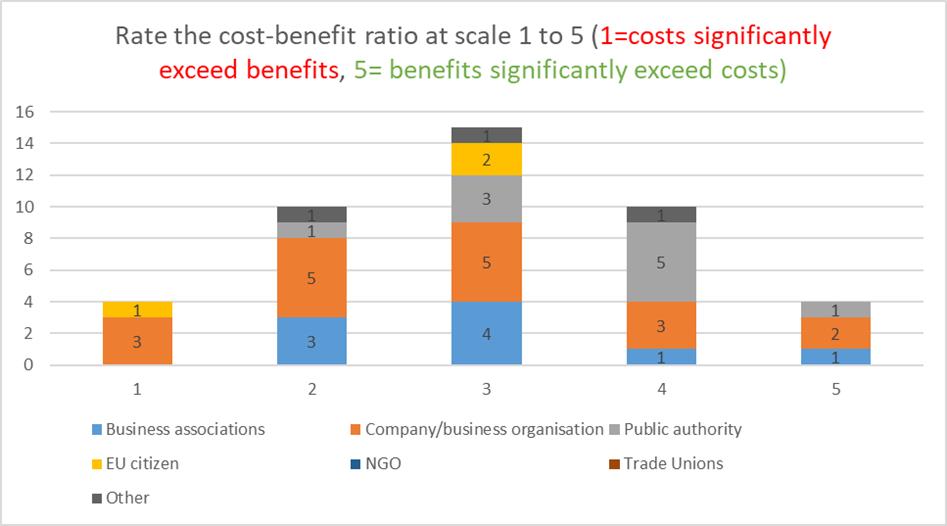
Figure 9: The perception of respondents to the public consultation as regards the efficiency of the Directive (source: EC public consultation)
Even if only partially effective in supporting increased broadband deployment, the benefits of the Directive are likely to outweigh the costs, as Member States often pursued minimal transposition in cases where the Directive provisions were optional (e.g. some measures on transparency of existing physical infrastructure, rules on civil works co-ordination, etc).
The benefits reported by ECN operators include cost savings for roll-out of both fixed and mobile network deployment (including for 5G backhaul) through shared costs and infrastructure, business development (including through access to third party infrastructure), improved transparency on existing physical infrastructure (including via the SIP) and easier permit processes. The associated costs reported by some ECN operators include internal costs related to its implementation (e.g. documentation, pushing information to the SIP; handling access requests, costs due to planning of civil works and their coordination), costs of RoW, more expensive digging and installation teams (when coordinating civil works with utility infrastructure), costs due to deterioration of co-shared network and maintenance conditions, costs linked to lengthy and burdensome permit granting and dispute settlement procedures as well as reporting obligations. To illustrate some of these, Table 1 shows the estimated costs to network operators associated with access to physical infrastructure, information systems and planning applications.
Table 1: Estimated costs to network operators associated with access to physical infrastructure, information systems and planning applications
|
|
Access to PIA (FTEs)
|
Information on existing / planned works (FTEs)
|
Planning applications (FTEs)
|
|
ECN operators
|
0-2 FTE
|
0-3 FTE
|
1 (small scale) – 15 (incumbent)
|
|
Major utility or transport network
|
10-20 FTE (if significant requests)
|
5 FTE (with SIP)
|
|
Source: ICF, WIK & EcoAct study, responses by network operators to WIK ICF questionnaire Q1 2021
Based on the assumptions shown in the Table 2 regarding the number of FTEs for different types of network operator in connection with Directive-based access and associated information provisions, the total administrative costs to network operators of the Directive can be estimated at around EUR 2.5 million per country and around EUR 68 million in total across the EU.
Table 2: Estimated administrative costs to network operators associated with the Directive
|
Type of operator
|
FTE
|
No. Per MS
|
Total FTE Per MS
|
|
Small ECN operator
|
1
|
3
|
3
|
|
Medium ECN operator
|
3
|
3
|
9
|
|
Large ECN operator / incumbent
|
5
|
1
|
5
|
|
Small utility
|
2
|
3
|
6
|
|
Large utility
|
25
|
1
|
25
|
|
|
|
|
|
|
Total FTE per Member State
|
|
|
48
|
|
Cost per FTE (ISCO 2)
|
|
|
€52,126
|
|
Total cost per MS
|
|
|
€2,502,032
|
|
Total for 27 MS
|
|
|
€67,554,856
|
Source: ICF, WIK & EcoAct study
Besides requiring additional resources, ECN operators and network operators other than ECN including utilities and transport operators might also experience delays (e.g. linked to notification of planned civil works). Some ECN operators also allege disproportionate market dynamics and disincentives for first movers (e.g. SMEs, local operators) who fear devaluation of their business case due to increased competition through access to their physical infrastructure or coordination of civil works (see section 4.2.1.2), in particular where duplicating the network is not economically viable (e.g. in some areas in Germany).
The benefits perceived or reported by public authorities include the high coverage achieved, improved cooperation among stakeholders, better coordination of network deployment (including due to the SIP) and better use of available public funds as well as increased possibilities for co-location and re-use of existing infrastructure. The costs for public authorities include: costs due to co-ordination by administrative bodies, structures and systems, set-up and maintenance of the Single Information Point (SIP) (between EUR 150 000 and EUR 2.8 million in set-up fees and between 5-15FTEs or around EUR 0.5 million per year /Member States recurrent costs for maintenance), increased cost of mapping, increased dispute settlements and their associated costs (the total cost of the DSB function across all 27 Member States would be approximately €5m, for an estimated total staffing EU-wide of 94.5 FTEs), expensive and lengthy planning of civil works by public companies (i.e. conducting market research, project financing and implementation planning), monitoring and enforcement related costs. The Broadband Competence Offices (BCO), working closely with local and regional authorities, also report costs due to multiple tasks assigned to the competent local authorities and the increased risk of misuse of funds by the ECN operators, in case of late responses from the BCOs.
Network operators other than ECNs report costs when aiming to equip underserved areas also with optic fibre network. Such costs are due to fees and duration of permit granting procedures, lengthy civil works’ planning process, costs and loss of opportunities due to incorrect or delayed/inappropriate provision of information, uncertainty due to unclear provisions for cost apportioning as well as deterioration of the network and maintenance conditions due to shared use.
Finally, consumers and SMEs as consumers of public utility and transport services benefit in a variety of ways from the Directive. Specifically, where the Directive-based access is relevant and is effectively applied and exploited by ECN operators, it accelerates the availability of high-speed broadband and/or lower retail charges for high-speed broadband as well as potentially lowering retail prices for utility services. The same benefits, but on a smaller scale, relate to co-ordination of civil works. Provisions on in-building infrastructure and associated access could also accelerate the availability of high-speed broadband, reduce the costs of getting connected and promote competition. Streamlined processes for permit granting could also accelerate the deployment of fixed and wireless networks, bringing benefits in terms of higher quality and increased choice for consumers.
In light of the above, we could conclude that the Directive was efficient as regards its general and specific objectives, but to a lesser extent than expected. The benefits could have been more important and the progress more uniform across the EU in terms of more ECN roll-out, cost reduction for ECN deployment and increased joint-use of existing physical infrastructure. The progress is uneven and the costs of ECN deployment could have been further diminished through clear guidelines (e.g. on fair and reasonable terms and conditions for access or cost-apportioning for coordinated civil works) – thus reducing the disputes that DSBs are called to settle or through more transparency and streamlined (and electronic) permit granting procedures – thus reducing the administrative burden.
4.3Relevance
4.3.1Relevance of the general and specific objectives
Evaluation question: To what extent did the general and specific objectives of the Directive remain relevant over the implementation period?
High quality connectivity supports the development of a more competitive and efficient economy. The reasons rely on the effect of digitalization in business models and the opportunities brought by the new technologies (e.g. fibre, Internet of things, artificial intelligence).
As section 3.3 shows, there is still a big digital connectivity gap between urban and rural areas across the EU. Figure 10 shows the gap in NGA coverage between total and rural ECN roll-out.
Figure 10: Next generation access (NGA) broadband coverage in the EU (% of households), 2020, total versus rural
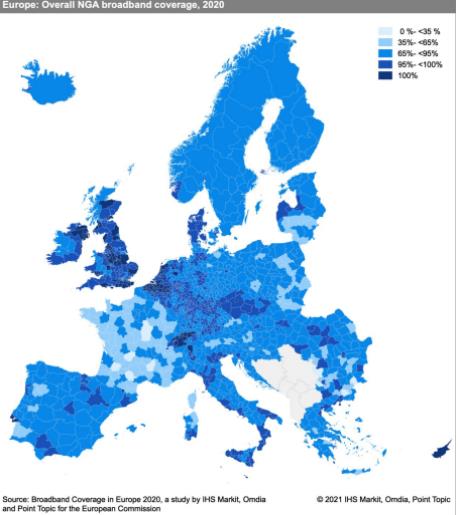

The
2020
and
2021
DESI telecom reports for EU countries show that COVID-19 heavily affected the well-functioning of our societies and praised how advanced ECNs enabled continued e-education, e-health, and teleworking or social entertainment and relationships. During the crisis, the demand for access to advanced ECNs increased, in terms of use, higher quality of services and categories and number of users. COVID-19 pandemic has also affected vulnerable groups, widening social inequality and digitalisation gaps. It continues to be relevant and important to ensure that advanced digital connectivity is deployed everywhere, notably very high capacity networks (VHCNs), including 5G, to support a stronger and more resilient digital transformation and economic recovery.
Most of respondents to the public consultation, ranging from network operators to public authorities, agree that high quality connectivity played – and plays – a vital role in the current COVID-19 crisis and the economic recovery. COVID-19 crisis has increased data consumption patterns and needs due to telework and home-schooling and ECN operators report having experienced an increase in demand for internet access and on data traffic.
The EU's multiannual financial framework for 2021-2027 provides for a long-term budget of EUR 1 074.3 billion for the EU27. Together with the Next Generation EU recovery instrument of EUR 750 billion, it will allow the EU to make available EUR 1.8 trillion of funding over the coming years to support recovery from the COVID-19 pandemic and the EU's long-term priorities across different policy areas. At least 20% of each national Recovery and Resilience Plan’s allocation has to support the digital transformation. This means around EUR 140 billion to invest in key initiatives at the heart of European digital strategies. However, for digital infrastructure and networks alone, the EU has an investment gap of EUR 65 billion per year.
The high costs of rolling out networks and the uncertainty concerning returns on investment are factors deterring investments. This is particularly relevant in rural and sparsely populated areas, where rollout necessarily involves higher costs. Physical infrastructure still constitutes a very significant proportion of the total cost of deploying fixed and mobile/wireless networks (up to 80%). ECN operators estimate that for fixed networks, the costs linked to physical infrastructure is in the range of 60%-80% and for mobile networks in the range of 40%-60% of total deployment costs. Therefore, despite the mobilized national and EU funding resources, it is crucial to further reduce the cost of network roll-out, including for fibre and 5G networks, by sharing costs and infrastructure.
We could thus conclude that the general objective and specific objectives of the Directive to facilitate and incentivise the roll-out of high-speed electronic communications networks by promoting the joint use of existing physical infrastructure and lowering the costs of deployment remain highly relevant.
4.3.2Relevance of the operational objectives
As shown in section 2.1, the operational objectives of the Directive aim at addressing the key challenges to fast and efficient ECN rollout that were hindering it when the Directive was adopted. Despite good progress in some areas (see section 4.1), these challenges still persist. Therefore, the subjects covered by the Directive remain important factors influencing the timely and efficient deployment of VHC networks.
Many respondents to the public consultation (from almost all categories of stakeholders) confirm the relevance of Directive’s objectives although it varies significantly per area of the Directive and per category of stakeholders. For ECN operators the most relevant provisions relate to permit-granting procedures, access to in-building infrastructure and information about existing physical infrastructure. ECN operators also consider provisions on access to existing physical infrastructure (in particular from ECN and energy operators) as well as co-ordination of civil works and fees for permits relevant in reducing ECN rollout costs. For public authorities the most relevant provisions are those on access to physical infrastructure, followed by provisions on in-building infrastructure and access to it and on civil works co-ordination while permits were still considered relevant, but less so than the other provisions.
Moreover, according to DESI 2021, new entrant network operators continued to slightly gain market share and held 61% of fixed lines in 2020. The market share of incumbents is the highest in Luxembourg (63%), Cyprus (55%), Latvia (55%) and Austria (54%) and the lowest in Romania (17%) and Czech Republic (22%). New entrants gain market share in cable, FTTH/B as well as in the NGA technologies (Figure 11). Therefore, absent SMP-based regulated access (should the conditions for imposing them not met anymore), the Directive becomes even more relevant, as alternative operators, in particular new entrants, are likely to most benefit from its provisions .

Figure 11: Incumbent operator market share by technology in the EU (% of subscriptions), July 2020 (source: DESI 2021 telecom chapter)
The relevance of each of the four operational objectives of the Directive is analyzed below.
4.3.2.1Increasing the use of existing physical infrastructure suitable for broadband rollout (OP1)
Evaluation question: To what extent did the objective of increasing the use of existing physical infrastructure suitable for broadband rollout remain relevant over the implementation period?
Access to and use of existing physical infrastructure for laying the cables and installing antennas remains a challenge for many operators. The challenge most frequently ECN operators face relate to duct access, accessing facilities for the hosting of base stations or are associated with gaining access to buildings and land under the control of public authorities as well as public infrastructures such as street furniture. Thus, mechanisms to access to physical infrastructure and resolve disputes remain important for the ECN deployment today.
Access to the existing physical infrastructure not only substantially reduces the cost but increases also the speed of deployment of ECN since civil works and construction of masts, which are very time-consuming, are not necessary. However, in Member States where the SMP-based access is ubiquitous and effective, the Directive-based access seems less relevant for ECN operators.
ECN operators consider access to the infrastructure of other network operators such as water, heat and gas to be less relevant than that of energy and ECN operators. This is because water (sewers are only suitable in some cases, depending on technical conditions e.g. size of pipe or the sewage channels like the location of entry points to buildings) and electricity networks (but poles) are not always suitable for the installation of telecom networks.
At the same time, the Directive does not cover all elements that are considered relevant for ECN operators, such as access to public facilities including buildings, land and street furniture that may be suitable for the installation of wireless infrastructure. As the Directive does not cover the access to these elements is available could make it less relevant over time, as access to facilities such as rooftops or street furniture become increasingly important in the context of 5G small cell deployment and fixed wireless access (FWA) technology.
Evaluation question: To what extent the transparency on existing physical infrastructure suitable for broadband rollout is still relevant?
The lack of information about the availability of existing infrastructure to deploy ECN networks remains a challenge. Most ECN operators consider the following information relevant for network deployment if constantly updated through the SIP:
·information on physical infrastructure from public bodies, ECN operators and network operators other than ECN, as well as on other elements and facilities suitable to install network elements;
·information on public buildings or facilities that are not part of a network (e.g. administrative buildings, communal centres), on private buildings or facilities other than residential and that are not part of a network (e.g. shopping centres, sports facilities, industrial plants/business facilities);
·information on acquisition and construction of sites for the deployment of mobile base stations, in progress or planned.
While geo-referencing physical infrastructure would be highly relevant, BEREC though cautions that access to existing public physical infrastructure might be harmful to both network safety and security, and national security.
Furthermore, some information about the existing facilities for the deployment of small area wireless access points (SAWAP) to which public authorities have to grant access to ECN operators is also relevant for ECN operators. Moreover, linking the SIP with other data or processes increased its relevance for ECN operators. The provision of additional information (compared to the minimum information according to Art. 4(1)) to the SIP by all telecom operators, utility companies and other owners of physical infrastructure would further increase the Directive’s relevance.
It is worth noting that the Directive does not require the inclusion of information about infrastructure which is not part of a network. Access to such infrastructure may be needed for the deployment of future networks, including 5G, in which case the provision might not meet all the current and future needs of network operators.
Therefore, the transparency of existing physical infrastructure remains highly relevant.
In light of the above, we could conclude that that operational objective of increasing the use of existing passive infrastructure suitable for broadband rollout (and its transparency) remains relevant. However, there is room for improvement, as the Directive does not cover some elements that are considered relevant for ECN roll-out such as access to other elements and facilities (not controlled by network operators) that may be suitable for the installation of network elements.
4.3.2.2Increasing cooperation in civil projects relevant for broadband rollout through the EU (OP2)
Evaluation question: To what extent did the objective of increasing cooperation in civil projects relevant for broadband rollout through the EU remain relevant over the implementation period?
In some countries, challenges remain in making use of co-ordination of civil works, such as denial of opportunities to co-ordinate, excessive charges and complex procedures. The lack of guidance on cost apportioning for coordinated civil works (see section 3.2.2) and potential delays in network roll-out have also contributed to reluctance of some ECN operators for coordination of civil works. If these challenges are addressed, the interest in civil works co-ordination could increase in future. Thus, the provisions regarding civil works coordination as well as a mechanism to resolve potential disputes in this field remain relevant. Furthermore, the fact that about half of Member States have voluntarily extended the obligation to meet requests for co-ordination of civil works to privately financed civil works projects (see section 3.2.2) shows that there is a significant interest in coordination of civil works and that this operational objective remains relevant.
As regards the kinds of networks that are relevant for co-ordination of civil works, co-ordination alongside the deployment of other ECN, alongside co-ordination with transport links such as roads and railways and co-ordination with electricity networks (including public lightening) are most relevant for ECN operators. This is also confirmed by some DESI reports. For example, Malta (
2020 DESI telecom report)
is currently in the process of implementing the government’s EUR 700 million plan to upgrade all the roads within 7 years. In this context, the coordination of civil works between transport and ECN networks could lead to significant cost savings due to cross-sector synergies.
Fewer synergies are associated with co-ordination of ECN rollout with gas pipelines and water networks rollout, due to differences in the type/timeframe of deployment and the subsequent requirements for maintenance while the network is in operation. However, this coordination has already proved relevant where portions of e.g. gas and ECN backbones were subject to coordination of works for long stretches. For short segments and/or small civil works and in particular in rural areas, the relevance seems lesser, due to higher costs of coordination and management and longer time of deployment. However, operators of other networks than ECN see more opportunities for co-ordination with these sectors (as well as synergies with transport networks and electricity) (see Figure 12).

Figure 12: To what extent is it relevant for the deployment of ECNs to coordinate civil works with the following types of networks? (scale from -2 not relevant at all to 2 very relevant) (Source: The ICF, WIK & EcoAct study & responses to the public consultation)
As regards the fixed networks, coordination of civil works is relevant (for network operators, public authorities and EU citizens) for reducing the digging in pavement (digging once principle) as well as the environmental impact of ECN roll-out. The relevance of civil works coordination of is even higher in countries that have limitations against opening the roads too often (e.g. Luxembourg, Belgium). As regards the mobile networks, the coordination of civil works with transport networks (including railways, roads, ports and airports) is suitable and relevant for the deployment of wireless/mobile networks along the main transport paths, in accordance with related coverage obligations. 5G corridors represent a clear example of relevance of such coordination.
Evaluation question: To what extent the transparency on planned civil works is still relevant?
Timely information on planned civil works is considered relevant by all stakeholders. The extent to which lack of information about planned civil works presented a challenge for network operators varies, according to national circumstances. For example, in Italy and Germany in particular, this remains a challenge, which should be addressed – not only to reduce deployment costs, but also to reduce interruption of works in cases where projects address the same areas simultaneously. Having access to the planned or ongoing civil works facilitates a better planning of civil works, thus reducing delays in network deployment and disturbance for local communities. Therefore, the provisions of the Directive on information related to planned civil works continue to be relevant, at least in countries where they are used by ECN operators and/or other options (e.g. access to existing physical infrastructure) are limited. These provisions could become more relevant in more countries, if more Member States pursue a proactive notification of civil works to the SIP and if they establish procedures and rules regarding cost sharing for civil works co-ordination (measures which may have contributed to greater uptake of co-ordination in Belgium and Sweden).
However, there are risks of potential delays and potential challenges with confidentiality of deployment plans. In addition, the relevance of civil works co-ordination (and associated information) needs to be weighed against other options that may be available for network deployment. For example, SMP-based access to physical infrastructure could be used to access the existing infrastructure of incumbent operators and other solutions such as micro trenching could simplify or lower the cost of the deployment process. Thus, the relevance of these provisions may vary from one country and/or type of operator to another.
Extending this obligation to public and private stakeholders, has increased the relevance of these provisions, fact confirmed by more extensively used SIPs in these case. For example, in Poland the use of the SIP has significantly increased since the data transfer of information already available in electronic format became obligatory (2020). In Czech Republic, part of the action plan on non-subsidy measures for deploying electronic communication networks is to create a database containing planned civil works. However, during consultation activities some stakeholders (both ECN operators and public authorities) argue that providing the information regularly to the SIP and irrespective of a request might be disproportionate.
Therefore, the transparency of planned civil works remains highly relevant.
Overall, in light of the above, we could conclude that the operational objective of increasing cooperation in civil works relevant for broadband rollout through the EU (OP2) remains relevant.
4.3.2.3Streamlining the administrative procedures related to network rollout throughout the EU (OP3)
Evaluation question: To what extent streamlining the administrative procedures related to network rollout throughout the EU is still pertinent?
Permit granting procedures, permit granting fees and the RoW influence the timely and efficient deployment of ECN. ECN operators consider that these issues, relevant at the time of the adoption of the Directive, are still very relevant today. Such are measures streamlining the administrative procedures related to network rollout throughout the EU, mainly by ensuring the enforcement of deadlines and increasing the transparency as regards permit granting procedures. These measures are relevant because they address important challenges for ECN rollout, which include: the complexity and length of permit granting procedures to deploy or upgrade ECNs, the multiplicity of permits needed, the lack of coordination between competent authorities, lack of electronic means/procedures for permit applications and the non-respect of the four months deadline to grant ECN deployment related permits, including those for RoW.
For ECN operators what is most relevant for supporting the deployment of fixed networks is duct sharing, while for the deployment of wireless networks seems to be the timely delivery of the administrative permits and the RoW to install facilities on or over public or private property. Moreover, addressing problems resulting from the varying practices at local level concerning permit granting procedures and fees remains very relevant. This perspective is also reflected in various DESI country reports that show that fragmented, non-uniform permit procedures (including at national level) hinders the speed of ECN rollout.
As section 4.1.1.3 shows, addressing these persisting challenges could further accelerate the ECN rollout by some months and reduce the associated cost, which is very relevant for all ECN operators, the competent public authorities and eventually the consumers/EU citizens.
Although the Directive does establish deadlines for granting permits and improves the degree of transparency as regards permit granting procedures (see section 3.2.4), the Directive does not fully address the procedural complexity in permit granting or fees and does not appropriately and explicitly address some issues around RoW (but more generally within the definition of ‘permit’), which ECN operators consider very important to enable fixed and wireless deployment. Thus, while the current provisions of the Directive are relevant for certain of the key problems the ECN operators face, they have insufficiently addressed the others. The current Directive is therefore not as relevant to all current needs of ECN operators as it could be, and significant loopholes could emerge if it is not updated.
The provisions of the Directive on transparency on permit granting related fees and procedures and provision of electronic services for handling permit requests are also relevant for permit granting authorities. The digitization of permit granting procedures, including the electronic application for permits, where available (see section 3.2.4), is of relevance for the digital transformation of public authorities.
Overall, we could conclude that the operational objective of streamlining the administrative procedures related to network rollout throughout the EU remains highly relevant. Moreover, the review of the Directive could improve the relevance of these provisions, by better addressing some of the above mentioned persisting barriers in network roll-out.
4.3.2.4Increasing the provision of buildings with high-speed ready infrastructure throughout the EU and access to it (OP4)
Evaluation question: To what extent increasing the provision of buildings with high-speed ready infrastructure throughout the EU and access to it is still pertinent?
The in-building infrastructure and the access to it remains an important bottleneck for the deployment of new ECNs and its importance is likely to further increase. ECN operators continue to highlight significant issues associated with accessing in-building infrastructure. Specific problems reported include the price of access and physical accessibility of in-building infrastructure. These problems are likely to continue to be relevant and may expand as more houses are built and renovated (and must thus be equipped with in-building infrastructure), and as commercial deployments of FTTH expand.
For example, trying to address the difficulties with in-building broadband roll-out, as revealed by numerous disputes concerning the access to in-building infrastructure, Poland (
2020 DESI report
) amended the so-called ‘Megaustawa’(4) (‘Mega-law’) in 2019 to improve the rules for access to buildings.
Two thirds of respondents to the public consultation (mainly ECN operators/ associations and public authorities) also consider that these provisions are at least moderately relevant. Less relevance seems to be reported in Spain and Portugal, where similar measures preceded the Directive, or in countries like Denmark and Malta, which do not so see an issue with in-building infrastructure or in countries that did not applied these provisions.
Therefore, the operational objective of increasing the provision of buildings with high-speed ready infrastructure throughout the EU and access to it (OP4) remain relevant.
Evaluation question: To what extent the role of the DSBs remains still pertinent?
In addition, for three operational objectives (OP1, OP2 and OP4), having a mechanism to resolve potential disputes in their field remains relevant, as denial of opportunities to use the existing physical infrastructure or co-ordinate civil works, excessive prices and complex procedures reduce the willingness of ECN operators to collaborate with each other and, therefore, need to be addressed further.
This view is also reflected in the last DESI reports (since 2018) that show an increased number of disputes in various areas (e.g. access to existing physical infrastructure, coordination of civil works, access to in-building infrastructure). The competent bodies (e.g. DSB) are thus called either to solve them in a case-by-case basis or to issue guidelines that bring some needed clarifications allowing to reduce the number of disputes. Moreover, complex, burdensome and non-uniform (including at national level) administrative procedures are pointed out in various DESI telecom reports.
Therefore, the role of competent bodies provided for in Article 10 of the Directive remains relevant, including for deepening the Digital Single Market.
4.3.3Continued relevance of the current objectives against new needs
Evaluation question: How well do the (original) objectives of the Directive still correspond to the new needs within the EU?
Comparing the Directive objectives and the current needs and problems in the area of ECN rollout, there are new challenges coming from the evolving EU digital transformation.
The Directive’s overarching objective is to facilitate and incentivise the rollout of high-speed electronic communications networks (broadband access services at speeds of at least 30Mbit/s). In the meantime, the EECC adopted in 2018 refers to “very high capacity networks (VHCN), including fixed, mobile and wireless networks” and more recently the “
2030 Digital Compass: the European way for the Digital Decade
” Communication adopted in March 2021 refers to Gigabit-capable networks.
EU’s digital transformation needs a fully functioning Digital Single Market and secure and performant sustainable digital infrastructures are a cardinal point of the Digital Compass 2030. In order to address the connectivity needs of EU post-COVID-19, massive investments into connectivity infrastructures are needed. While the EECC already provides measures to incentivize ECN investments, this Directive complements it, by making these investments more efficient.
The need for Gigabit-capable technologies has become even more critical in the wake of the COVID-19 pandemic which has seen bandwidth consumption increase by up to 60%, as a result of practices such as home working. In this context, the review of the scope of the general and specific objectives of Directive to promote deployments of Gigabit capable networks, in particular VHCN, could make its provisions more relevant and future oriented. While this view is supported by many respondents to the public consultation, BEREC recommends caution when considering to limit the scope to VHCN because of methodological reasons that could lead to increased disputes before the DSBs.
As regards the operational objectives of the Directive, its provisions have been relevant mainly to install modern (mainly fibre) infrastructure as well as partial fibre networks such as FTTC/VDSL (through access to existing physical infrastructure and coordination of civil works provisions). The reference to high-speed broadband ready in the context of in-building infrastructure may have been interpreted as also relevant to certify buildings equipped with copper as “high speed ready”. Moreover, under the existing provisions, based on the “availability of viable alternative means of wholesale physical network infrastructure suitable for the provision of high-speed electronic communication networks”, an operator might reject access to an operator wishing to install FTTH, because it could offer FTTC/VDSL-based wholesale access. However, looking to the current (and future) connectivity ambitions, the current operational objectives might need to be updated.
Both the EECC and the
2030 Digital Compass
aim to equip Europe with appropriate tools to lead the 5G race for the benefit of its international competitiveness. 5G will enable industrial transformation through wireless broadband services provided at Gigabit speeds. Furthermore, the Commission
“European Data Strategy” Communication
adopted in February 2020 foresees that the global data volume will reach 175 zettabytes and data processing model will change to 80% smart connected objects and 20% centralised computing facilities by 2025. The successful and efficient rollout of highly secured and state-of-the-art fibre and 5G network are highly relevant for future digital services and at the heart of the industrial data wave. In this context, the Directive objectives (updated in scope) remain highly relevant.
Moreover, the
EU Strategy on adaptation to climate change
of February 2021 and the European Green Deal Communication of 2019 also foresee to forge a climate-resilient Europe where the green and digital transformation of the EU strengthen each other. Secure and highly-performant fixed and mobile electronic communications networks are at the heart of this twin green and digital transition. The measures of the Directive already contribute to sustainability (e.g. by avoiding duplication of physical infrastructure and civil works). Furthermore, performant ECN have a strong enabling effect for sustainability of other sectors and more synergies between ECN and transport or energy networks are expected to further multiply in the years to come.
In light of the above, we could conclude that the objectives of the Directive remain highly relevant, but the review of its scope to Gigabit imperative is needed to better align it with the current EU ambitions and make it future-proof.
4.4Coherence
4.4.1Coherence with other EU policies
Evaluation question: To what extent is the Broadband Cost Reduction Directive coherent with other EU policies which have similar objectives?
Since the Directive was adopted, the Commission has increased its ambition in terms of connectivity questioning whether the current scope of the Directive (i.e. high-speed electronic communications networks) is still coherent with the new connectivity targets (e.g. with the EECC which puts emphasis on the more advanced concept of VHCN or the “Path to the Digital Decade” policy programme which refers to Gigabit connectivity).
As regards the coherence of Directive with the EECC, most stakeholders agree that the Directive and EECC are complementary, reinforcing each other (e.g. the Directive also provides for access to infrastructure of network operators other than ECN) and both are essential for boosting network deployment as they facilitate network investments, provide a more favourable regime for wholesale only undertakings, ease the permit granting procedures as well as the availability of transparent information. However, some respondents to the public consultation (ECN operators and public authorities) and
stakeholders’ feedback
to the Roadmap/Inception Impact Assessment consider that the Directive and the EECC are partially overlapping (e.g. in relation to access to in-building infrastructure: Article 9 of the Directive and Article 61(3) of the EECC) and consider that the Directive would have weakened the SMP regime (Article 3 of the Directive and Article 72 of the EECC) as regards duct and pole access. Also some incumbent operators expressed concerns about being subject to obligations under two regimes concerning access to their physical infrastructure.
Differences in scope (VHCN versus high-speed ECNs and the level of ambition for reaching Gigabit Society targets), in terms and definitions used, in requirements related to infrastructure mapping or in impact on fibre expansion related investments (in particular by public utilities), in timeframes of permit granting (4 months deadline provided for in Article 7 of the Directive and 6 months deadline for RoW provided for in Article 43 of the EECC) were noted during consultation activities (section 4).
There are also parallels on civil works coordination and network sharing (Article 5 of the Directive and Article 44 of the EECC) and synergies on information gathering (Article 4 and Article 6 of the Directive and Article 22 and Article 57(4) of the EECC). Article 3 of the Directive and Article 44 of the EECC do not overlap but are complementary, as obligations provided for in Article 44 of the EECC are linked to exercising RoW or rights of access to facilities under the scope of Article 43 EECC. More specifically, while the Directive grants a general right for ECN operators to benefit from physical infrastructure on reasonable request, sharing of network elements under Article 44 EECC is at the discretion of the Member State concerned and may be granted only under more limited circumstances. As regards the timeframe for permit granting (Article 7 of the Directive) and RoW (Article 43 of the EECC), there is scope to improve coherence thereof. There is scope to clarify the relationship between Article 9 of the Directive and Article 61(3) of the EECC, especially in cases where Member States take advantage of the potential exemption to the obligation to provide access to in-building infrastructure (Article 9(4) of the Directive), but there is no incoherence between Article 9 of the Directive and Article 61(3) of the EECC, as the scope of the provisions is different. More specifically, a key difference would be that Article 61(3) of the EECC is optional for NRAs (NRAs “may” impose obligations), while Article 9 of the Directive imposes an obligation on holders of the right to use an access point and in-building infrastructure to make access available under fair and non-discriminatory terms and conditions on reasonable request.
Article 4 of the Directive is complementary with EECC measures streamlining the deployment of small area wireless access points (SAWAP) by excluding facilities meeting certain characteristics from the need for town planning or other individual prior permits (Article 57 of the EECC). However, more clarity is needed as regards the relationship between the Directive and Article 57(4) of the EECC as well as the Commission Implementing Regulation 2020/1070 on small-cells, on access and information to support the installation of SAWAP. BEREC also stresses that the Directive and Article 57 EECC differ with regard to which organisations have to provide access to their physical infrastructure. The Directive demands this from network operators, while Article 57(4) of the EECC from public authorities (irrespective of whether they are network operators). In addition, Article 57(4) of the EECC refers to facilities which are not network elements (and thus not covered by Article 3 of the Directive) and thus it does not appear to be incoherent with the Directive.
The term ‘physical infrastructure’ is not defined in the EECC and that of ‘associated facilities’ also includes physical infrastructure as defined under the Directive, but not restricted to the latter. BEREC considers that the physical infrastructure of Article 57(4) of the EECC is not fully consistent with the definition of the term ‘physical infrastructure’ in the Directive because: (i) Art 57(4) includes any physical infrastructure suitable to host small-area wireless access points regardless whether it is part of a network; (ii) street furniture as e.g. light poles, street signs, traffic lights are not an element of a network (unless they would be part of the definition of a transport network) and (iii) are not intended to host other elements of a network. Furthermore, while BEREC is of the opinion that a parallel access regime to dark fibre under Directive seems not proportionate as regulatory instruments from the EECC (SMP regulation and the symmetric regulation in Article 61(3)) are best placed to provide such access for interested ECN operators, it considers that information on dark fibre available via the SIPs may be useful in light of national circumstances (e.g. in case access to dark fibre is possible based on SMP regulation, to be taken into account when planning civil works (to avoid breaking cables)).
As regards the coherence of Directive with sector-specific EU law on other network industries, it appears that shared use and construction are rather limited. One area where some utilities and municipalities claim that there is a lack of coherence is the differential treatment of ECN providers compared with other utilities and, in particular, their right to accelerated permit granting, access existing physical infrastructure and civil works co-ordination, when these advantages may not be available to network operators in other industries. Furthermore, the respondents to the public consultation argue that the obligation to separate communications networks into their own company has slowed down the process of co-deployment. Operators of other networks note a lack of clarity as regards the treatment of cost-savings and profits arising from collaboration under the Directive when network operators are subject to price controls applied in another network industry. From this perspective, only a few Member States (Portugal, Italy, Germany, Spain, Poland, Estonia and Lithuania) provided guidance concerning the treatment of cost reductions or revenue gains arising from collaboration with ECN operators.
As regards the coherence of the Directive with competition policy and state aid, some ECN operators state that EU competition law, in particular State Aid procedures, would suffer from a lack of emphasis on FTTH/B, same as the Directive. Some ECN operators regret that the RAN sharing model is not explicitly mentioned by the Directive as they consider it one of the key solutions to support more cost efficient roll out of mobile networks. Reasons for providing access are complementary, as the State Aid guidelines require widely available access to publicly funded infrastructure while the Directive focuses on the roll-out of ECN.
As regards the coherence of Directive with other EU policies, ECN operators and competent public authorities, including BEREC, welcome the Recommendation (EU) 2020/1307 on a common Union toolbox and the subsequent Connectivity Toolbox. On the one hand, it is pointing to the need to reduce the environmental footprint of networks and, on the other hand, the 39 best practices agreed by the Member States on 25 March 2021 are expected to contribute to the timely deployment of 5G and fibre networks. The replies to the public consultation also mention the Directive (EU) 2018/844 on energy efficiency that has introduced the concept of Smart Readiness Indicator, supported by a voluntary scheme provided for in the Delegated Regulation (EU) 2020/2155, as well as several related mandates on standardisation that the Commission had addressed to CEN, CENELEC and ETSI. A few representatives of ECN operators also stress that Recommendation on Relevant Markets (RRM), published by the Commission in December 2020, will decrease the number of markets susceptible to regulation and serve as a key policy harmonisation tool.
Overall, the Directive is generally coherent with other EU policies. However, there is place for enhanced coherence between the Directive and the EECC (including as regards changing its scope to VHCN and related definitions).
4.4.2Internal coherence
Evaluation question: To what extent is the intervention coherent internally?
The Directive is for the most part internally coherent and the various provisions complete and reinforce each other to achieve the common objectives of facilitating and incentivising the roll-out of high-speed electronic communications networks by reducing deployment costs and administrative barriers. For example, provisions on access to existing physical infrastructure are complemented with provisions on access to in-building infrastructure to ensure that ECN operators can efficiently reach end-users.
However, various stakeholders consider that the provisions of Article 5 are not fully aligned with those in Article 3 in the sense that Article 5 does not allow for refusal in case of the availability of viable alternative means of wholesale physical network infrastructure. Thus the Directive do not address situations where co-ordination of civil works might result in unviable overbuild. While this is not an incoherence between Article 4 and Article 6 as they differ in scope (transparency on infrastructure sharing and transparency on civil works, respectively), a potential mutual reinforcement of these provisions through a better alignment, might provide the network operator with a simplified set of rules.
BEREC also supports better alignment of the Directive provisions on coordination of civil works with the ones on access to the existing physical infrastructure, including for preventing the risk of unviable overbuilding. Less and simpler rules will increase legal certainty and diminish the number of disputes, as operators might reach agreements without the DSBs.
Overall, the Directive is coherent internally. However, a slightly better alignment of various provisions of the Directive might provide with more uniform and simple applicable rules.
4.5EU-added value
Evaluation question: What is the additional value resulting from the Directive, compared to what could reasonably have been expected from Member States acting at national and/or regional levels?
Digital connectivity is essential for the development of the Digital Single Market, enabling SMEs and other businesses to develop and offer digital services as well as enabling consumers to access digital services across the EU. Disparities (the ‘digital infrastructure divide’) between and within regions (e.g. in terms of levels of infrastructure endowment) prevent them from reaping the benefits of the EU digital transformation.
The Directive is among the instruments that could help to overcome the overall challenge to meet the European Gigabit Society targets, in particular in rural areas or areas where such services cannot be offered commercially, together with the Guidelines for the application of State aid rules in relation to the rapid deployment of broadband networks, and the co-investment provisions of the EECC (Articles 76 and 79).
While some Member States benefited from similar measures prior to the adoption of the Directive (section 2.2), the benefits of accelerated ECN roll-out would have been limited at national or even regional/local level. The Directive built on these existing best-practices and leveraged them at EU level to reduce the above-mentioned disparities (by increased high-speed ECN coverage – see section 4.1.1.1), raise standards (e.g. for in-building physical infrastructure – see section 4.1.1.4) and create synergies with other networked sectors like transport or energy (see sections 4.1.1.1 and 4.1.1.2). Thus, by setting common European objectives and rules facilitating and incentivizing the efficient rollout of performant ECN network, the Directive has brought regulatory stability and certainty for efficient deployment of ECNs, spearheading all Member States towards the European Gigabit Society.
The Directive’s measures on access to and transparency of existing physical infrastructure are considered to have an important EU-added value (e.g. efficient procedures, a minimum set of transparency obligations), while for the ones concerning the coordination of civil works and its transparency the EU-added value is limited, due to uneven effectiveness across the EU. As regards the Directive’s measures on permit granting procedures, overall, there is an EU added-value as the Directive brings common rules, reduces administrative costs (where effectively implemented) and provides clarity, legal stability and predictability. The EU added value of in-building infrastructure and access provisions is also real, although there is a need to address some challenges e.g. in relation to standardisation.
The Directive has led to greater cost reduction opportunities in a number of Member States. These are greater than it would have been possible without the Directive, due to the cumulative effect of all its measures. The Directive has also contributed to the further elaboration of measures in countries which already benefited from legislation pre-dating the Directive in some respects, such as Portugal and Spain. In all those cases and countries where the Directive has played a role in expanding high-speed broadband, which include in particular Germany, Finland, Italy, Lithuania, Romania, Bulgaria and Hungary (including for wireless deployment), the Directive has contributed to tackling the digital divide and bringing economic and societal benefits from wider availability of high-speed broadband.
However, when it comes to the ease of doing business across the EU or boosted economies of scale for companies with cross-border operations, ECN operators consider that the Directive has delivered less EU-added value than expected. For example, interviews and case studies found that, the EU-added value of Directive’s provisions on access to existing physical infrastructure was diminished because information which would be useful for the deployment of wireless networks, such as the location of masts and antennas, has not been comprehensively addressed e.g. via SIPs in all countries.
The Directive also created a common framework that allows Member States to learn from each other’s best practices and accelerate together the ECN roll-out across the EU. Several ECN operators and public authorities praise the
Connectivity Toolbox Recommendation
that has led Member States to agree on 39 best practices boosting investment in very high-capacity broadband connectivity infrastructure, including 5G, most of them triggered by the implementation of the Directive, as part of the
Connectivity Toolbox
. It seems unlikely that the progress, including the identified best practices, along with the associated cost-saving benefits would have occurred to the same degree in the absence of the Directive.
The flexibility of the Member States to elaborate on exemptions in cases where a full implementation of all provisions would be unduly burdensome is valuable. However, the considerable scope for exclusions or exemptions across a wide set of circumstances and Member States and the lack of up-front guidelines or common principles on various measures provided by the Directive diminished considerably its’ EU added value.
The Directive’s general objective is to facilitate and incentivise the roll-out of high-speed electronic communications networks. A recent JRC study
shows that after full implementation of the appropriate policies, the EU economy could be expected to enjoy up to EUR 110 billion of additional GDP per year thanks to actions in completing the Digital Single Market. A significant fraction of this potential can be found at the level of network infrastructures: different regulatory approaches to network rollout increase the cost of access to national markets, prevent the exploitation of economies of scale at services and equipment level and hinder the development of innovative services which could emerge on very high-speed networks running in a seamless fashion across borders. Another recent report
shows that promoting internet connectivity- notably through the deployment of wireless high-speed broadband and faster roll-out of fixed high-speed broadband - at EU level could bring potential efficiency gain of €58 billion per year. The Directive is called to bring its contribution to this outcome. Vice-versa, a low effectiveness of the Directive might partly jeopardize the above-mentioned efficiency gain. Looking wider, the study estimates the cost of non-Europe (non achievement of Digital Single Market) at EUR 110 bn/year, while for overall EU digital economy it would amount to EUR 178 bn/year.
Overall, the Directive is seen to have provided EU-added value through regulatory stability and certainty and only partially through more simple and efficient administrative procedures. It has brought less added-value as regards the ease of doing business across the EU or boosted economies of scale for ECN operators with cross-border operations.
5CONCLUSIONS
5.1Summary of the evaluation
The present evaluation report is part of the fitness check that aims at assessing the Directive as a whole, while carrying out evaluations for its objectives. It examines whether progress towards the objectives is on track or if there is a case for making any changes. The findings of the analysis are subject to some limitations, as explained in Annex II.
The review of the Directive should, on one hand, address the deepening of the digital divide resulting from the COVID-19 pandemic crisis and, on the other hand, contribute to efficiently achieving the connectivity objectives of the
“2030 Digital Compass: the European way for the Digital Decade”.
The results of the evaluation report need to be interpreted in this context.
5.1.1Effectiveness
The Directive built on similar existing measures in some Member States, while taking into consideration the national (including local) circumstances and the starting point of each Member State. The Directive allowed flexibility to the Member States not to implement certain measures or to apply exemptions. However, due to variable implementation across the EU, the Directive has been only partially effective with respect to both general and specific objectives.
While overall the Directive has had a positive effect on the deployment of high-speed broadband (nearly 100,000 km of re-use of duct and aerial infrastructure), this constitutes a relatively limited proportion of the available physical infrastructure (section 4.1). However, where effectively applied, the Directive can accelerate deployment of high-speed broadband projects by some months, save between 10-30% in deployment costs and proportionally increase network coverage. Thus, by supporting further the deployment of high-speed broadband networks, the Directive has contributed to reducing the digital divide.
The biggest progress relates to access to existing physical infrastructure and the related transparency measures while there has been less progress as regards permit granting, coordination of civil works and access to in-building infrastructure. Moreover, the outcome is uneven across the EU and, even in areas of action with more effectiveness, it does not fully satisfy the imperative of faster and more efficient ECN roll-out. Persisting barriers for ECN rollout, the lack of uniform and digitalized administrative procedures or insufficiently effective SIPs still hinder the potential impact of cost reduction measures to foster a more efficient and fast deployment of electronic communications networks across the EU.
5.1.2Efficiency
The Directive brings benefits to public authorities, ECN operators and, indirectly, to consumers. Despite the administrative costs incurred by ECN operators and competent public authorities, the benefits outweigh the costs. However, for operators of other networks than ECN the associated costs outweigh the benefits. Thus, even if only partially effective, the Directive was efficient, but to a lesser extent than expected.
The provisions on access to existing physical infrastructure have resulted in cost-savings of 10-30% of the deployment costs, the ones on coordination of civil work of about 10% (sometimes up to 30%) for fixed networks and more than 30% for mobile networks (but with potential delays and risk of unviable duplication of infrastructure) and the ones on in-building infrastructure of about 10%. However, the benefits are patchy and rely on specific national circumstances, thus limiting the overall efficiency of the Directive (section 4.2). Permit granting procedures are mainly inefficient due to the multiplicity of permits and fees needed for ECNs deployment. This increases significantly the costs associated with permit granting, for both ECN operators and competent public authorities.
The Directive has to a certain extent enabled a decrease in administrative burden, due to e.g. established timeframe for permit granting or the increased use of electronic platforms, albeit there is still room for improvement. In particular, clarification of certain measures as regards access to physical infrastructure and coordination of civil works could further increase the efficiency of the Directive, by potentially reducing the number of dispute settlements or make them more efficient. Digital systems facilitating permit granting provided for by the Directive as well as tacit approvals or permit exemptions could lead to more efficient handling of permit applications and, consequently, to more efficient ECN rollout.
5.1.3Relevance
Civil works remain a significant part of the total costs of ECN deployment. For fixed networks, the costs linked to physical infrastructure are estimated at 60%-80% of the total cost of deployment, while for mobile networks in the 40%-60% range. In addition, there is still a big digital connectivity gap between urban and rural across the EU and the COVID-19 pandemic widened social inequality and digitalisation gaps. Despite the mobilized national and EU funding resources to digital connectivity infrastructure, it is crucial to further reduce the cost of network rollout, including for fibre and 5G networks. The Directive should thus increase the efficiency of unprecedented investments in digital connectivity across EU, as foreseen for the current decade.
The general and specific objectives of the Directive - to facilitate and incentivise the roll-out of high-speed electronic communications networks at a lower cost, by promoting the joint use of existing physical infrastructure and by enabling a more efficient deployment of new physical infrastructure - remain valid and even have an increased relevance in light of-the COVID-19 pandemic crisis. The objectives of the Directive have been to a large extent appropriate for meeting the current needs within the EU so far, but they do not fully reflect the new needs emerging from recent EU policy developments and Commission priorities for the future, in particular ubiquitous coverage with “Gigabit-capable” broadband and 5G networks.
The Directive is to a certain extent adapted to subsequent market developments and technological advances, but further adaptation in specific areas are needed. For example, the increasingly important needs for access to facilities such as rooftops or street furniture in the context of 5G deployment trigger further reflection on how to boost the Directive’s relevance. Furthermore, the major renovation wave by 2030 triggered by the Green Deal objectives is also a huge opportunity for high performant in-building infrastructure, including fibre ready.
5.1.4Coherence
As regards internal coherence, the main pillars of the Directive form a rather coherent package, albeit some technical alignments may be necessary. Certain provisions of the Directive might be better aligned for both access to existing physical infrastructure and coordination of civil works.
With regard to external coherence, the Directive is quite coherent with other EU policies and legislation, in particular with the EECC, EU competition policy and state aid and relatively less with other sector specific EU law on network industries. However, the Directive does not always reflect more recent legislative developments after its adoption, including from new Commission’s priorities. One clear example is the scope of the current Directive (high-speed electronic communications networks, e.g. networks of at least 30 Mbps) while the new provisions of the EECC put emphasis on the more advanced concept of VHCN. Furthermore, the 2030 Policy Programme “Path to the Digital Decade” requires that the Commission and the Member States work together to achieve that, by 2030, all European households are covered by a Gigabit network, with all populated areas covered by 5G.
5.1.5EU added value
Overall the Directive has a visible EU added value as it brings common rules facilitating more efficient investments in high-speed broadband infrastructure, reduces administrative costs (where effectively implemented) and provides clarity, legal stability and predictability. However, the voluntary character of many provisions as well as considerable scope for exclusions or exemptions diminished considerably its EU added value.
All in all, this evaluation report mainly reconfirms the findings of the 2018 Commission’s report on the implementation of the Directive but also shows further progress, mainly concerning the access to physical infrastructure and information provision since the Directive started to apply. However, less progress has been made in supporting the coordination of civil works, easing the process of applying for civil permits or facilitating access to building for the installation of in-building infrastructure.
5.2Lessons learnt
Lesson learnt: The flexibility conferred by the minimum harmonisation nature of the Directive (with voluntary measures and exemptions) has led to uneven progress across the EU.
The minimum harmonisation character of the Directive, with many voluntary provisions as well as considerable scope for exclusions or exemptions has led to a patchy implementation of the Directive. Some Member States implemented the minimum while others went beyond. Some provisions have been more intensively applied than others and outcomes are variable, with considerable scope to refocus and improve the Directive. Although some progress can be expected from the implementation of the
Connectivity Toolbox
, there is little evidence that, under the current rules, the foreseeable progress across the EU would significantly boost investment in very high-capacity broadband connectivity infrastructure, including fibre and 5G. Moreover, despite the observed progress, the efficient achievement of 2025 (intermediate) and 2030 Digital Decade connectivity targets is at risk.
Lesson learnt: The uneven progress and persisting challenges are hindering the efficient ECN rollout, with impact on the functioning of the internal market.
The uneven progress observed impedes the development of the Single Market. Persisting barriers still hindering the efficient ECN rollout are: the high deployment costs for both FTTH and mid-band 5G and the complex and lengthy procedures slowing down deployments. These problems result from persisting challenges to access existing physical infrastructure or to locate and access sites for wireless deployment, lack of or incomplete information about physical infrastructure and planned civil works, limited co-ordination of civil works, risk of unviable overbuild (potentially deterring investments in rural areas), high complexity, timeframes and cost to obtain permits and RoW and lack of suitable (or access to suitable) in-building infrastructure and fibre wiring.
As large parts (13%) of the EU are still not covered by high-speed broadband infrastructure due to excessive costs of rollout, citizens and consumers in those areas will not benefit from access to advanced connectivity and to digital services. It is likely that the resulting patchwork of rules at national and sub-national levels will persist or accentuate and, as such, will increase the fragmentation of the internal market, which will in turn slow down development and growth of European companies and EU global competitiveness.
Lesson learnt: Transparency is a pre-requisite for a more efficient rollout of ECNs.
The lack of transparency on available suitable existing infrastructure has a significant impact on the cost and time of deployment since it reduces the effectiveness of the actual access to physical infrastructure. While transparency on physical infrastructure has significantly improved since the application of the Directive, the most significant challenge relates to obtaining information about public infrastructure or facilities for hosting fixed and wireless network elements, the exact location of physical infrastructure (geo-referencing) and the extent to which such information is complete and up to date. The lack of information about planned civil works is also challenging the efficient ECN rollout, as this limits the opportunities for timely and efficient coordination thereby and might even trigger interruption of works in cases where projects address the same areas simultaneously. Proactive notification of civil works have led to greater uptake of civil works co-ordination.
Lesson learnt: More clarity or guidance on some provisions of the Directive as well as enhanced, fully digitized information platforms/ SIPs, including for permit granting, could significantly reduce the administrative burden associated with network rollout.
The provisions on access to physical infrastructure (and the associated information) have led to disputes, notably regarding the terms and conditions under which such access should be granted. The risk of legal uncertainty, delays and eventually higher deployment costs associated with long lasting disputes, was mitigated in some countries by more clarity and guidance on, for example the “fair and reasonable” access conditions, including pricing. In case of coordination of civil works, in addition to the above-mentioned risks, ECN operators are less willing to engage in coordination, in particular where this might put at risk the financial viability of the project. Similarly, more clarity and guidance on e.g. apportioning of costs for coordinated civil works proved efficient where such guidelines had been issued.
Furthermore fully digitized information platforms/ Single Information Points, including for permit granting, improved transparency and reduced the administrative burden associated with network roll-out for both network operators and the competent public authorities. However, while these platforms might be already in place or required by other digital transformation related initiatives (e.g. e-government), setting-up of such platforms requires initial investments as well as further administrative costs for their maintenance and operation.
Lesson learnt: A monitoring system for the implementation of the Directive could further increase its effectiveness.
Last, despite good cooperation with Member States as regards the implementation of the Directive within COCOM, there are no monitoring arrangements (e.g. a set of indicators) to track progress and impacts resulting from the implementation of the Directive. A defined monitoring system could help Member States and the Commission to keep good track.
5.3Next steps
Overall, the Directive has contributed to the further development of the Digital Single Market and is broadly fit for purpose, as its objectives remain relevant. However, some of its provisions need revision and/or update, clarifications, further streamlining and simplification, as well as adjustments to reflect recent legislative developments, further be aligned to current and future needs and EU priorities and to market and technology developments (Figure 13).

Figure 13: SWOT analysis for the Directive
Building on the identified strengths and using the current and future opportunities, the review of the Directive is called to further facilitate and incentivise the rollout of increasingly performant electronic communications networks. The above five lessons learnt should serve to reduce the current weaknesses of the Directive and mitigate the current or future threats. The results of this evaluation will feed into the Impact Assessment for the Directive’s review.
A secure, resilient and reliable connectivity infrastructure is the foundation of the EU digital transformation. Stimulating economic growth and boosting investment in the real economy is at the heart of the Commission’s priorities. Taking into consideration the unprecedented financial support for the EU digital transformation by 2030, ensuring an incentivising regulatory environment while cutting costs through more efficient procedures is not only a challenge but also a duty for the Commission, Member States and all responsible stakeholders.
ANNEX I. PROCEDURAL INFORMATION
1.LEAD DG, DECIDE PLANNING/CWP REFERENCES
The review of the Broadband Cost Reduction Directive is one of the actions announced in the Commission’s Communication ‘Shaping Europe’s Digital Future’ as part of the initiatives which would contribute to achieving the aim that “technology works for people” and was part of the Commission’s Work Programme 2020.
Directorate General Communication Networks, Content and Technology (CNECT) is the lead DG for this evaluation, and in particular Directorate B ‘Connectivity’, Unit B1 – Electronic Communications Policy.
The process of the review was started in March 2020 and the DECIDE reference is PLAN/2020/7443.
2.ORGANISATION AND TIMING
In accordance with the Better Regulation Guidelines, an Inter-service steering group (ISSG) was set up with representatives from various Directorates General and services of the Commission. The ISSG is composed of representatives of Commission Directorate-Generals for Competition; Economic and Financial Affairs; Energy; Environment; Climate action; Internal Market, Industry, Entrepreneurship and SMEs; Legal Service; Mobility and Transport; Regional and Urban Policy; Secretariat-General.
The ISSG steered and monitored the progress of the exercise, ensuring the necessary quality, independence and usefulness of the evaluation. These services with a policy interest in the review of the Broadband Cost Reduction Directive have been associated in the development of this analysis and has provided support through the main steps of the process.
The ISSG met (online) for the first time on 29 April 2020, where it provided support for the preparation of the consultation of the Roadmap/Inception impact assessment and the draft Consultation strategy. Shortly after the ISSG was consulted on the draft terms of reference for the support study. In July 2020, the ISSG was consulted on the draft questionnaire for the wide public consultation covering both backward and forward-looking aspects and its members were informed of the outcome of this exercise (
factual summary report
). ISSG members were invited to participate and were informed of the outcome of the different consultation activities which were run during the first semester of 2020 (Commission and support study workshops). On 2 December 2021, the ISSG met (online) and discussed the draft evaluation SWD and accompanying support study and comments were received by 9 December 2021. This evaluation report has dully addressed the various remarks made.
The evaluation and impact assessment for the Broadband Cost Reduction Directive’s review are carried-out in a “back-to-back” process. Therefore, the evaluation report is annexed to the Impact Assessment for the review of the Broadband Cost Reduction Directive. The scrutiny of the impact assessment report by the Regulatory Scrutiny Board took place on 16 March 2022.
3.EXCEPTIONS TO THE BETTER REGULATION GUIDELINES
As the support study was designed on the basis of previous Better Regulation rules (launched in October 2020) and the evaluation report was submitted to the ISSG prior to the publication of the new Better Regulation rules of 25 November 2021, a derogation has been granted for using the previous Better Regulation rules. No other derogation from the usual procedure laid down in the Better Regulation Guidelines was requested.
4.CONSULTATION OF THE REGULATORY SCRUTINY BOARD (RSB)
The upstream meeting of the Regulatory Scrutiny Board (RSB) of 18 November for impact assessment report gave the RSB members the opportunity to make suggestions also on the evaluation report (e.g. lessons learnt). This report has dully addressed the various remarks made, as appropriate. It is worth noting that no further RSB comments came out from the scrutiny of 16 March 2022.
5.EVIDENCE, SOURCES AND QUALITY
The variety of views which have been collected through the extensive consultation activities contributed to the objectivity and independence of the evaluation, and allowed to cross-check data. We have used various sources for evidence gathering, namely:
·implementation reports: implementation, monitoring and screening exercises run by DG CONNECT regularly; annual reports issued by DG CONNECT covering market and regulatory developments in electronic communications such as the Digital Economy and Society Index (DESI).
·2018 Commission report on the implementation of the Broadband Cost Reduction Directive.
·dedicated support study supporting the findings of this fitness check: Support for the evaluation of current measures at European and national level to reduce the cost of deployment of electronic communications networks and for the preparation of an impact assessment to accompany an EU initiative to review Directive 2014/61/EU,
·The objective of the support study is to support the evaluation of the Directive by assessing the effect of measures adopted under this Directive (including optional measures and measures going beyond scope of Directive), taking into account the effect of other measures related to the reduction of the cost of high-speed broadband deployment adopted at national level. The support study also supports the preparation of an impact assessment to accompany a possible Commission initiative for the review of the Directive by contributing to the problem definition and assessing the impact of a number of policy options and refining them as necessary. To this end, the support study conducted targeted consultations consisting of surveys, interviews, case studies and workshops. The support study also took into consideration the results of the open public consultation and, eventually, the
roadmaps
developed by Member States for the implementation of the Common Union Toolbox of best practices to foster connectivity that Member States submitted between April and November 2021 and their
implementation reports
submitted between April and July 2022.
·literature review: several reports and studies related to the Broadband Cost Reduction Directive were reviewed and an extensive literature review was carried out.
·stakeholders’ consultations:
o
stakeholder feedback
for the Roadmap/Inception Impact Assessment (19 June 2019- 17 July 2020);
o
public consultation
(02 December 2020 – 02 March 2021) covering both backward and forward looking aspects. A factual report was published and the detailed analysis of the responses was done using stakeholder mapping;
oonline participatory workshops on network deployment: drivers and barriers for network deployment on 27 January 2021 (
summary report
) and on institutional aspects of BCRD on 22 February 2021 (
summary report
);
o
BEREC’s opinion
on the revision of the Broadband Cost Reduction Directive covering both backward and forward looking aspects;
otargeted consultation of local and regional authorities (2nd meeting of Committee of the Regions-European Commission Broadband Platform of 15 June 2021, online workshop with Living-in.EU signatories of 28 October 2021 (
event report
). This was carried out as not sufficient representativeness of sub-national authorities was ensured through the rest of the consultation activities and in order to have more robust and comprehensive data;
obilateral meetings, including with market stakeholders and their associations.
ANNEX II: METHODOLOGY
This evaluation was coordinated by the EC's Directorate-General Communications Networks, Content and Technology with the support of a Steering Group (with representatives of Commission Directorate-Generals for Competition; Economic and Financial Affairs; Energy; Environment; Climate action; Internal Market, Industry, Entrepreneurship and SMEs; Legal Service; Mobility and Transport; Regional and Urban Policy; Secretariat-General). The Group steered and monitored the progress of the exercise, ensuring the necessary quality, independence and usefulness of the evaluation.
The evaluation took place between June 2020 and February 2022 and drew from the data sources and methods as described below. The evaluation is based on the five
Better Regulation
standard evaluation criteria: effectiveness, efficiency, relevance, coherence (with EECC and new connectivity ambition) and EU added value.
Evidence gathering
·implementation reports: implementation, monitoring and screening exercises run by the EC's Directorate-General Communications Networks, Content and Technology (DG CONNECT) regularly; annual reports issued by DG CONNECT covering market and regulatory developments in electronic communications such as the Digital Economy and Society Index (DESI),
·the 2018 Commission
report on the implementation
of the Broadband Cost Reduction Directive;
·a supporting study (thereafter “support study”) supporting the findings of this fitness check: “Support for the evaluation of current measures at European and national level to reduce the cost of deployment of electronic communications networks and for the preparation of an impact assessment to accompany an EU initiative to review Directive 2014/61/EU”- (VIGIE2020-0647)
. The support study has evaluated the Directive and how it has been applied across the EU in line with the principles established in the Better Regulation
toolbox. As many of the measures in the Directive are voluntary, the support study has placed particular focus on assessing to which extent Member States have gone beyond the minimum requirements of the Directive (by implementing voluntary measures or going beyond the remit of the Directive), and assessed to what extent additional measures may increase its effectiveness, in which circumstances and at what cost.
·literature review: several reports
and studies
related to the Broadband Cost Reduction Directive were reviewed and an extensive literature review was carried out.
·stakeholders’ consultations:
o
stakeholders’ feedback
to the Roadmap/Inception Impact Assessment (19 June 2029- 17 July 2020);
othe
public consultation
(02 December 2020 – 02 March 2021); A
factual report
was published and the detailed analysis of the responses (synopsis report can be found in Annex II of the Impact Assessment SWD) was done using stakeholder mapping (see Figure 14);
othe online participatory workshops on network deployment: drivers and barriers on 27 January 2021 (
summary report
) and on institutional aspects on 22 February 2021 (
summary report
);
o
BEREC’s opinion
on the revision of the Broadband Cost Reduction Directive; and
otargeted consultation of local and regional authorities.
Deviations from the Roadmap
Compared to the published Roadmap for this initiative, the launch of the public consultation was in the fourth quarter of 2020 rather than in the third. Such short delay allowed to take account of the Connectivity Recommendation of September 2020. Moreover, the support study was also launched slightly later than foreseen, in November 2020, and incorporated the assessment of the summary report of best practices published in December 2020, the March 2020 Connectivity Toolbox as well as the roadmaps for implementation of Connectivity Toolbox that Member States provided between April and November 2021. Since April 2022 Member States also shared their
implementation reports
on the measures in the Connectivity Toolbox.
Collation/Triangulation of evidence
The evaluation covered the implementation of the Directive in all 27 Member States since the deadline for its transposition in January 2016. The consultation activities aimed at collecting the views of stakeholders as shown in the stakeholders consultation matrix below (Figure 14), which depicts the stakeholders considered as having an interest and experience in each of the aspects to be consulted.
Figure 14: Stakeholders consultation matrix
I= Level of interest in the aspect to be consulted
E= Level of expertise in the aspect to be consulted
|
High
|
Medium
|
Low
|
Not applicable
|
|
|
|
|
|
The evaluation was done based on the Directive’s main pillars (see Figure 1) and horizontal provisions. In the support study, this was done based on some quantitative but mostly on qualitative analysis of data gathered through questionnaires, case studies, interviews. The methods used depended to a large extent on the nature and aim of the provisions analysed: while for certain Directive objectives the interest is to quantify the results (e.g. cost savings for roll-out of electronic communication networks), for other specific or operational objectives a qualitative assessment (e.g. transparency and permit granting procedures) was more appropriate. The Directive’s efficiency was assessed on a cost-benefit balance analysis that quantified, where data was available, the main costs and benefits. Some network operators and public authorities provided some quantitative data, but the collection of quantitative data proved to be difficult as a large part of stakeholders did not provide it or simply did not have it. Thus, careful consideration was given to complementary use of qualitative and quantitative methods.
Evidence gathered was triangulated with various implementation reports and pre-existing specific studies and arguments of different stakeholder groups were compared against each other and, where possible, against information from independent third parties or official statistics. Attention was also paid to how the evidence corresponds to the responses obtained in the stakeholders consultation activities (stakeholders’ feedback to the roadmap/inception impact assessment, workshops, public consultation), as mapped per category of stakeholders. Moreover, the findings of the evaluation are also building on the experience (and data sets) formed throughout the Commission internal monitoring (e.g. requests for information to the Member States via Communications Committee (COCOM), yearly country missions, DESI reports) and enforcement exercises (additional information required from the Member States within the conformity check exercise). Triangulation is contributing to the robustness, objectivity and independence of the evaluation findings provided in this evaluation.
Limitations
While the evaluation is based on extensive consultation activities with stakeholders and the public consultation, it faced some limitations in the data collection, the impact of which was mitigated wherever possible.
A lack of comprehensive available evidence, including historical data, and low quality of information in some cases prevented a comprehensive quantitative analysis of the changes introduced by the Directive. For example, only few stakeholders provided quantitative data on costs and benefits of implementing the Directive rendering more difficult to quantify and monetise its impact. The evaluation has relied mainly on the support study and on stakeholder consultations.
The public consultation (the 96 responses covered 22 Member States, United Kingdom, Norway and China) and the support study online questionnaire (responses from DSBs and other competent authorities covered 21 Member States and Norway) did not cover all Member States. This data shortage has been mitigated, wherever possible, with review of past studies and Commission reports (DESI). In addition, the work of the
Connectivity Special Group
has also been a useful complement.
Limited evidence on the actual impacts of the Directive was available in Member States which have experienced delays in implementation. At the same time, the risk of drawing invalid conclusions has been mitigated by the online surveys and in-depth interviews carried out by the contractor of the support study as well as stakeholders consultation activities and data gathering through DESI reports.
It has been sometimes difficult to isolate the results and impact of the Directive from previous national measures or by reference – strictly speaking to the minimum provisions therein. It is therefore difficult to precisely estimate the Directive’s unique impact on EU wide efficient roll-out of electronic communications networks since its adoption.
In addition, the causality and attribution are challenging to prove or quantify, as the increased roll-out of electronic communications networks at a lower cost is not solely due to the Directive but to various other complementary EU legislation (EECC (and the framework in place before) contains measures e.g. for limiting charges to administrative costs, access obligations for operators designated with Significant Market Power (SMP)
or symmetric obligations for access to wiring and cables and associated facilities inside buildings; or EU broadband state aid guidelines
).
Last, absent indicators and an obligation to monitor the implementation of the Directive, has made difficult to obtain comparable data sets for all Member States covering the entire period evaluated. Within the Communications Committee (COCOM), the reflection on a common set of outcome indicators for the monitoring and evaluation of the implementation of the Directive was initiated without a concrete outcome, mainly due to the difficulties signalled by the Member States in collecting the envisaged data. The Commission’s 2018 implementation report on the implementation of the Directive has recommended the Member States to gather data on the scale of access to physical infrastructure under the Directive, the proportion of high-speed networks deployed in co-deployment, the timeframes for permit granting and the number of buildings certified as deployed with high speed-ready in-building infrastructure.
Based on the elements above, the evaluation has been carried out on the basis of the best available data. Whenever reliable quantitative data is lacking, this is indicated as appropriate and possibly counter-balanced with qualitative data and/or analysis.
ANNEX III: METHODS USED IN PREPARING THE EVALUATION
This annex provides the overall evaluation framework for the evaluation. It links with the various methodological tools used (i.e. interviews, workshops, survey, public consultation, literature review) and supplements Annex II (on methodology) to this report.
|
Objectives
|
Evaluation Question
|
Method used and data source
|
Judgement criteria
|
Issues/indicator to be analysed
|
|
Criterion: Effectiveness
|
|
General objective: facilitate and incentivise the roll-out of high-speed electronic communications networks
|
·To what extent has the Directive met its general objectives?
·To what extent have the Directive physical infrastructure access provisions resulted in acceleration in NGA deployment?
·To what extent has NGA deployment increased as a result of the ability to benefit from increased civil works co-ordination under the Directive?
·To what extent have the Directive provisions on permit applications resulted in accelerated NGA deployment?
·To what extent has NGA deployment increased as a result of the greater availability of in-building infrastructure under the Directive?
|
·public consultation
·targeted consultation (BEREC)
·Survey (support study)
·questionnaire for the DSBs (support study)
·quantitative data (support study) (DSBs/ECN operators)
|
incentivised and easy roll-out of high-speed electronic communications networks
|
·easier ECN roll-out
·increased speed of ECN roll-out
·increased ECN coverage
|
|
Specific objectives:
•
promoting the joint use of existing physical infrastructure
•
lowering the costs of deployment
|
·To what extent has the Directive met its specific objectives?
·How many agreements have been made within each of the last 3 years for access to existing physical infrastructure (excluding agreements made in the context of SMP regulation)?
·To what extent have the Directive physical infrastructure access provisions resulted in reduced cost of NGA deployment?
·To what degree has the availability of information about existing infrastructure reduced the cost and time burden associated with deploying NGA networks?
·To what extent have the Directive civil works provisions resulted in reduced cost or acceleration in NGA deployment in those areas where you made use of it?
·To what extent have the Directive provisions on in-building infrastructure resulted in reduced cost for NGA deployment?
·To what extent were cost-savings as a result of the ability to access existing in-building infrastructure under the Directive?
|
·survey (support study)
·public consultation
·targeted consultation (BEREC)
·questionnaire for the DSBs (support study)
·quantitative data (support study) (DSBs/ECN operators)
|
·increased joint-use of existing physical infrastructure
·reduced costs of deployment
|
·Km of joint use of existing physical infrastructure
·decreased cost of ECN deployment
|
|
Operational objectives:
·OP1: increasing the use of existing passive infrastructure suitable for broadband rollout, by achieving more transparency concerning this infrastructure, as well as a more consistent and effective regulatory regime concerning access to it;
|
·To what extent has the Directive met its operational objectives (OP1)? [add_1]
·Has the ease of infrastructure access improved since the implementation of the Directive?
·To what extent has improved access to information about existing infrastructure enabled greater use of access to existing infrastructure than would otherwise be the case?
·Where expectations have not been met, which factors have hindered their achievement?
|
·public consultation
·targeted consultation (BEREC)
·survey (support study)
·questionnaire for the DSBs (support study)
·quantitative data (support study) (DSBs/ECN operator)s
·case studies (support study)
|
·increased passive infrastructure sharing
·more transparency concerning physical infrastructure
·more consistent and effective regulatory regime concerning access to physical infrastructure
|
·km of poles and ducts of shared physical infrastructure provided under the Directive
·Number of base station sites to which access has been provided under the Directive
·number of requests to the SIP/year
·number of requests received (by ECN operator) per year
|
|
Operational objective (OP2): increasing cooperation in civil works relevant for broadband rollout through the EU, in particular by ensuring transparency and by increasing legal certainty for cross-sector / cross-utility cooperation;
|
·To what extent has the Directive met its operational objectives? (OP2)
·Has the ease of civil works co-ordination increased since the implementation of the Directive?
·How many km of EC networks have been deployed with the aid of co-ordination?
·What is the % of joint deployment in total deployment?
·Where expectations have not been met, which factors have hindered their achievement?
|
·public consultation questionnaire
·targeted consultation (BEREC questionnaire)
·survey (support study)
·questionnaire for the DSBs (support study)
·quantitative data (support study) (DSBs/ECN operators)
·Case studies (support study)
|
·increasing cooperation in civil works relevant for broadband rollout
·increased transparency for cross-sector / cross-utility cooperation;
·increased legal certainty for cross-sector / cross-utility cooperation;
|
·number of co-ordination agreements concluded under the Directive (DSB)
·km of ECN networks deployed with the aid of co-ordination under the Directive (DSB)
·% of joint deployment in total deployment (DSB)
|
|
Operational objective (OP3): streamlining the administrative procedures related to network rollout throughout the EU, mainly by increasing the transparency and coordination of the permit granting processes, while ensuring the enforcement of deadlines
|
·To what extent has the Directive met its operational objectives?(OP3)
·Has the availability of information concerning permit application processes improved since the implementation of the Directive?
·Has the process and speed of applying for a permit improved since the implementation of the directive?
·What is the average timeframe for deciding on permits? What has been the maximum timeframe since the implementation of the directive?
·Where expectations have not been met, which factors have hindered their achievement?
|
·case studies (support study)
·public consultation questionnaire
·targeted consultation (BEREC questionnaire)
·survey (support study)
·Questionnaire for the DSBs (study)
·quantitative data (support study) (DSBs/ECN operators)
|
·streamlined administrative procedures for permit granting
·increased transparency as regards permit granting procedures;
·permits granted within 4 months
|
·average/maximum timeframe for deciding on/obtaining permits since the implementation of the Directive
·% civil works permits obtained in 4 months or less in 2020
|
|
Operational objective (OP4): increasing the provision of buildings with open high-speed ready infrastructure throughout the EU, so as to reduce the costs and burdens associated with retro-fitting
|
·To what extent has the Directive met its operational objectives?(OP4)
·Has the availability of in-building infrastructure increased since the implementation of the Directive?
·What is the percentage of broadband-ready buildings among new and renovated buildings? (DSBs)
·How many buildings have been awarded the broadband-ready label (if one)?/per year
·Where expectations have not been met, which factors have hindered their achievement?
|
·survey (support study)
·quantitative data (DSBs)
·case studies (support study)
·questionnaire for the DSBs/ECN operators (support study)
·public consultation questionnaire
·targeted consultation (BEREC questionnaire)
|
·increased provision of buildings with open high-speed ready infrastructure;
·increased access to in-building infrastructure
|
·% of broadband-ready buildings among new and renovated buildings properly equipped with in-building physical infrastructure
·number of buildings that have been awarded with the broadband-ready label (if one)/per year
|
|
Operational objectives OP1, OP2 and OP4
|
·How the dispute settlement body/process influenced the overall efficiency of the operational objectives OP1, OP2 and OP4? [add_3]
|
·survey (support study)
·quantitative data (ECN operators/
building operators, DSBs)
·public consultation
·workshops
·BEREC questionnaire
|
·Identification of satisfaction with the governance system (DSB) established for the application of the Directive
|
·no of disputes settlements, per operational objective (OP1, OP2 and OP4) within the last five years
·no/% of decisions taken by DSBs subject to appeal
·no/% of decisions taken by the DSBs within/beyond the prescribed timeframe
·average/maximum timeframe for disputes settlements, per operational objective (OP1, OP2 and OP4) within the last five years
|
|
Criterion: Efficiency
|
|
Operational objective OP1: increasing the use of existing passive infrastructure suitable for broadband rollout, by achieving more transparency concerning this infrastructure, as well as a more consistent and effective regulatory regime concerning access to it;
|
·To what extent do the benefits outweigh the costs of the measures on access to physical infrastructure and information about physical infrastructure?
·Have requirements to make available information about existing infrastructure had an impact on administrative burden (time, cost)?
·To what extent do the benefits of the provisions on information about existing infrastructure exceed the costs?
·Did the Directive create any additional cost and benefits for the target stakeholders?
·To what extent the role of the DSBs remains still pertinent, in relation to OP1?
|
·survey (support study)
·quantitative data (DSBs/ECN operators)
·public consultation/ questionnaire
·workshops/questionnaire
·public consultation
questionnaire (ECN operators/other network operators/NRAs)
·case studies (support study)
|
Identification of costs and benefits generated by the
access to exiting physical infrastructure and transparency related provisions of the Directive
|
Costs:
·one-time cost of establishing SIP (on existing physical infrastructure), if present
·annual FTE involved in maintaining the SIP, if present
·no of average annual FTE for dealing with maintenance of information via a SIP if one is present
·no of average annual FTE for dealing with information requests outside the scope of any SIP
Benefits:
Competent authorities: administrative burden reduction;
Network operators: increased market share; administrative burden reduction (including due to digitalisation of procedures);
|
|
Operational objective (OP2): increasing cooperation in civil works relevant for broadband rollout through the EU, in particular by ensuring transparency and by increasing legal certainty for cross-sector /cross-utility cooperation;
|
·To what extent do the benefits outweigh the costs of the measures on coordination of civil works and information about civil works?
·For those subject to civil works co-ordination obligations, has it had an impact on administrative burden (time, cost)?
·For regulated utilities - are they able to cover your costs and make profits from civil works co-ordination for the purpose of ECNs?
·Did the Directive create any additional cost and benefits for the target stakeholders?
|
·survey (support study)
·quantitative data (DSBs/ECN operators)
·public consultation/
questionnaire (ECN operators/other network operators)
·workshops
·case studies (support study)
|
Identification of costs and benefits generated by the
civil works coordination related provisions of the Directive
|
Costs:
·one-time cost of establishing SIP (on planned civil works), if present
·annual FTE involved in maintaining the SIP, if present
·no of average annual FTE for dealing with maintenance of information via a SIP if one is present
·Number of average annual FTE for dealing with civil works coordination requests made or received (ECN/other network operators)
Benefits:
Competent authorities: administrative burden reduction;
Network operators: increased market share; administrative burden reduction (including due to digitalisation of procedures);
|
|
Operational objective (OP3): streamlining the administrative procedures related to network rollout throughout the EU, mainly by increasing the transparency and coordination of the permit granting processes, while ensuring the enforcement of deadlines
|
·To what extent do the benefits outweigh the costs of the measures for streamlining the administrative procedures related to ECN rollout?
·Has permit-granting provisions of the Directive had an impact on administrative burden (time, cost)?
·Did the Directive create any additional cost and benefits for the target stakeholders?
|
·survey (support study)
·quantitative data (operators)
·case studies (support study)
·workshops
·public consultation
|
Identification of costs and benefits generated by the
permit granting related provisions of the Directive
|
Costs:
Number of average annual FTE for dealing with planning applications, number planning applications handled
Benefits:
Competent authorities: administrative burden reduction; progress in digital transformation;
Network operators: increased market share; administrative burden reduction (including due to digitalisation of procedures);
|
|
Operational objective (OP4): increasing the provision of buildings with open high-speed ready infrastructure throughout the EU, so as to reduce the costs and burdens associated with retro-fitting
|
·To what extent do the benefits outweigh the costs of the measures on provision and access to in-building infrastructure?
·For building operators – are there any benefits arising from the obligation to construct in-building infrastructure?
·Did the Directive create any additional cost and benefits for the target stakeholders? [add_2]
|
·survey (support study)
·quantitative data (ECN operators/building operators, DSBs)
·public consultation
·workshops
·case studies (support study)
|
Identification of costs and benefits generated by the
in-building related provisions of the Directive
|
Costs:
·average costs per household of deploying in-building infrastructure to make a building "high-speed-ready"
·number of buildings accessed via access to in-building physical infrastructure in line with the Directive/operator
Benefits:
Competent authorities: administrative burden reduction; other
Network/building operators: increased market share; administrative burden reduction (including due to digitalisation of procedures);
|
|
Operational objectives OP1, OP2 and OP4
|
·How the dispute settlement body/process influenced the overall efficiency of the operational objectives OP1, OP2 and OP4? [add_4] and [add_5 (for SMEs)]
|
·survey (support study)
·quantitative data (ECN operators/
building operators, DSBs)
·public consultation
·workshops
·BEREC questionnaire
|
·Identification of costs and benefits generated by the
provisions of the Directive on DSBs
|
Costs:
Competent authorities: number of full-time employees; annual administrative costs;
Network operators: number of full-time employees, annual administrative costs;
Benefits:
Competent authorities: administrative burden reduction; other
Network/building operators: faster dispute settlement; administrative burden reduction (including due to less or more efficient settlements);
|
|
General objective: facilitate and incentivise the roll-out of high-speed electronic communications networks
Specific objectives:
• promoting the joint use of existing physical infrastructure
• lowering the costs of deployment
|
·To what extent has the Directive been efficient as regards its general and specific objectives?
|
·survey (support study)
·quantitative data (DSBs/ECN operators)
·public consultation/
questionnaire (ECN operators/other network operators)
·workshops
·case studies (support study)
|
·Identification of costs and benefits generated by the Directive
|
Costs:
Competent authorities: number of full-time employees; annual administrative costs; initial and recurring technical costs associated with dispute settlement;
Network operators: number of full-time employees, annual administrative costs, initial and recurring costs associated with dispute settlement;
Benefits:
Competent authorities: administrative burden reduction; increased efficiency and effectiveness; increased coverage with high-speed broadband networks; more efficient network rollout, including from public funds
Network/building operators: increased market share; administrative burden reduction (including due to digitalisation of procedures);
|
|
Criterion: Coherence
|
|
All objectives
|
To what extent is the intervention coherent internally?
|
·survey (support study)
·public consultation
·targeted consultation (BEREC)
·questionnaire for the DSBs (support study)
·workshops
|
It is ensured that the provisions of the Directive itself are coherent, and that there are no provisions that conflict or contradict each other or render each other impracticable.
|
·assessment of need for any corrective action
·views of key stakeholders
|
|
All objectives
|
To what extent is the intervention coherent externally?
|
·survey (support study)
·public consultation
·targeted consultation (BEREC)
·questionnaire for the DSBs /ECN operators (support study)
·workshops
|
It is ensured that any other EU actions complement the provisions of the Directive and do not give rise to overlapping requirements which may present relevant stakeholders with a lack of clarity about their rights or obligations.
|
·relevant EU actions with similar objectives
·assessment of need for any corrective action
·views of key stakeholders
|
|
Criterion: EU added value
|
|
All objectives
|
What is the additional value resulting from the Directive, compared to what could reasonably have been expected from Member States acting at national and/or regional levels?
|
• targeted consultation (BEREC)
• workshops
·interviews (support study)
·case studies (study)
·public consultation questionnaire
|
·It is ensured that the issues dealt with by the Directive could not be better achieved by regulatory action at national level.
·The Directive has additional value at national and European level
|
·cross-border activities enabled by the Directive;
·national and/or European standards related to the Directive
·economies of scale
·easy of doing business across the EU
·increased legal certainty through a consistent regulatory framework
|
|
General objective: facilitate and incentivise the roll-out of high-speed electronic communications networks
Specific objectives:
•
promoting the joint use of existing physical infrastructure
•
lowering the costs of deployment
|
Has the Directive added value/ reinforced other elements of the Digital Single Market and beyond that is, in other sectors being transformed by digitalisation (such as transport, education, health, etc.)?
|
·public consultation questionnaire
• targeted consultation (BEREC)
• workshops
·interviews (support study)
·case studies (support study)
|
·It is ensured that the Directive has had a positive impact on other elements of the Digital Single Market and sectors affected by digitalisation
|
·priorities of the Digital Single Market supported by the Directive
·potential for Directive to facilitate take up of very-high speed take-up across the EU
|
|
All objectives
|
To what extent do the issues addressed by the Directive continue to require action at EU level?
|
·public consultation questionnaire
·targeted consultation (BEREC)
·workshops
·interviews (support study)
·case studies (support study)
|
·The persistence of issues addressed by the Directive still requires action at EU level
|
·original needs addressed by the Directive
·current needs addressed by the Directive
·Effectiveness of the Directive in achieving its objectives
·Need for further action at EU level to address any of the issues identified in all others evaluation criteria
|
|
Criterion: Relevance
|
|
General objective: facilitate and incentivise the roll-out of high-speed electronic communications networks
Specific objectives:
•
promoting the joint use of existing physical infrastructure
•
lowering the costs of deployment
|
To what extent did the general and specific objectives of the Directive remain relevant over the implementation period?
|
·survey (support study)
·quantitative data (DSBs/ECN operators)
·public consultation/
questionnaire
·workshops
·interviews (support study)
·case studies (support study)
|
The original objectives are aligned with the current needs
|
qualitative
|
|
Operational objective OP1: increasing the use of existing passive infrastructure suitable for broadband rollout, by achieving more transparency concerning this infrastructure, as well as a more consistent and effective regulatory regime concerning access to it;
|
·To what extent did the operational objective OP1 of the Directive remain relevant over the implementation period?
·To what extent the transparency on existing physical infrastructure suitable for broadband rollout is still relevant?
|
·survey (support study)
·quantitative data (DSBs/ECN operators)
·public consultation/
questionnaire (ECN operators/other network operators)
·workshops
·case studies (support study)
·interviews (support study)
|
The original objectives are aligned with the new and future needs
|
qualitative
|
|
Operational objective (OP2): increasing cooperation in civil works relevant for broadband rollout through the EU, in particular by ensuring transparency and by increasing legal certainty for cross-sector / cross-utility cooperation;
|
·To what extent increasing cooperation in civil works relevant for broadband rollout through the EU is still pertinent?
·To what extent the transparency on planned civil works is still relevant?
|
·survey (support study)
·quantitative data (DSBs/ECN operators)
·public consultation/
questionnaire (ECN operators/other network operators)
·workshops
·Case studies (support study)
·interviews (support study)
|
The original objectives are aligned with the new and future needs
|
qualitative
|
|
Operational objective (OP3): streamlining the administrative procedures related to network rollout throughout the EU, mainly by increasing the transparency and coordination of the permit granting processes, while ensuring the enforcement of deadlines
|
·To what extent streamlining the administrative procedures related to network rollout throughout the EU is still pertinent?
|
·survey (support study)
·quantitative data (DSBs/ECN operators)
·public consultation/
questionnaire (ECN operators/other network operators)
·workshops
·interviews (support study)
·case studies (support study)
|
The original objectives are aligned with the new and future needs
|
qualitative
|
|
Operational objective (OP4): increasing the provision of buildings with open high-speed ready infrastructure throughout the EU, so as to reduce the costs and burdens associated with retro-fitting
|
·To what extent increasing the provision of buildings with open high-speed ready infrastructure throughout the EU is still pertinent?
·
|
·survey (support study)
·quantitative data (DSBs/ECN operators)
·public consultation/
questionnaire (ECN operators/other network operators)
·workshops
·interviews (support study)
·case studies (support study)
|
The original objectives are aligned with the new and future needs
|
qualitative
|
|
OP1, OP2 and OP4
|
To what extent the role of the DSBs remains still pertinent, in relation to OP1, OP2 and OP4?
|
·survey (support study)
·quantitative data (DSBs/ECN operators)
·public consultation/
questionnaire (ECN operators/other network operators)
·workshops
·interviews (support study)
·case studies (support study)
|
·The original objectives are aligned with the new and future needs
|
qualitative
|
|
All objectives
|
How well do the (original) objectives of the Directive still correspond to the new needs within the EU?
|
·survey (support study)
·quantitative data (DSBs/ECN operators)
·public consultation/
questionnaire (ECN operators/other network operators)
·workshops
·interviews (support study)
·case studies (support study)
|
·The original objectives are aligned with the new and future needs
·Alignment with the latest legislative (EECC)/policy (2030 Policy Programme “Path to the Digital Decade”), market and technological developments (VHCN/FTTH)
|
qualitative
|
Additional information
[add_1] Alternative operators, and especially fibre focused ECN operators prefer to build their own fibre network based on SMP duct/pole access and/or own digging. There are various reasons behind this choice, including more control/security over own network, faster delivery under SMP regime (via reference offers procedures instead of long negotiations under the Directive, up to 2 years, or commercial negotiations), potentially higher prices under Directive due to the lack of Reference Offers, cheaper through alternative methods (micro trenching) or technical constraints (e.g. capacity of ducts is not always sufficient for FTTH P2P deployments). Moreover, the cross-sectoral cooperation proves not always easy, but time and cost intensive.
[add_2] For example, in 2019 and 2020 (till end November), the Polish DSB issued 282 decisions which grant access to the buildings. The 2019 DESI telecom chapter for Poland also shows that Polish DSB issued about 30 decisions concerning access to in-building physical infrastructure which were not any operator's property in 2018. These however imply considerable resources and associated cost on the part of the Polish DSB, as well as for the operators concerned.
[add_3] In some cases the dispute resolution mechanism envisaged by the Directive has proven inefficient for issuing a timely final decision on the dispute. For example, between 2015 and 2020, some dispute settlement procedures took up to 46 months in Poland, 18 in Bulgaria, 16 in Spain, 13 in Czech Republic, 11 in Germany, Netherlands and Slovenia. Some of the last DESI telecom reports also indicate that dispute resolutions took, in some cases, more than a year. While for some of these Member Sates the average time taken to resolve disputes under the Directive (between 2015 and 2020) remained within a reasonable time, for some others, the average is very high (e.g. Poland – 14 months, Spain – nine months, Denmark seven months). Moreover, in Czech Republic, Denmark, Sweden and Spain almost all disputes open between 2015 and 2020 were not resolved within the target timeframe, about three quarters in Poland and more than half in Slovenia.
Long dispute resolution periods could however also indicate the complexity of the cases or could on the other hand occur at the request of the parties if they seek to suspend the proceeding in order to seek a commercially agreed solution.
[add_4] Long dispute resolution periods could however indicate lack of adequate resourcing for the competent DSB. BEREC also highlights that deficient preparations of the proceedings by the parties (e.g. lack of awareness of ECN operators on provisions of the Directive) led to high burden (due to deficient information/documents submitted to the DSB) and long proceedings.
Most decisions by the DSB have not been subject to appeal, which would have meant additional costs and delays. However, a significant proportion of decisions have been appealed in Poland, Germany and the Czech Republic. In Germany, the vast majority of decisions appealed were upheld, while in Poland, the result of numerous decisions subject to appeal are still pending.
To efficiently settle the increased number of cross-sectoral disputes, many DSBs have established formal collaboration procedures, in particular with energy authorities e.g. in Poland, Sweden, Romania, Czech Republic, and Italy. In other cases, cross-sectoral collaboration has been facilitated through regulatory authorities whose responsibilities cover different network industries. This has been implicit in cases where NRAs have responsibilities in other sectors, too (e.g. Germany, Denmark) but other forms of collaboration also proved efficient. However, for ex. BEREC favours the informal cooperation, as the decision-making process seems less complex or time consuming.
Furthermore, collaboration between the DSB and local authorities is growing. This collaboration accelerate some disputes settlement, reducing the overall associated burden.
[add_5] It is also worth noting that, in the public consultation, an SME alleged excessive cost (about EUR 5 800) paid to the DSB. Similar claims appear in
2018 DESI telecom report for Latvia
. Another SME (ECN operator) also claimed having paid excessive legal fees of EUR 35,000, probably in the context of a dispute, well outweighing the reported savings of EUR 5,000. Therefore, reducing the number of disputes or making them more efficient would also address some needs or the lack of resources that SMEs might face.
ANNEX IV: SUMMARY OF COST/BENEFITS
REGULATORY COSTS
|
Impact of regulatory costs on different stakeholders (according
to Better Regulation (Tool#58
)
|
|
Type of cost
|
Citizens
|
Consumers
|
Businesses
|
Administrations
|
|
Direct costs
|
Regulatory charges
|
|
|
oin some cases, fees for access to the SIP (e.g. commercial SIP) - not quantified;
|
|
|
|
Administrative costs
|
|
|
-documentation obligations - not quantified;
-I. information obligations (on existing physical infrastructure and planned civil works): 0-3 FTE for ECN operators and 5FTE (with SIP) for major utility or transport network operators;
-II. handling of physical infrastructure access: 0-2 FTE for ECN operators and 10-20 FTE (if significant requests) for major utility or transport network operators;
-III. handling of civil works coordination requests: one FTE for small scale and 15 FTEs for the incumbent ECN operator
I+II+III~= estimated at €2.5m/Member State and €68m in total across the EU
|
-Public authorities provide, upon request, the relevant minimum information (Article 4(1)) they hold by reason of their tasks - not quantified;
|
|
|
Compliance costs
|
|
|
-in some cases (e.g. geo-referencing), increased cost of mapping certification - not quantified;
-adaptation of network operators’ systems to the requirements of the Directive (or beyond, e.g. geo-referencing)/inform the SIP about network operator’s own network inventory systems - not quantified;
-adaptation of ECN operators to the requirements of the Directive (in-building infrastructure provision)/- EUR 100-150/house served (potentially up to EUR 500 with the equipment of in-house FTTH in multi dwelling units buildings)
-adaptation of construction companies/rules to the requirements of the Directive (e.g. in-building physical infrastructure - not quantified, but amounts involved are relatively insignificant in the context of a construction project
|
-to SIPs: set-up (one-off between €150,000 and €2.8m) and maintenance costs (recurrent: 5-15 FTE and ~€0.5m/year/Member States);
-the cost of defining ex-ante cost-oriented prices across industries - - not quantified;
-to local authorities:
- additional resources to handle permit applications within a shorter timeframe and digitize permit applications procedures for civil works (not only due to the Directive, but also e-Government plans/Digital Single Gateway) - not quantified;
- cost of coordination between competent authorities - - not quantified;
|
|
|
Hassle costs (annoyance, waiting time)
|
|
|
-lengthy and protracted dispute settlements procedures - not quantified;
-increased risk of misuse/loss of funds by the ECN companies the very late possibility of local authority to respond - not quantified;
-costs due to lack of guidance on some provisions (e.g. for cost-sharing for coordinated civil works, fair and reasonable access conditions) that lead to disputes and legal uncertainty - not quantified;
-(in some cases) delays due to coordination of civil works - not quantified;
|
|
|
Indirect costs
|
Indirect compliance costs
|
|
|
-shared use might deteriorate the network and maintenance conditions - - not quantified;
-
|
-costs due to cooperation among various competent public authorities (where applicable)- not quantified;
|
|
|
Offsetting
|
|
|
|
e-Government plans for electronic application for permits or transparency obligations through enhanced SIPs (e.g. digital platforms)
|
|
|
Reduced efficiency, competition
|
|
|
- delays in ECN rollout due to coordination of civil works - not quantified;
|
|
|
|
Reduced investment, efficiency, innovation
|
|
|
-uncertainty for investors regarding take-up of high-speed broadband (due to co-deployment, in particular in rural areas) that potentially undermine broadband network deployment in circumstances where duplicating the network is not economically viable- not quantified;
|
|
|
Enforcement costs
|
Information and monitoring
|
|
|
-monitoring obligations – not quantified;
|
-to NRAs: monitoring obligations - not quantified;
|
|
|
Inspections and sanctions/ Enforcement
|
|
|
-inspection and penalties - not quantified;
|
-to NRAs: inspections and enforcement - not quantified;
|
|
|
Complaint handling
|
-longer time to get access to high-speed broadband connection- not quantified;
|
-longer time to get access to high-speed broadband connection- not quantified;
|
-lodging and handling disputes - not quantified;
|
-to DSBs:
A).costs related to dispute settlement:
~3.5 FTE (13 Member States), meaning 94.5 FTE and €5m EU wide
B). appeals to the DSBs decisions - not quantified;
|
|
|
Adjudication/litigation
|
-longer time to get access to high-speed broadband connection- not quantified;
|
-longer time to get access to high-speed broadband connection- not quantified;
|
-appeals to the DSBs decisions - not quantified;
|
-appeals to the DSBs decisions - not quantified;
|
REGULATORY BENEFITS
|
Impact of regulatory benefits on different stakeholders (according to Better Regulation (of 2020) - Tool#58)
|
|
Type of benefits
|
Citizens
|
Consumers
|
Businesses
|
Administrations
|
|
Direct benefits
|
Improved well-being
(health, safety, environment)
|
-less disturbance due to coordination of civil works - not quantified;
-less duplication of civil works – coordinated installation constitutes less than 5% (2 Member States), 10% (1 Member State) of the total deployment of new infrastructure or 10-90% of some ECN operators’ network (1 Member State);
-less environmental impact due to co-location and shared use of physical infrastructure - not quantified;
|
-less disturbance due to coordination of civil works - not quantified;
-less environmental impact due to co-location and shared use of physical infrastructure - not quantified;
|
--less environmental impact due to co-deployment and shared use of physical infrastructure - not quantified;
|
to local authorities:
-reduced costs for handling permit applications via digital platforms;
-less disturbance due to coordination of civil works and co-location- not quantified;
-less environmental impact due to co-deployment and shared use of physical infrastructure - not quantified;
|
|
|
Market efficiency
(cost)savings, improved information, wider range of products/service)
|
-more than 100,000km of physical infrastructure re-use
-- not quantified
|
-more than 100,000km of physical infrastructure re-use
-faster access to high-speed broadband connection – advancement of ECN rollout by some months;
|
-increased network coverage, with more than 100,000km of physical infrastructure re-use;
-faster access to high-speed broadband connection – advancement of ECN rollout by some months
-cost savings of between 10-30% due to access to the existing infrastructure, 10 % (sometimes up to 30%) for fixed networks and more than 30% for mobile networks due to civil works coordination and 10% due to suitable in-building physical infrastructure, with proportional increase in network coverage- not monetized
-increased access to third party infrastructure - not quantified;
-easier permitting processes (e.g. tacit approvals) - not quantified;
-increased transparency on existing physical infrastructure and planned civil works, including through the SIP - not quantified;
|
-increased network coverage, with more than 100,000km of physical infrastructure re-use;
-faster access to high-speed broadband connection – advancement of ECN rollout by some months;
-better use of available public funds and cost savings/reduced subsidizes for ECN rollout – 12% of project costs due to co-sharing and/or co-deployment award criteria (1 Member State);
-better coordination of network deployment (including due to the SIP);
-increased possibilities for co-location and re-use of existing infrastructure
|
|
Indirect benefits
|
Indirect compliance benefits
|
|
-increased synergies across networked sectors (e.g. leading to faster smart grids and intelligent transportation systems) - not quantified;
|
-increased synergies across networked sectors - - not quantified;
|
-increased synergies across networked sectors - not quantified;
-Reduced administrative burden due to electronic procedures (for permits and SIPs), where effective - - not quantified;
|
|
|
Wider macroeconomic benefits
|
oIncreased GDP and employment -- not quantified;
|
|
|
-Increased GDP and employment -- not quantified;
|
|
|
Other, non-monetizable benefits
|
-increasing digital cohesion through increased ECN coverage and thus facilitating access to digital transformation of the society - not quantified;
-Strengthened internal market - not quantified;
|
-Strengthened internal market - not quantified;
|
-Strengthened internal market - not quantified;
|
-increasing digital cohesion through increased ECN coverage and thus facilitating access to digital transformation of the society - not quantified;
-Strengthened internal market - not quantified;
|