Table of contents
1.Introduction
Purpose and scope
2.Background to the intervention
Description of the intervention and its objectives
Baseline and points of comparison
3.Implementation / state of Play
Current situation
4.Method
5.Analysis and answers to the evaluation questions
5.1 Relevance
5.2 Effectiveness
5.3
Efficiency
5.4
Coherence
5.5
EU added value
6.Conclusions
Annex 1: Procedural information
Annex 2: Stakeholder consultation
Annex 3: Evaluation matrix
Annex 4: Overview of Member States’ support policies
Glossary
|
Term or acronym
|
Meaning or definition
|
|
CAPEX
|
Capital expenditure
|
|
COSME
|
EU programme for the Competitiveness of Enterprises and SMEs
|
|
DG MARE
|
DG for Maritime Affairs and Fisheries
|
|
EII
|
European Industrial Initiatives
|
|
EMFF
|
European Maritime and Fisheries Fund
|
|
ERDF
|
European Regional Development Fund
|
|
H2020
|
Horizon 2020
|
|
JRC
|
European Commission Joint Research Centre
|
|
LCOE
|
Levelized Cost of Energy
|
|
MSFD
|
Marine Strategy Framework Directive
|
|
MSP
|
Maritime Spatial Planning
|
|
NECPs
|
National Energy and Climate Plans
|
|
OEF
|
Ocean Energy Forum
|
|
OPEX
|
Operational expenditure
|
|
OTEC
|
Ocean Thermal Energy Conversion
|
|
PC
|
Public consultation
|
|
R&D
|
Research and Development
|
|
R&I
|
Research and Innovation
|
|
Roadmap
|
Ocean Energy Strategic Roadmap
|
|
SET Plan
|
Strategic Energy Technology Plan
|
|
TRL
|
Technology Readiness Level
|
1.
Introduction
Purpose and scope
The EU aims to become the first climate-neutral continent by 2050 and to reduce its carbon emissions by 55% by 2030. Increasing the share of renewable energy use in Europe will be key to achieve these targets. In this context, it is crucial to further develop and exploit the full breadth of renewable energy sources available in the EU, including ocean energy.
There are at least six different potential energy resources, which derive from seawater: tidal currents, ocean currents, tidal range (rise & fall), waves, ocean thermal energy and salinity gradient. Offshore wind energy – bottom-fixed and floating - and floating solar power are not a form of ocean energy, since they rely on wind and solar energy, albeit in a marine setting.
Ocean energy is considered to have a tremendous potential to provide clean and reliable energy in the future, contributing to meet European climate and renewable energy targets, whilst supporting job creation and economic growth. Given the resources available in the EU, and the advancement of the technologies, it is expected that in the short-to-medium term (up to 2030), ocean energy development will be largely dependent on the deployment of tidal and wave energy converters. In the EU, the highest resource potential for ocean energy exists along the Atlantic coast, with further localised exploitable potential in the Baltic and Mediterranean seas and in Outermost Regions. The theoretical potential of wave energy in Europe is about 2 800 TWh annually, whilst the potential for tidal current was estimated at about 50 TWh per year. Ocean Thermal Energy Conversion (OTEC) deployment requires high temperature gradient and is only possible in tropical seas.
Building on the well-developed policy framework supporting renewable energy, the European Commission adopted a Communication titled “Blue Energy Action needed to deliver on the potential of ocean energy in European seas and oceans by 2020 and beyond” (hereafter “Blue Energy Communication”) in 2014 to show its support and set an agenda of action to help the sector moving forward. The general objective of the Communication was to increase the uptake of ocean energy by addressing the main bottlenecks that hampered the development of the sector at the time (detailed in sections 2 and 5). In 2014, these challenges were mainly related to financial, infrastructure, administrative and regulatory issues. To address these, the Communication proposed to bring together stakeholders to enhance technological innovation, facilitate the industry’s access to finance and improve administrative practices and environmental monitoring.
Between 2014 and 2016 (Phase 1), the Commission supported the establishment of a stakeholders’ Ocean Energy Forum (OEF)
, which delivered to the Commission the ocean strategic roadmap “Building Ocean Energy for Europe”
in 2016. The Roadmap identified four key action plans to support ocean energy development, addressing financial support, guarantees, administrative barriers and environmental consenting process.
The second phase of action (2017-2020) included:
-the development of a European Industrial Initiative (EII), on the model of the several EIIs established under the SET-Plan and based on the outcomes of the Ocean Energy Forum;
-the development of sector-specific guidelines for the implementation of relevant legislation.
The Communication specifies that the Commission would undertake a comprehensive evaluation of the state of development of ocean energy at the latest by 2020. The review process takes into account the evaluation and further development of the EU's general policy towards renewable energy development and energy technology policy. Therefore, the Commission (DG MARE) launched a support study for the evaluation of the development of ocean energy policies in 2019, which was completed in December 2020.
Since 2019, the environmental ambition of the EU was significantly broaden by the expansion beyond the climate objectives to biodiversity, zero pollution and the circular economy, within the European Green Deal. These aspects were not assessed in the present review which predates the European Green Deal and focuses on the political and financial support to the ocean energy sector. The monitoring of environmental impacts was however part of the Blue Energy Communication and is an important pillar of the development of ocean energy.
In addition, the Offshore Renewable Energy Strategy, issued in November 2020, includes an analysis of our knowledge and policy gaps (e.g. cumulative environmental impacts, need for Maritime Spatial Planning and circularity) and a series of actions that enhance our multiple-objectives approach vis-à-vis offshore energy developments.It also outlines the expected contribution of the marine renewable energy sector to the EU ambitions to net zero emission by 2050 and includes specific targets for the ocean energy sector: 100 MW of pilot farms installed by 2025, at least 1 GW by 2030 and 40 GW by 2050.
Another recent policy paper, the Commission’s Communication on a new approach for a sustainable blue economy in the EU Transforming the EU's Blue Economy for a Sustainable Future published in May 2021 underlined that “a sustainable ocean energy mix should include (in addition to bottom-fixed offshore wind) floating wind, thermal, wave and tidal energy - emerging technologies that are expected to reach commercial stage within ten years”. The present Commission staff working document will feed the above-mentioned new initiatives which aims to steer political support for the blue energy sector at EU and Member State levels.
In terms of data analysis and sources, the European Commission Joint Research Centre (JRC) monitors the sector continuously since 2016. The “Blue Economy and Ocean Energy” reports cover the most recent ocean energy technology developments. The Strategic Energy Technology plan (SET-Plan Ocean) on technologies and jobs, and the Commission “competitiveness report for renewables”, published in October 2020, also assess progress made by the ocean energy sector. In addition, the Commission publishes every year its “Blue Economy Report” with a chapter on ocean energy in the section on emerging sectors. The results of this evaluation are meant to complement this information, notably with stakeholder views on policy developments.
Finally, it should be noted that the evaluation took place at a time when the Roadmap had been published for less than four years, which gives rise to challenges in assessing impacts and results that take a longer time to materialise, especially in an area as diverse and fragmented as offshore renewable energy development.
2.
Background to the intervention
Description of the intervention and its objectives
The development of a common energy policy in Europe took on a new pace in 2006, when the Commission’s green paper A European Strategy for Sustainable, Competitive and Secure Energy
was published, identifying a number of common challenges, such as the growing demand for energy and fossil fuels, reliance on energy imports, increasing energy prices and climate change projections. The green paper called for action in six priority areas, including the diversification of the energy mix to improve energy security and efficiency, whilst ensuring sustainable and competitive energy generation. It led to the initial definition of Europe’s Energy Policy
to reduce greenhouse gas emissions by 20%, increase the proportion of energy consumption from renewable sources by 20% and achieve a 20% improvement in energy efficiency (in relation to 1990 levels)
.
In line with this, the Renewable Energy Directive (2009/28/EC) established a common framework for the promotion of energy from renewable sources. Acknowledging the importance of renewable energy, the EU also set binding targets for the share of final energy consumption from renewable sources to be obtained by 2020 (20% by the EU as a whole).
The European Union decided on climate and energy targets for 2030 in October 2014
. The heads of state and government agreed on a legally binding new renewable energy target of at least 27% of final energy consumption for the whole EU by 2030. The target for renewables was revised upwards in 2018 to at least 32%. The Renewable Energy Directive was revised in 2018 and incorporates now the same 32% goal
. This was part of the “Clean Energy Package”
which in turn facilitates the implementation of the “Energy Union Strategy
”.
In 2020, the EU adopted the 2030 climate target plan, which establishes that greenhouse gas emissions should be reduced by at least 55% by 2030 compared to 1990. To deliver on this increased ambition, the Commission planned to revise existing legislation, including the Renewable Energy Directive, in 2021. The revision will consider the upward review of the 2030 target of at least 32% of renewables.
To better exploit the enormous potential of ocean energy within this wider renewable energy framework and push the Technology Readiness Level (TRL) of the technologies towards industrial roll-out (TRL 7-9), the European Commission launched a number of targeted support policies and instruments. This includes notably the 2014 Communication on Blue Energy (or the “Blue Energy Communication”), which is subject to this formal evaluation. The main objective of the Blue Energy Communication was to increase the uptake of ocean energy. To achieve this general objective, three specific objectives and four operational objectives were developed on the basis of an impact assessment (see figure 1).
The Blue Energy Communication was published recognising that ocean energy was still at an early development stage but had the potential to develop over time. The Communication calls on the Commission to undertake an initial evaluation of progress in 2017 and a more comprehensive evaluation of the state of development of ocean energy at the latest by 2020. The review process had to take into account the evaluation and further development of the EU's general policy towards renewable energy development and energy technology policy, notably in the framework of the European Green Deal and the publication of an Offshore Renewable Energy Strategy.
The Blue Energy Communication rolled out the actions in two phases in order to “allow for the accumulation of a critical mass of actors and development of a shared response to the issues at stake in a bottom-up manner, thus creating a sense of ownership among involved stakeholders” from the first to the second phase.
The first phase (2014 – 2016) included as first action setting up the Ocean Energy Forum (OEF) to bring together stakeholders and develop a shared understanding of challenges and devise workable solutions. In 2016, the OEF delivered the Ocean strategic roadmap Building Ocean Energy for Europe (the “Roadmap”), which is the second action of the Communication.
The second phase of action (2017-2020) included the potential development of a European Industrial Initiative (third action of the Communication), based on the outcomes of the OEF. Finally, action four of the Communication included the development of sector-specific guidelines for the implementation of relevant legislation.
The Ocean strategic roadmap Building Ocean Energy for Europe, developed by the OEF, defined four key action plans to support ocean energy development:
•Establish a European phase-gate scheme to validate sub-systems and early prototypes in less mature ocean energy technologies;
•Set-up a EUR250m Investment Support Fund;
•Set-up a EUR50m - EUR70m Insurance and Guarantee Fund for ocean energy demonstrations and pre-commercial projects; and
•De-risk environmental consenting through an integrated programme of measures that will develop guidance on planning, consenting, research, socioeconomics and demonstration.
The intervention logic is summarised in in the diagram below (figure2.1.
 Figure 2.1: Intervention logic
Baseline and points of comparison
To evaluate the effects of the Blue Energy Communication and the Roadmap, a counterfactual scenario assuming that these policy tools had never existed was developed. The baseline provides a point of comparison to determine the actual impact of the intervention. It covers the expected evolution of the policy context considering relevant external factors and the expected evolution of key variables. The main point of reference for the definition of the baseline is the impact assessment accompanying the proposal for the adoption of the Communication
.
The impact assessment defined the problems associated with the EU legal framework on support for ocean energy and its expected evolution in the absence of any further intervention (business-as-usual scenario). In the absence of the Blue Energy Communication, it is assumed that the existing policy instruments would continue to impact the ocean energy sector. Thus, business-as-usual assumes a baseline involving Community action in the form of the wider policy framework.
The Communication was the first EU policy tool specifically targeting the ocean energy sector. However, the Communication was the follow-up to (or embedded in) a few policy initiatives at the time of its adoption (i.e. in 2014), including most notably the Blue Growth Communication and the Limassol declaration. The 2011 Blue Growth Communication identified five areas of the blue economy where targeted EU action could stimulate economic growth and jobs in Europe, one of them being the ocean energy sector. Blue Growth itself is one of the five pillars of the Commission’s Integrated Maritime Policy and has recently evolved towards a new approach for a sustainable blue economy in the EU.
Through the European Framework Programmes, research and innovation activities are funded to promote the scientific and technological development of European industry and its competitiveness as well as other EU policy areas. Before the adoption of the Blue Energy Communication in 2014, the sector was already supported through research and development projects, pre-commercial demonstration projects, and market uptake projects notably through its 6th and 7th Framework Research Programmes, the Intelligent Energy Europe programme and the NER 300 programme.
Compared to the previous Framework Research Programmes, under H2020 there were no more dedicated calls for ocean energy projects, and instead the ocean energy sector was put in competition with other renewables. This was not in line with the Blue Energy Communication and thus, in its absence, the same development could have been expected. The Communication nevertheless played an important role in the programming of Horizon 2020 calls and in the preparation of the Horizon Europe work programme.
An additional funding instrument was also created in parallel and launched in 2012, in order to support innovative renewable energy technologies with an amount of EUR 2 billion for 7 years. Several ocean energy projects were selected and funded under this instrument and this might be partially due to the Blue Energy Communication and Roadmap.
The first Action Plan of the Ocean Energy Roadmap “A European phase-gate technology development process for sub-systems and devices” and the fourth Action Plan “De-risking environmental consenting through an integrated programme of measures” provided guidance for relevant research in the sector. This has been further refined and operationalised by the European Commission as part of the SET implementation plan . However, the other two Action Plans, which are concerned with funding and financing (Action plan 2 “An Investment Support Fund for ocean energy farms” and Action plan 3 “An EU Insurance and Guarantee Fund to underwrite project risks”) have not yet been implemented and thus don’t influence the baseline.
The impact assessment of the Blue Energy Communication acknowledges the importance of the EU’s renewable policy framework for the ocean energy sector. This includes the Renewable Energy Directive , the “Energy Roadmap 2050” , the SET Plan , and the 2012 Communication on Renewable Energy .
The Renewable Energy Directive establishes since 2009 a common framework for the production and promotion of energy from different renewable sources and set the aim for the EU to get 20% of its energy from renewable sources by 2020. EU Member States have also taken on binding national targets for raising the share of renewables in their energy consumption by 2020, under the Renewable Energy Directive. To this end, Member States drafted “National Renewable Energy Action Plans” in which they provided roadmaps for the development of renewable energy. In some of those plans, (e.g. Portugal and UK) ocean energy was included as being part of the energy mix. In 2014, the 2030 climate and energy framework was adopted which also set a renewable energy target of 27% for 2030, which was again revised in 2018 to 32%.
With the adoption of the Communication “Energy Roadmap 2050”, the EU committed to reducing greenhouse gas emissions to 80-95% below 1990 levels by 2050 and highlighted the challenges posed by delivering the EU’s decarbonisation objective, while at the same time ensuring security of energy supply and competitiveness.
To reach its 2020 and 2050 targets for cutting CO2 emissions, the high-performance low-carbon technologies are required. The EU energy technology policy has been set by the SET plan in 2010, to accelerate the development and deployment of cost-effective low carbon technologies, comprising measures relating to planning, implementation, resources and international cooperation in the field of energy technology, including ocean energy technology.
In 2012, the Commission published a Communication setting out a strategy to enable the EU to have a world-class technology and innovation sector fit for coping with the challenges up to 2020 and beyond. The document stressed the need for accelerating innovation in cutting edge low-carbon technologies and innovative solutions, for reducing costs rapidly and speeding up the introduction of new technologies to the market. The Communication called, among other, for further efforts to reinforce research and development in the field of ocean energy.
Almost all of the above initiatives (expect the revision of the 2030 targets and the SET Plan Ocean) were adopted either before or at the same time as the Blue Energy Communication and thus the Communication and consequently the Ocean Energy Roadmap could not have much influence on them. The Roadmap however strongly influenced the SET Plan Ocean Implementation Plan, as can be seen by the fact that the Plan reiterates some of the objectives identified in the Roadmap. To reach its 2030 and 2050 targets for cutting greenhouse gas emissions (see section Description of the intervention and its objectives), high-performance low-carbon technologies are required. The EU SET Plan adopted in 2010, came in to accelerate the development and deployment of cost-effective low carbon technologies, including ocean energy technology. The Blue Energy Communication and Roadmap strongly influenced the SET Plan Ocean Implementation Plan, as can be seen by the fact that the Plan reiterates some of the objectives identified in the Roadmap. The Communication and Roadmap also had an important influence in the programming of Horizon 2020 calls.
Besides the qualitative description of the baseline presented above, the evaluation has also considered how some key variables should be expected to evolve. More specifically, variables relating to the core indicators to assess ocean energy development in the impact assessment have been used to describe the expected evolution under the baseline scenario (see table 2.1).
The assessment of the counterfactual scenario is made across section 5 of this document and the key monitoring indicators are used as quantitative elements to reply to the evaluation questions.
Table 2.1 Key monitoring indicators proposed in the impact assessment
|
Indicator
|
Relevance
|
|
Installed capacity
|
Technology commercialisation
|
|
Number of projects planned
|
Investor confidence and political saliency
|
|
Magnitude of investment into the sector
|
Perceived reliability, efficiency and cost-effectiveness of the technologies
|
|
Capital cost reduction
|
R&D efficiency
|
|
Number of collaborative undertakings
|
Industry cooperation and collaboration, synergies
|
|
Amount of Member State financial support for ocean energy, including differentiated revenue support schemes
|
Political saliency
|
|
Lead time length (i.e. the total time taken to get building consent and grid connection permits)
|
Efficiency of planning and licensing procedures
|
|
Proportion of the administrative cost compared to the total project costs
|
|
|
Availability of relevant baseline environmental data
|
Monitoring of environmental impacts
|
|
Time and resources spent satisfying the requirements of the EIAs
|
Optimising the application of environmental protection legislation
|
3.
Implementation / state of Play
Current situation
The Communication was published in a context of increasing climate ambition, recognising that ocean energy was at the time still at an early development stage but had the potential to develop over time and to contribute significantly to the Green Deal’s objectives.
Other policies, instruments and programmes came in that context to support the ocean energy sector. They are not subjected to the current evaluation but are tightly linked to the Ocean Energy Communication evaluated here. They include the following:
·The Integrated Maritime Policy of 2007
, which calls for an increased coordination between different policy areas, and identifies Maritime Spatial Planning (MSP)
as an important tool for the sustainable development of marine areas and coastal regions, including in relation to the deployment of ocean energy technologies;
·The Commission’s Communication on Accelerating Clean Energy Innovation 2016
, which lays out a comprehensive strategy for the three main policy levers the EU can deploy to boost private investment in clean energy innovation;
·The Strategic Energy Technologies Plan (SET Plan)
, which sets the agenda for an EU energy technology policy and establishes European Technology and Innovation Platforms;
·Horizon 2020 for research and innovation, which, among others, provides funding to the Ocean Energy ERA-Net cofund initiative
to coordinate support for research and development in ocean energy, to encourage collaborative projects that tackle some of the key challenges identified for the sector as it progresses towards commercialisation;
·The NER300 programme
(and its successor, the Innovation Fund) for renewable energy technologies and carbon capture and storage;
·The cohesion policy with the European Regional Development Fund (ERDF) and the Cohesion Fund, aimed at helping Member States, regions and local authorities to strengthen economic, social and territorial cohesion in the European Union. In 2021-2027 it will enable investments in a smarter, greener, more connected and more social Europe that is closer to its citizens, including support for renewable energy. The Interreg programmes (co-financed by the ERDF) supports in particular cross-border, transnational and interregional cooperation and investments in these areas.
·The European Maritime and Fisheries Fund supported SMEs, notably in the field of environmental impact assessment, circularity and interactions with other sectors (maritime spatial planning).
Ocean energy and other renewable energies operate in a highly dynamic policy field. There are a number of recent developments in the policy and funding framework which will further influence the uptake of ocean energy in a close future. The Offshore Renewable Energy Strategy gives a clear continuity to the Blue Economy Communication on ocean energy, while also making the EU objectives more tangible for the sector.
To evaluate specifically at the implementation of the Ocean Energy Communication, one must look at the indicators identified in the impact assessment (see Chapter 2 – Baseline). The overall implementation will be assessed on that basis, as summarised below and in a more detailed manner in Chapter 5.
Installed capacity and number of projects planned
In the impact assessment, for the development up to 2035 the ‘business-as-usual’ scenario predominantly followed the reference scenario in the Commission’s Energy Roadmap 2050. For the short term, up to 2020, the scenario was refined by using the commitments made by Member States in the “National Renewable Energy Action Plans” referred to above.
The baseline resulted in the assumption that ocean energy installed capacity would grow to 2.2 GW in 2020 (and 4.3 GW in 2035), on top of the 10 MW installed in 2014. In 2018, even though the installed capacity more than doubled to 24.7 MW compared to the 10 MW installed in 2014 it was much lower than the expected 1.6 GW. The installed capacity is still low and comes only from a few projects. In addition, a lot of the installed capacity is from demonstration and prototype projects which will be at one point decommissioned
.
However, it is important to note that the majority of the current installed capacity and the most advanced technologies have benefited from EU financial support.
Magnitude of investment into the sector
No specific assumptions were made for member state, local or private sector investments. Compared to the baseline, it was expected that additional policy interventions would lead to an increase in “political, investor and public awareness of the opportunities available […] as will confidence in the sector”. In addition, other effects such as enhanced project bankability and investment commitments from the industry were expected. However, it was also acknowledged that the impacts of the actions on the above cannot be precisely quantified. At EU level, funding was provided through a number of different funds as described in the table below.
Table 3.1: EU funding mechanisms
|
Funding mechanisms
|
Responsible entity
|
Amount (in million EUR)
|
Period
|
|
Horizon 2020
|
European Commission, DG Research and Innovation
|
140
|
2014-2019
|
|
Of which Ocean ERA-NET
|
|
7.6
|
2013-2019
|
|
Of which EIT InnoEnergy
|
|
N/A
|
N/A
|
|
Of which Enhanced European Innovation Council (EIC) pilot
|
|
N/A
|
N/A
|
|
NER 300
|
European Commission, DG Climate Action
|
148
|
2010-2019
|
|
European Regional Development Fund
|
European Commission, DG Regional Policy
|
209.5
|
2007-2019
|
|
Of which Interreg Europe
|
|
72,5
|
2016-2022
|
|
European Maritime Fisheries Fund
|
European Commission, DG Maritime Policy
|
1.8
|
2017-2020
|
|
COSME
|
European Commission, DG for Internal Market, Industry, Entrepreneurship and SMEs
|
N/A
|
N/A
|
Capital cost reduction
Capital cost reduction is an important objective of the Blue Energy Communication. Given, that in the ocean energy sector there is a lack of commercial scale applications, this results in a lack of reliable data to analyse the cost trends
. This was also acknowledged in the impact assessment which stated that “data are not available on actual costs of electricity per generating technology”.
However, the impact assessment nevertheless made assumptions (for tidal and wave, based on calculations by the JRC
) about the development of capital cost of ocean energy as well as about the competitiveness of marine energy technologies based on the levelised cost of electricity (LCOE).
The market uptake has, compared to the expectations at the time, rather stagnated. Thus, economies of scale did not play as big a role as expected in the impact assessment in the reduction of LCOE.
That being said, there are some learning effects “as the industry now better understands how to build their foundations so they can resist harsh conditions, how and when to install them, how to build machines that produce more while decreasing the amount of materials used (after a phase when over-sizing was common as part of testing, the ocean energy industry is moving into an efficiency phase).”
A recent review paper, underlined that the ocean energy sector is a sector where the development of novel technologies is underway to improve its sustainability and flexibility, and novel materials can play a central role in improving efficiency, resistance, reliability, extending lifespan, and making the fabrication, installation, and transport process easier.
No definitive conclusion was made in the impact assessment as to if when and how fast ocean energy can be cost-competitive with other forms of energy generation, but the impact assessment had already highlighted that the inclusion of ocean energy in the SET-Plan would play a key role in reducing technologies costs and in ensuring their availability and reliability.
Number of collaborative undertakings
No baseline for the number of collaborative undertakings could be developed; however, several collaborative projects on ocean energy were developed between 2014 and 2020 with the support of EU funding via Horizon 2020, NER 300, the European Regional Development Fund (in particular Interreg) and the European Maritime and Fisheries Fund.
Amount of Member States’ financial support for ocean energy
An important indicator is also the number of countries with support schemes in place. An overview of instruments in place is provided in the impact assessment but no estimation is provided on how the Roadmap and the Communication would impact the number of support schemes.
In fact, while the amount of funding for R&D at EU level increased between 2014 and 2020, the trends in private and national public investments are opposite. From 2010 until 2016, private investments in the sector decreased, mainly due to the failure of several ocean energy demonstrations that led to some technology developers’ insolvency. The progress witnessed recently in the sector, however, indicates that confidence in the sector is growing again. A preliminary estimate based on patenting activity in the six most active Member States indicates that, between 2017 and 2019, private R&D investments increased again.
An overview of current Member State support is provided in Annex 4 of this report.
Efficiency of planning and licensing procedures (including environmental impact)
While no quantitative estimations were made for either of those indicators in the impact assessment, a qualitative analysis can be based on the different options proposed in the document. Administrative practices related to consenting and licensing of ocean energy are still long and characterized by uncertainties, and the monitoring of environmental impacts is still very limited. Despite relevant individual efforts being undertaken to collect data, best practices and lessons learnt in these fields, the progress registered is considered insufficient, and it still represents a deterrent for technology developers’ willingness to test and operate devices. Average licensing time among Member States is about three years and average consenting time is around two years for wave and tidal projects. The length of the process has been recognised as a possible deterrent for the willingness of developers to test and operate ocean energy technologies. According to most of the stakeholders consulted, limited to no progress has been made on the improvement of the efficiency of planning and licensing procedures to date and these procedures are still considered to be time-consuming
The MSP Directive, while sector-neutral, does call for a consideration of renewable energy when developing national MSPs. The exchange of best practices in the framework of the roundtable was also identified as a potentially effective first step to tackle administrative barriers. A guidance document was presented in the impact assessment as a way to address the sector-specific issues related to MSP to relieve the institutional risk aversion stemming from limited familiarity with the sector. In fact, in the framework of the MSP assistance mechanism, several specific guidance documents and information on tidal and wave energy were provided and made available via the MSP online platform.
4.
Method
The methodology included a database and literature review, in-depth interviews with the public sector (including at EU, regional and national levels), private sector actors and research institutions, and a public consultation.
Methods for gathering evidence
The approach to this evaluation consisted in assessing the relevance, effectiveness, efficiency, coherence and EU added value of the Communication and Roadmap, also taking into account the evolution and further development of the EU’s wider policy towards renewable energy development and energy technology policy. To ensure the robustness of the assessment, a structured evaluation approach was used, relying on an elaborated intervention logic, operationalised evaluation matrix and a mix of data collection and analytical methods.
An evaluation matrix (Annex 3) was prepared based on the evaluation criteria. Various data sources have been used and a substantial amount of online research has been conducted to gather stakeholder views in a time where meeting face-to-face was either difficult or impossible due to the COVID-19 crisis.
In the framework of the supporting study to this evaluation, interviews were carried out with public sector actors (including at EU, regional and national levels), private sector actors and research institutions to gather their insights into several aspects of this study.
A total of 25 interviews were conducted and tailored interview questionnaires were developed for the different stakeholder groups.
On 27th August 2020, the European Commission launched a public consultation to gather the views of the broader stakeholder community on the Ocean Energy Communication, and to take stock of ocean energy developments in Europe. The public consultation remained open for responses from all EU citizens for 15 weeks, until 10th of December 2020.
The results from the interviews and survey were analysed. The detailed analysis is presented in Annex 2 to this report.
Limitations and robustness of the consultations
Difficulties were encountered in generating a high response rate to the public consultation. For example, the majority of respondents provided only their general views on the sector of ocean energy, and a campaign of coordinated answers was identified in the course of data cleaning among the stakeholders. So, there are limitations to the robustness of the contribution of the public consultation as evidence for the study and this has been flagged out in the report, where relevant.
In addition to this, as for the targeted consultations, the stakeholders who replied to the public consultation are for the most part “expert” stakeholders, i.e. directly involved with or within the sector, and very knowledgeable on ocean energy technologies as can be seen from their answers to the questionnaire. As such they provided “expert” opinion and insights on the sector. The fact that a campaign of coordinated answers was identified can also signal that a number of expert stakeholders wanted to pass a clear message for consideration of the study and its readers. At the same time, these stakeholders most likely have a vested interest in seeing the sector progress, and this factor should be considered when assessing the conclusions based on their input.
Limitations and robustness of the method
In the process of data collection and analysis, a few general challenges and limitations were encountered:
·The Blue Energy Communication and the Ocean Energy Roadmap are embedded in well-defined policy frameworks, most notably of research and innovation policy, as well as renewable energy policy. The effects of the policy interventions are thus difficult to separate from the effects of the wider policy framework.
·The Covid-19 crisis arose in the middle of this evaluation, making face-to-face stakeholder consultation almost impossible and creating delays, notably in the publication of the public consultation.
·The public consultation partly ran in parallel to another initiative in the same policy field, the EU Strategy on Offshore Renewable Energy. There was a risk that stakeholders would confuse the two parallel initiatives.
Some mitigation measures were put in place to limit the detrimental consequences of these limitations:
·Results are presented in a two-layer fashion: evidence is presented for effects that can be clearly linked to the Roadmap and the Communication and effects due to the wider framework of research, innovation and renewable energy policies.
·An increased amount of advertisement though social media accounts and reaching out to relevant umbrella organisations and other multipliers was performed.
·In the communication on the public consultation, the parallel initiative (EU Strategy on Offshore Renewable Energy) was clearly mentioned and the differences between the two explained, to avoid confusion.
5.
Analysis and answers to the evaluation questions
5.1 Relevance
5.1.1 To what extent have the objectives of the intervention proven to be appropriate for responding to the needs/bottlenecks identified in the impact assessment?
The Blue Energy Communication aims to address the remaining challenges faced by the ocean energy sector in 2014, as identified in the impact assessment:
·Technology costs are currently high and access to finance is difficult. Most of the
existing technologies still need to demonstrate their reliability and survivability in the marine environment.
·Expanding and strengthening the EU's transmission grid infrastructure, offshore but also on land and across borders, is necessary to accommodate future volumes of ocean energy and transport it to centres of demand.
·Complex licensing and consenting procedures can delay projects and raise costs.
·More research and a better exchange of information on the environmental impacts will be required to understand and mitigate any adverse effects ocean energy installations may have on marine ecosystems.
·More grant and revenue support schemes from Member States are needed.
The collected evidence suggests that the objectives identified in the Blue Energy Communication and Ocean Energy Strategic Roadmap were appropriate to respond to the needs of the sector as identified in the impact assessment.
While none of the stakeholders interviewed during the study were able to refer to the specific objectives of the Communication or Roadmap, the majority of them agree that the publication of a cohesive document indicating a common direction and priorities for the further development of ocean energy served to create momentum and to give some level of confidence to investors, which was needed at the time. At the same time, some stakeholders indicate that these instruments were not meant to be self-sufficient to address all the needs and challenges of the sector, but were intended to function as a piece of the puzzle, to be complemented by additional support coming from Member States and the private sector. This is also reflected in the Communication itself, which indicated that the sector already counted on a well-developed policy framework, constituted by a number of provisions that facilitate the development of renewables and, in particular, the development of ocean energy technologies.
The Blue Energy Communication and Roadmap contained adequate elements to guide the sector in identifying the work streams where its resources should focus on. This was particularly useful for national and regional/local authorities and private actors aiming to develop their own strategies or business case for ocean energy, according to several stakeholders. In this context, the objective of consolidating R&D activities to enable cost reductions was considered particularly appropriate given the stage of development of the sector at the time, according to most stakeholders consulted. By contrast, some stakeholders raised concerns that coordination and knowledge sharing might be regarded as inappropriate by technology developers trying to preserve their intellectual property for competitiveness reasons, and this is also reflected in documentary evidence
.
Via the stakeholder consultation, it was found that additional aspects could have been more appropriately considered in the Communication or Roadmap at the time of their adoption, namely:
·The link to Member States’ complementary intervention could have been made clearer, as well as a clear strategy to ensure the engagement of Member States and to increase collaboration among the regions active in the field of ocean energy could have been included;
·The documents could have further expanded on the ‘business case’ for ocean energy, by treating more prominently aspects such as the predictability of the technology and the advantages of localised energy production for Member States, although it is noted that knowledge of these aspects might be of more recent origin, as indicated by the date of publication of available studies on such issues;
·The link to a dedicated budget line or specific funding instrument for the implementation of the actions set in the Communication and Roadmap could have further been considered;
·Stakeholders involved in the development of OTEC and salinity gradient technologies stated that documents were not appropriately tailored to address the needs of these technologies specifically but were rather geared towards being useful for wave and tidal technologies.
5.1.2To what extent do the objectives of the intervention remain appropriate in the light of the evolution of the EU energy, climate, maritime and R&I policies?
There is a widespread agreement among the consulted stakeholders that most of the objectives of the Communication and Roadmap remain relevant to date, notwithstanding the evolution of the broader framework on EU energy, climate, maritime and R&I climate policies. This is to a large extent because insufficient progress has been registered in their achievement so far, and therefore a large part of the needs and challenges identified in 2014 remains valid today. This is also confirmed by relevant documentary evidence
. In particular, the first annual review of Ocean SET, as well as other sources
highlight that progress relating to finance and administrative or environmental actions is still limited. Stakeholders also specifically confirmed that the objective of enhancing synergies with other industries remains relevant
. Notably, it was indicated by a small part of the stakeholders consulted that the Communication and Roadmap were perhaps too optimistic with regards to the maturity of the sector at the time of their adoption, and this might be a reason why some of their objectives are still relevant to date.
In addition to this, important developments also took place in the sector and in the context in which this operates, which resulted in the emergence of additional needs and challenges for the sector according to the stakeholders interviewed in the course of the study. The developments most stakeholders refer to can be summarised as follows:
·The scaling-up of more mature renewable energy technologies e.g. offshore wind, “outcompeting” ocean energy technologies and therefore requiring additional efforts to ensure that ocean energy receives the necessary support to further develop;
·Progress in the technological development of ocean energy technology (especially tidal energy), resulting in the evolution of the financing needs of the sector for some of the technologies e.g. need for market pull mechanisms;
·Limited support provided by Member States and private investors compared to the initial expectations, requiring additional strategies to ensure their involvement. Notably, the uncertainty about the continuity of Member States’ support policies for ocean energy can further discourage private investors and reduce the spectrum of funding available to technology developers
;
·Emergence of additional opportunities for synergies e.g. with the oil and gas sector or offshore floating wind, which would need to be further explored;
·Brexit, likely causing a reduction in the amount of available funding for ocean energy, as well as having an impact on the capitalisation of the investments made in the British ocean energy sector so far;
·COVID-19 outbreak potentially causing a reduction of available funding of ocean energy, but also representing an opportunity for ocean energy as many countries will look into recovering through low carbon strategies, as indicated in the EU post-COVID-19 recovery strategy. It is important to note that while a few sources
have been identified backing up the latter opinion, no evidence was found supporting the suggestion that there might be a negative relation between the pandemic and the reduction of funding for ocean energy. In fact, the political statements and initiatives adopted in 2020 showed rather the contrary.
According to the stakeholders interviewed in the course of the study, most of the developments listed above also had an influence, both positive and negative, in how effective the overall EU policy in support of ocean energy has been up to now. With regards to the continued relevance of the objectives of the intervention in light of the evolution of the wider EU policy framework, the literature points out
that while this general and non-targeted policy framework was instrumental for the sector, this was not always able to secure the success in the development and commercialisation of ocean energy technologies, not even when taken in combination with national and local support.
In this context, the majority of the stakeholders consulted maintain that ocean energy requires dedicated support from the EU. It is important to note that this conclusion is mainly qualitative and that the stakeholders consulted in the course of the study are principally technology developers or actors involved in the development of the sector overall, that have vested interest in the growth of the sector. This represents a limit to the robustness of this conclusion.
Despite the fact that there are wider policies at the EU level that indirectly support the uptake of ocean energy e.g. renewable energy policy, research and innovation policy as well as different financing mechanisms, this technology is still at an early stage of development, and it would likely not be able to progress further effectively without targeted support from the EU, according to these stakeholders. It has been repeatedly asserted that it would be particularly challenging for ocean energy to progress if it continues to be required to compete for EU support with other more established and less costly sources of renewable energy, e.g. offshore wind.
5.2 Effectiveness
5.2.1 What progress has been made in implementing the activities of the intervention between 2014 and 2020?
The Communication established a two-phased action framework to increase the uptake of ocean energy. A first phase, envisaging the establishment of the Ocean Energy Forum and the development of the Roadmap, and a second phase foreseeing the development of a European Industrial Initiative and of sector-specific guidelines for the implementation of legislation relevant to ocean energy.
Phase 1 (2014-2016)
Both the documentary evidence collected and the stakeholders consulted confirm that the first phase of the action framework was successfully implemented.
The Ocean Energy Forum was created in 2014 and it brought together more than 100 stakeholders over a period of two years with the aim of discussing and designing solutions to support the development of the ocean energy sector. The Forum was organised in three work streams for technology, finance and environment and consenting, each with a Steering Committee and a Chair guiding the open concertation process. A Secretariat was also created, with the purpose of supporting the work of the Forum and ensuring the delivery of the Ocean Energy Strategic Roadmap.
As foreseen, the Forum adopted the Ocean Energy Strategic Roadmap in November 2016. This Roadmap has been considered as a “declaration of intent” developed by different stakeholders in the ocean energy industry and with the agreement of the European Commission
. The Roadmap established four key action areas for the development of ocean energy, to be implemented jointly by the EU and National Authorities. According to the evidence collected, the EU, its Members States and the private sector have made some progress in the implementation of two out of four of these action plans, namely Action Plans 1 and 4, although most of the work is ongoing.
The Roadmap proposed that a phase-gate process for sub-systems and devices be created that would set clear performance indicators to be met before moving to one step of testing and development to the other. Partial progress on this Action Plan took place, only with regards to wave energy.
The Roadmap suggests that an Investment Support Fund for financing single demonstration/pre-commercial projects, able to provide different types of finance and able to help developers access other financing sources could be created. No single such fund has been created to date, and therefore it cannot be concluded that progress with this action plan has been made at this stage. Nevertheless, individual actions are taking place, both from the EU itself and its Member States. The following initiatives demonstrate progress has been made to some extent in the establishment of long-term financial programmes that can be used to invest in ocean energy projects or companies after 2014
:
·The European Commission has set up an investment platform called Blue Invest that will provide support of maritime-based industries, including ocean energy
;
·The European Commission established the InnovFin EDP facility
, which enables the EIB to finance innovative first-of-a-kind demonstration projects at the pre-commercial stage that contribute to the energy transition, including in the fields of renewable energy technologies, with the aim of contributing to de-risking the technologies and reassuring financial investors of their commercial viability;
·Horizon 2020 and the recently adopted Horizon Europe programmes have specific calls dedicated to wave and tidal energy, as well as to other emerging technologies;
·InvestEU will boost investment, innovation and job creation by triggering at least EUR650 billion in additional investments thanks to the EU budgetary guarantee;
·Member States’ have set up own initiatives such as France’s Bpifrance
.
The Roadmap proposed that an Insurance and Guarantee Fund be created to support deployment of the first demonstration and pre-commercial farms by insuring project revenues in the early years. The evidence collected so far shows that no progress was made in the implementation of this Action Plan. Reportedly
, in 2018 Ocean Energy Europe submitted a project proposal under Horizon 2020 aimed at defining how the EU Insurance and Guarantee Fund would work. While the proposal was selected for funding, the grant agreement preparations were terminated by the consortium due to the withdrawal of one key member of the project consortium. This signals that there is interest from the stakeholders and the EU to work on understanding the feasibility of setting up such an instrument, but there are no indications that this will be established in the near future.
Phase 2 (2017-2020)
The evidence collected demonstrates that limited progress was made in the implementation of phase 2 of the action framework established by the Blue Energy Communication, for what concerns wave and tidal energy.
The Communication suggested that a European Industrial Initiative (EII) would be created as a public-private partnership to bring together ocean energy industry, researchers, Member States and the Commission to set out and achieve clear and shared objectives for the sector.
Even if no specific EII for ocean energy could be set up by the time of this evaluation, the Offshore Renewable Energy Strategy adopted on 21 November 2020 states that the Commission will enhance the Clean Energy Industrial Forum on Renewables, established by the ‘Clean energy for all Europeans’ package, to bring together industry leaders, industrial clusters, companies and service providers, TSOs, investors, the civil society, the research community and expand it to include national and regional/local authorities. Within the Forum, a dedicated working group will be set up on offshore renewable energy to identify and propose solutions to barriers to the rapid scale up of a pan-European offshore renewable energy supply chain, to facilitate cooperation and to pool expertise between offshore energy technologies and across the different renewable energy supply chains, in compliance with competition rules. The Offshore Renewable Energy Working Group will help track progress and advance work on the action points in this strategy. The Blue Energy Communication represented a strong basis and argument to include the ocean energy sector in the above-mentioned intitiatives.
Moreover, the Communication recommended that guidelines be developed to “streamline and facilitate the implementation” of relevant EU legislation (e.g. Birds and Habitats Directive, Renewable Energy Directive, Maritime Spatial Planning Directive) and to facilitate the licensing of relevant ocean energy projects and therefore “ease the burden faced by public authorities and project developers”.
In 2019, the European Commission published the “Guidance on Energy Transmission Infrastructure and EU nature legislation”
, with the aim to provide guidance to project developers, transmission system operators and authorities responsible for the permitting of energy transmission plans and projects on how best to approach the installation, operation and decommissioning of energy transmission infrastructure in relation to Natura 2000 sites and species protected under the EU Habitats and Birds Directive. The document provides an overview of the potential impacts that energy transmission infrastructure might have on protected habitats and species, it presents approaches on how to identify appropriate mitigation measures during different stages of the plan or project cycle, and it also touches upon permitting procedures under the Habitats Directive. Notably, the document also includes a chapter dedicated to marine renewable energy, including wave and tidal current power. The inclusion of this chapter was steered by the existence of the Blue Energy Communication and Roadmap. The guidance however specifies that due to the current level of development of these types of technologies, there is still uncertainty with regards to the scale and complexity of their impacts on the marine environment, and it suggests a case by case assessment to identify the impacts.
In 2017
and 2019
, the European Commission published two calls on “Environmental monitoring of wave and tidal devices” under the EMFF. Following the publication of the 2017 call for proposals, the Sea Wave project
and the WESE Project
were cumulatively funded with EUR 1.5 million from the EMFF and launched in October-November 2018. Both projects are under way and will run until the end of 2021. The 2019 call gave light to the SafeWAVE project
, started in October 2020 and running until 2023. These projects will contribute to lowering cost and time for permitting of ocean energy commercial projects.
5.2.2What have been the quantitative and qualitative effects of the intervention?
The combined installed capacity of ocean energy devices in 2014 in Europe was 10 MW (including UK capacity)
. At the end of 2018, this amounted to 24.7 MW
. Evidence collected provides data mostly regarding wave and tidal technology devices. The collected information shows that while the installed capacity of wave technology devices doubled compared to 2015 (from 4.8 MW to 10 MW), the installed capacity of tidal energy quadrupled (from 4.6 MW to 20 MW)
. 11.8 MW of the tidal energy installed capacity are located in the United Kingdom
. Overall, 27.7 MW of tidal stream and 11.8 MW of wave energy were installed in Europe since 2010
, but a significant portion of this installed capacity was decommissioned at the end of their demonstration phase. In particular, according to recently collected data
, 10.4 MW of tidal stream is currently operating, while 17.3 MW have been decommissioned following the successful completion of testing programmes. Of the 11.8 MW of wave energy deployed since 2010, only 1.5 MW is currently in the water, while 10.3 MW have been decommissioned as well.
Ocean Thermal Energy Conversion (OTEC) is being developed in La Réunion for heating and cooling of buildings (approximately 15 kW of installed capacity). Salinity gradient is being developed in the Netherlands, with the installed capacity at the REDSTACK site being around 50 kW. This is planned to be upscaled. In general, the information regarding developments with OTEC and salinity gradient technologies is rather scarce in EU publications and in the literature in general. This can be attributed to the fact that these technologies are at earlier stages of development compared to wave and tidal, and that their applicability to the EU continent is limited or even non-existing.
While there is no direct evidence that the (small) increase of ocean energy’s installed capacity is due to the policy intervention object of this study, it is important to note that most of the installed capacity within EU waters received EU funding
, and this can be an indication that the wider EU support for ocean energy played an important role for the further installation of ocean energy devices in the water.
The total R&I expenditure on wave and tidal in the EU was EUR 3.84 billion from 2007 to 2019, with EUR 2.74 billion coming from private sources and EUR 436 million coming from national R&I programmes
(see figure 5.2). In this context, the EU contribution from R&I funds was around 650 million EUR. In terms of trends, while private investments in the sector decreased between 2010 and 2016, national and EU R&D funds increased. By contrast, between 2017 and 2019, private R&D investments started increasing again, while EU and national support slightly decreased.

Figure 5.2: Private and EU R&D expenditure on Wave and tidal energy, EUR million
Given the current status of the sector, a very limited number of projects operate thanks to commercial revenues and to Power Purchase Agreements (PPAs) with utilities. The challenge facing the ocean energy sector is identifying ways to support the deployment of wave and tidal energy farms through innovative support schemes. Until revenues are available, most of the companies are going forward thanks to a mix of grants, public funds, private equity and Venture Capital.
The Communication and Roadmap helped steer internal policy dynamics within the European Commission and channel considerable funding from EU mechanisms such as Horizon 2020, ERDF (including Interreg) and NER300 in the direction of ocean energy. EU support can be key to incentivise further national-level public and private-sector funding to de-risk ocean energy investment, to promote further testing and to reduce the costs and bridge the gap between demonstration and deployment. On average, EUR 1 billion of public funding (EU and national) leveraged EUR 2.9 billion of private-sector investment over this period. In the Offshore Renewable Energy Strategy, the Commission committed to work with Member States and regions, including islands, to make use of available funds in a coordinated manner for ocean energy technologies in order to achieve a total capacity of 100 MW across the EU by 2025 and around 1 GW by 2030.
Member States spent EUR 463 million in the period 2007-2019
. It is important to note that support for ocean energy development often comes from specific coastal regions within the different Member States. In this respect, regions such as Brittany, Pays de la Loire (France), Basque country (Spain) and Flanders (Belgium) currently play an important role in helping the sector, also by providing dedicated support to it in some cases. An overview of the main support policies by Member State, including local ones, is presented in Annex 4.
Aside of the direct provision of funding to the ocean energy sector, Member States and regions also support the sector by ensuring the availability of suitable test centres for these technologies. Access to these sites is crucial to enable technology developers to have a practical experience of the different phases of installation, operation, maintenance and decommissioning of their devices, including the related administrative procedures. Open sea test sites are available in the Netherlands, Ireland, Portugal, Spain, Denmark, Belgium, Sweden and France.
The capital expenditure (CAPEX) costs of ocean energy are on a decreasing trend, but the costs of ocean energy are still above the cost of many other renewable energy sources
. Cost reduction has been achieved at a faster pace than expected for tidal stream technologies
. Recent estimates on the current levelised cost of energy (LCOE) of ocean energy report a LCOE of 400 EUR/MWh for tidal energy, and of 560 EUR/MWh for wave energy
. Although there has been a reduction in the LCOE of ocean energy since 2014, by 40% for tidal stream in three years alone according to official sources
and by 30-50% for single wave energy devices
, the development of ocean energy is still associated with both high CAPEX and high operational expenditure (OPEX)
, and the sector struggles with creating a viable market for itself
.
5.2.3To what extent has the development of ocean energy sector contributed to job creation, economic growth or EU’s sustainability objectives since 2014
In terms of employment, 2,250 jobs were generated by the wave and tidal sector in 2019, with over 430 companies being involved in different stages of the supply chain in the EU. Other sources
inform that TRL7+ projects in wave energy have created 121 jobs in 2018, and those in tidal energy have created 78 jobs. The figure below provides and overview of the different types of jobs created by the ocean energy sector.

Figure 5.2.1 Source: JRC, updated Dec 2017
According to a European Commission’s market study published in 2018, the cumulative gross value added generated from deployed ocean energy by 2030 could be up to EUR 5.8 billion and it is projected that up to 25,000 yearly FTEs could be generated in Europe (EU27 and UK). Ocean Energy Europe has estimated that ocean energy could create up to 400,000 FTE by 2050 (including UK). Nevertheless, it shall be noted that the current development trajectory and current employment level are lower than what was modelled in the pessimistic scenario of the market study.
Generally, the 2021 outlook for the sector is positive despite the Covid-19 crisis and the departure of the UK (technology leader) from the EU. In 2020, several new devices were installed in Europe, no project got cancelled and significant policy developments occurred at EU and Member States’ level. The current pipeline comprises projects currently under development, and of industrial ambitions which should reach the target of 100MW by 2025 set in the Offshore Renewable Energy Strategy. This pipeline is in line with market projections released by DG MARE in 2018 and with the International Energy Agency modelling scenario of 2019 in the most optimistic development scenarios for ocean energy. The positive signal given by the EU Offshore Renewable Energy Strategy, as well as the ambitious targets of this communication, are seen as a very positive push by the sector itself and should encourage Member States and investors to participate actively in those developments.
5.2.4To what extent have the objectives of the intervention been met so far?
One third of the stakeholders interviewed have provided a positive feedback on the effectiveness of the instrument “in general”, with the majority of the others remaining rather neutral in their judgment.
Overall, the sector has made significant steps forward in terms of technological development over the past five years
, although this progress has been described as “limited” or “slow” compared to original expectations
. In fact, the Blue Energy Communication included a projection that foresaw total installed capacity of ocean energy to reach 2.2 GW in 2020 (and 4.3 GW in 2035) (as backed by the Impact Assessment that accompanied it), which is far from the current levels. Other estimates foresaw an installed capacity of around 2 GW
,
or 3.6 GW
by 2020. Different stakeholders mentioned that the Communication was “overoptimistic” in terms of the stage of development and potential of ocean energy at the time of its publication.
In this context, it is important to note that documentary sources indicate that the uptake of tidal energy has been notable, in particular since 2017
. Tidal technologies can be considered as being at pre-commercial stage, with a number of projects and prototypes being deployed across Europe
(with TRL of most devices being around 6-8)
. The progress made by tidal energy has been judged superior to the expectations, in particular in terms of the reliability of the devices, electricity generation (over 60 GW since 2016) and designe convergence, as well as their ability to provide stable input to the grid
. Wave energy technologies appear to still be at the R&I stage (with most of the approaches being at TRL 6-7)
, and are generally behind in terms of performance, in particular when electricity generation is taken into account
. In both cases, technological maturity varies amongst developers. For tidal energy, there is significant potential in France, Ireland and Spain, and localised potential in other Member States. For wave energy, high potential is to be found in the Atlantic, localised potential in North Sea, Baltic, Mediterranean, and Black Sea.
The EU support and the Communication also enabled the creation of platforms aiming to facilitate the development of a Europe-wide coordinated, unified and streamlined ocean energy sector
. Several initiatives favouring the encounter of stakeholders in the sector have been undertaken since before 2014. The majority of the expert stakeholders consulted in the course of this study affirm that the ocean energy sector is sensibly more structured, coordinated and organised than it was in 2014, in particular because of the EU support of several of the initiatives indicated above. In addition, several events bringing ocean energy stakeholders together are also regularly organised with EU support and participation since 2014, such as European Wave and Tidal Energy Conference
,
, WaveEC Annual Seminar
, Marine Energy Week
, Ocean Energy Europe Annual Event
.
Access to finance is still an issue in the context of ocean energy and this affects the development of the sector
. While funding for research and development is usually regarded as “reasonably good”, the stakeholders express concerns with regards to the amounts of the funding, as well as the lack of funding in support of the commercialisation of the technology and the lack of engagement of the private sector and Member States. Moreover, access to funding is deemed particularly difficult for OTEC and salinity gradient technology developers by the stakeholders consulted.
While different EU funding mechanisms are available for ocean energy development (see chapter on effectiveness), difficulties in accessing these funds persist, according to the stakeholders consulted. The need for “specifically designed calls” has been highlighted by the JRC, as it is important to ensure that these include realistic time scales for manufacturing, deployment and optimisation of devices
. For instance, some facilities require projects to be bankable, i.e. to demonstrate that they will deliver direct return on the investment over the lifetime of the project, but in the absence of dedicated revenue support by Member States, bankability is particularly difficult to attain. A part of the stakeholders consulted identified complicated application procedures as a barrier for developers. This can be explained by the fact that technology developers are in large part SMEs, that often find it challenging to gather the resources necessary to navigate the funding landscape.
To date, five EU Member States provide revenue support for ocean energy (wave and tidal), namely the Netherlands, Spain, Belgium, Sweden and France. Notably, France is the only country that ring-fences funding for ocean energy. In all other countries, ocean energy has to “attempt to compete against other, more established, renewables, which have already been able to lower costs through deploying substantial capacity. As a result, where revenue support is not ring-fenced, the payment to ocean energy projects is typically EUR 0.”
The absence of dedicated revenue support for ocean energy has been mentioned as one of the factors discouraging private investments in the sector by the stakeholders consulted. The scarcity of clear national strategies and targets for ocean energy deployment was also underlined by stakeholders as a barrier for the sector
.
It is important to note that the inclusion of specific targets for ocean energy production in the national climate and energy plans (NECPs) should bring an additional push to the sector and is the logical follow up to the offshore renewable energy strategy. While most member states only set a target for offshore renewables (some only set a target for wind offshore and onshore mixed), Portugal and Ireland already set targets for ocean energy: 7 and 30 MW by 2030, respectively.
The evidence collected suggests that, since the adoption of the Blue Energy Communication, there has been an increase in the number of EU-funded studies that have collected best practices and lessons learned in support of the ocean energy sector, including in relation to consenting processes
,
,
,
. The extent to which these lessons learned reach authorities or entities involved in consenting processes is, however, still unclear, and there seems to be a lack of uniform procedures or guidance with regards to licensing and consenting for ocean energy. This is because licensing is a national competence and largely depends on the governance system that operates in a given jurisdiction.
The Blue Energy Communication has influenced developments on ocean energy under other policies, notably the Renewable Energy Directive II (currently under revision), the EU Maritime Spatial Planning Directive and the Marine Strategy Framework Directive (undergoing review), which in turn supported some objectives of the Communication concerning permitting, planning and monitoring.
environmental status. What factors have influenced effectiveness (positively or negatively), how and to what extent?
Several factors influencing the effectiveness of the EU intervention in support of ocean energy overall have been identified via consultation of expert stakeholders. Often, these correspond with the developments taking place in the sector and in the context in which this operates since 2014, as indicated in the Relevance section.
The following factors appear to have influenced the effectiveness of the EU intervention in support of ocean energy positively:
·Increased societal awareness on climate change and its effects (e.g. extreme weather events) as well as an increased interest in renewable energies, including thanks to developments such as the adoption of the Paris Agreement
and European Green Deal
;
·The rapid improvement in performance, as well as reduction in cost, of offshore wind, presenting similar characteristics and facing similar challenges as ocean energy today, a process from which ocean energy development has learnt and will continue to learn from;
·Increased interest of the oil and gas sector in utilising ocean energy devices for offshore power production;
·Increased knowledge of the potential for multi-use of platforms by combining different marine energies (e.g. wind and wave energy);
·Increased knowledge of the complementarity of ocean energy with other renewable energy technologies to support the stability of the energy provision given the predictability and stability of its energy supply.
The following factors have influenced the effectiveness of the EU intervention negatively according to the stakeholders consulted:
·High-profile failures in the industry, discouraging private investors and Member States from investing in the sector;
·Other sources of energy becoming considerably cheaper and more performant: with the costs of more established renewable energy technology dropping dramatically, investments in other sources of energy have been deprioritised;
·Member States’ previous substantial investments in other sources of renewable energy, reducing their willingness to subsidise yet another technology;
·Excessive focus on the levelised cost of energy (LCOE) measure to assess the technology and poor argumentation of the benefits of ocean energy towards policymakers and investors: ocean energy has been so far assessed on the same factors as more established technologies, while other factors should have rather been given more consideration e.g. benefits in terms of localised energy production in peripheral areas, proof of concept, predictability and reliability of the technology, potential for complementarity and synergies with other industries could have also been emphasised instead.
5.3
Efficiency
5.3.1 To what extent are the costs of implementing the intervention justified, given the benefits it has achieved?
The Blue Energy Communication set a two-phased action plan to assist with the development of the ocean energy sector. The costs related to the implementation of this action plan mainly relate to the setup and coordination of the Ocean Energy Forum, as well as the development and publication of the Ocean Energy Strategic Roadmap (First phase of action of the Communication).
The European Commission provided financial support for the setup and operation of the Secretariat of the Ocean Energy Forum. The Secretariat of the Forum was appointed in 2015 and it formed part of a Programme financed by the European Maritime and Fisheries Fund whose implementation was delegated to the Executive Agency for Small and Medium-sized Enterprises (EASME, now CINEA). The main role of the Secretariat was to ensure the timely delivery of the Roadmap by the Ocean Energy Forum members, that participated to the Forum in their own personal capacity. A series of events was organised in the course of the Forum, including several Steering Committee meetings, workshops and conferences.
After the publication of the Roadmap, EUR 20.7 million were reserved for a 2018 call for proposals issued under Horizon 2020 and titled ‘European Pre-Commercial Procurement Programme for Wave Energy Research & Development’ (contributing to Action Plan 1). In addition, 3 million EUR were invested for the co-funding, via the EMFF, of Sea Wave, WESE and SafeWAVE project (contributing to the Action Plan).
The second action of the Second phase consisted in the development of sector-specific guidelines for the implementation of relevant EU legislation. The Communication did not specify which actor should undertake the development of these guidelines, but some guidelines and recommendations have been produced by the European Commission with regards to the application of the EU Nature legislation
and of the MSP Directive
of relevance for ocean energy. The EU contribution to the MUSES project
, amounts to EUR 2 million. It produced recommendations on the MSP processes although only part of the deliverables of the projects bears relevance for ocean energy.
Overall, it was not possible to identify comprehensive quantitative information with regards to the costs or administrative and regulatory burdens of implementing the actions inscribed in the Communication and Roadmap, especially for what concerns Member States and the private sector. As stated in previous sections of the report, the two documents assessed here represent “soft regulation” policy tools which do not prescribe specific behaviours or actions of organisations and individuals. Moreover, work is still ongoing on the projects financed by the Commission to achieve progress on some of the action plans inscribed in the Roadmap (as outlined above) and it is therefore not possible to assess the benefits gained by investing in these initiatives. As a consequence and taking into account the difficulty encountered in attributing specific developments and benefits yielded to the sector with the Communication and Roadmap, it is not possible to draw conclusions with regards to the efficiency of these policy tools.
In this context, it is important to note that, when asked about the efficiency of the EU intervention in support for ocean energy, most stakeholders referred to relevant EU funding instruments providing support for R&I.
5.2.5What factors have influenced efficiency (positively or negatively), how and to what extent?
In the absence of clear indicators and targets, it is not possible to clearly identify the direct impacts of those actions on the development of the sector and the general efficiency of the policy. It is clear that the uptake of ocean energy and other tangible benefits (employment, LCOE reduction, etc.) have not developed as assumed in the impact assessment and are limited so far. However, there are intangible benefits such as the signal of the European Commission supporting specifically this sector for the first time. Recent policy developments also went in that sense: the publication by the Commission of the Offshore Renewable Energy Strategy gave a very positive signal to the sector by setting clear targets
and planning for an increased support. The December 2020 Council conclusions on offshore renewables also underlined the need to support further a wide array of technologies ranging from bottom-fixed and floating offshore wind and solar energy to tidal energy, geothermal energy and biomass.
5.4
Coherence
5.4.1 To what extent are the components of the intervention coherent internally; are there any overlaps, inconsistencies, or incoherencies?
Overall, the Communication and Roadmap appear to be internally coherent, as no evidence has been found demonstrating incoherence: the actions build logically on each other and do not overlap or contradict each other.
There is little knowledge about the coherence of the Blue Energy Communication and Roadmap with the wider EU policy framework, amongst stakeholders. Overall, it appears that the objectives of these initiatives are particularly in line with the Blue Growth Strategy and EU renewable energy policy, followed by the EU research and innovation policies and support. While according to a part of the stakeholders there is a certain level of coherence between the Communication and Roadmap and regional policies, moderate to little coherence seems to exist between the objectives of the Communication and Roadmap and the national policies of EU Member States.
With the adoption of the Green Deal and the Offshore Renewable Energy Strategy, it appears that the Blue Energy Communication came as a precursor for the new ambitions set by the EU.
5.4.2 To what extent is the intervention coherent with wider EU policy and initiatives?
The Integrated Maritime Policy as overarching policy framework makes clear reference to the importance of marine-based energy infrastructures. The Communication and Roadmap refine this by putting a specific focus on Ocean Energy.
In addition, most of the actions inscribed in the Roadmap were transposed in the SET Plan Implementation Plan
, there is substantial alignment between these two documents, which were the centre pieces of the EU action to support the uptake of ocean energy until the adoption of the EU offshore renewable energy strategy.
There are a number of EU funds open to financing Ocean Energy development, including Horizon 2020/Horizon Europe funding, the NER300 programme and its successor, the Innovation Fund, as well as the ERDF (in particular Interreg) funding.
In general, it is clear that the goal of increasing the uptake of ocean energy is in line with the wider energy and climate policy targets. Ocean energy is a renewable energy source with high potential which could be an important piece in the energy mix towards climate neutral Europe by 2050.
A possible inconsistency has been identified in the fact that the integration of ocean energy in National Renewable Energy Action Plans has not been sufficiently incentivised nor prioritised by Member States. Due to the perceived low level of development of the technology, the inclusion of ocean energy in the energy mix that should achieve the renewable energy targets has so far not been prioritised, and this is shown also in the limited commitment to ocean energy capacity in the National Energy and Climate Plans compared to 2010
.
Additionally, the current energy models favour the inclusion of established technologies in long-term policies rather than emerging technologies, because of the difficulty to estimate the costs of energy produced by the latter; in this context the focus on the Levelised Cost of Energy (LCOE) may be considered inappropriate for the assessment of an emerging technology such as ocean energy. Generally, EU competition policy and technology neutrality principle establish that different technologies shall compete in the market and the ones presenting lower costs shall emerge, but this is often incompatible with the needs of an emerging technology such as ocean energy.
5.4.3 To what extent is the intervention coherent with other relevant EU (and national/regional/local initiatives) support schemes (e.g. funding, sectorial policies), in particular linked to renewables and innovation?
The intervention had set high ambitions ahead of the recent political developments (notably the European Green Deal) to tackle the climate emergency. Nevertheless, some of the stakeholders consulted mentioned that the wider EU policy framework in which ocean energy is situated might present some contradictions: they underlined that the communicated ambition on renewables and climate neutrality targets is not always matched by the way the funds are allocated. They mentioned, for example, the substantial funding still disbursed to the fossil fuel industry instead of being channelled to renewables.
The evidence collected so far also indicates that there is a certain degree of inconsistency between the overall EU intervention supporting the uptake of ocean energy and the support provided by Member States. In fact, the ambition of the EU with regards to ocean energy is not always reflected in national strategies, and even when this is the case, relevant support schemes are lacking to back the ambition (e.g. persistent lack of relevant revenue support schemes). In this context, the actions of single regions within some Member States (as outlined in Annex 4) often appear to me more aligned with the overall EU intervention.
5.5
EU added value
5.5.1
What is the additional value resulting from the intervention, compared to what could have been expected from private initiatives and investments, and Member States acting at national/local levels?
There is a widespread agreement among the stakeholders consulted that the Blue Energy Communication and Roadmap added value at the EU level. The majority of them affirm that the intervention achieved results that could not have been achieved at a different level of intervention at all, or at least not at the same cost or with the same result, in particular when it comes to stakeholder coordination, the consolidation of R&D activities, the monitoring of environmental impacts and the provision of a strategic direction to the sector and its stakeholders. Although not all stakeholders express positive views on the concrete results achieved by the intervention so far, in general, they agree that these instruments were only ever intended to be “strategic” and “soft regulation” policy tools, to be complemented by Member States and private sector’s actions. Overall, it appears that these tools served the sector in different ways:
- It provided a momentum and gave a common direction;
- It increased the cross-country collaboration among actors and Member States;
- It increased the confidence of private investors compared to the baseline scenario;
- It steered policy discussions and dynamic towards the provision of support for ocean energy.
It is worth noting that when the overall EU intervention is taken into consideration (e.g. including H2020 or ERDF (in particular Interreg) funding etc.) benefits of the EU intervention is perceived more clearly, with most stakeholders affirming that this was crucial for the sector to develop to the stage it has now. The fact that most of the current installed capacity and most developed technologies benefited from EU financial support seems to confirm this opinion.
5.2.6What would be the most likely consequences of stopping or withdrawing the existing intervention?
All stakeholders consulted overwhelmingly agree that the withdrawal of the EU support for ocean energy, intended both as strategic policy support and financial support, would have negative consequences on the development of the sector in Europe. In views of the majority of the stakeholders consulted, this would either substantially slow down the development of the sector or prevent the sector from developing at all from the stage where it is now. Different stakeholders also affirmed that the withdrawal of EU support would cause the disappearance of the sector in the EU. European ocean energy technology developers would move their companies and continue to develop their technologies abroad, where more favourable conditions can be found. Notably, several stakeholders have expressed the concern that this would represent a lost opportunity for Europe to capitalise on its current technology leadership in the sector and on the substantial efforts made so far, for the benefit of non-European actors.
6.
Conclusions
The Blue Energy Communication and Roadmap (2nd action from the Communication) were overall appropriate tools to address the needs and challenges faced by the sector in 2014. These documents also created a momentum and provided common direction and priorities for the further development of the sector in a moment when this was much needed. This notwithstanding, it appears that the documents were overoptimistic on the speed of the development of the technology and in the expectations of additional support to be provided by Member States and the private sector. A posteriori, certain elements could have been better considered or been expanded on at the time, for instance the link with Member States’ strategies and approaches to ensure their future interventions, the different business cases for ocean energy, the needs of certain technologies and the connection to specific funding instruments for the implementation of the actions described.
Most of the objectives of the Communication and Roadmap remain relevant today, although these would benefit from an expansion as recent developments in the sector have caused additional needs and challenges to emerge for the ocean energy sector. For instance, remaining challenges include:
·additional efforts to ensure that dedicated support is provided to ocean energy until they become competitive and stand on equal footing with other more advanced technologies, such as fixed offshore wind;
·adapting the financing to the new developments of the technologies (e.g. more focus on market pull mechanisms to stimulate commercialization);
·exploiting emerging synergies with other industries;
·avoiding that Brexit and the outbreak of COVID-19 have a negative impact on the development of the sector.
Partial progress has been made in the implementation of the actions inscribed in the Communication and Roadmap, but relevant work is ongoing for two of the four actions set out in the Roadmap. The EU successfully implemented the actions included under Phase 1 of the Communication, by setting up the Ocean Energy Forum and supporting the adoption of the Ocean Energy Strategic Roadmap. For what concerns the actions under Phase 2, some progress has been made in the development of sector-specific guidelines for the implementation of relevant legislation, in relations to the EU Nature legislation and to the MSP Directive, but no European Industrial Initiative (EII) was set up by 2020. The Ocean SET-Plan adopted in 2018, however, addresses, at least partially, the needs identified in the impact assessment. In addition, while outside of the scope of this evaluation, it must be noted that the Clean Energy Industrial Forum announced for 2021 in the EU offshore renewable energy strategy will also cover the ocean energy sector and therefore can be consider as a sort of EII.
The effectiveness of the EU intervention in support of the development of ocean energy has been affected by several external factors: On the one hand, the increased societal awareness on climate change and interest in renewable energy, as well as the lessons learnt from the development of other offshore renewable energy technologies, have had a positive impact for the development of the sector. On the other hand, factors such as high profile failures in the ocean energy industry, the increased competitiveness of other forms of renewable energy technologies, as well as the somewhat poor understanding/awareness of ocean energy have had a negative impact on Member States’ and private investors’ willingness to support the sector.
In terms of efficiency, the European Commission provided financial support for the setup of the Ocean Energy Forum and for the related development of the Roadmap. Moreover, funding through calls under Horizon 2020 and the EMFF helped to realise the objectives of two out of four action plans outlined in the Roadmap. Quantitative information is only available on the amounts provided for the calls, but as work on some of those projects is still ongoing and the technology is still not fully mature, it was not possible to assess yet the benefits gained by investing in these initiatives.
The Blue Energy Communication and Roadmap were internally coherent and in line with the wider EU policy framework, but a degree of inconsistency persists between the EU intervention on ocean energy and Member States’ strategies and activities in the sector. The broad EU intervention in favour of ocean energy development launched together with the Blue Energy Communication established a common direction and ambition for the development of the sector. This ambition is not always reflected in national strategies, such as National Energy and Climate Plans, which could be interpreted as a limited commitment of Member States to further develop ocean energy technologies. The offshore renewable energy strategy aims at addressing this inconsistency by setting clear targets at EU level and is therefore fully coherent with the Blue Energy Communication and the Roadmap.
Finally, the Blue Energy Communication and the Roadmap provided EU added value in particular in terms of defining a common strategic agenda for the sector, although it remains unclear whether the sector would be substantially different now had they not been adopted. Nevertheless, the broader EU intervention, in particular the financial support provided, was crucial for the development of the sector: The EU holds today a global leadership on ocean energy technologies thanks to the support provided by the EU and its Member States. The withdrawal of EU intervention would have negative consequences worldwide, as EU technologies and know-how are exported globally. Internal coherence was ultimately to be found in the form of the new EU offshore renewable energy strategy announced in the Green Deal. This strategy incorporates most of the concerns and remaining issues addressed by the 2014 Blue Energy Communication and can therefore be considered as the next generation policy on ocean energy.
Annex 1: Procedural information
·Lead DG, Decide Planning/CWP references
This evaluation is led by DG Maritime Affairs and Fisheries (DG MARE). It was included as item PLAN/2019/6047 in the DECIDE/Agenda Planning database.
·Organisation and timing
The evaluation has been steered by DG MARE since October 2019 under the scrutiny of an inter-service group comprising of representatives of DG CLIMA, DG ENER, DG ENV, JRC, DG MARE, DG REGIO, DG RTD and SG.
External consultants carried out an evaluation support study between December 2019 and January 2020. The Inter-service Group followed closely the drafting of the study and this SWD in four meetings during 2020 and 2021.
·Exceptions to the better regulation guidelines
None
·Consultation of the RSB (if applicable)
N/A
·Evidence, sources and quality
Support study
The study "Support study for the evaluation of the development of ocean energy policies" provided substantial support for the Commission Evaluation of the several EU policies related to ocean energy. The contract was signed on 19 December 2019. The contract was carried out by a consortium of experts led by Deloitte Consulting BV in consortium with Stichting Wageningen Research and Ramboll Management Consulting AS. The final report of the study was accepted on 30/04/2021.
Stakeholder consultation
Consulting a wide range of stakeholders has been an important instrument for gathering information, evidence, and validating data and preliminary findings, in the framework of this evaluation. (see Annex 2, Stakeholder consultation).
Evidence from selected studies and documents
The evidence for each question is assessed at the sub-question level and is based on the analysed evidence collected. As such, it includes 45 documentary sources. A list of the sources consulted and referenced is provided below. Each source has been schematically coded using the coding software NVivo to ensure a sound evidence base which will be used in the triangulation of the data in the draft final report.
Annex 2: Synopsis report of the stakeholder consultation
Overview of stakeholder consultation strategy
The overarching aim of the stakeholder consultation is to gather views, insights and information on the progress made by the ocean energy sector since the publication of the Ocean Energy Communication, including by considering the developments in the wider EU policies and instruments affecting and supporting ocean energy adopted since then.
The table below presents an overview of the key stakeholders and the consultation method utilised to reach them.
|
Stakeholder
|
Targeted interviews
|
Public consultation
|
|
European Institutions and bodies
|
X
|
X
|
|
International organisations
|
X
|
X
|
|
Member State Institutions and bodies
|
X
|
X
|
|
Industry representatives
|
X
|
X
|
|
Cluster organisations
|
X
|
X
|
|
Finance/Insurance/Investment stakeholders
|
X
|
X
|
|
Technology developers
|
X
|
X
|
|
Utility companies
|
X
|
X
|
|
Supply chain services providers
|
X
|
X
|
|
Research organisations
|
X
|
X
|
|
NGOs
|
|
X
|
|
Citizens/General Public
|
|
X
|
Public consultation
The aim of the public consultation was to ensure transparency in the evaluation process by involving the general public, in a way that is complementary to the targeted consultation activities.
Methodology and tools used to disseminate and process data
The public consultation questionnaire was finalised and approved by the Commission on 13th of July 2020. It was launched on 27th August 2020 and remained open for responses until 10th December 2020. The following dissemination strategies to advertise the launch of the Public Consultation on the EU Survey Portal were implemented:
·Publication on DG MAREs website;
·Dissemination and reminders through social media accounts
;
·Dissemination and reminders through targeted emails;
·Snowballing with the support of key stakeholders;
Our methodology for the analysis of the public consultation results combined quantitative analysis of closed-ended questions with qualitative analysis of responses to open-ended questions and position papers submitted using Excel. Prior to this, data was checked for errors, duplicates, and organised campaigns, and appropriate measures were taken to reduce bias – if any – introduced by these.
Stakeholders
A total of 71 respondents participated to the public consultation. Of these, one response was not taken into account as it came from a member of the project team, therefore the total number of responses analysed is 70. Two stakeholders that were consulted in the course of the targeted interviews also replied to the public consultation (namely, one technology developer and one representative of the European Commission), and their responses are taken into account in the analysis below. All the responses received were complete.
Responses came from 16 different countries, of which 12 from within the EU-27. France is the most represented country among respondents, followed by Italy, Ireland and the United Kingdom. Most of the respondents identified themselves as ocean energy technology developers, Research organisations or EU citizens.
Number and percentage of respondents by stakeholder type
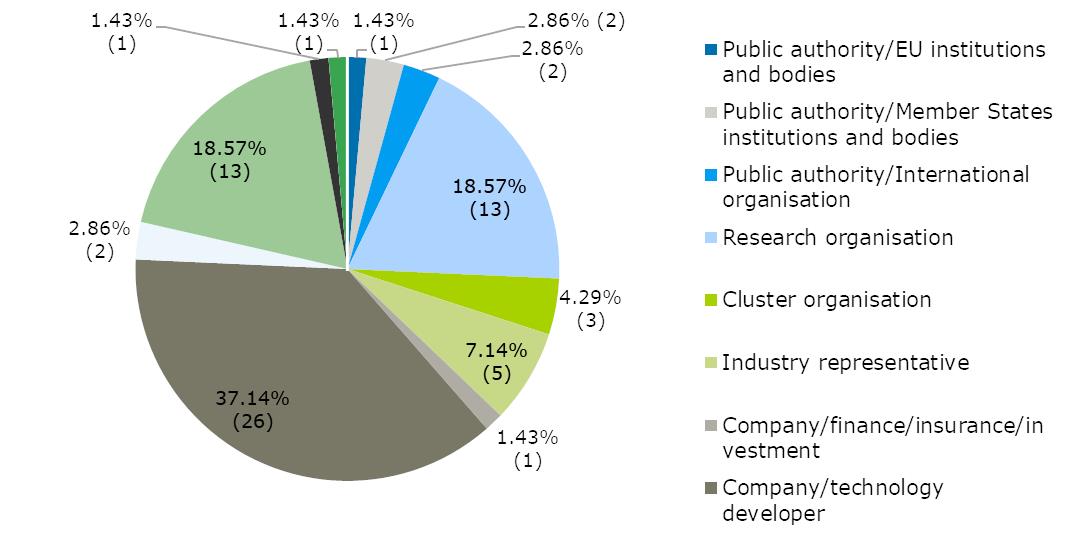
Two position papers were received in the course of this study. One was uploaded in response to the publication of the evaluation roadmap, by the industry association Ocean Energy Europe, and another one was uploaded in the course of the public consultation, by the technology developer Corpower. The content of these position papers is summarised in the last section below.
Key results per evaluation criterion
Profiling questions
The majority of the respondents claimed to be ‘very familiar’ or ‘more or less’ familiar with the Blue Energy Communication (63) and the Ocean Energy Strategic Roadmap (59), while only a small portion of the respondents not aware of their existence (respectively, 7 and 11 respondents).
Following the profiling questions, respondents were split into groups based on those that wanted to provide their ‘View on the sector of ocean energy’ and those who wanted to provide a ‘Detailed view on the Blue Energy Communication and the Roadmap’. Most of the respondents (41) belong to the first group, and their replies to the general questions are presented below. The replies of the remaining group of respondents (29) are presented further below under each evaluation criterion and correspond to the views of technology developers and research organisations. The moderate amount of detailed responses receive needs to be taken in due consideration when reading through the answers per evaluation criterion.
During data cleaning it was found that 18 out of these 29 responses correspond to “coordinated answers” according to the Better Regulations Toolbox and the decision was made to segregate the data and conduct a separate analysis so to not skew the results. These answers were segregated from the main dataset and the main differences will be highlighted during the analysis.
General responses
Of the respondents providing general views on ocean energy, most of them considered themselves to be very familiar (26) or more or less familiar (15) with the technology.
The large majority of the stakeholders who completed this part of the PC believe that the ocean energy sector has a strong potential for increasing the share of renewable energy in the EU. Moreover, they also agree that the sector has an overall positive environmental impact, and that it has a positive impact on climate change. In general, they all agree that ocean energy should be deployed more widely (38).
When providing additional explanation on their feedback, the stakeholders highlighted that ocean energy should be further developed as part of the EU energy mix because it is a stable, low-impact, predictable and reliable form of energy that can play an important part in complementing solar and wind energy and can work synergistically with them. in this context, the further development of this technology is key for the EU to reach its climate and energy objectives, as well it can play an important role in job creation. For the further uptake to take place, the respondents mention that strong support is needed, together with de-risking actions and further proofs of concepts, to enable a commercial deployment of these technologies. The importance to further investigate the environmental impacts of the technology is also identified. Single stakeholders also highlight that ocean energy could be further developed in specific areas in Europe (e.g. Portugal) as well as that technologies developed outside of Europe (e.g. Canada) should be taken into consideration.
Relevance
A part of the stakeholders (8 out of 11) agree that the objectives of the Communication and Roadmap were appropriate to address the bottlenecks that hampered the uptake of ocean energy at the time of their issuance, and that they are still relevant today. In particular, the consolidation of R&D activities to enable cost reduction was key in helping the sector according to a part of them (8). Of the other objectives inscribed in the Communication, enhancing the synergies with other industries such as offshore wind, as well as assisting with monitoring of environmental impacts, would still be relevant to address the bottlenecks of the sector today according to a limited part of the stakeholders (6). 3 out of 11 stakeholders also believe that additional objectives would play a major role in addressing the bottleneck of the sector today. These stakeholders suggest that the focus should now be placed on establishing revenue support and on reducing risks to enable larger-scale deployments to demonstrate the technologies on a sufficient scale. To this end, one stakeholder suggests that it will be crucial to reduce costs related to operation, maintenance and grid-connection of offshore energy technologies, including potentially by exploiting synergies with one or more technologies i.e. by sharing common infrastructure. In addition to this, two stakeholders remark that more should be done to make sure the further development of ocean energy does not harm marine resources and the other economic sectors that depend on these. In their views, the environmental and social impacts of ocean energy should further be investigated, and the European Commission should provide further guidance on how to monitor and gather environmental data under the EIA Directive.
The respondents belonging to the group of coordinated answers strongly agree that the objectives of the Communication and the Roadmap were appropriate for addressing the bottlenecks that hampered the uptake of ocean energy in 2014, and that these remain relevant today. In particular, the consolidation of R&D activities to enable cost reduction was key in helping the sector. In light of the progress shown by the sector, in particular by tidal energy, they suggest that ocean energy technologies are now “ready for larger-scale deployment”, and that the European Commission should now focus on engaging with Member States to grant revenue support for these technologies, as well as to enable access to sea required for this type of deployment. They mention that these objectives are also reflected in the recently published Offshore Renewable Energy Strategy, In particular the “key action” on coordinating with national governments to deliver 100MW with ocean energy by 2025.
Effectiveness
There is uncertainty with regards to the effectiveness of the Communication. The views regarding the achievement of the four operational objectives of the Communication are quite divergent among the stakeholders who replied to these questions (11), with a part of the stakeholders being convinced that the objectives on consolidating R&D activities and on assisting with monitoring of environmental impacts are close to being achieved (respectively, 5 and 3 stakeholders), and others affirming they have not been achieved at all, or at least to a lesser extent. Limited progress on improving efficiency of planning and licensing procedures and on enhancing synergies with other industries is registered by the stakeholders (with progress being mostly rated as 3 or 4 on a scale where 1 is ‘fully achieved’ and 5 is ‘not achieved at all’). Notably, none of the stakeholders consider that any of the objectives have been fully achieved, and a part of them affirms not knowing whether these objectives have been achieved at all (from 1 to 4 stakeholders, depending on the objective, with the objective on improving efficiency of planning and licensing being the one where the larger uncertainty exists).
The same scattered picture is represented in the replies concerning some specific aspects of the objectives of the Communication. Close to half of the stakeholders believe that improvements have taken place in terms of stakeholder collaboration, technological convergence, integration of offshore renewables into the energy system and EU-wide standardised testing. Partial improvements have been registered according to a part of the stakeholders on the establishment of a common understanding of administrative challenges faced by ocean energy technologies, on the increased awareness of investors on the opportunities offered by the sector, on the availability of relevant baseline of environmental data, on the decrease of the resources needed for EIAs and on the reduction of risks for investors. By contrast, improvements on the licensing procedures and lead time lengths have failed to materialise according to a part of the stakeholders. In this case again, a varying number of stakeholders affirm not knowing whether the specific objectives have been achieved, with the largest degree of uncertainty being registered on the objective regarding the decrease of the administrative costs compared to total project costs.
According to the respondents belonging to the group of coordinated answers, progress has been made primarily on the consolidation of R&D activities and on the monitoring of environmental impacts and application of environmental protection legislation, although none is considered as fully achieved. Moderate and limited progress are respectively reported on the improvement of synergies with other industries and on the improvement of the efficiency of planning and licensing procedures.
With regards to the specific objectives, these respondents indicate that the objective on stakeholder collaboration has been fully achieved, followed, in terms of progress, by the objective on technology convergence, integration of offshore renewables, the decrease of resources for EIAs, EU-wide testing and the reduction of risks for investors. In this case again, the stakeholders affirm not knowing whether proportion of administrative costs compared to total project costs decreased at all.
Efficiency
No questions pertaining to the criterion of efficiency were asked in the public consultation.
Coherence
There is little knowledge about the coherence of the Communication and Roadmap with the wider EU policy framework, with a number of stakeholders (up to 4) affirming they do not know whether these instruments are coherent with the other policies listed. Overall, it appears that the objectives of these initiatives are particularly in line with the Blue Growth Strategy and EU renewable energy policy, followed by the EU research and innovation policies and support. While according to a part of the stakeholders there is a certain level of coherence between the Communication and Roadmap and regional policies, moderate to little coherence seems to exist between the objectives of the Communication and Roadmap and the national policies of EU Member States.
According to one stakeholder this is because they perceive more directly the potential benefits of the development of the sector, including in terms of employment.
The stakeholders belonging to the group of coordinated answers affirm that the Communication and Roadmap are coherent with, and well complement, all the policies mentioned above, and only partially coherent with Member States policies. This is because, in their views the further development of ocean energy contributes to the decarbonisation of the energy system, while at the same time ensuring an economically and socially just transition.
EU added value
Overall, the EU intervention in support for ocean energy has an EU added value that justifies its existence and continuation. In fact, the majority of the respondents believed that the EU intervention has added to the support provided by private and national initiatives and investments. In particular, the EU support has been crucial for the consolidation of R&D activities and for the improvement of the monitoring of environmental impacts and simplification of the application of environmental protection legislation. The majority of these respondents believe that the cessation of EU support for ocean energy would have negative or very negative effects on the uptake for ocean energy.
In line with the above, the responses from the group of coordinated answers all indicate that the EU intervention in favour of ocean energy brought strong additional value, in particular in terms of the consolidation of R&D activities and the monitoring of environmental impacts. In their view, “beyond R&D”, the existence of EU-wide calls “ensured the emergence of European leaders” in ocean energy technology and avoided duplications of calls. The “European environmental monitoring calls” helped to increase developers’ knowledge of the sector and accelerated deployments. In addition to this, in general terms, the “EU seal of approval” for the technology helped to attract private funding. Also in their case, there is a widespread agreement that the cessation of EU’s intervention would have very negative effects on the uptake of ocean energy.
Recommendations
The respondents were also asked for additional feedback on the existing bottlenecks for the sector and recommendations to overcome them.
In terms of current bottlenecks of the sector, the following were identified by the stakeholders, with permitting and financing issues having the agreement of most stakeholders:
·Finance: the lack of revenue support at national level, the lack of an instrument to cover and mutualise the technological risks of projects and provide insurance and guarantee for them (e.g. such as EU Insurance and Guarantee Fund), the limited number of calls and grants dedicated to ocean energy;
·Permitting: the length of consenting processes and procedures, the understanding of environmental impacts;
·The availability of grid connection;
·Closer cooperation between academia and industry;
·Limited involvement of stakeholders from other blue economy sectors in the decision-making;
One stakeholder highlighted that the EU has partial traction on these topics, as some of them are shared competences with the Member States.
The stakeholders belonging to the group that provided coordinated answers identified two main bottlenecks preventing the further evolution of the sector:
·Finance: “The lack of revenue support at national level that prevents larger projects to attract private finance and reach financial close”, the risks for the investors are still too high and there are no commercial insurance products covering “innovative offshore technology”, the design and number of calls issued under programmes such as Horizon Europe, Innovation Fund and InnovFin EDP are insufficient to finance enough projects to reach the 100 MW target for ocean energy as set in the Offshore Renewable Energy Strategy;
·Permitting: The cumbersome permitting procedures, that make access to the sea for ocean energy technologies “very slow” and are caused by a limited understanding of the technologies and their potential by national authorities.
These stakeholders are confident that both challenges can be addressed by the Offshore Renewable Energy Strategy, called by them “the successor of the Roadmap”, with the EU playing a strong coordination role with Member States to ensure the achievement of the strategy’s targets for ocean energy.
Position paper | Offshore Renewables Strategy Ocean energy – the next European Industry – Ocean Energy Europe
The position paper uploaded by Ocean Energy Europe describes the potential for future deployment of ocean energy, as well as presents the benefits of this deployment for Europe e.g. in terms of job creation, decarbonisation as well as leadership potential. The paper welcomes the publishing of an Offshore Strategy including ambitious long-term objectives for the sector, that could increase confidence in the sector from private investors. The paper also highlights that national revenue support mechanisms, blended EU financial instruments, an EU Insurance and Guarantee Fund, further support for ocean energy from the EIB and the launch of international partnerships with third countries could help the sector move forward. In their views, for this to happen it will be necessary to streamline project development and to enable large scale deployments in Europe.
Position paper | The role of Wave Energy – Corpower ocean
The position paper uploaded by Corpower ocean presents a summary of the role the company sees for wave energy in the future electricity markets, and the value offered for electricity producers and electricity system owners. The paper highlights that wave energy is expected to have a “higher average value compared to wind and solar in future electricity markets”, that the demonstration of wave technology pilot arrays is expected to make the technology bankable by 2024. The achievement of the bankability milestone will unlock significant investments into wave energy in their views, and this will enable the installation of 600 MW of wave energy capacity by 2030.
Targeted consultations
The targeted consultations feed into several aspects of this study. Primarily, they are a source of information to feed into the analysis. However, selected interviews have also been conducted where considered relevant for other aspects such as complex analytical problems, definition of the baseline or for forming/testing of conclusions and recommendations.
Methodology and tools used to disseminate and process data
The interviews served a dual purpose:
·To gather stakeholder specific qualitative evidence in relation to the evaluation questions for which qualitative data was judged to be an important source;
·To complement the other tasks of this study and fill data gaps emerging from other consultation tools.
The targeted interviews were semi-structured, following interview guides designed for the different stakeholder categories during the inception stage. Detailed interview notes were written for each interview, which were subsequently analysed using the Qualitative Data Analysis (QDA) software NVivo.
Stakeholders
A total of 25 interviews were conducted at the EU level, with European Commission staff (2), International Organisations (1), Member States and Regional institutions and bodies (7), industry representatives and cluster organisations (2), representatives of the finance and insurance sector (2), technology developers (7), supply chain providers and utility companies (1), research organisations (3).
Key results per evaluation question
Relevance
There is a widespread agreement among all different stakeholder groups that the objectives and scope of the Communication and Roadmap (the latter in particular) were aligned with the needs of the ocean energy sector at the time of its publication. Although none of the stakeholders were able to refer to the specific objectives of the Communication or the Roadmap, the majority of them asserted that the publication of a cohesive document by the European Union in favour of the development of the ocean energy sector was instrumental to create momentum around ocean energy, as well as to set a common direction and priorities and as such to give confidence to the investors, which was needed at the time. This was particularly true in the years immediately following their adoption. The documents provided visibility to the industry, as well as clear recommendations and guidance based on the needs expressed by the sector at the time. As such, they contained the “right elements” to guide the sector in identifying the workstreams where its resources should focus on. Some of the representatives of national and regional/local agencies pointed out that these documents were particularly helpful for the development of their own strategies with regards to ocean energy, or as elements to build ‘the business case’ for ocean energy towards key stakeholders (e.g. national authorities).
This notwithstanding, a part of the stakeholders highlighted that the Communication and the Roadmap were not sufficient in and of themselves, but that they were only ever intended to be “a part of the solution” for ocean energy, in substance “strategy documents” that would need to be subsequently complemented by other tools, both EU’s and Member States’ (e.g. financing and other support instruments).
A part of the stakeholders identified the following aspects lacking in the Communication and Roadmap:
·Lack of a clear link with national interests and polices, as well as of an approach to facilitate or secure the engagement of and coordination among the European Member States and regions that are active in ocean energy;
·The limited consideration of some aspects, including the needs of OTEC and salinity gradient technologies, the need to support the business case for ocean energy (e.g. by highlighting its benefits in terms of predictability, the advantages of localised energy production), the importance of the sector for different regions in EU (e.g. including the Mediterranean);
·Lack of dedicated budget or link to a funding instrument for the implementation of the actions set in the Communication and the Roadmap.
While a part of the stakeholders maintain that the sector still faces some of the challenges identified in 2014 (e.g. risk, need to demonstrate projects and to cross the valley of death), the majority of the stakeholders involved pointed out that the EU policy in support of the uptake of ocean energy could benefit from a revision or adaptation, in light of the developments that took place in the sector and in the context in which this operates. These developments include: the progress made by ocean energy technologies (in particular tidal energy), the advancements in other renewable energy sources outcompeting ocean energy, the reduction in the support provided by the private sector and Member States, as well as wider developments such as Brexit and the outbreak of COVID-19.
In general, while the stakeholders consulted agree that there are different policy instruments at the EU level that can indirectly support the uptake of ocean energy (e.g. renewable energy policy, climate policy, maritime policy, R&I policy), most of them assert that due to its early stage of development, ocean energy necessitates targeted support if it is to play a role in the overall European energy mix. It has been reiterated several times that it will be extremely difficult for ocean energy to progress if it needs to compete for support with other more established sources of renewable energy e.g. offshore wind.
Effectiveness
Only a part of the stakeholders consulted was able to provide feedback on the progress made in the implementation of the activities inscribed in the Communication, and this recalls the limited knowledge of stakeholders in general when it comes to the details of the Communication and Roadmap. In the view of these stakeholders, the first phase of activities included in the Communication took place, as the Forum was organised, and it produced a Roadmap. They were not able to provide feedback on the second phase. With regards to the actions inscribed in the Roadmap, in their view only actions 1, 2, 4 took place to a certain extent.
In terms of the objectives of the Communication, in the view of the stakeholders consulted the coordination of the players in the sector has been enhanced substantially, and in general it appears that the sector is more mature, informed and structured than it was in 2014.
With regards to the uptake of ocean energy, part of the stakeholders indicates that while the sector is not where it was expected to be at this time, considerable progress has been made in the development of these technologies. This can be linked to the fact that funding for research and development has significantly increased since 2014, and that in general access to funding has slightly improved, although not for all times of technologies. This notwithstanding, while some believe that this has been “reasonably good”, “sufficient” or “adequate”, at least at the EU level, other maintain that the funding has not been sufficient nor appropriate, and they assert that increased funding would be needed, particularly at the Member State level.
Little information has been provided with regards to the improvement of administrative practices and environmental monitoring.
According to the stakeholders consulted, several factors have influenced the effectiveness of the EU intervention in support of ocean energy, including that of the Communication and the Roadmap, both positively and negatively.
Among the positive factors influencing effectiveness, the stakeholders consulted have mentioned:
·Increased societal awareness on climate change and increased interest in renewable energies;
·The rapid development of offshore wind, sharing some characteristics and challenges with ocean energy and demonstrating that such marine technologies can rapidly improve performance beyond expectations with the appropriate level of support;
·Increased interest of the oil and gas sector in utilising ocean energy devices for offshore power production.
According to the stakeholders consulted, the abovementioned factors have contributed to increasing the confidence and interest of private and public sector stakeholders in ocean energy to a certain extent.
Among the factors influencing negatively the effectiveness of the EU intervention in favour of the uptake of ocean energy, stakeholders have mentioned:
·The limited support provided by Member States and private actors, potentially affected by factors such as high-profile failures in the industry discouraging investments, long time scale for the harnessing of the benefits of the investment, substantial previous investments in other forms of renewable energy etc.
·Other sources of energy (e.g. offshore wind, and the emerging floating offshore wind) becoming considerably cheaper and more performant, also because of the considerable funding they previously received, and leading to a de-prioritisation of the investments in other sources of marine renewable energy;
·Inappropriate arguments used to advocate for ocean energy by industry stakeholders: different arguments should have highlighted better instead e.g. benefits to peripheral regions;
·Brexit, removing a strong actor, and investors, in ocean energy;
·COVID-19 crisis, that might cause the decrease or slowdown of funding but can also represent an opportunity, where states want to recover based on low carbon strategies.
Efficiency
While none of the stakeholders consulted were able to provide feedback with regards to the costs of implementation related to the Communication and the Roadmap, they all highlighted the importance of different EU funds in support of ocean energy. The most important for the development of the sector so far were Horizon 2020, ERDF (including Interreg), EMFF and other European Structural and Investment Funds, NER 300, InnovFin EDP.
With regards to the efficiency of the overall financial support provided so far by the EU, most of the stakeholders maintain that this was not always guaranteed, as some of the funding went to technologies that proved to be unfit for purpose. The efficiency of the funding was also affected by specific characteristics of the funding process, including the high level of competition, the time consuming and complicated application procedures, as well as the high expectations placed on project outcomes, which put excessive pressure on the technologies.
This notwithstanding, the majority of the stakeholders interviewed believe that the benefits of investing in ocean energy substantially outweigh the costs, in particular when the potential contribution of the technology to the achievement of the climate targets and the stability of the EU energy mix, as well as the potential job creation and the generation of EU added value (e.g. for export of the technology) are taken into account.
Coherence
None of the stakeholders were able to provide concrete examples of overlaps, inconsistencies or incoherence within the Communication or the Roadmap, aside for the fact that the development of OTEC and salinity gradient technologies were not granted sufficient consideration compared to the objectives set.
The opinions with regards to the coherence of the Communication and Roadmap with the wider EU policy framework are mixed.
A part of the stakeholders asserts that most of the current EU policies adequately complement each other and seem to “move in the same direction” “broadly coherent” e.g. renewable energy targets and climate neutrality targets. These stakeholders were unable to identify policies that contradict with the development of the ocean energy sector, also positively noting the Green Deal also favours the development of this technology.
Another part of the stakeholders consulted believes that there might be a certain degree of incoherence between the EU ambition on renewables and climate neutrality on the one side, and the allocation of EU funds on the other. In this respect, they mention that substantial resources are still allocated to the fossil fuel industry or to nuclear energy, and that this could in principle be seen as being incoherent with the intentions to develop ocean energy to a certain extent.
A limited portion of stakeholders mentioned additional potential contradictions between approaches adopted in the EU policy landscape and the interventions to favour the uptake of ocean energy:
·Contradiction with EU energy modelling: the current energy models favour the inclusion of established technologies in long-term policies rather than emerging technologies, because of the difficulty to estimate the costs of energy produced by the latter;
·Contradiction with EU competition policy and technology neutrality principle: these establish that the different technologies shall compete in the market and the ones presenting lower costs will emerge, but this is often incompatible with the needs of an emerging technology such as ocean energy;
·Contradiction with the EU State Aid rules: the notification threshold for state aid to renewable energy projects is quite low and this can discourage Member States from creation of substantial support schemes for ocean energy.
Lastly, an additional possible inconsistency has been identified in the fact that the integration of ocean energy in National Renewable Energy Action Plans has not been sufficiently incentivised. Due to the perceived low level of development of the technology, the inclusion of ocean energy in the energy mix that should achieve the renewable energy targets has so far been deprioritised.
With regards to the coherence between the EU intervention and available support schemes, rather than pointing at specific contradictions, the stakeholders interviewed mentioned that the abundance of different funds that can contribute to ocean energy might be confusing for technology developers. Also, they mentioned that the application requirements differ substantially among the funding instruments, and this signals a lack of coordination among these entities.
With regards to the relationship between the EU intervention and Member State support, none of the stakeholders were able to identify specific contradictions. Nevertheless, the large majority of them indicated that there is a certain level of incoherence between the EU and National policies, indicating that these are not always aligned. Specifically, relevant Member States don’t take ocean energy sufficiently into account in the development of their national renewable energy strategies, or when this is done it is not linked to concrete support actions (e.g. the establishment of market pull mechanism). By contrast, the alignment between the EU intervention and single strategies at the level of relevant regions within Member States is more prominent, although substantial differences persist in the types of support provided across regions interested in developing ocean energy.
EU added value
The large majority of the stakeholders interviewed confirmed that the Communication and the Roadmap added value at the EU level. They all agree that the intervention achieved results that could not have been achieved at a different level of intervention at all, or at least not at the same cost or with the same result. Although not stakeholders express positive views on the results achieved by the intervention, and some believe that there wouldn’t been significant differences, they all agree that the situation would have been worse than it is now. They suggest that at a minimum, it was able to:
·Provide momentum for the sector and set a common direction for the actors involved;
·Increase confidence of the investors;
·Increase collaboration and organisation of the sector.
The perception of the added value of the intervention varies among stakeholders, with some affirming that the ocean energy sector would not exist in Europe at the moment, others that there would certainly be less uptake in ocean energy. Only one stakeholder from a research organisation affirmed that other instruments would have taken the place of the Communication and the Roadmap had these not been published.
All stakeholders consulted overwhelmingly believe that the withdrawal of EU support would have negative consequences on the ocean energy sector in Europe. In their views, this would demonstrate that the EU does believe in the validity of the technology, and this would have the following consequences:
·Ocean energy activities in Europe would dramatically decrease or stop, and the sector itself could completely disappear, as investors would not be interested in investing in a technology in which the EU itself is not showing confidence
·EU technology developers would either shut down or move their companies abroad and continue developing the technologies in countries with more favourable conditions can be found e.g. Canada, USA, Japan, China – but capitalising on all the investments already poured in the sector by the EU
·The withdrawal of EU support could also have negative influence on the development of the sector overall (also abroad) given the importance they have also abroad “everybody is watching what the EU is doing” – the EU leads most international discussions on OCEN
Most of the stakeholders agree that this would be a lost opportunity for the EU, to exploit a technology with high levels of “EU content”, and it would be a waste of the efforts made so far, considering the scale of the investments that have been made to date.
Recommendations
The stakeholders interviewed were also invited to provide suggestions and recommendations for the future of the EU support in the sector. Their suggestions can be summarised as follows:
·The EU should continue to show leadership in the sector by providing political support to increase confidence in ocean energy by depicting a clear route for ocean energy technologies, including OTEC and salinity gradient;
·The EU should increase the collaboration with relevant Member States to stimulate their intervention (e.g. including in terms of revenue support) and involvement in the decision-making process regarding the sector, including by further highlighting the benefits of investing in the sector;
·The EU and Member States should improve efforts to help ocean energy technologies ‘cross the valley of death’, including by facilitating the achievement of an appropriate balance between market push and market pull mechanisms, and by fostering the de-risking of the technology.
Annex 3: Evaluation matrix
|
|
Evaluation questions
|
Sub-question
|
Indicators / descriptors
|
Judgement criteria
|
Sources
|
|
Relevance
|
EQ 1.To what extent have the objectives of the intervention proven to be appropriate for responding to the needs identified in the impact assessment?
|
1.1 To what extent were the specific and operational objectives of the Blue Energy Communication and the Ocean Energy Roadmap appropriate to address cost reduction, financial and profitability needs? Has this changed over time and to what extent are they still appropriate?
|
Qualitative indicators:
Paper, evaluations, reports etc. agree that the Blue Energy Communication and the Ocean Energy Roadmap were appropriate for supporting the uptake of ocean energy technologies
Quantitative indicators:
% of stakeholders agreeing that the Blue Energy Communication and the Ocean Energy Roadmap were appropriate for supporting the uptake of ocean energy technologies
Qualitative indicators:
Identified current needs within the EU per category of stakeholders (public; private; research community; citizens)
Identified changes in needs within the EU per category of stakeholders (public; private; research community; citizens) since 2014
Papers, evaluations, reports etc. agree that the original objectives of the Blue Energy Communication and the Ocean Energy Roadmap still correspond to stakeholders’ needs
|
There is evidence in the literature that the Blue Energy Communication and the Ocean Energy Roadmap were appropriate for supporting the uptake of ocean energy technologies
Stakeholders agree that the objectives have been appropriate and relevant for supporting the uptake of ocean energy technologies
There is evidence in the literature that the original objectives Blue Energy Communication and the Ocean Energy Roadmap correspond to the current needs of different stakeholders’ categories
Stakeholders are able to identify their current needs
Stakeholders agree that the original objectives continue to correspond to their needs
|
Literature review
Stakeholder consultations: PC
Stakeholder consultations: targeted consultations
|
|
|
|
1.2 To what extent were the specific and operational objectives of the Blue Energy Communication and the Ocean Energy Roadmap appropriate to address infrastructure needs (e.g. grid planning, port facilities and vessels)? Has this changed over time and to what extent are they still appropriate?
|
|
|
|
|
|
|
1.3 To what extent were the specific and operational objectives of the Blue Energy Communication and the Ocean Energy Roadmap appropriate to address administrative & regulatory needs (e.g. licensing and consenting procedures)? Has this changed over time and to what extent are they still appropriate?
|
|
|
|
|
|
|
1.4 To what extent were the specific and operational objectives of the Blue Energy Communication and the Ocean Energy Roadmap appropriate to address environmental needs (e.g. research and development, better exchange of information on environmental impacts of OCEN installations)? Has this changed over time and to what extent are they still appropriate?
|
|
|
|
|
|
EQ 2.To what extent do the objectives of the intervention remain appropriate in the light of the evolution of the EU energy, climate, maritime and R&I policies?
|
2.1 To what extent do the objectives of the Communication and the Roadmap correspond to the current needs of the ocean energy sector in light of the evolution of EU energy, climate, maritime and R&I policies (e.g. new renewable energy targets etc.)?
|
Quantitative indicators:
% of stakeholders agreeing that the Blue Energy Communication and the Ocean Energy Roadmap remain relevant policy
·EU climate policy
·EU maritime policy
·EU R&I policies
evolution
|
|
|
|
Effectiveness
|
EQ 3.What progress has been made in implementing the activities of the intervention?
|
3.1 What progress has been made in implementing the Ocean Energy Forum?
|
Qualitative indicators:
Evidence on progress/achievement of actions
Quantitative indicators:
Actions and activities achieved in relation to the planned outputs
|
There is evidence in the literature that actions and recommendations have been achieved
|
Literature review
|
|
|
|
3.2 What progress has been made in implementing the Ocean Energy Strategic Roadmap?
|
|
|
|
|
|
|
3.3 What progress has been made in implementing the European Industrial Initiative?
|
|
|
|
|
|
|
3.4 What progress has been made in implementing the sector-specific guidelines?
|
|
|
|
|
|
EQ 4.What have been the quantitative and qualitative effects of the intervention?
|
4.1 How many new ocean energy projects have been installed and deployed in Europe since 2014?
|
Qualitative indicators:
Other papers, evaluations, reports etc. agree that the Blue Energy Communication and the Ocean Energy Roadmap contributed to the uptake of ocean energy
Quantitative indicators:
Number of projects deployed and planned compared to what could be expected in the baseline scenario
Installed capacity compared to what could be expected in the baseline scenario
|
There is evidence in the literature that the Blue Energy Communication and the Ocean Energy Roadmap have contributed to the uptake of ocean energy technologies
Stakeholders agree that the objectives have been appropriate and relevant for supporting the uptake of ocean energy technologies
The intervention is found to have an effect (compared to the baseline)
|
Literature review
Stakeholder consultations: PC
Stakeholder consultations: targeted consultations
|
|
|
EQ 5.
|
4.2 How much has been invested in the ocean energy sector since 2014 (both public and private investments)?
|
Investment into the sector compared to what could be expected in the baseline scenario
|
|
|
|
|
EQ 6.
|
4.3 How much have Member States supported the uptake of ocean energy since 2014 (including revenue support schemes)?
|
Amount of Member State financial support for ocean energy, including differentiated revenue support schemes, compared to what could be expected in the baseline scenario
|
|
|
|
|
EQ 7.
|
4.4 How much have the capital costs for the deployment of ocean energy been reduced since 2014?
|
Capital cost reduction compared to what could be expected in the baseline scenario
|
|
|
|
|
EQ 8.
|
4.5 What is the extent of the investments in R&D for ocean energy since 2014 (public and private)?
|
Capital cost reduction/R&D spending over the evaluation period compared to what could be expected in the baseline scenario
|
|
|
|
|
EQ 9.
|
4.6 To what extent has the development of the ocean energy sector contributed to job creation, economic growth or EU’s sustainability objectives since 2014?
|
Extent to which the sector is contributing to the EU’s wider jobs, growth and sustainability objectives compared to what could be expected in the baseline scenario
|
|
|
|
|
EQ 10.To what extent have the objectives of the intervention been met so far?
|
5.1 To what extent has the uptake of ocean energy increased?
|
Partly answered by EQ 4.1
|
There is evidence in the literature that the Blue Energy Communication and the Ocean Energy Roadmap reached their objectives
Stakeholders agree that the Blue Energy Communication and the Ocean Energy Roadmap reached their objectives
The intervention is found to have an effect (compared to the baseline)
|
Literature review
Stakeholder consultations: PC
Stakeholder consultations: targeted consultations
|
|
|
EQ 11.
|
5.2 To what extent have the stakeholders been brought together and coordinated their action to enhance technological innovation and competitiveness? (specific objective)
|
Qualitative indicators:
Papers, evaluations, reports etc. agree that the Blue Energy Communication and the Ocean Energy Roadmap reached their objectives
Quantitative indicators:
% of stakeholders agreeing that the Blue Energy Communication and the Ocean Energy Roadmap reached their objectives
|
|
|
|
|
EQ 12.
|
5.3 To what extent has ocean energy’s access to finance been facilitated? (specific objective)
|
Papers, evaluations, reports etc. agree that the Blue Energy Communication and the Ocean Energy Roadmap improved access to finance for technology developers
% of stakeholders agreeing that the Blue Energy Communication and the Ocean Energy Roadmap improved access to finance for technology developers
|
|
|
|
|
EQ 13.
|
5.4 To what extent have the administrative practices and environmental monitoring been improved? (specific objective)
|
Proportion of the administrative cost compared to the total project costs compared to what could be expected in the baseline scenario
|
|
|
|
|
EQ 14.
|
5.5 To what extent has cost reduction being achieved via the consolidation of R&D activities? (operational objective)
|
Proportion of the administrative cost compared to the total project costs compared to what could be expected in the baseline scenario
|
|
|
|
|
|
5.6 To what extent has the efficiency of the planning and licensing procedures been improved? (operational objective)
|
Lead time length (i.e. the total time taken to get building consent and grid connection permits) compared to what could be expected in the baseline scenario
|
|
|
|
|
|
5.7 To what extent has the synergy with other industries (e.g. offshore wind) been enhanced, including on grid planning matters? (operational objective)
|
Number of collaborative undertakings compared to what could be expected in the baseline scenario
|
|
|
|
|
|
5.8 To what extent has the monitoring of environmental impacts of OCEN technology and the application of the relevant environmental protection legislation been supported? (operational objective)
|
Availability of relevant baseline environmental data compared to what could be expected in the baseline scenario
Time and resources spent satisfying the requirements of the EIAs compared to what could be expected in the baseline scenario
|
|
|
|
|
EQ 15.What factors have influenced effectiveness (positively or negatively), how and to what extent?
|
6.1 What factors influenced the effectiveness of the Communication/Roadmap positively? How did they influence effectiveness, and to what extent?
|
Qualitative indicators:
Factors identified on the basis of Literature review and interviews
|
The factors are found to have had an impact on the effectiveness
|
Literature review
Stakeholder consultations: targeted consultations
|
|
|
|
6.2 What factors influenced the effectiveness of the Communication/Roadmap negatively? How did they influence effectiveness, and to what extent?
|
|
|
|
|
Efficiency
|
EQ 16.To what extent are the costs of implementing the intervention justified, given the benefits it has achieved?
|
7.1 What have been the costs of implementation of the Communication/Roadmap for the different stakeholders?
|
Qualitative indicators/quantitative indicators:
Costs of implementation (administrative costs as well as funding)
|
The extent to which the benefits outweigh the costs of the intervention
|
Literature review
Stakeholder consultations: targeted consultations
|
|
|
EQ 17.
|
7.2 What progress has been made in terms of EU funding allocated to ocean energy?
|
Information of EU funding for ocean energy (e.g. including, ERDF (Interreg) etc.)
|
|
|
|
|
EQ 18.
|
7.3 What progress has been made in terms of Member States’ funding allocated to ocean energy?
|
Information of Member States funding for ocean energy (e.g. national, regional etc.)
|
|
|
|
|
EQ 19.
|
7.4 What benefits (direct, indirect) have been achieved to date for different stakeholders?
|
Benefits of implementation (see effectiveness questions – specifically EQ4)
|
|
|
|
|
EQ 20.
|
7.5 Are the costs and benefits proportional for the different stakeholders?
|
Information on the comparison between costs and benefits of implementation
|
|
|
|
|
EQ 21.What factors have influenced efficiency (positively or negatively), how and to what extent?
|
8.1 What factors influenced efficiency positively?
|
Qualitative indicators:
Factors identified on the basis of Literature review and interviews
|
The factors are found to have had an impact on the efficiency
|
Literature review
Stakeholder consultations: targeted consultations
|
|
|
EQ 22.
|
8.2 What factors influenced efficiency negatively?
|
|
|
|
|
Coherence
|
EQ 23.To what extent are the components of the intervention coherent internally; are there any overlaps, inconsistencies, or incoherencies?
|
9.1 Are there internal inconsistencies within the Communication?
|
Qualitative indicators:
The extent to which overlaps, gaps, contradictions or discrepancies exist within the intervention
|
Absence of evidence of overlaps, gaps, contradictions or discrepancies within the intervention
|
Literature review
consultations: targeted consultations
|
|
|
|
9.2 Are there duplications or overlaps within the Communication?
|
|
|
|
|
|
EQ 24.To what extent is the intervention coherent with wider EU policy and initiatives?
|
10.1 Are there inconsistencies or contradictions between the Communication/Roadmap and wider EU policy and initiatives?
|
Qualitative indicators:
The extent to which overlaps, gaps, contradictions or discrepancies exist with wider EU policy
|
Absence of evidence of overlaps, gaps, contradictions or discrepancies with wider EU policy
|
Literature review
Stakeholder consultations: PC
Stakeholder consultations: targeted consultations
|
|
|
|
10.2 Are there duplications or overlaps between the Communication/Roadmap and wider EU policy and initiatives?
|
|
|
|
|
|
EQ 25.To what extent is the intervention coherent with other relevant EU (and national/regional initiatives) support schemes (e.g. funding, sectorial policies), in particular linked to renewables and innovation?
|
11.1 Are there inconsistencies or contradictions between the Communication/Roadmap and other EU support schemes (in particular linked to renewables and innovation)?
|
Qualitative indicators:
The extent to which overlaps, gaps, contradictions or discrepancies exist with support in other sectors e.g. EMFF, ERDF (Interreg) etc.
|
Absence of evidence of overlaps, gaps, contradictions or discrepancies with other Commission initiatives
|
Literature review
Stakeholder consultations: PC
Stakeholder consultations: targeted consultations
|
|
|
|
11.2 Are there duplications or overlaps between the Communication/Roadmap and other EU support schemes (in particular linked to renewables and innovation)?
|
|
|
|
|
|
|
11.3 Are there inconsistencies or contradictions between the Communication/Roadmap and national/regional initiatives?
|
|
|
|
|
|
|
11.4 Are there duplications or overlaps between the Communication/Roadmap and national/regional initiatives?
|
|
|
|
|
EU Added Value
|
EQ 26.What is the additional value resulting from the intervention, compared to what could have been expected from private initiatives and investments, and Member States acting at national/regional levels?
|
12.1 Is there evidence for added value resulting from EU intervention in support of the ocean energy sector?
|
Qualitative and quantitative indicator:
Extent to which stakeholders agree that additional value has resulted from the intervention compared to what could reasonably have been achieved at other levels
|
A majority of stakeholders recognise the EU added value of the intervention
|
Stakeholder consultations: PC
Stakeholder consultations: targeted consultations
|
|
|
EQ 27.
|
12.2 To what extent would the same results have been achieved at international, national or regional level without EU intervention?
|
|
|
|
|
|
EQ 28.What would be the most likely consequences of stopping or withdrawing the existing intervention?
|
13.1 What would be the most likely consequences of stopping or withdrawing the existing EU intervention in ocean energy?
|
Qualitative indicators:
Likely consequences identified on the basis of literature review and interviews
|
Likely consequences are identified
|
Literature review
Stakeholder consultations: PC
Stakeholder consultations: targeted consultations
|
Annex 4: Overview of Member States’ support policies
This document provides and overview of the main national and regional support policies established by Member States, and regions within these, that contribute to the development of ocean energy. Where a sub-chapter on regional support is not available, this is because it was not possible to identify sufficient evidence on this type of support in the context of the study.
France
National support policies
The general strategy for renewable energies in France is laid out in the Energy Act (Loi de Transition Energétique pour la Croissance Verte) from 2015, which sets the target producing of 40% of the electricity with renewable energy technologies by 2030. While this law sets out targets for installed capacities for electricity productions from various renewable energy technologies, there is no specific objective towards the installed capacity of ocean energy technologies.
Support policies for ocean energy are managed under the “Investment for the Future” programme, which is coordinated by the Ministry for the Ecological and Solidary Transition. Grants and loans are provided by the Public Investment Bank (BPI), the Environment and Energy Agency (ADEME), or the National Research Agency (ANR), depending on the TLR. In 2019, ADEME funded projects with an estimated amount of 68 million EUR, and the ANR spent 4 million EUR on ocean energy project.
For commercial farms, the cost of the export cable is to be supported by the French Transmission System Operator, which also takes over more legal and financial responsibilities with respect to the availability of electricity exportation.
Two tidal energy projects have been provided a feed-in tariff of 173 EUR/MWh in the past. Both projects are on hold, showing that the provided support was insufficient for the commercial production of tidal energy.
Since 2017, a simplified consenting process is effective. Ocean Energy developers must provide an Environmental Impact Assessment, apply for a license to occupy territorial waters and an authorization from the Ministry of Energy (for projects >50MW)
.
Regional and local support for ocean energy
Regional actors are also active in the support of Ocean Energy. The region of Brittany for instance channels European funds in favor of maritime renewable energy production and provides port and testing facility infrastructure.
A notable project is the tidal range energy power plant in the Rance estuary (Brittany)
which operates since 1966. It is currently the world’s second largest tidal energy plant with a power capacity of 240 MW.
The region of Pays de la Loire has a very active ocean energy ecosystem, that focuses on tidal energy development. It is organized by the Solutions&Co
, the economic development agency for the Pays de la Loire region.
Both regions are partners in the Ocean Energy ERA-NET Cofund.
Special interest in ocean energy lies among local authorities in the French overseas territories, which could be less constrained than onshore renewable energies such as solar in terms of land requirements. Energy self-sufficiency has become a major concern, since energy production is very costly on remote island locations.
Ireland
National support policies
In 2019, Ireland launched an ambitious Climate Action Plan, which states to increase the share of renewable energies of the electricity production to 70% by 2030, including a planned increase of offshore renewables from 25 MW to 3.5 GW by 2030. While the actions of the Climate Action Plan heavily focus on offshore wind energy production, the three actions (Action 25, 26 and 27) covering offshore renewable energies will also benefit tidal and wave energy development.
Since 2014, Ireland also has an Offshore Renewable Energy Development Plan (OREDP), which identifies Ireland as the most fruitful coast in Europe for harnessing offshore renewable energies. The report predicts an installed capacity of wave and tidal energy being between 75 and 1500 GW by 2030.
Under the OREP, Ocean Energy Ireland was founded. It serves as a platform for ocean energy technology developers and most importantly provides free and accessible data on wave, tidal and environmental impact studies.
The main framework for supporting ocean energy projects is provided by the Renewable Electricity Support Scheme (RESS). It is the main policy instrument in Ireland to support renewable energies – including ocean energy – with funding opportunities.
Besides, public funding programmes include the Sustainable Energy Authority of Ireland’s Prototype Development Fund (65 projects subsidized since 2009, 15 new projects in 2015) and the OCEANERA-NET scheme, an innovative component of the European Union’s Framework Programme which supports cooperation of national/regional research funding programmes.
The Science Foundation Ireland (SFI) Research Centre for energy, climate and marine (MaREI), coordinated by the Environmental Research Institute (ERI) at University College Cork, coordinates 12 partner institutes with over 200 researchers. It delivers high quality research on maritime energy technologies, including cross-cutting topics such as societal and economic impact of ocean energy.
Regional and local support for ocean energy
Information on activities of regional authorities in supporting ocean energy are scarce, despite a number of ERDF (Interreg) funded projects in Ireland in partnership with other Atlantic countries (e.g. France, Spain) .
Portugal
National support policies
In Portugal, the Ministry of the Sea is responsible for defining policies encouraging the development of new activities in the sea that maximize the use of its resources. It is tasked with implementing the Industrial Strategy for Ocean Renewable Energies (EI-ERO).
While the strategy focuses on offshore wind power development, it recognizes possible synergies between offshore wind development and other ocean energy technologies (such as using the same sea cables etc.).
Portugal installed in 2014 a fixed feed-in tariff scheme for renewable ocean energy technologies, which includes (and focuses on) off-shore wind energy.
Portugal funds R&D and technology demonstration projects under the Blue Fund (“Fundo Azure”), which provides direct funds but also facilitates private investments.
Spain
National support policies
The Energy and Climate National Integrated Plan 2021-2030 of Spain sets ambitious targets for ocean energy of reaching 25 MW of installed capacity for 2025 and 50 MW for 2030.
The plan has been developed by the Ministry for the Ecological Transition, who is also in charge of permitting new ocean energy projects.
Spain does not provide specific support policies for ocean energy projects. A number of projects in Spain have been funded by European programmes such as Horizon2020, the ERDF or other sources such as grants from EASME or DG GROW.
Regional and local support for ocean energy
The Basque Government approved in 2016 the Basque Marine Energy Plan for 2030, which included a specific initiative to speed up technology and commercial development for marine energy and set a target of 60 MW by 2030.
Due to its geographic conditions, the coast of the Basque Country is well suited for harnessing wave energy. Aiming to find synergies with the local shipbuilding industry (which continues to be under economic pressure due to international competition), Wave Energy Basque Country forms a strong industry cluster which connects and coordinates the numerous actors in the sector.
Italy
National support policies
The National Research Council of Italy (Consiglio Nazionale delle Ricerche – CNR) leads the “Blue Italian Growth” (BIG) cluster. The BIG Action Plan includes encouraging the uptake and development of innovative ocean energy technology but does not specify any concrete targets.
Italy does provide a fixed feed-in tariff scheme for renewable energy technologies, the latest update of it however excludes ocean energy and focuses on more mature renewable energy technologies.
Up to 2017, also ocean energy plants with power outputs of >60kW could benefit from fixed feed-in tariffs.
There are no specific funding instruments for R&D activities of ocean energy projects. Developers rely on generic funds that aim at supporting innovation, regional development, blue economy or renewable energies.
The Netherlands
National support policies
The Netherlands does not have a national strategy for ocean energy and nor are there specific targets. The ocean energy strategy is part of the national target of 16% renewables in 2023 and a 49% overall CO2 reduction in 2030.
The marine spatial planning process in the country is focused on offshore wind, and special areas have been appointed for this. No commercial offshore ocean energy projects are planned yet.
The Netherlands provides a generic national subsidy scheme (SDE) to stimulate the uptake of renewable energy, that ocean energy technologies can also benefit from. In 2020, the maximum subsidy for renewables has been reduced to EUR0,13/kWh.
In addition this feed-in tariff, there are generic funding programmes for all relevant types of renewable energy that are also available for ocean energy. These programmes have a tender system in which projects compete with each other and have a general condition that a cost reduction must be achieved by innovation.
Denmark
National support policies
No national strategy for ocean energy is present in Denmark. For what concerns wave energy, the activities in Denmark continue to be driven by the Strategy for Wave Power published 6 years ago and by the Danish Wave Power Roadmap from 2015.
The EUDP (Energy Technology Development and Demonstration Program) is the main source of public funding for wave energy in Denmark, and this has funded two wave energy projects in 2019.
Germany
National support policies
Germany develops its renewable energy portfolio as part of the Energiewende initiative, as well as specific targets and agenda set in additional legislative documents. Germany has a consolidated strategy to develop offshore wind, but no dedicated policy or strategy for the development of ocean energy. This notwithstanding, some ocean energy technologies are being tested and demonstrated, and Germany delivers components and parts for a number of ocean energy devices in Europe.