 EUROPEAN COMMISSION
Brussels, 26.10.2021
SWD(2021) 308 final
COMMISSION STAFF WORKING DOCUMENT
[…]
Accompanying the document
Report from the Commission to the European Parliament and the Council
on the Functioning of the European Carbon Market in 2020 pursuant to Articles 10(5) and 21(2) of Directive 2003/87/EC (as amended by Directive 2009/29/EC and Directive (EU) 2018/410)
{COM(2021) 950 final} - {COM(2021) 962 final}
Table of Contents
APPENDIX 1 - EU ETS INFRASTRUCTURE AND COVERAGE
Figure 1.1. Number of installations per emissions category in 2020
Table 1.1. Greenhouse gases other than CO2 per activity and EU ETS participating country
APPENDIX 2 - THE EU ETS CAP
APPENDIX 3 – CROSS-SECTIONAL CORRECTION FACTOR
Table 3.1. Cross-Sectional Correction Factor: 2013 (original) and 2017 values
APPENDIX 4 - IMPLEMENTING LEGISLATION FOR PHASE 4 OF THE EU ETS
Table 4.1 Legislative acts adopted to implement phase 4 of the EU ETS (2021-30)
APPENDIX 5 – AUCTIONS AND AUCTION REVENUES
Figure 5.1. Number of bidders in general allowances’ auctions, 1 January 2013 - 30 June 2021
Table 5.1. Revenues generated from the auctioning of emission allowances by EU27 (and the UK until 2020), 1 January 2013 - 30 June 2021 (in million EUR)
Table 5.2. Revenues generated from the auctioning of emission allowances by Iceland, Liechtenstein and Norway, 2019 - 30 June 2021 (in million EUR)
Table 5.3: Revenues generated from the auctioning of emission allowances for the Innovation Fund and the Modernisation Fund (in million EUR)
APPENDIX 6 – MODERNISATION OF THE ELECTRICITY SECTOR IN CERTAIN MEMBER STATES UNDER ARTICLE 10C OF THE EU ETS DIRECTIVE
Table 6.1. Number of free allowances allocated to modernising the electricity sector
Table 6.2. Maximum number of free allowances per year under the Article 10c per Member State
Table 6.3. Number of unused free allowances under the Article 10c derogation that have been auctioned or are planned for auctioning in 2013-2021
Table 6.4. Distribution of Article 10c allowances from phase 4 of the EU ETS (2021-30)
APPENDIX 7 – EU ETS FUNDING INSTRUMENTS: NER 300, INNOVATION FUND AND MODERNISATION FUND
Table 7.1. NER 300 projects awarded support under the first and second calls for proposals
Table 7.2. Projects supported under the InnovFin EDP and and CEF DI (NER 300 funds), June 2020 - June 2021
Table 7.3. Transfers of allowances to the Modernisation Fund decided by eligible Member States in 2019
APPENDIX 8 – INTERNATIONAL CREDITS
Table 8.1. Summary of international credits surrendered during phase 2 of EU ETS (2008-12)
Table 8.2. Summary of international credits exchanged during phase 3 of EU ETS (2013-20) until June 2021
Table 8.3. Summary of international credits surrendered in phase 2 (2008-12) and exchanged in phase 3 (2013-20) by types of operators (in millions)
APPENDIX 9 - NON-CO2 EMISSIONS FROM STATIONARY INSTALLATIONS IN THE EU ETS
Table 9.1. Reported ETS verified non-CO2 emissions from installations by greenhouse gas in phase 3 of the EU ETS (2013-20) (in million tonnes)
APPENDIX 10 – MARKET STABILITY RESERVE
Figure 10.1 – TNAC methodology
Table 10.1. Annual contributions to the Market Stability Reserve by EU ETS participating country
APPENDIX 11 - MONITORING, REPORTING, VERIFICATION AND ACCREDITATION IN THE EU ETS
11.1 Monitoring applied in 2020
11.2. Accredited verification in 2020
Table 11.2.1 Overview of developments in the EU ETS accreditation and verification in 2020 ([ ] is the difference from previous year, omitted if unchanged)
11.3 Overview of administrative arrangements in 2020
Table 11.3.1 Coordination between competent authorities in EU ETS participating countries ([ ] shows the difference from the previous year, omitted if unchanged)
Table 11.3.2 Administrative fees charged by EU ETS participating countries ([ ] is difference from previous year, omitted if unchanged)
11.4 Compliance and enforcement
Table 11.4.1 Compliance checks in EU ETS participating countries ([ ] is difference from previous year, omitted if unchanged)
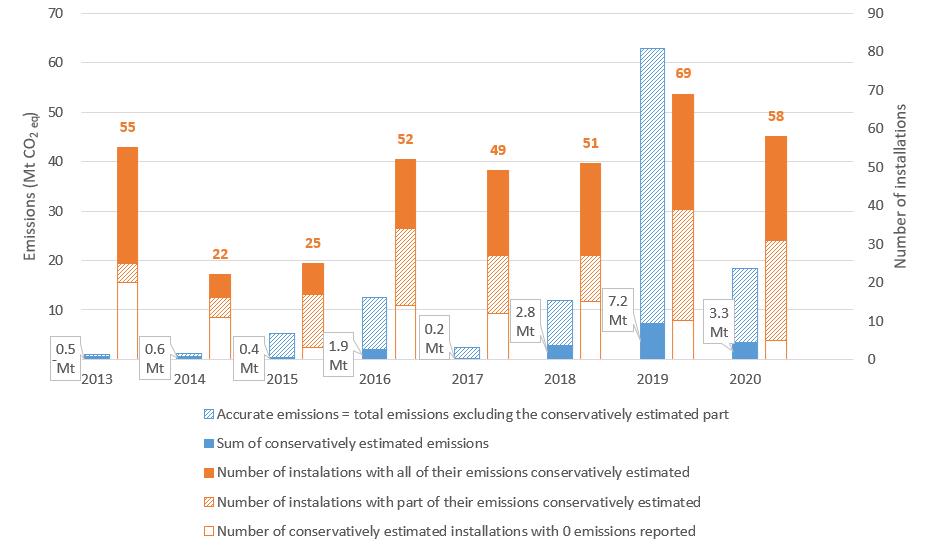
Figure 11.4.1 Overview of conservative estimates in EU ETS participating countries in phase 3 (2013-20)
Table 11.4.2 Overview of compliance measures administered in EU ETS participating countries ([ ] is difference from previous year, omitted if unchanged)
Table 11.4.3 Imposition of excess emissions penatlies in EU ETS participating countries ([ ] is difference from previous year, omitted if unchanged)
APPENDIX 1 - EU ETS INFRASTRUCTURE AND COVERAGE
The European Union Emissions Trading System (EU ETS) in phase 3 (2013-2020)
covered larger stationary installations such as power stations and other combustion plants with >20MW thermal rated input (except hazardous or municipal waste installations), oil refineries, coke ovens, iron and steel, cement clinker, glass, lime, bricks, ceramics, pulp, paper and board, aluminium, petrochemicals, ammonia, nitric, adipic, glyoxal and glyoxylic acid production, as well as capture of, transport in pipelines and geological storage of carbon dioxide.
The aviation scope of the EU ETS was limited to flights within the European Economic Area (EEA) in the period 2013-2016, to sustain momentum in the International Civil Aviation Organization (ICAO) for an international agreement to control greenhouse gas emissions from aviation. To support further development and facilitate operationalisation of the ICAO’s Carbon Offsetting and Reduction Scheme for International Aviation (CORSIA), in 2017, the limitation of the ETS scope to intra-EEA flights was prolonged until 2023.
The EU ETS covers emissions of carbon dioxide (CO2), nitrous oxide (N2O) from nitric, adipic, glyoxylic acid and glyoxal production, and perfluorocarbons (PFCs) from aluminium production. In some sectors, only installations above a certain size or production level are included. Participating countries can exclude small installations, emitting less than 25 000 tonnes of carbon dioxide equivalent (CO2eq) from the system if alternative and equivalent measures to limit emissions are in place.
According to Article 21 reports submitted by EU ETS participating countires
in 2021, a total of 9 628 installations in 2020 were covered by the system, with the necessary permit. Similarly to previous years, 7% of installations were category C, 20% were category B and 73% were category A
, which is 6 990 installations, of which 5 534 were classified as installations with low emissions
(58% of the total). Figure 1.1 shows the number of installations in 2020 divided by emissions category.
Figure 1.1. Number of installations per emissions category in 2020

The EU ETS activities additionally listed for non-CO2 emissions are shown in Table 1.1.
Table 1.1. Greenhouse gases other than CO2 per activity and EU ETS participating country
|
Gas
|
Activity
|
Number of countries
|
EU ETS participating country
|
|
PFCs
|
Primary aluminium
|
12
|
DE, ES, FR, GR, IS, IT, NL, NO, RO, SE, SI, SK
|
|
N2O
|
Nitric acid
|
20
|
AT, BE, BG, CZ, DE, ES, FI, FR, GR, HR, HU, IT, LT, NL, NO, PL, PT, RO, SE, SK
|
|
|
Adipic acid
|
3
|
DE, FR, IT
|
|
|
Glyoxal and glyoxylic acid
|
2
|
DE, FR
|
PFCs permits were reported as issued in 12 EU ETS participating countries for primary aluminium and perfluorocarbons, while 20 countries reported issued N2O permits for nitric acid production. N2O permits for other sectors – adipic acid production and glyoxal and glyoxylic acid production were reported in three countries. Only Norway declared CO2 capture and storage activities.
Six countries (ES, FR, HR, IS, IT and SI) have continued to use of the possibility to exclude small emitters from the EU ETS in line with Article 27 of the Directive 2003/87/EC (EU ETS Directive). Emissions excluded for 2020 amounted to 1.70 million tonnes CO2 (some 0.13% of total stationary EU ETS emissions, compared to 0.25% for 2019).
Just as in previous years, eight countries (BE, DK, FR, HR, HU, LI, LT and NL) have taken advantage of the provision of Article 13 of the Monitoring and Reporting Regulation (MRR)
to allow the use of simplified monitoring plans in low risk cases for stationary installations. For aircraft operators with low emissions, two countries reported to have used this provision for 2020 (BE and IS).
In 2020, 349 aircraft operators were reported as having a monitoring plan in place, 254 (42%) fewer than in 2019, of which 151 had been previously administered by the UK. Some 62% (217) of the reported aircraft operators were commercial, while the other 38% (132) were non-commercial.
A total of 116 operators (33%) qualified as small emitters (compared to 262 (43%) in 2019).
APPENDIX 2 - THE EU ETS CAP
The 2013 cap on emissions from stationary installations was set at 2 084 301 856 allowances. This cap decreased each year by a linear reduction factor of 1.74% of the average total quantity of allowances issued annually in 2008-2012. This implied that the cap in 2020 was 21% lower than in 2005.
The annual cap on aviation allowances for phase 3 of the EU ETS (2013-20) was originally 210 349 264 allowances, 5% below the average annual level of aviation emissions in 2004-2006. It increased by 116 524 aviation allowances on 1 January 2014 to accommodate Croatia joining the EU ETS. This cap reflects the 2008 legislation, which includes all flights from, to and within the European Economic Area (EEA) in the EU ETS. However, the scope of the EU ETS was temporarily limited to flights within the EEA to support the development of a global measure by the International Civil Aviation Organization (ICAO) to stabilise emissions from international aviation at 2020 levels. Therefore, the number of aviation allowances put into circulation since 2013 has been significantly lower than the original cap. In 2017, to support further development and facilitate operationalisation of the ICAO’s Carbon Offsetting and Reduction Scheme for International Aviation (CORSIA), the limited aviation scope of the EU ETS was extended until 2023.
APPENDIX 3 – CROSS-SECTIONAL CORRECTION FACTOR
Table 3.1. Cross-Sectional Correction Factor: 2013 (original) and 2017 values
|
Cross-Sectional Correction Factor
|
2013
|
2014
|
2015
|
2016
|
2017
|
2018
|
2019
|
2020
|
|
Values as of 1 March 2017
|
0.892071
|
0.876577
|
0.860901
|
0.845062
|
0.829051
|
0.812885
|
0.796517
|
0.780092
|
|
Original 2013 values
|
0.942721514
|
0.926347308
|
0.90978052
|
0.893041051
|
0.876121241
|
0.859036851
|
0.841739502
|
0.824382045
|
APPENDIX 4 - IMPLEMENTING LEGISLATION FOR PHASE 4 OF THE EU ETS
Table 4.1 Legislative acts adopted to implement phase 4 of the EU ETS (2021-30)
|
Measure
|
Purpose
|
Type of
legislative act
|
Adoption
|
|
|
|
|
|
|
Carbon leakage list for 2021-30
|
Established the new carbon leakage list for the entire phase 4 based on criteria for determining sectors significantly exposed to the risk of carbon leakage. This list specifies, which industrial sectors receive a higher share of free allocation.
|
Commission Delegated Decision
|
Adopted on
15 February 2019
and published in the Official Journal on
8 May 2019
|
|
Revision of the free allocation rules for 2021-30
|
Adapted free allocation to the new legal context of phase 4. Based on this Regulation the Commission, Member States and operators prepared National Implementation Measures that provided data for calculating revised benchmark values and free allocation for the first allocation period 2021-25.
|
Commission Delegated Regulation
|
Adopted on
19 December 2018 and published in the Official Journal on
27 February 2019
|
|
Adjustment to free allocation due to production changes
|
In phase 4, allocations to individual installations are adjusted in a timely manner to reflect significant increases and decreases in operation. The Regulation defined the rules for the adjustment of the level of free allocation to installations on the basis of changing levels of operation (of more than 15% upwards or downwards on average over a period of two years).
|
Commission Implementing Regulation
|
Adopted on
31 October 2019
and published in the Official Journal on
4 November 2019
|
|
Update of benchmark values for free allocation for 2021-25
|
To reflect technological progress and innovation, benchmark values for 2021-25 were updated on the basis of real data submitted by installations for the years 2016-17.
|
Commission Implementing Regulation
|
Adopted on 12 March 2021 and published in the Official Journal on 15 March 2021
|
|
National Implementation Measures
2021-25
|
Rejection or acceptance of installations in the National Implementation Measures’ list – the Commission accepted the list and data of installations under the EU ETS.
|
Commission Decision
|
Adopted on
25 February 2021
and published in the Official Journal on
26 February 2021
|
|
Cross-Sectoral Correction Factor 2021-25
|
Determined the uniform cross-sectoral correction factor for the adjustment of free allocations for the period 2021-25. The value of the cross-sectoral correction factor for every year between 2021 and 2025 was determined to be 1.
|
Commission Implementing Decision
|
Adopted on 31 May 2021 and published in the Official Journal on 9 June 2021
|
|
National Allocation Tables 2021-25
|
After the calculation of the cross-sectoral correction factor, Member States submitted to the Commission the final annual free allocations over 2021-25. Based on that, the Commission adopted national allocation tables per Member State per year.
|
Commission Decision
|
Adopted on 29 June 2021 and publlished in the Official Journal on 28 July 2021
|
|
Establishment of the Innovation Fund
|
Determined the rules on the operation of the Innovation Fund, including the selection procedure and criteria.
|
Commission Delegated Regulation
|
Adopted on 26 February 2019 and published in the Official Journal on 28 May 2019
|
|
Establishment of the Modernisation Fund
|
Determined the rules for the operation of the Modernisation Fund.
|
Commission Implementing Regulation
|
Adopted on 9 July 2020 and published in the Official Journal on 10 July 2020
|
|
Revision of the Registry Regulation
|
Laid down the requirements for the EU Registry for phase 4 in the form of standardised electronic databases containing common data elements to track the issue, holding, transfer and cancellation of allowances, and to provide public access and eensure confidentiality.
|
Commission Delegated Regulation
|
Adopted on 12 March 2019 and published in the Official Journal on 2 July 2019
|
|
Amendment of the Auctioning Regulation
|
Enabled the auctioning of the first 50 million allowances for the Innovation Fund taken from the Market Stability Reserve in 2020.
|
Commission Delegated Regulation
|
Adopted on 30 October 2018 and publsihed in the Official Journal on 4 January 2019
|
|
Revision of the Auctioning Regulation
|
Revised some aspects of the auctioning process to implement requirements for phase 4, in particular to enable the auctioning of allowances for the Innovation Fund and the Modernisation Fund, as well as to reflect the classification of EU ETS allowances as financial instruments under Directive 2014/65/EU on markets in financial instruments (MiFID2).
|
Commission Delegated Regulation
|
Adopted on 28 August 2019 and published in the Official Journal on 8 November 2019
|
|
Revision of the Monitoring and Reporting Regulation
|
Simplified, improved and clarified the monitoring and reporting rules and reduced administrative burden, based on implementation experience from phase 3
|
Commission Implementing Regulation
|
Adopted on 19 December 2018 and published in the Offical Journal on 31 December 2018
|
|
Revision of Verification and Accreditation Regulation
|
Simplified, improved and clarified the accreditation and verification rules and reduced administrative burden to the extent possible, based on implementation experience from phase 3
|
Commission Implementing Regulation
|
Adopted on 19 December 2018 and publsihed in the Official Journal on 31 December 2018
|
|
Monitoring, reporting and verification of aviation emissions as regards CORSIA
|
Supplemented the EU ETS Directive as regards measures adopted by the International Civil Aviation Organisation for the monitoring, reporting and verification of aviation emissions for the purpose of implementing CORSIA
|
Commission Delegated Regulation
|
Adopted on 18 July 2019 and published in the Official Journal on 30 September 2019
|
|
EU ETS State aid Guidelines 2021-30
|
Revised the EU ETS State aid Guidelines for phase 4 to accommodate the new provisions introduced by the revised EU ETS Directive for indirect carbon cost compensation schemes
|
Communication from the Commission
|
Adopted on 21 September 2020 and in force as of 1 January 2021
|
|
Exclusion of incoming flights from Switzerland from the EU ETS
|
Amended Annex I of the EU ETS Directive to exclude incoming flights from Switzerland from the EU emissions trading system as from 1 January 2020
|
Commission Delegated Decision
|
Adopted on 18 May 2020 and published in the Official Journal on 21 July 2020
|
|
Exclusion of incoming flights from the UK from the EU ETS
|
Amended Annex I of the EU ETS Directive to exclude incoming flights from the United Kingdomfrom the EU emissions trading system as from 1 January 2020
|
Commission Delegated Regulation
|
Adopted on 17 June 2021 and published in the Official Journal on 31 August 2021
|
APPENDIX 5 – AUCTIONS AND AUCTION REVENUES
Figure 5.1. Number of bidders in general allowances’ auctions, 1 January 2013 - 30 June 2021

Table 5.1. Revenues generated from the auctioning of emission allowances by EU27 (and the UK until 2020), 1 January 2013 - 30 June 2021 (in million EUR)
|
|
2013
|
2014
|
2015
|
2016
|
2017
|
2018
|
2019
|
2020
|
2021
|
|
|
General
|
Aviation
|
General
|
Aviation
|
General
|
Aviation
|
General
|
Aviation
|
General
|
Aviation
|
General
|
Aviation
|
General
|
Aviation
|
General
|
Aviation
|
General
|
Aviation
|
|
AT
|
55.75
|
0.00
|
52.17
|
1.18
|
76.24
|
2.36
|
58.81
|
0.65
|
78.74
|
0.69
|
208.20
|
2.16
|
180.94
|
2.89
|
181.62
|
2.60
|
143.42
|
1.54
|
|
BE
|
114.99
|
0.00
|
95.03
|
2.05
|
138.96
|
2.69
|
107.14
|
0.74
|
143.52
|
0.79
|
379.00
|
2.47
|
353.47
|
3.30
|
353.07
|
2.98
|
246.24
|
2.11
|
|
BG
|
52.63
|
0.00
|
36.19
|
0.22
|
120.91
|
0.91
|
85.08
|
0.25
|
130.15
|
0.27
|
367.34
|
0.83
|
439.19
|
1.11
|
447.55
|
1.01
|
369.36
|
0.72
|
|
CY
|
0.35
|
0.00
|
0.43
|
0.30
|
0.00
|
1.42
|
0.00
|
0.39
|
6.15
|
0.41
|
24.66
|
1.30
|
24.4
|
1.74
|
38.50
|
1.57
|
33.82
|
0.53
|
|
HR
|
0.00
|
0.00
|
0.00
|
0.00
|
86.40
|
0.49
|
20.09
|
0.16
|
26.97
|
0.18
|
70.96
|
0.55
|
71.97
|
0.74
|
71.52
|
0.66
|
50.06
|
0.58
|
|
CZ
|
0.00
|
0.00
|
55.24
|
0.47
|
110.30
|
1.20
|
117.63
|
0.33
|
199.43
|
0.35
|
583.33
|
1.10
|
628.94
|
1.46
|
718.12
|
1.32
|
289.54
|
0.77
|
|
DE
|
791.25
|
0.00
|
749.97
|
0.00
|
1093.31
|
16.87
|
845.74
|
4.65
|
1141.74
|
5.07
|
2565.34
|
16.31
|
3146.14
|
17.89
|
2641.79
|
20.58
|
2364.82
|
0.00
|
|
DK
|
56.06
|
0.00
|
46.93
|
1.16
|
68.64
|
2.71
|
52.93
|
0.74
|
70.93
|
0.79
|
187.32
|
2.48
|
162.78
|
3.31
|
163.47
|
2.99
|
133.95
|
1.87
|
|
EE
|
18.07
|
0.00
|
7.41
|
0.04
|
21.13
|
0.15
|
23.57
|
0.04
|
39.31
|
0.05
|
139.89
|
0.14
|
142.65
|
0.20
|
142.26
|
0.17
|
110.94
|
0.19
|
|
EL
|
147.64
|
0.00
|
129.97
|
1.10
|
190.17
|
4.99
|
146.68
|
1.37
|
196.57
|
1.46
|
518.96
|
4.57
|
503.34
|
6.11
|
501.16
|
5.53
|
454.60
|
3.80
|
|
ES
|
346.11
|
0.00
|
323.53
|
6.56
|
473.20
|
16.32
|
364.97
|
4.48
|
488.78
|
4.77
|
1291.07
|
14.97
|
1225.22
|
19.97
|
1222.29
|
18.05
|
1114.86
|
10.81
|
|
FI
|
66.97
|
0.00
|
62.68
|
0.81
|
91.64
|
2.13
|
70.63
|
0.58
|
94.64
|
0.62
|
249.84
|
1.96
|
217.35
|
2.60
|
218.22
|
2.36
|
188.06
|
1.54
|
|
FR
|
219.25
|
0.00
|
205.29
|
10.05
|
299.94
|
12.18
|
231.34
|
3.35
|
309.85
|
3.55
|
818.40
|
11.16
|
711.64
|
14.89
|
714.65
|
13.47
|
665.67
|
8.22
|
|
HU
|
34.59
|
0.00
|
56.21
|
0.29
|
82.28
|
0.99
|
63.43
|
0.27
|
84.94
|
0.29
|
224.48
|
0.91
|
226.8
|
1.21
|
225.21
|
1.10
|
189.42
|
0.72
|
|
IE
|
41.68
|
0.00
|
35.11
|
0.87
|
51.32
|
2.15
|
39.54
|
0.59
|
52.93
|
0.63
|
140.10
|
1.97
|
121.64
|
2.62
|
122.17
|
2.37
|
70.35
|
1.39
|
|
IT
|
385.98
|
0.00
|
361.25
|
5.24
|
528.00
|
14.41
|
407.23
|
3.96
|
545.44
|
4.21
|
1440.10
|
13.22
|
1271.35
|
17.64
|
1274.55
|
15.95
|
1150.03
|
8.94
|
|
LT
|
19.98
|
0.00
|
17.28
|
0.06
|
28.13
|
0.29
|
20.76
|
0.08
|
31.43
|
0.09
|
80.11
|
0.25
|
83.69
|
0.35
|
86.30
|
0.31
|
37.88
|
0.34
|
|
LU
|
4.97
|
0.00
|
4.52
|
0.63
|
6.62
|
0.22
|
5.08
|
0.06
|
6.81
|
0.07
|
18.09
|
0.20
|
16.79
|
0.28
|
16.75
|
0.25
|
4.06
|
0.24
|
|
LV
|
10.79
|
0.00
|
10.08
|
0.14
|
14.76
|
0.53
|
11.36
|
0.15
|
15.24
|
0.15
|
40.20
|
0.49
|
41.92
|
0.66
|
41.72
|
0.58
|
25.71
|
0.38
|
|
MT
|
4.47
|
0.00
|
3.81
|
0.10
|
5.62
|
0.57
|
4.30
|
0.16
|
5.78
|
0.17
|
15.19
|
0.52
|
15.21
|
0.71
|
15.13
|
0.63
|
12.18
|
0.43
|
|
NL
|
134.24
|
0.00
|
125.63
|
5.47
|
183.57
|
3.68
|
141.59
|
1.01
|
189.63
|
1.07
|
500.84
|
3.37
|
435.64
|
4.50
|
437.34
|
4.07
|
407.25
|
3.12
|
|
PL
|
244.02
|
0.00
|
78.01
|
0.00
|
129.84
|
2.98
|
135.57
|
0.58
|
505.31
|
0.69
|
1209.98
|
1.59
|
2545.94
|
2.89
|
3155.44
|
2.19
|
2601.21
|
4.96
|
|
PT
|
72.78
|
0.00
|
65.82
|
1.27
|
96.32
|
2.89
|
74.29
|
0.79
|
99.50
|
0.85
|
262.96
|
2.65
|
253.58
|
3.53
|
252.60
|
3.19
|
230.01
|
2.84
|
|
RO
|
122.74
|
0.00
|
97.57
|
0.32
|
193.62
|
1.60
|
193.56
|
0.44
|
260.29
|
0.47
|
717.64
|
1.45
|
747.87
|
1.95
|
801.34
|
1.77
|
247.60
|
1.35
|
|
SE
|
35.67
|
0.00
|
33.34
|
1.02
|
48.79
|
3.63
|
37.61
|
1.00
|
50.45
|
1.06
|
132.98
|
3.34
|
124.1
|
4.43
|
123.88
|
4.02
|
98.77
|
2.69
|
|
SI
|
17.74
|
0.00
|
16.59
|
0.05
|
24.28
|
0.14
|
18.70
|
0.04
|
25.05
|
0.04
|
66.19
|
0.12
|
65.14
|
0.16
|
64.88
|
0.15
|
58.18
|
0.10
|
|
SK
|
61.70
|
0.00
|
57.59
|
0.04
|
84.31
|
0.20
|
64.99
|
0.06
|
87.01
|
0.06
|
229.74
|
0.18
|
244.47
|
0.24
|
241.85
|
0.21
|
127.18
|
0.10
|
|
UK
|
409.63
|
0.00
|
387.42
|
14.08
|
567.72
|
18.54
|
418.96
|
5.37
|
604.02
|
5.30
|
1607.32
|
0.00
|
0
|
0
|
2652.29
|
39.20
|
|
|
|
TOTAL
|
3550.73
|
0.00
|
3115.11
|
53.53
|
4815.97
|
117.26
|
3761.57
|
32.28
|
5490.60
|
34.14
|
14090.23
|
90.27
|
14002.17
|
117.37
|
16925.69
|
149.27
|
11425.16
|
60.28
|
Table 5.2. Revenues generated from the auctioning of emission allowances by Iceland, Liechtenstein and Norway, 2019 - 30 June 2021 (in million EUR)
|
|
2019
|
2020
|
2021
|
|
|
General
|
Aviation
|
General
|
Aviation
|
General
|
Aviation
|
|
IS
|
23.91
|
1.86
|
36.29
|
2.82
|
1.35
|
0.67
|
|
LI
|
0.52
|
0
|
0.79
|
0.00
|
0.14
|
0.00
|
|
NO
|
476.78
|
18.24
|
720.58
|
27.19
|
81.18
|
3.08
|
|
TOTAL
|
501.21
|
20.1
|
757.66
|
30.02
|
82.68
|
3.75
|
Table 5.3: Revenues generated from the auctioning of emission allowances for the Innovation Fund and the Modernisation Fund (in million EUR)
|
|
2020
|
2021
|
|
|
General
|
Aviation
|
General
|
Aviation
|
|
Innovation Fund
|
1333.82
|
|
861.85
|
|
|
Modernisation Fund
|
|
|
1495.04
|
|
APPENDIX 6 – MODERNISATION OF THE ELECTRICITY SECTOR IN CERTAIN MEMBER STATES UNDER ARTICLE 10C OF THE EU ETS DIRECTIVE
Table 6.1. Number of free allowances allocated to modernising the electricity sector
|
Member State
|
2013
|
2014
|
2015
|
2016
|
2017
|
2018
|
2019
|
|
BG
|
11 009 416
|
9 779 243
|
8 259 680
|
6 593 238
|
3 812 436
|
2 471 297
|
1 948 441
|
|
CY
|
2 519 077
|
2 195 195
|
1 907 302
|
1 583 420
|
1 259 538
|
935 657
|
575 789
|
|
CZ
|
25 285 353
|
22 383 398
|
20 623 005
|
15 831 329
|
11 681 994
|
7 661 840
|
3 830 905
|
|
EE
|
5 135 166
|
4 401 568
|
3 667 975
|
2 934 380
|
2 055 614
|
38 939
|
19 471
|
|
HU
|
7 047 255
|
n.a.
|
n.a.
|
n.a.
|
n.a.
|
n.a.
|
n.a.
|
|
LT
|
322 449
|
297 113
|
269 475
|
237 230
|
200 379
|
158 922
|
94 432
|
|
PL
|
65 992 703
|
52 920 889
|
43 594 320
|
31 621 148
|
21 752 908
|
31 942 281
|
16 912 108
|
|
RO
|
15 748 011
|
8 591 461
|
9 210 797
|
7 189 961
|
6 222 255
|
3 778 439
|
1 723 016
|
|
TOTAL
|
133 059 430
|
100 568 867
|
87 532 554
|
65 990 706
|
46 985 124
|
46 987 375
|
25 104 162
|
Table 6.2. Maximum number of free allowances per year under the Article 10c per Member State
|
Member State
|
2013
|
2014
|
2015
|
2016
|
2017
|
2018
|
2019
|
Total
|
|
BG
|
13 542 000
|
11 607 428
|
9 672 857
|
7 738 286
|
5 803 714
|
3 869 143
|
1 934 571
|
54 167 999
|
|
CY
|
2 519 077
|
2 195 195
|
1 907 302
|
1 583 420
|
1 259 538
|
935 657
|
575 789
|
10 975 978
|
|
CZ
|
26 916 667
|
23 071 429
|
19 226 191
|
15 380 953
|
11 535 714
|
7 690 476
|
3 845 238
|
107 666 668
|
|
EE
|
5 288 827
|
4 533 280
|
3 777 733
|
3 022 187
|
2 266 640
|
1 511 093
|
755 547
|
21 155 307
|
|
HU
|
7 047 255
|
0
|
0
|
0
|
0
|
0
|
0
|
7 047 255
|
|
LT
|
582 373
|
536 615
|
486 698
|
428 460
|
361 903
|
287 027
|
170 552
|
2 853 628
|
|
PL
|
77 816 756
|
72 258 416
|
66 700 076
|
60 030 069
|
52 248 393
|
43 355 049
|
32 238 370
|
404 647 129
|
|
RO
|
17 852 479
|
15 302 125
|
12 751 771
|
10 201 417
|
7 651 063
|
5 100 708
|
2 550 354
|
71 409 917
|
|
TOTAL
|
151 565 434
|
129 504 488
|
114 522 628
|
98 384 792
|
81 126 965
|
62 749 153
|
42 070 421
|
679 923 881
|
Table 6.3. Number of unused free allowances under the Article 10c derogation that have been auctioned or are planned for auctioning in 2013-2021
|
Member State
|
2015
|
2016
|
2017
|
2018
|
2019
|
2020
|
2021
|
|
BG
|
5 444 169
|
1 461 360
|
920 823
|
604 908
|
1 386 372
|
0
|
476 621
|
|
CY
|
0
|
0
|
0
|
0
|
0
|
0
|
0
|
|
CZ
|
0
|
90 694
|
77 741
|
66 740
|
54 550
|
80 295
|
0
|
|
EE
|
0
|
188 682
|
134 897
|
1 767 499
|
761 088
|
50 026
|
0
|
|
LT
|
259 924
|
0
|
456 725
|
191 229
|
161 522
|
128 105
|
76 120
|
|
PL
|
1 196
|
0
|
7 491
|
0
|
55 800 000
|
49 520 000
|
34 501 299
|
|
RO
|
2 104 468
|
6 710 664
|
3 540 974
|
3 011 456
|
0
|
0
|
827 338
|
|
HU
|
0
|
0
|
0
|
0
|
0
|
0
|
0
|
Table 6.4. Distribution of Article 10c allowances from phase 4 of the EU ETS (2021-30)
|
Eligible Member States
|
Maximum Article 10c derogation
(40% of regular allowances)
|
Amount to be used under Article 10c
|
Amount transferred from Article 10c to the Modernisation Fund
|
Amount to be auctioned
|
|
BG
|
51 599 838
|
51 599 838
|
0
|
0
|
|
CZ
|
111 462 281
|
0
|
111 462 281
|
0
|
|
EE
|
17 583 702
|
0
|
0
|
17 583 702
|
|
HR
|
11 957 703
|
0
|
5 978 852
|
5 978 851
|
|
LV
|
3 794 677
|
0
|
0
|
3 794 677
|
|
LT
|
8 696 818
|
0
|
8 696 818
|
0
|
|
HU
|
34 610 750
|
20 748 000
|
0
|
13 862 750
|
|
PL
|
273 211 665
|
0
|
0
|
273 211 665
|
|
RO
|
91 673 704
|
5 600 000
|
86 073 704
|
0
|
|
SK
|
33 228 414
|
0
|
33 228 414
|
0
|
|
TOTAL
|
637 819 552
|
77 947 838
|
245 440 068
|
314 431 646
|
APPENDIX 7 – EU ETS FUNDING INSTRUMENTS: NER 300, INNOVATION FUND AND MODERNISATION FUND
Table 7.1. NER 300 projects awarded support under the first and second calls for proposals
|
|
1st Call for proposals
|
2nd Call for proposals
|
|
Projects in preparation
|
0
|
5
|
|
Projects under status revision
|
1
|
0
|
|
Projects in operation
|
7
|
1
|
|
Projects completed
|
2
|
0
|
|
Projects withdrawn
|
10
|
13
|
|
TOTAL
|
20
|
19
|
Since 2020, one new project was awarded support from the unspent funds of the NER 300 under the InnovFin Energy Demonstration Projects (InnovFin EDP), worth EUR 2.1 million. Another six operations eligible for the NER 300 support, amounting to some EUR 219 million, are in the InnovFin EDP pipeline.
Financing of some EUR 70 million from the undisbursed NER 300 funds was also awarded under the Connecting Europe Facility Debt Instrument (CEF DI) to two innovative projects in Denmark and Spain. Five more CEF DI projects have been confirmed as eligible for the NER 300 support, requesting financing of EUR 272.3 million.
Table 7.2 below provides detailed information on the projects supported from the unspent NER 300 funds via the InnovFin EDP and and CEF DI over 2020-21.
Table 7.2. Projects supported under the InnovFin EDP and and CEF DI (NER 300 funds), June 2020 - June 2021
|
Project title
|
Description
|
|
CH New Charging and Energy Storage Solutions
(InnovFin EDP)
|
The proposed technology platform allows the integration of electric vehicles (“EVs”) into the power grid by aggregating and leveraging the energy storage potential of end-user EVs batteries as stationary storage devices in order to provide power system services. The project’s demonstration is located in Germany, France and the Netherlands and the NER 300 contribution amounts to EUR 2.1 million.
|
|
DK Everfuel Green Hydrogen Project
|
The project comprises the deployment of a hydrogen distribution infrastructure and a hydrogen production plant, to supply green hydrogen to a large-scale fleet of fuel cell electric buses in Denmark. The financing of EUR 20.7 million is supported under the Future Mobility product, backed by the Connecting Europe Facility and the NER300 Programme.
|
|
ES Evervest
|
The project consists of the roll out of an electric vehicle charging network involving the deployment of 476 charging points in 200 sites over a 3-year implementation period. Charging points will only sell electricity sourced from renewable sources backed by relevant certificates. This project requested the EIB loan of EUR 50 million, fully covered from NER300 unspent funds.
|
Table 7.3. Transfers of allowances to the Modernisation Fund decided by eligible Member States in 2019
|
Member States
|
Share as per
Annex IIb of the EU ETS Directive
|
Allowances as per
Article 10(1) of the EU ETS Directive
|
Transfers from
Article 10(2)(b) of the EU ETS Directive
(solidarity)
|
Transfers from
Article 10c of the EU ETS Directive
|
Total transfers from
Article 10(2)(b) (solidarity) and Article 10c
|
Total
|
|
BG
|
5.84%
|
16 095 825
|
0
|
0
|
0
|
16 095 825
|
|
CZ
|
15.59%
|
42 968 135
|
38 722 276
|
111 462 281
|
150 184 557
|
193 152 692
|
|
EE
|
2.78%
|
7 662 054
|
0
|
0
|
0
|
7 662 054
|
|
HR
|
3.14%
|
8 654 262
|
0
|
5 978 852
|
5 978 852
|
14 633 114
|
|
LV
|
1.44%
|
3 968 834
|
0
|
0
|
0
|
3 968 834
|
|
LT
|
2.57%
|
7 083 265
|
0
|
8 696 818
|
8 696 818
|
15 780 083
|
|
HU
|
7.12%
|
19 623 677
|
0
|
0
|
0
|
19 623 677
|
|
PL
|
43.41%
|
119 643 793
|
0
|
0
|
0
|
119 643 793
|
|
RO
|
11.98%
|
33 018 490
|
81 673 875
|
86 073 704
|
167 747 579
|
200 766 069
|
|
SK
|
6.13%
|
16 895 104
|
1 783 231
|
33 228 414
|
35 011 645
|
51 906 749
|
|
TOTAL
|
100.00%
|
275 613 439
|
122 179 383
|
245 440 068
|
367 619 451
|
643 232 890
|
APPENDIX 8 – INTERNATIONAL CREDITS
Table 8.1. Summary of international credits surrendered during phase 2 of EU ETS (2008-12)
|
International credits surrendered 2008-12 (in millions)
|
|
Origin
|
Certified Emssions Reductions
|
Origin
|
Emissions Reduction Units
|
|
China
|
422.25
|
62.51
|
Ukraine
|
212.72
|
55.48%
|
|
India
|
108.36
|
16.04
|
Russia
|
130.53
|
34.04%
|
|
Korea
|
80.60
|
11.93
|
Germany
|
11.13
|
2.90%
|
|
Brazil
|
32.15
|
4.76
|
Poland
|
10.82
|
2.82%
|
|
Mexico
|
10.48
|
1.55
|
France
|
5.86
|
1.53%
|
|
Argentina
|
4.87
|
0.72
|
Romania
|
5.19
|
1.35%
|
|
Egypt
|
3.30
|
0.49
|
Lithuania
|
2.62
|
0.68%
|
|
Vietnam
|
3.08
|
0.46
|
Czechia
|
1.63
|
0.43%
|
|
Chile
|
2.16
|
0.32
|
New Zeland
|
0.90
|
0.23%
|
|
South Africa
|
1.86
|
0.28
|
Hungary
|
0.81
|
0.21%
|
|
Others
|
6.39
|
0.94
|
Others
|
1.21
|
0.32%
|
|
Total
|
675.50
|
63.79%
|
Total
|
383,40
|
36,20%
|
|
TOTAL
|
1058.90
|
Table 8.2. Summary of international credits exchanged during phase 3 of EU ETS (2013-20) until June 2021
|
International credits exchanged by end June 2021 (in millions)
|
|
Origin
|
Certified Emssions Reductions
|
Origin
|
Emissions Reduction Units
|
|
China
|
228.18
|
72.60
|
Ukraine
|
147.69
|
76.89%
|
|
India
|
21.14
|
6.72
|
Russia
|
32.06
|
16.69%
|
|
Uzbekistan
|
10.65
|
3.38
|
Lithuania
|
3.54
|
1.84%
|
|
Brazil
|
6.98
|
2.21
|
Poland
|
2.82
|
1.47%
|
|
Vietnam
|
4.38
|
1.40
|
Germany
|
1.65
|
0.86%
|
|
Indonesia
|
4.09
|
1.30
|
France
|
1.24
|
0.65%
|
|
Chile
|
3.99
|
1.27
|
Romania
|
0.67
|
0.35%
|
|
Mexico
|
3.36
|
1.07
|
Sweden
|
0.64
|
0.33%
|
|
Cambodia
|
3.17
|
1.01
|
Bulgaria
|
0.50
|
0.26%
|
|
Korea
|
3.04
|
0.99
|
Spain
|
0.43
|
0.22%
|
|
Others
|
25.29
|
8.05
|
Others
|
0.84%
|
0.44%
|
|
Total
|
314.27
|
62.07%
|
Total
|
192.08
|
37.93%
|
|
TOTAL
|
506.35
|
Table 8.3. Summary of international credits surrendered in phase 2 (2008-12) and exchanged in phase 3 (2013-20) by types of operators (in millions)
|
|
Certified Emissions Reductions and Emissions Reduction Units
|
|
|
2008-12
|
2013-20
|
|
Stationary installations
|
1047.94
|
498.42
|
|
Aviation operators
|
10.96
|
7.93
|
|
TOTAL
|
1058.90
|
506.35
|
APPENDIX 9 - NON-CO2 EMISSIONS FROM STATIONARY INSTALLATIONS IN THE EU ETS
Table 9.1. Reported ETS verified non-CO2 emissions from installations by greenhouse gas in phase 3 of the EU ETS (2013-20) (in million tonnes)
|
|
2013
|
2014
|
2015
|
2016
|
2017
|
2018
|
2019
|
2020
|
|
PFCs
|
0.40
|
0.74
|
0.58
|
0.64
|
0.53
|
0.67
|
0.59
|
0.54
|
|
N2O
|
2.48
|
5.48
|
5.31
|
4.62
|
4.92
|
4.08
|
3.68
|
3.16
|
APPENDIX 10 – MARKET STABILITY RESERVE
Figure 10.1 – TNAC methodology
A key notion for the functioning of the Market Stability Reserve (MSR) is the total number of allowances in circulation (TNAC). Allowances are added to the reserve if the TNAC is above a predefined upper threshold (833 million allowances), and are released from the reserve if the TNAC is below a predefined lower threshold (below 400 million allowances)*. The MSR absorbs or releases allowances when the circulating volume is outside of a predefined range. Back-loaded and so-called unallocated** allowances were also put in the reserve. From 2023 onwards, allowances held in the MSR exceeding the previous year's auction volume will no longer be valid.
The TNAC relevant for determining the MSR feeds and releases is calculated on the basis of the following formula:
TNAC = Supply – (Demand + allowances in the MSR)
The components of supply and demand used in the formula are described in the Communication from the European Commission on the TNAC, published annually in May.***
* Or where measures are adopted under Article 29a of the EU ETS Directive.
**Unallocated allowances are allowances not allocated pursuant to Article 10a(7) of the EU ETS Directive, i.e. allowances remaining in the new entrants' reserve, and resulting from the application of Article 10a(19) and (20), i.e. allowances foreseen for free allocation to installations but remaining unallocated because of (partial) cessation of operations or significant capacity reductions. De facto "unallocated" allowances stemming from the application of the relevant carbon leakage factor to sectors not included in the carbon leakage list during the current period, as well as any allowances that are not allocated under Article 10c of the ETS Directive, are not foreseen to be placed in the MSR under Article 1(3) of
Decision (EU) 2015/1814
. Such allowances are therefore not covered (please refer to p. 225 of the Impact Assessment (SWD(2015)135 final) accompanying the 2015 proposal for revision of the EU ETS Directive).
Table 10.1. Annual contributions to the Market Stability Reserve by EU ETS participating country
|
EU ETS
participating country
|
MSR contributions 2019
|
MSR contributions 2020
|
MSR contributions 2021
|
|
Austria
|
5 935 748
|
5 614 399
|
5 563 187
|
|
Belgium
|
9 846 994
|
9 313 899
|
9 228 856
|
|
Bulgaria
|
8 292 720
|
7 843 771
|
6 531 499
|
|
Croatia
|
1 614 984
|
1 527 552
|
1 513 604
|
|
Cyprus
|
932 844
|
882 342
|
874 285
|
|
Czech Republic
|
15 406 858
|
14 572 765
|
14 108 876
|
|
Denmark
|
5 340 750
|
5 051 614
|
5 005 490
|
|
Estonia
|
2 904 319
|
2 747 085
|
2 225 742
|
|
Finland
|
7 130 025
|
6 744 021
|
6 682 443
|
|
France
|
23 346 791
|
22 082 847
|
21 881 211
|
|
Germany
|
85 389 770
|
80 766 957
|
80 029 579
|
|
Greece
|
12 684 492
|
11 997 782
|
11 888 232
|
|
Hungary
|
5 115 708
|
4 838 755
|
4 381 023
|
|
Iceland
|
166 450
|
157 439
|
156 001
|
|
Ireland
|
3 991 393
|
3 775 308
|
3 740 851
|
|
Italy
|
40 304 729
|
38 122 721
|
37 775 362
|
|
Latvia
|
865 501
|
818 645
|
480 330
|
|
Liechtenstein
|
3 725
|
3 524
|
3 492
|
|
Lithuania
|
1 792 324
|
1 695 292
|
1 100 842
|
|
Luxembourg
|
467 394
|
442 090
|
438 053
|
|
Malta
|
354 798
|
335 590
|
332 525
|
|
Netherlands
|
14 291 411
|
13 517 705
|
13 394 277
|
|
Norway
|
3 314 570
|
3 135 127
|
3 106 500
|
|
Poland
|
39 282 170
|
37 155 520
|
34 583 085
|
|
Portugal
|
6 478 775
|
6 128 029
|
6 072 075
|
|
Romania
|
14 941 290
|
14 132 401
|
11 604 041
|
|
Slovakia
|
4 752 513
|
4 495 223
|
4 206 047
|
|
Slovenia
|
1 577 714
|
1 492 300
|
1 478 674
|
|
Spain
|
32 660 234
|
30 892 081
|
30 610 010
|
|
Sweden
|
3 457 106
|
3 269 946
|
3 246 409
|
|
United Kingdom (Northern Ireland installations only as of 2021)
|
44 480 623
|
42 072 540
|
883 013
|
|
TOTAL
|
397 124 722
|
375 625 270
|
323 125 614
|
APPENDIX 11 - MONITORING, REPORTING, VERIFICATION AND ACCREDITATION IN THE EU ETS
11.1 Monitoring applied in 2020
According to Article 21 reports submitted by EU ETS participating countries in 2021, most installations used the calculation-based methodology
to detrmine their emissions. Only 153 installations (1.6%) in 22 countries reported to have use continuous emissions measurement systems (CEMs), most frequently in Germany and Czechia. While the number of countries is the same as last year, compared to 2019, 10 installations used CEMs for the first time and 6 installations stopped reporting CEMs.
Only 11 countries reported the use of the fall-back approach, by 27 installations covering approximately 2.9 million tonnes CO2eq (adding one small Italian installation to the 26 installations that used the fall-back approach in 2019, then covering 2.8 million tonnes CO2eq). One installation in the Netherlands is responsible for 53% of the overall emissions reported in relation to the fall-back methodology.
The minimum tier defaults
of the MRR were met by the vast majority of installations. Only 80 category C installations (compared to 81 in 2019), that is 11.6%, were reported to have deviated for at least one parameter from the requirement to apply the highest tiers for major source streams. These deviations are only allowed when the operator demonstrates that the highest tier is technically not feasible or incurs unreasonable costs. Once these conditions no longer apply, the operator has to improve their monitoring system accordingly.
Similarly, 22 participating countries reported that 21% of category B installations were permitted to operate with some form of deviation from the MRR default requirements. This is similar to the level of 19% of the last two years, demonstrating a steady level of the highest tier compliance.
11.2. Accredited verification in 2020
The total number of verifiers is not reported in Article 21 reports. However, the European Cooperation for Accreditation provides a central link to relevant National Accreditation Bodies and their lists of EU ETS accredited verifiers
.
The mutual recognition of verifiers among participating countries is working successfully: 27 countries reported that at least one foreign verifier was active in their territory.
Compliance of verifiers with the Accreditation and Verification Regulation (AVR) is found to be high. No country reported a suspension and only one country reported a withdrawal of accreditation of a verifier. This compares to no suspensions and no withdrawals for 2019. Germany reported a reduction made in the scope of two verifiers' accreditation, compared to scope reductions for six and one verifiers in 2019 by Germany and Poland respectively. Five countries reported complaints received about verifiers in 2020 (one fewer than in 2019). The overall number of complaints (49) is 11% higher. 86% of the complaints received were detailed as resolved at the time of reporitng (last year this rate was 61%). Seven countries reported identification of verifier non-conformities as part of the information exchange process between National Accreditation Bodies and competent authorities (compared to seven last year). An overview of these developments is presented in Table 11.2.1 below.
Table 11.2.1 Overview of developments in the EU ETS accreditation and verification in 2020 ([ ] is the difference from previous year, omitted if unchanged)
|
|
Countries
|
Number
|
Differences compared to 2019 country by country
|
|
Number of verifiers accredited by another Member State - for installations
|
24 [+1]
|
65 [+1]
|
BE (4), BG (6 [+1]), CY (2), CZ (1), DE (1), DK (1), EE (1), ES (4 [-1]), FR (7 [+7]), HR (1),
HU (2 [-3]), IE (5 [-1]), IS (3), LI (1), LT (3), LU (5), MT (1), NL (2), NO (3), PL (5), PT (1 [-2]), RO (2), SE (3 [+1]), SK (1 [-1])
|
|
Number of verifiers accredited by a national accreditation body in another Member State - for aviation
|
23 [+2]
|
50 [+8]
|
AT (2 [-1]), BE (4 [+4]), BG (4), CY (1 [-1]), DE (3 [+3]), DK (1), EE (0 [-1]), ES (1), FI (1),
FR (2 [+1]), HR (1), HU (1 [-1]), IE (3), IS (1), IT (3 [+3]), LT (1), LU (2), MT (2), NL (4), NO (2), PL (6 [+2]), PT (2 [-1]), SE (2), SK (1)
|
|
Number of complaints made about verifiers
|
5 [-1]
|
49 [+5]
|
DE (11 [-1]), DK (6), ES (29 [+12]), FR (0 [-1]), HU (0 [-5]), PL (1 [+1]), RO (2 [+2]),
SE (0 [-3])
|
|
Number of resolved complaints
|
4
|
42 [+15]
|
DE (10 [+6]), ES (29 [+12]), FR (0 [-1]), HU (0 [-5]), PL (1 [+1]), RO (2 [+2])
|
|
Number of non-conformities for verifiers reported in the information exchange
|
7
|
66 [+7]
|
BE (2), DE (0 [-12]), DK (6), FI (18 [+18]), HR (9 [+9]), IE (11 [+1]), NL (14 [-6]), NO (6 [+1]), SE (0 [-4])
|
|
Number of non-conformities resolved
|
6
|
45 [+5]
|
BE (0 [-2]), DE (1 [-3]), FI (9 [+9]), HR (6 [+6]), IE (11 [+4]), NL (14 [-6]), NO (4 [+1]),
SE (0 [-4])
|
|
Verifiers suspended
|
0
|
0
|
|
|
Withdrawal of accreditation certificate
|
1 [+1]
|
1 [+1]
|
PL (1 [+1])
|
|
Scope of accreditation reduced
|
1 [-1]
|
2 [-5]
|
DE (2 [-4]), PL (0 [-1])
|
11.3 Overview of administrative arrangements in 2020
According to Article 21 submissions in 2021, there were, on average, four competent authorities involved in EU ETS implementation per country (129 competent authorities in 30 countries, three fewer than last year)
. Different tools to coordinate between authorities were reported, such as legislative instruments for central management of monitoring plans (in 14 countries), binding instructions and guidance by a central competent authority to local authorities (in nine countries), and regular working groups or meetings between authorities (in 13 countries). Seven countries indicated that no such tools were in use.
A more detailed overview of the coordination between EU ETS countries is presented in Table 11.3.1 below.
Table 11.3.1 Coordination between competent authorities in EU ETS participating countries ([ ] shows the difference from the previous year, omitted if unchanged)
|
|
Countries
|
|
Does national legislation require a central competent authority to review and provide binding instructions on monitoring plans, notifications of changes to the monitoring plan or emissions reports?
|
14 [+1]
|
BG, DE, EE, ES, GR, HR, HU, LT, LV, NL, NO, PL, RO, SE [new]
|
|
Does a central competent authority steer local and/or regional competent authorities by giving binding instructions and guidance?
|
9
|
BG, DK, FR, LT, LV, NL, PT, RO, SK
|
|
Does a central competent authority review and provide advice on monitoring plans, notifications and emissions reports on a voluntary basis?
|
15 [+1]
|
AT, BG, CZ, DK, EE, FR, GR, HR, LT, LV, NL, PL, PT, SE [new], SK
|
|
Are regular working groups or meetings organised with the competent authorities?
|
13
|
BE, BG, DK, ES, FI, FR, GR, HR, LT, LV, NL, PT, SE
|
|
Is common training organised for all competent authorities to ensure consistent implementation of requirements?
|
9 [+1]
|
AT, BG, DK, FR, HR, LV, NL, PT, SE [new]
|
|
Are IT systems or tools used to ensure common approaches to monitoring and reporting issues?
|
12
|
AT, DK, ES, HU, LT, LV, NL, NO, PT, SE, SI, SK
|
|
Is a coordination group established, with competent authority staff, which discusses monitoring and reporting issues and develops common approaches?
|
9
|
BG, DK, ES, FR, GR, HR, NL, PT, SE
|
On administrative fees charged in relation to permitting and approval of monitoring plans, 13 countries reported in 2021 that they do not charge any fees to installation operators, the same as in 2019. Aircraft operators in 15 countries do not pay fees. Charges vary significantly across countries and types of services, ranging from EUR 5 to EUR 7283.17 for permit and monitoring plan approval for installations, and from EUR 2.19 to EUR 29977 for the same service for aviation operators. Most of the price changes in 2020 compared to 2019 are upward.
Table 11.3.2 below presents a detailed overview of administrative charges in EU ETS participating countries.
Table 11.3.2 Administrative fees charged by EU ETS participating countries ([ ] is difference from previous year, omitted if unchanged)
|
|
EU ETS countries (values in EUR)
|
|
Installations
|
Are fees charged to operators?
|
17
|
AT, BE, BG, CZ, DK, ES, FI, FR, HR, HU, IS, IT, NO, PL, PT, RO, SI
|
|
|
Permit issuance/monitoring plan approval
|
13
|
AT (100), BG (500), CZ (400), FI (1900), HR (5), HU (257 [+105]),
IS (7167 [+4042]), IT (250), NO (3327 [+215]), PL (18), PT (207 [+1]),
RO (366 [-9]), SI (23)
|
|
|
Permit update
|
11
|
AT (100), BG (250), FI (1500), HR (5), HU (143 [-9]), IS (734 [-436]),
NO (989 [+59]), PL (2), PT (103), RO (366 [-9]), SI (23)
|
|
|
Permit transfer
|
9
|
AT (100), BG (100), FI (750), HR (5), HU (143 [-9]), IS (734 [+144]),
PL (2), PT (103), SI (23)
|
|
|
Permit surrender
|
3
|
HR (5), HU (143 [-9]), PL (2)
|
|
|
New entrant reserve application
|
6
|
HR (5), HU (14 [-3]), IS (2447 [+467]), PT (1447 [+4]), RO (366 [-9]),
SI (23)
|
|
|
Annual subsistence charge amount
|
2
|
DK (4071 [+830]), IT (250)
|
|
Aircraft operators
|
Are fees charged to aircraft operators?
|
15
|
AT, BG, DK, FI, FR, HR, HU, IE, IS, IT, NO, PL, PT, RO, SI
|
|
|
Approval of monitoring plan for emissions
|
13 [+1]
|
AT (100), BG (500), FI (550), HR (5), HU (603 [+603]), IE (200),
IS (29977 [+27577]), IT (250), NO (519 [+26]), PL (2), PT (277 [+4]),
RO (1500), SI (23)
|
|
|
Approval of change to monitoring plan for emissions
|
12 [+1]
|
AT (100), BG (50), FI (180), HR (5), HU (603 [+603]), IS (999 [+199]),
IT (62), NO (260 [+13]), PL (2), PT (139 [+2]), RO (500), SI (23)
|
|
|
Approval of monitoring plan for tonne-kilometre data
|
10 [+1]
|
AT (100), BG (50), HR (5), HU (603 [+603]), IE (200), IS (2977 [+577]),
PL (2), PT (277 [+4]), RO (2500 [+500]), SI (23)
|
|
|
Approval of change to monitoring plan for tonne-kilometre data
|
10 [+1]
|
AT (100), BG (50), FI (180), HR (5), HU (603 [+603]), IS (999 [+199]),
PL (2), PT (139 [+2]), RO (500), SI (23)
|
|
|
Transfer of monitoring plan
|
7 [+1]
|
AT (100), BG (50), HR (5), HU (603 [+603]), IS (999 [+199]),
PT (139 [+2]), SI (23)
|
|
|
Surrender of monitoring plan
|
2 [+1]
|
HR (5), HU (603 [+603])
|
11.4 Compliance and enforcement
Competent authorities in EU ETS participating countries carry out different compliance checks on installations’ annual emissions reports. Based on Article 21 submissions in 2021, all participating countries check completeness of annual emission reports from installations, and most do so for reports from aircraft operators - except for Hungary and Latvia (two and one aircraft operators respectively), as well as Liechtenstein, Estonia and Slovenia (no aircraft operators). 23 countries reported that they also carry out cross-checks against other data for both installations, and 22 countries do this for aircraft operators.
Table 11.4.1 below presents a detailed overview of the compliance checks performed in EU ETS participating countries.
Table 11.4.1 Compliance checks in EU ETS participating countries ([ ] is difference from previous year, omitted if unchanged)
|
Type of check
|
EU ETS countries
|
|
Installations
|
Share of the emissions reports checked for completeness and internal consistency (%)
|
30
|
AT (100), BE (100), BG (100), CY (100), CZ (100), DE (100), DK (100), EE (100), ES (90 [-4]), FI (100), FR (95), GR (100), HR (100), HU(100), IE(100), IS(100), IT(100]), LI (100), LT (100), LU (100), LV (100), MT (100), NL (100), NO (100), PL (100), PT (100), RO (100), SE (100), SI (100), SK (100)
|
|
|
Share of the emissions reports checked for consistency with the monitoring plan (%)
|
30
|
AT (20), BE (31), BG (100), CY (100), CZ (50 [+20]), DE (100 [+90]), DK (100), EE (100), ES (82 [-4]), FI (100), FR (65), GR (100), HR (100), HU (100), IE (75 [+14]), IS (100), IT (60), LI (100), LT (80 [-20]), LU (100), LV (100), MT (100), NL (100), NO (100), PL (100), PT (100), RO (100), SE (4 [-1]), SI (100), SK (100)
|
|
|
Share of the emissions reports that were cross- checked with allocation data (%)
|
23 [-2]
|
AT (100), BE (1 [-3]), BG (100), CY (100), CZ (20), DE (100), EE (100), ES (44 [+2]), FR (100), GR (100),
HR (0 [-100]), HU (100), IE (0 [-100]), IS (100), IT (20), LI (100), LT (80 [-20]), LU (100), LV (100), NL (90), PL (25 [+16]), PT (100), RO (100), SI (100), SK (100)
|
|
|
Share of the emissions reports that were cross- checked with other data (%)
|
23 [+1]
|
AT (100), BE (31), BG (10), CY (100), CZ (30 [+10]), DK (80 [+80]), EE (100), ES (29 [+2]), FR (62), GR (100), HR (100), IE (2), IS (0 [-100]), LI (100), LT (80 [-15]), LU (100), NL (100), NO (100), PL (100 [+100]), PT (100), RO (100), SE (100), SI (100), SK (100)
|
|
|
Share of the emissions reports that were analysed in detail (%)
|
23 [-3]
|
AT (20), BE (30), BG (100), CY (100), CZ (50 [+20]), DE (0 [-10]), DK (48 [+4]), EE (100), ES (19 [+7]), FI (0 [-100]), FR (24), GR (100), HR (100), HU (100), IE (75 [+14]), IS (100), LI (100), LT (100), LU (100), MT (100), NL (30), NO (100), PL (0 [-100]), PT (100), RO (100), SE (4 [-1])
|
|
|
Number of inspections of installations that were carried out through site visits by the competent authority
|
10 [-3]
|
Total: 95 [-45]
CY (19), CZ (0 [-5]), DE (0 [-2]), ES (7 [-7]), FR (7), HR (20 [+8]), HU (0 [-32]), IE (0 [-2]), IS (0 [-2]), LT (9 [+9]), LV (2 [+2]), NL (26 [-6]), NO (1), RO (3 [-2]), SE (1 [-6])
|
|
|
Number of emission reports rejected for non-compliance
|
3 [+1]
|
Total: 13 [-5]
ES (1 [+1]), FR (7 [-2]), NO (5 [-4])
|
|
Aircraft operators
|
Share of the emissions reports checked for completeness and internal consistency (%)
|
25 [-2]
|
AT (100), BE (100), BG (100), CY (100 [+50]), CZ (100), DE (100), DK (100), EE (0 [-100]), ES (100), FI (100), FR (100), GR (100), HR (100), IE (100), IS (100), IT (100), LT (100), LU (100), MT (100), NL (100), NO (100), PL (100), PT (100), RO (100), SE (100 [+90]), SI (0 [-100]), SK (100)
|
|
|
Share of the emissions reports checked for consistency with the monitoring plan (%)
|
25 [-1]
|
AT (100), BE (100), BG (100), CY (100 [+50]), CZ (50 [-50]), DE (100), DK (100 [+100]), EE (0 [-100]),
ES (100), FI (100), FR (100 [+95]), GR (100), HR (100), IE (43 [-57]), IS (100), IT (100), LT (100), LU (100), MT (100), NL (100), NO (100), PL (100), PT (100), RO (100), SE (100), SI (0 [-100]), SK (100)
|
|
|
Share of the emissions reports that were cross- checked with other data (%)
|
23
|
AT (100), BE (100), BG (100), CY (100 [+50]), DE (100), DK (100), ES (100), FI (100), FR (100), GR (100), HR (100), IE (100), IS (100), IT (100), LT (100), LU (100), MT (100), NL (100), NO (50 [-17]), PT (100), RO (100 [+100]), SE (100), SI (0 [-100]), SK (100)
|
|
|
Share of the emissions reports that were analysed in detail (%)
|
21 [+1]
|
AT (100), BE (14 [-13]), BG (100), DE (100), DK (100 [+100]), EE (0 [-100]), ES (100), FI (100), FR (2 [+2]), GR (100), HR (100), IE (43 [-57]), IS (100), LT (100 [+50]), LU (100), MT (100), NL (100), NO (50 [-17]), PL (100), PT (100), RO (100), SE (100)
|
|
|
Number of inspections of installations that were carried out on aircraft operators
|
0 [-2]
|
Total: 0 [-3]
DE (0 [-1]), SE (0 [-2])
|
|
|
Number of emission reports rejected for non-compliance
|
0
|
0
|
Competent authorities in eight countries carried out conservative estimates regarding missing data in the case of 58 installations (approximately 0.6% of installations overall), compared to 69 in 2019. Of the 58 installations, in 27 cases all emissions were conservativly estimated, in 26 cases part of the emissions was estimated and in five cases the estimate was that there were no emissions. In total, 3.3 Mt CO2 emissions were conservatively estimated (compared to 7.2 Mt in 2019), while the total emissions of the 58 installations were 18 Mt (compared to 63 Mt in 2019). The most common reasons given for making conservative estimates were emission reports that were not fully in line with MRR requirements and the absence of an emission report by 31 March.
Figure 11.4.1 provides an overview of conservative estimates in EU ETS participating countries in phase 3.
Figure 11.4.1 Overview of conservative estimates in EU ETS participating countries in phase 3 (2013-20)
Conservative estimates regarding missing data for aviation were reported by eight countries (two more than in 2019) concerning 23 (same as in 2019) aircraft operators and 0.14 Mt emissions.
Competent authorities' checks remain important to supplement the verifier’s work. Additional to the checks on emission reports, 26 countries reported that they carried out spot checks at installations in 2020 (unchanged from 2019), and 13 (unchanged from 2019, also three countries (EE, LI, SI) do not admisister any aircraft operators) countries reported spot checks for aviation.
Table 11.4.2 provides an overview of compliance measures administered in EU ETS participating countries.
Table 11.4.2 Overview of compliance measures administered in EU ETS participating countries ([ ] is difference from previous year, omitted if unchanged)
|
Compliance measures
|
Countries
|
|
Installations
|
Spot-Checks
|
26
|
AT, BE, BG, CY, CZ, DE, DK, EE, ES, FI, FR, HR, HU, IE, IS, LI, LT, LV, NL, NO, PL, PT, RO, SE, SI, SK
|
|
|
Regular meetings with industry and/or verifiers
|
25 [-2]
|
BE, BG, CY, CZ, DE, DK, EE, ES, FI, FR, GR, HR, HU, IE, IS, IT, LI, LT[end], MT, NL, NO, PL, PT, RO[end], SE, SI, SK
|
|
|
Ensuring that selling of emission allowances is prohibited in the case of irregularities
|
23
|
AT, BE, BG, CY, CZ, DE, DK, EE, FI, FR, HR, HU, IE, LI, LT, LU, LV, NL, NO, PT, SE, SI, SK
|
|
|
Publishing the names of operators that are not in compliance
|
15 [-1]
|
BE, BG, CY, DE, DK, FI, HR, HU, IE, LI, LT[end], LV, PT, SE, SI, SK
|
|
|
Imprisonment possible?
|
9
|
BE, CY, DK, EE, FR, IE, LU, NO, SE
|
|
Aircraft operators
|
Spot-Checks
|
13
|
AT, BE, DE, DK, HR, IE, IS, NL, PL, RO, SE, SI, SK
|
|
|
Regular meetings with aircraft operators and/or verifiers
|
13
|
BE, BG, CZ, DK, ES, FR, HR, IE, IS, MT, PT, RO, SE
|
|
|
Ensuring that selling of emission allowances is prohibited in the case of irregularities
|
16
|
AT, BE, BG, DE, DK, HR, HU, IE, LT, LU, LV, NL, PT, SE, SI, SK
|
|
|
Publishing the names of aircraft operators that are not in compliance
|
14
|
BE, BG, DE, DK, FI, FR, HR, HU, IS, LV, PT, SE, SI, SK
|
As shown in Table 11.4.3 below, in 2020, the application of an excess emissions penalty was reported for 20 installations by nine countries. For aviation, excess emission penalties were reported for eight aircraft operators by six countries.
Table 11.4.3 Imposition of excess emissions penatlies in EU ETS participating countries ([ ] is difference from previous year, omitted if unchanged)
|
|
Countries
|
Operators
|
|
Imposition of excess emission penalties to installation
|
9 [+1]
|
20 [+1]
|
DE (2 [+1]), DK (1 [-1]), ES (1), FR (1), HR (1 [+1]), IT (5 [+1]), LU (1 [+1]), PL (3 [+1]), PT (0 [-1]), RO (5 [-2])
|
|
Imposition of excess emission penalties to aircraft operators
|
6 [-2]
|
8 [-17]
|
CY (0 [-1]), DE (3), ES (1 [-3]), FR (1), IT (1 [-2]), LT (1), NL (1), PT (0 [-11])
|
For 2020, ten Member States (HR, CZ, DK, FR, DE, HU, NL, PL, RO and ES) reported issuing 27 penalties (other than excess emissions’ penalties) and two formal notices for installations. No imprisonments were reported, but fines (exercised or yet to be exercise, e.g. due to ongoing legal proceedings) amounting to a total of EUR 2.4 million were reported. For aviation, only Poland reported fines in 2020, for failure to submit a verified emissions report on time, four cases for a total of EUR 0.43 million). The most common violations reported for 2020 were: operation without a permit, a failure to monitor emissions in accordance with the approved monitoring plan and the MRR, a failure to submit a verified emissions report in due time, a failure to notify planned or effective changes to capacity, activity levels and operation of an installation by 31 December of the reporting year in accordance with Article 24 of the Decision 2011/278/EU.