
|
21.4.2006 |
EN |
Official Journal of the European Union |
C 94/1 |
SPECIAL REPORT No 6/2005
on the trans-European network for transport (TEN-T) together with the Commission's replies
(pursuant to the second subparagraph of Article 248(4) of the EC Treaty)
(2006/C 94/01)
TABLE OF CONTENTS
GLOSSARY
|
I-IV |
SUMMARY |
|
1-6 |
INTRODUCTION |
|
7-10 |
AUDIT SCOPE, OBJECTIVES AND APPROACH |
|
11-79 |
OBSERVATIONS |
|
11-24 |
Allocation of TEN-T financial aid |
|
25-51 |
Legal framework and administrative procedures |
|
25-29 |
Legal and regulatory requirements |
|
30-43 |
Evaluation and selection |
|
44-51 |
Project monitoring |
|
52-64 |
Organisational structure and staff allocation |
|
65-79 |
Coordination of EU transport infrastructure funding |
|
80-91 |
CONCLUSIONS AND RECOMMENDATIONS |
ANNEX 1 — Description of TEN-T management system
TEN-T legal and policy framework
TEN-T application, evaluation and selection process
TEN-T organisational structure
TEN-T budgetary framework
ANNEX 2 — Map showing TEN-T priority axes and projects
The Commission's replies
GLOSSARY
|
CF |
— |
Cohesion Fund |
|
DG REGIO |
— |
Directorate-General for Regional Policy |
|
DG TREN |
— |
Directorate-General for Energy and Transport |
|
EGNOS |
— |
European Geostationary Navigation Overlay Service |
|
EIB |
— |
European Investment Bank |
|
EIF |
— |
European Investment Fund |
|
ERDF |
— |
European Regional Development Fund |
|
FAC |
— |
Financial Assistance Committee |
|
FTE(s) |
— |
Full-time equivalent(s) |
|
ISC(s) |
— |
Inter-service consultation(s) |
|
ITS |
— |
Intelligent transport systems |
|
MEANS |
— |
Measures for evaluating actions of a structural nature |
|
MIP(s) |
— |
Multiannual indicative programme(s) |
|
PMS |
— |
Programme management system |
|
PP(s) |
— |
Priority project(s) |
|
PPP |
— |
Public-private partnership |
|
PSR(s) |
— |
Project status report(s) |
|
RTD |
— |
Research, technological development and demonstration activities |
|
SF(s) |
— |
Structural Fund(s) |
|
SNE(s) |
— |
Seconded Nnational expert(s) |
|
TEN |
— |
Trans-European network |
|
TEN-T |
— |
Trans-European transport network |
SUMMARY
|
I. |
The Community contributes to the establishment of trans-European networks in the area of transport (TEN-T) to promote cohesion, interconnection and interoperability of national networks as well as access to such networks across the European Union. To achieve this, the Community finances infrastructure projects and studies for roads, railways, inland waterways, airports, ports, satellite navigation and traffic management systems. The budget for the period 2000 to 2006 administered by the Directorate-General for Energy and Transport (DG TREN) amounts to 4 425 million euro. |
|
II. |
The Court's audit assessed the extent to which the Commission's management system, including the design and implementation of the legal framework, administrative procedures and internal control system, was conducive to the economic, efficient and effective implementation of TEN-T. |
|
III. |
The Court found that:
|
|
IV. |
The Court recommends that the Commission:
|
INTRODUCTION
|
1. |
With the entry into force of the Maastricht Treaty in 1993, the Community became responsible for contributing to the establishment and development of trans-European networks in the area of transport (TEN-T) (2). In order to support projects of common interest which are implemented by Member States and international organisations, the Commission set up specific measures for TEN-T in the early 1990's. Budgetary expenditure on TEN-T has increased from 182 million euro in 1993 to 661 million euro in 2005. |
|
2. |
The aim of TEN-T is to promote the interconnection and interoperability of national transport networks, as well as the access to such networks, specifically taking into account the need to link island, landlocked and peripheral regions with the central regions of the Community (3). |
|
3. |
Community expenditure on TEN-T is directly managed by the Directorate-General for Energy and Transport (DG TREN) (4). Annex 1 provides a comprehensive description of different aspects of the TEN-T management system. From a legal and regulatory perspective, TEN-T is governed by:
|
|
4. |
Community financial aid may take one or several of the following five forms: co-financing of studies, direct grants to investments or works, interest subsidies on loans granted by the European Investment Bank (EIB) or other financial bodies, contributions towards fees for guarantees for loans from the European Investment Fund (EIF) or other financial institutions, risk capital participation for investment funds or comparable financial undertakings. |
|
5. |
The TEN financial regulation provides for a total budget of 4 875 million euro for the period 2000 to 2006 for all TEN sectors (transport, telecommunications and energy infrastructures) combined, of which a maximum of 75 % can be allocated for the purposes of MIPs for these sectors (11). The remaining budget of at least 25 % is available for non-MIP projects. |
|
6. |
Of the total amount of 4 875 million euro, the Commission allocated 4 425 million euro to TEN-T, of which, so far, 70 % is reserved for the MIP to be distributed as follows (12): |
|
— |
1 551 million euro (50 %) to the PPs, |
|
— |
680 million euro (22 %) to the ‘Galileo’ programme, |
|
— |
815 million euro to the so called ‘coherent groups of projects’, of which
|
|
— |
30 million reserve (1 %). |
The remainder of the TEN-T budget (at least 25 %) is foreseen for non-MIP projects.
AUDIT SCOPE, OBJECTIVES AND APPROACH
|
7. |
The Court's audit assessed the extent to which the Commission's management system, including the design and implementation of the legal framework, administrative procedures and internal control system, was conducive to the economic, efficient and effective implementation of TEN-T (13). |
|
8. |
The specific audit objectives were to ascertain the extent to which:
The Court also verified whether, and to what extent, the Commission has taken corrective action with respect to its previous observations on TEN-T (14). |
|
9. |
The Court audited all procedures, from the submission of proposals to, where applicable, ex post financial audits. As part of its system analysis, the Court established a comprehensive description of the Commission's management system and identified the most important internal controls. A total of 72 TEN-T actions were sampled for compliance testing of the internal controls operated by the Commission (15). To allow broad conclusions to be drawn, the sample provided coverage of all transport modes (16), of all EU-15 Member States and represents over 577 million euro expenditure. Out of these 72 actions, 35 were audited on the spot. |
|
10. |
The audit also comprised a review of the TEN-T legal bases and model financing decisions adopted by the Commission. Furthermore, the Court issued questionnaires to the competent national ministeries and carried out a staff survey on issues such as programming, project ex ante evaluation, selection, monitoring and control. Finally, in cooperation with the Commission, the Court established a project database providing statistical data on TEN-T actions financed. |
OBSERVATIONS
Allocation of TEN-T financial aid
Slow execution of TEN-T priority projects
|
11. |
The initial deadline set by the TEN-T policy guidelines adopted by the Council and the European Parliament for completing the TEN-T network was 2010 (17). Only three out of 14 PPs decided in 1994 and 1996 have been completed so far, while an additional five PPs are expected to be finalised within the deadline set. For the six remaining PPs, only the main project sections are expected to be completed by 2010. In particular, cross-border sections of TEN-T projects are facing delays as these sections receive less priority at national level and require greater coordination efforts from the Member States concerned (see paragraph 15). In 2003, the Commission acknowledged these important delays, which are mainly due to insufficient financing at European and at Member State level and to a lack of coordination between the different sources of EU, national or regional public funds (18). |
|
12. |
Following enlargement, the European Parliament and the Council decided to add a further 16 PPs (with deadlines for completion ranging between 2008 and 2019) when revising the TEN-T policy guidelines in 2004 despite difficulties in completing the existing PPs (see Annex 2) (19). |
Budget allocation not sufficiently focused on cross-border sections
|
13. |
The overall objective of TEN-T is to ensure the cohesion, interconnection and interoperability of national networks, as as well as access to such networks across the European Union (see paragraph 2). |
|
14. |
An analysis of the distribution of the TEN-T budget by EU-15 Member States between 2001 and 2003 shows that with few exceptions, each Member State received a share of the annual TEN-T budget, either through the MIP or non-MIP budget (see Table 1). Moreover, the share of the total budget allocated to each Member State remained nearly constant (i.e. annual deviations of not more than 1 % for 9 out of 15 Member States) and projects included in the selection proposal which were finally not retained were replaced by another project(s) from the same Member State. This corroborates the statements made by the representatives of two Member States (20) in the TEN-T programme committee (FAC) in the Court's survey, and documentary evidence in the case of one Member State (21), that the principle of ‘fair share’ is an essential element taken into account in the TEN-T budget allocation. |
Table 1
2001-2003 distribution of TEN-T budget by EU 15 Member States
|
(million euro) |
||||||||
|
MS |
Amount allocated to the projects 2001 |
% of the total |
Amount allocated to the projects 2002 |
% of the total |
Amount allocated to the projects 2003 |
% of the total |
Amount allocated to the projects 2001-2003 |
% of the total |
|
AT |
12,1 |
2,2 |
14,4 |
2,6 |
18,1 |
3,0 |
44,6 |
3,2 |
|
BE |
18,7 |
3,4 |
15,0 |
2,7 |
15,7 |
2,6 |
49,4 |
2,9 |
|
DE |
76,0 |
13,9 |
76,2 |
13,5 |
73,1 |
12,0 |
225,3 |
14,2 |
|
DK |
5,9 |
1,1 |
0,1 |
0,0 |
1,5 |
0,3 |
7,6 |
0,5 |
|
ES |
23,6 |
4,3 |
23,7 |
4,2 |
31,5 |
5,2 |
78,8 |
4,5 |
|
EU (22) |
173,4 |
31,8 |
272,7 |
48,4 |
201,2 |
33,1 |
647,2 |
35,3 |
|
FIN |
13,0 |
2,4 |
11,4 |
2,0 |
13,1 |
2,2 |
37,5 |
2,4 |
|
FR |
61,4 |
11,3 |
32,4 |
5,7 |
98,7 |
16,0 |
192,4 |
10,2 |
|
GR |
17,7 |
3,2 |
10,7 |
1,9 |
1,0 |
0,2 |
29,4 |
1,4 |
|
IRL |
8,0 |
1,5 |
3,0 |
0,5 |
0,0 |
0,0 |
11,0 |
0,9 |
|
IT |
41,6 |
7,6 |
52,0 |
9,2 |
71,3 |
11,7 |
164,9 |
8,8 |
|
LU |
1,1 |
0,2 |
0,0 |
0,0 |
0,0 |
0,0 |
1,1 |
0,2 |
|
NL |
44,0 |
8,1 |
23,0 |
4,1 |
29,8 |
4,9 |
96,8 |
6,0 |
|
PT |
10,5 |
1,9 |
0,0 |
0,0 |
7,0 |
1,2 |
17,5 |
1,2 |
|
SE |
13,5 |
2,5 |
8,9 |
1,6 |
14,8 |
2,4 |
37,2 |
2,6 |
|
UK |
24,8 |
4,5 |
20,0 |
3,5 |
33,3 |
5,5 |
78,1 |
5,5 |
|
Total |
545,4 |
100,0 |
563,4 |
100,0 |
610,1 |
100,0 |
1 718,9 |
100,0 |
|
15. |
Most of the TEN-T project sections financed are located within the boundaries of the Member States. Of the 118 MIP infrastructure project sections (23), only nine sections cover more than one Member State. These cross-border project sections face most difficulties in obtaining national financing and encounter administrative and legal difficulties in their management. In addition, no adequate funding priority has been given by the Commission to these type of projects. Indeed, the MIP decision only provides for 5 % of its budget to cross-border projects, of which only 2 % to intra-Community cross-border projects (24) (see paragraph 6). Moreover, 70 % of the 2000 to 2006 MIP budget for the nine cross-border sections remains to be committed in 2005 and 2006, in particular those related to the railway links between Spain and France, and Austria and Italy. |
|
16. |
Although the TEN financing regulation increased the funding threshold for project sections crossing borders or natural barriers from 10 to 20 % in time, to be used from the 2004 financing decisions onwards, this has not led to any cross-border sections being financed at increased financing rates as of June 2005 (25). If the difficulties in completing the railway cross-border sections persist, the trans-European added value of TEN-T will not be exploited to the fullest. |
Too-fragmented budget allocation
|
17. |
TEN-T financial aid may not exceed 50 % of the cost of studies, and 10 % of the cost of infrastructure works (26) with an overall limit of 10 % of the total investment cost, except for projects concerning satellite positioning and navigation systems and for projects crossing borders or natural barriers for which grants can cover up to 20 % of the total investment cost. |
|
18. |
An analysis of the forms of intervention mentioned in paragraph 4 and used for projects committed between 1995 and 2004 showed (see Diagram 1):
|
|
19. |
40 % of the TEN-T actions committed between 1995 and 2004 concerned works. Even though the TEN financial regulation states that this form may only be used ‘in duly justified cases’, the audit found that specific justifications were hardly ever provided when using this form of aid. |
|
20. |
Co-financing of studies is the most used intervention mechanism (59 % of the actions). Unlike works, studies are attractive even for countries and regions benefiting from other EU infrastructure funding programmes, such as the Structural and Cohesion Funds (28). This is mainly due to the high co-financing rate for studies in TEN-T. |
|
21. |
In the period 1995 to 2004, the average rate of funding for works and studies amounted to respectively 3,5 % (as compared to 10 %) and 25,4 % (as compared to 50 %) of the total estimated eligible costs (29). These average funding rates are considerably below the maximum allowed for either form of aid. Moreover, the TEN-T budget is spread over a very large number of actions, many of which did not require TEN-T financing and/or did not fully comply with the evaluation and selection criteria (see paragraph 39). |
|
22. |
The above observation and the delays in executing PPs (see paragraph 11), indicate a lack of prioritisation in the selection of TEN-T actions for funding thereby reducing the desired catalytic effect of the Community financing (see paragraph 42). Furthermore, the low average of actual funding for works raises questions whether the Commission's proposal for a new TEN financial regulation increasing the maximum funding limits for works will achieve its intended results of attracting more public and private financing (30). |
More than half of the current MIP budget for cross-border projects not yet committed
|
23. |
During the period 2001 to 2004 a total amount of 1 926 million euro had been committed for MIP projects, 63 % of the total budget available for that purpose. A further 1 129 million euro remains to be committed in the period 2005 to 2006. To be in the position to commit the remaining 37 % in 2005 and 2006, will require strict monitoring of the MIP project execution by the Commission and the Member States. The measures contained in the amended policy guidelines on how to deal with significant project delays are adequate on a long-term perspective (31). However, to address delays in the short term, projects not progressing as planned should be the subject of a more stringent review by the Commission. In consultation with Member States it should be envisaged, where necessary, to provide for an immediate budget transfer within the MIP programme to projects implemented according to, or ahead of, planning. |
|
24. |
Projects belonging to the ‘Coherent Group of Projects’, for which almost 40 % of the budget remains to be committed, should be closely monitored. In particular, this is required for the group of cross-border projects where 56 % of the budget remains to be committed in 2005 and 2006. This highlights the overall difficulties in completing cross-border project sections which are either part of PPs or of coherent groups of projects. |
Legal framework and administrative procedures
Legal and regulatory requirements
Financing decision still contains weaknesses
|
25. |
The Commission financing decision is the main legal basis for awarding TEN-T financial aid to single projects and has therefore to specify clearly the scope, timing, form, budget and financial conditions for TEN-T financial aid (see Annex 1). It was only in 2002 that the Commission started consistently to notify such decisions to beneficiaries, despite this being required by the TEN financial regulation (32). Since then, the Commission has revised the model financing decision every year leading to a more complete and clear legal basis (33). |
|
26. |
Although the Commission also took steps to improve the description of activities covered by the financing decisions, the Court's suggestion of introducing a binding model structure for a technical annex has not been implemented (34). Such a model should oblige beneficiaries to provide a minimum level of information respecting a pre-defined structure linking activities to budget. This would facilitate project progress monitoring and contribute to a more effective and efficient operation of financial and technical controls of the activities financed by the Commission and Member States. |
|
27. |
The financing decision does not indicate what technical and financial information on project status must be provided by beneficiaries and in what form. Due to this absence of standardised reporting (or appropriate guidelines), the technical and/or financial information submitted together with each request for payments was not always sufficient to allow the Commission:
|
Scope of studies and of works not sufficiently clear
|
28. |
The Court's audit evidenced that errors at beneficiary level were mostly related to the following characteristics of TEN-T financial aid:
|
|
29. |
This led to payments by the Commission for construction works at the increased rate in 30 % of the study transactions tested. Unambigious definitions of the scope of both ‘studies’ (36) and ‘works’ (37), proposed by the Court to prevent the risk of errors, still remain to be transposed into the model financing decisions. |
Evaluation and selection
A complex application and ex ante evaluation process
|
30. |
Applications for TEN-T financial aid are submitted annually either through the MIP or non-MIP procedure (see Annex 1). Despite the multiannual character of the MIP, annual evaluation procedures are organised to allocate funds to MIP projects. This, together with the parallel running of an annual non-MIP procedure, considerably increases the administrative burden for the Commission and the Member States and thereby reduces the overall efficiency of the evaluation and selection process (38). In addition, as priority is given to financing of MIP projects, the budget available for non-MIP depends on the outcome of the MIP procedure, which unnecessarily delays the progress of non-MIP project selection. |
|
31. |
The administrative procedures for application and ex ante evaluation are complex. Various models of application and of evaluation forms have been established by the Commission and used in parallel (39). The Court identified several cases whereby this administrative complexity created additional work for the Commission's staff, without having had a fundamental impact on the quality of the project selection or the allocation of Community funds. |
|
32. |
Although the Commission has taken the first steps towards simplifying the administrative process by merging the preliminary and detailed application for non-MIP proposals in 2004, there remains room for further simplification of the application and evaluation process, in particular within the MIP. |
Proposal submission deadline not always respected
|
33. |
A deadline is set by the Commission for submitting applications for financial aid. Compliance with this deadline ensures an equal treatment of project applicants and allows Commission staff sufficient time to evaluate proposals (or project progress for second year financing). |
|
34. |
The audit showed that a significant number of applications for financial aid were not submitted within the deadline, despite rules on timely submission having been clarified and confirmed by the Commission (40). |
Until 2004, full project information not available at preliminary evaluation and selection stage
|
35. |
A proper and transparent evaluation requires that all relevant project information is available at the start of the process. However, the preliminary application forms used until 2004 as a basis for the first evaluation did not oblige applicants to provide all the essential information even though required by the TEN financial regulation (41). |
|
36. |
As a result, the initial evaluation and selection of MIP projects was performed on the basis of application forms which contained incomplete project information (see paragraph 40). Consequently, proposals did not comply with all submission criteria prior to the main evaluation stage. For MIP, a robust evaluation is particularly important as the MIP decision prioritises budget on the basis of which projects are subsequently allocated TEN-T financial aid. For instance, one of the PPs for which MIP budget indicatively allocated 13 million euro for the period 2001 to 2003 only received funding in 2004 (42). Since the preliminary and detailed application forms for MIP had not been merged before 2004, this deficiency persisted until then. |
|
37. |
From the second financing year onwards, evaluations are mainly carried out on the basis of project status reports (PSRs), which the audit found provide insufficient information for this purpose. An analysis of the PSRs submitted for projects audited showed that the information provided by Member States was insufficiently precise, in particular regarding the status of the work in previous periods. This is due to the format of the model report, which does not require Member States to provide detailed information. As a result, the quality of the selection of projects largely depends on the qualification, experience and conscientiousness of the individual project officers evaluating the proposals, the time available to perform an adequate progress review and the cooperation from the Member States in providing additional data if, and when, necessary. |
Project selections not sufficiently justified
|
38. |
The TEN financial regulation specifies the basic conditions for awarding Community aid (43) and the project selection criteria (44). The project application and appraisal forms used by the Commission do not mention or do not sufficiently guide towards assessing compliance with these conditions and criteria. Where relevant questions are included in the project appraisal forms, the replies given by the evaluators are often limited to a yes or no reply, without providing the required supporting justifications. |
|
39. |
More specifically, the audit evidenced that:
|
|
40. |
As for the initial evaluation of MIP projects, the audit showed that for most MIP projects an appraisal form had not been completed. An analysis of those forms where the Commission had documented its evaluation indicated the same deficiencies and weaknesses as identified for the non-MIP evaluations (i.e. not all questions answered, etc.). |
|
41. |
Due to the lack of justifications provided by the evaluators and the absence of evaluation guidelines or indicators, it is unclear how the verification of compliance with the established criteria takes place and how Commission staff carrying out the evaluations arrive at the final conclusion on whether the conditions or formal requirements are fulfilled in order to select proposals for funding. |
|
42. |
The MIP programme provides a multiannual allocation of TEN-T financing. Nevertheless, the TEN financial regulation requires annual project evaluations and selections to prioritise funding within the MIP (32). In this context, a robust and transparent evaluation is essential to assess the extent to which individual projects fulfil the policy objectives and the selection criteria to achieve the allocation of funding intended by the TEN-T policy guidelines. Given the weaknesses and deficiencies described above for evaluation, but also in the monitoring of ongoing projects from second year financing onwards (see paragraphs 44 to 50), the multiannual MIP budget has been allocated to categories of projects (i.e. projects of common interest, coherent groups of projects and Galileo), individual projects, project sections and actions, without a proper assesment of the legally required criteria. In the Court's view, the weaknesses highlighted above have a negative impact on the prioritisation of projects within the MIP programme. |
No general use of external experts in the evaluation process
|
43. |
The Court's recommendation of extending the use of external experts in the evaluation process to all transport modes has not been followed up by the Commission as it was considered ‘a sensitive issue for reason of confidentiality’ (50). It should be noted that many other Community programmes, such as Cohesion Fund and the RTD framework programmes, use external experts as evaluators whereby the confidentiality issue is addressed by a declaration to be signed by the evaluators (51). As shown by the evaluation of ITS projects, the use of external experts would have led to a better documented and jusitified evaluation and selection process (see paragraphs 38 and 39). In addition, experts supporting project officers during the evaluation would contribute to a more time and cost efficient evaluation and add objectivity and expertise to the process (see paragraphs 56 to 58). It is also a possibility explicitly provided for by the TEN financial regulation, which specifies that the Commission may seek any specialist advice it requires, including the opinion of the EIB (52). |
Project monitoring
TEN-T project monitoring tools are insufficient
|
44. |
In order to ensure that Community aid is used efficiently, the Commission and Member States have a shared responsibility to systematically monitor progress of projects, where appropriate, with the cooperation of the EIB or other bodies. The purpose is to assess the manner in which projects and the programme have been carried out and to evaluate the impact of their implementation (53). In addition, project monitoring is an essential element in the annual evaluation and selection of MIP project proposals requesting financial aid from the second year onwards (see paragraph 42). |
|
45. |
TEN-T project monitoring by the Commission mainly relies on the following two elements:
|
|
46. |
As already mentioned in the case of project evaluations (see paragraph 37), the PSR's submitted for the transactions audited showed that the information provided is often insufficient in detail or sometimes even lacking, complicating an adequate project evaluation and selection, and also having a negative impact on project monitoring. This has been corroborated by the Court's survey of DG TREN project staff. |
|
47. |
In addition to the PSR, project officers also receive technical and financial progress reports when cost statements are submitted by the Member States or project promoters. As mentioned in paragraph 27 there is no model structure for the technical and financial reporting that require Member States to provide a minimum level of information to the project officers. |
|
48. |
A second element in the project monitoring process consists, in the case of projects funding infrastructure works, of on-the-spot inspections to the project site which, in the majority of the cases, only take place prior to the final payment. For most of the actions, the project officer, accompanied by a financial officer, performs a technical and financial review of the action concerned after the submission of the final payment claim to the Commission and prior to the final payment (55). |
|
49. |
However, the Commission does not regularly carry out monitoring activities or ex post impact assessments to verify whether:
|
|
50. |
Furthermore, as in the case of evaluations (see paragraph 43), no use is made in the monitoring process of external experts or expertise available in other Commission services, other institutions (such as the EIB) or within Member States. |
Complete and reliable TEN-T project data not readily available
|
51. |
As recommended by the Court in the 2001 and 2002 Annual Reports, the Commission integrated the different TEN-T databases into a central IT system towards the end of 2003 (57). Although efforts have been made by the Commission to establish a user's manual, to train users and add functionalities, this IT system is not commonly used by project officers and therefore does not contain up-to-date and reliable information. The Court's survey of DG TREN project staff showed that project officers are not using the system as it is not user-friendly and too much oriented towards the needs of the RTD framework programmes. As a result, the Commission cannot provide reliable and complete information in its reporting, without extensive and time-consuming reconciliation work with accounting information contained in the Commission's central accounting system. |
Organisational structure and staff allocation
Evaluation and monitoring of TEN-T impeded by a too high workload per project officer
|
52. |
Table 2 shows the budget and staff allocation for all activities carried out within DG TREN as of 2004. |
Table 2
Budget and staff allocation to DG TREN activities as of end 2004
|
DG TREN activities — 2004 budget and full-time employed (FTE) staff |
||||
|
Activity |
Budget (in million euro) |
% of total |
FTE Staff |
% of total |
|
Inland, air and maritime transport |
76 |
6 |
167 |
17 |
|
Trans-European networks for transport |
672 |
54 |
55 |
5 |
|
Trans-European networks for energy |
18 |
1 |
6 |
1 |
|
Conventional and renewable energies |
64 |
5 |
108 |
11 |
|
Nuclear energy |
154 |
12 |
281 |
28 |
|
Research related to energy and transport |
235 |
19 |
103 |
10 |
|
Administrative support for DG TREN |
23 |
2 |
201 |
20 |
|
Policy strategy and coordination for DG TREN |
0 |
0 |
89 |
9 |
|
Total |
1 243 |
100 |
1 009 |
100 |
|
Source: European Commission, DG TREN 2004 Annual Activitiy Report and 2005 Annual Management Plan. |
||||
|
53. |
Adequate staffing is a prerequisite for efficient and effective programme management. As of 2004, the 459 ongoing TEN-T actions were managed by 18 full-time equivalent (FTE) project officers, an average of 26 actions per FTE project officer. In addition, the actual number of actions managed by each project officer differed substantially (ranging from 2 to 71 actions by FTE project officer), indicating an unbalanced allocation of actions and staff allocated to TEN-T between (and within) the directorates managing TEN-T. Moreover, the high number of actions (24 %) managed by seconded national experts (SNEs), who are only on a temporarily basis seconded to the Commission, raises concerns about the continuity of project management. |
|
54. |
The results of the staff survey requesting information from project officers about the average working time spent per activity reveals that most staff resources are allocated to technical project monitoring (35 %) and proposal evaluation and selection (16 %) (see Diagram 2). However, a large amount of time is, on average, also spent on ‘support to policy papers and/or legislative proposals’ (11 %), despite policy units existing within each of the four operational Directorates. |

|
55. |
The high workload of the project officers involved in a wide range of activities implies that insufficient attention can be paid to key activities such as project evaluation and monitoring, including periodic on the spot inspections. Given that these inspections are an essential element of project monitoring, this is not considered satisfactory by the Court. |
Qualification of TEN-T project officers: limited expertise on transport issues
|
56. |
TEN-T project officers play a major role in the project evaluation, selection and monitoring processes. In particular in context of the MIP, the decision to continue, suspend or cancel project financing largely depends on the assessment made by project officers, generally without the assistance and advise of external experts. In these circumstances, it is essential that project officers have the necessary technical knowledge related to transport issues. |
|
57. |
However, an analysis of the technical expertise of project officers (58) showed that less than half have a degree in transport-related subjects (59). In addition, a significant number of the statutory staff lacked professional experience relating to transport prior to their recruitment as a TEN-T project officer. In comparison, 8 out of 11 SNEs dispose of such professional experience. Although the absence of prior professional experience in a field does not necessarily imply a lack of competence, sufficient technical expertise in transport issues is essential for the quality of the evaluation, selection and monitoring of such complex technical projects. |
|
58. |
Moreover, these deficiencies are not adequately addressed by training measures. An analysis of the training activities attended between 2001 and 2004 by 30 project officers (of which six were SNEs) showed that 24 out of 30 (including four SNEs) followed at least one training course on financial or procedural issues. However, only 16 out of 30 (including three SNEs) followed a course on transport-related issues (60). In addition, the average duration of these courses was less than one day. |
Use of SNEs limited by Commission rules
|
59. |
The limited technical expertise of the majority of the TEN-T statutory project staff is compensated, to a certain extent, by the professional experience offered by SNEs. The temporary nature of their assignment and the Commission's internal rules applicable to SNEs (61) limit their contribution to the evaluation, selection and monitoring process. |
|
60. |
Although these rules have been in force since May 2002, it took DG TREN almost two years to clarify the practical implications of these rules for SNEs (62). In addition, the audit identified that contrary to the rules, some SNEs are managing projects originating from their Member State and are initiating and authorising financial transactions. |
|
61. |
The Commission's rules are intended to avoid any potential conflict of interest. However, they necessarily imply that SNEs can only partly contribute to project-management-related activities. In turn, this means additional work for the Commission's statutory staff, and a less efficient allocation of resources. Moreover, SNEs consider that their expertise is not being used to its fullest extent, and the results of their work is not visible within the Commission. |
TEN-T staff allocation and qualification not suited to new challenges
|
62. |
To be able to manage the TEN-T activity with a substantially larger number of projects and budget share from 2007 onwards, DG TREN will have to adapt, as quickly as possible, its organisational structure, staff allocation and qualifications to meet these new challenges. |
|
63. |
Within the Commission, the creation of a TEN-T Executive Agency is currently under consideration. According to a cost-benefit analysis (CBA) commissioned by DG TREN, setting up such an agency could lead to efficiency gains, mainly through (63):
|
|
64. |
However, the conclusions of the CBA do not stand scrutiny, in particular due to the overly optimistic parameters and incorrect reference data used in the calculation of the financial consequences. In addition, most of the identified efficiency gains could also be achieved with TEN-T being managed by DG TREN ‘in-house’. |
Coordination of EU transport infrastructure funding
Three main EU programmes funding transport infrastructure
|
65. |
The main sources of Community financing for trans-European transport infrastructure projects are TEN-T, the Structural Funds (SFs), in particular the European Regional Development Fund (ERDF), and the Cohesion Fund (CF) (64). The co-financing rate for individual projects via the ERDF is between 75 and 85 % (65) of total eligible costs while the CF contributes up to 85 % of eligible expenditure. In contrast, the Community contribution from the TEN-T budget heading is limited to 10 % of the overall total investment cost of a project regardless of the form of intervention chosen, except for some projects where the contribution can reach 20 % (see paragraph 17). |
Incomplete legal provisions relating to multiple financing
|
66. |
The legal bases governing ERDF (66) do not include explicit provisions for the case of simultaneous funding from an SF and other EU funding programmes. As far as the CF is concerned, the question of duplication and overlapping is addressed by Article 9 of Council Regulation (EC) No 1164/94 establishing a CF (67) stating that ‘The combined assistance of the Fund and other Community aid for a project shall not exceed 90 % of the total expenditure relating to that project’. Since the maximum rate of assistance granted by the CF alone is 80 to 85 % of public or equivalent expenditure, there is a margin of 5 to 10 % left for other Community aid, such as TEN-T. |
|
67. |
The TEN financial regulation specifies in Article 5(4) that ‘The financial resources provided for under this regulation shall not, in principle, be assigned to projects or stages of projects which benefit from other sources of Community funding’. By using the wording ‘in principle’ the regulation does not exclude co-financing of a TEN-T project by two or more sources of Community funding. There are no further provisions in the TEN financial regulation clarifying the use of multiple funding sources. |
|
68. |
The funding of a transport project by different EU funding programmes entails the risk of over- or double-funding of the same project or project section by different Community funding sources. In addition, this risk also exists if due to a combination of funding from the TEN-T programme and:
|
Terminology used in the project applications and appraisal forms insufficiently clear and consistent
|
69. |
To limit the risk of over- or double-funding, it is important that the Commission has accurate and relevant information on past, current and future EU financing of a project proposal. Member States are obliged to indicate other Community funding in the applications for the TEN-T programme, as well as in the applications for projects to be financed by the CF, and, in principle, also in the financing plans included in the programming documents of the SFs. However, in the latter case, the information available in the Commission is limited, due to the decentralised management of the SFs. |
|
70. |
The Court's analysis of completed application forms showed that the question relating to financing from different EU funding sources is understood differently by individual Member States, which led in some cases to incorrect or incomplete information on other EU financing sources being given to a TEN-T project. |
|
71. |
The detailed application forms used for TEN-T project proposals ask whether an application has been, or will be, made for support from any other Community source. The wording and the scope of the question differ between the application forms for works or for studies, but also between the annual models and even sometimes between the language versions. For instance, the term ‘project’ in the application for works was frequently interpreted by Commission staff as referring to the specific project section for which EU funding is requested rather than the project as a whole. |
|
72. |
In addition, in the TEN-T project appraisal forms, the question ‘The Project is without other EU funding support’ is interpreted by the Commission as referring only to the section for which financing is requested and not to the project as a whole. In application forms, however, the same term is interpreted differently. |
Limited use of expertise from other Commission services or the EIB for evaluation purposes
|
73. |
To assist in the evaluations on ERDF and CF proposals, the Commission concluded a cooperation agreement and framework contract with the EIB. In the case of projects jointly financed by both institutions, the EIB makes freely available all its technical and economical analyses and conclusions, at both the appraisal and monitoring stages. In the case of projects for which no application has been made for EIB financing, recourse can be made to the expertise of the EIB for an ex ante evaluation of technical or financial aspects of a proposed project for funding. In addition, DG REGIO makes use of other external experts for project assessments. To this end, a multiannual framework contract has been concluded with a consortium of consultants in the transport field. |
|
74. |
As mentioned in the section on evaluation and selection (paragraph 43), TEN-T proposals are mainly evaluated by Commission staff in DG TREN. No use is made of the specific expertise offered by DG REGIO or by the EIB. Such resources could be of particular use for ex ante inspections of projects located in regions or Member States eligible for ERDF or CF funding. |
|
75. |
In addition, evaluation practices or programmes existing in the stuctural policy area, such as MEANS (68), aiming at improving methods of evaluation of infrastructure projects, are not used for the evaluation of TEN-T projects. |
Insufficient information to allow coordination through inter-service consultations
|
76. |
Inter-service consultations (ISCs) represent the Commission's formal approach to coordination whereby all other Commission services, including the Legal Service, provide within a deadline of 10 working days an opinion (69) on a list of projects proposed for EU funding. By way of this procedure, the different Commission services verify, amongst other things, whether there is any potential overlap of EU funding (70). |
|
77. |
The effectiveness of inter-service consultations largely depends on the quality and accessibility of information available in each of the Commission services. Given the limited amount of time available to reply to the ISC, relevant information must be accurate and readily available for consultation. However, no database centralising information on EU funding allocated to transport projects is available within the Commission, nor within any of the services concerned. This is in particular the case for the ERDF managed by DG REGIO, where Member States can only indicate measures, but are not required to provide detailed information on projects within their operational programmes or programme complements as projects are not approved at this stage. |
|
78. |
This lack of information limits the validity of the ISCs carried out. This is evidenced by the reply given to several ISCs launched for TEN-T projects where a favourable opinion was given, but with a reservation stating that overlap with other EU funding cannot be excluded. |
Additional coordination measures not fully exploited
|
79. |
In addition to the ISC, there are also other possibilities to improve coordination of EU transport funding (71). However, these alternatives are not fully and systematically exploited by the Commission (72). |
CONCLUSIONS AND RECOMMENDATIONS
Need to concentrate TEN-T funding on project sections with highest European added value
|
80. |
The Court found that TEN-T financial aid has not always been allocated in the most effective way. The slow execution of PPs (in particular of cross-border project sections), the large number of actions financed and the low average of funding rates used, had a negative impact on the prioritisation of the TEN-T financing (see paragraphs 11 to 24). |
|
81. |
The Commission and the Member States, who have combined responsibility for achieving efficient and effective budget allocation and project execution, should take the following measures:
|
Legal framework needs to be completed and applied consistently
|
82. |
For beneficiaries, the model financing decision is the main legal basis setting the conditions to be observed for obtaining TEN-T financial aid. Despite several modifications, the model financing decision has still to be improved to ensure an efficient project monitoring and effective operation of controls (see paragraphs 25 to 29). |
|
83. |
To create a consistent and complete legal framework, the Commission should:
|
More efficient, transparent and strictly applied evaluation procedure
|
84. |
Despite the multiannual character of MIP projects, the Commission established a complex annual administrative framework to evaluate and select MIP and non-MIP projects. These heavy administrative procedures have not always led to relevant information being fully available for the evaluation and to a properly documented evaluation process. In addition, there is no coherent and consistent methodology established by the Commission on how to assess the basic conditions for financing and to check compliance with the submission and evaluation criteria. As a result, evaluations and selections of proposals were carried out by the Commission in an ad hoc manner, and in the absence of documented and publicly available guidelines (see paragraphs 30 to 43). |
|
85. |
To ensure a more time and cost-efficient, transparent and strictly applied evaluation process, the Commission should:
|
More rigorous project monitoring
|
86. |
For ongoing projects, the information provided by beneficiaries to the Commission is often too limited to allow project officers to carry out an effective and efficient project monitoring. In particular, the Commission's monitoring does not regularly verify whether essential conditions, such as the implementation of policy objectives or the overall funding limits, are complied with during the lifetime of the project (see paragraphs 44 to 51). |
|
87. |
To achieve a more rigorous and transparent project monitoring, the Commission should:
|
Need to adapt organisational structure and resources
|
88. |
Project evaluation and monitoring are impeded by the excessive workload of staff allocated within the Commission to the administration of TEN-T. The lack of educational background and/or limited professional experience in specific transport-related areas for a significant number of TEN-T project officers is not sufficiently addressed by training measures. The involvement of SNEs compensate for the lack of expertise to a certain extent. However, the temporary nature of their assignment and the Commission's internal rules applicable to SNEs limit their contribution to the evaluation, selection and monitoring process (see paragraphs 52 to 64). |
|
89. |
Given the expected substantial increase of TEN-T in budgetary terms, it is essential that the Commission makes efficient use of its staff resources. For that purpose, the Court recommends the Commission to:
|
Coordination of Community transport infrastructure funding to be further strengthened
|
90. |
The coordination of Community funding of transport infrastructure within the European Union does not allow the Commission to identify all cases of over- or even double-funding. The main reason for this is that the legal bases of the different EU programmes are ambiguous as to whether, and if so under what conditions and to what extent, multiple financing of projects is admissible (see paragraphs 65 to 79). |
|
91. |
To strengthen the coordination of Community transport infrastructure funding, the Commission is recommended to take following additional action:
|
This report was adopted by the Court of Auditors in Luxembourg at its meeting of 15 December 2005.
For the Court of Auditors
Hubert WEBER
President
(1) Report of the High Level Group on the trans-European transport network, 27 June 2003, paragraph 7.
(2) Articles 154 to 156 of the EC Treaty.
(3) Article 154(2) of the EC Treaty.
(4) As opposed to indirect, shared or decentralised management (e.g. Structural Funds).
(5) Decision No 1692/96/EC of the European Parliament and of the Council of 23 July 1996 on Community guidelines for the development of the trans-European transport network (OJ L 228, 9.9.1996, p. 1) as amended by Decision No 1346/2001/EC of 22 May 2001 (OJ L 185, 6.7.2001, p. 1) and Decision No 884/2004/EC of 29 April 2004 (OJ L 167, 30.4.2004, p. 1).
(6) Council Regulation (EC) No 2236/95 of 18 September 1995 laying down general rules for the granting of Community financial aid in the field of trans-European networks (OJ L 228, 23.9.1995, p. 1) as amended by Regulation (EC) No 1655/1999 of 19 July 1999 (OJ L 197, 29.7.1999, p. 1), Regulation (EC) No 788/2004 of 21 April 2004 (OJ L 138, 30.4.2004, p. 17) and Regulation (EC) No 807/2004 of 21 April 2004 (OJ L 143, 30.4.2004, p. 46).
(7) Commission Decision C(2001) 2654 final of 19 September 2001 as amended by Decision C(2004) 3242 of 26 August 2004 and Decision C(2005) 213 of 3 February 2005.
(8) The priority projects identified in Annex 1 to Commission Decision C(2001) 2654 final of 19 September 2001 are the following:
|
1. |
high-speed train/combined transport north-south |
|
2. |
high-speed train Paris-Brussels-Köln-Amsterdam-London |
|
3. |
high-speed train south: Madrid-Barcelona-Perpignan-Montpellier-Madrid-Vitoria-Dax |
|
4. |
high-speed train east: Paris-Metz-Strasbourg-Appenweier-(Karlsruhe) with junctions to Metz-Saarbrücken-Mannheim and Metz-Luxembourg |
|
5. |
convential rail/combined transport: Betuwe line Rotterdam-NL/D border-(Rhine/Ruhr) |
|
6. |
high-speed train/combined transport: France-Italy-Lyon-Turin-Milan-Venice-Trieste |
|
7. |
Greek motorways: Pathe: Rio Antirio, Patras-Athens-Thessaloniki-Promahon (Greek/Bulgarian border) and Via Egnatia: Igoumenitsa-Thessaloniki-Alexandroupolis-Ormenio (Greek/Bulgarian border)-Kipi (Greek/Turkish border) |
|
8. |
multimodal link Portugal/Spain with the rest of Europe by developing rail, road, sea and air transport links as appropriate in the three principal Iberian corridors: — Galicia (La Coruña)/Portugal (Lisbon) — Irún/Portugal (Vallodalid-Lisbon) — south-west corridor (Lisbon/Seville) |
|
9. |
Nordic triangle (rail/road) |
|
10. |
Ireland/United Kingdom/Benelux Road Link |
|
11. |
west coast main line (rail). |
The following three priority projects are not included in Annex 1 as they are already complete:
|
— |
Öresund fixed link (completed in 2000) |
|
— |
railway axis Cork-Dublin-Belfast-Stranraer (completed in 2001) |
|
— |
Malpensa Airport (completed in 2001). |
(9) There are four coherent groups of projects (see Annex 1 to Commission Decision C(2001) 2654 final of 19 September 2001):
|
— |
Group 1-2: Removal of bottlenecks on the railway network to improve freight and passenger traffic |
|
— |
Group 3: Intra-Community cross-border projects and cross-border projects with third countries |
|
— |
Group 4: Intelligent transport systems for road |
|
— |
Group 5: Intelligent transport systems in the air sector. |
(10) When a beneficiary is an international organisation or an EEIG, the Commission financing decisions are complemented by grant agreements signed by the Commission and the beneficiary. In addition to the information provided in the Commission financing decision, grant agreements include a more detailed description of the project activities.
(11) Article 5a of Regulation (EC) No 2236/95 as amended by Regulation (EC) No 1655/1999.
(12) Annex I to Commission Decision C(2001) 2654 of 19 September 2001 as amended by Commission Decision C(2005) 213 final of 3 February 2005.
(13) The implementation by the Member States of their obligations relating to project evaluation, monitoring and financial control as defined by the TEN financial regulation are not addressed by this audit (in particular Articles 12 and 15 of Regulation (EC) No 2236/95 as amended by Regulation (EC) No 1655/1999, Regulation (EC) No 788/2004 and Regulation (EC) No 807/2004).
(14) Court of Auditors, Annual reports for the financial years 2001 (OJ C 295, 28.11.2002, paragraphs 4.11 to 4.36 and 4.74), 2002 (OJ C 286, 28.11.2003, paragraphs 6.22 to 6.42 and 6.57) and 2003 (OJ C 293, 30.11.2004, paragraph 6.24).
(15) Account was thereby taken of the Commission's 24 Standards for Internal Control, adopted in December 2001, which must be followed by all Commission services in the management of their resources (see European Commission, ‘Standards for Internal Control within the Commission's services’ (SEC(2001) 2037, 31 December 2001 and SEC(2003) 1287 final of 26 November 2003)).
(16) Railway, road, inland waterway, ports, airports, satellite navigation, intelligent transport systems for road and railway transport.
(17) Article 2(1) of Decision No 1692/96/EC.
(18) Communication from the Commission on ‘Developing the trans-European transport network. Innovative funding solutions and Interoperability of electronic toll collection systems’, COM(2003) 132 final of 23 April 2003.
(19) The 16 additional priority projects are (see Annex III to Decision No 884/2004/EC):
|
1. |
Galileo |
|
2. |
freight railway axis Sines/Algecirias-Madrid-Paris |
|
3. |
railway axis Paris-Strasbourg-Stuttgart-Wien-Bratislava |
|
4. |
Rhine/Meuse-Main-Danube inland waterway axis |
|
5. |
high-speed rail interoperability on the Iberian peninsula |
|
6. |
Fehrman Belt railway axis |
|
7. |
motorways of the sea (Baltic Sea, sea of western Europe, sea of south-east Europe, sea of south-west Europe) |
|
8. |
railway axis Athina-Sofia-Budapest-Wien-Praha-Nürnberg/Dresden |
|
9. |
railway axis Gdansk-Warszawa-Brno/Bratislava-Wien |
|
10. |
railway axis Lyon/Genova-Basel-Duisburg-Rotterdam/Antwerpen |
|
11. |
motorway axis Gdansk-Brno/Bratislava-Wien |
|
12. |
railway/road axis Ireland/United Kingdom/continental Europe |
|
13. |
‘Rail Baltica’ axis Warszawa-Kaunas-Riga-Tallinn-Helsinki |
|
14. |
‘Eurocaprail’ on the Bruxelles/Brussel-Luxembourg-Strasbourg railway axis |
|
15. |
railway axis of the Ionian/Adriatic intermodal corridor |
|
16. |
inland waterway axis Seine-Scheldt. |
(20) The Netherlands and Sweden.
(21) Finland.
(22) EU means projects managed by international organisations (such as ESA, Eurocontrol).
(23) Excluding coherent groups of projects Nos 4 and 5 consisting of intelligent transport systems projects.
(24) The remaining 3 % is envisaged for cross-border projects with third countries and the new EU-10 Member States.
(25) A new proposal to amend the TEN financial regulation which provides for a further increase up to 50 % is now being discussed by the budgetary authorities.
(26) Although no limit is envisaged by the TEN financial regulation, the Commission applies a threshold of 10 % for infrastructure works.
(27) Between 1995 and 2004, only 13 interest subsidies on loans and one risk capital facility have been granted on a total of 1 143 actions supported.
(28) Between 1995 and 2004, 84 % of the budget allocated to CF countries was used for studies.
(29) The average funding allocated to a work action amounts to 5,0 million euro, while the average funding to a study action amounts to 3,4 million euro.
(30) From 10 to 15 % and in some cases to 30 or even 50 % (see Article 7 of the Proposal for a Regulation of the European Parliament and the Council, COM(2004) 475 final of 14 July 2004).
(31) Article 19a(4) and (5) of Decision No 1692/96/EC as amended by Decision No 884/2004/EC.
(32) Article 10 of Regulation (EC) No 2236/95.
(33) Following these revisions, the version used in 2004 now specifies the responsibilities of each actor involved in the execution of a TEN-T action in a clearer manner. It includes fixed start and end dates, requires a detailed budget breakdown by activities from the beneficiaries, specifies deadlines for reporting, defines more clearly the eligibility of costs and clarifies the publicity obligation.
(34) Annual report concerning the financial year 2002, paragraph 6.37.
(35) In 6 out of 10 applicable cases, request for final payments were submitted without the required information on the results of the study being available.
(36) A study is any preparatory analysis, survey, plan or design made before the start of implementation aiming at defining the characteristics of a project and the measures necessary to develop and implement the different phases of a given project and necessary precondition for the building permit and the final decision by relevant authorities to start implementation. Studies may include services of material nature (such as test structures, geological surveys, exploring of the construction site and drilling of trial bore tunnels) provided that: 1. they are necessary for the building permit or the final decision to start implementation, and 2. they do not result in a product intended for general use. A study results in a descriptive or analytical document entailing technical, economic, financial, legal and environmental domains.
(37) Works include any service and procurement after the start of implementation (including preparatory measures to make the start of implementation possible) that involves the actual implementation, construction or mise-en-service of a given physical structure or project serving a general usage purpose (and as to be defined in more detail in the Commission decision or contract for any particular project). All supervision and/or oversight activities, necessary detailed design, or design of alternative solutions should be considered as integral parts of the works, regardless if the beneficiary or an external party performs them. Works also include the implementation and/or construction of any physical environmental mitigation measures described in the relevant environmental impact assessment.
(38) See paragraphs 52 and 64 on TEN-T staffing.
(39) The forms to be used depend on whether the project is a MIP or non-MIP project, financed for the first year or subsequent years and whether the project concerns a study or works.
(40) Despite the rules being clarified in DG TREN's Manual of Procedures and the TEN-T Handbook, the Court's audit found that for 28 out of 72 projects, proposals were submitted up to 56 days after the deadline.
(41) Such as a cost-benefit analysis, a statement on the examination of alternative possibilities of public and private financing, a description of the control measures to be operated by the Member State, direct or indirect socio-economic effects, in particular on employment and the provisional timetable of work, which is limited to an indication of the start and completion date of the project.
(42) PP14 — West Coast Main Line Modernisation.
(43) The TEN financial regulation specifies the following four basic conditions (see Article 5 of Regulation (EC) No 2236/95):
|
— |
Community aid shall be granted, in principle, only if achievement of a project meets financial obstacles, |
|
— |
Community aid shall not exceed the minimum considered necessary for the launch of a project (Article 5(2)), |
|
— |
regardless of the form of intervention chosen, the total amount of Community aid under this Regulation shall not exceed 10 % of the total investment cost (20 % in specific cases) (Article 5(3)), |
|
— |
the financial resources provided for under this Regulation shall not, in principle be assigned to projects or stages of projects which benefit from other sources of Community funding. |
Compliance with the conditions which have been added following the 2004 revision of the TEN-T guidelines and the TEN financial regulation has not been analysed as it is too early to assess their application.
(44) The criteria specified in the TEN financial regulation can be summarised as follows (see Article 6 of Regulation (EC) No 2236/95):
|
— |
degree of contribution to objectives and priorities of the TEN-T policy guidelines, |
|
— |
project is potentially economically viable, |
|
— |
the financial profitability of the project is insufficient at the time of application, |
|
— |
the maturity of the project, stimulative effect on public and private finance, soundness of the financial package, the direct or indirect socio-economic effects in particular on employment and the environmental consequences should be taken into account, |
|
— |
in case of cross-border projects, timing of the different parts should be taken into account. |
(45) In 12 out of 72 applicable cases audited.
(46) EGNOS AOC Pre-operational implementation critical design studies. Since 1995, the Commission co-financed 11 studies, whereby the total amount of funding awarded until 2004 (130,4 million euro) exceeds the maximum threshold with an amount of 29,7 million euro.
(47) In 15 out of 31 applicable actions audited not all objectives were assessed by the Commission.
(48) This was the case for the evaluation of studies where the questions on the economic and financial appraisal were not answered even though required in the application form.
(49) For 15 actions where a proposal had been submitted beyond the deadline a positive reply was given to the question inquiring about the respect of the deadline for submission of proposals.
(50) Annual Report concerning the financial year 2001, paragraph 4.35 and reply from the Commission.
(51) Note however that Title III of the Financial Regulation (Article 160(3)) provides for specific rules applicable to the contracting of experts for the RTD framework programmes.
(52) Article 9(3) of Regulation (EC) No 2236/95.
(53) Article 15 of Regulation (EC) No 2236/95.
(54) The individual project financing decisions defining the monitoring obligations in more detail specify that PSRs have to be submitted on an annual basis by the Member States to the Commission by 31 January (as from 2004 onwards, by 31 March). In the model PSR established by the Commission, Member States are required to describe on about one page the activities achieved, the reasons for any delay in project execution, to state whether the objectives remain unchanged, to indicate whether the project benefits from other Community funds, the payments made, to annex relevant information to prove compliance with EU legislation and to provide a cost breakdown. Two tables are to be annexed to the PSR's for MIP projects providing an overview of the expenditure committed and incurred.
(55) 80 % of the decisions closed in 2004 where preceded by an on-the-spot mission.
(56) For instance, whether the initial cost-benefit analysis made at the project evaluation stage is still valid and what has been the actual impact of the Community intervention on public/private financing, on employment or on the environment.
(57) Programme management system (PMS).
(58) The CVs of 13 statutory project staff and of 11 SNEs (who are or have been working on TEN-T projects since 2001) have been analysed.
(59) Such as a DESS in transport, an MSc in transportation and traffic planning, engineer in field transport infrastructures.
(60) The analysis of the training activities was carried out on the basis of the information contained in the training cards and passports of each individual staff member.
(61) Commission decision C(2002) 1559 of 30 April 2002 as amended by Commission Decision C(2003) 406 of 31 January 2003 and Commission Decision C(2004) 577 of 27 February 2004. Article 6 stipulates that SNEs ‘shall under no circumstances (…) represent the Commission on his or her own with a view to entering into commitments (financial or otherwise) or negotiating on its behalf’. In addition, the rules state that ‘every effort must be made to avoid any conflict of interests or appearance of such conflict in relation to the SNEs duties while seconded to the Commission’. In addition, Article 52 of the Financial Regulation (EC, Euratom) No 1605/2002 of 25 June 2002 states that ‘there is a conflict of interests where the impartial and objective exercise of the functions of player in the implementation of the budget or an internal auditor is compromised for reasons involving family, emotional life, political or national affinity, economic interest or any other shared interest with the beneficiary’.
(62) The practical implications of these rules are that a SNE:
|
— |
can go alone on mission or participate in external meetings only as an observer or for information purposes, except in special circumstances authorised by the Director-General, |
|
— |
cannot be involved in any procedural phase of authorising financial transactions, implying that a SNE cannot initiate or verify any financial transactions, |
|
— |
cannot act as member of an evaluation committee, and |
|
— |
cannot act as project officer for projects originating from the SNEs own Member State and from the organisation from which he/she is seconded. |
(63) Cost-benefit assessment of the externalisation of the management of Community financial support to the TEN-T Networks, final report of June 2004.
(64) The CF and ERDF provide the major share of funding for transport projects in the eligible Member States or regions, both in terms of total funds available and the co-financing rate for individual projects. The Community contributions from CF and ERDF in the period 2000 to 2003 can be estimated at roughly 3,3 to 3,5 billion euro per year, whereas the TEN-T annual average budget amounts to 580 million euro. Apart from the subsidies provided by these three Community instruments, the European Investment Bank grant loans for the financing of transport infrastructure.
(65) The ceilings for contributions from the Structural Funds are set in Article 29(3) of Regulation (EC) No 1260/1999 (OJ L 161, 26.6.1999, p. 1) at 75 % of total eligible cost in regions covered by Objective 1, 80 % in regions located in a Member State covered by the Cohesion Fund, and 85 % for the outermost regions and outlying Greek islands. In the case of investment in infrastructure generating substantial net revenue, the contribution may not exceed 40 % in Objective 1 regions.
(66) Regulation (EC) No 1783/1999 of the European Parliment and of the Council of 12 July 1999 on the European Regional Development Fund (OJ L 213, 13.8.1999, p. 1) and Council Regulation (EC) No 1260/1999 of 21 June 1999 laying down general provisions on the Structural Funds.
(67) Council Regulation (EC) No 1164/94 of 16 May 1994 establishing a Cohesion Fund (OJ L 130, 25.5.1994, p. 1).
(68) Means for evaluating actions of a structural nature.
(69) Either a favourable opinion (with or without comments), a suspended opinion (e.g. pending submission of further information) or an unfavourable opinion. No opinion within a deadline of 10 working days implies a tacit favourable opinion. The time limit is increased to 15 working days if the main body of the text (minus annexes) is longer than 20 pages.
(70) The same is done for CF projects and ERDF measures, but with difference that the IDC is carried out in two steps: upon receipt of the project application or draft operational programme and when the draft financing decision is established. Additional IDC's take place in case a Member State applies for financing of a so-called major project (with financial aid exceeding 50 million euro) within the operational programme.
(71) Such as participation in committee or panel meetings (e.g. monitoring Committees for CF and ERDF measures), TEN-T financial assistance committee and TEN-T evaluation panel meetings; joint inspections or ex post impact assessments; exchange of relevant documentation (such as project progress reports); or informal contacts between Commission staff of different services.
(72) Invitations to committee and evaluation meetings are issued, but meetings are not systematically attended; on-the-spot inspections are generally carried out by each DG independently and project-related reports are not systematically shared with other Commission services (and if so, usually not analysed); and ex post impact assessments are carried out by external experts for most structural actions but findings are not communicated to DG TREN.
(73) See Article 17a of Decision No 1692/96/EC as amended by Decision No 884/2004/EC.
(74) See draft opinion of the European Parliament Committee on Transport and Tourism for the Committee on Budgets on the proposal for a European Parliament and Council Regulation determining the general rules for the granting of Community financial aid in the field of the trans-European transport networks and energy and amending Council Regulation (EC) No 2236/95.
(75) As already envisaged by the TEN financial regulation for some type of projects (see Article 5(5) of of Regulation (EC) No 2236/95 as amended by Regulation (EC) No 807/2004).
ANNEX 1
DESCRIPTION OF TEN-T MANAGEMENT SYSTEM
TEN-T legal and policy framework
TEN-T policy guidelines
|
1. |
Decision No 1692/96/EC on Community guidelines for the development of the trans-European transport network defines the basic conditions a project should meet in order to be qualified as a project of common interest and thus be considered for TEN-T funding (1). The guidelines list, by way of illustration, the 14 projects of common interest or priority projects (PPs) adopted by the European Councils held in Essen in 1994 and in Dublin in 1996. |
|
2. |
TEN-T projects should pursue the objectives and meet one or more of the priorities defined in the decision. These relate to, amongst other things, sustainable mobility, interoperability, elimination of bottlenecks, completion of missing links, studies to improve design and better implementation of the network. The projects should fall within, or relate to, the geographical scope of the network as shown in plans annexed to the decision, address the specifications identified for each transport mode and be economically viable, justified on the basis of a cost-benefit analysis. |
|
3. |
The decision was amended by Decision No 1346/2001/EC (2) extending the scope of the network to inland ports, seaports and inter-modal terminals and, more importantly, by Decision No 884/2004/EC (3). The latter amendment introduced the following main changes to the guidelines:
|
TEN financial regulation
|
4. |
Regulation (EC) No 2236/95 of 18 September 1995 (5) provides the financial framework and lays down the general rules for the granting of Community financial aid in the field of trans-European networks for Transport, Energy and Telecommunications. It was amended by Regulation (EC) No 1655/1999 (6) introducing the multiannual indicative programme (MIP) for the period 2001 to 2006 and by Regulations (EC) No 788/2004 (7) and (EC) No 807/2004 of 21 April 2004 (8). |
|
5. |
The budgetary resources envisaged for the implementation of the Regulation are 4 600 million euro for the period 2000 to 2006. |
|
6. |
The main conditions defined by the Regulation are the following:
|
The multiannual indicative programme (MIP)
|
7. |
Commission Decision C(2001) 2654 final of 19 September 2001 established a MIP for the transport sector covering the period 2001 to 2006. It was the subject of budget revisions in 2004 and 2005 (9). The MIP decision provides in its Annex I a list and an indicative budget breakdown for the 14 PPs endorsed by the European Councils of Essen in 1994 and Dublin in 1996 and four ‘coherent groups of projects’. In addition, a budget breakdown for the ‘Galileo’ project is provided. In Annex II, an additional listing of project parts and stages is shown, with an indicative annual budget breakdown. |
|
8. |
Besides improving the efficiency of the implementation of the TEN-T programme, the main objective of the MIP is to respond to the call by public and private investors for ‘legal certainty that Community financial aid will continue in one or several future years if implementation proceeds as planned’ (10). This certainty should provide better guarantees to promoters and encourage public-private partnership (PPP) solutions (11). At the same time, the MIP should provide the flexibility to take into account unforeseen technical, financial, environmental or legal project developments, by either increasing, reducing or withholding the yearly financial aid as indicated in the MIP decision. |
|
9. |
The MIP decision also introduced simplification to the management of the TEN-T programme. During the implementation of the MIP programme the Financial Assistance Committee (FAC) should only be informed about the progress of the programme and the financing decisions adopted. The Committee should therefore no longer provide an opinion. In addition, in order to obtain Community aid for the second year, Member States submit short project status reports (PSR's) instead of detailed application forms. |
Commission financing decision
|
10. |
The implementation of TEN-T project sections (or actions) is based on a model financing decision to be notified to Member States and beneficiaries. The current model of a financing decision consists mainly of the following elements:
|
|
11. |
The structure and contents of the decision have been modified on an annual basis since 2002. |
TEN-T application, evaluation and selection process
|
12. |
The project evaluation and selection procedure and the administrative forms to be used in this process depend on the type of project. Table 3 provides an overview of the model forms established by DG TREN to formalise the TEN-T application and evaluation procedure. Table 3 Overview of model forms used in application and evaluation procedure
|
|
13. |
For MIP projects, starting in the period 2001 to 2003, an initial evaluation took place in October and November 2000 on the basis of preliminary application forms. When the project was submitted for its first year of financing a detailed application form had to be submitted. Since 2000, the Commission has been using project appraisal forms to record the results of project evaluations. The results of the evaluation of the detailed application forms are recorded in a project appraisal form labelled ‘New projects’. The purpose of this evaluation is mainly to see if the information contained in the detailed application form corresponds to that in the preliminary application form submitted in 2000. For the subsequent years of financing an assessment of the project's progress is performed on the basis of a PSR. A separate project appraisal form is used for this evaluation which is labelled ‘Continuation’. |
|
14. |
For non-MIP projects, DG TREN launches a call for proposals at the end or at the beginning of each year inviting Member States, organisations or project promoters to submit proposals, before a deadline indicated by the Commission, using a preliminary application form. Until 2004, the evaluation of a non-MIP proposal also followed a two-phase process. The preliminary application forms were evaluated by the Commission using the model project appraisal form for non-MIP projects. Where a project proposal was selected by the Commission for funding the Member State concerned was asked to submit a detailed application form before the deadline specified by the Commission, which is prior to the meeting of the FAC where the Commission's proposals are discussed with the Member States representatives. As of end 2004, the preliminary and detailed application forms were merged. The progress of non-MIP projects is checked on the basis of PSR's submitted by the Member States using a model specifically designed for non-MIP progress reporting. |
|
15. |
The state of progress of the non-MIP evaluation procedure depends on the outcome of the MIP evaluation due to the priority given to the allocation of the MIP budget. In practice, this means that the non-MIP evaluation panel meeting can only take place once it has been decided how much of the total TEN-T budget is to be allocated to the MIP projects. The remaining TEN-T budget is allocated to the selected non-MIP project proposals. |
|
16. |
Until 2004, each project proposal was evaluated by one project officer: the Commission's desk officer in charge of (a) specific Member State(s) or the official in charge of a specific transport mode. In 2004, it was decided to have proposals evaluated by two project officers in order to ensure a more objective evaluation (14). The results of the individual evaluations are discussed at a panel meeting where the proposals from the different Directorates are presented and given a preliminary ranking. Finally, the TEN-T evaluation committee chaired by Directorate B adopts a draft proposal for the allocation of the TEN-T budget and submits it for approval to the Director-General. |
TEN-T organisational structure
|
17. |
The TEN-T programme is centrally managed by DG Energy and Transport (DG TREN). DG TREN has been operational since January 2000, following the merger of Directorate-General Energy and Directorate-General Transport. |
|
18. |
The total number of DG TREN posts (statutory and non-statutory including vacancies) has increased substantially, from 654 in 2001 to 1 046 at the beginning of 2005. |
|
19. |
Besides TEN-T, DG TREN also implements the following main activities: trans-European networks for energy; inland, air and maritime transport; conventional and renewable energies; nuclear energy; security; the RTD framework programme activities related to energy and transport and policy strategy and coordination for DG TREN. |
|
20. |
Four out of 10 DG TREN Directorates are involved in the TEN-T programme: Directorate B ‘Trans-European Networks Energy and Transport’, Directorate E ‘Inland Transport’, Directorate F ‘Air Transport’ and Directorate G ‘Maritime and River Transport; intermodality’. |
|
21. |
Seven units are currently dealing with TEN-T project management; unit B3 ‘TEN project management’, unit B4 ‘TEN project evaluation and financial management’ (created in 2004), unit B5 ‘Satellite navigation system (Galileo), intelligent transport’ (integrated in Directorate B in 2005), unit E2 ‘Rail transport and interoperability’, unit F2 ‘Air traffic management and airports’, unit G2 ‘Short sea shipping, inland navigation and ports’ and unit G3 ‘Motorways of the sea and intermodality’. In addition, staff in the financial cells of each Directorate are dealing with the financial aspects of TEN-T project management. |
|
22. |
Unit B3 plays a leading role in the evaluation, selection and commitment process of the TEN-T programme. It provides, among other things, the secretariat of the TEN-T FAC meetings, coordinates the MIP and non-MIP budgetary implementation and is in charge of horizontal issues such as PPPs and coordination with other programmes. |
TEN-T budgetary framework
|
23. |
The budgetary requirements and funding limits specified in the TEN financial regulation and model financing decision are the following:
The total amount of Community aid, regardless of the intervention chosen, should not exceed 10 % of the total investment cost, with an exception of 20 % for projects concerning satellite positioning and navigation systems (from 1 January 2003 following a review). In addition, an exemption is given under certain conditions, for projects of European interest started before 2010 with the aim of eliminating bottlenecks and/or filling in missing sections, if such sections are cross-border or cross natural barrier (18). |
(1) Decision No 1692/96/EC of the European Parliament and of the Council of 23 July 1996 on Community guidelines for the development of the trans-European network, (OJ L 228, 9.9.1996, p. 1).
(2) Decision No 1346/2001/EC of the European Parliament and of the Council of 22 May 2001 (OJ L 185, 6.7.2001, p. 1).
(3) Decision No 884/2004/EC of the European Parliament and of the Council of 29 April 2004 (OJ L 167, 30.4.2004, p. 1).
(4) The 30 priority projects include the three already completed priority projects; i.e Öresund fixed link completed in 2000, Malpensa Airport completed in 2001 and Conventional rail link Cork-Dublin-Belfast-Larne-Stranraer completed in 2001.
(5) Council Regulation (EC) No 2236/95 of 18 September 1995 (OJ L 228, 23.9.1995, p. 1).
(6) Regulation (EC) No 1655/1999 of the European Parliament and of the Council of 19 July 1999 (OJ L 197, 29.7.1999, p. 1).
(7) Regulation (EC) No 788/2004 of the European Parliament and of the Council of 21 April 2004 (OJ L 138, 30.4.2004, p. 17).
(8) Regulation (EC) No 807/2004 of the European Parliament and of the Council of 21 April 2004 (OJ L 143, 30.4.2004, p. 46).
(9) Commission Decision C(2001) 2654 of 19 September 2001 final as amended by Decision C(2004) 3242 of 26 August 2004 and Decision C(2005) 213 of 3 February 2005.
(10) See recitals of the Commission Decision of 19 September 2001.
(11) Some projects, such as the Dutch High Speed Rail Link and the French-Spanish Perpignan-Figueras line, have a PPP part, but this part is not co-financed by the EU.
(12) A separate model exists for the initial MIP and for the MIP revision.
(13) Preliminary and detailed application forms for non-MIP projects have been merged to one form in 2004.
(14) A third evaluator in case of conflicting evaluation results.
(15) Article 4(1)(a) of TEN financial regulation.
(16) Annex II to the Commission financing decision, paragraph 1.1. ‘Definitions’.
(17) Article 4(1)(e) of TEN financial regulation.
(18) Article 5(3) of TEN financial regulation.
ANNEX 2
MAP SHOWING TEN-T PRIORITY AXES AND PROJECTS
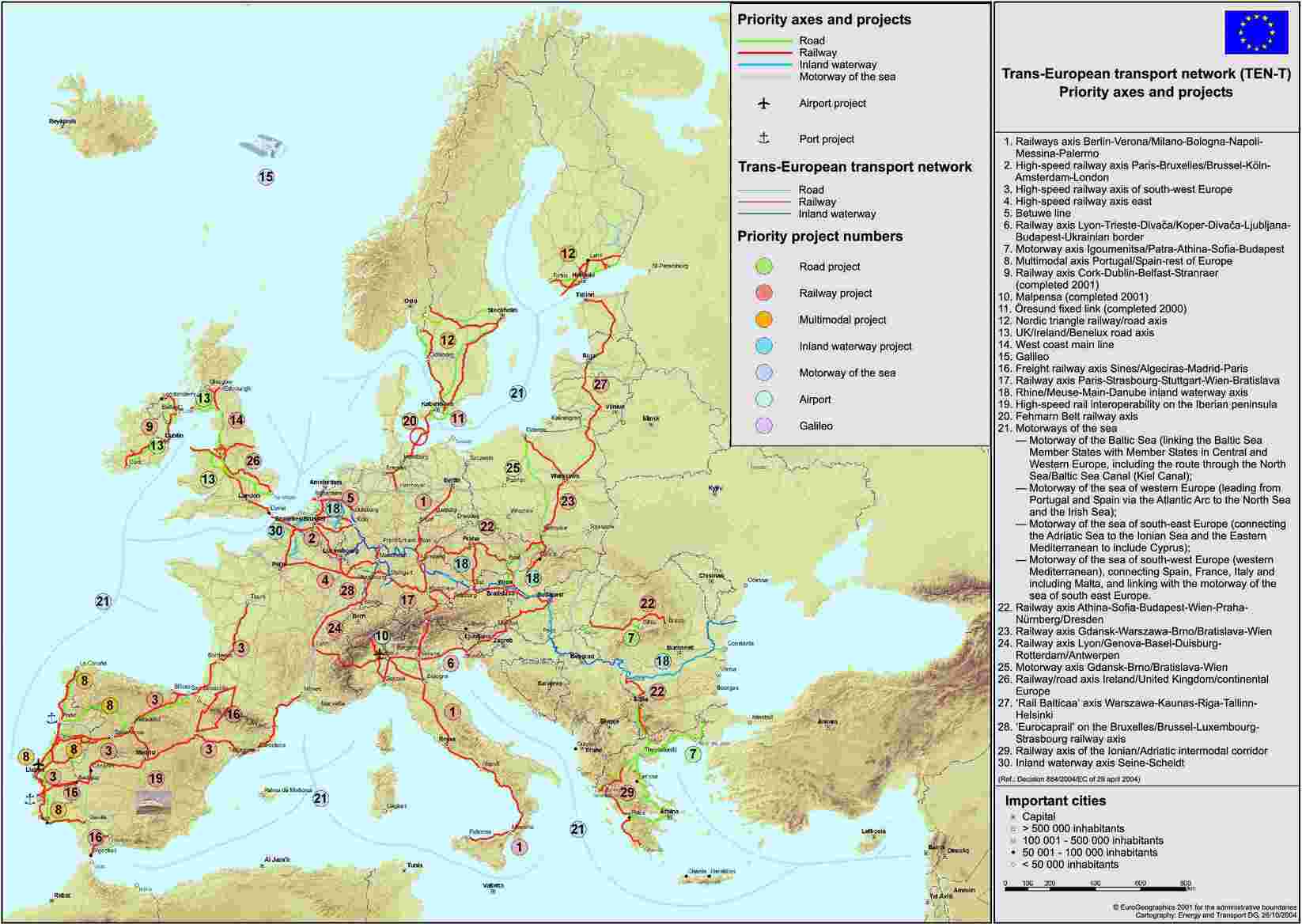
THE COMMISSION'S REPLIES
SUMMARY
|
III. |
|
|
IV. |
|
OBSERVATIONS
|
11. |
The management of the projects and their progress is mainly under the control of the Member States that finance the larger part of most of the TEN-T projects. As of today, three projects have already been completed and five are expected to be completed by 2010, while major parts of three other projects will be finished by 2010. The coordination problem is a genuine one since it is necessary to establish a delicate balance between different priorities, which do not necessary coincide at regional, national and Community level. |
|
14. |
The TEN-T budget consists of MIP and non-MIP elements. The MIP budget, representing a large part of the TEN-T budget, is allocated to priority projects located in all EU-15 Member States. Since a global amount per project is indicatively allocated at the beginning of the programme, variations are logically limited. The non-MIP budget allocation requires a positive opinion from the TEN Financial Assistance Committee which consists of Member States representatives. |
|
15. |
The Commission has to deal with projects proposed or agreed with by the Member States. The subject of the cross-border projects is only one out of eight priorities in the TEN-T guidelines set up by the European Parliament and the Council. In the MIP framework decision, cross-border projects are included in all four coherent groups of projects of common interest and in the Priority Projects Group and not only in the group GR 3 to which the Court limits its observations (for example the Brenner Tunnel, the Figueras-Perpignan project or the Lyon-Turin section). The Commission underlines that the majority of the cross-border projects are in the study phase, and therefore consume lower amounts. Many of these projects will be in the investment phase in the next MIP and are likely to consume a bigger share of the programme. Moreover, the Commission has taken measures to give more priority to cross-border sections, such as the nomination of European coordinators and the proposal of the new draft TEN Regulation to increase the Community financial aid for trans-frontier project sections to 50 %. |
|
16. |
For 2005 and 2006, the increased funding threshold for project sections crossing borders or natural barriers from 10 to 20 % will be applied. EUR 30 million have been reserved for this higher threshold in the MIP budget. |
|
18. |
The participation in the risk capital facility has a limit of 1 % of the budgetary resources pursuant toArticle 18 of the TEN Regulation (EC) No 2236/95 (i.e. EUR 4 875 million) until the end of 2006. In the new draft TEN Regulation for the period 2007 to 2013 (COM(2004) 475) this limit no longer exists. Since 2000, the EIF no longer provides funds for TEN infrastructures. Therefore, this instrument was not used. The instrument was not strictly limited to guarantee EIF loans. When the proposal for modification of the Regulation was made in 2001, the Commission did not analyse the potential of the instrument and therefore did not propose its deletion. |
|
19. |
The intention of the European Parliament and the Council was to apply this condition (funding of works only in duly justified cases) only to energy infrastructure projects and not to transport projects. In the new draft TEN Regulation this condition has been dropped. |
|
21. |
The Commission has to allocate a limited budget to a high number of qualified projects. For this reason, the maximum funding threshold is not always attained for each project. However, in future, the Commission will concentrate the funds on the 30 Priority Projects. Regarding the remarks made in the last sentence of the Court's text, the Commission considers that, as explained in paragraph 39, the TEN-T financing was duly required and compliant with the evaluation and selection criteria. |
|
22. |
The delays are mainly due to insufficient financing at European and at Member State level rather than to a lack of prioritisation in the selection of TEN-T actions. The higher funding rates proposed in the new draft TEN Regulation, in the line of the TEN-T guidelines 2004 adopted by the European Parliament and the Council, will allow the Commission to address this problem of insufficient financing, at least at European level, and to set clear priorities. To this extent, the conditions for receiving a higher funding will be as follows:
|
|
23. |
The Commission underlines that cross-border projects are included in all four coherent groups of projects of common interest, and not only in the group GR 3 to which the Court limits its observations. After two thirds of the planned MIP time-frame, the Commission has committed about two thirds of the planned amounts. Measures proposed in a next MIP revision will ensure that the total MIP budget is used on time. The annual evaluation of the progress of the projects leads to a shift of allocations if progress is too slow or faster than expected. |
|
24. |
As indicated in paragraph 23, the utilisation of the budget is coherent with the elapsed time-frame. For some big projects in Group 3 (named cross-border projects in the explanatory memorandum of the MIP decision), the Commission was forced to reduce the budget in the MIP revision of 2004, due to delays in project implementation. That is the reason why only the half of the budget for this Group has currently been committed. |
|
26. |
The Commission considers that the introduction of a binding model structure for a technical annex is not appropriate due to the various types of projects. However, for the 2006 exercise, the Commission will provide guidance to project promoters concerning technical description and breakdown of costs. The description of activities covered by the financing decisions has been improved, particularly with the text of 2005. Each activity has to be described and has to correspond to a line in the cost breakdown. A technical structure already exists in the application form. The Commission will reinforce it, and harmonise it with the text of the Decision and the PSR. |
|
27. |
As from 2005 onwards, the model text of the financial decision contains rules with details on the technical and financial information that has to be provided by the beneficiaries and contains models for their financial reporting.
|
|
28. |
|
|
29. |
The observation from the Court is based on a different interpretation of the scope of studies and works. As mentioned in paragraph 28, a clear operational definition of studies and works is contained in the new draft TEN Regulation. However, this definition will be subject to further reflection. |
|
30. |
The annual evaluation is part of project monitoring, which is considered essential (see amongst others observations 42 and 44). Moreover, it provides information in order to take the appropriate annual decisions, depending on the yearly budgetary availability and on the progress of the project. The in-depth appraisal of each project is done each year in partnership with the Member States. The corrective measures are implemented each year and during the revision of the MIP. For the two remaining years 2005 and 2006 the Commission decided to merge, where possible, the annual decisions and, in order to reduce the workload, to take only one decision either in 2005 or in 2006. This approach is possible for some, but not all projects: the relevant project must show a high level of budgetary execution for the existing decision(s). Furthermore, it is subject to the limitation of the annual budget. As from 2004 onwards, the Commission works with a non-MIP reserve list to ensure an optimal use of the budget. Within the new Financial Perspectives 2007 to 2013, it intends to introduce multiannual legal commitments for TEN-T projects. |
|
31. |
Since 2004, the Commission has reduced the number of forms taking into account the various types of Community aid. |
|
32. |
In the context of the new Financial Perspectives, the Commission will consider further simplification. |
|
33. |
For MIP projects, project status reports (PSR) are not considered as a formal application as projects are already ongoing. Therefore, the deadline for submission of PSRs was not considered a strict one. In this context, equal treatment of projects ‘applicants’ is not applicable to the same extent as in a call for proposals procedure. |
|
34. |
For the reasons explained above, the deadline for submission of PSRs was not considered a strict one. However, since 2005, the Commission requests a strict respect of this deadline, even on MIP projects. |
|
35. |
The forms referred to by the Court were only used to set up the MIP programme on an indicative basis. No project has been selected for a decision on financial aid without a detailed application form provided by the beneficiary. |
|
36. |
The MIP was completely revised in 2004 using detailed application forms submitted by Member States for the evaluation. The assessment of the information provided by the detailed application form led to the discontinuation of the funding of 14 project sections and to the revision of the planned amounts for most of the projects. New application forms in compliance with the new draft TEN Regulation will be established with the introduction of a new MIP in 2007. The fact that the West-Coast Main Line only received funding in 2004 shows that the annual appraisal process guarantees that the projects are only funded when all the essential conditions are met. |
|
37. |
The Commission considers that the PSR form and its annexes request all the essential information for the annual evaluation process leading to the granting of support for the following year. Therefore, the form should not be changed for the last year of the MIP. However, since PSR's are not always properly filled out by the Member States, the reporting procedure will be changed from 2007 onwards. Project appraisal guidelines will include sanctions for not filling out PSR forms completely. |
|
38. |
From 2005 onwards, the project application and appraisal forms have been modified and take into account the observations made by the Court. |
|
39. |
|
|
40. |
The Commission has taken measures to ensure that the problem of incomplete appraisal forms can no longer arise in the case of the MIP. |
|
41. |
Information on evaluation criteria is included in the call for proposals, the application form and the appraisal form. Additionally, the internal DG TREN Manual of Procedures includes general guidelines for evaluation. Nevertheless, specific evaluation guidelines for TEN are under preparation. |
|
42. |
The appraisal process is complex and based on several steps. It goes through the technical officer, the Evaluation Committee, the Director-General and the Financial Assistance Committee in which Member States are represented. It guarantees a well-balanced prioritisation of the high quality projects within the limited budget available, as provided for in the TEN-T guidelines that were adopted by the European Parliament and the Council. The Commission will reinforce its controls on compliance with the evaluation and selection procedures. |
|
43. |
For all modes of transport, evaluation is now carried out, both by staff dealaing with the Member State and those from the Directorate in charge of the respective transport mode. This combined approach has added objectivity to the evaluation process. When considered necessary, in particular because in-house expertise is not available, external expertise is used. As explained in paragraph 73, the cooperation with the EIB has been reinforced via the Memorandum of Understanding signed on 23 June 2005. The documentation and justification of the evaluation and selection process were also addressed in the revision of the project appraisal form in 2005. |
|
45. |
The following elements also play a role in the project monitoring:
In addition, a Memorandum of Understanding was signed between the EIB and DG TREN on 23 June 2005. This Memorandum provides that the EIB and DG TREN will inform and consult each other on a regular basis and consider having joint seminars involving their respective services. Regular meetings on projects planned are envisaged. The EIB will also assist DG TREN in studies, analyses and technical assistance, working groups will be set up, and staff exchanges are planned. |
|
46. |
The Commission refers to its reply to paragraphs 37 to 39 and 45. PSR's are only one tool in the evaluation process. The Commission considers that PSR's require the right information, but in order to improve the quality of the information provided by the Member States, the reporting procedure will be changed from 2007 onwards. Project appraisal guidelines will include sanctions for not filling out PSR forms completely. |
|
47. |
See reply to paragraph 27: as from 2005 onwards, the model text of the financial decision contains rules explaining which technical and financial information has to be provided by the beneficiaries and contains models for their financial reporting. Although, in previous years, the financing decision did not include models for financial reporting, it clearly stipulated that applications for second and third payments had to include technical and financial progress reports and a breakdown of cost for each category of expenditure. With those elements and the additional information provided when necessary, the Commission was in a position to verify the eligibility of activities and costs claimed. |
|
49. |
The Commission monitors regularly the projects via the annual project status report, the technical and financial reports for payments, on-the-spot visits, and regular meetings with the beneficiaries. Since 2005, the Member State concerned has to evaluate each financial decision. The methods for implementing ex post evaluation are currently being developed. This will include standardised check lists for project visits and enable the Commission to mobilise external monitors in addition to visits by desk officers. Since most of the projects are not yet completed, an ex post evaluation of the programme is not yet feasible. |
|
50. |
For all modes of transport, evaluation is now carried out both by staff dealing with the Member State and those from the Directorate in charge of the respective transport mode. This combined approach has added objectivity to the evaluation process. When considered necessary, in particular because in-house expertise is not available, external expertise is used. Furthermore, cooperation with the EIB has since been reinforced via the Memorandum of Understanding signed on 23rd of June 2005. |
|
51. |
The central project and contract management system of DG TREN (PMS) needs to accommodate the requirements of a high number of user groups (technical and financial officers, controllers, management etc.). It also has to cope with a large variety of situations (grants, subsidies, public procurement, small and large scale projects, etc.). PMS has been adapted to incorporate the management of TEN-T projects but this system is not designed specifically and exclusively for that purpose. It is therefore not surprising that certain users would prefer a simpler tool tailored to their specific needs. DG TREN is currently preparing the next generation of PMS (e-PMS) that will be built in a more modular way and take advantage of technological evolution. |
|
52. |
The Commission does not consider that the ratio of the budgetary size of projects relative to the number of staff is a relevant ratio as the nature of the projects and activities is very different and not comparable. For this reason, Table 2 should be interpreted with care. |
|
53. |
Staff allocation to DG TREN is determined by the Commission's annual budgetary procedure. DG TREN has also to deal with various policy areas besides TEN-T. DG TREN has recently allocated 12 new posts to the units dealing with TEN-T. Concerning the number of projects allocated to each project officer, the complexity of some TEN-T projects has to be taken into account. In order to face challenges for the period 2007 to 2013 with a considerably increased budget, the Commission proposes to create an executive agency which offers a more flexible recruitment policy and allows an increased number of specialised officers. In addition, the agency staff will concentrate solely on project management and will not have to deal with policy issues. The Commission encourages mobility and addresses the problem of continuity by implementing stable and robust processes through a range of measures and tools assisting new desk officers and SNE's. In 2006, reinforcement of the abovementioned measures and the establishment of a desk officer manual that will document all procedures are envisaged. |
|
54. |
While in theory policy issues could be centralised in one policy unit, contributions of project officers (who are more familiar with the specific problems of real life projects) will always be needed in order to ensure a coherent and practical policy approach. |
|
55. |
As explained in paragraph 53, the Commission is always adapting staff allocation to needs, within limits available. The Commission considers that with the additional allocation of staff, sufficient resources can be devoted to the different tasks including evaluation and monitoring. |
|
56 and 57. |
TEN-T project officers need to have a wide range of skills and competence and not just be technical experts. Whilst standard training courses will always play an important role in contributing to staff development, integration and motivation, the majority of learning in the Commission takes place in the workplace. On-the-job training and the transfer of staff skills from one to another being the most effective. The Commission considers that most of the project officers have the necessary professional experience. Indeed, most of the project officers have a degree in a transport-related subject and/or several years of previous experience on transport matters and/or a relevant experience in TEN-T project management. For this reason, the Commission considers that its staff is duly qualified for the job. |
|
58. |
An important part of training dispensed is training ‘on the job’. Up to now, such training activity is not formally reported under the IT-based database on training. The Commission will pay special attention to ensure that its agents involved with TEN-T follow relevant available transport-related training. |
|
59. |
As pointed out in paragraph 57, the Commission considers that the desk officers technical expertise is sufficient. The expertise of SNE's is complementary and is mainly used for policy issues as from 2005. |
|
60. |
Since end November 2003, the Commission rules on the use of SNEs have, to a large extent, been complied with. DG TREN will continue its efforts to reassign SNE's to more general, conceptual tasks related to policy design and implementation. |
|
61. |
The Commission's rules form a framework to manage SNE's responsabilities which intentionally limits the use of SNE's, regardless of their expertise. Avoidance of any potential conflict of interest while using SNE's is justified and is a priority. As from 2005 onwards, SNE's have been mainly allocated to policy related tasks where their expertise can be used to full extent. |
|
62. |
The Commission plans to create an executive agency that will be suited to the new challenges (see reply to paragraphs 53 and 57). |
|
64. |
The revised CBA addressed the elements raised by the Court and confirmed its support for the creation of a TEN-T Agency. The Commission, in the meantime, adopted the respective proposals on 20 July 2005. The main additional advantages identified by the CBA, include the ability to face the challenges of the new budget period 2007 to 2013, more flexibility in recruiting transport specialists, simplification of project management, raising the visibility of TEN-T and strengthening the coordination between all parties involved in project implementation. |
|
66. |
Although the ERDF regulation does not include explicit provisions on multiple financing from other Community sources except other Structural Funds, such multiple financing is prohibited by the Financial Regulation (see Article 111). In its draft regulation for general rules on the ERDF, ESF and CF for the next period 2007 to 2013 (COM(2004) 492), the Commission has now included a provision preventing multiple funding from different Community sources. |
|
67. |
TEN-T funds and the Structural Funds could finance the same ‘project’, but particular attention is paid in order not to finance the same action, stage or part of a project. The new draft TEN Regulation (COM(2004) 475) states that Community financial aid is excluded for sections of projects which receive other Community financing. |
|
68. |
To date, no cases of over- or double-funding have been detected. Different mechanisms are already in place to limit the risk of over- or double-funding: obligation for the applicants to provide information on financing from other Community sources in their applications, systematic inter-service consultations on funding proposals, and contacts between desk officers. Member States are also involved in the control process. Multiple funding is one of the aspects the managing services for the Structural and Cohesion Funds are required to check for all projects. The effectiveness of such controls is checked by the audit services of the Member States and of the Commission. |
|
69-72. |
Even though no cases of over- or double-funding have been detected hitherto, the Commission intends to further improve the existing coordination instruments. Inter alia, it will remind beneficiaries of TEN-T funding of the need to report any multiple financing of TEN-T projects. In case ERDF funding is granted to smaller projects (below the EUR 50 million threshold for notification to the Commission) after a TEN-T grant decision, the Commission requires beneficiaries to inform it of such financing. The wording of the 2005 application and appraisal forms is clearer and requires more detailed information from the Member States on the question of multiple financing. |
|
73. |
According to the contract, the EIB can be asked for either a first assessment or a full appraisal. The use of ‘other external experts’ is limited to strategic or ex post studies. DG REGIO also uses its in-house cost-benefit analysis specialists. The multiannual framework contract also covers projects in the environmental field. It is used for both the Cohesion Fund and ISPA. Concerning the EIB, DG REGIO intends to enhance cooperation with the EIB in the next programming period through a new technical assistance partnership to be known as Jaspers (for Joint assistance in supporting projects in European regions), which will offer Member States, particularly those which joined the Union on 1 May 2004, assistance with the preparation of major projects. |
|
74. |
DG REGIO and DG TREN are prepared to explore ways of increasing cooperation between their staff when useful and practicable. In June 2005, DG TREN concluded a Memorandum of Understanding with the EIB establishing a framework for cooperation on policy and investment in transport and energy, notably in the development of trans-European networks. |
|
75. |
In the past, DG TREN has looked at other existing methodologies but they were considered not to be the most appropriate for the selection of TEN-T projects. It was therefore decided to progressively adapt existing tools to the specific needs. |
|
77. |
Inter-service consultations allow the consulted DGs enough time for a thorough examination of the projects proposed for funding in order to ensure coordination, avoid overlap with other Community funding sources and suspend where necessary. The deadline can be extended, if necessary. The possibility to set up a database for TEN-T projects will be explored by the Commission. |
|
78. |
Even though no cases of over- or double-funding have been detected hitherto, the Commission agrees that the Directorates-General concerned must fully cooperate in order to ensure that the risk of over- or multiple-funding is avoided. It considers that the risk is being addressed with the request for information on other funding sources in applications and the exchange of information between the Directorates-General concerned. The potential lack of information for projects of under EUR 50 million in value, receiving funding from the ERDF, will be reduced by reminding TEN-T beneficiaries of their reporting obligations. |
|
79. |
The two Directorates-General will explore the need and scope to extend their existing cooperation by participating in joint missions and attending monitoring committees. |
CONCLUSIONS AND RECOMMENDATIONS
|
80. |
The Commission refers to its reply to paragraphs 14, 15 and 21. It considers that the processes for selection of projects assure an appropriate prioritisation, within a limited budget available, since the Commission selects projects amongst the Member States’ proposals complying with the TEN-T guidelines. These guidelines, that mention cross-border projects only as one out of eight priorities, are adopted by the European Parliament and the Council and intend to ensure the European added value to the fullest. Furthermore, the 2004 revision of the TEN-T policy guidelines introduced the principle of concentrating Community financial aid to 30 Priority Projects which also include cross-border projects. |
|
81. |
|
|
82. |
The new model Commission financing decision applicable as from 2005 implements the recommendations made by the Court and will allow more efficient project monitoring and effective operation of controls (see reply to paragraphs 26 and 27). |
|
83. |
|
|
84. |
The multiannual character of the MIP does not exonerate the Commission from the annual check of the progress of these projects, neither from the reconsideration of the indicative allocation of aid. Moreover, the Commission considers that the annual evaluation is part of project monitoring, which is considered essential (see amongst others, observations 42 and 44). It also provides information in order to take the appropriate annual decisions, depending on the yearly budgetary availability and on the progress of the project. Where appropriate, for 2005 and 2006, the Commission decided to merge the annual financing decisions (see reply to paragraph 30). The development of a single methodology has proved to be extremely difficult for such a different variety of projects in the various modes (rail, motorways, air, etc.). In addition to the existing general project appraisal guidelines, the Commission will develop specific TEN-T guidelines. |
|
85. |
|
|
86. |
Apart from the information provided by beneficiaries, there are also other elements which play a role in the project monitoring process (see reply to paragraph 45). The obligation for the Member States to verify the implementation of the policy objectives and the overall funding limits are explicitly integrated into the evaluation form included in the 2005 Commission financing decision. |
|
87. |
|
|
88. |
Within the limits set by the annual budget and considering other high priority areas, the Commission allocated additional statutory staff to TEN-T. In addition, the Commission is planning to create an executive TEN-T agency. The Commission considers that most of the project officers have the necessary professional experience (see reply to paragraph 57). The selection process ensures to allocate agents with adequate competencies and skills. Training on-the-job and permanent learning is very important in the Commission's training policy (see paragraph 58). As mentioned in its reply to paragraphs 53 and 60, the Commission does address the problem of continuity by implementing stable and robust processes. Since end November 2003, the Commission rules on the use of SNEs (including those of conflict of interest) have to a large extent been complied with. DG TREN will continue its efforts to reassign SNE's to more general, conceptual tasks related to policy design and implementation. |
|
89. |
|
|
90. |
No cases of over- or double-funding have been detected hitherto. With the instruments the Commission uses already (see paragraphs 65 to 79) it can in general be established if the project applied for receives multiple financing by the EC. The Commission refers also to the responsibility of Member States to provide complete and correct information. The Commission cannot check systematically whether Member States have supplied the right data, but in monitoring visits and audits this is one of the aspects that are checked. Due to the regular contacts and visits of the desk officers to the Member States, the risk of over- or double financing is limited. Only projects of an amount below EUR 50 million that may be co-financed through ERDF may represent a potential risk of double financing, as in these cases of smaller financial support, Member States are not obliged to submit such projects to the Commision for approval. However, the risk is addressed through the Member States’ management and control systems and through audit work. The Commission will also remind Member States that beneficiaries of TEN-T funding must disclose to the Commission subsequent awards of ERDF funding. |
|
91. |
|
(1) Definition of studies: studies needed for the definition of a project, including the preparatory studies, the feasibility and evaluation and any other technical support activities including activities prior to infrastructure works needed to complete the definition of a project and to make decisions about its financing, including exploratory work on the sites concerned and the preparation of the financial structure.
Definition of works: purchase and supply of components systems and services, undertaking construction and installation works related to the project, including the reception of installations and the entry into service of the project.