 EUROPEAN COMMISSION
Brussels,7.3.2018
SWD(2018) 214 final
COMMISSION STAFF WORKING DOCUMENT
Country Report Luxembourg 2018
Accompanying the document
COMMUNICATION FROM THE COMMISSION TO THE EUROPEAN PARLIAMENT, THE COUNCIL, THE EUROPEAN CENTRAL BANK AND THE EUROGROUP
2018 European Semester: Assessment of progress on structural reforms, prevention and correction of macroeconomic imbalances, and results of in-depth reviews under Regulation (EU) No 1176/2011
{COM(2018) 120 final}
Contents
Executive summary
1.Economic situation and outlook
2.Progress with country-specific recommendations
3.Reform priorities
3.1.Public finances and taxation
3.2.Financial sector
3.3.Labour market, education and social policies
3.4. Investment and competitiveness
3.5. Sectoral policies
Annex A Overview Table
Annex B Macroeconomic Imbalance Procedure scoreboard
Annex C Standard Tables
References
LIST OF Tables
Table 1.1:Key economic, financial and social indicators - Luxembourg
Table 3.1.1:Gross average replacement rate (% of average wage at retirement)
Table 3.2.1:Financial soundness indicators, all banks in Luxembourg
Table 3.5.1:Sector contribution to GHG emissions in 2015
Table B.1:The MIP scoreboard for Luxembourg (AMR 2018)
Table C.1:Financial market indicators
Table C.2:Headline Social Scoreboard indicators
Table C.3:Labour market and education indicators
Table C.4:Social inclusion and health indicators
Table C.5:Product market performance and policy indicators
Table C.6:Green growth
LIST OF Graphs
Graph 1.1:
Real GDP growth and contributions
Graph 1.2:
Breakdown of potential GDP
Graph 1.3:
Real investment in residential construction
Graph 1.4:
Breakdown of inflation differentials against the euro area
Graph 1.5:
Breakdown of employment growth (year-on-year)
Graph 1.6:
Beveridge curve
Graph 1.7:
Breakdown of the current account balance
Graph 1.8:
Breakdown of NULC (2000=100)
Graph 1.9:
Non-financial corporations indebtedness (% of GDP)
Graph 1.10:
Non-financial corporations indebtedness (% of GDP)
Graph 1.10:
Sectoral breakdown of the general government balance
Graph 2.1:
Overall multiannual implementation of 2011-2017 CSRs to date
Graph 3.1.1:
Age-related expenditure (as % of GDP) and population projections in selected Member States (2016-2070 % change)
Graph 3.1.2:
Number of new pensions, by type (thousands)
Graph 3.1.3:
Revenues from environmental taxes, 2005-2015
Graph 3.2.1:
Size of the financial sector in comparison to GDP
Graph 3.2.2:
Economic indicators –Real GDP and employment
Graph 3.2.3:
Outstanding credit for house purchase (% of GDP) and House Price Indices, Luxembourg.
Graph 3.2.4:
Households' debt (% of Households' disposable income), 2016
Graph 3.2.5:
Mortgage credits - New contracts -adjustable rate share
Graph 3.3.1:
Activity, unemployment and long-term unemployment rates
Graph 3.3.2:
Activity rate by detailed age group
Graph 3.3.3:
In-work-poverty rate, groups
Graph 3.4.1:
Main components of Luxembourg and EA19 value added at current market prices (% of GVA), by NACE Rev.2, 2016.
Graph 3.4.2:
Evolution of business R&D intensity and public R&D intensity, 2000-2016
Graph 3.4.3:
Eco-Innovation Index 2016 (EU=100)
LIST OF Boxes
Box 2.1: Summary Table on 2017 CSR assessment
Box 2.2: Tangible results delivered through EU support to structural change in Luxembourg
Box 3.3.1: Monitoring performance in light of the European Pillar of Social Rights
Box 3.4.1: Analysis of the ICT sector
Box 3.4.2: Policy highlights: the "Third Industrial Revolution" strategy
Box 3.4.3: Investment challenges and reforms in Luxembourg
Executive summary
Luxembourg’s strong growth momentum offers the opportunity to ensure sustainable economic growth and improve resilience. Public finances are sound and the labour market continues to exhibit strong job creation and low unemployment rates. Ensuring that labour supply and skill levels meet present and future labour market needs might improve economic resilience, notably by helping to better address the long-term challenge to public finances. Luxembourg's economic resilience would be further bolstered by improving the private sector's engagement in the digital transition. Moreover, complementing the current reforms to strengthen the banking system with measures that avoid the building-up of vulnerabilities in the housing market would improve the resilience of the economy (
).
Luxembourg's economy continues to grow healthily. The economy has been performing better than the euro area average since 2009. Real GDP growth averaged 3.2 % in 2010-2016, compared with 1.1 % for the euro area as a whole. The outlook for Luxembourg continues to be favourable. Growth is projected to have reached 3.4 % in 2017, after 3.1 % in 2016, and it is expected to pick up to 3.9 % in 2018.
The financial sector remains the main economic sector in the country. The sector has remained sound and profitable. This is reflected in strong surpluses in both the services balance and the overall current account balance. The external sector relative contribution to real GDP growth represented 61 % on average in 2013-2016, despite recurrent negative trade balances. In 2016, the current account balance posted a surplus of 4.8% of GDP.
Public finances are projected to remain sound. The implementation of the tax reform might reduce the general government surplus in 2017, which reached 1.6% in 2016. In 2018, buoyant revenue growth underpinned by strong underlying economic expansion is expected to be offset by growth in government expenditure, mainly due to infrastructure investments.
Luxembourg has made limited progress in addressing the 2017 country-specific recommendations. The government has made some progress on diversifying the economy. Limited progress has been made in removing regulatory restrictions in the business services sector. Limited progress has been made on limiting early retirement and on increasing the employment rate of older people.
Regarding progress in reaching the national targets under the Europe 2020 strategy, Luxembourg is on track to reach the renewable energy target and the energy efficiency target in 2020. However, Luxembourg is expected to miss its 2020 target reductions in greenhouse gas emissions. Transport fuel taxation remains low, stimulating traffic congestion and possibly providing incentives to increase consumption. Little progress has been made towards the targets for R&D investment and reducing poverty risk, and the employment rate, which remain below target.
Luxembourg performs relatively well on the indicators of the Social Scoreboard supporting the European Pillar of Social Rights. Unemployment and the share of young people not in employment, education or training are low. Childcare for very young children is widely used. Income inequality and the weakening impact of social transfers on poverty merit attention.
Key structural issues analysed in this report, which point to particular challenges for Luxembourg’s economy, are the following:
·Luxembourg has a healthy financial sector, for which risks can be assessed as contained. The whole economy benefits from the presence of a large financial sector. However, developments in the financial sector are expected to continue having a strong impact on the country's economic performance. Potential risks can also arise from developments in the housing market, which has an impact on household indebtedness. The government has continued to strengthen the macro prudential framework, which is key to ensure the resilience of the sector.
·House prices have kept on rising. This may undermine Luxembourg's ability to attract and retain a skilled labour force, a large share of which is made up of non-nationals. House price pressures emerge from both the supply and demand side. On the supply side, insufficient land availability and lack of incentives for private owners to sell land or buildings seem to represent a bottleneck to the creation of new housing units. On the demand side, high population and employment growth, as well as, to a lesser extent, tax policies encouraging ownership push prices up.
·The rise of age-related expenditure poses a threat to the long-term sustainability of public finances. The operational balance of the pension system is projected to become negative by 2023, with the deficit widening steadily over the medium to long term. However, past and current surpluses of the pension system have been saved. These cumulated reserves are projected to extend the viability of the system by about a further 20 years.
·Luxembourg has continued to pursue its strategy to diversify the economy, whereas business investment in R&D is on a declining trend. The authorities took several initiatives to deploy the diversification strategy and to foster investments in the key priority sectors. Among them, important achievements concern the ICT and space sectors. By contrast, expenditure in R&D remains highly dependent from public spending and is not leveraging private investments. Therefore, business investments in R&D continued to decline, indicating that several weaknesses remain in the research and innovation ecosystem, which drag down Luxembourg's innovation performance.
·The business environment showed some improvements, but barriers remain in the business services sector. Luxembourg has made efforts to simplify administrative formalities, but the business services sector is still restrictive, notably as regards the profession of lawyers.
·The labour market continues to enjoy strong job creation and low unemployment rates, but specific groups still face challenges. The unemployment rate continues to go down. Employment growth has increased in 2017, with both cross-border and resident workers helping fuel this growth. However, the employment rate of older workers remains substantially below the EU average. Upskilling is crucial, given the strong demand for highly specialised skills and several steps have been taken in this regard. Getting more low-skilled and older workers into training is also necessary.
·Poverty and social exclusion risks are increasing but they are still among the lowest in the EU. People with migrant background tend to have far fewer job and social opportunities. Social transfers remain essential in lifting people out of poverty, although their capacity to reduce the risk of poverty has decreased in 2016. The tax and benefit system has helped keeping income inequality at moderate levels, despite recent increases in those levels.
·Despite very high rates of tertiary education attainment, efficiency in providing basic skills is below the EU average. The impact of the students’ socioeconomic background on their performance is one of the strongest in the EU, pointing to high educational inequality. New policy initiatives have been introduced to close the achievement gap between pupils from different backgrounds. Their effectiveness remains to be seen. Adapting vocational education and training to labour market needs remains challenging.
·Some indicators suggest that Luxembourg's tax rules may be used in aggressive tax planning structures. Luxembourg has taken steps to amend certain aspects of its tax system that may facilitate aggressive tax planning and is engaged in international tax reform. However, the absence of withholding taxes on royalties and interest payments made by companies based in Luxembourg, or the lack of some anti-abuse rules, suggest that the country’s tax rules may still be used in tax avoidance structures.
1.
Economic situation and outlook
Economic growth
Luxembourg's dynamic economy has been performing better than the euro area average since the 2009 global economic recession. Real GDP growth averaged 3.2 % in the 2010-2016, compared with 1.1 % for the euro area as a whole (Graph 1.1). Annual GDP figures have been higher but more volatile, and subject to revisions as well (
).
|
Graph 1.1:Real GDP growth and contributions
|
|

|
|
Source: European Commission
|
Economic activity is growing at a healthy pace, underpinned by sound domestic demand and net exports. Recent economic trends and the outlook for Luxembourg remain favourable, with the latest indicators pointing to a strengthening economic momentum. According to the Commission Winter forecast 2018 economic growth is projected to have reached 3.4 % in 2017, after 3.1 % in 2016, and it is expected to pick up to 3.9 % in 2018, before slightly decelerating to 3.6 % in 2019.
|
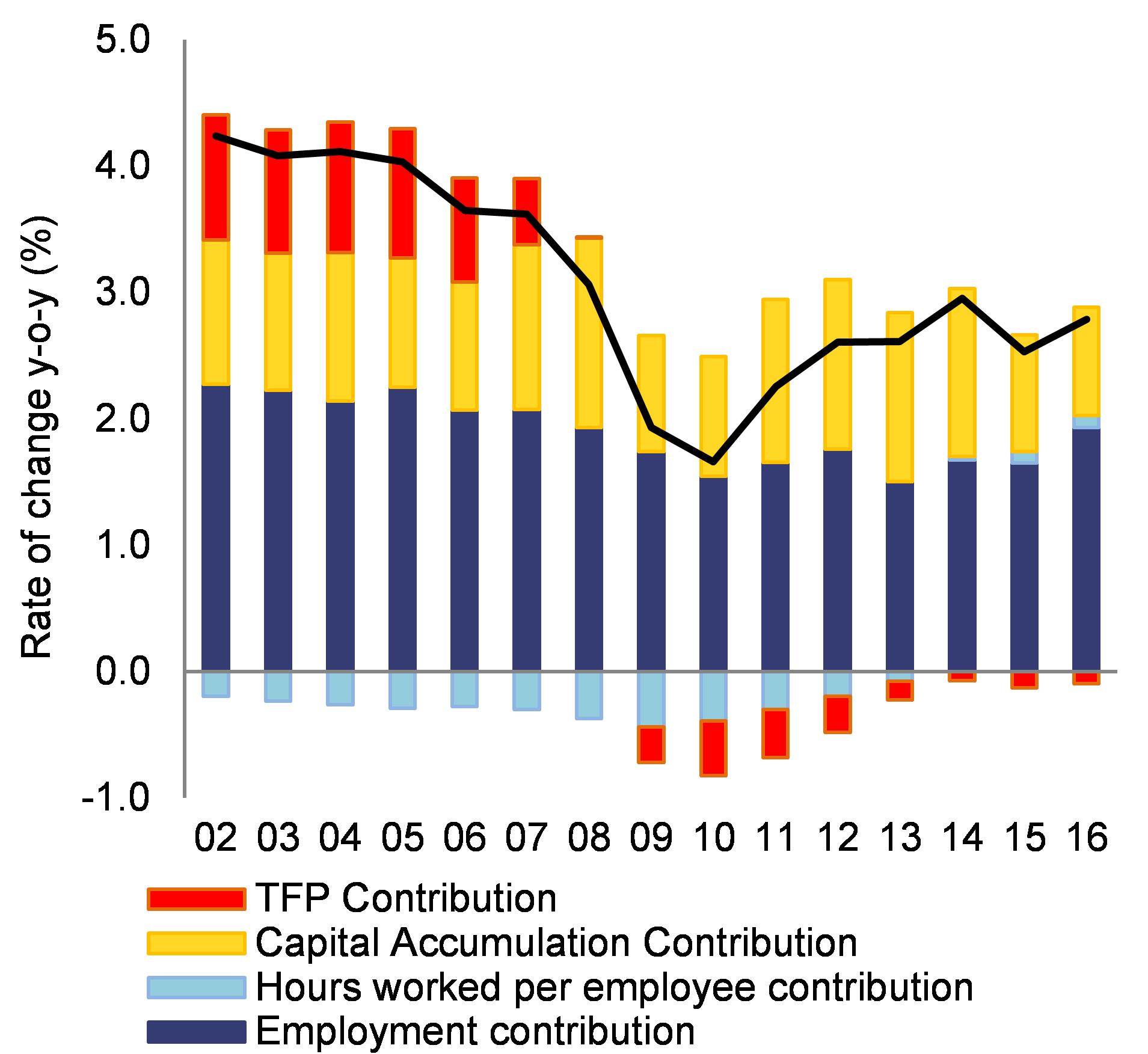
Graph 1.2:Breakdown of potential GDP
|
|
|
|
Source: European Commission
|
Potential growth
The favourable economic trends are reflected in estimates for potential growth. The rapid recovery of estimates for potential growth after 2010 first reflects the sustained contribution of labour (Graph 1.2). The main shift in this contribution has come from changes in hours worked, which in turn has reduced the impact on employment and fed into the labour contribution to the recovery. Second, it reflects quick recapitalisation, with capital accumulation rising to 2006-2007 levels in 2010-2014, before losing some intensity as the labour contribution increased. Additionally, it reflects a worsening in total factor productivity. In 2009, productivity gains turned into losses, and have remained negative ever since. With the labour contribution and capital intensity getting close to their pre-crisis levels, estimates for potential growth remain around 1 pp. below those levels. The estimated investment recovery in 2017 would improve labour productivity and support employment growth.
Private consumption is projected to continue growing moderately. Private consumption increased in second and third quarters of 2017. This trend is expected to continue, mainly on the back of stronger employment and moderate real income gains, since the surge in consumer prices has tempered the impact of income gains from the tax reform and the wage indexation applied in January 2017. In 2018, sustained employment creation and some real income gains, from the forthcoming wage indexation (expected in the first half of 2018) should continue to support private consumption. In 2019, consumption growth is projected to ease slightly, with employment creation moderating and higher underlying inflation taking a dent on real income gains. High household indebtedness and increasing debt burdens could also affect consumption growth
|
Graph 1.3:Real investment in residential construction
|
|

|
|
Source: European Commission
|
Investment in construction is projected to remain buoyant in 2017 and 2018 thanks to public infrastructure projects and housing. The housing investment-to-GDP ratio of around 3.2% is nevertheless expected to remain stable despite the high demand for housing. While supply constraints remain entrenched, price pressures are expected to build up further (Graph 1.3) (see Section 3.2.3). ). Ongoing infrastructure projects are forecast to drive up public investment in 2018. The public investment-to-GDP ratio of around 4 % is expected to remain among the highest in the euro area (see Section 3.4).
External demand is expected to remain robust. The external sector, led by financial services exports will be supported by an improved external environment, especially in the euro area, even if a slight slowdown is expected in 2019, in line with financial market prospects.
Inflation
Consumer prices rose to 2.1 % in 2017 from zero average in 2016, which is 0.6 percentage points above the euro area average, reflecting crude oil price developments to which Luxembourg is traditionally more sensitive (Graph 1.4). Oil price pressures are expected to continue driving inflation in 2018. In 2018, consumer inflation is expected to ease to 1.9 %. While high oil price pressures should continue feeding into higher inflation, their impact will be partially offset by some subsidies to child and healthcare services introduced in November 2017. As oil price pressures dissipate, underlying inflation should progressively drive the headline inflation rate to 1.6 % in 2019, with the expected picking-up of wage growth being passed on to services inflation. While positive differentials in the other underlying components are expected to remain at historical levels, this may lead to a narrowing of the difference in the overall inflation rate with the euro area average.
|
Graph 1.4:Breakdown of inflation differentials against the euro area
|
|

|
|
Source: Eurostat
|
Labour market
Growth of the Luxembourg labour market continues to accelerating. According to national monthly statistics, employment growth increased by 3.3 % in 2017, from 3.0% in 2016 (Graph 1.5). This momentum is expected to continue in 2018 although progressively stabilising towards 2019. All private sectors have been contributing to job creation in recent quarters. Resident employment (used for computing the unemployment rate) rose markedly, helping to curb the unemployment rate. Unemployment is estimated to have fallen below the 6% mark in 2017, from 6.3% in 2016. This downward trend is forecast to slowdown progressively and to stabilise towards 2019.
The good recent performance in job creation hides a number of structural shortcomings. Luxembourg has not yet reached its EU2020 employment rate target of 73 %, which stood at 70.7 % in 2016 (and at 71 % in 2017Q2). Substantial untapped potential remains, stemming from low labour participation, which is particularly important among certain groups. The participation of older people in the labour market is low. The labour market potential of women, in particular non-EU-born women, did not improve. Finally, the rate of young people not in employment, education or training (NEET) fell to 5.4 % in 2016 and further to 4.1% in 2017Q2, while youth unemployment remained high at 19.1% in 2016, but has decreased to 15.2% in 2017. As the enrolment rate in tertiary education is very high, this implies that unemployment is concentrated primarily among low-skilled young people in this country. This and other structural labour market issues are discussed in Section 3.3.
|
Graph 1.5:Breakdown of employment growth (year-on-year)
|
|

|
|
Source: STATEC
|
The labour market robustness is apparent. Yet, indicators remain below the pre-crisis levels. Although job creation has accelerated since 2013, growth remains below the rates recorded in the previous upturn (Graph 1.5), especially among cross-border workers. The persistent rise in the vacancy rate (Graph 1.6) (mainly in specialised sectors) is raising concerns about skilled-labour supply shortages and could constrain employment growth and economic growth (see Section 3.4). Moreover, vacancies could not be covered by the national jobseekers, as suggested by the barely changed unemployment rate, indicating the presence of skills mismatches between demand and supply.
|
Graph 1.6:Beveridge curve
|
|

|
|
Source: EUROSTAT
|
Social developments
Luxembourg shows very good social outcomes. The overall risk of poverty or social exclusion (AROPE rate), at 19.7 %, remains relatively low. A relatively high number of children under the age of 3 is registered for formal childcare, which provides incentives for both parents to work. It could also help integrate from a disadvantaged social background.
Income inequality after taxes and benefits increased in 2016. In 2016 the richest 20 % of households in Luxembourg had an income share five times that of the poorest 20 % (compared to 5.2 times in the EU as a whole). Social transfers have an important positive impact on the reduction of poverty, even though these two indicators experienced noticeable weakening in 2016. Over the period 2010-2017 growth in per capita GDP outpaced growth in household disposable income. Together with stagnating social indicators (see Section 3.3.2) this suggests that the economic recovery has not yet broadly translated into inclusive growth. The link between socioeconomic status and educational outcomes is particularly strong in Luxembourg, as evidenced by PISA. This is particularly relevant for pupils of foreign nationality.
External position
A key feature of the Luxembourg economy is its substantial exposure to international capital flows relative to the size of its economy. Luxembourg has the largest portfolio investment flows across financial centres. Assets under management of the funds industry, expressed as a percentage of national GDP, were around 7 800 in 2016. These flows partly reflect the size of the country's investment funds management industry, which is constantly moving towards specialisation, diversification and expansion.
The financial sector is a key driver of economic growth in Luxembourg, which is reflected in the current account balance. It accounts for ¼ of Luxembourg's GDP. The large size of the financial sector leads to strong surpluses in the services balance, and ongoing comfortable surpluses in the current account, despite sizeable net primary income outflows reflecting the large number of foreign corporations, workers and pensioners. The current account balance posted a surplus of 4.8 % of GDP in 2016 (Graph 1.7).
Moreover, Luxembourg is a net creditor to the rest of the world. Its net assets (net international investment position) have risen to around EUR 18.4 billion (34.7 % of GDP). The net position hides large international investment positions. At the end of 2016, gross external assets and liabilities reached EUR 10.5 trillion (around 200 times the country's GDP).
The economy heavy reliance on the financial sector has to be seen in the context of the European macro-prudential framework and the measures adopted by the national authorities to reduce the potential impact of an adverse external shock. The national authorities have taken steps since the last decade in reinforcing the macro prudential measures. Today, financial intermediaries are engaged in the process of adjusting to the new policy framework adopted by the national authorities in 2015, and complemented by reforms at European level (see Section 3.2.1).
|
Graph 1.7:Breakdown of the current account balance
|
|

|
|
Source: EUROSTAT
|
Competitiveness
The government has been implementing a strategy for diversifying the economy, by developing a few selected sectors. The sectors in focus comprise activities with high value added and high potential, in line with the country's high degree of specialisation in high value added activities, such as the financial sector. The strategy has been recently strengthened. Large public investment projects, including R&D, and market regulations, among other measures are being implemented to develop the priority sectors. However, this has not prevented private investment in R&D and innovation performance, as measured by the European innovation scoreboard, to decline further (see Section 3.4).
Among other factors, possible losses in cost competitiveness could challenge the diversification strategy. The steady increase in nominal unit labour costs (NULC) since 2000 has resulted in a significant differential compared with the euro area (see Graph 1.8). From 2000 to 2016, NULC increased by a cumulated 56 %, almost twice as much as in the euro-area (28 %). Yet, this trend stopped and the cost competitiveness of the country started to improve again in 2013, even if the overall gap could not be reabsorbed, thanks to the period of stable wage moderation witnessed in most recent years, ensuing from a low inflation environment and from government intervention in the wage indexation system. In 2016, nominal wage growth remained moderate at 1%.
|
Graph 1.8:Breakdown of NULC (2000=100)
|
|

|
|
Source: European Commission
|
Under Luxembourg’s wage-setting system, inflation is mostly transferred into NULC through the indexation mechanism, which seeks to keep real wages unaffected by domestic price inflation. Even so, Luxembourg has cumulated positive inflation differentials against the euro area. Moreover, labour productivity has not helped bring down rising NULC. This partly reflects strong employment growth, mainly from large inflows of foreign workers, on a par with economic growth, the already very high levels of productivity in the country, and the effects of labour hoarding at the onset of the crisis. A temporary modulation of the system of automatic wage indexation to inflation was applied in 2012-2014. Nonetheless, nominal wages continued to increase marginally above the euro area average, whereas real wages actually fell. The next wage indexation is expected in the first half of 2018.
Private indebtedness
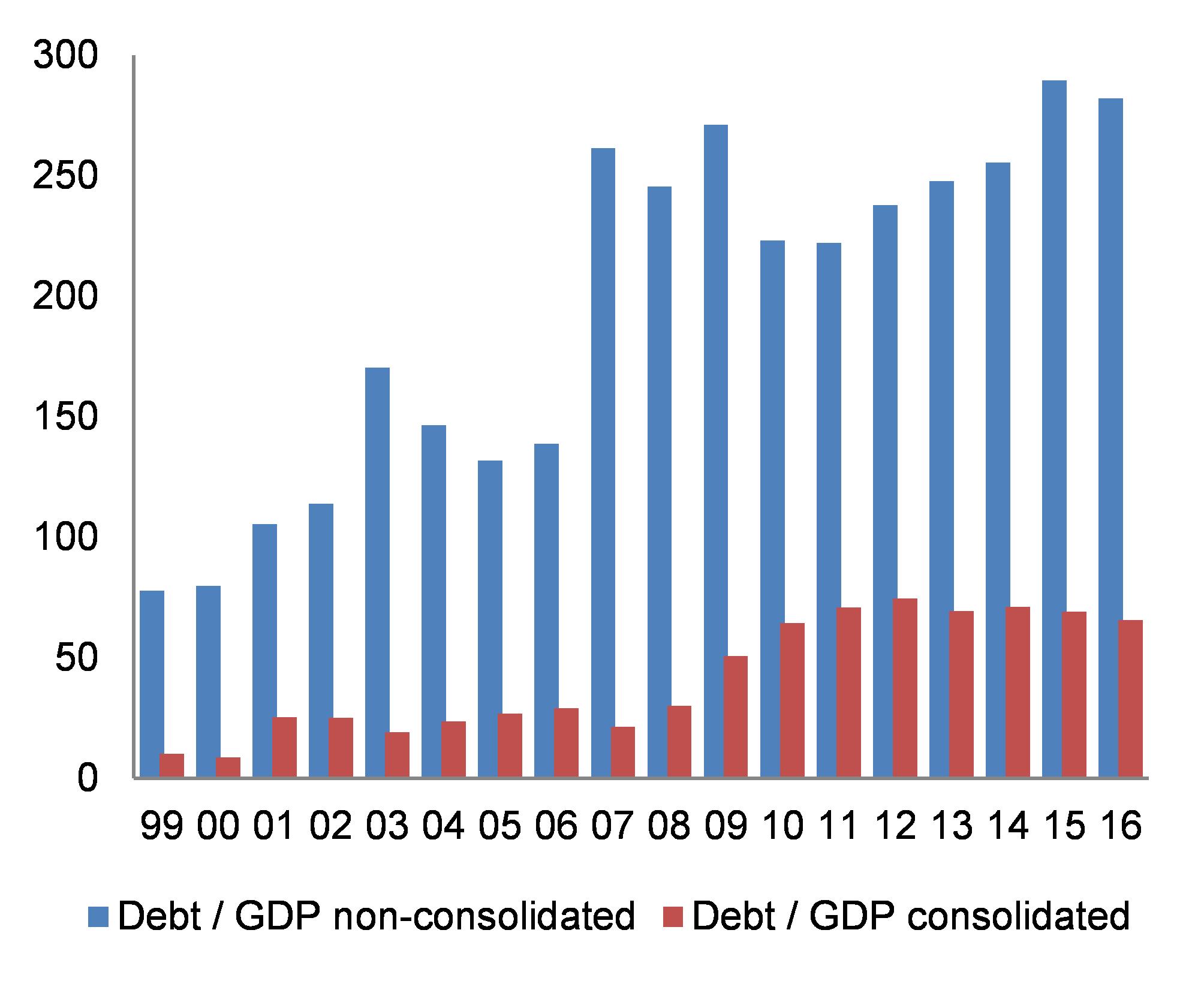
Private debt stands at a relatively high level, in particular for non-financial companies. Private sector debt stood at 344% of GDP in 2016. This is mostly due to high corporate debt (282% of GDP in 2016). However, corporate debt figures are inflated by widespread intra-group lending. This practice has been expanding in line with Luxembourg's financial sector's development. Corporate consolidated debt stood at 65.6 % of GDP in 2016 (Graph 1.9). The increase in liabilities generated by intra-group inflates the debt-to-GDP ratio, yet those liabilities are matched with equivalent assets. It turns out that the debt-to-financial asset ratio provides for a better measure of companies' financial situation. This ratio remains below 40 % in consolidated terms, comparing favourably with other Member States.
Credit to the domestic non-financial private sector has remained strong despite a slowdown in 2017. In 2017, credit to non-financial companies grew by 4.5 %, compared to 12.0 % in 2016 and 7.5 % in 2015.
Although household indebtedness has been rapidly increasing over the last 10 years, it also reflects the favourable wealth position of households. While household debt has risen from 39 % of GDP in 2000 to 62 % in 2016, the ratio of debt-to-assets is still very low (36 %). Yet, in terms of disposable income household debt is estimated at 165 % in 2016, according to sector national accounts figures, recently made available by the STATEC. Household indebtedness reflect real estate inflation, as around 80 % of households' debt stems from mortgage loans, which have registered strong growth in recent years. House prices are rising in real terms, after a slow down marked by the global recession in 2007 (see Section 3.2).
|
Graph 1.9:Non-financial corporations indebtedness (% of GDP)
|
|
|
|
Source: Eurostat
|
Public finances ()
The general government surplus is expected to have declined to 0.5 % of GDP in 2017 () compared with a surplus 1.6 % of GDP in 2016. The change is mostly explained by the impact of the tax reform enacted by the government at the start of the year. The reforms are expected to shave revenues from households and corporates by about 0.8 % of GDP. Finally, additional revenues, equivalent to 0.3 % of GDP will be lost, due to a cut from 30% to 15% in the share of VAT revenues that Luxembourg earns from e-commerce related transactions. Section 3.1.6 discusses these issues in more detail.
Expenditure growth is also projected to rise. This is a result of the automatic public wages indexation, which took place at the start of 2017. On top of that, the implementation of the wage agreement in the public sector, will add up to the wage bill. In 2018, the general government surplus is expected to marginally decline further. Buoyant revenue growth underpinned by strong economic growth will be outpaced by growth in government expenditure, especially still high spending for infrastructure investment.
A breakdown by sector shows that the overall surpluses come from the social security sector, while the central government accounts tend to record deficits (Graph 1.10). Although the large central government deficits recorded from the onset of the financial crisis have been almost completely absorbed, the deficit is projected to widen again from 2017, mostly as a result of the implementation of the comprehensive tax reform, while higher wage bill and the projected investment plans will add up on the expenditure side.
Public debt is well below the euro area average. After peaking at 23.7 % of GDP in 2013, public debt has declined to 20.8 % of GDP in 2016, although it is projected to have increased somewhat in 2017. It remains more than four times lower than the euro-area average (91.1 % of GDP). At the end of 2017, existing public guarantees are estimated at 8.7 % of GDP, 5.9 % of which are related to the financial sector. Given the low level of public debt and its relatively solid economic fundamentals, Luxembourg, together with Germany and the Netherlands, are the only countries in the euro area that still keep an ‘AAA’ rating from all the three major rating agencies.
|
Graph 1.10:Sectoral breakdown of the general government balance
|
|

|
|
Source: EUROSTAT
|
|
|
|
Table 1.1:Key economic, financial and social indicators - Luxembourg
|
|

|
|
Source: Eurostat and ECB as of 30 Jan 2018, where available; European Commission for forecast figures (Winter forecast 2018 for real GDP and HICP, Autumn forecast 2017 otherwise)
|
|
|
2.
Progress with country-specific recommendations
Progress with the implementation of the recommendations addressed to Luxembourg in 2017 has to be seen in a longer-term perspective since the introduction of the European Semester in 2011. Looking at the multi-annual assessment of the implementation of the CSRs since these were first adopted, 34 % of all the CSRs addressed to Luxembourg have recorded at least 'some progress'. 66 % of these CSRs recorded 'limited' or 'no progress' (see Graph 2.1). Substantial progress and full implementation have been achieved in several areas of the fiscal policy, for instance preserving a sound fiscal position and strengthening fiscal governance.
|
Graph 2.1:Overall multiannual implementation of 2011-2017 CSRs to date
|
|

|
|
Source: European Commission
|
Over the past years, Luxembourg has significantly strengthened its budgetary framework. In 2014, Luxembourg transposed in national legislation the requirements of the 2011 Council Directive on budgetary frameworks and the fiscal compact. In 2017, the authorities further adjusted the domestic regulation to bring it into full compliance with the 2011 Council Directive on budgetary frameworks. Since, Luxembourg, which is under the preventive arm, has remained committed and compliant with the provisions of the Stability and Growth Pact. In view of an expected deterioration of the fiscal balance in 2015, the government embarked on a series of corrective measures, targeting both the expenditure and revenue side, to maintain the country's Medium-Term Objective throughout the programming period. In 2016, the authorities decided to use the available fiscal space to implement a tax reform, which was approved in 2016 an entered into force in January 2017. The reform increased households' disposable income, especially for lower income households.
Several measures have been adopted to address the long-term sustainability of public pensions, though their impact has been limited. A pension reform was adopted in 2012, but its impact on pension expenditure has been limited. A law aiming at keeping workers with disabilities longer in the labour market entered into effect at the beginning of 2016. Additionally, the 2017 tax reform introduced some incentives for increasing working time. Finally, a reform of the long-term care public insurance is to take effect at the beginning of 2018, in spite of which the cost of the scheme is projected to continue growing (on the basis of latest dependency rate growth projection). More fundamental reforms have not been considered yet or are pending approval, such as the so-called 'Age Pact', which includes a whole package of measures to keep workers longer in employment. Finally, no measures have been taken on the recommendation for aligning the statutory retirement age to changes in life expectancy.
Some progress has been made on enhancing participation in the labour market, but challenges remain. The main efforts have focussed on reducing youth unemployment, where progress has been substantial. Upskilling has been recently addressed: the 2015 evaluation of the vocational education and training system had identified several fields for improvement. The law on vocational education and training, amended in 2016 and in application since 2016/2017, aims at improving the qualitative skill sets and study success rates of students. The employment of older workers remains among the lowest in the EU, particularly for the low-skilled, who are also particularly affected by long-term unemployment (at 25.6 % in 2016 for International Standard Classification of Education – ISCED – 0-2, but also for ISCED 3-4 at 34.6 % and ISCED 5-8 at 62.6 %).
Luxembourg has made some progress in addressing bottlenecks that hamper housing investment. Numerous measures have been adopted or are planned, especially on the supply side, trying to increase the market offer. Recently, the Parliament endorsed a law empowering the "Fonds de Logement", a land management agency, to support the supply of housing. Additionally, a reform is planned to enable local authorities to require the landowner to build on their land within a fixed period of time. Nevertheless, supply remains limited and the challenge ahead for the Luxembourg authorities continues to be sizeable. House prices are very high and still in an increasing trend.
Luxembourg has made limited progress in reforming the wage-setting system. After a modulation of the automatic wage adjustment to inflation in the period 2013-2014, no further measures have been adopted. A study was published about the impact of the wage indexation on the evolution of labour cost. Based on the study conclusion the current government announced its intention to consider reviewing the existing wage setting mechanism only in the case of a surge in inflation pressures.
Luxembourg has made limited progress (
) in addressing the 2017 country-specific recommendations. The government has made some progress on strengthening its strategy to diversify the economy, with large scale investment projects and sundry other measures to foster innovation. Yet, private investment, especially on R&D, and innovation remain low compared with the euro area average. Progress has been limited in removing regulatory restrictions in the business services sector. Several measures have been taken, although some barriers remain, notably concerning the profession of lawyers. On ensuring the long-term sustainability of public finances, limited progress has been made. The law suppressing the ‘préretraite de solidarité’ was adopted in November 2017 but its impact on the average effective retirement age and on expenditure is difficult to assess due to an easing of restrictions on other kinds of early retirement schemes. The employment rate of older workers remains particularly low, in spite of some targeted measures, at 39.6 % in 2016 compared to 55.3 % on EU average. The Age Pact to foster age management measures in businesses is still pending approval by the Parliament since its first introduction in 2014.
ESI Funds address key challenges to inclusive growth and convergence in Luxembourg, notably by providing sustainable professional integration of jobseekers, inactive persons and young people via active skills development and better access to lifelong learning to encourage workers aged 45+. ESI Funds also support entrepreneurship in the field of ICT for job seekers as well as supporting R&D and innovation via the Smart Specialisation Strategy for research and innovation.
|
Box 2.2: Tangible results delivered through EU support to structural change in Luxembourg
Luxembourg is a beneficiary of European Structural and Investment Funds (ESI Funds) support and can receive up to EUR 140 million until 2020. This represents around 1 % of public investment (
II
) annually over the period 2014-2018. By 31 December 2017, an estimated EUR 70 million (50 % of the total) was allocated to projects on the ground. This has paved the way for enterprises to cooperate with research institutions and over 30 researchers working in improved research infrastructure facilities.
ESI Funds help address structural policy challenges and implement country-specific recommendations. Support is provided to sustainable professional integration of jobseekers, inactive persons and young people (including through the implementation of the Youth Guarantee), active inclusion, and skills development through better access to lifelong learning. Helping answering the need to give incentives to older workers to work longer, the ESF supports measures to mentor job seekers and workers aged 45+. The ESF also supports entrepreneurship and training in the field of ICT for job seekers, for example with the training programme Fit4Coding which has received the award for "Best Practice" at the European Digital Skills Awards on 7 December 2017.
Reforms were undertaken as precondition for ESI Funds support (
III
). A Smart Specialisation Strategy for research and innovation was developed and has been adopted by the government. Efforts are made to complete all outstanding ex-ante conditionalities as soon as possible in order to avoid a possible suspension of interim payments.
Luxembourg is advancing the take up of the European Fund for Strategic Investments (EFSI). As of December 2017, overall financing volume of operations approved under the EFSI amounted to EUR 89 million, which is expected to trigger total private and public investment of EUR 284 million. More specifically, 3 multi-country projects involving Luxembourg have been approved so far under the Infrastructure and Innovation Window, amounting to EUR 14 million in EIB financing under the EFSI. This is expected to trigger about EUR 53 million in investments. Under the SME Window, 5 agreements with financial intermediaries have been approved so far. European Investment Fund financing enabled by the EFSI amounts to EUR 75 million, which is expected to mobilise approximatively EUR 231 million in total investment. Some 831 smaller companies or start-ups will benefit from this support. RDI ranks first in terms of operations and volume approved, followed by SMEs.
Funding under Horizon 2020, the Connecting Europe Facility and other directly managed EU funds is additional to the ESI Funds. By the end of 2017, Luxembourg has signed agreements for EUR 72 million for projects under the Connecting Europe Facility.
https://cohesiondata.ec.europa.eu/countries/LU
|
3.
Reform priorities
3.1.
Public finances and taxation
3.1.1.Long-term sustainability
In the short-to-medium-term Luxembourg faces low fiscal sustainability risks, as shown by both the debt sustainability analysis and the S1 indicator (European Commission, 2018). The low level of the general government debt set at 20.3 % of GDP at end of 2016 (the second-lowest in the euro area) and the recurrent surpluses in the headline balance help to explain these results.
The challenge for Luxembourg is the long-term sustainability of its public finances. The country is expected to face one of the sharpest increases in the EU in costs related to an ageing population from now to 2070. Specifically, this is indicated by the fact that the S2 long-term fiscal sustainability gap indicator is relatively high, at 9.5 percentage points of GDP, entirely driven by the expected increase in age-related expenditure, in particular pensions (6.5 pps of GDP) and health care and long-term care expenditure (2.8 pps of GDP) (
).
3.1.2.Pension and long-term care
The short-term financial perspectives are rather favourable for the Luxembourg pension system. Luxembourg has yet to experience the effects of an ageing population that have put other countries’ welfare systems under pressure. On the contrary, the continuous increase in the number of younger active foreigners (both immigrants and cross-border commuters) has a positive effect on the system balance and a modest increase in the average age of the workforce (see country report, 2017). In 2016, revenues from contributions were EUR 0.6 billon in excess of pension expenditure and the system has accumulated reserves equivalent to EUR 17.8 billion (33.6 % of GDP).
Concerns are set to arise only in the long term. According to the latest demographic and labour projections, total population will almost double by 2070. This will prompt a proportional increase in age-related expenditure (Graph 3.1.1), which is projected to reach 31 % of GDP, up from 18 % in 2016 (European Commission-EPC, 2018). According to the latest projections of the social security Ministry, the operational balance of the pension system is projected to go into the red by 2023, with the deficit widening steadily to -4% of GDP by 2060. However, accumulated reserves would maintain the viability of the system for a further 20 years, before been fully depleted by 2043 (Ministère de la sécurité sociale, 2016, p. 52).
|
Graph 3.1.1:Age-related expenditure (as % of GDP) and population projections in selected Member States (2016-2070 % change)
|
|

|
|
Source: European Commission services
|
The 2016 actuarial report of the General Inspectorate of Social Security pointed to different levers to improve long-term sustainability: i) an increase in the contribution rate (currently set at 24%); ii) a change in the parameter contained in the formula for computing the pension benefit; iii) an increase of the eligible age to pension (Ministère de la sécurité sociale, 2016, p.55). Proposals from an ad hoc group appointed by the government to carry out a review of the pension system could be presented in 2018.
Previous reforms have increased the contribution rates and made some changes in the calculation of pension benefits. Yet, the projected increase in pension-related costs remains a challenge. The contribution rate stands currently at 24 % of the wage mass, with employers, employees and the state each contributing one third. Following the 2012 reform, the rate has been fixed in such a way that contributions cover pension payments over a period of 10 years. However, based on the latest projections, the contribution rate need be raised to 37 %, to ensure the balance of the system by 2060 (Ministère de la sécurité sociale, 2016, p.52). In addition, while the 2012 reform already introduced changes to the calculation method, which provide incentives to pursue a longer working career, the gross average replacement rate is projected to remain well above the euro area average, see Table 3.1.1. In 2016, Luxembourg recorded the highest benefit and replacement ratios in the EU.
|
|
|
Table 3.1.1:Gross average replacement rate (% of average wage at retirement)
|
|

|
|
Source: 2018 Ageing report
|
|
|
The effective retirement age is far below the statutory retirement aged fixed at 65, due to a number of available pre-retirement schemes. In 2016, the average effective retirement age stood at 60.2 (
). In the same year, only 21.3 % of the newly attributed pensions were old-age pensions (granted at 65), 59.2 % were early old-age pensions (average effective age: 59.8) and 19.5 % were invalidity pension (average effective age: 53.2) (Ministère de la sécurité sociale, 2017). However, a reform of the professional reclassification scheme for persons with working disabilities, which took effect on January 2016, could possibly introduce a drop of the disability pensions.
Long-established incentives for early retirement are amongst the main factors underpinning old-age workers early exit from the labour market. The share of early old-age pensions in the total number of new pensions attributed every year almost doubled between 2000 and 2016 (Graph 3.1.2). The 2012 reform tightened the criteria for not-paid credited period to be considered: for new pensioners, only education periods between the age of 20 and 27 instead of 18-27 will be taken into account as a complementary period. Additionally, a draft law suppressing the ‘peéretraite de solidarité’, a special scheme allowing people to retire from age 57 has been recently adopted. These topics are discussed in Section 3.3.1 and Section 3.4.1.
|
Graph 3.1.2:Number of new pensions, by type (thousands)
|
|

|
|
Source: European Commission
|
The long-term care insurance system should remain financially stable until 2030 if the contribution rate is gradually raised from 1.4 % to 1.7 %, according to an analysis carried out by the General Inspectorate of Social Security (IGSS) (
). Following this analysis a reform of the system was finally adopted in 2017 and took effect from the 1st January 2018. In spite of the reform, the cost of the scheme is projected to increase over time in line with the increase in the share of dependent people over the total population. According to the latest projections by the European Commission services, long-term care expenditure is estimated to reach 4.3 % of GDP by 2070, which represents an increase of 3.0 pps. Since 2013, the government financing provisions to the system amount to 40 % of total annual expenditure.
3.1.3.Fiscal framework
The authorities adjusted the domestic regulation to bring it into full compliance with the 2011 Council Directive on budgetary frameworks. As part of the 2017 budget process, amendments were adopted, most notably, in the following areas: (i) improving the transparency of public finances by establishing the requirement to compare systematically the official macro-fiscal scenario with the most recent Commission's forecasts; (ii) increasing the effectiveness of medium-term budgetary planning by explicitly prescribing the systematic use of a no-policy change scenario as a numerical benchmark, as well as by requiring to include explanations for the differences between successive medium-term plans.
The substance of the fiscal policy dialogue between the government and National Council of Public Finances is promising. Albeit no legal provisions oblige the government to comply with the recommendations of the NCPF or explain publicly any departures from them, the authorities formally committed to release their reactions to the NCPF's opinions and findings, also to ensure full respect with the Fiscal Compact (European Commission, 2017b). In the Memorandum of Understanding concluded in October 2017 (Ministry of Finance, 2017b), the government undertook to respond publicly within a deadline of two months. The NCPF noted in the latest public finance assessment (CNFP, 2017), that the government's information has improved, as agreed in the Memorandum of Understanding, although the level of detail could be strengthened.
3.1.4.Spending review
The implementation of the saving steps identified by the 2014 spending review is reported to be largely on track. According to the written answer to a Parliamentary question (Ministry of Finance, 2016), the national authorities are progressing with the realisation of the 258 specific measures, most of them spending cuts integrated in the domestic budgetary planning. In fact, for 2015 (the first year of the multi-year budgetary strategy, called 'Zukunftspak'), the savings were even overachieved by close to 10 % compared to the original plans. This being said, the targeted savings for the 2016-2018 period were revised downwards by 25-35 %, partly linked to the reconsideration of a number of reform steps in vocational education and social transfers. The transparency of public finances would benefit from the regular publication of progress reports on implementation.
3.1.5.Taxation
The overall tax burden amounted to 38.3 % of GDP in 2016, close to the EU average of 38.9 % of GDP (European Commission, 2017c). Direct and indirect taxes make up around two thirds of total tax revenues (with the biggest contribution from direct taxation), the remainder being social contributions. The reform of Luxembourg's tax system adopted in 2016 focuses mostly on personal income tax and corporate income tax, with the stated aim of delivering greater social equity, efficiency, simplicity and competitiveness. It is, however, too early to assess the actual effects of the reform, which entered into force in 2017 (with a few exceptions).
Personal Income Taxation (PIT)
According to the Luxembourg’s authorities, the personal income taxation reform was guided by the principles of social equity. Most reform measures entered into force in 2017 (see European Commission, 2017d); a few others have done so from 2018. In particular the tax reform will enable couples to opt to be taxed separately (until now, couples have been taxed jointly) to reduce work disincentives for second earners. The finance bill for 2018 softens this regime by granting more time to couples to opt either for an individual or a common taxation.
Corporate Income Taxation (CIT)
The reform of corporate taxation sought to boost competitiveness, for instance by lowering tax rates. A first decrease in the corporate income tax rate, from 21 % to 19 %, took place in 2017. A second decrease, to 18 %, will take place in 2018. As a whole, and including the surcharges, this means that the 29.22 % top corporate income tax rate will go down to 26.01 % in 2018. The rate applicable to corporations with a taxable income below EUR 25 000 has also been reduced, from 20 % to 15 %. Moreover, the 2018 budget offers a tax credit to companies for investments in acquired software.
Some indicators suggest that country's corporate tax rules could be used by companies having recourse to aggressive tax planning (ATP) structures. As shown in a study (IHS, 2018), Luxembourg's high inward and outward FDI stocks (
) can only be partly explained by real economic activities taking place in Luxembourg. The high level of dividend, interest and royalty payments (
) as percentage of GDP suggest that the country’s tax rules are used by companies that engage in aggressive tax planning. The large majority of FDI is held by 'special Purpose Entities' (
). Corporate income taxes represent 4.6 % of GDP in Luxembourg, higher than the EU average (2.6 % in 2016). The absence of withholding taxes on interest and royalty payments may lead to those payments escaping tax altogether, if they are also not subject to tax in the recipient jurisdiction. This may facilitate aggressive tax planning (). Furthermore, there may be an exemption from withholding tax on dividends paid to a company resident in a country that has a bilateral tax treaty with Luxembourg and is fully subject to an income tax comparable to the Luxembourg corporate income tax (Article 147 of the income taxation law –Loi concernant l'Impôt sur le Revenu). To be applicable, the parent company is required to have at least 10 % participation or a participation with an acquisition cost of at least EUR 1.2 million for an uninterrupted period of at least 12 months.
Luxembourg has already taken measures and is continuing to amend some aspects of its system that were facilitating corporate tax planning. The patent box regime applicable to intangibles constituted after 31 December 2007 was repealed from 1 July 2016 in line with Action 5 of the Base Erosion and Profit Shifting project (BEPS) (see OECD, 2015), as endorsed in the Code of Conduct for Business Taxation. The transitional period for the intangibles already benefiting from the regime ends on 30 June 2021. A proposal to introduce a new patent box regime was adopted. Its main features will be reviewed at a later stage in line with the Code of Conduct. Under the new "nexus" regime, there will need to be a stronger link between the intellectual property that can benefit from the regime, and the R&D that created it. In addition, Luxembourg has engaged in international tax reform. While the economic evidence on the effectiveness of patent boxes as a means to encourage R&D remains limited (), they may be used as tax competition tools (
). Like all EU Member States, Luxembourg will transpose the provisions of the Anti-Tax Avoidance Directives into national law by the end of 2018 and 2019. This will introduce new anti-abuse rules (
). It will be important to assess to what extent the measures already enacted (
), in conjunction with the effect of the transposition of the Anti-Tax Avoidance Directives, further limit the scope for aggressive tax planning in Luxembourg.
Value added tax (VAT)
The EU destination rules on VAT of electronic services, applied in 2015, were a challenge for Luxembourg. Previously, revenues from electronic services represented more than 25 % of total VAT revenues (EUR 1 077 million in 2014). As a consequence, and anticipating a fall in VAT revenues, Luxembourg raised its VAT rate from 15 % to 17 % from 1 January 2015. While during the transition years, VAT revenues from electronic services can still be partially retained by Luxembourg, the share in total VAT collected decreased to 16 % and 11 % in 2015 and 2016 respectively. Still, total VAT revenues have remained broadly stable, amounting to EUR 3 465 million in 2016 and EUR 3 461 million in 2015 (
), compared with EUR 3 624 million in 2014.
Environmental and energy taxation
Luxembourg has witnessed a steady decrease in its environmental tax revenues share in GDP over the last 10 years. In 2015, it amounted to 1.9 % of GDP (EU28 average: 2.4 %) (Graph 3.1.3). Transport fuel taxes make up the largest proportion of environmental taxes in Luxembourg by far, reaching 1.7 % of GDP in 2015. Revenues from taxation on transport (excluding fuels) represented just 0.1 % of GDP in 2015.
Transport fuel tax rates are among the lowest in the EU and provide an incentive for increased fuel consumption, including cross-border sales. This results in highly negative ecological and health impact, while contributing to traffic congestion (see Sections 3.5.1 to 3.5.4) (
). Moreover, the tax rate on diesel, when used as a propellant, is 72% of that on unleaded petrol, despite diesel having a higher carbon content and higher negative environmental impact than unleaded petrol (European Commission, 2017e). The lower tax rate on diesel fuel helps explain the high share of new registered diesel cars in total cars, which at more than 70% in 2015, was still among the highest in the EU (
).
|
Graph 3.1.3:Revenues from environmental taxes, 2005-2015
|
|

|
|
Source: European Commission
|
The 2016 tax reform includes measures to encourage a "sustainable mobility", supporting the purchase of electric cars, pedelecs and bicycles (
). The use of less polluting vehicles is also encouraged by a re-evaluation system that lowers the costs of less polluting cars for employers, incentivising employers to opt for those vehicles as a benefit in kind (
).
In addition, the 2018 Budget provides for two measures to encourage sustainable mobility: (i) a deduction of EUR 2,500 for individuals acquiring hybrid cars for private use whose emissions do not exceed 50 g CO2/km; (ii) the introduction of a tax credit for investment by companies in electric cars with zero emissions or hydrogen fuel cell cars. However, measures taken in favour of more "sustainable mobility" are likely to have limited impact as long as conventional fuel prices are relatively lower.
3.2.
Financial sector
3.2.1.Financial sector
Luxembourg has a large, international and diversified financial centre. Expressed as a multiple of national GDP, Luxembourg's bank assets are by far the highest in Europe. Yet, in absolute terms, Belgium's banking sector is bigger. Investment funds are the most important financial intermediaries. Luxembourg is the largest fund administration centre worldwide after the USA (Graph 3.2.1). Although small compared to investment funds and banks, Luxembourg's insurance sector is the EU's biggest when assets are expressed as a proportion of GDP (
).
|
Graph 3.2.1:Size of the financial sector in comparison to GDP
|
|

|
|
Source: STATEC, CSSF, ECB, June 2017 aggregates, 2016 GDP
|
The international financial sector is Luxembourg's main economic driver. In 2016, the sector accounted for 27.3 % of the total value added. Beyond this figure, more than half of Europe's investment funds legal entities are domiciled in Luxembourg. Luxembourg's specialisation as an international financial centre explains the structure of its banking sector. More than 90% of banks are branches or subsidiaries of global banking groups, providing depository and custom services to the funds and maintaining strong financial links with their parent institutions. Only seven institutions are domestically oriented commercial banks, together accounting for 85% of the total amount of liabilities from domestic non-financial corporations and households, including mortgages. When it comes to money under management, Luxembourg's fund industry has a market share of 26 % Europe-wide, 2 pps higher than in 2006. Assets under management of the fund industry reached EUR 4.1 trillion in early December 2017, up from EUR 3.7 trillion at the start of the year. The 10.5 % expansion was a combination of net investment inflows and, to a lesser extent, market valuations. Partly thanks to Luxembourg's active FinTech scene, Invest Europe shows that in 2016 venture capital funds amounts invested in Luxembourg were 0.048 % of GDP which is about twice the European average.
The economy heavy reliance on the financial sector has to be seen in the context of the European macro-prudential framework and the measures adopted by the national authorities to reduce the potential impact of an adverse external shock. Luxembourg’s large financial sector appears highly interconnected, both domestically and internationally. Assets under management of the funds industry, expressed as a multiple of national GDP, amount to around 7 800 and the structure and composition of the funds industry makes it sensitive to developments and volatility in international financial markets (BCL, 2017, p.113). Financial connections with the domestic banking sector are found within the interbank network. Specifically, domestic banks appear to receive regular funding from a couple of funds' depositaries actively operating in the interbank market. On these grounds, four depositary institutions have been identified as systemically important.
A large-scale redemption shock on the fund sector could potentially spread to the domestic banking system, especially if the funds run on bank deposits, given the relatively high amount of funds' deposits held by domestic institutions. The impact of such redemption shock on the funding intermediaries could possibly affect the channelling of needed financial resources. In such scenario, banks would correct their balances by fire-selling assets through the interbank network, which could suffer losses hindering its financing provisioning to other banks, thereby posing a threat to financial stability. With most domestic commercial banks holding strong links towards the real sector of the economy, those risks could potentially spread to the economy, which justifies the government efforts to reinforce macro-prudential regulations. Today, financial intermediaries are engaged in the process of adjusting to the new policy framework adopted by the national authorities in 2015 and complemented by reforms at European and international level.
Luxembourg has further implemented macro-prudential measures. In 2016, in the context of the EU framework, Luxembourg completed the implementation of a national macro-prudential framework and additional reinforcing measures are being implemented. For instance, the countercyclical capital buffer (CCyB), which had been calibrated at 0%, has been maintained at this level at each quarterly re-setting, as measured by the credit-to-GDP gap. The designated national authority (Commission de Surveillance du Secteur Financier – CSSF) has set the capital buffer requirements at between 0.5 % and 2 % for the other systemically important institutions, currently involving eight institutions, which will be fully applied in 2019 after a phase-in period. Finally, in 2017 the central bank endorsed the reporting requirements of granular data on credit and credit risk.
While the outstanding stock of mortgages has quadrupled over the past 13 years, Luxembourg banks remain resilient. Mortgage debt as a percentage of GDP remains moderate. The tests of resilience, run bi-annually by the European and national supervisors, on the seven banks granting more than 99 % of domestic mortgages (
) highlight that domestically active banks are generally well positioned to withstand a real estate shock. Under the projected scenario, it would thus cost less than 1 % of GDP to recapitalise domestically active banks to regain capital minima, as Luxembourg's banks have ample capital buffers to draw on before regulatory minima are reached (see Table 3.2.1).
|
|
|
Table 3.2.1:Financial soundness indicators, all banks in Luxembourg
|
|

|
|
Source: ECB CBD
|
|
|
Luxembourg is introducing additional macro-prudential measures to monitor credit development. The government has adopted a proposal from the national macro-prudential authority (Comité du risque systémique) to introduce a number of mortgage borrower-based tools (Ministry of Finance, 2017). The draft bill is currently pending approval in the Parliament. The tools proposed are: the loan-to-income limit, the loan-to-value limit, the debt-to-income limit, the debt service-to-income-limit and the maturity limitation. As regards the sharing of roles and responsibilities between the authorities, the draft bill proposes to build on the existing decision modalities set out in the national macro prudential framework. With a view on increasing comparability of reporting data, the CSSF is also considering imposing a common loan-to-income and loan-to-value definitions on domestically active mortgage granting banks, hence following up on recommendations issued by the European Systemic Risk Board in 2016.
3.2.2.Housing developments
Fast-growing housing prices in combination with increasing household indebtedness are raising concerns about the sustainability of households' debt. Prices are currently at an unprecedentedly high level and are increasing both in relation to income and rents. An adverse economic or financial shock may challenge the sustainability of the ongoing upturn in the property market. In particular, deteriorating economic growth prospects, tightening financing conditions or rising long-term interest rates could worsen the debt servicing capacity of households, and might represent a risk for the seven domestic banks where property-related exposure is highly concentrated. On these grounds, in November 2016 the European Systemic Risk Board issued warnings and recommendations to 8 Member States, including Luxembourg. However, given the underlying momentum in the residential property market, Luxembourg has already introduced relevant macro-prudential measures to reduce significantly potential risks to financial stability. Recently, a proposal was adopted by the government, including a set of relevant measures to avoid a build-up of household vulnerability, although it needs to be approved by the Parliament and details on the benchmarks are not known (see Section 3.2.1).
House prices
Residential real estate prices appear to be moderately overvalued and are increasing at an annual real rate of 5.9 %. Several institutions have published measures of the degree of overvaluation in Luxembourg's residential real estate, with figures covering a wide range depending on the methodology applied. The ESRB pointed to a valuation gap over the fundamentals of 18 %, based on the price-to-income ratio and of 9 % based on an econometric model, by end 2016 (ESRB, 2017, p.46). In its short-term estimates, the national central bank has estimated an overvaluation of 8.5 % on average since 2015, 5.7 % in Q3 2016 (BCL 2017, p.137). Based on an average of the price-to-income ratio, the price-to-rent ratio and a fundamental model, the overall valuation gap computed by the European Commission services (European Commission, 2017f) is larger, at close to 28 %. Overall, valuation gaps based on the price-to-income ratio and the price-to-rent ratio return significantly higher values than results obtained from econometric models. Other issues suggested by this indicator, such as the increasing vulnerability of households, or the market possibly evolving under non-equilibrium conditions, warrant a close monitoring, as their cumulative interactions could amplify the impact on the economy of a potential significant shock.
The protracted increase in house prices seems to be the result of a significant mismatch between housing supply and demand. On the demand side, several fundamentals drive residential property price dynamics: wealth (disposable income, employment), demographics (population growth, net migration, household size), and housing finance indicators (mortgage loans' availability, interest rates, borrower-based limits). On the supply side, the factors affecting house price trends are dwellings investment, building permits, construction costs, employment in the construction sector, business sentiment in the construction sector and taxation.
Demand drivers
Demographics are one of the main drivers of housing demand. Since 2000, Luxembourg's economy has grown strongly. Economic output has increased almost by 60 % compared to around 19 % in the euro area. This performance was mostly based on a parallel strong increase in employment (indicating almost no productivity gains), as Graph 3.2.2 shows. The population increase has been accompanied by a growing number of cross-border workers. This pool of workers adds extra potential demand, helping to maintain the pressure on house prices.
|
Graph 3.2.2:Economic indicators –Real GDP and employment
|
|

|
|
Source: Eurostat
|
Lower interest rates make for higher mortgages. Low interest rates have eased financing conditions and supported house price increases. Outstanding credit for house purchases as percentage of GDP is much higher and, since 2007, has been growing faster in Luxembourg than in the euro area as a whole (Graph 3.2.3). At 21 years, average mortgage maturity is relatively short in Luxembourg. The average loan-to-value ratio is low at 48 % for the stock of mortgages, rising to 67 % at origination.
|
Graph 3.2.3:Outstanding credit for house purchase (% of GDP) and House Price Indices, Luxembourg.
|
|

|
|
Source: ECB
|
Recent policies appear to have encouraged house ownership over renting even further. Subsidies and fiscal incentives have been introduced over time, reflecting the government's intention to increase the supply of both housing and building land and to make property more accessible. Measures within the recent tax reform, enacted since January 2017, could potentially tilt the system bias further in favour of ownership. Recurrent property taxes on housing are also low (see Section 3.2.2 of 2017 Country report). Housing-related tax advantages such as low tax rates on real estate properties, combined with interest tax reliefs, lower the marginal cost of owner-occupied housing and consequently favour ownership. Given the rigidity of supply, these tax advantages are likely to be capitalised into house prices.
Supply side constrains
The supply of housing and building land cannot meet the strong demand. House-building has suffered from underinvestment. Over the last 20 years an annual average of only 2 600 housing units have been built a year, while the number of new properties required to keep up with constantly growing demand is estimated at 6 300 (BCL, 2017, p.17). Besides, the existing housing stock deterioration entails that around 2 200 dwellings need to be replaced annually. Since 2015 construction investment prospect (as measured by the number of residential building permits granted published by Eurostat) has remained rather stable. After an upward trend from Q3 2015 to Q2 2016 it has decreased to its previous level.
The scarcity of supply has been attributed to several factors, mainly the lack of available land. A recent census has revealed that in 2013 the private sector owned around 92 % of the surface of the country defined as urbanised or to be urbanised according to the general development plans. Private owners are seeing the price of their land increase in tandem with house prices, which are forecast to add at least 6 % in value every year until the end of the decade (L'Observatoire de l'Habitat, 2015). Consequently, private land or house owners do not seem to have incentives to sell, lacking alternative investments with such a risk-return ratio.
The recently adopted tax reform contains measures to promote the placing on the market of properties intended for sale. Capital gains on real estate sales between 1 July 2016 and 31 December 2017 will be taxed at a quarter of the standard rate. Based on the 2018 Budget Law, the measures has been extended until 31 December 2018. Given that this measure is time-limited to less than 2 years and given the continuous trend towards higher prices, it is not certain that it will significantly increase the housing supply.
The authorities are planning additional measures to increase the housing supply. In 2017, the government approved an update of the social housing programme. The update foresees 18 additional projects for building 149 housing units, of which 58 are to be sold and 91 to be rented. In the same line, the Parliament modified, with the effect as of 1 January 2018, the eligibility criteria for households to receive a rent subsidy. As a consequence, 29 000 instead of currently 18 000 households will be eligible for the subsidy. In addition, the planned reform of the 19 July 2004 law will introduce a new type of contract, called Baulandvertrag. Under this contract, the local authorities will be able to require that landowners build on their land within a fixed period of time. If the land is not used, local authorities will be able to impose penalties, such as reclassifying the land as unsuitable for building. Lastly, the government intervenes directly to support the supply of affordable housing through the national affordable housing agency ("Société Nationale des Habitations Bon Marché") and recently, through the housing fund ("Fonds de Logement"), which was restructured in 2017.
3.2.3.HOUSEHOLD INDEBTEDNESS CONCERNS
The increase in house prices has repercussions for household debt, as more than 80 % of that debt stems from mortgages (BCL, 2017, p.23). The household debt-to-GDP ratio has increased more quickly in Luxembourg than in euro area households. Additionally, the GDP ratio underestimates the debt burden of households, given the large number of international firms and cross-border workers contributing to GDP. Indebtedness as a percentage of household's disposable income stands at above 160 %, one of the higher in the EU (Graph 3.2.4).
|
Graph 3.2.4:Households' debt (% of Households' disposable income), 2016
|
|

|
|
Source: Eurostat
|
Existing factors can mitigate the potential impact of adverse developments on financial stability and on the economy as a whole. For instance, household financial wealth has increased at almost the same pace as debt, as the ratio of debtto total financial assets shows: it has increased from 32.1% in 2000 to 35.6 % in 2016. Moreover, household liquid wealth (currency and deposits) covers more than household debt. Additionally, the policy measures implemented to shield the banking sector form direct exposure to the housing market are assessed to be appropriate and sufficient (see Section 3.2.1). Yet, as far as the fundamental causes are not addressed, house prices and indebtedness are deemed to continue expanding, as it was the case in the first three quarters of 2017.
|
Graph 3.2.5:Mortgage credits - New contracts -adjustable rate share
|
|

|
|
Source: ECB
|
New borrowers are better shielded against changes in interest rates, but most outstanding mortgages remain exposed. The share of new mortgages with a fixed rate has sharply increased since 2009 in Luxembourg. It stood at 60 % at the end of 2016 (Graph 3.2.5). However, as adjustable rate mortgages dominated earlier, they still account for around 70 % of all current mortgages. One mitigating factor could be that adjustable rate mortgages are more frequently chosen by the most affluent households, while lower-income households have a preference for fixed rate mortgages. Such preference is explained by the historically low interest rates (making fixed rate mortgages affordable to lower-income households), coupled with higher risk-averseness and expectations of future interest rates hikes.
The debt burden of households may conceal quite different situations, depending on how financial vulnerability is distributed across individual households. Household-level micro-data, from the households' consumption and financing survey (ECB, 2016) provide additional insights on households’ overall financial vulnerability. The average debt-to-assets ratio in Luxembourg suggests a low insolvency risk. However, when considering net wealth quintiles, the ratio peaks in the second quintile, a possible sign of limited access to credit among low-income households. In addition, the median debt-income ratio, which is a common measure of medium to long-term debt sustainability, at 71.8 % in Luxembourg, is higher than in the euro area. Moreover, households in the second lowest income distribution quintile have a much higher ratio in Luxembourg than in the euro area, a feature that seems to confirm a degree of vulnerability for the poorer households in Luxembourg. Finally, the median debt service-to-income ratio for households with debt payments is 13.5 %, but rises to 16.7 % for households in the third net wealth quintile. It reaches 27.5 % among households in the bottom quintile.
3.3.
Labour market, education and social policies
3.3.1.LABOUR MARKET
Luxembourg continues to experience sustained job creation and a low unemployment rate. The most dynamic sector is business services, while industrial employment has also been growing, though moderately, since 2015, amid wage moderation and improved cost competiveness in the whole economy. The positive employment growth recorded in 2016 (+ 3 pps) (STATEC, 2017) benefited both cross-border workers, who represent 45 % of the labour force (+4.3 pps), and, to a lesser extent, residents (+2.1 pps). Nevertheless, in the third quarter of 2017 the employment rate reached 71.8%, which is against a national target of 73 %. The Nominal Unit Labour Costs (NULC) further decreased in 2016, mainly driven by productivity gains (+1.1 ppt.) and moderate wage growth (+ 0.4 ppt. in compensation per employee) lagging behind productivity growth.
Following a continuous increase since 2010, unemployment fell for the first time in 2016 (to 6.3 %) (Graph 3.3.1). In the 2017 the unemployment rate fell further to 5.7%. At the same time the long-term unemployment, although still low at 2.2%, reached its highest level in 2016, both as a share of the active population and as a share of total unemployment (34.6 %), and kept increasing in 2017. The self-employed accounted for less than 10 % of total employment in 2016, which is below the EU average of 14 %. Youth unemployment (age group 15-24) increased slightly to 19.1 % in 2016, just above the EU average, but decreased to 15.2 % in 2017. The activity rate of the young is decidedly low – at 24.9 % against 33.8 % on average in the EU in 2016. This is mainly due to the very high rate of enrolment in education or training for those aged 15 to 24.
|
Graph 3.3.1:Activity, unemployment and long-term unemployment rates
|
|

|
|
Source: Eurostat
|
Old-age employment
The employment rate of older workers remains a key challenge despite targeted activation policies. At 39.6 % in 2016 and 38.6% in 2017Q2, it is very low compared to the EU average (55.3 %) (Graph 3.3.2), including for those with the highest educational attainment. 29.2 % of jobseekers are older than 50 and among those, 42.4 % are disabled or have a reduced work capacity. The poor labour market performance of older workers can be partly attributed to high financial disincentives to work, which are comparatively higher for this group (see European Commission 2017, page 29, table 3.3.1). A law suppressing the ‘préretraite de solidarité’ scheme was adopted in 2017. However, its net impact on the effective retirement age average and on expenditure is still not clear; restrictions have been eased on other kinds of early retirement schemes, such as those for ‘shift workers’, ‘night workers’ and ‘gradual retirement’.
|
Box 3.3.1: Monitoring performance in light of the European Pillar of Social Rights
The European Pillar of Social Rights, proclaimed on 17 November 2017 by the European Parliament, the Council and the European Commission, sets out 20 principles and rights to benefit citizens in the EU. In light of the legacy of the crisis and changes in our societies driven by population ageing, digitisation and new ways of working, the Pillar serves as a compass for a renewed process of convergence towards better working and living conditions
Luxembourg performs relatively well on the indicators of the Social Scoreboard (
) supporting the European Pillar of Social Rights.
 Luxembourg has very good outcomes on unemployment and young people not in employment, education or training, but also as concerns childcare provision for very young children and digital skills. The overall risk of poverty or social exclusion rate remains below the EU average; social transfers have a strong impact on poverty reduction. Income inequality is relatively contained, but has experienced a stronger increase in 2016.
The overall employment rate in 2016 continues to be comparatively low. The female employment rate has not increased since 2014, while the male employment rate has been stagnating since the beginning of the crisis. The employment rate of older workers is considerably lower.
Luxembourg has good outcomes on social protection and inclusion, including childcare. In 2017 it introduced several new measures on early childhood education and care. The country has increased its public investment in this area that has translated into a very high number of available places in childcare and good affordability of the services offered (such as childcare vouchers for free or at a very low fee for low income groups). These measures can have a positive impact on the reconciliation of the work-life balance as well as on the integration of children of migrant background.
|
Unemployment benefits may also provide disincentives to work as for unemployed people aged 50 years and more the benefit period is in fact prolonged by either 12, 9 or 6 months with a contribution period of respectively 30, 25 or 20 years (and a maximum threshold of 150% of the minimum wage). After 55 years of age, a further prolongation of 6 months is granted without special conditions for unemployed hard-to-employ.
|
Graph 3.3.2:Activity rate by detailed age group
|
|

|
|
Source: Eurostat (LFS)
|
Factors such as salary, health or working conditions also play a major role in employees' decisions to work longer. Against this background, age management should also help keep senior workers in work and increase their effective retirement age. However the draft bill introduced in 2014 is still pending in parliament (see European Commission, 2017, section 3.3.1, page 29). 42.3 % of the long-term unemployed are over 50 years old. The new set of measures to fight long-term unemployment, adopted in July 2017, aims to create subsidised permanent jobs for long-term job seekers (aged 30 and older) that match the new needs of employers (municipalities and social enterprises). The law contains a specific provision for people older than 50 in the form of a total refund of wage labour costs until retirement. The profiling tool for job seekers takes age into account among risk factors associated with long term unemployment. Since the beginning of 2017, mandatory information sessions about activation and training measures target older job seekers based on their qualifications level and language skills. Initial results of the professionalization placement programme (six-week work placement) and reintegration employment contracts show that 62% and 49% of participants finding a job, although there is no indication yet of the sustainability and quality of such jobs. The on-going study on active labour market policies (ALMPs) in Luxembourg, co-financed by the European Social Fund, is expected to include impact assessment studies for all ALMPs.
Labour market participation of women
The female employment rate increased steadily over the last decade. It fell behind the EU average in 2016 (65.1 % versus 65.3 %) for the first time since 2011, but has increased again to 66.8% in 2017Q2. Luxembourg experienced a slight but almost continuous increase in the female employment rate (increasing by 5 pps between 2008 and 2016), coupled with a male employment rate that has been stagnating since 2011 and that reached its lowest rate in 10 years in 2016 (at 76.1 %, 3.1 percentage points below its peak in 2010), with a further decrease to 75.1% in 2017Q2. The overall gender employment gap is just above the EU average and is declining (down 10 percentage points since 2005). The increase in the female employment rate is registered mainly among women with more than one child, the lowest female employment rate involves women in a relationship without children and the highest single women with children. A new draft piece of legislation introduces a more flexible scheme for part-time work in the public sector, enabling people to work from 40 % to 90 %. The gender gap in part-time employment is 28.7 pps. (as compared to 23.2 pps for the EU-28), with consequences on the career prospects of women, their wage levels and ensuing pension entitlements. The tax reform, which will give married or co-habiting couples the option to file jointly or separately on their tax return, will enter into force in 2018 and is expected to reduce disincentives to work for second earners (see Section 3.1.6).
The labour market performance of non-EU-born women remains particularly weak as compared to nationals. Their employment rate (age group 20-64) was 52 % in 2016 (same as the EU average), much lower than their male counterparts (68.8%) and the employment rate of Luxembourg women (64.8%). This low performance can be attributed to several factors, including difficulties in accessing quality education and in the recognition of qualifications. Access to quality early childhood education and care for children of immigrants could help for a better integration. It would be interesting to follow up on the extent to which they actually use these ECEC measures.
Training and upskilling
Since 2016, there has been a greater focus on training and upskilling opportunities in the mix of active labour market policies in Luxembourg. The employment rate of the low-skilled workers, while above the EU average of 54.3 %, has been more or less stagnant for several years. The Public Employment Service (PES) reported a +55.6 % increase in jobseeker training in 2016 as compared to 2015, which represent around 30% of the total measures undertaken. However, despite an increasing number of job offers processed by the PES in 2016, together with the dynamism of the employers’ department, there were still no candidates for 25 % of the job offers (and 32 % in 2015). This was the case in particular in IT, banking and finance, which require more specialised skills. This implies that there are skills mismatches in the labour market.
In 2017, to tackle skills shortages, greater emphasis was put on improving job seeker training in relation to the needs of the labour market, particularly in the digital field. The PES worked more closely with the Luxembourg Lifelong Learning Centre (
) to improve job seeker access to further learning and increase the provision of training that facilitates transitions in the labour market. This includes specific training sessions on how to configure and manage computer networks, customised digital training and European Computer Driving Licence courses. A partnership was also set up with Open Classrooms, the European leader in digital professional training to promote employment opportunities for job seekers in the digital sector. This complements other partnerships or work in this field (such as "Fit4Coding", which is co-financed by the European Social Fund, and has a very high placement rate of above 80%, or "Start and Code"). The close cooperation developed by the PES with employers should lead to a new agreement with the Luxembourg Employers' Association on the recruitment of job seekers. The target set by the first agreement (to recruit more than 5000 jobseekers over 3 years compared to 2014) has almost been reached.
Adult participation in learning is high, but could be strengthened for low-skilled and older workers to improve their employability. Adult participation in learning, at 16.8 %, is much higher than the EU average. However, it is extremely low among older workers (7.8 % for those above 50 years old) and low-skilled workers (6.9 %), thus increasing the risk of outdated skills and early retirement. The Upskilling Pathways Recommendation (
) proposes several steps to address the low-skilled adult population. These are also being undertaken in Luxembourg. The government intends to progressively implement the national lifelong-learning strategy which addresses participation and quality issues in adult education. Since September 2017, the Second Chance School offers training comparable to the last year of upper secondary education. This leads to a diploma for entry to higher education. On public support for training in businesses, an amendment to the labour law (
) in 2017 might reduce the incentives for businesses to promote life-long learning as it reduced basic co-financing paid by the State to 15 %. However, the level of support rises to 35 % for employees without a recognised qualification and those aged 45 and above. There are also specific financing provisions depending on company size, with the highest level of co-financing being available to SMEs.
Digitisation and a high demand for digital skills imply further training measures. According to the European Skills Index (
)(Cedefop, 2017), Luxembourg is ranked among the best performers, in particular as concerns the Skills Matching pillar of the Index. However, the country has a good record for information and communications technology specialists and a high share of hard-to-fill vacancies in this field due to a growing demand. As part of the Digital Lëtzebuerg Initiative, the government is committed to addressing the high demand for ICT professionals and has launched the Luxembourg Digital Skills Bridge Programme, which kicks off in 2018 with a pilot project offering businesses financial compensation for upskilling some 600 employees in IT training. Other occupations such as financial and administration experts, medical doctors and technical and logistics engineers suffer from skills and labour shortages.
Against this background, recent statistics by the national statistical office on professional training suggest high involvement in training by firms. In 2015, 77% of enterprises were providing training to their employees, and those training measures benefited 62% of employees (i.e. more than 170,000 persons). The training took 1.2% of working time, (the double compared to 20 years ago) and, on average, 35 hours of training were followed. Fields of training were techniques and practices specific to a particular task (75% of enterprises), client relations (23%), IT tools (21%), managerial skills (19%) and languages (17%).
3.3.2.Social policies
Luxembourg shows very good social outcomes. The overall risk of poverty or social exclusion rate (AROPE) is relatively low (19.7 %) and social transfers have a favourable impact on poverty reduction (39.1 %). However, the current situation has not yet returned to the pre-crisis levels. With income inequality on the rise, the poverty reduction capacity of social transfers fell by 4 percentage points in 2016. However, the AROPE rate has increased for elderly (aged 65 and above), from 8.2 % in 2015 to 9.1 % in 2016 (significantly above 5.4 % recorded in 2008), and for young people (aged 16-24), from 25.3 % to 29.4 % (
) (18.4 % in 2008).
Children and young people are those most exposed to the risk of poverty or social exclusion; this risk generally decreases with age. For the population as a whole, the AROPE rate increased from 18.5 % in 2015 to 19.7 % in 2016 (15.5 % in 2008), and fell slightly from 23.0 % to 22.7 % for those aged 0-17 (although still above the 20.9 % recorded in 2008). Severe material deprivation among children and young people remained low, at 1 %. Households with children have a higher at-risk-of-poverty rate than households without children. Single-parent families were at the highest risk of poverty in 2015 (44.6 %), and this risk increases with the number of children. For instance, families and children made greater use of social grocery stores. However, the above-mentioned figures describe the situation for cash benefits, but benefits in kind, which Luxembourg has focused on since 2006, are generally not reflected in poverty indicators. For instance, access to public transport or school books are free of charge for children in Luxembourg.
The in-work poverty rate in Luxembourg is above the EU average despite benefits available to low income groups. The overall at-risk-of-poverty rate among workers has increased in recent years (from 9.4 % in 2008 to 12 % in 2016, as shown in Graph 3.3.3). Single-parent households experienced the highest risk of in-work poverty, at 36.2 %. For the year 2015, the median equivalent income was EUR 35,270 per year; the annual risk of poverty threshold is therefore EUR 21 162. While Luxembourg performs well with regard to adequacy of minimum income benefits overall (), the at-risk-of-poverty threshold in Luxembourg is above the minimum income (RMG – Revenu Minimum Garanti) level. Other benefits are available to low income groups and RMG beneficiaries, such as childcare vouchers and the housing benefit (the income threshold will be higher and the eligibility criteria less strict from 2018 onwards). People with modest incomes no longer have to pay healthcare expenses up-front. Free of charge access to public transport and free of charge or very cheap access to social and cultural activities and education and training are also offered to RMG beneficiaries.
|
Graph 3.3.3:In-work-poverty rate, groups
|
|

|
|
Source: Eurostat
|
Luxembourg has one of the lowest at-risk-of-poverty rates in the EU for the population aged 65 and above (9% in 2016 against 14.7% on EU average). According to analysis carried out for the upcoming Pension Adequacy Report, the net average replacement rate amounts to 97.5% for an average retired-earner after 40 years of contribution period, which places Luxembourg at the top of all EU countries. Also the gender gap, that has been larger than the EU–average, is reduced in the period 2008-2016.
Social transfers play a key role in reducing the at-risk-of-poverty rate in Luxembourg. Social transfers have a strong effect reducing poverty. On unemployment benefits, Luxembourg ranks above the EU average for indicators related to coverage, adequacy and duration (for a 1-year work record)(
). The proposed social inclusion income scheme (REVIS – Revenu d’inclusion sociale) is currently being reviewed following comments from social partners and institutional stakeholders. In Luxembourg, the social partners are largely involved in the legislative process and the implementation of social policies.
The REVIS reform aims at reducing the high inactivity traps generated by the current minimum income scheme, to address the problem of housing cost overburden for beneficiaries and the insufficient income for one parent households. In order to improve the situation of children and one-parent households, the proposed amount per child will increase, and there will be an extra increase for children of one parent families. Simulations conducted for six family types (single person, one-earner couple and two-earners couple, without children and with two children), based on the OECD tax and benefit model, show that the REVIS would improve the adequacy of the social safety net for households with children, while the reform would introduce little changes for those without children. Financial incentives to work would be slightly weaker after the reform as the difference between incomes in-work and out-of-work is reduced for those belonging to households with children. For those without children, this is only true at low earnings levels. Yet, the strong activation component of the new scheme, and the improved accompanying measures and services attached to it, is expected to largely overcome the possible side-effects of the reform in this respect.
People from migrant backgrounds face particularly poor labour market and social outcomes as compared to nationals: a low employment rate affecting women in particular, high unemployment (14.2% in 2016), below-average incomes and very high at-risk-of-poverty or social exclusion (46.1% in 2016). The gap in in-work poverty rates between native born and people born outside of the EU exceeded 20 pp in Luxembourg, the highest in the EU (6.6% versus 39.2% in Luxembourg as opposed to 8.7% and 26.9% in the EU as a whole). This situation can be attributed to the fact that people born outside of the EU might lack a recognition of their degrees, have lower qualifications or do not master sufficiently the official languages of the country. These elements prevent them from finding a job, or give them access to jobs that are less paid. Given the significant size of the population born outside of the EU in Luxembourg (11.4 % of the population) and the fact that migrants tend to be of relatively young age and represent a higher proportion of prime-age workers, better integration of migrants would benefit both economic growth and social cohesion.
Reforms are underway to improve the employment and social outcomes of refugees and other migrants in Luxembourg. A new multiannual national action plan on integration, the "Accompanied Integration Course" was approved by the Council of Government in March 2017. It was developed by the Luxembourg Reception and Integration Agency (OLAI) in collaboration with an inter-ministerial committee and in direct consultation with a number of relevant stakeholders. The action plan is based on two axes: (i) the reception and follow-up of applicants for international protection; and (ii) the integration of non-Luxembourg residents. People applying for refugee status take a compulsory medical test, then follow a 16 hours course on the Luxembourg society, the school system, etc. Childcare is covered so that women can take part. Language courses and job coaching are offered to those who obtaining refugee status. There are also seminars on how to find housing and a job.
3.3.3.Education and vocational training
The basic skills outcomes of 15-year-olds are significantly below the EU average. While the cumulative spending per student over their school life up to age 15 is the highest among EU countries, Luxembourg had an above EU-average share of low achievers (25.9% vs 20.6%) and a below EU-average share of top performers (6.9% vs 7.6%) in 2015 OECD Programme for International Student Assessment (PISA). Performance worsened between 2012 and 2015, especially in reading and science (for more detail (see European Commission 2017, 3.3.2).
There is a strong relationship between socioeconomic background and academic performance. How pupils’ perform at school is heavily influenced by their ability to cope with the trilingual system, especially for those who speak a different language than Luxembourgish at home (see European Commission 2017, 3.3.2, page 31). In 2014/2015, this group represented 57 % of the school population (Ministère de l’Éducation Nationale, de l’Enfance et de la Jeunesse/MENJE 2016). The link between socioeconomic status and educational outcomes is particularly strong. It outweighs (by 2.7 times) the impact of the language spoken at home (MENJE and the University of Luxembourg 2016) and even the immigrant background. Controlling for socioeconomic status, the performance gap of the children of immigrants is reduced by two thirds. The performance gap between non-immigrants and first-generation immigrants is around the EU average, but second-generation pupils do not catch up with non-immigrants. Pupils of foreign nationality are less frequently oriented towards the higher tracks of secondary education. The majority (63.2 %) of pupils of foreign nationality who do attend general secondary education go to schools that do not follow the national curriculum (MENJE, 2016). As most of these schools charge tuition fees, this option is available mainly to pupils with a higher socioeconomic status. Changing tracks is extremely rare (Klapproth et al., 2013). The difference in the language regimes of the general and technical tracks of secondary education also plays a role in orientation decisions and narrows the scope for switching. As of 2016-2017 the orientation process was reformed to give parents a say in the decision.
Luxembourg's early school leaving rate is significantly below the EU average, although national surveys indicate a steady increase. The early school leaving (ESL) rate, as measured by the Labour Force Survey in line with standard EU practice, decreased by 3.8 percentage points in 2016, to 5.5 %. However, caution is needed when interpreting this data because of the limited sample size in Luxembourg. National estimates based on the actual number of young people not completing upper secondary education indicate that the number of dropouts have been rising since 2009 and was 13.5 % in 2015 (Ministère de l’Éducation Nationale, de l’Enfance et de la Jeunesse (MENJE) 2017a). Repeating a year is not uncommon and is a key factor behind early school leaving (MENJE, 2017a). Across school types, repeating a year is particularly high (61 %) among pupils in technical secondary education (MENJE 2016– see also European Commission 2017, section 3.3.2, page 31).
New policy initiatives aim to close the achievement gaps between pupils from different backgrounds and reduce early school leaving. The law on early childhood education and care adopted in July 2017 introduced multilingual education for children aged 1 to 4. The law also links the funding of participation in early childhood education and care to better access and quality offered by providers. As of September 2016, a three-year induction period has been introduced for all new teachers, and the number of hours of compulsory continuing professional development has been doubled to 48 hours every 3 years. The law on secondary education adopted in July 2017 introduced several measures to improve school quality and better to adapt the school offer to the needs of an increasingly diverse school population.
Participation in vocational education and training is high, but is characterised by failure at school. The proportion of upper secondary students (ISCED 3) in vocational education and training (VET) was well above the EU average in 2015 (61.4 % versus 47.3 %), and the employment rate of recent VET graduates was near the EU average (78.5 % as against 75 % in 2014). Issues include students repeating a year and early school leaving rates. The amended VET law, in force since 2016-2017, aims to improve the qualitative skill sets and study success rates of students. Initial assessments are being carried out, which include by seeking the views of social partners. To better match supply and demand and prevent youth unemployment, the Chamber of Commerce launched the 'Talent Check' initiative in 2016 to help students choose a suitable training place. Companies can also make use of candidates’ test results when selecting apprentices. Important steps were also taken to ensure that VET teachers and trainers receive the latest training (Cedefop, 2017).
3.4. Investment and competitiveness
3.4.1.DIVERSIFICATION OF THE ECONOMY
Reducing the economy’s strong dependence on one economic sector remains a key long term challenge. The economy of Luxembourg today largely relies on the financial services industry (see Section 3.2.1), which in 2016 accounted for 27.3% of the country total added-value (Graph 3.4.1.). By contrast, industrial activities continue to represent a relatively minor share of Luxembourg’s added-value (
). Within industrial activities, manufacturing has remained stable in recent years, both in terms of gross added-value and number of jobs. The construction sector employs the two thirds of the country’s craft labour force and saw its number of operating firms steadily increasing over the last decades. Finally, the automotive sector is important, by representing around 50 operating companies and 10 000 employees.
|
Graph 3.4.1:Main components of Luxembourg and EA19 value added at current market prices (% of GVA), by NACE Rev.2, 2016.
|
|

|
|
Source: Eurostat
|
Over the last years, Luxembourg has boosted its strategy to diversify the economy. The authorities have identified five key priority sectors characterized by knowledge-intensive activities that are in accord with the country salary levels and technological development: information and communication technologies (ICT); the space industry; health-technologies (including biomedicine); logistics and eco-technologies. In 2014, the priority sectors represented around the 10.5% of Luxembourg's added-value, and represented around 33 000 jobs within 2 830 companies (cf. Observatoire de la compétitivité 2017). Among the diversification priority sectors, the ICT industry accounted for both the highest share of added-value and the highest number of operating firms (2 054) and employees (16 493) (cf. Observatoire de la compétitivité 2017). The logistics sector has showed improvements, with a sustained growth of freights transport (see Section 3.5.1). Luxembourg is ranked one of the highest worldwide in the World Bank's Logistic Performance Indicator (LPI). In the area of health-technologies and eco-technologies there are still few players, but the expected establishment of new operating institutions may foster growth in these sectors, notably in the biomedical industry. Additionally, in December 2017, Luxembourg has adopted its Research and Innovation Smart Specialisation Strategy, which foresees the implementation of action plans in priority areas, such as ICT and the circular economy.
Investment and strong technological infrastructure have underpinned good performance on ICT. The country is endowed with competitive infrastructures with high speed connectivity, including fiber optic networks to all major European POPs (e.g. Teralink and Luxconnect), internet exchange points (e.g. LIX and LU-CIX) and satellite connectivity (SES). Currently, two main areas of investments and specialization are datacentres and secure IT environment. Several actors and initiatives in place are stimulating investments in the ICT sector. For example, the Luxembourg ICT Cluster and the ICTLuxembourg platform serve to boost new business opportunities, to bring together the actors and to represent the interests in the sector. Luxembourg offers a highly competitive framework for the development and attraction of talents, and skilled people represent today an important share of the labour force. However, skilled labour unfulfilled demand (
) is currently perceived as one of the main barriers for investment by firms in Luxembourg (
) and might be further stretched as the diversification is implemented.
On the space sector, recent initiatives are trying to position Luxembourg at the forefront of the industry, in particular building on its existing strength in satellite communications for TV broadcast and through the adoption in 2017 of a regulatory and legal framework for the exploration and use of space resources (within the initiative SpaceResources.lu). The vision is to build-up an ecosystem for private firms to invest in the space domain and to create new space-related business opportunities. Another example of Luxemburg's space activities is the establishment of a Public-Private Partnership LUXGOVSAT between SES, one of the major global satellite operators, and the Luxemburg government. LuxGovSat targets the satellite communications market for Government and defence users. A first satellite GovSat-1 has been launched in January 2018. Additionally, the space industry is attracting risk capital companies, and a new space agency fund should be launched next year. Despite the fact that this industry remains relatively small in absolute terms with a limited number of enterprises and still limited weight in terms of employment (0.2 %), the space industry represents a relatively high share of the economy when compared to the other EU countries (1.8 % of added-value according to Observatoire de la compétitivité, 2017) ().
Luxembourg is also pursuing its diversification strategy with respect to the other key priority sectors. An Innovation Hub in the area of environmental technologies will be launched in January 2018. Concerning health-technologies, there are currently on-going several research investments, particularly in the domains of life-sciences and personalized medicine. Whereas those investments have resulted in the creation of a pole of scientific excellence in Immunology, Neurodegenerative diseases and Oncology, the critical mass of companies in the sector remains low. Additionally, the launch of a biotechnology incubator in Esch-sur-Alzette is expected soon.
Luxembourg continues to deploy its Third Industrial Revolution Strategy and its outcomes are expected in the medium-long term, as a result of a forward-looking process. Luxembourg officially launched in September 2015 its Third Industrial Revolution (also known as Rifkin Strategy) project (see Sections 3.5.1 and 3.5.3). This project aims at defining a new long term economic model in which three technologies converge: new information and communication technologies, new sources of energy, and new modes of transportation. A strategic study released in November 2016 (henceforth "Rifkin Study") proposed 229 measures, projects and recommendations along the following nine axes: energy; mobility; building; food; industry; finance; smart economy; circular economy; prosumers and social model.
|
Box 3.4.1: Analysis of the ICT sector
Luxembourg has embarked on a strategy of diversification of its economy towards the digital economy. This strategy is covered by an umbrella initiative called "Digital Luxembourg".
The ICT sector accounted for 5.9 % of GDP in 2014, well above the European average (4.2 % in 2014), placing Luxembourg third in Europe after Ireland and Sweden. Similarly, Luxembourg ranks third for ICT value-added growth between 2006 and 2014.
Luxembourg's ambition is to become the "digital hub" of Europe. To this end it has installed efficient infrastructures on its territory. It also promotes the establishment of data centres. The European Commission has decided to have its data hosted by the European Reliance Business Centre (EBRC) in Betzdorf; Google is also considering the possibility of setting up a large data centre in Luxembourg.
Similarly, Luxembourg promotes the establishment of companies in the ICT sector, particularly start-ups, through different incentive policies. The Digital Tech Fund was set up in 2016 to finance the development of start-ups in the ICT sector. Building on Luxembourg's experience in the financial sector, the Luxembourg House of FinTech (LHoFT) was opened in 2017 to accommodate newly created companies in the field of financial technologies; it relies on a network of public and private sector partners.
However, this favourable environment for the development of the ICT sector could be hampered by a shortage of highly skilled ICT workers in the medium term.
Luxembourg is at the top of the European Union for digital skills. Luxembourg is leading by the number of Internet users: 96 % of individuals aged 16 to 74 had access to the Internet at least once a week in 2016 (well above the European average: 81 %). Luxembourg is also the European leader in general digital skills: 85 % of individuals aged 16-74 had at least basic digital skills in 2016 (well above the EU average of 57 %).
In professional digital skills, the situation is more contrasted. On the one hand, Luxembourg is one of the leading European countries for the number of ICT specialists: ICT specialists represented 4.6 % of total employment in 2015 (above the European average: 3.5 %). However, Luxembourg companies are struggling to recruit ICT specialists: 65 % of the companies that recruited or tried to recruit reported difficulties in filling their vacancies in 2016 (third place in Europe, European average: 48 %).
In response to this shortage, the Luxembourg government has initiated policies and programmes for formal education and vocational training. The "digital (4) education" policy was launched in 2015 for primary and secondary education. Following the European initiative of the European Commission, a national coalition for digital skills and jobs was launched in May 2017.
|
3.4.2.INNOVATION
Luxembourgish authorities have been investing heavily to develop the public research system over the last two decades. However, these efforts have not led yet to a substantial increase in private R&D investments and to the further increase of innovation performance as measured by the European innovation scoreboard. Filling the gap between R&D spending and market-creating innovation may foster innovation in the key priority sectors, therefore strengthening the Luxembourg diversification strategy.
Together with an increasing public R&D intensity, Luxemburg has built a high-performance public R&D system. Public expenditure on R&D has been multiplied by five since 2000 to reach 0.60% of the GDP, nearly closing the gap with the EU average (0.70%). This increase, which is expected to continue with the additional budget allocation for R&D announced by the national authorities (
), allowed to achieve a scientific performance of the public research system above the EU average (for instance, Luxembourg scientific publications are more cited worldwide than the EU average (
).
This success is due for a large part to the international openness (
) and attractiveness of the Luxembourg public research system, which has become of a pole of attraction for excellent researchers (
). While the bulk of the funding is made of institutional funding, the Luxembourg National Research Fund (FNR) dedicated in 2016 94 million euro to support researchers and research institutions through project grants. As an example, through the PRIDE programme, 135 PhD candidates from all over the world were awarded with a grant in a limited number of fields of excellence, in order to achieve critical mass in those fields (
).
In contrast, the sharp drop of companies’ investment in R&D continues to be a key challenge and several persistent weaknesses in the research and innovation ecosystem drag down Luxembourg's innovation performance. With a declining trend since 2006, business R&D intensity reached its bottom (0.64% of GDP) in 2016 and is now well below the EU average (1.31%). The structure of the Luxembourg economy partly explains the low business R&D intensity. Sectors that account for the bulk of the Luxembourg GDP (services, in particular financial sector) invest traditionally less in R&D, and even less in Luxembourg than in the rest of the EU. In Luxembourg, the ratio R&D investments on added-value is 0.1% in financial and insurance services (EU average: 0.4%) and 0.7% in Non-financial businesses (EU average: 1.5%). By contrast, for the Industry (including energy), this ratio is higher in Luxembourg (7.2%) than the EU average (5.6%) (
).
The innovation performance of the Grand-Duchy as measured in the European Innovation Scoreboard is also on declining trend since 2013 (
) (and has further decreased by 4% in 2016 compared to the previous year). Symptoms of the weakness of the Luxembourg research and innovation (R&I) ecosystem can be seen in several indicators. For instance, Luxembourg's performance on the key indicators related to public-private cooperation remains significantly below the EU averages (
). The share of employment in fast-growing enterprises in innovative sectors remains also below EU average, despite some progress in recent years (
). Finally, it has also to be noted that most of the Scoreboard's indicators (
) on innovation in SMEs are on a declining trend, including commercialisation of innovation, especially on-line.
|
Graph 3.4.2:Evolution of business R&D intensity and public R&D intensity, 2000-2016
|
|

|
|
Source: DG Research and Innovation - Unit for the Analysis and Monitoring of National Research and Innovation Policies
|
A series of pertinent measures have been taken in the last years to foster business R&I. The Government of Luxembourg has notably launched several initiatives to strengthen science-business collaboration. For instance, the new performance contract of the FNR for the period 2018-2021 will increase from 10% to 25% the funding available for programmes fostering public-private links in research. Shared research infrastructure, such as the High Performance Computing –focused on Big Data applications– and the National Composites Centre –in the field of innovative materials– are examples of measures that help to foster a closer collaboration between companies and the scientific community.
A new law was adopted in May 2017 (
) that renews the aid schemes for research, development and innovation, broadening the scope of public aid available. It also provides new schemes aiming at enhancing public-private collaboration projects and reinforcing the innovation capacity in SMEs. Moreover, shared research infrastructures between the public and private sectors are subject to receive aid schemes as well. The national innovation agency, Luxinnovation, continues to manage several programmes that give companies access to external expertise to increase innovation and competitiveness. SMEs can receive support for improving innovation performance (Fit 4 Innovation) (
), increasing innovative activities (Fit 4 Growth) (
) or developing digital tools (Fit4 Digital (
). While all these are very positive initiatives, weaknesses in the business environment need also to be tackled to uplift R&I ecosystem.
|
Box 3.4.2: Policy highlights: the "Third Industrial Revolution" strategy
In 2015, Luxembourg decided to launch a new long-term strategy to "prepare the country to the challenges of the future" by deeply reviewing the current economic and social models, through a forward-looking process and with a cross-disciplinary approach. The Government together with the Chamber of Commerce and Inspiring More Sustainability (Luxembourg's leading network on Corporate Responsibility) asked the US economist Jeremy Rifkin to prepare a strategy study. The strategy was established with the government acting as a facilitator in cooperation with almost 300 stakeholders from universities and enterprises, as well as civil society. It has been presented to the public by Mr Rifkin himself in November 2016.
The goal of the strategy is to make Luxembourg economy more sustainable and interconnected, by creating digital ecosystems, at the meeting point of existing and future technologies. The strategy covers the areas of IT, clean energy and transport. Social, cultural and environmental narratives converge with economic theory and business practices, aiming at reconceiving the traditional economic development model within a larger frame of quality of life. Also, the strategy has a strong focus on reducing ecological footprint and addressing climate change. The specific topics of the strategy are: sharing, digitisation, renewable energies, Internet of things, smart economy, circular economy and telework. The study identifies nine challenges, among which six are sectoral (energy, mobility, construction engineering, industry, food industry, finance) and three horizontal (smart economy, circular economy, social model). In total, the strategy recommends 229 measures, strategic recommendations and projects allowing the country to prepare for the Third Industrial Revolution process.
Subsequently, the Government announced the launch of the first 9 measures in the areas of national energy internet, mobility (including electro-mobility and zero-emission vehicles), smart, sustainable and circular districts and cities, sustainable food production, shared technology platforms, promotion of sustainable development finance, HPC infrastructure, and promotion of circular economy via public procurement. A Government Committee for Strategic Follow-up on Strategy was set up to oversee the work of the nine thematic platforms (
IV
) engaged in analysing, discussing and, if need be, enhancing the measures and proposals presented in the strategy. The Committee, chaired by the Vice-Prime Minister and Minister of Economy, comprises representatives of trade unions, professional representations, the Union of Luxembourg Enterprises, the Chamber of Commerce, and other stakeholders.
The Third Industrial Revolution strategy is expected to radically change the current economic and social models in the long term. In November 2017 a first intermediary report produced one year after the publication of the Rifkin study presented, inter alia, the state of play of the priority projects (implementation of HPC infrastructure, pilot project of a sustainable, circular and zero-energy town, University research project "Eco-construction For Sustainable development"), as well as of the cross-cutting themes (data protection, sharing economy). The report was discussed with the public, with representatives of Chambers of Agriculture, Commerce, civil servants and public employees, trades and employees, as well as, with Members of the Parliament. For a proper deployment of the strategy, it is important that all relevant stakeholders carry on by ensuring a balanced development of both economic and social challenges.
|
Still, Luxembourg lacks an integrated strategy for research and innovation, as identified by the OECD in 2016. The key role that R&I has to play in the economic diversification policy is acknowledged by the Luxembourgish authorities. The Smart Specialisation Strategy was finally adopted on December 2017, after being delayed for several months. National authorities have announced that a national R&I strategy, currently under design, will be presented in 2018. A holistic approach to the whole R&I ecosystem is essential to support Luxembourg with its efforts to diversify the economy.
3.4.3.BUSINESS ENVIRONMENT and business services
The Luxembourg business environment is improving, although certain barriers persist (see Box 3.4.3). The number of registered business has grown consistently in recent years. Administrative procedures and government regulations are not considered particularly burdensome or complex. Start-up procedures are seen as easily accessible by entrepreneurs, and considerable progress has been made both in the area of e-government and in the entrepreneurs-government interaction services. The main obstacles in the business environment remain the high costs to start and to transfer a business along with the absence of a solid legal framework to address company failures (in terms of "Second Chance" the country performs relatively worse than other areas). An "early warning system" to prevent company failures is currently under preparation. A major challenge remains the smooth transfer of businesses, given that half of the employees in craft are working in firms that will be transmitted in the upcoming decade.
Various initiatives to foster the creation of businesses and innovative start-ups have been launched, but entrepreneurship remains relatively weak. The implementation of new legislative acts is expected to facilitate business creation. Among them, the Law on social impact companies (
) (December 2016) is expected to foster the creation of businesses proposing socially innovative activities. Additionally, the Law on simplified liability companies (
) (entered into force in January 2017) has further reduced the minimum social capital requirement to € 1 to establish a new business. In October 2016, the Ministry of the Economy and the Chamber of Commerce founded the House of Entrepreneurship, which through a single platform brings together the stakeholders involved in the business creation process, thus further facilitating the administrative process required to open one’s own new business.
In addition, the government has launched a comprehensive range of measures to foster the creation of innovative start-ups. In January 2016, the ‘ICT Seed Fund’ was launched to finance new innovative high-tech businesses in the ICT sector. Other entrepreneurship-related initiatives are the Entrepreneurial Schools, the Fit 4 Entrepreneurship programme, 6zéro1, the House of Biohealth, and the Technoport. However, it is still too early to clearly quantify the potential impact of all these efforts that may not yet have translated into a stronger entrepreneurial culture. Luxembourg’s entrepreneurial activity is mainly driven by opportunity and the country unveils by far the highest share of foreign-born entrepreneurs in the EU (53.2% vis-à-vis 9.4%). A minor quota of adults (12%) has entrepreneurial intentions and the self-employment rate (8.7%) is significantly lower than the EU average (14%).
The regulatory framework for business services has been improved. The changes concerned essentially the professions of architects and engineers, with the suppression of shareholding and voting right requirements (
) for companies exercising those activities and the abolition of fixed tariffs in public contracts (Decision of the Council of Government of 29 July 2016). Luxembourg is currently assessing the necessity to further modify the rules of these two professions. Luxembourg also simplified administrative formalities by adopting in March 2017 the so-called Omnibus law, which allows a systematic horizontal screening of administrative procedures. Particular efforts concern the reduction of administrative delays and costs, improvements of e-procedures and abolition of no-longer justified procedures. In addition, Luxembourg also envisages adopting some simplification measures for the recognition of professional qualifications, in particular for access to the teaching profession. Finally Luxembourg has undertaken a regulatory horizontal work in order to reform the provisions on the right of establishment with a view to adopt a draft bill during the first semester 2018.
But regulatory barriers remain in business services. The profession of lawyer is particularly concerned by highly restrictive regulations in term of shareholding requirements, incompatibility rules and multidisciplinary restrictions. In addition, the wide scope of activities reserved, in particular for architects, also represents important obstacles. As regards professional insurance requirements, the absence of specific equivalence assessment procedure allowing equivalent insurance coverage of service providers (natural and legal persons) from other Member States may be also a source of restrictions for foreign services providers.
Further measures in the retail sector have reduced restrictions. Since 2016, Luxembourg has been adopting several measures (
) which primarily attempt at removing the existing operational restrictions in the retail sector, with a focus both on facilitating end of business sales and on authorising sales below cost. Next to this, the Benelux Union is currently investigating the issue of territorial supply constraints, which includes, for example, business practices that could lead to a fragmentation of the market and end-up in higher prices for consumers. The results of this survey are expected by early 2018.
In December 2017, the government has announced a proposal to introduce a series of administrative simplifications in the retail sector. The simplifications include notably: (i) abrogation of the authorisation requirement for large retail areas, (ii) abolition of the requirement to have 3 years of professional experience, or to hold a DAP (diploma of vocational aptitude) for persons wishing to engage in commercial activities and services, (iii) abolition of special provisions for authorising trade fairs and markets, advisory and economic advisory, and (iv) clarification of scope of application for legal provisions on discounts.
3.4.4.CIRCULAR ECONOMY
The circular economy is high on the agenda of the Luxemburgish government. In order to unite all relevant stakeholders and coordinate their actions and sharing information, an inter-ministerial committee “Strategic group for a circular economy” was set up in 2015. The Third National Plan for waste and resource management (
) takes into account the evolution of waste management in recent years and proposes management modalities in line with the waste hierarchy and with the circular economy principles. The plan includes a number of measures for the different waste streams, going beyond the rates prescribed by existing or draft obligations of EU law. The circular economy is also fostered by the government through the development of economic activity zones and ‘eco-neighbourhoods’ based on circular principles.
Regarding the good practices, Fit4Circularity is a new support scheme created in 2015 by LuxInnovation (National Agency for Innovation and Research). Fit4Circularity is dedicated to helping SMEs that are willing to make a more substantial commitment to sustainable development practices, i.e. to use raw materials more efficiently, maximise the use of renewable sources, develop innovative products and services for sustainable growth, reduce energy consumption and increase reusability.
Luxembourg performs above the EU average in resource efficiency and ranks second in the Eco-Innovation Scoreboard 2016 (Graph 3.4.3).
|
Graph 3.4.3:Eco-Innovation Index 2016 (EU=100)
|
|

|
|
Source: Eco-innovation Observatory: Eco-Innovation scoreboard 2016
|
|
Box 3.4.3: Investment challenges and reforms in Luxembourg
Section 1. Macroeconomic perspective
Total investment in Luxembourg (measured by total gross fixed capital formation) is largely driven by the huge and irregular equipment investments of the satellite and aircraft industry (all of which are imported). Investment in dwellings recovered in 2016, after decreasing in previous years and it is expected to continue growing, though at a slower pace (see Section 3.2). Public investment as percentage of GDP stands among the highest in the EU and it is projected to increase further. The role of the public sector is also crucial in the ongoing strategy to diversify the economy; with large investment plans being announced and implemented to further develop priority sectors (see Section 3.4.1). By contrast, private investment remains among the lowest in the EU, partly reflecting a long-term trend of low investment in the three largest sectors (relative to their value added), which represent 45% of GVA.
Section 2. Assessment of barriers to investment and ongoing reforms

The Luxembourg business environment is improving, although certain barriers persist. The regulatory framework, in particular, has been improved, but barriers remain in business services. The inadequate insolvency framework, which leads to higher entry costs and uncertainty and may discourage investment, especially in the case of small firms and start-ups, has to be improved (European Commission, 2015). The strategy for the diversification of the economy has focused on high-technology activities. For instance, the government is deploying an ICT hosting infrastructure and a supportive regulatory framework, seeking to attract highly innovative and R&D firms. Although progress has been sizeable (see Box 3.4.1), this has not prevented private investment in R&D to decline further, indicating that other obstacles remain in this area. Additionally, the economy is highly dependent on high-skill sectors, such as the financial sector. Therefore, additional efforts will be needed to attract and retain larger numbers of skilled workers.
Main barriers to investment and priority actions underway
1.
A dedicated strategy towards skilled labour is a priority to avoid the potential risk of significant shortages having an impact on the economy. Several measures implemented or under discussion, such as alignment of education and training programs, increasing housing supply and improving transport systems, among other policies, could be jointly assessed from this perspective.
2.
Restrictive regulations in some services increase uncertainty linked to investment. Enforcing the announced measures will foster competition and investment (see Section 3.4.3).
3.
The success of the diversification strategy also depends on private innovation and entrepreneurship, which perform weaker compared with the EU average. An integrated strategy for research and innovation that ensures all business sectors step in and harness the potential of the new technological systems is needed to leverage the diversification strategy to foster private R&D investment and innovation.
|
3.5. Sectoral policies
3.5.1.Transport POLICY
The large projected increase in population and size of the workforce poses a challenge in terms of providing a suitable transport infrastructure. The significant increase in the number of cross-border workers, the lengthening of distances travelled and the ongoing enlargement of source areas add to the internal mobility requirements. In 2011, the Government launched the Global Strategy for Sustainable Mobility of National and Cross-border Employees, the so-called Mobilité Durable (MoDu). This strategy aims to provide long-term solutions to mobility problems. For instance, one objective of this strategy is to reorganise public transport into multi-modal polycentric network, such as the railway at the national level or the tramway in the capital. The initiative promotes the strengthening of existing infrastructure and new ways of organising transport. In 2015, the strategy paper Third Industrial Revolution added to the existing MoDu strategy, with a disruptive model based on the convergence of ICT, energy and transport networks (see Box 3.4.2). In spring 2018, the Ministry of Sustainable Development and Infrastructure will present the updated MoDu strategy, which also take into account the recent developments of digitisation and decarbonisation of transport in general.
The car is still the favourite means of transport. Luxembourg has the highest number of cars per capita (672 vehicles per 1 000 inhabitants), which can be explained by the high income level and a high number of company cars, but also cultural aspects. The current strategies recognize the need to fight congestion at peak hours by imposing restrictions on using the car, but also by developing alternative solutions such as multi-modal transport or carpooling. Park and ride stations are being developed at the national border, at regional level and around the capital. Their capacity will be doubled within a decade.
Significant investments have been made to improve public transport, and in particular the rail passenger transport, which has increased significantly (up 65 % between 2000 and 2014). Luxembourg has invested in more trains, modernisation and new railway stations around the capital. Despite these improvements, commuting time at peak hours could be further improved.
While the focus of future urban transport investments will be on public transport, including rail and buses, it will also promote soft transport. The 2015 national cycling network law aims at privileging ride to work and connection of cycling with other transport modes. On 10 December 2017, new means of transport and transport infrastructures have been put into operation in the city of Luxembourg: a tram line (with further extensions foreseen by 2020), new exchange stations, a new cycling path, new railway stations and a funicular.
The longer-term Rifkin Strategy is aiming for all new vehicles to be electric by 2050. Together with smart transport solutions and limiting transport needs, it should contribute to clean and sustainable transport. The first plug-in hybrid regional buses started running end of 2016 and the City of Luxembourg started operated its own plug-in hybrid buses in the beginning of 2017. Since May 2017, the entire bus network of the City of Differdange is operated by battery electric buses. In 2017, new financial incentives for buying new zero and low emission vehicles have been introduced. A public infrastructure of 1.600 charging points (22kW) is being implemented until 2020.
The Ministry of Sustainable Development and Infrastructures commissioned a large-scale study (LuxMobil) involving 40 000 commuters in Luxembourg and 45 000 cross-border commuters to explore what are the current daily mobility habits of people in Luxemburg. In its opinion of 11 July 2017, the Economic and Social Council of Luxembourg concluded that ongoing activities in the transport sector need to be centralised, such as the ‘Cellule modèle de transport’ which is responsible for planning and modelling, or the ‘Observatoire de la mobilité’. It also recommended improving transport statistics to better monitor the implementation of the different measures taken on transport.
In terms of freight transport, the large intermodal terminal Bettembourg-Dudelange was opened in 2017. This initiative will strengthen the competitiveness of CFL and make a significant contribution to sustainable transport.
3.5.2.ENVIRONMENTAL POLICY
Air pollution and traffic congestion continue to be a challenge for Luxembourg. Long-term measurements show certain periods over the year with high dust and high ozone concentration, but the main issue in Luxembourg City is still nitrogen dioxide concentrations, greenhouse gas emissions and traffic as the main source thereof. Under the Effort Sharing Decision (
), Luxembourg's target is to reduce by 20% its greenhouse gas emissions by 2020 (compared to 2005). Between 2005 and 2016, Luxembourg's greenhouse gas emissions declined by 16%. It will comply with its legal emission reduction obligations as it will bank a surplus of annual emission allocations over the period 2013-2020. However, according to the latest national projections, Luxembourg's existing domestic measures will not be sufficient to meet its Effort Sharing Decision target in the year 2020, tough it will be possible to buy or transfer emission allocations from other Member States at this time. Overall, greenhouse gas emission reductions are projected to be limited to 17.4% against the country's binding target of 20% (i.e. a gap of 2.6%).
In 2015, more than half (55%) of greenhouse gas emissions came from the transport sector (see Table 3.5.1). This is much higher proportion than the EU's average (21%) and most of these emissions are linked to fuel exports (+/- 70%). The main reasons for this phenomenon are Luxembourg's geographical situation as a transit country and the taxation of transport fuels which is among the lowest tax rates in the EU.
The Sustainable Mobility Strategy (MoDu) aims at addressing these challenges. It focuses on providing better public transport by constructing a new tramline, on modernisation and decarbonisation of the bus fleet and on avoiding the need for buses transiting between the city centre by building a more polycentric public transport network and by strengthening multimodal connections (see Section 3.5.1). However, there is a need for short-term actions that can contribute to the immediate reduction of nitrogen dioxide concentrations and greenhouse gas emissions in Luxembourg, such as access restrictions for transport (low emission zones or congestion charges).
|
|
|
Table 3.5.1:Sector contribution to GHG emissions in 2015
|
|

|
|
Source: European Environment Agency
|
|
|
The national air quality programme was adopted by the Government in 2017 and a second action plan, the "Climate Pact", is on preparation to reduce carbon dioxide emissions. The National Air Pollution Control Programme, due by April 2019 under the new National Emission Ceilings Directive (
), together with a Low Carbon Development Strategy under preparation, will be key tools for Luxembourg to pursue synergies and co-benefits from ambitions on clean energy and clean air, and the promotion of sustainable mobility, with a view also to investments in transport infrastructure and housing policy.
3.5.3.ENERGY POLICY
Luxembourg’s energy system is highly dependent on other countries. Nearly all of Luxembourg’s gross inland consumption is covered by energy imports (95.9 % in 2015). Its electricity grid is very well interconnected with the networks of neighbouring Member States, and the country participates in regional market coupling (in electricity day-ahead markets). While the power generation market is relatively concentrated, the wholesale gas market is not. For electricity and gas, household prices are below the EU average; they were also lower in 2016 compared with 2015, thanks to the decrease of the price of the energy component (
). Switching rates (
) remain very low for both electricity and gas, but consumer satisfaction is above the EU average. For the more modest households, energy also has a better affordability than in the EU as a whole. The distinctive feature of Luxembourg's energy profile is the preponderance of oil in the energy mix (71.3 % of gross inland consumption excluding electricity and derived heat exchanges in 2015) and of transport in final energy consumption (60.7 % in 2015). This can be explained by an important number of inbound commuters and the relatively advantageous taxation of transport fuels (see Section 3.1.4. and Section 3.5.2).
Luxembourg has set itself an indicative energy efficiency target of 4.5 Mtoe for primary energy consumption and 4.2 Mtoe for final energy consumption in 2020. In 2016, Luxembourg's primary energy consumption stood at 4.16 Mtoe, and its final energy consumption stood at 4.04 Mtoe. Thus, current consumption is below the 2020 target. Policy measures in this area include high efficiency standards that will be implemented in approx. 8,000 newly constructed buildings per year and the "Climate pact" initiative (Klimapakt) under which the country's municipalities commit to applying energy management systems.
Luxembourg has a national target for renewable energy of 11 % in 2020, expressed in terms of the renewable energy share in gross final energy consumption. In 2016, the country's actual renewable energy share reached 5.4 %, which is equivalent to the indicative trajectory (5.4 %). Luxembourg has different measures in place to promote the use of renewable energy, notably premium payments for the production of renewable electricity, feed-in tariffs for the injection of biogas in the natural gas grid, and financial incentives for households. There are also procedural facilitations for renewable developers, such as a one-stop shop and a maximum time limit for authorisation procedures.
Renewable energy and energy efficiency are key parts of Luxembourg's strategy for a Third Industrial Revolution (see Section 3.4.1 and Box 3.4.2). Given the country's relatively small size, there may be practical barriers to develop renewable energy generation on its own territory. Current EU proposals on electricity market reform and renewable energies, once adopted, will foster the integration of Member States’ markets and cross-border cooperation. In that vein, Luxembourg has already concluded two cooperation agreements with Lithuania and with Estonia on the statistical transfer of renewable energy. The agreements stipulate that Lithuania and Estonia will each transfer a certain amount of surplus renewable energy between 2018 and 2020 to help Luxembourg fulfil its 2020 national renewable energy target.
3.5.4.CROSS-BORDER INTEGRATION
Cross-border workers represent about 45 % of Luxembourg's labour force, living in one of the three Luxembourg's neighbouring countries. Half of cross-border workers live in France, 25 % in Germany and 25 % in Belgium. The interregional cooperation of the Grand Region, gathering 11.5 millions of inhabitants and 170 000 cross-border workers working in Luxembourg, represents a successful economic integration. The high degree of integration achieved through the past years in products, capital and labour markets between Luxembourg and its neighbours represents a high potential for growth.
While Luxembourg greatly benefits from free movement of workers, differences in national social security legislations remain. This is the case on criteria for benefits allowance (invalidity benefit, pensions, etc.), issues related to non-exportability of certain benefits (long-term care insurance, pre-retirement benefits and supplementary pensions) and the access to cross-border health care for family members of cross-border workers and for retired cross-border workers (see Section 3.1.2). In addition, mismatches in direct taxation systems between the country of residence and Luxembourg may create disadvantages.
Annex A Overview Table
|
Commitments
|
Summary assessment (
)
|
|
2017 country-specific recommendations (CSRs)
|
|
CSR 1: Strengthen the diversification of the economy, including by removing barriers to investment and innovation. Remove regulatory restrictions in the business services sector.
|
Some progress Luxembourg has made some progress on diversifying the economy by taking actions to foster investments in the key priority sectors. By contrast, private investment in R&D continued to decline, indicating that several weaknesses remain in the research and innovation ecosystem, which drag down Luxembourg's innovation performance. Additionally, barriers remain in the business services sector, which may be hindering private investment
|
|
Strengthen the diversification of the economy, including by removing barriers to investment and innovation.
|
Some Progress The government has strengthened its strategy to diversify the economy and some measures have been adopted to foster innovation. Yet, private investment, especially on R&D, and innovation remain low compared with the euro area average.
|
|
Remove regulatory restrictions in the business services sector.
|
Limited Progress Limited progress has been achieved in removing regulatory restrictions in the business services sectors, notably in some professions such as lawyers.
|
|
CSR 2: Ensure the long-term sustainability of the pension system, limit early retirement and increase the employment rate of older people.
|
Limited Progress The measures adopted to limit early retirement and increase the employment rate of older people have had a limited impact on addressing the long-term sustainability of public pensions. Moreover, the latest projections adopted by the EPC-AWG suggest an aggravation of the impact of age-related expenditure on the long-term sustainability of public finances.
|
|
Ensure the long-term sustainability of the pension system,
|
Limited Progress The latest projections adopted by the EPC-AWG suggest an aggravation of the impact of age-related expenditure on the long-term sustainability of public finances.
|
|
limit early retirement
|
Limited Progress The law suppressing the ‘préretraite de solidarité’ was adopted in November 2017 but its impact on the average effective retirement age and on expenditure is difficult to assess due to an easing of restrictions on other kinds of early retirement schemes.
|
|
and increase the employment rate of older people.
|
Limited Progress In spite of some targeted measures, the employment rate of older workers remains particularly low at 39.6 % in 2016 compared to 55.3 % on EU average. The Age Pact to foster age management measures in businesses seems stalled in Parliament since its first introduction in 2014.
|
|
Europe 2020 (national targets and progress)
|
|
Employment rate target set in the NRP: 73 %.
|
The overall employment rate of the resident population decreased slightly from 70.9 % in 2015 to 70.7 % in 2016, getting more distant from its target.
|
|
R&D target set in the NRP:
2.3 %-2.6 % of GDP, of which 0.7 % to 0.9 % for public spending (1.6%-1.7% for private sector)
|
Current national value: 1.3% of GDP in 2015.
The decrease in R&D expenditure made by companies over the last few years contrasts sharply with the intensity of public R & D, which has increased five-fold over the last fifteen years. The low level of R & D expenditure by companies could be due, at least in part, to the presence of a large financial sector in Luxembourg (25% of GDP) and the low investment intensity that characterizes these activities.
|
|
National greenhouse gas (GHG) emissions target:
-20 % in 2020 compared to 2005 emission (from sources not covered by the Emission Trading System)
|
Current national value: 10.30 Mt CO2 in 2015
It is only from 2018 that Luxembourg should record an "emissions gap" in relation to its AAQE. However, "reserve" or "deficit" calculations are subject to considerable uncertainty.
|
|
2020 Renewable energy target: 11 %
Share of renewable energy in all modes of transport: 10%
|
In 2016, Luxembourg experienced an accelerated growth of its renewable energy production. The country's overall renewable energy share for that year reached 5.4 %, which is equivalent to the indicative trajectory. Luxembourg has recently complemented its domestic policy measures with two cooperation agreements with Lithuania and with Estonia on the statistical transfer of renewable energy. This will improve the prospect of fulfilling the 2020 target.
The renewable energy share in transport in 2016 was 5.9 %.
|
|
Energy efficiency, 2020 energy consumption targets:
Luxembourg has set an indicative national energy efficiency target which implies reaching a 2020 level of 4.5 Mtoe, expressed in primary consumption and 4.2 Mtoe expressed in final energy consumption.
|
Luxembourg has made good progress on energy efficiency. The country's primary energy consumption stood at 4.16 Mtoe in 2016. Final energy consumption reached 4.04 Mtoe in 2016. Continued efforts are needed to keep current levels and achieve its indicative national 2020 targets of 4.5 Mtoe in primary energy consumption and 4.2 in final energy consumption. One of the main instruments to contribute to the target is the energy efficiency obligation mechanism put in place in 2015.
|
|
Early school/training leaving target:
<10 %
|
The early school leaving rate decreased by 3.8 percentage points in 2016, to 5.5 %. While the rate is still below the EU average of 11% and Luxembourg's Europe 2020 national target of 10%, national data for 2015, the latest year available, indicate an increase from the previous year and estimate the rate at more than 13.5%.
|
|
Tertiary education target:
>40 % (national target 66%) of population aged 30-34.
|
The tertiary educational attainment rate among 30-34 year olds increased to 54.6% in 2016 from 52.3% in 2015, well above the EU target of 40%. To strengthen its knowledge economy, Luxembourg has set the target of further increasing the rate to 66 % by 2020.
|
|
Target for reducing the number of people at risk of poverty or social exclusion, expressed as an absolute number of people: 6 000 (base year 2008: XX).
|
In 2016, 95000 people were at risk of poverty or social exclusion (starting from 78.000 in 2012), 16000 more than in 2015 and still well above the target set in 2012.
|
Annex B Macroeconomic Imbalance Procedure scoreboard
|
|
|
Table B.1:The MIP scoreboard for Luxembourg (AMR 2018)
|
|

|
|
Source: European Commission 2017, Statistical Annex to the Alert Mechanism Report 2018, SWD(2017) 661.
|
|
|
Annex C Standard Tables
|
|
|
Table C.1:Financial market indicators
|
|

|
|
Source: European Commission (long-term interest rates); World Bank (gross external debt); Eurostat (private debt); ECB (all other indicators).
|
|
|
|
|
|
Table C.2:Headline Social Scoreboard indicators
|
|
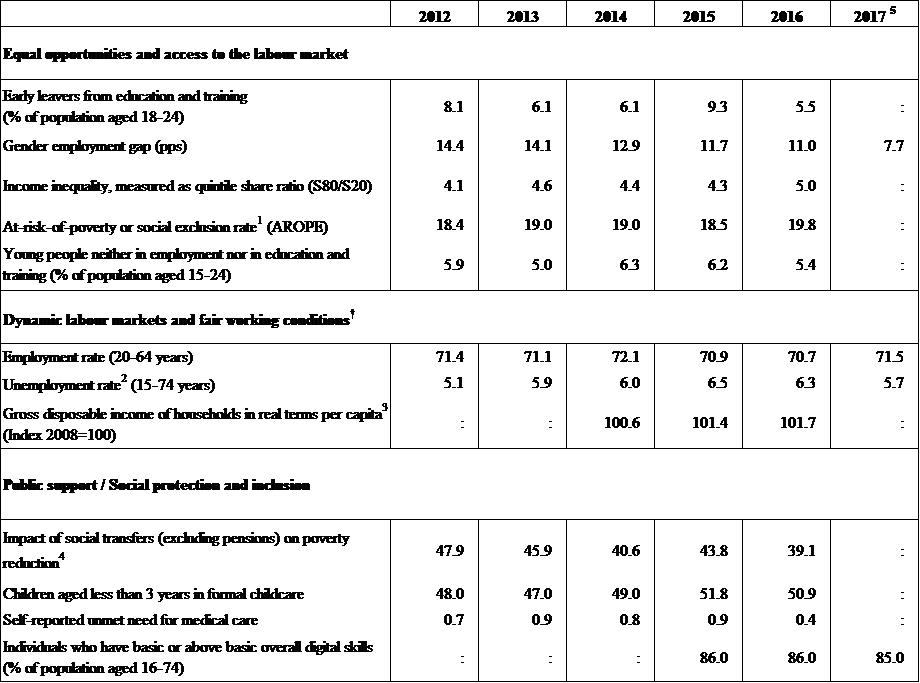
|
|
(5) Average of first three quarters of 2017 for the employment rate and gender employment gap.
Source: Eurostat
|
|
|
|
|
|
Table C.3:Labour market and education indicators
|
|

|
|
Source: Eurostat, OECD
|
|
|
|
|
|
Table C.4:Social inclusion and health indicators
|
|

|
|
(6) Fixed broadband take up (33%), mobile broadband take up (22%), speed (33%) and affordability (11%), from the Digital Scoreboard.Source: Eurostat, OECD
|
|
|
|
|
|
Table C.5:Product market performance and policy indicators
|
|

|
|
Source: "European Commission; World Bank — Doing Business (for enforcing contracts and time to start a business); OECD (for the product market regulation
indicators); SAFE (for outcome of SMEs' applications for bank loans)."
|
|
|
|
|
|
Table C.6:Green growth
|
|

|
|
Source: European Commission and European Environment Agency (Share of GHG emissions covered by ETS); European Commission (Environmental taxes over labour taxes and GDP); Eurostat (all other indicators)
|
|
|
References
Alstadsæter, A., Barrios, S., Nicodeme, G., Skonieczna, A. and Vezzani, A. (2017), Patent Boxes Design, Patents Location and Local R&D. Economic Policy, 65th Panel Meeting. Central Bank of Malta, 2017. Available at:
https://encrypted.google.com/url?sa=t&rct=j&q=&esrc=s&source=web&cd=5&ved=0ahUKEwiNx8Tf4vXYAhXL6xQKHYKjDokQFghMMAQ&url=http%3A%2F%2Fwww.economic-policy.org%2Fwp-content%2Fuploads%2F2017%2F04%2F993_Patent-Boxes-Design-Patents-Location-and-Local-RD.pdf&usg=AOvVaw30WTct7XP5I_Et4uezMu-V
Banque Centrale du Luxembourg (2017), Financial Stability Review 2017. Available at:
http://www.bcl.lu/fr/publications/revue_stabilite/Revue-de-stabilite-2017/revue-de-stabilite-2017.pdf
BOUCHET, M., MARCHIORI, L. and PIERRARD, O. (2017), Pension reform in a worst case scenario: public finance versus political feasibility. Banque Centrale du Luxembourg. Working paper.
Cedefop (2017), Cedefop Country Chapter Luxembourg: Developments in VET policy in 2015-2017
Cedefop (2017), Skills Panorama on Cedefop. Available at: http://skillspanorama.cedefop.europa.eu/en/indicators/making-skills-work-index3?field_countries_tid=21&edit-submit-businessservices=Apply
CNFP (2017), Evaluation des finances publiques à l’occasion du projet de budget pour 2018 et du projet de loi de programmation financière pluriannuelle pour la période 2017 à 2021. Conseil national des finances publiques. Available at:
http://www.cnfp.lu/content/dam/cnfp/documents/evaluations/2017-11-evaluation/1-evaluation-novembre2017.pdf
CPB (2014), A Study on R&D Tax Incentives. Final report. Taxation Papers 52.
Decovillea, A., and Durand, F. (2017), Challenges and obstacles in the production of cross-border territorial strategies: the example of the greater region. Transactions of the Association of European Schools of Planning • 1 (2017) 65-78.
ECB (2016), The Household Finance and Consumption Survey: results from the second wave. Household Finance and Consumption Network. ECB Statistics Paper No 18, December 2016. Available at:
http://www.ecb.europa.eu/pub/economic-research/research-networks/html/researcher_hfcn.en.html
European Commission and Economic Policy Committee -Working Group on Ageing Populations and Sustainability- (2018). 2018 Ageing Report: Economic and Budgetary Projections for the EU Member States (2016-2070). (Forthcoming).
European Commission (2018), Debt Sustainability Monitor 2017. Institutional Paper. Commission services.
European Commission, (2017a), Debt Sustainability Monitor 2016, Institutional Paper 047. Available at:
https://ec.europa.eu/info/publications/economy-finance/debt-sustainability-monitor-2016_en
European Commission (2017b): The Fiscal Compact: Taking Stock, Communication from the Commission C(2017) 1200 final. Available at
https://ec.europa.eu/info/files/xxx-2017-xxx-communication-commission-fiscal-compact-taking-stock_en
European Commission (2017c), Taxation Trends in the European Union: Data for the EU Member States, Iceland and Norway., 2017 Edition. Available at:
https://encrypted.google.com/url?sa=t&rct=j&q=&esrc=s&source=web&cd=1&ved=0ahUKEwiklKSwj9fYAhVEWhQKHQRIAd4QFggmMAA&url=https%3A%2F%2Fec.europa.eu%2Ftaxation_customs%2Fsites%2Ftaxation%2Ffiles%2Ftaxation_trends_report_2017.pdf&usg=AOvVaw0C7D7nm2Zh_s3O5jpo3-J_
European Commission (2017d), Country report for Luxembourg. Available at:
https://ec.europa.eu/info/sites/info/files/2017-european-semester-country-report-luxembourg-en.pdf
European Commission (2017e), Tax Policies in the European Union, 2017 survey, p.37. Available at:
https://ec.europa.eu/taxation_customs/business/company-tax/tax-good-governance/eu-semester/tax-policies-european-union-2016-survey_en
European Commission (2017f), Philiponnet, N., and Alessandro Turrini, A. Assessing House Price Developments in the EU, Discussion Paper 048. Available at:
https://encrypted.google.com/url?sa=t&rct=j&q=&esrc=s&source=web&cd=2&ved=0ahUKEwjeo56EwtfYAhXKuRQKHU8-AKoQFggsMAE&url=https%3A%2F%2Fec.europa.eu%2Finfo%2Fsites%2Finfo%2Ffiles%2Fdp048_en.pdf&usg=AOvVaw3VNRzqmt2KLEYimkgoEiil
European Commission (2015), A Single Market Strategy for Europe - Analysis and Evidence Accompanying the document Upgrading the Single Market: more opportunities for people and business (SWD(2015)202 final), 2015.
European Commission (2015b), A Single Market Strategy for Europe - Analysis and Evidence Accompanying the document Upgrading the Single Market: more opportunities for people and business (SWD(2015)202 final), 2015.
ESRB (2017), A Review of Macroprudential Policy in the EU in 2016. European Systemic Risk Board, 2017. Available at:
https://encrypted.google.com/url?sa=t&rct=j&q=&esrc=s&source=web&cd=1&ved=0ahUKEwj2ndvCv9fYAhVHuhQKHf-aCw8QFggmMAA&url=https%3A%2F%2Fwww.esrb.europa.eu%2Fpub%2Fpdf%2Fother%2F20170413_esrb_review_of_macroprudential_policy.en.pdf&usg=AOvVaw3IrTU6Eg-WtiRFyY_CNaeN
IHS (2018), Aggressive Tax Planning Indicators, forthcoming in Taxation Papers.
Klapproth and al. (2013): Klapproth, F., Krolak-Schwerdt, S., Hörstermann, T., & Martin, R., Predictive validity of tracking decisions: Application of a new validation criterion. In M. Spiliopoulou (Eds.), Data analysis, machine learning, and knowledge discovery. Studies in classification, data analysis, and knowledge organization. https://link.springer.com/chapter/10.1007/978-3-319-01595-8_7
Koske and al. (2015), Koske, I., I.Wanner, R. Bitetti and O. Barbiero, The 2013 update of the OECD product market regulation indicators: policy insights for OECD and non-OECD countries, OECD Economics Department Working Papers, No. 1200, 2015.
MENJE (2016), Ministère de l’Éducation Nationale, de l’Enfance et de la Jeunesse, Les chiffres clés de l’éducation nationale – statistiques et indicateurs 2014/2015.
http://www.statistiques.public.lu/fr/publications/thematique/conditions-sociales/chiffres-cles-education-2015/Chiffrescles201415.pdf
MENJE and the University of Luxembourg, (2016): PISA 2015: Rapport National Luxembourg.
http://www.men.public.lu/fr/actualites/publications/secondaire/pisa/pisa-2015-rapport/index.html
MENJE, (2017a), Ministère de l’Éducation Nationale, de l’Enfance et de la Jeunesse: Le décrochage scolaire – Année scolaire 2014/2015. http://www.men.public.lu/catalogue-publications/secondaire/statistiques-analyses/decrochage-scolaire/decrochage-14-15/fr.pdf
Ministère de la sécurité sociale (2017), Rapport Général Sur La Sécurité Sociale 2017. Ministère de la sécurité sociale. Inspection Générale de la sécurité Sociale. Available at: http://www.mss.public.lu/publications/rapport_general/rg2017/rg_2017.pdf
Ministry of Finance (2017), Projet de Loi relatif á des mesures macroprudentielles portant sur les crédits immobiliers résidentiels, 2017. Available at:
http://www.chd.lu/wps/portal/public/Accueil/TravailALaChambre/Recherche/RoleDesAffaires?action=doDocpaDetails&id=7218&index=0
Ministry of Finance (2017b), Convention entre le Ministère des Finances et le Conseil national des finances publiques. Available at:
http://www.mf.public.lu/publications/divers/cnfp_241017.pdf
Ministry of Finance (2016), Question écrite No. 2243:sujet: Exécution du "Zukunftspak". Available at:
http://chd.lu/wps/portal/public/Accueil/TravailALaChambre/Recherche/RoleDesAffaires?action=doQuestpaDetails&id=14602
Observatoire de la compétitivité (2017), Bilan Compétitivité 2017 Le nouveau tableau de bord de la compétitivité, Perspectives de Politique Economique, No.33, October 2017.
Observatoire de la compétitivité (2016), Bilan Competitivitè 2016 vers une croissance qualitative, Perspectives de Politique Economique, No.31, October 2016.
Observatoire de l'Habitat (2015), Le potentiel foncier destiné à l’habitat au Luxembourg en 2013.
Rapport intermédiaire de suivi (2017) - Etude stratégique de la Troisième Révolution Industrielle au Luxembourg.
STATEC (2017), Rapport travail et cohésion sociale. Cahier économique n° 123. Available at:
https://encrypted.google.com/url?sa=t&rct=j&q=&esrc=s&source=web&cd=1&cad=rja&uact=8&ved=0ahUKEwjiyeXZ5NfYAhXLbxQKHQ4vCJoQFggmMAA&url=http%3A%2F%2Fwww.statistiques.public.lu%2Ffr%2Fpublications%2Fseries%2Fcahiers-economiques%2F2017%2F123-cohesion-sociale%2Findex.html&usg=AOvVaw2ppB13nHirZN75AeQxtgDj
ZEW (2016), The Impact of Tax Planning on Forward-Looking Effective Tax Rates, Taxation papers 64.
-
(I)
This does not include an assessment of compliance with the Stability and Growth Pact
-
(II)
() Public investment is defined as gross fixed capital formation + investment grants + national expenditure on agriculture and fisheries.
-
(III)
()Before programmes are adopted, Member States are required to comply with a number of so-called ex-ante conditionalities, which aim at improving conditions for the majority of public investments areas.
-
(IV)
()National Board for Sustainable Construction, Energiezukunft Lëtzebuerg, High-Level Group for TIR Industry, Circular Economy, Mobility, Luxembourg Sustainable Development Finance Platform, Sustainable Intensification of Agriculture, as well as Labour, Employment and Social Affairs.