This document is an excerpt from the EUR-Lex website
Document C:2017:244A:FULL
Official Journal of the European Union, CA 244, 28 July 2017
Official Journal of the European Union, CA 244, 28 July 2017
Official Journal of the European Union, CA 244, 28 July 2017
Display all documents published in this Official Journal
|
ISSN 1977-091X |
||
|
Official Journal of the European Union |
C 244A |
|

|
||
|
English edition |
Information and Notices |
Volume 60 |
|
Notice No |
Contents |
page |
|
|
V Announcements |
|
|
|
ADMINISTRATIVE PROCEDURES |
|
|
|
European Parliament |
|
|
2017/C 244 A/01 |
|
EN |
|
V Announcements
ADMINISTRATIVE PROCEDURES
European Parliament
|
28.7.2017 |
EN |
Official Journal of the European Union |
CA 244/1 |
RECRUITMENT NOTICE NO PE/200/S
(2017/C 244 A/01)
The European Parliament has decided to organise a selection procedure based on qualifications and tests for the purpose of establishing a reserve list to fill the post of:
TEMPORARY STAFF MEMBER
ADMINISTRATOR, MEMBER OF A CABINET (AD 10)
(female or male)
|
Before applying, please read carefully the Guide for Candidates attached to this recruitment notice. The guide is an integral part of the recruitment notice and will help you to understand the rules governing selection procedures and how to go about applying. |
CONTENTS
|
A. |
JOB DESCRIPTION AND ELIGIBILITY |
|
B. |
PROCEDURE |
|
C. |
APPLICATIONS |
|
ANNEX: |
GUIDE FOR CANDIDATES IN SELECTION PROCEDURES ORGANISED BY THE EUROPEAN PARLIAMENT |
A. JOB DESCRIPTION AND ELIGIBILITY
1. General remarks
The European Parliament has decided to open the procedure for filling a temporary post (AD 10) of administrator in the Cabinet of the Secretary-General, in the European Parliament’s Secretariat.
The contract will be concluded on an open-ended basis. Recruitment will be at grade AD 10, first step, the basic salary for which is EUR 8 599,20 per month. This salary is subject to the Community tax and to the other deductions provided for by the Conditions of Employment of Other Servants of the European Union (CEOS). It is exempt from national tax. The step at which the successful candidate is recruited may be adjusted in accordance with his or her professional experience. Moreover, in certain circumstances allowances will be paid in addition to the basic salary.
The European Parliament is an equal opportunities employer and accepts applications without discrimination on any ground such as sex, race, colour, ethnic or social origin, genetic features, language, religion or belief, political or any other opinion, membership of a national minority, property, birth, disability, age, sexual orientation, marital status or family situation.
2. Job description
Working directly under the Head of Cabinet, the administrator will perform advisory and research tasks in one or more of the entity’s areas of responsibility.
Based in Brussels (1), he or she will be required to travel on a regular basis between Parliament’s three normal places of work (Brussels, Luxembourg and Strasbourg) and elsewhere.
The administrator will work closely with the other members of the cabinet, with the directorates-general in the Secretariat and, where necessary, with Members of the European Parliament. He or she will provide senior management with timely and relevant advice and information on matters falling within his or her sphere of responsibility.
These duties call for thoroughness, drafting skills, a high degree of confidentiality, the ability to analyse and summarise, forward-planning skills, diplomacy, the ability to liaise comfortably with a wide range of people at all levels and public-speaking skills.
Importance is attached to the ability to deal with a wide range of often complex problems, respond rapidly to changing circumstances and communicate effectively. Candidates must show initiative and strong motivation. They must be capable of working intensively on a regular basis, both on their own and as part of a team, and of adapting to a multicultural and multilingual working environment.
The administrator’s main tasks will include the following:
|
— |
advising senior management in the area of modern digital communication (website design, infographics, content management, digital publishing, search engine optimisation); |
|
— |
on behalf of Parliament’s political and administrative authorities, carrying out complex studies and drafting opinions which demonstrate a high level of expertise; |
|
— |
managing specific projects, including on sensitive issues (multidimensional technical, administrative, legal, financial and budgetary studies); |
|
— |
in the context of the policies implemented by Parliament, running medium- and long-term projects; |
|
— |
contributing to the preparation and implementation of the budget of the entity (budgetary management, public contracts, etc.); |
|
— |
accompanying senior management to or representing senior management at meetings and on internal and external working parties and taking part in or chairing administrative meetings. |
3. Eligibility
On the closing date for applications, candidates must meet the following conditions:
(a) General conditions
Under Article 12(2) of the CEOS, candidates must:
|
— |
be a national of one of the European Union’s Member States, |
|
— |
enjoy full rights as a citizen, |
|
— |
have fulfilled any obligations imposed on them by the laws on military service, |
|
— |
provide character references appropriate to the performance of the duties concerned. |
(b) Specific conditions
(i)
Candidates must have a level of education which corresponds to completed university studies attested by a diploma in a field relevant to the job description given in Section A.2
|
— |
of at least four years’ duration, where the normal period of university education is four years or more, or |
|
— |
of three years’ duration followed by one year’s professional experience in a field relevant to the job description, where the normal period of university education is three years or more. This year of experience will not be taken into account when assessing the professional experience required under A.3(b)(ii). |
The selection committee will take account of the differences between the Member States’ education systems. Examples of the minimum qualifications required are given in the table included in the Guide for Candidates.
(ii)
After gaining the qualifications specified under A.3(b)(i), candidates must have acquired at least 10 years’ professional experience relevant to the job description.
(iii)
Candidates must have a thorough knowledge of one of the European Union’s official languages (language 1): Bulgarian, Croatian, Czech, Danish, Dutch, English, Estonian, Finnish, French, German, Greek, Hungarian, Irish, Italian, Latvian, Lithuanian, Maltese, Polish, Portuguese, Romanian, Slovak, Slovenian, Spanish or Swedish
and
a very good knowledge of English, French or German (language 2). Language 2 must be different from language 1 above.
The selection committee will take account of knowledge of other official languages of the European Union.
|
Following the judgment handed down by the Court of Justice of the European Union (Grand Chamber) in Case C-566/10 P, Italy v Commission, the European Parliament must state the reasons for limiting the choice of the second language to a small number of EU official languages. Candidates are thus informed that the three second-language options for this selection procedure, i.e. English, French and German, have been laid down in the interests of the service, which require newly recruited staff to be immediately operational and to be able to communicate effectively in their daily work. It has long been the practice to use mainly English, French, and German for internal communication in the European Parliament, and these are also the languages most often needed when communicating with the outside world and in performing day-to-day work. Furthermore, in staff reports for 2016 the three languages most used by staff members in performing their duties, as attested by their assessors, were English (95 %), French (90 %) and German (33 %). For no other official language did that figure exceed 21 %. Therefore, in balancing the interests of the service and the needs and abilities of candidates, the European Parliament is entitled to require knowledge of one of those three languages to ensure that, whatever their first official language, all candidates are proficient in at least one of them. In addition, in the interests of equality of treatment, all candidates, even if they have one of those three languages as their first official language, are required to have a satisfactory knowledge of a second language, which must be one of those three languages. The assessment of specific skills in one of those languages enables the European Parliament to judge whether the candidates can be immediately operational in the environment in which they will be required to work. |
B. PROCEDURE
1. Admission to the selection procedure
The procedure is based on qualifications and tests .
|
(a) |
A list of the candidates who meet the general conditions set out under A.3(a) and have submitted their applications in accordance with the arrangements stipulated and by the closing date will be drawn up by the appointing authority and forwarded to the selection committee with the application files (for further details see the Guide for Candidates) . |
|
(b) |
The selection committee will consider the application files and draw up a list of candidates who meet the specific conditions set out under A.3(b). |
The committee will base its decisions solely on information given on the application form which is substantiated by supporting documents ( for further details see the Guide for Candidates ).
2. Assessment of qualifications
On the basis of criteria laid down in advance, the selection committee will assess the qualifications of candidates admitted to the selection procedure and draw up a list of the 12 best candidates, who will be admitted to the written test.
In assessing the candidates’ qualifications, the selection committee will take particular account of:
|
— |
qualifications and diplomas relevant to the job description; |
|
— |
experience of using databases, content management systems, website support systems or complex data repositories such as those commonly employed by the European institutions (2); |
|
— |
experience of the practices employed by a European institution in the areas of applied research, relations with think tanks, relations with third countries, online communication and policy strategy and planning; |
|
— |
experience of the practices employed by at least one Member State as regards policy strategy and planning at ministerial or inter-ministerial level; |
|
— |
experience of work in a large public- or private-sector body which calls for an understanding of political and economic issues; |
|
— |
experience of management; |
|
— |
experience of and/or training in project management; |
|
— |
experience of work in a multicultural and multinational environment; |
|
— |
knowledge of the organisational set-up of Parliament’s Secretariat, its functioning and its environment; |
|
— |
knowledge of European affairs in general. |
Marking: 0 to 20 points
3. Tests
Written test
|
(a) |
Drafting test in language 2 (English, French or German), based on a set of documents, to test candidates’ ability to perform the duties set out in Section A.2 and their drafting and summarising skills. Time allowed: 3 hours Marking: 0 to 40 points (pass mark: 20 points) |
The six candidates who have obtained the highest number of points will be invited to the oral tests, provided they have achieved the pass mark.
Oral tests
|
(b) |
Interview with the selection committee in language 2 (English, French or German) to assess, taking account of all the information contained in the candidates’ application files, their suitability to perform the duties set out in Section A.2. The selection committee may decide to test candidates’ language knowledge as specified on the application form. Maximum time allowed: 45 minutes Marking: 0 to 40 points (pass mark: 20 points) |
|
(c) |
Group discussion in language 2 (English, French or German) to enable the selection committee to assess candidates’ adaptability, negotiating and decision-making skills and performance in a group. The selection committee will determine the duration of this test on the basis of the ultimate composition of the groups. Marking: 0 to 20 points (pass mark: 10 points) |
4. List of suitable candidates
The list of suitable candidates will contain, in order of merit, the names of the three candidates who have obtained the highest overall scores in the procedure (assessment of qualifications and tests) and have passed each of the tests.
Candidates will be informed individually of their results, and the list of suitable candidates will be posted on the official noticeboards in Parliament’s buildings.
Successful candidates included on the list of suitable candidates who are offered a job will be required to produce the originals of all requisite documents, including diplomas and employment certificates, for verification.
The period of validity of the list of suitable candidates will expire on 31 December 2020; it may be extended. If it is, candidates on the list will be notified in good time.
C. APPLICATIONS
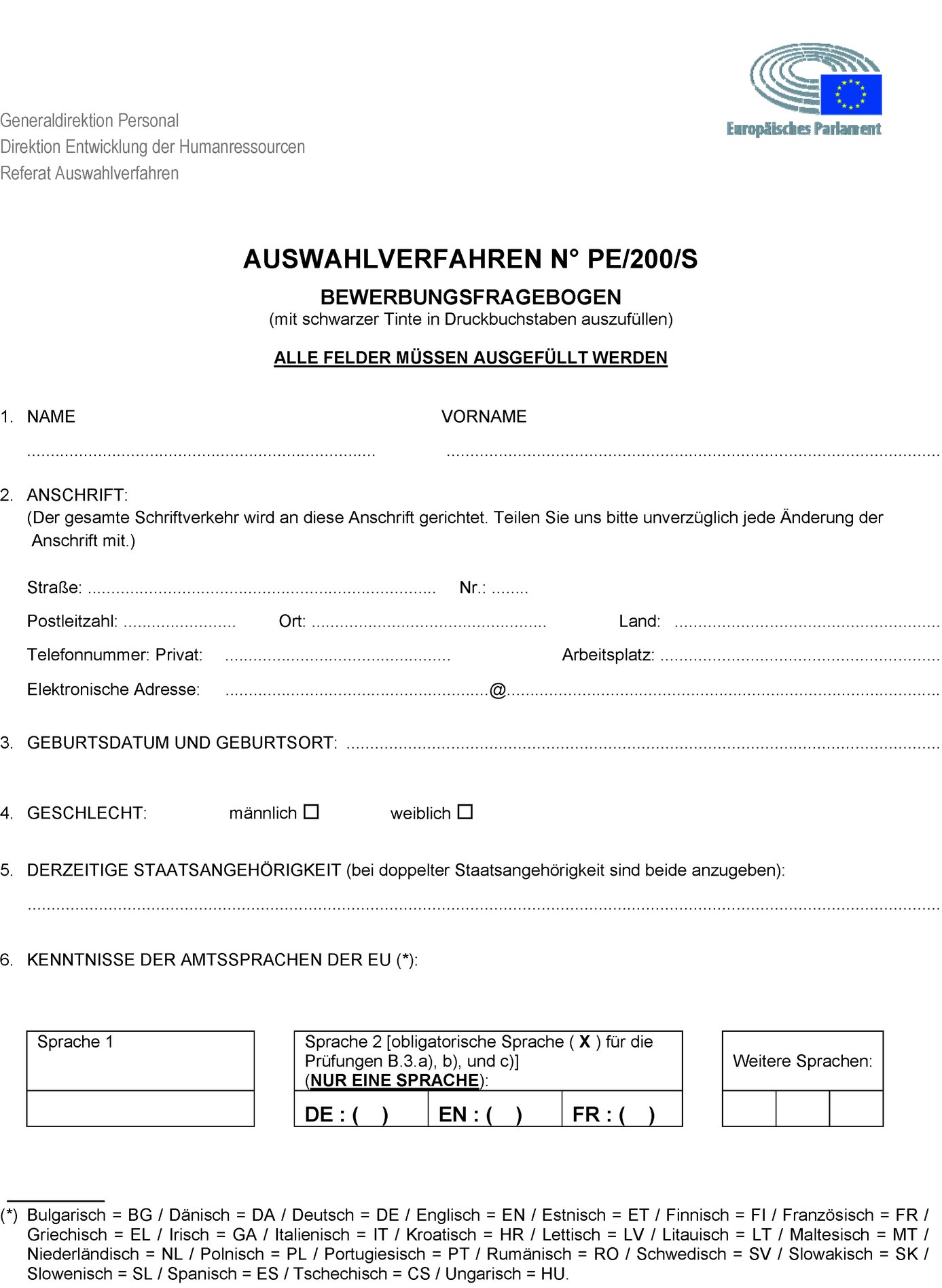
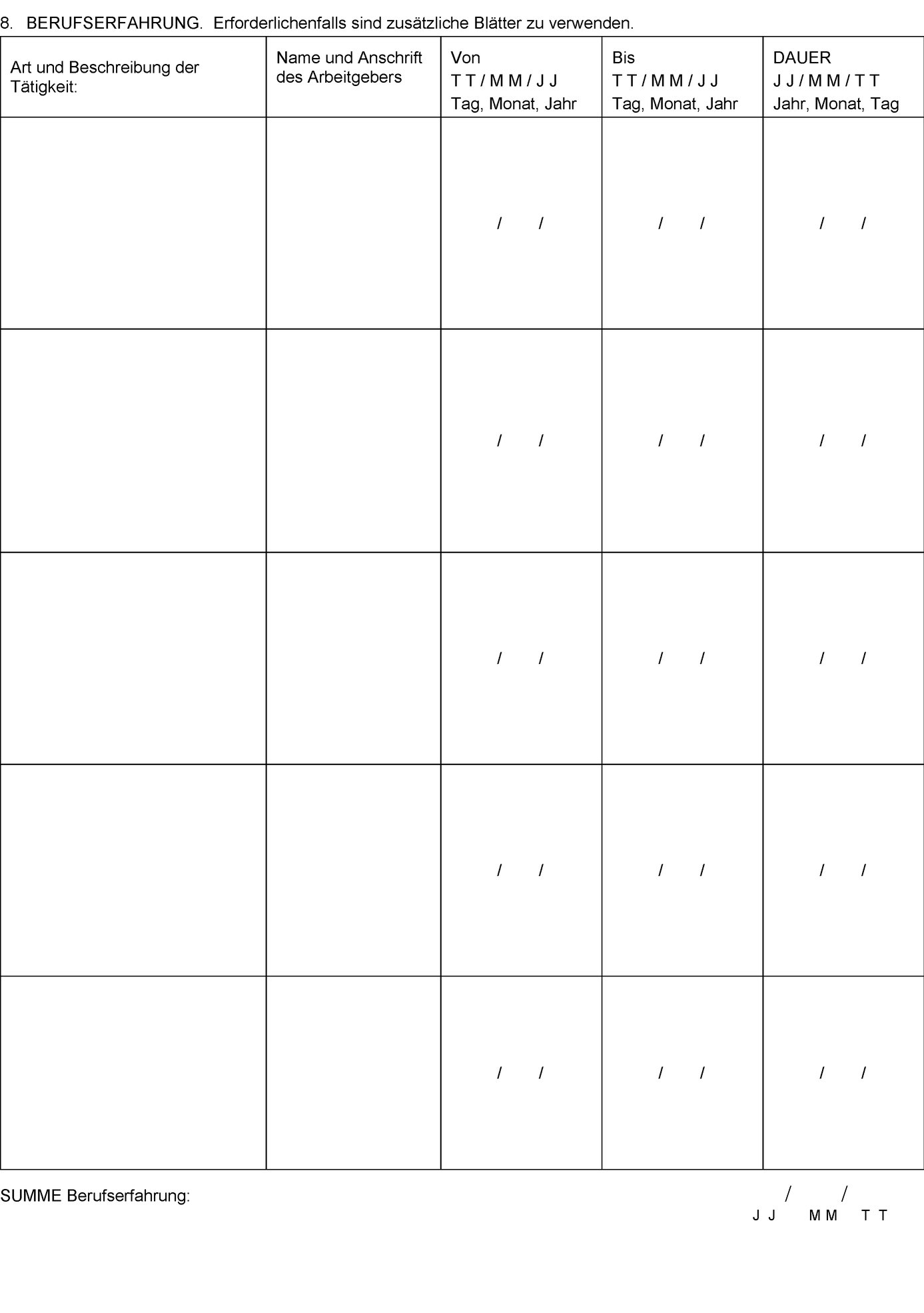
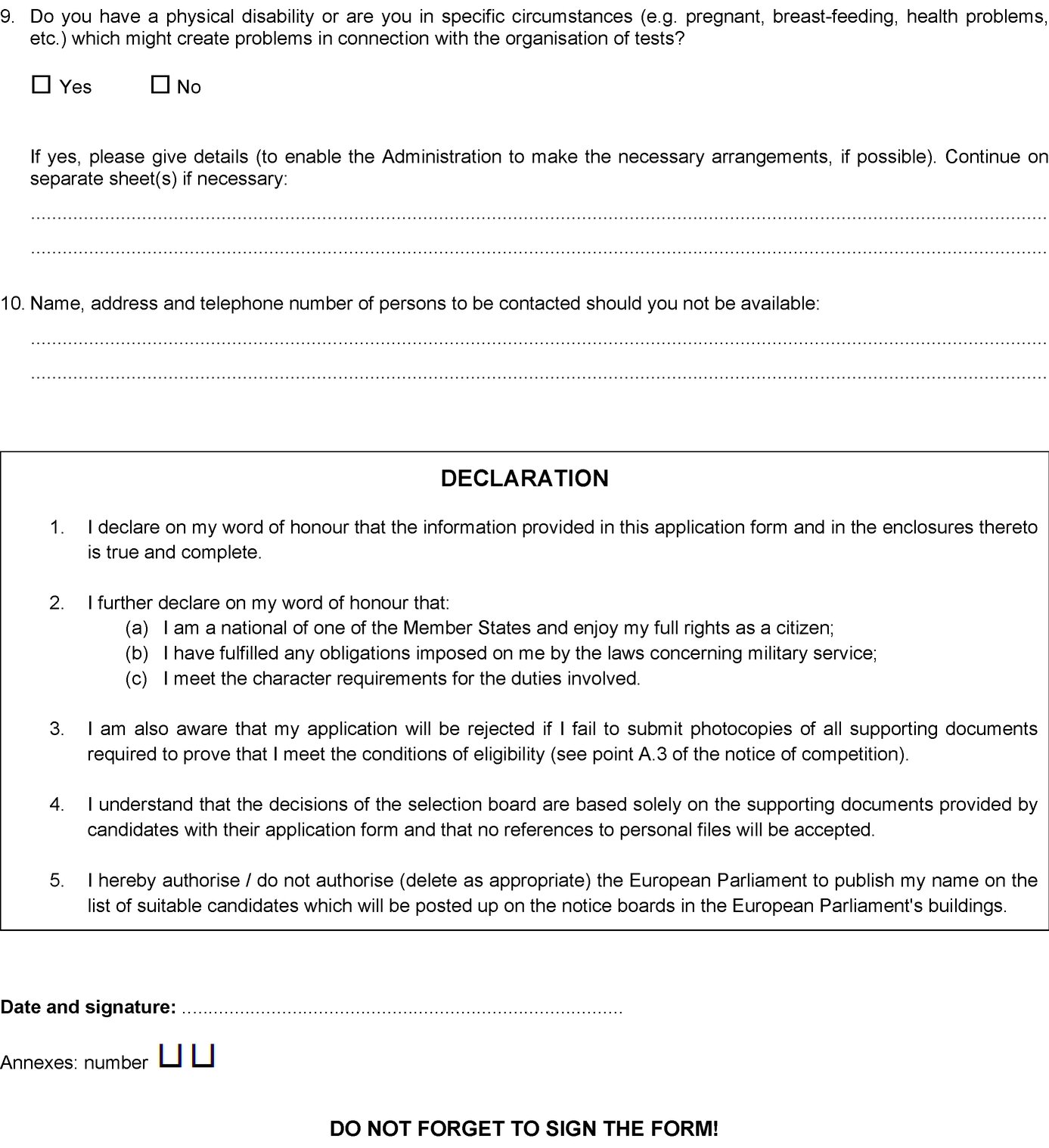
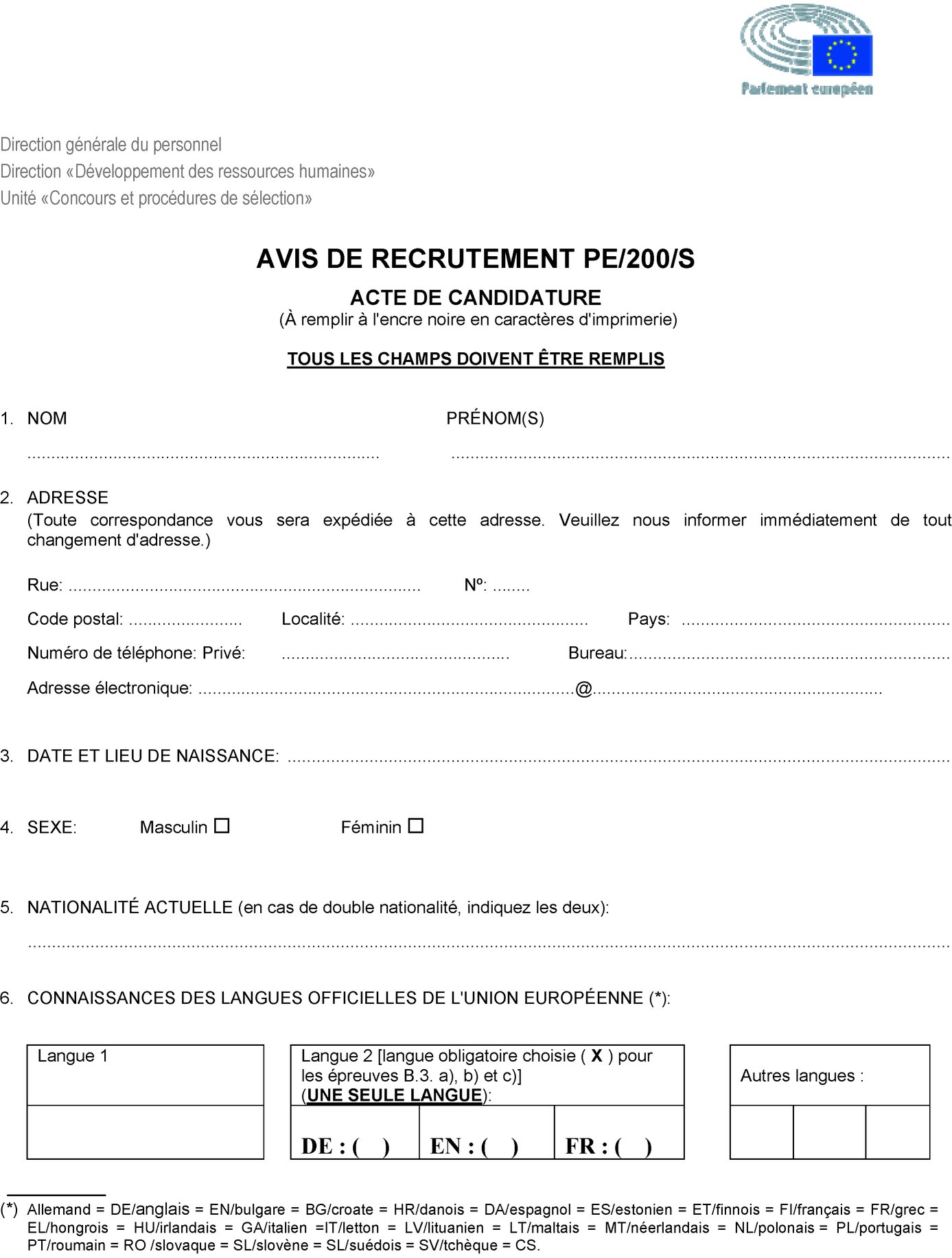
Candidates must use either the original or a copy of the official application form supplied with the recruitment notice in this Official Journal published by the Publications Office of the European Union.
Candidates are asked to read the Guide for Candidates carefully before completing their application forms.
Closing date for applications
The application form and photocopies of documents must be sent by registered post (3) by 1 September 2017 at the latest (as evidenced by the postmark) to the following address:
|
EUROPEAN PARLIAMENT |
|
Competitions and Selection Procedures Unit — BMT 08 A 038 |
|
Selection procedure PE/200/S |
|
(this selection procedure reference number must be quoted) |
|
Rue Wiertz 60 |
|
1047 Bruxelles/Brussel |
|
BELGIQUE/BELGIË |
Applications sent by ordinary post or through the internal mail will not be considered. The Competitions and Selection Procedures Unit will not accept applications which are submitted in person.
Acknowledgement of receipt of application files will be given only if an item dispatched by registered post is accompanied by an advice of delivery form.
Candidates are asked NOT TO TELEPHONE to ask about the timetable for the procedure.
Candidates who have not received an email concerning their application by 31 October 2017 should write an email (PE-200-S@ep.europa.eu) or a letter to the Competitions and Selection Procedures Unit.
(1) This post may be transferred to one of Parliament’s other places of work.
(2) Candidates are informed that the European institutions use the Drupal system.
(3) Dispatch by private courier company will be accepted as equivalent to dispatch by registered post. In such cases, the date of handing-in to the courier company as shown on the delivery form will be taken as the date of dispatch.
ANNEX
Guide for candidates in selection procedures organised by the European Parliament
|
1. |
INTRODUCTION | 8 |
| What form does a selection procedure take? | 8 |
|
2. |
THE STAGES IN A SELECTION PROCEDURE | 8 |
| Receipt of application files | 8 |
| Assessment of compliance with the general conditions | 9 |
| Assessment of compliance with the specific conditions | 9 |
| Assessment of qualifications | 9 |
| Tests | 10 |
| List of suitable candidates | 10 |
|
3. |
HOW TO APPLY | 10 |
| General points | 10 |
| How should the complete application file be submitted? | 10 |
| What supporting documents should be enclosed with the application file? | 10 |
| General points | 10 |
| Supporting documents demonstrating compliance with the general conditions | 11 |
| Supporting documents demonstrating compliance with the specific conditions and assessment of qualifications | 11 |
|
4. |
COMMUNICATION | 12 |
|
5. |
GENERAL INFORMATION | 13 |
| Equal opportunities | 13 |
| Requests from candidates for access to information concerning them | 13 |
| Protection of personal data | 13 |
| Travel and subsistence expenses | 13 |
| ANNEX I | 14 |
| ANNEX II | 17 |
1. INTRODUCTION
What form does a selection procedure take?
Selection procedures consist of a series of stages in which candidates compete against one another. They are open to all citizens of the European Union who, on the deadline for submission of applications, meet the relevant criteria. They give all candidates a fair opportunity to demonstrate their skills, with a view to discrimination-free selection based on merit.
Successful candidates in a selection procedure are placed on a list of suitable candidates, on which the European Parliament will draw in order to fill the post to which the recruitment notice applies.
A selection committee, consisting of members representing the Administration and the Staff Committee, is appointed for each selection procedure. The proceedings of the selection committee are confidential and are conducted in accordance with Annex III to the Staff Regulations of Officials (1).
Candidates may not under any circumstances approach the selection committee themselves, either directly or indirectly. The appointing authority reserves the right to disqualify any candidate who disregards this instruction.
The selection committee adheres strictly to the eligibility criteria set out in the recruitment notice when deciding whether or not each candidate should be admitted to the selection procedure. Candidates admitted to a previous competition or selection procedure will not automatically be eligible.
In order to select the best candidates, the selection committee compares the candidates’ performance with the aim of assessing their suitability to perform the duties described in the recruitment notice. This means that it must not only assess the candidates’ knowledge, but also identify the best-qualified individuals on the basis of their merit.
Please note that selection procedures take between six and nine months, depending on the number of candidates.
2. THE STAGES IN A SELECTION PROCEDURE
A selection procedure comprises the following stages:
|
— |
receipt of application files; |
|
— |
assessment of compliance with the general conditions; |
|
— |
assessment of compliance with the specific conditions; |
|
— |
assessment of qualifications; |
|
— |
tests; |
|
— |
list of suitable candidates. |
Receipt of application files
Candidates must submit a complete application file, including the application form specific to the recruitment notice, completed and signed and accompanied by all the requisite supporting documents showing that they meet the general and specific conditions set out in the recruitment notice. Failure to do so will result in exclusion from the competition. The application file must be sent by registered post by the date specified in the recruitment notice. (Dispatch by private courier company will be accepted as equivalent to dispatch by registered post. In such cases, the date of handing-in to the courier company as shown on the delivery form will be taken as the date of dispatch). The address and closing date for applications are given in section C of the recruitment notice.
Assessment of compliance with the general conditions
The Competitions and Selection Procedures Unit will check applications in order to determine whether they are admissible, i.e. whether they have been submitted in the form and by the closing date given in the recruitment notice and whether each candidate meets the general eligibility conditions.
Candidates will therefore be automatically eliminated if they:
|
— |
send their application after the closing date, as evidenced by the postmark or by the delivery form of a private courier company, or |
|
— |
do not send their application form by registered post or by private courier company, or |
|
— |
do not use the official application form specific to the recruitment notice, or |
|
— |
do not complete the official application form specific to the recruitment notice, or |
|
— |
fail to sign the application form, or |
|
— |
do not meet the general eligibility conditions. |
After the closing date for applications , candidates will be informed individually if their application has been rejected.
A list of the candidates who meet the general conditions set out in the recruitment notice will be drawn up by the appointing authority and forwarded to the selection committee with the application files.
Assessment of compliance with the specific conditions
The selection committee will consider the application files and draw up a list of candidates who meet the specific conditions set out in the recruitment notice. It will base its decisions solely on the information given on the application form and substantiated by supporting documents enclosed with it .
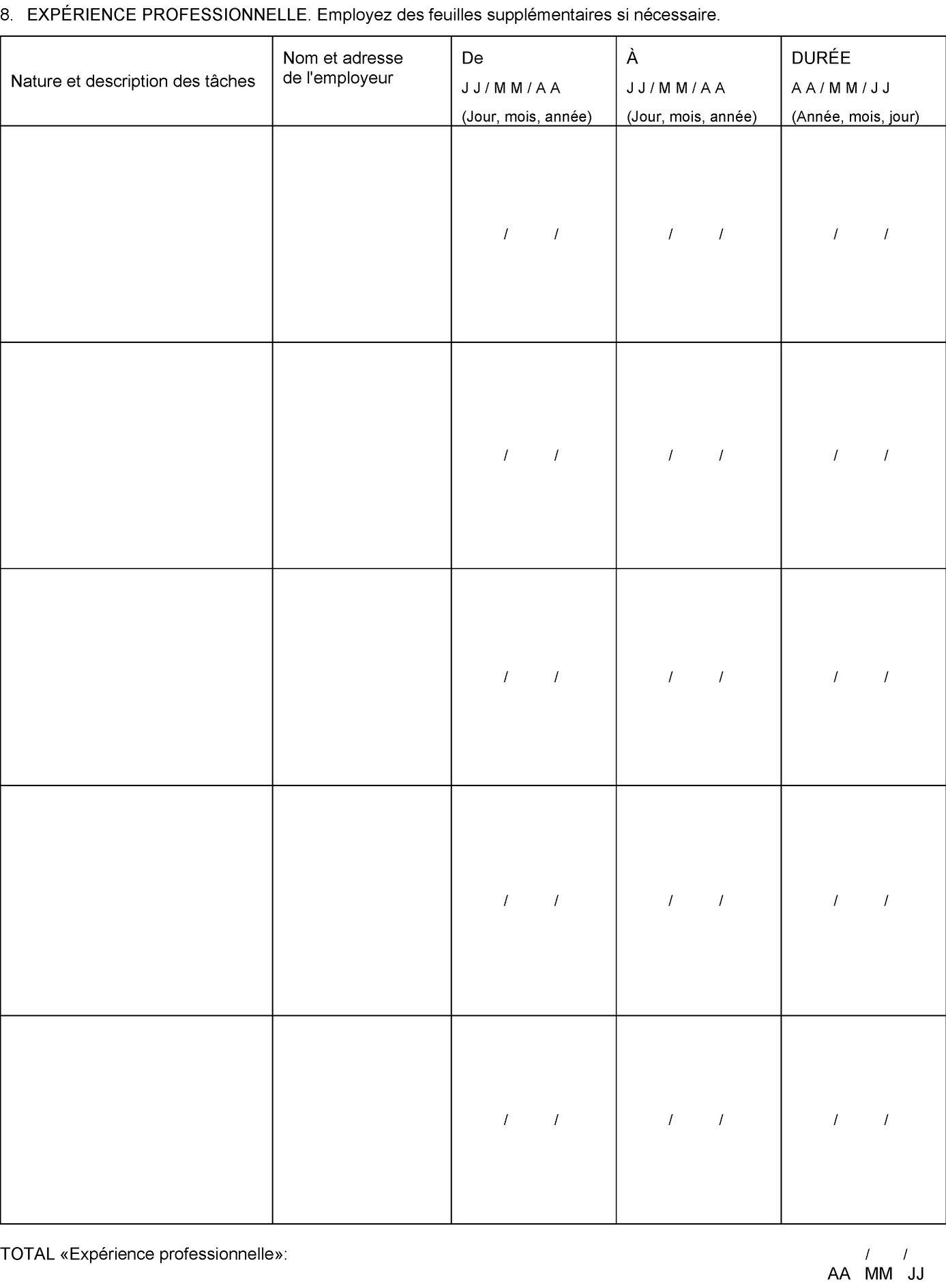
Applications must give full details of candidates’ studies, training, knowledge of languages and, where appropriate, professional experience, as follows:
|
— |
as regards studies: the dates on which they began and ended and the nature of the diploma(s) obtained, as well as the subjects studied; |
|
— |
as regards professional experience: the dates on which the periods of experience began and ended and the precise nature of the duties performed. |
Candidates who have published studies or articles or any other texts relevant to the duties set out in the job description should mention these on the application form.
Candidates who do not meet the specific eligibility conditions set out in the recruitment notice will be eliminated at this stage.
The selection committee will inform all candidates by letter of its decision concerning their admission/non-admission to the procedure.
Assessment of qualifications
In order to select the candidates who are to be admitted to the tests, the selection committee will assess the qualifications of the candidates admitted to the selection procedure. It will base its decisions solely on the information given on the application form and substantiated by supporting documents enclosed with it (see section 3 below). The selection committee will base its work on criteria which it has laid down in advance, taking account in particular of the qualifications specified in section B.2 of the recruitment notice.
The selection committee will inform all candidates by letter of its decision concerning their admission/non-admission to the tests.
Tests
All the tests are compulsory and eliminatory. The maximum number of candidates who may be admitted to the tests is specified in section B.2. of the recruitment notice.
For organisational reasons, candidates may be invited to all the written and oral tests. However, the tests will be marked in the order in which they appear in the recruitment notice. Consequently, if a candidate does not achieve the minimum mark required in one of the tests, the selection committee will not mark the subsequent tests.
The tests of candidates who give up will not be marked.
List of suitable candidates
The maximum number of candidates who may be placed on the list of suitable candidates is specified in section B.4.of the recruitment notice.
The inclusion of a candidate’s name on the list of suitable candidates means that he or she may be called for interview by one of Parliament’s departments, but it does not constitute either a right to, or a guarantee of, recruitment.
3. HOW TO APPLY
General points
Before applying, candidates should check carefully whether they meet all the eligibility conditions, both general and specific. To that end, candidates should first read the recruitment notice and this guide and take due note of the relevant requirements.
Although recruitment notices do not specify any age limit, please note that the retirement age for staff is laid down in the Staff Regulations of Officials of the European Union.
Candidates are required to complete the application form (original or copy) which is specific to the recruitment notice and contained in this Official Journal published by the Publications Office of the European Union.
Documents sent after the closing date will not be taken into account.
Candidates who have a disability or whose circumstances are such that they might cause difficulties during the tests (e.g. because they are pregnant or are breastfeeding, or because they have health problems or are undergoing medical treatment) must state that fact on the application form and provide any relevant information so that the Administration can take appropriate measures, where possible. If appropriate, they should enclose with their application form a separate sheet giving details of any arrangements which they consider necessary to help them take the tests.
How should the complete application file be submitted?
|
1. |
Complete and sign the application form specific to the recruitment notice for the selection procedure concerned. |
|
2. |
Include a numbered list of all the supporting documents enclosed with the application. |
|
3. |
Enclose all the supporting documents required, numbering them first. |
|
4. |
Send the application file as specified in the recruitment notice and before the closing date given therein. |
What supporting documents should be enclosed with the application file?
General points
Please do not send originals; only non-certified photocopies of the documents required should be enclosed. References to websites will not be regarded as constituting supporting documents. Printouts of pages from websites will not be regarded as certificates, although they may be enclosed purely to provide additional information.
Please note that successful candidates on the list of suitable candidates who are offered a job will be required to produce the originals of all the documents required before they can be recruited.
A curriculum vitae (CV) will not be regarded as a supporting document.
Candidates may not refer to application forms or any other documents already submitted in connection with previous applications (2).
None of the documents submitted with the application will be returned.
Supporting documents demonstrating compliance with the general conditions
No document is required at this stage to show that candidates:
|
— |
are a national of one of the European Union’s Member States, |
|
— |
enjoy full rights as a citizen, |
|
— |
have fulfilled any obligations imposed on them by the laws on military service, |
|
— |
provide character references appropriate to the performance of the duties concerned. |
Candidates must sign the application form. By doing so, they declare on their honour that they meet these conditions and that the information supplied is true and complete.
Supporting documents demonstrating compliance with the specific conditions and assessment of qualifications
Candidates must provide the selection committee with all the information and documents it needs to verify the accuracy of the information given on the application form.
Diplomas and/or certificates attesting successful completion of studies
Candidates must supply photocopies of the diplomas or certificates attesting that they have completed studies of the level required by the recruitment notice.
The selection committee will take account of the different education systems in the European Union Member States.
In the case of post-secondary diplomas, the most detailed possible information must be provided, particularly concerning the subjects studied and the length of time for which they were studied, so that the selection committee can assess the relevance of the diplomas to the duties to be performed.
In the case of diplomas relating to technical or vocational training, further training or specialisation courses, candidates must state whether the course was full time or part time or consisted of evening classes, as well as the subjects covered and the official duration of the courses.
Professional experience
Professional experience will be taken into account only if it has been obtained more recently than the required diploma or certificate. The supporting documents must prove the duration and level of the professional experience, and the nature of the duties performed must be described in as much detail as possible, so that the selection committee can assess the relevance of the experience to the duties to be performed.
All such periods of work experience must be covered by supporting documents, for example:
|
— |
statements from former employers and the current employer certifying that candidates have the professional experience required for admission to the selection procedure; |
|
— |
if, for reasons of confidentiality, candidates cannot enclose the required evidence of professional experience, it is essential, as a substitute for that evidence, that they enclose photocopies of the employment contract or letter of recruitment and the first and the most recent salary statements; |
|
— |
where the work has not been performed on behalf of an employer (as a self-employed person, member of the liberal professions, etc.), invoices detailing the services provided or any other relevant official supporting document will be accepted as evidence. |
Knowledge of languages
Knowledge of the required languages must be confirmed by a diploma, a certificate or a declaration on the candidate’s honour, to be made on a separate sheet of paper, explaining how that knowledge was acquired.
If, at any stage in the procedure, it is established that the information given on the application form is incorrect or is not substantiated by supporting documents, or that all the conditions set out in the recruitment notice are not met, candidates will be disqualified.
4. COMMUNICATION
It is the responsibility of candidates to make sure that their application form (original or copy), completed and signed and accompanied by all the supporting documents required, is sent by registered post (3) by the deadline specified, as evidenced by the postmark.
Applications sent by ordinary post or through the internal mail will not be considered. The Competitions and Selection Procedures Unit will not accept applications which are submitted in person.
Acknowledgement of receipt of application files will be given only if an item dispatched by registered post is accompanied by an advice of delivery form.
It is the responsibility of candidates to send a letter, fax or email (4) to the Competitions and Selection Procedures Unit if they do not receive an email concerning their application by the date given in the last paragraph of the recruitment notice.
Any correspondence from a candidate concerning an application must quote the name given in that application and the number of the selection procedure.
All correspondence forwarded by the European Parliament concerning a selection procedure, including invitations to tests, will be sent by email to the address given on the application form. Candidates are responsible for checking their email account regularly (at least twice a week) and for notifying the Competitions and Selection Procedures Unit of any change in their particulars.
All communications concerning the selection procedure should be sent by email to the following mailbox:
PE-200-S@ep.europa.eu
If candidates are no longer in a position to check their email account, it is their responsibility to inform the Competitions and Selection Procedures Unit immediately and to provide a new electronic address.
In order to safeguard the independence of the selection committee, candidates may not under any circumstances approach the selection committee themselves, either directly or indirectly; if they do so, they may be disqualified.
Any correspondence for consideration by the selection committee and any request for information or other correspondence concerning the procedure must be addressed solely to the Competitions and Selection Procedures Unit (4), which will deal with all communications with candidates throughout the selection procedure until it has been completed.
5. GENERAL INFORMATION
Equal opportunities
The European Parliament takes great care to avoid any form of discrimination.
It is an equal-opportunities employer and accepts applications without discrimination on any grounds such as sex, race, colour, ethnic or social origin, genetic features, language, religion or belief, political or any other opinion, membership of a national minority, property, birth, disability, age, sexual orientation, marital status or family situation.
Requests from candidates for access to information concerning them
Candidates in selection procedures are entitled to be given certain information which specifically concerns them, as described below. The European Parliament may therefore supply the following additional information to a candidate on request:
|
(a) |
candidates who have not been invited to the written test may, on request, obtain a copy of the evaluation sheet concerning their qualifications. Requests must be made within one month of the date on which the letter notifying the decision was sent; |
|
(b) |
candidates who do not pass the written test and/or who are not among those invited to the oral tests may, on request, obtain a copy of their test paper as well as a copy of their personal evaluation sheet setting out the selection committee’s remarks on their performance. Requests must be made within one month of the date on which the letter notifying the decision was sent; |
|
(c) |
candidates who are invited to the oral tests but whose names do not appear on the list of suitable candidates will be informed of their results in the tests only once the list of suitable candidates has been drawn up by the selection committee. They may, on request, obtain a copy of their written test paper and, for each of the written and oral tests, a copy of their personal evaluation sheet setting out the selection committee’s remarks on their performance. Requests must be made within one month of the date on which the letter notifying the decision not to include their name on the list of suitable candidates was sent; |
|
(d) |
successful candidates will be informed only that they have been included on the list of suitable candidates. |
Requests will be dealt with in accordance with the requirement for the work of the selection committee to be secret, as laid down in the Staff Regulations of Officials of the European Union (Annex III, Article 6), and in compliance with the rules on the protection of individuals with regard to the processing of personal data.
Protection of personal data
The European Parliament, as the body responsible for organising selection procedures, ensures that candidates’ personal data are processed in strict compliance with Regulation (EC) No 45/2001 of the European Parliament and of the Council of 18 December 2000 on the protection of individuals with regard to the processing of personal data by the Community institutions and bodies and on the free movement of such data (5), particularly as regards confidentiality and security.
Travel and subsistence expenses
A contribution will be made towards the travel and subsistence expenses of candidates invited to the tests. Candidates will be given details of the arrangements for this and the rates applicable in the letter inviting them to the tests.
The address given on the application form will be regarded as the place from which the candidate departs to attend the tests to which he or she has been invited. A change of address notified by a candidate after the European Parliament has sent the invitations to the tests will not be taken into consideration, unless Parliament considers that the circumstances invoked by the candidate amount to force majeure or are wholly exceptional.
(1) See Council Regulation (EEC, Euratom, ECSC) No 259/68 (OJ L 56, 4.3.1968, p. 1), as amended by Regulation (EC, Euratom) No 723/2004 (OJ L 124, 27.4.2004, p. 1) and most recently by Regulation (EU, Euratom) No 1023/2013 of the European Parliament and of the Council of 22 October 2013 amending the Staff Regulations of Officials of the European Union and the Conditions of Employment of Other Servants of the European Union (OJ L 287, 29.10.2013, p. 15).
(2) These conditions apply to all candidates, including officials and other servants of the European Union.
(3) Dispatch by private courier company will be accepted as equivalent to dispatch by registered post. In such cases, the date of handing-in to the courier company as shown on the delivery form will be taken as the date of dispatch.
(4) Address: EUROPEAN PARLIAMENT, Unité concours — BMT 08 A 038, Procédure de sélection PE/200/S, Rue Wiertz 60, B-1047 Bruxelles, Belgium Email address: PE-200-S@ep.europa.eu
ANNEX I
Indicative guide to qualifications giving access to function group AD (1) competitions (to be assessed on a case-by-case basis)
|
COUNTRY |
University course of at least four years’ duration |
University course of at least three years’ duration |
|
Belgium Belgique/België/Belgien |
Licence/Licentiaat/Diplôme d’études approfondies (DEA)/Diplôme d’études spécialisées (DES)/Diplôme d’études supérieures spécialisées (DESS)/Gediplomeerde in de Voortgezette Studies (GVS)/Gediplomeerde in de Gespecialiseerde Studies (GGS)/Gediplomeerde in de Aanvullende Studies (GAS) Agrégation de l’enseignement secondaire supérieur (AESS)/Aggregaat Ingénieur industriel/Industrieel ingenieur/Master — 60/120 ECTS/Master complémentaire — 60 ECTS ou plus Agrégation de l’enseignement secondaire supérieur (AESS) — 30 ECTS Doctorat/Doctoraal diploma |
Bachelor académique (dit ‘de transition’) — 180 ECTS Academisch gerichte Bachelor — 180 ECTS |
|
Bulgaria |
Диплома за висше образование Бакалавър — 240 ECTS/Магистър — 300 ECTS/Доктор Магистър след Бакалавър — 60 ECTS/Магистър след Професионален бакалавър по … — 120 ECTS |
|
|
Czech Republic |
Dip lom o ukončení vysokoškolského studia/Magistr/Doktor |
Dip lom o ukončení vysokoškolského studia/Magistr/Doktor |
|
Denmark |
Kandidatgrad/Candidatus/Master/Magistergrad (Mag.Art)/Licenciatgrad/Ph.d.-grad |
Bachelorgrad (B.A or B. Sc)/Professionsbachelorgrad/Diplomingeniør |
|
Germany |
Master (alle Hochschulen)/Diplom (Univ.)/Magister/Staatsexamen/Doktorgrad |
Bachelor/Fachhochschulabschluss (FH) Staatsexamen (Regelstudienzeit 3 Jahre) |
|
Estonia |
Rakenduskõrghariduse diplom Bakalaureusekraad (160 ainepunkti)/Magistrikraad/Arstikraad/Hambaarstikraad/Loomaarstikraad/Filosoofiadoktor/Doktorikraad (120–160 ainepunkti) |
Bakalaureusekraad (min 120 ainepunkti)/Bakalaureusekraad (< 160 ainepunkti) |
|
Éire/Ireland |
Céim Onórach Bhaitsiléara (4 bliana/240 ECTS) Honours Bachelor Degree (4 years/240 ECTS)/Céim Ollscoile University Degree/ Céim Mháistir (60-120 ECTS) Master’s Degree (60-120 ECTS)/Céim Dochtúra Doctorate |
Céim Onórach Bhaitsiléara (3 bliana/180 ECTS) (BA, B.Sc, B. Eng) Honours Bachelor Degree (3 years/180 ECTS) (BA, B.Sc, B. Eng) |
|
Greece |
Πτυχίο [ΑΕΙ (πανεπιστημίου, πολυτεχνείου), ΤΕΙ υποχρεωτικής τετραετούς φοίτησης], 4 χρόνια (1ος κύκλος) Μεταπτυχιακό Δίπλωμα Ειδίκευσης (2ος κύκλος) Διδακτορικό Δίπλωμα (3ος κύκλος) |
|
|
Spain |
Licenciado/Ingeniero/Arquitecto/Graduado/Máster Universitario/Doctor |
Diplomado/Ingeniero técnico Arquitecto técnico/Maestro |
|
France |
Maîtrise/MST (maîtrise des sciences et techniques)/MSG (maîtrise des sciences de gestion) DEST (diplôme d’études supérieures techniques)/DRT (diplôme de recherche technologique) DESS (diplôme d’études supérieures spécialisées)/DEA (diplôme d’études approfondies) Master 1/Master 2 professionnel/Master 2 recherche Diplôme des grandes écoles/Diplôme d’ingénieur/Doctorat |
Licence |
|
Italy |
Diploma di Laurea (DL) — da 4 a 6 anni/Laurea specialistica (LS)/Laurea magistrale (LM)/Master universitario di primo livello/Master universitario di secondo livello/Diploma di Specializzazione (DS)/Dottorato di ricerca (DR) |
Diploma universitario (3 anni)/Diploma di Scuola diretta a fini speciali (3 anni)/Laurea — L180 crediti |
|
Cyprus |
Πανεπιστημιακό πτυχíο/Bachelor Master/Doctorat |
|
|
Latvia |
Bakalaura diploms (160 kredītpunkti)/Profesionālā bakalaura diploms/Maģistra diploms/Profesionālā maģistra diploms/Doktora grāds |
Bakalaura diploms (min. 120 kredītpunkti) |
|
Lithuania |
Aukštojo mokslo diplomas/Bakalauro diplomas/Magistro diplomas/Daktaro diplomas/Meno licenciato diplomas |
Profesinio bakalauro diplomas Aukštojo mokslo diplomas |
|
Luxembourg |
Master/Diplôme d’ingénieur industriel/DESS en droit européen |
Bachelor/Diplôme d’ingénieur technicien |
|
Hungary |
Egyetemi oklevél/Alapfokozat — 240 kredit/Mesterfokozat/Doktori fokozat |
Főiskolai oklevél/Alapfokozat — 180 kredit vagy annál több |
|
Malta |
Bachelor’s degree/Master of Arts/Doctorate |
Bachelor’s degree |
|
Netherlands |
HBO Bachelor degree HBO/WO Master’s degree Doctoraal examen/Doctoraat |
Bachelor (WO) |
|
Austria |
Master Magister/Magistra Magister/Magistra (FH) Diplom-Ingenieur/in Diplom-Ingenieur/in (FH) Doktor/in PhD |
Bachelor Bakkalaureus/Bakkalaurea Bakkalaureus/Bakkalaurea (FH) |
|
Poland |
Magister/Magister inżynier Dyplom doktora |
Licencjat/Inżynier |
|
Portugal |
Licenciado/Mestre/Doutor |
Bacharel/Licenciado |
|
Croatia |
Baccalaureus/Baccalaurea (Sveučilišni Prvostupnik/Prvostupnica) Stručni Specijalist Master degree (magistar struke) 300 kredit min magistar inženjer/magistrica inženjerka (mag. ing). Doktor struke/Doktor umjetnosti |
Baccalaureus/Baccalaurea (Sveučilišni Prvostupnik/Prvostupnica) |
|
Romania |
Diplomă de Licenţă/Diplomă de inginer/Diplomă de urbanist/Diplomă de Master/Diplomă de Studii Aprofundate/Certificat de atestare (studii academice postuniversitare)/Diplomă de doctor |
Diplomă de Licență |
|
Slovenia |
Univerzitetna diploma/Magisterij/Specializacija/Doktorat |
Diploma o pridobljeni visoki strokovni izobrazbi |
|
Slovakia |
diplom o ukončení vysokoškolského štúdia/bakalár (Bc.)/magister magister/inžinier/ArtD |
diplom o ukončení bakalárskeho štúdia (bakalár) |
|
Suomi/ Finland |
Maisterin tutkinto — Magister-examen Ammattikorkeakoulututkinto — Yrkeshögskoleexamen (min 160 opintoviikkoa — studieveckor) Tohtorin tutkinto (Doktorsexamen) joko 4 vuotta tai 2 vuotta lisensiaatin tutkinnon jälkeen — antingen 4 år eller 2 år efter licentiatexamen/Lisensiaatti/Licentiat |
Kandidaatin tutkinto — Kandidatexamen/Ammattikorkeakoulututkinto - Yrkeshögskoleexamen (min 120 opintoviikkoa — studieveckor) |
|
Sweden |
Magisterexamen (akademisk examen omfattande minst 160 poäng varav 80 poäng fördjupade studier i ett ämne + uppsats motsvarande 20 poäng eller två uppsatser motsvarande 10 poäng vardera)/Licentiatexamen/Doktorsexamen Meriter på avancerad nivå: Magisterexamen, 1 år, 60 högskolepoäng/Masterexamen, 2 år, 120 högskolepoäng Meriter på forskarnivå: Licentiatexamen, 2 år, 120 högskolepoäng/Doktorsexamen, 4 år, 240 högskolepoäng |
Kandidatexamen (akademisk examen omfattande minst 120 poäng varav 60 poäng fördjupade studier i ett ämne + uppsats motsvarande 10 poäng) Meriter på grundnivå: Kandidatexamen, 3 år, 180 högskolepoäng (Bachelor) |
|
United Kingdom |
Honours Bachelor degree/Master’s degree (MA, MB, MEng, MPhil, MSc)/Doctorate |
(Honours) Bachelor degree NB: Master’s degree in Scotland |
(1) Access to grades 7-16 of function group AD is subject to the further condition of having acquired at least one year’s appropriate professional experience.
ANNEX II
REQUESTS FOR REVIEW — APPEALS — COMPLAINTS TO THE EUROPEAN OMBUDSMAN
Candidates who consider that a decision has adversely affected them may request a review of the decision, launch an appeal procedure or lodge a complaint with the European Ombudsman (1).
— Requests for review
Candidates may ask the selection committee to review its decision:
|
— |
not to admit them to the selection procedure |
|
— |
not to invite them to the written test |
|
— |
not to invite them to the oral tests. |
The selection committee will not review its decision not to include candidates on the list of suitable candidates.
Substantiated requests for review must be sent by email to: PE-200-S@ep.europa.eu within 10 calendar days of the date on which the Competitions and Selection Procedures Unit sent the email notifying the decision in question. A reply will be sent as soon as possible.
— Appeals
|
— |
Lodge a complaint under Article 90(2) of the Staff Regulations of Officials of the European Union (2), which should be addressed to:
This option is available at all stages of the selection procedure. Please note the broad measure of discretion enjoyed by selection committees, whose decisions are independently arrived at and cannot be changed by the appointing authority. The selection committee’s decisions are subject to review only in the event of a clear violation of the rules governing their work. In that event, a decision by a selection committee may be challenged directly in the European Union Tribunal without a complaint having first been lodged under Article 90(2) of the Staff Regulations of Officials of the European Union. |
|
— |
Submit an appeal to the:
under Article 270 of the Treaty on the Functioning of the European Union and Article 91 of the Staff Regulations of Officials of the European Union. This option is available only in relation to decisions taken by the selection committee. In the case of administrative decisions denying admission to the selection procedure on the grounds that the application does not meet the eligibility criteria set out in section B.1 of the notice, it is possible to appeal to the European Union Tribunal only after having first lodged a complaint as described above. Appeals to the European Union Tribunal may be made only through a lawyer authorised to practise before a court of a Member State of the European Union or of the European Economic Area. The time limits laid down in Articles 90 and 91 of the Staff Regulations of Officials of the European Union which apply to these two types of appeal start to run either from the date of notification of the original decision adversely affecting you or, only in the case of a request for a review, from the date on which you are notified of the selection committee’s original reply to the request. |
— Complaints to the European Ombudsman
Any European Union citizen can make a complaint to:
|
The European Ombudsman |
|
1 Avenue du Président Robert Schuman — B.P. 403 |
|
F-67001 STRASBOURG CEDEX |
|
FRANCE, |
under Article 228(1) of the Treaty on the Functioning of the European Union and in accordance with the conditions laid down in Decision 94/262/ECSC, EC, Euratom of the European Parliament of 9 March 1994 on the regulations and general conditions governing the performance of the Ombudsman’s duties (3).
You should note that complaints made to the Ombudsman have no suspensive effect on the time limit laid down in Article 91 of the Staff Regulations of Officials of the European Union for lodging appeals with the European Union Tribunal under Article 270 of the Treaty on the Functioning of the European Union.
(1) Reviews, appeals or complaints to the European Ombudsman will not interrupt the work of the selection committee.
(2) See Council Regulation (EEC, Euratom, ECSC) No 259/68 (OJ L 56, 4.3.1968, p. 1), as amended by Regulation (EC, Euratom) No 723/2004 (OJ L 124, 27.4.2004, p. 1) and most recently by Regulation (EU, Euratom) No 1023/2013 of the European Parliament and of the Council of 22 October 2013 amending the Staff Regulations of Officials of the European Union and the Conditions of Employment of Other Servants of the European Union (OJ L 287, 29.10.2013, p. 15).