 EUROPEAN COMMISSION
Brussels, 16.7.2021
SWD(2021) 192 final
COMMISSION STAFF WORKING DOCUMENT
IMPACT ASSESSMENT REPORT
Accompanying the document
Proposal for a Council Decision
on the accession by the European Union to the Convention on the Recognition and Enforcement of Foreign Judgments in Civil or Commercial Matters
{COM(2021) 388 final} - {SEC(2021) 279 final} - {SWD(2021) 193 final}
Table of contents
1.Introduction: Political and Legal Context
2.Problem definition
2.1 What are the problems and who is impacted by them?
2.2What are the problem drivers?
2.3How will the problem evolve?
3.Why should the EU act?
4.Objectives: What is to be achieved?
4.1General objectives
4.2Specific objectives
5.What are the available policy options?
5.1What is the baseline from which options are assessed?
5.2Description of the policy options
6.What are the impacts of the policy options?
6.1.Impacts of policy option 0 - baseline scenario
6.2.Impacts of policy option 1a – EU accession without any declaration
6.3.Impacts from policy option 1b – EU accession with a declaration under Article 18
6.4 Impacts from policy option 1c – EU accession with a declaration under Article 19
6.5Impacts from policy option 1d – EU accession with a declaration under Articles 18 and 19
7.How do the options compare?
8.Preferred option
9.How will actual impacts be monitored and evaluated?
Annex 1: Procedural information
Annex 2: Stakeholder consultation
Annex 3: Who is affected and how?
Annex 4: Analytical methods
Annex 5: Analysis of the possible declarations
Annex 6: Sensitivity analysis
Annex 7: Study Supporting the Preparation of the Impact Assessment – Excerpts from the Final Report by Deloitte
Glossary
|
Term or acronym
|
Meaning or definition
|
|
Brussels Convention
|
1968 Brussels Convention on jurisdiction and the enforcement of judgments in civil and commercial matters, OJ L 299, 31.12.1972
|
|
Brussels I Regulation
|
Council Regulation (EC) No 44/2001 of 22 December 2000 on jurisdiction and the recognition and enforcement of judgments in civil and commercial matters, OJ L 12, 16.1.2001
|
|
Brussels Ia Regulation
|
Regulation (EU) No 1215/2012 on jurisdiction and the recognition and enforcement of judgments in civil and commercial matters, OJ L 351, 20.12.2012
|
|
CAGR
|
Compounded average growth rate
|
|
Charter
|
Charter of Fundamental Rights of the European Union, OJ C 326, 26.10.2012
|
|
Choice of court agreement
|
An agreement by which parties agree that any present or future dispute arising out of their relationship should be resolved by a particular court
|
|
Choice of Court Convention
|
Convention of 30 June 2005 on Choice of Court Agreements
|
|
CJEU
|
Court of Justice of the European Union*
(*and its predecessors where applicable)
|
|
Contracting States/Parties
|
States/Parties that joined the Judgments Convention
|
|
Court addressed
|
The court which is asked to recognise or enforce a judgment
|
|
Declaration
|
A unilateral statement by a State or an international organisation made when joining the Judgments Convention (or thereafter) which purports to specify the scope of the application of the Convention with respect to the declarant. Declarations can only be made where envisaged by the Judgments Convention and have to be notified to the depository of the Convention.
|
|
DG JUST
|
Directorate-General for Justice and Consumers of the European Commission
|
|
European judgment
|
A judgment which originates from a Member State of the EU
|
|
Enforcement
|
The act of a public authority by which a judgment or administrative order is put into practice through coercive measures against the judgment debtor
|
|
EUR/€
|
Euro
|
|
EU
|
European Union
|
|
Exequatur procedure
|
Formal court procedure by which a foreign judgment is declared enforceable (i.e. "validated" for enforcement) in the state where enforcement is sought.
|
|
Explanatory Report
|
Explanatory Report on the 2019 HCCH Judgments Convention by Professor Francisco Garcimartín and Professor Geneviève Saumier
|
|
FDI
|
Foreign direct investment
|
|
Forum
(plural: fora)
|
A judicial body, e.g. a court or tribunal, where a dispute can be brought
|
|
GDP
|
Gross domestic product
|
|
Ground for refusal, refusal ground
|
A circumstance in which the recognition or enforcement of a judgment otherwise entitled to recognition and enforcement may be refused
|
|
GVA
|
Gross value added
|
|
HCCH
|
Hague Conference on Private International Law
An intergovernmental organisation with its seat in The Hague, which works on the progressive unification of the rules of private international law mostly by means of international conventions
|
|
IMF
|
International Monetary Fund
|
|
Indirect grounds of jurisdiction
(also called a jurisdictional filter)
|
Criteria which determine whether the foreign court that issued the judgment in question was a competent one and whether the judgment in question is thus entitled to recognition and enforcement
|
|
IO
|
Input-Output
|
|
Judgment
|
Here: a judgment given in civil and commercial matters
|
|
Judgments Convention, the Convention
|
Convention of 2 July 2019 on the Recognition and Enforcement of Foreign Judgments in Civil or Commercial Matters
|
|
Judgment creditor
|
The winning party in a lawsuit that is entitled to benefit from the judgment in their favour
|
|
Judgment debtor
|
The losing party in a lawsuit that is obliged to satisfy a court decision
|
|
Jurisdiction/International jurisdiction
|
The power conferred upon a court or tribunal to hear a specific case; international jurisdiction is the competence of the courts of a particular country to hear a case
|
|
Lis pendens
|
[Latin, ‘pending suit’] Situation in which at the moment when one court is seised, another court is already in the process of examining the same dispute
|
|
Lugano Convention
|
Convention on jurisdiction and the recognition and enforcement of judgments in civil and commercial matters, OJ L 339, 21.12.2007
|
|
Member State
|
Member State of the European Union
|
|
National Reports
|
National Reports were compiled by Spark Legal Network in the context of the Study by an external contractor (see below). They were based on a questionnaire completed by national legal experts.
|
|
New York Convention
|
Convention on the Recognition and Enforcement of Foreign Arbitral Awards, June 10, 1958, 21 UST 2517, 330 UNTS 3
|
|
OECD
|
The Organisation for Economic Co-operation and Development
|
|
Re-litigation
|
Here: The act or process of litigating a dispute again even though the dispute has already been resolved by a foreign court
|
|
Recognition
|
The act of accepting a judgment or other act of sovereignty of another State and giving it the same effect in one's own State which it has in its State of origin
|
|
Reference period
|
Period for which the impacts are assessed, i.e. years 2022-2026
|
|
Requested State
|
The State in which the court addressed is situated
|
|
RSB
|
Regulatory Scrutiny Board
|
|
Selected third countries
|
Reference countries selected for the purposes of this Impact Assessment: Argentina, Australia, Brazil, Canada, China, Japan, South Korea and the United States
|
|
SMEs
|
Small and medium-sized enterprises
|
|
State of origin
|
The State in which the court that rendered a judgment is situated
|
|
Study by an external contractor / Study
|
Deloitte. (2021). Study supporting the preparation of an impact assessment on the potential EU accession to the 2019 Convention on the Recognition and Enforcement of Foreign Judgments in Civil or Commercial Matters – Final Report.
The Study was commissioned by DG JUST in the framework of this Impact Assessment.
|
|
TFEU
|
Treaty on the Functioning of the European Union
|
|
Third countries
|
Countries which are not members of the EU*
* Throughout this report, Iceland, Norway and Switzerland should not be considered as third countries where the (possible) application of the Judgments Convention is discussed since the circulation of judgments with the above-mentioned countries is governed by the Lugano Convention which takes precedence over the Judgments Convention.
|
|
Third-country judgment
|
A judgment which originates in a third country
|
|
UK
|
United Kingdom
|
|
US
|
United States of America
|
|
USD
|
US dollar
|
|
WTO
|
World Trade Organization
|
1.Introduction: Political and Legal Context
Globalisation and growth in international trade and investment increase the chances of disputes arising between parties from different countries. As a result, it is common that judgments need to “travel” internationally and be recognised and enforced in foreign jurisdictions.
This circulation of judgments takes place both ways – the judgments given by the courts in the EU may need to be brought for their recognition and enforcement in a third country (“European judgments”) where judgment debtors have their assets, and the judgments from third countries (“third-country judgments”) may need to be recognised and enforced in the EU.
To enable such a global circulation of judgments, a reliable and transparent system for the recognition and enforcement of foreign judgments is needed. Without such a system, the companies and individuals involved in international dealings risk that the judgments handed down in their favour will not be accepted in another jurisdiction for the recognition and enforcement.
The currently existing rules on the recognition and enforcement applicable between the Member States and third countries include national rules and bilateral, regional, and international instruments. This dense legal framework makes it a complex landscape to navigate for all parties involved.
The new Convention (“the Judgments Convention” or “the Convention”), adopted under the auspices of the Hague Conference on Private International Law in 2019, holds the prospect of becoming an instrument to create an international framework for the acceptance of foreign judgments in civil and commercial matters.
This Impact Assessment assesses the desirability of the accession of the European Union to the Judgments Convention.
Since the Judgments Convention applies only to judgments given in civil or commercial matters, the term “judgment” should also be understood narrowly in this report as only a judgment given in civil or commercial matters.
Legal and political context
The Union derives its competence to regulate the matters of recognition and enforcement of judgments in civil and commercial matters from Article 81(2) TFEU. On this basis, the EU has already adopted internal rules governing the jurisdiction and recognition and enforcement of judgments – the Regulation (EU) No 1215/2012 of the European Parliament and of the Council on jurisdiction and the recognition and enforcement of judgments in civil and commercial matters (recast) of 12 December 2012 (“Brussels Ia Regulation”). The provisions of the Brussels Ia Regulation are applicable among 26 Member States of the European Union
. Under the Regulation, a judgment given in a Member State shall be recognised and enforced in the other Member States without any special procedure being required.
It is relevant in the present context that the Brussels Ia Regulation does not in principle apply in relation to third, non-EU countries and in particular it does not contain rules on the recognition and enforcement of judgments rendered in third countries.
Given the non-application of the Brussels Ia Regulation externally, the European Union has up to now acceded to two other international instruments governing the recognition and enforcement of foreign judgments in civil and commercial matters:
-The Convention on jurisdiction and the recognition and enforcement of judgments in civil and commercial matters (“Lugano Convention”) entered into force in 2010. Its effects and material scope are the same as the Brussels I Regulation but it geographically extends the rules of the Brussels I Regulation to relations between the European Union and its Member States on the one side and Iceland, Norway, and Switzerland on the other side.
-The other instrument concerning the recognition and enforcement of foreign civil and commercial judgments which the EU joined is the Convention of 30 June 2005 on Choice of Court Agreements (“Choice of Court Convention”). The Choice of Court Convention applies to the recognition and enforcement of judgments given by courts designated in exclusive choice of court agreements concluded in civil and commercial matters. The Choice of Court Convention is currently applicable among EU Member States (including Denmark) on the one side and Mexico, Montenegro, Singapore, and the United Kingdom on the other. The Choice of Court Convention, also negotiated and adopted under the umbrella of the Hague Conference on Private International Law, is a sister instrument to the Judgments Convention insofar that they are drawn up as complementary instruments.
Aside from the Lugano Convention with its limited geographical scope and the Choice of Court Convention applicable only to the judgments given by courts designated in exclusive choice of court agreements, the Union has not to date harmonised the rules on the recognition and enforcement of judgments in civil or commercial matters given in third countries.
Currently, there are no bilateral agreements between the EU and third states on the recognition and enforcement of third-country judgments. Since the Union has not exercised its competence and regulated the field, the recognition and enforcement of third-country judgments are governed by the national rules of each Member State and by bilateral treaties that some Member States have with third countries. Indeed, several EU Member States have bilateral agreements with certain third countries covering the mutual recognition and enforcement of foreign judgments in civil and commercial matters. These bilateral treaties date back to the time when the EU did not have exclusive external competence in this matter or before the accession of a given Member State to the EU. These bilateral treaties continue to apply even nowadays, however, Member States are no longer competent to negotiate new bilateral agreements or to amend the existing ones that are out of date.
The situation outside of the EU resembles in its complexity the one in the Union. Previous international instruments on the recognition and enforcement of civil and commercial judgments were limited – either by their subject matter, geographical scope or by their limited uptake. Countries thus generally either rely on their national law or bilateral agreements or on a small number of regional instruments as a basis for the recognition and enforcement of foreign judgments in civil and commercial matters. As a result, the rules for the recognition and enforcement of foreign judgments vary considerably around the world, as well as among the EU Member States, and judgments between the EU and certain countries do not circulate at all.
In this context, the Judgments Convention, adopted under the auspices of the Hague Conference on Private International Law (“HCCH”), has the potential to improve the current system of the circulation of foreign judgments. The Convention aims at promoting effective access to justice for all and facilitating rule-based multilateral trade and investment, and mobility, through judicial co-operation.
The EU has been always supportive of creating a multilateral system for the recognition and enforcement of judgments in civil or commercial matters and was thus actively involved in the negotiation process of the Convention with a view to its possible accession to this future international system. Based on the mandate given by the Council to the European Commission in May 2016, the Commission represented the interests of the block during the negotiation process at the HCCH. As members of the HCCH, Member States also participated in most meetings leading up to the adoption of the Convention. In addition, the positions to be taken in negotiations were discussed with the Member States in advance in the Council’s Working Party on Civil Law Matters. The European Parliament was also regularly informed about the progress of the negotiations.
A potential future proposal for the EU accession to the Judgments Convention would be in line with the objectives of the Commission set out in the Political Guidelines for the European Commission (2019-2024), in particular related to the priority “A new push for European democracy”. It would also epitomize the Union’s commitment to multilateralism in international relations and likely encourage other countries and EU trading partners to join the Judgments Convention. The EU accession to a multilateral convention on the recognition and enforcement of judgments in civil and commercial matters would also be in line with the Union's policy aimed at increasing growth in international trade and foreign investment and the mobility of citizens around the world.
The Judgments Convention
The HCCH Convention of 2 July 2019 on the Recognition and Enforcement of Foreign Judgments in Civil or Commercial matters (Judgments Convention) is an international treaty aiming at creating a uniform set of minimum rules on the recognition and enforcement of foreign judgments in civil or commercial matters.
The Judgments Convention is a result of long-standing efforts of the Hague Conference on Private International Law and the international legal community to work towards an instrument that would facilitate the international recognition and enforcement of judgments in civil and commercial matters. The Judgments Convention represents the culmination of many years of preparatory work. It builds on the previous unsuccessful attempts to negotiate a comprehensive international instrument including both the rules on recognition and enforcement of foreign judgments and jurisdictional rules. Another international Convention that crystallized from these attempts is the Choice of Court Convention. The troubled background to the Convention led its negotiators to opt for a more minimalist approach which would gain the consensus of all the states participating in the negotiation. This consensual nature may also induce a larger number of states to join the Convention. Indeed, three countries, Israel, Ukraine and Uruguay, have already signed the Convention thereby indicating their intention to later ratify it. Moreover, several countries indicated that they consider adopting the Convention. Nevertheless, despite any indications of interest in the Judgments Convention by any countries, it is difficult to predict which countries will eventually join the Convention.
The main obligation set out in the Convention is the reciprocal recognition and enforcement of judgments in civil or commercial matters between Contracting States. To this end, the Convention lays down a set of “indirect grounds of jurisdiction” that indicate a sufficient link between the court of origin and the dispute. This means in practice that a judgment is eligible for recognition and enforcement in another Contracting State if the jurisdiction of the court that gave the judgment complied with one of the grounds of jurisdiction enumerated in Articles 5 or 6 of the Judgments Convention.
The Convention applies to judgments given in civil or commercial matters as specified in Articles 1 and 2 of the Convention. The Contracting States may exclude the application of the Convention to further matters and judgments by using a declaration as provided in Articles 18 or 19 of the Convention. If a judgment falls within the scope of the Convention and is given in compliance with the indirect grounds of jurisdiction in Articles 5 or 6 of the Convention, such a judgment must in principle be recognised and enforced in the other Contracting States. This applies unless a justification exists to refuse the recognition of the judgment in question. The refusal grounds listed in Article 7 of the Convention delineate the cases wherein a Contracting Party “may” refuse the recognition of judgments where the Convention would otherwise command recognition. The States may, but are not obliged to use these grounds for refusal.
The Convention provides only a mandatory minimum standard for the acceptance of foreign judgments. Its Contracting States may keep their more favourable national regimes and recognise even judgments that go beyond what the Convention obliges them to. The Judgments Convention thus does not interfere with the currently applicable national systems where they provide for more generous rules on the recognition and enforcement of foreign judgments.
The Convention also takes into account both bilateral and multilateral agreements on the recognition and enforcement of foreign judgments that have been adopted before the Judgments Convention, such as the Lugano Convention, the Choice of Court Convention or bilateral agreements. In its Article 23(2), the Judgments Convention provides that “this Convention shall not affect the application by a Contracting State of a treaty that was concluded before this Convention”. The earlier treaties thus continue to apply.
Finally, the Judgments Convention also does not affect the intra-EU system for the recognition and enforcement of judgments between Member States as based on the Brussels Ia Regulation. The Judgments Convention contains a “disconnection clause” included in Article 23(4) of the Convention, according to which the Convention also does not interfere with the intra-EU system for the recognition and enforcement of judgments between Member States. Moreover, since the Brussels Ia Regulation applies between Member States and the Judgments Convention applies to third countries, both instruments have a different scope of application and the potential for overlaps is thus limited.
The goals of the Convention
The Judgments Convention seeks to promote access to justice globally through enhanced international judicial cooperation. This is expected to reduce risks and costs associated with cross-border litigation and dispute resolution. As a result, the implementation of the Convention should facilitate international trade, investment, and mobility. This will benefit both outward and inward trade and investment.
The Convention is set to achieve these goals in several ways, namely by:
-ensuring that judgments to which the Convention applies will be recognised and enforced in all Contracting States, thereby enhancing access to justice for the parties involved;
-reducing the need for duplicative proceedings in two or more Contracting States: a judgment determining the claim in one Contracting State is to be effective in other Contracting States, without the need to re-litigate the merits of the claim;
-reducing the costs and timeframes associated with obtaining recognition and enforcement of judgments, thereby granting access to faster and less costly justice;
-improving predictability: individuals and businesses in Contracting States should be able to ascertain more readily the circumstances in which judgments will circulate among those States;
-enabling claimants to make informed choices about where to bring proceedings, taking into account their ability to enforce the resulting judgment in other Contracting States and the need to ensure fairness to defendants.
No other global instrument exists that has the potential represented by the Judgments Convention to meet those objectives.
2.Problem definition
2.1 What are the problems and who is impacted by them?
What are the problems?
Currently, to have a European judgment recognised and enforced outside of the EU, the judgment creditors have to navigate through a patchwork of national laws of third countries on the acceptance of foreign judgments, as well as bilateral, regional and multilateral treaties in place. This is typically a complex exercise, often with an uncertain result.
Notably, in case a judgment does not prove to be acceptable in other countries, the litigants may end up in a situation where they have obtained a final judgment but this judgment is not enforceable in the country where judgment debtors have their assets. This may either dissuade the judgment creditors from continuing with pursuing their claim or may lead to the need to re-litigate the claim in the country where the assets are located. In both cases, the judgment creditors face economic losses – whether from the unenforced claim or from the additional costs and time spent re‑litigating. There is also a danger that re-litigation may bring about a different decision on the merits than the initial litigation and thus produce conflicting judgments. Aside from creating economic losses, the non-recognition of judgments thus also affects the general trust in the possibility to vindicate one’s claim in an international dispute.
To stand a chance that their judgment will be enforced abroad, those engaging in international litigation must invest resources and time to gather expertise on the third‑country procedural laws (e.g. with the help of an external legal counselling) and to prepare a robust litigation strategy. This may be challenging, costly and time‑consuming. Indeed, 82% of respondents to the online survey have faced challenges in complying with different requirements and procedures either to some extent or to a great extent.
Aside from the costs for the preparation of litigation strategy, the parties involved in international litigation bear further costs during the actual recognition and enforcement proceedings, such as:
-court fees;
-costs for legal advice;
-travel costs and time taken to travel (e.g. to a hearing);
-fees for expert opinions;
-costs for the translation of requests and/or evidence (e.g. testimonies) as well as interpretation;
-additional costs associated with exequatur procedure; costs of security, bonds, or deposits (in case where enforcement is initiated by a foreign national) and
-costs for possible re-litigation.
While some of these costs would be borne by the parties even if a comprehensive system for the recognition and enforcement of foreign judgments was in place, other costs could be significantly reduced in such cases (such as the cost of additional legal advice, costs incurred due to lengthier proceedings, costs for re-litigation, fees for expert opinions or costs of security, bond, or deposits in cases where enforcement is initiated by a foreign national). Therefore, the average cost for requesting recognition and enforcement of European judgments in third countries is currently deemed to be greater due to the complex legislative framework in place in third countries.
For instance, some countries currently accept foreign judgments only where reciprocity is established, i.e. where it is established that the state of origin of a judgment would in the same circumstances also recognise and enforce a judgment from the requested state. In the absence of any bilateral treaty on the recognition and enforcement of judgments, reciprocity may need to be verified factually by proving that judgments from the requested country have already been accepted in the state of origin of the judgment. This may require a costly and lengthy fact-finding procedure requiring legal and expert support.
|
Box 1: On the overall costs involving foreign judgments
The court fees involving foreign judgments (mainly fees for the application for recognition and declaration of enforceability) vary on a case-by-case basis. The rate of court fees may also be dependent on the status of applicants - with natural persons having a different rate than businesses. Countries either do not require any court fees for the recognition and enforcement of foreign judgments or charge a fixed fee or a fee calculated based on the value of the claim.
The EU Member States either do not require any fee or charge fees ranging from some dozens of euros (e.g. in Belgium, Bulgaria, and Poland) to over a few hundred euros (in Greece).
The same differences in court fees are pertinent also for the selected third countries; however, the differences in the court fees are even more considerable – the court fees range from some dozens of euros in Brazil and China to hundreds of euros in the United States and potentially EUR 700 in Australia.
In addition to court fees, litigation leads to additional expenses such as lawyer fees, travels costs and other fees such as expert opinions or translation costs. The average lawyer fees differ vastly per country and per case at hand with significant differences both within the EU and in third countries. The other fees (expert opinions, translation costs, interpretation etc.) were estimated to amount to an average of EUR 850 both within the EU and in third countries.
|
An additional problem faced by EU parties when attempting to have European judgments recognised and enforced in a non-EU country is excessive length of proceedings.
|
Box 2: On the length of the recognition and enforcement proceedings
Currently, the average length of proceedings for the recognition and enforcement of third-country judgments in the EU is estimated to be between 7 and 14 months. When cases are more complicated or appeals are made, proceedings can be delayed by an additional year or two. Another factor influencing the length of proceedings for the recognition and enforcement of third‑country judgments in the EU is whether the claim is uncontested or contested. In case of an uncontested claim, the average length of proceedings ranges between 6 and 8 months, whereas in case of a contested claim the average length increases to between 11 and 17 months.
In third countries, the average length of proceedings related to the recognition and enforcement of European judgments varies on a case-by-case basis and depending on the country. However, on average, the proceedings are longer than in the EU. The average length ranges between 9 and 23 months in general - with a range of between 7 and 11 months for uncontested cases and between 15 and 30 months for contested cases. However, there are outliers – e.g. Brazil – with proceedings lasting from 20 to 32 months for uncontested claims and from 32 to 56 months for contested claims.
Notably, the average length of the proceedings can be partially exacerbated by the difficulties related to obtaining information about the recognition and enforcement procedures abroad (e.g. whether the debtor has assets in the given country and what the requirements are for the recognition and enforcement of foreign judgments in that country) and by the possible need for re-litigation.
|
Indeed, 18% of respondents to an online survey mentioned the length of the recognition and enforcement proceedings as the main challenge caused by the absence of a comprehensive treaty on the recognition and enforcement of foreign judgments. Other problems described above have been also mentioned by the respondents to the survey - 32% of the respondents regarded having to litigate the same dispute in two different states as the main issue. For 25% the most problematic aspect was potentially contradictory judgments issued by two different states and 11% saw the main problem in the costs of proceedings.
Aside from the factual problems with the recognition and enforcement of foreign judgments, another significant problem in the current system is legal uncertainty as to whether a judgment would later be recognised and enforced abroad and under what conditions. The legal uncertainty manifests itself in various phases of the process – it influences the decision whether to pursue one’s claim through international litigation and later whether to request the recognition and enforcement of a foreign judgment. Indeed, given the uncertainties concerning the future enforceability of a judgment, some parties may prefer to opt for an immediate financial loss instead of pursuing an international claim. The limited knowledge of the legal framework for the recognition and enforcement of foreign judgments in foreign countries as well as the costs associated with international litigation and enforcement proceedings can be particularly strong deterring factors against pursuing one’s claim in a third country.
Indeed, the above-described factual problems and legal uncertainty can lead to decreased confidence in legal systems and negatively affect access to justice for all parties involved.
The above-described factual problems and legal uncertainty can also lead to the increased demand for arbitration. While arbitration is often a preferred option for disputes of high value, it has inherent disadvantages in other circumstances. Due to its very high costs, using arbitration for disputes of lower value may prove to be ineffective. The hefty price tag on arbitration also often dissuades mainly smaller entities, SMEs, and individuals from pursuing it. Therefore, it is mostly large enterprises that resort to arbitration. As arbitration is not a viable alternative to litigation for SMEs and individuals, they are more often impacted by the problems related to the missing international standard for the acceptance of foreign judgments.
The recourse to arbitration and the avoidance of international litigation by some parties in case a dispute arises affects the number of judgments that are given in civil and commercial matters. Therefore, the number of cases brought for recognition and enforcement globally is negatively affected by the persisting absence of any harmonised rules on the mutual recognition and enforcement of judgments.
|
Box 3: On the number of cases brought for recognition and enforcement between the EU and selected third countries
Precise data about the number of judgments in civil and commercial matters circulating among the EU Member States and third countries (i.e. either European judgments that are brought for recognition and enforcement in third countries or third-country judgments brought for recognition and enforcement in the EU) are not available. Many countries, both EU Member States and third countries, do not systematically collect data about the judgments brought for the recognition and enforcement in their jurisdiction. The data concerning the number of European judgments enforced in third countries was especially scarce.
It is estimated that currently, the number of third-country judgments from the selected third countries (Argentina, Australia, Brazil, Canada, China, Japan, South Korea, the USA) brought for recognition and enforcement in the entire EU is approximately 770 judgments yearly. The overall number of third-country judgments is about 2.000 for the whole EU.
The estimated number of European judgments brought for recognition and enforcement in the eight selected third countries was about 150 in 2020. It differed per country – ranging from an estimated 10 cases in Argentina to 60 in the USA per year. The number of European judgments brought for the recognition and enforcement in third countries reflects not only the intensity of the economic relations with the EU but also the relative difficulty and costs of having a foreign judgment recognised and enforced in that country. On a general note, it should be noted that due to the limited availability of statistics on the outgoing European judgments, the numbers above may be undercounted.
|
Furthermore, the complexity of the enforcement of judgments abroad, the related costs and legal uncertainty may be deterring factors which may move companies and citizens to decide not to engage in international dealings altogether. EU export and growth potential is thus negatively impacted by the current situation. Indeed, some businesses and consumers may be more reluctant or less willing to deal with foreign businesses, clients, and suppliers. Such foregone benefits in international trade will also impact the transnational investment, thereby decreasing market opportunities and hampering the overall economic upswing.
Figure 1: Visualisation of the problems

While the legal uncertainty about the possibility to enforce a judgment abroad exists to some extent in relation to all foreign countries, the problem with the non-recognition of European judgments manifests itself in particular with some foreign countries depending on the openness of their systems for the acceptance of foreign judgments. For instance, several common law countries have a more restrictive approach to enforcing judgments. Some Asian countries require reciprocity to recognise foreign judgments.
Who is affected by the problems?
The above-described factual problems with the recognition and enforcement of foreign judgments and related legal uncertainty may affect all EU parties involved in cross‑border dealings. Large companies usually engage in international trade and investment more intensively, therefore, due to the volume of their transactions, they are potentially the most affected by the problems described above. However, they typically have the resources to get expert advice on third countries’ legal systems to minimise the legal uncertainty. They also more frequently opt for alternative dispute resolution, in particular arbitration. Consequently, the most affected by the problems with the circulation of foreign judgments are smaller and medium enterprises (SMEs). SMEs typically choose litigation over costly arbitration and they often lack easily accessible and readily understood specialist knowledge on the rules on the recognition and enforcement procedure abroad and timely awareness of possible pitfalls of the procedure. Although the costs of litigation are higher for larger corporations and higher-value claims in absolute terms, they still make up a bigger percentage of the value of the smaller claims of SMEs. Against that background, SMEs are also more likely to get discouraged from pursuing international business because of the fear of international dispute.
With regard to consumers and other individuals, legal uncertainty is even greater as a recourse to arbitration is typically not an option and they often lack expertise in legal procedures in third countries. In comparison to businesses, their engagement in international dealings (and thus also international litigation) is however more limited. The most common ground for legal action concerning consumer rights relates to the online purchase of goods or services.
The absence of a comprehensive international framework for the recognition and enforcement of foreign judgments also affects national authorities to a certain extent, depending on the current system of the recognition and enforcement of foreign judgments in the respective Member State (existing national law, number of cases etc.). In 10 out of 17 responses to a questionnaire, national authorities of Member States confirmed that the lack of a comprehensive treaty on the recognition and enforcement of foreign judgments poses problems to their country.
Finally, while EU companies and other parties may struggle with having their European judgments recognised abroad, third-country parties may likewise face the same difficulties of legal uncertainty and inadequate access to justice when trying to bring their third-country judgments for the recognition and enforcement in the EU. The lack of legal certainty and predictability for the recognition and enforcement of third-country judgments may also deter non-EU companies from investing and trading in the EU or with EU counterparts.
2.2What are the problem drivers?
The problems illustrated above stem from the current fragmented legal framework consisting of disparate national rules on the recognition and enforcement of foreign judgments and the absence of a widely accepted international standard, e.g. in a form of a convention.
The scope of existent multilateral and regional conventions on the recognition and enforcement of foreign judgments is limited either geographically or materially (as explained above in section 1). The acceptance of foreign judgments is thus regulated mainly in the national law of each country or through bilateral agreements. With regard to the latter, Member States have concluded several bilateral agreements – mostly concerning the Eastern Partnership, the Southern Neighbourhood, and in some cases former colonies. However, the number of bilateral or other agreements with major trading partners is limited, with some EU trading partners having only a small number of bilateral agreements with the EU Member States (e.g. Argentina, Brazil, China) and some having none (e.g. Australia, Canada, Japan, South Korea, the United States). In the absence of a treaty commanding the mutual acceptance of judgments, the recognition and enforcement in a third state will be governed by its national law and sometimes conditioned by reciprocity.
Word should be added here about the specific situation of the recognition and enforcement of judgments between the EU and the United Kingdom. This country was a full Member State of the European Union until 31 January 2020 and the EU acquis still applied in the UK during the transition period, until 31 December 2020. In accordance with the Withdrawal Agreement, the mutual recognition and enforcement of judgments is still to be governed by the Brussels Ia Regulation where the proceedings have been instituted before the end of the transition period. Therefore, the situation in this field would be comparable to the one described above for other third states only for proceedings which are instituted after 1 January 2021. For those judgments it is expected that the problems mentioned here will be similar because of the absence of a clear legal framework for the recognition and enforcement of foreign judgments between the EU and the UK.
The disparate approaches to recognition and enforcement of foreign judgments are a clear driver of legal uncertainty and thus unpredictability in international dealings. This current patchwork of disparate rules on the recognition and enforcement of foreign judgments is also difficult and costly to navigate leading to various factual problems described above.
2.3How will the problem evolve?
In the absence of EU action, the problems would persist. First, the factual and legal difficulties with the recognition and enforcement of judgments abroad will remain, causing undue delays and costs in international enforcement proceedings and hampering the access to justice of both EU and foreign parties. Second, legal uncertainty and unpredictability in international dealings will continue to contribute to the reluctance of parties to engage in international dealings.
While the status quo regarding the enforcement of foreign judgments will persist in the coming years, the trade in goods and services is expected to continue to grow after a temporary decline due to COVID-19, in particular with the EU’s main trading partners. Due to increased trade volumes, the number of international disputes is expected to gradually increase for the coming years.
It is estimated that in the reference period 2022-2026, the number of European judgments where the recognition and enforcement is sought abroad will increase proportionally to the expected increase in foreign trade and investment. In the short term, the number of judgments can be affected by the COVID-19 pandemic. The disruption caused by COVID-19 is expected to lead in the near future to significant economic losses worldwide, including defaults of obligations. The enforcement of due payments and obligations would thus have a direct effect on the market situation and companies’ cash flow. In the context of consumer litigation, the most affected by COVID-related litigation will likely be tourism-related sectors. Therefore, the demand for speedy and predictable enforcement procedures for foreign judgments would probably grow as an indirect effect of the pandemic.
As compared to 2020, it is expected that the number of judgments circulating between the EU and third countries will steadily increase in the reference period of 2022-2026. In 2026, more judgments will be brought for their recognition and enforcement both in the EU (by about +179 third‑country judgments from the selected third countries in 2026) and in the selected third countries (about +39 European judgments in 2026). Therefore, the number of incoming third‑country judgments will grow by 9% by 2026 and the number of outgoing European judgments by 25%.
The increase in the number of cases will have an impact on all the parties involved. Moreover, it will also impact the judiciary that will have to deal with a greater caseload. However, given the fact that recognition and enforcement proceedings represent only a small share of cases, the additional burden for Member States’ judiciary will generally remain marginal.
While the number of cases will grow in the reference period, the present length of the recognition and enforcement procedure and costs borne by the parties to the dispute are predicted to remain comparable with the current situation.
3.Why should the EU act?
The competence of the Union to regulate matters of recognition and enforcement of foreign judgments in civil and commercial matters is based on Article 81(2)(a) TFEU.
In line with Article 3(2) TFEU the Union has exclusive competence for the conclusion of an international agreement insofar as such conclusion may affect common EU rules or alter their scope. As a result of the adoption of the Brussels I Regulation, the Union has acquired such exclusive external competence to regulate matters concerning the recognition and enforcement of third-country judgments in civil and commercial matters.
The Judgments Convention on the recognition and enforcement of foreign judgments thus falls within this exclusive external competence of the Union. The Union may accede thereto on the basis of Articles 81(2)(a) and 218(6)(a) TFEU. The subsidiarity principle does not apply.
Given the Union’s exclusive external competence on the subject matter of the Judgments Convention, Member States cannot ratify the Judgments Convention in their own right and likewise cannot enter into any other bilateral or multilateral international arrangement on the recognition and enforcement of foreign judgments. Therefore, to tackle the problem driver of the absence of an international convention on the recognition and enforcement of foreign judgments (as explicated in section 2), action on the part of the EU would be needed.
4.Objectives: What is to be achieved?
The following general and specific objectives reflect the problems identified in section 2 and set out goals to the achievement of which the below policy options contribute. The objectives are in line with the logic underpinning Article 81 TFEU that the EU should strive to improve the recognition and enforcement of judgments in civil matters.
4.1General objectives
The overarching objectives of the action are as follows:
·To enhance access to justice for EU businesses and citizens through a system that facilitates the recognition and enforcement of foreign judgments everywhere in the world where the judgment debtor happens to have assets;
·To promote international trade and investment, thereby increasing economic growth and creating jobs.
4.2Specific objectives
The specific objectives of the action are:
·To increase legal certainty and predictability of international litigation for EU businesses and citizens involved in international trade and investment;
·To reduce costs and length of proceedings for EU businesses and citizens involved in international dealings or in international dispute resolution;
·To allow for the recognition and enforcement of third-country judgments in the EU only where fundamental principles of EU law are respected and EU internal acquis on the same subject matter is not affected.
5.What are the available policy options?
Policy options are limited by the very nature of the question of the accession to an existing international convention. They are essentially reduced to acceding or not acceding. In the case of accession, some sub-options are conceivable concerning declarations which are possible under the Convention and which affect the scope of its application. Against that background, the following policy options will be considered below:
-Option 0: Baseline scenario: no policy change. The Union will not accede to the Judgments Convention and the current status quo will continue.
-Option 1a: The Union will accede to the Judgments Convention without making any declaration.
-Option 1b: The Union will accede to the Judgments Convention, excluding:
(I)Certain matters reflecting the EU’s policy objective of protecting weaker parties, such as consumers, employees or, in matters relating to insurance, the policyholder, the insured or the beneficiary;
or/and
(II)Certain matters falling under the exclusive jurisdiction of EU courts, for instance with regard to disputes relating to commercial lease of immovable property.
-Option 1c: The Union will accede to the Judgments Convention excluding cases to which State entities are parties from the application of the Convention.
-Option 1d: A combination of Options 1b and 1c.
The Convention allows several declarations that Contracting Parties can make when acceding to the Convention or at any time thereafter. The declarations may be modified or withdrawn at any time. A disadvantage of the declarations under Articles 18 and 19 of the Convention is that they apply in a reciprocal manner – i.e. they allow the declaring state not to recognise and enforce certain judgments under the Convention but also the judgments on these matters would not circulate if given in the declaring state. Without the declarations, the Convention would then apply more widely. The declarations limit the scope and the added value of the Convention. As such, they should generally be made only where a state has a strong interest in not applying the Convention (Article 18(1)) and should be no broader than necessary (Articles 18(1) and 19(1) of the Judgments Convention).
5.1What is the baseline from which options are assessed?
Under the baseline scenario, the European Union would not accede to the Judgments Convention. By not acceding, the EU would not take part in this new legal framework facilitating international circulation of foreign judgments and the current patchwork of rules would continue to apply. Under this scenario, the problems described in section 2 would persist, since the underlying problem drivers, the disparate national rules on the recognition and enforcement of foreign judgments and the lack of international standard, would remain unaffected.
As a result, the factual problems (such as the non-recognition of foreign judgments, the need for re-litigation, excessive costs and length of the proceedings) and the legal uncertainty for the parties involved in international dealings would continue.
These problems would continue to hamper the access to justice of EU parties. Moreover, some EU parties, in particular large enterprises, would resort to arbitration in order to avoid the uncertainties of international litigation. Some EU parties would continue avoiding not only court litigation but also just about any international dispute resolution mechanism. Some EU parties would be discouraged from pursuing international dealings altogether. This would further negatively affect foreign trade and investment.
In the baseline scenario, where the EU would not accede to the Judgments Convention, the above problems will continue and might get aggravated because of the increase in the instances of international litigation as a result of an increase in foreign trade and investment that is forecasted for the reference period of the years 2022‑2026. As foreign trade is expected to grow, the number of businesses and SMEs affected indirectly by EU export will increase by around 25% for both export in goods and services. The number of enterprises and SMEs affected by the current problems would thus also increase.
From the perspective of fundamental rights, the absence of a clear international convention would perpetuate the issues currently faced by EU parties when litigating abroad. In the current status quo, EU parties may be subject to proceedings in third countries in breach of the fundamental rights protected under EU law. These can entail for example the special protection of weaker parties in the context of international transactions, parties’ procedural rights and other principles and rights. The rights may for instance include consumer protection, right to property, equality before the law, workers’ rights, the right to protection of data and freedom to conduct a business. If the Judgments Convention provided a framework for the recognition and enforcement of foreign judgments, foreign courts would be incentivised to deliver judgments that would not be in violation of the public policy of the Member States and that could hence be recognised and enforced in the EU. In contrast, under the baseline scenario, some EU principles and fundamental rights may continue to be disregarded in foreign proceedings. It should however be underscored that only a minimum of the consulted stakeholders were aware of any cases where fundamental rights were not respected in the proceedings before a third-country court.
Finally, it is to be highlighted that under the baseline scenario all bilateral agreements between Member States and third countries continue to apply. Nonetheless, this is also the case for all other policy options, i.e. even if the EU accedes to the Judgments Convention.
It could be clearly concluded from the consultation activities that the stakeholders and Member States are overwhelmingly in favour of the EU accession to the Judgments Convention. In particular, at a workshop with Member States’ representatives, the participants unanimously favoured accession to the Judgments Convention. Given this support for the accession and the positive impacts of the Convention which will be further detailed in section 6, the baseline scenario was considered rather as a benchmark scenario for assessing the other policy options.
5.2Description of the policy options
5.2.1Policy option 1a: EU accession to the Judgments Convention without making any declarations
Under this policy option, the EU would conclude the Judgments Convention without making any declaration.
The Convention provides a mandatory minimum standard for the acceptance of foreign judgments in Contracting States. If a judgment given in one Contracting state meets the criteria laid down by the Convention, such a judgment has to be recognised and enforced in other Contracting states. For details regarding the Convention, see section 1 – political and legal context.
In the consultation activities conducted in the framework of this Impact Assessment, the replies varied on whether the EU should accede with or without making any declarations. Most stakeholders and Member States consulted did not have definitive views on the need for any declaration. It could be safely inferred from the results of the consultation activities that an appetite for a declaration under Article 19 is very limited. On the other hand, the views of the Member States and stakeholders were divided as to whether a declaration under Article 18 is desirable or the EU should accede to the Convention without making a declaration. About a third of the stakeholders did not indicate any preferred option (accession with or without a declaration), which could partially be attributed to a lack of interest in any particular declaration.
5.2.2.Policy option 1b: The Union will accede to the Judgments Convention with declaration(s) pursuant to Article 18 of the Convention
Article 18 of the Convention allows the Contracting States to not apply the Convention with respect to certain specific matters, and thereby to extend the list of matters already excluded from scope of the Convention by its Article 2(1). If a Contracting Party makes a declaration excluding judgments with respect to certain specific matters from the circulation under the Convention, it has a twofold effect: the country in question will not have to enforce such foreign judgments and equally, the judgments given by courts in that country on these specific matters will not circulate.
This Impact Assessment will assess whether declarations should be made excluding the following:
·Certain matters reflecting the EU’s policy objective of protecting weaker parties:
oConsumers; and/or
oEmployees; and/or
oin matters relating to insurance, the policyholder, the insured or the beneficiary;
or/and
·Judgments relating to tenancies or commercial leases of immovable property, a matter for which courts in the EU have exclusive jurisdiction.
The reason behind the contemplated exclusion of the above-mentioned matters from the scope of the Convention is that in these areas the rules on the recognition and enforcement of foreign judgments in the Convention differ from those in the Brussels Ia Regulation.
Taking into consideration that the Brussels Ia Regulation applies to the recognition and enforcement of civil and commercial judgments between the EU Member States and the Judgments Convention applies in relation to third countries, they both have a different scope of application. Thus, if the European Union accedes to the Judgments Convention, the internal EU rules on the recognition and enforcement of judgments among Member States would not be affected. This is true even if the EU made none of the declarations under Article 18 (or, for that matter, under Article 19).
However, the Impact Assessment report considers declarations based on Article 18 where the Convention adopted a different approach regarding certain specific matters than the ones adopted by the EU legislator. The declarations are considered with the intention to protect also internationally the policy approaches that the EU legislator made for intra-EU relations. In essence, the declarations aim to prevent a situation where judgments from third countries should be recognised and enforced in the EU under the Judgments Convention even if the same judgments would not circulate under the Brussels Ia Regulation if they were given by a court in the EU.
Therefore, the discrepancy between the Brussels Ia Regulation and the Judgments Convention is only limited to policy and there are no direct legal overlaps. When acceding to the Judgments Convention, the EU could use the declarations under Article 18 and exclude matters from the application of the Convention, where the Convention does not mirror the specific jurisdictional rules that are commonplace in the EU.
For instance, when it comes to commercial leases of immovable property, the EU courts have exclusive jurisdiction in the Member State where the property is located. No other court in the Union can decide the case. In contrast, the application of the Judgments Convention may lead to the result that the courts in the EU might be compelled to enforce third‑country judgments on property located within the EU even though these judgments were not given in the country where the property is located but in a third state instead. Therefore, the EU courts would have to recognise and enforce third-country judgments where in the same type of situation they would have to refuse a judgment issued in another EU Member State. (Under the Convention, the judgments on commercial tenancies given e.g. at the place of habitual residence of the defendant must be recognised by other Contracting Parties.).
In the consultation activities conducted in the framework of this Impact Assessment, the majority of interviewed stakeholders and legal professionals and majority of respondents to an online survey favoured accession without any declaration.
With regard to the possible declarations under Article 18, 12% of respondents to the online survey and most of the interviewed legal professionals and stakeholders favoured making a declaration concerning the commercial leases of immovable property.
Some respondents to an online survey supported the declarations aiming at protecting a weaker party – declaration on consumer and employment matters (12% of respondents) and on insurance matters (15% of the respondents). On the other hand, several stakeholders specifically pointed out that the number of judgments concerning the consumer, employment and insurance matters is limited, the declarations would thus not affect a significant share of the judgments circulating under the Convention. Targeted consultation of the insurance sector showed that the insurance sector did not consider that the Judgments Convention would significantly affect their sector and most consulted insurance stakeholders thus considered making a declaration on insurance matters unnecessary. In general, it should be noted that the limited number of judgments on consumer, employment and insurance matters has been mentioned both as a reason to make and not to make the respective declarations.
None of the Member States expressed its support for a declaration on consumer matters and only one Member State preliminarily supported a declaration on employment matters, pending further assessment. Only a few Member States expressed a preliminary opinion on the declarations concerning insurance matters and commercial tenancies. Some Member States preliminarily supported a declaration on insurance matters with a view to ensuring consistency with the Choice of Court Convention where the EU made a declaration on in that regard. Three Member States also informed that they were considering a declaration on commercial tenancies.
5.2.3.Policy option 1c: The Union will accede to the Judgments Convention with a declaration pursuant to Article 19 of the Judgments Convention
Article 19 of the Convention permits a State not to apply the Convention to judgments arising from proceedings involving that State or government agency thereof, or a natural person representing that State or governmental agency, and to do so even for the cases where they acted in the civil and commercial context. However, States may not exclude from the application of the Convention judgments pertaining to State-owned enterprises – something that could have otherwise created an unfair advantage in comparison to foreign private enterprises that operate on the same markets.
In the consultation activities conducted in the framework of this Impact Assessment, the majority of respondents to the online survey (88%) and vast majority of interviewed legal professionals and stakeholders advised against making a declaration under Article 19. The same sentiment was voiced in the workshop with the Member States where none of the experts supported such a declaration.
5.2.4.Policy option 1d: The Union will accede to the Judgments Convention with declaration pursuant to both Article 18 and 19 of the Convention
This policy option is a combination of policy options 1b and 1c – i.e. it would involve the EU accession to the Judgments Convention with declaration(s) under Article 18 and a declaration under Article 19.
6.What are the impacts of the policy options?
This section assesses the judicial, legal and the economic impacts for each policy option. The indicators to assess these impacts have been: (1) impact on the number of cases; (2) impact on the length of proceedings; (3) impact on the legal environment, fundamental rights, and protection of weaker parties; (4) impact on Member States’ public administrations and (5) macro-economic impacts, (6) micro‑economic impacts and (7) impacts on competitiveness. Finally, social impacts are briefly expounded.
No direct environmental impacts are envisaged from the policy options, the environmental impacts will thus not be further considered
.
In particular, the study considers the impacts of the accession on two levels. On the one hand, the report identifies the consequences of the enhanced recognition and enforcement of European judgments in third countries, and on the other hand, the impact of recognition and enforcement of third-country judgments in the EU (where appropriate).
The assessment covers the impacts on all EU Member States, apart from Denmark. Furthermore, for the purposes of the analysis, it is assumed that eight selected third countries (Australia, Argentina, Brazil, Canada, China, Japan, South Korea, and the United States of America) would accede to the Convention and the Convention would become applicable between the EU and those countries in 2022. It is acknowledged that this approach has limitations insofar that it is unclear whether the said third countries will accede to the Judgments Convention and whether they will do so in the given timeframe. However, as the EU has no influence over the decision of other countries to join the Convention and the timing thereof is thus unpredictable, this “best-case” scenario provides a clear benchmark against which the desirability of the EU’s accession can be assessed. It could be inferred that in case any of the third countries selected for the purposes of this Impact Assessment does not accede to the Convention, the impacts would have to be slightly adjusted to display that reality. However, even in such a scenario it is highly likely that the general and the specific objectives described in section 4 will be achieved.
It should also not be underestimated that also the EU’s accession to the Convention could encourage other countries to join the Convention. Furthermore, while the impacts were assessed only with respect to the selected third countries, it is likely that other countries, including with markets of considerable size, may join the Convention and thereby amplify the impact of the Convention as compared to the status quo. Against this background, the selection of only eight trading partners for a Convention (that may, if successful, be of worldwide application) may overestimate impacts in relation to those eight countries (since not all of them may ratify the Convention) but it may also considerably underestimate impacts since it does not take into account the likely effects of ratification by other States.
In order to consider the possibility that not all selected third countries join the Judgments Convention and/or that other than the selected third countries will join it, an illustrative sensitivity analyses has been included in Annex 6.
With regard to the relation between the EU and the UK, as mentioned in section 2.2 above, the positive impact of the Convention can be assessed only when compared to the situation after 1 January 2021, because the Brussels Ia Regulation still applies for all judgments resulting from proceedings instituted before 31 December 2020. Therefore, if both the EU and the UK will accede/ratify the Convention, the impacts described below for the selected third countries are expected to also apply in relation to the UK when compared to the situation post-transition period. However, because that period started only on 1 January 2021 and no quantitative data is available, it is not certain that the figures mentioned above will apply also in this case. At the same time, it is clear that the non-quantifiable positive effects of the Convention in terms of enhanced access to justice, increased legal certainty and predictability in international dealings will also apply in relation to the UK.
The reference period for assessment of the impacts of all policy options is 2022 to 2026, as it is assumed that a decision on the potential accession to the Convention would be made in 2021 and that the Convention would therefore enter into force in 2022 at the earliest.
It should nevertheless be noted that some estimates are subject to a high degree of uncertainty given the many unknown variables, including recovery time from the current COVID-19 pandemic. Therefore, where specific figures are provided, the level of specificity should be interpreted with caution as these represent estimates of the precise value.
6.1.Impacts of policy option 0 - baseline scenario
As detailed in sections 2.3 and 5.1, the baseline scenario will result in the persistence and possibly even growth of the current problems, as the underlying problem drivers will remain unaffected.
6.2.Impacts of policy option 1a – EU accession without any declaration
Under this policy option, the EU would accede to the Judgments Convention without making a declaration excluding any judgments from the scope of application of the Convention.
6.2.1.Judicial and legal impacts
The EU accession to the Judgments Convention would tackle the problem driver insofar that it would provide a comprehensive international convention on the recognition and enforcement of foreign civil and commercial judgments. As a result, it would thus mitigate the legal uncertainty and unpredictability in international dealings as well as decrease delays and undue costs related to such proceedings. The Convention would thus improve the access to justice for EU parties.
Impact on the number of cases
The accession to the Convention would likely result in slightly increased number of cases. Indeed, as the Convention would bring about a reliable minimum standard and legal predictability it would encourage:
-a larger portion of companies to give preference to court litigation over arbitration;
-companies (especially SMEs) and consumers to pursue their claims that they currently do not pursue because of concerns regarding their enforceability.
Moreover, in case the EU accedes to the Convention, the comparatively better degree of the global acceptance of European judgments may increase the appeal of the European courts as a sought-after forum in international litigation thereby enabling the better protection of EU concepts of procedural fairness and protection of weaker parties in civil litigation.
Overall, however, the amount of new cases compared to the increase in the baseline is not expected to be significant. The number of European cases brought for the recognition and enforcement in the selected third countries is estimated to grow by +11 as compared to the baseline scenario and the number of third-country judgments brought to Europe by +47.
Impact on the length of proceedings
Under this policy option, the burden from delays involved in international dealings is expected to decrease to some extent. Although it is complicated to assess the overall magnitude of this impact due to the different experiences based on the complexity of the cases and the efficiency of the judicial systems in the Member States or third countries, it is estimated that this decrease in length would range from 3 to 6 months on average, both for proceedings related to the recognition and enforcement of third-country judgments in the EU and of European judgments in third countries.
Impacts on the legal environment and fundamental rights
The Convention would impact each Member State to a different extent, depending mostly on the currently applicable grounds for recognition and enforcement of third-country judgments in those Member States, and grounds for refusal of such judgments. The positive impact will be particularly high in Member States that currently have more restrictive regimes for the recognition and enforcement of third-country judgments. On the other hand, the Convention will bring about more limited or even no changes in those Member States that already have a national law on the recognition and enforcement of third-country judgments that is either as liberal as the Convention or more liberal.
Table 1: On the recognition and enforcement of third-country judgments in civil and commercial matters based on the current national rules of the Member States
|
Liberal approach to third‑country judgments*
|
Less liberal approach to third‑country judgments*
|
Restrictive approach to third‑country judgments*
|
|
Bulgaria
Hungary
Netherlands
Portugal
|
Cyprus
Estonia
Greece
France
Ireland
Italy
Latvia
Malta
|
Austria
Belgium
Czech Republic
Germany
Spain
Finland
Croatia
Lithuania
Luxembourg
Poland
Romania
Sweden
Slovenia
Slovakia
|
|
Little to no improvement in the acceptance of third-country judgments under the Convention as compared to national law
|
Moderate impact of the Convention on the acceptance of third-country judgments as compared to national law
|
Considerable increase in acceptance of third-country judgments under the Convention as compared to national law
|
* as compared to the Judgments Convention
On the other hand, the Convention will not curtail the acceptance of foreign judgments in systems which are more liberal than the Convention.
Potentially negative impacts of the Convention were voiced by some either during the consultation activities in the framework of this Impact Assessment or in literature:
-The Convention may create some confusion as certain matters covered in the Convention fall under the exclusive jurisdiction of EU courts;
-The Convention may create an additional layer of complexity as joining the Convention would entail that a new system is added to the one existing under the EU regulations and to the existing national and international rules;
-The Convention may create some confusion as certain matters are covered both by the Convention and EU legal instruments.
These issues could however be overcome by providing better information about the Convention to the relevant national authorities and legal professionals (members of the judiciary, lawyers, bailiffs, etc.). Any training costs for judges and legal professionals could possibly be reduced by the fact that some of the provisions of the Convention are comparable to those in the Brussels Ia Regulation and the Choice of Court Convention that are both already in force.
At the same time, overall positive impacts on the legal environment are expected as the Convention would help to align the existing disparate rules on the recognition and enforcement of foreign judgments worldwide and simplify the current fragmented regime. This would have a positive impact on the administrative burden of EU businesses and citizens trying to have judgments given by EU courts recognised and enforced in third countries.
The Convention reflects to a large extent the rules on the recognition and enforcement of third-country judgments applicable internally in the EU – the Brussels Ia Regulation. Consequently, the Convention in principle does not diverge from EU fundamental principles and principles of procedural fairness. In particular, as the Brussels Ia Regulation, the Convention provides a ground to refuse the recognition and enforcement of judgments incompatible with fundamental principles of procedural fairness or with the public policy of the State where recognition and enforcement is sought. This would help to ensure on the basis of a tested approach that fundamental principles and/or rights such as the right of the defence or the right to a fair trial have been duly observed in a third country.
However, the Convention differs from the EU acquis when it comes to the protection afforded to weaker parties (consumers, employees or policyholders, beneficiaries or the insured in an insurance contract) or has rules which do not correspond to the Brussels Ia rules on exclusive jurisdiction. If these differences would prove to be detrimental to the achievement of EU’s policy objectives of protecting weaker parties or to attribute exclusive jurisdiction to EU courts for disputes related to immovable property situated in the EU, then declarations under Article 18 may be used (as further detailed in the policy option 1b).
Impact on Member States’ public administrations
Under this policy option, it is expected that some one-off costs related to the adoption of the Convention may be necessary, such as amendments of national legislation or training activities and awareness-raising campaigns to inform about the Convention. However, in line with to the position taken by 12 out of the 17 EU Member States who responded to the national questionnaire, it can be assumed that the current resources would be sufficient to cover the moderate costs that the Convention would imply.
Moreover, it is assumed that the slight increase in cases will be offset by the expected decrease in the lengths of proceedings.
Consequently, no overall impact on the Member States’ public administration is expected.
6.2.2.Economic impacts
Micro-economic impacts (businesses, consumers, and citizens)
With the EU accession to the Judgments Convention, the average cost for proceedings related to the recognition and enforcement of foreign judgments is expected to decrease because of the enhanced legal certainty achieved through clear rules and standardised procedures. While the Convention may not have a direct impact on the costs of the enforcement procedures, the more efficient procedures and smaller administrative burden would cause a decrease in overall legal fees. In particular, a decrease is expected in legal fees necessary for instance to research the foreign law on recognition and enforcement of foreign judgments or for expert opinion necessary to prove reciprocity with the state of origin of the judgment to be recognised and enforced. For the reference period, this means an estimated cost reduction for EU businesses and citizens ranging from EUR 1.1 to 2.6 Million in the selected third countries.
On average, an estimated decrease in the costs of proceedings for EU parties related to the recognition and enforcement of European judgments in selected third countries is expected to range between 10% and 20% compared to today’s costs. This decrease might differ per third country, depending on whether the current recognition and enforcement system is liberal there. The decrease in costs achieved by the accession to the Judgments Convention is likely to be highest in relation to Argentina, China, and Australia. In Argentina and China, this higher effect could be explained by current lower degrees of legal certainty.
Efficiency gains and a decrease in costs are particularly relevant for SMEs and consumers. Larger companies will also benefit from this effect, but proportionally to a lesser extent (as they generally already have more resources and in-house expertise and they tend to favour arbitration).
In this context it should be noticed that these estimated direct benefits for the reference period would decrease should the assumption made above, that all selected third countries join the Convention. For instance, if the US did not join the Convention, two effects would arise:
1.No additional trade benefits in trade with the US are expected as compared to status quo. Hence, the status quo continues.
2.The decrease in costs per case does not materialise. This in effect leads to an estimated decrease in savings for EU businesses and citizens of between EUR 518 647 and 1 197 245 compared to the situation in which the US acceded to the Convention. This impact is relatively high because of the importance of the trading relationship between the US and the EU.
Given that the economic impacts of the accession with declarations do not differ vastly from those when the EU accedes without any declarations, these estimates, once rounded, are the same under all the policy options 1a), 1b), 1c), 1d).
Macro-economic impacts
As the Convention contributes to enhancing legal certainty and access to justice, the accession would result in speedier and less costly court proceedings, thereby making the international dealings more predictable. This, in turn, has the potential of boosting trade in goods and services and foreign direct investment (“FDI”). The macro-economic effect with all third countries is expected to be positive under this policy option. However, the effects on FDI may be more limited where free trade and investment agreements providing a reliable standard for foreign investment are already concluded.
Out of the countries assessed, the macro-economic impact is expected to be the largest on the EU’s exports to China, Brazil, and Argentina in relation to which the legal uncertainty seems to be the highest. For instance, under this policy option, the trade volume and FDI with China will increase by about 1.2% for the years 2022-2026 as compared to the baseline. The trade volume with Australia is also expected to increase as the Convention can significantly reduce the complexity of the access to courts in recognition and enforcement proceedings in this country. The exports to Japan, South Korea and the United States will be impacted to a slightly lesser extent.
Table 2: Estimated total increase of EU trade volume and FDI under the policy option 1a (no declarations) - % of increase for the years 2022-2026 as compared to the corrected baseline
|
|
AR
|
AU
|
BR
|
CA
|
CN
|
JP
|
KR
|
US
|
|
Goods
|
1.5
|
1.2
|
1.5
|
1.5
|
1
|
1
|
1
|
1
|
|
Services
|
1.3
|
1.2
|
1.6
|
1.1
|
1.6
|
1
|
1
|
0.9
|
|
FDI
|
0.4
|
0.4
|
0.5
|
0.2
|
0.5
|
1
|
0.2
|
0.3
|
In addition, the Convention may facilitate the recognition and enforcement of judgments where it is currently exceedingly difficult to have European judgments enforced for the benefit of EU creditors, with the indirect effect of further promoting trade with such countries. Finally, by 2026 the number of indirectly affected enterprises will have increased under this policy option.
Impacts on competitiveness of EU businesses
In general, policies that encourage international trade and investment also indirectly affect the competitiveness of EU businesses. International trade opens access to foreign markets and enables further economies of scale. Nowadays, products are rarely made in a single country but rather assembled using parts and services from many countries to achieve the competitive advantage of having the best price and quality. As exporting businesses need to have a competitive edge globally, international trade is a catalyst for the greater efficiency and productivity of businesses.
As explained above, the accession to the Judgments Convention would positively impact foreign trade (albeit to a limited extent). Consequentially, it will likely have a positive indirect impact also on the competitiveness of EU businesses. In view of the fact that SMEs would profit from the Convention proportionally to a greater extent than large companies, the accession to the Convention may improve their competitiveness. This is so because the costs of international litigation and thus indirectly of doing business internationally for EU SMEs will decrease, which will provide these businesses with a comparative advantage on businesses from countries that did not ratify the Convention.
These positive impacts on competitiveness of EU businesses are estimated mainly based on economic theories, as specific data on the impact of the Judgments Convention on the competitiveness are not available. This Impact Assessment also does not consider the impacts on competitiveness in specific sectors as it is expected that no economic sector will be disproportionately affected by the accession to the Convention.
Finally, the Judgments Convention is not expected to have a direct impact on research and innovation (aside from the spill-over effect linked to the increased international trade which may act as an impetus to boost innovation to achieve a competitive advantage).
6.2.3.Social impacts
At best, the impacts of the Convention on the creation of jobs, real wages and welfare and on specific social groups will be negligible and indirect – i.e. caused by the link between international trade, economic growth, and employment.
Overall, wages in economies that are open are typically higher than in closed economies and export‑supported jobs often benefit from a wage premium. Many jobs are linked to international trade directly, particularly in industries like retail, shipping, express delivery, and logistics. Other sectors are impacted by international trade indirectly. Citizens of all Member States would benefit thanks to integrated supply chains in the internal market
. Furthermore, due to global value chains, the employment mobilised to support EU exports would not be confined to the European borders but the increase in international trade could have positive social impacts also in third countries.
Given the positive impact of the Convention on international trade and investment, albeit limited, it can be deduced that the Convention would also have a generally positive social impact. The positive effect that the Convention would have on EU exports and international trade could stimulate economic growth and generate welfare and employment opportunities. While no specific data on social impacts of the Convention were collected given the indirect and unpredictable nature of such impacts, their magnitude can be estimated as negligible. This (minor) impact of the accession on social rights will not markedly differ in specific sectors and among specific social groups.
6.3.Impacts from policy option 1b – EU accession with a declaration under Article 18
Under this policy option, the European Union would accede to the Judgments Convention with a declaration with respect to one or more specific matters – i.e. declarations excluding consumer matters, and/or employment matters, and/or insurance matters and/or certain judgments related to commercial leases of immovable property.
In case a declaration is made, it should be no broader than necessary and the specific matter excluded should be clearly and precisely defined. This is also in the interest of the Union as its general policy objective has been to have comprehensive rules for the recognition and enforcement of foreign judgments having the largest possible scope. The general approach to declarations both under Articles 18 and 19 should thus be that the EU would use these declarations only in instances where there is a sufficiently serious interest in not applying the Convention to such area(s).
In addition, it should be noted that any declaration under Article 18 would have a reciprocal effect – i.e. while it would prevent the recognition and enforcement in the EU of third-country judgments given in the excluded matters, it would equally prevent similar European judgments from circulating under the Convention.
It should be noted that by excluding certain matters from the scope of the Convention, the impact on the current status quo would generally be smaller than under the policy option 1a) because certain matters will not benefit from the regime of the Convention. In particular, for those matters excluded by the declaration, all indicators would remain the same as the status quo. However, considering that these matters only concern a limited number of cases, the overall impacts of the accession with or without these declarations would generally not differ significantly for most of the indicators (the number of cases, legal certainty, impact on Member States’ public administrations, macroeconomic impacts etc.). The following part thus only lists indicators where the impacts might differ more significantly under the policy option 1b) as compared to 1a) described above.
6.3.1.Impacts on the legal environment and fundamental rights
The reason behind the contemplated exclusion of certain matters from the scope is that the rules in the Convention on the recognition and enforcement of foreign judgments in certain matters differ from the rules in the Brussels Ia Regulation. This raises the question whether the rights of weaker parties, duly protected in the acquis, as well as the EU general policy objective of attributing exclusive jurisdiction to EU courts to rule on disputes related to commercial tenancies of immovable property situated in the EU, would be best preserved by excluding these matters from the scope of application of the Convention.
Therefore, to protect the weaker parties in consumer, employment and insurance contracts not only internally in intra-EU relations but also with respect to third countries, declarations under Article 18 of the Judgments Convention were considered. The Convention does provide for a sufficient protection for the weaker parties to consumer and employment contracts in its Article 5(2), even though the level of protection for the weaker parties under the Judgments Convention is different than that under the Brussels Ia Regulation. With regard to insurance matters, the Judgments Convention does not include any special protection to the weaker parties (the policyholders, the insured and the beneficiaries of the insurance contracts). However, the Convention does protect the weaker parties when they are also consumers.
Finally, a declaration excluding commercial leases (tenancies) of immovable property situated in the EU was considered. The Brussels Ia Regulation affords exclusive jurisdiction in the Member State where an immovable property is located to all tenancies irrespective whether they are residential or commercial. The Judgments Convention however includes specific jurisdictional rules only for residential tenancies. As a result, under the Convention the Member States would be obliged to recognise and enforce third-country judgments on commercial lease of immovable property that is situated in their territory. This would be in a contradiction to the policy objective sought by the EU legislator in the Brussels Ia Regulation to attribute exclusive jurisdiction to courts in the EU for disputes related to immovable property located in the EU.
For a closer analysis of the comparison of the Judgments Convention with Brussels Ia Regulation and the reasons why the declarations were contemplated, see Annex 5.
In case a declaration is made and a matter is thereby excluded from the application of the Convention, the current fragmented rules will continue to apply. This is true both for the national laws of the EU Member States and for the application of the national regime in third countries where European judgments issued in the excluded areas might be brought for recognition and enforcement.
Moreover, if a declaration excluding certain specific matters from the scope of the Convention is made, legal uncertainty may also emerge about the interpretation of such a declaration and about its scope, in particular if the declaration could give raise to different interpretations.
6.3.2.Economic impacts
For matters excluded by the declaration, no macro-economic effect is expected as the status quo remains for these sectors. The overall economic impacts are thus slightly smaller than under the policy option 1a).
Table 3: Estimated total increase of EU trade volume and FDI under the policy option 1b - % of increase for the years 2022-2026 as compared to the corrected baseline
|
|
AR
|
AU
|
BR
|
CA
|
CN
|
JP
|
KR
|
US
|
|
Goods
|
1.4
|
1.1
|
1.4
|
1.4
|
0.9
|
0.9
|
0.9
|
0.9
|
|
Services
|
1.3
|
1.2
|
1.6
|
1.1
|
1.6
|
1
|
1
|
0.9
|
|
FDI
|
0.3
|
0.3
|
0.4
|
0.15
|
0.4
|
0.9
|
0.15
|
0.2
|
If consumer and/or employment and/or insurance matters are excluded from the scope, the parties to these types of agreements (e.g. consumers, employees, insurance policyholders, beneficiaries or insured persons) will not be able to benefit from the Convention and the economic impact would thus not change as compared to the baseline scenario. The same is valid also for the parties to a commercial lease agreement. This means that the overall microeconomic direct benefits of the Convention will remain the same (cost reduction of between 10% and 20%) but will not apply for the excluded categories of EU citizens and businesses. However, due to the small number of judgments given in the potentially excluded matters, the overall benefits for the reference period will remain unchanged, ranging from EUR 1.1 to 2.6 Million in the selected third countries. As a potential declaration would have a reciprocal effect the benefits for third-country parties seeking to have a foreign judgment recognised and enforced in the EU in one of the excluded matters will also not materialise.
Even though the overall cost savings for EU parties are similar to those in option 1a, some citizens will not be able to reap the benefits of the Convention if consumer, employment and/or insurance matters are excluded (option 1b(i)). At the same time, the economic impact on citizens if only judgments related to commercial leases are excluded (option 1b(ii)) is rather positive and is comparable to that of option 1(a). Due to the very small number of judgments given in this particular area, only a small number of businesses is expected to be negatively impacted by such a targeted exclusion.
One can notice that the differences in trade and FDI volumes between this option and option 1a are rather insignificant. As mentioned above, this has to do with the low number of judgments given in these areas (approximately 5% of the total numbers), mainly in disputes about trade in goods or tourism related services subject to insurance policy.
6.3.3.Social impacts
While the mild positive social impacts will continue to exist under the Convention even if a declaration under Article 18 is made, it should be noted that by excluding judgments concerning employment matters from the scope of the Convention, employees, employers, and social partners (trade unions and employers’ organisations) will not benefit from the simplified regime under the Convention. However, it should be acknowledged that this type of international litigation is generally uncommon.
At the same time, such potentially negative social impacts are not expected for option 1b(ii) because a limited declaration with regard to commercial leases of immovable property will not affect citizens. Its social impacts would thus be comparable to those under option 1(a).
Therefore, since the combined impacts of both strands of this option, and in particular the economic ones, are negligible when compared to option 1a, the decisive factor should be the policy interest in ensuring coherence with the intra-EU system. Next section will show how best this coherence could be achieved.
6.4 Impacts from policy option 1c – EU accession with a declaration under Article 19
Under this policy option, the European Union would accede to the Convention with a declaration under Article 19 of the Convention (“Declaration with respect to judgments pertaining to a State”) and would thereby exclude judgments involving States, a government agency of a State or natural persons acting for States from the application of the Convention.
Just like with the declarations under Article 18, it should be noted that any declaration under Article 19 would have reciprocal effect, in the sense that while it would prevent the recognition and enforcement in the EU of third-country judgments in which an EU Member State is party, it would equally prevent similar European judgments in which foreign States are parties from circulating under the Convention.
A declaration under Article 19 would concern rather a small number of cases. Therefore, the accession of the EU to the Convention with a declaration under Article 19 is not expected to make a significant difference to most of the indicators as compared to an accession without any declaration (policy option 1a).
6.4.1.Impacts on legal environment and fundamental rights
The declaration under Article 19 could provide additional legal certainty regarding the interpretation of the term “civil and commercial matters” in cases that involve a state, governmental agency or a natural person acting on behalf of a state where it is unclear whether they acted in a public or private function since straightforwardly all cases to which they are parties would be excluded (whether civil and commercial or not).
In case a declaration under Article 19 is made by the Union, the Convention will not apply to judgments arising from proceedings involving States, a government agency or natural persons acting for these entities. As a result, national law on the recognition and enforcement of such foreign judgments will continue to apply.
On the other hand, the declaration can decrease legal certainty to a certain extent by adding an additional interpretation issue as to what is and what is not a governmental agency, especially in countries where the boundary between the public and private domain is blurred.
6.4.2.Economic impacts
The macro-economic impacts for the EU-26 (without Denmark) depend on the respective third country. On the international stage, this declaration would affect more extensively the states where the state is more deeply involved in the economy or has less liberalised markets. According to interviewed third-country legal experts, this could apply to third countries such as China, and to a certain extent Brazil and Argentina. In the case of China, this declaration could lead to increased legal uncertainty as public institutions in the country can act as such, but also develop business internationally.
On the microeconomic level, it should be noted that the accession to the Convention with a declaration under Article 19 is not expected to impact consumers, citizens, and SMEs. This is because SMEs, consumers and citizens are typically not involved in international dealings with states entities. This policy option is thus more relevant for larger businesses as they contract more frequently with state and governmental agencies.
As state-owned enterprises cannot benefit from this declaration, the Convention does not give them an unfair advantage over European private companies, for instance by shielding such state-owned enterprises from the enforcement of judgments.
6.5Impacts from policy option 1d – EU accession with a declaration under Articles 18 and 19
Under this policy option, the European Union would accede to the Convention with declarations under both Articles 18 and 19. Therefore, judgments with respect to specific matters (consumer, employment, insurance matters and/or commercial leases of immovable property) and those pertaining to a State would be excluded from the Convention.
As policy option 1 d) is a combination of the policy options 1 b) and 1 c), the effects of both policy options would logically add up under this variant. Since more matters would be excluded from the circulation, the effects (such as economic effects, effects on the length and costs of the proceedings etc.) brought about by the EU accession to the Convention will generally be more limited than in the policy options 1 a), b), and c). However, even under this combined option, the change to the indicators described under the policy option 1 a) (accession without any declaration) is not significant.
7.How do the options compare?
The options described above are compared based on three criteria, as follows:
·Effectiveness of the policy option, in terms of the capability to achieve the general and specific objectives of the initiative, as described above in section 4;
·Efficiency of the policy option, in terms of the probability of achieving cost reductions in the process of recognition and enforcement of European judgments in third countries;
·Coherence of the policy option, in terms of how the option would integrate in the legal landscape, at the national level of the Member States, at the EU level and internationally.
With regard to its effectiveness, policy option 1a whereby the Union would accede to the Judgments Convention without making any declarations would address all the objectives of this initiative. By providing EU businesses and citizens with a legal tool in order to seek recognition and enforcement of European judgments wherever the debtor happens to have assets, this option will enhance access to justice. Compared to the current situation, it will equally increase legal certainty by providing a clear and comprehensive set of rules to be applicable instead of disparate national strict regimes for recognition and enforcement. The impacts described above show that this option is expected to lead to a reduced length of proceedings and to lower costs for EU parties seeking to enforce an European judgment in a third country. Finally, the increase in legal certainty and the decrease in costs and length of proceedings is expected to encourage parties to claim their rights more often in international court litigation, thereby leading to more international dealings, which could contribute ultimately to an increase in international trade and in investment.
The effectiveness of policy option 1b is comparable to that of option 1a. This option will equally achieve the general and specific objectives of this initiative, but to a somewhat lesser degree because in the excluded matters, be it in consumer, employment or insurance matters or in matters related to commercial leases of immovable property, the Convention will not be applicable and thus the status quo will remain unchanged. However, due to the fact that in these matters the number of cases is not significant, the effectiveness of this policy option will not differ greatly from that of option 1a described above. There is an exception to this statement, and that relates to the specific objective of allowing the recognition and enforcement of third-country judgments only where EU fundamental principles are respected and the EU internal acquis is not affected. This objective is fully achieved by this option as the EU internal acquis is not affected, and this is particularly true for the option including a declaration excluding commercial leases of immovable property (option 1b(ii)). With regard to the possible affectation of the EU acquis concerning such commercial tenancies, this option scores better than option 1a.
Finally, with regard to the effectiveness of policy option 1c, this is comparable with that of option 1a described above, with the notable difference that litigation concerning civil an commercial disputes in which States or State entities are involved will be excluded from the scope of application, and thus for such matters the status quo will remain. Given the fact that mostly large businesses are involved in international dealings with States, the effectiveness of this policy option will be less important for this type of stakeholders.
All policy options considered present comparable efficiency scores. The direct benefits for EU businesses and citizens trying to have judgments given by courts in the EU recognised and enforced in third countries is similar in all options considering accession. These benefits stem from the estimated cost reduction and range from EUR 1.1 to 2.6 Million in the selected third countries during the reference period. These savings will benefit all stakeholders, but will have no impact on consumers, employers/employees, parties to insurance contracts or businesses involved in cross‑border commercial leases under policy option 1b. However, under option 1b(ii) citizens will be able to reap the benefits of the Convention as the limited declaration concerning commercial leases of immovable property will have little or no impact on this category of stakeholders. By the same token, such savings will be less prominent for large businesses, which are most frequently contracting with States, under policy option 1c. Finally, for public authorities the cost of the predicted increase in the number of judgments is only marginal and such costs are expected to be offset in the medium and longer term by the predicted decrease in the length of proceedings.
With regard to the coherence criterion, one has to differentiate between the coherence of the policy options with the national, EU and international legal environment. Policy option 1a is fully coherent with the international legal environment and will have a positive or very positive impact on the national legal environments of the Member States. However, this policy option is less coherent with the internal acquis in terms of being in line with the internal policy objective of attributing exclusive jurisdiction to EU courts in disputes related to commercial leases of immovable property located in the EU. Policy option 1b would be less coherent with the international legal environment as it will limit the scope of application of the Convention but will still have a positive impact on the national legal environment, albeit slightly less than the one observed in policy option 1a because some matters will be excluded. However, the coherence with the national legal environment would be at the same level for options 1a and 1b(ii) because the rules on exclusive jurisdiction for disputes related to immovable property in the Member State where the property is located are widely accepted under national law. At the same time, this option will score better overall on the coherence with the EU acquis. This is particularly true for commercial leases of immovable property located in the EU. For consumer, employment and insurance matters, even though there are some differences between the Convention and the Brussels Ia Regulation, the former provides an adequate level of protection for these categories of stakeholders. Finally, option 1c will be less coherent on all three situations, be it at the national, EU or the international level.
Table 4: Comparison of options
|
Criteria
|
Option 0
|
Option 1a
|
Option 1b
|
Option 1c
|
Option 1b(ii)
|
|
Effectiveness in reaching the following objectives
|
|
|
|
|
|
|
To enhance access to justice for EU businesses and citizens
|
0
|
++
|
+/++
|
+
|
++
|
|
To promote international trade and investment
|
0
|
++
|
++
|
+/++
|
++
|
|
To increase legal certainty and predictability of international litigation
|
0
|
++
|
+/++
|
+/++
|
++
|
|
To reduce costs and length of proceedings for EU businesses and citizens
|
0
|
++
|
+/++
|
+/++
|
++
|
|
To allow for the recognition and enforcement of third-country judgments in the EU only where fundamental principles of EU law are respected and EU internal acquis is not affected
|
0
|
+/++
|
++
|
+
|
++
|
|
Efficiency
|
|
|
|
|
|
|
Costs
Member States authorities
Large businesses
SMEs
Citizens
|
0
|
-/0
-/0
0
0
0
|
-/0
-/0
0
0
0
|
-/0
-/0
0
0
0
|
-/0
-/0
0
0
0
|
|
Benefits
Member States authorities
Large businesses
SMEs
Citizens
|
0
|
++
0/+
+
++
+
|
+/++
0/+
+
++
-
|
+/++
0/+
-
++
+
|
++
0/+
+
++
+
|
|
Costs v. benefits
|
0
|
++
|
+/++
|
+/++
|
++
|
|
Coherence
|
|
|
|
|
|
|
With national legal environment
|
0
|
++
|
+
|
-
|
++
|
|
With EU acquis
|
0
|
-
|
++
|
--
|
++
|
|
With the international legal environment
|
0
|
++
|
+
|
-
|
+
|
The analysis of these three criteria reveals that the three policy options show comparable results when it comes to effectiveness and efficiency. However, it can be observed that, while all three options show positive yields in these two criteria, there are still slight differences which indicate a better chance to fully achieve these objectives for option 1a and option 1b(ii), followed closely by option 1b and, as the last one, option 1c. This has to do with the fact that the Convention will simply not produce its effects to certain categories of citizens (option 1b – declarations with regard to consumer, employment or insurance matters) or some businesses (option 1c – large businesses) and thus fails to achieve the objectives for those categories of stakeholders. However, should the declaration under Article 18 be limited to the commercial tenancies, the scores of options 1a and 1b(ii) under these two criteria are practically similar.
The situation is different when it comes to coherence. Under this criterion option 1b scores better, while option 1a follows closely behind. Option 1c has a negative yield under this criterion. Option 1b scores better here because it is aligned with the EU acquis, while option 1a scores better for its alignment with the international legal framework but fails to take into account EU’s policy interest of awarding exclusive jurisdiction to courts in the EU for disputes concerning commercial leases of immovable property located in the EU.
To sum up, option 1c receives a negative score under coherence and combined with the third score received for the effectiveness and efficiency criteria one can safely conclude that this option should not be pursued.
The question that needs to be answered is whether option 1a or option 1b should be preferred. In case the latter would be the preferred option, the question is which declaration can strike the right balance between the least number of stakeholders that would not be able to take advantage of the Convention, on one hand, and the fullest possible coherence with the policy interests behind the choices made in the EU acquis, on the other hand.
Option 1b has slightly lower scores on the effectiveness and efficiency criteria mainly because it takes into account the lack of impact of the Convention on the citizens that could be impacted by a declaration with regard to certain matters (i.e. consumers, employees, policyholders, insured persons or beneficiaries of an insurance policy). However, if the declaration covered only commercial leases of immovable property located in the EU (option 1b(ii)), then the possible downside of such a declaration would be rather limited because only a small number of EU businesses would not be in the position to take advantage of the Convention. This will occur in the reciprocal situation, where if courts in the EU rendered a judgment on commercial leases of immovable property located outside the EU, such a judgment would not circulate under the Convention. At the same time, despite the differences between the Convention and the Brussels Ia Regulation, such a limited declaration would not come at the expense of consumers, employees or weaker parties in insurance contracts because the Convention does provide an adequate level of protection for these categories.
Therefore, if option 1b is to be retained, it would have to comprise a limited, targeted declaration that would not affect the effectiveness and efficiency of this initiative, and at the same time enhance its coherence. A targeted declaration excluding the recognition and enforcement of judgments rendered outside the EU on commercial leases (tenancies) of immovable property located in the EU would enhance the coherence of this initiative with the EU acquis. This is so because it is fully in line with the policy objective sought by the EU legislator to attribute exclusive jurisdiction to courts in the EU for disputes related to immovable property located in the EU.
As a result, option 1b(ii) with a limited, targeted declaration concerning commercial lease of immovable property scores better on all three criteria and is thus the preferred option.
8.Preferred option
Based on the above analysis, option 1b(ii), which entails that the EU accedes to the Judgments Convention with a declaration excluding the recognition and enforcement of third-country judgments that ruled on commercial leases (tenancies) of immovable property situated in the EU, is the preferred option.
This option strikes the right balance between guaranteeing the achievement of all the objectives of this initiative, on one hand, and its coherence with the EU acquis, on the other.
In terms of its efficiency, the direct benefits for EU citizens and businesses when attempting to have a European judgment recognised and enforced in a third country is estimated to be between EUR 1.1 and 2.6 Million during the reference period and is practically equal to that under the option without declarations. This has to do with the expected low number of judgments that would fall under this declaration.
In terms of the expected impacts of this option, the public authorities of the Member States are expected to have some one-off costs related to the implementation of the Convention but such costs are expected to be negligible. The judiciary would probably experience a slight increase in the number of cases in the reference period, but this increase will be offset by the expected decrease in the length of proceedings.
With regard to the impact on the legal environment, this option will have a positive impact on most national legal systems of the Member States, standing to improve the regime for recognition and enforcement of third-country judgments in 22 Member States. For the remaining four Member States the situation after accession will not be worse off than today, but there would be little or no improvement compared to the current situation. In addition, as stated also above, this option is fully in line with the EU acquis (Brussels Ia Regulation) and, as a result, has the highest level of coherence at this level.
EU businesses will benefit from the increase in legal certainty and predictability in international dealings. These benefits are expected to be more prominent for SMEs than for large businesses because the latter tend to prefer arbitration rather than court litigation when trying to resolve an international legal dispute. To the extent that EU businesses are engaging in court litigation, they will benefit from improved access to justice because of the higher likelihood of recognition and enforcement of European judgments in third countries, but also from lower costs (between 10% and 20%) and shorter length of proceedings (between 3 to 6 months). It should be noticed that, because of the reciprocal effect of the declaration to be made by the EU, these benefits will not extend to EU businesses seeking recognition and enforcement of European judgment that ruled on a commercial lease of an immovable property situated in the State where such enforcement is sought. However, the estimated low number of such judgments means that these situations will not affect the overall positive impacts on businesses.
The impact on EU citizens can be seen from two angles: On one hand, there are citizens involved in international dealings, for instance who engage in trade or investment activities in non-EU countries. For this category of citizens the impacts would be comparable to those for SMEs, as described above and in Annex 3. On the other hand, there will be also direct impacts on consumers and employees, such as better access to justice and increased legal certainty and predictability, for example when an EU consumer purchases goods from a non-EU trader or when an EU employee tries to have a European judgment recognised and enforced wherever the employer happens to have assets. In these situations consumers and employees will also benefit from lower costs and shorter length of proceedings.
Table 5: Overview of benefits of the preferred option
|
I. Overview of Benefits (total for all provisions) – Preferred Option
|
|
Description
|
Amount
|
Comments
|
|
Direct benefits
|
|
Reduced costs for EU businesses and citizens when seeking to have an European judgment recognised and enforced in another Contracting State
|
EUR 1.1 to 2.6 Million
|
During the reference period (2022-2026) a decrease of 10-20% of costs related to the recognition and enforcement of European judgments in the selected third countries is expected to occur in each case, bringing the total to the amount presented in the left row.
|
|
Shorter length of proceedings for EU businesses and citizens when seeking to have an European judgment recognised and enforced in another Contracting State
|
By 3 to 6 months
|
The current average length of proceedings for the recognition and enforcement of European judgments in third countries ranges between 9 to 23 months and is expected to decrease by 3 to 6 months.
|
|
Improved access to justice, increased legal certainty and predictability in international dealings
|
An improved and more predictable regime for recognition and enforcement of European judgments in other Contracting States.
Likewise, the current system will improve in many EU Member States
|
Non quantifiable
Beneficiaries: EU businesses and citizens
Businesses and citizens from outside the EU will also benefit from an improved system for recognition and enforcement of third‑country judgments in many Member States
|
|
Indirect benefits
|
|
Increase in international trade and investment
|
Between 0.3% and 1.6%
|
For the reference period (2022-2026) trade in goods and services as well as foreign direct investment with the selected third countries is expected to increase with figures of between 0.3% and 1.6%
Beneficiaries: Mostly businesses engaged in in international trade and investment but indirect benefits expected to ultimately translate in improved economic growth and job creation
|
|
Judgments from outside the EU will be recognised and enforced only where they are in line with EU fundamental principles and respect the EU acquis
|
As the recognition and enforcement of judgments under the Convention is subject to a number of refusal grounds and depends on the jurisdiction assumed by the court of origin, third-country judgments will only gain recognition and enforcement if in line with EU fundamental principles and acquis.
The declaration excluding the recognition and enforcement of third-country judgments that ruled on commercial leases (tenancies) of immovable property situated in the EU ensures full compliance with the acquis (Brussels Ia Regulation)
|
Non quantifiable
Beneficiaries: EU businesses and citizens
|
9.How will actual impacts be monitored and evaluated?
It is the practice of the Hague Conference on Private International Law, under whose auspices the Convention was drawn up, to organise regular meetings (“Special Commissions”) to take stock of the practical application of conventions, in order to monitor and evaluate their success and help resolve difficulties in their interpretation and application. The Judgments Convention will not be an exception. Even the Convention itself states clearly that the Secretary General of the Hague Conference on Private International Law shall at regular intervals make arrangements for review of the operation of this Convention, including any declarations (Article 21 of the Convention).
In addition to this review mechanism organised by the HCCH, the European Union as a Contracting Party should put in place its own monitoring and evaluation mechanism. This mechanism should include a comprehensive set of qualitative and quantitative indicators. Since this Impact Assessment worked with several assumptions and estimates, these should also be revisited as a part of the evaluation exercise to confirm their accuracy.
9.1Achievement of the main objectives
First, the monitoring and evaluation system would serve to verify whether the Convention is successful in achieving its main objectives set forth in section 4 of this Impact Assessment. The table below provides suggestions for monitoring and indicators to inform such assessment.
Table 6: Assessment criteria as per the main policy objectives
|
Assessment criterion
(per main policy objectives)
|
Possible indicators or assessment methods
|
|
To enhance access to justice for EU businesses and citizens
|
- Number of cases in which the Judgments Convention was applied in third countries;
- Specifics of the above cases, e.g.:
- subject matter of the cases and/or affected sectors;
- application of specific provisions of the Convention; or
- where the recognition and enforcement of a judgment was refused, the reasons for the refusal.
- Number of European citizens and businesses that benefited from the Convention;
- Total number of relevant civil and commercial cases where recognition and enforcement were sought abroad (i.e. including those instances where recognition and enforcement happened under national law or under bilateral agreements);
- Perception of the Judgments Convention by the relevant stakeholders and legal professionals.
|
|
To promote international trade and investment, thereby increasing economic growth and creating jobs
|
- Changes in the volume of mutual trade and investment vis-à-vis the States that have joined the Judgments Convention;
NB: Since the volume of international trade and investment is dependent on several aspects unrelated to the Judgments Convention, the above data should be collected for contextual purposes.
- Opinion of relevant stakeholders on the impact of the Judgments Convention on the international trade and investment.
|
|
To increase legal certainty and predictability of international litigation for EU businesses and citizens involved in international trade and investment
|
- Examples of relevant case law:
- at national level;
- at EU level; and
- in third countries that are party to the Judgments Convention
pointing to uncertainties connected to the interpretation of the Convention or to its application (e.g. lack of clarity on certain concepts);
- Opinions of relevant stakeholders on the impact of the Convention on legal certainty and predictability.
|
|
To reduce costs and length of proceedings for EU businesses and citizens involved in international dealings or in international dispute resolution
|
- Comparison of the length of recognition and enforcement proceedings before and after the accession of a State to the Judgments Convention;
- Comparison of the costs of recognition and enforcement proceedings before and after the accession of a State to the Judgments Convention.
|
|
To allow for the recognition and enforcement of foreign judgments in the EU only where fundamental principles of EU law are respected
|
- Number of cases at Member States level in which the recognition and enforcement of a third-country judgment was refused on the basis of the incompatibility of a judgment with public policy of a requested State;
- Number of cases at Member States level in which the recognition and enforcement of a third-country judgment was refused on the basis of the incompatibility of the proceedings leading to that judgment with the fair trial principle.
In addition, further data should be collected on the recognition and enforcement of third-country judgments in the EU, e.g.:
- Number of cases in which the Judgments Convention was applied in EU Member States;
- Total number of relevant foreign civil and commercial cases where recognition and enforcement were sought in EU Member States (i.e. including those instances where the recognition and enforcement of a third‑country judgment happened under national law or under bilateral agreements).
|
9.2Evaluation of the desirability and/or impacts of declarations
Additionally, the monitoring and evaluation system should serve to assess:
-whether the European Union should make a declaration under Article 18 with respect to specific matters at a later stage;
-whether the European Union should make a declaration under Article 19 with respect to judgments pertaining to a State at a later stage;
-whether, to the extent that declarations are made upon accession, the European Union should revoke or modify any of its declarations.
Indeed, as declarations can be either revoked under the Convention or new additional declarations can be made at a later stage, the evaluation should also specifically focus on the review of the need for declarations. Depending on the results of this assessment, the Commission could present a new proposal along the lines of the three points made above.
9.3Timing of the evaluation and sources of relevant data
The internal evaluation and monitoring mechanism should as much as possible correspond to the evaluation process done under the auspices of the Hague Conference of Private International Law. In any case, the review of the functioning of the Convention should be done at regular intervals (for instance every 3 to 5 years) as has been the practice for other legislative instruments in the area.
Given the time that might be needed before other states join the Judgments Convention (as already demonstrated by the limited uptake of the Choice of Court Convention), the evaluation and monitoring might be postponed to the time when sufficient experience with the practical operation of the Convention can be gathered.
The evaluation could be assisted by a study done by an external source. Likewise, the European Judicial Network in civil and commercial matters could assist in the monitoring of the application of the Convention.
To tackle the problem that data on the recognition and enforcement of judgments in the EU is not available in many instances, the Commission should encourage Member States to introduce processes that would help to gather data which could later serve as a basis for monitoring and evaluation of the success of the Judgments Convention.
Annex 1: Procedural information
1. Lead DG, Decide Planning
Lead DG: DG JUSTICE AND CONSUMERS (“DG JUST”)
Decide Planning: PLAN/2019/5402 – Accession to the Judgments Convention
2. Organisation and timing
A Commission inter-services steering group (ISG) was established in October 2019 for preparing this initiative. The ISG was chaired by the Directorate-General Justice and Consumers (JUST). The following DGs and services participated at the inter-service group: Communication Networks, Content and Technology (CNECT), Competition (COMP), Employment, Social Affairs and Inclusion (EMPL), Energy (ENER), Financial Stability, Financial Services and Capital Markets Union (FISMA), Migration and Home Affairs (HOME), Mobility and Transport (MOVE), Health and Food Safety (SANTE), Internal Market, Industry, Entrepreneurship and SMEs (GROW), Legal Service (SJ), European Neighbourhood and Enlargement Negotiations (NEAR), Secretariat-General (SG) and European Union External Action Service (EEAS).
The ISG met five times in the period from October 2019 to March 2021. The inter‑service group approved the Inception Impact Assessment on 22 October 2019 and the Impact Assessment report on 15 March 2021.
3. Consultation of the Regulatory Scrutiny Board
DG JUST received advice from the members of the Regulatory Scrutiny Board (“RSB”) at an upstream meeting organised on 9 February 2021 before the finalisation of the Impact Assessment report.
The Impact Assessment report was then examined by the Regulatory Scrutiny Board and received a positive opinion on 23 April 2021. In its opinion, the Board also provided suggestions as to possible improvements of the report. The table below shows how this report takes into account the main comments of the RSB.
|
(1)The report should better explain the legal nature and remit of the Judgments Convention, and which countries are likely to join it. It should clarify the impact of the EU’s accession to the Convention on other existing conventions (e.g. Lugano Convention, Choice of Court Convention) and on bilateral agreements between Member States and signatory countries.
|
Section 1 of the report has been amended to include a better explanation on the interactions of the Judgments Convention with the other international instruments.
Additional explanations were also provided in section 5.2 regarding the interplay between the Judgments Convention and the Brussels Ia Regulation.
|
|
(2)The report should strengthen the rationale for the initiative by clarifying the impact of legal uncertainty concerning foreign judgments on EU companies’ decisions to engage or not in international trade and investment.
It should also be clearer on the problems that relate to the areas considered for possible exclusions (declarations).
|
The impact of legal uncertainty was further illustrated in section 2. It follows from the open public consultation, that 92.5% of the respondents believe that legal certainty is very important or important in deciding whether to start a court litigation against a party from outside the EU.
No specific problems going beyond those described for other judgments in civil and commercial matters were detected during the collection of data for this impact assessment. The possible excluded matters are selected for reasons of conformity of the legal rules in the Convention with the EU acquis. This is now made clearer in section 5.
|
|
(3)The report should better distinguish the preferred option in the section that describes the options, either by presenting it as a self-standing option or a distinct sub-option (under the option that considers different possible EU declarations). Subsequently, it should be assessed (and compared) along the other options to better substantiate the final choice of the preferred option.
Although all four options have a similar cost-benefit outcome, the report should better explain what distinguishes them and what the preferred choice entails.
|
In order to further highlight the distinctive character of the preferred option, changes and additions were made in section 5, where the different policy options are presented, in section 6, where the impacts of the different policy options are presented, as well as in section 7 in which the different policy options are compared.
|
|
(4)The report should better integrate stakeholder opinions. It should be clear where views differ on specific issues. In particular, the report should clarify stakeholders’ support for the different options, including the preferred one.
|
The report has been amended to include further details about stakeholder opinions and preferences in its section 5.2.
|
4. Evidence, sources and quality
The Commission consulted widely and received input from various sources for this impact assessment work. Evidence used in this Impact Assessment was gathered following a consultation strategy, which included an open public consultation and workshop with Member States. Additionally, targeted consultations were made with stakeholders where specific data was missing.
Further evidence for this Impact assessment has been gathered through an extensive study by an external contractor (Deloitte) and from the materials and knowledge acquired during the course of the negotiations of the Judgments Convention. The study by an external contractor, on which this Impact Assessment report was based, included quantification of impacts (to the extent possible), literature review and more consultation activities (interviews, stakeholder survey, and questionnaire for national authorities).
The robustness of the findings in this Impact Assessment can be partially impacted by the fact that several key variables on which this assessment was based remain uncertain. This includes in particular the uncertainty as to which third countries will become a party to the Judgments Convention and when. As it is impossible to predict this factor, the impact assessment had to be based on an informed assumption. The Commission selected eight third countries that belong to the EU’s main trade partners and that actively participated in the negotiations of the Convention and based the impact assessment on the assumption that these countries will accede in 2021. To mitigate the drawbacks of this approach, a limited sensitivity analysis was included in Annex 6 illustrating how the results of the impact assessment change should one of the key third countries not join the Convention as assumed.
The Impact Assessment was also based on other assumptions, namely:
-It was estimated that the number of judgments would continue growing after international trade recovers from the COVID-19 pandemic. More judgments would thus need to be recognised and enforced abroad in the future.
-Other assumptions were used to help with the quantification of the current status quo and impacts of each policy option. The need for these assumptions partially stems from data limitations that the Impact Assessment encountered.
The data limitations encountered in this Impact Assessment have been in particular:
ofragmented data on the current number of European and foreign civil or commercial judgments that circulate for the recognition and enforcement between the EU and selected third countries;
ofragmented data on the current length and costs of the recognition and enforcement proceedings.
Notably, a significant number of countries (both Member States and third countries) do not keep systematic records about foreign judgments brought for the recognition and enforcement before their courts. It follows that data regarding the current number of cases, and average length and costs of proceedings for the recognition and enforcement of foreign judgments abroad had to be estimated.
Similarly, Member States and third countries often do not systematically collect data on the length of the recognition and enforcement proceedings and costs borne by the parties in such proceedings.
Finally, data limitations are also a result of the limited representativeness of the responses in terms of a number of participants and their professional background. Given the high-level and technical nature of this proposal, many stakeholders found it difficult to make up their opinion on the Convention. Despite the efforts to promote public consultation, only 13 answers were eventually received. Out of over 180 potential interviewees contacted in the framework of the study by an external contractor, only 28 interviewees from the EU and 6 from third countries were in the position to contribute on the topic of this impact assessment. Moreover, many of the respondents to various consultation activities were legal professionals. To mitigate these data limitations, the results were extrapolated and additional efforts were made to receive input from specific stakeholders.
As a result, quantitative data generally appeared to be fragmented and not readily available. This includes statistical, quantitative data with regard to indicators, such as the number of cases related to the recognition and enforcement of foreign judgments in the EU and European judgments in the selected third countries, costs associated with these proceedings, etc. As such, assumptions were made based on the insights provided in data collection tools and on extrapolations. These assumptions were validated or refined based on discussions with legal experts during the contractor’s validation workshops. However, the extrapolation of the data is complicated by the fact that each country has a different regime for the acceptance of foreign judgments, different volume of international trade and investment and different judicial environment. Informed estimates have been made but their representativeness may have some limitations.
To summarize, in order to mitigate the above-mentioned uncertainties related to the assumptions made and to the data limitations, the following has been done:
-targeted consultation was conducted;
-informed conclusions and extrapolation were made;
-the conclusions were validated / refined based on discussions with legal experts during the contractor’s validation workshops;
-sensitivity analysis was included in Annex 6.
Annex 2: Stakeholder consultation
1.Summary of Consultation Strategy
The aim of this annex is to present the consultation activities conducted to assess the desirability of the possible EU accession to the Judgments Convention. The Commission organised the following consultation activities throughout this process: an open public consultation and a workshop with the Member States. The external contractor also conducted a number of consultation activities such as an online survey, targeted interviews with stakeholders, as well as a Member States’ authorities questionnaire. Through these consultations the Commission sought views on issues concerning the possible EU accession to the Convention. Through the consultation activities, the Commission gave the opportunity to all relevant stakeholders to express their opinions, in particular businesses and citizens involved or likely to get involved in international trade and investment, public authorities (including legal professionals), social partners organisations (trade unions and employers organisations), trade, business and professional associations, including consumer and business organisations, as well as professional organisations representing lawyers or academic institutions.
2.Open public consultation
The open public consultation was launched by the Commission on the ‘Have Your Say’ portal on 22 June 2020 and ended on 5 October 2020. The consultation was addressed to the broadest possible public in order to obtain views and input from all interested stakeholders. The aim of this public consultation was to collect the stakeholders’ views on the desirability of the EU accession to the Judgments Convention and on the potential impacts of various policy options. The public consultation resulted in 13 responses from individuals or organisations from various EU Member States as well as in other contributions on this topic in the form of general comments and position papers related to this initiative.
A detailed summary of the replies to the public consultation was published on the Commission’s ‘Have Your Say’ portal.
The respondents to the public consultation represent different sectors, including business associations, legal practitioners, academics, self-employed and/or private individuals and an expert from a public authority. The vast majority of the respondents were from the European Union while the rest was from the United Kingdom.
2.1.Overview of business trends with third countries
Only 30% of respondents provide goods and services to countries outside the EU. However, the vast majority expressed their interest in changing this situation in the future. Also 30% of the respondents located in the EU indicated that they purchase goods or services from countries outside the EU and 34% of them would like to start such a business with service providers outside the EU. 20% of the respondents located in the EU invest in countries located outside the EU, while 40% of the respondents located in the EU do not invest in third countries and 25% of them intend to do so in the future. 50% of the respondents confirm that they do not benefit from investments originating outside the EU while 20% said that they benefit from such investments.
2.2.Trends in international litigation in civil and commercial matters
The vast majority of the respondents indicated that the legal certainty on the future recognition and enforcement of a European judgment in civil or commercial matters in a third country is a very relevant matter in the context of starting litigation against a party coming from that third country. A slight majority of the respondents declared that they do not have practical experience with commercial disputes involving parties from third countries. More than 38% of the respondents indicated that they were involved in a dispute outside the EU in cases concerning the subject matter of tort claims, payments for goods and services, insurance, immovable properties, insolvency and other commercial disputes.
Only a small amount of the respondents indicated to have had a European judgment in civil or commercial matters recognised and enforced in a third country. However, the respondents claimed that their attempts to have those judgments recognised or enforced in countries outside of the EU were in most cases successful. In those proceedings, the court fees were between EUR 1.000 and 5.000 and lawyer fees were between EUR 10.000 and 25.000. In terms of length of the proceedings, recognition and enforcement procedures outside the EU took more than a year.
When it comes to an attempt to have a third-country judgment recognised and enforced in a Member State of the European Union, some of the respondents indicated to have such an experience, which resulted mostly in success. In most of the cases, the fundamental rights were respected in the litigation procedure in the third-country country where the judgment was given. However, there were some cases in which fundamental rights were not respected, concerning for instance the right of access to justice, right to a fair trial or right to an effective remedy.
2.3.Opinion about the possible EU accession to the Judgments Convention
The majority of the respondents expect that a potential EU accession to the Judgments Convention would influence their decision to start international trade and investment activities in other countries outside the European Union or with companies from other countries outside the European Union. Many of them believe that it would have a rather positive influence.
The majority of the respondents believe that the prospects of successful recognition and enforcement of European judgments in civil and commercial matters in another Contracting State are likely to improve after the EU accession to the Judgments Convention. The respondents indicated that they want to see improvements in the recognition and enforcement regime for European judgments in civil and commercial matters, especially in the following countries: Brazil, the United States, Argentina, China, Japan, South Korea, Australia, Canada, Algeria, Congo, Egypt, Gabon, India, Iran, Nigeria, Norway, Russia, Switzerland and the United Kingdom.
When it comes to the question of potential benefits from the EU accession to the Judgments Convention, the vast majority of the respondents believe that the potential benefits would outweigh the possible disadvantages.
In terms of costs of the proceedings, a slight majority of the respondents believe that the litigation costs in Contracting States might decrease when requesting the recognition and enforcement of a European judgment in civil or commercial matters after the EU potential accession to the Judgments Convention. Regarding the influence of a potential EU accession to the Judgments Convention on the length of proceedings in other Contracting States, the vast majority of the respondents believe that the length of the proceedings will decrease by three to six months or by one to three months when requesting the recognition and enforcement of a European judgment in civil or commercial matters. The respondents had rather divided opinions on the influence of a potential EU accession to the Judgments Convention on their participation in public procurements in countries outside the European Union.
The vast majority of the respondents find the safeguards in the Convention are sufficient to guarantee adequate protection for the fundamental rights if third-country judgments were brought for recognition and enforcement in a Member State of the European Union. Those respondents who do not find the safeguards in the Convention sufficient share their concerns that their justice rights might be infringed. They believe that the safeguards provided in Article 7 of the Convention are of utmost importance but may not be sufficient in cases where the situation as regards the respect of procedural rights and the rule of law might be uncertain in other Contracting States.
The respondents to the public consultation also shared their views on acceding to the Judgments Convention under various policy options. When it comes to the question whether the EU should accede to the Judgments Convention with declarations under Articles 18 and 19 of the Convention, the views of the respondents are relatively divided. Around 25% of respondents would favour accession while making a declaration under Article 18 of the Judgments Convention excluding mostly consumer, employment and insurance matters, while one of the respondents indicated to favour a declaration excluding consumer contracts and disputes relating to commercial leases of immovable property. Some of the respondents who expect potential benefits from the EU accession indicated that they would favour a declaration under Article 19 of the Judgments Convention excluding the application of the Convention to States, government agencies or natural persons acting for the State (8%).
2.4.Other contributions
All additional contributions to the open public consultation stated their support for the EU accession to the Judgments Convention. It was indicated as a benefit of acceding to the Convention that the Convention might foster legal certainty, might result in reduction of costs and length of proceedings, enhance access to justice for EU citizens and encourage international trade. The EU accession to the Judgments Convention might also facilitate the recognition of European judgments by third countries, particularly those that currently take a restrictive stance on the recognition and enforcement of foreign judgments.
It was suggested to consider introducing declarations under Article 18 and Article 19 of the Convention. A declaration excluding matters relating to consumer and employment contracts could be justified by the need to ensure high-level protection of weaker parties. However, as European judgments concerning the excluded matters would not be enforceable in other Contracting States, a special caution was recommended when considering the possible declaration. Moreover, the exclusion of consumer and employment matters from the application of the Convention would restrict considerably the scope of the Convention and limit its impact for citizens. With regard to insurance matters, a contribution emphasised the low level of relevance of the Convention for the industry, which could justify an exclusion from scope. However, the same contribution stated that, if insurance matters are not excluded, the relevant provisions of the EU acquis in the Brussels Ia Regulation should be taken into account.
Finally, it was recommended to exercise utmost vigilance towards a proper application of Article 7 of the Convention, which reduces the grounds for refusal of recognition to a minimum. It was also proposed to take advantage of Article 29 of the Convention, which provides for the possibility of notifying the depository that ratification of the Convention will exclude its application between the notifying State and another Contracting State. As a result, the reciprocal recognition and enforcement of judgments would not take place with the countries that do not respect procedural rights and rule of law. It was also recommended to provide for monitoring tools to measure these parameters in the new Contracting States. However, one contribution recognised the difficulties inherent in the implementation of Article 29 pointing out the political and diplomatic consequences of using Article 29 might result in not applying this provision when needed.
3.Consultation activities conducted in the framework of the external study
The external contractor has conducted numerous consultation activities. The responses to the online survey and the input from confidential interviews conducted by the contractor were collected in order to find out the attitude of stakeholders towards the EU accession to the Judgments Convention and their view on the policy options. Additionally, the external contractor gathered views from the Member States’ authorities in a dedicated questionnaire.
The detailed overview of online survey responses, inputs from interviews and summary of responses to the Member States’ authorities questionnaire are included in Annex 7 of this Impact Assessment.
3.1.Online survey responses and inputs from interviews
The online survey had a total of 52 respondents out of which 45 were legal professionals. 91% of the responses to the online survey were from legal professionals from the EU. The majority of the respondents were bailiffs. The geographical representation of some EU Member States in the online survey was rather limited.
The external contractor had also conducted 28 interviews with stakeholders from EU Member States and 6 interviews with stakeholders from third countries. The majority of interviewees were legal professionals, but multinational companies, insurers and SMEs were also represented.
Participants in the online survey and interviews shared their experience with international litigation. The majority of the respondents to the online survey were never involved in international civil or commercial cases. The vast majority of the respondents to the online survey and interviews estimated that the average length of international recognition and enforcement proceedings is at least 6 months but in most cases it is longer than one year. The respondents also experienced differences in the costs of the proceedings due to the discrepancies in fees related to lawyers and courts in each country.
According to 96% of the responses to the online survey from legal professionals, EU Member States do recognise and enforce third-country judgments. The vast majority of the respondents has never requested the recognition and enforcement of a third-country judgment in the EU. Nevertheless, the respondents with such an experience indicated that the main challenge was the length of the proceedings. The minority of the respondents indicated that the main challenge was the cost of the proceedings. According to interviews, it was estimated that the usual length of the proceedings varied from 6 months to one year. No fixed charge for the enforcement of a foreign judgment was indicated, however the overall costs estimates varied from EUR 2.000 to 10.000. Moreover, the vast majority of the respondents experienced challenges in complying with different requirements and procedures and they considered the re-litigation of the same dispute as problematic.
The vast majority of the respondents has never requested the recognition and enforcement of a European judgment in a third country (including for their client). A slight majority of the respondents indicated that the length of the recognition and enforcement proceedings in third countries was excessive with more than six months to recognise or enforce a judgment. The average cost of such proceedings was deemed to be higher than that for the recognition or enforcement of a third-country judgment in the EU. The vast majority of the respondents has indicated as problematic both the potential need for re-litigation as well as the need to comply with different requirements and procedures in third countries.
Regarding the positive impact of the EU accession to the Judgments Convention, the majority of the respondents believed that it would outweigh the possible disadvantages. In this context, the respondents to the online survey indicated that the EU accession to the Judgments Convention would result in the decrease of the length of judicial proceedings (40% of respondents), decrease in the number of instances when a third‑country judgment is not recognised or enforced (32%) and the reduction of the costs of proceedings (25%).
The interviewees indicated that the EU accession to the Judgments Convention would have a positive impact on enhancing legal certainty (mostly for the countries not being a party to any bilateral agreement with a Member State), creating employment and in increasing international transactions and trade because of the enhanced certainty in doing business abroad. The accession would also indirectly benefit consumers because of the increase in competition through international trade. The interviewees were equally divided between those that believed that there would be a positive impact on the cost and length of the proceeding and those that did not expect a decrease in costs and length of proceedings as a result of the EU accession to the Judgments Convention.
According to the respondents to the online survey, the EU accession to the Judgments Convention might have a negative impact in creating confusion as some matters covered in the Convention fall under the exclusive jurisdiction of EU courts or because there is no sufficient protection of the weaker parties. Some interviewees raised their concern that the EU employment standards might be endangered.
Moreover, the respondents to the online survey and interviewees shared their opinion on the positive impact that the Convention on the recognition and enforcement of judgments in third countries. In the online survey the decrease in the length of judicial proceedings was mentioned (by one to three months according to the majority), as well as the reduction in the costs of proceedings (by between 10 and 30% according to the majority).
The respondents presented their views on acceding to the Judgments Convention while making a declaration under Article 18 of the Convention. The vast majority believes that the EU should accede to the Convention without making a declaration excluding consumer, employment and insurance matters in order to ensure the better protection for weaker parties. Some discrepancies arose regarding commercial tenancies of immovable properties situated in the EU. The respondents to the online survey believe that those matters should not be excluded from the scope of the convention while interviewees favoured their exclusion as immovable property rights are often excluded from other international conventions.
The vast majority of respondents believes that the EU should accede to the Judgments Convention without making a declaration under Article 19 with respect to judgments involving a State or a State entity. Interviewees also believe that a declaration with regard to Article 19 would be detrimental to the purpose of the Convention. However, some interviewees stated that in the future there should be declarations under Article 29 towards certain potential Contracting States where fundamental rights, due process and independence of the judiciary are not fully guaranteed.
3.2.Summary of responses to our Member States’ authorities questionnaire
The questionnaire was completed by 17 EU Member States’ authorities. The majority of the Member States’ authorities assessed the number of third-country judgments which are recognised and enforced in their countries as more than 100 per year (47% of the respondents) or between 0 and 25 per year (18% respondents). Only very few respondents (6%) indicated that there are no third-country judgments recognised or enforced in their country. A slight majority of the respondents shared that the evolution of the number of judgments was rather negative during the last five years.
Moreover, the majority of the respondents stated that there is a challenge or a problem because of the lack of a comprehensive treaty on the recognition and enforcement of foreign judgments. The Member States included among these problems and challenges the fact that the same dispute might be litigated in two different states (32%), potential contradictory judgments issued by two different states (25%), excessive length of proceedings (18%) and costly proceedings for businesses and consumers (11%).
In the vast majority of the Member States the recognition and enforcement of third‑country judgments was in the past. Only 6 % of the respondents claimed that they never experienced such a situation. The grounds for refusal were related to the rights of the parties that have not been observed during the foreign proceedings (36%) and concerned the fact that the third-country judgment was against national or EU principles (21%). The rest of the respondents provided additional reasons for refusing to recognise and enforce a third-country judgment, such as the lack of reciprocity, formalities and lack of documentation.
Among the potential benefits from the EU’s accession to the Judgments Convention national authorities included increase of legal certainty (37%), decrease of the number of instances where third-country judgments are not recognised and enforced (21%), increase of the speed of the judicial proceedings (13%) and reduction of costs of the proceedings (10%). The other respondents indicated other positive impacts such as better access to justice and wider recognition of judgments.
At the same time, some respondents to the national questionnaire believed that the EU accession to the Judgments Convention might have certain negative impacts, for instance creating confusion as some matters are covered both by the Convention and EU legal instruments (45%), or by creating administrative burden ad due to the lack of protection for weaker parties. However, the respondents that identified potential negative impacts were also of the opinion that the benefits of accession outweigh the drawbacks. The vast majority of the respondents did not know which environmental impacts the EU’s accession to the Convention would entail.
The vast majority of the respondents to the national questionnaire was of the opinion that the current resources of their administration were sufficient to implement the Convention.
4.Workshop with the Member States
On 8 December 2020, the European Commission organised a workshop with the EU Member States on the possible EU accession to the Judgments Convention. This workshop was devoted to discussing the available policy options. During the workshop, the following policy options were discussed with the Member States: no accession to the Judgments Convention (Option 0), accession to the Judgments Convention without making any declaration (Option 1a), accession to the Judgments Convention with a declaration under Article 18 (Option 1b) and accession to the Judgments Convention excluding State entities from the application of the Convention under Article 19 (Option 1c). About half of the Member States shared their preliminary views on the policy options.
4.1.Option 0: No Accession of the EU to the Judgments Convention
This option assumed that the EU will not accede to the Judgment Convention, and therefore, the current status quo would continue. Member States agreed that in a view of the EU’s active involvement in the negotiation process and the level of preservation of its policy interests in the final text of the Convention, this option should be treated rather as a benchmark scenario.
4.2.Option 1a: Accession to the Judgments Convention without making any declaration
The opinions expressed on this policy option were rather divided. Several Member States indicated that they would like to access the Judgments Convention without any declarations. The concern was raised that after entering any declaration, national law would continue to apply for the excluded matters and reciprocity in mutual acceptance of judgments with other Contracting parties might not be ensured. Some of the Member States stated that at this stage it was too early to state a final position on the necessity of any declaration. The concern of possible inconsistency with the Brussels Ia Regulation was also raised. Therefore, some of the Member States wanted to further examine the possibility to make declarations in order to ensure that the future accession to the Judgments Conventions is consistent with the Brussels Ia Regulation.
There were also Member States which indicated a possibility to introduce a declaration at a later stage, while being a party to the Convention, which means that it would not be necessary to make a declaration upon accession.
4.3.Option 1b: Accession to the Judgments Convention with a declaration under Article 18
The declaration under Article 18 permits excluding from the scope of application of the Convention certain matters reflecting the EU’s policy objective of protecting weaker parties: consumers, employees and, in matters relating to insurance, the policyholder, the insured or/and the beneficiary. This declaration also permits excluding from the scope of the Convention judgments relating to tenancies or commercial leases of immovable property, a matter for which courts in the EU have exclusive jurisdiction.
The Member States’ general approach was against excluding matters related to consumers and employees as the protection of consumers and employees is sufficient in the Convention. Those that intervened believed that consumers and employees would not be negatively impacted by the Convention. Only one Member State expressed its preliminary concern regarding the protection of employees as the weaker parties in tort litigation.
The Member States did not have strong views regarding a possible declaration under Article 18 excluding insurance matters from the scope of Convention. Some of the Member States did not express great interest for entering such a declaration. However, a number of the Member States raised the point of consistency with the Choice of Court Convention, where a declaration excluding matters related to insurance from the scope of the Convention was made. In that regard, it was mentioned that the existence of the declaration under the Choice of Court Convention does not necessarily mean that such a declaration is needed also for the Judgments Convention.
With regard to a possible declaration under Article 18 excluding judgments relating to tenancies or commercial leases of immovable property, the Member States did not share a clear tendency towards one approach. However, several Member States expressed a preliminary interest in adopting this declaration. Concerns regarding the consistency with the exclusive jurisdiction on these matters under the Brussels Ia Regulation were also raised during the discussion.
4.4.Option 1c: Accession to the Judgments Convention excluding State entities from the application of the Convention under Article 19
All Member States that expressed their position on this matter were not in favour of introducing a declaration under Article 19. Some Member States also stated that the Judgments Convention is consistent with the Brussels Ia Regulation when a state acts as a private party.
Annex 3: Who is affected and how?
1. Practical implications of the initiative
1.1.Member States public authorities
The implementation of the Convention in the Member States is expected to create some one-off expenditures. These costs relate to compliance measures or for instance to training of members of the judiciary or other legal professionals. At the same time, in most cases it is expected that Member States would not need additional resources for the implementation of the Convention.
In addition, as the Convention will bring about an increase in the number of third-country judgments that will be brought for recognition and enforcement before courts in the European Union, there will be a marginal increase in costs for the judicial systems. However, it is expected that these costs will be offset in the medium and longer term by the expected decrease in the length of proceedings.
1.2.EU businesses
There are no costs that are foreseen for EU businesses. However, EU businesses stand to benefit from the Convention because of improved access to justice and the increased legal certainty and predictability in international dealings. These benefits will apply differently depending on whether the business is large or can be classified as a small and medium-sized enterprise (SME). It should be noticed that these benefits would not materialise for cases related to commercial leases of immovable property, as this matter will be excluded. However, since the number of these particular cases is rather small, the impact on businesses of such a declaration will be marginal.
1.2.1 Large businesses
While large businesses will benefit overall from the Convention because of the reasons mentioned above, these benefits will be slightly lower in this case because, if involved in a legal dispute, such businesses tend to prefer arbitration rather than court litigation. However, to the extent that court litigation is used, these benefits will be present. It is also to be expected that, because of the improved access to justice in international litigation, some large businesses will prefer court litigation instead of arbitration, for instance because of the lower costs. If this happens then the expected lower costs for recognition and enforcement of judgments in a non-EU country, as well as the decrease in the length of such proceedings, will have an impact also on large businesses. Finally, because the Convention will essentially lower the costs of doing business internationally, it is expected that the global competiveness of large EU businesses will improve.
1.2.2. SMEs
SMEs involved in international dealings are expected to benefit directly from the improved access to justice and increased legal certainty and predictability, as well as from lower costs and shorter length of proceedings when litigating internationally. These lower costs mean that the global competitiveness of EU SMEs will increase, in particular compared to SMEs from countries that did not ratify the Convention.
Indirectly, other SMEs could profit from the Convention because the positive impacts mentioned above might provide an extra incentive to engage in international dealings, thereby opening new markets.
1.3.EU citizens
Citizens involved in international dealings, for instance private individuals involved in trade or investment activities outside the EU, would benefit from the Convention in the same way as SMEs. On the other hand, EU consumers would have improved access to justice as they will be able to have European judgments given against non-EU traders recognised and enforced in the State where that trader happens to have assets. The same is true for employees where they will be able to enforce such judgments where the employer happens to have assets. Finally, the projected increase in international trade, including due to more trade opportunities for non-EU businesses trading in the EU, will indirectly benefit the consumers because of the increase in competition.
2.Summary of costs and benefits
Table 7: Overview of Benefits (total for all provisions) – Preferred Option
|
I. Overview of Benefits (total for all provisions) – Preferred Option
|
|
Description
|
Amount
|
Comments
|
|
Direct benefits
|
|
Reduced costs for EU businesses and citizens when seeking to have a European judgment recognised and enforced in another Contracting State
|
EUR 1.1 to 2.6 Million
|
During the reference period (2022-2026) a decrease of 10-20% of costs related to the recognition and enforcement of European judgments in the selected third countries is expected to occur in each case, bringing the total to the amount presented in the left row.
|
|
Shorter length of proceedings for EU businesses and citizens when seeking to have a European judgment recognised and enforced in another Contracting State
|
By 3 to 6 months
|
The current average length of proceedings for the recognition and enforcement of European judgments in third countries ranges between 9 to 23 months and is thus expected to decrease by 3 to 6 months.
|
|
Improved access to justice, increased legal certainty and predictability in international dealings
|
An improved and more predictable regime for recognition and enforcement of European judgments in other Contracting States.
Likewise, the current system will improve in many EU Member States.
|
Non quantifiable
Beneficiaries: EU businesses and citizens
Businesses and citizens from outside the EU will also benefit from an improved system for recognition and enforcement of third‑country judgments in many Member States
|
|
Indirect benefits
|
|
Increase in international trade and investment
|
Between 0.3% and 1.6%
|
For the reference period (2022-2026) trade in goods and services as well as foreign direct investment with the selected third countries is expected to increase with figures of between 0.3% and 1.6%.
Beneficiaries: Mostly businesses engaged in in international trade and investment but indirect benefits expected to ultimately translate in improved economic growth and job creation
|
|
Judgments from outside the EU will be recognised and enforced only where they are in line with EU fundamental principles and respect the EU acquis
|
As the recognition and enforcement of judgments under the Convention is subject to a number of refusal grounds and depends on the jurisdiction assumed by the court of origin, third-country judgments will only gain recognition and enforcement if in line with EU fundamental principles and acquis.
The declaration excluding the recognition and enforcement of third-country judgments that ruled on commercial leases (tenancies) of immovable property situated in the EU ensures full compliance with the acquis (the Brussels Ia Regulation)
|
Non quantifiable
Beneficiaries: EU businesses and citizens
|
Table 8: Overview of costs – Preferred option
|
II. Overview of costs – Preferred option
|
|
|
Citizens/Consumers
|
Businesses
|
Administrations
|
|
|
One-off
|
Recurrent
|
One-off
|
Recurrent
|
One-off
|
Recurrent
|
|
Implemen-tation of the Convention
|
Direct costs
|
-
|
-
|
-
|
-
|
Negligible
|
-
|
|
|
Indirect costs
|
-
|
-
|
-
|
-
|
Negligible
|
-
|
|
Application of the Convention
|
Direct costs
|
-
|
-
|
-
|
-
|
-
|
Negligible
|
|
|
Indirect costs
|
-
|
-
|
-
|
-
|
-
|
Negligible
|
Annex 4: Analytical methods
1. Sources, evidence & validation of the results
To conduct this impact assessment and gather evidence, relevant data and information were collected from the following sources:
1.1.Study by an external contractor
The data presented in the Impact Assessment are largely based on a study by an external contractor (“Study by an external contractor”, “Study”) commissioned by DG JUST. In particular, the external contractor provided the calculations and qualitative and quantitative data and estimates used in the Impact Assessment.
The Study by an external contractor used the following sources to inform the conclusions and calculations included in the Study:
a.Desk research at national, EU, and international level
Among others, the following sources were consulted to collect relevant data:
a.Statistical sources;
-e.g. Eurostat data;
DG Trade Statistical Guide 2019
; WTO statistics on evolution of trade; Economist Intelligence Unit; Data by International Data Corporation; Forrester Research;
“How big is the EU Economy?” statistics
;
The EU Justice Scoreboard (2013-2019) and related factsheets
.
b.National and EU-level legislation;
c.Relevant international conventions and explanatory reports thereto, preparatory working documents from the negotiations, minutes of the negotiations;
d.Academic sources;
e.Other documents
- e.g.
Multilaw: Enforcement of Foreign Judgments Guide
.
b.National reports on each Member State
c.Input from all consultation activities, i.e. online survey, national authorities questionnaire and interviews at the EU level and the national level
d.Validation workshops with EU and third-country legal experts
Two validation workshops (one with EU stakeholders and one with third-country experts) have been organised to discuss, correct and validate key assumptions and estimates related to the impacts of the Convention which were developed on the basis of existing data.
Data analysis was started during the data collection phase, combining qualitative and quantitative methods. Following the analysis of all qualitative and quantitative data collected, using a combination of methodologies, the evidence was systematically cross-checked and triangulated to ensure the internal coherence of the Study. First, the impacts of the options were assessed, including costs and benefits.
Figure 2: Overview of data collection tools used in the Study by external contractor
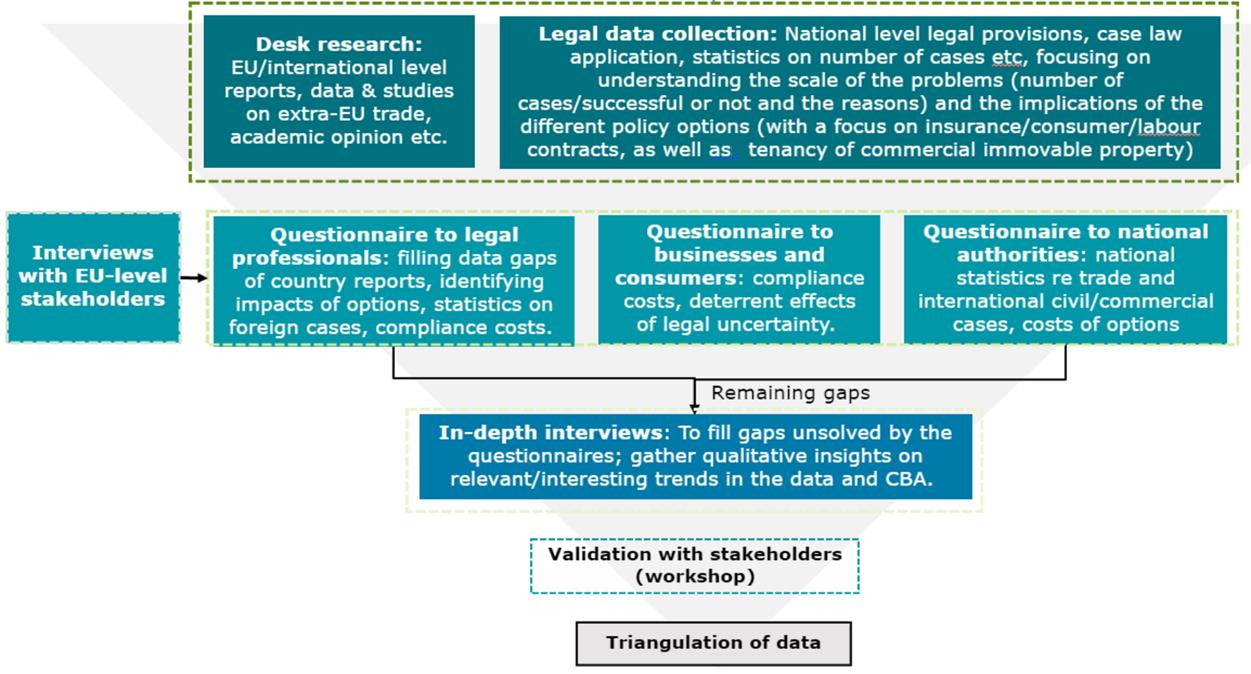
Source: Study by an external contractor
1.2.Additional sources of data
The conclusions from the Study by an external contractor were then enhanced by the results from the other consultation activities conducted by DG JUST – the open public consultation, workshop with the Member States and targeted consultations. Moreover, the knowledge acquired and materials produced in the course of the negotiations of the Judgments Convention were utilized.
As a result, the results of the impact assessment fed the comparison of the policy options via multi‑criteria analysis.
1.3.Validation of the results
Apart from the validation workshops held by the contractor, the Impact Assessment with its conclusions has been validated by the Inter-service Group of the European Commission consisting of 15 Commission’s Directorate-Generals and services.
2.Methodology used in the impact assessment
2.1Methodology used for the estimation of the number of civil and commercial judgments
Since many countries do not systematically collect data on the number of proceedings for the recognition and enforcement of foreign judgments with which their courts are seised, estimations had to be made. The current number of judgments circulating between the EU and third states was estimated based on the desk research, national databases, interviews with legal professionals, survey etc.
1.Baseline scenario: It was then forecasted that the number of cases under the baseline scenario will continue growing yearly following the forecasted growth in trade in goods.
èThe calculation: estimated number of yearly cases in 2020 times the yearly forecasted growth in trade in goods until 2026 in the baseline scenario;
2.Policy option 1a: estimated number of yearly cases in 2020 times the yearly forecasted growth in trade in goods until 2026 in policy option 1a;
3.Policy option 1b: estimated number of yearly cases in 2020 times the yearly forecasted growth in trade in goods until 2026 in policy option 1b, with a correction of an assumed ‑5% applied overall to account for cases falling outside of the scope of the Convention due to Article 18 declarations;
4.Policy option 1c: estimated number of yearly cases in 2020 times the yearly forecasted growth in trade in goods until 2026 in policy option 1c, with a correction of an assumed ‑5% applied for Argentina and Brazil and -10% for China to account for cases falling outside of the scope of the Convention due to Article 19 declarations;
5.Policy option 1d: estimated number of yearly cases in 2020 times the yearly forecasted growth in trade in goods until 2026 in policy option 1d, with the combined corrections applied for policy options 1b and 1c.
To consult the detailed estimates of the number of civil and commercial judgments, see Annex 7.
2.2Methodology to assess impacts of the Convention on the legal environment of the Member States
Based on the impact described for each Member State in the National Reports, the national legal systems were assessed as to their openness towards third‑country judgments. This has been done by comparing the grounds for recognition and enforcement (Articles 5 and 6 of the Judgments Convention) and grounds for refusal of foreign judgments in the Convention (Article 7) with those under national law of each Member State.
Based on number of instances where a judgment would be refused under national law while it would have to be recognised and enforced under the Convention, the Member States were divided into three groups - those with liberal approach (the most open to third-country judgments), those with less liberal and those with restrictive approach. See the Table 1 on p. 26.
To consult the detailed results of the assessment of impacts that the Convention would have on the legal environment of the Member States, see Annex 7.
2.3Methodology used for the estimation of the length of the proceedings for the recognition and enforcement and of the spending and savings on cases
The underlying assumption is that all cases create undue costs and delays that are partly solved by the Convention.
The current average cost and length of procedure for the recognition and enforcement of foreign judgments differ per country and were estimated based on consultation activities and desk research. For countries where limited data was available, the estimates were extrapolated.
For the details about the length of the recognition and enforcement procedure per country, see Annex 7. Notably, when assessing the average length of proceedings, it was distinguished between contested and uncontested cases since the recognition and enforcement of contested cases may be more cumbersome and thus lengthier.
With regard to the spending and saving on cases, the calculation was made using two main elements:
-the estimated cost of proceedings, based on three main cost elements
ocourt fees;
olawyer fees;
oother fees.
-the estimated number of cases (see above).
For the cost of proceedings, the court fees were based on data collected (see Annex 7). The lawyer fees were based on previous studies for EU countries
and on desk research for the selected third countries based on an assumed 80 hours of lawyer’s work for an average case. For other fees a flat average was taken based on previous impact assessments
. For cases related to the recognition and enforcement of third-country judgments in the EU, an EU-wide average was taken of these elements.
The estimated total spending is based on the average cost of proceedings times the number of cases in a given year under a given policy option. In the minimum scenario, a decrease in cost of proceedings of 10% is applied for those cases falling under the scope of the Convention, whereas under the maximum scenario a decrease in cost of proceedings of 20% is applied for those cases falling under the scope of the Convention.
For the detailed calculation of the estimated spending and saving on cases per country in both minimum and maximum scenario, see Annex 7.
2.4Methodology behind the calculation and estimates regarding macroeconomic impacts on trade and FDI
The macro-economic perspective refers to the EU-level impacts of the EU (non‑)accession to the Judgments Convention. Hence, the macro-economic perspective does not account for impacts on a Member State-level.
2.4.1. Calculation of the baseline
In order to determine the relevant (corrected) baseline for the impact assessment, the uncorrected baseline forecast for the years 2020-2026 was developed as a first step.
The uncorrected baseline scenario uses official data from Eurostat as the primary source, complemented by the databases from the OECD, the International Monetary Fund and the Economist Intelligence Unit in case no Eurostat data was available. The data for the years 2020-2026 was extrapolated by using a compounded average growth rate (“CAGR”) which was obtained from the growth rates of the previous years. This method accounts for path‑dependent trends in data and the respective economic circumstances.
For the previous years, the respective average yearly exchange rate from USD into EUR provided by OECD data was applied. For the years 2020-2026, a constant exchange rate of 0,896 EUR/USD was assumed, which is the average exchange for the year 2020 as forecasted by OECD statistics.
For the baseline scenario, three indicators were used in order to forecast the trade relations of the European Union with the eight selected countries, i.e. Argentina, Australia, Brazil, Canada, China, Japan, South Korea and the United States. Those indicators are:
-trade in goods (export and import);
-trade in services (export and import); and
-Foreign Direct Investment (FDI) (inward and outward stock).
All forecasts refer to the EU Member States, meaning that the share of the United Kingdom was subtracted when calculating the extrapolations.
a.Calculation of the uncorrected baseline
|
Box 4: Indicators used for the calculation of the baseline
Trade in goods (both export and import)
The first indicator, trade in goods, should be understood as a measure of the value and quantity of goods traded by the EU Member States. “Goods” refers to all movable property including electricity and is defined as set out in the European legislation. The data source for the extrapolation are the figures provided by Eurostat
, which refer to the amount of goods’ imports and exports of the EU with a respective third country.
Trade in services (both export and import)
The second indicator, trade in services, should be understood as the value of services exchanged between residents and non-residents of an economy, including services provided through foreign affiliates established abroad. The data of the import and export of services of the EU in relation to its selected third countries were obtained from the OECD statistics
. As this indicator is measured in million USD, the OECD annual exchange rates were applied for the previous years. With the values of the previous years, the CAGR was determined which was then used for the extrapolation to the years 2020‑2026.
Foreign Direct Investment (FDI) (both inward and outward)
The third indicator, the inward and outward Foreign Direct Investment stocks, measures the total level of direct investment at a given point in time. According to the OECD definition
, the outward FDI stock is the value of the resident investors’ equity in and net loans to enterprises in foreign economies. The inward FDI stock is the value of foreign investors’ equity in and net loans to enterprises resident in the reporting economy.
FDI statistics in the EU are collected in accordance with Regulation (EC) No 184/2005. The methodological framework used is that of the OECD benchmark definition of foreign direct investment which provides a detailed operational definition that is fully consistent with the standards of International Monetary Fund (“IMF”). Although different data sets have been used due to lack of availability, the data themselves are consistent. OECD data is expressed in millions USD. Therefore, the respective average annual exchange rate USD/EUR was applied to transpose the data.
The data for the OECD states Australia, Canada, South Korea, Japan, and the United States were mainly collected from the OECD International Direct Investment Statistics report
. FDI stock data for Brazil and China was partly available in a report published by the European Commission
. Data for FDI stocks between EU Member States and Argentina were only available for 2018. Therefore, the data was complemented with Economist Intelligence Unit data that included the total share of inward and outward FDI stocks in Argentina. Using this data, the share of inward and outward FDI stocks of the EU Member States was determined.
|
Based on the above methodology, baseline estimations for the trade and FDI between the EU and the selected third countries were calculated. The detailed calculations are presented in Annex 7 of this Impact Assessment.
b.Calculation of the corrected baseline
As a next step, the following three corrections were introduced into the baseline to capture only the trade flows and investments which are relevant for the macro-economic analysis:
·The share of intra-firm trade in goods and services was deducted;
·The impact of the Covid-19 pandemic on trade was considered; and
·The share of phantom investment in foreign direct investment was deducted.
I.Corrections for intra-firm trade in goods and services
Given the topic of the impact assessment, intra-firm trade in goods and services was deducted from the overall trade volume. Indeed, companies are expected to resolve their disputes from intra-firm trade with their own internal conflict‑resolution mechanisms. As a result, it is highly unlikely that such transactions would lead to international litigation. Therefore, the mechanism on the recognition and enforcement of foreign judgments provided by the Judgments Convention would typically not be used in intra-firm trade. Furthermore, through intra-firm trade, firms are, to different degrees, vertically integrated. This vertical integration reduces uncertainty and supports a faster mitigation of adverse effects such as negative demand shocks or rising trade costs.
In order to determine the degree of intra-firm trade, a qualitative analysis of relevant literature (such as in-depth studies and meta-studies of the WTO and OECD) was conducted. In addition, quantitative indicators which account for direct investments between fellow enterprises were used. To the extent that data is available, the literature suggests that on average 30% of exports and 25% of imports are intra-firm trade between OECD countries. This observation is consistent with the finding that closer trade relations induce a higher share of intra-firm trade. The goods that account for the largest share of intra-firm trade are chemicals, pharmaceuticals, medical devices, and electronics – all intermediate products with a rather intensive margin. Another observation is that trade costs reduce the propensity of firms to engage in intra-firm trade and trade costs are generally higher for more distant economies.
The main share of intra-firm trade is allocated between parties which operate mainly in the EU and the US. Japan and South Korea have less intra-firm trade shares with the EU as these economies focus more on regional markets and mutual linguistic and cultural barriers exist. Intra-firm transactions are also more common among OECD countries than mong emerging economies. The share of intra-firm trade in services is lower than the share of intra‑firm trade of goods.
Given these findings and observations, it was assumed that the shares of the EU trade in goods and services with third countries were as follows:
Figure 3: Shares of intra-firm trade in goods and services between the EU and third countries
|
OECD / non‑OECD
|
Country
|
EU goods
|
EU services
|
|
|
|
Import (%)
|
Export (%)
|
Import (%)
|
Export (%)
|
|
OECD
|
Australia
|
25
|
30
|
20
|
22
|
|
|
Canada
|
25
|
30
|
22
|
25
|
|
|
Japan
|
15
|
20
|
10
|
15
|
|
|
South Korea
|
15
|
20
|
10
|
15
|
|
|
USA
|
30
|
40
|
25
|
25
|
|
Non-OECD
|
Argentina
|
15
|
20
|
15
|
20
|
|
|
Brazil
|
15
|
20
|
15
|
20
|
|
|
China
|
20
|
25
|
15
|
20
|
Source: Study by an external contractor
To achieve the corrected baseline on trade in goods and services, the above shares were subtracted from the statistics on trade in goods and services in both exports and imports with the respective third countries.
II.Corrections related to the Covid-19 pandemic
For the years 2020 and 2021, a correction relating to Covid-19 was added into the model. As the pandemic is still ongoing, this correction had to be based on estimations and forecasts of the economic impacts of the pandemic (as available in November 2020).
The sources used for the estimations and forecasts expect a decline in trade with goods and services for the year 2020, a partial recovery with positive growth rates in 2021, and from 2022 until 2026, trade in goods and services is expected to return to their normal growth rates. The assumptions behind these transmission channels are as follows: First, due to the closures of factories and the persisting uncertainty a negative demand shock takes place. Second, this negative demand shock increases international trade costs of imports and exports. The cost increase depends, among others, on additional expectations, the share of reduced working hours, border closures and the level of increase in transport costs. Third, a sharp drop in international tourism takes place, implying a consumption shock and a sharp drop in exports of tourism services of around 20-32% at a global level. Fourth, at the household level, fewer services that require close human interaction such as mass transport, domestic tourism or restaurants are requested. This, in consequence, implies a drop and reallocation of demand across sectors.
For the purposes of this Impact Assessment a rather realistic scenario was used whereby the drops in demand, the rise in trade costs, the reallocation of demand across sectors and the loss of competitiveness would result in a decline of total exports and imports in 2020, the decline would persist in 2020 and in the first quarter of 2021 and would then convert into positive growth rates in 2021. It was also assumed that a trade reduction would be less severe where stable and intense trade relations exist.
The respective average export growth rates for the selected third countries were assumed to be the same as for the EU. This subtraction was made due to a lack of export growth data with the EU, and generally accounts for the general situation in trade and the percentage reductions of each third country.
III.Corrections for phantom investments in Foreign Direct Investment (FDI)
Macro-economic statistics on FDI are often blurred by offshore centres which have significant inward and outward investment positions. This so-called “phantom FDI” is not about real economic integration, as it hardly reflects productive assets in the respective economy. More likely, the main share of the investment passes through certain countries without being invested in these countries.
According to a study conducted by researchers aligned to the IMF, out of USD 40 trillion total FDI in 2017, USD 15 trillion (37.5%) were phantom investments. This share of phantom FDI has been growing since in 2009 it accounted only for 30%.
Based on a methodology which estimates the decomposition of total FDI into real FDI and phantom FDI (thereby attributing the real FDI to the ultimate owner and the sources of the total FDI to the ultimate investor economy), the IMF researchers were able to disentangle the share of the phantom FDI from the total FDI per country. Ten small economies account for 37.5% of global FDI although their combined share of global GDP is only around 3%. These 10 economies are The Netherlands, Luxembourg, Hong Kong SAR, Switzerland, Singapore, Ireland, Bermuda, the British Virgin Island, and the Cayman Islands.
Further, most phantom FDI is concentrated in economies involved in the tax planning of multinational enterprises., Luxembourg and The Netherlands each host more than USD 3 trillion of phantom investments, whereas Hong Kong SAR, the British Virgin Islands, Bermuda, Singapore, the Cayman Islands, and Ireland each account for USD 0.5-1 trillion. These 10 countries account for 85% of the phantom investment worldwide.
To calculate the corrected baseline, the share of phantom investment was deducted from the total FDI attributable to the EU and (if applicable) to the selected third countries. For the EU, this is the phantom investment in The Netherlands (USD 3.3 trillion), Luxembourg (USD 3.8 trillion) and Ireland (around USD 0.5-0.7 trillion) which amounts in total to about USD 7.7 trillion. This sum was subtracted from the total share of the EU FDI inward stock which leads to the amount of the real FDI inward stock in the EU.
Since it is currently not possible to allocate the shares of phantom FDI to the countries of origin, it was assumed that each selected third country has the same share of phantom FDI in the EU inward stocks. This share is assumed to be equal to the share of phantom investments in the EU total inward FDI stocks and amounts to 40.88%. Consequently, the share of real FDI of each of the third countries into the EU is 59.02%. Therefore, the inward FDI stocks of the selected third countries to the EU were adjusted to their baseline value multiplied with the factor 0.5902.
According to the study, the eight selected third countries - Australia, Argentina, Brazil, Canada, China, Japan, South Korea, and the US - are no significant destinations of phantom investment because the ratio of real FDI and total FDI inward stocks is near to 1. Hence, it was assumed that the share of phantom investment is negligible in these eight countries and no corrections were thus applied.
2.4.2. Calculation of the macroeconomic impacts of the policy options
a.General assumptions about the policy options as compared to the corrected baseline
Regarding all policy options, it is assumed that the EU will accede to the Convention in 2021 and that the Convention will become effective in 2022. It is also assumed that the third countries under consideration (Argentina, Australia, Brazil, Canada, China, Japan, South Korea and the United States) will also all join the Convention in 2021 which then will become effective in 2022 between the EU and these countries.
As the Convention would have positive effect on enhancing legal certainty of companies by providing a clear legal framework for the enforcement of judgments, it is assumed that its application would result in attracting more trade and FDI between its Contracting Parties. Moreover, general assumptions of international trade literature on bilateral trade patterns were applied, namely: the effects of agreements on trade are weaker for more distant economies and for trade partners where a high level of ex ante trade frictions exist. Economies with already high trade volumes and intense and stable relations where substantial levels of legal certainty exist are also likely to be less impacted by such agreements. This can be applied by analogy to the Judgments Convention to some extent since unlike the Judgments Convention, free trade agreements also include provisions on regulatory standards, health, safety rules, investment, banking and finance, intellectual property and many other subjects. They therefore have a substantially greater scope and macro-economic impact in comparison to the Convention. Hence, only a fraction of these positive macro‑economic impacts can be expected with the accession to the Judgments Convention.
In order to determine these impacts, several estimates and projections from different free trade agreements were compared to determine a range of possible impacts under different scenarios. Then, the share on the macro-economic impact related to the improvement of regulations and enforcement and legal certainty was estimated and compared in terms of scope and characteristics to the Judgments Convention. With this procedure, the potential macro-economic impact of the different policy options could be projected as compared to the corrected baseline scenario.
It is important to note that these estimations and ranges are not empirically tested and should therefore be interpreted with caution.
b.Policy option 1a: Accession to the Judgments Convention with no declarations
Policy option 1a foresees the accession of the EU to the Judgments Convention without any declaration. The macro-economic effect with all third countries is expected to be positive under this policy option. As the scope of the Convention would be fully applicable in this scenario, the highest macro-economic impact out of all policy options as compared to the baseline is expected to be achieved.
The macro-economic impact is expected to be largest in EU exports to China, Brazil and Argentina as in these countries, the difference with the EU with regard to legal certainty was highest. The trade volume is also expected to increase with Australia. Here, due to clearer regulations regarding foreign judgments, a significant improvement in reducing the complexity of the access to Australian courts can be achieved. Due to their distance to the EU, the exports to Japan and South Korea will be impacted to a slightly lesser extent. As the US has the closest trade relations with the EU and legal certainty exists to a higher degree in mutual relations, only a slightly positive macro-economic impact is expected as compared to the baseline.
In a general tendency, the macro-economic impact is expected to be larger when it comes to the trade with goods as compared to the trade in services since most litigation is related to trade in goods. However, this difference is expected to be negligibly small (see
Table 9: Total increases (in %) in 2026 as compared to the corrected baseline
). Further factors such as the particular sector of trade, the general economic situation and other economic circumstances obviously also contribute to overall variation.
Out of the three indicators, FDI will be the least impacted under policy option 1a (percentagewise). This is based on the observation above that FDI stocks are generally less impacted by agreements concerning trade relations.
c.Policy Option 1b: Accession to the Judgments Convention with declaration(s) under Article 18
Under policy option 1b, no macro-economic effect is expected for the matters excluded by the declaration(s), as the status quo remains for these specific matters. The general reasoning is that the greater the share of the matters under an Article 18 declaration, the smaller the macro-economic increase will be.
According to statements from experts during validation workshops, the matters under Article 18 are rarely subjects of foreign judgments and if so, they are judgments concerning trade in goods.
Given the small number of judgments that would be affected by each declaration under Article 18, the costs and benefits of the preferred option were not calculated separately from other declarations under Article 18. To differentiate the macro-economic impacts of each of the conceivable declarations under Article 18 would be challenging because the changes will be negligibly small. Instead, it was assumed that trade in goods will still be positively impacted as compared to the baseline, but to a slightly lesser extent (-0.1%) as compared to policy option 1a. For trade in services and FDI stocks, the macro-economic impact is expected to stay the same as under the policy option 1a (since trade in services and FDI stocks will generally not be affected by declarations under Article 18).
In fact, the occurrence of judgments on commercial leases (tenancies) of immovable property given in a state where the property is not situated is rather rare. Therefore, the number of judgments excluded from scope by virtue of a declaration concerning commercial leases (tenancies) of immovable property situated in the EU would be very limited. The macroeconomic impacts of the preferred option would thus be more or less similar as those of policy option 1a.
d.Policy option 1c: Accession to the Judgments Convention with a declaration under Article 19
Under policy option 1c, the macro-economic impacts would depend on the respective third country. EU trade and investment with third countries which have higher degrees of involvement of state entities in economic activities will be more affected by the possible declaration. This specifically applies for third countries with strict regulations regarding trade and/or little liberalization. Under this policy option, EU trade and investment with China and to a lower extent with Brazil and Argentina will be affected. In these countries, the state entities are more involved in civil and commercial matters and these activities would be excluded from the Convention under the policy option 1c.
In macro-economic terms, this was still expressed in a positive impact as compared to the baseline, but lower impact as compared to policy option 1a, in particular -0.3% for Argentina, Brazil and China for trade in goods and services and -0.2% for FDI stocks. As policy option 1c is not relevant for the remaining five selected third countries, the macro-economic impact under this option will be the same as for policy option 1a.
e.Policy option 1d: Accession to the Judgments Convention with declarations under Article 19 and Article 18
It is foreseen under the policy option 1d that the EU would accede to the Judgments Convention with declarations both under Article 18 and 19. The effects of policy options 1b and 1c will therefore add up for EU trade and investment with the selected third countries.
2.4.3. Overview of the macroeconomic impacts of all policy options
It was assumed that the effects of the Judgments Convention will evolve over years under all policy scenarios. Therefore, a linear percentage increase in the effect of the different policy options was assumed. In 2022, the first year after the EU accession to the Convention, a 20% increase with regard to the overall increase is reached, in 2023 40%, in 2024 60%, in 2025 80% and in 2026 100% of the overall increase is reached. The increases as compared to the corrected baseline are as follows:
Table 9: Total increases (in %) in 2026 as compared to the corrected baseline
Policy options, total % increase (2022-2026)
|
Policy option 1a
(no declaration)
|
AR
|
AU
|
BR
|
CA
|
CN
|
JP
|
KR
|
US
|
|
|
Goods
|
1.5
|
1.2.
|
1.5
|
1.5
|
1
|
1
|
1
|
1
|
|
|
Services
|
1.3
|
1.2
|
1.6
|
1.1
|
1.6
|
1
|
1
|
0.9
|
|
|
FDI
|
0.4
|
0.4
|
0.5
|
0.2
|
0.5
|
1
|
0.2
|
0.3
|
|
Policy option 1b (declaration under Article 18)
|
AR
|
AU
|
BR
|
CA
|
CN
|
JP
|
KR
|
US
|
|
|
Goods
|
1.4
|
1.1
|
1.4
|
1.4
|
0.9
|
0.9
|
0.9
|
0.9
|
|
|
Services
|
1.3
|
1.2
|
1.6
|
1.1
|
1.6
|
1
|
1
|
0.9
|
|
|
FDI
|
0.3
|
0.3
|
0.4
|
0.15
|
0.4
|
0.9
|
0.15
|
0.2
|
|
Policy option 1c (declaration under Article 19)
|
AR
|
AU
|
BR
|
CA
|
CN
|
JP
|
KR
|
US
|
|
|
Goods
|
1.2
|
1.2
|
1.2
|
1.5
|
0.7
|
1
|
1
|
1
|
|
|
Services
|
1.1
|
1.2
|
1.3
|
1.1
|
1.3
|
1
|
1
|
0.9
|
|
|
FDI
|
0.2
|
0.4
|
0.3
|
0.2
|
0.3
|
1
|
0.2
|
0.3
|
|
Policy option 1d (declaration under both Article 18 and 19)
|
AR
|
AU
|
BR
|
CA
|
CN
|
JP
|
KR
|
US
|
|
|
Goods
|
1.2
|
1.1
|
1.2
|
1.4
|
0.7
|
0.9
|
0.9
|
0.9
|
|
|
Services
|
1
|
1.2
|
1.3
|
1.1
|
1.3
|
1
|
1
|
0.9
|
|
|
FDI
|
0.2
|
0.3
|
0.3
|
0.15
|
0.3
|
0.9
|
0.15
|
0.2
|
Source: Study by an external contractor
2.5Methodology behind the calculation of indirect impacts on businesses
After the calculation of the macroeconomic impacts, the micro-economic analysis measured sectoral and indirect impacts, such as impacts on companies and SMEs across the supply chain, which are affected indirectly by trade flows.
Input-Output (“IO”) tables and models are widely used in the context of classic economic impact analysis, Using classic IO analysis or IO models, it is possible to quantify the effects of economic activities along the value chain - upstream. With the help of the input-output analysis, the intermediate goods incorporated in the production process can be allocated between different sectors of the economy, i.e. the supply links between the individual sectors can be shown.
The basic input-output table/coefficients aggregated for the EU used are provided by Eurostat for the reference year 2019. Data provided by Eurostat includes further output multipliers (the “Inverse matrix”) for domestic production. Applying these tables within a simple static IO model for comparative-static impact (scenario) analysis the indirect impacts were calculated with regard to exports of goods and services, which constitute part of the final demand. This model allows to measure the economic activities related to the exports of goods and services, in terms of the demand created in supplier (upstream) industries. Inter-industry linkages reflected in the IO tables allow the basic calculation of how many resources and e.g. workers are required in upstream industries to generate a specified value of a company’s production. With the help of this input-output model, statements can be made about direct and indirect effects based on exogenous changes in demand. As main indicators, production value and gross value added have been considered. The following methodological steps have been conducted to calculate the impact on the indicators:
-As a first step, detailed sectoral statistical data provided by Eurostat on the trade of goods and services (exports) between the EU and the selected third countries has been collected. Trade data is provided on a detailed sectoral product level. This data has been mapped with the nomenclature of the input-output tables.
-A primary application of the model is assigning production factors to the final demand of goods. In the context of our impact analysis, the change in final demand due to the exports is under consideration. Therefore, in the next step, the vector of final demand (exports) of each of the countries under consideration has been multiplied with the Input-Output Leontief inverse to calculate the entire production necessary for the production process of these exports. The allocation of production factors to the final demand is calculated with the Leontief inverse, and gives the total production output involved in producing the output associated with the exports. As a result, output multipliers have been obtained.
-Then, linking the coefficients for gross value added to these output values enables the calculation of the impact of the exports in focus.
The output multipliers and GVA-ratios (Gross value added) calculated are presented in the table below.
Table 10: Output and gross value added multipliers

Source: Study by an external contractor
It can be noticed, that the output multipliers – as well as the ratios of GVA per production value – differ only slightly between the countries in focus, but show differences between the export of goods and the exports of services. Based on the multipliers and GVA-ratios, the indirect and total impact has been calculated for all scenarios (the baseline and the different policy options).
Since the static IO model, used here to determine the indirect effects, is applied and constant technological structure over time is assumed, the differences over time and between different scenarios follow a linear relationship. However, the simple static model to assess the indirect effects was chosen in order to estimate and compare the magnitude of the impact, rather than to make a scientific forecast of future developments. The aim is to estimate a magnitude of indirect impacts (SMEs and production affected), but without presenting a sectoral breakdown. The IO model and analysis is only used to determine the indirect impacts.
In a last step, structural business statistics provided by Eurostat were analysed with regard to the share of SMEs in the production along the supply chain. Unfortunately, this data is not fully available on a corresponding disaggregated (sectoral) level. However, the share of SMEs with regard to the overall number of enterprises in the EU, as well as the share in the corresponding production value and gross value added have been calculated. The ratios obtained have been used to estimate the share of SMEs included in the indirect impact of the exports in focus. The results with regard to the share of SMEs are presented in section 7 of Annex 7.
Section 7 of Annex 7 also details the microeconomic impacts (quantitative estimates concerning the indirectly impacted businesses across the supply chain) of each of the policy options.
2.6Methodology behind the estimations of cost savings for EU businesses and consumers
The costs and benefits for EU businesses and citizens under each policy option demonstrated in the report are based as the overall savings by these EU parties on recognition of European judgments in selected third countries over the reference period 2022-2026.
These overall savings by the EU parties were calculated by taking into account:
-the projected increase in international trade and thus the corresponding increase in the number of judgments (see the methodology above) and
-spending on recognition and enforcement proceedings per case in each of the selected third countries (detailed data on this spending is included in Section 10 of Annex 7).
The estimated total spending on judgments over the reference period is based on the average cost of recognition and enforcement proceedings in each third country times the number of cases in that country in a given year under each policy option. With regard to the policy option 1b (declaration under Article 18), the costs and benefits were considered for all the declarations under Article 18 together given the small number of judgments that would be affected by each of the declarations.
In the minimum scenario, a decrease in cost of proceedings of 10% is applied to those cases falling within the scope of the Convention, whereas under the maximum scenario a decrease in cost of proceedings of 20% is applied. This percentage of cost reduction is based on the online survey conducted by the contractor, as corrected by experts during the validation workshop.
Section 11 of Annex 7 includes the detailed calculations of the total savings by EU companies and citizens under each of the policy options.
However, it should be noted that the estimates of the outgoing European judgments may be undercounted in the report since statistics on the number of judgments recognised and enforced in third countries are not readily available. Therefore, it is likely that the estimated benefits for EU business and citizens are also undercounted.
Sensitivity analysis in Annex 6 illustrates how these total savings would change should one of the selected third countries (the United States) not join the Judgments Convention.
Annex 5: Analysis of the possible declarations
under Articles 18 and 19 of the Convention
as to their desirability and their legal implications
Among others, the Convention allows its Contracting Parties to make a declaration excluding from the scope of the Convention judgments with respect to specific subject matters (Article 18 of the Convention, policy option 1b) and judgments pertaining to a State (Article 19 of the Convention, policy option 1c).
Notably, these declarations under Articles 18 and 19 apply in a reciprocal manner. They allow the declaring state not to recognise and enforce certain judgments under the Convention but in turn, such judgments given in the declaring state would also not circulate in other Contracting States under the Convention.
1. General approach to declarations
A declaration pursuant to Articles 18 and/or 19 should only be made where a state has a strong interest in not applying the Convention to a specific matter and it should be no broader than necessary. Indeed, the more judgments are excluded from the scope of the Convention by means of a declaration, the less added value the Convention will bring as compared to the current status quo.
The EU has actively participated in the negotiations of the Judgments Convention for many years. During the negotiations, the EU has advocated for a Convention with the widest possible scope which would make a difference to the current status quo. The Judgments Convention as it currently stands reflects in most cases the EU’s policy interests.
It should be also highlighted that many Member States currently have more liberal systems for the acceptance of foreign judgments as compared to most third countries assessed in this study. It is thus in the EU’s general interest that the Convention applies as widely as possible in order to improve the current acceptance of European judgments in third countries.
Finally, the more declarations there are, the more complex the legal framework of the Convention becomes for legal practitioners, businesses, and individuals. Moreover, as it would ultimately be national courts to interpret the declaration(s), inconsistencies may emerge in the interpretation since there is no supreme judicial authority ensure uniform interpretation.
Two approaches are conceivable when a declaration is considered. The declarations can be made at the time of acceding to the Convention or at any time thereafter. The declaration could thus:
-be made and later modified or withdrawn when it is no longer needed; or
-only be made when a need emerges from the practical application of the Convention.
Given the reasons above, the general approach to declarations should be that the EU will make a declaration only where it is deemed strictly necessary. In case the practical operation of the Convention would warrant additional declarations excluding certain types of judgments from the scope of the Convention, these declarations could be made at a later stage.
2. Policy option 1b - The Union would accede to the Judgments Convention with declaration(s) pursuant to Article 18 of the Convention
Article 18 allows the Contracting States not to apply the Convention with respect to certain specific matters, and thereby to extend the list of matters already excluded from scope by Article 2 of the Convention.
The following declarations excluding the following matters would be assessed:
·Certain matters reflecting the EU’s policy objective of protecting weaker parties:
oconsumers; and/or
oemployees; and/or
oin matters relating to insurance, the policyholder, the insured or the beneficiary;
and/or
·Judgments relating to tenancies or commercial leases of immovable property, a matter for which courts in the EU have exclusive jurisdiction.
The reason behind the contemplated exclusions from the scope of the Convention is that the rules on the recognition and enforcement of foreign judgments in the Convention differ from those in the Brussels Ia Regulation.
Taking into consideration that both the Judgments Convention and the Brussels Ia Regulation have a different scope of application, there is no direct overlap between these instruments with regard to the matters where the EU’s policy objective is to protect weaker parties. For these matters, the contradiction between the Brussels Ia Regulation and the Judgments Convention is thus limited to policy, in other words whether judgments given in a third country, where jurisdiction was based on a different ground than what is considered acceptable in the EU, should be recognised and enforced in the EU under the Convention.
Therefore, when acceding to the Judgments Convention, the EU could use the declarations under Article 18 and exclude (some of) those matters from the application of the Convention.
2.1Declarations to protect the weaker party
The EU’s policy objective to protect the weaker parties in certain transactions is reflected, within the Brussels Ia Regulation, in specific jurisdiction rules that aim at protecting the weaker parties. Such specific jurisdiction rules are provided in Chapter 2, Sections 3-5 of the Brussels Ia Regulation, namely:
-in Articles 10-16 with regard to matters of insurance;
-in Articles 17-19 with regard to consumer matters; and
-in Articles 20-23 with regard to individual employment contracts.
Recognition and enforcement may be refused where judgments were made by a court of a Member State which lacked jurisdiction under the afore-mentioned provisions.
By contrast, the Judgments Convention does not provide any special protection for the weaker party in insurance matters and while it provides protection for consumers and employees (Article 5(2) of the Judgments Convention), these protective rules differ somewhat from those included in the Brussels Ia Regulation.
By way of comparison, when acceding to the Choice of Court Convention, the EU made a declaration on insurance matters and the Choice of Court Convention generally does not apply to the choice of court agreements in consumer and employment matters.
2.1.1Consumer matters
The Judgments Convention provides specific protection for consumers insofar that it reduces the jurisdictional grounds otherwise available to the parties to a dispute. Article 5(2) of the Convention provides that:
-if jurisdiction of the court of origin of the judgment was based on consent of the weaker party, the recognition and enforcement of the resulting judgment is only granted if the consent was given expressly and addressed to the court, orally or in writing;
-several indirect bases for jurisdiction under the Convention are not available in consumer cases, namely:
owhere the consumer defended the case on the merits before the court of origin without contesting jurisdiction (Article 5(1)(f) of the Judgments Convention);
oin contractual matters, where the court based its jurisdiction on the place where the performance of an obligation took place or should have taken place (Article 5(1)(g) of the Judgments Convention); and
owhere jurisdiction was based on the choice of court agreement.
This means that the remaining available grounds of jurisdiction are mostly those that are widely acceptable (such as habitual residence) or where there was express submission to the jurisdiction of the court of origin.
Comparison of the Judgments Convention to the Brussels Ia Regulation
The Brussels Ia Regulation provides specific protection to consumers in its Section 4 on jurisdiction over consumer matters. Courts cannot base their jurisdiction on any other grounds than those provided for in that Section.
This protective regime for consumers as the weaker parties in consumer contracts includes:
-As a rule, the consumer can be sued in the court of the place where the consumer is domiciled. The plaintiff may not rely on any special jurisdictions provided for in Article 7 and 8 of the Regulation (except for Article 7(5)).
-In principle, the Regulation provides to a consumer as the weaker party an alternative forum in the place of the consumer’s domicile. The consumers can thus sue not only at the domicile of the other party, but also at their own domicile (the so-called “forum actoris”).
-The possibility to conclude choice of court agreements is limited. From the jurisdiction rules in consumer matters can generally only be departed by an agreement which is either made after the dispute has arisen or which allows the consumer (but not the other party) to bring proceedings in courts other than those indicated in the respective section.
It is clear from the above that the Judgments Convention and the Brussels Ia Regulation have several commonalities in how they protect consumers in cross-border litigation. However, there is one key difference.
Unlike the Brussels Ia Regulation, Article 5 of the Judgments Convention does not offer an alternative forum when consumers act as plaintiffs. If a consumer brings a case to the court, the resulting judgment will only be recognised and enforced under the Convention where the court of origin based its jurisdiction on one of the grounds in Article 5(1). Forum actoris in consumer matters is not one of these grounds. The place where the consumer-plaintiff is domiciled is therefore not acknowledged as a valid ground of jurisdiction under Article 5 of the Judgments Convention.
Of course, judgments that comply with any other indirect jurisdictional grounds in the Convention would have to be recognised and enforced under the Convention. Remarkably, this includes judgments given in the place of performance of a contractual obligation (Article 5(1)(g) of the Convention). Since the place of performance would very often be the country where a consumer resides, the consumer would be able to sue at a court in a state which is also its habitual residence. This could thus partially substitute a forum actoris jurisdiction.
|
Box 5: Example illustrating the forum actoris jurisdiction:
An action for warranty of a defective product may be brought by a consumer domiciled in Germany against the French seller before the German courts and the German judgment has to be recognised and enforced in France under the Brussels Ia Regulation.
By contrast, the German judgment will not be recognised and enforced under the Judgments Convention if the seller is domiciled in a Contracting State of the Judgments Convention outside the European Union. Instead, the German consumer has to bring the action, for example, before the courts of the State of the seller’s habitual residence or principal place of business under Article 5(1)(a) or (b) of the Convention.
|
Aside from the difference in the treatment of consumers when they are acting as plaintiffs, there are several other differences between the Judgments Convention and the Brussels Ia Regulation.
For instance, the Convention also does not provide a special protection to consumers in tort matters. Therefore, judgments in proceedings against a consumer have to be recognised and enforced also if given in any of the jurisdictions under Article 5(1). For example, a judgment which ruled on a non-contractual obligation arising from damage to or loss of tangible property is eligible for recognition and enforcement under the Judgments Convention if brought against a consumer in the State where the harm occurred (Article 5(1)(j) of the Convention). Under the Brussels Ia Regulation, if the non-contractual obligation is closely connected to the consumer contract, such a claim may only be brought by the other party in the place where the consumer is domiciled. In general, however, this ground for jurisdiction is limited under the Convention to non-contractual obligations and, in any case, it has a restricted reach because it applies only to death, physical injury, damage to or loss of tangible property at the place where the act or omission occurred.
When it comes to the choice of court agreements, the Judgments Convention protects consumers even stronger than Article 19 of the Brussel Ia Regulation. As Article 5(2)(b) of the Judgments Convention excludes Article 5(1)(m) completely from the application if the action is brought against a consumer, such an agreement is not a valid basis of jurisdiction even if it is concluded after the dispute has arisen or if it allows the consumer to bring proceedings in courts other than those indicated in Article 5(1). On the other hand, Article 19 of the Brussels Ia Regulation considers a choice of courts agreement in these two instances acceptable.
The Convention also goes beyond the protection afforded to the consumer in Brussels Ia Regulation in other respects. For example, arguing by the defendant on the merits before the court of origin without contesting jurisdiction is not a valid ground of jurisdiction in consumer cases under the Judgments Convention. Under the Brussels Ia Regulation, the Court of Justice of the EU (“CJEU”) has adopted a more nuanced view.
The concept of “consumer” itself may also not be construed identically under the Judgments Convention and the Brussels Ia Regulation. In Article 5(2) of the Judgments Convention, consumer is defined as a “natural person acting primarily for personal, family or household purposes”. By contrast, under the Brussels Ia Regulation, the Court of Justice of the European Union has developed a rather broad autonomous concept of “consumer”. It is thus questionable whether the concept of “consumer” in the Judgments Convention will be construed in such a wide manner. A difference in the interpretation of the term “consumer” between both instruments is likely unavoidable but it might lead to some misconceptions among legal professionals when applying the Judgments Convention.
The Judgments Convention, unlike the Brussels Ia Regulation, also does not specify that the other party must be acting in its trade or professional capacity. As the Explanatory Report to the Convention points out, it would have to be determined by courts applying the Convention whether consumer-to-consumer (C2C) contracts are included under Article 5(2).
In concluding, the Convention provides good protection for consumers in most cases. Moreover, it is unlikely that the differences listed above would impact a significant number of judgments. According to the interviewees, the Judgments Convention is considered mostly as a B2B instrument with only limited application to consumer matters. Where the Convention does apply to consumer matters, the instances of discrepancies between the Brussels Ia Regulation and the Judgments Convention are limited.
On the contrary, should the EU enter a declaration excluding consumer matters from the scope of the Convention altogether, consumers having their habitual residence in the EU would not be able to benefit from the recognition and enforcement of judgments under the Convention e.g. in e-commerce cases.
2.1.2Employment matters
The Judgments Convention provides specific protection also to employees as the weaker parties of the employment contacts (Article 5(2)).
As far as the protection of weaker parties in employment matters is concerned, the legal situation corresponds to what has been said for consumer matters. In particular:
-In employment matters, only the judgments given in compliance with Article 5(2) of the Judgments Convention will be recognised and enforced under the Convention.
-Article 5(2) of the Convention limits the jurisdictional grounds otherwise available to the parties to a dispute (e.g. jurisdiction through appearance, jurisdiction at the place of performance in contractual matters, consent to the jurisdiction and choice of court agreements). Similarly to the consumer matters, there is also no specific protection for employees in tort cases.
-As a rule, an employee shall be sued in the court of its habitual residence.
-On the other hand, the Convention does not allow the employee to sue at its habitual residence as is the case with the Brussels Ia Regulation (no forum actoris).
-When it comes to choice of court agreements, the Judgments Convention protects consumers even stronger than the Brussel Ia Regulation since choice of court is completely excluded as a ground of jurisdiction.
However, while most of the analysis made above on the consumer matters applies also to employment matters, employment matters also have some specificities:
According to Article 45(1)(e)(i) of the Brussels Ia Regulation, judgments made in proceedings brought by the employee have to be recognised and enforced in the other Member States if jurisdiction is based on:
-the place where or from where the employee habitually carries out his work or the last place where he did so; or
-if the employee does not or did not habitually carry out his work in one country, on the place where the business which engaged the employee is or was situated.
The Judgments Convention does not include these two specific indirect jurisdiction grounds for employment matters. However, it should be noted that these places do often coincide with other indirect grounds for jurisdiction in the Judgments Convention – e.g. with the place of the employer’s seat or habitual residence of the employee, or in torts with the place of the occurrence of a harmful event.
Moreover, the Judgments Convention applies only in “matters relating to the employee’s contract of employment”. Consequently, the disputes arising from a collective bargaining agreement between the parties to this agreement (typically trade unions, or employees’ representatives on the one hand, and an employer or an association of employers on the other) are not covered by this paragraph.
Further, as follows from the consultation activities undertaken in the context of this impact assessment, in foreign fora judgments may be given in breach of some EU principles and/or employees’ rights. According to three interviewees, a social right that is not duly observed in foreign countries is the right to collective bargaining and action
. While this could well be the reality, the problem is certainly less pertinent in this context of the recognition and enforcement of foreign judgments.
However, the interviewees also noted that the impact of the Convention on employment matters would not be significant and is more theoretical, especially when it comes to international disputes arising from collective bargaining agreements. The recognition and enforcement of foreign judgments that are manifestly contrary to EU fundamental rights could be also refused under various refusal grounds in the Convention.
In concluding, the Convention provides good protection for employees in most cases. It is unlikely that the differences listed above would impact a significant number of judgments. According to the interviewees, the Judgments Convention is considered mostly a B2B instrument with only limited application to employment matters. Where the Convention does apply, the instances where its application differs from the rules on the recognition and enforcement of judgments in employment matters in the EU are limited.
On the contrary, should the EU enter a declaration excluding the employment matters from the scope of the Convention altogether, employees and employers from the EU would not be able to benefit from the recognition and enforcement of judgments under the Convention.
2.1.3Insurance matters
While the Judgments Convention envisages a protective regime for employees and consumers by limiting the available grounds of jurisdiction, the Convention does not envisage any such regime for the weaker parties in insurance matters - the policyholders, the insured or the beneficiaries.
Should the EU accede to the Judgments Convention without any declaration on insurance matters, the circulation of judgments given in third states would be subject to less procedural protection for the weaker parties in insurance matters than similar intra-EU judgments (where the Brussels Ia Regulation applies).
Comparison of the Judgments Convention to the Brussels Ia Regulation
The Brussels Ia Regulation lays down the jurisdictional grounds specific to insurance matters in its Section 3 of the Chapter II. In matters related to insurance, it introduces specific exclusive jurisdiction which derogates from the general jurisdictional rules, thereby protecting the weaker party in insurance matters (the insurance policyholder, the insured or a beneficiary domiciled in the EU). The special protective jurisdictional regime consists of three main elements:
- (1) when insurance policyholder, the insured or the beneficiary act as plaintiffs, additional and more favourable bases for jurisdiction are available to them (i.e. the place of the claimant’s domicile - the so-called “forum actoris”);
- (2) when they are in the position of defendants, they may only be sued in the place of their domicile; and
- (3) the possibility for the parties to enter an agreement on jurisdiction departing from the aforementioned jurisdictional regime is significantly restricted. This applies both to the exclusive and non-exclusive choice of court agreements.
Apart from the matters of jurisdiction, the Brussels Ia Regulation stipulates rules concerning the recognition and enforcement of judgments. Pursuant to Article 45(1)(e) of the Regulation, the violation of the protective jurisdictional norms can, at the request of any interested party, result in a denial of the recognition of a given judgment.
Conversely, the Judgments Convention does not include any special protection for the weaker parties in insurance matters. Where the Judgments Convention limits the available grounds for jurisdiction in consumer and employment matters only to specific jurisdictional filters, all jurisdictional filters apply without limitation in the matters of insurance.
-Therefore, the weaker parties in insurance contracts may be sued abroad at the habitual residence of the insurance company in a third country and the resulting judgment would have to be recognised and enforced under the Judgments Convention.
-Moreover, should the weaker party in insurance matters acting as a claimant sue at its own habitual residence (forum actoris), the resulting judgment would not be recognised and enforced under the Judgments Convention, unless of course it would comply with any other bases in Article 5(1).
-Finally, while the Brussels Ia limits party autonomy as regard the choice of court agreement in insurance contracts, under the Judgments Convention, judgments given as a result of non‑exclusive choice of court agreements are recognised and enforced in compliance with Article 5(1)(m) of the Convention without any restriction. There is thus no protection of the weaker parties in insurance matters against the choice of court agreements made in favour of foreign fora.
As a consequence, the Member States would be obliged under the Convention to recognise and enforce judgments from third states where the insurance policyholder, the insured or beneficiary may have been less protected than if the same proceedings happened in the EU.
However, it should be noted that the weaker parties in insurance matters could enjoy special protection under the Judgments Convention if they qualified as consumers (Article 5(2) of the Convention and the explanations in 2.1.1. above). Indeed, even though the Brussels Ia Regulation affords special protection to all insurance policyholders, the insured and beneficiaries (even if they are the largest corporations), the “real” weak parties are often consumers. Since the Judgments Convention has specific indirect jurisdiction rules for consumers in Article 5(2), the lack of protection under the Convention applies only to non-consumers.
Moreover, foreign insurance companies have to comply with EU and national rules to provide their services in the EU market. To comply with these rules, they are often obliged to establish a branch or permanent presence in an EU Member State. The regulation of insurance sector may thus decrease the likelihood that a litigation from an insurance contract concluded with an EU weaker party would happen in a third country.
|
Box 6: Example illustrating the difference between the Judgments Convention and EU acquis:
If a Dutch insurer brings an action against a policyholder domiciled in Germany before the Dutch courts relying on a choice of court agreement inserted in the insurance contract and establishing the jurisdiction of the Dutch courts, these courts will not accept their jurisdiction because the choice of court agreement is invalid according to Article 15 Brussels Ia Regulation. And if the Dutch court would not respect Article 15 of the Brussels Ia Regulation and nevertheless made a decision it would not be recognised and enforced in Germany under Article 45(1)(e)(i) Brussels Ia Regulation.
By contrast, the decision has to be recognised and enforced under the Judgments Convention if the action has been brought against a German policyholder before the court of a Contracting State outside the EU, because the choice of court agreement is a valid basis of jurisdiction under the Convention even if it is made to the disadvantage of the policyholder (unless the policyholder is also a consumer).
|
Declaration on insurance matters in the Choice of Court Convention
The Choice of Court Convention, similarly to the Judgments Convention, does not include a special protection for the weaker party in insurance matters. The Choice of Court Convention applies in relation to other Contracting Parties of that Convention in cases where exclusive choice of court agreement was made.
When acceding to the Choice of Court Convention, the EU made a declaration whereby it excluded the application of the Choice of Court Convention to some judgments concerning insurance matters. These cases include the instances where parallelism with the Brussels Ia Regulation could not be ensured and where it was deemed necessary to protect policyholders, the insured and beneficiaries as the weaker party to the dispute.
Since the Choice of Court Convention and the Judgments Convention are perceived as complementary instruments, the existence of the declaration under the Choice of Court Convention could be another reason to consider similar declaration under the Judgments Convention to ensure consistency.
On the other hand, when it comes to the Choice of Court Convention, the conflict between that Convention and the Brussels Ia Regulation is not limited only to policy considerations (in other words to the consideration whether it should be accepted that the policyholders, insured or beneficiaries domiciled in the EU would have lower protection under the Convention than what is considered acceptable in the EU). Indeed, there is also a legal overlap between the two instruments. The Choice of Court Convention provides in its Article 26(6), that the Convention shall not affect the application of the EU rules only where none of the parties is resident in a Contracting State that is not a Member State of the European Union. Therefore, where one of the parties to the dispute in insurance matters has its residence in the EU and other party has its residence in another Contracting Party, the Convention would apply. The Brussels Ia Regulation applies in this case as well (e.g. when the insured is domiciled in the EU and the insurance company in a third state but has its branch, agency or other establishment in the EU). Since the Brussels Ia Regulation provides different rules for protecting the weaker parties by limiting the possibility to choose a court, the rules applicable under the Convention and the Brussels Ia may contradict one another. Therefore, to prevent discrepancy between the two instruments, a declaration was made when the EU acceded to the Choice of Court Convention.
However, since the Judgments Convention does not include direct rules on jurisdiction (unlike the Choice of Court Convention), no such direct legal overlap would materialize if the EU would accede to the Judgments Convention without any declaration on insurance matters. This difference is crucial for the assessment whether to make a similar declaration when acceding to the Judgments Convention.
Moreover, as follows from the consultation activities undertaken in the context of this Impact Assessment, it is considered highly desirable that any possible declaration on insurance matters under the Judgments Convention would not be a facsimile to the one made under the Choice of Court Convention. This is because some interviewees consider that declaration incomprehensible.
It can thus be concluded that a declaration similar to the one in the Choice of Court Convention is not only unnecessary given the different context but it may also be undesirable should it mirror the one in the Choice of Court Convention. Moreover, as explained above, the weaker parties in insurance matters that are also consumer can rely on the protection afforded to consumers by means of Article 5(2) of the Judgments Convention.
2.2Declaration to respect rules of EU exclusive jurisdiction
In its Article 24, the Brussels Ia Regulation affords exclusive jurisdiction to specific courts, regardless of the domicile of the parties. If any other court is seised with a claim that falls within the exclusive jurisdiction of another court, it shall declare of its own motion that it has no jurisdiction. Judgments given in breach of the rules on exclusive jurisdiction should not be recognised and enforced between the Member States.
2.2.1Commercial tenancies of immovable property
In some disputes concerning immovable property, the Judgments Convention recognises that the courts in the State where such immovable property is located should have exclusive jurisdiction to rule on the matter. The obligation under the Convention to recognise and enforce judgments thus only materializes in cases where the judgment was given by a court having such exclusive jurisdiction.
However, with regard to tenancies of immovable property, the Convention affords such a special regime only where the immovable property concerned was leased for residential purposes (Article 5(3) of the Judgments Convention).
Comparison of the Judgments Convention to the Brussels Ia Regulation
In contrast, the Brussels Ia Regulation does not distinguish between tenancies based on their purpose (i.e. as residential tenancies, commercial etc.). According to Article 24(1) of the Brussels Ia Regulation, in proceedings which have as their object tenancies of immovable property, the courts of the Member State in which the property is situated shall have exclusive jurisdiction (regardless of the domicile of the parties).
There is one exception to this rule. Only in proceedings which have as their object tenancies of immovable property concluded for temporary private use for a maximum period of six consecutive months (“short-term tenancies”), the courts of the Member State in which the defendant is domiciled shall also have jurisdiction, provided that a tenant is a natural person and that the landlord and the tenant are domiciled in the same Member State. However, this exception applies mainly to short-term holiday rentals that are by definition residential as opposed to commercial tenancies.
According to Article 45(1)(e)(ii) of the Brussels Ia Regulation, judgments given in the other Member States in violation of the jurisdiction rules in Article 24 of the Regulation are excluded from recognition and enforcement if the party against whom recognition or enforcement is sought raises this matter.
The rules of the Judgments Convention on the lease or tenancy of immovable property display some similarities with Article 24(1) of the Brussels Ia Regulation. Under the Convention, residential tenancies also enjoy exclusive jurisdiction at the place where the immovable property is situated, the level of protection is thus comparable. This includes all residential tenancies, irrespective of their length,.
However, unlike Article 24(1) par. 2 of the Brussels Ia Regulation, the Judgments Convention does not distinguish between tenancies based on their duration (longer and shorter than six months).
More importantly, under the Convention in matters of non-residential lease of immovable property, a judgment is eligible for recognition and enforcement even if it was given in other State than solely the State where the immovable property is located. Under the Convention, a judgment on commercial tenancy has to be recognised and enforced also if it was given in any other jurisdiction based on the other grounds of jurisdiction listed in Article 5(1). This may include for instance the state of the habitual residence, the principal place of business or the place of a branch, agency or other establishments of the defendant party (Article 5(1) lit. a, b or d). Therefore, different from Article 24(1) of the Brussels Ia Regulation, jurisdiction in matters of non-residential leases of immovable property is not exclusive under the Judgments Convention.
The fact that the Convention does to afford exclusive jurisdiction to a state where the immovable property is located when it comes to commercial tenancies is in a clear contradiction to the policy objective sought by the EU legislator in the Brussels Ia Regulation – i.e. the policy objective to attribute exclusive jurisdiction to courts in the EU for disputes related to immovable property located in the EU.
Because of this legal overlap, the European Union should make a declaration excluding from the scope of the Convention the judgments on commercial tenancies of immovable property in the instances where the rules in the Brussels Ia Regulation and the Judgments Convention differ. Under such declaration, the EU could avoid the obligation to recognise and enforce third-country judgments on commercial tenancies of immovable property situated in the Union.
The declaration should be limited in scope and strictly related only to commercial leases (tenancies) of immovable property located in the EU. This targeted declaration would avoid discrepancies with the exclusive jurisdiction of the Brussels Ia Regulation. Notably, such a limited declaration would also not affect a significant portion of judgments circulating under the Convention. Therefore, this approach would not be inconsistent with the general restrictive approach to declarations.
3. Policy option 1c - The Union would accede to the Judgments Convention with declaration(s) pursuant to Article 19 of the Convention
Article 19 permits a Contracting State not to apply the Convention to judgments arising from proceedings involving a State or a government agency thereof, or a natural person representing that State (“State”), and to do so even for the cases where they acted in the civil and commercial context.
In general, the Judgments Convention does not exclude judgments from its scope merely because a State was a party to the proceedings. By contrast, it distinguishes where the State acted in civil or commercial context as opposed to where it exercised governmental or sovereign powers. In the latter case, the matter falls outside the scope of “civil or commercial matters” and thus outside the scope of the Judgments Convention. On the other hand, if a State acted in civil and commercial context, the Convention applies.
However, some states wished to exclude from the circulation under the Convention all judgments where a State was a party to the proceedings, even those where a State acted in civil and commercial matters. Article 19 allows such an option by permitting States to make a declaration excluding the application of the Convention to judgments that arose from proceedings to which such a State was a party.
This declaration could cover the State itself and a governmental agency of that State or a natural person acting for either of them. On the other hand, the declaration cannot include legal persons acting for the State, unless they qualify as governmental agencies. This includes legal persons, irrespective of their ownership – i.e. commercial enterprises owned by the State or privately owned. In particular, the declaration cannot cover state-owned enterprises which often act on a narrow border between private and public sectors. In any case, the declaration should be as narrow in scope as possible.
Similarly to Article 18, the application of a declaration under Article 19 is reciprocal. When a declaration is made under Article 19(1) another State may refuse to recognise or enforce a judgment given by a court of the State that made the declaration and arising from proceedings to which a State is a party.
Comparison of the Judgments Convention to the Brussels Ia Regulation
In its Article 1(1), the Brussels Ia Regulation includes the principle that acta iure imperii are excluded from the scope of the Regulation:
This Regulation shall apply in civil and commercial matters whatever the nature of the court or tribunal. It shall not extend, in particular, to revenue, customs or administrative matters or to the liability of the State for acts and omissions in the exercise of State authority (acta iure imperii).
It follows that the mere fact that one of the parties might be a State or public authority does not exclude the case from the scope of the Brussels Ia Regulation – decisive is whether the party exercised public powers (acta iure imperii).
A notion of act iure imperii is interpreted autonomously by the CJEU. The basic principle is that a matter does not constitute such an act simply because a State is party to a dispute; in addition, the State must have acted by virtue of its prerogative powers. The interpretation of what constitutes acta iure imperii has been evolving over time in the CJEU case law. Notably, the CJEU makes a distinction between situations where a State made use of “special powers that go beyond those arising from the ordinary legal rules applicable to relationships between private individuals” and where it did not. Only the latter then fall in the scope of “civil and commercial matters” under Article 1(1) of the Regulation.
This also applies in situations where a State delegates certain tasks to private bodies. The Court held that it is irrelevant that certain activities were carried out upon delegation from a State. Even though such bodies may have public powers or powers introduced by a law and even have a general immunity, it is decisive whether they had recourse to these powers in a particular case.
Finally, in Supreme Site Services and Others, the CJEU held that the purpose of the contract is also not decisive in itself. The public purpose of certain activities does not, in itself, constitute sufficient evidence to classify them as being carried out iure imperii.
Overall, it could be safely concluded that the CJEU looks into the facts of the case to determine whether a State, a public body or anyone acting on their behalf exercises special powers that go beyond those between private parties. There is thus no general exemption from civil jurisdiction for State or governmental agencies in EU law in case they acted in a civil and commercial context.
While there is a rich case law on the notion of “civil and commercial matters” under the Brussels Ia Regulation, the Judgments Convention still waits to be interpreted by the courts of its Contracting Parties. The notion of “civil or commercial matters” under the Convention as described in the Explanatory Report does not seem to be in conflict with the notion of “civil and commercial matters” in the Brussels Ia Regulation. While the concepts may eventually differ in their nuances as both the Convention and the Regulation command autonomous interpretation, the notion of “civil or commercial matters” in the Convention does not seem to be less protective than the one in EU acquis.
Since EU law does not envisage any general exemption/immunity for States from the recognition and enforcement of foreign judgments where a State was a party to the proceedings, the declaration 19 would not sit well with the existing EU acquis.
Moreover, it should be pointed out that the EU actively advocated against the inclusion of the declaration 19 during the negotiations of the Judgments Convention. The low appetite for this declaration was also showed in the consultation activities conducted in the framework of this impact assessment – while there were some stakeholders (a minority), which supported the declaration, none of the Member States was in favour of this declaration during a workshop where preliminary views were debated.
4. Conclusion on the desirability of declarations
This Annex provided details about each of the declarations contemplated in the context of the present impact assessment.
The areas where the declarations are conceivable were compared to the rules that are included in the EU acquis - the Brussels Ia Regulation. While in the absence of the declarations, the EU internal acquis would not be affected, the declarations have been considered in cases where the EU law has adopted a different (or more nuanced) approach to judgments in a specific area.
As a general approach, it was concluded that declarations should be avoided, unless they are strictly necessary.
First, declarations under Article 18 of the Convention excluding consumer and employment matters were considered. In these matters, the Convention provides a special protection for the weaker parties. Even though the level of protection for the weaker parties differs under both instruments, it can be concluded that the protection is present where it is needed as the Convention is based on the logic that consumers and employees should be sued at the place of their habitual residence when acting as defendants (and not elsewhere). Given this existent protection and the desire to include consumer and employment contracts in the scope of the Convention so that the parties to these contracts can benefit from the Convention, it has been concluded that no declaration should be made for consumer and employment matters.
Second, declaration under Article 18 of the Convention excluding insurance matters was considered. The weaker party in insurance matters is protected in the EU acquis just as consumers and employees are. In EU law, this protection covers the policyholder, the insured and the beneficiary even if they are not factually a weaker party (e.g. the largest corporations). As compared to the rules in the Brussels Ia Regulation, there is no such specific protection under the Convention. It was nevertheless concluded that the weaker parties in insurance matters will often be also consumers and could thus benefit from the protection for consumers in Article 5(2) of the Convention. Therefore, the Convention does provide protection for the “real” weaker parties to the insurance contracts. It was thus concluded that no declaration should be made for insurance matters.
Third, declaration under Article 18 of the Convention excluding commercial leases (tenancies) of immovable property was considered. The Brussels Ia Regulation affords exclusive jurisdiction in the Member State where an immovable property is located to all tenancies irrespective whether they are residential or commercial. The Judgments Convention however includes specific jurisdictional rules only for residential tenancies. As a result, under the Convention the Member States would be obliged to recognise and enforce third-country judgments on commercial lease of immovable property that is situated in their territory. This would be in a clear contradiction to the policy objective sought by the EU legislator in the Brussels Ia Regulation to attribute exclusive jurisdiction to courts in the EU for disputes related to immovable property located in the EU. It was thus concluded that a targeted declarations on commercial tenancies should be made. It should be limited to the instances where the third-country judgment was given on commercial lease of an immovable property located in the EU.
Finally, declaration under Article 19 of the Convention excluding from the scope of the Convention judgments pertaining to the State was considered. The comparison of the rules in the Brussels Ia Regulation and the Convention showed that both instruments have a similar notion of “civil and commercial matters” and situations where the acts of public entities are excluded from this notion and thus from their scope. It was concluded that no declaration under Article 19 should be made.
|
In conclusion, the legal analysis above showed that the EU should make a narrow declaration under Article 18 excluding commercial tenancies of immovable property from the scope of the Convention.
|
Annex 6: Sensitivity analysis
The assessment of impacts of the EU accession to the Judgments Convention is based on the assumption that the selected third countries - Australia, Argentina, Brazil, Canada, China, Japan, South Korea, and the United States of America – join the Convention in 2022 (“assumption”). The Convention will thus be effective in 2022 both in these countries and in the EU.
In the absence of any certainty about and influence on the future uptake of the Convention by third countries, such an assumption had to be made to allow informed assessment of the future impacts should the EU accede to the Judgments Convention.
However, it should be acknowledged that the assumption has the following limitations:
-1. some of the selected third countries may not join the Judgments Convention;
-2. some of the selected third countries may not join the Judgments Convention by 2022;
-3. other third countries may join the Convention thereby influencing the parameters of the impact assessment.
It should be noted that the representatives of all selected third countries have actively engaged in the negotiations of the Convention. Some have already indicated their interest in the Convention (Brazil). Furthermore, some countries’ representatives indicated informally during the negotiations of the Judgments Convention that they consider adopting both the Judgments Convention and the Choice of Court Convention as a package (the United States), while others expressed general interest (China). Notably, it should also be considered that none of the selected third countries has ratified the Choice of Court Convention of 2005, a sister instrument of the Judgments Convention. It should also not be underestimated that also the EU’s accession to the Convention could encourage third countries to join the Convention.
Aside from the third countries selected as a reference for the present Impact Assessment, other third countries may also join the Convention. The impacts of the Convention as compared to the status quo would thereby be amplified. Three countries, Israel, Ukraine and Uruguay, have already signed the Convention thereby indicating their intention to ratify it. Moreover, several other countries also expressed their interest in the Convention or their intention to join the Convention. For example, Russia’s Justice Ministry, acting jointly with the Foreign Ministry and the Supreme Court of the Russian Federation, proposed to Government that Russia should accede to the Judgments Convention in October 2020. Given the fact that Russia is the fifth major trading partner of the Union, this accession could have substantial effects. The accession of important trading partners would indeed boost the practical importance of the EU accession to the Convention. The practical importance of the accession would also be boosted if the Convention applied vis-à-vis other strategically important countries, e.g. the EU Neighbourhood Policy partner countries.
Case study: the United States do not join the Judgments Convention
In the case the US did not join the Convention, two effects would arise:
2No additional trade benefits in trade with the US are expected as compared to status quo. Hence, the status quo continues.
3When it comes to total spending for EU businesses and consumers on the recognition and enforcement of cases, no decrease in costs would materialise - neither for European judgments in the US nor for US judgments in the EU. Therefore, the calculations of the total savings for the recognition and enforcement of cases (see Methodology for the calculation in Annex 4 and the calculations in section 11 of Annex 7) would have to be adjusted to reflect that there would be no decrease of costs with regard to the US.
Should the US not join the Judgments Convention, the decrease in savings of between EUR 1.6 mil. and 6.3 mil. in total would not materialize compared to the situation in which the US accedes to the Convention. This impact is considerably high because of the importance of the trading relationship between the US and the EU.
|
|
Difference in savings on third-country judgments in the EU
|
Difference in savings on European judgments in USA
|
Total
|
|
|
|
|
|
|
Min. cost reduction scenario
|
-3 531 216 EUR
|
-525 457 EUR
|
-4 056 673 EUR
|
|
Max. cost reduction scenario
|
-7 062 433 EUR
|
-1 210 664 EUR
|
- 8 273 096 EUR
|
Table 11: Comparison of savings in the EU under policy option 1a in case the US accedes to the Convention and if it does not (for the reference period 2022 – 2026)
|
|
Difference in savings on third-country judgments (originating in the selected third countries) in the EU
|
Difference in savings on European judgments in USA
|
Total
|
|
|
|
|
|
|
Min. cost reduction scenario
|
-1 070 550 EUR
|
-525 457 EUR
|
-1 596007 EUR
|
|
Max. cost reduction scenario
|
-5 041 353 EUR
|
-1 210 664 EUR
|
- 8 273 096 EUR
|
Table 12: Comparison of savings in the EU under policy option 1b in case the US accedes to the Convention and if it does not (for the reference period 2022 – 2026)
|
|
Difference in savings on third-country judgments in the EU
|
Difference in savings on European judgments in USA
|
Total
|
|
|
|
|
|
|
Min. cost reduction scenario
|
-3 532 531 EUR
|
-518 747 EUR
|
-4 051 279 EUR
|
|
Max. cost reduction scenario
|
-7 068 350 EUR
|
-1 197 245 EUR
|
- 8 265 594 EUR
|
|
|
Difference in savings on third-country judgments (originating in the selected third countries) in the EU
|
Difference in savings on European judgments in USA
|
Total
|
|
|
|
|
|
|
Min. cost reduction scenario
|
-2 620 676 EUR
|
-518 747 EUR
|
-3 139 424 EUR
|
|
Max. cost reduction scenario
|
- 6 386 388 EUR
|
-1 197 245 EUR
|
- 7 583 633 EUR
|
Table 13: Comparison of savings in the EU under policy option 1c in case the US accedes to the Convention and if it does not (for the reference period 2022 – 2026)
|
|
Difference in savings on third-country judgments in the EU
|
Difference in savings on European judgments in USA
|
Total
|
|
|
|
|
|
|
Min. cost reduction scenario
|
-3 531 951 EUR
|
-525 457 EUR
|
-4 057 408 EUR
|
|
Max. cost reduction scenario
|
-7 065 739 EUR
|
-1 210 664 EUR
|
- 8 276 403 EUR
|
|
|
Difference in savings on third-country judgments (originating in the selected third countries) in the EU
|
Difference in savings on European judgments in USA
|
Total
|
|
|
|
|
|
|
Min. cost reduction scenario
|
-2 633 723 EUR
|
-525 457 EUR
|
- 3 159 179 EUR
|
|
Max. cost reduction scenario
|
-6 412 480 EUR
|
-1 210 664 EUR
|
- 7 623 144 EUR
|
Table 14: Comparison of savings in the EU under policy option 1d in case the US accedes to the Convention and if it does not (for the reference period 2022 – 2026)
|
|
Difference in savings on third-country judgments in the EU
|
Difference in savings on European judgments in USA
|
Total
|
|
|
|
|
|
|
Min. cost reduction scenario
|
-3 533 089 EUR
|
-518 747 EUR
|
-4 051 836 EUR
|
|
Max. cost reduction scenario
|
-7 070 859 EUR
|
-1 197 245 EUR
|
- 8 268 104 EUR
|
|
|
Difference in savings on third-country judgments (originating in the selected third countries) in the EU
|
Difference in savings on European judgments in USA
|
Total
|
|
|
|
|
|
|
Min. cost reduction scenario
|
-2 608 135 EUR
|
-518 747 EUR
|
- 3 126 882 EUR
|
|
Max. cost reduction scenario
|
-6 361 304 EUR
|
-1 197 245 EUR
|
- 7 558 549 EUR
|
In conclusion, it could be inferred that in case the United States (or any of the third countries selected for the purposes of this Impact Assessment) does not accede to the Convention, the impacts would have to be slightly adjusted to display that reality.
However, even in such a scenario it is highly likely that the general and the specific objectives described in section 4 will be achieved, albeit the impacts will be more limited than in the “best-case” scenario. Moreover, this effect can be offset by the accession of the Convention by other third countries.
Annex 7: Study Supporting the Preparation of the Impact Assessment – Excerpts from the Final Report by Deloitte
This Annex reproduces certain parts of the Study supporting the preparation of an impact assessment on the potential EU accession to the 2019 Convention on the Recognition and Enforcement of Foreign Judgments in Civil or Commercial Matters - Final Report that was drawn up by an external contractor – Deloitte (“Study by an external contractor” / “Study”).
This document has been prepared to gather data and quantitative estimates for the impact assessment. However it reflects the views only of the authors, and the Commission cannot be held responsible for any use which may be made of the information contained therein.
This Annex contains the following sections:
1.Policy objectives
2.Intervention logic
3.The policy options to be assessed
4.Quantitative estimates of trade and FDI under the baseline scenario and each policy option
5.Overview of the total % increases in foreign trade and FDI under all policy options
6.Detailed quantitative estimation of baseline and policy options
7.Quantitative estimates concerning the indirectly impacted businesses across the supply chain under the baseline scenario and each policy option
8.Estimated number of civil and commercial judgments
9.Impact of the Convention on the legal environment of the Member States
10.Estimates of the average cost and length of procedure
11.Estimated spending and savings on cases
12.Environmental impacts of the accession to the Judgments Convention
Consultation activities by the contractor:
13.Online survey responses and inputs from interviews
14.Summary of responses to Member States’ authorities questionnaire
1.Policy objectives
Figure 4: Policy objectives

2.Intervention logic
Figure 5: Intervention Logic for the potential EU accession to the Judgments Convention

3.The policy options to be assessed
Table 15: Overview of the options to be assessed
|
Option
|
Description
|
Mode of implementation
|
Stakeholders impacted
|
|
Option 1: Status Quo
|
No comprehensive international convention allowing the recognition and enforcement of foreign judgments in civil and commercial matters.
|
None
|
·Legal professionals
·Businesses
·Citizens
|
|
Option 1a: EU accession without any declaration
|
Full ratification of the Convention.
|
Legislative / Proposal for a Council Decision
|
·Legal professionals
·Businesses
·Citizens
·National authorities
|
|
Option 1b: EU accession with declaration under Article 18 concerning:
-insurance matters and/or
-consumer matters and/or
-employment matters and/or
-immovable property
|
Accession to the Judgments Convention making a declaration under Article 18, excluding insurance and/or consumer and/or employment matters and or commercial tenancies of immovable property
|
Legislative / Proposal for a Council Decision
|
·Legal professionals
·Businesses
·Citizens
·National authorities
|
|
Option 1c: EU accession with declaration under Article 19
|
Accession to the Judgments Convention making a declaration under Article 19 excluding State entities from the application of the Convention
|
Legislative / Proposal for a Council Decision
|
·Legal professionals
·Businesses
·Citizens
·National authorities
|
|
Option 1d: Combination of sub‑options under 1a and 1b options
|
As above
|
Notably, the Study used different numbering of the policy options that the Impact Assessment itself. Some of the Tables and Figures in this Annex have not been adjusted to the numbering in the Impact Assessment.
4.Quantitative estimates of trade and FDI under the baseline scenario and each policy option
Table 16: EU trade with the selected third countries - according to volume of trade with the EU (2019)
|
Ranking
|
EU trade partner
|
Trade in goods with the EU (million EUR)
|
Share of the volume of EU trade with third countries
|
|
1
|
USA
|
616 386
|
15.2%
|
|
2
|
China
|
560 146
|
13.8%
|
|
7
|
Japan
|
123 983
|
3.0%
|
|
9
|
South Korea
|
90 686
|
2.2%
|
|
12
|
Canada
|
59 044
|
1.5%
|
|
13
|
Brazil
|
59 009
|
1.5%
|
|
21
|
Australia
|
39 088
|
1.0%
|
|
40
|
Argentina
|
14 105
|
0.3%
|
a.Baseline scenario
Table 17: Macroeconomic estimations for uncorrected baseline scenario for the years 2022-2026
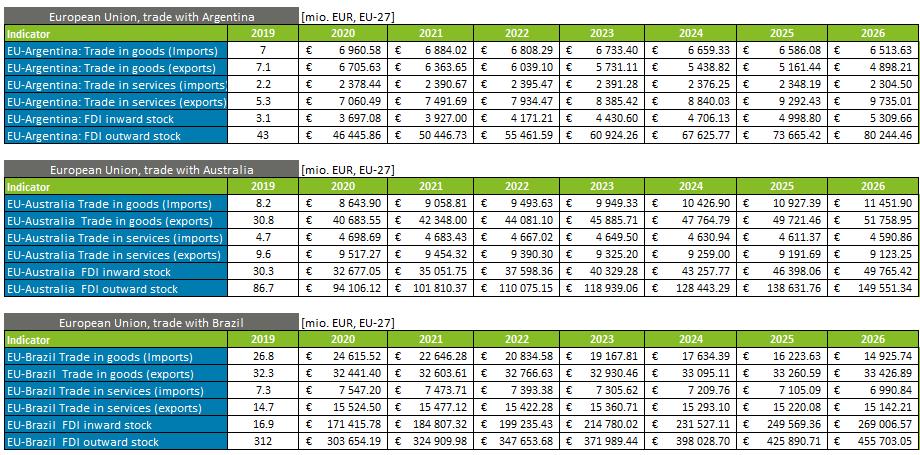

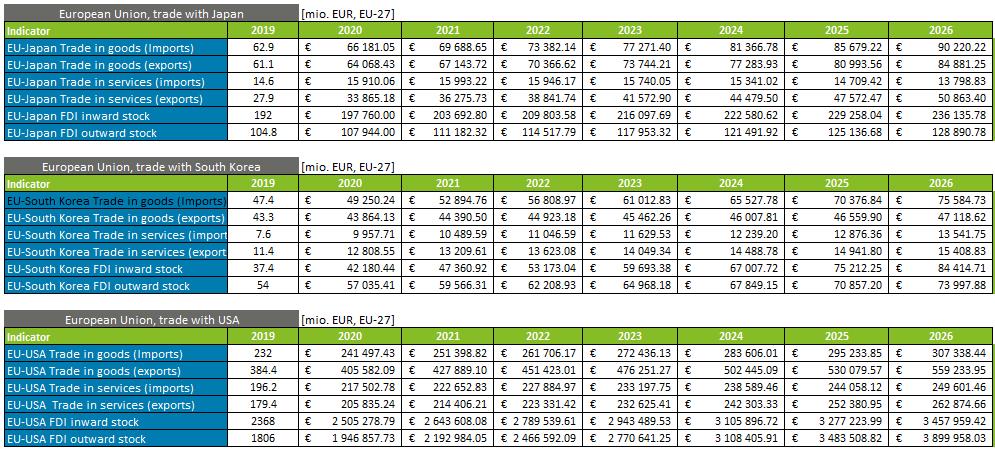
Table 18: Macroeconomic estimations for corrected baseline scenario for the years 2022-2026


b.Policy option 1a – accession without making any declarations
Table 19: Macroeconomic estimations for policy option 1a for the years 2022-2026


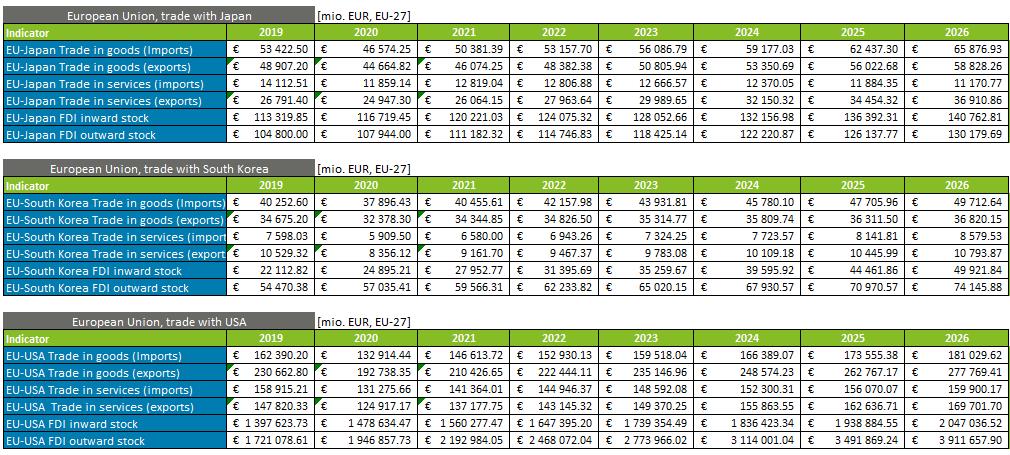
c.Policy option 1b – accession while making declaration(s) under Article 18
Table 20: Macroeconomic estimations for policy option 1b for the years 2022-2026


d.Policy option 1c – accession while making declaration under Article 19
Table 21: Macroeconomic estimations for policy option 1c for the years 2022-2026

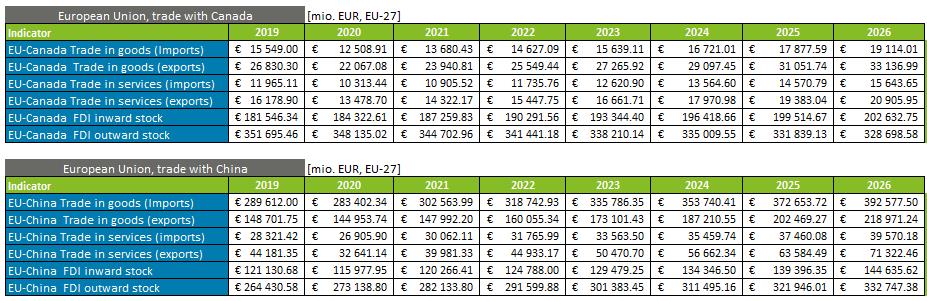

e.Policy option 1d – accession while making declaration under Articles 18 and 19
Table 22: Macroeconomic estimations for policy option 1d for the years 2022-2026


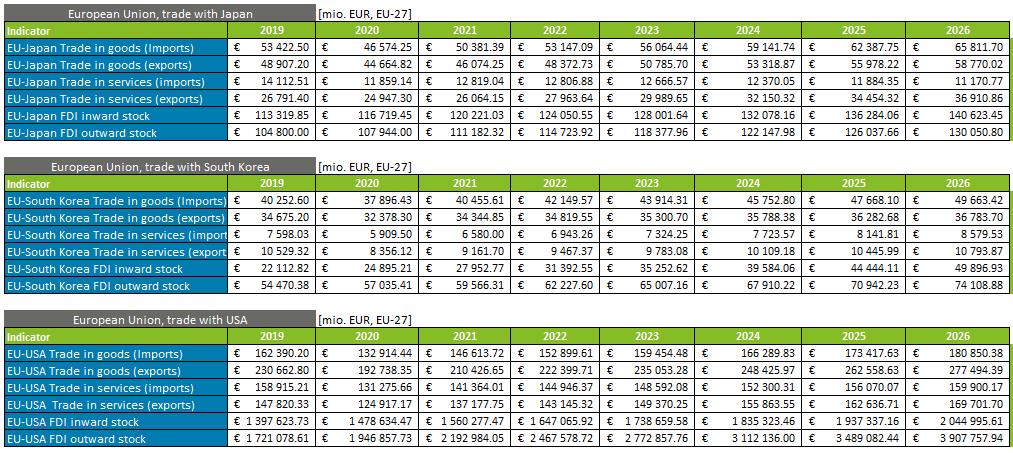
5.Overview of the total % increases in foreign trade and FDI under all policy options
Table 23: Total increases (in %) in 2026 as compared to the corrected baseline
Policy options, total % increase (2022-2026)
|
Policy option 1a
(no declaration)
|
AR
|
AU
|
BR
|
CA
|
CN
|
JP
|
KR
|
US
|
|
|
Goods
|
1.5
|
1.2.
|
1.5
|
1.5
|
1
|
1
|
1
|
1
|
|
|
Services
|
1.3
|
1.2
|
1.6
|
1.1
|
1.6
|
1
|
1
|
0.9
|
|
|
FDI
|
0.4
|
0.4
|
0.5
|
0.2
|
0.5
|
1
|
0.2
|
0.3
|
|
Policy option 1b (declaration under Article 18)
|
AR
|
AU
|
BR
|
CA
|
CN
|
JP
|
KR
|
US
|
|
|
Goods
|
1.4
|
1.1
|
1.4
|
1.4
|
0.9
|
0.9
|
0.9
|
0.9
|
|
|
Services
|
1.3
|
1.2
|
1.6
|
1.1
|
1.6
|
1
|
1
|
0.9
|
|
|
FDI
|
0.3
|
0.3
|
0.4
|
0.15
|
0.4
|
0.9
|
0.15
|
0.2
|
|
Policy option 1c (declaration under Article 19)
|
AR
|
AU
|
BR
|
CA
|
CN
|
JP
|
KR
|
US
|
|
|
Goods
|
1.2
|
1.2
|
1.2
|
1.5
|
0.7
|
1
|
1
|
1
|
|
|
Services
|
1.1
|
1.2
|
1.3
|
1.1
|
1.3
|
1
|
1
|
0.9
|
|
|
FDI
|
0.2
|
0.4
|
0.3
|
0.2
|
0.3
|
1
|
0.2
|
0.3
|
|
Policy option 1d (declaration under both Article 18 and 19)
|
AR
|
AU
|
BR
|
CA
|
CN
|
JP
|
KR
|
US
|
|
|
Goods
|
1.2
|
1.1
|
1.2
|
1.4
|
0.7
|
0.9
|
0.9
|
0.9
|
|
|
Services
|
1
|
1.2
|
1.3
|
1.1
|
1.3
|
1
|
1
|
0.9
|
|
|
FDI
|
0.2
|
0.3
|
0.3
|
0.15
|
0.3
|
0.9
|
0.15
|
0.2
|
Source: Study by an external contractor
6.Detailed quantitative estimation of baseline and policy options
a.Policy option 0: Corrected baseline
Table 24: Direct and indirect impacts of policy option 0 (corrected baseline)
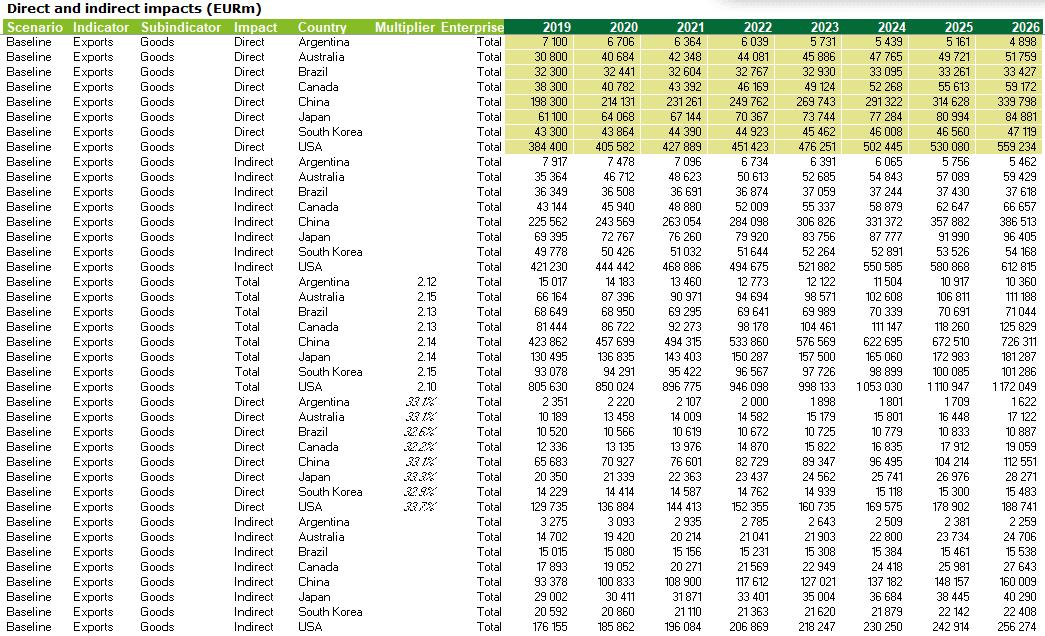
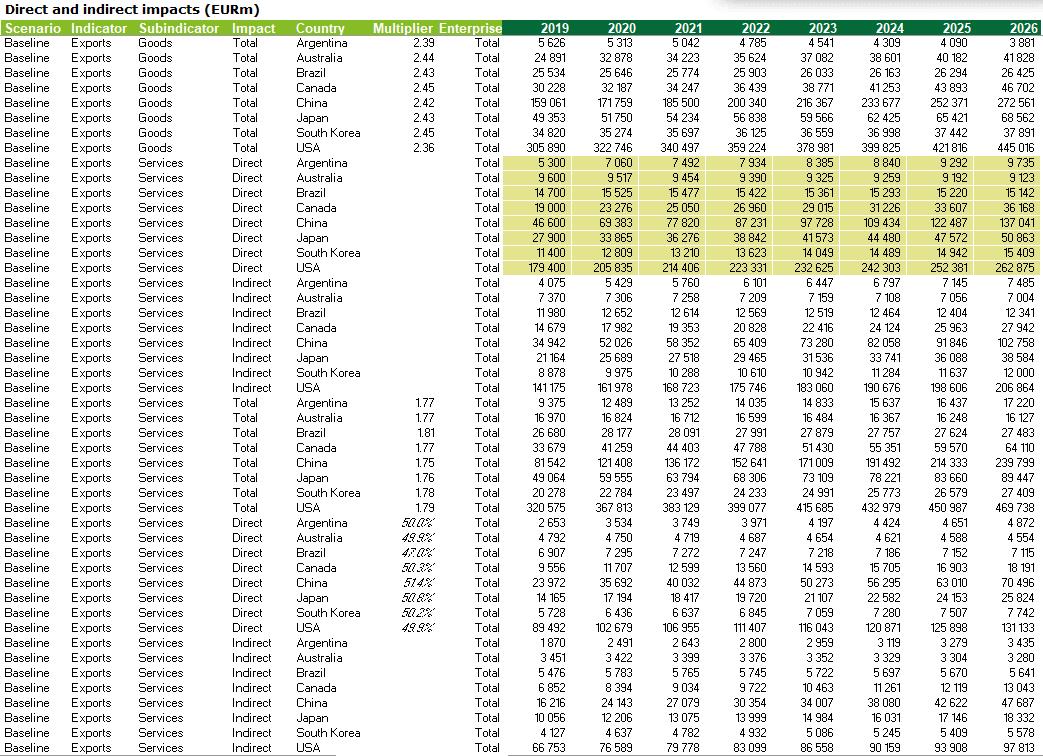

b.Policy option 1a: Accession without making any declaration
Table 25: Direct and indirect impacts of policy option 1a


c.Policy option 1b: Accession while making a declaration(s) under Article 18
Table 26: Direct and indirect impacts of policy option 1b


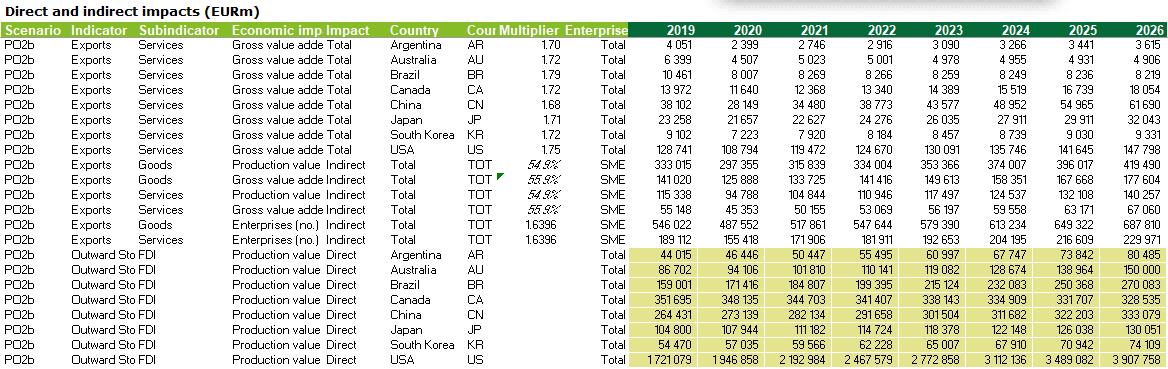
d.Policy option 1c: Accession while making a declaration under Article 19
Table 27: Direct and indirect impacts of policy option 1c
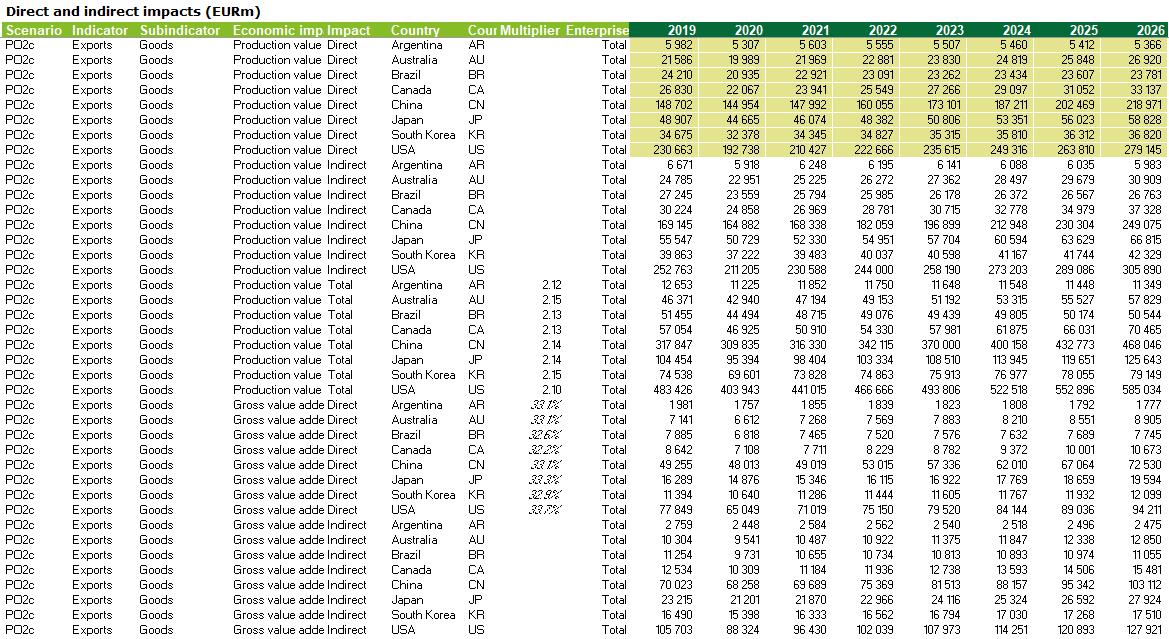


e.Policy option 1d: Accession while making a declarations under both Articles 18 and 19
Table 28: Direct and indirect impacts of policy option 1d
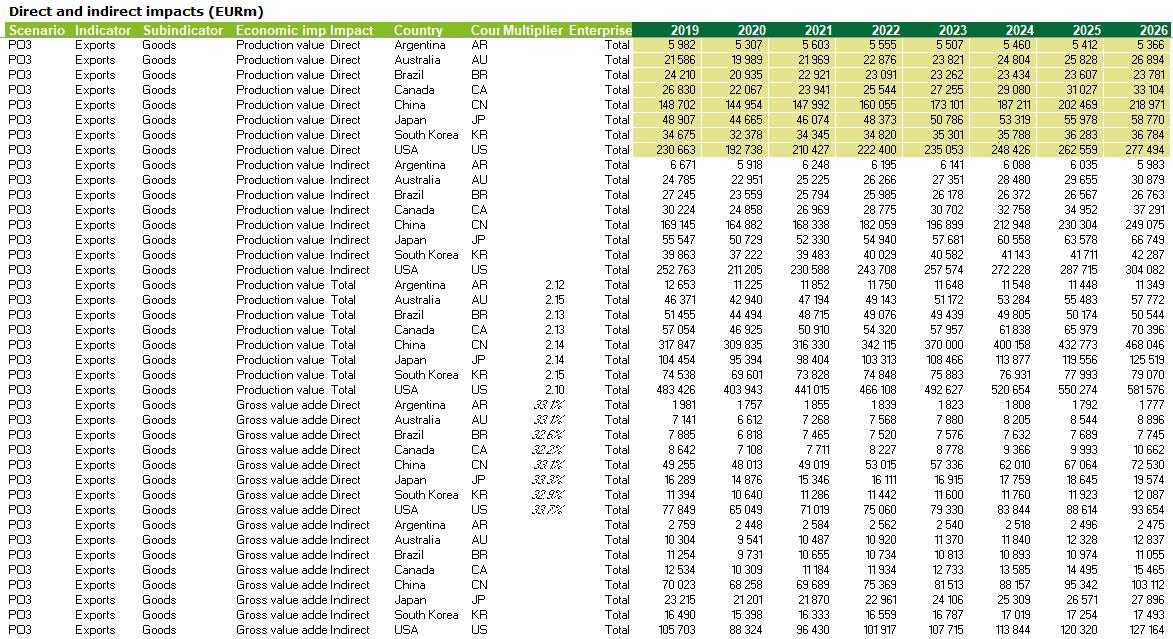


7.Quantitative estimates concerning the indirectly impacted businesses across the supply chain under the baseline scenario and each policy option
The sectoral and indirect impacts on companies and SMEs across the supply chain, which are affected indirectly by trade flows, were measured. In order to quantify these upstream effects (economic activities along the value chain), an Input-Output-Model was used. (see Annex 4 on analytical methods).
Table 29: Output and gross value-added multipliers for exports from the EU27 to selected third countries
It can be noticed that the output multipliers as well as the ratios of GVA per production value differ only slightly between the countries in focus but show differences between the export of goods and the exports of services.
a.Policy option 0 – baseline scenario – no accession to the Judgments Convention
The following table provides the corrected baseline estimations of the number of enterprises that will be affected indirectly in the baseline scenario. In 2026, 681 312 enterprises are estimated to be affected indirectly regarding EU export in goods and 227 457 enterprises will be affected regarding the EU export in services. These numbers increase by around 25% in the observation period (2022-2026). As compared to directly affected SMEs indirectly affected SMEs are expected to be affected – due to their potentially lower involvement in trade relations – to a lesser extent.
Table 30: Corrected baseline estimations of sectoral and indirect impacts on companies and SMEs

b.Policy option 1a – accession without making any declarations
Table 31: Estimation of sectoral and indirect impact on companies and SMEs under policy option 1a

c.Policy option 1b – accession while making declaration(s) under Article 18
Table 32: Estimation of sectoral and indirect impact on companies and SMEs under policy option 1b

d.Policy option 1c – accession while making declaration under Article 19
Table 33: Estimation of sectoral and indirect impact on companies and SMEs under policy option 1c

e.Policy option 1d – accession while making declarations under both Article 18 and 19
Table 34: Estimation of sectoral and indirect impact on companies and SMEs under policy option 1b

8.Estimated number of civil and commercial judgments
The estimations below are based on:
·For the estimated increase by 2026 under the baseline scenario: estimated number of yearly cases in 2020 times the yearly forecasted growth in trade in goods until 2026 in the baseline scenario;
·For the estimated change by 2026 vs. baseline:
oPolicy option 1a: estimated number of yearly cases in 2020 times the yearly forecasted growth in trade in goods until 2026 in policy option 1a;
o Policy option 1b: estimated number of yearly cases in 2020 times the yearly forecasted growth in trade in goods until 2026 in policy option 1b, with a correction of an assumed -5% applied overall to account for cases falling outside of the scope of the Convention due to Article 18 declarations;
o Policy option 1c: estimated number of yearly cases in 2020 times the yearly forecasted growth in trade in goods until 2026 in policy option 1c, with a correction of an assumed -5% applied for Argentina and Brazil and -10% for China to account for cases falling outside of the scope of the Convention due to Article 18 declarations;
oPolicy option 1d: estimated number of yearly cases in 2020 times the yearly forecasted growth in trade in goods until 2026 in policy option 1d, with the combined corrections applied for policy options 1b and 1c.
Table 35: Estimated number of yearly cases in 2020 and increase by 2026 under the different policy options
|
|
Est. number of current yearly cases (2020)
|
Est. increase by 2026 under baseline scenario
|
Est. change by 2026 vs. baseline under given policy option
|
|
|
|
Policy option 0
|
Policy option 1a
|
Policy option 1b
|
Policy option 1c
|
Policy option 1d
|
|
Foreign judgments in EU
|
2 000
(770 originating from the countries below)
|
+179
(originating from the countries below)
|
+47
(originating from the countries below)
|
+35
(originating from the countries below)
|
+40
(originating from the countries below)
|
+30
(originating from the countries below)
|
|
European judgments in third countries
|
Australia
|
20
|
-3
|
+2
|
+1
|
+1
|
+1
|
|
|
Argentina
|
10
|
+3
|
+1
|
-
|
+1
|
-
|
|
|
Brazil
|
14
|
+2
|
+1
|
+1
|
+1
|
+1
|
|
|
Canada
|
11
|
+4
|
+1
|
+1
|
+1
|
+1
|
|
|
China
|
13
|
+5
|
+1
|
-
|
-
|
-
|
|
|
Japan
|
17
|
+5
|
+1
|
+1
|
+1
|
+1
|
|
|
South Korea
|
11
|
+1
|
+1
|
-
|
+1
|
-
|
|
|
USA
|
60
|
+22
|
+3
|
+2
|
+3
|
+2
|
9.Impact of the Convention on the legal environment of the Member States
Table 36: Impact of the Convention on the legal environment of the Member States
|
|
|
EU Member States - Grounds for recognition and enforcement / refusals of foreign judgments provided under national law (Yes or No)
|
|
|
|
|
|
|
|
AT
|
BE
|
BG
|
CY
|
CZ
|
DE
|
EE
|
EL
|
ES
|
FI
|
FR
|
HR
|
HU
|
IE
|
IT
|
LT
|
LU
|
LV
|
MT
|
NL
|
PL
|
PT
|
RO
|
SE
|
SI
|
SK
|
|
Criteria
|
Grounds for recognition and enforcement under the Judgments Convention (Article 5): - Number of No
A judgment is eligible for recognition and enforcement if one of the following requirements is met:
|
15
|
15
|
4
|
8
|
15
|
15
|
5
|
8
|
15
|
15
|
6
|
13
|
3
|
13
|
5
|
15
|
15
|
3
|
7
|
3
|
15
|
0
|
15
|
15
|
15
|
14
|
|
|
(1.(a) the person against whom recognition or enforcement is sought was habitually resident in the State of origin at the time that person became a party to the proceedings in the court of origin;
|
No
|
No
|
Yes
|
Yes
|
No
|
No
|
Yes
|
Yes
|
No
|
No
|
Yes
|
Yes
|
Yes
|
No
|
Yes
|
No
|
No
|
Yes
|
Yes
|
Yes
|
No
|
Yes
|
No
|
No
|
No
|
No
|
|
|
(1.(b) the natural person against whom recognition or enforcement is sought had their principal place of business in the State of origin at the time that person became a party to the proceedings in the court of origin and the claim on which the judgment is based arose out of the activities of that business;
|
No
|
No
|
Yes
|
Yes
|
No
|
No
|
Yes
|
No
|
No
|
No
|
Yes
|
No
|
Yes
|
No
|
Yes
|
No
|
No
|
No
|
Yes
|
Yes
|
No
|
Yes
|
No
|
No
|
No
|
No
|
|
|
(1.(c) the person against whom recognition or enforcement is sought is the person that brought the claim, other than a counterclaim, on which the judgment is based;
|
No
|
No
|
No
|
No
|
No
|
No
|
No
|
No
|
No
|
No
|
No
|
No
|
No
|
No
|
No
|
No
|
No
|
Yes
|
No
|
No
|
No
|
Yes
|
No
|
No
|
No
|
No
|
|
|
(1.(d) the defendant maintained a branch, agency, or other establishment without separate legal personality in the State of origin at the time that person became a party to the proceedings in the court of origin, and the claim on which the judgment is based arose out of the activities of that branch, agency, or establishment;
|
No
|
No
|
Yes
|
No
|
No
|
No
|
No
|
No
|
No
|
No
|
Yes
|
Yes
|
Yes
|
No
|
Yes
|
No
|
No
|
Yes
|
No
|
Yes
|
No
|
Yes
|
No
|
No
|
No
|
No
|
|
|
(1.(e) the defendant expressly consented to the jurisdiction of the court of origin in the course of the proceedings in which the judgment was given.
|
No
|
No
|
Yes
|
Yes
|
No
|
No
|
No
|
Yes
|
No
|
No
|
No
|
No
|
No
|
Yes
|
Yes
|
No
|
No
|
No
|
Yes
|
Yes
|
No
|
Yes
|
No
|
No
|
No
|
No
|
|
|
(1.(f) the defendant argued on the merits before the court of origin without contesting jurisdiction within the timeframe provided in the law of the State of origin, unless it is evident that an objection to jurisdiction or to the exercise of jurisdiction would not have succeeded under that law;
|
No
|
No
|
Yes
|
Yes
|
No
|
No
|
No
|
Yes
|
No
|
No
|
No
|
No
|
Yes
|
Yes
|
Yes
|
No
|
No
|
Yes
|
Yes
|
Yes
|
No
|
Yes
|
No
|
No
|
No
|
No
|
|
|
(1.(g) the judgment ruled on a contractual obligation and it was given by a court of the State in which performance of that obligation took place, or should have taken place, in accordance with
(i) the agreement of the parties, or
(ii) the law applicable to the contract, in the absence of an agreed place of performance,
unless the activities of the defendant in relation to the transaction clearly did not constitute a purposeful and substantial connection to that State;
|
No
|
No
|
Yes
|
Yes
|
No
|
No
|
Yes
|
Yes
|
No
|
No
|
Yes
|
No
|
Yes
|
No
|
Yes
|
No
|
No
|
No
|
Yes
|
Yes
|
No
|
Yes
|
No
|
No
|
No
|
No
|
|
|
(1.(h) the judgment ruled on a lease of immovable property (tenancy) and it was given by a court of the State in which the property is situated;
|
No
|
No
|
No
|
No
|
No
|
No
|
Yes
|
Yes
|
No
|
No
|
Yes
|
No
|
Yes
|
No
|
Yes
|
No
|
No
|
Yes
|
Yes
|
Yes
|
No
|
Yes
|
No
|
No
|
No
|
No
|
|
|
(1.(i) the judgment ruled against the defendant on a contractual obligation secured by a right in rem in immovable property located in the State of origin, if the contractual claim was brought together with a claim against the same defendant relating to that right in rem;
|
No
|
No
|
Yes
|
Yes
|
No
|
No
|
Yes
|
No
|
No
|
No
|
Yes
|
No
|
Yes
|
No
|
Yes
|
No
|
No
|
Yes
|
No
|
No
|
No
|
Yes
|
No
|
No
|
No
|
No
|
|
|
(1.(j) the judgment ruled on a non-contractual obligation arising from death, physical injury, damage to or loss of tangible property, and the act or omission directly causing such harm occurred in the State of origin, irrespective of where that harm occurred;
|
No
|
No
|
Yes
|
No
|
No
|
No
|
Yes
|
No
|
No
|
No
|
Yes
|
No
|
Yes
|
No
|
Yes
|
No
|
No
|
Yes
|
No
|
Yes
|
No
|
Yes
|
No
|
No
|
No
|
No
|
|
|
(1.(k) the judgment concerns the validity, construction, effects, administration or variation of a trust created voluntarily
|
No
|
No
|
No
|
No
|
No
|
No
|
No
|
No
|
No
|
No
|
No
|
No
|
No
|
No
|
No
|
No
|
No
|
Yes
|
No
|
Yes
|
No
|
Yes
|
No
|
No
|
No
|
No
|
|
|
(1.(l) the judgment ruled on a counterclaim –
|
No
|
No
|
Yes
|
No
|
No
|
No
|
Yes
|
No
|
No
|
No
|
No
|
No
|
Yes
|
No
|
No
|
No
|
No
|
Yes
|
No
|
No
|
No
|
Yes
|
No
|
No
|
No
|
No
|
|
|
(1.(m) the judgment was given by a court designated in an agreement concluded or documented in writing or by any other means of communication which renders information accessible so as to be usable for subsequent reference, other than an exclusive choice of court agreement.
|
No
|
No
|
Yes
|
No
|
No
|
No
|
Yes
|
No
|
No
|
No
|
No
|
No
|
Yes
|
No
|
No
|
No
|
No
|
Yes
|
No
|
Yes
|
No
|
Yes
|
No
|
No
|
No
|
Yes
|
|
|
3.the judgment ruled on a residential lease of immovable property (tenancy) and given by a court of the State where the property is situated.
|
No
|
No
|
No
|
No
|
No
|
No
|
Yes
|
Yes
|
No
|
No
|
Yes
|
No
|
Yes
|
No
|
Yes
|
No
|
No
|
Yes
|
Yes
|
Yes
|
No
|
Yes
|
No
|
No
|
No
|
No
|
|
|
3.the judgment ruled on the registration of immovable property and given by a court of the State where the property is situated.
|
No
|
No
|
Yes
|
Yes
|
No
|
No
|
Yes
|
Yes
|
No
|
No
|
Yes
|
No
|
Yes
|
No
|
No
|
No
|
No
|
Yes
|
Yes
|
|
No
|
Yes
|
No
|
No
|
No
|
No
|
|
|
Exclusive ground of recognition and enforcement under the Judgments Convention (Article 6) - Number of No
|
1
|
1
|
0
|
0
|
1
|
1
|
1
|
0
|
1
|
1
|
0
|
1
|
0
|
1
|
0
|
1
|
1
|
0
|
1
|
0
|
1
|
0
|
1
|
1
|
0
|
1
|
|
|
a judgment ruled on rights in rem in immovable property shall be recognised and enforced if and only if the property is situated in the State of origin. "
|
No
|
No
|
Yes
|
Yes
|
No
|
No
|
No
|
Yes
|
No
|
No
|
Yes
|
No
|
Yes
|
No
|
Yes
|
No
|
No
|
Yes
|
No
|
|
No
|
Yes
|
No
|
No
|
Yes
|
No
|
|
|
Grounds of refusal of the Judgments Convention (Article 7): - Number of No
Recognition or enforcement may be refused if:
|
6
|
5
|
2
|
7
|
3
|
4
|
7
|
7
|
3
|
9
|
4
|
3
|
2
|
2
|
8
|
4
|
3
|
8
|
4
|
1
|
8
|
0
|
6
|
9
|
4
|
4
|
|
|
7.1.(a) the document which instituted the proceedings or an equivalent document, including a statement of the essential elements of the claim
(i) was not notified to the defendant in sufficient time and in such a way as to enable them to arrange for their defence, unless the defendant entered an appearance and presented their case without contesting notification in the court of origin, provided that the law of the State of origin permitted notification to be contested;
|
Yes
|
No
|
Yes
|
No
|
Yes
|
Yes
|
No
|
No
|
Yes
|
No
|
Yes
|
Yes
|
Yes
|
Yes
|
No
|
Yes
|
Yes
|
No
|
Yes
|
Yes
|
Yes
|
Yes
|
No
|
No
|
Yes
|
Yes
|
|
|
7.1. (a) the document which instituted the proceedings or an equivalent document, including a statement of the essential elements of the claim:
(ii) was notified to the defendant in the requested State in a manner that is incompatible with fundamental principles of the requested State concerning service of documents;
|
Yes
|
No
|
Yes
|
No
|
Yes
|
Yes
|
No
|
No
|
Yes
|
No
|
Yes
|
Yes
|
Yes
|
Yes
|
No
|
Yes
|
Yes
|
No
|
No
|
Yes
|
No
|
Yes
|
No
|
No
|
Yes
|
Yes
|
|
|
7.1. (b) the judgment was obtained by fraud.
|
No
|
Yes
|
No
|
Yes
|
Yes
|
No
|
No
|
No
|
No
|
No
|
Yes
|
Yes
|
No
|
Yes
|
No
|
No
|
Yes
|
No
|
Yes
|
Yes
|
No
|
Yes
|
No
|
No
|
No
|
No
|
|
|
7.1. (c) recognition or enforcement would be manifestly incompatible with the public policy of the requested State, including situations where the specific proceedings leading to the judgment were incompatible with fundamental principles of procedural fairness of that State and situations involving infringements of security or sovereignty of that State;
|
Yes
|
Yes
|
Yes
|
Yes
|
Yes
|
Yes
|
No
|
Yes
|
Yes
|
No
|
Yes
|
Yes
|
Yes
|
Yes
|
Yes
|
Yes
|
Yes
|
No
|
Yes
|
Yes
|
No
|
Yes
|
Yes
|
No
|
Yes
|
Yes
|
|
|
7.1. (d) the proceedings in the court of origin were contrary to an agreement, or a designation in a trust instrument, under which the dispute in question was to be determined in a court of a State other than the State of origin.
|
No
|
No
|
Yes
|
No
|
No
|
No
|
No
|
No
|
No
|
No
|
No
|
No
|
No
|
No
|
No
|
Yes
|
No
|
No
|
No
|
|
No
|
Yes
|
No
|
No
|
No
|
No
|
|
|
7.1. (e) the judgment is inconsistent with a judgment given by a court of the requested State in a dispute between the same parties;
|
No
|
Yes
|
Yes
|
No
|
Yes
|
No
|
Yes
|
Yes
|
Yes
|
No
|
No
|
Yes
|
Yes
|
Yes
|
No
|
Yes
|
Yes
|
No
|
Yes
|
Yes
|
No
|
Yes
|
Yes
|
No
|
Yes
|
Yes
|
|
|
7.1. (f) the judgment is inconsistent with an earlier judgment given by a court of another State between the same parties on the same subject matter, provided that the earlier judgment fulfils the conditions necessary for its recognition in the requested State.
|
No
|
Yes
|
No
|
No
|
No
|
Yes
|
Yes
|
No
|
Yes
|
No
|
No
|
No
|
Yes
|
Yes
|
No
|
No
|
Yes
|
Yes
|
Yes
|
No
|
No
|
Yes
|
Yes
|
No
|
No
|
Yes
|
|
|
7.2. Recognition or enforcement may be postponed or refused if proceedings between the same parties on the same subject matter are pending before a court of the requested State, where:
(a) the court of the requested State was seised before the court of origin; and
(b) there is a close connection between the dispute and the requested State.
|
No
|
No
|
Yes
|
No
|
Yes
|
Yes
|
No
|
No
|
Yes
|
No
|
No
|
Yes
|
Yes
|
Yes
|
No
|
No
|
No
|
No
|
No
|
Yes
|
No
|
Yes
|
No
|
No
|
Yes
|
No
|
|
|
10.1. Recognition or enforcement of a judgment may be refused if, and to the extent that, the judgment awards damages, including exemplary or punitive damages, that do not compensate a party for actual loss or harm suffered.
|
No
|
No
|
Yes
|
No
|
No
|
No
|
No
|
No
|
No
|
No
|
Yes
|
No
|
Yes
|
No
|
No
|
No
|
No
|
No
|
No
|
Yes
|
No
|
Yes
|
No
|
No
|
No
|
No
|
|
Score and groupe attribution
|
22
|
21
|
6
|
15
|
19
|
20
|
13
|
15
|
19
|
25
|
10
|
17
|
5
|
16
|
13
|
20
|
19
|
11
|
12
|
4
|
24
|
0
|
22
|
25
|
19
|
19
|
|
|
C
|
C
|
A
|
B
|
C
|
C
|
B
|
B
|
C
|
C
|
B
|
C
|
A
|
B
|
B
|
C
|
C
|
B
|
B
|
A
|
C
|
A
|
C
|
C
|
C
|
C
|
|
|
|
|
|
|
|
|
|
|
|
|
|
|
|
|
|
|
|
|
|
|
|
|
|
|
|
|
|
N° of No's
|
Group
|
|
|
|
|
|
|
|
|
|
|
|
|
|
|
|
|
|
|
|
|
|
|
|
|
|
|
|
0 - 8
|
Group A
|
Liberal approach to Foreign Judgments
|
|
9 - 16
|
Group B
|
Less liberal approach to Foreign Judgments
|
|
17 - 25
|
Group C
|
Restrictive approach to Foreign Judgments
|
Table 37: Overview of the Member States’ national systems for the recognition and enforcement of foreign judgments (based on grounds for recognition and enforcement of foreign judgments and grounds for refusal provided under national law)
|
Liberal approach to foreign judgments
(Little to no improvement in the acceptance of third-country judgments under the Convention as compared to national law)
|
Less liberal approach to foreign judgments
(Moderate impact of the Convention on the acceptance of third-country judgments as compared to national law)
|
Restrictive approach to foreign judgments
(Considerable increase in acceptance of third-country judgments under the Convention as compared to national law)
|
|
Bulgaria
|
Cyprus
|
Austria
|
|
Hungary
|
Estonia
|
Belgium
|
|
Netherlands
|
Greece
|
Czech Republic
|
|
Portugal
|
France
|
Germany
|
|
|
Ireland
|
Spain
|
|
|
Italy
|
Finland
|
|
|
Latvia
|
Croatia
|
|
|
Malta
|
Lithuania
|
|
|
|
Luxembourg
|
|
|
|
Poland
|
|
|
|
Romania
|
|
|
|
Sweden
|
|
|
|
Slovenia
|
|
|
|
Slovakia
|
10.Estimates of the average cost and length of procedure
The following tables provide the detailed estimates of the average cost and the average length of the procedure of enforcement of foreign judgments.
Table 38: European judgments in selected third countries
|
Country
|
Estimated number of cases for procedure of enforcement of foreign judgments per year
|
Cost and expenses that a claimant expect in this recognition and enforcement procedure?
(Court fees involving foreign judgments)
|
What is the average length of time for procedure of enforcement of foreign judgments? (Average duration of recognition and enforcement procedure involving foreign judgments)
|
|
|
|
|
Uncontested case
|
Contested case
|
|
Australia
|
20
|
Filling fees: 600 – 800 EUR for individual
1800 – 2400 EUR for corporations
|
Need application registration: 2-4 weeks, then several months
|
More than a year
|
|
Argentina
|
10
|
3% of the value of claim
|
N/A
|
N/A
|
|
Brazil
|
14
|
Equivalent of 30 EUR
|
Ratification: 1 year
Enforcement: 1 year
|
Ratification: 2 or more
Enforcement 2 or more
|
|
Canada
|
11
|
N/A
|
N/A
|
N/A
|
|
China
|
13
|
Approx. 20 EUR
|
6 months
|
One year to two
|
|
Japan
|
17
|
The amount of which is determined based on the amount of claim sought
|
N/A
|
N/A
|
|
South Korea
|
11
|
0,5% of the value of claim
|
4-6 months
|
A year or more
|
|
USA
|
60
|
Hundreds of EUR
|
2-6 months
|
6 months to 2 years
|
Source: Quantitative estimates based on interviews with national legal experts and the
Multilaw Enforcement of Foreign Judgments Project
.
Table 39: Third-country judgments in the EU
|
Country
|
Cost and expenses can a claimant expect in this recognition and enforcement procedure?
(Court fees involving third-country judgments)
|
What is the average length of time for procedure of litigious civil and commercial cases involving foreign judgments? (Average duration of recognition and enforcement procedure involving third-country judgments)
|
|
|
|
Uncontested case
|
Contested case
|
|
Austria
|
The application for the declaration of enforceability/ recognition does not trigger any court fees.
|
3 months
|
Up to 6 months
|
|
Belgium
|
20 EUR
|
4 months or more
|
More than 1 year
|
|
Bulgaria
|
25,56 EUR
|
6 months or more
|
More than 1 year
|
|
Croatia
|
General fees are applicable. No specific fees are required for the recognition and enforcement of a foreign judgment.
|
N/A
|
N/A
|
|
Cyprus
|
The court fees depend on the value of the claim.
|
Up to 3 months
|
Up to 6 months
|
|
Czech Republic
|
- In case of a judicial enforcement, a court fee amounting to approx. 5% of the claim value is charged.
|
N/A
|
N/A
|
|
Estonia
|
N/A
|
N/A
|
N/A
|
|
Finland
|
N/A
|
N/A
|
N/A
|
|
France
|
There is no specific provision regarding the fees payable for recognition and enforcement.
|
6 months
|
Two years
|
|
Germany
|
The court fees depend on the value of the claim are calculated in accordance with the Court Expenses Act.
|
N/A
|
N/A
|
|
Greece
|
Application for recognition and enforcement: 130 EUR
Appearance of the attorney before court: 126 EUR
Submission of required legal arguments: 150 EUR
The above prices include the minor fees and 24% VAT charged by the state. Amount to 300 EUR
|
Enforcement order to be issued in 6 months
Enforcement procedure to be concluded: Additional 2 months to a year
|
N/A
|
|
Hungary
|
Stamp duties range of 1% to 3% of the value of the claim
There is no specific fee for recognition and enforcement.
|
6 months
|
12-18 months
|
|
Ireland
|
NA
|
Weeks
|
months
|
|
Italy
|
No specific fees are required for the recognition and enforcement of a foreign judgment.
|
4 months
|
10 months
|
|
Latvia
|
30 EUR
|
N/A
|
N/A
|
|
Lithuania
|
There is no specific fees payable for recognition and enforcement.
|
N/A
|
N/A
|
|
Luxembourg
|
The fees payable in general are administrative fees
|
Three weeks to 6 months
|
Up to 1 year
|
|
Malta
|
These costs will vary according to what is being requested and depending on the amount which is claimed.
|
N/A
|
N/A
|
|
The Netherlands
|
Vary according to the value of the claim
|
One year and a half
|
Up to 3 years
|
|
Poland
|
- fee for determination of recognition or non-recognition: approx. 67 EUR
- fee for declaration of enforceability: approx. 67 EUR
- fee for an appeal against a ruling on any of these applications approx. 22 EUR
- Fee for cassation approx. 22 EUR
|
One year on average
|
1-2 years
|
|
Portugal
|
Vary according to the value of the claim
|
More than two months
|
Over a year
|
|
Romania
|
Yes, the applicant will have to pay the stamp duty
|
One year
|
Two years
|
|
Slovakia
|
66 EUR
|
3 – 9 months
|
9 to 15 months
|
|
Slovenia
|
N/A
|
N/A
|
N/A
|
|
Spain
|
Pursuant to Article 18 LCJI (para 1), the costs related to the processing of requests for recognition and enforcement will be paid, where applicable, by the applicant. The rules do not mention specific fees
|
4 months
|
9 months
|
|
Sweden
|
30 – 60 EUR
|
2 months
|
4 or more months
|
Source: Quantitative estimates based on interviews with national legal experts,
Multilaw Enforcement of Foreign Judgments Project
and National Reports.
Illustration: Two examples of what some of these costs of proceedings can amount to are shown in the below tables.
Table 40: Illustration of possible fees in The Netherlands
|
The Netherlands
|
|
|
Court fees
|
From 79 EUR to 3 946 EUR
|
|
Bailiff fee
|
98.01 EUR
|
|
Lawyer fees (hourly rates)
|
From 100 EUR to 400 EUR
|
Table 41: Illustration of possible fees in Australia
|
Australia
|
|
|
Professional costs
|
Max. 540 EUR
|
|
Court fees
|
Individual: 680 EUR
|
Business: min. 1 900 EUR
|
|
Filling fees
|
Individual: 860 EUR
|
Business: min. 2 500 EUR
|
|
Hearing fees
|
Individual: 400 EUR
|
Business: 1 000 EUR
|
|
Lawyer fees (hourly rates)
|
From 125 EUR to 370 EUR
|
Imagining a case on which an average lawyer spends 80 hours, such a case could amount to more than 24 040 EUR in The Netherlands, whereas in Australia it would amount to more than 25 740 EUR for businesses. A majority of interviewees indicated that for larger businesses, these amounts would run up to hundreds of thousands of euros.
11.Estimated spending and savings on cases
The overall cost of proceedings related to the recognition and enforcement of third-country judgments in the EU and European judgments in the selected third countries were calculated based on two main elements:
·The estimated cost of proceedings, based on three main cost elements:
oCourt fees;
oLawyer fees;
oOther fees.
·The estimated number of cases (see
Table 35: Estimated number of yearly cases in 2020 and increase by 2026 under the different policy options
)
For the cost of proceedings, the court fees were based on data collected for the purpose of this study (see section 6 of this Annex). The lawyer fees were based on previous studies for EU countries and desk research for selected third countries based on an assumed 80 hours of lawyer’s work for an average case. For other fees a flat average was taken based on previous impact assessments. For cases related to the recognition and enforcement of third-country judgments in the EU, an EU-wide average was taken of these elements.
These fee elements are shown below.
Table 42: Estimated fees per EU Member State (in EUR)
|
Member State
|
Lawyer fee (hourly)
|
Court fees
|
Other fees
|
|
Austria
|
377,06
|
No data
|
850
|
|
Belgium
|
220,47
|
20
|
850
|
|
Bulgaria
|
31,45
|
25,56
|
850
|
|
Croatia
|
212,06
|
No data
|
850
|
|
Cyprus
|
199,20
|
No data
|
850
|
|
Czechia
|
90,57
|
No data
|
850
|
|
Estonia
|
252,36
|
No data
|
850
|
|
Finland
|
366,71
|
No data
|
850
|
|
France
|
354,03
|
No data
|
850
|
|
Germany
|
357,25
|
No data
|
850
|
|
Greece
|
199,35
|
406
|
850
|
|
Hungary
|
252,19
|
No data
|
850
|
|
Ireland
|
446,68
|
No data
|
850
|
|
Italy
|
503,16
|
No data
|
850
|
|
Latvia
|
411,02
|
30
|
850
|
|
Lithuania
|
103,59
|
No data
|
850
|
|
Luxembourg
|
216,99
|
No data
|
850
|
|
Malta
|
30,69
|
No data
|
850
|
|
The Netherlands
|
354,75
|
No data
|
850
|
|
Poland
|
92,74
|
134
|
850
|
|
Portugal
|
202,17
|
No data
|
850
|
|
Romania
|
113,08
|
No data
|
850
|
|
Slovakia
|
90,98
|
66
|
850
|
|
Slovenia
|
212,49
|
No data
|
850
|
|
Spain
|
354,52
|
No data
|
850
|
|
Sweden
|
377,87
|
45
|
850
|
|
Average:
|
247,00
|
103,79
|
850
|
Table 43: Estimated fees per key third country (in EUR)
|
Key third country
|
Lawyer fee (hourly)
|
Court fees
|
Other fees
|
|
Australia
|
312,00
|
1.500,00
|
850,00
|
|
Argentina
|
82,00
|
No data
|
850,00
|
|
Brazil
|
48,00
|
30,00
|
850,00
|
|
Canada
|
193,00
|
No data
|
850,00
|
|
China
|
246,00
|
20,00
|
850,00
|
|
Japan
|
80,00
|
No data
|
850,00
|
|
South Korea
|
375,00
|
No data
|
850,00
|
|
USA
|
205,00
|
500,00
|
850,00
|
The estimated total spending is based on the average cost of proceedings times the number of cases in a given year under a given policy option. In the minimum scenario, a decrease in cost of proceedings of 10% is applied for those cases falling under the scope of the Convention, whereas under the maximum scenario a decrease in cost of proceedings of 20% is applied for those cases falling under the scope of the Convention.
For 2021, no decrease is applied.
Estimated spending in the minimum scenario
Table 44: Estimated spending (minimum scenario) by businesses and citizens on proceedings related to the recognition and enforcement of third-country judgments (originating in the selected third countries) in the EU and European judgments in the selected third countries under the different policy options
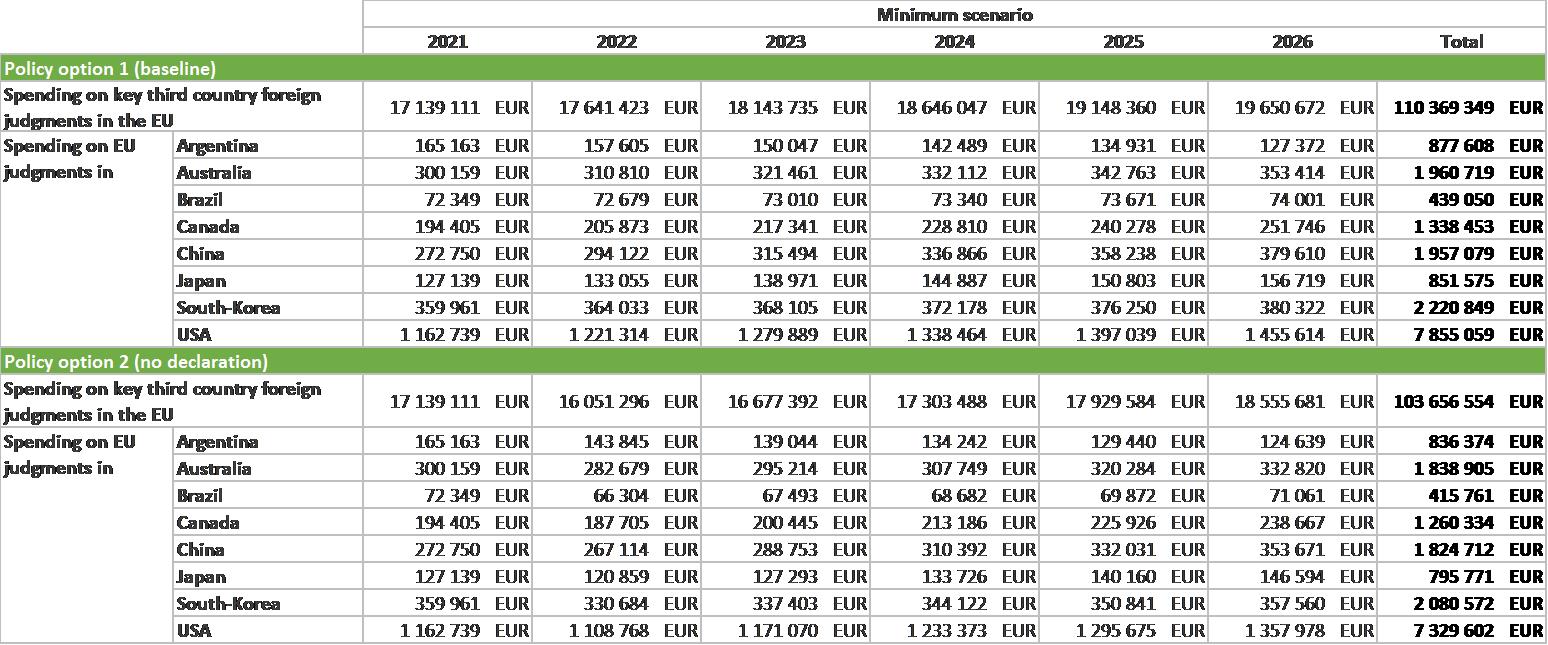
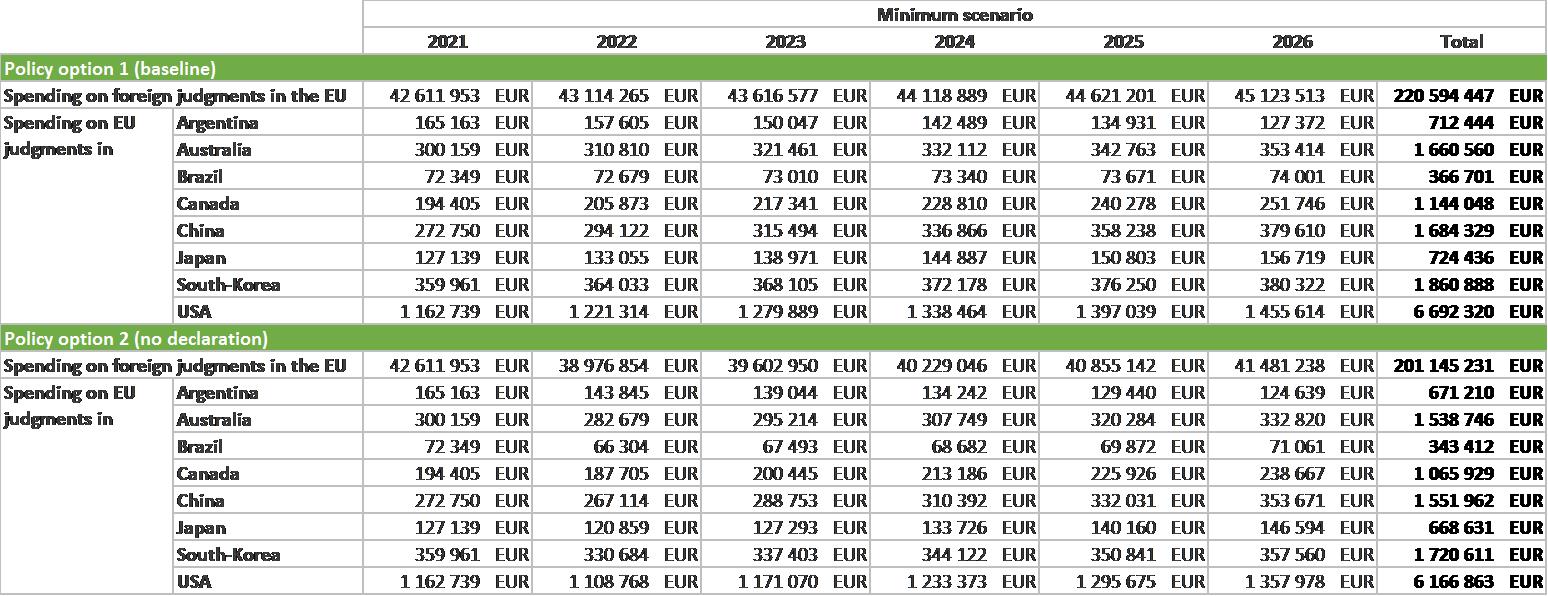

Estimated spending in the maximum scenario
Table 45: Estimated spending (maximum scenario) by businesses and citizens on proceedings related to the recognition and enforcement of third-country judgments (originating in the selected third countries) in the EU and European judgments in the selected third countries under the different policy options
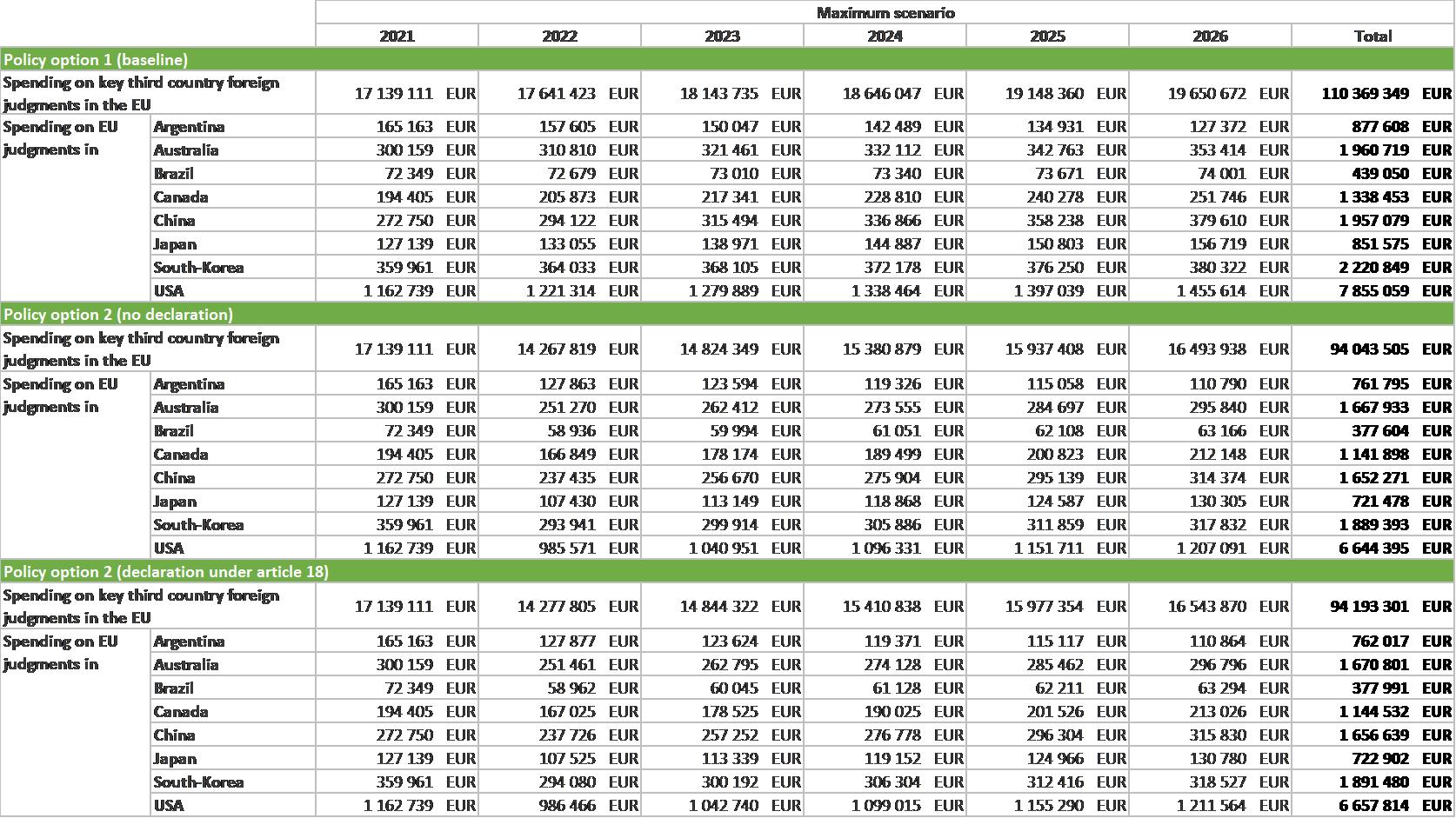

Estimated savings
Table 46: Estimated savings on proceedings (minimum and maximum scenario) related to the recognition and enforcement of third-country judgments in the EU (originating in the selected third countries) and European judgments in the selected third countries as compared to the baseline under the policy options

Upper and lower values of savings due to decrease in costs
·Policy option 1a
Table 47: Upper and lower values of savings due to decrease in costs in the EU and key third countries under policy option 1a for the entire reference period (2022-2026)

·Policy option 1b
Table 48: Upper and lower values of savings due to decrease in costs in the EU and key third countries under policy option 1b for the entire reference period (2022 – 2026)

Table 49: Difference in upper and lower value savings due to decrease in costs in the EU and key third countries under policy option 1b compared to policy option 2a over the entire reference period (2022 – 2026)

·Policy option 1c
Table 50: Upper and lower values of savings due to decrease in costs in the EU and key third countries under policy option 1c for the entire reference period (2022 – 2026)

Table 51: Difference in upper and lower value savings due to decrease in costs in the EU and key third countries under policy option 1c compared to policy option 2a over the entire reference period (2022 - 2026)

·Policy option 1d
Table 52: Upper and lower values of savings due to decrease in costs in the EU and key third countries under policy option 1d for the entire reference period (2022 – 2026)

Table 53: Difference in upper and lower value savings due to decrease in costs in the EU and key third countries under policy option 1d compared to policy option 2a for the entire reference period (2022 – 2026)

12.Environmental impacts of the accession to the Judgments Convention
Baseline scenario
Under the baseline scenario, the main environmental impacts concern the continued use of (non‑)renewable resources due to mostly paper-based communication and the transport of persons complying with a court summons or necessary travel. The environmental impacts of both elements are expected to increase under the baseline scenario in line with the projected increase of international proceedings.
Presently, official documents are often printed on paper whose production requires renewable resources (such as wood), consumes water and involve chemicals (e.g. brightening agents). Likewise, the production of toner requires (non-renewable) raw materials, e.g. plastic particles and other chemical products produced using mineral oil. Both paper and toner need to be packaged and shipped to end-users, leading to emissions from transport and handling. Both the production and use of these materials produce waste which may only be partially recycled (again requiring energy).
The environmental impact of international travel is expected to remain stable, or slightly increase, under the baseline scenario as well. Currently, persons involved in international proceedings may have to travel to enable the taking of evidence. For instance, a competent court may summon a person (e.g. witnesses or experts) directly to the trial. Moreover, and in the absence of the Convention, arbitration remains the preferred option chosen by businesses and citizens, to the extent possible, in the context of international civil or commercial proceedings. Under this situation, the persons or arbitral team in question have to travel across the border or internationally, e.g. by using a plane. While the distance to be covered and the environmental impact of different modes of travel varies, they are a direct result of the pending arbitral proceedings.
The digitalisation of the judiciary following the COVID-19 crisis could help offset these environmental impacts, decreasing the paper-based communication and the international travels to a certain extent. A recent survey found that 19% of executives stated that reducing the amount of air travel and discouraging use of private jets are some actions that their organisation has undertaken so far. According to interviewees, there seems to be a quicker shift towards digital hearings in arbitration, and it is expected to continue in the future as well.
Accession to the Judgments Convention
Under policy options 1a-1d, the environmental impacts are considered similar.
If the EU accedes to the Judgments Convention, the environmental impacts are expected to increase compared to the baseline scenario. This is mainly due to the relation of trade and its (in)compatibility with environmental sustainability. Whilst sustainable trade and investment could become more impactful in the future, and generate both balanced economic growth and promote environmental stewardship, its development is hampered by the recent economic downturns. The economic distress caused by the pandemic led to governments across the world focusing primarily on restarting their economies rather than improving its sustainability.
The accession and implementation of the Judgments Convention are expected to bring benefits such as:
-A decrease, to a certain extent, in the use of paper and other non-renewable materials due to the more efficient system;
-A decrease in international travel.
The accession to the Judgments Convention would lead to the decreased use of paper-based communication. The simplification of the procedures linked to the recognition and enforcement of foreign judgments internationally is expected to reduce the paper-based documentation around it. Combined with the increased digitalisation of the judiciary, also due to the COVID-19 crisis, the decrease in the use of paper and other non-renewable materials is expected to be considerable.
Furthermore, the environmental impact of international travel is expected to decrease to a certain extent as well. Fewer persons involved in such international proceedings would have to travel in persons, reducing the use of plane or other international and cross-border means of travel. On the other hand, economic growth resulting from increased (international) trade directly impacts the environment by increasing pollution due to the rising number of interactions. Thus, the accession to the Judgments Convention is expected to:
-Further increase the impact on the environment by increasing pollution or degrading natural resources due to pollution-intensive activities (e.g. increasing number of international dealings leading to additional international transport of goods, impacts on maritime shipping or air travel).
Consultation activities by the contractor
13.Online survey responses and inputs from interviews
Below we present an overview of responses to our online survey and the inputs from the confidential interviews performed by our study team.
Geographical representation
Survey responses
•The online survey had a total of 52 respondents out of which 45 were legal professionals. The analysis below exclusively concerns data related to the responses from legal professionals.
•91% of the responses to the online survey from legal professionals were from EU Member States. Out of those, 78% were from Portugal.
•Only 9% of the responses were from non-EU Member States, those including Brazil and the Russian Federation. 3 responses from Brazil, 1 from the Russian Federation.
•Lack of geographical representation within EU Member States. Only Belgium, Croatia, the Czech Republic, Germany, Greece, Ireland, Portugal, and Slovenia were represented. Portugal was overrepresented. Lack of responses representing non-EU Member States (only 4 responses).
Interviews
•In total, 28 interviews were conducted with stakeholders across the EU and 6 with stakeholders in third countries.
•Out of the 28 interviews that were conducted with stakeholders across the EU, 6 were stakeholders at the European level, representing organisations and/or businesses.
•The EU members covered by the interviews included: Germany, the Netherlands, Portugal, France, Cyprus, Hungary, Finland, Austria, Luxembourg, and Greece.
Profile of the respondents
Figure 6: Typology of legal professionals’ respondent of the survey
Online survey
•56% of the legal professionals who answered the online survey were bailiffs, 16% lawyers, and 4% judges. The rest (24%), were other legal professionals including legal academics, court registers, and court staff among others.
Interviews
•Interviewees were mainly legal professionals from their respective countries, with the exception of two multinational companies, multinational insurer, and one SME representative.
International cases
Figure 7: Number of international civil or commercial cases per year respondents were involved in
Online survey
•56% of the respondents had never been involved in international civil or commercial cases at the time of answering the online survey. 44% of the respondents had been involved in international civil or commercial cases to different extent. However, most of them (36% of the total) had only been involved from 1 to 10 cases.
Figure 8: Average length of international civil or commercial proceedings respondents have been involved in
Online survey and Interviews
•According to the responses to the online survey from legal professionals, and the input gathered via interviews, 80% estimated that the average length of proceedings of international civil or commercial cases was of 6 months to a year, or more than a year.
•The costs of the proceedings of international civil or commercial cases seem to vary from country to country. This is related to the different fees related to lawyers and courts, and the complexity of the cases.
Foreign judgments recognition in the European Union
Figure 9: Request for the recognition and enforcement of foreign judgments in the EU
Online survey
•When applicable, only 28% of the respondents to the online survey had requested the recognition and enforcement of a foreign judgment in the EU.
•77% of the respondents estimate that the length of the proceeding is long and it represents the main challenge in the process of requesting the recognition and enforcement of a foreign judgment in the EU. For 23% the main challenge is the cost of the type of proceeding.
Interviews
•According to interviewees, whilst the average length of proceedings varies from country to country and depending on its complexity, they estimate that it usually takes at least six months to one year. Costs also change from country to country but on average it seems to cost 2.000 EUR. In more complex cases, often concerning businesses, this quickly amounts to more than 10.000 EUR. It depends on the amount of the dispute as there is in most cases no fixed charge for enforcement of foreign judgments.
Procedural requirements
Figure 10: Survey respondents facing challenges in complying with different requirements and procedures of specific third countries
Online survey
•When applicable, 72% of the legal professionals that answered to the online survey have experienced to some extent, or a great extent, challenges in complying with different requirements and procedures of specific third countries. Only 28% have barely experienced, or not experienced at all, challenges in this regard.
Interviews
•According to the great majority of interviewees, it is indeed challenging to a great extent to comply with different requirements and procedures of specific third countries. This is even more, the case for consumers or SMEs as they do not possess the financial and economic capacity of larger businesses (multinational) that can deal with (legal advice for) these requirements and procedures.
Re-litigation in EU
Figure 11: Re-litigation (when EU Member States refuses to recognise and enforce a third country judgment)
Online survey
•When applicable, 73% of the responses to the online survey from legal professionals consider that if an EU Member State refuses to recognise and enforce a third country judgment, either to some extent, or to a great extent, having to re-litigate the same dispute presents a problem.
•Only around 9% of the respondents have expressed further challenges in relation to the process of having third country judgments recognised and enforced in the EU.
Refusal in EU
Online survey
•According to most of the responses to the online survey from legal professionals, 96% acknowledge that EU countries recognise and enforced third country judgments.
Requesting recognition of European judgments in third countries
Online survey
•When applicable, according to 73% of the responses to the online survey from legal professionals, they have not requested the recognition and enforcement of an EU judgment for their client in a third country
Interviews
•According to interviewees, whilst the average length of proceedings varies from country to country and depends on the complexity of the case, they estimate that it usually takes more than six months in non-EU Member States. With regard to the cost of EU judgments’ enforcement in third countries, it is also defined on a case by case basis. However, the average cost for requesting recognition and enforcement of EU judgments in third countries is deemed to be greater due to the more complex legislative framework in place in third countries but also due to lengthier proceedings. Still according to interviewees, Australia and the United States of America are considered very expensive, with basic cases costing thousand dollars or more.
Figure 12: Average length of proceedings according to survey respondents’ experience
Online survey
•42% of the average length of proceedings take from 6 months to one year, 20% from 3 months to 6 months, 5% from 1 to 3 months, and 33% less than 1 month.
Figure 13: Length of proceedings according to survey respondents’ experience
Online survey
•According to 51% of the responses to the online survey from legal professionals, the length of the recognition and enforcement proceedings were either excessive or slightly lengthy. Only 18% of the respondents considered that the length of proceedings was reasonable. Another 18% of the respondents did not have an opinion in relation to the subject.
•The assessment of the length of proceedings is highly subjective within and across countries.
Complying with requirements and procedures
Figure 14: Challenges for respondents of complying with different requirements and procedures depending on a third country
Online survey
•When applicable, according to the experience of the respondents to the online survey from legal professionals, 82% have faced either to some extent or to a great extent challenges complying with different requirements and procedures depending on a third country.
Re-litigation in third countries
Figure 15: Re-litigation (the third country refuses to recognise and accept the EU judgment) of the same dispute presenting a problem for respondents
Online survey
•When applicable, according to 65% of the respondents to the online survey from legal professionals having to re-litigate the same dispute if the third country refuses to recognise and accept the EU judgment is to a great extent, or some extent, regarded as problematic. The remaining 35% were of the opinion that this does not really problematic, or not at all problematic.
The positive impact from EU’s accession to the Convention
Online survey
•51% of the respondents to the online survey from legal professionals believed that the potential benefits from the EU's accession to the Judgments Convention would outweigh the possible disadvantages. Only 7% thought that the possible disadvantages would outweigh the potential benefits.
•A substantial percentage, 42%, did not know how to assess it. 40% of the respondents to the open consultation from legal professionals were of the views that the accession to the Convention will decrease the length of the judicial proceedings. 32% believed that it would have a positive impact on the decrease in the number of instances a third country judgement is not recognised or enforced. 25% were of the opinion that it would reduce the costs of proceedings.
•From those convinced that the accession to the Convention would reduce the costs of proceedings, 41% believed that the reduction should be between 10 to 30 per cent. 29% were of the views that the reduction should oscillate between 30 to 50 per cent. 18% thought that the reduction would be of less than 10 per cent. Finally, 12% believed that the reduction would be of more than 50 per cent.
•From those convinced that the accession to the Convention would decrease the length of proceedings, 41% believed the length of proceedings would decrease by three to six month; 37% were of the opinion that those would decrease by one to three months; 15% thought those would decrease by six months to a year; only 7% were of the views that the lengths of proceedings would decrease by less than a month
Interviews
•The majority of interviewees agree that it is difficult to assess and judge at this point the impact of possible accession to the Convention. However, they all tend to agree that there will be positive impacts from the EU’s accession to the Convention and that they expect these to outweigh possible disadvantages. The main impact expected by interviewees is that the Convention would provide more legal certainty, mostly in terms of countries currently not being party to a bilateral agreement, and the Convention will serve as an additional tool and offer more flexibility to the judiciary. Secondly, interviewees consider that there should be a positive impact on international transactions and trade as the Convention would increase certainty in doing business abroad. This will indirectly benefit consumers by the increase of competition. Concerning the level and quality of employment, interviewees tend to believe that employment creation will happen as a result of the potential increase in business.
•With regard to the cost and length of the proceeding, interviewees are divided, with half of them considering that the Convention would not directly improve and decrease such burdens. The other half believe that the Convention will positively decrease the length of proceedings and thus ultimately decrease their cost, as it was the case with the Brussels Ia.
Negative impact from EU’s accession to the Convention
Online survey
•47% of survey respondents, including those that also saw the positive impact of the convention of the legal professionals survey believed that the accession to the Convention could have a potentially negative impact in creating confusion as some matter covered in the Convention fall under the exclusive jurisdiction of EU courts. 29% of the respondents were of the opinion that weaker parties might not be properly protected. 24% thought that accessing the Convention could create more administrative burden.
•In total, the above negative impacts were mentioned 51 times (vis-à-vis the 66 times when positive impacts were underlined).
Interviews
•According to the majority of interviewees, the possible negative impacts would not outweigh the possible positive impacts. Yet, and with regard to fundamental rights, the necessity of a “safety valve” ensuring the minimum standards imposed by all parties to the Convention is often cited.
•Based on the majority of the interviews, EU employment standards could, in theory, be endangered due to the enforcement of a foreign judgment providing fewer standards than the one established in the EU.
Impacts the Convention would bring to third countries
Figure 16: Impacts respondents expect the accession to the Convention would bring for EU parties litigating in third countries
Online survey
•The respondents to the online survey believe that the accession to the Convention would bring for EU parties litigating in third countries the following impacts: 34% a decrease in the length of judicial proceedings; 24% a reduction in the costs of proceedings; 10% the potential creation of less administrative burden; 32% were not aware of the potential impacts.
Interviews
•Based on the five interviews with third country legal professionals, the accession to the Convention would lead to a decrease in the length of judicial proceedings and decrease the administrative burden. Regarding the costs of proceedings, two interviewees (from Brazil and Australia) specified that the decrease in the costs would only be linked to the reduction of the length of proceedings.
Figure 17: Possible decrease of the length of judicial proceedings as estimated by respondents
Online survey
•40% of the respondents believed that the decrease of the length of judicial proceedings would be by one to three months; 30% decrease by six months to a year; 20% decrease by three to six months; 10% decrease by less than a month.
Figure 18: Possible reduction of the costs of proceedings as estimated by respondents
Online survey
•50% of the respondents believe that the reduction would be by between 10 and 30 percent. 43% between 30 to 50 percent. The remaining 7% was of the opinion that the reduction would be by less than 10%.
Employment matters
Online survey
•According to 88% of the responses to the online survey from legal professionals, the European Union, in order to better protect weaker parties, should accede to the Convention without making a declaration to exclude employment disputes.
Insurance matters
Online survey
•According to 85% of the responses to the online survey from legal professionals, the European Union, in order to better protect weaker parties, should accede to the Convention without making a declaration to exclude insurance matters to better protect insurance policyholders.
Interviews
•According to a multinational insurer, there is not enough knowledge and oversight up until now to sufficiently assess this, but they seem to believe that it would be better to accede without making a declaration.
Consumers’ matters
Online survey
•According to 88% of the responses to the online survey from legal professionals, the European Union, in order to better protect weaker parties, should accede to the Convention without making a declaration to exclude consumer matters.
Interviews
•Moreover, and according to the majority of interviewees, they see the Convention as a more business to business (B2B) instrument, with the majority of consumer matters already excluded from the scope.
•Yet, for several interviewees, and because consumer matters are regulated in detail in the EU, there should be a declaration related to consumer matters.
Tenancies of immovable property situated in the EU Member States
Online survey
•According to 88% of the responses to the online survey from legal professionals, the European Union should accede to the Convention without making a declaration to exclude judgments involving commercial tenancies of immovable property situated in EU Member States.
Interviews
•On contrary, and according to interviewees, immovable property rights are often excluded from international conventions and thus it is an expected exclusion. Moreover, local courts are deemed as better equipped to deal with and resolve such disputes more efficiently.
Making a declaration regarding the proceedings concerned with the enforcement of judgments in a civil or commercial matter or based on Article 19 of the Convention
Online survey
•According to 83% of the responses to the online survey from legal professionals, the European Union should accede to the Convention without making a declaration to exclude proceedings concerned with the enforcement of judgments in civil or commercial matters, as described in Article 24(5) of the Regulation (EU) No 1215/2012 (known as Brussels I).
•According to 88% of the responses to the online survey from legal professionals, the European Union should accede to the Convention without making a declaration with respect to judgments involving a State or a State entity.
Interviews
•According to the majority of interviewees, the EU should not proceed to a declaration with regard to Article 19 as it would be detrimental to the purpose of the Convention if too many states were to make such a declaration.
•However, certain interviewees agree on the fact that there should be declarations, under Article 29, towards certain states of the world where fundamental rights, due process and independence of the judiciary are not fully guaranteed.
14.Summary of responses to Member States’ authorities questionnaire
The below represents a summary of the responses to our Member States’ authorities questionnaire. There are 17 EU Member States who participated to the national questionnaire, namely:
· Austria, Belgium, Bulgaria, Croatia, the Czech Republic, Finland, France, Germany, Greece, Hungary, Latvia, Malta, Portugal, Romania, Slovakia, Slovenia, and Sweden. The remaining 9 relevant EU Member States did not respond to the national questionnaire.
Number of foreign judgments cases
How many third-country judgments are recognised and enforced in your country on average per year?
·Out of the 17 EU Member States who participates to the national questionnaire, 47% indicated that there more than 100 third country judgments that are recognised and enforced in their country on average per year. 18% indicated that the average ranged between 0 and 25 cases, and another 6% pointed out that there are no third country judgments at all that are recognised and enforced in their country.
·The 23% remaining respondents did not answer to this question. Whilst they did not justify this choice, there are a lot of countries that do not automatically collect this kind of data.
Have you recorded a positive evolution of these numbers during the last 5 years?
·Some 18% of the respondents underlined a positive evolution of these numbers. 53% of the responding Member States indicated that there has been a negative evolution of the number.
Table 54: Average number of foreign judgments cases per year
|
Country
|
Average number of foreign judgments cases per year
|
Positive evolution of these numbers during the last 5 years?
|
|
Austria
|
>100
|
No
|
|
Belgium
|
N/A
|
N/A
|
|
Bulgaria
|
0-25
|
Yes
|
|
Croatia
|
>100
|
No
|
|
Cyprus
|
/
|
/
|
|
Czechia
|
>100
|
No
|
|
Estonia
|
/
|
/
|
|
Finland
|
0-25
|
No
|
|
France
|
>100
|
N/A
|
|
Germany
|
N/A
|
N/A
|
|
Greece
|
25-50
|
No
|
|
Hungary
|
>100
|
No
|
|
Ireland
|
/
|
/
|
|
Italy
|
/
|
/
|
|
Latvia
|
26-50
|
No
|
|
Lithuania
|
/
|
/
|
|
Luxembourg
|
20-30
|
/
|
|
Malta
|
N/A
|
N/A
|
|
The Netherlands
|
/
|
/
|
|
Poland
|
/
|
/
|
|
Portugal
|
>100
|
Yes
|
|
Romania
|
>100
|
No
|
|
Slovakia
|
N/A
|
N/A
|
|
Slovenia
|
>100
|
Yes
|
|
Spain
|
/
|
/
|
|
Sweden
|
None
|
No
|
Source: Survey questionnaire to the Member States in the context of the Study to support the preparation of an impact assessment on the potential EU accession to the 2019 Convention on the Recognition and Enforcement of Foreign Judgments in Civil or Commercial Matters.
The absence of a comprehensive treaty on the recognition and enforcement of foreign judgments
Figure 19: Lack of a comprehensive treaty on the recognition and enforcement of foreign judgments
·62% of the respondents expressed that they face a challenge or a problem in the light of the lack of a comprehensive treaty on the recognition and enforcement of foreign judgments. 38% did not seem to be affected by it.
Figure 20: Problems or challenges due to the lack of a comprehensive treaty on the recognition and enforcement of foreign judgments
·The following challenges or problems were expressed as follows: 32% the same dispute might be litigated in two different states; 25% potential contradictory judgments issued by two different States; 18% excessive length of proceedings; 11% costly proceedings for businesses and consumers; 14% other challenges or problems.
Refusals to recognise and enforce non-EU judgments
Figure 21: Refusals to recognise and enforce a non-EU judgment
·Only 6% of the respondents said that their country has never refused to recognise or enforce a third country judgment. 44% of the respondents did not answer the question related to the refusal to recognise and enforce non-EU judgments.
Figure 22: Reasons for refusing to recognise and enforce a non-EU judgment
·Only 50% of the respondents to the national questionnaire acknowledged that in their countries a non-EU judgment was refused recognition and enforcement at some point. The grounds for refusal were: 36% related to the rights of the parties that have not been observed during the foreign proceedings; 21% concerned the fact that the foreign judgment was against national or EU principles; 43% of the respondents provided additional reasons for refusing to recognise and enforce a non-EU judgment, those including among other, the lack of reciprocity, formalities, lack of documentation, etc.
Potential benefits from the EU’s accession to the Judgments Convention
Figure 23: Potential benefits form the EU’s accession to the Judgments Convention
·94% of the respondents believed that the potential benefits from the EU's accession to the Judgments Convention would outweigh the possible disadvantages. There were no responses stating the contrary. Only one respondent was unsure whether this would be the case.
·The respondents believed that the EU's accession to the Convention would bring the following potential positive impacts to their respective Member States: 37% said that the legal certainty would increase; 21% were of the opinion that the number of instances of third country judgments not recognised nor enforced would decrease; 13% said that accession will increase the speed of the judicial proceedings; 10% that will reduce the costs of proceedings; 16% put forward other positive impacts such as better access to justice, wider recognition of judgments, etc.; 3% did not know.
Potential negative impacts from the EU’s accession to the Judgments Convention
Figure 24: Negative impacts if the EU would join the Convention. The respondents that identified potential negative impacts were also of the opinion that the benefits of accession outweigh the costs
·The respondents to the national questionnaire believed that the EU's accession to the Convention could bring the following negative impacts to their respective Member States: 45% said that it would create some confusion as some matters are both covered by the Convention and EU legal instruments; 15% that it would create more administrative burden; 10% put forward other negative impacts that would depend on how the accession is done (e.g. with or without declarations); 5% said that weaker parties might not be properly protected. 25% replied that they didn’t know.
Environmental impacts
Figure 25: Environmental impact to the EU’s accession to the Convention
The vast majority of the respondents, 72%, did not know which environmental impacts the EU’s accession to the Convention would entail. Out of the responses gathered, Hungary and Portugal specified that the accession to the Convention by the EU would decrease the use of paper. Energy consumption and the demand for transport is also expected to decrease according to Hungary.
Long lasting measures to be put in place in order to implement the Convention
67% of the respondents said that the current resources of their administration were sufficient to implement the Convention. 7% believed they should hire additional human resources. Another 7% pointed out that they should restructure their department. The rest mentioned additional measures mostly referring to jurisdictional related matters instead of administrative measures.

