ISSN 1977-088X
Amtsblatt
der Europäischen Union
C 236

Ausgabe in deutscher Sprache
Mitteilungen und Bekanntmachungen
59. Jahrgang
30. Juni 2016
|
ISSN 1977-088X |
||
|
Amtsblatt der Europäischen Union |
C 236 |
|
|
|
||
|
Ausgabe in deutscher Sprache |
Mitteilungen und Bekanntmachungen |
59. Jahrgang |
|
Informationsnummer |
Inhalt |
Seite |
|
|
II Mitteilungen |
|
|
|
MITTEILUNGEN DER ORGANE, EINRICHTUNGEN UND SONSTIGEN STELLEN DER EUROPÄISCHEN UNION |
|
|
|
Europäische Kommission |
|
|
2016/C 236/01 |
Keine Einwände gegen einen angemeldeten Zusammenschluss (Sache M.8039 — Freudenberg/Vibracoustic) ( 1 ) |
|
|
2016/C 236/02 |
Keine Einwände gegen einen angemeldeten Zusammenschluss (Sache M.8049 — TPG Capital/Partners Group/TH Real Estate Portfolio) ( 1 ) |
|
|
2016/C 236/03 |
Keine Einwände gegen einen angemeldeten Zusammenschluss (Sache M.8041 — M&G/Anchorage/PHS Group Investment) ( 1 ) |
|
|
2016/C 236/04 |
Keine Einwände gegen einen angemeldeten Zusammenschluss (Sache M.8054 — 3i Group/Deutsche Alternative Asset Management/TCR Capvest) ( 1 ) |
|
|
IV Informationen |
|
|
|
INFORMATIONEN DER ORGANE, EINRICHTUNGEN UND SONSTIGEN STELLEN DER EUROPÄISCHEN UNION |
|
|
|
Europäische Kommission |
|
|
2016/C 236/05 |
||
|
2016/C 236/06 |
||
|
|
Rechnungshof |
|
|
2016/C 236/07 |
||
|
|
INFORMATIONEN DER MITGLIEDSTAATEN |
|
|
2016/C 236/08 |
||
|
2016/C 236/09 |
||
|
|
DEN EUROPÄISCHEN WIRTSCHAFTSRAUM BETREFFENDE INFORMATIONEN |
|
|
|
EFTA-Überwachungsbehörde |
|
|
2016/C 236/10 |
||
|
2016/C 236/11 |
||
|
2016/C 236/12 |
|
|
V Bekanntmachungen |
|
|
|
VERWALTUNGSVERFAHREN |
|
|
|
Europäische Kommission |
|
|
2016/C 236/13 |
||
|
|
VERFAHREN BEZÜGLICH DER DURCHFÜHRUNG DER WETTBEWERBSPOLITIK |
|
|
|
Europäische Kommission |
|
|
2016/C 236/14 |
Vorherige Anmeldung eines Zusammenschlusses (Sache M.8094 — BNP Paribas Fortis Private Equity Belgium/Sofindev IV/DHAM/Novy International) — Für das vereinfachte Verfahren infrage kommender Fall ( 1 ) |
|
|
|
|
|
(1) Text von Bedeutung für den EWR |
|
DE |
|
II Mitteilungen
MITTEILUNGEN DER ORGANE, EINRICHTUNGEN UND SONSTIGEN STELLEN DER EUROPÄISCHEN UNION
Europäische Kommission
|
30.6.2016 |
DE |
Amtsblatt der Europäischen Union |
C 236/1 |
Keine Einwände gegen einen angemeldeten Zusammenschluss
(Sache M.8039 — Freudenberg/Vibracoustic)
(Text von Bedeutung für den EWR)
(2016/C 236/01)
Am 22. Juni 2016 hat die Kommission nach Artikel 6 Absatz 1 Buchstabe b der Verordnung (EG) Nr. 139/2004 des Rates (1) entschieden, keine Einwände gegen den oben genannten angemeldeten Zusammenschluss zu erheben und ihn für mit dem Binnenmarkt vereinbar zu erklären. Der vollständige Wortlaut der Entscheidung ist nur auf Englisch verfügbar und wird in einer um etwaige Geschäftsgeheimnisse bereinigten Fassung auf den folgenden beiden EU-Websites veröffentlicht:
|
— |
der Website der GD Wettbewerb zur Fusionskontrolle (http://ec.europa.eu/competition/mergers/cases/). Auf dieser Website können Fusionsentscheidungen anhand verschiedener Angaben wie Unternehmensname, Nummer der Sache, Datum der Entscheidung oder Wirtschaftszweig abgerufen werden, |
|
— |
der Website EUR-Lex (http://eur-lex.europa.eu/homepage.html?locale=de). Hier kann diese Entscheidung anhand der Celex-Nummer 32016M8039 abgerufen werden. EUR-Lex ist das Internetportal zum Gemeinschaftsrecht. |
(1) ABl. L 24 vom 29.1.2004, S. 1.
|
30.6.2016 |
DE |
Amtsblatt der Europäischen Union |
C 236/1 |
Keine Einwände gegen einen angemeldeten Zusammenschluss
(Sache M.8049 — TPG Capital/Partners Group/TH Real Estate Portfolio)
(Text von Bedeutung für den EWR)
(2016/C 236/02)
Am 23. Juni 2016 hat die Kommission nach Artikel 6 Absatz 1 Buchstabe b der Verordnung (EG) Nr. 139/2004 des Rates (1) entschieden, keine Einwände gegen den obengenannten angemeldeten Zusammenschluss zu erheben und ihn für mit dem Binnenmarkt vereinbar zu erklären. Der vollständige Wortlaut der Entscheidung ist nur auf Englisch verfügbar und wird in einer um etwaige Geschäftsgeheimnisse bereinigten Fassung auf den folgenden beiden EU-Websites veröffentlicht:
|
— |
der Website der GD Wettbewerb zur Fusionskontrolle (http://ec.europa.eu/competition/mergers/cases/). Auf dieser Website können Fusionsentscheidungen anhand verschiedener Angaben wie Unternehmensname, Nummer der Sache, Datum der Entscheidung oder Wirtschaftszweig abgerufen werden, |
|
— |
der Website EUR-Lex (http://eur-lex.europa.eu/homepage.html?locale=de). Hier kann diese Entscheidung anhand der Celex-Nummer 32016M8049 abgerufen werden. EUR-Lex ist das Internetportal zum Gemeinschaftsrecht. |
(1) ABl. L 24 vom 29.1.2004, S. 1.
|
30.6.2016 |
DE |
Amtsblatt der Europäischen Union |
C 236/2 |
Keine Einwände gegen einen angemeldeten Zusammenschluss
(Sache M.8041 — M&G/Anchorage/PHS Group Investment)
(Text von Bedeutung für den EWR)
(2016/C 236/03)
Am 23. Juni 2016 hat die Kommission nach Artikel 6 Absatz 1 Buchstabe b der Verordnung (EG) Nr. 139/2004 des Rates (1) entschieden, keine Einwände gegen den obengenannten angemeldeten Zusammenschluss zu erheben und ihn für mit dem Binnenmarkt vereinbar zu erklären. Der vollständige Wortlaut der Entscheidung ist nur auf Englisch verfügbar und wird in einer um etwaige Geschäftsgeheimnisse bereinigten Fassung auf den folgenden beiden EU-Websites veröffentlicht:
|
— |
der Website der GD Wettbewerb zur Fusionskontrolle (http://ec.europa.eu/competition/mergers/cases/). Auf dieser Website können Fusionsentscheidungen anhand verschiedener Angaben wie Unternehmensname, Nummer der Sache, Datum der Entscheidung oder Wirtschaftszweig abgerufen werden, |
|
— |
der Website EUR-Lex (http://eur-lex.europa.eu/homepage.html?locale=de). Hier kann diese Entscheidung anhand der Celex-Nummer 32016M8041 abgerufen werden. EUR-Lex ist das Internetportal zum Gemeinschaftsrecht. |
(1) ABl. L 24 vom 29.1.2004, S. 1.
|
30.6.2016 |
DE |
Amtsblatt der Europäischen Union |
C 236/2 |
Keine Einwände gegen einen angemeldeten Zusammenschluss
(Sache M.8054 — 3i Group/Deutsche Alternative Asset Management/TCR Capvest)
(Text von Bedeutung für den EWR)
(2016/C 236/04)
Am 24. Juni 2016 hat die Kommission nach Artikel 6 Absatz 1 Buchstabe b der Verordnung (EG) Nr. 139/2004 des Rates (1) entschieden, keine Einwände gegen den obengenannten angemeldeten Zusammenschluss zu erheben und ihn für mit dem Binnenmarkt vereinbar zu erklären. Der vollständige Wortlaut der Entscheidung ist nur auf Englisch verfügbar und wird in einer um etwaige Geschäftsgeheimnisse bereinigten Fassung auf den folgenden beiden EU-Websites veröffentlicht:
|
— |
der Website der GD Wettbewerb zur Fusionskontrolle (http://ec.europa.eu/competition/mergers/cases/). Auf dieser Website können Fusionsentscheidungen anhand verschiedener Angaben wie Unternehmensname, Nummer der Sache, Datum der Entscheidung oder Wirtschaftszweig abgerufen werden, |
|
— |
der Website EUR-Lex (http://eur-lex.europa.eu/homepage.html?locale=de). Hier kann diese Entscheidung anhand der Celex-Nummer 32016M8054 abgerufen werden. EUR-Lex ist das Internetportal zum Gemeinschaftsrecht. |
(1) ABl. L 24 vom 29.1.2004, S. 1.
IV Informationen
INFORMATIONEN DER ORGANE, EINRICHTUNGEN UND SONSTIGEN STELLEN DER EUROPÄISCHEN UNION
Europäische Kommission
|
30.6.2016 |
DE |
Amtsblatt der Europäischen Union |
C 236/3 |
Euro-Wechselkurs (1)
29. Juni 2016
(2016/C 236/05)
1 Euro =
|
|
Währung |
Kurs |
|
USD |
US-Dollar |
1,1090 |
|
JPY |
Japanischer Yen |
113,85 |
|
DKK |
Dänische Krone |
7,4376 |
|
GBP |
Pfund Sterling |
0,82550 |
|
SEK |
Schwedische Krone |
9,4311 |
|
CHF |
Schweizer Franken |
1,0854 |
|
ISK |
Isländische Krone |
|
|
NOK |
Norwegische Krone |
9,3065 |
|
BGN |
Bulgarischer Lew |
1,9558 |
|
CZK |
Tschechische Krone |
27,114 |
|
HUF |
Ungarischer Forint |
316,95 |
|
PLN |
Polnischer Zloty |
4,4261 |
|
RON |
Rumänischer Leu |
4,5253 |
|
TRY |
Türkische Lira |
3,2157 |
|
AUD |
Australischer Dollar |
1,4911 |
|
CAD |
Kanadischer Dollar |
1,4407 |
|
HKD |
Hongkong-Dollar |
8,6041 |
|
NZD |
Neuseeländischer Dollar |
1,5565 |
|
SGD |
Singapur-Dollar |
1,4951 |
|
KRW |
Südkoreanischer Won |
1 283,15 |
|
ZAR |
Südafrikanischer Rand |
16,6016 |
|
CNY |
Chinesischer Renminbi Yuan |
7,3680 |
|
HRK |
Kroatische Kuna |
7,5273 |
|
IDR |
Indonesische Rupiah |
14 577,25 |
|
MYR |
Malaysischer Ringgit |
4,4594 |
|
PHP |
Philippinischer Peso |
52,106 |
|
RUB |
Russischer Rubel |
71,0452 |
|
THB |
Thailändischer Baht |
39,028 |
|
BRL |
Brasilianischer Real |
3,6216 |
|
MXN |
Mexikanischer Peso |
20,7331 |
|
INR |
Indische Rupie |
74,9693 |
(1) Quelle: Von der Europäischen Zentralbank veröffentlichter Referenz-Wechselkurs.
|
30.6.2016 |
DE |
Amtsblatt der Europäischen Union |
C 236/4 |
Neue nationale Seite von Euro-Umlaufmünzen
(2016/C 236/06)

Euro-Umlaufmünzen haben im gesamten Euro-Währungsgebiet den Status eines gesetzlichen Zahlungsmittels. Zur Information der Fachkreise und der breiten Öffentlichkeit veröffentlicht die Kommission eine Beschreibung der Gestaltungsmerkmale aller neuen Euro-Münzen (1). Gemäß den Schlussfolgerungen des Rates vom 10. Februar 2009 (2) ist es den Mitgliedstaaten des Euro-Währungsgebiets sowie Ländern, die aufgrund eines Währungsabkommens mit der Europäischen Union Euro-Münzen ausgeben dürfen, unter bestimmten Bedingungen gestattet, für den Umlauf bestimmte Euro-Gedenkmünzen auszugeben. Dabei darf es sich ausschließlich um 2-Euro-Münzen handeln. Die Gedenkmünzen weisen die gleichen technischen Merkmale auf wie die üblichen 2-Euro-Münzen, sind jedoch auf der nationalen Seite mit einem national oder europaweit besonders symbolträchtigen Gedenkmotiv versehen.
Ausgabestaat : Spanien
Anlass : Unesco-Weltkultur- und -naturerbe — Kirchen des Königreichs Asturien
Beschreibung des Münzmotivs : In der Mitte der Münze ist die Kirche Santa Maria del Naranco abgebildet. Entlang des inneren Münzrings ist oben halbkreisförmig der Ausgabestaat „ESPAÑA“ eingraviert, und rechts darunter ist das Ausgabejahr „2017“ zu lesen. Am linken Rand des inneren Münzrings befindet sich das Münzzeichen.
Auf dem äußeren Münzring sind die zwölf Sterne der Europaflagge dargestellt.
Prägeauflage :
Ausgabedatum :
(1) Zu den Gestaltungsmerkmalen der nationalen Seiten sämtlicher im Jahr 2002 ausgegebenen Euro-Münzen siehe ABl. C 373 vom 28.12.2001, S. 1.
(2) Siehe Schlussfolgerungen des Rates „Wirtschaft und Finanzen“ vom 10. Februar 2009 und Empfehlung der Kommission vom 19. Dezember 2008 zu gemeinsamen Leitlinien für die nationalen Seiten und die Ausgabe von für den Umlauf bestimmten Euro-Münzen (ABl. L 9 vom 14.1.2009, S. 52).
Rechnungshof
|
30.6.2016 |
DE |
Amtsblatt der Europäischen Union |
C 236/5 |
Sonderbericht Nr. 14/2016
„Politische Initiativen und finanzielle Unterstützung der EU für die Integration der Roma: Trotz bedeutender Fortschritte in den letzten zehn Jahren bedarf es in der Praxis zusätzlicher Bemühungen“
(2016/C 236/07)
Der Europäische Rechnungshof teilt mit, dass der Sonderbericht Nr. 14/2016 „Politische Initiativen und finanzielle Unterstützung der EU für die Integration der Roma: Trotz bedeutender Fortschritte in den letzten zehn Jahren bedarf es in der Praxis zusätzlicher Bemühungen“ soeben veröffentlicht wurde.
Der Bericht kann auf der Website des Europäischen Rechnungshofs (http://eca.europa.eu) oder auf der Website des EU-Bookshop (https://bookshop.europa.eu) abgerufen bzw. von dort heruntergeladen werden.
INFORMATIONEN DER MITGLIEDSTAATEN
|
30.6.2016 |
DE |
Amtsblatt der Europäischen Union |
C 236/6 |
Aktualisierung der Liste der Grenzübergangsstellen gemäß Artikel 2 Absatz 8 der Verordnung (EU) 2016/399 des Europäischen Parlaments und des Rates über einen Gemeinschaftskodex für das Überschreiten der Grenzen durch Personen (Schengener Grenzkodex) ausstellen (1)
(2016/C 236/08)
Die Veröffentlichung der Liste der Grenzübergangsstellen gemäß Artikel 2 Absatz 8 der Verordnung (EU) 2016/399 des Europäischen Parlaments und des Rates vom 9. März 2016 über einen Gemeinschaftskodex für das Überschreiten der Grenzen durch Personen (Schengener Grenzkodex) ausstellen, erfolgt auf der Grundlage der Angaben, die die Mitgliedstaaten der Kommission gemäß Artikel 39 des Schengener Grenzkodexes mitteilen.
Neben der Veröffentlichung im Amtsblatt wird eine monatlich aktualisierte Fassung auf die Webseite der Generaldirektion „Inneres“ gestellt.
FRANKREICH
Änderung der in ABl. C 229 vom 14.7.2015 veröffentlichten Angaben
LISTE DER GRENZÜBERGANGSSTELLEN
Flughäfen
|
1. |
Abbeville |
|
2. |
Agen-la Garenne |
|
3. |
Ajaccio-Campo dell’Oro |
|
4. |
Albert-Bray |
|
5. |
Amiens-Glisy |
|
6. |
Angers-Marcé |
|
7. |
Angoulême-Brie-Champniers |
|
8. |
Annecy-Methet |
|
9. |
Annemasse |
|
10. |
Auxerre-Branches |
|
11. |
Avignon-Caumont |
|
12. |
Bâle-Mulhouse |
|
13. |
Bastia-Poretta |
|
14. |
Beauvais-Tillé |
|
15. |
Bergerac-Roumanière |
|
16. |
Besançon-la Vèze |
|
17. |
Béziers-Vias |
|
18. |
Biarritz-Bayonne-Anglet |
|
19. |
Bordeaux-Mérignac |
|
20. |
Brest-Guipavas |
|
21. |
Brive-Souillac |
|
22. |
Caen-Carpiquet |
|
23. |
Calais-Dunkerque |
|
24. |
Calvi-Sainte-Catherine |
|
25. |
Cannes-Mandelieu |
|
26. |
Carcassonne-Salvaza |
|
27. |
Châlons-Vatry |
|
28. |
Chambéry-Aix-les-Bains |
|
29. |
Châteauroux-Déols |
|
30. |
Cherbourg-Mauperthus |
|
31. |
Clermont-Ferrand-Aulnat |
|
32. |
Colmar-Houssen |
|
33. |
Deauville-Saint-Gatien |
|
34. |
Dijon-Longvic |
|
35. |
Dinard-Pleurtuit |
|
36. |
Dôle-Tavaux |
|
37. |
Epinal-Mirecourt |
|
38. |
Figari-Sud Corse |
|
39. |
Grenoble-Saint-Geoirs |
|
40. |
Hyères-le Palivestre |
|
41. |
Issy-les-Moulineaux |
|
42. |
La Môle |
|
43. |
Lannion |
|
44. |
La Rochelle-Laleu |
|
45. |
Laval-Entrammes |
|
46. |
Le Castelet |
|
47. |
Le Havre-Octeville |
|
48. |
Le Mans-Arnage |
|
49. |
Le Touquet-Paris-Plage |
|
50. |
Lille-Lesquin |
|
51. |
Limoges-Bellegarde |
|
52. |
Lognes-Emerainville |
|
53. |
Lorient-Lann-Bihoué |
|
54. |
Lyon-Bron |
|
55. |
Lyon-Saint-Exupéry |
|
56. |
Marseille-Provence |
|
57. |
Metz-Nancy-Lorraine |
|
58. |
Monaco-Héliport |
|
59. |
Montbéliard-Courcelles |
|
60. |
Montpellier-Méditérranée |
|
61. |
Nantes-Atlantique |
|
62. |
Nevers-Fourchambault |
|
63. |
Nice-Côte d’Azur |
|
64. |
Nîmes-Garons |
|
65. |
Orléans-Bricy |
|
66. |
Orléans-Saint-Denis-de-l’Hôtel |
|
67. |
Paris-Charles de Gaulle |
|
68. |
Paris-le Bourget |
|
69. |
Paris-Orly |
|
70. |
Pau-Pyrénées |
|
71. |
Perpignan-Rivesaltes |
|
72. |
Poitiers-Biard |
|
73. |
Pontoise-Cormeillcs-en-Vexin, vorübergehend:
|
|
74. |
Quimper-Cornouailles, vorübergehend vom 19. Mai bis 4. September 2016. |
|
75. |
Rennes Saint-Jacques |
|
76. |
Rodez-Marcillac |
|
77. |
Rouen-Vallée de Seine |
|
78. |
Saint-Brieuc-Armor |
|
79. |
Saint-Etienne-Bouthéon |
|
80. |
Saint-Nazaire-Montoir |
|
81. |
Strasbourg-Entzheim |
|
82. |
Tarbes-Ossun-Lourdes |
|
83. |
Toulouse-Blagnac |
|
84. |
Tours-Saint-Symphorien |
|
85. |
Troyes-Barberey |
|
86. |
Vichy-Charmeil |
Seegrenzen
|
1. |
Ajaccio |
|
2. |
Bastia |
|
3. |
Bayonne |
|
4. |
Bonifacio |
|
5. |
Bordeaux |
|
6. |
Boulogne |
|
7. |
Brest |
|
8. |
Caen-Ouistreham |
|
9. |
Calais |
|
10. |
Calvi |
|
11. |
Cannes-Vieux Port |
|
12. |
Carteret |
|
13. |
Cherbourg |
|
14. |
Dieppe |
|
15. |
Douvres |
|
16. |
Dunkerque |
|
17. |
Granville |
|
18. |
Honfleur |
|
19. |
La Rochelle-La Pallice |
|
20. |
Le Havre |
|
21. |
Les Sables-d’Olonne-Port |
|
22. |
L’Ile-Rousse |
|
23. |
Lorient |
|
24. |
Marseille |
|
25. |
Monaco-Port de la Condamine |
|
26. |
Nantes-Saint-Nazaire |
|
27. |
Nice |
|
28. |
Port-de-Bouc-Fos/Port-Saint-Louis |
|
29. |
Port-la-Nouvelle |
|
30. |
Porto-Vecchio |
|
31. |
Port-Vendres |
|
32. |
Roscoff |
|
33. |
Rouen |
|
34. |
Saint-Brieuc (maritime) |
|
35. |
Saint-Malo |
|
36. |
Sète |
|
37. |
Toulon |
Landgrenzen
Zum VEREINIGTEN KÖNIGREICH
(Verbindung durch den Ärmelkanaltunnel)
|
1. |
Gare d’Ashford International |
|
2. |
Gare d’Avignon-Centre |
|
3. |
Cheriton/Coquelles |
|
4. |
Gare de Chessy-Marne-la-Vallée |
|
5. |
Gare de Fréthun |
|
6. |
Gare de Lille-Europe |
|
7. |
Gare de Paris-Nord |
|
8. |
Gare de St-Pancras International |
|
9. |
Gare d’Ebbsfleet International |
|
10. |
Gare TGV Haute-Picardie, am 1. Juli 2016 |
Zu ANDORRA
|
1. |
Pas de la Case-Porta |
Liste der früheren Veröffentlichungen
|
|
|
|
|
|
|
|
|
|
|
|
|
|
|
|
|
|
|
|
|
|
|
|
|
|
|
|
|
|
|
|
|
|
|
|
|
|
|
|
|
|
|
|
|
|
|
|
|
|
|
|
|
|
|
|
|
|
|
|
|
|
|
|
|
|
|
|
|
|
|
|
|
|
|
|
|
|
|
|
|
|
|
|
|
|
(1) Siehe die Liste früherer Veröffentlichungen am Ende dieser Aktualisierung.
|
30.6.2016 |
DE |
Amtsblatt der Europäischen Union |
C 236/11 |
Aktualisierung der Muster der besonderen Ausweise, die die Außenministerien der Mitgliedstaaten den akkreditierten Mitgliedern diplomatischer Missionen und konsularischer Vertretungen sowie ihren Familienangehörigen gemäß Artikel 20 Absatz 2 der Verordnung (EU) 2016/399 des Europäischen Parlaments und des Rates über einen Gemeinschaftskodex für das Überschreiten der Grenzen durch Personen (Schengener Grenzkodex) ausstellen (1)
(2016/C 236/09)
Die Veröffentlichung der Muster der besonderen Ausweise, die die Außenministerien der Mitgliedstaaten den akkreditierten Mitgliedern diplomatischer Missionen und konsularischer Vertretungen sowie ihren Familienangehörigen gemäß Artikel 20 Absatz 2 der Verordnung (EU) 2016/399 des Europäischen Parlaments und des Rates vom 9. März 2016 über einen Gemeinschaftskodex für das Überschreiten der Grenzen durch Personen (Schengener Grenzkodex) ausstellen, erfolgt auf der Grundlage der Angaben, die die Mitgliedstaaten der Kommission gemäß Artikel 39 des Schengener Grenzkodexes (Kodifizierter Text) mitteilen.
Neben der Veröffentlichung im Amtsblatt wird eine monatlich aktualisierte Fassung auf die Webseite der Generaldirektion „Inneres“ gestellt.
SCHWEIZ
Ersetzung der in ABl. C 133 vom 1.5.2014 veröffentlichten Informationen
BESONDERE AUFENTHALTSTITEL, DIE VOM MINISTERIUM FÜR AUSWÄRTIGE ANGELEGENHEITEN AUSGESTELLT WERDEN
Legitimationskarten (Aufenthaltstitel) des Eidgenössischen Departements für auswärtige Angelegenheiten (EDA):
|
— |
Carte de légitimation « B » (à bande rose) : chefs de mission diplomatique, permanente ou spéciale, membres de la haute direction des organisations internationales et membres de famille qui jouissent du même statut / Legitimationskarte „B“ (mit rosafarbigem Streifen): Missionschefs der diplomatischen, ständigen oder Spezialmissionen, leitende Beamte internationaler Organisationen und Familienmitglieder, die den gleichen Status besitzen / Carta di legittimazione „B“ (a banda rosa): Chefs de mission diplomatique, permanente ou spéciale, membres de la haute direction des organisations internationales et membres de famille qui jouissent du même statut; |
|
— |
Carte de légitimation « C » (à bande rose) : membres du personnel diplomatique des missions diplomatiques, permanentes ou spéciales, hauts fonctionnaires des organisations internationales et membres de famille qui jouissent du même statut / Legitimationskarte „C“ (mit rosafarbigem Streifen): Mitglieder des diplomatischen Personals der diplomatischen, ständigen oder Spezialmissionen, Beamte internationaler Organisationen und Familienmitglieder, die den gleichen Status besitzen / Carta di legittimazione „C“ (a banda rosa): membri del personale diplomatico di missioni diplomatiche permanenti o speciali, funzionari di organizzazioni internazionali e familiari che beneficiano dello stesso statuto ; |
|
— |
Carte de légitimation « D » (à bande bleue) : membres du personnel administratif et technique des missions diplomatiques, permanentes ou spéciales et membres de famille qui jouissent du même statut / Legitimationskarte „D“ (mit blauem Streifen): Mitglieder des Verwaltungs- und technischen Personals der diplomatischen, ständigen oder Spezialmissionen und Familienmitglieder, die den gleichen Status besitzen / Carta di legittimazione „D“ (a banda blu): membri del personale amministrativo e tecnico di missioni diplomatiche permanenti o speciali e familiari che beneficiano dello stesso statuto ; |
|
— |
Carte de légitimation « D » (à bande brune) : fonctionnaires de la catégorie professionnelle des organisations internationales et membres de famille qui jouissent du même statut / Legitimationskarte „D“ (mit braunem Streifen): Beamte der Kategorie Berufspersonal internationaler Organisationen und Familienmitglieder, die den gleichen Status besitzen / Carta di legittimazione „D“ (a banda marrone): funzionari appartenenti alla categoria del personale di carriera di organizzazioni internazionali e familiari che beneficiano dello stesso statuto ; |
|
— |
Carte de légitimation « E » (à bande violette): membres du personnel de service des missions diplomatiques, permanentes et spéciales, fonctionnaires des services généraux des organisations internationales et membres de famille qui jouissent du même statut / Legitimationskarte „E“ (mit violettem Streifen): Mitglieder des Dienstpersonals der diplomatischen, ständigen oder Spezialmissionen, Beamte der allgemeinen Dienste internationaler Organisationen und Familienmitglieder, die den gleichen Status besitzen / Carta di legittimazione „E“ (a banda viola): membri del personale di servizio di missioni diplomatiche permanenti e speciali, funzionari dei servizi generali di organizzazioni internazionali e familiari che beneficiano dello stesso statuto ; |
|
— |
Carte de légitimation « F » (à bande jaune) : domestiques privés des membres des missions diplomatiques, permanentes ou spéciales et des postes consulaires de carrière et domestiques privés des fonctionnaires des organisations internationales / Legitimationskarte „F“ (mit gelbem Streifen): private Hausangestellte der Mitglieder der diplomatischen, ständigen oder Spezialmissionen und der von Berufs-Konsularbeamten geleiteten konsularischen Vertretungen sowie private Hausangestellte der Beamten internationaler Organisationen / Carta di legittimazione „F“ (a banda gialla): personale domestico privato di membri di missioni diplomatiche permanenti o speciali e di rappresentanze consolari dirette da funzionari consolari di carriera nonché personale domestico privato di funzionari di organizzazioni internazionali ; |
|
— |
Carte de légitimation « G » (à bande turquoise) : fonctionnaires des organisations internationales (contrat de travail « court terme ») et membres de famille qui jouissent du même statut / Legitimationskarte „G“ (mit türkisem Streifen): Beamte internationaler Organisationen mit Arbeitsvertrag von begrenzter Dauer und Familienmitglieder, die den gleichen Status besitzen / Carta di legittimazione „G“ (a banda turchese): funzionari di organizzazioni internazionali con contratto di lavoro a durata determinata e familiari che beneficiano dello stesso statuto ; |
|
— |
Carte de légitimation « H » (à bande blanche) : collaborateurs non-fonctionnaires des missions diplomatiques permanentes ou spéciales, des consulats et des organisations internationales, ainsi que les personnes sans privilèges et immunités autorisées à accompagner les membres des missions diplomatiques, permanentes ou spéciales, des consulats et des organisations internationales. / Legitimationskarte “H” (mit weissem Streifen): Mitarbeiter ohne Beamtenstatus der diplomatischen, ständigen oder Spezialmissionen, der konsularischen Vertretungen und der internationalen Organisationen, sowie Personen ohne Privilegien und Immunitäten, die ermächtigt sind, Mitglieder der diplomatischen, ständigen oder Spezialmissionen, der konsularischen Vertretungen und der internationalen Organisationen zu begleiten. / Carta di legittimazione „H“ (a banda bianca): collaboratori senza statuto di funzionari di missioni diplomatiche permanenti o speciali, di consolati e di organizzazioni internazionali così come persone senza privilegi e immunità autorizzate a accompagnare membri di missioni diplomatiche permanenti o speciali, di consolati e di organizzazioni internazionali; |
|
— |
Carte de légitimation « I » (à bande olive) : membres du personnel non suisse du Comité international de la Croix-Rouge et membres de famille qui jouissent du même statut / Legitimationskarte „I“ (mit olivem Streifen): Personal nicht schweizerischer Staatsangehörigkeit des Internationalen Komitees vom Roten Kreuz und Familienmitglieder, die den gleichen Status besitzen / Carta di legittimazione „I“ (a banda oliva): membri del personale non svizzero del Comitato internazionale della Croce Rossa e familiari che beneficiano dello stesso statuto ; |
|
— |
Carte de légitimation « K » (à bande rose) : chefs de poste consulaire de carrière, fonctionnaires consulaires de carrière et membres de famille qui jouissent du même statut / Legitimationskarte „K“ (mit rosafarbigem Streifen): Berufs-Postenchefs und Berufs-Konsularbeamte der konsularischen Vertretungen und Familienmitglieder, die den gleichen Status besitzen / Carta di legittimazione „K“ (a banda rosa): capiposto consolari di carriera e funzionari consolari di carriera di rappresentanze consolari e familiari che beneficiano dello stesso statuto ; |
|
— |
Carte de légitimation « K » (à bande bleue) : employés consulaires de carrière et membres de famille qui jouissent du même statut / Legitimationskarte „K“ (mit blauem Streifen): Berufs-Konsularangestellte und Familienmitglieder, die den gleichen Status besitzen / Carta di legittimazione „K“ (a banda blu): impiegati consolari di carriera e familiari che beneficiano dello stesso statuto ; |
|
— |
Carte de légitimation « K » (à bande violette) : membres du personnel de service des représentations consulaires de carrière et membres de famille qui jouissent du même statut / Legitimationskarte „K“ (mit violettem Streifen): Mitglieder des dienstlichen Hauspersonals von berufs-konsularischen Vertretungen und Familienmitglieder, die den gleichen Status besitzen / Carta di legittimazione „K“ (a banda viola): membri del personale di servizio di rappresentanze consolari di carriera e familiari che beneficiano dello stesso statuto ; |
|
— |
Carte de légitimation « K » (à bande blanche) : chefs de poste consulaire honoraire / Legitimationskarte „K“ (mit weissem Streifen): Honorar-Postenchefs von konsularischen Vertretungen / Carta di legittimazione „K“ (a banda bianca): capiposto onorari di rappresentanze consolari ; |
|
— |
Carte de légitimation « L » (à bande de couleur sable) : membres du personnel non suisse de la Fédération internationale des Sociétés de la Croix-Rouge et du Croissant-Rouge et membres de famille qui jouissent du même statut / Legitimationskarte „L“ (mit sandfarbigem Streifen): Personal nicht schweizerischer Staatsangehörigkeit der Internationalen Gemeinschaft der Roten Kreuz- und Roten Halbmond-Gesellschaften und Familienmitglieder, die den gleichen Status besitzen / Carta di legittimazione „L“ (a banda color sabbia): membri del personale non svizzero della Federazione internazionale delle Società della Croce Rossa e della Mezzaluna Rossa e familiari che beneficiano dello stesso statuto ; |
|
— |
Carte de légitimation « P » (à bande bleue) : personnel scientifique non suisse du CERN et membres de famille qui jouissent du même statut / Legitimationskarte « P » (mit blauem Streifen) : wissenschaftliches Personal des CERN nicht schweizerischer Staatsangehörigkeit und Familienmitglieder, die den gleichen Status besitzen / Carta di Legittimazione « P » (à banda blu) : personale scientifico non svizzero del CERN e familiari che beneficiano dello stesso statuto. |
|
— |
Carte de légitimation « R » (à bande grise) : membres du personnel non suisse des organisations internationales quasi gouvernementales ou des autres organismes internationaux et membres de famille qui jouissent du même statut / Legitimationskarte « R » (mit grauem Streifen) : Personal nicht schweizerischer Staatsangehörigkeit von quasizwischenstaatlichen Organisation oder anderen internationalen Organen und Familienmitglieder, die den gleichen Status besitzen / Carta di Legittimazione « R » (a banda grigia) : membri del personale non svizzero di organizzazioni internazionali quasi intergovernative o di altri organismi internazionali e familiari che beneficiano dello stesso statuto. |
|
— |
Carte de légitimation « S » (à bande verte) : membres du personnel de nationalité suisse des missions diplomatiques, permanentes et spéciales, fonctionnaires de nationalité suisse des organisations internationales / Legitimationskarte „S“ (mit grünem Streifen): Mitglieder des Personals schweizerischer Staatsangehörigkeit der diplomatischen, ständigen und der Spezialmissionen, Beamte schweizerischer Staatsangehörigkeit internationaler Organisationen / Carta di legittimazione „S“ (a banda verde): membri del personale di nazionalità svizzera di missioni diplomatiche permanenti e speciali, funzionari di nazionalità svizzera di organizzazioni internazionali; |
Vom EDA ausgestellte Legitimationskarte des Typs „B“
|
— |
Botschaften und Ständige Missionen: Missionschefs |
|
— |
Internationale Organisationen: Mitglieder der oberen Führungsebene
Le titulaire de cette carte jouit du statut diplomatique Der Inhaber dieser Karte geniesst Diplomatenstatus |
Vom EDA ausgestellte Legitimationskarte des Typs „C“
|
— |
Botschaften und Ständige Missionen: Mitglieder des Diplomatischen Personals |
|
— |
Internationale Organisationen: hohe Beamte
Le titulaire de cette carte jouit du statut diplomatique Der Inhaber dieser Karte geniesst Diplomatenstatus |
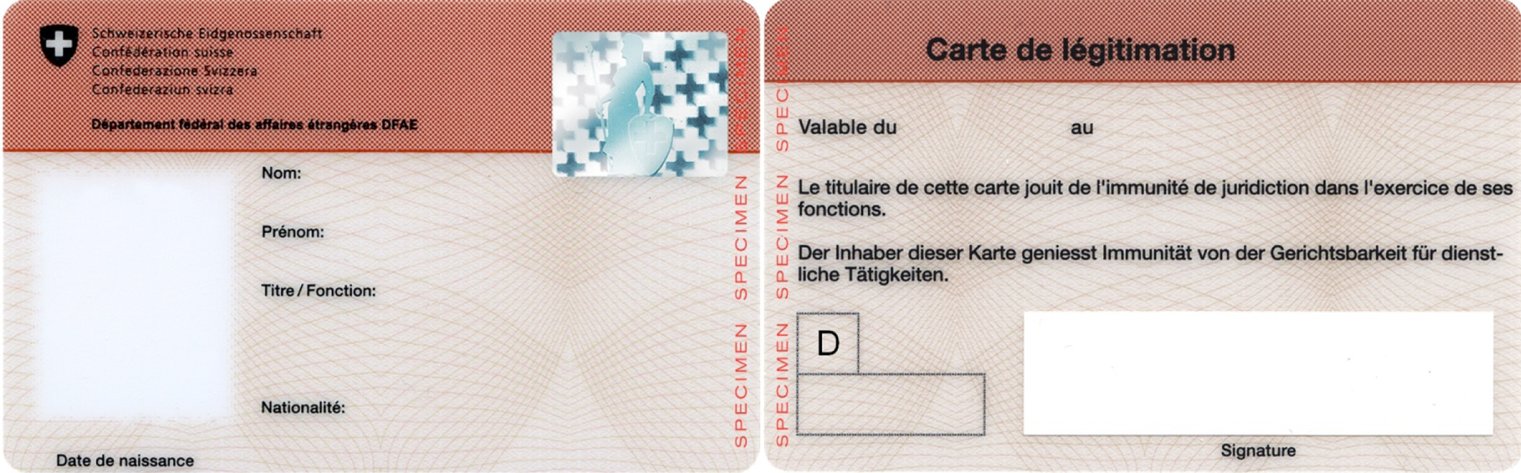
Vom EDA ausgestellte Legitimationskarte des Typs „D“
|
— |
Botschaften und Ständige Missionen: Mitglieder des Verwaltungs- und technischen Personals
Le titulaire de cette carte jouit du statut diplomatique, à l’exception de l’immunité de juridiction civile et administrative qui ne sont accordées que dans l’exercice de ses fonctions Der Inhaber dieser Karte geniesst Diplomatenstatus, Immunität von der Zivil- und Verwaltungsgerichtsbarkeit hat er jedoch nur für dienstliche Tätigkeiten |
|
— |
Internationale Organisationen: Beamte der Kategorie Berufspersonal
Le titulaire de cette carte jouit de l’immunité de juridiction dans l’exercice de ses fonctions Der Inhaber dieser Karte geniesst Immunität von der Gerichtsbarkeit für dienstliche Tätigkeiten |
Vom EDA ausgestellte Legitimationskarte des Typs „E“
|
— |
Botschaften und Ständige Missionen: Mitglieder des Dienstpersonals und örtliche Bedienstete |
|
— |
Internationale Organisationen: Beamte der allgemeinen Dienste
Le titulaire de cette carte jouit de l’immunité de juridiction dans l’exercice de ses fonctions Der Inhaber dieser Karte geniesst Immunität von der Gerichtsbarkeit für dienstliche Tätigkeiten |
Vom EDA ausgestellte Legitimationskarte des Typs „F“
|
— |
Botschaften, Ständige Missionen und internationale Organisationen: private Hausangestellte von Mitgliedern des Personals
Le titulaire de cette carte ne jouit pas de l’immunité de juridiction Der Inhaber dieser Karte hat keinen Anspruch auf Immunität von der Gerichtsbarkeit |
Vom EDA ausgestellte Legitimationskarte des Typs „G“
|
— |
Internationale Organisationen: Zeitbedienstete (befristete Arbeitsverträge) und Mitglieder des abgeordneten Personals
Le titulaire de cette carte jouit de l’immunité de juridiction dans l’exercice de ses fonctions Der Inhaber dieser Karte geniesst Immunität von der Gerichtsbarkeit für dienstliche Tätigkeiten |
Vom EDA ausgestellte Legitimationskarte des Typs „H“
|
— |
Botschaften, Konsulate, Ständige Missionen und internationale Organisationen: Personen ohne Privilegien und Immunitäten
Le titulaire de cette carte ne jouit pas de l’immunité de juridiction et n’a pas accès au marché suisse du travail Der Inhaber dieser Karte hat keinen Anspruch auf Immunität von der Gerichtsbarkeit und keinen Zugang zum schweizerischen Arbeitsmarkt |
Vom EDA ausgestellte Legitimationskarte des Typs „I“
|
— |
Internationales Komitee vom Roten Kreuz (IKRK): Mitarbeiter des IKRK
Le titulaire de cette carte jouit de l’immunité de juridiction dans l’exercice de ses fonctions. Il n’a pas de privilèges douaniers Der Inhaber dieser Karte geniesst Immunität von der Gerichtsbarkeit für dienstliche Tätigkeiten. Er hat keine Zollprivilegien |
Vom EDA ausgestellte Legitimationskarte des Typs „K“
|
— |
Konsulate — Karte K mit rotem Streifen: Berufs-Postenchef und Berufs-Konsularbeamte
Le titulaire de cette carte jouit de l’immunité de juridiction dans l’exercice de ses fonctions Der Inhaber dieser Karte geniesst Immunität von der Gerichtsbarkeit für dienstliche Tätigkeiten |
|
— |
Konsulate — Karte K mit blauem Streifen: Berufs-Konsularangestellte
Le titulaire de cette carte jouit de l’immunité de juridiction dans l’exercice de ses fonctions Der Inhaber dieser Karte geniesst Immunität von der Gerichtsbarkeit für dienstliche Tätigkeiten |
|
— |
Konsulate — Karte K mit violettem Streifen : Mitglieder des dienstlichen Hauspersonals und örtliche Bedienstete
Le titulaire de cette carte ne jouit pas de l’immunité de juridiction Der Inhaber dieser Karte hat keinen Anspruch auf Immunität von der Gerichtsbarkeit |
|
— |
Konsulate — Karte K mit weißem Streifen: Honorar-Postenchefs
Le titulaire de cette carte jouit de l’immunité de juridiction exclusivement pour les fonctions consulaires Der Inhaber dieser Karte hat Anspruch auf Immunität von der Gerichtsbarkeit lediglich für konsularische Tätigkeiten |
Vom EDA ausgestellte Legitimationskarte des Typs „L“
|
— |
Internationale Föderation der Rotkreuz- und Rothalbmondgesellschaften (Föderation): Mitarbeiter der Föderation
Le titulaire de cette carte jouit de l’immunité de juridiction dans l’exercice de ses fonctions. Il n’a pas de privilèges douaniers Der Inhaber dieser Karte geniesst Immunität von der Gerichtsbarkeit für dienstliche Tätigkeiten. Er hat keine Zollprivilegien |
Vom EDA ausgestellte Legitimationskarte des Typs „P“
|
— |
Europäische Organisation für Kernforschung (CERN): Mitglieder des wissenschaftlichen Personals der CERN
Le titulaire de cette carte jouit de l’immunité de juridiction dans l’exercice de ses fonctions Der Inhaber dieser Karte geniesst Immunität von der Gerichtsbarkeit für dienstliche Tätigkeiten |
Vom EDA ausgestellte Legitimationskarte des Typs „R“
|
— |
Personal nicht schweizerischer Staatsangehörigkeit von quasizwischenstaatlichen Organisation oder anderen internationalen Organen und Familienmitglieder, die den gleichen Status besitzen
Le titulaire de cette carte ne jouit pas de l’immunité de juridiction Der Inhaber dieser Karte hat keinen Anspruch auf Immunität von der Gerichtsbarkeit |
Vom EDA ausgestellte Legitimationskarte des Typs „S“
Personalmitglieder schweizerischer Staatsangehörigkeit erhalten grundsätzlich eine Legitimationskarte des Typs „S“, unabhängig davon, welche Funktion sie innerhalb einer ausländischen Vertretung oder internationalen Organisation ausüben. Schweizerische Personalmitglieder, die von Botschaften und Konsulaten vor Ort eingestellt werden, erhalten keine Legitimationskarte. Schweizerischen Beamten, die von internationalen Organisationen mit befristeten Arbeitsverträgen eingestellt werden (Zeitbedienstete) wird keine Legitimationskarte ausgestellt.
|
— |
Botschaften und Konsulate: Mitglieder des Berufspersonals schweizerischer Staatsangehörigkeit |
|
— |
Ständige Missionen: Personalmitglieder schweizerischer Staatsangehörigkeit |
|
— |
Internationale Organisationen: Beamte/Mitarbeiter schweizerischer Staatsangehörigkeit
Le titulaire de cette carte jouit de l’immunité de juridiction dans l’exercice de ses fonctions Der Inhaber dieser Karte geniesst Immunität von der Gerichtsbarkeit für dienstliche Tätigkeiten |
Liste der früheren Veröffentlichungen
|
|
|
|
|
|
|
|
|
|
|
|
|
|
|
|
|
|
|
|
|
|
|
|
|
|
|
|
|
|
|
|
|
|
|
|
|
|
|
|
(1) Siehe die Liste früherer Veröffentlichungen am Ende dieser Aktualisierung.
DEN EUROPÄISCHEN WIRTSCHAFTSRAUM BETREFFENDE INFORMATIONEN
EFTA-Überwachungsbehörde
|
30.6.2016 |
DE |
Amtsblatt der Europäischen Union |
C 236/21 |
Aufforderung zur Stellungnahme nach Artikel 1 Absatz 2 von Teil I des Protokolls 3 (staatliche Beihilfen) zum Abkommen zwischen den EFTA-Staaten zur Errichtung einer Überwachungsbehörde und eines Gerichtshofs
(2016/C 236/10)
Mit der Entscheidung Nr. 489/15/COL, die nachstehend in der verbindlichen Sprachfassung wiedergegeben ist, hat die EFTA-Überwachungsbehörde Norwegen von ihrem Beschluss in Kenntnis gesetzt, wegen der genannten Maßnahme das Verfahren nach Artikel 1 Absatz 2 von Teil I des Protokolls 3 (staatliche Beihilfen) zum Abkommen zwischen den EFTA-Staaten zur Errichtung einer Überwachungsbehörde und eines Gerichtshofs einzuleiten.
Alle Beteiligten können innerhalb eines Monats nach Veröffentlichung dieser Zusammenfassung zu der in Rede stehenden Maßnahme Stellung nehmen. Die Stellungnahmen sind an folgende Anschrift zu richten:
|
EFTA-Überwachungsbehörde |
|
Registratur |
|
Rue Belliard/Belliardstraat 35 |
|
1040 Bruxelles/Brussel |
|
BELGIQUE/BELGIË |
Alle Stellungnahmen werden Norwegen übermittelt. Beteiligte, die eine Stellungnahme abgeben, können unter Angabe von Gründen schriftlich beantragen, dass ihre Identität nicht bekannt gegeben wird.
ZUSAMMENFASSUNG
Verfahren
Norwegen meldete die Regelung für regional differenzierte Sozialversicherungsbeiträge für den Zeitraum 2014-2020 nach Artikel 1 Absatz 3 von Teil I des Protokolls 3 mit Schreiben vom 13. März 2014 (1) zur Genehmigung an. Auf der Grundlage dieser Anmeldung (2) und der anschließend übermittelten Auskünfte genehmigte die Überwachungsbehörde die angemeldete Beihilferegelung mit Entscheidung Nr. 225/14/COL vom 18. Juni 2014.
Mit seinem Urteil vom 23. September 2015 in der Sache E-23/14, Kimek Offshore AS/ESA (3), hob der EFTA-Gerichtshof die Entscheidung der Überwachungsbehörde teilweise auf.
Mit Schreiben vom 15. Oktober 2015 (4) ersuchte die Überwachungsbehörde die norwegischen Behörden um zusätzliche Auskünfte. Die norwegischen Behörden antworteten auf dieses Auskunftsersuchen mit Schreiben vom 6. November 2015 (5).
Beschreibung der Maßnahme
Ziel der allgemeinen Regelung für differenzierte Sozialversicherungsbeiträge ist es, in den norwegischen Gebieten mit der geringsten Bevölkerungsdichte Beschäftigungsanreize zu setzen, um Abwanderung zu verringern oder zu verhindern. Die Betriebsbeihilferegelung gleicht durch die Senkung der Sozialversicherungsbeitragssätze in bestimmten geografischen Gebieten Beschäftigungskosten aus. Die Beihilfeintensitäten variieren allgemein entsprechend dem geografischen Gebiet, in dem die Unternehmenseinheit registriert ist. Nach norwegischem Recht müssen Unternehmen für jede getrennte Geschäftstätigkeit Untereinheiten registrieren (6). Unternehmen, die verschiedene Geschäftstätigkeiten ausüben, müssen getrennte Untereinheiten registrieren. Wenn die Tätigkeiten an verschiedenen Standorten ausgeübt werden, müssen ebenfalls getrennte Einheiten registriert werden.
Abweichend von der allgemeinen Registrierungsbestimmung gilt die Regelung auch für Unternehmen, die außerhalb des Fördergebiets registriert sind, wenn diese Arbeitnehmer in das Fördergebiet entsenden oder die Arbeitnehmer im Fördergebiet mobile Tätigkeiten ausüben (für die Zwecke dieser Entscheidung als „ambulante Leistungen“ bezeichnet). Diese Ausnahmeregel wird in der vorliegenden Entscheidung geprüft. Die nationale Rechtsgrundlage der regionalen Differenzierung der Sozialversicherungsbeiträge ist Abschnitt 23-2 des nationalen Versicherungsgesetzes (7). Die nationale Rechtsgrundlage für die Ausnahmeregel bildet Abschnitt 1 Absatz 4 der Entscheidung Nr. 1482 des norwegischen Parlaments vom 5. Dezember 2013 über die Bestimmung der Abgabensätze usw. nach dem nationalen Versicherungsgesetz.
Die Ausnahmeregel gilt nur, wenn der Arbeitnehmer mindestens die Hälfte seiner Arbeitstage im Fördergebiet verbringt. Zudem gilt der verringerte Satz nur für den dort durchgeführten Teil der Arbeit.
Würdigung der Maßnahme
Die Überwachungsbehörde muss prüfen, ob die Ausnahmeregel nach Artikel 61 Absatz 3 Buchstabe c des EWR-Abkommens mit dem EWR-Abkommen vereinbar ist und mit den Leitlinien der Überwachungsbehörde für Regionalbeihilfen im Zeitraum 2014-2020 (Regionalbeihilfeleitlinien) (8) im Einklang steht.
Regionalbeihilfen können die wirtschaftliche Entwicklung benachteiligter Gebiete nur dann wirksam unterstützen, wenn sie zur Förderung zusätzlicher Investitionen oder wirtschaftlicher Tätigkeiten in diesen Gebieten gewährt werden (9). Regionale Betriebsbeihilfen können nur dann unter Artikel 61 Absatz 3 Buchstabe c des EWR-Abkommens fallen, wenn sie zum Ausgleich spezifischer oder dauerhafter Nachteile von Unternehmen in benachteiligten Gebieten gewährt werden (10).
Der geografische Geltungsbereich der Regelung ist zweifellos auf benachteiligte Gebiete beschränkt. Die vorliegende Entscheidung bezieht sich nur auf die Vereinbarkeit der Ausnahmeregel mit den Beihilfevorschriften. Nach der Ausnahmeregel können außerhalb der benachteiligten Gebiete registrierte Unternehmen auf der Grundlage der Regelung Beihilfen erhalten, soweit sie wirtschaftliche Tätigkeiten in benachteiligten Gebieten ausüben. Konkret stellt sich also die Frage, ob die Ausnahmeregel spezifische oder dauerhafte Nachteile von Unternehmen in den benachteiligten Gebieten ausgleicht.
Die norwegischen Behörden müssen nachweisen, dass ohne die Ausnahmeregel die Gefahr einer Abwanderung der Wohnbevölkerung besteht (11). Norwegen hat die Vorteile unterstrichen, die die Ausnahmeregel lokalen Unternehmen bietet. Sie könnten zu geringeren Kosten auf Fachkräfte zurückgreifen, die ihnen ansonsten nicht zur Verfügung stünden. Außerdem führe die Ausnahmeregel zu einer Steigerung des Wettbewerbs bei ambulanten Leistungen in den Fördergebieten, was wiederum lokalen Unternehmen (die keine ambulanten Leistungen erbringen) zugutekomme, da geringere Kosten für ambulante Leistungen unternehmerische Tätigkeiten im Fördergebiet attraktiver und rentabler machten. Der Einsatz von Beihilfen auf der Grundlage der Regelung sei insofern ein indirektes Instrument, als die Beschäftigungskosten gesenkt würden, um Abwanderung zu verringern oder zu verhindern. Dahinter stehe der Gedanke, dass der Arbeitsmarkt der wichtigste Faktor für die Wahl des Wohnorts ist.
Norwegen macht ferner geltend, dass die außerhalb des Fördergebiets registrierten Unternehmen gelegentlich Arbeitnehmer in den Fördergebieten beschäftigen. Auf diese Weise schafften die Unternehmen Arbeitsplätze, die meist zwar zeitlich befristet seien, aber dennoch zu höheren Einkommen in den Fördergebieten beitrügen. Dadurch werde die Konjunktur angekurbelt. Ein weiteres Argument der norwegischen Behörden lautet, dass Arbeitnehmer, die sich vorübergehend im Fördergebiet aufhalten, lokale Waren und Dienstleistungen erwerben und damit einen Beitrag zur lokalen Wirtschaft leisten. Dies gelte vor allem für Arbeitnehmer, die für kurze oder mittlere Zeiträume dorthin pendeln, da sie unter anderem wahrscheinlich in Hotels übernachten und in Restaurants essen würden. Die norwegischen Behörden haben die Beihilfe, die sich aus der Ausnahmeregel ergibt, auf 2 % aller Beihilfen für 2015 geschätzt, betonen aber, dass es sich dabei um eine mit Unsicherheiten behaftete Schätzung handelt. Diese 2 % entsprächen rund 19 Mio. EUR (12). Die Überwachungsbehörde ersucht die norwegischen Behörden um genauere Angaben zu den finanziellen Auswirkungen der Regel.
Abgesehen von den obigen allgemeinen Anmerkungen haben die norwegischen Behörden nicht nachgewiesen, dass ohne die Ausnahmeregel die Gefahr einer Abwanderung in dem betreffenden Gebiet besteht. Nach Auffassung der Überwachungsbehörde muss eine Maßnahme stärkere Auswirkungen als eine geringfüge Erhöhung vorübergehender Beschäftigungsmöglichkeiten und Ausgaben im Fördergebiet haben, um den Anforderungen der Regionalbeihilfeleitlinien zu entsprechen. Daher fordert die Überwachungsbehörde die norwegischen Behörden auf, weitere Auskünfte zu übermitteln, um nachzuweisen, dass ohne die Ausnahmeregel die Gefahr einer Abwanderung besteht.
Hinsichtlich der Auswirkungen der Ausnahmeregel auf Wettbewerb und Handel macht Norwegen geltend, dass die Ausnahmeregel gleiche Rahmenbedingungen für alle in den benachteiligten Gebieten tätigen Unternehmen schafft, da sie für alle im EWR ansässigen Unternehmen gilt und somit keine negativen Auswirkungen auf den Wettbewerb hat. Die Überwachungsbehörde bewertet dies vor dem Hintergrund der Randnummern 3 und 53 der Regionalbeihilfeleitlinien als positiv. Gleichwohl haben im Fördergebiet registrierte Unternehmen möglicherweise mit mehr ständigen Hindernissen zu kämpfen als Unternehmen, die lediglich Arbeitnehmer befristet dorthin entsenden. Norwegen argumentiert, dass außerhalb des Fördergebiets registrierte Unternehmen z. B. wegen der Fahrt- und Übernachtungskosten ihrer Mitarbeiter möglicherweise gegenüber lokalen Unternehmen im Wettbewerb benachteiligt sind. Die norwegischen Behörden haben keine Zahlen oder weiteren Argumente zur Untermauerung dieser These übermittelt. Die Überwachungsbehörde fordert sie daher auf, genauer darzulegen, warum die Ausnahmeregel keine ungerechtfertigten nachteiligen Auswirkungen auf den Wettbewerb hat, und dies durch weitere Auskünfte zu untermauern.
Norwegen betont, dass die Ausnahmeregel offensichtlich einen Anreizeffekt hat. Der Anreizeffekt einer Beihilfe kann jedoch nicht einfach anhand einer Annahme festgestellt werden. Auch wenn nicht für jeden Beihilfeempfänger einzeln nachzuweisen ist, dass die auf der Grundlage einer Regelung gewährten Beihilfen Anreiz zur Durchführung einer Tätigkeit bieten, die ansonsten nicht durchgeführt worden wäre, so muss der Anreizeffekt zumindest anhand einer soliden wirtschaftlichen Theorie festzustellen sein. Es reicht nicht aus, zu behaupten, dass der Anreizeffekt offensichtlich sei. Die Ausnahmeregel für außerhalb der Fördergebiete registrierten Unternehmen führt zwar zu einer Senkung der Arbeitskosten für ambulante Leistungen in den Fördergebieten, aber die norwegischen Behörden haben keinen Nachweis und kein Argument vorgebracht, um zu belegen, dass die Wirtschaftstätigkeit in dem betreffenden Gebiet aufgrund der Probleme, die durch die Beihilfen behoben werden sollen, ohne die Beihilfen erheblich geringer wäre (13).
Norwegen weist darauf hin, dass Unternehmen, die ambulante Leistungen erbringen, in gewissem Umfang Untereinheiten im Fördergebiet registrieren können. Wenn mindestens ein Mitarbeiter für die Muttergesellschaft in einem getrennten Gebiet tätig ist und das Unternehmen dort aufgesucht werden kann, seien sie sogar zu dieser Registrierung verpflichtet.
Norwegen bringt zudem vor, dass ohne die Ausnahmeregel für ambulante Leistungen im Fördergebiet ungerechtfertigte Unterschiede zwischen Unternehmen mit und ohne Untereinheiten im Fördergebiet gemacht würden.
Erstens ist der Überwachungsbehörde nicht klar, was die Anforderung „mindestens ein Mitarbeiter ist für die Muttergesellschaft in einem getrennten Gebiet tätig, und das Unternehmen kann dort aufgesucht werden“ bedeutet. Daher bittet die Überwachungsbehörde die norwegischen Behörden, dies genauer zu erläutern.
Zweitens ist der Gleichbehandlungsgrundsatz ein Grundprinzip des EWR-Rechts. Er kann aber nicht die einzige Rechtfertigung der Ausnahmeregel sein. Die Ausnahmeregel an sich muss mit dem EWR-Abkommen vereinbar sein.
Ohne die oben genannten Informationen zweifelt die Überwachungsbehörde an der Vereinbarkeit der Ausnahmeregel mit dem EWR-Abkommen.
EFTA SURVEILLANCE AUTHORITY DECISION
No 489/15/COL
of 9 December 2015
opening a formal investigation into the exemption rule for ambulant services under the scheme on differentiated social security contributions 2014-2020
(Norway)
The EFTA Surveillance Authority (‘the Authority’),
HAVING REGARD to:
the Agreement on the European Economic Area (‘the EEA Agreement’), in particular to Article 61,
Protocol 26 to the EEA Agreement,
the Agreement between the EFTA States on the Establishment of a Surveillance Authority and a Court of Justice (‘the Surveillance and Court Agreement’), in particular to Article 24,
Protocol 3 to the Surveillance and Court Agreement (‘Protocol 3’), in particular to Article 1(2) of Part I and Articles 4(4) and 6(1) of Part II,
Whereas:
I. FACTS
1. Procedure
|
(1) |
The Norwegian authorities notified the regionally differentiated social security contributions scheme 2014-2020 pursuant to Article 1(3) of Part I of Protocol 3 by letter of 13 March 2014 (14). On the basis of that notification and information submitted thereafter (15), the Authority approved the notified aid scheme by its Decision No 225/14/COL of 18 June 2014. |
|
(2) |
By its judgment of 23 September 2015 in case E-23/14 Kimek Offshore AS v ESA (16) the EFTA Court annulled, in part, the Authority's decision. |
|
(3) |
By letter dated 15 October 2015 (17), the Authority requested information from the Norwegian authorities. By letter dated 6 November 2015 (18), the Norwegian authorities replied to the information request. |
2. The scheme as such is not the subject of the formal investigation
|
(4) |
By its judgment the EFTA Court partly annulled the Authority's decision approving the aid scheme. The aid scheme as such is not subject to the renewed scrutiny carried out by the Authority in the present formal investigation. The subject of this formal investigation is merely the part of the scheme (an exemption rule for ambulant services) for which the Authority's approval was annulled. |
3. The scheme
3.1 Objective
|
(5) |
The objective of the general scheme on differentiated social security contributions as such is to reduce or prevent depopulation in the least inhabited regions in Norway, by stimulating employment. The operating aid scheme offsets employment costs by reducing the social security contribution rates in certain geographical areas. As a main rule, the aid intensitites vary according to the geographical area in which the business unit is registered. The rules on registration are explained in greater detail below. |
3.2 National legal basis
|
(6) |
The national legal basis for the scheme as such is Section 23-2 of the National Insurance Act (19). This provision sets out the employer's general obligation to pay social security contributions calculated on the basis of gross salary paid to the employee. According to paragraph 12 of that section, the Norwegian Parliament may adopt regionally differentiated rates, as well as specific provisions for undertakings within certain sectors. Thus, it is the National Insurance Act, in conjunction with the annual decisions of the Norwegian Parliament, that forms the national legal basis for the scheme. |
|
(7) |
For further detail on the aid scheme as such, reference is made to the Authority's Decision No 225/14/COL. |
3.3 Rules on registration
|
(8) |
As a main rule, aid eligibility depends on whether a business is registered in the eligible area. As noted above, the main rule of the scheme is that aid intensities vary according to the geographical area in which the business is registered. |
|
(9) |
Norwegian law requires undertakings to register sub-units for each separate business activity performed (20). If an undertaking performs different kinds of business activities, separate sub-units must be registered. Moreover, separate units must be registered if the activities are performed in different geographical locations. |
|
(10) |
According to the Norwegian authorities, the ‘separate business activitiy’ criterion is met when at least one employee carries out work for the parent unit in a separate area, and the undertaking may be visited there. Each sub-unit forms its own basis for the calculation of the differentiated social security contribution, depending on their registered location. Thus, an undertaking registered outside the area eligible for aid under the scheme will be eligible for aid if, and in so far as, its economic activities are performed within a sub-unit located within the eligible area. |
3.4 Ambulant services – the measure under scrutiny
|
(11) |
By way of exemption from the main rule on registration, the scheme also applies to undertakings registered outside the eligible area where they hire out workers to the eligible area and where their employees are engaged in mobile activities within the eligible area (for the purposes of this decision, this is referred to as ‘ambulant services’). This is the exemption rule under scrutiny in the decision at hand. The national legal basis for that exemption is provided for by section 1(4) of the Norwegian Parliament's Decision No 1482 of 5 December 2013 on determination of the tax rates etc. under the National Insurance Act for 2014. |
|
(12) |
The exemption applies only when the employee spends half or more of his working days in the eligible area. Further, the reduced rate is only applicable for the part of the work carried out there. As a principal rule, the tax registration period is one calendar month. |
|
(13) |
This entails that if an employee of an Oslo-registered entity (Oslo is in Zone 1, an ineligible zone, where the rate therefore is the standard 14,1 %) completes 60 % of his work one calendar month in Vardø (which is in Zone 5 where the applicable rate is 0 %) and the rest in Oslo, the undertaking will be eligible for the zero-rate on the salary to be paid for the work carried out in Vardø, but not for the work carried out in Oslo. |
4. The judgment of the EFTA Court
|
(14) |
The EFTA Court annuled the Authority's decision in so far as it closed the preliminary investigation as regards the aid measure in section 1(4) of the Norwegian Parliament's Decision No 1482 of 5 December 2013 on determination of the tax rates etc. under the National Insurance Act for 2014. Section 1(4) is drafted in such a way as to conflate, together with the exemption rule (which is the subject of the present decision), an anti-circumvention measure designed to prevent undertakings from claiming aid under the scheme by virtue of simply registering their business within an area with a lower rate of social security contributions, even if they then proceed to conduct ambulatory activities or hire out their employees to work in an area with a higher rate. The anti-circumvention measure is not subject to the present procedure (21). |
5. Comments by the Norwegian authorities
|
(15) |
The Norwegian authorities argue that the exemption rule for ambulant services is compatible with the functioning of the EEA Agreement on the basis of its Article 61(3)(c) and that it is in line with the Authority's Guidelines on Regional State Aid for 2014-2020 (the RAG) (22). |
|
(16) |
The Norwegian authorities have explained that the exemption rule accounts for about two percent of the total aid granted under the scheme for 2015. They stress that this calculation is based on uncertain estimates. |
|
(17) |
The Norwegian authorities have explained that in Norway, access to employment is the most influential factor when it comes to peoples' choice of residence. The social security contribution is as a main rule calculated on the basis of the rate applicable in the zone in which the employer is considered to carry out business activity. This rule is based on the premise that only undertakings performing economic activity in the eligible area should receive aid, and only to the extent that they are performing business activities in that area. This is a fundamental premise for the aid scheme. |
|
(18) |
Where a company is registered, is not, and should not be, decisive. There are many sectors that frequently provide ambulant services. As an example, it would be too burdensome to require all construction firms to register their activities locally wherever they were to carry out work in order to be eligible for reduced social security rates. Neither Article 61(3)(c) nor the RAG or the GBER (23) contain requirements on where regional aid beneficiaries need to be registered. A formalistic approach where the registered location of the beneficiary is decisive in all cases has no basis in Article 61(3)(c). To the contrary, it would be difficult to reconcile with the RAG which focusses on whether the aid promotes economic activity in disadvantaged areas and not whether beneficiaries are registered within the area covered by the scheme. The underlying realities, i.e. whether the undertaking carries out economic activity within the eligible area, should be decisive. Furthermore, undertakings performing ambulant services can to some extent register sub-units in the eligible area. In the absence of the exemption rule for ambulant serices in the eligible area, there would be an unjustified difference in treatment depending on whether the service providing undertaking had established a sub-unit in the eligible area. |
|
(19) |
The Norwegian authorities contend that the exemption rule contributes to an objective of common interest in a number of ways. They firstly note that undertakings in the eligible area can access, at a lower cost, specialised labour that would otherwise not be available. Secondly, the rule leads to increased competition between ambulant services in eligible areas. This is beneficial for local undertakings, other than those providing ambulant services, as lower costs for ambulant services make it more attractive and more profitable to run a business in the eligible area. Thirdly, employees with a temporal stay in the eligible area will buy local goods and services and thereby contribute to the local economy. This applies in particular to employees commuting to the location especially in the short or medium term as they are likely to stay in hotels, eat in restaurants etc. Fourthly, undertakings located in central areas may also hire personnel residing in the area where the ambulant services are performed. Even if the jobs are temporary in nature, they will contribute to increased wage income in the eligible regions, which also stimulates economic activity. Finally, undertakings registered outside the eligible zone may have a competitive disadvantage compared to local firms due to i.a. costs of transporting and lodging of personnel. |
|
(20) |
In the view of the Norwegian authorities, it is evident that the exemption rule has an incentive effect as it reduces labour costs for ambulant services. |
|
(21) |
Finally, the Norwegian authorities stress that the exemption rule creates a level playing field for all undertakings active in the disadvantages areas. The rule applies equally to any EEA-based undertaking. This ensures that undue adverse effects on competition are avoided. |
II. ASSESSMENT
1. The presence of state aid
|
(22) |
Article 61(1) of the EEA Agreement reads as follows: ‘Save as otherwise provided in this Agreement, any aid granted by EC Member States, EFTA States or through State resources in any form whatsoever which distorts or threatens to distort competition by favouring certain undertakings or the production of certain goods shall, in so far as it affects trade between Contracting Parties, be incompatible with the functioning of this Agreement.’ |
|
(23) |
This implies that a measure constitutes state aid within the meaning of Article 61(1) of the EEA Agreement if the following conditions are cumulatively fulfilled: (i) there must be an intervention by the state or through state resources, (ii) that intervention must confer a selective economic advantage on the recipients, (iii) it must be liable to affect trade between EEA States and (iv) it must distort or threathen to distort competition. |
|
(24) |
In Decision No 225/14/COL, the Authority concluded that the scheme on differentiated social security contributions 2014-2020 constitutes an aid scheme. The Authority refers to its reasoning in paragraphs 68-74 of that decision. The exemption rule for ambulant services is part of the provisions providing for that aid scheme. It increases the scope of the scheme in the sense that it widens the circle of potential beneficiaries to undertakings that are not registered in the eligible areas. As with the other aid granted under the scheme, extending the scheme to the undertakings registered outside of the eligible areas results in state resources conferring selective advantages on undertakings. These advantages are liable to affect trade and distort competition. |
2. Procedural requirements
|
(25) |
Pursuant to Article 1(3) of Part I of Protocol 3: ‘the EFTA Surveillance Authority shall be informed, in sufficient time to enable it to submit its comments, of any plans to grant or alter aid. … The State concerned shall not put its proposed measures into effect until the procedure has resulted in a final decision’. |
|
(26) |
The Norwegian authorities implemented the exemption rule after the Authority approved it by Decision No 225/14/COL. With the annulment of the Authority's approval of the rule by the EFTA Court, the aid has become unlawful. |
3. Compatibility of the aid
|
(27) |
The Authority must assess whether the exemption rule is compatible with the functioning of the EEA Agreement on the basis of its Article 61(3)(c) in line with the RAG. |
|
(28) |
The exemption rule for ambulant services entitles undertakings that are not registered in the eligible area to benefit from reduced social security charges when and to the extent that they carry out economic activities in the registered area. Neither Article 61(3)(c) EEA nor the RAG (nor the regional aid rules in the GBER) formally require that regional aid beneficiaries are registered in the assisted areas. |
|
(29) |
Regional aid can be effective in promoting the economic development of disadvantaged areas only if it is awarded to induce additional investment or economic activity in those areas (24). Regional operating aid can only fall under Article 61(3)(c) EEA if it is awarded to tackle specific or permanent handicaps faced by undertakings in disadvantaged regions (25). |
|
(30) |
There is no question that the geographical scope of the scheme as such is restricted to disadvantaged regions. The scope of this decision is limited to the exemption rule. The question is whether that rule, which entails that undertakings registered outside the disadvantaged regions covered by the scheme can benefit from aid under the scheme to the extent that they carry out economic activities in the disadvantaged regions is compatible with the state aid rules. In other words, does the exemption rule tackle specific or permanenet handicaps faced by undertakings in the disadvantaged regions? |
|
(31) |
It is for the Norwegian authorities to demonstrate the risk of depopulation in the absence of the exemption rule (26). The Norwegian authorities have underlined the benefits of the exemption rule for local undertakings. They can access, at a lower cost, specialised labour that would otherwise not be available. Moreover, the exemption rule leads to increased competition between ambulant services in the eligible areas, which again is beneficial for local undertakings (other than those providing ambulant services) since lower costs for ambulant services make it more attractive and more profitable to run a business in the eligible area. The use of aid under the scheme is an indirect tool in the sense that it is used to reduce the cost of employing workers as a measure to reduce or prevent depopulation. The idea is that the labour market is the most important factor influencing where people live. |
|
(32) |
The Norwegian authorities have further argued that the firms registered outside the eligible area occasionally will hire workers in the eligible areas. Thereby the firms will provide jobs that, although of a more temporary nature, will nevertheless contribute to increased wage income in the eligible regions. This also stimulates economic activity. The Norwegian authorities furthermore argue that employees who temporarily stay in the eligible area will buy local goods and services and thereby contribute to the local economy. This applies in particular to employees commuting to the location especially on short or medium term as they are likely to stay in hotels, eat in restaurants, etc. The Norwegian authorities have estimated the amount of aid resulting from the exemption rule to be two percent of the total aid for 2015 which they stress is an uncertain estimate. Two percent amounts to approximately EUR 19 million (27). The Authority invites the Norwegian authorities to provide more precise information about the financial effect of the rule. |
|
(33) |
Apart from the above remarks of a general nature, the Norwegian authorities have not demonstrated the risk of depopulation of the relevant area in the absence of the exemtion rule. It is the view of the Authority that a measure, in order to meet the requirements of the RAG, must have effects exceeding a marginal increase of temporary employment possibilities and spending in the eligible area. On this basis, the Authority invites the Norwegian authorities to provide more information to demonstrate the risk of depopulation in the absence of the exemption rule. |
|
(34) |
In terms of effect on competition and trade of the exemption rule, the Norwegian authorities argue that the exemption rule creates a level playing field for all undertakings active in the disadvantaged areas as it applies equally to any EEA-based undertaking. The consequence is that it ensures that undue adverse effects on competition are avoided. It is the view of the Authority that this is a positive feature in light of paras. 3 and 53 of the RAG. However, the undertakings registered within the eligible area may, in general, face more permanent difficulties than the undertakings that merely send their employees to work in the area on a non-permanent basis. The Norwegian authorities argue that undertakings registered outside the eligible zone may have a competitive disadvantage compared to local firms due to i.a. costs of transporting and lodging of personnel. The Norwegian authotities have not presented any data or further reasoning to back up this assumption. The Authority invites the Norwegian authorities to further clarify why it is that the exemption rule does not have undue adverse effects on competition and to submit further information to back this up. |
|
(35) |
The Norwegian authorities have stressed that it is evident that the exemption rule has an incentive effect. Incentive effect of an aid cannot merely be assumed. While it is not necessary to provide individual evidence that aid under a scheme provides each beneficiary with an incentive, on an individual basis, to carry out an activity it would not otherwise have carried out, the incentive effect must, at the least, be based on sound economic theory. It is not sufficient merely to refer to an alleged obviousness. While it is true that the exemption rule for companies registered outside the eligible areas reduces labour costs for ambulant services in the eligible areas, the Norwegian authorities have not provided evidence or arguments to the effect that it is likely that, in the absence of aid, the level of economic activity in the area would be significantly reduced due to the problems that the aid is intended to address (28). |
|
(36) |
The Norwegian authorities have explained that undertakings performing ambulant services to some extent can register sub-units in the eligible area. Moreover, they are required to do so when at least one employee carries out work for the parent unit in a separate area, and the undertaking may be visited there. |
|
(37) |
The Norwegian authorities argue that in the absence of the exemption rule for ambulant services in the eligible area, there would be an unjustified difference in treatment depending on whether the service providing undertaking had established a sub-unit in the eligible area. |
|
(38) |
Firstly, it is not clear to the Authority what the requirement that ‘at least one employee carries out work for the parent unit in a separate area, and the undertaking may be visited there’ entails. The Authority therefore invites the Norwegian authorities to clarify this. |
|
(39) |
Secondly, the the principle of equal treatment is a general principle of EEA law. However, this cannot in and of itself serve as a basis to justify the exemption rule. The exemption rule must itself be compatible with the functioning of the EEA Agreement. |
|
(40) |
In conclusion, the absence of the relevant information, as described above, leads the Authority to have doubts about the compatibility of the exemption rule with the functioning of the EEA Agreement. |
4. Conclusion
|
(41) |
As set out above, the Authority has doubts as to whether the exemption rule for ambulant services under the scheme on differentiated social security contributions 2014-2020 is compatible with the functioning of the EEA Agreement. |
|
(42) |
Consequently, and in accordance Article 4(4) of Part II of Protocol 3, the Authority is obliged to open the formal investigation procedure provided for in Article 1(2) of Part I of Protocol 3. The decision to open a formal investigation procedure is without prejudice to the final decision of the Authority, which may conclude that the measure is compatible with the functioning of the EEA Agreement. |
|
(43) |
The Authority, acting under the procedure laid down in Article 1(2) of Part I of Protocol 3, invites the Norwegian authorities to submit, by 10 January 2016 their comments and to provide all documents, information and data needed for the assessment of the compatibility of the measure in light of the state aid rules. |
|
(44) |
The Authority reminds the Norwegian authorities that, according to Article 14 of Part II of Protocol 3, any incompatible aid unlawfully granted to the beneficiaries will have to be recovered, unless this recovery would be contrary to a general principle of EEA law, such as the protection of legitimate expectations. |
HAS ADOPTED THIS DECISION:
Article 1
The formal investigation procedure provided for in Article 1(2) of Part I of Protocol 3 is opened into the exemption rule for ambulant services under the scheme on differentiated social security contributions 2014-2020.
Article 2
The Norwegian authorities are invited, pursuant to Article 6(1) of Part II of Protocol 3, to submit their comments on the opening of the formal investigation procedure by 10 January 2016.
Article 3
The Norwegian authorities are requested to provide by 10 January 2016, all documents, information and data needed for assessment of the compatibility of the aid measure.
Article 4
This Decision is addressed to the Kingdom of Norway.
Article 5
Only the English language version of this decision is authentic.
Done in Brussels, on 9 December 2015
For the EFTA Surveillance Authority
Sven Erik SVEDMAN
President
Helga JÓNSDÓTTIR
College Member
(1) Unterlagen Nr. 702438-702440, 702442 und 702443.
(2) Siehe Artikel 2 der Entscheidung Nr. 225/14/COL. Diese ist auf folgender Website veröffentlicht: http://www.eftasurv.int/media/state-aid/Consolidated_version_-_Decision_225_14_COL__NOR_Social_Security_contributions_2014-2020.pdf.
(3) Noch nicht in der Sammlung veröffentlicht.
(4) Unterlage Nr. 776348.
(5) Unterlagen Nr. 779603 und 779604.
(6) Gesetz über das Koordinierungsregister für juristische Personen (LOV-1994-06-03-15).
(7) LOV-1997-02-28-19.
(8) ABl. L 166 vom 5.6.2014, S. 44, und EWR-Beilage Nr. 33 vom 5.6.2014, S. 1.
(9) Randnr. 6 der Regionalbeihilfeleitlinien.
(10) Randnr. 16 der Regionalbeihilfeleitlinien.
(11) Randnr. 43 der Regionalbeihilfeleitlinien.
(12) Auf der Grundlage der für 2013 angemeldeten Haushaltsmittel berechnet; siehe Erwägungsgrund 49 der Entscheidung Nr. 225/14/COL der Überwachungsbehörde.
(13) Randnr. 71 der Regionalbeihilfeleitlinien.
(14) Documents No 702438-702440, 702442 and 702443.
(15) See paragraph 2 of Decision No 225/14/COL, available online: http://www.eftasurv.int/media/state-aid/Consolidated_version_-_Decision_225_14_COL__NOR_Social_Security_contributions_2014-2020.pdf
(16) Not yet reported.
(17) Document No 776348.
(18) Documents No 779603 and 779604.
(19) LOV-1997-02-28-19.
(20) The Act on the Coordinating Register for Legal Entities (LOV-1994-06-03-15).
(21) See Order of the EFTA Court of 23.11.2015 in Case E-23/14 INT Kimek Offshore AS v ESA (not yet reported).
(22) OJ L 166, 5.6.2014, p. 44 and EEA Supplement No 33, 5.6.2014, p. 1.
(23) The General Block Exemption Regulation (GBER). Commission Regulation (EU) No 651/2014 of 17 June 2014 declaring certain categories of aid compatible with the internal market in application of Articles 107 and 108 of the Treaty (OJ L 187, 26.6.2014, p. 1), incorporated into the EEA Agreement by EEA Joint Committee Decision No 152/2014 (OJ L 342, 27.11.2014, p. 63 and EEA Supplement No 71, 27.11.2014, p. 61) at point 1j of Annex XV to the EEA Agreement.
(24) Para. 6 of the RAG.
(25) Para. 16 of the RAG.
(26) Para. 43 of the RAG.
(27) Based on the notified 2013 budget, see para. 49 of the Authority's Decision No 225/14/COL.
(28) Para. 71 of the RAG.
|
30.6.2016 |
DE |
Amtsblatt der Europäischen Union |
C 236/29 |
Aufforderung zur Abgabe von Stellungnahmen nach Teil I Artikel 1 Absatz 2 des Protokolls 3 zum Abkommen zwischen den EFTA-Staaten über die Errichtung einer Überwachungsbehörde und eines Gerichtshofs in Bezug auf etwaige staatliche Beihilfen für Hurtigruten ASA im Rahmen der Küstenstrecken-Vereinbarung für den Hurtigruten-Seeverkehr 2012-2019
(2016/C 236/11)
Mit der Entscheidung Nr. 490/15/COL vom 9. Dezember 2015, die nachstehend in der verbindlichen Sprachfassung wiedergegeben wird, hat die EFTA-Überwachungsbehörde ein Verfahren nach Teil I Artikel 1 Absatz 2 des Protokolls 3 zum Abkommen zwischen den EFTA-Staaten zur Errichtung einer Überwachungsbehörde und eines Gerichtshofs eingeleitet. Die norwegischen Behörden wurden durch Übersendung einer Kopie von der Entscheidung unterrichtet.
Die EFTA-Überwachungsbehörde fordert hiermit die EFTA-Staaten, die EU-Mitgliedstaaten und alle Beteiligten auf, ihre Stellungnahmen zu der betreffenden Maßnahme innerhalb eines Monats nach Veröffentlichung dieser Bekanntmachung an folgende Anschrift zu richten:
|
EFTA-Überwachungsbehörde |
|
Registratur |
|
Rue Belliard 35/Belliardstraat 35 |
|
1040 Bruxelles/Brussel |
|
BELGIQUE/BELGIË |
Die Stellungnahmen werden Norwegen übermittelt. Beteiligte, die eine Stellungnahme abgeben, können unter Angabe von Gründen schriftlich beantragen, dass ihre Identität nicht offengelegt wird.
ZUSAMMENFASSUNG
Hintergrund
Hurtigruten ASA (im Folgenden „Hurtigruten“) erbringt entlang der Küste Norwegens zwischen Bergen und Kirkenes einen kombinierten Fracht- und Personenverkehr.
Infolge einer Ausschreibung wurde mit Hurtigruten am 13. April 2011 eine Dienstleistungsvereinbarung für die Küstenroute Bergen–Kirkenes für den Zeitraum 1. Januar 2012 bis zum 31. Dezember 2019 unterzeichnet. Infolge dieser Vereinbarung führt Hurtigruten ganzjährig tägliche Fahrten mit Anlauf von 32 genau festgelegten Zwischenhäfen zwischen Bergen und Kirkenes durch. Für die Strecken Tromsø–Kirkenes und Kirkenes–Tromsø ist ebenfalls Frachtverkehr vorgesehen. Die Dienstleistungen haben im Einklang mit bestimmten, in der Vereinbarung festgelegten Kapazitäts- und Schiffsanforderungen zu erfolgen. Auf der Küstenstrecke eingesetzte Schiffe müssen über eine Mindestpassagierkapazität von 320 Passagieren, Schlafkabinen für 120 Passagiere und Frachtkapazitäten für 150 Europaletten in einem Frachtraum mit normaler Lasthöhe verfügen. Außerdem müssen sie die rechtlichen und technischen Anforderungen gemäß Abschnitt 4.4 der Leistungsbeschreibung einhalten.
Für die unter die Vereinbarung mit Hurtigruten fallenden Dienstleistungen zahlt Norwegen eine Ausgleichsleistung in Höhe von insgesamt 5 120 Mio. NOK für die achtjährige Laufzeit der Vereinbarung.
Beihilferechtliche Würdigung der Ausgleichsleistung
Das einzige Kriterium für die Einstufung als staatliche Beihilfe, dessen Erfüllung in dieser Sache in Rede steht, ist somit, ob die Vereinbarung Hurtigruten einen ungerechtfertigten selektiven wirtschaftlichen Vorteil verschafft hat.
Selektiver wirtschaftlicher Vorteil für Hurtigruten
Die Behörde bewertete die vier Kriterien des Altmark-Urteils (1) und stellte fest, dass in diesem Stadium keines von ihnen offenbar erfüllt zu sein scheint und Hurtigruten somit einen selektiven Vorteil im Sinne des Artikels 61 Absatz 1 des EWR-Abkommens erhalten hat.
In Bezug auf das erste Kriterium, d. h. eine klare Definition einer gemeinwirtschaftlichen Verpflichtung, hat die Überwachungsbehörde Zweifel daran, ob die Reservekapazitätsanforderung in Abschnitt 4.2 der Hurtigruten-Vereinbarung von Norwegen als Dienstleistung von allgemeinem wirtschaftlichem Interesse (DAWI) geltend gemacht werden kann. Folglich bittet sie Norwegen um objektive Rechtfertigung der Notwendigkeit einer gemeinwirtschaftlichen Verpflichtung unter Berücksichtigung der jahreszeitlich bedingten Schwankungen bei der gewerblichen Passagierbeförderung.
Hinsichtlich des zweiten Kriteriums und der Tatsache, dass die Parameter zur Berechnung der Ausgleichsleistung im Voraus objektiv und transparent festzulegen sind, zweifelt die Überwachungsbehörde in diesem Stadium daran, dass die Reservekapazitätsanforderung an die tatsächlichen Passagierzahlen im Rahmen einer gemeinwirtschaftlichen Verpflichtung geknüpft ist. So wurde beispielsweise keine objektive und transparente Methode zur Vorab-Berechnung der Kosten pro Passagierkilometer vorgelegt. Hurtigruten hat ein gesondertes Budget für alle Kosten und Einnahmen in Bezug auf Strecken, die unter die gemeinwirtschaftliche Verpflichtung fallen, erstellt. Diese getrennte Rechnungslegung zielt jedoch nicht auf eine vorherige Festlegung der Parameter für die Ausgleichsleistung ab, die in direktem Zusammenhang mit den tatsächlichen Verlusten und Kosten (Kapazitäts- und Passagierkosten) von Hurtigruten stehen.
Was das dritte Kriterium angeht, so ist zu klären, ob Norwegen sichergestellt hat, dass die gewährte Ausgleichsleistung nicht über das hinausgeht, was zur teilweisen oder völligen Deckung der Kosten für die Wahrnehmung der gemeinwirtschaftlichen Verpflichtung unter Berücksichtigung der dabei erzielten Einnahmen und einer angemessenen Gewinnmarge für die Erfüllung dieser Verpflichtungen erforderlich ist.
Die Überwachungsbehörde kann in diesem Stadium eine Überkompensation an Hurtigruten für die Bereitstellung der öffentlichen Dienstleistung nicht ausschließen. Bei dieser vorläufigen Schlussfolgerung hat die Überwachungsbehörde Folgendes gewürdigt:
|
i) |
Hurtigruten reserviert keine Kapazitäten für Passagiere, die aufgrund der gemeinwirtschaftlichen Verpflichtung befördert werden, sondern verkauft die Kapazität vielmehr an Kreuzfahrtpassagiere, während die Ausgleichsleistung für gemeinwirtschaftliche Verpflichtungen auf demselben Niveau verbleibt; |
|
ii) |
im Vergleich zum vorangegangenen Vereinbarungszeitraum stieg die Ausgleichsleistung für die Erbringung der öffentlichen Dienstleistung erheblich; |
|
iii) |
Hurtigruten erhält weiterhin Ausgleichsleistungen für nicht erbrachte Dienste; und |
|
iv) |
Hurtigruten versucht weiterhin, bei gleichzeitigem Bezug unverändert hoher Ausgleichsleistungen für gemeinwirtschaftliche Verpflichtungen niedrigere Hafengebühren entrichten zu müssen. |
Was schließlich das vierte Kriterium angeht, das die Einleitung einer Ausschreibung oder die Durchführung eines Vergleichs mit einem effizienten Betreiber vorschreibt, zweifelt die Überwachungsbehörde in Bezug auf das Ausschreibungsverfahren, das zu einem einzigen Angebot, nämlich dem von Hurtigruten geführt hat, zum gegenwärtigen Zeitpunkt daran, dass eine Ausschreibung wie die hier in Rede stehende als ausreichend angesehen werden kann, um die „geringsten Kosten für die Allgemeinheit“ zu gewährleisten. Diese Zweifel sind umso angebrachter, als Hurtigruten einen erheblichen Wettbewerbsvorteil hatte, der die Position des Unternehmens bei der Ausschreibung stärkte, da es bereits Schiffe besaß, die den Anforderungen der Leistungsbeschreibung genügten.
Gemäß der Leistungsbeschreibung wurde der Auftrag zur Wahrnehmung der gemeinwirtschaftlichen Verpflichtung so ausgeschrieben, dass er auf drei alternative Weisen erfüllt werden konnte. Dies würde darauf hinweisen, dass im Rahmen dieser Alternativen weitere Informationen und/oder Gewichtungskriterien gefordert wurden. In Anbetracht der Tatsache, dass diese Informationen in den Ausschreibungsunterlagen nicht enthalten waren, zweifelt die Überwachungsbehörde daran, dass das Ausschreibungsverfahren Anreize für potenzielle Bieter — außer für Hurtigruten — enthielt, die zur Angebotsabgabe im Einklang mit den Anforderungen der drei verschiedenen Alternativen und für eine andere als die tatsächlich gewählte Alternative bereit gewesen wären.
Norwegen hat keine Informationen zur Durchführung eines Vergleichs mit einem effizienten Betreiber beigebracht.
Würdigung der Vereinbarkeit
Die Vereinbarkeit der Ausgleichsleistungen für gemeinwirtschaftliche Verpflichtungen im Seeverkehr wird nach Artikel 59 Absatz 2 des EWR-Abkommens in Verbindung mit dem Rahmen der Europäischen Union für staatliche Beihilfen in Form von Ausgleichsleistungen für die Erbringung öffentlicher Dienstleistungen (nachstehend „Rahmen“) (2) gewürdigt.
Die Grundsätze dieses Rahmens gelten für Ausgleichsleistungen für die Erbringung öffentlicher Dienstleistungen nur insofern, als es sich um staatliche Beihilfen handelt, die nicht unter den Beschluss 2012/21/EU der Kommission über die Anwendung des Artikels 106 Absatz 2 des Vertrags über die Arbeitsweise der Europäischen Union auf staatliche Beihilfen in Form von Ausgleichsleistungen zugunsten bestimmter Unternehmen, die mit der Erbringung von Dienstleistungen von allgemeinem wirtschaftlichem Interesse betraut sind („DAWI-Beschluss“) (3), fallen.
Der Überwachungsbehörde liegen keine Informationen Norwegens hinsichtlich der Vereinbarkeitserwägungen vor. Auch hegt sie zum gegenwärtigen Zeitpunkt Zweifel daran, ob die Vereinbarung mit Hurtigruten mit dem EWR-Abkommen vereinbar ist.
Schlussfolgerung
Aufgrund der vorstehenden Erwägungen hat die Überwachungsbehörde beschlossen, das förmliche Prüfverfahren nach Teil I Artikel 1 Absatz 2 des Protokolls 3 zum Abkommen zwischen den EFTA-Staaten über die Errichtung einer Überwachungsbehörde und eines Gerichtshofs einzuleiten. Beteiligte werden aufgefordert, ihre Stellungnahmen zu den Maßnahmen binnen eines Monats nach Veröffentlichung dieser Bekanntmachung im Amtsblatt der Europäischen Union zu übermitteln.
EFTA SURVEILLANCE AUTHORITY DECISION
No 490/15/COL
of 9 December 2015
opening the formal investigation procedure on the Coastal Agreement for Hurtigruten Maritime Services 2012-2019
(Norway)
[NON-CONFIDENTIAL VERSION]
The EFTA Surveillance Authority (‘the Authority’),
HAVING REGARD to:
the Agreement on the European Economic Area (‘the EEA Agreement’), in particular to Articles 59(2) and 61,
Protocol 26 to the EEA Agreement,
the Agreement between the EFTA States on the Establishment of a Surveillance Authority and a Court of Justice (‘the Surveillance and Court Agreement’), in particular to Article 24,
Protocol 3 to the Surveillance and Court Agreement (‘Protocol 3’), in particular to Article 1 of Part I and Articles 4(4), 6 and 13 of Part II,
Whereas:
I. FACTS
1. Procedure
|
(1) |
On 28 April 2014 the Authority received by e-mail a complaint about alleged incompatible aid to Hurtigruten ASA (‘Hurtigruten’) under the Coastal Agreement for the Bergen – Kirkenes route (‘Hurtigruten Agreement’ or ‘HA’) for the period 1 January 2012 to 31 December 2019. |
|
(2) |
A second complaint referring to the same Coastal Agreement was received on 9 July 2014. The two complaints are independent, but there are certain overlapping issues. Given that both complaints refer to the same HA, the present decision will treat them jointly and refer to them as ‘the complaints’ (reference will also be made to ‘the complainants’) throughout the text. |
|
(3) |
By letter dated 13 June 2014 (supplemented by a subsequent letter of 10 July 2014), the Authority requested information from the Norwegian authorities. By letter dated 22 September 2014, the Norwegian authorities replied to the information request. An additional request for information was sent to the Norwegian authorities on 21 November 2014, to which the Norwegian authorities replied by letter dated 16 January 2015. |
2. Background – the Hurtigruten Agreement
|
(4) |
Hurtigruten operates transport services consisting of the combined transport of persons and goods along the Norwegian coast from Bergen to Kirkenes, as illustrated in the diagram below: Diagram 1 – The Bergen – Kirkenes coastal route 
|
|
(5) |
The operation of the service for parts of the period 1 January 2005 to 31 December 2012 was the subject of the Authority's Decision No 205/11/COL. (4) In that Decision the Authority concluded that the measures involved entailed state aid that was incompatible with the functioning of the EEA Agreement in so far as they constituted a form of overcompensation for a public service obligation, and ordered the recovery of the aid. |
|
(6) |
The operation of the service for the period 1 January 2012 to 31 December 2019 was the subject of a tender procedure initiated on 30 June 2010, when the tender specifications were published on Doffin (online database for public procurement). (5) |
|
(7) |
Following this tender procedure, and on the basis of a bid submitted on 8 November 2010, a contract for the procurement of services for the Bergen – Kirkenes coastal route for the period 1 January 2012 to 31 December 2019 was signed with Hurtigruten on 13 April 2011. Under this contract, Hurtigruten shall perform daily sailings throughout the year with calls at 32 intermediate defined ports between Bergen and Kirkenes. For the Tromsø – Kirkenes and Kirkenes – Tromsø routes, freight transport shall also be provided. The services shall be operated in line with certain capacity and vessel requirements, as stipulated in the contract. Vessels used on the coastal route shall as a minimum have a passenger capacity for 320 passengers, berth capacity in cabins for 120 passengers and freight capacity for 150 euro pallets in a cargo hold with a normal load height. They shall also meet legal and technical requirements as indicated in section 4.4 of the tender specifications. |
|
(8) |
The maritime services for the Bergen – Kirkenes route are based on maximum fares as regards port-to-port passengers (i.e. public service passengers), which must be approved by the Norwegian authorities. According to the HA, ‘“[p]ort-to-port passengers” are passengers who purchase tickets for travelling on a chosen route in accordance with the normal tariff, with any supplement for cabins and/or meals at their option. Prices for supplementary services must correspond to published prices for the selected standard of cabin and meal. The overall price must in such cases equal the sum of the ticket price and individual prices of the selected supplementary services.’ An approved fare is taken to mean the normal fares tariff that applied on this route on 1 October 2004, adjusted in line with the Consumer Price Index. Any subsequent changes to the normal tariff must be approved by the Norwegian authorities. |
|
(9) |
For other passengers, Hurtigruten is free to set its prices. According to the HA, ‘“[o]ther passenger” are those who are not “port-to-port passengers”. In other words, they are passengers who purchase travel products for specific routes, defined by the supplier, and which include at least one overnight cabin stay and at least one meal on board, where the supplier has published a combined price for the items included and which cannot be broken down into the individual published prices for the same items, including that the passengers will not be entitled to defined discounts on the travel component of the product. Other passengers also include those purchasing a travel product, defined by the supplier, with at least the above-mentioned supplementary services at a combined price, specified per day, but where the passengers themselves select the route where these conditions apply.’ The same applies to cabin and meal prices, as well as to freight transport. |
|
(10) |
For the services covered by the HA, the Norwegian authorities pay a total compensation of NOK 5120 million for the eight years' duration of the agreement, expressed in 2011 prices, in accordance with Statistics Norway's cost index for domestic sea transport. (6) The compensation allocation for each individual year is as follows: Table 1 – Annual Compensation under the HA
|
|
(11) |
According to the HA, Hurtigruten is obliged to keep separate accounts for the activities on the Bergen – Kirkenes route and other activities and routes outside the scope of the HA. (7) In addition, Hurtigruten is obliged to keep separate accounts for the public service obligation routes (‘PSO routes’) of the Bergen – Kirkenes main coastal route and the commercial part of the same route. |
3. The complaints (8)
|
(12) |
Both complainants have requested confidential treatment. |
|
(13) |
The complainants' argument that Hurtigruten receives state aid in the form of overcompensation, violating thus Articles 61 and 59 of the EEA Agreement, is centred around the following allegations:
|
4. Comments by the Norwegian authorities (10)
|
(14) |
On the allegation that the compensation for the PSO routes under the HA is much higher than under the former agreement of 2005-2012, the Norwegian authorities submit that this reflects the actual costs of running the service with the conditions set in the tender specifications. In this regard, it is also submitted that Hurtigruten suffered considerable losses in the period 2005-2010 while running its PSO routes. |
|
(15) |
Nevertheless, as there was only one bid after the call for tenders, the Norwegian authorities made use of their right to initiate subsequent negotiations, resulting in the reduction of the compensation by NOK [400 - 1200] million in relation to the initial offer, i.e. from NOK [6320 – 5520] million to NOK 5120 million. |
|
(16) |
Concerning the allegations regarding Hurtigruten cancellations not resulting in any reduction of the compensation, the Norwegian authorities submit that the HA indeed foresees, in section 3, cancellations within the agreed quotas for technical reasons or cultural events, or due to extraordinary weather conditions in line with the force majeure clause of section 8, which do not lead to reductions in the compensation nor to liquidated damages. (11) It is submitted that the benefit gained by Hurtigruten in 2012 and 2013 by not having the compensation reduced in case of extreme weather conditions is significantly lower than a proportional part of the reduction in compensation of NOK [400 – 1200] million so far (i.e. the benefit was NOK [14 – 19] million in 2012 and around NOK [16 – 22] million in 2013). |
|
(17) |
As regards in particular the cancellations due to extreme weather conditions, the Norwegian authorities note that the guiding principle is the safety of the passengers, the crew and the ship, irrespective of whether such conditions are expected. Moreover, also in accordance with section 135 of the Norwegian Maritime Act of 24 June 1994 no. 39, the master of the vessel has the sole responsibility and absolute sovereignty when deciding to avoid servicing ports of call due to extreme weather conditions. |
|
(18) |
Nevertheless, the HA also provides in section 9.2 that cancellations for other reasons, including cancelled calls at ports, will result in reduced compensation and possible liquidated damages (or claim for compensation in cases of negligence or intent) (12). |
|
(19) |
In any case, according to the Norwegian authorities, the cancellations do not represent savings for the company as such cancellations involve several additional costs in changing the passengers' bookings, and finding alternative transportation of passengers and cargo. |
|
(20) |
In reference to the cancellation of services to the port of Mehamn, the Norwegian authorities consider that the decision to leave out the port of Mehamn as from January 2014 and until the port was repaired, was a result of a risk assessment made by Hurtigruten, taking into account the challenging port and weather conditions in line with the force majeure provision of section 8 of the HA. The passengers were informed in advance and a land-based transport of cargo was also established between Mehamn and Kjøllefjord. The question of reduction of compensation must be assessed in line with the force majeure provision of section 8 of the HA, pursuant to the accounting and other reporting requirements of section 4-4 of the HA. The repairs of the port of Mehamn were completed on 9 September 2014, and Hurtigruten has resumed its sailing. |
|
(21) |
As far as the allegations regarding the port fees, rent and service charges are concerned, the Norwegian authorities state that their level is based on the new Norwegian Ports Act (NPA) in force as from 1 January 2012 for most ports, replacing the previous NPA of 1984 (13). As from that date onwards, the ports can sell services at fair and non-discriminatory prices on a normal contractual basis. |
|
(22) |
The Norwegian authorities acknowledge that Hurtigruten has indeed approached some of the ports arguing that it is overcharged. This is because, as explained, some ports have conceived the new NPA as giving them the legal basis to increase radically their prices. |
|
(23) |
It is further stressed that the HA is a net contract, which means that Hurtigruten has the risk for costs and revenues during the period of the agreement and is therefore free to influence its costs, including the port fees, in such a way as to operate the service in the most cost efficient manner. The price adjustment clause of section 5-2 of the HA covers only the compensation under the HA. Any amendments of the port fees and charges to Hurtigruten do not thus lead to compensation reduction. |
|
(24) |
In this context, the Norwegian authorities point to the mechanism provided in section 7 of the HA for avoiding overcompensation under particular circumstances. This mechanism ensures that each of the parties may demand renegotiations concerning extraordinary adjustment of the compensation, a change in production or other measures, in the event of amendments to acts, regulations or statutory orders, which the parties could not have reasonably foreseen when signing the contract and which entail material extra costs or savings for the contract procuring the service. |
|
(25) |
The Norwegian authorities submit that the requirement of section 4-2, paragraph 1 of the HA for a minimum capacity is understood to mean that Hurtigruten is obliged to have sufficient capacity available for the public service passengers up to the set capacity requirements. On the other hand, Hurtigruten is allowed to sell tickets to other passengers e.g. cruise passengers, in order to avoid sailing with empty berths and to the extent that this does not prejudge the rights of the public service passengers. In any case, as submitted, it has seldom occurred that there is not enough capacity for the public service passengers as the vessels' capacity for other passengers is higher than the actual demand. |
|
(26) |
For the contingency, when access is denied to public service passengers, Hurtigruten has introduced a travel guarantee to ensure that these passengers may require either a free travel without berth on the planned journey or a travel with berth on the next scheduled ship, or alternative transport free of charge. |
4.1 The BDO report (14)
|
(27) |
The Norwegian authorities commissioned a report from the consultancy BDO, which looked at Hurtigruten's budgeted and actual financial performance in 2012 and 2013, for, separately: a) the services purchased by the government on the Bergen-Kirkenes route and, b) the totality of services provided by Hurtigruten on the same route (i.e. including both commercial and government-procured services). |
|
(28) |
In this exercise, BDO distinguished between capacity costs, passenger costs, and costs relating to marketing and sales activities. Capacity costs were then allocated to the government-procured services on the basis of the share of capacity reserved by the government compared to the total capacity of the fleet, whereas passenger costs were allocated on the basis of actual passenger kilometres sailed by distance travellers over the total number of passenger kilometres for all travellers on the fleet. The marketing and sales costs were allocated to the government-procured services on the basis of the share of actual net passenger revenue relating to the PSO passengers compared to the total number of travellers. |
|
(29) |
[…] |
II. ASSESSMENT
1. The presence of state aid
1.1 The concept of state aid
|
(30) |
Article 61(1) of the EEA Agreement reads as follows: ‘Save as otherwise provided in this Agreement, any aid granted by EC Member States, EFTA States or through State resources in any form whatsoever which distorts or threatens to distort competition by favouring certain undertakings or the production of certain goods shall, in so far as it affects trade between Contracting Parties, be incompatible with the functioning of this Agreement.’ |
|
(31) |
This implies that a measure constitutes state aid within the meaning of Article 61(1) of the EEA Agreement if the following conditions are cumulatively fulfilled. The measure: (i) is granted by the State or through state resources; (ii) confers a selective economic advantage on the beneficiary; (iii) is liable to have an impact on trade between Contracting Parties and to distort competition. |
1.2 State resources
|
(32) |
The Norwegian authorities, following a tender procedure, concluded a contract with Hurtigruten for the performance of maritime services over the period 2012-2019 against remuneration, as stipulated in detail in the HA. It is thus not disputed that the aid measure has been granted by the State or through state resources. |
1.3 Impact on trade and distortion of competition
|
(33) |
The measure in question must be liable to have an impact on trade between the Contracting Parties and to distort competition. |
|
(34) |
According to established case law, when the financial support granted by a Member State strengthens the position of an undertaking compared to other undertakings competing in intra-EEA trade, then there is at least a potential effect on trade between Contracting Parties and on competition (15). In this regard, the Authority is of the view that any potential economic advantage granted to Hurtigruten through state resources would fulfil this condition. As the Authority stated in its Decision No 205/11/COL the market for domestic maritime services (maritime cabotage) (16), within which Hurtigruten operates, was opened to EEA-wide competition in 1998 (17). Moreover, Hurtigruten is also engaged in the tourism sector, in particular through the offer of cruises/round trips along the Norwegian coast. Other operators offer cruises along the same parts of the Norwegian coast (18). Moreover, Hurtigruten also operates a number of cruises in various European States. |
|
(35) |
The only criterion of the notion of state aid that is thus in question is whether the HA has conferred a selective undue economic advantage on Hurtigruten. |
1.4 Selective economic advantage on Hurtigruten
|
(36) |
The aid measure must confer on Hurtigruten an advantage that relieves it of charges that are normally borne from its budget. |
|
(37) |
It follows from the Altmark judgment that where a State measure must be regarded as compensation for services provided by the recipient undertakings in order to discharge public service obligations, such a measure is not caught by Article 61(1) of the EEA Agreement. In the Altmark judgment, the Court of Justice held that compensation for public service obligations does not constitute state aid when four cumulative criteria are met:
|
1.4.1 The first Altmark condition
|
(38) |
The fulfilment of the first Altmark condition must be assessed with regard to Article 4, paragraph 2 of the Maritime Cabotage Regulation, which sets out the specifications that should be part of the definition of a public service obligation, namely: ports to be served, regularity, continuity, frequency, capacity to provide the service, rates to be charged and manning of the vessel. |
|
(39) |
Further, in accordance with section 9 of the Authority's Maritime Guidelines, ‘[p]ublic service obligations may be imposed or public service contracts may be concluded for the services indicated in Article 4 of Regulation (EEC) No 3577/92’ (20). |
|
(40) |
In the absence of specific EEA rules defining the scope of the existence of a service of general economic interest (SGEI), the Norwegian authorities have a wide margin of discretion in defining a given service as an SGEI and in granting compensation to the service provider. The Authority's competence in this respect is limited to checking whether Norway has made a manifest error when defining the service as an SGEI (21). |
|
(41) |
However, according to the case law, PSOs may only be imposed if justified by the need to ensure adequate regular maritime transport services, which cannot be ensured by market forces alone. It is important for the national authorities therefore to demonstrate that there is a real public service need (22). The Communication on the interpretation of the Maritime Cabotage Regulation confirms that ‘[i]t is for the Member States […] to determine which routes require public service obligations. In particular, public service obligations may be envisaged for regular (scheduled) island cabotage services in the event of market failure to provide adequate services’ (23). |
|
(42) |
The Norwegian authorities submit that the public service pursuant to the HA relates to the capacity reserve requirement as defined in section 4-2, and that the public service should not be assessed at the level of the actual use of the service. |
|
(43) |
Based on the information provided to the Authority (24), it appears however that in both 2012 and 2013, less than [10 – 30] per cent of the passenger capacity reserved for public service passengers was utilised. This would indicate that the compensation received by Hurtigruten for reserving capacity for PSO passengers in those two years vastly exceeded actual demand for PSO passenger services. Moreover, the BDO report shows that the capacity utilisation for commercial passengers amounted to [35 – 65] per cent and [35 – 65] per cent in 2012 and 2013 respectively. Given this level of spare capacity for commercial passengers (and the low level of capacity utilisation for PSO passengers), the Authority cannot exclude that a capacity reservation provision for PSO passengers may be unnecessary, especially during the winter season, where the utilisation by commercial passengers would naturally be much lower. |
|
(44) |
For these reasons, the Authority doubts whether the reserve capacity requirement of section 4-2 of the HA can be classified by Norway as an SGEI and invites the Norwegian authorities to provide objective justification regarding the need for such a PSO, taking into account the seasonal fluctuations of commercial passengers transportation. |
|
(45) |
The Authority has not received any information on berth utilisation. As regards the cargo transportation for the Tromsø – Kirkenes – Tromsø route, this is not price regulated and according to section 4-3 of the HA, Hurtigruten has full freedom to set the fares. It is doubtful therefore whether the cargo transportation is in compliance with Article 4(2) of the Maritime Cabotage Regulation, which explicitly mentions the elements needed for an adequate definition of a PSO, i.e. among others the rates to be charged. |
|
(46) |
In light of the above, the Authority doubts whether the PSO for cargo transportation has been clearly defined under the HA. |
|
(47) |
The Authority however, does not doubt that other obligations are clearly defined in section 4-1 of the HA, as regards the supplier obligations in terms of route production requirements, in section 4-2 of the HA, as regards the vessel requirements and in section 4-3 of the HA, as regards fare and discount requirements, with the exception of cargo transportation. |
|
(48) |
In view of the above, the Authority doubts that the first Altmark condition is met. |
1.4.2 The second Altmark condition
|
(49) |
The Norwegian authorities must define ex ante the methodology to calculate the compensation for discharging the PSO obligations. |
|
(50) |
Pursuant to section 4-2 of the HA ‘[v]essels used on the coastal route shall as a minimum have a passenger capacity for 320 passengers, berth capacity in cabins for 120 passengers and freight capacity for 150 euro pallets (in cargo hold with a normal load height)’. |
|
(51) |
It is the view of the Norwegian authorities that this condition has been satisfied given that the compensation is calculated on the basis of the elements specified in Annex D to the tender specification, which provides the following: Table 2 – The elements in the budget scheme for the public service
|
|
(52) |
In concluding that the parameters were established in advance in an objective and transparent manner, the Norwegian authorities asked the independent consultant BDO to study Hurtigruten's financial accounts for 2012-2013 and compare the accounts for the public service and the total accounts. |
|
(53) |
According to the Norwegian authorities, it is thus ensured that the PSO passengers do indeed receive their transport within the capacities set by the HA and that that capacity should be available to the extent that there is actual demand from PSO passengers. |
|
(54) |
At this stage, it is not clear to the Authority whether the capacity reserve requirement is linked to actual PSO passenger numbers. For example, there seems to be no objective and transparent methodology to calculate in advance the cost per passenger/kilometre. |
|
(55) |
Hurtigruten, in compliance with the tender specifications, has established a separate budget incorporating all costs and revenues attributed to the PSO routes. According to section 4.9.2 of the tender specifications, this separate accounting aims at ensuring predictability of which cost additions/savings/extra revenues/shortfalls form the basis of any renegotiation, as provided for in sections 6 and 7 of the HA. A further aim is to document that the public procurement process does not entail any unlawful cross-subsidisation. The separate accounting however does not aim at establishing in advance the parameters of the compensation, which shall be directly linked to the actual losses and costs (capacity and passenger costs) incurred by Hurtigruten. (25) Instead, the HA has only fixed the annual compensation to be paid for the maritime services for each individual year from 2012 to 2019 based on a minimum commitment for passengers/kilometres per year, without this having any link to the fixed costs (i.e. the capacity costs). |
|
(56) |
In addition, although the compensation is based on the elements stipulated in table 2, as mentioned above, the Authority has not received any information as to how these costs have been calculated. For instance, sections 6 and 7 of the HA contain certain provisions on the adjustment of compensation in case of changes in production or in case of unforeseen events. Even though certain indications are provided, i.e. a calculation based on the costs and revenues ensuing from the changes in production or an aggregated calculation in the case of unforeseen events, the exact parameters of these adjustments are not known in advance and there are no limitations on how much extra compensation can be granted (26). |
|
(57) |
In this context, as the EFTA Court pointed out in the Hurtigruten case, the principle of transparency could have been observed: ‘[…] Norway could, if necessary, have made provision, in the notice of invitation to tender, for the possibility of amending the conditions for payment of the successful tenderers in certain circumstances by laying down in particular the precise arrangements for any supplementary compensation intended to cover unforeseen losses and costs’ (27). |
|
(58) |
In addition, section 4-1, item 3 of the HA, provides that ‘[o]mission of up to 10 days of operation in agreed production per ship per annum due to planned maintenance and unforeseen operational disruption linked to agreed production (off-hire) is considered to be proper fulfilment and shall not entail a deduction in the agreed remuneration in accordance with section 9-2’. The Authority fails to see how this loss in production is calculated and certified in advance in a transparent and objective manner. The 10 days ceiling appears arbitrary and as such does not appear to qualify as an objective estimate of provable loss (e.g. cancellations of service to the port of Mehamn). |
|
(59) |
The Authority notes that neither HA nor the tender specifications specify whether the compensation awarded includes any profit margin for Hurtigruten, and if so, what the methodology used to calculate this profit margin is, taking into account the risks incurred by the operator in the provision of the service. |
|
(60) |
Lastly, concerning Hurtigruten's attempts to negotiate lower port fees whilst the Norwegian authorities maintain the compensation at the same level, the Authority underlines that the amount of compensation awarded should be fully reflected in the parameters established in advance including a reasonable profit. As mentioned above, the Authority is of the preliminary view that no parameters have been established to calculate a reasonable profit margin. Therefore, any attempts by Hurtigruten to get lower prices on the port fees while maintaining the compensation at the same level would seem not to satisfy the second Altmark condition. |
|
(61) |
As a result, in view of the above, it is the Authority's preliminary opinion that the second Altmark condition is not fulfilled. |
1.4.3 The third Altmark condition
|
(62) |
When granting compensation, the Norwegian authorities should ensure that it does not exceed what is necessary to cover all or part of the costs incurred in discharging the PSO, taking into account relevant receipts and a reasonable profit. |
|
(63) |
In this regard, the EFTA Court already held in the Hurtigruten case: ‘If it is shown that the compensation paid to the undertakings operating the public service does not reflect the costs actually incurred by that undertaking for the purposes of that service, such a system does not satisfy the requirement that compensation cannot exceed what is necessary to cover all or part of the costs incurred in the discharge of public services obligations, taking into account the relevant receipts and a reasonable profit for discharging those obligations’ (28). |
|
(64) |
Briefly, according to the complainants' arguments, presented in further detail in paragraph (13) above:
|
|
(65) |
As regards the first point, the Authority reminds the Norwegian authorities that under the third Altmark condition, only the costs incurred in discharging the PSO shall be covered. Any compensation granted to cover costs outside the public service remit cannot be held to constitute compensation for PSO. Therefore, when the capacity (passengers and berth) for PSO passengers is sold to commercial cruise passengers, and given that the BDO report does not provide any information on the capacity utilisation to justify the opposite, it appears that Hurtigruten is paid twice for the same service, which would in principle constitute a form of overcompensation. |
|
(66) |
The Authority is conscious that the figures presented in the BDO report are annual figures and therefore correspond to average capacity utilisation throughout the year. Accordingly, there may be periods of the year where capacity utilisation for public service passengers is higher, and where it is indeed also necessary to have in place a capacity reservation mechanism. The Authority, however, cannot rule out that the mechanism used in the HA overcompensates Hurtigruten in that it does not take into account different (e.g. seasonal) levels of capacity utilisation during the year. |
|
(67) |
The Authority takes note of the travel guarantee subsequently introduced, as mentioned above in paragraph (26), to ‘compensate’ the public service passengers for their lost travel and correct any alleged overcompensation. However, until the introduction of that travel guarantee, public service passengers appear at times to have been unable to benefit from the public service, although the costs were evidently covered by the compensation already granted to Hurtigruten. Also, at this stage it is not clear to the Authority whether the cost of providing a free travel without berth on the planned journey or a travel with berth on the next scheduled ship or alternative transport free of charge equals the compensation that Hurtigruten has received to cover the cost of public service berth capacity, which is sold to commercial cruise passengers. It appears therefore that such a mechanism, due to the limited (on average) capacity utilisation in both the PSO and cruise segment, is an ineffective and relatively costless service for Hurtigruten that does not offset the advantage gained through the excess capacity reservation, which is freely sold to cruise passengers. |
|
(68) |
Concerning the second point, as noted above in paragraph (13), and as evident from the Authority's Decision No 205/11/COL, the Norwegian authorities paid Hurtigruten a total compensation of NOK 1 899.7 million to carry out the same PSO routes during the period 2005-2012. More specifically, the annual compensation for the year 2011 amounted to NOK 236.8 million (29). Taking into account that the compensation for 2012 under the current HA amounted to NOK 700 million, the Authority expresses its doubts as to whether the increase in compensation is justified under the HA. The Norwegian authorities claim that there have been considerable losses for Hurtigruten in the period 2005-2012 to justify the increase of the compensation. However, the Authority is of the preliminary view that due to the fact that the previous HA had not envisaged separation of accounts, it is not possible to determine whether these losses were caused by commercial or PSO activities. In any case, it is questionable how such a higher compensation can be justified, when the scope of the PSO remains the same as in the previous contract period (in terms of sailing frequency and number of ports served) and the capacity reservation has decreased from 400 passengers to 320 and from 150 berths to 120. |
|
(69) |
In relation to the third point, the Authority notes that when Hurtigruten keeps on its books compensation that has been granted to cover the costs of transporting PSO passengers, without however rendering the service to them (or when the service is not required), overcompensation cannot be excluded. |
|
(70) |
Particularly, section 8 of the HA provides for the operator to keep the compensation granted in case of interruptions of sailings due to events that constitute force majeure. It is generally accepted that the decision to avoid servicing ports of call due to extreme weather conditions lies with the master of the vessel. However, the Authority questions at this stage the fact that, as provided for in section 8 of the HA, ‘[…] any cancelled production ensuing from force majeure shall not be considered as a non-conformity in the production under section 4-1, item 3’ and thus not lead to any reduction in the compensation. |
|
(71) |
On the basis of the information provided (30), it appears to the Authority that the phenomenon of extreme weather condition constitutes a normality in the maritime business along the Norwegian coast. It might thus be considered as a foreseen event. However, it is not reflected as such in the compensation calculations. The compensation has been calculated as a lump sum ex ante for the whole contract period, without taking into account an objective estimate of a provable loss due to foreseen extreme weather conditions. |
|
(72) |
In reference to the cancellation of services to the port of Mehamn, which, according to the complainant, resulted in Hurtigruten receiving monthly cost savings at the amount of NOK 314 500 over a period of around 8 months, the Authority is not at this stage convinced by the Norwegian authorities' suggestion that this situation should be assessed in the context of the force majeure provision of the HA. According to the information provided by the complainants, the port was damaged in 2012 by Hurtigruten itself, which nevertheless continued serving the port until January 2014. Therefore, the Authority cannot see at this stage how this cancellation could be held to have taken place due to unforeseen events, which would entitle the operator to keep the compensation granted. |
|
(73) |
Finally, concerning the last point and Hurtigruten's attempts to negotiate lower port fees whilst the Norwegian authorities maintain the compensation at the same level, it should be noted that there should not be any overcompensation above the level of a reasonable profit. Therefore, a reduction in port fees should result in lower compensation, whereas higher port fees would respectively mean a higher compensation. In light of this, at this stage the Authority is of the opinion that any attempts by Hurtigruten to get better prices of the port fees while maintaining the compensation at the same level, would not ensure that overcompensation is excluded. |
|
(74) |
The Norwegian authorities point to section 7 of the HA as establishing a mechanism to avoid overcompensation. Section 7, however, refers to unforeseen costs resulting from events that are independent of Hurtigruten's management decisions, such as amendments to acts, regulations or statutory orders. To claim compensation for such costs, it must be proved by the operator that those costs are genuinely incurred in the discharge of the PSO, and the costs must be well documented, so as to ensure that the ultimate compensation received by Hurtigruten does not exceed its actual costs. The Authority at this stage cannot see how section 7 of the HA can ensure that overcompensation is avoided. |
|
(75) |
Lastly, the contract does not contain any claw back clause such that if any agreed profit margin is exceeded, the surplus must be returned to the State or deducted from the compensation paid in the next year or perhaps over the contract period. |
|
(76) |
In view of the above, the Authority cannot exclude that Hurtigruten has been overcompensated for the provision of the public service. As a result, the Authority doubts whether the third Altmark condition has been fulfilled. |
1.4.4 The fourth Altmark condition
|
(77) |
Referring to the tender procedure carried out which resulted in only one bid, Hurtigruten's, the Norwegian authorities argue that the tender was designed in such a way as to attract more bidders. In this respect, it is argued that the tender was widened to include maritime services that would not run on a daily basis throughout the year and that the required minimum capacity was reduced from 400 to 320 passengers and from 150 to 120 berth bunks. Additionally, the deadline for submitting the bids was extended from 30 September until 8 November 2010 on request from an interested operator, whereas overall there was sufficient time allowed from the deadline for submitting bids (8 November 2010) until the date of commencement of the services (1 January 2013). |
|
(78) |
Despite the above arguments as well as the fact that subsequent negotiations took place between the Norwegian authorities and Hurtigruten, which resulted in a reduction of the compensation for the whole contract period in relation to the initial offer, see paragraph (15), the Authority at this stage doubts whether a tender procedure such as the one at issue, where only one bid is submitted, can be deemed sufficient to ensure ‘the least cost to the community’ (31), for the reasons listed below. |
|
(79) |
Hurtigruten had already run this particular maritime service consisting of the combined transport of persons and goods along the Norwegian coast from Bergen to Kirkenes for years (32). As the incumbent operator, Hurtigruten thus had a significant competitive advantage that reinforced its position in the tender procedure, given that it had already in its possession vessels adapted to the requirements of the tender specifications. |
|
(80) |
Furthermore, according to the tender specifications, the assignment for carrying out the PSO was advertised as three alternatives:
|
|
(81) |
However, the tender specifications do not provide any clarifications as to the criteria used to award the service. The Procurement Notice refers to the lowest price as the sole award criterion used for the service in question. Although, in itself the ‘lowest price’ criterion could satisfy the fourth Altmark condition, nevertheless in the case at hand, this reference is very abstract and cannot be assessed in isolation. The fact that there were three alternatives would indicate the existence of further information and/or weighting criteria among those alternatives. In view of the fact that such information was not included in the tender documents, the Authority doubts whether the tender as designed has provided incentives to potential bidders, apart from Hurtigruten, that would have been willing to bid in accordance with the requirements of the three different alternatives and for a different alternative than the one actually chosen (i.e. alternative 1). |
|
(82) |
The Norwegian authorities have not submitted any information on the second leg of the fourth Altmark condition, concerning whether the level of compensation needed is determined on the basis of an analysis of the costs of a typical undertaking, well run and adequately equipped. |
|
(83) |
In view of the above, the Authority doubts that the fourth Altmark condition is met. |
1.4.5 Conclusion on the Altmark conditions
|
(84) |
Based on the information submitted, the Authority cannot, at this stage, conclude that the compensation awarded under the Coastal Agreement for Hurtigruten Maritime Services for the period 2012-2019 complies with all the four conditions in the Altmark judgement. The Authority thus cannot exclude the presence of an advantage within the meaning of Article 61(1) EEA, granted to an undertaking for performing public service obligations. |
2. Conclusion on the presence of aid
|
(85) |
The Authority takes the preliminary view that the compensation awarded under the Coastal Agreement for Hurtigruten Maritime Services for the period 2012-2019 may entail state aid within the meaning of Article 61(1) of the EEA Agreement. |
3. Procedural requirements
|
(86) |
Pursuant to Article 1(3) of Part I of Protocol 3: ‘the EFTA Surveillance Authority shall be informed, in sufficient time to enable it to submit its comments, of any plans to grant or alter aid. […] The State concerned shall not put its proposed measures into effect until the procedure has resulted in a final decision’. |
|
(87) |
The Norwegian authorities did not notify the HA to the Authority. Should the Authority therefore conclude that the Norwegian authorities have not respected their obligations pursuant to Article 1(3) of Part I of Protocol 3, there would be a breach of the standstill obligation, without prejudice to the application of the SGEI Decision as below mentioned. |
4. Compatibility of the aid
4.1 The legal framework
|
(88) |
The compatibility of public service compensation for maritime transport is assessed on the basis of Article 59(2) of the EEA Agreement in conjunction with the Authority's Framework for state aid in the form of public service compensation (‘the Framework’) (33). |
|
(89) |
The principles set out in the Framework apply to public service compensation only in so far as it constitutes state aid not covered by Commission Decision 2012/21/EU on the application of Article 106(2) of the Treaty of the Functioning of the European Union to state aid in the form of public service compensation granted to certain undertakings entrusted with the operation of services of general economic interest (‘SGEI Decision’) (34). |
|
(90) |
According to the case-law of the Court of Justice, it is up to the Member State to invoke possible grounds for compatibility and to demonstrate that the conditions of compatibility are met (35). The Norwegian authorities consider that the measure at hand does not constitute state aid pursuant to the Altmark jurisprudence, and therefore has not provided any grounds for compatibility. |
4.2 Applicability of Decision 2012/21/EU
|
(91) |
The SGEI Decision lays down the conditions under which certain types of public service compensation are to be regarded as compatible with the functioning of the EEA Agreement pursuant to its Article 59(2) and exempt from the requirement of prior notification under Article 1(3) of Part I of Protocol 3 to the Surveillance and Court Agreement. |
|
(92) |
There is one exception from the notification requirement of Article 2 of the SGEI Decision, which might be relevant in the present case:
|
|
(93) |
The Authority has not received any information from the Norwegian authorities as regards the applicability of the said exception. The Authority therefore doubts whether the Bergen – Kirkenes public service route concern an annual traffic not exceeding the threshold of 300 000 passengers. |
|
(94) |
In light of the doubts expressed above under paragraphs (49) to (85) on alleged overcompensation, the Authority further doubts whether the Norwegian authorities have ensured, pursuant to Article 5 of the SGEI decision, that Hurtigruten does not receive compensation in excess of the amount needed to cover the net cost incurred in discharging the public service obligations, including a reasonable profit. |
|
(95) |
The Authority additionally invites the Norwegian authorities, in the event of the measure falling under the above exception, to justify whether the provisions of Article 4 (entrustment), Article 6 (control of overcompensation) and Article 7 (transparency) of the SGEI Decision are complied with. |
4.3 Applicability of the Framework
|
(96) |
On the basis of the provisions of the Framework, one of the compatibility conditions that must be fulfilled is that the entrustment act which specifies the public service obligation, in this case the HA, shall include ‘[a] description of the compensation mechanism and the parameters for calculating, monitoring and reviewing the compensation’. |
|
(97) |
Further, according to the Framework, ‘[t]he amount of compensation must not exceed what is necessary to cover the net cost of discharging the public service obligations, including a reasonable profit’. The Framework also clarifies that ‘[t]he net cost necessary, or expected to be necessary, to discharge the public service obligations should be calculated using the net avoided cost methodology […]’. (36) |
|
(98) |
On the basis of the considerations in paragraphs (49) to (85), at this stage the Authority considers that Hurtigruten may have been overcompensated for the provision of the public service. |
|
(99) |
The compatibility of the HA shall also be assessed against the following conditions as provided for by the Framework: a. Paragraph 14: proper consideration to the public service needs; b. Paragraph 19: compliance with EEA public procurement rules; c. Paragraph 20: absence of discrimination; d. Paragraph 24 to 38: calculation of the net cost necessary to discharge the PSO; e. Paragraphs 39 to 50: efficiency incentives; f. Paragraphs 51 to 59: no affectation of trade development to an extent contrary to the interests of the EEA; g. Paragraph 60: transparency. |
|
(100) |
The Norwegian authorities have not put forward any compatibility considerations. Therefore at this stage, the Authority raises doubts as to whether the compensation awarded under the Coastal Agreement for Hurtigruten Maritime Services for the period 2012-2019 is compatible with the functioning of the EEA Agreement. |
5. Conclusion
|
(101) |
As set out above, the Authority has doubts as to whether the HA entails state aid within the meaning of Article 61(1) of the EEA Agreement. |
|
(102) |
The Authority also has doubts as to whether the HA is compatible with the functioning of the EEA Agreement. |
|
(103) |
Consequently, and in accordance with Article 4(4) of Part II of Protocol 3, the Authority is obliged to open the formal investigation procedure provided for in Article 1(2) of Part I of Protocol 3. The decision to open a formal investigation procedure is without prejudice to the final decision of the Authority, which may conclude that the HA does not constitute aid or that it is aid compatible with the functioning of the EEA Agreement. |
|
(104) |
The Authority, acting under the procedure laid down in Article 1(2) of Part I of Protocol 3, invites the Norwegian authorities to submit, within one month of the date of receipt of this Decision, their comments and to provide all documents, information and data needed for the assessment of the HA in light of the state aid rules. |
|
(105) |
The Authority requests the Norwegian authorities to forward a copy of this decision to Hurtigruten. |
|
(106) |
The Authority must remind the Norwegian authorities that, according to Article 14 of Part II of Protocol 3, any incompatible aid unlawfully granted will in principle have to be recovered, unless this recovery would be contrary to a general principle of EEA law. |
HAS ADOPTED THIS DECISION:
Article 1
The formal investigation procedure provided for in Article 1(2) of Part I of Protocol 3 is opened into the Coastal Agreement for Hurtigruten Maritime Services 2012-2019.
Article 2
The Norwegian authorities are invited, pursuant to Article 6(1) of Part II of Protocol 3, to submit their comments on the opening of the formal investigation procedure within one month of the date of receipt of this Decision. They are further requested to provide, also within one month of the date of receipt of this Decision, all documents, information and data needed for assessment of the compatibility of the aid measure.
Article 3
This Decision is addressed to the Kingdom of Norway.
Article 4
Only the English language version of this decision is authentic.
Done at Brussels, on 9 December 2015.
For the EFTA Surveillance Authority
Sven Svedman
President
Helga Jónsdóttir
College Member
(1) Urteil des Gerichtshofs vom 24. Juli 2003, Altmark Trans GmbH und Regierungspräsidium Magdeburg/Nahverkehrsgesellschaft Altmark GmbH („Altmark“), C-280/00, EU:C:2003:415, Randnrn. 87-93.
(2) Abrufbar unter http://www.eftasurv.int/media/state-aid-guidelines/Part-VI---Framework-for-state-aid-in-the-form-of-public-service-compensation.pdf.
(3) ABl. L 7 vom 11.1.2012, S. 3, als Punkt 1h in Anhang XV des EWR-Abkommens aufgenommen.
(4) OJ L 175, 5.7.2012, p. 19 and EEA Supplement No 37, 5.7.2012, p. 1. See also Joined Cases E-10/11 and E-11/11 Hurtigruten [2012] EFTA Ct. Rep. 758, upholding the Authority's Decision.
(5) See www.doffin.no.
(6) If Statistics Norway's cost index is unavailable, Statistics Norway's Consumer Price Index would be used.
(7) As mentioned in the Authority's Decision No 205/11/COL ‘[i]n addition to the service covered by the Hurtigruten Agreement, Hurtigruten is a commercial operator and offers round trips, excursions, and catering on the route Bergen – Kirkenes. Moreover, in connection with this route, Hurtigruten also provides transport services in the Geiranger fjord, outside the scope of the Hurtigruten Agreement. Furthermore, Hurtigruten operates a number of different cruises in different European states, Russia, Antarctica, Spitsbergen and Greenland’, section 1.2.
(8) Doc Nos 748323 and 715314.
(9) The complainants point to the fact that in the call for tender for the 2005-2012 contract period force majeure as a result of extreme weather conditions was defined as wind speeds over 25 m/s (full storm). However, in the current HA, ‘extreme weather conditions’ are defined as ‘conditions where ocean and/or wind conditions are such that the ship's captain judges it to be unsafe to continue the sailing and/or arrive at a specific port’. This, according to the complainants, has resulted in the majority of the cancellations during the period 2012-2013 in select ports to have occurred at wind conditions below 15 m/s.
(10) Doc Nos 723002 and 742652.
(11) The Norwegian authorities submit that according to Hurtigruten's reports, ships were out of production for 171 operating days in 2012 and 186.7 operating days in 2013 due to maintenance and unforeseen operational disturbances, for 5 operating days in 2012 and 12.8 operating days in 2013 due to the ships being used for cultural or similar activities, and finally for 87 operating days in 2012 and 99.8 operating days in 2013 due to extraordinary weather conditions.
(12) On 12 December 2014, Hurtigruten paid back to the Norwegian authorities the amount of NOK [24 – 32] million due to cancellations in 2012 and 2013.
(13) The previous NPA of 1984 distinguished between port fees and service charges. There were several different port fees, e.g. quay fees covering quay costs, approach fees covering costs of keeping the fairway and port approach open and safe, passenger fees covering costs of special passenger facilities etc. Ports could additionally levy service charges for services they sold, which were not covered by the port fees.
(14) BDO Memo, ‘An assessment of Hurtigruten's reported income statements’, Oslo 14 January 2015, p. 7.
(15) Judgment in Philip Morris Holland BV v Commission, 730/79, EU:C:1980:209, paragraph 11; judgment in Regione Friuli Venezia Giulia v Commission, T-288/97, EU:T:2001:115, paragraph 41; and judgment in Altmark Trans GmbH and Regierungspräsidium Magdeburg v Nahverkehrsgesellschaft Altmark GmbH (Altmark), C-280/00, EU:C:2003:415, paragraph 75.
(16) Council Regulation (EEC) No 3577/92 of 7 December 1992 applying the principle of freedom to provide services to maritime transport within Member States (maritime cabotage) (OJ L 364, 12.12.1992, p. 7).
(17) The maritime cabotage regulation was incorporated at point 53a in Annex XIII to the EEA Agreement (OJ L 30, 5.2.1998, p. 42).
(18) Norwegian Cruise Line, MSC Cruises, Royal Caribbean, Holland America Line, etc.
(19) Paragraphs 87-93.
(20) Available at http://www.eftasurv.int/?1=1&showLinkID=15132&1=1.
(21) Available at http://www.eftasurv.int/media/state-aid-guidelines/Part-VI---Compensation-granted-for-the-provision-of-services-of-general-economic-interest.pdf.
(22) Judgment in Alanir and others, C-205/1999, EU:C:2001:107, paragraph 34.
(23) Communication from the Commission to the European Parliament, the Council, the European Economic and Social Committee and the Committee of the Regions updating and rectifying the Communication on the interpretation of Council Regulation (EEC) No 3577/92 applying the principle of freedom to provide services to maritime transport within Member States (maritime cabotage), COM(2003) 595 final, 22.12.2003, section 5.2.
(24) BDO Memo, page 7.
(25) Joined Cases E-10/11 and E-11/11 Hurtigruten [2012] EFTA Ct. Rep. 758, paragraph 117.
(26) Ibid, paragraphs 128-129.
(27) Ibid, paragraph 127.
(28) Paragraph 170. See for comparison, judgment in Enirisorse, C-34/01 to C-38/01, EU:C:2003:640, paragraphs 37-40.
(29) Section 2.
(30) See footnote 11.
(31) Paragraph 68, http://www.eftasurv.int/media/state-aid-guidelines/Part-VI---Compensation-granted-for-the-provision-of-services-of-general-economic-interest.pdf.
(32) For background information on the Hurtigruten Agreement, see Decision No 205/11/COL on the Supplementary Agreement on the Hurtigruten service, section 2, OJ L 175, 5.7.2012, p. 19 and EEA Supplement No 37, 5.7.2012, p. 1.
(33) Available at http://www.eftasurv.int/media/state-aid-guidelines/Part-VI---Framework-for-state-aid-in-the-form-of-public-service-compensation.pdf.
(34) OJ L 7, 11.1.2012, p. 3, incorporated at point 1h of Annex XV of the EEA Agreement.
(35) Judgment in Italy v Commission, C-364/90, EU:C:1993:157, paragraph 20.
(36) See also paragraphs 27 and 28 of the Framework for alternative calculation methods.
|
30.6.2016 |
DE |
Amtsblatt der Europäischen Union |
C 236/45 |
Bekanntmachung des Königreichs Norwegen betreffend die Richtlinie 94/22/EG des Europäischen Parlaments und des Rates über die Erteilung und Nutzung von Genehmigungen zur Prospektion, Exploration und Gewinnung von Kohlenwasserstoffen
Aufforderung zur Einreichung von Anträgen auf Erteilung von Lizenzen für die Gewinnung von Erdöl auf dem norwegischen Festlandsockel — Awards in Predefined Areas 2016
(2016/C 236/12)
Gemäß Artikel 3 Absatz 2 Buchstabe a der Richtlinie 94/22/EG des Europäischen Parlaments und des Rates vom 30. Mai 1994 über die Erteilung und Nutzung von Genehmigungen zur Prospektion, Exploration und Gewinnung von Kohlenwasserstoffen (1) fordert das norwegische Erdöl- und Energieministerium hiermit zur Einreichung von Anträgen auf Erteilung von Lizenzen zur Gewinnung von Erdöl auf.
Produktionslizenzen werden an in Norwegen oder einem anderen Unterzeichnerstaat des Abkommens über den Europäischen Wirtschaftsraum (das EWR-Abkommen) eingetragene gemeinsame Aktiengesellschaften oder an natürliche Personen mit Wohnsitz in einem Unterzeichnerstaat des EWR-Abkommens vergeben.
Unternehmen, die derzeit nicht Lizenznehmer auf dem norwegischen Festlandsockel sind, können, wenn sie die Voraussetzungen hierfür erfüllen, Produktionslizenzen erhalten.
Alle Unternehmen, die Anträge einzeln oder als Teil einer Gruppe einreichen, werden vom Ministerium gleich behandelt. Antragsteller, die einen Einzelantrag einreichen, oder Antragsteller, die Teil einer Gruppe sind, die einen gemeinsamen Antrag einreicht, werden alle als ein Antragsteller für eine Produktionslizenz betrachtet. Das Ministerium kann auf der Grundlage der von Gruppen oder Einzelantragstellern eingereichten Anträge die Zusammensetzung der Lizenzgruppen für neue Produktlizenzen bestimmen und dabei Antragsteller, die Teil einer Gruppe sind, ausschließen, Einzelantragsteller hinzufügen sowie den Betreiber für solche Gruppen ernennen.
Die Vergabe einer Beteiligung an einer Produktionslizenz setzt den Abschluss einer Vereinbarung über Erdölaktivitäten, einschließlich einer gemeinsamen Betriebsvereinbarung und einer Rechnungslegungsvereinbarung, voraus. Wenn die Produktionslizenz stratigrafisch aufgeteilt ist, müssen die Lizenznehmer der beiden stratigrafisch aufgeteilten Lizenzen auch eine besondere gemeinsame Betriebsvereinbarung abschließen, die das Verhältnis zwischen ihnen in dieser Hinsicht regelt.
Mit der Unterzeichnung der genannten Vereinbarungen bilden die Lizenznehmer ein Gemeinschaftsunternehmen, bei dem der Umfang ihrer Beteiligung immer ihrer Beteiligung an der Produktionslizenz entspricht.
Die Lizenzunterlagen werden im Wesentlichen auf den diesbezüglichen Unterlagen der Awards in Predefined Areas 2015 beruhen. Dadurch soll erreicht werden, dass die wichtigsten Bestandteile von Anpassungen des Rahmens den Unternehmen vor dem Zeitpunkt der Anwendung vorliegen.
Kriterien für die Vergabe einer Produktionslizenz
Um einen guten Mitteleinsatz sowie eine rasche und effiziente Exploration und Gewinnung von Erdöl auf dem norwegischen Festlandsockel einschließlich der Zusammensetzung von Lizenzgruppen, die dies gewährleisten, zu fördern, gelten folgende Kriterien für die Vergabe von Beteiligungen an Produktionslizenzen und die Ernennung des Betreibers:
|
a) |
Der Antragsteller muss die geologischen Verhältnisse in dem fraglichen geografischen Gebiet kennen und darlegen, wie die Lizenznehmer beabsichtigen, eine effiziente Exploration nach Erdöl durchzuführen. |
|
b) |
Einschlägige technische Sachkenntnis des Antragstellers sowie die Art und Weise, in der diese Sachkenntnis aktiv zur kostengünstigen Exploration und gegebenenfalls zur Gewinnung von Erdöl aus dem fraglichen geografischen Gebiet beitragen kann. |
|
c) |
Erfahrungen des Antragstellers auf dem norwegischen Festlandsockel oder gleichwertige einschlägige Erfahrungen aus anderen Gebieten. |
|
d) |
Der Antragsteller muss über ausreichende finanzielle Kapazitäten verfügen, um die Exploration und gegebenenfalls Gewinnung von Erdöl in dem fraglichen geografischen Gebiet durchzuführen. |
|
e) |
Falls der Antragsteller Lizenznehmer einer Produktionslizenz ist oder war, kann das Ministerium jegliche bei dem Antragsteller in seiner Rolle als Lizenznehmer aufgetretenen Formen der Ineffizienz oder mangelnde Verantwortlichkeit berücksichtigen. |
|
f) |
Produktionslizenzen werden vor allem an Gemeinschaftsunternehmen vergeben, bei denen mindestens ein Lizenznehmer mindestens eine Bohrung auf dem norwegischen Festlandsockel als Betreiber durchgeführt hat oder über diesbezügliche praktische Erfahrungen außerhalb des norwegischen Festlandsockels verfügt. |
|
g) |
Produktionslizenzen werden vor allem an zwei oder mehr Lizenznehmer vergeben, von denen mindestens einer über die unter dem Buchstaben f genannten Erfahrungen verfügt. |
|
h) |
Für Produktionslizenzen in der Barentssee muss der ausgewählte Betreiber mindestens eine Bohrung auf dem norwegischen Festlandsockel als Betreiber durchgeführt haben oder über gleichwertige praktische Erfahrungen außerhalb des norwegischen Festlandsockels verfügen. |
|
i) |
Für Produktionslizenzen in der Tiefsee müssen sowohl der ausgewählte Betreiber als auch mindestens ein weiterer Lizenznehmer mindestens eine Bohrung auf dem norwegischen Festlandsockel als Betreiber durchgeführt haben oder über gleichwertige praktische Erfahrungen außerhalb des norwegischen Festlandsockels verfügen. Für die Produktionslizenz muss ein Lizenznehmer Bohrungen in der Tiefsee als Betreiber durchgeführt haben. |
|
j) |
Für Produktionslizenzen, bei denen die Explorationsbohrungen voraussichtlich mit hohem Druck und/oder hohen Temperaturen (HPHT) verbunden sind, müssen sowohl der ausgewählte Betreiber als auch mindestens ein weiterer Teilnehmer mindestens eine Bohrung auf dem norwegischen Festlandsockel als Betreiber durchgeführt haben oder über gleichwertige praktische Erfahrungen außerhalb des norwegischen Festlandsockels verfügen. Für die Produktionslizenz muss ein Teilnehmer HPHT-Bohrungen als Betreiber durchgeführt haben. |
Blöcke, für die Anträge gestellt werden können
Anträge auf Beteiligungen an Produktionslizenzen können für die nicht lizenzierten Blöcke innerhalb des abgesteckten Gebiets gemäß den von der norwegischen Erdöldirektion veröffentlichten Karten eingereicht werden. Ferner können Anträge für Flächen eingereicht werden, die nach der Bekanntmachung innerhalb des abgesteckten Gebiets aufgegeben wurden, und zwar entsprechend den laufend aktualisierten und interaktiven Karten auf der Website der norwegischen Erdöldirektion.
Produktionslizenzen können einen oder mehrere Blöcke oder Teile von Blöcken umfassen. Die Antragsteller werden gebeten, ihren Antrag auf Gebiete zu beschränken, in denen sie Erdöl-Prospektivität festgestellt haben.
Der vollständige Text der Bekanntmachung, einschließlich detaillierter Karten der verfügbaren Gebiete, kann auf der Website der norwegischen Erdöldirektion www.npd.no/apa2016 abgerufen werden.
Anträge auf Erteilung von Lizenzen für die Gewinnung von Erdöl sind zu richten an:
|
Ministerium für Erdöl und Energie |
|
P.O. Box 8148 Dep. |
|
N-0033 Oslo |
|
NORWEGEN |
Zwei Ausfertigungen sind der Erdöldirektion zu übermitteln:
|
Norwegische Erdöldirektion |
|
P.O. Box 600 |
|
N-4003 Stavanger |
|
NORWEGEN |
Stichtag: 6. September 2016, 12.00 Uhr.
Die Vergabe von Lizenzen für die Erdölgewinnung auf dem norwegischen Festlandsockel im Rahmen von Awards in Predefined Areas 2016 soll im ersten Quartal 2017 stattfinden.
(1) ABl. L 164 vom 30.6.1994, S. 3.
V Bekanntmachungen
VERWALTUNGSVERFAHREN
Europäische Kommission
|
30.6.2016 |
DE |
Amtsblatt der Europäischen Union |
C 236/47 |
Aufforderung zur Einreichung von Vorschlägen im Zuge des Mehrjahresarbeitsprogramms für die finanzielle Unterstützung im Bereich der transeuropäischen Energieinfrastruktur im Rahmen der Fazilität „Connecting Europe“ für den Zeitraum 2014-2020
(Beschluss C(2016) 1587 der Kommission)
(2016/C 236/13)
Hiermit ruft die Generaldirektion Energie der Europäischen Kommission zur Einreichung von Vorschlägen im Hinblick auf die Vergabe von Finanzhilfen auf, die mit den Prioritäten und Zielen übereinstimmen, welche im Mehrjahresarbeitsprogramm im Bereich der transeuropäischen Energieinfrastruktur im Rahmen der Fazilität „Connecting Europe“ für den Zeitraum 2014-2020 festgelegt sind.
Für die folgende Aufforderung werden Vorschläge erbeten:
CEF-Energy-2016-2
Für die im Rahmen dieser Aufforderung zur Einreichung von Vorschlägen ausgewählten Vorschläge stehen vorläufig 600 Mio. EUR zur Verfügung.
Die Frist für die Einreichung von Vorschlägen endet am 8. November 2016.
Der vollständige Wortlaut der Aufforderung zur Einreichung von Vorschlägen kann hier abgerufen werden:
https://ec.europa.eu/inea/en/https%3A//ec.europa.eu/inea/en/connecting-europe-facility/cef-energy/calls/second-2016-cef-energy-call-proposals-2016-2
VERFAHREN BEZÜGLICH DER DURCHFÜHRUNG DER WETTBEWERBSPOLITIK
Europäische Kommission
|
30.6.2016 |
DE |
Amtsblatt der Europäischen Union |
C 236/48 |
Vorherige Anmeldung eines Zusammenschlusses
(Sache M.8094 — BNP Paribas Fortis Private Equity Belgium/Sofindev IV/DHAM/Novy International)
Für das vereinfachte Verfahren infrage kommender Fall
(Text von Bedeutung für den EWR)
(2016/C 236/14)
|
1. |
Am 21. Juni 2016 ist die Anmeldung eines Zusammenschlusses nach Artikel 4 der Verordnung (EG) Nr. 139/2004 des Rates (1) bei der Kommission eingegangen. Danach ist Folgendes beabsichtigt: Die Unternehmen BNP Paribas Fortis Private Equity Belgium NV („BNPPF PE“, Belgien), Sofindev IV NV („Sofindev“, Belgien) und DHAM NV („Korys/Colruyt Group“, Belgien) übernehmen im Sinne des Artikels 3 Absatz 1 Buchstabe b der Fusionskontrollverordnung durch Erwerb von Anteilen die gemeinsame Kontrolle über das Unternehmen Novy International NV („Novy“, Belgien). |
|
2. |
Die beteiligten Unternehmen sind in folgenden Geschäftsbereichen tätig: — BNPPF PE: private Beteiligungen und Mezzanine-Kapital. Die Portfoliounternehmen sind beispielsweise in den Bereichen Herstellung und Vertrieb von Metall und Kunststoff, Bereitstellung von Gründungskapital für Hochschul-Startups, Backwaren, Industriedienstleistungen und Immobilien tätig. — Sofindev: private Beteiligungen an belgischen KMU. Die Portfoliounternehmen sind im Vertrieb von Dach- und Fassadenmaterial und in der Entwicklung standortbezogener Softwarelösungen tätig. — Korys/Colruyt Group: Einzelhandel, Großhandel und Gastronomie. Außerdem ist das Unternehmen in den Bereichen Softwarelösungen, nachhaltige/erneuerbare Energie und Medizin/Biowissenschaften tätig. — Novy: Entwicklung, Herstellung und Vertrieb von Premium-Küchenausrüstung, hauptsächlich Dunstabzugshauben. |
|
3. |
Die Kommission hat nach vorläufiger Prüfung festgestellt, dass das angemeldete Rechtsgeschäft unter die Fusionskontrollverordnung fallen könnte. Die endgültige Entscheidung zu diesem Punkt behält sie sich vor. Dieser Fall kommt für das vereinfachte Verfahren im Sinne der Bekanntmachung der Kommission über ein vereinfachtes Verfahren für bestimmte Zusammenschlüsse gemäß der Verordnung (EG) Nr. 139/2004 des Rates (2) infrage. |
|
4. |
Alle betroffenen Dritten können bei der Kommission zu diesem Vorhaben Stellung nehmen. Die Stellungnahmen müssen bei der Kommission spätestens 10 Tage nach dieser Veröffentlichung eingehen. Sie können der Kommission unter Angabe des Aktenzeichens M.8094 — BNP Paribas Fortis Private Equity Belgium/Sofindev IV/DHAM/Novy International) per Fax (+32 22964301), per E-Mail (COMP-MERGER-REGISTRY@ec.europa.eu) oder per Post an folgende Anschrift übermittelt werden:
|
(1) ABl. L 24 vom 29.1.2004, S. 1 („Fusionskontrollverordnung“).
(2) ABl. C 366 vom 14.12.2013, S. 5.